Shared posts

22 Oct 09:26

Who’s killing physics? | Cosmos Weekly Taster

by Sabine Hossenfelder
Einsteing KillingPhysicsArtwork02 ORANGE

This article on the future of physics first appeared in Cosmos Weekly on 15 October 2021. For more stories like this, subscribe to Cosmos Weekly.

On a recent visit to my mum’s place, I searched through my old stuff for something my children might like. One book that caught my eyes was (the German edition of) James Trefil’s Dark Side of the Universe. It’s about cosmology, the Big Bang and the expansion of the universe, Einstein’s theory of general relativity, and speculations about what dark matter might be.

Trefil’s book was published in 1989. Back then, I found it tremendously exciting. But much of it could be published in 2021 without change – we’d just have to add that the cosmological constant is back. Then again, the cosmological constant was Einstein’s idea, so it’s not exactly new.

For much of the past century, scientific advances led to technological progress that furthered science, which in return led to more technological progress, and so on. It was a virtuous cycle that rapidly raised our standard of living. But in the foundations of physics, this virtuous cycle broke in the mid 1980s. Since then, we have been in a phase of stagnation.

This stagnation has befallen not only cosmology but also the rest of the foundations of physics: quantum gravity, particle physics, and quantum foundations. You have certainly noticed this yourself: popular science articles that cover these areas just regurgitate the same topics.

Nowadays, headlines covering the foundations of physics won’t tell you about new discoveries, but merely what “might be” or “could be”.

We’ve known of dark matter since the 1930s, when Fritz Zwicky’s study of galactic clusters led him to infer the existence of a substance he called dunkle Materie. But we still don’t know what it is made of: in fact, we don’t know whether it’s made of anything – it could just be we use the wrong theory for gravity. We’ve known similarly long that general relativity is incompatible with quantum theory, yet we still don’t know how to combine them. We’ve debated the beginning of the universe for even longer.

It’s not like physicists are short on ideas for solving those problems. It’s just that so far all their ideas were falsified: theories of grand unification, supersymmetric particles, extra dimensions, various fifth forces, and countless dark matter particles have been ruled out. The only ideas that survived are those that are unfalsifiable to begin with because they can be arbitrarily amended when conflicting evidence arises.

Nowadays, headlines covering the foundations of physics won’t tell you about new discoveries, but merely what “might be” or “could be”. The phrase “physicists say” is all too frequently followed by speculations about multiverses, non-existent particles, or fifth forces that we have no evidence of. Sometimes I’m embarrassed to be associated with this discipline.

But the worst part is that most of my colleagues think this situation perfectly okay.

For starters, they would probably disagree that we have a problem in the foundations of physics at all. They’d tell you about lots of exciting papers that have been published in recent years. At present the biggest fad is throwing artificial intelligence at everything, closely followed by claiming that quantum simulations or quantum computing is the way forward. About this I can only say that scientific progress isn’t measured by how many papers have been written.

But this illusion of progress is the minor problem. Worse is that they seem resigned to the idea that foundational work in physics is detached from experiment and technological application. Quantum mechanics is the theory on which all modern electronics build – from semi-conductors, to LEDs, lasers, and digital cameras, all the way to quantum computers. If this theory was revised, it would almost certainly impact technological development, and far more so than some new particle or dark matter possibly could.

Those working in the foundations of physics believe that whatever is left to find, it’ll be irrelevant to everyday life. I think they’re wrong – but I’m afraid their belief might become a self-fulfilling prophecy. That’s why I want to tell you why I think they’re wrong.

How we got here

To understand what happened in the foundations of physics, it’s worth a quick look at the history of the field. Physics is one of the oldest disciplines of science, acknowledged by the Greek philosopher Aristotle in the fourth century BC. For almost two millennia, physics and philosophy remained closely intertwined. But after the scientific revolution of the 16th and 17th centuries, scientific disciplines increasingly specialised, and the link between physics and natural philosophy faded away. The title PhD – “philosophiae doctor” – still bears witness to our common past.

Owing to the success of science and the growing number of researchers, physics developed sub-disciplines, of which we count today about a dozen. In most of them, theory-development is still closely linked to experimental test: for example, plasma physics, quantum information, statistical mechanics, photonics, optics and acoustics, quantum optics, condensed matter physics, nuclear physics, and much of astrophysics. These areas have remained comparably healthy. But in the foundations of physics – those areas concerned with the most fundamental laws of nature: particle physics, quantum foundations, quantum gravity, and cosmology – theory-development has decoupled from experimental test. And in the absence of reality checks, pointless speculation became accepted norm.

Let me be clear: it’s not that experiments have stopped in the foundations of physics. It’s just that – one after the other – experiments have confirmed theories we already had half a century ago and ruled out any ideas put forward after that. The confirmation that neutrinos have masses, that gravitational waves are real, and the detection of the Higgs are recent examples of remarkable experimental achievements in the foundations of physics. But the predictions of these phenomena all date back to before the 1970s.

The misgivings that philosophers had about quantum mechanics, it turned out, weren’t entirely irrelevant after all. If physicists hadn’t been so dismissive of philosophy, they might have seen that sooner.

This makes me worry it’s only a matter of time until experimental progress stalls in other areas of physics, too. That’s because for much of the history of physics, better observations led to a better understanding of natural laws, which led to better technologies, which led to better observations and so on. This virtuous cycle broke in the middle of the past century when foundational research hit the wall.

The progress we currently see in the non-foundational areas of physics is largely due to more computing power and miniaturisation well into the quantum regime – all progress driven by those foundational breakthroughs from the beginning of the 20th century. There is still much potential in pushing this trend further, but if we don’t make new discoveries in the foundations soon, this progress will eventually stagnate, too. And that won’t only affect physics, it’ll affect all of society.

Where we are now

This sounds rather grim, and yet I am hopeful. My hope springs, oddly enough, from a conversation I recently had with the American science writer John Horgan. Twenty-five years ago, John wrote The End of Science, in which he conjectured that the rapid scientific progress of recent history is a blissful – but ultimately transient – epoch in societal development. There’s only so much to discover about natural laws, John argues, and we’re almost done. There’s nothing left to find. John is not a scientist by training. His book is a report of what he heard from scientists – interesting, well-written, and sparkling with wit – but in the end still a report.

The book didn’t make John many friends among scientists, but I can’t blame him for having arrived at this conclusion. Physicists have declared we’re close to a final “theory of everything” since the 1970s, but widely acknowledged that this success would be largely cosmetic – like the cherry topping the tart, aesthetically pleasing but not of high nutritious value. That’s because they believe the currently open questions, once answered, won’t be useful for technological applications anyway. Quantum gravity and dark matter, which have attracted most of the attention, are far too feeble phenomena to be good for every-day gadgets.

Then the COVID pandemic came and, like many of us, John began to spend too much time on YouTube. At the same time, with half of the world going into lockdown, I saw a marked increase of interest in my YouTube channel. And so, one day in May 2020, John stumbled across one of my videos: an introduction to quantum mechanics. He didn’t understand it and vowed to finally properly learn quantum mechanics. I recommended some books.

One year later, John has learned enough about quantum mechanics to complain it’s a hopelessly confused patchwork, as he told me when we recently spoke.

This sounds rather grim, and yet I am hopeful.

Quantum mechanics has been remarkably successful. But ever since its conception a century ago, quantum mechanics has given headaches to philosophers for screwing up our notion of reality. The central ingredient of quantum mechanics – the “wave-function”, which supposedly describes everything we can possibly observe – can’t be observed itself. An entire research program of “foundations of quantum mechanics”, populated mostly by philosophers, sprung up and offered various ways of interpreting quantum math to make more sense of it.

Physicists ignored the philosophers. But in the past 10 years or so, physicists themselves have put forward a flood of new arguments, theorems even, that bring the problems with quantum mechanics into focus. They are past debating whether quantum mechanics is inconsistent; instead they argue in which way it is inconsistent – and what to do about it.

The most remarkable of those recent arguments is perhaps the Frauchinger-Renner paradox, which demonstrates that quantum mechanics cannot consistently describe the use of itself. If you imagine observers observing observers, Daniela Frauchinger and Renato Renner showed that in some cases the observers cannot agree on what happened – if quantum mechanics is correct. It’s simply not fit to be a fundamental theory of nature.

Another milestone has been a no-go theorem for theories that may underlie quantum mechanics. In 2012, Matthew Pusey, Jonathan Barrett, and Terry Rudolph proved that certain completions of quantum mechanics – that is, theories from which quantum mechanics might derive – are impossible. Now, this may sound like a negative result, but no-go theorems are incredibly helpful for theory development because they narrow down possible options.

The misgivings that philosophers had about quantum mechanics, it turned out, weren’t entirely irrelevant after all. If physicists hadn’t been so dismissive of philosophy, they might have seen that sooner.

What’s next?

I believe that physicists made a big mistake in the 1980s when they banked on new physics to appear on shorter distances and built a series of increasingly larger and increasingly more expensive particle colliders. Yes, they did confirm a couple of previously predicted particles. This is nice alright, but there’s not much you can do with particles that decay in a nanosecond or less. Frankly, I think, politicians back then should have asked a little more loudly what all this particle slamming would do for society. But they let themselves be shamed into silence. This is why the virtuous cycle that linked scientific and technological progress broke. This is why the foundations of physics have reached a dead end today.

In hindsight, physicists should have focused on the problem in front of their eyes, the one they’ve seen in myriad experiments: the measurement problem of quantum mechanics.

I am more optimistic today that we will finally make progress in the foundations of physics than I was 10 years ago.

In quantum mechanics, the outcome of a measurement cannot be predicted with certainty. We can merely calculate the probability of obtaining a particular outcome. Einstein was famously unhappy about this and argued that “God does not play dice”. But the randomness in and by itself is not the problem. The problem is that a theory which describes nature on the fundamental level shouldn’t rely on vague terms like “measurement” – it should instead explain what a measurement is. That quantum mechanics can’t do this is the reason for paradoxes like that of Frauchinger-Renner, and also why quantum mechanics is decried as strange, weird, and impossible to understand.

At last, it seems the “shut up and calculate” doctrine, which has dominated quantum mechanics for half a century, is losing its grip on the community. And this is why I am more optimistic today that we will finally make progress in the foundations of physics than I was 10 years ago.

If John, the-end-of-science guy, can see that quantum mechanics isn’t the end of the story, I believe physicists will finally see this too. And I hope that by the time my children have children, the physics books of today will be in dire need of revision.

To hear more from Sabine Hossenfelder, visit her YouTube channel “Science without the gobbledygook.


This article first appeared in Cosmos Weekly on 15 October 2021. To see more in-depth stories like this, subscribe today and get access to our weekly e-publication, plus access to all back issues of Cosmos Weekly.

15 Jul 11:03

You can now stake your claim in Apple’s $500 million iPhone slowdown settlement

by Chris Welch
iPhone 6S

The iPhone “batterygate” saga was one of the bigger controversies that Apple has ever faced. Apple’s throttling of iPhones with aging batteries prompted a class action lawsuit, and now you can register to get your chunk of the settlement that was reached earlier this year. Per MacRumors, there’s now a website where US consumers who owned an affected iPhone can go to file a claim.

To meet the criteria, you must currently or have previously owned:

  • An iPhone 6, iPhone 6 Plus, iPhone 6S, iPhone 6S Plus, and / or an iPhone SE that ran iOS 10.2.1 or later before December 21st, 2017
  • An iPhone 7 or iPhone 7 Plus that ran iOS 11.2 or later before December 21st, 2017

As part of the settlement terms, Apple agreed to pay out a maximum of $500...

Continue reading…

15 Jul 10:41

UK bans Huawei from 5G networks, with total removal by 2027

by Jon Porter
Illustration by Alex Castro / The Verge

Huawei’s networking equipment is to be be phased out of the UK’s 5G networks, the government announced today. Telecoms operators will not be allowed to buy new 5G telecoms equipment from the Chinese firm from January next year, and will have seven years to remove its existing technology from their 5G infrastructure at an expected cost of £2 billion. The announcement follows a new report about Huawei’s role in the UK’s national infrastructure from the UK’s National Cyber Security Centre.

The decision marks a U-turn from the government’s previous position, announced in January, which allowed Huawei’s equipment to be used in the country’s 5G infrastructure, with certain limitations. Under that position, Huawei would be limited to a 35...

Continue reading…

10 May 21:34

Rick and Morty is getting a whopping 70 more episodes

by Andrew Liptak

Since it debuted in 2013, Adult Swim’s show Rick and Morty has become a massive hit. Earlier today, Comedy Central and series co-creator Justin Roiland announced that they’re making another 70 — that’s right, 70 — episodes.

The animated science fiction show is a staple of Comedy Central’s Adult Swim; it follows Rick, a brilliant-but-cynical alcoholic scientist and his impressionable grandson, Morty, as they embark on a variety of zany adventures across the multiverse.

Comedy Central didn’t announce when the series would resume, and Roiland noted that he’s...

Continue reading…

20 Apr 12:57

Google adds Oculus Rift support for Chrome virtual reality apps

by Nick Statt

The latest version of Google Chrome, version number 66, quietly added support for Oculus’ Rift headset, meaning you can now use the high-end VR device to browse the web in VR and make use of compatible WebVR applications. Rift support was first picked up by keen Reddit users on the Oculus subreddit this week, some of whom noticed the new feature in the hidden “Experiments” section of Chrome. Variety later reported on the existence of the feature, and The Verge can confirm that Rift support in Chrome is live now for the Windows 10 version of Google’s browser only. That makes sense, given VR web apps won’t run on an Oculus that’s plugged into a Mac.

Up until now, web VR experiences have been mostly relegated to the mobile version of...

Continue reading…

18 Oct 13:43

Pholio is trying to make a personal, private Google Photos

by Thuy Ong

A London-based startup has created a device that can back up your photos and videos and make them searchable, marketing it as a rival to Google Photos. Though the service is similar, Pholio keeps your stuff private and off some companies’ servers.

The device has built-in algorithms that can locate specific photos you search for, based on 20,000 built-in descriptions. You can also customize and train the software to use new descriptors, too. Once connected to your computer, Pholio collects all of your digital images and videos and automatically backs them up them on the device, the company says.

Pholio can store a full-resolution copy of your photos, or users have an option for an “optimized format” which creates a smaller version (3–4MB...

Continue reading…

08 Sep 15:14

T-Mobile’s unlimited data family plans now include free Netflix

by Chris Welch

If you’ve got an unlimited data family plan at T-Mobile, you’ll soon be getting free Netflix to go along with it. The new “Netflix on Us” perk is T-Mobile’s latest attempt to differentiate its service from that of larger rivals Verizon Wireless and AT&T. There’s not much fine print here; as long as you’ve got two or more lines on a T-Mobile One unlimited plan, you’ll eligible to receive a standard Netflix subscription at no extra cost. The deal will launch starting September 12th and can be activate online, in-store, or by calling customer service.

T-Mobile says that customers who took advantage of the company’s “line-on-us” promotions still qualify for free Netflix. But it sounds like that’s not necessarily true for people on the...

Continue reading…

11 Aug 20:56

Scientists successfully infiltrate computer using malware coded into DNA

by Thuy Ong

In what reads like science fiction becoming reality, researchers at the University of Washington have been able to successfully infect a computer with malware coded into a strand of DNA. In order to see if a computer could be compromised in that way, the team included a known security vulnerability in a DNA-processing program before creating a synthetic DNA strand with the malicious code embedded. A computer then analyzed the “infected” strand, and as a result of the malware in the DNA, the researchers were able to remotely exploit the computer. The results were published in a recent paper.

“We wanted to understand what new computer security risks are possible in the interaction between biomolecular information and the computer systems...

Continue reading…

07 Jul 13:43

Volvo’s Electric Car Plan Isn’t as Bold or Crazy as It Seems

by Aarian Marshall
It’s the first major automaker to announce a serious shift to electric.
07 Mar 17:02

Mészáros Lőrinc és az ezer százalékot emelkedő részvény

by kasnyikm

Mészáros Lőrinc eddig csak elvett ettől az országtól, ráadásul nem is keveset. Döbbenetesen gyorsan hízó cégei szinte teljes egészében állami forrásból aratják a profitot. A csatornázási, vasútépítési és más építőipari közbeszerzéseken színlelt a verseny, ezért Mészáros cégeinek profitkulcsa hihetetlenül magas, harminc százalék körüli. Földjei után az uniós adófizetőktől kapja az évente milliárdos nagyságrendű járadékot, focis érdekeltségeibe milliárdjával megy a társaságiadó-kedvezményes közpénz. Mészáros Lőrinc magánvagyona exponenciálisan nőtt az utóbbi években, és mindent megtartott magának vagy gazdáinak – eddig.

Óriási fordulat, hogy most már vissza is ad valamit a felcsúti pénztáros: bárki beszállhat mellé tulajdonostársnak, és részesedhet gigantikus profitjaiból. Legalábbis ez az ígéret.

Február vége óta már nyílt, hivatalos tény, hogy a tőzsdén be lehet szállni a Mészáros-sikertörténetbe: a Konzum Nyrt, majd az Opimus Nyrt. tulajdonosai között is színre lépett Mészáros Lőrinc, mint magánszemély (egy tőzsdei kisbefektetőket védő szervezet, a TEBÉSZ szerint egyébként elég kifogásolható körülmények között). Mindkét cég esetében kisebbségi tulajdonosként, de ez is elég volt ahhoz, hogy a piac valósággal megőrüljön. Az árfolyamok felrobbantak.

Néhány rövidtávú spekuláns máris nagyot nyert ezzel – ők már a bejelentések előtt betáraztak az olcsó részvényekből, és most internetes fórumokon egymást megőrjítve drukkolják fel a Mészáros-részvények árát. Az viszont nem valószínű, hogy egy valódi, fundamentális elemzéssel megerősíthető alapokon álló, a generációnk egyszeri, nagy tőzsdei sikerének vagyunk tanúi. 

+1000 százalék

Most mindenesetre valóságos hisztéria van.

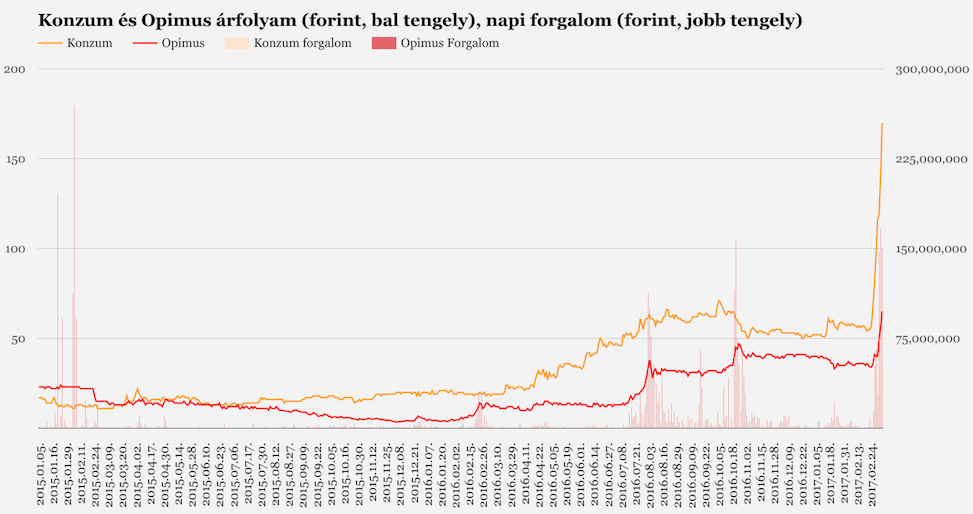
  • A Konzum részvényárfolyama 57 forint volt február 24-én, kedden 170 forinton volt már (+198 százalék)
  • Az Opimus részvényárfolyama 41 forint volt február 28-án, kedden 65 forinton volt már (+62 százalék)

Ha nem lenne limit a tőzsdén, ami miatt 20 százaléknál nem emelkedhet jobban az árfolyam, talán még magasabbra mentek volna az árfolyamok.

A Konzum tőzsdei kapitalizációja 1,19 milliád forintról nőtt 3,5 milliárdra, az Opimusé 12,6 milliárdról 20,7 milliárdra. Ha úgy tetszik, a két cég értéke pusztán attól nőtt tízmilliárd forinttal, hogy Mészáros Lőrinc bejelentette, tényleg övé a két cég.

Itt van néhány grafikon, ahol jobban látszik ez.

(Klikkre nagyobb lesz, forrás: BÉT)

(Különösen érdekes egyébként, hogy milyen kiemelkedő forgalomban kereskedtek az Opimus részvényeivel a Buda-Cash botrány kirobbanása előtt. A két offshore cég, akiktől Mészárosék a saját nevükre vették a részvénycsomagokat, a TAC Ltd. és a Cariati Ltd. már a botrány után lettek tulajdonosok, tőzsdén kívüli ügylettel került hozzájuk piaci vélemények szerint a Buda-Cash-es főnökök részvénycsomagja.)

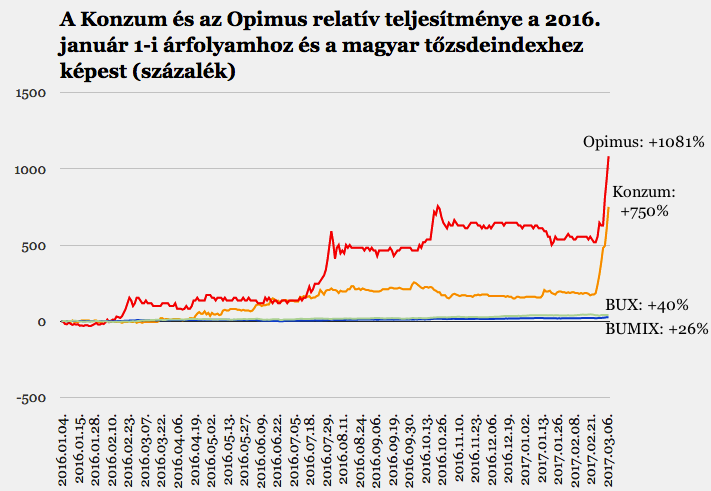
Még durvábban néz ki, ha a relatív teljesítményt nézünk. A pesti tőzsde egészen kiemelkedően teljesített tavaly, még a feltörekvő piaci között is egész jónak számító 40 százalékot emelkedtek a magyar részvények 2016 január 1. óta (főleg az OTP és a MOL, ez a két részvény adja a BUX kosár közel kétharmadát).

Nem rossz, de az Opimus 1081, a Konzum pedig 750 százalékot emelkedett ezen az időtávon,

ami olyan soha vissza nem térő szuperbefektetés, hogy csak na.

(Forrás: BÉT)

De azt is láthatjuk az ábrákból, hogy amikor alacsony volt az árfolyam, egyik részvénnyel sem kereskedtek sokat, sőt, rengeteg napon egyetlen kötés sem volt a tőzsdén, egészen ritkán érte el a napi forgalmuk értéke az egymilliót. Ez azt is jelenti, hogy nagyon kevesen szálltak be ezekbe a szuperrészvényekbe akkor, amikor az tényleg megérte.

Erről sajnos lecsúsztunk!

Totális hülyeség? Esélyes!

Ha valaki részvényt vásárol, pláne ilyen illikvid minipapírokat, és nem lottózásnak fogja fel, akkor érdemes megnézni néhány mutatót, amiből meg tudjuk állapítani, milyen helyzetben van a cég ahhoz képest, hogy a piacon mit fizetnek a részvényeiért.

Itt azonban máris problémákba ütközik a kisbefektető.

Egy részvényre jutó eredményt azért nem tudunk számítani, mert a két cég esetében csak egy részvényre jutó veszteség van. Az Opimus 2,2 milliárd (!) forintos, a Konzum 181 millió forintos veszteséget ért el 2015-ben, de tavaly is végig piros volt mindkét cég.

Az osztalékhozam nulla mindkét cég esetében, ilyet ugyanis nem fizettek ezek a cégek az utóbbi időben, veszteség után nyilván nem is lett volna túl okos dolog ez.

Ez persze nem jelenti azt, hogy ne érnének ezeket a cégek valamit, még ha veszteségesek is. Az Opimus egy komoly cégcsoport, a Buda-Cash csalás miatt lekapcsolt tulajdonosi köre itt vonta össze reálgazdasági érdekeltségeit.

Itt fontos hangsúlyozni, hogy a Buda-Cash vezetői a pénzügyi felügyelet és az ügyészség szerint elsikkasztottak több mint hatvan milliárd forintot, és joggal valószínűsíthetjük, hogy ebből építették fel a cégcsoportot – ami most átkerült Mészáros Lőrincék irányítása alá.

Egyébként egészen sötét módon került át a felcsúti vállalkozó érdekeltségébe a cég: éppen abban az időben jelent meg a cég környékén Csík Zoltán (Mészáros bizalmasa), amikor a Buda-Cash vezetőit kiengedték az előzetesből.

A korábbi, pénzügyileg egyébként nem túl jól menő, de értékes Opimus-érdekeltségek – Wamsler kazángyár, Euró-Generál építőipari cég, osztrák hotel, hatalmas békési agrárgazdaság – mellé már a Mészáros-irányította korszakban bekerült a Mediaworks nevű médiacég is. Ezt jókora kötvénykibocsátásból, azaz hitelből vették meg.

A Konzum már sokkal jelentéktelenebb cég, itt viszont hatalmas mozgolódás van, amióta megjelent a cégben Jászai Gellért. Nem sokkal később megvették a Hunguest szállodalánc nagy részét, 14 darab hotelt Leisztinger Tamástól, a Hunguest igazgatóságában pedig megjelentek Tiborcz István és Mészáros Lőrinc emberei. A tranzakcióban az állami Eximbank is részt vett egy nyolcvanmillió eurós hitelkerettel. A napokban már nemzetközi terjeszkedésről nyilatkozott az új tulajdonosi kör (egyébként az immár az Opimus tulajdonába tartozó Világgazdaságnak).

Mindenesetre nem könnyíti meg a helyzetet, hogy a brókercégek, akikkel beszéltünk, nem foglalkoznak ezzel a két céggel, nem is követik a teljesítményüket, nem adnak ki elemzéseket róluk. Igaz, azt hallottuk, hogy az utóbbi hetekben felerősödött a spekulánsok érdeklődése a Mészáros-részvények iránt.

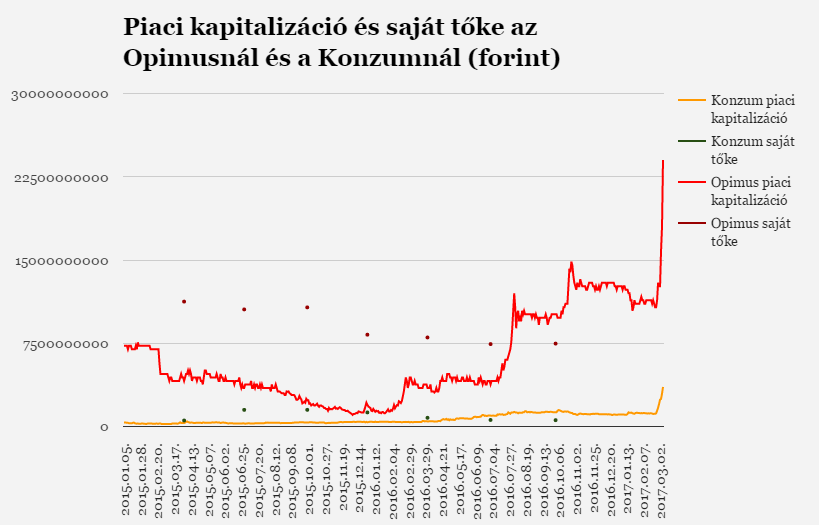
Ez az ábra talán jól mutatja, mennyire meg van őrülve a tőzsde:

(Forrás: Bét, negyedéves jelentések)

A pöttyök a cég saját tőkéjét jelölik negyedévente, a vonalak pedig a piaci kapitalizációt. Látható, hogy 2016 nyaráig szélsőségesen pesszimista volt a piac a cégekkel kapcsolatban, azóta viszont – miután megjelentek az első jelzések Mészárosék megjelenéséről – őrült optimista lett.

Az Opimus értékét a legutóbbi saját tőkéjének 3,2-szeresére, a Konzumét a legutóbbi saját tőkéjének 6,3-szorosára értékeli a piac jelenleg. Ehhez képest 2015 végén még fordítva állt a helyzet, akkor még a cégek saját tőkéje volt sokkal nagyobb piaci kapitalizációjuknál (az Opimus esetében 4,2-szer, a Konzumnál 3,2-szer).

A másik irány, ahonnan közelíteni lehet a cégekhez, hogy milyen jövőbeli eredményességet lehet várni tőlük. Ez az utolsó racionális szalmaszál, amibe kapaszkodhatnak azok, akik a mostani árfolyamon megveszik ezeket a részvényeket.

Érdekes, hogy hiába döbbenetesen sikeresek Mészáros cégei, a BÉT (illetve a BÉT megbízásából a Figyelő és a KPMG) egyiket sem válogatta be az ötven cég közé, amelyek a hosszú távú eredményesség szempontjából vonzó tőzsdei sztorik lehetnének. Még a hatalmas profitgyár építőipari cégeit, a Mészáros és Mészáros vagy az R-Kord Kft-t sem, pedig ezeknek a milliárdos osztalékaiból biztosan sokan részesednének szívesen ebben az országban.

A legvalószínűbb az, hogy néhány lelkes ember elhitte, hogy az Orbán Viktor körüli strómanbirodalom bármit is meg akar osztani mással abból a hihetetlen mennyiségű pénzből, amit eddig csak a saját bankszámláira vitt-utalt ki.

De ez egy elég naiv elképzelés. Miért akarnák ezek az emberek bárkivel megosztani a nyereségüket? Vagy transzparenssé tenni a cégeiket? Elhiszi ezt bárki? Főleg azért, mert a Mészáros-érdekkörnek nincs szüksége befektetőtársakra.

Mészároséknak forrásra nincs nagy szükségük. Ha kell, kibocsátanak egy zárt kötvényt hatmilliárd forint értékben, hogy megvegyék a Mediaworksöt, ha pedig arról van szó, akkor mondjuk Csányi Sándor ad nekik annyi hitelt, amennyi csak kell. Tőke se kell, hiszen az a töménytelen mennyiségű osztalék, ami a Mészáros-Szíjj-stb. építőipari cégekből kikerül, bőven elég bármelyik tervük elindításához.

Az egyik legszórakoztatóbb jelenség egyébként, hogy a tőzsde páriákat tömörítő T kategóriájában található hírhedt minirészvények, például a Futuraqua, a Nutex, az Őrmester vagy a Nordtelekom, szintén felültek a Mészáros Lőrinc kisvonatra, ma mind limittel emelkedtek csekély forgalomban. Úgy tűnik néhány zavarosban halászó spekuláns ezekben is fantáziát lát ezekben az őrült időkben.

07 Feb 14:48

Sous vide Kickstarter success Anova gets bought for $250 million by Electrolux

by Chaim Gartenberg

Anova Culinary announced on Sunday that it had finalized a $250 million dollar deal to be acquired by Electrolux, one of the world’s biggest appliance manufacturers. As part of the deal, Anova will keep its own branding and remain under the leadership of current CEO and co-founder Stephen Svajian as a division within Electrolux.

Anova is one of the biggest names in town when it comes to sous vide cooking

Anova is one of the biggest names in town when it comes to sous vide cooking, a trendy method of preparing food by placing it inside vacuum-sealed bags and slowly cooking it in a temperature-controlled water bath. Anova originally launched the first version of its water circulator back in 2013, as one of the first immersion circulators...

Continue reading…

19 Jan 08:17

Palmer Luckey defends the early days of Oculus in VR trade secrets trial

by Nick Statt

Palmer Luckey became tech industry royalty at age 21, when he sold his burgeoning virtual reality company Oculus VR to Facebook in 2014 for $2 billion. That fateful decision, while a milestone for virtual reality, is now causing headaches for Luckey, Facebook, and others at the core of a contentious legal battle over the origins of the modern VR movement. Luckey took the stand today in Dallas to testify in the trial alleging he helped Oculus steal trade secrets and violate copyrights owned by ZeniMax Media, the parent company of video game developer id Software.

Luckey says he did not take confidential code

At the center of the dispute is John Carmack, a legendary programmer and video game creator behind id Software titles Doom and Q...

Continue reading…

05 Jan 13:09

Intel gave us barf bags for its CES VR keynote

by Adi Robertson

One of virtual reality’s biggest problems is its tendency to make people nauseous. So what was Intel to do when it hosted its 2017 CES press conference partly in VR? Apparently, make a tongue-in-cheek plan for the worst possible outcome. When attendees of today’s keynote arrived, they were directed to comfortable chairs with a black table, an Oculus Rift, a laptop... and a paper bag.

Intel probably wasn’t literally expecting anyone to throw up during the keynote. (I’ve never gotten to that point, and I haven’t seen anyone else get there either, even during some truly excruciating experiences.) But we did get a long speech beforehand about what to do if we felt sick in our VR headset, which mostly amounted to a very nice version of “take...

Continue reading…

05 Jan 13:08

Nvidia is working with Audi to get you a self-driving car by 2020

by Rich McCormick

Nvidia might be most famous as a manufacturer of computer graphics cards, but the company has been increasingly turning its attention to the automotive market over the past few years. This CES, it detailed new moves that will move it even further into the market: partnerships with suppliers ZF and Bosch that will see it making parts for automatic cars, and an expanded deal with Audi that will see the companies bring a proper self-driving vehicle to market by 2020.

Audi and Nvidia have worked together before, but the new partnership, announced by Nvidia CEO Jen-Hsun Huang on stage at CES 2017, will see the companies working to produce a “Level 4” automatic vehicle — that means a car capable of driving entirely on its own. As an early...

Continue reading…

23 Dec 16:21

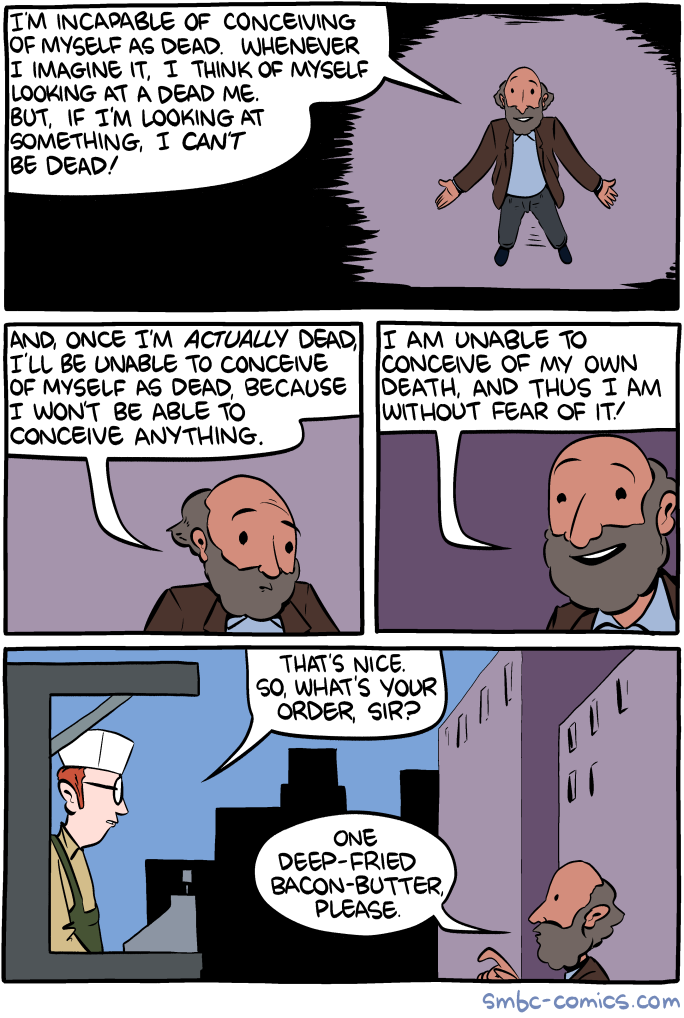
Saturday Morning Breakfast Cereal - The Denial of Death

by tech@thehiveworks.com


Click here to go see the bonus panel!

Hovertext:
I will never understand why existentialists eat salad.

New comic!
Today's News:
23 Dec 15:30

Mark Zuckerberg's presentation of his Jarvis AI is more robotic than the house itself

by Chaim Gartenberg

Coming off the heels of yesterday's post detailing a project to build his own home AI, Mark Zuckerberg is back today with a goofy proof-of-concept video showing off an idealized version of how his Jarvis system actually works.

After a year of coding, here's Jarvis.

Posted by Mark Zuckerberg on Tuesday, December 20, 2016

The video showcases some of the actual tasks that Jarvis can theoretically perform, but the whole thing comes off as a fancy version of Amazon Echo, albeit with a healthy dose of Morgan Freeman (who provides Jarvis's voice). As yesterday’s FastCo report shows, the system isn't quite as functional as the video portrays, but it's still an interesting look into the Zuckerberg's robot assistant, even if it's a far cry...

Continue reading…

23 Dec 15:28

The messed-up Mummy trailer is mutating faster than Universal Pictures can keep up

by Sean O'Kane

We live in an age of reboots and cinematic universes. And yet I had no idea that Hollywood was rebooting The Mummy until this morning, when the IMAX YouTube channel uploaded a Mummy trailer in which the sound was hilariously butchered. It was a pretty fantastic goof.

Instead of riding the gift of a spontaneous publicity wave for an unnecessary reboot, Universal Pictures is now doing The Dumb Thing and issuing DMCA takedown notices to stop the trailer from spreading. But the folks at Universal Pictures are forgetting one of the most beautiful and terrifying things about the internet: you can’t stop it, you can only hope to contain it.

Almost everything on the internet is a moving target

They’re also forgetting that almost everything on...

Continue reading…

23 Dec 15:07

Google cut its 2015 tax bill by $3.6 billion using the infamous Dutch Sandwich loophole

by Nick Statt

Google was able to shave $3.6 billion from its 2015 tax bill by relying on an elaborate system of loopholes known as the “Double Irish" and Dutch Sandwich,” according to a report from Bloomberg today. The loopholes — infamous among US corporations — effectively allow companies as large and profitable as Google to shuffle profits through subsidiaries in low-tax countries like the Netherlands and Ireland, and then onward to tax havens like Bermuda and the Cayman Islands. In this case, Google moved $15.5 billion worth of euros to a Bermuda shell company, cutting its tax rate outside the US to 6.9 percent last year, according to regulatory filings in the Netherlands that were obtained by Bloomberg.

The structure of the Double Irish and Dutch...

Continue reading…