
ACS Sustainable Chemistry & Engineering
DOI: 10.1021/acssuschemeng.5c03477

 Open Access
   This article is licensed under a Creative Commons Attribution 3.0 Unported Licence.

If every country's airspace extended up forever, which country would own the largest percentage of the galaxy at any given time?
Reuven Lazarus
Today's question is adapted from What If 2: Additional Serious Scientific Answers to Absurd Hypothetical Questions, which contains many more What If answers and is available now!
Congratulations to Australia, new rulers of the galaxy.
The Australian flag has a number of symbols on it, including five stars that represent the stars of the Southern Cross.[1] Based on the answer to this question, maybe their flag designers should think bigger.

Countries in the southern hemisphere have an advantage when it comes to star ownership. Earth's axis is tilted relative to the Milky Way; our North Pole points generally away from the galaxy's center.

If each country's airspace extended upward forever, the core of the galaxy would stay under the control of countries in the southern hemisphere, changing hands over the course of each day as the Earth rotates.
At its peak, Australia would control more stars than any other country. The supermassive black hole at the core of the galaxy would enter Australian airspace every day south of Brisbane, near the small town of Broadwater.

After about an hour, almost the entire galactic core—along with a substantial chunk of the disk—would be within Australian jurisdiction.

At various times throughout the day, the galactic core would pass through the domain of South Africa, Lesotho, Brazil, Argentina, and Chile. The United States, Europe, and most of Asia would have to be content with outer sections of the galactic disk.
The northern hemisphere isn't left with the dregs, though. The outer galactic disk has some cool things in it—like Cygnus X-1, a black hole currently devouring a supergiant star.[2] Each day, as the core of the galaxy crossed the Pacific, Cygnus X-1 would enter the United States's airspace over North Carolina.

While owning a black hole would be cool, the United States would also have millions of planetary systems constantly moving in and out of its territory—which might cause some problems.
The star 47 Ursae Majoris has at least three planets and probably more. If any of those planets have life on them, then once a day all that life passes through the United States. That means that there's a period of a few minutes each day where any murders on those planets technically happen in New Jersey.
Luckily for the New Jersey court system, altitudes above about 12 miles are generally considered "high seas." According to the American Bar Association's Winter 2012 issue of the Admiralty and Maritime Law Committee Newsletter, this means that deaths above these altitudes—even deaths in space—are arguably covered by the 1920 Death on the High Seas Act, or DOHSA.
But if any aliens on 47 Ursae Majoris are considering bringing a lawsuit in a US court under DOHSA, they're going to be disappointed. DOHSA has a statute of limitations of 3 years, but 47 Ursae Majoris is more than 40 light-years away...

...which means it's physically impossible for them to file charges in time.
[1] Epsilon Crucis has five points, while the others have seven, implying that the view of Epsilon is from a telescope with different lens geometry from the others. Minor symbolic/graphic design choice? Or clue to a secret multiversal alliance between parallel universe Australias? No way to know for sure!
[2] Cygnus X-1 was the subject of a famous bet between astrophysicists Stephen Hawking and Kip Thorne over whether it was a black hole or not. Hawking, who had spent much of his career studying black holes, bet that it wasn't. He figured that if black holes turned out not to exist, at least he would win the bet as a consolation prize. In the end, luckily for his legacy, he lost.


We present herein an unprecedented, catalytic enantioconvergent diamination of racemic allylic alcohols with the construction of two C−N bonds and 1,3-nonadjacent stereocenters. This iridium/chiral phosphoric acid cooperative catalytic system operates through an atom-economical borrowing hydrogen amination/aza-Michael cascade, and converts readily available phenylenediamines and racemic allylic alcohols to 1,5-tetrahydrobenzodiazepines in high enantioselectivity. An intriguing solvent-dependent switch of diastereoselectivity was also observed.
We present herein a catalytic enantioconvergent diamination of racemic allylic alcohols with the construction of two C−N bonds and 1,3-nonadjacent stereocenters. This iridium/chiral phosphoric acid cooperative catalytic system operates through an atom-economical borrowing hydrogen amination/aza-Michael cascade, and converts readily available phenylenediamines and racemic allylic alcohols to 1,5-tetrahydrobenzodiazepines in high enantioselectivity. An intriguing solvent-dependent switch of diastereoselectivity was also observed. Mechanistic studies suggested a dynamic kinetic resolution process involving racemization through a reversible Michael addition, making the last step of asymmetric imine reduction the enantiodetermining step of this cascade process.
Abstract
Hydrazones are important structural motifs in organic synthesis, providing a useful molecular platform for the construction of valuable compounds. Electrooxidative transformations of hydrazones constitute an attractive opportunity to take advantage of the versatility of these reagents. By directly harnessing the electrical current to perform the oxidative process, a large panel of organic molecules can be accessed from readily available hydrazones under mild, safe and oxidant-free reaction conditions. This review presents a comprehensive overview of oxidative electrosynthetic transformations of hydrazones. It includes the construction of azacycles, the C(sp2)−H functionalization of aldehyde-derived hydrazones and the access to diazo compounds as either synthetic intermediates or products. A special attention is paid to the reaction mechanism with the aim to encourage further development in this field.
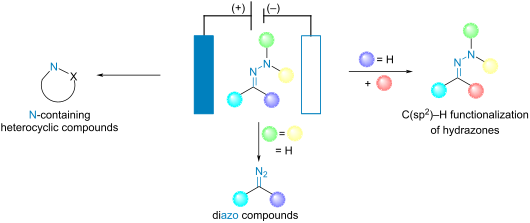
Beilstein J. Org. Chem. 2024, 20, 1988–2004. doi:10.3762/bjoc.20.175
Abstract
The utility of bio-isosteres is broad in drug discovery and methodology herein enables the preparation of deuterium-labeled products is the most fundamental of known bio-isosteric replacements. As such we report the use of both [D1]-aldehydes and [D2]-isonitriles across 8 multicomponent reactions (MCRs) to give diverse arrays of deuterated products. A highlight is the synthesis of several FDA-approved calcium channel blockers, selectively deuterated at a t1/2 limiting metabolic soft-spot via use of [D1]-aldehydes. Surrogate pharmacokinetic analyses of microsomal stability confirm prolongation of t1/2 of the new deuterated analogs. We also report the first preparation of [D2]-isonitriles from [D3]-formamides via a modified Leuckart–Wallach reaction and their use in an MCR to afford products with [D2]-benzylic positions and likely significantly enhanced metabolic stability, a key parameter for property-based design efforts.
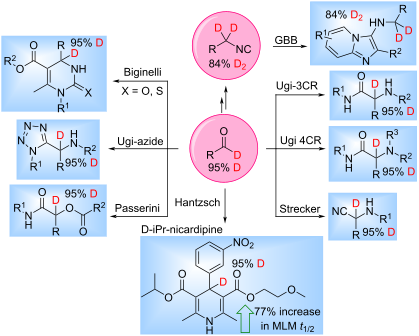
Beilstein J. Org. Chem. 2024, 20, 2270–2279. doi:10.3762/bjoc.20.195
Open Access  This article is licensed under a Creative Commons Attribution 3.0 Unported Licence.

