Shared posts

18 Jul 15:35

The Failure of Racial Profiling

by Lisa Wade, PhD

Jay Livingston at Montclair SocioBlog discussed the two figures below (full report here).  The first shows that Black and Hispanic drivers are more likely to be stopped by Los Angeles Police than White drivers.  The second shows that, when stopped, if searched, police are more likely to find weapons and drugs on Whites than on either Blacks or Hispanics.  Conclusion: Blacks and Hispanics are being racially profiled by the L.A.P.D. and racial profiling does not work.  Data from New York City in 2008 tells a similar story.

The New York Civil Liberties Union reports that the NYPD stopped 161,000 people in the first quarter of 2011. A record number.  Eighty-four percent of those stopped were Black or Latino.  The Civil Liberties Union has filed a lawsuit, claiming that the practice is unconstitutional.

Originally posted in 2011. Re-posted in solidarity with the African American community; regardless of the truth of the Martin/Zimmerman confrontation, it’s hard not to interpret the finding of not-guilty as anything but a continuance of the criminal justice system’s failure to ensure justice for young Black men.

Lisa Wade is a professor of sociology at Occidental College. You can follow her on Twitter and Facebook.

(View original at http://thesocietypages.org/socimages)

18 Jul 15:34

What Happens When You Teach Parents to Parent?

by Freakonomics

A new working paper (abstractPDF) by Paul Gertler, James Heckman, and several other co-authors examines the impressive long-term effects of a Jamaican program that taught low-income parents better parenting skills.  Here’s the abstract:

We find large effects on the earnings of participants from a randomized intervention that gave psychosocial stimulation to stunted Jamaican toddlers living in poverty. The intervention consisted of one-hour weekly visits from community Jamaican health workers over a 2-year period that taught parenting skills and encouraged mothers to interact and play with their children in ways that would develop their children’s cognitive and personality skills. We re-interviewed the study participants 20 years after the intervention. Stimulation increased the average earnings of participants by 42 percent. Treatment group earnings caught up to the earnings of a matched non-stunted comparison group. These findings show that psychosocial stimulation early in childhood in disadvantaged settings can have substantial effects on labor market outcomes and reduce later life inequality.

The program worked through three primary channels: it “increased maternal investment in children during the intervention period,” positively affected “schooling, cognitive development, and psychosocial development,” and increased the likelihood of participant migration to the U.S. or U.K. where participants could “gain[ed] access to higher quality schools and better labor markets.”  The authors also pointed out that the effects of the Jamaican program were substantially larger than the documented effects of U.S. programs such as Perry Preschool and Head Start.

18 Jul 13:37

Too many recent Japanese loanwords in English?

by Victor Mair

In "Chinese loans in English" and in "Too many English loanwords in Japanese?" we examined the propositions that Chinese borrowings into English in recent times have been very few, while English borrowings into Chinese and Japanese have been relatively numerous.  Some commenters even made the assertion that the age of borrowing is past.

In this post, I would like to suggest that — unlike Chinese, and contrary to those who believe that the age of borrowing is largely over — there has been a substantial amount of borrowing from Japanese into English going on in recent decades.  As to why this is happening in the Japanese case, but not in the Chinese case, and why there are numerous borrowings from English into Chinese and Japanese, and into many other languages as well, these are questions that might be good to take up in the comments to this post.

As a reference point, this Wikipedia article seems to offer a pretty good list of new and old Japanese borrowings into English.  See also this article in Japanese.

For our present purposes, I will consider only those terms that are fairly recent, say within the last 30 years or so.  I have not checked exact dates of borrowing, so some of these terms may have entered English more than 30 years ago, but my impression is that — for the most part — they do not go back half a century or more.  A few of the words may initially have come into English as much as a century or more ago, then lain submerged for decades, but have been revivified in recent decades.  Still, I avoid words like "yakuza", "judo", and "karate", which, though known to most Americans nowadays, I suspect of having been introduced more than half a century ago.

The Japanese terms are given in their usual American newspaper spelling, not in their proper romanization as pronounced in Japanese.

Here (below) are just a few common words that come to mind and that I personally know without having to look them up in any sort of reference work.  I believe that most literate, cultured Americans also know these words, and that they are familiar to large segments of the American population in general.  I could mention dozens of other Japanese words that are known mainly only to certain groups of Americans (e.g., chemists, biologists, physicists, etc.), but will refrain from doing so to avoid needless bloating of the list.

Note that I do not include in this list the very large numbers of new English words coined by Japanese that have worldwide circulation, words such as "walkman", "discman", "camcorder", "Betamax", "VHS", "Betacam", "Triniton Picture Tube", "Sony", "HDTV" (dating to the mid-1960s in Japan)", "Mini Disc" (abbrev. "MD"), "Pac-Man" (wildly popular when my son was in his teens), Hello Kitty (I have one hanging from the window of my office, and a colleague at Academia Sinica in Taiwan has hundreds in his office), and so forth.

I do include Japanese brand and product names, since they have become household words that are known to Americans of all classes and walks of life.

Here goes, in no particular order, though many of the words do fall into rough groups or categories (forgive me for unintentional duplicates):

  • anime
  • manga
  • karaoke
  • shiatsu
  • tsunami (probably older, but very much in the news in recent years)
  • sudoku (almost as prevalent on trains and planes at crossword puzzles, perhaps more so nowadays)
  • shiba inu
  • kudzu
  • teppanyaki
  • a(d)zuki bean
  • mikan (orange)
  • nashi (type of pear)
  • natto (slimy, sticky, stinky, fermented soybeans)
  • bento
  • ramen
  • sushi
  • sashimi
  • wasabi (could be older, but it's so popular in restaurants and at sushi / sashimi stands that I couldn't resist entering it here)
  • edamame
  • konbucha
  • Datsun
  • Honda
  • Isuzu
  • Kawasaki
  • Mazda
  • Mitsubishi
  • Nissan
  • Subaru
  • Suzuki
  • Toyota
  • Yamaha
  • Minolta
  • Nikon
  • Olympus
  • Seiko
  • Canon
  • Casio
  • Fujitsu
  • JVC
  • NEC
  • Panasonic
  • SEGA
  • Sony
  • Sharp
  • Toshiba
  • Yamaha (again)
  • Aiwa
  • Citizen
  • Daihatsu
  • Fuji
  • Hitachi
  • Konica
  • Matsushita
  • Maxell
  • National
  • Pioneer
  • Ricoh
  • Sanyo
  • TDK
  • Victor
  • Yashica
  • YKK
  • VAIO
  • Uniqlo
  • Bandai  (maker of monster toys like Diakron, marketed in the USA by Hasbro as "Transformer")
  • Pokémon
  • MITI (Ministry of International Trade and Industry)
  • Minamata disease
  • Yukawa particle
  • Kikuchi lines

Of course, everybody knows Nintendo, and they may think that "Atari" (Japanese for "a hit") is also a Japanese name, but it was actually coined by an American, Nolan Bushnell.

Naturally, there are numerous military and martial arts terms that are current in English, but I think that most of them go back to WWII, if not earlier, so I do not list them here.

Readers may also find this article by Margaret Pine OTAKE to be of interest:  "English Loanwords from Japanese:  A Survey of the Perceptions of American English Speakers" (PDF, esp. Table 1).

On the other side, i.e., E > J loanwords, this has always intrigued me greatly: a list of recent loanwords deemed important but not well understood by the National Institute for Japanese Language and Linguistics may be found here.  Click on a word to get its proposed Japanese translation, explanation, and degree of popular comprehension. For example, clicking ākaibu アーカイブ ("archive") reveals hozon kiroku 保存記録 ("conserved / saved records").

The quantity of English borrowings in Japanese is almost endless.  Sometimes I feel that virtually ANY English word can, upon occasion, be called upon for use in Japanese.  For example, here are just a few of the English words that Cecilia Segawa Seigle noticed in her reading of this morning's newspaper:

gurōbaru (global); kūru bejitaburu (cool vegetable); randamu dejitto daiyaringu (random digit dialing); reshipi shirīzu (recipe series); hōmu pēji (home page); manyuaru (manual); webbusaito (website); anaunsā (announcer); pasokon (personal computer); sutōkā (stalker); shinku tanku (think-tank); kīpāson (key person); pawāappu (power up); pātonāshippu (partnership); sumūzu (smooth); kappuru (couple; married couple, etc); haiburiddo (hybrid); daietto (diet — for food); terebi (television)

To show the extent to which such borrowings of English may go in Japanese, I once saw the following sign on the side of a truck in Kyoto:

Matsumoto   hausu   kurīningu   sābisu

マツモト  ハウス      クリーニング  サービス

I figured out immediately what it meant:  "Matsumoto House Cleaning Service".  But I was perplexed that the entire sign was written in katakana and that, aside from the surname of the proprietor (the surname might have been written in kanji as 松本 [I can't remember clearly, though I have often seen Japanese surnames written in kana]), the other words were all katakanized English!  Surely, I thought, they must be able to say "house", "cleaning", and "service" using Japanese words.

For "cleaning service", I suppose one could say something like seisō-gyō 清掃業, but that would make it sound "traditional", not "modern" like hausu kurīningu sābisu ハウス   クリーニング   サービス.  The latter is THE standard way to say "house cleaning service", and even Google Translate yields that.

In Japan, dry cleaners are customarily called kurīningu-ya クリーニング屋

As Nathan Hopson puts it:

I have told my Japanese students a million times: goods/services = katakana

That's why shirts in catalogs are burū ブルー ("blue") and reddo レッド ("red"), not ao 青 ("blue") and aka 赤 ("red").  How gauche!  What a faux pas!  The latter two terms sound so old, stuffy, and uncool!

In "Too many English loanwords in Japanese", I had suggested that "Japanese students learning English have a foot up at the start, since they already know thousands of English borrowings in their own language".  Jim Breen agrees that this is generally true, but with a few caveats:

  • the pronunciations are often mangled by the katakanaization, and if the learner can't adapt, the results are unintelligible;
  • quite often a loanword takes on a nuance which is quite missing from the original. For example, a feminisuto フェミニスト (from "feminist") is usually a male who does things like being polite to women;
  • there are masses of Wasei eigo 和製英語 ("Japanese-made English"), often concocted from fragments of loanwords. All too often a learner will trot them out under the illusion that they are real English words;
  • then there are the loanwords that are not from English. Saying "randoseru" in English won't get you far (it's from the Dutch "ransel".) Most Japanese (just like most English speakers) are happily unaware of etymology.

In response to the question "Too many English loanwords in Japanese?", another reader asked:  "How many are too many?  I mean, numerically."  To which I would reply that I don't think there can ever be any such thing as "too many loanwords."  The speakers of a language borrow as many words from other languages as they think are necessary and useful.  Loanwords enrich and empower a language, even though they may amount to 60% or more of the vocabulary of that language.

[Thanks to Bill Hannas, Linda Chance, Jim Unger, Frank Chance, Nathan Hopson, and Miki Morita]

18 Jul 13:00

Building a home is as vital as zombie headshots in State of Decay

18 Jul 13:00

$25 gadget lets hackers seize control of a car - tech - 17 July 2013 - New

18 Jul 13:00

Viewpoint: Employees Should Get Unlimited Vacation | TIME.com

18 Jul 13:00

How to talk a computer into creating a program for you - tech - 16 July 201

17 Jul 18:42

$25 gadget lets hackers seize control of a car

After journalist Michael Hastings's death, there were rumours that his car had been hacked. Now two researchers say they can do it for real


17 Jul 18:42

Go-carting babies reveal origin of fear of heights

Surprisingly, fear of heights is not innate but kicks in after we begin to crawl, when we notice stuff in our peripheral vision and use it to balance


17 Jul 18:17

What You Need to Know About Getting Magnetic Finger Implants

by George Dvorsky

What You Need to Know About Getting Magnetic Finger Implants

Not content with the mere five senses that nature gave them, an increasing number of biohackers have turned to magnetic finger implants. But the practice of sensory augmentation need not be confined to these pioneers. Here’s why you should consider getting magnetic implants — and how to do it.

Read more...


17 Jul 13:53

Racial Bias in Presidential Pardons

by Lisa Wade, PhD

In analysis of Presidential pardons during the George W. Bush administration, ProPublica has found that whites were four times as likely as non-whites to be granted a pardon.  Pardons were granted to 12% of whites, 10% of Hispanics and Asians, and zero percent of Blacks and Native Americans. The disparity remained even when investigators controlled for type of crime.

ProPublica explains:

…President George W. Bush decided at the beginning of his first term to rely almost entirely on the recommendations made by career lawyers in the Office of the Pardon Attorney.

The office was given wide latitude to apply subjective standards, including judgments about the “attitude” and the marital and financial stability of applicants…

Bush followed the recommendations of the pardons office in nearly every case… President Obama — who has pardoned 22 people, two of them minorities — has continued the practice of relying on the pardons office.

Sometimes disparate decisions in pardon cases were eyebrow raising:

An African American woman from Little Rock, fined $3,000 for underreporting her income in 1989, was denied a pardon; a white woman from the same city who faked multiple tax returns to collect more than $25,000 in refunds got one. A black, first-time drug offender — a Vietnam veteran who got probation in South Carolina for possessing 1.1 grams of crack – was turned down. A white, fourth-time drug offender who did prison time for selling 1,050 grams of methamphetamine was pardoned.

ProPublica traces the disparity to age, leniency given to people who are seen as “upstanding” members of society (e.g., they’re married, have little debt), the influence of money and politics (letters from Congresspersons and donations to lawmakers by convicts’ spouses), and simple prejudice.  Nevertheless:

When the effects of those factors and others were controlled using statistical methods, however, race emerged as one of the strongest predictors of a pardon.

Originally posted in 2012. Re-posted in solidarity with the African American community; regardless of the truth of the Martin/Zimmerman confrontation, it’s hard not to interpret the finding of not-guilty as anything but a continuance of the criminal justice system’s failure to ensure justice for young Black men.

Lisa Wade is a professor of sociology at Occidental College. You can follow her on Twitter and Facebook.

(View original at http://thesocietypages.org/socimages)

16 Jul 14:45

Obesity gene makes you fat by keeping you hungry - health - 15 July 2013 -

16 Jul 14:45

The Sequester's Devastating Impact on America's Poor - Nancy Cook - The Atl

16 Jul 14:14

CodeSOD: PHP Doesn't Have Date Functions Either

by Dan Adams-Jacobson

We recently brought you the touching story of Shaun, and his coworker's mistaken belief that Perl has no built-in methods for working with dates. Well, Shaun can rest easy: he's not alone.

Apparently, PHP can't handle dates either.

Whether you're Shaun or Chris M, working for an email-marketing company whose clients needed some tweaks to their software integration, inheriting a codebase is always the same: like inheriting a teetering cliffside mansion from your eccentric grand-uncle, the hair on the nape of your neck seems to tickle as you reach for the doorknob. Something primordial reaching up into your consciousness, warning you. But you always go in, despite the horror doubtlessly lurking inside... Chris had just finished recovering from exposure to a custom, PHP-delimited file importer when he received his new inheritance from a fellow consultant. Among the first things Chris learned from inspecing the code was that, if you abuse a database long enough, you can force it to reveal the next 31 days.

First, insert dates into a database table:

INSERT IGNORE INTO Dates (Dates) VALUES
(DATE_ADD(CURDATE(), INTERVAL+1 DAY));
;

INSERT IGNORE INTO Dates (Dates) VALUES
(DATE_ADD(CURDATE(), INTERVAL+2 DAY));
;

INSERT IGNORE INTO Dates (Dates) VALUES
(DATE_ADD(CURDATE(), INTERVAL+3 DAY));
;

...<snip>...

INSERT IGNORE INTO Dates (Dates) VALUES
(DATE_ADD(CURDATE(), INTERVAL+32 DAY));
;

Then, select the next 31 days and their difference from the current date, so we can iterate over them back in PHP Land - a benighted, backwards place where not a single tool to manipulate a date has ever been even theorized.

$sql=<<<SQL
SELECT Dates, DATEDIFF(Dates, CURDATE()) AS `datediff` 
FROM Dates 
WHERE DATEDIFF(Dates, CURDATE()) < 32 AND DATEDIFF(Dates, CURDATE()) > -1 ; 
SQL; 

$result = $db->query($sql);

while ($row = $result->fetch()) {
    ...<snip>...
}

His mind left fragile by its tango with the previous PHP perversion, Chris pulled a colleague in to make sure the above wasn't some sort of hallucination. The other developer offered that perhaps the code's author had understood SQL better than PHP. While Chris appreciated the effort, the thirty-two INSERTs into the same field in the same table made that justification seem unlikely. But it did make him feel better enough to replace the lot with this, leaving the poor database to nurse its wounds in peace:

for ($i = 0; $i <= 31; $i++) {
    $date = date('Y-m-d', strtotime("+$i days"));
    ...<snip>...
}

Remember, developers: before you reach for the Swiss Army knife of your nearest database, do poor Chris and Shaun a favour and consider that your programming language of choice just might be able to do things with dates all by itself.

[Advertisement] Make your team a DevOps team with BuildMaster. Pairing an easy-to-use web UI with a free base platform, BuildMaster gets you started in minutes. See how Allrecipes.com and others use BuildMaster to automate their software delivery.

16 Jul 14:12

Has the U.S. Reached “Peak Motorization”?

by Stephen J. Dubner

(Photo: Heath Alseike)

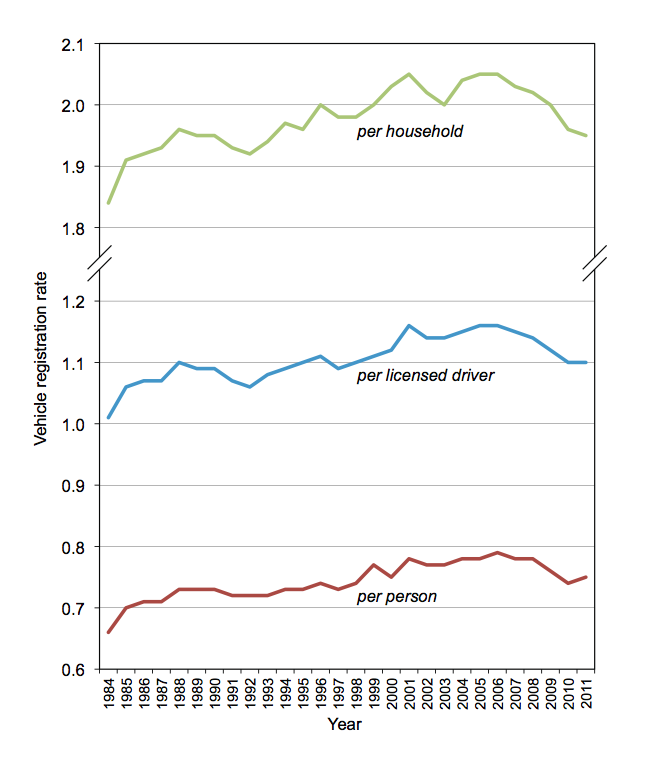
Peak oil? Probably not. But have we reached “peak motorization” in the U.S.?

Michael Sivak of the University of Michigan’s Transportation Research Institute says the answer is quite possibly yes:

The absolute number of vehicles reached a maximum in 2008. However, it is likely that this was only a temporary maximum and that the decline after 2008 was primarily driven by the current economic downturn that started in 2008. Consequently, with the improving economy and the expected increase in the U.S. population, it is highly likely that (from a long-term perspective) the absolute number of vehicles has not yet peaked. On the other hand, the rates of vehicles per person, licensed driver, and household reached their maxima prior to the onset of the current economic downturn. Consequently, it is likely that the declines in these rates prior to the current economic downturn (i.e., prior to 2008) reflect other societal changes that influence the need for vehicles (e.g., increases in telecommuting and in the use of public transportation). Therefore, the recent maxima in these rates have better chances of being long-term peaks as well.

But Sivak is smart enough to hedge his prediction:

However, because the changes in the rates from 2008 on likely reflect both the relevant societal changes and the current economic downturn, whether the recent maxima in the rates will represent long-term peaks as well will be influenced by the extent to which the relevant societal changes turn out to be permanent.

There is a lot of worthwhile data in his new paper but if you are going to look at just one data picture, this is it:

Sivak has written many, many other interesting papers about U.S. transportation. Related: interesting Times article by Matt Flegenheimer about (NYC Mayor) Mike Bloomberg‘s efforts to fund and institute smart traffic ideas all over the world. I have to say, it is a nice thing to be a New Yorker these days and travel around the world now and then — because people always ask about this magical mayor with the good ideas who actually has the ability and courage to try them out. I have come to think of New York as the world’s biggest laboratory for forward-looking social improvements, and Bloomberg as the crafty scientist who’s running the shop. (You may think of him as simply a billionaire mayor with a Wall Street background, but in his youth he was an Eagle Scout and full-fledged science nerd.)

16 Jul 13:06

123. ERICA GOLDSON: Graduation speech

by Gav

123. ERICA GOLDSON: Graduation speech

This is part of the speech Erica Goldson, the 2010 Valedictorian of Coxsackie-Athens High School, gave at her graduation ceremony.
The speech was uploaded on YouTube, went viral and Erica became known as the ‘Valedictorian who spoke out against schooling’. You can watch the entire speech and read the transcript here.

Erica’s speech really struck a nerve with me because I was totally like her when I was in school. I always did what I was told, didn’t ask too many questions, mindlessly memorised then regurgitated facts and figures. I remember I would write out an entire essay for homework, memorise the whole thing, then write it down verbatim on test day … and then promptly forget it and move on to the next assignment. I graduated near the top of my class, but on hindsight, I’m not sure I learnt much. The pattern continued as I went on to university, even though I never really wanted to be a graphic designer. But the piece of paper I received at the end did help me land a job, so it was all worth it in the end right? Maybe if I had heard this speech back in high school, I would have realised I was stuck in the system and gone down a different path.

One positive thing I do remember about school is that I doodled on EVERYTHING – my textbooks, files, folders, desk, arms, legs,
pencil case and all of my friend’s stuff as well (mainly pictures of Batman, sometimes Wolverine, the occasional Ninja Turtle). If only I spent MORE time doodling and less time being a robot.

Related comics: 11 Ways to be Average. The Road Not Taken.

- Thanks to Jesse for submitting this.
- Check out this in-depth article about myself and the growth of Zen Pencils by viral media expert Jonathan Goodman. It’s especially relevant if you’re interested in starting your own website, blog or webcomic.

15 Jul 17:48

Who Would You Shoot?

by Guest Blogger Lauren McGuire

In 2002, a study by Joshua Correll and colleagues, called The Police Officer’s Dilemma, was published. In the study, researchers reported that they presented photos of black and white men holding either a gun or a non-threatening object (like a wallet) in a video game style setting.  Participants were asked to make a rapid decision to “shoot” or “don’t shoot” each of the men based on whether the target was armed.

They found that people hesitated longer to shoot an armed white target (and they were more likely to accidentally not shoot). Participants were quicker and more accurate with black armed targets but there were more “false alarms” (shooting them when they were unarmed). These effects were present even though participants did not hold any explicit discriminatory views and wanted to treat all targets fairly.

The effect we see here is a subconscious but measurable preference to give white men the benefit of the doubt in these ambiguous situations. Decision times can vary by a fraction of a second, but that fraction can mean life or death for the person on the other end of the gun.

A terrible reminder of this bias was brought back into the headlines on March 2nd when a black student in Gainesville Florida was shot in the face with a rifle by a police officer. The conditions surrounding the shooting are murky, as the police are extremely hesitant to release details.

It appears that Kofi Adu-Brempong, an international graduate student and teacher’s assistant, was in a stress-induced panic and was worried about his student visa. On the day of the incident, his neighbors heard yelling in his apartment and called the police. It has been suggested that he may have suffered from some mental health problems that related to his panics (although this is not known for sure) and that he had resisted police in the past.

Even so, when the police arrived they broke down his door, citing that they did not know if there was someone else in danger inside the apartment. Adu refused to cooperate and the situation escalated to the point where police tried to subdue him with a tazer and a bean-bag gun. Then a policeman shot him. Adu is now in the hospital in critical condition and has sustained serious damages to his tongue and lower jaw. The police claimed that Adu was wielding a lead pipe and a knife and started violently threatening them with the weapons.

In fact, there was no lead pipe and there was no knife in his hand. When the police approached Adu after he had been shot, the pipe showed itself to be a cane- a cane that Adu constantly used due to a case of childhood polio. And the knife they saw in his hand was actually sitting on the kitchen counter.

Instances like these are tragic reminders of the mistakes that can be made in split second decisions and how race can play into those decisions.

This post originally appeared in 2010. Re-posted in solidarity with the African American community; regardless of the truth of the Martin/Zimmerman confrontation, it’s hard not to interpret the finding of not-guilty as anything but a continuance of the criminal justice system’s failure to ensure justice for young Black men.

Lauren McGuire is an assistant to a disability activist.  She’s just launched her own blog, The Fatal Foxtrot, that is focused on the awkward passage into adulthood.  

(View original at http://thesocietypages.org/socimages)

15 Jul 12:34

Leafcutter ants carry signs made out of leaves in a tiny protest rally

by Lauren Davis

In honor of the 50th anniversary of the World Wildlife Fund, these ants have taken up leafy signs, laser-cut with phrases like "Save trees!" and "Ban the saw!" and marched in their own protest rally.

Read more...


13 Jul 17:58

Charmian Gooch: Meet global corruption's hidden players | Video on TED.com

13 Jul 16:21

Oregon legislature passes bill to give free tuition to in-state residents |

13 Jul 15:51

TED: Al Vernacchio: Sex needs a new metaphor. Here's one ... - Al Vernacchio (2012)

For some reason, says educator Al Vernacchio, the metaphors for talking about sex in the US all come from baseball -- scoring, getting to first base, etc. The problem is, this frames sex as a competition, with a winner and a loser. Instead, he suggests a new metaphor, one that's more about shared pleasure, discussion and agreement, fulfillment and enjoyment. Let's talk about … pizza.
12 Jul 17:24

How to wash your hair in space

by Robert T. Gonzalez

Expedition 36 Crew Member Karen Nyberg gives us a rundown of hair hygeine aboard the International Space Station.

Read more...


12 Jul 15:40

If you've ever hated the movie version of a book, watch this trailer

by Charlie Jane Anders

This trailer for Saving Mr. Banks is priceless — it's a film about the making of Disney's Mary Poppins movie, with Tom Hanks inhabiting Walt Disney's eagerness to make the picture and Emma Thompson as author P.L. Travers, who absolutely does not want her wonderful book besmirched.

Read more...


11 Jul 12:36

What Do Ants Know That We Don't? | Wired Opinion | Wired.com

10 Jul 12:45

Night terrors of the uninsured - latimes.com

10 Jul 12:45

What do we fix first – environment or economy? - environment - 08 July 2013

10 Jul 12:45

New language helps quantum coders build killer apps - physics-math - 05 Jul

08 Jul 13:53

The Case For An $11 Minimum Wage -

08 Jul 12:53

Washington's hunger games | SocialistWorker.org

08 Jul 12:52

Just Have the Baby? A New Mom Reveals Why There Is No 'Just,' and Not Neces