Shared posts

24 Apr 16:28

Explosive Fast & Furious 6 Featurette

Explosive Fast & Furious 6 Featurette

'To catch wolves, you need wolves...'

Fast Five made $626 million back in summer 2011, delivering the world's first car chase involving two muscle cars tied to a giant safe. So what's Fast & Furious 6 got in store? Allow this new featurette to explain... 


Unlike many other featurettes like it, this little gem boasts a decent chunk of brand new footage, with snippets of a Moscow helicopter attack, Dom relaxing in his extradition-free hidey-hole and plenty of Luke Evans in his Robot Wars-a-like tumbler-wannabe as he scoots around London, making cop cars fly into each other. Boom, and, indeed, kablammo.

Key lines: "So now we work for The Hulk?" (Tyrese Gibson talking about The Rock" and director Justin Lin on why supercop Luke Hobbs has turned to the Fast crew for help: "To catch wolves, you need wolves." 

In case you hadn't got your head around the plot already, here it is:

This time around, Dom (Vin Diesel) and the gang have gone their separate ways after the big Rio job in Fast Five left them wealthy. But money, it seems, can’t buy happiness, a normal life or the chance to reconnect with family.

So when Luke Hobbs (Dwayne Johnson) comes to them with a proposal – help him take down a gang of skilled, mercenary drivers led by Owen Shaw (Luke Evans) in exchange for full pardons – they’re back in action. And the action, as you can see, is pretty damn huge.

Fast & Furious 6 hits UK cinemas on May 17. Start making "Brrrrrrm!" noises... now.  

{New Fast 6 character posters}

    
24 Apr 16:24

Abstract Expressionism was a CIA plot

by Cory Doctorow

In this 1995 Independent article, you can read about the former CIA officer who admitted that the Agency secretly funded and promoted Abstract Expressionism as a way for avant-garde, lefty types to reconcile their worldview with American values, rather than Soviet-style Communism. They operated in secret to avoid "the public hostility to the avant-garde," and hid their actions from conservative Congressmen who hated that long-hair junk.

The decision to include culture and art in the US Cold War arsenal was taken as soon as the CIA was founded in 1947. Dismayed at the appeal communism still had for many intellectuals and artists in the West, the new agency set up a division, the Propaganda Assets Inventory, which at its peak could influence more than 800 newspapers, magazines and public information organisations. They joked that it was like a Wurlitzer jukebox: when the CIA pushed a button it could hear whatever tune it wanted playing across the world.

The next key step came in 1950, when the International Organisations Division (IOD) was set up under Tom Braden. It was this office which subsidised the animated version of George Orwell's Animal Farm, which sponsored American jazz artists, opera recitals, the Boston Symphony Orchestra's international touring programme. Its agents were placed in the film industry, in publishing houses, even as travel writers for the celebrated Fodor guides. And, we now know, it promoted America's anarchic avant-garde movement, Abstract Expressionism...

Until now there has been no first-hand evidence to prove that this connection was made, but for the first time a former case officer, Donald Jameson, has broken the silence. Yes, he says, the agency saw Abstract Expressionism as an opportunity, and yes, it ran with it.

"Regarding Abstract Expressionism, I'd love to be able to say that the CIA invented it just to see what happens in New York and downtown SoHo tomorrow!" he joked. "But I think that what we did really was to recognise the difference. It was recognised that Abstract Expression- ism was the kind of art that made Socialist Realism look even more stylised and more rigid and confined than it was. And that relationship was exploited in some of the exhibitions.

"In a way our understanding was helped because Moscow in those days was very vicious in its denunciation of any kind of non-conformity to its own very rigid patterns. And so one could quite adequately and accurately reason that anything they criticised that much and that heavy- handedly was worth support one way or another."

Modern art was CIA 'weapon' [Frances Stonor Saunders/The Indepedent]

(via Kottke)


24 Apr 14:07

Documentary on the Cydwoq shoe factory

by Cory Doctorow

As mentioned before, I'm a big fan of the beautiful handmade shoes from Cydwoq, who manufacture their wares to order in Los Angeles. Here's a short and beautiful documentary on their factory and manufacturing techniques.


24 Apr 14:05

The Best Experimental Chrome Features You Should Check Out

by Thorin Klosowski

Google Chrome is an great browser as it is, but that doesn't mean it doesn't come with its share of annoyances and curiosities. You can fix some of these, as well as add new features by playing around with Chrome's experimental settings. Here are a few we really like.

When you type chrome://flags into your URL bar in Chrome, you get all kinds of crazy options for experimental features. Some of these can fix problems with Chrome, others do absolutely nothing, and others might wreck havoc on your system, so use them with caution. With that in mind, here are a few we've tested and love, although your mileage may vary.

Generate Passwords

If you're not using a password manager like LastPass (and you really should be) then you probably find yourself just reusing the same password over and over. That's no good for security, and while you're better off with a password manager, if you're holding out, you can generate new passwords right in Chrome. Just head to the Flags page, and enable, "Enable password generation." Now when you go to a new signup page, you'll see a small key icon. Click that, and Chrome will automatically make a password for you that's synced across all your versions of Chrome.

Tab Overview with a Gesture

Mac only: If you're a Mac user on a laptop you know the trials of having way too many tabs open. They line up across the top of the browser and suddenly you can't tell which tab is which. If you enable the experimental feature, "Tab Overview Mac," you can get a quick look at all the tabs you have open by holding down Option and swiping down with three fingers. It's incredibly handy.

Tab Stacking

Windows only: If you're on Windows and have a tab problem, Chrome has you covered there as well. When you enable "Tab Stacking" your tabs automatically start stacking on top of each other instead of just side-by-side when you have a ton open. As Ghacks points out, it's a feature that's been in Opera for a while. Tab stacking still needs a little work on Chrome, but it's better than nothing.

Speed Up Chrome's Performance

Whether Chrome is running slow or you simply want it to run faster, you have a few different options that can help boost performance. Enabling any of these can cause some problems with different video cards, so if you run into problems you might need to turn them off. Head into the flags page and enable these settings:

  • GPU compositing on all pages: This option should speed up Chrome across the board by giving your GPU more stuff to do. We've had mixed luck with this one, so use at your own risk.
  • Threaded compositing: As cool as the name sounds, you'll probably only get smoother scrolling when a page is loading with this enabled. Still, that's helpful enough for those slow-loading pages.
  • GPU Accelerated SVG Filters: This might speed up graphics-heavy sites that have a lot of effects like shaders going on.

Those are the only ones that will speed up performance without significantly changing how web pages look. Other options, like "Disable accelerated 2D canvas," might speed up performance but it might have a negative effect on how pages are displayed.

Make Browsing On Touch Screen Devices Bearable

Chrome's not made for touch screen devices, and that means that browsing on something like a Microsoft Surface is next to impossible. Thankfully, our own Melanie Pinola tested out a few of the experimental features and recommends enabling the following flags: "Touch Optimized UI," "Enable Touch Events," and "Enable Touch Initiated Drag and Drop." Combined, those should make it possible to use Chrome on your Windows touch device without giving you a headache.

Keep an Eye On What Your Extensions Are Doing

Chrome extensions want access to all kinds of data, and if you're uncomfortable with that you might want to peek under the hood and see what they're doing. When you turn on "Enable extension activity UI" a new option is added to the Extensions tab in your Settings. When you click "Activity," Chrome starts logging what the extension is doing so you can get a look at it and make sure it's not doing anything you don't want. It's a little hard to read, but you can at least decipher a little bit of what it's up to.

Fix Annoyances

The other thing that Chrome's Flags do is fix common annoyances. Occasionally, Chrome adds a new feature that makes things work differently, or that starts shooting out annoying notifications. The first place to check is the flags to see if you can disable it, but here are a few that fix common annoyances:

  • Revert to the Old New Tab Page: Just find "Enable Instant Extended API" and set it to "disabled." This should bring back the old new tab with history and recently closed at the forefront.
  • Turn Off Chrome Notification in Windows: If the way Chrome's notification icon sticks around after you close it is annoying you then turning it off is pretty simple. Just find "Enable Rich Notifications" and set it to disabled. That should keep the notifications from popping up when you're not actually running Chrome.
  • Smooth Scrolling: If you're not getting smooth scrolling on Windows or Linux, turning this feature on should get smooth scrolling working properly.

These are just a few we've tested and enjoyed. For the most part, you can fiddle around with the Chrome flags to your hearts content. Just make a note of what you're enabling (or disabling) so you can fix it in the future. Not every setting is going to work for everyone, and a few that sounded great, like "Enable desktop guest mode" and "Full History Sync" didn't work for us at all, but you might be able to get them running.

Photo by MARCELODLT and Evgeny Atamanenko.

24 Apr 14:01

Samsung Galaxy S4 versus HTC One: The editors face off

by Alex Dobie

Alex, Phil

With the release of the Samsung Galaxy S4, the Android smartphone battle lines are drawn. Samsung’s new flagship will go up against the HTC One, and it’s sure to be a fierce fight. Samsung needs to maintain the lead it established in 2012; for HTC, the future of the company depends on the success of the HTC One.

So which one should you buy? As always, it’s never as simple as recommending one device over the other. That’s why we’re launching into a little discussion with Alex and Phil, where we’ll try to spell out exactly where each device is strongest.

Join us after the break as we go back and forth on the HTC One versus Galaxy S4. There’s also a good old-fashioned video comparison, if you’re into that sort of thing.

More: Samsung Galaxy S4 review

read more

    
24 Apr 14:01

Samsung Galaxy S4: Sometimes, More Is Less [Review]

by Dan Rowinski

Your smartphone should not be a source of stress. With its new Galaxy S4, it seems Samsung may not have gotten the memo.

It seems that every feature Samsung could possibly dream up ended up in the Galaxy S4. The company pushes the envelope with technologies and features that keep the rest of the industry on its toes. Yet it packs the Galaxy S4 with so many of its own branded apps, so many features of questionable value that don't even work properly, that it detracts from the overall quality of the device. 

Samsung does allow you to strip away many of those features. Its custom-made widgets can be thrown out, and functions like Air Gesture and Smart Pause can be turned off. Once you strip away all the superfluous garbage, the Galaxy S4 is actually a pretty nice device. And there are indications that Samsung recognizes the problem. 

“Galaxy S3 and Note II are very feature-rich products. As is the S4. That is very core to the brand of ‘next big thing,’” said Nick DiCarlo, VP of Portfolio Planning and Product Marketing at Samsung Telecommunications America. “With the S4 you will notice that we have done a ton of things to make things simpler. We hope that this could be a phone that you would recommend to your mom.”

The Smartphone For Your Mom?

The term “fear of missing out” – FoMo – has been applied to the sociological concept of not wanting to miss anything your friends are doing in relation to social media, but it could just as easily apply to the Galaxy S4. With all the things that this smartphone can do, it's easy to get the feeling that you are missing out on the capabilities of your own device.

Let’s take a look at some of the new features in the Galaxy S4:

Air View: Hover over an item like an email or a calendar date and Air View will display a preview of what is inside. This feature originally appeared in Samsung's Note 2 with the built-in stylus but now can be done with a finger. 

Air Gesture: Theoretically, you can answer a phone call, change songs on a music playlist, swap browser tabs or perform a variety of other functions just by waving your hand over he device. An extra infrared sensor picks up the motion and executes the command. At least it is supposed to. Except for one limited instance (moving an app from one home screen panel to another), I was not able to get Air Gesture to work. And this turned out be a disappointing theme with the Galaxy S4. 

Smart Stay/Smart Pause/Smart Scroll: With Smart Stay, the screen stays on as long as you are looking at it. Smart Pause is intended to pause a video if your eyes look away. Smart Scroll is supposed to follow your facial motion and the tilt of your device to automatically scroll down a website. But no matter how hard I tried, with a wide variety of apps, I could not get Smart Pause to work. Smart Stay seems to work OK, but it was often hard to tell since I mostly seem to look at my smartphone for only a few seconds at a time. It was also difficult to get Smart Scroll to work. The instructions for these features note that your face and the background behind you must be well-lit, so Samsung seems to acknowledge that these functions won't work all the time. 

Multi-Window: You Can use two apps at the same time. A little tab appears on the left of the screen and essentially acts as a “recent apps” menu. 

[See Also: Samsung Galaxy S4: The Phone So Complicated, It Has An 'Easy' Mode]

Easy Mode: For people who ave trouble using complicated devices, the Galaxy S4 has an entire mode with bigger fonts, icons and less home screen space. This works, but there's no surer sign of the S4's feature bloat than the need for an "easy mode." 

WatchOn: OK, this feature is cool. WatchOn uses the device's infrared sensor to turn the S4 into a programmable TV remote control. It even recognize your TV and cable/satellite provider and displays a programming guide. 

Samsung Hub: Samsung used to have several different media “hubs” for books, music, video and so forth. They have now all been consolidated to one Hub.

Group Play: This feature lets you to connect to other Samsung devices and play the same song through all of them at the same time, with one person acting as the DJ. This could be fun in some situations, but it's mostly just a gimmick. 

Expanded Settings/Notifications: Android comes with a simple drop-down notification center. Samsung’s TouchWiz has historically added radio buttons to it to control Wi-Fi, GPS, rotate and other functions. Since the S4 has so many new functions, the company added an entirely new section to the drop-down settings to toggle all the various features on and off. 

“What we have done is create a form here which allows people to learn about the feature and decide if you want to turn it on our off. It is another way making these really, really powerful features more accessible,” DiCarlo said.

The Galaxy S4 comes pre-loaded with widgets and apps on its Android home screen panels out of the box, but these can be easily removed. See the composite image below for the pre-loaded apps and widgets on a Sprint version of the S4. (Note: Spotify does not come pre-loaded. I put that in to the only available space I could find on the Galaxy S4. )

With all this… stuff, is this really the phone that I would recommend to my mother? Or anyone's mother?

Camera

The S4's cameras have so much going on it deserves its own focus. Fortunately, though, the advanced camera functions are easy to use and understand. The Galaxy S4 has a 13-megapixel back camera and 2MP front camera - more than most competitors.

The goal of the Galaxy S4 camera is to give regular people (not just professional photographers) the ability to use more of its features. “Where we really focused was allowing people to really get a professional kind of photo experience super, super easy,” DiCarlo said. The camera interface uses a simple “mode” button on the display to toggle through the different ways the Galaxy S4 let you take a picture.

  • Best Photo: Takes a burst of eight pictures and selects the best. 
  • Auto: Classic smartphone camera feature, automatically adjusts for light settings. On by default.
  • Beauty Face: Enhances facial features automatically.
  • Best Face: Combines five photos of a face to create the ideal image.
  • Sound & Shot: Takes a still photo and records nine seconds of sound to go with it. Annoyingly, the clips play automatically when you flip through photos in the gallery.
  • Drama: Takes multiple pictures of a moving object and transposes them to one shot. A standard feature on most digital SLRs.
  • Animated Photo: You take a picture of someone waving at you. You can then go back into the picture and freeze portions of it, but keep the waving hand moving. Kind of like taking a picture to create an animated GIF. 
  • Rich Tone: Hi-definition. Most smartphones do this nowadays. 
  • Eraser: Is there something moving in your photo you want t oeliminate. Eraser lets you edit the photo to remove people walking in the background, or traffic in the foreground. Eraser does not work on stationary objects (like someone photo-bombing your pictures).
  • Panorama: Creates a simple multiple panel shot - already standard on Apple and HTC smartphones.
  • Sports: Speeds up the camera take capture pictures of fast movement.
  • Night: Improves low-light pictures without flash.

Its quite a list, although a few functions, like Animated Photo, don't work quite as well as they could. The camera also has a dual-function mode where you can insert your face from the front camera into the view finder of the back camera. All in all, except for maybe the HTC One, there may not be a better smartphone camera on the market. 

Panorama mode

One note: Some of the functions (animated photo, sound and photo) are saved to the Galaxy S4 in a proprietary Samsung file and can be shared only with other Samsung devices. 

Hardware & Design

The specs on the Galaxy S4 are comparable to other top smartphones on the market. The U.S. version sports the same Qualcomm Snapdragon 600 processor as the HTC One and LG Optimus Pro G.

It has all the usual sensors – Gyroscope, accelerometer, proximity – as well as that extra infrared sensor that powers the gesture-based controls. It also is said to have a barometer and humidity sensors, but I have no idea what they do or how to use them.

The Galaxy Sr's 2600 mAh battery, biggest in a non-"phablet" smartphone, will definitely last all day and then some. 

The Galaxy S4 has the same flimsy plastic removable back as other Galaxy S models. DiCarlo explained the company's reasoning:

In terms of the material, we definitely heard the criticisms and comments. It definitely did not go unheard. Our thinking on that is that a removable battery is a good thing. If you are at CES working all day or at a concert or whatever, having an alternate battery is certainly a good thing. A lot of people still like removable memory. And a lot of our accessories allow the device to stay thin by replacing that back cover for wireless charging or whatever. There are a lot of user benefits as well as durability factor, something you can carry around with you in a case. Not to make any excuse for it, but just to explain the thinking.

Samsung’s accessories, like the flip cover back, are definitely a big reason for the removable back. So is weight. At 4.59 ounces, it is almost a half-ounce lighter than the full-metal-casing HTC One.

Even though the S4 is a little smaller than the Galaxy S3, its screen is a little bigger, growing from 4.8 inches to 5 inches. The very nice screen is HD Super Amoled, coming in at 441 pixels per inch. If anything, the colors may seem a little over saturated. 

You Might Want This Smartphone, You Might Not

Samsung will sell a lot of Galaxy S4s. Consumers will like the size and shape, the screen and the camera. Developers will like the chance to play with the gesture-based controls like AirView (if they can actually get them to work). Enterprises won't mind employees bringing the device to work with its capability to use Knox, Samsung’s mobile enterprise management solution. 

Really, the Galaxy S4 is a solid smartphone, in just about every way. 

You just have to put up with Samsung’s insistence on loading you down with bloatware, pre-loaded apps and features that you will likely never use and just get in the way. Once you cut through all that, the Galaxy S4 is a first rate smartphone. 

24 Apr 14:00

Samsung Galaxy S4: The Phone So Complicated, It Has An 'Easy' Mode

by Dan Rowinski

Samsung has packed its Galaxy S4 with dozens of new features. If you happen to know nothing about smartphones, it's probably not the smartphone for you. 

But that leaves poor Samsung in a quandary. If its most popular smartphone is too complicated, it's just alienated a large portion of its potential market. Samsung is nothing if not egalitarian. It wants to be everything to everybody.

So, to cater to the less mobile savvy users of the world, Samsung gave the Galaxy S4 an Easy Mode.

Yes, really. 

Meet Easy Mode

Easy Mode in the Galaxy S4 limits the home screen to three panels. The icons are much bigger, as are the fonts. It provides access to a limited number of essential apps and offers very basic functions like a clock, weather, calendar, phone, messaging and camera. You can create memos, use the calculator, send email, listen to music and change the settings. 

The three panels of the Galaxy S4's Easy Mode

[See Also: Samsung Galaxy S4: Sometimes More Is Less]

You can access the Android app drawer from Easy Mode, but it doesn't look like the normal app folder. It's just an alphabetical list of apps on the phone. 

You can toggle between Easy Mode and standard mode by going to Settings – My Device – Home Screen Mode and applying Easy Mode. You can go back to standard by going to Settings and performing the same procedure in reverse.

Samsung believes that Easy Mode will be good for users that might find the rest of the features in the Galaxy S4  and there are a lot of them — confusing. Easy Mode is the setting your grandmother or a small child might use. Samsung is of the belief that it can ease people into learning how to use the Galaxy S4 with Easy Mode. Then, when they're ready, they can “graduate” to standard mode. 

I can't decide whether to give Samsung kudos for creating a setting that allows the phone to be much, much simpler, or to chastise it for making a phone so complicated that an Easy Mode was necessary. 

What do you think of Samsung’s Easy Mode? Is it something you'd recommend to Grandma? Let us know in the comments.

23 Apr 16:23

UK ISPs betray customers, collaborate on government surveillance

by Cory Doctorow

Britain's Communications Data Bill -- AKA the Snooper's Charter -- would effectively eliminate private communications in the UK, giving government and the police the power to spy on virtually everything you do online (which is rapidly merging with everything you do, full stop). The major ISPs in the UK have apparently been turned to the government's cause, and have been quietly supporting the bill, which strips their customers of any semblance of privacy.

The government defends this proposal by saying that they're not intercepting "messages," only "envelopes." That is, they'll get the subject lines, social graph data, who is talking, where, how often, and who replies, how long the messages are, and so on. I like to imagine Alan Turing taking this approach to informational significance: "Mr Churchill, I'm sorry, there's no point in what you're asking us to do: all we can decode from the Nazis is who is sending messages, who receives them, what they're about, where they're sent from, how often they're sent, and how long they are. Nothing compromising." (Then I imagine the ghost of Turing haunting Home Secretary Teresa May, who claims that none of that kind of data compromises Britons' privacy).

In an open letter to the major ISPs, the Open Rights Group, Big Brother Watch, and Privacy International accuse the ISPs of entering into a conspiracy of silence on the surveillance system:

It has become clear that a critical component of the Communications Data Bill is that UK communication service providers will be required by law to create data they currently do not have any business purpose for, and store it for a period of 12 months.

Plainly, this crosses a line no democratic country has yet crossed – paying private companies to record what their customers are doing solely for the purposes of the state.

These proposals are not fit for purpose, which possibly explains why the Home Office is so keen to ensure they are not aired publicly.

There has been no public consultation, while on none of your websites is there any reference to these discussions. Meetings have been held behind closed doors as policy has been developed in secret, seemingly the same policy formulated several years ago despite widespread warnings from technical experts.

That your businesses appear willing to be co-opted as an arm of the state to monitor every single one of your customers is a dangerous step, exacerbated by your silence

Consumers are increasingly concerned about their privacy, both in terms of how much data is collected about them and how securely that data is kept. Many businesses have made a virtue of respecting consumer privacy and ensuring safe and secure internet access.

Sadly, your customers have not had the opportunity to comment on these proposals. Indeed, were it not for civil society groups and the media, they would have no idea such a policy was being considered.

We believe this is a critical failure not only of Government, but a betrayal of your customers' interests. You appear to be engaged in a conspiracy of silence with the Home Office, the only concern being whether or not you will be able to recover your costs.

ISPs In ‘Conspiracy Of Silence’ With Government On Snooper’s Charter (via ./)


23 Apr 16:22

BitTorrent’s Secure Dropbox Alternative Goes Public

by Ernesto

sync-appDropbox, Google Drive, Microsoft Skydrive and Mega are just a few examples of the many file-storage and backup services that are available today.

All these services rely on external cloud based hosting to back up and store files. This means that you have to trust these companies with your personal and confidential files, and that your storage space is limited.

For those people who want to be in control of their own data there haven’t been many alternatives, but BitTorrent Sync has the potential to trigger a small revolution on this front.

BitTorrent Sync’s functionality is comparable to services such as Dropbox and Skydrive, except for the fact that there’s no cloud involved. Users sync the files between their own computers and no third-party has access to it.

Besides increased security, BitTorrent sync transfers also tend to go a lot faster than competing cloud services. Another advantage is that there are no storage or transfer limits, so users can sync as many files as they want, for free.

Earlier this year BitTorrent started a closed Alpha test with a limited number of users, and today Sync is being released to the public for the first time.

“We’re really excited about opening up this Alpha. The feedback has been universally positive. Those in the closed Alpha have already synced more than 200TB since we started the program,” BitTorrent announces.

Over the past weeks many improvements have been made to the Sync application, prompted by user feedback. Among other things it is now possible to allow one-way synchronization and to exclude files or directories from being shared.

While Sync uses BitTorrent technology, people’s files are not accessible to outsiders. Only those who have the unique private key can access the shared folder.

“All the traffic is encrypted using a private key derived from the shared secret. Your files can be viewed and received only by the people with whom you share your private secret,” BitTorrent explains.

sync-secretTo increase security, the latest Sync version also has the option to let the secret key expire after a day so new devices can’t be added, even if outsiders have the private key.

BitTorrent stresses that Sync is still in Alpha development but tests carried out by TorrentFreak confirm that it works very well. It is an ideal tool for people who want to share large amounts of data between computers without going through third-party services.

The application is also surprisingly easy to configure. There’s no need to create an account and it only takes a few clicks to get going.

The Sync application is available for Windows, OSX, Linux and has the ability run on NAS devices through a web-interface. Readers who are interested in giving it a spin can head over to BitTorrent labs, where the Sync app can be downloaded.

Source: BitTorrent’s Secure Dropbox Alternative Goes Public

23 Apr 16:22

How To Choose The Right Streaming Music Service — A Guide

by John Paul Titlow

It's going to be an interesting year in online music. The all-you-can-stream music subscription space is set to heat up, with rumored Spotify competitors from Google and Amazon potentially in the offing and an already-huge European service called Deezer planning to launch in the U.S. 

In the meantime, there are already a number of music subscription services to choose from, depending on where you live. None of them are perfect. Spotify and Rdio generally the lead the pack, each with its own impressively massive library of music. Spotify wins points over Rdio for letting you import your own MP3s, whereas Rdio's interface design, especially on mobile, is vastly superior to that of any other offering.

Then there are solid offerings from Grooveshark and MOG, both of which face an uncertain future, for completely different reasons. MOG was acquired by headphone maker Beats Audio, which plans to launch a new service called Daisy this year. Meanwhile, Grooveshark has faced a barrage of lawsuits from record labels, who accuse the startup of copyright infringement, but remains standing... for now.

Which service is right for you? It depends on how much you value things like audio control, design aesthetics, music selection and user control. 

A year from now, the landscape may well look totally different and we'll be updating this post accordingly. For now, here's a comparison of the major all-you-can-stream music services. 


Spotify

Number of Songs: 20 million Price (monthly): Free for desktop (limited) / $5 - $10 for premium Geographic Availability: 23 countries (mostly western Europe & U.S.) Mobile Platforms: iOS (iPhone & iPad), Android, Blackberry, Windows Phone 8, Symbian Offline Syncing: Yes Sound Quality (bit rate): 160 kbps on desktop & "low bandwidth" mobile; 320 kbps option on mobile Web App: Yes Killer Features: Ability to import local MP3s; 3rd party add-on apps are excellent Users: 24 million  

Rdio

Number of Songs: 18 million Price (monthly): Free for desktop (limited) / $5 - $10 for premium Geographic Availability: 23 countries (mostly western Europe & U.S.) Mobile Platforms: iOS (iPhone & iPad), Android, Windows Phone, Blackberry Offline Syncing: Yes Sound Quality (bit rate): 192 kbps Web App: Yes Killer Features: Vastly superior UI design Users: Unknown   

Deezer

Number of Songs: 20 million Price (monthly): Free for desktop (limited) / $5 - $10 for premium Geographic Availability: 182 countries (U.S. launch expected in 2013) Mobile Platforms: iOS (iPhone & iPad), Android, Windows Phone 7, Blackberry Offline Syncing: Yes Sound Quality (bit rate): Up to 320kbps Web App: Yes Killer Features: Ability to import local MP3s Users: 26 million   

Rhapsody

Number of Songs: 16 million Price (monthly): $10 Geographic Availability: U.S. only Mobile Platforms: iOS (iPhone & iPad), Android, Windows Phone, Blackberry Offline Syncing: Yes Sound Quality (bit rate): 128 kbps - 192 kbps on desktop; 64kbps on mobile Web App: Yes Killer Features: Sells high bitrate MP3s for download Users: 1 million (paid)

Grooveshark

Number of Songs: 13.2 million Price (monthly): Free (unlimited) / $9 per month for premium  Geographic Availability: Everywhere but Germany and Denmark Mobile Platforms: HTML5 Web app, plus Android and an unofficial Windows Phone app Offline Syncing: No Sound Quality (bit rate): Varies Web App: Yes Killer Features: More fluid catalog with rare (and sometimes unauthorized) material Users: 20 million monthly uniques (not the same as registered users)


MOG

Number of Songs: 16 million Price (monthly): Free for desktop  / $5 -10 for premium Geographic Availability: United States and Australia Mobile Platforms: iOS and Android Offline Syncing: Yes Sound Quality (bit rate): 320 kbps Web App: Yes Killer Features: Streams are high quality audio by default Users: 500,000    
23 Apr 16:22

Tumblr comes to Windows Phone with lock screen, live tile enhancements

by Chris Welch
Tumblrwp1_640_large

Tumblr has just launched an app for Windows Phone 8, aiming to deliver an experience uniquely suited to Microsoft's mobile OS. Like the company's existing offerings on iOS and Android, you'll be able to follow users, post to your own Tumblr in a variety of formats, and yes — there's full GIF support baked in. Tumblr says GIFs will play as users scroll through the app, which does an admirable job of sticking to Microsoft's design guidelines.

Windows Phone users can expect some exclusive functionality, too; you can opt to have Tumblr display the latest images in your feed on the WP8 lock screen or the app's own live tile. Bringing Tumblr on board is the latest victory in Microsoft's ongoing quest to bring its app catalog more in line...

Continue reading…

23 Apr 13:10

Generated Paper Features Over 40 Printable Paper and Notebook Types

by Alan Henry

If you need a specific type of paper for your notebook, organizer, or even your Hipster PDA, don't settle for drawing lines on paper yourself. Generated Paper has over 40 printable PDF templates for ruled paper, graph paper, business cards, music sheets, and more, all completely free.

All of the templates at Generated Paper are high quality PDFs without shading or colors, and they're all Creative Commons licensed, so you can use them, share them, and remix them so they suit your needs. Plus, it's faster and cheaper than heading to the office supply store to buy specifically ruled notebook paper, graph paper, or calendar sheets.

Generated Paper is full of templates, but If you can't find whatyou're looking for, you can always try previously mentioned Printable Paper or Konigi, another site for graph paper and wireframes. Hit the link below to see what they have available.

Generated Paper | via One Thing Well

23 Apr 12:18

Why I'm a Free Cloud Storage Hoarder

by trashcanpatrol

Everyone likes to say that "too much of a good thing can be bad". I agree, for the most part. The part I disagree with, is in the case of free cloud storage. I call myself a "cloud whore" because I have numerous free accounts for cloud storage with lots of different providers. Dropbox, Box (used to be called Box.net), Copy, Google Drive, Cubby, Mega, SugarSync, and Tresorit all come to mind. In total I probably have around 250GB of free cloud storage right now, thanks to multiple promotions I've taken advantage of from these sites.

I've heard people tell me that pretty much anything free you get online will be mining your data and selling it. My dad always told me that anything you put up online, you're publishing to the world. He's right in most cases, but I also feel he's a bit paranoid. Personally, I don't have much that's super confidential that I host on cloud storage - school essays, notes, photos, minimal amounts of music and installer backups.

So Why do I bother putting my information into all these sites, knowing they will likely be snooping and selling it? My question is, why not? For my personal use, I don't have sensitive information I store; any credit card numbers or otherwise identity crisis-prone information I keep to myself. My way of looking at it, then, is why not use them for non-sensitive data? My entire identity will not be compromised if one of these vendors decides to sell my To-Do.txt file or my album art backups. Moreover, these make it very easy to share files - just today, I used Google Docs to create a shared document of move lists for a site I'm working on with my Jiu-Jitsu instructor, so that either one of us can edit it at our convenience and it will be automatically updated on the actual web page it's embedded in.

The final deciding factor for why I leave my trust in cloud storage is, I've lost over 3 terabytes of physical storage. Note, this was not with any solid-state drives (I'm too poor for those), but rather with mostly Seagate drives, and mostly used drives. So my advice is, don't buy from Seagate, and don't buy used hard drives. Unless you want to have my same experience and witness the destruction of the Death Star I and II (two aptly-named hard drives which died for me... REBEL SCUM!).

23 Apr 12:16

Indigo Is A Voice Assistant That Knows How To Carry On A Conversation Like A Normal Person (Or Clever Bot)

by Eric Ravenscraft

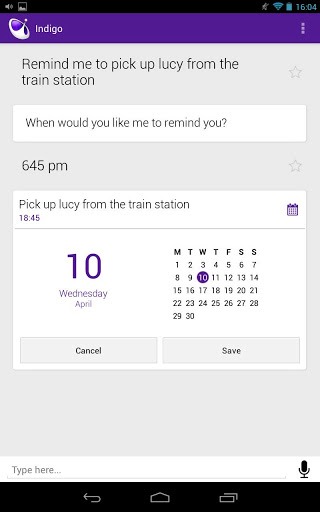
indigotinyHere at Android Police, we love Google Now (and all the associated voice actions), but the natural language could use a bit of sprucing up. If you'd like to try an alternative voice assistant, Indigo may grab your attention on this front. The pitch here is that the app remembers your conversations and can sync those inquiries across devices.

indigo1 indigo2 indigo3

If you ask a question like, "Where can I find Indian food around here?" you'll get a list of results. Tap on the one you're most interested in. You can then follow that up with "How can I get there?" From the context of your last question, the app can understand that "there" is "the indian restaurant." It even works if you switch devices, provided they're both logged in to the same account.

Done With This Post? You Might Also Like These:

Indigo Is A Voice Assistant That Knows How To Carry On A Conversation Like A Normal Person (Or Clever Bot) was written by the awesome team at Android Police.


23 Apr 12:10

Thor: The Dark World Teaser Online

Thor: The Dark World Teaser Online

'I gave you my word I would return'

A first look at Thor: The Dark World has arrived online this morning, and it's looking like things will indeed be bigger, badder and a fair bit darker for the sequel to 2011's Norse blockbuster.


This time, Chris Hemsworth's Thor is back on Earth to defend us all against the deadly forces of Malkeith (Christopher Eccleston), leader of the Dark Elves of Svartalfheim. Well, at the very least he's here to pick up Natalie Portman and get her out of harm's way, which we suppose is close enough. And it looks from this like he's going to need help from his disgraced brother Loki (Tom Hiddleston). Hooray! Er. We mean, boo hiss. Let's hope he gets hold of his horned helmet and/or some hair conditioner soon. {Thor: The Dark World}

The whole thing is directed by Game Of Thrones' Alan Taylor - which perhaps explains all those warm looking cloaks (after all, winter is coming) - and also stars Idris Elba, Anthony Hopkins, Stellan Skarsgard, Ray Stevenson, Zachary Levi, Jaime Alexander, Kat Dennings, Rene Russo, Adewale Akinnuoye-Agbaje and Tadanobu Asano. {Thor The Dark World Poster}

Thor: The Dark World hits cinemas on November 1, and we're guessing that this teaser trailer could well hit the big screen ahead of stablemate Iron Man 3 this very week.


22 Apr 23:25

Gaiman on the future of publishing: be dandelions!

by Cory Doctorow

The audience for Neil Gaiman's talk on the future of publishing at the London Book Fair apparently greeted his talk with stony hostility. But the Twitters liked it, and I like it too:

Going against a column yesterday in which Booksellers Association chief executive Tim Godfray argued that Amazon was the "foe", and has "the ability to destroy the book trade as we know it", Gaiman believes that "Amazon, Google and all of those things probably aren't the enemy. The enemy right now is simply refusing to understand that the world is changing".

The novelist went on to urge the assembled publishers to be more like dandelions – an analogy he stole, he said, from Cory Doctorow.

"Mammals spend an awful lot of energy on infants, on children, they spend nine months of our lives gestating, and then they get two decades of attention from us, because we're putting all of our attention into this one thing we want to grow. Dandelions on the other hand will have thousands of seeds and they let them go where they like, they don't really care. They will let go of 1,000 seeds, and 100 of them will sprout," Gaiman told the Guardian.

"And I was really using that analogy for today, saying the whole point of a digital frontier right now is that it's a frontier, all the old rules are falling apart. Anyone who tells you they know what's coming, what things will be like in 10 years' time, is simply lying to you. None of the experts know - nobody knows, which is great.

"When the rules are gone you can make up your own rules. You can fail, you can fail more interestingly, you can try things, and you can succeed in ways nobody would have thought of, because you're pushing through a door marked no entrance, you're walking in through it. You can do all of that stuff but you just have to become a dandelion, be wiling for things to fail, throw things out there, try things, and see what sticks. That was the thrust of my speech," said the author.

Here's that dandelion article he's talking about.

Neil Gaiman urges publishers to 'make mistakes' in uncertain new era [Alison Flood/Guardian]

(Thanks, Neil)


22 Apr 23:25

Galaxy Note III may have flexible, shatter-proof display

by Zach Epstein
Galaxy Note III may have flexible, shatter-proof displaySamsung's next-generation Galaxy Note III phablet may be a complete departure from the handsets that have made Samsung the world's top smartphone vendor by shipment volume. The South Korea-based company's current smartphones feature cheap-feeling plastic cases, but a report from last week suggested that the upcoming new Galaxy Note handset might ditch plastic in favor of a premium material for the casing. On the flip side, a new report now claims that the Note III will do away with the customary Gorilla Glass face in favor of a thinner shatter-proof OLED display assembly made of flexible plastic.

Continue reading...
22 Apr 23:24

Netflix will offer $11.99 family plan with up to four simultaneous streams

by Chris Welch
Netflix_large

Netflix currently permits subscribers to stream two movies or TV shows simultaneously from different devices, but according to the company's top executives, that limit is about to grow. "A few members with large families run into our 2-simultaneous-stream limit," reads Netflix's quarterly letter to shareholders, written by CEO Reed Hastings and CFO David Wells. "To best serve these members, we’re shortly adding a 4-stream plan, at $11.99 in the U.S."

Surprisingly, the streaming service expects a mere one percent of customers will take advantage of the upcoming, more generous family plan. It would seem most of Netflix's user base is content with current subscription rates, but for those of you letting friends and family "borrow" your...

Continue reading…

22 Apr 19:48

First Mozilla Firefox OS phones reportedly going on sale this week

by Carl Franzen
Firefoxdeveloper_large

We've heard a lot about the open, HTML5-focused strategy behind Mozilla's Firefox OS for mobile devices, but that will all be put to the test starting this week. The first two smartphones running Firefox OS — Keon and Peak, low-end developer models from Spanish startup company Geeksphone — are set to open for worldwide pre-order as early as tomorrow, possibly Wednesday, according to The Next Web. Pricing is still in flux, according to the report, but Keon should start at around 115 euros ($150 US) with tax included, and the Peak will debut at 180 Euros (about $234 US). Geeksphone is said to begin shipping globally by the end of the week. We've reached out to Mozilla and Geeksphone for more details and will update when we hear back.

U...

Continue reading…

22 Apr 19:39

Fox sends fraudulent takedown notices for my novel Homeland

by Cory Doctorow

My Creative Commons licensed 2013 novel Homeland, the sequel to my 2008 novel Little Brother, spent four weeks on the New York Times bestseller list, and got great reviews around the country. But Fox apparently hasn't heard of it -- or doesn't care. They've been sending takedown notices to Google (and possibly other sites), demanding that links to legally shared copies of the book be removed.

These notices, sent under the Digital Millennium Copyright Act, require that the person who signs them swears, on pain of perjury, that they have a good faith basis to assert that they represent the rightsholder to the work in question. So Fox has been swearing solemn, legally binding oaths to the effect that it is the rightsholder to a file called, for example, "Cory Doctorow Homeland novel."

It's clear that Fox is mistaking these files for episodes of the TV show "Homeland." What's not clear is why or how anyone sending a censorship request could be so sloppy, careless and indifferent to the rights of others that they could get it so utterly wrong. I have made inquiries about the possible legal avenues for addressing this with Fox, but I'm not optimistic. The DMCA makes it easy to carelessly censor the Internet, and makes it hard to get redress for this kind of perjurious, depraved indifference.

Fox Censors Cory Doctorow’s “Homeland” Novel From Google


22 Apr 19:37

The men who tickle rats

by Maggie Koerth-Baker
Apparently, if you tickle a rat it will respond with vocalizations that scientists have good reason to interpret as happy ones. Basically, it's the rat equivalent of laughter, only at ultrasonic frequencies that the human ear can't detect on its own. What's more, tickling rats on a regular basis appears to reduce the negative effects of stress in their lives. Scicurious' write up of this research includes the amazing quote: "For the “tickling treatment”, rats were tickled once daily, in two sessions of two minutes each, for two weeks." Also, there is video of this.


22 Apr 19:36

Short UK documentary about woman threatened with terrorism charges for videorecording cops while they stop-and-searched her boyfriend on the tune

by Cory Doctorow

Gemma sez, "You wrote a blog post about how I was assaulted by the police after filming my boyfriend being searched, back in 2009. The publicity we got from your post and the other press we got (Guardian and BBC) helped make thousands more people aware of this issue which led to the Metropolitan police eventually having to change their guidelines on photographing and filming the police. It was always my aim to get section 58a of the terrorism act clearer to all citizens in the UK and this hasn't changed. Today I'm releasing the animated short film about the case - It deals with broad issues of police accountability and citizen''s rights as well as the specifics of my case. We also hope it entertains you on its way."

Act of Terror


22 Apr 14:28

Windows 8.1 set to bring back the Start button

by Tom Warren
Win81startbutton1_640_large

Microsoft is preparing to revive the traditional Start button it killed with Windows 8. Sources familiar with Microsoft's plans have revealed to The Verge that Windows 8.1 will include the return of the Start button. We understand that the button will act as a method to simply access the Start Screen, and will not include the traditional Start Menu. The button is said to look near-identical to the existing Windows flag used in the Charm bar.

Microsoft changes its mind

Microsoft's change of heart follows another recent planned change for Windows 8.1: a boot to desktop option. We understand Microsoft will add an option to allow users to boot directly to the traditional desktop environment in future builds of the upcoming Windows 8...

Continue reading…

20 Apr 23:53

Create Your Own Dry Shampoo For Morning Hair Emergencies

by Shep McAllister

If your hair is a mess but you don't have time to shower, dry shampoo is a great alternative to soak up the oils that make your hair greasy. Usually these are sold as aerosols, but you can make your own powder version with a few household ingredients.

jessyratfink shares two versions of the shampoo on Instructables: one for light hair and one for dark. For light hair, just combine 1/4 cup of cornstarch and a tablespoon of baking soda in a spice jar. For dark hair, add in two tablespoons of unsweetened cocoa powder.

Once everything's mixed together, sprinkle a small amount in your hands, rub it into your hair, let it sit for a moment, then brush it out. The powder should absorb a lot of oil and make your hair look and feel less greasy.

Homemade Dry Shampoo | Instructables

20 Apr 21:13

Life in Kowloon Walled City, the self-sustaining city of darkness

by Aaron Souppouris
Kowloon_walled_city_large

After the Japanese invasion of Hong Kong during the Second World War, China reclaimed the rights to Kowloon Walled City, an ex-military fort. As refugees fled to the area, the Walled City became something of a diplomatic no-man's land — neither the Chinese government nor the British colonial administration were willing to intervene. Between 1945 and 1990, the population of the area raised from 2,000 to an estimated 50,000. An interconnected web of 14-story skyscrapers were erected with no input from architects or planners, and the largely triad-controlled city became infamous for lawlessness and squalor. At its peak, the city, which measured just 2.7 hectares (around 290,000 square feet), had a population density of 1.92 million per...

Continue reading…

20 Apr 11:15

Fox Censors Cory Doctorow’s “Homeland” Novel From Google

by Ernesto

homelandCory Doctorow’s latest novel Homeland tells the story of an infowar, the suppression of information and the fight against censorship.

The setting of the fictional book is a realistic scenario according to activists, and on a small scale the book itself has now become the center of a censorship row.

Published by Tor Books, Homeland is available for sale in most book stores, but because of its Creative Commons license people are also free to share the book online. After all, obscurity is a much bigger problem than piracy for most authors.

As a result copies of the novel are shared for free on hundreds of sites, and this attracted the attention of a Hollywood studio. For a few weeks none other than 20th Century Fox has been sending DMCA takedown requests to Google for Doctorow’s novel.

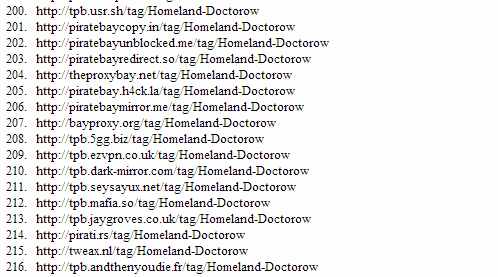
Fox’s idea is to make pirated copies of the TV-series Homeland harder to find, but as collateral damage they’re also taking down the novel. Shown below is an example of a typical notice 1, 2, 3, 4, 5 being sent out, and here’s an even bigger list.


All Your Homeland Are Belong to Us!

homeland-dmca

TorrentFreak confronted Cory Doctorow with these dystopian findings and the author was outraged by the gross abuse of his rights. Without hesitation he called for drastic action to be taken against the head honcho of the content empire.

“I think you can safely say I’m incandescent with rage. BRING ME THE SEVERED HEAD OF RUPERT MURDOCH!” Doctorow says.

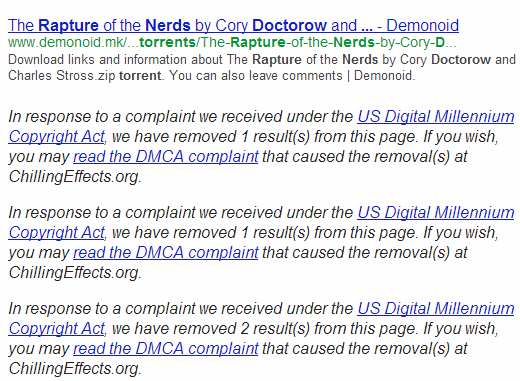
To make matters even worse, Fox is not the only party going after Doctorow’s books. His own publisher Tor Books has also sent DMCA takedown notices to Google, in this case for the book “The Rapture of Nerds”.


Creative Commons Who?

rapture-doctorow

When we made this discovery back in February, Doctorow was more understanding. He told us that Tor Books sends out DMCA notices with his authorization, but only in instances where the book is wrapped in DRM, or when there’s another violation.

But, where DMCA notices are sent out mistakes happen.

“I think what I’d like is for Tor to be perfect in only sending out takedowns when there’s a genuine violation, but perfection is a pretty high bar. I’m sorta OK with settling for one mistake in 10 years, especially if it doesn’t happen again,” Doctorow said.

Around the same time Tor Books told TorrentFreak that the takedown was an honest mistake, and that they would tell Google to reinstate the links so that the books could be accessed again.

“Those takedown notices were simply a bureaucratic/administrative mistake. We’re withdrawing them as quickly as possible.,” Tor’s senior editor Patrick Nielsen Hayden said.

However, more than two months later the links in question remain censored on Google, and Tor Books have been unreachable since. All our follow-up questions remained unanswered, most likely swallowed by some overactive spam filter or intercepted by a local spy agency.

Get out the pitchforks!


“We’re withdrawing them as quickly as possible”

still-censored

Source: Fox Censors Cory Doctorow’s “Homeland” Novel From Google

20 Apr 10:57

Controversial update to 'bible' of psychiatry fuels debate over foundations of mental health

by Amar Toor
Prozac_large

For years, the diagnosis of mental illness has largely relied upon one book — the Diagnostic and Statistical Manual of Mental Disorders, or DSM. Published by the American Psychiatric Association (APA), the DSM offers detailed classifications and criteria for conditions like depression, anxiety disorders, and schizophrenia. Psychiatrists around the world consult it when treating patients, insurance companies use it to verify reimbursement claims, and criminal investigators use it to assess a suspect's mental health.

Today, the DSM is widely referred to as the "bible" of psychiatry — but not everyone is a believer. The book has undergone four major revisions since first being published in 1952, with each one drawing varying degrees of...

Continue reading…

20 Apr 10:57

Anonymous calls for ‘Internet Blackout Day’ to protest CISPA [video]

by Brad Reed
Anonymous calls for 'Internet Blackout Day' to protest CISPAThe Cyber Intelligence Sharing and Protection Act (CISPA), which passed the House of Representatives this week, has drawn a lot of criticism from activist groups such as the Electronic Frontier Foundation for potentially undermining users' online privacy. In particular, the EFF has said that the bill gives Internet companies the right "to monitor user actions and share data – including potentially sensitive user data – with the government without a warrant" and also "overrides existing privacy law, and grants broad immunities to participating companies."

Continue reading...
19 Apr 20:27

U.S. Flip-flopping Proves Us Right, Megaupload Tells Court

by Ernesto

megaWhile Dotcom’s legal battle in New Zealand focuses on spying efforts and unwarranted seizures, the U.S. federal court still has to decide on Megaupload’s request to dismiss the entire case against the company.

Several months ago Megaupload filed a request to dismiss the indictment against it, until the U.S. Government finds a way to properly serve the company.

According to “Rule 4” of criminal procedure the authorities have to serve a company at an address in the United States. However, since Megaupload is a Hong Kong company, this was and is impossible.

Only by dismissing the case can the court protect Megaupload’s due process rights, the defense argued. However, the Government disagreed and asked the court to deny Megaupload’s motion. Among other things the Government claimed that the federal rules shouldn’t be interpreted so narrowly.

A company should only be served on a U.S. address if they have one, they argued.

Last week a new chapter was added to this standoff and it turned out that, behind the scenes, the Department of Justice is trying to change the law in its favor. In a letter to the Advisory Committee on the Criminal Rules the DoJ made suggestions that would directly influence the Megaupload case.

Among other things the Government asked to “remove the requirement that a copy of the summons be sent to the organization’s last known mailing address within the district or principal place of business within the United States,” and to amend the Rule to “provide the means to serve a summons upon an organization located outside the United States.”

These were the exact issues Megaupload used in its request to dismiss the charges against it, and Megaupload was even cited in the letter as an example of why the law should be improved.

The question is, however, whether the proposed amendments will help or hurt the Government’s case. Megaupload’s defense argues the latter and has now submitted the letter to court, using it as evidence that the authorities knew all along that they were not playing by the rules.

“The Government’s letter is directly relevant to the Court’s consideration of Megaupload’s pending motion to dismiss without prejudice, as it contradicts the Government’s repeated contention that it can validly serve Megaupload—a wholly foreign entity that has never had an office in the United States—without regard for Rule 4’s mailing requirement,” Megaupload’s lawyers write.

Megaupload’s legal team goes on to explain that the letter shows that the Government knew it couldn’t possibly serve the Hong Kong company.

“To the contrary, the Government explicitly acknowledges in the letter that it has a ‘duty’ under the current Rule to mail a copy of the summons to a corporate defendant’s last known address within the district or to its principal place of business elsewhere in the United States.”

“Moreover, by seeking to have the mailing requirement eliminated, the Government implicitly admits it cannot validly serve Megaupload consistent with Rule 4 as currently written,” Megaupload writes.

Adding up the bits and pieces Megaupload’s lawyers argue that the letter proves that there was no legal basis to destroy Megaupload. It therefore asks the court to take the letter into account when it decides on the motion for dismissal.

“The Government’s letter to the Advisory Committee thus confirms what Megaupload has argued all along—that the Government indicted Megaupload, branded it a criminal, froze every penny of its assets, took its servers offline, and inflicted a corporate death penalty, notwithstanding the fact that the Government had no prospect of serving the company in accordance with current law, yet to be amended.”

“Megaupload should not be made to bear the burdens of criminal limbo while the Government seeks to rewrite the Federal Rules to suit its purposes,” the lawyers conclude.

The court now has to decide whether or not Megaupload should be dismissed from the indictment. If that’s the case, Megaupload plans to give users access to the files that were seized, and it will also free up funds for a proper defense.

Source: U.S. Flip-flopping Proves Us Right, Megaupload Tells Court

19 Apr 20:13

Apkudo Wants To Handle Android Fragmentation So Carriers And Developers Don't Have To

by Darrell Etherington
lab

Baltimore-based Apkudo is debuting its “Apkudo Approved” program this week, extending its existing work with making sure that Android apps and devices perform well for consumers. The company has positioned itself in a growth market, to act as a layer both between developers and devices, and between devices and carriers, to help both parties deal with the fractured and often maze-like landscape of the Android hardware market.

It’s normal for tier 1 carriers to run a gamut of tests on prospective devices before they bring them to market. Most recently, this was made quite public by BlackBerry, which has discussed the carrier testing process around its new BlackBerry 10 devices, but it happens for anything that hits a network. What Apkudo does is offer similar services for tier 2 and lower carriers, who might not necessarily have the engineering workforces or resources to devote to extensive testing.

Tests run by Apkudo include monitoring all types of performance while running around 25,000 apps from developer partners, using techniques like taking photos of screens with high framerate cameras to detect dropped frames, Apkudo CEO Josh Matthews explained in an interview. So far, they’ve tested and can provide results for over 1,700 devices, and while they’re not allowed to reveal the names of any specific OEMs they work with, Matthews says that if you can think of a modern smartphone, they’ve probably had it in their labs.

“There’s so much opportunity for the carriers given that an Android device can target budget and spec points on the full range of the spectrum, which is phenomenal,” Matthews explained. “The flip-side of that is that the variation in quality between devices in terms of performance under different app loads and in different circumstances is also phenomenal, and that can lead to very high return rates and customer dissatisfaction.”

Apkudo’s work can help carriers take some of the mystery out of the process by providing them with data on hardware before it gets released on their network. That has led to a variety of smaller carriers now insisting that devices are first “Apkudo Approved” before they’ll even consider them for sale. Which, obviously, is hugely beneficial to Apkudo. But the company also works closely with OEMs, and can provide them with crucial testing data that helps them upgrade their own devices, too.

Matthews says that his company is better-equipped to handle this task than most, simply because it’s their sole focus. And it does make sense that if the only thing you’re doing day in and day out is testing devices and software, you’d be in a better position than either a carrier or manufacturer to assess their strengths and weaknesses. Being a third party, with less personal stake in the products themselves, also helps.

So far, Apkudo is making around $5 million a year in revenue, but it has just signed on a number of strong customers, including Cricket, Cincinnati Bell and the Associated Carrier Group, which includes C Spire, Alltel and a number of other smaller regional carriers. Its developer product is free, since it uses that to help build the library it uses to help with its lucrative carrier partnerships, so if you’re an Android dev trying to test across a range of devices, it might work better than trying to amass your own collection of Android hardware.