
Shared posts

19 Apr 20:09

Tour the bridge of the Enterprise from J.J. Abrams' 'Star Trek'

by Jacob Kastrenakes
Original_large

J.J. Abrams has some high-profile sci-fi flicks on his agenda, and the trailers for Star Trek Into Darkness should be an obvious reminder of why that's a good thing. In anticipation of his new film, io9 is taking a look back at the remarkably detailed set for the bridge of the Enterprise that was used in the 2009 Star Trek. The photos come from Bad Robot, Abrams' production company, and are being released for the first time in conjunction with a promotional app for Into Darkness. That the Enterprise looks good even when it's not behind the lens of a movie camera gives us high hopes for both the new Star Trek and the director's next picture — something called Star Wars: Episode VII.

Continue reading…

19 Apr 15:17

Gorgeous, psychedelic photos of Portuguese man-of-wars

by Cory Doctorow


Aaron Ansarov picks up live Portuguese man-of-wars from the Delray Beach, FL, photographs them on a light-table and returns them to the beach. The photos are then mirror-imaged and post-processed into a gorgeous collection of psychedelic nature photos. You can buy some amazing prints of his work.

Psychedelic Portuguese Man-of-War Photos Prove God Is a Stoner [Jakob Schiller/Wired]


19 Apr 15:15

The sweet spot for tablets: 8-inch slates to grab 11.9% of tablet market in 2013

by Zach Epstein
8-inch slates to grab 11.9% of tablet market in 2013Apple reinvigorated the media tablet market when it launched the iPad in 2010, and it created a multi-billion dollar industry that most consumer electronics companies are still scrambling to grab a piece of. As rivals toyed with various tablet sizes in an effort to put some space between their offerings and the iPad, Apple once again managed to find a new sweet spot in 2012 with the iPad mini's 8-inch display: According to China-based market research firm TrendForce, the iPad mini and new tablets with similar screen sizes will grow to control 11.9% of the tablet market in 2013.

Continue reading...
19 Apr 14:53

Why You Should Use Antivirus, Even If You Browse Carefully

by Whitson Gordon

The best way to avoid viruses is to use common sense, but that doesn't mean you should avoid antivirus altogether. Our friends at the How-To Geek explain why.

Good browsing practices can take you pretty far. If you aren't browsing shady sites, downloading files from suspicious sources, and clicking links from people you don't know, you'll put yourself at less risk for viruses. But Chris Hoffman from How-To Geek explains how you can still get infected:

We have previously written about “zero-day” exploits – vulnerabilities that the bad guys find first. Ones we don’t know about, which we can’t protect ourselves from. At events like Pwn2Own and Pwnium, contestants are challenged to compromise fully patched software like Chrome, Firefox, Internet Explorer, Adobe Flash, and more for a financial reward. These browsers and plug-ins inevitably fall as the contestants use unpatched security flaws to crack their security.

These flaws are corrected as soon as they’re found, but new ones inevitably pop up.

Just because you're careful doesn't mean you're safe. You can get infected just by visiting a web site, even if its a web site you trust. Heck, our friends at the Wirecutter had a short bout with malware a few weeks ago. A friend or family member could send you a link that looks legit, but perhaps they've been infected by malware themselves. Common sense will take you pretty far, but it isn't foolproof.

We recommend Avast for your antivirus needs, but there are a lot of great apps out there. If you don't have antivirus installed on your system, hit the link below to read more about why you might want to.

HTG Explains: Why You Need An Antivirus on Windows, No Matter How Careful You Are | How-To Geek

19 Apr 14:53

The Best Streaming Music Services You Aren't Using (But Should)

by Alan Henry

The Best Streaming Music Services You Aren't Using (But Should)

Streaming music apps and discovery services are a dime a dozen, but even the best ones have a hard time competing with the names everyone already knows. Even so, getting out of your comfort zone a little bit and trying a new service will only reward you with tons of great new music. Here are a few services we love that we think you'll love too.

We originally ran this post just over a year ago, but since then some of our picks, like Piki, Ex.fm, and even Turntable.fm have shut down. So here's an updated list with some of our new favorites!

Why Shouldn't I Just Use [Insert Service I Already Use]?

Pandora, Spotify, Songza, Rdio, Grooveshark, and all the rest are great, we're not trying to convince you otherwise. However, trying something new doesn't cost you anything and doesn't have to replace the app you already love. Seriously, the streaming music app you use doesn't have to define you, and shouldn't turn into some kind of music lover's version of the OS wars. Trying more than one will only reward you with new and interesting music you may not have heard.

Case in point, I love Pandora and happily pay for Pandora One. I keep a pretty big Grooveshark library too. I have the mobile apps for both, and stream Pandora in my car when I want to listen to music almost exclusively. That hasn't stopped me from falling in love with some of the services we're about to discuss.

Upbeat

The Best Streaming Music Services You Aren't Using (But Should)

Think of Upbeat as Reddit meets great music, without the unnecessary conversation. You can listen to everything available on the site, or just select specific genres from the sidebar on the left. Click to play tracks you like, or just start at the top and play everything in the category—and trust me, there's plenty to listen to. As you listen, you can star songs you love, save them to personal playlists where you can get to them again later, and most importantly, upvote or downvote them to tell the world how you feel about the track.

We've covered Upbeat before—it just so happens to be from the same team that built Noon Pacific, which we love (and will mention a little later), so you can be sure you're getting a good listening experience. The site is fast, light, and doesn't suck down resources when you're streaming all day, which is a nice bonus, and while you'll stumble on a track that won't play every now and again, it's a great listening experience. You can also easily switch between the newest songs on the site, the most popular, or just the hot songs that other users are listening to right now.

If you have your own music to submit, or see a song elsewhere on the web that you'd love on Upbeat, you can always submit it, and when you do, you get "karma" for doing so. Just like with the other services here, I use it personally, and while you can't follow people, you can see what they've saved.

Official.fm

The Best Streaming Music Services You Aren't Using (But Should)

Official.fm only recently hit my radar, although it's been around for a while. The site is an entirely curated selection of new music, combined with beautiful imagery that's paired with each song you play. The service pays artists fairly for every play they get (partially by getting brands and companies to buy those full-screen images you see when you play tracks) and you get to listen to great music ad-free, streaming, without the clutter of banner ads or interruptions on the page. It's a great system—one that's easy on the eyes and on the ears, and the site is constantly updated with new songs from great known and unknown artists.

From there, if the song is available to download, you can grab a copy. If not, you can share it with friends or save it to listen later, A lot of Official.fm's traffic comes from those artists sharing their music on social media, but there's nothing stopping you from visiting directly and checking out the front page, trying a few songs out, and then letting the curated playlist carry you away from song to song. Even the site's "about us" page speaks in music first and words second, asking you to click some of their favorite tracks to understand what they're all about. Those are people I can get behind.

The Hype Machine

The Best Streaming Music Services You Aren't Using (But Should)

The Hype Machine really needs no introduction, but its omission from the last time we did this roundup was an error I've long wanted to correct. The Hype Machine has tons of great music, from bands large and small, remix artists and DJs, indie musicians and well known artists alike. The service is great on the web, but also has a cottage industry of music players (some of which we've featured before). It's simple too—sign up for free, and listen to new songs highlighted on music blogs around the web.

For those unfamiliar, The Hype Machine aggregates music that's been posted to some of the most popular music blogs and review sites from around the web into a single, easy-to-navigate interface. If you find something you like, you can heart it and come back to it later, or click out to read the article or music blog where the song was posted. You can also follow other users, musicians, or music blogs that you know post great music. Music is tagged so you can filter or search for things you know you'll like, or sit back and enjoy the discovery experience. I've rarely found tracks at The Hype Machine that I didn't enjoy, and plenty that I've really loved.

There's an official iOS app, an unofficial Android app (an official one is coming—I've been testing the beta and it rocks), and tons of desktop players (linked above) if you don't want to keep a tab open. You can even go back in time with the Hype Machine Time Machine to explore popular tracks from the site's history.

This Is My Jam

The Best Streaming Music Services You Aren't Using (But Should)

We've mentioned This Is My Jam before in glowing terms, and it's still a great service. Here's how it works: Pick a song you love (or love right now) and make it your "jam." Other users will find it, listen to it, and "like" it. You can do the same—TIMJ makes it easy to explore jams by other users, and will suggest users to you who have similar jams to yours. It'll even lead you to other songs by similar artists to the ones you've already shared. Your tracks expire after seven days (but you can renew them if it's still your jam), or you can change them whenever you like. Best of all, since people are adding new tracks all the time, there's always something new to listen to.

From there, you can follow people who post music you enjoy, play all the jams from people you follow in one playlist, export all of your jams (or all of the jams from people you're following) as a Spotify playlist, or just use the This Is My Jam Spotify app to explore even more music. TIMJ is great if you're wary of trying a new service, or would prefer to just explore a few new tracks from some interesting people every now and again. It's totally free, and there are some great people sharing great music there. I use it regularly, and if you do too, leave me a link to your profile in the discussions and I'll give you a follow!
Noon Pacific

The Best Streaming Music Services You Aren't Using (But Should)

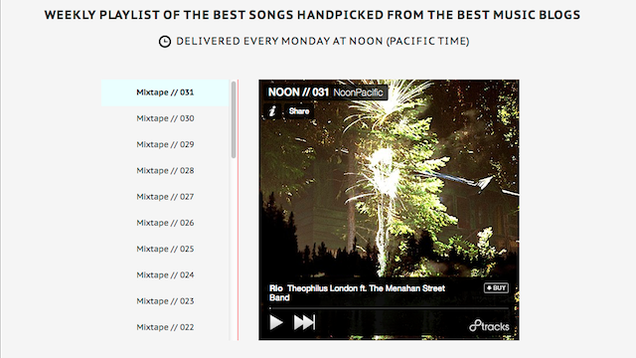
Every Monday at noon, Pacific time, I get an email in my inbox with a brand new playlist full of music. I've likely never heard any of it before but know I'll love all of it. That's Noon Pacific, and I can't say enough good things about it. It's probably the best, least-effort music discovery service ever, mostly because you sign up, and wait for the music to come to you every week.

We've discussed Noon Pacific before in glowing terms, and highlighted their mobile apps, but there's something great about knowing every Monday you're going to get a good hour of great new music hand picked, curated, and delivered right to you. The playlists are hosted at 8Tracks, and if you want to try some of the mixes before you sign up for the weekly newsletter, they're all posted on their site—which helps if you had a favorite mix from a few weeks ago and want to hear it again and again. (022 was my former love, but this week's, 097, is pretty killer.)
Whyd

The Best Streaming Music Services You Aren't Using (But Should)

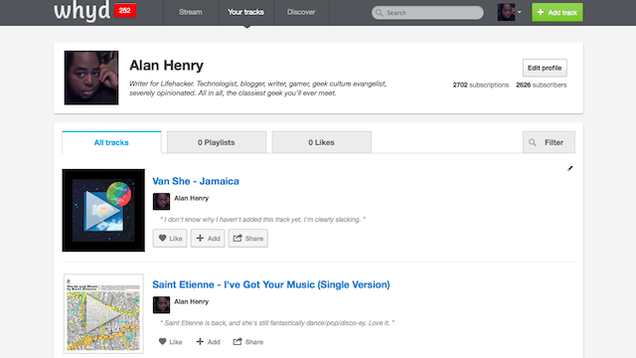
Whyd is another service we love because it fills two roles: it helps you organize all of the music you stumble on from around the web and keep it organized, and then it lets you build playlists and listen to that music anytime you want. Whyd used to be invite only, but it's open to everyone now, so there's even more great music to go around. It helps that Whyd is a social service, and there are plenty of other people there to listen to who have music just as good as the music you've added yourself.

If you wanted to use Whyd as just a way to organize YouTube videos, Vimeo videos, and SoundCloud tracks, that would be enough, but once you start exploring the music others are adding, it's a whole new world. Best of all, Whyd supports a lot of these services, and songs hosted on other sites, so even though I use some of the above, I find the source track and save it to Whyd so I can listen to it later. I'm not kidding when I say I use Whyd every single day. There's an iOS app if you want to take your tracks on the go, and an Android app on the way soon. If you like what you see but want an alternative, SongDrop is a similar service we've mentioned.


We've seen some good music discovery services and some really bad ones in the past. The worst services force you to listen to songs just because someone else has added them, without actually making sure you'd like the music before connecting you with that other person. I can think of a half-dozen that promised "music based on what your friends like," that completely ignore the fact that I may not always enjoy my friends' tastes in music. Sign up, and you're treated to a bunch of songs you can't wait to skip through. On the other hand, the best services connect you with people based on common tastes first and relationship second.

They make sure you and the other person would enjoy hearing the music that you both have listed, and then they start the tunes. The beauty of the great ones is that they can play the music you already like while simultaneously guiding you to new songs and new artists that you'd enjoy, all without playing the same tracks over and over, or depending on other people to pick great music before you can hear it. Like we said, give something new a try: the worst thing that could happen is that you discover something new you'll fall in love with.

Photo by Jonathan Kriz.

19 Apr 14:48

What I want to see at Google I/O: Third-party developer support for Google Now

by Dustin Earley

Google is relatively well know for embracing third-party developers. Where iOS forces users to stick with default browsers and email clients, use limited sharing options and keep their home screen just how Apple likes it, Google excels in handing over the keys to the kingdom. This goes for services too, where developers have been able to leverage products like Google Maps to make fantastically fast and accurate location-based software. This year at Google I/O, I’d like to see Google give third-party developers access to another one of their amazing services, Google Now. If you thought Google’s automated digital assistant of the future is impressive now, just think of the possibilities.

Released today for iOS, Osito is a Google Now clone for Apple products. It not only looks the same, but functions the same as well. You plug in some accounts, and Osito uses your location, email and calendar to bring you useful information exactly when you need it. When I first heard about Osito, I thought it seemed like a great idea, to beat Google out the door and try to establish an active user base as soon as possible. But Google is so powerful, and has so many people working on Now, there’s no way Osito could possibly keep up. And then I read something unique about Osito: it’s going to be opened up to third-party developers.

Instead of just relying on what Osito itself can offer, the app will let third-party developers have at it. As Ellis Hamburger writes in his look at Osito on The Verge, “You can imagine future integrations where Osito’s API ties in with IFTTT to text your spouse when you’ve arrived at work or send a tweet when you’re on the way home. You could set up Foursquare to ping you with recommendations when you land in a new city.”

Google’s restaurant and places ratings are great, and Google+ is one of my networks of choice, but both may not always be my first choice. I’d like to get Foursquare or Yelp cards in Google Now, because my friends use Foursquare and Yelp. When it’s one of my friends birthday’s, I’d like to be able to wish them a good day on Twitter or Facebook. I’d like to choose what service provides me with the information I see in Google Now, something that feels like right up Google’s alley.

The rate at which Google has rolled out features to Google Now has been meticulous. They’ve made sure not to push too much at once, and provided just the right amount of control to users when it comes to the appearance of cards and how frequently they’re displayed. Developers looking to utilize Google Now would have to follow strict design and notification guidelines, but that wouldn’t be a problem. If Google made Now integration easy enough, third-party services would be clamoring at the chance to put their cards, and their notifications, exactly where you need them, when you need them.

It would be like giving a steroid injection to a handful of already incredibly useful apps, pushing Google ahead of the competition even further. And that’s not even really diving in to the location-aware triggers aspect third-party developers could bring to the table. The creator of Osito, Bill Ferrell, mentioned in an interview that he set up a trigger with Osito to turn on a lava lamp when he enters his office. The possibilities there are endless.

We’re bound to see a lot of great things at Google I/O 2013, but third-party Google Now access is easily at the top of my list. The deep system integration and one-stop-shop information hub aspects of Google Now already causes me to use it more than apps that provide similar information, even when those apps provide information that’s closer to what I’m looking for. Google Now is easier, so most of the time I just don’t bother. But there are times when I have look for information elsewhere.

With third-party integration, Google Now would be all I ever need, and a whole lot more.


19 Apr 14:47

Bringing Google+ Comments to Blogger

by Emily Wood
Reading and responding to comments can be one of the most rewarding aspects of blogging. Not only do they help you connect with your readers, they can also inspire later blog entries. The challenge, oftentimes, is following all the conversations around your content—on Google+, for instance, as well as on your website. So we're making things a lot simpler.

Starting today, you can bring Google+ Comments to your Blogger blog. Once you've enabled the feature through your Blogger Dashboard, you'll enjoy a number of important benefits:

View your blog and Google+ comments, all in one place
Now when you're browsing your blog's comment threads, you'll see activity from direct visitors, and from people talking about your content on Google+. For example, if there's a public Google+ discussion about one of your blog entries, those comments and replies will also appear on your Blogger blog. This way you can engage with more of your readers, all in one place.

Help readers comment and connect with their circles
Your blog readers will now have the option to comment publicly, or privately to their circles on Google+. And when they're browsing blog comments, they can view all of them, just the top ones, or only those from the people in their circles.

In all cases, you and your readers will only see the comments you have permission to see. Giving people these kinds of controls not only encourages more meaningful sharing—it can lead to more blog traffic.


To get started with Google+ Comments, just visit the Google+ tab of your Blogger Dashboard, and check “Use Google+ Comments.” (Older comments will continue to appear in the new widget.) You can also visit any post on the Official Google Blog (like this one), or on Blogger Buzz (like this one), to see Google+ Comments in action.

Happy commenting!

Posted by +Yonatan Zunger, Principal Engineer
19 Apr 14:44

YouTube again defeats Viacom in copyright court case

by Dieter Bohn
Youtube-icon-android-stock_1020_large

YouTube has scored yet another victory in a long-running legal battle with Viacom over whether or not the video service is liable for copyright-infringing content that gets uploaded to its site. YouTube originally won the case three years ago, but then about a year ago the 2nd Circuit Court of Appeals kicked the case back down to the same judge to review the original ruling. Now that he has, YouTube has come out the winner.

The main issue has been whether or not YouTube had knowledge of copyright-infringing content and, more specifically, whether the burden of proof for showing it didn't have that knowledge fell on YouTube. Judge Louis Stanton fairly definitively said it didn't, "The burden of showing that YouTube knew or was aware of...

Continue reading…

18 Apr 21:58

Austerity economics only works if you make an Excel formula error

by Cory Doctorow

A new paper called Does High Public Debt Consistently Stifle Economic Growth? A Critique of Reinhart and Rogoff by Thomas Herndon, Michael Ash, and Robert Pollin from UMass Amherst tries and fails to replicate the classic work on austerity, Carmen Reinhart and Kenneth Rogoff's 2010 Growth in a Time of Debt.

Reinhart-Rogoff is the main research cited in favor of cutting public services and spending in bad economic times. It's a big part of why the local library is shutting down, why they're kicking people out of public housing, shutting down arts programs, slashing education and public transit, and laying off public employees. It purports to show that countries with high debt-to-GDP ratios of 90 percent or more are a "threat to sustainable economic growth."

In the new Amherst paper, the authors reexamine Reinhart-Rogoff's original data and conclude that the numbers don't add up. They show that Reinhart-Rogoff cherry-picked which years of high-debt GDP they measure, that they put their thumbs on the scales with "unconventional weighting" and made a "coding error" that "entirely excludes five countries, Australia, Austria, Belgium, Canada, and Denmark." This last error -- literally the wrong formula in a spreadsheet cell -- badly skews the outcome.

Here's the tl;dr: "the average real GDP growth rate for countries carrying a public debt-to-GDP ratio of over 90 percent is actually 2.2 percent, not -0.1 percent as [Reinhart-Rogoff claim]."

Selective Exclusions. Reinhart-Rogoff use 1946-2009 as their period, with the main difference among countries being their starting year. In their data set, there are 110 years of data available for countries that have a debt/GDP over 90 percent, but they only use 96 of those years. The paper didn't disclose which years they excluded or why.

Herndon-Ash-Pollin find that they exclude Australia (1946-1950), New Zealand (1946-1949), and Canada (1946-1950). This has consequences, as these countries have high-debt and solid growth. Canada had debt-to-GDP over 90 percent during this period and 3 percent growth. New Zealand had a debt/GDP over 90 percent from 1946-1951. If you use the average growth rate across all those years it is 2.58 percent. If you only use the last year, as Reinhart-Rogoff does, it has a growth rate of -7.6 percent. That's a big difference, especially considering how they weigh the countries.

Unconventional Weighting. Reinhart-Rogoff divides country years into debt-to-GDP buckets. They then take the average real growth for each country within the buckets. So the growth rate of the 19 years that the U.K. is above 90 percent debt-to-GDP are averaged into one number. These country numbers are then averaged, equally by country, to calculate the average real GDP growth weight.

In case that didn't make sense, let's look at an example. The U.K. has 19 years (1946-1964) above 90 percent debt-to-GDP with an average 2.4 percent growth rate. New Zealand has one year in their sample above 90 percent debt-to-GDP with a growth rate of -7.6. These two numbers, 2.4 and -7.6 percent, are given equal weight in the final calculation, as they average the countries equally. Even though there are 19 times as many data points for the U.K.

Now maybe you don't want to give equal weighting to years (technical aside: Herndon-Ash-Pollin bring up serial correlation as a possibility). Perhaps you want to take episodes. But this weighting significantly reduces the average; if you weight by the number of years you find a higher growth rate above 90 percent. Reinhart-Rogoff don't discuss this methodology, either the fact that they are weighing this way or the justification for it, in their paper.

Researchers Finally Replicated Reinhart-Rogoff, and There Are Serious Problems. [Mike Konczal/Next New Deal]

Does High Public Debt Consistently Stifle Economic Growth? A Critique of Reinhart and Rogoff

(via Techdirt)


18 Apr 21:57

How Stores Manipulate Your Senses So You Spend More Money

by Thorin Klosowski

When you walk into almost any store, you're immediately overloaded with sights, sounds, smells, and various things to touch. This barrage on your senses are hand-picked for one goal: to make you spend more. Here's what's going on.

No matter what type of store you walk into—from the Apple store to Wal-Mart—you'll find all types of carefully engineered tricks that get you to fork over cash. From the scent of coconut in the summer clothes section to the end caps filled with junk you don't want, stores are carefully organized in ways you may never notice. To get an idea of how this all works, I spoke with Dr. Kit Yarrow, consumer psychologist at Golden Gate University and co-author of Gen BuY: How Tweens, Teens, and Twenty-Somethings Are Revolutionizing Retail.

How Stores Tap Into Your Sense of Sight to Get You to Spend More

It shouldn't be surprising that the main sense that retail stores go after is your sense of sight. What is surprising are the subtle cues they leave around to get us to spend more. These are small symbolic cues that have a big impact on what we decide to buy, and how long we're willing to stay in a store.

For example, color has a big impact on our shopping choices. Each color often evokes or represents a feeling, and retailers use that to their advantage. Yarrow explains:

It could be the color of the product, or if they're displayed in groups of colors that tends to have a big emotional impact. Colors have different associations and those things tend to get people going. So, for example, red is almost always the color associated with sales because it inspires people to take action and it's a stimulating sort of color.

If Target's logo was blue, it wouldn't be perceived as a place where things are reasonably priced. I think value-oriented stores tend to have logos with red, but it could also be orange. Black is almost always associated with higher prices and luxury.

Colors have all sorts of impact on how we spend. Studies have shown that waitresses who wear red tend to get bigger tips, and red even makes us spend more online.

It's not just color, though. Retailers also tap into your unconscious is by creating simple navigation roadblocks. For example, people often go to a grocery store just to pick up a single item like milk, but milk is in the back of the store. You're forced to walk through and see everything before grabbing your one item. Chances are, unless you put the blinders on when you're walking through that you'll grab another item or two.

Retailers want you to get lost in the store so you to see more of their products. Take Ikea, for example. The store is structured in a way that you're bound to get turned around and lost. This causes you to see more than you need to, and in turn you end up with a couple more items in your hand. You could always walk in the exit doors to avoid getting lost when you're grabbing one item, but you don't have that option at every store.

Stores like Apple and Ikea also want to create a lifestyle image:

A lot of this is about a brand image. It's to get you to feel a particular way. One of the things I've found works really well is when you create a theme or a lifestyle, and people can see themselves living in this lifestyle. That causes them to want to buy those things—that's why Ikea sets up those rooms—you go to buy a lamp, and suddenly you want to buy that couch too. Pottery Barn is really good at this—they'll create a theme of a room or a party, and people kind of slip into that and they want to buy it.

It's not just big budget items. Stores do this all the time with little add-on purchases. They'll include a complementary pair of shoes next to some new jeans, or a cell phone case that happens to match a skirt right next to it. They want you to see yourself using or wearing what they're offering, so they present it all in a way that your brain makes those connections without you realizing it.

The idea here is that stores manipulate your sight so you see more products that you might want and also an entire lifestyle you want to live in. Unfortunately, it's one of those things that typically works so well that the only thing you can really do to avoid spending more money is to recognize what's happening and try not to fall for it.

Why Touching Products Makes You Want to Buy Them

All those carefully designed stores aren't structured just to assult your eyeballs with shiny objects. They're also about forcing you to touch more things. Why? Because touching tends to lead to purchasing for most of us. Yarrow explains:

[Environmental psychologist] Paco Underhill talked about stores that create roadblocks so that when you walk in you're forced to stop. He suggested that when you touch something, you're more likely to buy it. It turns out that we now know he was right.
Research shows that when people touch things they're more likely to buy them. So, you want to place things where people are more likely to pick them up. That means not-perfect displays—where things are a little off-kilter—because people are more comfortable picking things up that way. I know that's true for me, if I go into one of those jean stores where everything is folded and organized, I don't want to try and find my size because I know I'll just mess it up.

Essentially, the more time an item spends in your hand, the more likely you are to purchase it. That means stores are structured so you're always picking things up. That might mean an end cap filled with items, or even a cluttered looking shelf that you have to sift through. It's not just random shelves either. Even where an item is on a shelf makes you more likely to notice it and pick it up:

Shelf placement is really interesting and it's a newer concept. People really tend to gravitate to the center of displays. We seem to have this sort of homing instinct and there's research that shows people are more likely to buy something that's in the center of a display.

If you've ever walked out of a stuffy store where you weren't comfortable picking up items, you know how important the idea of touching a product is. That same sense can also be used against us though, causing us to pick up items we don't really want.

Why the Perfect Scent Makes You More Willing to Spend Money

You might not even notice it, but what you smell when you're shopping can impact the choices you make to a strange degree. Yarrow offers this simple example:

Our senses bypass our conscious mind. So, we smell something like baby powder, we feel all warm toward babies, we just happen to be in the baby department, and we spend a little more money. Or we smell coconut and we suddenly get beach fever.

Those are some obvious examples, but research has shown all kinds of ways that retailers manipulate our choices when we're out shopping. Essentially, as this study from the Journal of Business Research points out, odors and scents have a strong tie to memory. If retailers can evoke the right memory, we're more likely to get in the mood to spend there. If not—as is evidenced by anyone overwhelmed by a perfume counter—we won't. Scents in stores can indirectly affect our view of a product's quality, and when done right gives us a more favorable experience of shopping as a whole.

As Adweek notes, retailers go to absurd lengths to pipe in scents using something like a HVAC diffuser. One example from Hugo Boss shows off how time retailers spend thinking about this stuff:

Simmons relates that Hugo Boss spent two months tweaking the formula of its signature scent before getting it right. And little wonder. Asked to describe the juice, Simmons says it contains "light accents of fruits and citrus with a hint of cocoa fill[ing] the top note before a green floral heart of gardenia, jasmine and muguet over a foundation of vanilla, sandalwood, cedarwood and amber."

The idea here is very similar to how stores are set up to manipulate your sight. They want to create an lifestyle, and by providing subtle, ambient scents, they can evoke feelings that match that lifestyle. When it's done right, you'll hardly notice it, but you might just spend more.

How the Right Song Makes Expensive Products Look Better

The sounds you hear in a store also complement the overall image a store is trying to produce. A lot of retailers pipe in music specific to a store. Places in the mall targeted at teens tend to play high-volume pop music, whereas a high-end jeweler might play classical music. Yarrow explains why this is:

I think music is more of the ability to create a feeling. So, what stores are trying to do with music is tap into emotion. My favorite example is: imagine watching a movie without any music, and it just wouldn't work—once in a while I'll be watching something with the sound off and I'll think "that looks so cheesy." Music is emotionally evocative and that's what retailers want to do. They want you to get you feeling things and not thinking things.

Of course, it goes further than that in some cases. One study from the European Journal of Scientific Research suggests that music at a loud volume gets people to move through the store quicker, whereas slower and quieter music makes them stay longer. Slow tempo pop music might make you spend more on impulse purchases, and the effect of tempo and key might affect mood enough to alter shopping choices as well.

While music can influence you in all types of ways, the main purpose of using it in a retail store depends on what the retailer wants you to do. Sometimes they want you to move through a place quickly (like a fast food restaurant), while other times they want you to linger. The side effect of that is that you might end up spending more money if a tune happens to you hit you in the right spot.


While you can't do much to prevent these tricks from getting to you, the idea here to point out how these things work, and how they affect your choices. A store's main goal is to get you to spend money. One of the best tricks they have is to make you feel comfortable, and show you a lifestyle you want that's within your grasp. When you know what they're doing, it's a little easier to stop yourself from making bad choices when you're shopping.

We already know plenty about how advertising manipulates us, and how our own brains trick us into buying stuff we don't want. To counter all this, we've highlighted a a ton of ways to trick yourself into saving money in the past, but the fact of the matter is: stores are always looking for new ways to sell you stuff and get you to spend more. It's not always a bad thing, but all these subtle, psychological cues are worth paying attention to when you're shopping. If you know about them, you can take steps to avoid their effects.

Photos by Mike Kalasnik, Julie & Heidi, Polycart, Vetiver Aromatics, and Barry M.

18 Apr 21:54

I think, therefore I heal: the weird science of neurofeedback

by Katie Drummond
Brainwaves_large

Imagine if treating a mental illness was as simple as playing a video game — except your mind is the controller. That idea isn’t only real, it’s a therapy gaining traction in the medical community and among patients, who swear by its healing effects. Called neurofeedback, the procedure purports to treat a variety of illnesses — from alcoholism to post-traumatic stress disorder — for which mainstream medicine still hasn’t found adequate long-term solutions. While it’s been relegated to the realm of pseudoscience for decades, advocates are now hoping that new research can catalyze a revolution — one that’ll transform the therapy into a standard of care for thousands of patients.

Continue reading…

18 Apr 21:52

The Super-Powerful Long-Lasting Smartphone Battery Has Just Been Invented - Maybe

by Brian S Hall

As any smartphone owner knows all too well, even the best of today's mobile devices are completely dependent on batteries that can't often keep up with the rest of the technology.

Even the savviest hardware makers are bumping up against the limits of what they can extract from existing battery technology. They're forced to spend enormous efforts creating various engineering "cheats" to coax out the maximum battery life and performance for our most favored gadgets.

Despite frenzied research into both battery hardware and power-management software, the best you can say is that the industry is almost managing to keep up with the demand for more and more portable power. 

10 Times Better Than Today's Batteries

Finally, help may be on the way.

According to a recently published article in the journal Nature Communications, researchers at the University of Illinois claim to have developed lithium ion microbatteries with power densities up to "2,000 times" more powerful than comparable batteries. Or more helpfully, technology that could support batteries either 10 times smaller or 10 times more powerful than today's typical lithium-ion batteries. 

Professor William P. King, who led the university team, clearly has high hopes for the battery technology. In a statement, he said:

In recent decades, electronics have gotten small. The thinking parts of computers have gotten small. And the battery has lagged far behind. This is a microtechnology that could change all of that. Now the power source is as high-performance as the rest of it.

"You could jump-start a car with the battery in your cellphone," the researchers crow in their report. They also claim their battery tech can be recharged 1,000 faster than today's batteries. Put it all together and you could theoretically have a "credit-card-thin phone" that could be recharged in less than a second. 

The new battery tech remains in the labs, however, although the team hopes to trial it in commercial settings later this year. If viable, it could revolutionize the market for consumer mobile electronics such as smartphone and tablets - and spur a new outpouring of innovative hardware and screen designs. 

How Does It Work?

In simple terms, a chemical reaction inside a battery causes the anode to release electrons. When the battery is "on" these electrons flow from the anode to the cathode - which is on the opposite side of the battery. The University of Illinois team claims its breakthrough "integrates the anode and cathode at the microscale." Meaning, this allows for even a very small battery to have a "very high surface area" - and thus provide far greater power density (output) and simultaneously support much faster charging.

Battery Life Is Everyone's Problem

Battery performance continues to limit what smartphones and other mobile devices can do. Apple maintains a webpage devoted solely to helping customers improve battery life of their iPads. The company suggests users "update to the latest software," "use your iPad regularly" and 15 other actions to boost battery life, including "let it breathe." Seriously.

In 2012's J.D. Power smartphone satisfaction survey, "battery life" was listed as "a significant drain on customer satisfaction and loyalty." J.D. Power even noted that battery issues for smartphones resulted in "higher rates of merchandise returns and customer defections."

Is It Safe?

The new microbattery could help solve those problems, if they don't catch on fire. The BBC quoted University of Oxford chemist Peter Edwards wondering if the technology could meet the competing demands of cost, manufacturing scalability and safety:  

I'd want to know if these microbatteries would be more prone to the self-combustion issues that plagued lithium-cobalt oxide batteries which we've seen become an issue of concern with Boeing's Dreamliner jets.

Here's hoping the team at Illinois, or one of the many other groups working on this problem, achieve a commercially viable - and safe - battery breakthrough soon. I hate it when my iPhone runs out of power just when I need it most.

Lead graphic representation of new battery technology courtesy of the University of Illinois.  

18 Apr 13:39

R.I.P.D. Scares Up A Trailer

R.I.P.D. Scares Up A Trailer

M.I.Beetlejuice?

Just yesterday, the poster for ghost cop buddy comedy R.I.P.D. arrived on the web. And with the various studios touting their wares at CinemaCon this week, there has been an influx of trailers. So, naturally, the Robert Schwentke film is joining the pack. Check out the promo below.

Ryan Reynolds stars as Nick Cruz Walker, a cop at the top of his game who is mercilessly gunned down by a perp while on a raid. His spirit is plucked from the Earth, and he’s offered a job by the R.I.P.D – the Rest In Peace Department.

Partnered with dead ‘tec Roy Powell (Jeff Bridges, clearly having a little fun), Nick is assigned to help police the spirits who refuse to accept their fate and remain among the living.

As we noted when the poster popped up, there’s a definite feel of Men In Black about this one, which is increased tenfold by the trailer. Reynolds and Bridges look to have solid chemistry, and there are some nice tweaks here (such as the officers’ earthbound forms appearing as an elderly Chinese guy (Reynolds) and a sexy blonde (Bridges). We're just hoping it's more MIB and less MIB II or MIB III...

{R.I.P.D. images}

R.I.P.D. is out in the US on July and haunts our cinemas on August 30.


18 Apr 13:31

Yahoo releases new weather and mail apps in second phase of rebuilding effort

by Casey Newton
Photo_large_png

Rebuilding Yahoo will require "a series of sprints," CEO Marissa Mayer told investors this week during an earnings call. The first sprint "was all about getting people to believe in Yahoo," she said. The next phase, she said, "is all about building beautiful products and executing well against our business strategy." That phase begins today with the launch of two new apps.

Yahoo is releasing Yahoo Weather for iPhone and Yahoo Mail for iPad and Android tablets. By catering to mass-market interests like weather and email, the company hopes to generate interest across its entire line of mobile products.

Continue reading…

18 Apr 12:57

Napster.fm Is an Open-Source Social Music Player You Can Host Yourself

by Alan Henry

Not to be confused with the service that inspired it (beyond sharing a name), Napster.fm is an open source, social music service that syncs and plays your music on any system anywhere. You can even get friends together and play for a crowd.

The tabs across the top of the page will guide you to new music if you don't have something you want to search for and hear immediately. Discovery will show you what other users have played recently. Once you've made some friends on the service, Hot List is something of a Billboard chart of music played by your friends. As you search for and play new songs, they're automatically added to your library. You can listen privately, or if you want to get friends involved, you can type in other usernames in the "Sync With" field and play for all of them at once.

At its core, Napster.fm is a front-end webapp (no desktop or mobile apps yet) for YouTube that pulls in mp3 audio, so in that way it's not unlike other "search and play whatever you want" services out there. Where it excels is in the fact that it's fast, lightweight, and, if you choose, you can download the source (hosted at GitHub) and run the service on your own server, playing music for your friends and organizing your own playlists without depending on a web service (or getting sad if it shuts down on you or gets sued into oblivion).

Napster.fm | via TechCrunch

18 Apr 12:55

Hey, The FTC Might Finally Break The Carriers' Android-Update Logjam

by Antone Gonsalves

The federal government appears ready to take dramatic action against U.S. wireless carriers that fail to protect Android smartphone buyers against malware — specifically by not pushing out timely operating-system updates. And the catalyst most likely to kick the feds into gear is an American Civil Liberties Union complaint filed Tuesday with the Federal Trade Commission.

Let The Market Decide

What the ACLU is asking is not difficult.  Rather than have the FTC order carriers to ship security updates to the Android operating system as soon as they are made available by Google, the ACLU wants customers to be told upfront that they won't be getting the updates needed to protect their personal data from hackers.

"We think the companies should be forthcoming about this," Christopher Soghoian, principal technologist and a senior policy analyst for the ACLU, said. "If consumers knew that certain phones weren't going to get updates, they might not buy those phones in the first place."

Rather than force carriers to spend a lot of money on automatic update services, the ACLU wants the market to fix the problem, a stand that many lawmakers in Congress should applaud.

"We want the market to work, but consumers are never going to get to vote with their wallets if they don't know which phones are secure and which phones are not secure," Soghoian said.

(See also: FTC To Carriers: Fix Security Or End Up Like HTC)

The ACLU complaint names AT&T, Verizon Wireless, Sprint Nextel and T-Mobile USA. AT&T declined comment, Sprint said it follows "industry-standard best practices," and Verizon said it works closely with manufacturers to provide "mandatory updates to devices as quickly as possible."

T-Mobile was the only carrier to say that it keeps Android customers up to date with the latest software. "T-Mobile takes security very seriously, and regularly provides security updates to our customers, including those using the Android operating system," a company spokesman said.

The FTC Plays The Heavy

If that is what T-Mobile does, then it is more in line with the FTC's thinking than its rivals. In a February settlement with smartphone manufacturer HTC, the agency pointedly emphasized the need to secure mobile devices.

Under FTC pressure, HTC agreed to a "comprehensive security program" that includes patching vulnerabilities that could be exploited by hackers and spammers. The agreement was significant because it outlined for all device manufacturers what the FTC considers best practices for security.

Keeping software up to date is a critical defense against hackers, who often target known vulnerabilities in software because so many users continue to run older, bug-ridden versions. In a blog post following the HTC settlement, FTC chief technologist Steve Bellovin made it clear that securing mobile devices was the responsibility of manufacturers and carriers, and they have to work together at getting updates out to customers.

"Bugs happen, ergo fixes have to happen," Bellovin said.

Android malware is a much larger problem outside the U.S., particularly in Asia and Eastern Europe. That's because people in those regions will download applications from third-party app stores, many of which distribute malware-infected software. In the U.S., most people get their apps from the Google Play store, which regularly checks for malicious software.

Nevertheless, 97% of new mobile malware is directed at Android devices, which comprise 72% of the smartphone market, according to security vendor Symantec's latest Internet Security Threat Report. While most infections today occur from downloading bad apps, experts say hackers are increasingly trying to compromise devices through spam that carries links to malicious Web sites.

Given the mood of the FTC, and trends in Android malware, it should be obvious to carriers that the status quo is unacceptable. If they aren't ready to make changes on their own, then they're likely to get an unfriendly shove from the feds.

Image courtesy of Shutterstock

18 Apr 12:54

Wireless charging coup: HTC, LG and Samsung join Power Matters Alliance

by Sean Hollister
2012-02-27fultonq1-11_large

Wireless charging standard Qi looked formidable. High profile phones like the Nokia Lumia 920, the HTC Droid DNA, the Samsung Galaxy S III and the LG-built Google Nexus 4 all included the tech. Public charging stations were rolling out, including many in Japan. And yet now, it's looking like a rival wireless charging standard has even more momentum. HTC, LG, and Samsung all used Qi, but starting today they're members of the Power Matters Alliance as well, joining Google, AT&T, and Starbucks, which all signed on in 2012. BlackBerry's also on board as of this year, and a company called PowerKiss recently spurned Qi for PMA in its quest to bring wireless charging stations to McDonalds' restaurants in Europe.

Continue reading…

17 Apr 22:50

Pocket goes social with new Send to Friend sharing feature

by Sam Byford
Pktblog_sendtofriend_v1_1_large

A new update to Pocket overhauls the read-it-later service's social features with a more robust experience. While you could previously share articles to Facebook, Twitter, email, and so on, the new version allows you to send links to specific Pocket-using friends, who'll then be alerted of it within the app (or via a push notification) in addition to receiving an email. There's also a new share menu that displays the services or friends that you've most recently sent links to.

Pocket says that its users share links over email more than twice as often as doing so via social networks, so the aim was to improve that side of things in particular. The update comes one year after Pocket rebranded itself from its former identity as Read It...

Continue reading…

17 Apr 19:27

Microsoft introduces two-step verification for Microsoft accounts

by Tom Warren
Authenticator_large

Microsoft had been expected to roll out two-factor authentication for its accounts, and the company officially announced its plans today. The software maker will roll out an upgrade to Microsoft accounts over the coming days to enable an optional two-factor authentication service to improve account security. The service will protect an entire Microsoft account using a verification process with codes. Similar to Google, Microsoft will also let users use app passwords for services, like Xbox, that don't currently directly support two-factor authentication.

While Microsoft has long supported additional authentication methods for access to certain parts of its accounts, this new two-factor authentication is being rolled out across the...

Continue reading…

17 Apr 19:24

Sherpa Brings Natural Language Voice Commmands to Android

by Eric Ravenscraft

Android: If you like Google Now but are frustrated by its lack of natural language commands, you may want to try out Sherpa, the new voice assistant for Android.

Sherpa utilizes Android's built-in voice recognition to translate speech to text, so it already has a high degree of accuracy. However, it recognizes commands with much greater flexibility. Instead of memorizing a list of commands, you can simply say "I have an appointment tomorrow at 2:30." The app will then ask what the title is and confirm if you want to add it to your agenda. It even comes with a handy multi-paned layout for tablet users. Hit the link below to give it a try.

Sherpa (Beta) (Free) | Google Play Store

17 Apr 12:48

First Google Glass Explorer kits arriving to backers, user guide posted online

by Jeff Blagdon
13_-_1_large

Yesterday we learned that the first Google Glass units were rolling off the production line, and now we’re seeing the first units actually arriving to customers. Google+ user Brian Allgood has posted the internals of his Explorer Edition kit. The contents aren’t a surprise — yesterday, Google revealed that the kits would include a Micro USB charger and cable, for instance — but now we know that the first devices are getting into people’s hands. And even though we already had a good idea of exactly what would be showing up inside the Explorer box, there are two surprises: a luxurious Glass carrying pouch, and a clear visor in addition to the tinted one, for those times when you don’t feel like wearing your sun-Glass.

Update: T...

Continue reading…

17 Apr 12:47

Amazon to expand its Android Appstore to nearly 200 countries

by Matt Brian
5abl__ybach3kk1lur9o96s1d_dba3tog740b4tdpp0_large

Amazon has announced the next phase in the expansion of its Android Appstore, today notifying developers that they can submit their apps for distribution in nearly 200 countries. Android device owners in the new regions — which include Australia, Brazil, Canada, Mexico, India, South Africa, and South Korea — will be able to download apps "in the coming months."

Continue reading…

17 Apr 12:47

Musicians gloat about early access to Twitter #music app

by Aaron Souppouris
Dscf0518_large

The past week has seen a flurry of activity around Twitter's purported new music streaming service, #music. As previously reported, Ryan Seacrest told his followers last Thursday that Twitter #music was real, and he was already playing with it. Over the last two days, a number of prominent musicians have also tweeted about the service, which reportedly pulls in tracks from a number of services including Rdio, Spotify, YouTube, Vevo, SoundCloud, and iTunes.

Continue reading…

17 Apr 12:47

How New York is designing the perfect subway car

by Matt Brian
6239017125_0382ec4f27_b_large

New York transit authorities have come up with what they believe is the ideal car interior. In the winter of 2011-2012, researchers rode the New York City subway system to monitor where travellers sat and stood, also studying the length of time they did so. Unsurprisingly, New Yorkers were happy to sit or stand alone, preferring to congregate near the doors in the middle of the car, even if there were seats available. Wired takes a look at the new subway car design — which suggests utilizing asymmetrical door placements to lure riders away from the doors and removing the middle seats — which mimic NYC subway car designs of old (pictured above).

Continue reading…

17 Apr 12:46

WhatsApp now bigger than Twitter, but lead over rivals no longer seems so vast [updated]

by Tero Kuittinen
WhatsApp now bigger than Twitter, but lead over rivals no longer seems so vastWhatsApp CEO Jan Koum has been talking at the D: Dive Into Mobile conference and he revealed some numbers about the company's performance. The figures are certainly impressive: more than 200 million users and 12 billion outbound messages per day. In terms of active users, WhatsApp is now bigger than Twitter. Yet the company hit 11 billion outbound messages per day on New Year's Eve, 2012. In August 2012, WhatsApp announced it was handling 6 billion outbound messages a day. Is the service's messaging volume growth really decelerating this rapidly? From 6 billion outbound in August, to 11 billion in December, and then to 12 billion in April 2013. These are terrific volumes and they make WhatsApp one of the most fascinating and valuable app companies in the world... but its growth rate now seems to be falling quickly.

Continue reading...
17 Apr 12:45

Why FairSearch Can't Find Anyone To Listen To Its Anti-Google Tirades

by Brian Proffitt

Google is sort of everywhere these days. Between its successful Android platform and the ubiquity of Google services for consumers and businesses, it's getting hard to avoid the big G. Yet when its rivals form an organization like FairSearch.org and start calling out the search giant as monopolistic and anticompetitive, no one much seems to care. 

(See also: Microsoft's Complaint Against Android In Europe Is All Kinds Of Stupid)

It's a huge contrast with the smacking around Microsoft took a decade ago, when Windows dominated the PC universe and both U.S. and European antitrust regulators branded the company a monopolist. Microsoft, in fact, is still getting its butt handed to it in Europe, where it recently faced huge fines for failing to comply with earlier penalties.

These days, however, Google's Teflon coating remains largely unscratched.

Getting The Message Out

It's not like FairSearch, a tech lobbying group with 17 members that each have a reason to want Google hamstrung in one way or another, isn't trying. It has run advertisements. It has produced videos. It has held panel discussions. It has lobbied lawmakers and regulators.

The general response? Apathy.

For instance, two anti-Google videos FairSearch posted on YouTube have only 1,874 views. The group's Twitter account has 939 followers. Clearly, it's having trouble getting traction.

FairSearch basically faces two big problems. One is something it won't be able to fix very easily: the shoot-the-messenger problem. Read "FairSearch.org," and it's hard not to think "Microsoft" — Google's sworn enemy.

(See also: Microsoft Launching Another Pathetic Smear Attack On Google)

True, Microsoft is only one of the group's 17 members, and isn't even a co-founder. But it's still hard to take FairSearch's complaints at face value, because everyone knows they're self-serving and tailored to advance the interests of Microsoft and other members. Particularly when they follow Microsoft's own high-profile assaults on Google.

Too Big A Target?

The other problem is broader, but no less of a concern: FairSearch's message is too unfocused. Nor can it be tightened. It's a real dilemma.

When organizations or governments bust a company for antitrust violations, there's a clear black-and-white line that the company has to cross: they are doing something to reduce consumer choice. As much as FairSearch would like to pin that accusation on Google, there's little evidence that Google has done anything of the sort.

Last week, for instance, FairSearch complained to the European Commission that Google's Android operating system was an anticompetitive threat to the mobile market. My ReadWrite colleague Dan Rowinski did a pretty good job tearing that complaint apart. It's pretty simple: No user is forced to stay with Google services on Android. Nor is any manufacturer. So whose choices are being constrained?

That looks deliberate on Google's part. It's been very, very careful to be as big an influence on the market as possible without actually trying to establish direct control over anything. That makes it very hard for competitors to make the monopoly charge stick.

Fire A Shotgun, See What Sticks

Which may be why FairSearch is trying everything else under the sun. A quick look at its site reveals no fewer than nine lines of attack, include complaints about Google's acquisitions, "content scraping," "deceptive display," mobile, "search manipulation" and alleged unfair treatment of advertisers and partners.

This kind of unfocused effort suggests that FairSearch is taking a "see what sticks" approach, kicking up as much sand as possible in the hopes of clouding the view of government regulators.

Curiously, the one area where Google rightly gets smacked about sometimes — privacy — doesn't get much emphasis on the FairSearch site. Of course, its members probably want just as much user data as Google is collecting, so they don't see much advantage to rocking that particular boat.

Google's enemies have a tough nut to crack, and FairSearch's broad approach reflects that problem. The search giant has made a very good business out of mining user data and generating ad revenue without (as far as we know) crossing any serious lines yet. Until that changes, Google's competitors may have to deal with their Google problem by, y'know, competing.

Image courtesy of 1000 Words / Shutterstock

17 Apr 12:43

Amazon Expands Its Android Appstore To Nearly 200 Countries; It's All About Scale

by Ingrid Lunden
images-screenshots-captures-amazon-appstore-logo-21032011_00B4000000001978

Amazon today took a big step forward in its strategy to take its app distribution business — and its Kindle Fire hardware business — global: it announced that its Android-based Appstore will expand to cover “nearly 200″ countries, including adding Australia, Latin American countries like Brazil and Mexico, Canada, South Africa and South Korea. Up to now, the only countries where the Appstore was available were the U.S., UK, Germany, France, Italy, Spain and Japan.

Developers interested in distributing their apps to these new international users can start submitting their apps today, Amazon said. The storefronts themselves will be coming “in the coming months” when Amazon officially launches its Amazon Appstore for Android internationally.

Last quarter, Amazon missed on almost all analyst estimates but its stock soared anyway, partly because, as the WSJ points out, it was showing improvements in its operating income — a sign that its business of selling online on a grand scale continues to progress.

Amazon is due to announce its next quarterly results on April 25. Putting the news out today that it’s growing the scale of its digital content business even further helps them continue to sell that message in the lead-up to that.

It’s also an important message to lure more developers to its platform.

“Amazon’s platform is a complete end-to-end solution for developers wanting to build, market and monetize their apps and games on Kindle Fire and Android devices,” said Mike George, VP of Apps and Games at Amazon, in a statement. “Allowing developers to target distribution of their apps and games in even more international countries is yet another important milestone as we strive to serve consumers and developers globally. Many of our existing developers have localized their apps and games for international consumers, and we look forward to working with new developers that have been waiting to bring their apps to more Amazon customers across the globe.”

Amazon, as we have all come to expect by now, doesn’t give out specific numbers on how well apps (or its devices) are selling. (However, Flurry a year ago estimated that the Appstore generated nearly as much as Apple’s App Store, at 89% of Apple’s app revenues, with Google Play significantly behind them, making only 23% as much as Apple.

Since first launching the store in 2011, Amazon has gradually been offering different features in the Appstore to give developers more flexibility for how they charge users.

These include single-click purchasing, in-app purchasing, A/B testing capability, and GameCircle, launched last year, specifically to promote and use gaming apps. Amazon says that a study of 500 games that utilize in-app purchasing on Amazon found that those enabled to work via GameCircle earned 83% more average revenue per user than non-GameCircle games.

Amazon started as an online bookseller but has since expanded into electronics, home goods, fashion, digital content and much more. With that, it has built a business model around being aggressive on prices for consumers, making up for it with economies of scale. In that sense, taking its Appstore (and probably its hardware) to as wide an audience as possible is an essential move for the company.

But there could be another reason for ramping up Appstore distribution: Because a more powerful app storefront has become a prerequisite for many consumers when considering what mobile hardware to buy, the move is also a sign that Amazon could be gearing up to get more aggressive with its hardware strategy. Amazon currently sells Kindle e-readers and Kindle Fire tablets built on a forked version of Android. Many believe that it will add a smartphone to the lineup soon.

While Amazon has yet to announce a phone, there have been various signals that it does plan to do more with smartphones soon. Included in this is a carrier billing deal it has signed with Bango, which has yet to come into effect but looks like it might finally this year. Amazon’s Kindle Fire tablets largely work on WiFi connections (there is one model, the 8.9-inch Kindle Fire HD with LTE access, but so far this is only sold in the U.S.). But a smartphone would be more closely linked with mobile operators, making it more logical for Amazon to look for a way of making it easier for users to pay for content on its Appstore, especially in countries where credit card penetration is low.

Release below.

Amazon Expands Global App Distribution to Nearly 200 Countries – Developers Should Submit Their Apps Soon to Reach Millions More Active Amazon Customers

Developers around the world reporting high monetization rates with Kindle Fire and Amazon Appstore

SEATTLE–(BUSINESS WIRE)–Apr. 17, 2013– (NASDAQ: AMZN) – Amazon.com, Inc. continued the global expansion of its Appstore today by announcing that developers can now submit their apps for distribution in nearly 200 countries, including Australia, Brazil, Canada, Mexico, India, South Africa, South Korea, and even Papua New Guinea and Vatican City. These apps will be made available in the coming months when the Amazon Appstore for Android launches internationally for consumers. Registered developers who want international distribution will have their apps automatically made available for download, unless they designate otherwise. This international expansion is the latest in a series of Amazon Appstore for Android launches, which have included the UK, Germany, France, Italy, Spain and Japan. Signing up is easy and developers can get started today by visiting the Amazon Mobile App Distribution Portal.

Developers throughout the world are experiencing strong monetization and user engagement through Kindle Fire and the Amazon Appstore. The success is being driven by Amazon’s large customer base and industry-leading e-commerce features like 1-Click purchasing, Amazon’s APIs for In-App Purchasing (IAP) and A/B Testing, and GameCircle, Amazon’s gaming experience for Kindle Fire. A recent study of more than 500 games that utilize in-app purchasing on Amazon found that GameCircle-enabled mobile games earned 83 percent more average revenue per user (ARPU) than non-GameCircle games.

“Amazon’s platform is a complete end-to-end solution for developers wanting to build, market and monetize their apps and games on Kindle Fire and Android devices,” said Mike George, Vice President of Apps and Games at Amazon. “Allowing developers to target distribution of their apps and games in even more international countries is yet another important milestone as we strive to serve consumers and developers globally. Many of our existing developers have localized their apps and games for international consumers, and we look forward to working with new developers that have been waiting to bring their apps to more Amazon customers across the globe.”

Monetization Success
P2 Games is a UK based publisher of interactive games. “We launched our Kindle Fire version of Peppa Pig in January 2013 and within a couple of weeks we saw the sales on Kindle Fire overtake Google Play to a factor of four or five times,” said Peter Sleeman, Director, P2 Games Limited. “Kindle Fire is now a legitimate contender and although our apps have been out much longer on the iOS formats our current rate of sale is close to parity with iOS most days.”

Mobile Deluxe is the creator of popular games like Big Win Slots and Jewel Factory. “We see superior engagement, retention, and monetization from players who download our games from Amazon,” said Sean Thompson, Vice President of Mobile Deluxe. “The GameCircle integration is helping us achieve 40 percent better per-user monetization rates compared to non-Amazon players. We’re excited to continue this momentum as the Amazon Appstore grows into more and more international countries.”

Playmous is a UK mobile games publisher. “We were excited to see how fast the Kindle Fire install base was growing in the UK and other European countries,” said Anton Volnykh, Playmous. “Our initial launch on the Amazon Appstore in October was targeted to Europe only and we saw 4x growth in paid downloads when we launched the second campaign in just 6 weeks after the initial release. Moreover, our conversion rate from the free version to the paid version of the game has been 30% higher than on other app stores on average with the same product.”

Anuman Interactive is a French multimedia publishing company. “With 30 apps released since April 2012, more than 80 percent of the Anuman’s Android sales were realized on the Amazon Appstore,” said Stephane Longeard, CEO Anuman Interactive. “This store is extraordinarily easy to use with its recommendations system and secure 1-Click payment technology. We are really glad to reach people all over the world, thanks to Amazon Appstore.”

Developer Support
Big Duck Games is the developer of the popular puzzler Flow Free. “We’ve been distributing our games on Amazon since May 2012. Today, we have many hundreds of thousands of daily sessions on Amazon,” said Sharon Newman, Vice President, Big Duck Games. “It’s a great audience that deeply engages with our games, and we’re excited to reach an even larger audience with the added international launches of the Amazon Appstore.”

Imangi Studios is the creator of the popular game Temple Run. “We’ve integrated with Amazon’s In-App Purchasing and GameCircle APIs, which was a breeze,” says Keith Shephard, CEO of Imangi Studios. “We’ve seen significantly higher customer engagement with Temple Run since the integration, making the few, short steps worth it. We’re looking forward to following the Amazon Appstore as it expands into more international countries.”


17 Apr 12:39

Bring a Google Now-Style Home Page to Chrome

by Eric Ravenscraft

Chrome extension New Tab Page brings the Google Now look and feel to the browser. You'll see weather and news cards, as well as your frequently visited sites.

Additionally, the familiar Google Now bar includes a box for search as well as a button to use voice commands. This isn't a new feature, by any means, but it's very handy to have on the new tab page. Curiously, at the moment all voice searches get an extra 'h' attached to the beginning, but hopefully this can be fixed in an update. Some more customization options would be nice, too. Still, the extension is useful as is, and not bad looking either.

New Tab Page | Chrome Web Store via Addictive Tips

17 Apr 12:39

Why We Eat Whatever's In Front of Us

by Thorin Klosowski

In general, we suck at portion control. When food's placed in front of us, we tend to follow mom's advice and clean our plates, even when it's more than we actually want. Here's why that is, and a few tricks to keep yourself from overeating at every meal.

The occasional bout of overeating is inevitable and it's not necessarily a bad thing. But when we do it too often it not only increases the chance of gaining weight, it also just makes us feel gross for a couple hours. Science is still unraveling the mysteries of exactly why this is, but we do know a few reasons behind it, and a few tricks to help keep it from happening.

The Psychology Behind Why We Suck at Portion Control

If you've ever felt the burn of eating an entire bag of chips in one sitting than you know most of us aren't wired for portion control. Put some tasty food in front of a person, and chances are they'll gobble it all down until the plate's empty. There's a whole science behind overeating in general as well, but we'll just take a look at why researchers think we're so bad a portion control in particular.

A number of experiments over the years have watched this happen. One experiment in 2005 used self-refilling soup bowls to look at visual cues in relation to portion control. Essentially, a tube was hooked up to the bottom of a bowl of soup so as people ate the actual volume never decreased. The result? Participants with the auto-refilling bowl ate an astounding 73% more than those who had normal bowls without even noticing.

Another study, done in 2006, looked at what happens when we're offered food from different sized containers. For example, when participants were given a big scoop to grab their own M&Ms from a bowl, they filled up the whole scoop and ate it all. If it was a smaller scoop, they did the same. Essentially, the size of the scoop determined how much was "enough." This study also gave us the name unit bias: the tendency to finish off a given unit of an item when it's offered. In an interview with NPR, behavior psychologist Matt Wallaert sums up unit bias like so:

Nobody eats one and a quarter apples, right? The unit is an apple. And so you eat an apple. And so you can apply that same sort of experimental logic to things like bags of chips. And you can actually make a bag of chips 20 percent bigger, and 20 percent smaller. And people still eat one bag of chips, and they eat until it's done.

Basically, we don't know when to put on the brakes with food. That's not just on the plate either, if food comes in a package that looks like a single serving, we'll treat it like one, even when it's not. As The Wall Street Journal points out, bite-sized snacks are just as capable of making us overeat as an endless bowl of soup:

Certain types of eaters—people who are concerned about how they look or who aren't naturally good at controlling their eating—see bite-size pieces of food as "zero calories." In doing so, they tend to eat more than a regular-sized version of the food, says Pierre Chandon, a marketing professor who studies eating behavior at Insead, an international business school based in France. "Twenty-five calories is not a serving, so we nibble without thinking we are eating," he says.

Essentially, we eat what's in front of us because we're not thinking about it, and there isn't any clear sign to stop eating. It doesn't necessarily have to do with our hunger, it's likely more about the environmental cues. It's not just unhealthy food either—we'll do this with everything from broccoli to Reese's Peanut Butter Cups. While the long term health effects are different depending on what you eat, the short term effects—that horrible feeling you get when you eat way too much—is pretty much the same no matter what you're eating.

How to Keep Your Portions In Check

Keeping your portions in check is a lot easier said than done. If you eat at a restaurant you're likely getting more food than you actually need, and cooking for yourself often yields the same results.

Since we know we're pretty much almost always going to eat what's in front of us, one of the steps is to prepare the right amount of food in the first place. This is surprisingly hard, but as we've shown you before you can measure portions with just your hands to make the prep a little easier. If you get the portion right in the first place then chances are that once you eaten and clean your plate you won't be hungry.

Scaling back your portions on snacks is one of the toughest things to do. As we've pointed out before, the best thing you can do is eat normal sized portions of healthier food. Say, a cup of blueberries and some almonds instead of a giant bowl of ice cream. Is this easy? No, not at all. It requires a complete change to your diet, but at least you still get to eat.

Part of the issue with portion control is also just simple packaging: a bag of chips, microwave meal, or candy might look like a single portion because it's packaged in a single box. If you actually look at the details, you'll see that the serving size inside that box is more than one. The only thing you can really do here is pour out those chips or whatever else into a bowl instead of eating them directly from the box. At the very least, when you get to the bottom of the bowl you'll have to get up and refill it if you want more.

The same idea even extends to plate sizes. When you use smaller plates, you're less likely to eat more or go back for seconds. Even the size of the fork has been shown to change how much we eat. It's not foolproof by any means, but it's one of the subtle ways to get your portions down.

More recent is the idea of "mindful eating." This seeks to tackle the idea that we go unconscious when we're eating head on. The thought is that if we actually think about what we're eating while we're doing it, we're more likely to pay attention to the cues to stop eating. Essentially, mindful eating is about slowing down and practicing self control. Does it work? Arguments both pro and con are out there. It's no secret that slowing down eating gives you the opportunity to actually pay attention to your hunger, but it's surprisingly hard in practice.

It's worth noting that portion control isn't some magic diet trick. Sure, it's helpful for losing weight, and training yourself to recognize when you're full is good in the long run. But you'll still need all that other stuff like healthy eating and exercise. The fact is that since most of this happens without us realizing it, controlling portions is a heck of a lot harder than it seems like it should be.

Photos by thienzieyung, Kritacher, and Crystal.

16 Apr 22:45

Copyright enforcement as the New Prohibition: Andy Baio's speech on fair use

by Cory Doctorow

Andy Baio's "The New Prohibition" is a speech given at a Creative Mornings/Portland event, expanding on his must-read "No Copyright Intended" post, about the way that the complexity of copyright and fair use effectively criminalizes a whole generation of creators. Baio documents his own experience of being bullied into giving $35K to a photographer rather than spend a decade and hundreds of thousands of dollars proving that his limited-run, 8-bit remix of a photo was fair use, and makes some practical suggestions for what a modern fair use should look like, if it is to preserve the new, networked creativity.

The New Prohibition