Bcstevieb
Shared posts

22 Nov 17:00

Decrap Uninstalls All the Bloatware on Your New PC Automatically
by Eric Ravenscraft
No one likes bloatware, especially on a shiny new laptop. If you find wading through the program manager in Windows tedious and annoying, Decrap will volunteer to do the work for you.
The app is fairly straightforward. When you first run it, Decrap will generate a list of all the software that you may want to uninstall. Here, you can deselect an item if you'd like to keep it, and otherwise you can blow it all away. Once the app starts running, it will start the uninstaller from each app it removes and confirm all dialog boxes that pop up. You can just walk away.
Decrap | via AddictiveTips
22 Nov 16:57


Phones 4u extends Note 3 + Tab 3 deal, throws in S View case
by Alex Dobie

British retailer Phones 4u sends word that it's extended its deal offering Galaxy Note 3 buyers a free 7-inch Galaxy Tab 3 tablet for another week. And to sweeten the deal, the outlet is throwing in a free S View cover for all orders, both SIM-free and on-contract, placed online and in-store from today. The S View case provides a cutout for the phone's display, allowing you to view notifications and other information, unlock the device and even take pictures while the cover is closed.
What's more, 4G contract customers will get a free wireless (presumably Bluetooth-based) speaker in addition to the tablet and case. Phones 4u says the total value of the tablet, speaker and case amounts to more than £300 of free swag.
The new promotion runs through until next Thursday, Nov. 28, while stocks last.
Source: Phones 4u
    
|
22 Nov 16:55

Motorola signs a manufacturing partner for Project Ara's modular smartphones
by Chris Welch
Project Ara, Motorola's plan to create modular smartphones, is among the most ambitious ideas we've seen, but the company isn't wasting time in executing on its vision. 3D Systems has issued a press release confirming that it's partnering up with Motorola to "create a continuous high-speed 3D printing production platform and fulfillment system" for Ara. The deal announced today spans multiple years, and if 3D Systems is successful in building a manufacturing platform for Project Ara, it will also be creating its own Ara smartphone enclosures and modules "as Motorola’s exclusive fulfillment partner."
3D Systems CEO Avi Reichental said in a statment, “Project Ara was conceived to build a platform that empowers consumers all over...
22 Nov 16:52
 Apparently, Apple isn’t try to sue the heart of Google’s business. You see, last month, Rockstar — a consortium of companies including Apple, Microsoft, BlackBerry, and Sony that purchased 6,000 patents from Nortel in 2011 — sued Google, among others, for infringing six patents. Not just any patents, but ones that covered “an advertisement machine which provides advertisements to a user searching for desired information within a data network,” which is pretty much Google’s entire business.
Continue reading...
Apple may not be behind the World Patent War against Google after all
by Ben Zigterman
Apparently, Apple isn’t try to sue the heart of Google’s business. You see, last month, Rockstar — a consortium of companies including Apple, Microsoft, BlackBerry, and Sony that purchased 6,000 patents from Nortel in 2011 — sued Google, among others, for infringing six patents. Not just any patents, but ones that covered “an advertisement machine which provides advertisements to a user searching for desired information within a data network,” which is pretty much Google’s entire business.Continue reading...
22 Nov 16:51


Picture of metal Galaxy S5 frame purportedly leaks
by Brad Reed
Get excited, Samsung fans — there's hope that the next generation of your favorite phone may not be made from cheap-feeling plastic after all! Nowhereelse.fr has posted a new set of leaked pictures that it claims are of the metal frame of Samsung's upcoming Galaxy S5 flagship smartphone. Although it's entirely possible that the device will feature a metal frame that's surrounded by Samsung's trademark plastic casing, Nowhereelse.fr's source seems to suggest that at least one future Samsung phone will have an aluminum build like the iPhone 5s and the HTC One. The leaked picture of the purported Galaxy S5 frame also suggests that the new device will have a slightly larger display than the Galaxy S4's 5-inch display. One of Nowhereelse.fr's pictures of the frame follows below.
Continue reading...
22 Nov 13:18

Hydrobee Lets You Charge A Battery From A Fast-Flowing River To Juice Up USB Devices Off-Grid
by Natasha Lomas
We've seen fire harnessed to power a phone charger for the great outdoors, with the nifty FlameStower, now meet Hydrobee: another Kickstarter project aiming to provide an off-grid alternative for charging a battery you can then use to juice your phone. But, as its name suggests, Hydrobee is all about water.
There's two parts to Hydrobee. When wearing its ‘Stream Body', the gizmo can be placed in a river or dragged behind a boat - so long as the water is flowing faster than 1.8m/s (or 4mph+) - and two to four hours later its battery will be fully charged.
A smaller inner unit can also be attached directly to a flowing faucet to charge - so could be used as a back-up power generator for your phone during a power outage in your home (so long as your taps don't require electricity to pump the water to them).
Once Hydrobee's battery is juiced, you can then plug in a USB device to charge it - a secondary charging process that presumably takes several more hours.
Hydrobee reminds me of a CDT project I worked on in school, where we stuck a dynamo on a paddle wheel-bearing rig designed to float in a river and stuck a micro bulb on top that we hoped would be powered by it… Long story short it didn't work on demo day, but that's technology demos for you.
Hydrobee has clearly perfected the hydroelectric tech better than a bunch of schoolkids managed to. The prototype consists of a tiny hydropowered turbine sited in a can with rechargeable batteries and waterproofed electronics, and a USB 2.0 port - so you can juice up your phone or other USB-powered device.
The internal batteries are 6 x 1.2V AA NiMH rechargeable cells of 2,500 mAh capacity, yielding a total of 15,000 mAh.
It is still a prototype for now. And Hydrobee's U.S.-based creator has put a call out for Kickstarter users to give him feedback on the sorts of things they'd like to be able to use the device for to help shape the final product. The campaign is looking to raise $48,000 in crowdfunding, with 17 days left to run. If it hits its funding target, Hydrobees will be shipped to backers next March.
The Hydrobee turbine generator, which can be used to generate a charge from water from a running faucet or hose, is being offered to early Kickstarter backers for $24. Or it's $78 for all the kit, including the floating Stream Body.
22 Nov 13:18

Amazon Reportedly Eyeing Up London Underground Ticket Offices As Delivery Drop-Off Points
by Natasha Lomas
Technology isn't winning any friends in U.K. transport workers' unions, right now. Nor is London's mayor, Boris Johnson, who yesterday announced that almost all ticket offices on the London Underground transport network would close by 2015, with the loss of around 750 jobs. There are 268 ticket offices on the network in total, and around 260 are set to close with only large stations, such as King's Cross and Heathrow, due to retain a staffed facility in future.
Johnson argued that contactless ticketing via London's Oyster cards (pictured above), and direct contactless payments for ticketing - support for contactless bank payments at ticket gates is being added to the network next year - are making the need for staffed offices, where uniformed people issue printed paper, redundant.
The big driver, though, is of course money: aka the £270 million savings the plan will generate over five years.
But while technology destroys one set of jobs, ecommerce may be creating others. Or at least repurposing the space where tickets used to be issued by humans with another set of - you guessed it - self-service machines. Ecommerce giant Amazon is reportedly in talks with Transport for London to use the closed ticket offices as “drop off” points for deliveries.
The Amazon talks were reported earlier by the FT. The Guardian also said TfL was talking to unnamed “online retailers” about converting ticket offices to “drop-off” or “click-and-collect” points for goods.
At the time of writing, TfL had not responded to several requests for confirmation of the talks. We'll update this post with their statement when/if they finally send it. Update: TfL has now sent the following statement:
"As part of our broader commercial development, we are working with retailers to transform the services on offer for our customers. This week it was announced that we are working with Asda on a trial to offer click and collect services at six of our London Underground station car parks and are looking to work with other retailers to offer similar services."
Back in September, another ecommerce giant eBay kicked off a “click & collect” service in the U.K. where buyers can nominate a physical retail store location for their goods to be sent. Meanwhile, Amazon has been building out its own Lockers program for more than a year - which lets Amazon customers select a local place such as a 7-Eleven or a station to have their goods delivered to, rather than their home or work address.
The Lockers, pictured below, use a one-time code system for people to collect their deliveries. So again, there are no humans required to staff the machines - although humans are still required to stuff the stuff in the machines in the first place (but likely fewer than 750, in the case of the TfL jobs being removed by contactless payments).
It makes plenty of sense for Amazon to be eyeing up prime Tube real-estate - which could enable it to build out a whole conveniently-sited network of its delivery Lockers in the U.K. Capital - giving London's commuters a handy stop-off point to get their goods.
However the company declined to comment or confirm it has plans for repurposing the Tube's ticket offices. ”We do not talk about plans we may or may not have for the future, so I am unable to assist with your query on this occasion,” a spokeswoman told TechCrunch.
Amazon does already offer its Lockers service in the U.K. - it has 270 in all, with a total of 12,000 slots for individual deliveries across all those machines. But getting its Lockers in a very high traffic location, such as the London Underground, would vastly increase their visibility, as well as bumping up the number of deliveries its Lockers can accommodate.
[Feature image: TfL press image]
22 Nov 13:17
 It may be easier than ever for governments and corporations to spy on us but at least they won't be able to censor us for much longer. Bloomberg reports that Google chairman Eric Schmidt this week said that he thinks the days when governments are able to censor information they don't want their people to know are numbered. The key, Schmidt explained, is that major tech companies like Google, Yahoo and Facebook will soon start implementing strengthened encryption on users' e-mail and social-media posts that they claim won't be easily broken by the government until 2030.
Continue reading...
Google chairman explains why censorship’s days are numbered
by Brad Reed
It may be easier than ever for governments and corporations to spy on us but at least they won't be able to censor us for much longer. Bloomberg reports that Google chairman Eric Schmidt this week said that he thinks the days when governments are able to censor information they don't want their people to know are numbered. The key, Schmidt explained, is that major tech companies like Google, Yahoo and Facebook will soon start implementing strengthened encryption on users' e-mail and social-media posts that they claim won't be easily broken by the government until 2030.Continue reading...
22 Nov 13:15

Deezer music streaming is coming to the US next year
by Rich McCormick
Music streaming service Deezer will launch in the US in 2014. French company Deezer currently has five million paying subscribers in 80 countries worldwide, a figure that puts it close behind similar service Spotify — based in Sweden — which boasts more than six million paying users. Deezer will join a crowded market of subscription-based streaming music services that also includes Rdio, Google Play Music, and MOG.
22 Nov 13:15

Google celebrates 50 years of Doctor Who with a Dalek-dodging Doodle
by Rich McCormick
Google's latest Doodle is a playable nod to cult British sci-fi show Doctor Who on its 50th anniversary. Click the start arrow to choose one of eleven Doctors, each a cute 2D version of the actors that have played the show's lead role, and then guide them around isometric versions of appropriately Whovian settings to collect the letters to spell 'Google.'
Mini versions of Daleks, Cybermen, and inappropriately terrifying Weeping Angels block your route. Die and — as in the series — you'll regenerate, cycling through a list of Doctors that includes a wildly grinning Matt Smith, and a bouffant-headed Tom Baker with his trademark torso-length scarf. The Doodle comes ahead of a special episode of the show, set to air worldwide on...
22 Nov 13:13


Play Store will now show tablet-designed apps by default on tablets
by Andrew Martonik

Another reason for developers to consider tablet designs for their apps
Just as was previously announced, the Play Store is undergoing a few changes for those with tablets today. Although it has been an option for some time, when browsing app categories on a tablet you'll now be shown apps that are marked as "designed for tablets" by default. In addition, any apps that haven't been updated to be fully tablet-compatible will be marked as "designed for phones" under their title in the Play Store, giving you a warning of sorts that the app may not work properly.
Google is taking this opportunity to remind developers how to make their apps compatible with tablets, as well as to go above and beyond to make experiences that are preferable on tablets rather than simply compatible. Through the Developer Console you can simple head to the "tablet optimization tips" area and see what is keeping your app from being listed as tablet ready.
Source: +Android Developers
|
|
22 Nov 13:13


Motorola puts Motorola Assist in Google Play, adds custom autoreply option
by Phil Nickinson

Motorola today added Motorola Assist to its growing stable of software features that have moved from the system level of its smartphones into Google Play.
Along with that change comes the addition of a new "quick reply" feature. When you're driving or are in a meeting, incoming calls can be automatically declined, and a custom text message automatically sent.
Motorola Assist will work with the Moto X, Droid Ultra, Droid Mini and Droid Maxx.
Motorola also has put Touchless Control, the Moto X camera, Droid Zap and a number of other device-specific features into Google Play.
via +Mark Rose
|
|
22 Nov 13:08


WordPress joins its users in court to fight bogus, censoring copyright claims
by Cory Doctorow
WordPress has gone to bat for its users in court, joining in two lawsuits over fraudulent DMCA claims that used copyright claims as a means of censoring critics. Back in August, a British anti-gay group called Straight Pride UK used a copyright claim to censor the publication of an on-the-record interview with one of the group's spokesmen. And in February, disgraced cancer researcher Anil Potti used copyright claims to censor Retraction Watch, a science watchdog that had reported on the journals that retracted Potti's papers.
Wordpress was the host for both of these sites, and at the time, it cooperated with the takedowns (the law does not require WordPress to honor takedowns that it deems to be bogus, but if it does not honor a takedown, it can be named as a party to any eventual lawsuit over the alleged infringement). But when the users went to court to fight for their right to publish, WordPress got their backs -- bravo!
These cases are both infuriating and increasingly common. While there are no legal consequences (like fines) under the DMCA for copyright abusers, there is a provision that allows victims of censorship (and their web hosts) to bring legal action against those who submit fraudulent DMCA notices. So today, we’ve joined with Oliver, Ivan, and Adam to take a small strike back at DMCA abuse. We’ve filed two lawsuits for damages under Section 512(f) of the DMCA, which allows for suits against those who “knowingly materially misrepresent” a case of copyright infringement.
Until there are some teeth to the copyright laws, it’s up to us – websites and users, together – to stand up to DMCA fraud and protect freedom of expression. Through these suits, we’d like to remind our users that we’re doing all we can to combat DMCA abuse on WordPress.com….and most importantly, remind copyright abusers to think twice before submitting fraudulent takedown notices. We’ll be watching, and are ready to fight back.
We’ll also be actively involved, on behalf of our users, in trying to change the law – both through court cases and in Congress – to make sure that everyone has the right to share their voice on the Internet without threat of censorship.
Striking Back Against Censorship 
|
|
22 Nov 13:07


Germany threatens to jail Carl Malamud for making the law available for free
by Cory Doctorow

Rogue archivist Carl Malamud writes, "One of the most important public safety laws in Europe is Dir. 2001/95/EC which regulates general product safety. Public.Resource.Org, in our ongoing quest to make legally-mandated public safety codes available, purchased the German instantiation of 40 of these essential codes and made them available on the Internet. Every country in the EU is required to implement and publish these standards.
"Imagine our surprise when we were served notice to appear in Hamburg District Court in Germany."
You can read the docket here, but some of the highlights are that not only is Public.Resource.Org being sued, but “the person of” Carl Malamud is being sued in an individual capacity. The code people are asking for €50,000 in damages. Additional fines of €250,000 are being requested and, if I can't pay, a maximum total period of detention of two years is possible. I am very pleased to say that the premier German public interest law firm, iRights.Law, will be representing us. The iRights.Law group, and their affiliate iRights.Info, play a similar role to that of EFF in the United States and I'm very grateful for their help.
The code people picked 4 specific standards to sue on, including—believe it or not—the EU-mandated standard DIN EN 1400-1, “Child use and care articles - Soothers for babies and young children - Part 1: General safety requirements and product information.”
That's right, we're being sued for the .DE standard for the safety of the Binky® and other brands of baby pacifiers. Before we posted this important safety standard, you could only read the document if you spent €103.90 for the .DE Binky Code, £140.00 for the .UK Binky Code, or €90.26 for the .FR Binky Code.
As the people suing us say in their press release about this important standard:
“Babies fall asleep faster when they can suck on a soother. However, the consequences could well be fatal if a child were to swallow its dummy. Safety requirements relating to the physical and chemical quality of soothers are dealt with in DIN EN 1400-1 ff. Soothers wishing to conform to this standard must have a shield with at least two holes allowing the baby to continue to breathe in the event of the soother becoming lodged in its mouth.”
Sounds kind of important, don't you think?
The standards we posted for product safety from Germany are just one of several such collections we've posted that are mandated by the European Union:
* From Bulgaria, we've posted the EU-mandated standards for agricultural and forest machinery as well as train safety and interoperability.
* From France, the EU-mandated standards for toy safety and green packaging.
* From Ireland, the EU-mandated standards for medical implants.
* From Italy, the EU-mandated standards for food processing machinery.
* From Latvia, the EU-mandated standards for earth-moving machinery, garden equipment, and hand-held tools.
* From Serbia, the EU-mandated standards for personal protective equipment.
* From the United Kindom, all UK national annexes to the Eurocode and crucial standards for the safety of baby carriages and access to buildings by disabled people.
* The entire EU-mandated building code, the Eurocode, which has been transformed into valid HTML with SVG graphics and properly-encoded mathematical formulas.
Citizens of the world have the right to read the public safety codes that govern the safety of our modern technical society. Our work in Europe joins the complete collection of standards from India and our extensive collection of US-mandated public safety standards at the Federal and state levels, as well as numerous standards from around the world. Our goal is that all of the standards that are required by law become available to the citizens of the world so that the rule of law becomes real for all of us. You can't require a license to speak the law, you shouldn't have to have a credit card to read the law.
Be an informed citizen. Copy that code.

|
|
22 Nov 13:01


UK Piracy Blocklist Expands With YIFY, PrimeWire, Vodly and Others
by Ernesto
 The number of “pirate” websites being blocked in the UK is growing at a rapid pace.
This week a new High Court ruling went into effect ordering BT, Sky, Virgin Media, O2, EE and TalkTalk to block access to the popular torrent site YIFY-Torrents, as well as streaming portals PrimeWire, Vodly, WatchFreeMovies and Project Free TV.
The major UK Internet providers have stopped defending themselves against entertainment industry requests, making it a mere formality for copyright holders to have a torrent or similar site blocked by order of the High Court.
Talking to TorrentFreak Virgin Media confirmed the latest additions.
“We obey court orders when addressed to the company,” Virgin’s Gareth Mead said, noting that the streaming sites SolarMovie and Tubeplus will also be blocked next month.

The total number of websites blocked on copyright grounds is 33, not counting proxies and other alternative domains. This list includes all the 10 most visited torrent sites including The Pirate Bay, and is expected to expand further in the weeks and months to come.
Whether the measures will be successful in preventing people from downloading and watching “pirated” content entirely has yet to be seen. These are still hundreds of alternative sites still available, as well as many proxies that provide access to blocked sites via a detour.
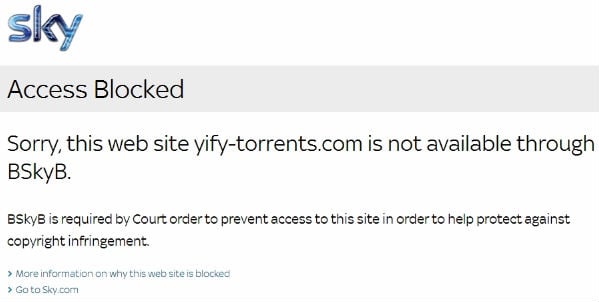
The entertainment industries, however, are confident that their actions will not be in vain. The movie studios and record labels will continue to press site owners to take down their services, and will submit complaints to the High Court for those that fail to comply.
“All of the sites in recent actions have been asked to comply with UK and international law and have refused to do so,” a FACT spokesman told TorrentFreak in response to the recent blocking orders.
“We have made it clear that we will seek action against sites that continue to provide unremitting mass access to infringing content following due legal process,” the Hollywood group said.
And so the Whack-a-Mole continues.
—
The full list of sites that are currently blocked in the UK is as follows:
Primewire, Vodly, Watchfreemovies, Project-Free TV, Yify-Torrents, 1337x, Bitsnoop, Extratorrent, Monova, Torrentcrazy, Torrentdownloads, Torrentreactor, Torrentz, Ambp3, Beemp3, Bomb-mp3, Eemp3world, Filecrop, Filestube, Mp3juices, Mp3lemon, Mp3raid, Mp3skull, Newalbumreleases, Rapidlibrary, EZTV, FirstRowSports, Download4all, Movie2K, KickAssTorrents, Fenopy, H33T and The Pirate Bay.
Source: TorrentFreak, for the latest info on copyright, file-sharing and VPN services.
21 Nov 21:19


Google Street View now includes national parks, historic sites in US and Canada
by Xeni Jardin
Moraine Lake’s beautiful color comes from the light reflecting off rock flour at the bottom of the lake.
Google has released new "Street View" imagery of national parks and historical sites across North America.
Working with the U.S. National Park Service and Parks Canada, our Street View cars, trikes and Trekker mapped more than 44 locations with beautiful, 360 degree panoramas. Leave your gear behind and still get a chance to marvel at the Sequoias in California. Or perhaps you’re looking for more adventure? Lookout to Signal Mountain in Wyoming’s Grand Tetons, climb around California’s Joshua Tree National Park, or dip your toe into Moraine Lake in Banff, Canada. Getting tired? Take a break to watch the Old Faithful geyser in Yellowstone National Park, the first national park in the world.
Or, let your inner history buff come out to explore monuments and fortresses across North America.
|
|
21 Nov 21:18
 On PBS NewsHour, science correspondent Miles O'Brien interviews Chris Hadfield, who has brought new popular interest to space exploration with his innovative use of web video, tweets, Facebooked photos, and a creative use of the internet, from space. Miles talks to the retired Canadian astronaut, author of "An Astronauts Guide to Life on Earth," about the importance of space exploration.


Astronaut Chris Hadfield shares 'unbeatable point of inspiration' for space exploration
by Xeni Jardin
Screengrab from Chris Hadfield music video for his cover of David Bowie's "Space Oddity."
You can listen to the interviews or read a transcript here; videos are below.
(Disclosure: Miles and I are in a relationship, and I think he's awesome.)

|
|
21 Nov 21:11


IOC Demands 2014 Olympics Piracy Takedowns & Blocks “Within Minutes”
by Andy
 One only has to look at how hard countries work to become Olympics hosts to know that the games involve huge sums of money, on both sides of the ledger. While it certainly bought in some tidy sums for the Chinese, the 2008 Beijing games are believed to have cost around $40 billion.
The outlays associated with the Olympics need to be clawed back in every possible way and one of the options is the selling of TV rights. In 2012, NBC paid the International Olympic Committee around $1 billion for broadcasting rights and as a result wanted to protect their investment.
Next year it’s expected that Russia will spend a record $50 billion to put on the Sochi winter games. Local broadcasting deals have already been sewn up by the IOC, with Channel One, RTR, NTV and RIA Novosti securing the key rights and other broadcasters having to settle for putting out a maximum of just six minutes of footage per day.
Needless to say, the Internet isn’t going to care about the IOC’s rules, much less abide by them. There will be hundreds of unauthorized streams and downloadable torrents of the games, from the opening ceremony through to the closing moments – and everything available for capture in between.
The IOC is familiar with the problem. In 2008 the body went as far as writing to the Swedish government to do something about Olympic events on The Pirate Bay. By 2012 illegal live streams caused the biggest problems and this time round in Russia the IOC wants to take an even more aggressive approach.
According to a letter obtained by Russian publication Gazeta, the IOC has written to Russian authorities and Olympic-related bodies demanding an extraordinary effort to rid the Internet of unauthorized Olympic content in record time.
The IOC is calling on the organizing committee for the games to create a “rapid response team” with the authority to remove unauthorized streams, links and other content from the Internet “in a few minutes or hours”, not days as is the current norm.
The adoption of a new anti-piracy law earlier in the year is an inadequate mechanism to protect the Olympics, the IOC said, as responses to copyright holder complaints take too long to process. Instead, they have a better idea.
The IOC appears to be suggesting the creation of a ‘blacklist’ of sites where Olympic events and streams are likely to appear without permission. Once on the list the IOC wants the sites to create tools that will “automatically and immediately carry out the removal of unauthorized content.”
Details are unclear, but the IOC also seems to be seeking government-administered punishment for sites that fail to efficiently remove infringing content.
When asked about the IOC’s demands the Ministry of Communications said they had not received a letter and refused to comment on “rumors”. The Olympic Organizing Committee simply refused to comment.
Communications watchdog Roscomnadzor, who would need to be involved in any initiative of this type, said they had not seen the letter but were willing to look at the proposals.
“If at the highest political and legislative level decisions are taken and Roscomnadzor receives the necessary powers, we will study this,” a spokesperson said.
By law, Roscomnadzor currently has the power to block access to any site or service that fails to remove reported copyrighted content or links within 72 hours. To meet the requirements of the IOC, legal adjustments will almost certainly be required.
Speaking with TorrentFreak, TV-focused torrent site EZTV said that they will be distributing torrents of the Olympics as they have done in the past. In their view the games should be an inspiration to everyone, not simply viewed as a money-making exercise.
“The Olympics is about people from all over the world coming together to show their skills and sportsmanship. And the IOC is purely interested in making as much money from broadcasting as possible,” the site told us.
“We think differently, we believe everyone should be able to see these events freely and inspire future sport heroes!”
Source: TorrentFreak, for the latest info on copyright, file-sharing and VPN services.
21 Nov 17:38

Cash for climate change: poor countries want payback for pollution they didn't cause
by Katie Drummond
In Burkina Faso, extreme droughts are killing off livestock and devastating crops. In Micronesia, rising water levels have spurred residents to dismantle ancient ruins for the construction of seawalls. And in the Western Region of Kenya, the aftermath of severe 2011 flooding continues to threaten the livelihoods of thousands.
21 Nov 17:36

Authy Now Lets You Use Its Two-Factor Authentication System On Multiple Devices
by Frederic Lardinois
Two-factor authentication is one of the most effective ways to keep your accounts safe, but it also means that if you ever lose your phone and don't have access to a backup code, you won't be able to read your email or sign in to your WordPress blog. Authy, a startup that focused on making two-factor authentication easier to use, wants to make this a thing of the past by allowing you get your second factor authentication code from multiple devices.
As Authy's founder Daniel Palacio told me earlier this week, the company expects that this move will be somewhat controversial. Virtually all two-factor authentication systems today are set up to only work on a single device. Some, like Google Authenticator, can be used on multiple devices, but Palacio argues that this is due to poor design choices and not really an intended use case.
Using Authy, users can add new devices to their list through a system of inherited trust. When users set the application up on a new device, they will receive a push notification on a previously authorized device to confirm that the new device can be trusted. If you ever lose one of your devices, you can simply deauthorize it from another phone or tablet. To be able to do so, Authy uses a multi-key system to ensure that different keys are generated for each of your devices. Users don't have to worry about all of these details, though. For them, the sign-in process remains exactly the same.
As Palacio admitted, this move will likely be somewhat controversial. He acknowledges that adding more devices also increases the number of attack vectors, but the Authy team believes the advantages of this system outweigh these issues.
For one, he told me, there is currently often a long window of time between losing a device and deactivating it. This new system lets you just deactivate the Authy app on your phone from your tablet. “Incorporating multiple devices solves many of the problems users face and should be part of any modern multi-factor authentication system,” Palacio writes in a blog post today.
One thing the Authy team also notes is that most two-factor authentication users either don't generate offline backup codes or store them in an unsafe spot. For them, using a second device may actually be safer than using backup codes.
21 Nov 17:35

Quip, The Mobile-First Word Processing App, Now Imports From Microsoft Word, Google Drive, Evernote, Dropbox
by Ingrid Lunden
Quip, a new word processing app with an impressive pedigree (co-created by ex-Facebook CTO Bret Taylor and the father of Google Apps Engine, Kevin Gibbs), has seen hundreds of thousands of documents created, and millions of messages generated, since its launch in July of this year. Today, Quip is getting updated with new features to drive those numbers higher. It's rolling out a new feature to import documents from other popular software and services - Microsoft Word, Google Drive, Evernote and Dropbox; and it is adding more options to customise the experience with inbox filters, notification settings and “focus mode” to turn off alerts.
With the release of today's version 1.5, Quip is also unveiling some early usage metrics: in addition to the hundreds of thousands of documents and millions of messages, Quip says that half of its users are on iPad, and 40% use it on multiple devices (it's also available on iOS and on the web, with an Android version currently being previewed).
While importing documents from other apps is definitely a step forward for making Quip fit in better with products that people are already using, what Quip has yet to add is the ability to export back out to those same programs. “That is definitely coming,” Taylor told me in an emailed interview. “We want to make it as easy as possible to get your ideas in and out of Quip. Import was more requested, so it came first, but I expect we will enable export to formats like Word early next year.”
What that request for importing over exporting points to, however, is another interesting trend: people are moving away from using word processing programs as the de facto place to store information. “The feedback we have from our early customers is that their use of ‘documents' has changed dramatically since the advent of smartphones,” Taylor said. “Many things that would have been ‘memos' in a document before are now in email conversations or in internal collaboration tools like wikis or SharePoint. Most companies are replacing these tools with Quip. They are using it as a mobile collaboration tool and using their previous word processor only for older, formal documents like contracts.”
It is in this vein that adding more customizing features into Quip is an important measure of its progress: Quip's features point to different ways that people can not just view information, but control how it gets communicated. If Quip can prove to people that it can make them more productive with its particular mix of tools, that could become the measure of its success. “Our focus is on mobile collaboration, and our focus will continue to be in that area, which is different than most competing products,” Taylor said. “Like most startups, our main challenge is gaining mainstream awareness of the product.”
Indeed, he points out that while Quip has come out of the heart of Silicon Valley, it's trying hard to be a product that is appealing beyond it. “We have been excited that most of our initial customers, e.g., Colorado Hazard Control (an asbestos abatement company in Colorado) and Trinity Valley School (a private school in Fort Worth, Texas), are extremely mainstream organizations, well outside of the ‘echo chamber' of Silicon Valley,” he said. “This gives us confidence that the problem we are solving - mobile collaboration - is a problem that is impacting a large number of mainstream organizations, and we are excited with the traction we have so far.”
Other developments since July have included opening Quip up to several international markets. Taylor said that the company's international ambitions have been “going great,” with particularly strong traction in China and Italy.
Going forward, what might we expect from Quip? I noticed that the company's blog post announcing the 1.5 version updates kicked off with a case study of Pop-Up magazine using it to plan an issue. I wondered if Quip might at some point look at ways of creating custom skins to tailor the platform to specific verticals. For example, the way that a marketing person would use Quip will be different from how a legal person uses it, and those would be different again from how a publisher or blogger might use it. Turns out that this is on the cards. “Definitely on the way next year,” he said.
21 Nov 16:44


Differences between life when you're poor and life when you're middle class
by Cory Doctorow
Beth Pratt writes, "Being poor is different than being middle class. Killer Martinis explains just how different in this post she calls 'Why I Make Terrible Decisions, or, poverty thoughts'. She begins by telling us that 'rest is a luxury for the rich' and goes on from there."
Convenience food is just that. And we are not allowed many conveniences. Especially since the Patriot Act passed, it's hard to get a bank account. But without one, you spend a lot of time figuring out where to cash a check and get money orders to pay bills. Most motels now have a no-credit-card-no-room policy. I wandered around SF for five hours in the rain once with nearly a thousand dollars on me and could not rent a room even if I gave them a $500 cash deposit and surrendered my cell phone to the desk to hold as surety.
Nobody gives enough thought to depression. You have to understand that we know that we will never not feel tired. We will never feel hopeful. We will never get a vacation. Ever. We know that the very act of being poor guarantees that we will never not be poor. It doesn't give us much reason to improve ourselves. We don't apply for jobs because we know we can't afford to look nice enough to hold them. I would make a super legal secretary, but I've been turned down more than once because I "don't fit the image of the firm," which is a nice way of saying "gtfo, pov." I am good enough to cook the food, hidden away in the kitchen, but my boss won't make me a server because I don't "fit the corporate image." I am not beautiful. I have missing teeth and skin that looks like it will when you live on b12 and coffee and nicotine and no sleep. Beauty is a thing you get when you can afford it, and that's how you get the job that you need in order to be beautiful. There isn't much point trying.
Why I Make Terrible Decisions, or, poverty thoughts (Thanks, Beth!) 
|
|
Ronald.phillips likes this
21 Nov 16:34

Sony imagines 'SmartWig' to monitor health, give directions, and read facial expressions
by Adi Robertson
Sony was in the smartwatch vanguard, but watches, as we all know, are a niche item when compared to at least one common accessory: hair. Eager to push into this new frontier, the company is attempting to patent an item it calls the "SmartWig," a full wig or toupee that would connect to a smartphone or other device and let users do something as basic as receive an email notification or as complex as ask a friend for directions, send picture or video footage to them for reference, and then receive subtle vibrational feedback that would tell them where to go. Here is a list of things that could be in the SmartWig:
21 Nov 16:34


File-Sharing Giant MediaFire Adds Desktop Syncing and Online Streaming Support
by Ernesto
 Operating from Texas, MediaFire has evolved into one of the largest file-sharing services, serving 30 million registered users and a massive 150 million monthly visitors.
This popularity also put the site in the crosshairs of the Hollywood studios, who branded it a “rogue cyberlocker” last year. Shocked by this characterization, MediaFire emphasized that it has always cooperated with rightsholders by taking down infringing content.
At the same time the company worked hard behind the scenes to expand its service into more than just a plain old file-sharing platform. Today MediaFire is ready to reveal the fruits of this effort to the world, with the release of its desktop syncing application and an overhaul of its website.
The sync software allows Mac and Windows users to back up the files stored in their MediaFire account directly to their computers. This means that with up to 50 gigabytes of free storage, MediaFire now is a direct competitor of other cloud hosting services such as Dropbox and Google Drive.
MediaFire desktop sync (large)
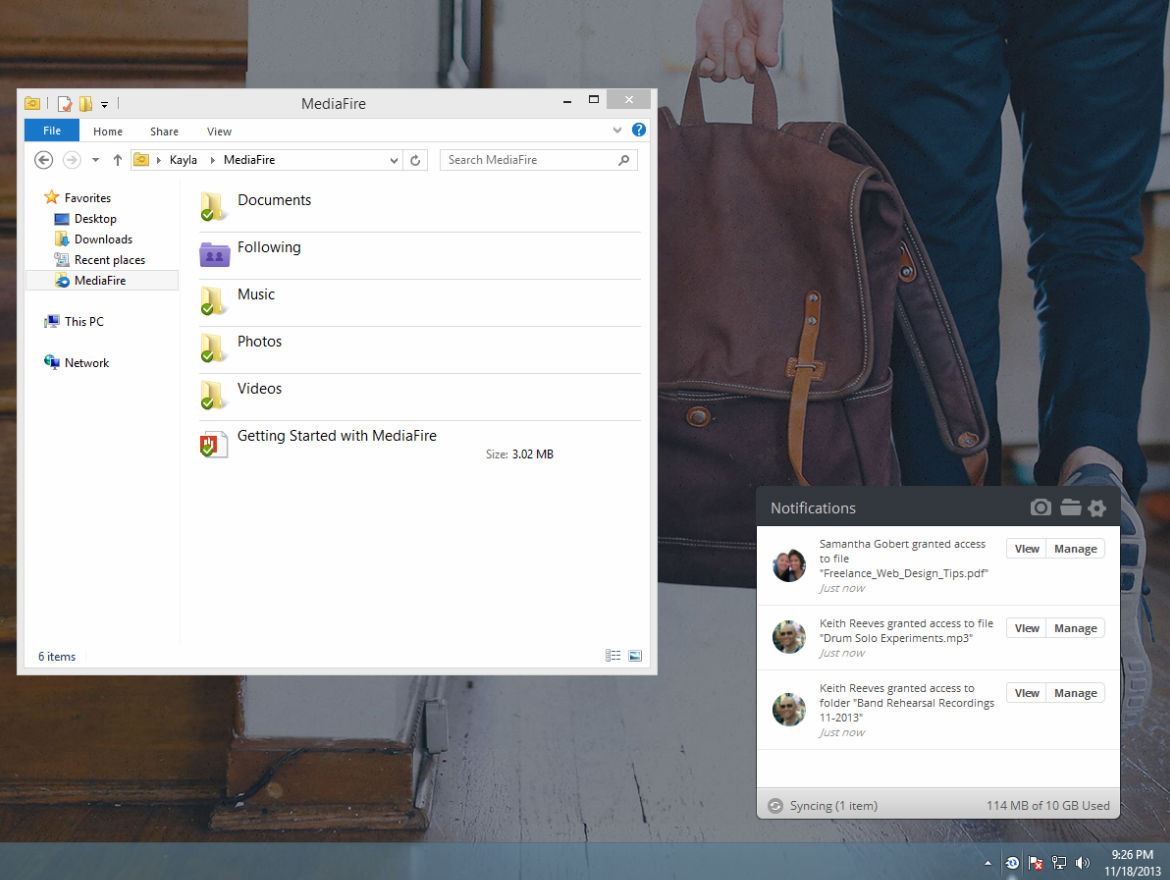
One of the advantages of the sync application is that it allows users to share files directly from their hard drive. For example, people can put audio and video files in their MediaFire folder and get a link to share these with a friend, a group of friends, or the public at large.
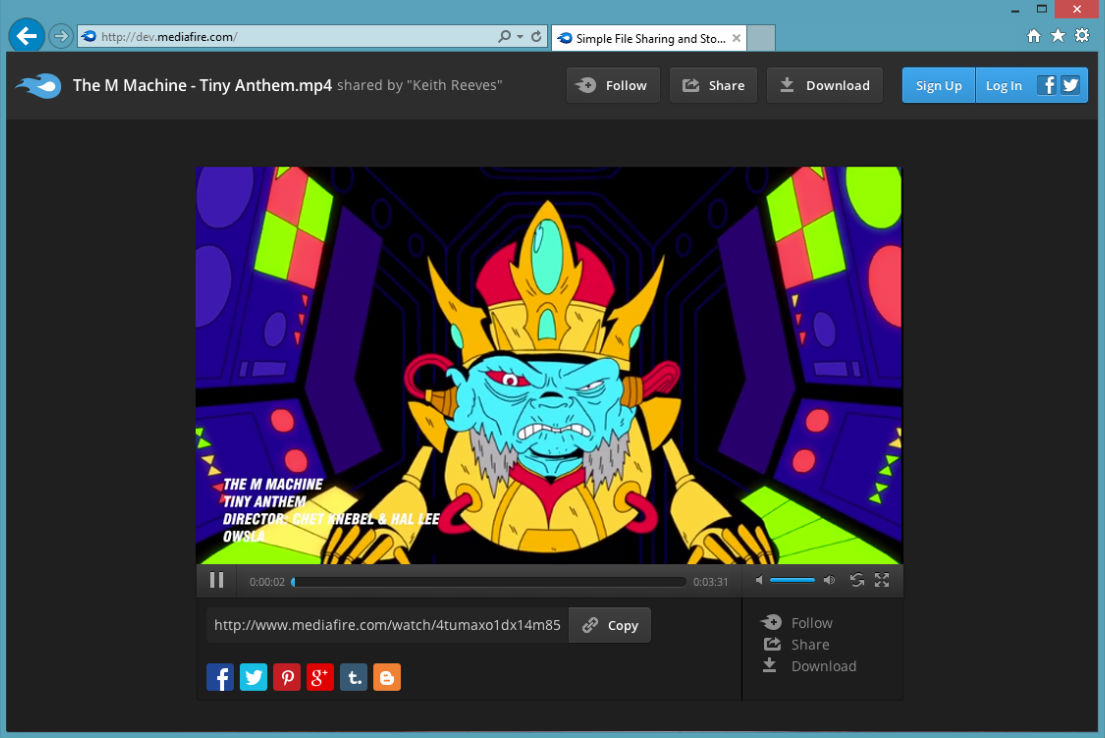
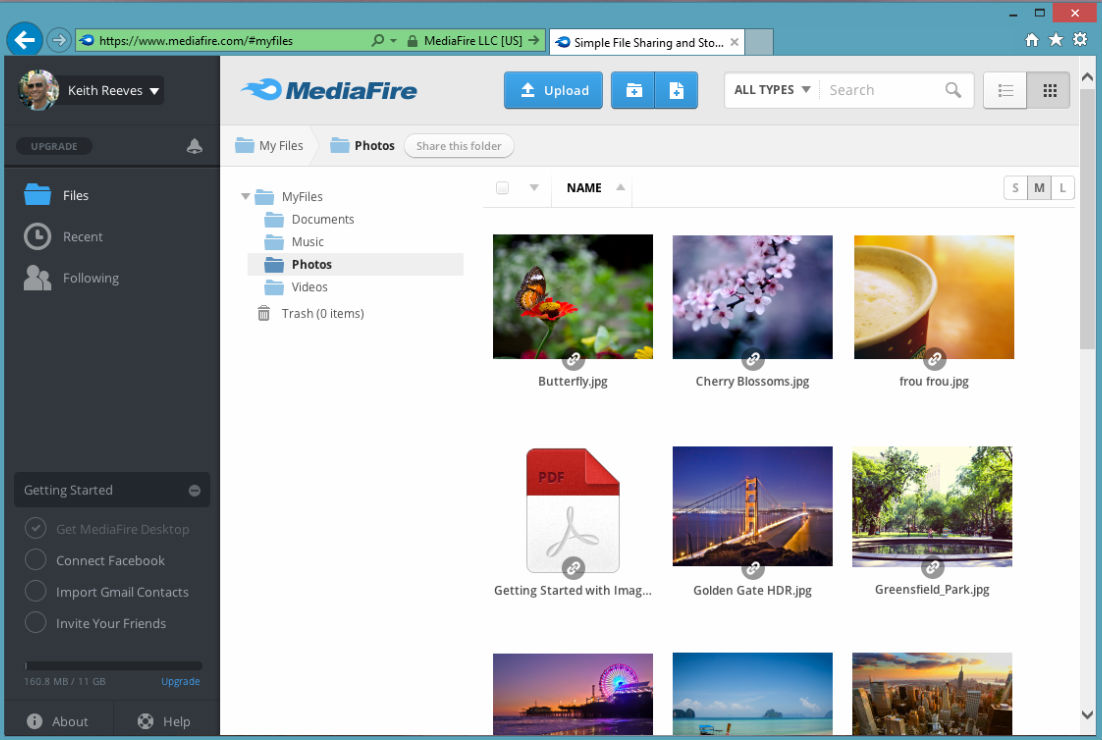
To make sharing more convenient, MediaFire has also overhauled its web interface. The service now supports automatic media file transcoding and streaming support guarantees that over 200 file formats can be viewed directly from a web browser.
Besides streaming, users can download a copy of the files to their computers as well, as this example shows.
MediaFire streaming support (large)
While the above are already major changes, it is just the beginning for the ambitious file-sharing service. The ultimate goal of MediaFire is to make sharing and discovering content easy and convenient across a variety of platforms through the new API.
Brent Bucci, MediaFire’s Vice President of Brands and Developer Relations, informs TorrentFreak that MediaFire’s API will open doors to video playback on other platforms, including Xbox, Playstation and Smart TV.
After the launch of the desktop sync application MediaFire plans to add sync support for mobile devices early next year. A few months later the service will also add search capability, which will make it easier for the public to find files that others share, much like YouTube.
MediaFire’s new web interface (large)
The timing of MediaFire’s new sync tools announcement is interesting as it comes days before Kim Dotcom’s Mega is expected to release similar applications. However, according to MediaFire this is a mere coincidence.
“We haven’t seen ourselves a competitor to Mega,” Bucci says, explaining that MediaFire has chosen to focus on the social sharing aspect rather than encryption.
“Encryption is very hard to do, and at the end of the day really good security, transparent policies and not pissing off the powers that be, are all essential parts to running a cloud service that can be trusted,” Bucci says
Dropbox, one of the most used file-syncing tools, is not a competitor MediaFire worries about either, as storage is much more expensive there. “If people want two gigabytes of storage, perhaps Dropbox is right for them,” Bucci says.
MediaFire users can store a maximum of 50 gigabytes with a free account (starting with 10 GB), and paid subscriptions start at $4.99 a month for 100 gigabytes.
Finally, the topic of online piracy can’t be ignored. When MediaFire adds discovery tools it may also become easier to find infringing content being shared on the service, something which has the potential to raise eyebrows in the entertainment industry.
“Of course, dealing with piracy and fair-use is a balancing act. We’ve developed some pretty innovative tools in order to identify pirated content, while at the same time, we are committed to protecting our users’ data and media,” Bucci says.
However, instead of focusing on the negative MediaFire prefers to highlight the advantages of sharing. Many musicians and even major labels and movie studios are beginning to realize that sharing can also have benefits, and this is exactly what MediaFire wants to excel at.
“The industry is changing, and entertainment companies and artists are beginning to see clear advantages when it comes to providing free content to their fans. Remixes, mash-ups, and social promotions are creating a new generation of artists that understand their fans,” Bucci concludes.
Those interested in the new MediaFire and its fresh streaming support and sync tools can check it out here.
Source: TorrentFreak, for the latest info on copyright, file-sharing and VPN services.
21 Nov 13:46


Ace New Gravity Short Lands Online

If you've seen Gravity - and judging by its monster box office, you have, twice - cast your mind back to the moment Sandra Bullock's astronaut Ryan Stone gets on the comms in the Russian space station and, Major Tom-style, has a fleeting interaction with a disembodied voice on Earth. Well, in a lovely moment of loose-end-tying, the movie's screenwriter, Jonás Cuarón, has made a short film showing what happened at the end of that line.
The seven-minute short film, entitled Aningaaq, was originally intended as a Blu-ray extra but has now debuted over at The Hollywood Reporter. It shows an Inuit, played by Greenlander Orto Ignatiussen, providing Stone's garbled lifeline, and offers a starkly beautiful counterpoint to the expanseless reaches of space.
"It's this moment where the audience and the character get this hope that [Stone] is finally going to be OK," Jonás Cuarón told The Hollywood Reporter. "Then you realise that everything gets lost in translation."
Shot for $100,000 - just enough to get the ten-strong guerilla crew out to Greenland to get it in the can - Aningaaq will be submitted into the Best Live Action Short category at the Oscars. Don't bet against a unique one-two for the pair of films.
For more on Gravity, head over to Empire's interviews with Bullock, director Alfonso Cuarón and producer David Heyman.
|
|


21 Nov 13:46

TaskRabbit Takes Its Errands Marketplace To London For Its First Move Outside The U.S.
by Ingrid Lunden
TaskRabbit, the U.S. startup that runs a marketplace for people who need help with short-term work and errands, is hopping over the pond for its first international city launch. On Thursday, it will open for business in London, starting with 50 Taskers ready to take on your every need in the areas of Christmas-related errands, cleaning and handyman-type work. Further UK cities will come in the months ahead, Stacy Brown-Philpot, TaskRabbit's COO, told me on Wednesday.
Prices for the initial errands on offer while TaskRabbit is still in beta in the UK range from between £12 to £25 per hour ($19-$40).
TaskRabbit has seen some knocks in its home market - manifested in the form of layoffs to refocus on what the company believes are opportunities in enterprise, mobile and geographic expansion. And some of its would-be competitors like Zaarly have also faced business challenges. In that sense, expanding internationally and the move to greener pastures could be a way for the company to spur growth. The London launch follows on the heels of a five-city expansion in the U.S. in August. London brings the total number of cities where TaskRabbit is active to 20.
But TaskRabbit is not entering a new market without its own hurdles. The UK, as Zadie Smith recently noted, is not exactly known for its service culture around food delivery, partly because the people who bring the food are surly, and partly because customers find the whole exchange so awkward. Taking that another step further, and going on my own experience as a longtime London transplant, I'd venture to say that perhaps many UK consumers are not naturally inclined to call on strangers to do lots of other things for them at the spur of the moment. The pictures that TaskRabbit supplied to me, in their stilted staging, only emphasize that feeling to me even more.
There are other challenges in the UK, in the form of existing players in the delivery market. Among them, the UK has TaskPandas, Sorted, Sooqini, Mila, along with at least one casualty, Milk.ly, which started as TaskRabbit clone but now has pivoted to e-commerce.
Interestingly, although there are a ton of offerings in the UK already, TaskRabbit says that London has been the most-requested city outside of the U.S. for the company. “Paris is a hot city that has the largest amount of demand after London,” Brown-Philpot says. “Toronto and Sydney after that.” (All those expansions would make a big dent in the $37.7 million the company has raised to date.) You could argue that the fact that these other startups are here working will make the market more receptive to TaskRabbit, too.
So what will set TaskRabbit apart from the rest? At its base, TaskRabbit is coming into the UK with the feeling that it is the market leader. Even if there are others, none have “our reputation,” she says, with 75% of its business coming from word-of-mouth. (And, from my own experience, using TaskRabbit in San Francisco, I have wished we had it here in London - although the service I have used it for, slightly odd purchasing and delivery requests, doesn't fall into the three categories TaskRabbit's launching with here in London.)
Brown-Philpot says that TaskRabbit has also done its homework, with a survey of some 2,000 consumers. The three areas where it is first concentrating (Christmas shopping/wrapping/preparing; cleaning; small repairwork) came directly from those results. The target audience, she says, are professional women who are married and have kids and just want more time in their lives.
On the supplier side, Brown-Philpot says that TaskRabbit had no problems getting people to sign up to become Taskers. She says that TaskRabbit found them through Facebook and Google advertising, and as part of getting onboarded they were vetted for fraud and other security-related areas, “and to make sure they had the skills they said they had.” There are more applications coming in, as there always have been in its home market, she says. Putting demand and cultural norms in the UK to one side, “We never have a problem with supply. There are always people looking for extra income.”
21 Nov 13:45

Pinterest Launches Place Pins To Help Pinners Plan Their Trips
by Ryan Lawler
Pinterest released a new set of tools for users that would help them “explore” and share the things around them. At an event with 150 “Pinners” (and an untold number of journalists) at Pinterest HQ in San Francisco, CEO Ben Silbermann announced that the company would introduce new ways to plan trips.
“We're excited to inspire you to go out and do things,” Silbermann told the audience. The new product, called “Place Pins,” is designed to help users provide a visual guide to finding places to go and things to explore.
Pinterest users, or “pinners” can beginning planning trips by creating a new board based on location, and then adding pins with locations to those boards. The tool adds a map, images, and relevant information to the pins, and allows Pinners to view the places they'd like to visit both online and on mobile.
While being able to share online could help users find inspiration and plan trips together, the real killer app is on mobile, where Pinterest users will be able to keep track of places even while they're on the go. (And hey, how important is it that you can access those places while traveling?)
The new Pinterest Place Pins depend on Foursquare's location API, along with Mapbox's map technology. But even if a location isn't on the map doesn't mean that Pinners can't add them - they can also add locations of their own. And Pinterest users can also use their mobile apps to get directions, based on location information they have collected.
The new tools for travelers, which was first reported by Skift, could give Pinterest a new potential revenue model.
The announcement comes not long after Pinterest raised a huge new funding round, bringing in $225 million from Fidelity Investments, as well as existing investors Andreessen Horowitz, FirstMark Capital, Bessemer Venture Partners and Valiant Capital Management. To justify that investment, which valued the company at $3.8 billion, Pinterest has begun looking for ways to make money off the massive number of user-curated pieces of content that have been collected from around the web.
One of the ways Pinterest is accomplishing that is with Promoted Pins, which are paid placements from various brands and advertisements that show up within Pinterest category and search fields. There are a number of other features the company has recently rolled out, such as a now-trending tool, personalized pin recommendations, price alerts, and more tools for businesses that are designed to increase the reach of companies trying to connect with potential customers.
While Pinterest didn't mention monetization plans at the event, it seems like a no-brainer that connect its users to local businesses in places all around the world. Because if it knows they want to go to the place, offering up discounts or providing some other incentive to get them there seems like an obvious next step.
21 Nov 13:40


Pocket updated to version 5, promises to be smarter and more dynamic
by Jerry Hildenbrand

Highlights, better app navigation, and an improved user experience make their way to Pocket's Android client
Pocket is the most popular save-it-for-later service out there. Over 1.5 million items get added daily, and the grand total of over 10 million users makes it the largest provider of it's type. People like to use it. I use it myself. Whenever I come across something on my phone that I just know would be better read on a tablet or computer, into Pocket it goes. It's handy like that. And with today's update to version 5.0, they say it's going to get better.
Anytime big changes come to an app with a slew of existing users, we tend to worry. People don't like change in their normal routine, if their normal routine serves them well. The good news is that Pocket's added some great additions, without doing anything that will force users to change their ways. Read through and see what I mean.
|
|