Google made news recently when it announced a cross-licensing deal with Samsung, but it's already moving on to another. The search giant has entered into a second such deal with network management firm Cisco. This might be the start of a pattern.
The specifics of the deal were not made public, but Google and Cisco did say the deal will prevent unnecessary patent lawsuits in the future. Google's deputy general counsel for patents also pointed out the company would be happy to entertain similar cross-licensing offers from other companies.
Satellite communications company Iridium today announced Iridium GO!, a portable hotspot that runs from the heavens down to your Android or iOS smartphone. While larger than your traditional Wifi hotspot, GO! is just 4.5 by 3.25 b 1.25 inches and weighs 10.4 ounces. You can mount it externally — remember that it'll need line-of-sight to the satellites — but it's not meant to be a permanent outdoor solution.
Voice and data are routed through the Iridium GO! app. You'll get about 4 hours' talk time, the company says. It's not a dumb data pipe — again, things have to be routed through the app — but Iridium will have an SDK for developers to tie into. Initial partners include:
OCENS – Transforming GRIB and classical weather, ocean and fishing data into interactive decision tools
Global Marine Networks (GMN) – Optimized email services for maritime use
Satcom Direct – Mobile applications that enable connectivity for passengers while in flight
Appareo Systems – Engineering and manufacturing of electronics, software and data communications solutions for aviation and agriculture
DeLorme – Communication, information, and safety applications
AIRSIS – Solutions for the energy and transportation industries
JouBeh Technologies – Innovative Iridium OEM hardware and software solutions provider for various applications
This isn't a product for most of us. And while price wasn't announced, expect it to be around the $800 range. But for those who need satellite communications, it's going to be a great option.
Modern governments have a problem. The Internet is becoming increasingly important to the future of economies, and yet the skills associated with it remain – for the most part – far down the priority order in terms of education policy. Amongst these governments, only a handful are putting in formal, structural, systems in place to teach coding from the earliest levels – amongst them are New Zealand, South Korea, the US, Israel and the UK.
In the UK the issue has rocketed up the political agenda, in part by the explosion of startups emerging from the country. This year the UK will be the first major G20 economy to place coding at the heart of the school curriculum on a national level. It’s an auspicious time: This year marks the 25th anniversary of the web, given to the world by British scientist, Sir Tim Berners-Lee.
Today, at the Skills 2014 Summit conference in London the Chancellor of the Exchequer George Osborne and Education Secretary Michael Gove announced a new initiative to train teachers in software coding to encourage these core skills and by implication, technology entrepreneurship.
The Government will put up £500,000 in matched-funding which will be awarded to ‘expert computing organisations’ willing to provide another 50 per cent of funding for projects to train teachers in delivering the new tech-oriented computing curriculum. UK businesses will be given the opportunity to bid for a portion of the fund later this month.
While £500,000 sounds like a relatively small amount of money given the scale of the problem, a government spokesperson told TechCrunch that the funding ought to be seen in the context of existing commitments in the area.
These include providing the British Computer Society with more than £2million to set up a network of 400 ‘Master Teachers’ to train teachers in other schools and provide resources for use in the classroom. There is also £1.1 million committed to the ‘Computing at School’ project to help train primary teachers already working in the classroom – through online resources and in school workshops. And the government has also increased bursaries for those wanting to become computing teachers. Scholarships of £25,000 – backed by Microsoft, Google, IBM and Facebook – are being offered to computer science teachers.
The overall idea is to equip schools to teach the new computing curriculum to be introduced in September this year. The curriculum was designed with input from the Royal Society of Engineering, and tech industry leaders such as Google and Microsoft.
This new funding is part of the UK government’s backing for the UK’s Year of Code, a campaign modelled loosely on the Hour of Code programme from the US.
The campaign will encourage the adoption of computer programming amongst teachers and children. The campaign has the backing of organisations including BBC, CodeAcademy, CoderDojo, , Decoded, FreeFormers, Founders4schools, RaspberryPi and Young Rewired State, amongst many others.
To kick start the campaign there is an introduction to programming in the form of learning to build a Moshi Monsters-themed Pong game, built by Kano, the startup backed by Saul Klein of Index Ventures.
The Year of Code campaign will see a series of events take place over the next 12 months to promote computing. It will include a week-long programme in March encouraging all UK schools to teach every pupil at least one hour of coding in that week.
It replaces the old ICT programme of study, which focused on computer literacy, with more up–to–date content teaching children how to code, create programmes and understand how a computer works. The government has ordered coding become compulsory for every child aged 5-16 years old.
Rohan Silva – a former special adviser to the UK Prime Minister on the tech startup sector – will be chairman the Year of Code. He’l be joined by Lottie Dexter, founder of the Million Jobs Campaign, who’ll be the Director of the campaign.
Saul Klein, partner at Index Ventures, which is supporting the Year of Code – and one of its main drivers – said: “We grew up with the three Rs. But this critical change to our curriculum means our children will now grow up with the three Rs and a C.”
Other institutions are joining in the initiative. Google has put more than £1 million over the last year to support organisations like Code Club, Teach First and the Raspberry Pi Foundation, while Microsoft has a “Switched On Computing” teacher training roadshow.
According to research commissioned from pollster YouGov, knowledge of technology amongst the UK’s population is now considered as important as reading, writing and basic maths.
In the survey of 4,000 adults, the study found that nearly 60% of those questioned thought computer coding was a vital skill for today’s job market and 94% considered general IT skills to be essential to work-readiness, as important as literacy and numeracy. Some 94 per cent of those with children aged 5-16 consider computer skills to be important for today’s job market, the same number as those who say the same of literacy and 95 per cent who say the same for numeracy. In London, 98 per cent believe computer skills to be important, higher than those who rate both numeracy and literacy to be vital. By contrast, only 62 per cent of parents across the UK believe it is important to know a foreign language.
Parents are also keen to make sure their children leave school with better computer skills. Only 19 per cent of adults say they are ‘very good’ with personal computer skills and 13 per cent admit they are ‘fairly bad’. But most never learned code as youngsters and many have never learned it since.
The poll also discovered that only 10% of adults knew how to code, yet nearly 50% of those polled said that they would like to learn. Some studies suggest that nearly 50% of today’s jobs could be taken over by technology and automation within two years
These latest initiatives come in the wake of a recently launched campaign from Facebook, Barclays and FreeFormers to teach digital skills called ‘Web for Everyone‘, launched by Martha Lane-Fox, former UK Digital Skills Champion and chair of Go On UK.
The Year Of Code is a great initiative to promote technology, entrepreneurship and creative thinking. But it contrasts somewhat markedly with the government’s recent enthusiasm for dated teaching methods such as teaching Classics and punishing students by making them write “Lines”.
Hopefully lines of code won’t be seen as an exercise in punishment…
Meanwhile, the Year of Code programme itself is introduced in its official launch video, below.
Y Combinator alum Kicksend started life out as a way to share large files — another file sharing app, if you will — but has since put the focus on making it easy to get photos taken on your smartphone printed. Photos ordered via the app are either printed and sent to you through the post or can be picked up at one of its “photo lab” partners. In the U.S., in-store printing spans every state, thanks to partnerships with Walmart, Target, CVS and Duane Reade.
Now the app, which is also available in Mexico and India, is launching in Europe. Specifically, photo printing now covers the U.K., France, and Germany. However, for the time being, Kicksend is providing the print-to-home service only. I’m told that in-store partnerships are in the works, but the first priority was to get the basic printing infrastructure in place.
In the U.K., a prime candidate might be somebody like high street chemist Boots, PC World, or one of the major supermarkets. I’m purely speculating here, but they’d be the equivalent of the startup’s existing U.S. partners, and, in most cases, already provide photo printing facilities.
Kicksend’s mobile app is available for Android, and iOS. It also has a Windows 8 offering. Along with the photo printing feature, it lets you share photo albums through the app or send as many full resolution photos as you want to anyone’s email address. Photo sizes supported include regular aspect ratios (4×6, 5×7 and 8×10), and Hipstamatic-styled photos (4×4). The Mountain View-based startup is currently generating over $150k in revenue a month, apparently.
In late 2011, Kicksend raised $1.8 million in seed funding from True Ventures, Digital Garage, SV Angel, Start Fund, and Milo Founder and CEO Jack Abraham.
As major cities like New York and Los Angeles make the switch over to LED lighting, the change is having a somewhat unexpected impact — changing the way these cities look in movies. As Dave Kendricken explains in No Film School, nighttime LA looks completely different under LED lights than it does with traditional streetlamps. The golden hue seen in movies like Michael Mann's Collateral no longer exists. "It's visually apparent that filmmakers exposing by the existing street lighting of Los Angeles will be picking up very different imagery, even in many of the same locations, as they might have before," he explains. Check out the article in full to get into the nitty gritty of how lighting can change a city's look.
Android: Constantly scanning for Wi-Fi networks can be a big battery drain. Wi-Fi Matic reduces this problem by only enabling Wi-Fi when you're near a network you frequently connect to by detecting your location via cell networks.
Disabling Wi-Fi when away from home or work is nothing new, but this app stands out by allowing you to automate the process with your location without using GPS. While your phone is already checking for cell tower connections, GPS checks are only necessary for fine location. Since Wi-Fi Matic only detects coarse location, the strain on your battery should be minimized, in addition to requiring very little set up like Tasker might.
Blurry images of an unannounced Sony smartphone have leaked. We have no idea what smartphone it might be. Perhaps it's the Xperia Z2, a follow-up to Sony's well reviewed Xperia Z1, or perhaps it's some other Xperia phone Sony it getting ready to unveil. Whatever the case may be, the pair of blurry images that leaked on Tuesday suggest that Sony's upcoming handset is exactly the smartphone we have been waiting for.
The rumors were true... well, some of them, anyway. Microsoft announced on Tuesday that it has picked enterprise and cloud boss Satya Nadella as its next CEO. The move comes after more than five months of searching that saw the company cycle through several rumored "top" candidates including Ford CEO Alan Mulally and former Nokia CEO Stephen Elop. In its official announcement naming Nadella as its new chief executive, Microsoft praised him for having "a relentless drive for innovation and a spirit of collaboration."
David Cameron's attempt to create a Made-in-Britain version of Iran's "Halal Internet" is the worst of both worlds for parents like me. Kids are prevented from seeing things that they need to access – sites about sexual health, for example – and I still have to monitor my daughter all the time when she uses the net (or teach her how to cope with seeing things no kid should see) because the filter won't stop her from accessing the bad stuff.
And for parents who don't understand that filters are bunkum, the situation is much worse. It's one thing to know that there are risks to your kid from the internet. But parents who rely on the filter are living in bubble of false security. There's nothing more deadly than a false sense of security: If you know your car is having brake problems, you can compensate by driving with extra care, increasing your following distance, and so on. If you falsely believe your brakes to be in good running order, you're liable to find out the hard way that they aren't (if you survive, you can thank Bruce Schneier for that apt and useful analogy).
Mastering by John Taylor Williams: wryneckstudio@gmail.com
John Taylor Williams is a audiovisual and multimedia producer based in Washington, DC and the co-host of the Living Proof Brew Cast. Hear him wax poetic over a pint or two of beer by visiting livingproofbrewcast.com. In his free time he makes "Beer Jewelry" and "Odd Musical Furniture." He often "meditates while reading cookbooks."
App reviews at Google Play and the iTunes App Store are pretty broken. They can be helpful, but you have to sift through the tech support rants, device-specific complaints, and half-legible reviews first to find something useful. There are better ways to tell if an app is any good.
Why App Store Scores Suck
Too often people toss review scores out as the only measure of an app. In a perfect world, an app's score would be indicative of the objective quality of an app judged by people who have actually used the app in question. Unfortunately, it doesn't always work that way. "Well it's got terrible reviews at Google Play," isn't a fair critique of an app, especially compared to a real, hands-on review.
The problem with app reviews isn't just trolls one-starring apps, though. It goes a bit deeper than that:
App store ratings suffer from self-selection bias. This isn't a problem unique to app stores, but everywhere online: The people who leave reviews are usually the most vocal (often the ones complaining) or people who have a positive incentive to do so (who traditionally give high marks.) In either case, their experiences don't offer an accurate picture of what most people—the people who don't like or hate an app enough to leave a review—experience when they use it.
Most reviews are poorly written, use criteria that's not useful to anyone, or are highly personal or device-specific. It doesn't take much to find reviews that are barely legible, and if you've ever seen a review that said "one star until it works on Xperia Z," or "four stars until it gets pull-to-refresh," you know how a useless review can impact an overall score. This also underscores the fact that a lot of reviews are so author-specific, either praising or complaining about specific features that you may or may not care about, that they're not useful.
PR companies and developers flood app stores with positive reviews before even launching their app. This is a huge issues with reviews, especially for new apps. Sometimes those upbeat, five-star reviews come later, but other times they're posted in the time between the app goes up in the app store and its official "launch." In that in-between time, which can be hours or days, a few five-star reviews go a long way towards making the app look good on launch day, assuming they don't get caught doing it.
Competing developers urge users and friends to one-star competing apps to keep their reviews down. This doesn't happen too often, but it has happened—asking "friends and family" of one app to sabotage the ratings of another competing app isn't unheard of. At the very least, developers will have their own teams try to influence a competing app's ratings. At worst, they'll just try to bump up their own. The inverse is true too—often app developers nag users to leave good reviews if they continue using the app. So much so that some people think it's annoying.
Changes to the app store itself can kill review scores. Not too long ago, Google introduced a new recommendation feature that suggests apps based on apps you have installed. It also lets you star that suggestion—making you think you're rating the suggestion and saying whether the app interests you. In fact, you're rating the app itself, which—as many developers have seen, led to crashing ratings. All because of a poorly-understood and poorly-implemented feature at Google Play. There's a great discussion at Hacker News about this, and how it damages the credibility of app store review scores.
So we've established that app scores and reviews can be pretty useless if you don't take the time to separate the wheat from the chaff. If it's not an issue with the app store itself, the reviews themselves are at best highly specific and useful only to certain people or circumstances, and at worst spam or promotional campaigns designed to influence your opinion. Of course, you can fight the tide by sifting through individual reviews to find the really good ones.
If app store reviews aren't terribly useful, what can you trust? You do have other options if you want to learn more about an app before downloading it. Here are a few useful options:
Read trustworthy, curated third-party reviews. Regardless of the type of phone you have, there are plenty of blogs that specialize in app reviews and ratings. Whether it's here on your favorite productivity blog, over at TUAW for your iOS needs or maybe over at Android Police for Android reviews, the key is to find reviews for the app you're looking for on a site that does them frequently and does enough that they're likely to have a worthwhile opinion. Read the review and see if it helps you glean the information you want to know—if the article is recent, you may be able to join a discussion with the author on the topic.
Check YouTube reviews and video demos. If you're looking at an app and wondering how it works, head over to YouTube and search for the app's name. You'll almost certainly find a number of reviews of the app from YouTubers and bloggers who want to post their video review to their site. While those reviews can be useful, they're really good at showing you how the app works, what the interface looks like, how snappy or quickly they run, and what options they have. An in-depth video review can be just as good as installing the app yourself, and watching one can help you decide.
Check a developer's other apps and stick with quality developers. Both the iTunes App Store and Google Play both let you see other apps by the same developer if you're looking at the app page for one. Check the developer's other apps and see how well they're regarded. You can check their reviews for general sentiment, but you'll do better if you look around for third party reviews and opinions about the developer and their work. If it's a developer behind other apps that you trust, that's a point in the app's favor. Similarly, if you know a quality developer, stick to them and take note when they launch a new app. Even if you're unfamiliar with the dev, see if they have a website or an easy way to get in touch with them. A serious dev will make their address available, and in the case of Android apps, they may even have a Google+ group you can join. See if they—or the app—has a presence on Twitter or Facebook.
You could always look into app direcovery apps, like our favorite discovery app for iPhone and for Android, but app discovery apps and services tend to guide you towards apps that the developer or team behind that service want you to see, not necessarily everything that's available. Still, it's another option.
In the case of some apps—especially free ones, or ones that fill in an important part of your life, like calendar apps, email clients, Twitter clients, or note-taking apps—you'll never really know if they're what you need until you actually try it out and use it for a while. In those cases, don't hesitate to give them a try and form your own opinion. Paid apps (and free apps that hide their useful features behind in-app purchases), on the other hand, make it difficult to get a good feel for it before you can possibly get a refund (if at all), so tread carefully and use the tips above to decide whether it's worth your hard earned cash.
Welcome to the roundup of the best new Android applications, games, and live wallpapers that went live in the Play Store or were spotted by us in the previous 2 weeks or so.
Please wait for this page to load in full in order to see the widgets, which include ratings and pricing info.
Looking for the previous roundup editions? Find them here.
Featured App
Medieval Wars:Strategy&Tactics
Today's roundup is presented by Medieval Wars: Strategy & Tactics from Herocraft.
With Microsoft dropping support for Windows XP in April, you would think people would start moving on to Windows 7 or Windows 8. Apparently they aren’t and instead, Windows XP’s market share is increasing. According to the latest report from Net Market Share, XP’s market share increased from 28.98% in December to 29.23% in January.
Samsung on Monday sent out press invites to a special media event scheduled for February 24 at the MWC 2014 in Barcelona, Spain, where the company will most likely unveil its next flagship smartphone, the Galaxy S5. While the Galaxy S5 isn’t mentioned in the press invite, the fact that this is an “Unpacked 5” event, and labeled as Samsung’s first major mobile announcement of the year, is an indication that the company will unveil a flagship handset during the show, which can only be the Galaxy S5.
Leaked screen shots from the HTC Desire 310 show that the phone will be the first device in HTC’s lineup to blend BlinkFeed with a near-stock version of Android – complete with on-screen buttons. The HTC Desire 310 is said to be powered by a quad-core MediaTek MT6582M processor clocked at 1.3 GHz. According to the source, future MediaTek-powered devices from HTC will take the same software approach. If that’s not surprising enough, manufacturing of the HTC Desire 310 will actually be outsourced to Compal Comm a Taiwanese ODM – a manufacturer which typically handles laptop production for the likes of dell, HP, Lenovo and Acer.
With all the rumors surrounding the HTC M8 and Sense 6, we doubt HTC has any plans on ditching its custom Android user experience, but the HTC Desire 310′s rumors raise quite a few questions regarding HTC’s software strategy. We know that many of you are not big fans of BlinkFeed, but would you be willing to live with it if HTC chose to merge its news and social media aggregate with stock Android?
U.S. broadcasters and brands have done a phenomenal job over the years of making TV commercials aired during the Super Bowl as much of a staple for TV viewers as the big game itself. Considering how hated TV ads are in just about any other context, this was no easy feat. Super Bowl XLVIII featured its fair share of gems and duds this year, as is the case every year, but Hulu has separated the cream of the crop from the rest and compiled the top-5 ads of this year's Super Bowl.
New P4u-operated Samsung stores to focus on 'smartphones, tablets and wearable technology'
UK high street retailer Phones 4u has announced a partnership with Samsung that'll see 15 P4u-operated Samsung stores opening across the country. These outlets will focus on "smartphones, tablets and wearable technology," and will be managed by Phones 4u and staffed by the company's employees. Phones4u has previously partnered with the electronics giant with Samsung-branded "stores within stores" in some locations; the new partnership will take things a step further by opening standalone Samsung stores managed by the smartphone retailer.
Today's news follows a wider deal between Samsung and P4u rival Carphone Warehouse to open more than 60 Samsung stores across seven European countries, as part of what CPW described as a "preferred partner" deal. As evidenced by today's announcement, however, Samsung's retail ambitions clearly extend beyond just one partner chain. And it's possible Samsung stores could soon become a common sight in many British towns and cities.
The Metro user interface that Microsoft unveiled with Windows 8 has spawned a cult of haters but the company isn't done coming up with ways to make its live tiles less annoying to its user base. The Verge reports that a leaked build of a new Windows 8.1 update slated to launch next month contains new features aimed at easing some big pain points on the Metro display.
Google Now is about to arrive in Chrome beta for Mac, Windows and Chromebook. With this, Google’s automatic alerts for upcoming concerts you bought tickets to, flight delays, heavy traffic on your route to work and other relevant information the company gleans from your daily habits and emails, have now finally found their way onto the desktop. The company says this new feature will be available later this week, so if you don’t see it yet, don’t despair.
Google Now launched on Android and then, after a long delay, found its way on iOS. While there had long been sightings of Google Now code in Chrome, it took Google quite a while to bring this feature to the desktop.
For the time being, this new feature is only available on Chrome beta, the most stable of Chrome’s preview channels, and in English. Google promises it will support other languages soon.
The notifications will show cards for weather, sports scores, commute traffic, shipping notifications and event reminders.
Google notes that some of this info may be based on where your mobile device is and that the desktop version only shows a subset of the notifications that are available on mobile. Given that you are probably not looking for tourist attractions around your desktop or in need of translation and currency conversion services, this restrictions makes sense.
Now that this feature in the beta channel, it’s only a matter of time before every Chrome users will get access to it. If this release in the beta channels works out well, chances are it will graduate to the stable release pretty soon.
After recent NSA leaks, the German is now facing a new threat on the legal front. The German hacker group Chaos Computer Club has joined forces with the International League for Human Rights to file a criminal complaint against the government, based on recent revelations of mass electronic surveillance. "We accuse US, British and German secret agents, their supervisors, the German Minister of the Interior as well as the German Chancelor of illegal and prohibited covert intelligence activities," the complaint reads, "of violation of the right to privacy and obstruction of justice in office by bearing and cooperating with the electronic surveillance of German citizens by NSA and GCHQ."
Carriers will reportedly build next stage of their LTE networks together
UK mobile operators Three and EE are set to work together on the next part of their 4G LTE networks, according to a report from the Financial Times. The FT reports that the largest and smallest major UK carriers will share masts and backhaul transmission costs as part of a deal that'll see £1 billion ($1.63 billion) being jointly invested.
The agreement covers cost and infrastructure sharing, however there's "greater flexibility" for both EE and Three to control the speeds and coverage of their networks, according to the report. That means the entire 4G network isn't being shared between the two — "the antennas, spectrum and the core network will also be different for the two groups." The deal is also said to revise the conditions of Three's existing network-sharing agreement with EE.
Naomi Novik isn't just a talented author (she won the John W Campbell Award for best new writer in 2007 on the strength of her fabulous Temeraire novels, which retell the Napoleonic wars with dragons providing air-support!), she's also a profound thinker on the questions of reuse, remixing, intellectual freedom and copyright.
Last week she gave testimony (PDF) to the House Judiciary Committee's Subcommittee on Courts, Intellectual Property and the Internet that described the way that creators rely on their ability to remix in order to create new and original works.
One thing I love about Novik is her intellectual honesty and her willingness to cut through the self-serving, romantic mythology of the wholly original creator, and to both acknowledge and celebrate the fact that her originality comes about by taking the works that others created before her and adapting them through her own artistic process, "Original work, work that stands alone, doesn't just pop up out of nowhere. It is at the end of a natural spectrum of transformation."
I also appreciated her strong arguments as licensing as a substitute for robust fair use: "On the purely practical level, the vast majority of remix artists doing non-commercial work simply don't have any of the resources to get a license — not money, not time, not access."
Novik's testimony is admirably summarized by Dr Matthew Rimmer in this Techdirt post. Rimmer is a global expert in fair use and copyright, and he highlights many of the most salient features of Novik's testimony.
I would like to publicly express my gratitude on behalf of writers everywhere to Naomi Novik for standing up for a fair deal for creators and audiences in Congress.
In 1994, while I was still in college, I first came across the online remix community. Over the next decade, before I wrote one word of my first novel, I wrote fanfiction, built online computer games, wrote opensource archiving software, and created remix videos. I met hundreds of other artists creating their own work, and found an enthusiastic audience who gave feedback and advice and help. I had no money for licenses or lawyers. Neither did my fellow artists. No one would have sold us one anyway. We weren't trying to make money off our work. We were gathering around a campfire to sing and tell stories with our friends. The campfire was just a bigger one, and instead of telling new stories about Robin Hood, we told new stories about Captain Picard, because that was who we saw on television every week. Fair use gave us the right to do that...
Vincent van Gogh deliberately copied Japanese woodcuts so that he could find his own style. Shakespeare borrowed heavily from earlier sources. No one could deny that he transformed them. But imagine if the laws of his time had barred him from doing so. We wouldn't have Hamlet, we wouldn't have King Lear, we wouldn't have Romeo and Juliet. And if Leonard Bernstein hadn't borrowed from Romeo and Juliet, we wouldn't have West Side Story. Now if we prevent the next generation from borrowing from West Side Story, we cap the flow of creativity, we dam the river of innovation...
I would ask Congress to make it easier for developing artists, who are often at a significant disadvantage currently, to exercise their fair use right. I have never received a ceaseanddesist letter. But some of my fellow remix artists have, despite the fact that their work was completely noncommercial and highly transformative. It drove several of them completely out of the community and caused them to stop sharing their work, or it stopped them creating it at all. Virtually every remix video artist I know (including myself) has had their videos taken down from multiple platforms by automated systems that look for even minute fragments of copyrighted work. In order to restore them, if that's even possible, they have had to file countercomplaints in the face of terrifying automated warnings telling them that they could be fined enormous amounts of money, and making them feel like criminals.
Our country is the world leader in innovation because here we ask those what if questions, and we are free to imagine what the answers look like. We're encouraged to look around us at the things that exist and imagine how we could make them better, how we could take them to the next level, how we could transform them.
That is the spirit behind fair use. Fair use invites us to tinker and transform, and it frees us to explore ideas and share them with one another. It gives new artists and creators more tools to play with early in their careers and facilitates the evolution of genres and new forms. Any narrowing of fair use is inimical to this spirit.
Ahmed Shihab-Eldin is a respected journalist who holds US citizenship. Every time he returns to his home in New York, he is detained for many hours by the DHS, subjected to humiliating questioning and detention without evidence or charge, because he fits a "profile" that seems to consist entirely of "brown dude with Arabic name who visits the middle east." He recently returned from the World Economic Forum in Davos and found himself detained for hours, despite having been assured that his name had been removed from the DHS's watch-list.
His story of harrowing treatment at JFK airport stands in sharp contrast to his experiences at checkpoints in the middle east, where security risks are much more immediate and more grave. As he points out, America has spent billions creating an aviation security system and system of border checks that have had no material impact on security, but have nonetheless enmiserated, alienated, and harassed millions of people who committed no crime and posed no threat,
The room was filled with rows of seats and several DHS officers with colorful folders (red, yellow, green, blue) lined up in front of them with passports and travel documents. The juxtaposition of the colorful folders with the rows of mostly brown people filling the seats was suspect in itself.
"Omar Mubarak... Juan Diaz... Sayed Hussain," the officers called us one by one.
I couldn't help but feel as though JFK itself was a bit racist.
After a 14-hour trip, I wanted to stretch my legs. So I stood up, anxious to find myself back in the room, especially after having written to the DHS. "Take a seat," the officer at the door sternly said to me. I told him I wanted to stretch my legs after the long flight. He told me I wasn't allowed to stand up. You are also not allowed to use your phone or electronic equipment. I was also slightly surprised to find as many children in the room as there were cameras.
"Sir, I'm a U.S. citizen who wants to stand while being detained. Am I not allowed to stand?" I said, pointing to the Asian man and Pakistani woman standing with their toddler strapped to the man's chest. Anyway, there were only two empty seats in the room with a capacity of 60.
"Sit down!" he repeated for the sixth time, and came and confiscated my phone, which I was using to try to text my coworkers who were waiting to share a car home.
This was not an accident or some bureaucratic misunderstanding and did not come as a surprise to Smulls’ lawyers. They say it was the third straight execution in Missouri in which corrections officials went ahead with lethal injection before the courts were through with the condemned man's appeals.
One presumes that they're just being tipped off on verdicts before they're official, but that's not the case. One "alarmed" U.S. Circuit Court of Appeals Judge said a prisoner was killed before they'd even finished voting. The Atlantic's Andrew Cohen seems to suggest that they're sending a message to the federal government:
What is striking here, though, is not just that state lawyers failed or refused even to respond to Smulls’ attorneys but that these officers of the court, and corrections officials, essentially divested the Supreme Court of jurisdiction by killing the litigant.
I was saddened to find out that the great actor Philip Seymour Hoffman was found dead this morning at the age of 46. His name on the bill of any movie was reason enough for me to watch, and I was never disappointed. I was looking forward to watching many more of his movies.
A lot of deaths feel sad. Philip Seymour Hoffman’s feels like a robbery.
A reader sends us The 2014 Campbellian Anthology, a free and DRM-free ebook (.epub and .mobi) with 111 authors eligible for the John W. Campbell Award for Best New Writer, and over 860K words of fiction."
The volume you now hold in your hands is considerably larger, and includes a multitude of works from 111 contributors, spanning more than 860,000 words. (Should anyone be curious, that exceeds the combined total in George R. R. Martin's A Storm of Swords and A Dance with Dragons, which are -- so far, at least! -- the two longest volumes from A Song of Ice and Fire.)
You've only got two days left to take advantage of The Humble Audiobook Bundle, which lets you name your price for a stellar lineup of DRM-free audiobooks (this is practically the only way to get DRM-free audiobooks these days, since Audible, the company that controls 90% of the market, requires that publishers use DRM even if they object to it). The Humble Audibook Bundle selection includes Salman Rushdie's "Satanic Verses;" William S Burroughs's "Junky;" Meg Cabot's "Abandon;" Dave Eggers's "A Heartbreaking Work of Staggering Genius;" Cormac McCarthy's "Blood Meridian," Charles Portis's "True Grit," and many more.
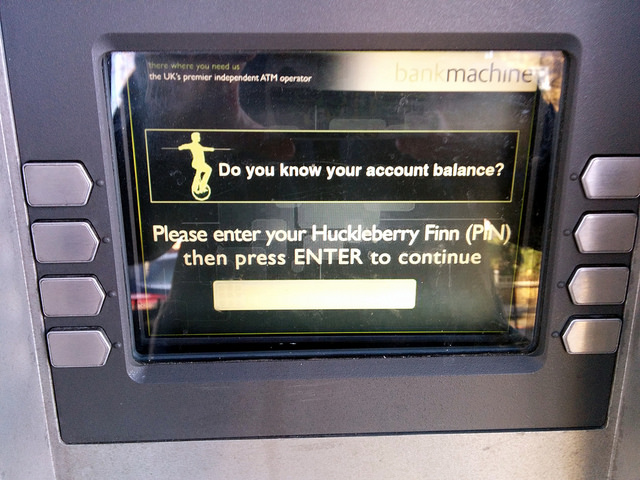
Long have I heard tell of the Cockney Rhyming Slang ATM of Hackney Road, but na'er had I chanced upon it...until today! As soon as I stuck my debit card in the machine in front of the Co-Op Grocers in Hackney Road and was asked to make a language-selection between "English" and "Cockney," I knew I'd found it at last.
The Deregulation Bill is coming before the UK House of Commons on Monday, and among its many "red-tape-cutting" provisions is one that would allow the courts to grant the police secret hearings in which they could secure orders to seize reporters' notebooks, hard-drives and other confidential material. No one representing the reporters would be allowed to see the evidence in these "closed material procedures."
How the hell did this happen? Sadly, it was absolutely predictable.
When Parliament passed a law permitting secret trials where people who were adverse to the government in court proceedings would not be allowed to see the government's evidence, nor have their lawyers review it, those of us who sounded the alarm were accused of hysterics. The Libdem leadership whipped their MPs on the issue, ordering them to vote for it. Many of us in the Libdem party left over the issue, and the party grandees patronised us on the way out, saying that we didn't understand that the Libdems had put in place "crucial changes," and that somehow, there were changes that could paper over the naked fact of a law permitting secret trials in Britain.
The Libdems' cowardice over secret trials removed any claim they had to being "the party of liberty." Anyone in the party leadership today who expresses surprise at the expansion of the doctrine of secret courts is either an idiot or a bad liar. When future journalists who report on government wrongdoing have their notebooks seized based on secret evidence, the trigger will be pulled by the government of the day -- but the gun was loaded by the Libdems in 2013.
The other parties were crucial to the creation of secret courts, but neither Labour nor the Tories have ever claimed to be "the party of liberty." No one mistook Labour -- creators of RIPA and architects of the world's most advanced surveillance state -- for a party that believed in freedom. Indeed, the Libdems' victories in the last national elections are in large part thanks to widespread disgust with Labour's authoritarianism. And as for Tories, everyone knew that the Nasty Party would happily gut civil liberties faster than you could say "G4S."
The Libdems promised to be a party that would, at last, stand up for freedom. Instead, they sold out out, and we're going to be paying the price for many years to come. There is a world of difference between objecting to the creation of secret courts and the expansion of secret courts. Now that secret courts are a fact of life in the UK, their expansion will always be on the horizon. As soon as "the party of liberty" endorsed the idea that justice could be served when the government could keep secrets from the people who were seeking redress of its wrongs, they set the stage for a mushrooming, toxic doctrine of state secrecy that overrules foundational democratic principles that have been in place since the overthrow of the Star Chamber in 1641.
It is an everlasting shame to the party, and makes me embarrassed to have endorsed them and raised funds for them. Better that they never won a single seat than to have brought us to this pass in British politics in the name of "liberty."
The Newspaper Society, which represents regional media, has written to the Cabinet Office ministers responsible for the bill, Kenneth Clarke and Oliver Letwin, protesting about the changes.
"The deregulation bill's provisions could enable the current statutory safeguards to be removed completely, reduced, weakened or otherwise radically altered at any later time, without prior consultation of the media affected nor detailed parliamentary scrutiny of the effect," the society has warned.
"Reporters are put at risk, whether reporting riots or investigating wrongdoing, if perceived to be ready sources of information for the police."
...Gavin Millar QC, who is representing BSkyB in the police application case, said of the changes combined with the court case: "[They could] allow the police to use closed material proceedings [presenting evidence in secret before a court] in lots of cases. It's very worrying. The media will not be there to argue their case. Greater awareness of the information available in the digital age will [increase the number of applications]. The police have realised that there are vast quantities of information that may be of use to investigations. It's lazy policing basically."
I was originally inspired by map of the internet created by xkcd, showing most popular social networks as countries and regions, back in 2010. It was not my original idea, but I extended it to such a scale for the first time. I used photoshop for the majority of drawing.
The base style of the map was inspired by the National Geographic Maps, I also used Winkel Tripel Projection and similar border coloring fashion. I created the map in quite a short time, three weeks to be exact. I often worked early in the morning, and I can say I really enjoyed it. I got the data about website sizes mainly from Alexa and similar online services.
Currently, I am working on the next versions of the map, which will be even more ridiculously detailed than the previous one, and will encompass all major websites without any significant exceptions, it will be coming in mid-february.
The map is divided into 2 distinctive parts; the eastern continent, "the old world" showcases software companies, gaming companies and some of the more real-life oriented websites.
Western part, "the new world" is composed from two major continent, northern one showcasing social networks, search websites, video websites, blogs, forums and art websites.
All major adult-oriented websites, in addition to varioius warez and torrent sites, are located on the southwestern continent of the map. In the very south of the map, there is located "Great Southern Land" of obsolete websites and online services.
Outside the main map, there are also 4 minimaps showing NSA monitoring by country, most used browser, most used social network, and internet penetration by country.
Even if you're a Windows (or Mac) user, knowing how to use Linux is a valuable skill, and it can run a bunch of awesome things in your home—even if it isn't your main desktop OS. Here are 10 ways you can use Linux even if you're not ready to go full Ubuntu.
10. Troubleshoot Other Computers
You don't even need to install Linux on a box to make it useful—all you need is a solid live CD. Just boot from the CD and you can grab any files from the hard drive, even if the computer won't boot or you've forgotten your password. Linux can even help if you accidentally formatted your entire drive. Of course, not all system rescue discs are Linux—and there are a lot of good ones out there—but a bit of basic Linux knowledge can turn you into a troubleshooting expert.
9. Make a Chromebook More Useful
You'd be surprised how much you can get done in Chrome OS. There are a lot of great Chrome apps out there for editing audio, video, images, coding, and more—but sometimes you just need a more powerful desktop app you're familiar with. Luckily, you can install Linux alongside Chrome OS really easily, and get access to a traditional desktop with a bunch of apps. It won't get you Photoshop or something of that caliber, but if all you need is a bit of a safety net, it's perfect.
8. Host a Web Site or Webapp
You'd be surprised how many web sites you visit every day actually run on Linux—and if you want to build a web site, you probably will too. Possibly more interesting, though, is how you can use a Linux-based web host—like Dreamhost—to host your own personal RSS reader with Tiny Tiny RSS, or your own Dropbox clone with OwnCloud. You could, of course, host these on a Linux box in your home, too. It's a bit more complicated, but it gives you complete control over everything rather than putting your data in someone else's hands.
7. Work with Hard Drives and Partitions
If you dual- or triple-boot your system and ever want to move partitions around, you'll have a much easier time with a Linux live CD and GParted. Heck, even if you don't dual-boot, you'll still need a bit of help from Linux if you ever migrate to a solid-state drive, or upgrade to a more spacious drive. And, if you want to securely wipe it so no one can get at your data...well, Ubuntu can do that too.
5. Run a Home Server for Backup, Streaming, Torrenting, and More
If you don't want to leave your computer on 24/7 just to share files or download torrents, a tiny dedicated Linux box might be a better solution. With an old computer or a cheap new one, you can put together a home server that stores your backups, streams movies and musics, seeds torrents, or performs any number of other tasks quietly in the corner. You can put one together with Nas4Free, FreeNAS, or even Ubuntu.
4. Create a Dedicated Media Center or Video Game Machine
If you have a computer that won't even use the desktop—like a media center or dedicated emulation machine—why not just set it up with a Linux backend? It's free and easy to do. XBMC works great on Linux, whether you're running on a Raspberry Pi or just a low-powered PC, and you can turn just about any PC into an all-in-one retro video game console. The Raspberry Pi works well for older games, but you'd want something more powerful to play newer stuff. Heck, you could even use it to create a retro arcade coffee table.
3. Brush Up on Your Hacking and Security
Some Linux distributions, like BackTrackor Kali, are security-focused distros for testing security systems. That means you can use them to learn how to, say, hack WEP orWPA Wi-Fi passwords, which is a great way to learn a bit more about your own network security and how to protect yourself from similar attacks. Of course, we don't recommend using these powers for evil—but knowing evil's tricks gives you a good path to preventing them.
2. Revive an Old or Slow PC
And so we come to one of the most obvious and common uses for Linux—and still one of the best. If you have a PC that's seen better days, Windows is far from the ideal OS. install a lightweight Linux distribution on it (like Lubuntu or, if you're a bit more savvy, Archbang) and it'll feel like a new machine again. It may not be able to do everything your powerful Windows machine can do, but it's better than having a non-functional computer, and works perfectly for basic tasks.
1. Learn More About How Computers Work
If none of the above sound like anything you need, why not just get in the spirit of DIY and learn a little bit more about how computers work? Tons of things run Linux these days, from TVs to the Android phone in your pocket, and learning about Linux is not only a fun hobby in and of itself, but it'll help you learn a bit more about what makes these machines tick. We recommend getting started with something like Ubuntu or Mint, then when you get a little more familiar, move onto Arch for some serious learning. There are a ton of great distros out there, and even if you're just playing around, you may find that those skills come in pretty handy one day.
 Google made news recently when it announced a cross-licensing deal with Samsung, but it's already moving on to another. The search giant has entered into a second such deal with network management firm Cisco. This might be the start of a pattern.










 I was saddened to find out that the great actor
 A reader sends us










 I was originally inspired by map of the internet created by xkcd, showing most popular social networks as countries and regions, back in 2010. It was not my original idea, but I extended it to such a scale for the first time. I used photoshop for the majority of drawing.


