Shared posts

10 Feb 21:24

Microsoft is getting ready to rip off the notification center that Apple ripped off from Android

by Zach Epstein
Windows Phone 8.1 Action CenterIf imitation is the sincerest form of flattery, Google is definitely blushing right now. One of the key features Apple introduced alongside iOS 5 was the Notification Center, a panel that aggregates notifications and other information into one simple list that can be dragged down and revealed from the top of a device's screen. Sound familiar? That's because the feature was unabashedly "borrowed" from Android. Companies "borrow" from each other all the time of course, and it looks like another major mobile platform maker liked Android's notification interface so much that it decided to "borrow" it in an upcoming software release.

Continue reading...
10 Feb 21:22

Microsoft OneDrive to debut with Dropbox-like bonus storage and folder sharing

by Tom Warren

Microsoft announced its OneDrive rebranding of SkyDrive recently, and it appears the service will soon debut with some new additions. LiveSide reports that OneDrive will offer up to 8GB of additional cloud storage, similar to how Dropbox entices users to share referral links with friends. Microsoft is said to be planning a referral bonus of up to 5GB, which is made up of 500MB for each friend you refer to OneDrive, up to a maximum of 10 friends. OneDrive users will receive the free storage for referrals, and friends who sign up to the service will also get 500MB each.


A second "bonus offer" involves extra storage for using the camera roll feature of the iOS, Android, or Windows apps to backup photos to the service. 3GB of extra...

Continue reading…

10 Feb 21:21

Hulu signs deals for 'Fraggle Rock' spin-off, 'Cheers,' and more CBS classics

by Jacob Kastrenakes

Hulu is preparing to launch its first original children's show, a spin-off of the classic '80s series Fraggle RockAccording to Variety, Hulu will be the exclusive US home to The Doozers, which turns a group of supporting Fraggle Rock characters into the centerpiece of a new series. Just as with Fraggle Rock, The Jim Henson Company is a co-producer of the series, only this time with the production company behind Yo Gabba Gabba! along for the ride. Hulu will have 52 episodes ready to air on April 25th.

Continue reading…

10 Feb 21:19

Dyson Puts £5M Into Robotics Vision Research With Imperial College London

by Darrell Etherington
Image (2) dyson.jpg for post 123065

Robot eyes. That’s a terrifying sentence. But robotics vision is an immense area of research interest, and a key technological field in terms of building the future of a wide variety of devices. That’s why it’s very interesting that Dyson is putting a sizeable investment into robotics vision via a joint robotics lab being launched in collaboration with Imperial College London.

The investment is worth £5 million (or around $8 million U.S.) and covers a five-year period. The lab will be working on robotics vision systems that are designed to help the next-gen of robots not only see things the way that humans do, but also process that visual information in a manner that better approximates human understanding.

For those unfamiliar with the field, it covers a broad range of potential uses: A friend with a graduate degree in robotics vision engineering helps design systems for production lines that inspect the products being built for quality assurance purposes. Typically, these offer up margins of error that are tiny compared to the standards established by human inspectors.

Dyson is no stranger to conducting robotics research – the company has been exploring that area of interest for the past 15 years, according to the company. With Imperial College London specifically, it’s been working on developing systems that can view, interpret and “logically navigate” their surroundings. This applies to robotic vacuums in terms of Dyson’s business interest (the company mentions this product category specifically, so watch out Roomba) but it’s not their only goal in terms of applied robotics.

What this signals for Dyson is a graduation of sorts, as the company moves from thinking about robotics as an area of sustained but relatively light interest, into something it would like to ramp up on the production side. Hopefully at the end of these next five years, we’ll all be living with an army of Dyson home cleaning automatons, but at the very least we should see some advancements in terms of the ocular powers of our robotic friends.

10 Feb 21:16

Apple Copyright Complaint Gets Themer Pulled From Google Play, Might Not Be Back For A Few Weeks

by Ryan Whitwam

-themer-beta-beta-1-22You might have noticed something missing from the Play Store in the last few days. One-click theming app Themer Beta by MyColorScreen was pulled from Google Play late on February 2nd due to a copyright complaint from Apple. When it will return is not clear, but it's probably not going to be immediate.

ku-xlarge

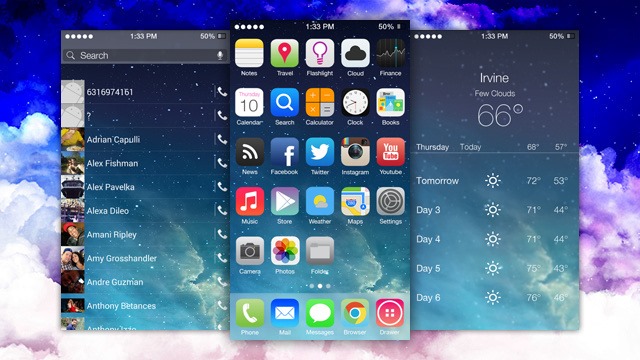
The issue stems from Themer's "Seven" theme, which you can see above. This is, admittedly, an obvious clone of iOS 7 – Apple pointed to the icons in Seven as the infringing content.

Done With This Post? You Might Also Like These:

Apple Copyright Complaint Gets Themer Pulled From Google Play, Might Not Be Back For A Few Weeks was written by the awesome team at Android Police.


10 Feb 14:49

Google Is Testing A New YouTube Mobile Web UI With Cards And An Android-Style Navigation Drawer [Update: Maybe Desktop Too]

by Ryan Whitwam

YouTube-icon-full_colorThe cards have been creeping into more apps as of late, and now it looks like Google is testing a new mobile web interface for YouTube with some of that card-based Android flavor. There are more cards, a cleaner video pages, and a slide-out navigation drawer that could have been ripped right from Android.

2014-02-08 - 7 2014-02-08 - 2 2014-02-08 - 1

The new web UI could easily be mistaken for the YouTube app at first glance.

Done With This Post? You Might Also Like These:

Google Is Testing A New YouTube Mobile Web UI With Cards And An Android-Style Navigation Drawer [Update: Maybe Desktop Too] was written by the awesome team at Android Police.


09 Feb 22:59

Because Of DRM, The Entire Copyright Monopoly Legislation Is A Lie

by Rick Falkvinge

Cory Doctorow had a brilliant column in The Guardian, which was very long and went into quite a bit of legislative history, but the key takeaway hit the nail right on the head.

The entire copyright legislation is a lie, a façade, a mirage. There are no exceptions, there are no expiries, there is no fair use. The reason the situation has been allowed to degrade to this point is a small but important detail called DRM (Digital Restriction Measures).

Since the turn of the century publishers are allowed to embed technical obstacles called Digital Restriction Measures in anything they publish, and these measures set and enforce a vastly expanded set of restrictions over and above ordinary copyright monopoly law. The original law loses its effect in the clause that says that any disabling of such Digital Restriction Measures is illegal in the US and EU.

The net effect of this is that the DRM portion of copyright law, as it stands today, is permitting publishers to dictate whatever terms they like and call it “copyright”, overriding the rest of that law.

Ordinary copyright monopoly law says that the monopoly eventually expires. That’s just not true, because mostly everything published today has DRM, which says the monopoly does not expire.

Ordinary copyright monopoly law says you have a right to enjoy your purchased works in various formats, places, and ways (in your car, in your home, on your bike, when you like). DRM has made sure that’s not in the lawbooks anymore, because publishers didn’t want it that way.

drm-noSo let’s look closer at what the copyright monopoly law really looks like, with DRM in place and protected by law as is today.

Publishers don’t want you to buy stories in another country and enjoy them at home? At odds with ordinary copyright law, but with DRM, publishers can totally override that.

Publishers want the copyright law to say that purchased books can’t even be shared between family members? Perfectly doable with DRM-fabricated copyright law, even if the ordinary copyright law would have dropped a ton of bricks on those publishers.

Publishers want the ability to remotely remove a book you’ve bought from your bookshelf, even as you have it in your home? Say, “1984″? Just fine with DRM.

Digital Restriction Measures were never – never – supposed to prevent copying. If you wanted to copy a DRM-ridden work, you could do so without problem; the DRM would follow along to the copy just fine. DRM is a usage restriction, not a copy restriction, and most importantly, as Doctorow puts it:

DRM is the right for publishers to make up their own copyright law.

And legislators have decided to have that made-up law enforceable just as if it were ordinary copyright monopoly law. That’s a disaster.

This mess is not very flattering for legislators, who should realize that banning DRM completely is the only way ahead from this situation. It’s the publishers and the copyright industry, and nobody else, who have been breaking the social contract here. Writing law is Parliament’s job, and certainly not that of the publishers and the copyright industry.

About The Author

Rick Falkvinge is a regular columnist on TorrentFreak, sharing his thoughts every other week. He is the founder of the Swedish and first Pirate Party, a whisky aficionado, and a low-altitude motorcycle pilot. His blog at falkvinge.net focuses on information policy.

Book Falkvinge as speaker?

Follow @Falkvinge

Source: TorrentFreak, for the latest info on copyright, file-sharing and VPN services.

09 Feb 22:57

NASA is now accepting applications from companies that want to mine the moon

by Adrianne Jeffries

NASA is now working with private companies to take the first steps in exploring the moon for valuable resources like helium 3 and rare earth metals.

Initial proposals are due tomorrow for the Lunar Cargo Transportation and Landing by Soft Touchdown program (CATALYST). One or more private companies will win a contract to build prospecting robots, the first step toward mining the moon.

The contract will be a "no funds exchanged" Space Agreement Act, which means the government will not be directly funding the effort, but will receive NASA support. Final proposals are due on March 17th, 2014. NASA has not said when it will announce the winner.

Continue reading…

09 Feb 15:16

That One Song Plays a Musician's Most Popular Track

by Mihir Patkar

That One Song Plays a Musician's Most Popular Track

Web: I like to namedrop some obscure bands and artists to (unsuccessfully) make people admire my eclectic musical tastes, so if the next time you hear someone say Fairport Convention and want to hear one of their tracks, That One Song has you covered.

This webapp is a part of This Is My Jam, a cool music streaming and sharing site. Head to That One Song, key in the name of any artist or band, and it will dig through its archives to find the most popular song by them. For bands with many hits, you might get different results on multiple searches.

It doesn't have autocorrect, autocomplete or suggestions, so you need to know the right spelling of the band or artist before keying it in. And yeah, it's limited to the catalogue that already exists on That One Song, so not every obscure artist is covered. That means if you want an introduction to of Spriguns of Tolgus, you still need to look elsewhere. But it's a cool idea nonetheless.

That One Song | via The Next Web

09 Feb 15:15

"A reason to hang him": how mass surveillance, secret courts, confirmation bias and the FBI can ruin your life

by Cory Doctorow


Brandon Mayfield was a US Army veteran and an attorney in Portland, OR. After the 2004 Madrid train bombing, his fingerprint was partially matched to one belonging to one of the suspected bombers, but the match was a poor one. But by this point, the FBI was already convinced they had their man, so they rationalized away the non-matching elements of the print, and set in motion a train of events that led to Mayfield being jailed without charge; his home and office burgled by the FBI; his client-attorney privilege violated; his life upended.

At every turn, the FBI treated evidence that contradicted their theory as evidence that confirmed it. Mayfield's passport had expired and he couldn't possibly have been in Madrid? Proof that he was a terrorist: he must be using his connections with Al Qaeda to get false papers so that his own passport isn't recorded as crossing any borders. Mayfield starts to freak out once he realizes he's under surveillance? Aha! Only the guilty worry about having their homes burgled by G-men!

The FBI was so sure of their theory that they lied to a judge during their campaign against him. His story is the perfect embodiment of "confirmation bias" -- the tendency of human beings to give undue weight to evidence that confirms their existing belief and to discount evidence that rebuts it. Confirmation bias is one of the underappreciated problems of mass surveillance: gather enough facts about anyone's life and you can find facts that confirm whatever theory you have about them.

Or, as Cardinal De Richelieu said: "If you give me six lines written by the hand of the most honest of men, I will find something in them which will hang him." This line is the epitaph in my story Scroogled (here's Wil Wheaton's reading of it), about the risks of automated, unaccountable attributions of guilt based on algorithms that are not subject to scrutiny. But as bad as the automated attribution as guilt can be, it's nothing compared to the directed attribution of guilt from cops who are absolutely sure that they have their man.

Because the FBI agents had no concrete evidence that Mayfield was linked to the Madrid train bombings, they decided not to apply for a criminal wiretap, which requires probable cause to believe there is criminal activity or intent. Rather, they applied for a Foreign Intelligence Surveillance Act (FISA) warrant, asserting they had probable cause to believe Mayfield was acting on behalf of a foreign terrorist group. This allowed the FBI to circumvent the Fourth Amendment because evidence of criminal activity incidentally discovered in the course of its intelligence activities could be shared with prosecutors and criminal investigators. The secret FISA court approved the request, as it almost always does, and the FBI began its surreptitious and incredibly intrusive blanket surveillance of Mayfield and his family.

Because of mistakes made by the FBI — they left shoe prints in the carpet of the Mayfields’ home and broke in one time when Mayfield’s son was home alone — Mayfield concluded he was under surveillance by federal authorities. Paranoia set in. When driving, he would look to see if someone was following him home or to the office. The FBI took his skittishness as more evidence of his guilt. Believing their cover blown, FBI agents detained Mayfield as a material witness to the Madrid bombing because they feared he was a flight risk. They couldn’t arrest him because their intrusive surveillance still could not find any evidence of any crime. He spent two weeks in jail, petrified that fellow inmates would learn he was somehow involved in the Madrid bombing and hurt him.

During the OIG’s review of the handling of the Mayfield case, it found that the FBI’s requests for material witness and criminal search warrants “contained several inaccuracies that reflected a regrettable lack of attention to detail.” The FBI’s belief that it had their man, despite all contrary evidence, was so strong that it provided misleading sworn statements to a judge. The only reason Mayfield is a free man today is that the Spanish police repeatedly told the FBI that the print recovered from the bag of detonators didn’t match Mayfield’s fingerprints. T

The terrifying surveillance case of Brandon Mayfield [Matthew Harwood/Al Jazeera]


09 Feb 00:06

Automated Device Brings "And/Or" Rules for Androids with Easy Setup

by Mihir Patkar

Automated Device Brings "And/Or" Rules for Androids with Easy Setup

Android: Apps like Tasker are fantastic to turn your Android into an automated beast, but even with Tasker's new UI, they can be a little daunting. Plus, they're restricted to "And" clauses instead of "And/Or". Automated Device is a new app that brings in this feature along with several others, and makes it easy to set up too.

Automated Device lets you control Switchers, Profiles or Rules. Here's a brief rundown of what each does:

  • Switchers are simple toggles for actions like Wi-Fi on/off, auto/manual brightness, speaker on/off/vibrate, etc. Each switch comes with the option of a timeout if you want to enable it. This feature is manual, not automatic.
  • Profiles are one-tap launchers for a set of actions. The actions can be anything, like launching an app, switching settings, sending an email, etc. Tap the profile and hit the arrow to activate it; and like a switcher, you can set a timeout. This feature is manual, not automatic.
  • Rules follow basic "if this, then that" logic for certain phone settings. The cool part is that the "If" logic isn't restricted to "And" alone for multiple logic parameters. For example, if you want to set a bunch of actions to be executed when you enter your home, the condition to be met can be either GPS based or connecting your phone to a charger or connecting to Wi-Fi. The condition doesn't have to meet all those criteria, like Tasker and other apps ask for. This feature is completely automatic.

The interface to set up the switches, profiles and rules is much simpler than Tasker and other automated apps I've tried. Plus, the developer is actively adding more conditions and addressing any errors or queries in the XDA thread below, so you can head there for more info.

Automated Device (Free) | Google Play Store via XDA Developers Forum

08 Feb 21:19

Rethinking TV news, Part III: First, kill the stand-up

by Jeff Jarvis

I was about to launch into writing a post about the most irritating habits of local TV news — starting with the most objectionable: the stand-up — when I got a surprising email from a producer at Fox Channel 5 News in New York: “We are working on a story about the most annoying things about local news,” he wrote. “Yes, we are really doing this. And it is for tonight.” I got a similar call from another network; more on that in a minute. So I spoke to the Channel 5 reporter for 10 minutes over Skype and they used one soundbite (which is another annoying thing TV news does, but I’m not complaining):

New York News

Points to Fox’ Joel Waldman for doing a stand-up ridiculing stand-ups.

Here’s why I hate the convention: The stand-up has zero journalistic value. It wastes time. It wastes precious reportorial resource. It turns the world into a mere backdrop for entertainment. It’s a fake. Take, for example, all the stand-ups we see these days at the George Washington Bridge because of the Christie scandal. Local TV news does it:

standup local 2

National TV news does it:

standup national

There is *no* reporting to be done at the bridge. None. There are no officials there. There are no sources to be found. The victims are long gone. So TV news wastes a reporter’s time and a crew’s time and the use of expensive equipment going to the bridge, standing there for an hour or more, where there is *nothing* happening, *nothing* to report. Why? Because TV thinks it must have video, style over substance, image über alles.

Think of how TV news covers, say, the ongoing deliberations of a jury in a trial. The anchor tells us what they’ve told us and what they’re going to tell us. The anchor throws to a reporter doing a stand-up in front of a courthouse where, of course, the jury is sequestered and there is nothing to learn and thus nothing to say. The reporter gives us a bit more background and tells us the jury is still out. The reporter throws back to the anchor. The anchor says they’ll be sure to tell us when something happens. All that hoo-ha could be replaced with the anchor reading one sentence: “The so-and-so jury is still out.” Bonus points if the anchor adds: “For background, see our web site.”

And on the web site, the TV station could have a standing piece explaining the background on the trial for anyone who has missed it. They’d waste less of their airtime and be able to give us, the audience, the public, more stories and/or more substance — wasting less of our time. More importantly, they’d free up the reporter to, well, *report* something rather than just regurgitating what we already know and nothing new: journalistic dry heaves.

I have taken to shouting at my TV when I see stand-ups in front of crime scenes where nothing has happened in at least 12 hours. Or when I hear anchors, particularly on network news, wasting precious seconds with empty transitions after reports: “Still much to learn” (no shit). Or when I see faked b-roll of someone walking down a hall or typing or talking on a phone to create images and easier edits — except this isn’t reality, it is staged, faked for us (how journalistic is that?). Or when I see team coverage of weather sticking rulers in snow or breaking eggs to fry (or now freeze) or demonstrating that ice is slick or that wind blows. Or when I see someone being interviewed and looking off-camera when they really should be talking to us (Hello? We’re over here!). And that is just a list of the silly orthodoxies of presentation on TV news, to say nothing of the quality, depth, originality, utility, wisdom, and incisiveness of the content itself.

I shouted at my TV and it didn’t listen … until now. Not only did I get that email from Fox 5 New York, but when I was in Davos, I spoke to a crew from Fusion, the new partnership of Univison and ABC, and couldn’t resist poking fun at the form, turning from the producer asking questions off-camera and staring instead directly into the camera to beg them to give up this silly, stilted convention. They didn’t air it. [CORRECTION: Turns out, they did air it, starting at :35.] Instead, they called me into the studio for a conversation with anchor Jorge Ramos.

We talked about the conventions of TV news:

And then Ramos asked me for my advice to Fusion:

I said in my first post on reinventing TV news that I wouldn’t dwell on the negative — preferring in a second post to concentrate on new opportunities — yet here I have focused on the bad, the silly, the wasteful. For we do need to get rid of the idea that real television news, professional television news must have stand-ups and establishing shots and staged b-roll and frothy transitions. We need to clean away that ancient filigree to free up resources and time to make TV news better, because it can be.

* * *

Here is the complete, 11-minute Fusion conversation:

Jeff Jarvis on AMERICA with Jorge Ramos from Fusion America on Vimeo.

08 Feb 18:20

Top 10 DIY Office Upgrades

by Whitson Gordon

Top 10 DIY Office Upgrades

So maybe your workspace isn't a cluttered mess, but maybe it just isn't the haven of productivity you wish it was. If you're looking to upgrade from your modest laptop on a desk to something more impressive, here are 10 cheap DIY upgrades to make it a battlestation worthy of your time.

Note that you don't need to follow all these projects to the letter. As with all DIY projects, think of them as inspiration—they may not work in your space the way someone else did them, or you may find a cheaper way to do the same thing (like getting supplies at Home Depot instead of IKEA).

10. Build a Better Desk

Top 10 DIY Office Upgrades

If the kitchen table just isn't cutting it anymore, it might be time to get a real desk. But don't go rushing out to the store to spend hundreds of dollars—you can save some money by building your own, not to mention craft one that fits in your space perfectly. For example, you can make a pretty awesome, large desk out of an old door. Perhaps you want to build yourself a standing desk so you aren't sitting down all day. If you want to be really cheap, you can even build one out of wooden pallets. Or, if you're old school, you can obviously build a custom one from scratch. Photo by verseguru.

9. Add a Whiteboard or Chalkboard to Your Workspace

Top 10 DIY Office Upgrades

A simple whiteboard can be a big boon for productivity, so while you're building that desk, why not build in a space for scratchwork? Heck, you can even make your entire desk dry-erase friendly, so you can use whatever space you have at the ready. If you're more of a chalkboard fan, you can add a chalkboard surface too, but the whiteboard is probably an easier, less messy way to go.

8. Raise Your Monitors to Eye Level

Top 10 DIY Office Upgrades

Staring down at your laptop or computer monitor is bad ergonomics, and if you're sitting at that desk all day, you're going to feel it. Instead of going out and buying an expensive monitor stand, though, just build your own—you can make one insanely cheaply with just a wooden shelf and some door stops or furniture legs. If you want more of a floating stand for a multiple-monitor setup, we've got optionsfor that too. And if you're using a laptop, one of these stands should fit the bill nicely.

7. Manage Your Cables

Getting cables under control is one of those things we'd all like to do, but never really get around to it. Well, there's no better time than now—and it doesn't have to cost you much. The IKEA Signum tray is a great option at only $10, but if you prefer something that hides your cables away a bit more—and requires a bit more work—store those cables in a rain gutter behind your desk. And, if you're a laptop user, keep those cables from falling off your desk with a few binder clips. See the video above for a few of these tricks in action.

6. Add Some Power or USB Outlets to Your Desk

Top 10 DIY Office Upgrades

Occasionally, you'll need quick access to power at your desk for something that isn't already hooked into your (now hidden) cable management. What then? Well, you can build a few outlets into your desk, whether it's in the form of this fancy USB hub, or a power outlet box you can move around as you need it. It's a great way to give your phone or camera a quick charge at your desk, without creating another permanent mess of cables.

5. Give Your Webacam or Microphone a Movable Stand

Top 10 DIY Office Upgrades

If you regularly use your webcam and/or microphone, having them in one static position isn't ideal. So, for something a bit more versatile, grab a flexible desk lamp—like this cheap one from IKEA—and convert it into a movable stand for your webcam, microphone, or whatever else you need. That way you can have it front and center when you need it, move it around, and get it out of the way when it isn't being used.

4. Raise Your Speakers to Ear Level

Top 10 DIY Office Upgrades

The best way to improve your speakers—without buying a new pair, of course—is to raise them up to ear level. Not only will the music sound better, but you'll gain a little bit of space back on your desk. Luckily, speaker stands are pretty easy to make, whether they're floor-standing models for big speakers, on-desk models for studio monitors, or smaller ones for on-your-desk speakers. If you're more of a headphone junkie, you can make a cheap, simple hanger out of a desk leg or one of these foldable hooks from IKEA.

3. Add Some Extra Storage

Top 10 DIY Office Upgrades

You may not use as much paper as you used to, but a good workspace still needs some storage—especially after you start running out of space on your desk! A good letter tray can give you some much-needed storage, and doubles as a stand for your laptop or other tech. Alternatively, if your desk doesn't have drawers, build some makeshift storage under the desk for quick access.

2. Hang Your Hardware

Top 10 DIY Office Upgrades

All that technology can add up fast, especially when you include things like routers, modems, power bricks, and other heavy things. Remember the cardinal rule of space-saving: build vertically. If you need somewhere to store all that hardware, try hanging it on the wall with a few hooks, or—if you have a lot—with a pegboard organizer. You can put it on the wall or behind your desk, if you have the room, so it stays out of sight.

1. Build a Real Office Anywhere

Top 10 DIY Office Upgrades

So you're all excited to build yourself a kick-butt workspace, but you don't exactly have an extra room in the house for your battlestation. Fret not: you can build an office just about anywhere, even if it's in a closet, tiny nook, or that shed out back. Heck, even a garage can work (if you have somewhere else to put the cars, of course). With a little outside-the-box thinking, you can get a real workspace just about anywhere you want, even if you aren't living in a multi-room mansion.

07 Feb 23:45

Guilty plea in Fox News leak case shows why Espionage Act prosecutions are unfair to reporters' sources

by Trevor Timm


Stephen Jin-Woo Kim. Image: Stephen Kim Legal Defense Trust.

Former State Department official Stephen Kim announced today he will plead guilty to leaking classified information to Fox News journalist James Rosen and will serve 13 months in jail.

The case sparked controversy last year when it was revealed the Justice Department named Rosen a “co-conspirator” in court documents for essentially doing his job as a journalist. But a largely ignored ruling in Kim’s case may have far broader impact on how sources interact with journalists in the future.

In Espionage Act cases involving sources or whistleblowers, defendants naturally want to explain to a judge or jury that the information they may have given to journalists (and the American public) didn’t harm US national security. The bar for this was already too low; in the past, the government didn't have to show actual harm, but at least they had to show the information could potentially harm national security. The judge in Kim’s case ruled the government didn’t even need to do that.

As secrecy expert Steven Aftergood reported at the time:

Judge Colleen Kollar-Kotelly ruled that the prosecution in the pending case of former State Department contractor Stephen Kim need not show that the information he allegedly leaked could damage U.S. national security or benefit a foreign power, even potentially. Her opinion was a departure from a 30-year-old ruling in the case of U.S. v. Morison, which held that the government must show that the leak was potentially damaging to the U.S. or beneficial to an adversary. (emphasis ours)

This means that it doesn’t matter if the information leaked by Kim was properly classified, or if it should have been classified at all. Kim could not argue the information he gave to Rosen may have been innocuous. The ruling also gives the government carte blanche power to classify whatever it wants—including waste, abuse, and crimes—and keep it secret under the threat of prosecution of anyone who could potentially reveal it. As the defense argued at the time, this ruling turns the Espionage Act into an Official Secrets Act, which Congress has continually refused to enact over the last century.

Because of this ruling, and other rulings in Espionage Act cases that bar defendants from explaining their intent to inform the American public to a jury, Kim likely had no choice to plead guilty. This is also why if Edward Snowden came back to the US he quite literally cannot receive a fair trial: he would be legally barred from making his case in court.

The Kim case yet another example of the broken nature of how the government deals with leaks, in which the Justice Department has complete discretion to ignore the leaks they like, and prosecute the leaks they don’t like. Kim’s lawyer Abbe Lowell made this point eloquently in his statement today:

Stephen’s case demonstrates that our system for prosecuting leaks in this country is broken and terribly unfair. Lower-level employees like Mr. Kim are prosecuted because they are easier targets or often lack the resources or political connections to fight back. High-level employees leak classified information to forward their agenda or to make an administration look good with impunity. In fact, in this case, news reports from the same day demonstrate that Stephen was not the only government employee discussing the topic at issue. Stephen may have told the reporter what the reporter already knew from others, but Stephen was the only one charged.

“Leak” cases are prosecuted under the Espionage Act, a 100-year-old law with crushing penalties that was never intended to apply to conversations between a government employee and a news reporter. The Act and its penalties are designed to punish traitors and spies – not State Department analysts answering questions from the media about their area of expertise. Stephen faced more than a decade in jail for the type of public discussion of foreign policy issues that ought to be encouraged. This Administration and Congress should address these problems, as they undermine the basic fairness of our criminal justice system.

It’s clear the Espionage Act is inherently unfair to sources and whistleblowers. As Congress debates NSA reform, they should also be considering repealing the Espionage Act once and for all.


07 Feb 22:07

What's With New Blogging Platforms Like Medium? Should I Use One?

by Thorin Klosowski

What's With New Blogging Platforms Like Medium? Should I Use One?

Dear Lifehacker,
I keep seeing these new blogging platforms pop up like Medium and Svbtle. Why would I use one of these new platforms instead of more powerful classics like Wordpress?

Sincerely,
Blog to Live

Dear BL,
Medium and Svbtle (not to mention our own platform, Kinja) are all pretty new to the world of blogging, and while they're all blogging platforms at their core, they do certain things a little differently. Let's take a look at how they work and try to figure out if they're right for you.

What's Different About These Platforms

What's With New Blogging Platforms Like Medium? Should I Use One?

When you first head over to a place like Medium or Svbtle, they're barely recognizable as blogs. Instead, they're designed more like a magazine. On the home page you'll find different popular articles written by a wide variety of people. In general, these articles tend to lean toward topics like technology, design, programming, or creativity.

Despite their outward appearances, both Medium and Svbtle are also blog-style platforms where you can write articles of your own. Once you create an account, you'll get your own page that looks a lot like a blog and you can start writing. For example, here's a Medium page and here's a Svbtle page.

In either case, you're publishing into something more like a magazine than a standalone private corner of the internet. On Medium, posts are curated and picked up for the main page, and popular posts float to the top automatically. Likewise, Svbtle's magazine grabs popular posts and shows them off to a larger group. Basically, both platforms have a built-in audience that you don't really get elsewhere. The idea is similar to something like Wordpress.com's "Freshly Pressed," but feel like they're spotlighted more.

Otherwise, the differences are all in what it's like to write a post. Both Medium and Svbtle have very minimal, text-based blog editing pages. Unlike something like Wordpress, you don't have a bunch of options for changing themes, editing multimedia content, or anything like that. You get a text box, a handful of publishing options, and that's all.

So What Should You Use?

What's With New Blogging Platforms Like Medium? Should I Use One?

So, now it's time to pick which platform is right for you. The shiny and new services, or the tried and true ones? Let's take a look at the strengths and weaknesses of each.

Medium and Svbtle Are Great for Discovery, but Less Customizable

The big benefit for these new platforms is that they're not just blogging platforms, but also discovery platforms. They're all about the writing, so they make it easier for people to find and read your writing, and for you to find and read others'. If you're trying to gain exposure, writing on a platform like Medium, Svbtle, and yes, even Kinja is a great way to do it (after all, when we hire writers here at Lifehacker, we'll be looking at Kinja going forward).

The most obvious problem with sites like Medium and Svbtle is, like any startup, they might fail. If they do, all your content goes with them because you can't host them on your own server like you can with Wordpress. Sure, you can pull down your writing and move it elsewhere, but that's not a very reassuring thing when you're trying to build a repository of your writing.

Although Medium and Svbtle are both great looking, easy to read, and easy to write in, they're also not customizable in any way. They're made to look a certain way and they stay that way no matter what kind of content you're creating. If you're sticking to their style and only writing, this is great, but you can't really expand on that much. Plus, if they ever do go through a redesign, you'll be stuck with that too, which could potentially prove disastrous if you don't like it. They're also made for single authors, so if you want to share a blog with a friend, that's not possible on either.

Lastly, these platforms have one other big problem: With Medium, you give them royalty-free access to your content. You still own the copyright to your words, but they can do whatever they want with what you write (you can always delete your blogs, but that kind of defeats the point). That means they can sell a blog post, use it for an ad, or anything else, without paying you for your work. They don't seem to ever sell posts, but the the point is they could. Our own Kinja's Terms of Use also has monetization options, but it's more clear on the role advertising plays, and how Kinja users and editors can use your content. Conversely, if Svbtle has a Terms of Service, I can't find it anywhere, so it's not clear who owns your posts.

The fact is, you have a ton of choices for places to host your blog. So it's really about deciding whether or not you care more about customization or ease of use. Svbtle and Medium are both stupidly simple to use and it's incredibly easy to start writing with them within seconds. You also get built-in access to a ton of readers, and if your posts are picked up for the front page on either Svbtle or Medium, you'll get a lot of eyes on it. From a traditional point of view, Svbtle looks and works a lot more like a blog than Medium, but both are a means to the same end: to put text on the internet. The tradeoff is besides a lack of customization, you're just giving away your words for free with no chance of getting paid.

Wordpress and Squarespace Have a Learning Curve, but Offer You Complete Control

If you really want complete control of a blog, you'll want to go with one of the long-standing solutions like Wordpress or Squarespace. These take a bit of time to set up initially, but once you get over that first hump, you have complete control over every single aspect of them.

Whether it's Wordpress, Squarespace, or anything else, you'll have a bit of a learning curve, and even when you've set everything up, none of them have a writing platform as simple as Svbtle and Medium. The classic blog powerhouses are made to power entire web sites, not just writing platforms, so they have a lot more going on than these newer services. That means that besides your writing blog, you could also have a whole separate page for videos, or art, or whatever else. If you're more interested in multimedia, Wordpress and Squarespace are the way to go.

Once you install something like Wordpress, all your content can be saved on your servers and in your control, and you can retheme and redesign whenever you feel like it. You can also copyright your blogs, sell advertising on them, or not—it's totally up to you. Squarespace doesn't have a self-hosting option, but they'll host your site for you. They're a bit more complicated to use, but that doesn't mean writers can't use them. Chances are you probably won't want to spend you time writing your blog posts in Wordpress or Squarespace, but you have a ton of desktop minimal text editors that offer the same benefits. Just write there, copy and paste into Wordpress, and you're all set. Heck, you can even install a Svbtle theme onto Wordpress if you like.

Good luck,
Lifehacker

07 Feb 22:05

HTC Settles All Patent Disputes With Nokia (Read: Gives Up And Pays Out)

by David Ruddock

wm__DSC0476

Nokia just issued a press release announcing that the company had settled all ongoing patent litigation with Taiwanese handset-maker HTC today, and it looks like the Finnish firm came out on top. Nokia says HTC will make payments to Nokia and that HTC will license its LTE patent portfolio to the company under a cross-licensing "technology collaboration agreement." Sounds pleasant.

wm__DSC0475

No figures were released in relation to the settlement. This news probably shouldn't be too surprising - HTC has a reputation for settling.

Done With This Post? You Might Also Like These:

HTC Settles All Patent Disputes With Nokia (Read: Gives Up And Pays Out) was written by the awesome team at Android Police.


07 Feb 15:47

Chromecast reportedly hitting the UK as soon as March 1

by Richard Devine

Android Central

An official release outside the U.S. may finally be about to happen

Ever since Google first launched Chromecast, those of us outside the U.S. have been waiting with bated breath for news of an official launch. Now, according to the folks at The Next Web, the UK might be seeing a release as soon as March 1. A spokesperson for high street electrical retailer Currys has provided the news, while a Google spokesperson added that March 1 is still a provisional date at this time. 

With the Google Cast SDK now officially open to developers, there are exciting times ahead for Google's low-cost HDMI dongle. There was no word on any possible UK pricing for the Chromecast, though other retailers have previously been selling imported versions for £35. Needless to say, March 1 is only three weeks away, so we'll be keeping our beady eye open for anything more official. 

Source: The Next Web


07 Feb 14:02

Panoramic Tours

by Bill Crider
This is an amazing site of panoramic tours from all over the world.  You can manipulate the photos, so play with them to figure it out.  You can start with this one: "Grand tour of Manhattan, New York, USA
07 Feb 13:52

Net Neutrality: Verizon Rep Admits Throttling Bandwidth for Netflix

by Uncle Dave

throttling

Towards the end of January, the president of our company – iScan Online, Inc., was complaining that our service was experiencing major slowdowns. I investigated the issue, but I couldn’t find anything wrong with our production environment. We were stumped.

One evening I also noticed a slowdown while using our service from my house. I realized that the one thing in common between me and our president was that we both had FiOS internet service from Verizon.

Oddlly enough, Verizon denies it.

07 Feb 13:47

Updated: Google Didn’t Pay $750M For A 5.94% Stake In Lenovo

by Catherine Shu
lenovo

[Updated: As Re/code notes, Google does not yet own Lenovo shares. Instead, the regulatory filing shows the number of shares Google might own after its agreement with Lenovo to purchase Motorola goes through.]

Google may get a stake worth $750 million in Lenovo Group on Jan. 30, according to a disclosure on the Hong Kong stock exchange. The filing was made on the same day after Google announced that it had agreed to sell the Motorola brand to Lenovo for $2.91 billion, but will keep most of the handset maker’s patents.

Lenovo agreed to pay a total of $2.91 billion, with $750 million in ordinary shares, $660 million comprised of U.S. cash, and the remaining $1.5 billion in a three-year promissory note.

According to one of our sources, Google had wanted to sell Motorola for some time before striking the agreement with Lenovo because the handset brand has yet to live up to its purchase price, but had to hold off on selling the division for tax reasons. On the other hand, buying Motorola helps Lenovo build out its cell phone business. There were rumors in October that it had submitted a bid for BlackBerry, but was turned down.

07 Feb 00:28

In Russia, Bathroom Mirror Watches You!

by Gregory Ferenstein
pervert-cat

In Russia, spying on visitors is so pervasive, authorities don’t even seem realize that watching someone shower is cause for alarm.

During a press meeting on the Winter Olympics, Deputy Prime Minister Dmitry Kozak claimed that Western journalists were deliberately sabotaging the hotel facilities. As evidence, he said authorities had seen guests leave the water running in the shower.

Yes, you read that right. Here’s the full report from the Wall Street Journal:

“Dmitry Kozak, the deputy prime minister responsible for the Olympic preparations, seemed to reflect the view held among many Russian officials that some Western visitors are deliberately trying to sabotage Sochi’s big debut out of bias against Russia. ‘We have surveillance video from the hotels that shows people turn on the shower, direct the nozzle at the wall and then leave the room for the whole day,’ he said.”

The conversation then took the an expected turn toward conspiracy city, as journalists started asking how many other people had been surveilled in the bathroom. Before he could respond, an aid told reporters Kozak had to take a “tour of the media center.”

In truth, it’s not terribly surprising. The State Department has advised travelers to come with “clean” electronics devoid of any personal information. Upon entering, journalists found that there were hacked within minutes of turning their computers on.

“We took two brand new computers out of their boxes and connected them to the Internet. In a minute, hackers were snooping around,” described NBC’s Richard Engel.

Whether the hacking is from the government or mobsters is an open question. We’re reported previously on Russia’s vast video and Internet surveillance tactics that University of Toronto Professor Ron Deibert called “PRISM on steroids”.

The idea that a senior Russian official would casually drop a reference to spying on journalists in the shower reveals all we need to know about the government’s mindset.

07 Feb 00:23

"100 Books To Read In a Lifetime," according to Amazon

by David Pescovitz
800px Old book bindings

Amazon posted its list of "100 Books To Read In A Lifetime." Of course, no such list could ever please everyone, but there are quite a few surprising and "unpopular" picks included. They say: "We wanted the list to cover all stages of a life (which is why you'll find children's books in here), and we didn't want the list to feel like homework." "100 Books To Read In A Lifetime"

(CC image by Tom Murphy VII)


07 Feb 00:23

Govt fought for years to hide mistake that put student on no-fly list

by Rob Beschizza

Government lawyers spent seven years claiming that a Stanford student belonged on the no-fly list, all the while trying to conceal the bureaucratic error that mistakenly put her there. Right up until the end, the government—knowing what had happened—tried to get her case dismissed.

“He checked the wrong boxes, filling out the form exactly the opposite way from the instructions on the form,” U.S. District Judge William Alsup wrote (.pdf) today.

The decision makes Ibrahim, 48, the first person to successfully challenge placement on a government watch list.

Much of the federal court trial, in which the woman sought only to clear her name, was conducted in secret after U.S. officials repeatedly invoked the state secrets privilege and sought to have the case dismissed.


07 Feb 00:22

Weird true facts that sound false

by Cory Doctorow

A great and endlessly entertaining Reddit thread asks for weird facts that sound made up, but aren't, like "The Ottoman Empire still existed the last time the Cubs won the World Series" and "When you get a kidney transplant, they usually just leave your original kidneys in your body and put the 3rd kidney in your pelvis." And:

The United States in World War 2 created a bomb that used bats. The bats would be carrying small incendiary charges and would be released from the bomb in mid air, causing them to fly and scatter to different buildings in the area. The charges would then detonate and set all the buildings on fire. It was tested and proven to be very effective.

Russia is bigger than Pluto. (Surface area of Pluto: 16.7x10^6 km^2; Surface area of Russia: 17.1x10^6 km^2)

If you melted down the Eiffel Tower, the pool of iron would be less than 3 inches deep (in a square area the same dimensions as the tower base).

John Tyler, who became president in 1841, has 2 living grandchildren.

Mammoths were alive when the Great Pyramid was being built.

If an atom was the size of our solar system, a neutrino would be the size of a golfball, to scale.

Humans share 50% of their DNA with... bananas.

What's the most bullshit-sounding-but-true fact you know? : AskReddit (via Kottke)


06 Feb 22:08

Industrial band Skinny Puppy bills the US government for torturing prisoners with its music

by Nathan Ingraham

A few years ago, it was revealed that the US was using loud music as part of its torture techniques in Guantanamo Bay — and now one of the acts wants to be paid for what it sees as unauthorized use of its music. The Canadian industrial act Skinny Puppy has sent a bill for $666,000 to the US Department of Defense and is also investigating ways to bring a potential lawsuit against the government if it doesn't pay up. "We sent them an invoice for our musical services considering they had gone ahead and used our music without our knowledge and used it as an actual weapon against somebody," bandmember Cevin Key told CTV News.

The band was alerted to its music being used for torture by a former guard who was also a Skinny Puppy fan. "I...

Continue reading…

06 Feb 21:49

Top 10 new Android games this week: BioGloom, Pyro Jump

by Steve Raycraft

Welcome back to Android Gaming Weekly, our weekly recap of new game releases. We still plan to cover upcoming releases and games we’re playing, but this column is dedicated to new games that you can install and start playing right now. Check out our top picks and let us know if you have any suggestions for next week in the comments below.

Line of Defense Tactics

Description: Command a team of four Galactic Command (GALCOM) marines in highly classified missions across space stations, starships and vast planetary battlefields. Based on the world of the Line Of Defense MMO, train your team, upgrade their stats, weapons, inventory and abilities to become the ultimate fighting force.


Squanda

Description: Do you have what it takes to reach the Temple of Squanda? Challenging puzzles await you on your ascent to the top of mountain in this unique block sliding puzzle game.


Pyro Jump

Description: Leap from one wheel to another and try to catch Princess Paper in a hundred or so levels full of pitfalls. Pyro, the little flame, is burning with love for the princess and is ready to try anything to convince her that this romantic idyll is not destined to go up in flames!


Pitfall! Krave

Description:  Pitfall! KRAVE is an adrenaline-fuelled, free-running adventure set in a deadly jungle with BRAND NEW twists and turns that will always keep you on your toes. The Chocovore Idol has been broken and pieces are scattered throughout the game.


Amerzone The Explorer’s Legacy

Description: Before dying, the explorer Emile Valembois tells you about the most amazing expedition of his career. This expedition was dedicated to the crazy “white bird” mystery. A Point&Click adventure using 360° vision technology in every scene.


The Great Martian War

Description: It’s 1913, and war is hell, especially when the enemies you must face are terrifying Martian warriors. You are Gus Lafonde, fearless scout and soldier, and you must survive. The future of the planet—along with every human being—depends on you.


Music Inc.

Description: Taking on the role of a producer and owner of a start-up label, you can select artists to nurture, record their songs, then support them with marketing and band management, ultimately attempting to succeed through the sales of your artist’s recordings.


BioGloom

Description: BioGloom is a 2-D survival adventure game made by student team Rich Tomato from Qantm College in Brisbane, Australia. Similar to other titles, such as Osmos and Flow, comes BioGloom; a story about Lumen, an alien angler fish struggling for survival within Earth’s deep oceans.


Play to Cure: Genes in Space

Description: Beating cancer through a space game never seemed possible. Until now. Every day, scientists across the globe are painstakingly analysing the genetic faults in thousands of cancer samples. They are looking for clues that will help develop new cancer treatments. This game lets you help.


Platforms Unlimited

Description: Platforms Unlimited is a procedural, minimalistic, zen, madly hard one-button endless platformer! Uninventing the genre to extirpate its core. An arcade game like in the old times when simplicity, fun and challenge ruled.


Coming Soon

06 Feb 21:41

New Ransomware Blocks Your DNS Connection And Forces Your Computer To Mine Bitcoins

by John Biggs
clvrgrl

A new bit of malware, Linkup, is a clever girl. First it takes control of the DNS servers your computer pings to connect to the Internet and, while you’re wondering how to delete it, begins mining bitcoins on the sly. Anti-virus purveyors Emisoft identified the ransomware in the wild.

The program essentially blocks all Internet access, instead throwing up a bogus warning from the Council Of Europe about potential child pornography on your machine (you can see it at 62.75.221.37/worlds/test/index.html until it’s inevitably blocked BUT DO NOT ALLOW IT TO INSTALL ANYTHING AND ENTER THE URL AT YOUR OWN RISK). To regain access to your Internet you’re asked to pay 0.01 euro by credit card (“likely a blatant lie,” writes Emisoft and we concur) and submit personal information.

Emisoft published an excellent analysis of the malware on their site.

Screen Shot 2014-02-06 at 11.27.37 AM

After firmly ensconcing itself into your system and rerouting all Internet traffic, the program downloads and runs pts2.exe, a bitcoin mining botnet system that runs independently of the ransomware.

This combination of ransomware and Bitcoin mining is a new and fascinating development. At this point, however, its functionality is still quite limited as the downloaded jhProtominer only works on 64-bit operating systems. In time, it will be interesting to see if Linkup is modified to download more flexible variants.

What happens if you pay the ransom? Presumably the malefactors will turn your Internet back on remotely once they’ve gotten your credit card number and personal info, a chilling thought. Given the realistic landing page and confusing behavior of the software, it’s clear that Linkup could be quite a dangerous piece of software if enough users believe its claims. Emisoft writes:

06 Feb 21:40

Amazon Puts Image Recognition Into Its Main iOS App – Prepare To Be Even More Showroomed, Retailers

by Darrell Etherington
amazon-flow-ios-app

People already use their mobile devices for comparative shopping when paying visits to brick-and-mortar retailers – but it’s about to get a lot worse. Amazon has integrated shopping-by-camera functionality into its main iOS application, which is even easier than the previous barcode scanning feature it used to let shoppers compare prices.

The image recognition feature isn’t new: Amazon previously released a standalone app called “Flow” run by its subsidiary A9 (the search and advertising wing of the e-commerce giant), and the new feature within the main app is called “Flow,” too. The standalone app was launched a little over two years ago, so Amazon clearly wanted to make sure the image recognition tech was fully baked before introducing it to the wider user pool of its main iOS application.

Flow’s introduction (and its eventual rollout on Android, too) was preceded by Amazon A9′s acquisition of SnapTell, a startup whose main purpose was to develop visual product search. With SnapTell, you could take a picture of certain specific items (CD, DVD, book or video game covers to be exact) and get price and ratings from not only Amazon, but also Google, eBay and more.

The in-app Flow feature in Amazon’s iOS title is much more flexible – it works by identifying not only media package covers, but also logos, artwork and other unique visual features – and can cover a much broader range of packaged items. You still can’t take a picture of, say, a pair of headphones you have lying around the house out of box, but for showrooming purposes (its main use case) that shouldn’t matter all that much.

The ability to scan barcodes made it much easier for people to comparison shop, but it’s still a degree of complexity that makes it not all that convenient, since barcodes are sometimes difficult to find, and shoppers might not always know where to look for them, or want to bother. With straightforward package trait identification, it’s a simple matter of point-and-shoot, without even having to take an item down from its rack or shelf.

Like a cowbird laying its eggs in the nests of wrens and sparrows, Amazon is using the retail floors of its competitors to demo products, while landing the final sale through competitive pricing. Image recognition definitely makes it an even more effective commerce parasite.

06 Feb 21:39

Google Launches Chromebox For Meetings, A $999 Videoconferencing System Based On ChromeOS

by Frederic Lardinois
chrome_meetings

At a small media event in Mountain View today, Google announced the launch of Chromebox for Meetings, a $999 Core i7-based ASUS Chromebox setup with a remote, camera and microphone for conference rooms. The system uses Hangouts in the backend and is also compatible with existing conferencing setups from Vidyo and UberConference (for phone calls).

The system includes all the components necessary to run a meeting, with the exception of a display. For the first year, users don’t have to pay any additional costs; after that, the cost is $250 per year. The product is available in the U.S. today and is coming to Australia, Canada, France, Japan, New Zealand, Spain and U.K. Businesses in the U.S. will be able to buy it through CDW, and resellers will be able to get it from SYNNEX. Both HP and Dell will make Chromeboxes for meetings available in the coming months.

photo (12)

As Google VP for Product Management Caesar Sengupta noted during today’s event, despite all the advances in video conferencing technology, remote meetings are still too hard. Over time, Google itself has developed a variety of solutions for its own teams and now, the company has decided to make some of this technology available to other businesses as well.

Sengupta hopes that this product “will transform meetings and meeting rooms. When you think of a meeting room, they have looked the same for the last 25 years.” It’s never clear when a meeting room is really available because the printout from the morning that somebody pinned to the door may not be up to date anymore. 

photo 2 (5)The system is deeply integrated with Google Calendar, which will also allow you to schedule conference rooms. The display will always show the schedule for the room (and rotate pictures in the background). If you’ve ever set up a Chromecast, the design will look very familiar.

Because the system uses Hangouts in the background, users can attend these meetings from any device that can run Hangouts. In total, Chromebox for Meetings supports up to 15 video streams (Hangouts itself tops out at 10 streams). As these streams will often go out over the public Internet, they will be encrypted.

As for the hardware, the system comes with an Intel i7-based Chromebox with four USB ports and a Logitech HD camera that can do full HD and automatically switch resolutions based on bandwidth. It also includes a microphone with a volume controls, built-in DSP and a remote control that includes a full QWERTY keyboard on the back and connects to the Chromebox over a nano-sized USB adapter.

lifestyle_chromemeeting

On the software side, Chromebox for Meetings was designed to stay out of the way as much as possible. To start a meeting, users just pick up the remote and get started. There are no pass codes or PINs. If a room is available, users can also set up ad-hoc meetings, and whenever another meetings is about to start in the same room, the software will gently remind the current users that it’s time to wrap up their call.

Unlike regular meeting software, whenever somebody joins the meeting, the system automatically mutes them instead of announcing their arrival with a loud ping. By default, everybody is muted and Hangouts just un-mutes them when they start speaking.

Just like with large Chromebook deployments, these Chromeboxes can be managed remotely through the ChromeOS management console.

Google tested the product internally, as well as with beta partners like Lytro, Gilt, SoftBank and Yelp. In the process, Sengupta said, it found that having more video conferences tends to help improve the corporate culture and increases trust in remote teams.

Typical video conferencing systems, Google argues, tend to be expensive and too hard to set up. Because of this, they are often only available to high-level executives. The company hopes that its solution will be quickly adapted among enterprise. The price, after all, is less than a single ticket between San Francisco and New York.

06 Feb 21:37

Sony to shutter its ebooks store in US and Canada in favor of Kobo

by Josh Lowensohn

Sony's giving up on its own ebook store in favor of going with a competing store from Kobo — at least in North America. The two companies announced a deal today that marks the end of Sony's store in the US and Canada on March 20, and that will send existing customers to Kobo's app on Sony's Reader and Xperia devices. Sony says that existing books will be transferred over as part of the changeover, and that its customers will be able to download those titles through April 30.

Continue reading…