Shared posts

13 Mar 10:19

I Disbelieve It!

by Maggie McNeill

Memory works a little bit…like a Wikipedia page: You can go in there and change it, but so can other people.  -  Elizabeth Loftus

One of the forms of magic characters might encounter in a Dungeons and Dragons game is illusion.  Some kinds of wizards or magic-using beings can create realistic illusions that fool the victims into believing something awful is happening, and unless they realize these phenomena are unreal and actively refuse to believe in them, they will suffer harm just as though they were real.  My friend Walter (whom I’ve mentioned before) had a running joke; whenever his character was in some sort of a dire predicament that he couldn’t think of a way out of, he would announce “I disbelieve it!” in the forlorn hope that whatever-it-was would vanish away like an illusion dispelled.

The ArrivalOf course, since the situations in which Walter announced this were never illusionary ones, his goal was just to make everyone laugh and/or break the tension of a harrowing episode.  But many people in real life think that disbelieving things, no matter what the proof of their existence, should have the legal or actual power to make them vanish; those same people also imagine the reverse, that strongly declared belief in something will make it so no matter what the evidence to the contrary.  Fortunately for those of us who prefer to live in the real world, neither of these is true:  bad things, or those which are inconvenient to one’s political agenda, cannot be dispersed by denying their existence; neither can nonexistent things, or those convenient to one’s agenda, be materialized by repeating a Shahada often enough.  But unfortunately, those who imagine otherwise are in the majority, and the law is often on their side.  The declared “beliefs” of cops (whether sincere or otherwise), and the first-person testimony of victims (or those who believe themselves to be victims, or who have been convinced by others that they’re victims) regularly trumps physical evidence in court, even when that evidence is solid and the human statements are incredible, absurd or even impossible.  And legislatures are even more disconnected from reality than courtrooms:  in statehouses, senates and parliaments the world over, sound evidence and credible, well-supported testimony is routinely disbelieved in favor of political or religious dogma, and the laws enacted from such beliefs are then enforced by vast armies of thugs prepared to inflict violence upon anyone who refuses to let the faith of irrational busybodies define his reality.

If human memory were like a videotape, and people were basically honest, the credibility gap between physical or documentary evidence and human testimony would at least be narrower than it is, and that might justify some degree of prejudice in the minds of the irrational and overly-emotional.  But it isn’t, and they aren’t; memory is both fallible and flexible, and people will lie to advance their own interests even when they know it will harm others (and even more so when they can convince themselves that the falsehood advances some “greater good”).  These two uncomfortable truths converge in special interest groups; as I explain in my forthcoming research paper “Mind-witness Testimony”,

…after-the-fact input from other people, either peers or authority figures, can distort memories so powerfully that after many repetitions the false memory will actually be much more powerful than real ones from the same time frame.  When confronted with proof of the falsity of their memories, some people have even insisted that such proof is either mistaken or manufactured…But even if there has been no external interference at all, the mere repetition of a distorted memory has the effect of strengthening it…The retelling of stories within a group biased toward a particular view produces an even more pronounced distortion, thanks to a psychological mechanism called group polarization…Obviously this dynamic tends to intensify moral panics, but because it alters the mental schemata of those involved it also affects the process of stereotypic conformation…[which means that] memories which fit the individual’s preconceptions are reinforced and those memories which do not are discarded, regardless of whether those memories are true or false

believe in fairiesIn other words, even if nobody is actively trying to manufacture false memories, then tend to occur anyway due to the powerful psychological need for group cohesion; when the leaders are actively working to create such confabulations via “reframing experiences”, they can will new memories into existence as easily as audience members heal Tinker Bell by demonstrating their belief in her.  And given the willingness of juries and lawmakers to believe in these fictions, the motive to create them is very strong indeed.  It is long past time we as a culture grew beyond believing in fairies and imagining that if we shut our eyes and cover our ears, unpleasant things will go away and trouble us no more.  Judicial proceedings and public policy must be based on evidence, not on belief, and such evidence cannot be disbelieved away even when we don’t like what it says.


13 Mar 09:37

So since we’re on the topic of Rocky, and the plucky fleshed-out white guy vs the 2D black...

So since we’re on the topic of Rocky, and the plucky fleshed-out white guy vs the 2D black guys trope, I wanted to talk about how Rocky came to be in the first place.  I’ve been re-reading Stephen Brunt’s excellent book “Facing Ali” where he interviews 15 boxers who fought Muhammad Ali and also gives us some of their story, and I read about Chuck Wepner, the boxer who Rocky was based on.

Wepner was one of the nothing fights that Ali had.  He wasn’t a very good boxer, and Ali didn’t really take him seriously.  And he knocked Ali down briefly (after stepping on his toes).  Ali then got up, and took the fight seriously and wiped the floor with him.  The fight ended in a TKO in the 15th round.  Wepner was also a white guy, so this inspired the imaginations of white people.  The white guy knocked the black champion down!  Let’s um… forget about everything else, and make a movie about this!

Forget Joe Frazier, who came from an incredibly poor background, survived the racism of the ’40s deep south and fought his way up to become world champion, beating Ali, and being Ali’s toughest opponent.

Forget George Foreman, forever cast as the fool Ali tricked and defeated in Zaire, who went on to pick his life up, fight for charity, and became the oldest heavyweight champion at the age of 45.

Forget even Ali himself, all his underdog battles, his moral stands, losing the peak of his career because he refused to fight an immoral war, reinventing his career after his speed faded, using his brains to win fights when he couldn’t float like a butterfly anymore.

Forget making fictional adaptations about them (the movies about Ali are about Ali, not characters based on him), let’s make a movie about the nothing white guy who briefly knocked down the much more interesting black champion!  Let’s rewrite the ending so he goes the distance!  Let’s then give him a sequel where he defeats the black champion!   Let’s strip away all the depth, and bravery, and soul of the black champion, and focus on the life and humanity of the white hero. 

Let’s do that instead of basing a movie off of actual good boxers because who cares about plucky black boxers who become successful?  Black guys are scary, and not plucky and human, like white guys.  When they succeed it’s because of natural gifts, when white guys succeed it’s because of determination and brains. 

Look, I love Rocky as a movie, but when you really think about it, and you know where it came from, and you know all of the other (black) boxers of the time who do not get movies based on them,  do not get their pluckiness and strength of will and intelligence poured into well-written 3-dimensional heroic characters… you realize how gross it is that Hollywood sees an entire movie in one lucky punch a white guy threw in a match he got owned in, and none in the lives and triumphs of the black boxers who were 100x the fighter he was.

A white person getting lucky for one moment is inspiring, a black person succeeding over a long period of time due to their talent, cleverness, and hard work is merely entertaining. 

13 Mar 00:38

A Plea to Current and Future Worldcons, re: Announcing the Hugo Nominations

by John Scalzi

Dear Chairs and Committee members of Loncon 3 and all future Worldcons:

Could you please, please, please and for the love of all that is good and sweet in this world, stop announcing Hugo nominations on the Saturday between Good Friday and Easter? Seriously, it’s absolutely idiotic really not a good idea.

Here’s why, from the point of view of someone who did marketing professionally and also worked professionally in journalism, and who is also an author and fan who wants to see the Hugo Awards get the media recognition they deserve (i.e., me):

Saturdays are a dead zone for publicity. News organizations are on skeleton crews. Blogs update sparsely if at all. No one reads newspapers, news sites, or watches cable news on Saturday because they’re sleeping in, are outdoors, or planning their Saturday night. Anything that happens on a Saturday is generally forgotten by Monday morning, when everyone goes back to work.

There is a reason why governments and corporations release all their bad news on Friday at 5pm — because they don’t want people to know about it. The only reason they don’t release it on Saturday is that even PR people are home on Saturday. Saturday is where news goes to die. Saturday is where you go when you want no one to know what you’re up to.

Mind you, that’s any Saturday. But of all the Saturdays in all of the calendar year, the very worst possible Saturday to announce anything is the Saturday between Good Friday and Easter. Because it’s the Saturday between Good Friday and Easter, that’s why — the Saturday sandwiched between two major religious holidays, which means the “weekend” that week starts on Thursday and Sunday’s news cycle is swamped by the most important Christian holiday of the year — Christmas is noisier for longer, but Easter is concentrated. If you’re the Pope, Easter Sunday is great for you, news wise. If you’re not the Pope, not. Certainly anything that happened the day before Easter is toast.

If I were a crooked politician who had been caught murdering kittens while masturbating to a picture of Joseph Stalin, then the day I would choose to have that news go out into the world would be the Saturday between Good Friday and Easter. That is the only scenario on which that day is optimal for the release of information. Conversely, if I were a publicist with a client who wanted the world to know what they were doing, and the client said “Hey, I have a great idea! Let’s release the news of our biggest event on the Saturday between Good Friday and Easter!” I would stare blankly at the client while I counted to ten in my head, followed by “Well, we could do that, but –”

Now, this is someone’s cue to jump in and note that the reason for announcing on the Saturday between Good Friday and Easter is because it’s a nice little treat for all the fans who attend Easter weekend conventions. This is a poor reason, from the point of view of publicizing and marketing the awards. The fans at conventions are already pre-sold on the idea of the importance of the Hugo Awards and will be excited about (or, if they don’t like the slate that year, annoyed at) them and will talk about them at length no matter when the nominations are announced. That being the case, the goal should be to get the Hugos into the consciousness of the larger public. You won’t do that by releasing the information on the Saturday between Good Friday and Easter.

If the conventions were on any other weekend, I could possibly see the argument for releasing the information on Sunday — it wouldn’t be optimal but then at least the announcement would land in a cycle where the news would still be reasonably fresh for Monday (releasing news on a Saturday for a Sunday news cycle is not a great idea — remember that most news orgs and blogs are running skeleton staffs, and your usual contacts are probably at home). But there is no good day on the Easter weekend to release any announcement, and Saturday least of all.

That Worldcon organizers announce their premier bit of news for the benefit of only a handful of fans at the expense of harnessing the power of the press really does not make any sense at all; it’s putting the cart before the horse. Nor does it even serve the larger interest of the fans, other than most insular of them. To put it another way, if you gripe about how the Hugo doesn’t get enough attention but don’t see why releasing the news about the nominations on the Saturday of Easter weekend is problematic, you might be part of the problem.

Releasing the information on the Saturday between Good Friday and Easter also makes it harder for nominees and their publishers/organizations to publicize the Hugo nominations they get. Yes, when the Hugo nominations are finally announced, nominees happily go to Twitter and squee about them and publishing house publicists do the same. But again — on a Saturday, when fewer people are looking, and on the deadest Saturday of the year. Then when the week starts, the authors and the PR people have to try to sell to the rest of the media a story that’s already two days old. It’s literally old news, which diminishes the native interest in the story and also, even if the media outlet takes a nibble, the amount of space they are willing to devote to the story.

Yes but what about io9 and Locus and the SF-oriented media online? They run it on Saturday when it happens! Yes they do, and I assure you that they wish they could announce that stuff during the week, when their readership is significantly higher and the story will get that much more play. Because, again, by the time the weekdays roll around, it’s old news. The only stories they have left to play during the week are the annoyed reactions by people who are unhappy with the nomination slate. Which is to say, releasing the nominations on the Saturday between Good Friday and Easter all but guarantees that stories complaining about the Hugo Awards will get bigger play in the SF-oriented media than the actual nomination announcement itself. And that is no way to run a railroad.

If I were in charge of announcing the Hugo nominations, I would announce them 10am Eastern on the Tuesday before Easter. Tuesday is a fine day to announce things you want to see get play in the media because it gives news editors plenty of time to slot you in, it gives publicists plenty of time to make announcements and get on the horn to their media contacts, and it’s during the week when the whole rest of the world might be paying attention, along with the fans. And then the Easter weekend cons can still play with the news, with panels and possibly other special events. Everybody wins.

If for some reason I couldn’t do that Tuesday, I would release on (in order of desirability) Wednesday, Monday or Thursday. Under no circumstances would I release on Friday (a holiday) or Sunday (Easter, for God’s sake). I would lick a wall socket before I released the news on the Saturday between Good Friday and Easter.

So, in short: The Saturday between Good Friday and Easter is the worst possible time to announce the Hugos, is bad for the Hugos, and is bad for the nominees. Please stop doing it that way. Get the Hugos the attention they deserve as the pre-eminent award in science fiction and fantasy. That means announcing them beyond the small group of science fiction and fantasy fans attending conventions on Easter weekend.

Just, you know, consider it, please. It’s not too much to ask.

Update: 4:15pm: Toned down the opening graph because I might have been slightly unfair in the assessment.


13 Mar 00:06

No, No, Arbitrary Executive Power Is For Terrorists

by Scott Lemieux

Historical item:

Two months ago, Dianne Feinstein used her position on the Senate Intelligence Committee to enable passage of Bush’s FISA amendments, granting the President vast new warrantless surveillance powers.

Last month, Feinstein used her position on the Senate Judiciary Committee to ensure confirmation of Bush’s highly controversial judicial nominee Leslie Southwick, by being the only Committee Democrat to vote for the nomination (The Politico: “Sen. Dianne Feinstein had emerged as a linchpin in the controversial nomination”).

This week, Feinstein used her position on the Senate Judiciary Committee to enable confirmation of Bush’s Attorney General nominee by ensuring that the frightened Chuck Schumer didn’t have to stand alone (Fox News: “Schumer’s and Feinstein’s support for Mukasey virtually guarantees that a majority of the committee will recommend his confirmation”).

And now, Feinstein is using her position on the Senate Judiciary Committee and Senate Intelligence Committee — simultaneously — to single-handedly ensure fulfillment of Bush’s telecom amnesty demands…

Contemporary news item:

Senate Intelligence Committee Chair Dianne Feinstein accused the CIA on Tuesday of violating the law and the Constitution of the United States by interfering in a committee investigation into Bush-era torture of terror suspects.

Feinstein said the CIA had removed documents provided to the committee through a special, segregated network set up by the agency for the committee to pursue its investigation. Among the documents removed was an internal review of CIA interrogation techniques conducted by then-CIA Director Leon Panetta, which committee members have said corroborated committee findings critical of the agency’s interrogation program. In an interview with msnbc later Tuesday morning, CIA Director John Brennan disputed Feinstein’s allegations.

Over to you, Justice Jackson:

I regard it as a salutary doctrine that cities, states and the Federal Government must exercise their powers so as not to discriminate between their inhabitants except upon some reasonable differentiation fairly related to the object of regulation. This equality is not merely abstract justice. The framers of the Constitution knew, and we should not forget today, that there is no more effective practical guaranty against arbitrary and unreasonable government than to require that the principles of law which officials would impose upon a minority must be imposed generally. Conversely, nothing opens the door to arbitrary action so effectively as to allow those officials to pick and choose only a few to whom they will apply legislation, and thus to escape the political retribution that might be visited upon them if larger numbers were affected.


12 Mar 23:47

Time For More Time And A Half

by Zandar
In the age of record corporate profits, President Obama will use power given to him by Congress through the Fair Standards Labor Act to classify more salaried professional workers as eligible for overtime.

On Thursday, the president will direct the Labor Department to revamp its regulations to require overtime pay for several million additional fast-food managers, loan officers, computer technicians and others whom many businesses currently classify as “executive or professional” employees to avoid paying them overtime, according to White House officials briefed on the announcement.

Mr. Obama’s decision to use his executive authority to change the nation’s overtime rules is likely to be seen as a challenge to Republicans in Congress, who have already blocked most of the president’s economic agenda and have said they intend to fight his proposal to raise the federal minimum wage to $10.10 per hour from $7.25.

Bush used the FSLA to push the number down to its current threshold, $455 a week, or about $11.38 an hour, back in 2004. 

Keep in mind that comes out to under $24,000 a year.  If you make the equivalent of more than that, and your job is management or  technical in nature where your workload isn't directly determined by others (like help desk or customer service), the dirty secret of the business world is that you're salaried and get worked however many hours over 40 you can be worked, no OT.  This is especially the case in management and in IT/clerical positions.  Pretty fun to work a job making two grand a month and have to put in 60-70 hours a week, every week, right?  Why, that works out to making less than minimum wage...

In addition, Mr. Obama will try to change rules that allow employers to define which workers are exempt from receiving overtime based on the kind of work they perform. Under current rules, if an employer declares that an employee’s primary responsibility is executive, such as overseeing a cleanup crew, then that worker can be exempted from overtime.

White House officials said those rules were sometimes abused by employers in an attempt to avoid paying overtime. The new rules could require that employees perform a minimum percentage of “executive” work before they can be exempted from qualifying for overtime pay.

“Under current rules, it literally means that you can spend 95 percent of the time sweeping floors and stocking shelves, and if you’re responsible for supervising people 5 percent of the time, you can then be considered executive and be exempt,” said Ross Eisenbrey, a vice president of the Economic Policy Institute, a liberal research organization in Washington.

Needless to say, Republicans are howling.  After all, Bush got businesses the power to classify millions of workers as "executive" and leave them stuck working nights and weekends for free.  They loved him for it.  Obama is about to piss some people off.

And I say good.
12 Mar 23:45

Meatpacking, Immigration, and Capital Mobility

by Erik Loomis

In comments last night, dollared said this about the decline of unionized meatpacking:

Allowing free immigration and mass union busting by illegal aliens. Never, ever, ever should have happened. 800,000-1M union jobs lost in meatpacking. Bill Clinton.

Now I don’t want to pick on dollared except for his demonizing of migrant labor through describing human beings as “illegal aliens,” which he has an unfortunate tendency to do and then claim those who call him out on it “don’t give a shit” about the American working class. Rather I want to use this comment as a way to understand how corporations use capital mobility as a way to bust unions while concealing the real reasons for job loss behind blaming immigrants (or environmentalists or many other scapegoats). I talk about meatpacking for a couple of pages in my forthcoming capital mobility book. Let’s look real fast at why those union jobs were lost in meatpacking and who is to blame. I’m basing a lot of this off Shane Hamilton’s Trucking Country: The Road to America’s Wal-Mart Economy, which you should read.

Most readers here probably have some sense of the early history of American meatpacking, thanks to Upton Sinclair’s The Jungle. Sinclair wrote his novel to expose the terrible lives of workers and convert readers to socialism. But Americans mostly ignored those messages. Workers stood on floors soaked in blood and water in very cold temperatures, with flying hooks and knives risking their limbs and lives every second. They began forming unions in the 1890s to improve their lives but it was not until the creation of the CIO-affiliated United Packinghouse Workers of America in 1937 that they achieved major gains in pay and working conditions. Organized labor increasingly played a big role throughout the nation’s food economy in the 1930s. UPWA members cut beef in Chicago. Milkmen delivering glass jars of fresh milk to your doorstep were Teamsters. The conditions that led Sinclair to write his novel faded. The UPWA was one of the nation’s most progressive unions. It worked for racial and gender equality and had a strong tradition of internal union democracy. By the 1960s, unionized meat cutters made twenty-eight percent more money than average workers made for nondurable manufacturing.

While meatpackers came to terms with the UPWA, for trucking companies, grocery store chains, and the Republican Party however, unionization and good wages were a bad outcome. Here starts the recent history of capital mobility in food production. A 1955 union contract won by the meatpacker unions put a collective $50 million dollars in workers pockets. This frustrated Eisenhower Administration officials who faced heat over high beef prices. Secretary of Agriculture Ezra Taft Benson and his undersecretary Earl Butz, who later created the modern farm subsidy system, wanted to raise farm profits without raising consumer costs. The answer was to undermine unions and squeeze wages through moving meat production out of the cities and into nonunion plants in the countryside, near where the cows and pigs were farmed.

New upstart meatpackers, with the support of trucking and grocery chains who profited from cheaper meat, introduced refrigerated trucks that allowed meat processing in union-free rural areas. This undermined the big Chicago packinghouses and their unions. The new rural corporations had ruthless anti-union mentalities. Iowa Beef Packers (IBP) became a leading meatpacker in the 1960s. Today part of Tyson Foods, IBP rapidly consolidated the rural meatpacking operations in the Midwest, built enormous feedlot operations on the Great Plains, and created nonunion workplaces with low wages. In 1969, IBP workers in Dakota City, Iowa went on strike. IBP hired scabs to replace them. Violence broke out on both sides and one person was killed. When union butchers in New York City refused to sell IBP beef, the company made a deal with the mafia to break the boycott, undermining the strike. Wages were soon fifty percent lower than in the Chicago plants. The big meatpackers could not compete, closed their unionized slaughterhouses, laid off 12,000 workers, and moved to the Plains as well. Further IBP hardline anti-union strategies led to the rapid weakening of what was now the United Food and Commercial Workers.

The new geography of meatpacking, with its decentralized production, low wages, and poor working conditions meant that farmers earned more money and consumers maintained low beef prices. Workers were caught in the middle, people never seen by meat consumers. Nonunion factories demanded vastly increased production from workers. Fatigue, repetitive motion injuries, serious accidents on the job, and high turnover followed. One IBP manager considered an average annual turnover rate of 96% at a plant “low,” showing how little the corporation cared to provide labor dignified enough work to keep them on the job.

Companies might not have wanted unions, but many in the new rural workforce did. The UFCW had major successes organizing southern poultry factories during the 1980s. Poultry truck drivers joined the Teamsters in North Carolina. The largely African-American workforce in these plants took major personal risks to improve the low wages and unsafe working conditions. Companies responded by closing unionized factories and opening new non-union plants nearby, threatening new hires into signing union decertification petitions, and declaring bankruptcy and then reopening the plants without union contracts. They also began replacing African-American workers with immigrants from Mexico and Central America, often undocumented. Beef plants in Iowa and Nebraska did the same thing after workers went on strike in the 1980s. An Immigration and Naturalization Service investigation led to 1991 accusations that Tyson Chicken paid smugglers to bring employees up to their plants from Mexico and Guatemala. Most unionized plants faded in the face of this determined effort.

In other words, Republicans, trucking companies, and anti-union rural business interests teamed up to reshape the beef industry for each group’s political gains. That forced Hormel and other big meatpackers to do the same to compete. Each were more than willing to sacrifice the American working class to make this happen. Capital mobility was the tool to see this project through. Yes, if the borders are closed to migrant labor, the new anti-union meatpackers have a harder time treating labor poorly, but they were determined to find a way to do this anyway. In any case, undocumented migrants are hardly to blame for the situation. Yet dollared, like so many people, first points to the workers forced to take jobs in this new system as the problem, not the underlying causes of why these factories moved. IBP, Tyson, and other meat companies covered up their own culpability through creating the same kind of scapegoating of migrant labor that has separated the American working class since the arrival of the Irish in the early 19th century.

And let’s note, if a president deserves blame for this situation, it isn’t Clinton, as dollared claims. It’s Eisenhower. That isn’t to say that Clinton did enough on this issue, but it’s important to place blame where it most properly belongs.


12 Mar 23:40

An Anecdotal Observation, Relating to Robert Heinlein and the Youth of Today

by John Scalzi

As it’s relevant to yesterday’s discussion:

About a year ago Athena was wondering what she should read next, and wandered into my office to look at books. Since she was amenable to suggestion, I went ahead and offered her Starman Jones, which is one of my favorite of the Heinlein juveniles. She looked at it a bit skeptically (it was an old copy with typically 80s cover art), but she was willing to give it a try.

And she did — she read a few chapters, and then she put it aside and read something else. I asked her later why she abandoned the book, and she more or less shrugged and said it was okay but it really didn’t speak to her.

Which on one hand made me sad — big Heinlein fan here, and also a fan of that particular book — but on the other hand didn’t surprise me all that much. Athena reads a ton of books and almost all the books she reads have been published in the last decade. The good news is that books in the last decade have been pretty excellent (the occasionally 50 Shades sort of thing notwithstanding — which Athena read, unbeknownst to me, and found less than impressive), so she hasn’t suffered for a lack of good work to read.

The sad news for me, though, is that it means a lot of the books I loved when I was a kid, she doesn’t have much time for. It’s not just Starman Jones, to be clear. Over the years it’s also been the Dark is Rising series, A Wrinkle in Time, The Phantom Tollbooth and a whole other host of books I loved but she… didn’t. In their place were books by John Green, Scott Westerfeld, Suzanne Collins, Margaret Peterson Haddix, Neil Gaiman, and so on. All good books and authors… just not my books and authors. Which is, of course, fine. My daughter also has different music than I do, and different favorite movies and television, and we frequent different places online. It shouldn’t be entirely surprising that her tastes in books also moves away from my own.

It’s also to the point that culture is not static and that every generation wants their own music, books and movies. In the case of Starman Jones, the book was a little old-fashioned when I first got hold of it around 1980, 27 years after it was originally published. I gave it to my daughter to read sixty years after its publication date. Regardless of its charms as a book, that’s a steep uphill climb for any book. It’s not that the book can’t be gotten into. It’s just that nearly everything about it is several steps out of sync with my daughter’s world.

Do I see Athena ever reading Heinlein? It’s certainly possible, if she takes a special interest in science fiction and decides to work her way back from current authors. But I don’t really see him ever being one of her authors in the way he is one of my authors. And while extending out from a single example is always fraught with danger, I have to say I wouldn’t be surprised if Heinlein is today only very rarely a teen’s author like he was my author. I suspect that door is closing, if it’s not already closed entirely.

Well. We still have Shel Silverstein in common. I can work with that.


12 Mar 07:46

Epistemic Closure: ACA Edition

by Scott Lemieux

Julie Boonstra is one of the people peddling random anecdotes in political ads as part of the Republican campaign to deny non-wealthy people access to affordable health care. Her story was completely false — she claimed that the ACA would make her insurance “unaffordable” but in fact she’d save more than $1,000 a year. Her reaction is predictable:

When advised of the details of her Blues’ plan, Boonstra said the idea that it would be cheaper “can’t be true.”

“I personally do not believe that,” Boonstra said.

Obviously, I don’t blame Boonstra so much as the Republicans cynically exploiting her ignorance.

So how are Republicans responding to people debunking their homages to Betsy McCaughey? With every hack’s favorite non-sequitur, civility trolling:

Taking to the floor, Reid, who is no stranger to the gutter, tried to drag Boonstra and other Americans who have complained about their experience with Obamacare in there with him, asserting forcefully that the ad was “absolutely false” and every single one of the anecdotal “horror stories” was “untrue.”

Heavens to Betsy! Reid is taking us into the gutter! So surely there’s some evidence showing that Boonstra is right and he is wrong? Not so much:

It strains credibility to believe that every single story being told about the harmful impact of the Affordable Care Act is totally inaccurate. As usual, Reid blames those responsible for the message, the individual American citizens funding the effort against the progressive agenda whom the Nevada senator once again accuses of distorting the truth.

Since I’ve seen Republicans operate for decades, it would be hard to imagine anything that would place less strain on credibility than all of their anti-AVA random anecdotes being made up. And the fact that Roff has no actual defense of the accuracy Boonstra’s claim — empirical evidence is such Kantian nihilism! — means that Reid’s credibility is fully warmed up and ready to go.


12 Mar 07:44

Overtime Pay by Executive Order

by Erik Loomis

Some of our more third party oriented commenters like to say that Obama has done nothing for workers. Well….

President Obama this week will seek to force American businesses to pay more overtime to millions of workers, the latest move by his administration to confront corporations that have had soaring profits even as wages have stagnated.

On Thursday, the president will direct the Labor Department to revamp its regulations to require overtime pay for several million additional fast-food managers, loan officers, computer technicians and others whom many businesses currently classify as “executive or professional” employees to avoid paying them overtime, according to White House officials briefed on the announcement.

Mr. Obama’s decision to use his executive authority to change the nation’s overtime rules is likely to be seen as a challenge to Republicans in Congress, who have already blocked most of the president’s economic agenda and have said they intend to fight his proposal to raise the federal minimum wage to $10.10 per hour from $7.25.


12 Mar 07:44

Eliminating paid sick leave, another front in the Right-Wing War on Americans

by Grung_e_Gene
As I posted about Paul Ryan's plagiarized fact-free CPAC speech, an overlooked element lost amongst Ryan's another aspect of the Right-Wing's insatiable quest to reduce Americans to wage slaves shackled in Corporate Bondage.

Ryan told the overwhelmingly crowd Obamacare's implementation will cost jobs. But, the Jobs Hosannahs Paul Ryan was signing are not the panacea for America's woes. The Rich are creating jobs, it's just they are creating jobs in which the worker has little rights, for less pay and no benefits. The Plutocracy would no doubt have 100% in America if they could pay us nothing.

Starting in Ryan's backyard of Wisconsin in 2011, right-wingers pushed through State Legislation prohibiting local governments from adopting Sick Leave Legislation. Wisconsin became the second state in the Nation behind Georgia. Following Scott Walker's lead 9 other States adopted similar legislation in 2013 and now nearly 40 million private sector workers can look forward to zero paid sick days

Of course, every state which has adopted this legislation is a so-called Right-to-Work State. Right-to-Work is more accurately known as Right-to-Work-for-Less and it gives Businesses inordinate power over workers and employees. Which, of course, is exactly what Business want and what Republicans time-and-again seek to provide them.

Time and again we are confronted by the fact that Republicans love Big Government intrusion into people's lives.

But, when Republicans attempt these maneuvers on the National Stage, using the Federal Government, they receive pushback, so they have perfected the art of Oppression in the so-called "Laboratories of Democracy", the States. The States are regressing quickly, far from being beacons of Democracy and Freedom, Republicans are turning State Government's into bastions of Tyranny and melting-pots of Bigotry.

But, pointing out Republican hypocrisy isn't the main point here. Republicans love to use the awesome power of the government to restrict and control people it's just they use and put the emphasis on State Power, where they can get away with their Ultra-Reactionary goals enslaving the American Worker into unending Corporate Bondage.
"How did we do it in Wisconsin? The simplest way I can tell you is we had total and complete unity between the state party, quite frankly, Americans for Prosperity, the Tea Party groups, the Grandsons of Liberty. The 9/12ers were involved. It was a total and complete agreement that nobody cared who got the credit, that everyone was going to run down the tracks together." - Reince Priebus lays bare the Republican Agenda of Wage Slavery and a return to Feudalism.
The Modern Republican Party's message to 99% of Americans is; You have No Friend in Government. 

Have you ever seen a map of the Holy Roman Empire in the High Middle Ages? It's a mash-up of Imperial free Cities, minor Baronies, tiny Principalities, Bishoprics and conglomerations of disjointed Duchies. Each of these tiny Fiefdoms was dominated by a noble or bishop or headman.

That is what the Plutocracy wants in the United States. The Koch Brothers, the DeVos family, Duke Energy, the Wall Street Wealth "Managers" want to bust up the current Nation-State and replace it surreptitiously with little fiefdoms controlled by the modern Nobility, the Capitalists. 

While they claim to support the United States, they merely want the shell of the Nation to exist while in these small enclaves the Rich rule; resting comfortably knowing the Republican Party and Pro-Business Democrats fight to ensure their campaign of Rape (of the Natural World), Theft (of People's Lives) and Murder (of the American Dream) is protected under the auspices of the Federal Government

Update:
I forgot to add in the other historical oddity of the Holy Roman Empire, which the Plutocrats want to emulate, the Electors.

The Koch Brothers, Paul E. Singer, Stpehen A. Schwarzman, Tom Perkins, Sam Zell and the other despicable Plutocrats aren't going to be satiatied with merely dominating their small piece of the country, they also want the power to choose the Next President as the electors of the Empire had the power to choose the Emperor.
12 Mar 06:31

Breaking News: Lies Work

by driftglass

(Advertisement precedes video)
Exposing misinformation does squat. 
-- Christopher Hayes.
It's a weird and painful sentiment coming from someone who has chosen a career in journalism, but it's true. It's true because, as every writer knows we understand, explain and predict our world through narrative.  As tribal creatures, we tend to share and adapt the narratives of those around us.  And as tribal creatures living in a mass media culture, "those around us" includes entities like Hate Radio and Fox News.

All of which means that once someone has accepted Roger Ailes or Rush Limbaugh as trusted sources on knowledge of the world around them, and once they have woven Conservative lies deep into their personal Bayeux Tapestry, they will hang onto those beloved lies like grim death.
THE TRIUMPH OF ARRANT BULLSHIT ON THE AFFORDABLE CARE ACT

By Charles P. Pierce on March 11, 2014
This may be the saddest quote I have ever seen in a newspaper.
When advised of the details of her Blues' plan, Boonstra said the idea that it would be cheaper "can't be true." "I personally do not believe that," Boonstra said.
Even granting that the administration did a rotten job selling and/or explaining the Affordable Care Act -- Get Massachusetts Governor Deval Patrick started on that sometime -- this quote is immeasurably tragic. It represents a kind of final victory for mean-spirited and uncharitable propaganda over reality, a triumph for misinformation, sabotage, and arrant bullshit in the service of a cruel ideology and faceless oligarchy. It is a measure of the failure of all of our institutions, which definitely includes my own, which allowed charlatans and frauds to hijack too much of the public debate. I pray for this woman's recovery...
Lies work.

And Big Lies -- repeated over and over again -- work best.

So, what is the Biggest Big Lie of all?

"Both Sides Do It".  Hands down.  Not even close.

This is the trap-door through which the Pig People escape accountability for the lies upon which they build their world, and that continue to blow up in their faces, every time, over and over again.

And until this line of retreat -- this lie of retreat -- is destroyed and Conservatives are forced to fight for their horrible ideas on their merits and not on the basis that they are less horrible than the antics of imaginary hippies, we will continue to lose.

driftglass
12 Mar 06:30

Review: Plunge Paddle from Tantus

by kittystryker

When I opened my treasure chest from Tantus the Plunge Paddle was honestly the first thing I went for. A silicone paddle that’s got a streamlined dildo on the end as a handle? Yes please!

It’s got a beautiful flexibility to it which is both a blessing and a curse. The curse is that it can take a minute to develop a rhythm with this toy, as it rebounds more than you might be used to in a paddle. The blessing is that once you’re working in that rhythm, you can deliver a hardy spanking without much effort. And I mean HARDY. This is an intense paddle for those who like something both thuddy AND stingy.

Dildo-wise, the handle is amazing for g-spot stimulation. The curve and stillness are both ideal, plus it’s this velvety soft silicone that feels really nice. The paddle allows for a reasonable thrust, too, making it relatively practical.  I imagine it’d be workable anally too though I’d recommend using a condom (both because I’ve noticed silicone can cling to butt smell and because of the handle’s tiny hole).

Ok, so, the stats: the flat part of the paddle is 6.75″ long, 3″ wide, while the dildo handle is a total of 7″ (about 5.5″  insertable). The bulbous head  measures just over 4″ around  while the rest of the shaft is between 3.25 to 3.5″.

Because it’s all silicone, this toy is boilable and dishwasher safe, making cleanup a breeze. The only thing I’d warn about is that the dildo end has a hole through it for hanging- not really noticeable when used for penetration, but a place where potentially lube can stick, so be aware when washing! You know those tiny bottlebrush things you can get for brushing around braces? Those would be perfect for scrubbing.

I’m sure I’m not the only person who has a thing for making a submissive kiss the implement I’m about to use on them. Being able to make them suck the handle without worry is really nice (with leather or wood… it’s just not that sanitary). In fact I can imagine giving a lover a good thrashing before fucking myself with the handle and making them clean it off for me. That sounds nice.

I can’t wait to redden someone’s ass with this paddle. I love how it looks- all one colour, so sleek! I can totally picture bringing it as my one toy for a hookup or to a play party, as it’s got plenty of sexyfuntimes value in one instrument that can fit in my purse. I also like the idea of experimenting with the temperature properties of silicone- how does a warm paddle feel vs a cold one? What if it’s wet? I’m excited to find out!

As the Plunge Paddle is silicone, don’t forget not to use silicone lube with this toy or it might start to break down. A good water based lube (I used Hathor Aphrodisia) will serve you well playing with this toy.

Thank you, Tantus, for sending me the Plunge Paddle in exchange for a fair review!

 Buy your own here!

12 Mar 06:24

Played Out

by Maggie McNeill

Come children, let us shut up the box and the puppets, for our play is played out.  -  William Makepeace Thackeray, Vanity Fair

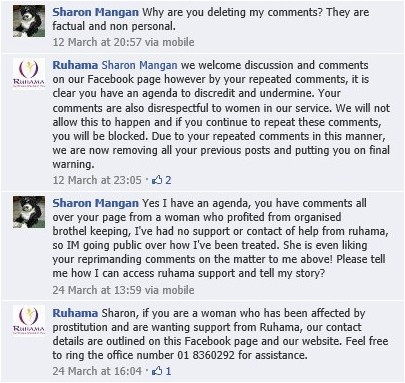
As regular readers know, the chief organization crusading for imposition of the Swedish model on Ireland is Ruhama, the new mask worn by the orders of nuns who for centuries enslaved many thousands of women in the horrible Magdalene laundries.  Just barely over a year ago I published “Puppet Show”, in which I shared information from Irish and British activists exposing Ruhama’s chief puppet, Justine Reilly, as a convicted “pimp” with a long history of “reframing her experiences” to transform herself from ruthless businesswoman to naïve hooker to pathetic victim of “pimps” herself (whichever was most profitable at the time).Rachel Moran  But soon after that column appeared, Ruhama unveiled a new star, Rachel Moran, whom they paid to present herself as the author of a fabricated memoir entitled Paid For.  I say fabricated because over a year before it appeared a correspondent wrote to me saying that during a bad time she had shared her own unfinished memoir with people from Ruhama and had reason to believe they had photocopied much of it and would in the near future build some tragedy porn around it; when this book appeared she confirmed that much of it was plagiarized from her manuscript.  But while Moran’s pantomime performance as victim-turned-author seems credible to True Believers and ignoramuses, it is utterly unbelievable to those involved in the tiny and close-knit world of sex work in Dublin.  For months now, activist Gaye Dalton has been “tweeting” about the holes in Moran’s story, and on February 26th she actually filed an affidavit swearing to that testimony.  When I expressed an interest in publicizing the affidavit Gaye kindly provided me with both scans and a transcription; I have combined the scans into a PDF for your perusal (her address and phone number have been pixilated to preserve her privacy), but here’s the heart of the document:

I sold sexual services on Waterloo and Burlington Roads in Dublin…between approximately June/July 1987 and March/April 1993…I worked there 5 or 6 nights a week…usually [arriving] at about 9:30pm and [working] until at least 2:30am.  I spent most of my time on the streets either walking or in two places:

  • At the top of Waterloo Road by the corner of Wellington Lane
  • Near the corner of Burlington Road outside Dublin Institute of Advanced technology

In cold or wet weather I might also sit in my car either at the top of Waterloo Road, or on Burlington Road looking out on to Waterloo Road.  The sex workers and regular clients were a small community that could be compared to the regular clientele of a pub, we all knew each other, at least by sight and were very much aware of new people, unusual occurrences, or any form of crime or abuse.  Every woman I knew at that time worked independently, for herself, apart from two women who were in personal relationships that would have been abusive and coercive in any environment…Anyone who seemed underage was prevented from working, sent home if possible and reported to Gardai.  Many of the women had teenage children of their own and were not easy to fool in this respect…Drug abuse was extremely rare and many women were actively involved in the “concerned parents” movement in their local communities.

At no time did I ever see, or hear of “Rachel Moran” author of Paid For and founder of “Space International” nor anyone resembling her, working in that area.  In her book she claims to have worked near the corner of Wellington Lane from early evening until “the small hours”, which would have placed her within 15 yards of me for several hours most nights.  I have asked several people…from that time and nobody else can remember her, or anyone like her, not only there but in any form of sex work indoor or outdoor, at any of the times she claims to have worked, between 1991 and 1998.  Beyond this, in her book Paid For and…blog The Prostitution Experience she has described several people, but not one of them even resembles anyone I ever met or heard of.  Like any small community of people there was gossip…we knew plenty about each other’s lives and were familiar with the known details of any abusive, awkward, or even interesting clients.  She does not allude to anyone recognisable  to me at all.  At no time does she show any awareness of the terminology we used, nor even the material realities of our work.  She has also, at times, claimed to have been arrested for soliciting before 1993.  Not only was this impossible, but also, one of the first things you would be told as a sex worker at that time is that you could not be arrested for soliciting. She did not even know that.

Rachel Moran is making money from her book and speaking engagements as well as…making significant input into Justice Committees both sides of the border through totally misrepresenting herself and that entire community and time.  Meanwhile real sex workers are denied all…self representation to refute [her claims]…I understand that it is unlawful for a person to obtain financial advantage from deceit, but I am personally more concerned with the damage to vulnerable, voiceless people that Rachel Moran will do with her lies.  The idea of anyone so unscrupulous having any degree of control over sex workers’ lives in future…absolutely horrifies me.  Justine Reilly, her partner in “Space International” (all reference suddenly removed from website in past few weeks) was discovered to be a convicted pimp in February 2013, after…putting herself forward in the media as a helpless victim.  RuhamasharonaI have never observed her to show any remorse towards the women she exploited, while at least one of these same women has been openly chastised by Ruhama for “disrespect” for alluding to her convictions.  During consultations in both North and South of Ireland genuine sex workers have been treated as animals who cannot think and speak for ourselves while dishonest persons such as these have been put forward as speaking for us. Genuine sex workers have been abused, intimidated and excluded while blatant lies are treated with the greatest courtesy and respect…

I wish that I could believe that this affidavit will help to undermine Moran’s credibility with the Irish government, but I have little hope for that considering the obsequious deference it has rendered and continues to render to the Magdalene orders, both on the issue of compensation to their past victims and the issue of their current attempts to bring sex workers under their control once more.  But I can and do hope that it has some deleterious effect on her credibility with the Irish people; each revelation like this one adds to the growing heap of evidence that Ruhama, like all prohibitionists, is a pack of sociopathic liars who will stop at nothing to subject all human sexual behavior to police and institutional violence.


12 Mar 06:18

queengayglitterfairy: Art by Starchild Stela Can we please talk...


queengayglitterfairy:

Art by Starchild Stela

Can we please talk about how rad she is?

12 Mar 06:06

The Orthodox Church of Heinlein

by John Scalzi

If you’re an aficionado of passive-aggressive fannish xenophobia, in which the frothing distrust of people who aren’t just like you is couched in language designed to give the appearance of being reasonable until you squint at it closely, then you’re not going to want to miss this piece by Baen publisher Toni Weisskopf. It’s a really fine example of the form. I recommend you check it out for the full effect, but for those of you who won’t, here’s an encapsulation of the piece:

“Once upon a time all the fractious lands of science fiction fandom were joined together, and worshiped at the altar of Heinlein. But in these fallen times, lo do many refuse to worship Heinlein, preferring instead their false idols and evil ways. What shall we, who continue to attend the Orthodox Church of Heinlein, do with these dirty, dirty people? Perhaps we shall wall ourselves away in His sepulcher, for we are the One True Church, and should not have to sully ourselves with the likes of them. P.S.: Also, their awards don’t mean anything because we don’t get nominated for them very much and maybe we don’t want to be nominated anyway.”

So, notes.

1. In one sense, Ms. Weisskopf is to be commended for her facility at marketing messaging, in which she, as publisher of Baen Books, quite adeptly makes the argument, implicitly and explicitly, that those who read Baen Books are in fact the One True Fandom, and that the One True Fandom reads Baen (it should be noted that the piece originally ran in the Baen Bar online forum, located at the Baen Books site). At the same time she also suggests that despite being the One True Fandom, Baen folk are also outside the mainstream of science fiction, thus playing the hand of rhetorical cards that includes both Heirs to the Throne and Belittled Outsiders. It’s a nice trick.

You might think I’m being sarcastic about that comment, but, in fact, I’m not. Anecdotally speaking, Baen’s folk really do appear to have a high level of identification with the house, and much (but to be clear, not all) of Baen’s stock-in-trade is a specific type of science fiction, which structurally resembles “golden age” science fiction and whose readership/authorship correlates with social/political conservatism. Conservative folks, pretty much by definition, tend to see themselves as caretakers and standard bearers of a lineage — in this case, of a brand of science fiction that hearkens back to an earlier age, and particularly to the work of Robert Heinlein.

So when Ms. Weisskopf addresses the Baen true faithful like this (as she does both in the Baen’s Bar and on the site of Ms. Hoyt, a Baen author), aside from anything else she’s doing, she’s engaging in the laudable tactic of binding — or rebinding — her company’s host to her company’s product: Baen fans are the real science fiction fans, and real science fiction fans want real science fiction, which comes from Baen. It’s a nice bit of commercial epistemic closure. So good job, Ms. Weisskopf.

2. That said, as a bit of messaging it does have its own risks: Namely, when a publisher of a science fiction house explicitly brands everyone else as heretics and interlopers in the House of the Future, she also implicitly argues that no one other than those she’s identified as True Believers should be touching her company’s books — they’re for the small and select in crowd. Sure, maybe once you’ve gone through a complex baptismal process, in which you memorize the Notebooks of Lazarus Long and are able to recite them at a gun range whilst the members of the faithful blaze away with their semi-automatics, then you can be allowed in. But you’ll still always be a novitiate — now go get papa a cigar, junior.

And, I don’t know. Maybe that’s what Ms. Weisskopf wants; maybe she’s decided that the self-identified True Faithful is a sufficient market, and will remain so, despite the fact that it’s aging as it goes along, and the numbers of people entering the genre through the Heinlein door has, shall we say, shrunk dramatically over the years. However, if I were one of her investors, or her distributor, I’d probably shoot her a note saying seriously, what the Hell are you doing? Because loudly and publicly dismissing a majority of a market segment in a publicly-accessible forum is not generally considered a smart business move. Fortunately I am not an investor or a distributor.

3. However, I have been — and am — a reader of Baen books and authors. The company has excellent stores of both. I’ve featured Baen authors here for the Big Idea segment; I note here and on Twitter the new books that Baen puts out every month, because I think that Baen authors and books are worth letting people know about, including people who aren’t already self-identified as members of the Baen faithful. Have I been wrong to do this? Have I been wrong to personally enjoy the books of Baen authors? Because certainly there are enough Baen authors out there who have been happy to consider me a poster boy for Everything That Is Wrong in Science Fiction. I would hate to sully their books with my gaze, or my willingness to let the wrong people know about their work.

So, a personal note to Ms. Weisskopf: If you’d like me to stop reading and appreciating the work of your publishing house, and to stop publicizing it to the people outside of the True Faithful, all you have to do is let me know. I will be sad to do it, because your authors do good work, well worth celebrating. But if, as you say, you are “not sure there is a good enough argument for engaging them,” where “them” includes a very large segment of the audience who reads this site — and almost certainly me — then I will regretfully stop accepting Baen authors for the Big Idea and stop noting when Baen Books come over my transom.

You know where I am; let me know what you think. In the meantime, I’ll just assume you actually do want me to keep promoting your authors and books.

4. Speaking as someone who does, in fact, love the work of Robert Heinlein, has acknowledged his obvious influence in his own work, defended him from detractors and who has been labeled “The New Heinlein” more times than he can count, I feel I can say this: The fetishization of Robert Heinlein creeps me the fuck out. Heinlein was a great writer, a central figure in the development of science fiction as a literature and as a community and, by all I know of him from people who knew him, a fine and decent human being — flawed, to be sure, but here’s a stone for you to cast if you are not also flawed.

With that said, using him as the yardstick for who is a True Fan and who is not, and picturing him with the sort of uncritically slobbering reverence one offers gods or Ayn Rand is risible. First and most obviously, a man who made a point of aiming for “the slicks” — the general interest magazines that would grow his audience exponentially beyond the pulps and helped him to position himself as a writer of wide cultural significance — probably should not be used as the fetish object for a group of people actively trying to exclude other people as real fans of science fiction.

Second, if memory serves, Heinlein took a exasperated view of people who read his stuff and then climbed his walls looking for him to be their guru. From what I know of the man I would suspect he would feel the same exasperation with the people who want to do to him in science fiction what conservatives do to Ronald Reagan in just about every other sphere. Maybe it’s just me, but I prefer my Heinlein as a human being, not a hand-sized plaster idol, perfectly sized to bludgeon those I’m uncomfortable with.

Third, if you want to make the argument that people who are serious about science fiction as a genre should read Heinlein, then you get no argument from me — indeed, I would agree! Just as they should read Wollenstonecraft, Verne, Wells, Asimov, Bradbury, Clarke, Russ and Tiptree. If you want to make the argument that writers should pay attention to how Heinlein crafts his work, I’m right there with you, too. But if you say that none but those who go through Bob shall enter the Kingdom of Fandom, you’re going to lose me. Because it’s wrong. People can, people do, people have. They’re quite happy in fandom, too! And there’s nothing a member of the Orthodox Church of Heinlein can do to evict them. Which is the thing which really busts some of their chops, I suspect.

5. There is no one way to be a fan of the genre. Ms. Weisskopf’s unilateral attempt to establish fans of her publishing house as the One True Church, with Heinlein as its graven image, is flat out wrong. Not only are they not the One True Church, they don’t even get Robert Heinlein to themselves. They have to timeshare him with me and with many other fans who love his work, see him as an influence, and at the same time are happy to welcome anyone who wants to be part of the science fiction and fantasy community into the fold, no matter how they got there. Try to take Robert Heinlein from me, guys. See where that gets you. He’s not yours alone. You can’t gatekeep him from me.

Likewise, Ms. Weisskopf’s handwringing about what should be done about the interlopers and heretics incorrectly arrogates to her little group the ability to make any sort of decision on the matter. They can’t. Baen is not, in fact, the core of science fiction and fantasy; people who identify as Baen fans are not the only “real” science fiction and fantasy fans. They’re not even “one side” of science fiction and fantasy; that’s like saying Virginia is “one side” of the United States of America. They are a constituency at best — one with no more or less significance than many others.

If the Baen folks do, in fact, decide to contract into a little defensive ball in which only the pure of heart shall be admitted into Bob’s sight, the impact on the rest of the science fiction and fantasy field will be pretty much exactly nothing. The rest of the field will chug along in its myriad ways, happy not to be bothered by a small and shrinking group yelling at them you aren’t the true fans, no not at all, why aren’t you listening to us. 

Baen and its fans and writers are what any of us in the genre are: a constituent part, something the makes the whole greater than the sum of the parts. It’s a shame so many of the people who identify with it — the publisher included — appear to be yelling at the rising tide of the current field to keep it from coming in. I imagine that Robert Heinlein might have something pungent to say to them about it. Maybe he already did. I’ll have to check the notebooks.


12 Mar 06:00

Sex Workers Unite: A History of the Movement from Stonewall to Slutwalk (2014)

by Caty Simon
Any book that aspires to be the first history of the sex workers’ rights movement in the United States will inevitably face accusations of exclusion. But despite some unavoidable failures in representation, Mindy Chateauvert’s Sex Workers Unite: A History of the Movement from Stonewall to Slutwalk, is a pretty damn good history of our movement. […]
12 Mar 06:00

The Reality Check – It Bounces

by syrbal-labrys

desk kittySometimes a news story just makes me scratch my head.  And pinch that space just between and below my eyebrows at the top of my nose.  I think a permanent crease is forming there, to be honest!

The latest “You have got to be fucking kidding me!” story is that of the Oregon couple whose cat “attacked” their child and “trapped” them in their bedroom.  The child was a seven month old.  Now, I’ve had three children and two of the three learned to crawl AND to walk attempting to catch the household cats.  My firstborn managed to walk by age seven months sans kitty, because our apartment allowed no pets.

Each of my children did, however, finally lay rough hands on a household cat.  In spite of being stringently taught to be kind to animals, kids can be little wild things in their own right; that first born for instance?  Carefully repeating “Gentle, gentle, gentle,” he grabbed the first cat of our marriage — a tortoiseshell kitten, by the tail — and jerked her out from beneath the chair she was hiding under with a loud carpet “RiiiiiiP!” sound.  She turned and wrapped all five pointy ends around his chubby little fist and taught him to never do that again.  Well, alrighty then.  A bit of antibiotic salve and a band-aide and the world kept turning.

Seems the news story kitty weighs 22 pounds; that is a substantial amount of cat.  We had a Himalayan kitty once who likely came near that.  He was a sweet, sappy, spoilt (before we inherited him) kitty who would lie looking up at Christmas tree lights as if he was LSD tripping.  Until he got a snoot of catnip, that is.  Then he was formidable as a mean drunk kitty who thought he was Dracula come again in kitty-drag.  So, the fact that “dad” in the story kicked the cat to “protect” his child and then wondered that the previously indulged and pampered kitty freaked out?  Can I get a “Duuuuh, dumbass!”?  The cat doesn’t need psychological help.  The owners need a Gibbsian head smack.

Cats scratch kids, that is how kids learn to not be shits to pets.  You don’t kick an animal for defending itself and then run and hide in the bedroom.  I keep a spray bottle to say “NO” to a new cat in training.  I never hit a cat.  That one in the picture, little Gray Gracie, our recent rescue?  She only has three pointy ends, some coward had her declawed — while I am grateful that she will not be savaging my furniture, I sure am not letting any child grab her!  I have to protect her since she cannot do it for herself.


Filed under: Life, Media Morons, Snark Tagged: American stupid, children, parenthood, pets
12 Mar 05:57

thatlittlefreakfromlotr: native-detroiter: marfmellow: aboutexhaleprivilege: The best thing is...

thatlittlefreakfromlotr:

native-detroiter:

marfmellow:

aboutexhaleprivilege:

The best thing is that these people are complaining that white people ruin everything and are the devil and only steal everything from PoC while 99% of them sits in a country that wouldn’t be in the modern state it is now if not for white people, while using a machine made by white people running a operating system made by white people blogging on a website made by white people .

image

I’m sorry but who built America nigga? LMAO YO GETCHA HISTORY TOGETHER BABY!!

lol at the bolded. hooray for oppression and capitalism!  good job guys.

I’m going to keep this brief and undetailed since I’m out of time and on my mobile phone, but first things first—I am an engineer. I’m going to assume you don’t know much about engineering at all, because I otherwise can’t imagine why you would write what you have. A working machine is not built by one person, its mechanisms not drawn from thin air. Development is a long process—occasionally punctuated by strokes of genius and happy accidents—undertaken by multiethnic (and usually multinational) teams, and the final product is a synthesis of theory and ideas that form something new (and hopefully useful). So it’s very odd to me that you would attribute things like “operating systems” and “computers” to “white ingenuity” as if that is logical by any measure. Do you know the history of microcomputing at all? The teams behind the ISA systems bus or the one gig processing chip? How about MCM or the development of modern RAM? Modern PC display? The development of the colour computer? Does Wang Laboratories sound familiar to you? Perhaps doctors An Wang or G.Y. Chu? Surely Mark Dean and IBM do. I know they do, because I know that you are well-informed about the development of modern computing and the countless engineering teams that put all their time, sweat, effort, and research into it.

I’m also curious to this “modern state” you attribute to white people. Is it this Western civilisation built by five hundred years of violent exploitation set to end, within the century, in global ecological catastrophe? Because even then, you at least surely recognise that it was built on the ruins of civilisations far more complex, and in many ways, more advanced. You at least surely realise that technological catalysts like the Textile and Industrial Revolutions would have been literally impossible without black African labour; that Western infrastructure was built both literally and physically, by black and Asian individuals, sustained by Native American agricultural practices (yes, including Europe, which accrued wealth by establishing colonies), was created financially by both riches stolen from the continents of Asia and Africa, and an economic system that relied entirely on the fabulously lucrative trade of human bodies, subjugation, barbarism, and slaughter.

Or did you mean before that—the European Renaissance that was only made possible by Moorish intervention in Europe?

Or did you mean before that, when Europe was experiencing its “Dark Ages”—a time of unprecedented death and disaster marked by violent superstition, sectarianism, and lack of hygiene—when, meanwhile, empires of the rest of the world—the Sahelian kingdoms; the caliphates of North Africa; the empires of Mali, Ghana, and the Songhai; the sultanates of Sudan, the Ethiopian and Somali city-states; the polities of the Americas; the universities of West Asia and Africa; the Song, the Mongols (and countless many more) were all in top form?

Or did you mean before that, during much-lauded Greco-Roman era…whose academic achievements were far outmatched by their West and South Asian counterparts, and whose greatest thinkers were educated by Africans?

I mean, seriously. Please show me this elusive age of white nobility and white achievement, because I’m keen to know where in history it ever existed. You won’t be able to. Do you know why?

Because that simply isn’t how civilisation works.

If you really think the world was built brick by brick by whiteness, or that the humans were pulled out of the primordial ooze by white men, you just aren’t as clever as you think you are. Like the process of engineering, the development of humankind has been one long synthesis of cultures, and the (not always peaceful) trade of languages, knowledge, and ideas. At no point in history did humans sit on their laurels with hands over their ears and eyes, ignorant of the world around them and entirely isolated from one another. It’s why you can find ancient Chinese coins in East Africa, West African bones in the Americas, Polynesian chickens in South America, Arab accounts of Asia and Africa, Central Asia vestiges in Eastern Europe, black Africans all throughout European history. The world is not stagnant. It never was. Human evolution was only possible because of the sharing and propogation of ideas. Your entire argument is facile.

Do you know why people on this website are angry?

Because it’s about the only place where you can express that anger and be (relatively) safe.

Do you know why we are angry in real life?

Because these last five hundred years have seen unprecedented cultural destruction, murder, ethnic cleansing, and subjugation in the name of greed, all sustained and justified by the construction of race. And nothing has changed.


You can write legislation to “guarantee” rights. Lands can be rewon in litigation. A few languages can be relearnt by handfuls of individuals. But you can never repair a culture. You can never repair a metaphysical holocaust, revive those lost to genocide, retrieve forgotten languages, customs, modes of thought, identities. Not only have they been destroyed, they have been actively and systematically been written out of history.  How much of human development has been lost? How many lives do you think this earth has forgotten? How many ghosts wailing beneath cotton fields and rail ties do you think had wisdoms passed down by countless generations or held intellectual properties cultivated by thousands of years?  A concept in its purest form may be as immutable as mass and energy, but like all Forms they are meaningless if there is no one to access them. Not even ideas are infinite; they disappear when no one is there to think them into existence. Gods die like everybody else. Whole perspectives destroyed. Thoughts, feelings, concepts, entire ways of viewing the world, all wiped out through magical feats of destruction. All this, by writing a few words in a book. Like magic.

Do you understand that? Is isn’t us who constructed this system, but we are still the ones dying because of it, erased because of it, dehumanised. And that’s worth owning. You should be as angry as we are, that anyone should have to endure centuries of and current suffering for arbitrary reasons that were installed by terrible legacies left by people who committed horrific acts of evil…whether those people were your forebears or not. Unless you don’t recognise those actions and the actions of the present as evil at all, and you genuinely don’t care about the welfare of your fellow human beings, you should be as angry as we are.

Of course, it doesn’t matter if you really don’t care or not. This five-hundred year system that’s been in place is unsustainable. And honestly? It will probably ultimately destroy itself and take all of us—and you—with it.

12 Mar 05:56

Say it with me, kids:

tbskyen:

stopsjws:

  • Being white doesn’t automatically make you a racist.
  • Being a man doesn’t automatically make you a sexist.
  • Being a heterosexual doesn’t automatically make you homophobic.
  • Being cisgendered doesn’t automatically make you transphobic.
  • Existing as a part of the majority does not automatically make you an oppressor to the minority.

I was with you right up until that last point. Systematic oppression does not require the active participation of every member of the oppressive group to work.

For example, say you’re white and looking for work. Employer gets your resume and a POC’s resume. The POC is more qualified than you, but you’re hired because you’re white and your employer is a racist like that.

You have thus been part of the oppression of POCs not through your own actions, but through the behaviour of the racist system that you are benefitting from whether you want to or not.

This is the horrifying power of systematized oppression: EVERYONE is a cog in its machine, often without their knowledge.

Honestly, I find that I’m getting less and less interested in assuaging people who have privilege on an axis that they aren’t a bad person, responsible for all the bad things in the world, and that they shouldn’t feel guilty.  I feel like far too many discussions are being centered on how bad privileged people should feel, how much responsibility they personally have, and how guilty they should feel, and not about what’s happening to the marginalized groups.  I don’t really care how bad you feel, whether you personally misgender trans people, whether you personally rape women, or whatever.  I get that we try to get through to them by appealing to their conscience and their guilt, but I find mostly it gets absorbed as being just about their own personal responsibility and feeling guilty, and a lot of privileged people seem more concerned about absolving themselves of guilt than stopping oppressive systems from happening.  They’d rather spend their time arguing with activists about how they don’t really participate in oppressive practices than trying to stop those practices from happening.  They’d rather argue with me online that they don’t MEAN to misgender trans people, than to challenge their friends’ cissexist beliefs.  They’d rather tell women to stop being afraid of men because “hey I’M NICE, WE’RE NOT ALL BAD” than to try to create a culture where women are safe from harassment and assault.  So I’m pretty done with telling privileged people “there there, I don’t hate you, you’re not all bad.”  I’m not interested in their tears and their guilt.  And I wish they would stop offering it to me.

12 Mar 05:53

Psssst, Senator Feinstein?

by syrbal-labrys

1we the peopel are [isedSenator Feinstein?  You are bitching about the CIA possibly “spying” on your staffers?  You are saying this could have undermined the Constitution?

Wow.  Where HAVE you been, Senator?  All ya’ll politicians have been wiping your asses with the Constitution almost since the 21st century began and you only notice once you think it has impacted YOU?

Bite me, Senator!  You had no trouble with your boss Obama NOT dismantling the hellish game board that Bush, Cheney, Addington, Yoo and others created — not only disavowing any need to honor that “goddamned piece of paper”, but also ignoring the Geneva Conventions.

So hey, what goes around comes around sweetheart, suck it up.  This is what you Democrats get for not prosecuting the war criminals in 2008!


Filed under: Politics, Snark, War & No Peace Tagged: cia, constitutional-toilet-paper
10 Mar 08:42

Fuck “Forgiveness”

by stabbity

Some of the phrases most likely to make me instantly hulk out are “you need to forgive”, “let it go”, and “move on.” All of those piss me off, but “forgive” is the absolute worst. “Forgiveness” seems like such a nice, happy concept, so you’re probably wondering why I have such a deep and passionate loathing for that stupid fucking word. Let’s start with the dictionary.com definition so we can then throw it out the window:

forgive

— vb , -gives , -giving , -gave , -given
1. to cease to blame or hold resentment against (someone or something)
2. to grant pardon for (a mistake, wrongdoing, etc)
3. ( tr ) to free or pardon (someone) from penalty
4. ( tr ) to free from the obligation of (a debt, payment, etc)

Ceasing to blame or hold resentment against someone sure sounds like a nice idea. So does granting a pardon, or forgiving a debt. The problem is that when people say “you need to forgive” they don’t mean “I want you to be happy and being super pissed off about ___ is not making you happy.” What they always seem to mean is “I’m uncomfortable with your anger. How about you shove it down until you choke on it?” Shockingly enough, I don’t respond terribly well to being told that I don’t even get to have my own goddamn feelings about all the terrible shit that’s happened to me, or that my completely justified rage is less important than some random fuckface’s comfort.

People also seem to have this idea that once you’ve “forgiven” someone, whatever happened magically becomes okay and everyone acts like it never happened. Fuck that noise. Nothing is ever going to make what happened to me “okay.” No empty fucking platitude is going to give me a happy childhood or a mother who loved me (why yes, there is a post coming about kink and childhood abuse), and I’m not going to pretend otherwise for anyone else’s convenience.

To make things right, much more than one-sided “forgiveness” (read, swallowing my emotions so that no one else has to think about what happened) is necessary. Real forgiveness is earned with honest acknowledgement of wrongdoing and sincere, ongoing, and above all successful efforts to make amends. If you promise something will never happen again and it does, guess what? You don’t fucking deserve to be forgiven. Not that people have to be perfect to make amends, but they have to fucking try. Without any efforts from the people who hurt me to make things right, it is literally impossible for me to “forgive.”

In all the time I’ve spent thinking about forgiveness or letting go or moving on, I’ve read precisely one article that has anything remotely useful to say about forgiveness. To paraphrase fairly heavily, that article says there are three steps to take before you can forgive:

1. Acknowledge the harm done.

2. Feel your feelings about it.

3. Talk about it.

The standard “forgiveness” bullshit allows me to do precisely zero of those things. Instead, it tells me that I should just stop being angry, as if I can flip my emotions on and off like a fucking light switch, that I don’t have the right to feel inconvenient feelings about it, and that I shouldn’t talk about it. Funny how all those things do much more good for my abuser than they do for me.

I’ve tried not acknowledging the harm that’s been done to me, and it’s fucking exhausting to pretend things are okay when they are most certainly not. I’ve tried not feeling my feelings too. Trying to swallow my anger just made it worse, to get anywhere I had to decide I had the right to be angry and that I was damned well going to keep being angry until I was good and done. I still hate talking about it, but keeping it a secret is just one more way to pretend it never happened.

Fuck forgiveness, fuck the idea that I don’t have the right to be angry, and especially fuck the idea that other people’s convenience is more important than my well being.

If you want to actually help someone who had been hurt to move on, strike the word “forgive” from your vocabulary. Instead, say “What happened to you was terrible”, “You have a right to be angry”, “Do you want to talk about it?”, and “Is there anything I can do to help?”

If you can’t manage that, then at the very least be honest about what you really mean if you feel the need to spout some bullshit about how they need to let go. Admit that you don’t give a flying fuck at a rolling donut about their happiness and that all you want is for them to shut up about how they were hurt so you can go back to pretending nothing is wrong. And then admit that you’re a worthless sack of shit.

10 Mar 08:40

So What?

by bspencer

A couple of weeks ago my father-in-law told me a story about an old art teacher of his. One day in class said teacher was quickly critiquing pieces, one by one. He said something nice about one piece, he said something nice about the next piece. He got to my father’s-in-law piece and said “So what?” In other words, “What about this is special? What about the color/composition/subject matter makes you want to look at this?”While the critique stung, my father-in-law knew there was just nothing about the piece that jumped out, that was special, that demanded you look at it. Many times I have completed a piece and thought “So what?” Sometimes I’ve reevaluated that “so what” and answered myself with “Oh yeah, here’s what.” Happily, I would not say this is a “so what?”  about my latest work, though it remains to be seen if it will end up being a favorite of mine.

A Dream to Keep


10 Mar 00:19

stand-up-comic-gifs: He’s just mad because he can’t acquire all...


stand-up-comic-gifs:

He’s just mad because he can’t acquire all the apple juice that I’m acquiring. (x)

That would be a better world. 

08 Mar 19:30

Twenty Nine Feet, Eight and a Quarter Inches

by Kristopher Jansma

The day I sold my first novel I was playing golf with three middle-aged Chinese women somewhere near the Throgs Neck Bridge. Over the past two months my book had gone up the chain from my agent to an editor to her boss to her boss’s boss and now, that morning the President of the company was supposed to call with the final verdict. I was sure it would be ‘no’.

The only thing worse than getting bad news alone is getting it around other people, so I’d gone to play golf, where at least the scenery would be pleasant and if the other golfers heard me cursing and weeping, they’d chalk it up to a bad slice.

Only when I arrived at the Clearview Park Golf Course, it was too crowded for me to play alone, so I was sent to the three Chinese women to round out their foursome. Only one of them spoke English, at least enough to scold me when I tried to putt from the fringe. They ignored me mostly, but soon I began to pick up a note of annoyance in their chatter. I was slowing them down, because, well, I really suck at golf.

Thing is, I don’t mind sucking at golf. I’d only began playing a year earlier, after my former roommate bought some clubs at a yard sale. Our first day out we walked off the course with scores around triple par, but neither of us cared. Later I played a few rounds with my father and brother and managed to get down to only double par. Then my wife signed me up for a lesson at Chelsea Piers, where I discovered I was not standing, swinging, or holding the club correctly. But none of this made it any less enjoyable.

Golf was peaceful, the courses were beautiful. My father used to tell me that if he could have done anything, he’d have been a professional golfer. Between jobs as a computer programmer, he’d played a lot and apparently gotten pretty good. He’d go out with my grandfather when he was in town. I wanted, badly, to join them, but my grandmother was dead set against it, always quick to tell me about my cousin Buddy, who as a kid had gotten hit in the head with a golf club and was still severely brain-damaged.

I’d never even met Buddy, but he lived large in my imagination. He was my first inkling that a life could be ruined in a split-second. I had used this story in the first chapter of my novel, transposing the accident onto a small-town Homecoming King. I’d thought of the idea during my first day out golfing with my old roommate, which is why I thought it only appropriate that I be out golfing on the day the novel got shot down.

As I waited for the call to come, I thought about Buddy, but something else, a number, kept running through my head. Twenty nine feet, eight and a quarter inches.

PETER KRAUSE, JOSH CHARLES, SABRINA LLOYD, FELICITY HUFFMAN, JOSHUA MALINA, ROBERT GUILLAUMEThe TV drama Sports Night aired in the late 90s on ABC, giving a backstage view of a nightly live sports show. Written by Aaron Sorkin, it got cancelled after its second season and it had an odd meta-awareness of its own impending failure. The characters are hard-working and idealistic just like those who would later inhabit The West Wing and The Newsroom, and many episodes revolve around their struggle to keep their show (also called Sports Night) on the air while maintaining their integrity. They have so-so ratings and are forever third in their market, but darn it, they’ve got heart! The show ends as greedy network executives sell the company to the highest bidder, a billionaire who turns out to be an idealist dreamer just like them, intent on saving Sports Night. Ironically, the real life Sports Night has no such luck.

The episode I was thinking about that day, “The Local Weather” was also about failure. One of the anchors, Dan, is sick of being in his co-anchor’s shadow and has begun to see a therapist. She asks him for the time and he blurts out “Twenty-nine feet, eight and a quarter inches.” Slowly, this slip’s meaning emerges.

The broadcast they’d done the night before focused on a long jumper named Oscar Parrish who’d had “a decade’s worth of bad luck”—tearing his ACL, then losing his father on the eve of the Olympics. But finally he was expected to break the world record by a few quarters of an inch, which Dan explains is “a hundred miles in track and field.”

Oscar admits that at 33 years old, his legs aren’t getting any stronger. “All I’ve done since I was 14 years old is try to jump a quarter inch farther.” He knows that this is his last chance.

But then the moment comes and… he breaks the world record! Everyone at Sports Night cheers except for Dan. He is the only one watching five minutes later when an unknown Austrian steps up to the line. This 19-year-old jumps and effortlessly shatters Oscar’s new record, by an astounding three inches. His distance? Twenty-nine feet, eight and a quarter inches.

What do you do when your best is not good enough? Dan’s therapist points out that, hey, a world record is still a world record, even if you only hold it for five minutes. Oscar did just what he set out to do. Dan argues that anyone good enough to be second place is good enough to be disappointed in not being first.

That day, as I walked behind the three Chinese ladies in their cart, I anticipated returning home just a quarter inch short. I’d gotten used to rejections over the years: from colleges, grad schools, magazines, agents, editors. Maybe eventually there comes a point where, like Dan, you have to accept being number two. Logically, there must be far more people in the world who work incredibly hard, come very, very close, and don’t succeed. It just doesn’t make for very good television.

But then the call came in, and my agent told me that the publisher wanted to make me an offer.

18114280This was a mistake—surely. They were going to call back in a few minutes and change their minds. But no. I’d made the jump. What if I was the 19-year-old Austrian, not the 33-year-old runner-up? I had no script for this. I wanted to tell everyone, although I’d been urged to keep quiet until we’d finished the negotiations. But I took out my phone and changed my Facebook status to, “Twenty Nine Feet, Eight and a Quarter Inches.”

Though my golfing companions couldn’t understand what I was saying on the phone, the look on my face spoke in every language. “Good news?” the first lady asked me.

“My book. I wrote a book. Someone’s going to publish it.”

She smiled and jabbed a thumb up into the air. We let the group behind us play through while I called my wife, my mother, a few close friends… The ladies were happy to take a breather and clean their clubs. The woman I’d spoken to appeared to be telling her friends why I was so happy. Only as they smiled over at me, I realized that while I was very happy—was also having trouble breathing and seeing straight. I’d expected to feel vindicated, confident, assured. Instead I was having some kind of panic attack. How could this be what it felt like to win?

They say that the only real failure in life is to fail to try. But what if you’ve thrown nearly everything else aside, practiced night and day, and pushed your mind and body to the absolute limit—only to come up a quarter of an inch short—isn’t that worse than failing to try?

Twenty-nine feet, eight and a quarter inches. For the first time I thought about what that really meant. The long jumper, my Cousin Buddy—these weren’t just dreams but lives that hadn’t worked out. And I knew that even before that phone call, writing hadn’t just been my dream; it had been my life. For years now I had been running towards the board, but I hadn’t landed yet… The mix of excitement and panic I felt was exactly like finding myself suddenly in mid-air. Momentum pushing me forward; gravity tugging me down. How far would I go?

Soon it was time to move on to the next hole. As we packed up and I tried to remember how to breathe, I noticed for the first time that one of the other two women was moving awkwardly. Her face was partially paralyzed and her arm and leg on that same side were stiff. Though I’d been playing a dozen yards away from her all morning, I hadn’t paid any attention. I asked the first woman if her friend was all right.

“That’s my sister-in-law. She had a stroke,” she explained, almost apologetically. “She doesn’t play too well, but the doctor says she needs the exercise. She likes to get outside.” This was followed by a chummy laugh, as if to say, hey—it could be worse.

Surely, it could have been. She’d adapted her swing to make up for the fact that her limbs were not co-operating. Everything appeared to exhaust her, and a few times she seemed to be in actual pain, but she kept going. Certainly it made me think of how small my own problems were, and how lucky I was for the health, love, and luck that had gotten me that far. But mostly it made me think that the old saying was right. As long we are still trying, we have not failed.

Related Posts:

08 Mar 09:24

dorkly: Xbox Live Demands Where do we get these powers!?  Sign...


dorkly:

Xbox Live Demands

Where do we get these powers!?  Sign me up!

08 Mar 09:23

Nightshift

by Jess Lowry

I became acquainted with the nightshift in the winter of 2009.

Sleep, back then, had become a problem. Formally friends, we were, that winter, two adversaries who circled my college dorm room like cage fighters. Finally, a semester away from graduation and unable to stare at my ceiling for another sleepless night, I took my coat, laced my sneakers and set off down Broadway. The pavements were chapped with long cracks that’d deepened during the harshest snows the city had seen in ten years.

My daytimes were too loud. New York going about its business: the jackhammers, the fire engine klaxons, the helicopters whapping low overhead the whining, grinding, masticating of a garbage truck partaking of its feed as buses rumbled and horns honked and always an insistent car alarm. Incoming trains came to rest with a squeak and a hiss of air brakes. The ground note of the traffic noise, more tire whoosh than engine sound, punctuated every now and then by the clank of a car passing over a manhole cover. Foot noise: the clacking pop of high heels. And chattering of hundreds of conversations weaving in and out of one another. And above everything, like a flattened organ chord, the heavy breathing of idle bus engines. But at night, the frantic daytime streets became glowing, dotted lines. In the darkness specific things were illuminated: a pink hand on the back of plum-coloured coat guiding her into the theatre, the tiled doorstep of a Diner with ruby-coloured booths, the window into a basement apartment where a woman stood at the kitchen sink behind metal taps. I had longed for this simplicity and was soothed by the continuity between the black of the sky and the dark pavements. A glass of milk on a white counter top: grey shadows on white. Exhausted after my first night’s exertions, I collapsed into bed with my shoes on—forgoing my usual wrestle with sleep. Subsequently, I walked every night that semester—for two, three, four hours. And sometimes, till dawn.

I took no music on these walks. Nor did I want company. I walked in the rain. And the snow that fell one night while most of the city slept and the buildings shimmered verticality—a gossamer veil hanging against the black sky. As I walked, I knew that all around me people were sleeping under blankets on beds that were wrapped in sheets. Their heads were on pillowcases that were wrapped around pillows. Closed curtains faced the street like unblinking eyelids. This nighttime world was tucked, folded, shut: secure. I gained a particular fondness for street lamps and the little puddles of light they so easily cast. The very specific area they lit. That was all they were responsible for, and they achieved it.

I saw people with backpacks, no bags, and plastic bags inside plastic bags.  With shopping trolleys full of cans and empty baby strollers full of old shoes.  I saw a group of pigeons attack a mouse. I saw a seagull swinging low with a pigeon in its beak. There was a woman at 72nd Street who did the same sidewalk drawing of the same person over and over. When the rain washed it away, she did it again. A group of men on the corner of the park displayed their coin collections but wore shoes that didn’t fit and dug in the trashcans for food. The sides of busses caught my reflection and carried it away down the street as I watched myself go.

The buildings around me were stacked floor on floor like towers of books in a library. And the avenues were the aisles between Economics (Wall street), History (The Bowery), Philosophy (Alphabet City), Mathematics (Hudson Heights), English (the poetic East and grimy West Side). Harlem was Hughes and Hurston country with the clackety-clack of trains wheels and boom boom bust pop of cars. Midtown was Truman Capote’s sucked orange. The Hotel Chelsea had busts of Twain, Tennessee Williams and Arthur Miller in its windows while Mailer, Nabokov, Vonnegut and Irving’s portraits were in the foyer of the 92nd street YMCA— peeking palely out the front door. The rhythm of the city  had been defined by Kerouac’s leather-healed boots and destruction of the best minds of Ginsberg’s generation had howled naked in the dark on 42nd street. These ghosts were everywhere—still moving in the night—and I considered them good company. Surely, I thought, they too would have walked the night.

By February, I could walk the city with my eyes closed. The smells of Morningside Heights—with its green copper-rusted rooftops—giving away to the booming 50s where restaurant doors were open late and the women with all their perfume wafted by.  The air got closer together in the mid-30s, tighter as the streets got smaller and everything started to smell of candied pistachios and the damp of the subway. Times Square smacked of dry hotdogs and damp plastic. As spring arrived, I smelled my way from one side of the city to the other—like a mole.

There were three groups of people on the street at night. The first were homeless. Walking with their hands outward and upward, they prayed to themselves or asked for change. Next were the crowds that flooded the pavements from the restaurants and theaters. Clutching each other’s arms, they flashed teeth and eyes and trailed stray ends of conversations like fading jet fuel. Wasn’t he handsome? They said of the male Lead. She would break your heart, they said of the understudy. The chicken was dry, they whispered.

The third group on the pavement were the regulars: the nightshift.

Members of the nightshift were always alone. They never had dogs. They had no bags or backpacks. Their tops rarely matched their bottoms: pinstriped trousers and a tracksuit top. A pencil skirt and an old jumper. Blazer and running trousers.  These layers, I knew from experience, were hastily chosen—their convenience to the front door trumping all questions of style and appearance. Members of the nightshift were never on the phone or eating. With hands neither out nor up, they walked with heir arms at their sides with slow, steady steps that anticipated potholes and irregular pavement gradient.  They didn’t pause to look at street signs or consult maps—they didn’t take photographs and they didn’t wheel bicycles. The nightshift had no purpose other than to walk.

Nightshift

There were rules, I deduced, to being a part of this group. No eye contact. No pause. No break in step.  And, most importantly, no questions. The warm, inside world—living rooms, restaurants, bars and theatre lobbies—belonged to the speaking world. If members of the nightshift wanted to talk about what had brought them into the Manhattan moonlight, if they wanted to describe whatever battle was too large to fight in their small apartments, they most certainly had somewhere to have such a conversation. But they had chosen the avenues. And silence.  And the great tide of fellow walkers who wanted to be spoken to as much as they wanted to speak.  Which was not at all.  Thus the nightshift operates under its members’ non-acknowledgment of each other, an unspoken pact of anonymity between strangers who flit from streetlamp to streetlamp, never looking up. Membership to the nightshift involved becoming an expert in walking through crowds. I learned how to navigate through groups of people without touching them—anticipating the turn of an elbow or an impromptu dance step. I learned to wave at strangers located behind the maitre d’ upon entering a restaurant in order to gain access to the restroom. Won’t be a second, I called to my imaginary friends while enquiring about the location of the facilities and afterwards, making a swift exit to resume my walk. Members of the nightshift know what time supermarkets haul their rubbish out onto the street. They know what hour the streetlamps go on and off. And they know where the ineffective storm-drains are located. They know not to respond to catcalls, taunts or jeers—pleas from the homeless or the cries of an animal. Swit-swoon, a group of men called to my unflinching profile each evening that I walked past their stoop swit-swoon.

For as long as I can recall, I’ve felt as though everyone had been given a secret manual on how to behave like a young person, everyone except me.  This secret manual outlines, among other things, how to achieve confidence through jeans and a jumper, how to hold a glass in a room of crowded people and how not to blush when embarrassed. And how to sleep.  I lacked an awareness — a solidification in my mind— of how I looked and, as such, touched my own face constantly, moved my shoulders too much and looked at my hands as if to assure himself they were there.  Any handsomeness on my part was diminished by my anxiety that something was missing.  But in the nightshift, I had found rules that I could follow and people with whom I belonged. I felt at home in the anonymity— the soundless, wordless crowd.

I abided by the rules and can’t tell you anything about the faces of the people I walked with that winter in New York. I knew them by their hazy outlines—their approach and gait. I knew their shoulders, the sounds of their feet and the color of their coats. A man at Lexington and 102nd wore a denim jacket and baseball cap over his suit trousers. He smelt of fresh paint and put more weight on his right than his left leg. There was a woman who, regardless of weather, always carried an umbrella between 63rd and 79nth.  Another man— in a pinstriped blazer and running trousers— paced nightly between 33rd and 34th street all the while looking up at a window high overhead. He wasn’t old. A woman in red trousers occasionally crossed my path on 21st street—the outlines of her hands shoved into her pockets. Most nights, I drew level with a pair of turquoise cowboy boots as I waited to cross Columbus circle though, I never looked up at their owner. The toes of the boots had painted, golden snakes.

The May evening before my parents were due to arrive for my graduation, I had gone out for a final walk.  By that time I had lost most of my friends—shunning their attentions for my desire to walk—and needed to think of an explanation to offer my parents when they wanted to meet Kitty or Molly or Sue.  I had worn through three pairs of shoes—their soles becoming too thin to withstand the asphalt—and needed to go out early the next morning to buy flats for the ceremony. I had also lost a substantial amount of weight. These were the things on my mind as I put one foot in front of the other and tried to contrive stories about my lack of company, footwear and fat. But crossing the intersection at 77th street, I found myself walking towards someone who was wearing my jacket: the exact shade of magenta in cropped denim.  Found in a charity store in Houston, my mother was fond of calling it, The ugliest jacket God did ever see. But I had never seen another. And because I was looking at her jacket—it was an easy shift up to her face. I looked without thinking.

The girl was making no move to hide her tears nor was she seeking attention. She was quietly weeping because of the rules that said she could without any interference. And my head, which had been so quiet for months, was suddenly so loud that I covered my ears. Where moments before there had been space—as wide as the avenues—questions jostled like people on a subway platform. I shouted, my voice ricocheting off the nearby buildings that I imagined tumbling down, like books on our heads.

Did you notice the difference in the smell between 62nd and 63rd? Did you see what was written on that wall back there? The graffiti? Why are you walking? Why are you out here at night? I have no idea why I’m here, I was hoping you could tell me, but I understand if you don’t want to.

The girl paid me no mind and kept walking, the same even pace though, I heard her rhythm break as we crossed mid-street. A momentary mid-step pause. Maybe she realized we were wearing the same coat. I headed to my parents hotel and sat in the lobby until dawn broke like a yoke over the park.

I graduated from Columbia the next day in a sea of baby blue mortarboards and gowns.  I remember little about the ceremony and saw only the summer stretching before me like a line of white boxes with black space between them. I left New York with my parents and spent the next few months at their home in Texas. My father set the security system each night and I couldn’t get out without sounding an alarm. So I remained in bed—toes curled and gripping the side of the mattress.  Gradually colours became more bearable and sounds returned to their normal decibel. But the girl in the jacket walked back into my thoughts every night—and I wondered if she was still there.

I have since found myself walking in other cities. I exist in the daytime but am often drawn, on those sleepless nights, to the nightshift that moves out there in the darkness.  But I abide by none of the rules. I look at the wandering tide of people and sometimes pause to stare. In my mind, I ask them their stories. I ask about their families. I ask their addresses. I ask about their jobs, schools, careers, routes, roots and what they had for breakfast. I’ve walked in Paris and London, Rome, Oxford and Florence—Berlin and Chicago. The purposeful steps, the downward faces, the lack of music or company or food or drink or phone or matching clothing: the city changes, the nightshift does not.

***

Art credit: Ed Yourdon

Related Posts:

08 Mar 09:20

Fatness as Fetish, or Why I Hate the Term “BBW”

by kittystryker

originally posted here

I often identify myself, with some pleasure, as fat. Just as often, there’s a flurry of anxiety around my use of the word, as if I am judging myself harshly in some fashion.

‘Fat’ is an insult here in the US, where I’ve come of age, and I rarely hear it without some commentary on a percieved lack of hygiene or intelligence. Ever since I started calling myself ‘fat’ as a way of combating my own prejudices about the term, I have been constantly corrected, told that I’m a Big Beautiful Woman, I’m just curvy, I’m pretty, not fat…like there is some contradiction. But I actually like the word ‘fat.’ ‘Fat’ implies something more juicy…fruitfulness, and richness. It’s succinct. I feel like the term “BBW” fetishizes my fleshiness, makes my body about my perceived beauty and therefore sexual value to others, while “fat” allows me to take up space for myself. I feel less and less like apologizing for the term — not to my family, not to my friends, and certainly not to my clients.

My body’s attractiveness has been vital to my work since I started seriously pursuing the adult industry at twenty, spanning various areas from professional domination to escorting, from pornography to live sex shows. I have been (dare I say consciously) working in sex for most of my adult life. Because I’m employed within an industry where certain specific beauty standards are considered to reign supreme, many expect that I would have to mold myself into a Stepford heteronormative sex worker of sorts. I often hear shock when I come out. “Really?” they gasp, “but you don’t LOOK like an escort!”

an average look

The implications of that statement are not unfamiliar to me. I’m not the depiction of “escort” the male gaze markets on television, nor am I a sob story or a capitalistic fantasy. Hell, I’m not the standard of attractive they’re marketing to you either. I’m 280 lbs, with often multicoloured streaked hair, tattoos, in jeans and sneakers as often as I present high femme. When I walk down the street, my fatness is impossible to hide, and makes me vulnerable, particularly to sexualized, and often violent, attention. Ignoring or rebelling against catcalling often leads to threats intermingled with statements about how grateful I should be for the sexual harassment. The implication being that as a fat girl, of course, I’m lucky to be thought of as desire-worthy at all, even if that desire is violent or unwanted. This view tends to render the idea of someone paying me for adult entertainment mind boggling. My refusal to see a client has often led to being insulted and physically threatened for my fatness, again feeding off the idea that I am ungrateful for not taking all opportunities given. I am lucky to have privilege and not have to see such people anyway, despite their attitudes. I know not all sex workers are as privileged.

Publicly, I may be ridiculed, threatened with rape, given unsolicited suggestions on diet or exercise, or asked about pregnancy. Privately, however, I am sought out. The first break I got was when I started using the term ‘Big Beautiful Woman’ on my ads and site. Before then, I used ‘curvy’ or some other euphemistic term. When I stopped and used ‘BBW’ instead (in the interest of using a term I saw more women my size embracing), I got more queries, more excitement, more…letching.

Now, I’m an exhibitionist- I love my body, most of the time, and enjoy showing off. But the thing I realized is that I was attracting men who were more interested in fetishizing my body than relating to me as a person. I could feel myself being assessed and categorized by their gaze and it made me feel disassociated and strange. When I related my experience to other sex workers I know, I found that some trans* women empathized in particular – the terminology of fetishism, specifically when focused on ones own body, feels uncomfortable at best and deeply traumatic at worst. Even if a person thinks you’re a “goddess” because of your body, being put on a pedestal is still just another form of objectification, and that’s just not my kink.

But many of the clients that I see are too embarrassed by their attraction to a fat woman to date one, or even to be seen with me in public. When fat people are ridiculed publicly, those who desire them stay silent for fear of being dragged down as well. It’s like any other form of bullying. There is a shame for us both — for him in being interested in my thick thighs, my soft belly, my large breasts, and for me in possessing a body made of these during a declared “war against obesity.” My flesh is resistance to a medical establishment that demands that I lose weight before they investigate my symptoms, a humiliation scene I did not consent to and yet somehow pay for as much as it is a stand against homogenized standards of beauty.

And it is not just the clients who are supposed to hide their desires. There is an expectation, if you’re queer and in the sex industry (particularly professional domination or prostitution), that you will likely feign heterosexuality in order to make your clients feel comfortable. Many sex workers create a whole persona that they slip into along with their sex work drag when they go to work. As a fat sex worker, I found myself facing a choice: I could do the same and potentially see clients who, in their shame about desiring me, might shame me as well or act violently towards me. Alternatively, I could take my fatness and my inability to hide it as a cue and refuse to deny my queerness in my work either, to embrace that side of me in my sessions.

Even as I found my own stride, I struggled to get recognition from others within the queer sex work community, particularly in the area of pornography. It’s hard enough to market the non-male gaze oriented queer erotic on its own – with every identity you add (person of colour, trans*, non-binary gender, fat, disabled) a sex worker can see their work possibilities get fewer and further between. While some queer sites enjoyed working with me (thanks TroubleFilms and Crashpad Series!), others would consider me less marketable than slimmer, more fit queer performers and would decline in the interest of more success. Just as the outliers of the queer community found to be true of the greater Lesbian/Gay movement, sometimes your own community will employ the same “acceptability” policing techniques as society in the name of “the greater message.” “We’ll come back for you,” they say, to the trans* people fighting for gay rights, to the fat sex workers asking to work in queer porn. “When we succeed, we’ll come back for you.”

History shows that to be unlikely.

photo by TroubleFilms

The experience of being fat, queer, and a sex worker crash together often and sometimes unexpectedly. One such example is my style when I see a client: Many fat sex workers, or alternative looking queer ones, suggest that a female-identified person starting out in the adult industry play up a high femme look in order to succeed. I worked initially with one professional domination house (a sort of kink-focused, non-sexual “brothel” for dominatrices) who insisted I wear black lingerie, stockings, and black pumps, even though it wasn’t flattering on my figure and I was not particularly feminine at the time. Instead of looking graceful and elegant, I looked awkward, teetering in heels that fit uncomfortably and wiggled when I walked. Rather than commanding authority in session, this attempt to submit my fatness and my queerness to this particular male gaze fantasy woman ended in many twisted ankles. It took a month before I went independent and found my power in queer femme, with buckled boots and ‘90s era flowered minidresses mixed with leather collars and studded bracelets.

What I have discovered in my years of work is that though, by using the term “fat” unapologetically, I may get less work than sex workers who more closely follow the media-created ideals of sensual femininity or fetishize their non-media-normalized bodies, my clients also tend to be more interested in me as a person. They are forced to acknowledge my opinions and my politics by engaging with me, and it’s on my terms. Talking to other sex workers has given me similar stories; high femme (or high butch for male sex workers) may be more marketable, but also more exhausting and more expensive to maintain, while being genuine to a personal truth is less time consuming but can take a toll on client numbers and emotional state. It can become harder to separate sex work from recreational sex, and harder to “turn off” the need for strict emotional boundaries. It’s a tough trade off to make, and each provider decides on a balance that feels comfortable and manageable for them.

The divergence between what one publicly claims to desire (generally based on what is socially acceptable) and what one privately seeks brings to mind the multiple examples of anti-gay politicians or religious leaders who are later discovered in bathrooms on their knees. Hypocrisy is so common it has become a joke rather than a surprise. Some men who want to sleep with men are still afraid to admit their desire when male bisexuality is still seen as dangerous and risky, never mind if you have a faith that calls it sinful.

While I was thinking about this piece, multiple blog posts came to my attention that used the logical technique “reductio ad absurdum” to support gay marriage by showing how ridiculous it would be to forbid another group from getting married based on claims of disgust from people outside that group. Over and over, the group chosen for this analogy is fat people, resting on the unchecked assumption, and perpetuating the dehumanizing idea, that disgust is an acceptable and appropriate reaction to fat people. Jon Stewart and Dan Savage are two gay marriage supporters who have used this tactic. Libertarian blogger, Judd Weiss, took it a step into more graphic territory, similarly expressing his blatant fatphobia under the guise of humour and activism. You can find these quotes by looking up “ban fat marriage” and their names; I don’t want to add to their page views.

These attitudes painfully reminded me of how some sex workers create hierarchies among their ranks, putting respect and rights for indoor escorts above those engaging in street prostitution, or wanting to draw a line between sex work that involves physical sexual contact and is therefore illegal and stripping, or professional domination. I see the way that in our scrabble for rights, we throw each other under the bus, hoping to gain favour and forward momentum. I also see how it pulls us all back, and prevents us from working together, from bonding and becoming more powerful. By denying these intersections and silencing the voices of the marginalized between movements, I can’t help but feel that we are harming ourselves. This concern is particularly salient when taking into account the tension between what people privately seek as opposed to what they publicly claim to desire discussed above. Certain groups are left behind because it is assumed that their inclusion would make progress more difficult, but this assumption could be, and probably is, wrong. What is acceptable is inextricably tied to what is believed to be acceptable.

I am a fat, queer sex worker. It is as political a statement as my existence in a body, as political as my desire — which is to say, completely, and equally not at all. What I mean by that is it can feel incredibly difficult to separate my body from a political sphere, when simply existing as a fierce fat femme is considered a middle finger to the status quo, even when I simply want to walk down the street to meet a friend, or perform on stage for the joy of it, or have sex on film because it’s sexy to me. My unapologetic success in what is considered a heterosexist, heteronormative, body-policing market suggests that perhaps the “erotic ideal” constructed by the male gaze is not truly the ideal at all. There is power in recognizing and embracing the places of our intertwined marginalizations and areas of privilege, and perhaps, with that, there is r/evolution.

08 Mar 09:20

Listen Up, Poors!  Feed Your Souls!

by Bette Noir

image

(h/t Big Bad Bald Bastard - what a swell idea!)

OK Poors, maybe you can’t afford to go to CPAC to feel the love, in person, and learn all of the great ways Conservatives can change your lives but that’s where Rump Roast can help by reporting the Good News (wouldn’t a nice hunk of rump roast taste really good right now?). 

Fahgeddaboudit! Poors.  Feed Your Souls, you silly moochers.  So what if your parents are welfare-sucking meth heads who haven’t gotten dressed since 2006 and who are too busy feeding their heads to put apples in brown bags for you?  Stay hungry!

Jesus and the GOP love you.  And Paul Ryan has spent a lot of time and taxpayer dollars flying from swing state to swing state to investigate your plight and he now has a shitload of Poor Ideas!

P.S.  Remember Poors, it’s not the policies that suck, it’s the word choice.

RYAN/POORS 2016

And for even more #RyanFail please visit yr Wonkette.

08 Mar 09:20

The Week In Links—March 8

by suzyhooker
The prostitution crackdown in the Guangdong Province of China will continue; 363 suspects have already been detained. Strange news out of San Francisco last week as the faith-based sex workers’ outreach Solace SF was closed under allegations of fraud against founder Laura Lasky. Canadian sex worker Celine Bisette acknowledges that Canada has done a terrific job […]
08 Mar 09:19

Zombie-Eyed Kid Starver Paul Ryan

by Zandar
Attention poor people:  did you know that allowing your kids to eat free or reduced price lunches at school means you simply don't love your kids enough to work more hours to be able to afford meals?  (And why don't you love your children enough to make lunches for them, you horrible scum?)

Speaking to the Conservative Political Action Conference, the former Republican vice presidential nominee argued that conservatives should let Democrats be the “party of personality,” while “we will be the party of ideas.”

“I’m optimistic about our chances because the left, the left just isn’t out of ideas, they’re out of touch,” he explained. “Take Obamacare — not literally, but figuratively here, okay? We now know that this law will discourage millions of people from working. The left thinks this is a good thing.”

Ryan insisted that liberals were only offering people “a full stomach and an empty soul.”

He then told a story of a “young boy from a very poor family” who received free lunches at school “from a government program.”

“He didn’t want a free lunch,” Ryan insisted. “He wanted his own lunch, one in a brown paper bag, just like the other kids.”

“He wanted one, he said, because he knew a kid with a brown paper bag had someone who cared for him. This is what the left does not understand.

 Of course, what the right doesn't understand is that being poor doesn't mean you love your children any less, but that notion that whoever has the most stuff means you have the most love is pretty much the entire raison d'etre of modern conservative parenting:  If you were truly loving and deserving parents with good values and moral standards, you wouldn't be poor in the first place.

Oh, but here's the best part of the story:  It's 100% nonsense.  Even much-maligned WaPo "Fact Checker" Glenn Kessler dropped the dreaded "Four Pinocchios" rating on Ryan's story in less than 24 hours.

It turns out that Ryan stole the story from Wisconsin's GOP Department of Children and Families head Eloise Anderson.  Oh but it gets worse:

But the story doesn’t end there. Wonkette, a satiric blog, wondered if Anderson’s story was actually derived from a 2011 book titled “The Invisible Thread,” by Laura Schroff, which is a book about a busy executive and her relationship with an 11-year-old homeless panhandler named Maurice Mazyck. His mother was a drug addict, in jail, who had stolen things and cashed in food stamps to pay for drugs. At one point, Schroff offers to bring Mazyck lunch every day so he won’t go hungry.

And worse:

This actually seemed a little strange. Could the tale told in congressional testimony really be drawn from a book? It did not make much sense in part because Schroff and Mazyck are partnering with a group called No Kid Hungry to help end childhood hunger in the United States. One key part of the program is connecting hungry kids with federal programs such as school lunches and food stamps. The group also opposed Ryan’s 2013 budget for its proposed reductions in the food stamp program.

And worse.

Here at The Fact Checker, we often deal with situations in which people misspeak. We certainly don’t try to play gotcha. But this is a different order of magnitude. Anderson, in congressional testimony, represented that she spoke to this child—and then ripped the tale out of its original context. That’s certainly worthy of Four Pinocchios.

But what about Ryan? Should he get a pass because he heard this from a witness before Congress? It really depends on the circumstances. In this case, he referenced the story in a major speech. The burden always falls on the speaker and we believe politicians need to check the facts in any prepared remarks.

In this case, apparently, the story was too good to check. We appreciate he is regretful now. But a simple inquiry would have determined that the person telling the story actually is an advocate for the federal programs that Ryan now claims leaves people with “a full stomach and an empty soul.” So he also earns Four Pinocchios.

And this guy will almost certainly be running for President.  The guy is such a scumbag that, in order to attack free school lunches for poor kids, he stole a story from another Republican who stole the story first from an author who was pointing out how badly poor kids need things like school lunches.

And the best part:

This story recounted an incident from more than 25 years ago. 

When Paul Ryan was still in high school.

Presumably eating a school lunch.

Think about that for a moment.