SnobAdoro as bromas desta xente. :3

Mi último proyecto para Marvel Comics.
My last project for Marvel Comics.
 Beloved British sitcom The IT Crowd is coming back for an extra-long finale episode after ending its run in 2010. Bleeding Cool reports that creator Graham Linehan announced at a Q&A in Germany that the 40-minute special is set to start filming in three weeks after two-plus years of pre-production and delays. The show ended its four season run in 2010 and was renewed for a fifth season, but the fifth season was never made and everyone involved has been talking about wrapping things up with a special finale for years now. Stars Chris O'Dowd, Richard Ayoade, Katherine Parkinson, and Matt Berry will all be returning for the last episode, and all of their busy schedules are part of the reason it's taken so long. Hopefully, Chris Morris returns from the afterlife, as well.
---
See more posts by Bradford Evans

“¿Ser o no ser punk? La cuestión afloró anoche en la alfombra roja del Metropolitan de Nueva York, donde grandes figuras del celuloide y famosos como Sarah Jessica Parker, Kanye West, Miley Cyrus o la mujer de Tom Cruise homenajearon a esta corriente musical y estética de finales de los años setenta con motivo de la exposición «Punk: chaos to couture» que se puede visitar desde hoy en el prestigioso museo. La muestra subraya el gusto del punk por la ferretería y el bricolaje y exhibe diseños con chinchetas, tampones usados y pintadas de muchos colores, ejemplos que remiten a la influencia de Marcel Duchamp (un artista francés cuyos objetos dadaístas son una especie de antecedente del movimiento). «Es interesante poder confrontar el podrido statu quo de la sociedad actual con algo tan directo como la forma en que te vistes», declara la directora de cine y actriz Angelina Jolie con la piel de su cuerpo bañada por la luz de los focos. El museo rinde tributo al local CBGB’s con los acordes del conjunto musical «The Ramones» sonando y la reproducción de uno de sus baños con una pintada que nos recuerda que «Los chicos malos molan». Canapés de queso azul y caviar con forma de guitarras eléctricas y un grupo de divertidos enanos afectados de acondroplasia y peinados con crestas al estilo «mohawk» alegraron la velada. «Tal vez el ethos punk pueda parecer contrario al de la Alta Costura, pero no cabe duda de que ambos están definidos por los mismos impulsos de originalidad e individualidad», asegura el comisario de la exposición, Andrew Bolton, mientras deja caer unas monedas dentro del vaso de plástico de un vagabundo. La madrina del evento, la pantera negra Beyoncé, fue la encargada de dar cierre a la pasarela ataviada con un palabra de honor en negro y fuego de Riccardo Tisci muy «Rhythm and Blues». El sacrificio de un bebé filipino y la posterior ingesta de su sangre por parte de los invitados coronó una noche de ensueño en la ciudad que nunca duerme. A continuación: las peluquerías caninas, ¿un avance social o un peligro para nuestros hijos?”
SnobVOLVE JOE GUARRO!
 Don't worry, the Joe Dirt franchise is still alive and breathing. Crackle, Sony's digital network and studio, announced today that they'll be producing a sequel to the 2001 David Spade movie. The first film only grossed $27 million, but Spade cited the movie's high DVD sales at Wal-Mart (seriously) when he first started talking about a sequel in 2006. The sequel didn't materialize and Spade sold a Joe Dirt animated series to TBS in 2010. The project didn't move forward, but now Spade is prepping it as a digital movie for Crackle, to be released online streaming. A rep from Crackle said today that the Joe Dirt sequel "will break new ground as the first made for digital movie that is a sequel to a hit motion picture." It will also break new ground as the mot unexpected sequel ever.
---
See more posts by Bradford Evans
Here's "Fête des Pets," a French short film Sarah Silverman made for JASH, a YouTube comedy channel in which she is a partner. It's a little creepy, like all French short films.
---
See more posts by Bradford Evans
Namoja, Munster Zoo's female Cheetah, has her paws full with five cubs. Now nearly two months old, Namoja's quintet has been exploring Munster's outdoor exhibit since day nine. Father Jabari met Namoja in early January and the five cubs arrived just 92 days later! While First-time mom Namoja has shown excellent cub-rearing skills and a steady paw, she'll have to remain vigilant. The cubs are already adept crawlers and it won't be long before they're scampering around the entire 7,500 sq. ft. exhibit!
Photo credits: Allwetterzoo Munster
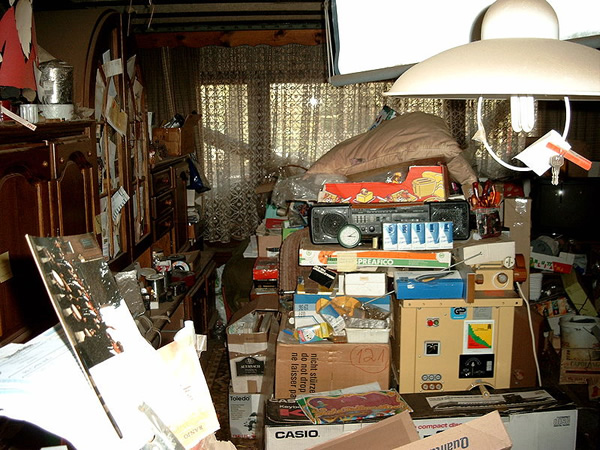
Image: Grap/Wikimedia
The next time your mom complains that you don't throw junk away, tell her that you're in good company: nearly 15 million people suffer from varying degrees of hoarding disorder. But what causes hoarding?
A few years ago, Samson (not his real name) unplugged his refrigerator. It had, he says, “got out of hand.” He didn’t empty it, and he hasn’t opened it since.
That's how Bonnie Tsui's journey to understanding the science of hoarding began:
In a National Public Radio interview a couple of years ago, Frost talked about the reasons hoarders might collect certain items: a decades-old newspaper because it could be useful in the future; an array of bottle caps purely for their fascinating physical characteristics; a seemingly insignificant postcard because it reminded the owner of a loved one or a specific event. Frost saw universality in the way the beliefs seem to be tied to information processing. “There are some problems with attention—that is, distractibility and sometimes a hyper focus, problems with categorization, the ability to organize things,” he explained. “People who hoard tend to live their lives visually and spatially instead of categorically, like the rest of us do.” One of his patients, Irene, would put an electricity bill on top of a pile; if she needed it again, she would remember where it was in space, rather than filing it away—mentally and physically—in a “bills” category.
“We don’t know the nature of the emotional attachments that people who hoard have to objects,” Frost told me. “How do they form, and why are they so? What are the vulnerabilities that lead up to it?”
Read the rest of Bonnie's article over at Pacific Standard Magazine: Link
You waste a third of an apple if you eat it from side to side, down to the core. An apple core, Foodbeast's Elie Ayrouth argues, is completely edible if you eat it from end to end:
In between bites, Geoff managed, “See, eating it from the sides is wasteful. But if you eat it from the top, the core doesn’t even exist.”
In that moment, Geoff handed the apple back to me. Sure enough, he was nearly halfway through the apple, all without choking on what we normally consider the inedible ‘core.’ Eating from the top allowed more of the pleasant flesh to encompass the surface of every bite.

 Have you ever taken stock of the personal pronouns you use in everyday conversation? A German study found that those who use the first-person singular more often tend to have more personal problems and are more likely to be depressed.
In the study, 103 women and 15 men completed 60- to 90-minute psychotherapeutic interviews about their relationships, their past, and their self-perception. (99 of the subjects were patients at a psychotherapy clinic who had problems ranging from eating disorders to anxiety.) They also filled out questionnaires about depression and their interpersonal behavior.
Then, researchers led by Johannes Zimmerman of Germany's University of Kassel counted the number of first-person singular (I, me) and first-person plural (we, us) pronouns used in each interview. Subjects who said more first-personal singular words scored higher on measures of depression. They also were more likely to show problematic interpersonal behaviors such as attention seeking, inappropriate self-disclosure, and an inability to spend time alone.
Anyone who has dealt with self-obsessed teenagers will say, "Duh." And the report doesn't mention those who use predominantly second- or third-person pronouns; the contrast was with the prevalence of first-person plurals, like "we" or "us." Of course, this study doesn't mean that the language causes depression -the word frequency could be a symptom of underlying mental conditions. Link
(Image credit: Flickr user madamepsychosis)

Al principio era solo una hipótesis planteada en algunos blogs y foros de Internet. Sin embargo, ayer mismo el diario El País empezaba a dar credibilidad al rumor, debido a las múltiples fotografías de cumbres europeas y actos políticos en los que aparece: Mariano Rajoy, el hombre con barba que figura en las instantáneas que acompañan este artículo, podría ser en realidad un miembro al servicio del Gobierno.
“Es discreto y escurridizo, pero si se presta la suficiente atención se le ve en múltiples contextos políticos, en fotografías de cumbres europeas en segundo plano e incluso junto a mandatarios importantes. ¿Quién es este hombre y qué papel desempeña?”, preguntaba anoche un tertuliano del programa Cuarto Milenio, especializado en actualidad paranormal y teorías de la conspiración, mientras la pantalla mostraba diversas fotografías donde se reconocía al mismo hombre con barba.
“Las pruebas están ahí, que no nos engañen”
“Es normal que la gente se haga preguntas. ¿Qué se está ocultando a la opinión pública? ¿Para qué agencia u organización trabaja? ¿Forma parte del Gobierno? ¿Es esta la mano negra que está detrás de Sáenz de Santamaría o de Montoro moviendo los hilos y diciéndoles lo que tienen que decir a la gente?”, añadió.
Lo que parece claro, más allá de programas de especulación paranormal, es que Mariano Rajoy podría estar trabajando para algún tipo de agencia gubernamental, o incluso para el mismo Gobierno, y que “es alguien que podría tener más poder del que aparenta”, tal y como señalaban en El País.
“Ningún periodista internacional había reparado en él pero a todos ellos les muestras una foto de este tipo y reconocen que les suena su cara, que lo han visto aquí o allá, despistado, disimulando o fingiendo que la situación no va con él. Es demasiada casualidad que aparezca en tantos y tantos contextos clave, a veces incluso en televisión”, insiste el citado artículo.
Pese a todo, la información es contradictoria. “Podría ser un infiltrado del Gobierno pero también uno de esos curiosos que se cuelan en eventos de todo tipo para gorronear canapés, siempre con expresión amable y procurando no llamar la atención de nadie. Eso explicaría razonablemente bien por qué sale en tantas fotografías”, argumentaba El País, intentando distanciarse de los rumores de la red.

Un verdadero amigo es el que te ve llorar y te dice a quién hay que matar.
SnobQUE BONITADA DE ARTIGO SOBRE UNHA SERIE PRECIOSA
 Sitcoms aren't supposed to make us think about change. They're supposed to establish stasis, to remind of us of normalcy- the same bar, the same group of friends, the same stakes. Maybe two of the characters date, then they break up. They lose jobs, they get new ones, the dynamic stays pretty level.
Parks and Recreation, which wrapped up its stellar fifth season last night, somehow manages to feel familiar every year, while consistently expanding the inner and outer lives of its characters, changing the group dynamics but strengthening them at the same time. It's basically the Mad Men of sitcoms. The characters stay largely consistent (or change in ways that feel true-to-life), but each season carries with it the weight of the previous ones, and as the characters grow, they seem complex in ways that make the emotional stakes higher and the payoffs more satisfying.
Amy Poehler's lead character, Leslie Knope, was presented as slightly buffoonish in the 6-episode first season (aping the tone of The Office at the height of its popularity), but quickly evolved into the hyper-competent, loyal, and effusive character that powers the good spirit at the heart of this show. She's evolved from the ineffectual bureaucrat that fell into a pit in season one to an elected city councilwoman, affecting change in the city she loves. Has the show spent an ample amount of time on her love life? Sure, but the conflict between her dedication to public service and her relationship with Adam Scott's Ben Wyatt was what drove large parts of seasons three and four. Instead of creating plot-devicey love triangles or relying on Chuck-Lorre-style passive-aggressive couple bickering, Leslie and Ben have to deal with the sorts of actual personal compromise and maturation that real couples do, which makes their eventual marriage this year the series high-water mark by far.
The show has impossibly fleshed out nearly all of its main supporting cast with season-long subplots that involve personal growth or ambition. Aziz Ansari's Tom Haverford successfully launches his own business, learning to reign in his goofy "Tommy Fresh" persona and use it to his advantage. Aubrey Plaza's April Ludgate shows both ambition and initiative this season, showing positively Knope-like enthusiasm for work at times (without losing her icy demeanor). Nick Offerman's Ron Swanson is now both a cartoonishly badass man's man and father figure to his new girlfriend's two daughters. Chris Pratt's Andy Dwyer spends the majority of the year training to take the police academy entrance exam, which would've seemed beyond his attention span in the past.
Even the most cartoonish personality of the regular cast, Rob Lowe's impossibly-positive, "literally"-abusing Chris Traeger went trough a season-long identity crisis, vacillating between joy and despair in the midst of as many as 15 (offscreen) therapy sessions a week. The only character that Parks has never known what to really do with is Rashida Jones's Ann Perkins, which it all but admitted by having Ann realize that she'd been too-defined by her past relationships and go on a search for self-discovery – which ended abruptly with the decision to have a child via sperm donor, a seemingly out-of-nowhere decision that you just sort of had to shrug and accept.
All of these personal journeys make up the heart of the show in the long-term, cumulative sense, but the beauty of Parks and Recreation is that each episode deals with short-term, entertaining goals, and the other things just happen along the way. So all of the familiar things happened this year – jabs at snooty neighboring town Eagleton, visits with local TV anchors Perd Hapley and Joan Callamezzo, the hapless Animal Control employees, and so on. But it's new versions of our main characters navigating this cartoonish landscape every year, so it feels familiar but takes us new places.
The only major change this year that didn't feel right to me was the introduction of the show's first true villain in Councilman Jamm, embodied with able douchiness by Jon Glaser. Pawnee is a city of many cartoonish and one-dimensional fringe characters, to be sure, but Jamm appeared in ten episodes and never was fleshed out beyond being a self-serving jerk, there to provide opposition to our beloved heroes' ambitions – to the point that he rudely interrupts Leslie's wedding in "Ben and Leslie" and gets punched in the face by Ron. It's a minor quibble, but the show has shown so much affection for the weirdos and misguided citizens of Pawnee (I love Leslie's dedication to town-hall meetings, even though the Q & A portions are always disastrous), that it feels cheap and easy just to have some asshole throw a wrench into things. Pawnee just doesn't seem like a place where people punch one another. It's a place where they throw someone named Ted into a lake every year (the town charter misprinted the word "tea").
The town itself comes into play in the finale, which did a nice job of summing up the season. Leslie faces a potential recall after making several unpopular decisions over the course of her first year in office. It's the first time the show has really addressed its main character's progressive, very pro-government attitudes in the midst of what's mostly been portrayed as an exaggeratedly conservative Midwestern city: the residents object to Leslie's tax on 128 oz. sodas, her blocking of a new Paunch Burger location, and her teaching sex ed to STD-ridden seniors (84 percent of Pawnee-ans favor abstinence-only education). The finale also sets up new changes and challenges for Ron and April. NBC's impossibly dismal ratings have made the show pretty much a lock for renewal, so it'll be exciting to see if the show can reach new emotional heights next year.
Every year we get older and more complex, even though we basically feel like the same people. But each success starts to feel harder won, each failure hits differently, and, if we're lucky, our relationships deepen and grow. I'm sure there's a need for TV shows where nothing ever changes, where the CSI team solves the case every week, or the same half-dozen attractive people make the same witty comebacks. But we also need shows like Parks that tell new stories, that accumulate, that we can look back and realize were very different five years ago, and that back then we were different too.
---
See more posts by Duncan Carson
 Then the Bad Plus made their major label debut with These Are the Vistas in 2003, they generated heaps of praise for their supposed ability to capture a rock band’s energy in a jazz trio format. But their hamfisted mistranslations of “Smells Like Teen Spirit” and “Iron Man” were hardly revelatory. Between, say, the Lounge Lizards in the late ’80s up through to Neneh Cherry’s 2012 collaboration with Swedish-Norweigan saxophonist Mats Gustafsson’s trio the Thing, you can point to dozens of artists who have subverted or even nullified the dichotomy between jazz and rock. Brooklyn trio Parlor Walls sit in this lineage.
On their first full-length, Opposites, Parlor Walls convey urgency with a forcefulness that’s both convincing and sophisticated.
Like the Thing, core members Alyse Lamb and Chris Mulligan use repetitive phrases that speak directly to the gut—“riffs,” for all intents and purposes. But where the Thing’s meaty sound verges on street tough (in a good way), Parlor Walls approach aggression with an agility that’s rare no matter what style of music you look at.
Frontwoman Lamb’s guitar sounds as if it was run through a classic Fender Twin-style amp, a reverb-heavy tone that instantly evokes early rock’n’roll and rockabilly/surf twang. But the makeup of her chords has little in common with those forms. Even as Lamb slashes and wails with her guitar strings, her playing hovers at the music’s outer edges, creating a cavernous ambience for Mulligan’s synth parts, which essentially perform the same function as a bass guitar. Mulligan’s drums tumble with the steady clang of a cement mixer—they’re loud, assertive, and colorful—but it’s his synth parts that actually drive the music and sustain its foundational groove. Meanwhile, nimble saxophonist Kate Mohanty plays a role akin to a rock guitarist’s, supplying the most hummable licks in tandem with Mulligan’s synth lines.
Likeminded groups like Denmark’s Selvhenter and England’s Get the Blessing have shown over the past decade that it’s still possible to uncover new shades of darkness by using jazz instrumentation in unconventional ways. Parlor Walls follow suit with Opposites and, in the process, lend new definition to the term “heavy.” Even without vocals, the album’s mood would stand out, but Lamb’s singing adds weight to the tension and intensifies what the other instruments are doing like a lit match held inches away from a puddle of gasoline.
A multifaceted vocalist, Lamb tends to be highly tuneful and dextrous. Still, her phrasing lands somewhere between taunting and alarm, and there are moments where she channels the spitfire edge of riot grrrl-era punk. She matches her vocals with appropriately complex lyrics that can be read a number of ways. Her verses percolate with obvious references to emotional ruptures, but she stops short of spelling them out. Her images pack a punch nevertheless: “Cover me/To my knees/Keep me warm/Put me at ease/But you only feed me when you’re full,” she sings on “Cover Me.” Imagine having amnesia and speaking to someone who, you infer, has a bone to pick with you. At times, that’s what this album feels like.
Meanwhile, the guitar and sax flit like moving shadows cast by strobing red and blue siren lights outside your window. All of these elements combine to create a sinister vibe that rides the line between pleasant and imposing. On “Play Opposites,” Lamb asks, “Hey, why don’t we go/And play opposites?/Burn it to the ground/There ain’t nothing left.” And on “Hesitation,” she sings, “Come through, I’ll leave my light on/Rearrange my shapes/We can imagine partition/Then see it all fall away.” Lamb probably wasn’t referring to the supposed “partition” between jazz and rock, but it’s just as well that we let it fall away. Other bands have given us reason to do the same for years, but that doesn’t make Opposites any less extraordinary.

No es una historia de curro y becarios pero he visto el GIF y me ha venido eso a la cabeza… jajaja xD