Shared posts

02 Nov 03:47

"Death Song" and Other Delights (1940 - 1953)

by Listener Mindwrecker


Pp59p036 a"The desire to gain retribution is one of the strongest of human passions,  actually capable of transcending the grave itself! As it did when Henri Marleau heard a murdered man play his ... Death Song!"

Teaser #2:

"Dr. Hormone, world's greatest scientist, goes to Washington to defend his country against imminent invasion by Nazia. With him are his his granddaughter, Jane, and his bodyguard - the Five Fleamen."

Just two samples of some of the timeless prose that we have to serve you today in the WFMU Comic Supplement!  We will kick off with two short pre-comics-code horror tales from the early 1950s, and then hop in the WABAC machine to visit early 1941 and some very peculiar characters from the title Popular Comics.

Feast your eyes on some choice four-color madness, right after the jump!

Page09_WitchesTales020 a

I think that we'll lead off with "Death Song", from the November 1952 issue of Weird Terror. The cover art is by Harry C. Kiefer, and the story itself by the more famous Don Heck, a decade later to make his mark on the series Iron Man, over at Marvel, but who drew all kinds of comic book genres in the 1950s.

Page01_WeirdTerror02 Page01_WeirdTerror02 a
Page27_WeirdTerror02 Page28_WeirdTerror02
Page27_WeirdTerror02 a
Page29_WeirdTerror02 Page30_WeirdTerror02
Page30_WeirdTerror02 a
Page31_WeirdTerror02 Page32_WeirdTerror02
Page32_WeirdTerror02 a
Page33_WeirdTerror02
Those mad fiddler types sure were common back then - we already have an assortment of 'em here in the Comic Supplement, and I expect there'll be a few more before we're done!

Now we'll move forward a bit to August 1953, still in the glorious pre-comics-code era, where comics could get as icky and hateful as they wanted to. This book was put out by Harvey Comics and the cover is (possibly) drawn by Warren Kremer, with lettering by Joe Rosen. We'll be looking at a little ditty called "Jazz!", as pictured by Lee Elias, with lettering again by Rosen. The editors are obviously following the successful EC Publications model in their book design and illustration. We'll be standing by with interlocking hands of firm support.

Page01_WitchesTales020 Page03_WitchesTales020
Page04_WitchesTales020 Page05_WitchesTales020
Page06_WitchesTales020 Page07_WitchesTales020
Page06_WitchesTales020 b
Page07_WitchesTales020 Page08_WitchesTales020
Page09_WitchesTales020 Page36_WitchesTales020
I've included a nice Uncle Bernie ad, above, from the back cover, since we did a whole post about him a while back, here.

Now we'll go back to January 1941, and the 59th issue of Popular Comics, from Dell. I originally examined this one to use the story with the character The Voice: the Invisible Detective, since it partly takes place in a radio studio, but I later got sucked into the mad adventures of Doctor Hormone! Yes, that's right, Doctor Hormone AND his five Flea Men.  Even though the story contains no elements in line with what we usually showcase here in the Comic Supplement, it is such an insane and bizarre piece that we'll have a look at the Doctor's story in this issue, and his last adventure (in which his storyline is abruptly terminated) in issue #60 of Popular.
Cover art by E. C. Stoner, with the Voice story drawn by Jim Chambers, and Doctor Hormone's art by Ralph Carlson.
Pp59p000fc-hag Pp59p033V
Pp59p034 Pp59p035
Pp59p036 Pp59p037
Pp59p038 Pp59p039
Pp59p040 Pp59p050DrH
Pp59p050DrH a

        This story is odd from the start, and only gets weirder...
Pp59p051 Pp59p052
Pp59p053 Pp59p054
Pp59p054 a
Pp59p055 Pp59p056
Pp59p055 a
Pp59p056 a

Pp59p098ibc
Wowsers!  What a yarn! Well, after reading THAT thing I had to acquire the next issue to see what happens with Doctor Hormone and flea pals, even though sort of off-topic for this blog, this is still just too strange not to look at a bit more. As it happened, the next chapter of the good Doctor was his swan song. Somehow I'm not too surprised that HE didn't catch on with readers!

The contest page above ran on the inside back cover of this issue (#59), and I like how Ramon Butts (!) gives his number two favorite slot to Doctor Hormone, so somebody liked him!

Now we'll close out today with the Hormone story and some other bits from Popular Comics #60, with cover art by Maurice Kashuba, the Hormone tale illustrated again by Ralph Carlson, and a tiny half-page 'Heroes' spot by Roy Humphries.

PopularComics060p001heritagecoveredit PopularComics060p011
PopularComics060p045 PopularComics060p046
                         "And the whole world rocks."
PopularComics060p047 PopularComics060p048

BELOW:  Those with a casual knowledge of the German tongue may notice that the writer of this piece slipped in a rather naughty word!  It sure caught my eye - I couldn't believe they did it; plenty of comic book readers in those days would have caught it. Amazing.

PopularComics060p047 a

  PopularComics060p049 PopularComics060p050
                     And thus ended the saga of Doctor Hormone and his sassy granddaughter.

                                                     Whew!   Nutty!

PopularComics060p050 a Page05_WitchesTales020 a

And the comic book train keeps a-rolling along here at the WFMU Comic Supplement. Thank you for your support and encouragement, and I expect to see you here again in two weeks for another dose of educational and entertaining comics!

You may leave comments at:  mindwreckertv@gmail.com

02 Nov 03:43

Photo


02 Nov 03:29

Why Gremlins Is the Scariest Film I’ve Ever Seen

by Jed W. Harris-Keith

Gremlins

I love Halloween. Like many of you, it’s one my favorite times of year. It provides an excuse for watching horror movies for a month straight and for eating enough candy to make me see sounds. The thing is, though, while I enjoy watching Sam Neill slowly driven mad in the film In the Mouth of Madness or watching Pinhead discuss the virtues of wearing a leather dress in Hellraiser, horror films don’t scare me. Maybe it’s because I’m dead on the inside, but I don’t get frightened by that type of imagery. I enjoy consuming movies like The Texas Chainsaw Massacre and the Nightmare on Elm Street series, and I can appreciate them for their storytelling and the artistic choices of the filmmakers; but, except for the occasional jump, I’m typically not moved to being frightened by any so-called scary movie. Never have been.

With one exception: Gremlins. [your laughter here]

Before you protest while laughing uncontrollably, I know what you’re about to say:

“The gremlins are cute! Gizmo is adorable!” (Note: Gizmo is a Mogwai, not a gremlin. Gremlins are vile.)

“It’s so funny! They sing along to Snow White!” (Yes, a bunch of reptilian bipeds who’ve just slaughtered many of a town’s residents is hysterical.)

“It’s about the dangers of consumerism!” (Maybe, but my TV and DVDs are murdering me in a slow way, not an overt, run-me-over-with-a-tractor sort of way.)

I saw Gremlins when I was 5-years-old, shortly after the film hit theaters. I am willing to admit that my age, along with my older brothers yelling “Gremlins!” whenever I entered a darkened room, didn’t help my phobia of the green little bastards. However, while I am now a grown man who knows gremlins aren’t real and isn’t actually afraid of the film anymore, there’s a reason I still feel a repulsed chill whenever I stumble across a picture from the film. (Gremlins 2: The New Batch, by the way, never bothered me. It was more cartoon than comedy-horror hybrid that the first fill purported to be.)

Let’s look at the facts and examine why this movie is still the scariest film I’ve ever seen, and why we must prepare ourselves from the slightest hint of a gremlin attack in the future.

Gizmos

Talking Mammals = Bad Omens

First off, am I the only one mystified by the fact that nobody who comes across Gizmo or the other Mogwai—from Rand Peltzer, to his wife, to his son Billy, to Billy’s girlfriend Kate, to Corey Feldman—aren’t properly in awe of encountering what, as far as they know, is a new species of animal, an animal that can’t get wet (the Hell?), be exposed to bright lights, or feed after midnight? Oh, they give the obligatory oohs and ahhs, but, on the whole, just shrug when being met with what appears to be a type of mammal they have never seen before.

By all accounts, aside from the fact that Gremlins contains mystical creatures that terrorize a town and make even the most vile of humans turn to Jesus, the world in which the characters inhabit seems much like our own. Maybe I’m different than most folks, but if I were to come up against a new species who, not only seems to have an intelligence that rivals most higher level primates AND has rudimentary abilities for speech, I would be turning to all the gods and flying spaghetti monsters I could find and asking for the proper forgiveness, because damn. Am I the only one seeing the disconnect here? And speaking of intelligence…

Gremlins2

A Little Knowledge Is a Dangerous Thing

I have two bassets and I adore them. They keep me laughing and they cheer me up when the world is grey. However, if they were to somehow make an evolutionary leap overnight and have the ability to, say, open Christmas gifts and play video games, as did Gizmo’s spawn in Gremlins, as much as I love Otto and Igor, I have no doubt that I would be filled with sleepless nights of sheer terror. Not because I fear that the puppies would harm me; they’re sweethearts through and through. Still, I don’t know where their newfound intelligence would end and their natural animal instincts would begin. Using their spark of sentience, they may very well wish to engage in communication heretofore elusive to their abilities, or bite my throat in my sleep for not giving them treats when I know damn well where they’re hiding.

Now, imagine that you encounter a new species that already has that innate intelligence and a clear understanding of how to employ it to get what they want. Why would you not be on guard? Billy and company know-ish that Gizmo is pretty harmless, even though, again, he’s a species with a degree of intelligence not seen in any other animal besides humans. However, as the characters themselves even note, Gizmo’s Mogwai spawn are more aggressive and seem to take joy in low-grade trickery. Why wouldn’t the humans be somewhat concerned about this? To his credit, Billy half-asses an investigation into the nature of the Mogwai by leaving one with his science teacher who, despite the fact that I would call his reaction just a notch above surprised, seems to be the only character in the film who thinks that maybe this shit ain’t copacetic.

And this doesn’t even take into account the stuff that the Mogwai spawn do that the Peltzer family is oblivious to, including terrorizing the family dog and tricking Billy into feeding them after midnight.

Gzios

Metamorphosis, Or Why I Have No Sympathy for What Befalls the Characters

Read that last sentence again: “…tricking Billy into feeding them after midnight.” This suggests that the Mogwai spawn not only know the rules, but are actively trying to circumvent them. Why? Either it’s an instinctual mechanism that makes the Mogwai want to advance to the next stage of their evolution—which seems to be absent in Gizmo, curiously—or they know full well what will happen once they have a post-midnight buffet.

Either way, the result is the same: Billy and his mom find the Mogwai in their pupa in the attic, five green cocoons for each of the Mogwai. Look, I’m not advocating killing another creature, even one with the intelligence that the Mogwai have exhibited, but, at this point, I’m out. Done. Asexual reproduction in talking mammals? The heroes shrug. Obvious intelligence? Meh. Something is clearly up with these creatures. However, now that what are, as far as any of us know, mammals (or demonic hellspawn, take your pick) have clearly entered a metamorphic stage of existence in cocoons resembling sinister-looking globs of snot—no. All sorts of no. Billy should have done what was necessary to protect his family: walked to the garage, grabbed the hedge clippers, and gone all stabby-stabby to the cocoons.

Instead? Their reaction: “Hey, that’s weird. ANYway…”

Some may protest that Billy had no way of knowing what the Mogwai were transforming into, to which I will say that nothing good is coming out of a cocoon containing something that was once furry. Shit’s sideways, and there’s only one course of action that’s sensible. Instead, Billy did the horror movie equivalent of walking into the dark woods alone. I have no sympathy for that brand of idiocy.

gerlg

A Multiplication of Gleeful Evil

And because of Billy’s uselessness, the cocoons hatch, producing, as we all know, gremlins, reptilian bipeds resembling demonic hellbeasts. Once they have completed their metamorphosis, what do they do? As anyone in the audience could have told Billy, they immediately commence to wreaking havoc in the Peltzer household and attempt to murder Billy’s mother. Not in a slow, plodding, Jason Voorhees sort of attempted murder, but a “holy Hell, why why why are they so fast?” kind of attempted murder. While most of the gremlins are dispensed with by Mother Peltzer and Billy, doing the first sensible things they’ve done since the film began, the leader, Stripe, gets away, takes a swim at the local YMCA, and reproduces enough gremlin spawn to overrun the city. Spawn who, as I’ve already noted, has eerily advanced intelligence and can make cognitive leaps in a matter of hours.

Finally, this is where we get to the heart of why Gremlins scared me so much as a child. It’s not that they are demonic-looking creatures. It’s not that they act as locusts, devouring whatever is in their wake. It’s not even that they cause chaos and sow discord. It’s all of that, topped with the fact that the gremlins took such glee in torturing the human populace. As despicable as Jason Voorhees and Freddy Krueger were, I could understand their motivations. I didn’t agree with them in the least, but at least there was a reason behind their evil acts. The gremlins, on the other hand, committed vile acts for the sake of committing vile acts. Whether it was disrupting traffic lights to cause car wrecks or running over Mr. Futterman with heavy machinery, not only did they did poke at the fragility of humanity, they reveled in it. And as a kid, and even now, I don’t know if that evil was a result of their base animalistic urges or if they were conscious enough to take glee in the suffering of others. The same creatures who were content enough to drink beer in a bar are the same creatures who had the wherewithal to distract the hateful crone Mrs. Deagle while they rigged her stair-chair to send her to her ultimate doom. She thought that the gremlins were demons when she answered to some of the creatures singing Christmas carols.

That’s the only sensible thing anyone in that town thought during that entire movie.

And before you ask, yes, I will be watching Gremlins during Halloween. Have to work on building a callous over my heart in case I’m wrong and they’re real.

Jed W. Harris-Keith is a pop culture junkie but insists that he can stop whenever he wants. His spirit animals are Jim Halpert from The Office and Jeff Winger from Community. He usually stays busy making squiggles into words over at FreakSugar and by working as an educational writer. You can also catch him on the Twitter @jwkeith80 and on Tumblr at therunningdude.tumblr.com

Are you following The Mary Sue on Twitter, Facebook, Tumblr, Pinterest, & Google +?

02 Nov 03:28

So Irish Jack-O-Lanterns Used To Be Horrifying (And Still Kinda Are) - SMILE, KIDS

by Victoria McNally

MI-jackolantern

Hey, you know how most carved pumpkins this time of year are kind of light-hearted and cute? Because the Jack-O-Lanterns of 19th century Ireland—carved out of turnips, because nobody who lived in Europe had heard of pumpkins yet—were horrifying monster vegetables. Also, don’t even get us started on why they’re called Jack-O-Lanterns, because that noise is effed up.

Back in the day, Irish Central tells us, the Irish carved turnips, beets, potatoes, and something called a mangel wurzel (which ALSO makes for a really messed up Jack-O-Lantern, in case you were wondering) into faces to light the way for revelers on Samhain, AKA the pagan Gaelic version of Halloween that existed before the Christians swooped in and stole it—so suck on that, Kirk Cameron!

Anyway, according to old Irish legend, this guy named Stingy Jack convinced the devil not to take his soul to hell by basically messing with him a bunch over the course of his lifetime—but then when he did die, heaven didn’t want him either, because he was still kind of a dick.  So instead he was doomed to walk the Earth between the realms of the living and dead, with only a messed-up turnip lantern for company. Moral of the story there is that bad people wanting nothing to do with you does not automatically make you good person, I guess.

It wasn’t until Irish and Scottish immigrants came to North America and discovered that pumpkins makes for much better sculpting material that the Jack-O-Lantern took on its now-iconic orange look. But in places where there aren’t many pumpkins to be had, people are still making these creepy suckers. Here’s another more modern turnip-o-lantern from Cornwall, England:

GNAH. What is it about a non-pumpkin Jack-O-Lantern that is just so full of nope, guys? Is it just that we’ve been conditioned to accept pumpkins and don’t find them disturbing anymore, or are turnips just inherently more creepy than pumpkins? Or both? Both is good.

Funny thing is, these carvings probably were meant to be light-hearted and cute. It’s just that the more rural parts of the British Isles are bad at that sort of thing, especially in Ireland. As comedian John Mulaney once said in a bit, “Irish people don’t want comfort. Look at a sweater made in Ireland — it’s like a turtleneck made out of Brillo pads.” Or, as a quote often attributed to Wiliam Butler Yeats says, being Irish gives you an abiding sense of tragedy which sustains you through temporary periods of joy.

As a descendent of the Irish, I can confirm that from personal experience here: we’re a very casually morbid people who are deeply and subconsciously troubled by the thought of warmth and inner peace. That’s why Halloween is the perfect holiday for us, really. So watch out for Irish turnips in your merriment tonight, readers! Cuz they will freak you out something real good.

(via Irish Central, featured image via Wikimedia Commons)

Previously in Halloweeeeeeen

Are you following The Mary Sue on Twitter, Facebook, Tumblr, Pinterest, & Google +?

02 Nov 03:03

Un menú divertido e cachondo para nenos

by magago

Hoxe publican en El Hematocrítico este menú, supostamente dado aos nenos do comedor da gardería da escola Municipal A Caracola da Coruña. Con todas as cautelas xornalísticas (non contrastei esta información coa fonte da gardería), queríaa compartir convosco para alegrarvos algo do día igual que a min me alegrou a noite.

Haberá a quen lle pareza pretencioso, pero a min pareceume divertidísimo, e unha demostración de que se pode facer algo rico e sano para nenos pequenos que, non o esquenzamos, hoxendía mesmo teñen programas de cociña para eles. Non son un experto en nutrición, pero o menú parece bastante equilibrado e seguro que ten moita menos fritanga que outros menús doutros colexios cos que están castigando aos nosos escolares, aderezados con ketchup para camuflar. Así que un aplauso para as/os cociñeiras/os da Caracola!

Facebook
Twitter
Google+
Pinterest
02 Nov 03:03

Cando a sentenza non interesa: caso Jorquera

by eunonman
scale3
Un xulgado da Coruña anulou a multa ao deputado do BNG Francisco Jorquera pola súa participación nas protestas contra o desafiuzamento dunha anciá e condenou á Delegación do Goberno a pagar as costas do xuízo por “vulnerar os dereitos fundamentais do recorrente”. Todos os telexornais ocultaron esta información e as declaracións sobre a sentenza realizadas por Jorquera.

Unha vez máis, cando se trata de noticias favorables á oposición política, a Televisión de Galicia oculta a información que a cidadanía pode ver en calquera outro medio de comunicación.

Arquivado en:Mais manipulación, O que non se deu Tagged: BNG, Desafiuzamentos, Goberno, Jorquera, Xustiza
02 Nov 02:53

Así se colocó la quilla del flotel de Pemex en Navantia Ferrol

by Rebeca

FERROL360 | Jueves 30 octubre 2014 | 21:57

02 Nov 02:39

Os castrexos eran máis labregos que guerreiros - Un estudo retrata a vida diaria nos castros da Idade de Ferro no val do Miño, unha poboación pacífica e sen clases sociais

by GCiencia

Un estudo retrata a vida diaria dos castros da Idade de Ferro no val do Miño, unha poboación pacífica, autosuficiente e sen clases sociais

Os castrexos eran máis labregos que guerreiros en GCiencia.

02 Nov 01:55

Mitch Hurwitz Is Re-Editing 'Arrested Development' Season 4 in Chronological Order

by Megh Wright
by Megh Wright

newarresteddevelopmentGood news for Arrested Development fans who were confused by season 4's character-focused episodes. According to Uproxx, AD creator Mitch Hurwitz recently revealed during a Pretentious Film Majors interview that he plans to re-edit the fourth season: "Right now, I'm cutting a version of season four that tells it kind of chronologically," he said. No word on whether the revamped season 4 will be available on Netflix or not, but any news on more AD is good news. To refresh your memory on AD's fourth season, check out our complete season review.

0 Comments
02 Nov 01:54

The John Oliver Video Sweepstakes

by John Herrman
by John Herrman

Each week, the ᴄᴏɴᴛᴇɴᴛ industry observes a sacred ritual: Together, but not quite in sync, dozens of websites embed and then post the longest segment from John Oliver's HBO show, Last Week Tonight. This video is made available by HBO shortly after the show airs—this week's, about the sugar industry, is timestamped October 26th.

That John Oliver's weekly video(s) will go viral is, at this time, a given. Whether or not the posts that embed those videos will go viral is another matter altogether. Each time around there are winners, losers, and mere participants. Here's what happened this week. READ MORE

0 Comments
02 Nov 01:50

Chelsea Handler whips out her knockers on Instagram to make a valid point

by Brian Abrams
Chelsea Handler whips out her knockers on Instagram to make a valid point

Joining the ranks of Hollywood First Amendment martyrs such as Lauren Bacall, Larry Flynt and 2 Live Crew, comic Chelsea Handler took to Instagram on Thursday evening to challenge the social media channel for its inane no-female-nipple policy. After all, if Vladimir Putin can thrust his man-boobs in the internet’s face, why not your run-of-the-mill female talk show host?
handler tits putin1 Chelsea Handler whips out her knockers on Instagram to make a valid point
“Taking this down is sexist,” Handler writes. “I have every right to prove I have a better body than Putin.”

No one would argue with the latter; however, Instagram, still a stickler for lady parts, removed the post moments after. (But, as Elle notes, the post received at least 11,000 likes before it disappeared.)
pt68gp496hwpnduoxiof Chelsea Handler whips out her knockers on Instagram to make a valid point

Handler updated her removed post with the caption: “If a man posts a photo of his nipples, it’s ok, but not a woman? Are we in 1825?”

Touche.

h/t Jezebel

02 Nov 00:40

Being a Real Witch Has Never Been Much Fun

by David Whelan

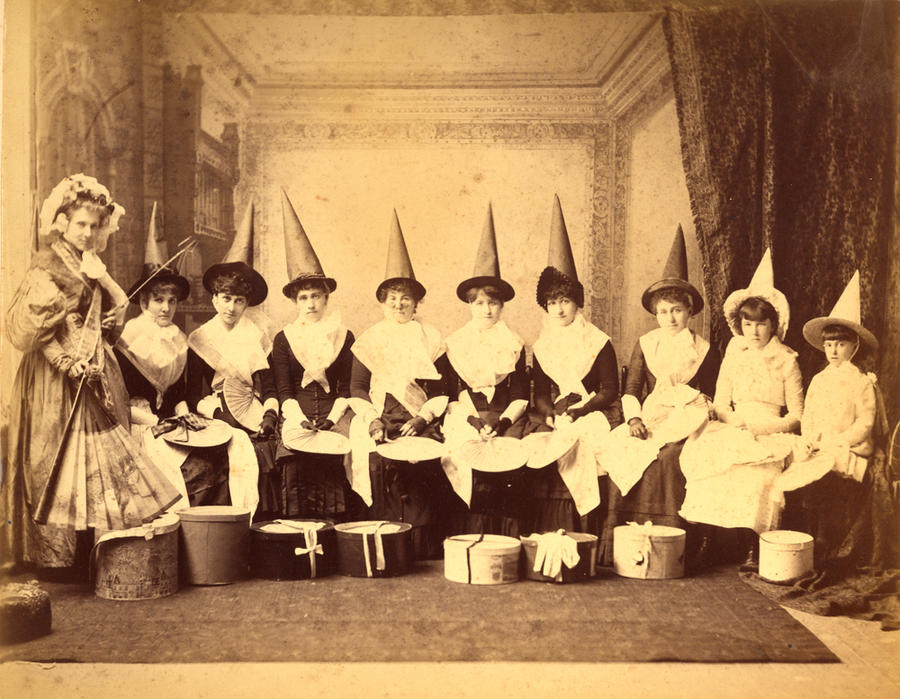
Nine witches from an indeterminate time in history. Image via

Tonight, cities across the country will be teaming with throngs of sexy witches, stinking out the back seats of the bus with the heady combination of cheap facepaint, perfume, and cider. Plastic noses will be snapped on, broomsticks will be dry humped, and cheeks slicked in various shades of algae—only to be streaked later with sweat and pre-vomit drool. But while you're shuffling to the bus stop cackling, beer in hand, it's worth paying some mind to the truly shitty time witches have had throughout history. 

Earlier this week, the supposed actual grave of a witch, Lillias Adie, was found in Torryburn, Scotland. Because at one time, if the church saw you as a threat, or a 16-year-old little shit decided to spread a rumor, you would be publicly executed. That was the reality. 

The contemporary witch mythos, see, is a palimpsest; a new story written over the top of an old one and only linked to the original by the fact it literally supersedes it. Underneath we have Aide, who admitted to fucking the devil after bouts of torture and was either murdered or driven to suicide. On top we have Sabrina, a girl who goes to a small liberal arts college in Boston and has a talking cat. This is fine. History becomes woven into modernity in lots of silly ways. But we don't really have particularly adequate language to talk about witches and maybe we should. 

Historical Western witches, modern tribal witches, green witches, and the sexy contemporary ones all get lumped together into some curious mismatched sports team. You can spend days wondering which witch is which. But here's the thing: you don’t want to be a fucking witch. Not then, not today.

A West African vodun. Image via

In the past few years alone, hundreds of women have been killed for being a witch. Most have been beaten, raped, burned, stoned, flogged, or hacked to bits with a machete before being killed. But because this is happening outside the Western world—in places like Tanzania, India, and Saudi Arabia—there is a tendency to suggest that this is an example of tribal barbarism, the sort of hideous stuff we would never do.  

This isn’t really true.

Take, for example, Pittenweem, a small coastal village in the East Neuk, Fife, Scotland, known for its Arts Festival and proximity to Britain’s finest fish and chip shop. A little bit down the coast rests an old church whose graveyard juts into the North Sea like a severed finger. It is, by all accounts, a damn fine example of Scottish romanticism: remote, eerie, and with a violent history that is retold as a sort of mental masturbation, a way of saying, "look at how civilized we are now."

The story goes that in 1705 a young buck named Patrick Morton—inspired by stories of the Pittenweem Witch Trials of 1645 where four women were put to death—decided to claim that Beatrice Laing, the former town treasurer, was a witch, along with her husband, Thomas Brown, and friend, Janet Cornfoot.

All three died. Cornfoot, however, escaped from incarceration, was recaptured by an angry mob, flogged, stoned, and then tied between a ship and the shore. Eventually, she was crushed to death by a door piled high with rocks. Apparently a man then drove his horse and carriage over her, just to make sure. Her body was then left to decompose somewhere along the Western braes, denied a burial.

From our remove, it’s quite easy to read what happened but not really understand it. Politically, socially, and economically, Britain at the time resembled somewhere like Gambia in 2009. Rising independence for women, coupled with greater devotion to capitalism, meant that those in power feared their control would be reduced—especially by those with dark magick in their hearts. 

Historically, the word "witch" was conceived to mean someone who practices in petty theft, sheep stealing, and the like, but by the 16th century it came to represent women who went to bed with Satan and were hellbent on bringing down the church. Malleus Maleficarum, published in 1486, said: "All witchcraft comes from carnal lust, which is in women insatiable." God damn those women and their insatiable desires. Why couldn't they just keep it under their cloaks, eh?

There is a common belief, too, that witches were the original terrorists. Time Magazine argued as much this week, saying that their re-emergence in popular thinking (American Horror Story, etc) bodes badly for society. Maybe. But it's also a show that systematically explores how misogynistic history is. And Christ knows we need more powerful women on television, in whatever form they take. If it's Lange, Kathy Bates, Frances Conroy, and Angela Bassett basically reclaiming the idea of a witch as a superhero, that's pretty powerful. 

Salem Witch Trials. Image via

But the idea of aligning witches with terrorists is problematic. Sure, in purely propaganda terms, the Salem Witch Trials is comparable to the war on terror because witches were believed to be widespread and hidden. Anyone could be one. Doubt thy neighbor and all that. But there is a tendency to over-intellectualize the witch mythos, removing it from the realm of blatant misogyny toward a safer, more palatable idea of the masses rising up against an insurgent force. 

So if you're dressing up as a witch tonight, remember the 20 executed on Gallows Hill while you stick fake warts on your face. Benjamin Franklin might have swept in to make a mockery out of the Salem slaughters with a satire involving sheep and hangings, but behind our modern, cartoonish interpretations are centuries of savage means to keep women from getting too big for their pointy boots. 

Follow David Whelan on Twitter.

01 Nov 23:59

Goblins: how do they work?

by boo_radley
01 Nov 23:00

It's a graveyard smash!

by Small Dollar
You might know the Monster Mash, but how much do you know about the original artist, Bobby "Boris" Pickett? The article includes a link to the official website of The MoNsTeR mAsH, a revenant from Web 1.0

Not ready to stop mashing? Here's a bunch of covers! (cribbed from Wikipedia)
Beach Boys
Boris Karloff
Bonzo Dog Doo-Dah Band
Luis "Vivi" Hernandez - "El Monstruo," a Spanish cover
Vincent Price
Bad Manners
Ill Repute
The Big O
Murphy's Law
Alvin and the Chipmunks
Misfits
Kidz Bop
Mannheim Steamroller
Zombina and the Skeletones
Bruce Springsteen
CrabCorps - from the Silver Linings Playbook soundtrack
01 Nov 23:00

He who laughs last, laughs longest

by the man of twists and turns
Victor Hugo, famous for Les Miserables and Notre-Dame de Paris, wrote L'Homme Qui Rit, or The Man Who Laughs in 1869 on the isle of Guernsey. The story was adapted for film in 1928, directed by Paul Leni and starring Conrad Veidt. You can watch the film whole or in parts.

You might recognize Veidt's famous grin in another medium. While Gwynplaine was disfigured by 'comprachios', Veidt's disturbing smile was made by a painful prosthetic appliance.

The Man Who Laughs was recently adapted into a graphic novel: Adapting Victor Hugo For The 21st Century

You can read much more about Veidt, here, including An Interview with Bret Wood, producer of The Man Who Laughs DVD for Kino On Video
01 Nov 21:45

The War Nerd: Crunching numbers on Kobane

by Gary Brecher

war-nerd-crunching-the-numbers-in-kobane

How many Islamic State fighters have died in Kobane? That question isn’t as easy to answer as you might expect. In fact, nothing about Islamic State’s numbers really adds up. How many fighters does IS have in the first place? Even that isn’t easy to answer. Islamic State expands and contracts in the press according to its own propaganda requirements, and the fear-level of Western correspondents.

IS has been very good at hiding its dead. Oh yeah, jihadis love to talk about how they love death, but a smart military force doesn’t show too many close-ups of its dead, and IS has put a very effective clamp on reports about how many of its men are dying in the long, bloody fight for Kobane.

And that’s why the USAF arranged with the Kurdish YPG units defending Kobane to stage a video that would force IS men out into the open, where they could be killed on-camera, in a way that would send a message to potential recruits around the world.

You’ve probably seen that video. It shows the summit of Tel Sehir, a hill west of Kobane. in the early evening of October 24, 2014.

It starts with a beautifully framed telephoto shot of Islamic State fighters standing on the crest of Tel Sheir, a hill to the west of town. There’s the dreaded black IS flag flying on the summit, and to the right, a hooded fighter who seems to be talking to several other IS men who are walking uphill toward him.

Suddenly the man on the crest starts running. A second later, the summit explodes, as two more blasts hit the far side of the hill at the same time. That first blast sends the body of the man near the crest flying in classic ass-over-teakettle manner through the air, along with enough freshly-turned dirt to start a garden shop in the Namib. One of the men standing on the front slope starts running downhill, a sure sign that he’s seen too many action movies.

You don’t outrun something like this. Sure enough, the second strikes hit, one landing precisely in his gully.

It was a glorious moment, perfectly directed, the sort of thing YPG fans like yers trooly couldn’t see enough times. I’m not pretending to be neutral in this one, having lived in Kurdistan, and then in Saudi Arabia. The Kurds are the sanest people in the Middle East at the moment, the least bigoted, the most adaptable. In any war between misogynist slave-dealing Wahhabi bigots and Kurdish militia led by a woman, I’m cheering for the Kurds all the way.

But even for a fan like me, the video seems almost too good to be true. Syria has been the real Hollywood of war videos for years now, and the real ones don’t look nearly as smooth and professional as this one.

For example, after the first shot of the hilltop before impact, the camera turns away, to a placid shot of the dusk over Kobane. Then it cuts to the hilltop again, as if the camera crew knew something was going to happen. And they’re on the spot, full telephoto, when the first blast hits.

It seems like they were expecting it because they *were* expecting it. This was a classic staged operation. Not fake—those were real IS men on the hill, and they were really blown to bits. But the operation was choreographed all the way. You can do that with a force like IS, because they’re too stupid to know when they’re being lured into a kill zone like this.

Jenan Moussa, one of the best journalists covering Syria, picked up on the story quickly:

Jenan Moussa‏@jenanmoussa
ISIS advances to Tel Sheir hill West #Kobane. Clearly this didnt go unnoticed by coalition planes. Pics v @Kilicbil

What happened was that someone in the U.S. military propaganda wing decided we needed a good shot of IS fighters getting zapped by the air strikes. Until the Tel Sheir video, all we had seen was flying concrete, as US planes blew up ruined buildings inside Kobane. It was probably effective, but it wasn’t good TV. You couldn’t tell, at telephoto distance, if those buildings were even occupied.

That’s when a nice bare hilltop comes in handy. And Tel Sheir happened to be available, thanks to another deception the YPG and USAF ran on IS. The YPG staged a fake retreat from the hill on Thursday, October 23 “…due to a shortage of ammunition and weapons.”

The next day, Friday October 24, Islamic State moved a squad (at least) onto the hill. IS had every reason to expect that the YPG would retreat eventually. After all, the Iraqi Army, far bigger and better-armed, had abandoned all of Western Iraq to IS without a fight. Why wouldn’t this tiny Kurdish militia, worn out from holding off IS firepower equivalent to an entire armored division, withdraw at last?

And that, as moviegoers used to say, is where we came in. By dusk on October 24 the cameras were in place, focused on the hilltop. The light was perfect—dim enough to highlight the coming explosions but not so dark as to obscure the men who were the targets. The call went up to a B1-B

And the video went up, becoming an instant hit.

But why stage such an expensive spectacle to kill a few IS goons? Air strikes are expensive, and the munitions that blasted those men off the hill cost thousands of times more than the flag they destroyed. Even if you add the seven IS men confirmed killed by the strikes by the YPG, it’s a lot of trouble to kill seven idiot sectarian dupes.

But this is not Stalingrad, and you can’t do that sort of simple cost-accounting. To understand why that air strike was worth it, you have to factor in all the times that video was shared online, all the gloating that went on from YPG supporters, Kurds, Shi’ites, and others who have reason to hate and fear Islamic State. My friend Annibale, who keeps up with a very interesting range of sources around the world, said he was getting messages from minority areas of northern Pakistan cheering for the video. We hear mostly about the anger of Sunni Muslims, especially Sunni Arabs, but you ain’t seen rage until you hear from people from the minority sects and tribes living under Sunni rule.

One way to judge the propaganda value of that video is to count the number of IS supporters who were tweeting “Fake! Didn’t happen!” or “So what, big deal, didn’t hurt!” as soon as they saw it. Look at the tweets reacting to Jenan Moussa’s news about the strike and you see the delight by YPG supporters, and the bitter denials of IS fans.

Update: "Tal Sheir hill west #Kobane back in hands of ypg. 17 ISIS fighters killed there. 7 burned bodies from coalition airstrikes" source

— Jenan Moussa (@jenanmoussa) October 24, 2014

This was being repeated all over social media, all over the world, in Urdu, Arabic, German, French, Bengali, Malayalam, and Bahasa Indonesia, as well as English. It’s too simple to say that there’s a propaganda war going on over the struggle for Kobane. Actually there are at least two propaganda wars. One of those, the one to win over traditional media, came down in favor of the Kurds a while ago—about the time Islamic State actually published an article in its magazine, Dabiq, boasting about enslaving Yazidi women and girls and handing them out as sex toys to its fighters.

After that article, it was kinda difficult for most liberal humanists to keep a soft spot for Islamic State. Oh, a few of the stupider fellas among the usual suspects tried to find some way of absolving sex-slavers of any blame in sex-slavery. Glenn Greenwald twisted himself into knots to make the brilliant guess that the US didn’t even intend to bomb IS at all, which would have come as news to the men on that hill in the video. But c’mon—Glenn Greenwald? I had a little exchange with Glenn Greenwald over Mali a while back, and came away with the firm conviction that Greenwald may well be the stupidest human being on the planet. I concede that there may, in fact, be a stupider person somewhere on earth, but my contention is that if this hypothesized miracle of Nature exists, he or she will most likely be found at the bottom of a lake, skeletal fingers on the key, eye sockets turned in exasperation toward the ignition, wondering why the car won’t start.

Aside from cretins like Greenwald, pretty much everybody in the pundit world agrees that yes, slavery is bad, beheading people for believing in the wrong imaginary friend is bad, and therefore IS is bad.

The Western Front of the propaganda war over Kobane was officially won on October 28, 2014, when the New York Times opened its editorial pages to the woman in charge of the YPG in the town.

But that was a very minor theatre of the propaganda war, involving a few elderly folk. The real PR war being fought on YouTube and Twitter and Instagram is a struggle for a much younger, fiercer, and mostly non-American audience.

The rules of that war are very different. Imagine you’re a young guy sitting at a café in, say, Tunis.

There are no jobs in Tunis. There isn’t much that connects you to anyone, except Islam, which—in theory—unites all Muslims in friendship. It doesn’t work that way in practice, of course, as Muslims from poor countries find when they take jobs in the Gulf—and Lord, do they get mad!–but it’s still the only cheerful idea in your world, as you sit there nursing a coffee all day.

Imagine being that guy, and jihad doesn’t seem like such a crazy idea. You don’t even have to imagine being a Tunisian; I can give you an All-American example from the other side of the fight in Kobane. Jordan Matson, a 28-year old American, joined the YPG after getting out of the US Army and ending up doing night shifts in a meat-packing plant.

I’m not pretending that YPG and IS are morally equal. They’re not. YPG is a secular, gender-neutral local militia defending its home town against fucking monsters, and IS is the monster in question, one of the vilest groups around. But the life-story, the motives, the experiences, of Jordan Matson and the average Tunisian recruit aren’t that different. Jihad, on either side, beats graveyard shift in Wisconsin or unemployment in Tunis.

So if you’re that potential IS recruit in Tunis, you’re watching the news from Kobane, but you’re watching it your way. You don’t worry too much about the atrocity stories coming out about IS. Young men have a great tolerance, let us say, for such things. In fact, many of them have a great deal more than tolerance—something more like enthusiasm, and I speak from my own embarrassing experience of a celibate adolescence.

As for sex slavery, it can look very different, if you’re a celibate young man sitting in a Tunis café with no job, than it looks to a New York Times pundit. As William Butler Yeats said a century ago, noting the, er, unusual eagerness of young Irish Catholic males to get themselves killed fighting better-trained and –armed regulars, celibate young men raised in sex-segregated environments get very excited at the idea of war and martyrdom. My hand is the first to be raised here, my old bald head blushing. I’m not one of those old “bald heads forgetful of their sins” that Yeats described; I remember my sins all too well, even if they were mostly imagined. And the average young man in Tunis or Riyadh has been raised in an atmosphere every bit as devout and celibate as the one which forged the martyrs of Yeats’s Ireland.

If you really want to venture into this territory—and it’s very, very embarrassing territory, believe me—you should read an amazing book called Male Fantasies.

The author is an annoying German academic, and the writing is tedious as Hell, but the idea is amazing: A look at the fantasies about women that motivated the young men who joined the Freikorps, the volunteer military forces of Weimar-era Germany. The book argues, in its slow, earnest German way, that these fantasies are ordinary, but very creepy, male ideas leading direct from dumb-ass dreams about girls, to the fatal decision to march off with the Freikorps. And if you were to look for a 21st version of the Freikorps…Ladies and gents, may I present Islamic State?

So you don’t dissuade a contemporary Freikorps recruit thinking about heading to Syria that it would be un-liberal or un-humanist to do so. He loves that idea. You need a different approach, one that matches his notions of what matters.

And you better find a way to reach these guys sitting around at cafes in Tunis, because they’re the ones who fill up IS’s ranks. Tunisia, with a population of only 10.8 million people, has 3000 fighters in Syria/Iraq, more than Saudi Arabia, Jordan, or any of the other bigger Muslim countries.

And the reason they like Islamic State is simple: It’s been looking like a winner. You won’t persuade guys like this that joining Islamic State is a bad idea by showing them that IS has been doing bad things. Young men…I don’t know how to put this politely, really; young men from celibate, conservative backgrounds have a deep interest in doing bad things. What they don’t like is looking like fools, like suckers—like losers.

So you won’t persuade these guys to stay home by showing them that Islamic State is evil, but you can show them it’s foolish, overstretched, led by idiots, doomed. And that air strike on the hill does a very good job of conveying that message, in a way that doesn’t depend on speaking fluent English or sharing any of the pundits’ self-righteous opinions about justice or freedom.

The guy you see tumbling over and over through the air doesn’t look like a shahid, a martyr; he looks like an idiot. The guy who starts running down the gully, as if he’ll outrace the second salvo—he looks like a fool. You may want to be a martyr, but not that way, not as a crispy critter to be counted and shoveled into a shallow grave by gloating YPG men—or worse, YPJ women. What the hick young men who join IS fear most of all is being shamed by the women of the YPJ.

If IS looks lame, recruits will stop coming, and IS will wither very quickly. They need a steady supply of kids to keep going, because they’ve been using up men very quickly. But you need to remember what “lame” means to a 19-year old male of limited intellect. Consider the case of a typical group of IS recruits: six young guys from the Bangladeshi community in Portsmouth, in the UK, who flew off to Syria to join some idiot outfit called “The Britani Brigade Bangladeshi Bad Boys.” My keyboard is blushing, just from typing out that alliterated crap bravado. But then I’m not in the IS recruit pool, and neither (most likely) are you. If we were 19-year old celibate boys, that dumb-ass name might seem very cool.

But what would not seem cool is being a sucker, and those guys are dying like suckers. Six of these Bangladeshi guys from Portsmouth made jihad; four have died in Syria, and another is in prison in the UK.

If you can persuade these guys, not just that they’re going to die—because dying can seem pretty cool when you’re 19 and stupid—but that they’re going to die stupid, like the men on the hill did, then they may stay home.

Without new recruits, IS will dry up very quickly. It’s a matter of basic numbers. How many men does IS have? How many casualties have they lost? How many replacements are they getting?

First: Islamic State is remarkably small, given the possible pool of recruits. The CIA now guesses (and it is just a guess) that there are 31,000 men fighting for IS.

When you recall that there are a billion-plus Sunni Muslims in the world, and that their population skews very young compared to those of the infidel countries, 31,000 is a tiny number. Consider Tunisia; although it’s the most enthusiastic contributor to jihad, it’s only sending a tiny percentage of its military-age men to Syria. Thanks to a very high recent birth rate, Tunisia could send something over a half-million men to Syria if it was really all in for jihad.

As I’ve said before, the most amazing thing about jihadis is how few of them there are. My own guess is that the CIA’s number is low. I make that guess the same way the CIA did: Squinting at what IS is doing and guessing how many men it must take to do it. IS is fighting against the Peshmerga in Northern Iraq, the “Iraqi Army”/Shia near Baghdad, and is at least pretending to fight Assad’s SAA in NW Syria as well. Add to that the number of men it takes to run around Raqqa telling women to veil up, the squads assigned to track down and kill former soldiers and cops, the internal security men working other guys’ fingernails to the bone trying to get them to confess to heresy…and you end up thinking that there have to be more than 31,000 men involved.

But let’s start with the CIA’s estimate of 31,000 IS fighters, and see what the fight for Kobane has cost IS. As of October 23, US air strikes had killed at least 464 IS fighters, according to a Syrian war-monitor group that’s been accurate throughout the war.

Keep in mind that until October 7, the US was apparently minimizing strikes near Kobane to keep Erdogan’s Turkish Islamists happy, an insane “Hit’em, but lightly” policy that changed radically after that first week of October.

So for the first weeks of fighting in Kobane, most of IS’s casualties would have come in close, urban combat with YPG. It’s much harder to come up with casualty numbers for that combat, but one blogger has done a great job with a spreadsheet, coming up with about 800 IS men killed in air strikes and ground combat by early October.

This was a very rough guess, but a reasonable one. The spreadsheet shows almost 400 YPG KIA during this period, and it’s reasonable that IS, as the attacking force, trying to take rubble-filled streets defended by diehard locals, would have higher losses.

And those losses have continued this week, after the period covered by these estimates. In fact, IS has intensified its attacks to seal the border before reinforcements can arrive.

So, no matter how you chop these numbers, you get an incredible total, almost certainly over 1000 KIA. Now, in contemporary warfare, the usual ratio of wounded to killed is often very high. US casualties in recent wars involved about one KIA for every seven WIA, and very few of the WIA die of their wounds (though many of them lose limbs, vision, or suffer other horrific injuries).

Obviously an IS fighter who gets shot in a street fight in Kobane is not going to get US-level care, or, in many cases, any care at all. So the number of wounded is probably lower—or rather, you can count most of the wounded as dead within hours of being hit. So let’s start with a very low estimate of IS wounded, say three WIA for every KIA. That still gives you something like 3000 men injured seriously enough to be put out of action.

So six weeks of fighting in Kobane has cost Islamic State something like 4000 men. That’s 13% of their total force (if you accept the CIA’s low-ball estimate of their numbers).

But I can’t go with that number. It’s too high. One rule of war numbers is that you never believe what you hope, so I must be wrong; it must be lower. So I’ll just arbitrarily lop a thousand off it. That still leaves IS with 3000 casualties in Kobane, almost 10% of its force—yer classic decimation. That is a huge loss for any force, but far more disastrous for one like IS that depends on volunteers—worse yet, volunteers from far away who have to go to one Hell of a lot of trouble to join up, and in fact just to reach the theater.

So IS is now in a classic bind: The only way to make up for these ungodly (har-de-har-har) losses is to keep attacking and hope you can salvage a win—because unless you win, you won’t get more recruits. That’s why IS is willing to spend so many lives on “CNN warfare.” Kobane isn’t “strategically” important, in the sense that Bonaparte or Rommel understood “strategy” as they pored over their paper maps. But in terms of 21st c. strategy, it matters because it’s a hit TV show, and everything depends on how the plot comes out. All those wavering potential recruits in Jakarta, Berlin, and Riyadh need to believe that IS is winning; if it’s not, they’ll stay home and play video games.

That’s why IS has even taken the really scary step of bringing the Chechen to Kobane. You know why you bring in the Chechen? Because balrogs don’t actually exist. Chechens are the next best thing, and the Chechen in question, Abu Omar al-Shishani (“Omar the Chechen”), was transferred this week from the Sinjar front, where he was in charge of slaughtering Yazidi refugees. Omar has been brought to Kobane as a fixer, with the job of closing down the border before reinforcements can reach the YPG. And the Turks have been making very, very sure he has lots of time to kill all the Kurds fighting for Kobane before any eventual reinforcements can arrive. Turkey has used every lame excuse it could find to delay the Iraqi Peshmerga it sullenly allowed to help in Kobane, while Turkish troops chat happily along the border with IS goons stealing local Kurds’ trucks and farm vehicles.

So far, Kobane has held out against all this, and bled Islamic State very badly. So the long question is whether IS can recover from its huge losses in this “CNN” battle. How many recruits are joining IS? According to British security, “at least” five men from the UK join IS each week.

If you assume that other countries with a history of sending a lot of recruits to IS are sending new troops at the same rate, you get something like 30 per week from Tunisia, 25 per week from Saudi, and a few from Russia, Germany, and France. That would mean a hundred new men per week—untrained amateur troops with little combat value, and not nearly enough to make up for the huge losses in Kobane.

But those recruiting numbers aren’t stable. They depend completely on image, the “CNN War.” And the one thing IS can’t afford to do, if it wants to win the war for the guys sitting around cafes in Tunis, is look weak.
So Omar al-Shishani has very little time to choke out Kobane. If he can’t do it—if the Peshmerga finally make it through Erdogan’s Islamist obstacle course and cross into Syria—then the number of recruits will fall very quickly. Some will join other Syrian groups like Jabhat al Nusra; others will decide to stick around Tunis (or Portsmouth, or Sarcelles) and see if a job turns up.

[illustration by Brad Jonas for Pando]

Gary Brecher

8320ad7218821615d8a87d53f23fae11
Gary Brecher is the War Nerd.
01 Nov 21:13

Vuelve Dominion, mejor y más grande

by Daniel Mayoralas

Vuelve Dominion, mejor y más grande

Tras la feria de Essen Rio Grande Games ha anunciado la publicación de una nueva expansión para Dominion, el juego de creación de mazos que desde 2008 sigue causando furor. Diseñado por Donald X. Vaccarino y publicado en nuestro país por Devir Iberia, esta expansión está planeada para que llegue al mercado en primavera de 2015. […]

La entrada Vuelve Dominion, mejor y más grande aparece primero en LudoNoticias, todo sobre juegos de mesa y simulación.

01 Nov 19:56

Nuno Borralho: «En Galicia se talan eucaliptos antes de su rendimiento óptimo»

by Xavier Lombardero
Ve absurdo sacar biomasa que nutre el monte y destaca la mejora genética
01 Nov 19:53

Franco, ese abuelo entrañable

by Carlos Prieto

Alfombra roja, photocall y glamour de hace medio siglo. Estreno de Franco, ese hombre (José Luis Sáenz de Heredia, 1964) en la Gran Vía. El cartel del filme cubre la fachada del Palacio de la Música con un eslogan propio de un biopic épico: “Sesenta años de la historia de España a través de la biografía del hombre que la ha vivido más intensamente”.  Por la alfombra roja pasan los ministros de Información y Turismo, Agricultura, Asuntos Exteriores, Educación, Hacienda y Justicia, el presidente de las Cortes, el presidente del Consejo de Estado y “otras personalidades”. “El todo Madrid de las grandes solemnidades se encuentra en este estreno organizado por la junta interministerial de los 25 años de Paz”, contó el No-Do que, con su habitual ecuanimidad, calificó el filme de “admirable”.

En unos días se cumplen los cincuenta años del estreno del documental Franco, ese hombre. Cuando hablamos de propaganda cinematográfica franquista lo primero que se nos viene a la cabeza es Raza (José Luis Sáenz de Heredia, 1941), esa fantasía sobre nacionales buenos y rojos despiadados cuyo argumento ideó el Generalísimo. No obstante, Franco, ese hombre fue un intento más complejo de propaganda: su objetivo era mostrar a un Francisco Franco entrañable y pacifista.

Los contextos históricos en los que surgieron ambas películas, dirigidas por José Luis Sáenz de Heredia, fueron bien diferentes. Si Raza se estrenó en 1941, cuando el Caudillo no tenía ningún motivo para disimular ni su victoria, ni su ardor bélico/vengativo ni sus flirteos con la Alemania nazi, Franco, ese hombre fue la guinda a los 25 años de paz, monumental campaña oficialista para blanquear el régimen con un discurso conciliador al cumplirse un cuarto de siglo del fin de la Guerra Civil.

Video embebido

“Por primera vez la victoria franquista de la guerra se convertía en una celebración orquestada bajo el lema de la paz. Ciertamente muchas actividades tuvieron como eje la victoria, pero ese cambio de denominación sugiere que, en la concepción de Manuel Fraga, flamante ministro de Información y Turismo, una tentativa de captar a las nuevas generaciones debía ser puesta en marcha. Y lo fue”, cuenta Vicente Sánchez Biosca, autor de ensayos como El pasado es el destino. Propaganda y cine del bando nacional en la guerra civil (Cátedra, 2011) y No-Do: El tiempo y la memoria (Cátedra, 2006).  

SumarioEran los tiempos de la apertura turística, de la integración económica internacional, del desarrollismo y de los tecnócratas. Todo estaba preparado, por tanto, para que el Franco cinematográfico entrara en la modernidad reformista y liberal. “Franco, ese hombre introduce el factor humano, por así decir, en el discurso sobre Franco y representa, aunque a éste no le agradó, un modelo de propaganda más sutil y menos combativo frente al enemigo. Después del contubernio de Múnich y el contacto entre los disidentes del franquismo con algunas gentes del exilio, se imponía una variación de estrategia, una propaganda que implicara hacia el futuro y no sólo reuniera a las gentes del pasado, los triunfadores en la guerra”, explica Biosca a este periódico. Y añade: el filme fue más un “éxito de Fraga que de su director”.

Glosar al Caudillo

SumarioPese a la influencia reformista de Fraga, Franco, ese hombre tuvo también algo de filme fallido. “Intentó combinar, sin demasiada habilidad, la exaltación del heroísmo del pasado con la mítica del descanso del guerrero y la creación de una máscara que pretendía ofrecer una forzada dimensión humana del antiguo héroe, transformado en un viejecito que desde su despacho intentaba preservar una hipotética paz de la que su apacible imagen de padre de familia se constituía en una quimérica proyección”, ha explicado el crítico Ángel Quintana.

En palabras de Paul Preston, sacadas de su biografía Franco, Caudillo de España (Mondadori, 1994), la película presenta “un héroe que había salvado al país de las hordas del comunismo, luego lo había salvado nuevamente de las hordas del nazismo y, posteriormente, se había convertido en el padre benévolo de su pueblo”.

En su momento, algunos vieron el filme con otros ojos. El crítico Fernando Méndez-Leite, que dirigiría el ICAA en los años ochenta, escribió lo siguiente en su Historia del cine español publicada en 1965: “Sáenz de Heredia ha logrado un apasionado documental revelador de muchas cosas desconocidas para las jóvenes generaciones y muy emotivo para los que vivieron los acontecimientos evocados en la pantalla con singular maestría”.

Francisco Franco, en la Batalla del Ebro, 1938.

Scorcese y el Caudillo

Una cosa es analizar un filme como Franco, ese hombre en el contexto de 1964, con Fraga forzando una pequeña apertura cultural del régimen, y otra bien diferente hacerlo en el de 2014, cuando es difícil ver otra cosa que un monumento kitsch a la propaganda. En otras palabras: la cabra tira al monte. Puede que Franco, ese hombre no sea Raza, pero ni Sáenz de Heredia, ni Fraga ni el régimen estaban todavía preparados para rodar un filme sobre el Generalísimo que no acabara derivando en una enloquecida hagiografía.

Los fans de Martin Scorsese suelen admirar sus secuencias torrenciales en las que narra una gran cantidad de cosas recurriendo al montaje frenético, la voz en off y  un tema de funk/soul de fondo. Pues bien, lo crean o no, algo de eso hay en Franco, ese hombre, aunque sea en versión sosegada, carpetovetónica y con el himno nacional de fondo. Ahora bien: si Scorsese narra a golpe de imágenes, Sáenz de Heredia lo hace a golpe de palabra inflamada.

El filme, de hecho, se articula en torno a una serie de escenas crescendo en las que la omnipresente voz en off, clave en una obra que se sostiene sobre la retórica propagandística del régimen, marca siempre el punto álgido.

SumarioEn efecto, más allá del trabajo con el montaje y las imágenes de archivo, que lo hay, Franco, ese hombre se construye sobre la palabra. Sobre un lenguaje al que, ay, le ha sentado fatal el paso del tiempo: lo que entonces quizás sonaba a fina propaganda política, ahora suena sin más a hito del humorismo involuntario. Así glosa el desatado narrador del filme la figura del Generalísimo:

“Un hombre entero, de vida rectilínea, soldada a una razón de ser que siempre acaba teniendo la razón. Un hombre sinceramente humano que nunca ha jugado a ser un semi dios, que no conoce la palabra cansancio y que es, como pedía José Antonio para el dirigente, inasequible al desaliento. Un hombre anclado en su firmeza de servicio, que recibe las mejores compensaciones de su trabajo en los minutos que le exprime a su tiempo para dedicarlos a los suyos y a sus aficiones más entrañables: El mar, su frustrada vocación tan sentida (imagen del caudillo pescando salmones de tamaños absurdos), sus lecturas veraniegas, y la caza, pólvora descafeinada para quien la tomó durante mucho tiempo pura…”.

El narrador, por tanto, bascula entre lo lírico, lo épico y lo roto en mil pedazos.

Otro ejemplo: la descripción de la secuencia del “desfile de la victoria”, parada militar en las calles de Madrid para conmemorar el aniversario del fin de la guerra civil.

Video embebido

“Los desfiles militares son espectáculos eternos que nos afectan con un estremecimiento purificador, algo muy entrañable nos habla al corazón con un diálogo recto y alegre que limpia el ánimo porque nos predispone a ser mejores. Esta vez el desfile dice lo mismo, pero con otro acento. Habla de paz y de victoria, pero de una victoria diferente, y más difícil que la de las armas, una victoria total en la que no hay dolor de derrotados, en la que cabe el gozo de todos, la victoria de la paz...”.

SumarioEl clímax llega con la entrada de Franco en escena, que agita el montaje y hace perder definitivamente los papeles (retóricos) al narrador: “Todos esperan en tensa calma la llega del Jefe del Estado... hasta que un toque de atención (se escucha una corneta) recorre a la muchedumbre como un escalofrío (suena el himno nacional), las aclamaciones del público se van aproximando a nosotros, son tres generaciones de españoles que reciben clamorosamente a Franco, a ese hombre que ha sabido forjar 25 años de paz con su espíritu de acero sobre el yunque de su vida (acordes acelerados del himno, voces desgañitadas gritando “Franco,  Franco,  Franco”)... El pueblo le aclama con el entusiasmo y la gratitud de quien sabe a ciencia cierta que en él radica la gloria del pasado, la industriosa paz del presente y la clave soberana del futuro. El hombre que ganó la guerra ha ganado también la paz…”.

Pese a estos excesos de ardor retórico, el filme no es del todo risible como pieza de propaganda. Heredia realiza algunos montajes habilidosos donde combina eficazmente mensaje y emoción, aunque la falta de mesura del narrador acaba por neutralizar el poder evocador de las imágenes.

Video embebido

Pero el verdadero hallazgo llega al final, con un giro metacinematográfico que asombró al mismísimo Slavoj Zizek. El filósofo esloveno vio el filme en Madrid antes de dar una conferencia en el Círculo de Bellas Artes. Quedó entusiasmado:

Sumario“Al final de Franco, ese hombre encontré algo absolutamente increíble. La ideología en estado puro. La imagen se va empequeñeciendo y rodeándose de un marco oscuro. Lo que se ve entonces no es ya la película, sino alguien viéndola en una pantalla. ¡Es el propio Franco viéndose a sí mismo! ¡Celebrándose a sí mismo!”, contó Zizek a este periodista.

Sí, no es broma, Franco, ese hombre acaba con una secuencia de Francisco Franco viendo Franco, ese hombre en el cine del Pardo. “Franco certifica que la imagen de ese otro que el discurso cinematográfico ha construido a partir de sí mismo no es más que la máscara oficial que el Régimen había diseñado de su persona a mediados de los años sesenta”, razona Ángel Quintana.

Para colmo la filigrana metacinematográfica contiene una traca final: al acabar la proyección y encenderse la luz, aparece por allí el director del filme, José Luis Sáenz de Heredia, para hacerle unas preguntas a Franco sobre la película y otros asuntos de Estado.

La entrevista de Heredia a Franco es una obra maestra del kitsch cultural: el descaro hagiográfico, la decoración de los salones del Pardo, la voz aflautada del Caudillo, su retórica ampulosa y el tono forzado de un Franco que se ha aprendido sus respuestas de memoria.

La paradoja está servida: puede que la idea original de Franco, ese hombre fuera mostrar a un Caudillo costumbrista y humano, pero cuando uno ve a Franco convertido en un abuelito camp, no ve a un dirigente conciliador, sino a un impostor. O el franquismo como farsa histórica.

01 Nov 19:52

¿Qué pasa si nos enamoramos del novio/a de nuestra amigo/a?

by Sergio Parra

Infidelity 379565 640Todos hemos asisitido (y algunos protagonizado) a la escena típica de, por ejemplo, una chica que seduce al novio de su amiga y acaba arrebatándoselo. Una estimación sugiere que el 63% de los hombres y el 54% de las mujeres están en sus relaciones actuales a largo plazo debido a que su actual pareja "les robó" a una pareja anterior.

Hasta la fecha, la mayor parte de la investigación científica sobre el tema ha sido llevado a cabo por los psicólogos evolutivos, que argumentan que estamos evolutivamente preparados para buscar compañeros de esta forma y que, a menudo, nos involucramos en estas conductas de una manera inconsciente. Pero lo que no se había estudiado es la consecuencia de obtener pareja mediante este sistema.

Menos comprometidos, menos satisfechos

Esta clase de caza furtiva de compañeros románticos o sexuales, es decir, localizada a personas que ya tienen pareja y no están solteros, sin embargo, tiene efectos a corto y largo plazo. Es lo que sugiere un nuevo estudio llevado a cabo por Joshua Foster, que ahora aparece en Journal of Research in Personality.

Después tres estudios distintos, Foster conluyó que los individuos que fueron saqueados por sus parejas románticas actuales eran menos comprometidos, menos satisfechos, e invertían menos en sus relaciones. También prestaron más atención a otras alternativas románticas, perciben sus alternativas como de mayor calidad, y participan en mayores tasas de infidelidad.

Couple 260899 640En el primer estudio, que involucró a 138 participantes heterosexuales, los voluntarios fueron estudiados de 0 a 36 meses. Tanto los hombres como las mujeres que fueron saqueados tendían a comenzar la presentación de informes con menos grado de compromiso con su relación existente, se sentían menos satisfechos en él, más engañados, y estaban buscando activamente alternativas románticas. Con el tiempo se informó de niveles cada vez más bajos de compromiso y satisfacción en sus relaciones. Esto contrasta con los participantes que no fueron saqueados, que mostraron menos interés en alternativas románticas a través del tiempo.


Un segundo estudio, más pequeño, confirmó estos resultados. Pero este grupo de muestra no mostró deterioro en sus relaciones con el tiempo (probablemente debido a que el estudio fue demasiado corto, o porque el deterioro ya había tocado fondo).

En los tres estudios, entre el 10 y el 30 por ciento de los participantes dijeron que habían sido saqueados por sus parejas actuales.

Escribiendo en el BPS Research Digest, Christian Jarrett señala:

Tiene sentido que las personas que fueron saqueadas por sus parejas mostrasen menos compromiso y satisfacción en su relación actual. Después de todo, si estaban dispuestos a abandonar a un compañero en el pasado, ¿por qué no estar dispuestos a hacerlo de nuevo? Esta lógica fue corroborada por un estudio final de 219 participantes que respondieron a preguntas no sólo acerca de la manera en que su relación actual se había formado, sino también sobre sus personalidades y actitudes.

Rasgos psicológicos del "cazado"

De hecho, según el estudio, las personas que han sido "cazadas" tienden a exhibir los siguientes rasgos:

  • Menor empatía, menos preocupación por el bienestar de los demás.
  • Pocos escrúpulos.
  • Narcisismo.
  • Se tiende a evitar la intimidad, mantener distancia emocional.
  • Orientación sociosexual sin restricciones (más dispuestos a involucrarse en el sexo casual o sexo fuera de una relación de compromiso).
  • Baja extraversión (menos socialmente involucrado, reservado).

En pocas palabras, lo relevante no es necesariamente la caza furtiva en sí, sino el hecho de que las personas que poseen estos rasgos típicos no les va bien en las relaciones a largo plazo de todos modos. Se haya producido o no la caza furtiva. En cualquier caso, éstas son conclusiones quizá apresuradas para un estudio tan limitado en su alcance. Se necesitarán muchos más estudios para llegar a comprender esa maraña inextricable que son las relaciones humanas.

Imágenes | Olessya | Tumisu

-
La noticia ¿Qué pasa si nos enamoramos del novio/a de nuestra amigo/a? fue publicada originalmente en Xataka Ciencia por Sergio Parra .


01 Nov 19:49

Chicho Ibáñez Serrador, precursor de Halloween en nuestra televisión (VÍDEOS)

by Borja Terán

Chicho Ibáñez Serrador fue un adelantado a su tiempo. Incluso con Halloween. Y es que, mucho antes de que cayéramos en la tentación de importar esta celebración festiva a España, Ibáñez Serrador fue pionero en ridiculizar el miedo (y la muerte) en televisión. De hecho, siempre incorporó ingredientes de sus prestigiosas terroríficas ficciones, como Historias para no dormir en TVE o La Residencia en cine, a sus programas de entretenimiento.

Un equilibro perfecto para el éxito televisivo: no quedarse sólo en el meticuloso show de variedades y aderezarlo con tramas de suspense, que aumentaban la emoción del programa.

Chicho y sus terrores favoritos. De la intensidad, pasando por frivolidad y el guiño misterioso. Siempre jugando con su propio personaje de omnipresente director, tan perverso tan cómplice.

SU CAMBIO DE PROFESIÓN… FÚNEBRE

TERROR… CON LAS MANOS EN LA MASA

SALVANDO LA CRISIS ECONÓMICA

VIVIR DENTRO DE TVE

RESUCITANDO ZOMBIES EN TVE

DRÁCULA EN PLATÓ

Y ADEMÁS…

El truco de Chicho Ibáñez Serrador que sigue vigente hoy

Secretos que nunca te contaron de ‘Un, dos, tres…’

40 años de ‘Un, dos, tres…’

 La última imagen de ‘Un, dos, tres…’

El defecto que ve Mayra a la tele de hoy

01 Nov 19:46

Sobre la coca

by David Sucunza Sáenz
Una hoja de coca. Foto: Marcello Casal Jr. (CC)

Una hoja de coca. Foto: Marcello Casal Jr. (CC)

Hoy por hoy, la hoja de coca es una sustancia ilegal. A pesar de sus cuatro mil años de uso demostrado, quedó proscrita tras la Convención Única sobre estupefacientes de 1961. Su comercio internacional está prohibido desde entonces y solamente una empresa conserva el privilegio de introducirla legalmente en Estados Unidos. Se trata de la compañía Stepan, que cada año importa entre cien y doscientas toneladas de hoja de coca de Perú a sus laboratorios en el estado de New Jersey. Con ellas elabora un extracto descocainizado que envía a Coca-Cola. Este es el secreto mejor guardado de «la chispa de la vida», pudo prescindir de la cocaína, que no es parte de esta bebida desde 1903, pero no de los aromas y aceites esenciales que aporta la coca. Paradojas de la sociedad que hemos creado, los Estados Unidos han gastado miles de millones de dólares en la erradicación de un ingrediente esencial de su producto paradigmático, la marca que durante un siglo ha abanderado el american way of life.

Este esquizofrénico comportamiento con respecto a la coca no es nuevo, en cualquier caso. Tras cinco siglos de difícil convivencia, hay que reconocer que constituye la actitud habitual de nuestra sociedad hacia la planta. La encontramos desde el primer encuentro. Cuando en 1531 un grupo de desperados comandados por Francisco Pizarro se internó en los Andes para sojuzgar al mayor imperio de su tiempo, se topó con una rica civilización que no podía entender la vida sin la hoja de coca. Presente tanto en ritos como vida diaria, era ofrecida a los dioses e intercambiada para afirmar la amistad de los hombres. Un carácter sagrado que no pasó desapercibido a la Iglesia, que en cuanto tomó posesión de las nuevas almas incaicas quiso prohibirles su uso para alejarlas de las costumbres paganas.

Pronto tendría que renunciar a sus severas intenciones. En 1545 los españoles descubrieron a más de cuatro mil metros de altitud la mayor veta de plata de la que se tiene conocimiento. El Cerro Rico de Potosí, una montaña rellena de metal que durante décadas alimentó la maquina imperial española. Pero para explotarla se necesitaba a los indígenas, los únicos capaces de realizar el ímprobo trabajo minero a esa altura. A través de la mita, un sistema de trabajo comunal obligatorio tomado de los incas, los conquistadores se aseguraron un flujo continuo de mano de obra. Y para que esta realizase su labor hacía falta coca, que como escribió el Inca Garcilaso de la Vega «sacia el hambre, infunde nuevas fuerzas a los fatigados y agotados y hace que los infelices olviden sus pesares». De esta manera la planta se convirtió en uno de los ejes de la economía del Virreinato del Perú y los españoles en los principales promotores de su cultivo, que creció enormemente con respecto a la época precolombina. Incluso la Iglesia acabaría participando en tan lucrativo negocio. Haciendo gala de su proverbial pragmatismo se financió con los impuestos requeridos a esta actividad y se conformó con que la hoja de coca no formase parte de los rituales religiosos.

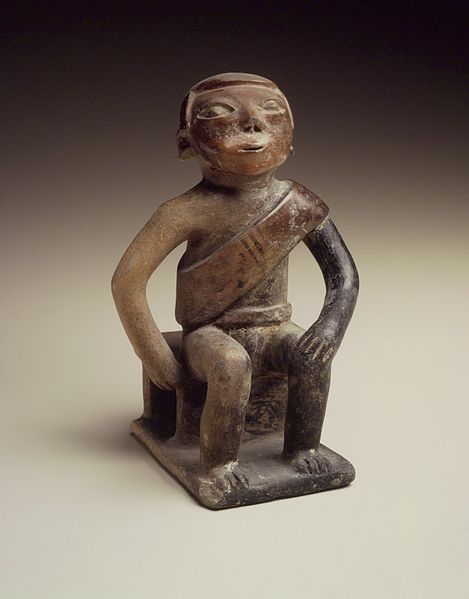
Coquero, una figura inca masticando coca. Foto: Museo de Brooklyn (DP)

Coquero, una figura inca masticando coca. Foto: Museo de Brooklyn (DP)

Llegados a este punto, y viendo lo bien que combinaron trabajo y coca, parecería lógico que se hubiese adoptado su empleo al otro lado del charco. Este nunca se produjo, sin embargo. La hoja se conoció en Europa, el médico sevillano Nicolás Monardes la describió en su libro Historia medicinal de las cosas que se traen de nuestras Indias Occidentales, pero su utilización no se extendió más allá de Sudamérica. Distintos factores contribuyeron a este desinterés, desde culturales —la coca siempre fue vista como cosa de indios— hasta económicos, las prioridades de la corona española en su comercio con América se llamaron plata y oro. Pero no son causas menores lo dificultoso de su transporte, ya que se pudre con facilidad y con ello pierde sus propiedades estimulantes, y la imposibilidad de su cultivo en Europa. Y aquí, entre unas cosas y otras, se le fue a la coca la ocasión de convertirse en una planta de amplio uso a nivel mundial.

El siglo XVI fue una época pródiga en el descubrimiento de nuevas sustancias estimulantes. El tabaco, el cacao y la coca de América, el café y el té orientales, todos llegaron a Europa en un intervalo relativamente corto, siendo sus diferentes condicionamientos de orden práctico los que marcaron su destino. Mientras unos, como la yerba mate o la coca, pasaron sin causar impacto alguno, otros, como el cultivable en España tabaco o los más fácilmente transportables café y té, se fueron asentando. Pero no por ello dejaron de provocar recelos durante decenios. Hasta el café sufrió prohibiciones en varios países y tan solo su uso continuado durante generaciones permitió eliminar las suspicacias que despertaba y dar paso a su reconocimiento como la costumbre inocua que es. La coca, por el contrario, nunca gozó de un periodo de adaptación similar y por ello ha quedado estigmatizada hasta hoy.

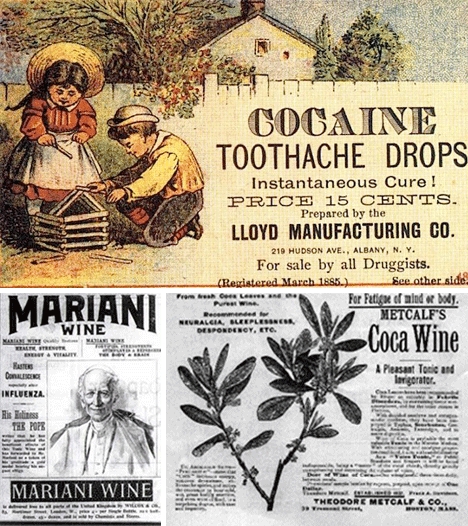
Transcurrirían trescientos años hasta el siguiente encuentro entre la coca y otra sociedad que no fuese la andina, un largo olvido que finalizó con el desarrollo científico del siglo XIX. Todo comenzó con un propósito puramente académico, fruto de las expediciones geográficas que los países europeos enviaron por todo el mundo. Los naturalistas que visitaron Sudamérica volvieron a describir las bondades de la hoja de coca y enviaron muestras a Europa. De ahí surgiría un renacido interés que en principio no pasó de anécdota. Pero apareció Angelo Mariani, un ayudante de farmacia corso con un finísimo olfato para los negocios que en 1863 patentó el Vin Tonique Mariani, un vino de Burdeos macerado con hojas de coca. Y, contra todo pronóstico, esta invención se convirtió en la bebida más glamurosa de su tiempo.

El papa León XIII siempre llevaba consigo un frasco de Vin Mariani, el presidente norteamericano Ulisses Grant tomó una cucharadita diaria en sus últimos meses de vida, Emile Zola lo calificó como elixir de vida… Hasta mil ochenta y seis personalidades enviaron por escrito sus elogios a Mariani, que hábilmente los utilizaba en la promoción de su tónico. Entre ellas figuran tres papas, dieciséis reyes y reinas, seis presidentes de la República Francesa y celebridades como Thomas Edison, Sarah Bernhardt, H. G. Wells, Julio Verne o Augusto Rodin. Lo más granado de la sociedad occidental se aficionó al vino de coca, que por un momento dejó su estigma aparcado. Y, por supuesto, no tardaron en aparecer centenares de copias. La que más éxito obtuvo a la larga fue un cura lo todo que nació como bebida carbonatada ya que en su Atlanta natal el alcohol estaba prohibido. Tomó su nombre de las dos plantas estimulantes que contenía, la sudamericana coca y la africana cola.

Merece la pena recordar que este boom de bebidas basadas en la hoja de coca se desarrolló sin que se tenga noticia de casos de adicción asociados. Y es que, al igual de lo que ocurre con el consumo tradicional de la planta, la cantidad de cocaína presente en ellas y su lento metabolismo al ser tomadas de esta manera las convierten en sustancias tan inocuas como cualquier otro estimulante legal. Como dejó escrito el médico y alquimista suizo Paracelso «solamente la dosis hace al veneno». Por ello, habría que esperar al consumo de cocaína pura para ver los primeros casos de adicción, lo que en cualquier caso se produjo por la misma época.

En 1884, un joven médico austriaco que con el tiempo ganaría renombre mundial publicó una monografía sobre los usos terapéuticos de la cocaína. Este alcaloide, aislado por primera vez veinticinco años antes, llevaba dos décadas siendo comercializado por la compañía farmacéutica Merck sin excesivo éxito. Pero un aún inexperto Sigmund Freud había empezado a experimentar en propia persona con su uso y estaba encantado de lo que veía. A su novia Martha le escribía cartas procaces en las que bromeaba «y verás quién es más fuerte, si una dulce niñita que no come lo suficiente o un viejo alborotado con cocaína en el cuerpo». Y en su consulta la prescribía para diversos tratamientos, que incluían las curas de desintoxicación de alcohol y morfina. También la recomendó a colegas amigos y uno de ellos, Carl Koller, dio con su verdadera utilidad médica.

Publicidad de productos con cocaína. En la imagen de Mariani puede verse al papa León XIII. Imagen: DP.

Publicidad de productos con cocaína. En la imagen de Mariani Wine vemos al papa León XIII. Imagen: DP.

La cocaína revolucionó la cirugía ocular, prácticamente inviable hasta aquel entonces por falta de anestésicos locales. Este alcaloide fue el primer compuesto que demostró su eficacia para tal fin, lo que le catapultó definitivamente a la fama. En medio de una euforia exagerada, se recetó con alegría y comenzaron a observarse los primeros casos de dependencia, muchos de ellos agravados por el uso de otro adelanto de finales del siglo XIX, la jeringuilla hipodérmica. El poder de adicción de la cocaína depende principalmente de dos factores, la dosis y la manera en que se suministra. Y si al ser tomada oralmente parte de ella se metaboliza en el hígado, cuando es inyectada produce un efecto rápido e intenso que genera una gran dependencia en el consumidor. Sorprendentemente, nadie reparó en este problema durante una buena temporada y por unos años casi tuvo consideración de fármaco milagroso, lo que disparó su demanda. Merck pasó de vender menos de un kilogramo de cocaína en 1883 a tonelada y media en 1884 y setenta y dos toneladas en 1886. Y esto solamente en los albores de lo que estaba por llegar.

Durante las primeras décadas del siglo XX, la elaboración de cocaína se convirtió en uno de los negocios más lucrativos de la industria farmacéutica. La pionera Merck dio el pistoletazo de salida en Europa y su rival Parke-Davis le tomó el testigo en los Estados Unidos. Ambas contaron con factorías en Perú que procesaban la hoja de coca para aislar la llamada pasta base que luego enviaban a sus fábricas centrales, donde se obtenía el alcaloide refinado. Pronto se les sumarían otras compañías y, como en los Andes no había sitio para todas, el cultivo de la coca se extendió a otras zonas. No fue este un salto problemático porque en aquel momento la mayoría del mundo estaba en manos europeas. Cada cual utilizó sus dominios, los holandeses establecieron plantaciones en la isla de Java, los británicos en Nigeria y la actual Sri Lanka y los japoneses, potencia colonial del extremo oriente, en Taiwán e Iwo Jima. A todos les fue bastante bien pero la coca de Java sobresalió particularmente. Los holandeses acertaron a sembrar una variedad que contenía en sus hojas una cantidad particularmente alta de cocaína, hasta un 2%, más del doble de lo habitual, y llegó un momento en que la producción proveniente de Asia dominó el mercado, en un auge desmedido que concluiría en un final igual de abrupto.

Una vez pasado el entusiasmo inicial, el potencial adictivo de la cocaína se fue haciendo evidente y la comunidad médica acabó renegando de su criatura. Su uso quedó restringido al de anestésico local e incluso en este campo terminaría siendo superado por otros fármacos más eficientes. Aunque sería otro factor el principal causante del rápido declive. La condena definitiva vino de la mano de los movimientos por la templanza que proliferaron en Estados Unidos y otros países de mayoría protestante. Alcohol, cocaína, heroína y marihuana quedaron asociados a violencia doméstica, delincuencia, corrupción y otros males colectivos y se extendió la idea de que solamente su prohibición frenaría estas calamidades. La ley seca estadounidense pondría en evidencia la ingenuidad de esta teoría pero al revocarse solo se redimió al alcohol, que además de una mayor aceptación social contaba con una fuerte industria local detrás.

Conforme avanzó el siglo XX, la influencia de Estados Unidos fue creciendo en el resto del mundo y con ella su visión sobre la necesidad de ilegalizar las drogas, pese a que nunca quedó del todo claro hasta dónde llega este término. Los países productores se resistieron en mayor o menor medida pero, una vez finalizada la Segunda Guerra Mundial y con el liderazgo estadounidense definitivamente implantado, este planteamiento terminó por imponerse. Las plantaciones de coca fueron arrancadas en todos los países donde se había introducido y su cultivo volvió a quedar restringido al área donde tradicionalmente se ha consumido su hoja. También este hábito quedaría en entredicho y empezaron las presiones para que una costumbre íntimamente ligada a la vida en la cordillera andina fuese abandonada.

Trabajadores machacan hojas de coca en Java. Foto: Tropenmuseum (DP)

Trabajadores machacan hojas de coca en Java. Foto: Tropenmuseum (DP)

La ratificación de esta tendencia tendría lugar en la ya mencionada Convención Única sobre estupefacientes, donde los estatus de cocaína y hoja de coca quedaron injustamente equiparados. Como para entonces el Vin Mariani no era más que un lejano recuerdo y Coca-Cola mantenía su fórmula en secreto, nadie sacó la cara por la planta andina. Así seguimos, en una desigual pugna entre la reivindicación de los usos tradicionales de la hoja de coca, avalados por estudios que muestran su estimable valor nutricional, y la desconfianza que despierta internacionalmente por su vinculación al narcotráfico. Y aquí, llegados a este punto, topamos con la verdadera tragedia de esta historia.

Cuando en 1961 se firmó la Convención Única, el tráfico de cocaína no suponía ningún peligro real. Sus rutas comerciales habían quedado cortadas durante la Segunda Guerra Mundial y su consumo no pasaba de ser una curiosidad entre ciertas élites. Todo cambió a principios de la década siguiente, sin embargo. La presión ejercida sobre las sustancias ilegales más consumidas en ese momento, heroína, speed y marihuana, condujo a un paulatino cambio de hábitos en favor de la cocaína, que además se consideraba una droga blanda y con cierto glamour. Y siempre que nace una nueva demanda hay alguien interesado en cubrirla, por lo que este alcaloide comenzó una nueva vida, esta vez como rey del narcotráfico internacional.

Hoy se estima que unos veinte millones de personas consumen cocaína en el mundo, un mercado colosal que mueve alrededor de sesenta y seis mil millones de euros al año. ¿De qué manera? Pongamos un ejemplo. Un productor, posiblemente colombiano, vende un kilogramo de cocaína pura. Recibirá setecientos dólares. Cuando el paquete atraviese Panamá costará dos mil quinientos. Serán quince mil en la parte mexicana de la frontera con los Estados Unidos y cinco mil más al otro lado de Río Grande. En su destino, pongamos por ejemplo Nueva York, habrá alcanzado un valor de treinta mil. Y el verdadero negocio comienza ahí. Ese kilogramo de cocaína pura será cortado para obtener cuatro veces más producto de mercado, que una vez vendido en pequeñas dosis habrá reportado ciento veinte mil dólares.

El tráfico de cocaína, combinado con el del resto de drogas ilegales, supone un negocio superlativo. Tanto, que no es de extrañar que a su alrededor se haya creado una monstruosa estructura que, como la hidra, regenera cada cabeza que se le corta. Y, sin embargo, la comunidad internacional se ha propuesto decapitarla, en un esfuerzo que se ha demostrado tan hercúleo como vano. Durante décadas, la llamada guerra contra las drogas se ha centrado exclusivamente en perseguir la oferta, sin tener en cuenta la enorme demanda que la mueve. El objetivo puede ser loable: que la menor cantidad de droga llegue a las calles para que quede fuera del alcance de los consumidores, bien por la propia escasez, bien por el encarecimiento que esta causaría. Pero para lograrlo se ha criminalizado a campesinos y drogadictos, se han gastado miles de millones de dólares en planes de represión que no resultan y, como perversa consecuencia, se ha puesto en manos criminales una formidable fábrica de dinero capaz de corromper, y bañar en sangre, todo lo que toca.

Es hora de admitir que esta táctica no funciona. En lo que refiere a los consumidores, la cocaína sigue fiel a su cita con quien la busque. A pesar de todos los esfuerzos, la producción se mantiene en cerca de mil toneladas anuales, lo que garantiza su presencia en las calles a precios accesibles, por no hablar de sus sucedáneos baratos y especialmente dañinos crack y paco. Y si miramos a los países que forman parte de las rutas del narcotráfico, la situación se vuelve sangrante. Por dar un solo dato, entre 2007 y 2012 se produjeron en México setenta mil asesinatos vinculados a esta actividad. Durante la primera parte del siglo XX el comercio de la cocaína fue un negocio legal que transcurrió sin causar miles de muertes violencias. Naturalmente existió un problema de adicción en muchos consumidores pero esta cuestión no ha mejorado con la ilegalización, de hecho, en cifras, ha empeorado. ¿No nos estaremos equivocando?

La Guardia Costera de Estado Unidos incauta un cargamente de coca. Foto: Official US Navy Page / Lt. Cmdr. Corey Barker (CC)

La Guardia Costera de Estado Unidos incauta un cargamente de coca. Foto: Official US Navy Page / Lt. Cmdr. Corey Barker (CC)

 Bibliografía

-«A Brief History of Cocaine», Steven B. Karch, CRC Press, 2º Ed., 2005.

-«High Society: Mind-Altering Drugs in History and Culture», Mike Jay, Thames & Hudson, 2010.

-«El río», Wade Davis, Editorial Pre-Textos, 2004.

Los mitos de la coca», Drogas y Conflicto Nr. 17, Junio de 2009, Transnational Institute (TNI).

-«Regulando las Guerras Contra las Drogas», LSE IDEAS Special Report SR014, Octubre de 2012. 

The global cocaine market», United Nation Office on Drugs and Crime (UNODC), 2010.

World Drug Report 2014», United Nation Office on Drugs and Crime (UNODC), 2014.

La cocaína: producción y precio«, Rubén Aguilar Valenzuela, El Economista, 6 Noviembre de 2013.

01 Nov 19:44

Cuanto más te rascas, más te pica

by Sergio Parra

Según un estudio publicado por la revista Neuron que ha sido llevado a cabo por investigadores de la Escuela Universitaria de Medicina de San Luis, por fin podemos responder a la trascendental pregunta de por qué nos pica más cuanto más nos rascamos. La clave parece residir en la serotonina que se segrega cuando nos rascamos la piel.

La serotonina ayuda a transmitir mensajes entre los nervios del cuerpo. Así que para probar su hipótesis se indujo picores a ratones de laboratorio a través de una sustancia inyectada, y luego se les bloqueó la producción de serotonina (obstruyendo el receptor 5HT1A). A otro grupo de control no se les bloqueó la serotonina.

Los ratones que no podrían serotonina se rascaban mucho menos a pesar de que sentían los mismos picores. Tal y como lo explica Zhou-Feng Chen, líder del estudio:

El problema es que cuando el cerebro recibe estas señales de dolor, responde a ellas produciendo serotonina, un neurotransmisor que ayuda, precisamente, a controlar el dolor. Pero a medida que la serotonina se extiende desde el cerebro a la médula espinal, nos hemos dado cuenta de que puede 'saltar de pista' y moverse desde las neuronas detectoras del dolor a las células nerviosas que regulan la intensidad del picor. (...) Esto concuerda muy bien con la idea de que las señales del picor y del dolor se transmiten a traves de vías diferentes, pero estrechamente relacionadas. Rascarse puede aliviar el picor mediante la creación de dolores leves, pero cuando el cuerpo responde a esas señales de dolor, la picazón empeora.

Este descubrimiento ayudará a encontrar una cura para las personas que experimentan picor crónico o prurito, así como para romper ese “círculo vicioso” que se produce cuando nos pica algo y nos rascamos.

Vía | ABC
Imagen | Apetitu3283735703_4722e45bff_o.jpg

-
La noticia Cuanto más te rascas, más te pica fue publicada originalmente en Xataka Ciencia por Sergio Parra .


01 Nov 19:39

Expertos reunidos en Santiago avalan que Colón era gallego «sí o sí»

by La Voz / Efe
Snob

VERGOÑA

En la USC se mostró por primera vez el documento de venta de la finca de A Puntada, en Poio, donde se supone que nació el navegante

01 Nov 19:36

Cineuropa levanta el telón el 9 de noviembre con 227 películas

by La Voz
En esta 28ª edición del festival compostelano los premiados serán la actriz Bárbara Lennie, el realizador Nils Malmros y el productor Paulo Branco
01 Nov 19:34

Un hombre se desnuda ante los juzgados de Santiago por la custodia de su hijo

by Efe
Busca llamar la atención del juez que decidirá el 10 de noviembre con quien debe estar su hijo
31 Oct 16:01

PERET - TODAS SUS GRABACIONES EN DISCOPHON (1965-1967)

by Gordi Bonita

PW-- mijas

MIJAS 50

31 Oct 15:54

Apple CEO Tim Cook Came Out as Gay, and It's a Big Deal

by Allie Conti

In an editorial for Bloomberg Businessweek posted this morning, Tim Cook,  the CEO of Apple, came out as gay. The 53-year-old has never denied his sexuality, but he has kept his privacy closely guarded. Apparently, though, he had a revelation. Cook wrote, "I believe deeply in the words of Dr. Martin Luther King, who said: 'Life's most persistent and urgent question is, What are you doing for others?' I often challenge myself with that question, and I've come to realize that my desire for personal privacy has been holding me back from doing something more important."

For a long time, Cook's sexuality has been an open secret.  Out magazine called him the most powerful gay man in America last year, and no one protested or filed suit. But still, the declaration is making headlines across the globe, and Daniel D'Addario at Time even said it's the most meaningful coming-out yet. That's because Cook is not merely "admitting" to being gay, he's owning it. "I'm proud to be gay, and I consider being gay among the greatest gifts God has given me," the CEO wrote.

It's true that Cook's coming out is important, but not for the reason that D'Addario suggests. For one, it's much harder to come out in the business world than, say, in Hollywood. A New York Times article by Claire Cain Miller from May asked why, exactly, there weren't many out CEOs. "The business world is one of the slowest sectors of society to adopt new norms of acceptance-despite the fact that it keeps out some talented people, the lifeblood of companies," Miller wrote. Ultimately, she concluded that breaking through the pink ceiling was considered dangerous because having a gay executive could potentially irk investors or customers.

The problem is compounded when it comes to the tech industry, which is notoriously misogynistic. Evidence abounds that it's run by overgrown college bros. In the spring of 2013, a woman tweeted about sexist remarks she overheard at an open-source conference and was subsequently besieged with-of course-death and rape threats. In May, the CEO of Snapchat had some of his old emails leaked, like one telling his fellow bros: "pat yourself a pat on the back or have some girl put your large kappa sigma dick down her throat."

Tim Cook isn't only the CEO of the biggest tech company in the world-he's also on the board of directors of the National Football League. By coming out, he's become the ultimate gay bro. So while people are shrugging their shoulders about yet another dude coming out (you can practically hear the collective sigh of clueless straight dudes across the globe going: We get it already), they should realize that Cook claiming his sexuality as an asset is a big fucking deal. By not publicly acknowledging it, he was giving credence to the idea that there are certain immutable aspects of people's personalities that can't or shouldn't be recognized in the tech world. Numbers and data are pretty democratic, so it's bizarre that tech isn't a place with a level playing field already. By coming out, Cook's helping the industry reach its meritocratic ideal-that the best programmer or the best engineer or the best businessperson should rise to the top.

Follow Allie on Twitter

31 Oct 15:40

6 Psychology Lessons You Learn Scaring Kids for a Living

By Daniel Dockery  Published: October 30th, 2014  I've been working at a haunted Halloween trail for the past three years. If you're unsure of what that is, just imagine a haunted house designed exclusively for the kind of people who sometimes offer up hiking as a possible fun activity. Some culture
31 Oct 15:16

En Jamaica la fiesta también es política

by Maria

Bass_Culture_portada


No es vuestro primer título sobre música. Repasando vuestro catálogo detectamos un cierto hilo narrativo entre las autobiografías de Johnny Cash, Mezz Mezzrow o John Lydon.

En Acuarela Libros aspiramos a publicar libros que vayan un paso más allá de lo estrictamente musical, al margen de que nos gusten Bob Marley, el jazz o los Sex Pistols. En el caso de Rotten se trata de un personaje que puede resultar irritante, pero que encarna la virulencia social del punk en el contexto del thatcherismo, mientras que el libro de Cash retrata la América profunda, marginada y pobre. Lo que buscamos es que la música no le robe protagonismo a un trasfondo que puede resultar incluso más apasionante, si cabe.


Una de las principales virtudes de este libro es despertar el interés del lector ajeno al reggae, invitándole a profundizar en ella a través de la historia de Jamaica.

¡Esa era la idea! Los efectos de la colonización, el activismo político y los conflictos raciales son aspectos imprescindibles para abordar el reggae como un fenómeno musical autóctono y comprender las consecuencias posteriores a su globalización.


El reggae sublima la conciencia social del pueblo jamaicano. Un tema sobre el que apenas existe bibliografía en castellano.

Recuerdo un libro de Carlos Monti sobre Bob Marley [Positive Vibrations, (La Máscara, 1998)] que actualmente está descatalogado. Según me contó el propio Carlos, el almacén de la editorial se incendió, pero todavía se puede encontrar alguna copia por Amazon. Que yo sepa fue el primer libro escrito en castellano que introdujo ese contexto sociopolítico, cultural y espiritual indispensable para comprender la música jamaicana. En este libro Bradley lo analiza mucho más a fondo, sin perder el rumbo de la narración en ningún momento. A ratos tienes la sensación de estar viendo un documental.


Ahora que lo mencionas, Lloyd Bradley fue productor ejecutivo de Reggae: The Story of Jamaican Music (2002) para la BBC. Los testimonios de los verdaderos protagonistas del género (Prince Buster, Horace Andy, Bunny Lee o Lee Scratch Perry) aportan ese tono documental al libro.

Esa multiplicidad de voces revela la propia complejidad de la música jamaicana. La dimensión popular de Bob Marley suele eclipsar lo que hay detrás, tal y como ocurre con James Brown respecto al funk. Nos llama la atención el escaparate, pero cuando pasas a la trastienda… ¡mira todo lo que hay ahí! En el caso de Bradley, el hecho de ser británico le permite hablar de la llegada del reggae a Inglaterra, que es un episodio realmente fascinante. En su último libro, Sounds Like London (2013), cuenta cómo empezó escuchando northern soul y terminó montando su propio sound system para pinchar música jamaicana.


Podría decir lo mismo de la mayoría de los mods que conozco…

En el libro hay una anécdota buenísima de Prince Buster. Al poco de llegar a Londres ya tenía un séquito de mods que le seguía a todas partes. ¡El tío flipaba al ver a todos aquellos blanquitos escoltándole con sus Vespas como si se tratase de un alto mandatario! Mientras que el circuito del northern soul contaba con sus propias discotecas y ballrooms, los primeros sound systems se instalaron en sótanos del norte de Londres. Poco a poco los mods se acercaron a bailar reggae y beber cerveza caliente…


Muchos de mis amigos se engancharon al reggae por la vía del punk y la escena skinhead: The Clash, The Specials, Toots & The Maytals…

El reggae y el punk estaban condenados a entenderse. Es como el título del libro de Rotten: “No irish, No Blacks, No Dogs”. Como dice un colega, se convirtieron en “la voz de los sin voz”, permitiendo que llegase a un público que necesitaba escuchar aquello que tenían que contar. A raíz de los disturbios de Notting Hill, The Clash consiguieron universalizar la problemática del pueblo jamaicano. De eso trata precisamente Punky Reggae Party de Bob Marley & The Wailers. La gente simpatizó con los ritmos bailables y el mensaje urgente. En ese aspecto fueron fundamentales.


En aquella época, Don Letts solía pinchar a Lee Scratch Perry y Dr. Alimantado para los punks del Roxy. Sin pretenderlo, aquellas sesiones sentaron las bases del sonido post-punk.

La filosofía de Lee Scratch Perry es puro “do-it-yourself”. Él mismo construyó su estudio, The Black Ark, con sus propias manos. Por allí pasaron artistas como Marley, The Congos, The Heptones, Junior Murvin, Dillinger, Keith Rowe, Prince Jammy… pero también John Lydon, The Clash o The Slits. Hablamos de un  momento de especial efervescencia para un género que se alimentaba del ansia por la novedad. El público no podía esperar a ver qué sería lo siguiente. En occidente suele ocurrir justamente lo contrario. Nos conformamos con imitar fórmulas que ya han triunfado.


Dennis Bowell se burlaba de los grupos blancos que empezaron a interesarse por el reggae. Los bautizó como “English One Drop”, porque no atinaban con el ritmo y acababan sonando como una banda de ska del malo.

Antes de convertirse en productor, Bowell tocaba la guitarra en Matumbi. En el libro le confiesa a Bradley que The Stranglers les invitaron a telonearlos en una gira con The Police, pero se negaron a compartir escenario con unos blancos que se hacían llamar “La Policía”. Ahora se lamenta de no haberlo hecho. Steel Pulse actuaron en su lugar y vendieron 250.000 copias de su primer disco. Y con el tiempo, Aswad acabarían versionando el So Lonely.


Mi primer contacto fue a través de Kortatu. Su canción Sarri Sarri habla de la fuga del etarra Joseba Sarrionandia, escondido dentro de un amplificador tras un concierto del cantautor Imanol en la prisión de Martutene. ¿Los contrabandistas jamaicanos no usaban el mismo sistema para burlar el control de aduanas?

¡Efectivamente! ¡Y encima la canción es una versión de Chatty Chatty, un clásico del ska de Toots & The Maytals! En los años ochenta los chavales pasábamos por varios pasos intermedios para llegar a Jamaica y uno de los más directos era el rock radical vasco; como en el caso de Hertzainak, los The Clash de Vitoria. Se autoproclamó una nación tropical en Euskadi que todavía sigue existiendo. Te vas a las fiestas de Bilbao y hay un montón de txosnas donde suena reggae. Quizá sea el único lugar en España donde realmente se vivió con fuerza… Ibon Errazkin es otro enamorado de Jamaica. En las bases de Single, el dub tiene mucha presencia.


En el prólogo describes el dub como una especie de “reggae cubista”. Es curioso, teniendo en cuenta que el arte africano fue una de las influencias de Picasso a la hora de pintar Las señoritas de Avignon.

El dub no surge de manera espontánea. Tiene que ver con un proceso cultural de miles de años que se remonta a los tambores africanos. Yo llegué a la música jamaicana a través de la música electrónica. Las raves británicas de los noventa compartían ese sentimiento de ritual colectivo. Esa forma de trascender con la música ya estaba presente en Jamaica. Lo que nos cautiva del reggae y el dub es su vitalidad: ese aire de fiesta, de invitación al baile…


Victor Lenore afirma que Jamaica ha sido el mayor laboratorio musical del siglo XX. Las innovaciones técnicas de productores como King Tubby y Lee Scratch Perry se trasladaron a la música electrónica a través del remix.

El método de trabajo de King Tubby era muy casero. En sus primeras producciones trabajaba con una mesa de dos canales, lo que le obligaba a mezclar las pistas en directo. El proceso era rapidísimo: los músicos le llevaban el master de su canción por la tarde, y esa misma noche el acetato estaba sonando en público, con un toaster improvisando sus rimas en directo. Era una forma mucho más orgánica de hacer música electrónica. Los temas se concebían como un work in progress perpetuo. Los productores recuperaban la misma canción un par de años más tarde y sacaban otra completamente diferente; al estilo del cut’n’paste, solo que más puro porque no existía el concepto de plagio. Se trataba de producir algo completamente nuevo y, a partir de ahí, seguir construyendo.


Coldcut, Steinsky y Andrew Weatherall siempre han reivindicado el carácter visionario de la música de King Tubby. En The Poor Barber (1975), una de mis canciones favoritas con The Aggrovators, manipuló el sonido de la batería para obtener detonaciones y ráfagas de ametralladoras…

A mí me flipa Kung Fu Meets The Dragon (1975), un album de Lee Scratch Perry con The Mighty Upsetter que toma prestados elementos del cine de artes marciales para contarnos su propia historia. Funciona como una banda sonora y podría decirse que es el precedente más cercano de lo que Wu Tang Clan hicieron con el hip hop. Los vínculos entre el rap y el reggae son muy estrechos y la evolución de ambos estilos discurre casi en paralelo.


La obsesión por las películas de Bruce Lee era algo frecuente en la escena blaxploitation norteamericana de la época. Cuando vi a Jimmy Cliff en The Harder They Come (1972) no podía sacarme al protagonista de Superfly (1972) de la cabeza. Ni las canciones de Curtis Mayfield…

Simplificándolo un poco, el reggae viene del R&B que llegó a Jamaica a través de las emisoras de radio y los toasters imitaron la cadencia del jive que empleaban los locutores norteamericanos. Y de ahí al rap de finales de los setenta, pasando por el soul, el funk… Se trata de una conexión de ida y vuelta que no siempre ha resultado positiva, como señala Bradley, porque la afinidad entre dancehall y gangsta rap coincide con el auge de la coca y la violencia en Jamaica, diluyendo la carga  política y espiritual que tenía la música jamaicana.


Para Bradley, la muerte de Bob Marley supuso el certificado de defunción del reggae tal y como lo conocemos. ¿Coincides con él a la hora de afirmar que a partir de entonces la música jamaicana enfermó de éxito?

La narración se detiene en 1985 y apenas dedica un par de capítulos a lo que llegaría después. Estaría bien que se animase a retomar la historia a partir de este punto, porque solo la historia del dancehall daría para otro libro. El éxito internacional de Marley contribuyó a popularizar el reggae en todo el mundo, pero también le pasó factura. A partir de ese momento todos los jamaicanos quisieron convertirse en estrellas y, en lugar de producir música para el consumo propio, empezaron a hacerlo con la mirada puesta en el mercado extranjero. En ese sentido se desvirtúa, porque no era el tipo de música que se podía encontrar en las tiendas. Ni siquiera estaba pensada para que fueras a un concierto. Estaba hecha para que la pincharan en el sound system de tu barrio y ponerte a bailar toda la noche. Reflejaba un entorno al margen de la industria.


El otro día vi un especial de Madrileños por el mundo sobre Jamaica que me recordó aquel anuncio de Heineken en el que los rastafaris bailaban con una birra en la mano…

Hay una canción de Max Romeo titulada Rasta Banda Wagon (1972) que habla de cómo todo el mundo se subía al vagón de los rastas. Entre finales de los setenta y principios de los ochenta, los propios jamaicanos fomentaron los tópicos porque pensaban que era lo que querían escuchar los blancos. El espíritu original se fue diluyendo hasta que alguien se plantó y dijo “¡esto es una mierda colonialista!” y empezaron a darle caña al dancehall, que gustará más o menos, pero supone una vuelta a esa frescura tan característica. Ese hedonismo es bueno y revolucionario. ¡En Jamaica la fiesta también es política!


¿Es por eso que la evolución de todos los estilos jamaicanos pasa necesariamente por el baile? Cuando escuchas esta música en casa no puedes evitar seguir el ritmo.

Por eso el título de Bass Culture me parece tan acertado. El carácter visceral de la música jamaicana tiene que ver con la potencia de esos bajos que te mueven. Nosotros tenemos un concepto más cerebral: la música nos entra por la cabeza. En el caso jamaicano, los graves te llegan por el estómago… o incluso más abajo todavía (risas). Es una cuestión sexual que te sacude el cuerpo completamente. El dancehall ha sido muy criticado por abordar el sexo de una manera tan explícita. Fíjate en el reggaetón, por ejemplo. Cuando vas a bailar a una discoteca se respira una tensión sexual y primigenia. No tiene nada que ver con las letras: es la vibración del bajo el que lo potencia. Y la música jamaicana es pura vibración. Si tienes un buen equipo en tu casa y lo pones a cierto volumen puedes intuirlo, peor no es lo mismo.


¿Y qué hay del componente místico? Al principio los rastafaris se mostraron muy recelosos con el reggae…

Pero eso era porque lo relacionaban con Babilonia. Para ellos representaba el Mal. Los rastas incorporaron la rítmica tradicional del mento y lo dotaron de un cariz político. Fueron los responsables de que el Black Power se instalase definitivamente en Jamaica.


De hecho, existen numerosos paralelismos entre los primeros activistas políticos jamaicanos y los líderes afroamericanos del movimiento por los derechos civiles. Marcus Garvey y Leonard Howell son los antepasados de Malcom X y Martin Luther King.

Garvey fue el primer gran activista negro de los Estados Unidos. Y era jamaicano. Su discurso era de una radicalidad sorprendente para la época. Englobaba la economía, la autosuficiencia, la autonomía… “Ya que no nos quieren aquí, vamos a llevar a nuestra gente de vuelta a África”.  Décadas más tarde la herencia de su pensamiento caló profundamente en un sector del Black Power que abogaba por separarse de los EEUU, que era algo que apoyaba el Ku Klux Klan. Los rastas de los setenta resultan algo más ingenuos en ese sentido.


Pero también muy combativos: fueron el verdadero alma del movimiento independentista jamaicano.

La espiritualidad de los rastas se ha estigmatizado en Occidente. Todo lo que tenga que ver con la religión nos parece reaccionario, sobre todo en España, donde acarreamos un lastre bastante jodido. Para ellos forma parte de la identidad revolucionaria. Las primeras revueltas en Jamaica las lideraron los propios predicadores desde las iglesias. La Biblia fue el primer libro que se les permitió leer a los esclavos y en sus manos se convirtió en un arma revolucionaria. Gracias a ella se concienciaron de que eran tan hijos de Dios como el hombre blanco y les permitió transmitir sus propias ideas.


¿Funcionó la música reggae como aglutinador del sentimiento nacionalista?

Hasta entonces la música que se escuchaba en Jamaica era la de los blancos. En cambio, la estética de los rastafaris es revolucionariamente africana, con sus vestimentas holgadas y el característico peinado de los guerreros mau mau. La coronación de Haile Selassie I como emperador de Etiopía posee para ellos un valor simbólico equiparable al del león o la marihuana como instrumento de identidad colectiva.


En el libro se aborda la marihuana como vehículo de trascendencia y detonante político. En España la asociamos a un consumo lúdico que perpetúa los tópicos sobre los rastafaris.

Hay un libro de Stephen A. King, Reggae, Rastafari and the Rethoric of Social Control (2007), que resume la estrategias de los poderes fácticos para neutralizar la amenaza que suponían por su popularidad la música reggae y la ideología rasta. Primero intentaron desacreditarlos, reduciéndolos al cliché de fumetas visionarios, pero como no tuvieron éxito decidieron institucionalizarlos. Se apropiaron del reggae y lo utilizaron para sus campañas políticas. Eso demuestra la capacidad que tenía la música para movilizar a la gente.


179892_A_2


La marihuana (y por extensión el ideario rasta) se asoció a una forma de escapismo para evadirse de la realidad, cuando más bien es todo lo contrario. Es una vía de autoconocimiento que le abre las puertas de esa identidad africana a la que aludía Garvey. Es curioso, porque se definían a sí mismos como nacionalistas, pero en realidad eran internacionalistas: “todos formamos parte de una misma nación”.


One Nation Under A Groove, que dirían Funkadelic.

La música es un idioma universal. Aunque este tipo de comparaciones son un poco peligrosas, pasa lo mismo que con el fútbol. En Singapur puedes congeniar con alguien hablándole del Real Madrid o del Barça. La música ofrece una conexión inmediata y muchísimo más potente, no solo entre los diferentes pueblos de la diáspora, sino de toda la humanidad.


A principios de los ochenta músicos británicos como Adrian Sherwood y Mark Stewart empezaron a sacar discos conceptuales sobre la cultura negra y la relación con África como cuna de la civilización. Otros como Mad Professor (que es el primero en grabar un disco de dub fuera de Jamaica) se abrieron a sonidos más caribeños e influyeron en el sonido Bristol de Massive Attack. ¿Ves este tipo de globalización como un nuevo tipo de colonización?

Todos esos híbridos han enriquecido muchísimo la música reggae y le han otorgado preponderancia en la música de baile actual. ¿Has escuchado el disco de Sun Araw & The Congos? Ahora mismo no se me ocurre otra música del Tercer Mundo que haya conseguido llegar a todos los puntos del planeta. El afrobeat nunca gozó de tanta repercusión, ni la música cubana. Tienes a Ray Cooder grabando con Ali Farka Touré y a Damon Albarn yéndose a Mali… Todos esos viajes me gustan mucho. Se les critica mucho como si necesariamente hubiera algo de falso en que un blanco se sumerja en la música negra. ¿Quién puede decretar lo que es auténtico y lo que no, cuando la música es mestizaje? Siempre lo ha sido. En Inglaterra no cuesta tanto entenderlo porque hay mucha población inmigrante jamaicana. En Francia cuentan con el flujo de las colonias, pero ya me dirás qué tradición puede haber en países como Nueva Zelanda, donde existe una escena roots muy potente. Incluso cuentan con su propio festival, el Kaikoura Roots, en el que actúan un montón de grupos que reivindican el legado jamaicano. Estamos hablando de un país donde el movimiento hippie todavía está muy presente, lo que ha propiciado una mayor afinidad hacia el género. La sensibilidad de un neozelandés del siglo XXI se encuentra, literalmente, en las antípodas de lo que podríamos denominar como el black power jamaicano pero, al fin y al cabo, ¿cómo puede llegar a entender un tipo de Usera como yo lo que se hacía en la isla a finales de los años sesenta y principios de los setenta?


Para empezar leyéndose el libro…

O viajando. ¡Y escuchando mucha música!