I’ve got some bad news about ferrets.

Writing in the Washington Post, James Palmer lashes the pundits who use China's successes as a counterexample to everything going wrong in America, but never quite seem to notice everything that's going wrong in China:
For Chinese residents, daily life is a constant reminder of both how far the country has come and how far it has to go. One morning recently I went to the coffee shop at the end of my central Beijing alley for a superb latte, where the owner teasingly chastised me, as he has before, for paying with cash like some peasant rather than with my mobile phone through the WeChat Wallet service. That evening, I came home to one of our small compound's regular power failures, and I wrote this in the dark on a laptop battery and a neighboring building's thankfully unshielded WiFi signal. In heavy rain, our alley becomes a swimming pool, and even newly built Beijing streets disappear under a foot of water because the drainage is so bad; in storms in 2012, people drowned in cars stuck under bridges.
China's mega-projects are often awesome, but they're also often costly and corrupt. The more than 10,000 miles of recently built high-speed rail came in well over the original $300 billion budget, and all but a few lines run at a loss. The process of creating them was so crooked that the Ministry of Railways ended up broken into three parts and most of the top officials ended up in jail. It's understandable why visitors, especially those who don't stray beyond the metropolises, might be overwhelmed. What's not forgivable is how rarely pundits try to look further, content with an initial vision of glittering skyscrapers and swish airports that can be conveniently shoehorned into whatever case they're trying to make.
When I went to China in 2010, I carried the typical assumptions of contemporary Washington political punditry: China is a rising colossus with awesome infrastructure, ruthlessly efficient government, and a tremendous future.
But after spending some time there, and talking to a lot of people who really knew China, my confidence in their prospects dimmed considerably. China's success in recent decades has been one of the great growth stories in human history, but the country is beset by economic mismanagement, political corruption, environmental devastation, rural-urban tensions, pockets of hardcore nationalism, and much more. China's continued rise isn't inevitable, or anything close to it. There's a lot that can go very wrong in the country, and sooner or later, something will.
That isn't to say China will collapse, or even that its growth will end. But I don't think we know what happens when the eight percent (or more!) growth that's been the norm gives way, for an extended period of time, to two percent growth — or worse. I don't think we know how Chinese society will react. I don't think we know what the Chinese government will do to try to get growth moving again, and what the long-term consequences will be (arguably, China's already got a lot of economic time bombs from past government efforts to goose growth). And I don't think we know how the political system will fare if an extended period of slow growth leads to real, widespread dissatisfaction with the ruling class.
Which is all to say, read Palmer's whole essay on China. It's the sanest thing I've read on America's view towards the country in a long time.
[body_image width='490' height='425' path='images/content-images/2015/06/02/' crop='images/content-images-crops/2015/06/02/' filename='king-khan-uelve-a-espana-571-body-image-1433237846.jpg' id='62028']
Imagen vía
Una vez los Almighty Defenders -el grupo marciano de gospel de los Black Keys- tocaron en una fiesta del festival de cine de Cannes y Lindsay Lohan acabó con el culo de King Khan en la cara.
Ahora King Khan viene a España para tocar en Madrid el próximo día 12 de junio con su amigo Mark Sultan (BBQ) en el festival garagero Holy Circus. Todos sabemos qué esperar del directo de "puro rock and roll trastornado" de King Khan & BBQ (y si no, tienes un vídeo un poco más abajo), pero hemos querido repasar aquí algunas de las curiosidades que no se pueden ver en un vídeo y hacen que les amemos por encima de todas las cosas.
[youtube src='//www.youtube.com/embed/s36tMN8mifU' width='560' height='315']
Un par de datos no muy relevantes (pero fascinantes) de KING KHAN:
- Le puso el culo en la cara a Lindsay Lohan. Fin de la cita.
- "Lindsay tuvo el honor de estar cerca de mi culo", añade el músico.
- Es padre de dos niñas. Esto no es un dato fascinante en sí mismo, pero si lo contextualizas en el punto anterior quizá sí lo sea. "Con mis hijas teníamos un juego al que llamábamos 'El muro de Berlín' en el que yo hacía de torre de vigilancia apagando y encendiendo una linterna. Ellas tenían que atacarme y bombardearme sin que yo las viera", nos cuenta en primicia el indio-canadiense.
- Su parecido con Aziz Ansari, el actor de Funny People, I Love You, Man, Parks and recreation... podría ser más que un parecido. Podríamos estar hablando de una doble vida.
- Ha participado en varios cortos, con títulos que invitan a la reflexión, como Enchiladas de Amore, Count Crackula o Cocaine Kid. Con suerte, Cockaccino with milk podría ser su próxima película de autor.
- No tiene nada que ver con la montaña rusa de Port Aventura, a pesar de su apellido. Fuentes cercanas al artista descartan que haya montado jamás en ella o que ni siquiera conozca su existencia.
- No es rey. A pesar de su nombre. Nos da su opinión sobre la realeza: "Las familias reales deberían ser cocinadas y devoradas por indigentes hambrientos, parece el final perfecto para una gente que cree que está aquí para acometer las mayores proezas".
- Publicó en el sello de VICE su disco con los Almighty Defenders, un supergrupo de gospel con Mark Sultan y los Black Lips. También ha escrito artículos para nosotros. Sí, sabe escribir y es crítico musical.
- Con los Spaceshits se ganó la fama de músico violento y fue pionero en poner en práctica el uso de fuegos artificiales en una sala de conciertos. En los noventa, el grupo fue vetado en Montreal.
- Ha colaborado con GZA y Method Man de los de los Wu-Tang y se rumorea que planean volver a grabar Enter the 36 chambers, el primer disco de los raperos.
- Su mujer es alemana y viven en Berlín. Otro dato nada fascinante, pero que sí lo es teniendo en cuenta la de ocasiones en las que cada día Khan tiene que morderse la lengua para no hacer chistes sobre Hitler.
- Ha pasado por millones de grupos: The Infernos, Kukamongas, Maury Povitch 3, Powersquat, The Irritations, Lyle Sheraton and the Daylight Lovers, The Shrines, Tandoori Knights, The Scat Rag Boosters, Black Jaspers... Vomit Squad es nuestro favorito.
- Tiene su propio estudio y produce a cualquier inconsciente que se deja en sus manos. Bloodshot Bill, Jasper Hood of the Moorat Fingers, The Demon's Claws o Mary Ocher te lo pueden confirmar.
- De joven se cayó en la marmita de la droga. Por si tenías alguna duda.
Un par de datos no muy relevantes (pero fascinantes) de MARK SULTAN (BBQ):
- Su nombre real es Mark Antonio Pepe. Fin de la cita.
- BBQ es solo uno de sus miles de nombres artísticos. También responde si le llamas Needles, Krebs, Von Needles, Skutch, Creepy, Bridge Mixture, Kib Husk, Noammnn Rummnyunn, Blortz o Celeb Prenup.
- Siempre ha sido un macarra y un antisistema. Lo sigue siendo.
- Lleva tocando con King Khan desde niño. Estuvieron dos años sin hablarse pero el resto del tiempo lo pasaron viajando, juntos y revueltos. Es un milagro que no hayan sentado la cabeza y consumado una relación homosexual.
- Es polígamo como su compañero. Bob Log III, The Deadly Snakes, The Woggles, The Ponys, Mr. Airplane Man, Nathaniel Mayer & The Shanks, The Cool Jerks, The Del-Gators, Scat Rag Boosters, The Mystery Girls, The Come-Ons o The Soledad Brothers son algunos de los grupos a los que ha prestado su duende.
- Es muy bueno cantando y tocando la batería a la vez (Les Sexarenos). Sólo Rodrigo Alfaro de Satanic Surfers y Francis Mark de From autumn to ashes han llegado a su mismo nivel.
- Hay un pequeñito grupo de fans suyos que reza cada día para que vuelva a poner en marcha Sultan Records, donde ha editado bandas de garage como los Scat Rag Boosters, The Deadly Snakes o The Daylight Lovers.
- Sus disfraces, la mayoría imposibles de descifrar, merecen ser estudiados en las escuelas de diseño. Lo único más patético y humillante que estos atuendos caseros es su cuerpo desnudo.
You know what she did. And you know you’re never going to forgive her. Jen may think that eventually this will all blow over and that everyone will HAVE to move on. But Jen is about to find out just how cold a shoulder can be. Cut that thing off and throw it in the freezer, because you’re about to stay mad at Jen FOREVER. Here’s how:
Act like she’s not there. Forever.
Literally pretend that she isn’t there. She’s just empty space shaped like a sociopath. If she has the audacity to try speaking to you, or mentions wanting to resolve the fight, literally find a corner and turn your back to Jen like a scullery maid in Edwardian Britain. If your squad is planning night out via group text, mention how excited you are to see everyone except Jen.
Ex: “OMG Kerry – can’t wait to check out the new gel manicure, Julia – don’t bring your gluten allergy this time! Lisa – WTF? lolz :) :) I luv all ma girls! No one’s missing from this text, I checked!”
Interrupt her apologies for the rest of time.
Jen’s in your face trying to backpedal her way out of the shitstorm she found herself in. She’s saying things like, “I still don’t even know why you’re mad at me,” and “What did I do?” and “Please just tell me what I did!” NEVER. Let her know just how dumb she sounds by interrupting her pleas with “UH DUH DUH DUHHHH!” every time she opens her mouth forever and ever. That’s what you sound like, Jen! Like an idiot! Jen is an idiot.
Make a list.
Staying truly, deeply mad at someone takes work and commitment. There will be days when you might have even forgotten why you’re mad and are tempted to give up. Luckily, you have plenty of reasons to hate Jen. When you feel like you need a little inspiration, having a list, chart, or Pinterest board with all the ways in which Jen is awful can be a lot of help. Remind yourself of the time Jen bought a dress at Anthropologie right after you made that Facebook status about how rude the sales clerk was to you there. NEVER ACCEPTING YOUR ANTHRO-APOLOGY, JEN! Jen is literally awful. I’m getting mad for you just thinking about it.
Create tension in your shared home.
If you live with Jen (we’re so sorry), you have way more opportunities to be passive aggressive to dumbass Jen. Slamming doors can be effective, but you can be more obvious so she really knows it’s intentional. Try hate-cleaning your apartment in the early hours of the morning. Nothing lets Jen know you’re angry without saying anything directly to her like cleaning your shared bathroom HARD at two in the morning. It’s also a great idea to call your mom on the phone and vent about all the chores Jen forgot or had no idea you wanted her to do. Make your trip to CVS to buy new trash bags sound like The Road to your mom while Jen listens and squirms like the cockroach she is.
Cry.
This one is important. Forever is a long time and people are living well into their nineties, so this “being mad at Jen” thing might start to alienate your other friends. Unfortunately, you might start to come off as the aggressor when it’s painfully clear that you are really the victim. Don’t let Jen tarnish your reputation of being all about love and light and dancing like no one is watching and fucking MATURITY. You can still be steadfast in your resolve to hate Jen by changing up your approach and gaining sympathy through uncontrollable crying. When Jen views your Facebook invite non-ironically and shows up to your birthday drinks, everyone will feel super bad for you and super mad at Jen. That’ll teach her!
Jen brought this on herself. Here’s to never dying and making Jen pay for all eternity! That’s definitely the last time she ever dates anyone’s ex’s friend!
How to Stay Mad at Jen Forever is a post from: Reductress
“I don’t know how I go back to work after this.”
youtube.com / Via youtube.com

Via youtube.com


El pulled pork es una popular forma de cocinar la carne de cerdo en Estados Unidos, normalmente para servir como relleno de bocadillos y sándwiches. Llevo un tiempo viendo versiones más ligeras y rápidas con carne de ave, y desde que probé esta receta de pulled chicken o pollo deshilachado ya la he repetido varias veces.
El término pulled hace referencia a cómo la carne se desgarra o deshilacha en pequeñas fibras tiernas y jugosas tras una cocción larga a temperatura media-baja. Se puede preparar en el horno y tiene muchísimas aplicaciones en la cocina, así que os recomiendo aprovechar para cocinar al menos dos o tres pechugas enteras y así tener una deliciosa carne lista para diferentes recetas a lo largo de la semana.
Precalentar el horno a 150ºC. Retirar los posibles restos de grasa de las pechugas de pollo y secarlas ligeramente con papel de cocina. Forrar con varias capas de papel de aluminio una bandeja o fuente y disponer encima las pechugas.
Mezclar todos los demás ingredientes en un cuenco, batiendo hasta tener una salsa homogénea. Echar encima de las pechugas y embardurlarlas bien por todas partes. Envolver la carne con el papel de aluminio, cerrando bien la fuente.
Introducir en el horno. Pasados 20 minutos bajar la temperatura a 110ºC y continuar la cocción hasta completar unas 3 horas. Dejar enfriar ligeramente y desgarar la carne con ayuda de dos tenedores, mezclándola con los restos de la salsa que hayan quedado en la fuente.

Tiempo de elaboración | 3 horas Dificultad | Muy fácil
El pulled chicken o pollo deshilachado se puede guardar, una vez frío, en un recipiente hermético y aguanta muy bien varios días en la nevera. Podemos servirlo como relleno de bocadillos, en tostas, fajitas, sopas o ensaladas. En los próximos días compartiré algunas de mis recetas favoritas para dar salida a esta sencilla pero deliciosa manera de cocinar la carne de pollo.
En Directo al Paladar | Pollo al limón con gurullos. Receta
En Directo al Paladar | Fajitas de pollo rebozadas con cerveza. Receta
Receta de pollo asado con manzanas y setas
Muslos de pollo en salsa de naranja y soja. Receta
Asado de ternera con pimentón y miel. Receta
-
La noticia Cómo hacer pulled chicken. Receta de pollo deshilachado fue publicada originalmente en Directo al Paladar por Liliana Fuchs .

This article appears in the June Issue of VICE Magazine.
I first met David Sedaris about ten years ago, after he mentioned my Richard Yates biography on the Harvard Book Store website. I wouldn't have been more flattered if I'd discovered that Mark Twain had read and enjoyed my work, and I made a point of attending David's next reading in Gainesville, Florida, where I lived at the time. Later I moved to Norfolk, Virginia, and met David for a drink one night when his tour was in town—or, rather, I had a martini and David, as I recall, had seltzer. He sat across from me, alertly smiling, and sometimes he'd unobtrusively flip open a little steno pad and make a note. Which is to say, he's almost always working, even when he's picking up litter along the side of the road near his home in West Sussex, England (his diligence has been commended by the Queen).
On May 24, 2013, David's youngest sister, Tiffany, killed herself in Somerville, Massachusetts, and David wrote a poignant piece about this and other matters, "Now We Are Five," that appeared in the
New Yorker. Tiffany had stipulated in her will that the family "could not have her body or attend her memorial service," and among her effects were a number of family photos that had been ripped to pieces. "Now We Are Five" recounts a family trip that summer to a beach house in Emerald Isle, North Carolina, where the surviving children and their 90-year-old father wonder who Tiffany really was and how things had gone so wrong. "Ours is the only club I've ever wanted to be a member of, so I couldn't imagine quitting," David writes of his family. "Backing off for a year or two was understandable, but to want out so badly that you'd take your own life?"
After reading the piece, I remarked to my wife that Tiffany reminded me a lot of my older brother, Scott, the main subject of a memoir I was about to publish,
The Splendid Things We Planned. Growing up, Scott was the more promising one: better-looking, more athletic, and arguably smarter (he spoke German, our mother's first language, whereas I can hardly count to ten in anything but English). In many ways, both good and bad, he was more like me than anyone on Earth: He and only he would laugh at the same stupid shit that I did, and nowadays I often find myself laughing alone, and it will occur to me that Scott would have laughed just as hard. But Scott eventually killed himself, too, and by then it wasn't so surprising, though one always wondered to what extent the drugs and drink contributed to his mental illness or vice versa. As early as the age of ten or so, Scott would tell me he had a different family in another dimension (and no little brother) and that someday he'd disappear into their loving arms forever.
Before his local show on April 29, David and I met at the Skirvin Hilton in downtown Oklahoma City, across the street from where my father practiced law for almost 45 years. We candidly discussed our families, especially the "remarkable messes" that were Tiffany and Scott.
VICE: Though Scott and I had a certain affinity, for the most part it wasn't much fun growing up with him. Would you say that you had a relatively happy time growing up in your family?
David Sedaris:
I had a happy time with my family. I always felt safe with them. I always felt a part of them. When I think back on my childhood, I think of my siblings and me sitting around a table laughing with my mother. And I mean long after dinner was finished. We did not leave the table the second we were done eating; my father would, and then we would all breathe a sigh of relief and talk for hours and hours. Elementary school, junior high school, high school, after high school—we just always really enjoyed one another's company.
That sounds great. My heart would kind of sink when it was time to sit down for dinner with my family—or with Scott, anyway.
One thing that I've been saying to people about your book is that, if you've had someone like Scott in your family, it's a grinding wheel. He fucks up majorly, and after he begs forgiveness, you let him back. Then he wrecks the car and goes to rehab. Then he gets out and starts taking drugs—it's the same story over and over and over. What saves a reader from feeling hopeless in your book is that you portray your brother as a remarkable person. A remarkable mess, but a remarkable person nonetheless. As a brother and an author you never lose sight of that. And I think a lot of times people do, especially because they cause you so much pain, these messes. It's the remarkable ones you want to write a book about.
Speaking of remarkable messes: Was Tiffany the difficult one even when she was small?
Yes. She was a lot like my mother. The physical resemblance was almost spooky, and they had a similar personality. Perhaps because of this, our mom never really liked Tiffany. Even as a child I looked at my sister and wondered what that would be like, not to feel the warmth of my mother's love. Tiffany didn't. There was always a nervous quality about her, a tentativeness, a desperate urge to be in your good graces. While the rest of us had eyes in the front of our heads, she had eyes on the sides, like a rabbit or a deer, like prey, always on the lookout for danger. Even when there wasn't any danger. You'd see her trembling and think, You want danger? I'll give you some danger...
More from the Fiction Issue: "Three Love Stories" by April Ayers Lawson
So was she picked on?
She was picked on, though it would have been different if she were higher up in the birth order. Generally speaking, the older you are, the fewer people there are to fuck with you. I was talking to Zach Galifianakis a few weeks ago, and he told me that his older brother used to stuff his filthy underpants into Zach's mouth and say, "I'm serving you with a gag order." He said—and I thought it was very interesting—that his older brother had "formed" him. Zach is a hugely successful comedian and is grateful to have the family that he did. I think of my older sister, Lisa, and how she used to pin me to the ground and spit into my mouth. At the time it wasn't a whole lot of fun, but I certainly don't hold it against her. Tiffany, on the other hand, retained it all. I think it felt like betrayal to her to recall a happy moment. The narrative was that we were horrible to her and nothing we said or did could change it.
Did your younger siblings, Amy and Paul, connect a bit better with her?
Yes, but as Tiffany got older she couldn't hold that in her mind. She was diagnosed, we later learned, as bipolar II, though she preferred to say there was nothing wrong with her. When pressed she'd say that she was being treated for post-traumatic stress disorder and that the trauma was her childhood.

Front row, left to right: Amy, David, Gretchen, Paul, Lisa, and Tiffany
How did you find out about her bipolar diagnosis?
She had cleaned her room but left some papers amongst some trash in a plastic bag hanging on the back of her bedroom door. We never knew what was going on with Tiffany and thought, at one point, of hiring a private detective to find out what her life was like. Because of her secrecy we suspected the worst. I know that she had sex with people for money at certain points in her life.
How do you know that?
Tiffany came twice to visit me and Amy in New York. She went home to Raleigh a few times after moving to Boston, and on every occasion it would end badly. It's like it had to end that way. If there wasn't unpleasantness she'd manufacture it, just so she could leave on a bad note and keep to the narrative she'd fashioned.
There was a guy she knew in Queens who wasn't a boyfriend exactly, who'd buy her plane tickets and give her money. Maybe it's not fair of me, but I suspected it was in return for sex. There were other guys she referred to and situations she recounted in phone calls. Tiffany was very beautiful, and by 14 or so she knew how to use her looks to her advantage. There were a few exceptions, but for the most part, her relationships with men were, well... it always seemed like she was using them, playing them. There never seemed to be an innocent period with her, a period of dating or having a crush. She was sent away to a kind of reform school, a place called Élan [in Maine], when she was 14. Maybe she was innocent there and because we weren't allowed to visit we missed it. It's like she went in as a child and came out a hardened vamp.
More from the Fiction Issue: "The Love Trip" by Brian Booker
We know that Tiffany complained about being in your work.
Tiffany told me I could never write about her, and I said "fine." Then she called one day in the year 2000 and said, "Everybody thinks you don't like me. Will you write a story about me?" I wrote "Put a Lid on It" and sent it to her with a note reading, "Is this OK with you?" She said, "My boyfriend and I read it, and we laughed so hard. You captured me perfectly." Then I took some things out, sent her the revised version, asking, again, "Is this OK?" "Love it," she told me. When the book it was included in came out in 2004, she gave an interview [to the Boston Globe] and said I had invaded her privacy and ruined her life. That was Tiffany in a nutshell. I should have kept it in mind and never written the story. She was always testing the wind and tailoring her reaction according to who she was talking to. Were someone to say, "I love the story your brother wrote," her response would be, "Yes, isn't it great?" And if somebody said, "I can't believe what your brother wrote about you," she'd say, "Yes, isn't it awful?"
How do your siblings react to their appearances in your work? Have there been conflicts with the others? Or do you have a policy of letting them see a given piece before?
I always let them see it first, or almost always. I was in Asheville, North Carolina, about ten days ago, and read a new story I had written about my sister Lisa, who is always willing to laugh at herself. She was in the audience that night, and rather than having her read it in advance, I wanted to surprise her with it. When people laugh at a story about one of my family members, they're laughing because the family member in question is funny. They're laughing, most often, at quotes. Lisa knows she's funny. She's not inclined to get up on stage and do what I do, but the laughs I get with that story are hers, and she earned every one of them.
Growing up, were you closer to some siblings than others? Or did alliances sort of form and dissolve over time?
I think it's like this for everyone in a big family. Relationships shift. When I was in junior high school and high school, I was best friends with my sister Gretchen. We were inseparable. When she went off to college, I started spending more time with Lisa. Then Amy and I moved to Chicago and became inseparable. In New York it was still me and Amy. Then I left the United States, and kind of moved back to Lisa, with short forays to Gretchen. I don't see Paul that often, but things shift, and who knows ten years from now? Amy and I go to Japan together, and she comes to Europe for Christmas, as do the others. I like them all.
Is there a sibling who's relatively conservative, or are you all a bunch of live wires?
Lisa's more—a bit more sober perhaps. I wouldn't use the word conservative. But the stories she tells are wild, and she delivers them beautifully. If you're looking from the outside in, she might appear a little more straitlaced than anybody else—the suburban house, etc.—but I don't know that she really is.
You mention how Paul would occasionally make "Rooster-ish" fun of your sexual orientation. What about your other siblings? Were you out as a gay man with them before you were out with your parents? How did that go down?
That's the great thing about a big family. All you have to do is tell one person, then by sunset everybody knows. I confided in Gretchen, and she did the rest of the work for me. Except for my father, and Paul when he was young, nobody seemed to care. That's probably pretty normal, though. When you're a kid, 13 or 14 years old, you don't want your older brother to be gay. It's embarrassing to you. As a young man Paul had a few bad experiences. Once, he was doing yard work at somebody's house, and this guy pulled over to ask for directions. Paul helped him out, and the guy said, "How about if I suck your dick?" My brother was shocked and went crazy with his rake. I think he thought that this was what being gay was like: You drive around and try to pick up teenagers with rakes and shovels in their hands.

Left to right: David, Lisa, and Gretchen
So was there any friction between you and Paul about it?
Not friction, no. He was, like I said, embarrassed for a while, but he got over it.
In an interview, Amy said something about the first time you brought a boyfriend to the seaside cottage or whatever. Everybody teased him.
When my sisters brought boyfriends home, my mother would make them sleep in separate rooms—this because they weren't married. With my boyfriends, though, there were no restrictions. Funny, but the only sex my mother allowed under her roof was gay sex, perhaps because it couldn't lead to pregnancy. I didn't have a serious boyfriend until I was 27. That was the first time my family saw me in a relationship.
Did your father try to talk you out of it?
Even as late as 2005 he tried to sell me on my friend Evelyne, who is ten years older than me and lives in Chicago. "She's a great gal! You ought to marry her." I'd been with Hugh for 15 years by that point, and I said, "What do you think it says about her that she'd want to marry a gay man?" It was just so weird to me.
He gets along with Hugh OK, right? Or...?
Yes, he does, amazingly well, especially given that he's 92 and Greek. When I started on the radio my father said, "Why do you have to talk about that stuff?" I thought he meant being gay, but he was talking about cleaning apartments. He didn't want people to know that I did that for a living. That, somehow, was more shameful to him than my sexuality, which was interesting.
In your latest story about the Rooster [his younger brother, Paul], you said something about how your mom became a mean drunk at the end.
When you're writing about somebody, whether they're dead or alive, there are things that they wouldn't want the world to know. So I never really addressed my mother's drinking. Writing that story about my brother, though, I wanted to talk about how he was formed, about how different his childhood was from mine. The mother I had would never have spoken to me the way she did to Paul, would never have acted the way she did in front of him, would never have lost control like that. It's hard to admit it, but toward the end of her life she was really an unhappy person, and it broke our hearts because we loved her. Worse still, we never confronted her about it. Instead it just sat there, seeping.
More from the Fiction Issue: "The Terminal Artist" by David Means
So it was sort of doubly sad?
I suppose we all sort of enabled her. She drank like an unhappy person, and that made it all the more troubling. Would our saying something have changed the situation? Who knows. My mom was the sort who really got a kick out of her children. She enjoyed spending time with us, and the feeling was mutual. Then we were gone and the darkness crept in. I was signing books one day, and this mother came up with her two children, aged maybe 18 and 20. They were in that golden period: the kids in college, both so beautiful and content with each other. And I just wanted to protect them. "Horrible, horrible things are coming," I wanted to say. "Remember this time! Cherish it!" I remember my dad boasting to a friend, "I've got the most beautiful daughters in the neighborhood!" And he did.
Speaking of your mom and dad, usually I find the humor about your father to be non-scathing. He's a character, and he's lovable. In "Ashes," though, about your mother's cancer, there's one part where he's berating her about smoking a cigarette, and you write something like, "He'd made a commitment to make her life miserable, and he would stick to that until the bitter end." Did that hurt your dad?
The only time my father got mad at me is when I wrote a story about my grandmother ["Get Your Ya-Ya's Out!"]. I remember when Naked came out, I called him to tell him that the book was on the best-seller list, and he hung up the phone on me. Ouch. Honestly, though, he could have been a lot angrier. I think about that story you mentioned, "Ashes," and cringe. After our mother died we were all mad at my father. We blamed him for making our mother unhappy. She had free will, though. She could have left and improved her life. She could have quit drinking. What did any of us know about marriage, about being with someone for 35 years? In retrospect, he was just an easy target. So when I look at that story it just seems bratty to me, and ignorant.
Was there much physical violence between you and your siblings? You said Lisa got on top of you and spit in your mouth.
As the older brother, it's your job to torment people, to tie your sisters up in a wheelbarrow, for instance, and roll it off a cliff into the ravine. But there was rarely serious violence, never throwing a brick at anybody. A person can really get hurt that way. I remember we had a butterfly chair. You know those canvas—
With the metal frame—
Exactly. So if you were all watching TV and you decided that you wanted
to sit in the butterfly chair, you'd take a pin and stick it through
the canvas into whichever ass was occupying it at the time. They'd run
upstairs to tell on you, and voilà: The chair was yours. But there
wasn't a lot of blood drawn. Tiffany stabbed me in the eye with a pencil
once. I changed the channel while she was watching
Bewitched and
she just went ballistic. Blood was everywhere. I had to go to the
hospital, but it wound up being nothing serious. She was pretty young,
third grade or something, when that happened.

Left to right: David, Lisa, and Mom
Was she remorseful?
Sure, and I don't hold it against her.
I've gotten occasional hate mail about my memoir. Strangers who go to my website, they've read the memoir and they think I'm callous and having fun at Scott's expense. And I've noticed—though the overwhelming response to "Now We Are Five" is positive—there have been some snarky things written about it too. Do you take notice of that sort of thing?
No. I mean, I know that it exists, but I don't pay it any mind. I gave a reading last year in Mississippi, and during the Q&A this woman asked, "What do you say about the charge that you were responsible for your sister's suicide?"
You suggest in "Now We Are Five" that the suicide was, in some ways, a pointed gesture against the family. Do you think that?
Tiffany wrote a seven- or eight-page suicide note that was addressed to her lawyer and said, basically, "This is what led me to do what I did." It was mainly about friends she thought were stealing from her. The letter was so tangled and desperate-sounding. One of the things I noticed while reading it was that she capitalized all of her B's: But, Because, Barely. Everything else was lower case. I only received one letter from Tiffany, and she sent it to me long ago, in 1998, I think. I wasn't aware, then, of what her writing was like. I mean, who capitalizes all their B's?
She said she didn't want any family coming to her memorial service.
Yes. She also stated that we weren't allowed to have her body. Tiffany left all her belongings to a woman she once worked for who lives in New York State. Lisa called about maybe getting a cupful of ashes, and the woman said no. She was furious about this Dutch interview I gave. A couple months after Tiffany died, this Dutch film crew came to Sussex. They followed me around for several days, and toward the end of it, the interviewer kind of pulled up very close to me and said, "I know your sister recently committed suicide. So if you could say one thing to her, if she was here right now, what question would you ask?" And I said, "Can I have back that $6,000 that I loaned you?" I said it because the moment felt so cheesy: the lowered voice, the closeness. Certain people got bent out of shape over it, but come on. Tiffany was nothing if not funny. She would have been the first one to say something like that.
More from the Fiction Issue: "The Bridgetender" by Joy Williams
There's a YouTube video, about five minutes long, of Tiffany. And it was published in 2013, so it must have been toward the end of her life. She's kind of hilarious. She tells this story about Fred Astaire and Dick Cavett—
I saw that, and it made me sad, mainly because she was so much funnier than that. She could really make you laugh, Tiffany could. Most often, though, she'd go on too long. It was rare that she'd let the other person talk, and after a while it became oppressive, especially as she got older.
How would that happen? Can you give me an example of how an otherwise amiable gathering would deteriorate because of Tiffany?
I did a live This American Life show in Boston one year. Tiffany came with me and was getting high all evening, smoking pot, and talking nonstop. Ira Glass was there, a bunch of people, some I knew and some I didn't. At the end of the night, I put Tiffany in a cab, and Jonathan Goldstein said "wow." Because she was out of control that evening. Just would not stop talking. I know when I get nervous I talk a lot, but this was—
Do you think that was the mania?
Maybe. All I know is that I've never seen anything like it. You could set the phone down while talking to Tiffany, and when you picked it up again ten minutes later she'd still be going at it, never asking anything about you, never pausing. It was just this cascade of words. There was rarely any level of engagement, rarely a sense that you were actually conversing. Maybe she was different with her friends. I don't know. I hope it was different with them.
Do you think the Élan thing—I see it was a pretty rough place—do you think that was the most valid aspect of whatever overblown grievance Tiffany had against the family?
I can't remember a single conversation where she didn't talk about that place, I mean, ten, 20, 30 years after she left it.

David at Atlantic Beach, North Carolina
You said that you hadn't spoken to her in eight years before she died, because the last argument was so nasty. Was that argument because of the Boston Globe story, or just another argument with Tiffany?
It was that, yes, and then there were other things. There was never any resolution after an argument with Tiffany. She'd call you up six months after a fight and just pretend that nothing ever happened. I usually went along with it, but this time something stopped me. I just couldn't trust her anymore. She threatened to sell my letters after that and accused me of taking down her Myspace page. As if I'd ever seen it. She accused me of buying her name as a web address, all sorts of things. You don't want to be the brother who's not talking to his sister, but sometimes...
Back when we were talking I'd see her in Boston. Some visits were better than others, and the worse would take a heavy toll. My father, though, was always up for it. He never stopped talking to her, even after she'd berate him, saying the worst things you can imagine. "Things are looking up for Tiffany!" he'd tell us, always so positive. It's sort of beautiful that he believed she was capable of change. [
Imitating his father:]
"What she needs to do is put out an album. She's got a beautiful voice! I talked to her and said, 'We gotta get you on the radio!' ... I talked to her and said, 'What you need to do is pull yourself up by the bootstraps!'" He supported her financially. And that's part of Dad's deal: If he's going to give you money, you're going to listen to all his suggestions about what to do with your life. That's probably every parent's deal. It's why you stand on your own two feet, because you think,
If I have to listen to this for five more minutes, I'm going kill myself.
A few years before she died, she decided to move back to Raleigh. It didn't work out, and during the three weeks that she was there she caused some real problems. I'm told she had a knapsack with her. It was locked, and no one was allowed to go anywhere near it. We wonder if there wasn't a tape recorder in it. "Do you think I'm beautiful?" she kept asking my father. "Do you think I'm sexy?" After ten days, she left and moved in with a woman she knew from high school. That lasted a week, and she left claiming that the woman had made sexual advances toward her. This was always the story.
I suggested that my father buy Tiffany an apartment, someplace warm like Key West. There are a lot of people like her down there. In ten minutes she'd have carved out a place for herself, though it wouldn't have solved her greater problems.
Now that Tiffany is dead, or even if she weren't, do you think about writing a memoir—I mean a book-length thing rather than individual pieces? Is that something that tempts you at all?
I would love to find out who she was. But I don't have your skill, the skill to go out and talk to her friends, to hunt down people she went to Élan with and construct a concise portrait of her. We all wonder, my family and I. We talk about it all the time. We'd like to know how she survived. For close to 20 years Tiffany had a good deal on an apartment in Somerville. Her landlady was from China, Mrs. Yip, and for years my sister sang her praises. "Mrs. Yip, she's the greatest. She's teaching me tai chi!" Little by little Tiffany destroyed the apartment: pulled up the linoleum in the kitchen, overturned buckets of paint on the living-room floor, wrote on the walls. The tub was black, and the spare room was crowded floor to ceiling with junk. It became a complete wreck. This rental unit was Mrs. Yip's retirement account. Somerville is full of students, and instead of renting to Tiffany for $1,000 a month, she could have been getting at least twice that, and having tenants who didn't destroy the place. I don't know what happened between my sister and Mrs. Yip, but at some point she stopped paying rent and claimed she'd put $25,000 worth of work into the apartment. There was an eviction notice. Tiffany took out a restraining order. It got ugly, and eventually she moved into a single room in a much worse part of town, and then into another single room.
Can I ask you a question? When people write you ugly things about your book, what does that make you feel? Do you read that stuff?
Yeah. I'm not David Sedaris; I get pretty sparse reader mail, so when I do get it, I tend to respond to it. And most of it is kind. But when I get nasty stuff... OK. So there was this woman who wrote, "You should be ashamed of yourself, turning your brother out of your house at Christmas. What kind of a person are you? You're a monster." That sort of thing. So I reminded her that my brother, around that Christmas, had assaulted my mother and threatened to kill her, so I was just protecting my mother. And I really think we all did the best we could. So I told her, "Why don't you go pick on some other memoir author you don't like, or maybe you have better things to do? For your sake I certainly hope so." Something like that. And other people have said that I'm too detached from my brother's suffering, that I have a tacky sense of humor—things like that. Some people are pretty humorless, and if you don't have a sense of humor you tend to see things in a way I don't understand. It's almost as if they're talking to me in Swahili or something. I don't get it.
I never read anything about myself. No reviews, nothing.
Sometimes people tell me, "You didn't try hard enough with Scott. You didn't try hard enough to help him." Do you get that sort of thing?
In order for things to be different, Tiffany would have had to be a completely different person. I mean, why not say, "Well, if she were four inches tall, and her name were Thumbelina, everything would have been fine." I could not have saved Tiffany. If you don't want to take your medication, there's nothing anyone can do. There's not a single day that I don't think about her, though. She was a remarkable person.
Follow Blake on Twitter.


You are not Crohn’s Disease. You are not an illness or a statistic. You are not a success story or a sob story. You are not a weakness or an embarrassment or a disability. You are not a joke. You are not a body that sits in a hospital room, waiting for a doctor to come in, to look you over without really seeing you, to assign one more medication to you.
You are a person. You are a person who has a chronic illness. You, yourself, are not an illness.
It can be hard not to become the disease, especially when you’ve spent countless hours having to explain to friends and coworkers and bosses and significant others why you can’t come in to work today or why you can’t go out tonight or why you can’t make it to their birthday celebration.
When a significant portion of your life is focused around Remicade infusions or Humira injections or a Prednisone trial or just finding something that will work – even just for now, so that you can leave the house – it can be hard not to completely associate yourself with the disease. It can be difficult not to base your entire identity around this illness.
You want Crohn’s Disease to just be another something about you, like your hair color or your height or your age. You want it to be a careless fact – I’m blonde, I’m 5’3, I have Crohn’s Disease. But it can be hard to tack it on as just another thing about me, when you’re spending such a significant amount of your time worrying about getting sick in social situations and finding food that doesn’t make you ill and stressing out about traveling and scheduling multiple doctor visits into your busy weeks.
Sometimes, there are steady periods where you can forget about it for a little while. Not completely, but at least to the point where you can go out without needing an escape plan, where you aren’t thinking about Crohn’s the minute you wake up. These are beautiful, brief oases that give you time to think about the disease, to process it. You wonder how you could have ever been that caught up in the illness, you question if maybe you were just being a little bit dramatic.
And then the flare-up comes back, as it always will, and it’s really all you can think about. Your days revolve around food, or a lack of desire for it, and sleeping, and bathroom breaks, and excuses. Fake reasons about why you have to leave work or the party or the event early. Sleepless nights and wanting-to-sleep-all-day days.
These are the moments where it is so easy to become the disease. It takes up such a large space in your mind, because of the worrying and the planning and the anxiety. Often, by accident, this illness becomes the only thing from which you derive your sense of self.
When I feel this starting to happen to me, I try to remember what what my doctor told me 9 years ago, right after I was diagnosed: “You have Crohn’s Disease. Crohn’s Disease does not have you.” A cheesy statement, maybe. But real nonetheless.
Crohn’s often takes away your control. So you try to get that control back by finding a sense of identity within the disease. I was diagnosed this many years ago. This is how I deal with it on a daily basis. This is what I eat. These are my medications. These are the issues I have. These are my side effects.
Crohn’s tries to trick you. Crohn’s tries to make you think that this is who you are. But what you need to remember is that you exist outside of this illness. You can find your sense of identity from who you are and what you do in spite of having Crohn’s Disease.
This is not to say you should walk around like a martyr, patting yourself on the back and informing everyone of what a warrior you are. Yes, your suffering is real, and at times it has probably been very intense. But everyone has issues, everybody has a cross to carry.
Crohn’s is one of your crosses, one of your challenges, one of your issues. It will probably be a steady companion throughout your entire life. Sometimes it will be in the background, sometimes it will be right in your face, refusing to be ignored.
Don’t try to avoid it. Do everything in your power to make it easier on yourself. Do everything in your power to take care of your body. Don’t try to hide the pain, just acknowledge that it’s part of your reality and keep going.
Refusing to allow Crohn’s Disease to become your identity doesn’t mean you have to ignore it. It is a significant part of your life, and you can form a safety net for yourself when you need it – discovering safe foods that you can eat, putting on your favorite show when you need comfort, getting extra rest when your body is exhausted, turning to people you can count on when you need to be encouraged.
The illness is real and it always will be. The medications are real, the side effects are real, the exhaustion is real, the flare-ups are real. But they are just the things that make up your cross. They are not you.
You are the person who’s living and creating and experiencing and doing and trying, in spite of the fact that Crohn’s is trying to pull you back. Some days you will feel weak. Some days you will feel strong. Some days you will feel mediocre, just somewhere in the middle. That’s okay.
What matters is just that you keep going, that you keep living, that you keep doing things that will help remind you that you exist outside of this box.
You have an age. You have a height. You have an eye color. You have Crohn’s. These are all just things about you. Perhaps Crohn’s affects you more than some of your other characteristics, but it is not you. It never will be. And as long as you can remember that, it will never beat you. 


People are spending an incredible eight hours a day consuming media, according to a new report by ZenithOptimedia:
People will spend an average of 492 minutes a day consuming media in 2015, up 1.4% from 485 minutes a day in 2014. This increase will be driven by the rapid growth in internet use, which will increase by 11.8%.
The report's expansive definition of what counts as "media" includes content that comes from various sources and in many different forms. Media sources include media companies, company brands, news organizations, and social media; forms include advertisements, articles, television shows, and online videos.
Not surprisingly, newspapers fared the worst in the report. The Guardian proudly points out the British still enjoy their papers:
The average amount of time spent reading newspapers fell more than 25% globally from 2010 to 2014 – but the popularity of newsprint has proved resilient in the UK with just a 3% decline over the same period. The amount of time spent reading newspapers across the world averaged 16.3 minutes per reader a day last year, down 25.6% from the 21.9 minutes daily average in 2010. ...
However, it seems the UK remains a relative nation of newspaper lovers, with just a 3% decline in average reading time per day from 19.2 minutes to 18.6 minutes from 2010 to 2014.
Latin Americans spend an average of 12 hours a day consuming media, winning the prize for "How much media can a single person possibly consume in a day?"
Occasionally I like to take a step sideways from my usual remit about dating advice and focus on something a little different. In this case, it’s very simply avoiding being an asshole to others.
Spend enough time in any community or social circle – whether online or in person – and you’ll inevitably hear people complaining about the group being too insular, too much of a circle jerk or just plain unwilling to listen to people who disagree with them. You may especially notice this when forums have active moderation or websites and YouTube accounts turn off the ability to post comments. Now, on occasion, you will find a group or community that is unwelcoming to divergent voices… but more often than not, the problem isn’t that people are unwilling to hear an opposing opinion, but rather a case of “we don’t like assholes in the clubhouse.”

“I dunno if we should let him in. He keeps getting pissed when we don’t agree that jet fuel can’t melt steel beams.”
There’s a difference between having an unpopular or opposite opinion and being a dick to other people. If you’ve found that you’re regularly getting excluded from conversations or kicked out of forums for the apparent crime of not agreeing with everyone, then it may be that the problem isn’t what you have to say, but how you’re saying it.
One of the first things to consider when you have an opposing opinion or belief is whether there’s a real need to actually express it in the first place. The fact that you may disagree with someone doesn’t necessitate sharing that disagreement, nor does having an opinion mean that you absolutely must make your position known. Yeah, you may have strong feelings about the topic… but not every thought you have needs to be shared.
Ask yourself: what, exactly, is the purpose of sharing your opinion at this particular moment? Are you trying to change people’s minds about something? Trying to correct a perceived mistake? Or are you just looking for an opportunity to show off how “superior” you are for being correct? Sometimes injecting your opinion into a topic is just plain dickishness. To give one example: if someone is asking for help with their iPhone, leaping in to say “I never have this problem because I have an Android” doesn’t contribute to the conversation; it’s just a way of saying “look at me, I’m better than you.”
Not every statement – even ones that you may feel are gobsmackingly incorrect – needs someone to leap in to challenge or correct it. Sometimes it’s better to hold your tongue and (metaphorically) roll your eyes at the wrongness of it all than to get involved in an ultimately pointless fight… especially if it becomes an issue of who’s the biggest pedant.
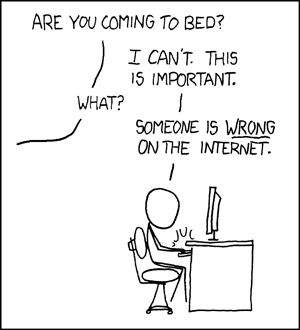
XKCD is going to show up a LOT in this article…
Another common mistake is to assume that just because somebody has stated an opinion or position means that they’ve opened themselves up for debate, even if it’s in a “public” space such as on YouTube or Twitter. While I’m a believer in “you have a right to what you can defend”, there’s a time and a place for challenging others – and many people wrongly assume that’s “any time”. The fact that somebody is having a conversation on Facebook or Twitter doesn’t mean that they’re looking to take on all comers. Yes, they may not have their settings on “private”, but simply being in a “public” space doesn’t serve as an invitation for anybody to put their two cents in. Restaurants or shopping malls are also public spaces, but inserting yourself uninvited into somebody else’s conversation there is still rude.

“Sea-lioning” may be one of the greatest contributions to the lexicon of the 21st century
Part of not being seen as a dickhead means recognizing that you can pick your battles. Some arguments are simply not worth having. You may enjoy a lively debate; that doesn’t mean everyone else does and trying to drag other people into it is a quick way to end up alone. Being “right” is a hollow victory when it comes with a side of “…and this is why nobody likes you.”
One of the biggest mistakes I see people make when they’re trying to express an unpopular or opposing opinion is that they aren’t having an argument, they’re having a fight. Arguments are about trying to change minds and bring someone around to your point of view. Fights, on the other hand, are about beating the other person either literally or metaphorically.
This becomes significant because mistaking one for the other is part of how you get singled out as being an asshole. If you’re presenting your opinion in a way that focuses less on the subject and more on the person you’re disagreeing with, then you can count down the time until you get ignored, blocked or banhammered in minutes. The fact that you have a difference of opinion with somebody – or the community at large – doesn’t excuse insulting them, mocking them, ad-homenims, tone-policing, gish-galloping or otherwise switching from an actual discussion to an insult match. If you want people to listen to you instead of disregarding you, the last approach you want to take is “your opinion is stupid and you’re stupid for having it.”
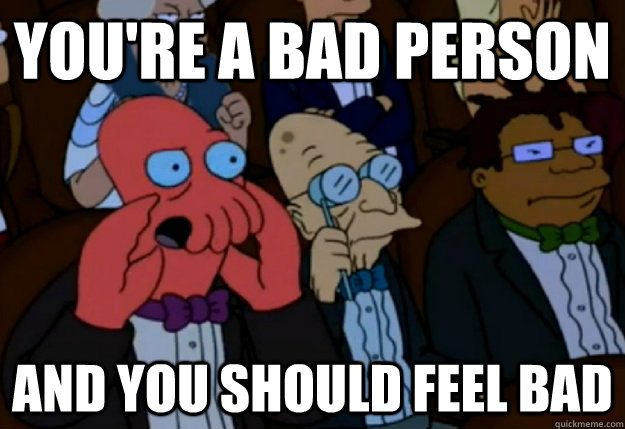
99% of arguments on the Internet are some form of this.
This means that no matter how strongly you may be disagree with the other person, losing your cool or insulting them (or the community at large) is an effective way of losing the argument. This has less to do with the “U mad bro” school of arguments, and everything to do with pure practicality. Again: the point of an argument is to persuade people to change their minds; as soon as you start getting angry and insulting people, you’ve given them reasons to quit listening. Moreover, insulting them will only reinforce their belief in their initial position… even when their opinion is factually incorrect. This is known as the “backfire effect” and you can witness it in just about any argument about religion, sex, money or politics. If you want to persuade people, you have to connect with them. Reaffirming their positive values – they’re not idiots, they’re not crazy, etc. – is far more effective for making actually persuasive arguments. Attacking them, on the other hand, just shuts things down.
This also means not getting upset and defensive when defending your own opinions. Being calm and collected – not smug, not dismissive, but calm – helps keeps the argument from escalating into a fight. You may not win, but at the same time you’re not making an ass out of yourself. People may not agree with you but they will respect you… assuming that you give them that same respect, too.
While we’re at it:
When we get into arguments – especially over topics and opinions we feel strongly about – there’s a tendency to quit listening to what the other person is saying and to argue against what we think they’re saying. We end up arguing against our (frequently distorted) version of their opinion rather than what they actually think – a form of argument known as a “straw man”. Sometimes this is unintentional, particularly when the subject is heated and controversial; there’s a tendency to assume that we know more about what the “other side” is thinking and is really saying and we argue against that. Other times it’s a deliberate misinterpretation, particularly when one side or the other is playing to the crowd or when “beating” the other person is more important than persuading others.

See also: Breitbart, A Voice For Men, r/KotakuInAction, r/TumblrInAction, etc.
When it’s unintentional, it’s annoying at best. People are quickly going to get frustrated constantly having to correct you or pointing out that they never said what you’re accusing them of. Just as with getting angry or defensive, annoying people through straw-manning is counter-productive; annoying people is a great way to get ignored and/or banned. It’s especially galling in written media, such as arguments on subreddits, forums or comments sections – after all, their exact words are right there for you to refer to.
Part of what makes unintentional straw-manning annoying is the lack of respect it conveys to others. It indicates that you can’t be bothered to actually stop and listen to the other person – and if that’s the case, why should they bother to talk with you at all if you can’t afford them the basic respect of actually listening? If you’re looking to share your opinion, especially when it’s unpopular in the group, then you need to give the respect you’re hoping to receive from others.
(You may notice that respect comes up a lot in this topic. There’s a reason for that.)
Intentionally straw-manning, along with taking things out of context in order to score points and JAQ-ing off1, on the other hand, are signs that there’s no point in talking to you because you’re clearly not there to discuss things in good faith and are a fast-track to meet the ban-hammer. You can complain about people’s intolerance for outside opinions all you want – just don’t expect anyone to take you seriously when you announce your intentions with the Asshole Signal.

Remember: the fail-state of “clever” is “asshole”.
Have you ever noticed how some people get greater leeway than others in communities, both offline and on? Ever wonder why some people get the benefit of the doubt while other people get labeled “troll” right off the bat?
This is because the former are valued members of the group, while the latter are unknown quantities. The regulars have built up their relationships with everybody else over time; there’s a solid base of previous exposure and experience to weigh against their apparent misbehavior. They’ve earned themselves the benefit of the doubt through their contributions to the group as a whole. Meanwhile, the newbie has yet to prove themselves. They don’t have that same reservoir of goodwill and respect to draw upon that the regulars do. When a known member of the community acts up, the others have their past behavior to use as context for their current actions. A newbie does not. There may be extenuating circumstances for the regular’s behavior, or they simply may be well-liked enough that people are willing to forgive them a temporary aberration of behavior. Somebody who doesn’t have that relationship with others, on the other hand, looks less like a valued potential member of the community and more like someone who’s there just to be an asshole.
Is that fair? Well… depends on whose definition of “fair” you’re using. If you work under the assumption that everybody should be precisely as equal as the others regardless of seniority or relationships, then no, no it’s not fair. But then again, expecting to be given the exact same levels of respect and consideration just for showing up as is given to people who’ve been participating for months or years is equally unfair to everyone who came before. Communities are built upon relationships and relationships are in no small part based on previous behavior. Coming in as an unknown means that you’re of neutral value to the group and the way you participate is going to affect people’s first impressions of you. If your first introduction is to come in like a seagull – making a lot of noise and shitting on everything – then you can’t be surprised when people have a less than charitable opinion of you.

And anyone who’s lived near seagull colonies can tell you how appreciated they are…
Similarly, people are going to judge you on your previous behavior. You don’t get a blank slate with each new forum thread or party or Facebook posting. If you have a long history of being a contentious dick, people are going to respond to you accordingly and the question of whether your presence brings more benefits than drawbacks is going to tilt quickly into the drawback territory, even if you’re completely correct. Forget about House or Sherlock; people would rather spend time with someone who may be wrong but is still fun to be with than with a competent asshat.
On the other hand, if you’re able to put disagreements aside and take part in other conversations, to share jokes and contribute positively to the group by helping others have fun, people will give you more leeway and respect within the group. Yeah, you may have the odd opinion or two that people may take issue with, but overall, you’re going to be considered a more valued member of the community… especially if you can disagree with people without it turning into a knock-down, drag-out fight.
Whether you’re talking about a circle of friends or an online community, respect is something that’s earned through building connections and relationships with others. If you’re able to show that you can be a part of the community and participate in it as a whole, then people are far more likely to give respect in return – even if you disagree on some subjects.
Plus, being a valued member of the community means that people are more likely to listen to your opinion and take it seriously instead of just dismissing it (and you).
One of the fundamental mistaken ideas about arguing is the idea that getting the other person to shut up or tell you to go away is a “victory”. Winning an argument means that you’ve persuaded the other person to change their mind. Getting someone to ignore you, block you or otherwise quit paying attention isn’t winning, it just means they no longer feel like wasting their time and energy responding to you and their time may be better spent doing something more productive and/or entertaining like organizing their sock-drawer.
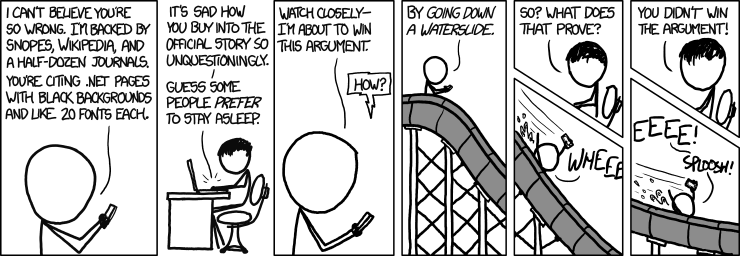
And really, at that point they’re definitely the winner…
Arguing to silence or frustrate someone isn’t a debate, it’s bullying. When all you’ve done is convince someone to ignore you, you haven’t proven your point through superior rhetoric or the correctness of your opinion. In fact, you’ve highlighted the weakness of your debating technique. You haven’t changed their mind or gotten them to concede victory, you’ve just annoyed them into shutting you up so that you no longer waste their time.
Similarly, a refusal to engage with you in the first place isn’t a sign of weakness of their position, it’s an indication that they don’t feel that arguing with you is worth their time. The idea that every statement or position must be defended is a fallacy, because it assumes all challengers are equal. It’s rare the (random) challenger actually has something new and valid to say, or standing which makes their input valuable in the first place. Anti-vaccination activists on Twitter or Facebook yelling at medical professionals aren’t on the same level as, say a peer-reviewed medical journal, particularly as the anti-vaxxers have no medical background and are frequently relying on debunked information they read on conspiracy websites. Anita Sarkeesian ((Counting down to someone coming into the comments to complain about Feminist Frequency in 3… 2… )) disables comments on her YouTube videos not because she can’t take the criticism but because frankly YouTube comments are a sewer at best and the “criticism” tends to be nothing but gendered insults… hardly hard-hitting commentary from respected thinkers.
The other mistake is to assume that all communities are intended to be free-for-all bastions of complete and unregulated speech. Every community, forum, subreddit, website and social circle has the right to set the rules as they choose and abiding by those rules is part of the price of entry. If, for example, someone decides that every comment on their blog needs to start with the phrase “Bless $BLOG_OWNER, May his passing cleanse the world,” that’s their look-out; people who don’t want to play along are free to go elsewhere. People aren’t obliged to listen to or respect your opinion, and being an asshole about it only justifies your exclusion from that community. If that makes you throw your hands up and complain about circle-jerks and hugboxes, so be it; go find a place more to your liking. And to be frank, people who use the term “hugbox”2 unironically are demonstrating why the community is better off without them in the first place.

“I can’t remember where I heard this, but someone once said that defending a position by citing free speech is sort of the ultimate concession; you’re saying that the most compelling thing you can say for your position is that it’s not literally illegal to express.” – Randall Munroe
More to the point, not giving you a voice in the community isn’t a violation of your rights, nor are you being censored if people ignore you or kick you out. You aren’t guaranteed access to a person, an audience or a platform. If you want to express your opinion, you have the entire Internet with which to do so, from blogs to Tumblr to open publishing platforms like Medium to YouTube.
But if you want to be an active, accepted part of the community, then you need to be able to express yourself – unpopular opinions and all – without being a dick. Sometimes this means recognizing that you’ve hit an impasse and let the argument go. Yeah, it sucks that people disagree with you. But sometimes agreeing to disagree is the price of being part of the community. It’s easier – and much more pleasant – than dragging things out to the bitter end and letting other people decide that they’re better off without you.
Having a conflicting opinion isn’t the problem. Being an asshole is.
The post How To Share Your Unpopular Opinion (Without Being An Asshole) appeared first on Paging Dr. NerdLove.
"Spend enough time in any community or social circle – whether online or in person – and you'll inevitably hear people complaining about the group being too insular, too much of a circle jerk or just plain unwilling to listen to people who disagree with them. You may especially notice this when forums have active moderation or websites and YouTube accounts turn off the ability to post comments. Now, on occasion, you will find a group or community that is unwelcoming to divergent voices... but more often than not, the problem isn't that people are unwilling to hear an opposing opinion, but rather a case of "we don't like assholes in the clubhouse."--How To Share Your Unpopular Opinion (Without Being An Asshole)
 If you're not playing NimbleBit's Capitals [Free], first off, what's wrong with you? Secondly, you should fix that problem by reading our review and maybe even checking out the strategy guide written by the game's developer. For everyone else, the game's two main IAP items recently got a little cheaper.
The two things that seem worth buying in the game are the ability to customize your capital which now only costs 99¢, and infinite lives which has dropped from $24.99 to $9.99. The infinite lives thing seems pretty optional, as once you get going and have a bunch of games rolling the lives system becomes pretty irrelevant.
I would, however, think about springing for the customization stuff as you can show your TouchArcade pride with a swanky TA capital, as seen in the screenshot here.
Additionally, if you've got the game but are looking for more serious opponents beyond random Game Center people, be sure to stop by the thread for the game on our forums.
 |
| Jim Meehan's take on a watermelon margarita Ask Drinks Editor Jim Meehan for a watermelon margarita and you'll get a Mexican agua fresca—spiked with tequila, of course. It's the perfect pitcher cocktail for your next party. |
| Keep reading on TastingTable.com |
Terceira entrega da Torre de Trezenzônio. O pretexto deste artigo é um comentário ao artigo anterior de Henrique que vinha a dizer que todo isso de Breogàn eram lendas e que as lendas já se sabe que são um invento.

Le doy, como mucho, año y medio más al feminismo para empezar a ser unánimamente denostado en toda red social de persona enterada, independiente, con-c-r-i-t-e-r-i-o; tras haber llegado al escalafón más bajo de la construcción de la personalidad virtual pseudoalternativa: la normal basic bitch, cuando esta se dé cuenta insconscientemente de que el feminismo es ya algo aceptado y bien visto porque las disidentes de tecladito así le han abierto camino, y, conscientemente, de que declarando de forma clara su interés en el tema demostrará estar al lado bueno de la cultura virtual y podrá acceder al respeto e interés de hombres (y mujeres; pero, y hombres) ligeramente mejor posicionados que ella, moviendo también a su paso y en su dirección al basic fuckboi que empezará a guardar en marcadores enlaces de Píkara.
Y así, la mujer crítica y despierta, la que no se guía por modas (la misma que hace dos años se reía de las feministas como mujeres feas y dejadas en cuanto al cuidado personal frustradas por no poder conseguir sexo ni atención mientras hoy habla del manspreading como acoso) empezará a virar su constante difusión de información feminista hacia cualquier versión del hiper-reciclado “Qué pesadas ahora con el feminismo ya sabemos que sois inconformistas y especiales presumiendo todo el tiempo de ser feministas como si fuese algo radical aquí tenéis vuestro pin volveos a vuestra clase de ciencias sociales”.
Pensará en la etapa en la que era feminista como hoy piensa en la que era antifeminista, que es prácticamente igual a como piensa en la etapa en la que llevaba pantalones de campana. Identificará su inversión total de criterio con una adquirida madurez y sabiduría que le impide caer de nuevo en los delitos estéticos y morales del pasado, pero no habrá sido absolutamente nada más que un cambio de tendencia.
La mujer feminista será otra figura de cera embalsamada en un sótano en el que quizás se encuentren todavía las de la chica gamer y la retronazi, y al que puede que de vez en cuando aún recurra alguna despistada porque es que hay gente que no se entera pero mira el ridículo que está haciendo, ¿es que no sabe que esto está mal y hace dos años que los listos nos hemos dado cuenta?
Ignacio Murillo, como sucede con Pablo Ruiz, es más conocido por su nombre artístico, Furillo, pero, a diferencia del genio malagueño, él nació en la preciosa ciudad de Zaragoza –localidad bajo la advocación de la Virgen del Pilar, la cual no dudó en interceder por su población para que las bombas republicanas no estallasen y, de paso, destruyeran su impresionante basílica–.
Estudiante notable, acudió al colegio con los Escolapios, cuyos pupitres pronto fueron testigos de las dotes artísticas del muchacho, ávido lector de los productos de la factoría Bruguera, de tebeos de terror y de las aventuras de los superhéroes norteamericanos.
Colaborador de diversas cabeceras ilustradas, en los últimos tiempos Furillo ha firmado un sustancioso contrato con la editorial Autsaider Cómics y ha publicado Nosotros llegamos primero.
Esta ambiciosa obra cuenta a través de más de cien páginas todas ellas en blanco y negro, pero que parecen dibujadas a todo color, la odisea espacial durante mucho tiempo silenciada de los héroes españoles de la Agencia Española de Astronáutica, que en los años 60 sortearon todas las dificultades técnicas y el boicot de los servicios secretos de Estados Unidos, Israel y la URSS, para llegar a la Luna antes que nadie en La Polo, astronave bautizada así en homenaje a la mujer del dictador.
Ellos lo consiguieron y hoy, Ignacio Murillo (Furillo), lo pone en conocimiento de todos los españoles.

¿Cómo conociste uno de los secretos mejor guardados de la historia española? ¿Es cierto que manejas información reservada?
Bueno, pues uno va por los bares, frecuenta ciertos ambientes y acaba escuchando cosas. Sí, soy una especie de «Pequeño Nicolás» del tebeo, solo que más gordo -y eso que el Nicolás tiene buen papo-, y viruta veo poca.
¿Cuánto tardaste en hacer esta obra? ¿Cuáles fueron tus fuentes de inspiración?
En cuanto a la elaboración manual de la obra, podría decir que unos dos años. Pero la historia en sí misma surgió en mi cabeza hace muchos años y se fue macerando en mi cerebro, recociéndose al fuego lento de mis meninges durante mucho tiempo. Fue reescrita en mi sesera varias veces antes de verse finalmente plasmada en papel.
Mi fuente de inspiración básica fue una: España. También el cine que me gusta, el de las españoladas, el landismo, el neorrealismo, el fantaterror español, la Ci-Fi, el cine de espías y cosas como la II Guerra Mundial, la Guerra Fría, las señoras neumáticas y el siglo XX en general; cosas que le gustan a cualquier hombre cuajado con dos dedos de frente.
¿Cómo te documentaste? ¿Cuánta tinta y papel utilizaste? Y en este sentido, ¿no crees que sería útil que todos los tebeos incluyeran lo que se ha utilizado para su realización como en la portada de «Astérix y Cleopatra»?
La documentación que hice fue mínima: ver un par de fotos de automóviles, cohetes y señoras de pelo lacado y sostén puntiagudo. No llevo registros en cuanto al papel gastado ni nada de eso. Supondría un trabajo inútil contabilizar esas cosas. No sabía lo de la portada de Astérix. Lo he tenido que buscar para verlo. Yo esas cosas de gabachos, no las leo. Bueno, a Vuillemín, sí. Y a Lauzier también. Bueno, igual alguno más.
Además de arrojar luz sobre un hecho que todos sospechábamos, el de que Nosotros llegamos primero, tu libro confirma algo que también todos sabíamos: que lo de Stanley Kubrick rodando la llegada a la Luna de los norteamericanos es verdad porque ellos nunca llegaron. ¿Puedes confirmarnos si estamos en lo cierto?
Lamentablemente y efectivamente los yanquis llegaron a la Luna. Es un hecho incuestionable. Lo cuestionable es si fueron los primeros. Tanto que se dice ahora que los españoles no llegamos los primeros a América, que si fueron los vikingos o los fenicios o su puta madre; sí hombre, sí, con una chalupa del Ikea. ¡Los cojones! Tampoco echamos a los moros, ¿no? ¿Qué pasa?, ¿también fueron los vikingos? ¿Conquistaron los rubiales Tenochticlán también o como coño se escriba? ¿Fueron virreyes del Perú?
Gusta mucho menospreciar los logros de este simpático pueblo porque en el fondo nos la suda, y así debe ser. Nosotros mismos lo hacemos y me parece bien. Porque solo un grande se ríe de sí mismo y se toma a chufla sus propias heroicidades. ¿Qué mérito tendría si no? Yo me sumo a eso como español que soy. Como decía aquella canción, «¿que quieres mil duros? Pues te los doy».

Según tengo entendido, y a pesar de lo inexplicable del hecho, expertos como Iker Jiménez o J. J. Benítez no han mostrado demasiado interés en tu obra. ¿Crees que hubiera sucedido lo mismo si hubiera caído en manos de Jiménez del Oso?
Jiménez del Oso fue, en el mundo del misterio, lo que Rocio Jurado en el de la canción ligera, o sea, el Más Grande.
Iker Jiménez es el gran comunicador televisivo de los últimos años. Un tipo que se conduce sin guion leído (también es verdad que siempre está con lo mismo, las putas caras de Bélmez, el tío del bronci y el niño bocina, pero bueno), no como el Wyoming, que parece mentira, con el reprise que tiene, que se deje encorsetar tanto por los guionistas, con lo que ha sido él. J.J. Benítez ya patina más. Tengo que hablar con Iker, de todas formas.
Recuerdo haber visto a Del Oso de crío en la tele. Ese hablar pausado y reflexivo. Esa cadencia hipnótica. El gobierno de este país debería estar en manos de gente como él. Mejor nos iría. Espero que esté bien allá donde esté.
¿Qué piensas cuando te dicen que tu libro no relata hechos verídicos? ¿Crees que hay un complot de los servicios secretos internacionales para desprestigiar tu obra por las consecuencias que podría tener para el equilibrio del poder mundial?
Hasta ahora nadie ha tenido arrestos de venirme con esa cantinela. En cualquier caso creo en la libertad de pensamiento, frontera última de la libertad individual, auténtica y única libertad real del individuo. A partir de ahí me importa todo tres cojones. Ya me gustaría que hubiera un complot contra mí.
¿Fueron esos poderes en la sombra los que impidieron que te alzases con el Premio del Salón del Cómic? ¿Crees que sucederá lo mismo en la próxima edición de los premios Will Eisner?
Que me hubieran dado a mí ese premio sería como si le dieran a Fernando Esteso un Goya. Ambos, sin duda, nos lo merecemos, seguramente más él que yo, pero es algo que no va a suceder. Provenimos de mundos que chocan frontalmente con lo establecido como formalmente premiable.
Más allá de que las otras obras pudieran ser mejores, que es posible, claro que sí, se sustancia el hecho innegable de que hay obras que más allá de su contenido tienen la categoría de premiables, el estigma del éxito, diría yo.
En mi humildad, reniego de este estigma. Fabrico obras maestras que, de suyo premiadas ya con su mera existencia, trascienden los premios, que en el fondo no son más que andamios que pretenden ensalzar cuerpos desgüesados, incapaces de aguantar su propia sustancia. Hablo siempre en general, ojo.

¿Cómo te sentirías si la Fundación Francisco Franco, FAES o el propio PP eligiera tu libro como regalo para sus afiliados y amigos para las próximas navidades?
Me sentiría francamente bien, valga la redundancia. Y lo digo totalmente en serio, porque significaría que son gente con humor. Y además aumentarían mis royalties, que eso es importante.
¿Por qué cuando se tratan temas relacionados con la historia de España en el cine y en el cómic siempre se recurre a la Guerra Civil y no a otras épocas de esplendor como el desarrollismo, la llegada de las suecas, el 600, Torremolinos, la Ley de Prensa de Manuel Fraga, Palomares, el garrote vil o los fusilados del FRAP del año 75…?
Supongo que porque el muerto está todavía caliente, en el fondo. Los de la Guerra ya se han quedado más fríos. En este país somos mucho de comer fiambre.
En tu obra hay sexo en sus más variadas combinaciones: tabaco, alcohol, drogas, nazis… Una combinación que, a la luz de las nuevas legislaciones como la ley mordaza, podría hacer que un fiscal o Rosa Díez pidiera su secuestro y prohibición. ¿Hace Furillo lo que podríamos llamar «cómic protesta»?
Hombre, no creo yo que haga ningún material secuestrable. Es más, en mis historietas es palpable un profundo sentimiento de moralidad. Hay un mensaje trascendente que está implícito en todas mis historietas y que a poco que rasques aparece. No nos quedemos en las pollas y en la mierda. Qué sí, que las hay. ¿Pero es que acaso podemos entender el mundo de otra forma?
¿Qué garabateaban los romanos por las paredes sino ordinarieces? ¿Qué contenían, a menudo, esos milenarios grafitis si no enormes falos enhiestos? En las cuevas, ¿qué pintaban nuestros ancestros? Bueno, sí, vale, búfalos y ciervos, sí… pero también tíos empalmados. ¿Y esas nodrizas tetudas que modelaban en arcilla, quién sabe con qué amasada? No hago cómic protesta. Hago un cómic profundamente humano.
¿Qué es lo que hace que el público hipster y moderno sea tan receptivo a El Ministerio del Tiempo y le cueste entrar en una epopeya en viñetas como la que tú has creado?
Espero que no le cueste. Yo creo que mi público es bastante variado, seguro que algún atontado de esos también se lo ha comprado.
¿Cuáles son tus próximos proyectos? ¿Tal vez una película de Nosotros llegamos primero?
Estoy trabajando en mi próxima novela gráfica, Yo le hice una paja a Franco. Se trata de una astracanada al hilo del Nosotros llegamos primero, donde aparecen algunos personajes de esta historia. Tengo también algunos otros proyectos en marcha enmarcados en el territorio del cómic de terror y continúo en la labor serigráfica con mi «Palmeras y puros compañía gráfica».
Estoy abierto a todo tipo de ofertas. Películas, series de televisión, cromos, llaveros y bolígrafos promocionales.


Este post Españoles por la Luna: Nosotros llegamos primero, escrito por Eduardo Bravo, se publicó originalmente en Yorokobu.

When you have a look at the infographic above, you definitely will recognise many characters from your childhood days. DailyInfographics.eu made a selection of the most popular cartoon characters from European countries in one infographic. Many of them are known worldwide: Asterix, Tintin, Krotek - generations grew up watching their adventures.
As you see, the data about some countries is missing. Could you help us to complete it?
Tell us in the comment section which is the most popular cartoon character made in your country! Add an image if you can.
Which cartoons did you like most of all as a child?
What cartoons do your children and younger siblings prefer?
Discuss with OneEurope!

It’s rare for a video game to hang dong. Cobra Club, the newest game by developer Robert Yang, doesn’t just feature dicks: the game is fundamentally about dicks, how they look, and the many ways people try to make them look good. (NSFW warning!)


Regardless of which end of whatever pond you’re on, region blocked content is annoying. Whether you’re an ex-pat looking to watch reruns of The Wonder Years, or you’re hankering for a dose of Dr. Who, here’s the best (and easiest) way to get that content.


 Some spicy finger food from the Jazzman label.
Jukebox Mambo vol. 2 is the second part in this funky journey.
Based around mid 20th century mambo jams, this spans all sorts of African-american styles with some Latin-american tinges through out.
A strong follow up to 2011’s first volume, Vol. 2 further showcases Liam Large’s curatorial skills and broad knowledge of early stateside R&B.
Two years in the making, this sequel ploughs deeper still into the revolutionary ’40s and ’50s Afro-American musical canon, pulling together another combustible collection of lascivious Latin-edged blues exotica.
320 kbps | 143 MB UL | HF | MC ** FLAC
01. Lincoln Chase – I Love Your Many Ways (2:22)
02. Christine Chatman and Peppy Prince Orchestra – Run Gal Run (2:59)
03. Chris Powell and His Five Blue Flames – I Come from Jamaica (2:38)
04. Zilla Mays – Calypso Blues (2:51)
05. Johnny Oliver – All I Have Is You (2:41)
06. Chuck Edwards – Morning Train (2:22)
07. Oscar Saldana – Mambo Hop (2:13)
08. Jimmy Nolen – Jimmy’s Jive (3:08)
09. Four Blazes – All Night Long (2:45)
10. Chanters – She Wants to Mambo (2:49)
11. Jeanne DeMetz – Calypso Daddy (feat. Johnny Alston Orchestra) (3:16)
12. Camille Howard – Within This Heart of Mine (2:12)
13. Ashton Savoy – Denga Denga (2:15)
14. Freddie Mitchell and His Orchestra – Later Gator (3:13)
15. Note and Toe and The Grenadiers – I Got a Cold (Calypso) (2:48)
16. John McKinney and The Premiers – Gee I Love You (2:11)
17. T-Bone Walker – Plain Old Down Home Blues (3:06)
18. Ron Rico and Sax Kari Orchestra – Chano (3:07)
19. Don Tosti Y Su Conjunto – Mambo Del Pachuco (2:54)
20. Billy Emerson – Satisfied (2:20)
21. Frank Motley – Wanda Landa Landa (2:40)
22. Red Saunders – Summertime (2:33)