31 cool 50s & 60's trash rock 'n' roll classics! 76 minutes! Full-color 24 page booklet! INFO http://www.discogs.com/Various-Songs-The-Cramps-Taught-Us-Volume-3/release/2891274trax:
1. Woodpecker Rock - Nat Couty 2. Bop Pills - Macy Skipper 3. Calling All Cows - The Blues Rockers 4. Storm Warning - Mac Rebennack 5. Bitter Feelings - Larry Phillipson 6. Earthquake Boogie - Terry Dunavan 7. He's Waiting - The Sonics 8. I Will Not Be Lonely - The Fanatics 9. Chop Suey Rock - The Instrumentals 10. Can Your Hossie Do The Dog - Dell Raney 11. Strollin' After Dark - The Shades 12. Georgia Lee Brown - Jackie Lee Cochran 13. You'll Never Change Me - Lonnie Allen 14. Rompin' - Jerry Warren 15. I Want Some Of That - Kai-Ray 16. How Come You Do Me? - Junior Thompson 17. Madness - The Rhythm Rockers 18. Uranium Rock - Warren Smith 19. Don't Tread On Me - Kit & The Outlaws 20. Miniskirt Blues - The Flower Children 21. Sometimes Good Guys Don't Wear White - The Standells 22. Blue Moon Baby - Dave Day 23. Devil With The Blue Dress On - Shorty Long 24. Rockin' Bones - Ronnie Dawson 25. Save It - Mel Robbins 26. I Got A Rocket In My Pocket - Jimmy Lloyd 27. One Hand Loose - Charlie Feathers 28. Mule Skinner Blues - The Fendermen 29. Hungry - Paul Revere & The Raiders 30. I Walked All Night - The Embers 31. Faster Pussycat Kill Kill - The Bostweeds
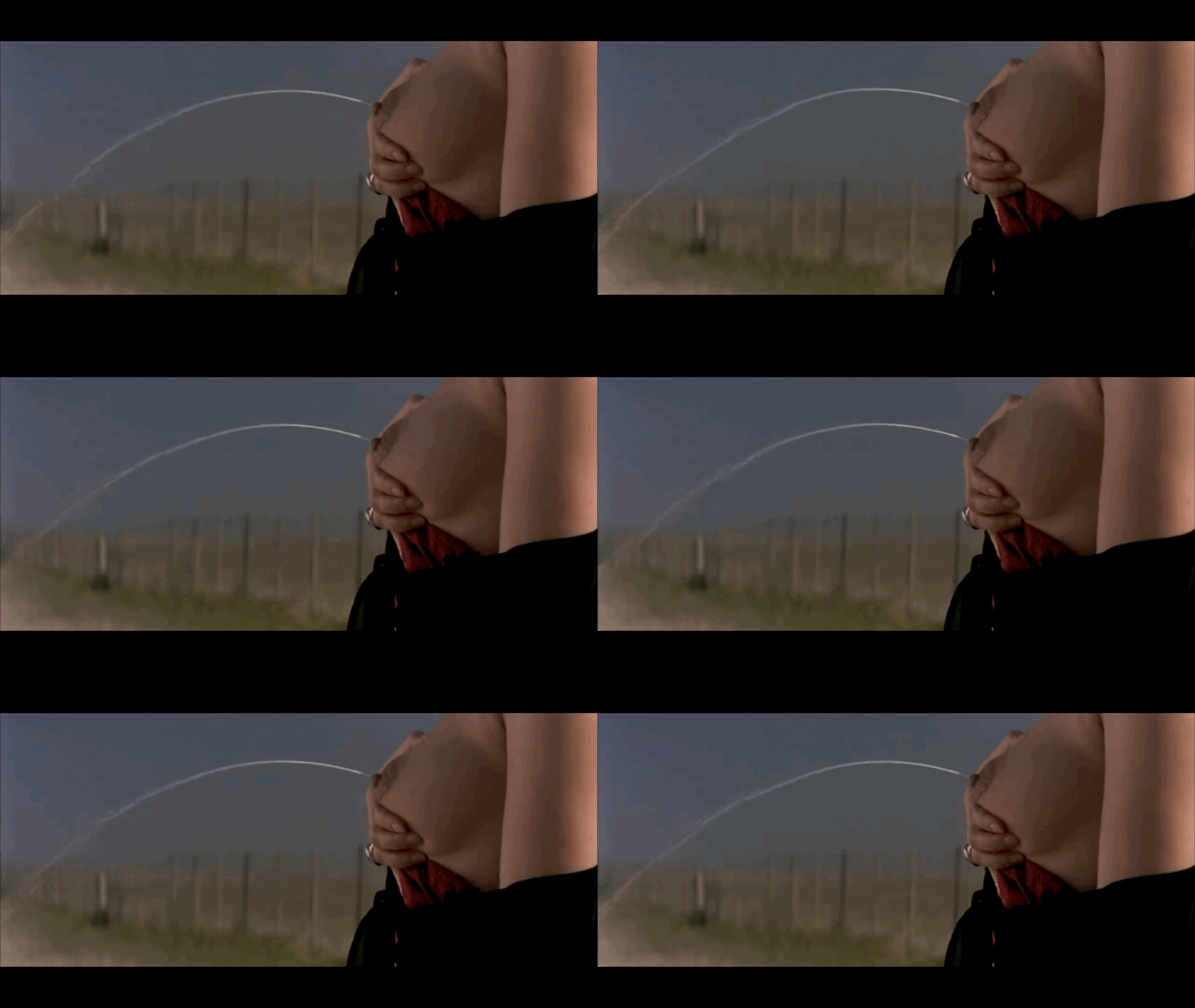
Watersports is one of those things we know nothing about, so it’s really awesome to get a good new artist who knows the fetish on board. We hope you like it as much as we do!
Edit 8/19/15
A few folk have been emailing to explain that pee isn’t always sterile and that we ought to warn would-be watersporters that it could contain bacterias! While Sicklyhypno explicitly states in this comic that it’s not 100% sterile, I will reiterate: your pee isn’t 100% sterile, it could contain some bacteria, but more often than not it’s in such low amounts that it’s negligible! All sex acts carry some risk, so practice your kink responsibly and maybe don’t pee on anyone if you’re suffering an infection.
Mario Rouco é un enxeñeiro agrónomo de 33 anos que traballa nunha multinacional relacionada co sector agrario no concello das Pontes. As súas orixes están no veciño concello de Muras, en concreto no lugar do Seixo, nunha zona de alto valor gandeiro que nos últimos anos ven padecendo o peche de explotacións e o abandono do rural.
Sen embargo, o que para uns é un medio de vida do pasado, para Mario constitúe unha opción de futuro e deste xeito puxo en marcha este ano unha pequena explotación de Porco Celta nunha fraga da familia. “Sempre me gustou a idea de poder criar porco en liberdade, e ademais a raza Porco Celta é moi rústica, cría unha carne de excelente calidade e non presenta case ningún problema sanitario”, asegura.
O seguinte paso foi facer o peche da finca, unha zona de fraga en pendente que non se podía aproveitar para vacún, pero que resultaba ideal para a cría de porcos en liberdade. En total, 3,5 hectáreas, das que o 90% é un bosque mesto de carballos, castiñeiros e bidueiras, que proporcionan sombra e alimentación para os animais. “O terreo é moi bo para este tipo de animais, xa que ten pendente, o que os obriga a facer músculo”, salienta Mario.
Nunha explotación de Porco Celta ao aire libre, o xabarín é unha das principais ameazas xa que podería matar ao verrón e danar ás porcas. Por iso, e para manter controlados aos porcos, Mario levantou na finca un peche perimetral con tela gandeira reforzada. A tela ten unha altura de 1,20 metros. Por dentro e por fora conta cun arame de pastor eléctrico a 30 centímetros de altura do chan para evitar a entrada do xabarín ou a saída dos porcos. Ademais, colocou un arame de pico a 1,50 metros para evitar a entrada do corzo e do lobo, tamén electrificado con pastor.
“Rota os porcos entre distintas partes da finca para evitar sobreexplotación”
Este peche perimetral supuxo o maior desembolso, uns 15.000 euros, que foi financiado cunha axuda da Consellería do Medio Rural e do Mar para explotacións gandeiras non prioritarias, é dicir, para aquelas que non teñen a actividade gandeira como principal fonte de ingresos.
Para completar, a instalación e xestionar esta parcela de fraga de forma sustentable, Mario instalou tamén varios peches internos para rotar os animais dentro da finca.
Unha vez construídas as instalacións, que se completan cun pendello para o refuxio dos animais, comedeiros, bebedeiros de chupón e un comedeiro para o penso, tocou esta primavera o último paso para o inicio da explotación: a entrada dos animais.
Para iso, mercou dúas porcas, de variedade Santiaguesa, e un macho da variedade Barcina a un criador certificado de Porco Celta de Castro de Rei (Lugo). A día de hoxe, na finca están 26 porcos de ceba, as dúas femias e o verrón. Neste sentido, Mario recoñece que “por superficie poderíamos ter unha carga gandeira maior, pero prefiro empezar cunha explotación de tipo reducido, cunha carga gandeira que sexa sustentable para o terreo e cun crecemento lento dos porcos”.
Control do penso para mellorar a rendibilidade e o sabor da carne
A alimentación é un dos aspectos que máis coida esta explotación xa que pode supor ata o 80% dos gastos variables dunha gandería de Porco Celta. Precisamente, na busca de máis rendibilidade, Mario realiza un racionamento do penso para buscar que o animal medre máis lentamente, en base aos recursos da finca, e con máis calidade da carne.
Así, Mario dálles de comer penso aos porcos soamente unha vez ao día, ás 9 da mañá, nun comedeiro pechado que se abre só durante 30 minutos, para desta forma ter controlada a cantidade de comida. En total, proporciónase arredor de 1 kg de penso diario por cebón, aínda que varía segundo a fase de crecemento. En concreto, elabora unha ración especial para os leitóns de ata 4 meses; outra para os de 4 a 10 meses e unha ración de finalización con aporte suplementario para os porcos de 10 a 14 meses.
“O obxectivo é lograr unha carne de crecemento lento e de alta calidade”
O resto da alimentación proporciónaa a propia fraga en forma de landras, castañas, herba, raíces….. así como restos da horta familiar. Para finalizar a ceba, Mario ten previsto mercar castañas no outono para darlle máis sabor e valor á carne.
Deste xeito, os cebóns estarán na finca ata un máximo de 14-15 meses, momento no que se sacrificarán cun peso que chegue aos 120 kilos por canal.
Venda directa a particulares
Outro dos aspectos polos que aposta Mario para mellorar a rendibilidade é pola venda directa dos porcos cebados a particulares. “Vou intentar facer venda directa dos animais para este inverno, cun prezo prezo final que estará entre os 4 e os 4,5 euros/kilogramo”.
Mentres tanto, e alleos ao San Martiño que algún día lles chegará, os porcos de raza Celta de Mario Rouco fozan e corren ao aire libre polas carballeiras de Muras.
Ya sé que estoy siempre con el cuento de “amiga de los hombres”, que dentro del feminismo es todavía peor que definirse como amiga de Satán, pero es que cada vez que veo las cosas planteadas como que todas las mujeres son unas luchadoras oprimidas frente a los acosadores y asesinos que son todos los hombres, no puedo evitar preguntarme si es que vosotras no habéis tenido madres, abuelas o grupitos endogámicos de amigas en el instituto. ¿Es que, ahora y desde hace veinte años, todas las mujeres que os rodean son unas activistas convencidísimas de acabar con las desigualdades de género?
Debo ser yo la única que recibía reprimendas por no actuar respecto a unos cánones de género por parte de mujeres de mi familia mientras los hombres miraban a otro lado o hasta le quitaban toda importancia. Debo ser yo la única que se sorprendía con la falta de naturalidad para actuar en ciertas ocasiones de mis amigas de instituto y con sus juicios sobre lo que hacía u opinaba y lo que no mientras entre mis amigos producía menos sorpresa.
Perdonad que no me crea ya nunca nada. Esto es como con la política: Si todos vuestros abuelos lucharon en el bando republicano y vuestros padres son comunistas, ¿¿quién hostia está votando tantas veces al PP??
A collection of 31 songs which have been covered by or have inspired The Cramps. Similar to the Born Bad series, but with loads more music and loads more info, with each CD containing a 24 page booklet. Perhaps the ultimate collection of 1950s and '60s Rock 'n' Roll Trash.
1. She Said - Hasil Adkins 2. Heartbreak Hotel - Buddy Love 3. Jailhouse Rock - Dean Carter 5. Tear It Up - Johnny Burnette 6. Its Mighty Crazy - Lightnin Slim 7. Everybodys Movin - Glen Glenn 8. Her Love Rubbed Off - Carl Perkins 9. Strange Love - Slim Harpo 10. Its Just That Song - Charlie Feathers 11. Green Fuz - Randy Alvey & The Green Fuz 12. Please Give Me Something - Bill Allen 13. Hard Working Man - Captain Beefheart 14. Oo-Ma-Liddi - J. J. Jackson And The Jackaels 15. Booze Party - 3 Aces And A Joker 16. Chicken - The Spark Plugs 17. Rock On The Moon - Jimmy Stewart 18. Red Headed Woman - Sonny Burgess 19. Jungle Hop - Kip Tyler And The Flips 20. Sundown - Don And The Galaxies 21. Domino - Roy Orbison 22. Shortnin Bread - The Readymen 23. The Crusher - The Novas 24. The Green Mosquito - The Tune Rockers 25. Peter Gunn - The Jesters 26. Psychotic Reaction - Count Five 27. The Bird - The Flames 28. Hurricane Fighter Plane - Red Crayola 29. Quick Joe Small - Kasenatz Katz Super Circus 30. Lonesome Town - Ricky Nelson 31. Fever - The Huntsmen 32. Green Door - Jim Lowe
Advertencia: este artículo contiene spoilers de The Jinx. Si aún no has visto la fascinante miniserie documental de HBO, ya estás tardando.
Todos sufrimos cuando Robert Graysmith se adentró en el sótano de uno de los principales sospechosos de varios asesinatos en Zodiac (David Fincher, 2007). Sin recurrir a truculencias ni a trucos efectistas, la escena consiguió helarnos la sangre y cortarnos la respiración gracias al talento habitual del director estadounidense. Los espectadores habíamos empatizado ya con el protagonista, que no es un policía ni periodista de investigación, sino un simple caricaturista de un diario obsesionado con el famoso asesino en serie. Al acudir a casa de un testigo, le pregunta por una prueba que podría confirmar su teoría sobre un posible sospechoso. Sin embargo, su idea se va por el desagüe cuando su anfitrión le desvela que en realidad había sido él mismo quien había escrito una frase en esa pista y no otra la persona. Sin duda es un gran hallazgo, pero ese giro repentino de los acontecimientos provoca que de pronto el joven dibujante tema por su vida al estar sentado solo frente al nuevo sospechoso número uno de haber matado a varias personas.
Sensaciones parecidas nos embargan cuando vemos The Jinx o jugamos Her Story.
Podrían considerarse dos obras hermanas, al hacernos partícipes (y, a su manera, interlocutores) de hechos similares y haber visto la luz casi al mismo tiempo. The Jinx nos cuenta durante seis capítulos de 45 minutos la historia real de Robert Durst, un septuagenario heredero de una familia de magnates de Nueva York. Su primera esposa desapareció en extrañas circunstancias en 1982, su mejor amiga fue asesinada en 2000 y en 2001 fue acusado de matar y desmembrar a un vecino. The Jinx es un documental que recoge material de archivo (principalmente periódicos y vídeos antiguos), declaraciones de amigos y familiares, y, lo más interesante de todo, varias entrevistas al propio protagonista, que nunca antes había accedido a hablar públicamente.
El director, Andrew Jarecki, ya nos demostró en el imprescindible documental Capturing the Friedmans que la realidad es más compleja de lo que creemos, que nada es lo que parece y que una historia puede tener más puntos de vista que los descritos en Rashomon (Akira Kurosawa, 1950). Robert Durst es una persona/personaje fascinante: escurridizo, inteligente, inquietante y desconcertante. A lo largo de las más de veinte horas de material grabado en charlas con él, Jarecki nos muestra su carácter poliédrico, alejado de los dibujos de un solo trazo a los que estamos acostumbrados cuando las anarosas o susannagrisos de turno suelen criticar, prejuzgar y acusar a los sospechosos en sus programas matinales. El propio Fincher ya mostró a la perfección ese tipo de periodismo visceral y vengativo en Gone Girl, donde el personaje de Ben Affleck, tras ser sometido a escarnio público, acabó concediendo un entrevista enseñando su lado más humano, similar al de Durst en el documental.
Jarecki poco a poco nos va mostrando los muchos matices de la personalidad del primogénito de la familia Durst. Descubrimos asombrados su triste infancia, en la que dice presenciar el suicidio de su madre, sus posteriores intentos de alejarse del dinero y el poder de su castrador padre, sus deseos de construir algo propio (un negocio, una familia) y su extraña capacidad para estar siempre en el lugar equivocado en el momento menos oportuno. Como el propio protagonista se califica a sí mismo en un momento del metraje, es un gafe, un maldito, lo que da título a la obra. Aunque la prensa y los testigos se empeñen en contradecirle, nosotros, como el propio director/interlocutor, acabamos fiándonos de ese pobre anciano enclenque con tendencia a hablar solo y a parpadear más de la cuenta. Progresivamente vamos empatizando con una persona torturada y atormentada que parece salida de una obra de Shakespeare.
En las cuatro horas y media que dura el documental, sentimos en todo momento que Jarecki le hace las preguntas lógicas que nosotros mismos le haríamos, gracias a la información que vamos descubriendo. Hay toda una maraña de datos, desde la desaparición de la mujer en 1982, hasta el estreno de la mini serie en 2015, que los creadores de The Jinx han ordenado y dosificado para hacérnosla digerible y comprensible aunque no conociéramos el caso previamente. El equipo es al mismo tiempo fiscal y abogado, pues presenta pruebas, interroga a testigos y al propio acusado. Jarecki había declarado anteriormente: “Me interesan este tipo de historias de monstruos. Alguien descrito como maníaco, loco o asesino en serie. Siempre pienso que esas personas empezaron por algún sitio, con esperanzas y sueños”. Por eso, cuando el propio sospechoso contactó con él para ofrecerse a ser entrevistado por primera vez, la conversación telefónica (incluida en el documental) fue la siguiente:
-Sabes más sobre Robert Durst que otros medios de comunicación.
-Supongo que la cuestión es: ¿le ha hecho alguien alguna entrevista donde no partieron de ninguna presunción?
Así que el anciano, desoyendo a sus carísimos abogados, accedió a colaborar con el realizador, a contarle su visión de la historia y a facilitarle todo el material necesario. Por eso, tras varios años de filmación y veinte horas de entrevistas, el director ha establecido una conexión emocional con él. Y por ese motivo, con el descubrimiento de la pista esencial que se produce al final del quinto capítulo, y el precipitado giro que se produce, el mismísimo Jarecki reconoce en el último episodio sus sentimientos encontrados: “Es un tipo a quien, en varias maneras, le he estado dando un tremendo beneficio de la duda. No sólo con respecto al tipo de preguntas que le hago, sino con respecto a la conexión emocional que tengo con él. Me cae bien. (…) No estaba seguro de que fuera culpable y este es un gran cambio.”
La decepción del director es similar a la que sentimos los propios espectadores: ese pobre niño rico nos caía bien, joder. Para nosotros no era Robert Durst, sino Bob. Nos negamos a aceptar la evidencia, pero la escalofriante escena final, con el anciano hablando solo en el baño con el micrófono encendido, nos deja las cosas claras.
Her Story ha sido la gran sorpresa de este año en el mundo de los videojuegos. No sólo por surgir aparentemente de la nada, sino por su carácter radical y experimental. El título de Sam Barlow nos propone, a su manera, algo similar a lo que vemos y sentimos con The Jinx. Nos sitúa ante la vetusta interfaz de un sistema operativo antiguo, sin ninguna explicación. Sólo hay lo que parece una base de datos con la palabra “murder” (asesinato) escrita en ella y cuatro vídeos como resultado que podemos ver. En ellos, aparece Hannah Smith, una mujer británica de mediana edad hablando en lo que parece una declaración ante la policía, sobre su marido desaparecido.
Revisando algún documento que hay por el escritorio del ordenador descubrimos que si introducimos alguna palabra (en inglés) en el buscador, la base de datos nos mostrará los resultados de interrogatorios en los que esa mujer dijera esa palabra. Así, lo mismo podemos buscar información sobre el desaparecido, un antiguo viaje a Roma o una discusión, que sobre el jefe del marido, su querido reloj o su coche. De esta forma, vamos poco a poco recuperando piezas de un puzle para desenmarañar el misterio, pues el caso tuvo lugar en 1994. Como el creador del juego dice: “si puedes usar Google, puedes jugar a Her Story”.
Son un total de 272 piezas de vídeo breves, pues la mayoría no dura más de treinta segundas, grabadas a lo largo de siete entrevistas. Un caótico maremágnum de información que debemos ordenar tirando de intuición, inteligencia, lápiz y papel. Cualquier dato o nombre puede ser una pista relevante en este extraño caso; no debemos pasar nada por alto, no sólo lo que dice la sospechosa, sino también su manera de expresarse y su lenguaje corporal. Aunque el caso se cerró hace décadas, nosotros, sentados frente al ordenador real y virtual, nos acabamos sintiendo como los propios investigadores. Gracias a su narrativa no-lineal preguntamos lo que queremos y cuando queremos, así que es como si fuéramos nosotros quienes estuviéramos interrogando a Hannah en todo momento, llevando las riendas de la investigación y preguntando sobre algo, volviendo a una pista anterior o insistiendo en otra evidencia.
Su creador define Her Story como un cruce entre Blair Witch Project y True Detective (la buena, no la segunda temporada). Su intención es emplear una herramienta clásica como el vídeo para trasladarla al mundo de los videojuegos y aportar una experiencia interesante. Pero su objetivo va más allá:
“Quiero poner el foco en el moderno fenómeno del ‘Jurado por YouTube’, en el que la policía distribuye metraje de entrevistas íntimas a sospechosos para que detectives de salón lo diseccionen. Se ha podido ver en casos como el de Jodi Arias y Amanda Knox, en los que las historia de las propias acusadas se pierden entre el torrente de clichés y prejuicios que los vídeos contienen”.
Cada país tiene sus miserias, y España más que ninguno. Aquí hemos vivido casos similares con Dolores Vázquez, acusada injustamente y vapuleada públicamente del asesinado de Rocío Wanninkhof. Más reciente aún está el caso de José Bretón, principal sospechoso de la desaparición de sus hijos y a quien todos hemos condenado ya como culpable, gracias a las pruebas que las televisiones nos han presentado. O sin ir más lejos, el supuesto parricida gallego. Black Mirror ya exploró este complejo tema en el segundo capítulo de su segunda temporada, White Bear, donde el público voyeur acude en masa a Justice Park, para disfrutar y regodearse contemplando el sufrimiento de condenados por diversos crímenes, que son obligados inconscientemente a revivir los hechos una y otra vez en bucle infinito.
El mérito de The Jinx y Her Story es contarnos dos historias complejas, enrevesadas y fragmentadas para que conozcamos todos los puntos de vista y no nos quedemos con la primera impresión que la maruja o el cuñado de turno establecen cómodamente desde el sofá de casa mientras ven la tele con sus hijos e insultan a esos “monstruos” para sentirse mejor con sus grises vidas. Estas dos obras nos permiten bajar a su sótano, como en Zodiac, e investigar por nosotros mismos lo ocurrido para hacernos partícipes de los terribles hechos. Ambas profundizan, van un paso más allá y nos hacen comprender las motivaciones, miedos, filias y fobias de esos acusados, hasta el punto inquietante e incómodo de llegar a sentir cierta empatía por ellos. Quizá, después de todo, nosotros también seamos unos monstruos.
Creador de La familia Addams, Charles Addams es conocido por sus viñetas de humor negro. Un género no siempre suficientemente valorado pero que, en el caso del autor norteamericano, fue desarrollado con tal inteligencia, que acabó siendo incorporado a varios tests de habilidades mentales.
Hace unos años saltó a los medios de comunicación la noticia de la invención de un dispositivo que emitía unos sonidos que solo eran perceptibles por los adolescentes porque, con la edad, los adultos pierden la facultad de escuchar sonidos de alta frecuencia por encima de los 13 o 14 kilohercios.
Aprovechando ese hecho denominado presbiacusia, las autoridades de diferentes países colocaron esos emisores de ultrasonidos para dispersar a adolescentes conflictivos de zonas como parques, centros comerciales y otros lugares que los jóvenes aprovechan para sus cosas, al igual que se hace con las palomas o los perros cimarrones.
Sin embargo, los chavales, que son más listos que lo que muchos adultos piensan, aprovecharon ese descubrimiento para crear un tono para móvil que no podía ser escuchado por los adultos. Resultado: Adultos 1- Jóvenes 1.
Este descubrimiento sobre las capacidades perceptivas y reflexivas de los adolescentes, lejos de ser novedoso, es algo que los pedagogos y profesores saben desde hace tiempo. Por ejemplo, para ser admitidos en la escuela, los alumnos chinos de primaria deben resolver un cuestionario en el que se incluye una pregunta («¿En qué número de plaza de garaje está aparcado el automóvil?») que ellos pueden resolver en apenas unos segundos. Los alumnos mayores tardan algunos minutos y los adultos pueden pasarse horas sin conseguir dar con la respuesta.
Todo porque cuanto más adulto se es más desarrollado se tiene el pensamiento lógico, que se impone sobre el llamado pensamiento lateral, caracterizado por ser más creativo y menos sujeto a convencionalismos. Resultado: Adolescentes 2-Adultos 1.
Pero como el partido no acaba hasta que el árbitro da el pitido final, los adultos encontraron la forma de resarcirse. Concretamente con una viñeta de Charles Addams publicada en el semanario New Yorker el 13 de enero de 1940.
Un chiste aparentemente sencillo pero lo suficientemente abstracto o absurdo como para que no sea comprensible para personas por debajo de los 15 años. Tal es su eficacia, que el chiste ha sido incluido en algunos tests de inteligencia como el de Binet-Simon.
A finales del siglo XIX, el Gobierno Francés estableció la escolarización obligatoria de los niños entre 6 y 14 años. El problema era que los alumnos llegaban con unos niveles muy dispares, lo que provocaba dificultades a la hora de crear grupos homogéneos capaces de entender los contenidos de los diferentes cursos.
Para solucionarlo, las autoridades encargaron a Alfred Binet un método para establecer las capacidades de los alumnos. El pedagogo comprobó que era imposible determinar esas capacidades basándose en análisis frenológicos relativos al desarrollo del cráneo y consideró que la mejor fórmula era proponiendo una serie de tareas que exigían atención, dominio del vocabulario y destreza aritmética.
Se elaboraron varios test que fueron mejorados al incorporarse a las investigaciones Théodore Simon, discípulo de Binet, y en 1905 publicaron la primera escala Binet-Simon.
Dicha escala consistía en treinta tareas de complejidad creciente. Las primeras podían ser resueltas por todos los niños, incluidos los que sufrían de algún retraso intelectual. Las últimas, más complejas, incluían hacer frases con varias palabras, crear rimas, contar de modo inverso o hacer razonamientos deductivos según una serie de datos. El resultado establecía la edad mental del niño, que podía ser igual a la de su edad física, mayor o menor. Así se lograba determinar el curso en el que debía entrar y si precisaba de ayuda pedagógica extra.
La viñeta de los esquiadores acabó siendo incluida en versiones posteriores del test Binet-Simon y una institución mental de Nebraska también la utilizó para determinar la edad mental de sus pacientes. En lo que respecta a Charles Addams, fue el trabajo que le catapultó a la fama, mucho antes de que crease a su Familia Addams.
Muchos de sus colegas llegaron a afirmar que la idea no había sido suya, pero la realidad es que fueron bastantes los dibujantes de New Yorker que comenzaron a hacer chistes con esquiadores, por si se repetía el éxito. Incluso el propio Addams se hizo un homenaje repitiendo la idea para un amigo y aún hoy hay autores que lo recrean con otros personajes.
Cuando le preguntaron al propio Charles Addams cuál era en su opinión la clave del éxito del chiste, afirmó que estaba en el segundo esquiador, el testigo. Sin él «no estás seguro de que eso haya realmente sucedido y eso le aporta el elemento lógico que de otra forma no tendría».
Por cierto, la respuesta a lo del aparcamiento del coche es «87».
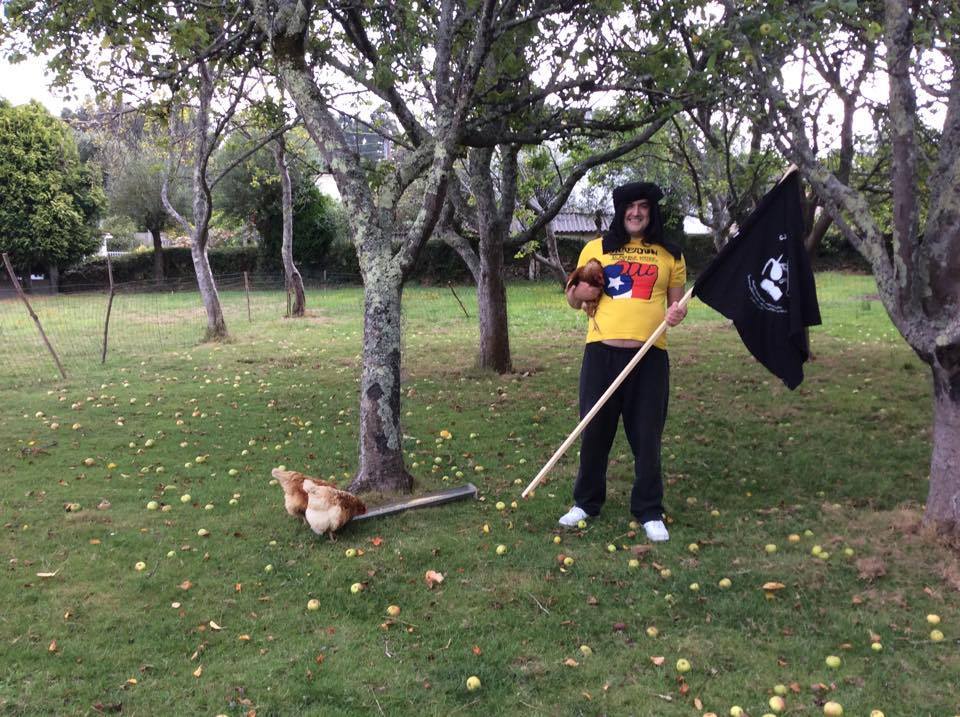
Octavio Cadelo Tojeiro, vendedor de merch yihadista
La semana pasada detuvieron a
Octavio Cadelo Tojeiro por hacer apología del terrorismo y
menosprecio y humillación a las víctimas del terrorismo yihadista. La verdad es
que lo que realmente hacía el tipo era vender —a través de la página web de su negocio de serigrafía— merchandising con motivos yihadistas: camisetas y
petos para bebés con la bandera de Estado Islámico, imágenes de la ejecución de Alan
Henning o un curioso diseño de algo llamado Califato de Xuvia. Es evidente que
la cosa era una broma de gusto ciertamente complicado pero el Ministerio del
Interior se lo tomó en serio y decidió detener al responsable y registrar su
local en busca de una célula terrorista. Después de declarar ante el magistrado
y el fiscal, Cadelo quedó en libertad con cargos y se le impuso la obligación
de comparecer semanalmente en el juzgado. Cadelo también tiene prohibido
abandonar el país.
Como nos sorprende que pase todo
esto por culpa de unas simples camisetas nos pusimos en contacto con Cadelo
para saber un poco de qué iba todo esto del merchandising yihadista. Y bueno,
la verdad es que también queríamos saber si se trataba de un terrorista
peligroso con ganas de matar occidentales.
VICE: Hola Octavio, ya estás en casa,
¿verdad? ¿Qué tal con los vecinos de Xuvia? Algunos llegaron a decir que
estabas loco o que hacías cosas "raras".
Octavio Cadelo Tojeiro: He hablado aquí con gente del vecindario y la impresión es la misma,
está todo el mundo riéndose y ha llegado a la conclusión de que la prensa y el
gobierno no son de fiar. Las cosas que se dijeron mientras estaba incomunicado
eran desternillantes. A mis conocidos les han regalado dos días de risas sin
parar. Los informativos al parecer estaban hablando continuamente del "autodenominado
Al-Xuviani", el "Califa de Xuvia" y tomándose en serio mis troleadas de
Facebook, enseñando el logo de la gaita por la tele y diciendo tonterías
continuas. La gente que no me conocía al principio sí que se creía lo que
decían en los noticiarios pero fueron hablando los unos con los otros y poco a
poco se fue imponiendo la cordura. Esto es una ciudad pequeña.
¿Hubo algún momento álgido o digno de
mención durante la detención, registro o las declaraciones ante el magistrado y
fiscal?
La parte más épica probablemente fue cuando estaba esposado, flanqueado
por dos UIP, veía como me estaban desmontando los ordenadores que necesito para
currar para llevarse mis datos, y empecé a decirles que yo en realidad era
sionista. Luego durante la primera declaración, ante la policía, pasó algo
parecido. Estaba totalmente confuso y no entendí nada de lo que me estaba
pasando hasta que salí fuera y empecé a leer las noticias, entonces tuve uno de
los ataques de risa más grandes de mi vida.
Es evidente que no estás loco ni eres
yihadista. ¿Qué pretendías con todo esto de la venta de merch y los comentarios
en tu muro de Facebook?
Son dos cosas separadas, mis comentarios en Facebook y el merch. Las
redes sociales además las uso para discutir con gente, así libero tensión, y me
entretengo. El punto en común que tengo entre ambas cosas es que ves las
noticias y te vuelves tarado viendo tanta barbarie. Entonces lo expresas, una
manera es haciendo comentarios en Facebook y otra es lo de las camisetas.
Aparte de eso la idea era colocarme en una posición política que no tuviese
nadie, para sentirme más cómodo; por eso fundé mi propio Califato, porque así
poseo mi propio derecho divino. Era algo totalmente necesario porque sin tener
mi propio Califato siempre tendría a alguien condicionándome.
¿Es Estado Islámico la representación del mal
absoluto o forma parte de algún entramado político internacional de control
sobre Oriente Medio?
Lo de "ISIS" se lo han puesto los medios occidentales, en realidad es
un Califato, o al menos un intento del mismo. Existen discusiones entre los
expertos en derecho islámico sobre si realmente es un Califato o no, pero el
consenso es que, aunque no haya pruebas suficientes de que lo sea e incluso
algunas cosas que hace son "haram" —o sea pecado— podría llegar a serlo. Para
poder llegar a serlo requieren de muchas victorias militares, en un proceso que
podría llevar décadas. Pero vamos, esto son cosas totalmente hipotéticas. No es
que sean el mal absoluto, lo que pasa es que su poder emana de Dios, y por lo
tanto están fuera de la ONU y de cualquier reconocimiento de cualquier otro
estado. Por lo tanto no es que sean malos, si no que están fuera de la ley, la
ley de los demás.
¿Qué papel tiene realmente Estado Islámico?
El Califato intenta construir una potencia hegemónica en Oriente
Próximo a base de intentar unificar a todos los árabes sunnitas al oeste de
Persia. Es una meta hipotética, aunque realista.
El Ministerio del Interior tiene que
estar muy jodido si puede llegar a creerse que personas como tú son yihadistas.
¿Crees que se pretende generar cierto clima de histerismo entre la población
civil?
La verdad es que no lo sé, porque no soy
telépata, pero lo que sí puedo asegurar es que el procedimiento que se ha hecho
es innombrable. Para los casos de crimen organizado nunca se hacen arrestos sin
antes hacer un trabajo exhaustivo de recogida de inteligencia, para así
intentar desmontar a toda la organización. Para saber cómo se hacen esas cosas,
cuándo se trata de un pez gordo de verdad, recomiendo ver el documental "La
caída de Sendero Luminoso, Operación Victoria", sobre la captura de Abimael
Guzmán, el "Califa" de los Andes.
Lo del Califato de Xuvia es bastante
épico. ¿Nadie, durante todo este proceso, vislumbró la ironía de lo que estabas
haciendo?
Los policías que hicieron el arresto y el registro sí, no tardaron en
darse cuenta. De hecho la policía de aquí de la zona ya me había investigado
hace la tira y sabían que yo no era más que un trol, además de un pringao, pero
alguien dio la orden desde Madrid de hacer una redada para trincarme y montó
todo el circo. Por lo que deduzco los datos que manejaron en Madrid sobre mí
los pidieron a la comisaría de aquí DESPUÉS de mi detención, o sea que fue algo
totalmente precipitado.
¿Crees que el operativo policial fue totalmente
desmesurado?
Creo que el operativo policial fue desmesurado, sin duda. Ya te digo
que yo ya había sido investigado por la comisaría local y no me habían dado más
importancia de la que tenía. También me dio la impresión de que los policías
que vinieron a detenerme, que eran todos de fuera, los llamaron de forma
apresurada.
¿Es la representación de un crimen un
crimen en sí mismo? ¿Es el referente lo mismo que lo referido?
No, desde luego, pero aquí lo que hay en el fondo de estas histerias
colectivas es una sociedad enferma. Me explico: los islamistas, como en general
toda la derecha radical, dicen que occidente está corrompido por el
materialismo. Pues es verdad. En Francia un terrorista musulmán entra en un
colegio judío y mata a varios niños, y no pasa gran cosa, pero cuando matan a
unos dibujantes de poco valor de una revista se monta, porque habían matado a
"la cultura". Pero incluso la reacción ante esos asesinatos fue sólo una
escenificación que no tuvo resultados tangibles.
Algo semejante ha pasado con las ruinas de Palmira. Con mi caso ha
pasado también lo mismo, con el escándalo que se ha montado con el tema de los
bodys de bebé con emblemas islamistas y con la ropa y la simbología en general.
Que maten a gente se la suda, pero si alguien hace unas camisetas se ponen
histéricos. Yo sinceramente me veo obligado a dudar de que el convertir a un
niño en islamista sea peor que dejarlo que se eduque en la sociedad occidental.
El último recurso de una sociedad que ha llegado a ese punto sería intentar
encarcelarme por insinuar tal cosa ¿No? Pero en realidad cuando las cosas
llegan a un punto tan extremo es que ya no le quedan mucho trecho en esa
dirección, yo no me tomaría en serio a ninguna institución que actúe con tales
principios.
ISIS es iconoclasta. ¿Puede esta moral
convivir con toda la estética épica de sus ejecuciones y toda la imagen que
proyectan?
El Califato proyecta su mejor estética cuando se carga a hombres
armados, no cuando hace degollaciones.
¿Me harías una camiseta del doble crimen
de Cuenca?
Tengo camisetas de José Bretón, espero que no me las prohíban también,
así que no veo problema de hacerlas también de este caso. Pero que conste que
no veo la tele y casi no me entero de esas chorradas.
Description: Compilation of early Ivan Cardoso's films in Super 8, including Brasil, Eu Adoro Você; Sururucucu D'Almeida; Astros & Estrelas; Piratas do Sexo Voltam a Matar; Sexta-Feira 13; Branco Tu És Meu; Onde Freud Não Explica; O Padre e as Moças; A Múmia Volta a Atacar; O Conde Gostou da Coisa; Chuva de Brotos; Geração Sem Lei; Sentença de Deus; Horário Minerva; Amor & Tara; Nosferato no Brasil.
A collection of 31 songs which have been covered by or have inspired The Cramps. Similar to the Born Bad series, but with loads more music and loads more info, with each CD containing a 24 page booklet. Perhaps the ultimate collection of 1950s and '60s Rock 'n' Roll Trash.
1. Hipsville 29 Bc - The Sparkles 2. Sunglasses After Dark - Dwight Pullen 3. Fatback - Link Wray 4. Shombolar - Sheriff And The Ravels 5. Machine Gun - The Riptides 6. Dancing Girl - Bo Diddley 7. Surfin Bird - The Trashmen 8. Jelly Roll Rock - Walter Brown & His Band 9. Strychnine - The Sonics 10. Boss - The Rumblers 11. All Women Are Bad - Dypsomaniaxe 12. Bust Out - The Busters 13. Love Me - The Phantom 14. Go Girl Go - Jett Powers 15. Goo Goo Muck - Ronnie Cook & The Gaylads 16. The Strangeness In Me - The Runabouts 17. Primitive - The Groupies 18. Werewolf - The Frantics 19. Rockin Bones - Elroy Dietzel 20. Tornado - Dale Hawkins 21. Whiplash - The Shells 22. Trapped Love - Keith Courvale 23. Sinners - Freddie And Hitchikers 24. Cant Hardly Stand It - Charlie Feathers 25. Bikini Girls With Machine Guns - Rantanplan 26. Get Off The Road - R. Lewis Band 27. Blues Blues Blues - Hayden Thompson 28. Beat Out My Love - Lee Dresser & The Krazy Kats 29. Bacon Fat - Andre Williams 30. The Way I Walk - Jack Scott 31. Do The Clam - Elvis Presley
As makers of imaginary (and actual) film soundtracks, this Italian group refer to themselves as “the bastard sons of Fellini”, a title that captures their mischievous spirit. Delone flies past in 14 short tracks that sometimes suggest a lost Morricone western (as on the whistled title track), at others a sultry Italian arthouse flick.
There are lashings of guitar twang courtesy of maestro Marc Ribot, moody vocals from diva Carla Lippis and chanteuse Emmanuelle Sigal, and touches of Mexican brass and homegrown folk. It’s a shapeshifter, but its playfulness is underpinned by skilful playing and breezy melodies.
While still primarily an instrumental affair, the album introduces the resplendent voice of Carla Lippis, whom Sacri Cuori met in Australia and…
…brought back to her ancestral homeland (and language). Other vocalists include Howe Gelb of the famed American cult band Giant Sand, and Adam Gladyszek (Snake Charmer). As always, Sacri Cuori is more like an enlarged family than a fixed ensemble, and other guests include Evan Lurie (The Lounge Lizards, soundtracks for Roberto Benigni’s films) on keyboards, drummer Steve Shelley (Sonic Youth), and members of the Mexican Cumbia sensations Sonido Gallo Negro.
Este es el perfil definitivo de Kathleen Hanna, líder de Bikini Kill y Le Tigre. Nos adentramos en su intimidad por vez primera: riot grrrl, familia, celebridad, Kurt Cobain, enfermedad de Lyme y su retorno como Julie Ruin. Una odisea ardua, sin concesiones. La vimos en Who took the Bomp!, el documental sobre Le Tigre, pero este filme penetra hasta el infinito y más allá. Nos encontramos ante el perfil definitivo de Kathleen Hanna, líder de Julie Ruin, Bikini Kill y Le Tigre. Es un filme de mujer explicando a mujer. Realizado con la completa colaboración de la artista-activista, nos adentramos en su intimidad por primera vez: se habla con profusión del aprendizaje en el mundo del arte concienciado, de riot grrrl, de fabricar un nuevo espacio donde cupieran las chicas, de familia, también de abuso físico y emocional, de celebridad, de su amigo Kurt Cobain, del renacimiento bailable de Le Tigre y del fin de Le Tigre. Hay emoción cuando Hanna relata por primera vez la ruptura del grupo, de cómo contrajo la enfermedad de Lyme y de cómo logró regresar como Julie Ruin. Testifican junto ella discípulas, socias y maestras: Sleater Kinney, Joan Jett, Kim Gordon, Tobi Vail… Y su marido, Adam Horowitz. Una odisea ardua, sin concesiones.
Viago, Deacon y Vladislav son tres vampiros que comparten piso en Nueva Zelanda. Hacen lo posible por adaptarse a la sociedad moderna: pagan el alquiler, se reparten las tareas domésticas e intentan que les inviten a entrar en los clubs. Una vida normal, salvo por una pequeña diferencia: son inmortales y tienen que alimentarse de sangre humana. Cuando su compañero del sótano, Petyr, convierte en vampiro a Nick, nuestros protagonistas deberán enseñarle como funciona todo en su recién estrenada vida eterna.
Liz Tooley and Lance Barresi run two record stores in Chicago and L.A., both called Permanent Records. They frequently host inexpensive, all-ages in-store shows—during their early goings in Chicago, artists like Kurt Vile, Thee Oh Sees, Times New Viking, Vivian Girls, and others would perform there before playing the Empty Bottle later on. With their label, they release music from the fringes — psychedelic, beefy, muddy, weird, loud — by bands with names like Rectal Hygienics and King Blood. Every Monday, they thoughtfully curate picks for their record store’s weekly newsletter. They named cats after Betty Davis and Zaireeka. These are the sort of people you root for. They’re two-thirds of the L.A.-based garage punk trio Endless Bummer.
Quality isn’t ever a guarantee for a new band,…
…but consider: These people are first-rate curators who have run a consistently great label for almost a decade. Lance is a former member of the overlooked Chicago band Heavy Times. The third member is Greg T., a guitarist whose credits include work with the coldwave outfit MERX (whose two albums were released by Permanent) and the skate punk heroes the Spits. And right as the band got started, they packaged themselves with some well-tread rock’n’roll traditions. All three adopted the surname “Bummer” (a la Ramone, Davila, Partridge) and a uniform (all black, sunglasses, scowls). In the video for their debut single “Such a Drag”, they got doused with blood. These are the sorts of rock’n’roll tropes that border on gimmickry, but in this case, their “we’re the Bummers” narrative helps keep the focus on their angry (and often violent) music. Endless Bummer aren’t simply “co-owners of a record store plus another guy who’s been in some bands.” They’re the angry voices repeating the words “it’s time to say goodbye” and “I don’t like you.”
They recorded Vol. 1 with their friend (and sometimes employee) Ty Segall at his short-lived home studio “the Sweat Lodge.” That guy’s reputation practically guaranteed that the guitars on the record would sound awesome—his backyard set-up produced successful sessions for White Fence, Wand, and Meatbodies, after all. Within seconds, those few opening strums of “Gray” portent the entire album’s tone: This is brazen, blown-out, fuzz-caked, and dour rock’n’roll.
The Endless Bummer approach becomes quickly apparent. They’re not the band to deliver the unhinged, wild-eyed screams you get from rock’n’roll’s magnetic icons. Liz’s drumming is more skeletal than flashy; Lance and Greg’s vocals hover in the middle space between “scream” and “monotone.” (The vocals on “Speed Queen” lean a little Lemmy, actually.) But this is a band that puts a premium on the numbers game. The vocals become vicious and beefy when barked by two dudes in unison; the onslaught of power chords doesn’t relent. Their attack is emboldened by their hooks, which make a few stylistic shifts over the album’s 28 minutes. Regardless of whether they’re tapping into surf, blues, or punk influences, it all comes out in the wash sounding like Endless Bummer. It’s churning, trashy rock music.
Vol. 1‘s lyrics are arguably most instrumental in defining the band’s sullen, furious tone. They’ve got three songs about the beach (“High Tide”, “Rip Tide”, “Nuclear Beach”) which are the inverse of Frankie & Annette’s white-bread beach blanket fantasies. These are the beaches of exploitation films—kids drinking out of paper bags, nude old guys shooting up in the shade, people getting swallowed by the riptide. Over the stilted minor chord churn of “B Movie”, they blurt a concise, satisfying kiss-off: “I don’t need you, you don’t need me/ That’s the way it’s always gonna be.” Their mentality seems most clear on “Bad News”: “I’ll crash your car, trash your home, hang around when you’re alone.” The people wearing all black are sending a clear message here: they’ve been hurt one too many times, and now it’s time to destroy something and/or someone.
Taken individually, Hawkins' albums didn't measure up to his critical reputation, due to uneven material, occasionally inappropriate production, and overreliance upon covers. More than most best-ofs, this 20-song compilation is a revelation of sorts. By focusing on his best moments, it's much easier to make a convincing case for Hawkins as a major, if erratic, roots-music performer who sounded like a coarsened, acoustic-oriented Sam Cooke. The set goes all the way back to both sides of his rare (and good) 1966 soul single on the Money label and highlights the best originals from the '70s and '80s sessions released on Rounder, wisely selecting sparsely from his cover-dominated albums of the mid-'80s. The songs from his major-label finale The Next Hundred Years can veer toward production slickness, but there's a pleasing bonus in three acoustic, previously unreleased cuts from the early 1990s. It's an intelligently selected, well-rounded disc, presenting several sides of this idiosyncratic artist: composer, folky interpreter of material by Sam Cooke and Brook Benton, and country tinged soul artist. (Richie Unterberger, Allmusic)A thumbnail version of the Ted Hawkins story goes something like this: Southern black man braves poverty and Mississippi's notorious Parchman Farm prison. He moves west and camps out on Venice Beach, where he sings for change, ultimately securing a major-label contract. A critically acclaimed album (1994's The Next Hundred Years is released. Months later, at age 59, he suffers a stroke and dies. Quite a tale, but that isn't the half of it. The illegitimate son of a teenage alcoholic prostitute, Hawkins claimed he was abused as a child. Substance abuse, crime (including child molestation and indecent exposure), and psychiatric institutionalization marked his adulthood. His final flourish was preceded by earlier fruitless "discoveries." Hawkins's music was as mixed up as his life. A thoroughly commanding vocalist, he was stylistically all over the map, as Suffer No More indicates. The 20-song compilation opens with two long-lost soul sides from 1966. By the early '70s, he'd developed into a singer/songwriter. Best (if insufficiently) characterized as a soul-folk singer, Hawkins had an unlikely taste for hardcore honky-tonk. Highlights here include a version of the Johnny Horton chestnut "North to Alaska" and an obscure cheatin'-'n'-drinkin' tune called "Happy Hour." (Steven Stolder, Record Runner)
trax:
01 Whole Lot of Women 02 Baby 03 Who Got My Natural Comb? 04 Watch Your Step [Acoustic Version] 05 Sorry You're Sick 06 The Lost Ones 07 Bad Dog 08 Happy Hour 09 Cold and Bitter Tears 10 I Got What I Wanted 11 North to Alaska 12 Don't Ever Leave Me 13 Who Do You Love? 14 I Ain't Got Nothing Yet 15 You're Beautiful to Me 16 Happy Days 17 Be With Me Jesus 18 Strange Conversation 19 Biloxi 20 The Good and the Bad
...Many Thanks To Jc Ork for this share! - served by Gyro1966...
It was five years ago, that Big Beat International, a subsidiary of Ace Records, released Nippon Girls: Japanese Pop, Beat and Bossa Nova 1966-1970 to critical acclaim. The follow-up, Nippon Girls 2: Japanese Pop, Beat and Rock ’N’ Roll 1965-1970 features twenty-four tracks by Kayoko Ishuu, Reiko Mari, Mari Henmi, Katsuko Kanai, Akiko Wada, Akiko Nakamura, Kemeko Matsudaira, the Peanuts, Kazumi Yasui and Chiyo Okumura, none of whom featured on the first volume.
There was a time not so long ago when credibility in pop and rock music came only from success within the American or British marketplace. No matter how accomplished they might be, foreign acts and their attendant music scenes were frequently viewed with condescension,…
…and anything not sung in English deemed a novelty. As the development of rock in other countries during its first two decades comes increasingly into focus, such cultural imperialism has been proved wrong time and again. Even when its practitioners were aping American or UK acts, each country added something of its own identity. There were different levels of energy too. The raucous abandon ofIceland’s Thor’s Hammer or the Antipodean beat groups contrasts with the sophisticated pop oozed by a French chanteuse. In 60s Japan, you got both sides of the coin – sometimes even within the same record.
People who’ve been married to the same person for decades must have some sort of secret, right? Ask them, and you’ll get all kinds of good advice, but often those who are happily married can’t pinpoint the exact psychological process of marital success. Science can help.
As a society, we place a huge amount of emphasis on being there for each other when we’re in need, but past research has actually shown that relationship satisfaction is influenced as much, if not more, by how we react to each other’s good news. Whereas emotional support from a partner when we’re down can have the unfortunate side-effect of making us feel indebted and more aware of our negative emotions, a partner’s positive reaction to our good news can magnify the benefits of that good fortune and make us feel closer to them.
Where did this idea come from? An experiment by the Rotman Research Institute and the University of Toronto measured brain activity in women who have been married to the same person an average of 40 years, while watching their husband’s emotional reactions. Read about the experiment and some preliminary findings at New York magazine. Now we can wait for the same experiment to be performed on men. -via Digg
Suffering from anxiety, depression, insomnia, or even schizophrenia? It'll probably come as no surprise that there's now an app for that. With modern life completely dominated by smartphones and tablets, innovators in the field of mental health are rushing to develop ground-breaking digital solutions to the problems in our heads. But are they any good?
As of July 2015, Apple's app store boasted 1.5 million apps, while Android users are able to choose from 1.6 million in the Google Play store. Needless to say, as with all of these apps, the tools designed to improve your mental health and wellbeing vary greatly.
Many draw on the Buddhist practice of mindfulness—the most popular of which, Headspace, boasts two million users, Gwyneth Paltrow, Emma Watson, Fearne Cotton, Jared Leto, and Arianna Huffington among them. Others, meanwhile, use techniques from more modern psychological tools like Cognitive Behavioral Therapy (CBT).
Andy Gibson is "Head Gardener" of Mindapples, a social enterprise dedicated to educating people about nurturing and nourishing their mental wellbeing. "What we're seeing is a growing interest in people wanting to take care of their minds," he says, "so I see a large number of these apps as an extension of the self-help market."
He adds: "There's an obvious extension into the app world of monitoring behavior, getting support from peers, feedback, that kind of thing." This is exactly where the Mindapples app, Moodbug, fits in: it combines a tool for tracking and monitoring your moods, similar to the kind of "mood diary" you might use in more traditional CBT, with interactions similar to a social network—where users can view their friends' moods and offer support where necessary.
There's an obvious parallel with the equally fast expanding market for fitness tracking apps like Strava or MapMyRun, where users not only log their exercise sessions, but also share them socially, liking and commenting on each other's efforts. In fact, Headspace is even marketed as "a gym membership for the mind."
"The health applications space is inundated with physical fitness apps, and people are starting to realize, due to the high pressures that life brings, that mental health is equally as important," says Ustwo's Alana Wood, who is product lead on the new app Moodnotes.
Produced in collaboration between game developer Ustwo and the two clinical psychologists behind Thriveport LLC, Moodnotes draws on CBT and "positive psychology" approaches to help users track their moods, identify and challenge negative "thinking traps," and develop techniques for re-evaluating and modifying their thinking.
"We are already seeing that some people use it every day to log their mood. Some people just use it when they encounter a stressful situation at work, to unstick their thinking. Then we're also seeing people who use it to discover what makes them more content in life," Wood explains.
Another app, Sleepio, was co-developed by Professor Colin Espie, one of the UK's leading sleep experts, as a CBT-based tool to tackle insomnia. "Self-help is the first port of call for most people, so apps make information, education, and indeed therapy much more readily available," he says. "The dynamics of an app allows for interaction, so it can be engaging and supportive, to assist people with behavior change, but not intrusive or dominating."
Of course, the key challenges with any app are both understanding what it can and can't do for you, and knowing which apps are actually worth your time and money, and which could end up doing more harm than good. "You can't replace human contact, and the more cynical driver of [mental health apps] is obviously cost saving in healthcare," says Gibson.
"In something like mental health, where we know isolation is really bad for people's minds, it would be counterproductive to try and replace people with an app—there's still much need for nurses and peer group support. For me, it's important that apps shouldn't be used as an excuse for continuing to keep mental health services underfunded."
For Dr. Edrick Dorian, one of the clinical psychologists who makes up Thriveport, the organization behind MoodKit and Moodnotes, the potential for digital mental health tools is much more about augmenting existing therapeutic services.
"It's foolhardy for anyone to expect an app to replicate what can be done with a live professional in the room; you can't discuss any of the nuances, and of course you miss the interpersonal aspect and the feedback of a trained professional," he says.
"[An app] is certainly capable of communicating some of the education, principles, tools, and techniques that one would learn in therapy, and supplementing therapeutic services," he adds.
Likewise, Professor Espie highlights that, "One obstacle is that [the app industry] is largely unregulated, so anyone can make claims that 'this will transform your life.' What we're endeavoring to do with Sleepio is very much pioneer the evidence-based app, so GPs are more able to direct you toward things that are going to be safe and effective. The standing of the [developer] within their field is important, knowing who is actually behind it."
Likewise, Gibson adds, "With apps like Headspace, that have got a huge following, at least you know there are a lot of happy users. It's also worth knowing the free ones are often better than the paid ones, because a lot of these are made by charitable organizations or healthcare trusts for the purpose of improving health, so don't feel you've got to spend a lot of money."
Quality control is an area where the sector is now developing, albeit slowly. Research published by the University of Cambridge at the start of August found that "brain training" game Wizard helps people with schizophrenia, and Sleepio has been successfully piloted with patients affected by depression and anxiety—conditions in which sleep plays a significant role.
"The Department of Health and senior NHS people have recognized that innovation is coming from entrepreneurs, so they've set up the NHS Innovation Accelerator [to which Sleepio's co-founder Peter Hames has been appointed as a fellow], to bring in people who have done good things in an evidence-based way."
He adds: "I see [apps] as components of the new healthcare system going forward; we should see it as a great opportunity." In that spirit, both Sleepio and Moodnotes feature functions that allow GPs and psychologists to access and track their patients' progress, so the apps can be used to provide feedback in face-to-face sessions.
However, until using and recommending apps becomes mainstream within the health service, Dr. Dorian's advice for finding reputable, credible mental health apps is to use resources like the NHS health apps library. "It has a clinical team of reviewers who go through the content, inquire about the developmental history of the app and its developers, and ultimately determine whether they consider it to be both a safe and trustworthy app," he explains.
Ultimately, Professor Espie believes "the apps that really help best will be the ones that last, and the ones that really don't work will end up being just a waste of some people's time and money. The risk is that in the interim they could actually do some harm."
Why Turkey is bombing the Kurds more than Islamic State - "Turkish President Recep Tayyip Erdogan's bombing campaign — capitalizing on the nationalist, anti-Kurd sentiment that has been steadily growing inside Turkey — could help him regain his AKP party's absolute majority in parliament now that coalition talks have failed and snap elections are likely."
US military leaders were "outraged" when Turkey began its bombing campaign, giving US special forces stationed in northern Iraq virtually no warning before Turkish jets started striking the mountains... Erdogan has also complicated his party's relationship with Washington further: While the White House was relieved when Turkey announced it would allow the US to launch airstrikes against ISIS from Incirlik airbase in its southeast, the PKK is a politically contentious target.
The militia was working with US-backed Kurdish fighters to repel ISIS from northern Iraq and is also closely linked to the Kurdish YPG militia, which, backed by US airstrikes, has proved to be the most effective force fighting ISIS on the ground in northern Syria. Now the US is reportedly embracing an all-out partnership with the YPG to make up for the failures of its $500 million Syrian train-and-equip program — a move that is sure to anger Ankara and inflame tensions even further.
also btw...
A caretaker government attacks the Kurds, abroad and at home - "Erdogan has used bombing IS as cover for much heavier air strikes against the Kurdish Workers' Party (PKK) in northern Iraq. Peace talks launched over two years ago have in effect ended. Hundreds of Kurds have been arrested. The PKK, which has fought intermittently for Kurdish autonomy in Turkey for decades, has resumed killing Turkish policemen and soldiers. The PKK's attacks play into Mr Erdogan's hands; many believe it, too, is escalating the conflict to undermine the HDP's moderates."
The Kurds' chance for peace is being blown apart - "Many warn that the situation could spin out of control. Young Kurds born in families displaced by the earlier conflict tend to support the militants. In October 2014, protests against Turkey's lack of support for the Syrian Kurds fighting Islamic State (IS) led to street violence in which nearly 40 people died. Meanwhile the autonomous area carved out by Kurdish fighters in Syria, which they call Rojava, is fuelling dreams on the Turkish side of the border too. In Kurdish towns, the fresh graves of young fighters killed in Rojava, festooned with flowers and flags, testify to the growing numbers joining the struggle."
Turkey, America and the Kurds: Awkward allies - "Turkey had been edging towards taking a more active role in the coalition against IS for several weeks, which may well have been the trigger for the suicide attack. The reasons included growing alarm about the strengthening relationship between the Americans and the Kurds; active recruiting by IS inside Turkey's big cities; and worry over the damage being done to Turkey's reputation by its tolerance of IS."
By bombing the Kurds, as well as Islamic State, Turkey is adding to the chaos in the Middle East - "Erdogan's vainglory risks placing Turkey on the pyre of the Middle East. The AK party should ignore the president's scheming, get on with forming a coalition with centrists and resume peace talks with the Kurds. The PKK must restore the ceasefire: more than three decades of fighting produced only misery. Now that the PKK has abandoned its old separatism, negotiations on devolution and language rights offer the best prospect of peace. If Turkish and Kurdish guns were pointed at IS, rather than at each other, it would be better for Turkey, the Middle East and the world."
Kurdish fighters 'confused' by U.S. allegiance with Turkey - "So we now have this very complicatedtriangulation where you have the YPG in northern Syria working with the United States and the coalition actively fighting ISIS and succeeding... and at the same time you have Turkey, which just opened fire on the PKK (the Kurdistan Workers' Party separatists), their sister group in Iraq and Turkey."
Back to Fundamentals - "Corruption of a much greater magnitude... implicating President Recep Tayyip Erdoğan and his family, has gone untouched. A probe by Turkish prosecutors against Erdoğan in 2013 was clearly politically motivated (and driven by Erdoğan's foes in the movement headed by Fethullah Gülen, a self-exiled Islamic preacher), which gave the government the cover needed to quash the investigation."
A few weeks ago, we were trying to decide which one to use in a story about animals genetically modified to grow extra muscle. In a non-unanimous decision, the full-bull glamour shot won out over the close-up. The latter, for some reason, seemed off-putting, like it might force readers to think too hard about what meat actually is.
This exercise in denial, which you perform each time you’re confronted with a late-night hot dog stand, has a name: "strategic ignorance," according to Cor van der Weele, a bioethicist in the Department of Applied Philosophy at Wageningen University in the Netherlands. If we know too much about that juicy steak, she says, we might not want to eat it anymore — and that would be tragic, because juicy steaks are delicious. But the problem, van der Weele says, is that we end up with a lot of people who actually do feel uneasy about meat production, but just never do anything about it.
But for nearly 10 years, van der Weele has been studying something that she thinks could finally free us from our strategic ignorance: cultured meat. She first stumbled upon the stuff when she heard about a 2003 art exhibit in France called "Disembodied Cuisine." The artists, Oron Catts and Ionat Zurr, grew little pieces of frog meat in a lab and then fed the tiny "steaks" to diners in a gallery while the frog who supplied the starter cells looked on from a nearby terrarium. The frog, we presume, spent the rest of its life in therapy, while van der Weele became fascinated with cultured meat and has been studying it ever since.
"Inevitably, when you think more about [cultured meat], it loses some of its initial strangeness," van der Weele says, "and at the same time, meat as we know it becomes more strange."
Lab-grown meat might be more sustainable than the regular kind
A laboratory might be more environmentally friendly for growing meat than a cow is.
Cultured meat, otherwise known as lab-grown or in-vitro meat, hit the big time in 2013 when Maastricht University tissue engineer Mark Post held his (in)famous "Frankenburger" taste test. The cultured beef patty looked weird, reportedly tasted okay, and was in no way ready for mass production. But none of that mattered — the burger was a proof of concept, lab-grown chum for hungry investors.
The basic process behind Post’s patties is this: Take a muscle biopsy from a cow, isolate the cells responsible for muscle repair (there can be a couple hundred in just a few muscle fibers), and then put those cells in a so-called bioreactor full of a nutrient-rich serum. There, the cells will multiply — if all goes well, each will turn into more than a trillion new muscle cells. Next, place those new cells onto some kind of temporary support surface so that they can connect into muscle fibers. (Post currently uses an animal-derived gel surface, but says he’s experimenting with an algae-derived alternative.) Finally, knead the fibers — each about a millimeter in diameter and about two-and-a-half centimeters long — into a patty with salt, bread crumbs, and egg white, and voila! You’re ready for the grill.
Back in 2011, researchers assessed the environmental impacts of culturing 2,200 pounds of meat using an algae-based feedstock for the cells. The study accounted for everything in the production process, with the exception of indirect land use for energy input materials and decommission of the production facility, and the results made for a pretty compelling case:
Hanna L. Tuomisto and M. Joost Teixeira de Mattos/Grist
"The results showed that production of 1000 kg cultured meat requires 26–33 GJ energy, 367–521 m3 water, 190–230 m2 land, and emits 1900–2240 kg CO2-eq GHG emissions. In comparison to conventionally produced European meat, cultured meat involves approximately 7–45 percent lower energy use (only poultry has lower energy use), 78–96 percent lower GHG emissions, 99 percent lower land use, and 82–96 percent lower water use depending on the product compared."
Since no one is actually mass-producing cultured meat yet, the assessment is entirely theoretical and contains many uncertainties. Still, the results suggest that growing meat in metal bioreactors could be much more sustainable than growing meat in the flesh bioreactors that we call cows.
What’s more, proponents of cultured meat say it could finally free us from the nasty business of killing animals altogether — an unfortunate fate for even the happiest organically raised, grass-fed, antibiotic-free, local, cage-free, free-range animal. PETA, the world’s largest collection of in-your-face vegans, got on the cultured meat bandwagon a few years ago, offering up $1 million to the first researchers who could create commercially viable in-vitro chicken meat (the deadline has since come and gone).
Ben Wurgaft, a historian interested in the culture and anthropology of food, has been researching cultured meat for the past two years. He says most of the people he’s encountered in the field actually cite animal welfare as their primary motivation more so that environmental concerns. (Incidentally, he also says that most of the people working in the field seem to be very nice: "I rarely meet people in the cultured meat world I wouldn’t want to hang out with.")
Some progress since 2013's Frankenburger taste test
A cooked burger made from cultured beef.
But despite all its potential benefits, there’s one big problem standing in the way of a cultured meat revolution: There just aren’t that many people working on it. A group at Tel Aviv University is trying to engineer a cultured chicken breast, and a Brooklyn-based startup called Modern Meadow is culturing flat sheets of beef and leather, but by Wurgaft’s count, there are no more than 10 research labs and (maybe) three companies working in the field, only one of which — Modern Meadow — is actually funded and working on a product, he says.
"The thing that will make me think that cultured meat is approaching fast on the horizon is when there are a bunch of labs doing this work," he says. "It’s hard to believe that a breakthrough product like [cultured meat] is going to emerge out of a singular facility and that it will then create massive change in the food system."
Isha Datar, the executive director of New Harvest, a nonprofit that supports early-stage biotech researchers developing sustainable ways to make animal products, agrees: "It is something that is very worth pursuing, but that pursuit is not taking place," she says.
Datar, who has tried Modern Meadow’s "steak chips" (which she describes as tasting like beef broth with the mouthfeel of potato chips) says there are a variety of different techniques for culturing meat that scientists still need to try: different starter cells, serums, surfaces for tissue growth. What if you want a whole steak instead of a quarter-pounder? The odds of finding a complete process that works at scale go way up as more researchers get in the game, Datar says, and who knows? Maybe cultured meat turns out to be just too hard or expensive to mass-produce, but "we’ll only find that if we start investigating."
In the meantime, Post is at least willing to try. He and his team have already made a few improvements to their method since the 2013 tasting. For one, they’ve started culturing fat tissue (the original burger was all muscle). They’ve also improved the proteins in their meat to avoid having to add things like beet juice and saffron for coloring, which they did back in 2013. And perhaps most importantly, they’ve started using a synthetic serum that can almost entirely replace the bovine serum they originally used to feed the cells.
Bovine serum is not ideal because it comes from the blood of fetal calves and therefore has all kinds of animal welfare and quality control issues associated with it, Post says. Plus, he says, it would be in short supply in a world where cultured meat drastically reduces the number of cows we have on the planet.
The synthetic serum that the lab now uses comes from a commercial proprietor, but the researchers do eventually want to try an algae-based serum like the one used in the environmental impact study. Growing large quantities of algae, however, could come with issues of its own, like keeping the plants alive while they fight off disease and compete for nutrients, as synthetic biologist Christina Agapakis pointed out in a 2012 Discover Magazinearticle.
As for scaling, Post says, the group wants to gradually work its way up from the half-liter bioreactors that it currently uses to 25,000-liter vats. A reactor of that size, he estimates, could feed about 10,000 people for one year, assuming people eat just under 90 pounds of meat annually — a considerably low estimate for the US, where the average person ate about 70 pounds of red meat and about 55 pounds of poultry in 2012.
At that scale, Post estimates, the meat would cost about $30 per pound. That’s pretty high compared to the bargain prices you’ll find on those plastic-wrapped trays of meat at your local supermarket, but it’s not bad considering how many people (including Grist) freakedout over the $325,000 price tag on the original 2013 burger — a freakout that was kind of unfair. That whopping figure was the budget for an entire tissue engineering lab, not the cost of a consumer product.
And besides, that burger was just a demonstration of what was possible. When the Wright brothers flew at Kitty Hawk for the first time, no one gave them a hard time for not offering competitively priced airfares that could compete with the railroads.
But all that — the 25,000-liter bioreactor, the $30-per-pound price tag, the 10,000 people who will be fed — only happens assuming that everything goes smoothly. And it won’t, because turning a lab experiment into a commercial process never does. Post will almost surely have to tweak his process along the way.
Funding, too, will be a big obstacle, Post says. The 2013 tasting did attract investors, he says — but without a company, he doesn’t really have anything for them to invest in yet. That’ll be a problem as each step up in bioreactor size comes with high equipment costs.
Money is actually a major issue throughout the field, Datar says, partly because cultured meat is a long-term, high-risk investment and partly because the research lies in a kind of no-man’s land between the medical world, where there’s plenty of tissue engineering research going on, and the food science world, where there isn’t.
Post himself is actually a physician who got his start in tissue engineering making human blood vessels. He says that the methods for human tissue engineering and other types of tissue engineering are pretty much the same, but that researchers in the medical world don’t have to worry about scale and cost the same way that people trying to engineer a competitively priced Happy Meal do.
Still, Post says he thinks he can have a commercial product ready in five or six years. It won’t be a $3.79 Cultured Quarter Pounder with Cheese, but Post is confident that people will want it.
"If this gets accepted, and you can do this in an efficient and animal-friendly and environmentally friendly way, it has to at some point take over the market," he says, "or at least create a new market for itself. We are not targeting vegetarians; we are targeting all the meat eaters."
Getting over the ick factor
A pig in the backyard.
Shortly after she first heard about cultured meat, van der Weele, the bioethicist, held a series of workshops in which she asked participants how they felt about the strange new meat.
"When I first started to talk about cultured meat with people, first there were some responses of disgust — not as many as you might expect, but some — and people then said, ‘Well, this is not something I want to think about.’"
But then van der Weele observed something interesting. After just a brief conversation — sometimes only a few minutes — many who reacted negatively at first started to reconsider, van der Weele says. It seemed that just thinking about cultured meat forced people to confront the way we currently produce meat, she says. That, in turn, brought out all the uneasy feelings that strategic ignorance so conveniently keeps at bay.
"All of a sudden, it’s no longer a threat to think about meat as something that may be morally very satisfactory," she says.
Many of van der Weele’s workshop participants were especially taken with what she calls the "pig-in-the-backyard scenario." She and a colleague explained the scenario and how people reacted to it in a paper published back in 2013:
In the future we might all have a pig in our backyard or in our local community, from which some stem cells are taken every few weeks in order to grow our own meat, either in a machine on our kitchen sink or in a local factory. It is an idea that in some form or another often turns up in conversations on cultured meat. It typically takes the form of pigs or cows in urban farms or backyards, held as pets and serving as donors of muscle stem cells …
The degree of shared enthusiasm in response to this idea was remarkable; it was so large that the preferred future of cultured meat was completely clear, as far as the participants of this workshop were concerned. A combination of joy, inspiration and amazement characterized the atmosphere.
The future beef industry might look a lot like the beer industry today
Looking into the future of meat.
For Datar, the future of cultured meat looks something like the current beer industry (they’re both, after all, just examples of biotechnology in big metal vats, she says). There could, for example, be giant meat factories — or "carneries" — out in rural areas, small artisanal ones in cities, and everything in between, she says. Since there’s no clear way to patent the cell division process like there is with, say, GMOs, she says, this beer-like trajectory seems more probable than a future where just a few giant corporations churn out cultured meat for the masses.
Another crucial difference between cultured meat and GMOs, Datar says, is the fact that we’re already talking about cultured meat.
"The first GMO was for sale in '93, and the first Right to Know campaign was 2003, so there was a real feeling of betrayal that the public didn’t know what was going on. Whereas with cultured meat, we’re having this conversation way in advance of it being ready for market," she says.
But that’s if it’s ever ready for market. For now, the rest of what Wurgaft calls the "post-animal bioeconomy" seems to be taking off. Companies are already making animal-free rhino horns, spider silk, eggs, and milk. (The latter two started as New Harvest ventures and recently closed on $1.75 and 2 million in seed funding, respectively.) Culturing these kinds of products is easier than meat, Datar says, because it involves genetically engineering microbes to produce the necessary proteins — something that we’ve been doing for a long time to make things like insulin.
Wurgaft, who’s writing a book about cultured meat, says that for him, the interesting questions aren’t when or if or how lab-grown meat is going to take over the market. He prefers instead to think like an anthropologist, focusing on the culture and philosophy of cultured meat: Who are these people trying to grow meat in a lab? What are their motivations? Do they prefer to call their product cultured meat or just meat? What would a lab-grown meat industry mean for society?
Any predictions about the future of cultured meat would just add to the all the otherclickbaityclaims about the elusive "future of food," Wurgaft says.
"That narrative stops being interesting after three seconds," he says. "We don’t know what the future of food is, and we’re not gonna know by continuing to read the story."
And yet, many in the cultured meat world are selling us visions of the future. They, like practically every early-stage technologist since Gutenberg, have had to do so in order to attract investors.
Of course, we don’t know what our cyborg progeny will be eating decades from now: Insects? Soylent? Plant blood? Maybe cultured meat will revolutionize the meat industry, or maybe it’ll turn out to be just another overhyped fantasy. Either way, perhaps the most constructive thing we can do now is simply consider the possibility and face up to our strategic ignorance in the process. And we’re sorry, but that means you may just have to walk away from the hot dog stand.
Grist is a nonprofit news site that uses humor to shine a light on big green issues. Get their email newsletter here, and follow them on Facebook and Twitter.
 trax:
trax:


































/cdn0.vox-cdn.com/uploads/chorus_asset/file/3966818/Grist.cow-times-two.jpg)
/cdn0.vox-cdn.com/uploads/chorus_asset/file/3966830/grist.life-cycle.jpg)
