Shared posts

05 Jul 08:35

Las madres que nos parieron

by Patricia Gosálvez

Fotografía: Getty Images.

Mi abuela nació con un cuerpo diminuto y un nombre larguísimo: María de la Concepción Perpetuo Socorro Luisa Josefa Wenceslava Gosálvez y Otero. Pesó kilo y medio. Descubrí ambas cosas cuando ella ya había muerto.

Para mí era Concha y siempre fue gorda. Una mujer sonriente y parlanchina que comía colocándose un pañuelito en el pecho con un alfiler de perla. Le tuve cariño, pero apenas la veía dos veces al año. Los Gosálvez somos así, despegados, dice mi padre.

Cuando ingresó en una residencia poco antes de morir en 2012, se empeñó en que cada nieto recibiese algo de la casa que estaba desmontando. ¿Seguro que no quieres una lámpara? ¿Un costurero? ¿Una enciclopedia? Pasé semanas repitiendo que no. «No quiero trastos», dije, para ser sinceros. Y entonces mi abuela, a la que nunca le conté mi vida ni le pregunté mucho por la suya, pensó en algo solo para mí. Algo especial para la despegada nieta número nueve. «A ella le gusta contar historias, ¿no? Pues dile que aquí tiene una». Y le entregó a mi padre el cuadernito negro.

***

El cuadernito negro tiene las hechuras en las que se inspiraron los de Moleskine. Tapas de hule y delicadas hojas rayadas. Amarillean porque fue escrito hace cien años por mi bisabuela María, la madre de Concha. Aviso, no narra una heroica aventura. El viaje más largo es de una calle del barrio de Salamanca a otra calle del barrio de Salamanca. Aunque tiene un giro inesperado, no hay grandes ni bajas pasiones, crímenes ni pecados. Narra una historia pequeña, doméstica, femenina. Y lo hace sin sentimentalismos, con aire de registro burocrático. Con estilográfica sepia y una cursi caligrafía recostada a la derecha mi bisabuela entra al trapo:

Relación del embarazo y nacimiento de la niña María de la Concepción, Perpetuo Socorro, Luisa, Josefa, Wenceslava Gosálvez y Otero nacida (al decir de los médicos) a los 6 1/2 meses de gestación, el viernes día 28 de septiembre de 1917 a la una y veinte minutos de la madrugada en la casa de la calle Torrijos 28, 1.º centro izda., Madrid.

Al nacer no se la pesó por temor a que se enfriase. A los once días se la pesó anotando un peso de 1500 gramos.

¡Dios la proteja!

No es tu típico mummy blog. Qué necesidad de tanto formalismo, si un siglo después esto lo hemos leído tres. Pero es todo así. Cada fecha con su hora, cada calle con su número, cada persona con sus dos apellidos. La parturienta, María Otero y Delás está dando fe. Dando fe de que en aquel piso de clase media había nacido una niña, raquítica, sí, pero con sus cinco nombres. Esto ha pasado, parece decir. Esto es verdad y ocurrió así. No son imaginaciones mías.

María tenía razones para querer dejarlo por escrito: hasta el día del parto no tenía ni idea de que estaba embarazada.

***

Lo de que no sabía que estaba embarazada es un spoiler mío. En su cuadernito negro María no cuenta enseguida lo que debió de ser el susto de su vida. Antes se enrolla sobre su boda, sus mudanzas, su salud… «Tarda en llegar», decimos los periodistas. Cuando yo cuento la historia, voy al grano.

María tenía reglas irregulares que desaparecían durante meses y los médicos le dijeron que no podría tener hijos. Tras seis años de casada, un día se encontró mal de la tripa y le recetaron una montaña de purgantes, lavativas, friegas estomacales… Se puso a morir. Estaba a punto de llamar al cura para pedirle la extremaunción cuando una amiga francesa se pasó a verla por su casa («providencialmente», escribe la pobre). La encontró paseando por el pasillo apoyada en su marido y «sufriendo horrores»: «En camisón, la toquilla rodeada al vientre, en medias y zapatillas».

Ante la estampa, madame Felicité dedujo que aquello no era una muerte inminente por estreñimiento, sino un parto, y llamó a su médico de confianza. El primero que en años de consultas decidió levantarle las faldas a la bisabuela y certificar que sí, que allí había una vagina y una cabeza saliendo de ella. Con las mismas, se fue y dejó dicho que llamasen al ayudante del tocólogo. En la que es mi frase favorita del relato, mi bisabuela escribe:

Siguieron los dolores naturales y más fuertes pero más tolerables, pues tenían explicación.

«El fenómeno del alumbramiento» se lo ventila en unas pocas y asépticas líneas: ocurrió y luego se encontró «hasta dispuesta a pasear por la calle». Con la criatura tampoco se permite muchas florituras:

Era de tamaño sumamente pequeño y muy flaca, pero de facciones muy regulares. Una vez limpia, ligado el cordón, la envolvieron en unos trapos limpios para suplir a la envoltura que no poseíamos. Acabaron de arreglarme y me quedé en la cama con mi nena que durante toda la noche dejó oír un pequeño rugido.

***

Cuando el cuadernito negro llegó a mis manos hacía poco que yo misma había parido. Un niño rollizo de casi cuatro kilos, dos veces y media lo que pesó esa nena un siglo antes. Me resulta inverosímil que nadie tocase a la bisabuela. A mí me tocaron por fuera y por dentro médicos, matronas, enfermeras, estudiantes de Medicina… La vulva como el camarote de los hermanos Marx. La prueba de fuego: una clase de masaje perianal con alguien que tenía que practicar y yo, todo por la ciencia.

Durante mi embarazo cumplí 37 años. Durante el suyo, mi bisabuela cumplió 30. Ambas íbamos tarde. Lo que los médicos llaman «primíparas añosas» (apuesto a que la etiqueta no la inventó una mujer). Otros dirían que se nos estaba «pasando el arroz». Superábamos con creces la media de edad de las madres primerizas, 25,8 años en 1900 y 30,7 ahora.

Como buena primípara añosa del siglo XXI, yo estaba saturada de información y tecnología más allá de las mil citas de un embarazo que, por amenaza de parto prematuro, tuvo un seguimiento exhaustivo. Me había quedado embarazada con la ayuda de una app, iPeriod —mi novio la llamaba hoyFollo—, que registraba mis ciclos y mis días fértiles (desconocidos por mí hasta entonces). Luego otra app, iPregnant, nos fue informando del tamaño frutal del bebé: uva, ciruela, ¿melón chino?

Foroenfemenino (el reverso preñado de Forocoches) se convirtió en mi mejor amigo y después en mi pesadilla. Para elegir hospital hice tours con preguntas de listilla y fui a reuniones. Medio leí libros. Consulté comparativas de estudios Cochrane sobre cada hito. Un día le enmendé la plana al ginecólogo privado sobre los riesgos de la amniocentesis porque el dato que me daba estaba desactualizado según el último American Journal of Obstetrics & Gynecology (a partir de ahí, fui solo por la pública). También disfruté a tope, que conste. La alegría loca. El amor total. El pelazo. Las tetacas. Sí, claro, pero además vi partos en YouTube.

Vi partos en YouTube.

Acabé tan harta del tema que nunca escribí una línea sobre estar embarazada. Qué puedo decir; llevo quince años documentándome para escribir reportajes, no iba a pasar nueve meses en la inopia. Yo quería saber qué me estaba pasando.

A mi bisabuela le habría gustado saber al menos una cosa, que se había quedado. Tras la «sensacional noticia de que estaba de parto» («que estaba de parto» subrayado tres veces en el cuadernito), María escribe:

Causábame espanto pensar en las precauciones que debe tomar toda mujer encinta y que yo había omitido por completo, y las cincuenta mil cosas, todas contrarias a la lógica y razón, que se habían ejecutado. ¡¡¡Además, era primeriza y tenía treinta años cumplidos!!!

A María, sin saber, le pasaba lo mismo que a mí. Teníamos miedo, queríamos hacerlo bien. Así que, cien años después, me he documentado por ella.

***

Con un poco de pudor mando la transcripción del cuadernito (veinte páginas de Word) a un ginecólogo con un blog sobre historia de la medicina, a una neonatóloga jubilada amiga de mi pediatra y a dos historiadoras centradas en la evolución de la maternidad.

Lo primero que me dicen todos es que es un documento excepcional. Bravo por la bisabuela. Mi primera fuente, Cira Crespo, historiadora y autora de Maternalias: «Creo que no existe un material así publicado… Me parece un texto muy sintomático de lo que debió de ser la maternidad en esos momentos. Justo cuando se empezó a señalar la importancia de los cuidados a los recién nacidos y, de paso, a las mujeres como principales responsables». Me recomienda el libro Mujeres ignorantes, madres culpables, de la historiadora de la Universidad de Valencia Irene Palacio Lis, con quien doy por mail: «Los escritos de mujeres anónimas sobre el asunto son prácticamente inexistentes, si exceptuamos los que se deben —ya en otro rango— a médicos varones, tocólogos o pediatras y, en muchísima menor medida, a alguna que otra doctora».

Palacio Lis se refiere al cuadernito como «una verdadera fuente histórica» y me manda tres folios de interesantes anotaciones sobre el aleccionamiento de las niñas y mujeres en cuestión de puericultura e higienismo, la palabra de moda a principios del XX. En vez de internet ellas tenían los «Consejos a las madres», una suerte de literatura divulgativa «que abogaba por la “madre científica”, la “madre consciente”, alejada de las meras prácticas intuitivas y tradicionales consideradas por los médicos de la época como causa fundamental de la altísima mortalidad infantil».

El instinto insuficiente de las madres. La culpa. Las madres que salvan con sus cuidados las curvas demográficas. Las batallas domésticas donde se libra el futuro de los países. La importancia de hervir biberones. La santa teta. La misión de ser madre como asignatura en los colegios de monjas. El asunto da para un libro, ¿cómo ha cambiado la construcción social de la madre en estos cien años que separan el cuadernito de la bisabuela de mis apps? Me lo apunto, pero por ahora me quedo con la primera reacción de la historiadora: no hay apenas relatos sobre maternidad escritos en primera persona.

Vale que —según me apunta la experta— en 1900 el 71,43 % de las mujeres eran analfabetas, pero en 1917 nacieron 602 139 niños (en 2015, con más del doble de españoles, fueron 419 109). Y así a lo largo de toda la historia; la mitad de la humanidad pariendo (o no haciéndolo, que también tiene un tema) y dejando que otros lo escriban por ellas. Por nosotras.

Esa ausencia me recuerda a «El silencio de las madres», un texto de la escritora Laura Freixas publicado en Babelia hace un par de años. Entre los temas literarios eternos, el amor y la muerte, se pregunta Freixas, «¿No falta algo? ¿No hay otra vivencia universal y eterna, y no menos crucial para la especie humana?».

Pues sí, pero en la inmensa mayoría de la literatura las madres lo son en cuanto madres de alguien. Incluso ahora, cuando la maternidad es un floreciente negocio de libros de autoayuda, revistas, webs… vivimos, dice Freixas, en una «cultura en la que falta una voz, la de las madres pensantes». La escritora cita libros como Dónde está mi tribu, de Carolina del Olmo, que yo me leí embarazada y que navega con inteligencia por las guerras de la crianza, esos contradictorios consejos de expertos con los que somos bombardeadas. Acabo de leer otro que también tiene una pregunta en el título: Quién quiere ser madre, en el que Silvia Nanclares narra con humor y ternura la odisea de la fecundación in vitro, el ardor de querer y no poder ser madre.

***

Cuando la bisabuela María se puso a escribir, además de un bebé prematuro de 1500 gramos, tenía muchas cifras en su contra. En 1917, en Madrid, de cada 1000 niños que nacían vivos morían 163 antes de cumplir un año. Hoy mueren 2,5, y este dato incluye a los fallecidos en las primeras veinticuatro horas (hasta 1975 estos niños eran considerados abortos y no se contaban). La inmensa mayoría de las mujeres parían en casa y, de cada 100 000 niños nacidos vivos, unas 550 madres morían en el parto (hoy, son unas seis).

Las españolas tenían 4,22 hijos de media, frente al 1,33 de ahora, muchos para sustituir a los que se les morían. Leo en un estudio demográfico que solo «cuando la fecundidad se desvincula de la mortalidad pasa a depender de decisiones individuales»; hemos pasado de los hijos por obligación al hijo como objeto de deseo.

Para completar el cuadro, la expectativa de vida de las mujeres era de 42 años (hoy es de 85). No me extraña que en su aséptico relato María apenas se refiera al bebé por su nombre; es «la niña» o «la nena». Creo que lo hace para marcar una distancia. Por si acaso lo peor.

Da igual lo preparada que estés. Los meses de nesting, preparando el nido, lavando ropita, comprando cachivaches absurdos. Las horas hablando con la tripa, poniéndole cascos al ombligo para que al niño le gusten los Beatles. Si ya es complicado volver a casa con un recién nacido sano, gordo y con el ajuar de un ciudadano, imagínate lo que debe ser pasar de tener un supuesto cólico a sujetar una criatura que lo más probable es que se te muera en los brazos, en tu casa, por tu culpa.

Sin embargo, si María tuvo miedo (¿pánico?), no lo dice. Te lo quieres imaginar en que no la llame por su nombre, en que no se explaye en ternuras. Te lo quieres imaginar en la mera existencia del cuadernito. ¿Por qué lo escribió?, ¿para combatir ese miedo?, ¿para paliar la culpa? Una mujer mayor, de clase media, educada, que no se dio cuenta de que estaba encinta. No soy tonta, me fie de los médicos, soy una buena madre, una madre preparada.

Puede ser también que María fuese simplemente fría o tímida. El «Prólogo» del diario arranca con el día de su boda. De sus sentimientos por Francisco Gosálvez Ramos, quien a pesar de los dos apellidos era su marido, dice:

Viviendo este nuestro matrimonio como cristianamente se debe, llevándonos todo lo mejor posible en unión y armonía ligeramente turbadas algunas veces por pequeñas cuestiones de carácter pero siempre llevada al final por tratarse de un matrimonio de inclinación por ambas partes.

Apasionante. María, como tantas mujeres decentes de esa época, imagino, vivía las pasiones en el subtexto.

En su resumen de sus primeros años de casados, de él no dice más; sin embargo, sí detalla las direcciones de los cuatro pisos a los que se mudaron (Claudio Coello 62, 2.º interior, Ayala 17…) y los pormenores de dos disgustos. El primero fue un desencuentro con la familia de él en 1913 por trece mil pesetas. Lo considera importante porque tras la bronca se le retiró el periodo siete meses. María consultó a un médico que la despachó con un «deje obrar a la Naturaleza, ya se arreglará todo».

El segundo disgusto es la muerte de su padre (el 24 de agosto de 1915 «a las doce y veinte minutos»). El «sobrecogimiento por este acontecimiento tan inesperado» le provocó «un conato de infarto cerebral», o eso le dijo un segundo médico.

Aprovechando, María le explicó lo de las reglas, y el facultativo dedujo, a ojo, que tenía «la matriz atrofiada siendo muy difícil tener descendencia». De lo que ello le hizo sentir o lo que opinó su marido al respecto, no dice nada. De si se sintió frustrada o aliviada, nada. De su deseo de ser madre o su falta de él, nada.

***

Tras el prólogo, bajo el irónico epígrafe «Embarazo», María rememora lo que hizo esos meses en los que no supo que estaba preñada. Empieza describiéndose con un párrafo que no sé si es una pulla, o la sospecha de que su infertilidad venía por ahí:

De naturaleza fuerte, o por lo menos sostenida a fuerza de energías morales, muy poco sensual, y sí muy apasionada espiritualmente, enamorada sinceramente de mi marido y correspondida por él, no he notado, sino rarísima vez, alguna sensación sensual durante los actos fisiológicos.

Lo siento por ti, bisabuela, pero eso no tuvo que ver con que no te quedases. Luego cuenta que en esos seis-siete meses le dio asco el café con leche un par de veces, un día le dolió la cabeza, y otro tuvo «nerviosidad en el vientre»; que tras una mudanza el agua del nuevo piso le resultó repugnante y que otra vez, tras un susto, estuvo tres días con diarrea. También que un día, después del baño, le «impresionaron desagradablemente las sábanas al tocar la cama y después pasó». Vamos, que tuvo un embarazo bueno.

Un día «Paco» (ahora ya sí le llama Paco) dijo encontrarla con «una fisonomía extraña» (ella misma admite que había «engruesado», como era su «tendencia» —¡y la mía, malditos genes!—, llegando a ochenta y dos kilos). Fueron al médico «a propósito de los disturbios que padecía». Explicado el caso «sin omitir detalle», el médico vio claro (también a ojo) que tenía «enteritis crónica».

«Como siempre fui estreñida, aunque este señor no habló nada de reconocimiento, nos dimos por satisfechos», escribe María, que se fue a casa con sus purgantes. Estos hicieron su efecto. Cada vez más. Preocupada por los dolores, llamaron a otro médico.

Al verme, me preguntó si me hallaba encinta. A mi contestación de que yo lo ignoraba, no objetó y creyó reconocer que los dolores que padecía eran consecuentes de la enteritis. Me ordenó un calmante de opio que no me hizo efecto.

Como no se le pasaba el malestar, al día siguiente volvieron a llamar al primer médico, que, no contento con los purgantes, recomendó cataplasmas para ablandar el vientre y aceite de ricino. Al menos el farmacéutico les dijo que aquello era demasiado y ella no lo tomó. A partir de ahí empezaron los dolores nivel «me arrancaban las entrañas».

Llamaron al cura, apareció madame Felicité… y nació la sorpresa.

En su diario María no arremete contra sus doctores, pero yo me quedo con ganas, así que llamo a Tomás Cabacas, el ginecólogo con un blog de historia de la medicina. Mi abuela le cae bien, le parece «inteligente y observadora». No así el médico que le diagnosticó matriz atrofiada: «No realiza análisis, ni como es obvio existía ecografía. Según los datos que relata la paciente y su edad no tiene rigor este diagnóstico. Claro que lo realiza un médico, que en esta época era considerado la máxima autoridad».

Claro, pero no se pudo equivocar más: en los quince años siguientes María tuvo otros cinco hijos. ¿Qué le pasaba entonces a la bisabuela?

Basándonos en sus baches amenorreicos, su edad, que no se quedaba fácilmente embarazada y el hecho de que era obesa (esto lo dice él, yo diría gordita), «se puede pensar que padecía una enfermedad que actualmente se llama síndrome de ovario poliquístico; un cuadro moderadamente frecuente que aún hoy es un cajón de sastre» para los casos de subfertilidad femenina. Sin embargo, el hecho de que tuviera más hijos complica la certeza.

La segunda metedura de pata médica fue ver una enteritis donde había un embarazo del tercer trimestre. ¿Pudieron los laxantes y las friegas provocar el parto? El doctor Cabacas responde: «Mi opinión es que comenzó un parto prematuro y que el exceso de purgantes contribuyó. Pero no fue todo por los purgantes, se puso de parto antes».

El ginecólogo me explica que el asunto no resulta tan raro para 1917. «Lo normal en esa época es que los médicos de cabecera hiciesen una palpación abdominal, nada más. Aunque ya existían especialistas en Madrid y había catedráticos de Tocología, estos no realizaban revisiones normales».

Los embarazos no tenían apenas seguimiento. Aunque desde 1834, me cuenta el médico, existía en Madrid la Casa de Maternidad, «la mayoría de los partos eran domiciliarios y con matronas, si se complicaban llamaban al médico; los hospitales eran escasos y se hacían muy pocas cesáreas».

Pienso en todo lo que ha pasado de esas pocas cesáreas a las «innecesáreas». De la casa al hospital, y otra vez, de vuelta a parir en casa. Los antibióticos. La epidural. Las vidas salvadas. La incubadora. La preparación al parto. Las matronas que te llaman «mami». Las matronas que te llaman por tu nombre. El hipnoparto. La violencia obstétrica. Las doulas. Los quirófanos. Los quirófanos con bañera. Lo que diga el médico, lo que diga el plan de parto. Las bajas. La oxitocina. Las irónicas malas madres. La matronatación. Las episotomías («un cortecito de nada», según las matronas que te llaman «mami»). La leche de fórmula. La Liga de la Leche… El cambio radical de cómo nos parieron a cómo parimos.

De aquello a esto solo han pasado cuatro generaciones de mujeres en mi familia.

***

La tercera y última parte del cuadernito es la única que está escrita en presente. Es propiamente un diario de la evolución de la niña. Con una entrada semanal, la bisabuela describe parcamente (la madre científica) cómo mama, cómo hace caca (ella dice «obra»), cómo duerme, cuánto llora, cuánto engorda…

Yo también tenía una app para esto, iBaby, que ofrecía hasta un Pantone —del amarillo al negro— para contrastar el color de las heces (el malo es el verde). «Orina con frecuencia y las evacuaciones son color de oro», escribe la bisabuela el 28 de octubre 1917.

Esta es la parte del cuadernito que me hace sentir normal. No soy la única neurótica, al menos no en mi familia —tampoco creo que la única en el mundo, porque, si no, no existiría iBaby—, que necesitaba apuntar lo que hacía aquel marciano diminuto que había aterrizado en mi cama. En aquellos primeros meses loquísimos del puerperio, —meses de no dormir y de sangrar por los pezones— apuntar cacas y llantos me daba cierta sensación de control. El control. La madre preparada. El instinto solo no vale.

María lo apuntó todo con el interés científico de quien observa gorilas. El 28 de octubre:

Dos días antes de hacer el mes se nota que ve, pues cierra los ojos y parpadea cuando se le acerca la luz y viendo algo que por ser grande le llama la atención lo sigue con la vista.

El 6 de noviembre:

Llora muy seguido sin motivo justificado, pues en cuanto se la saca de la cuna y está en brazos, calla.

Semana a semana escribe los gramos ganados y las recomendaciones de los médicos (tiene dos, una es una doctora): las lavativas, el aceite de ricino, los biberones con agua azucarada (todo para hacer caca, qué obsesión), las friegas con alcohol alcanforado a la niña que dormía envuelta en algodones en un moisés preparado a modo de incubadora con botellas de agua caliente.

La neonatóloga Nieves Martínez va desgranando lo que se hacía igual que ahora (extraer leche y dársela a cucharadas, meterla en la cama con la madre para favorecer el enganche) y lo que ya no se hace (casi todo lo que le recomendaron los médicos). Un día que el bebé tiene diarrea verde (la mala), el médico recomienda ayuno y aceite de ricino. «La dejan a dieta doce horas, uf, y lo del aceite de ricino…», dice la neonatóloga, «ahora se mantendría el pecho». Cualquiera que tenga un hijo y una madre sabe cuánto cambian los consejos pediátricos de una generación a otra.

Neonatóloga y ginecólogo coinciden en que el bebé debía tener entre treinta y treinta y dos semanas al nacer, siete, siete meses y medio, uno más de lo que calcularon los médicos de 1917. La historiadora destaca de esta parte una frase:

Dicho está que tanto biberón como tetina están muy bien esterilizados y para las cosas de la niña se emplea cacharros particulares que no salen del cuarto y no se mezclan con la demás vajilla.

La pediatría, me explica, arrancaba como ciencia de la mano de su «hermana pequeña», la puericultura, que se ocupaba del niño sano y que pasó a ser inculcada a esas «madres responsables». «Habiéndose educado en un buen colegio de Madrid [la bisabuela lo menciona, una escuela privada de una congregación francesa] cabe suponer el especialísimo énfasis que pondrían las maestras en las disciplinas propias del hogar y la maternidad, en el contexto de una concepción de las mujeres conservadora, tradicional y fundamentalmente religiosa».

La niña tiene casi cuatro meses cuando María se atreve a sacarla por primera vez a la calle. El destino está claro:

La hemos llevado a las Monjitas y la han puesto encima del altar de la capilla. Luego hemos dado un gran paseo hasta la estatua de Espartero por el sol de la calle Alcalá y luego la hemos retratado.

Tengo esa primera foto (¿cuántas teníamos de mi hijo a los cuatro meses?). Mi padre, que es muy de escanear, imprimir y pegar con celo, me la colocó en la tapa del cuadernito antes de dármelo. María, falda oscura, blusa clara, mira a cámara con el ceño preocupado. La diminuta carita del bebé apenas asoma entre el gorro y los lazos de la toquilla. En el reverso de la postal se lee: «A mi querido papaíto para que quiera mucho a su Conchita».

María borrando las distancias.

En las semanas siguientes se pone más tierna, menos científica. «Ya sabe decir ajo», «se ha puesto guerrera», «está monísima»… La caligrafía se suelta, más desganada; deja de apuntar las fechas completas (con su día, su mes, su año). Se nota que se le va quitando el miedo y la necesidad de control, y eso que el último peso anotado, a los cinco meses y diez días, es de 3600 gramos, menos que mi recién nacido.

Al final María solo escribe una vez al mes, hasta el 17 de mayo. La última entrada tiene un tono lacónico y generalista:

La niña va muy bien, se mueve mucho, duerme algo más, toma admirablemente los biberones, vomita bastante, pero está muy contenta. Lleva varios días sin salir porque hace muy mal tiempo de lluvia y frío.

Los diarios se dejan así, descolgados en medio de la nada. Sin grandes finales. Te vas olvidando y un día simplemente te aburres de seguir. Yo así dejé de rellenar mis apps de maternidad, un día de frío cualquiera. No sé la fecha exacta, me robaron el móvil. Ningún relato entrañable llegará a mis bisnietas, si es que estas llegan.

***

Cuando cuento la historia del cuadernito negro, el interlocutor siempre me pregunta al final: ¿Y qué fue de la niña?, ¿salió adelante?

El rocambolesco parto por purgantes de la bisabuela les hace olvidar que la historia arranca precisamente con mi abuela Concha, esa niña, entregándome el documento para contar esta historia. Concha llegó a los 95 años. Optimista e independiente hasta el final, trabajó toda la vida en un ministerio. Educó con alegría y laboriosidad a siete hijos y sobrevivió a tres. Tuvo catorce nietos (crio a varios) y vio nacer a diecinueve bisnietos.

Llevaba las fechas de cumpleaños de todos apuntadas en un papelito plastificado en la cartera. El último al que conoció fue a mi primer hijo. Así que sí, la niña salió adelante.

Doy fe.

La entrada Las madres que nos parieron aparece primero en Jot Down Cultural Magazine.

19 Jun 14:38

El Santander intenta comprar por un euro Caixabank, que responde que “un euro lo vale tu puta madre”

by Xavi Puig

El Banco Santander ha intentado comprar Caixabank por un euro tras haber hecho lo propio con el Banco Popular la semana pasada. “Caixabank no presentó oferta pero, como conocíamos la entidad, hemos podido presentar una propuesta en muy poco tiempo para quedarnos con el banco”, ha explicado esta mañana Ana Botín, presidenta del Santander. La directiva ha repetido en cuatro ocasiones que la compra sería buena para el sistema financiero y para España.

El ofrecimiento del Santander ha sido recibido con frialdad en Caixabank, que considera que la oferta de compra inicial es baja. “Un euro lo vale tu puta madre”, ha sentenciado Gonzalo Cortázar, director ejecutivo de la entidad, que considera que “el Santander se ha venido arriba pero el nuestro no es un banco de mierda como el Popular, a ver si vamos a ser nosotros los que les compremos a ellos por cincuenta céntimos y un bono descuento del Carrefour”, ha agregado el directivo de la entidad catalana, claramente molesto.

“Un euro dice, qué se ha creído la pava esa”, ha repetido Cortázar, según confirman fuentes de la directiva.

José García Cantera, director financiero del Santander, ha salido al paso de las airadas declaraciones emitidas desde Caixabank y ha aclarado este mediodía que “se podría complementar la oferta inicial con una cafetera Nespresso y una cubertería de lujo fabricada en acero 18/10 con cuchillos enmangados”.

“Bueno, esto ya es otra cosa. Con esta premisa ya podríamos sentarnos a hablar”, ha respondido el director ejecutivo de Caixabank.

19 Jun 14:36

La Guardia Civil abre fuego contra unos ladrones en Milladoiro

by Álvaro Rcd
El Instituto Armado, que aclara que no hay heridos, ha abierto una investigación para saber si el agente actuó correctamente <p> <img border="0" src="http://www.lavozdegalicia.es/sc/960x/default/2017/06/19/00121497871696220356217/Foto/a.jpg" /></p>
19 Jun 14:36

Find Someone Who Understands And Loves You Through Your Anxiety

by Rose Goodman
God & Man

Find someone who knows what your anxiety looks like. Someone who can understand what is running through your mind just by a glance, someone who knows that your silence means you are drowning and the way your face looks when you’re using every inch of strength not to cry.

Find someone who will reassure you, even if it means doing it every day or every hour.

Find someone who isn’t tired by your mind because sweet girl, no-one is more exhausted by it than you.

Find someone who will do everything in their power not to be the cause of that anxiety and if they are, find someone who will do everything to ease it. Who will smooth their hand over your knuckles when they’re white with frustration, someone who will rub gentle circles over your stomach when it is tied up in a thousand knots and feels like crashing waves of the ocean. Find someone who will run their fingers through your hair when your head is so full of terrible thoughts with no route that can be severed, that it feels as if your mind is fighting against your skull, desperate to get out.

Find someone who will be your calm in the storm, your rock, your steady.

Find someone who will make you feel as if you can tell them anything, no matter what time of day or night. Someone who will fight sleep just to smooth the creases in your brow. Find someone who will hold you so close to their chest that you feel their warmth radiate throughout you like a safety blanket.

Find someone who will listen to the mess of your thoughts, who will not tell you that you’re “over-reacting” or “paranoid” or “overly sensitive” or any other number of things which make you feel bad for feeling bad. 

Find someone who will learn what it takes to stop you feeling like a grenade. Whose only goal is to help you through whatever thought is gripping you- no matter how real or imagined or so over-analysed it feels as if it will be the thing to break you.

Find someone who will be the hand pulling you to the surface when you feel as if you are drowning and will shield you when the hurricane hits.

Find someone who is not afraid of the darkness, but someone who will be your light.

Find someone who doesn’t give you more reasons to doubt, to fear, to obsess. Find someone who you can see into and through, who will not let your trust issues become magnified, who will not make comments without thinking, who will not joke about things which could turn your world to dust.

Find someone who doesn’t need to be told when you’re feeling anxious. Someone who knows it merely by your twisted features and the picking at your skin. Someone who hears your screams when your mouth is shut and sees your tears when you turn away. Find someone who understands that you won’t tell him you want him to accompany you to that horrible appointment, but you need it more than anything. Someone who will suggest coffee dates after events which cripple you because he knows that is your happy place.

Find someone who will offer to listen to your presentation a thousand times just so you feel a little less terrified on the day. Find someone who will slip their hand into yours at social events so you don’t feel invisible yet exposed all at the same time.

Find someone who will make you feel heard, important, adored.

Find someone who knows that anxiety isn’t who you are. It’s just a part of you.

Find someone who will never make you ask for help or support or just a hand to hold because they are there, always. Because they understand. Because they love you.

Find that person, sweet girl, because you deserve it.
You deserve more than to feel like a burden. TC mark

18 Jun 20:55

Fallece el cantante y compositor de soul, Sonny Knight

by Magic Pop
Sonny Knight
El cantante y compositor de soul Sonny “Bozzie” Knight, falleció el 17 de junio de 2017 en el Abbott Northwestern Hospital de Minneapolis a consecuencia del cáncer que padecía a los 69 años de edad.  Nativo de Jackson, Mississippi, Knight se mudó a St. Paul cuando tenía 7 años.  Grabó su primer sencillo, "Tears on My Pillow", en 1965 con The Cymbals en un estudio de Minneapolis siendo un adolescente.  No consiguió seguir en su carrera como músico, y se alistó  en el ejército y sirvió en Corea y Vietnam. Cuando regresó a los Estados Unidos, Knight encontró un trabajo de conductor de camiones. En los setenta se unió a la banda de funk Haze y después cantó con miembros del grupo de R&B Valdons.  En la década de lso dos mil consiguió la repercusión que merecía acompañado de la banda de R&B y soul, The Lakers, grabando un par de discos de estudio y un directo.   

E
Sonny Knight 
n 2012, el sello  Secret Stash fundado por Eric Foss editó el recopilatorio “Twin Cities Funk and Soul: Lost R&B Grooves from Minneapolis/St. Paul 1964-1979”. El single de Knight no estaba ahí pero terminó incorporándose al repertorio de la banda que promovió el disco con la banda los Lakers.

Sonny Knight y los Lakers pasaron cuatro años juntos y grabaron un single en 2013 con “Hey Girl / Sugar Man” más un par de álbumes “I'm Still Here” (2014) y “Sooner Or Later” (2016) más un disco en vivo “Do it Live” (2915) con un clásico sonido soul de los sesenta actuando por los Estados Unidos y Europa.  Le acompañaron Casey O'Brien al bajo, Eric Foss a la batería, Blair Krivenek a la guitarra,  Sam Harvey-Carlson  al piano, más el saxofonista Cole Pulice, el trombonista Tony Beaderstadt  y el trompetista Bryan "Lumpy" Highill.


Documento sonoro: 

Sonny Knight y los Lakers en directo con "Juicy Lucy".


18 Jun 18:30

Banco de terras: unha revolución freada polo PP

by Erik Dobaño
Mentres o rural agoniza, a ferramenta máis innovadora da que dispón o país para frear o abandono de terras, o Bantegal, está parada, apenas incorporou fincas desde que o PP regresou ao goberno (unhas dúas mil) e...
18 Jun 14:47

Gay Guys: You're Douching Wrong

by Brian Moylan

Like many bottoms, my gay friend George* has a harrowing story about using an enema before anal sex. "I had met a guy on Grindr," he said. "I get to his place and ring the doorbell. As he opened the door to say hi, I coughed and shat out a load of poo water into my underwear. Loudly. I had to run into his flat, straight to the toilet, and throw my underwear away. It was all down my legs. It killed the mood, needless to say. And, yes, I left the dirty underwear there."

Among bottoms, learning the art and science of douching—using an enema, syringe, or hose to flush out the rectal cavity before getting rammed to high heaven—is a sacred rite of passage. Like the asses they irrigate, douches come in all shapes and sizes, from readily available Fleet brand saline bottles to complicated shower contraptions for seasoned vets. It's a messy reality of taking dick up your butt: If you don't want to end up with a disappointed top and a gross sex situation on your hands, a courteous bottom needs to douche beforehand. Or so many within the gay community think.

In the interest of all my dirty bottoms out there, I asked a few doctors what one should do to prevent horror stories like George's. What's really the best way to douche? The answer surprised me—according to medical experts, you probably shouldn't be doing it at all.

"I usually tell patients to just put a towel down on those fancy sheets and go for it," said Dr. Stephen Goldstone, an assistant clinical professor of surgery at Mount Sinai Hospital and a specialist in anorectal disease and gay men's health. Goldstone is the author of The Ins & Outs of Gay Sex: A Medical Handbook, so he knows a thing or two.

Dr. Evan Goldstein, who founded the gay men's sexual wellness practice Bespoke Surgical (and is one of the country's foremost anal rejuvenators), provided a helpful hypothetical. "Imagine if you line up ten guys, and you're going to top them all," he said, describing a modest Thursday evening at The Eagle. "Even if they haven't prepared, nine out of ten would be completely stool-free."


Watch Thomas Morton head to the Eagle with NYC leathermen:


That's because, contrary to what your gay best friend or some insufferable YouTube personality told you, you don't truly need to clean out before riding the baloney pony all night long. It all comes down to anatomy. As Dr. Goldstein told me, stool resides in the sigmoid colon, the part of the large intestine closest to the rectum and anus. There, you'll find a muscle that keeps poo from going into the rectum and through the anus until you're actually ready to, you know, poo. That means there shouldn't be any stool where the top's dick is going, unless your top is hung like Jon Hamm times Justin Theroux.

You're probably about to say, "Yeah, but when I douche all kinds of poo comes out." You're not wrong. The thing about enemas and irrigation devices is that they were made for people with actual constipation issues, not bottoms. When we douche, the force of water propelled into the colon goes past the area that actually needs to be clean for sex, up into the sigmoid colon. That fills the feces up there with water, and then washes it all out, which is the point of the enema in the first place. An enema cleans out way more than you need to for sex, making your butthole even dirtier in the process. And many people do this repeatedly, until the water comes out clear. That's like draining a whole pool just to get a few leaves out when you could be using a skimmer instead. (Though it's possible for a dick to enter the sigmoid colon depending on one's individual anatomy, it's not common.)

The doctors added that over-the-counter enemas weren't intended to be used on a regular basis, either. "Fleet [brand enemas] are not great," Dr. Goldstein said. "They cause a lot of trauma. The chemical in there creates irritation. It brings water into the movement so you can poop away, but it causes the cells [of the rectum] to get irritated. It creates tons of mucus and tons of dryness in the area." That dryness can lead to cracks and bleeding, which can also make it easier to pass some STDs.

Dr. Goldstone points out that douching too often can lead to other, long-lasting problems, too. "If you're doing it every day, there are a lot of issues with enemas. You can lengthen your colon, and that can lead to constipation later in life," he said. Yep, your worst fears are true: the constant pushing required to expel all of that water-logged poop can blow out the anal sphincters that keep it in, causing irreparable harm that can mess up bowel movements down the road. Dr. Goldstone said symptoms of that damage aren't often evident until it's too late.

"That's what's so dangerous about it," he said. "It's not threatening, but it's a real pain in the ass, so to speak, it can make you uncomfortable and miserable."

What should you do instead? Well, probably nothing. Both doctors recommended a simple shower before bottoming, using plain water to clean the butthole and a little bit inside, too. If that's not sufficient, there's probably something wrong with your diet. Try adding fiber for bulkier stools, which can be found in leafy green vegetables and other fiber-rich foods. If you don't like waiting in line at Sweetgreen, you can always try fiber supplements like Metamucil. There's even a supplement that explicitly targets the gay market: Pure for Men, which is made with the same psyllium husk, flaxseed and chia found in other over-the-counter fiber products, presumably manufactured extra… homosexually. Dr. Goldstein noted that every booty is different, so you'll need to experiment to find the timing and dosage of fiber to ensure maximum cleanliness for you.

For those who still insist on doing something—anything—up there before sex, Dr. Goldstein said it's best to douche using plain water and just a tiny bit of pressure from an enema bulb. But buyer beware. "When someone has a big bulb in front of them, they just want to squeeze the fuck out of it and get all of the water in there," he said. Remember, you only need to clean a few inches, not your entire gut.

Both doctors said that any butt should be ready to rumble with a moment's notice. If you don't believe that, try sticking a dildo or buttplug in there and pulling it out. If there's no brown stuff on it, then you're fine. If there is, think about refining your diet or using supplements.

What does all our anxiety about douching say about gay culture? That we need to chill out (without turning to poppers). The gay community sets notoriously unrealistic expectations for itself on everything from ideal body type to the "value" of masculinity; expecting absolute cleanliness in sex is much the same. After all, if you keep going down that rabbit hole, eventually you're going to meet the rabbit, and there's nothing really wrong with that. Or, as Dr. Goldstone said, "No matter what you do, it's always going to be an asshole. You can't enemize it into something it's not."

*Name changed to protect the innocent.

Follow Brian Moylan on Twitter.

18 Jun 08:54

VA – Keb Darge Presents: The Best of Legendary Deep Funk (2016)

by exy

Keb DargeAfter losing his Northern soul collection, veteran DJ and fabled crate-digger Keb Darge began collecting the rare funk he shared at his Deep Funk sessions at Soho’s Madame Jojo’s through BBE’s Legendary Deep Funk series in the late ’90s. Darge has selected 21 tracks from those three compilations to create a stellar barrage of impossibly rare ’70s funk nuggets first released on tiny independents.
While many here, including Ricky Calloway, Carleen & the Groovers, Leon Gardner and The Chefs homage then-omnipotent James Brown through funky drummer beats, scratch guitars and cockroaches-in-the-pants yelping, Joe Washington’s “Blueberry Hill” heists Kool & The Gang’s party funk blueprints and Soul Drifter’s “Funky Brother” unleashes savage guitar riffs worthy of Hendrix’s Band of Gypsys.

310 MB  320 ** FLAC

Family of Eve’s Kenny Dope-edited “I Wanna Be Loved By You” hotwires proto-disco grooves, Dee Edwards’ “I Can Deal with That” evokes gritty Ann Peebles soul and Golden Toadstools’ “Silly Savage” rides aboard a surreal Stax variant; the tip of an iceberg that also contains fabulous obscurities such as the mysterious Cross Bronx Expressway and The Fabulous Mark III’s rampant “Psycho”.

A second disc boasts 17 highlights mixed together by DJ Mr Thing; perfect for the party season. — recordcollectormag.com

17 Jun 16:31

For Adults Only

by Polar Bear

1. Marty & The Mufftones - It's So Hard To Say You Love Me (When You're Sitting On my Face) (4:22)
2. Connie Lingus - F**k Me Forever (2:33)
3. The Perversions - Did He Eat Your Titty (2:14)
4. The Echoes - Sit On My Face (1:36)
5. Couto & The Milligans - Everybody Is An Asshole (To Somebody Sometimes) (4:31)
6. Jackie Wilson & La Verne Baker - Think Twice ( X-version) (2:37)
7. The Blenders - Dont F**k Around With Love (2:50)
8. Harry Hepcat & The Boogie Woogie Band - Streakin USA (2:20)
9. The Clovers - Derby Town (2:25)
10. Screamin Jay Hawkins - Bite It (3:06)
11. Blackie Kidd - Hot Nuts (2:49)
12. Slim Gaillard - F**k Off (The Dirty Rooster) (2:13)
13. The Bangers - Baby Let Me Bang Your Box (2:37)
14. The Clovers - The Rotten Cocksuckers Ball (1:20)
15. Chinga Chavin - Asshole From El Paso (4:47)
16. Connie Vannet - The Pussy Cat Song (2:37)
17. Adam Martin & The Pickers - Yo Yo (3:57)
18. P.Vert - Stickball (3:36)
19. Jack & Basil - Get Ready (French Style) (2:46)
20. The Dildos - F**k Off (3:02)
21. David Trout - The Fast Food Song (1:36)
22. Dicky Williams - Come Back Pussy (3:56)
23. Dick Curless - The Iceman (2:48)
24. James Lee Meadows - Uranus Is Out Tonight (3:09)
25. Screamin Jay Hawkins - Constipation Blues (6:08)

@320

https://filejoker.net/pf2ylmiirx5d/VA_ForAdultsOnly.rar

http://hitfile.net/RxaP5Wm/VA_ForsOnly.rar.html
17 Jun 10:50

Chelsea Manning Is the Purest Soul on the Internet

by Eve Peyser

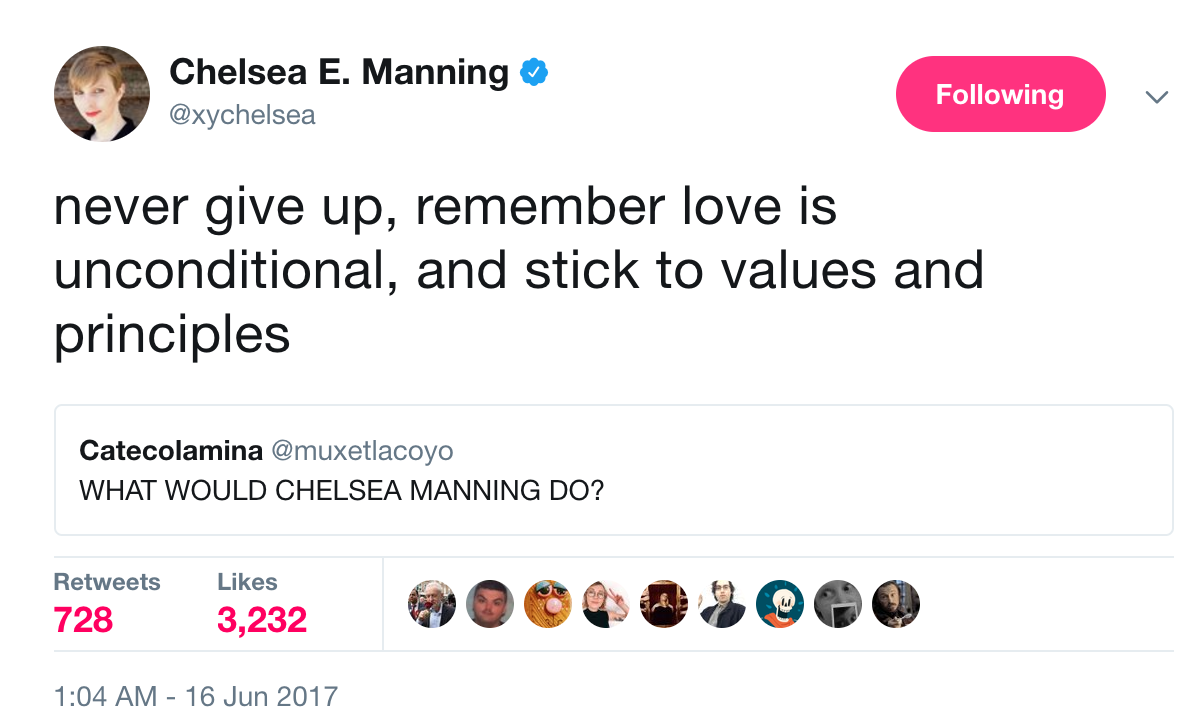
The internet is an increasingly nasty and dark place—the MAGA Nazis empowered by Trump's rise to power, leftists and liberals tearing one another apart, the nonstop stream of cyberbullying that's become so commonplace it feels mundane. But among the utter darkness of the Trump-era internet, Chelsea Manning is a beam of light.

via Twitter.

In 2010, Manning was detained by the US government for leaking hundreds of thousands of documents to WikiLeaks that, in many cases, exposed wrongdoing. (Critics said that these leaks put American lives at risk.) Obama commuted her harsh 35-year sentence—the most prison time ever given to a US government leaker—in April.

During her imprisonment, she came out as a trans woman, sued the military to get hormone therapy, was harassed by prison guards, got subjected to torture and months in solitary confinement, and survived two suicide attempts. When she was finally released in May, she sent her first Instagram: a picture of her pristine new Converse captioned "First steps of freedom!! .. #chelseaisfree."

More than almost anyone, Manning has reason to be angry, even bitter. Instead, untainted by the last seven years of online discourse, she exudes a sort of purity. She unapologetically posts about the music she likes (drum and bass), her love of video games, and her genuine excitement about finally being able to exist outside of a cell.

While Manning's whistleblowing has been lauded as heroic by many on the left, she remains controversial. When Obama announced he would commute her sentence, Trump called her an "ungrateful TRAITOR" on Twitter, while liberals like MSNBC's Joy Ann Reid have said her time in prison should be "unpleasant." After the New York Times published a profile of Manning, anti-Trump conservative John Podhoretz tweeted, "This is not a good person. This is a bad, narcissistic, destructive solipsist and the pardon was outrageous."

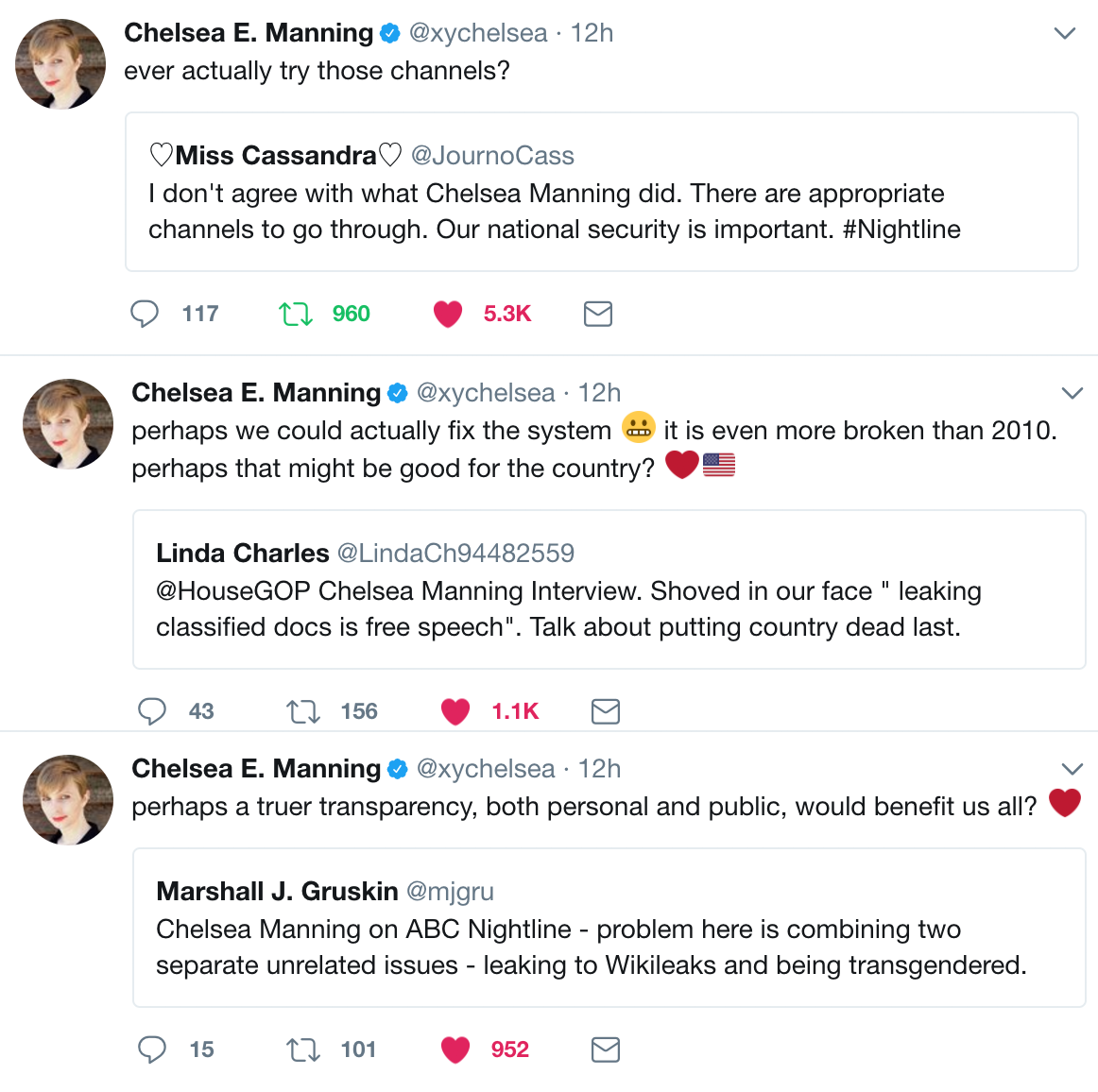
In short, Manning gets more shit online than you could possibly imagine, and also knows how to handle it with more grace than most. She is always kind, but that doesn't mean she isn't cutting. Why own the trolls when you can educate them?

via Twitter.

Maybe you're waiting for an aside on why this hopeful tone is actually problematic, or at the very least complicated. Sorry to disappoint. Manning seems to be that rare person who has evaded the usual internet cynicism—and that positivity is contagious. If Chelsea Manning can feel optimistic about a world that has wronged her so deeply, you can too.

Follow Eve Peyser on Twitter, but more important, follow Chelsea Manning on Twitter.

17 Jun 10:41

“Ojalá mi patio sirva de ejemplo para otros del Ensanche compostelano”

by Sandra Cuiña Santiago


17 Jun 10:31

At Last, a Handmaid’s Tale Just For Men - "They ruined Ghostbusters, and we didn't wake up then either."

by Kaila Hale-Stern

Bless everything about this pitch-perfect Funny or Die parody of The Handmaid’s Tale TV adaptation, which stars “Manfred.”

“I was asleep before,” Manfred tells us in the voiceover, in a comedic echo of the promotions Hulu ran featuring Elisabeth Moss’ Offred. “When they didn’t date us because of feminism, we didn’t wake up. They ruined Ghostbusters, and we didn’t wake up then either. And when they were being shrill bitches 24/7, we didn’t wake up. And now, we are Handmen. The feminazis own us … like more or less. My name is Manfred.”

The parody goes on to show a tongue-in-cheek dystopia for men where (gasp!) some women are included as senior VPs at the executive table (so that the old sexist jokes that thrived in an all-bro space are out). “All I said was that she looked like she could take a dick! It was a compliment!” Manfred’s colleague wails as he is dragged from the boardroom. “Handmen” are seen praising the “strong female protagonist” of a film they saw (it’s Wonder Woman) under brainwashed coercion.

“Men used to be respected,” Manfred laments. “I mean, we can still get wasted and eat tacos, but call feminism an ugly girl thing and it’s jail for you.” Then we see a female law enforcement officer using her baton to get him to stop manspreading. Interspersed with these scenes terrifying to men who are terrified of female equality are fake pull-quotes from the worst MRA hives on the Internet. “If you’re a men’s rights activist, you’ll be shaken to your strong, masculine core.” — thereturnofkings

There’s a “resistance” to be found on 4chan and reddit.com, one man tells another; his username there “lenadunhamhater69.”

“I just want to be able to say anything I want about women’s tits,” Manfred yells when confronted with the idea that women want to be seen as people.

This is all in good fun, of course, but the parody does a great job of driving home how ridiculous many of the “men’s rights” grievances are when contrasted with simple requests on the part of women for equality and bodily autonomy.

The total control exerted over women’s reproductive and personal lives in The Handmaid’s Tale, a fictional dystopia, feels more creepily real than the idea that we will ever be able to drag men off to jail for cracking sexist jokes. And there’s where this stops being funny. Still, comedy is often the best medium to expose the ridiculous cracks in the systems that we labor under, and I would gladly tune into The Handman’s Tale weekly on dudehulu.

(via Nerdist, image: screengrab)

Want more stories like this? Become a subscriber and support the site!

The Mary Sue has a strict comment policy that forbids, but is not limited to, personal insults toward anyone, hate speech, and trolling.—


17 Jun 10:27

Nerdy Relationships: Movies Vs. Real Life

by Zeon Santos

It's no surprise most movies made for geeks feature a nerdy relationship far too good to be true, since roping the audience into the storyline of a movie is a textbook tactic to make viewer's feel invested in the film.

But movies also reduce real life to black and white generalizations, so their portrayal of nerd culture makes us all seem like Sheldon from The Big Bang Theory, which is an insult to nerd diversity.

So illustrator JHALL created this cute comic strip to show all the ways the movies get nerd love wrong, from the epic Con adventures to the male chauvinist friends to the drama of moving in together.

-Via Dorkly

17 Jun 10:12

Syfy’s Blood Drive Is Disgusting and Over the Top, If You’re Into That

by Charline Jao

BloodDrive_gallery_101Recap_14

Syfy’s new grindhouse show Blood Drive has absolutely no subtlety or restraint in its deranged violence, and that’s kind of the point.

If you’ve caught any of the ads, clips, or social media posts for the new 13-episode series you’ll know that the show isn’t so much in-your-face as it is curb-stomping it into a flesh-eating car. The dystopian premise takes you into a world where cars run on human blood and we follow characters is a cross-country Death Race type competition, with our main protagonists being Arthur, a upright cop there against his will (Alan Ritchson) matched with a more experienced driver, Grace (Christina Ochoa). It’s a Blood Drive, get it?

The show proudly embraces the brutality of it all, and holds nothing back. Rivers of blood flow in every episode, where any and every taboo is absolutely exploited. Cannibalism, torture—you name it. While at face value this kind of “Oh, are you outraged? Is this too edgy?” attitude can come across as insufferable (they’ve gleefully set up a hotline for complaints), there’s a can’t-look-away element to the humor and sheer shamelessness of the show. It’s not for everyone and they’re totally fine with that. Still, there’s an emotional core to the story of particular drivers and as we progress, we start unlocking some backstories. You come for the wildness, and stay for the characters.

Seriously though, while I think all the promotional material makes it explicitly clear, please make sure you know what you’re getting into because I would strongly advise against springing Blood Drive on anyone who might be sensitive to violent images or assault. When you watch or follow the show on different platforms, there’s a kind of pact that occurs as viewers are referred to as sick freaks that rejoice in the disgustingness. That type of engagement isn’t really for me, but I know some who love participating in that kind of community. I don’t really have an issue with it, but I think you should know what you’re getting into before jumping on the Blood Drive train.

The nostalgia element is also particularly strong, which is exemplified in the package they sent us that included a VHS alongside some lollies (because of course Grace is always playfully eating candy) and chocolate. However, after that cannibalism episode I have to say I’m a little cautious? (P.S. does anyone have a VHS player I can borrow?)

Grindhouse fans will love @blooddrivesyfy in all its gory glory. PS does anyone have a VHS player we can borrow?

A post shared by The Mary Sue (@themarysue) on

There’s a lot of great television out there that in its elegant minimalism, nuanced commentary, and understated performances give us thoughtful examinations of the human condition. I love those shows, but there are times you just want to watch a show that includes lines like, “Have you seen gas prices lately?” with camp and full self-awareness. Are there definite political undertones to the ways the police literally collect teeth, a gigantic corporation exploits the poor, and people sell blood to survive?

Yeah, but sometimes you just wanna watch some Bad Dudes get blood-drived.

(image: Syfy)

Want more stories like this? Become a subscriber and support the site!

The Mary Sue has a strict comment policy that forbids, but is not limited to, personal insults toward anyone, hate speech, and trolling.—

17 Jun 10:11

Don’t Be Garbage: How to Navigate Social Media When You’re Miserable

by Mallory O'Meara

oscar

Editor’s note: This article originally appeared on Mallory O’Meara’s Tumblr, and is reposted here with permission.

It’s difficult to navigate social media when you are unhappy.

benedict

Consciously, you understand that most people put their best foot forward online, only showing the good things. They Instagram a cute picture with their significant other, tweet the success of their latest creative project, or post a video on Facebook of them in a bikini to show their weight loss. Sure, you know that other things in their lives might be awful, or those pictures might not tell the full story. But man, at least they’ve got something, right?

Maybe you’re unwillingly single, or struggling with your body image, or fighting for success in your field. Seeing these happy posts feels like daggers flung into your raw, lonely heart. You want to block these people, or comment with some passive aggressive snark. The raging, jealous part of you wants to kick over their sandcastle. Unfortunately, there’s no button for TOO HAPPY – SCREW YOU. There isn’t a separate internet for miserable fucks. We’ve all got to share the pool.

I’m estranged from my father. With Father’s Day coming up this weekend, my social media feeds are drenched in ads for Great Gifts For Dads and Cool Places To Take Your Awesome Father. I’m actually estranged from both of my parents, which brings an inevitable sting to most holidays, but the specific ones really twist the knife. This coming Sunday, my Instagram will be flooded with pictures of people with their loving fathers. My Facebook feed will be covered with tributes to supportive dads.

A part of me will wince at every post. A part of me will want to tweet something snarky and bitter about Father’s Day. It’s the same part of me that, when friends complain about their dads being too corny or overbearing or clingy, wants to scream AT LEAST YOU HAVE ONE and throw them into an erupting volcano. This part of me is valid. It’s also a tiny garbage person.

No one should ever, ever be made to feel bad for being happy. If I am bitchy to a friend complaining about their father, I am not going to be magically assigned a new dad. If you take happiness away from someone, you don’t get that happiness. Joy and success are not footballs. If someone fumbles with their joy, you can’t grab it and sprint away. It’s unique to them and dissipates as soon as it leaves their grasp.

Your pain and frustration is valid. It’s also like a fart. It’s okay that it’s there, but it’s not acceptable to aim it at someone.

Bitterness and resentment accomplish nothing. The pain and frustration in your life might not be any fault of your own. But it probably isn’t any fault of your friend’s, either. No matter what has happened to you, even beyond your control, the onus is on you to do something about it. The only thing that’ll truly help is doing the work. That could take the form of self care, working out, or putting more effort into your career. Whatever it is, it’s your job to do it. Instead of spewing anger at people with great families, I go to therapy every week and learn how to manage and move forward.

Thwart that tiny garbage person and use social media to be genuine and honest about your problems. Being open online about my own issues and receiving support from people going through the same things has been one of the most cathartic experiences of my life. To do that, you’ve got to accept that happiness and success are not zero sum games. You don’t get to where you want to go on the highway by asking everyone else to slow down.

The only real option is to deal with your shit. Spend the time and effort you’d put into a bitchy subtweet and do something for yourself instead. If you need to, take a social media break. Sunday, I’ll be spending the day power-reading and eating sandwiches, which is how I handle almost everything.

4124c

Once you start to climb on top of that mountain of pain instead of languishing underneath it, you’ll be able to see past it. You’ll be able to see your friends’ successes and joys as inspiration, or as something to learn from. Or, just something that is fucking great. If you honestly care about someone, their happiness should make you happy, too.

We’ve all got that tiny garbage person inside of us. Don’t let them out. Dimming someone else’s shine won’t make you glow brighter.

(images: Sesame Street)

Mallory O’Meara is an author, screenwriter and producer for Dark Dunes Productions. She also co-hosts the podcast Reading Glasses, a weekly show hosted by Maximum Fun that focuses on book culture and reader life. She lives in Los Angeles. Her first book, The Lady From The Black Lagoon, is being published by Hanover Square Press. @malloryomeara

Want more stories like this? Become a subscriber and support the site!

The Mary Sue has a strict comment policy that forbids, but is not limited to, personal insults toward anyone, hate speech, and trolling.—

16 Jun 14:31

O Banco de España dá por perdidos 8 de cada 10 euros destinados a resgatar a banca

by Redacción
Cifra en 77.000 millóns de euros o diñeiro destinado a salvar a banca e asume que 60.000 millóns non se recuperarán.
16 Jun 14:31

This robot crawls up your butt to examine your colon

by David Pescovitz

A colonoscopy is a very unpleasant selfie. The medical procedure involves having a long, thin, flexible camera inserted up your rectum and into your large intestine to look for ulcers, polyps, and tumors. Nobody looks forward to this. To improve the process, researchers at the University of Colorado, Boulder's Advanced Medical Technologies Laboratory designed a worm-like soft robot that employs a wavelike motion, similar to the way the bowel moves, to make its way up your large intestine. From their research abstract:

Traditional colonoscopy requires highly trained personnel to be performed. Additionally, current devices may cause discomfort and carry the risk of perforating the bowel wall. In this paper, a soft three modular section robot is designed, modeled, controlled and tested. Each of the robotic sections has three degrees of freedom, one translation and two rotations. The robot uses a peristaltic motion to translate, inspired by the motion generated by the bowel.

The robot uses nine independently controlled Shape Memory Alloy (SMA) springs as its actuators and a novel silicone rubber skin provides the passive recovery force to expand the springs to their original state. It also incorporates three air tubes, one for each section, to provide forced convection reducing the cooling time of the SMA springs.

16 Jun 14:28

New cast.

by Ryan
16 Jun 14:27

Retirada e resistencia nos centros sociais da Coruña

by ERIK DOBAÑO
Os movementos cidadáns da Coruña máis afastados da Marea retroceden aos centros sociais en medio dunha campaña de desprestixio desde a prensa local e os ataques do PP que os utilizan como arma contra o goberno...
16 Jun 14:21

Today is the anniversary of the first woman in space

by David Pescovitz

On June 16, 1963, Soviet cosmonaut Valentina Tereshkova became the first woman in space. She orbited the Earth 48 times over a period of three days. Inspired by Yuri Gagarin who in 1961 became the first person in space, Tereshkova applied to the Russian space program and was accepted based on her extensive background as a skydiver. It wasn't until 40 years later that Tereshkova's nearly tragic experience in orbit was made public.

An error in the spacecraft's automatic navigation software caused the ship to move away from Earth. Tereshkova noticed this and Soviet scientists quickly developed a new landing algorithm. Tereshkova landed safely but received a bruise on her face.

She landed in the Altay region near today's Kazakhstan-Mongolia-China border. Villagers helped Tereshkova out of her spacesuit and asked her to join them for dinner. She accepted, and was later reprimanded for violating the rules and not undergoing medical tests first.

Valentina Tereshkova: First Woman in Space (Space.com)

16 Jun 14:19

Painful Sex Nearly Destroyed My Relationship

by Stephanie Auteri

I remember being surprised by the complete absence of pain the first time I had sex. After all, there is an assumption among women that the first time will always be painful. Awkward. Ugly.

Though my first time was, indeed, ugly—in that it was coercive and I wasn't ready and I cried afterward and he didn't care—that first instant of penetration was so unremarkable as to seem like an accident. Like oh, your penis has accidentally slipped into my vagina. Why don't we do something about that?

Sex remained painless for the next several years, well into the beginning of my relationship with the man I would eventually marry. Until suddenly, inexplicably, it wasn't painless anymore. What followed were years in which I would come to wince my way through sex, clenching my teeth, tensing my muscles, squeezing my thighs together. Then, once he slipped in, I would experience a sharp, jagged pain that ripped me apart.

I did this—continued to have painful sex—because I felt obligated. After all, if I didn't let the man I most cared about into my pants, how could he ever love me? Why would he ever want to stay?
Still, when this pain persisted, I finally told my gynecologist, hoping she could give me a definitive answer, hoping she would say to me: This is what is wrong with you. This is how you can fix it. But she told me she couldn't see or feel anything wrong. And though she gave me a prescription for a transabdominal ultrasound, she also suggested it was more likely a psychological issue. When the ultrasound tech also failed to find anything amiss, I finally had to accept that my brain was the problem. I went to see a psychologist.

And this was much the way of things back in the day. According to Talli Rosenbaum—a certified sex therapist, couples' therapist, and well-known expert in the treatment of what are now known as sexual, or genital, pain disorders—the ideology around sexual pain, until fairly recently, was that it was either physical or psychological.

Recent research has blown all of this to hell, and it is now becoming understood that genital, vulvar, and pelvic floor pain are biopsychosocial issues. What this means is that this pain can be attributed to biological factors, psychological factors, social factors, or some combination thereof. There might be an STI at play. There might be skin cancer. There might be a neurological disorder. And at the same time, there could a troubled relationship. Or post-traumatic stress. Or anxiety and depression.


More From Tonic:


But merely understanding doesn't make it any easier to live with. Before I learned about the complexity of sexual pain, all I knew was that painful sex was wreaking havoc on my marriage. Not wanting to get busy because the sex is bad is one thing. But painful sex with no discernible cause is a bit more slippery. When a recent study showed that sexual pain adversely affects sexual response, my reaction was basically: No shit, Sherlock. Still, the study was a confirmation of what I had been through. It was a validation of my own experience, and of my reaction to it.

When I had been grappling with sexual pain, my avoidance of sex made my husband feel rejected. Undesirable. I, meanwhile, felt an immense pressure to provide my husband with the sexual release I felt he deserved from me. But that pressure only seemed to make the pain worse, and so I pushed him away. And then I felt guilty for pushing him away. And then I felt resentful that I was being made to feel guilty.

It was a nauseating mix of emotions. And Rosenbaum says that the ways in which a woman's partner reacts to her pain can be just as important as the way in which a woman reacts to her own pain. "It is important to explore how a couple communicates with one another about their feelings," she says, "and if they are able to contain and provide empathy, rather than attribute blame.

Often, there's a dynamic where the partner pulls away, withdrawing all affection to avoid rejection, or a woman with pain avoids hugs or other physical intimacy, for fear it will "lead to" sex. Deborah Coady, gynecologist and co-author of Healing Painful Sex (a book I pored through carefully when I was focused on "fixing" myself) echoes Rosenbaum's comments on this relational dynamic. "Even in a long-term relationship," Coady says, "there can be a sense of isolation and withdrawal that is not just about the sex, but is about intimacy in general—like when you touch something hot."

And when the one who is experiencing the pain pushes through it out of a sense of obligation? "Women often are extremely motivated to allow intercourse to occur and to engage in intercourse despite pain, due to societal messages that sexual activity is expected to culminate in intercourse," Rosenbaum says. "Feelings of obligation, guilt, and a pressure to please their partner turn sex into a chore that must be fulfilled. A lot of anxiety is created around that need to succeed."

In cases such as this, "muscles contract as part of a defensive, fight-or-flight response to what feels threatening," Rosenbaum explains. "Telling women to just relax," she says, "is like telling a person to stand in the middle of the street when a car is coming."

Seven years ago, my husband and I decided we were ready to start a family. As eager as I was to be a mother, the knowledge that I'd have to have more frequent sex during times of ovulation—despite my enduring pain—terrified me. When we struggled to conceive—weeks spinning out into months spinning out into years—our troubled sexual dynamic was only magnified. Because of all of this, our marriage faltered.

I started taking yoga classes at a nearby studio, partially to get a nice ass, but also partially to get the hell out of a home where I felt I was walking on eggshells. I became hooked when I saw how the practice helped my stress, anxiety, and depression, and was soon taking four to six classes a week. Over time, I began to cultivate a body awareness I hadn't previously had. This enabled me to more easily relax my muscles during sexual activity, bypassing their normal, fight-or-flight response.

Psychologist Lori Brotto has been studying the usefulness of mindfulness exercises in the treatment of various sexual dysfunctions for years, and Rosenbaum herself also contributed to a paper on using a mindfulness-based approach in the treatment of sexual pain and anxiety. Practicing mindfulness—an essential aspect of yoga—forces one to focus on their breath, their body sensations, and their thoughts without judgment. In the context of sex, it can help the practitioner become more attuned to their body's sexual response, and more accepting of their body's physical limitations.

Perhaps because of this—and because of our increased, babymaking-related sexual frequency—one day, I realized sex wasn't painful anymore. The pain that had been a source of mental and physical anguish for years stopped without my even noticing.

My experience isn't typical. But with so many possible contributors to sexual pain, I don't know that anyone's is. The one thing I can say without hesitation is that, while sex can hurt, it shouldn't. And while the route to managing or eliminating sexual pain can be a circuitous one, it's well worth following.

Read This More: The Complicated Relationship Between Sex and Masturbation

16 Jun 14:17

‘Yes that’s right, punk is DEAD’: Crass and other punk AF fidget spinners


Do they owe us a spinning? Of course they fucking do! Crass logo fidget spinner. The final death knell of capital P, capital R, Punk Rock?

As fidget spinners are the latest inexplicable toy fad, the popularity of which most adults find absolutely confounding, I posted a couple of weeks ago...

16 Jun 09:59

Granados denuncia que en las cárceles ‘es muy difícil ir a Misa’

by INFOVATICANA

El político, que se confiesa católico, considera que la culpa es repartida entre Instituciones Penitenciarias y la Conferencia Episcopal.

El exconsejero madrileño Francisco Granados salió este miércoles de la prisión de Estremera tras 31 meses encarcelado por el caso Púnica.

En una entrevista concedida a OK Diario, Granados habla del período que ha pasado en prisión, de cómo le ha cambiado la vida en la cárcel y también de las dificultades que ha encontrado para poder ir a misa.

“Soy creyente, la fe me ha ayudado bastante”, asegura en esta entrevista, al tiempo que confiesa que durante los meses en prisión ha “rezado mucho”.

El exconsejero ha dirigido una crítica a Instituciones Penitenciarias porque “es muy difícil ir a misa, pero es muy fácil hacer el Ramadán y practicar otras religiones”. Explica que no ha podido ir a misa el domingo y considera que “hay culpa compartida entre Instituciones Penitenciarias y la Conferencia Episcopal, quizá porque no hay sacerdotes suficientes”.

Granados también habla de cómo la vida en la cárcel le ha cambiado: “He cultivado la humildad, la política te cambia, ahora soy mejor persona. Me ha permitido ver el mundo de otra manera y valorar las cosas que son más importantes.”

La entrada Granados denuncia que en las cárceles ‘es muy difícil ir a Misa’ aparece primero en Infovaticana.

16 Jun 09:56

Froilán, coronado como soltero de oro de Europa

El sobrino del rey Felipe forma parte de una extensa lista elaborada por la publicación 'Point de Vue'. Se refieren a él como un joven al que le gustan las discotecas. No es el único español deseado de 2017. 

16 Jun 09:04

The 15 Guys You’ll Only Date Two Of in Your 20s Because You Don’t Date That Many Guys

by Editor

Your 20s are the perfect time to experiment. You can change you hair, your career, or your man to discover what is most authentically you. After all, dating lots of different types of dudes is the only tried and true way to figure out what really works for you in the relationship department – plus, it’s fun! Alternatively, you can date almost no one in your 20s because that’s just how you are and it’s actually really hard to meet good men in your 20s. No judgment! Here are 15 guys you’ll only date two of your 20s because you don’t date that many guys.


The Barista

A man who can rock your world and make you a deliciously strong cup of Joe! This free spirit with a job that’s not quite a real job is the quintessential guy that you would date in your 20s if you dated more guys in your 20s, which you won’t because that’s crazy.


The Guy In His 30s

When a guy who’s firmly in his thirties dates a woman in her early 20s, it definitely raises some red flags. Luckily for you, those flags can stay down because you will not date this guy. Look at you, avoiding creeps as if you’re some sort of woman who just doesn’t date that much! Honestly, 15 guys is a lot of guys!


The Finance Bro

Woof. This guy pronounces “finance” the British way, which is one of the many reasons you will not date him in your 20s, although you could if you dated more guys, which some girls do.


The Kind and Thin Nerd

Aw! A kind thin nerd makes a great boyfriend and guess what – you will date him! He’s one of two guys you will date in your 20s because to be honest you’re more of a long-term relationship kind of gal, except for when you’re single which is when you become completely and uncontrollably celibate!


The Overly-Protective Guy

Sometimes it’s nice to feel protected by a big strong man, but when he’s overly protective it can get old real fast. In your case, you’re the one doing the protecting by protecting yourself from this dude. He kind of reminds us of the one boyfriend you’ll have when you’re 25 though.


The Guy Who Calls You “Dude”

We’ve all dated or hooked up with a guy like this! Except for you because you’re just kind of busy right now focusing on your career and your family, etc. The truth is, this guy sucks! But you wouldn’t know that because you didn’t date him, you dated the guy who’s kind of like the other guy but not quite.


The High Maintenance Hipster

This is the guy who takes longer to get ready than you do. He cares a ton about his looks, owns a tweed jacket, and you will not date him in your 20s because you just don’t really date that much and you DEFINITELY don’t date hipsters, even if one wanted to date you!


The High-Powered CEO

This guy is young, successful, and not your boyfriend. You didn’t date him because you never met — you don’t get out much. And when you do, it’s not to places where a 24-year-old startup wunderkind goes to schmooze, obviously.


The Standup

Ok, yup, this is the other guy on this list you will date. Ugh. For someone who’s picky about dates, you really picked a dud here. Congrats.


The Male Feminist

Being a feminist is a good thing. But if you have to qualify with the word “male” then maybe you’re a bad person? You’ll come really close to dating this sensitive, woke, white man.


The College Freshman

There’s something sexy in a forbidden way about dating a younger man. But seeing as you don’t date a lot of guys, you’re not going to waste any time on a 19 year Econ major.


The TA

Every college woman gets hit on by a TA, it’s just a fact! But only some women date them. Not you, you don’t date a lot of guys, and you won’t date your TA. Or anybody else’s TA, or even just a guy who was a TA!


The Guy Who Looooooves Kids!

At first it’s so adorable how much this guy loves kids. But eventually it’s like, come on dude, you’re 24. Either way, you’re not gonna date this guy!


The Bad Guy

You will definitely not date this mysterious James Dean wannabe.


The One Who Was In Front Of You The Whole Time

Sometime we get so distracted by the crazy world around us that we miss the guy that was front of us the whole time. That’s why you date that standup instead of your nice friend who is literally in love with you.


There they are! The 15 guys you will totally date 2 of in your 20s because frankly, finding one man to date is exhausting. But that’s ok! You do you, and stay away from stand-ups!

16 Jun 08:59

Archaeologists Discover Fully Intact 17th-Century Belief System In Ohio Congressman

COLUMBUS, OH—Marveling at how well preserved the archaic opinions were, a team of archaeologists from the Smithsonian Institution announced Thursday the discovery of a fully intact 17th-century belief system in Ohio congressman Jim Jordan (R-OH). “It’s just extraordinary to come across a perspective that dates back to the the mid-1600s and shows absolutely no signs of decay,” said Dr. Claire Goedde, explaining that while it’s not uncommon to encounter partial remains of convictions from that era, it’s exceedingly rare to recover a specimen this pristine. “All the 400-year-old viewpoints remain almost completely untouched, from religion’s place in society to the rights of women to the attitude toward science. I can only imagine the insights this single sample will provide as to how people who lived centuries ago saw the world around them.” Goedde added, however, that the congressman’s belief system was fragile even in ...

16 Jun 08:52

Os Cangaceiros, los legendarios bandidos que fotografió Benjamin Botto

by Charles de Batz

Los cangaceiros eran temidos en todo Brasil. Nadie los había podido fotografiar y menos aún filmar. Hasta que llegó Benjamin Botto...

Las fotografías e imágenes que tomó Benjamin Botto son a día de hoy uno de los más valiosos testimonios gráficos que hay sobre los bandidos rurales del nordeste del Brasil conocidos como cangaceiros, en la época de liderazgo indiscutible de Virgulino Ferreira da Silva, «Lampião», entre 1926 e 1938. Benjamin Abrahão Botto huyó de su Líbano natal para no combatir en la Primera Guerra Mundial. Aunque su destino original eran los Estados Unidos, terminó por instalarse en Brasil, donde se buscó la vida como vendedor ambulante de telas, alimentos y todo aquello que pudiera pasar por sus manos. En uno de sus viajes a Juazeiro do Norte, un municipio del estado de Ceará, conoció al padre Cicero, un anciano religioso a quien consideraban santo los numerosos peregrinos que acudían a verle de todos los lugares del Nordeste del país. Botto ganó su simpatía y confianza contándole que era originario de Belén, Palestina, el lugar de nacimiento de Jesucristo, y pronto descubrió que junto a este hombre de religión venerado por los cangaceiros de la región, le aguardaba un próspero futuro.

El padre Cicero junto a su secretario Botto

El padre Cicero junto a su secretario Botto

El padre Cicero consintió en hacerse esta fotografía con su secretario Botto para hacer público su perdón, y terminar con los rumores que hablaban de su expulsión, tras descubrirse que se había llenado los bolsillos vendiendo fraudulentamente recuerdos y joyería religiosa de su mentor.

«Tras una costosa negociación con el líder de los cangaceiros, Benjamin Botto consigue en 1936 hacerse esta foto dando la mano a Lampião. Cuentan que con ella, el fotógrafo quiso despejar la desconfianza del líder de los bandidos, poniéndose ante el objetivo de la cámara para demostrar que no se trataba de ninguna trampa»

Al morir Cicero, Botto volvió a las andadas e intentó mantener su nivel de ingresos vendiendo a precio de oro mechones de pelo del difunto, fragmentos de su sotana y otras reliquias… Pero cuando vio que el negocio no daba más de sí, pensó en aprovechar el haber conocido de mano de su protector a Lampião, el famoso jefe de los cangaceiros, para hacer algo al respecto... Llegó a un acuerdo con Ademar Bezerra de Albuquerque, propietario de ABA-FILM, para que este le proporcionara material fotográfico y de filmación, comprometiéndose a obtener imágenes hasta entonces nunca vistas de aquellos bandidos. Estaba seguro de que se venderían muy bien a la prensa y las salas cinematográficas.

Botto estrecha la mano del legendario Lampiao

Botto estrecha la mano del legendario Lampiao

Tras una costosa negociación con el líder de los cangaceiros, Benjamin Botto consigue en 1936 hacerse esta foto dando la mano a Lampião. Cuentan que con ella, el fotógrafo quiso despejar la desconfianza del líder de los bandidos, poniéndose ante el objetivo de la cámara para demostrar que no se trataba de ninguna trampa.

Los cangaceiros que conoció Botto formaban un grupo compacto y disciplinado alrededor de su líder, Virgulino Ferreira da Silva «Lampião». Muchos aseguran que el motivo de su ingreso en al Cangaço fue el deseo de venganza por la muerte de su padre. El caso es que durante casi tres décadas vagando por el nordeste del Brasil, Virgulino sembró el terror y la muerte allá por donde pasaba. El fracaso de las operaciones preparadas para capturarlo y las recompensas ofrecidas a quien lo matase, solo consiguieron aumentar su fama.

María Bonita, en el centro de la imagen, junto a Lampiao

María Bonita, en el centro de la imagen, junto a Lampiao

María Gomes de Oliveira, conocida como Maria Bonita, abandonó a su primer marido para unirse a los cangaceiros y acompañar a Lampião durante los ocho años siguientes. A lo largo de ese tiempo participó en todas las acciones de sus compañeros, resultando herida solo una vez. Llegó a ser considerada como «la reina de los Cangaceiros». Todo terminó a las cuatro de la mañana del 28 de julio de 1938, cuando Lampião y otros diez cangaceiros murieron tras caer en una emboscada. María Bonita fue atrapada con ellos aún viva y degollada en aquel mismo lugar.

Cristino Gomes da Silva Cleto, alias «Corisco»

Cristino Gomes da Silva Cleto, alias «Corisco»

Cristino Gomes da Silva Cleto, «Corisco», segundo hombre más importante del Cangaço, era también conocido como el «Diabo Loiro» —Diablo Rubio—, debido a lo llamativo de su cabello claro y su porte físico atlético. En 1940, un año después de la caída de Lampião, murió junto a su mujer Dadá en una emboscada en Fazenda Pacheco. La muerte de Corisco es considerada el fin del ciclo general del cangaço. Corisco fue enterrado en Bahía. Después de algunos días su sepultura fue asaltada, el cadáver exhumado, y sus restos mortales aparecieron expuestos en el Museo Nina Rodrigues junto a las cabezas de Lampião y Maria Bonita, donde permanecerían durante cerca de 30 años.

Sergia Ribeiro da Silva, alias «Dada», junto a Corisco

Sergia Ribeiro da Silva, alias «Dada», junto a Corisco

Sergia Ribeiro da Silva, «Dada», fue secuestrada por Corisco cuando tenía trece años. Él le enseño a leer, escribir y usar armas, creándose un vínculo afectivo que les mantuvo unidos hasta el día de la muerte de Corisco. Aunque en aquella emboscada perdió una pierna como resultado de una herida de bala mal curada, Dada sobrevivió largos años, hasta 1994. Durante toda su vida luchó tanto por el respeto a los restos de sus compañeros, que durante mucho tiempo fueron expuestos como objetos de feria en un museo,  como por los derechos de los más desfavorecidos.

En una de las escenas del documental Lampião, O rei do cangaço, que filmó Benjamin Botto, una mujer camina entre sus compañeros en dirección a la cámara, haciendo entre risas que apuntan a ella dispuesta a disparar. Esta mujer se hacía llamar Durvinha y es quizá a la que esperó un futuro más sorprendente. Ella y su marido, conocido como Moreno, consiguieron huir de las sucesivas emboscadas que tendieron a la agonizante cangaça, permaneciendo ocultos durante varios años, hasta que salieron a la luz con identidades falsas. Vivieron así, sin contar la verdad ni a sus propios hijos y nietos hasta el 2005. Un año después participaron en la filmación de un documental dedicado a los cangaçeiros dirigido por Wolney Oliveira.

Como puede observarse en la fotografía, los hombres usaban sus característicos sombreros en forma de media luna, adornados con monedas de oro y plata, una especie de pantalón ancho y colgaban de sus hombros dos alforjas bordadas con coloridos adornos. Las mujeres se cubrían con gruesos vestidos llenos de bolsillos, ataban un pañuelo al cuello y con otro cubrían su cabeza bajo el sombrero. Durante el tiempo que pasó entre los cangaceiros, Benjamin Abrahão Botto pudo hacer cerca de 70 fotos y una película, que tuvieron gran éxito, y se reprodujeron en los principales periódicos brasileños de la época. Pero la alegría no le iba a durar mucho: en 1936, la dictadura del Estado Novo secuestró la mayor parte de sus imágenes, así como de la filmación. Muchos originales desaparecieron entonces, y del documental, que durante mucho tiempo se dio por perdido, pudieron recuperarse hace algunos años alrededor de 11 minutos.

El 9 de mayo de 1938, dos meses antes de la muerte de Lampião, Botto apareció asesinado con 42 puñaladas, sin que se llegara averiguar ni la autoría ni el motivo del crimen.


16 Jun 08:51

Si naciste después de 1990, no podrás sacar más de 10 en este test de logos

by Alfredo Murillo

Cuando veas las repuestas solo vas a poder exclamar “¡mierda! ¿cómo no me he acordado?”.

BuzzFeed

16 Jun 08:49

La meditación también tiene efectos negativos, y muy chungos

by Esteban Ordóñez Chillarón

Haz yoga. Te hace falta relajarte. El taichí te arregla el chasis y la mente. Medita. Lo ves todo con más claridad. Cambias de perspectiva. Como toda buena nueva, la meditación se vende revestida de valores incuestionablemente positivos. Sin embargo, como cuenta un estudio publicado en PLOS One esta práctica provoca, a veces, efectos perturbadores […]

Este post La meditación también tiene efectos negativos, y muy chungos, escrito por Esteban Ordóñez Chillarón, se publicó originalmente en Yorokobu.

15 Jun 05:06

Modern Strike Online Review: Portable FPS Perfection

by Nik Ives-Allison
Modern Strike Online Banner

Truly excellent mobile first-person shooters are rare. Thus, iOS users should rejoice that the richest first person shooter experience on mobile has finally arrived on the App Store. Over the last year and a half Modern Strike Online has quietly offered Android users the best-looking, smoothest running and most engaging FPS experience ever for mobile. In return, those who found the game have provided the critical mass needed to ensure that neither rookie nor pro is left waiting for a game that’s both fair and challenging.

Now that it’s available for iOS, Modern Strike Online has the ability to up the ante in terms of what iOS users can (and should) expect from multiplayer mobile FPS shooters from here on in. However, to make a real impact, it needs to find the audience needed to support and sustain the gameplay experience currently available on Android. That’s going to be difficult to do if issues with server stability that have been leading to players being kicked out of games prematurely or waiting whole rounds with no one to play against aren’t cleared up.

Fortunately, the quiet launch approach means that there just might be enough time to secure stability before a critical mass of players descends on the game. Even better, it seems as though the game’s mysterious developers are already taking the issue seriously with things getting noticeably better over the last week. With that in mind, the bulk of this review will be based on our experiences with Modern Strike Online prior to its iOS launch, but the gist is the same for players on both devices apart from the server issues.

Modern Strike Online Team Play

What can players expect from Modern Strike Online? First, and perhaps most importantly, quality matchmaking. In an era where many free-to-play shooters leave you feeling as though there’s no way to win without dropping hundreds of dollars into top-line weaponry, Modern Strike Online’s matching system means that almost always you’re facing off against players that are truly a good fit with your skills, experience and assets. After at least 18 months of consistent Android play, there’s ever only been a handful of total blowouts – and this is coming from someone that can’t last more than 90 seconds without accidentally blowing themselves up in Halo.

Beyond the matchmaking, there’s the game’s intuitive touch controls that reflect the strengths and limitations of a touch screen. Modern Strike uses autofire by default, giving a big boost to players who might not be the strongest shooters. Still, it also allows players to use manual fire, thereby appeasing FPS sharpshooters. The aim function does improve accuracy considerably, especially for those looking to rack up headshots specifically — though it’s still possible to get by without it if moving, looking and trying to avoid enemies is already a bit overwhelming.

Modern Strike Online Kill

There isn’t a vast array of maps in Modern Strike Online, but rather than making the game feel boring and repetitive, it’s something that works really well. As quickly as you can get a lay of the land, there’s always new hiding spots and routes through the map to discover. This helps speed up progression and with certain equipment and game modes only becoming accessible after you reach a certain level, hitting level 10 quickly is something you’ll almost certainly want to do.

What the game lacks in terms of a glut of maps, it makes up for in terms of different types of game modes. There’s the common team and everyone for themselves deathmatch scenarios of course, but unlike many mobile FPS games, Modern Strike Online certainly doesn’t stop there. Make it to level 10 and you’ll also be able to play Bomb Mode (unlocks at level 8), Team Squad (unlocks at level 8), Team Battle, Hardcore and Custom Games (designed for playing with friends).

Modern Strike Online Menu

This array of game modes is complimented by an almost dizzying selection of weapons, customizations and armor. As a free-to-play game, if you want to buy the best weapons on offer it’s going to cost you as you’ll either need to quit your job to play full time or splash out a bit of cash, and this is where Modern Strike Online draws much of its criticism.

However, there are a few things to consider here. Firstly, it is totally possible to have an amazing experience without spending a dime. Secondly, battle chests, reward points and the gold you’ll naturally accumulate mean that you’ll often that the ability to play with top-grade weaponry on a rental basis. Thirdly, the matching system means you’ll almost always be playing against people packing similar firepower. Finally, Modern Strike Online at its best offers an experience that rivals most console FPS games for free. The occasional in-app purchase sends a message to the developers that you appreciate the effort that goes into a game of this scale and makes future improvements (maps, server capacity, game modes) possible.

Modern Strike Online Enemy Attack

It’s also worth noting that Modern Strike Online doesn’t use a limited energy model. Most of the time this is great. Sometimes less so, because there’s a persistent likelihood that you’ll log in for one game and lose an entire night if there’s no external force making you stop. To call a game ‘addicting’ has become something of a cliché, but in this case it’s the most accurate descriptor.

If you’re interested in either the first-person shooter genre or high quality mobile games of any genre, Modern Strike Online is a rare must play. It might play better on Android than iOS right now, but that almost certainly won’t be the case for long. Even with its server issues, Modern Strike Online for iOS threatens to blow other mobile FPS shooters straight out of the water.

The post Modern Strike Online Review: Portable FPS Perfection appeared first on Gamezebo.