23 Oct 12:49
by Xin Liu, Xianliang Wang and Mark T. Swihart

Chemistry of Materials
DOI: 10.1021/cm402848k

23 Oct 09:02
by Hao Zhang, Jae Sung Son, Jaeyoung Jang, Jong-Soo Lee, Wee-Liat Ong, Jonathan A. Malen and Dmitri V. Talapin

ACS Nano
DOI: 10.1021/nn404692s

22 Oct 10:22
by Jun Pan, Ala’a O. El-Ballouli, Lisa Rollny, Oleksandr Voznyy, Victor M. Burlakov, Alain Goriely, Edward H. Sargent and Osman M. Bakr

ACS Nano
DOI: 10.1021/nn404397d

21 Oct 12:39
J. Mater. Chem. C, 2013, Accepted Manuscript
DOI: 10.1039/C3TC31699H, Paper
Seungho Cho, Seong Cheol Hong, Sungjee Kim
Near-infrared (NIR)-emitting PbS-based quantum dots (QDs) and exfoliated layered double hydroxide (LDH) nanosheets are self-assembled to form photostable composites for NIR-emitting codes. PbS QDs prepared by a pyrolysis synthetic method...
The content of this RSS Feed (c) The Royal Society of Chemistry
21 Oct 09:34
by Min-Seok Kim and Yun-Mo Sung

Chemistry of Materials
DOI: 10.1021/cm4015018

21 Oct 09:33
Nanoscale, 2013, Accepted Manuscript
DOI: 10.1039/C3NR04461K, Paper
Liang Tao, Yan Xiong, Hong Liu, Wenzhong Shen
Quantum dot sensitized solar cells (QDSSCs) have been attractive photovoltaic devices due to their simplicity and low material requirements. However, the efforts to realize high efficiency in QDSSCs have often...
The content of this RSS Feed (c) The Royal Society of Chemistry

18 Oct 16:00
by Alex Carrete, Alexey Shavel, Xavier Fontané, Joana Montserrat, Jiandong Fan, Maria Ibáñez, Edgardo Saucedo, Alejandro Pérez-Rodríguez and Andreu Cabot

Journal of the American Chemical Society
DOI: 10.1021/ja4068639

17 Oct 08:50
Chem. Soc. Rev., 2013, Advance Article
DOI: 10.1039/C3CS60290G, Tutorial Review
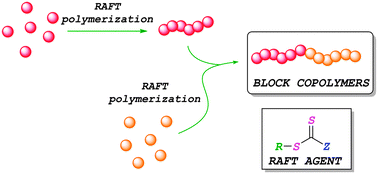
Daniel J. Keddie
This tutorial review addresses several key concepts that are critical for the synthesis of well-defined block copolymers via RAFT polymerization.
To cite this article before page numbers are assigned, use the DOI form of citation above.
The content of this RSS Feed (c) The Royal Society of Chemistry

15 Oct 19:04
J. Mater. Chem. B, 2013, 1,6254-6260
DOI: 10.1039/C3TB21197E, Paper
Tracey D. Bradshaw, Marc Junor, Amalia Patane, Phil Clarke, Neil R. Thomas, Mei Li, Stephen Mann, Lyudmila Turyanska
Apoferritin-PbS nanoparticles with near-infrared fluorescence and antitumor activity in colorectal carcinoma cells are well tolerated in vivo by mice.
The content of this RSS Feed (c) The Royal Society of Chemistry
15 Oct 15:26
Chem. Soc. Rev., 2013, Advance Article
DOI: 10.1039/C3CS60209E, Review Article
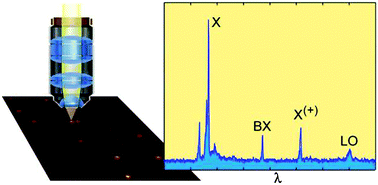
Mark J. Fernee, Philippe Tamarat, Brahim Lounis
Spectroscopic studies of single nanocrystals have been instrumental in unraveling their complex photo-physics.
To cite this article before page numbers are assigned, use the DOI form of citation above.
The content of this RSS Feed (c) The Royal Society of Chemistry

15 Oct 08:51
Nanoscale, 2013, Accepted Manuscript
DOI: 10.1039/C3NR04628A, Review Article
Peng Wu , Ting Zhao, Shanling Wang, Xiandeng Hou
Semiconductor quantum dots (QDs) exhibit unique optical and photophysical properties that offer significant advantages over organic dyes as optical labels for chemo/bio-sensing. This review addresses the methods for metal ion...
The content of this RSS Feed (c) The Royal Society of Chemistry

14 Oct 17:13
by James R. McKone, Nathan S. Lewis and Harry B. Gray

Chemistry of Materials
DOI: 10.1021/cm4021518

11 Oct 08:50
by Zuohe Wang, Wing Yan Lam and Robert Pelton

Langmuir
DOI: 10.1021/la403229g

11 Oct 08:48
J. Mater. Chem. C, 2013, 1,7914-7919
DOI: 10.1039/C3TC31758G, Paper
Xin Yan, Xia Zhang, Xiaomin Ren, Junshuai Li, Jiangong Cui, Liang Li, Sijia Wang, Qi Wang, Yongqing Huang
Stranski-Krastanow InAs quantum dots are realized on nanowire-based InGaAs nanoshells and the structural and optical properties are studied.
The content of this RSS Feed (c) The Royal Society of Chemistry
26 Sep 10:15
by Flannan T. F. O'Mahony, Ute B. Cappel, Nurlan Tokmoldin, Thierry Lutz, Rebecka Lindblad, Håkan Rensmo, Saif A. Haque

Structured absorbers: Mesoporous films of highly crystalline Sb2S3 are prepared from a doctor-bladed precursor paste that is thermally annealed. This facile and versatile processing route allows for control of the pore size through variation of the annealing temperature. The resulting high surface area allows for efficient charge transfer to a polymeric hole acceptor; hence, such films could form the basis of a novel hybrid organic–inorganic photovoltaic device.
24 Sep 16:01
Chem. Soc. Rev., 2013, 42,8304-8338
DOI: 10.1039/C3CS60054H, Review Article
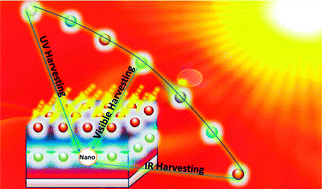
Guanying Chen, Jangwon Seo, Chunhui Yang, Paras N. Prasad
Nanochemistry and nanomaterials provide numerous opportunities for new generation photovoltaics with high solar energy conversion efficiencies at low fabrication cost.
The content of this RSS Feed (c) The Royal Society of Chemistry

24 Sep 11:40
by Brady Haran, Martyn Poliakoff
“… We live in exciting times for the development of both chemistry and social media. The challenge is how to couple the excitement in the two fields. As in other areas of chemical activity, we believe that the answer is not to copy what has been done before but to harness the rapid rise of the next social medium …” Read more in the Editorial by Martyn Poliakoff and Brady Haran.
24 Sep 11:40
by Yi Shen, Megan Y. Gee, Rui Tan, Perry J. Pellechia and Andrew B. Greytak

Chemistry of Materials
DOI: 10.1021/cm4012734

24 Sep 11:38
by Shuijin Lei, Chunying Wang, Lei Liu, Donghai Guo, Chuanning Wang, Qingliu Tang, Baochang Cheng, Yanhe Xiao and Lang Zhou

Chemistry of Materials
DOI: 10.1021/cm400848f

24 Sep 11:35
by Frank C. J. M. van Veggel

Chemistry of Materials
DOI: 10.1021/cm4021436

24 Sep 11:35
by Chin Ming Hui, Joanna Pietrasik, Michael Schmitt, Clare Mahoney, Jihoon Choi, Michael R. Bockstaller and Krzysztof Matyjaszewski

Chemistry of Materials
DOI: 10.1021/cm4023634

24 Sep 11:34
by Olesya Yarema, Deniz Bozyigit, Ian Rousseau, Lea Nowack, Maksym Yarema, Wolfgang Heiss and Vanessa Wood

Chemistry of Materials
DOI: 10.1021/cm402306q

24 Sep 11:33
by Fudong Wang, Vernal N. Richards, Shawn P. Shields and William E. Buhro

Chemistry of Materials
DOI: 10.1021/cm402139r

24 Sep 11:33
by Devatha P. Nair, Maciej Podgórski, Shunsuke Chatani, Tao Gong, Weixian Xi, Christopher R. Fenoli and Christopher N. Bowman

Chemistry of Materials
DOI: 10.1021/cm402180t

23 Sep 17:50
by Philipp Stadler, Brandon R. Sutherland, Yuan Ren, Zhijun Ning, Arash Simchi, Susanna M. Thon, Sjoerd Hoogland and Edward H. Sargent

ACS Nano
DOI: 10.1021/nn401396y

23 Sep 12:21
by Illan J. Kramer and Edward H. Sargent

Chemical Reviews
DOI: 10.1021/cr400299t

23 Sep 12:11
Chem. Commun., 2013, 49,9344-9346
DOI: 10.1039/C3CC45175E, Communication
Kamal Nayan Sharma, Hemant Joshi, Alpesh K. Sharma, Om Prakash, Ajai K. Singh
The first synthesis of PdTe NPs (hexagonal) and nano-rods (first example) via thermolysis of Pd(II) complexes, as single source precursors, in OA-ODE/TOP.
The content of this RSS Feed (c) The Royal Society of Chemistry

23 Sep 11:38
by Vladimir A. Vlaskin, Charles J. Barrows, Christian S. Erickson and Daniel R. Gamelin

Journal of the American Chemical Society
DOI: 10.1021/ja4072207

09 Aug 13:40
by In Chung and Mercouri G. Kanatzidis

Chemistry of Materials
DOI: 10.1021/cm401737s

05 Jul 17:10
Nanoscale, 2013, 5,8202-8209
DOI: 10.1039/C3NR01923C, Paper
Minwoo Nam, Sungwoo Kim, Sejin Kim, Sang-Wook Kim, Keekeun Lee
PbSxSe1-x quantum dots and nanorods are embedded together in a low-bandgap polymer matrix for high-efficiency hybrid solar cells with efficient charge transfer networks.
The content of this RSS Feed (c) The Royal Society of Chemistry