Shared posts

11 Jan 14:37

Project Linda är ett laptopskal – använder Razer Phone som hjärna

by Lars A
Project Linda är ett laptopskal – använder Razer Phone som hjärna

Razer har introducerat en laptop kallad Project Linda som bara har utrustats med skärm (13,3”/QHD), 200GB lagring, bakbelyst tangentbord och batteri. Project Linda använder Razer Phone som dator och konceptet är ungefär samma som Samsung DeX, fast i ett färdigt laptop-paket.

Telefonen placeras i ett fack nedanför tangentbordet och kan även agera touchpad. Det inbyggda batteriet i Project Linda kan ladda Razer Phone och det går att spara backups och appar på den interna lagringen.

Frågan är hur stor efterfrågan det finns för en så pass smal produkt, för en redan ganska nischad smartphone. Razer skriver att det rör sig om ett koncept i skrivande stund och laptopskalet har visats upp under CES.

Företaget berättar inte vad tillbehöret kommer kosta, men de som är intresserade kan anmäla sig på Razers hemsida.

Processor: 2,35GHz octa-core
Plattform: Snapdragon 835 64-bit
RAM: 8GB
Skärm: 5,7" / WQHD / 515PPI
Skärmtyp: LCD
Kamera: 12MP

Inlägget Project Linda är ett laptopskal – använder Razer Phone som hjärna dök först upp på Swedroid.

10 Jan 07:58

Four Views of the Same Short Story

by John Scalzi

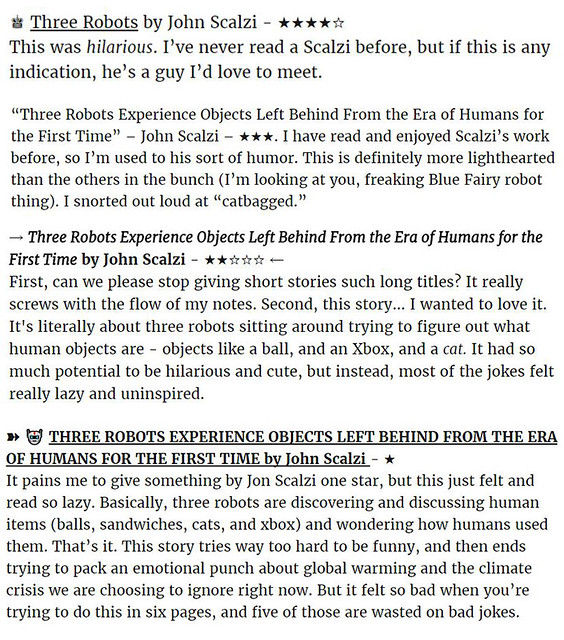
I had a short story come out today: “Three Robots Experience Objects Left Behind From the Era of Humans for the First Time,” as part of the Robots Vs. Fairies anthology. And here’s something I would like to show you, regarding the story: Four takes on “Three Robots,” from four different Goodreads reviews of RvF, each one giving the story one star fewer than the review preceding it (note: minor spoilers in a couple of the reviews):

Four reviews of my short story. The first one gave the story four stars the second three; the third two; and the last, one.

Which review is correct? Of course, they are all correct. Which is to say, they accurately represent the opinion of the person writing the review. Depending on who you are and what you want out of a story (or what you want out of a story from me), “Three Robots” is a four star story, or a three star story, or a two star story, or a one star story. It might be your favorite story in the collection, or the one you actively hate, or the one you don’t remember the instant you stop reading it. The text of the story is the same regardless of who reads it, but the experience of reading it is unique to the person reading.

This is a very important thing for writers (especially newer writers) to learn and build into their worldview: That everyone’s experience of your work, and any reviews they might then write, are inherently subjective, dependent on the person writing them, and there is nothing in the world you can do about that. That’s just the nature of putting work out into the world. Your job is to write the story as well as you can, and not worry overly much how it will be received. Because, as you can see above, it will be received well, and poorly, and everywhere inbetween.

And yes, learning to be okay with the fact everyone won’t love what you wrote is hard, because everyone has an ego, and everyone likes the validation of people enjoying their work. But as I frequently tell people, there are creators who I admire and whose work I love, and every single one of them has something they’ve created that I don’t like. Sometimes more than one thing! And sometimes it’s more than just not liking; sometimes I kinda actively dislike it. Or even hate it. On the flip side there are creators whose work I mostly dislike who will have that one thing that just works for me, or that I might even love. It happens! And then the whole mass of creators in the inbetween, whose work is mostly okay for me, but occasionally veer into the “like” or “dislike” territory.

If I feel that way about the creators whose work I experience, how can I expect any different from anyone else? I don’t expect everyone to like what I write equally; I don’t even expect people who like what I write to like it all equally — or uncritically. That would be weird and a little unsettling. I mean, you don’t need to tell me personally when I write something you don’t like. Feel free not to. But if you think yourself “I like Scalzi’s work — well, except for [X] which really kinda stank,” congratulations, you’ve passed a Turing test. You’re human.

Write your story and create your work as well as you can. Be as happy as you can with what you write and create before you send it out into the world. That way, no matter what people think or say about it, you can be happy knowing you did as well as you could with it.

Which is how I feel about “Three Robots,” incidentally. I enjoyed writing it, and it did what I wanted it to do, really well. It was fun. If people like or love it, that’s great. If they don’t, that’s okay too. They’re entitled to their opinion, and they’re entitled to share that opinion. I’m glad they took the time to read it.

29 Dec 08:47

because so many of you asked…

by Wil

Approximately 162% of the total population of Twitter users has sent me this Gizmodo post about some mostly-awesome custom (unofficial) LEGO minifigs that are inspired by the cast of Star Trek: The Next Generation. Approximately 600% of them asked me to comment, and since I can’t do that in 280 characters without resorting to the dreaded [THREAD 1/66], I’m doing it here.

Before I get into the Wesley part of this that you’re all here for: I love that this set exists. I love that enough people want to do TNG LEGO to create a market demand for these figures. I can’t speak for the rest of the cast, but things like this, based on us, are always awesome. Earlier this year, a guy gave me a little minifig that he made of Wesley, and even though it’s unofficial, it is a delightful thing to own. He’s in his little red spacesuit, and he looks like he’s got a course you can plot. I love it.

In this particular custom set, though, Wesley is depicted as a crying child, and that’s not just disappointing to me, it’s kind of insulting and demeaning to everyone who loved that character when they were kids. The creator of this set is saying that Wesley Crusher is a crybaby, and he doesn’t deserve to stand shoulder to minifig shoulder with the rest of the crew. People who loved Wesley, who were inspired by him to pursue careers in science and engineering, who were thrilled when they were kids to see another kid driving a spaceship? Well, the character they loved was a crybaby so just suck it up I guess.

“Oh, Wil Wheaton, you sweet summer child,” you are saying right now. “You think people actually loved Wesley Crusher. You’re adorable.”

So this is, as you can imagine, something I’ve spent a lot of time dealing with for thirty years. It’s been talked about to death (on this very blog, more than once), but I’ll sum up as briefly as I can: I reject the idea that nobody liked or cared about the character. Now, It is absolutely true that, for the entirety of the first season, Wesley was a terribly-written character. He was an idea, a plot device, and was not handled with much care or respect. I think the best example of this is in Datalore, which I wrote about in Memories of the Future Volume 1:

Wesley, who was sent to check up on Data, does what any smart Starfleet officer would do: He reports to his captain that something fishy is going on with the robot and suggests that maybe they shouldn’t be so quick to trust him.

Picard, the captain who recognized Wesley’s intellect and promoted him to acting ensign, and Riker, who chose Wesley over everyone else on the ship to check up on Data and report back on what he found, not only ignore Wesley’s concerns, they actually tell him that he’s out of line for expressing them!

“Data” (actually Lore) leaves the bridge — after making it clear that he doesn’t know what “make it so” means and arousing absolutely no suspicions from Picard — and Wesley decides he’s had enough of this bullshit.

“Sir,” he says, “I know this may finish me, but —”

And Picard, the captain who recognized Wesley’s intellect and promoted him to acting ensign, and the closest thing to a father figure Wesley has ever known, responds with three words that follow and haunt me to this day: “Shut up, Wesley!”

Trekkies around the country gasp in delight as an episode that was veering dangerously close to the Tkon empire suddenly has redeeming value. Printing presses, silk screens, and button-makers go into overdrive as entrepreneurial fans do what they do best: skirt the borders of IP infringement to make a quick buck. Children are still attending college today from the sales.

[…]

Wesley points out that everything he said in his report, and all of his concerns, would have been listened to if it came from an adult, or a competent writer. Picard considers this retort momentarily, and then sends him to his room to organize his sweaters. Then, for good measure, he sends Dr. Crusher to keep an eye on him.

“Personally, I hated the way they handled Wesley in this episode. He’s already on his way to becoming a hated character by the adults in the audience, and the writers cranked it up to Warp 11. It was stupid of them to have Picard give him an adult responsibility and then dismissively treat him like a child when he carried it out. It undermines both of the characters — how is the audience supposed to take either of them seriously?”

Another brief and related note on “Shut up, Wesley”, from a Reddit thread seven months ago:

People have been saying this to me since I was fourteen. I’m nearly 45. I’ve heard this for the entirety of my adult life. It’s annoying. It isn’t funny, it isn’t clever, and it’s just become obnoxious.

More than that, though, let’s put it into dramatic context: an adult says that to a kid who is doing his best to help, to do his job, to live up to the expectations that have been placed upon him. It’s used to shut him down, to disregard and silence him. And it turns out that, holy shit, the kid was right all along. In context, if we accept that it’s all real: Picard never says that to Riker, or Geordi, or Tasha, or to literally anyone else under his command because that would be profoundly unprofessional. But there are different rules when you’re dealing with the kid among the adults (and, believe me, the producers and directors on TNG treated me the exact same way).

So it’s a loaded phrase that bothers me, and I’d really like it if it just went away forever.


So back to the minifig: it’s “Shut up, Wesley,” made into what would otherwise be an awesome minifig, in a collection of truly amazing and beautiful minifigs. It’s a huge disappointment to me, because I’d love to have a Wesley in his little rainbow acting-ensign uniform, but I believe that it’s insulting to all the kids who are now adults who loved the character and were inspired by him to go into science and engineering, or who had a character on TV they could relate to, because they were too smart for their own good, a little awkward and weird, and out of place everywhere they went (oh hey I just described myself. I never claimed to be objective here).

I want to be clear here, because I know that future members of my Twitter blocklist will send me a cropped image of LEGO Wesley crying, or tell me to shut up because I’m making too much of this: this isn’t about me. This is about thirty years of people kicking Wesley Crusher around because writers in the first season of Next Generation (who gave us such memorable gems as Angel One, Code of Honor, and The Last Outpost) didn’t write him as well as writers did in later seasons, and once the fandom narrative was fixed, no amount of Final Mission or Starfleet Academy -like episodes could change it.

I understand that a lot of people will see the humor in this, and I respect that. From a certain point of view, it is very funny. I don’t think that this was done this way to be mean/ If anything, it’s just lazy. But because so many people asked me what I felt when I saw it: I’m disappointed, because this isn’t the way I’d like to see Wesley portrayed in a medium that I love. I just feel like Wesley Crusher and the boys and girls he inspired deserve something that isn’t making a joke at his expense, or just reducing him —again– to little more than an idea.

28 Dec 15:33

Procrastinate is the way

By Miryinthesky
hope you like it! :)


24 Dec 06:24

First screenshot of next GemCraft & Happy Holiday!

by Peter
Hey Everyone! Sorry for not posting anything for so long! After some adventurous dead end side projects, the next GemCraft has been in development for a while now, but I wanted to wait to have a screenshot to show. And … Continue reading →
20 Dec 06:47

December 19, 2017: That Dark Matter Dark Timeline Revealed!

by Joseph Mallozzi

Back in 2012, I went out with a well-developed plan for a space opera, one with a beginning, middle and end to every storyline and character arc, answers to every question.  It was to be a self-contained and satisfying narrative.  But after the show was green lit and we went into production, those plans changed – slightly at first (ie. making our Android female), then more significantly (ie killing off the character of ONE).  And yet, while the changes required adjustments that necessarily echoed through future narrative threads, they didn’t really affect the promised answers to all the questions the show would pose, or the endings I had intended for these characters.  As time wore on, however, and I spent more time on the show, with these characters, interacting with fandom, I began to have a change of heart.  And I began to think that, maybe, that downbeat heartbreaker of an ending I had planned for the series wasn’t really appropriate anymore.  Maybe these characters, and fans, or at least some of them, deserved a more hopeful conclusion to Dark Matter.  So I began to make more adjustments, pulling up storylines, making slight character modifications, ensuring it would all track and those little set-ups would nevertheless pay off in some fashion down the line.

In time, I decided on another ending, one I began to seed and build toward – but, alas, never got to reveal.  That particular conclusion will remain a secret, for now. But as for that alt. dark timeline, here it is:

We see a version of this story play through Dark Matter’s second and third seasons.  In the show, Ryo’s relationship with Hiro isn’t emphasized to the extent I’d originally planned and the murder of his half-brother is decidedly deliberate rather than accidental.  Of course, as outlined in my recent #DarkGate Q&A, the plan wasn’t for TWO to execute Ryo (although she comes tantalizingly close in Episode 312, “My Final Gift To You”) but for the Android to essentially “restore” FOUR via the transfer transit pod he used in Episode 207, “She’s One Of Them Now”.  Still, I loved the bittersweetness of this ending and I can only imagine what a fantastic scene TWO’s farewell conversation with her old friend could have been.

Again, we see echoes of this intended storyline in season 2 and 3 – the guilt that weighs on him for his past actions (turning in the crew, his indirect responsibility for the destruction and loss of life on Hyadum-12), knowledge of the family he left behind – but rather than succumb, our SIX fights through it and actually helps TWO battle parallel inner demons following the destruction of EOS-7.  Again, as explained in my recent #DarkGate Q&A, the plan was for SIX to seemingly sacrifice himself at the end of the show’s third season – only to find his way back to our reality by drawing an assist from a most unlikely ally, the mercenary and mercurial Alt. Tash.  In hindsight, I really loved this planned ending for SIX because it touched on Dark Matter’s central theme of our memories making us who we are.  It also offered up the single hopeful end to our crewmembers’ individual journeys.

Ah, now this was a change that required a little more fiddling, chiefest of which was a rethinking of TWO’s essential being.  In my original vision, her physical being, while still biological, was nevertheless more bio-synthetic in design.  When I abandoned this ending, I moved up the storyline involving her failed nanites, addressing the issue, instead, in the show’s second season.  Another bittersweet conclusion which echoed one of my favorite anime of all time, and an inspiration for Dark Matter as a whole – Cowboy Bebop.

Perhaps the biggest adjustment I had to make pertained to the character of ONE who I’d envisioned continuing his role as the angel to THREE’s devil, developing that love-hate bromance to the point where, in their last moments, either has the opportunity to save themselves by abandoning the other but, instead, choose to go down fighting – a nice little bookend to our opener.

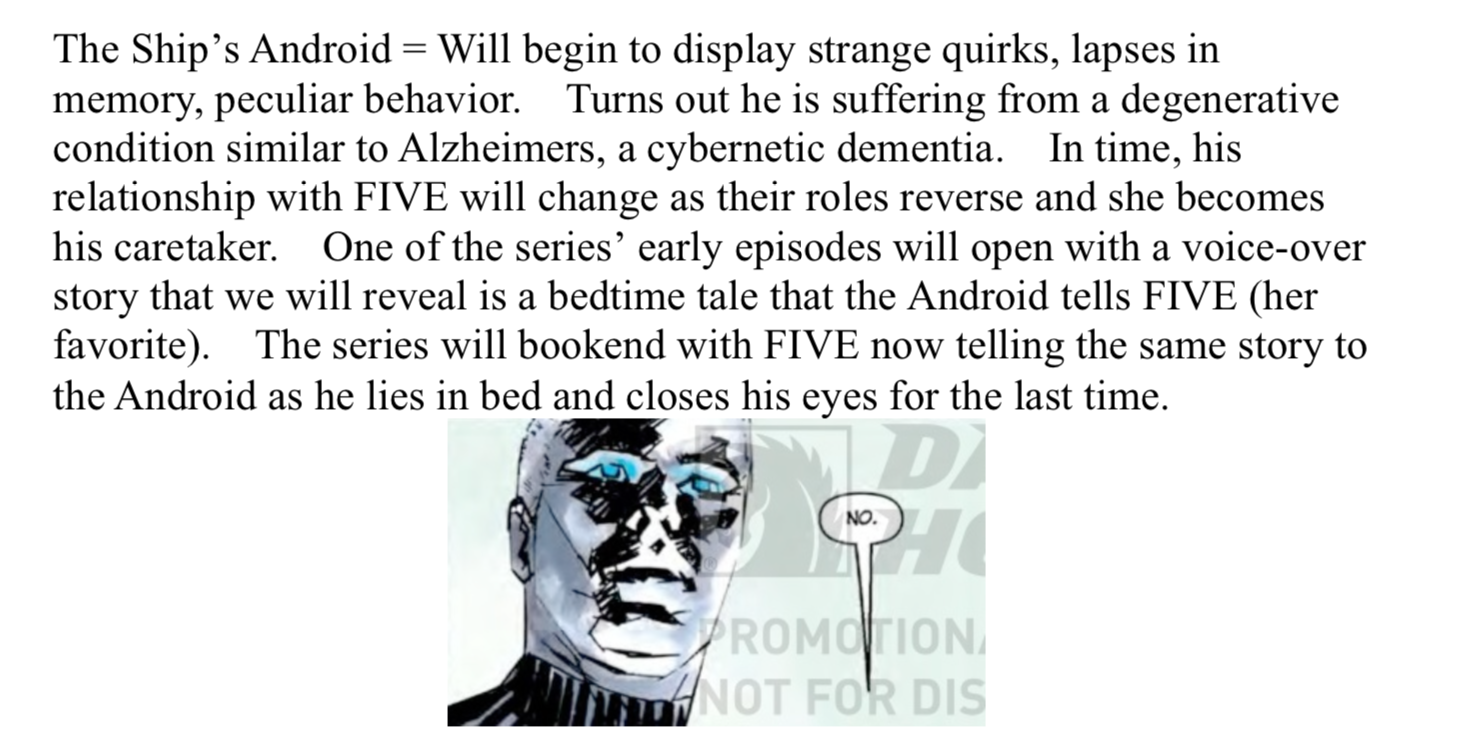
Most heartbreaking of all was this intended ending for our lovable Android that, again, harkens back to the recurring memory theme that is the heart of our show. Of course, this would have worked much better if FIVE was younger (closer to 12) and if the Android’s sad demise wouldn’t have triggered the inevitable mass fandom uproar.

And our last show would have been of FIVE on the bridge of The Raza, all alone.

End of series.

And, at the time, I would have been satisfied with this conclusion – but even then, I did consider the possibility that fans may not have shared my feelings for the ending I had given them.  And so, just in case, I had a back-up plan…and the in to one final miniseries adventure…


14 Dec 10:25

Processed Food Has More Fat Than It Used to, But Less Sugar

by Beth Skwarecki on Vitals, shared by Beth Skwarecki to Lifehacker

There’s good and bad news from a November government report on how the nutrition content of processed food has changed over time. The good news: new products often have less sugar, less salt, and more fiber. But that’s offset by a change in fat content: new cereals, yogurts, and snacks tended to be higher in fat.

Read more...

14 Dec 08:08

Recent snapshots from the International Space Station

by Stephen Clark

Recent photos from the International Space Station’s Expedition 53 crew show wildfires burning in Southern California, expansive views of the Himalayas, cities by night and day, and colorful vistas of sites around the world.

The space station orbits around 250 miles (450 kilometers) above Earth, on a path that takes it between 51.6 degrees north and south latitude on each 90-minute trip around the planet.

These images captured from over the last three months were shared by the station’s crew on social media, or posted on NASA’s website. The captions were written by NASA, or one of the station crew members.

The spectacular aurora borealis, or the “northern lights,” over Canada is sighted from the space station near the highest point of its orbital path. The station’s main solar arrays are seen in the left foreground. Credit: NASA
This night time view of southern Europe prominently features the “boot” of Italy, the home of current Expedition 53 crew member Paolo Nespoli of the European Space Agency. Credit: NASA
Mizuna is pictured being cultivated inside the Veggie facility for the Veg-03 botany experiment. Future long-duration missions will look to have crew members grow their own food, so understanding how plants respond to microgravity is an important step toward that goal. Credit: NASA
Flight Engineer Joe Acaba installs botany gear for the Veggie facility to demonstrate plant growth in space for the Veg-03 experiment. Credit: NASA
The Southern California wildfires could be seen by the International Space Station crew. NASA astronaut Randy Bresnik photographed the plumes of smoke and shared the images with his followers on social media, writing, “Thank you to all the first responders, firefighters, and citizens willing to help fight these California wildfires.” Credit: NASA
“Hola #Barcelona! // Good morning Barcelona!” — ESA astronaut Paolo Nespoli. Credit: NASA/ESA
“Whether from below, above or way above, London is a unique and captivating city.” — NASA astronaut Randy Bresnik
“Haircut Saturday.” — NASA astronaut Joe Acaba
“This is #Patagonia. The photos were taken as part of the Uragan experiment. According to this experiment, we taking photos the glacier of Patagonia. The scientists analyses this photos and note the dynamic of deglaciation.” — Russian cosmonaut Sergey Ryazanskiy
“Mount #Fuji located on Honshu Island. Mount Fuji’s exceptionally symmetrical cone is a well-known symbol of #Japan and it is frequently depicted in art and photographs, as well as visited by sightseers and climbers.” — Russian cosmonaut Sergey Ryazanskiy
“When we take a picture of somewhere on Earth we are unfamiliar, @Astro_Sabot (Mark Vande Hei) shows how we look it up and learn where we were.” — NASA astronaut Randy Bresnik
“Since we live in 0-G we don’t need a selfie stick to shoot the perfect crew picture.” — ESA astronaut Paolo Nespoli
“Some new photos of forest #fires in Southern #California…” — Russian cosmonaut Sergey Ryazanskiy
“The caldera of Pico de Fogo pokes up through the haze on Fogo Island.” — NASA astronaut Randy Bresnik
“One night in Bangkok, or at least over Bangkok, alive with fishing boats in the waters and a lightning flash to show the size of a storm.” — NASA astronaut Randy Bresnik
“Good Morning Dallas & Houston. God Bless Texas!” — NASA astronaut Randy Bresnik
“The #supermoon rising over Mongolia. Good night from @Space_Station.” — NASA astronaut Randy Bresnik
“Good morning from @Space_Station. Karachi, Pakistan” — NASA astronaut Randy Bresnik
“Good morning from @Space_Station. Istanbul, Turkey” — NASA astronaut Randy Bresnik
“Dominican Republic and Haiti show off their beauty in the setting sun.” — NASA astronaut Randy Bresnik
“From the ground or from orbit, the Grand Canyon in Arizona is an amazingly unique feature on our planet.” — NASA astronaut Randy Bresnik
“With the blackness of space above, far away on our horizon, the impressive vertical of Mt. Everest/Sagarmatha stands out.” — NASA astronaut Randy Bresnik

Email the author.

Follow Stephen Clark on Twitter: @StephenClark1.

10 Dec 07:49

FX is developing a Welcome To Night Vale show

by William Hughes on The A.V. Club, shared by Julie Muncy to io9

Fans of podcast sensation Welcome To Night Vale will soon be able to get their community announcements, otherworldly threats, and reminders to stay out of the dog park via their TVs, with Deadline reporting that the series is being developed for television over at FX. Creators Jeffrey Cranor and Joseph Fink will both…

Read more...

07 Dec 08:21

Dear Mens: Your Greasy Demon Hands Are In Time Out

by terribleminds

HELLO, FELLOW CISGENDERED MENS,

It is I, your male-identifying cohort, Chnurk Mandog, and it’s time we had a little talk.

Before we begin this talk, though, I’m gonna tell a story.

Recently, I was in Florida, aka, America’s Moist Dangly Bits, and while there, I was on Sanibel Island, which is known in part as possessing the best shelling beaches in the world, and also offering up tiny invisible bugs called no-see-ums that appear in a shimmering cloud and buzzsaw you down to your bones. While on a shelling beach, I witnessed many things, including pretty shells, a dead rat, several dead stingrays, and a vicious red tide. I also witnessed this:

A family was walking up along the top margins of the beach. Meaning, away from the water, up by the trees. It was a father and a mother, both I’d guess in their late-30s early 40s, and a pack of four boys. Presumably, their children, or maybe clones, I dunno. The boys were chasing lizards, and one of the boys came up to his father and said, “DAD CAN I GRAB A LIZARD’S TAIL?”

And the father said, “Yeah, just don’t let him bite you.”

The boy ran off to join his lizard-hunting brothers.

Thankfully, the lizards were faster than these shitty kids, and the boys became so irritated and bored with not-catching lizards that they fucked off down to the water’s edge, instead.

My own son was with me, and I asked him, “Do you think you should grab lizards by the tail?” And he asked me, “Won’t that hurt the lizard?” And I said, “I dunno, probably.”

“Will they bite you?” he asked.

“Does that matter?” I asked. And when he looked up at me confused, I explained:

“The effect of the action on you is not as an important as the effect of the action on the lizard. Doesn’t matter if the lizard bites, because it’s not okay to go grabbing living things, because they’re not yours, and because you might hurt them.”

Our son, a little burgeoning rules lawyer, seemed pleased with this answer, and I felt, yay, a teachable moment. Huzzah and hooray.

The day went on, as days tend to.

But I was bugged by the event because I felt like I should’ve said something. Not to my own son, but to that dickhead dad and his dickhead boys — normally, I have a very strong DON’T PARENT OTHER PEOPLE’S CHILDREN creed in place, because you can do what you want with your kids and I will handle my own, thank you. I’m not the Worldfather, I’m not your Parent Cop, and we all make mistakes. Just the same, I felt like those little fuckers are probably out ripping tails off lizards because their father couldn’t be bothered to tell them that wasn’t nice to do.

Later that afternoon, we were at a grocery store in the island called Jerry’s — and outside of Jerry’s is an array of other shops, a little courtyard, and maybe six cages that play host to various parrots or parrot-like entities. My son and I were toodling around outside while my wife was in one of the stores, and together we walked up to one of the cages, which contained, if I recall, a squawking blue-and-yellow macaw.

An older dude, maybe early 60s, was standing there next to us.

On the cage hung a sign, clearly written, in big, bold letters:

WE ARE ON A SPECIAL DIET.

PLEASE DO NOT FEED THE BIRDS.

The older dude was noshing a pastry of some kind. A danish, I think.

And as we’re standing there, he took a piece of the danish, and thrust it through the cage bars to the parrot. Literally moving his hand three inches above the sign that clearly tells him DO NOT FEED THE BIRDS YOU FUCKING DING-DONG in an act of willful ignorance.

As the bird moved to the food, I snapped at him:

“You’re not supposed to feed the birds.”

He shot me a look, confused. Maybe angry. Said nothing.

I continue:

“It says right there on that sign you’re ignoring. They’re on a special diet. Don’t feed the goddamn birds.” He stared at me, mute, and I said, “Are you listening?” Slowly, his hand retracted before the bird was able to claim its inappropriate pastry snack. The man continued to look at me, not saying anything, and he then hurried away toward his wife. As he scurried off, I explained to my son loudly, because I’m a jerk, “YOU CAN’T FEED BREAD TO BIRDS BECAUSE BIRDS DON’T EAT BREAD. YOU DON’T SEE BIRDS BAKING BREAD, DO YOU? NO, YOU DON’T. BREAD CAUSES MALNUTRITION IN BIRDS.” My voice got louder and louder as I said this, to ensure that the old man heard me. My son, who is now reading actual words, said, “It says right there on the sign, don’t feed the birds.”

“Yeah,” I said.

“Yeah,” my son said.

Yeah,” I said again, righteous.

I’m sure as soon as we walked away, Ol’ Danish McGee probably wandered back up and shoved a gobbet of cheese danish into the macaw’s beak. But at least I said something and I felt a little better about that, even if it didn’t answer for the jerkwad boys who were ripping tails off lizards.

You might say, Chnurk, what is the point of this story?

To which, I point to this as a partial answer:

IN WAKE OF WEINSTEIN, MEN WONDER IF HUGGING WOMEN STILL OK

Now, of course, obviously what I’m doing here is I’m leading up to something, and that something is not that women are lizards or birds, nor do they have tails or special diets, but rather, hey men?

You need to keep your damn hands to yourself.

Your touch is not a gift.

Your gropey, searching hands are not charity, they’re not a favor, they’re not God’s Benevolence, they’re just your dumb hands, and you need to keep them — and all your other parts, especially your stupid probably very ugly dick — to yourself. This shouldn’t be difficult. It’s literally a lesson we taught to our own son at a very early age: “Don’t touch people who don’t want to be touched.” And that want to be touched part is not only essential, but rather, it’s essential to realize that only vigorous consent can alert you to the desire to be touched. It’s not implicit. It’s not in her eyes, it’s not whispered on the wind, as if by magic. It’s spoken by the mouth, or written on a piece of paper — if someone asks for a hug or some other kind of physical contact? They want the hug. If they don’t, you can ask them proactively: “HI, MAY I HUG YOU?” and if they say yes? Hug them appropriately, in the Normal Hugging Way. If they say no? Then do not touch them. No-handsy, no-touchy. This shouldn’t be difficult. These are preschool rules, man.

It’s not even an insult if she says no. It’s just a choice. A choice born maybe of trauma you can’t see. Or a choice based on preference or predilection. Or maybe it is an insult, maybe she doesn’t like you, maybe you’re an asshole, maybe this, maybe that. It doesn’t matter. A no is a no. You are owed nothing. She is not yours. The world is not yours. More to the point:

Life is not your buffet line of sexual opportunity, jerks. Women are not in a stable for your mate or mistress selection. I once watched a dude at a grocery store hit on a blind woman (I am ashamed I didn’t say anything to him, honestly), and what I said then remains true now: women are not just sockets for your plugs. This is true everywhere. It’s true at the grocery store. It’s true in your own home. It’s true at work! I know! At work. But isn’t the workplace just a meat market where you, the Hunter-Gatherer, will select your Ladymeat from the Ladymeat on Display?

No! No you fucking ape, it’s not. The women there in the workplace are there to work. That’s literally it. They are autonomous, independent individuals, just as you yourself are an autonomous, independent individual, dude. That’s true no matter their gender, their color, their able-bodiedness — they are not yours to touch or ogle. Your own autonomy extends to the margins of your own body and no further. And, by the way, since I have a number of writer and other creative folk following along, please note too that our workplaces are a little more fluid and flexible — conventions and conferences, for instance, are our workplaces. They, too, are not your sexual buffet line. The women there, be they fans, volunteers, readers, writers, artists, whoever, are still not a box of lusty chocolates from which to choose.

Keep your shitty demon hands to yourself. They are in time-out. Stick them in your pockets if you must. Duct-tape them together. Burn them with cigarettes if they seem motivated to stray. Keep them hidden or someone is going to rightfully chop them off.

Listen, I get it. You’ve been told, or at least shown, that the WORLD IS YOUR OYSTER. All you gotta do is grab it, pop open its shell, and suck down the meat that you have claimed for yourself. Grab all the lizards you want, dominionist man! Personal liberty says you can feed that parrot whatever the fuck you want, mighty parrot-conquerer! You can feed that parrot danish, or dishsoap, or your own dick, why not? Why can’t you fuck the parrot? You are God-chosen caveman! Club what you choose and take what is yours! Women are there for your pleasure and your breeding, ha ha ha right? Christ, my own father would drive his big-ass pickup truck close to other cars so he could stare down women’s shirts. We’d go to a couple local bars, and — in full view of my mother! — would flirt with waitresses, slap their asses, that kind of thing. He never said to me, “Son, women are yours to do with as you please,” but he certainly demonstrated that. And that kind of demonstration continues today, all around us. “Rape culture doesn’t exist,” someone surely believes even as we elected an admitted sexual predator to the highest office in the land, a guy whose only spoken moral is, “You can do anything,” and that includes grabbing women in whatever way he chooses. That sexual predator is now endorsing a secondary monster, Roy Moore, who is credibly-accused of child molestation in a way where he was banned from the local mall. (But not banned from the Senate, I guess!)

And here you might be saying, whoa whoa whoa, how’d we get here? Clearly that is different. Clearly there are stratum at play here — nuance is essential, right? A guy who forces a hug is nowhere near the same as a guy who picks up 14-year-old girls and tries to force sexual acts upon them? And you’re right. Points for you. They’re not the same. The matter of degree in difference is considerable, in much the same way that slapping someone in the face is way different from blasting out their middle with a shotgun blast of buckshot.

And yet, slapping people is still wrong.

And it’s still an act of violence.

The difference between what our president has admitted doing — or what Weinstein did — and inappropriate sexual misconduct in the workplace is obvious, but both actions come from the same place: the belief that you can do what you want, that you can touch who you want, that you do not require consent to do so.

That is incorrect.

JFC, men. Stow it. Stick your hands in the nearest glove compartment, then have someone — preferably a woman — slam the compartment shut in a way so violent that it dismembers your monster hands and contains them in the prison of that glove compartment.

I have no greater point than that. The world is not your plaything. That extends to women, to each other, to all humans, to the creatures of this world, to objects you do not own, to really every damn thing under the sun that is not a part of your body or purchased by you with cash-slash-credit. Yes, you can hug women, if they consent to being hugged. With vigorous consent, you and all other consenting parties can slap all your parts together in whatever configuration you find most delightful. Affection is not dead. It’s just meant for people who actually want it. Why the fuck would you want to give affection to someone who doesn’t want it? What the fuck is wrong with you? Put your hands away. PUT YOUR STUPID HANDS AWAY. AND YOUR MOUTH AND YOUR TONGUE AND ALL YOUR BITS.

And seriously, also, your dick.

Seriously.

Seriously.

Put your dick away.

Nobody wants to see that thing.

Even people who want to see that thing really don’t want to see that thing.

No, no, I’m not saying to be ashamed of your dick, I’m just saying, unless you get an email where the font is in 144-point size Comic Sans and it says PLEASE SHOW ME YOUR DICK AT THE NEXT OPPORTUNITY, I WILL GAZE UPON THIS DICK DIGITALLY OR IN FULL 4K REALITY, and it has a signature of authenticity underneath that is notarized by three licensed sources, stop showing people your stupid dingle.

Teach this to your children.

Tell this to the men in your life.

If you see something, say something.

The end.

07 Dec 07:51

Allies and Cookie Badges

by Jim C. Hines

ETA: Before anyone responds, I want to be clear that this is not a request for reassurance or cookies or any of that. I’m an adult, fully capable of buying or making my own damn cookies. Thanks.

#

A week or so back, a group working to end violence against women named me as one of sixteen male role models helping to fight violence against women. In an unrelated situation a few days later, someone on Facebook told me she would no longer support my work, and that I might claim to be an ally, but I’m not.

I can’t say with 100% certainty, but I don’t think I’ve ever claimed to be an Ally. I don’t think it’s my place to proclaim myself an ally to women, or to victims of sexual violence, or to the LGBTQ community, and so on.

It was a little odd having these two things occur so close together, and there was a bit of cognitive dissonance for a little while, like I was Schrödinger‘s Ally or something.

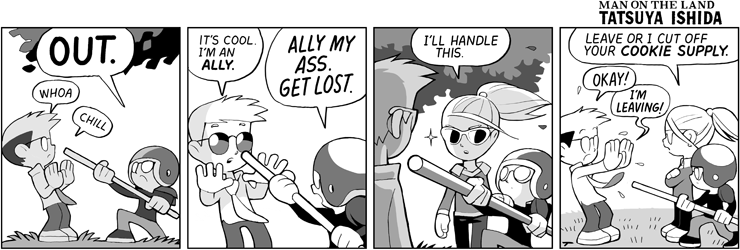
I’ll be honest, this whole Ally thing confuses me a little. As shorthand for “this is a person who seems to be trying to understand and support me,” it makes sense. But it feels like we’ve turned it into the ultimate cookie, or a badge to flash around to prove you’re one of the Good Guys. Or maybe a badge-shaped cookie, I don’t know.

So you end up with people trying to deflect criticism by flashing their cookie badge. “Don’t you realize I’m your Ally? It says so right here in white frosting!” Or they turn it into a flounce, throwing their cookie on the ground and declaring, “You have lost a Valuable Ally this day!”

What a waste of a cookie…

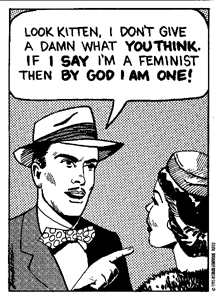
Sinfest Comic

(As I’m writing this, I’m starting to like the idea of Schrödinger‘s Ally as shorthand for that person who seems to say the right things, but you’re not sure whether they genuinely support you or if they’re only in it for the cookies. That’s a bit of a tangent though, so I’ll save it for later.)

I can understand that when you’re in a marginalized group fighting for dignity and equality and survival, it’s vital to know who your allies are and who you can trust to have your back. And the term is useful shorthand for articles like “How to be a good male ally” and such.

The whole concept still feels weird to me. Maybe it’s the idea that “ally” is a noun. A concrete, black-and-white thing you either are or aren’t, which gets back to my point about people simultaneously calling me an ally and not an ally…

Dissonance resolved: they’re both right, of course.

Because, linguistics aside, ally isn’t a noun; it’s a verb. It’s action. A process. It’s listening and learning to do better. It’s learning to offer support in ways that are helpful. It’s learning that it’s not all about you.

That gets to the heart of a lot of my discomfort. The moment you stand up and wave your cookie-badge and declare yourself An Ally, it becomes about you. Which not only misses the point, it turns 180 degrees and jumps to hyperspeed to get as far from the point as possible.

And on that note, I’m gonna go see if we have any cookies…

06 Dec 06:33

December 5, 2017: Project A!

by Joseph Mallozzi

To be perfectly honest, I was looking forward to some time off.  Nothing crazy.  Maybe a month.  Or six.  While a lot of my fellow writers start going stir crazy after a few directionless weeks, I have no problem sleeping in, spending time with my girlfriend and the dogs, and reading into the wee hours.  And that WAS the plan but, prior to leaving Vancouver, my agent arranged for sit-downs with some of the local production companies.  I figured, why not?  If nothing else, I would know what I’d be missing.

Anyway, great meetings all, and one in particular in which I was presented with the opportunity to help develop something.  I liked the project a lot, but especially liked the people involved – and, at this point in my career, that’s what I’m looking for: interesting projects and good collaborators.  As they used to say on Stargate: “LTS” (Life’s Too Short).

And time off, apparently, is even shorter.

So, after reviewing the project and offering my take (and, of course, assuring them I wasn’t THAT crazy), I was hired.  David Ray and I spent about a month fleshing out the world, the backstory, the characters, and arcs.  We delivered the overview, received some input from the broadcaster and production company, and prepared for the writers’ room.

I elected to bring in local-kid-makes-good Alex Levine, a former script coordinator on Stargate (and practicing lawyer before that!) who ended up making quite a name for himself in his days as a writer and Co-Executive Producer on Orphan Black.  Yes, he has an impressive track record.  But, more importantly, he has a great head for story and characters.

Which he has proven over the past two days of spinning.  He, David, Samantha, and I dedicated Monday to waiting for the white board to arrive broad stroking the major story beats.  Then, today, we ate pastries David picked up from the Italian bakery across the street focused on individual character arcs.  I figure tomorrow, we’ll finish up the character arcs, then dedicate Thursday and Friday to fleshing out our first episode.

And, once that’s done, it’ll be smooooooth sailing.  I’ll write an outline, possibly a revised outline, and then go to script.

Can’t reveal much about this project except to say that it’s a compelling, character-driven SF series chock full of surprises, humor, and warmth.  Every sci-fi show I’ve worked on in the past – SG-1, Atlantis, Universe, and Dark Matter – has been, at its heart, about the family.

I have no doubt – you’re gonna love it!


27 Nov 21:13

How to Detect When People Are Using the Truth to Lie to You 

by Patrick Allan

There are three types of lies: omission, where someone holds out on the facts; commission, where someone states facts that are untrue; and paltering, where someone uses true facts to mislead you. It’s not always easy to detect, but there are a few telltale signs.

Read more...

20 Nov 19:27

November 20, 2017: Knock Knock!

by Joseph Mallozzi

In the almost eight years she’s been living in Canada, Akemi has mastered many aspects of western culture – its unreliable transportation system, the English language, Beef Wellington – but there’s one uniquely North American oddity she’s yet to grasp: the knock-knock joke.  And yet, despite her repeated failures to fully grasp its nuanced set-up and delivery, she keeps trying.  Like last night, when she insisted we, once again, go down the knock-knock route.  After some reluctance, owing in large part to the fact that my storehouse of knock-knock jokes is almost bare, I conceded.  The results were, if not exactly predictable, certainly not that surprising –

“Knock knock,”I said.

“Who’s there?”she asked.

“Boo,”I said.

“Who’s boo?”she asked.

I sighed and explained to her that the correct phrasing of her response should be “Boo hoo?”, thus setting up the classic follow-up: “You don’t have to cry about it.”

A realization seemed to dawn.  “So you have to think of something that ends in hoo?”

“Well no – ”

“Like tofu,”she said, pronouncing the “fu” in tofu as she often does, with an “f” so soft it could be misinterpreted for a “hu”.  “Or kung-hu?”

“No – ”

“Knock knock,”she said.

“Who’s there?”

“Toe.”

“Toe who?”

She frowned.   “It doesn’t really make sense.  A better way would be – knock knock?”

“Who’s there?”I asked.

“Something soft,”she replied.  “And then you guess tofu.  You see?”

Yeah.  No.  I tried again: “Knock knock.”

“Who’s there?”

“Lettuce.”

“Lettuce who?”

“Lettuce in!  It’s cold out here?”

She frowned.  “Why lettuce?”

“Because lettuce in it’s cold out here.”

She started back at me, genuinely mystified.  “That’s not a joke.” Uncomprehending: “That’s funny?  That’s not funny.  I think my kung-fu joke you didn’t like is better.”  And then, after some consideration, a sigh of resignation. “The knock-knock joke – it’s very hard to nail it.”

I don’t even want to get her started on puns.


20 Nov 10:33

The story of a beloved book…

by Pat

Today I’d like to tell you a story about a book. Some of you might not have met it before. But to many of us here at Worldbuilders, it is an old, familiar friend….

It’s a book that has been with the fundraiser since the beginning….

2008: A Gift from Gaiman.

In 2008, on a whim, I decided to try raising money for Heifer International on my blog. Things quickly spiraled out of control as other authors pitched in, spreading the word and donating books for me to use as donation incentives.

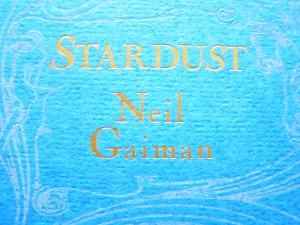
The pinnacle of the coolness/madness came when Neil Gaiman mentioned us to his vast legion of readers. He also donated a rare, numbered, slipcased ARC of Stardust to the cause.

Unfortunately, mail was delayed because of the holidays, so we couldn’t use the book until….

2009: Stardust for the People.

So the second year of the fundraiser rolled around, and I had this book. This beautiful book. This beautiful, *rare* book.

I was still doing the fundraiser pretty much by myself then, and I was having a really hard time deciding how best to use it. I knew we could auction it off and raise at least a thousand dollars, but that didn’t seem right somehow.

So I decided to put it into the lottery, where anyone who donated at least 10 bucks to Heifer International on our team page would have a chance of winning it. That seemed fair to me, more egalitarian.

Then something strange happened: the person who won the book gave it back to us. Their one stipulation is that we auction it off next year, so it would raise more money for Heifer. So….

2010: Stardust on the Auction Block.

Year 3 of Worldbuilders, we auctioned off all manner of things. And, as the previous winner requested, we put Gaiman’s Stardust ARC up on eBay too.

After some fierce bidding it sold for over $2500 to a lovely guy named Dan. There were many high-fives in Worldbuilders central. We were sad to see the book go, but $2500 bucks buys a lot of goats.

But when I e-mailed Dan to arrange shipping, he said he wanted to donate the book back to Worldbuilders.

I asked Dan if he was sure. He said he was sure. I asked Dan how he got to be so cool, and he said he was inspired by the story of how last year’s winner re-donated the book.

But most of the credit, he said, should go to his mom. She always made a point of donating to charity even though she never had a lot of money. Not only that, but she was a dyed-in-the-wool geek like the rest of us: she read fantasy and sci-fi, she played Infocom games…

From everything I’ve heard, she sounds like my kind of lady.

Dan told me she had passed away recently, and most of the money he inherited from her went into buying this book. He told me she would be proud and happy to know that the money will go to helping as many people as possible through Heifer.

His only stipulation was that we put the book back into the lottery next year, so anyone could win it….

2011: Stardust Full Circle.

Year Four of Worldbuilders, we put the ARC back into the lottery with much cheering. After picking the prizes, I called the winner, Maayan, to set up shipping (because you don’t want something like this to show up as a surprise on someone’s doorstep).

Maayan tells me no.  She wants it back in the fundraiser. It’s sort of a thing now.

I thanked her kindly, and sent along a box of books as as “Thanks for being cool” present.

Then something weird happened….

2012: Stardust as Statistical Anomaly.

In 2012, we put Stardust back in the lottery again. Mostly because I like the idea of this amazingly cool prize being something anyone can win.

At the end of the fundraiser, we pick the prizes and when I’m told who the winner is, I give the assistant holding the papers a look loaded with grim, fatherly disapproval, telling them in the gentlest of terms that they’ve fucked up and are obviously using last year’s spreadsheets.

She assures me that isn’t the case. She shows me the sheets, and the ticket numbers.

This is bizarre math, people. This is like Heart-of-Gold level improbability. Maayan had won again.

I called her. She was shocked, amused, and flustered. So we sent her the book.

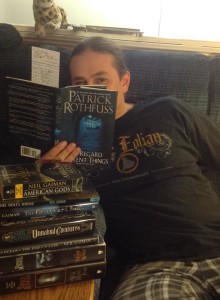
And she sent us back a picture.

Here’s what she had to say:

I was really extremely surprised to win the Stardust ARC two years ago, because I don’t think I’ve ever won any kind of online contest before. I was actually sitting in a hot tub on a ski trip to Colorado when Pat called, and my friends got to watch me make the craziest faces while on the phone. A few weeks later, Neil Gaiman sent me a little card with a picture he had drawn in it, which was so nice of him.

When Pat called me this year to say that I had won again, I’m pretty sure my first words were, “No, I did not!” Surprised doesn’t begin to describe it. If I win again this year, I’m going to start to be suspicious of your randomization algorithm.

Worldbuilders is such a great fundraiser, and Heifer International is an outstanding organization. I’m thrilled to take part. Thank you to Pat Rothfuss for putting it together, and thank you to all of the authors and artists who donate the prizes! I’ve enjoyed reading the fruits of your generosity.

Then Maayan sent it back to us again.

Thanks so much, Maayan. We’re glad you at least got to touch the book that seemed so desperate to meet you.

2013: Stardust In the Lottery Again.

Year six of Worldbuilders, Stardust chose a new person to love. It chose Jennifer.

She was overjoyed, happy to have won it, and just as happy to return it.

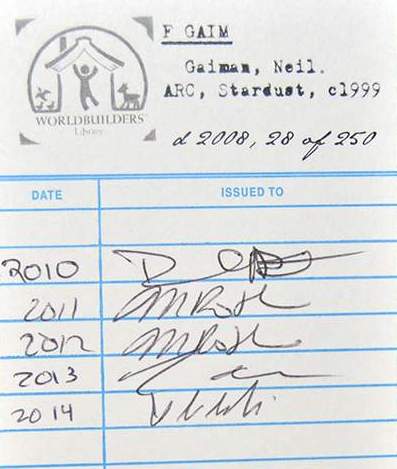
That was the year we had a cool idea – we instituted a Library Card system for the Stardust ARC.

When I was a kid, every library book had one of these. Even now, all these years later, seeing one fills me with a strange joy.

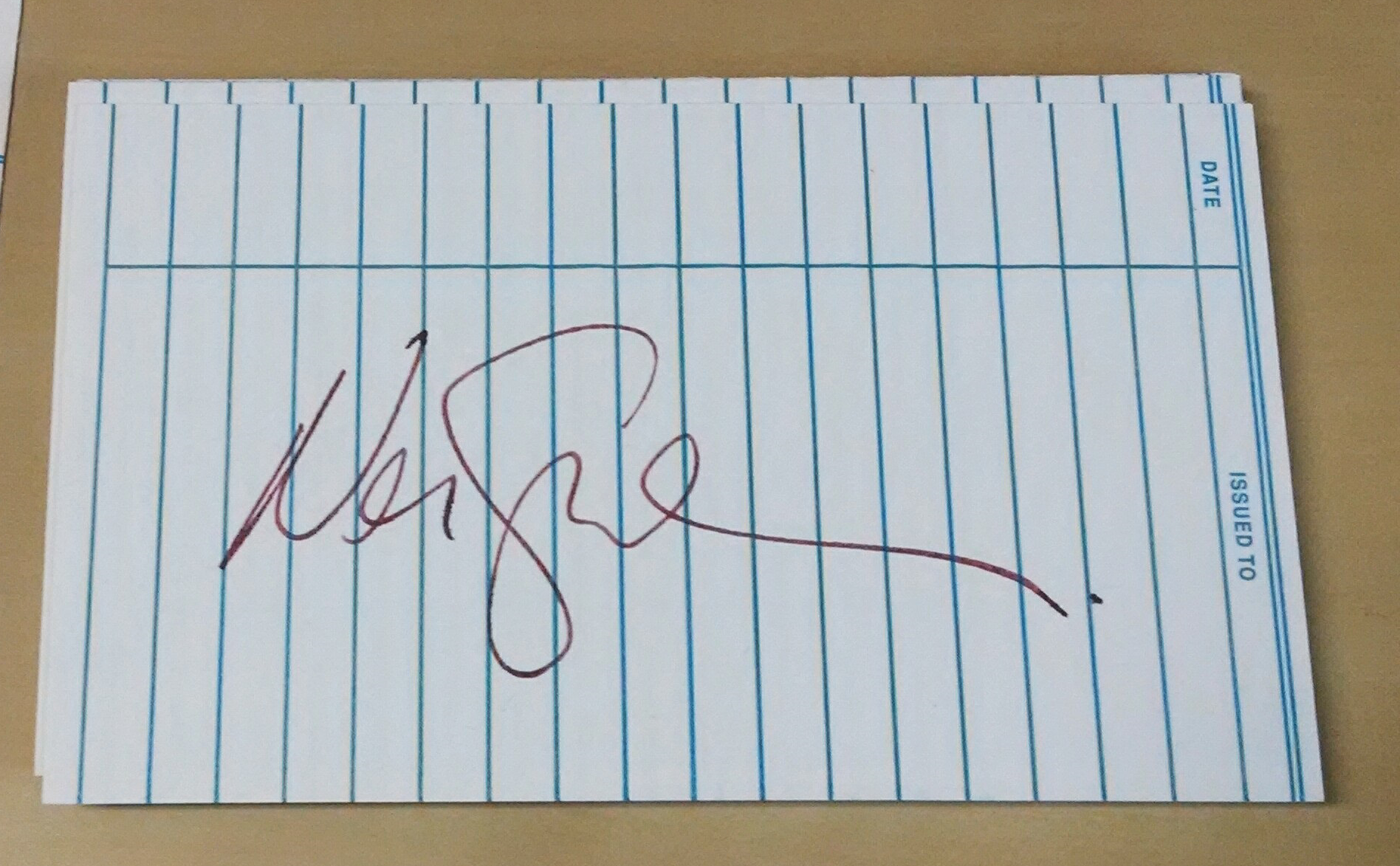
Neil graciously agreed to sign the cards for us.

NeilLibraryCard

What’s more, we had all the previous winners sign the cards and pass them on after keeping one for themselves of course (Maayan got to keep two).

DSC0562b

This way, if the winner chooses to return the book, they still get a memento of the experience: signed by all the people who have loved the book before them as well as the original donor, Neil Gaiman.

2014: Stardust Makes a New Friend

In 2014 Jeff’s name was drawn as the winner of the Stardust ARC. He donated it back again, and we sent him much love in return as well as his own signed Library Card.

The more we do this library card thing, the more I love it.

2015: Stardust Returns Again

In 2015, Stardust went to a wonderful supporter named Don.

It was the first year Amanda called the winner. She had a great conversation with him, he told us to keep it, and we sent him a box of goodies and his library card as a sign of what he won. He has his library card, and we still have a beautiful, signed Stardust ARC.

2016: Stardust ALMOST goes to France

Last year, our winner was a lovely guy named Lucas. He lives in France, and had a lovely phone call and email exchange with the Worldbuilders team, and they sent him a box full of books, including the French editions of a couple of books from The Tinker’s Packs.

He has his library card, and we still have a beautiful, signed Stardust ARC.

This year’s winner will get their very own library card signed by Neil Gaiman and the other winners.

So, without further ado, allow me to add today’s book to the lottery.

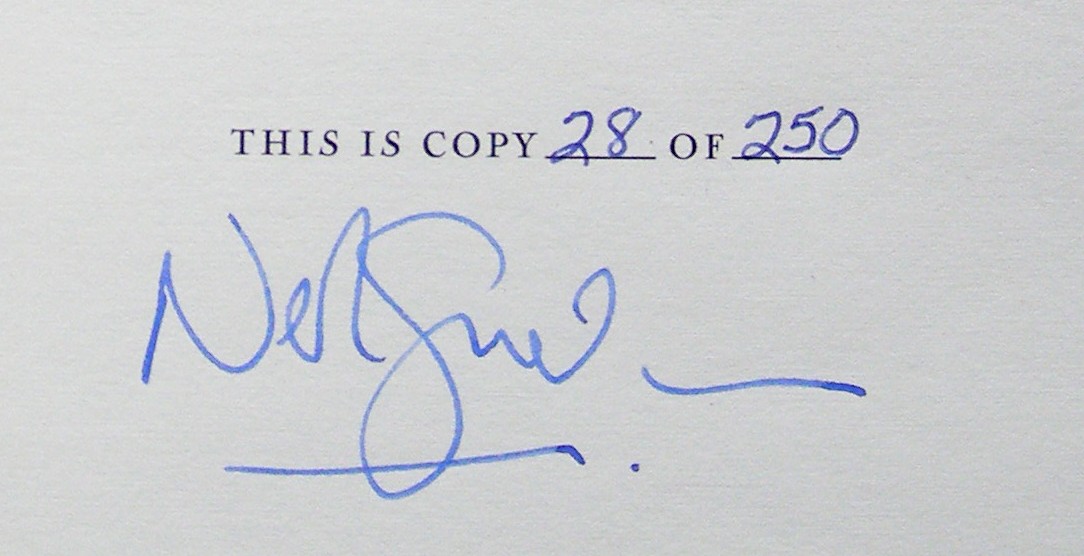
  • A numbered ARC of Stardust in its own slipcase. Signed by Neil Gaiman.

Stardust (6)

Not much remains to be said here. It’s a beautiful book with its own slipcase. Numbered 28 out of 250. Signed by Gaiman.

If you donate to the fundraiser you have a chance of winning not only this book, but also thousands of other books and games donated by authors, publishers, collectors, and fans.

Every $10 you donate gets you a chance to win. So if you donate enough for honeybees ($30) you get three chances to win. Donate enough for a goat along with the training and materials to care for it ($120) and you get twelve chances to win. Donate enough to provide clean water for a village ($300), you get 30 chances to win.

So. If you’d like to be part of a fine tradition of people being awesome, winning books, and making the world a better place, you can head over and donate right now.

16 Nov 07:10

Brandon Sanderson Discusses the Past and Future of the Stormlight Archive

by Aidan Moher

Brandon Sanderson’s fans have come to expect big things with each new novel he releases. Like, literally big things: his latest, Oathbringer, the third volume of the Stormlight Archive, clocks in an an astounding 1,200 pages. More astounding: not a one of them is wasted.

Sanderson rose to popularity on the back of his admirable work completing Robert Jordan’s Wheel of Time series after Jordan’s passing in 2007, and has since become known as the premier American author of big, fat epic fantasy novels. Fans love the intricacy of his worlds; the casts of thousands that fill his pages; his layered, complex magic systems; and his plots, which twist and weave and leave you a little breathless.

I recent caught up with the author to chat about Oathbringer, the intersection of religion and fantasy, what it’s like to write epic fantasy in 2017, and what’s next for the Stormlight Archive.


“I feel like one of the big dangers for epic fantasy is growing so large you stop being able to tell a complete story in each volume,” Sanderson said, referencing the latest, largest volume in his already huge Stormlight Archive. However, he said, he has an advantage over forbears like Robert Jordan and George R.R. Martin—he’s seen what they did, and where they went wrong.

“When [readers] have to wait on new installments, and they’re not each coming to a satisfying conclusion, there’s this sense of being lost at sea. Something feels off. At least, it felt off to me during those middle volumes of Robert Jordan’s series,” he said. While he doesn’t think it affected the overall quality of Wheel of Time, he saw it as a warning sign when he began work on his own ambitious multi-volume epic.

He asked himself: “Is there something you can do about that, having seen how it’s gone for authors in the past?”

Epic fantasy has a tendency to grow unsustainably from volume to volume, he said. “When you’re adding plot elements with each volume, and they’re always bigger than the last, the series can collapse under their own weight. When I was designing the Stormlight Archive, I gave myself a couple of pressure valves.”

Sanderson knew from the get-go the Stormlight Archive was going to be long—he never seriously toyed with a trilogy, like Jordan and Martin so famously did. He came up with a plan, full of those “pressure valves” to help him mitigate the issues of those other epic fantasy series. The Stormlight Archive is projected to be 10 volumes long (with additional short stories, novelettes, and novellas woven in along the way), but Sanderson split it into two shorter, five-volume series. “After the fifth book is done, [there’s] not going to be a reset button—I hate reset buttons—but we are going to take an in-world breather.”

Then, with the sixth book, readers will return to the world of Roshar at the beginning of a new arc that will connect heavily to the first.

“A big story is just a bunch of little stories connected in interesting ways.”

“A big story is just a bunch of little stories connected in interesting ways. When I write a Stormlight Archive book, I plot each book like I would plot a trilogy. So, between the covers of Oathbringer is an entire trilogy.”

In addition to the trilogy-within-a-novel, Sanderson also sprinkles in interludes of a handful of chapters featuring characters who aren’t generally connected with the novel’s overall plot. He considers these a “short story collection” within the larger novel. Each book is then “built up of the different sub-stories of the different characters, and they’re all building blocks that are becoming a bigger and bigger thing. What I love about epic fantasy is the knowledge that people will read and treat something like a trilogy as an entire single whole.”

Knowing people are going to read the whole thing back-to-back means authors can do things they couldn’t do otherwise. “This is why I forced Tor Books to publish these books as these big things, rather splitting them up (as, marketing-wise, I’m sure they would prefer),” he said.

Sanderson wrote the first draft of The Way of Kings (referred to now as “The Way of Kings Prime”) in 2002. He considers it a failure as a novel because it was made up of small pieces of many stories, but didn’t tell a complete story. “When I re-approached The Way of Kings for its 2010 release, I started over from scratch and said, ‘I’m only going to do one character’s backstory per book, and I’m going to let that backstory interweave with the overarching story of that book.'” He realized success for the series was allowing those stories—the backstory and the present story—to “play off each other, or mirror each other in interesting ways, giving each volume its own distinct identity.”

Though he writes some of the longest epic fantasies on the market, Sanderson admitted bigger is not always better.

“It can be better, but smaller can be better, too. It depends how you write.” Sanderson’s goal with the Stormlight Archive is to find a balance of the two, an intimate story within the larger narrative. In Oathbringer‘s case, it’s about Dalinar. “We’re finding out how he became the person he was at the start of The Way of Kings, following his journey in Oathbringer as he’s changing into someone else, and using those journeys to mirror each other.”

Oathbringer is distinctly a novel about change—about the breakdown in social hierarchy during times of war, and the upheaval of society, government, and religion. At the same time, it is also an examination of nationalism and xenophobia. These themes  are particularly resonant in 2017. Has this changing socio-political atmosphere affected how Sanderson approaches these topics?

“I often say that fantasy isn’t a reflection of the past any more than science fiction is a reflection of the future.”

“I often say that fantasy isn’t a reflection of the past any more than science fiction is a reflection of the future,” he said. “In most cases, it’s a reflection of the now told through a [fantastical] lens. We’re using these high fantasy stories to explore how we see the world. These things have a deep and profound effect on me as a writer. At the same time, I’m of the school of thought that my primary goal is to tell a good story, and to make sure the characters feel real. The topics that I’m tackling have to be topics that are important to the characters.”

It’s a cyclical thing, he said. His concerns and worries reflect on what he choose to write about, and affect his characters. “It’s a product of what’s on my mind—but at the same time, it’s trying to tackle it through the lens of who these people are and what’s happening to them.”

“It’s not like I’m sitting down and saying, ‘What tropes need to be subverted?’ It’s more about what my instincts and passions decide need to be subverted.

Sanderson also believes this is affected by the general tropes and themes of contemporary epic fantasy (versus the books he grew up with in the ’80s and ’90s.) He likes to subvert them in ways that he finds relevant or interesting. “It’s not like I’m sitting down and saying, ‘What tropes need to be subverted?’ It’s more about what my instincts and passions decide need to be subverted. The masters of the past have done a great job, so where can I go that explores something new? Or something that’s already been explored, but through the eyes of somebody living in 2017?”

Religion plays a huge role in the Stormlight Archive, and also in Sanderson’s life. He’s a practicing Mormon, and spent two years in Seoul, Korea as a missionary  for The Church of Jesus Christ of Latter-day Saints. There’s this misconception—since Dungeons & Dragons was demonized by evangelical religious groups in the ’80s, and again with Harry Potter in the mid-2000s—that religion and fantasy don’t mix. But that’s simply not true, and Sanderson is a prime example.

“I’m trying to create a story first. The biggest effect my religion has on my writing is me wanting to say, ‘Okay, what annoys me about [what I see] when someone like myself [is portrayed] in a book?’

“The greatest compliment someone can give me is that when they read about one of my characters, who [may think] very differently than Brandon Sanderson, they say, ‘Wow! [Brandon] must be X, because he got this character right.’ That’s the best thing you can me as tell a writer. I think that’s part of the calling of a writer, to make sure that we’re doing that. We arrive at interesting questions, and interesting answers, by having people butt against each other who have different philosophies on life. Nothing changes unless there’s friction—unless there’s another option out there forcing you to look at it and actually consider it.”

Sanderson described what he considers to be the three main pillars of modern fantasy: epic fantasy in the mold of J.R.R. Tolkien; portal fantasy in the mold of C.S. Lewis (or Lewis Carroll before that); and the gritty movement spurred by the success of George R.R. Martin. Two of Sanderson’s pillars were popularized by authors who were deeply religious (Tolkien and Lewis).

“There’s this grand tradition of people who are religious looking at fantasy as a way to explore the world.”

“There’s this grand tradition of people who are religious looking at fantasy as a way to explore the world. For some reason, though, particularly in the ’80s, it became a thing that there was this antagonism.”

Sanderson is often asked how he got into fantasy while living in a deeply religious household and region. Was the push-back against Dungeons & Dragons not happening in Nebraska where he lived?

“It went through my hometown,” he admitted. But it was never something his parents were worried about. “I remember playing [it], and my mom coming down and checking on us, and then later on hearing someone say, ‘You let them play that game?’ She was like, ‘Um, yes? They’re sitting and interacting with one another. They’re actually, you know, being social. And there’s even a girl there!’ I had good parents, who were able to actually look at the thing and ask], ‘Is this damaging to my children? No! It’s actually really good for them.'”

As an adult, he looks back on that time and wonders if the pushback wasn’t part of the appeal. It was a safe counter cultural activity for kids like him. “I knew there wasn’t anything bad about it, but other people thought there was. I could be a bit of a rebel, a bad boy, but not actually go out and do crack.”

Fantasy has always had a strong, passionate intersection with religion. Modern fantasy was popularized “by people who were deeply religious, while at the same time, other deeply religious people think it is the worst thing to ever happen,” Sanderson said, contemplating the abyss that separates the two groups. “But that’s just how humankind is, right? You take any great thing, and someone else is going to tell you why it’s awful.”

Hostility and cultural divide is at the heart of Oathbringer. Sanderson digs into the conflicts between nations and cultures, even between races, but, one of the most unique and interesting aspects to his writing—in the Stormlight Archive, but also a lot of his other work—is that he doesn’t do so by visiting myriad nations. Despite their length, the Stormlight books are generally set in one location—whether that’s the Shattered Plains in The Way of Kings or Urithiru, the ancient home of the Knights Radiant, in Oathbringer.

“I read so many travelogues when I was younger,” he said. He wanted to try something different. “What I’m really interested in is different worlds colliding with one another. I really like how turning the setting into a character changes how a conflict plays out.”

“Back when I was in college, I [said], ‘We need to get rid of books with elves and dwarves!’ I’ve come around a lot since then.”

That’s not to say that travelogues don’t have a place in modern fantasy, he was quick to point out. “Back when I was in college, I [said], ‘We need to get rid of books with elves and dwarves!’ I’ve come around a lot since then. If people want to read and write books about elves and dwarves, I’m sure there are cool stories still to tell. Go for it!”

But Sanderson is more fascinated by the nooks and crannies of the intricate worlds of epic fantasy. He’d rather dig deep than travel wide. “I’ll read these travelogues and think, ‘That’s a really interesting setting. What if you had to live there? Let’s dig into that.'”

The Stormlight Archive is set on Roshar, a planet besieged by “highstorms” with the power to batter society to rubble. Roshar is unusually hostile, and was actually inspired by science fiction. Sanderson believes “fantasy as a genre would be served by having a few more science fiction setting principles applied to its worlds.”

“Granted,” he added, “whatever an author wants to write and do a good job with, I think, is valuable to the genre.”

Meanwhile, he’s more interested in taking a “science fictional” approach to worldbuilding, exploring alien ecologies and figuring out how they might play out.

“Fantasy works backward: take something that’s impossible, make it feel plausible.”

To Sanderson, the biggest difference in worldbuilding for science fiction and fantasy is that science fiction takes what we have and tries to extrapolate what’s plausible. “Obviously not all science fiction tries to do this, but it’s an easy rule of thumb: take what we have, extrapolate the plausible. Fantasy works backward: take something that’s impossible, make it feel plausible.”

So, Sanderson wondered, what would happen if you took that science fiction approach but started from a place of fantasy. That’s just the question he’s looking to answer in the Stormlight Archive. “The genre could be served by a little more of this sense of wonder to the way the environment looks, rather than just taking for granted it’s going to take place in a world that feels vaguely familiar.”

The Stormlight Archive is part of the Cosmere, a vast interconnected series of books (containing, but not exclusive to, the Stormlight Archive, Mistborn, Warbreaker, and the Hugo Award-winning novella The Emperor’s Soul). At the end of the Stormlight Archive’s second volume, Words of Radiance, Sanderson fans were surprised to see the emergence of Nightblood, an awakened sword that was first introduced in Warbreaker. The ultimate easter egg for those invested fans. Is this the start of a new trend? Are we going to see more obvious crossovers between the Cosmere books?

“The short answer is, yes,” Sanderson admitted.

The long answer, however, is a bit more complicated. He was inspired to create the Cosmere by reading comic books during the ’90s. “It was really cool when you got to see [comic book characters] cross over between different series, and really frustrating when an editor would say, ‘If you want to know this story that we’re dangling in front of you, you have to read this whole other thing.’ So, I wanted to try to tell the grander story—the bigger epic happening behind the scenes—without feeling like I’m laughing at readers who aren’t in the know.”

When he set out to write the Cosmere books, he drew a line in the sand: “I want to make sure that I am not making enjoying any given series require reading of another series.”

He also revealed the relationship between the Stormlight Archives and Warbreaker is “very special,” and different than that between the other Cosmere books. Warbreaker was initially written as a prequel to the first draft of “The Way of Kings Prime.” He became fascinated with the character of Vasher (Kaladin’s swordmaster in “The Way of Kings Prime”), and wrote Warbreaker as a prequel—only for the Stormlight Archive to end up getting rewritten and published afterwards.

Over time, you’ll see more of these connections, because Sanderson feels he’s at the point now where he can start bringing in outside elements without feeling like he’s laughing at his more casual readers.

But, he stressed, he’s not trying to recreate The Avengers.

“What I’m trying to build is something a little more like Star Trek—where you have different cultures and different planets who all have their own interesting stories.” 

“People do ask this, because that’s the big shared world thing that’s gotten really cool in recent memory. What I’m trying to build is something a little more like Star Trek—where you have different cultures and different planets who all have their own interesting stories. Over time you get to see the influence of those different cultures as they butt against each other. It’s not really a ‘gather the heroes’ type of story; it’s more of a ‘here’s an evolving universe where you can see the different places influencing one another.'”

Sanderson is fascinated by the trend toward globalism in our world, and it has a big impact on how he approaches building the Cosmere. “[There’s] this idea nations are no longer distinct entities, but are so interconnected with other cultures that it becomes really strange to talk about what national identity means anymore. It’s a different thing than it used to be. If you live in Germany right now, your national identity is very different with the EU [than it was in the past] because you have this different layer.”

Oathbringer is the latest entry in the Stormlight Archive, but it’s not the last. So, what’s next?

“I finished Oathbringer in June. I’m giving myself until December of next year to work on other things.”

“I finished Oathbringer in June,” he said, “so, I’m giving myself until December of next year to work on other things.” He splits his time 50/50 between the Stormlight Archives (which take about 18-20 months to write) and his other projects.

“I’ve finished the third Legion story,” he continued. “Those are my bizarre little detective stories.” Now, he’s working on a followup to his YA Steelheart series. After that, Sanderson will move on to the fourth volume in his “Mistborn Era 2” series, which takes place a few hundred years after the original Mistborn trilogy.

“Right about then, I should be ready to dive back into the Stormlight Archive.”

And so, back to Roshar.

Oathbringer is available now.

The post Brandon Sanderson Discusses the Past and Future of the Stormlight Archive appeared first on The B&N Sci-Fi and Fantasy Blog.

15 Nov 16:14

OnePlus svarar på EngineerMode – rootfunktionen kommer tas bort

by Lars A
OnePlus svarar på EngineerMode – rootfunktionen kommer tas bort

Igår uppdagades att det finns ett Qualcomm-verktyg i Oxygen OS som genom ADB och tillgång till rätt lösenord kan ge telefoner från OnePlus rootaccess. Det så kallade EngineerMode upptäcktes även på enheter från andra tillverkare som Asus och Xiaomi.

OnePlus har nu svarat på upptäckten. De berättar att det mycket riktigt rör sig om ett diagnosticeringsverktyg. Enligt OnePlus utgör möjligheten att roota enheter genom verktyget ingen större säkerhetsrisk, då USB-debugging behöver aktiveras och det behövs även fysisk tillgång till själva telefonen.

Tillverkaren skriver dock samtidigt att de kan förstå att vissa fortfarande känner oro. Därför kommer de skicka ut en OTA-uppdatering som tar bort möjligheten att roota systemet genom EngineerMode.

Inlägget OnePlus svarar på EngineerMode – rootfunktionen kommer tas bort dök först upp på Swedroid.

14 Nov 20:12

Why You Should Check Out The New Firefox Quantum Browser

by Patrick Lucas Austin

Mozilla claims its updated web browser is twice as fast as its last one, and uses a lot less memory than the competition—Google Chrome in particular. It’s called Firefox Quantum, and it might give the web’s most popular web browser a run for its money.

Read more...

14 Nov 06:55

Catching Up: Harassment and George Takei

by Jim C. Hines

I’m still scrambling to catch up with everything after last week’s book release. Huge thanks to everyone who supported, signal-boosted, posted reviews, came to the events, and so on.

A lot has been happening, and I don’t know that I’ll be able to talk about everything I want to, but I’ll try…starting with the sexual harassment/assault accusation against George Takei.

We’ve seen a lot of these stories coming out recently. It feels like the Weinstein revelations helped to break the dam of silence, and we’re beginning to hear from victims who have been suppressed for decades.

In the case of Takei, model Scott Brunton accused Takei of groping his genitals while he was unconscious. There’s also a suggestion that Takei might have drugged him. This allegedly happened at Takei’s house in 1981.

Takei has denied the accusation, saying he has no memory of ever knowing Brunton.

However, a radio interview with Howard Stern a month earlier included the following exchange:

Stern asked Takei if he had ever grabbed a man’s genitals against his will.

Takei paused, said “uh oh” and laughed. Stern repeated the question and Takei said: “Some people are kind of skittish, or maybe, um, uh, afraid, and you’re trying to persuade.”

Stern’s co-host, Robin Quivers, asked if Takei did “this grabbing at work”. Takei said: “Oh, no, no, no, it wasn’t at work. It was either in my home. They came to my home … it didn’t involve power over the other.”

#

Like many others, I’ve admired and respected George Takei for ages. I recognize that I very much don’t want to believe Takei did this.

I also know false accusations, while they do happen, are rare. And while Takei’s interview says nothing about drugging people, he does admit to grabbing men’s genitals against their will, which he justifies as “trying to persuade.”

As I said on a friend’s FB post, I’m still processing. But I’m seeing a lot of reactions that are troubling as hell.

1. “I’ve met George Takei and he’s always been a gentleman” and “I’m friends with Takei and don’t believe he could do this.”

Harassers don’t go around wearing signs that say “I drug and grope people against their will.” They don’t greet everyone they meet with a hearty handshake to the genitals. Abusers tend to be very good at maintaining a pleasant, friendly public persona. The fact that you’ve never seen someone behave inappropriately doesn’t mean it’s never happened.

And yes, Takei has been outspoken against harassment and abuse and such. Unfortunately, there are predators even among anti-rape, anti-harassment circles.

2. “Why would Brunton wait all these years before saying anything?”

This is the same criticism being thrown at accusers against Moore, Spacey, Weinstein, and so many others. There are too many real, valid reasons to list here, but some of them include:

  • Fear of the consequences of speaking out
  • Shock and confusion over what happened
  • A desire to “get on with your life” and not relive the assault
  • Believing you’re alone
  • The power difference between you and your harasser

3. “This whole thing is turning into a witch hunt” and “It’s McCarthyism all over again!”

Why? Because there are so many accusations and revelations coming out?

We as a society have spent decades silencing victims of sexual harassment. What the hell did you expect it to look like when the dam finally began to crumble?

Victims of harassment — particularly women — have been saying for ages that this is a huge problem. Most of the stories we’re seeing involve multiple victims coming forward, and most of their accounts are corroborated by others. The Takei accusation feels like an outlier in some respects, since to the best of my knowledge, Brunton is the only one to have spoken out against him.

What pisses me off the most about this deflection is that when people try to defend Takei by calling it a witch hunt, they’re undermining everyone who’s been speaking out about their harassment. They’re suggesting all of these victims are lying, caught up in hysteria and publicity.

If you want to say you don’t believe a particular allegation, that’s one thing. If you say it’s all a witch hunt, then intentionally or not, you’re joining everyone else who’s silenced victims and helped to perpetuate this harassment and abuse for so many decades.

#

Like I said, I love George Takei and his work. I don’t want the accusation to be true. But Takei’s interview is troubling as hell. And so are some of the knee-jerk defenses I’m seeing from others who simply don’t want to believe.

11 Nov 21:35

Stockholms län utom Roslagskusten: Varning klass 1, plötslig ishalka, Stockholms län utom Roslagskusten.

Natt mot söndag risk för tillfrysning av våta vägbanor i samband med uppklarning och fallande temperatur till minusgrader.
10 Nov 05:32

Why You Shouldn't Let People Search for You by Phone Number on Facebook

by Emily Price

Getting an apartment in San Francisco is a competitive nightmare, which is why I was excited to find that the landlord I had been texting with to set up an apartment viewing just happened to be friends with another good friend of mine. She didn’t tell me, and we aren’t Facebook friends: I found out because she has her…

Read more...

08 Nov 08:09

These Are the Things Restaurant Workers Wish You Knew

by Patrick Allan
Oakfairy

Självklarheter det mesta, men den sista detaljen var intressant.

Recently, we asked people who worked in the food service industry if there were any insights about their job they wished restaurant patrons would know, and we got some great answers. Whether it’s about tipping, food orders, or how you should and shouldn’t treat the wait staff, these are the secrets to being a good…

Read more...

06 Nov 20:29

Antisocial turtle

By NemiMakeit
I just prefer to stay at home


05 Nov 08:55

Att lyckas med sina mål!

by Martina

Idag tänkte jag dela med mig av 4 tips för att nå sina mål och 4 vanliga misstag när man inte når sina mål.
Mina inlägg om produktivitet och målplanering är bland de mest populära, och något jag verkligen älskar att skriva om också, så nu kör vi!

4 tips för att nå sina mål

1. Bestäm klart och tydligt vad du vill
Att VETA vad man vill är superviktigt. Det går inte att uppnå ett mål om man inte vet vilket det är! Vill du ha ett nytt jobb? Tjäna mer pengar? Bygga mer muskler? Gå ned i vikt? Bestäm och skriv ned så att du har definierat målet klart och tydligt.

2. AGERA AGERA AGERA – gör man något så händer det något!
Steg två är att utföra en verklig handling för att komma framåt. Skicka in en jobbansökan, registrera en ny blogg, betala ett medlemsskap… vad det nu kan handla om. GÖR DET! När jag mäter min produktivitet räknar jag sällan alla fails och försök, den goda viljan räknas ej, endast resultat. 

3. Analysera och experimentera och håll dig till fakta
Det är viktigt att titta på resultaten med nyktra ögon. Funkar det inte? Erkänn det, säg till dig själv “det jag gör nu fungerar ej, vad kan jag ändra?” Det är jätteviktigt att våga överge en strategi som bara inte funkar. Vet många personer som vill gå ned i vikt men i stället går upp och ändå inte överger den dysfunktionella metoden. Var inte en av dem.

4. Ändra kontinueligt TILLS det fungerar!
Testa, testa, testa tills det funkar. Det är inte farligt, gör bara en ny plan om den förra inte funkade. Det är inte hela världen. Eyes on the prize!

4 vanliga misstag

1. Motstridiga eller otydliga mål
“Det hade varit trevligt att känna sig mer fit”
“Det hade varit kul att göra något annat”
“Jag tror jag vill dansa mer”
“Till våren ska jag börja med ett intresse!”
“Jag vill bygga muskler och gå ned i vikt!”

Det är viktigt att sätta mer exakta och gärna detaljerade mål. Hur definierar du fit? Hur mycket är mer? Eller tillräckligt? Särskilt män verkar ha problem med att till exempel sätta en målvikt och istället säga att “det spelar ingen roll vad jag väger, det är kroppsformen som räknas” men bättre att bara bestämma en siffra.

2. Du har inte GJORT något KONKRET
Jag fick den här aha-upplevelsen 2006 tror jag det var, att alla mina planer och saker jag ville göra stannade i mitt huvud. Analyzing is paralyzing. Jag hade i ett decennium skrivit tusentals sidor dagbok och gjort vadå? Inget? Så fort jag insåg detta köpte jag biljetter till Arvika-festivalen, bara för att bryta cirkeln.

3. För mycket känslor – för lite fakta
Det bästa man kan göra när man inte når ett mål är att skala bort ALLA känslor och bara titta på data. Bli superpragmatisk och lös problemet oavsett hur det känns eller borde vara. 

4. Ifrågasättande istället för lösningar
“Varför funkar det inte?”
“Det funkar ju för si och så”
“Varför funkar det aldrig för mig?”
“Det borde funka!”

Deta är exempel på extremt dåliga frågeställningar som inte leder någonstans. Ta förståelsen en annan dag och titta på fakta. Funkar det inte så funkar det inte. Punkt. Testa nått annat, gå vidare. Fastna inte i ältande.


Detta var mina tips inför helgen, kanske dags att sätta lite nya mål nu till vintern? Man måste inte vänta på nyåret! Jag har själv satt massa nya mål för min kroppsviktsträning, dansandet, mitt boende och andra saker som jag tänkte fixa INNAN 2018! 


Dela inlägget!

Inlägget Att lyckas med sina mål! dök först upp på Martina Johansson.

02 Nov 06:09

Thanks, folks! Mayim Bialik admits her errors about poly and open relationships

by noreply@blogger.com (Alan)
01 Nov 06:21

Yoda's Venn Diagram

By returnsaph
Do or do not, there is no try.


26 Oct 05:44

Embrace the Swedish "Lagom" Lifestyle to Reduce Stress and Live More Moderately

by Starre Julia Vartan

Looking longingly toward Nordic cultures for solutions to American problems is practically a cottage industry at this point. Between Scando design principles (more light, less stuff); sustainability initiatives (The Netherlands have figured out how to feed us all); education (Norwegian forest schools, anyone?); and…

Read more...

26 Oct 04:37

A Letter of Thanks to My Son Who Wants to Be Luke Cage This Halloween

by Lawrence Ware on Very Smart Brothas, shared by Cheryl Eddy to io9

Dear L.J.,

Read more...

23 Oct 11:19

Lobbyism och hyckleri bakom cancerforskning

by Martina

Jag skrev och dementerade en artikel i SvD som handlade om mammografins förträfflighet, och började i min research läsa lite allmänt om Cancerfonden. En sak fångade min uppmärksamhet, nämligen hur de räknar överlevare. När jag tänker på “att överleva cancer” så tänker jag på att man fortsätter leva, är frisk och sen kanske (längre fram) dör av något annat. Så tänker inte cancerfonden, föga förvånande egentligen. De tycker att “överlevnad i 5 år efter diagnos” är samma sak som “överlevnad”. Dvs att patienten lyckades dra ut på plågan i 5 år med otäcka behandlingar innan han eller hon ändå dog av sin cancer. Det är såhär cancerfonden fifflar med sin statistik när det säger att “Åh vad överlevnaden har ökat de senaste åren!”

Forskningen går inte framåt!

och den kommer inte att göra det så länge man forskar med tunnelseende och vägrar titta på helheten, som till exempel att högt blodsocker, läckande tarmar, D-vitaminbrist och förhöjda inflammationsmarkörer ökar risken för cancer. Men nä… bättre att förlita sig på mammografi (som i studie efter studie inte fungerar) och cellgifter som dödar hela människan och inte bara cancern.


Vet du vad fördelen med att räkna antalet “överlevare” på det här förvrängda sättet? Det ger en ökad försäljning av cytostatika och andra mediciner för att till exempel hantera biverkningar. “Överlever 5 år efter diagnos” ger ju således mer cash än “Överlever 1 år”. Kanske inte toppen för individen men toppen för statistiken och läkemedelsbolagen.

Bojkotta alla rosa band

Tyvärr stödjer man ingenting vettigt när man köper rosa-bandet-produkter. Cancerfondens koppling till läkemedelsbolagen redovisas inte, men det är allmänt känt att de arbetar för opinionsbildning eller lobbying som till exempel att införa kontroversiella läkemedel. Ett exempel är Herceptin som är väldigt biverkningstungt och lett till tusentals dödsfall.

Astra Zeneca är en stor sponsor av Rosa bandet. Förvånande? 

Rosa bandet används för “pink washing”

Företag med tveksam hälsoprofil går ofta in och stöttar hälsokampanjer för att verka bättre… som till exempel Kellogs, Fazer och andra producenter av rent skräp. Det kallas för “pink washing” och förekommer med massor av produkter och hälsokampanjer. Bli inte förvånad om du ser…

cancerforskning

Så lämpligt när cancerceller lever uteslutande av glukos. Låt oss äta mer socker och bli fetare och sjukare. För en god sak givetvis.

Kul svar från SvD

När jag frågade om jag kunde kontra deras mammografiartikel fick jag detta svar:

Ja det kan du, men det är viktigt att det verkligen är ett svar på en tidigare artikel, inte en förevändning för ett eget budskap vid sidan om.

Artikeln jag ville bemöta var skriven av en politiker och en representant från Cancerfonden… så lobbyism gick trots allt alldeles utmärkt?

Dela inlägget!

Inlägget Lobbyism och hyckleri bakom cancerforskning dök först upp på Martina Johansson.

23 Oct 11:15

Are you drunk?

By theduc
^^