Shared posts
Hellvetica Puts a Spooky Twist on the World’s Most Popular Font
In Mark Zuckerberg’s World, “Provenance” Means Nothing

To the supreme ruler of Facebook, nothing is sacred. Especially not language.
During a summit at the Paley Center last week, Facebook creator Mark Zuckerberg gave a 40-minute address on his company’s latest innovation: Facebook News.
Seated next to Zuckerberg was another media giant, Robert Thomson, the chief executive of News Corp — Rupert Murdoch’s conglomerate-empire that owns the Wall Street Journal, the New York Post, and the Daily Telegraph, among other major outlets.
About 10 minutes through his sermon, Zuckerberg arrived at a thesis — and a word of interest: “Provenance has been one of the key things I think we’ve talked about for years, the importance for people to know where the information is coming from … so that they establish that base of trust,” he said, nodding at Thomson, whom Zuckerberg praised for “pushing him” in this area.
In the art world, provenance is a crucial term — and a perennial conversation.
According to the Oxford English Dictionary, provenance denotes “the place of origin or earliest known history of something.” It derives from the french verb provenir, or “to come from.” To dealers, collectors, and historians, provenance is largely a matter of authenticity — who painted the work, when, and under what circumstances. In museums, it’s also a question of how, exactly, a work might have been acquired — and whether its collector handled the work ethically.
Certainly, language (its meaning, scope, and impact) is fluid. But in Zuckerberg’s case, word choice may betray a certain arrogance.
Since its emergence, Facebook has changed the way we communicate — and that includes the way we speak. To “like” something is to click a button on-screen; a “wall” signifies that endless Facebook scroll. And now, provenance may come to imply one question — is it fake news or misinformation? Gone are the implications about art, origin, ethics, and quality. Since Facebook arguably was an incubator for the fake news phenomenon, Zuckerberg may be explaining away his company’s unfortunate record with one word.
That is not to imply Zuckerberg has done anything remarkable with word choice. Individuals in power often borrow words and concepts from other industries. But given Zuckerberg’s callous approach to public interest, his vocabulary may be worth a second listen.
During Friday’s event, Zuckerberg unveiled his site’s forthcoming “news tab,” what he referred to as a “dedicated space” for journalism to exist in the Facebook universe. Up until this point, journalism has competed directly with the musings of friends, memes, and baby photos. Once the news tab launches in earnest, articles will leave the busy, chaotic main feed for their own depot.
In exchange for access to this content, Facebook will pay select publishers — presumably the New York Times, the Washington Post, et al. (Commentators have already noted that local, less profitable outlets may unjustly lose out on the cushy arrangement.)
Social media has infiltrated every corner of modern life, but does it have the authority to redefine language as it pleases? The ultimate test is, of course: will the vernacular change? Will our sense of provenance change according to Zuckerberg’s definition? Let’s hope not.
Happy Birthday, ARPANET: The Internet’s Grandfather First Connected 50 Years Ago

On October 29, 1969, the first successful message was sent over ARPANET. UCLA student Charley Kline transmitted from an SDS Sigma 7 computer to an SDS 940 machine at the Stanford Research Institute. The initial message was inauspicious — the letters “lo” were sent before the machine crashed. The very first message sent over ARPANET was, therefore, “lo,” which means the internet’s grandfather managed to use slang (or at least Orson Scott Card’s version of it) before transmitting an intelligible command. In retrospect, we probably should have interpreted this as an ominous clue.
“It was inadvertent, but it turned out to be prophetic and powerful that the message we delivered was ‘LO,’ as in ‘lo and behold,'” said UCLA professor Leonard Kleinrock, who was hired to head the project.
The first genuine command transmitted over ARPANET, incidentally, was “login.”
ARPANET was funded by the Advanced Research Projects Agency, the forerunner of DARPA today. ARPANET was the ancestor of the modern internet. It was the first packet-switching network to implement the TCP/IP protocol. The TCP/IP protocol was designed to be latency and fault-tolerant in a way that existing telephone networks were not. The major goal of the project was to allow for the more efficient sharing of computer resources. Computers were rarer in the 1960s than they are today, and not everyone who worked on an ARPA project had access to the horsepower they needed. The idea of connecting to a remote machine to tap non-local resources is so common today, it’s difficult to remember there was a time when the feature had to be invented out of whole cloth. Nevertheless, it was.
There’s disagreement over whether ARPANET had a specific goal of robust communication in the face of nuclear war. The RAND corporation has drawn a link between some of the early work it did on packet-switched networks (as opposed to circuit-switched networks) and the comparative robustness of the former. The Internet Society and Charles Herzfeld, former ARPANET director, have both argued that ARPANET was not conceived of as a means of creating a network that would survive a nuclear war. While RAND published some theoretical work on packet-switched networks at the same time researchers were creating what would become part of ARPANET, the two projects were not connected and the two groups were not aware of each other.

First ARPANET IMP log: the first message ever sent via the ARPANET, 10:30 pm PST on 29 October 1969 (6:30 UTC on 30 October 1969). This IMP Log excerpt, kept at UCLA, describes setting up a message transmission from the UCLA SDS Sigma 7 Host computer to the SRI SDS 940 Host computer. Image and caption via Wikipedia
The initial proposals for ARPANET were anything but lauded. According to Wikipedia, “Most computer science companies regarded the ARPA proposal as outlandish, and only twelve submitted bids to build a network; of the twelve, ARPA regarded only four as top-rank contractors.” An article at The Conversation makes a similar point.
Predictably, the new network was scarcely used at the beginning. Excluding, in fact, the small circle of people directly involved in the project, a much larger crowd of potential users (e.g. graduate students, researchers and the many more who might have benefited from it) seemed wholly uninterested in using the ARPANET. The only thing that kept the network going in those early months was people changing jobs. In fact, when researchers relocated to one of the other network sites – for instance from UCLA to Stanford – then, and only then, the usage of those sites’ resources increased.
It’s easy to look back today and see the modern internet as the inevitable result of technological progress. It wasn’t. It was a slow process of creating communication protocols to bridge the gaps between incompatible systems and to develop common languages and approaches to communication challenges, all done with a fraction of the computing power available in a modern smartphone. The initial four locations connected to ARPANET were UCLA, Stanford’s Augmentation Research Center, UC Santa Barbara, and the University of Utah School of Computing. From there, it extended to Massachusetts. By 1981, the network had grown to 213 machines.
ARPANET was formally shut down in 1990, succeeded by the internet. Upon its decommissioning, Vint Cerf, the architect of TCP/IP, wrote the following lament:
It was the first, and being first, was best,
but now we lay it down to ever rest.
Now pause with me a moment, shed some tears.
For auld lang syne, for love, for years and years
of faithful service, duty done, I weep.
Lay down thy packet, now, O friend, and sleep.
Requiescat in Packet, ARPANET. And happy birthday. Your grandkid is kind of a big deal.
Top image credit: DARPA
Now Read:
Cory Doctorow on Reclaiming Technologies of Oppression

The Origin of Consciousness in the Brain Is About to Be Tested
Here’s something you don’t hear every day: two theories of consciousness are about to face off in the scientific fight of the century.
Backed by top neuroscientist theorists of today, including Christof Koch, head of the formidable Allen Institute for Brain Research in Seattle, Washington, the fight hopes to put two rival ideas of consciousness to the test in a $20 million project. Briefly, volunteers will have their brain activity scanned while performing a series of cleverly-designed tasks targeted to suss out the brain’s physical origin of conscious thought. The first phase was launched this week at the Society for Neuroscience annual conference in Chicago, a brainy extravaganza that draws over 20,000 neuroscientists each year.
Both sides agree to make the fight as fair as possible: they’ll collaborate on the task design, pre-register their predictions on public ledgers, and if the data supports only one idea, the other acknowledges defeat.
The “outlandish” project is already raising eyebrows. While some applaud the project’s head-to-head approach, which rarely occurs in science, others question if it’s all a publicity stunt. “I don’t think [the competition] will do what it says on the tin,” said Dr. Anil Seath, a neuroscientist at the University of Sussex in Brighton UK, explaining that the whole trial is too “philosophical.” Rather than unearthing how the brain brings outside stimuli into attention, he said, the fight focuses more on where and why consciousness emerges, with theories growing by the numbers every year.
Then there’s the religion angle. The project is sponsored by the Templeton World Charity Foundation (TWCF), a philanthropic foundation that tiptoes the line between science and faith. Although spirituality isn’t taboo to consciousness theorists—many embrace it—TWCF is a rather unorthodox player in the neuroscientific field.
Despite immediate controversy, the two sides aren’t deterred. “Theories are very flexible. Like vampires, they’re very difficult to slay,” said Koch. Even if the project can somewhat narrow down divergent theories of consciousness, we’re on our way to cracking one of the most enigmatic properties of the human brain.
With the rise of increasingly human-like machines, and efforts to promote communications with locked-in patients, the need to understand consciousness is especially salient. Can AI ever be conscious and should we give them rights? What about people’s awareness during and after anesthesia? How do we reliably measure consciousness in fetuses inside mother’s wombs—a tricky question leveraged in abortion debates—or in animals?
Even if the project doesn’t produce a definitive solution to consciousness, it’ll drive scientists loyal to different theoretical aisles to talk and collaborate—and that in itself is already a laudable achievement.
“What we hope for is a process that reduces the number of incorrect theories,” said TWCF president Andrew Serazin. “We want to reward people who are courageous in their work, and part of having courage is having the humility to change your mind.”
Meet the Contestants
How physical systems give rise to subjective experience is dubbed the “hard problem” of consciousness. Although neuroscientists can measure the crackling of electrical activity among neurons and their networks, no one understands how consciousness emerges from individual spikes. The sense of awareness and self simply can’t be reduced down to neuronal pulses, at least with our current state of understanding. What’s more, what exactly is consciousness? A broad stroke describes it as a capacity to experience something, including one’s own existence, rather than documenting it like an automaton—a vague enough picture that leaves plenty of room for theories to how consciousness actually works.
In all, the project hopes to tackle nearly a dozen top theories of consciousness. But the first two in the boxing ring are also the most prominent: one is the Global Workspace Theory (GWT), championed by Dr. Stanislas Dehaene of the Collège de France in Paris. The other is the Integrated Information Theory (IIT), proposed by Dr. Giulio Tononi of the University of Wisconsin in Madison and backed by Koch.
The GWT describes an almost algorithmic view. Conscious behavior arises when we can integrate and segregate information from multiple input sources—for example, eyes, ears, or internal ruminations—and combine it into a piece of data in a global workspace within the brain. This mental sketchpad forms a bottleneck in conscious processing, in that only items in our attention are available to the entire brain for use—and thus for a conscious experience of it. For another to enter awareness, previous data have to leave.
In this way, the workspace itself “creates” consciousness, and acts as a sort of motivational whip to drive actions. Here’s the crux: according to Dehaene, brain imaging studies in humans suggest that the main “node” exists at the front of the brain, or the prefrontal cortex, which acts like a central processing unit in a computer. It’s algorithmic, input-output based, and—like all computers—potentially hackable.
IIT, in contrast, takes a more globalist view. Consciousness arises from the measurable, intrinsic interconnectedness of brain networks. Under the right architecture and connective features, consciousness emerges. Unlike the GWT, which begins with understanding what the brain does to create consciousness, IIT begins with the awareness of experience—even if it’s just an experience of self rather than something external. When neurons connect in the “right” way under the “right” circumstances, the theory posits, consciousness naturally emerges to create the sensation of experience.
In contrast to GWT, IIT believes this emergent process happens at the back of the brain—here, neurons connect in a grid-like structure that hypothetically should be able to support this capacity. To IIT subscribers, GWT describes a feed-forward scenario that’s similar to digital computers and zombies—entities that act conscious but don’t truly posses the experience. According to Koch, consciousness is rather “a system’s ability to be acted upon by its own state in the past and to influence its own future. The more a system has cause-and-effect power, the more conscious it is.”
The Showdown
To test the ideas, 6 labs across the world will run experiments with over 500 people, using 3 different types of brain recordings as the participants perform various consciousness-related tests. By adopting functional MRI to spot brain metabolic activity, EEG for brain waves and ECoG (a type of EEG with electrodes directly placed on the brain), the trial hopes to gather enough replicable data to assuage even the most skeptical of opposing fields.
For example, one experiment will track the brain’s response as a participant becomes aware of an image: the GWT believes the prefrontal cortex will activate, whereas the IIT says to keep your eyes on the back of the brain.
According to Quanta Magazine, the showdown will get a top journal to commit to publishing the outcomes of the experiments, regardless of the result. In addition, the two main camps are required to publicly register specific predictions, based on their theories, of the results. Neither party will actually collect nor interpret the data to avoid potential conflicts of interest. And ultimately, if the results come back conclusively in favor of one idea, the other will acknowledge defeat.
What the trial doesn’t answer, of course, is how neural computations lead to consciousness. A recent theory, based on thermodynamics in physics, suggests that neural networks in a healthy brain naturally organize together according to energy costs into a sufficient number of connection “microstates” that lead to consciousness. Too many or too few microstates and the brain loses its adaptability, processing powers, and sometimes the ability to keep itself online.
Despite misgivings, TWCF’s Potgieter sees the project as an open, collaborative step forward in a messy domain. It’s “the first time ever that such an audacious, adversarial collaboration has been undertaken and formalized within the field of neuroscience,” he said.
Tononi, the backer of IIT, agrees. “It forces the proponents to focus and enter some common framework. I think we all stand to gain one way or another,” he said.
Image Credit: Image by Beyond Timelines from Pixabay
How proximity bias holds employees (and workplaces) back
Many companies still hold on to the idea that workers who physically come into the office are more productive than their remote counterparts.
Successful businesses depend on their ability to make the right decisions. That’s why interest in “cognitive bias”—the set of faulty perceptions which can often taint our judgments—is not only growing in clinical psychology: it’s a growing focus in the boardroom, too. There are many forms of cognitive biases, but one, in particular, is often overlooked. I’m calling it “proximity bias.”
How to Keep Your Siri, Alexa, and Google Assistant Voice Recordings Private
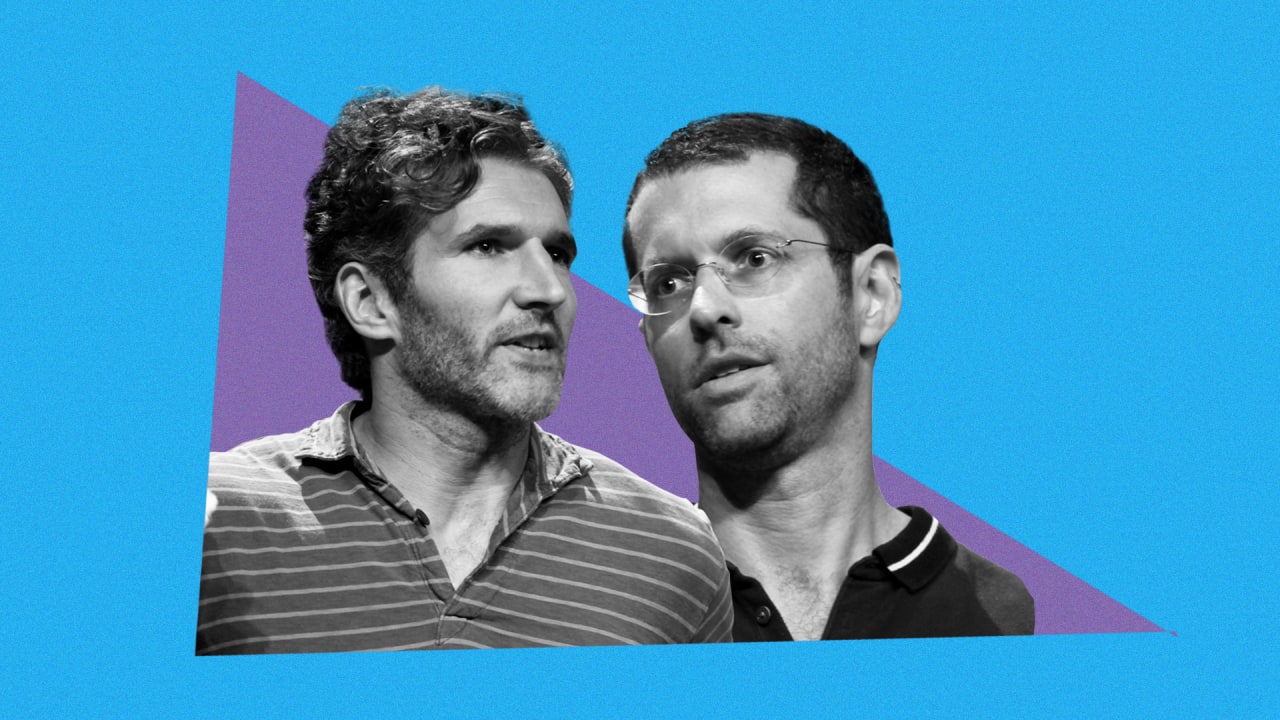
The unbelievable timeline of how Benioff and Weiss went from ‘Game of Thrones’ gods to ‘Star Wars’ goats
The wild ride down for the once high-flying showrunners
What a long, strange trip it’s been for David Benioff and D. B. Weiss, the Game of Thrones showrunners and now former Star Wars writer/producers. The Emmy-winning pair who oversaw all eight seasons of the groundbreaking (and in the end, bitterly polarizing) HBO series say they’re leaving the galaxy far, far away to devote more time to their upcoming, and as yet unspecified, Netflix projects.
Forget poisoned candy and razor blades. Here’s the real Halloween horror

Enlarge / Dun-dun-duun. (credit: Getty | Los Angeles Times)
You've likely heard the spooky stories: adorable, sugar-crazed kids gleefully toddle from door to door in their homemade costumes and festive masks—only to be handed razor-blade-stuffed apples or cyanide-laced pixie sticks by wicked, faceless strangers.
As such, many a trick-or-treater has hauled their cloying bounties home over the decades only to surrender them to parental authorities for thorough inspection. At some points, hospitals even offered free X-ray screenings for candy to make sure that the sweet loot was safe. Subsequent research found that this costly endeavor failed to turn up any threats. But it still seemed worthwhile.
Through the years, media reports continued to gather terrifying tales of deadly Halloween candy handed out by evildoers—a phenomenon dubbed "Halloween sadism" in the press. There was little 5-year-old Kevin Toston of Detroit, who died from heroin-laden Halloween candy in 1970. And 8-year-old Timothy O'Bryan of Pasadena, Texas, who died from cyanide poisoning after eating tainted Halloween candy in 1976.
Read 7 remaining paragraphs | Comments
Pink Petro and our role in the energy transition

7,902 total views, 268 views today Change is hard. A few years ago Wall Street made a statement with this photo. They told the world and the free markets it’s time we change. The statue was symbolic. It created a ruckus. It sent the message that we are ready to embrace the reality that a gender-balanced workforce […]
The post Pink Petro and our role in the energy transition appeared first on Pink Petro.
Artist paints a panorama on a sphere
This is a spherical painting of a street intersection somewhere in Japan. I don't know who the artist is, but the effect is amazing.

Controversial copyright bill inches closer to becoming law as House approves

Enlarge / The United States Capitol Building, the seat of Congress, on the National Mall in Washington, D.C. (credit: Omar Chatriwala | Getty Images)
In a change of pace for the modern era, the House of Representatives yesterday agreed on a bill and passed it by an overwhelming majority. Unfortunately, the bill in question, known as the CASE Act, is a controversial measure that critics argue could penalize ordinary Americans as much as $30,000 for something as simple as photo sharing, while also emboldening copyright trolls.
The House voted 410-6 on Monday to adopt the measure, fully named the Copyright Alternative in Small-Claims Enforcement Act of 2019. The bill aims in part to create a new "small claims" Copyright Claims Board within the US Copyright Office. That, proponents argue, would give content creators and rights holders a better, more efficient way to pursue infringement claims, instead of having to spend the time and money on filing a federal court case.
As Schoolhouse Rock taught us, a bill needs approval from both the House and Senate before it can become law. (Though the reality is somewhat more complex). CASE went through committee in both the House and Senate earlier this year, and so the version of the bill the House voted to accept on Monday is ready to go to the Senate floor for a vote.
Read 15 remaining paragraphs | Comments
More Than Half of the World's Banks Are Already in a Weak Position Before Any Downturn That May Be Coming


Read more of this story at Slashdot.
Michael Douglas on Kathleen Turner, age gaps, and the return of The Kominsky Method

If part of the allure of the first season of Netflix’s The Komisnky Method was watching Michael Douglas and Alan Arkin play two bickering old friends (Sandy Kominsky and Norman Newlander, respectively), then season two hopes to up the ante with some new sparring partners. Joining the cast this go-around are Jane…
Jared Harris will try to save the world again in Apple TV's Isaac Asimov adaptation

Jared Harris and Lee Pace know you have options when subscribing to streaming platforms, and they appreciate you choosing Apple TV, the future home of their new series, Foundation. Per TVLine, Harris and Pace will headline the upcoming adaptation of Isaac Asimov’s sci-fi novel (the first in a trilogy) from David S.…
The Glamour of 1950s Senegal in Photographs

The Republic of Senegal is located in West Africa, with the capital city of Dakar perched Atlantic-facing at its westernmost tip. A new project sponsored by the Josef and Anni Albers Foundation and Le Korsa shows Senegal of decades past through the documentary lens of Senegalese black-and-white film photographer Roger DaSilva (1925-2008). Born in Benin, DaSilva took up photography while dispatched with the French army in 1942, documenting the wounded, and the return of concentration camp survivors after the 1945 armistice. But his work in the following decade, featuring Senegalese citizenry decked out in cutting-edge fashions at nightclubs, upscale weddings, and cultural events, capture a joyful cross-section of post-colonial African self-expression.


The Albers Foundation joined Le Korsa and the Dakar-based association Xaritufoto, in the promotion of DaSilva’s extensive archive, comprised of an estimated 75,000 negatives that were discovered in his home after his death in 2008. Some 100 of DaSilva’s negatives have been restored, and six will be presented for the first time outside Senegal, under the auspices of the Albers Foundation at this year’s Also Known as Africa (AKAA) design festival, running from November 8–11, 2019 in Paris. The festival will host 44 exhibitors, with new galleries from Germany, the Netherlands, and Mali.


“For decades, the anonymity of both artist and sitter has been a principal characteristic of African art and photography,” said a press release from the Albers Foundation. “The existence of this collection of images by DaSilva, including his self-portraits, resonates powerfully and underlines the strong agency and intent of the photographer as an author in full possession of his narrative.” Though DaSilva is not a household name today, in the 1960s he was recognized among the celebrity elite of his time. In pictures from the 1966 World Festival of Negro Arts, DaSilva — also an actor and a tap dancer — appears in his images alongside Ella Fitzgerald, Ingrid Bergman, and Louis Armstrong.


The restoration of this archive by the Albers Foundation continues the foundation’s long-standing relationship with Senegal, including their support for the arts in the region via the Thread Senegal residency. The images on view at AKAA festival will be sold, with proceeds going to Le Korsa, a non-profit founded by Nicholas Fox Weber in 2005, focusing particularly on medical care, scholarships, and education in Senegal.


For those interested in a vision of Senegal that captures the vibrancy and dynamism of the city of Dakar in the middle of the 20th century, the imagery of Roger DaSilva, painstakingly recovered from the brink of obscurity, will be a colorful experience, black-and-white notwithstanding.
The post The Glamour of 1950s Senegal in Photographs appeared first on Hyperallergic.
Halloween: Corgi in a spider costume at a pumpkin patch
“Corgi’s first pumpkin patch.”

What an adorable critter I mean a terrifying spider!
Photo and video by the dog's human, @whynothmm.

Check it out with sound.
[IMGUR]

Bipartisan legislation would force Big Tech to allow interoperability with small competitors
The Augmenting Compatibility and Competition by Enabling Service Switching” (ACCESS) Act was introduced by Senator Mark Warner [D-VA] and co-sponsored by Senator Josh Hawley [R-MO] and Senator Richard Blumenthal [D-CT]; it mandates the creation of "third party custodial services," regulated by the FTC, that will allow uses of Facebook and other Big Tech platforms to switch to smaller, direct competitors who would then act as an intermediary between these new entrants and the platforms.
The requirement to open their systems to third parties would take effect 120 days after the bill's passage.
This idea is fantastic in concept: as the bill's authors note, interoperability has always been a key to keeping tech markets competitive, and the creation of third-parties that act as conduits -- rather than as service providers themselves -- is a kind of structural separation that could keep everyone's incentives aligned. As intermediaries, rather than as service providers, the third party custodial services would be limited by FTC rules and thus (theoretically) not in the business of locking in or abusing their users.
One important note is that mandated interoperability is not enough: there will be legal, legitimate, pro-competitive activities that aren't in the remit of the third-party custodians, activities that would fundamentally challenge the platforms. For this reason, it's vital that mandatory interoperability should be the floor, not the ceiling, on interop -- we must preserve adversarial interoperability as the upper bound on interoperability.
If approved, the ACCESS Act would allow users to sign up for a third-party data management service that would work as an intermediary for managing their privacy and account settings across platforms. This “third-party custodial service,” as the bill refers to it, would need to register with the Federal Trade Commission and adhere to any rules created by the agency governing them that are spurred from the passage of this bill. Notably, these services will likely not be free for users. The text of the bill explicitly says that these services could charge users a fee, but it doesn’t outline how much that could cost.
“Your data is your property. Period. Consumers should have the flexibility to choose new online platforms without artificial barriers to entry,” Hawley said. “This bill creates long-overdue requirements that will boost competition and give consumers the power to move their data from one service to another.”
Congress could require Facebook to build more open APIs under new bill [Makena Kelly/The Verge]
The Augmenting Compatibility and Competition by Enabling Service Switching” (ACCESS) Act [Senator Mark Warner, Senator Josh Hawley and Senator Richard Blumenthal]

Petronas wraps up drilling at Mexico wildcat
Cole Haan found a brilliant way to make high heels more comfortable
The brand collaborated with UMass Amherst’s biomechanics lab to create heels that redistribute weight and reduce pressure on the foot.
Over the past few years, I’ve been tracking the quest to invent a more comfortable high heel, including efforts from startups like Sarah Flint, Marion Parke, and Antonia Saint to redesign the stiletto. A more established player, heritage brand Cole Haan, has taken another step forward to make a better heel. Today, the brand launches a new shoe collection aptly called Grand Ambition that is the result of a collaboration with the University of Massachusetts Amherst’s Biomechanics Lab. The key to the shoe’s comfort comes down to an anatomical molded footbed that is designed to redistribute weight as a woman walks and reduce pressure on the ball of the foot.

Trump’s War On Science Is Hobbling The U.S. In The Global Innovation Race

The Oil And Gas Situation: Exxon Not Panicking, Permian De-Bottlenecking
Why Energy Companies Struggle Without Women in Leadership

1,868 total views, 8 views today Companies don’t have enough women in leadership roles Women in leadership have always been underrepresented across virtually all industries. According to the US Department of Labor, women account for approximately 47% of the workforce, yet little more than 6% of Fortune 500 companies have a female CEO. Moving into the energy […]
The post Why Energy Companies Struggle Without Women in Leadership appeared first on Pink Petro.
New live online training courses

Get hands-on training in machine learning, TensorFlow, blockchain, Python, cybersecurity, and many other topics.
Learn new topics and refine your skills with more than 165 new live online training courses we opened up for September and October on the O'Reilly online learning platform.
AI and machine learning
Machine Learning with the Tidyverse in R, September 19
Deep Learning with PyTorch, October 1
Deploy Machine Learning Projects in Production with Open Standard Models, October 1
Building AI & ML Applications on Google Cloud Platform, October 2
Introduction to TensorFlow 2.0, October 7
Deep Learning for Natural Language Processing (NLP), October 9
Hands-on adversarial machine learning, October 22
Introduction to AI on Google Cloud, October 29
Intermediate Natural Language Processing (NLP), October 29
A Practical Introduction to Machine Learning, October 30
Hands-on Machine Learning with Python: Classification and Regression, October 30
Introducing Machine Learning with Amazon SageMaker, October 30
Hands-on Machine Learning with Python: Clustering, Dimension Reduction, and Time Series Analysis, October 31
Artificial Intelligence: AI For Business, November 5
Fundamentals of AI Algorithms in 90 minutes, November 20
Blockchain
Blockchain and Cryptocurrency Essentials, October 28
Business
Business Applications of Blockchain, October 4
Introduction to Strategic Thinking Skills, October 9
Spotlight on Innovation: Blockchain for Intellectual Property with Saga Arvidsdotter, October 9
Foundations of Microsoft Excel, October 16
Spotlight on Cloud: DevSecOps Lessons Learned with Zane Lackey, October 16
Introduction to Delegation Skills, October 22
Agile for Everybody, October 22
Salary negotiation fundamentals, October 23
Applying critical thinking, October 23
Why Smart Leaders Fail, October 23
Building the Skills to Succeed as a Remote Worker in 90 Minutes, October 23
Managing your Manager, October 24
Business data analytics using Python, October 24
60 Minutes to a Better Daily Scrum, October 29
Succeeding with Project Management, October 29
Scrum Master: Good to Great, October 30
Building your people network, October 30
Developing your coaching skills, October 31
60 Minutes to Designing a Better PowerPoint Slide, October 31
Text Analysis for Business Analytics with Python, October 31
Building a case to start working remotely in 90 minutes, November 5
Fundamentals of Financial Decision-Making, November 5
60 Minutes to better product metrics, November 6
Incident Management, November 6
Leadership Communication Skills for Managers, November 7
Fundamentals of Management, November 11
Mastering Microsoft Excel Pivot Tables, November 11
Developing Resilience to Stress, November 12
Writing User Stories, November 13
Unlock your Potential, November 13
Adaptive project management, November 14
Quantitative trading with Python, November 14
SQL-Powered Excel for Business Analytics, November 14
Leading Innovative Teams, November 14
Data science and data tools
Text Mining and Sentiment Analysis in R, September 27
Python-Powered Spreadsheets Beyond the Basics, October 1
IoT Fundamentals, October 1-2
Facebook Libra, October 2
Cleaning Data at Scale, October 14
Accelerate and Migrate Your Data Science to GPU with RAPIDS, October 14
Time Series Data Processing and Modeling, October 14
Scalable Data Science with Apache Hadoop and Spark, October 14
Managing Data in a Multi-Cloud World, October 14
Causal Inference in Data Science, October 17
Visualization in Python with Matplotlib, October 30
Linear Algebra with Python: Essential Math for Data Science, November 4
Linear Regression with Python: Essential Math for Data Science, November 13
Programming
Beginning R Programming, September 18
Reactive Spring Boot, October 1
Bash Shell Scripting in 4 Hours, October 2
Certified Ethical Hacker (CEH) Crash Course, October 2-3
Next Steps in Data Analysis with R: Revealing the logic and strengths of R for working with data, October 3
Advanced Javascript, October 7
Hands-on Introduction to Apache Hadoop and Spark Programming, October 7-8
Getting Started with PostgreSQL, October 8
Solving Java Memory Leaks, October 9
Statistical Literacy: Linear Models as a Unifying Concept (using R), October 10
Solidity Programming Fundamentals for Ethereum Applications, October 14
Mastering the basics of relational SQL querying, October 14-15
Python Full Throttle with Paul Deitel, October 15
Getting Started with Pandas, October 15
Getting Started with Python 3, October 15-16
Mastering Pandas, October 16
Learning Regular Expressions, October 18
Functional Programming in Java, October 21-22
Design Patterns Boot Camp, October 22-23
Testing Vue.js Applications, October 23
Introduction to the Bash Shell, October 23
Applied Cryptography with Python, October 24
Getting Started with SQL Server, October 24
Practical Linux Command Line for Data Engineers and Analysts, October 28
Applied Probability Theory from Scratch, October 30
Python-Powered Excel, November 4
Hands-On Algorithmic Trading With Python, November 5
Learn the Basics of Scala in 3 hours, November 5
Introduction to Quantitative Financial Risk Management with R, November 7
What's New in Java, November 11
Getting Started with Python 3, November 12-13
Inferential Statistics using R, November 13
Mastering Python’s pytest, November 13
Next-generation Java testing with JUnit 5, November 14
Reactive Spring and Spring Boot, November 15
Security
Build Your Own Cybersecurity Lab and Cyber Range, September 30
CISSP Crash Course, October 2-3
Security Analytics with Snowflake, October 8
Getting Started with Cyber Investigations and Digital Forensics, October 14
Cyber Security Defense: Best Practices and Strategies for Current and Future Threats, October 18
Expert Transport Layer Security (TLS), October 22
Introduction to Ethical Hacking and Penetration Testing, October 22-23
Kubernetes Security: Attacking and Defending Kubernetes, November 4
Azure Security Fundamentals, November 6
Fraud Analytics using Python, November 7
Introduction to encryption, November 13
Systems engineering and operations
Rethinking REST: A hands-on guide to GraphQL and queryable APIs, September 24
Introduction to Docker Containers, September 30
Introducing Infrastructure as Code with Terraform, October 1
Ansible in 4 Hours, October 1
Automating with Ansible, October 1
AWS Certified Security - Specialty Crash Course, October 1-2
9 Steps to Awesome with Kubernetes, October 2
AWS Certified Cloud Practitioner Exam Crash Course, October 2-3
Linux Performance Optimization, October 4
Deploying Container-Based Microservices on AWS, October 7-8
Red Hat Certified System Administrator (RHCSA) Crash Course, October 7-10
Take Terraform to the Next Level, October 8
Managing Cloud Costs: How to apply FinOps strategies to decrease your cloud spend, October 8
Getting Started with Serverless Architectures on Azure, October 8
Getting Started with Google Cloud Platform, October 9
AWS Certified Cloud Practitioner Exam Prep, October 9
Continuous Compliance on AWS, October 9
From developer to software architect, October 9-10
Practical Software Design from Problem to Solution, October 11
Essentials of JVM Threading, October 14
Hands-on Introduction to OAuth 2.0, October 14
Software Architecture by Example, October 16
ASP.NET Core 3.0, Web API and EF Core Fundamentals, October 17
AWS Certified Solutions Architect Associate Crash Course, October 17-18
AWS Certified Big Data - Specialty Crash Course, October 17-18
Linux Fundamentals Bootcamp, October 17-18
Linux, Python, and Bash Scripting for Cybersecurity Professionals, October 18
Network Troubleshooting: Basic Theory and Process, October 18
Software Architecture Foundations: Characteristics and Tradeoffs, October 21
Docker: Up and Running, October 21-22
Ansible for Managing Network Devices, October 23
Architecture for continuous delivery, October 24
AWS core architecture concepts, October 24-25
Getting Started with OpenShift, October 25
Kubernetes in 4 Hours, October 25
AWS Account Setup Best Practices, October 28
Intermediate Git, October 28
Continuous Delivery and Tooling in Go, October 28
Developing Incremental Architecture, October 28-29
Implementing Evolutionary Architectures, October 28-29
Web Performance in Practice, October 29
60 minutes Introduction to Hypothesis Driven Software Development, October 29
Introduction to Google Cloud Platform, October 30-31
Google Cloud Platform Professional Cloud Architect Certification Crash Course, October 30-31
Introduction to Docker Compose, November 4
Getting Started: Microsoft Certified Azure Administrator, November 5
Comparing Service-Based Architectures, November 6
Implementing Infrastructure as Code, November 7
Introduction to Docker CI/CD, November 11
Microservices Caching Strategies, November 11
Architecture Foundations: Styles, Patterns, & Tradeoffs, November 11
Hands-on Introduction to Software Testing, November 12
Introduction to Kubernetes, November 13-14
Next level Git: Master your content, November 14
Microservice Decomposition Patterns, November 14
Introduction to Docker Images, November 14
Getting Started With Jenkins X, November 14
Microservice Fundamentals, November 15
Continue reading New live online training courses.
Bill Gates explains why he’s backing companies that change how we build
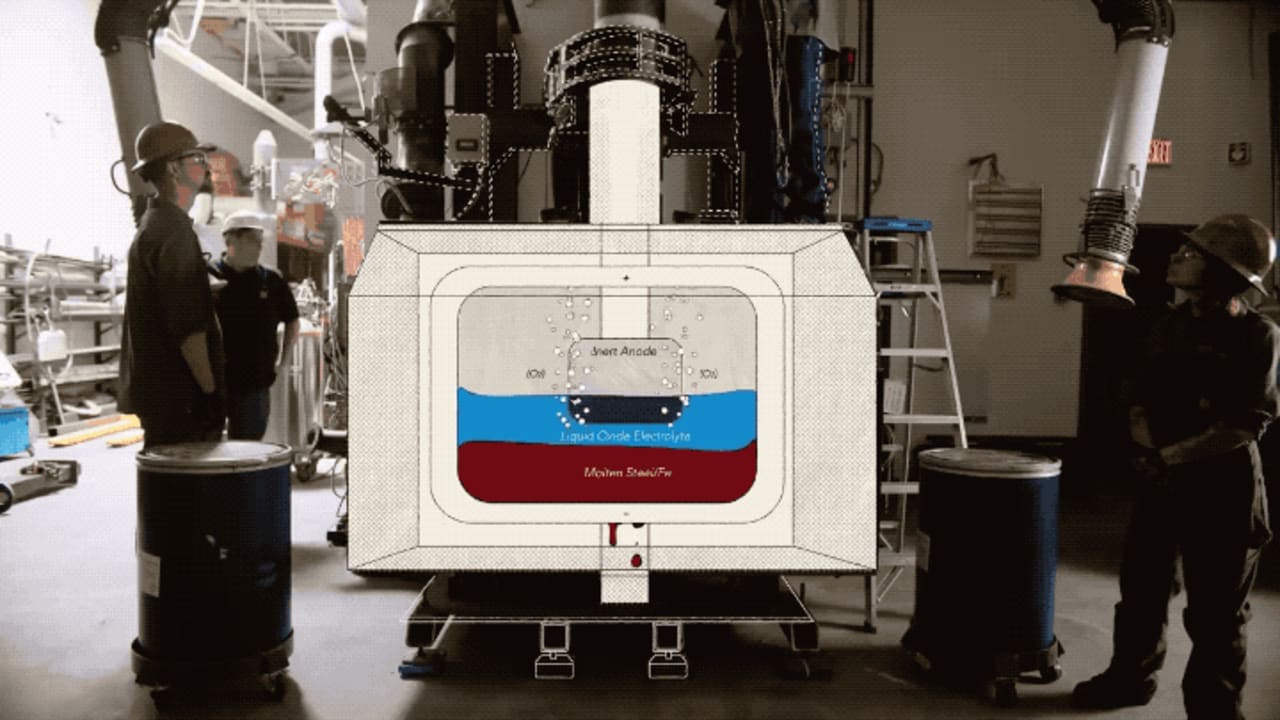
The production of materials like steel, cement, plastic, glass, and aluminum causes enormous emissions, but it’s not going to stop being necessary. Gates wants to change how we make them.
Bill Gates loves to make solving complex problems sound fairly straightforward. Take the fact that the manufacturing sector accounts for roughly one-fifth of the world’s greenhouse gas emissions. To create the basic building blocks of urbanized society—steel, cement, plastic, glass, aluminum, and even paper—we are slowly destroying it.


Pre-2020 US-China Trade Deal Likelihood Low
How organizations are sharpening their skills to better understand and use AI

To successfully implement AI technologies, companies need to take a holistic approach toward retraining their workforces.
Continuous learning is critical to business success, but providing employees with an easily accessible, results-driven solution they can access from wherever they are, whenever they need it, is no easy feat. Additionally, delivering valuable content in a variety of formats—whether that is through books, videos, or live online training—is crucial to supporting employees to upskill and reskill on the job. These are some of the features O’Reilly Online Learning provides to its 2.25 million platform users to encourage personal and professional development, and there’s no better time to take advantage.
According to Deloitte, evolving work demands and skills requirements are one big reason why continuous learning is critical, and there is no sector experiencing this more abruptly than technology. Executives and employees alike are worried about how emerging tech, such as robotics and AI, are changing jobs and how people should prepare for them. In fact, a recent World Economic Forum report found that more than half (54%) of all employees will require significant reskilling and upskilling in just three years. So, what exactly are the skills data scientists and other tech titles are honing in response to this shift?
As the co-chair of the O'Reilly Artificial Intelligence conference, I regularly track broad changes in consumption patterns and preferences on our platform. For example, Figure 1 shows usage across a few select topics related to AI and Data. More precisely, it provides total usage across all content types in this subset of topics. We measure consumption with Units, a metric tuned specifically for the type of content (e.g., page views for books, minutes for videos):

Python is the largest topic on our platform, and it also happens to be a popular language among data scientists (the second largest topic is another programming language, Java). Overall content usage, across all topics combined, grew by 8% from 2018 to 2019 (January to July). Among the fastest-growing topics are those central to building AI applications: machine learning (up 58% from 2018), data science (up 53%), data engineering (up 58%), and AI itself (up 52%).
One of the main reasons Python has been ascendant as a programming language is because of its popularity among data scientists and machine learning researchers and practitioners. In fact, of the top 20 most-consumed Python titles on O’Reilly Online Learning in 2019, several were focused mainly on data science and machine learning applications, including:
- Python for Data Analysis, 2nd Edition
- Introduction to Machine Learning with Python: A Guide for Data Scientists
- Python for Finance, 2nd Edition
- Machine Learning with Python Cookbook
In a survey we conducted earlier this year about AI adoption in the enterprise, respondents cited culture, organization, and lack of skilled people among the leading reasons holding back their adoption of AI technologies. As I noted in a recent article, adopting and sustaining AI and machine learning within a company will require retraining your entire organization. To succeed in implementing and incorporating AI and machine learning technologies, companies need to take a more holistic approach toward retraining their workforces. The rapid growth in consumption of content in training-relevant topics on oreilly.com (including machine learning, data engineering, data science, and AI) provide early signs that companies and individuals are taking training seriously.
At our upcoming Artificial Intelligence conferences in San Jose and London, we have assembled a roster of two-day training sessions, tutorial sessions, and presentations to help individuals (across job roles and functions) sharpen their skills and understanding of AI and machine learning. In addition to our usual strong slate of technical training, tutorials, and talks, we return with a two-day Business Summit designed specifically for executives and business leaders. Wholesale transformation will require cross-functional teams who are familiar with digital, data, and AI technologies. With this in mind, the AI conference in San Jose also will feature several outstanding new tutorials as well as executive briefings and case studies from leading companies and research organizations.
Continue reading How organizations are sharpening their skills to better understand and use AI.
How to Send a File
My new book, How To: Absurd Scientific Advice for Common Real-World Problems, comes out in a week! You can preorder it now on Amazon, Barnes & Noble, IndieBound, and Apple Books.
Here’s an excerpt from the How To chapter on file transfers.
Chapter 19: How to Send a File
Sending large data files can be difficult.
Modern software systems have moved away from the concept of “files.” They don’t show you a folder full of image files; they show you a collection of photos. But files linger on, and will probably continue to do so for decades to come. And as long as we have files, we’ll need to send them to people.

The simplest, most obvious way to send a file is to pick up the device the file is stored on, walk over to the intended recipient, and hand it to them.

Carrying computers can be difficult — especially the earlier ones that were the size of a whole room — so rather than carry the whole computer, you can try detaching a piece of the computer containing the file. You can then bring this piece to the other person and let them transfer it to their own device. On a desktop-style computer, the files may be stored on a hard drive, which can often be removed without destroying the computer.
On some devices, though, file storage is permanently attached to the electronics, making removal more challenging.

A more convenient and less destructive solution is removable storage. You can make a copy of the file, put it on a device, then give the device to the person.

Carrying storage devices around is a surprisingly high-bandwidth way to transfer information. A suitcase full of MicroSD cards contains many petabytes of data; if you want to transfer very large amounts of data, mailing boxes of disk drives will almost always be faster than transferring them over the internet.
If you want to send data to a specific location that’s too far to walk, but not convenient to reach by mail — say, a nearby mountaintop — you could try using some kind of autonomous vehicle to carry it. A delivery drone, for example, could easily carry a small satchel of SD cards containing terabytes of data.

Quadcopter-style drones don’t work very well over long distances thanks to the limitations of batteries. If a drone has to carry its own battery, it can only hover for so long. If it wants to hover longer, it needs to carry a bigger battery, but that means more weight and faster power consumption. For the same reason that a house supported by jet engines [Note: For more on hovering houses, see Chapter 7: How to Move] can only hover for a few hours, small coaster-size drones typically have flight times measured in minutes, and the larger ones used for photography are usually limited to less than an hour in the air. Even if it flew very fast, a tiny drone carrying a MicroSD card could make it just a few miles before running out of steam.

You could increase your range by making the drone bigger, adding solar panels, flying higher, and going faster. Or you could turn to the real masters of efficient long-distance flight:
Butterflies.

Monarch butterflies travel thousands of miles during their migration across North America, with some traveling all the way from Canada to Mexico in a single season. If you look up during the spring or fall on the East Coast of the United States, you can sometimes spot them gliding by silently overhead, a few hundred feet above the ground. Their extreme range puts drones — and even many large aircraft — to shame.
You might think butterflies have an unfair advantage over battery-powered aerial vehicles, since they can stop to consume nectar and “recharge.” Butterflies will certainly refuel if they can, but they don’t necessarily need to. Another butterfly species, the painted lady (Vanessa cardui), is even more impressive: it flies from Europe to central Africa, a 4,000-kilometer flight that takes it over the Mediterranean Sea and the Sahara desert.
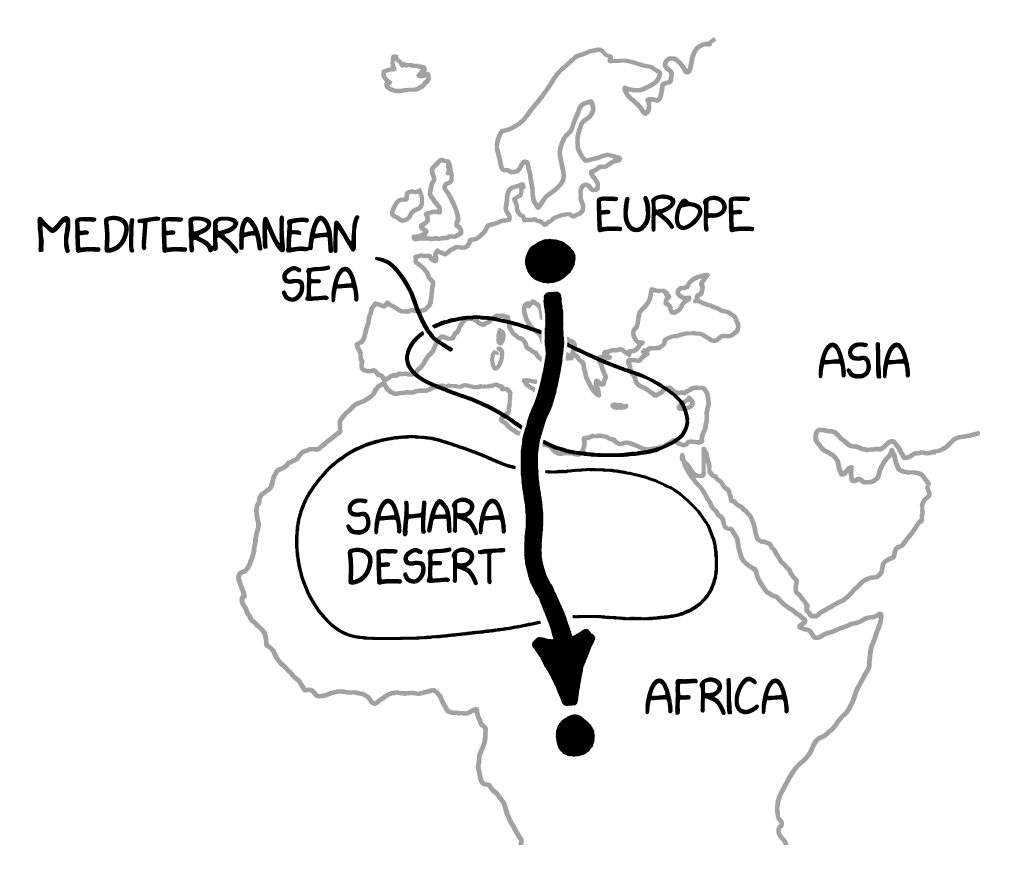
Butterflies make these journeys powered only by small reserves of stored lipids. They can fly so much more efficiently than drones in part by soaring — they seek out thermal columns and mountain waves, then hold their wings steady and ride the rising air upward like a vulture, hawk, or eagle.

If you want to send your file to someone who lives along the migration route, could you get a butterfly to carry it for you?
Butterflies can carry weights. Volunteers with groups like Monarch Watch tag tens of thousands to hundreds of thousands of monarch butterflies each year to track their migration and monitor their population (which has been in decline in recent decades). The smaller tags weigh about a milligram, but monarchs have completed their migration with larger tags that weigh 10 mg or more.
MicroSD cards weigh several hundred milligrams — comparable to the weight of a butterfly — so butterflies would have a hard time carrying them. But there’s no reason a storage device can’t be made smaller. MicroSD cards contain memory chips, and the storage density of these chips might be up to a gigabyte per square millimeter. Given those sizes, a butterfly could easily carry a tiny chip with a gigabyte of data. If your file is larger than that, you could break it up across multiple butterflies, and send multiple copies for redundancy.
When your data finally arrived at its destination, the recipient would have to check a lot of butterflies to assemble all the pieces of the file. You may need to develop some kind of touchless butterfly scanner that allows them to scan many butterflies at once.
You could avoid that problem — and increase your bandwidth dramatically — by using DNA-based storage. Researchers have stored data by encoding it into a DNA sample, then sequencing the DNA to recover it. Systems like this can achieve densities far beyond anything we do with chips — it’s possible to store and recover hundreds of petabytes of data using a single gram of DNA.
Each year, tens to hundreds of millions of monarch butterflies arrive in Mexico to spend the winter together in giant colonies in the mountains. If you tagged ten million of these butterflies with tiny pouches containing 5 mg of DNA storage each, the total capacity of the butterfly armada would be about 10 zettabytes — 10,000,000,000,000,000,000,000 bytes. That’s roughly the total amount of digital data in existence in the late 2010s.
If the Sun is warm, the winds are favorable, and it’s the right time of year, you could use butterflies to send someone the entire internet.
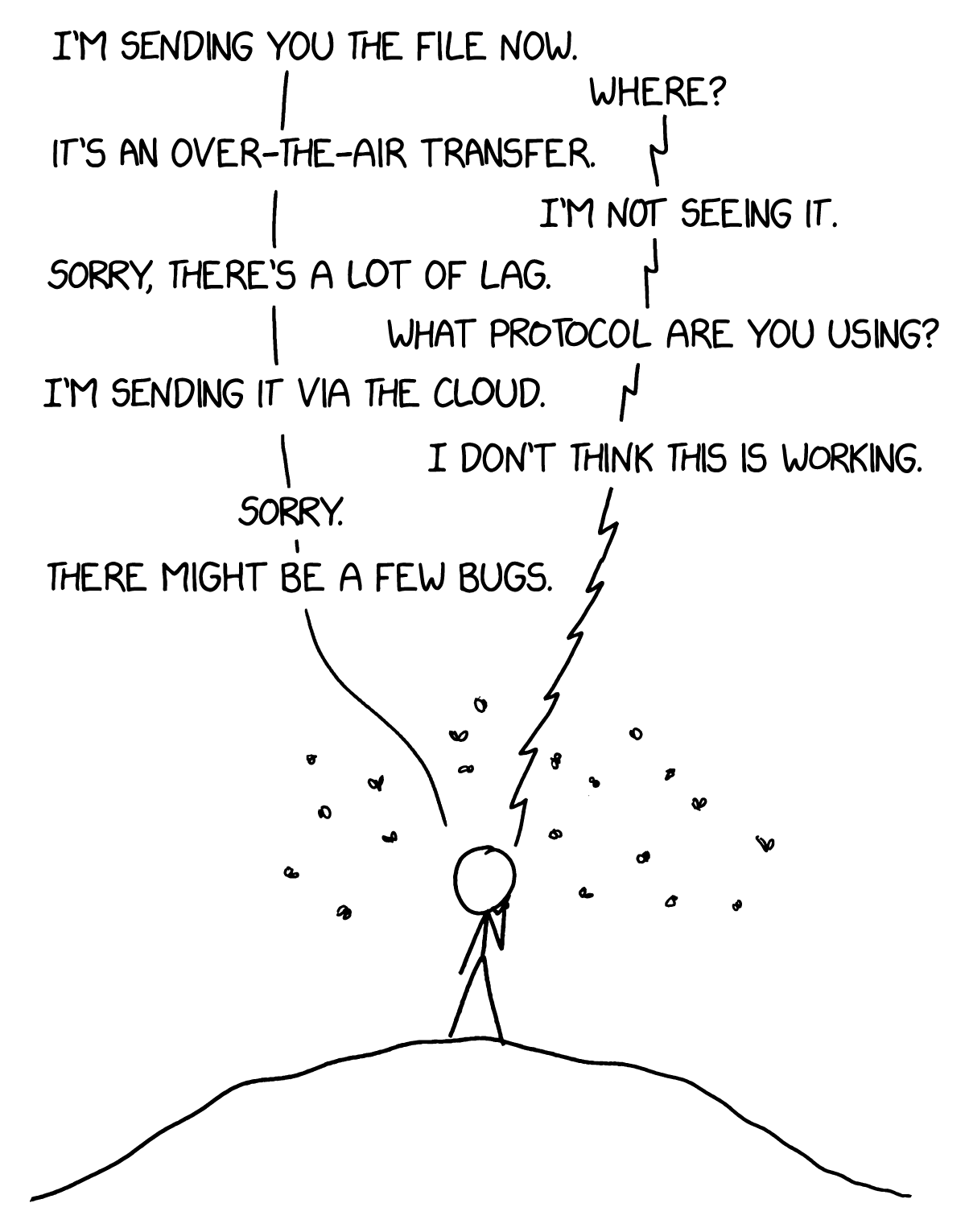
How To: Absurd Scientific Advice for Common Real-World Problems will be released on September 3rd. You can preorder it now on Amazon, Barnes & Noble, IndieBound, and Apple Books.
Read: Jeannette Ng's Campbell Award acceptance speech, in which she correctly identifies Campbell as a fascist and expresses solidarity with Hong Kong protesters
MaitriLife is not a ledger. Your sins can't be paid off through good deeds. Your good deeds are not cancelled by your sins. Your sins and your good deeds live alongside one another. They coexist in superposition.
You (and I) can (and should) atone for our misdeeds. We can (and should) apologize for them to the people we've wronged. We should do those things, not because they will erase our misdeeds, but because the only thing worse than being really wrong is not learning to be better.
We, collectively, through our norms and institutions, create the circumstances that favor sociopathy or generosity. Sweeping bad conduct under the rug isn't just cruel to the people who were victimized by that conduct: it's also a disservice to the flawed vessels who are struggling with their own contradictions and base urges. Create an environment where it's normal to do things that -- in 10 or 20 years -- will result in your expulsion from your community is not a kindness to anyone.
There are shitty dudes out there today whose path to shitty dudehood got started when they watched Isaac Asimov deliver a tutorial on how to grope women without their consent and figured that the chuckling approval of all their peers meant that whatever doubts the might have had were probably misplaced. Those dudes don't get a pass because they learned from a bad example set by their community and its leaders -- but they might have been diverted from their path to shitty dudehood if they'd had better examples. They might not have scarred and hurt countless women on their way from the larval stage of shittiness to full-blown shitlord, and they themselves might have been spared their eventual fate, of being disliked and excluded from a community they joined in search of comradeship and mutual aid. The friends of those shitty dudes might not have to wrestle with their role in enabling the harm those shitty dudes wrought.
Last weekend, Jeanette Ng won the John W Campbell Award for Best New Writer at the 2019 Hugo Awards at the Dublin Worldcon; Ng's acceptance speech calls Campbell, one of the field's most influential editors, a "fascist" and expresses solidarity with the Hong Kong pro-democracy protesters.
I am a past recipient of the John W Campbell Award for Best New Writer (2000) as well as a recipient of the John W Campbell Memorial Award (2009). I believe I'm the only person to have won both of the Campbells, which, I think, gives me unique license to comment on Ng's remarks, which have been met with a mixed reception from the field.
I think she was right -- and seemly -- to make her remarks. There's plenty of evidence that Campbell's views were odious and deplorable. For example, Heinlein apologists like to claim (probably correctly) that his terrible, racist, authoritarian, eugenics-inflected yellow peril novel Sixth Column was effectively a commission from Campbell (Heinlein based the novel on one of Campbell's stories). This seems to have been par for the course for JWC, who liked to micro-manage his writers: Campbell also leaned hard on Tom Godwin to kill the girl in "Cold Equations" in order to turn his story into a parable about the foolishness of women and the role of men in guiding them to accept the cold, hard facts of life.
So when Ng held Campbell "responsible for setting a tone of science fiction that still haunts the genre to this day. Sterile. Male. White. Exalting in the ambitions of imperialists and colonisers, settlers and industrialists," she was factually correct.
Not just factually correct: also correct to be saying this now. Science fiction (like many other institutions) is having a reckoning with its past and its present. We're trying to figure out what to do about the long reach that the terrible ideas of flawed people (mostly men) had on our fields. We're trying to reconcile the legacies of flawed people whose good deeds and good art live alongside their cruel, damaging treatment of women. These men were not aberrations: they were following an example set from the very top and running through fandom, to the great detriment of many of the people who came to fandom for safety and sanctuary and community.
It's not a coincidence that one of the first organized manifestations of white nationalism as a cultural phenomenon was within fandom, and while fandom came together to firmly repudiate its white nationalist wing, these assholes weren't (all) entryists who showed up to stir trouble in someone else's community. The call (to hijack the Hugo award) was coming from inside the house: these guys had been around forever, and we'd let them get away with it, in the name of "tolerance" even as these guys were chasing women, queer people, and racialized people out of the field.
Those same Nazis went on to join Gamergate, then take up on /r/The_Donald, and they were part of the vanguard of the movement that put a boorish, white supremacist grifter into the White House.
The connection between the tales we tell about ourselves and our past and futures have a real, direct outcome on the future we arrive at. White supremacist folklore, including the ecofascist doctrine that says we can only avert climate change by murdering all the brown people, comes straight out of sf folklore, where it's completely standard for every disaster to be swiftly followed by an underclass mob descending on their social betters to eat and/or rape them (never mind the actual way that disasters go down).
When Ng took the mic and told the truth about his legacy, she wasn't downplaying his importance: she was acknowledging it. Campbell's odious ideas matter because he was important, a giant in the field who left an enduring mark on it. No one disagrees about that. What we want to talk about today is what that mark is, and what it means.
There are still people in our community who knew Campbell personally, and many many others one step removed, who idolize and respect the writers Campbell took under his wing. And there are people — and once again I raise my hand — who are in the field because the way Campbell shaped it as a place where they could thrive. Many if not most of these folks know about his flaws, but even so it’s hard to see someone with no allegiance to him, either personally or professionally, point them out both forcefully and unapologetically. They see Campbell and his legacy abstractly, and also as an obstacle to be overcome. That’s deeply uncomfortable.
He's not wrong, and the people who counted Campbell as a friend are legitimately sad to confront the full meaning of his legacy. I feel for them. It's hard to reconcile the mensch who was there for you and treated his dog with kindness and doted on his kids with the guy who alienated and hurt people with his cruel dogma.
Here's the thing: neither one of those facets of Campbell cancel the other one out. Just as it's not true that any amount of good deeds done for some people can repair the harms he visited on others; it's also true that none of those harms cancel out the kindnesses he did for the people he was kind to.
Life is not a ledger. Your sins can't be paid off through good deeds. Your good deeds are not cancelled by your sins. Your sins and your good deeds live alongside one another. They coexist in superposition.
You (and I) can (and should) atone for our misdeeds. We can (and should) apologize for them to the people we've wronged. We should do those things, not because they will erase our misdeeds, but because the only thing worse than being really wrong is not learning to be better.
People are flawed vessels. The circumstances around us -- our social norms and institutions -- can be structured to bring out our worst natures or our best. We can invite Isaac Asimov to our cons to deliver a lecture on "The Power of Posterior Pinching" in which he literally advises men on how to grope the women in attendance, or we can create and enforce a Code of Conduct that would bounce anyone, up to and including the Con Chair and the Guest of Honor, who tried a stunt like that.
We, collectively, through our norms and institutions, create the circumstances that favor sociopathy or generosity. Sweeping bad conduct under the rug isn't just cruel to the people who were victimized by that conduct: it's also a disservice to the flawed vessels who are struggling with their own contradictions and base urges. Create an environment where it's normal to do things that -- in 10 or 20 years -- will result in your expulsion from your community is not a kindness to anyone.
There are shitty dudes out there today whose path to shitty dudehood got started when they watched Isaac Asimov deliver a tutorial on how to grope women without their consent and figured that the chuckling approval of all their peers meant that whatever doubts the might have had were probably misplaced. Those dudes don't get a pass because they learned from a bad example set by their community and its leaders -- but they might have been diverted from their path to shitty dudehood if they'd had better examples. They might not have scarred and hurt countless women on their way from the larval stage of shittiness to full-blown shitlord, and they themselves might have been spared their eventual fate, of being disliked and excluded from a community they joined in search of comradeship and mutual aid. The friends of those shitty dudes might not have to wrestle with their role in enabling the harm those shitty dudes wrought.
Jeannette Ng's speech was exactly the speech our field needs to hear. And the fact that she devoted the bulk of it to solidarity with the Hong Kong protesters is especially significant, because of the growing importance of Chinese audiences and fandom in sf, which exposes writers to potential career retaliation from an important translation market. There is a group of (excellent, devoted) Chinese fans who have been making noises about a Chinese Worldcon for years, and speeches like Ng's have to make you wonder: if that ever comes to pass, will she be able to get a visa to attend?
Back when the misogynist/white supremacist wing of SF started to publicly organize to purge the field of the wrong kind of fan and the wrong kind of writer, they were talking about people like Ng. I think that this is ample evidence that she is in exactly the right place, at the right time, saying the right thing.
And I am so proud to be part of this. To share with you my weird little story, an amalgam of all my weird interests, so much of which has little to do with my superficial identities and labels.
But I am a spinner of ideas, of words, as Margaret Cavendish would put it.
So I need say, I was born in Hong Kong. Right now, in the most cyberpunk in the city in the world, protesters struggle with the masked, anonymous stormtroopers of an autocratic Empire. They have literally just held her largest illegal gathering in their history. As we speak they are calling for a horological revolution in our time. They have held laser pointers to the skies and tried to to impossibly set alight the stars. I cannot help be proud of them, to cry for them, and to lament their pain.
I’m sorry to drag this into our fantastical words, you’ve given me a microphone and this is what I felt needed saying.
John W. Campbell, for whom this award was named, was a fascist. [Jeannette Ng/Medium]
(Image: @JeannetteNg)
(via Whatever)
Filed with auntie pride of @jeannette_ng, the newest winner of the Campbell Award for BEST NEW AUTHOR!!!!!
— Zen Cho (@zenaldehyde) August 18, 2019pic.twitter.com/T4vG0x6mwo
U.S. Recycling Industry Is Struggling To Figure Out A Future Without China

China is no longer taking the world's waste. The U.S. recycling industry is overwhelmed — it can't keep up with the plastic being churned out. This doesn't bode well for our plastic waste problem.
(Image credit: Saul Loeb/AFP/Getty Images)
