Shared posts

04 Jun 03:55

Ballet Dancers Do Their Hardest Moves in Slow Motion

by Dan Colman

The Washington Post went behind the scenes at the Washington Ballet to get “six professional dancers to show off the most difficult moves in their repertoire.” If this intrigues you, you can turn back to a 2012 post where we featured Marina Kanno and Giacomo Bevilaqua, both from the Staatsballett Berlin, performing several jumps, each captured in slow motion at 1000 frames per second. And it’s all set to Radiohead’s “Everything In Its Right Place.” Enjoy.

via The Creators Project/Boing Boing

Related Content:

Le Ballet Mécanique: The Historic Cinematic Collaboration Between Fernand Legér and George Antheil

James Brown Gives You Dancing Lessons: From The Funky Chicken to The Boogaloo

Statistics Explained Through Modern Dance: A New Way of Teaching a Tough Subject

Ballet Dancers Do Their Hardest Moves in Slow Motion is a post from: Open Culture. Follow us on Facebook, Twitter, and Google Plus, or get our Daily Email. And don't miss our big collections of Free Online Courses, Free Online Movies, Free eBooksFree Audio Books, Free Foreign Language Lessons, and MOOCs.

The post Ballet Dancers Do Their Hardest Moves in Slow Motion appeared first on Open Culture.

04 Jun 03:54

Texas will do just fine under the new EPA clean air regulations

by Charles Kuffner

Unless it wants to fail, of course, which is always an option under the likes of Rick Perry and Greg Abbott.

Greg Abbott approves of this picture

Texas could lead the way into a less carbon-intensive future under the Obama administration’s plans to sharply reduce greenhouse gas emissions from coal-fired power plants.

Or the state could have trouble keeping the lights on.

The competing views underscore the exquisite complexity of the rules scheduled to be unveiled Monday. The proposed regulation represents the centerpiece of President Barack Obama’s climate agenda – one that could lead to the shuttering of hundreds of coal plants, the nation’s largest source of carbon pollution.

Already Texas officials are lining up against the plan, with 29 members of the state’s congressional delegation – Republicans and Democrats – voicing concern in a letter to the Environmental Protection Agency. They say the rules could drive up electricity bills, threaten reliability and lead to job losses in a state that pumps far more carbon dioxide into the air than any other.

But environmentalists note that Texas already is shifting closer to Obama’s goals. Last year, 63 percent of the state’s electricity came from sources other than coal.

“We will hear a lot of complaining about the rule, but we have a lot of options in Texas that other states do not have,” said Al Armendariz, a former EPA official who now leads the Sierra Club’s anti-coal campaign in Arkansas, Mississippi and Texas.

Oh, there’s plenty of complaining, all right. The hot air generated by Rick Perry and Ted Cruz alone might be enough to offset whatever gains the Obama administration hopes to make via these new regulations. Just remember, when you hear the usual assortments of gasbags start to bloviate about this, we’ve heard it all before, and they’ve been wrong every single time. Consider this, for example:

Let’s flash back to an article from the Van Nuys Valley News, dated Sept. 10, 1970 — when the Clean Air Act was young and eager and taking aim at unchecked, noxious emissions from U.S. cars. “Ford Motor Co. said yesterday in Dearborn, Mich.,” the item begins, “that some of the proposed changes in the Federal Clean Air Act could cut off automobile production in just five years, lead to huge price increases for cars even if production were not stopped, do ‘irreparable damage’ to the American economy — and still lead to only small improvements in the quality of the air.”

Sound familiar? Are you driving a car nearly half a century later? Yes, those controls had a cost — and so too will future efficiency mandates that the Obama administration has put in place — but in the long view, the view that matters, life will go on and be cleaner for it. Not so sure? Consider that between 1970 and 2011, aggregate emissions of common air pollutants dropped by 68 percent, even as U.S. gross domestic product grew by 212 percent and vehicle miles traveled increased by 167 percent. The number of private sector jobs increased by 88 percent during that same period.

So yeah, pay them no attention. And remember as well, they’re vastly out of step with public opinion:

* Among Americans overall, 69 percent say global warming is a serious problem, versus 29 percent who say it isn’t. Among Americans in the states carried by Mitt Romney in 2012, those numbers are 67-31. Among Americans in states carried by Barack Obama, they are 70-28.

*Americans overall say by 70-21 that the federal government should limit the release of greenhouse gases from existing plants to reduce global warming. In 2012 red states, those numbers are 68-24. In 2012 blue states, they are 72-20.

* Americans overall say by 70-22 that the federal government should require states to limit greenhouse gases. In 2012 red states, those numbers are 65-23. In 2012 blue states, they are 73-21. Even in red states, then, support for the feds stomping on states’ rights (on this issue at least) is running high.

* Americans overall say by 63-33 that the government should regulate greenhouses even if it increases their monthly energy bill by $20 per month. In the 2012 red states, those numbers are 60-35. In 2012 blue states, they are 64-32.

On every one of the above questions, in red states, large percentages of independents and moderates favor action. And more broadly, as you can see, those just aren’t meaningful differences between red and blue states on these questions. This applies even in nearly two dozen coal states [emphasis added].

Who wants to bet the Trib will come out with a poll showing the opposite in Texas? I can see it coming from here. Unfair Park and the Rivard Report have more.

14 May 22:54

How to Make a Graph (Part 2)

How do you turn a bunch of data into a super-handy graph? Keep on reading to learn the final 2 steps in Math Dude's easy 4-step method for making graphs 

-- Read more on ScientificAmerican.com
14 May 22:52

Doctor Who Comics Bundle, Doctor Who RISK, MST3K, Dragon Age

by Shane Roberts, Commerce Team

Doctor Who Comics Bundle, Doctor Who RISK, MST3K, Dragon Age

Doctor Who RISK. Repeat. Doctor Who RISK. Interestingly, you play as one of several warring Dalek factions, with the Doctor bringing peace to a different territory each turn. Win before the eleventh regeneration or its game over. [RISK: The Dalek Invasion of Earth, $37]

Read more...


08 May 17:43

Why Neil deGrasse Tyson is a philistine

by S. Abbas Raza

Damon Linker in The Week:

ScreenHunter_608 May. 07 21.49Neil deGrasse Tyson may be a gifted popularizer of science, but when it comes to humanistic learning more generally, he is a philistine. Some of us suspected this on the basis of the historically and theologically inept portrayal of Giordano Bruno in the opening episode of Tyson's reboot of Carl Sagan's Cosmos.

But now it's been definitively demonstrated by a recent interview in which Tyson sweepingly dismisses the entire history of philosophy. Actually, he doesn't just dismiss it. He goes much further — to argue that undergraduates should actively avoid studying philosophy at all. Because, apparently, asking too many questions "can really mess you up."

Yes, he really did say that. Go ahead, listen for yourself, beginning at 20:19 — and behold the spectacle of an otherwise intelligent man and gifted teacher sounding every bit as anti-intellectual as a corporate middle manager or used-car salesman. He proudly proclaims his irritation with "asking deep questions" that lead to a "pointless delay in your progress" in tackling "this whole big world of unknowns out there." When a scientist encounters someone inclined to think philosophically, his response should be to say, "I'm moving on, I'm leaving you behind, and you can't even cross the street because you're distracted by deep questions you've asked of yourself. I don't have time for that."

"I don't have time for that."

With these words, Tyson shows he's very much a 21st-century American, living in a perpetual state of irritated impatience and anxious agitation. Don't waste your time with philosophy! (And, one presumes, literature, history, the arts, or religion.) Only science will get you where you want to go! It gets results! Go for it! Hurry up! Don't be left behind! Progress awaits!

More here.

08 May 16:54

Retelling of Stories Increases Bias

by schneier

Interesting experiment shows that the retelling of stories increases conflict and bias.

For their study, which featured 196 undergraduates, the researchers created a narrative about a dispute between two groups of young people. It described four specific points of tension, but left purposely ambiguous the issue of which party was the aggressor, and "depicted the groups as equally blameworthy."

Half of the participants read a version of the story in which the two hostile groups were from two Maryland cities. The other half read a version in which one group was from the city of Gaithersburg, but the other was identified as "your friends."

Participants were assigned a position between one and four. Those in the first position read the initial version of the story, and then "re-told" it in their own words by writing their version of the events. This was passed on to the person in the second position, who did the same.

The procedure was repeated until all four people had created their own versions of the story. Each new version was then examined for subtle shifts in emphasis, blame, and wording.

The results: Each "partisan communicator" -- that is, each student who wrote about the incident involving his or her "friends" -- "contributed small distortions that, when accumulated, produced a highly biased, inaccurate representation of the original dispute," the researchers write.

Standard disclaimer -- that American undergraduates might not be the best representatives of our species -- applies. But the results are not surprising. We tend to play up the us vs. them narrative when we tell stories. The result is particularly interesting in light of the echo chamber that Internet-based politics has become.

The actual paper is behind a paywall.

07 May 20:54

Why Are All These Physicists in a Weird Creationist Documentary?

by Annalee Newitz

WTF? A bunch of reputable physicists like Lawrence Krauss, and actress Kate Mulgrew (Star Trek: Voyager), are featured a documentary called The Principle, about how the Earth really is at the center of the solar system. How did this happen?

Read more...


07 May 20:09

It’s time to move to real-time regulation

by David Stephenson

One under-appreciated aspect of the changing relationship between the material world and software is that material goods can and will fail — sometimes with terrible consequences.

What if government regulations were web-based and mandated inclusion of Internet-of-Things technology that could actually stop a material failure, such as a pipeline rupture or automotive failure, while it was in its earliest stages and hadn’t caused harm? Even more dramatically, what if regulations could even prevent failures from happening at all?

With such a system, we could avoid or minimize disasters — from Malaysia Airlines Flight 370′s disappearance to the auto-safety debacles at GM to a possible leak if the Keystone XL pipeline is built — while the companies using this technology could simultaneously benefit in a variety of profitable ways.

Let’s call the concept “real-time regulation.” It will be possible in the near future (and, in many cases, already is) because of the Internet of Things. While the IoT offers many benefits, the one that’s relevant to regulation is that it makes it possible for many people and/or devices to share data in real time about how something is actually operating — that’s crucial to regulatory reform.

In the past, regulation has been limited in its ability to achieve its major goal: avoid future incidents where individuals, the environment, or other public goods suffer because of some sort of action, from a pipeline leak to an airplane crash. That’s because the responsible companies or regulators could only intervene after a catastrophe had happened. Equally important, once a product had left the factory, a manufacturer had no idea how it actually operated in the field — until it broke down or malfunctioned.

Because of the IoT’s ability to share data instantly and its ability to report on operating problems in their earliest stages, it is technically possible for companies and regulators to have real-time access to data about a possible violation while it is in progress. In some cases, such as with pipeline leaks or potential crises on off-shore oil rigs, that would make it possible to actually intervene before there’s a violation, in time to take corrective action.

For example, a sensor on an off-shore oil rig might detect a stress fracture in a section before there was visible evidence. That same sensor could automatically trigger a shutdown: not a drop of oil would be spilled, there would be no environmental impact, and the company would know exactly where to go, speeding repairs and reducing downtime. In the case of flight 370, if the airline had only paid $10 more per flight, it would have received real-time access to the data stream from sensors on the engines. The airline could have realized immediately after the voice transmissions ended that the plane was still in flight, in time to have scrambled interceptor planes, and possibly have avoided the disappearance. Or — my favorite example because it involves such an exemplar of 19th-century industry — after implementing a track-sensor program, Union Pacific has cut its maintenance costs and reduced bearing-related derailments by 75%.

These and many other types of real-time monitoring by companies and regulators alike are possible today, using sensor and communications technologies that are increasingly installed in a wide range of devices. Companies using the devices use real-time data for everything from “predictive maintenance” that keeps repair costs low to the ability to optimize a devices’ operating efficiency. In other words, connected devices create opportunities for companies and the public interest.

Many devices, such as thousands of jet engines, already have Internet-of-Things capacity built in, and declining prices and smaller sizes of sensors and communications equipment will speed their adoption in other trouble-prone products, such as cars and medical devices.

Regulators should begin now to study the feasibility of real-time regulation, and to phase it in as soon as the IoT-equipped products become widespread, requiring companies to have sensors installed and processes in place to monitor results in real time. The result will be a fundamental transformation in regulation: from a system that motivates safety improvements primarily by punishing past infractions to one in which the same technology that helps optimize efficiency and cut operating costs simultaneously protects the public interest by avoiding, or at least minimizing, costly — or deadly — infractions.

05 May 22:23

“Pavlovian password management” aims to change sloppy habits

by Dan Goodin

For more than a decade, the virtues of strong passwords have been lost on most end users, despite frequent sermons from security experts and IT administrators over their importance in locking down accounts. Now, a consultant is proposing a system that provides rewards or penalties based on the passcode choices people make.

For instance, a user who picks "test123@#" might be required to change the password in three days under the system proposed by Lance James, the head of the cyber intelligence group at Deloitte & Touche. The three-day limit is based on calculations showing it would take about 4.5 days to find the password using offline cracking techniques. Had the same user chosen "t3st123@##$x" (all passwords in this post don't include the beginning and ending quotation marks), the system wouldn't require a change for three months.

"We spend a lot of time telling the user to 'do this because security experts advise it, or it's part of our policy' but we don't really provide an incentive or an understanding of why we tell them to do this," James wrote in a blog post laying out the idea for what he dubs "Pavlovian password management." "Well humans are programmable, and the best way to see the human brain is to look at it like a Bayesian network. It requires training for it to adapt to change and repeated consistent data to be provided."

Read 2 remaining paragraphs | Comments


02 May 22:03

EFF “Privacy Badger” plugin aimed at forcing websites to stop tracking users

by Jon Brodkin

Web browsers generally allow users to send a "Do Not Track" signal that lets advertisers know the user prefers not to be tracked for the purposes of serving up personalized ads.But it's largely a futile exercise, because websites and advertising networks are free to ignore the signal. Even Yahoo, which had been honoring Do Not Track requests, decided to stop doing so this week.

The Electronic Frontier Foundation may have a solution. Last night, the group announced "Privacy Badger," an extension for Chrome and Firefox "that analyzes sites to detect and disallow content that tracks you in an objectionable, non-consensual manner."

Privacy Badger doesn't automatically block ads. The group explained:

Read 3 remaining paragraphs | Comments


02 May 22:03

Mr. Rogers Introduces Kids to Experimental Electronic Music by Bruce Haack & Esther Nelson (1968)

by Josh Jones

Experimental electronic musician and inventor Bruce Haack’s compositions expanded many a young consciousness, and taught kids to dance, move, meditate, and to be endlessly curious about the technology of sound. All of this makes him the perfect guest for Fred Rogers, who despite his totally square demeanor loved bringing his audience unusual artists of all kinds. In the clips above and below from the first, 1968 season of Mr. Roger’s Neighborhood, Haack introduces Rogers and a group of youngsters to the “musical computer,” a homemade analog synthesizer of his own invention—one of many he created from household items, most of which integrated human touch and movement into their controls, as you’ll see above. In both clips, Haack and longtime collaborator Esther Nelson sing and play charming songs as Nelson leads them in various movement exercises. (The remainder of the second video mostly features Mr. Roger’s cat.)

Although he’s seen a revival among electronic musicians and DJs, Haack became best known in his career as a composer of children’s music, and for good reason. His 1962 debut kid’s record Dance, Sing & Listen is an absolute classic of the genre, combining a dizzying range of musical styles—country, classical, pop, medieval, and experimental electronic—with far-out spoken word from Haack and Nelson. They followed this up with two more iterations of Dance, Sing & Listen, then The Way Out Record for Children, The Electronic Record for Children, the amazing Dance to the Music, and several more, all them weirder and more wonderful than maybe anything you’ve ever heard. (Don’t believe me? Take a listen to “Soul Transportation,” “EIO (New MacDonald),” or the absolutely enchanting “Saint Basil,” with its Doors-y organ outro.) A psychedelic genius, Haack also made grown-up acid rock in the form of 1970’s The Electric Lucifer, which is a bit like if Andrew Lloyd Webber and Tim Rice had written Jesus Christ Superstar on heavy doses of LSD and banks of analog synthesizers.

While Haack’s Mr. Rogers appearance may not have seemed like much at the time, in hindsight this is a fascinating document of an artist who’s been called “The King of Techno” for his forward-looking sounds meeting the cutting edge in children’s programming. It’s a testament to how much the counterculture influenced early childhood education. Many of the progressive educational experiments of the sixties have since become historical curiosities, replaced by insipid corporate merchandising. What Haack and Nelson’s musical approach tells me is that we’d do well to revisit the educational climate of that day and take a few lessons from its freeform experimentation and openness. I’ll certainly be playing these records for my daughter.

via Network Awesome

Related Content:

Mr. Rogers Takes Breakdancing Lessons from a 12-Year-Old (1985)

Mr. Rogers Goes to Washington

Josh Jones is a writer and musician based in Durham, NC. Follow him at @jdmagness.

Mr. Rogers Introduces Kids to Experimental Electronic Music by Bruce Haack & Esther Nelson (1968) is a post from: Open Culture. Follow us on Facebook, Twitter, and Google Plus, or get our Daily Email. And don't miss our big collections of Free Online Courses, Free Online Movies, Free eBooksFree Audio Books, Free Foreign Language Lessons, and MOOCs.

The post Mr. Rogers Introduces Kids to Experimental Electronic Music by Bruce Haack & Esther Nelson (1968) appeared first on Open Culture.

15 Apr 20:53

Build the dungeon, not the adventurer

by Rob Beschizza
In the Guild of Dungeoneering, instead of controlling the adventurer, you build the dungeon--and put in monsters--as they go. It's $10 to buy into the alpha, and you can play with a browser demo free of charge. I love the hand-drawn style, evocative of every schoolroom doodling ever put to paper by a bored geek! Mute the sound, though.


15 Apr 20:52

Bachelor's Degree: An Unnecessary Path To a Tech Job

by samzenpus
dcblogs (1096431) writes "A study of New York City's tech workforce found that 44% of jobs in the city's 'tech ecosystem,' or 128,000 jobs, 'are accessible' to people without a Bachelor's degree. This eco-system includes both tech specific jobs and those jobs supported by tech. For instance, a technology specific job that doesn't require a Bachelor's degree might be a computer user support specialist, earning $28.80 an hour, according to this study. Tech industry jobs that do not require a four-year degree and may only need on-the-job training include customer services representatives, at $18.50 an hour, telecom line installer, $37.60 an hour, and sales representatives, $33.60 an hour. The study did not look at 'who is actually sitting in those jobs and whether people are under-employed,' said Kate Wittels, a director at HR&A Advisors, a real-estate and economic-development consulting firm, and report author.. Many people in the 'accessible' non-degree jobs may indeed have degrees. For instance. About 75% of the 25 employees who work at New York Computer Help in Manhattan have a Bachelor's degree. Of those with Bachelor's degrees, about half have IT-related degrees."

Share on Google+

Read more of this story at Slashdot.


15 Apr 20:27

Free Online: Hunter S. Thompson’s Fear and Loathing in Las Vegas

by Dan Colman

fear and loathing original

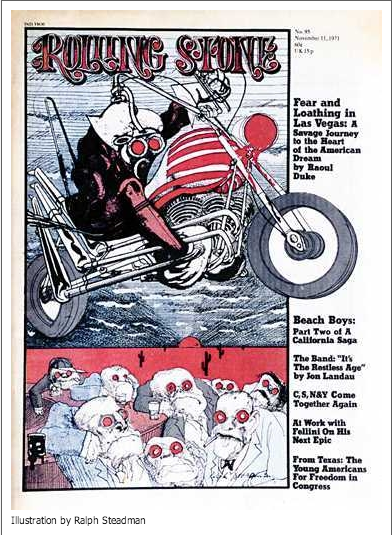
Last week, we revisited Johnny Depp’s reading of the famous “wave speech” from Hunter S. Thompson’s Fear and Loathing in Las Vegas. Wouldn’t you know it, a week later, we’ve discovered that you can read the entire text of the original novel, online, for free.  The Gonzo journalism classic first appeared as a two-part series in Rolling Stone magazine in November 1971, complete with illustrations from Ralph Steadman, before being published as a book in 1972.  Rolling Stone has posted the original version on its web site. The 23,000 word manuscript famously begins:

We were somewhere around Barstow on the edge of the desert when the drugs began to take hold. I remember saying something like “I feel a bit lightheaded; maybe you should drive. …” And suddenly there was a terrible roar all around us and the sky was full of what looked like huge bats, all swooping and screeching and diving around the car, which was going about 100 miles an hour with the top down to Las Vegas. And a voice was screaming: “Holy Jesus! What are these goddamn animals?”

Down the line, you can find this text permanently listed in our collection of Free eBooks, as well as in our List of 10 Free Articles by Hunter S. Thompson That Span His Gonzo Journalist Career (1965-2005). Enjoy.

via @SteveSilberman

Free Online: Hunter S. Thompson’s Fear and Loathing in Las Vegas is a post from: Open Culture. Follow us on Facebook, Twitter, and Google Plus, or get our Daily Email. And don't miss our big collections of Free Online Courses, Free Online Movies, Free eBooksFree Audio Books, Free Foreign Language Lessons, and MOOCs.

The post Free Online: Hunter S. Thompson’s Fear and Loathing in Las Vegas appeared first on Open Culture.

15 Apr 20:11

The point cloud is the model at Volvo

by Geoff
At the SPAR International Conference in Colorado Springs this morning Magnus Rönnäng, ‎Technical Expert in Virtual Manufacturing at Volvo Car Group gave a fascinating presentation on how Volvo has transformed the modeling of their automobile assembly plant using laser scanning.   Volvo is different from many other car manufacturers in having a single assembly line that is driven by customer orders (just-in-time manufacturing). Volvo makes 10 models and at any given time several of these models will be moving down the line.   When they introduce a new model, they can't afford to shut down the assembly line.  What they do is simulate in 3D how the new model will progress down the line. Until several years ago they simulated the assembly line using 3D CAD, but just the assembly line not the rest of the plant.   That led to problems because they couldn't determine from the simulation whether there was enough room outside of the assembly line to manipulate a new part or assembly.  To resolve these issues they needed a model of the entire plant.   In 1999 they tried to model the entire plant using 3D CAD. By the time they completed the model, the plant had changed so much that the model was out of date. They tried to do this several times again with the same result.  Then they decided to try laser scanning which turned out to be the solution. They laser scanned the entire plant.  It took 2500 scans and generated 80 billion points.  But they didn't convert or reverse engineer the point cloud - the point cloud was the digital model of the plant.  They abandoned trying to use 3D CAD for modeling the plant, and continued to use it only for the vehicles themselves and other movable and moving equipment.   The key to keeping the model up to date in a very dynamic ‎plant environment is incremental scanning which allowed them to update only part of the point cloud model of the plant. This technique allowed them to scan new equipment installations and renovations and replace only part of the point cloud model.   Volvo uses commercial software that allows them to simulate a vehicle represented by a 3D CAD model moving th‎rough the point cloud of the assembly line and the plant looking for any collisions, basically a dynamic clash  detection algorithm.  They also use 3D visualization software to demonstrate to non-technical staff in management and on the Board of Directors how a new model moves through the assembly line.
08 Apr 22:00

The Lovers, the Dreamers, and Generation X

by Marisa Siegel

The Muppets taught us to think for ourselves, innovate, follow our dreams and make the world a better place.

Head over to Salon to learn how the Muppets helped shape a generation of artists and businesspeople, and taught 50 million Americans growing up in the 70s and 80s the value of creativity.

Related Posts:

08 Apr 21:59

Restoring CC attribution to Flickr, because Yahoo broke it

by Cory Doctorow


You may know that Flickr is one of the largest repositories of freely usable public domain and Creative Commons photos in the world, hosting collections contributed by libraries, national archives, foundations, museums, galleries, and individual users (I've uploaded more than 10,000 CC-BY-SA images of my own). However, with its latest redesign, Flickr has made is very difficult to copy the images it has been entrusted with, and nearly impossible to correctly attribute them in accord with their license terms.

Today, we're fixing that. A little, anyway.

Years ago, Boing Boing reader Cory Dodt (no relation, obviously) created a script called "attributr" that took the structured license data in each Flickr image page and created a snippet of text that set out the permalink for the image, its creator's name, and the license it was released under, along with a link to the license -- for example:

(Image: Modern Book for Girls, a Creative Commons Attribution (2.0) image from snigl3t's photostream)

Late last month, Yahoo updated the Flickr pages for each image in a way that removed all the structured Creative Commons license data, breaking the script. And CC users who tried to make use of the images Flickr is privileged to host found that replicating the attribution text by hand was nearly impossible. The page used scripts that intercepted copy-to-clipboard shortcuts and also broke text-selection, so that it was nearly impossible to copy the name of image or the name of its creator to your clipboard unless you found it in the page's source-code.

In addition to removing the structured, machine-readable CC metadata, the new Flickr pages also don't make use of the standard CC license logos, familiar due to hundreds of millions (possible billions, by now) of webpages that use those logos to signal in familiar terms that the material on the pages can be shared.

Finally, the links for downloading the high-resolution versions of CC licensed images that had been entrusted to Flickr have been buried under a cryptic ellipsis.

Cory Dodt has replicated his Flickr script, with the caveat that it is now extraordinarily fragile, because it scrapes the Flickr source, and any future changes will break it. Accordingly, it's hosted on github so that it can be maintained when (inevitably) it breaks.

But this is bigger than one script. I have a long history with Flickr. I served as an advisor to Stewart Butterfield and Caterina Fake when they were working on a game called Game Neverending, and Stewart offered to prioritize GNE's photo-sharing feature to help me court a woman I'd started dating overseas. The feature was so successful they folded up GNE and renamed it Flickr, and now I am married to that woman. I owe my marriage to Flickr, and Flickr exists in part because of my marriage.

Over the years, I continued to advise and cheer on Flickr as it became a powerhouse for CC-licensed images, one of the most important photographic resources on the planet.

I understand Yahoo's desire to update Flickr in the face of competitive pressure from other image-sharing services, and I celebrate its design experiments. But the current iteration -- either through negligence or deliberate intent -- terribly undermines the Flickr Commons and does not do justice to the trust and generosity of its many institutional and individual contributors.

I hope that Yahoo will take speedy action to remediate this issue. Honestly, restoring the CC metadata -- a feature that's been part of Flickr since the day it added CC licenses -- is trivial. Using real CC logos will have virtually no visual impact on the pages. And putting the download link back where it belongs, visible and located near the CC license, is a minor change. Ending the interception of control-C on the page so that users can copy the names of the images and their posters would be trivial.

And if Yahoo doesn't do this, I think it's time to start thinking about hosting CC images somewhere else -- perhaps Wikimedia Commons, or a purpose-built site. Flickr still has its admirable API for bulk-ingesting CC images and rehosting them in a way that facilitates the sharing that their copyright holders and custodians expressly desired for them.

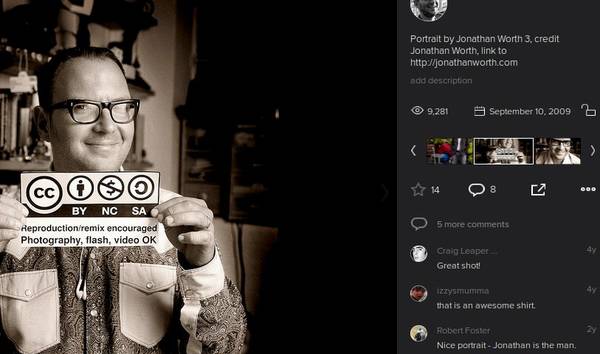
(Image: Portrait by Jonathan Worth, CC-BY-SA)


08 Apr 21:58

What Ails Indian Science

by noreply@blogger.com (Suvrat Kher)
A strongly worded article by Mathai Joseph and Andrew Robinson in Nature points the finger at the bureaucratic stranglehold over Indian research institutes.

Some snippets...

The basic problem is that Indian science has for too long been hamstrung by a bureaucratic mentality that values administrative power over scientific achievement. And, to preserve local control, research is still done mostly by small teams working in isolation rather than through collaboration — a key generator of impact.

..Nearly 60% of India's science budget2 is now spent on the CSIR, scientific departments and the Defence Research and Development Organisation (DRDO) — an enormous and impenetrable empire set up in 1958. None of these national institutions has stimulated scientific excellence..

..The problems at the national level are mirrored in institutions. First, scientists are promoted on the basis of years of service, rather than achievement, and once at the top they stay until retirement age; long after, in some cases.

.. limited foreign travel and no travel support for research students, ruling out regular participation in leading conferences and research gatherings.

..the movement of researchers from one institution to another is discouraged, because administrators prefer senior positions to be filled by internal promotion rather than lateral hiring.

and 4 steps for change-

a) empowered funding agency
b) rotation of institutional role and responsibility
c) trans-institute groups (collaboration)
d) more money for State Universities that produce most of the country's PhD's.

..also worth reading is an older  article by Gautam Desiraju which takes a more detailed look on the current state of Indian science education and research.
 
..
08 Apr 21:54

OH THANK GOD: Kate Mulgrew Is Mad About the Geocentric Documentary, Too

by Victoria McNally

mulgrew2

Yesterday, we ended the day on a major bummer when we learned that Kate Mulgrew, the actor best known for playing Captain Kathryn Janeway in Star Trek: Voyager, would be narrating a documentary backed by geocentrists and Holocaust deniers. Today, she’s set the record straight.

Mulgrew took to her official Facebook page about an hour ago to address growing concerns that her involvement with The Principle, a documentary about how NASA is totally trying to hide the truth that the Sun revolves around the Earth from us or whatever, in some way reflected her own views.

“I understand there has been some controversy about my participation in a documentary called THE PRINCIPLE. Let me assure everyone that I completely agree with the eminent physicist Lawrence Krauss, who was himself misrepresented in the film, and who has written a succinct rebuttal in SLATE. I am not a geocentrist, nor am I in any way a proponent of geocentrism. More importantly, I do not subscribe to anything Robert Sungenis has written regarding science and history and, had I known of his involvement, would most certainly have avoided this documentary. I was a voice for hire, and a misinformed one, at that. I apologize for any confusion that my voice on this trailer may have caused. Kate Mulgrew”

Now, you might be asking, “But Kate—you were the narrator! How did you not notice that this documentary was going to be full of terrible misinformation?” In which case, we’d like to point you to this passage of the Lawrence Krauss-penned Slate article she’s referring to, which is bafflingly entitled “I Have No Idea How I Ended Up In That Stupid Geocentrism Documentary:”

I have no recollection of being interviewed for such a film, and of course had I known of its premise I would have refused. So, either the producers used clips of me that were in the public domain, or they bought them from other production companies that I may have given some rights to distribute my interviews to, or they may have interviewed me under false pretenses, in which case I probably signed some release. I simply don’t know.

We were pretty sure that Krauss, as well as the other cosmologists and theoretical physicists featured in the trailer, were going to be misrepresented—after all, none of them seem like the type to ignore fundamental theories of modern scientific thought and understanding. But, for him to not even remember being interviewed? That takes a level of deception and subterfuge that’s beyond anything we previously suspected of Robert Sungenis and his team, for sure. Of course, they probably meticulously edited Mulgrew’s script to ensure she was none the wiser as to their geocentric leanings.

Now that we’ve cleared up this matter and our faith in Captain Janeway has been successfully restored, we intend to take a page out of Krauss’ book and “stop talking about [the film] from today on.” There’s really no point in giving such a despicably anti-semitic and backwards-thinking person such as Sungenis any more of our time and attention.

(via Facebook, image via Star Trek: Voyager)

Meanwhile in related links

08 Apr 21:52

Update: NGA Offers Code for Apps on GitHub

by Joe Francica
The NGA issued a press release on April 11. The goal for NGA, according to the release states that, "NGA hopes to reap benefits in innovation, creativity, and the power of a far-reaching community of programmers who approach the development of the program from different... Continue reading
08 Apr 21:46

Those Ignorant of Where Ukraine Is Are More Likely To Support Intervention

by Matthew Feeney

Political scientists recently polled Americans on their knowledge of where Ukraine is located and their policy recommendations related to the ongoing crisis there. The results show that, perhaps unsurprisingly, the more ignorant an American is about the location of the former Soviet country, the more likely he or she is to support U.S. intervention.

According to the polling, done by political scientists Kyle Dropp of Dartmouth College, Joshua D. Kertzer of Harvard, and Thomas Zeitzoff of Princeton, the median respondent was about 1,800 miles off when trying to click on Ukraine on a high-resolution map. According to the map of the results (shown below), some Americans think that South Africa, Australia, China, France, Greenland, and Brazil are Ukraine. Shockingly, some respondents seem to think that Ukraine is inside the U.S.

Perhaps more shocking than the astonishing ignorance of geography demonstrated by those polled is the relationship between this ignorance and support for intervention.

From a post written on the polling at The Washington Post's Monkey Cage:

Even controlling for a series of demographic characteristics and participants’ general foreign policy attitudes, we found that the less accurate our participants were, the more they wanted the U.S. to use force, the greater the threat they saw Russia as posing to U.S. interests, and the more they thought that using force would advance U.S. national security interests; all of these effects are statistically significant at a 95 percent  confidence level. Our results are clear, but also somewhat disconcerting: The less people know about where Ukraine is located on a map, the more they want the U.S. to intervene militarily.

The post also mentions that two-thirds of Americans claim to be following the situation in Ukraine at least "somewhat closely."

According to Reason’s polling, 58 percent of Americans want to stay out of the current mess in Ukraine altogether and only 8 percent support sending in troops.

08 Apr 21:37

The geology of Westeros

by Maggie Koerth-Baker
This Stanford project imagines 500 million years of planetary evolution on the planet of Game of Thrones, using a combination of book details and the principles of Earth-based geologic physics. Also dragons and White Walkers.


08 Apr 21:27

I Wasn't a Fan of Sheryl Sandberg's—Until I Couldn't Find a Job

by Margaret Barthel

A year ago, when Lean In hit book stores and caused the firestorm that happens every time a prominent woman makes some sort of dramatic cultural intervention, Sheryl Sandberg wasn't my girl. I was in my final year of college, embroiled in the exhausting process of thinking radical thoughts and then self-righteously posting them to Facebook. I had no time for career advice, and I was not interested in a tech dynamo telling women to get in the damn driver's seat, already.

Sheryl Sandberg is an undeniably easy target if you're in the business of raging against the machine. My huffy critique ran something like this: Lean In speaks to and for a very specific group of women—highly educated, skilled professionals, most privileged by their wealth and many by their race. What does it have to offer women of color or lower income women?

Nor, I felt, does Lean In require any meaningful restructuring from the professional working world, other than that it accommodate an equal division of leadership positions among men and women. When Sandberg does demand change from a system that punishes workers who can't sit at a desk for long daytime hours and that still expects (mostly) women to work a "second shift" of parenting and housework when they arrive home, she does it by asking individual women—already the outsiders in the professional world—to carry the burden of the reform. She believes that the best way to achieve professional gender equality is for women to suck it up and learn to rise to the top of the existing system. At its worst, her message calls out women for failing to floor the accelerator of their career. Subtext: Ladies, you’re not trying hard enough.

These criticisms are great if you're safely ensconced in the collegiate environment, or if you're a career woman with some modicum of job security. But when I left my safe haven and ventured out into a tepid if not downright frigid job market—and when, after months of soul-sucking unemployment, I got lucky and landed short-term work—my perspective on Sheryl Sandberg softened.

Reading Lean In as an idealistic and unemployed college graduate is an emotional roller coaster. Months into my job search and I had a sad little collection of interviews, rejections, and silence in response to my resume, not to mention the hours I spent wondering what was wrong with me as a job candidate. Needless to say, Sheryl Sandberg’s certainty that anyone could have a successful career, if only they took her advice and leaned in, didn’t help my unemployment doldrums.

All that said, there’s a reason that a special "Recent Graduates" edition of Lean In is coming out today. It has never been more important for young adults beginning their career to lean in—hard. In a tough economy, one in which who you know can determine your employment prospects, the value of Sandberg’s advice about making connections and taking initiative is undeniable.

The road to a full-time, well-paid career after college isn’t a straight line these days. Students graduate and then zig-zag through (unpaid and paid) internships, limited-term apprenticeship positions, part-time work, contract work, graduate-school programs, underemployment, and outright unemployment.  In 2012, a Pew study found that 24 percent of 18-to-34-year-olds had taken unpaid work to gain the experience they needed; 35 percent said they had entered graduate programs because of the difficulty of finding work. The March 2014 unemployment rate for 20-to-24-year-olds is 12.2 percent, back up to October 2013 rates. And according to recent findings from the New York Fed, 33 percent of all four-year college graduates are working in jobs that don’t require a four-year degree.

It’s a daunting landscape for any college graduate to survey, and for me as a young woman (granted, one in Sandberg’s target audience—ambitious, financially privileged, and highly educated), it was a confusing one. I knew that the odds of landing a permanent full-time job were slim, which left internships, fellowships, and contract work, one of which I might be able to parlay into the beginnings of a career, although I didn’t know how. Worse, as a young woman, I had an idea of some vague spectre of sexism in the workplace, but I worried that I had very little sense of the practical dynamics of that discrimination, nor any idea of how I might address it as a bottom-of-the-totem-pole intern or entry-level professional. I was unemployed, unhappy, and unsure of what I could do to help myself in the face of economic and cultural forces far beyond my control. 

Oddly enough, I ended up taking a second look at Sheryl Sandberg, whose neglect of the pervasiveness of racial, socioeconomic, and gender-based social barriers sparked such criticism from my college self (then safely at school on my parents’ dime). Not so (or not so much) anymore: What I needed now, far more than feminist theory, was someone to tell me that I did have the personal strength to respond to the vast, impossibly complex challenges of finding meaningful work in this economy and preparing to navigate the professional world as a young woman. I needed an example of someone who had the audacity to consider the individual, not society, the center of paradigm shifts. I needed a reminder that I owed it to myself to respect the power of my own agency.

It’s impossible to accuse Sheryl Sandberg of not believing in the individual’s ability to create the change that they desire. While it’s frustrating that her bootstraps approach to 21st century feminism isn’t characterized by a more consistent recognition of the breadth of the societal obstacles to women’s rise to the top, I don’t think we should lose sight of her celebration of the potential force of individual effort. It’s something of a conservative impulse, and it’s definitely imperfect, but it did get me out of bed every morning to face another day of unemployment. 

I don’t credit Lean In with getting me full-time work; I don’t credit Sandberg with discovering some new frontier in feminism; and I believe that Sandberg’s acknowledgement of structural barriers to professional success—particularly where race and class are concerned—is cursory at best. But, almost a year after my graduation from college, she’s giving me hope that, all social and economic structures to the contrary, I can exercise some control when it comes to my professional life. I can’t rage on Facebook about that. 


08 Apr 21:25

Meet Your Inner Fish—and a few other animals left inside you

by John Timmer
Shubin along with Tiktaalik, a fossil fish that made him famous.
Image courtesy of PBS.

Neil Shubin's day job consists of two apparently unrelated tasks. He teaches anatomy to medical students at the University of Chicago, and he studies evolution by looking at fossils of ancient fish (he also runs a lab that experiments on modern ones). But the work he does while moonlighting as a popularizer of science neatly ties these two things together. The human anatomy has deep roots in the evolutionary past, and some of our key features date back to an odd-looking fish called Tiktaalik that Shubin found high in the Canadian Arctic.

That find seems to have been what launched Shubin's career as a communicator. His first book, Your Inner Fish, was published in 2009, and it features Tiktaalik on its cover. The themes of that book have now been made into a three-part television series, which will begin airing on PBS tomorrow night.

Big ideas like human evolution take in concepts from a huge variety of fields, as different people tackle individual problems using a variety of methods that are largely unrelated to each other. The tools Shubin uses to dig for fossils, for example, have little to do with the ones his lab uses to manipulate the development of fish embryos. So it's often good to have an overarching metaphor to provide some conceptual organization to the chaos. Cosmos has its cosmic calendar and ship of the imagination; Your Inner Fish guides its viewers using the tree of life.

Read 7 remaining paragraphs | Comments


02 Apr 17:44

How a 'Seismic Cloak' Could Slow Down an Earthquake

by Soulskill
Daniel_Stuckey writes "The United States is currently gripped in a bout of earthquake mania, following a series of significant tremors in the West. And any time Yellowstone, LA, or San Francisco shakes, people start to wonder if it's a sign of The Big One to come. Yet even after decades of research, earthquake prediction remains notoriously hard, and not every building in quake-prone areas has an earthquake-resistant design. What if, instead of quaking in our boots, we could stop quakes in their tracks? Theoretically, it's not a crazy idea. Earthquakes propagate in waves, and if noise-canceling headphones have taught us anything, it's that waves can be absorbed, reflected, or canceled out. Today, a paper published in Physical Review Letters suggests how that might be done. It's the result of French research into the use of metamaterials—broadly, materials with properties not found in nature—to modify seismic waves, like a seismic cloaking device."

Share on Google+

Read more of this story at Slashdot.


02 Apr 17:18

The creeping threat of the Risk Perception Gap

by Maggie Koerth-Baker
Risk perception expert David Ropeik on why we fear the things we fear and the role of the media in making our perceptions of risk even more screwed up than they are naturally.


02 Apr 15:48

The Blue Period: An Origin Story

by Ta-Nehisi Coates


The secret origins of "the blue period"--if that's what we're calling it--lay in the video embedded above. In it, historian Nell Irvin Painter discusses her book A History Of White People and calmly, and methodically, breaks my heart:

On the other hand, the idea of blackness, that is poor dark-skinned people, I think we will have that with us always, and when we particularly at this moment of economic crisis and this moment in which we have a small number of very rich people and a lot of people who are kind of scraping by and then tremendous differences.  We have a great inequality of wealth and income.  This group of people who are scraping by, there will be a lot of them, but they will probably be largely black and brown and that will tend to reinforce racial ideas.  So on the upper strata, among these few people up here who are doing very well there will be people of various colors and from various backgrounds, but they will probably not be so racialized as the people who are not doing well. 

You can see from my posting at the time I was sort of horrified by Painter's argument. It didn't really mesh with my worldview at the time. At that point I was a progressive in every sense of the word. I believed that you could sketch a narrative of progress in this country from enslavement to civil rights. It seemed logical, to me, that this progress would end--some day--with the complete vanquishing of white supremacy. 

I probably first came across Painter as a young child. My Dad had a ridiculous collection of black books and I'd just swim through them. I certainly knew about her during by my late teenage years at Howard. By then I understood her to be one of the great historians of our era. I also came to understand at Howard that historians are heartbreakers. I have often referred to my history professors destroying all my Afrocentric fantasies, and then telling me that I must, somehow, pick up the pieces and argue for my humanity. The Nubians, for whom I was named, weren't going to cut it. At least not alone. I thought about that for awhile--history and humanity. The history I had been taught had been crafted by humans for political aims. And if these black people truly were human, than it meant that other people likely would also do the same. Even my countrymen. 

Years after Howard, I sat with Painter on a panel at the United Nations. Her poise was ridiculous. There was something modest and grand about how she carried herself. I thought it was the aura of a person in full awareness of their big brain and all that it could do. Once I got over my fear of speaking in her presence, I found her to be one of the sharpest people I'd ever engaged. Her assessment of white supremacy cut to the core of me. I had always considered a vaguely-defined "hope" to be a prerequisite for writing. What kind of intellectual confronts a problem and concludes, "Beats the hell out me."

I had, by then at least, gotten past the idea that history was a pep rally, that if France had walls, Zimbabwe must have walls too. I also knew that Nell Painter knew a good deal more about America than me. If she thought racism would always be with us, then I had better take that notion seriously.

That was four years ago. I knew something about redlining and the New Deal. But not really. I had not heard of Arnold Hirsch. I certainly had never heard of contract lending. I knew about the wealth gap, but not really. I knew that the ghetto was public policy, but I did not know the extent. (I still don't totally. My knowledge about what happened on the South Side, for instance, is still lacking.)

I was grappling with the Civil War. I had some sense of Reconstruction. I had begun to grasp that slavery was not a side practice in America, but big business.  I still (sort of) believed in "class-based" solutions, for racist problems. I hadn't read Patrick Sharkey's research into neighborhoods. I hadn't grappled with Robert Sampson's work on Chicago and the vast gulf that divides blacks and whites. I hadn't read Walter Johnson's work on the intrastate slave trade. I hadn't thought about Rousseau's sense of slavery as useful killing. I hadn't read Isabel Wilkerson

And I hadn't thought at all about what any of this meant for humanity. I hadn't read about Japanese soldiers practicing beheading techniques on their fallen prisoners.  I hadn't read any of Tony Judt's books. I hadn't grappled, at all, with communism. I didn't know who Timothy Snyder was. I had no sense of a world where morality depends, almost exactly, upon the size of your arsenal and your distance from the conflict. I had not grappled with a Poland pillaged by Nazis, pillaged by Russians, the Nazis turning on the Russians, and then the Russians "liberating" the Poles, and then subjugating them. Again. 

I had not been to Paris. I had not committed to French.  I had not read James Baldwin in almost twenty years. I had forgotten some things:

White people in this country will have quite enough to do in learning how to accept and love themselves and each other, and when they have achieved this -- which will not be tomorrow and may very well be never -- the Negro problem will no longer exist, for it will no longer be needed.

People more advantageously placed than we in Harlem were, and are, will no doubt find the psychology and the view of human nature sketched above dismal and shocking in the extreme. But the Negro's experience of the white world cannot possibly create in him any respect for the standards by which the white world claims to live. His own condition is overwhelming proof that white people do not live by these standards....

In spite of the Puritan-Yankee equation of virtue with well-being, Negroes had excellent reasons for doubting that money was made or kept by any very striking adherence to the Christian virtues; it certainly did not work that way for black Christians. In any case, white people, who had robbed black people of their liberty and who profited by this theft every hour that they lived, had no moral ground on which to stand. 

They had the judges, the juries, the shotguns, the law -- in a word, power. But it was a criminal power, to be feared but not respected, and to be outwitted in any way whatever. And those virtues preached but not practiced by the white world were merely another means of holding Negroes in subjection.

And I'm not done. I haven't yet grappled with Israel. I haven't grappled with the experience of Indigineous Peoples since I was a teenager reading Bury My Heart At Wounded Knee. My whole project suffers from a kind of bias. I haven't thought about the black diaspora--Cuba, Brazil, Haiti, Venezuela--in years. I haven't even considered India and China--a giant swath of humanity and history. I don't think a human gets to see all of this before dying. But I want to see as much of it as I can. And here is the key thing--it thrills me to see it. I love seeing it. I love knowing. The knowing is its own reward. The ability to frame the question is it's own gift--even if you can't quite name the answer.

I think now, four years after watching that video, and having read A History of White People, that I am a writer. And that is not a hustle. And this is not my "in" to get on Meet The Press, to become an activist, to get my life-coach game on. I don't need anymore platforms. I am here to see things as clearly as I can, and then name them. Sometimes what I see is gorgeous. And then sometimes what I see is ugly. And sometimes my sight fails me. But what I write can never be dictated by anyone's need to feel warm and fuzzy inside:

The TNC of 2010 who wrote that great piece seemed like the kind of guy his father was. Tough. Strict with his kids. And all because he knew the world out there really is wicked and unfair, but that ultimately you can make it if you pay attention to what’s going on around you. Anyone can rise above it and find their way to a decent life. I’m now left wondering if that TNC still exists.  Does he tell his son to just quit or move to some other country because there is no hope for the U.S.?

In short, TNC is angry, and that anger is clouding his vision.

I pray my friend circles back to hope soon.

Golly-gee. 

I think it's hard for people who know you for your work, to grasp that they don't actually know you. And  it's hard for people to get that if they refer to you as an acronym, they probably have never referred to "you" at all. And none of my friends are anonymous. The work gets dark and people think I must be dark. But they don't know and they can't see what's right in front of them--I was born dark. 

I never expected a single thing I wrote to change anything. Writing rarely does. I never expect to make any white person see anything. And if they do, I hope they go read more. But really it's beside the point.

My aims are fairly limited: I expect to hug my kid, and tell him I love him. I expect to hug my wife, and tell her I will always support her. I expect to make my Momma proud ("Be a good race-man," she used to say.) And I expected to honor my Dad. I expect to drink some good rum. And I expect to know more tomorrow than I know today. And I expect to talk to the youth about taking control of their own education. And I expect to be a good writer. 

And that really is it. It's all I can ask. It's all I can control. Isn't this old?


02 Apr 15:35

The Strange Connection Between Germs and Sherlock Holmes

The Remedy author Thomas Goetz on big data, germs and Sherlock Holmes.


01 Apr 21:10

Newswire: Homestar Runner is back, sort of

by Marah Eakin

Homestar Runner is back—sort of. The Brothers Chaps finally relented to years of fan pressure and updated the much beloved site, just in time for April Fool’s Day. While the updates aren’t extensive—it’s basically just one long, but hilarious intro video featuring Homestar and Strong Bad—they’re something, and hopefully that should be enough for fans. Plus, in the clip, both Homestar and Strong Bad lay down some sick Windows 98 sounds now available for download. It’s really more than any fan could have hoped for, which unfortunately means that now all anyone’s going to want is more, more, more. 

In the meantime, now seems as good a time as any to remind people of yesterday’s smash sensation, Random Access Fhqwhgads, an hour-long mash-up of Daft Punk’s Random Access Memories and Strong Bad’s classic jam “Everybody To The Limit ...

01 Apr 17:52

One Click Download of US Topos from Google Maps Gallery

by Adena Schutzberg
I share these steps since I didn't find them intuitive at first. That said, once I figured it out, I promised never to use the USGS Store again. One warning: I understand that the quads downloaded from Google may or may not be the most recent versions. USGS and partners are working... Continue reading