Shared posts

13 Nov 17:04

L’Aquila earthquake manslaughter verdict reversed

by Chris Rowan

A post by Chris RowanIt should come as no surprise that I think that this is the right result:

Six seismologists accused of misleading the public about the risk of an earthquake in Italy were cleared of manslaughter on 10 November. An appeals court overturned their six-year prison sentences and reduced to two years the sentence for a government official who had been convicted with them.

We’ll have to wait for the verdict to be published before we’ll know the reasoning that led the appeals court to overturn the original verdict, which was a little bit unexpected given the somewhat pessimistic accounts of how the appeal was proceeding last month. There is also still the prospect of a further appeal. For the moment, however, the scientific community can breath a sigh of relief: there is no longer a legal precedent for being prosecuted for failing to predict the unpredictable.

However, although the manslaughter charge was always senseless, as David Wolman’s compelling account makes clear, there are still some hard lessons to be learnt from this tragic affair. I’ve argued before that a lot of harm comes from the whole mistaken idea that earthquake risk assessments can be given and adjusted in real-time, but the way this specific situation was handled at the time was also wanting, in ways I may have been slow to appreciate.

A few weeks ago, I discussed the L’Aquila story with my class. After a lively ‘mock trial’, the consensus in the room seemed to settle on the following points:

  • It wasn’t manslaughter.
  • Bernardo De Bernardinis’ statement about there being “no danger, because there is an ongoing discharge of energy” was…not clever.
  • The rest of the scientists on the Serious Risk Commission abdicated their responsibilities by not talking to the public in L’Aquila themselves, effectively leaving De Bernardinis’ misguided statement as the official line.

I’ve been contemplating that last point ever since, because there does appear to be a critical mismatch between what was said behind closed doors, and what the public heard. The scientists on the Serious Risk Commission would probably argue that their responsibility began and ended with the former: the government asked for their opinion, and they gave it. The latter – what was ultimately done with that advice – was outside of their area of responsibility. But the very act of meeting in March 2009 – being flown down to L’Aquila to do so – was part of a government PR operation designed to calm a troubled populace. Considering that context, did the members of the Serious Risk Commission not have a further duty to ensure that the ‘be calm’ message did not go too far?

Earthquakes remain unpredictable: the close timing of the Italian authorities’ media blitz and a major earthquake remains a tragic and unforeseeable coincidence. It may not have made much difference, but this disconnect between what was said and what was made known might explain much of the anger still felt by people in the region, particularly by the families of the more than 300 people who were killed.

11 Nov 21:48

Too Many Kids Quit Science Because They Don’t Think They’re Smart #makereducation

by Kelly

Lead

The Atlantic’s Alexandra Ossola spoke to a Carl Dweck, a psychology professor at Stanford, about the reasons why many kids give up on science. Hint: self-esteem plays a crucial role. Read the full interview here!

For most students, science, math, engineering, and technology (STEM) subjects are not intuitive or easy. Learning in general—and STEM in particular—requires repeated trial and error, and a student’s lack of confidence can sometimes stand in her own way. And although teachers and parents may think they are doing otherwise, these adults inadvertently help kids make up their minds early on that they’re not natural scientists or “math people,” which leads them to pursue other subjects instead.

Read more.


Adafruit_Learning_SystemEach Tuesday is EducationTuesday here at Adafruit! Be sure to check out our posts about educators and all things STEM. Adafruit supports our educators and loves to spread the good word about educational STEM innovations!

11 Nov 18:56

The rise of unreason

by Azra Raza

Pervez Hoodbhoy in Dawn:

PervezSome 300 years ago the age of reason lifted Europe from darkness, ushering in modern science together with modern scientific attitudes. These soon spread across the world. But now, running hot on its heels is the age of unreason. Reliance upon evidence, patient investigation, and careful logic is giving way to bald assertions, hyperbole, and blind faith. Listen to India’s superstar prime minister, the man who recently enthralled 20,000 of his countrymen in New York City with his promises to change India’s future using science and technology. Inaugurating the Reliance Foundation Hospital in Mumbai two Saturdays ago, he proclaimed that the people of ancient India had known all about cosmetic surgery and reproductive genetics for thousands of years. Here’s his proof:

“We all read about Karna in the Mahabharata. If we think a little more, we realise that the Mahabharata says Karna was not born from his mother’s womb. This means that genetic science was present at that time. That is why Karna could be born outside his mother’s womb.” Referring to the elephant-headed Lord Ganesha, Modi asserted that, “there must have been some plastic surgeon at that time who put an elephant’s head on the body of a human being and began the practice of plastic surgery”. Whether or not he actually believed his words, Modi knew it would go down well. In 1995, parts of India had gone hysterical after someone found Lord Ganesha would drink the milk if a spoon was held to his trunk. Until the cause was discovered to be straightforward capillary action (the natural tendency of liquids to buck gravity), the rush towards temples was so great that a traffic gridlock resulted in New Delhi and sales of milk jumped up by 30pc.

More here.

07 Nov 16:31

How to de-jargonify health info online

by Thomas Goetz
What is only slightly more annoying than trying to decipher your doctor's handwriting? Trying to decipher their language. Thanks to a new translator extension, however, your life is about to get a little easier to understand. By Thomas Goetz. Read the rest
07 Nov 16:23

Don’t Waste Any Tears on the Democrats

by S. Abbas Raza

Ezra Palmer in Far From Brooklyn:

16395_10152458693736179_870729479636026355_nThere are a thousand and one reasons the Democrats lost control of the Senate, but the main one is this: They didn’t stand for a goddam thing.

The GOP ran on a single talking point — “We’ll stop Obama” — whereas the Dems couldn’t even work up the guts to admit they voted for the man.  

What a bunch of empty suits, lacking vision, courage, values, goals — indeed, lacking any sort of apparent dream other than that of being elected to public office.

It’s become a commonplace to criticize President Obama for failing to lead.  I call bullshit on that.  What happened is that his party has failed to follow.

How hard is it to campaign alongside a man who ended two wars and staved off a second Great Depression?   How hard is it to remind the electorate of what life was like in 2008, when there was a very real possibility of mass failure of our bank system, the collapse of much of our mutual fund infrastructure, and erasure of wealth on a scale never before seen in history?

But the 2014 Democratic candidates, this cluster of zymotic panderers, no, they didn’t even dare to share a podium with the man, let alone attempt to argue for anything that’s happened in the past six years.

So they deserved to lose.  They deserved to have the Senate wrested from them.  They deserved the shame of listening to the victorious GOP talk magnanimously about the need for bipartisanship.

More here.

07 Nov 15:47

The robotic worm

by Tim Busbice

Editor’s note: this is an excerpt from the latest edition of BioCoder; it is republished here with permission. Get your free copy of BioCoder Fall 2014 here.

CElegansNeurons

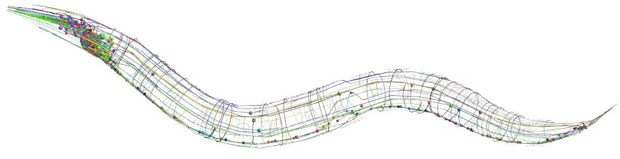
One of the age-old questions has been whether the way a brain is wired, negating other attributes such as intracellular systems biology, will give rise to how we think and how we behave. We are not at the point yet to answer that question regarding the human brain. However, by using the well-mapped connectome of the nematode Caenorhabditis elegans (C. elegans, shown above), we were able to answer this question as a resounding yes, at least for simpler animals. Using a simple robot (a Lego Mindstorms EV3) and connecting sensors on the robot to stimulate specific simulated sensory neurons in an artificial connectome, and condensing worm muscle excitation to move a left and right motor on the robot, we observed worm-like behaviors in the robot based purely on environmental factors.

Our artificial connectome uses a program that can be started 302 times, where each program inherits the attributes of one of the worm’s 302 neurons. These attributes consist of the neuron itself (named, for example, AVAL, DB02, and VD03) and the neurons that it connects to. We use the number of connections that a neuron has to another neuron as a weighted value. For example, if neuron A has three synaptic connections to neuron B, when neuron A “fires,” we send a weighted value of 3 to neuron B. Using UDP1 message communications, we can message the weighted values between each simulated neuron by assigning a port number and IP address.

Each simulated neuron program has a weight accumulator that sums the weights as they are received; a threshold is established that must be met before that neuron will fire. If no message activity is received within 200 ms, the accumulator is automatically set to zero (e.g., depolarizes the cell). Once a neuron fires, the accumulator is also set to zero. This gives our artificial connectome a temporal paradigm that has similarities to living connectomes.

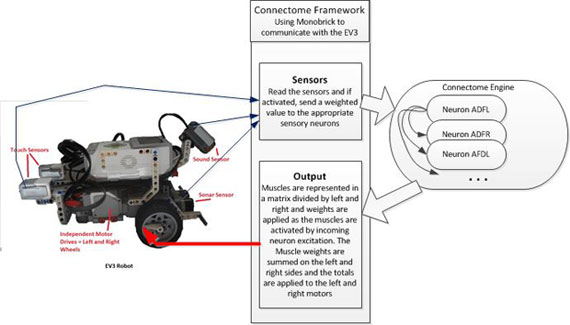
To connect the robot to the artificial connectome, we created a program that reads the robot sensors every 100 ms. Depending on the sensor, we send weighted values to a specific set of simulated sensory neurons. For example, we simulate the worm “nose touch” by using a sonar sensor on the robot. If the robot comes within 20 cm of an object, the well-defined sensory neurons that are associated with nose touch on the worm are activated with UDP messaged weighted values. Likewise, there are many motor neurons within the C. elegans connectome that stimulate each of the 95 body muscles. Four rows of muscles are aligned down the worm’s body: two rows ventral and dorsal left, and two rows ventral and dorsal right. We create a 4 x 24 matrix of these muscles, with each cell of the matrix representing one of the 95 muscles. We accumulate the weighted values on the left and right to drive the left and right motors on the robot. Motor neurons can be excitatory or inhibitory, and we send positive weighted values for excitatory synapses and negative numbers for inhibitory synapses. This, in turn, causes the two wheels on the robot to move independently, forward or backward.

ConnectomeFramework

The Lego Mindstorms EV3 robot sensors are read by an input program that activates the appropriate sensory neurons of the simulated connectome. An output program receives the motor neuron output and accumulates weighted values to drive the robot wheels.

In general, the EV3 robot using the artificial connectome behaved in very similar ways to the behaviors observed in the biological C. elegans. In the simplest of terms, stimulation of food sensory neurons caused the robot to move forward. Stimulation of the robot’s sonar, which in turn stimulated nose-touch neurons, caused the robot to stop forward motion, back up, and then proceed forward, usually in a slightly skewed path. Touching the anterior and posterior touch sensors caused the robot to either move forward (anterior touch) or move backward (posterior touch). There is no programming to direct the robot to behave in any specific manner. Only the simulated connectome directs when the robot will move a motor forward, stop, or move backward. This answers, at a very basic level, that the connectome alone gives rise to phenotypes that we observe in animals.

A YouTube video shows the robot using the connectome framework and simulated C. elegans nervous system. The first part of the video displays the sensor input program that captures sensory data and sends it to a set of sensory neurons. This part of the video also shows the output program that captures the motor neuron weights; the weighted data is accumulated by the left and right sides of the C. elegans body muscle structure, and the accumulated weights are sent to the left and right motors of the robot. The middle of the video shows the robot as it comes up to a wall, activates the nose-touch sensory neurons, stops and changes direction, again totally under the control of the simulated C. elegans nervous system. The last part of the video is a capture of the neurons as they are activated, showing green as weights are received and dark green when the accumulated received weighted value exceeds 10.

The C. elegans connectome is highly recursive. When the connectome reaches a sufficient level of stimulation, the connectome will continuously self-stimulate: a neuron (presynaptic) will stimulate another set of neurons (postsynaptic), and in turn, many of those postsynaptic neurons will stimulate the originating presynaptic neuron, creating loops of stimulation. The recursive nature of the connectome has shown to be a key factor in the connectomics research and resulting behaviors of C. elegans. This is now becoming a focal point of our analysis, to determine how these recursive loops play on the topology and resulting actions when the connectome is fully engaged.

DD5Network

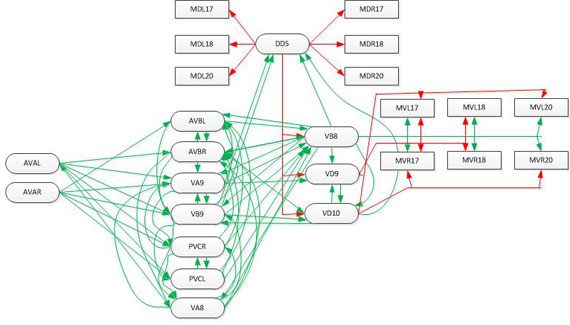
This image is created from the direct data output of the simulated C. elegans connectome, and specifically the network that surrounds the activation of neuron DD05. The green arrows are excitatory (positive) stimulation, and the red arrows are inhibitory (negative) stimulation. Oval shapes represent neurons, and rectangles represent muscle cells. As you can see, the network is highly recursive, whereby often neuron A excites neuron B, which in turn excites neuron A.

Although we can show that simple neuronal connections can give rise to expected behaviors, there is much more to the neurons of C. elegans (and of other animals) than just neuronal connections — including, but not limited to, the difference between chemical and electrical connections, neuropeptides, and the various peptides and innexins that create neuronal complexities at the cellular level. Just the differences in chemical (synapse) and electrical (gap junctions) warrants the possibility of two programs to shadow one another and represent a single simulated neuron. Whether this evolves into multiple programs that together comprise a single neuron, or a single application that encompasses all of the systems biology of a single neuron, we must continue to improve and add complexity to get a true representation in reverse-engineering biology. This also includes the spatial aspects of how neurons are placed and connect throughout the nervous system to create a spatio-temporal model (which we have seen is important regarding body-touch sensing).

The artificial connectome has been extended to a single application written in Python and run on a Raspberry Pi computer. To our surprise, this simple program and version of the C. elegans connectome worked very well. We are currently creating a self-contained, Raspberry Pi–controlled robot that will be completely autonomous and independent of Internet connectivity. Our objective is to develop robots that can use the artificial connectome as a means to not only adapt to and navigate unknown environments, but also carry out specific tasks such as identifying or reporting environmental changes that could be vital to specific interests.

There is still very much to experiment with and analyze in reverse engineering the nervous systems of animals. We believe that this first step in being able to study an entire connectome, from sensory input to motor output, and the observations of expected behaviors will allow us to move forward in the understanding of nervous system wiring and how it develops into our behaviors. Moving from a simple 302-neuron connectome to higher-order animals will only increase the complexity and give us greater insight into how our own minds work.

06 Nov 20:58

Stream Yourself Some Culture: Globe Theater Offers New On-Demand Player for Shakespeare Productions - Yes that is Arthur Darvill. You're welcome.

by Victoria McNally

Screen Shot 2014-11-06 at 2.12.01 PM

Back in the day, if you wanted to watch a Shakespeare play—or any work of Elizabethan-era theater, really—you had to schlep yourself over to a disgusting outdoor theater and, unless you could afford the exorbitant costs for seats. stand with a bunch of other plebes in a tightly packed standing-room-only gravel pit. But we live in the future now, where we can stream those plays directly into our eyeballs via magic screens! Isn’t life amazing?

Okay, I kid; seeing a play live at Shakespeare’s Globe is a pretty amazing experience whether you’re standing or not. Unfortunately, flights to London are a bit expensive these days, so for the rest of us, the theater has released an On-Demand service called the Globe Player, which allows you to watch past productions online, as well as free-to-watch interviews with celebrated actors like Ewan McGregor and Judi Dench, and a larger number of translated works from the theater’s Globe to Globe festival. Ever wanted to watch Coriolanus in Japanese, or All’s Well that Ends Well in Guajarati? Now’s your chance.

But it’s not all Shakespeare down at the Globe! You can also treat yourself to a screening of Christopher Marlowe’s Doctor Faustus that stars none other than Pond-Husband Arthur Darvill as Mephistopheles. That’s right, Rory was the devil one time! Here, let this overdramatic trailer show you what you’re missing.

Filming live play performances and then putting them up online is not actually an uncommon practice in the UK—the Digital Theatre website offers a lot of productions that star famous actors, such as David Tennant and Catherine Tate’s Much Ado About Nothing or Richard Armitage in The Crucible. Heck, they’ve even got a fair number of the productions that the Globe’s new service also features. But as Globe artistic director Dominic Dromgoole said on Tuesdsay, the Globe is the first theater with “its own dedicated video-on-demand platform,” and that it will be able to “take Shakespeare out into the world and share his astonishing plays with as many people as possible.”

Personally I would recommend Henry IV part 1 and 2, as I saw both those productions live back in 2010 (and it’s worth pointing out that they cast the same guy who plays Hal as the king in a later production of Henry V—yay, continuity!). Is there anything else on the Globe Player that you’re dying to see?

(via Times Dispatch)

Are you following The Mary Sue on Twitter, Facebook, Tumblr, Pinterest, & Google +?

06 Nov 20:58

Early Chinese History Told Through Maps And Poetry

by noreply@blogger.com (Suvrat Kher)
I am really enjoying Jerry Brotton's A History Of The World In 12 Maps. One richly rewarding chapter is on early Chinese map making traditions and inevitably you end up learning quite a bit of history as well.

The Song dynasty (907- 1276 AD) struggled with keeping the empire unified and intact and faced particularly strong challenges from the Jurchen Jin a confederacy of Tungusic tribes from northern Manchuria. In the middle of the 12th century the Song were forced to sign a peace treaty with the Jurchen Jin ceding to them nearly half their northern territory.

Subsequent imperial maps drawn up by the Song never showed this division. Rather, an idealized geography that the Song kept dreaming of based on earlier classical texts like Yu Gong, that of a unified empire to which foreign barbarian rulers paid tribute was portrayed. Using maps as a tool for political propaganda is an old trick! 

What maps did not depict though, poetic license did.

This beautiful passage from the book:

Poetry describing maps either side of the traumatic division of the Song also captures their power to first acknowledge, and then lament the loss of territory. Writing more than 100 years earlier, the ninth century Tang poet Cao Song describes 'Examining " The Map of Chinese and Non Chinese Territories"':

With a touch of the brush the earth can be shrunk;
Unrolling the map I encounter peace.

The Chinese occupy a prominent position;
Under what constellation do we find the border areas!

On this occasion the almost meditative act of unrolling the map and seeing a unified Chinese dynasty at its center evokes emotions of security and assurance. Later Southern Song poets used a similar conceit, but with very different emotions. Writing in the late twelfth century, the celebrated Lu You (1125-1210) lamented:

I have been around for seventy years, but my heart has 
remained as it was in the beginning, 
Unintentionally I spread the map, and tears come gushing forth.

The map is now an emotive sign of loss and grief, and perhaps a 'template for action', a call to unite what has been lost.

06 Nov 19:50

Wearables Are Totally Failing the People Who Need Them Most

by J.C. Herz
Wearables Are Totally Failing the People Who Need Them Most

Fitness tracking companies need to start embracing the FDA and making devices and apps for the old, the chronically ill, and the poor.

The post Wearables Are Totally Failing the People Who Need Them Most appeared first on WIRED.


06 Nov 17:43

Esri Integrates SciPy with ArcGIS

Esri Integrates SciPy with ArcGIS: Geography is the science of our world, and GIS is a...
05 Nov 22:55

Too Many Kids Quit Science Because They Don't Think They're Smart

by Soulskill
An anonymous reader writes: Carol Dweck, a psychology professor at Stanford, has done years of study on how students' attitudes affect their academic achievements. Her work began at the height of the "self-esteem movement," when parents were told to praise their kids' brainpower at every turn. But Professor Dweck found that praise for intelligence or talent — relatively immutable characteristics — only turned kids off of trying subjects they perceived as difficult, like math and science. Praising effort, perseverance, and problem-solving strategies works better. She also says, "There is such a thing as too much praise, we believe." Instead, she suggests engaging with kids about the process itself, showing interest and encouragement when they talk about how they did something.

Share on Google+

Read more of this story at Slashdot.


05 Nov 22:20

Revitalizing Medical Imaging With Ultrasound-On-a-Chip

by Soulskill
catchblue22 writes: MIT Technology Review has an article about a device being developed by Butterfly Network that aims to make medical imaging dirt cheap. From the article: "Butterfly's patent applications describe its aim as building compact, versatile new ultrasound scanners that can create 3-D images in real time. Hold it up to a person's chest, and you would look through 'what appears to be a window' into the body, according to the documents. ... Most ultrasound machines use small piezoelectric crystals or ceramics to generate and receive sound waves. But these have to be carefully wired together, then attached via cables to a separate box to process the signals. Anyone who can integrate ultrasound elements directly onto a computer chip could manufacture them cheaply in large batches, and more easily create the type of arrays needed to produce 3-D images."

Share on Google+

Read more of this story at Slashdot.


05 Nov 22:20

The Raven's Chamber: a mad scientist's apparatus

by Cory Doctorow


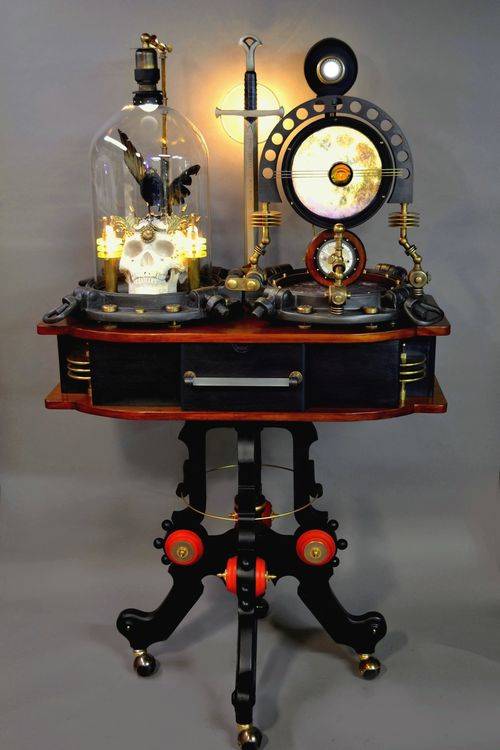
Art Donovan (previously) created this amazing, mixed-media sculpture as a commission, called The Raven's Chamber, resembling some arcane astronomical instrument from a mad alchemist's lab. Read the rest

05 Nov 22:19

Fabiola Gianotti To Take Over As CERN Director-General

by samzenpus
somegeekynick writes "The public face of the ATLAS experiment at CERN which co-discovered the the Higgs-like boson in 2012, Fabiola Gianotti, 52, has been chosen as the next Director-General of the particle physics lab. She'll become the first woman to hold the position. The 5-year term begins on Jan 1, 2016."

Share on Google+

Read more of this story at Slashdot.


05 Nov 22:13

Creativity Is Messy

by Ian MacAllen

Technically perfect writing is important when it comes to journalism or nonfiction, and especially helpful when writing with short deadlines. Fiction writing is different though. Nicole Bernier, over at Beyond the Margins, explains why grammatically sloppy writing might be the product of greater creativity:

Sometimes when creative writers say they don’t notice their own typos, it has a whiff of, well, humblebraggery. They’re on a roll, blinded by their vision — the fingers cannot be stopped, the whole brain engaged in its art. That’s why God invented proofreaders, right? To straighten up the mess of the visionaries. The people who sweep up the mistakes are valued professionals, to be sure, but they are not the artists. They are the people with the golden dustpan and brush.

Related Posts:

05 Nov 19:17

Of Dragons and Geology

by David Bressan

Johann Jakob Scheuchzer (1672-1733) was a Swiss physician, but also quite interested in travels and natural sciences. He published his observations on the culture and natural world of the Alps as “Itinera per Helvetiae alpinas regiones facta annis 1702-1711“.

In the introduction by the editor we read:

The name of Scheuchzer will be famous …[] The author was in the best conditions to make valid discoveries during his explorations. He worked with incredible determination.., [] no danger, no costs, no difficulty were too large for this great man.

Despite the work was intended to dispel of myths and superstitions so common in the Alps, Scheuchzer, like many other naturalists of his time, did not see a contradiction in publishing own and exact observation and rumors in the same book. In the German translation of the “Itinera alpina” by Johann Georg Sulzer, published in 1746 with the title “Natur-Geschichte des Schweizerlandes” (Natural History of Swiss) so we read about dragons:

In the summer of the year 1717 Joseph Gackerer from Neftls… a half hour distant from Glarus…[]… encountered an animal with the head of a cat, with large eyes, it was long a foot, with a thick body, four limbs, and something like breasts pending from the belly, the tail was a foot long, the entire body was covered by scales and colored. The man touched it with a stick; it was soft and full of poisoned blood, so that from some drops spilled on his leg, it became swollen.

I requested to mister Tschudi, pastor at the village of Schwanken, that he would find an honest person which would search for the bones of this person, so in April 1718 he send some to me, which I hold in my collection as rare specimens.

Fig.2-4. For centuries the inhabitants of remote valleys in the Alps were convinced that, hidden in the forests and caves, strange creatures existed, like serpents with a human face, lizards with multiple tails and the most fearsome of all – the terrible Tatzelwurm (all images in public domain).

Scheuchzer dedicates an entire chapter to encounters with these strange creatures.

From the evil dragon must also be told…[]…Years ago, an honest man named Mcyer …[recounts] … above the village of Ommen under the shade of a large fir tree was seen to lie [a dragon]. He had legs and wings, which were characterized by red spots, [the wings of the color] like silver.
The man turned back as soon as he had seen him. Two days afterwards there was a storm with hail, which confirms the common believe of the locals that severe storms occur after a dragon is spotted. This would not be without reason. Because we know that after the dilution of the air and before it rains creatures like snakes, lizards and similar animals tend to come out from their holes.

Scheuchzer however is sometimes skeptic about local legends and correctly notes in one case that bones attributed to dragons are more probably from known animals:

[]…an observation of the year 1718, there in a cave on a very high mountain, called Ober-Urner-Schwendi, there were found some bones, declared as the remains of a dragon, but after my judgment these are nothing more than the remains of a bear, which maybe hibernated in the cave and because of the collapse of the entrance must have died there by starvation.

Scheuchzer also offers a geological explanation for the dragon myth:

At last I must mention, that furious rivers from the mountains are called by the locals of the Alps also dragons. If a river flows down from the mountains, and carries large stone, trees and other things with it, so they say: The dragon became unchained…[]… that many false stories about the dragons have their source in this fact.

Bibliography:

MÄGDEFRAU, K. (1973): Geschichte der Botanik. Stuttgart, Gustav Fischer.

03 Nov 22:36

“Diet Raspberry Pi” – It’s only WAFER thin! @Raspberry_Pi #raspberrypi

by adafruit

Raspberry Pi B-

Diet Raspberry Pi @ The Adafruit Learning System.

The Raspberry Pi finds itself in an ever-expanding gamut of project types…wearables, drones, internet of things and other embedded gizmos…and there are times when an extra-slim version of this already diminutive wonderputer would be just the thing.

Here we’ll show how to trim some fat from the Raspberry Pi Model B+. You’ll lose the Ethernet port and at least two of the USB ports, so this is really suited only to projects where size or weight take priority over connectivity.

Read more!

20 Oct 22:31

40 Maps That Explain the Internet

by James Fee

I have no idea what a map story or story map is but I do love maps. Timothly Lee over at Vox has compiled 40 maps that show the growth of the Internet since 1969.

The internet increasingly pervades our lives, delivering information to us no matter where we are. It takes a complex system of cables, servers, towers, and other infrastructure, developed over decades, to allow us to stay in touch with our friends and family so effortlessly. Here are 40 maps that will help you better understand the internet — where it came from, how it works, and how it’s used by people around the world.
ARAPNET 69

20 Oct 17:53

Women in Data Science Are Invisible. We Can Change That

by Claudia Perlich
Women in Data Science Are Invisible. We Can Change That

I have to admit that I never really gave the number of women in data science much thought until recently. Maybe it was because, by some lucky accident, my NYU faculty advisor’s two other PhD students also happened to be female. And about half of my predictive modeling group peers at IBM Research were female. […]

The post Women in Data Science Are Invisible. We Can Change That appeared first on WIRED.


20 Oct 17:13

Open data for open lands

by Tim O'Reilly

President Obama’s well-publicized national open data policy (pdf) makes it clear that government data is a valuable public resource for which the government should be making efforts to maximize access and use. This policy was based on lessons from previous government open data success stories, such as weather data and GPS, which form the basis for countless commercial services that we take for granted today and that deliver enormous value to society. (You can see an impressive list of companies reliant on open government data via GovLab’s Open Data 500 project.)

Based on this open data policy, I’ve been encouraging entrepreneurs to invest their time and ingenuity to explore entrepreneurial opportunities based on government data. I’ve even invested (through O’Reilly AlphaTech Ventures) in one such start-up, Hipcamp, which provides user-friendly interfaces to making reservations at national and state parks.

A better system is sorely needed. The current reservation system is clunky and difficult to use. Hipcamp changes all that, making it a breeze to reserve camping spots.

But now this is under threat. Active Network / Reserve America’s 10-year contract is up for renewal, and the Department of the Interior had promised an RFP for a new contract that conformed with the open data mandate. Ideally, that RFP would require an API so that independent companies could provide alternate interfaces, just like travel sites provide booking interfaces for air travel, hotels, and more. That explosion of consumer convenience should be happening for customers of our nation’s parks as well, don’t you think?

Unfortunately, as drafted, the RFP allows the winning contractor to determine whether this type of API is feasible — meaning the entity who benefits most from keeping all the reservations to themselves has the authority to do so. And the draft even removes data that is currently accessible — availability data — from public sharing. So, it’s a huge step backward, and completely out of step with the administration’s open data policy.

The founder of Hipcamp, Alyssa Ravasio, has written up some thoughts on how this RFP could be improved that I want to share with you. And after reading them, I’m hoping you will be moved to send comments asking the Department of the Interior to reconsider their RFP.

Comments on this draft are accepted through Wednesday October 22, so if you agree, please email jasonmking@fs.fed.us and let him know that opening up this system is important.

Here is Alyssa’s more detailed write-up.

Open data for open lands

The federal government has released a draft contract that will define how we access our public lands for the next decade. They are seeking a private contractor to build software that will provide online access to our nation’s parks, forests, monuments, campsites, cabins, and tours.

The problem + the context

As drafted, this contract places all this inventory and its associated revenue into the hands of one contractor and one website, creating a closed silo and a monopoly.

This would be a huge step backward from all of the Obama administration’s great work encouraging federal agencies to use open data to build platforms. In the words of President Obama, he wants to “make sure that we’re giving entrepreneurs the ability, if we build an effective platform, to essentially develop apps that work off this new information.”

The key to making open data accessible is an API, which allows different applications to share data. The government now offers federal agencies an API management service called API.Data.Gov. The first principle of our National Data Policy is “openness,” and the Digital Services Playbook tells agencies to “default to open.”

Examples of government platforms

The open data platform model of public-private partnerships has already seen huge successes. Public transit agencies opened up their data to popular mapping applications like Google Maps, making public transit accessible and relevant to a wider demographic.

The IRS created e-file, which has been called “the blueprint for public-private partnerships.” The e-file platform enabled and inspired services like TurboTax and TaxAct to build easy ways for citizens to file their taxes online. Market forces of competition incentivize these companies to constantly improve their products, resulting in better experiences for the taxpayers and less paperwork for the government.

The solution for recreation.gov

Instead of consolidating data and revenue into one contractor building one website, the government should design Recreation.gov as an open data platform with a revenue incentive, giving “entrepreneurs the ability…to essentially develop apps that work off this new information.”

This would allow an ecosystem bloom, inspiring multiple services to compete in helping people get outdoors. The benefits of getting more people outdoors include increased revenue for the government; a boost in business for the outdoor industry; and perhaps most importantly, a larger population connecting with nature and developing a passion for ensuring its protection and preservation for future generations.

There are two core requirements missing in this draft contract that are needed to unlock this potential.

  1. API first

    An API needs to be a primary requirement of this contract, to be completed first. It should include static data (park name, location), real-time data (availability, pricing), and “write” functionalities that allow for the automated processing of transactions.

    The new Recreation.gov website should use this API, as should the general public and licensed third parties (all with different access levels). Starting with an API as the core and using it for both internal and external purposes is a software industry best practice known as “eating your own dog food,” and has a tremendously positive impact on security, sustainability, and flexibility of the software.

    As drafted now, the contract leaves it up to the contractor to determine whether this type of API is feasible, meaning the contractor who can profit from keeping this data to themselves has the authority to do so. This is a clear conflict of interest and must be changed.

  2. Align incentives
  3. The winning contractor should receive an annual fee per year for the service and support of the system, but then should compete for the transactional revenue. If a sale occurs on Recreation.gov (the website they’ve built), then they will earn the commission. But if the sale occurs on a third party site (which has successfully applied for a license to process transactions), then the third party will earn this commission instead. The government receives the same amount of revenue either way.

    This is the only way to incentivize the contractor to offer an outstanding service. If they are given a monopoly, they will do the bare minimum and nothing more. By adding competition for transactional revenue, the contractor will be subject to market forces and will naturally be driven to improve their product and services.

The dream & its impact

Imagine a world where popular applications like Waze, Roadtrippers, AllTrails, and many more new applications that don’t even exist yet are all competing to get people outside and enjoying our parks. An entrepreneur will develop a website featuring the parks in Spanish. Another will develop a mobile app targeting the rising trend of bike camping, and yet another for motorcycle camping. A middle school student will develop an app where her friends compete to collect badges for all the parks they attend.

This may sound overly optimistic, but when you align incentives and allow open market forces to work, the “invisible hand” has a way of serving its own. For example, TurboTax is fully available in Spanish, and that’s not because they’ve been given a mandate to reach “underserved” communities; it’s because it makes sense to do so financially. Read the entire 93-page Recreation.gov contract draft — nowhere does it mention Spanish, despite the fact that the Latino population represents 17% of our population and is expected to reach 31% by 2060. Market forces will accomplish what government cannot — developing all the different ways the public needs to be reached.

If we break open this monopoly and let an ecosystem bloom, we’ll allow the creativity and innovation of the American people to benefit our public lands. We will inspire a new generation to explore the outdoors and commit to protecting it for future generations.

How you can help

None of this will happen if we don’t first persuade the government that Recreation.gov should be a platform, not a silo. Comments are being accepted for a couple more days, until October 22. Please email jasonmking@fs.fed.us (the official recipient for public comments) and let him know that this issue matters to you and why. They’re on the fence about this issue, and our feedback can make all the difference in the world.

Submit your comments to jasonmking@fs.fed.us no later than October 22.

Author’s disclaimer: My name is Alyssa, and I’m the founder of Hipcamp — we offer a comprehensive search engine for campgrounds across government agencies. One of the main frustrations that led to the founding of Hipcamp was that the information I needed to plan a camping trip was locked in various siloed agency websites. When I go camping, I’m looking for an ocean or mountains — I don’t want to choose between BLM and state parks. Hipcamp certainly stands to benefit from opening up this system, but no more than our many competitors (both present and future) do.
Alyssa Ravasio, founder of HipCamp

20 Oct 03:03

This is Halloween: Danny Elfman Reading The Nightmare Before Christmas - Halloween! Halloween! Halloween!

by Jill Pantozzi

I mean, come on.

(via Nerdist)

Are you following The Mary Sue on Twitter, Facebook, Tumblr, Pinterest, & Google +?

20 Oct 03:00

The Entirety Of The Hobbit Book In LEGO In 72 Seconds - Yes, P. Jax, it is possible.

by Sam Maggs

It’s 33,000ish seconds shorter than the Peter Jackson version, and it includes (pretty much) no Tauriel. Make of that what you will. If you want to marathon the cinematic-length version, you can do so when Battle of the Five Armies comes out on December 17th.

(via THR)

Previously in Hobbitses

Are you following The Mary Sue on Twitter, Facebook, Tumblr, Pinterest, & Google +?

20 Oct 02:59

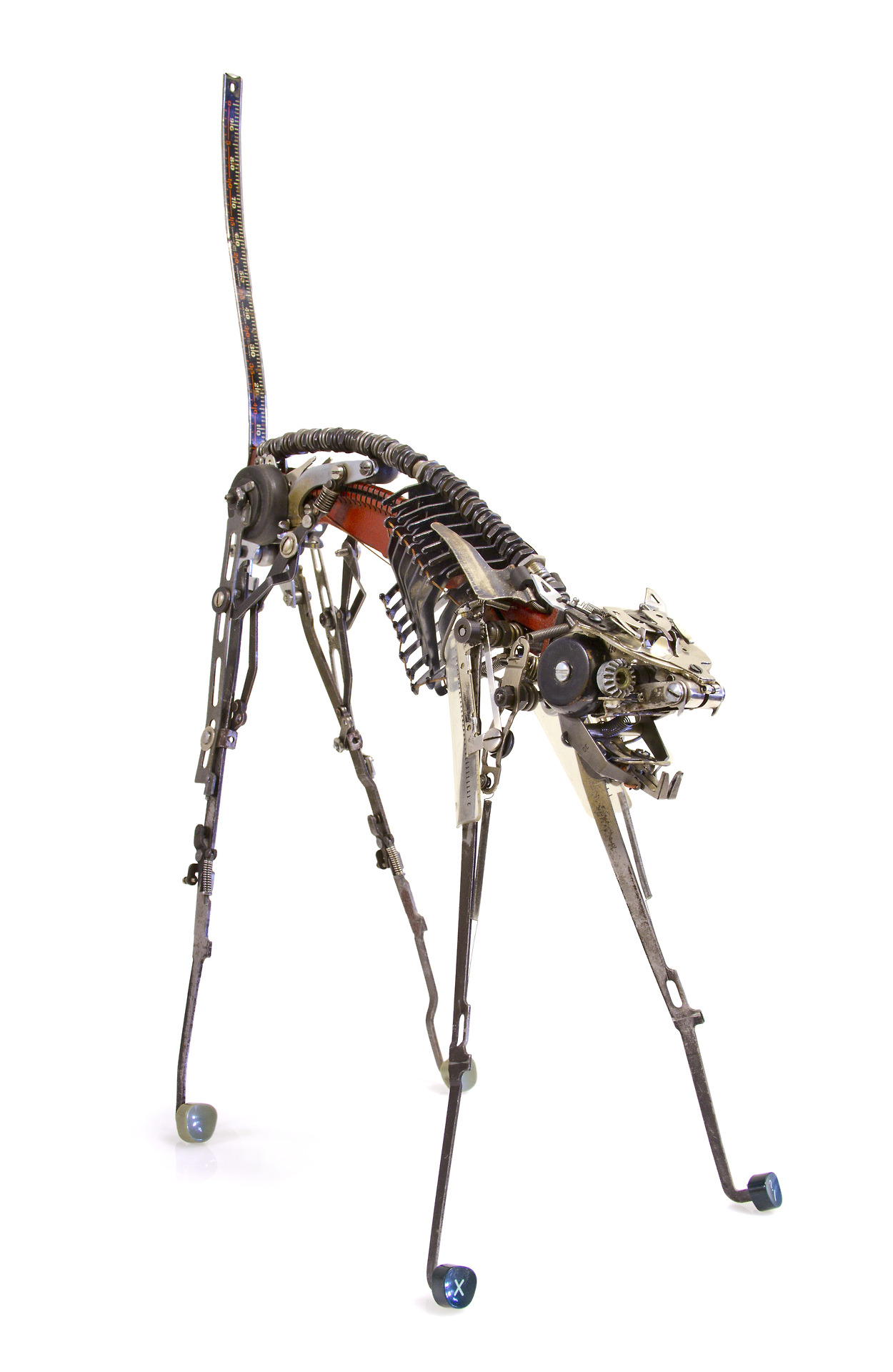
Typewriter-parts cat

by Cory Doctorow


New from Jeremy Meyer, who makes brilliant assemblage sculptures out of typewriter parts: Cat XXI, a classic Hallowe'en cat rendered skeletal and wistful through the medium of obsolete mechanical components.

17 Oct 21:23

Italian Scientists Appeal Absurd Conviction for Quake Deaths

by David Wolman
Italian Scientists Appeal Absurd Conviction for Quake Deaths

This month in Italy, three judges have a chance to undo the Kafkaesque nightmare that has ensnared some of the country’s top scientists for almost five years. So far it looks doubtful they will. In 2012, seven scientists and engineers were convicted of manslaughter for things they said and did not say in the days […]

The post Italian Scientists Appeal Absurd Conviction for Quake Deaths appeared first on WIRED.


17 Oct 17:50

T-shirt printer spits them out in seconds

by Rob Beschizza

Epson's SureColor F2000 can print a t-shirt in just a few seconds. At Comic-Con in New York, they had one on display: I emailed a picture, rested my iPhone on its transparent lid, and recorded this real-time video of it running one off in less than a minute.

Read the rest
17 Oct 17:32

How Do We Know How Old The Earth Is?

by Robbie Gonzalez

The folks at SciShow teamed up with Google and YouTube to bring us answers to 10 of the most commonly searched questions on the Internet. Today's question? How old is the earth?, or, an even better question: How do we know how old the earth is?

Read more...


17 Oct 16:11

Geologists: The Cowboys of Science

by Silver Fox
A colleague of my former (deceased) husband once said, "Archaeologists are the Cowboys of Science." (I don't know if he actually said it in Capital Letters like that, but that's how it came across to me.) DH disagreed and said, "No, Geologists are the Cowboys of Science. Archaeologists don't even come close."

The first character that actually comes to my mind, for some reason, is Bret Maverick's brother Bart. He's not a geologist, but he goes off gallivanting around the countryside on his horse, somehow managing, often, to get into trouble. He reminds me of some geologists I know, who go off the same way in their 4WD pickups.

Also read:

Sherlock Holmes, Forensic Geologist
The Romance of Geology in Russia: A Tribute to Alexander Ainemer
Here's to You: Geological Heroes
Dust Hole (previous post)
17 Oct 16:10

New iPads come with special, multi-carrier “Apple SIM”

by Andrew Cunningham
The "Apple SIM" allows AT&T, T-Mobile, Sprint, or EE support without switching SIM cards.
Andrew Cunningham

Apple's iPad announcements today focused overwhelmingly on the iPad Air 2's thickness, its screen, and its internals, but it and the iPad Mini 3 got some other quieter upgrades too. One such upgrade is a new "Apple SIM," a nano SIM card that allows the cellular models to switch between multiple mobile carriers without changing the actual card. At launch the card supports AT&T, Sprint, T-Mobile, and UK carrier EE. Though Apple is still selling Verizon-compatible iPads, the US' biggest carrier remains conspicuously (though perhaps not surprisingly) absent from the list.

One thing Apple is emphasizing with the SIM is that it can be used to secure short-term data commitments, rather than the regular monthly charges most cellular tablets generally assume. In theory, you can jump between carriers based on the one that's offering the data you need for the price you want, and you never have to swap out the SIM card to do it. Apple is also playing up the ability to buy data from international carriers when traveling, though obviously the carrier list will need to expand before this is practical.

Though the Apple SIM is launching in the iPad Air 2 and the iPad Mini 3, we would expect it to start showing up in other Apple products eventually. Simplifying the product line instead of shipping carrier-specific versions of iPhones and iPads seems like the right move for Apple to make; let's hope carriers continue to climb on board.

Read on Ars Technica | Comments


17 Oct 16:09

Stanford engineers built an earthquake-resistant house. Watch the shake test.

by Matthew Williams

Engineers at Stanford have designed, built, and tested an earthquake-resistant house which has stayed upright even when subjected to three times the intensity of the 1989 Loma Prieta earthquake.

06 Oct 02:53

Download the “Great American Comic Sci Fi Novel,” Buddy Holly is Alive and Well on Ganymede

by Dan Colman

fre buddy holly is alive and well

Back in 1991, Bradley Denton published Buddy Holly is Alive and Well on Ganymede. The next year, it won the John W. Campbell Memorial Award for Best Science Fiction Novel.

Writes Cory Doctorow on BoingBoingBuddy Holly is Alive and Well on Ganymede “is the great American comic science fiction novel, a book about the quest to exhume Buddy Holly’s corpse from Lubbock, TX to prove that he can’t possibly be broadcasting an all-powerful jamming signal from a hermetically sealed bubble on a distant, airless moon.”

Taking advantage of new innovations (new since 1991), Denton has made the novel available for free download on his website, publishing it under a Creative Commons Attribution-NonCommercial-NoDerivatives license. You can access the text in four parts here: Part 1, Part 2, Part 3, Part 4.

If you become a fan, keep an eye out for a film adaptation of the novel starring Jon Heder. It’s been in development for some time, but you can watch a trailer online.

Buddy Holly is Alive and Well on Ganymede will be added to our collection, 600 Free eBooks for iPad, Kindle & Other Devices.

You can find more free sci-fi below:

Free Science Fiction Classics on the Web: Huxley, Orwell, Asimov, Gaiman & Beyond

33 Sci-Fi Stories by Philip K. Dick as Free Audio Books & Free eBooks

Read Hundreds of Free Sci-Fi Stories from Asimov, Lovecraft, Bradbury, Dick, Clarke & More

The Ware Tetralogy: Free SciFi Download

Download the “Great American Comic Sci Fi Novel,” Buddy Holly is Alive and Well on Ganymede is a post from: Open Culture. Follow us on Facebook, Twitter, and Google Plus, or get our Daily Email. And don't miss our big collections of Free Online Courses, Free Online Movies, Free eBooksFree Audio Books, Free Foreign Language Lessons, and MOOCs.

The post Download the “Great American Comic Sci Fi Novel,” Buddy Holly is Alive and Well on Ganymede appeared first on Open Culture.