Shared posts

19 Jul 23:10

Copyright As Censorship: NBC Pulls YouTube Clip From Senator Elizabeth Warren's Account

by Mike Masnick
In yet another story of copyright being used as censorship, a clip of Senator Elizabeth Warren responding forcefully to some dubious claims made by some CNBC hosts has been pulled from Warren's own YouTube account: Whether or not you agree with Warren or the CNBC hosts, I'd hope everyone could agree that using copyright to censor such a thing is wrong. While it's unclear if this was a mere ContentID match or a DMCA takedown, the fact that other similar clips remain on YouTube suggest that it was not an automated decision, but a deliberate one. Furthermore, as Upworthy has pointed out, many other Senators have CNBC clips on their own YouTube channels, which have not been pulled. Given those two things, it seems quite clear that NBC directly targeted Senator Warren's use of this clip (which was getting a lot of traffic -- over 700,000 views) for takedown.

CNBC's "response" that the clip "has been available to view in multiple locations on CNBC.com since its original posting" is equally misleading, because, as Gawker notes, CNBC has the full 10 minute interview, rather than the short clip that was highlighted on Warren's YouTube account.

If Senator Warren so chose, I think she has a exceptionally strong fair use claim to challenge the takedown. It was a short clip, clearly used for disseminating information to the public and educating the public on a topic of great public interest, wasn't being used commercially and a whole host of other reasons. And, NBC, who regularly relies on fair use claims to broadcast clips from other sources, would have a difficult time fighting back. But, once again, we see the pernicious effects of how copyright is being used, repeatedly, by copyright holders not for legitimate, copyright-related reasons, but rather directly as a tool for censorship.

Oh, and of course, NBC's attempt to censor a Senator getting the better of one of its talking heads, has only meant that the video is popping up in plenty of other places and getting much more attention. There's a phrase for that, I think...

Permalink | Comments | Email This Story


19 Jul 23:07

Telcos Refused To Sign On To 'Let Us Be Transparent About Surveillance' Letter

by Mike Masnick
We've discussed before that, while the major tech companies have been pretty vocal about the NSA surveillance situation, the major telcos have been almost universally silent. In fact, it has since come out that AT&T and Verizon were more or less shoving each other aside to "volunteer" to hand your info over to the government. The further revelations (including some past leaks) about how AT&T and Verizon have more or less given the NSA on-premise access to all data going through their pipes suggest a level of cooperation with government that is stunning and dangerous -- especially given the market dominance held by the telcos at the internet backbone level.

We were just talking about how various tech companies have strongly asked the government for permission to be a lot more transparent, but it seems equally notable that, according to a report in the NY Times, the telcos were approached about joining on the letter and declined to participate:
While prominent Internet companies are pushing for fuller disclosure, some of the nation's largest telecommunications firms were not willing to sign on, according to several people involved in the coalition.
Gee, I wonder why? In fact, the only company on the list whose main business is internet access is the small ISP Sonic.net, who has built up its (wonderful) reputation as one of the only ISPs out there that really tries to align its business with its customers' best interests.

Meanwhile, if you're wondering what the big telcos are doing instead of pushing for this kind of necessary transparency? Apparently it's hiring incredibly powerful lobbyists, including the recently-departed FTC chairperson (and former MPAA lobbyist) Jon Leibowitz, along with former Congressional Rep. (another Hollywood favorite) Mary Bono Mack, to "lobby Congress on digital privacy policies." You think they'll be advocating for better privacy protections? Or... better protection for themselves against the privacy concerns of the public. The group isn't saying, but it's not hard to take a guess.
Tim Karr, a policy analyst at the communications watchdog group Free Press, tweeted after the coalition went public that AT&T launching a privacy coalition is like "Ted Nugent" launching "wildlife coalition."
The level of transparency demanded by the tech firms could (and should) go much further than what they're currently asking. But at least they're asking for transparency, and there's at least some evidence that some of the companies -- mainly Twitter, Yahoo! and Google -- have fought back against Government requests. When it comes to the telcos, not only is there little evidence of them pushing back against government overreach, it appears that the telcos actively volunteered to make such overreaches easier. That might explain why they're not so keen on "transparency." Having to reveal numbers like "number of users impacted: all of them" probably won't go over well. Somehow, I doubt their massive new "digital privacy" lobbying effort will seek to improve this situation.

Permalink | Comments | Email This Story


19 Jul 22:52

FISA Order To Verizon Expires Today, No One Wants To Say If It's Being Renewed

by Mike Masnick
The very first of the Ed Snowden leaks was a FISA court order to Verizon, ordering it to hand over information on every single phone call, on an "ongoing, daily basis." That order expired on July 19, 2013. Today. It quickly came out that the FISA court has been approving nearly identical orders every 90 days for about seven years, though the defenders of the program like to use that "it's only for 90 days" excuse to suggest there's "oversight." Still, given that the existence of this effort is now actually public, plenty of people are wondering whether or not the FISA court issued the expected followup. Of course, no one who knows wants to say anything.
The Obama administration is refusing to say whether it will seek to renew a court order that permits the National Security Agency's bulk collection of phone records on millions of Verizon customers when it expires at the end of this week.

Officials declined to discuss what action they intend to take about the order at the center of the current surveillance scandal, which formally expires at 5pm Friday.
That's because it's almost certain that it's already been renewed and rubber stamped by the FISA court. The White House told Guardian reporters to ask the Justice Department. Guess where that went:
The White House referred queries to the Justice Department. "We have no announcement at this time," said Justice Department spokesman Brian Fallon. The NSA and office of the Director of National Intelligence did not respond to questions.

A spokesman for the Fisa court, Sheldon Snook, said the court "respectfully declines to comment".
In other words: please, please, go away and can we hope this story dies down by the time the next 90-day window rolls around?

Thankfully, some members of Congress have told the White House not to seek a renewal, but it seems unlikely that the White House will do anything, other than keep on sucking up all that data.

Permalink | Comments | Email This Story


19 Jul 15:19

Overcriminalization: Congressional Research Service Doesn't Have The Manpower To List All Federal Crimes

by Mike Masnick
A new video from the Cato Institute discusses the issue of overcriminalization, which is quite interesting: The video discusses the book Three Felonies a Day by Harvey Silvergate, which we've mentioned in the past. However, a point that was perhaps more stunning was mentioning how Rep. James Sensenbrenner asked the Congressional Research Service to list out the criminal offenses under federal law, and they refused, saying it would be too much work:
The task force staff asked the Congressional Research Service to update the calculation of criminal offenses in the federal code, which was last undertaken in 2008, said task force chairman Representative John Sensenbrenner (R-Wis.)

"CRS's initial response to our request was that they lack the manpower and resources to accomplish this task," Sensenbrenner said Friday. "I think this confirms the point that all of us have been making on this issue and demonstrates the breadth of overcriminalization."
There's clearly something very, very wrong about a criminal code where the governmental agency charged with doing basic research for Congress finds it too big a task to list out all of the crimes listed under federal law. At that point, you no longer have a "rule of law." You have a system of loopholes and gotchas, with enough tricks and traps that anyone can be made into a criminal if the authorities decide that's what they want to do. This isn't to suggest that law enforcement regularly goes after people with trumped up charges -- I don't think they do. However, it does happen sometimes. But, far more common, and equally worrisome, is how this allows law enforcement to pile on additional charges and potential punishment for people accused of relatively minor crimes.

Permalink | Comments | Email This Story


19 Jul 14:02

Google Being Pressured Into Crippling Self-Driving Cars

by Mike Masnick
One of the most common results of disruptive technologies is that the legacy players scream to the heavens (or, rather, the politicians) about how dangerous the new technology is and how people will die if that new technology isn't crippled. One of the most ridiculous examples of this -- from over a century ago -- was with the introduction of automobiles. Some transportation competitors raised such a stink about how dangerous cars were, that a few governments passed so called red flag traffic laws, that required someone to walk in front of any car, waving a red flag to warn people of what was coming. One of the most famous, in the UK, included this:
... one of such persons, while any locomotive is in motion, shall precede such locomotive on foot by not less than sixty yards, and shall carry a red flag constantly displayed, and shall warn the riders and drivers of horses of the approach of such locomotives...
Of course, those who were once the disruptors often become the incumbents, so it should be little surprise that automakers are on the other side of things when it comes to the eventual roll out of Google's self-driving cars. The Wall Street Journal is reporting that politicians and automakers are pushing Google to cripple their self-driving cars while also delaying the roll out.
Google Inc. , under pressure to slow down development of driverless cars, may crimp the capabilities of the first auto products that it brings to market, people close to the company say. That may mean that cars using Google's software may not drive faster than 25 miles per hour and may feature a foam front end to limit the extent of damage caused in the event of a collision.
Yes, there are some irrational fears about self-driving cars. Undoubtedly, there will be some malfunctions and accidents. And a lot of legal issues are unsettled. However, crippling the cars to the point that they're almost useless seems rather silly. Regular, human-driven cars are notoriously unreliable and subject to accidents. It's quite likely that as more self-driving cars are on the road that accidents will decline massively, as the technology will actually make the roads much safer.

While the article highlights the potential legal concerns and "public perception" of self-driving cars as a reason to cripple the first round of those cars, there are also, not surprisingly, competing automakers and tech companies in the mix, with their fear that Google's willingness to keep innovating may leave them all far behind:
Auto makers and technology companies have made significant investments in the development of self-driving cars, although they favor a much more cautious, step-by-step approach than Google's leadership does. How the car research plays out will say a lot about how Google's innovative process will work as the company continues to mature and enter huge new markets such as transportation. It has run roughshod over the wireless phone industry for the last few years, quickly establishing the dominance of its Android operating system. But the auto industry has seen that story unfold, and doesn't want to be cast unwillingly in a sequel.
In other words, spreading FUD about self-driving cars means Google can't be as aggressive in pushing the envelope, and maybe we can hold back the tide for a few more profitable years of the old, more dangerous, kinds of cars.

Permalink | Comments | Email This Story


19 Jul 13:37

Benefits Of Synthetic Blood Could Be Squandered Thanks To Patents

by Glyn Moody

Two of the key arguments during the Myriad Genetics trial were that gene patent monopolies stifle innovation by preventing others from building on and extending key knowledge, and that they can cause unnecessary suffering and even death by driving up prices for medical treatment beyond the reach of many people. Even though the Supreme Court struck down Myriad's key patents, reducing those issues for DNA, a new technology with major ramifications for health runs the risk of suffering from precisely the same problems.

In this case, we're talking about synthetic blood. Researchers based at the Scottish Centre for Regenerative Medicine (SCRM) in Edinburgh have been granted a license to use stem cells to manufacture blood. As an article in The Scotsman explains, the potential benefits are huge:

If scientists succeed in producing blood from stem cells it could help overcome the recurring problem of shortages from donations, which often lead to appeals for donors of certain blood groups to come forward.

Producing blood products on an industrial scale could help provide supplies for use in hospitals, as well as in war zones and at the scene of accidents.

It would also combat the risk of new infections being transmitted between donors and recipients -- a major concern as new diseases emerge before tests can be developed to identify them in blood supplies.
But as Wired reports, there's a problem:
If the researchers at the SCRM choose to patent their technology … they could stand to make a fortune off the stuff -- and destroy a lot of potential future research in the process.
Just as happened with Myriad. And Wired identifies another big issue here:
the Scottish Centre for Regenerative Medicine will produce synthetic blood for the trials using induced pluripotent stem cells -- adult cells that can be forced to act like embryotic stem cells. That means they'll need stem cell donors as well as, later on, transfusion recipients, and neither of those come free.

"Most clinical trials offer some compensation," said Benjamin. "They don't call it payment; they consider it a stipend, 'to offset the burden of participating.' That means that, for the most part, people who are well off are not participating. People signing up on websites for clinical trials are often working-class men [and] men of color."
As the article goes on to explore, this raises numerous ethical issues in terms of exploiting those who might find it harder to resist the promise of such payments for taking part in the necessary clinical trials. But maybe there's a way of addressing both of these problems.

Not all clinical trials offer compensation, because people are often willing to help without payment in order to benefit society as a whole. Indeed, one of the strongest arguments for making clinical trial information freely available is that it is largely the result of members of the public agreeing to take part in trials for precisely this reason -- not in order to boost the profits of some pharmaceutical company that keeps the results for itself. That suggests one way of encouraging people to become stem cell donors and transfusion recipients would be to promise that the results based on their participation will be made freely available for all scientists and companies to use. In other words, that no patents would be taken out on key discoveries.

And for those who think that it is unreasonable to expect scientists not to patent their work, Wired reminds us of a famous counter-example:

as [Polio vaccine] inventor Jonas Salk told a reporter in 1955 when asked who owned the patent for his discovery, "Well, the people, I would say. There is no patent. Could you patent the sun?"
Or DNA? Or human blood...?

Follow me @glynmoody on Twitter or identi.ca, and on Google+


Permalink | Comments | Email This Story


19 Jul 13:36

Investigation Finds The UK's Spy Agency Did Not Break Any Laws When It Tapped Into PRISM Data

by Tim Cushing

In case anybody thought UK's GCHQ may have broken a law or two by pulling data from the NSA's PRISM surveillance net, they can now set their minds at ease. Like every other surveillance program in the UK and the US, it's totally legal.

Parliament's intelligence and security committee launched an investigation into allegations Britain's GCHQ surveillance agency circumvented British laws protecting the privacy of communications by accessing data from the U.S. program.

"From the evidence we have seen, we have concluded that this is unfounded," said the committee.
That's a relief. For a little while, it looked as though sweeping data collection might be something that ran afoul of laws protecting citizens' privacy or other limitations put in place to prevent domestic intelligence agencies from spying on their countrymen. You know, the sort of restrictions that separated us from our Cold War rivals and current totalitarian regimes.

On the bright side, the GCHQ at least has the decency to show up with a warrant. Classy.
A thorough investigation had shown the reports GCHQ compiled using U.S. intelligence were put together legally, it said. The agency possessed a warrant for interception signed by a government minister each time it asked for information from the United States, it added.
Oh, wait. A "warrant for interception" is remarkably similar to a FISA court order.
All interception warrants are valid for an initial period of three months. Upon renewal, warrants issued on serious crime grounds are valid for a further period of three months. Warrants renewed on national security/economic well-being grounds are valid for a further period of six months. Urgent authorisations are valid for five working days following the date of issue unless renewed by the Secretary of State.
And they go after the same data.
For mobile telephony

the telephone number from which the telephone call was made and the name and address of the subscriber and registered user of that telephone;

the telephone number dialed and, in cases involving supplementary services such as call forwarding or call transfer, any telephone number to which the call is forwarded or transferred;

the date and time of the start and end of the call;

the service used to make the call;

details of the SIM and phone used to make and receive each call;

for pre-paid services the date, time and place of activation; and

the cell ID and location used for each call.
And having one conveniently available "each time" the GCHQ asked sounds familiar, too. More specifically, the report makes this statement:
Further, in each case where GCHQ sought information from the US, a warrant for interception, signed by a Minister, was already in place, in accordance with the legal safeguards contained in the Regulation of Investigatory Powers Act 2000.
"Already in place." A warrant pre-approval process, not unlike our "not a rubber stamp" FISA court approval process.

The process appears to be: if you'd like to grab some data, please stop by our offices during business hours to pick up a pre-filled out warrant. But don't worry. It's all legal and buttressed by plenty of "safeguards," just the way it is over in the US.

The takeaway is simple: the laws governing these surveillance programs are terrible if this is what they permit. Perhaps there will be some major changes in the future. But all of this would have remained unchallenged without Snowden's leaks. This just shows that, within our two governments, those who had direct knowledge were perfectly content with what was allowed. Even worse, they allowed expansions and reinterpretations of these laws in order to enable and encourage additional surveillance of domestic citizens.

Permalink | Comments | Email This Story


19 Jul 00:36

NJ Supreme Court Says Cops Need A Warrant To Obtain Cell Phone Location Data

by Tim Cushing

The New Jersey Supreme Court joins a handful of other courts in deciding that law enforcement agencies need a warrant in order to obtain cell phone tracking data.

The case itself goes back to 2006, dealing with three warrantless location requests placed by police to T-Mobile. These "traces" were used to track down a suspected burglar. Once on trial, the defendant moved to suppress, which the court agreed with, stating he had a reasonable expectation to privacy in terms of his cell phone data. However, the evidence was still allowed under an "emergency aid" exception. On appeal, the court allowed him to reopen his challenge of the suppression ruling but its decision aligned itself with many others, stating he did not have a reasonable expectation to privacy for information "in plain view." This specific challenge proceeded to the state Supreme Court, resulting in this ruling.

The ruling is somewhat state-specific. The court found that, historically, New Jersey's Constitution afforded greater protection against warrantless searches than the Fourth Amendment. (This relies on previous rulings by NJ courts, as the wording is nearly identical.)

This Court has found that Article I, Paragraph 7 of the New Jersey Constitution provides greater protection against unreasonable searches and seizures than the Fourth Amendment. When people make disclosures to phone companies and other providers to use their services, they are not promoting the release of personal information to others. Instead, they can reasonably expect that their personal information will remain private.
Splitting off further from the third party doctrine claim of reduced privacy expectations, the court offered this observation.
Viewed from the perspective of a reasonable expectation of privacy, what was problematic in 2006 is plainly invasive today. We are not able to draw a fine line across that spectrum and calculate a person’s legitimate expectation of privacy with mathematical certainty –- noting each slight forward advance in technology. Courts are not adept at that task. Instead, our focus belongs on the obvious: cell phones are not meant to serve as tracking devices to locate their owners wherever they may be. People buy cell phones to communicate with others, to use the Internet, and for a growing number of other reasons. But no one buys a cell phone to share detailed information about their whereabouts with the police. That was true in 2006 and is equally true today.
The court's argues that the more specific the data is, the greater the need for a warrant, and so-called metadata is surprisingly specific, especially when location data is included. Many investigative and intelligence agencies have gathered a lot of phone records by pushing the narrative that cell phone users are complicit parties in the creation of this data and therefore, willingly ceding their expectation of privacy. The New Jersey court's ruling is a strong rebuttal to that narrative.

This ruling will be effective moving forward and the court has decided not to apply the new standard retroactively. The new requirement goes into effect in 30 days, which may mean NJ telcos are in for a few last-minute fishing expeditions. The justices have kicked the case back to the appeals court and instructed it to apply the new ruling in determining whether its use of the "emergency aid" exception to allow the warrantless evidence was proper.

It may be a very venue-specific decision, but it's another small step towards restoring the expectation of privacy to cell phone users and their data.

Permalink | Comments | Email This Story


19 Jul 00:03

If 'Just Metadata' Isn't An Issue, Why Can't Tech Companies Reveal 'Just Metadata' About NSA Surveillance?

by Mike Masnick
You may have heard the news today that a bunch of big tech companies -- including Google, Facebook, Microsoft, Apple, Twitter, Mozilla, Reddit, Tumblr and others -- have sent a strong letter to a variety of government officials, both in the administration and Congress, demanding greater transparency, and the ability to reveal more information about the government's various surveillance programs that compel the tech companies to participate:
We the undersigned are writing to urge greater transparency around national security-related requests by the US government to Internet, telephone, and web-based service providers for information about their users and subscribers.

First, the US government should ensure that those companies who are entrusted with the privacy and security of their users’ data are allowed to regularly report statistics reflecting:
  • The number of government requests for information about their users made under specific legal authorities such as Section 215 of the USA PATRIOT Act, Section 702 of the FISA Amendments Act, the various National Security Letter (NSL) statutes, and others;
  • The number of individuals, accounts, or devices for which information was requested under each authority; and
  • The number of requests under each authority that sought communications content, basic subscriber information, and/or other information.
Second, the government should also augment the annual reporting that is already required by statute by issuing its own regular “transparency report” providing the same information: the total number of requests under specific authorities for specific types of data, and the number of individuals affected by each.

As an initial step, we request that the Department of Justice, on behalf of the relevant executive branch agencies, agree that Internet, telephone, and web-based service providers may publish specific numbers regarding government requests authorized under specific national security authorities, including the Foreign Intelligence Surveillance Act (FISA) and the NSL statutes. We further urge Congress to pass legislation requiring comprehensive transparency reporting by the federal government and clearly allowing for transparency reporting by companies without requiring companies to first seek permission from the government or the FISA Court.
This follows on a somewhat somewhat similar letter from Reps. Jim Sensenbrenner and Zoe Lofgren to Attorney General Holder and Director of National Intelligence Clapper, urging them "to authorize U.S. companies to release information regarding national security requests for user data."

Both letters point out that they're just looking for the ability to reveal specific numbers about orders received and user accounts impacted, but obviously not further information that might reveal the details of any investigations. Basically, they're asking for "just the metadata."

You may have spotted the irony, pointed out by Ashkan Soltani: Defenders of many of the government's surveillance programs have repeatedly trotted out the "just metadata" argument for why all of this surveillance is no problem, claiming that mere metadata doesn't reveal anything important. Yet, when it comes to their own metadata about their own surveillance programs, suddenly it will reveal all their secrets? (And I won't even get into the fact that only some of the surveillance programs are "just metadata").

So, which is it, feds? Is "just metadata" nothing too important, or does it reveal everything?

Permalink | Comments | Email This Story


19 Jul 00:01

Judge Refuses To Drop 'Aiding The Enemy' Charges Against Bradley Manning

by Mike Masnick
We noted recently that it has become official Obama administration policy that leaking governmental wrongdoing to the press is considered aiding the enemy. This is ridiculous on multiple levels, not the least of which is the suggestion that "the enemy" is the public, and that truthful information about government overreach and excess could somehow be counterproductive to the country's interests. Of course, that issue hadn't really been put to test in any sort of court until now, in the military trial of Bradley Manning. Tragically, the judge has announced that the "aiding the enemy" charge will not be dropped, despite the near total lack of evidence to support the idea that Manning knowingly released the documents to Wikileaks recognizing that it would "aid the enemy." It is still possible he could be found "not guilty" of aiding the enemy, but dismissing the overall charge would have sent a more powerful message.

Of course, the double standard you see when compared to how the military has treated its own when it comes to things like massacring innocent people is stark and disgusting:
Colonel Morris Davis, one of the key witnesses called by Manning's defence team in an attempt to have the "aiding the enemy" charge dropped, said he was "extraordinarily disappointed" by the ruling. Davis was director of the US air force's judicial system from 2007 to 2008 and said he was normally a defender of military justice.

But he said the fact that military prosecutors were pursuing Manning with such a heavy hand had forced him to think again. He pointed to the contrast between the full-blooded prosecution of the US soldier and the outcome of the court martial that flowed from the 2005 Haditha killings in Iraq.

In that incident, 24 unarmed Iraqis including women and children were killed by US marines. In the ensuing prosecutions, six of the marines involved had their cases dropped, a seventh was found not guilty and the only one to be convicted of a single count avoided any time in jail.

"When you think about these different responses, it suggests to me that the military justice system is not working," Davis said.
Notice that this wasn't being said by some civil libertarian, but the guy who had been in charge of the air force's judicial system just a few years ago. When even folks like Colonel Davis are recognizing what a farce the Manning trial is, it's pretty clear that the system is really, really broken.

The dangerous impact of this ruling cannot be overstated. As we've noted, the main "evidence" against Manning on this particular charge is the claim that Al Qaida, and bin Laden in particular, were found to have some of the Wikileaks documents. But that's not evidence of "aiding the enemy" and if it is, it means that famed reporters like Bob Woodward and his White House sources are equally at risk for having "aided the enemy," since Woodward's books have revealed much more sensitive information, and bin Laden was also found to have not only read Woodward's book, but recommended the book to others.

Meanwhile, as Harvard law profess Yochai Benkler has written (and also testified during the trial), a finding that leaking such information to the public is a form of "aiding the enemy" creates a massive threat to the concept of a free and independent press. The chilling effects are massive.
Freedom of the press is anchored in our constitution because it reflects our fundamental belief that no institution can be its own watchdog. The government is full of well-intentioned and quite powerful inspectors general and similar internal accountability mechanisms. But like all big organizations, the national security branches of government include some people who aren't purely selfless public servants. Secrecy is necessary and justified in many cases. But as hard-earned experience has shown us time and again, it can be—and often is—used to cover up failure, avarice, or actions that simply will not survive that best of disinfectants, sunlight.

That’s where whistleblowers come in. They offer a pressure valve, constrained by the personal risk whistleblowers take, and fueled by whatever moral courage they can muster. Manning's statement in court yesterday showed that, at least in his motives, he was part of that long-respected tradition. But that’s also where the Manning prosecution comes in, too. The prosecution case seems designed, quite simply, to terrorize future national security whistleblowers. The charges against Manning are different from those that have been brought against other whistleblowers. “Aiding the enemy” is punishable by death. And although the prosecutors in this case are not seeking the death penalty against Manning, the precedent they are seeking to establish does not depend on the penalty. It establishes the act as a capital offense, regardless of whether prosecutors in their discretion decide to seek the death penalty in any particular case.
The Freedom of the Press Foundation goes deeper in explaining how merely asking basic important questions can have you accused of "aiding the enemy" under the definitions used by the court.
The implications of the government’s argument are breathtaking. To understand why, it helps to recall the experience of another soldier. In December of 2004, Defense Secretary Donald Rumsfeld held a town-hall style meeting for troops who were preparing to deploy to Iraq. Following his remarks, Rumsfeld was confronted by an Army specialist who complained about the inadequacy of the combat equipment provided by the military.

“Our vehicles are not armored,” said Specialist Thomas Wilson, an airplane mechanic with the Tennessee Army National Guard. “We’re digging pieces of rusted scrap metal and compromised ballistic glass that’s already been shot up . . . to put on our vehicles to take into combat. We do not have proper vehicles to carry with us north.”

The soldier’s question — and Rumsfeld’s now infamous response that “you go to war with the army you have, not the army you might want or wish to have” — were front-page news around the world. And while war cheerleaders like Rush Limbaugh accused Specialist Wilson of “near insubordination” for embarrassing the defense secretary in a public forum, there was no suggestion in serious quarters that he face punishment — much less prosecution — for his words.

Yet the government’s decision to prosecute Manning for “Aiding the Enemy” threatens to make public comments like Wilson’s grounds for criminal prosecution. The government does not contend that Manning gave any information to Al Qaeda, or even that he intended that Al Qaeda receive it. Rather, it claims that Manning “indirectly” aided Al Qaeda by causing intelligence information to be posted on WikiLeaks’ website, knowing that Al Qaeda has access to the internet. Specifically, the government contends that Manning violated Article 104 of the Uniform Code of Military Justice, which provides that “any person who . . . gives intelligence to or communicates or corresponds with or holds any intercourse with the enemy, either directly or indirectly; shall suffer death or such other punishment as a court-martial or military commission may direct.”
They go on to note that in merely asking that question (and, in fact, Rumsfeld in answering it) "spoke openly about the vulnerability of U.S. forces in Iraq." And, under the definitions used against Manning, claiming he was "aiding the enemy" the same would apply to both Wilson and Rumsfeld as well:
Both men surely knew that the enemy would watch their exchange on television or read about it on the internet. The notion that Wilson and Rumsfeld broke the law by communicating this information to the media and thereby “indirectly” aiding the enemy is absurd — but no more so than the government’s contention that Bradley Manning did so.
Today's failure to dismiss that claim against Manning is a travesty of justice in so many ways, but more importantly, it makes it clear to future whistleblowers that the cost of blowing the whistle on gross government negligence is much, much higher. That's a very unfortunate situation for a country who at least used to pretend that it was important to keep its government in check.

Permalink | Comments | Email This Story


18 Jul 13:43

Heads Up: Heat Wave Workouts Are Free This Summer at NYSC Gyms

by Zachary Sniderman

Heads Up: Heat Wave Workouts Are Free This Summer at NYSC Gyms

07/17/2013 - 2:43pm by Zachary Sniderman

heat wave

It's tough to work out and avoid feeling like your face will melt off, thanks to the stifling heat wave that's currently hitting the East Coast.

For folks without a gym membership (and access to sweet, sweet A/C) there's a solution: All New York Sports Club, Boston Sports Club, Washington Sports Club, and Philadelphia Sports Club gyms will be opening their doors for free whenever the temperature is above 90 degrees Fahrenheit. Simply say the words "heat wave promotion" at any location's front desk and you're in.

The deal, lasting from July 18 until August 31, is kind of ambitious. It's also kind of amazing. Town Sports International (TSI), which owns these sports clubs, is trying to help people get fit without risk of heat stroke or collapse. Intentionally hot workouts can be a good way to push your limits, but working out in the heat can also be dangerous if done without proper prep.

The heat wave promotion is meant to keep folks safe while also introducing them to the facilities and benefits of joining one of TSI's gyms. In that sense, it's a win-win deal: The public gets to cool off and get in shape for free, while TSI gets some great PR and access to potential customers.

Despite the financial benefit, TSI seems to legitimately care about the safety of its local communties. The fitness company has done this kind of thing before. A similar heat wave promotion took place in 2011, and, following Hurricane Sandy in 2012, TSI's New York branch opened its doors to downtown residents stranded without clean water, showers, or a place to charge their phones.

The 2013 Heat Wave promotion appeals to fitness enthusiasts. A representative for the clubs said she understood some people may just want to hang out and enjoy the free A/C, but those situations will be handled by each individual gym.

What about the fine print? The only catch is that the promotion is good for all hours except Monday to Thursday from 5:30 pm to 7:30 pm, which are peak hours for the clubs' regular members. TSI and its subsidiaries control 159 fitness clubs, including three in Switzerland, so I suppose that's also gute nachrichten.

If individual gyms start kicking out non-members during heat spikes, the whole idea could go up in flames with a surge of bad PR. That said, if done properly — with the same spirit of openness and community as TSI's Hurricane Sandy outreach — the heat wave promotion could be a big, cold win for everyone involved.

Is there such a thing as a "free workout"? Let us know if you'd go to a local gym to escape the heat in the comments below, or find the author on Twitter at @zsniderman.

Photo: dolanh

18 Jul 13:39

Kickstarter Campaign Wants to Send Tiny Satellites out of Earth Orbit

Researchers have launched a crowdfunding campaign for a propulsion system that could send loaf-sized satellites on interplanetary voyages.

A mini-satellite, no bigger than a loaf of bread, could push itself out of Earth’s orbit as soon as next year if a crowdfunding campaign to support development of a diminutive propulsion system succeeds. If such small spacecraft can be made to operate far from Earth, they could one day make inexpensive expeditions to asteroids, Mars, and beyond.

18 Jul 13:38

Court's 'Temporary' Rule Changes Protect Bad NYPD Cops And Stack Deck Against Plaintiffs

by Tim Cushing

The New York Police Department doesn't have a great track record when it comes to civil rights. As Reason points out, claims against the department leapt 71% over the past decade, with $135.8 million in settlements paid out in 2010 alone. While any number of internal investigations and policy changes may be taking place at the NYPD in an attempt to lower the number of rights violations, the Southern District Court of New York made its own proactive, and actively terrible, efforts.

Concerned about the number of federal civil rights lawsuits filed against New York City police officers, a subcommittee of judges in the Southern District of New York adopted a temporary set of rules two years ago "designed to promote the just, speedy and inexpensive resolution" of many of those lawsuits.
That's a nice thought, but at least two of those terms deployed are incorrect. The rules enacted by the court have little to do with "justice" or "speed." But it may have nailed the last term. Stacking the deck against plaintiffs may ultimately be more "inexpensive."
Among other things, the rules increased the amount of time defendants have to respond to lawsuits in Manhattan and the Bronx that accuse police officers of excessive force, false arrest or malicious prosecution, and provided for what its authors called "limited discovery" while establishing a strict timetable for settlement demands and mediation.
How this subcommittee arrived at the conclusion that extending the mandatory response time to filed suits from 21 days to 80 days serves either "justice" or "speed" is beyond me. In the real world, if you give a student the choice of three weeks or three months to finish writing a paper, chances are it will be completed the night before its due. The only thing that's changed is the amount of dead time. Same thing here. Giving the NYPD four times the grace period before response means most (if not all) responses will take four times as long to be filed.

And the discovery process is a nightmarish train wreck of travesty traveling down a one-way street (to pile on excessive metaphors) if you're the plaintiff. These "relaxed" rules heavily favor law enforcement.
While the city is required to produce some evidence quickly, most of it is postponed, and all discovery can be halted if a defendant moves to dismiss the suit.
The NYPD can apply the brakes on discovery at any time, something that will at least speed up responses in some cases. On the other hand, the plaintiff is expected to provide an open book for the defendant to page through.
Plaintiffs are required to authorize the release of medical records and sealed arrest records related to the lawsuit. They must also provide a list of all previous arrests, sealed or unsealed, although the city is only obliged to turn over indexes of previous complaints about officers that are similar to those in the lawsuit or that could raise questions about the officer's credibility.
The city is allowed to know everything about the plaintiff, whether it's relevant to the lawsuit or not. Plaintiffs are only allowed to access what the city deems "similar" to the subject matter of the complaint. With these rules in place, an officer's disciplinary file can be cherry-picked by the defense to present the court with the case of Scumbag Citizen With Priors vs. Officer Good Guy With A Couple Of Judgement Errors On His Record.

And if the officer's misdeeds are altogether too awful/too similar to be withheld? No problem. The court allows for the automatic adoption of protective orders to designate certain evidence as confidential. Either side can take advantage of these orders and either side can attempt to exempt the case from the automatic protection, but a judge can overrule any of these requests. A brief glance at the stacked deck gives a pretty good indication as to which side will receive more favorable rulings.

Here's where the court attempts to obtain the "speedy" resolutions it claims the rule changes enable.
If a case is not settled within three months of the city's initial response, both sides are required to attend a mediation session. And if there has been no resolution at the end of the plan's process, which lawyers said can take about six months, cases proceed with full discovery.
"Speedy" means settlements, but settlements rule out "inexpensive," and nothing in the process indicates "justice" is the intent. The plaintiff's bar has opposed the recommendation to make this temporary rule set permanent, stating that that "months of limited discovery pressures plaintiffs to settle without seeing all relevant evidence." That's one way to keep settlement costs lower -- keep the plaintiff and the evidence separated, as happened to a woman who brought a suit against the NYPD after being shoved to the ground by police officers and detained for hours before being released without charges.
By February 2012, Ms. Weber (attorney for the woman filing the suit) said would generally emerge during the discovery process.

But because of the limited discovery, lawyers for the city were not obliged to quickly identify the unnamed officers.

"If this case remains within the ambit of the plan, it is quite likely that the statute will expire before plaintiff can identify all possible defendants," Ms. Weber wrote to a judge, calling that possibility "utterly unfair" and asking that her case be exempted from the plan and handled under standard rules.

The judge, Denise L. Cote, refused the request. A month later, the case settled without the names of the unidentified officers being revealed.
There's nothing speedy or just about "resolutions" like this. The temporary rule changes that were enacted with the stated intent of streamlining the process and serving justice do nothing of the sort. Now, with the court planning on making these changes permanent, police who violate citizens' rights will have an ally within the justice system, one that allows them to duck their accountability to the public.


Permalink | Comments | Email This Story


18 Jul 08:44

Just As US Finally Realizes Copyright Terms May Be Too Long, Japan Looks To Make Them Longer

by Mike Masnick
As even the more traditional maximalists in the US have started to admit that copyright terms are too long, it appears some are still leaning in the opposite direction. Maira Sutton points us to the news that Japan is now looking to retroactively lengthen copyright terms from life plus 50 years to life plus 70 years. Of course, we've gone over this many times before. There simply is no legitimate rationale for such a thing. We're told that the purpose of locking up the public domain behind a government granted monopoly like copyright is to give the creator an extra incentive to create, and to keep the work away from the public domain for a limited period of time. If the creation was made under the rules at the time, then clearly the incentive was enough. To go back and retroactively change the bargain between the creator and the public is to unilaterally change the terms of the deal by flat out taking away the public's right to those works.

The only way in which retroactive copyright term extension makes sense is if copyright is a welfare system for creators, in which the public is taxed to support the estates of wealthy content creators. And, yes, it is wealthy content creators (or, rather, their children and grandchildren) who are the beneficiaries of such extensions, along with the major multinational corporations who hold most of those copyrights. Studies have shown that the overwhelming majority of beneficiaries of extending copyright are not actual content creators, and certainly not "poor" content creators, but "incumbent holders of major back-catalogues, be they record companies, ageing rock stars or, increasingly, artists' estates." The "poor artists" who are often cited in support of such extensions are not even in the picture, because the works of poor artists who died 50 years ago are not making much money today. It's the huge rockstars' and their works that are still making money today.

So why is Japan trying to tax the public, to take away their rights, all to support the giant record labels and the grandchildren of rock stars?

Of course, this is hardly the first time this debate has come up. We wrote about a similar plan in Japan nearly six years ago, which went nowhere. Hopefully, more sensible copyright experts in Japan prevail. Either way, the fact that Japan is now a big part of the TPP, and wants to help "lead" the discussions to finalize that agreement should be seen as worrying -- since it may seek to put in clauses that would limit the abilities of countries like the US to roll back copyright terms.

Permalink | Comments | Email This Story


18 Jul 08:42

House Judiciary Committee Rails Against Domestic Spying

by Mark M. Jaycox

The House Judiciary Committee's hearing on the government's unconstitutional spying provided the Obama Administration with a marvelous opportunity to answer Congress’s questions about abuses of the Foreign Intelligence Surveillance Act and Section 215 of the PATRIOT Act, the laws being used by the government to order phone companies provide the calling information from every American's calling information. Representatives from both parties grilled the government’s witnesses about the spying, the lack of transparency, the violation of the law, and the violation of the Fourth Amendment. Sadly, the witnesses were caught off guard, unable to answer questions, and hid behind secrecy.

"You've Already Violated the Law"

Many of the representatives were incensed the government believes it has the legal authority to collect every American's calling information without violating the law or the Constitution. A core issue is the government's use of Section 215 of the PATRIOT Act. Section 215 allows the government to obtain "any tangible thing" to be obtained by the government if "relevant" to an authorized national security investigation. In his introduction, Rep. John Conyers spoke plainly of the abuses, noting:

"We never—at any point during this debate—approved the type of unchecked, sweeping surveillance of United States citizens."

Rep. Conyers concluded saying, in his view, the witnesses "already violated the law" by using Section 215 to obtain such an enormous amount of call records.

Rep. Jim Sensenbrenner, one of the authors of Section 215 of the PATRIOT Act, agreed. In the hearing he said the law has "got to be changed,” threatening: "You’ve got to change how you operate 215…or you’re not going to have it anymore." Rep. Zoe Lofgren also voiced her concerns demanding reform of Section. Currently, the bills introduced in Congress fail to fix the spying and we encourage members to draft tougher legislation. Throughout the hearing, witnesses were adamant the records were needed to pursue terrorists organizations, and to serve as a type of grand jury subpoena for investigations.

"You're Not Answering My Question"

Section 215, itself, restricts the records that can be obtained to those available with a grand jury subpoena—a legal tool allowing prosecutors to obtain records relevant to criminal investigations. The government has misleadingly suggested that its use of Section 215 is no different than a grand jury subpoena, and witnesses repeated the claim today. But Rep. Jarold Nadler wasn’t buying it: he immediately jumped on the fact that grand jury subpoenas are very different in scope than Section 215 orders.

Rep. Nadler pointedly asked James Cole of the Justice Department for any example of a grand jury subpoena, issued at any time in U.S. history, that is remotely similar to collecting every American's calling information. Cole conceded that he could not provide an example. When Rep. Nadler asked him to answer the question in writing after the hearing, Cole hid behind secrecy: he stated he would try to respond, but cited that grand jury proceedings can't be released and are secret.

Where is the Fourth Amendment?

Representatives also tackled the violations of the Fourth Amendment. One of the main reasons the Fourth Amendment was drafted was to protect against "general warrants"—exceedingly broad warrants used by the British to conduct searches with little restriction. Time and time again, Representatives pressed the witnesses to reconcile the dragnet, suspicionless collection of call records by the NSA with the Fourth Amendment.

For example, Rep. Blake Farenthold repeatedly asked why such collection of telephone records is not considered a "general warrant," while Rep. Ted Poe demanded to know if the witnesses think there is a "national security exemption" to the Fourth Amendment. Reps. Spencer Bachus, Raul Labrador, and Jason Chaffetz asked similar key questions regarding the constitutionality of the program.

More Information Needed

The tough questions representatives asked today are a great first step. But more needs to be done. The secret law surrounding the programs must be released. Congress cannot craft legislative solutions without finding out how the government uses, and interprets, the statutes. Congress, and the American public, can’t rein in a domestic spying apparatus run wild without knowing the full extent of the NSA’s spying program.

It's time for the government to come clean and give the American public the information we need about the programs. That's why EFF and a coalition of over 100 civil liberties groups are pushing for a special investigatory committee to investigate the unconstitutional spying. Join us, and over half-a-million users, to tell Congress to initiate a special investigatory committee, to demand more transparency, and to demand more accountability.

Related Issues: 

Share this: Share on Twitter Share on Facebook Share on Google+ Share on Identi.ca Share on Diaspora  ||  Join EFF
18 Jul 02:09

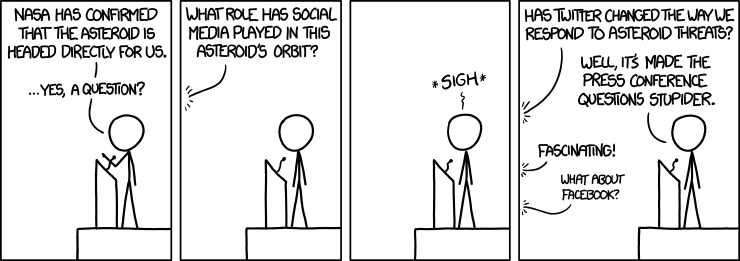
Social Media

The social media reaction to this asteroid announcement has been sharply negative. Care to respond?
18 Jul 01:56

Man Suggests Nature Walk To Observe NSA Spies Threatened Habitat; Has Law Enforcement Visit His Habitat

by Tim Cushing
Facebook continues to be an intelligence operative's best friend. Many of its users subvert any sort of expectation of privacy simply by leaving their accounts on the default settings. (This also works out well for Mark Zuckerberg.) Anything set to the public default can and, apparently, will be seen.

If you want to make a joke about the NSA, feel free. Just don't be surprised if it gets a response.
Normally, Daniel Bangert's Facebook posts tend to be of the serious variety. The 28-year-old includes news items and other bits of interest he encounters throughout the day. "I rarely post funny pictures," he says.

Recently, though, he decided to liven up his page with something a bit more amusing -- and decided to focus on the scandal surrounding the vast Internet surveillance perpetrated by the US intelligence service NSA. He invited his friends on an excursion to the top secret US facility known as the Dagger Complex in Griesheim, where Bangert is from.

He described the outing as though it were a nature walk. He wrote on Facebook that its purpose was to undertake "joint research into the threatened habitat of NSA spies." He added: "If we are really lucky, we might actually see a real NSA spy with our own eyes." He suggested that those interested in coming should bring along their cameras and "flowers of all kinds to improve the appearance of the NSA spies' habitat."
Few of Bangert's friends took him up on his offer. However, he did receive some queries from some other interested parties. Four days after his post, he received a phone call from the local police who wished to discuss the post. Unfortunately for Bangert, this phone call was interrupted.
Bangert's doorbell rang at almost the exact same time. The police on the telephone told him to talk with the officers outside of his door. Bangert quickly put on a T-shirt -- which had a picture of NSA whistleblower Edward Snowden on it along with the words "Team Edward" -- and answered the door.

Bangert says he answered all of the questions truthfully, saying that, yes, his intention was that of heading out to watch the spies. "The officers did smirk a bit," he notes.
So, how did the local police hear of Bangert's "event?" According to the spokesperson, US military police had come across the post first and passed the info along. Apparently, this information wasn't done traveling, resulting in Bangert receiving yet another phone call.
Not long later, Bangert got another call asking him to report to Central Commissariat 10 of the German federal police. They too then sent an officer to his home. "The wanted to know if I had connections with (anarchist groups) or other violent people," Bangert says. He told the officers that he didn't, repeating over and over that he "just wanted to go for a walk."
The federal police were less amused by Bangert's post (he was called *gasp* a "smart aleck"), but unable to find anything damning, they resorted to more bureaucratic forms of dissuasion -- suggesting Bangert secure a permit for his "demonstration." They also told him not to post anything on the web about their visit. Bangert met them halfway.
Bangert took their first piece of advice, registering his "demonstration" even though, as he says, "it wasn't supposed to be one." But he ignored the police's second suggestion and reported on their visit on his Facebook page. "How much more proof do you need," he wrote. "Everyone says that they aren't affected. But then I invite people for a walk and write obvious nonsense in the invitation and suddenly the federal police show up at my home."
Bangert's story spread to the local media, resulting in his "nature walk" being joined by another 70 people who wished to view spies in their natural habitat. It also attracted a police "escort" comprised of squad cars bookending Bangert's group. Although attempts were made to coax the spies out of their offices for closer observation, the walk ended without any actual spy sightings.

Bangert wisely neither confirms nor denies reports there will be more "nature walks" in the future.
So is he planning a repeat? "I didn't say that and I didn't write it anywhere," Bangert replies.
This particular incident ended amicably, without arrests or conjecture about terrorist activities. But it only takes one overreaction for things to go horribly worse, and the more reponding entities there are, the higher the chance is that this might offcur. It also clearly indicates that American operatives are exercising active surveillance on German citizens' online activities, something German citizens aren't exactly thrilled about, especially when the local US military base has the power to send officials after anyone who offends the "sensibilities" of their permanent visitors.

Permalink | Comments | Email This Story


18 Jul 01:51

Judge: Aereo Case Was Decided Incorrectly, Because I Don't Like Previous Ruling

by Mike Masnick
Back in April, Aereo won its appeal, saying that its system to allow people to watch broadcast TV over the internet, via an individual antenna (each customer gets their own antenna) is not infringing. As we've said, this is basically an argument of whether or not the length of a cable turns non-infringing activity into infringing activity. Everyone agrees that it's legal to put up your own antenna and watch broadcast TV. For the most part, it's recognized (though not universally agreed) that you can "place shift" the authorized TV that you watch to another place. This is basically what Aereo was doing. But, the networks, completely freaked out that this might mean the very large fees the cable providers pay them for retransmission might go away, insist that this must be illegal, because, basically, they really like the money they get from cable companies and anything that takes away that revenue stream must be illegal. Except, both the district court and the appeals court rejected that, in large part relying heavily on the important Cablevision ruling, which allowed Cablevision to offer a remote DVR service to its customers.

The networks, of course, asked the appeals court to rehear the case en banc (with a full panel of 11 judges, rather than just the 3 who heard the case initially). That's now been rejected, but Judge Denny Chin, who has a bit of a history siding with the TV guys against upstart innovators is pretty upset about this. Chin was the dissenting judge in the original ruling on Aereo, and he's also the judge who ruled against ivi -- a startup that tried to do something somewhat similar to Aereo, but through different means. Also, before Chin was on the appeals court, as a district court judge, he made the original ruling in that key Cablevision case, in which (shocker) he sided with the networks over Cablevision. In other words, every time this kind of issue has come up, Chin sides with the broadcasters and against the innovators.

Chin's dissent from the decision to reject an en banc rehearing is quite incredible. I saw someone quote the following line, which I had through was a joking paraphrase of Chin's argument, but this is verbatim from the dissent:
Aereo's reliance on Cablevision is misplaced because, in my view, Cablevision was wrongly decided.
That's a fairly startling admission. Here's a precedent, and the judge is saying that the company can't rely on the precedent because he doesn't agree with the precedent. That's not how this is supposed to work. Yes, Chin may have had his feelings hurt because the appeals court overturned his original ruling in Cablevision, and now the other judges have gone against him, but that does not mean he gets to simply ignore the ruling because he doesn't like it.

Most of Chin's dissent is basically a close copy of the networks' arguments, which is, again "the networks make money this way, and how dare some company undercut their business model." This is kind of weird. The very nature of disruptive innovation is that it often undercuts existing business models. But that's called competition. It's not supposed to be illegal. Chin also approvingly cites his own ruling in the ivi case, where he accepted -- without question and with no factual basis beyond the claims of the networks -- that allowing such startups to thrive would harm their rights.

But, the crux of his argument is simply that he's feeling hurt that his Cablevision ruling got overturned, and even if it's precedent, Aereo shouldn't be able to rely on it, because Chin wants to overturn it:
The panel majority's decision is based entirely on Cablevision. In my view, however, as some of the broadcasters argue, Cablevision was wrongly decided. Of course, I was the district judge in Cablevision, and I recognize that the panel was bound by the Court's decision in Cablevision, to the extent the decision is controlling. But rehearing these cases en banc would also give the Court the opportunity to reconsider Cablevision.
Basically, I lost last time around, and even though Aereo is relying on the winning side, that shouldn't be allowed, because I'm still bitter that I lost, and I'd like to overturn Cablevision first, and then use that to shut down Aereo too.

It's difficult to see how this is an unbiased judge, looking at these cases impartially.

Permalink | Comments | Email This Story


18 Jul 01:42

NSA Official Admits Agency's Surveillance Covers Even More People Than Previously Indicated

by Tim Cushing

The hits just keep on coming. Each new leak or revelation fills in more details on the audacious breadth of the NSA's surveillance activities. Previous statements from intelligence agencies declared that surveillance efforts covered only "two hops" from suspected terrorists. This meant that the agencies watched who these suspects communicated with (the first hop) and who those people communicated with (the second hop).

The two-hop limit is still broad enough to drop the surveillance dragnet over thousands of people who weren't specifically targeted. It's a perverse form of "guilt by association" that opens up people twice removed from the original targets to further surveillance efforts.

Now, it has come to light that these agencies go even further.

Chris Inglis, the agency's deputy director, was one of several government representatives—including from the FBI and the office of the Director of National Intelligence—testifying before the House Judiciary Committee this morning. Most of the testimony largely echoed previous testimony by the agencies on the topic of the government's surveillance, including a retread of the same offered examples for how the Patriot Act and Foreign Intelligence Surveillance Act had stopped terror events.
But Inglis' statement was new. Analysts look "two or three hops" from terror suspects when evaluating terror activity, Inglis revealed.
This third "hop," delivered as an "aside" during testimony, effectively throws a dragnet over a majority of the world's population.
For a sense of scale, researchers at the University of Milan found in 2011 that everyone on the Internet was, on average, 4.74 steps away from anyone else.
In addition to marveling at the fact that these agencies apparently see nothing wrong with tracking millions of non-terrorists, one has to wonder what they sought to gain by clouding their own "search results" with millions of useless data points. This certainly falls under the NSA mantra of "collect it all," an attitude that indicates the agency collects this info because it can, not because it needs it. This also provides it with a way to "target" American citizens without actually targeting them, something that would run afoul of Section 702. Each additional "hop" exponentially increases the chance of including American citizens.

It also calls into (further) question claims that harvesting vast amounts of data is preventing terrorist attacks and making our country safer. Trolling a sea of data looking for bites isn't an effective way to fight anything, much less terrorism, something that is nebulous in both definition and aim. Asking the database "questions" and "connecting the dots" is significantly more difficult when the database is filled with tons of useless info and the number of "dots" has increased exponentially.

Inglis failed to explain why this additional hop was necessary, but that sort of casual omission may not be an option much longer. It looks as if these hearings are turning much more adversarial. A few legislators fired off some choice words in the direction of Inglis and the agency.
Ranking Minority Member John Conyers (MI): "You've already violated the law in my opinion."

Rep. Jerry Nadler (NY): "I believe it's totally unprecedented and goes way beyond the statute."

Rep. Ted Poe (TX): "Do you see a national security exemption in the Fourth Amendment? … We've abused the concept of rights in the name of national security."
It's heartening to see a few representatives stepping up to declare the NSA's actions reprehensible. Unfortunately, this conversation should have occurred a long time ago. What's been revealed is likely the tip of the iceberg, and while the agencies haven't been truthful with their overseers in Congress, the fact is that there were several opportunities for legislators to curb the overreach of the NSA and other intelligence agencies.

What's even more disappointing is that the current administration has made very few critical statements of these agencies and their policies, preferring to make small noises about "balance" and "debate." It, too, had an opportunity to roll this back, but instead chose to extend and expand the policies put in place by the previous administration.

The NSA is currently two "hops" away from effectively surveilling the entire world -- and that's only if we believe its latest claim. The NSA didn't get to this point alone. It had plenty of help, some tacit and some active, in its steady march towards omniscience.

Permalink | Comments | Email This Story


18 Jul 01:41

License Plate Readers Track You for Profit

by David Kravets
License Plate Readers Track You for Profit
As license-plate readers proliferate, law enforcement and private business are pooling surveillance data in light of a hodgepodge of conflicting guidelines on how long they may retain the data, which is often being marketed for profit, according to a report ...


18 Jul 01:38

Ed Snowden Explains To Former Senator, Who Emailed In Support, That No Foreign Gov't Can Access His Documents

by Mike Masnick
While the government and defenders of the NSA surveillance program continue to want to paint Ed Snowden out to be a spy and trying to "aid the enemy," public opinion continues to side with Snowden and believe that he's a clear whistleblower, calling attention to government excess. Glenn Greenwald has published a fascinating email exchange between Snowden and former Senator Gordon Humphrey, who apparently sent an unsolicited email to Snowden to thank him for exposing government wrongs.

Mr. Snowden,

Provided you have not leaked information that would put in harms way any intelligence agent, I believe you have done the right thing in exposing what I regard as massive violation of the United States Constitution.

Having served in the United States Senate for twelve years as a member of the Foreign Relations Committee, the Armed Services Committee and the Judiciary Committee, I think I have a good grounding to reach my conclusion.

I wish you well in your efforts to secure asylum and encourage you to persevere.

Kindly acknowledge this message, so that I will know it reached you.

Regards,
Gordon J. Humphrey
Former United States Senator
New Hampshire

Think about this for a second. Here is a former US Senator -- a member of the Foreign Relations, Armed Services and Judiciary Committees -- telling Snowden that he supports his effort, agrees that the surveillance program is a "massive violation" of the Constitution, and wishes him well in finding a country that will protect him from the US. That's really rather incredible, but it shows just how far the current US government is taking things in trying to demonize Snowden. Humphrey recognizes that the leak helped expose a questionable program, hasn't "aided our enemies" and is supporting Snowden remaining outside the hands of US law enforcement.

Snowden's response, by the way, is quite eloquent, and presents Snowden's arguments even better than I've seen him express them elsewhere. He also, strongly, refutes the claim that many have made that Snowden must have given the contents of the documents he copied to the Chinese or the Russians. He notes that keeping such things secret is his specialty, and he set things up carefully to avoid anyone else getting their hands on the documents:

Mr. Humphrey,

Thank you for your words of support. I only wish more of our lawmakers shared your principles - the actions I've taken would not have been necessary.

The media has distorted my actions and intentions to distract from the substance of Constitutional violations and instead focus on personalities. It seems they believe every modern narrative requires a bad guy. Perhaps it does. Perhaps, in such times, loving one's country means being hated by its government.

If history proves that be so, I will not shy from that hatred. I will not hesitate to wear those charges of villainy for the rest of my life as a civic duty, allowing those governing few who dared not do so themselves to use me as an excuse to right these wrongs.

My intention, which I outlined when this began, is to inform the public as to that which is done in their name and that which is done against them. I remain committed to that. Though reporters and officials may never believe it, I have not provided any information that would harm our people - agent or not - and I have no intention to do so.

Further, no intelligence service - not even our own - has the capacity to compromise the secrets I continue to protect. While it has not been reported in the media, one of my specializations was to teach our people at DIA how to keep such information from being compromised even in the highest threat counter-intelligence environments (i.e. China).

You may rest easy knowing I cannot be coerced into revealing that information, even under torture.

With my thanks for your service to the nation we both love,

Edward Snowden

Of course, it's one thing to claim that they cannot get access to the documents, and a different thing to actually keep those documents safe. However, given everything Snowden has done so far, it's shown that he was exceptionally careful in how he's acted with the release of the documents to date, and I have little doubt that he's taken significant precautions to keep them out of the hands of those governments, contrary to the claims of those who are seeking to tar and feather him.

Separately, Greenwald contacted Humphrey to confirm the email, and Humphrey provided even more on his thoughts about Snowden which are worth publishing:

Mr. Greenwald,

Yes. It was I who sent the email message to Edward Snowden, thanking him for exposing astonishing violations of the US Constitution and encouraging him to persevere in the search for asylum.

To my knowledge, Mr. Snowden has disclosed only the existence of a program and not details that would place any person in harm's way. I regard him as a courageous whistle-blower.

I object to the monumentally disproportionate campaign being waged by the U.S. Government against Edward Snowden, while no effort is being made to identify, remove from office and bring to justice those officials who have abused power, seriously and repeatedly violating the Constitution of the United States and the rights of millions of unsuspecting citizens.

Americans concerned about the growing arrogance of our government and its increasingly menacing nature should be working to help Mr. Snowden find asylum. Former Members of Congress, especially, should step forward and speak out.

Regards,
Gordon Humphrey

It seems unfortunate that we live in a country where the reaction to Snowden is considered reasonable by some. Yes, the government is clearly embarrassed by the leaks, but that's because it's now clear they were hiding things that either they shouldn't not have done in the first place, or which should never have been hidden. Embarrassment is a terrible feeling, but it's no excuse for turning a whistleblower into a fugitive.

Permalink | Comments | Email This Story


17 Jul 12:22

Manifesto: Let my upload bandwidth flow!

by Lee Hutchinson
Let it flow, I say.

Consumer broadband connections in the US are almost all "asymmetric" connections—that is, out of the total amount of bandwidth available, more bandwidth is allocated to the "download" direction than to the "upload" direction. This decision made sense 15 years ago when DSL connections were first gaining momentum. The Internet—and specifically the World Wide Web—was far more of a consumption-oriented construct then. People were more interested in reading or watching content than in putting up their own. We wanted, needed, fast download speeds, and broadband providers jumped at the chance to differentiate themselves from dial-up ISPs by offering fast always-on connections and by using as much of that bandwidth as possible to send data to users.

The story today is very, very different. Download speeds are still important (by some estimates, just a bit under half of all Internet traffic is from people watching Netflix and YouTube videos), but it's become far easier to create content, too. The ability to actually share anything that you've created relies on being able to upload that content.

Slow upload speeds are a problem even my mother has commented on—and when my mother starts commenting on a technical issue, that's when I know that it's absolutely a mainstream concern. She enjoys making videos of things she's painted and of new plants in the backyard garden, then uploading those videos to YouTube to share with her friends. But she's stymied by how long it takes to upload her videos, even if they're relatively short. She and my father are trapped by Comcast into an overly expensive residential cable modem plan with a grossly asymmetric download/upload ratio. Explaining the problem to her yielded the common sense observation, "Well, that's just stupid. How am I supposed to share videos if it takes longer to get them to YouTube than it does to film them in the first place?"

Read 11 remaining paragraphs | Comments


17 Jul 11:58

NJ Congressman Rush Holt Is Attempting To Repeal The Patriot Act And FISA Amendments Act

by Tim Cushing

Just recently, we discussed Rep. Justin Amash's plan to defund the NSA through an amendment to the defense appropriations bill working its way through the House. At this point, I would normally say "following on the heels of that news," but in this case, Rep. Steve Rush Holt!!! of New Jersey made his announcement on the 11th, while Amash's arrived on the 15th.

Holt's news? A plan to repeal two laws notorious for their encroachments on civil liberties.

Soon, I will introduce legislation that would repeal the laws that brought us our current “surveillance state”: the Patriot Act and the FISA Amendments Act. My bill would restore the probable cause-based warrant requirement for any surveillance against an American citizen being proposed on the basis of an alleged threat to the nation.
As a bonus, Holt is also proposing "genuine legal protections" for whistleblowers, a big step up from the current climate in which whistleblowers are persecuted and prosecuted.

Holt's editorial/announcement, which appeared in the Asbury Park Press, details how the NSA collects and retains data without warrants, providing special "dispensation" for those who circumvent the normal routes.
The Electronic Frontier Foundation, analyzing how the National Security Agency is apparently utilizing this data, said on its website: “In sum, if you use encryption they’ll keep your data forever. If you use Tor, they’ll keep your data for at least five years. If an American talks with someone outside the U.S., they’ll keep your data for five years. If you’re talking to your attorney, you don’t have any sense of privacy. And the NSA can hand over your information to the FBI for evidence of any crime, not just terrorism.
These two acts have resulted in agencies that are long on data and short on accountability. This situation is a direct result of administrations and legislators in thrall to a calculus of fear that has persuaded them to exchange liberty for safety despite being completely unable to guarantee their end of the bargain. Holt quotes Alexander Hamilton to make this point:
“Safety from external danger is the most powerful director of national conduct. Even the ardent love of liberty will, after a time, give way to its dictates. The violent destruction of life and property incident to war, the continual effort and alarm attendant on a state of continual danger, will compel nations the most attached to liberty to resort for repose and security to institutions which have a tendency to destroy their civil and political rights. To be more safe, they at length become willing to run the risk of being less free.”
And that's where we are today -- more than a decade removed from the event that resulted in the PATRIOT Act and seeing nothing but continual escalation and expansion of government incursion on our rights and privacy. Instead of spending the last 12 years attempting to find a balance, our elected officials (and the agencies under their purview) have chosen to see how far they could push before meeting resistance. Repealing these two laws completely may be excessive (or more negatively, impossible), but finding a balance is much easier when you start from a clean slate, rather than attempting to inch back miles of overreach until the scale settles.

Minor update: Eric Hellman points out that Rush Holt is in the middle of a Senate race, which means NJ voters have a chance to (somewhat indirectly) cast their vote on these two laws.

Permalink | Comments | Email This Story


17 Jul 09:44

Edward Snowden, Michael Meili, And The United States' Hypocrisy On Whistleblowers

by Timothy Geigner
As the Edward Snowden asylum drama marches on, examples of odd behavior by the American government are beginning to weigh down the scales of justice. Most recently, the United States seems to be overly concerned with all that free speech Russia is allowing Snowden, which would be like Switzerland criticizing another country for eating way too much chocolate. Or you may have noticed the not-so-subtle difference in treatment for established DC insiders leaking information versus your ordinary, everyday NSA sub-contractor. Finally, most apropro, the US appears to be willing to strain international relations and possibly violate diplomatic privileges for national leaders in their quest to keep Snowden from reaching anything resembling asylum, despite asylum having been offered by several South American countries.

These actions might be dastardly all on their own, but when you measure them against how the United States has behaved when the shoes were on the other foot, you're left with a dose of hypocrisy that would kill most lab rats. Take, for instance, the case of Michael Christopher Meili, security guard in Switzerland (chocolate!) for UBS, their mega-bank. He revealed some of UBS' shady dealings when it came to the banking documents of Jewish clients during the holocaust.
As a result, not only did Meili lose his job, but he was also under investigation by Swiss authorities for violating Swiss law. Moreover, according to Meili's testimony in a U.S. Senate hearing (available here), after Swiss police took possession of the documents, they told Meili that the Swiss government was treating the documents as "classified," despite the fact that they were UBS documents, and that they "would never be seen by people 'outside Switzerland.'"

Finally, while Meili believed he was exposing an act of destruction that was, or should have been, illegal, the Swiss police told him that they had concluded that UBS had done nothing wrong.
Sound familiar? Person of conscience working for a private organization that has ties to the government exposes wrong-doing, government sweeps in and initiates investigation while also unilaterally declaring classification of said wrong-doing, and then money-shots the affair by declaring all activities legal. Now, perhaps you're wondering why Meili was testifying about this at the US Senate. Well, because he went there to receive asylum, of course.

Unfortunately for Meili, the United States government determined that under no applicable law could Meili qualify for asylum. Fortunately for Meili, the Unites States government then decided to just make up a law specifically for Meili and pass it, ostensibly under the "Because Fuck You" statute in international law. And if you think I'm exaggerating, witness Private Law 105-1:
For the relief of Michel Christopher Meili, Giuseppina Meili, Mirjam Naomi Meili, and Davide Meili.
Yeah, they didn't even attempt to hide what they were doing. Just signed a law that might as well have been called "Private Law 105-1-haha-we-got-this-guy-LOL." Clinton signed the law straight away. Senators lined up to say how heroic Meili was. This in stark contrast to Obama's claim that Snowden must be returned to the US because we have to uphold "the rule of law." More striking still is Senator Charles Grassley, who claimed that because Snowden obviously broke the law, he must come home to be prosecuted at all costs. Want to guess what Grassley's take on Meili was?
The situation we have here with Mr. Meili, albeit everything that he has brought to our attention has worldwide implications, but a person like him acted out of bravery, or maybe the bravery comes after he has acted because he has had to withstand the mental torture of what has gone on since then. But it reminds me of a lot of things that happen in our own Government, and I realize his is a private sector situation, but I like to think that we keep our Federal Government honest when we have people in our Government who, when something is wrong, will be willing to come forward and say what is wrong.

We speak of these people in our Government as whistleblowers. Maybe, originally, that was to denigrate them, but as far as I am concerned the word "whistleblower" is a description of somebody who wants to seek the truth, who wants to make sure that all of the facts and circumstances are known so that a wrong can be corrected.
Now, compare that to the very same Senator Grassley and his comments on Snowden:
"I suppose it gets down to — did he break a law? — I think it's pretty obvious he did," Grassley says. "People in the Justice Department will make that determination and whatever that determination is, I'll have to abide by it, but if he did break a law, it's quite common sense that he be prosecuted."
Grassley also suggested that Snowden, who "sought truth" and "wants to make sure that all of the facts and circumstances are known so that a wrong can be corrected" was clearly "aiding the enemy." I think it'd be really nice if 1997 Senator Grassley could come back and have a long discussion with 2013 Senator Grassley, preferably one involving a pointy stick and much foul language. And perhaps include the rest of the government as well.

Permalink | Comments | Email This Story


17 Jul 09:40

7 Months Of Warrantless 'Just Metadata' Paints A Clear Picture Of Your Personal Life

by Tim Cushing
The ACLU (along with the EFF and many others) has filed an amicus brief in a case of warrantless cell location tracking currently being considered by the Fourth Circuit Court of Appeals. It cites the obvious similarity between this and the U.S. vs. Jones decision, in which the justices concluded that a person's privacy is violated by long-term tracking of their movements.

In that case, a GPS device was attached to a vehicle. In this one, the privacy implications run much deeper.
People carry their cell phones with them all the time. Each time a cell phone makes or receives a call or text message, the wireless provider logs the cell towers the phone connected to during that communication. Cell phone tracking therefore allows the government to reach back into the past and pull up a record of where we have been on any given day.
Lest we forget, this is the same sort of supposedly harmless, non-identifying "metadata" the NSA and FBI are collecting on millions of cell phone users every day, thanks to a very obliging FISA court. In the Jones case, the justices concurring opinion agreed with the appeals court in finding that the long-term tracking (in this case, 28 days) violated the Fourth Amendment. One wonders what this court will make of this warrantless tracking, which ran for nearly ten times as long.
In the case, United States v. Graham, the government obtained a staggering 221 days of historical cell site location information for two suspects. For one suspect, Aaron Graham, this timespan allowed the government to sweep up his location at 29,659 specific points.
The amount of information that can be culled from these data points easily exceeds anything law enforcement should reasonably expect to obtain without a warrant. Aaron Graham worked with his provider and the ACLU in order to provide it with the same tracking information law enforcement had acquired. Here's what the ACLU found.
Mr. Graham's wife was pregnant during the records period. 29 calls during business hours began or ended in the sector where Mr. Graham's wife's OB/GYN's office is located, allowing the inference that they were at the doctor's office at these times.

The most frequently occurring cell site and sector in Mr. Graham's records is the closest sector and tower to his home – nearly a third of all of his calls were placed or received in this sector. Of those 4,917 calls, 77 started in his home sector and ended elsewhere and 226 started elsewhere and ended when he was at home, providing information about his patterns of movements to and from home.

From July 10 to July 15, 2010, Mr. Graham's last call of the night and first call of the morning were either or both placed from his home sector, allowing the inference that he slept at home those evenings. However, on July 9, Mr. Graham's last call of the night and first call of the next morning were placed from a cell sector 30 minutes from his house. Although we have no reason to believe it to be the case here, this information could reveal private information about the status of a person's relationships and any infidelities.
The ACLU points out that technological advancements have made it easier for law enforcement and others to easily collect large amounts of data on any person, making the protections of the Fourth Amendment more important than ever. Just because millions voluntarily use products and services utilizing invasive technology doesn't mean they're implicitly waiving their right to privacy. Nor should it be assumed the use of a cell phone means the "expectation of privacy" is no longer valid.

Once again, it appears law enforcement's m.o. is "do it until someone makes you stop." One wonders what sort of information can be both so vital as to be obtained without the hassle of a warrant, yet still so elusive it could only be ascertained by gathering two-thirds of year's worth of location info. Hopefully, the court will find along the lines of the Jones decision, and continue rebuilding the protections the Fourth Amendment was written to provide.


Permalink | Comments | Email This Story


17 Jul 08:30

The terrible and wonderful reasons why I run long distances - The Oatmeal

Matthew

Amazing

17 Jul 08:11

Okay: Now Do You Realize Why CISPA's Granting Of Broad Immunity For Companies Sharing Data With The Feds Is An Issue?

by Mike Masnick
You may recall that, back during the CISPA debate, one of our biggest concerns was the broad immunity from liability that the bill gave to tech companies if they shared data with the government -- including the NSA. Many people campaigned for limitations on that, including restricting what kind of information would be shared, and trying to keep that info away from the NSA. Of course, given the revelations over the last couple months about the amount of information sharing that already happens with the NSA and the DOJ/FBI, -- including giving zero day exploits to the government and building in backdoors -- it seems doubly worrisome what CISPA would allow.

And yet, people insisted that our worries about the broad liability protections were overblown, noting over and over again that it was "voluntary" and that companies wouldn't just give up their data like that. Yet, as we pointed out, if you give the ability to get this information to the government, the government will find a way to take it. And, from the various revelations, it's clear they were already taking it, and the purpose of CISPA may have been to just to further protect these companies from liability.

In the recent Washington Post profile of NSA boss Keith Alexander, it ends with a detailed description of how Alexander has been pushing for more direct control over internet company networks, which should give you a pretty clear suggestion of how the NSA intended to use CISPA:
At a private meeting with financial industry officials a few years ago, Alexander spoke about the proliferation of computer malware aimed at siphoning data from networks, including those of banks. The meeting was described by a participant who spoke on the condition of anonymity because the discussion was off the record.

His proposed solution: Private companies should give the government access to their networks so it could screen out the harmful software. The NSA chief was offering to serve as an all-knowing virus-protection service, but at the cost, industry officials felt, of an unprecedented intrusion into the financial institutions’ databases.

The group of financial industry officials, sitting around a table at the Office of the Director of National Intelligence, were stunned, immediately grasping the privacy implications of what Alexander was politely but urgently suggesting. As a group, they demurred.
Now, some may argue that it would be crazy to interpret CISPA liability protections from leading to that sort of situation, but given how the NSA has pushed for incredibly broad interpretations of other laws, how crazy is it really?

Given all of this, one hopes it means that CISPA is officially dead in the water.

Permalink | Comments | Email This Story


17 Jul 08:09

The Public Domain: Now Available For Only $165 An Hour!*

by Teri Karobonik
So you want to use a work you think is in the public domain in your creative project.  Hang on; it might not be as simple as you think.

Works published before 1923 are in the public domain. This means these works are no longer protected by copyright and are free for use by anyone in any way. However, works between 1923 and 1964 fall into a grey area -- they may be in the public domain depending on if their copyright was renewed 28 years from the date of the original copyright.

Figuring out if a work is renewed can be a tricky business. The only official records of renewal are held by the Copyright Office in Washington D.C. However, records before January 1, 1978 are not available online. The only way to gain access to these accurate and official records of copyright renewals is to either:

  1. Go to the Copyright office in person, in Washington D.C. , and research their records using paper card catalogs OR;
  2. Pay the copyright office $165 an hour to search the copyright records for the original copyright and the renewal notice.

In 2013, should we have to rely on paper card catalogs to help determine if a work is in the public domain? Moreover, is a work really public domain if it costs $165 an hour to know it's in the public domain?

Of course, there is a much larger problem. Even a search by the copyright office stating that the work was not renewed isn't definitive proof that the work you want to use is in the public domain. It's entirely possible that the work you want to use is actually a derivative work of a public domain work and still under copyright protection. For a great example of how complex this can get check out our video “Is the Wizard of Oz Copyright protected?

The difficulty of assessing which works are in the public domain is a huge problem. Creativity cannot exist in a vacuum. When we can't easily determine what works we can safely use and draw inspiration from, creativity is stifled and our critical First Amendment right to free speech is chilled. New Media Rights recognizes the complexity of the problem. However, a great first step would be the digitization of all copyright office records to make them accessible to the public without a plane ticket to D.C. or a $165 an hour surcharge.

Teri Karobonik is a staff attorney with New Media Rights. New Media Rights is a nonprofit program that provides legal services and advocacy for internet users and creators. This story is reposted with permission.


Permalink | Comments | Email This Story


17 Jul 08:06

Either The Solicitor General Lied To The Supreme Court, Or Senator Feinstein Lied To The Public About Warrantless Wiretapping

by Mike Masnick
While there's been plenty of attention over the last month or so concerning the revelations from Ed Snowden about NSA surveillance, there have been a series of important ongoing lawsuits that tried to challenge the various aspects of the surveillance efforts. Unfortunately, most of these have ended badly, leading some to wonder if there even is any way at all to legally challenge these programs. At the end of 2011, for example, in a case testing the legality of the telcos helping the government with warrantless surveillance, Hepting v. AT&T, one of the key reasons why the court rejected the challenge was because it basically said, "well, you can always sue the government, but the government has the right to absolve companies of such wrongdoing." Except that, as the Supreme Court ruled earlier this year, because the government keeps the program a complete secret, no one has standing to sue. That is, unless you can prove that you were spied on via this specific program, you can't sue because there's been no harm.

The Supreme Court Justices were clearly troubled by the idea that the government could implement a secret surveillance program that could never be challenged in court, and homed in on that key point in questioning the Solicitor General of the US (and former top RIAA litigator), Donald Verrilli. As the NY Times notes, Verrilli insisted that it simply was not true that no one would ever have standing, because if the government ever used information from such surveillance programs in a court case against someone, the government would have to reveal that the info came via that program.
“Is there anybody who has standing?” Justice Sonia Sotomayor asked.

Yes, said Mr. Verrilli, giving what he called a “clear example." If the government wants to use information gathered under the surveillance program in a criminal prosecution, he said, the source of the information would have to be disclosed. The subjects of such surveillance, he continued, would have standing to challenge the program.
Got that? Of course people would have standing, because the government has to tell them where the information came from. So those people could always challenge the program. When the eventual Supreme Court ruling came out, the majority decision relied very heavily on this particular claim:
...if the Government intends to use or disclose information obtained or derived from a §1881a acquisition in judicial or administrative proceedings, it must provide advance notice of its intent, and the affected person may challenge the lawfulness of the acquisition.... Thus, if the Government were to prosecute one of respondent-attorney’s foreign clients using §1881a-authorized surveillance, the Government would be required to make a disclosure.... In such a situation, unlike in the present case, it would at least be clear that the Government had acquired the foreign client’s communications using §1881a-authorized surveillance.
Ok. Now, here's the important part. In defending the FISA Amendments Act (FAA), which is what enabled these kinds of warrantless wiretaps, politicians have been pointing to all of those "examples" where this program was supposedly instrumental in "stopping terrorists." And this includes a few cases that involved federal prosecutions. Senator Dianne Feinstein, the staunchest defender of these programs, has called out two specific prosecutions as "specific cases where FISA Amendments Act authorities were used," saying that "these cases show the program has worked."

While it's arguable whether or not these cases actually showed whether or not the program worked, they do give us two cases where, according to the US Solicitor General and the Supreme Court, the feds were required to reveal to the defendants the source of the information. And take a wild guess whether or not the government actually informed the defendant how it obtained the info? You're psychic!
In a prosecution in Federal District Court in Fort Lauderdale, Fla., against two brothers accused of plotting to bomb targets in New York, the government has said it plans to use information gathered under the Foreign Intelligence Surveillance Act of 1978, or FISA, which authorized individual warrants. But prosecutors have refused to say whether the government obtained those individual warrants based on information derived from the 2008 law, which allows programmatic surveillance.

Prosecutors in Chicago have taken the same approach in a prosecution of teenager accused of plotting to blow up a bar.
In fact, the magistrate judge in the Florida case has told the government it needs to disclose whether or not the surveillance was based on the FAA, but the government, so far, is refusing to say anything, and is asking the court to reconsider.

As far as I can tell, there are a few possibilities here, none of them good:
  1. Solicitor General Donald Verrilli lied to the Supreme Court about whether or not the federal government would need to reveal the source of surveillance info obtained under the FAA.
  2. Senator Dianne Feinstein lied to Congress about the FAA supposedly being instrumental in those cases.
  3. The US Attorneys are now withholding information they are, by law, required to reveal.
It's possible that the reality is a combination of all three. But I can't see how you can explain the present situation without at least one of the three statements above being true.

The ACLU has called this "a shell game" and it's that and more. No matter where you point for the legal authority to challenge these programs, the government insists you have to look elsewhere. Can't sue the companies, but can sue the government. Can't sue the government unless you can prove standing. Can't prove standing unless you're in a case which involves this surveillance, at which point we have to tell you. Of course, in cases where it's been revealed that this kind of surveillance is used, well, now the government insists it doesn't have to admit that. Basically, the feds are going to keep trying to avoid ever having to face an actual legal challenge on this, which suggests they know the reality: the program is illegal and unconstitutional. If they were sure that it was a legitimate, constitutional program, why not just stand up in court and say that?

Permalink | Comments | Email This Story


16 Jul 12:50

123. ERICA GOLDSON: Graduation speech

by Gav

123. ERICA GOLDSON: Graduation speech

This is part of the speech Erica Goldson, the 2010 Valedictorian of Coxsackie-Athens High School, gave at her graduation ceremony.
The speech was uploaded on YouTube, went viral and Erica became known as the ‘Valedictorian who spoke out against schooling’. You can watch the entire speech and read the transcript here.

Erica’s speech really struck a nerve with me because I was totally like her when I was in school. I always did what I was told, didn’t ask too many questions, mindlessly memorised then regurgitated facts and figures. I remember I would write out an entire essay for homework, memorise the whole thing, then write it down verbatim on test day … and then promptly forget it and move on to the next assignment. I graduated near the top of my class, but on hindsight, I’m not sure I learnt much. The pattern continued as I went on to university, even though I never really wanted to be a graphic designer. But the piece of paper I received at the end did help me land a job, so it was all worth it in the end right? Maybe if I had heard this speech back in high school, I would have realised I was stuck in the system and gone down a different path.

One positive thing I do remember about school is that I doodled on EVERYTHING – my textbooks, files, folders, desk, arms, legs,
pencil case and all of my friend’s stuff as well (mainly pictures of Batman, sometimes Wolverine, the occasional Ninja Turtle). If only I spent MORE time doodling and less time being a robot.

Related comics: 11 Ways to be Average. The Road Not Taken.

- Thanks to Jesse for submitting this.
- Check out this in-depth article about myself and the growth of Zen Pencils by viral media expert Jonathan Goodman. It’s especially relevant if you’re interested in starting your own website, blog or webcomic.