Shared posts

14 Mar 21:13

8 Recipes to Grill or Smoke in March

by Daniel

Weather folklore predicts, “If March comes in like a lion, it will go out like a lamb.” But as anyone who’s lived in northern climes knows, it’s impossible to predict what face March will show us on any given day. Shirt-sleeve, spring-like temperatures one day can be followed by a foot of snow the next.

As a consequence, adaptability is key when planning menus for this volatile month. That’s why we’ve juxtaposed warming shrimp chowder with a beautiful salad featuring tender stalks of fresh asparagus.

In any case, eat well while you wait for the arrival of spring!

8 Recipes to Grill

1. Steak and Bean Nachos

Steak and Bean Nachos Recipe

Perfect for a hearty snack or a casual supper in front of the TV, these nachos make good use of leftover grilled steak or brisket. By layering the ingredients in a springform pan before smoking or indirect grilling, you ensure it’s not just the top chips that carry a payload of toppings.

Get the Recipe »

2. Smoked Shrimp Corn Chowder

Smoked Shrimp and Corn Chowder

Stretch a pound of home-smoked shrimp to serve 6 to 8 by using it as the base for a rich chowder that includes potatoes, leeks, corn, and cream. Add a salad and grilled bread sticks for a complete meal.

Get the Recipe »

3. Maple Sriracha-Glazed Chicken Drumsticks

Maple-Sriracha Glazed Chicken Drumsticks

In parts of Canada and the American northeast, late winter is maple syrup time. Freezing nights and warmer days cause maple sap to run, which is then tapped, boiled down, and made into syrup. If you’re lucky enough to snag a sample from the current harvest, combine it with butter and sriracha for some of the best smoked chicken drumsticks of your life. The glaze is great on wings, too.

Get the Recipe »

4. Baltimore Pit Beef

Baltimore Pit Beef

Steven’s hometown of Baltimore, Maryland, is known for its outstanding crab, of course, but in-the-know locals often take a trip on the Pulaski Highway for a pit beef fix. Pit beef is Baltimore’s contribution to barbecue—lean beef (usually top round) is grilled until coal-black on the outside but relatively rare on the inside, thinly sliced, then piled haphazardly on a bun with a dollop of horseradish sauce. Steven elevates this regional specialty by using a boneless rib roast and his own special rub.

Get the Recipe »

5. Canadian Bacon

Canadian Bacon

Maybe you jumped on the homemade sourdough bread bandwagon during the pandemic. Ready for a new project? We suggest home-cured Canadian bacon. Pork loin (one of the biggest bargains at the meat counter) is brined for several days, then smoked. Brunch, anyone?

Get the Recipe »

6. Tuscan Grilled Polenta and Vegetable Platter

Tuscan Grilled Polenta & Vegetable Platter

Fresh locally grown asparagus begins to show up in markets in early spring; it’s one of our favorite grilled vegetables. Here, it’s joined by the jewel-like colors of red onion, bell peppers, eggplant, and radicchio and served with grilled polenta. As for the latter, make your own, if you wish, or buy the premade cylinders of polenta sold in the pasta aisle. Finish the dish with a drizzle of extra virgin olive oil.

Get the Recipe »

7. Barbecued Cabbage

Barbecued Cabbage

Often a bit player at backyard barbecues, cabbage takes on a starring role when stuffed with a savory mixture of bacon, onions, and barbecue sauce and smoke-roasted until tender. Cut into wedges for serving.

Get the Recipe »

8. Cedar Planked Chocolate Brownie S’Mores

Cedar Plank Chocolate Brownie S’Mores

From appetizer to dessert, show your tablemates you’ve developed mad skills since your days at scout camp. Crown a barbecue feast with this showy dessert, a delectable mash-up of chewy brownies, orange liqueur, premium chocolate, and gourmet marshmallows served on individual cedar planks.

Get the Recipe »

The post 8 Recipes to Grill or Smoke in March appeared first on Barbecuebible.com.

14 Mar 19:49

2022 Indian FTR 1200 Review First Ride

by Ryan Adams

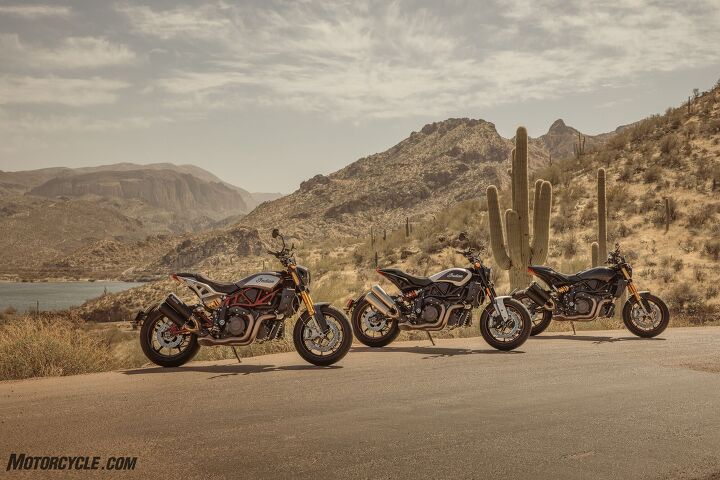
2022 Indian FTR R Carbon

Editor Score: 91.25%
Engine 19.0/20
Suspension/Handling 14.0/15
Transmission/Clutch 8.25/10
Brakes 9.25/10
Instruments/Controls 4.25/5
Ergonomics/Comfort 9.0/10
Appearance/Quality 9.5/10
Desirability 10.0/10
Value 8.0/10
Overall Score 91.25/100

Different is good. Change is good. Not fitting precisely into a predetermined category is good. That was the take-away from many when the Indian FTR1200 hit the market in 2019. Made in America with naked bike styling, a flat-track-esque wheel combo, and a rowdy performance-focused V-Twin engine, the FTR was unlike anything to come from an American manufacturer for quite some time – and arguably the best culmination of its mass-produced parts ever assembled Stateside. 

Sometimes though, being different for the sake of being different just isn’t practical. Indian, of course, brought the production FTR to market hot on the heels of its ongoing success in American Flat Track. With its launch, Indian wanted to imbue the production model with as much flat track DNA as possible. Win on Sunday, sell on Monday, right? The FTR’s raucous V-Twin and 19/18-inch wheel combo helped differentiate it from anything else currently on offer around the globe. 

Indian hasn’t exactly been tight-lipped with its plans of what now makes up most of the 2022 Indian FTR line, having hinted at a more street performance focused version back in 2019. Pilfered screenshots of an alleged Indian/Polaris presentation confirmed this with a 2021 model year designation. Also of interest was the inclusion of an FTR-based adventure model to follow in 2022. These timelines have likely been pushed due to COVID-related circumstances, but with the models we were fortunate enough to test in Arizona this month now surfacing, we’re hopeful that the rest of the purported plans are underway as well. 

2022 Indian FTR

2022 Indian FTR 1200 Review

The Indian FTR line has undergone a bit of rearranging. Three of the four FTR’s get the street-focused overhaul while the FTR Rally will continue on as it were – mostly. The FTR, FTR S, and FTR R Carbon are the new monikers. With the new names comes a welcome slew of changes to make the machines better on the street and easier to live with. To set up the FTR’s new street focus, the bike’s geometry was scrutinized. The new 25.3°-degree rake is a full degree steeper than the previous model thanks to the shorter suspension and smaller wheels, and trail is now just over a full inch shorter at 3.9 inches. This change combined with more standard 17-inch cast wheels (wrapped with Metzeler Sportec rubber) and less suspension travel – down from 5.9 inches to 4.7 – has resulted in a reduction to seat height of nearly 1.5 inches. We’re told the footpegs are ever so slightly higher for increased cornering clearance, and the handlebar is narrower (to the tune of 1.5 inches), while the former was negligible, the latter works in conjunction with the aforementioned changes to help transform the riding experience of the Indian FTR. 

These changes mark a vast improvement in the FTR’s approachability and the likelihood of more riders feeling comfortable with the machine. I recently read a comment on our site that a prospective FTR buyer who was short of inseam had his dreams of ownership dashed after throwing a leg over one at a local bike night. The bike was too tall. This should no longer be an issue for many interested parties. 

2022 Indian FTR 1200 Review

Mural Artist: Miguel Angel Godoy

What I was most interested in couldn’t be ascertained from simply sitting on the new FTRs. There was one nagging issue that soured the Indian FTR for me when I first managed to pluck one away from my colleagues, and that was centered around fueling and throttle response. I had the chance to sample the base version, the race replica, and Rally at different times, and they all seemed to suffer from the same problems, but at varying severity. The base model that I had in my garage would die just seconds after being started every time I pulled it from the garage, sometimes more than once while waiting for the bike to “warm up.” (JB doesn’t remember having any issues with the bike dying, but they say memory is the first thing to go…) All of them suffered from abrupt throttle response at low rpm, though the Rally version that we tested back in October of 2020 seemed to be the least affected. I could look past it to enjoy the motorcycle for what it is while it was freely placed in my garage, but it wasn’t quite up to par with what the motorcycling public has come to – and should – expect from a major manufacturer these days. 

2022 Indian FTR 1200 Review

Tons of accessories are available including the pictured side covers and high pipes.

So, naturally, when the Indian execs told us these issues – which they have heard from editors and customers alike – had been remedied, I could not wait to have a rip on the new and improved FTR. The Rally model will remain relatively unchanged with its 19/18 inch wire wheels and high handlebar but will receive the engine tuning updates as the other models have. 

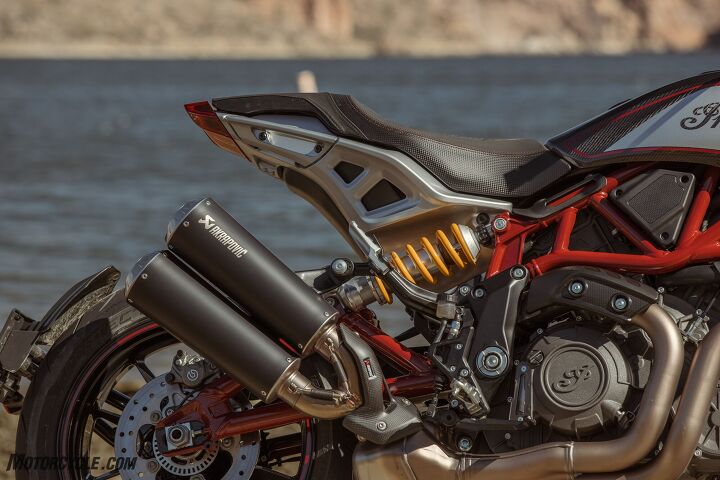
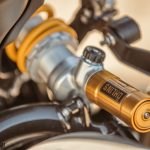
Other updates for the 2022 model year include fully adjustable suspension: ZF Sachs on the FTR and S models with Öhlins bestowed upon the R Carbon model. Akrapovič silencers are now found on the S and R Carbon models as well. As before, moving up from the standard model gets you a 4.3 inch touchscreen display as well as IMU-based ABS and TC in addition to Bluetooth connectivity. TC is either on or off on these models, and ABS cannot be disabled. Otherwise, the machines are much the same as they were in previous years. 

Ready to rip

2022 Indian FTR 1200 Review

Since producing an event of any type is hard these days, and given the measures that Indian went to in order for the assembled test riders to have a go at their new FTRs, I was forced onto the top-o-the-line FTR R Carbon for the duration of our test ride and did not have the opportunity to ride the S or base model while at the event. Woe is me.  

When I was told we would be based out of Phoenix for the press ride, I must admit I was curious how the riding would pan out. I’ve never spent a whole lot of time in Phoenix or the surrounding area so I didn’t really know what to expect. Turns out, the fact that we would have to do a bit of bobbling around town followed by time on the freeway to and from some spectacular riding gave a great all around test of the machine. One that even the afternoon’s treacherous haboob couldn’t sully.

2022 Indian FTR 1200 Review

Cruise control is standard across all models.

As you might expect, sitting on the machines is a completely different experience from the previous models. The low seat height and narrow bars feel a bit more in line with what one might expect from most standard/naked bikes on the market. The motorcycle’s weight feels nicely balanced as well. To further drive the point home of the difference in rider triangle and seat height, Indian had brought out a few  Rally models for a seat-to-seat reference. While the handlebar bend is different, there is still a massive difference between the width of the grips and of course the seat height. 

Inching forward as we took off, the clutch engagement point is still really close to the handlebar, and it’s as grabby as it always had been. Still, it’s really something that you warm up to quickly and that I’ve come to enjoy. 

2022 Indian FTR 1200 Review

The front brake lever is adjustable whereas the cable-actuated clutch is not. Model shown with accessory fly-screen.

Rolling around town at low speed through construction with a large group of riders quickly showcased that the low rpm abruptness in fueling was a thing of the past. It also fired up ferociously and without stumble – from cold – before we left. Had my prayers been answered? It seemed at that point my prior niggles with the bike had been worked out. With the rear cylinder deactivation feature turned on (which deactivates the rear cylinder when the bike is at a standstill), the bike never got too hot in town either. 

Just as we managed to get out of town onto some curvy roads, it was time for a break. The long sweeping corners we’d made it through didn’t do much to convey the potential performance enhancement that the smaller wheels would provide, rather it was just a tease.

2022 Indian FTR 1200 Review

The last FTR we had around was the Rally model which weighed in at 522 lbs on the MO scales fully fuelled. Despite the ‘22 model’s new dancing shoes, its weight is still evident through switchbacks.

Before too long we were separated into smaller groups and let loose on one of the most fun roads I’ve had a chance to ride recently, and I finally got a chance to test the FTR R Carbon’s performance. 

I’ve always likened the FTR to an American muscle car. Its snarling V-Twin lope is reminiscent of some big-block V8. The hit of acceleration that one experiences from the FTR is also similar. It is a beast, and now, with the stuttering fuel issues and abrupt throttle gone, one can take full advantage of letting the torquey V-Twin dip low into the rpm-range to rocket out of each corner. The smaller wheels do make the FTR feel like a more nimble dance partner, and the entire package feels slightly more refined as though its rough edges have been smoothed out just enough, but not so much as to take the excitement out of the machine. 

2022 Indian FTR 1200 Review

The same 3.4-gallon tank remains inside the bike’s subframe. Since mileage isn’t likely to be great thanks to the heavy hand you’ll be goaded into using, don’t expect much more than 100 miles to a tank. During our last comparison with the FTR Rally we returned an average of 33 mpg.

For sporty riding, the Öhlins units on my R Carbon could have been stiffened up a bit, but overall, the stock setting was just fine. I felt the underside of the exhaust bottom in the middle of an apex with a nice dip in it, but the suspenders kept things copacetic. Still, damping was smooth and never felt harsh. Smooth is what you need to be with the FTR too. The S and R Carbon still have Rain, Street, and Sport riding modes. There were some on our ride who kept Rain selected the entire time as the kick in the seat from Street or Sport was too much. For the folks in our group it was Sport mode or nothing at all. This is where being smooth helps. The FTR is a serious motorcycle with a serious wallop of power low in the revs. In order to ride the machine fast, smoothness is preferred. Whack the throttle before you’ve given up enough lean angle and dire consequences are inevitable. Even TC won’t save you from yourself. 

While we aren’t peacocking Stylemas, the Brembo braking components, braided lines, and radially-mounted master cylinder and calipers do just fine to get the FTR’s 320mm front rotors slowed in a hurry. If I wanted to nitpick, the initial bite is somewhat soft, but the power is there promptly and confidently slows things down. Without a lot of weight over the rear it’s easy to dip into the rear wheel’s ABS, but again, the bike doesn’t have any issues stopping. 

2022 Indian FTR 1200 Review

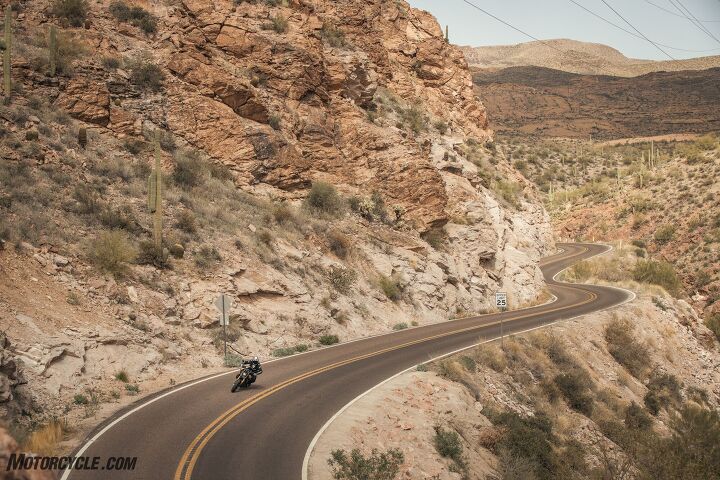
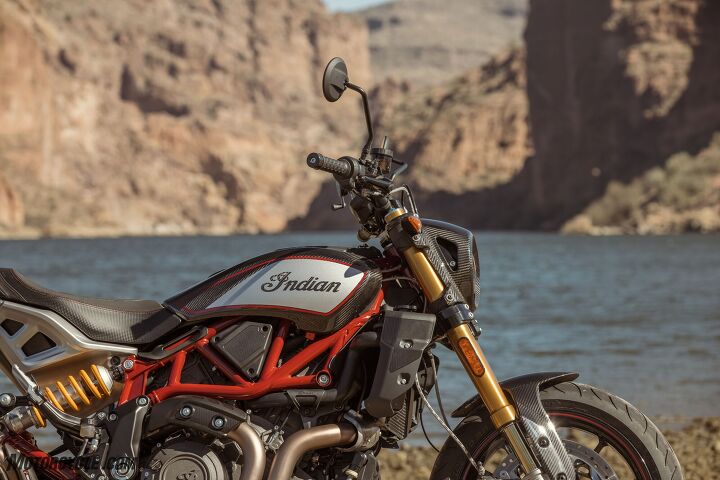
On the FTR R Carbon, with a thoughtful right hand, the entire ride was a visceral experience. From idle to full throttle through the canyons, the 1203 cc V-Twin delivers performance and sound unlike anything else. Its delivery of torque is brutish and exhilarating, and while it peters out toward redline, a quick shift (not to be confused with quickshift because we’re still doing things manually in that department) brings the feeling back. The confidence-inspiring suspension and braking components allow the ride to be uneventful if you respect it. Not to mention the R Carbon is dripping in its namesake, and its metal flecked paint damn near had me drooling at every stop. She is a looker, no doubt. 

An emotional experience

2022 Indian FTR 1200 Review

The emotion that the FTR stirs up inside of me is similar to that of the 2015 Aprilia Tuono V4R sitting in my garage that I bought new back in 2016. That’s not to say that the Indian could hold a candle to the outright performance of the Aprilia, but both powerplants, the level of finish, and the happiness that I get from riding them, or hell, even being around them are similar, but at the same time different. The R carbon that I rode in Phoenix is actually a fair bit more expensive than that Tuono. At $16,999, it’s not cheap. While the top-of-the-line FTR has remained unchanged in terms of pricing, the base and S models have dropped $500 putting them at $12,999 and $13,999, respectively. 

2022 Indian FTR 1200 Review

I don’t think the 2022 Indian FTR is about outright performance though. That’s not me making an excuse for the machine either because it doesn’t need any. It’s about how you feel when you’re riding it and what twisting the throttle does for you as you hustle through a set of curves. It’s about turning around for one last glance across the parking lot or garage as you walk away from it. It’s about being proud of an American brand pushing the performance envelope in a new way. If a motorcycle doesn’t make you feel some sort of way, what’s the point? As I said to my wife right before I started this review, “The FTR is just a lot of f*cking fun.” 

2022 Indian FTR 
+ Highs
  • Rowdy V-Twin will have your back in a bar fight
  • Looks to get the girl/guy
  • In R Carbon trim, easily keeps its sh*t together
– Sighs
  • Not exactly a cheap date
  • Drinks a lot
  • Could stand to lose a few pounds

In Gear

2022 Indian FTR 1200 ReviewHelmet: Shoei X-14 $770
Jacket: REV’IT! Mantis Jacket $460
Gloves: REV’IT! Prime Gloves $100
Jeans: Pando Moto Steel Black Jeans – Discontinued
Boots: Dainese Axial D1 Air Boots $530

2019 Indian FTR1200 Specifications
MSRP FTR, $12,999, FTR S $14,999 / FTR R Carbon $16,999
Engine Type 1203 cc liquid-cooled 60-degree V-twin, DOHC, four valves per cylinder
Bore and Stroke 102 x 73.6mm
Compression Ratio 12.5:1
Rear Wheel Horsepower 120 hp (claimed)
Torque 87 lb-ft at 6000 rpm (claimed)
Transmission 6-speed, slip/assist clutch
Final Drive #525 chain
Front Suspension 43mm ZF Sachs Fully Adjustable Inverted Telescopic Cartridge Fork 4.7 in. travel / 43mm Ohlins Fully Adjustable Inverted Telescopic Cartridge Fork. 4.7 in. travel
Rear Suspension ZF Sachs Fully Adjustable Piggyback IFP, 4.7 in. travel / Ohlins Fully Adjustable Piggyback IFP, 4.7 in. travel
Front Brake Brembo Dual 320mm t5 Rotor, 4-Piston Caliper
Rear Brake Brembo Single 260mm t5 Rotor, 2-Piston Caliper
Front Tire Metzeler Sportec M9 RR 120/70ZR17 58W
Rear Tire
Metzeler Sportec M9 RR 180/55ZR17 73W
Rake/Trail 25.3°, 3.9 inch
Wheelbase 60.0 in.
Seat Height 30.7 in.
Curb weight 514 lbs / 513 lbs (claimed)
Fuel Capacity 3.4 gallons
Warranty 2 Years, unlimited miles
2022 Indian FTR 1200 Review 2022 Indian FTR 1200 Review 2022 Indian FTR 1200 Review 2022 Indian FTR 1200 Review 2022 Indian FTR 1200 Review 2022 Indian FTR 1200 Review 2022 Indian FTR 1200 Review 2022 Indian FTR 1200 Review 2022 Indian FTR 1200 Review 2022 Indian FTR 1200 Review 2022 Indian FTR 1200 Review 2022 Indian FTR 1200 Review 2022 Indian FTR 1200 Review

Become a Motorcycle.com insider. Get the latest motorcycle news first by subscribing to our newsletter here.

The post 2022 Indian FTR 1200 Review – First Ride appeared first on Motorcycle.com.

14 Mar 19:48

More Than You Probably Wanted to Know about the Harley-Davidson 1250 Revolution Max Engine

by John Burns

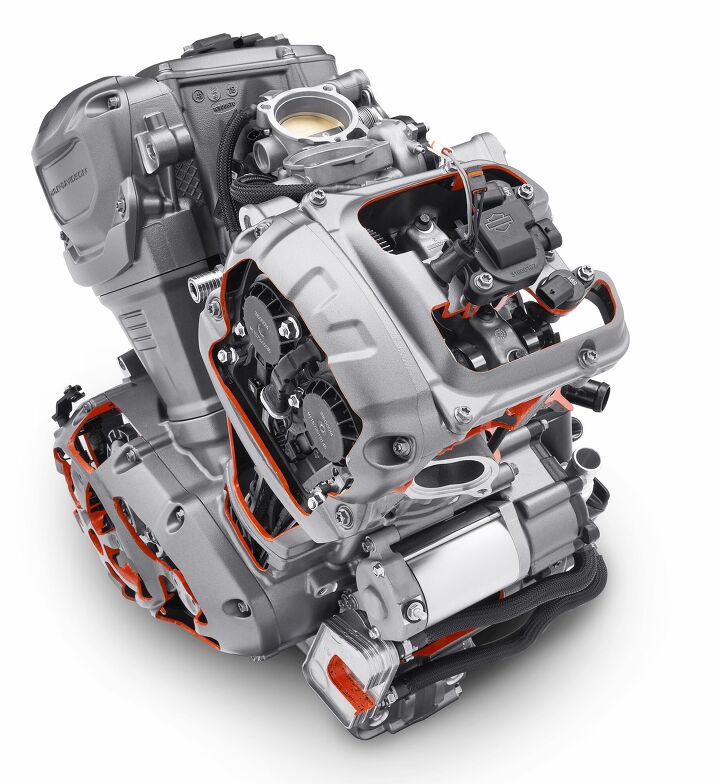
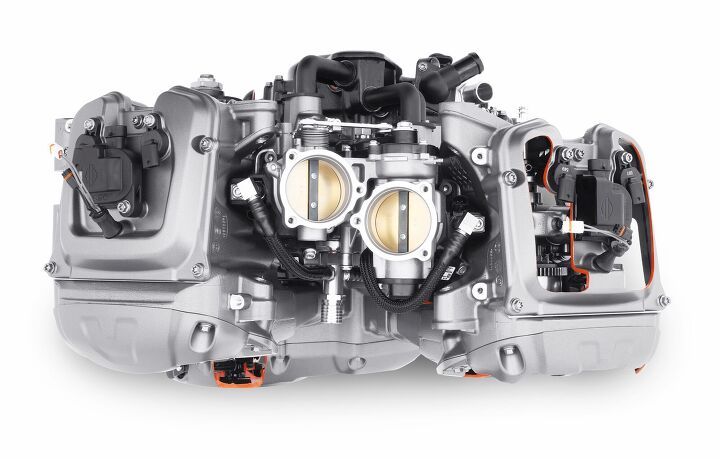
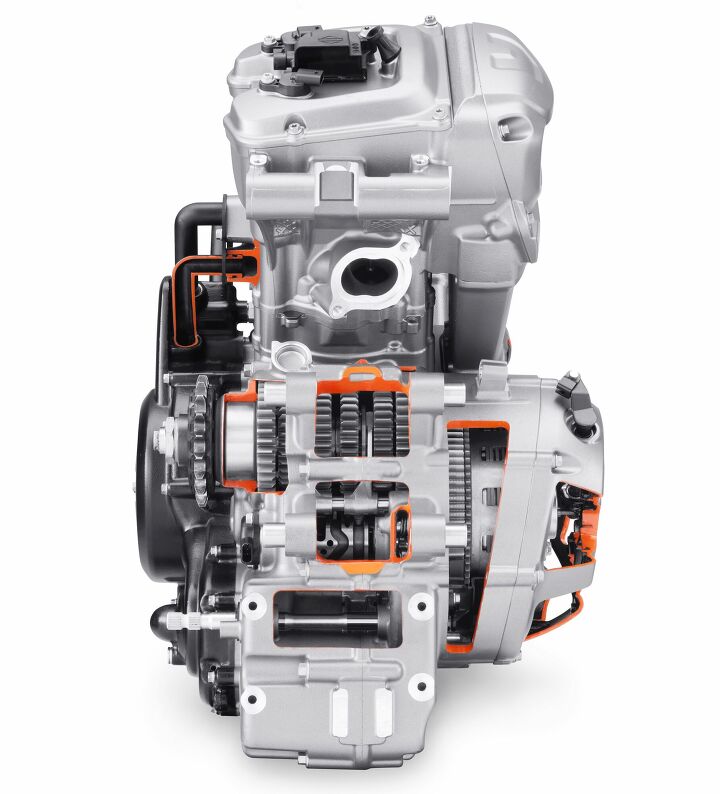
We’ve already expended a ton of pixels talking about the new Harley-Davidson Pan America, most recently here. But Harley put out even more detailed pics and info in this release a few weeks ago about the all-new 1250 Revolution Max, or “Revmax” V-twin engine, that’s going to power it. 

Eschewing the “not invented here” mentality it’s famous for, Harley included more sweet details in the new engine than you might’ve expected, including variable valve timing and scissors gear primary drive. Dual counterbalancers on a Harley? That’s correct, because: “Engine balancing contributes to weight reduction and motorcycle performance because engine components do not have to be designed to withstand stress inputs from vibration.” Though they couldn’t resist: “The balancers are tuned to retain just enough vibration to make the motorcycle feel `alive.’”

Hydraulic valve adjusters are a thing seldom found on motorcycles but almost always on cars, and we don’t understand why (peak rpm is 9500 here). And though you should never have to remove these cams to adjust valves since they’re hydraulic, you are able to lift the cams out without disassembling the camshaft drive if you need to – ala, the old TL1000 Suzuki and current V Strom 1050 engine. Somebody’s using their noggin. 

Furthermore, H-D claims 150 horsepower and 94 ft-lbs torque (crankshaft) for its new engine, which is fully 30 hp and 7 ft-lbs more than Indian says its excellent liquid-cooled FTR1200 puts out. H-D’s not meaning to just provide comparable performance, but to blow its upstart competitor out of the water. Not that the Pan America and the FTR are quite in the same motorcycle category, but you know you’ll be seeing the Revmax in a bunch of new Harleys beyond the PA. We’ll have to wait for the dyno to tell the tale.

Finally, contrary to what you may have read, Harley’s Paul James would like to point out that this is an entirely new engine, with no parts shared with the Revolution (V-Rod) engine or Revolution X (Street) engine. It was also not a partnered or purchased engine, but rather entirely designed and developed in-house by HDMC and made in Milwaukee.


Harley-Davidson Press Release:

MILWAUKEE (February 22, 2021) – The Harley-Davidson Pan America 1250 and Pan America 1250 Special models are powered by the all-new Revolution Max 1250 engine, a liquid-cooled V-Twin designed to offer flexible, engaging performance with a broad powerband that builds to a rush of high-RPM power surging through the redline. The Revolution Max 1250 engine has been tuned specifically to deliver desirable power characteristics for the Pan America 1250 and Pan America 1250 Special models, with an emphasis on smooth low-end torque delivery and low-speed throttle control applicable to off-road riding.

“Through its history Harley-Davidson has embraced technological evolution while respecting the heritage of our brand, with engines that produce real-world performance for real-life riders,” said Harley-Davidson Chief Engineer Alex Bozmoski. “The Revolution Max 1250 is a clean-sheet, advanced-design effort that will carry Pan America riders over new horizons with reliability, efficiency, and exciting performance.”

A focus on performance and weight reduction drove both vehicle and engine architecture, material choices, and aggressive component design optimization. To minimize overall motorcycle weight the engine is integrated into the vehicle as the central member of the chassis. The use of lightweight materials helps achieve a desirable power-to-weight ratio. The Revolution Max 1250 engine is assembled at the Harley-Davidson Pilgrim Road Powertrain Operations facility in Wisconsin.

Revolution Max 1250 Engine

Displacement: 1250cc

Bore x Stroke: 4.13 in. (105 mm) x 2.83 in (72 mm)

Horsepower: 150 hp

Peak Torque: 94 ft. lbs.

Peak RPM: 9500

Compression Ratio: 13:1

Revolution Max 1250 Engine Technical Features

V-Twin Architecture

  • A V-Twin design provides a narrow powertrain profile that centralizes mass to enhance balance and handling, and also provides ample foot/leg room for the rider.
  • A 60-degree V angle of the cylinders keeps the engine compact while providing space between the cylinders for dual down-draft throttle bodies that maximize air flow and increase performance.

Reducing the weight of the powertrain contributes to lower motorcycle weight – reducing weight can enhance every aspect of motorcycle performance: efficiency, acceleration, handling and braking.

  • The use of finite element analysis (FEA) and advanced design optimization techniques in the engine design stage minimized material mass in cast and molded components. For example, as the design progressed, material was removed from the starter gear and camshaft drive gears in an effort to lighten these components.
  • Single-piece aluminum cylinders with nickel silicon carbide-surface galvanic coating are a lightweight design feature.
  • Rocker covers, camshaft covers and primary cover are lightweight magnesium.

Stressed Member Powertrain

The Revolution Max 1250 powertrain is a structural component of the motorcycle chassis.

Notice the big mounting lugs at the rear of both cylinders, and at the rear of the cases. “The cylinder heads are cast from high-strength 354 aluminum alloy. Because the heads act as a chassis mounting point, they are designed to be flexible at that mounting point but rigid over the combustion chamber. This is accomplished in part through targeted heat treating.”

  • The engine serves two functions – providing power and acting as a structural element of the chassis.
  • Eliminating a traditional frame significantly reduces motorcycle weight and results in a very stiff chassis.
  • A front frame element, mid frame element and the tail section bolt directly to the powertrain.
  • The powertrain is designed to be both strong and very rigid so that it can effectively function as a chassis component.
  • The rider realizes optimized performance due to a significant weight savings, a rigid chassis and mass centralization.


Liquid Cooling

Heat is an enemy of both durability and rider comfort. Liquid cooling the engine maintains a stable and controllable engine and oil temperature for consistent performance in changing environmental and riding situations.

  • Powertrain performance is enhanced by tight component tolerances that can be achieved when engine temperature is controlled (there is less expansion and contraction of metal parts).
  • Desirable engine sounds – a stirring exhaust tone – can predominate because noise from internal engine sources is reduced by liquid cooling.
  • The engine oil is also liquid cooled, which ensures that engine oil performance and durability will be maintained in challenging conditions.
  • The cooling system is designed to be esthetically pleasing, easy to service and rugged.
  • The coolant pump is internal and features high-performance bearings and seals for extended service life.
  • Coolant passages are integrated into a complex stator cover casting to save weight and reduce powertrain width.
  • A coolant drain plug is recessed and guarded by a foot peg to limit vulnerability to damage in off-road riding situations.

Offset Connecting Rod Journals

The two crankshaft connecting rod journals are offset by 30 degrees. Harley-Davidson leveraged its extensive experience in flat track racing to help inform the cadence of Revolution Max 1250 engine power pulses.

  • The 30-degree offset creates a 90-degree firing order that produces a smooth power delivery, especially at higher RPM.
  • The cylinders are offset slightly to accommodate the crankshaft design, with the rear cylinder positioned to the rider’s left on the crankcase, a choice made to enhance ergonomics.
  • The rider may gain control and confidence because the power pulses of a 90-degree firing order may improve traction in some off-road riding situations.
  • The 90-degree firing order produces a stirring exhaust beat.

Forged Aluminum Pistons

  • Piston crowns are machined for precise control of compression ratio. The 13:1 compression ratio improves engine torque at all speeds. This high compression ratio is made possible by advanced knock detection sensors. The engine will require premium-grade (91 octane) fuel to make maximum power, but will run on lower-octane fuel and is protected from detonation by the knock sensor technology.
  • The base of the piston is chamfered so no piston ring compression tool is required for installation.
  • The piston skirt has a low-friction coating.
  • Low-tension piston rings reduce friction, which improves performance.
  • The top ring land is anodized to enhance durability.
  • Oil cooling jets are aimed at the bottom of the pistons to help dissipate combustion heat.

Four-Valve Cylinder Heads

  • Four-valve cylinder heads (two intake and two exhaust) permit the largest-possible valve area.
  • The rider realizes an optimal performance profile for adventure touring – strong bottom-end torque with a smooth transition to peak power – because the flow of gasses through the combustion chamber is optimized to match the desired performance requirement and engine displacement.
  • The exhaust valves are sodium-filled to better dissipate heat.
  • Suspended oil passages within the heads are made possible by a complex casting technique, and reduce weight because the head wall thickness is minimized.
  • The cylinder heads are cast from high-strength 354 aluminum alloy. Because the heads act as a chassis mounting point, they are designed to be flexible at that mounting point but rigid over the combustion chamber. This is accomplished in part through targeted heat treating.

Double Overhead Camshafts (DOHC)

The Revolution Max 1250 engine is equipped with separate intake and exhaust camshafts for each cylinder.

  • The DOHC design facilitates higher-RPM operation by reducing valve train inertia, which produces higher peak horsepower.
  • The DOHC design permits independent Variable Valve Timing (VVT) on the intake and exhaust cam, optimized for the front and rear cylinder, to broaden the powerband.
  • Specific cam profiles are selected to produce the most-desirable performance characteristics.
  • The drive-side camshaft bearing journal is part of the drive sprocket, a design that makes it possible to remove the camshaft for service or a future performance upgrade without disassembling the camshaft drive.
  • The camshaft drive chain guides and sprockets have been optimized to reduce as much mass as possible. The chain tensioner is internally mounted and incorporates design features to minimize start-up clatter.

Hydraulic Lash Adjusters

  • The Revolution Max 1250 engine features roller-finger valve actuation with hydraulic lash adjusters.
  • This design ensures that the valves and valve actuators (“fingers”) are in constant contact as engine heat changes.
  • The hydraulic lash adjusters make the valve train maintenance-free, saving the owner time and cost – there is no mechanical adjuster.
  • This design realizes a reduction in undesirable valve train noise, especially on cold starts.
  • This design maintains consistent pressure on the valve stem, which facilitates more-aggressive camshaft profiles which can boost performance.

Variable Valve Timing (VVT)

The Revolution Max 1250 engine is equipped with computer-controlled Variable Valve Timing (VVT) on both the intake and exhaust camshafts.

  • Through computer control, VVT advances or retards exhaust and intake camshaft timing independently through a potential range of 40 degrees of crankshaft rotation.
  • VVT broadens the overall powerband and improves torque management and efficiency compared to the same engine with fixed valve timing. This allows the same engine to provide both low-end grunt for acceleration off the line as well as the thrill of high-RPM horsepower.
  • VVT may improve fuel efficiency and increase range from each tank of fuel.
  • The timing phaser is located between the cam drive sprocket and the camshaft, and uses a solenoid plunger to control ported hydraulics that change the cam timing.
  • When the engine is shut down, VVT sets intake cams to full retard and exhaust cams to full advance to reduce compression for easier starting.
  • Camshaft position pick-ups are located in the valve covers.

Dual Spark Plugs

The Revolution Max 1250 engine is equipped with two spark plugs per cylinder.

  • Dual spark plugs improves ignition of the fuel charge across this wide-bore cylinder.
  • The Revolution Max 1250 engine is equipped with “dual side strap” spark plugs that are designed to better manage high temperatures in the combustion chambers than a standard spark plug.

Dual Down-Draft Throttle Bodies

Separate throttle bodies are located between the cylinders, positioned to create minimal turbulence and impedance to air flow.

  • High-velocity air flow into the combustion chamber is optimized for improved performance.
  • Fuel delivery can be optimized individually for each cylinder, which can improve economy and range.
  • The central location of the throttle bodies permits the ideal position of an 11-liter airbox over the engine. Airbox capacity is optimized for engine performance.
  • The airbox is shaped to permit use of tuned velocity stacks over each throttle body that utilize inertia to pack more air mass into the combustion chamber, which can increase power output.
  • The airbox is formed of glass-filled nylon with integrated internal ribs that help quell resonance and muffle intake noise. A forward-facing intake snorkel directs intake noise away from the rider. Silencing intake noise permits desirable exhaust tone to predominate.
  • The circular base of the washable conical air filter provides an optimal seal to the airbox.

Robust Oiling System

The engine oiling system is scaled to perform well in challenging conditions.

  • The engine features a dry sump oiling system, with the oil reservoir (or sump) incorporated into the crankcase casting below all rotating parts. This increases performance by reducing the parasitic power loss that can occur when a rotating part must pass through an oil bath.
  • Triple oil scavenge pumps evacuate excess oil from three engine cavities – crankcase, stator cavity and clutch cavity. The rider gains optimal performance as parasitic power loss is reduced because internal engine components do not have to rotate through excess oil.
  • A windage tray prevents the clutch from aerating engine oil, which could degrade oil delivery.
  • The oil feed pump is fitted with a large-capacity screen able to filter debris for the lifespan of the motorcycle.
  • The oil pump is designed to pull vacuum in the crankcase, which can further reduce internal engine friction because lighter piston ring pressure is required to minimize combustion blow-by.
  • Oil delivery to main bearings and connecting rod bearings is delivered through the center of the crankshaft, a design that enables low oil pressure (60-70 psi) that reduces parasitic power loss at high RPM.

Fully Balanced Powertrain

Internal balancers cancel most engine vibration to enhance rider comfort and improve vehicle durability.

  • Primary balancer: This spiral-shaped, chain-driven balancer located in the crankcase manages the primary vibration created by the crank pins, pistons and connecting rods, and also a “rolling couple,” or side-to-side imbalance, caused by the off-set cylinders.
  • Secondary balancer: A small balancer located in the front cylinder head between the camshafts complements the primary balancer to further reduce vibration.
  • The balancers are tuned to retain just enough vibration to make the motorcycle feel “alive.”
  • Engine balancing contributes to weight reduction and motorcycle performance because engine components do not have to be designed to withstand stress inputs from vibration.

Clutch and Transmission

The Revolution Max is a unitized powertrain, meaning that the engine and six-speed transmission are housed in a common case.

  • The clutch is mechanically actuated with a large-diameter cable for smooth, consistent  disengagement and minimal drag.
  • The clutch assist function offers a lighter feel at the clutch lever while maintaining the ability to transmit full torque and power to the transmission.
  • The clutch features eight friction plates designed to provide consistent engagement at maximum torque throughout the life of the clutch.
  • A clutch slipper function enables the rider to downshift without over-speeding the engine or slipping or hopping the rear wheel.
  • To minimize NVH (noise vibration harshness) the primary gear assembly was designed to achieve the optimal balance of sound quality and performance. A custom-designed scissor gear reduces both backlash and gear meshing noise.
  • Compensation springs in the primary gear smooth out torque pulses from the crankshaft before they reach the transmission, providing consistent torque delivery.
  • The six-speed transmission shift system features roller bearings to support the shift drum and Teflon-coated shift shaft support bushings to minimize frictional losses and optimize shift quality.
  • Internal shift components are durable but also as light as possible to improve shift quality and acceleration by minimizing power losses during shift events.
  • The semi-dry transmission cavity reduces parasitic power loss and increases fuel economy for the customer because gears are not churning through oil.


The post More Than You Probably Wanted to Know about the Harley-Davidson 1250 Revolution Max Engine appeared first on Motorcycle.com.

14 Mar 19:03

Daniel Kordan accidentally photographed a meteor while photographing an erupting volcano!


Tags: Klyuchevskaya Sopka

1400 points, 38 comments.

11 Mar 23:38

Aleksander Doba, Who Kayaked Across the Atlantic, Dies at 74

by Alex Vadukul
He hungered to paddle across an ocean so vast it seemed infinite. He did it three times, setting records and becoming a national hero in Poland.
11 Mar 23:38

Aaron Rose, Photographer Whose Work Long Went Unseen, Dies at 84

by Neil Genzlinger
Spurning commercialism, he made thousands of one-of-a-kind prints that for decades he largely kept to himself. Then came a show at the Whitney.
11 Mar 22:45

Low Pressure and Prime Conditions Make 2021 The Best Year to Book a Bucket-List Fishing Trip

by Jill Dutton
The Salmon Falls Resort in Ketchikan, Alaska.
The Salmon Falls Resort in Ketchikan, Alaska. (Salmon Falls Resort/)

If you wanted time to fish your home waters, 2020 was definitely the year for you. But it was also the year for everybody else. Around three million new anglers in the U.S. took to rivers, streams, lakes, and oceans for the first time in 2020—making otherwise peaceful trips to the water pretty crowded in some states. But at faraway fishing destinations—the kind that make for once-in-a-lifetime trips—things were a little more sleepy. Alaska took a hit due to airline and state restrictions, as did places like Mexico, Grenada, and Canada. Top-quality lodges all over the world had to basically shut down because nobody was allowed to visit them.

What does that mean for the average angler? Low fishing pressure, better rates, and fresh guides who are ready to put you on the fish of your dreams. Most game fish in the destinations above haven’t seen a hook, line, or iPhone camera flash for a year, upping your odds to have the best fishing of your life. So if you’ve been putting off booking that big fishing trip, you might not want to wait any longer. A variety of factors point to a banner year for fishing in 2021. Here are a few outfitters and lodges worth checking out.

Fish the Sea of Cortez in Mexico

Jonathan Roldan owns Tailhunter Sportfishing, the largest sportfishing fleet in La Paz. Roldan is optimistic about fishing in 2021 for many reasons.

“There has been minimal pressure on the fishing stocks,” Roldan says. “There were lots of fish swimming around and only a fraction of the fishermen attempting to catch them last year. This not only means that there should be a good stock of fish for 2021 but with so many holdover fish from last year, the quality and size of the fish should improve.”

Chase a variety of species at Tailhunter Sportfishing in the Sea of Cortez.
Chase a variety of species at Tailhunter Sportfishing in the Sea of Cortez. (Tailhunter International LLC/)

Environmental factors are another reason to look forward to the La Paz fishing season in 2021. “The waters have remained relatively warm during the winter months,” he says. “This has kept many of the ‘glamour’ top-water pelagic species hanging around. Fish like dorado, wahoo, and tuna, which are normally warm-water species have stuck around through the normally cooler winter months.”

Additionally, Roldan says that live bait stocks appear to be abundant. These include Mexican anchovies as well as mackerel and jacks. Sportfish tend to stick around when there’s a ready food source. “As I’ve seen in other years, when there’s more to eat, it corresponds to larger, fatter gamefish,” he says.

Mexico’s easy access and cheap flights make fishing in La Paz even more appealing to anglers traveling from the U.S. To book your Trip at Tailhunter Sportfishing visit tailhunter.com.

Book a Salmon Fishing Trip in Alaska

For more than 30 years, Salmon Falls Resort has provided thrilling Alaskan adventures at its full-service waterfront resort. Matt Herod, General Manager at Salmon Falls Resort says, “We offer popular guided and self-guided fishing excursions as well as adventure, cultural, and culinary programming including fishing expeditions to remote locales, floatplane tours to the Misty Fjords National Monument, and guided bear watching throughout the Alaskan rainforest. We also include three meals per day, airport transfers, fishing gear, accommodations, and fish processing in our rates.

The guides at Salmon Falls Resort will clean and pack your catch for transport back home.
The guides at Salmon Falls Resort will clean and pack your catch for transport back home. (Ashley Scott Photography/)

“The waters around Salmon Falls are unlike any other with warm ocean currents and spring runoff that create an ideal habitat for millions of baitfish, which in turn creates a perfect environment for all types of salmon and other species of fish.”

Herod says last year was tough for all businesses, and especially for those in the hospitality industry. Luckily, unlike Europe and many other international destinations, Salmon Falls Resort was able to stay open throughout the 2020 season. But while Salmon Falls did see a stream of customers last year, Ketchikan was quieter than usual because the cruise ships that usually visit the area (and the crowds that come with them) weren’t around.

With fewer mainstream travelers and a reduction in sportfishing in 2020, Herod says that there was less pressure on the ecosystem, making wildlife watching and fishing better than in recent years. “In fact, Southeast Alaska just received eased Halibut regulations for the 2021 season, allowing visitors to keep bigger fish,” he says.

Salmon Falls Resort also offers float-plane fishing trips, bear-watching tours, and other adventures.
Salmon Falls Resort also offers float-plane fishing trips, bear-watching tours, and other adventures. (Salmon Falls Resort/)

In addition to fishing, Salmon Falls Resort has several new private experiences that allow guests to explore the region’s vast natural splendor while social distancing. Some of the new offerings include a wildlife-watching boat safari, and a salmon cooking demonstration. “For those who want complete seclusion, we offer full and partial resort buyouts that can be customized to include rooms, meals, fishing, and various activities,” Herod says. “For the first time, due to the increase in remote work and school, we introduced special rates for extended stays of two weeks or more starting at $5,075 per person, including meals.”

Salmon Falls Resort is conveniently located 90 minutes from Seattle via Alaska Air. To book a trip visit salmonfallsresort.com.

Catch Stripers On a Fly Rod in Maine

Peter Fallon, the owner of Gillies & Fallon Guide Service, specializes in shallow water sight casting to striped bass in and around Maine’s Lower Kennebec River and Eastern Casco Bay.

As a former outdoor educator and science teacher, part of Fallon’s passion includes, “helping my clients become better anglers and learn more about these incredible fish and the environment they inhabit.” He’s worked as a professional fly-casting instructor at the L.L. Bean Fly Fishing School since 2005, is a founding member and current President of the Maine Association of Charterboat Captains, and also belongs to the American Saltwater Guides Association.

He says of last year, “March into May 2020 was a total loss. I was not booking trips for the summer which meant zero deposits coming in at a time when cash flow was critical.” Fallon says it wasn’t until late June that a pent-up demand to do something brought many Mainers out to fish. “Corporate outings still weren’t happening, but families were fishing together.”

Maine is an easy-to-reach destination for most anglers on the east coast.
Maine is an easy-to-reach destination for most anglers on the east coast. (Gillies & Fallon Guide Service, LLC/)

He expects to run significantly more trips in 2021. “I’m optimistic that I’ll be able to start my season in April and that June will be mostly booked by the end of May. What I’m hearing from clients is that another long and trying winter has done nothing to diminish their desire to go fishing this summer.”

Fallon says he’s always enjoyed serving food and drinks on his boat, but he’s had to give that up this past year. As a result he’s reduced charter fees by $50.

The Lower Kennebec River and Eastern Casco Bay are easy-to-reach destinations for those in the eastern United States who might be uncomfortable with flying during the pandemic. Yet, while Maine is close to home, it still offers an escape for striper fishermen who need a change of scenery. To book your trip with Gillies & Fallon Guide Service visit mainestripers.com.

Take a Float Plane to Some of the Best Pike Fishing in Manitoba, Canada

The Aikens Lake Wilderness Lodge opened in 1948 and Pit Turenne, Co-owner and General Manager, says his family has been involved since 1988. Recognized as one of the top luxury fly-in fishing experiences in Canada, Turenne says his parents taught him that “while I could not control fishing or weather, I had to make sure everything else about a trip was as good as possible.”

This year conditions are perfect for pike fishing in Manitoba.
This year conditions are perfect for pike fishing in Manitoba. (Aikens Lake Wilderness Lodge/)

The good news is that Turenne believes fishing will be premium in 2021. “It feels like the fish got a big break last summer without our regular clientele in town. They didn’t get touched at all in the spring, and it wasn’t until late June that they saw their first lures. A lot less pressure on the fish, in general, meant they were freer to go about their business in 2020 and just grow and proliferate in the lake. We also just finished a fish-aging study at the end of 2019 and instituted some new slot sizes on the lake in 2020 which won’t have an immediate impact, but should ensure the fishery remains strong.”

Another reason Turenne sees this season as ideal is a return to regular water levels. “We had just finished three historically low-water years. The low water makes many of our classic spring bays untenable for the fish because the water is too skinny. The water warms up too fast in the sun, and consequently, there aren’t the oxygen levels needed in the bays for fish and aquatic life to thrive.

“Typically, fish will stage in these classic bays post-spawn for up to a month before going into the main lake basin. Most classic bays will have 6-10 feet of water in a normal year, and levels were at 2-6 feet for the past couple of seasons.” But Turenne says that in 2020, water levels finally started returning to normal as the season went along. “In 2021, big pike and walleye should be able to hang around the bays a lot longer after the spawn before being chased out by warmer water—about the 3rd or 4th week of June.” This means more opportunities to land big pike in Manitoba. To book a trip at the Aikens Lake Wilderness Lodge, visit aikenslake.com.

Charter a Fishing Boat in St. George’s, Grenada

According to Richard McIntyre, Commodore of the Grenada Yacht Club and Chairman of the Spice Isle Billfish Tournament Committee, “There has not been any destination in the Southern Caribbean that can compete with Grenada for sport fishing. The blue marlin, white marlin, and sailfish all migrate through our waters.”

The Spice Isle Billfish Tournament has taken place every year for 52 years. This premier sport-fishing event consists of five days of competitive fishing in Grenada’s capital city, St. George’s. The tournament went as planned in January 2020 with 300 anglers participating, but the 2021 tournament was canceled—leaving the waters around St. George’s with less fishing pressure than usual.

Book a charter and experience world-class fishing in Grenada.
Book a charter and experience world-class fishing in Grenada. (Grenada Yacht Club/)

“In the past, over 60 boats have participated, and on average each year, a minimum of 50 boats/teams come in from Trinidad, Barbados, and St. Lucia, Martinique. Teams from the U.K., U.S., and Sweden have also chartered boats out of Grenada and Barbados to participate in our event,” McIntyre says.

Although the sportfishing fleet has dwindled somewhat due to the hardships of 2020, McIntyre says there are at least seven boats that are locally owned and operated and have adapted to the current atmosphere to offer attractive rates for trips. In 2021, sport fishermen who make the trip to Grenada should have waters that usually see hundreds of anglers per year all to themselves.

An additional reason to head to Grenada for fishing is that their dry season is on its way. McIntyre says that means loads of sunshine and warmer water temperatures, which bring the yellowfin to the surface. To book a trip to St. George’s Grenada visit puregrenada.com.

11 Mar 22:43

Sunreef’s New All-Electric Catamaran Blends Solar and Wind Energy for Unlimited Range

by Rachel Cormack
The vessel features a special "solar skin" that produces clean power.
11 Mar 22:40

The Future Is Up: How Advanced Aerial Mobility Will Transform Transportation

by Jia Xu, Brand Contributor
A new generation of air taxis and cargo drones are about to change how goods and people get from here to there.
11 Mar 17:09

Visuals can be deceiving

1854 points, 55 comments.

11 Mar 17:04

Jeep Crawls Into Full-Size SUV Fray With 2022 Wagoneer And Grand Wagoneer

by Sam Abuelsamid, Senior Contributor
Jeep is jumping into the full-size premium SUV fray with the 2022 Wagoneer and Grand Wagoneer
10 Mar 03:24

The Best Irish Whiskeys: 17 Stellar Bottles For St. Patrick’s Day And Beyond

by Karla Alindahao, Senior Contributor
Skip the Shamrock Shake and green beer this St. Patrick's Day. Life is way too short—so go for the good stuff instead. Here, Katie Auth (the founder of New York-based Katie Sips) lists her top picks—from an $800 Midleton Very Rare to a more reasonably-priced $77 Tyrconnell Port Cask Finish.
10 Mar 02:32

The Best Winston Churchill Quotes

by Brett and Kate McKay

It’s been posited that, outside Jesus and Shakespeare, no one has been quoted more often than Winston Churchill.

The reason for the enduring cultural ubiquity of Churchillisms is two-fold.

First, the canon from which they can be distilled is simply huge. Over his lifetime, Churchill penned forty-four books and many thousands of articles, speeches, memos, and letters, which, in total, amount to about 20 million words. 

But it was, of course, not simply the quantity of Churchill’s writing that has made him so frequently cited today, but its incomparable quality. From an early age, Churchill set out to become a master of the English language, and he continued to refine his craft his entire life through. Believing that “There is no more important element in the technique of rhetoric than the continual employment of the best possible word,” he would spend hours on this selection process. He labored over the many drafts of his works, making sure his phrases had just the right punch, just the right cadence and rhythm. He spent an equal amount of effort eliminating any words which weren’t necessary, which lent his writing the pithy, concise style which ultimately produced so many memorable epigrams.

Beyond the mechanics of language, it was the intangible qualities Churchill infused it with that created such an enduring effect. As a soldier, gardener, pilot, stonemason, traveler, hunter, painter, husband, and father, Churchill had a far more varied range of experiences to draw from than the average politician. As a sentimental Romantic, he was able to imbue his words with genuine emotion, conviction, and sincerity. As a man with a thoroughgoing sense of humor, he knew how to leaven the serious with the witty. And as a thick-skinned individualist, he was unafraid to ruffle feathers and be strikingly direct. 

For these reasons, Churchill’s words continue to stir us today. Whether on the topics of war and politics, the necessity of action, the importance of history, or the theme which overarched his entire life and career — resilience — his quotes spur reflection, elicit a chuckle, and strengthen the backbone. While it’s impossible to include all his worthy gems, below you’ll find a collection of many of his very best to read, ponder, and enjoy. As Churchill, who himself intently studied the quotations of others, said: “quotations when engraved upon the memory give you good thoughts.”

Note: Not only is Churchill one of the most quoted figures in history, he is also one of the most misquoted. Many of people’s favorite supposed Churchillisms were not in fact said by him at all. Others were originally said by Churchill, but have been passed along in distorted form. We have done our best to vet all the quotes below as being authentically sourced and accurately worded.


“We are all worms, but I do believe I am a glow-worm.”

“I never worry about action, but only about inaction.”

“Study history, study history—in history lie all the secrets of statecraft.”

“If this long island story of ours is to end at last, let it end only when each one of us lies choking in his own blood upon the ground.”

“Change is the master key. A man can wear out a particular part of his mind by continually using it and tiring it…{and this tired part} can be rested and strengthened, not merely by rest, but by using other parts.”

“We seem to be very near the bleak choice between War and Shame. My feeling is that we shall choose Shame, and then have War thrown in a little later on even more adverse terms than at present.”

“Ambition, not so much for vulgar ends, but for fame, glints in every mind.”

“It is the people who control the Government—not the Government the people.”

“Honors should go where death and danger go.”

“Nothing in life is so exhilarating as to be shot at without result.”

“the counsels of prudence and restraint may become the prime agents of mortal danger.”

“Difficulties mastered are opportunities won.”

“Let it not be thought that the age of chivalry belongs to the past.”

“Twenty to twenty-five! These are the years! Don’t be content with things as they are.”

“No one is compelled to serve great causes unless he feels fit for it, but nothing is more certain than you cannot take the lead in great causes as a half-timer.”

“This is the company I should like to find in heaven. Stained perhaps, but positive. Not those flaccid sea anemones of virtue who can hardly wiggle an antenna in the turgid waters of negativity.”

“Books, in all their variety, offer the human intellect the means by which civilization may be carried triumphantly forward.”

“The only guide to a man is his conscience; the only shield to his memory is the rectitude and sincerity of his actions.”

“youth is for freedom and reform, maturity for judicious compromise, and old age for stability and repose.”

“{An appeaser} hopes that if he feeds the crocodile enough, the crocodile will eat him last.”

“Do not let spacious plans for a new world divert your energies from saving what is left of the old.”

“We must beware of trying to build a society in which no one counts for anything except a politician or an official, or a society where enterprise gains no reward and thrift no privileges.”

“The only way a man can remain consistent amid changing circumstances is to change with them while preserving the same dominating purpose.”

“Courage is rightly esteemed the first of human qualities...because it is the quality which guarantees all others.”

“In the course of my life I have often had to eat my words, and I must confess that I have always found it a wholesome diet.”

“Our difficulties and dangers will not be removed by closing our eyes to them.”

“the world does not end with the life of any man.”

“When the notes of life ring false, men should correct them by referring to the tuning fork of death.”

“I am ready to meet my Maker. Whether my Maker is prepared for the great ordeal of meeting me is another matter.”

“For defeat there is only one answer...victory.”

“The whole history of the world is summed up in the fact that when nations are strong, they are not always just, and when they wish to be just, they are often no longer strong.”

“Democracy is the worst form of Government except for all those other forms that have been tried from time to time.”

“It is a crime to despair. We must learn to draw from misfortune the means of future strength.”

“when you have to kill a man, it costs nothing to be polite.”

“The most important thing about education is appetite.”

“Of course, I am an egotist. Where do you get if you aren’t?”

“This is not the end. It is not even the beginning of the end. But it is, perhaps, the end of the beginning.”

“The nose of the bulldog has been slanted backwards so that he can breathe without letting go.”

“I am always ready to learn, although I do not always like being taught.”

“The Socialist dream is no longer Utopia but Queuetopia.”

“Cheap popularity can prove itself very dearly bought.”

“To act by half-measures, with a lack of conviction miscalled ‘caution,’ is to run the greatest risks and lose the prize.”

“Expert knowledge, however indispensable, is no substitute for a generous and comprehending outlook upon the human story with all its sadness and with all its unquenchable hope.”

“When the eagles are silent, the parrots begin to jabber.”

“I hope that I shall never see the day when the Force of Right is deprived of the Right of Force.”

“The idea that nothing is true except what we comprehend is silly, and that ideas which our minds cannot reconcile are mutually destructive, sillier still.”

“There is no doubt that it is around the family and the home that all the greatest virtues, the most dominating virtues of human society, are created, strengthened, and maintained.”

“Defeat is one thing; disgrace is another.”

“A nation without a conscience is a nation without a soul. A nation without a soul is a nation that cannot live.”

“Dangers which are warded off and difficulties which are overcome before they reach a crisis are utterly unrecognized. Eaten bread is soon forgotten.”

“Criticism in the body politic is like pain in the human body. It is not pleasant but where would the body be without it?”

“When danger is far off we may think of our weakness; when it is near we must not forget our strength.”

“we must beware of a tyranny of opinion which tries to make only one side of a question the one which may be heard. Everyone is in favor of free speech. Hardly a day passes without its being extolled, but some people’s idea of it is that they are free to say what they like, but if anyone says anything back, that is an outrage.”

“It is foolish to waste lamentations upon the closing phase of human life. Noble spirits yield themselves willingly to the successively falling shades which carry them to a better world or to oblivion.”

“I have no fear of the future. Let us go forward into its mysteries, let us tear aside the veils which hide it from our eyes, and let us move onward with confidence and courage.”

“short words are best, and old words, when short, are the best of all.”

“It is a mistake to look too far ahead. Only one link in the chain of destiny can be handled at a time.”

“A good knowledge of history is a quiver full of arrows in debates.”

“Moral force is, unhappily, no substitute for armed force, but it is a very great reinforcement.”

“In a broad view, large principles, a good heart, high aims, a firm faith we may find some charts and a compass for our voyage.”

“The more serious physical wounds are often surprisingly endurable at the moment they are received. There is an interval of uncertain length before sensation is renewed. The shock numbs but does not paralyze; the wound bleeds but does not smart. So it is with the great reverses of life.”

“The glory of light cannot exist without its shadows.”

“Nature will not be admired by proxy.”

“We must beware of needless innovation, especially when guided by logic.”

“It is a very fine thing to refuse an invitation, but it is a good thing to wait till you get it first.”

“We live in a world of 'ifs.'”

“There is a precipice on either side of you—a precipice of caution and a precipice of over-daring.”

“There are thoughtless, dilettanti or purblind worldlings who sometimes ask us, ‘What is it that Britain and France are fighting for?’ To this I answer: ‘If we left off fighting, you would soon find out.’”

“Nothing makes a man more reverent than a library.”

“You must look at facts, because they look at you.”

“What is the use of living, if it be not to strive for noble causes and to make this muddled world a better place for those who will live in it after we are gone?”

“The journey {of life} has been enjoyable and well worth the taking—once.”
possibly Churchill's last recorded statement

“{Socialism is} government of the duds, by the duds, and for the duds.”

“To change your mind is one thing; to turn on those who have followed your previous advice another.”

“In war, resolution; in defeat, defiance; in victory, magnanimity; in peace, good will.”

“Projects undreamed-of by past generations will absorb our immediate descendants...comforts, activities, amenities, pleasures will crowd upon them, but their hearts will ache, their lives will be barren, if they have not a vision above material things.”

“How strange it is that the past is so little understood and so quickly forgotten. We live in the most thoughtless of ages. Every day headlines and short views.”

“You must have four children. One for Mother, one for Father, one for Accidents, one for Increase.”

“I like things to happen, and if they don’t happen I like to make them happen.”

“They are a class of Rt. Hon. {Right Honorable} gentlemen—all good men, all honest men—who are ready to make great sacrifices for their opinions, but they have no opinions. They are ready to die for the truth, if they only knew what the truth was.”

“War is horrible, but slavery is worse.”

“one should be just before one is generous.”

“We have not journeyed all this way across the centuries, across the oceans, across the mountains, across the prairies, because we are made of sugar candy.”

“To be really happy and really safe, one ought to have at least two or three hobbies, and they must all be real.”

“Virtuous motives, trammeled by inertia and timidity, are no match for armed and resolute wickedness.”

“Nothing is more dangerous…than to live in the temperamental atmosphere of a Gallup Poll, always feeling one’s pulse and taking one’s temperature.”

“Criticism is easy; achievement is more difficult.”

“It is very much easier and quicker to cut down trees than to grow them.”

“Where does the family start? It starts with a young man falling in love with a girl. No superior alternative has yet been found!”

“I like a man who grins when he fights.”

“I believe we have been all these months in the position of the Spanish prisoner who languished for twenty years in a dungeon until one morning the idea struck him to push the door, which had been open all the time.”

“logic, like science, must be the servant and not the master of man.”

“Of all the talents bestowed upon men, none is so precious as the gift of oratory. He who enjoys it wields a power more durable than that of a great king.”

“It was the nation and race dwelling all round the globe that had the lion’s heart. I had the luck to be called upon to give the roar.”

“‘All men are created equal’ says the American Declaration of Independence. ‘All men shall be kept equal’ say the British Socialist Party.”

“It is not open to the cool bystander...to set himself up as an impartial judge of events which would never have occurred had he outstretched a helping hand in time.”

“To try to be safe everywhere is to be strong nowhere.”

“if we open a quarrel between the past and the present we shall find that we have lost the future.”

“The world…was made to be wooed and won by youth.”

“it is better to have an ambitious plan than none at all.”

“The longer you can look back, the farther you can look forward.”

“every pleasure has its corresponding drawback, just as every rose its thorn.”

“the tragedy of the twentieth century is that the development of human beings lags far behind the growth of their undertakings. We live in an age of great events and little men.”

“There would be no purpose in living when there is nothing to do.”

“Politics is almost as exciting as war and quite as dangerous. In war you can only be killed once, but in politics many times.”

“The first victory we have to win is to avoid a battle; the second if we cannot avoid it, to win it.”

“we must be prepared. We must be ready for all eventualities. It is good to be patient, it is good to be circumspect; it is good to be peace-loving. But that is not enough. We must be strong.”

“the essence of American journalism is vulgarity divested of truth.”

“It is always more easy to discover and proclaim general principles than to apply them.”

“In critical and baffling situations it is always best to recur to first principles and simple action.”

“I always avoid prophesying beforehand, because it is much better policy to prophesy after the event has already taken place.”

“Large views always triumph over small ideas.”

“Every prophet has to come from civilization, but every prophet has to go into the wilderness. He must have a strong impression of a complex society and all that it has to give, and then he must serve a period of isolation and meditation. This is the process by which psychic dynamite is made.”

“In one respect a cavalry charge is very like ordinary life. So long as you are all right, firmly in your saddle, your horse in hand, and well armed, lots of enemies will give you a wide berth. But as soon as you have lost a stirrup, have a rein cut, have dropped your weapon, are wounded, or your horse is wounded, then is the moment when from all quarters enemies rush upon you.”

“unpunctuality is a vile habit, and all my life I have tried to break myself of it.”

“The veils of the future are lifted one by one, and mortals must act from day to day.”

“why is it the ship beats the waves, when they are so many and the ship is one? The reason is that the ship has a purpose, and the waves have none.”

“never give in, never give in, never, never, never, never—in nothing, great or small, large or petty—never give in except to convictions of honor and good sense.”

“Perhaps it is better to be irresponsible and right than to be responsible and wrong.”

“It is no use saying, ‘We are doing our best.’ You have got to succeed in doing what is necessary.”

“The price of greatness is responsibility.”

“Too often the strong silent man is silent only because he does not know what to say.”

“Success cannot be guaranteed. There are no safe battles.”

“Victory will never be found by taking the line of least resistance.”

“I cannot forecast to you the action of Russia. It is a riddle wrapped in a mystery inside an enigma.”

“it is wonderful how well men can keep secrets they have not been told.”

“Want of foresight, unwillingness to act when action would be simple and effective, lack of clear thinking, confusion of counsel until the emergency comes, until self-preservation strikes its jarring gong—these are the features which constitute the endless repetition of history.”

“I do not wonder that British youth is in revolt against the morbid doctrine that nothing matters but the equal sharing of miseries; that what used to be called the submerged tenth can only be rescued by bringing the other nine-tenths down to their level; against the folly that it is better that everyone should have half rations rather than that any by their exertions, or ability, should earn a second helping.”

“I have nothing to offer but blood, toil, tears, and sweat.”

10 Mar 01:40

Panzer for Wisdom


3159 points, 169 comments.

10 Mar 01:18

Music From Peter Gunn

Tracklist: 1. Peter Gunn 2. Dreamsville 3. Fallout! 4. Sorta Blue 5. The Brothers Go To Mother's 6. Soft Sounds 7. The Floater 8. Brief And Breezy 9. A Profound Gass 10. Session At Pete's Pad.

This item belongs to: audio/album_recordings.

This item has files of the following types: 24bit Flac, Archive BitTorrent, Columbia Peaks, DjVuTXT, Djvu XML, Generic Raw Book Zip, Item Image, Item Tile, JSON, MP3 Sample, Metadata, OCR Page Index, OCR Search Text, PNG, Page Numbers JSON, Scandata, Scandata JSON, Segment Data, Single Page Processed JP2 ZIP, Spectrogram, Text PDF, Unknown, VBR MP3, chOCR, hOCR

09 Mar 23:08

LitiHolo Has Developed the First Desktop 3D Hologram Printer

by Jaron Schneider

LitiHolo, a company that bills itself as a global leader in hologram technology and production, has today unveiled its Desktop 3D Hologram Printer. This device, a first of its kind, allows anyone to print true three-dimensional holograms in a home or office setting.

Similar to the hologram technology offered by Looking Glass Factory, the LiteHolo holograms can be seen without headsets or glasses and can be easily shared with others.

The Desktop 3D Hologram Printer takes multiple perspectives images — captured from a camera, video footage, or computer-rendered — and slices them into unique recordings for each individual pixel on the hologram that it calls a “hogel” or “hologram element.” The printer can then optically encode that information with a laser onto a special hologram film. The finished product recreates many different perspectives as if the 3D image is actually there, giving you the ability to look around the image to see different angles.

“Holography has evolved a great deal in the 60 years since its introduction and we view our Desktop 3D Hologram Printer as an important next step in bringing this technology to the masses,” said Paul Christie, LitiHolo CEO. “For the first time, the power to create true holograms will be accessible to anyone with one of our printers, which opens up a whole new world of hologram possibilities.”

LitiHolo says that beyond recreational use, it believes its Desktop 3D Hologram Printer can be a catalyst for holography to impact industries such as architecture, engineering, and entertainment.

The development of the Desktop 3D Hologram Printer is a major milestone in LitiHolo’s quest to make true hologram technology more accessible. Previously, LitiHolo produced hologram kits sold nationwide in Barnes & Noble stores as well as a full-color version sold online and at retailers worldwide. LitiHolo also manufactures an array of holography film that allows for hologram production without the use of chemicals.

LitHolo has chosen to use Kickstarter to launch the Desktop 3D Hologram Printer. Early backers can get it for up to 50% off the final retail price at $800 with an estimated delivery time of September of 2021. Two further batches offer slightly lowered discounts and will ship in October and November, with a final production run aimed for December. At the time of publication, the first two production runs already sold out, with only the November batch still available along with the final December production run.

Holograms are clearly popular in some circles, as LitiHolo already raised almost $100,000 in backing at the time of publication and the Looking Glass Portrait raised over $2.5 million from its Kickstarter last December.


Disclaimer: Make sure you do your own research into any crowdfunding project you’re considering backing. While we aim to only share legitimate and trustworthy campaigns, there’s always a real chance that you can lose your money when backing any crowdfunded project.

09 Mar 22:59

Wildlife Gardening: Create A Refuge For Birds, Bees, And Other Creatures

by Sheryl Normandeau

The best wildlife gardens offer animals such as butterflies, bees, bats, birds, and amphibians a sense of security, safe places to take shelter, birth and raise their young, and feed. It sounds like a lot to provide, but it’s easy to do! Our tips will help you create a low-maintenance haven for your wildlife visitors you can enjoy for years to come.

1. Decide Who You’d Like To Invite

American Goldfinch - Songbirds

Before you get started planning (and planting) your wildlife garden, you’ll need to decide which types of wildlife you’d like to bring to your landscape. Do you want to welcome them all, or just a certain type of songbird, for example? As every animal has different needs, the plant selections and the design you choose will reflect your decision.

What To Plant To Attract Hummingbirds
Invite These Songbirds To Your Yard

2. Plant in Layers

Think of how a forest looks. Near the ground, you’ll find the groundcovers: small perennial fruits and flowers, and sometimes creeping vines. Shrubs are the next layer, then small trees. Large trees tower over everything. For wildlife to feel comfortable and make your garden a source of food and a place to live and reproduce, you’ll need to mimic these layers.

3. Design An All-Season Garden

Three hummingbirds hovering over a flower

This may not seem as important in cool climates, where insects and some other types of animals are not active in the winter, but there are many bird species that will benefit from the persistent seeds and berries left on shrubs, grasses, and herbaceous perennial flowers. Be sure to plant a wide range of plants that bloom, produce fruit, and provide cover through all seasons.

4. Keep Your Lawn to a Minimum

Backyard wildflower garden with bench
Keep an area of your lawn overgrown for diverse pollinators.

For many gardeners, it is appealing to maintain a carefully-mowed lawn near their homes and driveways. While turfgrass isn’t diverse enough to be wildlife-friendly, it can still have its place, so if you need a manicured lawn, all is not lost. Bear in mind, however, that wildlife gardens are pesticide-free—this may impact your decision to maintain a lawn, unless it is grown using organic methods. You can keep a small area “overgrown.” Wildlife garden spaces can fill a portion or all the rest of the existing land.

5. Use Native Plants Whenever Possible

bumble bee on raspberry bush
Bumblebees enjoy raspberry bushes and would make a great addition to your wildlife garden.

Grow what is best for your particular region. To do this, it is best to source seed and plants from your own geographical area. What is native in one part of the United States isn’t necessarily in another. Climate will also play a huge role in your choices.

A diverse selection of plant species is the key to success with wildlife gardens. Some wildlife-friendly plants to consider for your garden are:

  • Raspberry
  • Blueberry
  • Elderberry
  • Dogwood
  • Viburnum
  • Snowberry
  • Buckeye
  • Hazel
  • Hickory
  • Oregon grape
  • Little bluestem grass
  • Columbine
  • Anise hyssop
  • Four o’clock
  • Phlox
  • Borage
  • Oregano

Don’t forget that even if you live in the city, you can grow plants in containers to attract bees, butterflies, and birds.

6. Have a Source of Water Ready

Thirsty, Swarm of bee is drinking water from tub on sunny day
Young green frog (Rana clamitans) on pad of water lily (Nymphaea sp.) in backyard garden pond.
Little birds are take bath.Concept image contains little film grain.
Closeup of two common house sparrow birds perched on pan pot with green leaves grass blades in summer drinking water
  • Thirsty, Swarm of bee is drinking water from tub on sunny day
  • Young green frog (Rana clamitans) on pad of water lily (Nymphaea sp.) in backyard garden pond.
  • Little birds are take bath.Concept image contains little film grain.
  • Closeup of two common house sparrow birds perched on pan pot with green leaves grass blades in summer drinking water
  • Even shallow dishes containing a few smooth stones in the middle for butterflies and bees to land on are helpful if there aren’t any ponds nearby. Birdbaths are special treats for your feathered friends – and it is fun to watch them use them!

    7. Add a Few Special Touches

    Two Eastern bluebirds sit on a nesting box
    Nesting boxes are always welcome.

    Nesting boxes for birds that are cavity nesters (birds that use holes in trees) such as woodpeckers, owls, chickadees, and nuthatches, are very welcome. Bat houses for bats to take shelter in during the day are easy to construct and valuable to the winged mammals.

    8. Check Local Ordinances

    Before siting your wildlife garden, ensure there are no ordinances in your community regarding this style of garden. Wildlife garden landscapes are largely unmaintained, left to the natural processes of weather and time (although a bit of tidying and pruning should be performed when required). That may be frowned upon by both your neighbors and the lawmakers in your community. Inquire before you start work to save grief later.

    Over time, your wildlife garden will mature and become even more of a haven to the animals who call it home. With suitable plant selections and proper siting, a wildlife garden is a low-maintenance landscape that will be sustainable long in to the future. Enjoy the animal encounters you will share!

    09 Mar 22:59

    The Best Used 4x4s We’d Buy for $10,000 Right Now

    Need a four-wheel-drive SUV or truck, but don’t have a lot of money to spend?

    09 Mar 22:03

    Cajun-Fried Wild Turkey Biscuits & Gravy Sandwich

    by Michael Pendley

    If you needed a good reason to go turkey hunting this spring, this is it!

    The post Cajun-Fried Wild Turkey Biscuits & Gravy Sandwich appeared first on Sporting Classics Daily.

    07 Mar 13:39

    Getting Landscapes Sharp: Hyperfocal Distances and Aperture Selection

    by Elliot Hook

    The post Getting Landscapes Sharp: Hyperfocal Distances and Aperture Selection appeared first on Digital Photography School. It was authored by Elliot Hook.

    How to use hyperfocal distance for sharp landscapes

    Want to know how to master depth of field and hyperfocal distance – so you can capture consistently sharp landscape photos?

    You’ve come to the right place.

    Because in this article, I’m going to tell you everything you need to know about hyperfocal distance.

    And by the time you’ve finished, you’ll be able to confidently use it in your own landscape photography.

    Let’s get started.

    Keeping your landscape photos sharp: depth of field

    Great landscape photos generally have all of their key elements sharp.

    This includes foreground objects that are just meters from your camera, as well as background elements that are kilometers away.

    Sunrise over the limestone pavement hyperfocal distance for sharp landscapes
    In this scene, it was important to capture everything in sharp focus – from the frozen puddle in the foreground to the hills in the background.

    So how do you achieve such perfect front-to-back sharpness?

    By ensuring that your depth of field is large enough to render everything of interest suitably sharp.

    Let me explain:

    When you focus on an individual point within your landscape, you are creating a plane of focus that lies parallel to the sensor.

    Everything in front of and behind that plane is technically not in focus. But there is a region within which objects will appear acceptably sharp – even though they’re not in focus!

    That region is the depth of field.

    Put another way, the depth of field is the range of acceptable sharpness within a scene, moving outward from the point of focus.

    For instance, in the graphic below, the camera is focused on a rock:

    Hyperfocal Distance Diagram 1
    A theoretical example showing the depth of field for a given focal length, aperture, and point of focus.

    So the plane of focus sits parallel to the sensor at that rock, and the limits of acceptable sharpness that form the edges of the depth of field lie in front of and behind that plane.

    If you were to fire the shutter button on that camera, you’d get a photo with a sharp rock. The front of the first tree would be sharp, and the rest of the trees would fade into softness.

    Make sense?

    Factors affecting depth of field

    Thus far, I’ve talked about depth of field as if it were a fixed property.

    But it’s not. Your depth of field can change depending on three key factors:

    1. Focal length
    2. Aperture
    3. The distance between the camera and the point of focus.

    Let’s take a closer look at how each of these elements affects depth of field, starting with:

    Focal Length

    A short focal length (e.g., 20mm) will give you a greater depth of field than a long focal length (e.g., 400mm).

    So while it’s easy to keep an entire scene in focus with a wide-angle lens, you’ll struggle to do the same with a long telephoto.

    Of course, changing your focal length will alter your field of view and therefore your composition, so you should rarely adjust your focal length to change the depth of field. Instead, select your focal length, frame your composition, and then use the next factor on this list to achieve the perfect depth of field:

    Aperture

    A narrower aperture, such as f/16, will produce a deep depth of field. A wider aperture, such as f/2.8, will give you a shallow depth of field.

    So if you’re after an ultra-sharp, deep-depth-of-field shot, you’ll want to use a narrow aperture.

    But be careful; extremely narrow apertures are subject to an optical effect called diffraction, which will degrade image sharpness. So while you should absolutely use aperture to adjust the depth of field, be on the lookout for blur.

    Distance to the point of focus

    If your focal point is close to the camera, then you’ll get a shallower depth of field. If your focal point is far from the camera, you’ll get a deeper depth of field. So if you shoot a distant subject, it’ll be much easier to get the entire scene sharp!

    In other words:

    To increase the depth of field, you can either choose a more distant subject…

    …or you can back up to frame a wider shot.

    Note that these three factors work together to determine the depth of field.

    grasses and mountain landscape using the hyperfocal distance to keep the landscape sharp

    No one factor is important than any of the others; instead, they’re three variables in the depth of field equation.

    So if you want a deep depth of field, you could use a narrow aperture or move farther away from your subject or use a wide-angle lens.

    (You could also do all three of these things for an ultra-deep depth of field.)

    And if you want a shallow depth of field, you could use a wide aperture or move closer to your subject or use a telephoto lens.

    Keeping the entire scene sharp with hyperfocal distance

    If you’re dead-set on capturing a scene with front-to-back sharpness, then you’ll need to understand another key concept:

    Hyperfocal distance.

    Hyperfocal distance is the point of focus that maximizes your depth of field.

    In fact, by focusing at the hyperfocal distance, you can often ensure that the entire scene is sharp, from your nearest foreground subject to the most distant background element.

    Look at the graphic below:

    Hyperfocal Distance Diagram 2
    By focusing at the hyperfocal distance, the entire scene will fall within the depth of field.

    Do you see how the area from the point (or plane) of focus onward is sharp?

    That’s what the hyperfocal distance will do for you.

    And it’s the reason landscape photographers love using the hyperfocal distance.

    Because by selecting a narrow aperture, and by moving the point of focus to the hyperfocal distance, you can render the entire scene in focus – for a stunning result!

    (By the way, when focusing at the hyperfocal distance, the near acceptable sharpness limit is half of the hyperfocal distance.)

    Now, you’re probably wondering:

    How do you determine the hyperfocal distance when out shooting?

    Technically, you can do a mental calculation, but this can get pretty complex. So I’d recommend you use a hyperfocal distance chart or calculator (there are plenty of apps for this, such as PhotoPills).

    Eventually, you’ll be able to intuitively identify hyperfocal distances for common apertures and focal lengths – so you won’t even need to use an app!

    Aperture selection and the dangers of diffraction

    As you should now be aware, a narrow aperture deepens the depth of field.

    So if you want your entire scene sharp, you generally need a narrow aperture.

    Unfortunately, choosing your aperture isn’t as simple as dialing in f/22. Thanks to diffraction, if you set such a narrow aperture, you may get the entire scene in focus – but still end up with a blurry image.

    For example, the image below shows a comparison of the same scene, shot at f/8 (left) and f/16 (right):

    images taken at f/8 and f/16 to illustrate the dangers of a narrow aperture

    The frosty fern leaf is an important part of the foreground interest here. And though both images look perfectly sharp when resized and compressed for browser viewing, the 100% crop for each image below shows a significant difference in detail:

    100% crops of the f/8 and f/16 images, to illustrate hyperfocal distance for sharp landscapes
    The sharpness of the fern leaf at f/8 (left) versus f/16 (right). The image was captured with greater sharpness via a wider aperture of f/8 – though I took care to focus on the hyperfocal distance.

    Do you see how the image on the right (taken at f/16) is blurrier than the image on the left (taken at f/8)?

    That’s diffraction at work.

    And note that, for the scene in question, both apertures resulted in a depth of field that extends from before the fern leaf to infinity.

    (In other words: The blurriness has nothing to do with depth of field.)

    Diffraction becomes an issue in all lenses as the aperture gets smaller, though it is more pronounced on inexpensive lenses. Typically, the sweet spot, in terms of lens performance, is somewhere between f/8 and f/11.

    So when selecting your aperture, you’ll want to keep your lens as close to the sweet spot as possible, while also ensuring sufficient depth of field.

    Getting landscapes sharp: conclusion

    Now that you’ve finished this article, you can hopefully see that it’s worth understanding hyperfocal distance, aperture selection, and how they affect each other.

    So make sure you find a nice hyperfocal distance app.

    And remember to avoid tiny apertures (because they cause diffraction).

    That way, you can get consistently sharp landscape shots!

    Now over to you:

    Do you struggle to keep your landscape photos looking sharp? Do you think an insufficient depth of field is the culprit? Or is it diffraction? Share your thoughts in the comments below!

    The post Getting Landscapes Sharp: Hyperfocal Distances and Aperture Selection appeared first on Digital Photography School. It was authored by Elliot Hook.

    07 Mar 13:29

    Top 25 most common passwords by year

    by /u/HotGravy
    07 Mar 13:28

    Why Switzerland’s Glacier Express Train Should Be On Your Bucket List

    by Sandra MacGregor, Contributor
    Discover why Switzerland's Glacier Express train offers a journey of a lifetime.
    06 Mar 19:28

    ‘Floating Ship’ Photographed in the Sky Off the U.K. Coast

    by Michael Zhang

    A man was taking a walk this week along the U.K. coast when he was stunned to see what appeared to be a large ship floating across the sky in the distance. His remarkable photos actually show an optical illusion caused by a rare “superior mirage.”

    52-year-old businessman David Morris was strolling along the shore at the village of Gillan in Cornwall on Thursday when he noticed the bizarre sight. He was able to pull out his smartphone and snap a series of photos of the flying ship before the phenomenon passed.

    David Morris/Apex
    David Morris/Apex

    “The images appear to show evidence of a phenomenon called fata morgana,” a spokesperson for the UK’s Met Office says. “A rare and complex form of mirage in which horizontal and vertical distortion, inversion and elevation of objects occur in changing patterns.

    “The phenomenon occurs over a water surface and is produced by the superposition of several layers of air of different refractive index.”

    When you stick a straw in a glass of water, it can look broken because the light from the straw is bent by three different mediums (and refractive indices) of air, glass, and water. The same principle is happening in Morris’ photo with layers of air that bend light differently.

    “Superior mirages occur because of the weather condition known as a temperature inversion, where cold air lies close to the sea with warmer air above it,” BBC meteorologist David Braine tells BBC News. “Since cold air is denser than warm air, it bends light towards the eyes of someone standing on the ground or on the coast, changing how a distant object appears.”

    These types of mirages can make ships in the distance look like they’re floating above where they actually are, but they can also make ships below the horizon visible when they ordinarily wouldn’t be. Braine also notes that superior mirages are more common in the Arctic regions on the planet but can “very rarely” be spotted further south, such as in the UK, in the wintertime.

    “I was just in awe of the image in such a lovely part of the country,” Morris says.


    Image credits: Header image cropped from photo by David Morris/Apex

    06 Mar 19:24

    Create Escape

    by Miss Cellania


    Banksy has published footage of the creation of the his latest work, which appeared on the outside wall of HM Prison in Reading, Berkshire, UK. The artwork depicts poet and onetime inmate Oscar Wilde escaping not with knotted bed sheets, but on a long page of typewriter paper. The video uses Bob Ross' television show The Joy of Painting as a framework, and Ross himself narrates in exquisitely edited clips from the show. -via Geekologie

    06 Mar 19:24

    Australian Airline Offers Mystery Flights with Unstated Destinations

    by John Farrier

    When you buy a ticket for for one of Qantas's mystery flights, you know from where you will depart, but the airline keeps your destination a secret. All that you know is that Qantas has definite plans for you when you land and those plans will be surprising. Fox News reports:

    The three mystery flights will depart from Sydney, Brisbane and Melbourne to a destination outside of the "major capital cities," but still within a two-hour distance. Activities upon arrival could include a winemaking course or a gourmet lunch, and even a visit to one of Australia’s "tropical island wonders," Qantas describes. Once passengers touch down, they’ll have a day to explore at their leisure before flying home.
    And while Qantas hasn't specified where passengers will land, the airline is giving a few hints. Those taking off from Brisbane can expect to enjoy "country hospitality" along with food and wine, while those leaving from Melbourne will likely be doing some hiking, or browsing through local farmers' markets. Passengers leaving from Sydney, on the other hand, will be enjoying "long lunching on the beach" at a tropical destination.

    That's what Qantas claims. Has anyone actually returned from one of these mystery flights?

    -via Marginal Revolution | Photo: Colin Brown Photography

    06 Mar 19:18

    Cardinals: Legends, Lore, and Spiritual Symbolism

    by Melissa Mayntz

    Cardinals are beautiful birds, beloved by birders and non-birders alike. However, they are more than just familiar and easily identified guests at your feeders and backyard baths. Northern cardinals are associated with a great deal of folklore, legends, and spiritual beliefs in many different cultures.

    Cardinals and Their Spiritual Link

    Northern cardinal - Image

    It was these spiritual beliefs, in fact, that gave northern cardinals their name. When European settlers arrived in North America, they noticed these birds’ bright red hue and how closely it resembled the red vestments of Roman Catholic leading bishops. And the bird’s jaunty crest is similar in shape to the church officials’ headgear, especially the tall, pointed mitre.

    Coloration is not all that makes cardinals a key figure in different spiritual beliefs. It is common folklore that a visit from a cardinal represents a sign from a loved one who has passed. While this belief cannot be traced to a single origin, birds have often symbolized heavenly visitors, messengers to the gods, or even the gods themselves in feathered form. This belief has been part of ancient Egyptian, Celtic, Maori, Irish, and Hindu spiritualism, as well as the lore and legends of many Native American tribes, including the Ojibwe, Lakota, Odawa, Sioux, Algonquin, and Menomini.

    Cardinals And Romance

    A male cardinal will bring food to his mate while she sits on the nest, offering it to her in a gentle,
    kiss-like gesture.

    The Choctaw tribe specifically references the “redbird” as a matchmaker between a maiden and a brave, responsible for bringing them together. This is why cardinals are often associated with romance, and it is believed that if you are single and see a cardinal, romance is in your near future. At the same time, if you are in a relationship and a cardinal crosses your path, it is said to be a reminder to honor your partner and remember the romance that brought you together.

    This connection between cardinals and romance is not unfounded. These birds are largely monogamous, and a male cardinal will bring food to his mate while she sits on the nest, offering it to her in a gentle, kiss-like gesture. Cardinals also remain together as dedicated pairs throughout the year, unlike many songbirds that split up after the mating season.

    Cardinal Families

    Both parents tend to the Cardinal chicks, and even after the chicks have matured, they stay together as a family.

    Cardinals are associated with more than just couples, however. After cardinal eggs hatch, both parent birds tend to the chicks, and even after the chicks have matured, they stay together as a family. Cardinal groups are sociable, though, and unrelated birds may join the group or move between groups, just as our own families grow and change, and our own circles of friends adjust throughout the years.

    This sociability also connects to the heavenly visits symbolized by the appearance of a cardinal. Because of these birds’ bright red plumage, they more easily catch our eyes, particularly on drab winter days when other colorful birds are absent.

    Cardinals are cherished, not just for their bright colors and social personalities, but for the meaning they hold in our lives. From heavenly visitors to spiritual guides to cheery guests on winter days, cardinals are beautiful birds to watch and feed.

    Tips To Attract Cardinals To Your Backyard

    A Cardinal red bird eating seed at a bird feeder.

    It’s easy to bring northern cardinals to your yard when you meet their needs for food, water, and shelter.

    Provide Their Favorite Foods

    Use broad, open feeders where these songbirds will feel most comfortable.

    • Sunflower seed
    • Safflower seed
    • Peanut hearts
    • Berries
    • Suet crumbles

    Providing Water

    • Use broad, open basins
    • 1-2 inches deep
    • Ground-level or pedestal baths
    • Heated baths for winter water
    • Clean bird baths weekly to minimize diseases and keep water fresh

    Cardinal Shelters

    • Dense vines and shrubs
    • Layered thicket-like areas
    • Evergreen pine and spruce trees
    • Tall brush pile
    • Minimize pruning so cardinals always have someplace safe to hide
    06 Mar 13:30

    The Hidden Rule of Ownership

    by Michael Heller

    This post is adapted from our new book, Mine!: How the Hidden Rules of Ownership Control Our Lives, available March 2. To learn more about the book, visit minethebook.com.

    The idea of ownership seems natural and beyond contest.  You know what it means to own stuff, whether you're buying a new home or claiming the last slice of pie.  Mine couldn't be simpler.

    But a lot of what you know about ownership is wrong.

    As we have shown in the blog posts this week, once you understand how the rules actually work, you will see the drama taking place beneath our workaday ownership.  Governments, businesses, and ordinary people are constantly changing the rules on who gets what and why.  Each of these choices creates winners and losers.  And this has always been so. At its core, human society exists to help us deal with competing claims to scarce resources—whether it's food, water, gold, or sexual partners—so that we don't kill each other too often.

    Even the Garden of Eden story turns on ownership.  God instructs Adam and Eve that the Tree of Knowledge and its fruit belong to God alone.  It's mine.  Don't touch.  But the first people pluck the apple, are evicted from the Garden, and human history begins.  Since then, ownership has been up for grabs. And ownership conflicts present themselves where you might least expect.

    • When is it okay to recline your airplane seat?
    • Why does HBO tolerate, even encourage, you to share your password illegally?
    • What do you really own when you click the "buy now" button?
    • And why does New York City have some of the world's best drinking water?

    Ownership invisibly shapes every single day of our lives. Every minute. These are the rules that determine who gets what and why. Whether you stand at the front of the line or the back. It's the medications you take, what you drive, where you live. What you can listen to and watch. We encounter the rules of ownership all the time without noticing, like fish swimming in water.

    It's no coincidence that in every culture "mine" is one of the first words babies speak. Spend any time in a playground, and all you will hear is kids shouting mine, mine, mine. One kid shouts, "I had it first. It's mine!" The other cries back, "Mine! I'm holding the shovel."

    You may tune out this shouting match. But if you listen carefully, you can learn something subtle and revealing about ownership. Each child is asserting an ownership story – in our example, it's "first come, first served" versus "possession is nine-tenths of the law." First-in-time and possession are two of the six stories that everyone uses to claim everything in the world. Only six:

    • First in time – "First come, first served"
    • Possession – "Possession is nine-tenths of the law"
    • Labor – "You reap what you sow"
    • Attachment – "My home is my castle"
    • Self-ownership – Our bodies, ourselves"
    • Family – "The meek shall inherit the earth"

    Owners of valuable resources are always trying to figure out the particular story for "mine" that will influence others to do their will at the lowest cost and with the least hassle.  Simply by tweaking each story, they can steer you and everyone around you invisibly, gently, but powerfully to act how they want.  Yet notions of "mine" are so incorporated into our everyday behavior that we don't even notice how the rules have been chopped up, fine-tuned, and redefined to push us this way or that.

    Don't be fooled.  Each side claims the moral high ground, each side wants the law bent towards its view. But there is no natural, correct rule for who owns what. It all comes down to competing stories. And because ownership is a story-telling battle, that also means it's up for grabs. The prize goes to those who know how its hidden rules really work.

    Once you start looking for competing ownership stories, you will see them everywhere. We guarantee there's a newspaper headline today that snaps into focus once you understand how ownership really works—just look at current debates over who counts as "first" for the Covid-19 vaccine.

    In Mine! we explore fun, surprising, and often infuriating real-life stories that reveal who gets what in the 21st century. Remarkably, governments and businesses use the exact same six simple stories kids assert to solve fights on the playground—and these stories offer our best chance to address really big problems like preserving online freedom, cooling our warming planet, and curbing America's new wealth aristocracy.

    If the tools of modern microeconomic analysis interest you, then look at Freakonomics, where Steven Levitt and Stephen Dubner explain everything from cheating and crime to parenting and sports.  If you're more psychologically minded, read Nudge, where Cass Sunstein and Richard Thaler show how to improve our decisions on health, wealth, and happiness.  Economics and psychology are great tools.  They explain a lot.  But they also miss a lot.  Both tend to take ownership for granted, when it is anything but fixed.  If you want to see how the hidden rules of ownership really work, then Mine! is for you.

    Thank you so much to the Volokh Conspiracy for inviting us to guest post over this past week.  If you are interested in having us talk at your business, organization, or school, please get in touch.  We love to discuss all things Mine!

    05 Mar 23:01

    The Amazing History of Supercharged Motorcycles: And What the Future Holds

    by John Burns

    Who’s the most exciting motorcycle manufacturer in the world? It’s Kawasaki, and I wasn’t really aware of the fact until they loaned us a few supercharged motorcycles: an H2 SX SE a couple of years ago, followed up lately by an H2 Carbon sportbike, and now an Z H2 naked bike. What they all have in common is Kawi’s excellent supercharged 998 cc inline Four – an engine that made over 200 rear-wheel horsepower in the H2 Carbon without really even breaking a sweat: 205.5 hp @ 11,600 rpm. It helps that all the Rivermark-branded systems surrounding those engines are top-notch as well.

    Not that the supercharged motorcycle is anything new: BMW was force-feeding its boxers as early as 1925, and by the late `30s the 492 cc Type 255 was the fastest thing going. In 1936, Ernst Henne set a new land speed record of just over 169 mph on the autobahn between Frankfurt and Darmstadt. In roadracing trim, BMW said the Kompressor was good for 80 horsepower at 8000 rpm.

    But let’s face it. The H2s are all expensive motorcycles; the Z naked H2 is the cheapest of them, at $17,500. It probably wasn’t inexpensive to develop that supercharger. After they tried to farm the job out to the specialists and were told it couldn’t be done without a bulky intercooler, Kawasaki took things in-house and seem to have succeeded spectacularly. If history is any indication, these blown Kawasakis will be just as hard to kill as everything else the Japanese megalith builds, including the earlier GPz750 Turbo, which is to say very.

    BLOWHARDS! 1984 Kawasaki GPz750 Turbo Vs. 2020 Kawasaki H2 Carbon Vs. Ken Vreeke And JB
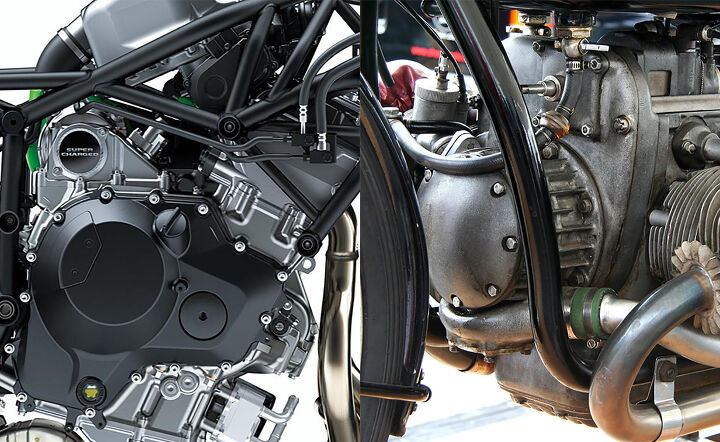
    Left: Kawasaki H2 charger is reasonably compact. Right: So was the BMW Kompressor’s, bolted to the front of the engine.

    Why’d they do it? Because they’re Kawasaki, and have a history of blowing up the status quo with irresponsible motorcycles. But in the 21st century, there are other forces at work also – legal ones that require ever-constricting combustion cleanliness, for which supercharged engines are particularly well-suited. 

    If you follow cars at all, you’re already aware that those manufacturers have been getting lower emissions and better fuel mileage through the use of turbo and superchargers for a while. Even stuffed with extra fuel and air, smaller displacement engines still produce fewer noxious emissions than bigger ones. Heck, Volvo’s latest T6 Polestar engine uses a turbocharger and a supercharger to produce 362 horsepower, from just two liters. Which is good in car terms, but not as good as the H2’s 200+ horses from one liter. 

    More rpm equals more problems…

    Motorcycle engines’ biggest emissions hurdle – especially high-revving ones – is in the hydrocarbons department, HC, where the requirement has dropped from 0.170 grams/kilometer under Euro 4, to 0.100 g/km under the new Euro 5 regs. Hydrocarbons are unburnt fuel, quite a bit of which escapes due to the kind of long valve overlap high-revving things like Kawasaki ZX-10Rs require in order to make 168 horsepower at 11,800 rpm (the last time we dyno’d one, in 2017). Alas, keeping up with the World Superbike Joneses hasn’t made life any easier: Kawi’s UK site says the new, 2021 ZX-10R makes max power at 13,500 rpm.
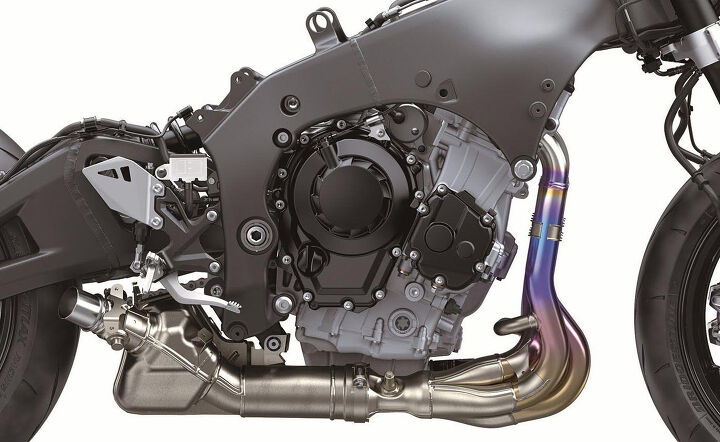
    The 2021 ZX-10R’s engine relies on high rpm to make its horsepower, resulting in more emissions.

    Making power at really high rpm means exhaust valves have to open early and close late to let all the gas out, which is great for power but not for emissions. Likewise intake valves; all that overlap, when both intake and exhausts are open at the same time, lets more fuel blow through without being burned. 

    2018 Kawasaki H2 SX SE First Ride Review

    Reviewing Kawasaki’s H2 SX SE a couple years ago (whose sport-touring tuned blown H2 only made a measly 172 horses to the H2 Carbon’s 205), we wrote:

    There are more powerful 1000cc sportbikes than the ZX-10, including the 180-hp Aprilia RSV4RR and 177-hp BMW S1000RR that duked it out in last year’s Superbike Shootout. But they make their power well past 13,000 rpm; you have to work for it a little. The H2’s artificial air inseminator lets its 998cc four-cylinder produce its peak at just 10,300 rpm. And even more to the point is the fact that the H2’s blown motor is making more torque way sooner – 89 pound-feet of the stuff at just 8600 rpm. The S1000RR puts out 80 lb-ft at 9600 rpm, the Aprilia 78 lb-ft at 11,300.

    Getting the same power with less rpm is a win/win situation for rider and environment. An H2 feels like it’s always rolling downhill ahead of a strong tailwind; the torque’s the thing most of the time on the street. And our 2018 H2 SX SE recorded 40 mpg, too – anywhere from 2 to 8 mpg better than the 2017 superbikes from that last big comparison. 

    Carbon Dioxide

    Strangely enough, one of the nasty byproducts of combustion Euro 5 does not address is CO2, good old carbon dioxide. Maybe that’s because CO2 isn’t poisonous like the others? But, and it’s a big but, CO2 is the gas an increasing number of countries are basing their increasingly popular carbon taxes upon. On most European websites, “grams/kilometer of CO2” is now a spec in the chart along with “bore x stroke” and the rest of them, to allow dealers and customers to anticipate their bottom line.

    Here’s a sampling of them from Kawasaki’s UK website:You’d think, I would anyway, that two 1-liter inline four-cylinder Kawasaki engines making almost the same power would spit out the same amount of emissions. We’d both be wrong. The H2’s supercharger lets it use more conservative valve timing, and its lower-compression pistons also help it achieve a more complete burn. So complete, in fact, that the H2 isn’t much nastier than the old Vulcan 650 it makes over three times as much power as.
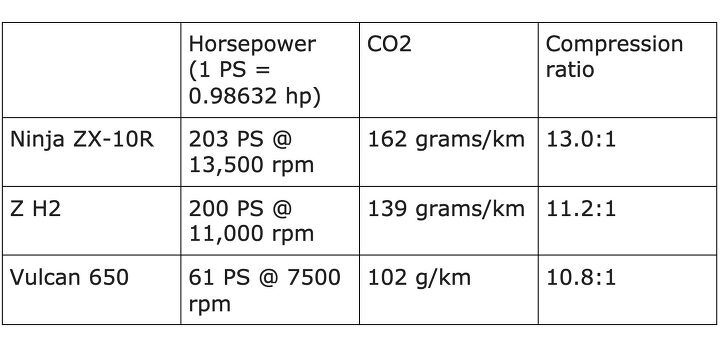
    As far as the noxious gases Euro 5 actually does control, the Z H2 continues to outperform, matching the ZX-10R’s 1.0 g/km of HC and NOX, and spitting out even less deadly CO – 1.23 g to the ZX-10R’s 1.457 (and again comparing favorably to the Vulcan 650’s 1.118 g/km of CO).

    Meanwhile at MV Agusta…

    We turned to our friend Brian Gillen, R&D Director of MV Agusta for enlightenment:

    Please note that HC, CO and NOx emissions requirements are ever-tightening and that during the WMTC (world motorcycle test cycle) emissions test, a lower geometric compression ratio with reduced squish can help reduce the NOx generation. Having a turbo/supercharger then allows you to recover the compression ratio by force, over-filling the cylinder and upping the effective compression ratio, and allowing you to reach the desired performance targets. At the same time, you can have very low overlap valve timing which helps eliminate the short-circuiting of fresh fuel/air directly from the intake tract to the exhaust, thus reducing HC emissions. It’s a win-win.

    Given all the benefits of supercharging, why did we stop doing it anyway? Mostly because when racing restarted in 1946 after WW2, the Fédération Internationale de Motocyclisme (FIM) banned forced induction from road racing. It was a way to keep both costs and fatalities down. And until very recently on the historic timeline, nobody gave a damn about cleaning up exhaust emissions. Lots of people still don’t.

    Before the war, everybody was supercharging engines, from BMW to Brough Superior to DKW and right across the board, in a crazy era when tires and chassis and fairings were learning how to deal with 160 mph plus speeds the hard way.

    Hmmm, not sure I want to go  274.181 km/h (170.3 mph) on the Gilera 500 Rondine, like Piero Taruffi did on 21 October 1937 on the Milano-Bergamo motorway. The Rondine won a bunch of international races in the years before WW2, as well as the world speed record. (Wikiwand photo)

    Mostly, motorcycles have been fast enough for most of us this last half century without the added complexity and expense of super- or turbocharging. The hands-on accessibility of bikes has always been a big part of the charm until not long ago. But now, as manufacturers begin coming up with more complex strategies like variable valve timing, in an attempt to meet Euro 5 and beyond (our man Dennis Chung wrote an excellent coping-with-Euro 5 article here two years ago), supercharging begins to look relatively simple – especially with the new electronic controls that didn’t exist when all the Japanese OEMs tried their hand at turbocharging in the early 1980s.

    The Copenhagen Connection

    Kawasaki deserves full credit for its revolutionary 2015 H2R and the later street versions of that beast, but its very cool planetary drive supercharger may not have been quite as groundbreaking as we were led to believe. Since the 1970s, a little-known company in Copenhagen (meaning, I didn’t know about it until Brian Gillen mentioned it) called Rotrex has been in the business of speed, and had its first supercharger drive patented in 1996.
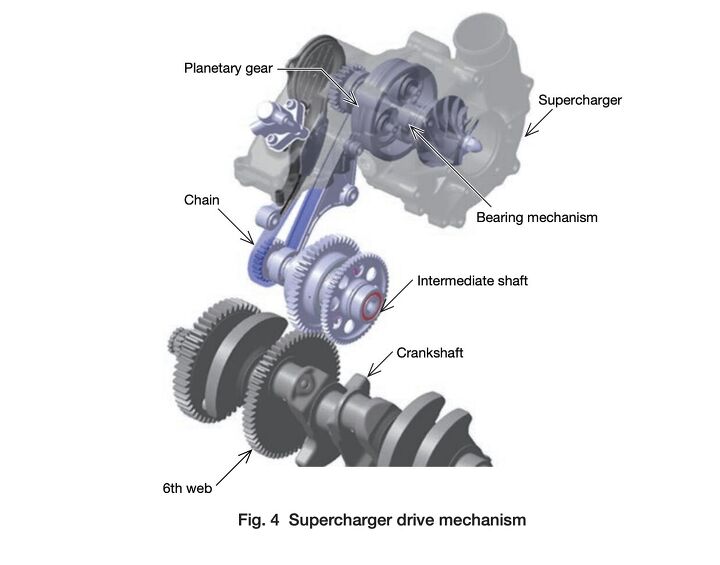
    Kawasaki’s planetary drive system, illustrated here, looks quite bit like Rotrex’s “traction drive” one.

    Similar to Kawasaki’s unit, Rotrex’s advanced “traction drive” system is able to greatly step up impeller speed from engine speed, achieving impeller speeds way above 100,000 rpm. And like Kawasaki’s supercharger, Rotrex does it without the aid of an intercooler, which makes it easy to package on a motorcycle. It’s all about the “adiabatic efficiency,” according to this article in Hot Rod from 2005.

    Adiabatic efficiency describes an air compressor’s ability to compress air without increasing air-charge temperature. The higher the efficiency, the lower the intake-charge temperature and the higher the density of the compressed air-cooler… In a perfect world, a compressor would be 100 percent adiabatic efficient, but in the real world, adiabatic efficiencies range from a low of about 40-50 percent for a Roots-type supercharger to slightly above 80 percent for the most efficient turbochargers. A typical centrifugal supercharger is about 60-65 percent efficient, but according to Rotrex, the higher impeller speeds its units generate elevate them into turbocharger efficiency ranges of up to 80 percent or higher.

    Kawasaki’s H2 unit spins its impeller up to 130,000 rpm or so.

    How hard would it be to put one of these on a motorcycle? Not very, apparently, since Rotrex has been selling kits for a bunch of bikes for years – including Harley’s new Milwaukee 8s (and now defunct V-Rod). But Rotrex’s bread and butter is definitely automotive; kits for the Camaro SS on its site claim to take that 6.2-liter Chevy V-eight from 455 to 610 or 750+ horsepower.

    Maybe I’m reaching the stage where I’ve forgotten more than I ever knew about motorcycles? Now I remember seeing this Rotrex-charged Triumph in Austin a couple years ago. Its owner, Boris Loera, said it went from 96 hp and 82 ft-lbs, to 156 and 132. Rotrex sells the very nice kit for around $4000.


    Which jogged me into remembering this Rotrex-charged Mellow Motorcycles Thruxton we saw at the Cologne show in 2018.

    Interesting, isn’t it? All our man at Kawasaki is allowed to say is,“Kawasaki is always looking at the market and developing new product for our consumers. While we cannot comment on future models, our Supercharged family of motorcycles has been a huge hit in the market and we continue to look at this technology and future applications.”

    I think that means that after they went to all the expense to develop that supercharger tech, they’d be fools not to use it going forward. Lots of the magazines are full of conjecture about the possibility of a new supercharged Eliminator like the old ZL1000. And why not, since Kawasaki has now already built a naked H2, a few sporty ones, and the SX SE sport-tourer (my favorite).

    This artist’s rendering of what a new H2 cruiser might look like on the cover of Japan’s Young Machine a while ago got the chattering classes chattering.

    Where do we go from here?

    Personally, I’d be more excited to see Kawasaki supercharge a midsize bike to give it liter-bike power. A 135-horsepower ZX-6R wouldn’t be a bad thing, but an 80-hp Versys 650 ADV bike with about 70 lb-ft of torque, a low seat, and a cruise control button would be even better for me most days.

    After explaining to me the advantages of supercharging and calling it a win-win, Brain Gillen at MV Agusta closed with, “yes, we’ve been working on a project at MV for some time now!” and closed with a winking smiley emoji. All but one of MV’s models are powered by its excellent 798 cc Triple, with current horsepower claims ranging from 110 to 153 hp. Add 40% to those numbers for a general idea.

    Maybe BMW is just waiting for the 2025 model year to come around, which will be a nice, even century since it built its first supercharged motorcycle? This one’s a `29 WR750, with kompressor just beneath your mantackle. (Kawasaki says it was very careful to make sure the housing is strong enough to contain the shrapnel in the event of an impeller failure.)

    Who knows, but sometimes life has a way of reasserting why old sayings like “it’s always darkest before the dawn” still apply (though it may be time to throw out “there’s no replacement for displacement”). Weirdly, nearly all the Euro 5 bikes I’ve ridden run better in stock form than the Euro 4 versions did, but the screws are only going to tighten further going forward regarding exhaust emissions. And can we please bypass, in the Comments section, whether that makes sense or not? Governments gotta govern. 

    The naysayers were certain emissions controls were going to bankrupt Detroit in 1970, when the US Congress passed the first Clean Air Act, which required a 90 percent reduction in emissions from new automobiles by 1975. There were definitely some dark years while the engineers figured it out (and while you could buy late-model muscle cars for like 5% of what they go for now unless you were a penniless youth), but current Detroit products will bury any Hemi Cuda, stock for stock, without asphyxiating following traffic or requiring toxic, leaded fuel.

    All to say, if you’re saddened by electric motorcycles, and already mourning the demise of internal combustion, you might be a little early to the funeral; a whole renaissance of highly advanced, yet 1930s-simple supercharged motorcycles might shortly be upon us.

    Related reading:

    Kawasaki Development of Supercharged Motorcycle Engines

    Turbocharging, Supercharging To Help In Engine Downsizing, Emissions Compliance

    Bonham’s: 1939 BMW RS 255 Kompressor


    The post The Amazing History of Supercharged Motorcycles: And What the Future Holds appeared first on Motorcycle.com.

    05 Mar 22:56

    Spencer Wright, Founder of The Prepared

    by claudia

    Our guest this week is Spencer Wright. Spencer is the founder of theprepared.org, where he edits a widely read newsletter about engineering, manufacturing, and other meaningful work in the physical world. His career has spanned construction project management, bicycle framebuilding, consumer electronics, and generative design software. He also co-organizes the New York Hardware Meetup and spends a lot of time trying to get his four-year-old daughter excited about hanging out in his Brooklyn workshop. You can find Spencer on Twitter and Instagram @pencerw.

    Subscribe to the Cool Tools Show on iTunes | RSS | Transcript | See all the Cool Tools Show posts on a single page

    Show notes:

    cordreel
    Cord reels & overhead power
    We’re in an old, old, industrial building in Brooklyn and it has these great high ceilings. And the ceiling is all concrete, which kind of has some downsides, but has some upsides. And in this case, we mounted all of this conduit and these receptacles right to the ceiling and then hung these overhead cord reels, with these retractable extension cords right next to them. The result is that whenever you want power anywhere in the shop, we laid these things out on a grid. And so you just reach up and grab the closest extension cord from right above head and pull it down to you. The cord reels themselves, they’re about maybe a foot in diameter. They hang from the ceiling very easily and then they have a 25 or a 30 foot extension cord coiled up inside them with a spring retract system. And the result is that you have this easy access to power anywhere in the shop and no extension cords around the ground to trip on. Even in a smaller shop, something with a roughly eight foot ceiling, you could mount them right in the corner, right where the ceiling meets the wall and you have the same effect. Where they’re out of the way. You’re not walking into them all the time and they’re easy to reach. And again, your power is all above you and so whenever you do need an extension cord, you’re not tripping over it.


    partsbox
    Partsbox
    PartsBox is a digital way of managing all of the inventory of everything you keep in your shop. Basically, you know when you get a small parts cabinet, that have either a bunch of little drawers or one large drawer with a bunch of sub-compartments. And usually they give you a booklet or a tape of these little stickers or cards that you are supposed to write the part number on or the specifications and then stick it to that drawer. PartsBox is a digital replacement for all of that. It’s a website and you create your own catalog of parts and then tell PartsBox where each part is stored, how many you have there, what they cost, so on and so forth. You go to your physical part cabinet and you just name every single compartment in it. And PartsBox has easy ways to do this where you just kind of create a grid and you say, you have columns and rows. And so this is bin A4 or whatever it is. And then you add whatever parts that you have in your inventory into PartsBox and assign them to that storage location. I name all my parts that McMaster-Carr number or whatever it is and then add enough detail so that PartsBox’s search system can easily find what I might be looking for. For instance, I use mostly metric fasteners and if I’m working on a project, I need an M5 socket head cap screw, I’ll go to PartsBox. I won’t look at my physical parts storage at all. I go to PartsBox first, I search M5 socket or something like that and up come the 20 different parts that meet that description. And if I click on them, then it tells me what storage location to go to to look for them.

    paulk-style-workbench
    Paulk style workbenches
    I built a Paulk workbench. The Paulk workbench design is something that’s distributed by this guy, Ron Paulk, who is a YouTube and internet personality. He’s a woodworker who has created this design and sells plans for it. And the idea is that you make it yourself. It’s a woodworking workbench that’s made primarily of plywood and the workbench top, instead of being a solid, like a butcher block, is a plywood box that uses what’s called a torsion box system. And so the workbench top, in my case is 200 millimeters tall and it has a top surface and a bottom surface and then some ribs and sides to hold them together. And the result is that you have this great built-in storage area in your workbench top, you have kind of a shelf, where you can keep commonly used tools. And then the standard Paulk workbench uses plywood saw horses for the base. I actually used this industrial framing system called Flexpipe, which is a kind of a steel pipe system to build this substructure. But then the idea with the workbench is that you use it to mount both your table saw and a router table as well. And it becomes kind of the central workstation for your entire wood shop. Geared mostly towards folks who are making things out of plywood.

    johnsonbar
    A Johnson bar
    My last pick is a Johnson Bar. Johnson bar is kind of like a cross between a crowbar and a hand truck. It’s this big piece of steel or wood, usually about six feet long and one end there’s a handle and the other end, there are two little wheels and a little lip. A pry lip that you can use to lift really heavy things off the ground. They’re used mostly to move heavy machinery and they can lift up to 5,000 pounds pretty easily just with one person. They only lift them a couple of inches, but they’re kind of magical. It’s kind of like an Egyptian way of moving heavy things around where you have this really, really, really long lever and are able to scoot something that’s very heavy, a very small distance. And the beauty of owning the Johnson bar is that they enable you to take unloved, heavy equipment off other people’s hands. There are a lot of milling machines and lathes out there that someone bought decades ago and they’ve been sitting on a garage floor ever since. And they decline in value, partly because they’re just difficult to move. Now you’re not going to use a Johnson bar to move something down the street, let alone to a different city or something like that. But you can use it to just get a heavy item up onto a dolly or a hand truck or a pallet jack. And it really is just an incredible super power to be able to lift this heavy thing just a couple of inches and then actually move it.

    About The Prepared:
    The Prepared is a weekly newsletter that I word as meaningful work in the physical world because, it’s partly about manufacturing, partly about logistics, partly about construction — kind of the areas of my career that I’ve worked in. And it’s divided up into some industry news, some just engineering factoids and then the random kind of interview or plenty of manufacturing videos as well. My belief is fundamentally that being a generalist helps you make good decisions. And in addition, it’s personally enriching to be aware of things kind of in the adjacent possible. Some of my favorite conversations with engineers have been folks who work in industries that I would never consider working in. And The Prepared is kind of meant to treat all those things with at minimum, curiosity and ideally with some degree of respect. There are plenty of really interesting engineering topics happening in oil and gas and aviation and also in single family home construction. And my belief is that you don’t have to agree with them, you don’t have to study them at much length, but being aware of them and at least considering what their implications are, can make you better at the things that you do, whether or not you work in the physical engineering world.


    We have hired professional editors to help create our weekly podcasts and video reviews. Please consider supporting us on Patreon. We have great rewards for people who contribute! If you would like to make a one-time donation, you can do so using this link: https://paypal.me/cooltools.– MF

    05 Mar 22:48

    How to Pick the Best Knife Steel

    by T. Edward Nickens
    Hunting knives made with a variety of steel types.
    Hunting knives made with a variety of steel types. (Collage by Dave Hurteau/)

    Like it or not, you must choose. 1095 or D2? 8Cr13MoV or AUS-8? H1 or ZDP-189? And those are just a few of the varieties of knife steels, of which there are thousands.

    Dialing in on which steel suits your needs best is a confounding business, but few factors are as important to knife function as the choice of steel. Some steels are harder than others, some are easier to sharpen, some are known for holding an edge, and some are more resistant to corrosion. Each attribute typically comes with a tradeoff. A blade that is harder and holds an edge longer, for example, might be prone to chip. Knowing a bit about steel metallurgy will help you pick the right knife, whether you want an inexpensive model or a high-dollar custom blade.

    Carbon Steel Vs. Stainless Steel

    Basic steel is simply iron and carbon. But over the ages, steel makers learned that a pinch of cobalt or a dash of chromium—or a smidge of more exotic compounds such as vanadium or molybdenum—changes a steel’s character. The least you need to know is that the higher the carbon content, the harder the blade and the better it holds an edge. But too much can make a blade brittle, reducing toughness. Blades with a higher carbon content also rust and corrode more easily. Adding chromium prevents rust but it can soften the steel.

    And that brings us to the first big decision: Do you want a carbon-steel blade or a stainless-steel blade? All steels contain carbon. The defining difference between carbon steel and stainless steel is that stainless-steel blades typically contain between 10.5 percent and 16 percent chromium in the alloy.

    A bladesmith draws out a billet of steel.
    A bladesmith draws out a billet of steel. (T. Edward Nickens/)

    The Advantages of Carbon Steel

    Carbon steels often include various added elements to give the steel specific properties, but chromium is either absent or present in very low amounts. Carbon steel proponents point to its relative ease of sharpening, edge-holding ability, and the fact that carbon steel can be differentially heat treated—with a very hard edge, for example, and a softer, more flexible spine. And for many, the fact that carbon steel stains is a plus. It requires a bit of cleaning and oiling. But like a fine wood gunstock aging and darkening, a blued carbon knife blade wears a story-rich patina.

    The Advantages of Stainless Steel

    When it comes to stainless steel, let’s be clear: There’s no such thing as truly stainless steel. An alloy that’s absolutely impervious to rust would have to contain so much chromium that it would be useless as a knife. But when chromium is added to a steel alloy and the metal is heat treated, protective chromium oxide turns back crud, making stainless blades easier to care for. Popular inexpensive stainless steels include 440A, 440B, and 440C, and while they’ll polish to a mirror finish, they are very difficult to sharpen to as keen an edge as other steels. If you prefer your blades to be very sharp and shiny and easy to work with, upgrade to better stainless steels such as 154CM, ATS-34, AUS-8, the CPM stainless series, Sandvik 12C27, and VG-10. Or you can buy a Morakniv or Helle knife, and bask in the glow of their proprietary, and very fine, stainless steels.

    What the Heck is Super Steel?

    This Wingman EDC folder uses Elmax steel.
    This Wingman EDC folder uses Elmax steel. (Knifecenter.com/)

    Many new high-technology steels are made of powdered, or pelletized, steel. First, a desired alloy is formulated and melted. This molten metal is then processed through a high-pressure air or gas cannon, which atomizes the metal into a fine spray of mist-like droplets. These harden into tiny round powder pellets, with very few impurities. The millions of granules of evenly distributed carbides allow for hair-splitting edge grinds and no weak spots in the blade. Many of these steels, such as CPM 154, ZDP189, M390, and Elmax, pretty much do it all, and knife buffs call them “super steel.” They’re corrosion-resistant, hard, and tough. Naturally, you pay for it.

    17 of the Best Knife Steels for Outdoor Blades

    Now that you know enough about knife steels to make your own informed decisions, here are a few favorites to consider.

    5 Great Carbon Steels

    1. 1095 Steel

    The Ka-Bar USMC, one of the popular fixed blade knives ever made, is constructed of 1095 steel.
    The Ka-Bar USMC, one of the popular fixed blade knives ever made, is constructed of 1095 steel. (Ka-Bar Knives/)

    A very popular and simple alloy that has been around forever. It is used in a great many inexpensive knives, but still furnishes the blades for some very costly knives, too. It’s easy to sharpen and takes a keen edge. Over time, tool steel like 1095 blues with use, acquiring a pleasing character.

    2. 0-1 Steel

    This steel is favored by the famed knife maker Bo Randall. With a carbon content nearing 1 percent, it’s a hard steel with great edge retention, but it’s less desirable on large blades due to brittleness.

    3. D-2 Steel

    Dozier Knives is known for making great blades from D2 steel.
    Dozier Knives is known for making great blades from D2 steel. (Arizona Custom Knives/)

    Containing almost enough chromium to be considered a stainless steel, D2 is rust-resistant (although it will stain), very tough, takes a first-class edge, and holds that edge nearly forever. It’s an awesome knife steel, but it takes care and skill to sharpen.

    4. 52100 Steel

    A very hard, high-carbon tool steel. Holds an edge well but can be difficult to sharpen. With less chromium than other tool steels, it is prone to rust, but makes a great hunting knife.

    5. 5160 Steel

    A simple carbon steel with a smidge of chromium for strength, it was considered by the great smith Bill Moran to be the best of the knife steels.

    A Dozen Top Stainless Steels

    6. AUS-6 and AUS-8 Steel

    Japanese versions of 420 stainless steels, with vanadium in the alloy for wear resistance. AUS-6 has .65 percent carbon. AUS-8 has .75 percent carbon. They are inexpensive and widely used.

    7. 8Cr13MoV Steel

    China-produced steel similar to AUS-8 with slightly more carbon in the alloy. Easy to sharpen, decent edge retention. A great mid-range steel when heat treated properly.

    8. Sandvik 12C27 Steel

    Very popular Swedish steel that’s a definite upgrade from the 440 series. Manganese in the alloy allows it to sharpen easily and hold an edge well, making it a less-expensive choice with high-performance characteristics.

    9. 154 CM Steel

    The Boker Plus USA folder is made with 154 CM steel.
    The Boker Plus USA folder is made with 154 CM steel. (Knivecenter.com/)

    A hard American Crucible steel with 1.05 percent carbon content and added molybdenum. Holds an edge very well. Often used in high-end custom knives and top-shelf manufacturers. Rusts only with difficulty.

    10. ATS-34 Steel

    Japanese steel with 1.05 percent carbon content, very similar to 154CM. The addition of vanadium gives it a great balance between corrosion resistance and edge-holding ability.

    11. VG10 Steel

    Japanese steel with better corrosion resistance than 154CM and ATS-34. A fairly hard steel, tough, and relatively easy to sharpen.

    12. CPM S30V Steel

    Very popular for upper-level knives, the carbon content of 1.45 percent makes for a tough knife with great wear resistance. The “V” denotes the vanadium carbides that boost the steel’s hardness. A great choice for all-around performance.

    13. CPM S35VN

    The excellent White River Hunter is made of S35VN steel.
    The excellent White River Hunter is made of S35VN steel. (White River Knives/)

    An upgrade from S30V steel with the addition of niobium for toughness and ease of sharpening, it’s an affordable top-shelf steel.

    14. ZDP-189 Steel

    Hitachi powder steel with super-high levels of carbon and chromium for super-high hardness—64-66 HRC. Once sharp, it stays sharp practically forever, which is a good thing, because sharpening this steel is not easy.

    15. Elmax Steel

    The Swedish firm Uddeholm developed this powder steel that’s very high in both carbon and chromium and combines extreme corrosion resistance with high wear resistance. This means it resists rust stubbornly, and once it takes an edge it keeps it. Pretty close to perfect, it’s hardened to HRC 60-61.

    16. M390 Steel

    The brainchild of the Bohler-Uddeholm merger, the powdered M390 super steel contains tungsten for wear, corrosion resistance, and edge-retention scores that are off the charts.

    17. H-1 Steel

    Miracle of alloy miracles: With 1 percent nitrogen in the alloy, this is a steel that will cut shrimp for surf fishing and never rust no matter how long it bangs around, forgotten, in your tacklebox. Great edge-holding ability. Perfect for saltwater environments.