
Visit Uncrate for the full post.


After President Donald Trump's loss in 2020, a majority of his supporters believed the election had been rigged. Some adopted wild conspiracy theories involving Chinese supercomputers, Hugo Chavez, and state-level Republican officials. These beliefs culminated in an attack on the U.S. Capitol that left five people dead. To make sense of these events, many officials have argued that platforms such as Facebook and Twitter allowed conspiracy theories to spread unimpeded, leading to erroneous beliefs and deadly behaviors. In other words, they blame misinformation for the violence.
But it strains credulity to believe random tweets can lead otherwise normal people to drive across the country and stage an insurrection. That places an undue focus on misinformation itself, rather than on the people and institutions sharing it and on the people who choose to access and believe it. It also seems odd to call for more government intervention into our information ecosystem when government officials—the president, members of Congress—were, in this instance, the biggest purveyors of misinformation.
Since he became a candidate in 2015, Trump and his high-profile supporters in Congress and the media have repeatedly claimed that elections are rigged. Since his loss last year, he has become only more vociferous about this. It should come as no surprise that the person with the biggest bully pulpit in the world was able to convince some voters he was cheated. This is what politicians do: They build and mobilize coalitions. On the other side of the ledger, electoral losers are naturally prone to believing they were cheated, and Trump's claims only exacerbated this tendency among his core supporters.
Once we account for the influence that politicians have, as well as the dispositions of core audiences, the role of misinformation and mediums of communication in fomenting events like the Capitol riot become highly conditional and much smaller than many are arguing.
Nonetheless, pundits have called for interventions ranging from the benign (more journalistic fact checking) to the heavy-handed (internet censorship, the nationalization of social media). While these calls have intensified recently, they are not new. After the 2016 election, many journalists declared that we had entered a "post-truth" world in which lies, misinformation, and groundless conspiracy theories carried as much weight as statements of fact, if not more. Such sentiments grew more widespread during the COVID-19 pandemic.
The desire that others believe the "right" things and act the "right" way is often well-intentioned. I too would prefer that people not inject themselves with bleach because they heard that it can prevent COVID-19. But designs on others' beliefs are sometimes little more than expressions of crass self-interest or, worse, authoritarian tendencies.
It isn't clear that the public is more prone to believing misinformation than in the past. If it is, this may mostly be a top-down phenomenon driven by the conspiratorial rhetoric of high-profile elites such as Trump. Nonetheless, it has become scripture that our current maladies have been wrought by the mass public spreading misinformation through social media—and, of course, that something must be done to stop them.
Enter Harvard legal scholar Cass R. Sunstein. His new book, Liars: Falsehoods and Free Speech in an Age of Deception, expresses many questionable but popular claims about false information: that lies travel faster and farther than truth, that social media are responsible for a new age of misinformation, that government intervention is needed lest we lose our democracy.
Sunstein does recognize the dangers of asking the government to act as arbiter of truth. Early in Liars, he invokes Justice Robert Jackson to clarify the stakes: Governments that police speech will inevitably move on to policing dissent, and when they can't fully eliminate it, they may turn to exterminating dissenters.
Yet Sunstein ultimately concludes that, under some circumstances, the government has not just a reason but the authority to censor, punish, or use other tools against those who spread harmful falsehoods. His argument in brief: "False statements are not constitutionally protected if the government can show that they threaten to cause serious harm that cannot be avoided through a more speech-protective way."
Sunstein concedes that most falsehoods don't require punishment or censorship. But for some falsehoods, he insists, legal intervention is required. He begins with already proscribed forms of falsehoods involving defamation or fraud but expands from there to defamation of politicians and harmful misinformation about "people, places, and things." Sunstein would specifically like to see regulation of knowingly false speech that "creates a clear and present danger of harm."
So on one hand, Sunstein acknowledges that officials cannot be trusted to police truth because they have their own biases, which can ultimately lead to punishing dissent rather than mere falsehood. But he simultaneously argues that more categories of speech should lack constitutional protection and that government should play a role in determining both what is false and under what circumstances people should be allowed to freely express falsehoods. He wants an "independent tribunal" to make some of those decisions, but it isn't clear how independent it could actually be.
Meanwhile, the punishment of speech can foster exactly the kinds of beliefs that Sunstein says he wishes to prevent. If the believers think they're being persecuted, that can reinforce the idea that they possess important secret knowledge. Many of the people prosecuted would become martyrs. And the trials of accused liars could draw more attention to their falsehoods.
That's just one way that Sunstein overemphasizes misinformation and underemphasizes beliefs and behaviors. For example: If he thinks getting a vaccine is so important that we need to punish people who lie about the dangers of it, why not just call for the government to make those vaccinations mandatory? If the motive for policing speech is the actions that stem from the speech, then a punishment for not engaging in the prescribed behaviors would be even more justified. Besides, many people engage in the "wrong" behaviors even though they weren't exposed to false information. Does Sunstein want to improve outcomes or just to punish speech?
Sunstein also credits misinformation with more power than it has. A century of research into belief formation has shown that while information, true or false, can convince people to change their beliefs, it often doesn't. For people to adopt new information, they usually need worldviews already in alignment with it. This puts the responsibility for false beliefs at least partially on the back of the believer.
Sunstein ignores the role political and media elites play in driving people's beliefs as well. Prominent partisan leaders wield enormous influence over the beliefs of co-partisans in the mass public; this influence exists whether those leaders speak truthfully or not. (As we have seen, many of the lies told on social media are told by the president and members of Congress.) Because he omits this facet of opinion formation, Sunstein is blind to a paradox: Government leaders may be the ones spreading false information, yet Sunstein wants to empower the government to find out exactly who is spreading falsehoods and punish them. Government leaders are unlikely to punish themselves, and enforcement will likely target the less powerful, not the more powerful. So the probable result isn't to punish the most influential spreaders of falsehoods; it's just another cudgel for violating citizens' rights. Case in point: The members of Congress who encouraged the violence at the Capitol remain in power as of this writing.
If Sunstein's recommendations were policy, it would be difficult to know what is illegal and what isn't. Sunstein puts forward four considerations to determine what should be done about false speech, each with four gradations: the speaker's state of mind (from purposely lying to mistaken), the magnitude of the potential harm (from grave to nonexistent), the likelihood of harm (from certain to highly improbable), and the timing of the harm (from imminent to the distant future). Sunstein asks readers to consider all of these factors when considering what to do about an individual sharing a falsehood; this would leave the authorities to figure out where a particular falsehood falls within 256 possible categories. Such incomprehensibility would most certainly chill speech.
Nor would Sunstein's recommendations work on their own terms. We should have little confidence that government agents or tech companies could—in real time—tell fact from fiction without much error. Even professional fact checkers don't always agree on what is false and why. Further, the fear of being prosecuted may serve to drive falsehoods underground, where they can't be challenged.
Or people may choose to speak in generalities that don't assert facts. Saying "the MMR vaccine has been shown to cause autism" is factually wrong; saying "I don't trust vaccine companies" could be entirely true, since it refers to the speaker's state of mind. Both statements could convey the same meaning, but only one would be punishable. Unless, of course, the next step is to ban not just unwelcome speech but unwelcome meanings.
Liars: Falsehoods and Free Speech in an Age of Deception, by Cass R. Sunstein, Oxford University Press, 192 pages, $22.95
| Special purpose acquisition companies — or “blank check companies” — are suddenly all the rage on Wall Street. What’s the deal? | ||||||||
| This edition of The Hustle was brought to you by Graze Mowing… The mow-bot commercial landscaping. | ||||||||
 |
||||||||
|
||||||||
| The Hustle is proud to deliver original longform journalism to your inbox every Sunday. This work would not be possible without the support of our sponsor, Graze Mowing. Please support them so we can continue to bring you the most interesting stories you’ll find anywhere. | ||||||||
What the hell is a blank check company (SPAC)?Special purpose acquisition companies — or “blank check companies” — are suddenly all the rage on Wall Street. What’s the deal? |
||||||||
|
TL;DR: A SPAC is a publicly traded shell company set up specifically to merge with, and take public, a private company. In the past year, we’ve seen a massive spike in SPACs as an alternative to traditional IPOs, but questions remain about whether they’re a good investment for the public. |
||||||||
|
What do these 5 people have in common?
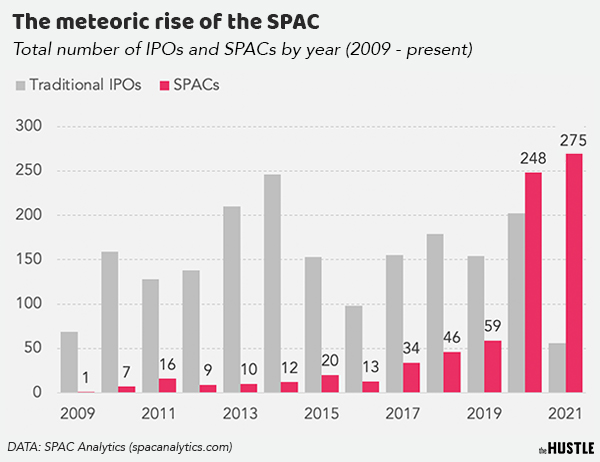
Answer: They all have a hand in SPACs (special purpose acquisition companies), one of the hottest financial trends on Wall Street. In the past 15 months, SPACs have seen a meteoric rise as an alternative way to take a private company public — one that bypasses many of the legal and regulatory “headaches” of the traditional IPO (initial public offering) process. By the latest tally, SPACs now outnumber traditional IPOs by a factor of 5x. |
||||||||
Zachary Crockett / The Hustle |
||||||||
|
Many outlets have proclaimed SPACs to be the “new IPO” — and with good reason:
Prominent companies like DraftKings, Virgin Galactic, and OpenDoor have all used SPACs to go public. But SPACs — which are generally subject to less regulation than IPOs — have also drawn controversy for the risks they pose to public investors: earlier this week, the investment bank UBS banned its financial advisors from recommending SPAC stocks to clients. What exactly is a SPAC? Why are so many companies choosing to go public via SPACs in lieu of a standard IPO? And how beneficial are they to businesses and investors? How a standard IPO worksBefore we get into SPACs, it’s necessary to touch on how a standard IPO typically works. Let’s say our pal, Tony, starts a donut shop. |
||||||||

Zachary Crockett / The Hustle |
||||||||
|
At first, Tony’s happy just running one little shop in California. But his donuts get hyped and people start lining up for blocks to try them. Tony uses his income to open a 2nd shop, then a 3rd, and a 4th — each more successful than the last. Eventually, he takes some money from private investors and expands to hundreds of locations all over the US. After years of hard work and luck, Tony’s little donut shop becomes a full-fledged corporation, with hundreds of employees and $1B in annual revenue. |
||||||||

Zachary Crockett / The Hustle |
||||||||
|
Tony realizes that he has to raise more capital to sustain his growth. So, he decides to take his company public via an IPO. There are a few different types of IPOs. But if Tony goes the traditional route, his company will partner with an “underwriter” (typically an investment bank) to navigate the mountain of legal paperwork, regulatory documents, and pricing models required to go public. Usually, the simplified process looks something like this: |
||||||||

Zachary Crockett / The Hustle |
||||||||
|
Going public offers several obvious advantages:
But there are a few problems with the affair:
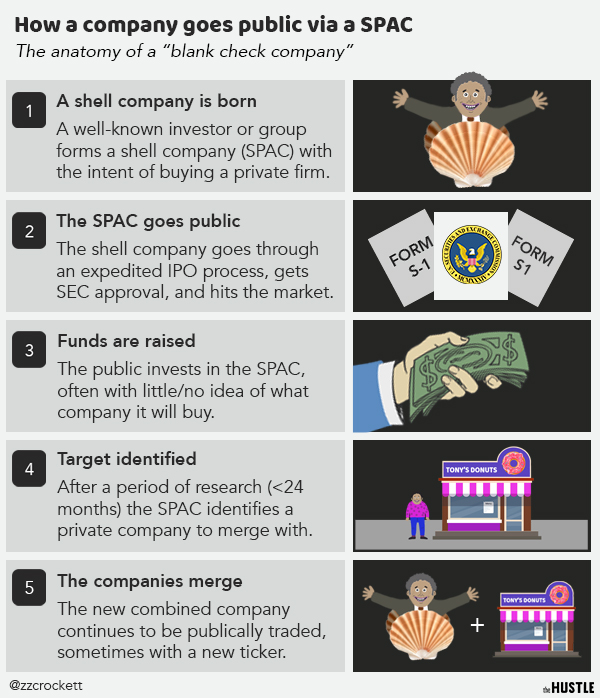
The bulk of that time — up to 5 months — is tied up in filing an S-1, the standard registration form required by the SEC. The government often puts applicants through 2-5 rounds of revisions before approval. An IPO also requires a ton of back-end work for a company like Tony’s Donuts — “roadshows,” huge marketing investments, and financial disclosures of every imaginable variety (balance sheets, cash-flow statements, income statements). The goal of all of this due diligence? To provide as much transparency as possible to the public before they invest. With an IPO, investors know what company they’re betting on and, ideally, have the necessary information to make an informed buy. But if Tony decides this process is too tedious, he has another option… Enter the SPACLet’s say Tony’s Donuts doesn’t want to mess with all that regulatory oversight. In lieu of an IPO, the company might consider a SPAC. In essence, the SPAC process allows a company to bypass the rigmarole of an IPO by merging with a shell company (called a SPAC) that’s already gone public. |
||||||||
Zachary Crockett / The Hustle |
||||||||
|
A SPAC can usually get SEC clearance and IPO much faster than an established private company (~2 months) since it doesn’t have any historical financial documents to disclose. Once public, the shell company can take up to 24 months to identify a purchase target — like Tony’s Donuts — and enact a merger. A SPAC allows a private company to go public in as little as 5-6 months, compared to the 1- to 2-year timeline of an IPO. On paper, it can also be a tad cheaper, and it offers a company both more flexible negotiation terms and more market certainty. Sounds pretty decent for Tony’s Donuts… But is it good for public investors?When you buy into a SPAC IPO, you almost always pay a set price of $10/share and get “warrants,” or options to buy more shares in the future at a low price. As a SPAC IPO investor, you’re buying shares in a shell company and hedging a bet that it will merge with a desirable private firm in the future, thus boosting the share price. It’s usually a leap of faith — hence the moniker “blank check company.” Most SPACs offer little insight into the companies they plan to merge with. Investors may be told something extremely general like, “our focus will be on the technology industry in Southeast Asia or the United States.” |
||||||||
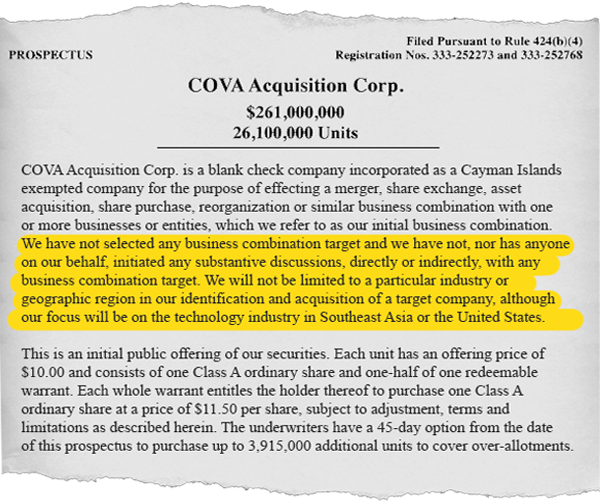
A SPAC filed in February 2021 uses typically vague language: “We have not selected any business combination target…[and] we will not be limited to a particular industry or geographic region.” (Filing via SEC.gov; graphic: The Hustle) |
||||||||
|
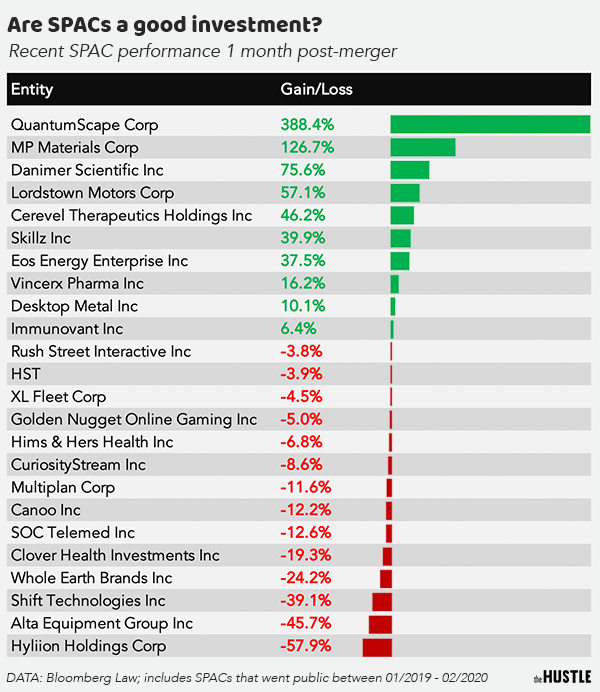
The “blind” nature of these investments — and the reduced regulatory oversight they’re subject to — has drawn criticism that SPACs pose more dangers for retail investors than typical IPOs. One case study frequently cited is Nikola Motors Co., which went public via a SPAC in June 2020 and shot up to as high as $66/share before allegations of fraud tanked the stock to $14. As The Hustle has written, SPACs have also attracted controversy for giving long-term revenue projections — something that’s strongly discouraged in the traditional IPO process. But SPACs pay off? Like most stocks, results are mixed. A Bloomberg analysis of 24 SPAC stocks that went public between January 2019 and February 2021 found that more than half depreciated in value 1 month after a merger was announced. Research by Bain has shown similar outcomes: a review of 121 SPACs showed that 60% underperformed the S&P 500 post-merger. |
||||||||
Data via Bloomberg Law; graphic: Zachary Crockett / The Hustle |
||||||||
|
Among Bloomberg’s sample size of SPACs, the average return was 22.9%. By comparison, in 2020:
If we examine longer-term data, the results are a bit more sobering. A study of 93 SPACs that went public between 2015 and 2020 found that common shares posted an average loss of -9.6% (vs. a 37.2% average return for traditional IPOs). Less than one-third of SPACs were in the green. As Tony would say, that’s a big ol’ donut hole. NOTE: This post is for informational purposes only and does not constitute financial advice. |
||||||||
| Share & discuss this story on: | ||||||||
|
||||||||
|
||||||||
| How did you like today’s story? | ||||||||
|
||||||||
Today’s email was brought to you by Zachary Crockett and Brad Wolverton.
|
||||||||
| 2131 THEO DR. STE F, AUSTIN, TX 78723, UNITED STATES • 415.506.7210 | ||||||||
| Never want to hear from us again? Break our hearts and unsubscribe. | ||||||||
 |
||||||||
Caulking a shower is a simple project that most home owners can do themselves. If your shower has peeling caulk or no caulk at all, take the time to get the seams sealed properly. To get the job done correctly, you need to use a caulk and tools that are right for your surface. Then with a bit of time and the right technique you will have a well-caulked shower that will keep water and mold out of your walls and will look great.



The METL tire, developed by Smart Tire Company, utilizes the technology that NASA developed for its lunar missions. The airless bike tires are made of the Shape Memory Alloy Radial Technology (SMART), a lightweight and ultra-elastic material that “rearranges its molecular structure when you bend it, but instantly goes back to its original shape, perfectly” which could make you not worry about flat tires at all:
They are basically, shape-memory tires that have almost 30 times the recoverable strain limit of the steel, thereby making them ideal for any kind of rough terrain. The metal of these tires will not come in contact with the tarmac as they will be coated with a new kind of rubber-like material called Polyurethanium, which’s crafted for all king of weather conditions and has a long-lasting tread and grip for superior handling.
Since the tires are going to be targeted towards next-gen buyers, the design is as important as function. Therefore, Smart Tire Company has made it a point to embellish them in white, gold, silver, and metallic blue colorways. They plan to bring the METL tires to the consumer market in early 2022, but there is no word about the cost of these tires yet. As per Earl Cole, CEO of The Smart Tire Company, “The unique combination of these advanced materials, coupled with a next-generation, eco-friendly design make for a revolutionary product.” This shape memory alloy technology looks promising and will make it beyond just the bicycle tires for sure.
As Santo Padula, a materials science engineer at NASA pointed out, “Shape memory alloys look extremely promising in revolutionizing the entire terrestrial tire industry.” In fact, that’s just a starting point and these could make it to the four-wheelers and commercial vehicles – changing the landscape of commuting to another dimension. After all, who doesn’t want to fit their bicycle, car, or truck with wheels that will never go flat or need to be changed in a lifetime!
Image via Yanko Design
Root, Stem, Leaf, Flower: How to Cook With Vegetables and Other Plants
Gill Meller’s Root, Stem, Leaf, Flower shows home gardeners how to put their bounty of fruits and vegetables to use. First released in the UK last year, the cookbook reads like a love letter to plants. The 120 recipes are organized by seasons and ingredients, making it easy to find new purposes for the springtime boom of asparagus and rhubarb and summer’s surplus of tomatoes, eggplant, peppers and more.
(March 9, Quadrille/Chronicle Books)

When you’re feeling overwhelmed or overextended or are simply out of dinner ideas one year into a global pandemic, this is the cookbook to reach for. At the heart of Heidi Swanson’s recipes is a deep appreciation of fresh produce, which she utilizes in 120 non-fussy vegetarian recipes, many of which are rooted in California cooking. The third cookbook from the James Beard Award-winning blogger and author, Super Natural Simple offers easy yet appealing soups and stews, single-skillet and sheet-pan meals and sweet one-bowl bakes for the busy home cook.
(March 23, Ten Speed Press)

The Chef’s Garden: A Modern Guide to Common and Unusual Vegetables
After losing their family farm in the 1980s, the Jones family set out to rebuild the business near the shores of Lake Erie in Ohio. They learned to grow crops considered exotic at the time, such as microgreen herbs, specialty lettuces and edible flowers, fulfilling the needs of top chefs across the country. Still a family-owned farm, the Chef’s Garden is run by brothers Bob Jones Jr. and Farmer Lee Jones, who helped author this new cookbook. It features 100 recipes (beet marshmallows, anyone?), organized by categories such as nightshade fruits, rhizomes and brassica family roots.
(April 20, Avery)

Mother Grains: Recipes for the Grain Revolution
Looking beyond wheat, Roxana Jullapat set out to highlight the diverse world of ancient grains—that is, grains unaltered by domestication. “I was struck by the fact that our conventional global supply reflects only a handful of wheat varieties,” writes the baker and grain advocate in the book’s introduction. “This is especially shocking considering the diversity of flavorful, nutritious grains found in nature.” In Mother Grains, Jullapat focuses on barley, buckwheat, corn, oats, rice, rye and sorghum, and pays respect to the farmers who grow them. In addition to more than 90 recipes for bread, rolls, cakes and more, Jullapat offers tips for sourcing, storing and sifting ancient grains.
(April 20, W.W. Norton)

Bress ’n’ Nyam: Gullah Geechee Recipes from a Sixth-Generation Farmer
When Matthew Raiford left home at 18, he never planned to return. But after stints in the military and restaurants across the country, the chef eventually returned to his family’s organic farm, Gilliard Farms, in Georgia. He would go on to work the same land farmed by his great-great-great-grandfather Jupiter Gilliard, a descendant of West Africa who was born into slavery in 1812 in South Carolina. The chef and farmer’s new cookbook Bress ’n’ Nyam, which translates to “bless and eat” in the African Creole language called Gullah Geechee, pays homage to these roots. The sixth-generation farmer showcases the lineage of African foodways and traces his family history through 100 recipes, including creamy grits, buttermilk biscuits, stewed greens, sweet potato pie, Gullah fish stew, oyster dressing and other essential dishes.
(May 11, Countryman Press)

The post 5 New Cookbooks We’re Reaching for This Spring appeared first on Modern Farmer.

The Boone and Crockett Club has released its sixth edition of the Records of North American Whitetail Deer, and at 700 pages, it promises untold hours of geeking out for deer nuts like you and me, who can’t get enough of giant whitetails.
One of the coolest things about record books like this is that they bring to life the history of hunting, and this new edition serves that up in heapfuls—states and regions and individual bucks that have placed an area in the record books for all time. But this record book also reveals recent trends, highlighting the incredible bucks that serve as evidence of where, if you are intent on tagging a whopper whitetail, you need to hunt right now. Remember the Jordan Buck? Killed in Wisconsin in 1914, the incredible 10-point stood atop the B&C typical whitetail category for more than 70 years and remains one of the most iconic trophies of any species of all time. Well, the B&C book proves that the Jordan buck was no fluke, as Wisconsin continues to be the nation’s leader in overall B&C entries all-time with 1,822 bucks. What state comes in second and third...? Here’s a rundown:
Top 8 B&C Record-Book Whitetail States

1. Wisconsin
The Badger State ranked No. 1 in all-time B&C record-book whitetail entries. It also has six counties in the top 20 U.S. counties for record-size whitetail. Wisconsin’s Buffalo County is No. 1 on that list, with 150 entries.
2. Illinois

Second overall, with 1,445 total entries, is Illinois. It has four counties in the top 20 and the highest number of top 21st Century whitetails, with eight, including Luke Brewster’s incredible 327⅞-inch nontypical, which is the biggest ever taken by a hunter.
3. Iowa
The Hawkeye State ranks third, with 1,330 total entries. The book’s list of top 21st Century buck section includes Austin Pointer’s 194⅛-inch typical buck, taken in 2016. It is Pointer’s Iowa giant that graces the book’s cover.
4. Minnesota
With 1,194 total entries, Minnesota comes in fourth and has four counties in the top 20, including St. Louis County, which is second overall with 102 entries. A pair of 190-plus-inch typicals are listed in the top 21st Century bucks.
5. Ohio
The Buckeye State moved up in rank since the book’s last edition to No. 5, with 1,049 total entries. If you’re wondering about which state to book a hunt in next year, you might consider that all of the new typical records in the state’s top 10 and six of the 10 non-typical state records were taken in the 2000s. Ohio is on the rise.
6. Kentucky
With 1,048 total entries, Kentucky is No. 6 and is another up-and-comer, with five of the state’s top 10 typicals and nine of the best 10 non-typicals being from in the 2000s.
7. Missouri
Missouri ranks seventh overall with 896 total entries. This is another one where the number of state-record bucks is on a recent surge.
8. Kansas

Kansas moved up since the books last edition to the No. 8 spot. Included among Kasas’s top recent bucks is Gerald E. Rightmyer’s 272-2/8-inch nontypical taken in 2006 and a 295-inch giant picked up in 2012.
Bonus State: Texas
Texas gets special recognition for having four of the top six counties in the country.
Bonus State: Arkansas
Arkansas gets a nod thanks to Willian L. Loyd’s incredible 200⅛-inch typical taken in 2018.
Bonus State: Tennessee

Finally, Tennessee deserves special notice for Stephen L. Tucker’s 315⅛-inch Sumner County non-typical buck, the second largest ever taken by a hunter.
The stories of these bucks, and many others, are included in this most recent release of the B&C’s Records of North American Whitetail Deer, which has more than 17,000 deer listings, 300 color field photos, portraits of all the current state and provincial record deer (17 new state records since the book’s last edition), and state maps showing trophy distribution for each county. At $60, this is not only the best resource a whitetail nut can own; it’s a coffee-table book that will provide entertaining reading for years.

The Museum Club, known locally as "The Zoo", is a Route 66 icon. It began as a taxidermy museum/shop in 1931 when taxidermist Dean Eldredge purchased federal land just outside Flagstaff, Arizona. He constructed what he believed was "the largest log cabin in the nation." The upper floor and roof are supported by several massive tree trunks and the doorway is under an arch constructed from the crook of a large tree. The building is designated as a Historic Landmark.
Unfortunately, Dean passed in 1936 and most of his collection was sold. The building was purchased by a local saddle maker who took advantage of its proximity to Route 66 and opened a nightclub.
Over the years, the nightclub passed through several owners. By the 1950s, the building had become somewhat run down and was commonly associated with late-night brawls.
" The Zoo" nickname arose because of all the fighting that took place at the club. The alternative origin of the name dates back to its days as a taxidermy museum.
In 1963, guitarist Don Scott bought the club and converted it to a country music venue. Scott had many contacts in the industry and was able to attract some excellent acts.
The Museum Club continues to be a popular country music honky-tonk, with a legendary happy hour. The neon guitar sign at the side of the road has become an icon of Route 66. The menu items for lunch and dinner often carry the names of famous country music stars.

The World Photography Organization has announced its category winners of the Sony World Photography Awards 2021, which seeks to recognize the best single images from 2020.
Over 100 photographers were shortlisted in the competition along with ten category winners. Each winner is set to receive what is described as “the latest digital imaging equipment from Sony” and will go on to compete for the overall open winner that will be announced on April 15. That winner will be presented with the Open Photographer of the Year title and a $5,000 award.
The ten categories along with the winners and descriptions of the photos are below.

The above photo, by Klaus Lenzen (Germany) is titled The Blue Window, and depicts a ramp of stairs at the Hyatt hotel in Düsseldorf ascending towards a window from which a view of clear blue skies is reflected. “Seemingly floating in space, the stairs and window are framed in dark shadows that highlight the design while also adding an element of surrealism.”

This photo was taken by Tamary Kudita (Zimbabwe) and is titled African Victorian, and is a portrait of a young black woman dressed in Victorian dress and holding traditional Shona cooking utensils. “The image probes at stereotypical contextualizing of the black female body and offers an alternative visual language through which a multifaceted African identity is presented.”

The above photo is by Juan López Ruiz (Spain) titled Electric Storm on Lavender, and is a dramatic photograph capturing the moment lighting strikes a flowering field of lavender with a solitary tree at its centre, set against a dusky evening sky. It was taken in the province of Guadalajara, Spain.

This photo is by Mariano Belmar Torrecilla (Spain) titled Dias de playa, and depicts a softly focused picture of two women enjoying a morning walk on the beach in Alicante, Spain.

This photo is by Marijo Maduna (Croatia) titled Girl Power, and is a black and white photograph recording the moment when a woman dives off a cliff on the island of Lokrum near Dubrovnik, Croatia, while her friends stand-by and watch.

The above photo is by Cristo Pihlamäe (Estonia) titled Little Kiss, and is described as “an amusing picture of a hare looking out into the field with its tongue sticking out.”

This photo is by Kata Zih (Hungary) and is titled Memento, depicting a tailor’s mannequin in an empty room. For Zih, the stillness of the scene evokes a feeling of solitude and stirs up memories of lockdown.

The above is by Lyudmila Sabanina (Russian Federation) and titled Son, featuring a young child sitting on a table while gazing into space, lost in contemplation. The photograph shows another side to childhood, one of calmness and reflection.

This photo is by F. Dilek Uyar (Turkey) and titled Disinfection, and is described as a cinematic image documenting an employee of the Health Affairs unit of Ankara Municipality in protective gear walking along the train platform while spraying it with disinfectant.

This photo is by Khanh Phan (Vietnam) titled Drying Fish. It is a photograph of a lone woman surrounded by hundreds of trays of drying fish in the Long Hai fish market in Ba Ria – Vung Tau, Vietnam. Taken from above the pattern, of the fish in trays resembles a large piece of fabric with the woman seemingly weaving it all together.
This year’s Open competition was judged by Gastón Deleau, the Director of FOLA in Buenos Aires, Argentina. The winners above and all shortlisted photographers will be presented in the form of a virtual exhibition that is available to view here starting on April 15.
Image credits: All photos individually credited and used courtesy of the World Photography Organization.

Prior to a recent apartment move our movers suggested this service for discount moving boxes, and I’m glad they did. This company purchases box stock in bulk from commercial businesses and resells them in various size combinations for residential moving and storage. I was a little concerned about how “used” the boxes I ordered would be, but they showed up in 3 days in pretty much like-new condition. I could see the marks from where the old packaging tape was removed, and the logos of the companies the boxes came from were printed on all the boxes I got.
That aside, the quality and strength of the boxes were better than what I would have gotten from Home Depot or somewhere similar, which is really the thing that mattered most for us.
With the free shipping, the average price of the medium and large boxes I ordered was about half of what I would have paid otherwise.
Added bonus: the box the boxes were shipped in worked perfectly for moving our flat-screen TV too!

-- Rayan Parikh
Used Cardboard Boxes
For the next reader-contributed content, I want to talk to you all about DIY storage tech – storage systems made from milk jug bins, detergent boxes, jelly jar racks, etc. Anything either made from recycled materials or designed and built by YOU. Please share with the class.
***
Not maker tips-related, but I wrote a piece for the productivity and self-help site, Better Humans, about living with chronic pain. I thought I might as well share with my readers here.
More on 1-2-3 Blocks

The Swiss cheese of shop tools.
Anyone who reads this newsletter knows that I have a bit of a thang for 1-2-3 blocks. These precision-milled hardened steel blocks are precisely 1″ x 2″ x 3″ and weigh exactly a pound. They were created for machinist-use, but have now been widely adopted across many maker disciplines. You can use them as shop weights, for quick measuring and aligning, to hold parts in place for gluing, and a thousand other uses. In this Stumpy Nubs video, James shows some of the things he uses them for around the woodshop and he clears up a few misconceptions about 1-2-3s. He shows both the hole and solid types of blocks and how you can use them in combination with brass set-up gauges.
Backpack Theft Deterence Using Diamond Knots
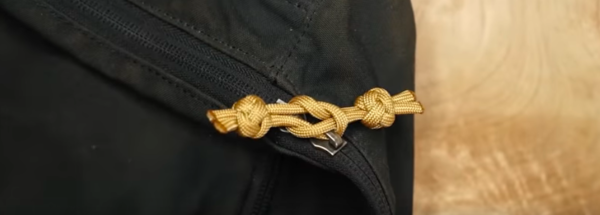
Hassle-based theft deterence.
This nifty knot “lock” using diamond knots in paracord won’t prevent a determined thief from getting into your backpack, but it offers just enough annoyance in figuring it out and opening it, that it will deter the quick pick-pocket from boosting your stash. And, it looks cool!
Testing Torx Bits

A little bit wobble is a good thing.
Todd at Project Farm strikes again with a series of tests to gauge the efficiency, hardness, and wear on 12 different brands of Torx (star) bits. In the end, pound for pound, he concludes that the DeWalt bits offered a really well-made and easy to drive bit at a reasonable price (.40 each). Also, the Makita bits (.67 each) fared well in the testing.
TOYS!

It’s two, two, two tools in one!
I’ve never used these lineman’s pliers, but recently, I’ve seen several makers raving about them on social media, so I thought I’d share. They combine a pair of lineman’s pliers with a set of wire strippers. If any of my readers have experience with these, I’d love to hear.
Life Hacks: What Has It Got In Its Pocketses?
I suck at organization. And even organized thinking. So, like a lot of people, I don’t think about what I stuff into my pockets and where. I usually carry a wallet, phone, pen, pocket notebook, gum, and a handkerchief. But until recently, I paid no mind to what went where. It all just got stuffed into whatever pockets were available. Same with my sling bag. But, I finally decided after x-number of years down here on the Big Blue Marble (never you mind the number), I should start thinking through the organization of my EDC (everyday carry). With a little bit of forethought and discipline, it makes a big difference. Do you know where the contents of your pocket, purse, or backpack are?
Using Aluminum Foil as Faux Chrome on Models

Sometimes, cheap is best.
Most scale modelers and game crafters, when adding chrome accents to their models, use special products like Bare Metal Foil. This stuff is ridiculously expensive ($14 for a single 6″ x 12″ sheet!). In this video on Custom Scale Models, Brandon shows how you can get the same, some argue even better, results using the cheapest aluminum foil you can find and some white glue. You can get super thin (which is good) rolls of at the dollar store.
Shop Tales: I Told Them So!
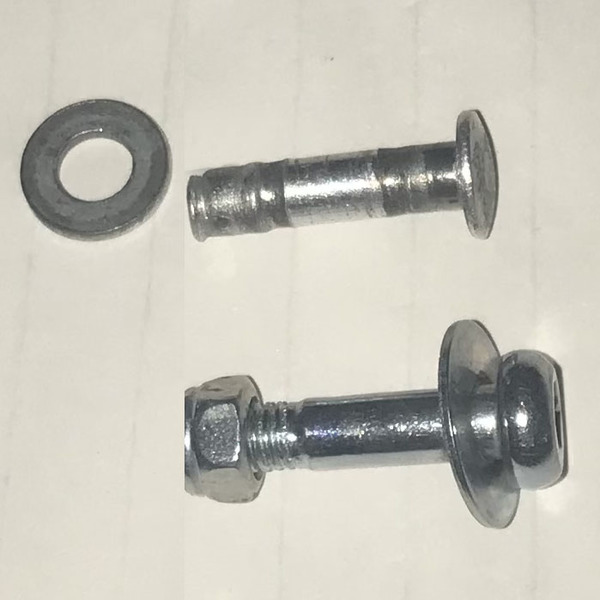
See, it pays to keep EVERYTHING.
Reader Gary A wrote in with this story. I am always all-ears with stories that validate my hoarding instincts:
Finally, after years of “Why are you saving that …?,” I’ve been vindicated! My father always put leftover screws, parts, and other components aside because he “might need them some day.” I’ve always done the same. Well, some day finally came and neither my wife nor kids have apologized yet for 50 years of chastisement!
The post at the top of the above image was a “rivet” type (aluminum) fastener which failed. Before I headed off to the hardware store, I pulled out my “I might need that one day” stash and couldn’t have been more correct. I had saved several bolts from a canopy tent that had been destroyed in the wind. The bolts were the perfect size and length to make the repair! See, I told them so!
Maker’s Muse

A resident of Hamnavoe, Shetland, Anne Eunson, knitted herself a fence using twine (the same kind used in fishing nets)
[Gareth’s Tips, Tools, and Shop Tales is published by Cool Tools Lab. To receive the newsletter a week early, sign up here.]
“Holy cow, a 42 Fly with outboards,” was Lysle Spangler’s first reaction when he saw the boat in the water for the first time. “You notice that it’s a yacht…with outboards. For me, it was, ‘Oh, my goodness. This is going to be awesome.’ ”
Regal’s new flagship model, the 42 FXO, made its debut at the Fort Lauderdale International Boat Show last October as the new kid on the block unrivaled as an overnighter, sandbar hopper, and entertainer. In other words, a coastal cruiser that can behave like a take-it-to-the-beach sport boat. With the engines up, “You can get three to four feet off the beach and almost step right onto the sand,” says Jeff Littlefield, Regal’s marketing manager.

It’s a Liveaboard
“My first impression stepping aboard was that it was going to be a lot like its sisters, the 42 Grand Coupe and the 2021 42 Fly with IPS drive,” says Spangler, Regal’s Midwest regional sales manager. “It didn’t rock or feel any different than what the boats felt like in the past in terms of stability or layout.”
The layout is the same, so the cockpit, or aft patio, has L-shaped transom seating that wraps to starboard with spacious storage underneath and a removable section that gives easy access to the gunwale to aid in docking or to reach the foredeck from the starboard side. An integrated electric smokeless grill with a solid counter cover and an undercounter fridge nestles forward of the settee to starboard and aligns with the salon galley. The cockpit and salon are on the same level, so with the double sliding glass doors open, an indoor/outdoor prep, cooking, and serving area makes a great entertainment center, especially with the interior dinette table and wraparound seating to port. In addition, a 32-inch hidden TV adds to the mix when lowered from the ceiling above the galley counter. Then again, the Fusion RA770 marine stereo system will add much more bounce. The ANT wireless stereo remote allows audio control from anywhere on the boat, including the swim platform.

A few steps down between the salon settee and the interior helm to starboard leads to an open atrium that’s a room in itself. It separates the forward stateroom with a walkaround queen island berth and the aft stateroom that features a king berth with upholstered headboard that can slide apart into twins depending on whose on board. The starboard-side head features teak in the separate shower stall, a glass vessel sink, solid-surface countertop, and mirrored cabinets above. A long window above both the head and atrium counters provides natural lighting, a water view, and an open feel to the rooms.

Besides the ingenious king berth in the aft cabin, a settee, cedar-lined armoire, and a 32-inch TV add to the comfort. The forward cabin has separate access to the head, a 32-inch TV with DVD player, a deck hatch with privacy screen, cedar hanging lockers, and a hidden pocket door for privacy.
Owners have a choice for the atrium setup to port. The refreshment center has slick, modern cabinetry that offers plenty of storage, and an optional built-in refrigerator goes below a countertop that includes a covered sink. Accent lighting adds that special ambience in the evening. The other option is a second head sans shower, which could be a tough choice to ignore.

On the Top
There are lots of advantages to having a flybridge, mainly a 360-degree unobstructed view, fresh air, and that cat-like perch from above. Access is from the cockpit via the stainless steel stairway with teak steps. The entry is covered with a large tinted acrylic hatch to protect the cockpit below during inclement weather or to keep young ones at bay.
First, the captain or owner/operator will have a full-service helm that includes a 22-inch glass cockpit display (or optional dual 16-inch displays) with autopilot and joystick steering with cruise control. There are plenty of options for the helm, including Garmin displays and HD closed array radar.
Second, the flybridge is a great place to hang out for cocktails, or the sunset, or time alone. There’s plenty of seating with a large captain’s seat, an L-shaped lounge aft to starboard, and an UltraLounge seat to port with a multi-position backrest that adjusts the seat as it slides forward to connect to the sunpad next to the helm.

The Outboard Advantage
When the IPS drives were changed to triple Yamaha 425 XTO Offshore outboards, the 42 took on a whole new life and added the moniker FXO, the “F” for flybridge. “One of the things Regal does is that we’re not just going to throw outboards on a boat,” says Spangler.
Littlefield takes it a step further. “None of our models are the same exact boat, the same exact hull with a different propulsion mounted on,” he says. “They’re completely different bottoms. The hulls are designed and optimized for whatever that propulsion is. The 42 FXO, while it looks and has a similar layout as the 42 FLY, the hull bottom is different to accommodate and optimize that outboard power.”
By changing the engines to outboards, the mechanical space is immense—full beam, 42 inches tall, six feet deep. Needless to say, there’s plenty of room for the Seakeeper, which is standard, and all the gear you want to carry.
As for performance, Spangler says that part of the conversation when he drove it the first time was that the boat had a “very sport boat feel. It was exceedingly nimble for a boat this size.” The boat went in and out of turns smoothly and never felt like it wanted to stall when going left to right or vice versa and wasn’t excessive in the roll over. “I am honestly blown away by the performance of the boat,” he adds. “Fully loaded with water, gear, and six people, we were forty-nine miles per hour top speed. It was just impressive the way the boat performed.”

Specifications
LOA: 44′
Beam: 13′
Draft, Engines Up: 2′ 9″
Draft, Engines Down: 4′ 2″
Approximate Dry Weight: 26,650 lbs.
Fuel/Water: 456/62 U.S. gals.
Max/Cruise speed: 49.4/30 mph
Price: $1,008,920 very well-equipped
Contact: Regal Boats
(407) 851-4360
Orlando, FL
regalboats.com
The post 2021 Regal 42 FXO Boat Review appeared first on Southern Boating.
YouTuber, actor, and content creator Josh Yeo created a device that he says is the world’s first ceiling-mounted, motion-controlled camera dolly that allows him to create incredible motion timelapses and cinematic video shots in a way that dramatically elevates the quality of his work.
What Yeo has designed — called the Orbit — allows for some rather impressive shots, particularly when it comes to video and timelapse. The device is simple in concept: a motor that supports two arms connects to the ceiling via a rod that is held in place by four screws. The whole apparatus hangs above whatever subject is desired and can pan or fully rotate around it.

That’s it: At its core, the Orbit is just a single-axis robot arm with a LED light that is mounted in the center. But what you can do with that single-axis does look like it can open a door to a wealth of possibilities.
Yeo shows the Orbit being used for timelapsing builds, stop motion, slow-motion capture, interviews, and more. While he mentions the only downside of the product is that it must be mounted to a ceiling, Yeo also shows how it is possible to use the Orbit outdoors as well with an optional kit.

Below is a film Yeo produced using the Orbit:
In designs and examples presented on his crowdfunding page, Yeo shows that one of the two arms would hold the camera in place while the other arm can be used for a variety of purposes, from standard lights, to whiteboard bounce cards, to batteries, to a second camera, to simply just a counterweight. Yeo says that he wanted the Orbit’s motor to be capable of both pretty quick speeds as well as very slow speeds to give creators a good range of possible uses.
Additionally, the Orbit needed to be absolutely silent so as to not cause audio issues when recording in quiet studios. His first prototype — which he says he built three years ago — was cobbled together using a repurposed timelapse motor (specifically a Syrp Genie). The version that he has put up on Kickstarter is significantly improved from that original design.

Part of what makes the Orbit so easy to like is due to how charismatic Yeo appears on camera, his clever editing, and the transparency he reveals in the 13.5-minute video pitch. That seems to have paid off, as at the time of publication, the Orbit was fully funded and had raised over $200,000.
As a note, buyers should be aware that this kind of camera movement is really useful, but can become stale very quickly. The orbit will best be utilized sparingly to highlight specific aspects of a project rather than be the focus of the production.
The Orbit can be backed on Kickstarter starting at $599 and has an estimated delivery date of October 2021. You can peruse all the options here.
(via DIY Photography)
Disclaimer: Make sure you do your own research into any crowdfunding project you’re considering backing. While we aim to only share legitimate and trustworthy campaigns, there’s always a real chance that you can lose your money when backing any crowdfunded project.


Has anyone lived a more interesting, influential, and inspiring life than Stewart Brand?
Born in 1938 and educated at Stanford and by the United States army, Brand was a Merry Prankster who helped conduct Ken Kesey's legendary acid tests in the 1960s. His guerilla campaign of selling buttons that asked "Why haven't we seen a photograph of the whole earth yet?" pushed NASA to release the first image of the planet from space and helped inspire the first Earth Day celebrations. From 1968 to 1971, he published the Whole Earth Catalog, which quickly became a bible to hippies on communes and techno-geeks such as Steve Jobs, who famously quoted its parting message: "Stay hungry, stay foolish."
Brand has rightly been called "the intellectual Johnny Appleseed of the counterculture." He helped shape early techno-culture and cyberspace by reporting on the personal computer revolution and interacting with many of its key figures early on. His ideas were instrumental in the creation of the Well, one of the earliest online communities and he helped found The Long Now Foundation, which seeks to lengthen and deepen the way we all think about the past and the future.
In a series of books on everything from the MIT Media Lab to how buildings learn to "eco-modernism," he has delineated a unique strain of ecological thought that embraces technology as a means of salvation and liberation rather than a destructive force that must be stopped. His current passion is Revive & Restore, an organization that is leading the "de-extinction movement" by using biotechnology to bring back plants and animals including the American Chestnut tree, the passenger pigeon, and the woolly mammoth.
Brand is the subject of the new documentary, We Are As Gods—a line from the first issue of the Whole Earth Catalog—which takes a long, critical look at his life and work. For today's podcast, Nick Gillespie talks with with Brand and the directors of the film, David Alvarado and Jason Sussberg, about his long, strange trip over the past 60 years that has taken place exclusively at the frontier of social and cultural change.

Arguments between vertical-bow hunters and crossbow hunters over what qualifies as archery equipment have been going on for 20 years. (Maybe longer if you count the Medieval Ages, when legend has it Pope Urban II banned the unholy things from being used in combat.) But particularly in the past five years, during which time crossbow developments have accelerated at breakneck speed, some have asked, “Where is the line we’re unwilling to cross if we want to still call this bowhunting?”
Would it be a crossbow that shoots 500 feet per second? Or maybe one with a digital range-finding smart scope? What about an over-and-under two-shot repeater? In 2021, crossbow manufacturers may get their answer on what the public (and state agencies) are willing to accept, because we now have all of the above. Three radically innovative crossbows from three of the biggest players in the game all promise game-changing performance and capabilities.

I’ve shot the Excalibur and the TenPoint, but I haven’t been able to get my hands on the Ravin yet. And I’ll be clear: Manufacturers either innovate and make good products for their market, or they go out of business. I don’t begrudge these companies one bit for making the products.
But it’s up to hunters and managers to decide how the products fit into hunting seasons, and in the case of crossbows, that’s an evolving question. The crossbow regs on the books now—even though they’re modern, as hunting regs go—were written when equipment like this did not exist. And so as the envelope is pushed, people are bound to ask questions. Just the other day a friend of mine, who owns a local sporting-goods store, sells some of these brands, and hunts with crossbows almost exclusively whispered to me on the side: “Sometimes we don’t know when to quit. These are going to get crossbows restricted.”
He may be right if there’s significant backlash against these particular models. They are no doubt flashy and impressive—but do they cross the line? Have we now reached a point in crossbow innovation where we we stop and say, “These are bowhunting tools, and those are not”?
I’m glad you asked, because I have an opinion on all of that.
Putting the Best New Crossbows in Context

Back in 2013, when I started reviewing crossbows for Field & Stream, it was still OK to ask things like, “Should we really be using these things during bow season?” Full inclusion of crossbows into archery seasons was becoming more common by then—but there were still embers glowing from the raging debates of the mid-2000s, and compound bow hunters still easily outnumbered crossbow hunters.
But the push to legalize crossbows for bowhunting continued, and it was largely spearheaded by crossbow manufacturers. The argument was frequently made that crossbows, like compound bows, were short-range tools that offered no significant advantage to bowhunters. But they were easier for new hunters—and aging hunters—to use, and therefore excluding them from bow seasons was counterproductive to hunter-recruitment efforts. In the face of steadily declining license sales (at least up until about April of 2020), nobody wanted that.
And so the push worked. Crossbows are now legal for use during the archery season in 28 states—and crossbow companies have sold a bunch of crossbows. In Ohio, one of the few states to differentiate crossbow vs. vertical-bow harvest data, crossbow hunters have begun to replace bowhunters in the same way that compound hunters once replaced recurve hunters. Crossbow hunters killed more than twice the deer that vertical bowhunters did in the 2019-20 season.
Still, the biological worries of full crossbow inclusion—over-harvest and timing of mature buck harvest—haven’t really happened on a scale that seems to concern wildlife managers. Wisconsin, which allowed full inclusion in 2014, published a study in 2019 that largely found crossbow inclusion to be a good thing that stabilized (and even increased) hunting license sales without negatively impacting the resource. Any drawbacks to crossbow inclusion were largely social. The study did, however, find that gun and archery hunters took fewer bucks, relative to their respective license sales, while crossbow hunters harvested more.
Gradually, the message on crossbows during bow season—especially if you work in the hunting industry—has become, there is no debate at all. If you dare question them, you’re divisive, and shame on you.
There are a few holdouts, of course. The Pope & Young Club remains steadfast in their stance on crossbows. Animals taken with them do not count in their record books, because they only recognize trophies taken with a bow and arrow. Others in the archery industry feel the same way and have told me as much—but usually only when they’ve been drinking and pulled me to the side, because they don’t want to say it in public.
I’ve written about the crossbow controversy a few times, and I’ve caught more hell than praise every time. One time a reader even told me I was a danger to the future of hunting itself for writing this piece that dared to draw some distinction between crossbows and compounds as hunting tools.
But to everyone who’s been triggered by something I’ve written on crossbows, I’d say this: Not many people have shot, hunted with, and objectively tested crossbows more than I have. I’ve evaluated flagship crossbows, alongside flagship compound bows, from every major manufacturer since 2013 (that’s 80 or 90 crossbows at least), and I hunt with them every fall. I’ve been privy to the advances in crossbows in a way that few others have. At once, I’m in awe of those advances. I appreciate good product development when I see it.
But do I have a problem with categorically including them as bowhunting equipment, with no distinction whatsoever? Yes I do. I grew up a bowhunter, and that tradition is important to me. Plus, I really get a kick out of calling b.s. when I see it. Crossbows are great hunting tools that deserve long and generous seasons all their own, outside of firearms season. But they’re not bows, and anyone who tells you the experience of hunting with the two weapons is the same either hasn’t done much of it—or is trying to sell you a crossbow.
Have 2021′s Best New Crossbows Crossed a Line?

That brings us back to the 2021 Excalibur, Ravin, and TenPoint, which seem to at least have more people doing some critical thinking along the lines of, “If we allow these during bow season, why not arrow rifles and maybe muzzleloaders too?”
But we should’ve been asking more of those questions all along. What I found in 2013, between the slowest crossbow tested that year and the fastest compound, was that there was simply no comparison between the two tools. As hunting effectiveness went, the crossbow was superior in almost every way. The fastest compound I tested that year was, according to its IBO standards, a 340-fps. Hoyt. Real world, set to my specs with a roughly 400-grain hunting arrow, it might’ve broken 300 fps. Meanwhile the very slowest crossbow of the year was a 307-fps Mission that fired a bolt heavier than my hunting arrows. The physics of such things do not lie.
And then crossbows just got better and faster. In 2014, we tested an Excalibur Matrix Mega 405 that handily broke 400 feet per second on the chronograph. In 2016, the Scorpyd Ventilator Extreme clocked 430 fps. As crossbows continued to get faster, they also became so accurate that as part of our accuracy testing procedure, we began shooting all of our groups on paper targets with a single bolt, and then measuring the groups with a digital caliper. Otherwise, we learned, we’d break all our bolts after about two groups.
Meanwhile, outside of testing them, I was playing with these crossbows at long range because I suspected they might help me kill more critters out hunting. And I was right. One spring, Executive Editor Dave Hurteau and I fanned up two Nebraska gobblers and killed them with crossbows. Mine was at 48 yards—a shot that I wouldn’t try on a turkey on my best day with a vertical bow, much less from my belly, after crawling through the brush, while holding a turkey fan, with Hurteau arguing with me the whole way (because that’s what he does).
After more and more hunting experience, I didn’t necessarily think crossbow companies were being deceptive—but I did think they were underselling the capabilities of their products because it was to their advantage. Without a clear distinction between them and compound bows, more states were likely to include them in archery seasons.
Then Ravin hit the market in 2017 with a crossbow that didn’t look like anything else. Called the R15, it was easier to cock and shoot than the competition; it punched one-hole groups, and it clocked 434 fps. in a package that wasn’t remotely as bulky as competing bows with the same performance.
Moreover, the Ravin launched with an absolutely unapologetic marketing campaign that showed two shooters, side-by-side on a bench rest shooting at a 100-yard target. One was using a scoped rifle, and the other was using an R15, and both were landing hits in the bullseye, bullets and arrows. Ravin’s tagline in print ads was, “Meet Your Next Rifle.”
It wasn’t that previous crossbows weren’t capable of the same thing. Ravin’s crossbow was really good—but it finished runner-up the following year to TenPoint, and the two brands have been neck-and-neck in our tests since (though to be fair, Ravin has won more of them).
What Ravin got right was having the balls to actually say what their crossbow could do, and then selling that message to their customers. They don’t hide it, quantify it, or apologize for it. And I’ve heard stories of 100-yard kills in the field every fall since Ravin hit the market.
Not that I condone that nonsense. But in an industry that glorifies long-range everything, it’s hard to convince people who’ve just shelled out $2,500 on a crossbow that the 100-yard reticle mark in their scope is only for shooting balloons.
The Newest Crossbows Are Just a Little More of the Same
While I’ve certainly noticed the buzz around the new 2021 crossbows, they haven’t surprised me, and I’m not convinced that they represent a radical new performance standard. Five hundred feet per second from the R500 is indeed crazy fast, but it’s only 30 fps faster than the TenPoint Vapor RS470, which we tested a year ago. I can’t tell you the drop on that at 100 yards, but according to a ballistics table by the North American Crossbow Federation, a 450-fps bolt drops 71 inches at that distance. I know I’ve shot slower crossbows at 100 yards, and it’s not really a big challenge with a good rest. In fact, if you pair your scope with your rangefinder and spend time practicing, just about anyone can shoot good groups at 100 yards with a decent crossbow. It’s not the extra speed that makes all the difference.
On the other hand, a 500 fps crossbow is roughly 170 fps faster than the fastest hunting compound bow we tested last year(at IBO specs), and it produces more than double the kinetic energy. So, there’s that.
The TenPoint Vapor RS470 XERO with the added Garmin XERO X1i rangefinding scope is way cool—and the bow itself is more than capable of tight 100-yard groups (it finished runner-up in last year’s test). But my 45 minutes of experience with the smart scope setup showed there to be a learning curve, with more buttons and features than I’d personally care to mess with in the field (and a reticle that was tough to see in bright sun). I’m not discounting it because I didn’t get to use it long enough to call it a real evaluation, but I don’t think it’s the system every crossbow hunter will gravitate to, either. Master that scope, and it certainly provides an advantage, but it’s the crossbow, more than the scope, that I’d compare to a vertical bow. You can, after all, get a Garmin XERO A1 range-finding sight for your compound if you’re so inclined.
The Excalibur TwinStrike is at once the simplest of the designs but also, in my opinion, the one that actually provides the biggest practical advantage to hunters: a rapid follow-up shot. I thought a crossbow with two sets of limbs, two strings, and two triggers with string catches would be comically cumbersome. But instead, because of the recurve design, it looks rather like a sleek, split-limb compound up front. It’s wider axle-to-axle than either the TenPoint or Ravin, of course, but it’s also a good bit lighter than either of those. It doesn’t offer near the speed (360 fps advertised) as the other two, nor the power due to the light, 350-grain bolts. But again, if you’ve hunted much with a crossbow, you know that lack of power, even from the “puny” ones, isn’t an issue. And in a delightfully ironic twist, when I compared the in-the-field hunting effectiveness of compound bows to crossbows in 2013, the speed of the follow-up shot was the only category in which the compound bow had an advantage. I even used an Excalibur crossbow for that test. You can see it right there in the picture, along with the magnificent sideburns I was once capable of growing. Two shots in one second kinda put that category to bed now.
All said, each of these crossbows are expensive—the Excalibur is $2,000, the Ravin is $3,350, and the TenPoint is $4,050. That alone limits how many of them will find their way to the deer woods and make a real impact. But do they offer a significant advantage over a compound bow, as the original argument for their inclusion was framed? Do they cross the line of what can reasonably be deemed archery equipment? Of course they do. But there’s not much use hand wringing over it, because we already crossed that line years ago.

When it was first announced that limits would be placed on recreational RC aircraft heavier than 250 grams, many assumed the new rules meant an end to home built quadcopters. But manufacturers rose to the challenge, and started developing incredibly small and lightweight versions of their hardware. Today, building and flying ultra-lightweight quadcopters with first person view (FPV) cameras has become a dedicated hobby onto itself.
But as impressive as those featherweight flyers might be, the CogniFly Project is really pushing what we thought was possible in this weight class. Designed as a platform for experimenting with artificially intelligent drones, this open source quadcopter is packing a Raspberry Pi Zero and Google’s AIY Vision Kit so it can perform computationally complex tasks such as image recognition while airborne. In case any of those experiments take an unexpected turn, it’s also been enclosed in a unique flexible frame that makes it exceptionally resilient to crash damage. As you can see in the video after the break, even after flying directly into a wall, the CogniFly can continue on its way as if nothing ever happened.
With the help of a level shifter, the Raspberry Pi can communicate directly with the quadcopter’s flight controller over UART. A Python library developed by the CogniFly team allows the Pi to give commands to the flight controller using MSP (MultiWii Serial Protocol), which when combined with the other onboard sensors to detect altitude and relative motion, means there’s little left for a human pilot to do.

The CogniFly is wrapped up in a unique frame that not only protects all of its high-tech gear, but makes sure the spinning propellers are kept far enough away from the edges that they won’t hit anything (or anyone) in a crash. Rather than make it out of something entirely rigid, the team came up with a clever construction technique that combines flexible TPU connectors with carbon fiber rods.
The TPU pieces can be printed flat on an inexpensive 3D printer, and then folded into position for assembly. Should any of the frame components break in a particularly energetic impact, it can be quickly and easily repaired in the field with a small stock of spare parts.
Looking ahead, the team has designed the frame in such a way that the CogniFly will be able to land on a rotary battery changer when it needs a fresh pack. There’s not a whole lot of prior art for automatic battery swaps in the hacker and maker ecosystem, and given how ambitious their concept is, we’re very interested to see how this element of the project progresses.
The CogniFly is a particularly compelling platform for anyone looking to experiment with autonomous flying, and the fact that it’s light enough to sidestep most drone laws is huge for the hobbyist crowd. You might think that by 2021 we’d already seen every kind of quadcopter imaginable, but occasionally new designs still pop up that prove there’s still plenty of room for innovation.
Squirrels had been a significant item of diet all the way back to our country’s beginning. Here are a few scrumptious squirrel recipes with “all the fixins.” One of the favorite family meals when I was a youngster was squirrel with all the fixins. That usually meant squirrel recipes served with baked sweet potatoes, gravy,…
The post Scrumptious Squirrel Recipes appeared first on Sporting Classics Daily.
Fort Worth, Texas, may have earned the nickname “Cowtown” with its booming nineteenth century cattle industry, but local chef Bria Downey thinks the moniker also aptly describes the way the city has historically eaten. “Up until about five years ago, Fort Worth was a very steak and potatoes kind of place,” Downey says. “But now we’re starting to get more ethnic food, fresh pasta places, great seafood, mom-and-pop shops, and people butchering their own stuff.”
Downey has been part of that revolution herself. A San Antonio native, she grew up bouncing around the country with her military family before returning to Texas for college and culinary school. She moved to Fort Worth in 2013 to open Bird Café and later transitioned to a position as executive chef at Clay Pigeon, where she was named a James Beard semifinalist last spring just before COVID closed the restaurant and left her jobless—although not for long.
This spring, Downey will reopen Roy Pope Grocery, which had been a Fort Worth mainstay since the 1940s until shuttering last year. The new iteration will sell gourmet spices, meats, and dry goods, while offering daily blue-plate specials made with the ingredients on the shelves and whatever’s fresh in season. “One day we’ll have lasagna, and the next we’ll have meatloaf smoked on a five-hundred-gallon smoker out back,” Downey says. “You can buy a fresh slice right off the smoker, a raw piece to take home and bake yourself, or a packaged meal with sides to reheat. And if you really like a spicy pepper I’ve used, it will be on aisle three.”
The pandemic has undeniably changed the restaurant landscape, and that’s something Downey has focused on while crafting the spot. “I’ve been trying to take it a step backward and show people that you can accomplish the same things I make in my kitchen on your own,” she says.
Downey thinks that spirit of helping neighbors through hard times represents the city’s culinary scene. “Everyone is interested in lifting each other up and making everyone in Fort Worth better,” she says. Here are five spots she says embody Cowtown’s new appetite.
Four Sisters
1001 S. Main Street, Suite 151
“This is a small Vietnamese place that my friend Tuan Pham owns. He named it after his four sisters, and each sister has a specialty cocktail named after her. I love their fried tofu dish. Normally fried tofu is super heavy, but this one is light and fluffy and crunchy. It’s on point.”

Tulips FTW
112 St. Louis Avenue
“Tulips is a new concert venue off St. Louis Avenue. They have great cocktails on tap: the Mai-Tro, which is a Mai Tai with coconut water and rum, and the Sunny Day, Night People, which is bourbon and coffee. It opened in November as a small concert venue—if there weren’t COVID precautions, they could seat about six hundred people, but with the limitations it’s just a little over one hundred. They have live music every night. Big Mike, who is kind of a celebrity around here, plays every Tuesday. People in the crowd can scream a song to him to play. They try to trip him up but somehow he knows all of them.”

Enchiladas Olé
2418 Forest Park Boulevard
“This is female-run and recently reopened. It’s been in owner Mary Perez’s family for years and years. It’s a cheap and tasty Mexican place—exactly what you want.”

Salsa Limón
5012 White Settlement Road
“They have lots of locations, but my favorite has a great patio and looks kind of like a silver Airstream trailer. I get their torta with barbacoa and they make a great sour margarita with fresh lime juice and Sprite, so it has bubbles, which I love.”

“Kevin Martinez is the chef at Tokyo Café, but he also runs a food truck called Yatai Food Kart with incredible ramen. He pops up at breweries and stuff. He’s the baddest all around. During the pandemic, he was doing to-go food on Sundays, and he would get local chefs to donate food and pass it out to whomever needed it.”

The post Eat Like a Local in Fort Worth appeared first on Garden & Gun.
Tracklist: 1. Choo Choo Train 2. (Sweet, Sweet Baby) Since You've Been Gone 3. Stoned Soul Picnic 4. Mighty Quinn (Quinn, The Eskimo) 5. La La (Means I Love You) 6. I Thank You 7. Lady Madonna 8. Sunday Morning 9....
This item belongs to: audio/album_recordings.
This item has files of the following types: 24bit Flac, Archive BitTorrent, Columbia Peaks, DjVuTXT, Djvu XML, Generic Raw Book Zip, Item Image, Item Tile, JSON, MP3 Sample, Metadata, OCR Page Index, OCR Search Text, PNG, Page Numbers JSON, Scandata, Scandata JSON, Segment Data, Single Page Processed JP2 ZIP, Spectrogram, Text PDF, Unknown, VBR MP3, chOCR, hOCR
When the pandemic-sponsored dust settles, I truly hope America’s archetypical steakhouses, those beloved palaces of gluttony, will be left standing. I would truly miss New York City’s clubby Delmonico’s, the oldest restaurant in the country. The Palm (multiple locations), with its cartoonish portraits (painted directly on the walls) of celebrities and politicians. The Cut in Los Angeles. Gibson’s Bar and Steakhouse in Chicago, where the martinis are as memorable as the Prime Angus. And all the unassuming family-owned steakhouses in the Heartland with their signature steaks, salad bars, and chatty waitstaffs.
I wouldn’t just miss the steaks, always cooked to sanguine perfection. I’d miss the cocktails, the appetizers and side dishes, the rich desserts—professionally-rendered Manhattans (preferably with Luxardo cherries), deftly dressed Caesar or wedge salads, tiered towers of iced shellfish, loaded baked potatoes, decadent bowls of creamed spinach, sautéed mushrooms, New York-style cheesecake.
But, just as you can cook spectacular steaks on your grill—especially now since Prime meats are often available online—you can replicate some of steakhouses’ most popular accompaniments at home, too. Here are some of our nominees.
Smoky Manhattan: As our friend Dave Stolte says, “A properly made Manhattan is truly a thing of beauty, capturing balance, excitement, and depth in four quick sips while priming your appetite for the evening ahead.” (Dave is the author of the just-released Home Bar Basics. Find more of his inspired grilled and smoked cocktails here.
Smoke-Roasted Oysters and Clams: Bacon, butter, jalapenos, and white wine combine to seduce even people who don’t think they like oysters and clams. Alternatively, serve a grilled shrimp cocktail.
Grilled Caesar Salad: Steven claims a Caesar salad was one of the first recipes he ever learned to make, and his expertise shines through in this recipe, first published in BBQ USA. Romaine lettuce is exposed to live fire just long enough to give it a hauntingly good smoke flavor while leaving it raw and crisp. It’s been a favorite at Barbecue University for years.
Grilled Breadsticks: Serve with the Caesar Salad above, but be sure to make extra as these batons of grilled bread are sure to be a hit.
Anchovy Cream: In the spirit of American steakhouses, long known for their heavy handedness with cream and butter, comes this umami-rich flavor bomb. Drizzle it over your steak (Steven recommends dry-brined rib-eyes) for a truly transcendent experience. Think you don’t like anchovies? We beg you—just try this recipe.
Hasselback Potatoes: Steakhouse potatoes are often large enough to challenge the passing skills of Tom Brady or Patrick Mahomes. Hasselbacks, named for the Swedish hotel and restaurant where they were invented, can be—if you want—smaller, but just as sexy. A series of parallel cuts are made through the side of the potato before smoke-roasting with butter and Parm. The outside of the potato is crusty while the inside is creamy. You’ll make these again and again.
Roasted Red Pepper Salad with Feta, Capers, and Pine Nuts: Even if you served a Caesar salad (see above) as one of the first courses in a steakhouse-style meal, this combination looks absolutely stunning on the plate. Especially if your garden, farmers’ market, or supermarket yields an array of colorful bell peppers. Steven first discovered it in Italy, where it’s called“Peperoni ai Ferri con Capperi e Pinoli.”
Smoked Cheesecake with Burnt Sugar Cream Sauce: This swoon-worthy dessert was the crown jewel in a sumptuous dinner we put together on the set of Project Smoke several years ago to celebrate Steven’s March birthday. Cheesecake is usually bake din a pan of simmering water, which cooks the filling while preventing it from cracking or curdling. In other words, low, slow, and moist. So naturally, we baked it in a smoker. The smoke gives the cheesecake an intriguing flavor—familiar, yet exotic.
The post Eight Delectable Side Dishes For Grilled Steak appeared first on Barbecuebible.com.
Chicken wings are one of my favorites. They are great as an appetizer or a meal, depending on how many you eat. And there are so many creative ways to cook and flavor wings. Most people have a favorite cooking method and favorite seasoning or sauce for their wings. I find the most difficult part of making wings is deciding what style or flavor to make.
My wife and I discussed our menu for the recent Super Bowl; we agreed on wings. I struggled to narrow down my choices, so I made wings three ways.
Here are the preparations I decided on and the tasty results. Think of this as “Wings of the World.” Each wing style comes from a specific part of Planet Barbecue and has its own story.
One of my favorites is also one of the most famous wings…Buffalo-style. Wings in a peppery hot sauce started at the Anchor Bar in Buffalo, New York, in 1964. Co-owner Teressa Bellissmo cooked wings (free from her meat supplier) in hot sauce for her college-aged son and his friends. The late-night snack was added to the menu the next day and the “Buffalo” wing was born. The Super Bowl was the perfect opportunity to make my own Buffalo wings.
The second batch of wings were flavored with a teriyaki and tangerine marinade. While working as the fire wrangler on Season 2 of Project Fire, I watched Steven make Teriyaki Tangerine Chicken. It looked and smelled delicious: I knew I wanted to try this when I got home. I first put the marinade on chicken thighs, but knew it would be great on wings. The marinade is a fusion of Asian and Caribbean flavors.
The inspiration for the Salt and Lemon Pepper Wings with Chimichurri Sauce came from a cooking failure. Recently, I tried to make salt-crusted wings just as cookbook author and celebrity chef Francis Mallmann would do with a whole chicken or fish on an infiernillo. I seasoned the wings with lemon pepper, encased them in a salt crust, and cooked them in a Big Green Egg XL for about an hour. The wings were way too salty, but I could see how the flavors would work on wings without the crust. I think of these as Argentinean wings.

To prepare the three versions of wings, I separated whole wings into flats and drumettes (discard the tips or save them for stock), and then divided them among resealable plastic bags. The marinade or seasonings were added to the wings and then they were refrigerated overnight.
The Buffalo marinade consisted of homemade hot sauce (or you can use your favorite Louisiana-style hot sauce), Worcestershire sauce, lemon juice, pepper, garlic, and white vinegar. Use Steven’s Buffa-Que wing recipe as a guide. All ingredients were mixed in a bowl and then poured over the wings in the bags.
The teriyaki tangerine marinade was made as is detailed in Steven’s recipe.
The Salt and Lemon Pepper Wings were seasoned with kosher salt and homemade lemon pepper seasoning. I used the lemon pepper since I like to use lemon juice in my chimichurri instead of vinegar. It adds a bright acidic freshness to the chopped herbs in the chimichurri.
I set-up a kettle grill for indirect grilling and heated it to medium-high. The high temperature crisps the skin on the wings. While the wings cooked, I prepared the chimichurri. I finely chopped fresh parsley, oregano, and garlic. I then added the zest and juice of 2 lemons and mixed in olive oil. The Buffalo glaze was made by melting a stick of butter and adding ½ cup of the Buffalo-style hot sauce. The teriyaki tangerine marinade is strained and then boiled for 10 minutes until it reduces to a syrupy consistency. I basted the wings with their specific sauce or glaze 30 minutes into the cook. The second baste was at 40 minutes, and the wings were removed at 45 minutes.
Now for the results. I enjoyed them all and it was hard to pick a winner.
The Salt and Lemon Pepper Wings were the crispiest of the wings. The crispy skin created a great bite contrasted with the juicy inside. The herbs and lemon in the chimichurri added a boost of freshness to the wings. I will definitely make these again.
The Buffalo wings had a nice kick but were not overwhelmingly hot. I went easy with the amount of the spice with the Buffalo wings since my wife does not like spicy food. She has never had a Buffalo wing and does not like blue cheese. The Buffalo wings were crispy, tender, and had a nice balance of flavor and heat. The perfect bite was created when you dipped the wing in the homemade blue cheese dressing. I followed Steven’s Maytag Blue Cheese recipe. You will want to scoop the dressing with the leftover bones to get more blue cheese!
The teriyaki tangerine wings started to take on a dark color from the marinade. The wings developed a caramelized exterior that become more intense as the wings were basted. The tangerine juice and the aromatics created a fragrant aroma. The honey, soy sauce, and the bronzed skin created the perfect sweet, salty, crispy, and luscious bite.
I struggled to pick a winner. I had not made Buffalo wings in years and was really looking forward to trying the wings with the homemade blue cheese sauce. The salt and lemon pepper wings were so crispy, flavorful, and nothing like my salt-crusted failure. The caramelized sweet-salty exterior took the teriyaki-tangerine wings over the top.
And the winner was? My wife’s favorite was a total surprise…the Buffalo wings with the blue cheese dressing. I will make each of these wings again, but my big win was that my wife is now a Buffalo wing fan! I challenge you to experiment with a new cooking method, try a new marinade, or a new spice rub the next time you make wings.
The post Chicken Wings of the World appeared first on Barbecuebible.com.