Tags: Pythagorean theorem
369 points, 22 comments.

Most of us may have gratefully abandoned the floppy disk a decade or more since, but even today many PCs and their operating systems retain the ability to deal with these data storage relics. The PC was widely fitted with either 5.25″ or 3.5″ disk drives, but other formats such as the older 8″ discs were not a fixture in the 16-bit desktop computing world. It’s something [Jozef Bogin] has taken aim at, with his exploits in connecting a variety of 8″ drives to a PC.
In the early 1970s there were a variety of different 8″ drive standards that weren’t all entirely compatible, but a de facto standard emerged as clones of the Shuggart drives used by IBM. It’s a modified version of this interface that can be found in a PC floppy controller. While there is enough electrical compatibility to connect the two there remains a variety of connectors used on the drives. There are also a wide range of power supplies, with drives requiring 5, 12, and 24 volts, and some of them even requiring AC mains with different versions for 50Hz and 60Hz mains frequencies.
With an 8″ drive hooked up to a PC, how might DOS, or even older Windows versions, interface with it? To that end he’s created a piece of software called 8format, which not only allows 8″ disks to be formatted for the PC, but also provides a driver that replaces the BIOS floppy settings for these drives. This doesn’t work for imaging disks from other older platforms, but he provides pointers to more capable floppy controllers for that.
If these drives interest you, there’s more to be gleaned from a tale of interfacing them with 8-bit retrocomputers.
From Long Lake Township v. Maxon, decided March 18 by the Michigan Court of Appeals (Judge Kathleen Jansen joined by Judge Amy Ronayne Krause):
In 2008, the parties litigated an alleged violation of the Long Lake Township Ordinance by defendants. That proceeding culminated in a settlement agreement …. In 2018, plaintiff filed the instant civil action, alleging that defendants had "significantly increased the scope of the junk cars and other junk material being kept on their property" since entering into the 2008 Agreement, and that such activity "constitut[ed] an illegal salvage or junk yard" in violation of the Long Lake Township Zoning Ordinance. In support of these allegations, plaintiff attached aerial photographs taken in 2010, 2016, 2017, and 2018. These photographs showed a "significant increase in the amount of junk being stored on [d]efendants' property."
Defendants moved to suppress the aerial photographs and "all evidence obtained by [p]laintiff from its illegal search of their property." Defendants argued that the aerial surveillance of their property, and the photographs taken by the drones of their property and the surrounding area, constituted an unlawful search in violation of the Fourth Amendment.
Defendants argued that the instant case is distinguishable from precedent involving manned aerial surveillance because, unlike fixed wing aircraft and helicopters which "routinely fly over a person's property," drones are equipped with "high power cameras" and do not operate at the same altitudes as airplanes and helicopters. Additionally, defendants argued that a person can reasonably anticipate being observed from the air by a fixed wing aircraft, but aerial surveillance from a drone flying over private property and taking photographs is not a reasonable expectation. Moreover, defendants noted that plaintiff's drone surveillance did not comply with Federal Aviation Administration (FAA) regulations. We note that photographs in the record clearly show that very little, if any, of defendants' property is visible from the ground, due to a combination of buildings and trees….
This is ostensibly a civil proceeding…. However, the Fourth Amendment may protect parties from unreasonable searches and seizures committed by a governmental entity in civil cases, if the civil case can be considered "quasi-criminal" and the search or seizure was committed by the governmental entity pursuing the action. Kivela v. Dep't of Treasury (Mich. 1995) (discussing a test for the admissibility of evidence illegally seized by police for a criminal proceeding in an independent subsequent tax proceeding); People v. Gentner, Inc. (Mich. App. 2004); see also Camara v. Muni. Court of City and Co. of San Francisco (1967) (holding that administrative searches implicate the Fourth Amendment even if the searches are not criminal in nature, albeit subject to less exacting requirements to establish probable cause)….
The purpose of this litigation is to obtain a declaratory judgment that defendants' use of their own property is illegal. Considering the great historical importance placed on the freedom to use one's own property, and the fact that the consequences of this action may entail far more than merely the imposition of money damages, we conclude that this is the kind of proceeding to which the Fourth Amendment may apply. Further supporting this conclusion is MCL 259.322(3), which expressly prohibits the use of a drone to "capture photographs, video, or audio recordings of an individual in a manner that would invade the individual's reasonable expectation of privacy."
In Kyllo v. United States (2001), Justice Scalia [wrote]:
… The present case involves officers on a public street engaged in more than naked-eye surveillance of a home. We have previously reserved judgment as to how much technological enhancement of ordinary perception from such a vantage point, if any, is too much. While we upheld enhanced aerial photography of an industrial complex in Dow Chemical, we noted that we found "it important that this is not an area immediately adjacent to a private home, where privacy expectations are most heightened." …
Critically for the instant matter, the Court opined that mere existence and availability of technological advancements should not be per se determinative of what privacy expectations society should continue to recognize as reasonable. Although again discussing only privacy within the home, the Court emphasized that the homeowner should not be "at the mercy of advancing technology" that might eventually be able to see directly through walls outright. The development of historically-novel ways to conduct unprecedented levels of surveillance at trivial expense does not per se reduce what society and the law will recognize as a reasonable expectation of privacy.
In California v. Ciraolo (1986), the United States Supreme Court determined "whether the Fourth Amendment is violated by aerial observation without a warrant from an altitude of 1,000 feet of a fenced-in backyard within the curtilage of a home." In that case, a law enforcement officer used an airplane, flown at an altitude of 1,000 feet, to observe the respondent's yard, which was next to the respondent's home and enclosed by a fence. The officer identified marijuana plants in the respondent's yard and used a camera to photograph the area, and the images were used to secure a warrant…. The Court determined that the officer's observations took place within public navigable airspace, in a physically nonintrusive matter, and that "[a]ny member of the public flying in [the] airspace who glanced down could have seen everything that these officers observed." The United States Supreme Court concluded, "[i]n an age where private and commercial flight in the public airways is routine, it is unreasonable for respondent to expect that his marijuana plants were constitutionally protected from being observed with the naked eye from an altitude of 1,000 feet."
Only a few years later, in Florida v. Riley (1989), the United States Supreme Court held, in a plurality opinion, that police observation of a greenhouse, located in respondent Riley's curtilage, from a helicopter at an altitude of 400 feet did not violate the Fourth Amendment….
As defendants tacitly concede, Ciraolo and Riley establish that defendants could not have reasonably expected the activities and items on their property to be protected from public or official observation made by a human being from the publicly navigable airspace. Conversely, unrefuted photographic exhibits of defendants' property taken from the ground seem to establish a reasonable expectation of privacy against at least casual observation from a non-aerial vantage point. We conclude that; much like the infrared imaging device discussed in Kyllo; low-altitude, unmanned, specifically-targeted drone surveillance of a private individual's property is qualitatively different from the kinds of human-operated aircraft overflights permitted by Ciraolo and Riley. We conclude that drone surveillance of this nature intrudes into persons' reasonable expectations of privacy, so such surveillance implicates the Fourth Amendment and is illegal without a warrant or a traditional exception to the warrant requirement.
Although noncompliance with FAA regulations does not establish a Fourth Amendment violation, such regulations are relevant to what a person might reasonably expect to occur overhead. Persons may, absent extraordinary circumstances, reasonably expect the law to be followed, even if they know the law is readily capable of being violated.
The FAA regulations require drone operators to keep drones within visual observation at all times, fly drones no higher than 400 feet, refrain from flying drones over human beings, and obtain a certification. Such rules reflect the fact that drones are qualitatively different from airplanes and helicopters: they are vastly smaller and operate within little more than a football field's distance from the ground. A drone is therefore necessarily more intrusive into a person's private space than would be an airplane overflight.
Furthermore, unlike airplanes, which routinely fly overhead for purposes unrelated to intentionally-targeted surveillance, drone overflights are not as commonplace, as inadvertent, or as costly. In other words, drones are intrinsically more targeted in nature than airplanes and intrinsically much easier to deploy. Furthermore, given their maneuverability, speed, and stealth, drones are—like thermal imaging devices—capable of drastically exceeding the kind of human limitations that would have been expected by the Framers not just in degree, but in kind.
Although the United States Supreme Court rejected the ancient understanding that land ownership extended upwards forever, landowners are still entitled to ownership of some airspace above their properties, such that intrusions into that airspace will constitute a trespass no different from an intrusion upon the land itself. Drones fly below what is usually considered public or navigable airspace. Consequently, flying them at legal altitudes over another person's property without permission or a warrant would reasonably be expected to constitute a trespass.
We do not decide whether nonpermissive drone overflights necessarily are trespassory, because we need not decide that issue. Although a physical trespass by a governmental entity may constitute a violation of the Fourth Amendment, a trespass into an open field might not implicate the Fourth Amendment. Furthermore, we think there is little meaningful distinction for present purposes between "just inside the property line" and "just outside the property line."
We decide this matter based upon defendants' reasonable expectation of privacy—critical to which is that any reasonable person would have expected a low-altitude drone overflight to be trespassory and exceptional, whether the drone flew as high as a football-field length or flew directly up to an open bathroom window. The Legislature has already stated that drones may not be used to violate a reasonable expectation of privacy, MCL 259.322(3), or to perform an act that would be illegal if performed by the operator in person, MCL 259.320(1)….
We also observe that plaintiff's warrantless surveillance was totally unnecessary. The parties could easily have—and likely should have—included a monitoring or inspection provision in their settlement agreement. Aside from that, as the United States Supreme Court observed, the quantum of evidence necessary to establish probable cause to conduct an administrative inspection is more than "none," but is less than what might be required to execute a criminal search warrant.
By plaintiff's own account, it had concrete evidence, in the form of unrelated site inspection photographs and complaints from defendants' neighbors, that defendants were violating the settlement agreement, violating the zoning ordinance, and creating a nuisance. Our holding today is highly unlikely to preclude any legitimate governmental inspection or enforcement action short of outright "fishing expeditions." If a governmental entity has any kind of nontrivial and objective reason to believe there would be value in flying a drone over a person's property, as did plaintiff here, then we trust the entity will probably be able to persuade a court to grant a warrant or equivalent permission to conduct a search….
Judge Karen M. Fort Hood dissented, arguing that Ciraolo and Riley were controlling here, and Kyllo didn't apply because drones were indeed in common use:
[D]rones are generally widely available to the public {[t]here were 873,144 drones registered with the FAA as of February 2021}, there is reason to believe that the public commonly flies them at altitudes of 400 feet and below, and there is no evidence in this case that the drone in question was flying at a particularly invasive altitude or in a particularly invasive manner, or that the drone contained or used any particularly invasive technology. Similar to Ciraolo and Riley, there is reason to believe that any member of the public could have used their own drone and plainly viewed the property at issue in this case…. I would emphasize the common availability and use of drones by the public in determining whether defendants had a reasonable expectation of privacy in this case. That, in conjunction with whether the drone in this case was lawfully deployed in the public airspace, should control over our policy concerns with respect to how drones may be operated in future cases….
The fundamental principle from both Ciraolo and Riley is that the property observed in those cases was observable by commercial and public aircraft in the publicly navigable airspace, and the fundamental difference between those two cases and Kyllo was that the technology in Kyllo was not something that could be reasonably expected to be employed by members of the public. On that basis, I would conclude that no Fourth-Amendment violation occurred in this case, and I would affirm the trial court's order denying defendants' motion to suppress.

BETHESDA, Md. — The old adage claiming alcohol “goes straight to the head” is actually true according to new research. Scientists say booze breaks down in the brain, rather than the liver. The finding turns previous theories upside down and scientists believe it holds the key to combating binge drinking and alcoholism. Researchers hope the…
The post Why you get tipsy after just one drink: Scientists say alcohol really does go straight to the head! appeared first on Study Finds.
 |
submitted by /u/paulrobinsonauthor [link] [comments] |

Most people associate the British parliament with the Palace of Westminster, the iconic home of the green benches and Big Ben. While the palace on the Thames has hosted parliaments since the 12th-century, it's not an exclusive host.
Long before the United Kingdom existed, medieval England was ruled as an absolute monarchy, and parliament was convened at the pleasure of the king in whatever location was convenient. Times of crisis led to parliament being convened in some unusual locations.
Sherwood Forest is of course best known for the legend of Robin Hood. Thanks to Sir Walter Scott's classic Ivanhoe, as well as Hollywood, King John has become a major character in the Robin Hood story. John and his villainous henchman the Sheriff of Nottingham are the renowned antagonists in the modern version of the legend. However, King John does have a real association with Sherwood.
A 12th-century royal hunting lodge at nearby King's Clipstone is now known as King John's Palace, and served as the residence of English royalty within Sherwood for centuries, being visited by at least eight kings. While John was in residence in 1212, he was informed about a rebel uprising in Wales. To respond to the situation, it's believed that John hastily-convened parliament under the branches of an oak tree near his palace in the forest.
Parliament was again convened at the same location in 1290 during the reign of John's grandson, King Edward I. Historians are more certain about this parliament, and it's likely that the name Parliament Oak stems from this occasion.
Like its neighbor, the Major Oak, the tree itself is believed to be at least 1,000 years old. While it's not as big as it was at its peak, an impressive 25 feet in diameter, it has undergone a resurgence thanks to the efforts of conservationists. It remains an impressive sight to this day, as well as a location of historic political importance.

There are so, so many.

We normally think of atomic clocks as the gold standard in timekeeping. The very definition of a second — in modern times, at least — is 9,192,631,770 periods of the radiation corresponding to the transition between the two hyperfine levels of the ground state of a stationary cesium-133 atom at a temperature of 0K. But there is a move to replace that definition using optical clocks that are 100 times more accurate than a standard atomic clock.
In recent news, the Boulder Atomic Clock Optical Network — otherwise known as BACON — compared times from three optical clocks and found that the times differed a little more than they had predicted, but the clocks were still amazingly accurate relative to each other. Some of the links used optical fibers, a method used before. But there were also links carried by lasers aimed from one facility to another. The lasers, however didn’t work during a snowstorm, but when they did work the results were comparable to the optical fiber method.
A standard atomic clock takes a beam of atoms that are in two states and uses a magnetic field to remove all the atoms in one state. The remaining atoms are subjected to a microwave signal which causes some of the atoms to flip to the opposite state. Another magnetic field removes one state and the remaining atoms are counted. When the microwave signal exactly matches the material’s resonance frequency — 9.192631770 GHz, in the case of cesium — the number of atoms changing state will be at a maximum, so you know when you’ve hit the right frequency.
Optical clocks such as the aluminum ion, ytterbium, and strontium clocks have much higher resonance frequencies, high enough to be in the spectrum of light. This allows a much more precise frequency in the same way that a ruler with 32 marks will be more precise than the same ruler with 4 marks. While a cesium clock may be off one second in 100 million years, the optical clocks will take 15 billion years to have the same magnitude of inaccuracy.
If you want to build your own clock, you might start with rubidium at a less accurate 6.8 GHz. If you want to know more about how atomic clocks work, we have just the video for you.
You have to be careful what you say in meetings. We were yukking it up over unlikely Top 10 ideas the other day, when I threw out “Most Revolutionary Harleys.” A few weeks later, here we are. The joke’s on me. After a little investigation and contemplation, it turns out a bunch of Harleys were pretty revolutionary, in the context of Harley-Davidson at least. And when you start bagging on Harley for being a bit hidebound, you also need to step back and try to remember the last time Honda ventured outside its box? Or Suzuki? The bigger and older the company, the more things stay the same – mostly because that’s how the customer likes it. But not so much these ten things:

Photo: Lars-Göran Lindgren Wiki Commons
Stop me if you’ve heard this one before: The Model W was a new middleweight entry-level model designed to grow the motorcycle market by appealing to new riders! Its 584 cc side-valve flat-twin (like a BMW boxer but running fore-and-aft) was ahead of the game at the time: H-D’s first flathead was also its first bike with the (3-speed) gearbox inside the engine cases, which served as a stressed frame member. But all that tech meant the small Hog cost almost as much as a Big Twin. It was big in Europe! But when Indian introduced its first Scout in 1920 – faster, cheaper and cooler than the W – it was removed from the menu after 1923.

Harley-Davidson Museum Archive Photo
The Great Depression saw Harley sales plunge from 24,000 units in 1929 to 3700 by 1933, and nobody knew how bad it might still get. While there was nothing to do but worry, the MoCo developed its first overhead-valve V-twin, a 45-degree 60-inch (988cc) all-new engine with valve covers reminiscent of clenched fists. Valves were operated via push rods driven by a single, multi-lobed camshaft, and a recirculating lubrication system replaced primitive total-loss oiling. The new engine was rated at 40 horsepower. The EL framed the look for the next 85 years, right up until the present, with its chrome pushrod tubes, gas tank-mounted instruments, and that straight hardtail-line from front to rear axle. The EL pulled Harley out of the Depression, through WW2, and by 1947 the company was moving 20,000 units per year again – 11,000 of which were Knuckleheads.
(The Harley-Davidson Story: Tales from the Archives, $19, Aaron Frank)

Harley-Davidson Museum photo
H-D’s response to the British invasion of the early `50s, when Triumph, Norton, and BSA were drinking its milkshake through a big straw, was the 1952 Model K. The K was the sportiest bike Harley had ever built, and when it still couldn’t outperform the 650 British twins, the ante was upped: The 1957 Sportster XL and its new 883 cc Ironhead OHV V-twin was a match for anything English, and it got plenty of Americans to return to the home team. The Sportster was Harley’s biggest seller by 1970, introduced God knows how many youths to motorcycling, and soldiered on until ahh, sounds like this year could be its last; if so, 64 years was a helluva run.

Harley-Davidson Museum Photo
Before the Super Glide, there were big Harleys (FL touring bikes) and small Harleys (XL Sportsters). The Super Glide changed all that, mating small Harley parts (mostly the whole front fork assembly) to the big Electra Glide engine and chassis, to create what is generally agreed upon as being the first factory custom motorcycle. This Glide led directly to every Harley since that’s not a touring bike or a Sportster. Here’s Cycle magazine’s conclusion from 1970 (read the whole thing here):
Visually, like it or not, the Super Glide is a dazzler, and H-D’s commitment is a dazzling commitment. With the exception of the sickening failure of the brakes(!), the Super Glide is everything mechanically that it promises visually to be; and it will succeed in this country like no machine H-D has ever made or dreamed of making.

Photo courtesy Iconicmotorbikeauctions.com
H-D had a relationship with the Italian bike maker Aermacchi since about 1960, and at some point in the mid`70s, it couldn’t help noticing how many MX motorcycles the kids were snapping up. In 1978, the MX250 was sprung. Motocrossactionmag.com tells us around 900 were built before the plug was pulled, many of which went unsold if they were even lucky enough to have made the journey from the Italian factory. Serial #1, pictured here, made the crossing. Iconic auctioned it off at $18,500!
It is unlikely that the regular clientele at Harley dealerships was interested in dirt bikes or that motocross racers would have wandered into a Harley-Davidson dealership looking for a dirt bike. After the 1978 debacle, Harley sold Aermacchi to the Castiglioni brothers who changed the name to Cagiva… Motocross Action did not test the 1978 Harley MX250 because Harley-Davidson was afraid of critical tests (although they did advertise the bike in MXA). The retail price was $1695. – MXA

JB Archive
This one was so revolutionary it didn’t get built. Porsche built the 135-horsepower liquid-cooled DOHC V-four engine, Milwaukee did the rest. A couple dozen running engines were built and put into a dozen prototype motorcycles, which put in many dyno hours, wind-tunnel testing, and 100,000 road miles. But making the jump to putting the Nova into production, the lore goes, was too great an economic leap for H-D to be able to make at the end of the flat-broke AMF era: The hard decision was made to stay on the V-twin path and develop new Evolution V-twins instead. If there had been funding, the Nova would’ve beaten Honda’s first V45 Sabre to market by one year.

Harley-Davidson Museum photo
If the Nova was Captain Tom Hanks in Saving Private Ryan, the new FXST Softail was Private Ryan – trying hard to earn its existence under a heavy burden of guilt. The very first Softail, with twin shocks hidden under the transmission to give a hardtail look without the hardtail ride, was also one of the first Harleys with the new, all-aluminum Evolution V-twin for which command had sacrificed the entire Nova squad.
The Softail was an instant hit, and pulled the Motor Company’s wagon out of the ditch once again. From 1984 forward, Harley’s been stamping out Softails in iterations too numerous to remember, and continues to do so today (even though the Softail frame was completely revised for 2018). The FXST didn’t just revolutionize an industry, says the great Terry Roorda, it created one.
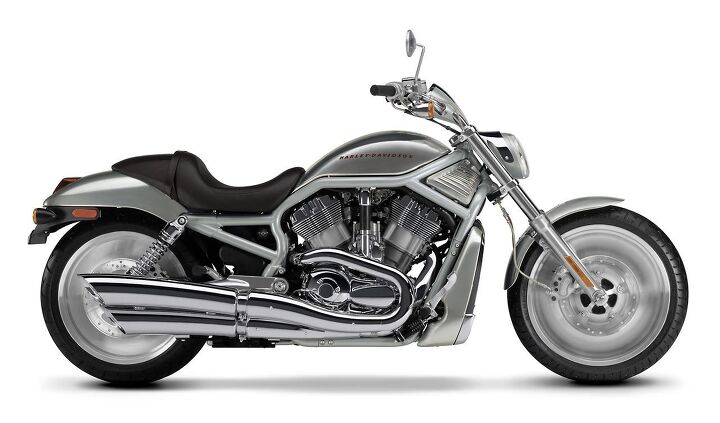
Of the first revolutionary Harley built in the MO era, we said “it’s a Harley for people who hate Harleys.” Calling again upon the Porsche connection from the Nova era, the VRSC became the first street-going H-D with a modern, DOHC liquid-cooled engine. Matter of fact, the 1131cc V-twin was called the Revolution engine, and was situated in an artistically hydroformed steel perimeter frame. Inspired by Harley’s VR1000 roadracer and by the H-D dragrace contingent, this power cruiser was also pretty good at going around corners. More to the point, for a company whose motorcycles are largely style-driven, the V Rod was a radical departure. The V Rod was liked, but not well-liked. Several variants appeared, but after the 2018 model year, the V-Rod was gone.

The official word is that Harley wants to lead the world in electric motorcycles, which is not something we would’ve expected. Our man Duke first sampled a LiveWire in June of 2014, but bikes weren’t sold to the public until 2019, which is a thing that makes you immediately say hmmmmmm… I’ve yet to spot one of the $28,000 electric wonderbikes in the SoCal wild, but then all electric motorcycles are few and far between.
New H-D CEO Jochen Zeitz is on record as being fully behind the LiveWire and Harley’s electric future. Last October, the Milwaukee Business Journal quoted Zeitz: “It’s still an emerging category so sales volumes are relative. But from what I can see through all this we actually believe that LiveWire is the best selling on-highway or dual-electric cycle in the U.S. — actually selling more than double the next-highest electric motorcycle.”

Once again between a rock and a financial hard place, H-D is swinging for the fences with an all-new model in a new-to-it market teeming with very experienced sharks in a sea of mixed metaphors. But on paper, the Pan America 1250 (and Pan America Special) look like they know exactly what they’re diving into, and they seem to be packing all the gear they need to succeed: 150 horsepower from an all-new nearly maintenance-free engine with variable valve timing, the latest in IMU-controlled electronics (and even electronic suspension on the Special), and the long-range niceties sophisticated riders expect. All of it wrapped up in a distinctive, not-too heavy package wearing what so many riders crave – that famous bar and shield logo.
Feel free to bet against the Pan America. The fun part of little historical journeys like this one is remembering how many times in the last century people have lost that bet. It’ll be fun to watch, as always.
Become a Motorcycle.com insider. Get the latest motorcycle news first by subscribing to our newsletter here.
The post Top 10 Most Revolutionary Harley-Davidsons! appeared first on Motorcycle.com.
So you want to drag your knee, huh? We get it. Scraping your knee puck on the ground looks cool, and if you’re in the business of looking cool on motorcycles like we are, then it helps provide a little bit of job security. But putting your knee on the ground is not just a way to get more likes on the ‘gram, it can also be a useful tool to gauge how far over you’re leaning your motorcycle. In this tutorial, I’ll tell you how.

If you’re going to try this, then you’re doing it at your own risk. Don’t blame us if anything goes wrong.
But first, a disclaimer. Learning and practicing any new motorcycle technique should be done in a controlled environment, like a big empty parking lot or a racetrack. Your local canyon road, or worse, your freeway on-ramp, is NOT the place to practice any motorcycle technique. Ensure your motorcycle is in proper operating condition – no leaky fluids, no bald tires, etc. – before beginning. And if we have to remind you to wear all your gear, especially knee pucks and/or protection in this case, then we highly advise you to stop reading now and not try this at all. Lastly, Motorcycle.com accepts ZERO responsibility for any harm, damage, or injury that may occur to you, your motorcycle, or other property. You, and you alone, are responsible for your actions.
For the sake of this guide, we’ll assume you’re riding a sportbike or a sporty-type motorcycle. Basically, cruisers need not apply, though we’ve seen cruiser riders get their knee on the ground on occasion. Getting into the details of proper ergonomics and the placement of the controls on the motorcycle is out of the scope of this article, so we’ll save that discussion for another time.

Don’t resign yourself to thinking you have to ride a sportbike to drag a knee.
Like any new skill worth learning, picking it up means starting with the basics. A common misconception is the amount of speed needed to drag a knee. Contrary to popular belief, putting a knee on the ground can be done at low speeds under the right environment. In a large parking lot setting, all you need to reach is a speed where the bike is stable and not under threat of falling over. This low speed is a good place to start, since mistakes aren’t going to be met with disaster.
How do you know if your speed is right? Try riding in a circle at whatever speed is comfortable to you, at whatever body position you normally use. Don’t try sticking your knee out yet. Whatever that speed is, it’ll be enough to get your knee down. You may not realize it, but when you’re going round and round, maintaining a neutral throttle (not accelerating or decelerating, just staying constant) is what’s keeping you literally running around in circles. This will be important when it comes to knee dragging practice.

The easiest place to start learning a new riding technique is in a big, empty lot.
Now that you understand what the bike will be doing, let’s turn the attention to you and one of the most popular topics riders talk about – body position. We could easily go down a rabbit hole talking about body position, but the fundamental element here is scooting your butt off the seat to the side you intend on turning (move your butt off to the left if you’re turning left and vice versa). A good rule of thumb is to have the balls of your feet on the pegs and the edge of the seat “between your cheeks,” if you catch our drift. If you’re able to scoot even more off the seat, the easier getting a knee down will be – but only if you’re comfortable.
Once your lower body is set, your upper body will be “leading” you into the turn. The simple way to think about it is to pretend you’re kissing whichever mirror is on the side you’re turning while concurrently squaring your shoulders towards the turn. If you’re on a sportbike, and assuming your head is leading into the turn and your shoulders are square, being able to rest your outside arm across the gas tank is a good indicator your upper body is in the right place. Don’t worry if you can’t drape your arm over; different bikes place your arms in different positions and resting your arm on the tank isn’t always possible. But that’s the idea.
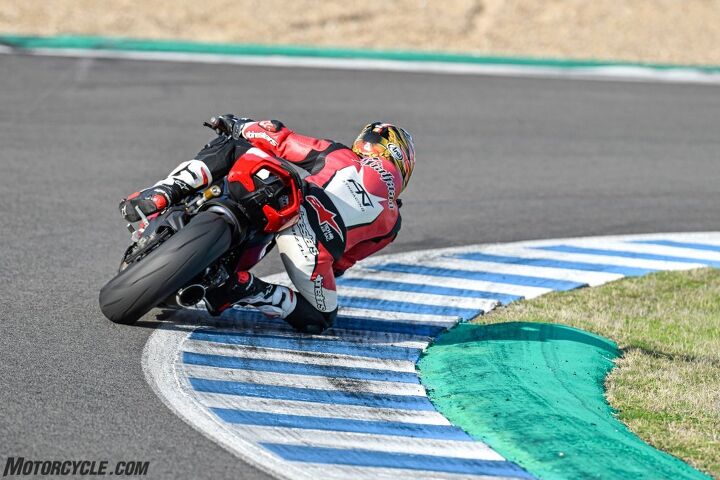
Notice how much of the rider’s backside is off the seat and how his head and shoulders are leading him into the turn.
With a stable speed and your body in the right position, the next step is… sticking your knee out. From here maintain neutral throttle and gently initiate the turn. If your area allows, use an even bigger circle to start with to get more comfortable. From here, keep leaning steadily until you feel and hear that magic *scrape* sound. Remember to maintain your speed and neutral throttle. The first time you touch down will scare the bejesus out of you. That’s normal. Afterward, try some more until you’re able to tighten your circle, and definitely try it in both directions, even doing figure-eights if you feel ready.

Gradually keep leaning and/or tightening your radius until you hear that magic scraping sound. Then you’ll have graduated into the knee-dragging club!
Congrats! You’ve successfully touched your knee to the ground. It’s a cool feeling, right? Now go practice some more. Before you get too excited, there’s one important thing to remember NOT to do.
First and foremost, don’t introduce any sudden inputs to the motorcycle. Everything you do should be smooth, controlled, and deliberate. Don’t stab the brakes, whack the throttle, or any other jerky motion. Remember, as you’re using the tire to lean, you’re incrementally taking away its ability to do other things like stop or go. Sudden inputs can overwhelm a tire. Slow, deliberate inputs do not.

Fast Freddie Spencer won multiple world championships without ever hanging off like Marq Marquez. Proof that there are several ways to get a knee down. However, note Spencer’s lower body is off the seat like the rest of the riders shown here.
Touching a knee to the ground isn’t the end-all, be-all of how to ride a motorcycle quickly. In fact, this is a good time to dispel a common myth: dragging your knee doesn’t automatically make you a faster or safer rider. There are plenty of great riders who never put a knee on the ground and racers who can go a whole season on the same set of knee pucks. Touching a knee down is simply a tool for judging lean angle – or for cool social media pictures.
In fact, if getting faster really is what you’re after, dragging knee isn’t the goal at all, but simply a byproduct of the process. There are more nuances to the art of dragging knee than are shared here, like how to use trail-braking to tighten your radius, and thus touch down. But the deeper we go into the weeds, the more complex and convoluted this discussion becomes.

We’ll save the lesson on elbow dragging for another time, but the basics are similar to getting a knee down.
This tutorial is meant for the rider who has never touched down before and is simply looking to do it for the first time. As they say, you never forget your first, so go to a large lot and give it a try.
The post How To Drag Your Knee: What Every Rider Should Know appeared first on Motorcycle.com.
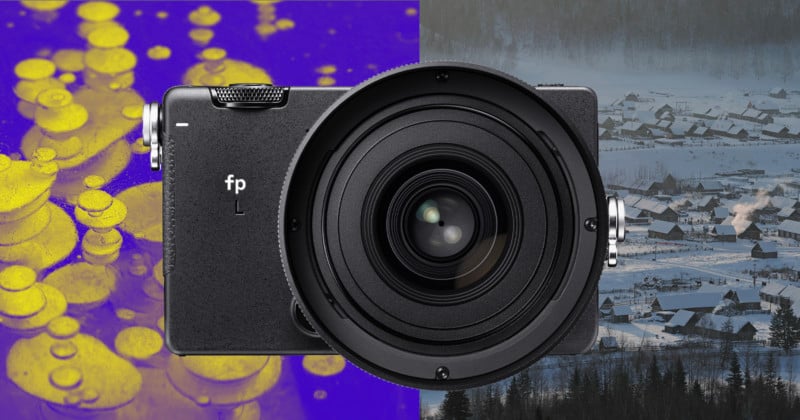
On March 25, Sigma announced the 61-megapixel fp L camera that features a new autofocus system and much more resolution than the original fp. The company has provided a few images captured on the camera, and the quality looks impressive.
Sigma’s latest takes what made the original fp desirable — its small size — and added features that would make it something more photographers would be interested in. For starters, a true hybrid autofocus system is a boon, making the fp the first camera released in the L-mount alliance to feature phase detection autofocus. You can read more about it here.
But more than that, Sigma integrated features that take advantage of the resolution, which will be interesting to see for applications such as wildlife photography. While none of the images Sigma shared with PetaPixel use this new crop zoom option, we can get an idea of what to expect by taking a closer look at full resolution images.
The photos below were captured by photographer Aya Iwasaki, and the first one is a macro photo that really shows off the resolving power of the new camera. The original file size is massive: 53.4 MB at a 9520 x 6328 resolution and was captured with the Sigma 105mm f/2.8 DDG DN Macro Art lens at f/5.6, 1/640 second, and ISO 400. Here is the full image:

And this is a fully-zoomed crop:

The next image from Iwasaki is a landscape photo and give an indication of the dynamic range of the sensor. This image was captured with the 65mm f/2 DG DN Contemporary lens at f/4, 1/500 second, and ISO 100:

And this is a fully-zoomed crop:

Two more landscape images were provided by Sigma, these ones captured by photographer Yang Su Tie. The first is a panoramic crop shot with the 65mm f/2 DG DN Contemporary lens at f/4, 1/1600 second, and ISO 100:

And again a crop:

Finally, a photo shot on the 14-24mm f/2.8 DG DN Art at f/16, 1/15 second, and ISO 100:

And again a fully-zoomed crop:

Based on these images, the question isn’t so much if the sensor is good, but more about what lenses can be used to fully take advantage of that resolution. Other questions that still remain center around how good the new autofocus system is and if Sigma addressed issues with the rolling shutter that plagued the original fp, as both cameras feature a fully electronic shutter. These are questions PetaPixel intends to answer in our review of the camera.
In related news, for those interested in using the camera for filmmaking, SmallRig and Sigma teamed up to create a custom cage solution for both the fp and fp L:

The Sigma fp L is set to become available in mid-April for $2,499.

Sign up here to get Recomendo a week early in your inbox.
The rules of “No”
Hidden in Plain Sight
If you’re going to click on an exposé about exploitative companies who discriminate against BIPOC, you should start here. CC Paschal’s essay about her experience as a producer for Gimlet called “Hidden in Plain Sight” is beautifully vulnerable and powerful to read. It is also incredibly infuriating, so be warned: it will crack your heart open. — CD
Real time virtual characters
I am always on the lookout for the next new thing. I found one in vtubers. Vtubers are virtual characters that are streamed before an audience in real time, puppeted by their master behind the scenes. They have long been predicted in science fiction, such as William Gibson’s Idoru. These virtual characters appear live today on Twitch and YouTube, and interact with fans or guests in real time and use the latest motion capture technology so they appear “realistic”. They are rapidly gaining audiences. Their human host is acting out their role in their home, and voicing them. Their virtuality permits the characters to go in a new thousand directions, creating a new fictional space. Rather than point you to particular streams, I suggest this pretty good article describing one of the most popular vtubers: CodeMiko is the Future of Streaming. — KK
Loop sound track on YouTube
Like many writers and programmers I like to listen to a loop of music over and over again as an inducement to work. It’s similar to writers who work in a cafe for its background hum. The familiar sound induces a flow trance that makes it easier to concentrate. Some loopers will loop a different track for a different project, but I have looped the same song for a decade. My loop is a Gregorian chant, Hymn of the Cherubim. In fact, as soon as I hear it now, I am primed to write. Popular tracks to loop include video game music, because these were intentionally engineered to work in the background and help focus. Tons of music, including video game tracks, can be found on YouTube, and the cool part is that you can loop YouTube. Right click on the Play button and choose Loop. — KK
Drain unclogger
I was dealing with a stubborn shower drain. Backed up and it smelled bad. Liquid Plumr had no effect. A hose and plumber’s bladder made the water drain slowly, but it clogged right back up again. I bought a jar of Green Gobbler Ultimate Main Drain Opener and poured half into the drain and let it sit overnight. The next morning I poured in a quart of boiling water. Problem solved, and the bad smell is gone. — MF
How long would it take to hack your password?
Here is a scary visual: the time it takes a hacker to brute force your password. I’m not sure how accurate this is, but considering I still have some passwords that are 8 characters or less — and those can be cracked in under 8 hours — this chart is enough for me to calendar a time block for password management. — CD
-- Kevin Kelly, Mark Frauenfelder, Claudia Dawson
Artificial intelligence developer Jagadish K. Mahendran and his team at the University of Georgia have designed an AI-powered, voice-activated, camera system that can help the visually impaired navigate common challenges such as traffic signs, hanging obstacles, and crosswalks.
The system is all housed within a small backpack that contains most of the computing unit, which in this case was a laptop, and is connected to a camera and a fanny pack that contains a battery that allows for approximately eight hours of continuous use. The aforementioned camera is a Luxonis OAK-D spatial AI camera and can be affixed either to the vest or the fanny pack. In this particular case, three tiny holes in the vest provide the viewports for the camera which is affixed to the inside of the vest.
According to a press release, the OAK-D unit is a versatile and powerful AI device that runs on Intel Movidius VPU and the Intel Distribution of OpenVINO toolkit. It is capable of running advanced neural networks while providing accelerated computer vision functions and a real-time depth map from its stereo pair, as well as color information from a single 4K camera.
As reported by Engadget, the system communicates with the wearer via a bluetooth earpiece, which can be used to issue queries and commands to the AI that can then respond with verbal information.
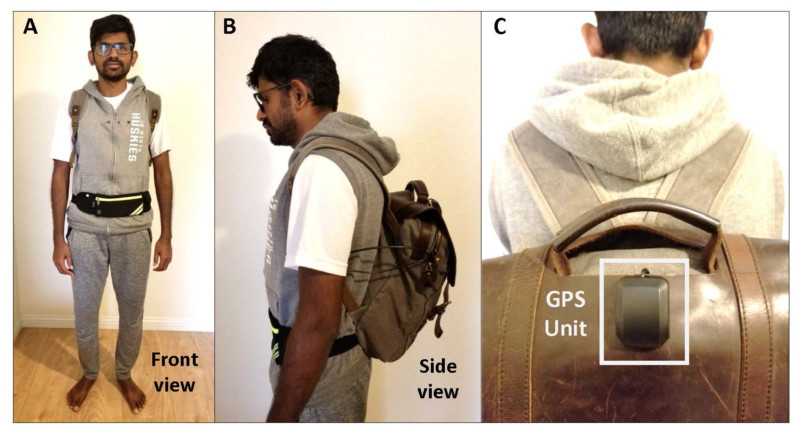
“As the user moves through their environment, the system audibly conveys information about common obstacles including signs, tree branches, and pedestrians,” Mahendran writes in a case study. “It also warns of upcoming crosswalks, curbs, staircases, and entryways.”
This system is meant to be able to replace a seeing-eye dog and would allow the visually impaired to walk more safely on city sidewalks, better avoid obstacles, be better informed on the presence of traffic and street signs, and be are of and — perhaps more importantly — stop at crosswalks.
“For example, if the user is walking down the sidewalk and is approaching a trash bin, the system can issue a verbal warning of ‘left,’ ‘right,’ or ‘center,’ indicating the relative position of the receptacle,” Mahendran continues. “When the user is approaching a corner, the system will describe what’s ahead by saying ‘Stop sign’ or ‘Enabling crosswalk,’ or both. Similarly, if the user is approaching an area where bushes or branches overhang the sidewalk, the system will issue a notice such as ‘Top, front,’ warning of something in the way.”
The research team argues that based on what they have shown the system to be able to do, there is little doubt that this will be the beginning of many more advanced versions soon to follow. As this continues to evolve, it should have a profound and liberating effect on many visually impaired people.
AI has shown to be highly valuable in assisting the impaired in the past, including allowing a blind man to become a photographer. In the spirit of continuous development, this particular project will be open-sourced and the entire project will be published as a research paper in the near future.
In part two of "In Pursuit of Papa," the author heads outside the U.S. for clues about the famed sporting scribe.
The post Hemingway’s Cuban Hideout appeared first on Sporting Classics Daily.
The Event Horizon Telescope (EHT), which was responsible for producing the first-ever image of a black hole in 2019, has today revealed a new polarized view of the M87 black hole that reveals the structure of its magnetic fields, key in explaining how it is able to launch energetic jets from its core.
Since releasing that original image of the black hole, scientists have been delving deeper into the data on the supermassive object at the heart of the M87 galaxy and discovered that a significant fraction of the light around the black hole is polarized.
This research was presented in two papers published today in The Astrophysical Journal.

“The bright jets of energy and matter that emerge from M87’s core and extend at least 5000 light-years from its center are one of the galaxy’s most mysterious and energetic features,” the EHT team says. “Most matter lying close to the edge of a black hole falls in. However, some of the surrounding particles escape moments before capture and are blown far out into space in the form of jets.”
What this research today shows, and is highlighted by this new photo, essentially reveals more about how black holes behave.
“This work is a major milestone: the polarization of light carries information that allows us to better understand the physics behind the image we saw in April 2019, which was not possible before,” explains Iván Martí-Vidal, also Coordinator of the EHT Polarimetry Working Group and GenT Distinguished Researcher at the Universitat de València, Spain. He adds that “unveiling this new polarised-light image required years of work due to the complex techniques involved in obtaining and analyzing the data.”
As the EHT team explains, light becomes polarized when it goes through certain filters or when it is emitted in hot regions of space that are magnetized. Just like looking through polarized sunglasses can help you see better by reducing reflections and glare, the same can be said about looking at the region around a black hole to see how the light originating from there is polarized.
The video below depicts how M87 is seen through a light polarizer.
“The newly published polarized images are key to understanding how the magnetic field allows the black hole to ‘eat’ matter and launch powerful jets,” says EHT collaboration member Andrew Chael, a NASA Hubble Fellow at the Princeton Center for Theoretical Science and the Princeton Gravity Initiative in the United States.
As noted by Gizmodo, the Event Horizon Telescope is not a “traditional” telescope. It is instead a unified term for a group of global observatories that are timed to atomic clocks that look to the sky together. The idea is to create a telescope that is the size of Earth itself and using complicated math all of these independent observatories are all able to look at one object and then account for the differences in time that it takes for each observatory to see the same light.
According to the astrophysicists on the team, the next step would be to see the innermost workings of the core of the black hole. Specifically, they want to see the larger-scale conditions that formed the huge plasma jet, ejected it, collimated it, and accelerated it. Currently, there is too much noise in the image for this to be clear, but adding more observatories to the EHT array, hopefully, will change in the future.

The original music video for "Y.M.C.A." is a happy, upbeat song. It's no wonder that people like to sing and dance to it a public events.
The Melodicka Bros, a duet from Italy, offer this more somber and melancholy version. Without changing the lyrics, "Y.M.C.A." becomes a downbeat message to young men who can find their only hope of respite at the local YMCA boarding house.
-via Laughing Squid
Honey baked or country smoked, ham likely sits at the center of the post-church table if you’re celebrating Easter in the South.
Most Easter-celebrating countries in the world roast a leg of lamb—Britain’s classic interpretation is served with mint sauce—instead of popping a pig on a platter. What’s with the Southern United States’s porcine predilection? Sitting at the heart of the so-called Ham Belt has something to do with it.
It’s not hard for third generation curemaster Sam Edwards, owner and president of Edwards Virginia Smokehouse, to imagine country ham—a Southern delicacy since practically day one of this country’s existence—making early American Easter tables. It was all a matter of timing.
“You harvest the hogs as early as December, so by the time you put them in cure, they were coming out in say January, February, then you would smoke them—so the first edible hams would be getting ready by Easter,” Edwards says. “I think that’s why people, in Virginia at least, eat ham on Easter.”

Virginia, of course, did have sheep. Kentucky and Tennessee did too. “But the need for good grassland for pasture was always an issue in the South outside Virginia and the Bluegrass,” says David Shields, a University of South Carolina distinguished professor and food historian. Westward expansion didn’t help either. With its better grazing land, the sheep industry eventually moved away from the East Coast, taking dinner with it.
Wool production also affected lamb prices, says Robert Moss, a food historian and the author of Barbecue: The History of an American Institution. “Lamb prices fluctuated a lot more year to year than beef and chicken,” Moss says. And Americans just never developed a strong taste for lamb. “Even back in the early twentieth century there were lots of articles written asking, ‘What can we do to make Americans eat more lamb?’” The answer? Not much. Southerners’ palates, at least, were primed for pig.
We have generations of pitmasters and cooks and chefs to thank for that, from James Hemings, an enslaved cook at Monticello who was the first American to train as a chef in France and who baked Virginia hams; to twentieth century chefs like Edna Lewis who was known to always keep a bit of country ham handy to perk up greens; to today’s barbecue barons, including pitmaster Rodney Scott, who schools Southerners in the beauty of cracklins and pulled pork. Which is to say, the question isn’t why eat ham on Easter? It’s why eat anything else?
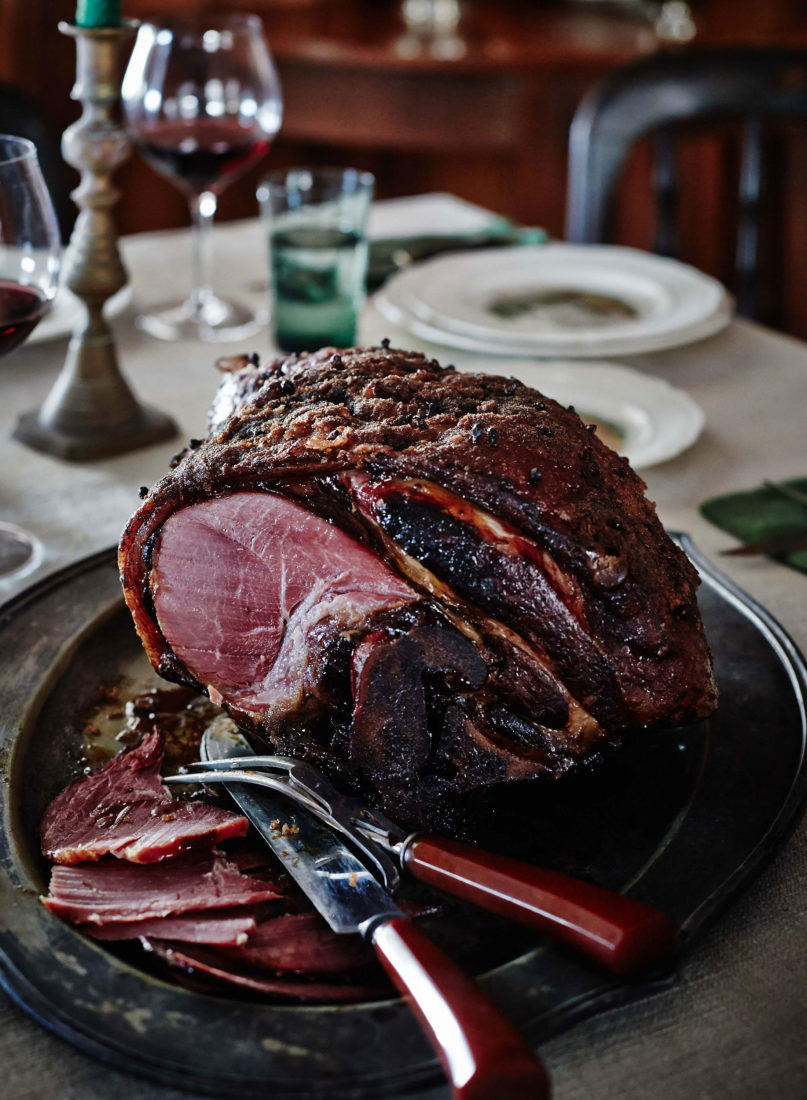
Today, Americans eat a fraction of a once healthy mutton diet. In the early 1960s, Moss says the average American ate four to five pounds of lamb per year. By 2011, it was less than a pound. So naturally we turn to the familiar ham to go with our deviled eggs, carrot cake, and macaroni and cheese on Easter. The spread might include honey baked ham with citrus glaze, spiral cut holiday ham, or the old school pineapple glazed ham, the result of a 1925 push by the Hawaiian Pineapple Packers Association to convince home cooks to add the exotic fruit to savory dishes—a marketing win only topped by Jello’s shrimp aspic campaign. And then there’s the awe-inspiring, singularly Southern union of booze and soda and sow that just might be coming to an Easter table near you: Cheerwine Bourbon glazed ham. Eating high on the hog indeed.
The post Why do Southerners Eat Ham on Easter? appeared first on Garden & Gun.

Life-threatening health emergencies can happen at any moment. While you should always call 911 and summon professional medical attention for a victim, oftentimes time is of the essence, and paramedics are minutes (or much longer) away. If the person is going to live, they can’t wait for a medic to get to them. They need help now.
That’s where you — a family member, friend, or random bystander-on-the-scene — come in. If someone close to you was stricken with a life-threatening emergency, would you be prepared to be the first first responder?
I talked to ICU nurse (and Strenuous Life member) Jared Shears about the basic lifesaving skills every man should know. While all of these can be performed by laypeople, Jared highly recommends taking an in-person first aid course so you can actually do some hands-on practice. Check with your local Red Cross for times and locations for these classes.
If someone is unresponsive, doesn’t have a pulse, and isn’t breathing, they’ve likely gone into cardiac arrest. To prolong their life until an AED (see below) or advanced medical care is available, you’ll need to perform hands-only CPR (the American Heart Association recommends that untrained bystanders who see someone collapse do only the chest compression part of CPR, sans the mouth-to-mouth part).
In our in-depth article on how to recognize and treat a heart attack, paramedic Charles Patterson strongly recommends that everyone take in-person CPR training:
Having hands-on training to help you understand the mechanics of CPR and feeling the appropriate rate and depth of compressions is extremely beneficial and cannot be matched by simply watching a video or reading instructions online. Being able to go through the steps of CPR on a dummy will help you build confidence and remain calm in the event of an emergency.
In a cardiac arrest emergency, hands-only CPR is performed to prolong life until a shock from an AED is given or an EMT arrives. As soon as an AED is available, use it.
AED stands for Automated External Defibrillator, and it gives the heart a shock to get it going again.
AEDs are located in most public places like stores, offices, and gyms. While most AEDs provide automated voice instructions when you turn them on, as with CPR, Charles recommends getting in-person training from the Red Cross or the American Heart Association so you can go through the steps manually and know what it feels like to use this device.
Choking is the fourth leading cause of death by unintentional injury. Thankfully, with a bit of know-how, choking deaths can be prevented. Enter the Heimlich maneuver.
Before you perform the Heimlich maneuver, the Red Cross recommends first leaning the person over your arm (put one of your arms under one of theirs and across their chest) and giving them five hard blows on the back with your other arm. Often the item becomes dislodged with just these back slaps. But if that doesn’t work, then initiate the abdominal thrusts dictated by the Heimlich maneuver.
Be sure to go through our in-depth guide on how to perform the Heimlich maneuver in different circumstances, including on pregnant women, obese people, babies, and even dogs.
A tourniquet is used to stop severe bleeding and prevent deaths caused by severe blood loss. For many decades, the tourniquet was seen as a measure of last resort because it was believed that completely stopping the blood flow to a limb would result in tissue or nerve damage. But studies out of the wars in Iraq and Afghanistan proved that the application of a tourniquet could save lives while having an extremely minimal chance of leading to nerve damage or limb amputation. As a result, many civilian EMTs and doctors recommend that tourniquets be applied more routinely in severe blood loss situations to prevent deaths. But it’s essential that you know how to use one properly.
For an in-depth guide on how to use a tourniquet, check out our article written by Iraq war veteran and Army medic Bruce A. West.
The first step to saving someone from drowning is recognizing what drowning actually looks like. The signs can be much less dramatic and obvious than you think.
After you’ve established that a person is drowning, your initial response shouldn’t be to jump in the water and try to bring them ashore yourself. A person who’s drowning can be panicked, and clutch, kick, and grab at you as you try to rescue them, dragging you both underwater. So rather than jumping in yourself, extend a rope, oar, or stick to the victim from the shore or from a boat. If the victim is too far away for this course of action, and you can’t use a boat to get closer, then get in the water yourself, grab the drowning person from behind, and physically tow them to safety.
While minor burns can be treated and managed at home, third-degree burns will require professional medical attention. However, the immediate care a burn victim receives before getting to the hospital can go a long way in mitigating the extent of the damage and reducing the chance of the burns being fatal.
Burn care varies according to the kind of burn it is (thermal, chemical, electrical, etc.), and, despite on-the-scene intervention being so crucial, most people are unaware of what it involves. Jared directed my attention to this comprehensive and detailed guide on how to treat severe burns while you await the arrival of paramedics. Print it off and study it.
For help in remembering things like how to save a drowning person, how to recognize that someone is having a heart attack (or stroke), along with other lifesaving information, check out these nine mnemonics that are easy and essential to commit to memory.
With our archives 4,000 articles deep, we’ve decided to republish a classic piece each Sunday to help our newer readers discover some of the best, evergreen gems from the past. This article was originally published in March 2021.
This article was originally published on The Art of Manliness.
March 21st has officially been proclaimed: AstroTurf Day. March 21, 2021 has been officially named AstroTurf Day in Dalton, Georgia, home to AstroTurf’s manufacturing facility since 1968. The Mayor of Dalton, David Pennington, made the proclamation to mark the 55th anniversary of the first major league game ever played on synthetic turf: the match-up between […]
The post Congratulations to AstroTurf appeared first on FootballScoop.




![[link]](https://i.redd.it/izpn4nrs2kp61.jpg)
