Choosing one of these options is a good way to ensure your paint job is protected in the long term from unexpected damage.
The post Wash, wax, repeat: Polish and protect your precious ride with the best car waxes appeared first on The Manual.
Choosing one of these options is a good way to ensure your paint job is protected in the long term from unexpected damage.
The post Wash, wax, repeat: Polish and protect your precious ride with the best car waxes appeared first on The Manual.
While an omelet sounds easy, mastering it can be complicated. But don't be intimidated — we're here with the tips you'll need to cook a restaurant-perfect omelet.
The post How to make an omelet: A step-by-step guide for the perfect breakfast appeared first on The Manual.
Milkshakes are at their tastiest only if you make them correctly. In this guide, we're going to tell you exactly how to make a perfect milkshake every time.
The post How to make a perfect milkshake at home every time appeared first on The Manual.
Building strong and functional shoulders make your life easier. Here are the 8 best shoulder exercises to make them grow bigger.
The post The 13 best shoulder workouts for an outstanding upper body appeared first on The Manual.
Plan to eat, sleep, and sightsee your way across America — all for free.
The post The 10 best road trip apps to make your next journey more epic appeared first on The Manual.
The Internet Archive’s The Pulp Magazine Archive has downloadable scans of 13,559 pulp magazines from the 20th century. They range from romance to science fiction. Some aren’t really pulp magazines in the traditional sense, like Hollywood gossip magazines, but everything is interesting. I am fascinated by the design, the typography, the illustrations, the stories and articles, and the ads. The people who upload the titles often provide entertaining and interesting descriptions of the individual issues. There’s truly a lifetime worth of study here!
A small sampling:


Every issue of Look magazine had hundreds of photographs of unusual and remarkable people, animals, things, and places. I wish it was still being published – I’d subscribe!
Look at this crazy freckle-removing process:


Comic book artist Jim Steranko, known for his highly stylized work in Nick Fury: Agent of S.H.I.E.L.D., published and edited this beautifully designed newsprint magazine devoted to “comics, films, paperbacks, undergrounds, TV, pulps.” What’s not to love? I have a few issues in my collection.


Getting a new Johnson Smith Catalog in the mail when I was a kid was an absolute thrill. Each issue was over 100 pages, and each page was loaded with marvelous novelties and gadgets and magic tricks and other things you couldn't find in any store.

From the 1930s to the 1960s, newsstands were filled with dozens of science fiction titles. People had an insatiable appetite for bug-eyed monsters, space creatures, radioactive monsters, and science experiments gone awry. This issue of a lesser-known title called Super-Science Fiction has a cover by Kelly Freas, a story by Robert Silverberg, and as a one-page “feature” article called “Nuclear News,” which I’ve transcribed for your reading pleasure:

Nuclear News
by Steven Rory
A weird garden of mutated plants at Brookhaven National Laboratory on Long Island offers a foretaste of what an Earth devastated by atomic energy may look like. The ten-acre tract, closely guarded, is in its tenth year of use. It features a long cylinder of radioactive Cobalt-60 that is lowered into the ground for several hours each day, showering the nearby plants with 2000-curie gamma rays that induce the genetic changes known as mutations.
Several useful plant mutations have resulted, though most of the garden’s plants are biological monstrosities. Among the useful mutants are a bushy type of navy bean that is resistant to disease and easier to harvest; a strain of oat resistant to the costly rust disease; and a hardy, short stemmed rice plant. A strain of peach trees that ripens two weeks earlier than normal, and one that ripens two weeks later than normal, have also been produced.
But most of the crop is strange and bizarre. In a wedge-shaped bed of gladioluses, those nearest the gamma-source (which would kill a human being four feet away within an hour) are dwarfed to one-eighth normal size. Tobacco plants grow with cord-like, stringy leaves in the Brookhaven garden. Some other plants bear little resemblance to their non-mutated originals.
The purpose of the Atomic Energy Commission-sponsored garden is to develop beneficial mutants for the improvement of agriculture. More than 150 plant breeders and geneticists are taking part in the radiation experiments.

I just learned that “atomic gardening” was popular in the 1950s, and Brookhaven National Laboratory really did have a radioactive plant-breeding program. The 99% Invisible podcast did an episode about atomic gardening in 2017.
If you find a gem in The Pulp Magazine Archive, please share it in the comments.

The Magnet’s mascot is a little creature with a horseshoe magnet head. It’s wearing a smock that says “mysterious stone,” which is the old Japanese word for “magnet.” Because of popular demand, I’m selling another batch of Magnet mascot shirts in various styles. To keep the shirts mysterious, there are no other markings on them other than the mascot image.

When woodcut artist Katsushika Hokusai made his famous print The Great Wave off Kanagawa in 1830 — part of the series Thirty-six Views of Mount Fuji — he was 70 years old and had lived his entire life in a Japan closed off from the rest of the world. In the 19th century, however, “the rest of the world was becoming industrialized,” James Payne explains above in his Great Art Explained video, “and the Japanese were concerned about foreign invasions.” The Great Wave shows “an image of Japan fearful that the sea — which has protected its peaceful isolation for so long — would become its downfall.”
It’s also true, however, that The Great Wave would not have existed without a foreign invasion. Prussian blue, the first stable blue pigment, accidentally invented around 1705 in Berlin, arrived in the ports of Nagasaki on Dutch and Chinese ships in the 1820s. Prussian Blue would start a new artistic movement in Japan, aizuri-e, woodcuts printed in bright, vivid blues.
“Hokusai was one of the first Japanese printmakers to boldly embrace the colour,” Hugh Davies writes at The Conversation, “a decision that would have major implications in the world of art.” When the country’s isolationist policies ended in the 1850s, “a showcase at the inaugural Japanese Pavilion elevated the artistic status of woodblock prints and a craze for their collection quickly followed.”

Chief among the works collected in the European and American fervor for Japanese prints were those from Hokusai, his contemporary Hiroshige, and other aizuri-e artists. So famous was The Great Wave in the West by 1891 that French graphic artist Pierre Bonnard would satirize its stylish spray in an advertisement for champagne. A print of The Great Wave hung on Claude Debussy’s wall, and the first edition of his La Mer bore an adaptation of a detail from the print. As Michael Cirigliano writes for the Metropolitan Museum of Art:
Cultural circles throughout Europe greatly admired Hokusai’s work…. Major artists of the Impressionist movement such as Monet owned copies of Hokusai prints, and leading art critic Philippe Burty, in his 1866 Chefs-d’oeuvre des Arts industriels, even stated that Hokusai’s work maintained the elegance of Watteau, the fantasy of Goya, and the movement of Delacroix. Going one step further in his lauded comparisons, Burty wrote that Hokusai’s dexterity in brush strokes was comparable only to that of Rubens.
These comparisons are not misplaced, John-Paul Stonard explains in The Guardian: “That the Great Wave became the best known print in the west was in large part due to Hokusai’s formative experience of European art.” Not only did he absorb Prussian blue into his repertoire, but “prints from early in his career show him attempting, rather awkwardly, to apply the lesson of mathematical perspective, learnt from European prints brought into Japan by Dutch Traders.” By the time of The Great Wave, he had perfected his own synthesis of Western and Japanese art, over two decades before European painters would attempt the same in the explosion of Japanophilia of the late 19th and early 20th century.
Related Content:
Watch the Making of Japanese Woodblock Prints, from Start to Finish, by a Longtime Tokyo Printmaker
Watch the Making of Japanese Woodblock Prints, from Start to Finish, by a Longtime Tokyo Printmaker
Josh Jones is a writer and musician based in Durham, NC. Follow him at @jdmagness
The Great Wave Off Kanagawa by Hokusai: An Introduction to the Iconic Japanese Woodblock Print in 17 Minutes is a post from: Open Culture. Follow us on Facebook and Twitter, or get our Daily Email. And don't miss our big collections of Free Online Courses, Free Online Movies, Free eBooks, Free Audio Books, Free Foreign Language Lessons, and MOOCs.

From her early, unhappy teen years in Port Arthur, Texas, Janis Joplin seemed to know she wanted to be a blues singer. She once said she decided to become a singer when a friend “loaned her his Bessie Smith and Leadbelly records,” writes biographer Ellis Amburn. “Ten years later, Janis was hailed as the premier blues singer of her time. She paid tribute to Bessie by buying her a headstone for her unmarked grave.” She was devoted to the blues, from her earliest encounters with the music in her youth to her last recorded song, the lonely, a capella blues, “Mercedes Benz.”
But when Joplin first appeared on the San Francisco scene in 1963, she did so as a Dylan-influenced folkie fresh from the University of Texas, Austin. The year before, she had been described by a profile in The Daily Texan as an artist who “goes barefooted when she feels like it, wears Levis to class because they’re more comfortable, and carries her autoharp with her everywhere she goes so that in case she gets the urge to break into song, it will be handy.” The article was titled “She Dares to Be Different.”
Joplin’s folk persona was hardly unique in either San Francisco or Austin in the early 60s. “In fact, her love of Dylan and folk simply marked her out as a rider of the zeitgeist,” writes music journalist Chris Salewicz. “When, for example, a former University of Texas alumnus called Chet Helms passed through [Austin] he was astonished at the wealth of folk music.” Helms, who had already moved west, promised Joplin gigs in San Francisco. The pair hitchhiked to the city “midway through January 1963, with considerable trepidation… a trek in which they spent 50 hours on the road.”
Once in North Beach, a neighborhood defined by City Lights bookstore and the Beats, Helms found Joplin gigs at Coffee and Confusion, then the Coffee Gallery, where she “was just one of many future rockers to play the Coffee Gallery as a folkie,” writes Alice Echols. In South Bay coffeehouses, she met Jerry Garcia and future Jefferson Airplane guitarist Jorma Kaukonen. Everyone made the coffeehouse rounds, acoustic guitar in hand. It was the way to make a name in the scene, which Janis did quickly, appearing the same year she arrived in San Francisco on the side stage at the Monterey Folk Festival.
But Janis brought something different than other students of Dylan — bigger and bolder and louder and deeply rooted in a Southern blues tradition Joplin spread to astonished beatniks like a “Blues Historian,” one commenter notes, “turning a small audience on to some obscure and forgotten performers, whose music would serve as the foundation for an entire genre yet to come.” You can hear her do just that in the gig above at the Coffee Gallery in 1963: “no drums, no crowds. Just Janis and a small group of people gathered to hear some samples of rural blues, done by an enthusiast from Texas.”
See the full setlist below. Other performers on the recording, according to the YouTube uploader, are Larry Hanks on acoustic guitar and vocals, and Billy Roberts (or possibly Roger Perkins) on acoustic guitar, as well as banjo, vocals, and harmonica.
Leaving’ This Morning (K.C. Blues)
Daddy, Daddy, Daddy
Careless Love
Bourgeois Blues
Black Mountain Blues
Gospel Ship
Stealin’
Related Content:
Janis Joplin’s Last TV Performance & Interview: The Dick Cavett Show (1970)
Janis Joplin & Tom Jones Bring the House Down in an Unlikely Duet of “Raise Your Hand” (1969)
Josh Jones is a writer and musician based in Washington, DC. Follow him @jdmagness
A Young Janis Joplin Plays a Passionate Set at One of Her First Gigs in San Francisco (1963) is a post from: Open Culture. Follow us on Facebook and Twitter, or get our Daily Email. And don't miss our big collections of Free Online Courses, Free Online Movies, Free eBooks, Free Audio Books, Free Foreign Language Lessons, and MOOCs.

We get the culture our technology permits, and in the 21st century no technological development has changed culture like that of the smartphone. As with every piece of personal technology that we struggle to remember how we lived without, it evolved into being from a series of simpler predecessors that, no matter how clunky they seem now, were received as technological marvels in their day. Take it from Martin Cooper, the Motorola Engineer who invented the first handheld cellular mobile phone. “We didn’t know it was going to be historic in any way at all,” he says of the first publicly demonstrated cellphone call in 1973 in the Bloomberg video above. “We were only worried about one thing: is the phone going to work when we turn it on?”
The device Cooper had in hand was the prototype that would eventually become the Motorola DynaTAC 8000X, the first commercial portable cellular phone. (This as distinct from the existing car-phone systems that Cooper credits with inspiring him to develop an entirely handheld version.) Brought to market in 1983, it weighed about two pounds, took ten hours to charge a battery that lasted only 30 minutes, could store no more than 30 phone numbers, and cost nearly $10,000 in today’s dollars.

Yet “consumers were so impressed by the concept of being always accessible with a portable phone that waiting lists for the DynaTAC 8000X were in the thousands,” says Motorola design master Rudy Krolopp as quoted by the Project Management Institute. “In 1983, the notion of simply making wireless phone calls was revolutionary.”

38 years after “the brick,” as the 8000X was known, we’ve grown so used to that notion that many of us hardly ever make wireless phone calls anymore, preferring to communicate on our phones through text messages or an ever-expanding universe of internet-based apps — to say nothing of the other aspects of our lives increasingly handled through palm-sized touchscreens. “The modern smartphone is a technological marvel,” says Cooper. “It really is incredible, all the stuff that is squeezed into that cellphone.” Yet despite the astonishing evolution of his invention it represents, he’s not satisfied. “We think that we can make a smartphone that does all things for all people, and yet we know that it doesn’t do any of those things perfectly. We’ve still got a ways to go.” If you’re reading this on a smartphone, know that you hold in your hand the “brick” of 2059.
Related Content:
Filmmaker Wim Wenders Explains How Mobile Phones Have Killed Photography
A 1947 French Film Accurately Predicted Our 21st-Century Addiction to Smartphones
When We All Have Pocket Telephones (1923)
The World’s First Mobile Phone Shown in 1922 Vintage Film
Scientist Creates a Working Rotary Cellphone
Based in Seoul, Colin Marshall writes and broadcasts on cities, language, and culture. His projects include the Substack newsletter Books on Cities, the book The Stateless City: a Walk through 21st-Century Los Angeles and the video series The City in Cinema. Follow him on Twitter at @colinmarshall or on Facebook.
The First Cellphone: Discover Motorola’s DynaTAC 8000X, a 2-Pound Brick Priced at $3,995 (1984) is a post from: Open Culture. Follow us on Facebook and Twitter, or get our Daily Email. And don't miss our big collections of Free Online Courses, Free Online Movies, Free eBooks, Free Audio Books, Free Foreign Language Lessons, and MOOCs.

DALLAS, Texas — If dementia runs in your family, it’s natural to fear the same symptoms developing in you. Despite these genetic risk factors, a new study finds there are still ways to make dementia onset less likely. In fact, researchers say six simple lifestyle changes can almost halve the risk of dementia, regardless of…
The post 6 simple lifestyle changes can cut familial dementia risk nearly in half appeared first on Study Finds.

It wasn’t that the phone hadn’t rung for an entire year, it was that the shoots were always too risky; my urge to be on set was always overruled by my commitment to ensure that making art did not lead to someone contracting COVID.
Yet once the vaccine began to make things safer, I knew that it would only be a matter of time before I was behind the camera once more, and with that I wanted it to be an automotive photo shoot. In a way, it was like dipping your foot in to test the waters before taking a plunge by putting a celebrity or athlete in front of the camera.
Little did I know that my first job back would have me photographing a 1934 Chrysler Airflow; a car that finds its place in the hearts of the super eclectic. Lucky for me, one of those eclectic few happened to be none other than Jay Leno. This actually presented the right set of variables that would just so happen to work in my favor. First, it was in Burbank, so a short — albeit miserable — flight was all that I had to take to get to the location. Second, I have worked for this particular client for nearly 15 years. This made producing the shoot without a client on set (as they weren’t vaccinated yet) entirely feasible for we knew each other’s creative approach quite well.

In the weeks leading up to the shoot, I researched the car as much as I could. However, when dealing with a car as rare as this one, the best information available was actually the YouTube video that Jay had previously made with it. In reviewing his footage, it was obvious that the Airflow’s curves and lines were very appropriate to the period it was created in, making it a rather difficult car to light. Modern cars have sharper creases and folds in the metal that take in lighting in a crisp way that is forgiving to the photographer. Unfortunately, a certain variety of older cars like the Airflow are more rounded due to the machines that were available to the manufacturers at the time. This changes the approach of the photoshoot to higher and larger diffused sources that are complemented by narrow background lights to define the car’s form. This updated approach would end up being the photoshoot I needed to get back in the groove of producing campaigns again, as the challenge of lighting such a unique car proved both exciting and nerve-wracking.
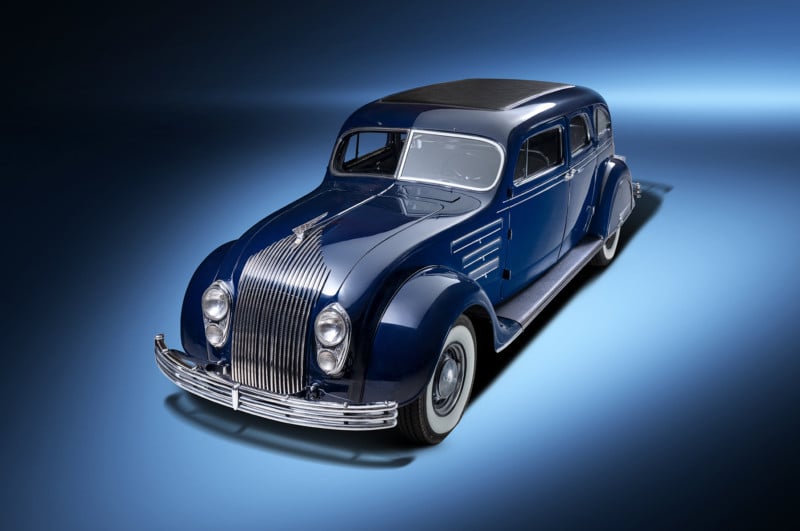
To add fuel to the fire, this would also be the first time that I would be shooting with the Nikon Z 7II. Not only did I need to learn the camera, but with it arriving the night before my flight, I found myself setting it up on the 45-minute plane ride over. It turns out that having worked with so many Nikon bodies before, it was a rather seamless transition to their newest mirrorless system. The leap of faith for me came down to the glass. I am a fiend for shooting 24-70mm lenses, so much so that I packed the f/2.8 S and f/4 for this one. However, in a challenge from the good folks at Nikon, I took both the 14-24mm f/2.8 S and 70-200mm f/2.8 S lenses with me to broaden the options for compression. Having never seen the car in person, this seemed like some additional insurance just in case I needed to present additional options to the client. It turns out that this ended up being a great choice, I was able to utilize all three 2.8 lenses in the piece. The images selected by the client also included options from all three, making this the first series that I’ve done with multiple lenses in many years.
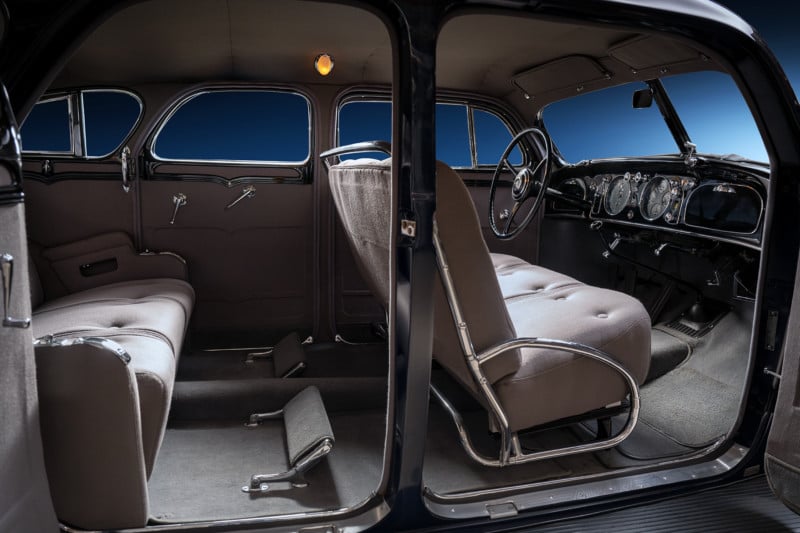
One thing I do have to mention is that during pre-light the day before the shoot, I took a very short Uber to Jay Leno’s Garage as it is just minutes away from Burbank Airport. In the collector car world, Jay’s Garage and the remarkable cars it houses is just as famous as Jay himself. With over 150 cars and 175 bikes, the staggering collection takes a decent amount of time just to walk through.
When arriving at the garage, I was met by the man that manages the day-to-day operations for Jay. Over the next hour, he toured me around every room, each packed to the brim with jaw-dropping cars, motorcycles, and even a full-size steam engine. After we had seen the last car, we discussed the next day’s photo shoot and what time I would be showing up. At that point, I requested an Uber to take me to the hotel so that I could rest up for the long day ahead.
No sooner than I had pressed the “request” button on the app, Jay Leno himself walked up. He asked how I was and what I thought about the collection. To be honest, I was a bit caught off guard by how much he cared to hear my thoughts. I told him that I appreciated the collection, not for any marque or car that was in it, but for the glimpse inside the mind of the man that had collected it.
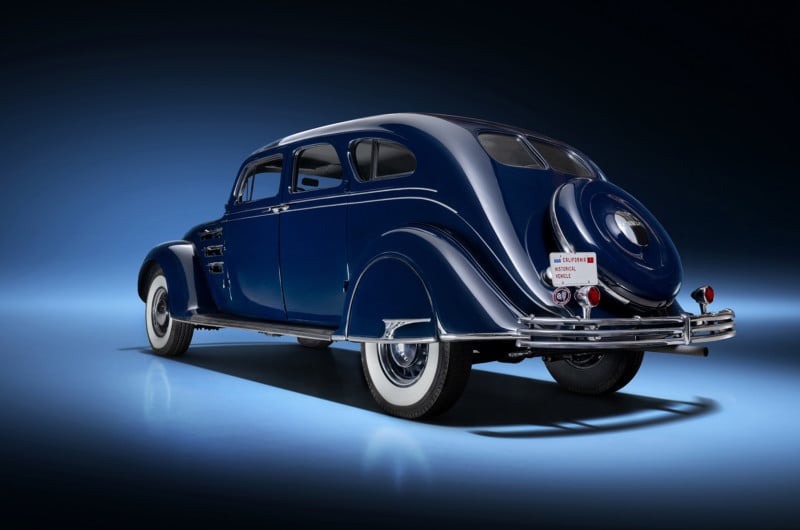
His response still floors me to this day. He appreciated my view so much that he then asked if he could personally give me a tour. Never have I been so happy to pay an Uber cancellation fee! Over the next few hours, Jay showed me around in what can only be the most hilarious car-related experience I have ever had. I was in tears multiple times by the jokes he was cracking while explaining the ins and outs of individual cars and motorcycles. The man is as brutally funny as he is knowledgeable about automobiles. To a level that is almost Rain Man-esque, he can tell you every nut, bolt, and spec for each of his 150-plus cars.
In sharp contrast, I can barely tell you where windshield wiper fluid goes on my car, so it was quite an overwhelming experience. The passion that Jay has for the cars is one completely grounded in humility about owning them. Not once did he brag about owning a car, but instead was always grateful to have them, and I could tell this was genuine. For a celebrity of his level to be so removed from any ego renewed my faith in humanity.
This photo shoot returned me to the career I love in an environment that restored my confidence in safely returning to set. I feel immediately back at the top of my craft and ready for the next photoshoot and welcome any challenges that may arise.
Little did I know I would return to Jay Leno’s garage two weeks later…
About the author: Blair Bunting is an advertising photographer based in Phoenix, Arizona. You can see more of his work on his website, blog, Facebook, and Instagram. This story was also published here.
Aluminum carry-ons are designed to protect your belongings — and make other travelers jealous. From affordable Away to ritzy Rimowa, these are the best ones.
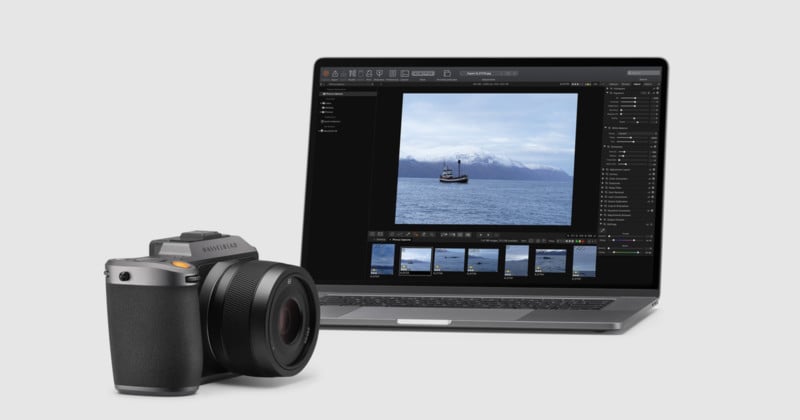
Hasselblad has released updates for Phocus and Phocus Mobile that bring an array of new features to the apps including a heavily requested Focus Bracketing tool.
The new 3.6 update for Phocus on desktop — for both macOS and PC — brings some new features that expand the creative post-production options for medium format photographers including Focus Bracketing, a Film Grain tool, and Adaptive Chromatic Aberration correction. These new features add to the software’s current list of toolsets that accompany the first-party RAW processing engine for Hasselblad cameras. Phocus already let photographers shoot tethered with full camera control and live view functionality and offered editing features that include adjustment layers and Hasselblads Natural Color Solution tools.
With Phocus 3.6, photographers can now create focus bracketing sets while tethered via additional functionality in the Capture Sequencer tool. As the video above details, this new feature supports the X, H, and 907X cameras.
The new Film Grain tool brings what Hasselblad bills as a highly flexible simulation of film grain options to photographs. Included in this update are three different types of film grain simulation with the ability to change the amount, granularity, roughness, and color for each one.
The updated Adaptive Chromatic Aberration option now makes corrections of lens chromatic aberration based on image analysis rather than theoretical data, which is the method that the application previously used. This new method will also allow for the correction of chromatic aberration in images shot on third-party lenses.
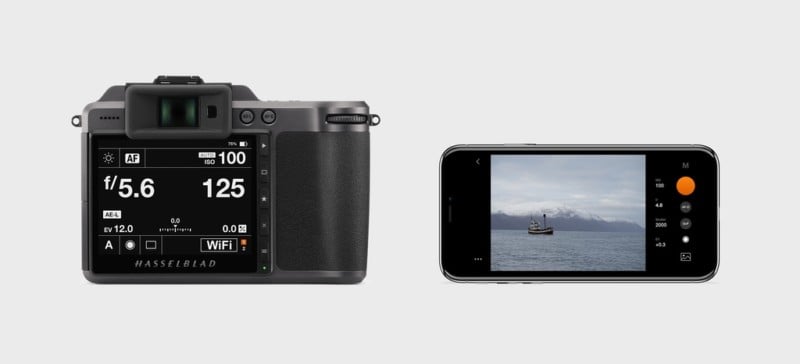
The updated Phocus Mobile 2 app will give Hasselblad shooters the ability to take their image editing process out in the field with a fully portable workflow for the X1D II 50C and 907X systems. The updated app gives you the ability to import, rate, and now edit both RAW and full quality JPEG images directly on the photographer’s device. Additionally, Phocus Mobile 2 also supports full quality image exports, direct camera control, and tethered shooting.
Additionally, the 1.2 update adds a new Defringe tool to remove purple and green fringing, allows JPEG images to be edited, added support for simultaneous capture to both SD card and iPad, grants full synchronization of camera white balance, and makes a few general UI and system improvements.
Photographers can download these free applications on either the Phocus or Phocus Mobile websites immediately.

When you join the military, you’re going to learn some new life skills. How to make a bed. How to shine your shoes. And, how to effectively pack a bag.
We recently asked former and current members of the military who follow AoM for their best packing tips, and we got a ton of responses. Far and away the #1 submission was this: Learn to roll your clothes.
An effective packing technique whether you’re a soldier headed out for deployment or a civilian headed out for vacation, the Ranger or Army Roll is a method of “folding” your clothes that keeps them both compact and tidy. It makes your clothes look like tight, well-rolled burritos, and minimizes the amount they wrinkle, as well as their footprint in your bag. Ranger-rolled clothes take up less space in your suitcase and keep it better organized. On the latter front, you can also roll up outfits — shirt, socks, underwear — together into a single, action-ready pouch.
The only downside to the Ranger Roll is that it does take longer to do than simpler folds — at least before you’ve practiced it a lot and gotten the technique down pat. You’ve really got to focus on making a nice, tight roll for each piece of clothing in order for this method to work. But the tradeoff in time is worth it, as it allows you to pack more in a single bag, saving you from schlepping around multiple pieces of luggage and paying the attendant fees for those extra bags if you’re flying.
Below we highlight how to Ranger roll four different pieces of clothing. Follow the instructions with military-esque precision, and you’ll be packing your bag like a seasoned veteran in no time.
And if you’re curious as to what additional packing tips came up in our survey, here are some of the other most popular responses (thanks to everyone who submitted their tips!):




With our archives 4,000 articles deep, we’ve decided to republish a classic piece each Sunday to help our newer readers discover some of the best, evergreen gems from the past. This article was originally published in May 2021.
This article was originally published on The Art of Manliness.

Travel and immigration ground to a halt in 2020, as countries tried to curb the COVID-19 pandemic with strict restrictions on mobility. From mid-March of 2020 and late February this year, more than 100,000 restrictions on movement were issued worldwide. Global tourism hit a historic low in 2020, with a billion fewer international arrivals than in 2019. The global travel and tourism sector lost nearly $4.5 trillion.
Hoping to attract new visitors and revenue, many places are considering innovative tourism and residency schemes. One idea with potential is the digital nomad visa.
Digital nomad visas allow holders to live in a country while working a job based abroad. Most countries require applicants to meet a certain monthly income threshold, to have proof of health insurance, and to test negative for COVID-19. The requirements are otherwise sparse, and most of the programs let visa holders remain in the country for up to a year.
In places that haven't enacted digital nomad visa programs, workers are limited to tourist visas that prevent stays longer than a few months. Living somewhere long-term while maintaining employment abroad often requires company sponsorship and complicated bureaucratic processing.
While several preexisting visa programs are devoted to self-employed people and those who can live off passive income, digital nomad visas apply to a much broader population. Somewhat paradoxically, most of them were launched during the pandemic, even as governments were imposing the harshest restrictions on international movement in recent history. Even under these conditions, many officials realize that foreign visitors are good for economic recovery.
Estonia began developing its digital nomad visa program in 2018, and it started taking applications last August. Around 20 other countries and territories have rolled out similar schemes. Thailand and Indonesia, already top destinations for off-the-books digital nomads, are in a slow race to become the first Asian country to roll out a program for remote workers.
The demand is clearly there. When Barbados launched its year-long "Welcome Stamp" visa last June, it received more than 1,000 applications in its first week. Georgia received 2,000 applications to its year-long remote work program from August to January.
Croatia adopted its digital nomad program thanks to the Dutch entrepreneur Jan de Jong, who pitched the idea to Prime Minister Andrej Plenković in an open letter on LinkedIn. De Jong, who has lived in Croatia for over a decade, was invited to meet with Plenković and the Ministry of the Interior shortly after posting his appeal.
De Jong tells Reason that politicians "right away showed full understanding of how big of an opportunity this was for Croatia." He built much of his case around the wealth digital nomads bring to a country: "The average monthly salary in Croatia is EUR 905. So, basically, every digital nomad that comes to Croatia is considered to be a high-spending temporary citizen of Croatia." With those people comes "a nice influx of new revenues."
Welcome as that revenue is, de Jong thinks it may be "even more important" that "digital nomads will be bringing their experience and mindset with them." Over the past 10 to 15 years, half a million young people have left the country. "By welcoming digital nomads," de Jong says, "we wish to reverse the brain-drain." In that way, digital nomad visas can offer both short-term relief for pandemic-era strain and long-term benefits for countries struggling to attract talent.
The digital nomad visa market is sufficiently saturated that countries are advertising unique benefits to attract workers interested in relocating. The Croatian visa program has a lower income threshold than Barbados and Estonia, gives digital nomads the opportunity to buy private health insurance, and does not collect income tax during the 12-month visa period. Barbados, Cape Verde, and Georgia also exempt digital nomads from income taxation. Dominica offers duty-free goods and discounts from service providers. Dubai provides the COVID-19 vaccine to visa holders free of charge.
With many restrictions on global movement still in place, travelers may not be as interested as usual in shorter trips. But longer-term nomadism, de Jong predicts, will "recover faster and sooner."
Border reopening goalposts have been pushed back again and again, and it's easy to fear that these restrictions on movement will outlast the pandemic. But the growing popularity of digital nomad visas bodes well for the long-term health of international mobility. Travelers bring talent and resources with them, and officials adopting this idea understand the goodness of that.
Night fishing is a tactile approach, one affected by current flow and wind.
The post Fishing Up the Moon: Perks of Night Fishing appeared first on Sporting Classics Daily.
When it comes to naming your boat, no one has the right to tell you what to emblazon on the stern. But trust me; from one Captain to another, there are a few names that you might want to avoid. Creating boat names is as tricky as naming a child. Name it after a real…
The post A Captain’s Guide to Boat Names appeared first on Sporting Classics Daily.
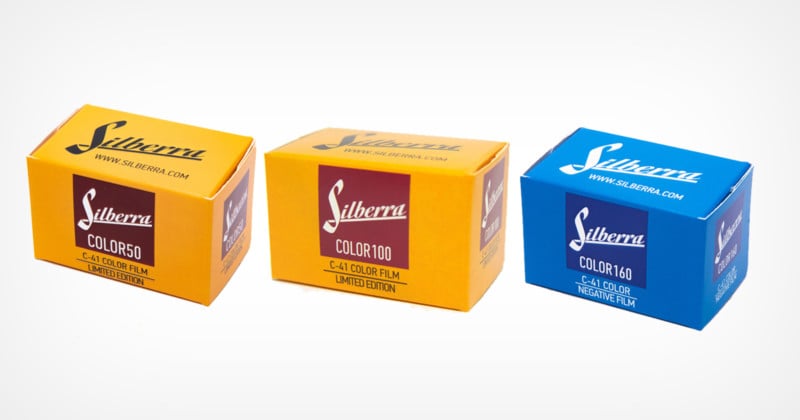
Silberra, a Russian-based company known for its line of 13 black-and-white films, has unveiled three new styles of color film for 35mm and 120 formats at approximately $13 per roll.
While the color film made by the company was initially discovered by Kosmo Foto in early 2020 with the release of the Color 160, it and the other new additions were not made available through the official website store until they were just recently discovered by the publication.
This new lineup includes a Color 160 C-41 Color Negative Film, a Color 50 C-41 Color Film Limited Edition, and a Color 100 C-41 Limited Edition style. The website describes the film as having “slightly different taste for everyone. Some photographers say that it reminds them Kodachrome colors, some would say that there are tints of another film. Actually, the film will certainly show you that it is different from anything you’ve seen, right from the first look upon the emulsion.”
Many film producers stopped manufacturing film stocks in the 1990s and 2000s after the advancement of DSLRs due to the high cost and falling demand, which left most of the market to major players like Kodak, Fujifilm, Ilford, Adox, and Foma. Because it is expensive to produce, new color films are a very rare thing to see from the manufacturers still providing them. According to the report from Kosmo Foto, it initially believed these new films are rebranded stock of an existing color product.
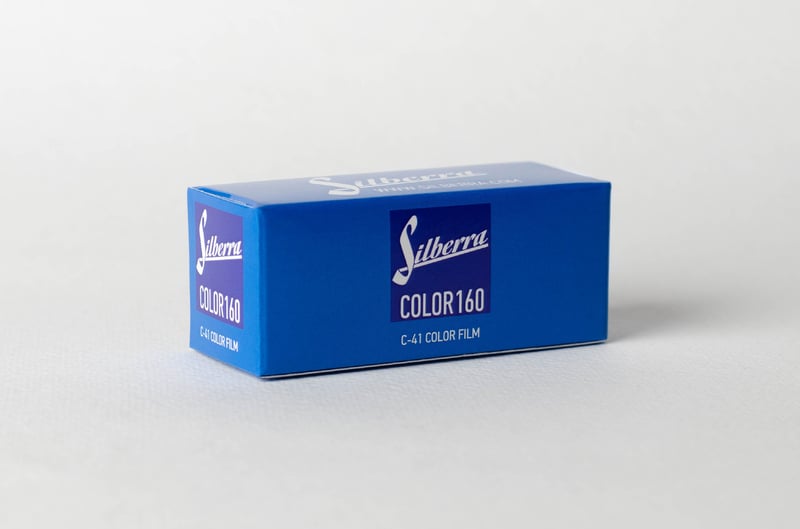
The company alleges that the film is entirely new though, and in an exchange with Silberra’s founder Konstantin Shabanov, Kosmo Foto was told as much.
“We’re bound to classify the coating place by the contract, but that’s new stock and we’ll keep it available. We may state the next things about the emulsion and its properties,” Shabanov says.
“As most of Silberra films this one is not available under any other brand at mass market,” he continues. “It was coated by special order and we hope to have a kind of exclusive rights for it since the next coating. We don’t have access to the formula of the emulsion, so it was made to comply with described quality and properties.
“We’ve got different feedback from different photographers around the world about the color rendering of the emulsion. Some of them say that it reminds them [of] good old Kodachrome, some of them name other films. To avoid direct comparisons with different brand names we may say that it was made to provide natural color rendering with slight shift to magenta. Magenta tint was inevitable due to the original formula of the emulsion which was used to create the final product.”
The full response from Shabanov can be read in Kosmo Foto’s coverage here.
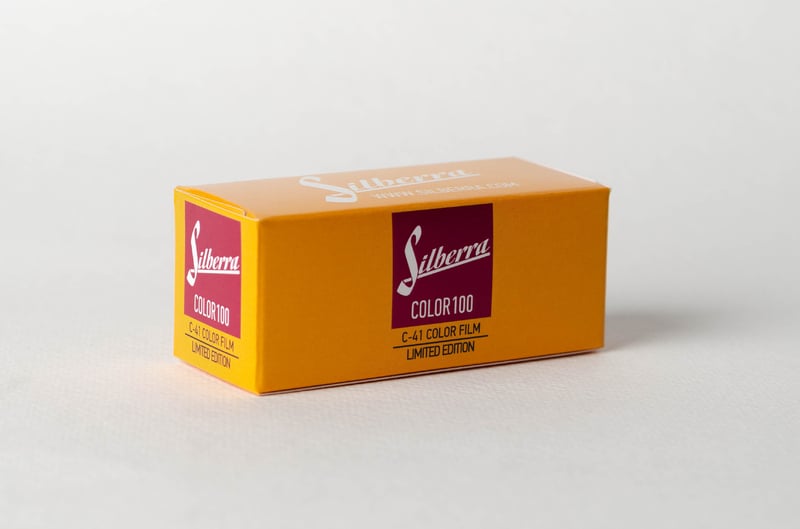
According to the company, the film is made to provide natural color rendering with slight shifts to magenta due to the original formula of the emulsion which was used to create the final product. The tint seems to come and go with ISO, with the lower ISO showing less of a tint. Pushing or pulling the processing of the color films will not shift the colors significantly, but it will enhance or degrade the magenta tints. Shabanov has also stated that Silberra does not have access to the formula of the emulsion, so it was made to comply with described quality and properties.
It appears that Silberra does not plan to reveal who exactly is making this new lineup of color film and the product itself isn’t lending many clues either, as it is devoid of much packaging info and states only “Made in Russia” on the box. Regardless, the addition of new color film varieties is always welcome for photographers still shooting in the analog format which has rebounded in popularity over the last several years.
You can find these new color films as well as Silberra’s full line of options through its website.
Founded in 1872 by Giovanni Battista Pirelli, the company we now know for its expansive range of tires got its humble beginnings in a different industry: telecomms. Back then several new technologies and industries were emerging, including energy and telecommunications. Throughout Europe, kilometers upon kilometers of power cables and phone lines were being put into the ground and into the ocean. All of them needed protection. Enter Pirelli and his expertise in another emerging field: rubber. Pirelli founded a limited partnership, “G.B. Pirelli & C.”, in Milan to produce elastic rubber items – primarily sheathing to protect all these wires buried in the ground. According to Pirelli’s corporate history website, by 1873, only a year after its foundation, Pirelli already had a plant in Milan. Production of carriage bands (they weren’t exactly tires) started in 1885, and by 1894 the first velocipede tire was born.

Giovanni Battista Pirelli
Over the course of the next 50 years, Pirelli grew quickly, opening plants all across the globe while also participating in motorsports both on two wheels and four. By the 1920s, a reorganization of the Pirelli group resulted in the Società Italiana Pirelli, the first Italian group traded on the New York Stock Exchange. Little did anyone know that the Great Depression was looming around the bend…
Through it all, Pirelli diversified its reach immensely. From clothing to sanitary products, if something could be made from rubber, Pirelli was finding a way to be a part of that industry. As far as tires were concerned, the automotive sector dominated the company’s focus, with 1949 marking the start of the company’s involvement developing its first radial car tire, the Cinturato. You’d have to fast-forward to the 1980s before Pirelli developed a radial motorcycle tire, and even then, it was developed for a single model – the 1983 Honda VF1000R.
Pirelli really took a turn in the new millennium, as it integrated its MIRS (Modular Integrated Robotized System) technology in 2001 which substantially changed Pirelli’s tire building process. In 2003, the CCM-based (Continuous Compound Mixing) technology room was introduced to test new mixes and materials.
During this time, Pirelli was still competing in racing. But 2004 marked another turning point, as it became the sole tire supplier to the World Superbike Championship – a partnership that continues to this day. Not long after that, the British Superbike Championship – arguably the top domestic championship in the world – also signed Pirelli as its spec tire supplier.

As the spec tire for the World Superbike Championship since 2004, Pirelli has used the lessons learned in racing and applied them across its entire motorcycle product range.
With data from two top-level championships to lean on, plus Pirelli-sponsored riders throughout the world, the biggest benefactor has been the general consumer, as Pirelli’s road bike offerings have advanced leaps and bounds in the past 20 years. From a business standpoint, further commitment to tire manufacturing and development instigated the process of selling off its other commercial holdings, including its stakes in telecommunications – the very foundation Giovanni Battista Pirelli started the company on. Finally, in 2010, Pirelli liquidated its last remaining outside entities, enabling it to focus solely on tires.
Today, road-going motorcyclists enjoy three distinct categories of Pirelli tire: Diablo, Angel, and Scorpion (Pirelli is no stranger to motocross either, but that’s a story for another time). Diablo is the family of tires for sport, track, and race use. Angel is the family of touring tires, and Scorpion encompasses Pirelli’s adventure and scrambler lineup for bikes that go on road and off. All three of these families benefit from the lessons learned in racing, as well as the advances in manufacturing and technology Pirelli has dedicated itself to.
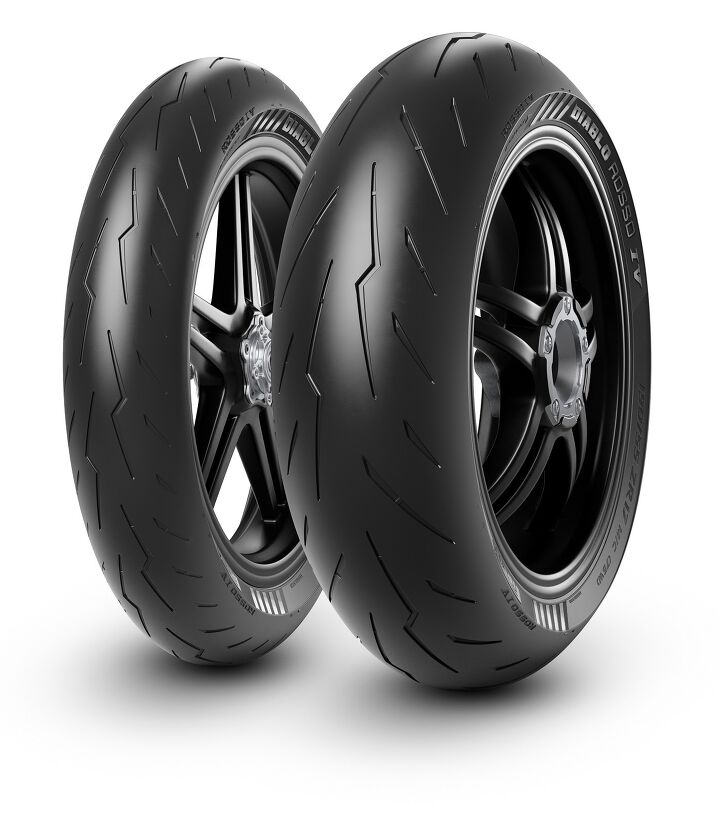
The latest in Pirelli’s street-focused side of the sporty tire range, the Diablo Rosso IV was just introduced in February 2021. As such, as of this writing, your esteemed Motorcycle.com staff have not had a chance to try the tire ourselves. However, a set is currently being sent to us to remedy this situation (and we’ll update accordingly).
Nonetheless, the Diablo Rosso family (versions 1 through 3) have been proven performers for spirited street riders. In the case of the Diablo Rosso IV, emphasis has been placed on braking performance, acceleration grip, quick handling, and both wet and dry performance for bikes with a wide range of power figures, from entry-level bikes to 200 horsepower beasts. How is this done? Here’s a quick dive.
The front tire is divided into three areas using two different compounds. The center is a harder compound for durability and composure under braking. Its high silica content allows it to get up to temperature quickly while also giving it good wet performance. The sides are made up of a softer compound for better cornering grip, also with a high silica count for fast warm-up times.
For the rear tire, there are two different solutions depending on the motorcycle’s weight and power. For sizes up to 190/50-17, the tire is split into three zones, similar to the front tire. A harder compound is in the middle with a softer one on the sides, though the exact chemistry and distribution of the silica and other chemicals is different from the front.
Starting with the 190/50-17 size, the tire is split into five zones using three different compounds. The center compound is high in silica and a harder compound. The intermediate compound is also a full silica compound for fast warm-up and confidence to lean moderate amounts quickly. The very edges are carbon black in a similar compound to the Supercorsa SC endurance racing tire for optimum cornering grip for high horsepower bikes.
All this and we haven’t even begun to talk about profiles and tread pattern. Both of these will be similar among the Diablo line, with a responsive yet neutral profile adapted from the requests of Pirelli’s race teams. Pirelli’s signature “flash” makes up the tread pattern, and different tweaks to it will be found on all the Diablo tires. Pirelli says this pattern helps promote better wear uniformity while also evacuating water well.
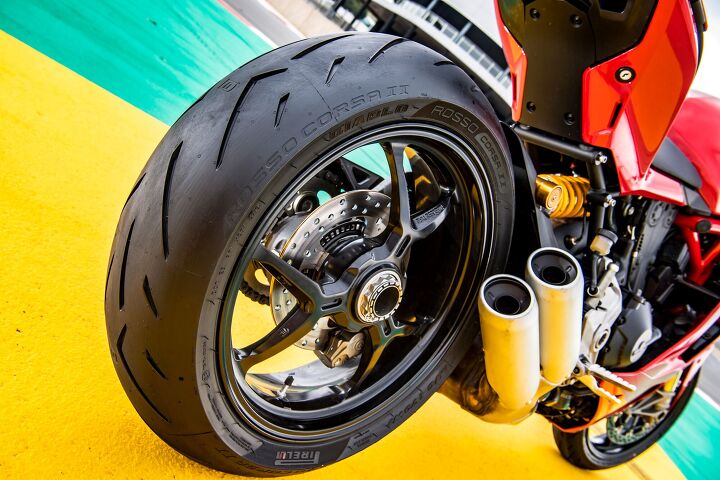
Moving more towards the sporty end of the Diablo family, the Diablo Rosso Corsa II has been a solid street/track tire for as long as we can remember. In fact, Johnny Burns had nice things to say about it in his review. To quote him, quoting Pirelli:
This one “is intended for riders of mid-high performance motorcycles who enjoy a sports riding style on the street and not just on the racetrack. They desire a tire with fast warm-up, sports agility, excellent grip and consistent performance ready to compete against the challenges of everyday use. Pirelli have now transformed racetrack performance into street versatility to guarantee top performance also on road.”
Like the Rosso IV (no Corsa), the front tire is split into three zones while the rear is divvied into five. The front features a full silica center compound while the rear’s center compound is 70% silica. The rear’s shoulders are full silica, then both front and rear use full carbon black compounds at the edges for optimum grip.
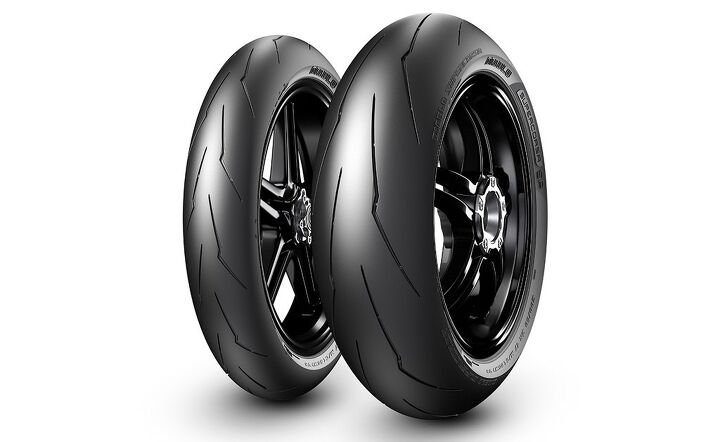
A direct descendant of the Supercorsa SC tires used in racing championships all over the world, the Supercorsa SP version is a street tire that can very easily be ridden hard on the racetrack with even today’s most powerful sportbikes. Guest tester, Isle of Man racer, and all around good (and fast!) guy Mark Miller proves my point when he got to try the tires aboard the latest superbikes.
As far as specifics go, the profile has been revised yet again over V2 based on feedback from World Superbike riders. Pirelli says this improves agility and gives the rider more feel while leaned over. A new compound is being used for the dual compound rear tire for better warm-up times and more consistent grip and feel at maximum lean angles. Lastly, a tweak of the tread design helps give the tire better uniformity as it wears.
Having personally used this tire on several occasions, with and without tire warmers, I can attest to its excellent performance, capable of handling everything all but the fastest of riders can throw at it.
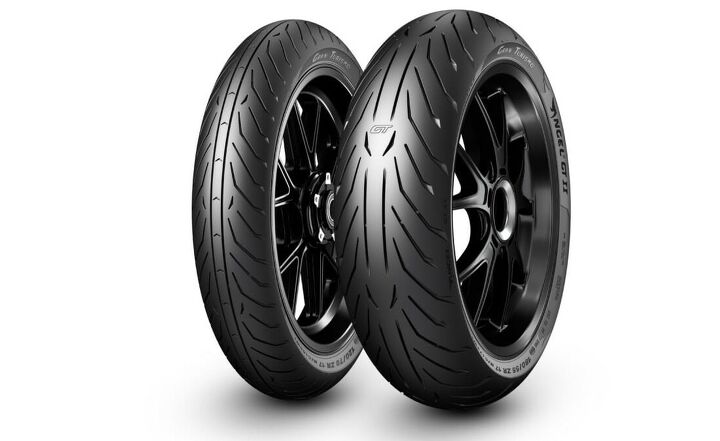
Pirelli’s premier sport-touring tire, the Angel GT focuses on mileage and wet weather performance, especially on today’s sport-touring machines. With a secondary aim of making a tire with neutral handling characteristics, Pirelli focused on the carcass structure to help achieve these goals. As is common with S-T tires, there’s a high silica content in the compounds both front and rear. This not only helps the tire get to temp quickly, but also gives it a good amount of grip in wet conditions.
As you can see from the tread design, getting rid of water is a high priority. But Pirelli also says the structure also helps keep consistent contact pressure for more even wear and better mileage. The original Angel tire, the Angel ST, had a similar tread pattern, with a more pronounced image of a devil in the center. After a certain amount of miles, the devil would turn into an angel. Or maybe it was the other way around. Whatever it was, it was incredibly weird. Thankfully, it’s still an excellent sport-tourer.

Moving to the adventure side and we have the Scorpion Rally STR. The knobby bias makes it clear this is a tire that prefers being off-road. However, it still delivers impressive road performance too. You can tell by looking at the rounded profile that the Scorpion Rally STR borrows from the road division. But its high silica content makes it well suited for pavement duties, even in cold weather. If you’re worried about the knobs tearing, the wide surface area of the knobs helps to dissipate heat more evenly, helping them last longer.
Get off into the dirt and the knobbies will be in their element. The long, wide blocks may not give motocross levels of grip off-road, but they’re chunky and still well able to bite into the ground. Big adventure bike riders should be satisfied with the Scorpion Rally STR.
Are Pirelli motorcycle tires good?
You don’t remain in business for nearly 150 years by accident. Pirelli is known all over the world for its excellent tires in a variety of different riding categories. This is a result of its constant research, development, and involvement in motorsports. The lessons learned in racing ultimately get transferred back to the products you and I can buy at our local store.
Is Pirelli better than Michelin?
When it comes to high-profile brands like Pirelli, Michelin, and others, one isn’t necessarily better than another. It really is true that these well-known brands all produce great products. But each company may have specific characteristics they impart into their tires that may or may not work well with your riding style.
How long do Pirelli motorcycle tires last?
The lifespan of any tire depends on a number of factors – type of tire, type of riding, riding conditions, type of motorcycle, etc. Tires meant for competition will clearly have a shorter lifespan than touring tires, but the competition tires will have more outright grip. Within their specific categories, Pirelli tires are known to last a similar amount of miles as others in the category. But again, it’s nearly impossible to get into specifics about how long a tire will last.
Riding The Pirelli Diablo Supercorsa Tire Range
MO Tested: Pirelli Supercorsa TD Review
Pirelli Diablo Rosso Corsa Review
Pirelli Diablo Rosso II Review
We are committed to finding, researching, and recommending the best products. We earn commissions from purchases you make using the retail links in our product reviews. Learn more about how this works.
Become a Motorcycle.com insider. Get the latest motorcycle news first by subscribing to our newsletter here.
The post Pirelli Motorcycle Tires: Everything You Need To Know appeared first on Motorcycle.com.
We’re big fans of motorcycle airbag technology here at MO, especially our own Troy Siahaan who learned first hand how effectively an airbag can protect a rider in a crash.

One of the world’s leaders in airbag technology is Helite, a French company founded in 2002 by Gérard Thevenot, an engineer specializing in fluid mechanics. In addition to airbag vests for motorcyclists, Helite produces similar systems for equestrian riders and cyclists, and even an airbag belt for seniors to protect their hips during a fall.
Thevenot had a passion for lightweight methods of flight such as hang gliders, paramotors and ultralight aircraft. Seeing the risks and high accident rates of light aeronautics, Thevenot started looking at ways to provide pilots with extra protection. Eventually, Thevenot developed an individual airbag that would deploy around a pilot, providing some protection from impacts.
Though the initial idea came from aeronautics, Thevenot saw how the technology would also help motorcyclists, and his initial patent from 2002 describes how a rider could wear an airbag packaged in a vest that deploys in the event of a crash.
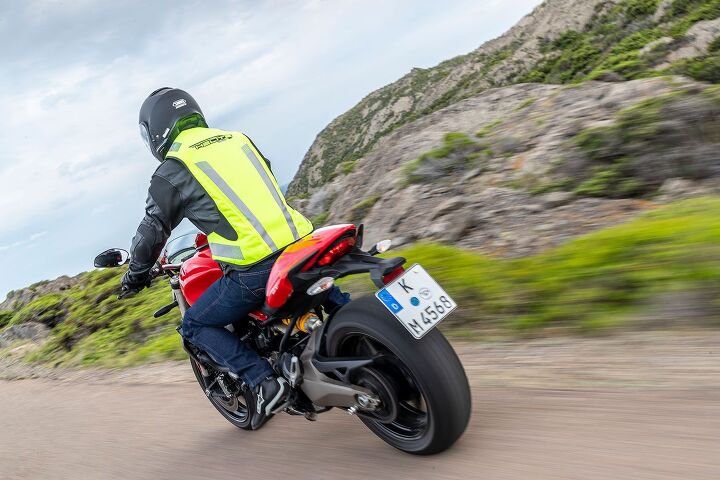
One of Helite’s signature products is the Turtle 2 vest. Unlike other products where the airbag is incorporated into a jacket, the Turtle 2 is an airbag vest that can be worn over most motorcycle garments. This gives the Turtle 2 some added versatility, as a rider can use the same vest over a lightweight ventilated jacket during the summer, or over a heavier jacket for when the weather gets cooler.
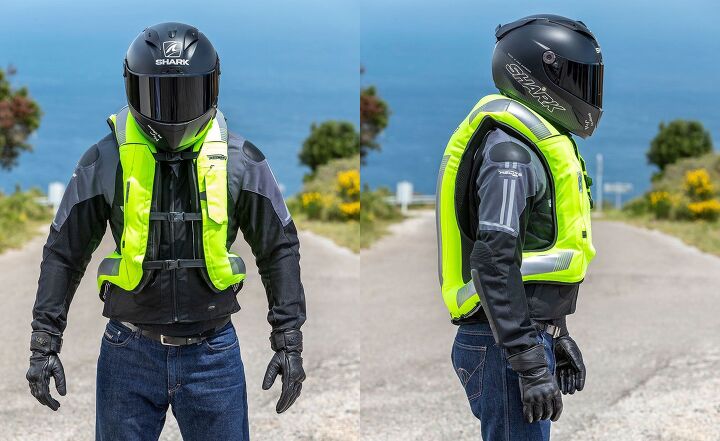
Helite’s airbags have a unique shape that helps protect several vulnerable areas. Around the neck and shoulders, the airbag stabilizes the cervical vertebrae and the head to prevent whiplash. The front part of the airbag protects vital parts such as the thorax, lungs, and ribs, while the back of the airbag protects the spinal column. The bottom of the airbag covers the kidneys and hips while protecting the torso from hyperflexion. The Turtle 2 also comes with a SAS-TEC level 2 back protector which helps to distribute the force of impact across the entire surface of the airbag and not on just one point.
The Turtle 2 uses a mechanical system, with the vest attaching to a motorcycle via a lanyard. If a rider is ejected in a crash, the lanyard gets pulled away from the vest, activating a gas cartridge that inflates the airbag. According to Helite, the airbag will fully inflate within 100 ms of a crash, which should be enough time to deploy before the rider hits the ground.
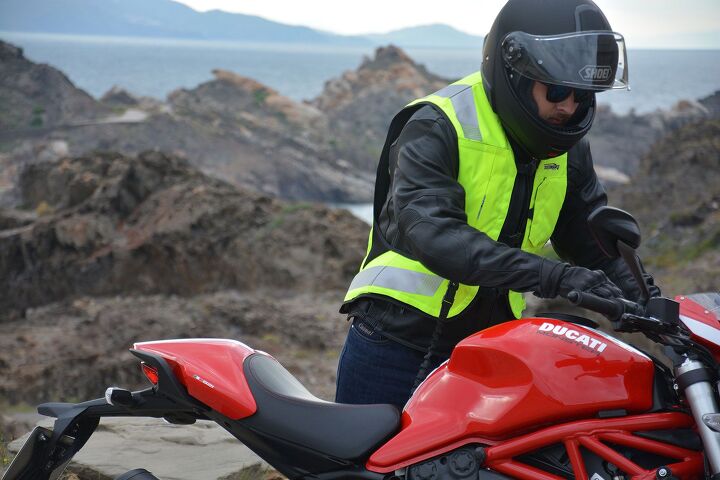
Because it uses a mechanical system, the Turtle 2 airbag vest does not need to rely on batteries or electronic sensors. The airbag is also reusable and can be reset by deflating the airbag and installing a new gas cartridge.
In September, Helite will also offer U.S. riders an electronic version that uses sensors integrated into the vest to measure the rider’s motion as well as an external sensor mounted on the fork to detect impacts on the motorcycle.


We are committed to finding, researching, and recommending the best products. We earn commissions from purchases you make using the retail links in our product reviews. Learn more about how this works.
Become a Motorcycle.com insider. Get the latest motorcycle news first by subscribing to our newsletter here.
The post A Breath of Fresh Air: Introducing the Helite Turtle 2 Airbag Vest appeared first on Motorcycle.com.
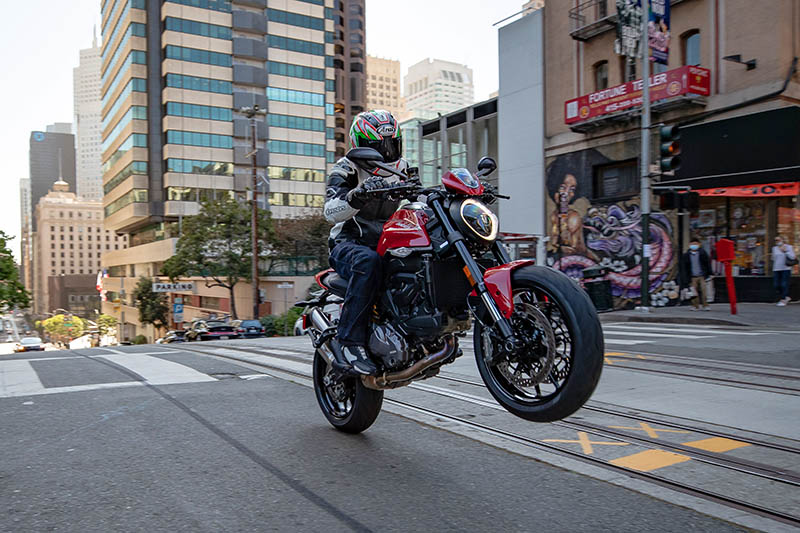
Over the years Ducati has produced several iconic motorcycles which have withstood the test of time. Many enthusiasts credit Ducati’s 916 as the one that stands above the rest in it’s revolutionary design and styling. But there’s another Ducati that has made its own mark in similar fashion — the Monster — which established the “naked bike” style.
Unveiled at the Cologne show in 1992, designer Miguel Galluzzi said, “All you need is: a saddle, tank, engine, two wheels and handlebars.” Though designated the M900, it became known by its nickname, “Monster.” Like Frankenstein’s monster, the M900 stitched together the steel trellis frame from the 851 Superbike, the air-cooled, 904cc L-twin from the Supersport Desmodue, a “bison-back” gas tank, a low handlebar and a round headlight.
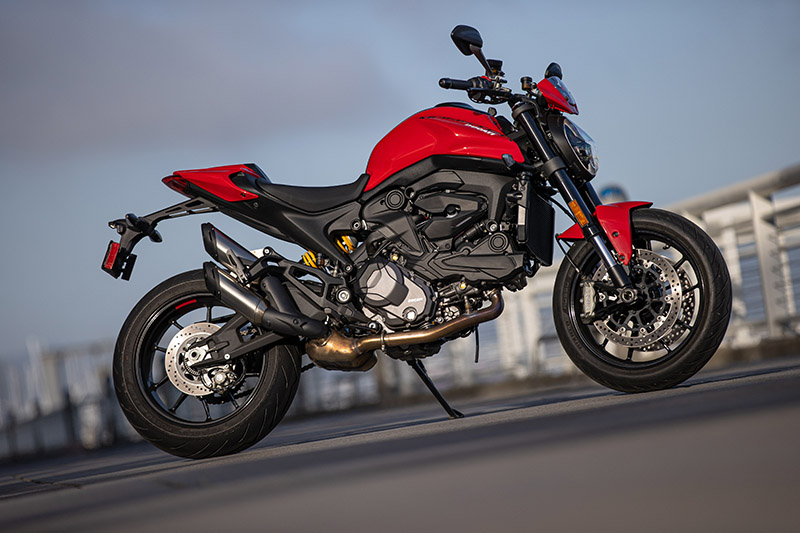
Over nearly three decades of production and more than 350,000 units sold, the Ducati Monster has seen multiple evolutions in terms of styling and technology, and it has been offered in a range of displacements, from 600cc to 1,200cc. The commitment made by Ducati to enhance and keep the Monster relevant is evident from the latest version of this iconic motorcycle, which brings together a Superbike-inspired chassis, a road-going engine and the latest in electronic riding aids.
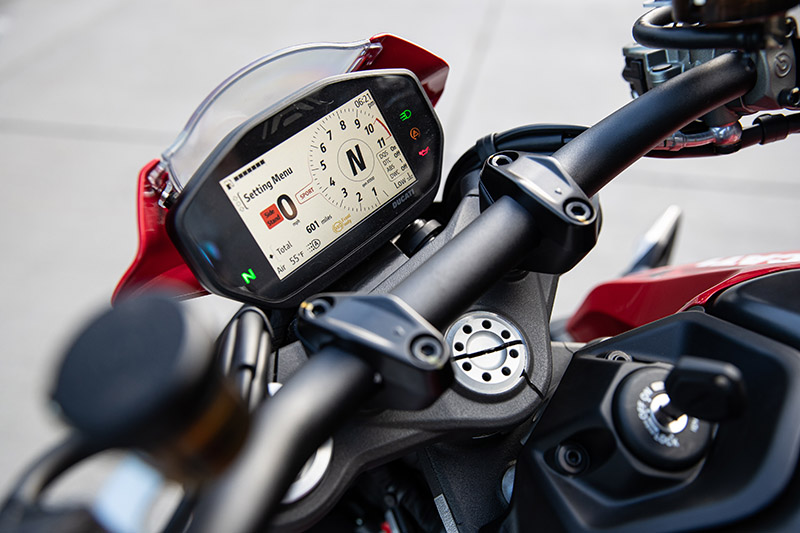
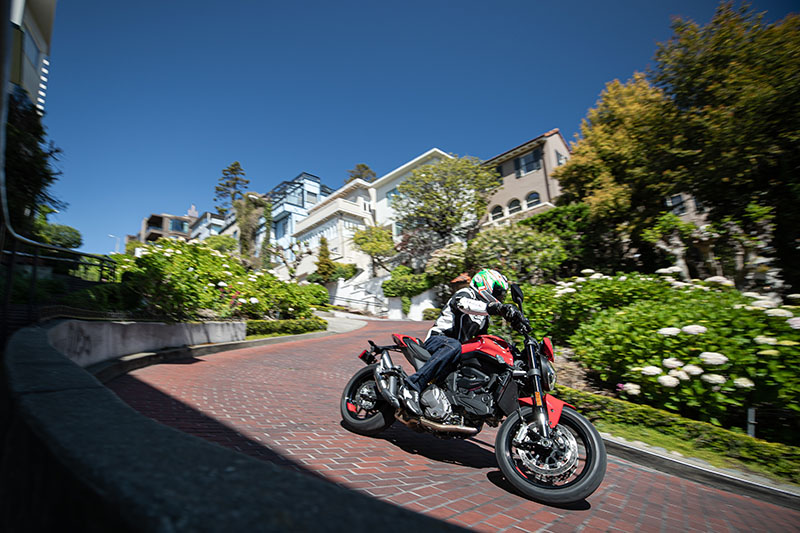
It’s fitting that the 2021 Ducati Monster was launched in San Francisco because the bike has been a huge hit among urban enthusiasts. The design brief for the latest version was to deliver the best of both worlds — to be “more thrilling for experienced riders” as well as “more accessible for new riders.” The new 2021 Monster maintains the model’s signature minimalist styling and aggressive attitude while delivering increased power, comfort, and maneuverability. Couple this with a new, comprehensive electronics package, and the latest generation is likely to ensure the Ducati Monster remains as popular as ever.
First impressions of the 2021 Ducati Monster can be deceiving. Sure it looks like a Monster with its bison-back tank and round headlight, but there’s something missing. The classic steel trellis frame has been replaced with a new Panigale-style aluminum upper section frame that saves 9.9 pounds and uses the engine as a structural member of the chassis. They didn’t stop there. Updates including a new swingarm and fiberglass-reinforced polymer subframe shave off 10 pounds, and the Testastretta engine and lighter wheels save another 10 pounds. All this tinkering, Ducati says, has reduced the Monster’s curb weight to a lean 414 pounds, a full 40 pounds less than last year’s model.
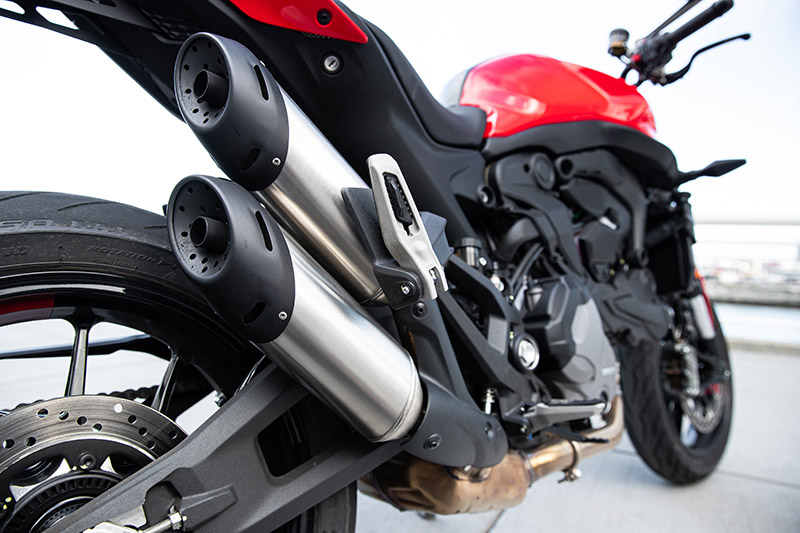
Firing up the Monster produced a familiar sound that resonated in my ears. Powering the Monster is a version of the liquid-cooled, 937cc Testastretta 11-degree L-twin also found in the Hypermotard, Multistrada 950 and SuperSport 950. Claimed output is 111 horsepower at 9,250 rpm (up 2 from the Monster 821) and 69 lb-ft at 6,500 rpm (up 1.5). Updates to the engine include new cylinder heads, pistons and rods, intake and exhaust system, geardrum, stick coils, alternator and belt covers. A new clutch has 20% lighter pull, and an up/down quickshifter is standard. The new Monster has a 9,000-mile oil service interval and an 18,000-mile desmodromic valve service interval.
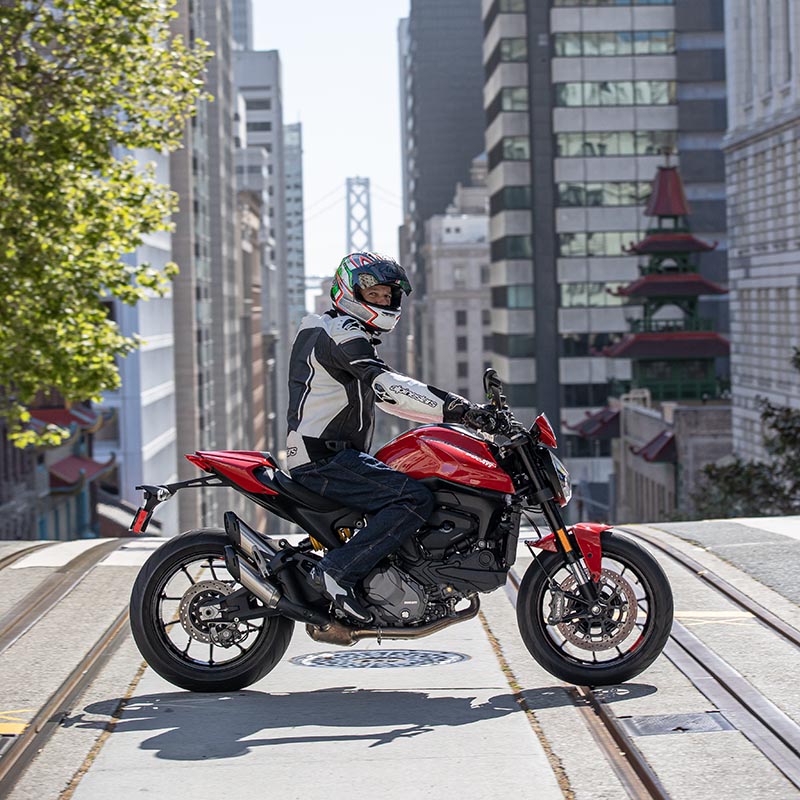
The Monster’s new electronics package includes three fully customizable riding modes (Sport, Touring and Urban), IMU-based cornering ABS, cornering traction control, as well as wheelie and launch control. Starting off in Urban mode, which reduces engine output to 75 horsepower, the softer throttle response and increased level of intervention for ABS and TC make the Monster highly manageable. The tamed throttle response is sufficient enough to get the job done when negotiating lane changes or avoiding sketchy situations, but after a few miles of exploring the busy streets of San Francisco, Urban mode felt too corked up and I was eager for more.
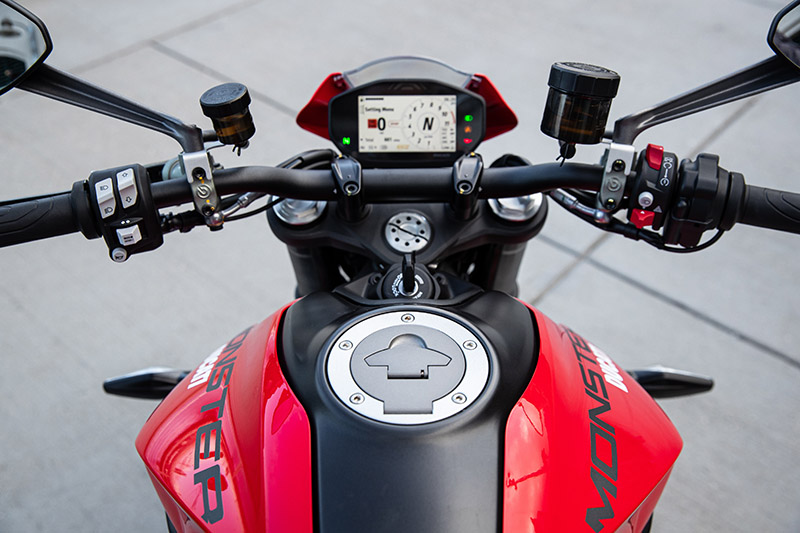
Tapping a button on the left switch cluster allowed me to sample Touring and Sport modes, both of which offer full power, more direct throttle response and less electronic intervention, with Sport mode being the most aggressive. An up/down toggle scrolls through the various settings within each mode; just push the button, close the throttle and the change takes effect. Changes to default settings can only be done while stopped. Everything is displayed on a new 4.3-inch, high-resolution TFT instrument panel.
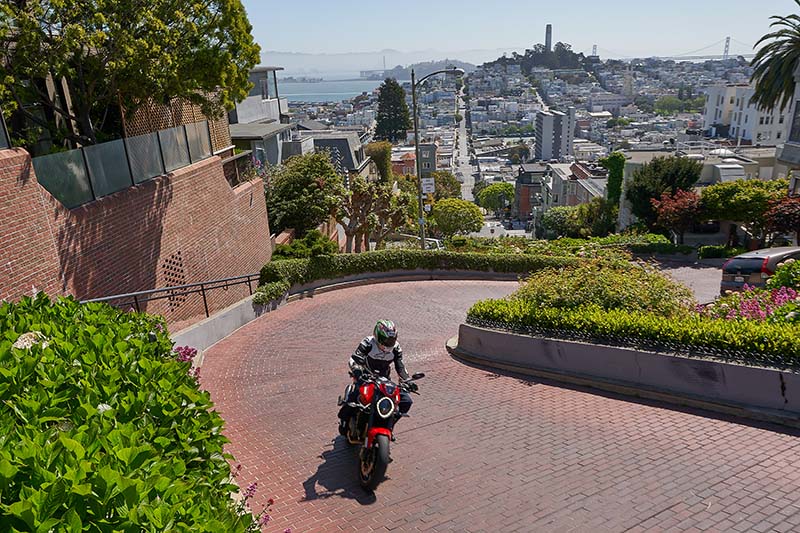
As our test ride continued, I came to appreciate the Monster’s agreeable riding position and agile handling. The Panigale-style frame, new bodywork and a new seat make the Monster narrower between the legs. Height of the stock seat is 32.3 inches, but the accessory low seat ($160) reduces seat height to 31.5 inches and the low seat plus the accessory low suspension kit ($300) reduces seat height further to 30.5 inches. Ducati also changed the bar/seat/peg configuration, with the handlebar moved 2.6 inches closer to the rider and the footpegs moved back 1.4 inches and down 0.4 inch compared to the Monster 821. Not only are the ergonomics more comfortable, but a 7% tighter steering angle reduces the turning radius by 3.75 feet, simplifying U-turns and slow-speed maneuvering.
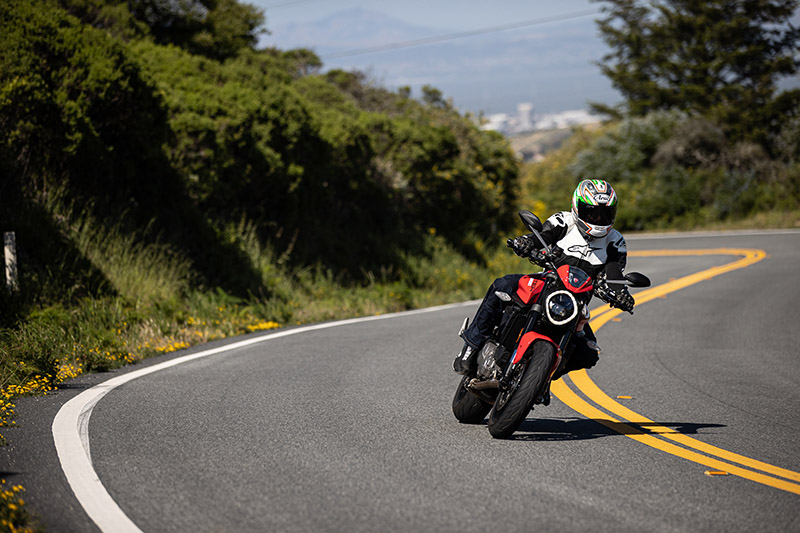
Riding around town, the Monster hits all the marks, but how will the changes translate out in the twisties, while giving it the berries? On the handling front, Ducati kept it simple. Suspension is made by KYB, with a non-adjustable 43mm USD fork with 5.1 inches of travel and a preload-adjustable rear shock with 5.5 inches of travel. The basic setup worked quite well, with good bump compliance and exceptional midcorner stability. Compared to the Monster 821, the wheelbase is slightly shorter thanks to a tighter rake (24 degrees, down 0.3) but trail is unchanged at 3.7 inches. Revised chassis geometry, less weight and a narrower 180/55 rear tire make for a more maneuverable platform. While lighter wheels, reduced unsprung weight, and grippy Pirelli Diablo Rosso III tires combined to give a planted feeling during quick transitions.
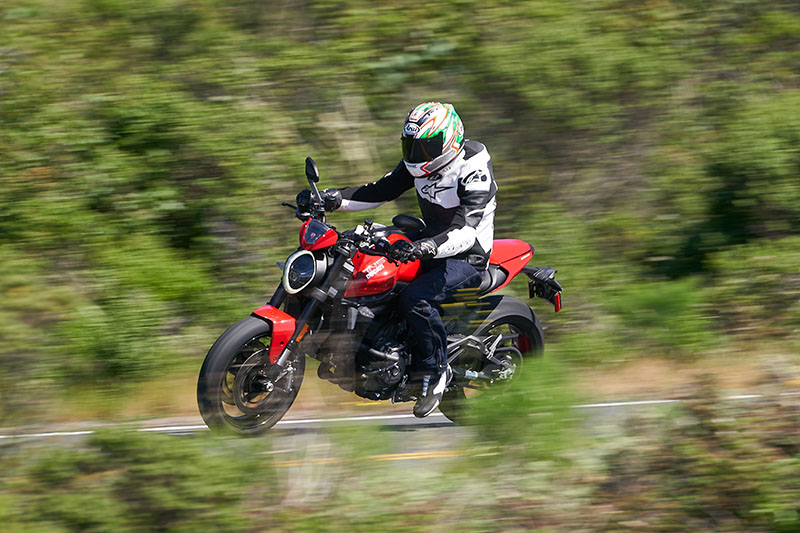
The highway separating me and the new Monster from the sublimely twisty roads of the Santa Cruz Mountains, south of San Francisco, provided an opportunity to feel out its cruising abilities, and in 6th gear, at around 75 to 80 mph at 5,500 rpm, there was plenty of roll-on power in reserve. As soon as I exited the highway, and headed into the mountains, I really started to flog it. I thought for sure the suspension would give it up, but the Monster handled pretty much everything I threw at it. Tight switchbacks, long sweepers, decreasing-radius corners, uneven pavement and even those mystery bumps hidden in the shade of redwoods were all kept in check. The effort Ducati put into designing a more compact, agile, and friendlier riding position has really paid off. Transitioning back and forth was fairly easy in the fast stuff, but needed some increased effort in the tighter sections. The front-end feel at corner entry and mid-corner was reasonably good, allowing me to feel the road adjust to the conditions with confidence.
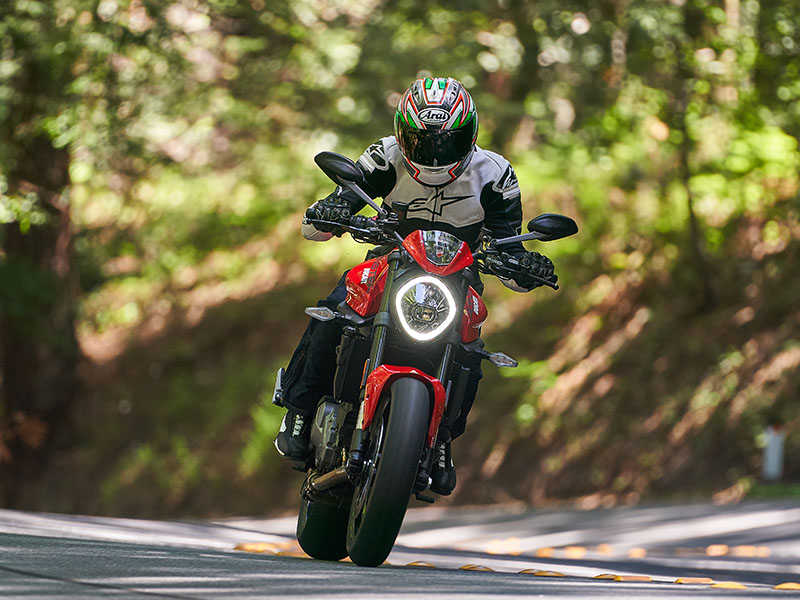
The Monster also has good front-to-rear balance and minimizes weight transfer on exits. I did some experimenting with the TC and ABS settings to gauge their effects at full tilt. There is definitely some intervention in the upper ranges of the 8-level TC, especially when traction is questionable. I found that peculiar sensation like a rev limiter kicking in several times on hard corner exits. In the lower levels of the TC the Monster’s response is more measured and precise. You’ll feel like a real pro, barely noticing that it’s working.
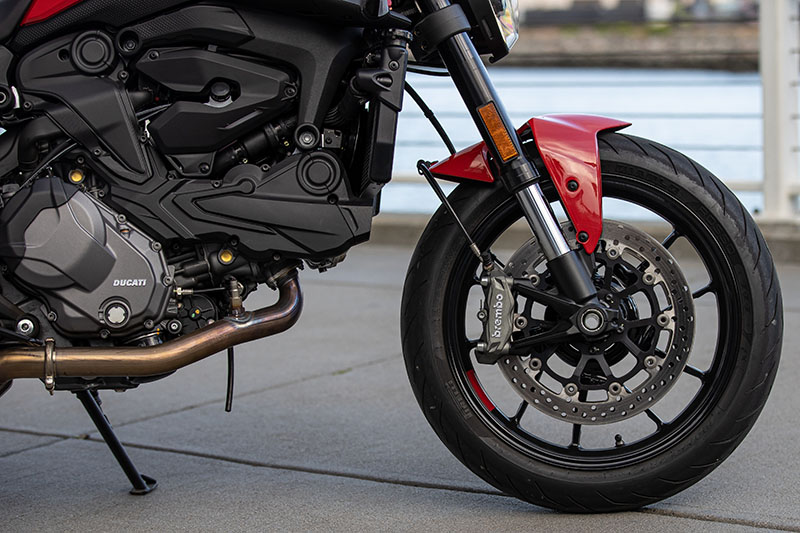
Braking wise, the Monster is equipped with Brembo’s latest M4.32 monoblock front calipers and 320mm rotors, along with a Brembo radial master cylinder. Together they offered a superb braking feel with plenty of stopping power. The ABS is well sorted and even though I’m not usually a fan, it stepped in to save the day a few times.
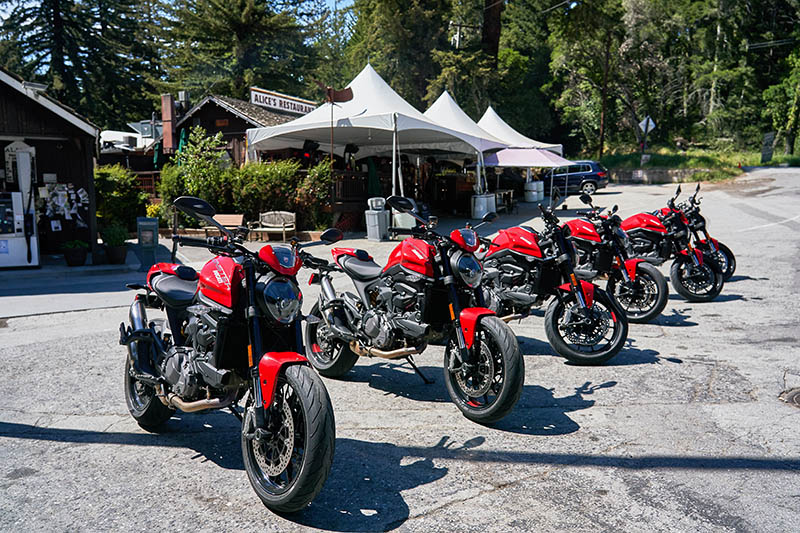
Everybody sampled the 4-level wheelie control and launch control at nearly every stop light. Where it counted for me was on low-speed corner exits. In Level 4 it’s very apparent as the motor starts to cut out in order to keep the front wheel on the ground. Level 1 and 2 seemed most agreeable with minimal intervention. The good thing is the wheelie control can be independently adjusted from the other control systems or turned off. Ducati’s quickshifter worked well in both up and down directions, adding to the fun, but felt clunky at lower speeds.
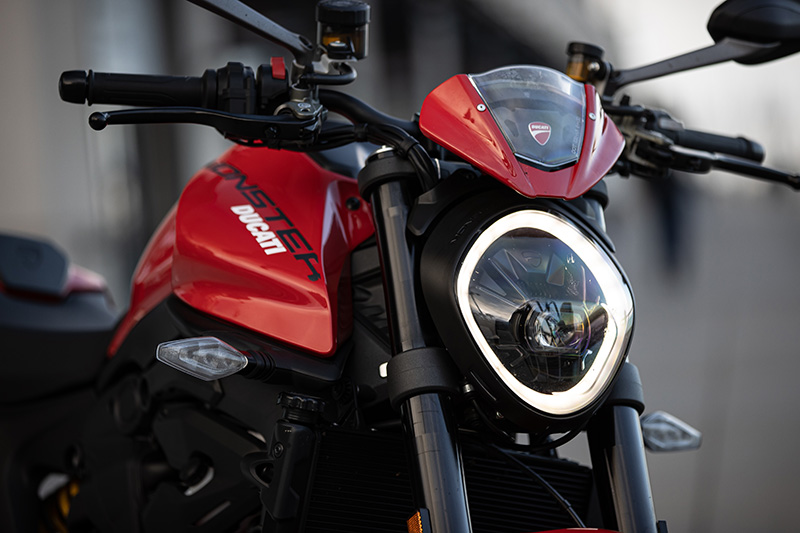
Overall, the 2021 Ducati Monster performed exceptionally well. It’s the friendliest Monster yet and should satisfy a wide range of riders (and abilities) attracted not only to its performance and style, but also its accessibility. The many updates ensure that Monster legacy will be carried forward by this worthy successor.
The Monster comes in three color options: Ducati Red ($11,895), Aviator Gray (+$200) and Dark Stealth (+$200). And the Monster+ ($12,095) adds a flyscreen and passenger seat cover. An extensive range of accessories allow you to personalize the Monster, from a Termignoni racing exhaust to an EPA/CARB-compliant slip-on, tank cover kits and more.
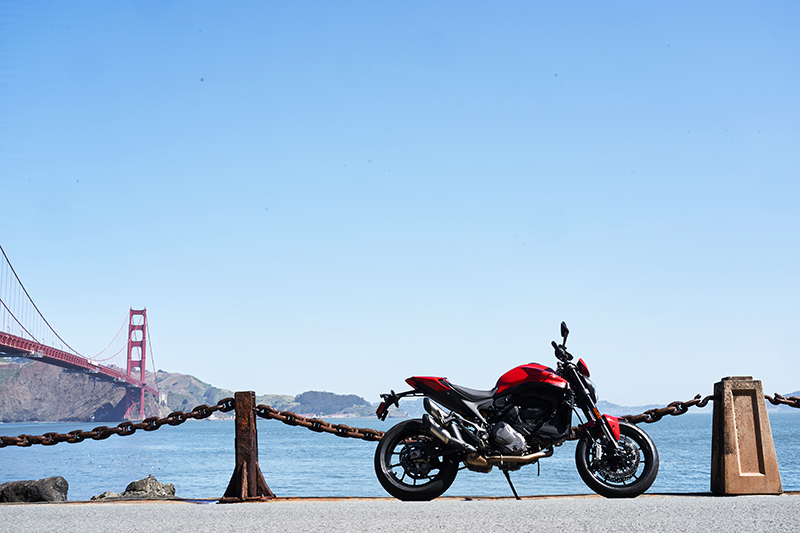
Base Price: $11,895
Price as Tested: $12,095 (Monster+ w/ flyscreen, passenger seat cover)
Website: ducati.com
Engine Type: Liquid-cooled, transverse 90-degree V-twin, DOHC w/ 4 valves per cyl.
Displacement: 937cc
Bore x Stroke: 94.0 x 67.5mm
Horsepower: 111 hp @ 9,250 rpm
Torque: 69 lb-ft @ 6,500 rpm
Transmission: 6-speed, hydraulically actuated wet clutch
Final Drive: Chain
Wheelbase: 58.0 in.
Rake/Trail: 24 degrees/3.7 in.
Seat Height: 32.3 in.
Wet Weight: 414 lbs. (claimed)
Fuel Capacity: 3.7 gals.
REOPENING TOMORROW WITH SPECIAL GUEST KYLE SMITH We are thrilled to be reopening our doors from 10am tomorrow and have installed some brand-new exhibitions, restocked our Factory Shop and filled the fridges in our 1902 [...]
The post Free entry to Triumph Factory Visitor Experience Exhibition appeared first on Total Motorcycle.