Although professional photographers may deal with copyright and licensing regularly, it is not right to assume that clients are just as versed. For that reason, an architecture photographer has put together a simplified explanation to help business owners better educate their clients on who owns the produced photos and how they can be used.
Questions surrounding copyright and licensing can be a complex issue to navigate not just for clients — who may not have dealt with purchasing and using intellectual property before — but also for beginner photographers who are just entering the business. Clear communication between the photographer and the client prior to booking the job can help resolve any legal issues that may arise due to ambiguous wording in the contract or a misunderstood verbal agreement.
To help photographers better educate their clients about copyrights and image use — and to explain this in a simple way without the use of complex legal jargon — Kansas City-based architecture photographer Matthew Anderson put together a brief YouTube video that puts the topic into a simple context for better understanding. Not to be used as professional legal advice, his simplified explanation compares image use with that of other intellectual property, such as music.
Image theft and misuse is something that photographers are likely to encounter in their career at some point — such as the below example from Anderson himself where a company wanted to use his image on the social media app for free — which is why it’s important to clearly articulate who the produced work is owned by and how it is permitted to be used by clients.
Although adding clarity to the discussion of image rights and usage is not a guarantee that the guidelines will be adhered to nor does it protect the photographer from strangers stealing work, it can at least help avoid certain situations that could have been resolved if the client or shoot collaborator fully understood the received image rights. This also includes situations when a client is happy to share the produced images with a third party — although no malice may be intended — without realizing that they might be required to ask for the photographer’s permission first.
Intellectual property is one of the most important assets of a photography business, so it is important to guide clients with clear instructions at every possible opportunity which will help avoid profit loss in the future.
More of Anderson’s architecture photography-based videos can be found on his YouTube channel and his own photography work can be seen on his Instagram.
This story is excerpted and adapted fromThe Appalachian Trail: A Biographyby Philip D’Anieri, published in June 2021 by Houghton Mifflin Harcourt.
On April 4, 1948, Army veteran Earl Shaffer set out from the southern end of the Appalachian Trail (AT) to, as he famously said, “walk the war out of my system.” When he finished at the northern terminus, Maine’s Mt. Katahdin, 124 days later, Shaffer became the first person known to have thru-hiked the 2,000 mile-plus trail that snakes its way up the mountainous spine of the eastern United States. Less than a decade later, a 67-year-old grandmother laced up not hiking boots but sneakers, and became the first woman to thru-hike the trail on her own*. While Shaffer’s journey of finding redemption on the trail is better known, Emma Gatewood’s trek is just as compelling: After a lifetime of dire hardship, she was simply drawn to the freedom of a long walk.
Gatewood, unlike most thru-hikers of the Appalachian Trail, was actually from Appalachia, the southern highland region defined by both its steep terrain and distinct social economy. She grew up among the Allegheny foothills of far southeastern Ohio, and her everyday environment had much more in common with that of West Virginia, just across the Ohio River, than with the agricultural flatlands and industrial cities of the rest of her home state.
She was born Emma Caldwell in Gallia County in 1887, the 12th of 15 children, and grew up on a succession of farms as her family moved repeatedly in search of better opportunities. For the Caldwells and the thousands of people who scratched out a living in the hills, unlike their counterparts in towns and cities, the outdoors was a workplace from which to wrest a livelihood, not a patch of scenery to admire and explore. At 18, she was earning 75 cents a week as live-in help when she met P. C. Gatewood. The two got married in the spring of 1907. Almost from day one of their marriage, according to her descendant and biographer, Ben Montgomery, Emma Gatewood’s husband viewed her as a possession, and violence as his means of control. After he hit her for the first time, according to Montgomery:
She thought of leaving him that day and that night and on into the next, but where would she go? She had no paying job, no savings, and her education had ended in the eighth grade. She couldn’t return home and be a burden on her mother, who remained busy rearing children. So she bit her tongue and stayed with P.C.
Surviving her husband and providing for her steadily growing family would define Gatewood’s married life for the next three decades. She raised 11 children, ran the household, and performed back-breaking farm labor. Through it all, she did whatever she could to protect herself and her children from her husband. She defended herself, she fought back, and she sometimes escaped to the woods, where the idea of refuge among the trees was no literary allusion, but an all-too-real matter of life and death. There were happy times as well. The children remembered their mother especially enjoyed taking them for long walks.
P. C. Gatewood was convicted of manslaughter after he killed a man in 1924. He was given a suspended sentence because of the court’s belief that he needed to be able to provide for his wife and children, but the restitution he was ordered to pay required selling off half the farm, and began a steady cycle of worsening economic fortunes for the family.
His violence toward Emma was a constant. In 1937, she left her younger children in the care of their adult siblings, and escaped to California, where her mother and two of her siblings lived. She corresponded with her children in letters that had no return address, and were carefully written to prevent P. C. from determining her precise whereabouts. In the end, she returned home out of obligation to the children, knowing that it put her again in harm’s way.
Not long after, P. C. moved with Emma and the three youngest children, aged 11 to 15, to a small farm on the West Virginia side of the river. In 1939 he managed to have Emma arrested after a fight between the two of them that left her badly battered. But the event turned out to be the beginning of the end for the Gatewoods’ marriage, and P. C.’s presence in Emma’s life. In early 1941, after more than 30 years of marriage, Emma Gatewood secured a divorce. Now in her early 50s, she would set about building a new life on her own terms. Those terms would eventually include going for several very long walks.
By the end of World War II, Emma had moved back to Ohio. Free to fashion a life on her own terms, she spent the next several years moving around to different jobs and arrangements, tending to sick relatives, and working in healthcare. At some point, she came across a 1949 article in National Geographic about the Appalachian Trail. It mentioned that a young man from Pennsylvania, Earl Shaffer, had become the first to hike the full length of the trail in a single trip.
In 1954, Gatewood, then 66 and apparently knowing nothing more about the trail than what had appeared in National Geographic, made her own decision to hike the full AT. She would never provide a singular answer as to why she was drawn to a thru-hike, beyond the fact that the trail sounded attractive to her, and she appreciated having the freedom to do as she pleased. The National Geographic article had organized its overview from north to south, and in July Gatewood arrived at Baxter State Park in Maine to begin her trek. Though her first day on the trail was a success, she quickly ran into trouble. On just her second full day of hiking, she inadvertently left the trail, one of the most dangerous situations for AT hikers. In the deep woods of Maine, being just a short distance off a trail can render it completely invisible, at which point the sea of surrounding trees becomes uniform and directionless, and disorientation quickly sets in. After two nights in the wilderness, and breaking her glasses, Gatewood somehow managed to rediscover the trail and return to where she’d started. With the strong encouragement of park rangers, including a ride to the nearest train station by the park’s superintendent, Gatewood called off her hike and returned to Ohio.
The next spring she tried again, this time heading north from Georgia. As she had the previous year, Gatewood told no one, including her own family, what she was up to. She didn’t want them to worry, or to try to dissuade her.
From the start, Gatewood made little distinction between the trail she was hiking on and the larger territory she was walking through. She sought food and shelter from the world around her, whether that was picking berries on the trail or asking to spend the night on nearby farms. Rather than outfit herself in special gear, she wore sneakers and slung her few belongings in a duffel over her shoulder. Gatewood had spent virtually her entire life in a working Appalachian landscape, getting around by foot, making do with what was at hand. Her hike on the AT would play out as an extension of that life, an indulgence in something that she enjoyed, rather than a self-conscious expedition into nature.
Her first night, she lost the trail but came upon a house whose owners let her spend the night, and she hiked back in the morning. The second night, she used an abandoned shack near the trail for shelter. Later in Georgia she overnighted in a church. Another night, she was told by a man that she couldn’t stay on his property, because she belonged with her family and not out hiking on her own.
Day in and day out, she relied on her own grit and wits to get by, and on the generosity of others. As was the case with Shaffer, word of Gatewood’s passage over the trail began to precede her, and local reporters caught up with her to write stories. One reporter took an especially keen interest. As Gatewood approached Bear Mountain in New York, Mary Snow, who covered women’s sports for Sports Illustrated, arranged to hike along with her for about five miles, bought her dinner, and paid for a cabin.
Unlike much of the other coverage, which portrayed Gatewood as an eccentric, Snow’s story, a short back-page article, focused on the seriousness of the challenge she had undertaken:
Mrs. Gatewood, alone and without a map, began following the white blaze marks of the trail early in May, and this week from Connecticut’s Cathedral Pines, Grandmother Gatewood could look back on 1,500 miles of the best and worst of nature. She had carefully avoided disturbing three copperheads and two rattlesnakes on the trail, flipped aside one attacking rattler with a walking stick. When caught without nearby shelter she had heated some stones and slept on them to keep from freezing. For snacks Grandma nibbled wild huckleberries, used sorrel for salad and sucked bouillon cubes to combat loss of body salt.
When Gatewood got to Baxter State Park, she was met by both Snow and the woman who had reported on the conclusion of Shaffer’s hike seven years earlier, Mrs. Dean Chase. (Chase was known, as many women were at the time, by her husband’s name. Snow’s articles on Gatewood went without a byline.) The two women would accompany Gatewood off and on for the next several days, but she climbed Katahdin alone, for the second time in just over a year, to complete her hike on the morning of September 25, 1955.
Asked why she undertook the trip, Gatewood answered, “Because I wanted to,” and because of the alluring things she had read about the Appalachian Trail. The reality was a disappointment. “The article told about the beautiful trail, how well marked it was, that it was cleared out and that there were shelters at the end of a good day’s hike,” she said. “I thought it would be a nice lark. It wasn’t.”
Despite her disappointment, and settling back into her Ohio life, in the spring of 1957, Gatewood flew to Georgia again and thru-hiked the AT for the second time in three years, finishing a few weeks before her 70th birthday. In 1959 she walked along roads that followed the old Oregon Trail, from Independence, Missouri, to Portland, Oregon, her progress tracked in newspapers, and the crush of onlookers near the end leaving her so frustrated that she hit one photographer with her umbrella. In 1964, at 77, she completed a section hike of the AT, the last of a series of separate such trips over the years, marking the third time she had walked the full length of the Appalachian Trail.
During this period, AT thru-hikers remained rare. It was only in the late 1960s, and accelerating in the ’70s, that the popularity of hiking soared, to the point that hundreds of would-be thru-hikers were setting out from Georgia’s Springer Mountain each spring.
Earl Shaffer’s 1948 hike came to serve as the origin story for a thru-hiking culture that was playing a bigger and bigger role in the life of the AT itself, portrayed as a wilderness experience where backpacking skill and know-how provided entry to a separate, higher realm of nature. But Gatewood showed that the AT could be hiked in concert with the world of buildings and people that permeated it, not necessarily in opposition to them, and that it was a stage not just for the heroism of a young man, but for the mundane getting-by of an old lady. Yes, it could be the object of a years-long quest to re-create oneself. But it could also be “a lark,” taken up at the suggestion of nothing greater than a chance encounter with a magazine article.
Gatewood continued to hike and travel until the end of her life. Beginning in 1967, she led an annual winter hike along a trail, now named after her, in Ohio’s Hocking Hills. The hike drew 2,500 participants in 1973, not long after which Gatewood embarked on a bus trip around the United States and parts of Canada. Within days of returning home, she fell seriously ill, and her condition quickly deteriorated. Emma Gatewood died in June 1973, at the age of 85.
*Correction: This excerpt previously did not clarify Emma Gatewood was the first woman to thru-hike the Appalachian Trail alone. In 1952, Mildred Norman and a male hiking partner completed a "flip-flop," hiking part of the full trail in one direction, then traveling to the other end and hiking the remainder in the opposite direction.
ODENSE, Denmark — Ever wonder why and how birds are whistling such beautiful songs throughout the day? The secret to the uplifting melodies of nightingales, skylarks, robins and other songbirds has finally been revealed. Birdsong has inspired humans for centuries. Mozart, Beethoven, Vivaldi and Handel have all written music that mimic the sounds of our…
Every day, the PetaPixel Instagram account is sharing excellent photography from our readers and those who inspire us. Here’s a look at some of our recent favorite posts and the photographers behind the lens.
Our @PetaPixel Instagram page has been posting all the great work that finds its way in front of our eyes. Want to see your photos shared on our account? First, you’ll want to follow us. Then use the #petapixel hashtag in your posts to join our Instagram community of photographers. These steps let us easily find what to share.
Below, we recognize a selection of talented photographers who recently has their work featured on @PetaPixel. Keep posting your images with #petapixel and you could find yourself here next week.
Yannis Chasomeris, or @yannisphoto on Instagram, is a fashion and portrait photographer based in Manchester, UK. If you view his work, you’ll quickly notice that Chasomeris’ style has total richness in the tone and color palette and the images themselves are full of story.
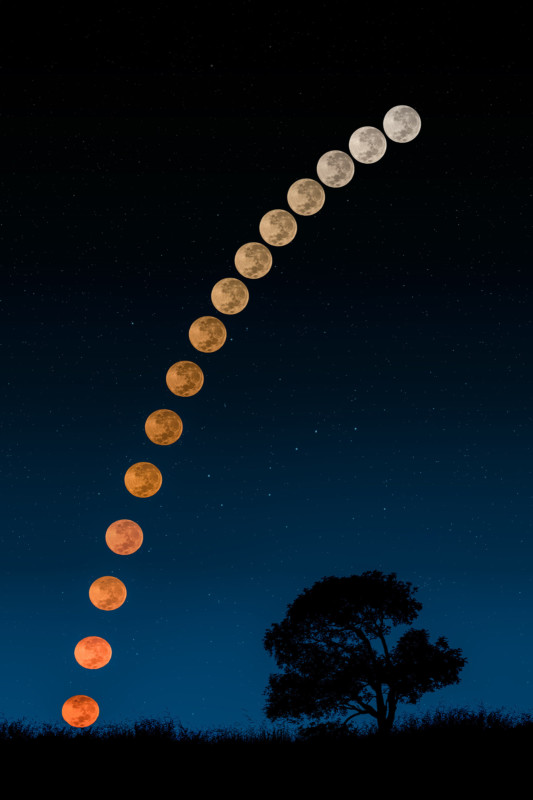
Reinaldo Opice, who can be found on Instagram as @reinaldoopice, is a landscape photographer based in São Paulo, Brazil. Over the course of two hours, Opice shot many frames of the lunar eclipse in the Mantiqueira Mountains to capture the supermoon’s different colors during the event. The gear used includes a Sony a7 III, Sony 70-300mm lens, plus a K&F Natural Night filter and K&F carbon fiber tripod.
Holding & Co. Photography is the husband-and-wife photography team of Kevin and Julia Holding and found on Instagram as @holdingcophoto. They do local destination weddings in Southern California as well as offer modern documentary coverage.
“Due to COVID, our couple Nicole and Jacob had to reschedule their wedding day numerous times,” Kevin told PetaPixel. The couple eventually decided to forgo the big wedding and went with a small gathering of family and friends for the ceremony.
“Two weeks after their micro-wedding, the four of us traveled to Yosemite National Park for a two-day epic photoshoot excursion.” Kevin said that it was a 1 1/2-mile hike to get to Taft Point, where this photo was taken. “With a stunning view of El Capitan from up above, it was well worth it.”
Abel Lares, or @abelinsane on Instagram, said that photography has fueled his life with passion and purpose. “I’ve been happily taking photos for a little over a decade now, and have been teaching on the subject of portraiture and editing for half of that time,” Lares told PetaPixel. To Lares, photography is “a superpower that allows you to freeze a moment in time, and within that moment, capture a memory, an emotion, a loved one.”
Roksolyana Hilevych, or @roksolyana_hilevych on Instagram, is an award-winning landscape photographer based in Italy. Hilevych’s preferred landscapes are in the mountains, and she said 80 percent of her shots are taken there. Her remarkable photo of Mont Blanc, titled “GreenIce,” combines the dense greenery with the icy cold mountains.
Mike Dunn goes by @mikedunnusa on Instagram and loves environmental portraiture. “While I love the studio, my favorite portraits take place in the subject’s natural environment. In this case, a generational orange grove,” Dunn said to PetaPixel through email. “Florida is where I call home, and though it comes with its odd ‘Florida Man’ stories (which are true), when you dig a bit deeper there are also these beautiful human stories steeped in history and Americana.”
Dunn also leaves us with some valuable advice: “Aside from the necessary technical knowledge, I think you have to love people to be an effective portrait artist. If you approach an assignment with genuine curiosity you’ll find a story. Everyone has one.”
Be sure to follow us on Instagram to see more work from photographers like you and tag photos with #petapixel for them to be considered for a feature.
Image credits: All photographs used with the permission of their respective photographers.
In the morning hours of June 10th, a “ring of fire” solar eclipse greeted sky observers in the northeast United States, northern Canada, Europe, northern Asia, Russia and Greenland. While most photographers captured single photos of the eclipse, Göran Strand decided to show the entirety of the rare eclipse from his backyard in Östersund, Sweden.
Using 50,000 still images that equaled over 250 gigabytes of data, Strand was able to show the two and a half hour eclipse in just 10 seconds. While most people will only see photos of the peak “ring of fire,” Strand’s resulting timelapse is an incredibly smooth depiction of how the moon moved in front of the sun.
This kind of ring-shaped event occurs when the moon is close to its farthest point from Earth during an eclipse, making the moon appear smaller than the sun in the sky, which doesn’t block the whole solar disk.
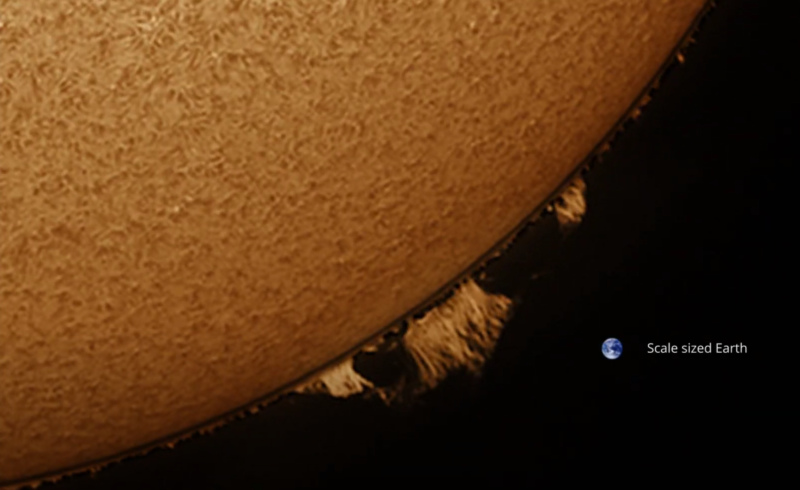
To add to the remarkable achievement of capturing the movement of the eclipse itself, Strand also captured all of the solar prominences. A solar prominence is a large, bright feature extending outward from the Sun’s surface. Strand also shows a close-up of the largest prominence with a scaled earth graphic beside it. With this remarkable graphic, it’s easy to see how roughly one million Earths could fit inside the massive star.
With so many frames captured, Strand told PetaPixel about how he went about editing the solar eclipse timelapse.
“To capture the timelapse, I took a series of 200 frames every 30 seconds for 2.5 hours,” he explains. “From each 200-frame clip, I stacked, aligned, and calibrated the best 50 frames. In total, I ended up with 250 calibrated still images that I then did further processing with. First, I aligned all of the 250 images, sharpened the details, and then extracted the data that showed all the prominences. Then I had my finished images for the timelapse.”
As eclipses and other notable astro events occur rarely, less than ideal weather is always a challenge for those photographers hoping to catch the action.
“I’ve been doing astrophotography for over 25 years now and one thing I’ve learned is to accept bad weather and the frustration it usually brings during events like this,” Stand says. “On this day, the weather forecast was quite good but clouds were forecasted for later in the day. When it was just 10-15 minutes left of the eclipse, some clouds were moving in but they stayed clear of the Sun, so I’m really glad that I got a perfect eclipse this time.
“Eclipses like these are so exciting to follow. Even though I’ve seen three total solar eclipses, events like these always gives me some goosebumps when you realize you’re actually capturing it.”
With over a quarter-century of experience, it is obvious that Strand is an experienced astrophotographer. For those who wish to follow in his footsteps, he gives his advice to newcomers.
“If you would like to get started with celestial photography I would recommend going slow. Don’t rush out and buy a big, expensive telescope and go planet-hunting. Planet photography is really hard and takes several years to master. Start with your telephoto lenses and capture photos of the moon that you then stack together to get even more detail,” he says.
“This is a technique called Lucky Imaging and is a great way to get sharp images of planets as well as the Sun and the Moon even through very turbulent air. When you have your images, it is time to practice editing them. AutoStakkert! is my favorite software for stacking images of celestial bodies. Above all, have fun and take a moment to realize how small we are in the grand scheme of space.”
Image credits: Photos by Göran Strand and used with permission.
With all of our staff editors busy working on the upcoming middleweight naked bike shootout, we found ourselves in a difficult position. Thankfully, we have Mark Miller in our quiver of freelancers. Who else but someone who has raced in some of the most challenging motorcycle races around the world could be trusted to crank the throttle of a Hayabusa wide open down the long front straight of the Utah Motorsports Campus? (Note: if you’re looking for information on the technical changes to the Hayabusa,skip over to our First Look beforehand.) —Ed.
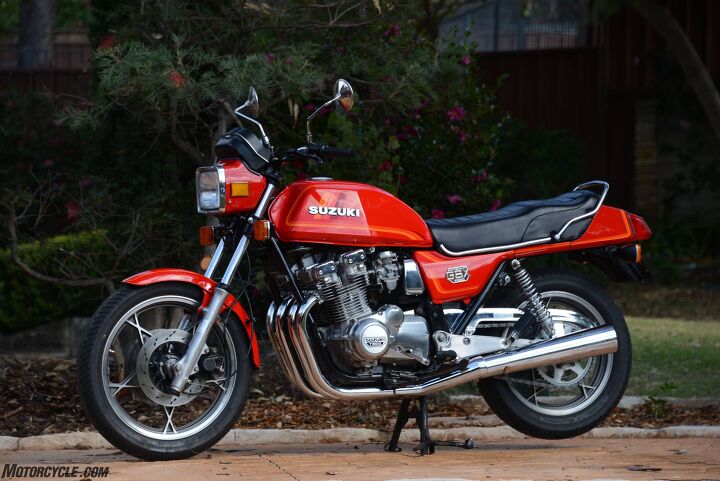
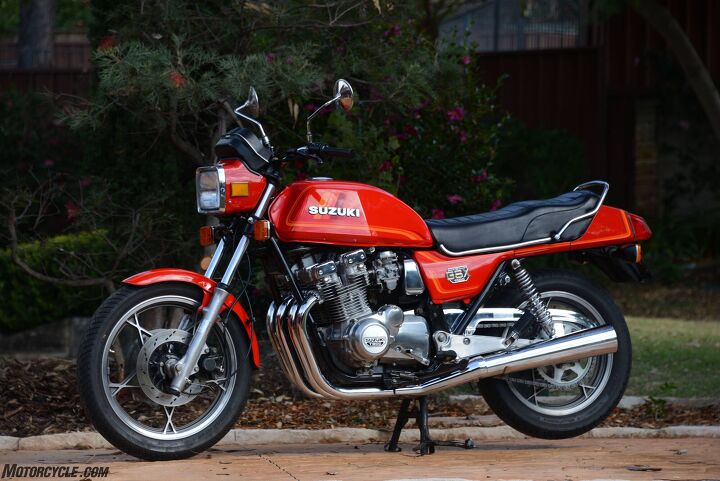
In 1988, I graduated from high school at 17 years old and three weeks later moved out of my mother’s house. Two weeks after that I bought my first motorcycle, a 1981 Suzuki GS1100E, the fastest production motorcycle to date, when it was new.
I had been asking my parents for a minibike every year since I was six. At every Christmas and every birthday I pleaded with them, “I don’t want a motorcycle, I need a motorcycle. Don’t you understand?” I never got one.
Then finally the day came when I broke out of home and immediately started looking for the fastest, most badass big bore motorcycle I could find within my budget, which was, of course, $500.
When you’re seventeen years old, 100 hp and 580 lbs feels like 1000 hp and 80 lbs. The never ending roller coaster ride.
With its four valves per cylinder, 5-speeds, disk brakes, and 100.0 horsepower, the GS became not only my personal rocket ship, but an obscene shared existence. No helmet, all tears.
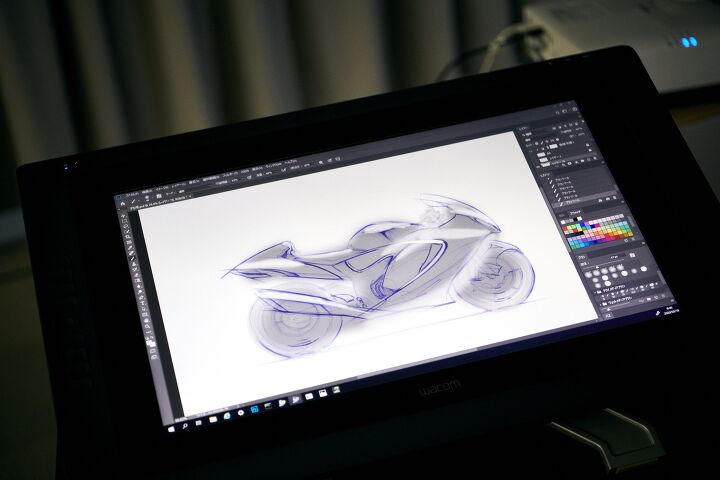
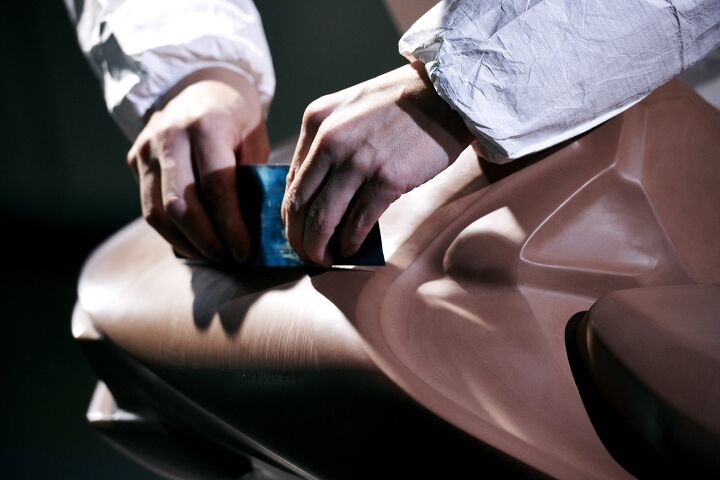
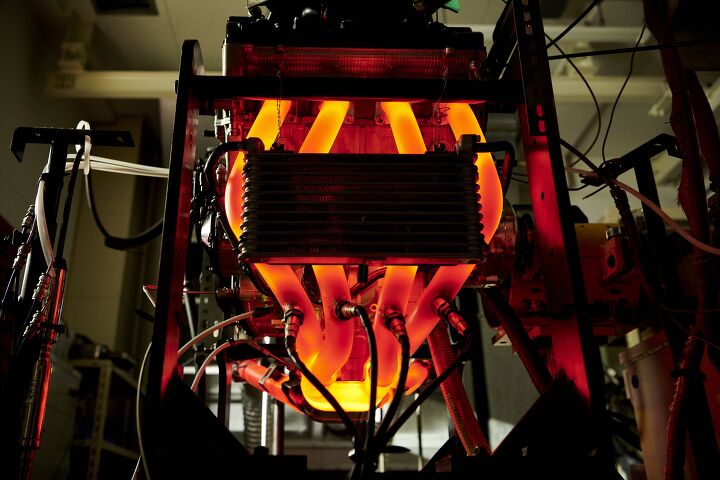
From concept to production, the “Refined Beast” took Suzuki ten years to perfect.
Fast-forward to the year <cough> 2021, and I get a call from the editor at MO. “Yo Miller, you wanna jet over to Utah to ride Suzuki’s new 2022 Hayabusa for their big North American launch?”
“Suzuki?” I perk up. “Hayabusa?” My eyes focus in. “You’re asking me if I’d like to go and ride Suzuki’s most famous rocket ship, known to the world over as one of the fastest, most badass big bore motorcycles basically made to be obscene?” If it’s 2021, I must have made it past 30. So weird. F*ck yeah, I’m in. Of course, I’m in!
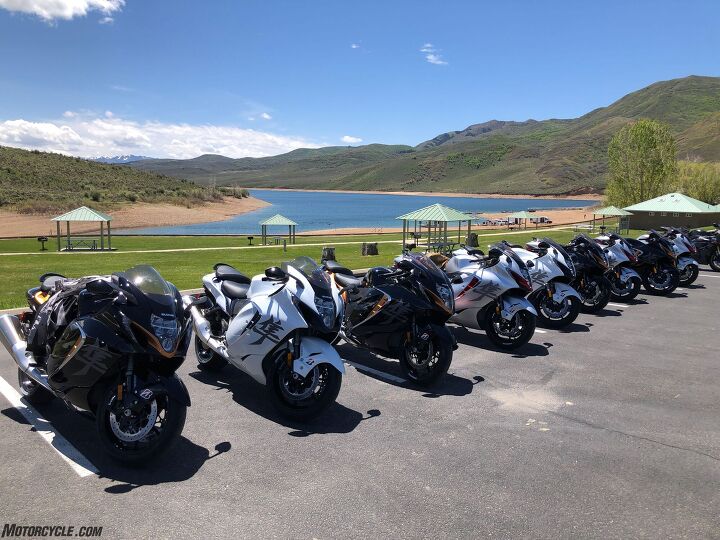
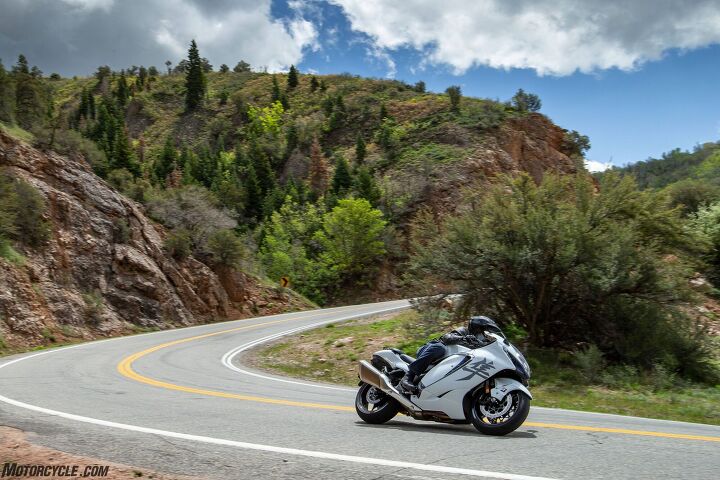
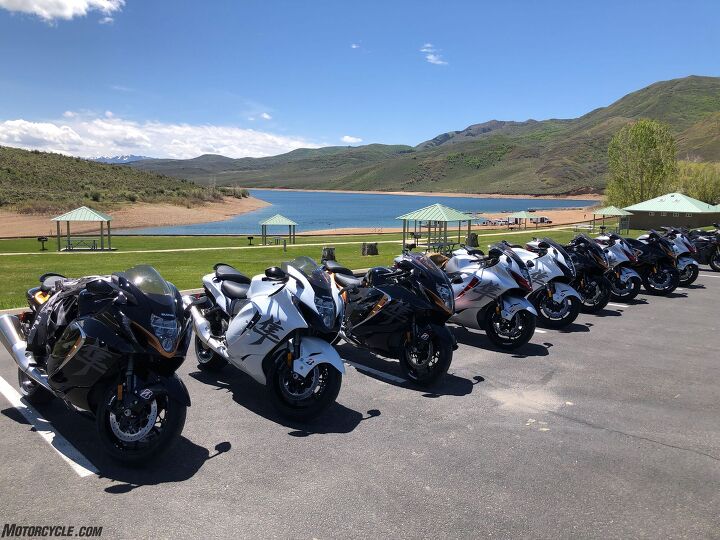
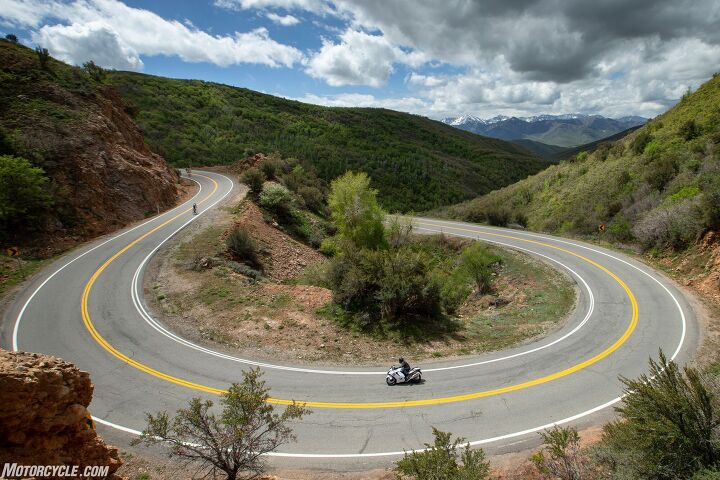
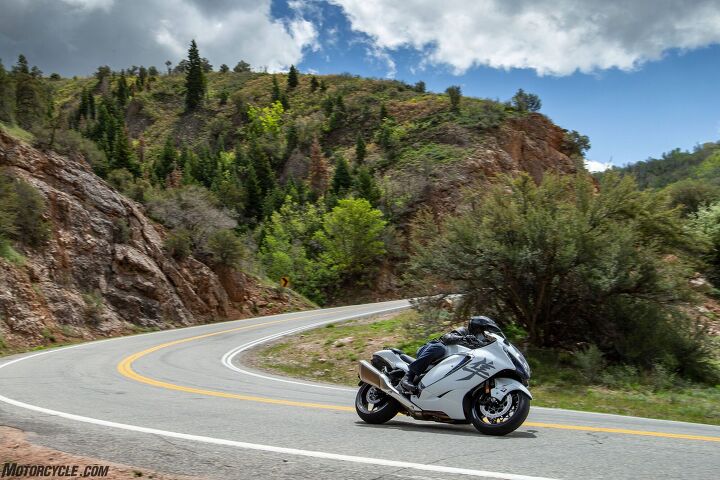
A few days later I arrived in Utah and on day one, about a dozen of us rode the new Hayabusas up through some beautiful mountains near Salt Lake City.
The first thing I noticed was the number of people that would gawk at these 1340cc “Refined Beasts” and how many of them had the gall to yell at us to “Slow down!” In all but one case we were just chugging along minding our own business. All 16,000cc’s worth, heh heh. Totally innocent.
Up-to-no-good smirks ensued.
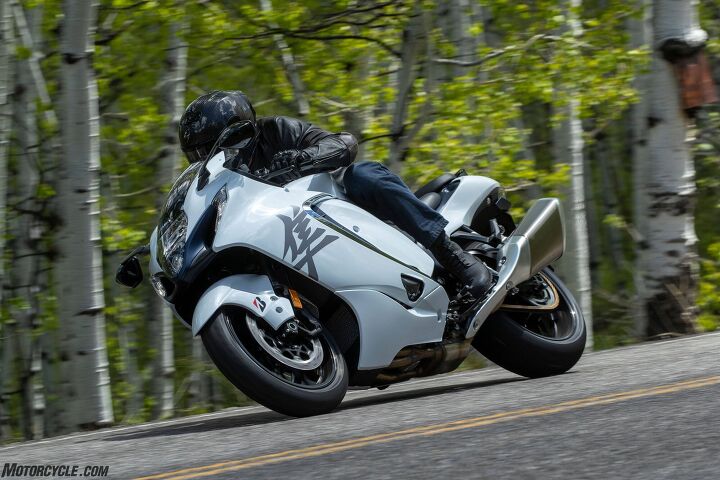
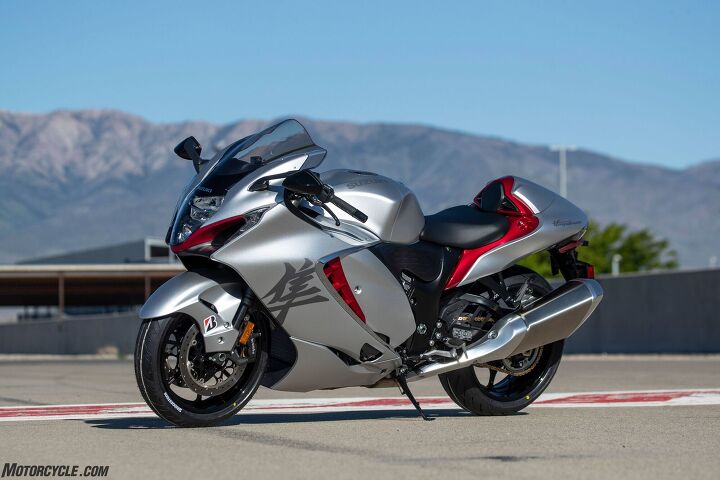
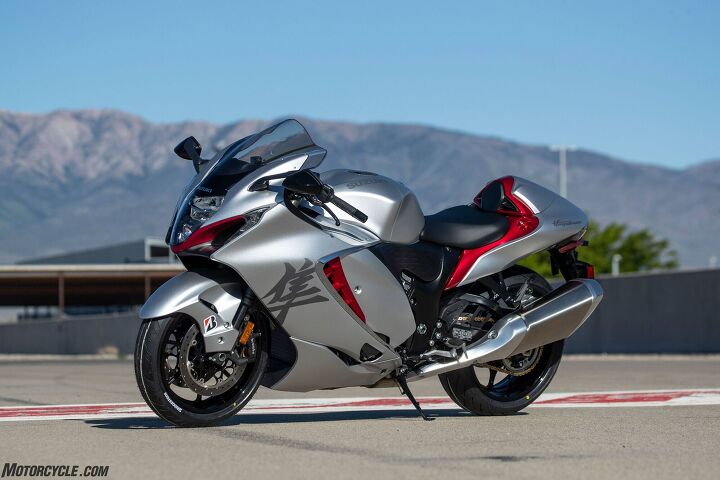
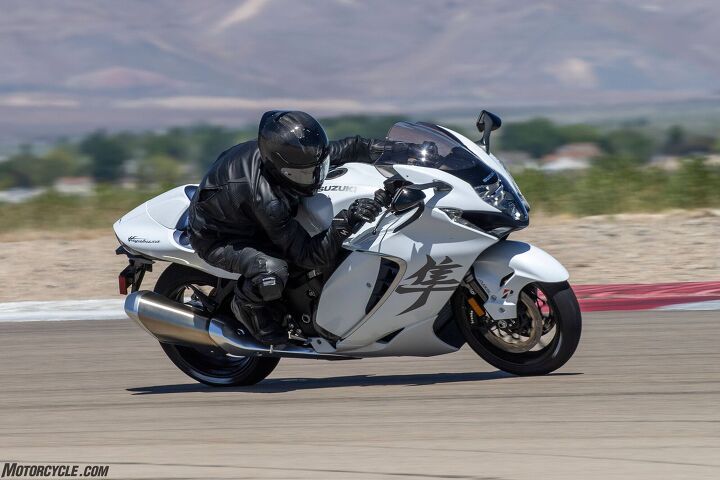
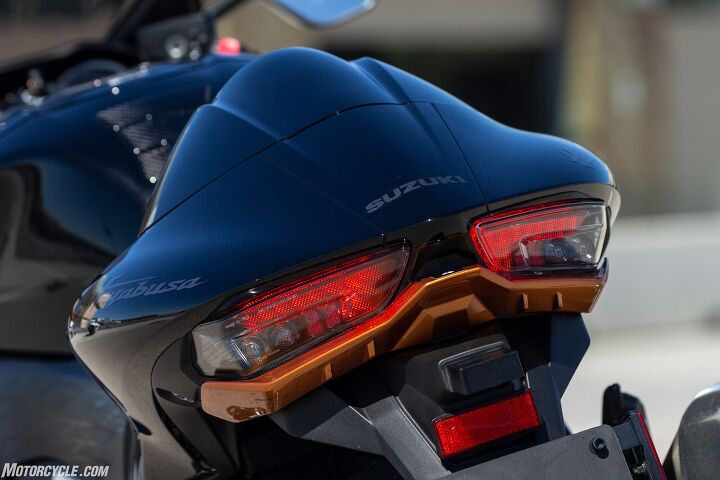
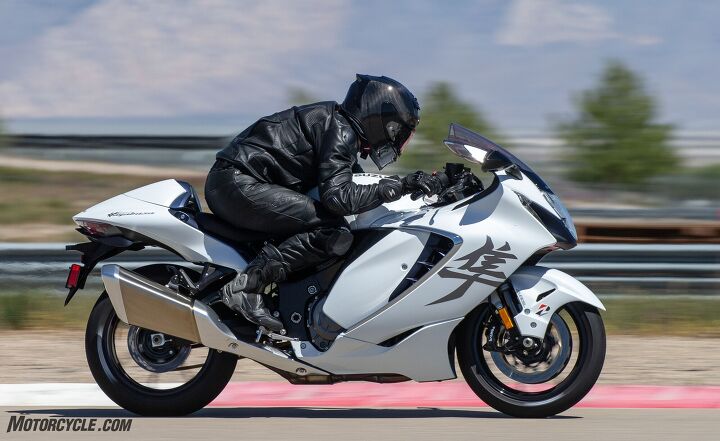
The bike is handsome in person and reeks of quality, and for me, it’s fair to say that this is the tidiest Suzuki street bike I’ve seen. I would never, ever want to scratch one.
On the road, the power of the new engine pulls way down low then continues to build up zest upon gusto until finally unleashing this fury on top which gives the impression it’s inviting you to participate in the bending of your reality from a wispy Sunday ride to an intoxicating blur. It gets off on it, I think. Reliably and often.
It’s ridiculous how good this bike works on the roads with its silky strong mid-range and sporty but comfortable ergos.
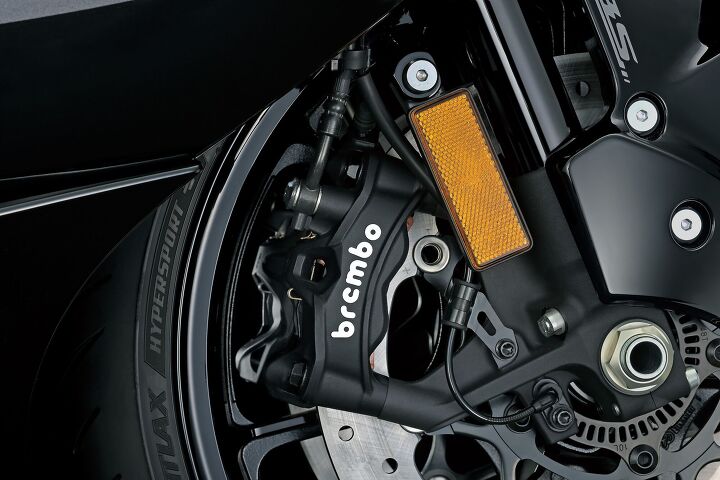
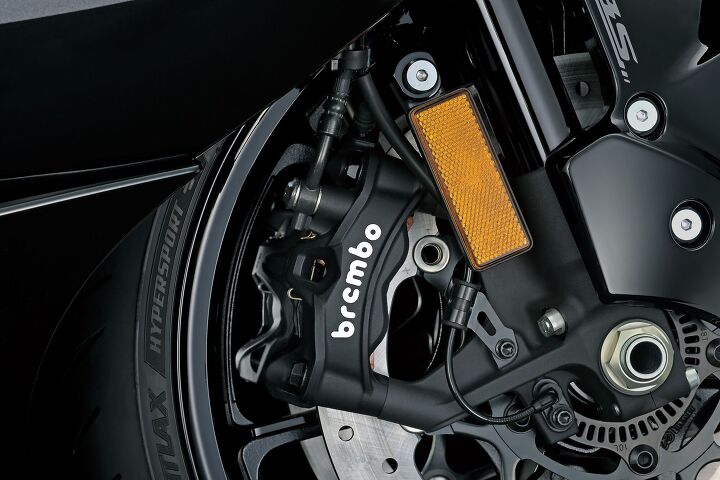
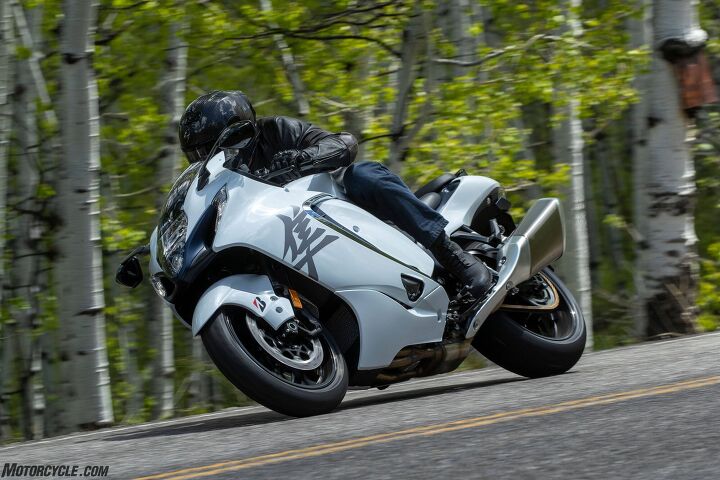
At no point on the street did the bike feel heavy or out of sorts. It felt instead like there was this balanced dance going on between the bike’s 50:50 weight distribution, the electronically controlled ride-by-wire system and its power delivery modes. The analog KYB suspension felt compliant, the bi-directional quick shifter and gearbox worked like butter, and the top shelf Brembo calipers combined with a latest six-direction, three axis IMU from Bosch worked well in concert with an accompanying ABS unit, also from Bosch.
The rubber floating handlebars and footrests were nearly without vibration, and the ride on the whole could be described as dead smooth.
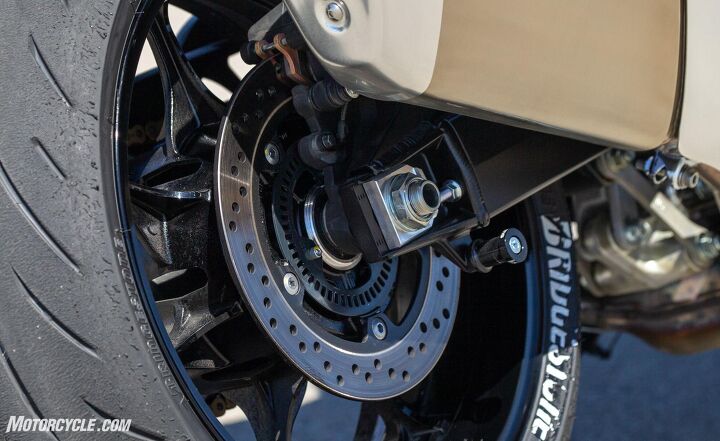
The Brembo Stylema calipers are the company’s latest greatest street monoblock; lightweight, self-cooling, and they use popular brake pads.
The 2022 Suzuki Hayabusa is not a nimble GSX-R1000, nor is it trying to be. As a matter of fact, the nimble flagship GSXR is over 100 lbs lighter than the ‘Busa. But the Hayabusa has more in common with a luxury supercar than a buzzy, anemic Superbike.
The second of the two days was spent at the Utah Motorsports Campus; or, the artist, I mean, circuit formerly known as Miller Motorsports Park…no relation.
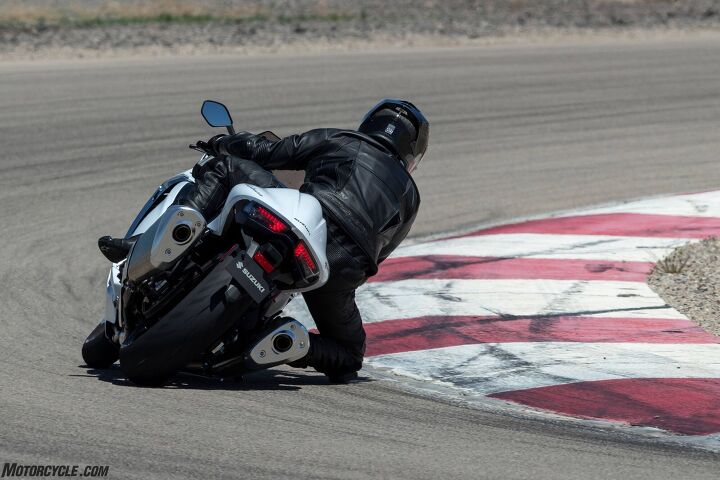
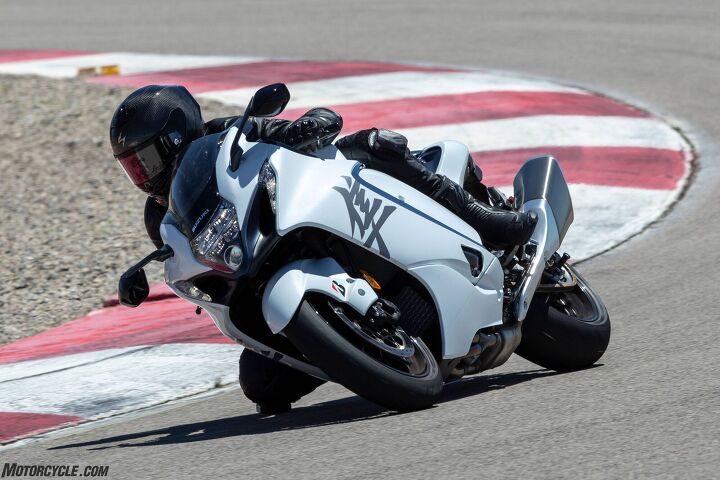
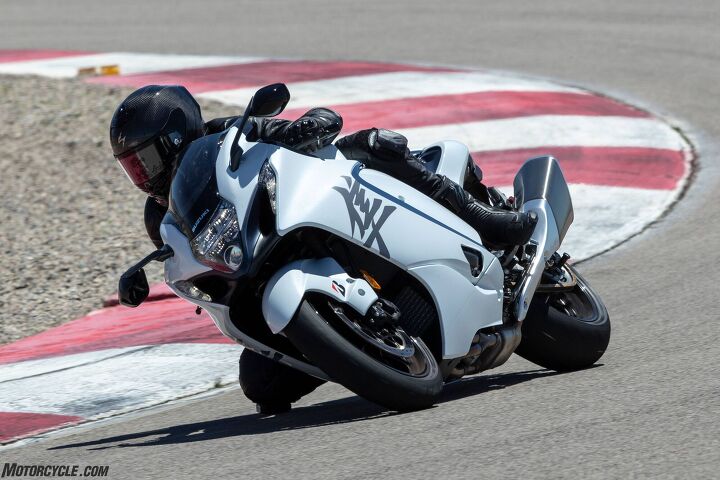
Cool track with loads of fast sweepers, hard-ish braking zones, and a 7th of a mile front straight – which in reality is longer than it sounds. The perfect playground to test the revamped Hayabusa.
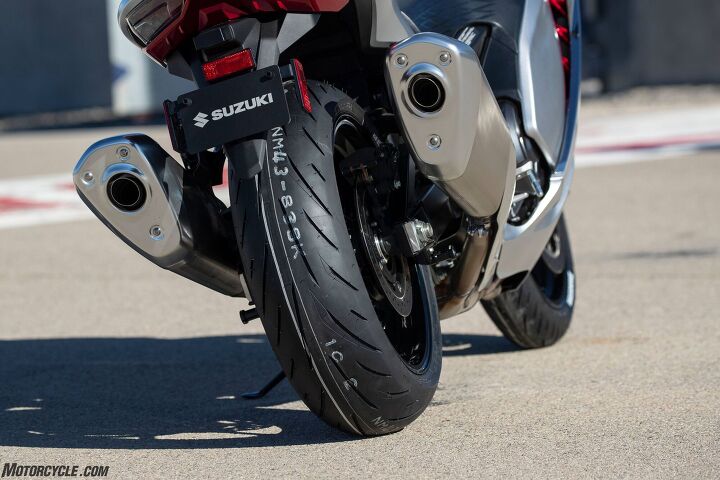
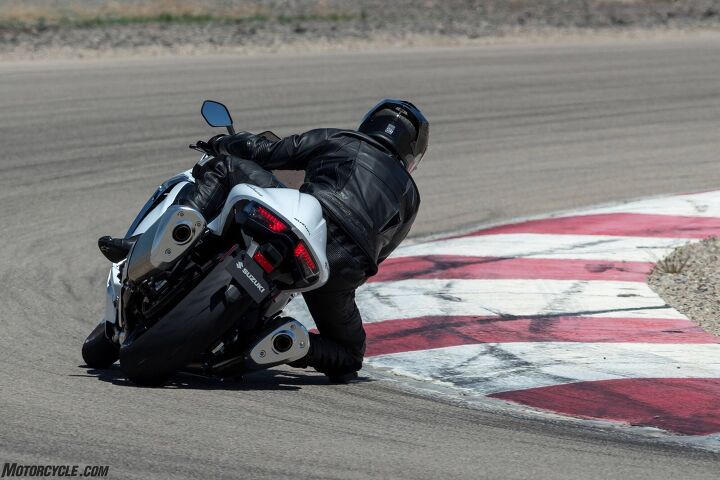
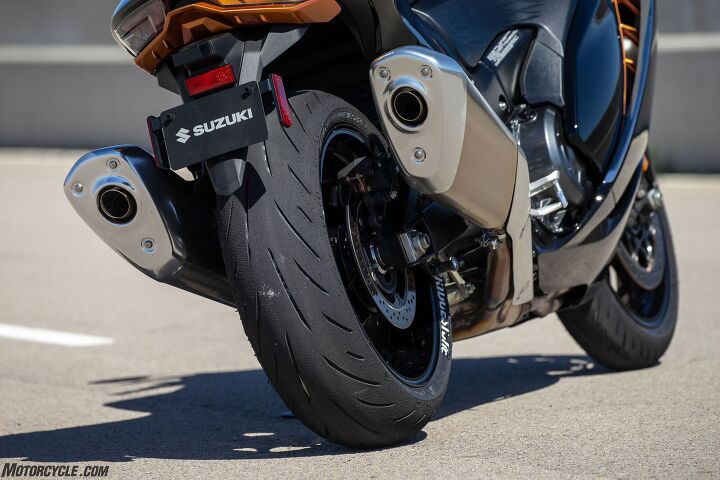
The Bridgestones never faltered no matter how hard they were pushed. Check out the perfect orange peel, bragging on its serious grip (and stuff).
Every time I pushed the Suzuki to faster and more aggressive heights, it responded just like it did on the roads; poised and uniform. The brakes were quite adequate right up to the point where I didn’t want to push the envelope of trail-braking any further. The front lever at that point would start obnoxiously “growing” away from the handlebar, which I was told from the ABS kicking in more forcefully. One thing I really appreciated was how the rear brake remained independent from the front when only the rear brake lever was applied. The front brake lever would link lightly with the rear, but it never felt intrusive or unwanted. Actually, with a bike of this size and power, it was helpful.
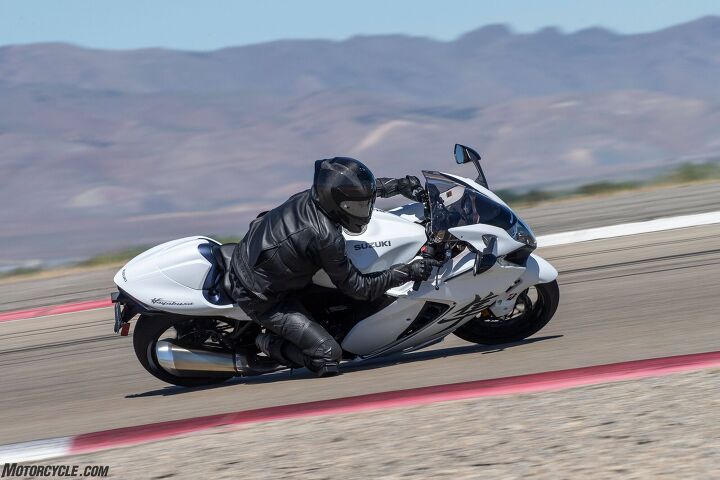
The ground clearance was much better than I anticipated and the top speed down the front straight saw me consistently eclipsing 175mph, indicated.
It’s not a hundred pound scooter, for certain, but it feels balanced and poised. ABS, linked braking, TC, and power modes by Bosch worked very well.
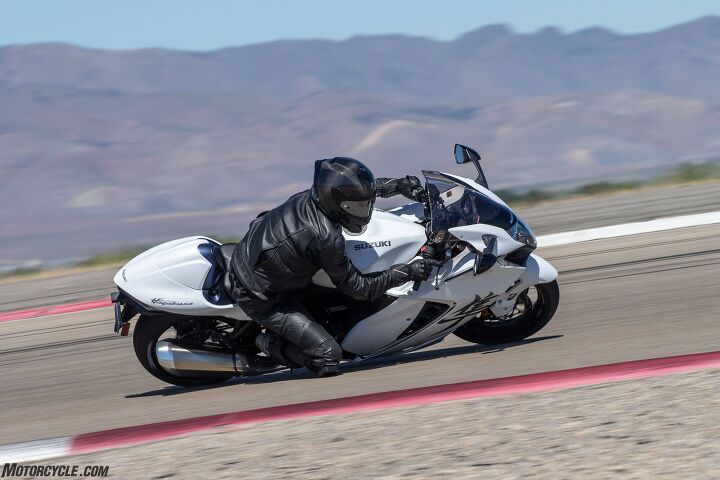
Speaking of high-speed, the aerodynamics on this flying fortress was the best I can recall, and I’ve ridden several dozens of bikes right up to and beyond 200 mph. Suzuki claims the Hayabusa enjoys one of the greatest drag coefficients amongst all street legal motorcycles, and I believe it. This ol’ girl cuts straight through the atmosphere like a samurai sword eviscerates a watermelon. It does such a good job at it, in fact, that I kept being lured into a false sense of security – each time I popped out from behind the bubble at 178mph to brake late (the bike wanting to continue accelerating), I’d damn near get blown off the machine. It never seemed like I was going as fast as I was when in a full tuck. It was kind of ridiculous.
Suzuki asserts the 2022 Hayabusa has among the lowest drag coefficient of any street bike.
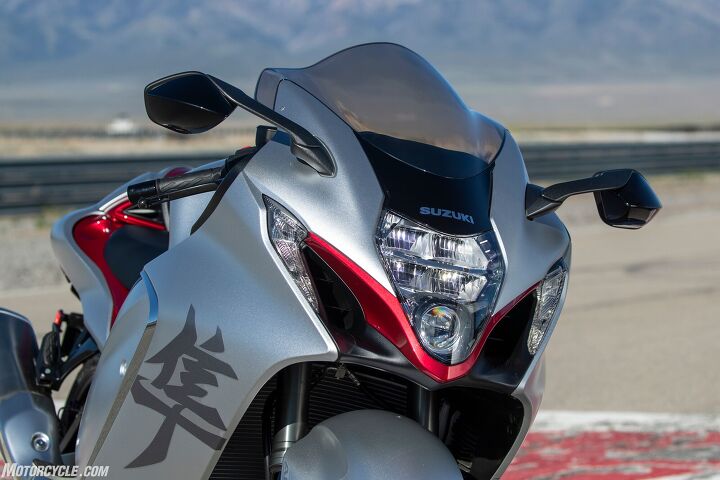
Another prop I have to give for the Suzuki’s engineers is how they kept the only objects protruding into oncoming air being the mirrors. The turn signals, for example, have been kept flush within the bodywork. Even the headlights have been stacked vertically to allow the greatest aerodynamics as well as maximum ram air intake volume. It’s a sleek design that would make even a Peregrine Falcon proud. This bird of prey, which is the fastest animal on earth, has been known to reach over 200mph in a dive to catch its lunch. The Hayabusa is named after it.
One gadget on the motorcycle that I could personally live without is the Hayabusa’s highly touted launch control function. The system holds the RPM steady electronically as you feed the clutch out manually.
I did however use the heck out of the cruise control when we were on the highway and it worked awesome. I could speed up and slow down for long lengths of time just by toggling my left thumb forward and back. It became a different riding experience entirely, which doesn’t happen everyday.
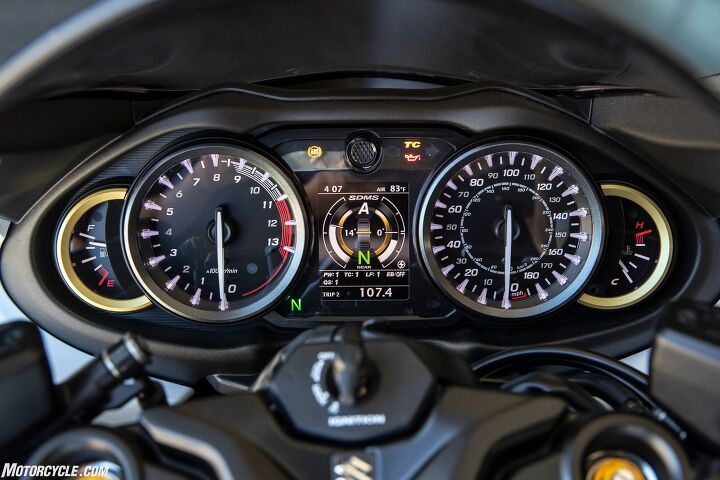
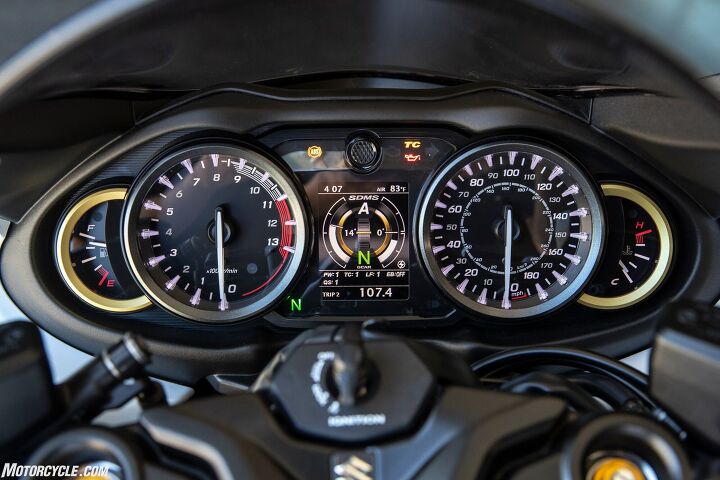
Navigating through the menu was straight forward and I must say ‘quick’. Every additional change I initiated snapped into place without a lag, digitally speaking. The TFT at the center of the two analog gauges was useful and easy to modify its information. There was an interesting artificial horizon and digital gimbal option that displayed both throttle position and brake pressures in real time, which I assumed was fun to watch, but how could I? I’m frigging riding? Like my momma always said to me, “You’re stupid and you’re ugly.”
The wide sweeping gauges are old-school-easy to glance at, while the center TFT can display a gamut of adjustable information which includes an artificial horizon for when you take off.
The Hayabusa comes with a rather cool and super-efficient Computer Area Network (CAN) type wire harness which manages all of the bike’s gobs of data between the Suzuki Intelligent Ride System (S.I.R.S.) – Engine power modes, TC, WC, quick shifter, cruise control, linked braking, ABS, etc. – whilst using only a limited number of actual wires. The harness works as a network instead of normal more complex setups we’re used to, which are slower and in the end much heavier. Vast numbers of electronic signals can pass each other at the same time by employing numerous different frequencies, which also aids in the rapid response of everything electrical. The higher the speeds in which all of these gizmos and toys can respond, the lower their latencies get, the more responsive and tactile the experience of riding these newest bikes will be.
The proprietary Bridgestone S22’s worked great on the roads and took one hell of a beating on the short circuit and never bitched back at me, and I was really trying to piss them off. They weren’t havin’ it.
These proprietary Bridgestone S22’s look fast just sitting there. They were fast on the race track, too.
So, in conclusion, I didn’t know what to expect when getting into this 2022 Suzuki Hayabusa test. I’ve never been one to sit around a garage and clean a bike all weekend. But I’d sit around and clean this bike if I owned one. When you see one in person, you’ll know what I mean. But usually, I’d rather be riding them full tilt – ever since that first GS1100E robbed me of my innocence and taught me everything it’d expect me to do. When it first invited me to bend my reality.
These ultra-fast comfortable motorbikes can become life-changers, if you’re not careful. Having this kind of capacity at the tips of your fingers and the ability to accelerate yourself across the surface of the earth with such reliability and composure is kinda mental if you ponder on it. This should be mentioned, as I’m sure the engineers at Suzuki were sure to realize after developing this 1340cc over the last ten years.
I’m just happy to still be here to enjoy these terrific inventions, to ride and compare these two co-conspirators, which were conceived some 40 years apart. Crazy shit. Thank you Motorcycle.com. And thank you Suzuki engineers.
2022 Suzuki Hayabusa
+ Highs
Still blisteringly fast
Modern electronic rider aids
Supremely stable at speed
– Sighs
Brembo Stylema calipers “adequate?”
582 pounds isn’t light
Still blisteringly fast (be careful out there)
2022 Suzuki Hayabusa Specifications
MSRP
$18,599
Engine Type
1340cc liquid-cooled inline-Four cylinder, DOHC, four valves per cylinder
Bore and Stroke
81mm x 65mm
Compression Ratio
12.5:1
Claimed Horsepower
187.75 hp @ 9,700 rpm
Torque
110.64 lb-ft @ 7,000 rpm
Transmission
6-speed constant mesh
Final Drive
Chain
Front Suspension
43mm inverted KYB fork with spring preload, rebound and compression damping adjustability
Rear Suspension
Single shock with spring preload, rebound and compression damping adjustability
Front Brake
Dual radial-mounted four-piston calipers with 320mm discs
Rear Brake
Single-caliper 260mm disc
Front Tire
120/70ZR17
Rear Tire
190/50ZR17
Rake/Trail
23.0°/3.54 inches
Wheelbase
58.3 inches
Seat Height
31.5 inches
Curb Weight (Claimed)
582 pounds
Fuel Capacity
5.3 gallons
Become a Motorcycle.com insider. Get the latest motorcycle news first by subscribing to our newsletter here.
After his homemade car is impounded because it lacks license plates, the socially awkward but inventive Italian engineer Giorgio Rosa (Elio Germano) dreams up a way to escape the government's arbitrary intrusions: With help from some friends, he constructs a 400-square-meter steel platform in the international waters of the Adriatic Sea.
The seasteaders drill for fresh water, build a bar (naturally), and attract attention from mainlanders eager for something different from the dull and heavily regulated beach club scene in nearby Rimini. From there, it's just a small step to asking the United Nations to officially recognize the Respubliko de la Insulo de la Rozoj as a sovereign nation. (That, they hope, will fend off the Italian Navy.)
Rose Island, released on Netflix and based on real events from the tumultuous summer of 1968, portrays Rosa and his allies as romantic radicals. Sydney Sibilia's film struggles to maintain an even tone—some scenes veer into whimsical, Wes Anderson–esque territory, particularly a comic encounter with a patrol boat—but it never wavers in its appreciation for our heroes as they piss off all the right people in pursuit of their slice of utopia.
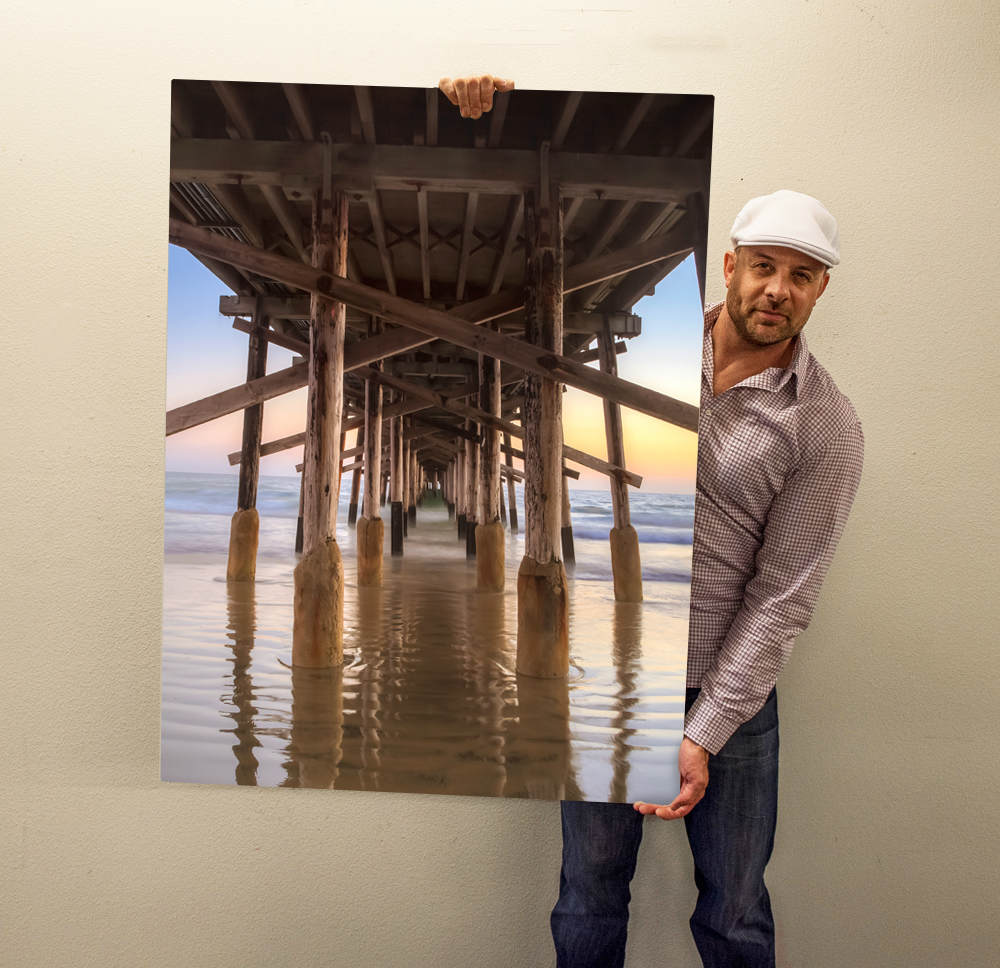
Large physical prints make an impression on viewers, especially when the images are well crafted. A high quality large format print such as an enlargement beyond 11x14 or 16x20 inches requires a good image file and excellent printing.
So part of the answer to the question of how to create excellent large format prints, or photo printing tips, will be about the photography and part of it about the printing.
What are the steps? Capture the best image file you can, process it so it can be printed, select the right printing solution, and then display it to be seen.
We can make a large format print of any file we have, but in order to have these giant prints look great, we should be concerned with the art and craft of our photography.
Whatever type of camera we have, we can maximize the quality of our photography by striving for excellence. It’s been said since I can remember reading Modern Photography and Modern Photography magazines all those years ago, “It’s the photographer, not the camera.”
Today’s digital camera systems are amazingly high quality. A photographer who knows what they’re doing can craft a superior image with an APS-C format beginner level camera with the basic kit lens. And we could make mistakes with our super sophisticated Full Frame pro level cameras and specialty lenses that cause our image quality to suffer.
The main thing is to find out what methods and techniques we can use with the equipment we’re currently using and get as good as we can with our photography. Proper exposure, good focus, appealing composition, and understanding light and color quality will result in image files that will make great looking large format prints.
Preparing images for lab printing or for printing on our own large format professional printers means we will be considering how to edit photos for printing with our post processing programs.
First, let’s not attempt to fix a photo with problems, instead let’s choose our best files to work on and then enhance them to their best potential. This is often one of the hardest parts of editing, culling down from our entire memory card to only our best images.
Next, we want to enhance our image with color and exposure adjustments to bring out the best parts of the image. When working on a good image file, subtle adjustments are often all that’s needed, but they can really be powerful in what they produce as an end result.
Cropping is an important tool for large format printing. A useful method is to decide on what the final enlargement size is going to be and then crop the final image to that ratio. So, if an enlargement of 40x60 inches is desired, that correlates pretty directly to a 4x6 image. A 30x40 inch large format print is just a bit off of the raising a 4x5 or 8x10 image relates to.
A lot of post processing programs allow custom sizing for the cropping tool. So go to the crop function, select custom size, and click “constrain cropping proportions” or whatever your program calls it, and type in the numbers you want as your enlargement size.
We want to do this ourselves, as possible, in order to be in control of the final large format print, since otherwise the lab or printing program will crop to create the size of the print which can result in a change to our carefully crafted composition.
As a further step, removing digital noise from the final image file is a good idea. Then, as we save to JPEG, choose the highest quality and least compression. If the printer or printing service allows using a TIFF or PSD, we might try those options too.
Having our own professional quality large format printer is nice, but these are very expensive and require a lot of maintenance to ensure consistent quality. Many professional photographers use a photo printing service, a method which goes back many years.
What is often beneficial about a photo printing service is the variety of sizes and materials available to us. With our own personal printer, we’re constrained by the size and what paper we have on hand.
With a printing service, we can choose from different types of paper, various finishes, and often these shops have non paper options such as canvas, metal, or acrylic printing.
A service that we at PhotographyTalk.com are fond of is Artbeat Studios, the winner of our 2020 Metal Print Shootout. They make 3 different types of paper prints as well as very large format prints on metal, acrylic, and canvas.
In addition to reasonable prices, important factors for choosing a printing service include fast turnaround, superb materials, professional craftsmanship, and excellent customer service, all of which Artbeat Studios excel at.
Art deserves to be seen, so display options are an important factor to also consider. Some large format prints, such as the giant metal prints seen earlier, can be displayed as is. Others may require matting, framing, or both.
Where to hang the prints is also important. A large format print deserves a prominent spot, good lighting will also add to the visual appearance. Some photographers like to have a light especially for the photo, others just want a well lit, open wall. Whatever works for the photo is appropriate.
Have fun choosing your files, preparing images for lab printing, choosing your large format printing options from a professional printing service, and displaying them for optimal viewing pleasure.
In the previous articles about Geography and History, we explored how things like plains, mountains, rivers, landmass, and latitudes have influenced the History of several regions. This week’s free article went up one level, to look at worldwide patterns. But what causes Geography to be the way it is? Today, we’re going one level higher yet: to Space. I…
With over 250,000 rivers in the U.S., kayak enthusiasts have plenty of options. Whether you’re kayaking for the first time or a veteran on the water, here are the the most scenic places to kayak in the U.S.
In an old Zen story, two monks argue over whether a flag is waving or whether it’s the wind that waves. Their teacher strikes them both dumb, saying, “It is your mind that moves.” The centuries-old koan illustrates a point Zen masters — and later philosophers, psychologists, and neuroscientists — have all emphasized at one time or another: human experience happens in the mind, but we share reality through language and culture, and these in turn set the terms for how we perceive what we experience.
Such observations bring us to another koan-like question: if a language lacks a word for something like the color blue, can the thing be said to exist in the speaker’s mind? We can dispense with the idea that there’s a color blue “out there” in the world. Color is a collaboration between light, the eye, the optic nerve, and the visual cortex. And yet, claims Maria Michela Sassi, professor of ancient philosophy at Pisa University, “every culture has its own way of naming and categorizing colours.”
The most famous example comes from the ancient Greeks. Since the 18th century, scholars have pointed out that in the thousands of words in the Iliad and Odyssey, Homer never once describes anything — sea, sky, you name it — as blue. It wasn’t only the Greeks who didn’t see blue, or didn’t see it as we do, Sassi writes:
There is a specific Greek chromatic culture, just as there is an Egyptian one, an Indian one, a European one, and the like, each of them being reflected in a vocabulary that has its own peculiarity, and not to be measured only by the scientific meter of the Newtonian paradigm.
It was once thought cultural color differences had to do with stages of evolutionary development — that more “primitive” peoples had a less developed biological visual sense. But differences in color perception are “not due to varying anatomical structures of the human eye,” writes Sassi, “but to the fact that different ocular areas are stimulated, which triggers different emotional responses, all according to different cultural contexts.”
As the AsapSCIENCE video above explains, the evidence of ancient Greek literature and philosophy shows that since blue was not part of Homer and his readers’ shared vocabulary (yellow and green do not appear either), it may not have been part of their perceptual experience, either. The spread of blue ink across the world as a relatively recent phenomenon has to do with its availability. “If you think about it,” writes Business Insider’s Kevin Loria, “blue doesn’t appear much in nature — there aren’t blue animals, blue eyes are rare, and blue flowers are mostly human creations.”
The color blue took hold in modern times with the development of substances that could act as blue pigment, like Prussian Blue, invented in Berlin, manufactured in China and exported to Japan in the 19th century. “The only ancient culture to develop a word for blue was the Egyptians — and as it happens, they were also the only culture that had a way to produce a blue dye.” Color is not only cultural, it is also technological. But first, perhaps, it could be a linguistic phenomenon.
One modern researcher, Jules Davidoff, found this to be true in experiments with a Namibian people whose language makes no distinction between blue and green (but names many finer shades of green than English does). “Davidoff says that without a word for a colour,” Loria writes, “without a way of identifying it as different, it’s much harder for us to notice what’s unique about it.” Unless we’re color blind, we all “see” the same things when we look at the world because of the basic biology of human eyes and brains. But whether certain colors appear, it seems, has to do less with what we see than with what we’re already primed to expect.
Long-range cruising yachts aren’t known for their high speeds, but their design allows for greater fuel efficiency, comfortable accommodations, roomy entertainment areas, and best of all, a home that can take you beyond the bay!
These vile little creatures transmit diseases such as Lyme, Babesiosis, Rocky Mountain spotted fever, and the rare-but-fatal Powassan virus, among others.
Symptoms of tick-borne illnesses can range from swollen joints to meat allergies.
About 50,000 cases of tick-borne illnesses are reported to the Centers for Disease Control and Prevention every year. Lyme, the most prevalent tick-borne disease in the US, is potentially debilitating and can be difficult to diagnose.
In 2023, the CDC reported that Babesiosis, which can present asymptomatically or with flu-like symptoms, has been on the rise in the Northeast and Midwest over the previous few years.
Since prevention is better than any treatment, here's what to keep in mind as you head outdoors this summer.
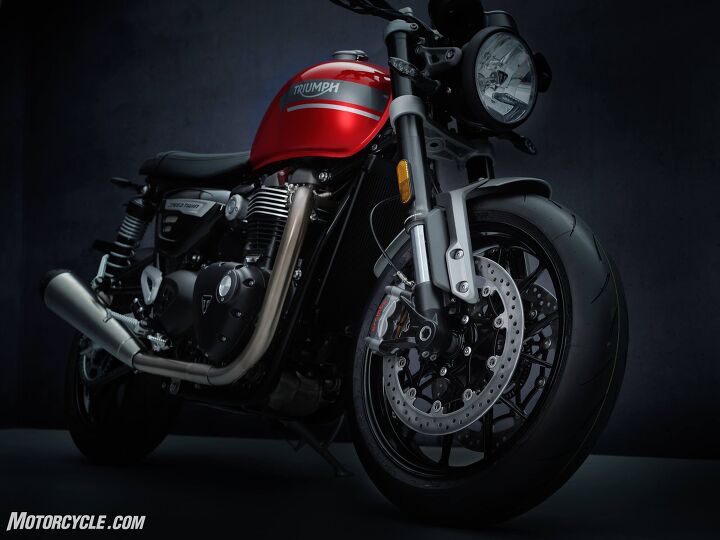
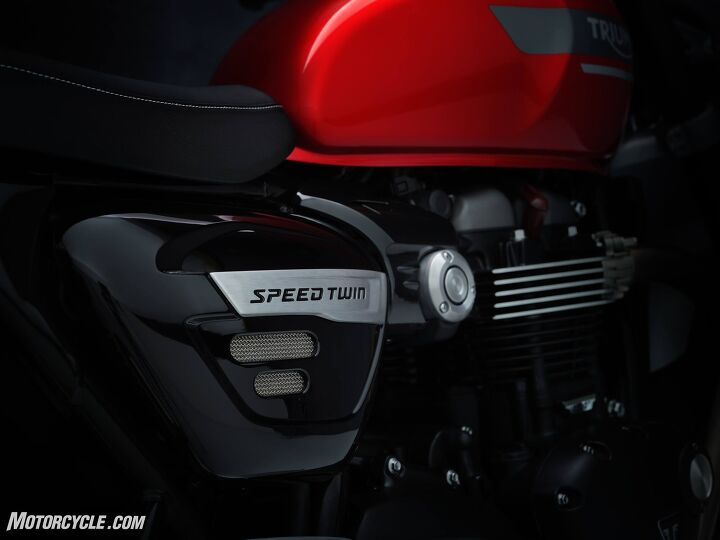
Triumph continues trickling out new models with its latest announcement, the 2022 Triumph Speed Twin. You probably won’t be surprised to learn that the engine upgrades added peak power, 3hp to be exact, but the bottom end also got some love. The midrange reaches 83 lb-ft of torque lower in the rev-range at 4,250 rpm. Additionally, the engine will now spin up quicker, thanks to a 17% reduction in inertia. To match the improved engine output, the Speed Twin’s electronics also received an upgrade in the form of improved riding modes.
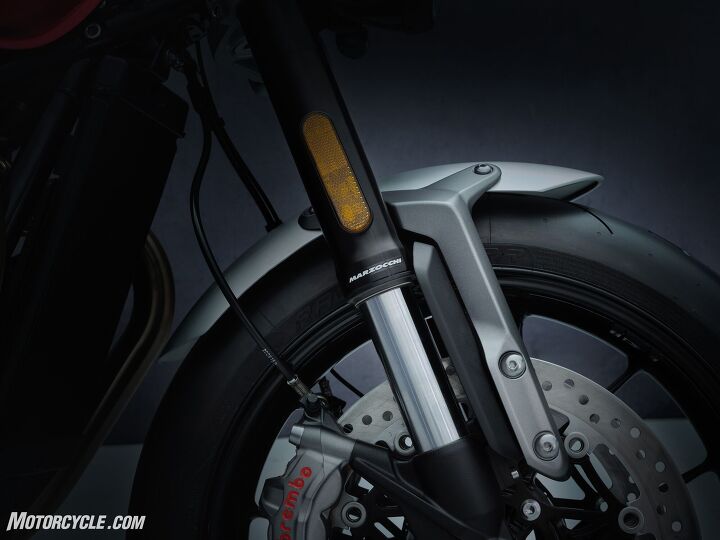
The chassis received its own list of updates, which Triumph claims results in more precise, agile, and dynamic handling. A higher-spec 43mm Marzocchi upside-down cartridge fork takes care of the front suspension duties, while a pair of preload-adjustable shocks live out back. Braking was improved with a pair of Brembo M50 radial monobloc calipers squeezing 320mm discs. Finally, the rubber meeting the road is in the form of Metzeler Racetec RR tires for sporty fun.
You know the drill: We’ll throw a leg over the 2022 Triumph Speed Twin as soon as we can and let you know how it works. Until then, sate your curiosity with the full Triumph press release below. (Ignore the 2021 reference, all U.S. models will be 2022 model year.)
Begin Press Release:
With the perfect combination of character, style and genuine sports performance, the new Speed Twin is significantly updated for 2021 with higher performance, better handling, enhanced technology and even more premium custom style and detailing.
Higher Performance – Significant Engine Update – 3PS more peak power, now 100PS at 7,250rpm
– More mid-range power and torque
– Peak torque now lower down the rev range, with 112Nm at 4,250rpm
– More responsive with a 17% reduction in inertia
– Lower emissions and fully Euro 5 compliant
– High 10,000 mile / 16,000km first major service interval
Better Handling – Even more precise, agile and dynamic modern roadster ride
– New higher specification Marzocchi USD forks with cartridge damping
– New higher specification Brembo M50 radial monobloc calipers
– New higher specification Metzeler Racetec RR tyres
– New lightweight cast aluminium wheels
– Comfortable, engaged riding position for a confidence-inspiring, intuitive feel
Enhanced Technology – Upgraded riding modes – Road, Rain and Sport
– High specification of standard equipment:
ABS and switchable traction control
LED lighting with DRL headlight (market specific)
Torque-assist clutch
Under-seat USB charging socket
Immobiliser
More Premium Style and Detailing – New stylish 12-spoke wheels
– New brushed stainless-steel twin upswept silencers
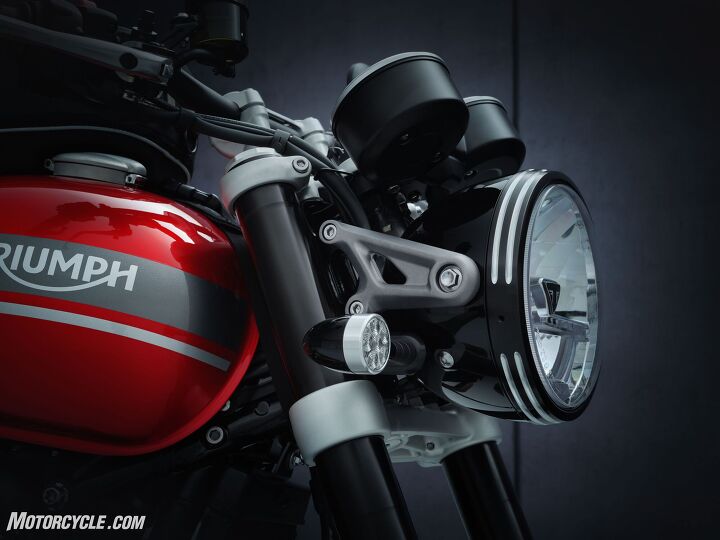
– New anodised headlight and mudguard mounts
– New distinctive tank graphics
– Three contemporary colour schemes
50+ Custom Accessories – Genuine Triumph accessories for added style, practicality and security
Launched in 2018, the Speed Twin set the benchmark for how a Modern Classic performance roadster should ride and feel thanks to its class-leading handling, thrilling and responsive engine, advanced rider technology and beautiful, modern custom style with category-defining premium finish and detailing.
An award-winning motorcycle, the Speed Twin has been a great success and a customer favourite. Recognised for having the power and torque of the Thruxton R in an even more accessible set up, the Speed Twin delivered the contemporary custom style and engaged ride of the Street Twin, with even more premium and beautiful details and touches.
And now for 2021, the Speed Twin brings an evolution in every dimension, from power and performance, to handling, technology and style – making it the perfect combination of character, style and genuine sport performance.
Higher Performance Significantly updated for 2021, the Speed Twin’s characterful 1200cc High Power Bonneville twin engine now has even higher performance, as well as lower emissions, making it fully Euro 5 compliant. The engine now delivers 3PS more peak power with 100PS at 7,250rpm, plus more power in the mid-range than the previous generation.
Alongside the incredibly strong and linear power delivery, the 2021 Speed Twin also has a fuller torque curve, with peak torque of 112Nm arriving more than 500rpm lower down the rev range compared to the previous generation.
The responsiveness of the Speed Twin engine has also been enhanced, thanks to a 17% reduction in inertia obtained via a new lightweight crankshaft and alternator. These enable the engine to spin up faster than the previous generation, and rev harder for longer, with a red line now 500rpm higher than before. In addition, new high compression pistons, revised ports and a new cam profile complete the list of performance enhancements.
The distinctive sound of the Bonneville Twin is amplified by the new brushed stainless steel megaphone twin upswept sports silencers, that have been carefully crafted for a deep, throaty roar to match the Speed Twin’s legendary name. The innovative and uninterrupted exhaust header run cleverly conceals the catalyst box, delivering the characteristic clean-line “straight-run” design.
As with all of the models in Triumph’s Modern Classic range, the cost of ownership is kept low thanks to the high first major service interval of 10,000 miles / 16,000 kilometres.
Better Handling Already acknowledged for its superb, sure-footed comfortable handling, the new generation Speed Twin benefits from a number of significant upgrades for an even more precise, agile and dynamic ride.
New for 2021, the Speed Twin comes equipped with higher specification upside down 43mm Marzocchi front forks with cartridge damping, bringing a more confidence-inspiring and comfortable ride with 120mm wheel travel. These are perfectly matched to the twin rear suspension units with adjustable spring preload, and 120mm rear wheel travel, both precisely tuned for even better handling and the perfect modern roadster ride.
Further enhancing the new generation Speed Twin, braking performance is improved with new higher specification Brembo 4-piston M50 radial monobloc front brake calipers and twin 320mm Brembo discs. Alongside the Nissin 2-piston floating rear caliper with 220mm disc, and ABS fitted as standard, these deliver a stronger initial braking-bite, more feel and better fade characteristics.
Ensuring incredible grip, precision and high-speed stability, new Metzeler Racetec RR tyres are fitted as standard for the 2021 model, along with new cast aluminium wheels, 17” on both front and rear, with a lightweight 12-spoke design.
A beautifully balanced motorcycle, the Speed Twin brings an intuitive and confidence-inspiring ride. The ergonomics are perfectly proportioned with an accessible 809mm seat height, a slim stand over width, tapered handlebars and a comfortable roadster foot-peg position, which are 38mm further forward and 4mm lower than the Thruxton, providing the rider with a more relaxed riding position.
Enhanced Technology The new generation Speed Twin is packed with rider-focused technology, including a sophisticated ride-by-wire system that ensures precise throttle control and enables three riding modes: Rain, Road and Sport. These have been enhanced for 2021, adjusting both the throttle response and traction control settings to suit the rider’s preference.
The riding modes can be changed at the touch of a button while on the move, to respond to any change in riding conditions, maximising rider confidence and safety. The rider can also choose to switch the traction control off independently through the instrument menu.
The bike is also equipped with an LED rear light and indicators, and, where market legislation permits, the signature LED Daytime Running Light (DRL) is incorporated into the headlight.
The contemporary 3D clocks incorporate a digital menu system accessed by the scroll button mounted on the handlebar. This provides the rider will all of the key information, including gear position, two trip settings, fuel level and range-to-empty, as well an average and current fuel consumption, access to traction control settings and TPMS indicator if fitted as an accessory.
Other rider focused technology includes an under-seat USB charging socket, an accessory Tyre Pressure Monitoring System and an immobiliser with transponder integrated into the premium Triumph branded key.
More Premium Style and Detailing Incorporating Triumph’s timeless DNA with a contemporary stripped-back custom style and poise, the new 2021 Speed Twin is even more beautiful and now comes with even more stylish details.
In addition to the new 12 spoke cast wheels and twin upswept sporty silencers with brushed stainless-steel headers, the Speed Twin is characterised by its signature-shaped 14.5L tank with knee indents, beautiful bar end mirrors, sculpted side panels and stylish bench seat.
Premium details and finishes are harmonised across the bike, including brushed aluminium front and rear mudguards with new mounts, plus brushed aluminium side panel finishers and heel guards. Additional premium touches and details can be found in the new anodised headlamp mounts to compliment the painted headlamp bowl, classic Monza fuel cap and clear anodised aluminium swingarm.
For 2021, the Speed Twin is available in three paint schemes: the new vibrant and lustrous Red Hopper scheme, the sophisticated Matt Storm Grey with subtle yellow accents, or the timeless Jet Black.
The Genesis of a Motorcycle Icon Changing the face of motorcycling, the original 1938 Triumph Speed Twin, with the world’s first successful parallel twin engine packaged into a game changing chassis, was a revelation to ride. Its smooth dynamic handling and superb responsive feel established Triumph as the number one motorcycle marque globally for performance and handling, setting the template for all that followed, and earning a global reputation for being the first real ‘riders bike’.
For 2021, the new Speed Twin sets the benchmark all over again for its balance of torque-rich performance, agile and dynamic handling, and stunning contemporary custom motorcycle design and character.
50+ Custom Accessories The 2021 Speed Twin is the perfect platform for personalisation with over 50 custom accessories that riders can add to enhance the style, practicality and security of their bike. These range from multi-function LED indicators, to quilted seats and luggage, knee pads, engine embellishers, head bolt covers, sump plates, heated grips and many more.
All genuine Triumph accessories have been designed and developed alongside the bike itself, to the same exacting standards, to ensure perfect integration and excellent durability, and all come with the same two-year unlimited mileage warranty.
Single Ø 220mm disc, Nissin 2-piston floating caliper, ABS
Instruments
Twin dial analogue speedometer and tachometer with LCD multi-functional displays
DIMENSIONS & WEIGHTS
Length
2099 mm
Width (Handlebars)
778 mm
Height Without Mirrors
1097 mm
Seat Height
809 mm
Wheelbase
1413 mm
Rake
22.3°
Trail
91.5 mm
Wet weight
216 kg
Fuel Tank Capacity
14.5 litres
FUEL CONSUMPTION
Fuel Consumption
5.1 litres / 100 km
CO2 Figures
116 g/km
Standard
EURO 5
CO2 emissions and fuel consumption data are measured according to regulation 168/2013/EC. Figures for fuel consumption are derived from specific test conditions and are for comparative purposes only. They may not reflect real driving results.
Have you ever wondered why the chicken is the go-to poultry of the world today? It wasn't because of Colonel Sanders. No, we need to go back further to see how the chicken supplanted ducks and geese on our tables. Back to Queen Victoria, the trendsetter (see white wedding dresses and childbirth anesthetic) and monarch of the British Empire, who popularized chicken for dinner.
Queen Victoria, an abolitionist whose title gave her an outsize influence on trends of the day, helped make chicken a food so universally associated with wholesome nourishment that within just a few decades after her death, politicians would start promising would-be voters a “chicken in every pot.” By the time KFC franchises were spreading across the nation after World War II, all Colonel Sanders had to do to sell his deep-fried breasts, wings, drumsticks, and thighs was to promise customers that his birds were so full of fat, they’d happily lick their fingers to keep the tasty grease from running down their elbows.
The crash of hen fever in 1855 made such table manners possible, for the chicken would not have become so universally consumed if its price had remained at $700 for a breeding pair. The collapse was also a boon to Charles Darwin, who was finally able to afford enough chickens to study—Darwin’s work with chickens would inform On the Origin of Species, which was published in 1859.
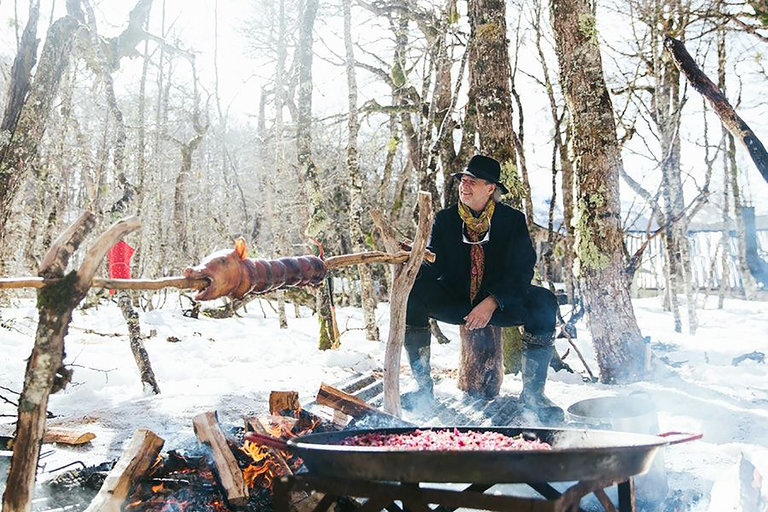
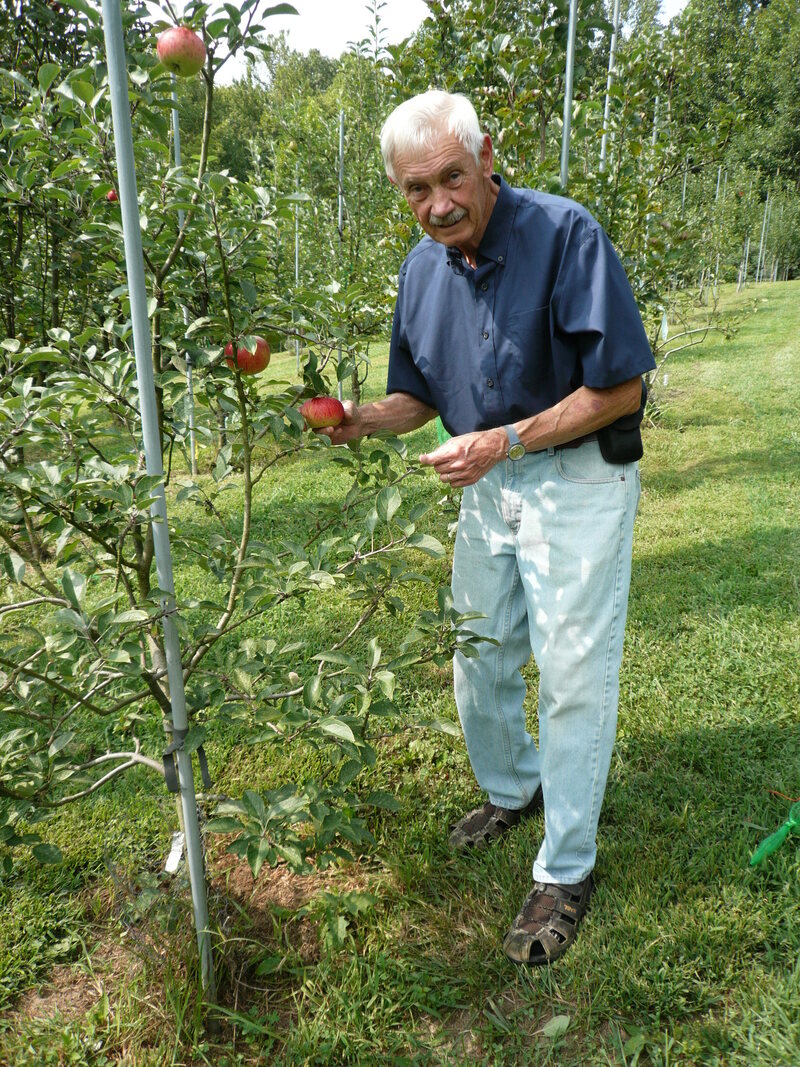
As Tom Brown leads a pair of young, aspiring homesteaders through his home apple orchard in Clemmons, North Carolina, he gestures at clusters of maturing trees. A retired chemical engineer, the 79 year old lists varieties and pauses to tell occasional stories. Unfamiliar names such as Black Winesap, Candy Stripe, Royal Lemon, Rabun Bald, Yellow Bellflower, and Night Dropper pair with tales that seem plucked from pomological lore.
Take the Junaluska apple. Legend has it the variety was standardized by Cherokee Indians in the Smoky Mountains more than two centuries ago and named after its greatest patron, an early-19th-century chief. Old-time orchardists say the apple was once a Southern favorite, but disappeared around 1900. Brown started hunting for it in 2001 after discovering references in an Antebellum-era orchard catalog from Franklin, North Carolina.
Detective work helped him locate the rural orchard, which closed in 1859. Next, he enlisted a local hobby-orchardist and mailman as a guide. The two spent days knocking door-to-door asking about old apple trees. Eventually, an elderly woman led them to the remains of a mountain orchard that’d long since been swallowed by forest. Brown returned during fruiting season and used historic records to identify a single, gnarled Junaluska tree. He clipped scionwood for his new conservation orchard and set about reintroducing the apple to the world.
Brown has dozens of apple-hunting tales like these from the nearly 25 years he’s spent searching for Appalachia’s lost heirloom apples. To date, he has reclaimed about 1,200 varieties, and his two-acre orchard, Heritage Apples, contains 700 of the rarest. Most haven’t been sold commercially for a century or more; some were cloned from the last known trees of their kind.
“These apples belong to the [foodways] of my grandparents’ and great-grandparents’ generations,” says Brown, who was raised in western North Carolina.
Thousands of varieties probably still exist, but saving them is a race against time. The people who hold clues about their locations are typically in their 80s or 90s. Each year trees are lost to storms, development, beetles, and blights. Brown has devoted his later years to beating the clock.
Ironically, Brown didn’t know what a heritage apple was until he stumbled on them at a historic farmer’s market in 1998.
“There was a little stand with a bunch of strange-looking apples laid out in baskets,” says Brown.
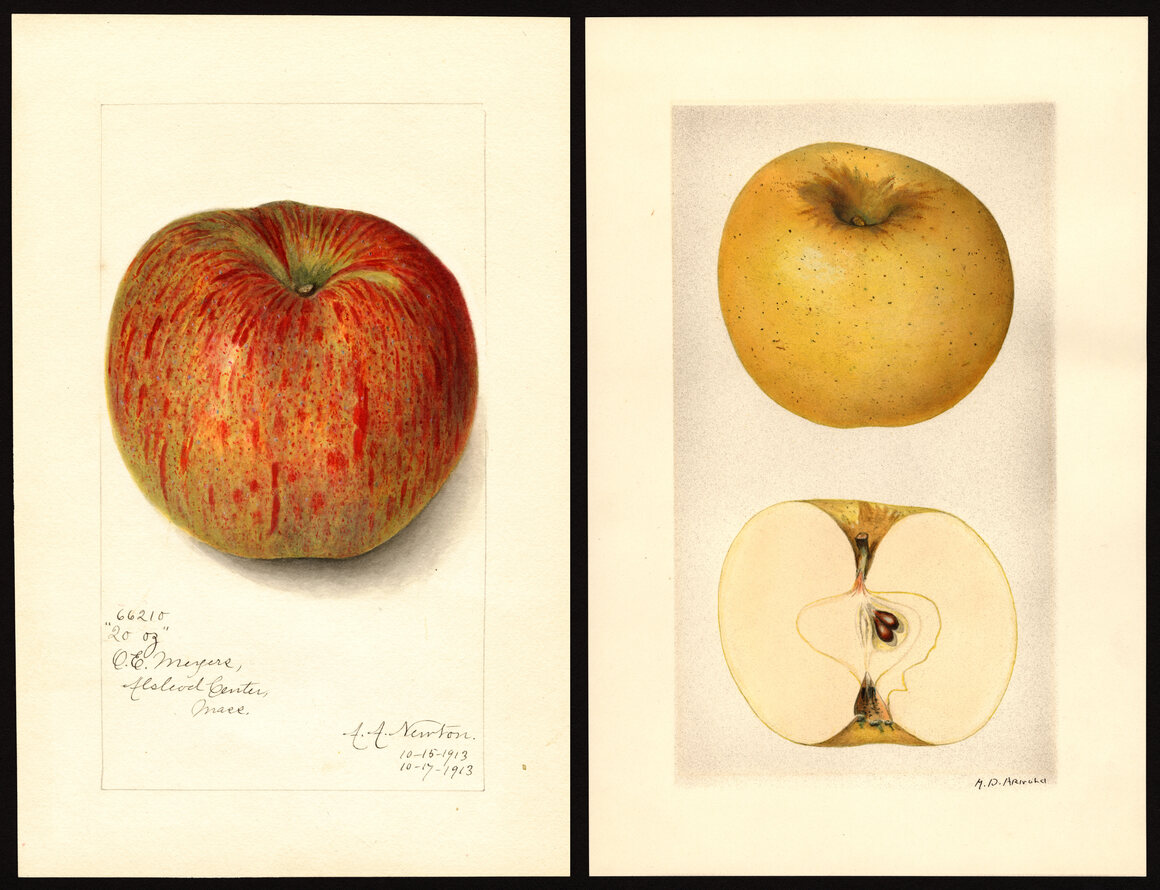
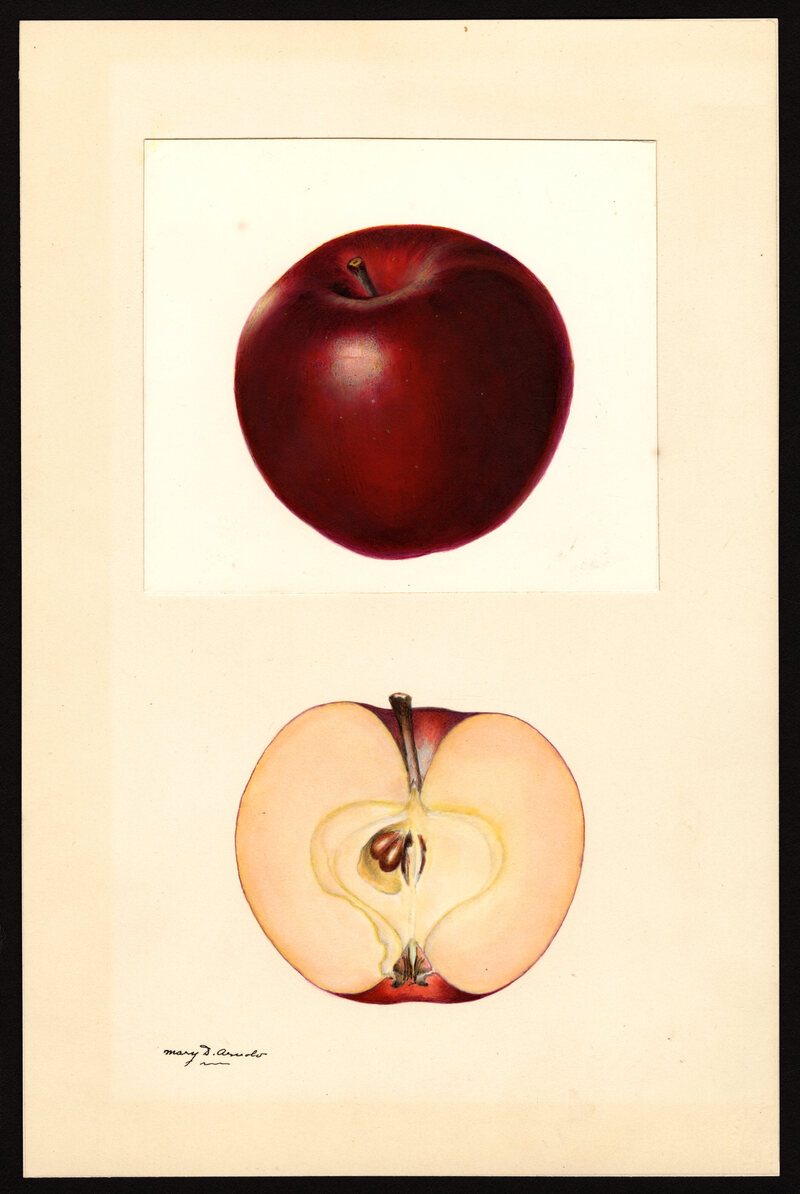
Colors ranged from bright green to yellow-streaked, sunset pink, and purplish black. Some were plum-sized, others as big as softballs. They had names like Bitter Buckingham, White Winter Jon, Arkansas Black, and Billy Sparks Sweetening. Tasting trays brought a smorgasbord of flavors and textures.
Brown tasted Jonathans that had rosé wine-colored flesh. Rusty Coats were soft like pears and sweet like honey. The mammoth Twenty Ounce was crisp with a tart, peachy finish. Semi-firm Etter’s Gold brought peony bouquets and grape flavors. Grimes Golden were sweet with a hint of nutmeg and white pepper.
Brown’s enthusiasm led to a conversation with the vendor, late orchardist Maurice Marshall. The varieties of apples he was selling were standardized in the 1700s and 1800s, and had vanished from commercial circulation by 1950. Marshall had obtained most of the scionwood for them from elderly mountain homesteaders. But two or three varieties came from clippings taken during apple-hunting expeditions at the ruins of old orchards. What’s more, hundreds of lost apples could likely be reclaimed at similar sites throughout Appalachia.
“That part stayed with me,” says Brown. “I kept thinking: ‘How neat would it be to find an apple nobody’s tasted in 50 or 100 years?’”
Then it struck him: Had so many interesting, great-tasting fruits really just disappeared? It seemed impossible. Brown threw himself into researching the history of Appalachia’s heritage apples. What he learned was awe-inspiring and devastating.
Commercial orchards in the U.S. grew about 14,000 unique apple varieties in 1905, and most of them could be found in Appalachia, says William Kerrigan, author of Johnny Appleseed and the American Orchard and a professor of American history at Muskingum University.
The diversity was rooted in early colonial precautions.
“Water wasn’t always safe to drink, and episodes of sickness from contaminated water gave that substance a questionable reputation,” says Kerrigan. Fermented beverages were the go-to alternative. Importing wine was expensive, and native pests killed Old World grapes. Apple orchards were easier to maintain and more utilitarian than growing fields of barley for beer, so cider became the colonists’ choice beverage. By the mid-1700s, virtually every East Coast farm and homestead had an apple orchard.
The settlement of Virginia’s Blue Ridge Mountain region spurred an innovation boom.
High-but-not-too-high elevations, hot, humid summers, and rich, deep soil nurtured by consistently rainy winters produced ideal growing conditions, writes Kerrigan in Johnny Appleseed and the American Orchard.
By the early 1800s, the Shenandoah Valley had become the top U.S. growing region. Commercial orchards were proliferating throughout eastern Appalachia. Experimentation was relentless.
Growers did things like cross tannin-rich indigenous crabapples with Old World cider staples, writes Kerrigan. The efforts produced new varieties such as the Taliaferro, which Thomas Jefferson championed as the world’s greatest cider apple.
But apple varieties were cultivated for more than cider.
For Appalachian farmers and homesteaders, “a diverse orchard was fundamental to survival and good-eating alike,” says Brown. Residents were expert gardeners and developed varieties that matured at different intervals, tasted unique, and catered to specific culinary functions.
“The goal was to be able to pick fresh apples from June to November, and have a diverse supply of fruit throughout the year,” says Brown. Thick-skinned, late-ripening varieties provided wintertime pomaceous treats. Others were tweaked for applications such as frying, baking, dehydrating, making vinegar, and finishing livestock.
Apples were the garden’s crown jewels, says Appalachian Food Summit co-founder and renowned chef, Travis Milton. People took pride in having something unique to brag about to their neighbors.
"How neat would it be to find an apple nobody’s tasted in 50 or 100 years?”
But Appalachian traditions around heritage apples were eroded and ultimately destroyed by urban migration, factory farming, and corporatized food systems. Conglomerates negotiated national contracts and switched to apples that matured fast and were suited to long-distance shipping. By 1950, most smaller orchards had been forced out of business—Milton’s grandfather, for instance, sold the family’s Wise County, Virginia, orchard to a coal company to save his cattle farm. Gardens began to disappear.
By the late 1990s, U.S. commercial orchards grew fewer than 100 apple varieties—and just 11 of them accounted for 90 percent of grocery-store sales. Experts estimated 11,000 heirloom varieties had gone extinct.
“It upset me to learn about that,” says Brown. Two-hundred-fifty years of culinary culture had been squandered. “These were foods that people had once cared about deeply, that'd been central to their lives. It felt wrong to just let them die.”
But if Marshall was right, some of Appalachia’s heritage apples could still be recovered. And Brown was looking for a retirement hobby. His experience as a scientist would bring calculated organization to searches. The project would let him explore and learn more about the history of rural Appalachian communities.
Brown realized he’d stumbled onto “what could only be described as a ‘calling.’”
Becoming the world’s most accomplished heirloom apple-hunter brought a steep learning curb.
Marshall introduced Brown to a network of aging, small-scale heritage orchardists (none kept more than 20 varieties) who taught him the basics of identifying, cloning, grafting, and maintaining trees. He discussed lost apple varieties and made lists of names including characteristics, former growing locations, and rumors of where trees still existed.
Connecting with regional historical societies yielded old orchard maps, fruit-grower association newsletters, and names of former owners and workers. Pomological historians helped Brown track down vintage orchard catalogs with drawings and descriptions for thousands of lost varieties.
His early search-and-rescue attempts centered around former hotbeds of production, such as North Carolina’s Brushy Mountains. The two-county region was home to more than 100 commercial orchards in 1900. Brown advertised in area newspapers seeking information about old apple trees.
“The response was exciting, but also kind of [a reality-check],” says Brown. He fielded dozens of calls, but few brought concrete information. Most callers were in their 80s and 90s, says Brown, and told childhood stories where “old man such-and-such had a tree with 20 different types of apples grafted onto it.”
“Up to then I hadn’t grasped how much detective work [this] was going to require,” says Brown.
Years of ad-hoc efforts helped him develop central strategies for hunts. First he gathers clues about trees’ possible whereabouts. For instance, discovering the address of someone’s great-grandparents who once kept a large orchard can pinpoint a rural community where special trees may still exist. Brown then draws a radius around the property and canvasses nearby homes. He stops at local businesses to make inquiries.
“When I explain what I’m doing, most people are really receptive,” says Brown.
For instance, a conversation with an 80 year old at a country store in northeast Georgia led Brown to amateur orchardist Johnny Crawford. Crawford put Brown in touch with elders in the Speed family, who ultimately helped him locate a treasure-trove of heirlooms in a rural area, including the Royal Lemon, Neverfail, Candy Stripe, and Black Winesap.
When Brown finds a tree, he takes clippings and returns during fruiting season to identify them. He compares leaves and apples to catalog entries, and uses photos to correspond with experts for further verification.
Brown drives about 30,000-plus miles a year and devotes around three days a week to apple-hunting. His partnerships with municipalities and non-profits such as the Southern Foodways Alliance help establish reclaimed varieties at additional orchards and ensure their survival.
“Saving an apple from the brink of extinction is a miraculous feeling,” says Brown. “It’s incredibly rewarding—and incredibly addictive!”
Today Brown’s orchard is filled with clones of trees recovered in Georgia, South Carolina, North Carolina, Kentucky, Tennessee, Virginia, West Virginia, Maryland, and Pennsylvania. He divides time between apple-hunting, tending trees, donating scionwood to nonprofit heritage orchards, and selling about 1,000 saplings annually.
Brown’s work has been commended by conservationists and culinary professionals alike. Chefs like Travis Milton are stoked to have hundreds of new flavors to experiment with. Craft cidermakers say reintroduced heirlooms are inspiring a cider renaissance.
“Tom has helped redefine what’s possible,” says Foggy Ridge Cider owner, Diane Flynt, who won a James Beard Foundation award in 2018. She says heirlooms such as Hewes Virginia Crab and Arkansas Black are for Appalachia what noble grape varieties like Merlot or Cabernet Sauvignon are for Bordeaux.
Brown is thrilled the apples are being put to good use. But he’s quick to note that many still need saving. And they’re getting harder to find.
“It takes me probably 20-30 times more work and a lot more driving to locate one new tree,” says Brown.
But that doesn’t deter him. Brown has come to think of restoring Appalachia’s heritage apples as his “true life’s work.” While he hopes to recover another 100 varieties or more in his lifetime, experiencing just one more find would be reward enough.











































![[link]](https://i.redd.it/kbh905ccen271.jpg)
![[link]](https://i.redd.it/agiuf6uq9m371.jpg)