KWBaker
Shared posts
Best Swirl Remover for 2022 - Roadshow

Chevy COPO Camaro returns in a big way with Big-Block V8 power - Roadshow

Want to Watch a James Bond Movie? These Are My Top Picks

Every James Bond Movie, Ranked - CNET

The Armored Mercedes S-Class, Designed for Heads of State, Can Withstand Assault Rifle Bullets and Grenades

Single-Wheel Motorcycle Trailer

A motorbike might not take up a lot of parking space, but this is not true for the trailer required to transport one. To solve this problem, [Make It Extreme] built a custom single-wheel motorbike trailer barely wider than the motorcycle itself.
The frame of the trailer is welded together from a couple of sections of large diameter steel tube, with a single car wheel mounted to a C-shaped portion on the rear end. A standard ball hitch would allow the entire trailer to tilt over to one side, so a pin hitch is used instead, with a pivot to allow up and down movement. Another pivot was added to the frame just ahead of the rear wheel to allow the trailer to lower to the ground for loading. It is raised and lowered with a manually pumped hydraulic cylinder, and a small pivoting ramp at the back also acts as a stop for the motorbike’s rear wheel. With the rigid frame and no suspension, we’re just wondering how well it will handle bumps at high speed.
[Make It Extreme] really likes his recreational vehicles, which include a monotrack motorbike, a monowheel, and an all-terrain hoverboard, among others.

Are Aliens Already Here?
Look up at the stars tonight. Those twinkling diamonds are several thousand light-years away. Our planet is just a grain of sand on a virtually endless beach, a small dot in a gigantic galaxy. Is it the only dot with life on it? That’s a question humankind has been asking ever since we started to understand the basics of astronomy thousands of years ago. Now, we’re closer than ever to finding the answer, as an unprecedented crush of ultrapowerful telescopes and interplanetary missions try to trace where else life might possibly exist. Today’s Daily Dose travels to the far reaches of the universe on that search, taking you through the latest breakthroughs and the people behind them. Curious? You should be.
come out, come out wherever you are
Age-Old Search
Some 2,500 years ago, two Greek philosophers looked to the sky and wondered if humans were alone in the universe. Today, many scientists believe the question is a no-brainer. For decades, one of the fundamental laws of physics formed the basis of our understanding of life on Earth. The law of increasing entropy insists that energy tends to dissipate instead of coming together: pour ink in water and watch it diffuse. If that’s true for the universe, then the sublime marriage of millions of cells and molecules for the creation of life on Earth could be a low-probability fluke that needn’t repeat itself. But some researchers now believe that the existence of extraterrestrial life doesn’t necessarily violate that basic law: In fact, they argue, it could be what drives the creation of living beings.
Count the Stars
And then there’s simple math to consider. There are billions of galaxies in the universe, each one home to tens of billions of stars circled by at least a planet each. See where I’m going? From the first astronomer eager to catch audio signals using radio in the early 1900s to the rovers currently exploring Mars, our fascination with outer space has always in part had to do with the hunt for potential neighbors beyond our planet. Sophisticated new tools, including the soon-to-be-deployed largest telescope in history, are capable of exploring the atmosphere of planets trillions of miles away, potentially bringing us within reach of an answer.
Move Over, Mars
While Mars has long been the poster child for out-of-Earth exploration, (it is, after all, the most similar to Earth in many ways), scientists are expanding their horizons. In fact, researchers at Washington State University have already identified more than 20 planets outside our solar system that could sustain life even better than Earth (don’t pack your bags just yet though; they are all more than 100 light-years away). Meanwhile, even as it waits for a robotic rover to deliver Martian samples by the end of the decade, NASA wants to explore one of Jupiter’s moons, Europa. The agency is planning to send a mission to probe Europa’s frozen oceans and volcanoes as early as 2024. Another moon catching everyone’s attention is Titan, Saturn’s largest, where a mission will be launched to analyze liquid methane lakes in 2027.
Not So Fast
But some scientists are urging caution, saying the broadly accepted global guidelines on how to respond to a potential alien encounter are not enough. Physicist Mark Buchanan worries that these new civilizations could be more advanced and powerful than ours. “Most stars in our galaxy are much older than the sun. If civilizations arise fairly frequently on some planets, then there ought to be many civilizations in our galaxy millions of years more advanced than our own,” he wrote in The Washington Post in June. On the opposite side is a slightly more eerie argument: If these super smart aliens wanted to kill us all, they would have already done it.
Wait, Are They Already Here?
What if we’re the aliens on Earth? While a recently declassified report on alleged UFO sightings by U.S. navy pilots raised more questions than it provided answers, some prominent scientists have been positing a much more interesting theory: that life on Earth could have actually originated on Mars, making us, well, Martians. How? Life forms when planets cool down and liquid water eventually emerges. Evidence is increasingly pointing to the fact that Mars formed and cooled down before Earth, and that it had methane (an ingredient for the birth of life). Add that to the theory that various forms of life travel across the universe through asteroids and other debris, and you have a hypothesis more credible than distant sightings by pilots that could be explained in part by optical illusions.
Who Are the Aliens?
Scientists have recently discovered more than 2,000 stars from where Earth would be visible when it passed in front of the sun. That means that aliens with powerful telescopeson planets near those stars could actually be looking at us without visiting us on UFOs. The good news? Hector Socas-Navarro, an astrophysicist at the Institute of Astrophysics of the Canary Islands, says that if there’s life out there, we currently have a good chance of finding it. “The new large telescopes will allow us to scrutinize the chemical composition of many exoplanet atmospheres,” he tells OZY. “With those tools, we could find life elsewhere within the next 10 to 20 years.”
how are we finding them?

Telescopes
From the moment Galileo Galilei, one of modern astronomy’s founding fathers, pointed his telescope upward in the 1600s, the instrument has been central to our understanding of the universe. It helped early scientists study the surface of our moon and discover Saturn’s rings and Jupiter’s moons. Since then, telescopes have evolved in ways the Italian astronomer probably never dreamed of. In 1931, American engineer Karl Jansky’s giant rotating antennas detected the first radio signal from the center of the Milky Way. And more than seven decades later, NASA’s Kepler Space Telescope identified thousands of planets that orbit around stars other than the sun between 2009 and 2018.
Best Bet
While China and the European Space Agency — apart from America — are investing in new rovers to explore Mars’ surface, modern versions of the telescope represent our best shot at discovering the truth about possible extraterrestrial life. China recently unveiled one of the largest single dish observatories in the world, so sensitive that it can detect anything from dead stars to hydrogen in distant galaxies. Meanwhile, NASA is preparing to send up the James Webb Space Telescope this year. This $10 billion observatory will work from space, its state-of-the-art technology allowing it to look through the gas and dust that usually obscure the view for other telescopes.
The Future
Telescopes are poised to become ever more sophisticated, with the ability to provide better images of smaller planets located farther away. The Giant Magellan Telescope in Chile and the European Extremely Large Telescope (brownie points for original naming) are both due to be up and running by 2025. They promise to deliver images so sharp scientists might be able to identify the fine imprint that molecules leave in the atmospheres of other planets, tracking clues to the possibility of life. Another Harvard University-led project will search for possible technologies aliens might have discarded as junk. Meanwhile, other researchers are developing ultrafast light-driven nanocrafts, similar to the ones aliens could have, to launch toward Alpha Centauri, the star system closest to ours (about 25 trillion miles away) that could potentially harvest life. Why is it so important to search for life elsewhere? Astrophysicist Socas-Navarro tells OZY the answer is simple: “All the life that we know descends from one line. Biology has only one sample to work with in trying to understand life itself and how it originates. It’s like trying to study medicine in a world with only one person.”
the next galileos
Yuri Milner
Jeff Bezos and Richard Branson aren’t the only billionaires locked in a space race. Milner, an Israeli Russian businessman and one of the moneybags behind Facebook and Twitter, founded Breakthrough Initiatives in 2015 and has invested more than $200 million in the search for alien life on Jupiter, Saturn and in the clouds over Venus. The businessman, who was named after the Russian astronaut Yuri Gagarin, the first human to venture into space, has always been interested in what is out there. “I think it is only appropriate that we, as a civilization, devote at least some resources to try and ask the biggest existential questions; for example, are we alone in the universe?” he told CTech. But his biggest strength might be his proximity to Russian President Vladimir Putin, who heads a state with one of the world’s most sophisticated space programs at its disposal.
Latinas in Nasa
Latinos represent just 7% of NASA’s workforce, though they constitute 18% of the U.S. population. For Hispanic women, making it to NASA can be as hard as getting to Jupiter. Mexican Ali Guarneros Luna is shattering that glass ceiling, remaking the space agency’s reputation for a new generation. Growing up in Mexico, she read about space missions in an encyclopedia — and was instantly hooked. Then, at the age of 12, she immigrated to California with her mother after an earthquake devastated her native Mexico City in 1985. After high school, she gave up on her college dreams to support her four children. After she finally went back to school and earned two degrees, a professor convinced her to try out for NASA. She now works as part of the Agency’s small satellite technology program, which develops new tools for space missions, and is a top safety expert at the agency. Shooting for the stars has paid off for her.
You
But you don’t need to be a space engineer to satiate your curiosity about possible alien life. All you need is a telescope and a ton of time. NASA is recruiting amateur astronomers keen to observe planets from outside our solar system as they pass in front of the sun. The idea is that mass observation will help build a body of data pointing to the time and frequency at which these planets travel near the sun, allowing more experienced astronomers to know when to point the larger telescopes.
in pop culture

Fact or Fiction?
If they exist, what do aliens look like? Are they green and cute as in E.T., tall and skinny as in Signs, human-looking like Sally from 3rd Rock From the Sun or perhaps angry and gooey like in Aliens? For decades, popular culture has stepped in where science has been unable to answer questions. Some argue these stories reflect other social fears (think about the many reports of UFO sightings between 1952 and 1969 during the Cold War).
Mirror, Mirror
OK, that’s Hollywood. What do scientists say about the way aliens might actually look? That we should look at evolution, and keep an open mind. They argue that the way we humans look is pretty much a result of necessity (two eyes for wide vision, two ears for stereo audio, two legs to stand up and grab things from high up). Each species is different, based on their own evolutionary needs. So aliens can actually look completely different to us. Where we are going wrong is that we are only imagining beings similar to creatures on Earth.
Man on Mars
What if we could combine scientific research with the spectacle of films? A series of cool new documentaries does just that, exploring some of the questions NASA scientists are asking themselves and offering a front-row seat to their findings. Among them is Nat Geo’s Mars, a documentary-style fiction series that takes viewers on a trip over the next few decades as humans settle on Mars. Spoiler alert: It will take more than finding a new habitable planet to rid humanity of its problems.
The post Are Aliens Already Here? appeared first on OZY.
Kansas Froggers Share Bullfrog-Catching Tips
Experienced Kansas bullfrog hunters are sharing some of their tips and tricks to help out new and practiced froggers alike.
The post Kansas Froggers Share Bullfrog-Catching Tips appeared first on GunsAmerica Digest.
Treat your mind: The 13 best short stories ever written
Many authors say that penning a great short story is harder than writing an entire novel. These are the best short stories to add to your list.
The post Treat your mind: The 13 best short stories ever written appeared first on The Manual.

ADV:Overland – The Petersen Automotive Museum Celebrates the Spirit of Motorcycle Adventure

The Petersen Automotive Museum and Motorcycle Arts Foundation have launched a new exhibit titled ADV:Overland, which celebrates the spirit of adventure through off-road and off-world motorcycles and related vehicles. With support from Harley-Davidson, the exhibit features 23 adventure-touring motorcycles and race vehicles from 1930 to the present, as well as sci-fi and NASA off-world exploration vehicles, to tell a comprehensive story about adventuring on two wheels, on Earth and beyond.

RELATED: 2021 Harley-Davidson Pan America 1250 Special | First Ride Review
Motorcycles and off-road racing vehicles on display include an example of the 1903 California that was the first motorized vehicle to travel coast to coast; a 1912 Henderson Four as used in the first motorcycle trip around the world; a 1915 Harley-Davidson 11-F with sidecar, as used by Effie and Avis Hotchkiss when they became the first women to drive across the United States; the 1932 Douglas “Mastiff” which inspired Robert Edison Fulton Jr.’s novel “One Man Caravan”; the 1933 Puch 250SL that was the first motor vehicle to overland from Europe to India; a 1964 Honda CL72 Baja Scrambler homage to Dave Ekins’ first timed run down Baja; a 1974 BMW R60/6 which inspired the book “Lone Rider” by Elspeth Beard; a 1906/2019 Contal Mototri veteran of the Peking to Paris rally; and many more, including an example of the 2021 Harley-Davidson Pan America.
RELATED: Silver Shotgun: Italian Motorcycle Design of the 1970s, about a recent motorcycle exhibit at the Petersen
Real and science fiction space vehicles are also on display and include a 2021 Tardigrade concept electric Lunar motorcycle; a replica of the 1965 chariot from the “Lost in Space” television series; as well as another from the 2018 remake; a model of the Opportunity MER-1 rover, the robotic spacecraft that holds the long-distance record in off-world overlanding; and a model of the 1996 Sojourner rover.

“We are proud to partner with Motorcycle Arts Foundation to gather this impressive display of vehicles in the spirit of adventure,” said Petersen Executive Director Terry L. Karges. “Coming on the heels of a global pandemic, ADV:Overland is an important retrospective of the freedom of exploration, to go where no one has ever gone and accomplish things that no one has ever accomplished. This visionary spirit drives innovation in transportation and has inspired this exhibit.”
Exhibit curator Paul d’Orléans explains, “This exciting, first-ever collection of Round-the-World, overland racing, and off-world overland vehicles is the perfect pandemic escape hatch. Most of these extraordinary machines have never been publicly displayed, and absolutely radiate the spirit of adventure: some even retain their original accessories, 90 years later. These are must-see vehicles, on display in the best motoring museum on the planet.”

“ADV:Overland” opened on July 3, 2021, at the Petersen Automotive Museum in Los Angeles. The exhibit is produced by Motorcycle Arts Foundation (MAF) and Sasha Tcherevkoff with support from Harley-Davidson. Guests who would like to visit the museum must purchase tickets in advance on the Petersen’s website. Health and safety guidelines are being followed: face coverings are required for all guests (single-use face masks will be provided to those who do not have one). For more information visit: petersen.org/overland.com.
Citizen App Pays $25/Hr for People to Film and Livestream Crime Scenes

A controversial smartphone app called Citizen is offering to pay people who can rush to crime and emergency scenes to capture the events with their smartphone cameras in hopes of encouraging ordinary people to participate in the app as well.
The New York Post reports that the app was first released in 2016 under the name “Vigilante” but was soon removed from Apple’s App Store amid criticism that it encouraged vigilantism. Now rebranded as “Citizen,” the app has received financial backing from high-profile venture firms and individuals (including Sequoia Capital and Peter Thiel) and promises to deliver real-time safety alerts for its 7 million users across 30 cities (with more areas on the way).
The app claims it is a “personal safety network” that empowers its users to protect themselves and the people and places they care about. In addition to crime reporting, it can also be used for COVID-19 contact tracing, access to real-time 911 alerts, instant help from crisis responders, and safety tracking for friends and family.
The New York Post speculates that the vast majority of alerts and videos are submitted on this app are done so by volunteers who happened to be in the right place at the right time, which saves the company money instead of using local journalists. However, to generate public involvement, it is believed that the company has recruited “field team members” who are hired to chase emergencies around the Big Apple.

Although the company doesn’t post the available jobs on its website nor does it publicize its name on online job sites, a since-deleted job posting on the Journalism Jobs website read that a company is seeking “field team members” to work for an unnamed “tech company with user-generated content.”
The posting also read that the successful members would be “dispatched” to cover a variety of events in their area and that they should use their initiative to interview people, such as witnesses, police officials, and other parties if the situation permits it. The advertised listing offered $200 per day for eight-hour shifts in New York, while workers in Los Angeles stand to make $250 per day for ten-hour shifts.
Although the company has made its mission to make the world a safer place, it is noted that the app has had its share of criticism for “sending out alters based on 911 calls without corroboration,” for example. The company’s CEO Andrew Frame has also received criticism, as reported in detail by Vice, for putting out a $30,000 reward for information leading to the arrest of a male arson suspect in Los Angeles before it came to light that the captured suspect was innocent.
The app is available for free on both Google Play and Apple’s App Store. A list of recently captured incidents and videos is also available on Citizen’s website.
That ball is REALLY out of here!

Atlanta’s major league baseball team, the Braves, began their Atlanta baseball history in 1966, but baseball’s history in Georgia predates the Atlanta Braves by nearly 100 years. Before the Braves, there were the Atlanta Crackers, a member of the Southern League and the Atlanta Black Crackers, charter members of the Negro Southern League.
Though they began in 1901, the Crackers planted their Atlanta home field roots in 1907 at Ponce de Leon Ball Park, a stadium that seated about 9,000 people but, unfortunately, that park burned to the ground in 1923, destroying the team’s records, uniforms and all of their trophies.
It was a donation of $250,000 from wealthy Atlantan R. J. Spiller that enabled the park to be rebuilt bigger and better than ever. And the Crackers franchise went on to become one of the most successful professional franchises in baseball history, winning 17 league championships. In fact, during their 64-year-history, they won more titles than any team other than the New York Yankees.
A large part of the Crackers success was due, in part, to outfielder Bob Montag who hit 113 home runs in his career with the Crackers. But it was one home run in particular that set Bob Montag apart for every other baseball player in the history of the game. And it is that shot that is the subject of this installment of Stories of Atlanta.
The post That ball is REALLY out of here! appeared first on SaportaReport.
‘Top Gear’ Host Richard Hammond Is Selling Rare Cars and Bikes From His Private Collection

Drink like Hemingway and whip up a Death in the Afternoon cocktail
Drink like Hemmingway with his most intriguing cocktail invention: the Death in the Afternoon Cocktail.
The post Drink like Hemingway and whip up a Death in the Afternoon cocktail appeared first on The Manual.


Is It Really Better To Rent These Days Than Buy? Price-To-Rent Ratios Tell The Story.

Drone Pilot Spots and Saves Man Being Attacked by Shark
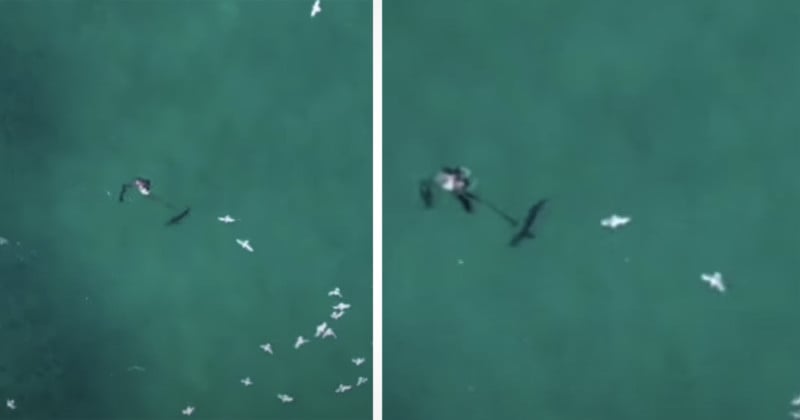
Amateur drone pilot Matt Woods was sitting on his balcony in Bondi Beach, Australia and decided to send out his Mavic 2 Zoom to perhaps capture an ocean vista, but instead found a spearfisherman grappling with what appeared to be an aggressive mako shark.
In an interview with the Daily Mail, Woods says he was horrified to see the shark lunging towards the swimmer, who was only able to keep it at bay with a spear gun.
“I spotted the shark straight away as there was a big bait ball of fish and as I got closer I could see it was also circling the diver in the water,” Woods says. “The diver was fending the shark off and poking it with his spear gun. The shark then went after his float that is attached to the diver. He was charging it and trying to bite it, thrashing it about.”
Woods and his girlfriend immediately alerted local lifeguards to the situation and continued to monitor the swimmer on his drone. He says he was very concerned for the diver as the shark looked angry and aggressive, and he maintained his drone on the position to monitor the diver so that he would be able to guide help to his location while his girlfriend spoke with lifeguards.
Woods says it took about 30 minutes for lifeguards to clear the area of surfers and swimmers before they were able to arrive by jet ski and scare away the shark. Woods says that the diver appeared to be able to scrable onto the rocks and reef, and lifeguards were able to extract him.
“I was pretty concerned for the diver as the shark looked angry. I’ve never seen anything like it before, only whales. I always seem to miss sharks. We know there are sharks here all the time but nothing like this,” he continues.
“I went looking for the diver after trying to try and meet him but couldn’t find him,” Woods says.
According to records, there have only been nine recorded attacks on humans by mako sharks since 1580 and only one of those was fatal, which would make the situation seen in the video extremely rare. That said, positive identification of sharks is very difficult as victims rarely make adequate observations during attacks — as to be expected. The mako is often blamed for shark attacks due to its size, speed, and capability of causing injury, though mako sharks will not generally consider humans to be prey. The Daily Mail writes that sometimes mako sharks are attracted to spearfishermen if they are carrying dead fish, though it is not clear if that was the case here.
This is the latest in a few notable cases involving drones and sharks. In October of 2020, a drone captured an extremely close encounter between pro surfer Matt Wilkinson. In 2019, photographer Dan Watson noticed a shark in the water coming extremely close to his family.
Best Wireless Bluetooth Boom Boxes for 2025

Red wine, greasy pizza, smelly cat pee: How to clean your couch of stains and odors - CNET

5 Best Cheap Meal Kit and Prepared Meal Services, Out of Dozens We Tried

How to Change Handgun Sights The Right Way

Best Saltwater Spinning Reels

Saltwater spinning reels have advanced mightily in recent years. Today’s models boast super-strong gearing, enhanced corrosion resistance, drags with greater stopping power, and more line capacity than ever, thanks to ultra-thin braided fishing lines. When angling techniques call for ripping off quick, long casts with light lures and baits to hard-fighting fish, today’s spinning reels are the tools of choice for saltwater fishing.
Over the past decade, saltwater spinning reels have also grown larger than ever. Big, top-of-the-line offshore spinning reels such as Shimano Stella SW C STLSW30000C and Okuma Makaira MK30000 prove capable of tackling the most powerful species like sailfish, marlin, Pacific halibut, tarpon and big tuna. At the same time, inshore spinning reels such as the Daiwa BGMQ5000-H and Penn Clash II CLAII4000 have established themselves as great choices for targets such as cobia, redfish, snapper, snook and more.
Here are 12 of the best saltwater spinning reels available today, first in the inshore, mid-price range, followed by the best offshore spinning reels, listed in alphabetical order by brand.
Best Inshore Spinning Reels

Daiwa BGMQ5000-H
The BGMQ5000-H from Daiwa represents one of today’s most versatile inshore saltwater spinning reels. Like all models in the mid-priced BG MQ series, it features a Monocoque body with no sideplate, allowing room for a driving gear that’s 85 percent of the diameter of the body surface. Nine rubber seal points prevent water intrusion, and the Advanced Tournament Drag allows for smooth, high drag pressure. This 15.3-ounce reel also features a 5.7-to-1 retrieve ratio and a lightweight Air Rotor that increases the ease of motion and sensitivity. Holding 230 yards of 30-pound-test braid, the BGMQ5000-H spool arbor has a rubberband coating that prevents line slippage.

Fin-Nor Lethal LTH40
The Lethal LTH40 from Fin-Nor boasts high-performance saltwater durability and versatility at an affordable price point. This medium-size spinning reel features an all-aluminum body and sideplate with a braid-ready, machined aluminum spool. The high-lockdown carbon fiber MegaDrag System offers a maximum of 23 pounds of smooth drag pressure. MegaShield multi-layer corrosion protection keeps the reel and its components protected and fully functional in briny conditions. The 19-ounce LTH40 boasts a 5.2-to-1 gear ratio for quick retrieves, and it holds 270 yards of 30-pound-test braid. If you’re in search of one of the best spinning reels for the money, this is it.

Okuma Cedros CJ-6000H
The Cedros CJ-6000H inshore spinning reel from Okuma features rigid and corrosion resistant magnesium and aluminum alloy construction that helps keep its weight to 14.3 ounces, yet provides this medium-size reel with an ultra-sturdy platform. One of six models in the mid-priced Cedros series, the CJ-6000H incorporates Okuma’s DFD—the Dual Force Drag system that results in 33 pounds of maximum drag pressure. The powerful, precision drag system is housed under a machined aluminum two-tone anodized spool with a matte finish to help grip the line and prevent slippage. Boasting a 5.8-to-1 gear ratio, it holds 320 yards of 40-pound-test braid.

Penn Clash II CLAII4000HS
The Clash II CLAII4000HS from Penn combines power, speed, light weight and versatility in an affordable saltwater spinning reel. Featuring Penn’s CNC Gear Technology and HT-100 carbon drag system, the CLAII4000HS weighs just 11.4 ounces, yet offers 15 pounds of maximum drag pressure. This HS model delivers a 7-to-1 gear ratio for fast retrieves. The Clutch Armor System and Hydrophobic Line Roller Bearing add lightweight weatherproofing to protect internal components, while the Leveline Slow Oscillation System guarantees perfect line lay on every cast. Constructed with a full metal body and sideplate, CLAII400HS holds 210 yards of 30-pound-test braid.

Shimano Saragosa SW-A SRG5000SWAXG
The Saragosa SW-A SRG5000SWAXG from Shimano features Infinity Drive Technology to boost the reel’s winding torque under load. A rigid Hagane body won’t flex under immense loads, and the Hagane gearing is engineered to create super-smooth reeling. With an IPX8-rated waterproof body, this mid-priced reel also features a waterproof Cross Carbon drag capable of generating 22 pounds of maximum drag pressure. The 6.2-to-1 gear ratio retrieves 41 inches of line for every tune of the handle. The SRG5000SWAXG weighs 15.9 ounces and holds 225 yards of 30-pound braid.

Van Staal VR125
The medium-sized VR125 from Van Staal is one among six next-generation saltwater spinning models that feature bails, but it can also be fished bail-less with the included conversion kit. The fully sealed body and spool are machined from 6061 aluminum. The VR125 weighs 15.8 ounces and features a 4.8-to-1 gear ratio that retrieves 31.6 inches of line per turn of the handle. A powerful waterproof drag system and stainless steel spiral-bevel gear system provide durability. The VR125 spool holds 400 yards of 20-pound-test braid. The VR125 is priced about 30 percent less than a comparable premium Van Staal X-series model.
Tarpon put big spinners to the real test. | Chris Woodward / Sport Fishing
Best Offshore Spinning Reels

Daiwa Saltiga G20000H
The Saltiga G20000H is the largest model in the Daiwa top-of-the-line Saltiga saltwater spinning reel series. A single-piece high-strength aluminum Monocoque body houses large internal gearing. Weighing 31.4 ounces and featuring a 5.8-to-1 gear ratio, the G20000H has beefy gear teeth for strength. An aluminum heat-dissipating drag knob results in improved cooling, while the Longcast spool enhances casting distance. It holds 440 yards of 80-pound-test braid. The Advanced Tournament Drag offers 66 pounds of maximum drag pressure. Magsealed technology produces a low-friction seal that keeps water, dust and grit from internal components. The Air Rotor is designed for optimal winding smoothness.

Fin-Nor Offshore OFS10500
The Offshore OFS10500 from Fin-Nor features gears constructed of solid stainless steel for high strength and durability, while an aluminum body and sideplate keep the reel lightweight. The sealed Offshore MegaDrag multi-stacked drag system of this big spinning reel is made up of 10 premium carbon fiber and stainless-steel washers, and produces a maximum drag pressure of 55 pounds. A 4.44-to-1 gear ratio gathers 51.2 inches of line per handle turn. Weighing 39.9 ounces, the OFS10500 holds 770 yards of 80-pound-test braid.

Okuma Makaira MK30000
The Makaira MK30000 from Okuma represents one of the best offshore spinning reels on the market. It is also one of the strongest with the frame, sideplates and Cyclonic Flow rotor constructed from A6061 Cold Forged Aircraft Aluminum. The MK30000 features a watertight drag system with three oil retaining O-rings and gaskets that generate a maximum of 66 pounds of drag pressure. The Micro Adjustable Power Drag operates like a lever drag system with a preset and fine adjustment within the range. A machine cut and ported 304 stainless steel main gear is paired with a 17-4 stainless steel pinion gear. The MK30000 has a 5.8-to-1 gear ratio and holds 700 yards of 80-pound-test braid. It weighs 39 ounces.

Penn Spinfisher VI SSVI10500
The standard Spinfisher VI SSVI10500 from Penn features the legendary HT-100 carbon-fiber-washer drag system housed in a fully sealed Superline spool and capable of producing 50 pounds of maximum stopping power. The SSVI10500 has a full metal body and sideplate to keep the CNC gear system aligned under the heaviest loads. An IPX5 rating adds a layer of waterproof protection to the gearbox. A 4.2-to-1 gear ratio retrieves 43 inches of line with every turn of the handle. Weighing 38.6 ounces and equipped with a manual bail to prevent accidental bail trips, this big spinning reel holds 435 yards of 30-pound-test monofilament.

Shimano Stella SW C STLSW30000C
Among the largest of the best offshore spinning reels, the Stella SW C STLSW30000C from Shimano boasts a Hagane super-rigid metal body for improved impact resistance and less flex. Weighing 34.4 ounces, this reel relies on cold-forged Hagane gears for smoothness, strength and durability. Infinity Drive technology optimizes winding torque of the 4.4-to-1 gear ratio. Silent Drive eliminates worm shaft and drive gear play. A Heatsink Drag improves performance by transferring heat away from the spool, reducing spool surface temperature by up to 100 degrees. It offers a maximum drag pressure of 55 pounds. X-Protect and X-Shield guard against corrosion. The STLSW30000C holds 700 yards of 30-pound-test braid.

Van Staal X-Series VS275XP
The X-Series VS275 XP from Van Staal features a bail-less design for a more secure line-roller mechanism and to eliminate accidental bail trips while casting. This reel is constructed with a fully sealed, aircraft-grade aluminum body, titanium main shaft, and stainless-steel spiral-bevel gear system for strength, durability and smoothness. A 4.25-to-1 gear ratio retrieves 40 inches of line per handle turn. The waterproof, sealed drag system features a clicking adjustment knob and produces maximum drag pressure of 42 pounds. The X-Wrap oscillation system results in even line lay for braid or monofilament. The VS275XP weighs 24 ounces and holds 400 yards of 80-pound-test braid.
Prius Of The Skies? Cessna To Offer Hybrid Version Of Workhorse Caravan Utility Plane In Tie-Up With Surf Air

Book Freak #54: How to Take Smart Risks

Paul Arden (1940-2008) was the executive creative director at Saatchi & Saatchi. Here are four pieces of advice from his book, It’s Not How Good You Are, It’s How Good You Want to Be.
Use the opportunity you have
“Don’t look for the next opportunity. The one you have in hand is the opportunity.”
Strive for visual boldness
“The more strikingly visual your presentation is, the more people will remember it.”
Share your ideas with everyone
“Do not covet your ideas. Give away everything you know and more will come back to you.”
Ask for notes, not approval
“If, instead of seeking approval, you ask, ‘What’s wrong with it? How can I make it better?’ you are more likely to get a truthful, critical answer.”
-- Mark Frauenfelder
It’s Not How Good You Are, It’s How Good You Want to Be
by Paul Arden
2003, 128 pages
Available from Amazon

In 1968, the city of London sold a bridge from 1831 to Robert McCulloch for $2.46 million, who then had it shipped, brick by brick and rebuilt in Lake Havasu City, Arizona. It’s now the 2nd largest tourist attraction in the state, beat only by the Grand Canyon.

The Post Office Pension Ponzi Scheme

The coronavirus pandemic created all sorts of new problems for the U.S. Postal Service (USPS), but the most serious financial issue the agency faces was a crisis long before anyone had heard of COVID-19—and it won't be solved with a vaccine.
Like many other government entities, the USPS has overpromised and undersaved for its employees' retirements. The pension system for retired postal workers has a $50 billion unfunded liability—that's an accounting term for the gap between what actuaries expect the system to owe current workers and retirees for the rest of their lives and the revenue it's expected to take in from paychecks and investment earnings. Meanwhile, the USPS fund that's supposed to cover health care expenses for retired workers is facing a $70 billion unfunded liability, and it has less than half the assets necessary to cover expected future costs.
With each passing year, the situation grows worse. Even though the Postal Service reported a $2 billion uptick in operating revenue during the fiscal year that ended on September 30, 2020, expenses (largely due to the pension debt) increased faster. Overall, the USPS lost nearly $9.2 billion last year, up from about $8.8 billion of red ink the year before. Since 2007, the USPS has reported more than $86 billion in losses.
Retirement costs are also the main reason the Government Accountability Office declared, in a May 2020 report relying on data gathered before the pandemic hit, that the Postal Service's current business model was "not financially sustainable."
During the kerfuffle over mail-in balloting prior to the 2020 presidential election, Congress briefly appeared to care about the USPS' problems. Democrats in the House pushed for the inclusion of a rather arbitrary $25 billion bailout for the USPS in several iterations of COVID-19 relief packages, but a veto threat from then–President Donald Trump sunk those plans. Instead, Congress extended a $10 billion loan to the USPS as part of the relief package passed in December.
On the political left, it's become somewhat popular to claim that the USPS' pension mess is the result of unique rules that do not apply to other businesses or government agencies. In a viral tweet from 2019, for example, Rep. Alexandria Ocasio-Cortez (D–N.Y.) claimed that USPS being required to "prefund pensions decades out (which makes NO sense & no solvent biz does)" was the root of the problem.
This is mostly untrue. All private pension systems must prefund future benefits. Indeed, this is a wise thing for businesses to do if they wish to remain solvent. The unique situation for the USPS is that those requirements also apply to its retiree health care benefit plan. Private sector companies aren't required to do that because they could, theoretically, eliminate those benefits at any time. The USPS, however, would not be able to do that without an act of Congress—and so prefunding is not only financially sound, but politically prudent.
Despite those obvious long-term drawbacks, the American Postal Workers Union and at least 270 members of Congress support a plan to switch the USPS to a so-called "pay-as-you-go" pension system. If passed, the USPS Fairness Act would allow the USPS to use current workers' contributions to pay benefits to current retirees, rather than requiring that those dollars go into an investment fund to cover the cost of the current workers' eventual retirement.
Setting up what amounts to a Ponzi scheme instead of addressing structural issues in the current retirement system is an easy way to make the current mess go away, but it will certainly create bigger problems later on.
Upgrade Your Wireless Network To WiFi 6 With Netgear’s Latest And Affordable Wireless Access Points

Never underestimate an Irishman when a pint is involved.
6634 points, 225 comments.