KWBaker
Shared posts
Highways to the horizon: A 10,000-mile road trip around the US - CNET

U.S. Army’s New Expeditionary 3D Concrete Printer Can Go Anywhere, Build Anything

Own A Windows Laptop And An iPad? Check This Great Little Device Out

Kolsch-style beers are perfect for spring, and these are our favorites
The tried and tested German Kolsch-style beer draws in new fans and introduces them to a wide array of styles.
The post Kolsch-style beers are perfect for spring, and these are our favorites appeared first on The Manual.

High Inflation Is Here To Stay

News that the September Consumer Price Index (CPI) rose by 5.4 percent on a year-over-year basis should be evidence enough for Federal Reserve Chair Jerome Powell, White House economists, and even the president to admit that we have more than a temporary inflation uptick on our hands. Better yet, it's proof that we should avoid adding fuel to the fire, even if it means cutting back on President Joe Biden's multi-trillion-dollar American Rescue Plan.
Until recently, evidence of inflation exceeding 2 percent—the Fed's traditional goal for inflation—has been dismissed as temporary or transitory, and for good reason. Newly printed stimulus money has been passing through the system. This, accompanied by serious supply-chain disruptions, might be over in another 12 months—if we're lucky.
Then in August, the Biden administration indicated that 2021's economy would show as much as 4.8 percent inflation—but, with an optimistic spin, would fall to 2.5 percent the next year. Meanwhile, there is some stimulus money pending in the yet-to-be determined infrastructure bill, and that complicates the issue.
Avoiding the hard truth or waiting before countering inflationary forces carries a cost. In this case, delays could mean harsher action later when, for example, the Fed hits the money brakes harder to cool the economy. In such a case we might see interest rates head to the ceiling, construction activity and high-tech investment plummet, and the economy roll into a recession.
This is not the first time politicians have obscured the truth with wordplay. In 1978, the CPI was exceeding 7.5 percent and economic growth was slowing because of deliberate Fed action to cool the economy. Economist Fred Kahn, who chaired President Jimmy Carter's inflation tax force, was asked if he believed we were headed toward a depression. Kahn and other senior officials had been warned not to use the d-word. Somehow, it was believed that saying "depression" would become a self-fulfilling prophecy. They didn't even want to say "recession," so a new euphemism was created. Kahn responded in congressional testimony: "We're in danger of having the worst banana in 45 years."
The really bad banana (or r-word, to be more specific) came later during the Reagan years, when Fed chair Paul Volcker hit the brakes long and hard and squeezed out inflation, along with employment growth. The unemployment rate hit 10.8 percent in late 1982. Kahn's bad banana forecast ended up being accurate.
Needless to say, Washington leaders have long been reluctant to call a spade a spade. But today, the no-no isn't depression or even recession. It's referring to unqualified inflation. No one in authority wants to admit that the dollars we hold are systematically losing their purchasing power. We are being quietly robbed by Washington's dollar-printing press, with politicians calling the shots. The presses are not operating without drivers.
Seemingly, it's okay for the Fed chair to recognize CPI heading north, but only if he qualifies the trip by calling it temporary. And while Washington analysts argue that COVID-19 disruptions are affecting just some key items, such as used cars and lumber—and that ports clogged with container ships waiting for workers, drivers, and trucks to be unloaded are the culprit—an analysis of the price movements in the July Consumer Spending Index, which is the Fed's preferred inflation measuring rod, shows 84 percent of included items rising.
The price increases are widespread, which suggests they are embedded. No matter how analysts choose to slice and dice the data, the answer is the same: The U.S. inflation rate calls for taking offsetting actions, such as avoiding direct distributions of stimulus or minimum family income dollars (though not harsh, invasive measures to cool off the economy). Let us not forget that inflation is not about rising prices. The rising price level is the result of an inflated money supply—all those trillions of stimulus dollars now out and chasing harder after goods and services.
So, what should our esteemed political leaders do? Gazing into a crystal ball and talking about things that may be transitory is what soothsayers and fortunetellers do. Just give the public the unvarnished story.
Why Millennials and Gen Z Hate Boomers, and What To Do About It.

What are the long-term psychological effects of growing up in a world where the 9/11 attacks and school shootings drastically restructured your childhood around overblown fears of random violence, where the Great Recession wiped out your parents' savings, and the historically slow economic recovery hampered your job prospects for a decade, and where you were reminded every single day that the world only has a few years left before climate change makes the planet uninhabitable? And on top of all that, you face massive political polarization, growing racial strife, and COVID-19?
Meet "Generation Disaster," the subject of a fascinating new book by State University of New York at New Paltz psychologist Karla Vermeulen. Subtitled Coming of Age Post-9/11, Generation Disaster is built around a massive national survey of people born between 1990 and 2001. Vermeulen looks at the cumulative impact of being raised in a relentlessly apocalyptic social and political environment, the role that Boomer and Gen X parents and authorities play in stoking anxiety, and how new forms of technology and media have influenced the worldviews of millennials and Generation Z members roughly between the ages of 20 and 30.
In an era of mounting generational hostility, Vermeulen is an essential mediator between older and younger Americans, and her book, Generation Disaster, is a rich, empathetic portrait of a group too often simply—and wrongly—dismissed as weak, lazy, and entitled.
Photo Credits: Karla Vermeulen; People Walking on Urban City Street, Envato Elements; Etienne Tremblay, CC BY 3.0, via Wikimedia Commons; The White House, Public domain, via Wikimedia Commons; DoD photo by U.S. Air Force Staff Sgt. Marianique Santos, Public domain, via Wikimedia Commons; Office of Senator Kamala Harris, Public domain, via Wikimedia Commons; Photo by Mark kassinos on Unsplash; Nicolas Landemard/ZUMAPRESS/Newscom; ImageSpace/ZUMA Press/Newscom; Ronen Tivony/ZUMA Press/Newscom; Mark Hertzberg/ZUMAPRESS/Newscom; BILL GREENBLATT/UPI/Newscom; Photo by Christopher Ott on Unsplash; Photo by Viktor Talashuk on Unsplash; Photo by Ümit Yıldırım on Unsplash; Photo by Yogendra Singh on Unsplash; Photo by Alex Motoc on Unsplash; Photo by Jakayla Toney on Unsplash; Philwelch, CC BY-SA 3.0, via Wikimedia Commons; Rowland Scherman, Public domain, via Wikimedia Commons; Prelinger Archives, via Archive.org; Photo by Alexandre Desane on Unsplash; Photo by Eliott Reyna on Unsplash; Photo by Clem Onojeghuo on Unsplash; Photo by Jordan on Unsplash; Photo by Marko Beljan on Unsplash; Photo by Holly Mindrup on Unsplash; Photo by Jeff Kingma on Unsplash; Photo by Caleb Woods on Unsplash; Reason Archives, 1990, 2001; Photo by Joe Woods on Unsplash; Photo by Ryoji Iwata on Unsplash; Photo by Adrian Swancar on Unsplash; Photo by Alex Iby on Unsplash; Photo by Nsey Benajah on Unsplash; Photo by Aarón Blanco Tejedor on Unsplash; Photo by Patrick Hendry on Unsplash; Photo by Annie Spratt on Unsplash; Photo by Patrick Perkins on Unsplash; Photo by Antoine GIRET on Unsplash; Photo by Alexis Antoine on Unsplash; Photo by Cristina Gottardi on Unsplash; Photo by Katsiaryna Endruszkiewicz on Unsplash; Photo by Noah Buscher on Unsplash; Photo by Tanya Pro on Unsplash; Photo by Onur Binay on Unsplash; Photo by Alex Blăjan on Unsplash; Photo by Ma Ti on Unsplash; Photo by Markus Spiske on Unsplash; Photo by Marvin Meyer on Unsplash; Photo by Ludovic Toinel on Unsplash; Our World in Data; Photo by Bekky Bekks on Unsplash; American Enterprise Institute, Scott Kinship page; Photo by Konstantinos Papadopoulos on Unsplash; Photo by Louis Hansel on Unsplash; CNP/AdMedia/Newscom; Time magazine, 1987; Photo by Mike Von on Unsplash; Photo by Marcel Strauß on Unsplash; Photo by Ma Ti on Unsplash; Photo by Claudio Schwarz on Unsplash; Life Magazine, May 17 1968; Anthony Souffle/TNS/Newscom; Carlos Gonzalez/ZUMA Press/Newscom; Mehri Jamshiri/Polaris/Newscom; Alba Cambeiro/ZUMAPRESS/Newscom; Lev Radin/ZUMAPRESS/Newscom
Footage Credit: Isaac Reese and Noor Greene
Music Credits: "Wild Cat," by Ian Post, and "Punch," by Oliver Michael via Artlist.io
Produced by Regan Taylor; map graphic by Isaac Reese; audio post-production by Ian Keyser
The Ultimate Oktoberfest Sausage Guide

Best Internet Providers in Your Area

New 1Password feature lets you share passwords with a simple link - CNET

Prince Charles has been driving a cheese-fueled car for years and nobody noticed

Remember when Al Gore tried to tell everyone that the planet was fucked and nobody listened? Well, Prince Charles has been doing the same thing over in the U.K., and nobody listened to him either. Bless their filthy rich hearts; these fellas really did have the best of intentions—but when old wealthy white dudes tell…
How old is too old for trick-or-treating?

The end of one’s trick-or-treating era is much like puberty: it comes at a different time for everyone, and it’s often accompanied by much emotional strife (and sweating). But for some adolescent candy hounds, the Halloween season presents an opportunity to throw caution to the wind and romp around like an…
Buckhorn Grill to cook up something new as barbecue chain leaves midtown Sacramento location - Sacramento Bee
Riding the Georgia Triangle
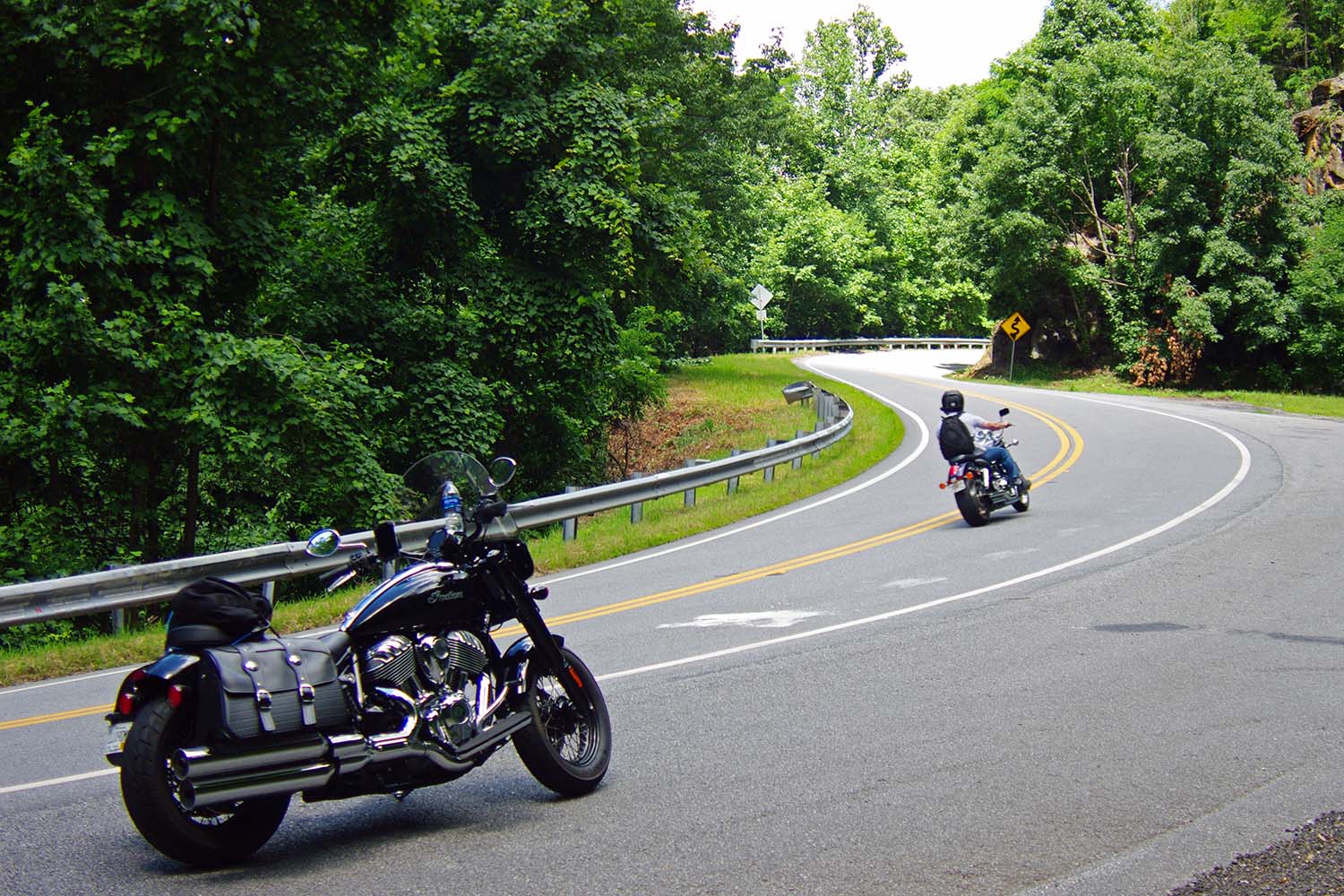
Formed roughly 480 million years ago, the Appalachians are a chain of mountains that stretch from Newfoundland, Canada, down to central Alabama. Eons of erosion have rounded and softened their edges, and rivers and creeks have cut deep creases within their slopes. The result is a nearly endless variety of roads that follow the contours of the land, attracting motorcyclists from far and wide like moths to a flame.
The Appalachian Trail begins in North Georgia, on Springer Mountain, not far from one of the best riding loops in the Southeast. The three sides of the Georgia Triangle are anything but straight. In fact, the triangular loop made up of U.S. Route 19 and Georgia State Routes 60 and 180 has some of the most challenging curves and best scenery in a region known for both.
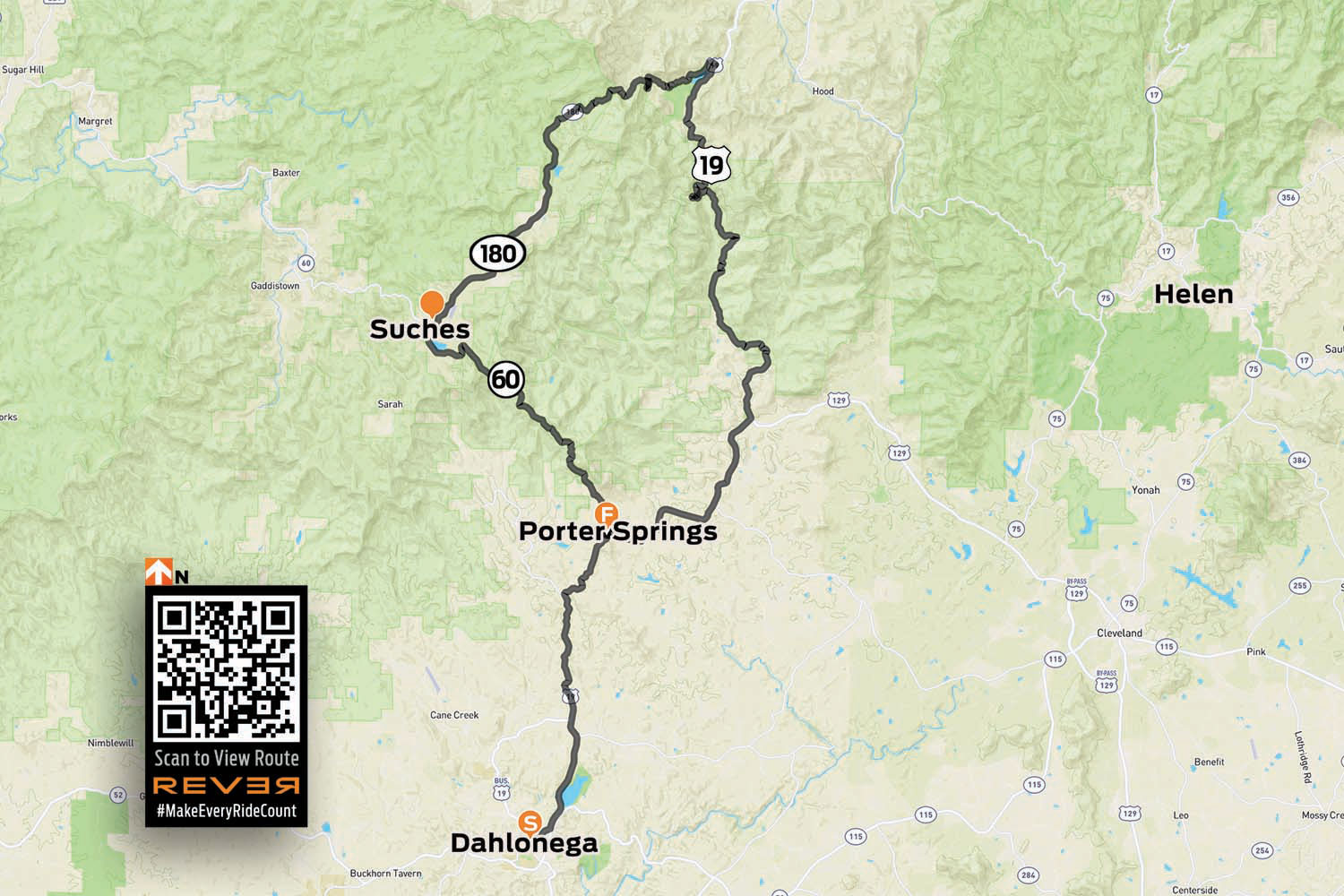
View/download the Georgia Triangle route on REVER
The Georgia Triangle is located in the Blue Ridge Mountains just north of the charming, historic mountain town of Dahlonega. The three-road loop is located within the Chattahoochee National Forest, and there’s an abundance of streams, waterfalls, lush forests, and historic sites in the area. Add in numerous tourist attractions, activities, hotels, bed-and-breakfasts, campgrounds, and eateries, and you’ve got everything you need for a great day ride or a long weekend of exploration.

Six miles north of Dahlonega, the triangle begins where U.S. 19 meets State Route 60 at Stonepile Gap. Within the junction’s roundabout is a mound of stones that is said to mark the burial spot of Cherokee Princess Trahlyta. According to legend, Trahlyta was a beautiful princess kidnapped by a Cherokee warrior she refused to marry. Her dying wish was to be buried near her home on the mountain, though she probably didn’t imagine her grave would be surrounded by a ring of asphalt.
Riding north on Route 60 toward the town of Suches is the first leg of the triangle. If you have not been practicing your cornering skills, be cautious. These roads are not for the faint of heart. They can either be exhilarating or nerve-wracking, depending on your motorcycle’s cornering clearance and your comfort with tight S-curves and decreasing-radius turns. For the alert, confident rider, these roads offer an unforgettable riding experience, with gorgeous scenery and well-maintained pavement.

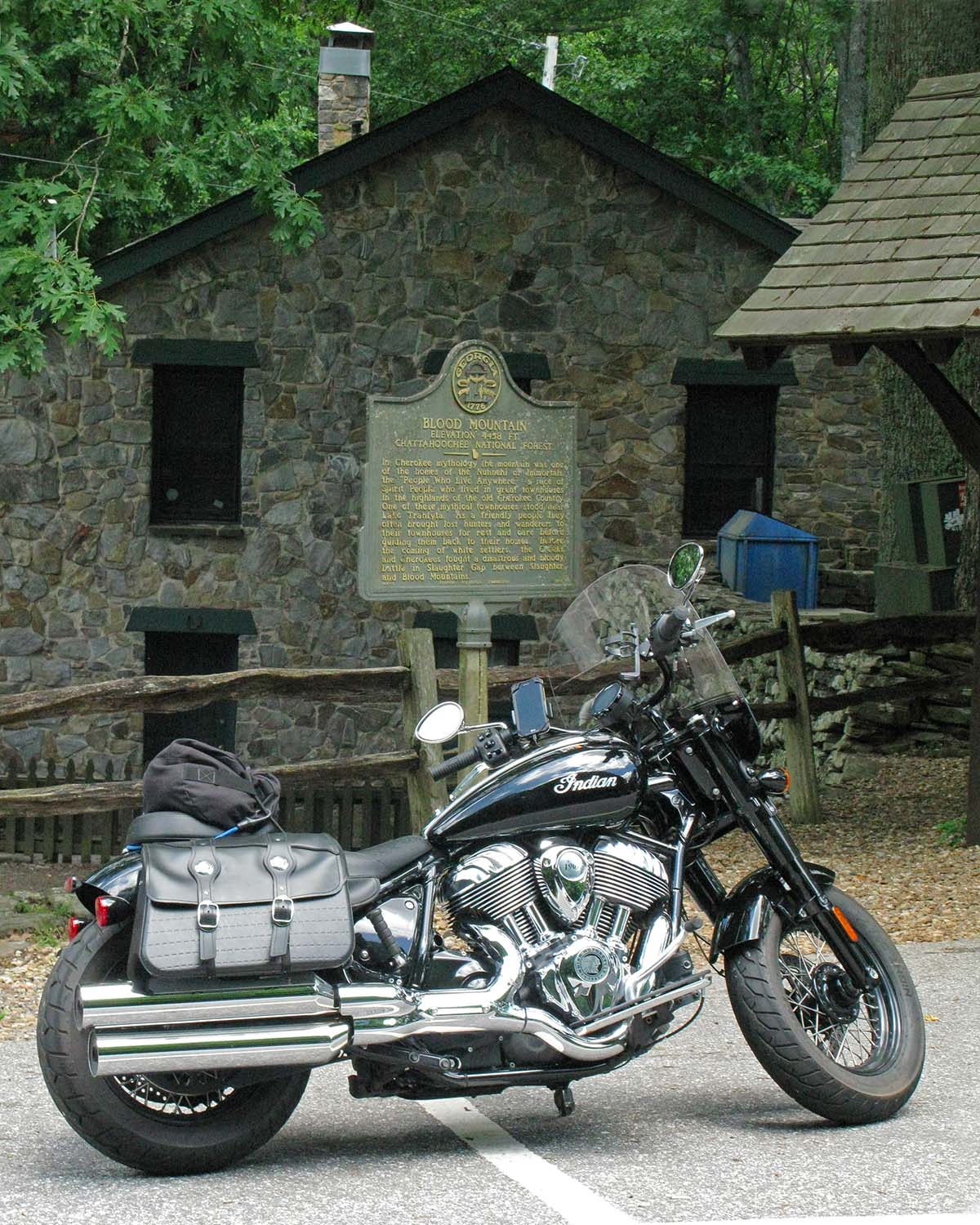
About 5 miles up Route 60 is Woody Gap, and a look to the left reveals an expansive valley with Springer Mountain rising on the other side. The Appalachian Trail crosses the road nearby, and other stops on the road have signs and information about Civil War battles, gold mining sites, and hiking trails.
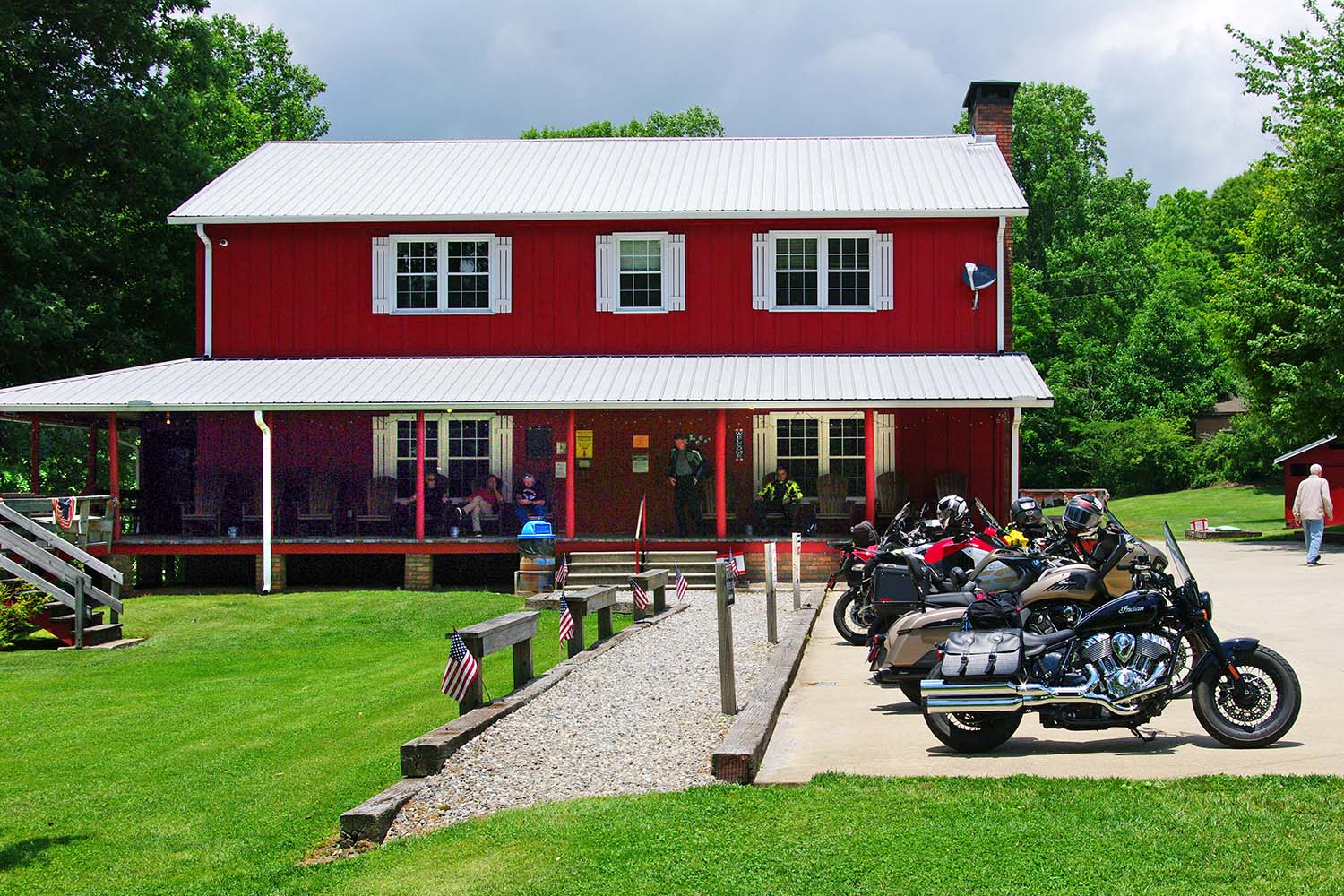
In the small town of Suches is a well-known motorcycle lodge and campground called Two Wheels of Suches, a popular meet-up spot. On weekends the parking lot is filled with bikes of all styles and vintages, and riders from all over. There’s an onsite restaurant that serves burgers, sandwiches, snacks, and drinks on Friday nights and weekends. The main lodge offers rooms for rent, and there are small cabins and campsites with a bathhouse on the property. A single-person campsite is $15/night, cabins are $65/night, and lodge rooms are $75/night.
A stone’s throw from Two Wheels of Suches is the junction with State Route 180, also known as Wolf Pen Gap Road. This segment of the ride is without a doubt the most challenging leg of the triangle, with more tight curves and steep grades per mile than any other paved road in Georgia. The first few miles are a sedate and primarily straight two-lane blacktop leading to Lake Winfield Scott Recreation Area. When the lake’s emerald-green water is calm, it acts as a large reflecting pool for the mountains that surround it. And it is a particularly scenic spot in the fall when the leaves change color.
Once past the lake, the roller-coaster ride begins with a sign that says “Sharp Curves and Grades Next 5 Miles.” Route 180 snakes through the Sosebee Cove Scenic Area with speed limit signs on some curves reading as low as 10 mph, with nary a straight section of road. Stay sharp and heed the caution signs. The great thing about this section of the Georgia Triangle is that it’s only 11 miles long – the same length as the Tail of the Dragon in Tennessee – so you can ride it back and forth to your heart’s content.
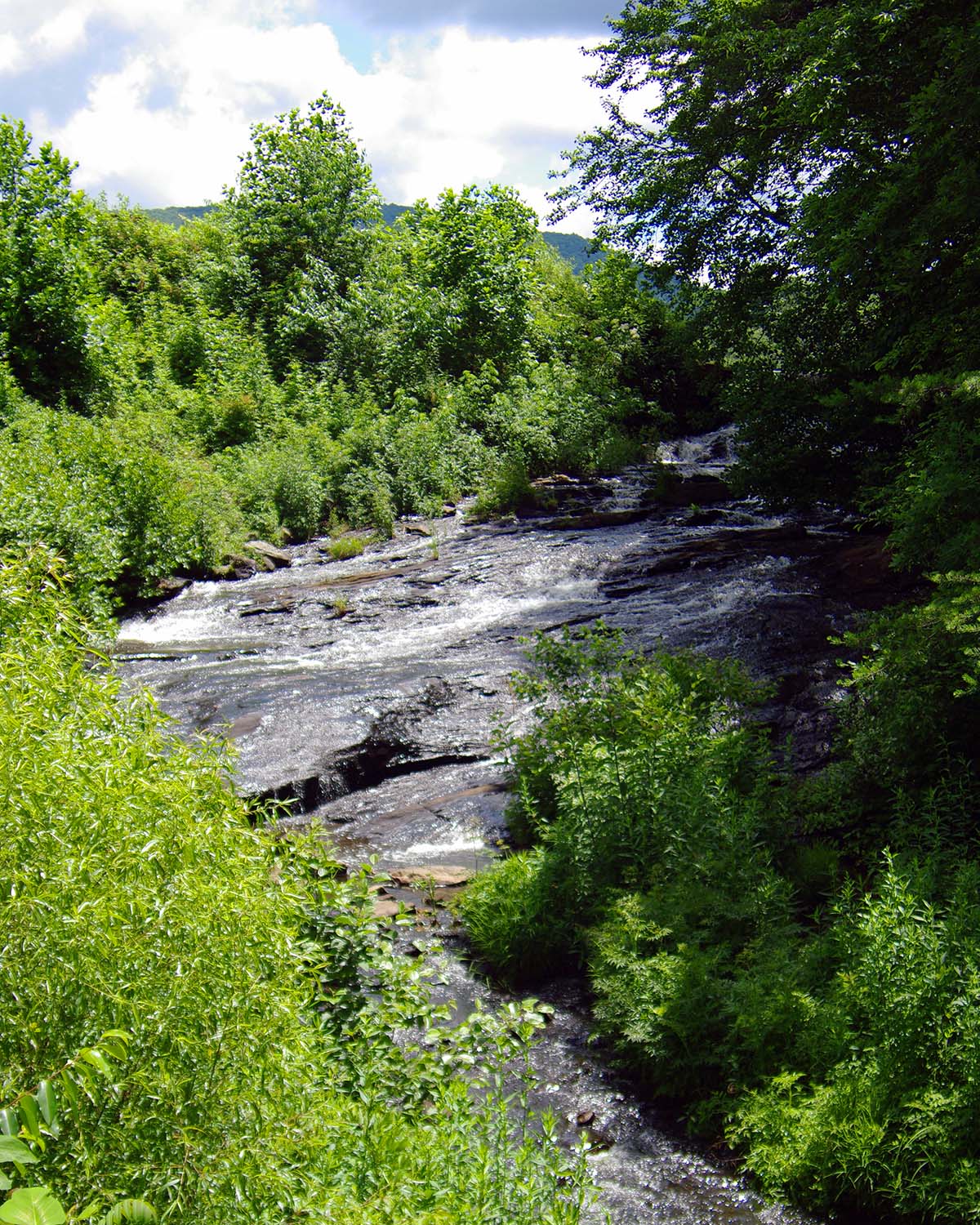
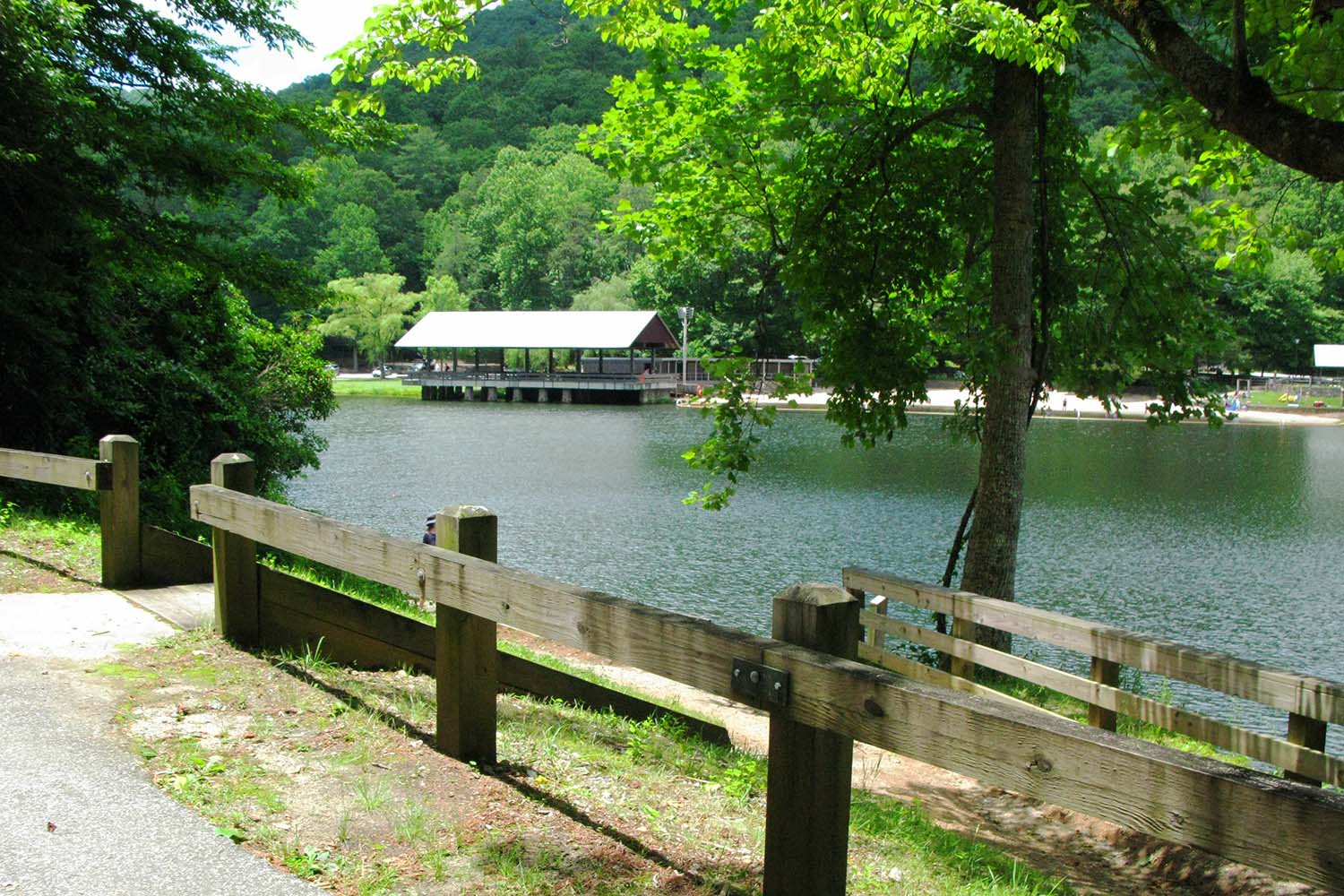
Just before Route 180 merges with U.S. Route 19, it passes by Lake Trahlyta, which is part of Vogel State Park. You can swim in the lake and stay in the park, which offers tent camping, RV sites, and rental cottages and yurts. Georgia is often hot and humid in the summer, even up in the mountains. I have stopped here on a hot day for a quick change and a swim, so pack your swimsuit.
Riding south on U.S. 19 is the last leg of the triangle. The road here is wider, with passing zones for easily and safely getting around slower traffic. Still, it has magnificent twisting sections of repeating S-curves and turns, great scenery, and worthwhile stops all the way back to the triangle’s starting point.
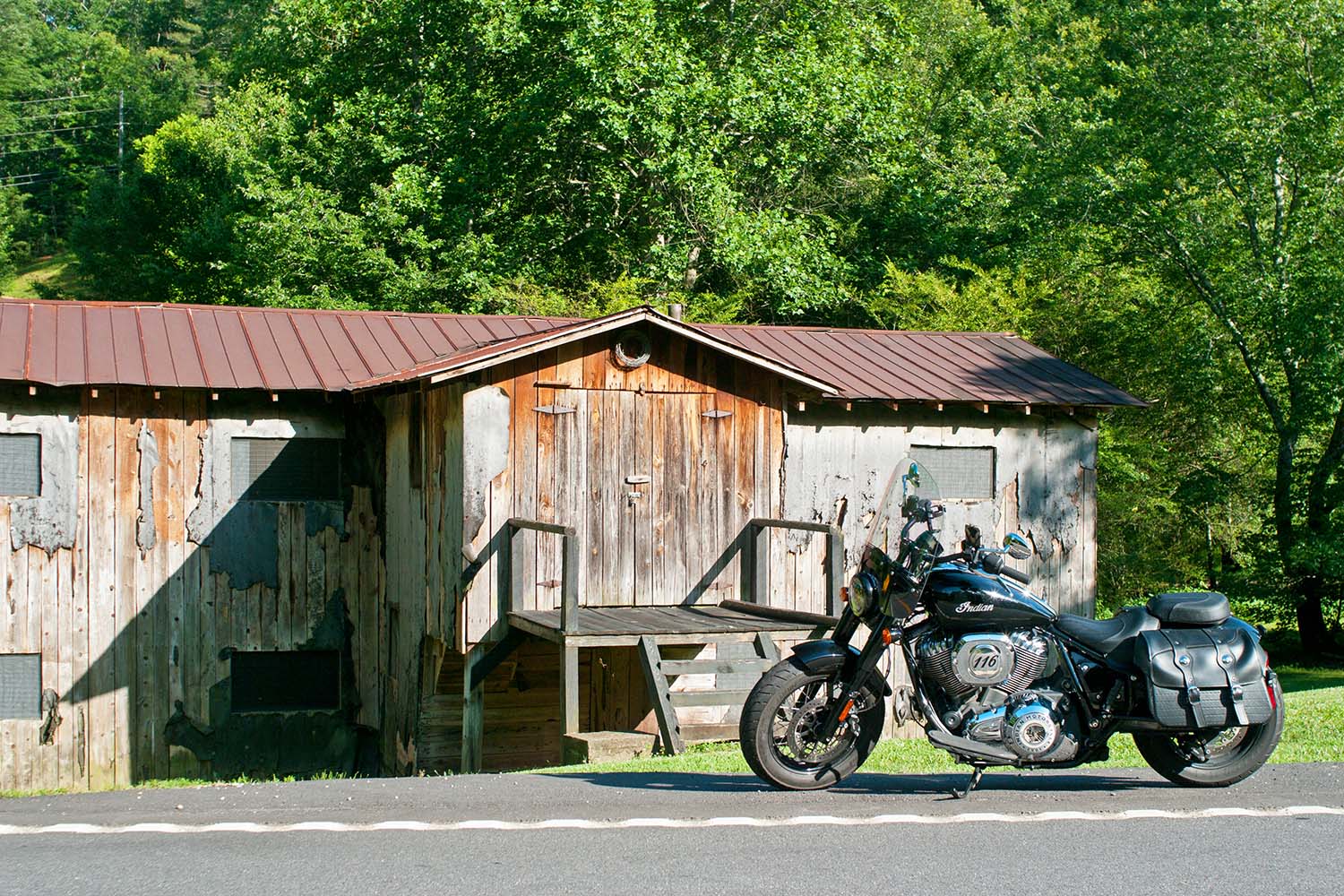
Continuing to the junction with Route 60 yields total mileage around the triangle of about 36 miles. The travel time for a nonstop ride is about 90 minutes at a reasonable rate of speed, but why hurry? The beautiful forest ride and options for stops make a leisurely pace worthwhile. Or, follow the lead of many motorcyclists and repeat the loop or run it in reverse. You won’t be bored, I promise.
Part of what makes the Georgia Triangle such a target-rich destination is that it’s a hub for other great rides in the area. Route 60 is a joy to ride not just to Suches but beyond, all the way to Route 76. From there, head east to Hiawassee, the scenic town on Lake Chatuge, or west to Route 515, which becomes I-575 and takes you to Atlanta.
If you’re looking to explore further, taking Route 60S (also known as Murphy Highway) northeast at Mineral Bluff into North Carolina will lead you to U.S. Route 74 and the town of Murphy, North Carolina. Continuing east on U.S. Route 64 is a scenic ride through the Hiawassee River and Lake Chatuge areas, and several roads connect back to the Georgia Triangle area.
Continuing north on U.S. 19 past Vogel State Park, Route 180 breaks away again and continues east. A short hop on 180 takes you to State Route 348, also known as the Richard B. Russell Scenic Highway, another gem of a road. Or continue east on 180 to Brasstown Bald, the highest point in Georgia (4,784 feet), which on a clear day offers a 360-degree view of four states.
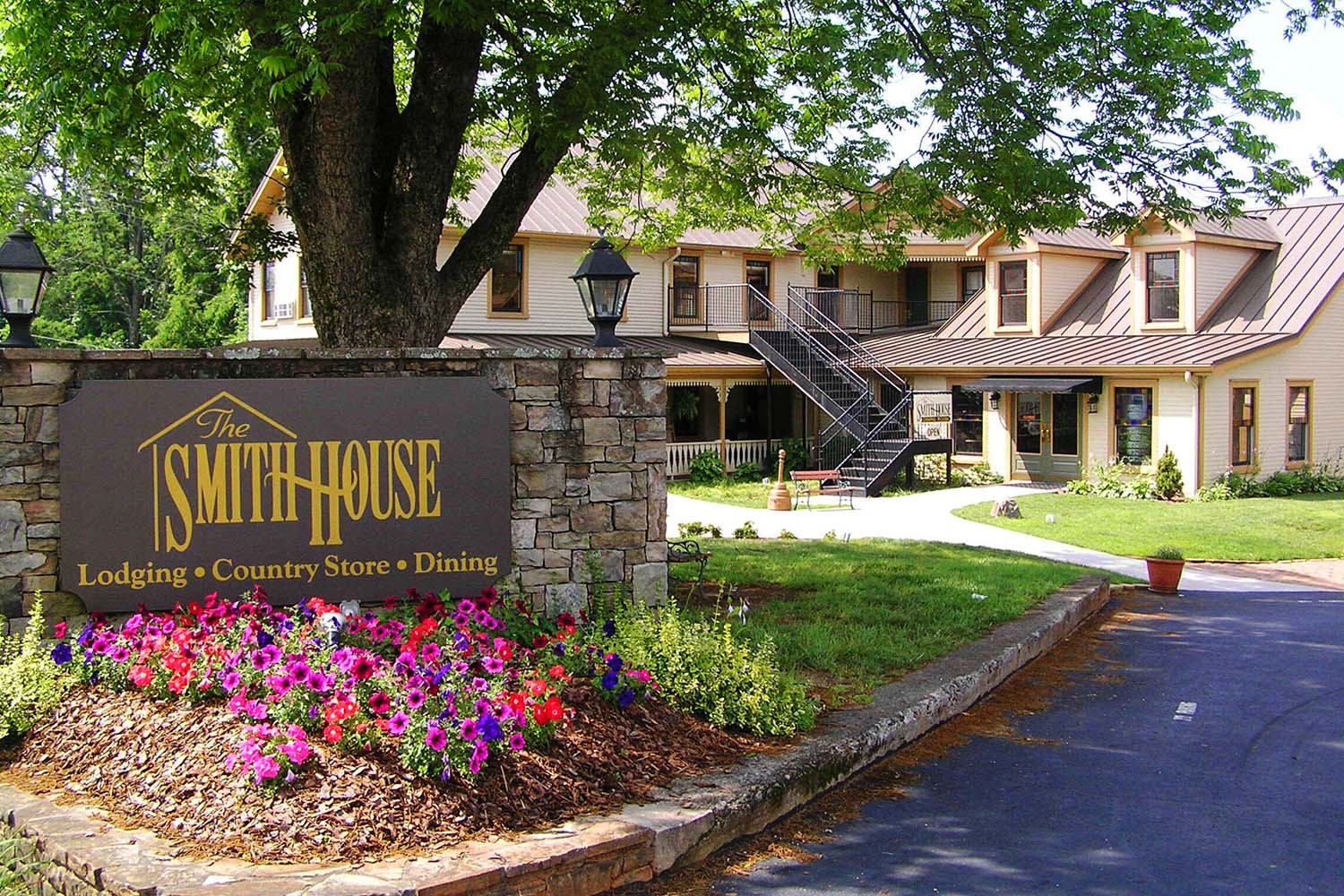
If you are planning a stay in the area, Dahlonega is a charming, historic town known for its history of gold exploration and mining. Legend has it that in the 1540s, Spanish explorer Hernando DeSoto searched this area for El Dorado, the legendary lost city of gold. Dahlonega was the site of the second major U.S. gold rush in the early 1800s and still has active mines where visitors can pan for gold and gemstones. For lunch or dinner, I highly recommend the Smith House, which serves fried chicken, ham, sides, and desserts family-style, with platter after platter passed around long tables. Just to the east of Dahlonega is Helen, a quaint alpine-style village. Both towns offer many choices for lodging, dining, and shopping.
If you’re undecided about which road to ride first, throw a dart at the map – chances are wherever it lands, you’ll find a winner. North Georgia offers hundreds of miles of great roads to ride, and the Georgia Triangle is just the beginning.
The post Riding the Georgia Triangle first appeared on Rider Magazine.Ball and Buck Jeep CJ-8 Scrambler ARB Overland Edition Truck

Visit Uncrate for the full post.
How Government Devastated Minor League Baseball
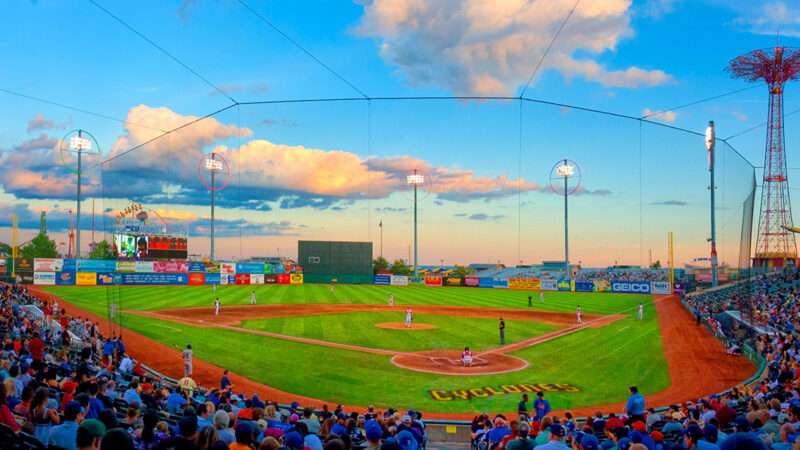
It's family Sunday FunDay here at Coney Island's Maimonides Park, home of the Brooklyn Cyclones. For the low price of $18, enjoy the up-close views of future New York Mets stars and between-innings fan contests involving potato sacks. If the kids don't wilt in the mid-July swelter, they can run the bases on the field after the game. It's minor league baseball at its corny, affordable best.
Seven miles away as the seagull flies over the mouth of New York Harbor, the scene at Richmond County Bank Ballpark is considerably bleaker. Gawky weeds shoot up through the neglected infield dirt and mangy outfield grass where the Staten Island Yankees once roamed. Just over the chain-link fence in right field sits an overflowing dumpster. The sliver of real estate past left field was supposed to be a walkway to a billion-dollar Ferris wheel; now it's a shady homeless camp dotted with flattened cardboard. "Let's not eat here," a mom says to her picnic-impatient 6-year-old.
The divergent fate of New York City's two minor league ballparks, like too much of life in the five boroughs, is a cautionary tale about what happens when government and business promiscuously canoodle. The city spent $71 million on a picturesque stadium on the Staten Island waterfront (Maimonides cost $55 million) that after a two-decade run now stands empty, and it's reacting to that calamity by throwing a fresh new $8 million toward cleanup costs in the hopes of luring baseball back.
Not for the first or even hundredth time, people elected to be caretakers of taxpayer money are discovering the ironic lie behind the most famous line derived from the overly nostalgic baseball film Field of Dreams: "If you build it, they will come." In fact, when governments become landlords, sports businesses, no matter how deep their pockets, start acting like tenants: always eyeing the exits for a potentially better deal. If you build it, they will leave.
This particular fable, though, transcends Gotham and the eternal ribbon-cutting temptations of local politics. The Staten Island Yankees were one of 40 minor league clubs—25 percent of the nationwide total—that were cut off overnight from their major league affiliates in December 2020. Local governments were suddenly on the hook for a quarter-billion dollars' worth of investment in event spaces that no longer held events. Though the main culprit was a cost-cutting Major League Baseball (MLB), the federal government and the judiciary had their fingerprints all over the murder weapon.
Through a mix of obfuscating patriotism, congressional camera hogging, and legal reasoning more twisted than a kosher Cyclones pretzel, Washington over the past century-plus has granted latitude to MLB that no other professional sport enjoys. Baseball's preeminent global league has not only blocked all halfway serious competition to its legally protected North American monopoly; it can dictate the most fundamental of operational details—employee salaries, game rules, even existence—to the once-independently owned professional teams and leagues that groom talented young men in the vast expanses between school and The Show.
"It's about controlling the industry," a bitter Jeff Katofsky, owner of Utah's Orem Owlz, told ESPN after learning of MLB's proposal to cull his team. "It's all about money and power."
Those who hold legislative power are proposing to fill the bush-league void with still more money, via the bipartisan $550 million Minor League Baseball Relief Act introduced in June 2021. That would be one way to extend the cycle of federal codependency.
But two other developments this season herald a potential break in the pattern. Republican senators, outraged by MLB's hasty decision to relocate the annual All-Star game from Atlanta in protest over Georgia's new GOP-written election law, introduced legislation in April that would punitively remove some of baseball's legal carve-outs. More plausibly, a unanimous Supreme Court in June signaled a willingness to revisit the antitrust exemption that former 9th Circuit Court Judge Alex Kozinski once characterized as "one of federal law's most enduring anomalies."
Those are a couple of tentative paths out of this corporatist game of pickle. But there are lessons of broader application to be gleaned from retracing the policy missteps that squandered taxpayer billions while making the minor leagues unfree.
Playing the Senate Like a String Quartet
In early 2018, MLB Commissioner Rob Manfred put the squeeze on the owners of the 160 minor league baseball teams: Go lobby Congress to pass the unsubtly named Save America's Pastime Act, or face potentially dire consequences.
"We were told very clearly if we didn't get that thing passed, we would be staring down the barrel of contraction," multi-franchise owner Dave Heller recalled to ESPN. "So we were all supremely motivated to help MLB pass that legislation." (Two of Heller's four franchises lost their MLB affiliations in the December 2020 downsizing.)
The press release from sponsor Rep. Brett Guthrie (R–Ky.) announcing the 2016 bill warned that if it wasn't passed, "the costs to support local teams would likely increase dramatically and usher in significant cuts across the league, threatening the primary pathway to the Majors and putting teams at risk."
The Save America's Pastime Act amended the 1938 Fair Labor Standards Act to carve out an exemption for minor league baseball players so that they would not be paid overtime during the season or any money at all during pre- and post-season team workouts. Instead of paying players the federal minimum wage, franchises could retain them for as low as $1,100 a month for three to five months.
This was sold to legislators by minor league owners as a way to keep community ties alive in non–major metro areas like Charleston, West Virginia, and Burlington, Vermont. But in fact it was a penny-squeezing power play by MLB owners in the country's largest markets. To understand why requires a brief historical explanation about the relationship between the major and minor leagues.
Baseball as we know it derives from ball-and-bat game variations developed in the mid–19th century in Philadelphia, Connecticut, Massachusetts, and especially New York City. There were clubs of varying degrees of formality, temporary travel teams, and eventually leagues. The eight-team National League was born in 1876 and quickly developed a reputation as the best in organized ball; an eight-team American League upstart came along in 1901; the two formed an organizational truce and held an annual World Series, and that (with a couple of brief detours) is pretty much what Major League Baseball looked like for a half-century.
But the "minor leagues" during that span changed so dramatically they are unrecognizable. "The minor leagues did not start out as what they are," author Bill James wrote in The New Bill James Historical Baseball Abstract. "By a long series of actions and agreements, inducements and rewards, the minor leagues were reduced in tiny degrees from entirely independent sovereignties into vassal states, existing only to serve the needs of major league baseball."
Some early leagues and teams jealously held onto players that were every bit as good as an American League or National League all-star. Hall of Famer Lefty Grove, before becoming MLB's best starting pitcher in the late 1920s, dominated the International League through his age-24 season. Joe DiMaggio arrived at the New York Yankees fully formed as one of the sport's best players at age 21; he had already been playing at a high level for three years for the Pacific Coast League's San Francisco Seals.
James in his book keeps a decade-by-decade tally of how "free" and "unfree" the minors were vis-à-vis the big leagues. In the 1870s and 1880s they were 100 percent free, and in the 1900s the free/unfree tilt was still 90/10. But by the 1930s the minors were just 30 percent free, and it was all over by the 1970s, when they were "100 percent slaves to the majors." The "critical years" for the transformation, James observed, were "1915 to 1925."
What happened then? Competition, the snuffing out thereof, and the Supreme Court, in that order.
In a unanimous 1922 decision written by Justice Oliver Wendell Holmes, the high court in Federal Base Ball Club of Baltimore, Inc. v. National League of Professional Base Ball Clubs, et al. held that Major League Baseball was exempt from the Sherman Antitrust Act of 1890—and therefore legally free to buy out half of the upstart 1914–15 Federal League, then shut the whole operation down—because the business of holding baseball contests between teams from different states somehow did not qualify as interstate commerce.
Set aside for now the theoretical case against antitrust and consider the practical effects of that handwritten exemption: Independent minor leagues, and even ambitious international efforts such as the Mexican League, which attempted after World War II to poach high-quality MLB talent, knew that any organizational behavior perceived to be threatening to the monopoly or even deviant from its desires could be met with severe consequences. (Players who jumped to the Mexican League, for example, were automatically banned from MLB for five years, a policy that brought forth still more litigation that strengthened the antitrust exemption.) Minor league players in professional sports that do not enjoy an antitrust exemption, such as the National Hockey League, are able to unionize, giving them much better salaries and working conditions.
For a half-century before the December 2020 minor league contraction, the basic organizational relationship between the minors and the majors was this: Each of the 30 MLB franchises was aligned with five or six minor league affiliates of various levels that would develop and manage the not-ready-for-prime-time players that the big clubs had acquired via trade, free agent signing, or amateur draft. Those affiliates, which operated on multiyear contracts, were usually owned independently. But the personnel decisions—and, relevant to the Save America's Pastime Act, the salaries—were determined and covered by the parent MLB club.
So when minor league team owners were giving sob stories on Capitol Hill about needing to constrain payroll costs lest their teams disappear, they were lobbying on behalf of MLB franchises who that year earned on average $330 million in revenue. Congress was being asked to intervene so that minor league salaries would remain within a band of $4,000 to $14,000 per year; meanwhile, the owners actually signing those checks were paying out minimum MLB salaries of a half-million dollars.
The federal legislative process being what it is, the Save America's Pastime Act, with zero fanfare, was tacked onto page 780 of an 891-page, $1.3 trillion omnibus spending bill that was passed by Congress and signed into law by President Donald Trump in March 2018.
America's pastime, alas, did not long stay saved. MLB, having frogmarched minor league owners under threat of contraction to warn legislators that minor league teams would die if salaries weren't capped, took all of seven months to begin leaking lists of teams it would soon kill off anyway. "In retrospect," Clinton (Iowa) LumberKings general manager Ted Tornow told ESPN in 2020, "MLB played the Senate like a string quartet."
Instruments do not always enjoy being exposed as tools. Sen. Chuck Schumer (D–N.Y.) had been critical in getting the Save America's Pastime Act inserted into the omnibus, only to watch the hatchet fall on multiple New York minor league teams two years later. "They can't just pick up and walk away," Schumer complained in late 2020. Au contraire, Chuck.
The Gorsuch Opening
"There are good arguments for getting rid of baseball's long-standing exemption from antitrust laws," wrote antitrust scholar Herbert Hovenkamp at Pro Market, a website run by the University of Chicago's Stigler Center, in May. "But the reason cited by Republican Senators angry at MLB's response to Georgia's new voting laws isn't one of them."
In early April, to protest the state of Georgia controversially changing its voting laws in the name of "election integrity," Major League Baseball announced that it was moving its long-planned mid-summer All-Star game out of Atlanta. Conservatives were irked by what they saw as a noxious combination of media hysteria, cancel culture, and the flexing of progressive muscle over big business. As he can be counted on to do in such situations, Sen. Ted Cruz (R–Texas), stepped up to the plate, or at least the microphone.
"Major League Baseball asks for your ID when you pick up tickets at will-call, but they have made it clear they oppose photo ID requirements to vote," Cruz said while introducing the Competition in Professional Baseball Act two weeks later. "If Major League Baseball is going to act dishonestly and spread lies about Georgia's voting rights bill to favor one party against the other, they shouldn't expect to continue to receive special benefits from Congress."
There is something both unseemly and unsurprising about a modern politician using legislation as a tool to punish the political behavior of a corporate entity. Nevertheless, the generally more serious Sen. Mike Lee (R–Utah), another co-sponsor of the bill, was on firmer footing when he asserted at the same press conference that MLB "has used its judicially fabricated antitrust immunity to suppress wages and divide up markets for decades—conduct that is plainly illegal, and sometimes criminal, in any other industry."
The case against using antitrust law on baseball is the general case against antitrust itself, which has been debated in the pages of this magazine for 52 years. Antitrust is too often determined politically, too often applied to non-monopolies, too often solicited and gamed by regulated entities to cement their market share. None of these critiques maps very well onto the past century of Major League Baseball; better to make the purely philosophical argument that the government has no business meddling in the affairs of monopolists.
The case for the MLB exemption from antitrust, on the other hand, is so flimsy that few bother making it. Even the Supreme Court has been distancing itself from the precedent.
Near the end of its 2020–21 term, SCOTUS ruled 9–0 that the National Collegiate Athletic Association (NCAA) could no longer prohibit universities from compensating their sometimes highly revenue-generating athletes. The NCAA had argued that its price fixing of student-athlete labor should be exempt from the Sherman Antitrust Act due to its "societally important non-commercial objective" of upholding "amateurism."
Justice Neil Gorsuch in his majority opinion made the nonroutine step of quoting from an amicus brief, one submitted by a nonprofit called Advocates for Minor Leaguers, which had urged the Supreme Court to think of the example of baseball while rejecting "a judge-made exemption from the antitrust laws for a group of thousands of workers based on an anachronistic understanding of their workplace."
"To be sure," Gorsuch wrote, "this Court once dallied with something that looks a bit like an antitrust exemption for professional baseball. In [the Federal Baseball case] the Court reasoned that 'exhibitions' of 'base ball' did not implicate the Sherman Act because they did not involve interstate trade or commerce—even though teams regularly crossed state lines (as they do today) to make money and enhance their commercial success….But this Court has refused to extend Federal Baseball's reasoning to other sports leagues—and has even acknowledged criticisms of the decision as 'unrealistic' and 'inconsistent' and 'aberration[al].'"
In addition to spotlighting the shakiness of the MLB precedent, Gorsuch suggested that it may soon be vulnerable to challenge: "Whether an antitrust violation exists necessarily depends on a careful analysis of market realities….If those market realities change, so may the legal analysis."
Harry Marino, executive director of Advocates for Minor Leaguers, responded jubilantly: "I think that today's opinion signals that the current composition of the Supreme Court has a significant skepticism about baseball's antitrust exemption. I read their segment of the opinion about the antitrust opinion as an invitation to litigants to raise the issue in front of the court."
Senne v. MLB, a 2014 class action lawsuit seeking back wages for minor league players, could yet provide a challenge to the exemption. In October 2020, it survived an MLB attempt to get the Supreme Court to decertify the litigating class.
Independence Day
In the meantime, some minor league team owners are beginning to take their first tentative steps toward independence from the MLB Borg. The first modern independent circuit in the minors, the Atlantic League, was founded in 1998 as a smaller-market repository for big-league washouts, injury comeback stories, and other misfits. Since the MLB's forced contraction process, the Atlantic League has doubled from four to eight teams by absorbing some abandoned franchises; an investment group on Staten Island is hoping to make Richmond County Bank Ballpark home of Team No. 9.
Following the Atlantic League's independent trail were the Pecos League (founded in 2011), the Pacific Association (2013), the Empire Professional Baseball League (2016), and the United Shore Professional Baseball League (2016). All have fattened on the stranded teams. Meanwhile, three other former minor league baseball groupings (the Pioneer League, the Frontier League, and the American Association) have gone independent, though they maintain a general partnership with MLB for things like experimental rule changes.
Will there be a market for small-city baseball, unaffiliated with MLB franchises, featuring a caliber of play higher than the NCAA but lower than Yankee Stadium? Who knows! One thing for certain is that government financial assistance is not going to speed the discovery process.
The Minor League Baseball Relief Act, like so much of government intervention into business, would mostly serve to benefit incumbents: Its $550 million would go to the 120 minor league teams still affiliated with deep-pocketed MLB franchises, as well as the 40 that were disaffiliated in December 2020. Longstanding independent teams and leagues would be at a comparative disadvantage.
The single most important thing lawmakers could do to promote baseball is to stop forcing non–baseball fans to subsidize the sport. The MLB commissioner stated explicitly while pulling the plug on minor league franchises that the now-smaller number of affiliation agreements will be reevaluated with an eye toward making sure that stadium facilities are maximally modern. By creating artificial scarcity, Manfred hopes to spur cities to compete with each other via taxpayer-financed stadium building and maintenance, thus preempting any need for MLB owners to pay their own freight. He should be invited to choke on a churro.
Study after study has shown that sports facility subsidies do not pay off through increased tax revenue. And as both the Los Angeles Rams football team and MLB's San Francisco Giants demonstrate, professional teams that pay for their own stadiums tend to have the most beautiful ones, along with a built-in incentive to stick around and improve the neighborhood.
So let us, if we are so disposed, cheer on the minor leagues as they tilt the scales back toward living or dying on their own terms. Maybe one or more of the independent leagues, freed from both the mandates of MLB and the meddling of Chuck Schumer, will become so competitively successful that they'll capture local or even national attention, creating an incentive for commercially successful owners to invest in their own damned stadiums. If they build it, they might just stay.
Let’s Be Serious, There’s No Such Thing As A $1 Trillion Coin

What's the difference between a Western and Japanese chef's knife? - CNET

Great Reads in Photography: October 10, 2021
Every Sunday, we bring together a collection of easy-reading articles from analytical to how-to to photo features in no particular order that did not make our regular daily coverage. Enjoy!
Photo Dumps Are Now in Museums – Elle
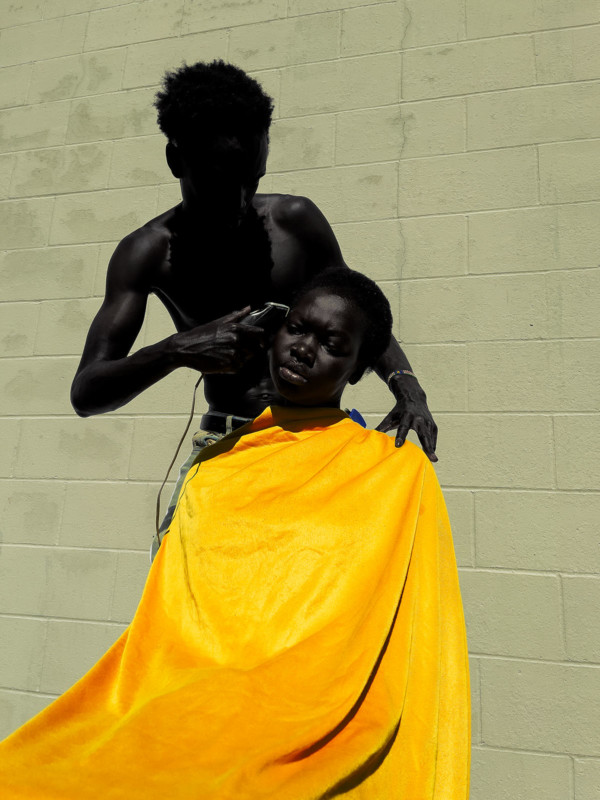
A new photo exhibit called INWARD: Reflections on Interiority at the International Center of Photography (ICP) in New York City features work shot entirely on an iPhone. Open through next January, it gives the spotlight to five emerging Black artists.
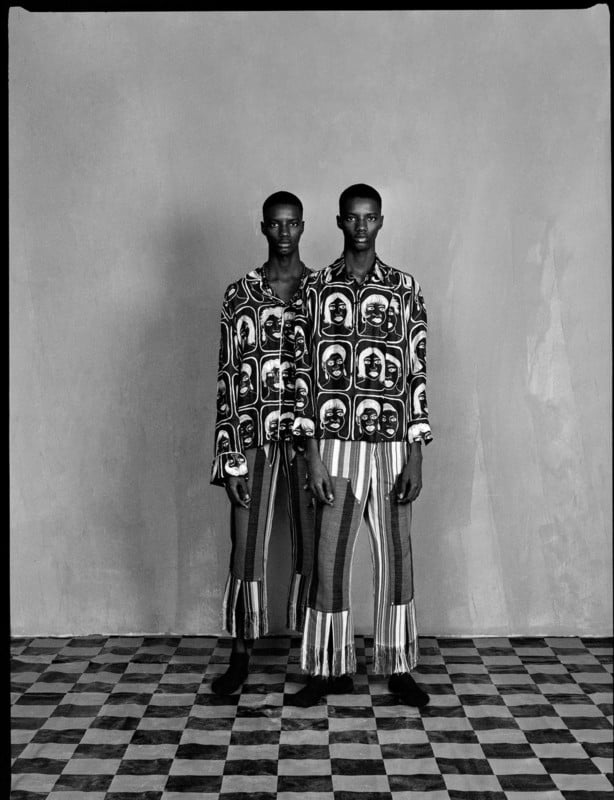
Curator Isolde Brielmaier notes that Apple is redefining its work, specifically regarding the iPhone 12 Pro Max and its camera capabilities.
“The richness of darker skin tones comes through in a much more dynamic way,” Breilmaier explains to Elle.

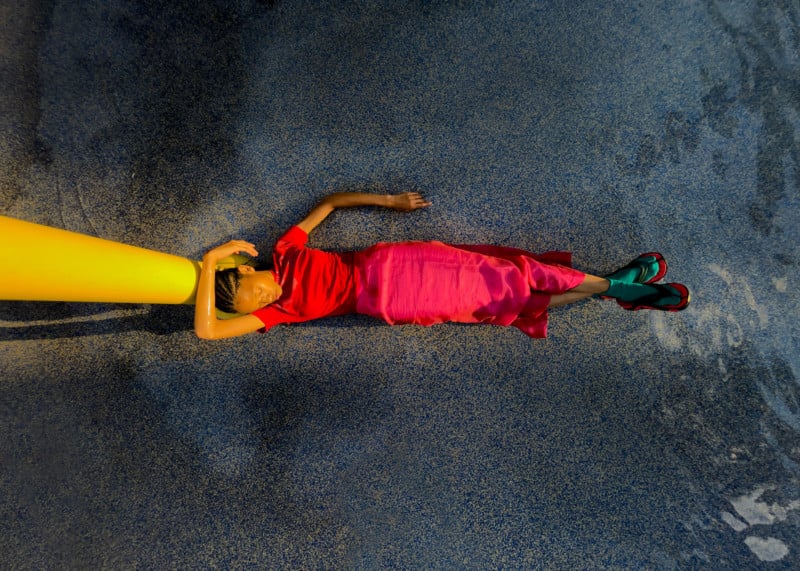
Breilmaier is likewise awestruck that a tech tool can also produce personal images. “I think my favorite part of curating this exhibit is to see how compelling the viewpoints of these artists are. They’re using the same phone that I use, that you use, but what they see is completely unique,” she says. “So, through their Photo folder, we can see their world. Which informs how we see our world.”
How an F-15 Pilot’s Life Was Saved by a Photographer – Air & Space

Last July 13, Ian Simpson was in a favorite spot just outside the fence at RAF Lakenheath, north of London, England, home to the US Air Force 48th Fighter Wing taking photos of planes taking off.
As US Air Force pilot Major Grant Thompson took off in his F-15E, Simpson noticed a shower of sparks coming from the aircraft’s rear. As the fighter continued to climb, Simpson Googled the base, called the switchboard, and reached flight operations. “I said, ‘Look, something is wrong with the plane, definitely. We’ve got lots of photographs of sparks coming out the back’,” Simpson, 56, told the Associated Press.
The First Picture Taken on a Leica – Kosmo Foto

Stephen Dowling, founder & editor of Kosmo Foto, writes:
At the turn of the century, many cameras – Kodak’s lightweight Brownie excepted – were bulky, heavy and difficult to carry. Oskar Barnack, a skilled mechanic who worked in the microscope department of Ernst Leitz in Wetzlar, was an enthusiastic amateur photographer who often took cameras with him on his travels.It’s believed that Barnack began thinking about a camera small enough to take anywhere as early as 1905. At Ernst Leitz, he was involved in the production of the company’s first cine camera. Cinema films used a much smaller film format than stills cameras of the time, making them much lighter and easier to carry. Cine film’s size – 18 x 24mm compared to large plates used in many still cameras – was Barnack’s springboard for developing the world’s first 35mm camera.
… Between 1913 and 1914, Barnack perfected the design of a camera that, a decade later, would enter the market as the first Leica camera. Instead of the film being transported vertically, as it was in a cinema camera, Barnack’s prototype camera transported the film horizontally…He called this camera the Ur-Leica.

A True Story About Bogus Photos of People Making Fake News — WIRED
From WIRED:
The photographic elite gathered in Perpignan, France, on September 1 at the annual Visa Pour L’Image photojournalism festival. That night, the outdoor screen shimmered with images of people using laptops in Soviet-era apartments and a bear strolling past rundown industrial sites. They came from The Book of Veles by Jonas Bendiksen, an award-winning documentary photographer. He had traveled to North Macedonia, which had been home to a vibrant fake news industry during the 2016 US election. As his peers gazed at his work, Bendiksen watched from the bleachers with increasing discomfort…In fact, Bendiksen had created the people in the images with software. The next day, the prestigious cooperative Magnum Photo posted an interview in which Bendiksen revealed that although he had traveled to Veles, every person and bear in his images were digitally faked using 3D models like those used to make video games…
“It’s scary that the most visually sophisticated people on the planet fell for this,” Bendiksen told WIRED. “Where’s the threshold for fooling people who are not so visually literate?”
San Francisco Photography Legend Robert Altman Dead at 77 – SFgate
Embed from Getty ImagesRobert Altman, the legendary San Francisco photojournalist who focused his lens on the city’s counterculture in the 1960s and 1970s, died on Sept. 24.
Altman, who was born in NYC, trained under Ansel Adams before moving to San Francisco in 1968, where he quickly became a fixture in the city’s counterculture scene, befriending — and sometimes photographing — artists, musicians and hippies with ease. He was Rolling Stone’s chief staff photographer.
The ‘Gift of Pictures’: Praemium Imperiale Laureate Sebastião Salgado on his Photography – JapanForward
This year’s laureate in painting is artist and photographer Sebastião Salgado (Brazil/France), recognized by the Japan Arts Association for his powerful works that “put a spotlight on the dispossessed and exploited, the beauty of nature, and the fragility of the world and its inhabitants.”
To make a photo, you need to have an authorization ‒ not a written authorization, nothing signed, but a tacit authorization. It should not be you taking photos; it should be the person in front of you who gives you the photo as a gift. – Sebastiao Salgado to JapanForward
Lion Roaring as Fly Buzzes into his Eye Wins Africa Geographic Photographer of the Year 2021—The Sun

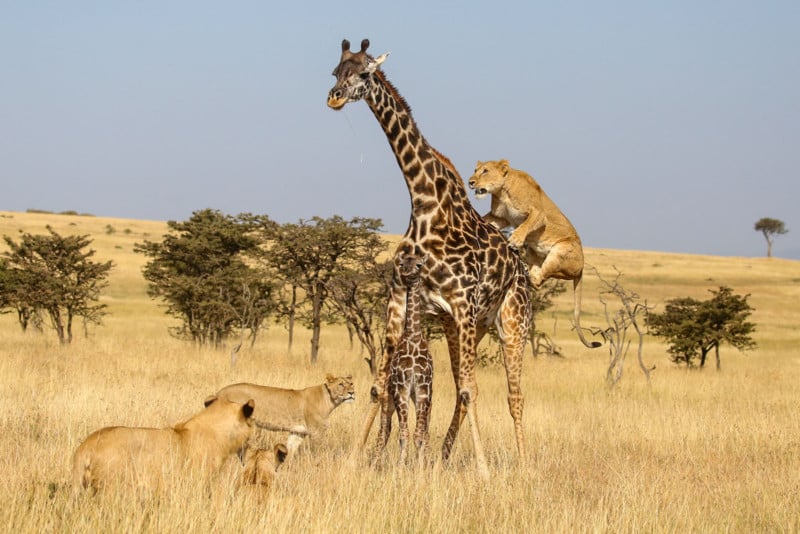
An amazing photograph of a lion roaring as a fly buzzes in his eye has won the Africa Geographic Photographer of the Year 2021.
The stunning entry was selected from 25,023 photographs that celebrated the African continent.
“With one snap of the shutter, this image succeeds with so many of the criteria that make an excellent photograph,” commented the judges. “It is technically brilliant from the perspective of timing, anticipation, and setting the camera perfectly for the predicted behavior. Then, as with so many great wildlife shots, luck played a huge part as the fly just happened into the frame at the right time.”

Discover Daguerreotype Photography and How the Pioneering Process Is Still Used Today — MyModernMet
My Modern Met writes:
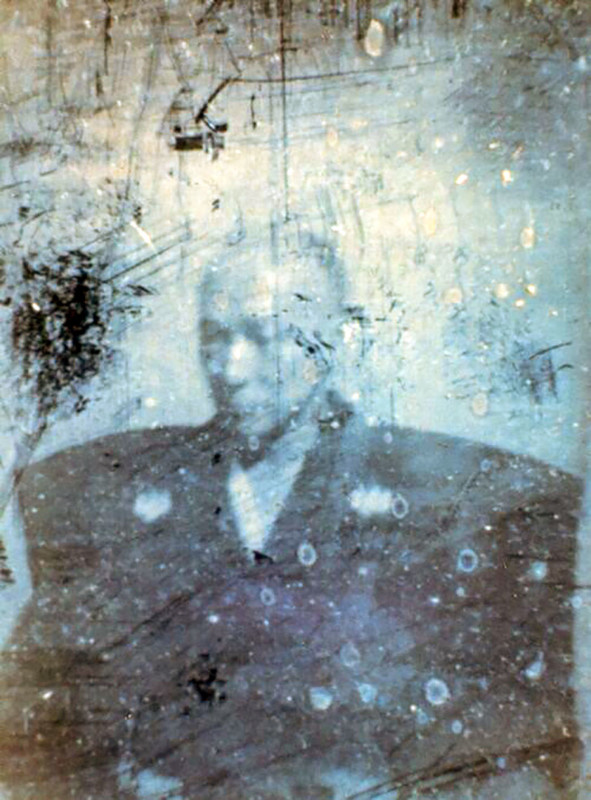
American artist Chuck Close worked with Jerry Spagnoli to take a series of daguerreotype images of fellow artists, poets, film stars, and other creatives. Close converted the old metal plates into super-sharp, large digital prints by scanning the daguerreotype in high resolution. Merging old and new techniques, the experimental artist found a rather dangerous way to capture the famous faces in beautiful detail. “A normal daguerreotype is a more than two-minute exposure,” he says. “We’ve made it instant photography by having a billion foot-candles of light go off all at once, and that’s very painful. The flashes are so intense your eyes slam shut. It’s like having an ice pick shoved in your eyeball.”
Where and How to Photograph the Aurora — Space
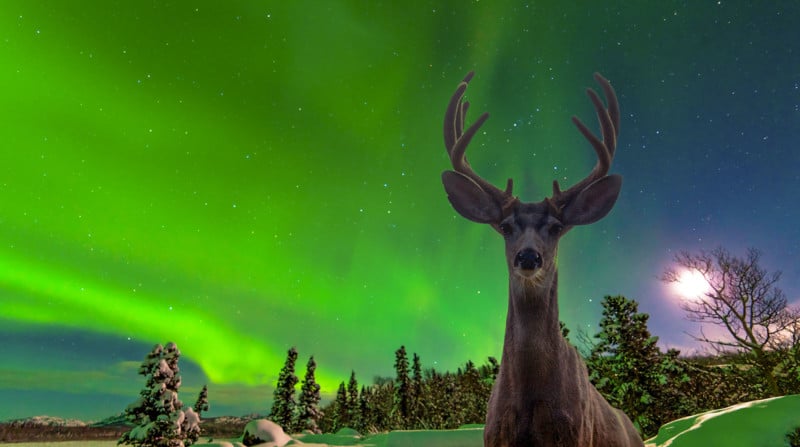
Here is a guide to capturing the elusive Northern Lights or aurora borealis which is certainly there on every adventure and outdoor photographers’ bucket list.
On an active night, the aurora can be thousands of miles long, so you can capture it in Iceland, Norway, Finnish Lapland, Alberta (Canada), or Alaska. You can also capture it in New Zealand, where you can get the Southern Lights or the aurora australis.
‘I Want my photographs to Convey the Reality’ – Lynsey Addario – PhotojournalismNews
I am trying to capture the reality of a given scene or situation and trying to say whatever the subject is trying to say. My images are just a vehicle for the subject or story.– Lynsey Addario to Photojournalism News.
Read also:
A Chat with War Photographer Lynsey Addario
War Photographer Lynsey Addario Shares the Photos That Impacted Her the Most
Helen Levitt: the Most Celebrated, Least Known Photographer of her Time – The Guardian
From The Guardian:
The American poet and cultural critic David Levi Strauss memorably described Helen Levitt as “maybe the most celebrated and least known photographer of her time.” That was in 1997 when Levitt was 84 and the subject of a retrospective at The International Center of Photography in New York, the city in which she was born and made most of her work. Just over two decades on and 12 years after her death, aged 95, in 2009, one could argue that little has changed in terms of her enigmatic status.
Local Wedding Photographer Sues NYS Over Right to Deny Service for Same-Sex Marriage Ceremonies – WENYnews
A local photographer is suing New York State over the state’s anti-discrimination laws, specifically, the photographer’s right to choose to accept or deny requests to photograph same-sex marriage ceremonies.Five Photographers Share Why They Use Creative Commons Licenses – Flickr

Creative Commons is celebrating its 20th anniversary this year, and they have since the beginning been offering an alternative to full copyright under Creative Commons licenses.
These licenses give everyone from individual creators to large institutions a standardized way to grant the public permission to use their creative work under copyright law.
Photographers, artists, and other creators on Flickr have contributed hundreds of millions of photos, enabling others to use their work in Wikipedia articles, news items, and more.
Does this Photo Show a Meteor Falling into a Volcano? — Snopes
“This is a genuine photograph of a meteor streaking above a volcano. While the angle of this photograph makes it appear as if the meteor was falling ‘into’ the volcano, that likely isn’t the case,” explains Snopes.
The claim is miscaptioned as the stated destination of this meteor was likely off by a few miles.
Indonesian photographer Gunarto Song’s photo above was a four-second exposure as the meteor descended above the volcano. The meteor was a round light, but the long exposure created a streaking effect.
Harlem Street Named After White Photographer Art Kane of Famed Picture Gets Community Pushback — Yahoo
Still one of my fave photos. A Great Day in Harlem – 57 of the coolest jazz cats, photographed by Art Kane, 1958 pic.twitter.com/nwr2qJA8tI
— Eric Alper 🎧 (@ThatEricAlper) March 26, 2017
A 1958 photo of legendary jazz musicians, called A Great Day in Harlem, was shot by photographer Art Kane on August 12, 1958, while he was on assignment for Esquire and quickly became famous.
Last month, the city renamed this iconic block between Madison and Fifth Avenues, calling it Art Kane Harlem 1958.
Now residents are objecting to a street being named after the man who took the iconic pic.
Great Read from the Past — 2017
Monkey Selfie Photographer David Slater Says He’s Broke: ‘I’m Thinking of Dog Walking’ – The Guardian
Read Also Photographer Wins Monkey Selfie Copyright Case, Court Slams PETA
Photos of the Week
The Story of Two Men on Different Sides Whose Paths Unwittingly Crossed 80 years Ago
Embed from Getty ImagesDefendant Josef S. gets help from his lawyer Stefan Waterkamp (L) to hide his face behind a folder as he arrives for his trial in Brandenburg an der Havel, northeastern Germany, on October 7, 2021. – The 100-year-old former concentration camp guard will become the oldest person yet to be tried for Nazi-era crimes in Germany when he goes before the court charged with complicity in mass murder. The suspect, identified as Josef S., stands accused of “knowingly and willingly” assisting in the murder of 3,518 prisoners at the Sachsenhausen camp in Oranienburg, north of Berlin, between 1942 and 1945. Embed from Getty ImagesHolocaust survivor Leon Schwarzbaum shows a family picture as he arrives to observe a trial against defendant Josef S.Quiz of the Week
1.) Canon EOS R3 and Sony a9 II use what’s called Stacked CMOS technology for their 24 megapixel sensors. This means:
a.) Certain pixels are stacked one on top of the other for better light gathering
b.) There are high-speed ram chips wired directly to the rear of the sensor
c.) Multiple colored filters are stacked on top of each pixel
2.) Who opened the first photographic studio in the US?
3.) The new iPhone 13 Pro offers Macro. Is there a third-party software solution to shooting in macro mode for owners of older iPhones?
Answers
1.) b. These ram chips allow for high-speed readout rates.
2.) Samuel Morse, the inventor of the telegraph. Daguerre gave Morse a copy of his photographic instructions in the summer of 1839 before Morse returned to America after a visit to France. Morse hadn’t sold his telegraph yet, so he supported himself by opening the first photography studio in the United States and teaching others photography.
3.) Yes, all iPhones (from the iPhone 8 and on) can shoot macro with the Halide app — no accessories required.
Why I Like This Photo – Patrick Smith
Embed from Getty ImagesI like this photo because it is one of a kind from Super Bowl LV. No other photographer has the same image, a rare feat for a major sporting event where photographers were stacked next to one another.
What elevates the image even more is that it’s of what many consider one of the greatest of our lifetime, Tom Brady. Not only did he win another Super Bowl, but after being with the Patriots his entire career, he proved that being traded and his age wouldn’t stand in his way of winning another ring.
For this image of Tom Brady, having an angle with a clean background was first and foremost important. Second, it was hoping to get a reflection of his face. There is so much happening on the field of play during any sporting event, but especially at the Super Bowl and celebration following the game. Family, friends, players can get in the way of zeroing in on the moment.
This was shot on a Canon 1DX Mark III on a Canon EF 200-400mm f/4L IS USM Extender 1.4x at 560mm (with the converter down) at 1/1600, 5.6 at 6400 ISO.
This was shot as Tom Brady of the Tampa Bay Buccaneers celebrated with the Lombardi Trophy after defeating the Kansas City Chiefs in Super Bowl LV at Raymond James Stadium on February 07, 2021, in Tampa, Florida.
Due to the pandemic, photographers did not have field access like we normally would at prior Super Bowls. This was something we had become accustomed to when sporting events began to make their return a few months prior. This, however, made working the entire game difficult navigating only the first row of seating, finding creative ways to tell a story from this one position.
By the time the game had ended, it felt like a weight was lifted. As the celebration started, I saw the reflection in the trophy and tried to work it a few times. Sometimes you just know if you were able to get the shot, and that was the case here. It was after Brady passed on the trophy, I was able to confirm on the back of the camera that I did and then transmit it to our remote editing team at Getty so they could get it out for the world to see on our site in under a minute.
We usually cover the Super Bowl with a massive team of photographers and editors on-site, but this game had to be covered with only three photographers and a couple of technical and editorial support. Therefore, strategy in our movements became much more of a thought process and very deliberate to make sure we covered every aspect of the game, celebrations, fans, etc. At the end of the day, it was a huge success for our Getty team, and this is just one image that shows that.
Patrick Smith is a staff photographer with Getty Images based in Baltimore, MD, documenting news, sports, and feature stories locally and internationally. Smith has been recognized notably by The Pulitzer Prizes, Pictures of the Year International, The Atlanta Photojournalism Seminar, Pro Football Hall of Fame, Society of Professional Journalists, National Motorsports Press Association, and The National Press Photographers Association.
Quote of the Week – Mitch Epstein

Documentary work is commonly associated with objectivity. I am not objective.* – Mitch Epstein
*My photographs have been drawn from the real world since my beginnings in the late ՚60s although I’ve never thought of myself as a documentarian. Documentary work is commonly associated with objectivity. I am not objective. My photographs function like poetry, a distillation of my real-life experience compressed into the flattened frame of a still photograph. DocumentJournal.com
Mitch Epstein (b. 1952) is a photographer who helped pioneer fine-art color photography in the 1970s. Epstein’s fifteen books include Property Rights (Steidl, fall 2021), In India (Steidl, fall 2021), Sunshine Hotel (Steidl/PPP Editions, fall 2019); Rocks and Clouds (Steidl 2017); New York Arbor (Steidl 2013); Berlin (Steidl/The American Academy in Berlin 2011); American Power (Steidl 2009); Mitch Epstein: Work (Steidl 2006); Recreation: American Photographs 1973-1988 (Steidl 2005); and Family Business (Steidl 2003), winner of the 2004 Kraszna-Krausz Photography Book Award.
To see an archive of past issues of Great Reads in Photography, click here.
We welcome comments as well as suggestions. As we cannot possibly cover each and every source, if you see something interesting in your reading or local newspaper anywhere in the world, kindly forward the link to us here. ALL messages will be personally acknowledged.
About the author: Phil Mistry is a photographer and teacher based in Atlanta, GA. He started one of the first digital camera classes in New York City at The International Center of Photography in the 90s. He was the director and teacher for Sony/Popular Photography magazine’s Digital Days Workshops. You can reach him via email here.
Image credits: All photographs as credited and used with permission from the photographers or agencies. Portions of header photo via Depositphotos.
Pistachios, mushrooms, eggs, and more: These foods high in melatonin may help you sleep better
These foods are high in melatonin and can help you sleep better.
The post Pistachios, mushrooms, eggs, and more: These foods high in melatonin may help you sleep better appeared first on The Manual.

This Private Jet Operator Is Growing With A Low-Cost, High-Quality Model

10 Signs You Have A Really Bad Boss

A Novel Solution To Plastic Pollution

1957 Mercedes-Benz 300 SL Roadster
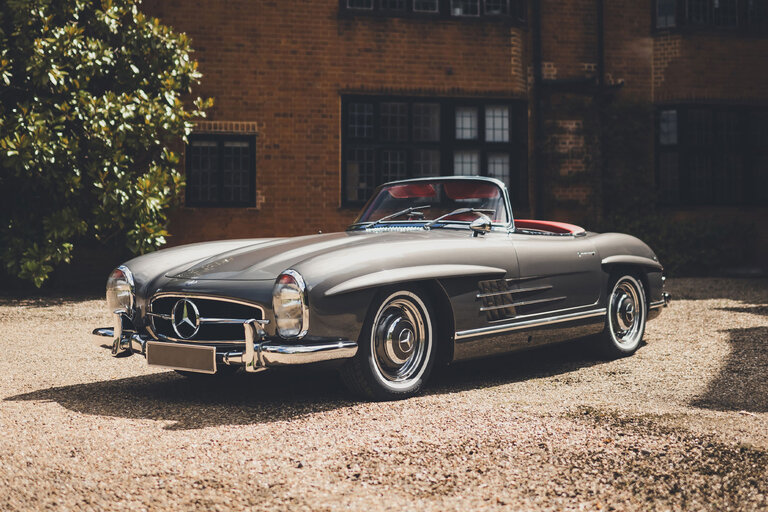
Visit Uncrate for the full post.
End the day right with the 6 best nightcap cocktails
Get a good night's sleep with these perfectly balanced nightcap cocktails.
The post End the day right with the 6 best nightcap cocktails appeared first on The Manual.

Here's Why You Keep Being Told to Exercise if You Have Lower Back Pain

There's good scientific evidence for this.
What the Hell Is Small Batch Bourbon?
The words are stamped on all your favorite whiskeys; do they mean anything?

Bothering And Even Spying On Your Neighbors Via An AI Self-Driving Car


How to Make James Bond Scrambled Eggs

In addition to being a cold, effective secret agent, the James Bond of Ian Fleming’s novels is also something of, well, a foodie. Over the course of the book series (you can find the series’ five best installments here) Fleming describes, often in sumptuous detail, seventy of 007’s meals. Bond noshes on crab, samples caviar, and sips champagne with relish, but with the lack of affectation and air of indifference with which he goes about all activities. His knowledge of food is part of his savoir faire — his ability to fit into and make the most of all situations. The fine meals he often enjoys amidst his missions are also little respites from the stresses that come with his line of work — “wonderful moments of consolation . . . for the darkness and danger of his profession.”
But while Bond’s tastes can lean towards the gourmet while on assignment (might as well charge a fine dining meal to one’s expense account if tomorrow you may die!), in his more day-to-day life, he’s content with simpler fare: sandwiches, steaks, and, very especially, scrambled eggs. Indeed, there are only three books in Fleming’s twelve book series in which scrambled eggs are not mentioned.
In From Russia With Love, Fleming writes that “Breakfast was Bond’s favorite meal of the day,” but 007 doesn’t reserve the eating of scrambled eggs for the a.m. — he also enjoys them for lunch, dinner, and even a late-night repast. He often eats the dish with buttered toast (frequently paired with marmalade) and bacon or sausage, and washes it down with black coffee (sometimes doctored with a nip of something stronger).
While Bond’s scrambled eggs are typically prepared for him by others — his beloved Scottish maid and the cooks of the restaurants he patronizes — he also knows how to make them himself, as evidenced by his whipping up a “vast” amount of them in the short story “The Living Daylights,” and the footnote in “007 in New York,” in which Fleming, who was himself a scrambled eggs devotee, shared his creation’s recipe for the dish.
Below you’ll find that recipe quoted verbatim, followed by a visual guide to making it, along with our personal commentary and opinion as to how 007’s eggs turned out.
_____
SCRAMBLED EGGS ‘JAMES BOND’
For FOUR individualists:
- 12 fresh eggs
- Salt and pepper
- 5-6 ounces of fresh butter
Break the eggs into a bowl. Beat thoroughly with a fork and season well. In a small copper (or heavy-bottomed saucepan) melt four oz. of the butter. When melted, pour in the eggs and cook over a very low heat, whisking continuously with a small egg whisk.
While the eggs are slightly more moist than you would wish for eating, remove pan from heat, add rest of butter and continue whisking for half a minute, adding the while finely chopped chives or fine herbs. Serve on hot buttered toast in individual copper dishes (for appearance only) with pink champagne (Taittainger) and low music.
_____
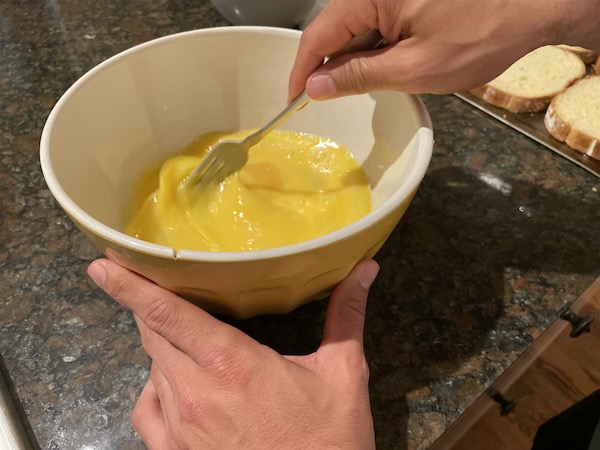
Beat a dozen eggs with a fork.
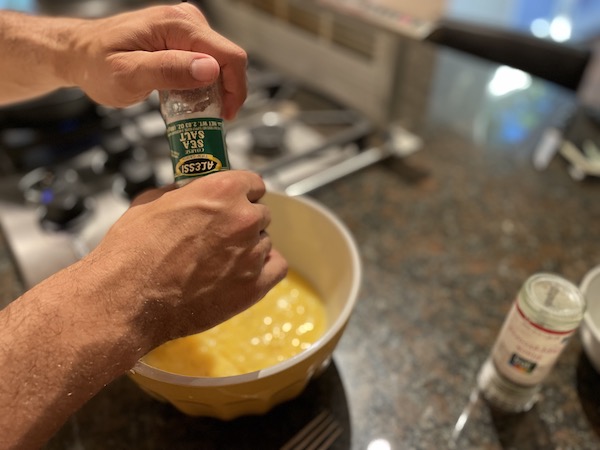
Season with salt and pepper.

4 ounces of butter doesn’t seem like a lot until you start weighing it out on a food scale and realize . . . it amounts to an entire stick. Melting down a entire stick of butter to receive the eggs felt kind of revolting, but we’d come too far to back out now!
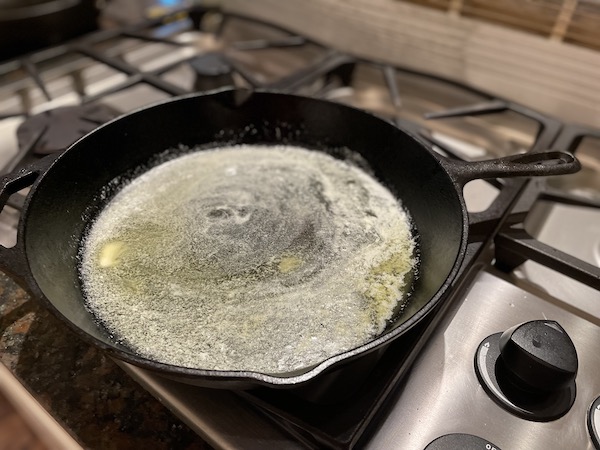
If his deadly archnemeses didn’t kill Bond, all this butter would have. Just kidding, butter won’t kill you. Just wanted to make a joke that your Snackwells-eating mom would have enjoyed in 1995.
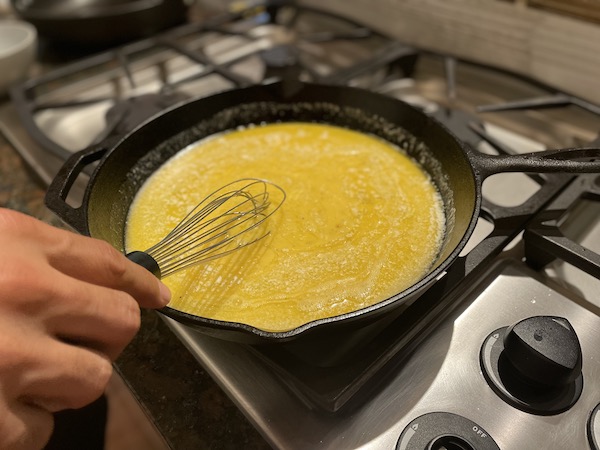
Adds eggs to the butter pool.
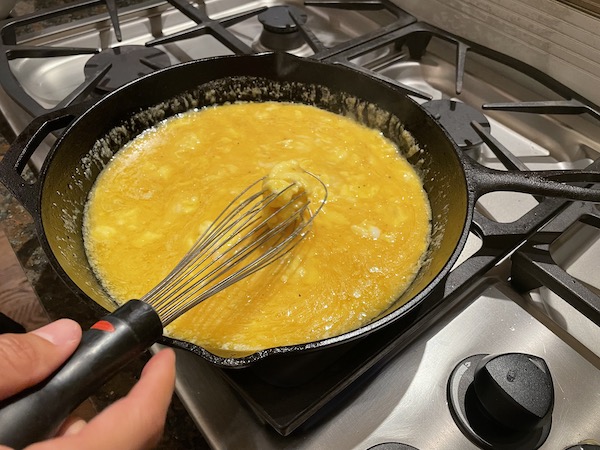
The instructions say to cook on low, but there’s so much liquid, that even after several minutes they’d hardly cooked at all. We cranked it up to medium at that point. Might be better to heat the pan to medium initially, then turn it down to low after you add the eggs.
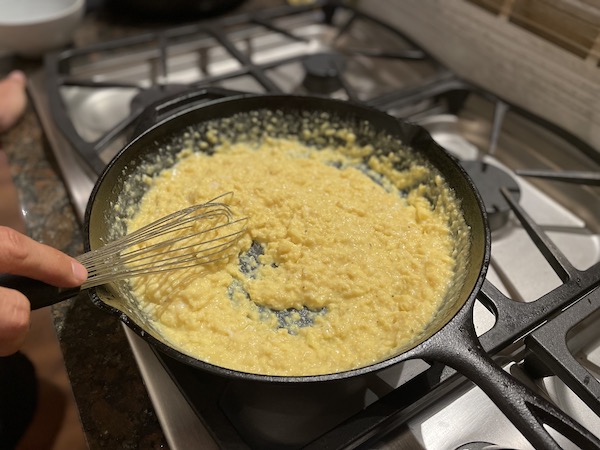
Give the eggs regular whisking as they solidify.
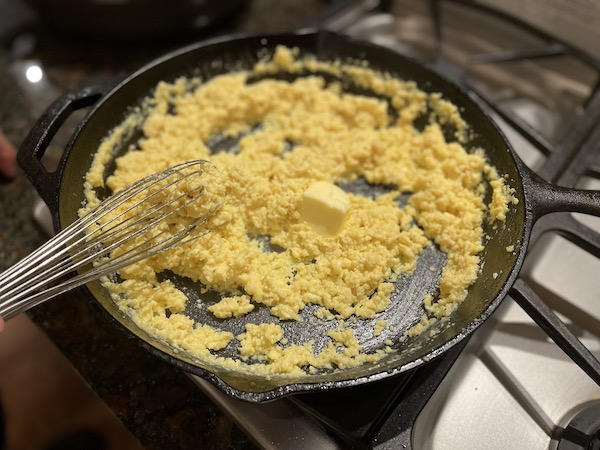
Once the eggs are just a bit moister than you like to eat them, remove the pan from the heat and add . . . heaven help us all . . . more butter. The recipe says you can add 1-2 ounces; that’s around 2-4 tablespoons of butter. Being sane, we opted for the lower end and did just an ounce. If you’d like to mix up your fat bomb here, the original manuscript that contained the recipe included this postscript from Fleming’s secretary: “I think you sometimes add cream instead of the last piece of butter.”
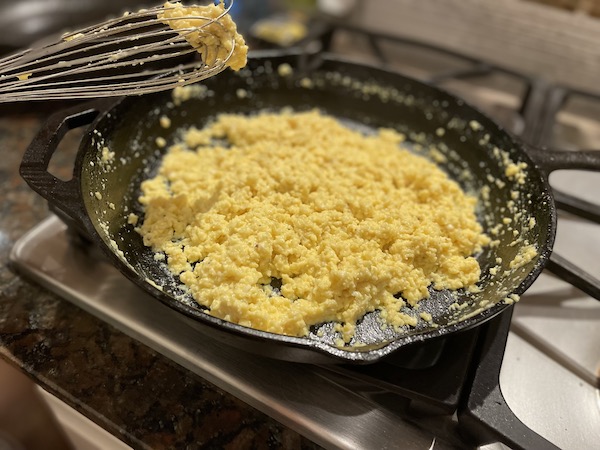
Finished. The recipe calls for herbs, but the kids vetoed that addition.
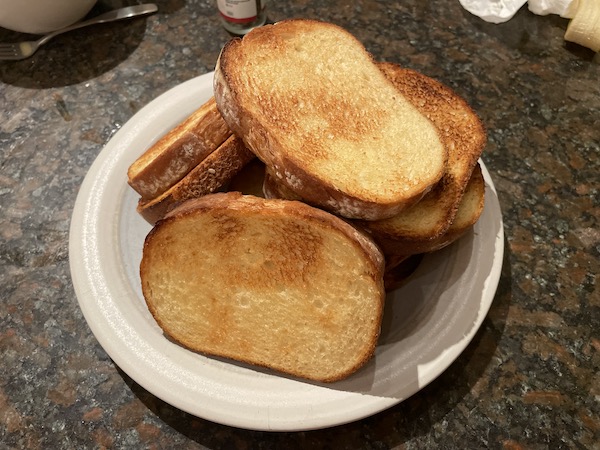
We made a batch of toast big enough for “four individualists” by brushing each side of slices of bread with . . . yup, more butter . . . and broiling both sides in the oven.
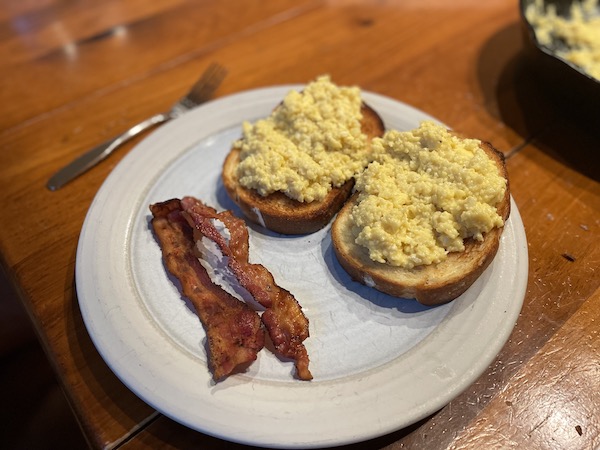
Served. We skipped the champagne and low music, and added bacon.
And how were they? Well, it’s hard for anything with that much butter to taste bad, naturally. The eggs were soft, moist, and kind of mushy; with all the butter, they don’t solidify like typical scrambled eggs. They were certainly rich, very rich. Which made them quite satiating, honestly; you didn’t need to eat a lot to feel full — the French paradox and all that. Overall, the eggs tasted delicious, and quite luxurious compared to the classic variety, but we won’t be eating them as often as Bond does; standard scrambled eggs, with but a pedestrian spray of Pam to fry them in, works alright by us. But if you want to sample the secret agent’s special recipe, now you’ve got yourself a license to cook.
The post How to Make James Bond Scrambled Eggs appeared first on The Art of Manliness.