Shared posts

06 Jun 17:29

A Beginner’s Guide to Aspect Ratios

by MikeV

the-grand-budapest-hotelEmpire Magazine’s Film Studies 101 shares the history and range of the film maker’s canvas, the aspect ratio. A great example is in Wes Anderson’s latest opus Grand Budapest Hotel, which uses not one but three different aspect ratios to portray different time periods.

  • 1.85:1 – For the modern scenes with Tom Wilkinson
  • 2.35:1 – For the 1960s scenes with F. Murray Abraham & Jude Law
  • 1.37:1 – The old ratio for the main body of the film with Tony Revolori & Raplh Fiennes.

Now enjoy this lengthy article on why breaking the rules introduced a standard and also opened an pallet for artistic film expression.

EMPIRE ONLINE – A BEGINNER’S GUIDE TO ASPECT RATIOS

02 Jun 01:30

Beer, Bait & Ammo – Michael Loyd Young

by david alan harvey

Beer, Bait & Ammo – Michael Loyd Young

In 2007 I gave a small grant from my blog Road Trips to Sean Gallagher. This first grant of 5k just came out of my pocket. Times were changing for young photographers who wanted to shoot for magazines etc., or could not finance personal projects, so it just seemed the right thing to do. It was.

I had never even seen any blog when I started Road Trips, and I am not an internet cruiser now. I still love print, the tactile nature of books especially and I work just as hard trying to help others publish their work as much as I do my own. Maybe more. The net is for audience building and information, and yet print is still the ultimate medium for fine work. Ahhh yes, and the wall.

The point is this. Others picked up on my spirit of passing the baton to the next generation and have helped me support young photographers in a way that no one else could. We have no advertising here nor any sponsors except those of you out there who do so often contribute. So you are my “stockholders” so to speak. This audience collectively and individually have been my “angel investors”. So I owe you, not anybody else.

Michael Loyd Young, featured in the video above with his new BEER, BAIT & AMMO (BurnBooks) has been a major contributor to the Emerging Photographer Fund since 2008. Mike up until today has wanted to remain anonymous as an EPF supporter and has contributed to the Burn/EPF through the Magnum Foundation which allows tax exempt donations because of their non-profit status. He is not the only one.  We have had many very generous anonymous donors all these years. Thank you all.

The Magnum Foundation, spearheaded by Susan Meiselas, also supports young photographers outside of Magnum. So it is in this spirit that the EPF exists in tandem with the MF.

Mike has told me that any book sales profits from  BEER, BAIT, & AMMO will go back to BurnBooks and the EPF. To help us with our operating costs which is always a struggle. Mostly the Burn team works for free. If we do a workshop, I make sure my crew gets paid well for those, and I cut them in on any commercial gig I may do. In other words if I make money, my team makes money. They deserve it. Still without generous support from this audience, Burn just couldn’t exist.

So check out Mike’s book. Printed in Italy, cool design, best paper and binding. Our BurnBooks crew knows how to build fine books.  Win win. Hold a fine book , help to support Burn, and support your own work as well.

Circles.

I am old school. Payback pay forward, and everything will somehow work out. To tell the truth, that old idea has worked for me.  For sure “angel investors” have given us a lot, asking nothing in return except to keep supporting those who need it, and to keep publishing good books and as good an online magazine as I can do from my 11 inch laptop and my team spread out all over the world. Hey we have a lot of fun! We want you to as well.

Do I pay special attention to Michael Loyd Young and his work? Yes I do. I mentored him. Yet about 50 times less than I spend with a whole lot of other photographers and their work. I said to Mike when he told me he wanted to do this book that I would cut him no slack because he was a friend. I told him what I would tell any of you. Friendships and hanging out etc have nothing to do with an honest appraisal and editing of work. The work must stand on its own. Magnum photographers are the same way with each other. Nobody gives anybody a break on critique. Tough love works.

So, submit a story to Burn. We want good stories. Or give the current EPF a shot. 10k might just help you finish your work. Or, be a contributor and feel good about it. We will make sure you do.

By the way, come and meet us. The Burn team tries to be as accessible as possible. Ask a question here on Burn, and I will answer it. Three of my Burn team, Diego Orlando, Claudia Paladini, and my Burn startup partner Anton Kusters were part of the Magnum photo fest in Reggio Emilia , Italy just this last weekend, and one of us or all of us hit as many photo fests as possible. We will look at your work. Patience helps, but we will look. We do workshops when we can. We cannot please everyone, nor be everywhere, yet I do believe we are more personally accessible than any magazine staff you will find.

With photography as the world’s only truly common language, we see only unfathomable opportunities ahead for those who have something “to say”. If you have a voice we will listen, if you are finding your voice we will help.

One of mankind’s greatest pleasures is either the telling of or listening to a story.

That is why we are here.

-dah-


Buy “Beer Bait & Ammo” by Michael Loyd Young here:

for USA, Canada, Mexico:

Add to Cart

for Europe and the rest of the World:

Add to Cart

1456141_10154035607270408_3526384323497829593_n


29 May 19:11

Simple Security System Installs in Minutes for Under $100

by delana
[ Filed under Home & Personal & in the Gadgets category ]

korner system home security

Security systems for the home can be quite costly; not only the initial installation, but the monthly fees are enough to make you consider whether a big dog might be a better idea. Korner is an affordable home security device that, for under $100, protects you, your home, and your family.

korner home security system

The Korner system consists of a motion-detecting tag that sticks to the corner of a door or window frame and a small fob that plugs into the Ethernet port on your router. The fob can control up to 15 tags, which themselves run on coin batteries that last up to three years. The tags have reusable adhesive that allows them to be taken down and replaced when you move.

korner security device

When the Korner system is activated, the tags sense when a door or window has been opened. The compromised fob emits a high-pitched screech to deter intruders while sending information about the incident to the fob. The fob then notifies you via the iOS or Android app. You can choose to contact the police or a friend who can nip over to your home to check in on things.

You can arm and disarm the system from the app no matter where you are, so if you have a dogsitter coming over at a certain time you can temporarily disable the system to let them in. The system takes less than two minutes to install and is far more streamlined than others of its type. In its first stages as an IndieGoGo project, the Korner raised far more than its goal and is set to go into production in 2014.


Share on Facebook

[ Filed under Home & Personal & in the Gadgets category ]

[ Gajitz | Archives | Categories | Privacy | TOS ]

28 May 16:35

When Evel Came to Cooperville.

by Jake Gallagher

21850031

Evel Knievel slides & film, 1972

Garrett Colton’s story begins like many others: a grandson travels home to visit his family and uncovers an heirloom. Only this story is a little bit different because Colton didn’t just discover a familial trinket, he unearthed a national treasure.

While Garrett only entered into this tale a couple years ago, the story really begins back in the early seventies when his grandfather Jack Cooper, an Oklahoma car dealer, met a salesman of a different nature. During a trip to Las Vegas, Cooper was introduced to Evel Knievel by a mutual friend, and the two men hit it off instantly. Knievel and Cooper were kindred spirits – middle American straight shooters with a taste for spectacle, and at the close of their meeting Knievel turned to his newfound friend and said, “I may just come to Oklahoma and jump your cars.” And just like that a few weeks later Knievel came rolling on into town.

21850016

The entire community turned out to see the notorious stuntman jump those cars, but the story was all but lost to history until recently when Garrett Colton went snooping around in his grandparent’s attic. It was there that he found a box that was chock full of photographs from that weekend in 1972. The pictures were likely taken by Patty Roloff, a local amateur photographer who ran a creative agency with her husband, although even Patty can’t say for sure if she was the one behind the lens that day. Regardless of who snapped them, the photographs, are now on display for the first time ever in a book compiled by Garrett and published by Done to Death. The sixty page book is a glorious flashback to the that time when America’s greatest daredevil came to Cooperville.

21840034

21840026

21840025

21840024

21840047

21840022

01360007

01360008

14 May 12:49

Mark Steyn Slams 'Hashtag Diplomacy,' Jon Stewart: #BringBackOurBalls

On Tuesday’s broadcast of Fox News Channel’s “Hannity,” conservative commentator Mark Steyn elaborated on his column from over the weekend headlined “#BringBackOurBalls,” in which he was critical of the foreign policy of the United States having been reduced to a tweet.

“I think there's a danger of communicating to the world the United States is not a serious power anymore,” Steyn said. “You know, when celebrities do it, when Alec Baldwin or Beyoncé issues a tweet about whatever their pet concern happens to be, celebrity activists are doing it to put pressure on government. Mrs. Obama is the government. She’s the wife of the government. And the only point to doing this would be if the United States was involved in some way of actually bringing back these girls. These girls -- if you're going to say ‘bring back our girls,’ somebody has to bring them back and realistically that means it's American special forces, French special forces, British special forces, Israeli special forces or maybe a couple of others. There’s nobody else who can get these girls back alive. So unless you're actually doing something to bring them back, this tweet is less than useless because it communicates to the world that you're not a serious power.”

Steyn also took issue with Comedy Central’s “The Daily Show” host Jon Stewart, who criticized conservative talker Rush Limbaugh on his Monday show for attacking the Obama administration tactic of using social media.

“I would like to get those 276 girls back, Sean, and hire them as replacement writers for Jon Stewart because they couldn't do a worse job than his writing staff if that so-called hashtag is the best he can come up with,” Steyn added. “Look, I’m serious. I’d like to get those girls back alive.  As I said, I regard them as my commonwealth cousins and I want them back alive. But a tweet and a hashtag is not getting them back alive. So Jon Stewart should get serious. It’s not about you or Rush [Limbaugh]. It’s not about you. It’s not about me. It's about the president of the world's superpower reducing himself to a tweet because that’s cool. Well, a tweet works for Alec Baldwin. And a tweet works for Beyoncé and Jay-Z. A tweet does not work for the foreign policy of the United States.”

Follow Jeff on Twitter @jeff_poor


14 May 03:17

TX Gun Store Sign: 'I Like My Guns Like Obama Likes His Voters: Undocumented'...


TX Gun Store Sign: 'I Like My Guns Like Obama Likes His Voters: Undocumented'...


(Third column, 12th story, link)

14 May 03:11

Individuals can demand takedown of news articles, court judgments, other documents...


Individuals can demand takedown of news articles, court judgments, other documents...


(First column, 6th story, link)
Related stories:
13 May 13:14

8 Puzzling Sales Tax Rules

by Elizabeth Nolan Brown

States are seeking some official guidance on whether take-and-bake pizzas are a prepared food or a grocery item. In many places, the difference determines whether these pies are subject to state sales tax (and also whether they're purchasable with federal food benefits).

At the moment, cooked pizza pies are generally taxed, while uncooked take-and-bake pizzas often aren't. But for clarification, states have turned to the Streamlined Sales Governing Tax Board (SSGTB), a group which provides sales tax collection guidance for 24 states*.

The SSGTB will be handing down recommendations on take-and-bake pizza later this week, it says. But the pizza issue is just one of many silly puzzles the regulatory distinction between groceries and prepared foods has created. What's resulted is a series of relatively arbitrary and absurd food categorizations. Take-and-bake pizza aside, here are seven more silly sales tax distinctions: 

Pumpkins: Many states exempt pumpkins from sales tax if they will be eaten but not if they will be carved. Effectively, this means that medium-sized pumpkins tend to be exempted while mini- pumpkins and gourds are considered decorations for sales tax purposes. 

Candy bars: In 24 states, Hershey bars but not Twix bars are subject to sales tax, according to NPR. It's because of the presence of flour in Twix, which takes it from taxable candy to non-taxable grocery item. In case you're curious, here's a six-page definition of candy from the SSTGB.

Baked Goods: In Texas, bakery items are exempt from sales tax "unless sold with plates or other eating utensils." As an example, the state clarifies that "a roll served in a restaurant with a meal is taxable even if the roll is served rolled up in a napkin rather than directly on the plate. However, the restaurant is not required to collect sales tax on bakery items purchased without utensils from its bakery."

Coconut Oil: It's sometimes taxed as a food, sometimes as a cosmetic, and sometimes as a supplement. 

Ice cream cake: In Wisconsin, whether an ice cream cake is taxable is a complicated issue. The Wisconsin Department of Revenue explains that "generally, if a person mixes ice cream and one or more other food items to form an ice cream cake or ice cream bar, the retail sale of the ice cream cake or bar is taxable as a sale of prepared food. If the ice cream cake or bar is prepared by someone other than the retailer, it is not taxable unless it meets one of the other prepared food definition categories (e.g., furnished with utensils)." 

Paper cups: In Colorado, paper cups and disposable containers are considered "essential" food items, and therefore exempt from sales tax. Napkins, straws, and plastic utensils, however, get no such exemption.

Bagels: In New York, there's an 8 cent per bagel tax for "altering" bagels by slicing, toasting, or adding spreads. 

"When you are looking at crafting these definitions, you are looking at clear, bright line tests. You want to take the subjectivity out of it," Craig Johnson, the SSTGB's executive director, told NPR. He noted that it wasn't easy, with more and more foods straddling the line between prepared and unprepared.

In today's Wonka-esque food world, how will regulators even know what to tax anymore?!? Also prompting the question: Would snozzberry wallpaper be sales tax exempt?

 *These states are: Arkansas, Georgia, Indiana, Iowa, Kansas, Kentucky, Michigan, Minnesota, Nebraska, Nevada, New Jersey, North Carolina, Oklahoma, Rhode Island, South Dakota, Tennessee, Utah, Vermont, Washington, West Virginia, Wisconsin, and Wyoming

12 May 18:03

Kit: Austin-Healey MkIII

Austin-Headly-MKIII-Kit-Gear-Patrol-Lead-

If you're in the market for a vintage roadster that adds a new dimension of style and sophistication to your life, and you're willing to throw reliability and modern amenities into the dumpster, then an Austin-Healey MkIII is an excellent choice. Since a good example of the MkIII is relatively affordable, you'll be able to add the right gear and adorn yourself in the right garb to match your new British steed's level of panache.

...

Read More »
12 May 17:58

What’s in My Bag? Mark Frauenfelder

by mark

marks-bag

What do you bring along when you leave your house? What do you bring when you fly? What do you take with you on hikes?

I’m always curious about the things people bring with them when they travel, whether they are going out for an afternoon or leaving the country for months. I suspect Cool Tools readers have more interesting things than other people do. We’d like you to share your photos and stories about the things in your bag. To get the ball rolling, I’ll start with the stuff I take with me when I fly. (Click any image to zoom in.)

personal

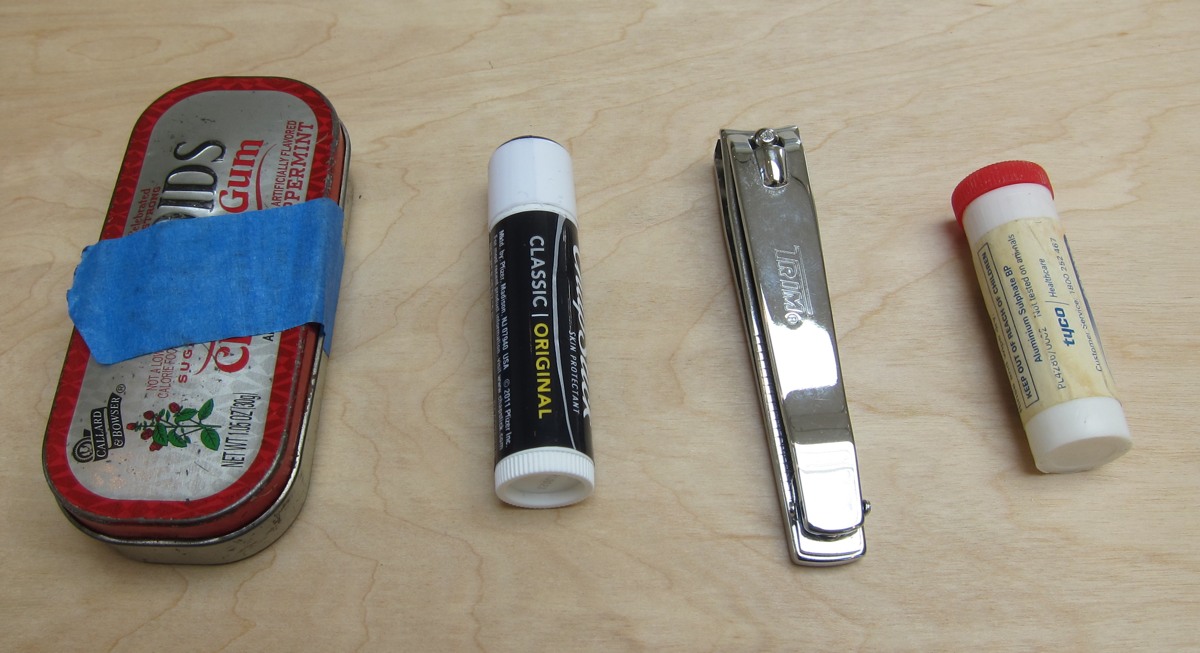
Personal items: an Altoids mint gum tin filled with Zyrtec, Sudafed, Motrin, and a cough drop (blue tape is to keep it closed). Chapstick (my lips get dry when I travel, every time). Nailclipper (hangnails drive me berserk). Styptic pencil (because for some reason I cut myself shaving much more frequently when I’m away from home).

case

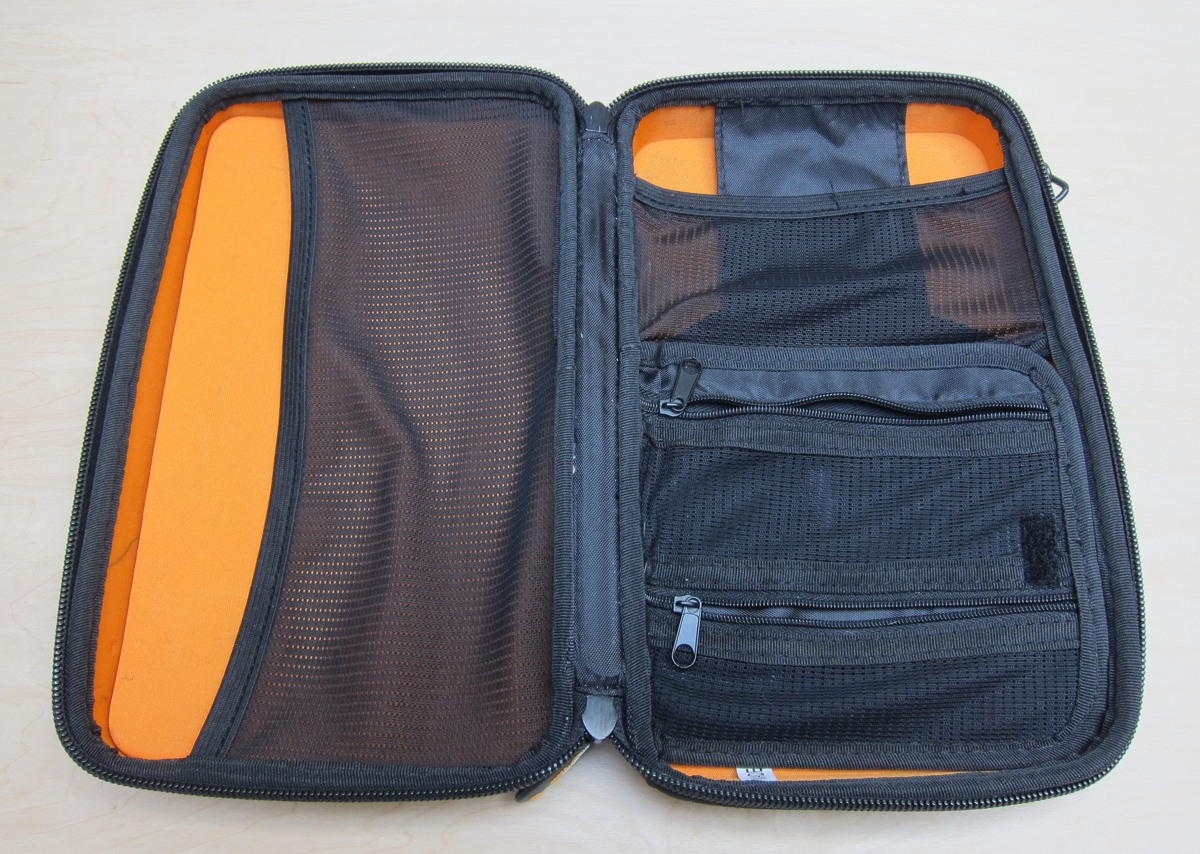
Amazon Basics Electronics Travel Case: $14. Reviewed on Cool Tools here. This small case holds everything in the photo except my laptop, umbrella, and ChicoBag.

memory

Super Talent 16 GB USB 2.0 Flash Drive: $14. I got a 4GB version a few years ago and since then the price has dropped to the point where the 16GB is less than what I paid for mine. This holds my Keynote presentations in every file format imaginable. It’s tiny, and I keep in it one of the little zipper compartments of the Amazon case.

umbrella

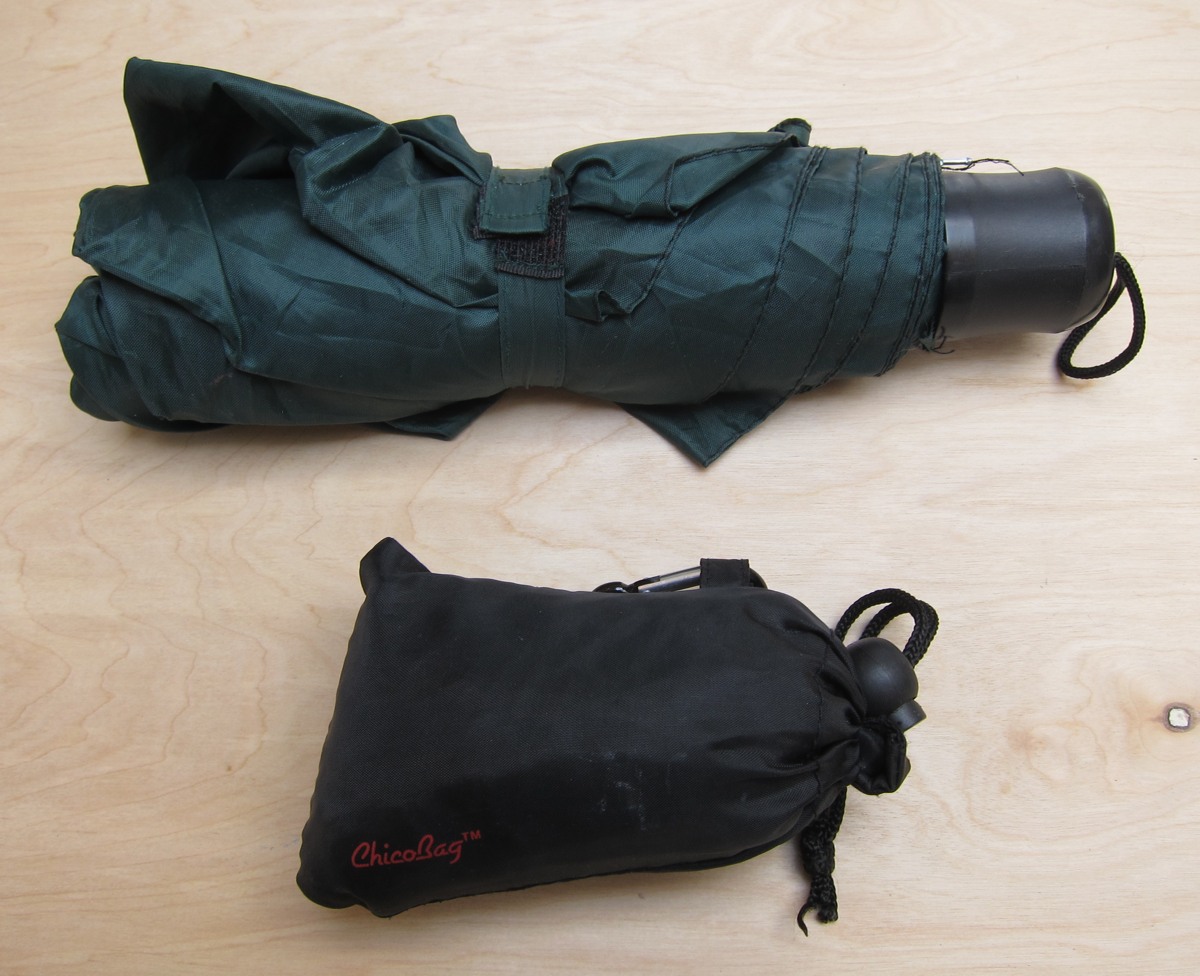
Compact umbrella and ChicoBag: I was in Paris last year and it started raining while we were waiting in line for a museum to open. A man with a cardboard box filled with small umbrella materialized, and sold them all for five euros each. I still have the one I bought. (I actually  keep it in my carry on luggage, but I wanted to include it in this list because I bring it with me on every trip I take.) I can almost hide the nylon ChicoBag ($17.50 for a four pack) in my fist, but it opens to 18×14.5 inches. Great for groceries, carrying my computer, or the beach.

charging

USB Charger and USB cables: The PowerGen White Dual USB Wall Charger ($11) has a 2.4 Amp outlet that charges phones and tablets fast. The BlueLounge Kii ($20) is a keychain USB charger for iPhones and iPads.

cards

Playing cards and card manipulation book: It’s ridiculous that this miniature edition of S.W. Erdnase’s classic book on card manipulation is selling for $200 on Amazon. You can buy the (admittedly uglier) Dover edition for $9. This book, along with a deck of cards, will keep me busy for hours on a flight as I practice different kinds of cuts, shuffles, and double lifts.

snacks

Snacks: I don’t like airplane food. I’ll either fast or bring along a bag of macadamia nuts (lots of omega-3 oil) and a few Epic Gluten Free Grass Fed Bison Bacon and Cranberry Bars ($40 for 12).

air

11.6-inch MacBook Air: Some people manage to get by with a tablet when they are on the road, but I need a real computer. The 11.6-inch MacBook Air ($860) has everything I need. I keep it in a STM neoprene Glove ($30). I also bring a USB Ethernet adapter (for hotel Internet because WiFi in hotel rooms is usually slow) and a VGA adapter (I put my email address on it so I can get it back if I forget it). The charger cable is shielded with split loom tubing ($12 for 100 feet) so my cats won’t bite it. See the Cool Tools review here.

mophie

Mophie Juice Pack Powerstation: This 6000mAh USB charging unit  ($88) keeps my devices running for days without having access to an AC outlet. In the comments of my Cool Tools review, many readers suggested less expensive and more capacious chargers. Try them and report back!

phone

iPhone 5s and Mophie Space Pack: This case ($160) is a combination battery pack, protective case, and 32GB storage device. You can load it with movies and leave plenty of room to take photos and shoot video.reading

Reading material: A small paperback book, a Kindle Paperwhite ($119 for the version that displays offers from Amazon when you are not using it — and the offers are often good). I picked up the reading glasses in Little Tokyo (Los Angeles) for a few bucks.

OK, now it’s your turn. Send photos of the things in your bag (and of the bag itself, if you love it), along with a description of the items and why they are useful. Make sure the photos are large (1200 pixels wide, at least) and clear. Use a free file sharing service like Bitcasa to upload the photos, and email the text to editor@cool-tools.org.

-- Mark Frauenfelder

12 May 13:44

The Food Lab: The Hard Truth About Boiled Eggs

by J. Kenji López-Alt

It's time for another round of The Food Lab. Got a suggestion for an upcoming topic? Email Kenji here, and he'll do his best to answer your queries in a future post. Become a fan of The Food Lab on Facebook or follow it on Twitter for play-by-plays on future kitchen tests and recipe experiments.

20140430-peeling-eggs-10.jpg

A perfect hard-boiled egg: clear yellow yolk and smooth, tender white, all peeled perfectly. [Photographs: J. Kenji Lopez-Alt]

Back when I was a lowly line cook at a fancy-pants restaurant in Boston, as the new guy*, it was my job to wake my butt up at the crack of dawn to come in early and prep breakfast whenever one of the Beacon Hill politicians wanted to impress their campaign funders with boozy waffles and perfectly soft-boiled eggs topping their asparagus. In those days, I used the brute-force method of getting perfect boiled eggs: I boiled at least three times what I needed, knowing that at least half of them would stick to their shells and turn into egg salad sandwiches for family meal.

*Let's just call it like it is: I was the kitchen bitch.

Since then, I've had a bit of time to reflect and refine my methodology. The secret to peeling hard boiled eggs? Well "secret" might be a bit of an exaggeration. Here's the truth: there is no 100% fool-proof method, and anybody who tells you different is selling something. And I do believe I've tried them all, many, many times over. The number of eggs I've boiled over the last several years in carefully controlled circumstances numbers well into the thousands, but despite that, the best boiled egg I cooked this year is no better than the best boiled egg I cooked twelve years ago in that Beacon Hill kitchen.

That said, a bit of the old scientific method has helped to greatly increase my success rate. Finding the hard truth about boiled eggs was a tough case to, er, crack.* I can now pretty routinely produce perfectly boiled eggs with clean-peeling shells, and you can too!

*sorry, I just can't help myself!

Want the tl;dr version? Here you go. This is all you need to know:

20140430-peeling-eggs-16.jpg

Lower your eggs into already-boiling water, or place them in a steamer insert in a covered pot steaming at full blast on the stovetop. If boiling, lower the heat to the barest simmer. Cook the eggs for 11 minutes for hard or 6 minutes for soft. Serve. Or, if serving cold, shock them in ice water immediately. Let them chill in that water for at least 15 minutes, or better yet, in the fridge overnight. Peel under cool running water.

No baking, no pricking, no tricks, no gimmicks, that's it.

But of course, there's still a lot of eggsplaining to do.

This is not the first time I've explored boiling eggs, but this time I went all-in with dozens and dozens and dozens and dozens of eggs to get to the bottom of what really makes them tick.

Bear with me.

Old vs. Young

The age of an egg does make a difference, but only when the eggs are super fresh: freshly laid eggs are more likely to stick to the shell. In the U.S., eggs can sit for up to 30 days before being packaged, and the sell-by date can be a further 30 days after that, which means that most likely, the eggs you're getting at the supermarket are old enough that no further aging at home should be necessary. Still, it certainly doesn't hurt to look for a package with the closest expiration date.

If you're buying your eggs direct from the farmer or you keep a couple hens out back, then you may want to let your eggs sit around for a couple of weeks before using them for boiling. (And if you want to cook those super-fresh eggs, might I recommend poaching them using our foolproof method? It's almost a shame to do anything else with them!)

Much more important to the end result is the way in which the egg is cooked.

Hot or Cold Start?

More than any other factor, the thing that made the most difference in how cleanly eggs released from their shells was the temperature at which they started: A hot start produces easier-to-peel eggs. And it doesn't matter whether that hot start is in boiling water or in a steam-filled pot or pressure-cooker. They're all strikingly easier to shell than those started in a cold pot.

20140430-peeling-eggs-07.jpg

Starting eggs in cold water greatly increases the chances of shell sticking.

Even with two-week-old eggs, starting cold resulted in eggs that had just over a 50% success rate for clean peeling. Eggs started in boiling water or steam came out well above 90%. I don't have a fully satisfactory answer for this phenomenon, but my thoughts are that it's somewhat like cooking a steak in a skillet. Add the steak to a cold pan and heat it up slowly, and as proteins coagulate, they bond with the metal, becoming nearly inseparable. Heat that steak fast, however, and the proteins bundle into themselves, instead of sticking to the metal. Slow-cooked egg whites bond more strongly with the membrane on the inside of an egg shell.

You might notice that this goes almost exactly against the advice I gave four years ago in my very first Food Lab column. Back then, I did not know what I do now. Back then, I recommended starting eggs in cold water and bringing them up to a simmer with the water, the idea being that they'll cook more evenly with a slow start. This is true: eggs started slow will have more tender, evenly cooked whites.

Why is that? It's because in rapidly boiling water, the exterior of an egg will cook much faster than the center.

Take a look at these eggs, which were cooked in fully boiling water for times ranging from 1 minute to 15 minutes:

09242009-egg-boiling-timing.jpg

As you can see, not one of them is a perfect hard-cooked egg: the eggs go directly from having slightly translucent centers to having rubbery whites.

Here's what happens when an egg white cooks at a raging, full-on boil:

09242009badhardegg.jpg

  • From 30 -140 degrees: As it gets hot, its proteins, which resemble coiled up balls of yarn, slowly start to uncoil.
  • At 140 degrees: Some of these uncoiled proteins—called ovotransferrin—begin to bond with each other, creating a matrix, and turning the egg white milky and jelly-like (like the innermost layers of egg white in the 3-minute egg above).
  • At 155 degrees: The ovotransferrin has formed and opaque solid, though it is still quite soft and moist (see the white of the 5-minute egg).
  • At 180 degrees: The main protein in egg whites—ovalbumen—will cross-link and solidify, giving you a totally firm egg white (see the whites of the 7 and 9 minute eggs). This is very similar to the gunk that seeps out of the surface of overcooked salmon.
  • 180 degrees-plus: The hotter you get the egg, the tighter these proteins bond, and the firmer, drier, and rubbier the egg white becomes (the 11-15 minute eggs). Hydrogen Sulfide, or "rotten-egg" aromas, begin to develop. Ick.

Egg yolks, on the other hand, follow a different set of temperatures:

  • At 145 degrees: They begin to thicken and set up.
  • At 158 degrees: They become totally firm, but are still bright orange and shiny.
  • At 170 degrees: They become pale yellow and start to turn crumbly.
  • 170 degrees-plus: They dry out and turn chalky. The sulfur in the whites rapidly reacts with the iron in the yolks, creating ferrous sulfide, and tinging the yolks.

Thus, for perfect hard-cooked eggs, you want whites that don't cook much beyond 180°F, and yolks that have just hit 170°F throughout. Cooking relatively gently allows for this, but easy peeling requires a full 212°F blast of heat.

So how does one cook easy-peeling eggs that also have relatively tender whites? There are a couple of options. If you're boiling, you can plunge your eggs into boiling water, let them boil for 30 seconds or so just to set the exterior of the whites, then drop the temperature and finish them off at around 180 to 190°F (a very low simmer). You end up with eggs that are easy to peel, with tender whites throughout.

20140430-peeling-eggs-03.jpg

Steaming eggs cooks them more gently than boiling, making them less likely to crack or explode, and less likely to turn rubbery.

With steam, there's no need to lower the heat—steam's relatively lower density means that steamed eggs actually cook a little more gently than boiled eggs. Your whites will be ever-so-slightly tougher than with simmered eggs, but not enough to be off-putting. The gentleness of steam and the ability to load up a steamer insert and lower it gently into a pot also has the advantage of reducing your chances of shells cracking and whites leaking out.

Finally, steaming your eggs has the advantage of being the fastest method around: instead of waiting for a pot of water to come to a boil, all you need to do it boil a half inch of water. Throw your steamer insert in, cover the pot, set your timer, and you've got perfectly cooked eggs.

What About the Pressure Cooker?

Yeah, what about it?

For a while now, I've been reading about cooking eggs in a pressure cooker. Those articles promise you a magic bullet: cook your eggs at low pressure in a standard pressure cooker, and they'll practically jump out of their shells.

But here's the thing: I couldn't find a single source that actually tested that hypothesis in a controlled, scientific environment, and all the anecdotal evidence in the world is not worth the pixels it's written with when confronted with strong scientific evidence.

So I tested the pressure cooker method, multiple times with multiple eggs in each batch, using different pressure cookers, different timings, and different cooling methods. Dozens and dozens of eggs in total. Not only that, but I tested it side-by-side with boiled and steamed eggs, and to get really scientific about it, I went double-blind, with one test administrator (who did not know which eggs had been cooked by which method) handing cooked eggs in random order to a third party who peeled them all (also with no knowledge as to the cooking method for the eggs he was peeling). All of the eggs were rated on ease of peeling (1 = easiest to peel, 10 = most difficult), and were observed for surface damage after peeling.

Guess what? There is absolutely zero correlation between cooking eggs in a pressure cooker and ease of peeling. In fact, depending on how long it took to bring the pressure cooker to pressure, eggs cooked in one actually showed a slight negative correlation!

There's an even more nefarious problem: Even when timed perfectly, the pressure cooker produces slightly rubberier whites than other methods.

Here's the thing: Pressure cookers cook hotter than steaming or boiling—even at low pressure they hit temperatures in excess of 220°F. And the hotter something cooks, the greater the temperature differential between the center and the edges.

Pressure-cook your eggs for six minutes to get perfectly hard-cooked yolks, and the outer layers of your whites end up tough. At least, tougher than equivalently steamed or simmered eggs.

20140430-peeling-eggs-12.jpg

Pressure cooked for five, six, and seven minutes.

The bigger issue is that pressure-cooker eggs have a smaller window of perfection. With a stovetop simmered or steamed egg, the difference in end results between 10 minutes of simmering versus 11 minutes is not that great. With a pressure-cooked egg and its rapid cooking, however, the difference a minute makes is huge. At five minutes, the yolks are still translucent yellow. At six minutes, the yolks are tender and just set. At seven minutes, you've already started to develop the dreaded green tinge.

My advice? Save the pressure cooker for things that it actually improves or makes faster. Eggs ain't one of 'em.

Out of the Pot and Into the Oven

The other method that seems to be getting a fair bit of play recently is cooking eggs in the oven. Now, nobody wants to heat up the oven just to make a couple of eggs for breakfast, but what if you're making deviled eggs or breakfast for a crowd? Heating an oven to cook a few dozen eggs seems like it might be a swell idea.

Alton Brown (a generally trustworthy guy) recommends placing eggs on a moistened towel directly on an oven rack in a cold oven, then setting the oven to 320°F and coming back 30 minutes later.

Even before I tested the method, alarms were going off in my head. Recipes that call for cooking in an oven while its temperature is in flux (either starting cold or turning off in the middle) are never reliable. Ovens on their own are bad enough—most home ovens swing their temperatures by as much as 50°F above and below their set temp (assuming they were calibrated well to begin with). To add the confounding variable of how efficiently your specific oven heats or cools on top of that is asking for trouble.

20140430-peeling-eggs-18.jpg

What may work perfectly in one oven probably won't in another. The method certainly didn't work in mine. One batch heated too quickly and came out with dark spots on the shell and a pale brown color to the white. For a second batch, I lowered the cooking time and managed to get eggs that looked ok when split open, but they were a bitch-and-a-half to peel, which makes sense. Remember: cold start = harder to peel eggs. It doesn't matter if it's in the oven or in a pot of water.

Ovens are inherently unreliable because there is no physics-based indicator or limiter of heat. A pot of simmering or steaming water, on the other hand, is reliably at the same temperature (assuming constant atmospheric pressure), which means that no matter whose kitchen I'm in and no matter how powerful their stovetop burner, so long as I can boil some water, my eggs will cook reliably time after time.

When cooking eggs in large numbers, I'll stick with the steamer and cook my eggs in batches if I have to rather than play Russian roulette with the oven.

A Simple Cure for the Dimple

Does anyone else get bothered by the dimple created by the air space in the fat end of the egg? I sure do. The problem is that the older the egg is, the bigger that air space gets. This means that the eggs that are most suitable for boiling also happen to come out the ugliest,* and nobody wants to be that guy who serves the deformed deviled eggs.

*I'm sure there's some parallel to be drawn here between the kinds of people who are having babies and the kinds of people most suited to raising babies, but that's another subject for another time.

20140430-peeling-eggs-01.jpg

A pin-prick in the fat end can help remove the air bubble... when it works. But we have a better way.

If you're to trust Jacques Pepín (and I usually do!), solving this problem is as simple as pricking the fat end of the egg with a pin. This allows the air inside to be pressed out rapidly as the egg cooks, leaving you with a completely smooth egg. Usually.

But occasionally, you end up with this:

20140430-peeling-eggs-08.jpg

This is what can happen with pricked eggs.

Instead of creating a prettier egg, things can go sour when boiling water enters your egg, creating these strange, deep craters. Wouldn't it be great if there were a more foolproof method of getting rid of those dimples?

As it turns out, there is, and it was one I discovered completely accidentally.

See, I came in early one morning to start boiling eggs before the office filled up with coworkers and distractions. I'd gotten through three dozen test runs, working in six-egg batches and testing various combinations of cooking temperatures, cooking methods, and cooling methods. When I started shelling those eggs, I noticed that despite the eggs all coming from the same origin, some batches of six had perfectly round bottoms, while others had dimples. What was the correlation?

20140430-peeling-eggs-05-text.jpg

Shocking in ice water can help remove the divot in a boiled egg.

Here it is: The eggs that I had immediately shocked in ice water after cooking came out full-figured and smooth, regardless of the initial cooking method, whereas those that I allowed to cool naturally had dimples.

Shocking!

My theory? When you pull the hot egg out from the pot, the yolk and white have yet to firm up completely (you can feel this when you try to peel a hot-from-the-pot egg compared to an egg that has rested or cooled a bit). By shocking it, you very rapidly cause the steam that has built up inside that air pocket to convert to water, instantly dropping to about .5% of its original volume. The still-malleable boiled egg moves in to fill its place.

Let the egg cool slowly, on the other hand, and by the time that steam has cooled sufficiently, the egg is already basically set in its shape. Instead of the egg moving in to fill that space, air is drawn in through the egg shell.

Further testing is needed to prove the theory, but it sounds pretty legit to me, and the practical effects on appearances are undeniable. Shocked eggs also have a slightly higher success rate for peeling.

Time to Peel!

One last factor that improves your chances of a successful peel, and it's a major one: make sure to chill your eggs completely. I mean let them sit in that ice bath for at least 15 minutes, or better yet, let them sit overnight in the fridge. The cooler the egg is, the firmer and tighter its structure will be, and the less likely is it to develop craters when you pry off the shell.

Chilling eggs overnight reduced poorly-peeled-egg count by a further 50% compared to those peeled after a few minutes of shocking (or even worse, straight out of the pot).

Sure, sometimes you want to serve your hard boiled eggs hot. My advice for those times? Serve them in the shell so that if they don't peel well, it's your guests who will feel inadequate. This is a good strategy for instilling a bit of insecurity and fear in them before a brunch-time debate over politics or religion.

20140430-peeling-eggs-04.jpg

Crack your egg all over before starting to peel.

Before I start to peel my eggs, I crack them gently all over their surface, starting at the fat end and gently rotating and tapping all around. I don't use the roll-it-against-the-counter method, as I've accidentally squashed too many eggs with my ham-hands that way.

The many cracks makes it easier to gently peel away the shell under running water.

20140430-peeling-eggs-02.jpg

Peeling under running water is the way to go, and yes, I forgot to shock this one.

When I've got a bunch of eggs to peel, I'll place either a fine mesh strainer or the insert of a salad spinner in the sink under the tap and peel the eggs under the flow, letting the shells drop down into the strainer below for easy cleanup afterwards.

20140430-peeling-eggs-10.jpg

And that's about all there is to it. Start with old eggs, cook them hot (but skip the pressure cooker), chill them rapidly and completely, crack all over, and peel under running water.

Another Food Lab article, another 5,000+ words on a subject that probably only really needs 10, but what are humans if not voraciously curious and insatiably wasteful? At least this time around there was only two egg puns. But it was an egg-ceptional one. D'oh!

P.S. For the record, baking soda still doesn't make any detectable difference.

About the author: J. Kenji Lopez-Alt is the Chief Creative Officer of Serious Eats where he likes to explore the science of home cooking in his weekly column The Food Lab. You can follow him at @thefoodlab on Twitter, or at The Food Lab on Facebook.

Recipes!

09 May 16:05

Kuretake No. 13 Brush Pen

by mark

I’ve been a brush pen user for years. I love them. They’re my primary sketching tool & I always have at least one in my bag and one in my car. My first was the Pentel Pocket Brush. From there I moved on to the Pentel Standard Brush and the Kuretake No. 8. Then I was given a Kuretake No. 13.

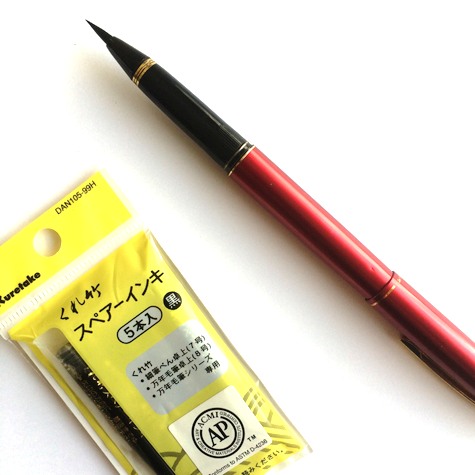
I still have all the others, and still use them, but the Kuretake No. 13 is the finest of the lot. Being able to move, in one stroke, from a thin, fine line to a fat, smushed line is what makes all brush pens so fun. Even my least favorite brush pen is a blast to use but it’s the Kuretake that gives me the most control. My thin lines are thinner, my fat lines are more consistent and I get more variety between the two than with any other pen. Further, after a broad, smushed stroke, the bristles return to shape immediately, allowing me to move onto a more delicate line without having to dab the brush back into shape on a piece of scrap paper.

Further, the ink flow is just right. A lot of brush pens, with a full ink cartridge, have a tendency to be “wet.” When you press the bristles down for a fat line, the ink can puddle on the page, leaving a shiny wet line just begging to be smeared across your sketch. Great, if that’s the effect you want. I rarely do. I like an ink line that’s controllable and dries quickly enough that I can move around the page without worrying too much about where to put my hand.

The pen uses water-based dye ink refill cartridges and the default ink is just a bit blacker than the default Pentel ink & reacts similarly with water. Because I’ve ruined two Pentel brush pens trying DIY refilling tricks, I’ve no idea how well the Kuretake reacts to other inks. If someone wants to try it, please let us know how it goes.

Kuretake_01

Kuretake_02

-- Barry McWilliams

[This is a Cool Tools Favorite from 2014]

Kuretake Sumi Brush Pen

Available from Amazon

08 May 17:04

YELLEN: I 'DON'T KNOW WHAT TO CALL OUR SYSTEM'...


YELLEN: I 'DON'T KNOW WHAT TO CALL OUR SYSTEM'...


(First column, 19th story, link)
Related stories:
08 May 13:42

Man and Machines

by sallyedelstein
vintage illustration machine and working man 1930s

Illustration from an article entitled The Machine and the Depression” February 1933 issue of “Everyday Science and Mechanics”

Are machines after your job?

A struggling middle class grappling with unemployment, frets over headlines warning “How Technology is Destroying Jobs!”

Sounds familiar, but the warning is from 1933.

Looking to place the blame of the economic woes of the Great Depression on something, many well-informed people in the 1930’s pointed to the proliferation of machines usurping jobs from needy men.

Promising to debunk technocracy, an article entitled “The Machine and the Depression” ran in February 1933 issue of Everyday Science and Mechanics.

Would “Machine Man” make the working man an endangered species?

“Horsefeathers!” the article claimed.


vintage illustration Economy and Machines

Vintage illustration from an article entitled The Machine and the Depression February 1933 issue of “Everyday Science and Mechanics”

“Lets not forget,” writes Hugo Gernsback the editor of the magazine and author of this piece, “ that the machine itself creates employment which would otherwise not be there.”

“Take such a recent addition as the radio industry, for instance, which was created out of the blue sky”.

It goes on to explain:

“It was not existent before 1920 because there was no broadcasting. Immediately it gave employment to literally millions of workers who would not have been employed otherwise. The same is true of electricity and the automobile.”


business man  automation

Automation 1963


Little solace to future generations of workers who continued to worry they would soon be an endangered species with each new technology.

Whether it’s Mad Men’s Don Draper contemplating his own impending obsolescence as a behemoth computer is installed in his 1969 office, or today’s middle class worrying whether we have mechanized and computerized ourselves into obsolescence, in the age-old race against the machine, man is always in fear of losing.


© Sally Edelstein and Envisioning The American Dream, 2014. Unauthorized use and/or duplication of this material without express and written permission from this blog’s author and/or owner is strictly prohibited. Excerpts and links may be used, provided that full and clear credit is given to Sally Edelstein and Envisioning The American Dream with appropriate and specific direction to the original content.


You Might Also Enjoy

Robot Romance


08 May 13:41

Shoot the Blue Sky to Check for Sensor Issues on a DSLR Camera

by Mihir Patkar

Shoot the Blue Sky to Check for Sensor Issues on a DSLR Camera

If you're buying a second-hand DSLR camera (or you just want to check the sensor of your current camera), CNET suggests a neat trick to identify dust or dead pixels: point it at the sky and take a photo.

Read more...


08 May 13:34

The Ferrari Of The Water

by Andy Forch


Before the Hamptons caught the eyes of the wolves of Wall Street, the Adirondack mountains were the summer playgrounds of America's elite. Travel back in time to the late 1800s, and it wasn't uncommon to see J.P. Morgan, John D. Rockefeller, and other titans of industry enjoying a cold one on the shores of Lake George, or hunting deer across the Adirondacks' thick old-growth forests. Their primary mode of transportation: the lightning-quick guideboat. 


Our friend, Stephen Gordon, is helping resurrect the guideboat with his latest endeavor, Guideboat Company, and he recently invited Richard (my co-founder), Jeff (our art director) and me to take one out with him and his colleague, Chris, on a glassy morning on San Francisco's Richardson Bay. It was, and I say this recognizing that I'm describing the act of rowing, exhilarating.


Known as the Ferrari of the water, guideboats are up to two times faster than a canoe: they're rowed, not paddled—except for navigating tight quarters with a small "sneak" paddle—and utilize an overhand grip which increases torque as you row. It took us a while to get the strokes right, but once we did, our guideboat zipped through the water fast enough to create a small wake.


Unlike many heritage products out on the market today, which over time have been improved upon both in form and function, guideboats remain the gold standard of paddled boats. A century has come and gone since they were first introduced, and yet they remain the fastest fixed-seat rowboats in the world.



Stephen, who prior to founding Guideboat Co. founded Restoration Hardware, modeled the guideboats he retails on his crushingly beautiful 1892 J H Rushton Saranac Laker.  The only major update he made was to craft the hull from hand-laid biaxial composite instead of wood—which makes the boats stronger and lighter, and decreases production time (order a guideboat from Stephen and it'll ship in 2-3 days).


While out on the water, Stephen told us how sportsman used to hunt deer at night from their guideboat by lighting a lantern fueled by pine needles—which would catch the attention of the deer and give the hunter enough time to shoot. Stephen would later show us his collection of antique guideboats and photographs, which only further heightened our appreciation for the sport and craft.


If you find yourself in Mill Valley, we highly recommend that you pay a visit to Guideboat's shop and showroom—which is housed in a stunning 19th century Lumber Yard. Just like the boats they encase, it's a sight to behold.


In addition to rowing a guideboat, Stephen and Chris also took us out on Guideboat Co's equally stunning Double Ender Maine Peapod. First crafted in the 1870s for inshore lobsterman, the Peapod is fast, stable, and remarkably seaworthy, earning it the distinction of once being the official boat of U.S. lighthouse keepers.


Images ©: Jeff Masamori.

08 May 12:32

Meat Ups: When Your Butcher Comes To You

by Carolyn Malcoun

And Slayton was the reason we had gathered in my kitchen that night.

I was hosting what Slayton calls a “Meat Up,” or a gathering of meat-loving folks there in part to socialize but mainly to buy meat.

Slayton hatched the idea after his mother-in-law asked him to bring some of the meat he butchered to her house for her neighbors to buy. The experience changed the way he thought about his business. “I saw everyone coming together with their wagons to bring their meat home, chatting and exchanging recipes. And they had questions for me about how the animals were raised and how to cook the meat,” he says. “I realized that I had missed the boat—my business wasn’t just about moving meat, it was about the sense of community that comes from buying and cooking local food.”

Not to mention: Slayton’s shop is about 80 miles round trip from Portland. There is a wider audience for his meat than he can get to come to his shop. So he started to bring his meat to his customers.

‘I realized that my business wasn’t just about moving meat, it was about the sense of community that comes from buying and cooking local food.’

Now Slayton totes his products to eight regular Meat Ups hosted around southern and midcoast Maine. Customers gather at coffee shops, offices or at people’s homes. They’ve already put in an order for what they want. Some Meat Ups are a quick pickup, like at a chiropractic office in Damriscotta. Others, like mine, are more like a cocktail party. While other butchers might balk at the time spent on this side project, almost 20 percent of Slayton’s annual revenue comes from these events.

Are Meat Ups the answer to small-scale butcher shops that want to stock local, sustainable products? “My knee jerk reaction is no,” Slayton says. Instead of eating dinner on many Thursday nights with his family, he’s driving around the state with a minivan packed with meat.

Not that Slayton doesn’t do a fine business at his storefront, which he took over four years ago after apprenticing with the previous owner and at Tenuta di Spannochia, a working farm in Tuscany. Customers are willing to make the drive to buy the meat he butchers: Everything in his shop is humanely raised and slaughtered in Maine. Each cut is labeled with the farm it came from. The sausages are made from trim from a single farm. Customers can order full, half or quarter animals from him, or make special requests. “I’ve had customers come in and point out the exact cut they want on a hanging carcass,” Slayton says.

But the trip can be a long haul. I took the 45-minute drive from my house to his market one afternoon in March. Slayton, who is clean cut and charismatic, greets me in the shop. “Everything about this place is inconvenient,” he says with a laugh. Slayton leads me to where he, the other two butchers and one apprentice are working on half a pig carcass hanging from the ceiling. I watched as they turned it into spareribs, bone-on pork chops, ham and more.

‘We can tell them what they feed their animals and how they treat their animals. That you won’t find at Whole Foods.’

“We’ve been to the farms, we can explain to the customer who [the farmers] are, where they live and how many kids they have,” Slayton says as he debones a ham. “We can tell them what they feed their animals and how they treat their animals. That you won’t find at Whole Foods, I don’t think you’ll find that anywhere. That’s what we do.”

The door to the shop opens and longtime customer Julie Hausman comes in. “I refuse to buy meat at the grocery store anymore. After you’re used to this kind of meat, it doesn’t taste as good. I don’t mind paying more for it,” she tells me as Slayton finds her order.

A week later, I arrived at another Meat Up – this one hosted at Damariscotta Chiropractic Health Center. When I arrive, Slayton is there with a mini van full of coolers packed with meat. For the next half hour, people come and go. Some take the time to ask Slayton questions, others just grab their meat and exit. There are elderly couples, moms with young kids, single 30 somethings. Debbie Mikulak of Round Pond buys all of the meat her family eats from Slayton. “How the animal is raised affects the quality,” she tells me. “The meat is very tender and the sausages are superb.”

Chiropractor Susan Giglia started this Meat Up group in January 2013, and it’s one of Slayton’s most dynamic groups. Giglia and her husband had been vegetarians for 25 years when they decided to eat meat again for health reasons. “Since we were ethical vegetarians, it was very important to get humanely raised, healthfully and naturally raised meat that was as organic as possible, and we wanted to support local farmers,” she says. “It was apparent when I met Ben at the Meat Up that he was the real deal.”

Slayton visits each farm partner at least once a year, and he has ended relationships with ones in the past based on how animals were treated.

And he is: Slayton visits each farm partner at least once a year, and he has ended relationships with ones in the past based on how animals were treated. Because many of the farmers Slayton works with told him that slaughtering and processing was the main challenge of being in the livestock business, he partnered with L & P Bisson and Sons Meat Market & Farm, which has a USDA inspected slaughtering facility, to get a dedicated slaughter day each week for his farm partners. (Slayton slaughters chickens at his market.) Every Tuesday the carcasses arrive at his shop, unlike your typical grocery store, which tend to get in large hunks of meat already removed from the carcass, or even already broken down into the cuts you see in the packages on the shelves. “The problem with getting meat in boxes is it starts to remove the connection you have with the farmer and the animal itself,” he says. “We see ourselves as facilitators to creating a stronger relationship between farm and family.”

The post Meat Ups: When Your Butcher Comes To You appeared first on Modern Farmer.

08 May 12:31

How to Pack an Emergency Kit Like a Spy Plane Pilot

by Alan Henry

How to Pack an Emergency Kit Like a Spy Plane Pilot

The SR-71 Blackbird is one of history's most celebrated spyplanes, and for good reason. When Blackbird pilots took off however, they had to be ready to eject and land in some pretty harsh, desolate environments. Here's a little detail on what they packed in their emergency kits, and what you should include in yours.

Read more...


07 May 16:56

Putin Plans to Attend D-Day Ceremonies Despite Conflict with Ukraine

June 6, 2014, is the 70th anniversary of the historic D-Day landings in Normandy, France, and Russian President Vladimir Putin is planning to attend the commemorations with Western leaders.

"Such a trip is being worked out," Putin's spokesman Dmitry Peskov said, adding that it was "undoubtedly" not ruled out.

French President Francois Hollande sent Putin an invitation in March. "I invited President Putin for the D-Day celebrations on June 6 and I maintain that invitation," Hollande said. "Russia was in solidarity with France and paid a heavy tribute," he added.

France's justification for the invitation is "historic context." A source from the Elysée reportedly said, “We have with Russia our dead and our heroes," adding that this gathering is “different from the G8 summit.”

The G8 was scheduled to meet in Sochi, Russia, in June, but the other seven countries agreed to boycott the summit after Russia annexed Crimea from Ukraine. The G7 countries will now meet in Brussels on June 4-5.

The situation between Ukraine and Russia has caused a major standoff between Moscow and the West similar to the Cold War days, which began after WWII. The U.S. passed harsh sanctions against Putin’s inner circle. The list includes Igor Sechin, the president and chairman of Rosneft, which is Russia’s top petroleum company. Sanctions also targeted Bank Rossiya, which is Putin’s preferred bank.

Russia has responded by threatening Ukraine and Europe with its gas supply. Gazprom, which is not on any sanction list, raised the price of Ukraine’s gas and told Europe it will not receive natural gas until it helps Ukraine pay off its debt. Europe receives almost half its energy from Russia, even though the U.S. warned them in 1981 not to rely on Russian energy.

Russian media said Putin might take part in talks with Western leaders while in France. Leaders from Britain, America, and Germany are expected to be in attendance.

D-Day is considered the turning point of World War II because it began the liberation of Europe from the Nazis. Russia joined the Allies after Hitler invaded the Soviet Union, and the Red Army was instrumental in the defeat of Nazism across Europe. Putin passed a law “introducing punishment of up to five years in prison or a fine of about 500,000 rubles (about $14,000) for anyone found guilty of denying facts established by the Nuremberg trials regarding the crimes of Axis powers.”


07 May 00:23

The Deepest Sleeper: The Volvo Amazon Combi “VÖX”

VOX-VOLVO-AMAZON-KOMBI-GEAR-PATROL-LEAD-

What's more surprising than a sedate-looking vintage Volvo wagon that has enough power to bury supercars? In search of the ultimate sleeper, we came across what would normally be a cute vintage 1967 Volvo Amazon Combi wagon that's instead been slammed, juiced up and fitted without some of the most mind blowing guts a family hauler has ever seen.

...

Read More »
07 May 00:23

5 Tequila Cocktails for Cinco de Mayo

tequila-cocktails-gear-patrol-lead-full

Oh, you were planning on taking a few shots? Celebrate the Fifth of May with these five tequila cocktails instead.

...

Read More »
07 May 00:13

Civilian’s Guide to Military Watches: Best of the East

guide-to-military-watches-east-gear-patrol-lead

From the Archives: Issued timepieces are some of the most collectible in the watch world, and the rabbit hole of military watches and their history delves very deeply, very quickly. We’ve broken our overview into two parts: those countries from the West with influential and interesting military timekeeping history, and those from the East. These are the best from Japan, China, Russia, India and Australia.

...

Read More »
06 May 23:42

Among The Perks For Amazon's Part-Time Workers: Being Homeless

by Tyler Durden

Judging by the narrative promoted after last Friday's idiotically connived jobs report, any job is a good job... however, as The Guardian reports, that does not include a job working for Amazon.com. Quarter after quarter, we highlight the growth in Amazon employees (and death-cross-like plunge in annual sales growth). While Amazon makes no secret of the fact that it relies on seasonal work force, what went unsaid and unnoticed during President Obama's visit last year, was that the Amazon 'employees' would not have jobs or prospects after the holidays. Many of the people in those Amazon warehouses were among the long-term unemployed – shuffling from one temporary job to another to another; and due to this unstable employment, a growing number of them have found themselves living in shelters... 'employed' but homeless (or "the working poor" in America).


Amazon's death cross... total employees and worldwide revenue growth - (which makes perfect economic sense as the marginal employees costs approaches zero...)


As The Guardian reports, working away in warehouses, beyond the pages of Amazon's website, the seasonal workers and the effects that temporary contracts have on their lives are kept out of public's eye and often avoid scrutiny.

Andrew Cummins, 43, was one of these elves last year, working north of Chattanooga at an Amazon warehouse in Jeffersonville, Indiana. For three months, he stowed away clothes, working 40 hours a week at $10 an hour. He enjoyed the job and saw it as his ticket out of the Haven House, a shelter where he lives with his wife, Kristen, and stepson.


"They had this big hype that they were going to hire on and stuff and that didn't happen. They just worked you until the time was up and then they let everyone go," he says. According to him, about 50 other seasonal workers like him who were hired through Integrity Staffing Solutions – a staffing agency working with Amazon in Jeffersonville – were let go at the same time. "They just said they would email everybody that they let go but we never heard anything back. And then you can't apply for [another Amazon job] for another year after you worked for them."

Which brings us to the new normal in America - The Working Poor

The underlying situation at the Chattanooga facility belied the president's speech. He spoke about the recession, noting that "it cost millions of Americans their jobs and their homes and their savings." He spoke of the long-term unemployed and their struggles in finding a job. He spoke of the great job that Amazon and Jeff Bezos were doing taking care of their employees.


Since Amazon opened its warehouse in Jeffersonville, one homeless shelter, Haven House, has been a home to between two and six of its employees at all times, says Barbara Anderson, the shelter's director.


"The impact is profound. One man was sleeping in a car when he landed his 'permanent job' with Amazon," she says. His good luck didn't last long. "He lost everything all over again. The jobs are good but the temporary status sets people up for failure."


More than half of the shelter's tenants are working poor, according to Anderson. Often times they are either in between jobs or working jobs that pay just enough to make ends meet, but not enough to help them break out of the cycle of homelessness.


With lack of subsidized housing affordable at their level of income, they are stuck. They have no one to co-sign an apartment for them and no way to save up for a security deposit, much less the first and last months' rent that many landlords now require before one moves in.


“When you live in a shelter, the first thing you want to do is get out,” says Anderson. People often view their first paycheck as ticket out, but as soon as they lose that job, they are back at the shelter. “They get that first paycheck and they are gone. Then four to six weeks later, I see them again. They leave too early.”

And The Working Poor are banking on warmer weather...

For Tim, the job at Amazon is just a short-term solution. "I can't live on $10 an hour," he says, adding. "If I am at Amazon longer than a month, I'd be very disappointed frankly."


It's his hope that warmer weather will bring better news. "Temporary or contract jobs are going to pick up, because employers are still a little skittish about bringing on permanent employees and so to keep the costs down, they are going to increase their contracting levels. That's what I am counting on," says Tim.

Sadly... the "working poor" is all too common...

There are about 3.5 million Americans who have been out of a job for longer than six months, according to the most recent unemployment report.


Only one in 10 of them is likely to find stable employment down the road, according to Brookings Institute. While some give up looking altogether, those who keep looking are often only able to find part-time, sporadic employments.

It seems, just as we made all too clear previously, that work is indeed being punished in America...

This is graphically, and very painfully confirmed, in the below chart from Gary Alexander, Secretary of Public Welfare, Commonwealth of Pennsylvania (a state best known for its broke capital Harrisburg). As quantitied, and explained by Alexander, "the single mom is better off earnings gross income of $29,000 with $57,327 in net income & benefits than to earn gross income of $69,000 with net income and benefits of $57,045."

We realize that this is a painful topic in a country in which the issue of welfare benefits, and cutting (or not) the spending side of the fiscal cliff, have become the two most sensitive social topics. Alas, none of that changes the matrix of incentives for most Americans who find themselves in a comparable situation: either being on the left side of minimum US wage, and relying on benefits, or move to the right side at far greater personal investment of work, and energy, and... have the same disposable income at the end of the day.


06 May 18:14

Willison Shack near Marokopa, New Zealand Contributed by...


Willison Shack near Marokopa, New Zealand

Contributed by Brigette Cameron.

06 May 17:47

How to Recycle a Hen

by Emma Bryce

As founder of the British Hen Welfare Trust, Howorth gathers expired hens from commercial egg farms before they meet the slaughterhouse, and gives them an easy retirement in someone’s grassy back garden. Often, hen collections morph into rescue missions—like the time a bird became trapped behind its wire pen during a pick-up.

“My vet was pushing me into the cage to catch it, and she informed me were not leaving until I got that hen,” Howorth says. When she finally rescued the troubled bird, Howorth was unceremoniously extracted from the cage and wheeled out on an egg trolley.

‘Long term, I’d like to see every hen come outdoors.’

This is the day-to-day reality facing those we might call “hen humanitarians”, who have made it their duty to re-home farm hens through adoption. Re-homing is now widespread in the United Kingdom, where backyard birds are commonplace, and it’s on the rise in the United States too. What drives it is the harsh fact that for most hens, egg production takes a dip after one year of laying, which cues farmers—who struggle globally with mounting economic pressures—to cut their losses and send aging chickens to slaughter.

Howorth established the British Hen Welfare Trust in 2005 to try and give such birds a shot at free-range living.

“Long term, I’d like to see every hen come outdoors,” she says. She hopes all egg farms might eventually turn free-range.

Hen2

Retired hens enjoying a day at the orchard.

The Trust has so far re-homed over 400,000 hens via 30 cross-country collection centers, and it aims to hit half a million adoptions by the end of 2015. Almost all the birds come from large-scale commercial farms, and the demand for such hens seems to indicate that Britons are beginning to see the appeal of saving commercial farm chickens over purchasing mail-order hens.

In the U.S., the backyard hen trend is also catching on, and similar adoption schemes have been going for several years, nurtured by the slow-food movement and the rise of CSAs. In California, which annually churns out five billion eggs, two non-profits called Animal Place and Forget Me Not Farms recently made news when they partnered to rescue 1,800 birds that were orphaned after a nearby farm closed down.

Forget Me Not Farms collects and adopts out about 50 birds at a time—and they’re popular.

“We have a waitlist for 300 hens right now,” says Carol Rathmann, the farm’s executive director of children’s services, whose birds do double duty as therapy animals for abused and neglected children who come to the farm to visit the hens before they are adopted out.

American non-profits still struggle with cautious farmers, however. According to Rathmann, factory farmers don’t want anyone to make a mental link between hens that are adopted out and the farms they originate from—so much so that when Animal Place collects hens, they do so in unmarked vans. Animal Place knows where the hens originate, but they don’t necessarily pass on that information.

California’s Proposition 2 Law—legislation designed to make cages more humane, and considered controversial by some farmers—comes into effect in 2015. But in the UK, battery farms were banned in 2012. So, in a step-up from oppressively crushed cages, British chickens enjoy more space, a place to perch, a scratch pad, and a curtained enclosure behind which they can lay their eggs—something they prefer to do in private (thank you very much). Conditions are still crowded, but they are deemed more humane by authorities which may be why UK farmers feel more at ease working with groups like Howorth’s.

But despite this improved scenario for commercially-farmed British hens, what drives Howorth to continue re-homing is that these chickens still often reach the end of their short lives having never seen the sun. It’s an experience she’d like to give to as many as she can.

Whether British or American, hens aren’t just handed out to adoptive parents like prizes at a county fair.

Whether British or American, hens aren’t just handed out to adoptive parents like prizes at a county fair, however.

“We want to make sure they’re not going back to the same kind of situation,” says Rathmann. As with rescued pets, Howorth says they used to do home-visits with applicants, but now there are just too many birds.

Instead, prospective hen-parents in the UK go through what Howorth jokes is “a bit like a military operation.” When the Trust advertises a new batch of hens, interested applicants are interviewed by phone, given a crash-course in hen-care, and required to show they have garden space, a chicken shelter, and time on their hands to dole out the love these birds will come to crave. When collection day arrives, successful applicants are issued a time slot, when they’re asked to arrive and queue at the collection center, bearing a ventilated, straw-filled box in which to carry their hens.

Most birds will then be transported to modest suburban yards, while others will find themselves strutting about palatial grounds—quite literally.

“One of our patrons is the Duchess of Richmond,” Howorth says. “Providing people can offer hens security and commitment, we’ll look at any situation.”

“They love sunshine just like we love sunshine” says British Hen Welfare Trust’s Jane Howorth.

There are the occasional chance-takers, like one woman who arrived with a suitcase to sandwich her chickens into.

“I said, ‘Not with my hens you don’t,’” Howorth recalls.

And there’s even a bold—albeit small—contingent who ask if they can eat the birds they adopt; somewhat at odds with the notion of rescuing a hen that’s really just seeking a break from all that.

“We’ve been asked three times max, and we’ll just say to people, you’ve got the wrong birds. These are just not designed to hold meat,” says Howorth.

At Forget Me Not Farms, a $10 charge is affixed to every hen to act as a control.

“Why would you pay that when you can get a barbecue chicken from Costco for less?” Rathmann points out.

New parents, Howorth says, are soon besotted.

One owner, Jane Elliott from Croydon in the UK, adopted two rangers from the Trust in January, named ‘Maisy’, and ‘Flora’.

“I really wanted to give a couple of the girls a happy retirement where they would be able to live life like hens,” she says. “They’re very cheeky girls, very affectionate, and friendly.”

Both started laying right away, and now each clocks in a cool six eggs a week. Elliott bakes an awful lot to use up all of their produce. “Pavlovas,” she says, drily, referring to a meringue dessert that calls for several eggs.

For hens accustomed to life in an indoor cage, a gargantuan green scratch pad must feel like an extended trip to Disneyland.

For commercial hens accustomed to life in an indoor cage, being re-homed to a gargantuan green scratch pad with luxury accommodation must feel like an extended trip to Disneyland.

Yet, re-homing isn’t approved by all.

“There are a few within the industry that see me as a potential for spreading disease,” says Howorth.

Hens are all farm-vaccinated though, and grow to be healthier than they might be inside a cage. Howorth’s continuing partnership with British farms, both large-scale commercial and smaller free-range, also speaks volumes about her successful approach. She’s a staunch supporter of the British egg industry and avoids berating farmers. It appears to be what keeps her relationships afloat.

For such organizations, the overarching aim is to enlighten people.

“Number one, it’s about saving hens’ lives, number two, giving them a better life, and number three, it’s about educating the public,” Rathmann says.

Both use adoption as tool to expose people to the reality of commercial farming, while creating a new reality for hens.

And if anyone needs convincing that a free-ranging hen is a happier hen, says Howorth, watch a small flock experiencing the outdoors. With their bellies to the earth and wings outspread, the birds will, quite literally, sunbathe.

“They love sunshine just like we love sunshine.”

The post How to Recycle a Hen appeared first on Modern Farmer.

06 May 15:19

Pfizer to leave the US because of high tax rates, Makes a huge part of its money from tax funded government programs

by Nick Sorrentino
Soon to be London?

Soon to be London?

The big pharmaceutical companies have done very well in the crony department over the last decade. Medicare Part D was a giant gift to pharma, then the “donut hole” fill of Part D in 2010 meant even more money for the drug companies. Big Pharma in many respects is a government contractor. A quarter of its revenue comes from Medicare, Medicaid, and various other government programs. But now one of the giants is leaving for England lured by lower tax rates.

Read More

06 May 15:18

There is class warfare. It’s the political class versus the rest of us.

by Nick Sorrentino

capitol lights cc

An excellent piece from Mark Hendrickson at Forbes.com.

He is right on the money. The size and scope of the government is a threat to our liberties. A massive political class has emerged in this country. At the lower levels it’s public school teachers (Certainly not most teachers. Most teachers are interested in teaching.) county clerks, and water use inspectors. At the top are the folks in Congress, the President, the Pentagon and the alphabet soup agencies. It is Leviathan and it grows each and every day.

Read More

06 May 15:18

The Pentagon Tossed Millions of Dollars Into the Trash

by Editor

money_trash cc

The Pentagon, like the Federal Reserve now seems to be completely unauditable, or at least that’s what we are told. Millions of dollars are probably lost every day in the giant military superstructure, but we don’t really know. And as this article points out, the military really doesn’t care.

Read More

06 May 15:17

Hillary is the corporate candidate, Twenty-nine of the 30 Dow Jones Industrial Average index companies have given money to her

by Nick Sorrentino

Fortune Most Powerful Women Summit - Day 3

Bush was a corporatist. There is no doubt about that. Obama is a corporatist as we have documented over and over and over. But Hilary Clinton is taking things to a new level. She is tight with the banks, pharma, defense, you name it. She watched Glass-Steagall twitch and die at her husband’s hand from the guilded confines of the White House. She is a crony capitalist through and through.

Read More

06 May 15:14

Mike Rowe on Finding Mr. Right

Forgive me, Convo readers, for another post linking to my book, Finding Mr. Righteous.  This time I have a point, I promise.  The point is that Mike Rowe is right about nearly everything.  He's right about skilled trades.  He's right about energy and jobs.  He's even right about dating.  Mike Rowe wrote this response to a reader who is trying to decide on a career to pursue.  


I had drinks last night with a woman I know. Let’s call her Claire. Claire just turned 42. She’s cute, smart, and successful. She’s frustrated though, because she can’t find a man. I listened all evening about how difficult her search has been. About how all the “good ones” were taken. About how her other friends had found their soul-mates, and how it wasn’t fair that she had not. 

“Look at me,” she said. “I take care of myself. I’ve put myself out there. Why is this so hard?” 

“How about that guy at the end of the bar,” I said. “He keeps looking at you.” 

“Not my type.” 

“Really? How do you know?” 

“I just know.” 

“Have you tried a dating site?” I asked. 

“Are you kidding? I would never date someone I met online!” 

“Alright. How about a change of scene? Your company has offices all over – maybe try living in another city?” “What? Leave San Francisco? Never!” 

“How about the other side of town? You know, mix it up a little. Visit different places. New museums, new bars, new theaters…?” 

She looked at me like I had two heads. 

“Why the hell would I do that?” 

Here’s the thing, Parker. Claire doesn’t really want a man. She wants the “right” man. She wants a soul-mate. Specifically, a soul-mate from her zip code. She assembled this guy in her mind years ago, and now, dammit, she’s tired of waiting!! 

I didn’t tell her this, because Claire has the capacity for sudden violence. But it’s true. She complains about being alone, even though her rules have more or less guaranteed she’ll stay that way. She has built a wall between herself and her goal. A wall made of conditions and expectations. Is it possible that you’ve built a similar wall?

It's worth reading the full response (as the part I excerpted doesn't specifically deal with career advice).  Now to convince Mike Rowe that he's my Mr. Righteous...