Shared posts

07 Oct 14:43

Essential Paddling Tips from Pros

by Charli Kerns

Pat Keller
Three-time long boat Green Race champion; whitewater’s sweetheart of the Southeast
Learn your boat by first taking it out to the lake. The best way to know your craft and how it will respond in varying currents is to be aware of what its rocker and edges will want to do. A quick drill on flatwater will help you dial this. First, get up to speed. Once you’re moving, you have four options:

1. Lean to the front left edge
2. Lean to the front right edge
3. Lean over the back left edge
4. Lean over the back right edge.

Try all four of those and just see what the boat wants to do.

Shane Benedict
Two-time medalist at World Freestyle; co-founder of Liquidlogic kayaks
I have always thought of my top skill as being precision. I regularly use a broad repertoire of strokes to the point that they become second nature. Practice freestyling and old-school-style eddy hopping to learn how to visualize tight, precise lines and put the boat exactly where you want it with the right momentum and angle. It also doesn’t hurt to know how to scramble like a mofo when you are dealing with Plan B.

Nick Troutman
Bronze medalist in Freestyle World Championships 2007; three-time Canadian national freestyle champion
One of the most important and most underrated skills is edge control. It’s the difference you notice between someone flying through the rapid fast and stylish compared to someone just making it down the rapid. You edge the boat to miss tapping on a little rock or catching your edge on an eddy line; it’s also about knowing exactly when to edge to take a boof stroke or land a boof. To practice, just try simple tricks like seeing how long you can edge on your side without having your paddle in the water. Get farther onto your sidewall until you eventually fall over. This skill takes time to master, though luckily you can practice anywhere.

Clay Wright
First Green Race winner; squirt boating icon; inventor of “the loop”
Practice failure. Try really hard moves in safe places. You’ll learn the very real skill of dealing with where you are when you aren’t set up for the rest of the drop. Try rolls or 360s between eddies, attempt eddies that are too shallow or small and learn to grab at rocks or fall out the back and get back on track. Paddlers who can improvise quickly form better back-up plans and get to run challenging lines with less risk.

Anna Levesque
Bronze medalist at Freestyle World Championships 2001; founder and owner of Girls at Play
The skill I think is crucial for styling a rapid is confidence. Confidence and skill are related. The better skill (technique) you have, the more confident you’ll feel; the more confident you feel, the better you’ll perform. Building confidence has four components:
1. Learn and practice good technique.
2. Gain experience. Get out and paddle.
3. Feel supported by your paddling peers.
4. Learn from the bad lines, but don’t focus on them.

Confidence comes from recognizing our strengths while we learn from our weaknesses.

The post Essential Paddling Tips from Pros appeared first on Blue Ridge Outdoors Magazine.

07 Oct 14:43

What’s In Your Pack: AT Thru-Hike Record Holder Jennifer Pharr Davis

by Aaron Bible

To find out what the absolute essentials are for hiking the Appalachian Trail, we went straight to the source.

Jennifer Pharr Davis holds the overall speed record for thru-hiking the Appalachian Trail. She is the founder of Blue Ridge Hiking Company in Asheville, N.C., and she travels and speaks to hikers and runners across the region and the country. Her strategy: everything she carries is important—nothing more, nothing less. Here are a few of her favorite gear and apparel picks for both day hikes and overnights.

Day Hikes

1. Zamberlan Shoes
“People are constantly asking whether I prefer hiking in trail runners and boots. I respond, Both! Since the birth of backpacking, hikers have relied on boots. They protect and support feet on technical terrain, they provide great traction, and they are durable. A good pair of boots can last a couple of thousand miles. But trail runners are lightweight and breathable, less expensive and they don’t require the break-in miles boots demand. I went back and forth between trail runners and boots until I found Zamberlan Crossers. The Crossers are a “cross” or hybrid of a traditional boot made with lightweight, breathable materials. They last a really long time and they have great traction and support that’s especially important when I am carrying my 20-month-old daughter in a pack. But they are still comfortable and light enough to allow me to fastpack or put in high mileage days.” About $119, depending on model; zamberlanusa.com

2. McHale Pack
“Footwear and packs are extremely important to me because those are the items that I feel all day long. An ill-fitting pack will turn even a simple day hike into a miserable march. With a tall, slender frame and a disdain for too much weight on my shoulders, I was a tough match for traditional packs. For about 2,000 miles I actually thought that packs were supposed to hurt. I thought it was part of hiking and that I just needed to suck it up. But then I heard about Dan McHale. McHale started a cottage industry by hand making custom packs. He requires clients to send measurements and pictures and then go through a demo process to ensure that the pack is a perfect fit. It takes a couple of months to receive your pack, but it is worth the wait! Now when I load up with 40 pounds, it simply feels like a good friend is giving me a gentle hug around the waist.” Custom prices vary; mchalepacks.com

3. Fits Socks
“These became my go-to sock on the 2011 Appalachian Trail record. They are extremely durable but at the same time soft and cushioned. They never bunch up, and the socks only have one seam which helped cut down on blisters and rubbing. They also wick away moisture incredibly well. I only occasionally had to use Gold Bond powder, which is another amazing piece of backpacking gear!”
$20.99 Medium Hiker Crew; fitssock.com

4. Sawyer Mini
“A water parasite is the most unpleasant trail souvenir that I can think of. When I started hiking I had to choose between using heavy pump filters or chemical treatments. I didn’t like the weight of the filter or the wait that the chemicals entailed. Today, I use the Sawyer Mini. It boasts the finest micron filter on the market and it only weighs two ounces. It is guaranteed to treat 100,000 gallons. You can screw it onto a water bottle or water bladder. Or you can use the straw attachment and drink directly from a water source.” $24.95; sawyer.com

Overnighters

“When it comes to solo overnight trips, I am a minimalist,” says Davis. “I like the focus to be on hiking rather than on camping. But anyone who knows me knows that I am a wimp in cold weather.”

5. Western Mountaineering Sleeping Bag
“I have used Western Mountaineering Bags for the past eight years. They are expensive, but the high quality goose down makes the bags lightweight, extremely packable, and super warm. I actually gave my husband a Western Mountaineering sleeping bag as his engagement gift. Back then I thought it was imperative that he had a left zip bag and I had a right zip bag so we could zip up together. Six years later, I look back and laugh.” $329 – $499; westernmountaineering.com

6. Snow Peak Stove
“I don’t like cooking on the trail and I will only cook when I am backpacking with someone else. But Snow Peak does make my life pretty easy. All I have to do is screw their lightweight stove onto a gas canister and press the igniter! It is easy to control the flame, which is good because I am paranoid about forest fires, and it usually gets the water boiling in less than five minutes.” $39.95 – $49.94; snowpeak.com

7. Mountain House Meals
“I don’t like to cook, but I really hate doing dishes on the trail. Mountain House dehydrated dinners are not only delicious, but they are self-contained in a re-sealable pack. No fuss. No mess. All I have to do is heat water, wait, eat my dinner, and then zip up the pouch when I am done. A lot of times, if I have leftovers, I will save them in the pouch and eat them for lunch the following day. But I rarely have leftovers because Mountain House is so tasty. My favorite meal is the Chili Beef Mac. Try adding cheese and Fritos. And yes, I have occasionally made Mountain House at home.” $6.99 – $9.29 per entree; mountainhouse.com

The post What’s In Your Pack: AT Thru-Hike Record Holder Jennifer Pharr Davis appeared first on Blue Ridge Outdoors Magazine.

07 Oct 12:51

Future Typing: 15 Creative Keyboard Designs & Concepts

by Steph
[ By Steph in Gaming & Computing & Technology. ]

Keyboards Wearable Sensors 1

If your hand has ever molded into a claw from typing on a conventional keyboard for too long, or you’re in the habit of hovering over your workspace with a bowl of noodles, pay attention. These 15 unusual keyboard designs include built-in bowls, flip-out panels for the fat-fingered, virtual displays and one-handed grips.

Keyboard-Plate Combo

Keyboard Plate Combo

Keyboard Plate Combo 2

Our computer keyboards are known to be among the most germ-ridden places known to man, but that doesn’t stop most of us from hovering over them as we eat our meals (thus, making the problem even worse.) This keyboard/plate combo by Dutch designer Hella Jongerius aims to solve that problem by adding a bowl to the center. Unfortunately, as much as gamers, students and over-achievers would probably love this to be a real product, it’s just a tongue-in-cheek concept.

Virtual Laser Keyboard
Keyboards virtual laser

Keyboards virtual laser 2

The future of keyboards is almost certainly virtual, with lasers projected onto a flat surface and optics that track the movement of your fingers. Keyboards like this still seem futuristic to many people, but they’re already available. This model goes for $119.99 at Brookstone.

Inside-Out Keyboard
Keyboards Inside Out

Keyboards Inside OUt 2

The Inside-Out keyboard by designer Min Koo Yeo might just be a peek at what gesture-based keyboards will look like just a few years from now. While the front side is a standard keyboard with its own mini track pad, the back side is one big “smart” track pad for a greater range of gesture-based commands.

Wearable Sensors as Keyboards
Keyboards Wearable Sensors 1

Keyboards Wearable SEnsors 2

The tiny keyboards on mobile devices can be frustrating for anyone with larger fingers. What if you could just cuff a couple devices onto your hands and ‘type’ on a flat surface instead? AirType detects the movement of your fingers and translates them into alphanumerical input. According to the creators, the device will learn from you, adapting to your personal typing style and habits.

Paper Keyboard
Keyboards paper

The Verbatim Virtual Keyboard by designer Florian Kraeutli turns a simple piece of paper printed with letters into a fully functioning keyboard. It puts the iPhone’s built-in accelerometer to work measuring and identifying the location of letters on the paper. At 80% accuracy, the concept still needs work, but it’s an intriguing start.

Next Page - Click Below to Read More:
Future Typing 15 Creative Keyboard Designs Concepts


Want More? Click for Great Related Content on WebUrbanist:

Tap That: 10 Terrifically Techy Keyboard Concepts

Tap tap tap! These keyboard concepts go beyond QWERTY to provide new levels of freedom and fun while typing. Click Here to Read More »»


E-Ink Keyboard: Letter Keys Morph into Custom Symbols

Electronic ink is energy efficient and easy on the eyes, so why not adapt it to the keyboard? Think of it like the Apple version of a colorful but bulky ... Click Here to Read More »»


Power Trip: 13 Creative Cord & Outlet Concepts

Retractable extension cords that work like tape measures, circular wall outlets and modular power strips are among these 13 electrifying innovations. Click Here to Read More »»


Share on Facebook

[ By Steph in Gaming & Computing & Technology. ]

[ WebUrbanist | Archives | Galleries | Privacy | TOS ]


30 Sep 13:39

Is This The Worst Argument Against Libertarianism Ever? No, But It is the Most Recent.

by Nick Gillespie

As one of the folks (along with Matt Welch, natch), who started the whole "Libertarian Moment" meme way back in 2008, it's been interesting to see all the ways in which folks on the right and left get into such a lather at the very notion of expanding freedom and choice in many (though sadly not all) aspects of human activity.

Indeed, the brain freeze can get so intense that it turns occasionally smart people into mental defectives.

To wit, Damon Linker's recent essay in The Week (a great magazine, by the way), which argues that the outcomes of U.S. military intervention in Iraq and Libya disprove libertarianism, in particular, the Hayekian principle of "spontaneous order."

No shit. Linker is being super-cereal here, kids:

Now it just so happens that within the past decade or so the United States has, in effect, run two experiments — one in Iraq, the other in Libya — to test whether the theory of spontaneous order works out as the libertarian tradition would predict.

In both cases, spontaneity brought the opposite of order. It produced anarchy and civil war, mass death and human suffering.

You got that? An archetypal effort in what Hayek would call "constructivism," neocon hawks would call "nation building," and what virtually all libertarians (well, me anyways) called a "non sequitur" in the war on terror that was doomed to failure from the moment of conception is proof positive that libertarianism is, in Linker's eyes, "a particularly bad idea" whose "pernicious consequences" are plain to see.

In the sort of junior-high-school rhetorical move to which desperate debaters cling, Linker even plays a variation on the reductio ad Hitlerum in building case:

Some bad ideas inspire world-historical acts of evil. "The Jews are subhuman parasites that deserve to be exterminated" may be the worst idea ever conceived. Compared with such a grotesquely awful idea, other bad ideas may appear trivial. But that doesn't mean we should ignore them and their pernicious consequences.

Into this category I would place the extraordinarily influential libertarian idea of "spontaneous order."

What nuance: Exterminating Jews may be the worst idea...! When a person travels down such a rhetorical path, it's best to back away quickly, with a wave of the hand and best wishes for the rest of his journey. Who can seriously engage somebody who starts a discussion by saying, "You're not as bad as the Nazis, I'll grant you that"...? I'd love to read his review of the recent Teenage Mutant Ninjas movie: "Not as bad as Triumph of the Will, but still a bad film..."

But in fact Linker attributes to Hayek and other libertarians a definition of spontaneous order (sometimes called the "extended order," as in Hayek's Fatal Conceit) that is made of the finest straw. In Hayek's writing—and that of most libertarians and classical liberals who preceded them—the term is essentially a modern vision of Adam Smith's "invisible hand."

That is, it helps to explain how goods and services and all sorts of social organization form absent centralized planning (or how alternatives crop up in the face of centralized planning). Especially in the context of the 18th and even the 20th century, the idea that markets and people could function autonomously from rulers dictating virtually every aspect of life wasn't take for granted. Explaining how complicated social and economic activity could happen absent such oversight and control was one of the main projects of liberal thought. 

Like Smith, Hayek was no anarchist, and spontaneous order is precisely about how rules, customs, and traditions inherited from the past inform current arrangements and how we evolve and add to them, sometimes displacing them altogether. An obvious example of spontaneous order from the contemporary moment isn't Iraq or Libya but something like the way Uber operates vis a vis traditional taxi cartels. The system of taxis is heavily regulated and all the participants are subject to varying levels of state coercion. By contrast, Uber started as an experimental service that built rules, customs, and norms that continue to be tweaked based on feedback from everyone involved.

The central insight of Hayek—and most libertarian thinkers—is simply this (I'm quoting from the very page Linker links to in his Week piece) is that things generally work better (not perfectly, but better) when people are given more space to choose among options or to create new options for themselves. That's as true in the social and cultural spheres as it is in the economic sphere.

As Hayek wrote,

The recognition of the insuperable limits to his knowledge ought indeed to teach the student of society a lesson in humility which should guard him against becoming an accomplice in men's fatal striving to control society—a striving which makes him not only a tyrant over his fellows, but which may well make him the destroyer of a civilization which no brain has designed but which has grown from the free efforts of millions of individuals. 

That's from Hayek's Nobel prize lecture, which was titled "The Pretense of Knowledge." Though sometimes terrible in his personal political commitments, Hayek's first instinct was always to combat constructivism, or the idea that a few smart, violent, or powerful people have all the answers and can direct the rest of us toward some form of human perfection. 

Hayek's emphasis on the limits of human knowledge helps explain the tyranny of people such as Qaddafi and Saddam Hussein in Libya and Iraq, Islamists who want to control every aspect of human life, and the Nazis whom Linker feels a need to insert into random conversation about contemporary politics. They all sought or seek to do the impossible (control all aspects of human life) and the immoral (use other people as means to their ends). It's a shame that defenders of the invasion of Iraq didn't read more Hayek before settling on their plan, and it seems as if the brilliant minds who bombed Libya into chaos (and are doing so in Syria as we speak) skipped any and all classes on the Austrian School of economics.

It takes real chutzpah to pretend that self-evidently stupid foreign policy disasters based on the worst sort of hubris undermine a contemporary libertarian agenda focused on reduced government spending on defense (among other things), a general deregulation of economic activity (recall the housing and fiscal crises, which were caused and intensified not by lack of government involvement but a surfeit of it), and a push for tolerance in the social sphere.

At least Linker's colleague at The Week, Matt Lewis (who also blogs at The Daily Caller), is more forthright in his response to creeping libertarianism. Rather than construct a bad argument against libertarianism, Lewis simply points out that, to quote his piece's headline, it's "bad for traditional conservatives." Indeed, Lewis can't be bothered to generate new arguments for his piece and instead cites a 2011 column he wrote quoting a Catholic thinker who says "libertarianism is parasitic upon Christian civilization." Which would be news to Roger Williams, among other Christian thinkers who stress the indivdual's right of conscience as central to legitimate government. It's actually more accurate to say the classical liberal project that started in 17th-century England is in many ways based upon a Christian respect for the individual. In making the first case in the English language for a fully secular temporal government, Williams argued that forced prayer or worship "stinks in God's nostrils."

Lewis' anxiety clearly stems from the partisan political fallout of the Libertarian Moment (which of course is more a general direction than a brief moment in time...). If libertarians continue to grow in power and influence, the contemporary Republican Party will have to change from the policies that gave rise to the Bush years, a spend-and-regulate debacle that also saw the United States enter two unwinnable wars. Social conservatives, along with crony capitalists and those invested in the military-industrial complex will all need to adjust.

Change is tough, Republicans, but sometimes it's necessary. Especially when it leads to not to chaos but to a freer, more peaceful, and innovative society.

29 Sep 19:09

6 Personal Alerts You Should Set Up Today

by Matt Smith
smartphonenotification

Most people who own a smartphone or tablet are subject to a swarm of notifications which, to be honest, are often useless. Do you really need to know a bar halfway across town has sweet happy hour deals? Or that some guy who works in accounting is at the Red Robin? There are some useful notifications, however. They can help you keep tabs on your finances, your family and important social connections. Here are six personal alerts that are easy to set up and will help you keep tabs on what actually matters. Birthday And Anniversary Alerts Forgetting to tell a friend Happy Birthday can cause some...

Read the full article: 6 Personal Alerts You Should Set Up Today

29 Sep 19:08

The Seven Deadly Sins Of Punctuation

by Jackson Chung
deadly sins of punctuation feat

Are you committing a deadly grammar sin? Don’t let your mistakes send you to punctuation purgatory. For goodness’ sake, learn to use punctuation properly. Need help? Here, allow us to explain it using bacon. Yeh, you’re welcome. via TheVisualCommunicationGuy Click to enlarge.

Read the full article: The Seven Deadly Sins Of Punctuation

29 Sep 18:56

Maserati Centennial Gathering: The innovative Italian automaker celebrates 100 years with an awe-inspiring showcase of its historic legacy

by Paolo Ferrarini
Maserati Centennial Gathering
Often times, the stories behind companies are something worth knowing, in particular when they talk about passion, intuition, genius, downfalls, and comebacks—and especially when each step is is punctuated with victories. Maserati was born in 1914,...
Continue Reading...
29 Sep 18:56

Nashville's Holler Design: How one designer began making furniture with wood sourced from his family farm

by CH Contributor
Nashville's Holler Design
by Chérmelle Edwards Matt Alexander grew up on a farm just outside of Nashville, Tennessee. After stints in Knoxville and Detroit, he found himself in Brooklyn, daydreaming about returning to his roots. His reverie eventually drew him back to his hometown, where he...
Continue Reading...
29 Sep 18:53

"Say it Ain't Southern" : Territorial markings and grease-pen sketches on trains make for a fascinating look at a piece of American history

by CH Contributor

by Chermelle Edwards Fascinated with train culture and its resulting, reclusive history, Will Rhoten finds himself in the American crossroads of Dallas, Texas. Here, using Instagram as a tool, Rhoten...
Continue Reading...
29 Sep 18:50

Interview: Paul Budnitz of Ello: The founder of the internet's new unconventional, ad-free social network explains its honest origins and its exciting future

by CH Editors
Interview: Paul Budnitz of Ello
We've long been supporters of multifarious designer Paul Budnitz—we even collaborated on a Cool Hunting bicycle with the Kid Robot founder. So when he began telling us about his new project, ,...
Continue Reading...
29 Sep 17:59

Conference Ratings: Pac-12, Big Ten, ACC Battle for 3rd; CUSA Leads non-Power

The Big Ten and Pac-12 have now caught the ACC in a virtual tie for third best conference, while the Mountain West almost caught Conference USA and the American Athletic for the best non-Power 5 Conference. The following table updates the Top 10 Conferences, showing their record and margin of victory this week (e.g., the SEC went 7-4 and won by a total of 71 points), the rating last week (e.g., +15 for SEC), if their wins and margins exceeded or fell short of expectations, where they ranked after last week, and their new rating after the Week 5 games (SEC remains unchanged at +15).

Rank Conf, Week 5 record, margin Last Week Week 5 Wins+ Week 5 Pts+ This Week
1 SEC, 7-4 record, +71 pts 15 0.2 -4 15
2 B12, 5-3 record, +50 pts 11 0.3 13 11
3 P12, 5-5 record, +0 pts 8 0 0 8
4 ACC, 6-7 record,-69 pts 9 -1.9 -69 7
4 B10, 9-5 record, +89 pts 6 0.6 19 7
6 CUSA, 5-6 record, -41 pts -5 0.4 8 -5
7 AAC, 1-7 record, -111 pts -4 -1.5 -35 -6
8 MWC, 5-5 record, -22 pts -8 0.8 25 -7
9 MAC, 5-5 record, -17 pts -17 1.4 59 -15
10 SBC, 4-4 record, -24 pts -20 0.8 14 -19
  Ind, 1-2 record, +6 pts 5 -1.2 -26 4
  FCS, 1-1 record, -14 pts NA 0.2 -4 NA

AAC (ranked 7th after 1-7 week): The American Athletic led the non-Power 5 until Texas State of the Sun Belt stunned Tulsa and neither Tulane nor Cincinnati looked competitive against Big Ten teams. The conference lost all six non-conference match-ups, with only Temple beating UConn in conference play to make the conference 1-7, losing by 35 points more than expected overall. The good news is their two teams competing to earn the one New Year’s Day Bowl for a non-Power Conference, East Carolina and Central Florida, were off.

ACC (tied for 4th after 6-7 week):  After a great first three weeks, the ACC had a second consecutive terrible week to fall two points to a +7 rating and behind the Pac-12 and into a tie for fourth with the Big Ten. The two biggest inter-conference losses in the country were Boston College falling to Colorado State of the Mountain West and Akron of the MAC stunning Pitt.

Big Ten (tied for 4th after 9-5 week): The Big Ten has reversed rolls with the ACC – having a solid Week 5 to follow-up on an amazing Week 4 and catch the ACC as the fourth best conference at a +7. The conference stands only one point behind the Pac-12. While most teams played in conference, Ohio State and Rutgers easily defeated American Athletic opponents that seemed in position to put up a big of a fight.

Big 12 (ranked 2nd after 5-3 week): The Big 12 stayed alone in 2nd with a +11, four points behind the SEC and at least three points ahead of every other conference. While most teams played in conference, the two that did not (K-State and TCU) led by a combined score of 101-0 until K-State let up late and allowed four meaningless touchdowns. But for a dropped TD and three missed field goals in Week 4, those two teams would be a combined 7-0. TCU put up 614 yards to get ready for games against Oklahoma and Baylor, while K-State didn’t allow a first down on the first five UTEP drives while holding the nation’s second-leading rusher (Aaron Jones) to nine first half yards.

Conference USA (ranked 6th after 5-6 week): Western Kentucky has relied on the No. 1 passing attack in the country so far, but Saturday it was a pick-6 by Wonderful Terry that preserved a big upset at Navy that pushed Conference USA back past the American Athletic as the top non-Power 5 conference. The biggest winner of the day may have been Marshall, who did not play after scoring over 40 points in every game of a 4-0 start, including a 48-17 drubbing of an Akron team that looks much better with the Zips going into stun Pitt on Saturday. If Rakeem Cato can stay anywhere near his current 10-yards per pass attempted, and the running game keeps exploding with Devon Johnson, Stewart Butler and Cato (all averaging over seven yards a carry and all with a run of over 60 yards this season), then Marshall could be hoping for an East Carolina loss in order to grab the non-Power New Year’s Day Bowl slot.  

FCS schools went 1-1 against FBS schools: Yale and Army have combined for 30 National Championships, but none since World War II ended and Army couldn’t draft the best players. But Saturday Yale scored a big win for the FCS and Ivy League, giving the league their first win over an FBS team since 1986.

Independents went 1-2 this week: Everett Golson looks much more talented after his year off training in San Diego, as he completed 25 straight passes – one short of the FBS record – against Syracuse. He showed the potential to give the Irish a chance against Stanford and Florida State, but also hopes he got the rustiness out of his system (two fumbles and two interceptions to keep the game close).

Navy tripped up, and Army lost to Yale.

Mid-American (ranked 9th after 5-5 week): The Mid-American is still 9th of 10 conferences, but had a great Week 5 to move up two points to -15. Akron’s Conor Hundley outrushed Pitt star James Conner 148 to 92, and the Zips used the old Refrigerator Perry play with 5-11, 284 pound defensive lineman Cody Grice moving to running back for two touchdowns in a 21-10 upset. Ohio faced a very tough FCS opponent in Eastern Illinois, but AJ Oullette took the first carry of the 2nd quarter 65 yards for his second touchdown to make it 21-3, and they never looked back. Four of five conference teams had a better margin than expected in non-conference games.

Mountain West (ranked 8th after 5-5 record week): The Mountain West made it a three-way race for the top non-Power conference when Colorado State went to Boston and stunned a BC team that had beaten USC. Garrett Grayson hit Charles Lovett on fourth down with a minute to go for the game-winning touchdown in a 24-21 win.

Pac-12 (ranked 3rd after unchanged rating due to playing on conference games): The Pac-12’s +8 rating is pretty set since they started playing just conference games this week, but they still moved into third place because of the ACC falling behind them. The only two non-conference games the rest of the season will be two games against Notre Dame – Stanford plays them next week with national implications, while Arizona State plays them November 8. While the rating stays the same, the conference may have two national contenders after UCLA destroyed Arizona State 62-27 just two weeks before hosting Oregon after winning their first three games all by eight points or less. Brett Hundley returned from the injury that kept him out against Texas, and he rekindled title hopes for the 4-0 Bruins.

Sun Belt (ranked 10th after 4-4 week): Terrence Franks crashed into the end zone to give Texas State a three-overtime upset over Tulsa of the American Athletic. The big upset almost slipped away when Tulsa scored their second fourth-quarter touchdown in the closing seconds, and it took Texas State eight plays to score a game-tying touchdown in the first overtime. Overtime wins count as one-point wins in this system.

SEC (ranked 4th after 7-4 week): The +15 margin ranks four points ahead of the Big 12 for first place. Anti-SEC fans will take heart in Missouri’s upset at South Carolina the week after ndiana of the Big Ten stunned them at home. However, that still left the SEC 5-2 against the Power 5 with the only other loss being one of its bottom teams (Tennessee) against national contender Oklahoma. Of the five teams beaten (Clemson, Texas Tech, Wisconsin, West Virginia, and K-State) four were not in an SEC stadium, two were blowouts, two were against ranked teams, and another was against a West Virginia team that has proven strong.

Sure, those big clashes do not happen often, but the reasons all the computers and voters have the SEC at the top is because the SEC simply wins most of the big clashes and wins games like this by more than other conferences beat the same teams. The three inter-conference games this week include:

Memphis came into Saturday one touchdown away from having beaten UCLA to be 3-0 and having scored at least 35 points in every game. They scored one field goal against Mississippi in a 24-3 loss.

New Mexico State was 27 seconds from stunning New Mexico last week and had scored at least 24 points in every game. They lost to LSU 63-7.

Louisiana Tech has outscored their three opponents not ranked in the Top 5 by a combined score of 117-71, giving up a last second field goal to prevent them from winning all three of those games. Auburn would have taken a 30-0 lead except for two missed field goals – basically dominating them by virtually the same score as when Louisiana Tech played Oklahoma.

Yes, the Big 12 is close, and the Pac-12 has often been close. It could be that in the Bowl season one or the other passes the SEC, but having the best team in the Big 12 (Oklahoma) beat the 11th best team in the SEC (Tennessee) is not going to do it. If the Big 12 can repeat last year’s Sugar Bowl and have a better bowl season, then they have a shot.


29 Sep 00:54

Swiss reject switch from private to state health insurance...


Swiss reject switch from private to state health insurance...


(Second column, 15th story, link)
Related stories:
29 Sep 00:53

‘I, me, my': Ron Fournier ‘transcribes’ President Obama’s ’60 Minutes’ interview

by Brett Taylor

.@JusticeWillett every child — and , unfortunately, virtually every national political leader, D & R

— Ron Fournier (@ron_fournier) September 29, 2014

Virtually every national political leader, but we’re thinking one in particular.

As Twitchy reported, previews of President Obama’s “60 Minutes” appearance Sunday night reminded many how much the president loves the words “I” and “me,” until it comes to assigning blame. Case in point: the administration’s underestimating of the growing threat posed by ISIS.

Those tweets were inspired by a single quote lifted from the interview. National Journal’s Ron Fournier seems to have caught the entire broadcast, at least based on this rough transcription.

I, me, my. It's their fault. I, me, my. It's their fault. I, me, my. It's their fault. I, me, my. It's their fault. I, me, my …

— Ron Fournier (@ron_fournier) September 28, 2014

@ron_fournier OUCH!

— Greta Van Susteren (@gretawire) September 28, 2014

@ron_fournier still "managing"and not leading…

— rbee (@rbeestweets) September 28, 2014

@ron_fournier @MelissaTweets THat would be the latest Obama speech. ALways the same.

— holly ammon (@hollyammon) September 28, 2014

@ron_fournier @exjon all through the night, I me mine, I me mine, I me mine.

— jazz & cocktails (@netchord) September 28, 2014

@ron_fournier wait tell he starts blaming MEDIA other than Fox. Everyone misheard , misunderstood, misled. Yup that's our 🎍👑 Obama.

— Debera Blevins (@DeberaAsfaiken) September 28, 2014

@ron_fournier Couldn't have said it better myself!

— johnette vodenicker (@jimvod1) September 29, 2014

Americans see through that man. @ron_fournier @MelissaTweets

— Jackie (@redhead_1862000) September 29, 2014

Man? We’re talking about a man here?

@ron_fournier @exjon That's a three year old you're talking about, right? :|

— Robert Shilling (@RobShilling) September 29, 2014


29 Sep 00:52

A New Idea for Treating Alzheimer’s

by Gary Stix
If it’s good for the heart, it could also be good for the neurons, astrocytes and oligodendrocytes, cells that make up the main items on the brain’s parts list. The heart-brain adage comes from...

-- Read more on ScientificAmerican.com
29 Sep 00:29

"I Am Putting Everything In Goldman Sachs Because These Guys Can Do Whatever The Hell They Want"

by Tyler Durden

When we first covered the Carmen Segarra lawsuit alleging the capture of the NY Fed by Goldman Sachs back in October 2013, we didn't have much hope for justice to get done. We said that "while her allegations may be non-definitive, and her wrongful termination suit is ultimately dropped, there is hope this opens up an inquiry into the close relationship between Goldman and the NY Fed. Alas, since the judicial branch is also under the control of the two abovementioned entities, we very much doubt it."

Sure enough, the lawsuit was dropped (and no inquiry was opened) but not before it became clear that the very judge in charge of the case, U.S. District Judge Ronnie Abrams, was herself conflicted, after it was revealed that her husband, Greg Andres, a partner at Davis Polk & Wardwell, was representing Goldman in an advisory capacity. Curiously, before she assumed her current office in March 2013, back in 2008 Abrams returned to Davis Polk herself as Special Counsel for Pro Bono. She had previously worked at the firm from 1994 to 1998. For the full, and quite amazing, story of how the "Judge" steamrolled Segarra's objections reads this Reuters piece.

As a result of this fiasco, some wondered just how far do Goldman's tentacles stretch not only at the money-printing (i.e., NY Fed) level, not only at the legislative level (see "With Cantor Down, Which Other Politicians Has Goldman Invested In?"), but at the judicial as well.

And then, on Friday, the Segarra case against the Federal Reserve branch of Goldman Sachs got a second wind, when as a result of another disclosure, ProPublica revealed "How Goldman Controls The New York Fed in 47.5 Hours Of "The Secret Goldman Sachs Tapes." That is to say, nothing new was revealed per se, because as anyone who has read this website for the past 6 years knows just how vast Goldman's network is not only at the Fed, but in that all important other continent too, Europe.

Sadly, just like a year ago, so this time too, we are reluctant to say anything will change. In fact, there is too much at stake, for Goldman to drop the reins and disassociate from the NY Fed: for pete's sake, the president of the NY Fed is a former Goldman employee - does it get any more conflicted than that?!

But, wait, Goldman will do penance by "prohibiting its bankers from buying stocks"... the horror. Luckily at least purchasing politicians and Fed presidents is still perfectly allowed.

In fact, what has become clear to everyone is that aside from yet another dog and pony show (led by, you guessed, it the head dog and ponier herself, Elizabeth Warren), not only will nothing change, but in fact the best way to take advantage of a broken, corrupt, sinking system, is to join it. And the best summary of just that sentiment was released over the weekend by Nanex' Eric Hunsader as follows:

After listening to http://t.co/zTZ3vCBy9U I'm putting everything in $GS - because these guys can do whatever the hell they want

— Eric Scott Hunsader (@nanexllc) September 26, 2014

Curious what made up Eric's mind? Then fast forward to minute 24 to hear what it sounds like when a top Fed official "questions" Goldman Sachs:


But before we put this topic to bed, here is Raúl Ilargi Meijer explaining why "The US Has No Banking Regulation, And It Doesn’t Want Any"

* * *

It is, let’s say, exceedingly peculiar to begin with that a government – in this case the American one, but that’s just one example - in name of its people tasks a private institution with regulating not just any sector of its economy, but the richest and most politically powerful sector in the nation. Which also happens to be at least one of the major forces behind its latest, and ongoing, economical crisis.

That there is a very transparent, plain for everyone to see, over-sized revolving door between the regulator and the corporations in the sector only makes the government’s choice for the Fed as regulator even more peculiar. Or, as it turns out, more logical. But it is still preposterous: regulating the financial sector is a mere illusion kept alive through lip service. Put differently: the American government doesn’t regulate the banks. They effectively regulate themselves. Which inevitably means there is no regulation.

The newly found attention for ProPublica writer Jake Bernstein’s series of articles, which date back almost one whole year, about the experiences of former Fed regulator Carmen Segarra, and the audio files she collected while trying to do her job, leaves no question about this.

What’s going on is abundantly clear, because it is so simple. The intention of the New York Fed as an organization is not to properly regulate, but only to generate an appearance – or illusion – of proper regulation. That is to say, Goldman will accept regulation only up to the point where it would cut into either the company’s profits or its political wherewithal.

What the ‘Segarra Files’ point out is that the New York Fed plays the game exactly the way Goldman wants it played. Ergo: there is no actual regulation taking place, and Goldman will comply only with those requests from the New York Fed that it feels like complying with.

In the articles, the term ‘regulatory capture’ pops up, which means – individual – regulators are ‘co-opted’ by the banks they – are supposed to – regulate. But the capture runs much larger and wider. It’s not about individuals, it’s a watertight and foolproof system wide capture.

The government picks a – private – regulator which has close ties to the banks. The government knows this. It also knows this means that its chosen regulator will always defer to the banks. And when individual regulators refuse to comply with the system, they are thrown out.

In one of the cases Segarra was involved in during her stint at the Fed, the Kinder Morgan-El Paso takeover deal, Goldman advises one party, has substantial stock holdings in the other, and appoints a lead counsel who personally has $340,000 in stock involved. Conflict of interest? Goldman says no, and the Fed complies (defers).

The lawsuit Segarra filed against the NY Fed and three of its executives was thrown out on technicalities by a judge whose husband was legal counsel for Goldman in the exact same case. No conflict of interest, the judge herself decides.

This is not regulation, it’s a sick and perverted joke played on the American people, which it has been paying for it through the nose for years, and will for many years to come. Sure, Elizabeth Warren picks it up now and wants hearings on the topic in Congress, but she’s a year late (it’s been known since at least December 2013 that Segarra has audio recordings) and moreover, it was Congress itself that made the NY Fed the regulator of Wall Street. Warren has as much chance of getting anywhere as Segarra did (or does, she’s appealing the case).

The story: In October 2011, Carmen Segarra was hired by New York Fed to be embedded at Goldman as a risk specialist, and in particular to investigate to what degree the company complied with a 2008 Fed Supervision and Regulation Letter, known as SR 08-08, which focuses on the requirement for firms like Goldman, engaged in many different activities, to have company-wide programs to manage business risks, in particular conflict-of-interest. Some people at Goldman admitted it did not have such a company-wide policy as of November 2011. Others, though, said it did.

Let’s take it from there with quotes from the 5 articles Bernstein wrote on the topic over the past year. To listen to the Segarra files, please go to The Secret Recordings of Carmen Segarra at This American Life.

One last thing: Jake Bernstein’s work is of high quality, but I can’t really figure why he says things such as the audio files show: “a New York Fed that is at times reluctant to push hard against Goldman and struggling to define its authority”. Through his work, and the files, it should be clear that just ain’t so. Both the Fed’s policy and authority are crystal clear and ironclad.




29 Sep 00:26

Jorge Ramos Swam in Raw Sewage for 'Solidarity,' Says Border Patrol Agent

LAREDO, Texas — News anchor Jorge Ramos unintentionally swam in raw sewage in a recent publicity stunt where he crossed the Rio Grande, according to a Border Patrol agent who works in the area. The swim was intended to show solidarity with illegal immigrants who cross the shallow river that separates Texas from Mexico.  


“Ramos swam immediately downstream of the place where Mexico’s Nuevo Laredo releases all of its raw sewage into the Rio Grande,” said Border Patrol agent Jarrad Seely. Agent Seely was speaking exclusively with Breitbart Texas in his role as a vice president and spokesperson for the National Border Patrol Council (NBPC) Local 2455.


“The guy came down here and he literally swam with poo-poos. He came and told us what the reality was rather than listen to us about what we know and experience. We would have warned him had he taken the time to ask,” said Agent Seely. “We had to watch as Customs and Border Protection (CBP), our parent agency, put on a show and beefed up security for the Ramos visit. They had a show of force on the border that is usually not there, and that is dishonest to the American public. It makes them think the federal government is doing more to secure the border than they actually are doing.”

Breitbart Texas was able to independently confirm that such a plant does exist a short way upstream from where Ramos swam. The plant pumps raw effluent into the Rio Grande, including human-derived raw sewage. 

Follow Breitbart Texas Managing Director on Twitter @brandondarby.


28 Sep 17:35

This is what it's like to eat barbecue for a living - The Week Magazine


The Week Magazine

This is what it's like to eat barbecue for a living
The Week Magazine
It's a common outburst when people first meet me at a barbecue event, book signing, or one of the hundred-plus barbecue joints I visit in a year traveling across Texas and beyond. "How are you not..." a pause to size me up, "...400 pounds?" This line ...

and more »
28 Sep 17:31

Enfield 350: the bike that time forgot

by Wesley Reyneke

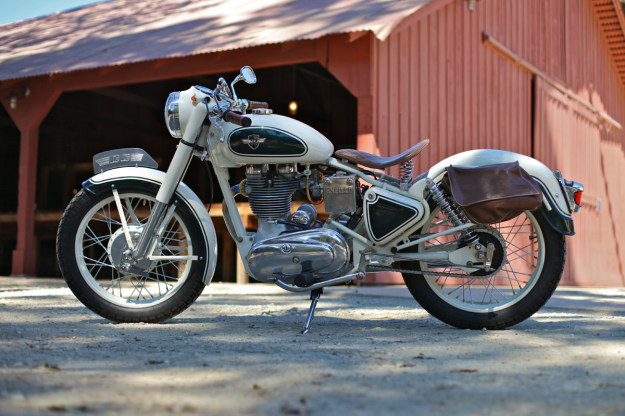
Chris Chappell's meticulously restored Royal Enfield Bullet 350.
For most pro builders, personal projects usually draw the short straw—relegated to the back of the shop by a steady stream of client work. Just like the “rusted out junk pile” that Californian Chris Chappell picked up a few years ago.

It’s a Royal Enfield Bullet 350, and it did a stint in Chappell Customs‘ front lobby before Chris finally tore into it. But when he did, it was a project free of deadlines, briefs or budgets. “The original plan was to build a radical bobber,” he says. “But with the little 350cc engine, it made more sense to keep it as an upright, fun-to-ride city bike.”

Chris Chappell's meticulously restored Royal Enfield Bullet 350.
The actual model year of this Enfield is a mystery: the original number plate indicated 1955, but no paperwork was filed prior to 1973. “The VIN numbers on old Enfields really don’t mean much, and there are no good records we can find to verify the year,” says Chris. So, to get the bike on the road, he went with 1973.

Given its age and the state it was in, the Enfield 350 needed a full, bare-bones strip down. Which started with a total rebuild of the engine using all-new, original Royal Enfield parts. A completely new top-end sorted out poor compression—”A combo of a bad cylinder and even worse valves,” Chris reports.

Chris Chappell's meticulously restored Royal Enfield Bullet 350.
Every nut and bolt on the Enfield was replaced, along with a host of other parts—except for the fuel tank, fenders and toolboxes, which Chris opted to keep. He blasted off the old paint and powder coated them in a creamy Oyster white, along with the frame. (“I left a few small dings here and there.”) Once the powder coating was done, green accents were added and the parts clear coated.

Chris Chappell's meticulously restored Royal Enfield Bullet 350.
The bike is now roughly five or six inches longer than a stock Bullet 350. “We relocated the rear swingarm, from its original position to what used to be the passenger footpeg area. Our friends at Works Performance made us a custom stainless swingarm bolt with tapered aluminum spacers, to fit the funky taper of the rear foot peg holes.”

Works also supplied a set of longer, dual-rate aluminum shocks to help the Enfield negotiate urban potholes. The rear fender struts were lengthened to fit the new geometry of the rear end.

Chris Chappell's meticulously restored Royal Enfield Bullet 350.
With the major work out of the way, Chris started poring over the smaller details: a handmade seat, grips and saddle bags in a rich leather with a cream stitch. “Seemed only fitting for a classy look to accent the cream and green color scheme,” he says. “I made the saddle bags myself … that was a first!”

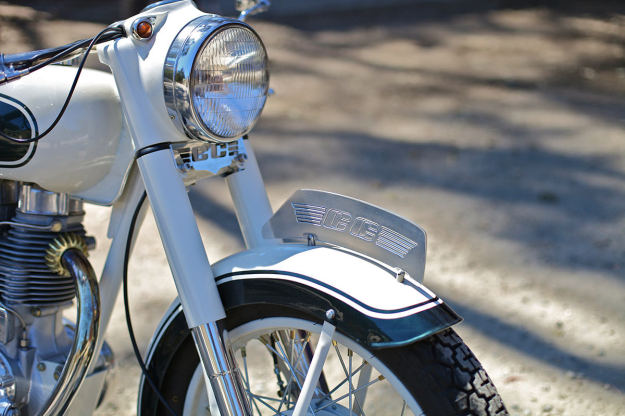
The seat mount is a hand-made part too; Chris CNC-routed a Royal Enfield logo into the aluminum, before mounting the seat on 3” springs. The CNC router was also put to work on the bespoke front number plate and fork badge. All the aluminum bits were then meticulously polished, “to bring back the original luster that was buried under years of oxidization and corrosion.”

The Enfield was then re-wired with updated components—including a smaller regulator and rectifier unit, and a new coil. Chris installed new gauges, lights and a set of “M” bars—with adjustable steering stops to prevent them from connecting with the tank.

Chris Chappell's meticulously restored Royal Enfield Bullet 350.
Despite the extensive mods, the little 350 is still not quite the perfect ride. “The drum brakes are poor, the right-side shift is odd, and you feel like you’re wide open on the throttle most of the time.”

“But regardless of its lack of power, you somehow feel like you’ve gone back in time. And it’s just fun as hell to ride around. The long, baffled muffler and the sound of the single cylinder thumping along always makes you smile!”

Chappell Customs website | Facebook

Chris Chappell's meticulously restored Royal Enfield Bullet 350.

The post Enfield 350: the bike that time forgot appeared first on Bike EXIF.

28 Sep 00:30

GoPro to launch budget friendly camera

by El Guapo

Along with the new Hero 4 models, GoPro will also be unveiling a less expensive entry-level action camera called the HERO.

LINK (via: PetaPixel)

27 Sep 23:10

1,695 Record Low Temperature Records Broken or Tied in Ten Day Period

Gateway Pundit, by Jim Hoft Posted By: JoniTx- Sat, 27 41 2014 11:41:35 GMT (Map, Chart) 1,695 record low temperature records were broken or tied in the US in a ten day period in September. Climate Depot reported: Wow. One record was broken by 25F!!!! 1695 Low Max Records Broken or Tied From Sept 11 to Sept 20 according to the NOAA. A “Low Max” means that the maximum temperatures for the day was the lowest it has ever been. This indicates daytime cooling. Below is a screenshot showing location and the biggest difference between old record and new record. (Snip) Then on September 23rd Barack Obama gave a speech to the United Nations
26 Sep 16:16

Earth's Water Is Older Than The Sun - And May Exist On Alien Worlds Too

by Brid-Aine Parnell, Contributor
Earth's water predates the formation of the Sun - and there might be more of it out there in the Universe.
26 Sep 16:16

7 Foods That Fight Back Against High Cholesterol

by Melanie Haiken, Contributor
Got high cholesterol? Lower your cholesterol naturally with these 7 heart-healthy foods.
26 Sep 15:52

Best + Brightest: Hollow Flashlight Runs on Your Body Heat

by delana
[ Filed under Science & in the Energy & Power category ]

flashlight powered by the heat of a palm

Remember that potato clock you made for your high school science fair? Apparently, the bar has been raised quite a bit. Ann Makosinski, a 15 year old student from Canada, made a flashlight for her science fair project – a flashlight powered entirely by the body heat of the hand holding it. To be fair to the rest of us, though, this wasn’t any old science fair; this was the Google Science Fair, a global competition that brings out the best and brightest in the 13 to 18 age range.

Makosinski used Peltier tiles to create the flashlight. These tiles produce electricity when they are heated on one side and cooled on the other. A temperature difference of just five degrees is enough to power the LED bulb on the Hollow Flashlight. When the ambient temperature is colder, the flashlight will receive more power from the user’s body heat and provide more light. The average amount of electricity generated by palm heat was about 57 milliwatts in tests, and only about half a milliwatt is required to light the LED.

hollow flashlight

The Peltier tiles are arranged around a hollow aluminum tube – hollow so that the inside can receive air that will cool the backs of the tiles. In tests, the flashlight worked for around 30 minutes, but its useful time could vary widely depending on ambient temperatures. If the flashlight were ever to be mass produced for sale, Makosinski says that she would make some tweaks to her prototype design to make the light more durable and efficient.

hollow flashlight inventor anna makosinski

Part of Makosinski’s inspiration for the project was her desire to reduce the use of disposable batteries. These single-use power sources are toxic and can leak harmful chemicals into the ground. But her invention can also be priceless in parts of the world where access to electricity is scarce. The inventor’s interest in harvesting sustainable energy that would ordinarily be wasted won her a $25,000 scholarship from Google.


Share on Facebook

[ Filed under Science & in the Energy & Power category ]

[ Gajitz | Archives | Categories | Privacy | TOS ]

26 Sep 15:52

Safety Seat: Ingenious Bike Seat Transforms Into a Lock

by delana
[ Filed under Transportation & in the Bikes & Cycles category ]

bike lock built into seat

Biking is supposed to be a convenient and relaxing way to get around, but so many bikers are saddled with the mental and physical baggage of trying to prevent theft. Some cyclists take their front tires with them when they lock their bikes up; others remove the seats. In most cases, they carry a big lock wherever they go to secure the bike at their destination.

bike lock integrated into the seat

seatylock bike seat becomes a lock

Seatylock is a novel answer to the worries of cyclists everywhere. It integrates a lock right into the bike’s seat, eliminating extra baggage while making it easy to keep your bike safe from thieving miscreants.

When you get to where you’re going, the entire seat comes off of the bike frame. Stowed underneath are a few metal arms that fold out to become a lock which loops around a bike rack or the nearest stable object. A quick lock with a small key and your bike is secure – all told, it takes about 30 seconds to remove the seat and secure the lock.

seatylock bike lock integrated in seat

seatylock bike seat with integrated lock

The Seatylock comes with an adapter that lets it fit onto just about any bike, and is available in both “trekking” and “comfort” models to suit your specific biking habits. A special safety adapter ensures that your seat won’t go wobbling off of its post mid-ride.

The team behind the unconventional lock clearly had a great time testing its strength if the video above is any indication. The Seatylock couldn’t be broken by chain cutters, a saw, or ice spray and a mallet. It can stand up to .6 tons of pressure, which is definitely strong enough to deter any hoodlums from taking off with your ride. Kickstarter pledges starting at $75 will get you a Seatylock of your own.


Share on Facebook

[ Filed under Transportation & in the Bikes & Cycles category ]

[ Gajitz | Archives | Categories | Privacy | TOS ]

26 Sep 15:51

DIY Folding Headset Takes Your Phone to Virtual Reality

by delana
[ Filed under Gaming & Geek & in the Gadgets category ]

1 google cardboard vr headset

Not all of us can afford to drop a few hundred dollars for an Oculus Rift, but wouldn’t it be cool to play around with virtual reality? Google has released a low-tech, low-cost VR headset that you can build from stuff you already have lying around.

2 google cardboard

3 folding virtual reality headset

To use Google Cardboard, you have to have an Android phone (sorry, iPhone loyalists) running Android 4.1 or above.

4 google cardboard folding cardboard virtual reality

5 virtual reality headset google cardboard

An open software toolkit lets developers create virtual reality apps easily. Google hopes the platform will encourage developers to build an accessible generation of immersive digital experiences.

6 google cardboard

7 folding cardboard virtual reality headset

Building Google Cardboard is as simple as gathering a piece of cardboard, lenses, Velcro, a rubber band, some magnets, and an optional NFC tag.

9 google cardboard smartphone virtual reality

10 smartphone virtual reality headset

The templates available for download on the Cardboard website include instructions for cutting and assembling the cardboard enclosure. If you choose to include an NFC tag, your phone will recognize when it’s put into the enclosure and automatically launch the Cardboard Android app.

11 google cardboard smartphone virtual reality

12 folding cardboard smartphone virtual reality headset

When you’re done cutting, folding, and gluing, Cardboard goes right up to your face like a View-Master. Google Cardboard’s images show a pre-cut piece of cardboard printed with instructions for putting it together, giving us hope that they will someday release an inexpensive pre-made kit that will let us unwrap. fold, and start playing within minutes.


Share on Facebook

[ Filed under Gaming & Geek & in the Gadgets category ]

[ Gajitz | Archives | Categories | Privacy | TOS ]

26 Sep 15:50

Texas Fireframe Fireplace Grate

by mark

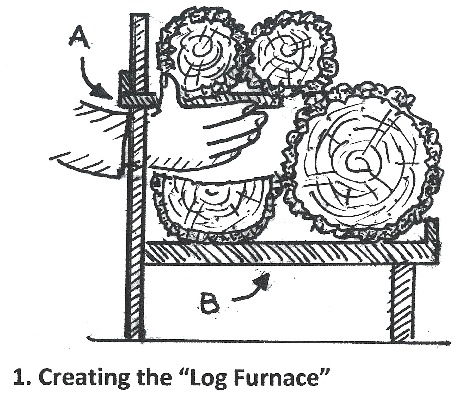
The Texas Fireframe is the best way to burn ordinary logs in your ordinary fireplace (that is, no pellets, no gas, no installation, no electric fans) and not have most of the heat go up the chimney. Going by the catchphrase/slogan, “The Physicist’s Fire,” this improvement on the fireplace grate permits an arrangement of the logs that forces the heat into the room. In fact, I can put my hand into the fireplace over the fire and hold it there for thirty seconds or more, but I have to lean in from the side, because the heat coming into the room is so intense that I can’t stand directly in front of the fireplace.

Unfortunately for the manufacturer, this thing — made of cold steel — lasts practically forever. In fact, I’ve used the first and only Texas Fireframe I ever bought for over thirty years. Still works as well as it did the first winter I had it.

Check out the diagram of how it works at the website, and you’ll probably have an “Of course!” reaction. It’s definitely a cool tool.

Screen Shot 2014-08-28 at 3.12.16 PM

-- Bob Leedom

Texas Fireframe
$95 to $215

Available from Texas Fireframe

26 Sep 15:49

President Obama created the world's largest protected area in the Pacific Ocean

by Carl Franzen

Back in early 2009, shortly before he left office, outgoing President George W. Bush created three massive protected areas in a few parts of the Pacific Ocean controlled by the United States (a move undertaken at the behest of then-First Lady Laura Bush). This week, President Obama moved to expand one of those areas, the Pacific Remote Islands Marine National Monument — which encompasses the waters around several island chains southwest of Hawaii — to six times its previous size. The resulting area protected area now covers about 490,000 square miles and is the largest marine reserve on the planet, as well as the largest protected area in the world.

Continue reading…

26 Sep 15:46

A Lesson In Cleaning Fish and Game From a 12-Year-Old

by David Draper

I’m a little late to the game with this great story from C.J. Chivers that ran in the New York Times last month. I had set it aside to read later and just now got around to it. Still, it feels timely, mostly because the act of butchering my elk is still fresh in my mind and the lesson taught by Chivers’ son is one that I can relate to. What 12-year-old Mick Chivers discovers is that even a finely filleted striped bass still hold some extra meat worth saving—meat he turns into a bowl of ceviche for his dad and brother.

Chivers writes:

“Soon [Mick] was at the cutting board and sink with his pile of striped bass scraps and a few Walla Walla and Red Zeppelin onions that he and [his brother] Jack had planted and grown.

“He quickly squeezed about a cup and a half of lemon juice and whisked in two tablespoons of olive oil. Then he sliced a half-cup of small, tangy rings from the garlic stems and chopped a few onions and hot peppers, which, for reasons we cannot explain, tended more to sweet than heat.

“Everything went into a bowl: bass scraps, garlic greens, onions, his lemon-juice-and-oil cocktail, all topped with a quick hail of sea salt. He turned it all over a few times with a wooden spoon.

“This is where I’d like to say that we let it soak for a few hours. We didn’t. The day was warm, the fish was cold and we were hungry. After 30 minutes or so we broke out the forks and the bowl, and sat down to a midsummer’s lunch.

“I’d like to say we didn’t drink the juice afterward. But we did.”

If you’re still cleaning fish, you can use Chivers’s description as a guide for your own ceviche, or if you’ll be processing some game animals this fall, keep Mick’s lesson at the front of  your mind. No matter how closely I cut out my backstraps, there always seems to be some meat left behind. If you’re in the same boat, don’t let it go to waste. You could mince it all up and make venison tartare. Or if raw game is not your thing, grind it separate to build a very special burger.

The point is, there are a lot of scraps there and with a little extra time and some fine knife skills, a hunter can not only pay further tribute to the animal he killed, but also make a very fine meal for himself.

26 Sep 15:38

Are You Getting The Most From Your DSLR?

by Saikat Basu
DSLR-Camera

The DSLR camera user guide is perhaps one of the most daunting collection of words ever written, but studying it is one of the necessities to get the most from your digital SLR camera. As beginners to digital photography, we have all skimmed through or avoided it altogether because we just wanted to get down shooting photos. There is something to be said for practice, but not at the expense of theory, which relates the camera’s features with proper usage. A great shot is a split second event. Getting it right is knowing which camera feature to use and when. So, a broader knowledge of...

Read the full article: Are You Getting The Most From Your DSLR?

23 Sep 17:49

Obama '09: F-22 Jets Used to Strike 'Outdated and Unnecessary'...