When you’ve mastered the art of persuasion, it’s easy to get people to do what you want . This video goes over six of the science-backed shortcuts you can use to start influencing others.
One of the best tools you can add to your EDC is a folding pocket knife. Along with generating light and making a fire, a sharp edge is one of the things human beings don't naturally produce or easily come by. Adding one to your kit means cutting down on the time spent on daily tasks, from opening a package to preparing food, even working on a hobbies like whittling or working with paracord.
One thing a knife doesn't have to be is expensive. Modern manufacturing techniques and the availability of quality materials means there's never been a better time to invest in a great knife without breaking the bank. Inexpensive doesn't mean cheap!
The best budget knives…
Use good materials. Many common steels competently hold an edge and sharpen easier than their more expensive counterparts. Common as they are, G-10 handles are actually unparalleled in terms of weight and toughness!
Stand out among their peers. In spite of their price point, these knives have unique features often found in their higher-priced counterparts. Even the most affordable Spydercos and Benchmades bear the trademarks of their creator, like the Spydie hole and the AXIS lock.
Are built to last. Our picks for 2015 weren't released this year, but their reliability in the hands of daily carriers made them timeless.
These are our picks for the best EDC knives you can buy this year if you’re on a tighter budget. They’re knives that time and time again answer the question "What knife should I buy?" The hundreds of appearances of these knives in carries on the site over the years speak for themselves. Even better: these knives are all under 3", making them a safe EDC choice for most parts of the world where larger knives are prohibited.
Under $15
Opinel No6 Carbon Knife
The Opinel No6 with its 2.875" blade takes all the classy, carbon steel goodness of Opinel's inexpensive knives and packs it into a useful and non-threatening size. You get the same high-carbon, razor-sharp X90 steel, beechwood handles, and Vibrobloc safety ring in a compact package you can easily slip into a pocket until needed. For all these reasons, it earned a spot in our first 15 Under $15 list of affordable gear (be sure to check out our second 15 Under $15 if you're looking for essentials to round out your carry on a budget!).
Kershaw as a manufacturer came out of nowhere, making top-notch knives for a fraction of the cost of their competitors. The Cryo fast became one of their most popular models by bringing high-end knife design, fit, and finish to a wider audience. Robustly built, it's designed by distinguished knifemaker Rick Hinderer. For quick deployment, its SpeedSafe flipper mechanism is a pleasure to use. Its handles with integrated framelock keeps things light and locked in. There are few knives out there that look this good with this many features at this price.
To no one's suprise, the Alox Cadet is one of the most recommended Swiss Army Knives in our forum. It has the legendary Victorinox quality, a surgical-sharp blade, and attractive aluminum handles that come in many colors. It's thin, light, and does many things flawlessly with its solid complement of tools. Best of all is its low price, making it once of the best value EDC knives — and multitools! — in the market.
No, not the Tenacious, but for good reason. The Persistence features the Tenacious' best features: 8Cr13MoV steel blade, milled G-10 handle, skeletonized steel liners, and trademark Spydie hole. The difference is in its length — a 2.75" blade means better compliance to local laws around the world. If you have bigger hands or need the extra cutting length, however, the Tenacious is still a viable option. Otherwise, the Persistance makes for a great value entry-level blade.
The Mini Griptilian features everything great about Benchmade's manufacturing and design. It has a useful drop point blade made of tough 154CM steel. Its ambidextrous Valox handles also give superior strength and stiffness while providing its namesake grip, and feature the trademark AXIS lock favored by many knife enthusiasts. It has the pedigree, features, and quality of its bigger brothers without the bigger price.
Ken White of Popehat fame has a great post out titled "How To Spot And Critique Censorship Tropes In The Media's Coverage Of Free Speech Controversies." For frustrated free-speechers, it's worth bookmarking and pulling out whenever the latest First Amendment nonsense-conversation begins jacking up your blood pressure to Joe Pesci levels. But it's also a must-read for journalists who wish to avoid making stupid mistakes.
White's nine tropes:
1) "Hate Speech"
2) "Like shouting fire in a crowded theater"
3) "Not all speech is protected"
4) "Line between free speech and [questioned expression]"
5) "Balancing free speech and [social value]"
6) "This isn't free speech, it's [category]"
7) "Fighting words"
8) "[Professor] explained…."
9) "This speech may be protected for now, but the law is always changing."
There's a lot of valuable Supreme Court citation in there, but I'd like to highlight this bit of media wisdom from #8:
Quoting professors about law is particularly risky, if your aim is an accurate and informative discussion of free speech law. If you call a physics professor and ask them what will happen if you drop your pencil, and why, he or she will say "it will fall, because of gravity." There is a relatively low chance that the professor will tell you "well, maybe nothing will happen" because he or she harbors the belief that the current gravitic regime is unfair and otherwise problematical. But when you call a professor of law, or political science, or journalism, and ask them a question about whether some controversial speech is protected by the First Amendment, there is an unacceptably high probability that you will get a quote expressing what the professor thinks the law ought to be. Sometimes the professor will flag a statement as an argumentative one, sometimes not. Moreover, some professors . . . . how can one put this delicately? Some law professors' views on how a court is likely to rule on an issue are untainted by exposure to actual courts.
I don't know whether Rand Paul's ongoing Senate talkfest will succeed in running out the clock on the Patriot Act, or (as he is seeking) opening up a debate and amendment process, but I do know that—just like his 2013 exercise—these have been some of the most invigorating hours on C-SPAN in recent memory.
1) Warrants need to be "individualized," because collective law enforcement is the root of much evil.
Paul's root opposition to the Patriot Act is that it is being used as the legal justification for the collection of bulk data against unsuspecting U.S. citizens who no one believes have committed a crime. His opposition to the reforming USA Freedom Act is that it still allows the government to compel third-party companies like Verizon to cough up 100 percent of its customer metadata.
Either way, Paul has stressed all day, this is antithetical to both the Fourth Amendment and the American tradition of individual rights. Collective guilt is what underpinned the segregationist horrors of the Jim Crow south, and of the indefensible internment of Japanese-Americans during World War II. The people who really need the Bill of Rights, he has said, are not the prom queens and homecoming kings, but people who are in a disfavored minority, whether ideological, religious, or racial.
2) Internet/telephone/data companies should put up "unified resistance" to federal compulsion to turn over user data.
It’s not every day that you see a sitting U.S. senator calling for straight-up civil disobedience. But in an era where the Supreme Court has yet to definitively rule on the third-party doctrine governing what intermediaries have to do when requested by the government to cough up all user data, building up a bigger culturalexpectation of privacy is crucial if our credit-card data and cloud storage is going to be proferred traditional 4th Amendment protection.
3) "We're using the Patriot Act to put [drug offenders] in prison."
One of the least remembered scandals in the Summer of Snowden is that the Drug Enforcement Agency has been collecting bulk metadata with all the same gusto as the National Security Agency, even though the DEA is supposed to enfore the law on U.S. citizens who are afforded protections from the Constitution. In fact, the DEA has been using the NSA's data. Patriot Act mission creep might not be news to Reason readers, but that makes it no less indefensible.
4) "Government by cliff is a recipe for disaster."
That's a quote from Sen. Mike Lee (R-Utah), not Rand Paul, though the two have long agreed about this principle. The Patriot Act expires at the end of May. "It's been three years since we've known this date is coming," Paul said. Why in hell hasn’t there been a debate, with amendments, in the Senate? Why does Capitol Hill lurch from cliff to cliff, instead of actually do the job of governing? I suppose this bad habit of mind is good for certain opportunistic politicians with a sense of theater, but it's just lousy for the country. The Republicans run the joint; the dysfunction is now squarely on them.
5) "It was done by executive decree, it can be undone by executive decree."
Paul has continuously bemoaned President Barack Obama's civil-liberties switcheroo when in office, a topic he talked with me about in a September 2013 (bottom of the post). As he rightly points out, most of the actions civil libertarians are complaining about are pure inventions and executions by the executive branch. If the president cares about this stuff as much as he occasionally pretends to be, he can actually stop collecting the metadata.
6) The government is "using records to gain entrance to people, and then tak[ing] their stuff without conviction."
The connection between civil asset forfeiture and NSA surveillance might not be immediately obvious, but Paul has done a bravura job in making the link. A government that can take your money—even if you are never charged with a crime—because it doesn't like the way you deposit it in your bank, is a government that should not be trusted with holding all your seemingly innocuous third-party information.
7) "The Constitution is an end to itself."
That's another one from Mike Lee (who, it should be stressed, is wholly in favor of the USA Freedom Act, which Paul opposes on grounds that it still allows for bulk collection of metadata). Too often people try to locate their defense of the founding document on utilitarian grounds; actually, it's a noble blueprint all on its own.
8) We shoulda listened to William Binney.
William Binney was a crucial, pre-Snowden NSA whistleblower. Don't know who he is, what he saw, how he was threatened, and why he's worried about America’s "totalitarian" turn? Read this Nick Gillespie interview with the guy.
9) "The director of national intelligence…wasn't telling the truth."
Director of National Intelligence James Clapper famously lied to Congress under oath about the collection of bulk metadata on millions of Americans. All afternoon, Rand Paul has used the word "lied" to describe what Clapper did. It is bracing to watch government misbehavior called by its proper name.
10) "The presumption of innocence is an incredibly important doctrine that we shouldn't so casually dismiss."
The fact that this has to be said on the floor of the U.S. Senate is appalling. The fact that it is being said at least offers a little hope.
Amid lots and lots of interesting, and wonderful to hear on the floor of the Senate, stuff from Rand Paul in his just-concluded talk about all the reasons why the Patriot Act needs to go and the USA Freedom Act needs to be amended before it's passed was a quick quote from a name that doubtless most people hearing didn't recognize: Smedley Butler.
The quote was either a direct statement or paraphrase of Butler's "There are only two things we should fight for. One is the defense of our homes and the other is the Bill of Rights."
But that Paul had the nerve to mention Butler in a positive way was a great, if obscure and possibly easy to overinterpret, sign for those who love Paul for his tendencies toward reining in America's tendencies toward war.
Butler, himself a highly honored major general in the Marine Corps, is author of an incendiary tract called War is a Racket in 1935, beloved of antiwar folk ever since. Christopher Coyne summed it up for us here at Reason nicely back in 2012:
"War is a racket. It always has been. It is possibly the oldest, easily the most profitable, surely the most vicious. It is the only one international in scope. It is the only one in which the profits are reckoned in dollars and the losses in lives."
So begins U.S. Marine Corps Major General Smedley Butler's 1935 pamphlet War is a Racket. Butler, who had participated in many military interventions, came to realize that war allowed elites to gain while less powerful citizens and foreigners bore the conflict's financial, physical, and emotional costs. Citizens, policymakers, pundits, and scholars have yet to internalize Butler's warning.
Indeed they haven't, which is why it's great, even though the words "war is a racket" in their full Butlerian meaning likely never won't come from Rand Paul's lips, to hear Butler's name mentioned in the filibuster-ish peroration today. (Paul similarly named a more thoroughly libertarian secret hero, Lysander Spooner, in his 2013 anti-drone filibuster.) These sort of reminders that Rand Paul comes from the curious and unique background of radical anti-state and anti-war thinking are always nice for those of us who hope for a Rand Paul who doesn't forget the rich heritage of libertarian and libertarian-ish thought. And today's Rand Paul was a pretty pure hero.
Sheldon Richman wrote in praise of Butler for Reason last year, which also helps contextualize why it's delightful to find Butler is on Rand Paul and his team's mind. Butler's plan to rein in our military is bracing by anyone's standards and glad to see Paul not so afraid of any guilt by association that might be involved for daring to speak Butler's name:
in 1936 [Butler] formalized his opposition to war in his proposed constitutional "Amendment for Peace." It contained three provisions:
The removal of the members of the land armed forces from within the continental limits of the United States and the Panama Canal Zone for any cause whatsoever is prohibited.
The vessels of the United States Navy, or of the other branches of the armed service, are hereby prohibited from steaming, for any reason whatsoever except on an errand of mercy, more than five hundred miles from our coast.
Aircraft of the Army, Navy and Marine Corps is hereby prohibited from flying, for any reason whatsoever, more than seven hundred and fifty miles beyond the coast of the United States.
Of course, to the likes of Lee Fang, mentioning Butler is apparently a sneaky sign Paul is secretly planning a big-business-sponsored coup--the kind of thoughtless, malign guilt-by-association that even Fang likely isn't dumb enough to think means anything worth saying, though he hopes some of his readers might be. [UPDATE: Fang insists in tweets to me that I misread him and he meant nothing untoward toward Paul by tweeting: "Rand Paul bringing up Smedley Butler, who was recruited by businessmen to plot a coup against FDR, during Patriot Act filibuster speech"--his only direct tweet about the filibuster itself--and that he "wanted to flag just which Smedley Butler Rand Paul was mentioning, in case folks didnt get ref." I'm keeping the rest of the post below as written because I do believe that a left-leaning reader would very likely take his original tweet out of any understanding of any further context the way I took it.]
To the extent that Butler's story of being called upon by sinister big business interests for a coup is true, which is not adequately proven, he was the hero of it who refused the role and tried to expose it. (Butler had an anti-big-business streak that likely rubs many modern libertarians the wrong way, though his reasons were largely for its role in shifting state action to its own ends and working against those of the rest of us.)
But just waving your hands and linking Rand Paul to "businessmen" and "coup" will doubtless add to many thoughtless leftists hating Rand Paul even more (even as he's one of the few national politicians standing up foursquare for some of their alleged values).
Those elected to office, and those appointed to it also, took oaths to uphold the Constitution. All in government, from presidents to park rangers, from generals to janitors, from judges to jail guards, take substantially the same oath. But very few who have taken their oaths take them seriously, laments Andrew Napolitano.
In fact, very few have actually read the Constitution, or at least very few understand the values it upholds. Most who took those oaths did so expecting someone else in government to tell them what the Constitution means and how to deal with it. But the whole purpose of the Constitution is to limit the government, not to unleash it. Personal liberty is the birthright of all persons, argues Napolitano, and government is essentially the negation of that liberty.
A video clip from the very first American Sportsman TV show, 1963 pilot program. It was filmed as a fishing competition between two Argentines, Tito Hosman and Erick Gornick versus two Americans, Joe Brooks and Curt Gowdy on Lago General Paz, Argentina. During a horrific wind storm the fisherman were unable to compete, so Joe gives a casting demonstration… into the wind.
Beginning at Big Lagoon State Park near Pensacola, extending around the Florida peninsula and Keys, and ending at Fort Clinch State Park near the Georgia border, the Florida Circumnavigational Saltwater Paddling Trail (commonly referred to as The CT) is a
Desk covered in junk? Give the vital things a place to belong and give the rest a Viking funeral. To that end, here are some of the best desk organizers out there right now.
A change in the law will allow photographers to pay rent on their homes and studios with ‘exposure’ instead of money. They will also be able to buy coffee, shampoo, and other essentials by mentioning to the checkout assistant that they did a big job last week for nothing and are hoping it will bring them some paying clients.
Landlords and supermarkets are protesting this move on the grounds that “Well what the hell am I supposed to do with ‘exposure’? I can’t pay my bills with fresh bloody air! Why can’t you just give me money like every bugger else?”
The controversial new change will allow photographers to pay for their homes and studios by doing freebies for people that want pictures of their spoiled daughter at her expensive Sweet Sixteen party, pictures of their hair-brained new business idea, or a range of merchandise they plan to sell on eBay.
“This is a very good deal, and I can’t understand what you’re all moaning about,” the owner of an online sausage website states. “I own a big sausage factory, and when people see that you have photographed my famous sausages, you’ll be beating off paying clients with a mucky stick. Everybody knows that’s how it works. If you think about it, I’m actually doing you a favor by letting you photograph my sausages.”
Photographers themselves are saying that they don’t care how famous a company’s sausages are or how many wealthy parents will be at your daughter’s swanky party that cost a grand to put on.
“As the old saying goes: if you pay peanuts you get monkeys,” says one professional photographer. “It used to be that if you planned to pay in imaginary benefits, good luck with your imaginary professional photographer, and the top notch professional service that you won’t be receiving. They’ll probably throw in imaginary re-touching and shoot it on a fictional Hasselblad as well.”
“But with this new change in the law, I can actually pay the rent on my studio by spending the whole afternoon photographing someone’s annoying children for nothing. I can even get a free coffee in Starbucks by whipping out my portfolio and showing them all the many hours of retouching I did on some bright orange teenager whose mum told her she could be a model.”
“This has revolutionized the field of photography, and I couldn’t be more delighted.”
“This is absolutely outrageous,” says a spokesperson for the National Landlords Association. “How can anyone in their right minds hope to pay for goods and services with ‘exposure’? If we’re forced to accept the promise of future work in lieu of actual money, we’re all going to go bankrupt!”
Editor’s note: Just in case you didn’t catch it, this article was a work of satire and not meant to be taken seriously as news.
About the author: The Beezly Street Gazette is a satirical UK news blog, that publishes spoof articles on photography and other creative industries. You can read all of the satirical photography articles here. This article originally appeared here.
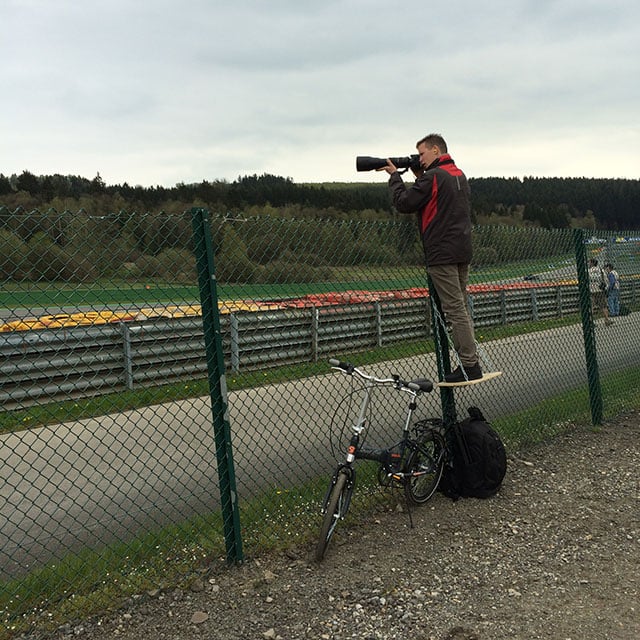
Hobbyist photographer and motor racing fan Carlo Bingen was at a race at the Circuit de Spa-Francorchamps in Belgium yesterday when he cane across this photographer taking pictures over the chain link fence. While many people would be content with shooting through the fence gaps with a telephoto lens, this guy created a DIY platform that lets him stand over the top.
Bingen tells us that the simple platform was created with a metal chain, some carabiners, and a panel of wood. You simply find where you want to mount it to, attach the carabiners to the fence, and it’s ready for you to step on. Here’s a closer crop of the photo:
This could be a useful thing for some photographers to make and carry around in their camera bags — especially if it can be recreated with strong yet lightweight materials.
Image credits: Photographs by Carlo Bingen and used with permission


 Ken White of Popehat fame has a great post out titled "How To Spot And Critique Censorship Tropes In The Media's Coverage Of Free Speech Controversies." For frustrated free-speechers, it's worth bookmarking and pulling out whenever the latest First Amendment nonsense-conversation begins jacking up your blood pressure to Joe Pesci levels. But it's also a must-read for journalists who wish to avoid making stupid mistakes.
 There's a lot of valuable Supreme Court citation in there, but I'd like to highlight this bit of media wisdom from #8:
 I don't know whether Rand Paul's ongoing Senate talkfest will succeed in running out the clock on the Patriot Act, or (as he is seeking) opening up a debate and amendment process, but I do know that—just like his 2013 exercise—these have been some of the most invigorating hours on C-SPAN in recent memory.