The new Range Rover Velar may boast luxury through modern simplicity, but it's hard to go more basic than pure analog.
...Read More »
The new Range Rover Velar may boast luxury through modern simplicity, but it's hard to go more basic than pure analog.
...
Layer 1… Layer 2… Layer 3… ad infinitum. Think of layers as transparent plastic sheets organized on top of each other and the picture is clear. But poor organization can turn them into stacks of newspapers — and a recipe for disaster when it comes to any photo editing work. Layers are at the core of Adobe Photoshop. Maybe as a beginner, you have put off using Photoshop layer management tricks for later. But organization is as much a habit as it is a priority. Just think of yourself on the receiving end: someone just sent you a PSD file with...
Read the full article: 3 Photoshop Layer Management Tips for Beginners

Vimeo is known best as the video-sharing site preferred by indie filmmakers. But did you know that there are a handful of secrets and lesser-known details about Vimeo that you probably weren’t aware of? Here they are in no particular order. 1. An HBO Show Started on Vimeo HBO’s comedy series High Maintenance actually started out as a web series on Vimeo. The show provides little vignettes as a Brooklyn pot dealer delivers his wares to his clients around the city. Vimeo continues to step up its original content with Vimeo originals, with a commitment to support female filmmakers. Resulting content has included a...
Read the full article: 5 Surprising Facts You Didn’t Know About Vimeo

Depending on where you live and which websites you visit you may have noticed the internet acting up on Tuesday (Feb 28, 2017). Countless websites were disrupted, and millions of people were affected. And now, thanks to Amazon admitting the truth, we know how it happened… According to Amazon’s pithily titled “Summary of the Amazon S3 Service Disruption in the Northern Virginia (US-EAST-1) Region” a single typo was responsible for taking down the internet. And no, that’s not a typo. One small mistake by an unfortunate engineer killed the internet for several hours. Have You Tried Turning It Off and...
Read the full article: How a Typo Temporarily Took Down the Internet

A bug out bag can be a lifesaver in helping you deal with the unexpected, as long as it's filled with the right gear.
Even if you've got a good emergency bag to haul around, picking out what to put in it can be a daunting task.
What's in your bug out bag should reflect your own needs and situations. For example, keep in mind what events you're preparing for, your plan of escape, who's going with you, and so on.
While all of this can be highly personal, most bug out bags do share a few fundamental core essentials.
If you need help starting your own bug out bag kit, we've put together this checklist to give you an idea of what bases you should have covered.
This list should give you a good foundation for starting your BOB, but feel free to sub in your preferred products for each category and add anything else you'll need.
Bug Out Bag Checklist
✓ First Aid Kit
In an emergency situation, planning ahead for a possible injury is extremely important. Having a good first aid kit as part of your bug out bag is essential. This one comes with the traditional bandages and shears. It also comes with a survival blanket, compass, and poncho.
✓ Emergency Radio
An emergency radio is essential for finding out rescue and safety information. The Kaito KA500 is a good radio for this, and more. It integrates a solar panel and dynamo for charging if the power grid fails. It also has a built-in USB rechargeable battery pack for your personal devices.
✓ Fire Source
Being able to start a fire to keep warm at night is important. The easiest way to get this done is with a lighter. Zippo lighters are popular for this for a reason. They provide a reliable light when others fail, even when it's a bit windy.
✓ Multi-tool
Space and weight is a premium and there isn't room to carry around individual tools in your bug out bag. It's better to carry a good multi-tool instead. The SOG PowerAssist offers easy, assisted one-handed operation. SOG's compound leverage system also makes the pliers on this tool easier to use than others.
✓ Flashlight
When disaster strikes, you're going to want more than the light on your keychain or the flash on your cell phone. A dedicated light is the best tool for the job and it deserves a spot in your bug out bag. The Anker LC90 offers 900 lumens in a small water resistant package. It's also rechargeable via USB.
✓ Dry Food
Food is energy, and without food it will be hard to power through and get out of an emergency situation. With these S.O.S. 3600 calorie food bars, you'll have safe food on hand no matter what happens. They have a five year shelf life if you keep them sealed.
✓ Water Bottle and Purifier
Water is an absolute essential in any survival situation. You can last a bit without food, but go for long without water and you'll be in deep trouble fast. The LifeStraw Go is unique from other water bottles in that it integrates a water purifier. Once you run out of the safe water you put in it to start, you can deal with questionable water sources with it if needed.
First time prepping a bug out bag? Leave a comment and let us know what you're planning to include. For more experienced EDCers, what are the top 3 must-have items for a BOB?

Your EDC knife says a lot about you. And while any standard everyday carry knife can get the job done, chances are it'll raise some eyebrows and awkward questions depending on when and where you use it. That's why carrying something that can fly under the radar is often a good idea. A tactical folder probably isn't the best fit for this, especially when you need to dress up a bit for the occasion. What you want is something your coworkers won't bat an eye at. Something that looks as sharp as it cuts. That something, for a lot of EDCers, is a gent's knife. Thankfully, there's a wide variety to choose from when it comes to gent's knives. In this guide, we'll focus on 10 of the more “old school” options with traditional designs and timeless charm.
What's a gent's knife?
A gentleman's knife, or gent's knife, is deeply rooted in tradition. In the old days, it was simply unbecoming to carry something like a large knife in polite company. Instead, people carried pocketknives made with premium materials that reflected their taste and social status.
Even though they are made to add a touch of class to your ensemble, they aren't made just for show. The gent's knife is practical, but it isn't a run-of-the-mill utility knife. The gent's knife is beautiful, but it isn't going to be a futuristic-looking tactical blade.
For a large segment of the EDC community, only knives derived from the traditional forms fit the bill. Classic gent's knives either lack a locking mechanism, or they rely on older technology like slipjoints and lockback designs.
Now that you've got an idea of what a gent's knife is, check out these 10 excellent options.
The Best Gentleman's Folders for EDC
Opinel No. 8
The venerable Opinel No 8 is an affordable introduction to classic EDC gent's knives. It has an extremely sharp blade, making cutting tasks a breeze. It also comes in an assortment of beautiful wooden handles for you to choose from, including rare and exotic styles. The Opinel also has a twist collar lock that lets you hold the blade in place for more strenuous work.
Fallkniven U2
The unique blade steel is what sets the Fallkniven U2 apart from the rest of the knives on this list. It's made of Super Gold Powdered Steel, an extremely high carbon alloy that has incredible sharpness and edge retention while remaining durable enough for daily use in your EDC. It's also ambidextrous, with nail nicks on both sides and a symmetrical handle.
Buck 110 Folding Hunter Knife
If you're looking for a larger knife, the Buck 110 is your best bet. It has a sharp 3.75" 420HC blade with a sturdy lockback. When this knife came out in the 1960s it became famous both for its great looks and because it locked up reliably enough to be used like a fixed blade.
Boker Wine Knife
If you want a classic gent's knife that'll do more than just cut, this one comes with a bottle opener, corkscrew, and flathead screwdriver.
Case Small Texas Toothpick
The Texas Toothpick is a long and slender slipjoint knife that's great for opening up envelopes and cardboard boxes. Its unique blade shape makes it easy to slot it into small spaces. Just don't pry things open with it, it definitely isn't made for that.
Douk-Douk
The douk-douk is based on a traditional French design, and it strikes a slimmer and longer profile compared to the Opinel. With its high-carbon steel blade, it can be honed to incredible sharpness. Just make sure to take care of it to avoid rust. The douk douk also lacks a locking mechanism of any sort, making it easier to carry around legally in more places.
Higo no Kami
Traditional gent's knives aren't just from the West. The higo no kami is a traditional friction folding knife from Japan. It's designed so that the pressure you exert while holding the handle when the blade is open is enough to keep it in place for most light work. It has a brass handle and a tanto blade shape that is perfect for piercing tasks despite its small length.
Al Mar Hawk Classic
The Hawk Classic is a lockback that features a small yet capable 2.5” AUS-8 blade. It's incredibly lightweight at just 1.5 ounces. You'll badly notice it until you need it. You can make this knife your own by choosing from a large number of available handle materials including mother of pearl and cocobolo.
Schrade Old Timer Gut Hook
The Schrade Old Timer Guthook combines classic gent's folding lockback styling with a gut hook for dressing fish. It isn't just for the outdoors, though. When the blade is closed, the gut hook remains partially exposed. This helps you cut things like twine and rope without having to get the whole thing open.
Great Eastern Cutlery Lick Creek
A purist will tell you the only acceptable gent's knife has multiple blades on a slipjoint. The Lick Creek model from Great Eastern Cutlery is one of the best within that criteria. It has a pair of slipjoint blades: a spear point for general use and a smaller, secondary pen blade for precision cutting (or to keep a sharp edge just in case). This particular style has a more minimalist appeal to it, with a clean ebony wood handle and sterile steel bolsters.
This is the perfect pasta recipe to utilize excess ground venison and wild hog still in the freezer

This pasta recipe takes delicious to the next level with a savory ground venison and wild hog meat sauce.
When making a guest list for a dinner party where this wild game pasta recipe will be served, DO NOT invite anyone who gives you venison or wild hog meat. They will likely ask for the recipe to cook it themselves; your organic protein source will disappear!
Serves: 6-8
Prep time: 30 minutes
Cook time: 4.5 hours
Ingredients:
Directions:
1. In a food processor, pulse the onion, carrot, celery, garlic, oregano, red pepper flakes and 1/4 cup parsley until finely chopped; transfer to a small bowl and set aside.
2. Purée tomatoes with juices in processor; set aside.
3. Heat oil in a large heavy pot over medium heat; add sausage and cook, breaking up with a spoon, until browned. Add ground meat and bacon, season with salt and pepper, and cook, breaking up with a spoon, until no longer pink. Using a slotted spoon, transfer to a plate.
4. Increase heat to medium-high. Add reserved vegetable mixture to drippings in pot, season with salt and cook, stirring often, until golden, about 8-10 minutes.
5. Stir tomato paste and 1 cup water (or red wine!) in a small bowl; add to pot. Cook, scraping up any browned bits from bottom of pot. Bring to a boil, reduce heat and simmer until liquid has almost evaporated, about 6-8 minutes.
6. Add reserved meat and tomato purée and 1 cup water (or red wine!). Bring to a boil. Reduce heat; simmer, adding more liquid as needed to keep meat nearly submerged, until meat is tender, about 4 hours. Season with salt to taste.
7. About a half-hour before serving, boil pasta in lightly salted water until al dente, or slightly chewy. Drain and add to sauce, stir and continue to cook.
8. Serve in individual bowls, garnished with the remainder of the chopped parsley and a few shavings of Parmesan cheese.

The backbone of this homemade wild game ragu pasta sauce is a combination of ground venison and wild hog.
About this Recipe
If you’re French, a slow-cooked stew of meat and vegetables is a ragout. Here, in the New World, led astray by the name of a commercial spaghetti sauce, it’s ragu. In either instance, this wild game version is worth the effort.
I’m not a hunter of anything bigger than an Osceola turkey, but I’m lucky to be on the receiving end of wild meat gifts from my hog and deer hunting buddies. And when my freezer starts to overflow with packages of ground venison and wild hog, I start thinking “ragu.”
You need to set aside an afternoon to make a proper ragu. The cutting, chopping and browning don’t take long, nor does it take lots of specialized kitchen equipment. A large covered skillet and a pot to boil a couple of quarts of water will do.
If you’re cooking tonight’s dinner, start at noon. Another option is to cook the sauce, hold on preparing the pasta, and chill in the fridge or freeze for later. You’ll be amazed how well this wild game pasta sauce tastes after it has rested a day or so. FS
This recipe was first published in Florida Sportsman Magazine November 2015 issue.ssue.
The post Venison and Wild Hog Pasta appeared first on Florida Sportsman.





From left: Scratch proprietor Phoebe Lawless; Apple pie. (Photos by Lissa Gotwals; Johnny Autry)
“I know the look of an apple pie that is roasting on the hearth on a winter’s evening, and I know the comfort that comes of eating it hot, along with some sugar and a drench of cream.” So wrote Mark Twain in his autobiography. In the 1870s, toward the end of a long European tour, he compiled a lengthy list of all the American foodstuffs he would indulge in upon his return home, including no less than four variations of the humble dessert.
Like Twain, Southerners recognize the power of pie. We’ll pull out the rolling pin for almost any reason—to comfort a sick friend, to welcome a new neighbor, to attend a family reunion, to celebrate the holidays. There’s a pie for every season. In honor of National Pie Day, we rounded up some of our favorite Southern pie shops. After all, not everyone has a baker in the family.
PieLab
Greensboro, Alabama
Pie brings people together. That’s a fact PieLab founder and Alabama native Seaborn Whatley was counting on when he opened this shop, which also serves as a community center and employs at-risk youth, in tiny Greensboro, Alabama. Staples like chocolate chess, cherry, and bourbon pecan are made using Whatley’s grandmother’s crust recipe. And he’s not sharing—the recipe at least. You can have all the pie you like, though. Try, the signature apple.
Proper Pie Co.
Richmond, Virginia
While you’ll find sweet standards like pumpkin, pecan, and lemon meringue, folks seek out this Richmond bakery for its savory offerings. New Zealand native Neil Smith serves up the hand-pies of his homeland, featuring simple straightforward ingredients. The popular chicken and kumara (the Kiwi name for sweet potato) pie includes those two ingredients, plus gravy and fresh tarragon.
Red Truck Bakery
Warrenton and Marshall, Virginia
At both locations of Brian Noyes’ Virginia bakery, you’ll find classic double-crust and Streusel crumb apple pie, pecan, chocolate bourbon-pecan, and savory traditional mincemeat year-round. As spring and summer bring fresh fruit to the kitchen, check for seasonal specialties. Ignore the calories and go ahead and tack on a hunk of their signature moonshine cake to your pie order.
Scratch Baking
Durham, North Carolina
Owned and operated by pastry chef Phoebe Lawless—a four-time James Beard Award nominee—Scratch dishes out elevated Southern classics like brown butter pecan, heirloom apple, buttermilk, and sorghum shoo fly pies. This spring in the Bull City, Lawless will open the Lakewood, a casual neighborhood restaurant and bar serving lunch and dinner, along with a second Scratch location and a wholesale bakery to supply her sweet treats to area chefs.

Shaker lemon pie at Scratch. (Photo by Lissa Gotwals)
And one we hope reopens soon:
The Pie Shop
Atlanta, Georgia
With more than a hundred flavors rotating through her menu, Atlanta baker Mims Bledsoe served a pie (fried, hand, whole, or bite-sized) to satisfy every sweet tooth. Last summer, though, she shuttered her popular Buckhead location and is still on the hunt for the perfect new home. Until she reopens, check her website for seasonal orders or whip up one of the watermelon chiffon pies she shared with G&G last summer. Find the recipe here.
What are your favorite Southern pie shops? Let us know in the comments below.




There's just something about black and white photos that exude class and sophistication.
That's on full display in the featured image above. The woman would be beautiful in a color shot too, but in black and white, the lines of her body, the contrast of her pale skin against the dark background, and the soft, even lighting turn this into a show-stopping photo.
Granted, not all black and white photos are winners, and unlike some photographers think, black and white shouldn't be the go-to treatment to try and rescue images that are poorly lit, not composed well, or suffer from some other malady like blurriness.
That means that though black and white photography can be more forgiving, it shouldn't be treated like a rescue project for bad photos.
Instead, with the right approach and preparation, black and white photos can turn into gorgeously elegant shots, no matter the subject.
Let's examine a few black and white photos to see this elegance in action.

There is elegance in simplicity, and this portrait of a little girl demonstrates that concept well.
Not only does the close-up view of her face put the fine details of things like the texture of her hair and her freckled skin on full view, but the black and white conversion serves to make those details stand out even more.
Even her eyelashes take on more prominence without the distraction of color to take the eye away from the abundance of textures and shapes in this portrait.
This image also shows how a lower contrast black and white image can be quite fetching. Note that there are still bright whites and dark blacks, but that they take a backseat to the abundance of middle grays. The result is a feeling of calm and serenity that jives well with the sweet innocence of the little girl.

Then again, there is something to be said about the visual impact of a portrait with greater contrast.
Like the featured image, the image above benefits from strong areas of light and dark, giving the portrait a sophisticated, high-fashion look.
In this instance, the lines created by the model's dress and hat help accentuate the richness of the shot.
Often, using lines in black and white photos is a primary tool for incorporating more interest. In this case, those lines also help elevate the image in terms of elegance.

Even a simple photo of a flower takes on a different visual impact when the image is converted to black and white.
But simply converting the image in post-processing won't get you results like those seen above.
In this instance, great care was taken to create an environment in which the delicate petals of the flower take on the elegance of a jewel.
The lighting had to be just right to get this effect - bright enough to highlight the texture of the flower's petals, yet focused enough such that the light falls off quickly and doesn't illuminate the background.
In this case, we see again how crucial contrast is to a successful black and white photo: the pure black background helps the bright highlights of the flower seem as though the pop off the screen.

High-key black and white images might not be as common, but I think you'll agree that they have their place in terms of creating a high-impact shot.
This image is an ideal example of taking a subject with tons of visual appeal and ramping up that appeal with a level of contrast that's both in your face and beautiful at the same time.
The trick to creating an effective high-key photo is having the right background.
In this case, the bright white backdrop is an ideal complement to the delicate and intricate features of the dandelion. What's more, since the background is devoid of features, we get a full view of the dandelion's lines, form, and other details.

A photographic element that can take a black and white photo to another level is texture.
As seen here, the texture of the elephant's skin adds depth and dimension to the shot. The horizontal lines of the mother's skin contrasts nicely with the vertical grass in the foreground, creating a visual playground for the eye.
Note as well the position from which the photo was taken: by getting low to the ground, the photographer is able to create a scene in which the elephants are more imposing. Even with that powerful stance, the elephants have a graceful look about them that just couldn't be achieved had this image remained in color.

If you've ever seen an Ansel Adams landscape, you already know how a black and white treatment can result in a stunning, stylish take on the world around us.
Much like is central to the success of a portrait or a photo of nature and wildlife, landscapes benefit from the inclusion of things like areas of highlight and shadow.
In this case, the lightness of the water combines with the darkness of the clouds and the trees in the background to create a classic black and white look with excellent dynamic range. Like the portrait of the little girl above, the abundance of middle grays helps give this shot an increased sense of tranquility and calm - effects that are mirrored in the still waters of the lake.
In that regard, converting this image to black and white doesn't just make it a more elegant shot, it helps accentuate the themes that are already present.
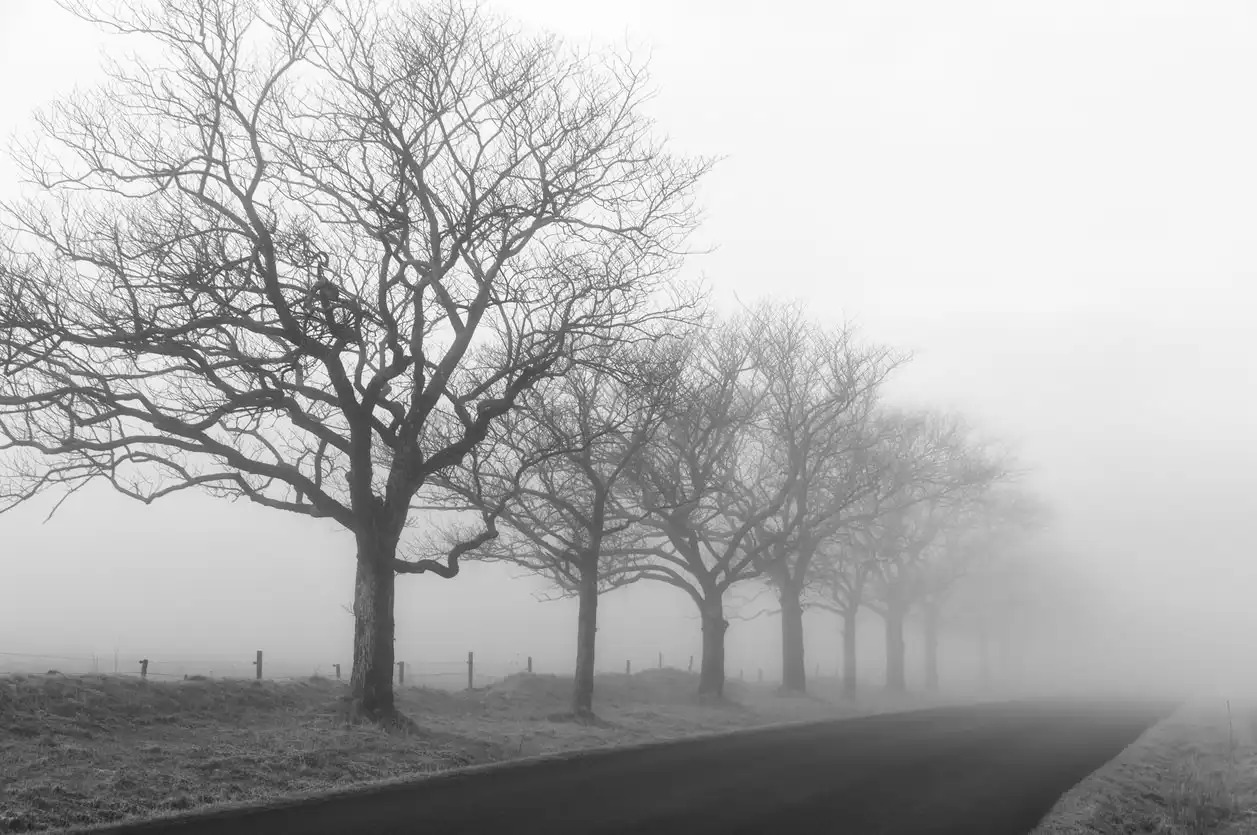
If you ask me, there's something mystical and mysterious about fog that gives landscapes an extra level of visual interest.
But when fog is combined with a black and white conversion, that feeling of mystery is only enhanced.
The key to an impactful black and white foggy shot is to include strong visual elements that grab the eye's attention.
In this case, the strong, linear lines created by the tree trunks offer a nice juxtaposition to the ether of the fog.
What's more, the repeating pattern of the trees gives the image some structure, which, again, is crucial for a black and white photo, no matter the subject. Without the benefit of color, things like lines, textures, and patterns help give the eye something on which to focus.

I noted earlier that there is beauty in simplicity. And though some might be hesitant to go the simple route when creating an abstract photo, I can see the value of doing so when that simplistic, abstract scene is presented in black and white.
In the example above, the high-key background helps put the gentle lines and curves of the dark fabric on full view.
The manner in which the fabric seems to be waving in a gentle breeze is chic, a quality that is only enhanced by the contrast of the dark and light tones in the shot.
This image is proof positive that you don't need tons of detail to create a compelling black and white photo. Contrast, lines, and texture will carry you a long way!

Because black and white photos can be, at times, much more elegant than color photos, you can get away with photographing objects that might seem odd or even mundane.
In the image above, a jet's engine becomes an interesting subject because of the black and white treatment.
The strong lines created by the engine's fan provide structure similar to the tree trunks I discussed in the landscape image above.
Working with that structure is lighting that offers just enough contrast that gives the photo needed depth, but without blowing out the highlights.
Notice on the left side of the frame how the light is gently reflected off the engine's blades. That bit of light contrasts beautifully with the darker recesses of the engine, the result of which is a classic image of a subject that usually goes without notice.

Speaking of everyday objects...
This photo of an array of light bulbs puts the notion of contrast in a black and white image on full display.
With a single bulb illuminated, we have a bright, featureless area of highlight that works nicely with the dark, shadow-filled corners of the shot.
What's more, that light helps illuminate the intricate and interesting details of the surrounding light bulbs - details that add visual impact to the shot.
Again, as noted earlier, repeating patterns give structure to black and white images. In this case, the array of lights helps elevate this photo with a polished and refined look that helps these everyday objects take on a greater sense of luxury and elegance.
With that, you've got 11 beautiful examples of how converting your images to black and white can garner gorgeous results.
Just remember that when looking for subject matter for a black and white shot, focus on things like light and shadow, texture, lines, and patterns, as each of these features will enhance the stately appearance of the subject.
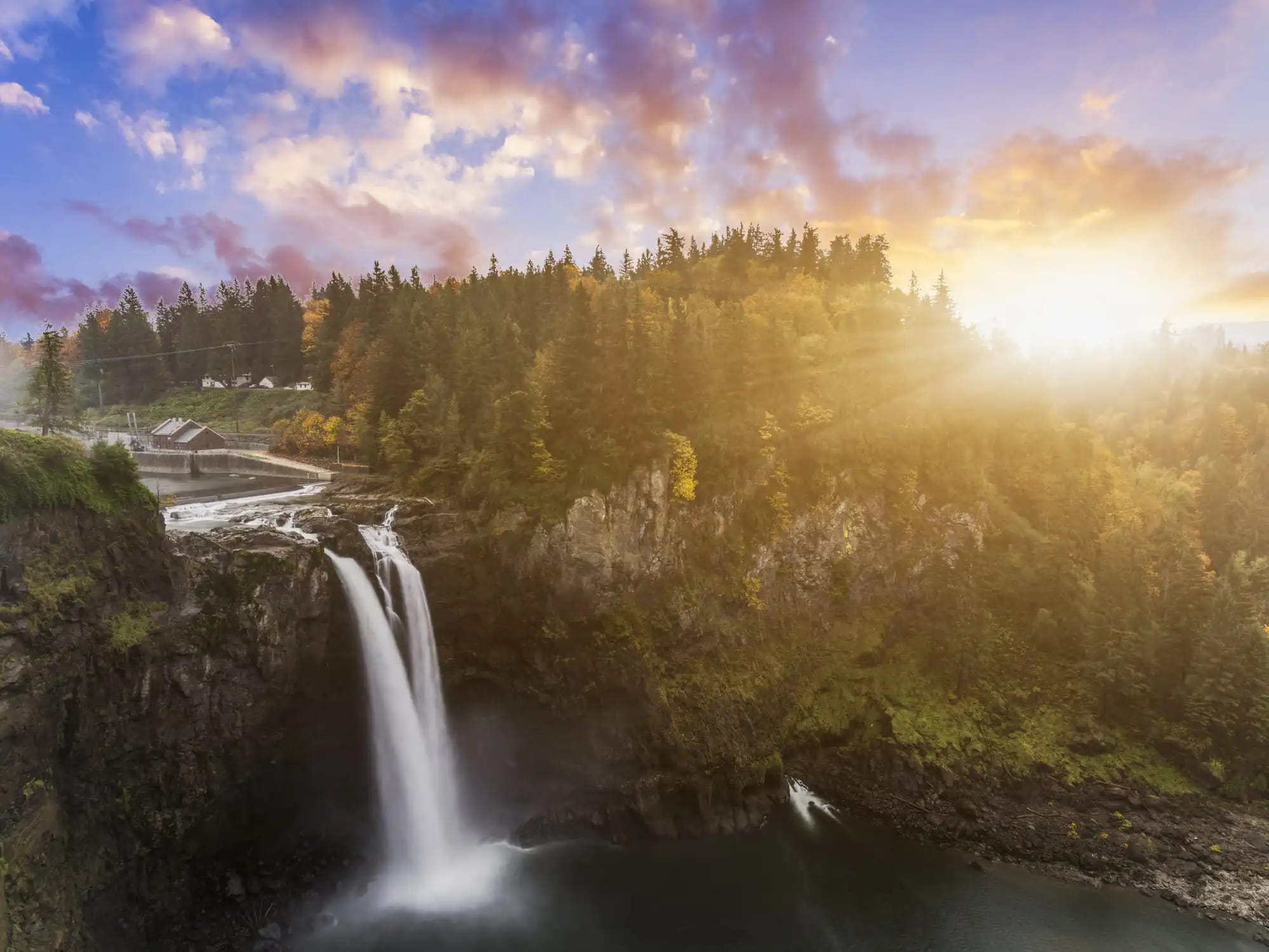
We continue our Mastering Filters series today with an in-depth discussion of 5-stop solid ND filters. As a whole, ND filters allow you to control the exposure, thus increasing the length of time you can leave the shutter open, even during daytime shooting. The results of using a 5-stop solid ND filter can be quite breathtaking, as I think you’ll agree by looking at the featured image above!
Creating breathtaking images like that with a 5-stop ND filter is a lot easier than it might seem. Let’s explore a little bit more about 5-stop ND filters and see just what sort of benefits they provide you as you explore the world of long exposure photography.

There’s no shortage of subject matter to photograph with a 5-stop solid ND filter. With one of these filters, you can photograph streams, waterfalls, and rivers such that they have smooth, milky water as seen above. You can also lengthen light trails on passing cars as seen above, such that their headlights and taillights stream across the width of the frame.
For more advanced subject matter, you can use a 5-stop solid ND to enhance camera movements like panning and swiping - the filter allows you to extend the shutter time, thus enhancing these effects. Additionally, a 5-stop filter is ideal for shooting in low-light conditions, such as at dusk - the filter extends the shutter speed to 15 seconds, allowing you to create highly dramatic movement effects.
What’s more, you can photograph these subjects at a wider aperture, thus minimizing diffraction on your long exposures. Additionally, with a wider aperture, you can enhance bokeh and soften backgrounds that might otherwise distract the viewer’s eye. Better still, pair your 5-stop ND filter with strobes or other light sources to get even better lighting effects on your subjects both indoors and out.
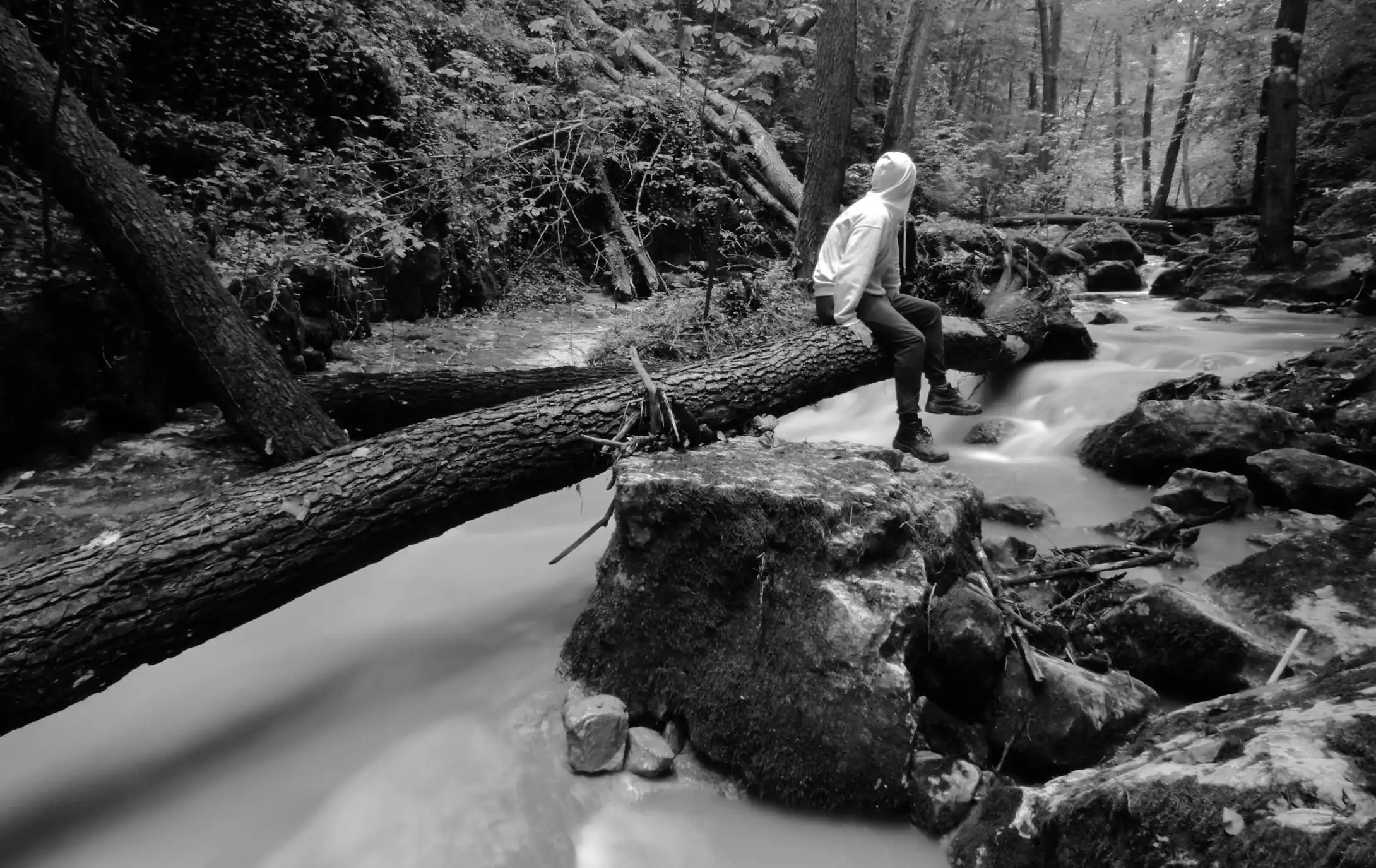
Of course, photographing the subjects listed above requires a certain amount of time to get the effects just right. When you use a high-quality solid ND filter, you can shoot in all sorts of lighting conditions using varied times because it’s 1.5 density darkens the whole image, giving you access to slower shutter speeds than normal.
For example, in bright light, a 5-stop filter can turn a 1/250 second exposure into a 1/8 second exposure, thus allowing you to get dreamy long exposures even in the daytime. In low light situations, such as under overcast skies, a 1/2 second exposure becomes a whopping 16 second exposure with a 5-stop solid ND. Just think of the photography possibilities with that kind of filtering power!
What’s more, you can pair your 5-stop solid ND with a variable ND filter for even more possibilities for effects. By adding a variable ND, you can more easily eliminate reflections from the scene, such as the sun reflecting off the water, while increasing the density up to 13 stops. You could also choose to go with a combination of a 5-stop solid ND filter plus a Duo polarizer for 13 stops of filtering power.
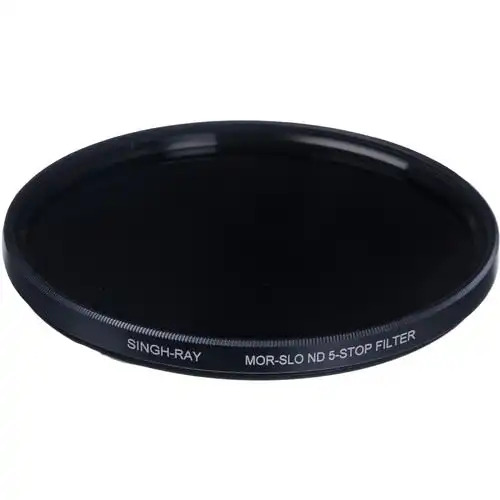
Just like any photography gear you buy, it’s critical that you pay attention to the build quality of the filters you purchase. Many photographers mistakenly believe that one filter is just as good as the next, but this could not be further from the truth. As with camera lenses, with filters, you definitely get what you pay for.
If you want the best results, look for a filter like the Singh-Ray Mor-Slo 5-Stop Solid ND. These filters are made from high-quality, polished glass that get you clear, sharp images that maintain neutral color fidelity. Singh-Ray’s filters are known for being well-built so they stand up to the uses and abuses of everyday photography adventures. What’s more, you want to find a filter manufacturer that offers multiple sizes to fit a variety of lenses. Singh-Ray ticks that box as well, offering 25 different variations of their 5-stop solid ND filter, from circular filters to square, thin rings to standard rings, and a range of sizes from 49mm to 105mm circular filters and 84x84mm to 150mm x 150mm square filters. Custom sizes are available as well.
So, as we’ve detailed here, the possibilities for expanding your photography are virtually endless with a 5-stop filter. From indoor portraits with artificial lighting to long exposures in the city of passing vehicles to smooth, milky waterfalls in the forest, the 5-stop solid ND filter can go anywhere you’d like and help you get images with unparalleled sharpness and clarity. Just be sure when you select a filter that you choose a brand, like Singh-Ray, that’s got a reputation for building a quality product.

Havasupai, which translates to people of the blue-green water, has been home to the Havasupai Native American tribe for hundreds of years. Set along a southern tributary of the Colorado River just outside the boundaries of Grand Canyon National Park, this land now attracts thousands of visitors every year, many of whom make the pilgrimage on foot down from the lip of the canyon to the water below. Since Havasupai is so high up on most adventurer’s bucket lists, you’ve probably seen pictures of it on Instagram – of the milky turquoise waters, the lush greenery, the high, red rock canyon walls.
But let me let you in on a not-so-secret piece of information: those photos that fit on your phone screen barely do it justice. Experiencing Havasupai must be on your list of places to go in 2017.
This past fall, I signed up for a Shoestring Adventures trip to Havasupai that took me and a dozen other adventurers from around the country down into the canyon to swim in that magical water for ourselves. I took a plane, drove a rental car, camped in a parking lot, and backpacked in ten miles to see Havasupai for myself. And I would travel for twice as long to do it all over again.
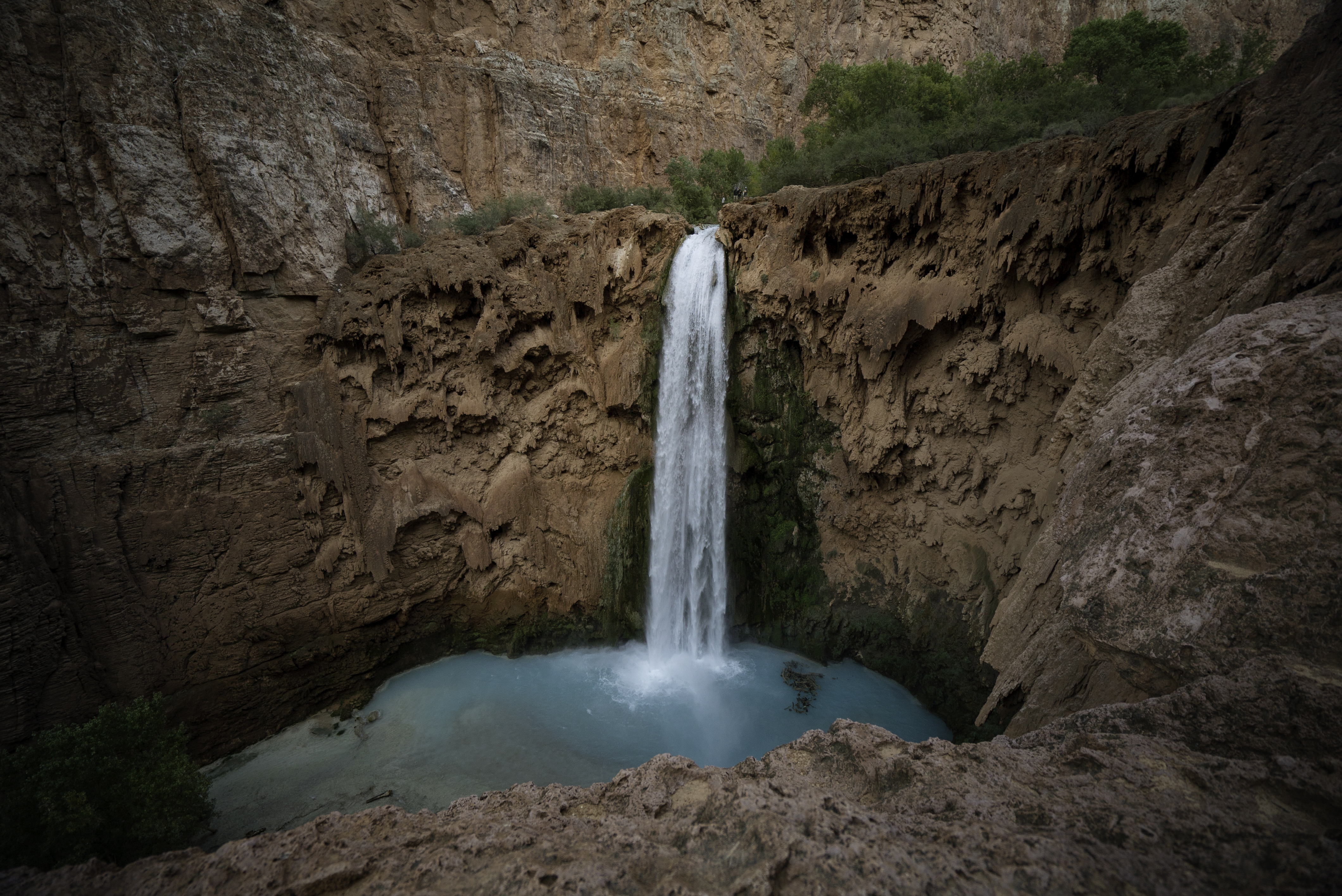
Since Havasupai is in the generally warmer southwestern part of the US, spring, summer, and fall are all good times of year to make your trip. That being said, I’d recommend early fall for a variety of reasons – less stifling heat, no bugs, fewer people, and less chance of flash floods, which are most common during monsoon season from July through September.
But regardless of what season you choose, you can’t go unless you get a reservation. Write this down, make yourself a calendar invite, set a reminder on your phone – all reservations for Havasupai become available on February 1st at 9 am mountain time. (More on exactly how to get that reservation later!)
"In the months leading up to your trip, it's a good idea to get yourself in the best physical shape you can."
Unless you live close enough to drive straight to the trailhead, you’ll likely be flying into the Las Vegas McCarran International Airport and driving from there. Set flight trackers through Google or a site like Yapta.com to get alerts when fares drop.
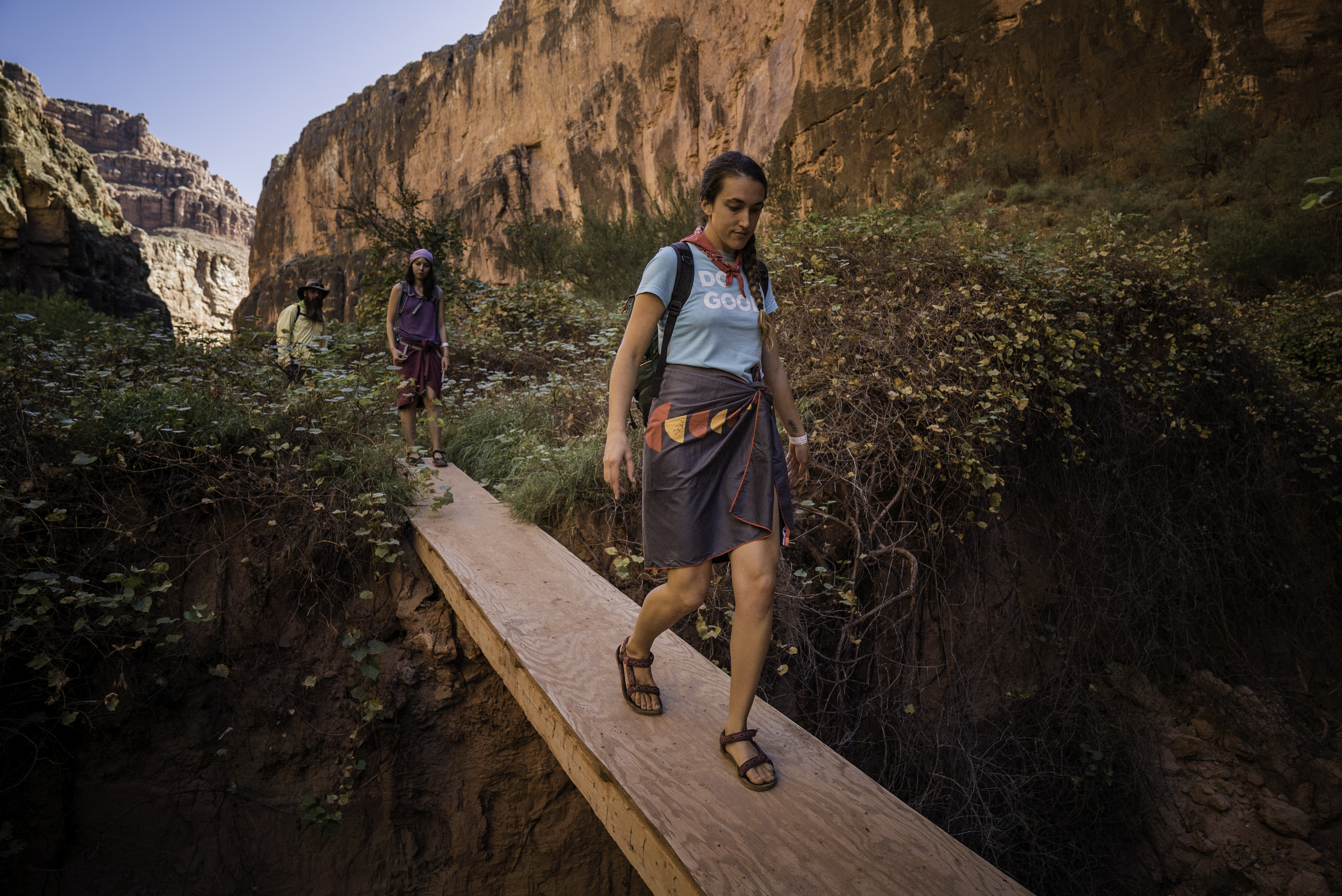
In the months leading up to your trip, it’s a good idea to get yourself in the best physical shape you can. From the trailhead to the campground, the hike is 10 miles, and when you’re descending 2,400 vertical feet over the course of those miles, it can be pretty strenuous (especially when you’re carrying a heavy pack). “I highly recommend training for this trip,” says Alyx Schwarz, the founder of Shoestring Adventures. “Start with shorter hikes and gradually increase your miles and vertical gain. Join a local hiking Meetup group for motivation!”
Want to do some reading on Havasupai before you go? You can read a few of Alyx’s favorite online resources here, here, and here.
"Call every day, as frequently as you can, to secure reservations"
Okay – the big question. Reservations at Havasupai are notoriously hard to come by, but the trick is this: balancing patience and persistence. As mentioned, reservations are only taken by phone starting February 1st at 9 am MT. “Be persistent!” says Alyx. “Call every day, as frequently as you can, to secure reservations. Have a list of preferred dates and back-up dates ready for when you get through. Also have a pen and paper handy to write down your confirmation number.” Not successful in the first round? You can also call a few days before you’d like to make a trip to see if there are any last-minute cancellations. You can find all the phone numbers here.
Reservations are required to stay the night at Havasupai, and day hikes are not permitted. As for fees, you must pay them at the time you make your reservations.
After arriving at the Las Vegas airport, you’ll have four hours of driving ahead of you from the city deep into the desert. Your destination is Hualapai Hilltop parking lot, the trailhead down to Havasupai. There’s nothing close by in the way of lodging, so your best option is to camp here the night before; yes, it’s a tad windy (if you can get a rental car big enough to sleep in, spring for it), but it also means you’re able to get up at the crack of dawn and start your hike early enough to beat the heat of the day.
"Make a stop in Las Vegas to buy everything you need, including drinking water"
Just as there’s no lodging on the drive to Hualapai Hilltop, you won’t come across grocery stores to buy food for your trip. (Though there is a small general store in Supai Village, it’s best to have everything you need on you when you begin the hike, including all your meals.) Make a stop in Las Vegas to buy everything you need, including drinking water – there’s no potable or filterable water source at the trailhead, so you’ll need to have enough for the night you’re camping at Hualapai and the entirety of the hike down the next day.
Be sure not to leave valuables in car at the hilltop; while there are frequently tribe members up there and a night watchperson, it’s not guaranteed that there won’t be an opportunity for someone to break in. If you absolutely have to leave any possessions in your car, try to make sure they’re locked away in the glove compartment or tucked out of sight.
As already mentioned, flash floods are a very real danger when you’re in a canyon. Monsoon season runs from July through September, and during this time, extreme rains can fall at a moment’s notice, causing the water levels of Havasu Creek to rise drastically and require an evacuation of the campground into Supai Village. Learn the signs of flash floods, check the weather conditions before your trip, and have an evacuation plan just in case.
These same months are also very hot, so consider hiking as much as you can before dawn on the way down or back up to avoid heat exposure on the trail, where, after a certain point, there isn’t much shade. Alyx’s tips to combat heat exhaustion or over-exposure: stay hydrated, replenish electrolytes, wear protective clothing, and make sure to continue applying sunscreen throughout the day.
In the summer, mosquitos can also be an issue. Make sure to bring bug spray.
Rodents are present in the campground, so be sure to have an odor-proof bag or bear canister to store your food while you’re sleeping or away from camps. Never leave food or scented items out and unattended; you will draw unwanted animal attention.
"packing light is key on the 10 miles to and from Havasupai"
Just like any other backpacking trip, packing light is key on the 10 miles to and from Havasupai. Think about exactly what you’ll need in terms of meals, clothing, and gear, and bring just those things – since what makes this backpacking trip different is that there are more than your average backcountry resources available to you at your destination. Along with the general store at the bottom, there are donkeys that you can hire to take you and your gear out of the canyon. However, I’d always suggest making the trip on your own two feet – it’s part of the experience. So pack light, people.
And yes, they can be dorky, but hiking poles can come in really handy when you’re hiking up and down so much incline. If you’re worried about your knees, it’s a worthy option to absorb some of the impact. I used them and had no regrets.
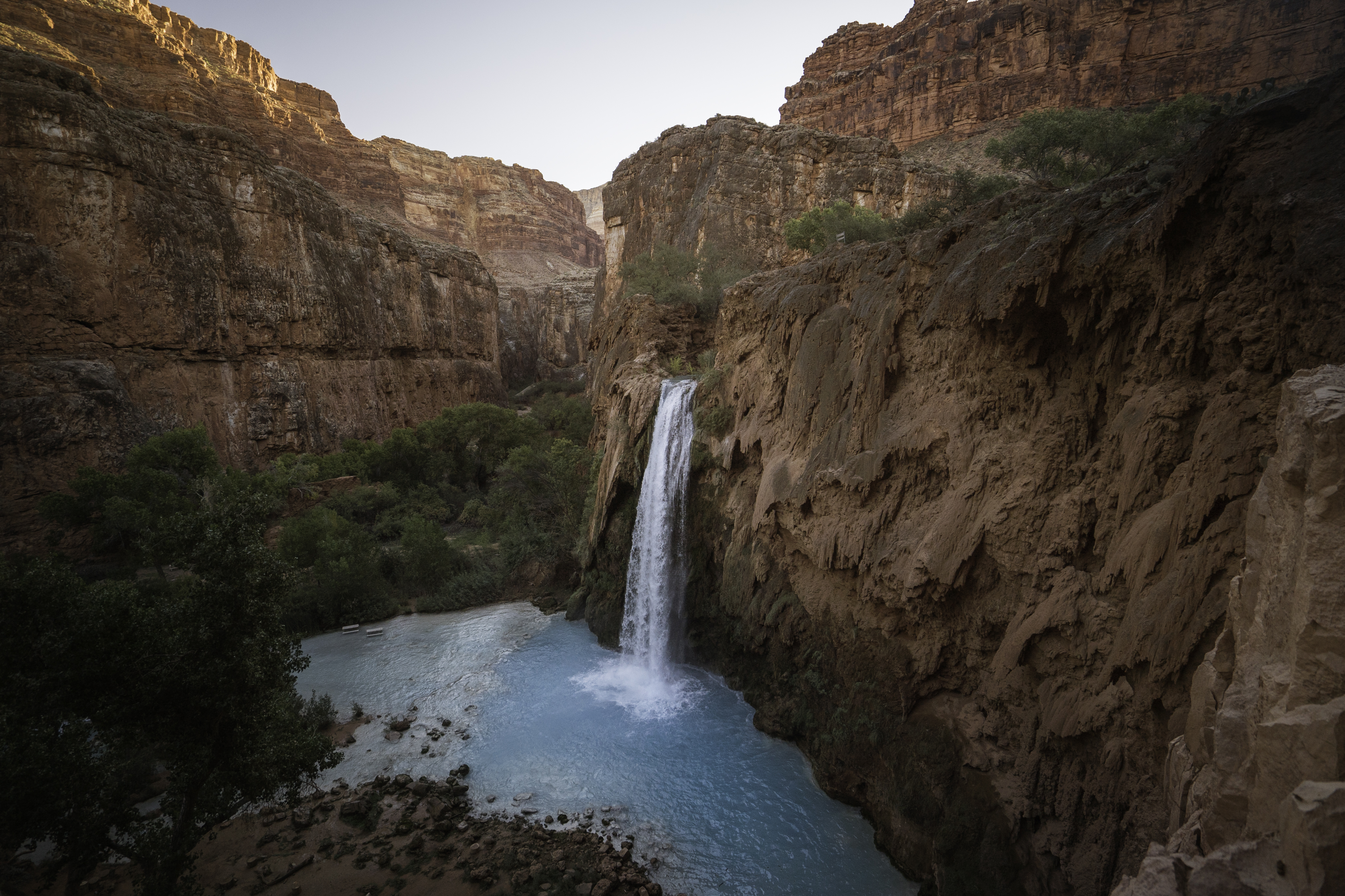
Once you’ve made it down to Supai Village (it’s eight miles to the village, and another two to the campground), “Have your confirmation number and the name of the person who made the reservation handy,” suggests Alyx. “They will give each person a wristband that you must wear for the duration of your trip. They will also give you a tent tag, which will be checked daily by a ranger. If you have a large group, be sure to hang your tent tag where it is easily visible.”
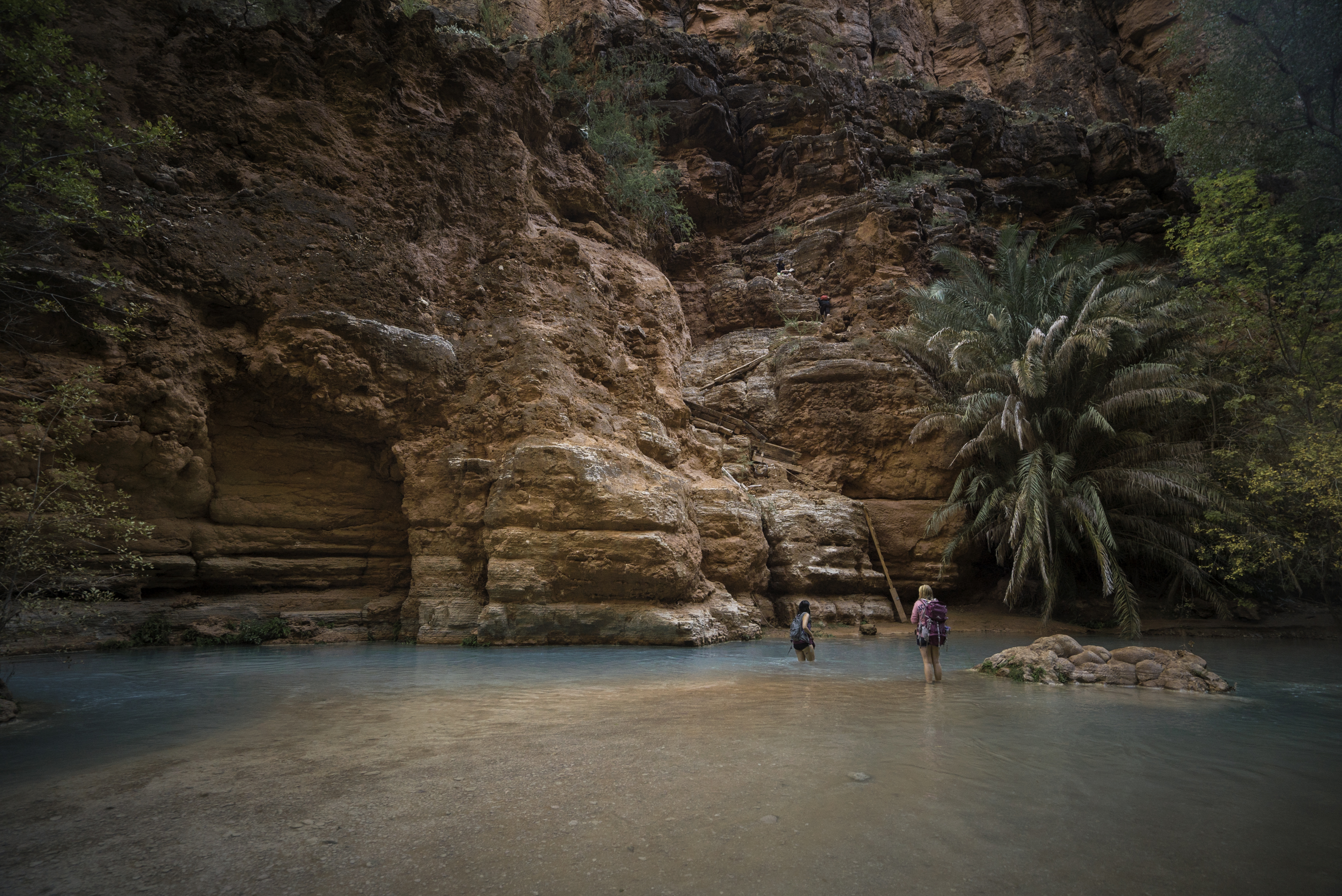
And when official business is taken care of, it’s off to the campground with you! The campground is huge, extending for a few hundred yards following the bends of Havasu Creek. Find an open spot and set up camp. The campground has composting toilets and drinking water available, and you can also drink the water straight out of the creek – but we’d recommend a filtering system that filters out debris as well as bacteria.
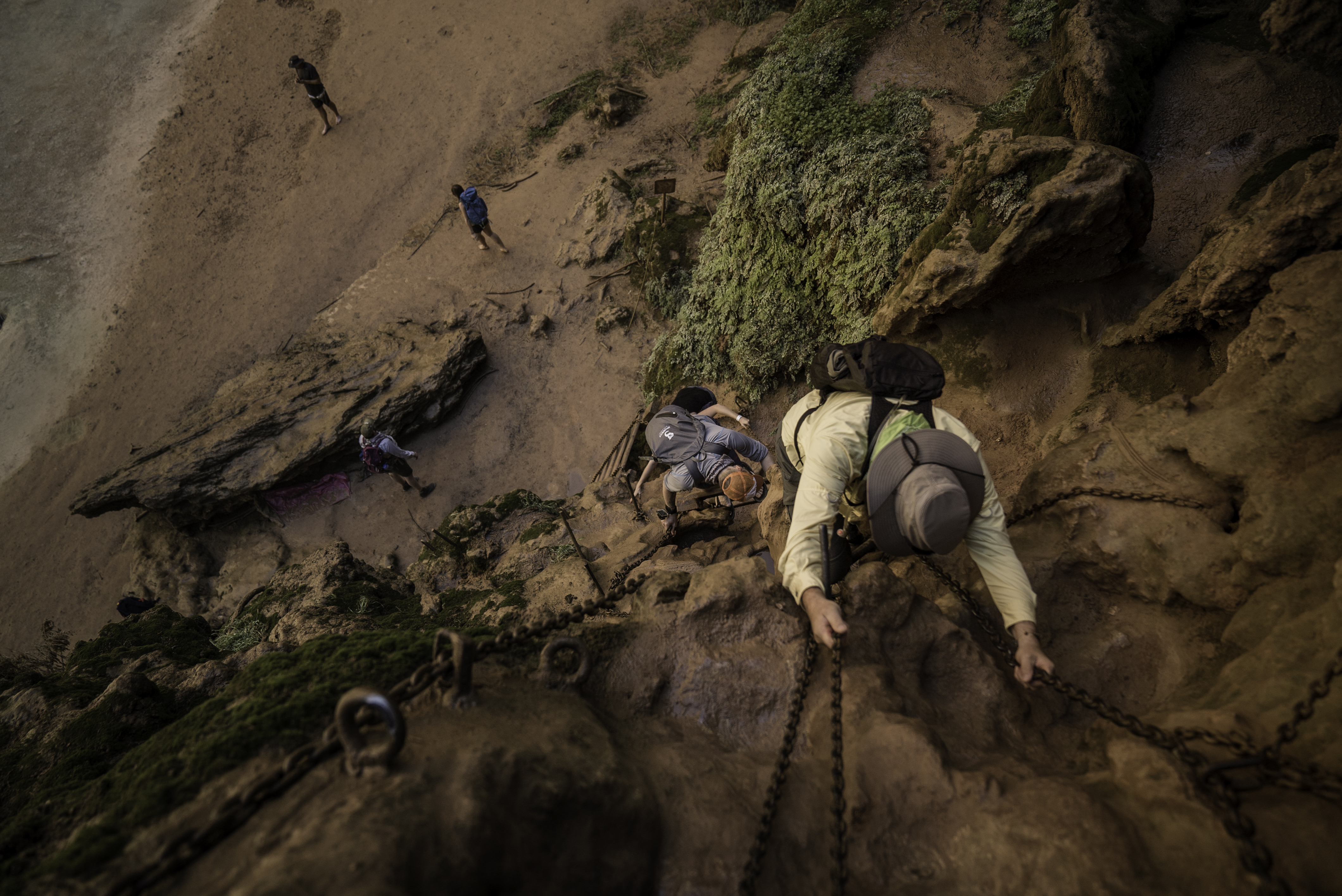
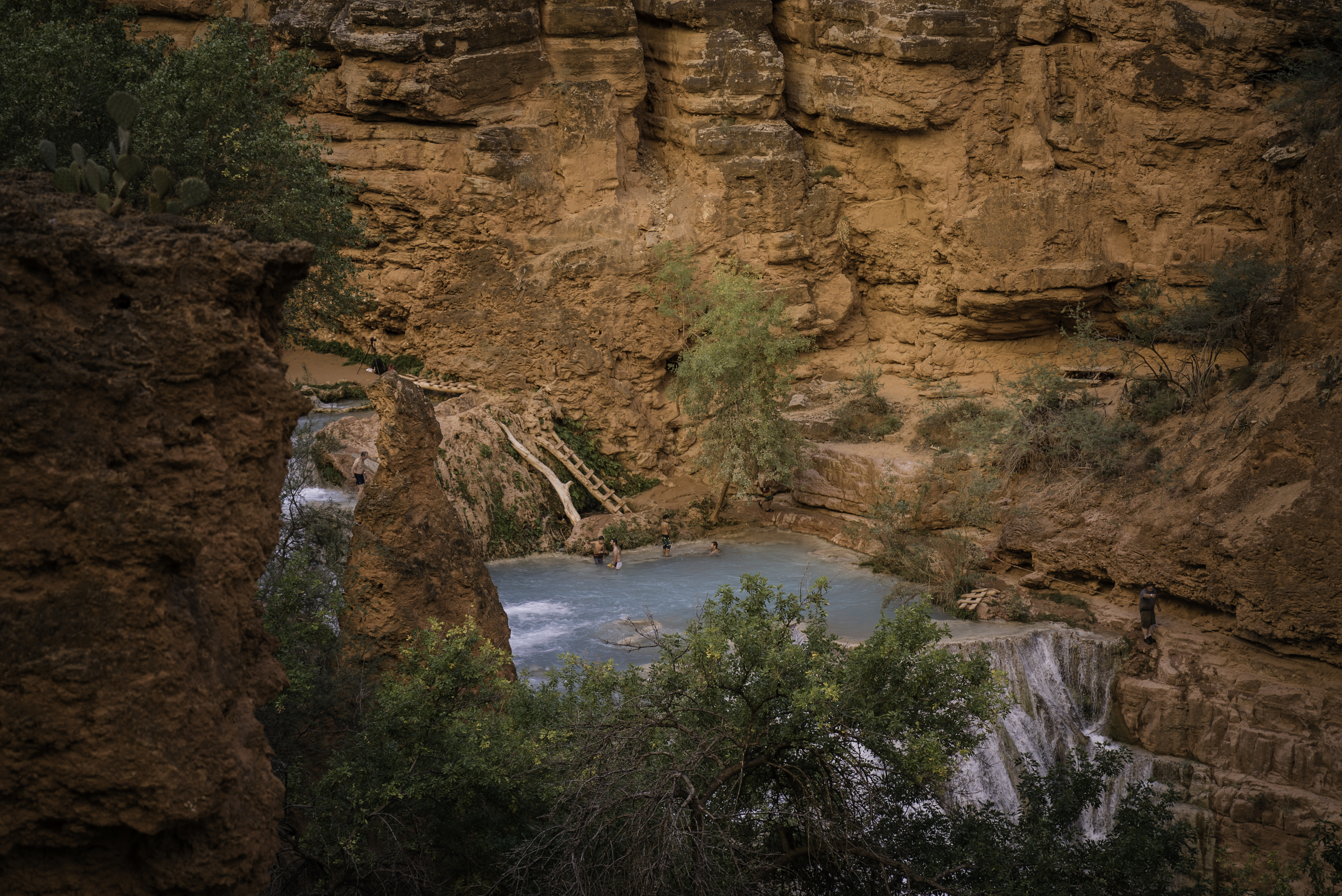
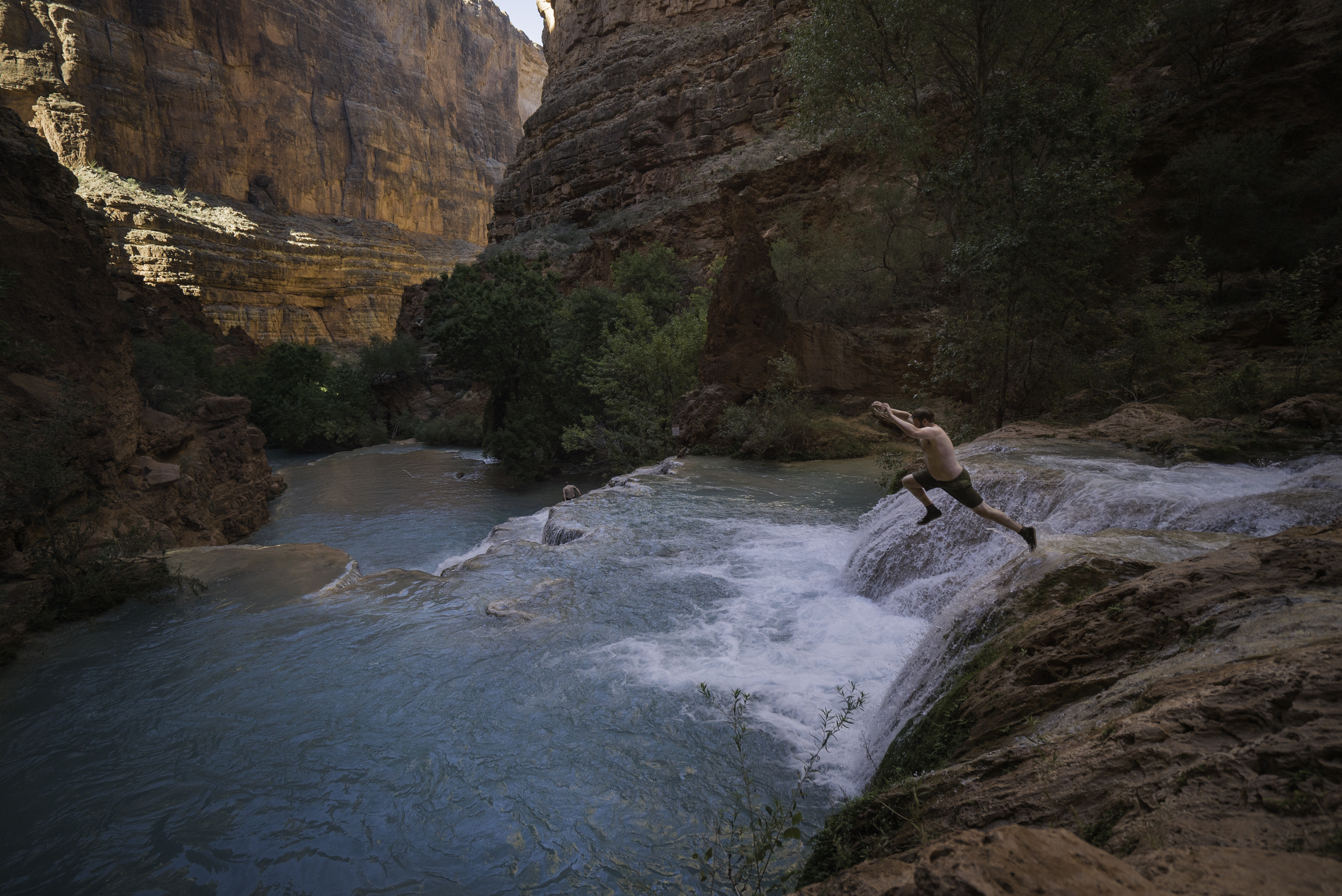
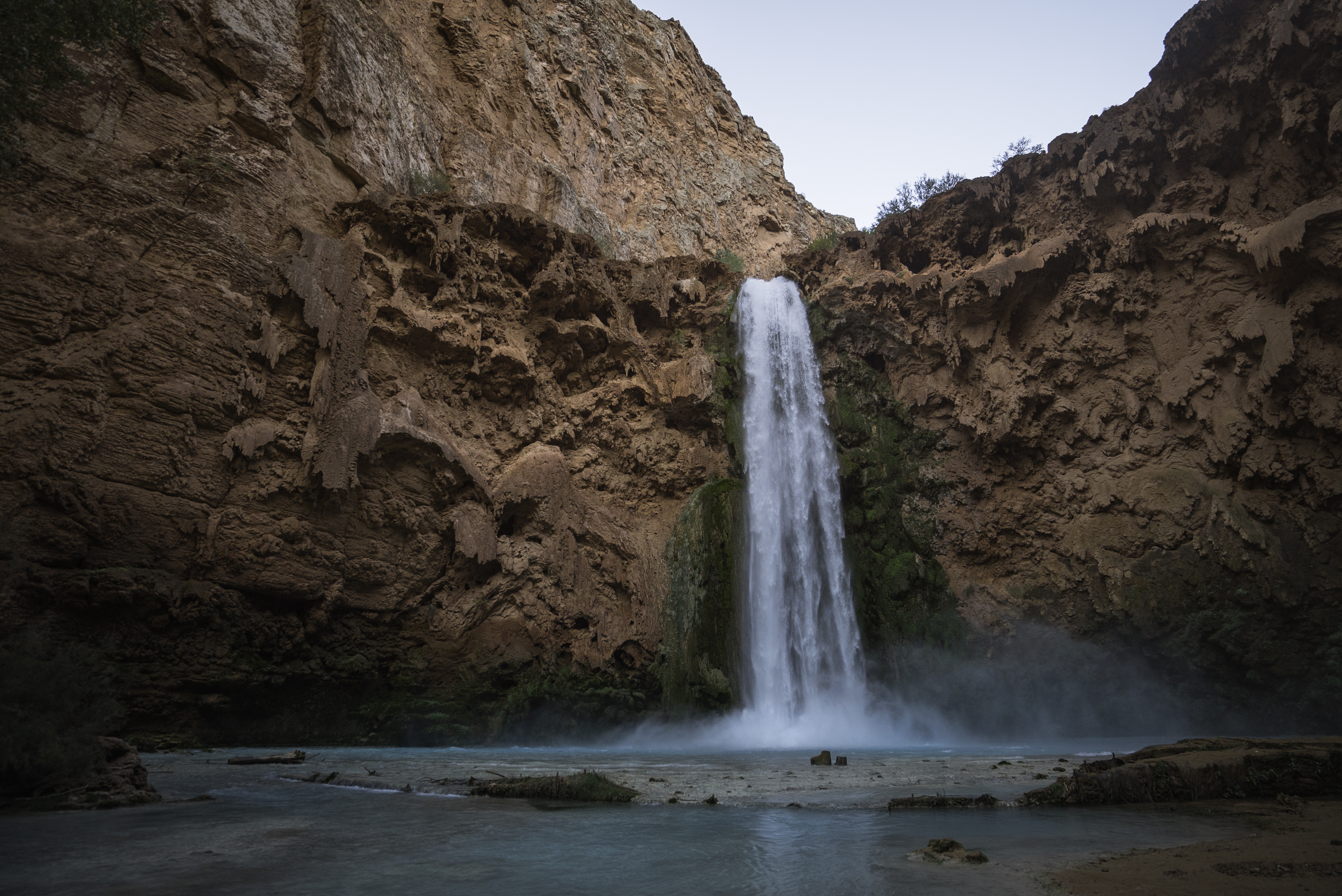
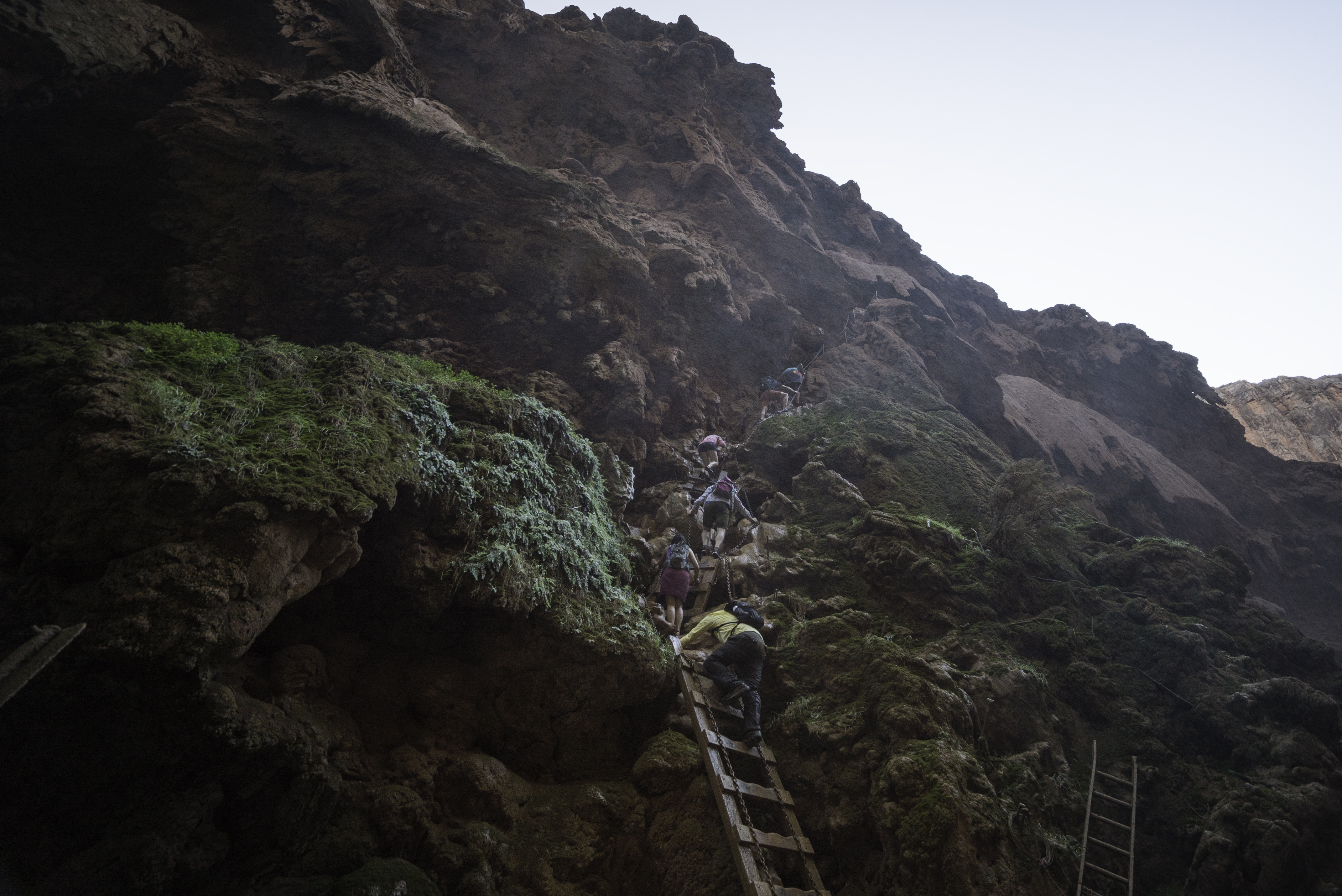
Once you’re down in the canyon, the fun really begins. There are three main waterfalls in Havsupai – Havasu Falls, Mooney Falls, and Beaver Falls. Havasu you’ll pass on your way to the campground, Mooney requires a very steep and slightly terrifying (but also quite doable) climb down a chained trail, and Beaver is another three or so miles beyond Mooney, making it a perfect out-and-back trip for a full day in the canyon. Pack a lunch and give yourself a few hours for the hike and swimming in the series of smaller waterfalls and pools.
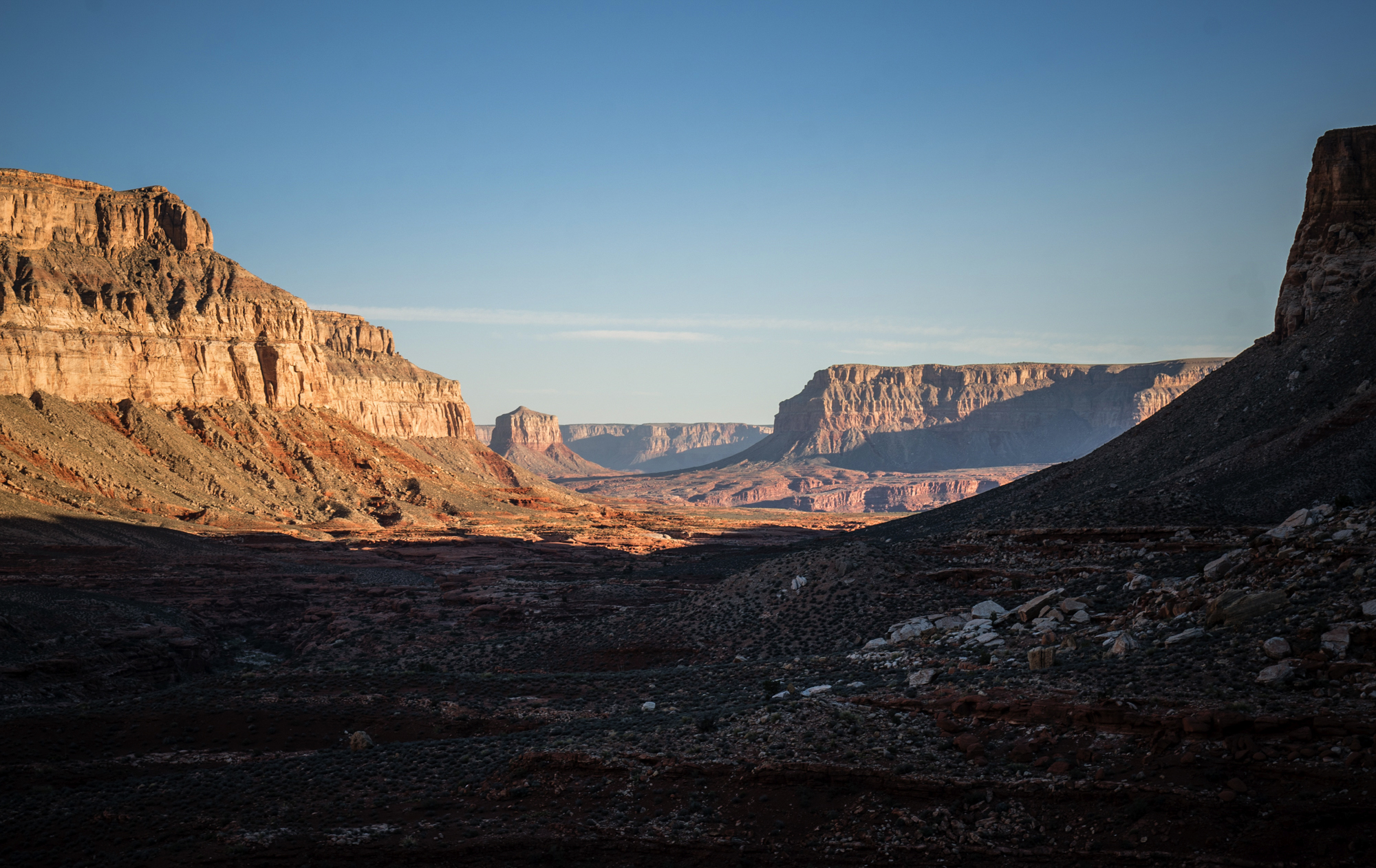
If you want to bring a book, only bring one – you’ll likely be spending most of your time hiking or lounging in the turquoise waters, anyway. Also, keep in mind that you have to carry all your trash out with you. Read up on Havasupai history before you go – this is sacred land and the people have a deep connection to the water.
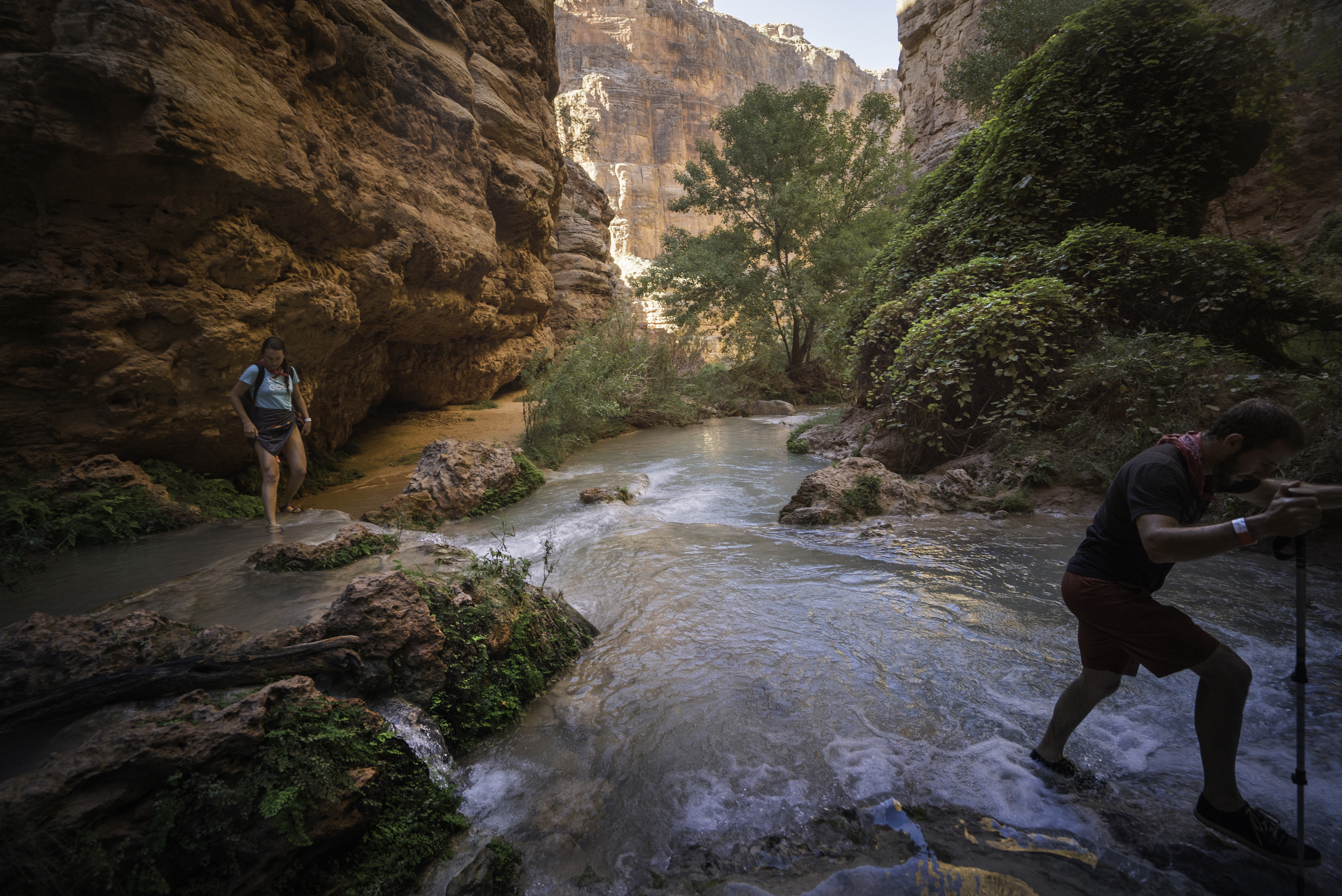
Besides the usual essentials – tent, sleeping bag, hiking boots, and so on – here’s a list of items that I’d highly recommend taking with you:
• Water shoes that you can hike in. Tevas work extremely well – you want an all-purpose shoe that you can make the hike from Mooney to Beaver Falls in, and the trail cuts right through the creek more than once.
• A daypack — Once you’ve made it down to Havasupai, you won’t want to be using your backpacking pack for hikes in the canyon.
• A drybag — “If you take photos with your iPhone or DSLR,” says Alyx, “you might want to bring a waterproof case or a drybag to protect your electronics during water crossings.
• A bathing suit
• A lightweight towel that will dry quickly.
• Sunscreen — Don’t let a bad sunburn ruin your trip! Apply and reapply often, especially on the hike down and up.
• Power — “If you’re worried about the battery life on your camera or phone,” says Alyx, “I recommend a recharger kit like the Goal Zero Venture 30 Solar Kit for powering devices.
• Mosquito repellant
• Rodent-proof storage bags for food.
• Water filter
• Trekking poles (Do it. You really won’t be sorry.)
Interested in heading out on a Shoestring Adventures trip of your own this year? Check out all their upcoming trips here.
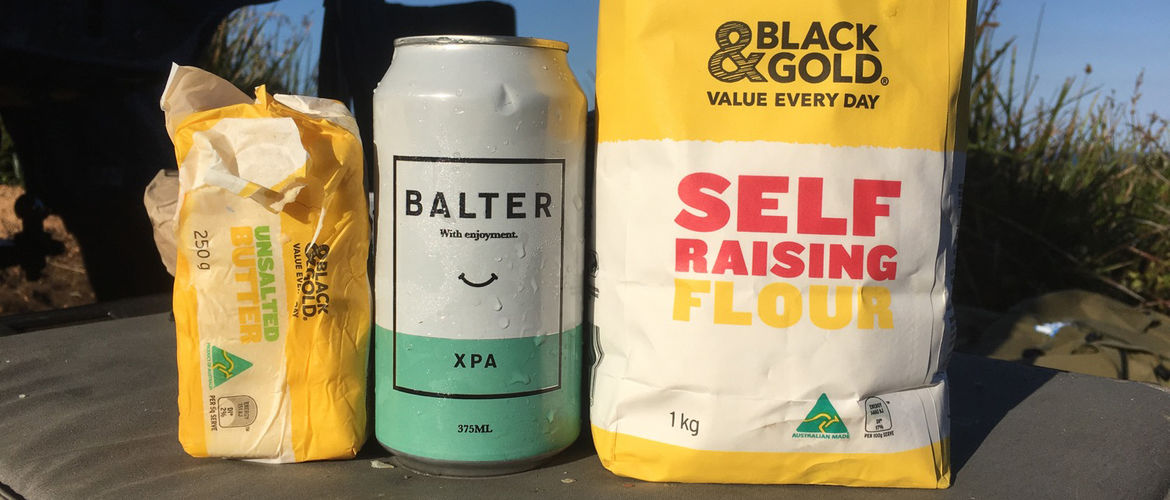
Destinations throughout the world are known for their traditional dishes. Belgium takes their waffles pretty damn seriously, Ireland has Guinness-dipped potatoes, and Italy is often equated with masterful pizza. Though it hasn’t exactly garnered worldwide acclaim like the aforementioned, the Bush Damper is a traditional Australian food with origins in the bush.
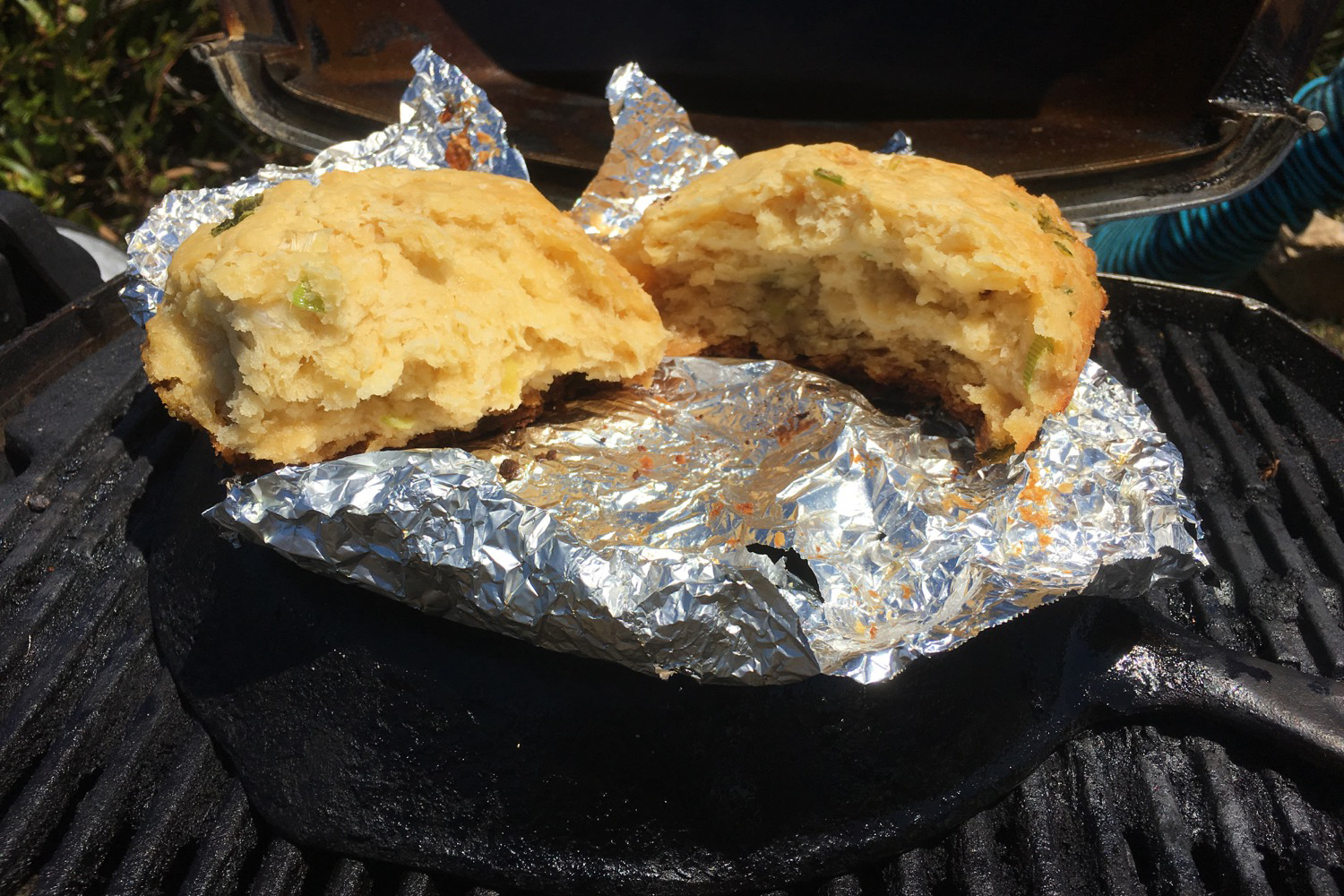
Australian Bush Damper is a kind of crusty bread put together with just about anything you happen to have on hand. Originally developed by stockmen who drove cattle in the Outback for months on end, the staple ingredients are simply flour and water. But, even water isn’t totally necessary. You can use milk, beer, or the tears of a saltwater crocodile – whatever fluid you can find. If you have some butter all the better. Things like cheese and spring onions can be added for a savory taste. Nuts and chocolate can go in for a mouth-watering dessert. It really depends on what you can dig up and what seems like a good idea at the time — and even if it turns out to have been a terrible idea, that’s half the fun, right?
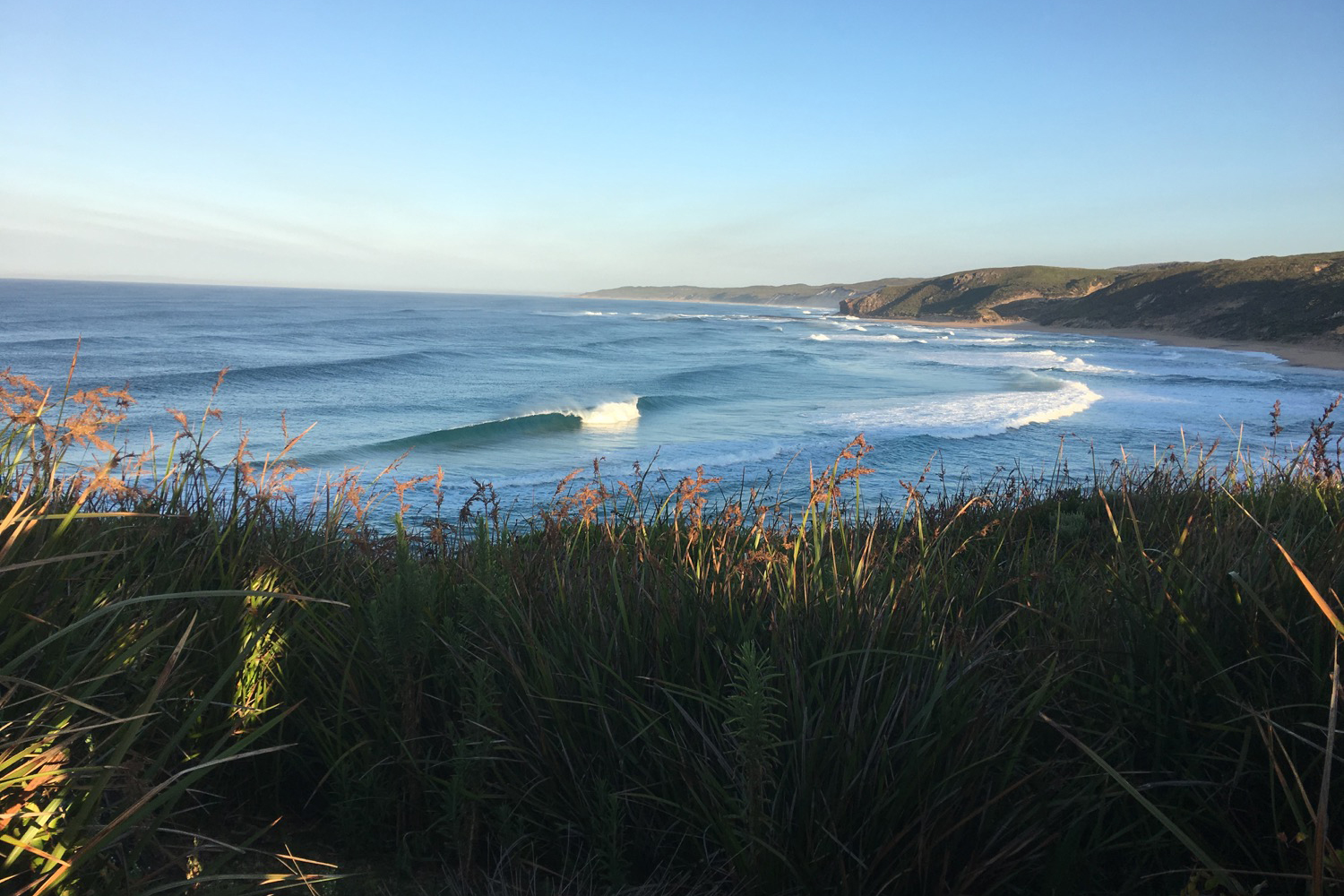
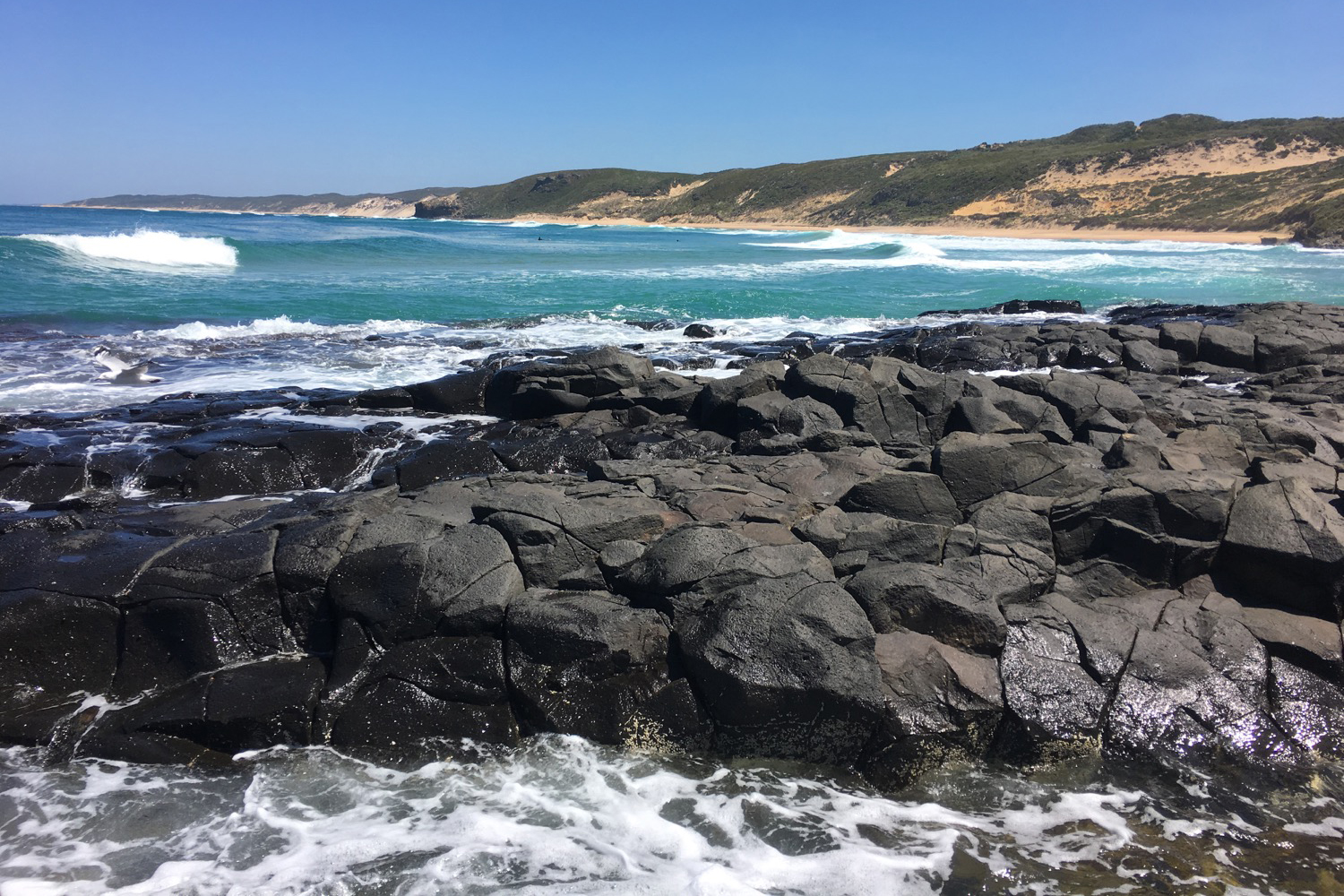
Recently I had the pleasure of camping on the West Australian coast with two chefs. One makes his living running a brew house, and the other has a long history of cooking for billionaires on super yachts. Both have different ideas about what makes the ideal Bush Damper. While one thought it was best to put the dough directly into the coals of a dying campfire, the other thought that wrapping it in foil first meant you got more out of your ingredients; where one thought sweet was the way to go, the other preferred savoury; one thought kneading the dough with your hands was superior, the other thought mixing it all with a hunting knife was much more romantic. At one point they forgot which options they were arguing for and swapped sides. After a heated discussion over a few (dozen) cold beers, the one thing we all agreed on is that the key to a great damper is the willingness to improvise.
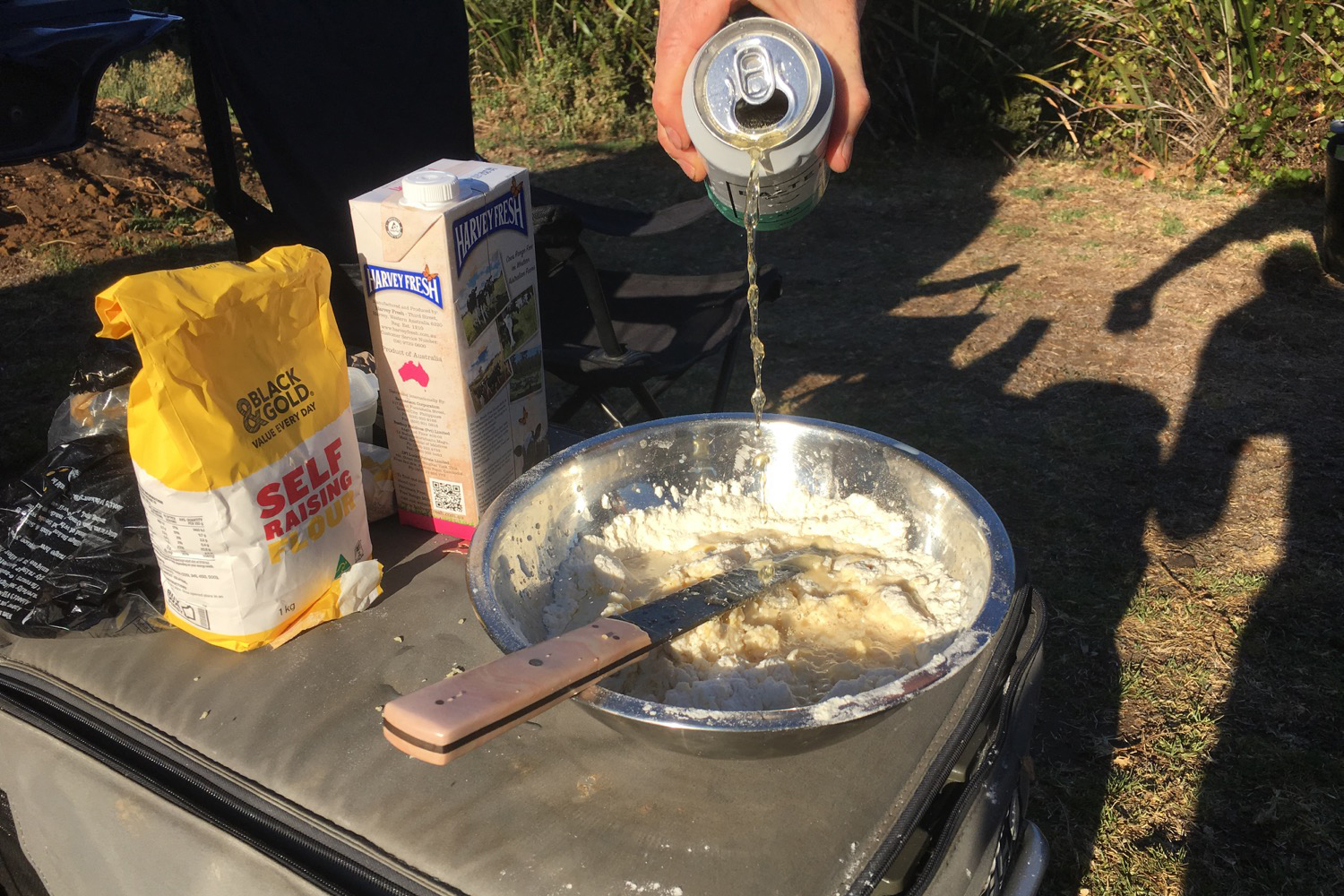
With that in mind, we decided to take a crack at it and cook a damper for breakfast. The first improvisation came when we realized that the place we had set up at prohibited campfires, because of how dry the surrounding bush was. We had to make do with a portable barbecue that one of the guys had in his car (because that’s what chefs carry around). The next came when we couldn’t agree whether beer or milk was the best fluid to use, so we used both.
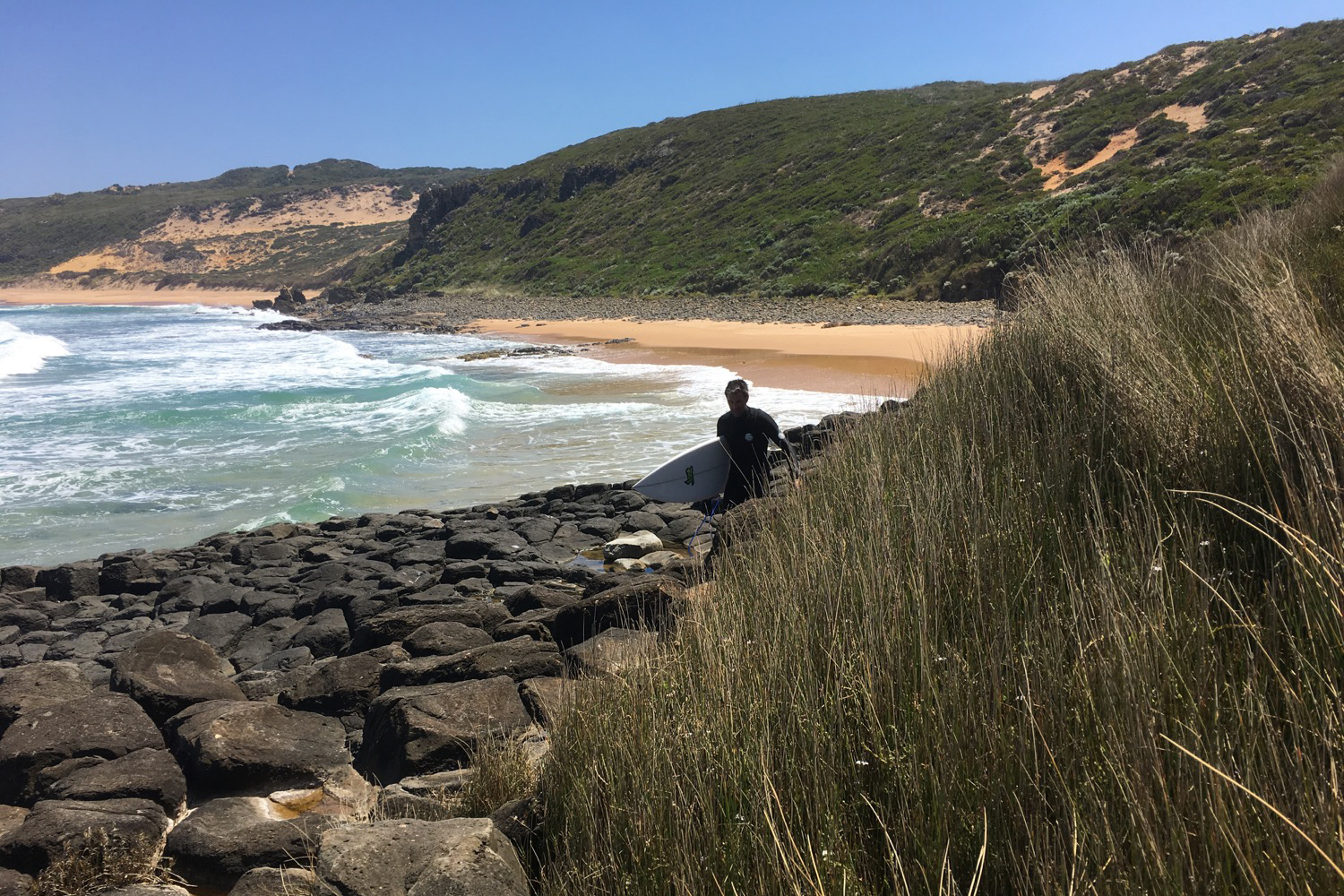
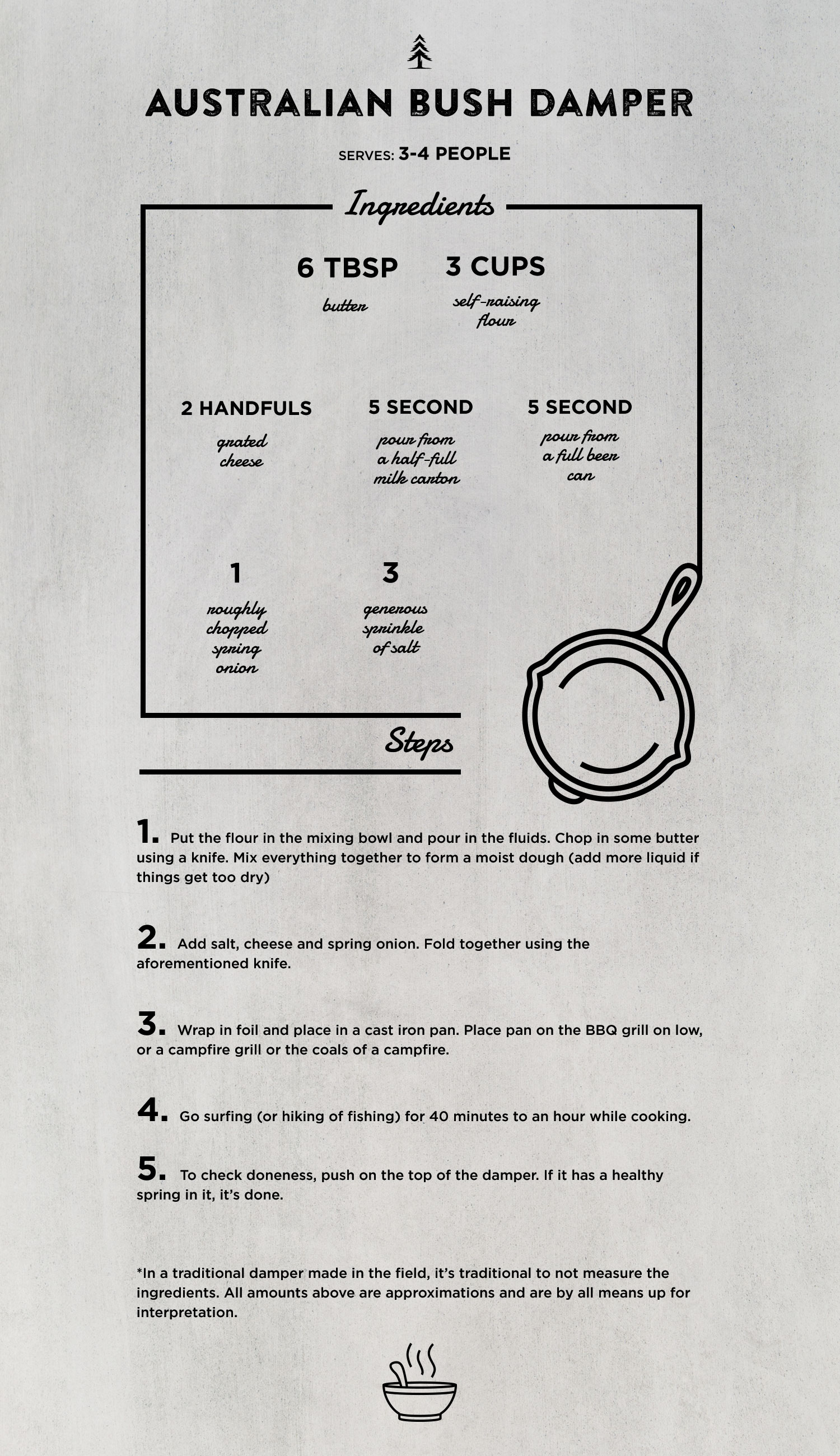
We spent some time in the surf to work up our appetites. As the super yacht chef said, "hunger is the best sauce." When we returned to our damper, the results were surprisingly awesome. Below you’ll find the recipe for what was the best Aussie Bush Damper I’ve ever wrapped my laughing gear around [Ed. note: that's Australian for mouth].

If you’re heading out for a camping trip anywhere, I highly recommending giving bush damper a try. You don’t have to be in Australia, just somewhere remote with some good friends that have the will to give something a go, and the bravery to be the first one to taste it. Add in some campfire tales and you have a meal that’s the stuff memories are made of. [H]

Tim Hawken is an Australian writer who enjoys surfing, Indian food, and romantic midnight strolls to the beer fridge. Find out about his weird world by checking out his website, or following him on Twitter. Links below.

Just south of the skyscrapers, Pioneer Square, the tourists and the ferry terminals in downtown Seattle, lies SoDo, an industrial neighborhood that has somehow managed to avoid some of the gentrification typical of the rest of Seattle.
The busy streets are shared by commuters, football and baseball fans heading to the stadiums as well as armies of container trucks heading to and from the Port of Seattle. There in a nondescript building, recognizable only by a red flag over the front door, there’s a distillery whose founders are single-handedly rethinking everything there is to know about American single malt whiskey.

Westland takes advantage of Washington's natural attributes like Skagit Valley grains, Washington State peat and Pacific Northwest oak to create uniquely Northwest single malts.
At Westland Distillery, long before your eyes get a chance to take in the handsome tasting room decked out in exposed wood, your nose is greeted with a sweet and malty aroma signifying that you are indeed in the right place.
It was there that I met with Westland’s Master Distiller Matt Hofmann. We stood in the middle of a wide open room lined on two sides with marked and branded barrels - a single malt temple of sorts - and a red Westland flag hung from the tall ceiling.
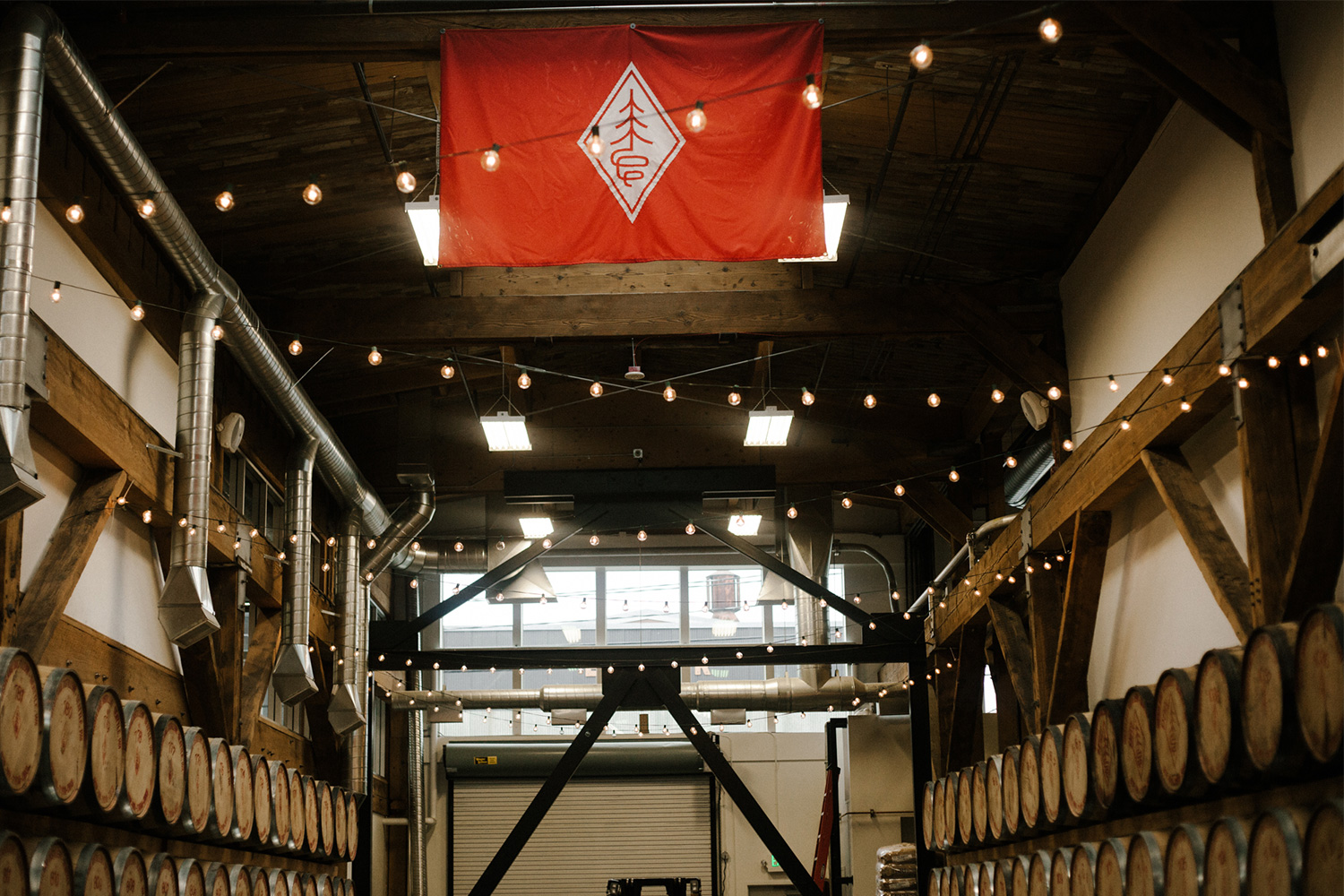
It was still early in the morning and the room was dark, save for the rows of twinkle lights strung from the ceiling, but just because the distillery wasn’t open to customers, didn’t mean it was quiet. The copper stills in the room next door were humming away while technicians took readings and watched over the distillation process. We walked into a room lined with dozens of small bottles filled with varying shades of amber spirits. It’s in that room, isolated from noise, smell and other outside influences and senses, that Westland’s crucial blending work happens.
“We don’t really consider ourselves a craft distillery,” Master Distiller Matt Hofmann says, careful not to lump Westland in the same category as the other newcomers...and for good reason.

When Washington legislators eased regulations in 2012 to allow the creation of craft distilleries, the state was almost immediately flooded with new and aspiring startup distilleries all angling for their piece of the pie. Some have already gone out of business, others have had some degree of success, but only a handful have made such an impact with patrons in and outside the Evergreen state as Westland.
To achieve this, Westland has relied on all that is distinctly Northwest to create their spirits. The distillers take advantage of Washington's unique natural characteristics, like Skagit Valley grains, Washington State peat and Pacific Northwest oak, to craft a whiskey and the barrels for aging that whiskey. The whiskey itself is aged at a rack house in the cold and moist coastal climes of Hoquiam.

Hoffman calls it Washington’s “cultural terroir” and it’s no doubt not only helped Westland establish the Northwest as a new bed of single malts, but also establish the entire category of American single malts too. Cheers!
There is no one right way to appreciate whiskey. But for the thoughtful analysis of what’s in the glass, the folks at Westland do follow a rigorous routine. Here are a few tips from their Master Blender to help you get the most of out of every dram.
GLASSWARE
The right glass can improve a whiskey greatly. A tulip-shaped glass like these from Glencairn Crystal work to concentrate the aromas and reveal a whiskey's full array of nuance. Fill it to the widest point in the glass and you’re ready to begin.
NOSING
The one common mistake in first nosing a whiskey is to take one large breath like you would with wine. Given the significantly higher level of alcohol in whiskey as compared to wine, you want to be careful to take a slower approach. Don’t stick your nose all the way into the glass. Instead, take several short whiffs from closer to the rim.
TASTING
Similar to nosing, you want to take a measured approach to tasting whiskey. Take a small sip first and move it around your tongue and mouth. This will help your palate acclimate to the alcohol level. From there, take sips as you normally would, making sure to allow some air to come in. Let the whiskey coat your tongue and mouth before swallowing.
WATER ADDITIONS
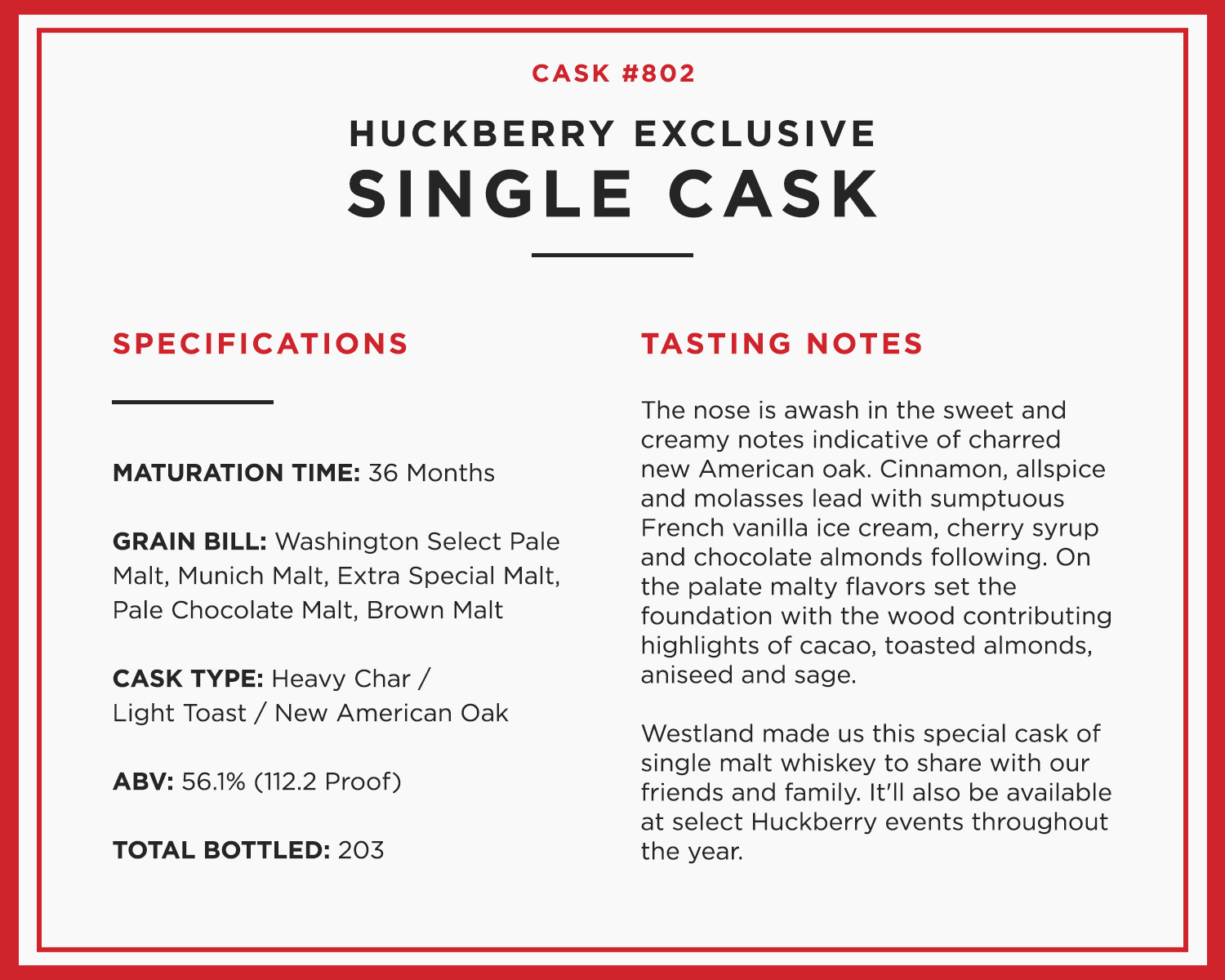
Adding water will change the chemistry and proof of the whiskey, and as a result, its flavor. Serious maltheads prefer their whiskey at Cask Strength (the alcohol level of the final matured spirit taken right from the cask) just like the Huckberry Exclusive cask. Adding water—just a few drops at a time—allows you to explore the whiskey at various strengths, revealing different flavors and ultimately letting you decide how you like it best.


Andy Bokanev is a photographer based in Seattle, WA. He can often be found on two wheels, at a coffee shop, or at an airport.
Infographic and final image: Alex Souza

A plaque that has been shared thousands of times online commemorates a drunken fight between Jack Kerouac and William S. Burroughs, all over the Oxford comma. Only problem is... the story isn't true.
The plaque recounts a fight in 1968 between the two authors, who “came to blows over a disagreement regarding the Oxford comma.” Claiming the altercation even showed up in Kerouac's novel “Doctor Sax,” as well as a local police report, the whole affair smacks of exactly the kind of fight the two iconoclasts might actually have engaged in.
While writers and editors have been known to come to blows over the use of the Oxford comma (that is, whether or not to add a comma in a list before a final “and”), there are a few issues with the report. It notes the fight as happening at the Lowell Athenaeum (which never existed), it cites that the incident appeared in "Dr. Sax" (which was published nine years earlier, in 1959), and Burroughs never actually showed his face in Lowell, Massachusetts, let alone hung out there with Kerouac.
The plaque, one of a few faux historical markers at Mill No. 5, is a marketing creation of Constantine Valhouli and Jim Lichoulas III, to help promote their commercial venture, a conversion of old industrial space into a hive of new businesses, galleries, studios and tech labs. The developers really intended it as a goof—little did they anticipate how quickly two dead writers could create an online viral ruse.

No sleeping in this spring. You’re going to hunt more, hunt smarter, and have the best turkey season of your life. Ready?

As new technologies revolutionize and streamline our lives, more and more traditional crafts are falling by the wayside or becoming the domain of hobbyists. Among those that were once ubiquitous, but are becoming more obscure is the art of knot tying—once an essential skill in professions ranging from sailing to farming and today becoming a more and more specialized craft, as the number of people who use the traditional methods of knotting dwindle.
But there are still those, such as the members of the International Guild of Knot Tyers, who are working to make sure that these disappearing skills don’t unravel. The Guild was started in 1982 by Des Pawson, an expert knot tier, and Geoffrey Budworth, a police officer who was no slouch in the knotting department either. Uniting over a love of a new knot that was invented in the 1970s, the Hunter’s Bend, the duo soon came upon the idea of seeking out other knot enthusiasts. Eventually the Guild was formed, becoming an official U.K. charity, complete with government oversight.
“I became interested in knots when I was young, partly as a boy scout and partly as a sailor,” says Colin Byfleet, who is currently serving as the IKTG’s Secretary to the Trustees. “I’m about 74 now, and as I was coming up on retirement, I was living in France at the time, I met a group of people who were demonstrating knots, and that’s where it all started. I thoroughly enjoyed it.”
Byfleet’s lifelong interest in knots may have led him to his involvement with the Guild, but people come from a variety of different points of appreciation for the craft.
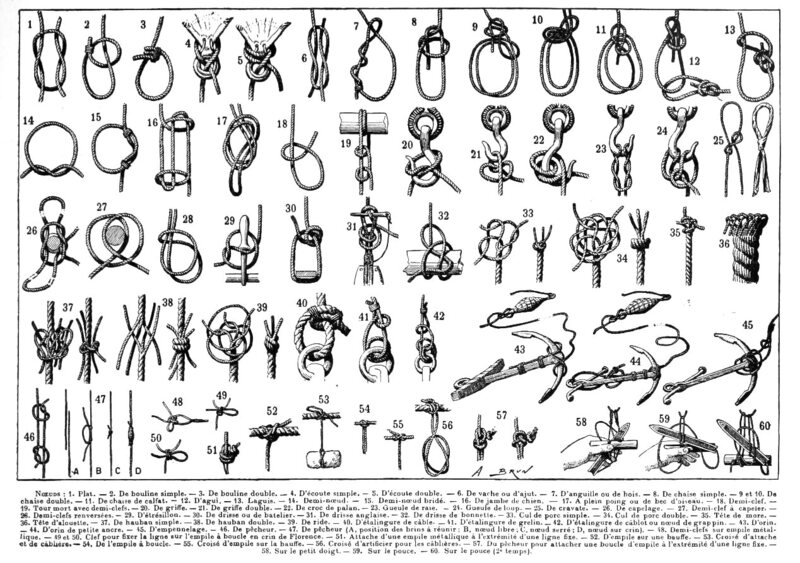
Byfleet, for instance, says that he’s most interested in the math and science behind knots, including how modeling projected knots can lead to surprising discoveries about their geometry. He says there are a number of mathematicians who are part of the Guild: “We have a spectrum, from a pure mathematician, all the way through to people who may be unemployed and just do it for fun.”
Expert knotting is generally considered to belong to the maritime world, but members of the Guild use their knowhow for a wide variety of uses. A deep knowledge of knots is needed everywhere from the rigging of Cirque du Soleil acrobats to law enforcement agencies who use forensic knotting, studying and identifying knots to help solve criminal cases in the same way one might study handwriting. “It’s a bit like folding your arms," says Byfleet. "Even if you tie simple knots, you tend to tie them the same way.”
Some members of the Guild prefer to focus on the related craft of rope-making, which in and of itself is a very particular art. Byfleet told us that he knows of Guild members whose focus is on church bell ropes, which need to be made in such a way that they stretch when pulled, making the sound of the bell less harsh and more musical.
While members might join the IGKT for different reasons, the Guild’s goal is always education, getting the word out about the joy of knots, and passing on the craft. They hold around 100-200 events around the world each year, where experts and aficionados come to hold seminars and show off their skills. While there is no directly competitive aspect to the events, the Guild does hold a handful of exhibitions each year to let the most skilled knot tyers, who can create knots with the most finesse and speed, show off their stuff. In an effort to get more kids interested in knots, they’ve also held speed tying contests, which Byfleet says were a pretty big hit.
The Guild isn’t a massive organization, but it does have a healthy roster of around 1,000 devoted members, spread across the world. As Byfleet says, there are an infinite number of knots, so it’s possible that that the Guild will continue to grow. Most standard types of knots, though, have already been catalogued in such books as The Ashley Book of Knots—the closest thing the Guild has to a bible.
With the rise of the internet, where people can share their techniques and skills at the touch of a button, Byfleet says that he can see a day when the Guild no longer serves a purpose, since knot knowledge is now readily available, and communication between experts has never been easier. But it doesn’t seem to bother him. “It might [disappear,] but it wouldn’t worry me if it did, because its purpose is being fulfilled anyway." As he says, learning something from an actual person is still better than just picking it up on the internet.