KWBaker
Shared posts
How This Surprisingly Understated Tip Can Win A Tough Negotiation

J.D. Roth, Get Rich Slowly

We have hired professional editors to help create our weekly podcasts and video reviews. So far, Cool Tools listeners have pledged $365 a month. Please consider supporting us on Patreon. We have great rewards for people who contribute! – MF
Our guest this week is J.D. Roth started blogging in 1997, before “blog” was even a word. In 2006, he founded GetRichSlowly.org, a site devoted to common-sense personal finance. He sold Get Rich Slowly in 2009 then bought it back in 2017. His mission in life is to help everyday people master their money and achieve their financial goals.
Subscribe to the Cool Tools Show on iTunes | RSS | Transcript | Download MP3 | See all the Cool Tools Show posts on a single page
Show notes:

National notebook ($6)
“I am a writer, and I do most of my writing on a computer like most writers do nowadays, and that’s not very exciting. Everyone has their favorite computers. But I also do a surprising amount of writing by hand, and I have my own favorite cheap notebooks. I use a couple of the models from a company called National Brand, and basically there’s this legal supply store here in Portland, and I go down there and I stock up on these notebooks. They’re a little more expensive than Mead spiral notebooks, but they’re also a heavier quality paper. And then I buy Dixon Ticonderoga pencil and BIC Cristal ballpoint pens. I buy them by the case from Amazon. … So those are kind of unsexy tools, but they’re very much tools that I use every day.”

Hobonichi Techo Planner ($33)
“It’s a Japanese calendar. It’s A6 size. … It’s by a company Hobonichi, and it’s just a big … Instead of having all sorts of lines and times and all that, it’s basically just a big blank slate. Each page has a date, and it shows noon, and it shows dinnertime, and other than that it’s just squared paper for you to jot down your thoughts or to jot down your schedule. And for me, it works like a charm. Until my girlfriend convinced me to go digital, this was my source. I carried this with me everywhere.”

The Maker’s Bag ($130)
“I am a bag nerd. I have probably a dozen backpacks and messenger backs, and I use all of them. I like Filson bags, but they’re expensive. For the past two years, my daily bag is the Maker’s Bag from Tom Bihn. … I like it because it’s not overly complicated, for one…. It’ll hold a 15-inch laptop but not much more than that. And then it will hold several books and magazines, plus there are maybe a dozen pockets. Maybe I’m exaggerating, but it seems like there’s tons of different pockets and zippered places so that I can tuck all sorts of different stuff in there. I tend to travel a lot for work, and so on the plane I want to be able to have all of my stuff compartmentalized, and with the Maker’s Bag I’m able to do that, and yet it’s not overwhelming.”

SleepPhones ($40 – $100)
“So, this is something I originally got for travel. So what SleepPhones are is if you can imagine an elastic headband that inside is a set of earbuds, but they don’t actually go in your ear, they just kind of rest outside ear. That’s what SleepPhones are, and the kind I have are wireless. You do need to plug them in to charge them, although I think they have a model now that uses induction charging. So at night, when you’re getting ready to go to sleep, if you want to listen to something you put the SleepPhones around your head like a headband — or I actually use it to double as an eye mask to keep out light — and then you listen to whatever you want to listen to. And like I said, I originally got them for travel, but because my girlfriend and I both have trouble sleeping, we now both use them to listen to stuff at night.”

Icebreaker Merino wool clothing
“I am a HUGE fan of Icebreaker merino wool clothing. I discovered this stuff in 2010, and have been hooked ever since. It’s warm when it’s cold and cold when it’s warm. It itches, but only a very little. The best part? Wool does NOT retain odors. That means you can wear an Icebreaker shirt (or a Smartwool shirt) over and over and over again without washing it and there are no consequences. This makes wool clothing ideal for travel. I know people who travel for months at a time with only two Icebreaker shirts. They take two because it does help to alternate them, to air one out after you use it — especially if you’ve been running in the shirt. No specific Icebreaker item to recommend. Just love their stuff.”
Also mentioned:
Hotels To Help You Start Curling In Chicago, Scotland And The Tyrol

Use Excel to Keep Your Family Organized
In my first post-college employed position, I worked for a boss who loved Excel spreadsheets. She thought nearly everything could be put into “boxes and rows,” and after my first year working there, I was officially a convert. I’m big on organization anyway, and those spreadsheet cells called to me, luring me in with…
How to Filter Unpopular Opinions on Every Social Network

If you feel very strongly about certain topics, social media can be a minefield. In the real world, you don’t always know the opinions your family or friends have on things like politics, religion, or other controversial issues. But online, you see everything. And sometimes it isn’t pretty. In this article, you’ll find out how to see fewer posts from the people in your life (at least your social media life) who have opinions you don’t like. Further along in this article, we’ll also explore whether or not this is a good thing. How to Filter Opinions on Facebook On...
Read the full article: How to Filter Unpopular Opinions on Every Social Network
Teslonda makes a 1981 Honda scoot like a Tesla in Ludicrous Mode

The Polyphonic Screed

Today's GIF comes from a 1994 Nokia commercial.

Brain Hacking For Dummies! Join us on The WELL for a far-ranging discussion with Roger McNamee, co-founder of the Center for Humane Technology. Roger will discuss the problems with Facebook and today's social media, and what we can do to fix them.
Today's issue is sponsored by The WELL. (See yourself here?)
1902
The year that Spanish guitarist Francisco Tárrega first composed “Gran Vals,” a solo guitar composition that inspired the iconic “Nokia Tune” after the company’s engineers were looking for a suitable ringtone for its line of cellular phones. The musical passage, which would become one of the world’s most-heard pieces of music, was pulled into Nokia’s devices in part because it was in the public domain—Tárrega had been dead for about 80 years by the time they sampled the song as a ringtone. That said, while Tárrega’s guitar playing was the clear inspiration for the ringtone, The Next Web noted in 2011 that the original version of the composition was created by Fréderic Chopin in his “Grand Valse Brillante,” though it’s not obvious due to the two compositions being played on different instruments and in differing contexts. You may be able to make it out here.

The Carterfone didn't produce ringtones, but a regulatory decision enabled the first devices that did. (Courtesy of Scott Brear/Computer History Museum)
Two key touch points in the evolution of the modern ringtone
Though the success of “Crazy Frog,” the animated amphibian associated with the unavoidable 2005 hit “Axel F,” might make you think otherwise, the ringtone didn’t necessarily start with the cell phone—though, certainly, that was the logical conclusion.
It certainly didn’t thrive until the cell phone era, but the the inspiration point for the ringtone as we know it today likely goes back to at least the 1970s, when a regulatory decision made novelty gadgets possible. In 1968, the Federal Communications Commission ruled that equipment that wasn’t made by Bell could be used to connect to the telephone system. The decision came up because of a device called the Carterfone, which made it possible to connect a telephone line to a private two-way radio system.
The ruling, which AT&T fought tooth and nail, was far more significant than it seemed at the time, as it made it possible for third-party companies to offer long-distance service, something MCI first offered the in 1970.
Another, less heralded side effect of the ruling was that it allowed for the use of devices that created novelty ringtones. The Tele-Tune, produced by Interconnect Telephone of Canada around 1981, focused its ringtones on the caller, not the recipient; it used chips to play up to eight tunes in place of the ringing you might expect otherwise.
(It could be argued that answering machines were the ringtones of their day, and much work went into customizing those, as Phone Losers of America graciously recalls.)
Around the time that these devices were starting to appear on shelves, a British musician named Thomas Morgan Robertson was working on his debut album, The Golden Age of Wireless, a name in reference to radio, not cell phones. You might know the guy as Thomas Dolby. It's a rather ironic album name given the second stage of his career.

Thomas Dolby, as seen in his most famous music video.
Dolby, a masterful synthpop musician whose hit “She Blinded Me With Science” was just a small glimpse of his talent, later played an important role in the evolution of the ringtone—he added lots of depth to the sounds that standard cell phones could make.
As Dolby noted in a 2005 interview with The A.V. Club, he stumbled into the ringtone space because of a piece of software his company, Beatnik, had created. The technology was intended as a website plugin not unlike Flash or Java, but it checked off most of the marks for working in simplistic cell phones.
“When the whole dot-com crash happened, what Beatnik was left with that wasn't a bunch of fluff was a contract with Nokia, who were looking to put polyphonic ringtones into phones,” Dolby explained to the news outlet. “Sort of by accident, the requirements for Web audio-software technology were not that dissimilar to what Nokia needed, because we'd made a software-based audio engine that could be downloaded very quickly and used files like MIDI files, but which had good fidelity because they could include actual samples of recordings.”
Beatnik’s strategy was effective because of how it worked—it was a software solution to a problem that other cell phone makers were trying to solve with hardware chips that cost a lot of money. Nokia, which used monophonic sounds previously, was looking to add more layers of depth to the tones coming out.
Dolby’s solution was so effective that every major cell phone company of the pre-smartphone era licensed the software after Nokia had success with it.
“Everybody licensed the Beatnik engine,” Dolby said at the time. “It's the predominant ringtone in the world.”
This licensing opened up an opportunity for the record industry to make money from digital music—something still not entirely clear as a path in 2001 or so—particularly outside of the U.S. According to Dan Steinbock’s The Mobile Revolution: The Making of Mobile Services Worldwide, the Japanese and European markets particularly gravitated to the ringtone model, while the U.K. industry took steps to protect a budding market from privacy.
“The music industry doesn’t want another Napster-type situation to develop and is starting to crack down on such sites,” Ben Coppin of the anti-piracy firm Envisional noted in 2001.
$300M
The estimated size of the mobile music market in the U.S., according to a 2004 press release announcing the launch of Billboard’s Hot Ringtones chart, which highlighted the most popular ringtone downloads. (A New York Times piece from a year later doubled the size to $600 million.) It’s a market that would not have existed had Thomas Dolby not sold Nokia on its polyphonic ringtone technology. “Billboard charts have long held an independent and authoritative role in influencing sales of recorded music, whether it be a physical or digital format,” Billboard’s then-publisher, John Kilcullen (who, side note, is also the guy who came up with the idea for the “For Dummies” series of books), said in the release. The company published the ringtone chart until 2014; it’s the one place where Taylor Swift’s “Shake It Off” is still on top.
This guy doesn’t own an iPhone, but he thinks Apple needs new ringtones
For weeks, Slavio Pole, a Ukrainian musician and sound engineer, has been on a Twitter-based quest: He wants Apple to consider using his ringtones for its iPhones—and ditch the ones it currently has.
Perhaps it seems like a fruitless, tilting-at-windmills kind of situation (he has just four followers at the time I write this, and one of them is me), but his reasoning is sincere and totally valid even if his ask is a bit unusual.
“We want the best to become perfect,” Pole explains in a video that shows him dropping a flash drive into a letter addressed to Apple’s headquarters in Cupertino, California. (He says he actually mailed two—one to Tim Cook, one to Craig Federighi.)
So what’s wrong with Apple’s current sounds? In an interview, he explained his thought process was driven by the seemingly in-stasis nature of ringtones on Apple devices.
“I think that most of the ringtones on the iPhone have a sharp sound,” he told me in an email. “I checked all the sounds in the iPhone and I can conclude that many ringtones and sounds are superfluous and incomprehensible.”
The point that these sounds—which are everywhere, blaring from the purses of inconsiderate theatergoers and train passengers and on the bedsides of people waking up first thing in the morning—annoy Pole is particularly notable, because he doesn’t own an iPhone, and nor do most of his friends.
“Yes, unfortunately in Ukraine [people] do not appreciate creative work with dignity, so not everyone can afford to buy an iPhone,” he explained.
This is not uncommon in the country; as mobile operating systems go, iOS has a marketshare of 19.1 percent percent in Ukraine according to Statcounter, compared with 53.4 percent in the United States. Part of the reason for this, according to the local TV channel 112 Ukraine, involves higher taxes than other parts of the world. Asbis, an electronics retailer that serves the Ukranian market, has a starting price of around $944 USD for the iPhone 8, around $255 more than the American base price.
Pole, who has played music in bands and worked professionally in sound engineering for about 15 years, saw an opportunity to solve a basic wrong he heard on a daily basis, and he recorded lots of tiny compositions with the help of collaborators Iryna Tuzenko and Sergey Sitnyk—a mobile phone production team called ZEPHYR.
Of the many sounds ZEPHYR has created, from bubble-popping sounds designed for iMessage to a soothing ring called “Evening Mystery,” perhaps my personal favorite is one called “Azure Coast,” a piano-and-guitar ditty, intended as an alarm, that sounds significantly less abrasive than most of Apple's own noises. It has a very minor chord change right near the end that is subtle, but prevents the sound from getting annoying.

(stevepb/Pixabay)
While Apple has tried to evoke this feel in recent years with the “Bedtime" mode it's offered in recent versions of iOS (leading one YouTuber to create a ten-minute version of its most interesting alarm, “Early Riser”), it's arguable that Pole’s team has found a softer touch.
Apple’s creative process—whether for big things like its laptops or for tiny things like ringtones—has famously been something of a black box, though there is precedent for technology companies relying on well-known outside musicians to create their sounds. For example, Microsoft gave a lot of money to Brian Eno to create a startup sound for Windows 95, and later paid Robert Fripp to do the same thing for Windows Vista. (And of course, as noted above, Nokia had a deal with Thomas Dolby’s company.)
Even though the strategy isn’t one that Apple seems like it’d be interested in trying, Pole suggests it might want to make an exception in this case, because of just how important these sounds really are.
“I think that companies should rely on outside musicians because it does not matter where you are from or where you live,” Pole told me. “The main thing is that you want to be useful anywhere in the world. Such actions have a social and commercial vector.”
The idea of using a song as a ringtone, while still certainly done, is probably less fashionable than during the days of “Crazy Frog” and Billboard dedicating a chart to them.
Certainly, Dolby had mixed feelings about the fact that his idea eventually gave way to the use of modern pop songs—even though, before Nokia came up with its official sound, that’s exactly what it initially wanted to do.
"Little tiny clips of the latest Adele song going off are just not quite the same,” he told the BBC in 2011. “There’s a certain purity about the polyphonic ringtone that will never be replicated.”
In fact, it’s arguable that lots of folks just leave their ringers off at all times, barring those moments when they use the phones as alarm clocks. The official sound of the cell phone era, for what it’s worth, may actually be vibrate mode.
I asked Slavio Pole about this, as I found it interesting to consider that he put all this work into this beautiful bleeps and bloops that lots of people have conditioned themselves to never even use, lest they have bad memories of the first time they heard Apple’s infamous “Marimba” sound, later updated to the less-infamous-but-still-infamous “Opening.”
“This can lead to a lot of problems,” Slavio argued. “Someone can lose money, someone can lose people they love, and someone can miss a call with a proposal for a million, because they won’t hear the call.”
And of course, there’s the other argument that carries weight even if vibrate mode is on: “People need an alarm clock. Not everyone can wake up on time.”
Tim Cook, Craig Federighi, if you’re reading this, you know what to do: Give Slavio a call.

Brabus builds a boat: the fast and luxurious Shadow 800
Filed under: Etc.,Luxury,Performance
 Only 20 examples of the Brabus Shadow 800 will be built.
Continue reading Brabus builds a boat: the fast and luxurious Shadow 800
Brabus builds a boat: the fast and luxurious Shadow 800 originally appeared on Autoblog on Fri, 23 Feb 2018 07:30:00 EST. Please see our terms for use of feeds.
Permalink | Email this | CommentsFour Ways To Ruin A Sale

The Upgrade: This Is the Cast-Iron Skillet You’ll Want to Pass Down to Your Kids
Butter Pat Industries harkens back to the lighter, smoother cast-iron from yesteryear— when non-stick was an expectation, not a feature.

The Pentax K-1 Mark II Is a Terrific Low-Light Shooter (And Only Costs $550 for Existing K-1 Owners)
Ricoh is offering current K-1 owners a pretty terrific deal -- trade in your older K-1 for the new Mark II for just $550.

Ferrari Sets the Stage For the 2018 Geneva Motor Show
The most hardcore, track ready version of the Ferrari 488 we've seen yet.

3 Behavioral Science Tricks That Companies Use To Get You To Buy More

Massive Archive of 78RPM Records Now Digitized & Put Online: Stream 78,000 Early 20th Century Records from Around the World
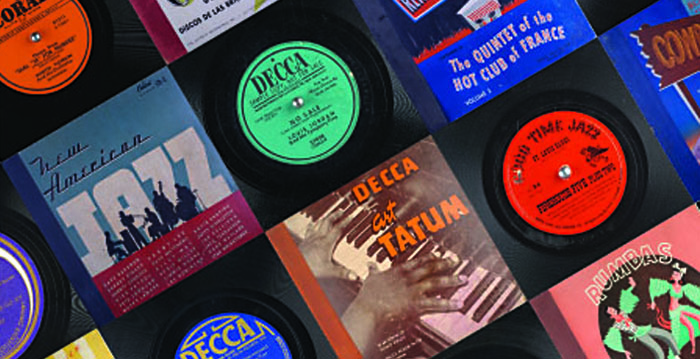
Last summer we checked in with the Internet Archive’s Great 78 Project, a volunteer effort to digitize thousands of 78rpm records—the oldest mass-produced recording medium. Drawing on the expertise and vast holdings of preservation company George Blood, L.P., the ARChive of Contemporary Music, and over 20 more institutions from around the world, the project aims to save the recorded sounds of the past, and not only those that have come down to us through the efforts of highly selective curators. What we think of as the sound of the early 20th century—the blues, jazz, country, classical, ragtime, gospel, bluegrass, etc.—only represents a popular sample.
Internet Archive founder Brewster Kahle wants to widen our sonic appreciation of the period, and include everything, “Midwest, different countries, different social classes, different immigrant communities and their loves and fears.”
This massive archive will eventually number in the millions, up to 3 million recordings, to be exact, and continues apace at the rate of about 5,000 new uploads per month.
Last August, the recordings in the archive numbered over 25,000. Now, the Great 78 Project contains more than 78,000 and counting digital transfers of fragile 78rpm records—everything from Prokofiev to the Carter Family (further up) to Mississippi John Hurt from 1928 (above) to international folk dances to field recordings of animal sounds.
The collected works of Al Jolson, spanning the years 1911 to 1926, appear (above), as does a fascinating collection from Argentina, brought to the U.S. by Tina Argumedo, who began collecting 78s in the 30s and continued to do so for another 20 years before moving to the States. Her digitized collection of almost 700 records “comprises primarily tango music, with boleros, sambas, mambo, and other dance music,” like the Argentine swing of Dajos Bela y su Orquestra from 1932 below.
As we noted in our previous post, the utmost care has gone into preserving the original sound of these records, with a variety of digital transfers made with different vintage styluses to represent the differences in playback systems. The process also preserves all the original records’ crackle and hiss—sometimes the music seems to swim below the surface noise, which only enhances the effect of hearing, transported through time, music from 80, 90, and 100 years ago and more.
Enter the 78 archive here.
Related Content:
The Boston Public Library Will Digitize & Put Online 200,000+ Vintage Records
Stream 8,000 Vintage Afropop Recordings Digitized & Made Available by The British Library
Josh Jones is a writer and musician based in Durham, NC. Follow him at @jdmagness
Massive Archive of 78RPM Records Now Digitized & Put Online: Stream 78,000 Early 20th Century Records from Around the World is a post from: Open Culture. Follow us on Facebook, Twitter, and Google Plus, or get our Daily Email. And don't miss our big collections of Free Online Courses, Free Online Movies, Free eBooks, Free Audio Books, Free Foreign Language Lessons, and MOOCs.
Ask The Salty Waitress: Is it tacky to split entrées?

Are you a server’s worst nightmare without even knowing it? We’re here to help. The Salty Waitress is The Takeout’s advice column from a real-life waitress that will teach you how not to behave like a garbage person while dining out—and maybe in real life.
Commonly Stolen Cars Are Worth Less Than The Sum Of Their Parts
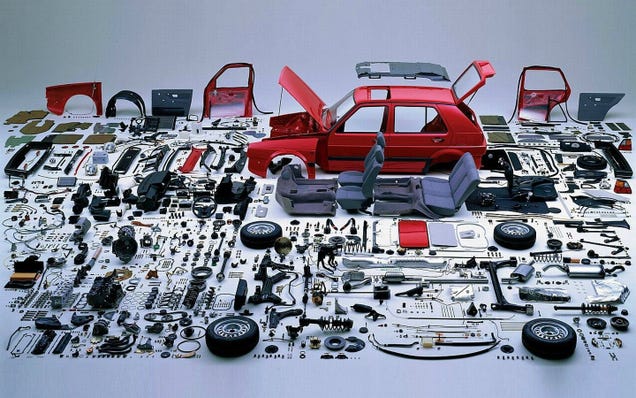
Most car thefts don’t involve a list of secret supercars and Nicholas Cage hitting jumps in a Mustang. Late-model Toyota Camrys, Nissan Altimas and GMC Sierras are apparently stolen because just a few easily-removable parts are almost worth more than the entire vehicles.
Backlit Landscape Photography: Why You Should Shoot Into the Sun (+ Tips)
The post Backlit Landscape Photography: Why You Should Shoot Into the Sun (+ Tips) appeared first on Digital Photography School. It was authored by Christian Hoiberg.

In landscape photography, avoid photographing toward the sun.
It’s one of the most common tips you’ll hear from seasoned landscape photographers. In fact, it’s a tip that I’ve previously shared, myself!
Now, avoiding strong backlighting is a well-known tip for a reason. When you point your camera into the sun, you’ll be faced with very difficult lighting conditions, and you risk losing details in the highlights and the shadows (or both at the same time!). Expert landscape photographers know this, and they know the dynamic range that their sensors are capable of capturing, which is why you often hear the above advice.
That said, the importance of avoiding strong backlight might not be as relevant today as it was several years ago. Today’s sensors and post-processing opportunities are much more forgiving, and what once was a bad idea can now be an opportunity.
In this article, I’ll show you how photographing toward the sun can enhance the atmosphere and add an extra dimension to your landscape images. And I’ll share my best tips so you can include the sun in your shots with amazing results!
Why you should include the sun in your landscape photos
I’m sure many of you are ready to jump straight into the comment section right now and tell me how much of a bad idea it is to shoot towards the sun. But give me a minute to explain why it’s something you might want to consider doing with your landscape photography.
The greatest benefit of adding the sun to the frame is that it adds depth to the resulting shot.
Take this next image as an example. As you can clearly see, the sun is present, and the shot is incredibly three-dimensional:

But if you remove the sun, the photo becomes flat and much less interesting:

Sure, you could process the sunless image to add some three-dimensionality and drama, but the result wouldn’t be the same. Without the sun, the image is flat; with the sun included, the image comes to life and drags you into it.
Including the sun can also be beneficial from a compositional perspective. In the example above, the bright sun serves as a focal point. The viewer’s eye is naturally guided along the cliffs and up toward the sun in the background.
Here, it’s important to keep in mind that our eyes are naturally attracted to the brighter parts of an image. So if you include the sun in the frame, and you ensure that it’s positioned in a background area where the viewer’s eye can rest, it’ll do a great job of drawing the eye from foreground to background.
(Of course, whether this looks good depends on where you place the sun. You must think of the sun as a compositional element and position it accordingly, the same way you’d position a mountain, a picturesque cabin, an interesting tree, and so on.)
One final benefit of shooting toward the sun is that you often get beautiful shadows moving from background to foreground. These can serve as additional leading lines that help guide the viewer’s eye and add an even greater sense of depth.
How to effectively include the sun in your landscape photos: a few powerful tips
Hopefully, you now agree with me that the sun can sometimes enhance your landscape images.
However, there’s one thing I need to make clear: including the sun in your images won’t always be beneficial. There are certain conditions or methods you should take advantage of for this to work. Here are some tips to help you out:
1. The time of day matters
While there are exceptions to this advice, the best landscape images generally come when the sun is low on the horizon. The sun then creates a soft glow and gives a nicely balanced light, plus it often turns the sky into a breathtaking canvas of color:

Additionally, when the sun is low in the sky, the landscape features a more limited tonal range, making it easier to capture backlit shots.
On the other hand, during midday – when the sun is positioned higher in the sky – the light is harsh and less pleasing to the eyes. This is something you generally want to avoid in landscape photography!
2. Carefully place the sun within the frame
I’ll start by saying this: There’s no one single correct spot to place the sun within your image. Sometimes it’s beneficial to place it in the center, while other times it’s better to place it on the side.
This is where trial and error, as well as experience, come into play.

For the image above, I chose to place the sun at the very edge of the frame. Partly obscured by the clouds, it doesn’t attract too much attention; instead, the viewer is drawn to the beautiful light hitting the landscape while subtly guided from the foreground to the distant background.
If you are familiar with semi-advanced post-processing techniques, you might be aware of a processing style called light bleed. This is a technique that involves heavy dodging and enhancing/creating a light source that diffuses through the image, and it’s used by a lot of landscape photography professionals to create an ethereal effect.
However, by placing the sun at the corner or edge of your frame, you can actually produce the light-bleed style in-camera.
Other times, however, you want to place the sun in the center of the image. For the image below, placing the sun in the center added a light source that your eyes naturally go toward. Had I instead placed the sun to the side, this image would have been less balanced.

3. Obscure the sun
In my opinion, one of the best ways of including the sun in your landscape photos is to partly obscure it. You can do this by waiting for the sun to get low in the sky, then position your camera so the sun is peeking out from behind a tree, a mountain, etc.
When you combine a partially obscured sun with a narrow aperture such as f/8 or f/11, you can achieve a beautiful sunstar or sunburst:

4. Use a graduated ND filter
Since the sun is so much brighter than the surrounding landscape, it can be hard to capture a well-exposed image when including it in the frame. But by using a graduated neutral density filter, you can darken the sky in your image while leaving the foreground untouched – resulting in a well-balanced image even with the sun in the frame.
Unfortunately, working with graduated ND filters is not always ideal. Since the transition between darkened and transparent parts of the filter is a straight line, it can create unwanted darkening effects if you’re photographing a scene where something is projecting above the horizon.
Graduated ND filters are better to use when the horizon is flat, such as in the image below:

So what do you do when faced with a high-contrast backlit landscape that isn’t amenable to photographing with a graduated ND filter? That’s where my next tip comes in handy:
5. Bracket and merge your files
Another more flexible method of capturing well-balanced images with the sun included is to bracket multiple exposures and blend them in a photo editor. This is the better choice when the sun is at the highest position in the sky, as the contrast is even greater – or when you can’t effectively place a graduated ND filter over the horizon.
To create this next image, I actually captured three files: one exposed for the landscape, one exposed for the sky, and one even darker to balance out the brightest parts.

Then I blended them in post-processing to produce a final shot with good detail in both the land and the sky!
Try including the sun in your landscape shots!
Hopefully, I’ve been able to convince you that shooting toward the sun isn’t a complete no-no. And if you use the tips I shared, you’ll be well on your way to capturing some stunning backlit landscape photos, too.
Photographing into the sun can be tough, but the rewards can be great, so give it a try and see what you think!
Now over to you:
Have you captured any images that are shot toward the sun for your landscape photography? Share them in the comments below! I’d love to see them.
Table of contents
Landscape Photography
-
GENERAL
-
PREPARATION
-
SETTINGS
- 5 Tips for Setting the Focus in Your Landscape Photography
-
LIGHTING
-
COMPOSITION
-
GEAR
-
ADVANCED GUIDES
- Tips for Shooting Landscape Photography Towards the Sun
- How to enhance your nature and landscape photos with flash
- Essential gear
- General advice
- Imitating natural light on the landscape
- Adjusting the exposure when using flash
- How to use the flash for more artistic nature photos
- How to use flash to photograph wildlife
- Capture some amazing nature and landscape photos – with flash!
- How to enhance your nature and landscape photos with flash
- Essential gear
- General advice
- Imitating natural light on the landscape
- Adjusting the exposure when using flash
- How to use the flash for more artistic nature photos
- How to use flash to photograph wildlife
- Capture some amazing nature and landscape photos – with flash!
- 1. 70-200mm f/2.8
- 2. 24-70mm f/2.8
- 3. 85mm prime
- 4. 35mm
- 5. 105mm (100mm) or 60mm macro lens
- Essential lenses for wedding photography: final words
- 1. 70-200mm f/2.8
- 2. 24-70mm f/2.8
- 3. 85mm prime
- 4. 35mm
- 5. 105mm (100mm) or 60mm macro lens
- Essential lenses for wedding photography: final words
- 1. Watch your step
- 2. Follow local regulations
- 3. Be considerate of others
- Take landscape photos, but be responsible and ethical
- 1. Watch your step
- 2. Follow local regulations
- 3. Be considerate of others
- Take landscape photos, but be responsible and ethical
- Why you should include the sun in your landscape photos
- How to effectively include the sun in your landscape photos: a few powerful tips
- 1. The time of day matters
- 2. Carefully place the sun within the frame
- 3. Obscure the sun
- 4. Use a graduated ND filter
- 5. Bracket and merge your files
- Try including the sun in your landscape shots!
- Why you should include the sun in your landscape photos
- How to effectively include the sun in your landscape photos: a few powerful tips
- 1. The time of day matters
- 2. Carefully place the sun within the frame
- 3. Obscure the sun
- 4. Use a graduated ND filter
- 5. Bracket and merge your files
- Try including the sun in your landscape shots!
-
CREATIVE TECHNIQUES
-
POST-PROCESSING
-
INSPIRATION
The post Backlit Landscape Photography: Why You Should Shoot Into the Sun (+ Tips) appeared first on Digital Photography School. It was authored by Christian Hoiberg.
Nelson Dellis, USA Memory Champion

We have hired professional editors to help create our weekly podcasts and video reviews. So far, Cool Tools listeners have pledged $359 a month. Please consider supporting us on Patreon. We have great rewards for people who contribute! – MF
Our guest this week is Nelson Dellis. Nelson is one of the leading memory experts in the world, traveling around the world as a Memory Consultant and Keynote Speaker. A four-time USA Memory Champion, mountaineer, and Alzheimer’s disease activist, he preaches a lifestyle that combines fitness, both mental and physical, with proper diet and social involvement.
Subscribe to the Cool Tools Show on iTunes | RSS | Transcript | Download MP3 | See all the Cool Tools Show posts on a single page
Show notes:

Mountain Hardware Ghost Whisperer Jacket
“I like to climb, I’m a big climber, and through my charity I do a bunch of big expeditions. So I’ve been up Everest a few times … where you’re dealing with the elements, trying to stay warm and not get cold in different circumstances. You’re trying to find the perfect gear that’s not too heavy and gets the job done. So I’ve experimented with a bunch of stuff, and in 2016 I was on Everest, and I was introduced to this jacket … and I haven’t stopped using it since. It’s just this really lightweight kind of down jacket that folds up super small, it’s super light, and it just has so many different uses. I wear it kind of in between layers, on top of layers, it just stops the wind and just keeps you toasty.”

Peak Design Anchor Links for Camera Straps
“I love taking video of when I travel, when I climb, even for some of my memory videos, I’m shooting them on the go, interviewing people or trying to get a shot while I explain something and sometimes, I like to go really hand-held to get these angles or to just be run and gunning. Other times, I just have to have it’s strapped around my neck and I’m doing something else, holding something else. So, I kind of go in-between those things and I’ve always hated Canon straps that have these double loops that take like, 10 minutes to sit down and fish them through the little loop and all that stuff and I think the Sony’s DSLRs, which I’ve played with too, have these really annoying kind of clips that make noise if you keep them on, so people take them off … this little kind of contraption is basically getting rid of you ever having to do that again … they don’t bother the camera at all, but you can just latch on when you need the strap or not and it’s awesome for dealing with that kind of stuff.”
The Memory Palace Technique
“This technique supposedly was invented by the Greeks thousands of years ago and has been used to memorize massive poems and legions of armies’ fighters names and it’s something people had to use back in the day to store information … The technique works around something that our brains are really good at, which is one, thinking in pictures. … The second step is to take advantage of what our brains are also good at, and that is spatial information. We’re very spatially aware. Our brain is very good at kind of scanning areas and keeping that information within our heads without really trying. And so, if you think about your house for example, close your eyes and picture yourself standing at your front door. I guarantee you, 99.9% of people listening could close their eyes and walk through their whole house without even trouble, right? … So, if you can take those two things, thinking in pictures and using your house or some place familiar, the spatial information that’s already memorized in your mind, you can actually memorize really large amounts of things, and this is the memory palace … Let’s say you’re memorizing all 45 presidents … You would come with a picture for each of the Presidents’ names. So, like, Taft could be a raft, because you’d actually picture a raft, right? Wilson could be a tennis ball, right? Because you think of Wilson tennis, right? Trump’s face is actually memorable, or you could think of an orange … So, you have a picture for each of those things and then what you do is you place the pictures in order, because you want to know the presidents in order, around a path through the place that you’re using as your palace. … So, maybe your picture for Washington is a washing machine filled with a ton of clothes and you picture that washing machine kind of pushed up against the front door and maybe it’s rattling because there’s a ton of stuff in there, it’s really over-loaded and it’s just shaking, making a lot of scary noises and kind of banging up against the door so much so that maybe even the wooden door is splintering and kind of shattering. So you kind of combine the images and have them interact with the space.”

Art of Memory
“This is something I actually helped create with a few other memory friends and it’s basically a place to train your memory. I use it to practice, of course. Teach others as well, these techniques. Play memory games online against other memory enthusiasts and you can actually create your memory palaces through our software online … So, it’s just a great kind of tool. All memory training related. Great resource for learning techniques, practicing them and developing your systems.”
Also mentioned:
Paddle Submission: Lee F's Poplar Voyageur Paddle

For sanding, Lee used a piece of wet leather embedded with sand. That's a technique seems so practical in its simplicity. I hadn't heard of that before but will certainly try with the growing pile of leather scraps on hand.
Great stuff Lee!

3 Things You Don't Want To Know About Your Health

Is Charles Bukowski a Self-Help Guru? Hear Five of His Brutally Honest, Yet Oddly Inspiring, Poems and Decide for Yourself


I don't know if he’s been replaced as a major influence on young, restless (and almost exclusively male) aspiring writers, but once upon a time—if you weren’t into the romantic wanderlust of Kerouac but still considered yourself a fringe character—it might be to the hard-boiled shit-talking of wise old man Charles Bukowski that you turned. Upon first learning this, and being a busy college student, I decided to take a crash course and checked out a documentary.
I did not find myself charmed all at once. But one can fall in love with an author’s persona yet loathe them on the page. Bukowski’s crudeness and bad humor on film could not hide the deep wells of sadness in which he seemed to swim, as if—like some ancient cynic philosopher—he knew something profound and terrible and spared us the telling of it by posing as a drunken, half-mad street-corner raconteur. I had to go and read him.

In his idiom—that of an eloquent streetwise barfly—Bukowski can be every bit as passionate and profound as his hero Dostoevsky. His unforgettable mixing of comic seediness and casual abuse with a deeply tragic mourning over the human condition, while not to everyone’s taste, make his decades-long struggle out of penury and obscurity a feat worthy of the telling in his semi-autobiographical prose and poetry.
But does it make him a role model? For anyone but certain young, mostly male, aspiring writers maybe spending more time drinking than writing, that is?
A fair number of people seem to think so, and I leave it to you to decide, first by listening to the Bukowski poems read here, posted on YouTube with heavy, inspirational background music. Some are given new titles to sound more like self-help seminars—such as “Reinvent Your Life” at the top (originally “No Leaders, Please”). The video reading called “Go all the way,” second from top, changes the title of “Roll the Dice,” a classic picture of Bukowski’s uncompromising commitment to “going all the way,” even if it means “freezing on a park bench” and “losing girlfriends, wives, relatives, jobs and maybe your mind.”
Solidly middle-class parents might approve of the first poem’s sentiments, which could be wedged into a suitably vague, yet bold-sounding commencement speech or a job recruiter’s pep talk. But “Roll the Dice” simply goes too far. “It could mean jail, it could mean derision, mockery, isolation”? This won’t do at all. Hear another reading of “Roll the Dice” by inspirational rock star Bono further up, just after the more Bukowski-like Tom Waits reads “The Laughing Heart,” frequently referenced for its intensity of feeling. Like Thomas Hardy or Leonard Cohen, the bard of the barstools could look life straight in the eye, see all of its bleakness and violence, and still manage at times to catch a divine glimmer.

And for the many aspirants to whom Bukowski has appealed, we have, further up, “So, You Want to Be a Writer?” Before you hear, or read, this poem, be advised: these are not warm words of encouragement or helpful life-coaching in verse. It is the kind of raw talk no respectable writing teacher will give you, and maybe they’re right not to, who’s to say? Except a man who went all the way, froze on park benches, went to jail, lost girlfriends, wives, relatives, jobs and maybe his mind? Read an excerpt of Bukowski’s writing advice below, and just above, hear the author himself read “Friendly Advice to a Lot of Young Men,” which urges them to do virtually anything they like, “But don’t write poetry.”
don’t be like so many writers,
don’t be like so many thousands of
people who call themselves writers,
don’t be dull and boring and
pretentious, don’t be consumed with self-
love.
the libraries of the world have
yawned themselves to
sleep
over your kind.
don’t add to that.
don’t do it.
unless it comes out of
your soul like a rocket,
unless being still would
drive you to madness or
suicide or murder,
don’t do it.
unless the sun inside you is
burning your gut,
don’t do it.
Related Content:
Harry Dean Stanton (RIP) Reads Poems by Charles Bukowski
Charles Bukowski Reads His Poem “The Secret of My Endurance”
Josh Jones is a writer and musician based in Durham, NC. Follow him at @jdmagness
Is Charles Bukowski a Self-Help Guru? Hear Five of His Brutally Honest, Yet Oddly Inspiring, Poems and Decide for Yourself is a post from: Open Culture. Follow us on Facebook, Twitter, and Google Plus, or get our Daily Email. And don't miss our big collections of Free Online Courses, Free Online Movies, Free eBooks, Free Audio Books, Free Foreign Language Lessons, and MOOCs.
How a Pile of Unpaid Bills Led to Washington, D.C.
The following is an article from the book Uncle John's Canoramic Bathroom Reader.
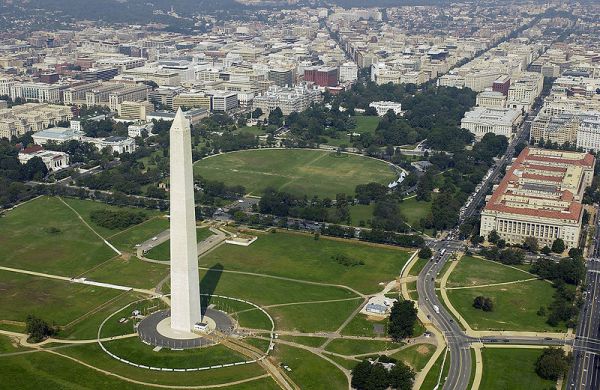
You probably know that the “D.C.” in Washington, D.C., stands for “District of Columbia” and that the district is not part of any state. But do you know why America’s Founding Fathers placed such importance on creating a capital outside of any state? We owe it all to piles of unpaid bills.
EVOLUTION OF THE REVOLUTION
In April 1783, the U.S. Congress (then known as the Continental Congress) gave preliminary approval to the Treaty of Paris, which, if ratified by both England and the United States, would end the Revolutionary War after eight long years of fighting. Final ratification was still a year off, but it was clear that the war was all but over and that the American colonies had won. That was good news for the colonies… but not necessarily for the soldiers who’d done the fighting, because it wasn’t clear that they would ever be paid for their years of service and sacrifice.
The Congress had run up huge debts to finance the war effort, and it had no real means of paying back the money. The Articles of Confederation, which served as the American constitution from 1781 until it was replaced by the U.S. Constitution in 1788, gave Congress the power to declare war and the power to raise an army to fight it. But it didn’t give Congress the power to levy taxes. Without this power, it had no way to raise the money it needed to pay its war debts. The Congress could ask the states to contribute, but it couldn’t compel them to do it. The states had run up huge war debts of their own that had to be repaid.
BEG, BORROW, STEAL
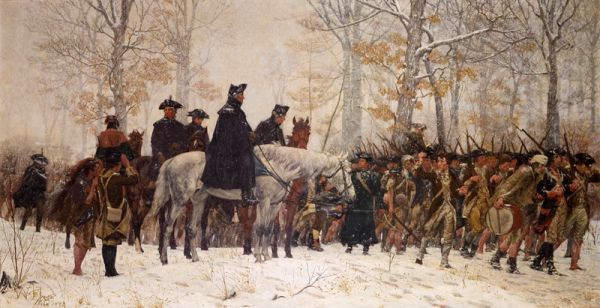
Many soldiers had been paid with IOUs or not at all. Their material needs had often gone unmet as well. During the winter of 1777, for example, nearly a quarter of the 10,000 soldiers camped at Valley Forge died there -not from combat, but from malnutrition, exposure, and disease. “We have this day no less than 2,873 men in camp unfit for duty because they are barefooted and otherwise naked,” General George Washington complained in a letter two days before Christmas in 1777.
FREE… FOR NOW
Soldiers with the means to do so had supported themselves during the war, and when their money ran out, they had amassed debts of their own. Now, having shed their blood to secure America’s liberty, they faced the prospect of losing their own liberty in debtors’ prison as soon as they were discharged from the army. “We have borne all that men can bear,” one group of soldiers wrote in a petition to Congress in early 1783, “our property is expended, our private resources are at an end.”
In response to this and other demands for payment from the soldiers, Congress could offer only vague promises to make good on its obligations to pay them …someday.
ON THE MOVE
On June 19, 1783, a group of about 80 unpaid soldiers stationed in Lancaster, Pennsylvania, mutinied and began marching the 60 miles to Philadelphia, then the nation’s capital, to demand payment from Congress in person. As they made their way toward the city, more troops abandoned their posts and joined the march. The congressmen, meeting at the State House (known today as Independence Hall), feared that if the soldiers made it to Philadelphia they’d join forces with soldiers stationed in the city. The mutiny might then be large enough to overthrow the government, ending America’s democratic experiment just as it was beginning.
Congress had no troops of its own to call on for protection. When the war ended, the Continental Army had disbanded, and command of the soldiers had reverted to the states, each of which had its own militia. Alexander Hamilton, then a congressman from New York, appealed to Pennsylvania’s ruling body, the Supreme Executive Council, to dispatch the state militia to protect Congress, but the council refused to do so. Unless and until the soldiers became violent, Congress would have to fend for itself.
By then, of course, it would probably be too late.
OVER THE LINE
Having been rebuffed by the Supreme Executive Council, Hamilton dispatched the assistant secretary of war, Major William Jackson, to meet with the soldiers at the city limits and hopefully turn them back. No such luck- the soldiers marched right past Jackson and, as feared, made common cause with troops stationed in the city. The mob, now numbering some 400 angry (and, thanks to the generosity of sympathetic tavern keepers, drunken) men, raided several arsenals and seized the weapons inside. Then it marched on the State House and surrounded it while Congress was meeting inside.
STANDOFF
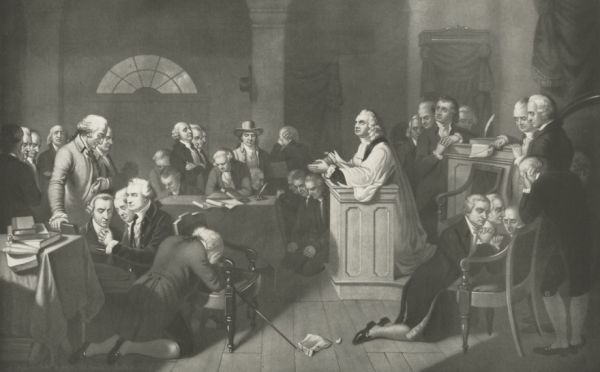
The mutineers delivered a petition to Congress stating their demands and threatening that if they were not met within 20 minutes, the “enraged soldiery” would take matters into their own hands. As volatile as the situation was, Congress refused to submit to the soldiers’ demands, nor would it agree to negotiate with the mob or even adjourn for the day. Instead, it continued with its ordinary business for another three hours, then adjourned at the usual time and left the building to the taunts and jeers of the soldiers outside.
That evening Congress reassembled at the home of Elias Boudinot, the president of Congress. There it passed a resolution condemning the mutineers and demanding that Pennsylvania’s Supreme Executive Council order the state militia to disperse the mob. If the Council refused, the Congress warned, it would leave the state and assemble in either Trenton or Princeton, New Jersey. And if Pennsylvania refused to guarantee the security of the congressmen in the future, it would never meet in the city again.
 TIME TO GO
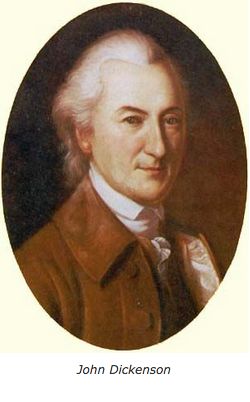
The next morning Alexander Hamilton and another congressman, Oliver Ellsworth, delivered the resolution to the president of the Supreme Executive Council, John Dickinson, in person. But Dickinson sympathized with the unpaid troops, and he feared that the Pennsylvania militia -also comprised of Revolutionary War veterans- would refuse to fire upon their brothers in arms if commanded to do so. Dickinson declined to take action.
With no help coming from the state government, Congress made good on its threat and evacuated to Princeton. It remained there for just a month before moving to Annapolis, Maryland. A year later, in 1785, it moved to New York City. It was still there in June 1788, when the U.S. Constitution replaced the Articles of Confederation. The new constitution gave Congress the power to levy taxes, which finally made it possible to pay its bills.
STAND DOWN
By then, of course, the mutiny was long over. Pennsylvania’s Supreme Executive Council eventually did call up the state militia to disperse the mutineers, and as soon as the soldiers received word that the militia was on its way, they laid down their arms and returned to their bases. They never fired a shot or killed a single person in anger, which is one of the reasons the “Pennsylvania Mutiny of 1783” is largely forgotten today.
But the mutiny did have a big impact on American history, because the congressmen who found themselves surrounded by an armed, angry (and drunken) mob with no one coming to their aid were determined that the fledgling democracy would never face such a threat again. “The Philadelphia mutiny… gave rise to the notion that the national capital should be housed in a special federal district where it would never stand at the mercy of state governments,” author Ron Chernow writes in his biography of Alexander Hamilton. When delegates met in 1787 (in Pennsylvania’s State House, ironically) to draft the new constitution, they inserted in Article 1, Section 8, of the U.S. Constitution a paragraph giving Congress the power “…to exercise exclusive Legislation in all Cases whatsoever, over such District (not exceeding ten Miles square) as may, by Cession of Particular States, and the Acceptance of Congress, become the Seat of the Government of the United States.”
DETAILS, DETAILS, DETAILS
The U.S. Constitution did not, however, say where the capital city should be located or even require that one be established. All it said was that such a city could be created, and if it was, that Congress would exercise exclusive control over it, including providing for its security. Whether such a city would be built -and if so, where- would be the subject of battles to come.
SITE FIGHT
The U.S. Constitution did not require that a new federal city be built from scratch. All it said was that Congress, if it wanted to, could create a federal district “not exceeding ten miles square” (a site ten miles wide and ten miles long, for a total of 100 square miles) where it would have exclusive jurisdiction. The simplest and cheapest solution would have been to designate a portion of an existing city, such as Philadelphia, Boston, or New York, as the federal district, and for the city and state in question to cede jurisdiction to Congress.
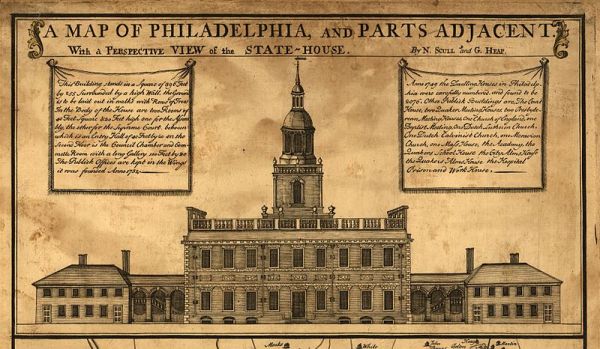
More than one city recognized the financial and other benefits that would accrue from providing the site for the new national capital. Philadelphia, then the country’s largest city, was an obvious choice. The Continental Congress had met there during the war, and both the Declaration of Independence and the U.S. Constitution had been signed in the State House (Independence Hall). And though Congress had vowed never to return to the city after the Pennsylvania Mutiny of 1783, the Pennsylvania delegation was eager to forgive and forget. New York City had served as the nation’s capital since 1785, and prominent New Yorkers like Alexander Hamilton, now the secretary of the treasury, wanted it to be named the permanent national capital.
DOWN UNDER
So why did neither city get the nod? Because Southern states didn’t like the idea of any established urban center, let alone one in the North, serving as the national capital. The rural, agrarian South was suspicious of big cities and the merchants, bankers, manufacturers, stockbrokers, and other sharpies who lived there.
Southern states were also determined to preserve the institution of slavery, which was on its way out in the North. Congressional delegations from the South feared that if the capital was located in a Northern city, slavery would be under constant attack. Southern congressmen also worried that if they brought their slaves to live with them in New York or Philadelphia while Congress was in session, the presence of large numbers of abolitionists and freed slaves in these cities would make it easy for the slaves to escape. (George Washington had the same fear; it was realized in 1796 when a female slave named Oney Judge escaped from the presidential household and never returned.)
IN THE HOLE
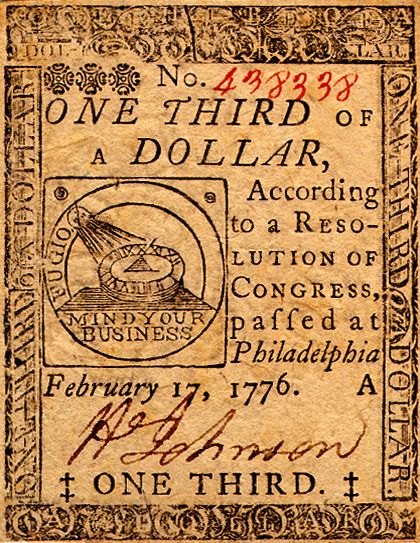 As the United States debated where to put the capital city, it also wrestled with a much more daunting challenge: the country’s staggering Revolutionary War debts. Thanks to the ratification of the Constitution in 1788, Congress now had the power to tax, which gave it the ability to generate revenue to pay down the debt. It was certainly going to need it. The nation was nearly bankrupt. In 1790 the federal government’s war debt stood at $54 million (the equivalent of around $1.2 billion today) at a time when the population of the United States was fewer than four million people. Individual states had also piled up millions of dollars in debt, more than $25 million of it still outstanding.
How to repay all that money -and indeed whether to repay it at all- was the subject of much debate. Many Americans felt a stronger allegiance to their home states than they did to the new union; they would have cared little if the national government defaulted on its debts. Some states had already reneged on their obligations. New York stopped making interest payments on its bonds in order to drive down their market value, then bought them back for a song to avoid paying back the money in full.
FORTUNE OF SOLDIERS
Complicating the issue were the thousands of IOUs that had been issued to Revolutionary War soldiers in lieu of their pay. Many soldiers, either out of desperation or simply in despair that they would ever be paid, had sold their IOUs to speculators for pennies on the dollar. If the IOUs were paid off now, the speculators, not the soldiers, would benefit. So why not default on the IOUs and find some other way to pay the soldiers directly?
CREDIT HISTORY
Alexander Hamilton, the New York congressman whom George Washington appointed secretary of the treasury in 1789, felt otherwise. He believed that if the young country was going to develop, it would need access to capital and plenty of it. If it wanted to borrow the money at favorable interest rates, it needed to demonstrate to lenders that it would always honor its debts.
The treasury secretary drew inspiration from the British, who had built the Royal Navy with borrowed money and then used the navy to extend the British Empire to every corner of the globe. England’s reputation for honoring its debts was unquestioned; the government’s bonds were considered as good as cash. People could even use them as collateral for loans, which injected even more money into the British economy.
ALL FOR ONE, ONE FOR ALL
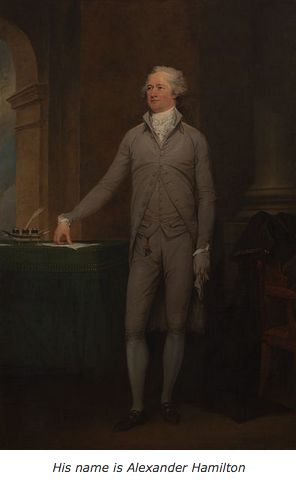 Hamilton believed it was important for the federal government to assume responsibility not only for its own debts but also those of the states, and to consolidate them all into a single, giant pool of war debts that would be repaid in full. Since everyone had benefited from the Revolution, he reasoned, everyone should pitch in to pay for it, not just the states that had done most of the fighting (and thus most of the borrowing).
In January 1790, Hamilton published his ideas in The First Report on the Public Credit, which he presented to Congress. His plan aroused strong opposition from the start; some states, like Virginia and North Carolina, had already paid most of their war debts, and they balked at having to pay a second time to settle the debts of other states, like Massachusetts and South Carolina. And nobody relished the idea of enriching speculators at the expense of destitute Revolutionary War veterans.
Hamilton believed that making good on the IOUs, even those that had been sold to speculators, was a necessary evil. The only reason the IOUs had sold for a fraction of their value in the first place, he argued, was because people had assumed the government would never pay up. Demonstrating the government’s intent to honor its obligations would prevent those debts from ever selling for a fraction of their face value again, depriving future speculators the ability to profit from wild swings in their value. (Hamilton also had a grudging admiration for the speculators because they’d shown faith in the new government and risked their own money to buy the IOUs that so many people assumed were worthless. He believed they deserved to be rewarded for taking the risk.)
THANKS… BUT NO THANKS
As Hamilton’s debt-payment plan made its way through Congress in the early months of 1790, it lost some key preliminary votes, thanks to strong opposition from such luminaries as Secretary of State Thomas Jefferson and James Madison, then an influential member of Congress. Both men were from Virginia, an agrarian Southern state that was then the most populous in the Union.
Unlike Hamilton, Jefferson and Madison were not inspired by the British model of a worldwide empire ruled by a single government in London. They envisioned the United States as something more akin to what the European Union and the United Nations are today: a coalition of independent, sovereign states linked (when necessary) by a comparatively weak central government. Jefferson and Madison feared that Hamilton’s financial plan would strengthen the federal government at the expense of the states. They also sympathized with the Revolutionary War veterans and wanted to see that they, not the speculators, were paid in full.
DOUBLE TROUBLE
Either of the two great issues of the day -where to put the capital city and how to deal with the Revolutionary War debts- was divisive enough in its own right to dissolve the fragile new nation just as it was coming into being. So why didn’t it happen? Because as badly as Alexander Hamilton wanted to see New York or some other Northern city as the national capital, he wanted his debt-payment plan even more. And as much as Jefferson and Madison loathed Hamilton’s debt plan, they understood that America defaulting on its debts was even worse. They were willing to support Hamilton’s plan, but they had a price: They wanted the new capital city to be located somewhere in the rural South.
MEAL DEAL
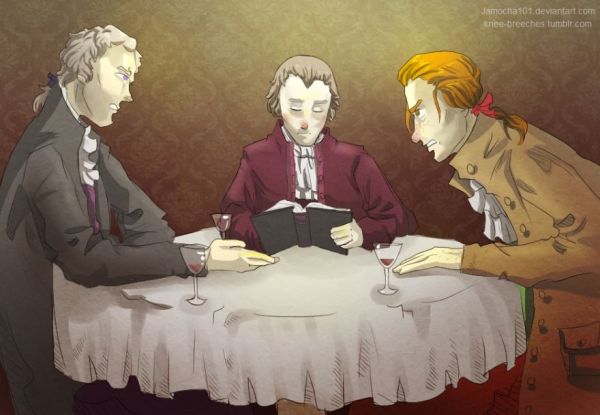 (Image credit: Dinner Table Agreement by Jamocha101 on DeviantArt)
That was the deal that was worked out at a famous dinner that Jefferson hosted for Hamilton and Madison at his home in New York in June 1790. There, Hamilton agreed that the capital city would be located somewhere along a 65-mile stretch of the Potomac River, on the border between Maryland and Virginia, with the exact site to be chosen later. In return, Jefferson and Madison agreed that Madison would round up the votes needed to get Hamilton’s debt-payment plan through Congress. To win the support of the Pennsylvania delegation, it was agreed that Philadelphia would serve as the temporary capital for ten years while the permanent capital was being built.
The bill placing the capital city on the Potomac was called the Residence Act; it passed both houses of Congress in early July 1790 and was signed by President George Washington on July 16. Hamilton’s debt plan was signed into law a few weeks later.
The Residence Act also specified that Washington would decide precisely where along the Potomac the federal city would be located. He selected a spot just 15 miles north of his estate at Mount Vernon. In 1791 the new city was named Washington in his honor, and the federal district in its entirety was named Columbia.
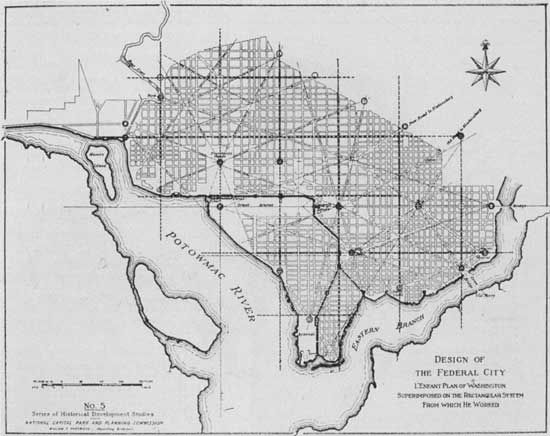
STAY (JUST A LITTLE BIT LONGER)
One of the reasons the Pennsylvania delegation was willing to vote for the plan in exchange for Philadelphia being named the “temporary” capital was that many Pennsylvanians assumed it wouldn’t be temporary. With so much money needed to pay the Revolutionary War debts, how much would be left over to build the new capital? Washington, D.C., was supposed to be completed by 1800… but what if construction fell behind? Pennsylvania officials were so certain that the new capital would never be finished that they began constructing their own buildings to house the federal government, including a house for the president, to entice the government into staying in Philadelphia for good.
And even though the state had been phasing out slavery for a decade via the Gradual Abolition Act of 1780, that law specifically exempted slaves owned by members of Congress from the law. That meant that congressmen from slave states could bring their slaves into Pennsylvania without fear of them winning their freedom under the law. (The slaves could still escape to freedom -and many did- but at least they had no means of obtaining their freedom through the legal system.)
PHILADELPHIA FREEDOM
The building of Washington, D.C., actually did fall behind, and there must have been plenty of times when it seemed like the project would end in failure. Who knows? Philadelphia might well have been named the permanent capital, were it not for one more problem: mosquitos. In August 1793, Philadelphia was hit by a yellow fever epidemic- its first in over 30 years and far worse than any that had come before. A tenth of the population died in just three months, and another two-thirds fled the city, leaving it a virtual ghost town.
George Washington decamped to Germantown, ten miles outside the city, and ran the executive branch from there for about a month until moving to Mount Vernon in September. He survived the epidemic, but four of his servants did not.
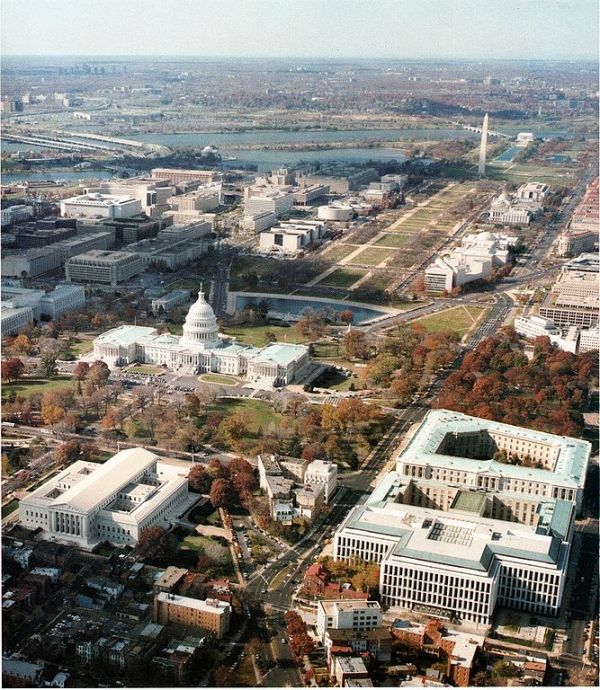
No one understood at the time that mosquitos were the carriers of yellow fever, but when the disease returned to Philadelphia in 1797, 1798, and 1799, people assumed that something had to be wrong with the city, perhaps the climate, or the air, or the water. Whatever it was, what little chance Philadelphia had for remaining the capital city was gone for good. When 1800 rolled around and Washington, D.C., still wasn’t completed, the federal government went ahead and moved there anyway.
It wasn’t perfect, but it was better than staying in Philadelphia.
_______________________________
 The article above is reprinted with permission from Uncle John's Canoramic Bathroom Reader. The latest annual edition of Uncle John’s wildly successful series features fascinating history, silly science, and obscure origins, plus fads, blunders, wordplay, quotes, and a few surprises
Since 1988, the Bathroom Reader Institute had published a series of popular books containing irresistible bits of trivia and obscure yet fascinating facts. If you like Neatora ma, you'll love the Bathroom Reader Institute's books - go ahead and check 'em out!
Tim Minchin Presents “9 Rules to Live By” in a Funny and Wise Commencement Speech (2013)

Tim Minchin isn’t much of a role model in the hair brushing department, but in every other way the prolific comedian/actor/writer/musician/director inspires.
He’s unabashedly enthusiastic about science, a lifelong learner who’s a strong believer in the power of exercise, travel, and thank you notes….
He uses his stardom and talent for penning controversial lyrics to raise awareness and money for such causes as the UK’s National Autistic Society and a local charity formed to send adults who, as children, were sexually abused by Catholic clergy, to Rome.
His creative output is prodigious.
And he’s one helluva commencement speaker.
In 2013, his alma mater, the University of Western Australia, awarded him an Honorary Degree of Doctor of Letters and invited him to address the graduating class.
The speaker insisted up front that an “inflated sense of self importance” born of addressing large crowds was the only thing that positioned him to give such an address, then went on to share a funny 9-point guide to life that stressed the importance of gratitude, education, intellectual rigor, and kindness toward others.
If you haven’t the time to watch the entire 12-minute speech, above, be sure to circle back later. His advice is hilarious, heartwarming, and memorable.
In extrapolating the essence of each of his nine “life lessons” below, we discovered many bonus lessons contained therein (one of which we include below.)
Tim Minchin’s 9 Rules To Live By
- You don’t have to have a dream. Be micro-ambitious and see what happens as you pursue short-term goals…
- Rather than chasing happiness for yourself, keep busy and aim to make someone else happy.
- Remember that we are lucky to be here, and that most of us - especially those of us with a college education, or those actively seeking to educate themselves to a similar degree—will achieve a level of wealth that “most humans throughout history could not have dreamed of.”
- Exercise. Among other things, it helps combat depression.
- Identify your biases, prejudices, and privileges and do not exempt your own beliefs and opinions from intellectual rigor.
- Be a teacher! Swell the ranks of this noble profession.
- Define yourself by what you love, rather than what you despise, and lavish praise on the people and things that move you.
- Respect those with less power than yourself, and be wary of those who do not.
- Don’t be in a rush to succeed. It might come at a cost.
BONUS. Uphold the notion that art and science are not an either/or choice, but rather compliment each other. “If you need proof—Twain, Douglas Adams, Vonnegut, McEwan, Sagan and Shakespeare, Dickens for a start. …The arts and sciences need to work together to improve how knowledge is communicated. “
Read the full transcript of Minchin’s commencement speech here.
Related Content:
NPR Launches Database of Best Commencement Speeches Ever
David Lynch Gives Unconventional Advice to Graduates in an Unusual Commencement Address
Jon Stewart’s William & Mary Commencement Address: The Entire World is an Elective
Ayun Halliday is an author, illustrator, theater maker and Chief Primatologist of the East Village Inky zine. Follow her @AyunHalliday.
Tim Minchin Presents “9 Rules to Live By” in a Funny and Wise Commencement Speech (2013) is a post from: Open Culture. Follow us on Facebook, Twitter, and Google Plus, or get our Daily Email. And don't miss our big collections of Free Online Courses, Free Online Movies, Free eBooks, Free Audio Books, Free Foreign Language Lessons, and MOOCs.
Nostradamus Wrote Prophecies; He Also Made Jelly
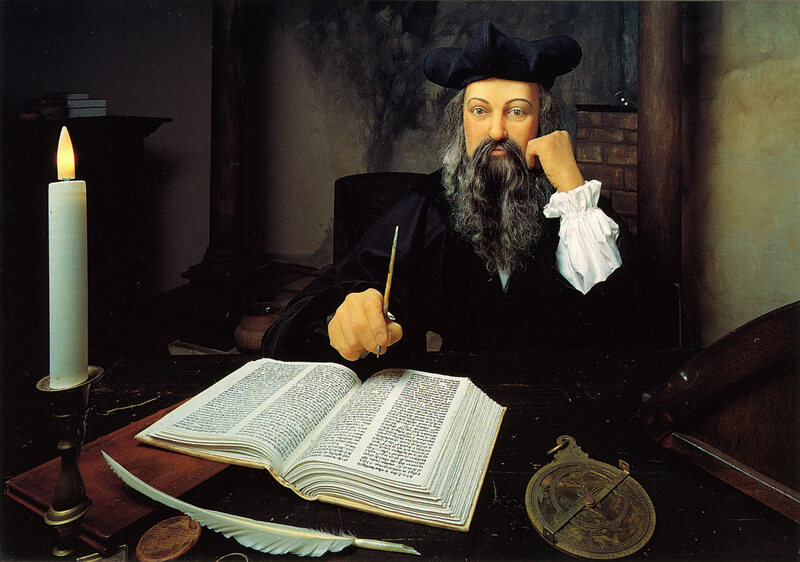
Michel de Nostredame, better known as Nostradamus, was a 16th-century French writer, astrologer, and prophet. In his 1555 book Les Propheties, he laid out predictions for centuries to come: all in rhyme, of course. According to believers, Nostradamus successfully predicted the French revolution, the World Wars, and the election of Donald Trump.
But Nostradamus had another mystical power that’s less well known: the ability to whip up fabulous jellies. In 1552, he published the Traité des fardements et confitures, or the “Treatise on Cosmetics and Jams.” One of them was even an aphrodisiac.
The book didn't come completely out of nowhere. Nostradamus was, among other things, an apothecary. Combining herbalism and pharmacy, he devised and recorded remedies. It’s even said he was kicked out of university when his past career as an apothecary was revealed: Tradesmen were considered sordid, and badmouthing actual doctors didn't help his cause. But Nostradamus bounced back to travel Europe as an in-demand apothecary and famed plague fighter.
Oddly enough, his favorite plague remedies can be found in Traité des fardements et confitures. While it might seem odd to include medicines, sweets, and beauty tips all in the same volume, early recipe books often offered such hodgepodges. Plus, sugar was so rare and valuable that it was often regarded as medicinal, especially, according to The Oxford Companion to Sugar and Sweets, for "warming [the body], and as an effective laxative." During Nostradamus's time, apothecaries often controlled the sale of sugar. (Unfortunately, neither his sweets nor his herbal remedies could save his wife and two children, who died of plague.)
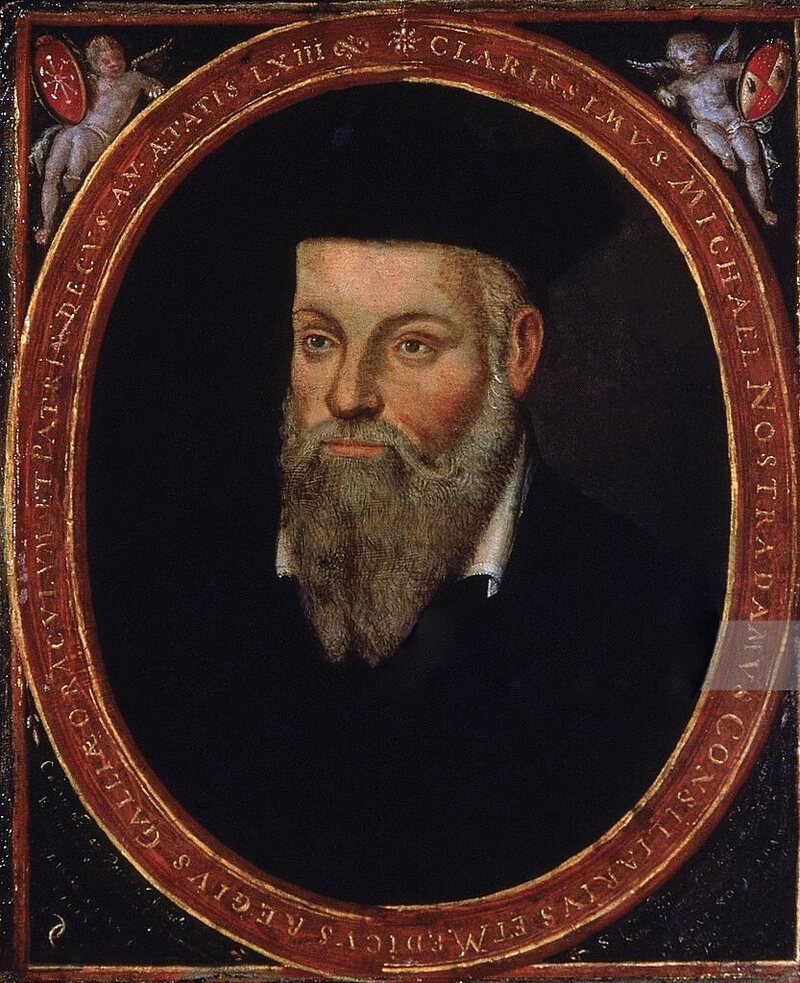
Some of Nostradamus’s recipes in the Traité, which are collected in The Elixirs of Nostradamus, seem downright poisonous. Beauty treatments call for scary ingredients such as lye (for giving hair blonde highlights) and crushed crystal (for a teeth scrub). To make a beard darker and softer—or to dye whiskers the color of “black amber”—Nostradamus recommends soap mixed with ashes and walnut juice.
The Traité’ also includes some genre-bending (at least by modern standards) recipes, such as a jelly-like love potion that contains the blood of seven male sparrows, cinnamon, and mandrake apples. (Swallows are thought to mate for life, which makes them a potent love symbol.) The syrup that results from boiling and straining the mixture, Nostradamus claims, must be stored in a gold or silver container. A mere spoonful causes a fiery passion that can prove dangerous if unrequited. After all, Nostradamus writes, it was invented by Medea, the famous female villain of legend.
But other recipes are more recognizable and downright edible. In the Traité, sugar is touted for its ability to preserve fresh fruit, and many of the recipes resemble modern jam and jelly techniques. A recipe for morello-cherry jelly involves fruit cooked until soft enough to strain out the pits and skins, then mixed with sugar. If a dab of the jelly on a plate doesn’t slide around, Nostradamus writes, then it’s ready to be stored.

But at the time, sugar was fabulously expensive. This is probably why Nostradamus writes that several of his sweet concoctions are intended only for nobility or kings. Consider his quince jelly recipe. Nostradamus turns up his nose at those silly enough to peel their quinces before cooking them: The rind and peel, he writes, enhances the jelly. After boiling the fruit, straining it, and adding sugar (taking care not to overcook), the final product has the color of a ruby and is “fit to set before a king.”
Nostradamus didn’t just write about jellies. One recipe for preserved pumpkin is touted as having fever-reducing abilities. He also includes a recipe for marzipan, a type of sweet almond candy still popular today. Though he admits that the recipe is simple and common, he defends its inclusion on the basis that ordinary men and women may not know how to make it. Plus, he adds, it’s medicinal and tastes great. It doesn’t take a soothsayer to deduce that the same probably can’t be said of the sparrow blood-soaked love potion.
How to Train Your Own Gun Dog
1. KICK-START THE DOG’S DRIVE
“Let your pup be a pup before you try to do too much,” says Brad Arington, owner of Mossy Pond Retrievers in Patterson, Georgia. “But between eight and twelve weeks, you’ll want to spark that innate desire to retrieve.” Use a tennis ball, a noise-making toy, or a bird. “Toss it three or four inches initially. The first time, your dog might just look at it, but that drive will slowly wake up. Then begin steadily increasing the distance.”
2. SOCIALIZE, SOCIALIZE, SOCIALIZE
And not just with other dogs and people. Slowly expose your dog to everyday activities such as going down a flight of stairs and getting in and out of a car, but also to sporting-related tasks, like entering the water, being around gunfire, or riding on the back of a four-wheeler. “If you go into a duck blind and your dog has never been around decoys, he’s going to be distracted.” Or worse, think they’re real ducks and plunge in after them.
3. MASTER THE BASICS
“Between twelve weeks and six months, work to get the foundation commands—sit, here, and heel—really ingrained. At the six-month mark, you can begin increasing the distance and difficulty of these basic commands. When teaching a young pup to sit, we might make him stay for only five or six seconds, but at six months, we’d try for maybe five minutes and work up from there. On a slow duck hunt, you might need him to sit for hours.” Repetition and consistency are key. “From four to six months, I work with my dogs for ten to fifteen minutes, three to four times a day.” When they succeed, be effusive. “Your dog is always looking for that affectionate touch.”
Click here for more Southern secrets.
The post How to Train Your Own Gun Dog appeared first on Garden & Gun.
Hear Lost Music from the Original Muscle Shoals Rhythm Section
In 1969, after years of working as the house band for the late Rick Hall at the legendary FAME Studios, where the likes of Aretha Franklin and Wilson Pickett recorded, the Muscle Shoals Rhythm Section struck out on their own. Affectionately known as the Swampers, the band set up their own studio, Muscle Shoals Sound, at 3614 Jackson Highway in Sheffield, Alabama, and they didn’t have to wait long for artists to seek them out. Cher, Paul Simon, Bob Dylan, the Rolling Stones, Bob Seger, and other superstar acts came to town to get a helping of the Swampers’ funky, soulful Southern “swamp” sound.
But unlike other celebrated studio musicians such as Booker T. and the MG’s, the Swampers never put out a record of their own material. Until now. On Friday, Muscle Shoals Has Got the Swampers will finally see the light of day. The title is taken from the shoutout given to the band by Lynyrd Skynyrd in “Sweet Home Alabama,” and the album includes fourteen previously unreleased instrumental tracks, mainly from 1969-1978, that sizzle with precision and groove.
“We were never known as soloists because people gave us so much work,” says Swampers bassist David Hood. “Everyone would ask, ‘When are you guys gonna make an album?’ We just didn’t have time.”

photo: © Dick Cooper
The Swampers at Muscle Shoals Sound Studio.
Eventually the Swampers—which also includes guitarist Jimmy Johnson, drummer Roger Hawkins, and the now-deceased keyboardist Barry Beckett—tried to make a record with a couple of singers, but as Hood says, “It sounded like the singer, not us.”
Unearthed by Jackson, Mississippi–based Malaco Records, many of the album’s tracks came out of studio jams the foursome would play while sitting around waiting for whatever legend was ready to record. A few of the cuts, including “Muscle Shoals Malmo Express,” were recorded specifically for a friend in Sweden who needed theme music for his public radio show. All told, the collection is a vital snapshot of music history and stands as a testament to the deep influence the band had on modern music. “I’m happy this is finally coming out,” says Hood, one of the more modest and unassuming music legends around. “I’m really proud of what we’ve done.”
Garden & Gun is thrilled to premiere Muscle Shoals Has Got the Swampers. Take a listen and prepare to get funky.
The post Hear Lost Music from the Original Muscle Shoals Rhythm Section appeared first on Garden & Gun.