Shared posts

10 Apr 13:20

Mushrooms Demystified

by Kevin Kelly

Veterans of wild mushrooming quickly graduate to author David Arora’s masterpiece, Mushrooms Demystified, which is the undisputed bible of mushroom knowledge in North America. Where All That the Rain Promises and More… is breezy and succinct, Demystified is encyclopedic and exhaustive. You take Rains out to the mushrooms in the woods; you bring the mysterious ones back to the heavy Demystified tome at your kitchen table.

[This is a favorite from 2004]

Sample Excerpts:

Boletus appendiculatur (Butter Bolete); pores normally stain blue when bruised.

*

LBM’s: Little Brown Mushrooms

The cap is brown, the stem a shade browner, the gills browner still. This can be said of nearly one half of all the mushrooms you find. On even the most casual jaunt through the woods, you’ll find dozens and dozens of Little Brown Mushrooms sprouting at your feet, and very likely under them as well. The fact is, Little Brown Mushrooms (“LBM’s”) are so overwhelmingly abundant and uncompromisingly undistinguished that it is more than just futile for the beginner to attempt to identify them — it is downright foolish.

10 Apr 13:15

Digital license plates connect cars directly to POLICE...


Digital license plates connect cars directly to POLICE...


(First column, 12th story, link)


10 Apr 13:13

Learn to Build Cool Techy Gadgets With These Step-by-Step Video Guides

by Saikat Basu

If it weren’t for build-it-yourself tech projects, you wouldn’t be reading this article—at least not on a computer. Bill Gates, Steve Wozniak, Steve Jobs, and Michael Dell were just some of the self-starters from the pre-PC era.

Today, you have more DIY learning options than ever before: from Radioshack to online electronic component shops, from local makerspaces to Kickstarter, from Raspberry Pi to real miniature satellites.

Want to build some cool techy gadgets of your own? These five do-it-yourself learning projects will show you how to start small but dream big.

1. How to Build a Computer: A Beginner’s Guide

Udemy: How To Build a Computer

Total students enrolled: 3,934
Course length: 12.5 hours
Key lesson: Learn how a computer works and how to build it from scratch.

Most of us are more interested in unboxing a new computer than putting one together from scratch. But there are many benefits to building your own PC. One of the abstract reasons is that it is a skill which will always stay useful. A practical advantage is that you can upgrade your PC on your own anytime.

But it is always cheaper to custom build a PC? For the most part, yes!

Nathan Cope shows you how to get the most value from your first customized PC. He teaches you the basic terms you need to learn, how to shop for the best computer parts, and how to put them together.

The course will evolve over time. The latest one goes into high-end gaming PC builds and how to install water cooling.

2. Tech Explorations Arduino Step-by-Step Your Complete Guide

Complete Guide to Arduino

Total students enrolled: 35,726
Course length: 23 hours
Key lesson: Learn how to begin with Arduino programming.

The best way to learn about Arduino is to buy one. The cheap Open Source microcontroller board isn’t only for electronic buffs. It can be used by any tinkerer who is interested in interactivity between devices and human commands. An Arduino can be the building block for more advanced electronic projects—like a satellite in space!

This Arduino step-by-step guide is a precursor to the more advanced Tech Explorations Arduino Step-by-Step Getting Serious course.

But the former lays the foundation and may just help you if you are unfamiliar with the Arduino board. Even without any electronics experience, you can learn how to create interactive electronic devices.

3. Tech Explorations Raspberry Pi Full Stack Raspbian

Raspberry Pi

Total students enrolled: 1,494
Course length: 9.5 hours
Key lesson: How to develop web applications on the Raspberry Pi.

An Arduino is a building block that runs simple commands. A Raspberry Pi is a general purpose computer that commonly runs on Linux. Yes, you can combine them to create smarter applications like an AI robot.

But learn the differences between Arduino and Raspberry Pi before you decide your learning path. It will help you decide the direction of your project.

The 88 lectures will take you through the development of an IoT (Internet of Things) web application. The “gadget” will capture sensor data and feed it to a web interface via the cloud.

The course by Dr. Peter Dalmaris is an updated version of the best-selling Tech Explorations Raspberry Pi: Full Stack Minibian course. Minibian is a simpler version of Raspbian, so you will be upgrading yourself with the latest course.

4. Tech Explorations Make an Open-Source Drone

Make a Drone

Total students enrolled: 1,722
Course length: 5.5 hours
Key lesson: Build a quadcopter and understand a bit about avionics.

The drone “revolution” is showing us that these aren’t just fly toys. They are serious electronic gadgets that are changing our daily life. The best news is that you can buy a drone for any budget today. But where’s the fun in that? Go build one with the help of Dr. Peter Dalmaris’s online course.

This electronic project will take you into the basics of how any flying machine is put together. You will learn about motors, flight controllers, speed controllers, power distribution, and batteries.

Apart from the hardware, the course also covers flight mechanics and safety issues. If you have ever enjoyed an aviation game, this course could be for you.

5. Electricity & Electronics – Robotics, Learn by Building

Robotics

Total students enrolled: 7,613
Course length: 9.5 hours
Key lesson: The principles of automation as you build a basic robot.

NASA has a little page where their best robotics engineers reveal their career paths. Most of the answers reveal that their interest came from some hands-on project in school.

If you’re fiddler of any sort, a robotic course might just protect your future job from the very machines you build. And yes, you can go back to an Arduino to build your tiny robot army.

The end goal here isn’t so fantastical because you will put together a 3D printer from scratch, hook it up to a desktop computer and make your own plastic parts.

To begin, you will need some basic electronic parts for your DIY printer robot. But you don’t need any prior knowledge of electricity of electronics. Remember, you are learning by building.

Learn to Be a Tinkerer With These DIY Projects

The above DIY electronic gadgets aren’t about learning a single concept. They can teach you many skills simultaneously. Think about it—parts are cheap, information is aplenty, and there are several ways to use these as mini-projects to inspire your children, improve your home, and even bring them to the market.

Just start with the electronic project that interests you. Any of these Udemy DIY courses will give you the structure and knowledge. As you know, every paid course on Udemy comes with:

  • Lifetime access
  • 30-day money-back guarantee
  • Certificate of completion

Have another idea for a DIY gadget? Take the first step to turn your unique electronic ideas into reality.

09 Apr 15:02

1957 F.B. Mondial Grand Prix Racing Motorcycle

Between 1949 and 1957, F.B. Mondial dominated the Motorcycle World Championship. With four championships in that span, Mondial was so dominant that Soichiro Honda was given a race bike by...

Visit Uncrate for the full post.
09 Apr 15:00

1968 Shelby GT350 Convertible

Shelby Mustangs are rare, but this GT350 Cobra convertible is among the rarest — only 404 were made for the 1968 model year. 1968 saw the 289 cubic-inch V8 dropped...

Visit Uncrate for the full post.
09 Apr 14:59

1983 Porsche 911SC Safari

The Swiss Army Knife of sports cars. That is the Porsche 911 — from road to track to dirt, there isn't a surface the 911 hasn't dominated on. Rally-style 911...

Visit Uncrate for the full post.
05 Apr 18:20

How To Succeed As A Property Manager

by Kami Zargari, CommunityVoice
Achieving success as a property manager takes time — and the careful development of these key skills.
05 Apr 17:23

Five Gorgeous Italian Beaches You Probably Don't Know About But Should

by Catherine Sabino, Contributor
For extraordinary beach settings, ancient sites, historic towns and fabulous cuisine head to the Salento region of Puglia. Vacation stays can range from luxe to the extremely affordable.
05 Apr 14:39

An old prank


Tags: hashtag, no homo

1323 points, 22 comments.

04 Apr 13:53

Tennessee Whiskey Pork Chops

by Kita

It’s time to rethink pork. The classic pork chop is an easy healthy weeknight save and these one-pan Tennessee Whiskey Pork Chops are sure to bring everyone running to the table.  How much do you love a good juicy pork chop? Cuz, I get the feeling they are an unloved member of your meat market (ok, a little […]

The post Tennessee Whiskey Pork Chops appeared first on girl carnivore.

04 Apr 13:06

Trailer Valet RVR

Pulling a trailer isn't always easy, but it's far less stressful than parking one. That's where Trailer Valet RVR comes in. This remote-controlled assistant is powered by either two or...

Visit Uncrate for the full post.
04 Apr 12:53

Copenhagen Island

Drifting throughout the city's harbor, the Copenhagen Island gives public parks a new landscape. Each platform is handmade from wood using traditional boat-building techniques and houses a single linden tree....

Visit Uncrate for the full post.
04 Apr 12:14

Joshua Tree Homesteader Cabin

On the grid but off the pavement. That's how the owners describe the Joshua Tree Homesteader Cabin. Accessed by a dirt road, the home is surrounded by five acres of...

Visit Uncrate for the full post.
04 Apr 12:14

Serralves House

Clean and minimal, the Serralves House brings simplicity to the forefront. A sleek concrete cube forms the home's exterior. Like a cement fortress, there are only two entrances to the...

Visit Uncrate for the full post.
04 Apr 12:13

1991 Mercedes-Benz 250 GD SUV

Seemingly unrestored, this 1991 Mercedes-Benz 250 GD SUV is highly desirable regardless. A two-door, short wheelbase convertible, it's powered by a 2.5L, inline five-cylinder diesel mated to a manual transmission...

Visit Uncrate for the full post.
04 Apr 12:10

The Libraries of Famous Men: George S. Patton

by Brett and Kate McKay

Welcome back to our series on the libraries of great men. The eminent men of history were often voracious readers and their own philosophy represents a distillation of all the great works they fed into their minds. This series seeks to trace the stream of their thinking back to the source. For, as David Leach, a now retired business executive put it: “Don’t follow your mentors; follow your mentors’ mentors.”

From a very early age, George S. Patton had one overarching aim: to become a great and glorious combat commander. Becoming a military leader wasn’t just a goal, he felt, but his absolute destiny. Having descended from a long line of dashing and brave warriors, Patton literally felt these ancestors watching him, and desired nothing more than to make them proud and to live up to his lineage. 

There was just one problem. Young George felt himself lacking in both martial and mental aptitude.

As a boy Patton could be timid and sensitive, and worried that he was cowardly. And though bright and energetic, he struggled with what would today be called dyslexia and ADHD. The words on the printed page appeared jumbled up to him, and reading and spelling came with great difficulty. Having to recite something or write on the chalkboard at school became episodes of severe humiliation for Patton, who absorbed his classmates’ taunts into his own self-perception. “I am either very lazy or very stupid or both,” he said as a young man, “for it is beastly hard for me to learn and as a natural result I hate to study.”

As a cadet at West Point, Patton continued to struggle with his studies, and had to repeat his first year after failing mathematics. He could sometimes be beset by an “overpowering sense of my own worthlessness,” and the fact he had to work far harder than his more lackadaisical peers simply to achieve average results (he would graduate 46 out of 105), was a source of great frustration; there was, he wrote, “no one in my class who so hates to be last or who tries so hard to be first and utterly fails.”

Patton saw these weaknesses not as insurmountable obstacles to achieving his aim, however, but as challenges to be overcome. He committed himself to always doing his best, always doing more than what was required of him. By sheer dint of will, he would transform himself into the consummate warrior.

To gain the rough and ready constitution he would need to become a battlefield commander, Patton built and tested his body — becoming a football player, track star, expert swordsman, and Olympic pentathlete. And he embraced “the mask of command”the act-to-become principle; by intentionally exposing himself to risk and danger, and acting like he felt cool, calm, and courageous, he became such.

To allow his intelligent mind to live up to its potential, he focused on his reading ability until he became more fluent. Though studying began as a chore, it eventually became a passion.

Becoming an avid reader would in fact help give Patton the confidence to change the other aspects of himself which needed work; realizing he could overcome his difficulties with books made him realize he could remake any other aspect of his nature he wished. 

Patton’s hard-won love of reading would not only have an indirect impact on his leadership; the development of his prodigious physical and mental library would ultimately become a central key in his mastery of the art of warfare. 

The Reading Habits of George S. Patton
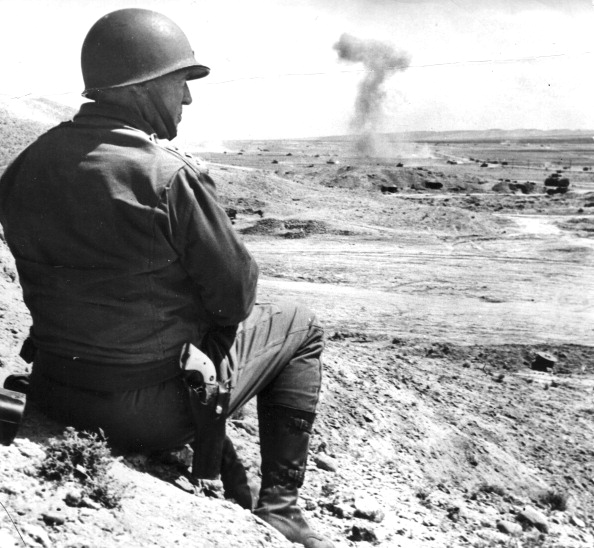
When you think of General George S. Patton, you probably think of his dramatic appearance — shiny helmet atop his head, ivory-handled Colt revolver tucked in his pants, “swagger stick” in hand, scowl upon his face. You likely think of his bombastic, profanity-laden speeches, filled with pithy maxims like “it is fine to be willing to die for your country but a damned sight better to make the German die for his.” You probably think of a man nicknamed “Old Blood and Guts,” arguably the greatest combat general of modern times.

What you probably don’t think of is a voracious, meditative reader. But you should.

In addition to his rough, tough, and extroverted public side, Patton also had a very gentle, introspective, and thoughtful private side. And part of that included nurturing a lifelong love affair with books. As his biographer, Martin Blumenson, observes, “He jumped from vulgarity to scholarship as nimbly as a cat.”

Patton’s appetite for reading was nurtured from a young age. His whole family loved books, and he and his sister and parents would not only read aloud to each other, but also act out their favorite tales. Patton grew up reading and taking on roles in the Iliad and the Odyssey, Shakespearean plays, Bible stories, and stirring tales by Sir Walter Scott, Rudyard Kipling, Arthur Conan Doyle, and G. A. Henty. These texts offered Patton inspiration on adventure and heroism, as well as insight into human drama, emotions, and conflict.

As Blumenson writes, young George also studied “the lives of the great leaders of antiquity”:

“They imbued in him the importance of character. Those who made moral choices succeeded, he learned, while those who sacrificed honor for expediency failed and merited disgrace.

Historical figures instructed him in the military profession. Scipio and Hannibal in North Africa showed a thorough grasp of soldiering, along with personal courage and the intuition to be at the critical place at the crucial moment. Caesar to his Tenth Legion in Gaul, Joan of Arc at Orleans, Napoleon to his Army of Italy provided personal and dynamic leadership, together with direct inspiration that touched every man under arms. Stonewall Jackson gave his followers the willingness to go beyond the limits of endurance and to accept risks and the prospect of disfigurement and death. These commanders who exhibited self-confidence, enthusiasm, and bravery became his models, and he absorbed their genius.”

Patton’s reading of history not only refined his character, but deepened his dedication to becoming a great warrior; he didn’t just want to live up to the standards set by his own forefathers, but those of eminent figures from the past as well. His reading also enflamed the sense of destiny that surrounded his dream; in fact, Blumenson explains, Patton’s reading “induced in him a strain of mysticism, a sense of déjà vu, an acceptance of telepathy, and a belief in reincarnation, the feeling that he had lived before in other historical periods, always as a soldier—a Greek hoplite, a Roman legionnaire, a cavalryman with Belisarius, a highlander with the House of Stuart, a trooper with Napoleon and Murat.”

While at West Point, Patton continued to dive into the classics and the biographies of great men. History easily became his strongest subject, and he was a particularly dedicated student of the Civil War, slowly studying Douglas Freeman’s epic four-volume biography of Robert E. Lee, as well as the life stories of the conflict’s other generals.

Patton never read passively, but instead memorized his favorite passages and had a vigorous conversation with his books, marking up the text with copious marginalia and noting places he agreed or disagreed with the author’s view. If he found a tome particularly compelling, he would type up his notes on 3X5 index cards. He also kept a pocket notebook for writing down reflections, pithy military maxims, rules of warfare, and observations on past battles. His first entry in the notebook read: “Do your damdest always.”

After graduating from the Academy, Patton furthered his education, both formally — attending the Army Command and General Staff College and the Army War College for graduate-level instruction — and through his own personal studies. His reading continued to be focused on biography and military history; believing you had to understand the past to navigate the present, and almost fanatically devoted to learning his profession inside and out, he read nearly every piece of martial-related material he could get his hands on — including training notes, after-action reports, operational histories, and even every citation for bravery he could find.

Patton would also read books that offered insight into the history and current cultures of the countries (and the leaders) with which the U.S. might find itself at war, in order to better grasp the potential enemy’s mindset. As he told his nephew:

“I have read the memoirs of [our enemies’] generals and political leaders. I have even read his philosophers and listened to his music. I have studied in detail the accounts of every damned one of his battles. I know exactly how he will react under any given set of circumstances. He hasn’t the slightest idea what I’m going to do. Therefore, when the day comes, I’m going to whip the hell out of him.”

Patton was one of the few Americans to read Lenin, Marx, the Koran, and Hitler’s Mein Kampf, “believing,” his wife explained, “that one can only understand Man through his own works and not from what others think he thinks.”

During WWII, Patton made sure he’d be able to continue his reading in the field by carrying a small library with him wherever he went. This field library included the Bible (which he read religiously, in both senses of the word), a prayer book, Caesar’s commentaries, and a complete set of Kipling’s works, which may have included as many as 38 volumes.

As a result of Patton’s lifetime of reading, he had an encyclopedic knowledge of strategy to draw from in leading his troops. He knew what other commanders had done in similar circumstances; he knew the different options available to him and how such options had fared in the past. As he said:

“In order for a man to become a great soldier . . . it is necessary for him to be so thoroughly conversant with all sorts of military possibilities that when ever an occasion arises he has at hand with out effort on his part a parallel. To attain this end . . . it is necessary . . . to read military history in its earliest and hence crudest form and to follow it down in natural sequence permitting his mind to grow with his subject until he can grasp with out effort the most abstruse question of the science of war because he is already permeated with all its elements.”

While Patton continued to feel inadequate at times throughout his life, stemming from his learning disabilities, he always publicly acted with great confidence, and it was largely his prodigious knowledge base that gave him a sound reason and the self-assurance to do so. He knew more about the art of war than anyone else, and he knew he knew it.

Patton’s Favorite Books

While Patton was widely read and accumulated a vast library, after his death his wife compiled the following list (included in The Leader’s Bookshelf) of his very favorite books:

Biographies and Memoirs

  • R. E. Lee: A Biography by Douglas Southall Freeman
  • Charles XII — King of Sweden by Carl Gustafson Klingspor
  • Genghis Khan, Alexander of Macedon, and other biographies by Harold Lamb
  • Maxims of Napoleon, and all the authoritative military biographies of Napoleon, such as those by Bourrienne and Sloane
  • Memoirs of Baron de Marbot, a colonel under Napoleon — Mrs. Patton noted, “We were translating the latter, when we went to war in 1942.”
  • Memoirs of Erich Ludendorff, Paul von Hindenburg, and Marshal Foch
  • Memoirs of Ulysses S. Grant and George McClellan
  • Stonewall Jackson by G.F.R. Henderson

Current Events

  • The Crowd: A Study of the Popular Mind by Gustave Le Bon

Leadership

  • Alexander the Great by Arthur Weigall
  • Anything by J.F.C. Fuller, especially Generalship: Its Diseases and Their Cures — “He was so delighted with this that he sent a copy to his superior, a major general,” recalled Mrs. Patton. “It was never acknowledged. Later he gave 12 copies to friends, colonels only, remarking that prevention is better than cure.”
  • Lee’s Lieutenants: A Study in Command by Douglas Southall Freeman 

Military History

  • Anything by B. H. Liddell Hart, “with whom he often loved to differ”
  • The Art of War in the Middle Ages by Charles Oman, and other books by him
  • Fifteen Decisive Battles of the World by Sir Edward S. Creasy
  • Military History of Greece by Thucydides
  • The Influence of Sea Power Upon History, 1660-1783 by Alfred Thayer Mahan, and other books by him (including the entire The Influence of Sea Power trilogy)

Novels

  • Rudyard Kipling, complete works

Other History 

  • Anything by Winston S. Churchill
  • The Decline and Fall of the Roman Empire by Edward Gibbon
  • Gallipoli Diary by Sir Ian Hamilton
  • The Prince by Niccolo Machiavelli
  • The Years of Victory and The Years of Endurance by Arthur Bryant

Miscellaneous 

  • Commentaries by Julius Caesar
  • Maxims of Frederick the Great Strategicon by Marcus Vitruvius Pollio and Oliver L. Spaulding
  • The Home Book of Verse, American and English 1580-1912 by Burton Egbert Stevenson
  • Treatises by von Treitschke, von Clausewitz, von Schlieffen, von Seeckt, and other Napoleonic writers

Interested in learning about what other military commanders have read to develop their leadership? Listen to my podcast with Admiral James Stavridis, author of The Leader’s Bookshelf:

The post The Libraries of Famous Men: George S. Patton appeared first on The Art of Manliness.

04 Apr 12:08

The Complete Library of Rocky Training Exercises

by Brett & Kate McKay

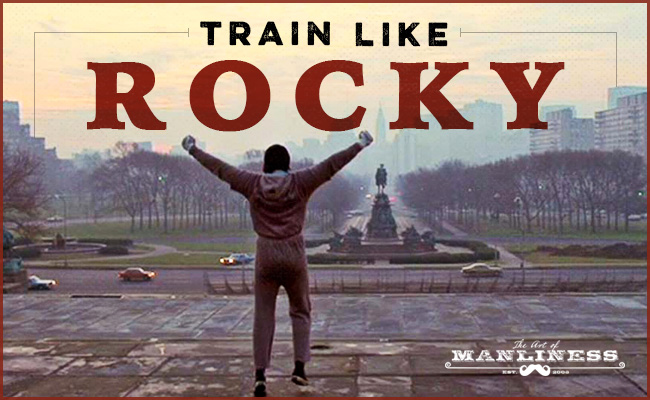
Poster of rocky movie showing "Train like Rocky" by Art of Manliness.

With our archives now 3,500+ articles deep, we’ve decided to republish a classic piece each Friday to help our newer readers discover some of the best, evergreen gems from the past. This article was originally published in April 2018.

The best part of many action/superhero/sports films is arguably the training montage scene, in which we get to see, in compressed time, the protagonist prepare to do battle with his opponent. There’s something incredibly inspiring, and thumos-inflaming, about seeing a man transform from clumsy and out-of-shape, to skilled and fit. It’s a potent symbol of the kind of metamorphosis we all often hope to make in our lives.

Of all the cinematic training montage scenes that have ever been, those from the Rocky films are unarguably the best. Featuring a perennial underdog who always manages to finds scrappy ways to beat the odds, and always gives it all he’s got, they never fail to light a fire in your belly.

Fictional though the Rocky character is, his training regimen provides real inspiration on tough, often creative ways to get fit and strong — no-excuses exercises that frequently employ free or improvised equipment and could be incorporated into your own routine (make sure you get the butcher’s permission before you go punching his carcasses of meat, though).

Below we break down every single exercise from the training montages featured in the first, second, third, fourth, and sixth Rocky installments (in Rocky V, Balboa takes a break from fighting himself to train another boxer). Some of the exercises remain consistent across the various films, while each installment also incorporates new moves and methods.

Use this complete library of exercises to get pumped, add some variety to your workouts, and start really training like a champ.

Rocky I


The training montage that sets the archetype for all others. We’re introduced to Rocky Balboa, a kind-hearted blue collar bloke who makes a living collecting debts for a loan shark on the mean streets of Philly. The small-time club fighter gets a chance to face off against heavyweight boxing world champion Apollo Creed.

Rocky doesn’t have the kind of training resources his opponent does, and makes do with what he’s got — running through scrap yards and wailing on slabs of beef. Rocky’s journey into fighting shape is accompanied by the greatest training montage song of all time — “Gonna Fly Now” — and culminates with one of the most famous scenes in cinema: a run up the steps of the Philadelphia Museum of Art (an exercise that was part of the real-life training routine of Joe Frazier). 

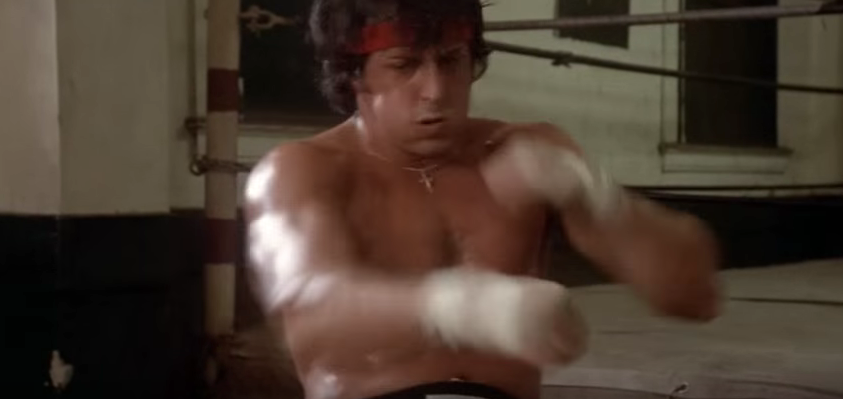
Running With Bricks in Your Hands

Rocky running with bricks in his hands.

Distance Running

Rocky running down the street.

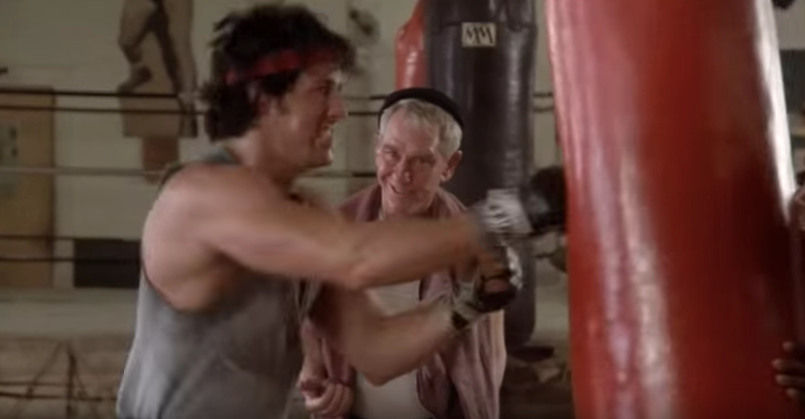
Hitting the Speed Bag

Rocky hitting the speed bag.

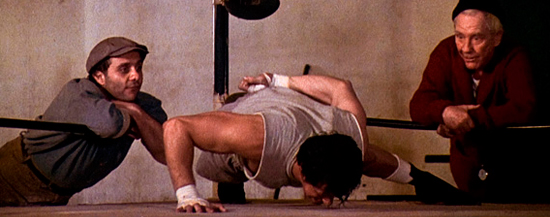
Alternating One-Arm Push-Ups

Rock doing alternating one-arm push-ups.

Clapping Push-Ups

Rocky doing clapping push-ups.

Sit-Ups

Rocky doing sit-ups.

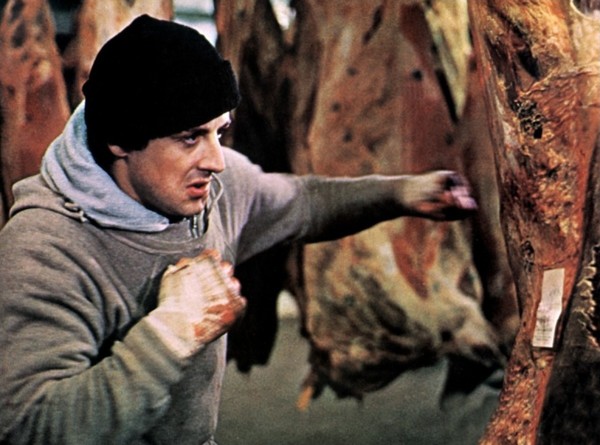
Punching Meat

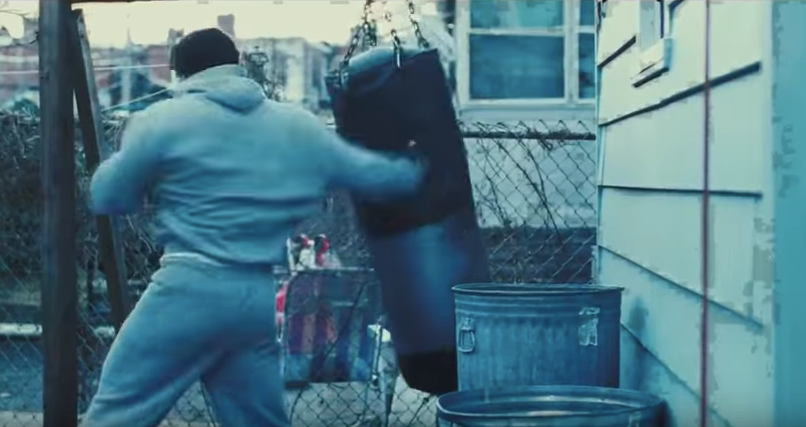
Rocky punching meat in his movie.

Sprints

Rocky sprinting along the sea.

Running Up Steps

Rocky running on the stairs.

Rocky II

In Rocky II, our underdog protagonist gets a shot at a rematch with Apollo Creed, and again trains in scrappy fashion — continuing to improvise his exercises (shouldering a log; chasing a chicken), while adding some weight work as well. Rocky also does an encore run that once more culminates atop the art museum steps, this time joined by a crowd of kids cheering on their hometown hero.

Hitting Junk With a Sledgehammer

Rocky hitting junk with a sledgehammer.

One-Arm Pull-Ups on a Jungle Gym

Rocky doing one-arm pull-ups in a jungle gym.

Sit-Ups, Straight, and With Twists or Punches at the Top

Rocky punching while doing sit-ups.

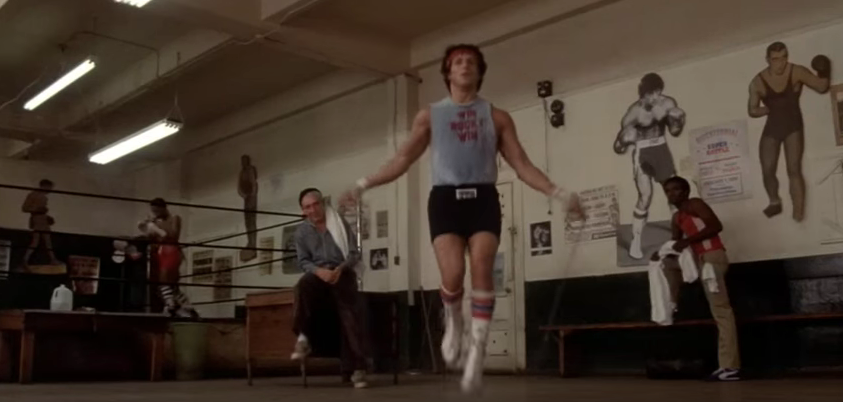
Jumping Rope

Rocky on a jumping rope.

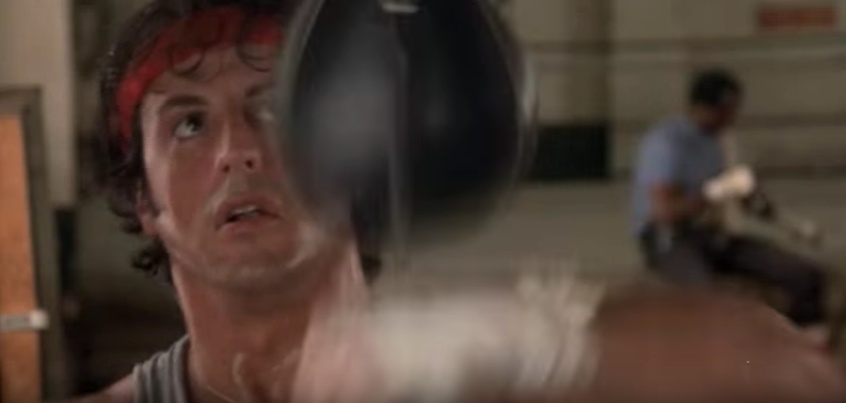
Hitting the Speed Bag

Rocky hitting the speed ball in training.

Hitting the Pads

Rocky hitting the pads while training.

Back-to-Back Medicine Ball Pass

Rocky performing back to back medicine ball pass.

One-Arm Push-Up

Rocky doing one arm push-ups.

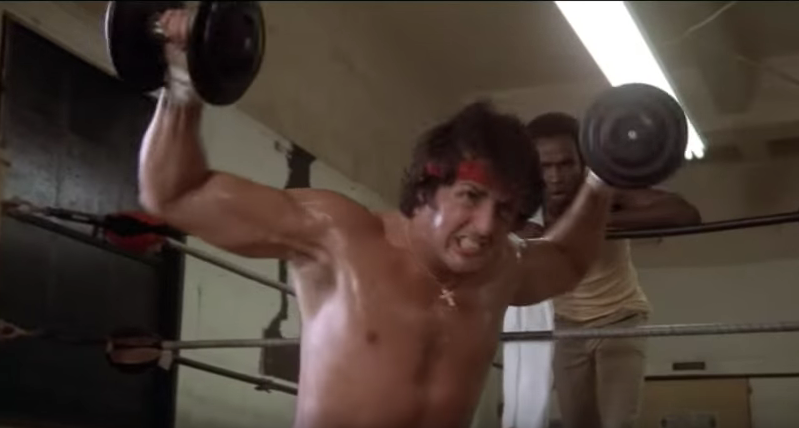
Lateral Dumbell Raises

Rocky doing lateral dumbbells' raises.

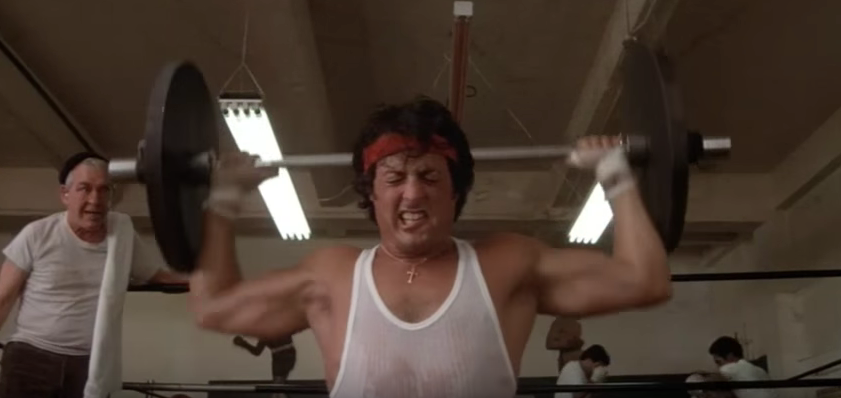
Front-to-Back Barbell Presses

Rocky doing barbell presses while training.

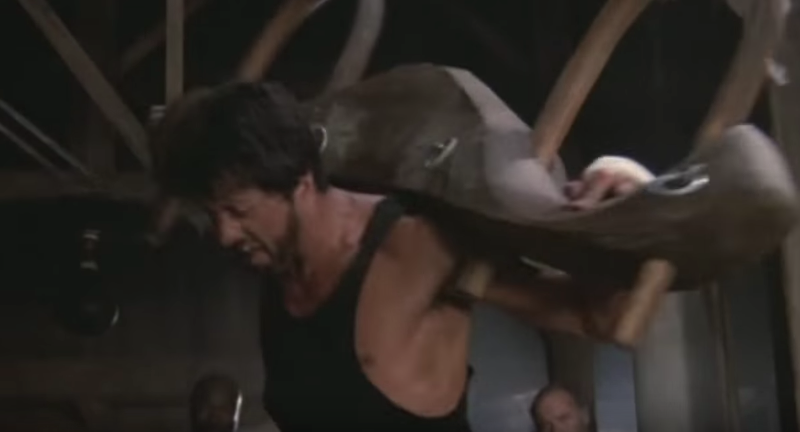
Frog Hop and Duck Walk With a Log on Your Back

Rocky doing frog jumps with a log on his neck.

Hitting the Heavy Bag

Rocky hitting the heavy bag.

Chasing a Chicken

Rocky chasing a chicken.

Distance Running, With Children

Rocky running with children.

Rocky III

In Rocky III, Balboa is no longer an underdog in the traditional sense; having successfully defended his title ten times, he’s garnered significant fame and wealth. But when he learns that his manager hand-picked lesser opponents for his fights and that he hasn’t truly been squaring off against the best, he decides to take on a young, hungry, powerful contender — James “Clubber” Lang.

Balboa’s new challenge becomes sloughing off the softness he’s accumulated from being on top, and trying to find some of the old hunger himself. At first he fails, and his unfocused training regimen results in a loss to Lang. Balboa must then deal with not only the fallout of this failure, but the death of his manager. It turns out to be Rocky’s former rival, Creed, who helps him to again find his fighter’s heart. Creed trains Rocky with classic boxing exercises, while putting a new emphasis on speed, footwork, and agility, and taking his runs off the urban pavement and onto the beach.

Hitting the Speed Bag

Rocky hitting the speed bag.

Footwork Drills

Rocky doing footwork drills.

Shadow Boxing

Rocky while boxing with his shadow in movie.

Swimming

Rocky swimming.

Hitting (and Dodging) the Double-End Bag

Rocky hitting double-end bag.

Jumping Rope

Rocky on a jumping rope.

Hitting the Pads

Rocky hitting pad in his movie.

Sand Runs

Rocky running with his trainer along sea shore.

Rocky IV

Rocky IV is a study in contrasts. The individualistic, democratic United States vs. the communist Soviet Union. A kind-hearted boxer vs. an unfeeling robot. And an old school, back-to-nature training regimen vs. a modern, high-tech one.

While Rocky’s opponent, Ivan Drago, uses all kinds of experimental gizmos (and drugs) to get in shape, Rocky sets up camp on a remote Russian homestead and goes full-on wild man, creatively utilizing what’s at hand to get “farmer strong.” The stakes of the fight — a chance to symbolically establish national superiority and avenge Creed’s death at Drago’s hands — call forth the longest training montage in the series, an epic sequence that requires two parts to fully encapsulate. 

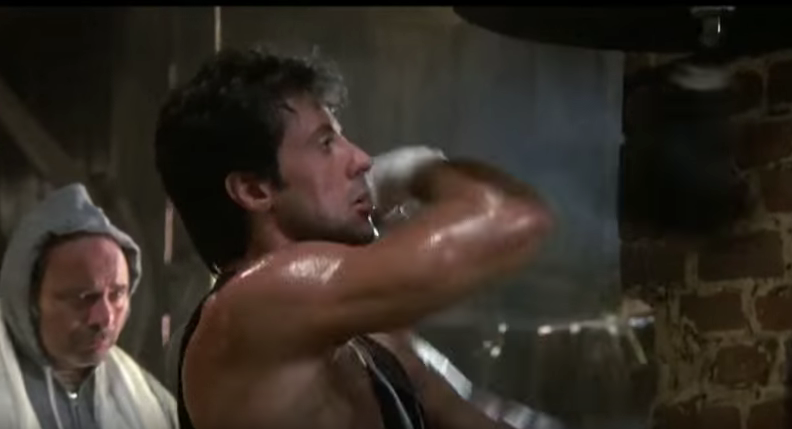
Hitting the Speed Bag

Rocky hitting the speed ball in movie.

Sawing Wood

Rocky sawing wood in snow.

Tossing Rocks

Rocky tossing rocks in snow.

Pulling a Weighted Sled

Rocky while pulling a weighted sled.

Pull-Ups on a Beam

Rocky doing pull-ups on a beam.

Carrying Log on Shoulders in Snow

Rocky carrying loft on his shoulders in the snow.

Outdoor Nightime Shadow Boxing

Rocky doing outdoor nightime shadow boxing.

Felling a Tree

Rocky while cutting a tree.

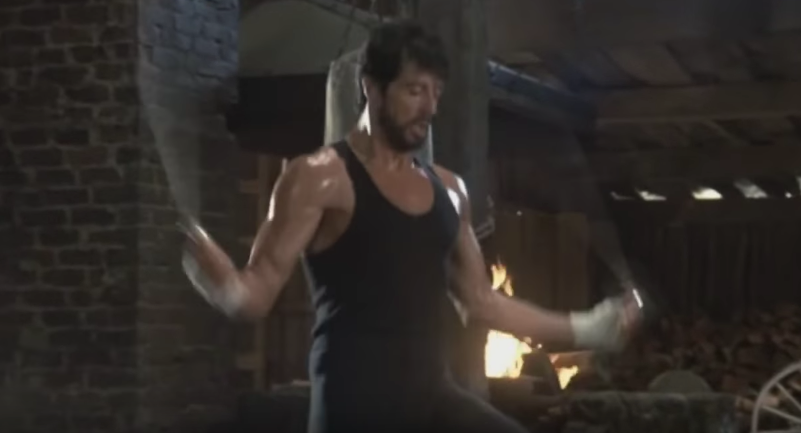
Jumping Rope

Rocky on a jumping rope.

Hanging Sit-Ups With Punches, or Held, at the Top

Rocky doing sit-ups with punches while hanging.

Splitting Wood

Rocky splitting wood.

Hitting the Pads

Bearded rocky hitting the pads.

Hoisting Rocks

Rocky while hoisting rocks.

“Dragon Flag” Core Exercise

Rocky doing dragon flag core exercise.

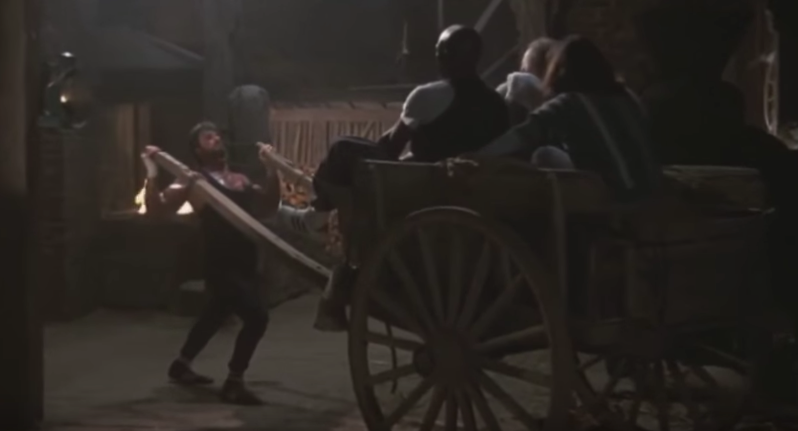
Cleaning and Pressing a Wagon Full of People

Rocky pulling a wagon full of people.

Ducking and Throwing Upper Cuts Back and Forth Under a Rope

Rocky dukking and throwing uppercuts under a rope.

Shouldering and Twisting a Wooden Yoke

Rocky shouldering a wooden yoke.

Running/Crawling in the Snow + Scrambling to the Top of a Mountain

Rocky running in snow on a mountain.

Rocky Balboa

In the final installment of the series in which Rocky fights (these days he’s mentoring Apollo Creed’s son), an aging Balboa comes out of retirement for one more fight. In his late 50s, he can’t hope to compete against his younger opponent on quickness and agility and will instead have to rely on raw strength and power. As Rocky’s trainer tells him:

To beat this guy, you need speed — you don’t have it. And your knees can’t take the pounding, so hard running is out. And you got arthritis in your neck, and you’ve got calcium deposits on most of your joints, so sparring is out.

So, what we’ll be calling on is good ol’ fashion blunt force trauma. Horsepower. Heavy-duty, cast-iron, pile-driving punches that will have to hurt so much they’ll rattle his ancestors. Every time you hit him with a shot, it’s gotta feel like he tried kissing the express train!

In order to build some “hurtin’ bombs,” Rocky really hits the weights hard and incorporates compound barbell lifts into his more traditional boxing exercises. Things come full circle as “Gotta Fly Now” (which went missing in Rocky IV) returns, and Rocky once more ascends the steps of the Philadelphia Art Museum. 

Jogging

Rocky running with his dog.

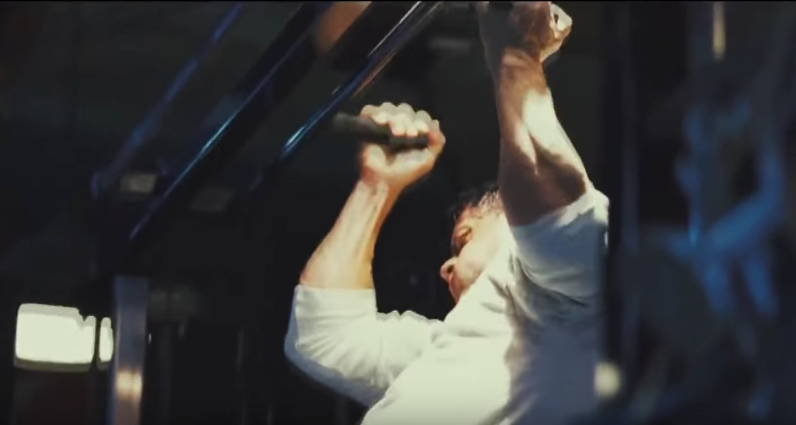
Neutral Grip Pull-Ups

Rocky doing neutral grip pull-ups.

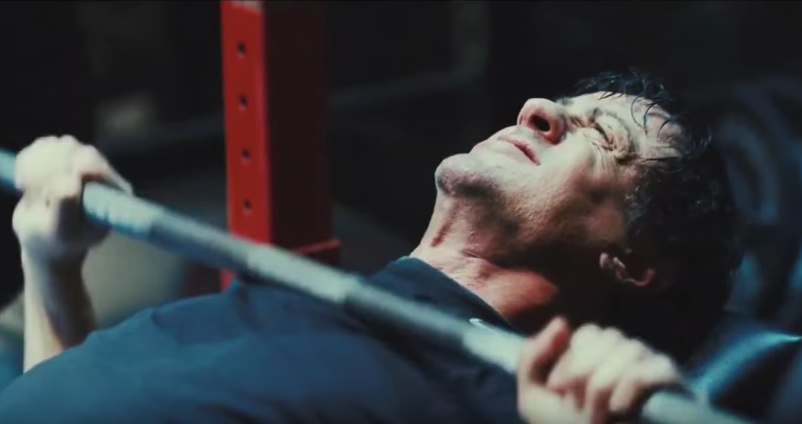
Bench Press

Rocky doing bench press.

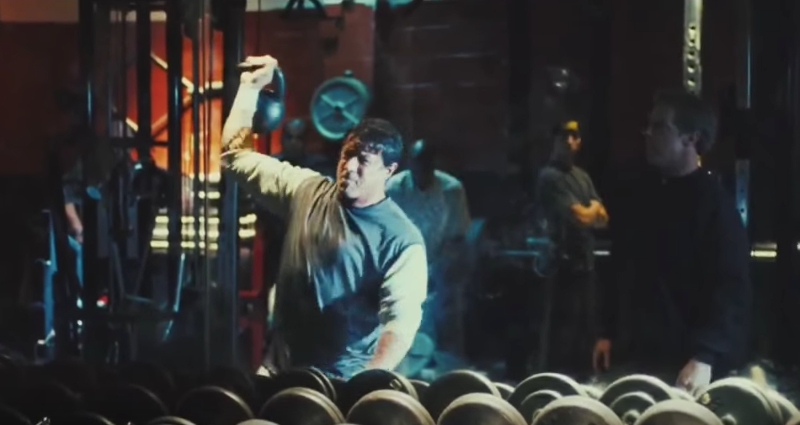
Kettlebell Clean and Press

Rocky cleaning and pressing kettlebell.

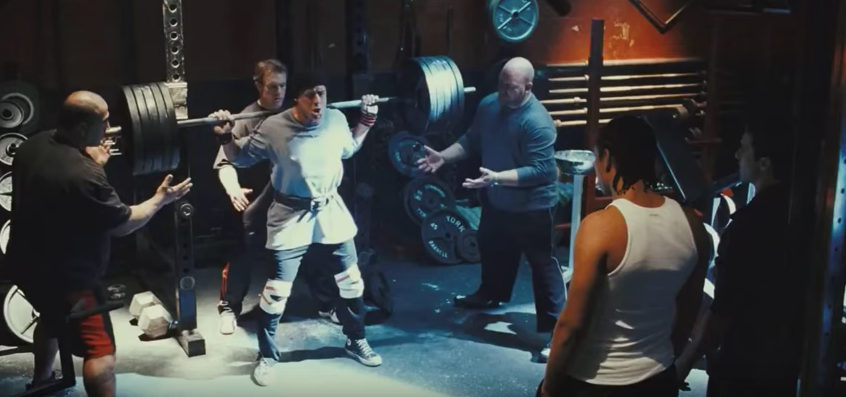
Back Squat

Rocky doing back squat.

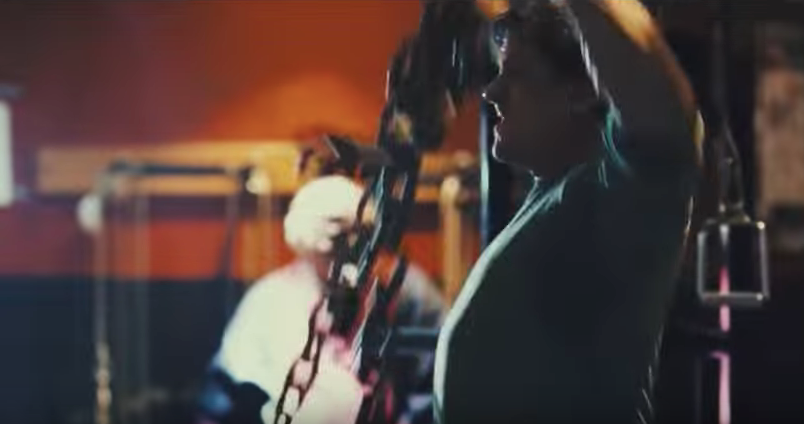
Lat Raises With Chains

Rocky doing lit raises with chains.

(Not Pictured: Incline Press)

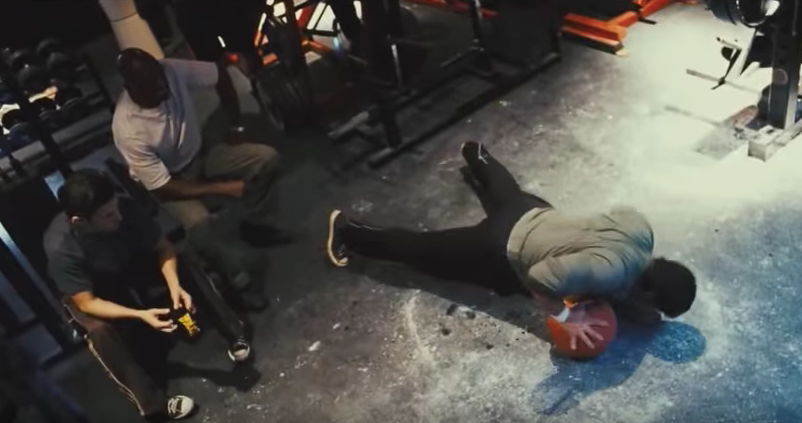
Medicine Ball Push-Ups

Rocky doing medicine ball push-ups.

Tire Slams With Sledgehammer

Rocky slamming the tire with a sledgehammer in snow.

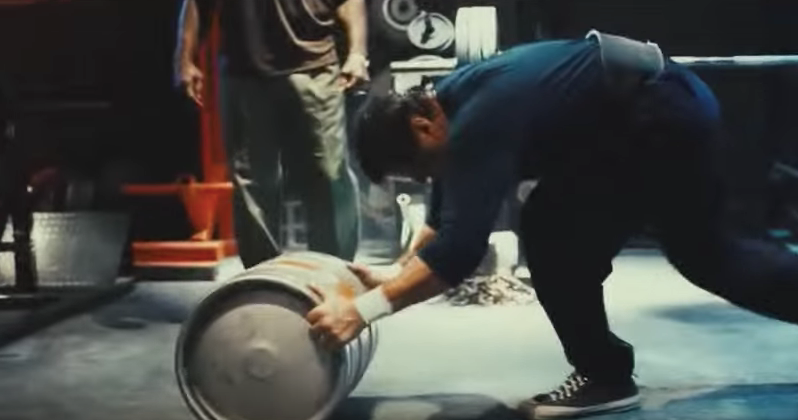
Overhead Keg Slam

Rocky doing overhead keg slam.

Hitting the Heavy Bag

Rocky while hitting the heavy bag.

Walking Upper Cuts With Dumbbells

Rocky's walking uppercuts with dumbbells'.

Pull-Ups

Rocky doing pull-ups.

Clean & Press

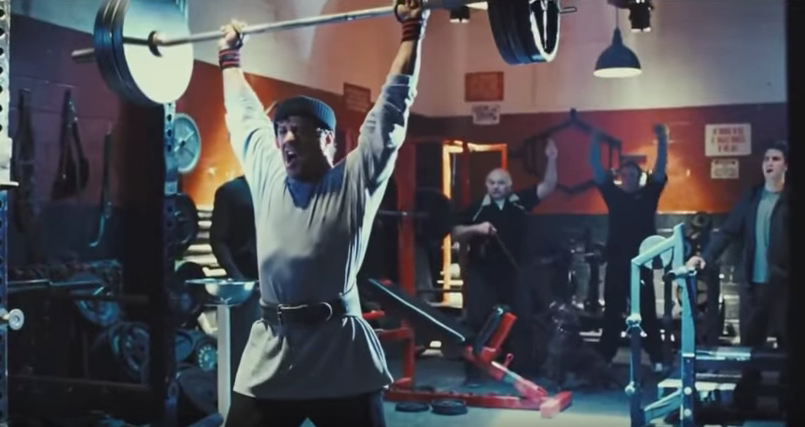
Rocky lifting heavy weight.

Punching Meat

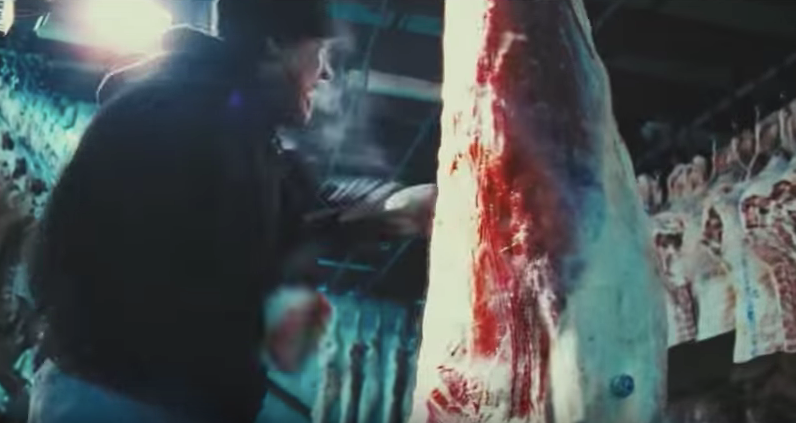
Rocky punching meat.

Running Stairs, in the Snow

Rocky running on stairs with his dog.

The post The Complete Library of Rocky Training Exercises appeared first on The Art of Manliness.

04 Apr 11:58

Using Pizza To Understand The Cloud

by Mike Lloyd, CommunityVoice
If you think about the ways you can get pizza, you'll find a useful for analogy for the various cloud offerings that are available to you.
04 Apr 11:46

Tales From The Minibar

by Ernie Smith
Tales From The Minibar

Today in Tedium: More than 20 years ago, a reporter for The New Republic took a sharp stab at a famous conservative conference by implying nefarious activity that involved a minibar. “The minibar is open and empty little bottles of booze are scattered on the carpet,” the reporter wrote of the 1997 Conservative Political Action Conference (CPAC). “On the bed, a Gideon Bible, used earlier in the night to resolve an argument, is open to Exodus.” The minibar was a great scene-setter for a reporter whose scene-setting skills made for great fiction. As was figured out by a Forbes reporter two decades ago this May, the writer of that article, Stephen Glass, was fabricating breezy stories that weren’t even remotely true. Nonetheless, Glass’ CPAC tale may perhaps be the most prominent uses of a minibar in popular culture. (Thank you, Shattered Glass.) The minibar, a hotel mainstay for the desperate, deserves an analysis. Here’s mine. I promise I will make up no facts about it. — Ernie @ Tedium

1876

The year that the compact refrigerator was invented by Carl von Linde, a German man whose goal was to come up with a process of liquefying gases en masse. Von Linde’s work, which originally found success with German breweries, expanded far beyond the refrigerator, however. His still-active company, The Linde Group, is the world’s largest industrial gas company with around $21 billion in revenue in 2017 alone.

Tales From The Minibar

A drawing included with the German patent for the original refrigerated minibar.

The technologies that made the minibar possible

The genesis of the modern refrigerated minibar is commonly attributed to a Hong Kong Hilton location that, in the mid-1970s, saw much success by adding liquor to its many fridges—and likely kicked off the trend at luxury hotels worldwide after it saw drink purchases surge by a not-insubstantial 500 percent. Per the South China Morning Post, the minibar gained tiny bottles of liquor thanks to Robert Arnold, the food and beverage director of the hotel chain at the time. Arnold was inspired by a mini-bottle of liquor he got on a flight over the South China Sea and wondered if it would be a good fit for the mini-fridges the hotel chain had just acquired. As it turns out, they were.

While the Hong Kong location was certainly early, the minibar is actually quote a few years older than that. For one thing, a 1971 Associated Press story featuring the then-head of New Jersey’s Alcohol Beverage Control bureau noted that the state was eyeing putting tiny liquor bottles in those fridges—a full three years before the Hong Kong Hilton offered up its version of the idea.

Going even further back, evidence of its creation exists more than a decade prior to the creation of the Hong Kong Hilton, and can be traced back to a 1963 patent from Siegas Metallwarenfabrik, a German manufacturing firm that specialized in industrial products, including refrigeration technologies.

The 1963 patent is in German and I’m therefore relying on Google Translate to make it clear, but the basic gist of the patent was that the refrigerator was designed to cool glass bottles at a consistent temperature all the way through, while allowing hotel guests to grab out a bottle at will without disturbing other bottles in the fridge.

While examples of refrigerators or food storage mechanisms designed for hotel rooms had surfaced prior to 1963, it appears Siegas was first to build a fridge around beverages, including alcohol and soft drinks.

And after it was conceived, the innovation did not appear in Hong Kong first, but in the hotels of Washington, D.C., with one of the District’s most iconic venues, the Madison Hotel, getting the minibars upon its opening—at the behest of John F. Kennedy, no less—in February of 1963.

The minibars, a common element of D.C. luxury hotels of the era, had their way of showing up at modestly historic times. A post-Pentagon Papers New York Times profile of leaker Daniel Ellsberg briefly touches on the “soft drinks and cheese” Ellsberg and his interviewer grabbed from a lounge minibar.

And the Madison Hotel’s minibars even played a small role in the ending of the Cold War. Historian Martin McCauley’s book The Cold War 1949-2016 noted that, during the 1987 Washington Summit, in which Mikhail Gorbachev met with Ronald Reagan at the White House amid a thaw in U.S.-Soviet, the minibars at the Madison were heavily used—perhaps too heavily.

“The Soviet delegation stayed at the Madison Hotel where the minibar was replete with wines and spirits,” McCauley wrote. “They imbibed so heavily that the head of mission had to ask the hotel to replace alcohol with soft drinks! Outside, they gorged on Big Macs and Cola.”

Colin Powell also recalled the incident in his 1995 book My American Journey, noting that the Soviets racked up a $1,400 bill on minibar alcohol in a single night.

This was the image that top Russians had of our country—that you could get spirits inside a tiny fridge in a snazzy hotel room.

“It always surprises people that, as much as we charge at the minibar, we actually don’t MAKE money in the minibar.”

— Arne M. Sorenson, the CEO of Marriott, in a comment tweeted by CNBC reporter Carl Quintanilla in 2014. The comment was quickly deleted by Quintanilla, but Fast Company kept it around for posterity. Sorenson’s sentiment isn’t actually uncommon in the sector. Despite the fact that minibars are infamous for charging $9 for a bottle of beer and $8 for a can of soda, they represent a downright tiny share of the hotel industry’s revenue—a 2017 report from CRBE Hotels found that minibars represented just 0.4 percent of total food and beverage service revenue. The reason it's so unprofitable? Simple: There's a lot of overhead due to all the workers needed to restock the fridges.

Tales From The Minibar

Odds are that you may not find a minibar with an actual fridge on your next trip. (russellstreet/Flickr)

Five ways hotels are modernizing the minibar experience

  1. Pulling snacks out of the fridge: Per The Wall Street Journal, the move to keep candy bars and other snacks at room temperature has everything to do with satiating your hunger. “It may be harder to resist that chocolate bar if it's staring at you from the TV stand,” Journal reporter Andrea Petersen explained.
  2. Adding technology: Hotel News Now reports that some hotel chains have added digital tablets to their minibar displays in an attempt to revamp the experience. This also extends to the products sold in minibars—with USB drives and charging cables made easily accessible in room.
  3. The use of automation: In recent years, hotels have started to use fridges that can automatically detect when an object has been moved from a minibar. The reason for this is less because they’re trying to screw the customers and more because of inventory control. A major reason that minibars are so hard to make money from is because they’re difficult to restock. Automated minibars get rid of this problem, and help make minibars more profitable, by making it easy to track inventory automatically. Of course, this is no fun for hotel guests that get charged for moving a Snickers bar.
  4. Getting rid of the fridges entirely: Bartech, perhaps the most prominent company in the minibar vendor space, has been selling a concept called the wireless eTray in recent years, which is designed to be placed anywhere in a room and only sells goods intended to be consumed at room temperature, like bottled water, cookies, or wine.
  5. Dedicated appliances and robots: Perhaps the future of the minibar won’t look like a minibar at all. A 2015 piece by the Las Vegas Review-Journal suggested that robot bartenders could one day usurp minibars, and we’re already starting to see some of that in some hotels. The Plum wine dispenser allows hotels to “pour” one of two bottles of wine for guests. The technology was built for hotels, but they sell it at Williams-Sonoma if you want to spend a lot of money on being lazy.

“I've stayed in a bunch of hotels from a small boutique hotel on Easter Island, to a luxury suite overlooking the Bangkok skyline, to a two-bedroom villa on Koh Samui, and never come across this kind of fee.”

— Keri Anderson, a travel blogger known for her site Heels First Travel, discussing with the Daily Mail how a Las Vegas hotel tried to charge her money for putting her own stuff in the hotel minibar. Anderson is a seasoned traveler, but even that threw her for a loop.

Tales From The Minibar

A minibar fridge. (Wikimedia Commons)

Does the minibar have a future?

It’s not hard to run into a story about how the minibar is in decline or will soon be on the way out.

The New York Times dedicated an article to it last year, and they were probably late to the trend. The Huffington Post write about it way back in 2014, noting that some chains were dropping the feature or paring it down, in part because of a 28 percent drop in sales between 2007 and 2012.

In some ways, it makes sense why some think minibars are on their way out. There’s only so much stuff you can fit in a tiny fridge, or perhaps a kiosk on the wall. It makes more sense, logically, to have a built-in convenience store, which gives hotel customers a broader array of options than you might expect to find in a dedicated room fridge.

But on the other hand, it represents a missed opportunity for hotels to win consumers over with the psychological mechanics that come with your average hotel stay.

Perhaps the problem has less to do with the minibar concept itself and more with what you can get out of that minibar. While chatter around the decline of refrigerated minibars has increased in the past few years, some boutique hotels have responded to minibar criticism by improving the quality of the goods sold within the minibar.

In other words, the reason why minibars suck is because of Diet Coke and Jack Daniel’s being a mainstay in every one, not because minibars are a terrible idea in general.

In a piece for GQ last year, writer Mark Byrne made the case that minibars were secretly in a renaissance, by doing things like pre-bottling cocktails, embracing their local liquor scenes, and improving the quality of the mixing equipment. Having a shaker in the room is a nice perk.

Another example of this surfaced just this week: The Los Angeles Times, which covered the minibar’s decline back in 2013, wrote this week about the decision by the hotel chain Standard International to offer in its minibars a lotion and a gumdrop snack laced with cannabidiol, a key compound of marijuana that generally isn’t as psychoactive as actual marijuana. (Standard, interestingly, is teaming with Lord Jones, a cannabis company that plans to open a dispensary at one of the chain’s locations.)

That’s a left-field turn, sure, but the hotel industry could use a little left field right now.

Of course, this isn’t really happening in the national chains so much as the boutique hotels. But those boutiques are the ones that often set the stage for innovations that show up at larger chains—because they’re the pacesetters, the idea labs, the petri dishes of the hotel industry.

Sure, it gets watered down by the time it gets to the Sioux City Hilton, but the idea could have legs in the right context.

The thing that’s fascinating about the hotel minibar is how perception has shifted of the offering over the years.

That 1971 Associated Press story about New Jersey’s research into adding minibars to hotels around the state—three years before the Hong Kong Hilton had the same idea—was centered around an argument for “convenience and comfort for the public,” while the state’s Alcohol Beverage Control bureau noted that when you broke it down, a mini-fridge didn’t actually hold all that much alcohol.

Meanwhile, the Los Angeles Times noted in a 1985 article that the mini-bar “unburdens room service” from small, annoying requests.

These days, the minibar isn’t seen as a perk for the public, but an expensive cash grab. And many hoteliers see minibars as something more actively burdening than unburdening.

Is the problem with the minibar that we simply find the idea of pre-packaged food and drinks already living in your hotel room kind of boring? Admittedly, other parts of the hotel experience suffer from this as well. For example, room service can often be a repetitive affair when you’re stuck ordering the burger and fries because it’s the only thing on the menu that seems like an actual meal and doesn’t cost $35.

Sure, technology can fix or minimize some of these problems, but what if the real problem is a lack of new ideas?

03 Apr 17:31

Make Your Own Torchy’s Taco: fried portobello mushroom ‘Independent’

by Meredith Wagner

By Meredith Wagner | Arts & Life Editor

If you’ve ever indulged in a vegetarian taco from Torchy’s, you likely understand the craze. Piled high with various toppings and flavors, including a hard-to-come-by, satisfactory meat substitution, they’re a great fix for vegetarians and meat-eaters alike. Nothing beats the taste of a home-cooked meal, however, and the creativity that cooking your own meals calls for can be a stimulating form of stress relief, a rewarding task that helps you wind down at the end of a long day. I did my best to recreate a restaurant favorite at home so that you can enjoy the process of producing your own food and save some money in the long run. Torchy’s ‘Independent’ is described on their menu as a taco with “hand-battered and fried portobello mushroom strips, refried black beans, roasted corn, escabeche carrots, cotija cheese, cilantro and fresh avocado.” Try it at home for yourself.

There are three parts to this recipe, some of which can be purchased at the store if you’re short on time.

*makes two servings (two tacos per person)

ingredients.jpg
Meredith Wagner | Arts & Life Editor

INGREDIENTS


Mushrooms

  • 2 portobello mushroom caps, thoroughly washed
  • 2 T coconut oil
  • 1 cup all purpose flour
  • 2 eggs
  • 1 tsp paprika
  • 1 tsp cumin

Pickled Carrots and Onions

  • Jar of pickle juice.
  • 4 small carrots, shredded or sliced into thin strips (can be purchased shredded from the store)
  • 1/4 sweet onion, sliced into thin strips

Refried Beans

  • 3/4 can black beans
  • 1 T olive oil
  • 2 cloves of garlic, minced
  • a dash of salt

Tacos & Toppings

  • 4 tortillas (corn or flour)
  • 1 small avocado
  • Fresh cilantro
  • Cotija cheese (optional)
  • Torchy’s Diablo Sauce, salsa or other hot sauce

step1.jpg
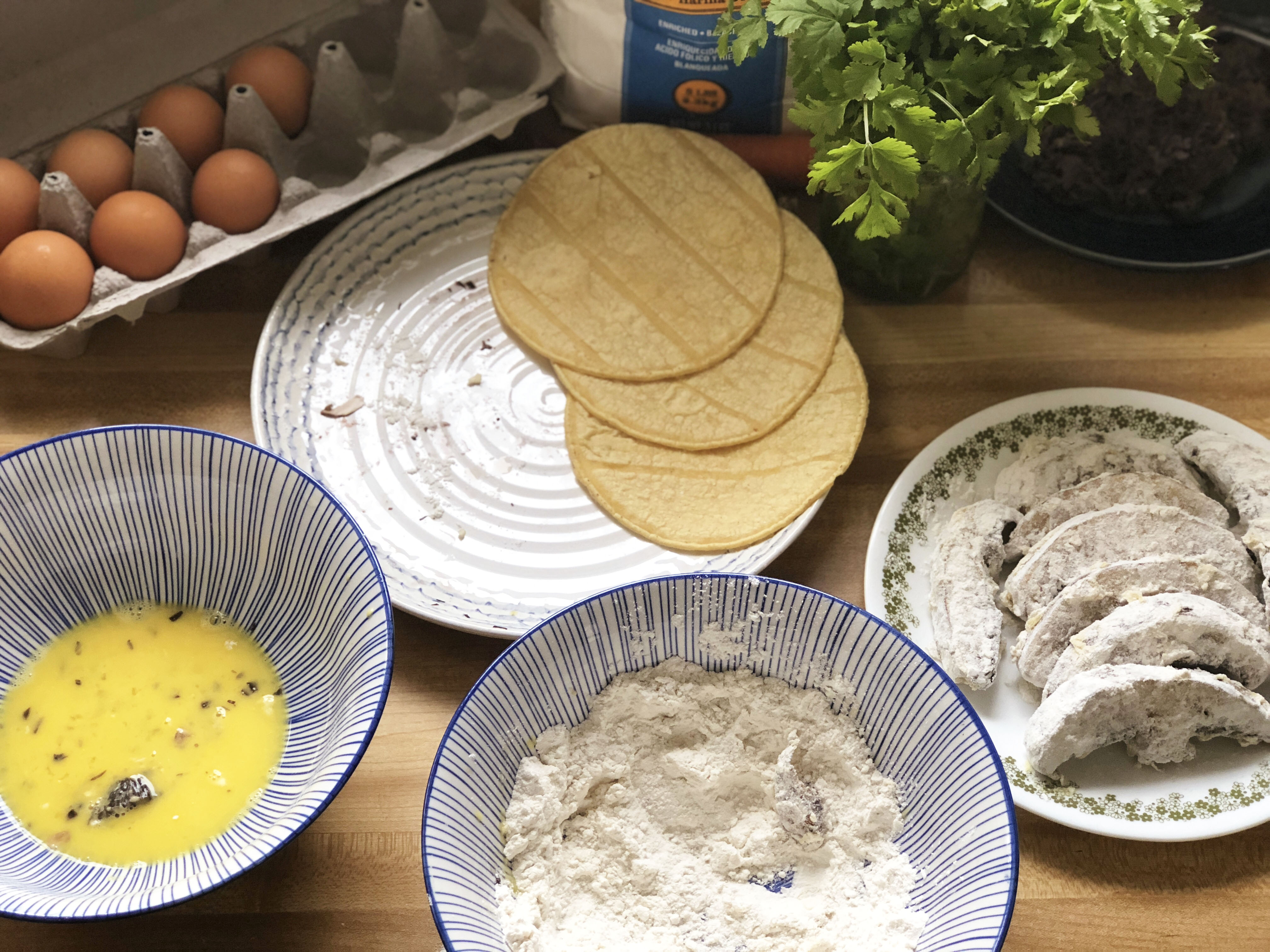
Step Two: Prepare an assembly line. In the first bowl, add 2 eggs, and whisk together. In the second bowl, add 1 cup all purpose flour, cumin and paprika.
Meredith Wagner | Arts & Life Editor
step2.jpg
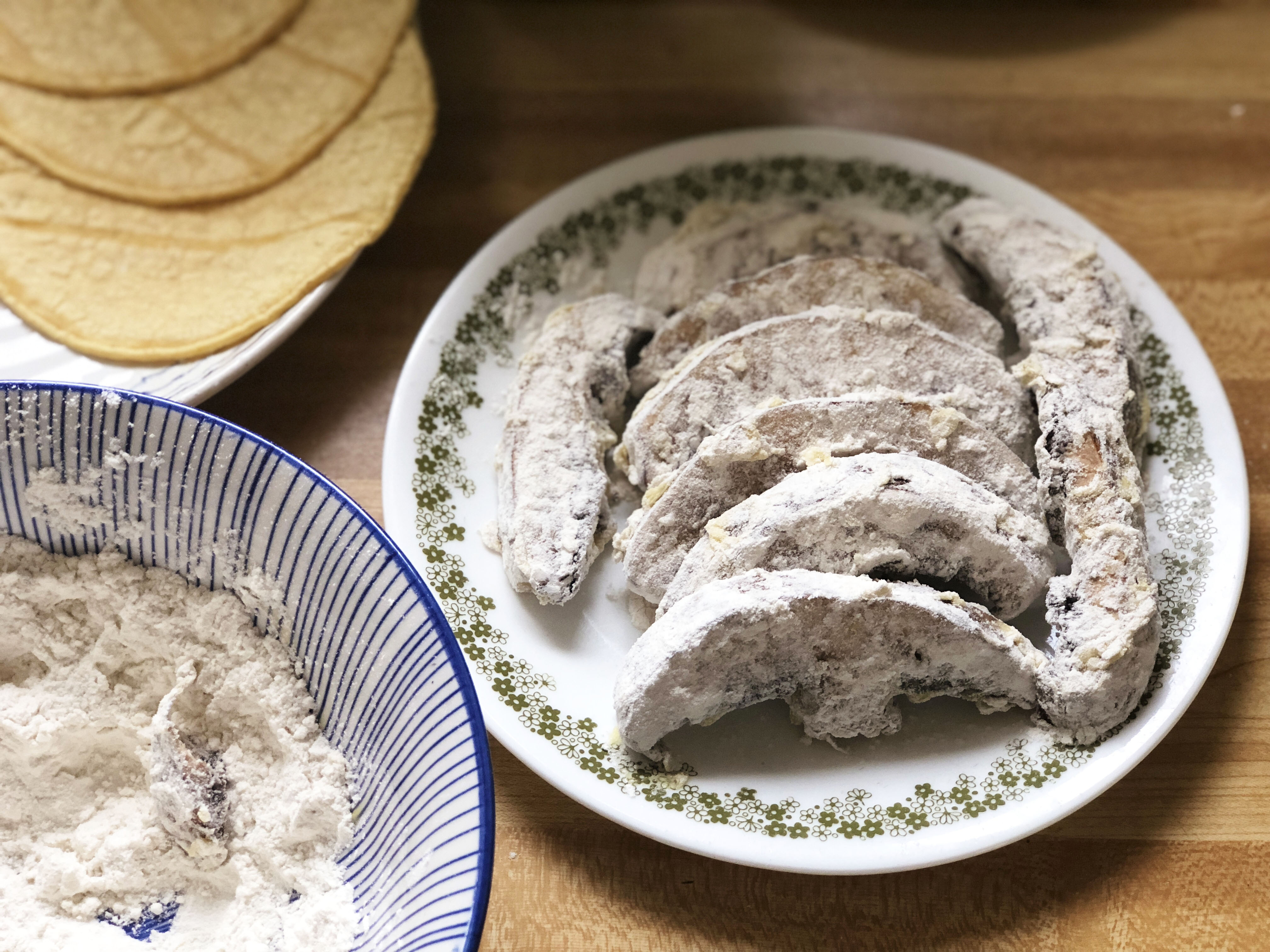
Step Three: One by one, coat the mushroom slices in the egg, then the flour, then set aside on a plate. Repeat this process until all mushrooms are evenly coated.
Meredith Wagner | Arts & Life Editor
IMG_5893 copy.jpg

DIRECTIONS


carrot2.jpg

Pickled Carrots and Onions

  1. Complete this step two days in advance. Alternatively, simply purchase escabeche carrots from the store.
  2. Using leftover juice from a jar of pickles, add the shredded carrots and thinly sliced onions to the jar. Refrigerate for at least two days. They should retain the flavor of the juice, so buy pickles with interesting flavors like spicy garlic or bread and butter.

IMG_5899 copy.jpg

Refried Beans

  1. Warm 1 T olive oil over medium heat on a skillet.
  2. When oil is warm, add 2 cloves minced garlic and 3/4 can of black beans. Sprinkle salt over the top.
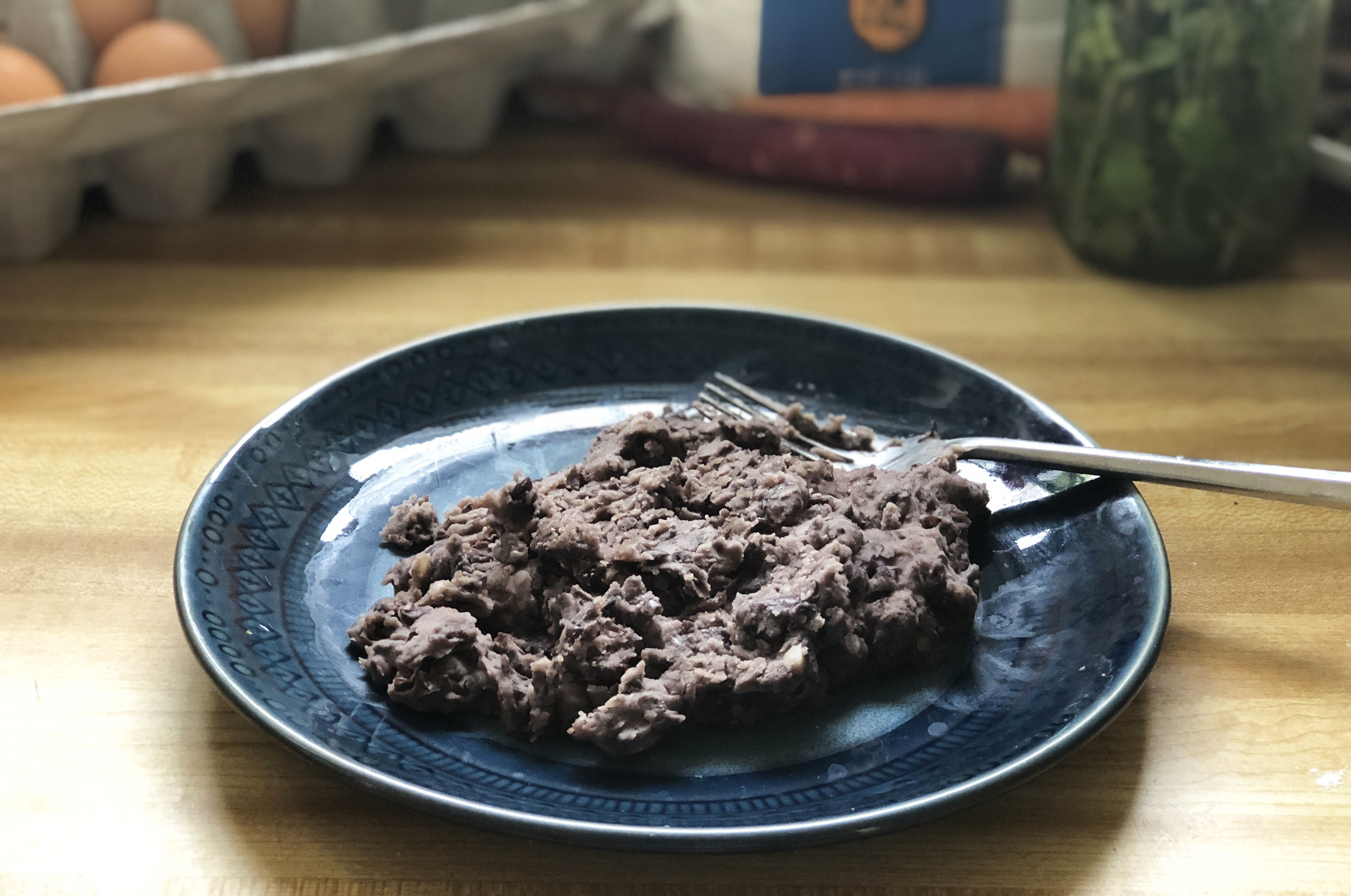
  3. Immediately begin mashing the beans with a potato masher. If you don’t have one, a fork works well, too.
  4. Mash the beans until they are even and consistent throughout. Transfer to a plate and set aside. Keep them warm if you can.

mushroom.jpg

Mushrooms

  1. Slice the mushrooms into strips about 1/2 inch thick. 2 portobellos should produce about 8-10 slices.
  2. Prepare an assembly line: In the first bowl, add 2 eggs and whisk together. In the second bowl, add 1 cup all purpose flour, cumin and paprika.
  3. One by one, coat the mushroom slices in the egg, then the flour, then set aside on a plate. Repeat this process until all mushrooms are evenly coated.
  4. Heat 1 T of coconut oil in a skillet on medium heat. Save yourself an extra dish, and use the same skillet you used for the refried beans.
  5. Place mushrooms directly into the oil. If the pan becomes dry and begins to create smoke, add more coconut oil a little at a time.
  6. Fry for 2 minutes on one side. Use tongs to flip mushrooms over and fry for 2 minutes on the other side. They’re ready when they are tender all the way through.
  7. Set fried mushrooms aside.

Assembly

  1. Smear refried beans onto tortilla.
  2. Add 2 portobello slices, 2 avocado slices, fresh cilantro, pickled carrots and cotija cheese (optional).
  3. Top with Torchy’s Diablo Sauce, salsa or your favorite hot sauce.

final.jpg

Voila.

03 Apr 16:18

An Appalachian Treasure

by Dacey Orr

From Blackbeard’s booty to stockpiles of forgotten Confederate currency, the South has procured many a legend about hidden Southern treasures—and what happens when they’re found. In 1990 in the woods outside of Asheville, North Carolina, Jarvis Wayne Messer, a local fishing guide and self-proclaimed “rock hound,” trumped the lore with a find worth upwards of $90 million: the largest and most unique set of star rubies in existence, now up for auction.

Messer was a man of simple means living with his wife and young son in Buncombe County, North Carolina, when he discovered trace elements of corundum during a fishing trip near his home—in an exact location he chose never to disclose. “He’d often see something in a stream bed that drew his attention, and he’d trace it back to some origin and dig down into the ground to follow the trail,” says Arlan Ettinger, founder and president of Guernsey’s, the New York City-based auction house now responsible for the sale of the rubies. “For this particular find, he had to dig about eight feet down.” From first sighting to protraction of the rubies, the discovery took three years.

photo: Courtesy of PBS

Messer in an interview with North Carolina Now in the early 1990s.

“When I found it, there was a red-tailed hawk that soared right over me,” Messer told local talk show North Carolina Now in an early 1990s interview. “I knew it was something special, but I didn’t realize how important the stones would be.”

When a friend cut and polished them, it became obvious that they were star rubies, pigeon’s blood-red gems with six radiating lines that refract light in the shape of a star. While rubies are already rarer than diamonds, star rubies are roughly a thousand times rarer than regular rubies.

“Messer was educated enough to know that you typically don’t find this kind of thing in North Carolina, or even the United States for that matter,” Ettinger says. “Before this, star rubies had only been found in Southeast Asia—Sri Lanka, Burma—but not western North Carolina.”

photo: Courtesy of Guernsey's

The Appalachian Star.

Before Messer’s discovery, the finest star ruby in the world, the “Rosser Reeves,” sat in the Smithsonian at 138 carats, with only five perfect rays. The largest of Messer’s find, the “Appalachian Star” weighs in at just over 139 carats and has all of its rays intact. “The Promise Star,” “The Misty Star,” and “The Smoky Mountain Two Star,” the three other rubies in what was dubbed “The Mountain Star Collection,” are identical in color and pattern, with one even displaying a double star on both front and back.

After friends and neighbors of the Messers raised funds to send the stones to the Gemological Institute of America in New York City to be tested and certified, the Natural History Museum in London invited Messer to display the “Appalachian Star” for thirty days, during which time an estimated 150,000 guests filed through the museum to see the gem.

Although many attempts to sell the stones were made over the next decade, the rubies remained in Messer’s possession. (Eight and nine-figure appraisals for the entire collection shrink the potential buyer pool.) When he died in 2008 after a long battle with cancer, the rubies remained with the Messer family, mostly forgotten. “There’s the notion that these are worth many, many millions of dollars,” Ettinger says, “but the family is still living a very humble life.”

A recent appraisal revived interest in the rubies, and the same friends who raised money to test the stones more than twenty years ago contacted Guernsey’s auction house. Guernsey’s is known for its unusual sales, and many valuable artifacts have passed through its doors during its forty-three years of existence, including the contents of the SS United States ocean liner, possessions of John F. Kennedy’s and Elvis’s, and the complete collection of Rosa Parks’s belongings at the time of her death, which were bought and donated to the Library of Congress.
Although the rubies are nearly priceless, Guernsey’s has taken on the challenge of trying to sell them. “Our job now is to help Wayne’s widow,” Ettinger says. “She deserves to live comfortably.” The rubies are currently available for a privately negotiated sale before an official auction is scheduled, and no bid, Ettinger says, will be ruled out. Any takers?

The post An Appalachian Treasure appeared first on Garden & Gun.

03 Apr 16:11

KAREEM: Don't Be Fooled, 'ROSEANNE' Is TV's Most Anti-Trump Show...


KAREEM: Don't Be Fooled, 'ROSEANNE' Is TV's Most Anti-Trump Show...


(Second column, 18th story, link)


03 Apr 15:25

Adobe Unleashes ‘Massive Update’ for Profiles in Lightroom and Camera Raw

by Michael Zhang

Adobe today announced a “massive update” to its Camera Profiles feature. It’s now simply known as Profiles, and the way they’re accessed has been redesigned.

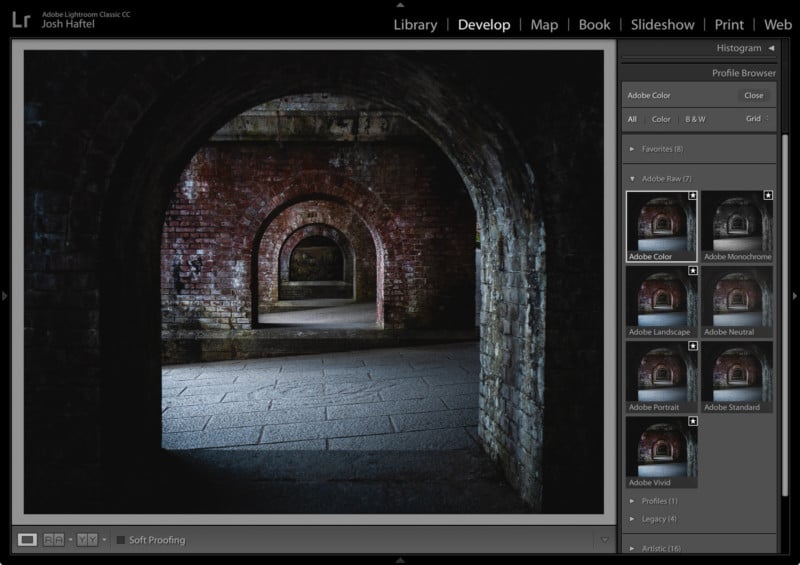
In Lightroom Classic and Adobe Camera Raw, profiles have been moved from the Camera Calibration panel to the Basic Panel. The feature has also been added to Lightroom CC at the top of the edit panel.

First off, here’s Adobe’s explanation for what profiles are and what they do:

In photography and digital imaging, the term “profile” can mean many different things. There are color profiles, display profiles, printer profiles, working profiles, and so on. Within ACR and Lightroom, a profile is used to render your photograph, converting it from raw camera information into the colors and tones that we see.


For raw photographs, we build profiles for nearly every camera make and model we support (our DNG format enables camera manufacturers to build their own profiles). Our profiles incorporate deep imaging science and take into consideration the colors of the filters used on top of the sensors (the array of red, green, and blue filters that help an otherwise colorblind sensor “see” the colorful world around us), the specific sensitivity of the sensor used, the sensor’s characteristics in different lighting conditions and with different ISO values to interpret the digital 1s and 0s into images inside Adobe photography products.

For non-raw photographs (like JPEGs and TIFFs), a profile isn’t needed to render the photo, as all of the rendering was done already (either in another raw processor or within the camera itself). However, profiles can be used for creative purposes to change the look and feel of the photo.

6 New Adobe Raw Profiles

Today’s update brings six brand new profiles for raw photos. In addition to the “tried-and-true” Adobe Standard profile, which was the only raw profile available up to this point, there’s now Adobe Color, Adobe Monochrome, Adobe Portrait, Adobe Landscape, Adobe Neutral, and Adobe Vivid.

The new profiles bring a standard look and feel regardless of what camera the photo was shot with.

“This can be incredibly helpful when upgrading from one camera to another (you won’t have to spend a ton of time figuring out how to make your new photos match your personal style) or if you’re using multiple cameras for the same shoot, you won’t have to worry about some photos looking totally different from the others,” Adobe says.

Adobe Standard is no longer the default profile used to display raw photos — it’s now Adobe Color.

“Adobe Color was designed to greatly improve the look and rendering of warm tones, improving the transitions between certain color ranges, and slightly increasing the starting contrast of your photos,” Adobe says. “Since Adobe Color is the new default (but only for newly imported photos), it was designed to work on the widest range of photos and ensures that regardless of the subject, your photo will look great.”

40+ New Creative Profiles

In addition to the new raw profiles, there are also a host of new Creative Profiles organized into four groups: Artistic, Black & White, Modern, and Vintage. These are like photo filters that can be easily applied to any photo regardless of whether it’s raw or non-raw.

A 3D Lookup Table (LUT) can be included within a Creative Profile, providing more control and precision — LUTs are used by image and video pros for color grading — than standard Lightroom tools allow.

Creative Profiles also have an Amount slider that lets you turn the effect up or down depending on your desired look.

3rd Party Profiles

Aside from Adobe’s official profile sets, 3rd party preset makers can also create profiles for the new system, and a number of sets have already been released to coincide with today’s launch: Brian Matiash, Contrastly, DVLOP, Jared Platt, Matt Kloskowski, Nicolesy, Prolost, and RNI.

Watch it In Action

Here are three videos showing the power of Profiles in Lightroom Classic, Adobe Camera Raw, and Lightroom:

To get started with Adobe’s new Profiles feature, download the latest versions of Lightroom Classic, Lightroom, or Adobe Camera Raw through Adobe’s Creative Cloud.

03 Apr 15:25

Chinese space station entering the atmosphere

2341 points, 94 comments.

03 Apr 15:23

The U.S., China and Others Race to Develop 5G Mobile Networks

by Stratfor, Contributor
The focus on 5G isn’t just about getting faster cellphones into the hands of users, it’s about shaping the development of technology that will influence everyone's lives by the 2020s.
03 Apr 15:22

PODCAST: How Zillow CEO Spencer Rascoff Turned A Real Estate Site Into One Of The World's Hottest Mobile Apps

by Steven Bertoni, Forbes Staff
On this episode of The Forbes Interview podcast, hear CEO Spencer Rascoff’s strategy for turning Zillow into one of the most popular apps around, and learn about the latest trends in the trillion-dollar real estate biz.
03 Apr 15:22

Timepieces And Timekeepers Focus Of European Tour

by Tanya Mohn, Contributor
A tour for lovers of watches, clocks and watchmaking journeys through Switzerland and Germany to showcase the craft, artistry and heritage of timekeeping devices and their makers.
03 Apr 14:49

Use This Easy URL to Manage Your iOS Subscriptions

by David Murphy

Apple doesn’t make it easy to figure out what apps you’ve subscribed to on iOS—go figure. In fact, just remembering where to go to see your subscriptions (and cancel them, if need be) usually requires a trip to your favorite search engine. Or, at least, it did.

Read more...

03 Apr 13:52

GOP Senate Candidate Austin Petersen Wants You to Be Able to Legally Buy a Machine Gun

by Brian Doherty

Austin Petersen, the 2016 runner-up for the Libertarian Party presidential nomination and current contender for the Republican nomination for a Senate seat in Missouri, has always believed in free possession of fully automatic weapons (machine guns) for American citizens. As he reminded me in a phone interview this week, one of his colorful slogans during his L.P. run was, "I believe in a world where gay married couples are free to protect their marijuana fields with fully automatic machine guns."

"I've been saying this for years," Petersen notes. But he felt inclined to say it again in the past week because his most prominent rival vying for the GOP Senate nod, current state Attorney General Josh Hawley, "on the day he declared [for the nomination] also declared for banning firearms accessories via executive orders. He's to the left of Obama, and he made it important for me to differentiate myself."

It's one thing for someone from the knowingly radical-for-freedom Libertarian Party to say that sort of thing. But such an attitude is rare among would-be candidates for the major parties. Still, Petersen is confident that doing so in the context of the fight for the GOP nod to run against Democratic incumbent Claire McCaskill will help, not hurt.

"Not just Republicans, but even Democrats in Missouri are pro-gun," Petersen says. "The Missouri Senate voted to nullify federal gun laws in the state; we have permitless concealed carry as well as open carry."

In "response to Democrats pushing hard left and saying we should repeal the Second Amendment," Petersen says that we should repeal the 1934 National Firearms Act (NFA), which among other things placed strong licensing and tax requirements on machine guns, and also repeal the Hughes Amendment to the 1986 Firearms Owner Protection Act, which barred all possession of machine guns made after its passage. Second Amendment advocates "need to stop playing defense, and go on the offense," he tells me. "If they talk about repealing the Second Amendment, let's push in the opposite direction. The best defense is a good offense so let's talk about repealing the NFA and the Hughes Amendments."

Petersen recently got himself into a Twitter squabble with gun control advocate Shannon Watts that dragged in television personality Montel Williams. Petersen thinks Watts made a fool of herself by prodding him about ordnance and nukes, which are matters not relevant to the NFA. Petersen doesn't think NFA repeal is that out-there a position, pointing to a Whitehouse.gov petition to do so with over 285,000 signatures. "It's time to stop placating people having a conversation about how to limit our rights; let's get the conversation to where people are talking not about limiting gun rights but expanding them, and that's what I'm trying to do" by calling for NFA repeal.

He's running Republican, Petersen says, because thousands of phone calls made to past supporters from his L.P. run showed that nearly all of them wanted him to wave the GOP banner. But that doesn't mean his fans don't have a hardcore radical streak when it comes to Second Amendment liberty. "Dollars talk. We had our single greatest fundraising day" after reiterating his support for private machine gun ownership. "We got a lot of 'attaboys' and as far as anger from the left, well, those people weren't going to support me anyway. Missouri is a pro-gun state, we don't have a lot of gun-grabbers."

Petersen pushes back against the idea that advocating private civilian machine gun ownership is unbearably eccentric in the current gun control debate. "I want to bring the conversation back to our rights, rather than being about trying to justify why I need something, why don't you tell me why I can't?"

When challenged about why he can't support "reasonable gun control," Petersen counters cheekily with his belief in reasonable new laws like the "Hearing Protection Act" (to allow for sale of suppressors without a tax stamp, basically treating suppressors the same as long guns when it comes to legal hoops) and national concealed carry reciprocity among states.

02 Apr 12:20

28-Year-Old Sailor Susie Goodall Will Take On The Planet In 1960's Style

by Tom Mullen, Contributor
Susie Goodall is primed to repeat the famed and challenging 1968 nonstop, single-handed, round-the-world sailing race