by Claire Lower on Skillet, shared by Claire Lower to Lifehacker
After running around all of Brooklyn, helping various staff members prepare their dishes for our Thanksgiving family meal, they left me with the task of cooking the big ol’ bird. (Luckily, when it comes to making turkey, I’m all I need.) With the help of some sturdy kitchen shears, a handful of kosher salt, and a…
Look on the hands of the person wrangling chairs or patrolling at your local ski hill. You’ll probably see an old-school insulated leather glove made by workwear supplier Kinco. Now, there are slightly warmer and more dexterous technical gloves out there made specifically for skiing, but would you change your oil or weld with $100 Hestra Army gloves? I haven’t found a more durable, warm, or better value work glove than Kinco’s ($20) for the cold and snow.
The pair I have so far has lasted through four years of welding, skiing, snow shoveling and carpentry. They’ve been drenched in motor oil, covered in antifreeze, and nearly frozen solid in an ice storm while I was skiing. My hands have stayed happy.
The most care they require is a coat or two of Sno-Seal every season. Unlike synthetic gloves, they aren’t fazed by heat and flame. I’ve found that the Kinco 901 gloves paired with some cheap silk liners is enough to keep my hands warm until it gets below 5F or so.
–Jon Braun
I’ve never used their ski gloves, but Kinco insulated pigskin gloves with the knit cuff are staples at our farm. Pigskin is durable and most importantly dries soft after getting wet, whereas cowhide gloves can become useless after getting wet as they dry stiff. The knit cuffs are important if you work with chainsaws or hay, etc., as they keep debris from getting in and permanently clogging the fingers of the glove.
We go through a few pairs a year, but that’s because we use them hard. I often get them at Gempler’s for about 15 bucks. The uninsulated styles are good for working in warm weather, but often I use the insulated ones even in summer as they damp vibrations from power tools pretty well. They are widely available elsewhere but often stores only stock the large size which are too big for my hands. Gempler’s was a subject of Cool Tools a long while back and is a great source for workwear and general outdoor/light industrial tools and supplies.
Hey all, Ernie here with a fresh piece from Andrew Egan, who seems ready to fill in the gaps I haven’t managed to fill in this dang newsletter.
Today in Tedium: Among obscure pop culture tidbits and stories about wacky inventions, Tedium has often documented the continued survival of technology long thought of as obsolete. From calculagraphs to COBOL, we love hearing that ancient tech survives in the 21st century and revel in the uses that keep them around. So it was surprising to dig through the Tedium archives looking for something I expected to find, but didn’t. Today, we’re righting that wrong and diving into the robust and thriving world of a technology that was foundational to the progress humanity made during the 20th century. Today’s Tedium is talking vacuum tubes. — Andrew @ Tedium
The amount of money that Emerald City Guitarswas asking for a custom-made tube amplifier handcrafted by the Stradivarius of guitar amps, Alexander Dumble. Reportedly made in 1978 for Merle Haggard, the amp is considered to be the most expensive available for purchase in the world. Perhaps just as shocking as the price tag for one piece of music equipment, the amp requires four 6550 vacuum tubes to reach decibel levels only exceeded by military aircraft and cataclysmic natural disasters. Just a single set of 6550 vacuum tubes from the 1960s can cost as much as $500. It’s a good thing they have a legendary reputation for longevity.
Vacuum tubes are multipurpose tools that perform important niche functions
Finding a brief explanation for how vacuum tubes function can be surprisingly difficult. The only people that tend to be interested in them are technically minded and relish the details in how electronic components function at a basic level. The results are articles and YouTube videos that heavily rely on schematics and a pre-existing understanding of what a cathode and anode are.
But to avoid a heavily jargoned article that I will screw up, let’s just say that vacuum tubes most commonly perform two functions: amplifying an electronic signal and converting AC power to DC. In the guitar amp, we see both functions performed. In tube amps, it’s a vacuum tube that boosts the electric output from the guitar to be amplified by the speaker. All the while, the amp is using both AC and DC power, which is being converted by another tube.
In the 1940s and 50s, researchers began to notice that vacuum tubes served as incredibly effective on/off switches, i.e. a 1 and 0, that helped form the basis of modern computing. But vacuum tubes are clunky and you can only fit so many into one computer before it takes up the entire floor of a university building. Silicon transistors solved the space problem and quickly became cheaper to mass produce than vacuum tubes. Once a useful and vital component of electronics, the vacuum tube helped transition modern societies from the Industrial Age to the Digital. It seemed doomed to be discarded as a stepping stone to greater development.
But the story of the vacuum tube would ultimately be about resilience and eventual reinvention.
300
The weight in pounds (136 kg for our non-American audience) of the 40 inch Sony Trinitron CRT TV made in 2002. A Verge article noted that a modern 40-inch Sony TV weighs about 20 pounds (or 9 kg). A cathode ray tube is unquestionably a vacuum tube in that it’s a tube evacuated of air and contains electronic components. CRT technology also developed alongside vacuum tubes in computing and audio in the 1940s but the technology stuck around well into the 21st century. Audio has dominated the commercial vacuum tube market since the switch to flat screen TVs. However, vacuum tubes have some surprising uses in the modern world. They might even have a brighter future.
It turns out that vacuum tubes weren’t quite done being useful. Some 90 percent of American households have a microwave, most of which use something called a magnetron to generate the intense (but still non-radioactive) energy needed to produce microwaves. Silicon transistors or other solid-state devices aren’t quite up to the job of generating the power necessary for a magnetron. That is slowly changing, but for now, vacuum tubes will be a feature in American households for years to come.
Though vacuum tubes still have their uses with medical and military applications, the most prolific consumers in modern times have to be audiophiles. Their dedication to vacuum tubes borders on stubborn. For x-rays or maintaining antiquated military systems, vacuum tubes are a necessity. For guitar players using vintage equipment, they use because they say it sounds better.
This has lead to a crazy market for vintage vacuum tubes and specialized knock-off manufacturers in China, Russia, and the Czech Republic. The quality of the products is noticeably different.
A guitar player living in New York for the past 60 years gave me these vacuum tubes, along with an explanation of their value. The one on the left was manufactured by RCA sometime in the 1960s. It was consistently used until it finally blew in October 2018. The tube on the right is Czech made in 2016. It also blew in October 2018.
Blowing a tube on an amp can be kind of cool—well, unless it’s your tube. Still-functioning 50 year old RCA tubes can go for as much as $300 a piece. The one on the right usually goes for anywhere from $30 to $40.
Thanks to nanotechnology, scientists might have solved the size problem that long plagued vacuum tube technology.
“The computer you and I buy is what NASA buys, but they won’t want it exactly the same way. It takes them a few years to radiation-proof it. Otherwise, the computer you put in the space shuttle or the space station basically will get zapped and stop working.”
— An explanation on the strange computing problems NASA faces when putting computers in the radiation-rich environment of space, told to Science by Meyya Meyyappan, an engineer at NASA Ames Research Center at Moffett Field in California. Meyya is helping research a new solution using some rather old technology.
Vacuum tubes might never be the hero, but they’ll probably be a workhorse
Every tool for every job. While silicon and solid-state transistors work just fine on Earth, space is a different story. Vacuum tubes aren’t susceptible to cosmic radiation in the same way that most modern transistors are.
This has led researchers at NASA to recreate vacuum tubes on a nanoscale. Calling these vacuum tubes is a little bit of cheating as there is no actual vacuum effect. These tubes are so small there is actually very little chance that flowing electrons will actually collide with air particles. The premise is the same and works very similarly to their full-scale counterparts. Research is still in its early phases but the applications could be quite significant, including detecting illicit drugs at airports without intrusion and lower cost shielding of military and government operations involving radiation.
Vacuum tubes seem like a relic of the past, but they’re not going anywhere soon. In fact, they might actually make a comeback in a major way.
Remembering old technology is a thankless, but important, job. The technology of the past is often as creative as anything we create today. Forgetting that leads some modern audiences to assume that remarkable achievements of human ingenuity were actually the result of aliens. Or time travelers. Magic is always a good go to.
Remembering the tools and technology, even the outdated ones, that got civilization to this point is like documenting a new branch of evolution. New tech replaces old, yet somehow what’s old and outdated adapts to find new life. Even if it is just in niche industries.
"Rule the World" in the title can be taken with a grain of salt. A few people end up becoming very powerful in a tiny niche of modern life because someone's gotta do it. The Unicode Consortium is a private non-profit company that sets standards so that programming languages and software can communicate with each other. It's an important job, and no doubt the work is hard. You could try to get a job there if you wanted to.
Other "powerful groups" are businesses that became so successful they overwhelmed any competition. If those companies didn't fulfill a need, or if they turned evil, they could lose their power because they can't exist without users or customers. But remember, if you're not paying for the service, you are the product.
I thought this one was quite odd, so I looked it up. The sentence would be more clear if it said, "They now manufacture all US money paper," instead of "paper money." American currency is still printed by the US Mint, on paper supplied by Crane Currency. The company does print money for other nations.
Then there are the quirks that come with small governments who see a way to become powerful by being different, like a tiny island nation that makes bank by selling their top level domain names or collectible postage stamps. Delaware's lack of usury laws mean that your credit card company is most likely headquartered there (or in South Dakota), and apparently they have other laws to attract business.
That said, most of the "pictofacts" in the list at Cracked will not shock you (they don't promote scary conspiracy theories), but you'll learn something new.
CloudFlare's 1.1.1.1 DNS service launched last year for desktops and laptops. We've been using it since launch, and it's rock-solid. The fastest public resolver, it's now available to speed up...
We humans have a deep need to think highly of ourselves. If that opinion of our goodness, greatness, and brilliance diverges enough from reality, we become grandiose. We imagine our superiority. Often, a small measure of success will elevate our natural grandiosity to even more dangerous levels. Our high self-opinion has now been confirmed by events. We forget the role that luck may have played in the success, or the contributions of others. We imagine we have the golden touch. Losing contact with reality, we make irrational decisions. That is why our success often does not last. Look for the signs of elevated grandiosity in yourself and in others—overbearing certainty in the positive outcome of your plans; excessive touchiness if criticized; a disdain for any form of authority. Counteract the pull of grandiosity by maintaining a realistic assessment of yourself and your limits. Tie any feelings of greatness to your work, your achievements, and your contributions to society.
The Success Delusion
By the summer of 1984, Michael Eisner (b. 1942), President of Paramount Pictures, could no longer ignore the restlessness that had been plaguing him for months. He was impatient to move on to a bigger stage and shake the foundations of Hollywood. This restlessness had been the story of his life. He had begun his career at ABC, and never settling too comfortably within one department, after nine years of various promotions he had risen to the position of head of primetime programming. But television began to seem so small and constricting to him. He needed a larger, grander stage. In 1976 Barry Diller—a former boss at ABC and now a chairman of Paramount Pictures—offered him the job to head Paramount’s film studio, and he jumped at the chance.
Paramount had long been in the doldrums, but working with Diller, Eisner transformed it into the hottest studio in Hollywood, with a string of remarkably successful films—Saturday Night Fever, Grease, Flashdance, and Terms of Endearment. Although Diller certainly played a part in this turnaround, Eisner saw himself as the main driving force behind the studio’s success. After all, he had invented a surefire formula for creating profitable films.
The formula depended on keeping costs down, an obsession of his. To do so, a film had to begin with a great concept, one that was original, easy to summarize, and dramatic. Executives could hire the most expensive writers, directors and actors for a film, but if the underlying concept was weak, all the money in the world would be wasted. Films with a strong concept, however, would market themselves. A studio could churn these relatively inexpensive films out in volume, and even if they were only moderate hits, they would ensure a steady flow of income. This thinking went against the grain of the blockbuster mentality of the late 1970s, but who could argue with the undeniable profits Eisner had generated for Paramount? Eisner immortalized this formula in a memo that soon spread around Hollywood and became gospel.
But after so many years of sharing the limelight with Diller at Paramount, trying to please corporate CEOs, and pushing back against marketing directors and finance people, Eisner had had enough. If only he could run his own studio, unfettered. With the formula he had created and with his relentless ambition he could forge the greatest and most profitable entertainment empire in the world. He was tired of other people piggybacking on his ideas and success. Operating on top and alone, he could control the show and take all the credit.
As Eisner contemplated this next and critical move in his career that summer of ’84, he finally settled upon the perfect target for his ambitions—the Walt Disney Corporation. At first glance, this would seem a puzzling choice. Since the death of Walt Disney in 1966, the Walt Disney film studio seemed frozen in time, getting weirder with each passing year. The place operated more like a stodgy men’s club. Many executives stopped working after lunch and spent their afternoons in card games, or would lounge about in the steam room on site. Hardly anyone was ever fired. The studio produced one animated film about every four years, and in 1983 produced a meager three live-action films. They had not had a single hit film since The Love Bug in 1966. The Disney lot in Burbank almost seemed like a ghost town. The actor Tom Hanks who worked on the lot in 1983 described it as “a greyhound bus station in the 1950s.”
Given its dilapidated condition, however, this would be the perfect place for Eisner to work his magic. The studio and the corporation could only move up. Its board members were desperate to turn it around and avoid a hostile takeover. Eisner could dictate the terms of his leadership position. Presenting himself to Roy Disney (Walt’s nephew and the largest shareholder in Disney stock) as the company’s savior, he laid out a detailed and inspiring plan for a dramatic turnaround (greater than Paramount’s), and Roy was won over. With Roy’s blessing the board approved the choice, and in September 1984 Eisner was named chairman and CEO of the Walt Disney Corporation. Frank Wells, the former head of Warner Bros., was named president and Chief Operating Officer. Wells would focus on the business side. In all matters Eisner was the boss, Wells there to help and serve him.
Eisner wasted no time. He let go of over a thousand employees and began filling the executive ranks with Paramount people, most notably Jeffrey Katzenberg (b. 1950) who had worked as Eisner’s right hand man at Paramount, and was now named chairman of Walt Disney studios. Katzenberg could be abrasive and downright rude, but no one in Hollywood was more efficient or worked harder. He simply got things done.
Within months Disney began to churn out a remarkable series of hits, adhering to Eisner’s formula. Fifteen of their first seventeen films generated profits (Down and Out in Beverly Hills, Who Framed Roger Rabbit, et al), a run of success almost unheard of for any studio in Hollywood.
One day, as he explored the Burbank lot with Wells, they entered the Disney library and discovered hundreds of cartoons from the golden era that had never been shown. There on endless shelves were stored all of the great Disney classic animated hits. Eisner’s eyes lit up at the sight of this treasure. He could reissue all of these cartoons and animated films on video (the home video market was in the midst of exploding) and it would be pure profit. Based on these cartoons, the company could create stores to market the various Disney characters. Disney was a virtual goldmine waiting to be exploited, and Eisner would make the most of this.
Soon the stores opened, the videos sold like crazy, the film hits kept pumping the company with profit, and Disney’s stock price soared. It had replaced Paramount as the hottest film studio in town. Wanting to cultivate a more public presence, Eisner decided to revive the old Wonderful World of Disney, an hour-long television show from the 50s and 60s hosted by Walt Disney himself. This time Eisner would be the host. He was not a natural in front of the camera, but he felt audiences would grow to like him. He could be comforting to children, like Walt himself. In fact, he began to feel the two of them were somehow magically connected, as if he were more than just the head of the corporation, but rather the natural son and successor to Walt Disney himself.
Despite all his success, however, the old restlessness returned. He needed a new venture, a bigger challenge, and soon he found it. The Disney Corporation had plans to create a new theme park in Europe. The last one to open, Tokyo Disneyland in 1983, was a success. Those in charge of theme parks had settled upon two potential sites for the new Disneyland—one near Barcelona, Spain, the other near Paris. Although the Barcelona site made more economic sense, since the weather there was much better, Eisner chose the French site. This was going to be more than a theme park. This was going to be a cultural statement. He would hire the best architects in the world. Unlike the usual fiberglass castles at the other theme parks, at Euro Disney—as it came to be known—the castles would be built out of pink stone and feature handcrafted stained-glass windows with scenes from various fairy tales. It would be a place even snobby French elites would be excited to visit. Eisner loved architecture, and here he could be a modern-day Medici.
As the years went by, the costs for Euro Disney mounted. Letting go of his usual obsession with the bottom line, Eisner felt that if he built it right the crowds would come and the park would eventually pay for itself. But when it finally opened as planned in 1992, it quickly became clear that Eisner had not understood French tastes and vacation habits. They were not so willing to wait on line for rides, particularly in bad weather. As in the other theme parks no beer or wine was served on the premises, and that seemed like sacrilege to the French. The hotel rooms were too expensive for a family to stay there more than a day. And despite all the attention to detail, the pink stone castles still looked like kitschy versions of the originals.
Attendance was only half of what Eisner had anticipated. The debts Disney had incurred in the construction had ballooned, and the money coming in from visitors could not even service the interest on these debts. It was shaping up to be a disaster, the first ever in his glorious career. As he finally came to terms with this reality, he decided that Frank Wells was to blame. It was his job to oversee the financial health of the project and he had failed him. Whereas before he had only had the highest things to say about their working relationship, now he complained endlessly about his second-in-command, and contemplated firing him.
In the middle of this growing debacle, Eisner felt a new threat on the horizon—Jeffrey Katzenberg. He had once referred to Katzenberg as his golden retriever—so loyal and hardworking. It was Katzenberg who had overseen the string of early hits for the studio, including the biggest hit of all, Beauty and the Beast, the film that had initiated the renaissance of Disney’s animation department. But something about Katzenberg was making him increasingly nervous. Perhaps it was the memo that Katzenberg had written in 1990, in which he dissected the string of flops Disney had recently produced in live action. “Since 1984, we have slowly drifted away from our original vision of how to run a business,” he wrote. Katzenberg criticized the studio’s decision to go for bigger budgeted films such as Dick Tracy, trying to make “event movies.” Disney had fallen for “the blockbuster mentality,” and had lost its soul in the process.
The memo made Eisner uncomfortable. Dick Tracy was Eisner’s own pet project. Was Katzenberg indirectly criticizing his boss? When he thought about it, it seemed like this was a clear imitation of his own infamous memo at Paramount, in which he had advocated for less expensive, high-concept films. Now it occurred to him that Katzenberg saw himself as the next Eisner. Maybe he was angling to take his job, to subtly undermine his authority. This began to eat away at him. Why was Katzenberg now cutting him out of story meetings?
The animation department soon became the primary generator of profits for the studio, with new hits such as Aladdin, and now The Lion King, which had been Katzenberg’s baby—he had come up with the story idea and developed it from start to finish. Magazine articles now began to feature Katzenberg as if he were the creative genius behind Disney’s resurgence in the genre. What about Roy Disney, the vice chairman of animation? What about Eisner himself who was in charge of everything? To Eisner, Katzenberg was now playing the media, building himself up. An executive had reported to Eisner that Katzenberg was going around saying, “I’m the Walt Disney of today.” Suspicion soon turned into hatred. Eisner could not stand to be around him.
Then in March of 1994, Frank Wells was killed in a helicopter accident while on a skiing trip. To reassure shareholders and Wall Street, Eisner soon announced that he would take over Wells’ position as president. But suddenly here was Katzenberg pestering him with phone calls and memos, reminding Eisner that he had promised him the president’s job if Wells had ever left the company. How insensitive, so soon after the tragedy. He stopped returning Katzenberg’s phone calls.
Finally in August 1994 Eisner fired Jeffrey Katzenberg, shocking almost everyone in Hollywood. He had fired the most successful studio executive in town. The Lion King had become one of the most profitable films in Hollywood history. It was Katzenberg who was behind Disney’s acquisition of Miramax, considered a great coup with the ensuing success of Pulp Fiction. It seemed like madness on his part, but Eisner did not care. Finally freed of Katzenberg’s shadow, he could relax and now take Disney to the next level, on his own and with no more distractions.
To prove he had not lost his touch, he soon dazzled the entertainment world by engineering Disney’s purchase of ABC. The sheer audacity of this coup once again made him the center of attention. Now he was forging an entertainment empire beyond what anyone had ever attempted or imagined. This move, however, created a problem for him. The company had virtually doubled in size. It was too complex, too big for one man. Only a year earlier he had had open-heart surgery, and he could not handle the added stress.
He needed another Frank Wells, and his thoughts soon turned to his old friend Michael Ovitz, one of the founders and the head of Creative Artists Agency. Ovitz was the greatest dealmaker in Hollywood history, perhaps the most powerful man in town. Together they could dominate the field. Many within the business warned him against this hire—Ovitz was not like Frank Wells, he was not a finance guy or a master of detail. He ignored such advice. People were being too conventional in their thinking. He decided to lure Ovitz away from CAA with a very lucrative package and offer him the title of President. He assured Ovitz in several discussions that although Ovitz would be second in command, they would eventually run the company as co-leaders.
In a phone call Ovitz finally agreed to all of the terms, but the moment Eisner hung up, he realized he had made the biggest mistake of his life. What had he been thinking? How would two such larger-than-life men ever get along? Ovitz was power hungry. This would be the Katzenberg problem times two. It was too late, however. He had gotten the board’s approval for the hire. His own reputation, his decision-making process as a CEO, was at stake. He would have to make it work.
He quickly decided upon a strategy—he would narrow Ovitz’ responsibilities, keep a tight leash on him, and make him prove himself as president. By doing so he could earn Eisner’s trust and get more power. From day one he wanted to signal to Ovitz who was boss. Instead of moving him into Frank Wells’ old office on the sixth floor at the Disney headquarters, next to Eisner’s, Eisner put him in a rather unimpressive office on the fifth floor. Ovitz liked to spread money around with gifts and lavish parties to charm people; Eisner had his team monitor every penny that Ovitz spent on such things, and watch his every move. Was Ovitz contacting other executives behind Eisner’s back? He would not nurture another Katzenberg at his breast.
Soon the following dynamic developed: Ovitz would approach him with some potential deal, and Eisner would not discourage him from exploring it. But once it came time to agree to the deal, Eisner would give a firm “no.” Slowly word spread through the industry that Ovitz had lost his touch and could no longer close a deal. Ovitz began to panic. He wanted desperately to prove he had been worthy of the choice. He offered to move to New York to help manage ABC, since the merger of the two companies was not working out so smoothly, but Eisner said no. He told his lieutenants to keep their distance from Ovitz. He was not a man to be trusted—he was the son of a liquor salesman in the San Fernando Valley, and like his father Ovitz was just a smooth salesman. He was addicted to attention from the media. From within the company, Ovitz had become completely isolated.
As the months dragged on in this saga, Ovitz could see what was happening and he complained bitterly to Eisner. He had left his agency for Disney; he had staked his reputation on what he would do as president, and Eisner was destroying his reputation. Nobody respected him any longer in the business. His treatment of Ovitz was downright sadistic. In Eisner’s mind, however, he had failed the test he had laid out; he had not proven himself to be patient; he was no Frank Wells. In December of 1996, after a mere fourteen months on the job, Ovitz was fired, taking with him an enormous severance package. It was a dizzying and rapid fall from grace.
Finally liberated from this great mistake, Eisner began to consolidate power within the company. ABC was not doing so well. He would have to intervene and take some control. He began to attend programming meetings; he talked of his own golden days at ABC, and of the great shows he had created there such as Laverne and Shirley and Happy Days. ABC needed to go back to that earlier philosophy and create high-concept shows for the family.
As the Internet began to take off, Eisner had to get involved but in a big way. He nixed the purchase of Yahoo, pushed by his executives. Instead, Disney would start its own Internet portal called Go. Over the years he had learned the lesson—it was always best to design and run your own show. Disney would dominate the Internet. He had proven himself a turnaround genius twice before, and with Disney now in a slump he would do it a third time.
Soon, however, a wave of disasters hit the corporation, one after another. After being fired, Katzenberg had sued Disney for the bonus—based on performance—he was due by his contract. When he had been president, Ovitz had tried to settle the suit before it went to court and had gotten Katzenberg to agree to $90 million, but at the last minute Eisner had nixed this, certain he did not owe Katzenberg anything. In 2001 the judge ruled in Katzenberg’s favor, and they had to settle for a whopping price of $280 million. Disney had poured vast resources into the creation of Go and it was a terrific flop that had to be shut down. The costs from Euro Disney were still bleeding the company. Disney had a partnership with Pixar, and together they had produced such hits as Toy Story. But now the CEO of Pixar, Steve Jobs, made it clear he would never work with Disney again, deeply resenting Eisner’s micromanaging. ABC was underperforming. The movies Disney produced were mostly not just flops but expensive flops, culminating in the biggest one of all, the film Pearl Harbor, which opened in May of 2001.
Suddenly it seemed that Roy Disney had lost faith in him. The stock price was plummeting. He told Eisner it would be best for him to resign. What ingratitude, what hubris! He, Eisner, was the man who had singlehandedly brought the company back from the dead. He had saved Roy from disaster and made him a fortune, Roy who had been considered Walt’s idiot nephew. And now, in his darkest hour he was going to betray Eisner? He had never felt more enraged. He quickly struck back, forcing Roy to resign from the board. This only seemed to embolden Roy. He organized a shareholder revolt known as Save Disney, and in March of 2004 the shareholders voted a stinging rebuke of Eisner’s leadership.
Soon the board decided to strip Eisner of his position as chairman of the board. The empire he had forged was falling apart. In September of 2005, with hardly an ally to lean on, and feeling alone and betrayed, Eisner officially resigned from Disney. How did it all unravel so quickly? They would come to miss him, he told friends, and he meant all of Hollywood; there would never be another like him.
Interpretation: We can say that at a certain point in his career Michael Eisner succumbed to a form of delusion or madness, his thinking so divorced from reality that he made decisions with disastrous consequences. Let us follow the progress of this delusion as it emerged and took over his mind.
At the beginning of his career at ABC, young Eisner had a solid grasp on reality. He was fiercely practical. He understood and exploited to the maximum his strengths—his ambitious and competitive nature, his intense work ethic, his keen sense for the entertainment tastes of the average American. Eisner had a quick mind and the ability to encourage others to think creatively. Leaning on these strengths, he rose quickly up the ladder. He possessed a high degree of confidence in his talents, and the series of promotions he received at ABC confirmed this self-opinion. He could afford to be a little cocky, because he had learned a lot on the job and his skills as a programmer had improved immensely. He was on a fast track towards the top, which he achieved at the age of 34 by being named head of prime time programming at ABC.
As a person of high ambition, he soon felt that the world of television was somewhat constricting. There were limits to the kinds of entertainment he could program. The film world offered something looser, greater, and more glamorous. It was natural then for him to accept the position at Paramount. But at Paramount something occurred that began the subtle process of the unbalancing of his mind. Because the stage was bigger and he was the head of the studio, he began to receive attention from the media and the public. He was featured on the cover of magazines as the hottest film executive in Hollywood. This was qualitatively different than the attention and satisfaction that came from the promotions at ABC. Now he had millions of people admiring him. How could their opinions be wrong? To them he was a genius, a new kind of hero altering the landscape of the studio system.
This was intoxicating. It inevitably elevated his estimation of his skills. But it came with a great danger. The success that Eisner had at Paramount was not completely of his own doing. When he had arrived at the studio, several films were already in pre-production, including Saturday Night Fever, that would spark the turnaround. Barry Diller was the perfect foil to Eisner. He would argue with him endlessly about his ideas, forcing Eisner to sharpen them. But puffed up by the attention he was receiving, he had to imagine that he deserved such accolades strictly from his own efforts, and so naturally he subtracted from his success the elements of good timing and the contributions of others. Now his mind was subtly divorcing itself from reality. Instead of rigorously focusing on the audience and how to entertain people, he started to increasingly focus on himself, believing in the myth of his greatness as promulgated by others. He imagined he had the golden touch.
At Disney the pattern repeated and grew more intense. He basked in the glow of his amazing success there, quickly forgetting the incredible good luck he had had in inheriting the Disney library at the time of the explosion of home video and family entertainment. He discounted the critical role that Wells had played in balancing him out. With his sense of grandeur growing, he faced a dilemma. He had become addicted to the attention that came from creating a splash, doing something big. He could not content himself with simple success and rising profits. He had to add to the myth to keep it alive. Euro Disney would be the answer. He would show the world he was not some corporate executive, but rather a Renaissance man.
In building the park, he refused to listen to experienced advisors who recommended the Barcelona site, and who advocated a modest theme park to keep the costs down. He did not pay attention to French culture, but directed everything from Burbank. He operated under the belief that his skills as the head of a film studio could be transferred to theme parks and architecture. He was wildly overestimating his creative powers, and now his decisions revealed a large enough detachment from reality to qualify as delusional. Once this mental imbalance takes hold it can only get worse, because to come back down to earth is to admit that one’s earlier high self-opinion was wrong, and the human animal will almost never admit that. Instead, the tendency is to blame others for every failure or setback.
In the grips now of his delusion, he made his most serious mistake of all—the firing of Jeffrey Katzenberg. The Disney system depended on a steady flow of new animated hits, which fed the stores and theme parks with new characters, merchandise, rides, and avenues for publicity. Katzenberg clearly had developed the knack for creating such hits, exemplified by the unprecedented success of The Lion King. Firing him put the entire assembly line at risk. Who would take over? Certainly not Roy Disney or Eisner himself? Furthermore, he had to know that Katzenberg would take his skills elsewhere, which he did when he co-founded a new studio, Dreamworks. There he churned out more animated hits. The new studio drove up the price for skilled animators, vastly increasing the costs for producing an animated film and threatening Disney’s entire profit system. But instead of a firm grip on this reality, Eisner was more focused on the competition for attention. Katzenberg’s rise threatened his elevated self-opinion, and he had to sacrifice profit and practicality to soothe his ego.
The downward spiral had begun. The acquisition of ABC, under the belief that bigger is better, revealed his growing detachment from reality. Television was a dying business model in the age of new media. It was not a realistic business decision, but a play for publicity. He had created an entertainment behemoth, a blob without any clear identity. The hiring and firing of Ovitz revealed an even further level of delusion. People had become mere instruments for him to use. Ovitz was considered the most feared and powerful man in Hollywood. Unconsciously he had the desire to humiliate Ovitz. If he had the power to make Ovitz beg for crumbs, he must be the most powerful man in Hollywood.
Soon all of the problems that stemmed from his delusionary thought process began to cascade—the continually rising costs of Euro Disney, the Katzenberg bonus, the lack of hits in both film divisions, the continual drain on resources from ABC, the Ovitz severance package. The board members could no longer ignore the falling stock price. The firing of Katzenberg and Ovitz made Eisner the most hated man in Hollywood, and as his fortunes fell, all of his enemies came out of the woodwork to hasten his destruction. His fall from power was fast and spectacular.
Understand: the story of Michael Eisner is much closer to you than you think. His fate could easily be yours, albeit most likely on a smaller scale. The reason is simple: we humans possess a weakness that is latent in us all, and will push us into the delusionary process without us ever being aware of the dynamic. The weakness stems from our natural tendency to overestimate our skills. We normally have a self-opinion that is somewhat elevated in relation to reality. We have a deep need to feel ourselves superior to others in something—intelligence, beauty, charm, popularity, or saintliness. This can be a positive. A degree of confidence impels us to take on challenges, to push past our supposed limits, and to learn in the process. But once we experience success on any level—increased attention from an individual or group, a promotion, funding for a project—that confidence will tend to rise too quickly, and there will be an ever–growing discrepancy between our self-opinion and reality.
Any success that we have in life inevitably depends on some good luck, timing, the contributions of others, the teachers who helped us along the way, the whims of the public in need of something new. Our tendency is to forget all of this and imagine that any success stems from our superior self. We begin to assume we can handle new challenges well before we are ready. After all, people have confirmed our greatness with their attention and we want to keep it coming. We imagine we have the golden touch, and that we can now magically transfer our skills to some other medium or field. Without realizing it, we become more attuned to our ego and our fantasies than to the people we work for and our audience. We grow distant from those who are helping us, seeing them as tools to be used. And with any failures that occur we tend to blame others. Success has an irresistible pull to it that tends to cloud our minds.
Your task is the following: after any kind of success, analyze the components. See the element of luck that is inevitably there, as well as the role that other people played in your good fortune, including mentors. This will neutralize the tendency to inflate your powers. Remind yourself that with success comes complacency, as attention becomes more important than the work, and old strategies are repeated. With success you must raise your vigilance. Wipe the slate clean with each new project, starting from zero. Try to pay less attention to the applause as it grows louder. See the limits to what you can accomplish and embrace them, working with what you have. Don’t believe bigger is better; consolidating and concentrating your forces is often the wiser choice. Be wary of offending with your growing sense of superiority—you will need your allies. Compensate for the drug-like effect of success by keeping your feet planted firmly on the ground. The power you will build up in this slow and organic way will be more real and lasting. Remember: the gods are merciless with those who fly too high on the wings of grandiosity, and they will make you pay the price.
“Existence alone had never been enough for him; he had always wanted more. Perhaps it was only from the force of his desires that he had regarded himself as a man to whom more was permitted than to others.” —Fyodor Dostoyevsky, Crime and Punishment
Keys to Human Nature
Let us say that you have a project to realize, or an individual or group of people you wish to persuade to do something. We could describe a realistic attitude towards reaching such goals in the following way: getting what you want is rarely easy. Success will depend on a lot of effort and some luck. To make your project work you will probably have to jettison your previous strategy—circumstances are always changing and you need to keep an open mind. The people you are trying to reach never respond exactly as you might have imagined or hoped. In fact, people will generally surprise and frustrate you in their reactions. They have their own needs, experiences, and particular psychology that are different from your own. To impress your targets, you will have to focus on them and their spirit. If you fail to accomplish what you want, you will have to examine carefully what you did wrong, and strive to learn from the experience.
You can think of the project or task ahead of you as a block of marble you must sculpt into something precise and beautiful. The block is much larger than you and the material is quite resistant, but the task is not impossible. With enough effort, focus, and resiliency you can slowly carve it into what you need. You must begin, however, with a proper sense of proportion—goals are hard to reach, people are resistant, and you have limits to what you can do. With such a realistic attitude, you can summon up the requisite patience and get to work.
Imagine, however, that your brain has succumbed to a psychological disease that affects your perception of size and proportion. Instead of seeing the task you are facing as rather large and the material resistant, under the influence of this disease you perceive the block of marble as relatively small and malleable. Losing your sense of proportion, you believe it won’t take long to fashion the block into the image you have in your mind of the finished product. You imagine that the people you are trying to reach are not naturally resistant, but quite predictable. You know how they’ll respond to your great idea—they’ll love it. In fact, they need you and your work more than you need them. They should seek you out. The emphasis is not on what you need to do to succeed, but on what you feel you deserve. You can foresee a lot of attention coming your way with this project, but if you fail other people must be to blame because you have gifts, your cause is the right one, and only those who are malicious or envious could stand in your way.
We can call this psychological disease grandiosity. As you feel its effects, the normal realistic proportions are reversed—your self becomes larger and greater than anything else around it. That is the lens through which you view the task and the people you need to reach. This is not merely deep narcissism in which everything must revolve around you. This is seeing yourself as enlarged (the etymology of the word “grandiosity” meaning big and great), as superior, and worthy of not only attention, but of being adored. It is a feeling of not being merely human, but godlike.
You may think of powerful, egotistical leaders in the public eye as the ones who contract such a disease, but you would be very wrong in that assumption. Certainly we find many influential people with high-grade versions of grandiosity, such as Michael Eisner, where the attention and accolades they receive create a more intense enlargement of the self. But there is a low-grade, everyday version of the disease that is common to almost all of us because it is a trait embedded in human nature. It stems from our deep need to feel important, esteemed by people, and superior to others in something.
You are rarely aware of your own grandiosity because by its nature it alters your perception of reality and makes it hard to have an accurate assessment of yourself. And so you are unaware of the problems it might be causing you at this very moment. Your low-grade grandiosity will cause you to overestimate your own skills and abilities, and to underestimate the obstacles that you face. And so you will take on tasks that are beyond your actual capacity. You will feel certain that people will respond to your idea in a particular way, and when they don’t you will become upset and blame others.
You may become restless and suddenly make a career change, not realizing that grandiosity is at the root—your present work is not confirming your greatness and superiority, because to be truly great would require more years of training and the development of new skills. Better to quit and be lured by the possibilities a new career offers, allowing you to entertain fantasies of greatness. In this way, you never quite master anything. You may have dozens of great ideas that you never attempt to execute, because that would cause you to confront the reality of your actual skill level. Without being aware of it, you might become ever so slightly passive—you expect other people to understand you, give you what you want, treat you well. Instead of earning their praise, you feel entitled to it.
In all of these cases, your low-grade grandiosity will prevent you from learning from your mistakes and developing yourself, because you begin with the assumption that you are already large and great, and it is too difficult to admit otherwise.
Your task as a student of human nature is threefold: first, you must understand the phenomenon of grandiosity itself, why it is so embedded in human nature, and why you will find many more grandiose people in the world today than ever before. Second, you need to recognize the signs of grandiosity and how to manage the people who display them. And third and most important, you must see the signs of the disease in yourself and learn how not only to control your grandiose tendencies, but also how to channel this energy into something productive.
According to the renowned psychoanalyst Heinz Kohut (1913-1981), grandiosity has its roots in the earliest years of our life. In our first months, most of us bonded completely with our mother. We had no sense of a separate identity. She met our every need. We came to believe that the breast that gave us food was actually a part of ourselves. We were omnipotent—all we had to do was feel hungry or feel any need, and the mother was there to meet it as if we had magical powers to control her. But then slowly we had to go through a second phase of life in which we were forced to confront the reality—our mother was a separate being who had other people to attend to. We were not omnipotent but rather weak, quite small, and dependent. This realization was painful and the source of much of our acting out—we had a deep need to assert ourselves, to show we were not so helpless, and to fantasize about powers we did not possess. (Children will often imagine the ability to see through walls, to fly, and to read people’s minds, and that is why they are drawn to stories of superheroes.)
As we get older we may not be physically small any more, but our sense of insignificance only gets worse. We come to realize we are not only one person in a larger family, school, or city, but of an entire globe filled with billions of people. Our lives are relatively short. We have limited skills and brainpower. There is so much we cannot control, particularly with our careers and global trends. The idea that we will die and be quickly forgotten, swallowed up in eternity is quite intolerable. We want to feel significant in some way, to protest against our natural smallness, to expand our sense of self. What we experienced at the age of three or four unconsciously haunts us our entire lives. We alternate between moments of sensing our smallness and trying to deny it. This makes us prone to finding ways to imagine our superiority.
Some children do not go through that second phase in early childhood in which they must confront their relative smallness, and these children are more vulnerable to deeper forms of grandiosity later in life. They are the pampered, spoiled ones. The mother and the father continue to make such children feel like they are the center of the universe, shielding them from the pain of confronting the reality. Their every wish becomes a command. If ever attempts are made to instill the slightest amount of discipline, the parents are met with a tantrum. Furthermore, such children come to disdain any form of authority. Compared to themselves and what they can get, the father figure seems rather weak.
This early pampering marks them for life. They need to be adored. They become masters at manipulating others to pamper them and shower them with attention. They naturally feel greater than anyone above them. If they have any talent, they might rise quite far, as their sense of being born with a crown on their head becomes a self-fulfilling prophecy. Unlike others, they never really alternate between feelings of smallness and greatness; they only know the latter. Certainly Eisner came from such a background, as he had a mother who met his every need, completed his homework for him, and sheltered him from his cold and sometimes cruel father.
In the past, we humans were able to channel our grandiose needs into religion. In ancient times, our sense of smallness was not just something bred into us by the many years we spent dependent on our parents; it also came from our weakness in relation to the hostile powers in nature. Gods and spirits represented these elemental powers of nature that dwarfed our own. By worshipping them we could gain their protection. Connected to something much larger than ourselves, we felt enlarged in the process. After all, the gods or God cared about the fate of our tribe or city; they cared about our individual soul, a sign of our own significance. We did not merely die and disappear. Many centuries later, in a similar manner, we channeled this energy into worshipping leaders who represented a great cause and promoted a future utopia, such as Napoleon Bonaparte and the French Revolution, or Mao Zedong and Communism.
Today, in the Western world, religions and great causes have lost their binding power; we find it hard to believe in them and to satisfy our grandiose energy through identification with a greater power. The need to feel larger and significant, however, does not simply disappear; it is stronger than ever. And absent any other channels, people will tend to direct this energy towards themselves. They will find a way to expand their sense of self, to feel great and superior. Although rarely conscious of this, what they are choosing to idealize and worship is the self. Because of this, we find more and more grandiose individuals among us.
Other factors have also contributed to increases in grandiosity. First, we find more people who experienced pampering attention in their childhood than ever in the past. Feeling like they were once the center of the universe becomes a hard thing to shake. They come to believe that anything they do or produce should be seen as precious and worthy of attention. Second, we find increasing numbers of people who have little or no respect for authority or experts of any kind, no matter the level of training and experience of these experts, which they themselves lack. “Why should their opinion be any more valid than my own?” they might tell themselves. “Nobody’s really that great; people with power are just more privileged.” “My writing and music are just as legitimate and worthy as anyone else’s.” Without a sense of anyone rightly being above them and deserving authority, they can position themselves among the highest.
Third, the powers that come from technology give us the impression that everything in life can be as fast and simple as the information we can glean online. It instills the belief that we no longer have to spend years learning a skill; instead, through a few tricks and with a few hours a week of practice we can become proficient at anything. Similarly people believe that their skills can easily be transferred—“my ability to write means I can also direct a film.” But more than anything it is social media that spreads the grandiose virus. Through social media we have almost limitless powers to expand our presence, to create the illusion that we have the attention and even adoration of thousands or millions of people. We can possess the fame and ubiquity of the kings and queens in the past, or even of the gods themselves.
With all of these elements combined, it is harder than ever for any of us to maintain a realistic attitude and a proportionate sense of self.
In looking at the people around you, you must realize that their grandiosity (and yours) can come in many different forms. Most commonly people will try to satisfy the need by gaining social prestige. People may claim they are interested in the work itself or in contributing to humanity, but deep down what is often really motivating them is the desire to have attention, to have their high self–opinion confirmed by others who admire them, to feel powerful and inflated. If they are talented, such types can get the attention they need for several years or longer, but inevitably, as in the story of Eisner, their need for accolades will lure them into overreaching.
If people are disappointed in their careers yet still believe they are great and unrecognized, they may turn to various compensations—drugs, alcohol, sex with as many partners as possible, shopping, a superior mocking attitude, etc. Those with unsatisfied grandiosity will often become filled with manic energy—one moment telling everyone about the great screenplays they will write or the many women they will seduce, and the next moment falling into depression as reality intrudes.
People still tend to idealize leaders and worship them, and you must see this as a form of grandiosity. By believing someone else will make everything great, followers can feel something of this greatness. Their minds can soar along with the rhetoric of the leader. They can feel superior to those who are not believers. On a more personal level, people will often idealize those they love, elevating them to god or goddess status, and by extension feeling some of this power reflected back on them.
In the world today, you will also notice the prevalence of negative forms of grandiosity. Many people feel the need to disguise their grandiose urges not only to others but also to themselves. They will frequently make a show of their humility—they are not interested in power or feeling important, or so they say. They are happy with their small lot in life. They do not want a lot of possessions, do not own a car, and disdain status. But you will notice they have a need to display this humility in a public manner. It is grandiose humility—their way to get attention and to feel morally superior.
A variation on this is the grandiose victim—they have suffered a lot and been the victim numerous times. Although they may like to frame it as being simply unlucky and unfortunate, you will notice that they often have a tendency to fall for the worst types in intimate relationships, or put themselves in circumstances in which they are certain to fail and suffer. In essence, they are compelled to create the drama that will turn them into a victim. As it turns out, any relationship with them will have to revolve around their needs; they have suffered too much in the past to attend to your needs. They are the center of the universe. Feeling and expressing their misfortune gives them their sense of importance, of being superior in suffering.
You can measure the levels of grandiosity in people in several simple ways. For instance, notice how people respond to criticism of themselves or their work. It’s normal for any of us to feel defensive and a bit upset when criticized. But some people become enraged and hysterical, because we have called into doubt their sense of greatness. You can be sure that such a person has high levels of grandiosity. Similarly, such types might conceal their rage behind a martyred, pained expression meant to make you feel guilty. The emphasis is not on the criticism itself and what they need to learn, but on their sense of grievance.
If people are successful, notice how they act in more private moments. Are they able to relax and laugh at themselves, letting go of their public mask, or have they so over-identified with their powerful public image that it carries over into their private life? In the latter case, they have come to believe in their own myth and are in the grips of powerful grandiosity.
Grandiose people are generally big talkers. They take credit for anything that is even tangential to their work; they invent past successes. They talk of their prescience, how they foresaw certain trends or predicted certain events, none of which can be verified. All such talk should make you doubly dubious. If people in the public eye suddenly say something that gets them into trouble for being insensitive, you can ascribe that to their potent grandiosity. They are so attuned to their own great opinions that they assume everyone else will interpret them in the right spirit and agree with them.
Higher grandiose types generally display low levels of empathy. They are not good listeners. When the attention is not on them they have a faraway look in their eyes and their fingers twitch with impatience. Only when the spotlight is on them do they become animated. They tend to see people as extensions of themselves—tools to be used in their schemes, sources of attention. Finally, they have non-verbal behavior that can only be described as grandiose. Their gestures are big and dramatic. At a meeting, they take up a lot of personal space. Their voice tends to be louder than others, and they speak at a fast pace, giving no one else time to interrupt.
With those who exhibit moderate amounts of grandiosity, you should be indulgent. Almost all of us alternate between periods in which we feel superior and great and others in which we come back down to earth. Look for such moments of realism in people as signs of normalcy. But for those whose self-opinion is so high they cannot allow for any doubts, it is best to avoid relationships or entanglements with them. In intimate relationships, they will tend to demand adoring one-sided attention. If they are employees, business partners, or bosses, they will oversell their skills. Their levels of confidence will distract you from the deficiencies in their ideas, work habits, and character. If you cannot avoid such a relationship, be aware of their tendency to feel certain about the success of their ideas, and maintain your skepticism. Look at the ideas themselves and don’t get caught up in their seductive self-belief. Don’t entertain the illusion that you can confront them and try to bring them down to earth; you may trigger a rage response.
If such types happen to be your rivals, consider yourself lucky. They are easy to taunt and bait into overreactions. Casting doubts on their greatness will make them apoplectic and doubly irrational.
Finally, you will need to manage your own grandiose tendencies. Grandiosity has some positive and productive uses. The exuberance and high self-belief that comes from it can be channeled into your work and help inspire you. But in general it would be best for you to accept your limitations, and work with what you have, rather than fantasize about godlike powers you can never attain. The greatest protection you can have against grandiosity is to maintain a realistic attitude. You know what subjects and activities you are naturally attracted to. You cannot be skilled at everything. You need to play to your strengths and not imagine you can be great at whatever you put your mind to. You must have a thorough understanding of your energy levels, of how far you can reasonably push yourself, and how this changes with age. And you must have a solid grasp on your social position—your allies, the people with whom you have the greatest rapport, the natural audience for your work. You cannot please everyone.
This self-awareness has a physical component to it that you must be sensitive to. When you are doing activities that mesh with your natural inclinations, you feel ease in the effort. You learn faster. You have more energy and you can withstand the tedium that comes with learning anything important. When you take on too much, more than you can handle, you not only feel exhausted, but also irritable and nervous. You are prone to headaches. When you have success in life, you will naturally feel a touch of fear, as if the good fortune could disappear. You sense with this fear the dangers that can come from rising too high (almost like vertigo) and feeling too superior. Your anxiety is telling you to come back down to earth. You want to listen to your body as it signals to you when you are working against your strengths.
In knowing yourself, you accept your limits. You are simply one person among many in the world, and not naturally superior to anyone. You are not a god or an angel, but a flawed human like the rest of us. You accept the fact that you cannot control the people around you and no strategy is ever foolproof. Human nature is too unpredictable. With this self-knowledge and acceptance of limits you will have a sense of proportion. You will search for greatness in your work. And when you feel the pull to think more highly of yourself than is reasonable, this self–knowledge will serve as a gravity mechanism pulling you back down and directing you towards the actions and decisions that will best serve your particular nature.
Being realistic and pragmatic is what makes us humans so powerful. It is how we overcame our physical weakness in a hostile environment so many thousands of years ago, and learned to work with others and form powerful communities and tools for survival. Although we have veered away from this pragmatism as we no longer have to rely on our wits to survive, it is in fact our true nature as the preeminent social animal on the planet. In becoming more realistic, you are simply becoming more human.
___________________
The above was adapted from The Laws of Human Nature by Robert Greene. The Laws of Human Nature was six years in the making and is the culmination of Robert’s life study of power, psychology, and history.
Real-time smartphone data from millions of actual journeys traveled by Deliveroo food couriers shows what bicycle advocates have long said: cycling is the swiftest way to get through town.
When managing construction and renovation projects that involve many people, having everyone on the same page is essential. These two tools can help simplify and streamline your own projects—no matter what your business does.
People often ask me, given the improvement and ubiquity of cell phones, whether DSLRs survive. This actually entails two slightly different questions: will standalone large-ish cameras survive, and will the particular reflex design (the R in DSLR) survive? I am cautiously optimistic about the former and very pessimistic about the latter. In this piece, I will discuss DSLR vs. mirrorless.
Historical Perspective
Let’s see why I think the reflex design is doomed, even though it has dominated serious photography for decades. DSLR means digital single lens reflex. The term Reflex comes from reflection and means that the photographer sees an optical image through the viewfinder thanks to a mirror placed at 45 degrees in front of the sensor.
The mirror needs to be flipped up when taking a photograph, which, together with the shutter, is the source of the typical SLR noise. In contrast, in rangefinder or twin-lens reflex cameras (those old-looking cameras with two lenses), the photographer sees an image from an offset viewpoint, which can result in parallax error where the captured image is not exactly what was expected.
Historically, the reflex design has proven superior for two main reasons. First, the photographer sees exactly the image that will be taken “through the lens.” This in turns makes it possible to have a rich set of interchangeable lenses. In contrast, it is harder to change a lens on a rangefinder or twin-lens reflex because you also need to change the viewfinder lens or have marks to visualize the field of view of different lenses.
Second, and this came much later, the SLR design enables superior autofocus thanks to a secondary optical path through parts of the mirror to specialized AF sensors. These sensors essentially perform stereo vision between viewpoints at the edges of a lens for a discrete set of AF points on the image plane. This is often called phase-based autofocus, although stereo would be clearer in my opinion.
Video and digital cameras have fundamentally changed the photography landscape by enabling another type of “through-the-lens” viewing, where the sensor used to capture the final image can also be used for preview, albeit with an electronic screen and not directly optically. Originally, though, this still came at the cost of inferior autofocus performance because there is no space to route light towards phase-based sensors. As a result, non-reflex digital cameras first used slow contrast autofocus.
In a nutshell, they had to sweep through multiple possible distance settings to find the sharpest one (highest contrast), whereas phase-based autofocus could directly compute the correct distance in one step. Note that when DSLRs are used for video, however, they must keep the mirror up. This means that they are back to the same constraints as other cameras, and would originally use slow contrast autofocus.
A breakthrough occurred when camera manufacturers modified cameras to perform phase-based (or stereo) autofocus directly using the main sensor. The idea is to split some or all pixels into two sub-pixels that capture light coming from only half of the lens. This means that they now can perform stereo between images taken roughly from the center of each half of the lens aperture. This explains the dramatic improvement in autofocus ability for non-DSLR cameras such as the various mirrorless systems (Sony, Olympus.) This technology also gets integrated into some DSLRs, in particular Canon’s dual pixels, because it is needed for video shooting.
For computational photography nerds, this is very similar to a light field camera, with just two subpixels. DSLR autofocus usually still has an edge because the dedicated sensor has better performance, in particular in low light, but the advantage is getting smaller and smaller.
Sony was the first to challenge the DSLR dominance at the high-end with its widely applauded a7 series, and Canon and Nikon have recently released full-frame mirrorless cameras. It is noticeable that, in both cases, these camera systems target high-end users, with their full-frame sensors and expensive lenses. This has everyone on the photography internet wondering if the DSLR is doomed. My personal prediction is yes, although this will probably take some time. After all, Nikon still sells a film SLR, the F6.
Why the Mirror Has to Go
The DSLR has to die because the mirror is too high a cost for its diminishing benefits. The mirror adds to the complexity of the camera and its manufacturing, it makes the camera bigger, and it introduces challenges for lens design. And its advantages don’t extend to video, which is an increasingly important use case.
The mirror and phase-based autofocus system make camera design more complex, with additional optical and mechanical challenges and need for precise calibration between the various parts. It also increases the risk of mechanical failure (although the shutter mechanism is a primary offender, which hopefully will eventually be resolved by good global electronic shutters). The manufacturing of a mirrorless camera is much easier to automate because it has fewer moving parts and less calibration. And obviously, the mirror takes space, which makes the body larger.
Furthermore, the mirror in DSLR severely constrains the design of lenses, by preventing lens elements to be placed near the sensor. This is particularly unfortunate for wide angle and large-aperture lenses. Both Canon and Nikon emphasize the extra flexibility and have focused their lens offering on designs that would be hard to achieve given the constraints of SLRs. Canon has a 28-70mm f/2, whereas the largest aperture you can have on a 24-70 for DSLR is f/2.8. Nikon exhibits sharpness (MTF) in its new 35mm that is significantly improved compared to the SLR equivalent.
The flange focal length of a SLR-type camera (left) and a mirrorless camera (right). Illustration by Shigeru23 and licensed under CC BY-SA 3.0
Finally, the mirrorless design makes it easier to include image analysis of the image from the sensor for, e.g. face detection or eye detection to drive autofocus and exposure before the picture is taken. In contrast, with an SLR, the mirror occludes the sensor and we don’t have access to the image while focusing. Some manufacturers such as Nikon add a secondary sensor to perform face detection when the mirror is down, but this further complicates the design and offers only limited resolution for analysis.
In the end, DSLRs still have slightly more pleasant viewfinders, but electronic viewfinders are getting better and better and are needed for video anyway. DSLRs have slightly better autofocus but the gap is closing and, again, doesn’t apply to video (and face or eye detection or harder.) In turn, mirrorless systems are smaller, simpler, easier to manufacture, probably more durable, yield more flexible optical design, and offer more opportunity for AI and image analysis before shooting.
Even for still photography, the mirrorless design is increasingly advantageous. In the case of video, the DSLR loses all its advantages because the mirror needs to stay up during capture.
There may also be a market incentive for camera manufacturers to encourage the switch to mirrorless. The market for DSLRs has plateaued as most potential customers already have a DSLR and image quality is not improving fast anymore, particularly because sensors are getting close to physical limits. Mirrorless could be an argument for convincing people to upgrade.
I don’t know how long it is going to take. Sony became a serious player with the a7R II, which was released in 2015, and it still doesn’t have a full ecosystem of lenses (no fisheye, limited telephoto options). Nikon and Canon only have a few lenses each. As some observers have pointed out, the next Olympics will give us some hint, since this is often when manufacturers release their flagship camera. But I would be surprised if, ten years from now, DSLR accounted for a serious share of camera sales.
About the author: Frédo Durand is a professor of Electrical Engineering and Computer Science at MIT. The opinions expressed in this article are solely those of the author. He works both on synthetic image generation and computational photography, where new algorithms afford powerful image enhancement and the design of imaging system that can record richer information about a scene. His research interests span most aspects of picture generation and creation, with emphasis on mathematical analysis, signal processing, and inspiration from perceptual sciences. You can find more of his work and photos on his website. This article was also published here.
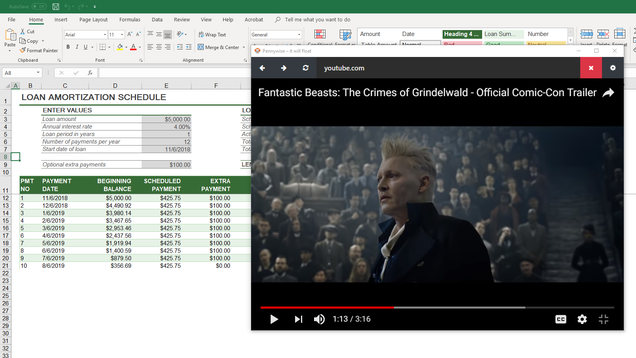
If you don’t have a dual-monitor setup or an ultra-wide display, your options for multitasking on your PC are limited. It’s going to be trickier to put on a YouTube video while you work, since anything you’re doing in your primary window—Excel, let’s say—is going to sit on top of what you’re trying to watch. And…
I live in a 112-year-old brick house. Brick lasts a long time. Mortar does not. Most of my house’s tuck pointing is in great condition, but a few isolated spots are almost completely devoid of mortar. Small spots, but bothersome. And bound to become bigger spots if I don’t take care of them soon. So today I decided to take care of them.
I assumed that I would mix mortar for the repairs, but the prospect of carrying a 60-pound bag of dry mix inspired a change of heart. Scrounging around Home Depot’s cement aisle I stumbled upon Quikrete Mortar Repair ($6). It’s sold in tubes for use in a caulking gun, but it’s not caulking. It’s a sanded acrylic designed to do the job of mortar, without the mess of mixing and applying the real stuff by hand.
The square applicator tip is supposed to make finishing the surface easier, and in fact it worked well. Although a wet finger did an equally nice job. Water is key to patching mortar, and with this stuff a wet sponge was extra helpful not only for smoothing the mortar as it cured but for wiping excess off the face of the bricks.
The 10-ounce tube cost me about $4; still a premium over dry mix. (It’s also available in a 5.5-ounce hand-squeezable size.) But for the handful of single-brick-sized repairs I needed to make, I was very thankful to avoid the setup and cleanup that mortar mix would have required. Not to mention the hassle of effectively getting the mortar from my unskilled hands into the open joints.
It is neither practical nor advisable to use Quikrete Mortar Repair to cover a large area of wall. The acrylic isn’t designed for structural tuck pointing so much as it is intended to fill in the gaps and keep water out, which is crucial if you want your brick wall to last a long time.
Artificial intelligence and machine learning produce many of the advancements we see in the technology industry today. But how are machines given the ability to learn? Furthermore, how does the way we do this result in unintended consequences?
Here’s our quick explainer on how machine learning algorithms work, along with some examples of machine learning gone awry.
What Are Machine Learning Algorithms?
Machine learning is a branch of computer science that focuses on giving AI the ability to learn tasks. This includes developing abilities without programmers explicitly coding AI to do these things. Instead, the AI is able to use data to teach itself.
Programmers achieve this through machine learning algorithms. These algorithms are the models on which an AI learning behavior is based. Algorithms, in conjunction with training datasets, enable AI to learn.
An algorithm usually provides a model that an AI can use to solve a problem. For example, learning how to identify pictures of cats versus dogs. The AI applies the model set out by the algorithm to a dataset that includes images of cats and dogs. Over time, the AI will learn how to identify cats from dogs more accurately and easily, without human input.
Machine learning improves technology such as search engines, smart home devices, online services, and autonomous machines. It’s how Netflix knows which movies you’re more likely to enjoy and how music streaming services can recommend playlists.
Google Search has made navigating the web a whole lot easier. The engine’s algorithm takes a variety of things into consideration when churning up results, such as keywords and bounce rate. But the algorithm also learns from user traffic, which can cause problems for search result quality.
Nowhere is this more apparent than in image results. Since pages that receive high traffic are more likely to have their images displayed, stories that attract high numbers of users, including clickbait, are often prioritized.
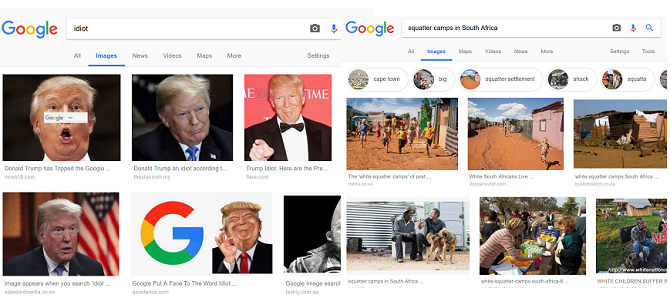
For example, the image search results for “squatters camps in South Africa” caused controversy when it was discovered that it predominately featured white South Africans. This is despite statistics showing that the overwhelming majority of those living in informal housing, such as shacks, are black South Africans.
The factors used in Google’s algorithm also means that internet users can manipulate results. For example, a campaign by users influenced Google Image Search results to the extent that searching for the term “idiot” shows images of US President Donald Trump.
2. Microsoft Bot Turned Into a Nazi
Trust Twitter to corrupt a well-meaning, machine-learning chatbot. This is what happened within of day of the release of Microsoft’s now notorious chatbot Tay.
Tay mimicked the language patterns of a teenage girl and learnt through her interactions from other Twitter users. However, she became one of the most infamous AI missteps when she started sharing Nazi statements and racial slurs. It turns out that trolls had used the AI’s machine learning against it, flooding it with interactions loaded with bigotry.
Not long after, Microsoft took Tay offline for good.
3. AI Facial Recognition Problems
Facial recognition AI often makes headlines for all the wrong reasons, such as stories about facial recognition and privacy concerns. But this AI also caused huge concerns when attempting to recognize people of color.
In 2015, users discovered that Google Photos was categorizing some black people as gorillas. In 2018, research by the ACLU that showed that Amazon’s Rekognition face identification software identified 28 members of the US Congress as police suspects, with false positives disproportionately affecting people of color.
Another incident involved Apple’s Face ID software incorrectly identifying two different Chinese women as the same person. As a result, the iPhone X owner’s colleague could unlock the phone.
Meanwhile, MIT researcher Joy Buolamwini recalls often needing to wear a white mask while working on facial recognition technology in order to get the software to recognize her. To solve issues like this, Buolamwini and other IT professionals are bringing attention to the issue and the need for more inclusive datasets for AI training.
4. Deepfakes Used for Hoaxes
While people have long used Photoshop to create hoax images, machine learning takes this to a new level. Software like FaceApp allows you to face-swap subjects from one video into another.
But many people exploit the software for a variety of malicious uses, including superimposing celebrity faces into adult videos or generating hoax videos. Meanwhile, internet users have helped improve the technology to make it increasingly difficult to distinguish real videos from fake ones. As a result, this makes this type of AI very powerful in terms of spreading fake news and hoaxes.
To show off the power of the technology, director Jordan Peele and BuzzFeed CEO Jonah Peretti created a deepfake video showing what appears to be former US President Barack Obama delivering a PSA on the power of deepfakes.
5. The Rise of the Twitter Bots
Twitter bots were originally created to automate things like customer service replies for brands. But the technology is now a major cause for concern. In fact, research has estimated that up to 48 million users on Twitter are actually AI bots.
Rather than simply using algorithms to follow certain hashtags or respond to customer queries, many bot accounts try to imitate real people. These ‘people’ then promote hoaxes and help make fake news go viral.
A wave of Twitter bots even influenced public opinion to a degree on Brexit and the 2016 US presidential election. Twitter itself admitted that it uncovered around 50,000 Russian-made bots which posted about the elections.
Bots continue to plague the service, spreading disinformation. The problem is so rife that it’s even affecting the company’s valuation.
6. Employees Say Amazon AI Decided Hiring Men Is Better
In October 2018, Reuters reported that Amazon had to scrap a job-recruitment tool after the software’s AI decided that male candidates were preferential.
Employees who wished to remain anonymous came forward to tell Reuters about their work on the project. Developers wanted the AI to identify the best candidates for a job based on their CVs. However, people involved in the project soon noticed that the AI penalized female candidates. They explained that the AI used CVs from the past decade, most of which were from men, as its training dataset.
As a result, the AI began filtering out CVs based on the keyword “women”. They keyword appeared in the CV under activities such as “women’s chess club captain”. While developers altered the AI to prevent this penalization of women’s CVs, Amazon ultimately scrapped the project.
7. Inappropriate Content on YouTube Kids
YouTube Kids has many silly, whimsical videos meant to entertain children. But it also has a problem of spammy videos that manipulate the platform’s algorithm.
These videos are based on popular tags. Since young children aren’t very discerning viewers, junk videos using these keywords attract millions of views. AI automatically generates some of these videos using stock animation elements, based on trending tags. Even when the videos are made by animators, their titles are specifically generated for keyword stuffing.
These keywords help manipulate YouTube’s algorithm so that they end up in recommendations. A significant amount of inappropriate content appeared in the feeds of children using the YouTube Kids app. This included content that depicts violence, jumpscares, and sexual content.
Why Machine Learning Goes Wrong
There are two major reasons machine learning results in unintended consequences: data and people. In terms of data, the mantra of “junk in, junk out” applies. If the data that is fed to an AI is limited, biased, or low-quality; the result is an AI with limited scope or bias.
But even if programmers get the data right, people can throw a wrench in the works. Creators of software often don’t realize how people may use the technology maliciously or for selfish purposes. Deepfakes came from the technology used to improve special effects in cinema.
What aims to provide more immersive entertainment also ends up ruining people’s lives when exploited.
There are people working towards improving the safeguards around machine learning technology to prevent malicious use. But the technology is already here. Meanwhile, many companies don’t show the required willpower to prevent abuse of these developments.
Machine Learning Algorithms Can Help Us
It may seem a bit doom and gloom when you realize just how much machine learning and artificial intelligence falls short of expectations. But it also helps us in many ways—not just in terms of convenience, but improving our lives in general.
If you’re feeling a bit hesitant about the positive impact of AI and machine learning, find out about the ways artificial intelligence is fighting cybercrime and hackers to restore some hope.
Want to take Windows with you, but don’t want to lug a laptop around? Thanks to flash technology, you don’t have to. USB and HDMI devices can run Windows, and they’ll fit snugly in your pocket when you’re done working.
Here’s how you can take Windows with you wherever you go.
Why Go Portable With Windows?
Perhaps you’re heading on a trip somewhere and need a computer with you. Your laptop is too big; you have other luggage, and don’t want to pay for the extra weight. Or maybe you have to give a presentation in a secure building and don’t have time for the bag checks.
Whatever the reason, taking Windows with you is still an option. As long as you have access to a display, a keyboard and mouse, you’ll be able to stay productive wherever you are.
Windows 10 has several portability options available, which we’re going to look at below. While none of these is a complete replacement for your desktop or laptop, they’re ideal for use in cybercafes, for hot-desking, or even in libraries.
Method 1: Windows to Go
First, it’s a good idea to look at what is available from Microsoft. Windows to Go is a feature that enables you to write a copy of Windows to a USB stick. This can then be inserted into any computer and used as the primary boot device.
The advantage of this is that Windows to Go will save your state, so any data you’re in the middle of working on will be retained. Unfortunately, Windows to Go only works on Windows 10 Enterprise and Windows 10 Education. If you’re running Windows 10 Home, or as most people are, or Windows 10 Pro, this won’t work for you.
Backup utility software publisher EaseUs has provided an alternative to those users who want to use Windows to Go but cannot.
EaseUs ToDo Backup is a general backup tool with added functionality for creating a bootable operating system on USB. You can create a full clone of your existing Windows installation if your USB device is big enough—and take it with you.
EaseUs’ solution will work on any version of Windows 7, 8, and 10.
You can find a free version of ToDo Backup on the EaseUs website, which can be used to create a portable Windows drive.
Simply connect your drive to your computer and launch EaseUs ToDo Backup. Next, select System Clone, and select the destination disk (your USB device), ensuring it has enough storage.
Click Advanced options, then check the box labeled Create a Portable Windows USB Drive. Click OK, then Proceed.
Wait while the clone is created and written to your USB device. Safely remove the drive—it’s ready to run on another computer!
Method 3: Continuum for Windows 10 Mobile
If you use a Windows 10 Mobile device, are happy to swap, and don’t want to flash an operating system to a USB flash device, the Continuum feature is ideal.
It’s essentially a system that changes the output of your phone’s display, depending on what it’s connected to. With Windows 10 Mobile phones, you have two options: the phone, and a display. Just connect a mouse and keyboard via Bluetooth, and the phone to a wireless HDMI device. Microsoft has also produced dedicated docks for this.
Once connected, your phone becomes a PC, with a standard Windows desktop, and access to all your apps and data. Better still, the phone still takes and receives calls!
Only a handful of Windows 10 Mobile devices ship with Continuum. These include the HP Elite x3, and the Microsoft Lumia 950, which although a couple of years old, features an awesome camera.
Method 4: Intel Compute Stick and Clones
Rather than make your own portable PC on a stick, you can also buy one. Since 2015, Intel has been producing Compute sticks, small devices around the size of a Google Chromecast, or Amazon Fire TV Stick, but with a full version of Windows preinstalled.
All you need to do is insert the device into your display’s HDMI port, and power it up. With a Bluetooth mouse and keyboard connected, you’ll be ready to start work.
An Intel Compute stick comes with the same advantages of a USB device. It will store the data you create, ready to be accessed again later.
Although compact, these little computers feature Atom or Core M series processors, with prices for all budgets. Intel aren’t the only producers of such devices, although they’re certainly the most notable.
Having a computer with you at all times is a great idea for productivity and convenience. But it isn’t always possible. With Windows 10 in your pocket, you have a great opportunity to just get started, and even pick up where you left off, without worrying about packing everything up when you’re done.
To recap, here are the four ways to run portable versions of Windows 10.
Keep it simple with Windows to Go
Use the EaseUs ToDo Backup
Turn your phone into a computer with Continuum on Windows 10 Mobile
Keep an Intel Compute in your pocket
If all of this is all a bit fiddly for you, there is another way for ultra-portability with Windows 10: a Microsoft Surface tablet.
We’re sure most people have put a packet of Mentos in Diet Coke and enjoyed the ensuing carnage by this point. But in terms of science experiments you can do at home, that’s just the tip of the iceberg.
If you like watching weird and wacky science experiments, YouTube is a treasure trove of content. With that in mind, here are the best YouTube channels full of people doing madcap science experiments.
Have you ever wondered what happens if you put a grape in the microwave? Or what happens if you combine milk and soap? Doctor Mad Science has the answers.
A 15-year-old autistic boy called Jordan hosts the channel. Impressively, in addition to hosting, Jordan also records and edits all of the content.
His channel is filled with science experiments that use household products, meaning anyone can try them in their own home. Just make sure you take appropriate safety measures before starting!
The Brusspup channel goes in a different direction. It explores the boundaries between science and amazing optical illusions.
If you subscribe, you can look forward to finding out what happens when UV light hits sand or how to control magnets using static electricity.
One of the channel’s most popular videos (with almost 30 million views) is “10 Amazing Paper Tricks”. It’s impressive stuff, so make sure you check it out.
Whizz Kid Science is another channel that’s hosted by a child. The presenter is 13, but he often ropes in his younger brother and sister in be part of whatever experiment he is conducting.
Some of the channel’s most-watched videos include “Five Amazing Egg Experiments” and “Top Seven Colorful Experiments”.
The Whizz Kid Science channel also features a handful of how-to videos that straddle the divide between science and children’s activities. Examples include “How to Make Chocolate Slime” and “Glow Stick Hacks for Kids”.
Kids love a fad. It doesn’t matter how old you are; you’ll definitely be able to recall something from your childhood that everyone badly wanted then quickly got bored with (Tamagotchi, anyone?).
The Incredible Science channel aims to put those fad products to good use by extrapolating science lessons from them. We had no idea that a fidget spinner could be such a great learning tool.
There are also plenty of other experiments that don’t use toys. The most viewed video investigates the weird science behind polymer balls. At the time of writing it has been viewed more than 70 million times.
If you have kids, the kitchen is a fantastic place to do science. There are so many things that you can combine to learn more about the world.
The MC Experiments channel takes the kitchen idea and runs with it. All the experiments on the channel are kid-friendly and can be performed using items that most families will have lying around.
Bouncing eggs, lava in a cup, and fun with food coloring—the channel has it all.
The Quirkles is a 26-book science series for kids. Each book featured a different imaginary scientist who takes the reader on a journey through the subject matter. The YouTube channel is a spinoff from the book series.
It differs from the other channels on this list thanks to its focus on seasonal science. You’ll see experiments geared towards the time of year, but also towards events such as Halloween and Valentine’s Day.
Sick Science is the brainchild of Steve Spangler. Steve is an American TV personality, science teacher, toy designer, and author, meaning he’s well-placed to perform some entertaining weird and wacky science experiments.
Some of his most fun videos include “Liquid Light”, “Exploding Egg”, and “Make Your Own Lightsaber”.
Unfortunately, Spangler is slow to release new videos, so you can expect just a couple per year. Nonetheless, the back catalog is impressive enough.
The clue is in the name. The Spangler Effect is Steve Spangler’s second YouTube channel. Thankfully, this one receives new content far more frequently—you’ll get at least eight new videos every month.
The content is broadly similar to Sick Science. If you want to see fire tornadoes, fizzy reaction contests, colorful convection currents, and magnetic slime, this is the channel for you.
The most viewed video on the channel is an experiment that shows you how it’s possible to unlock a car using nothing more than water. It has racked up 4.2 million views and counting.
It’s fair to say that The Backyard Scientist channel should come with a giant “Do Not Try This at Home” warning.
But, while the channel’s videos might be somewhat dangerous, they’re also packed with incredible science and wild experiments.
Honestly, we’d never given a thought to what happens when you pour molten aluminum into a watermelon before, but now we’re glad we know.
Other examples of what to expect include putting molten salt into water, what happens if you microwave a microwave, and whether someone can escape a human-sized glue trap.
Our final recommendation is Applied Science. It’s slightly less wacky than some of the other channels on this list, but the experiments are still fun and will teach you a lot.
If you subscribe, you’ll be able to learn what happens if you blow mold over plastic bottles or dissolve lithium in anhydrous ammonia. The channel’s most popular video looks at how to make a refrigerator work using rubber bands.
There are even some videos for foodies (which you can watch when you run out of Netflix documentaries for foodies). You can find out how a potato chip reacts if you fry it in Fluorinert FC-40 or how to make chocolate whip using high-pressure nitrous oxide.
Improve Your Scientific Knowledge Further
These channels will hopefully inspire you to get more involved with science. And they’re a reminder that science doesn’t have to be dry and boring.
Professional photographers know how important lenses are for getting that elusive, award-winning shot, but they also know that camera lenses can get dirty and/damaged while chasing the perfect photo.
Using a few preventive measures, you should be able to make your camera lenses last longer and perform better. In this article, we’ll show you how to take care of your camera lenses.
The Main Enemies of a Camera Lens
The three main enemies of your lens are :
Dust
Condensation
Fungus
Keeping these out of your camera is a challenge. Outdoor photographers have it tougher than those who use their cameras mainly in a studio. With a little care, you can make your lenses last longer and keep getting those quality photos.
Use a UV Lens Filter
A good quality UV filter is a great way to protect your lenses. This stops dust and moisture from getting in your camera’s lenses. It also saves the situation in case something hits your lens or you drop the camera.
Some people argue that there is a slight loss of picture quality when using a UV filter, which is why it is wise to opt for a high quality filter. In practice, the loss of quality because of a UV filter is negligible when compared to the benefits of using one.
Be Extra Careful While Changing Lenses
Dust, moisture, and fine particles can get in your camera’s mechanism while changing lenses, so be extra careful in these moments. Always point the camera down while changing lenses.
A better idea is to plan your shoot ahead so that you don’t need to change lenses often. Using prime lenses requires more lens changes, especially while shooting moving action from a distance.
Each time the lens is changed, the seal between lens and body is opened, providing a way for dust to enter the camera and get on the sensor. Once this happens, the dust is difficult to remove, and can taint picture quality.
A zoom lens can make things much easier. To use one properly, do find out everything you need to know about zoom lenses. If you are not attaching a new lens immediately, use the camera body cap to protect the sensor.
When you have finished clicking, put the lens cap back on. Most caps will fit on the front even with a filter attached. After removing the lens, put on the second lens cap, which fits the rear of the lens. Always keep both caps on while storing and transporting your camera.
Invest in a Case, a Cloth, and Some Gel
Invest in a good quality camera case. These have separate compartments for batteries. Most are padded to prevent any damage if the camera gets bumped around during transportation. If you cannot carry the case, put the lens in a clean sock and wrap it around a couple of times for protection.
Use a microfiber cloth to wipe off dirt from other parts of the camera. Keeping your equipment clean prevents dirt from getting lodged, and eventually finding a way on to your lens or sensor.
Anyone who has used equipment that needs to be protected from moisture knows the value of silica gel. A few sachets in your camera bag (these are the best large camera bags money can buy) or lens case will get rid of dampness. Replace the silica gel when it cannot hold any more moisture.
In the long run, these are your best defense against fungus setting in the lens. You should be vigilant against fungus, as it is the death knell of lenses. Once it does make a home in your lens, there is not much you can do to get rid of it. The only option then is to send your camera for professional cleaning.
Tips for Cleaning your Camera Lens
Most lenses have a coating applied to the front surface. Besides this, glass used for optical lenses is very delicate. It can get scratched, or the lens can lose its coating if cleaned improperly.
Lens cleaning liquids containing harsh chemicals are not recommended. Instead, use a lens brush or compressed air blower to remove any loose dust or grit. Hold the lens with the surface you are cleaning face down as you brush, so any dislodged dirt or dust falls away. Use the brush sparingly.
Some compressed air blowers have a soft top to avoid damaging the lens in case you accidentally get too close. If possible, carry a set of brushes and a blower while travelling to take care of messy situations as they arise. These two accessories are especially helpful for getting rid of sand.
Use the camera strap whenever the camera is not mounted on a tripod. And if you don’t already own a tripod, check out our camera tripod buying guide for beginners.
This greatly reduces the chances of your equipment hitting the ground. Even if you walk on padded floors, the impact will cause some damage and provide an opportunity for dust or sand to further damage your lens.
Things You Should Never Do
You may have seen many shutterbugs breathing on a lens and then wiping it with a cloth to get rid of a small stain. This bad habit affects both, pros and amateurs, and you should try not to pick it up. It causes condensation and at times lets saliva get on the lens. It seems like the most natural thing to do but expert opinion advises against it.
Develop the habit of not leaving fingerprints on the lens by consciously avoiding touching it. The urge to rub off a speck of dirt from the lens will be strong but resist knowing that your fingers will leave traces of sweat. If you do accidentally touch the lens, wipe off the spot with a microfiber cloth.
In case some water does fall on the lens, don’t let it dry off on the lens as it will leave traces. Dab it off gently.
Helping Your Camera Lenses Last a Lifetime
With the right care and attention, along with some affordable equipment and a regular cleaning schedule, your lenses should last a lifetime. And the longer you use a lens, the better you’ll get at using it. So it pays to take care of your camera lenses as best you can.
With that out of the way you should be ready to take some photographs. But before you set off for a photo shoot, why not compare notes on common photo lenses and when to use them.
Turns out there is a solid neurological reason for indecision when faced with too much choice. New research can give important insights into how to improve decision-making when there is an abundance of options to choose from.
A few years ago I was shooting at dawn in East London for one of my books. I walked past a butcher and thought, “awesome!” Capturing people up at dawn can be really hard as they are either not around or it can be difficult to find people doing interesting things.
The scene was great. I liked the blue early morning light on the buildings contrasting with the yellow tungsten inside. It really was a perfect combination of elements. I lifted my camera, shot this, but I obviously wasn’t happy with it because the positioning is all wrong.
Then I saw that the butcher had spotted me. Guess what I did? I carried on walking! I had been totally overtaken by the fear and just left the scene.
“We pay a heavy price for our fear of failure. It is a powerful obstacle to growth. It assures the progressive narrowing of the personality and prevents exploration and experimentation.” —John W Gardener
To be honest it sort of surprised me how fearful I was. I have a lot of years under my belt of photographing strangers. It just shows you, though, that fear is not something you overcome and then that’s it, it’s gone. It can come back at any time. And of course, we professionals are not immune.
But you know what? That’s OK. For me the best way is to accept that fear is a bit like clouds in the sky or rain in London – it comes and then it goes. The worse thing for me to do is let it stop me from taking the shot – or in this case, going back and getting the shot.
Fear is an interesting concept (I like to think of it as a concept because the more I emotionally distance myself from it, the less it’s likely to eat me whole). A little fear and a little anxiety can be great drivers for creating work.
Fear can keep you motivated and alert and save you from the most dreaded of all creativity killers: inertia. But too much, and it’s a real threat to your creativity. And it’s too much fear that I see most often on my workshops.
It’s good to note though that it’s totally natural to feel fear when you are creating.
“We’ve evolved to distrust creative ideas: except in a crisis, there’s little survival benefit to trying something new.” —Oliver Burkeman
As creative people though we are always striving to be better at what we do, trying to create original and beautiful things with our photography.
I believe that fear in its many forms is the main barrier to improving your photography. It’s not just the thing that will stop you from photographing strangers – it will also stop you from pushing yourself further with your creativity. It will stop you from envisioning what is possible to do with your photography – and then getting on with it.
I see fear all the time with my students, and often they are surprised when I tell them that most people can experience fear when they are taking photos. They are not unique or alone in this. With my students I see fear come up in the form of:
Not staying at a scene long enough
Self-consciousness when shooting around people. So instead of being in the moment, connecting to your environment and composing your image, half of your mind is distracted with what people might be thinking or what is happening outside the moment of the photo
Not shooting what you really want to photograph because it scares you too much
Not shooting that intriguing stranger
Not getting started! I see this a lot. Worrying about doing it just right, so people don’t even get themselves out the door. (Perfectionism is just another form of fear.)
I agree with Oliver Burkeman (again) in that…
The real question, then, is not whether creativity provokes fear, but what to do when it does. Far too many authorities urge you to conquer it… but as with any emotion, launching an all-out attack on fear is counterproductive. That just puts it center stage, and risks reinforcing the notion that creativity must – and should – be one endless, bare-chested struggle.
So what I encourage in the dealing with fear is:
Be patient with yourself. Fear is just a feeling. Don’t react to it. Let it come up and eventually it with leave you. Probably the worse thing you can do is start adding lots of thoughts and judgments about your fear. Thoughts are like adding fuel to the fire. Let the fire just burn itself out.
Accept that it’s part of being creative. Putting yourself out there in terms of showing your work, being out there in the world with your camera, doing something outside of your day to day life is going to provoke feels of discomfort. And really, if you are feeling discomfort you are on the right path – it shows you’ve stepped outside your comfort zone, you are onto to something new and different.
I also like this idea about overcoming fear by distracting your mind and creating habits:
There’s nothing wrong with fear; the only mistake is to let it stop you in your tracks. A basketball player comes to the free-throw line, touches his socks, his shorts, receives the ball, bounces it exactly three times, and then he is ready to rise and shoot, exactly as he’s done a hundred times a day in practice. By making the start of the sequence automatic, they replace doubt and fear with comfort and routine. —Twyla Tharp
Accept it is impossible to totally quiet the mind. Thoughts just keep coming in whether you want them to or not (I love what the meditation teacher Jack Kornfield says — that the mind has no shame, it “secretes thoughts the way the mouth secretes saliva.”). So the only choice you have is to ignore your mind, the thoughts, and pay attention to being completely present.
Don’t rush
Don’t think ahead
Don’t wonder where you are going
Instead:
Listen to the sounds around you
Look for the light
Spend three times longer looking than you usually would. Stop yourself from moving
Imagine yourself just drifting, like a small child looking around with fresh eyes, catching the things that interest and being totally absorbed until you are ready to shift the interest to the next thing
Try and look at the whole scene
Don’t think about taking photos, think only about looking and seeing
If in doubt, stay still
And perhaps most importantly….have fun! (remember how much you love photography?)
When I am really struggling with fear I like to remember what Seth Godin advises about starting small:
What we need to do is say, ‘What’s the smallest, tiniest thing that I can master and what’s the scariest thing I can do in front of the smallest number of people that can teach me how to dance with the fear?’
Once we get good at that, we just realize that it’s not fatal. And it’s to intellectually realize – we’ve lived something that wasn’t fatal. And that idea is what’s so key — because then you can do it a little bit more.
Photography for me is not a list of technical skills or camera gear to acquire. It’s not exotic locales or hip people to photograph – photography is a state of mind. The more you work on removing what is cluttering up your vision, the more you’ll see searingly original, interesting photos that make people go “wow!”
Last thought for you: if you are struggling with fear, and not sure if you want to overcome it, then I like to remember this:
“Can anything be sadder than work left unfinished? Yes; work never begun.” –Christina Rossetti
About the author: Anthony Epes is a photographer whose work has been featured internationally; including on BBC, French Photo Magazine, Atlas Obscura and CNN. The opinions expressed in this article are solely those of the author. Epes is also a teacher – writing in-depth free articles on his website. Receive his free ebook on the two essential skills that will instantly improve your photos, and sign up to his weekly newsletter providing inspiration, ideas and pro-photo techniques. This article was also published on Cities at Dawn.
There's no doubt about it: overlanding is an expensive (read: addictive) hobby, but getting a rig already perfectly set up can save you time and money.
Anyone doing technical or design work has burned through reams of graph paper. I’m a designer, and I use Whitelines to do technical drawings in accurate scale, which are then turned into 3-D models and die tooling diagrams. Whitelines is the best graph paper I have ever worked with.
The concept is simple and powerful. Ordinary graph paper is paper with a graph of lines printed on it in a light color, often blue or gray. Whitelines is paper with a very light gray grid of squares printed on it. The graph is unprinted, hence, white lines.
This is genius. Pen strokes, and even pencil, are startlingly clear against the background. The distracting visual noise of a printed graph is gone entirely, while retaining the precision and ability to see scale, which is graph paper’s reason for being.
I’ve been using Whitelines extensively for the past few months, mostly for technical drafting on the MakerBeam project, an open source metal building kit like Meccano for the Arduino set. The grid is 0.5 centimeter pitch, perfect for working on a metric standard. With ordinary graph paper, pencil lines are close in color weight to the lines themselves. When scanning pencil marks on ordinary graph paper, the pencil lines often vanish completely. With Whitelines, I can scan a pencil sketch, if I’m satisfied with it, without having to go back over it with pen.
Available in A4, A5 and pocket sizes, as tablets, spiral bound, perfect and hardbound, both lined and graph. Better graph paper makes better drawings, and this is genuinely better graph paper.
Today in Tedium: We put a weird amount of weight into the food that we eat. (And conversely, depending on the food, it puts a weird amount of weight on us.) And over time we gain affinity for certain kinds of food experiences, especially as those experiences have become easily repeatable due to the exacting standards of modern manufacturing. Which is to say: if you eat a Big Mac in Missoula, Montana it’s going to taste like Big Mac in Moorestown, New Jersey. This means that we get used to specific flavors of fast food in specific combinations—and when those items fall off the menu, people get sad over their loss of something familiar. Today’s Tedium ponders what it means to miss a piece of fast food. — Ernie @ Tedium
9,000+
The number of McDonald’s locations that are selling the McRib in 2018, out of the 14,000 locations nationwide. As it turns out, through our masterful sense of timing, I was able to put together this article just as the McRib, the ultimate seasonal sandwich, was returning to the McDonald’s menu once again.
(Via the Taco Bell website)
Why the Chili Cheese Burrito may be the greatest under-the-radar fast food item of all time
As a 2011 article in The Awl, the late great online publication, famously pointed out, the McRib may be the world’s greatest example of manufactured scarcity, a sandwich that appears to return just as pork prices are in the midst of a major dip.
But there’s plenty of room for actual scarcity in fast food—and to highlight that point, I give you the Chili Cheese Burrito.
The foodstuff, whose broad appeal is right in its name, is not an item on the menu of every Taco Bell location in the country, which belies its roots. It is not a Taco Bell original, but was acquired through another chain, Zantigo, in the late ‘80s, and its popularity tends to be stronger in areas where Zantigo was once located.
(It was once called the Chilito, by the way, and it’s long been suggested that the name was changed because it means something vulgar in Mexican Spanish slang—though that didn’t stop a Minnesota-based revival of Zantigo from sticking with the old name.)
The Chili Cheese Burrito is still out there, but you have to look really hard to find it, due to the fact that it’s considered an optional item for chains to carry. It’s basically nonexistent on the East Coast, and even in the Midwest, where it’s relatively common, it’s a crapshoot as to whether your nearby store will have one.
ChiliCheese.org, as it looks today. The source of its power is in the Midwest.
Fortunately, the job of confirming whether a store sells one is easy these days, thanks to a website called ChiliCheese.org, which is a repository of information related to the deceptively simple burrito. The website, thanks to a recent upgrade, features a detailed map highlighting roughly every Taco Bell in the country—and spotlighting the ones that have this burrito, which is obscure enough these days that many of the chain’s current employees might not even know what it is. Which sometimes proves a problem, as the site’s founders, including Steve Gomez, are frequently calling up stores to ask if they have it.
“We try to call 10 to 20 locations a day, during the weekday, each of us,” he told me in an interview.
Gomez, a cofounder of the site who handles its public relations and serves as its software developer, explained that the idea for the coordinated campaign, a side project if an extremely sophisticated one, came up much in the way one would expect: During a random office discussion with a group of coworkers.
“We were were just sitting around just talking about our favorite fast food items that we used to love when we were kids in high school or something like that,” he explained.
And once the Chili Cheese Burrito turned into a topic of discussion, the idea of launching a campaign to help revive the classic burrito came to life. There was just one problem: It was 2004, and social media was in its infancy—that’s right, this site is almost 15 years old.
“When we started out, there was no Twitter or Facebook or anything like that,” he noted.
But they did have a team of folks who knew how to market things, as well as Gomez, a developer by trade. Even the initial campaign was elaborate: The site included a petition, and the organizers even came up with a clever name—the Culinary Crisis Coalition—as well as a detailed mission. To keep up the illusion that it was bigger than it actually was, the team even registered McRib.org to make it look like the made-up coalition had multiple foods it was trying to save.
ChiliCheese.org, as it looked in 2004. (Internet Archive)
“The Chili Cheese Burrito has today been run out of most towns by bigger, flashier choices,” the site stated upon its 2004 launch. “Let Taco Bell keep their sour cream-infused quesadillas, lettuce-filled taco salads, and salsa-covered MexiMelts. But let them hear your screams for a simple, delicious Chili Cheese Burrito.”
But even while the site drew a lot of attention, Taco Bell leadership at the time showed no interest in bringing the burrito back on a national level, even though the campaign received a lot of early notice, including many mentions in the media. Gomez even noted that the company once responded to the campaign in an indirect way, suggesting through an interview with the Riverfront Times—a story Gomez himself was interviewed for—that the campaign was futile.
“We have about 50 million customers a week at our 7,000 restaurants worldwide,” Taco Bell’s director of public relations, Laurie Schalow, stated. "Unfortunately, sometimes we have to remove some of the lower-selling items to make room for newer items."
(Mike Mozart/Flickr)
Is Taco Bell ready to turn a Chili Cheese corner?
This claim is definitely true, and it means that the Chili Cheese Burrito is far from Taco Bell’s only under-the-radar icon of culinary achievement. Some of the most famous ones include the Enchirito, which doused a burrito in red sauce, evoking an enchilada-type appeal; Fully Loaded Nachos, which literally shoved a bunch of nachos inside of a taco salad shell; and the Beefy Crunch Burrito, whose use of Flamin’ Hot Fritos gave the burrito a unique taste.
But the Chili Cheese Burrito faces challenges that most of Taco Bell’s limited-time options do not, and it comes down to the fact that the saying about all Taco Bell food items relying on the same 10 ingredients is more or less true: Unlike the Cheesy Gordita Crunch or the Enchirito, which are simply reimaginings of basic elements of the Taco Bell ingredient list, the main ingredient of the Chili Cheese burrito, chili, isn’t used anywhere else in Taco Bell’s menu. Which means that the seasoning it uses has to be specially ordered. Which means that the concoction of seasoning and beef is taking up a spot on the production line that can’t be used for anything else. Which means the burrito has to sell at a certain rate to maintain its place on the menu. Which means it’s hard to make it part of a “secret menu,” like the Enchirito has at times survived on.
On the other hand, perhaps the campaign for the Chili Cheese Burrito was just too early. In recent years, Taco Bell has been much more willing to revive retired products than some of its competitors.
The Cheesy Gordita Crunch, which combined a soft gordita shell with a hard taco, was such a popular limited-menu item that it eventually became a permanent part of the chain’s identity. And the Beefy Crunch Burrito turned into a meme a couple of years ago, thanks to a social media campaign of its own called the Beefy Crunch Movement.
Perhaps it’s because of the power of social media that the Chili Cheese Burrito still has a chance to return to prominence someday. Gomez noted that ChiliCheese.org embraced social media relatively late, but once it did, it finally started making headway. Earlier this year, Taco Bell did something unexpected: It filled out the website’s map, and said so on social media, basing its data on actual shipments of the chili seasoning to stores.
“It was a huge victory just to be acknowledged by Taco Bell,” Gomez noted when the company reached out to offer updates to the map.
Gomez stated that the campaign, already active off and on for more than a decade by this point, spoke to a certain level of frustration—and the copy, always a strong point for the campaign, was reflecting it in the years before Taco Bell finally gave them some direct notice.
“We probably should have kept that nicer, more cooperative tone,” Gomez says in retrospect. “It seems like now there’s now there’s a point where they want to reach out to fans about certain items.”
And that’s the advice he gives to anyone that puts on a similar campaign of their own—don’t give up optimism even as your campaign slogs on. “You catch more flies with honey and vinegar,” he stated.
Five forgotten fast food items that might be worthy of a social media movement
McDonald’s McStuffins. In the early ‘90s, McDonald’s produced its own take on the Hot Pocket, putting different kinds of flavored meat in French bread. (They even made commercials.) The product—which was sold in teriyaki chicken, barbecued beef, pepperoni pizza, and cheesesteak flavors—didn’t last, but effectively rekindles the Hot Pocket’s roots as a restaurant food.
Pizza Hut’s Priazzo Italian Pie. Pizza Hut isn’t exactly a culinary icon these days, but the chain is known for its experiments, and during the ‘80s, it hit on something truly ambitious: A full-sized deep-dish Chicago pizza that it branded as if it had sourced every ingredient from Italy (to the point that there were four Italian-named variants—Roma, Florentine, Napoli, and Milano). The fanbase was strong, but there was a problem. If you’ve ever waited for a legitimate Chicago pizza at a place that sells one, you might know why this one failed: Simply, it took too long to make. (It’s certainly a better culinary legacy than Domino’s Pasta Bread Bowls.)
Wendy’s Stuffed Pita sandwiches.With market research in its pocket that pitas would appeal to women, the fast food chain decided in the ‘90s it would introduce a variety of pitas to its menu, including chicken Caesar, ranch Chicken, Greek, and garden veggie. The stuffed pitas faded from view after about three years, though the chicken Caesar still has something of a fanbase, leading to copycat recipes.
Burger King’s St. Louis-style ribs. For a short period in the summer of 2010, Burger King actually sold miniature pork ribs, an unusual option for a major fast food chain—as proven by the fact that the company sold the ribs for as much as $9. Problem was, the ribs were incredibly successful, to the point where the chain had to end the promotion early due to shortages. (Also worth a mention here: Burger King somewhat recently sold a Whopper burrito.)
Subway’s Orchard Chicken Salad Sub. Usually, if a fast food chain is going to add fruit to its menu, it’s either going to be highly processed or done begrudgingly. But not in the case of Subway’s Orchard Chicken Salad Sub, a sandwich dating to the early 2010s that featured apples, raisins, cranberries, and celery along with the chicken. It hasn’t reappeared in a number of years, but it’s up there with the falafel footlong on the list of most interesting Subway experiments.
18
The number of months it took Wendy’s to test out and distribute its Frescata sandwiches, an attempt at high-quality cold sandwiches with fancy bread. The company tested 24 different varieties, but removed them from the market slightly more than a year after rolling them out nationally. Part of the reason the sandwiches, which were heavily promoted, didn’t stick around? They were apparently much harder to make than burgers.
The problem with fast food items that don’t quite make it is that their reintroduction is a major risk even considering their prior success, and even accepting the risk might not be worth it.
To offer an example, Wendy’s had a truly buzzworthy menu item in the summer of 2013: The Pretzel Bacon Cheeseburger, a well-received combination of three things people truly love: Bacon, burgers, and pretzel bread. To underline the point, Wendy’s even had Nick Lachey sing love songs about it, and those love songs were derived entirely from customer tweets. The company reportedly sold 50 million pretzel sandwiches in 2013 alone.
But it was a limited-time item, and when it was gone, it was gone—until Wendy’s decided to bring it back in 2014, putting it on its permanent menu in August of that year. It seemed like all the elements of a social media-driven recovery were there. But less than a year after making that call, it was off the menu again, having failed to make an impact a second time around.
Consumers are fickle and their tastes evolve, and fast food is very much a mainstream play—the appeal of fast food doesn’t often allow for cult followings along the lines of an obscure band that only a few people have heard of, even a fake one. You can’t rediscover a piece of fast food that was unappreciated in its time, unless you were looking to give yourself food poisoning by eating a moldy burger. The food that sticks around has to hit a certain threshold of success or off the menu it goes, its past glories forgotten.
In that light, the Chili Cheese Burrito is the perfect cult following food. It’s mass-manufactured like everything else, seemingly forgotten by many, but it sticks around in certain pockets because just enough people love it in just enough places, and, unlike other menu items, it’s simple enough that some store owners feel compelled to keep it on the menu.
But the greatest strength of the Chili Cheese Burrito and every other fast food item—its standardization—is in some ways also its greatest weakness. A 1997 Associated Press article about the way that interstate highways tend to remove the culture from a community by leading to fast food standardization has a line that might be the best one ever written about the Chili Cheese Burrito:
Consider: The Breezewood Taco Bell has a Chili Cheese Burrito. It’s a perfectly good Chili Cheese Burrito. But it’s the same Chili Cheese Burrito you get 80 miles east in Harrisburg or 400 miles west in Ann Arbor, Mich. And it’s served in a place with the same purple, dusty, rose-teal decor, too.
There’s something comforting about consistency, even when the consistent item can’t be found everywhere, when it has to be sought out or even, in the case of this magical burrito, mapped out.
But at what point does the cult following overshadow the culture?



















 CloudFlare's 1.1.1.1 DNS service launched last year for desktops and laptops. We've been using it since launch, and it's rock-solid. The fastest public resolver, it's now available to speed up...