Visit Uncrate for the full post.

(From Cato.org)From The Wall Street Journal – “The borrowers envisioned the sports facilities as a form of economic development that would attract fans from near and far, raising cities’ national profile and boosting their revenue beyond what was needed to pay back the bonds. The pandemic has turned that calculus on its head, crushing tourism proceeds and turning stadiums into a strain on city budgets.”
The lone beneficiaries of sports subsidies are team owners and players. The existence of what economists call the “substitution effect” (in terms of the stadium game, leisure dollars will be spent one way or another whether a stadium exists or not), the dubiousness of the Keynesian multiplier, the offsetting impact of a negative multiplier, the inefficiency of government, and the negatives of higher taxes all argue against government sports subsidies. Indeed, the results of studies on changes in the economy resulting from the presence of stadiums, arenas, and sports teams show no positive economic impact from professional sports – or a possible negative effect.

Unlike a traditional safe, which relies either on keyed mechanisms or a number configuration to open, a biometric safe opens with a simple fingertip. Press the linked finger to a keypad, and the safe springs open. It’s a great choice for items that you need to access in a hurry, or if you are concerned about misplacing keys or forgetting combinations. Here are three factors that will help you make the best choice when buying a biometric safe.

The best biometric safes are backup-plan ready. That means you can open one multiple ways. You can pop one open using the fingerprint reader, manually open with a key or bob, or enter a combination on a keypad. While the fingerprint reader is the primary way to access the inside, having multiple entry options enables access to more than one person if desired.

Placing the correct fingerprint on the reader kick starts the process of opening a safe, but the mechanical devices inside that actually complete the action vary. Some safes are spring operated and open quickly. Others rely on gas struts that dampen the sound of the door opening. Whichever you prefer, it’s important the door opens a full 90 degrees for ease of access.

You’ll likely want to attach a biometric safe firmly to immovable objects like a floor or wall. If so, consider a safe with pre-drilled mounting holes that allow you to fix it to a sturdy surface. Doing so provides an extra measure of security against theft.

Strong combination safes with digital locks make it safer than ever to store your valuables at home or work. The quick-to-access keypads are easy to operate, and you can change the combination whenever you need. Most run on batteries, so you’ll have to switch them regularly. Remember to do it every time you change batteries on your home smoke detectors. There are a few options to weigh when it comes to selecting a digital safe, so think about these three things before you invest.

Before you make your purchase, know exactly what you plan to put in it. Some safes have soft fabric lining to protect fragile items from scratching. Others come with shelves to help organize interior spaces. Before you buy, stack up all the stuff you intend to store in the safe. The volume inside most home safes is about 1.2 cubic feet, which is about the size of a 12-inch-tall stack of paper. If you want to add valuables like jewelry, you may need a larger safe.

Not all safes guard against fire or water, so make sure your choice meets your needs. Fireproof safe ratings indicate how safe the contents inside remain at certain temperatures. A safe rated at 350 degrees can protect paper documents. But if you need to safeguard computer drives, hard disks, or photographic materials, consider a safe that doesn’t exceed 150 degrees. If you’re concerned about floods or water damage, make sure the description of the product you’re considering clearly states it’s waterproof.

A quality safe is heavy, but you might not want to rely on weight to keep a burglar from hauling it off with your contents inside. You can secure some safes to the floor or wall studs with screws or bolts, which adds an extra layer of protection.
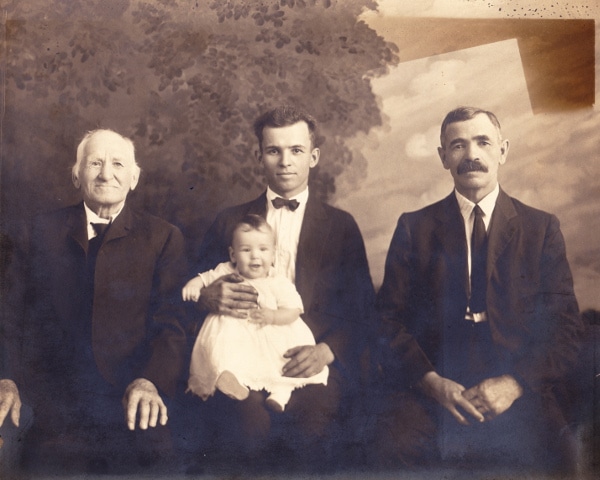
With our archives now 3,500+ articles deep, we’ve decided to republish a classic piece each Friday to help our newer readers discover some of the best, evergreen gems from the past. This article was originally published in July 2012.
As is the generation of leaves, so to of men:
At one time the wind shakes the leaves to the ground
but then the flourishing woods
Gives birth, and the season of spring comes
into existence;
So it is with the generations of men, which
alternately come forth and pass away.
—Homer, The Illiad, Book Six
If you’ve been following AoM for awhile now, you know that Kate and I love history. I studied classical history in college and Kate actually taught American History and Humanities at a community college here in town. And in running the Art of Manliness for the past five years, we’ve read hundreds of old writings while researching material for our articles and two books.
Through our study and reading, something that we’ve both come to appreciate about history is just how right the author of Ecclesiastes was: “What has been will be again, what has been done will be done again; there is nothing new under the sun.”
We are often struck, even sort of tickled, about how much the hopes, observations, and complaints of people decades, even centuries, ago sound just like the hopes, observations, and complaints of modern folks. It’s uncanny sometimes!
It is often said that history repeats itself. But do these repetitions happen at random . . . or is some kind of regular cycle at work?
All human things are a circle. —Inscription upon the temple at Athens
While modern societies typically see history as a linear movement — either ever improving or declining from a past high — ancient and traditional cultures believed time was cyclical, just like the waxing and waning of the moon, the rising and setting of the sun, the birth and death of living creatures, the planting and harvesting of crops, and the seasons of the year. The idea of sacred time as an eternal round and the symbol of the ring or wheel is common to many faiths, including Buddhism and Hinduism. The Old Testament is in many ways the story of a “pride cycle” with repeating periods of renewal, regression, and repentance. And many ancients couldn’t help but notice that times of war and peace seemed to move in a regular cycle as well.
In the 1990s, William Strauss and Neil Howe published two books, Generations and The Fourth Turning, which set out a bold and fascinating theory: that the generations of history change in a regular cycle, just like the seasons of the year — that the ancients were on to something with their cyclical view of time after all.
Strauss and Howe argue that the last five centuries of Anglo-American history can be explained by the existence of four generational archetypes that repeat sequentially in a fixed pattern every 80-100 years, the length of a long human life, or what the ancients called a “saeculum.” These generational archetypes are: Prophet, Nomad, Hero, and Artist. Each generation consists of those born roughly during a 20-year period. As each generation moves up the ladder of age and takes a different place in society, the mood of the culture greatly changes:
Childhood: 0-20 years old
Young Adulthood: 21-41
Midlife: 42-62
Elderhood: 63-83
Late Elderhood: 84+
A generation reaches it apex of influence when it moves into midlife and begins to take leadership positions of power within society. Thus every 20 years as a new generation fills the midlife rung of the age ladder, and the generation that previously occupied that rung moves into less influential elderhood, the mood of the culture shifts. As each generation type is born, matures, comes to influence in the culture, and then declines and dies, it plays a role in propelling society through a cycle of growth, maturation, entropy, destruction, and then regrowth. Just as in nature, this cycle of death and rebirth is necessary to maintain the health of the ecosystem of society.
Why do the same four generational archetypes repeat in the same way each saeculum? They are molded by four historical turnings that reoccur every 80-100 years as well. The four historical turnings are: High (First Turning), Awakening (Second Turning), Unraveling (Third Turning), and Crisis (Fourth Turning). Historical turnings and generational archetypes work together to power the generational cycles. Historical turnings shape generations in childhood and young adulthood; then, as parents and leaders in midlife and old age, generations in turn shape history.
Because each of the four generation types experience the four historical turnings at different times in their lives, each generation is shaped differently by these watershed moments in history.
Below I include a chart that lists the four generational archetypes and turnings, and shows at which point in life each generation experiences the turnings:
| Prophet | Nomad | Hero | Artist | |
|---|---|---|---|---|
| High | Childhood | Elderhood | Midlife | Young Adult |
| Awakening | Young Adult | Childhood | Elderhood | Midlife |
| Unraveling | Midlife | Young Adult | Childhood | Elderhood |
| Crisis | Elderhood | Midlife | Young Adult | Childhood |
Each horizontal row represents a “generational constellation” — the set arrangement of the generations on the age ladder during a turning. The generational constellations are the same in each turning, saeculum after saeculum.
If you’re feeling confused, hopefully things will become clearer as we discuss the historical turnings and the four generational types below. The theory will be easiest to grasp and keep track of if you think in terms of who the generational types were/are during our most recent saeculum as we go along:
Most Recent Generations:
Heroes: G.I. Generation (born 1901-1924)
Artists: Silent Generation (born 1925–1942)
Prophets: Baby Boom Generation (born 1943-1960)
Nomads: Generation X (born 1961-1981)
Next Heroes: Millennial Generation (born 1982-2004)
Most Recent Turnings:
Crisis (Fourth Turning): Great Depression/WWII (1925-1945)
High (First Turning): Postwar Boom (1946-1960)
Awakening (Second Turning): Consciousness Revolution (1961-1981)
Unraveling (Third Turning): Reagan Revolution/Culture Wars (1982-2006)
Next Crisis (Fourth Turning): ? (2008?-2028?)
Before we move on, we should note that a cyclical view of history does not preclude the idea of a society progressing or regressing; the cycle may be spiraling up or spiraling down.
Be sure to listen to our podcast with Neil Howe about the generational cycles:
The saeculum is broken up into four periods: First Turning (High), Second Turning (Awakening), Third Turning (Unraveling), Fourth Turning (Crisis). Each lasts roughly 20 years, just as the generations do. It’s helpful to imagine these periods as the seasons of the year. The Awakening is the summer of the saeculum, and the Crisis is the winter. The Unraveling (fall) and High (spring) are the transitional seasons. An Awakening changes a society’s culture; a Crisis changes its public life.
The changing of the turnings always catches people by surprise, as people ever suppose that life will keep going on just like it is now. For example, people in the 1950s envisioned the future as a stretch of unceasing progress — a clean, orderly world filled with wondrous technology and space travel. What they got instead was a sagging economy and the counter-culture movement. We are bad at seeing the next turning coming because just as in nature, “the season that is about to come is always farthest removed from memory.” In nature we are currently in summer and are awaiting the fall — the season we have not experienced in the longest time; in history, we now await (or perhaps are actually in) the Crisis, the turning we have not experienced since WWII.
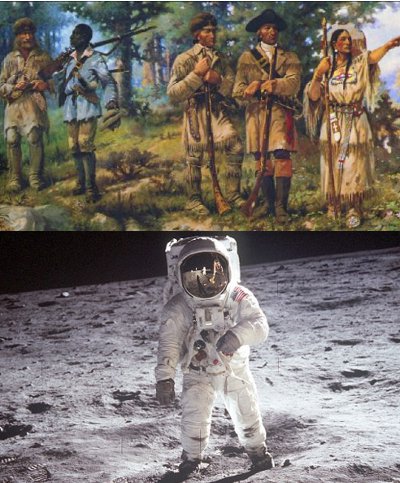
A High follows the Crisis era. It is a time with strong civic values: institutions are strong and individualism is weak. Ideals that were valued during a crisis are institutionalized. The emphasis during a High is on planning and building — doing big things. Society is confident about where it wants to go collectively, though those outside the majority often feel stifled by the conformity. Culture is friendly, but bland and lacks spiritual depth. Big technological advances are often made during High eras. The amount of structure/protection/nurturing given children begins to diminish towards the end of the turning.
During a High, old Prophets die off, Nomads enter elderhood, Heroes enter midlife, Artists enter young adulthood — and a new generation of Prophets is born.
The postwar boom between 1948 and 1963 was America’s most recent High. Before that was the twenty-year period after the Revolutionary War. According to Strauss and Howe, the Civil War created an anomaly in which the High period was skipped.
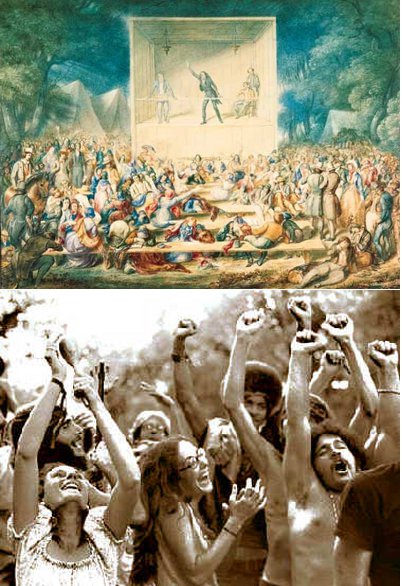
The focus of society shifts from building institutions to developing an individual’s inner life. New social ideals emerge during this time and experimentation with utopian communities is common. Members of the coming-of-age Prophet generation are often at the forefront of the spiritual awakenings during Second Turning eras. Young activists look back at the previous High as a period of cultural and spiritual poverty and begin to rebel against the midlife Hero generation who made it possible. The amount of structure/protection/nurturing given children reaches a saeculum low.
During an Awakening, old Nomads disappear, Heroes enter elderhood, Artists enter midlife, Prophets enter young adulthood — and a new generation of child Nomads is born.
The Consciousness Revolution of the 1960s, the Transcendental Movement, and the Great Awakenings of the 18th and 19th centuries are examples of Awakening turnings.
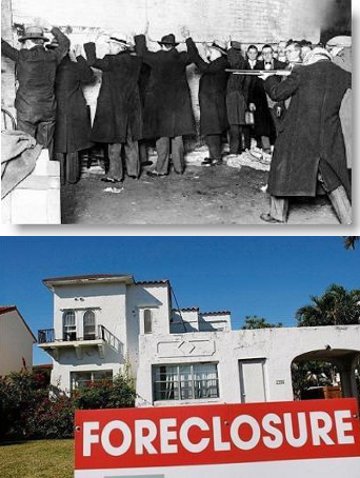
An Unraveling begins as a society embraces the liberating cultural forces set loose by the Awakening. Individualism and personal satisfaction are at their highest, while community and confidence in public institutions are at their lowest. Pleasure seeking and extreme lifestyles emerge. Society fragments into polarizing groups which makes decisive public action difficult. Instead of addressing problems, businesses and government leaders just kick the can down the road. Confidence in society’s future darkens, and the culture feels used up and worn out. Civic and moral paralysis and apathy set in. Art reflects the growing pessimism as themes of dreary realism take center stage. Child-rearing begins to move back towards protection and structure.
During Unravelings, old Heroes disappear, Artists enter elderhood, Prophets enter midlife, Nomads enter young adulthood — and a new generation of child Heroes is born.
Previous Unravelings occurred around World War I and the decades before the Civil and Revolutionary Wars. According to Strauss and Howe, the most recent Unraveling began during the second term of the Reagan administration and continued into the 2000s. Today, trust in institutions and leaders are at an all-time low and individualism is at an all-time high. Decisions on national problems like the growing deficit, deteriorating infrastructure, and rising education and healthcare costs are continually postponed because politicians and citizens are increasingly entrenched in their ideologies; consensus action and progress seems impossible.
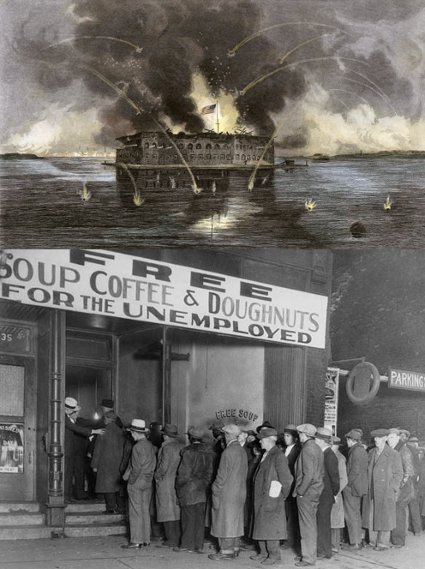
This is an era in which America’s institutional life is destroyed and rebuilt in response to a perceived threat to the nation’s survival. This threat can take numerous forms; economic distress caused by defaulting on national debt, hyper inflation, or widespread unemployment, social distress caused by class or race warfare, ecological distress caused by natural or man-made disasters, energy or water shortages, epidemics/pandemics, secessionism and civil revolts, and traditional, nuclear, or cyber warfare are some of the possibilities. The Crisis can be caused by one large threat, or by the many little things that a society failed to deal with during the Unraveling finally coming to a head.
Obviously, societies are faced with wars and crises all the time; it is how the society responds to the crisis that determines whether it catalyzes into a Fourth Turning. There are always sparks, but not all sparks turn into fire. A spark ignites a Fourth Turning because in some way, the society is ready for it and wants it, though not consciously; they sense that society feels tired, worn out, and needs to be renewed.
No matter what form the Crisis takes, it galvanizes people into an action-taking consensus; problems that were once kicked down the road during the Unraveling are finally taken by the horns. Civic authority revives, cultural expression redirects towards community purpose, and people begin to locate themselves as members of a larger group. Self-sacrifice, institution building, and consensus replace self-interest, personal development, and contrarianism as values society encourages. Wanting to protect their children from the turmoil surrounding them, parents are overprotective of their children during the Crisis.
During the Crisis, old Artists disappear, Prophets enter elderhood, Nomads enter midlife, Heroes enter young adulthood — and a new generation of child Artists is born.
America experienced a Crisis-era during the Revolutionary and Civil Wars. Our previous Crisis began with the Great Depression and ended after WWII. When Strauss and Howe wrote The Fourth Turning in 1997, they predicted that the next Crisis would begin in the middle of ‘00s and last until around 2025. According to Howe’s current blog, he believes the next Fourth Turning began with the 2008 economic crisis.
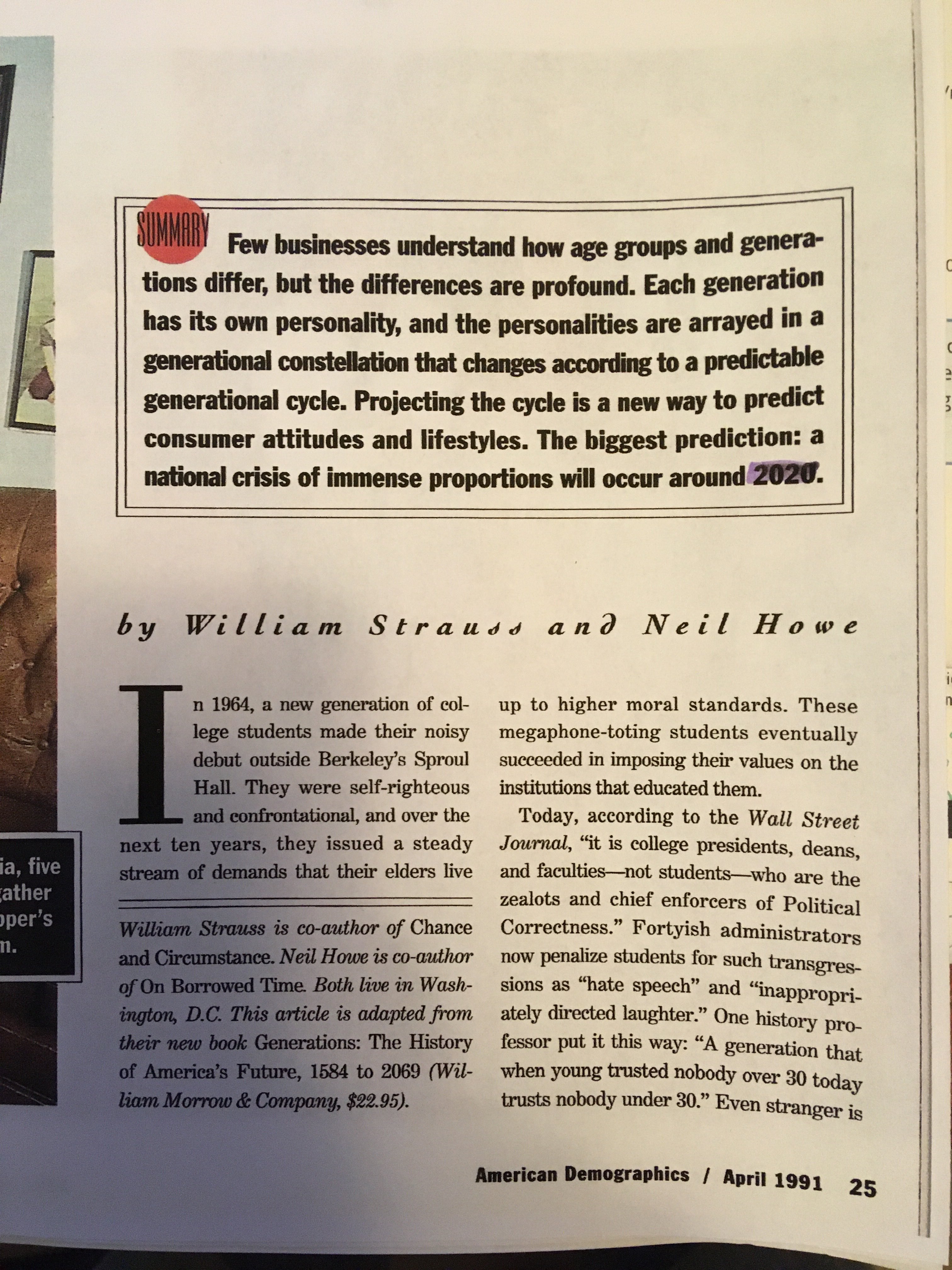
While a Crisis period lasts for around twenty years, and throughout that time the actual difficulties being faced can increase in intensity, or wax and wane, Strauss and Howe predicted that the crisis would truly coalesce around the year 2020, as seen in this article they wrote for American Demographics back in 1991.
Strauss and Howe argue that it’s never possible to predict how long or severe a Fourth Turning may be, or what form it may take (the last Crisis, after all, started with the Depression and ended with a World War). In whatever form it takes, by the time the Fourth Turning is over, it has created a sharp break with the old order and a rebirth and renewal of society — a new High.
Just as there are four turnings in a saeculum, there are four generational archetypes: Prophet, Nomad, Hero, Artist. The generations are shaped both by each other and by the turnings; they are affected by the amount of nurturing they receive growing up and then by the challenges they face as they come of age.
The idea of breaking people into generations isn’t very popular in our highly individualized age. But to say that generations share common characteristics is not to say these cycles force people’s behavior, or that there are not always exceptions to the rule: in every generation there are three groups of people: those who set the tone for the generation, those who follow the tone-setters lead, and those who rebel against the generational mood altogether. Talking about generations is simply a way to acknowledge that because different age groups are raised in less or more nurturing families, and experience historical events at different times in their development, their “generational persona” — their “attitudes on family life, gender roles, institutions, politics, religion, lifestyle, and the future” are shaped in a distinct way.
It’s also important to keep in mind that no generation is “better” or “worse” than another; each generation has unique strengths and weaknesses, each is important, and each provides balance and self-correction to the cycle of history. This is especially important to remember as you notice that one of the generations is labeled the “Hero” generation. This is not in reference to its superiority, but to the fact, as you will see below, that the Hero generation serves as the foot soldiers during a Crisis, and so are given a chance to do heroic things during that time and are thus reverently remembered for their service during the Crisis. But the Hero generation has flaws and strengths just like every other.
Finally, it is essential to understand that just because generational types repeat throughout history, this does not mean they are just like each other. The Puritan generation and the Baby Boomer generation are both Prophet generations, but they couldn’t be more different! Instead, it is only that a set of salient characteristics unique to each generational archetype reemerges over and over again, manifesting in very different ways according to the circumstances of the time. So what the Puritans and Baby Boomers have in common is the value those generations placed on one’s inner convictions and spiritual awakening.
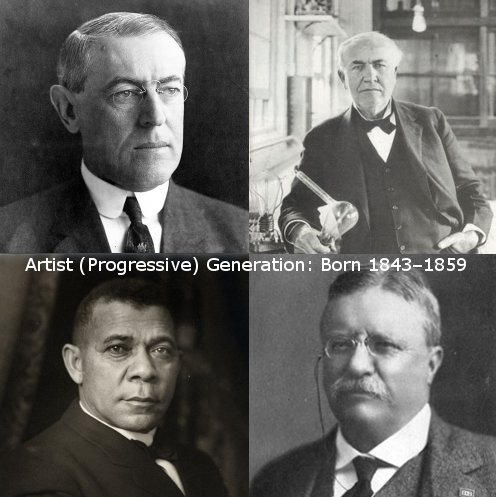
Artists grow up overprotected by adults during a Crisis. Children are expected to stay out of the way and be well behaved, and for the most part Artist children comply. Taught from a young age to please adults, Artists enter adulthood as one of the most conformist but also most well-off youth generations. Young adult Artists often take a supportive role to midlife Heroes. Those who find their generation’s conformity to elder expectations stifling, begin to explore a “fresher, more fulfilling role.” Rebellious young adult Artists are frequently the leaders of youth movements filled with teenage Prophets (e.g., MLK).
In midlife, Artists become known for their flexible, consensus-building leadership. They put a premium on expertise, process, and statistics. While this allows Artists to take on complex issues in a nuanced way, midlife Artist leaders often get bogged down in details and tend to postpone unpleasant choices. Midlife Artists become increasingly sympathetic to and even embrace the ethos of the younger Prophet generation who led the Awakening Turning. Midlife Artists redefine what it means to age and try to remain young at heart.
In old age, Artists maintain their flexible attitude towards life and continue to adopt the values of the younger Prophet generation. “They preserve a social conscience, show a resilient spirit, and never stop raising new questions.”
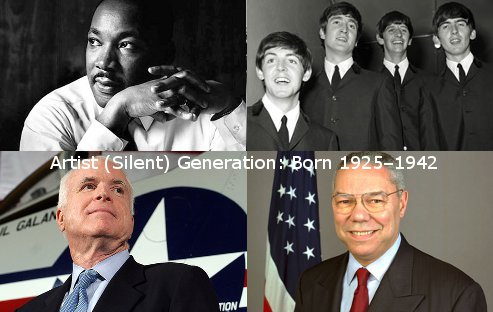
In many ways, the Artist generation comes of age in a tough, in-between spot in the generational cycle; for example, the Silent Generation just missed out on serving in WWII, and were left only to hear the stories of service from the Hero generation, and then when the counter-cultural movement happened in the 60s and 70s, they were already settled down in families, leaving some to look on enviously at the Prophet generation’s experiments with drugs and free love. Because of their in-between position in history, members of the Silent Generation have sometimes been overlooked; there has never been a Silent Generation president.
The Artist generation’s main societal contributions are in the area of expertise and due process. The Artists generation produces — surprise, surprise — great artists (Elvis Presley, Andy Warhol), reformers (Theodore Roosevelt, Martin Luther King, Jr., John Dewey), and statisticians (Frederick Winslow Taylor). America has had four Artist Generations: Enlightenment Generation (1674–1700), Compromise Generation (1767–1791), Progressive Generation (1843–1859), and Silent Generation (1925–1942).
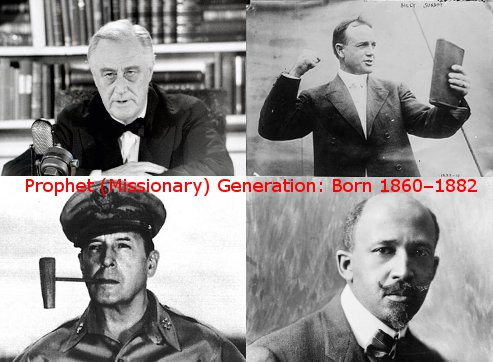
Prophet generations are born after a Crisis Turning, and grow up increasingly indulged as children and youth, which imparts a sense of narcissism to this generation. They come of age as passionate young crusaders during an Awakening era and rebel against their elders’ spiritually sterile society. Self-discovery and authenticity are valued by Prophets throughout their lives, and they feel passionate about the morals, principles, and ideas they hold dear.
Prophets enter midlife during an Unraveling by initially disengaging from public life in order to focus on themselves. However, slowly but surely, midlife Prophets begin to take on the mantle of leadership. Unlike Hero leaders who put action over ideals, Prophet leaders put ideals ahead of action. Because of this, irreconcilable rifts occur between Prophet factions, which causes societal problems to come to a head during an Unraveling.
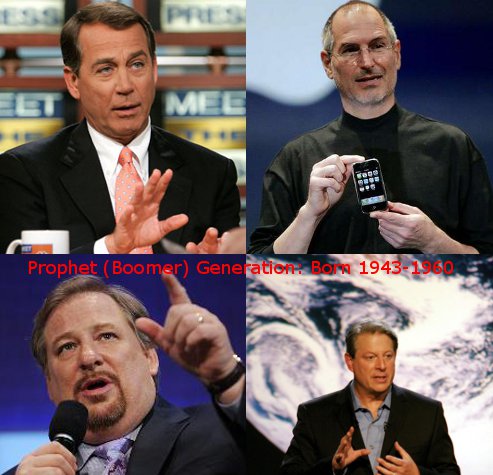
Prophets reach elderhood during a Crisis. By then, one of the competing Prophet factions from the Unraveling prevails which sets the agenda and tone for public action during the Crisis. During the Crisis, elder Prophets provide moral vision and values-oriented leadership to younger generations. They inspire younger generations to sacrifice, although during their own youths they were generally not “in the trenches” themselves, and are thus ultimately remembered more for their words than their actions. They may lead society through the Crisis to the birth of a new High . . . or, if they do not lead well, to destruction.
The Prophet Generation’s main societal contributions are vision, values, and religion. They often produce America’s most notable preachers, activists, radicals, and writers. Prophet Generations include: Puritan Generation (1588–1617), Awakening Generation (1701–1723), Transcendental Generation (1792–1821), Missionary Generation (1860–1882), and Boomer Generation (1943-1960).
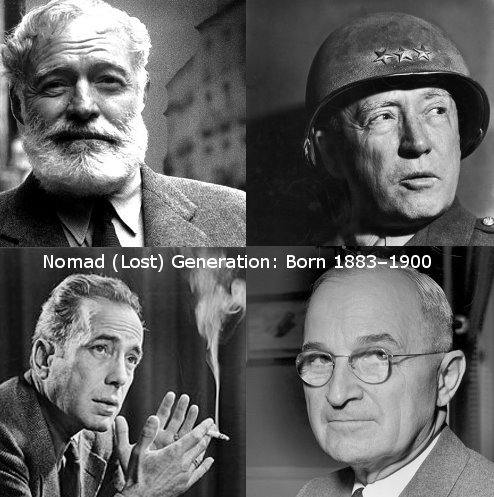
Nomad generations are born and nurtured during a spiritual Awakening and grow up as unprotected children. Often seen as a nuisance by Artist and Prophet adults, Nomad children are left to find their own norms and are exposed to the world of adult dangers and anxieties at a young age. Consequently, Nomad children grow up fast and often engage in risky behavior.
Nomads come of age during an Unraveling as alienated and often cynical adults. However, their early exposure to the realities of adult life give them strong survival skills and a fierce independent streak that makes them well-suited to navigate the societal Unraveling that surrounds them.
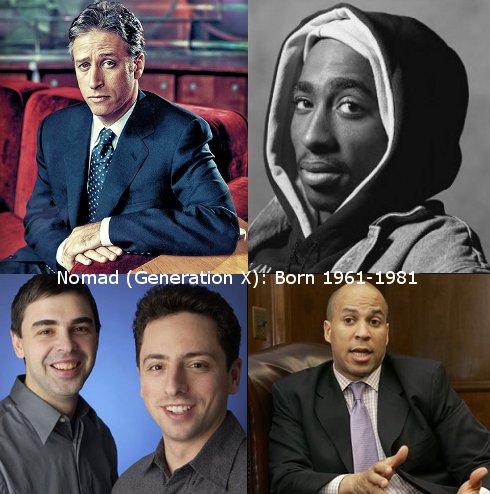
In midlife, Nomads mellow into pragmatic and savvy leaders during a Crisis. Middle-aged Nomads make the personal sacrifices for the good of society that their elder Prophets weren’t willing to make during the Unraveling. The Nomads’ cunning and survival instincts make them well-suited to lead during a Fourth Turning. Many of America’s most memorable military, government, and business leaders were scrappy midlife Nomads (e.g., Generals Patton and Grant).
Nomads reach elderhood during a High. To compensate for the excessively risky decisions they made as young adults, aging Nomads shun risk and demand conformism from their peer group and especially from younger generations.
The Nomad’s main societal contributions are liberty, survival, and honor. Nomad generations have produced America’s greatest entrepreneurs and industrialists (Andrew Carnegie, Jeff Bezos), satirists (Mark Twain, Jon Stewart), and generals (Dwight Eisenhower, George Patton, George Washington). Nomad Generations include: Cavalier Generation (1618–1647), Liberty Generation (1724–1741), Gilded Generation (1822–1842), Lost Generation (1883–1900), Generation X (1961-1981).
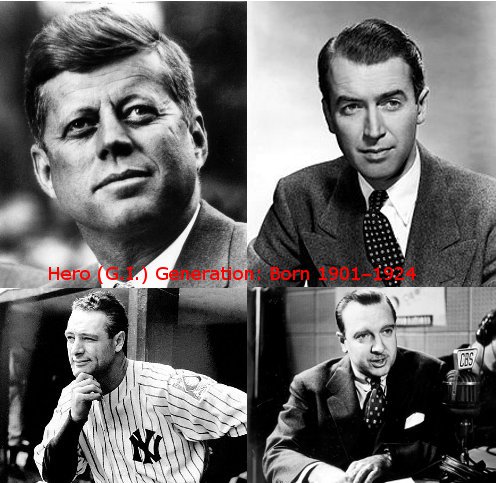
Hero generations grow up as increasingly protected post-Awakening children. Prophet parents see their Hero children as instruments to fulfill their inner visions. Community and teamwork are instilled in Heroes at a young age. They are confident, ambitious, and optimistic about life, even in tough times.
Heroes enter young adulthood during a Crisis. Their youth, along with their orientation towards action and their ability to work well in teams, makes Heroes the go-to foot soldiers during a Crisis era. They are led by Nomads and revered by later generations for the sacrifices they make on the battlefield. Heroes enter midlife during a societal High, filled with confidence but also hubris from their early success during the Crisis; their penchant for taking on big projects can only be supported by the economic boom they experience during the High, which they naively believe will continue indefinitely. When the economy starts to sag during an Unraveling, younger generations are left holding the bag on faltering Hero-built programs and institutions.
Heroes are straightforward and polite; midlife Heroes become “defenders of a wholesome but conformist culture.” Technological advancement and institutional building are the main focuses of Hero leaders in midlife, and they use this focus to create a well-ordered society. They eschew passionate and divisive ideology for a pragmatic approach to society and life, and when it comes to spirituality, either favor a pragmatic secularism or a non-charismatic, community-oriented mainline-type faith.
As they enter elderhood, Heroes begin receiving increasing scorn from younger Prophets for their lack of inner depth, spirituality, and passion. Consequently, Heroes “detach themselves from new cultural trends” while still maintaining an active role in public affairs.
The Hero generation’s main societal contributions are community, technology, and affluence. Hero generations have produced America’s greatest statesmen (James Madison, Thomas Jefferson) and societal builders (William Levitt). Throughout American history there have been three Hero Generations: the Glorious Generation (1648–1673), the Republican Generation (1742–1766), and the G.I. Generation (1901–1924).
If you’re feeling confused about how this all goes together, let’s again take a look at how the turnings and generation types played out during our most recent cycle.
The Hero generation were young adults during our most recent Crisis: the Great Depression and WWII. Led by Nomads, they were the GIs who fought the war. After the war and the conclusion of the Fourth Turning, the Hero generation entered midlife and led society through a First Turning High. They led with a practical, civic-oriented, can-do spirit, and did big things like going to the moon. The Artist Generation (the Silent Generation) largely followed the Hero generation’s lead and acted as helpmates to it. These generations indulged their Prophet children, which made them a little self-absorbed. When the Prophet generation (the Baby Boomers) entered Young Adulthood, they led an Awakening (Second Turning), rebelling against the conformity and complacency of the Hero generation. As parents, the younger Boomer-Prophets and older Artist-Silents, raised a generation of latchkey kids, who became independent and cynical adults: the Nomad Gen X-ers. Because the Boomer-Prophet Awakening created a society that valued individualism and passionate ideology, the 80s and 90s were a time of Unraveling, with little consensus on shared values, fighting among interest groups, and stagnant civic progress. With a faltering economy, Hero-generated programs like LBJ’s Medicare have become difficult for the younger generations to sustain, while the Old Hero generation itself has largely passed on. Older Boomer and younger Gen X parents raised their kids in an over-protective way (helicopter parents), creating Millennial children, the next Hero generation.
According to Strauss and Howe’s generational theory, the Millennial Generation (1982-2004) is our most recent Hero generation. They’ve gotten a lot of flack on this because, according to many columnists/opinion makers/sociologists, today’s young adult Millennials aren’t displaying the qualities that you’d expect from a Hero generation. However, Howe would argue that it’s too early to judge whether Millennials will follow the Hero archetype; before the Depression/WWII Crisis, nobody thought the young G.I. generation was anything special either or had any idea that we’d later revere them as we do.
The more you look at it, the less of a stretch it becomes. The Millennial generation has weaknesses as every generation does, but they already display some classic Hero generation qualities: they’re friendly, even-keeled, and pragmatic; get along well with younger peers and older adults; and are very peer and team-oriented. They’re surprisingly wholesome, in fact, and do less drugs and have less sex than previous generations.
Millennials are also confident and ambitious goal-setters, and remain optimistic despite the downbeat economy; although they’ve been hit hard by the downturn, 9 in 10 still say “they earn enough money now to lead the kind of life they want, or that they expect to earn enough in the future.” Other insights to the true nature of Millennials’ values can be seen in the graph below, which is based on a study done this year:
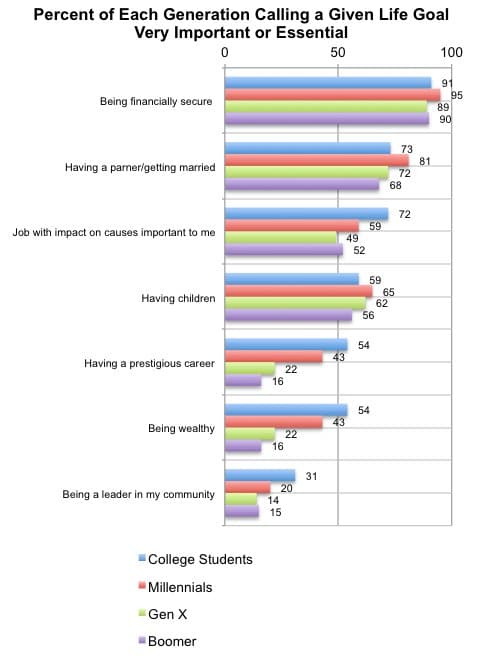
While it is often said that Millennials are “idealistic,” this is perhaps a projection from Boomer parents who tried to instill this value in their kids; while Millennials do want meaningful jobs, they value “being financially secure” higher than other generations (and are in fact more frugal than past generations). They also place more importance on getting married, having kids, and being a leader in their community than Boomers and Gen X-ers do.
There is still a ton more that could be covered about the Strauss-Howe generational theory of history. Generations and The Fourth Turning each weigh in at around 500 pages. In attempting to give a brief-ish overview of the theory, much was left out, and what was left out may answer various questions that arose in your mind as you read this article.
Nevertheless, even if you take the time to plow through both books, you will still discover that the theory is far from airtight. There are plenty of holes to be found and objections to be raised. Furthermore, looking to it strictly as a guide to life and history, soon turns it into more of a squidgy horoscope chart than a historical/sociological theory. Those caveats aside, it is one of those things where taking the time to think through it, regardless of whether you end up embracing the theory completely, find truth in parts of it while rejecting others, or dismiss the theory wholesale, will very likely give you some fresh insights on life, history, and your place in it; it’s a fascinating prism through which to view the world.
The post How the Generational Cycle of History Explains Our Current Crisis appeared first on The Art of Manliness.
Monk: Eagle-eyed readers may have noticed that I quietly posted my Lexington rankings a few months back through the top navigation bar. Before the pandemic hit, it was my pet project to hit all of the current Lexington-area barbecue restaurants for my definitive* Lexington rankings. I’ve been a longtime fan of Lexington Barbecue and in recent years, The Barbecue Center. But as the self-proclaimed “Barbecue Capital of the World” (one of many cities claiming that title, it should be noted) boasting at times one barbecue restaurant per 1,000 restaurants (though this is not currently the case), I needed to explore the others to understand the quality and depth of the other restaurants.
I’ve broken the 14 restaurants I’ve reviewed thus far into three tiers. Someday I will get to the curiously named Lexington Trimmings for completeness sake but in the meantime, here is the most definitive list of Lexington-area barbecue restaurants on the internet*. Ladies and gentlemen, the Lexington Big Board.
*one man’s opinion
**that I know of


I need to revisit both Smiley’s and Speedy’s asap, as they may no longer be in business for too much longer as a result of the NC Department of Transportation widening Highway 8 that they both sit on. Also, both were reviewed very early in this blog’s life and while I really enjoyed both, I’ve had a lot of barbecue since.
To my knowledge, all of these places smoke over wood with no gas or electricity but are just a notch below the best of the best in Lexington.
Of the bottom tier, Kerley’s and Randy’s don’t smoke over wood and it shows in the actual barbecue.
Lexington Trimmings
Have I missed anything? Let me know in the comments or email us at barbecuebros@gmail.com.

Our guest this week is Maggie Koerth. Maggie is the senior science reporter at FiveThirtyEight.
Subscribe to the Cool Tools Show on iTunes | RSS | Transcript | See all the Cool Tools Show posts on a single page
Show notes:

Basil-in-a-tube
I have been trapped in my house, as everyone has been trapped in their house, and trying not to go to the grocery store very often. But when I did the last time, I ran across this tube of fresh basil that’s chopped up into a paste with a little bit of oil. It doesn’t have any flavoring. It’s kind of like a pesto but without all of the other stuff that you would put into a pesto and it’s pretty fantastic because it means I can get fresh-tasting herbs all through my quarantine without having them go bad on me. I have been using it to make cream sauce. I also used it in a cocktail that I invented one night by taking a bunch of strawberries that my kids had not eaten and dicing them up really fine and putting some of this squeezy basil toothpaste on top of it, and then muddling that up with some brown sugar and a little bit of apple cider vinegar and then tossing some bourbon on top of all of it. The basil has to stay refrigerated but it’s good for up to a month or more. I’ve had one of them now for like the entire time I have been trapped in my house and it’s been still really good and lasting and it’s fantastic.

JBL Pulse 3 Wireless Waterproof Speaker ($220)
This is a thing that several people in my life have and I’ve been sort of admiring but hadn’t picked up one until, again, quarantine happened. And suddenly, I really wanted better sound in my apartment and decided to just go ahead and grab it. You can program it to do different kinds of LED patterns and colors and custom colors. I’m using it a lot right now for my daughters. They like to listen to a meditation tape type of thing at night before they go to bed and they really love having this multicolored rainbow light show happening while they’re lying in their beds all tucked in with the lights off. It’s pretty great and the sound quality is excellent. And like a Bluetooth speaker, I can move it all over the house. And that’s the other thing that makes it really great for the girls is that they can hear their meditation tape that’s playing off of my phone, but I can have my phone with me in a different room. I don’t have to just completely give it over to them for an hour. It’s a really nice little setup.

Smoked Garlic Powder ($3) (Recipe to make your own)
This is smoked garlic powder that I had never really seen before, and sort of bought on a whim just to play around with and have something fun during quarantine. It has turned out to be really, really delicious. Last night, I used it on Brussels sprouts. My oldest daughter has been using it on toast with butter and garlic and honey. And it has this really, really fantastic sort of hickory thing happening that’s very, very about the smell and changes the taste not a ton, but it’s just nice and mellow garlicky goodness. I looked up and found places you can buy it online and there are recipes where you can make your own if you have the right kind of grill. And it seems like it’s actually pretty easy to just put together at home. I might end up trying to do that myself at some point.

VTech KidiZoom Digital Camera ($40)
This is a weird one. I did not expect when I got these that I was going to like them very much. This is something that my mom got for my daughters at Christmas and I was at first just kind of like, “Seriously, really, we’re doing digital cameras. Okay.” But as the girls have played with them, I found all these really interesting little features that this camera has and one of the things they just figured out that it can do is make stop motion animation. It has a setting where they can go in and take a bunch of pictures and move a toy across the table and then, the camera will automatically stitch them together into a little video with music. It has a little screen on the back where you can see the pictures that you’re taking. It’s not like the world’s greatest camera as you might guess. But you can see sort of how you could line up the shots and kind of get them all together. The girls really like to take pictures of people and then add these little animations and stickers on them. There’s a whole bunch of photos of me with flowerpots on my face. They’ve been taking them with us on walks and taking pictures of trees and puddles in the alley and it’s pretty delightful. It’s got a tiny little SD card in there. And you can just plug into your computer and you can download stuff directly from it on to the computer. It runs on batteries, but they’ve been using it a ton and I haven’t had to change the batteries since Christmas. It lasts a decent amount of time. It’s also really sturdy, my youngest daughter is four and the number of times she has dropped this thing is just astronomical. And it has yet to have anything bad happen to it.


Your choice of headphones is critical for those audiophiles who enjoy listening to music privately. However, standard designs not only lack audio clarity but allow the sounds of the outside world into your personal space.
A set of noise-canceling headphones is essential, then, for any audiophile hoping to listen to music on the go. These sets use microphones to cancel out the sound before it even reaches your ears, allowing you to enjoy your music in relative peace.
Here are the best noise-canceling headphones for audiophiles available today.
It won’t surprise any audiophile to see this company on the list. The Sennheiser Momentum 2.0 Wireless respects the brand’s strong legacy of high-quality audio products. To that end, Sennheiser even lists the frequency response (16Hz to 22,000Hz), active impedance (280 Ohms), and passive impedance (28 Ohms).
They use the apt-X Bluetooth codec for CD-quality wireless audio when connected to any apt-X enabled device. The earcups are slightly larger than on previous editions to increase comfort, especially over long periods. This is especially important, as the company’s NoiseGuard active noise cancellation (ANC) can be found inside the headset, granting you a peaceful space to enjoy your music.
The Momentum 2.0 Wireless achieve up to 20 hours of use on a single charge, even with Bluetooth and noise-cancellation enabled. So you don’t have to spend time switching, you can connect two devices simultaneously and pair with up to eight. This is useful when coupled with Sennheiser’s VoiceMax technology, so you can seamlessly take calls on the headphones.
For many years, Jabra was best known for its range of office-based headsets. However, the company has entered the headphones market, releasing some of the best sets available today. One such pair, the Jabra Elite 85h, make the perfect companion for any audiophile. This set comes with three noise-cancellation modes; full active noise-cancellation, HearThrough, and disabled.
Of course, being able to tune out your surroundings is part of the appeal of any ANC set, but HearThrough is one of the best features here. When paired with the Jabra Sound+ app, the headset’s AI can determine your surroundings and adjust the noise-cancellation, so you always stay safe and aware when you need to be.
Aside from the intelligent ANC, the headphones can adjust for high-quality calls thanks to six of the set’s eight microphones. Using these, it can block unwanted background noise on calls, too. With ANC enabled, you can expect up to 36 hours of use from a single charge. The Jabra Elite 85h are water-resistant as well. A dedicated button on the right earpad gives quick access to Alexa, Siri, or Google Assistant.
If you want to know more before investing in a set, check out our review of the Jabra Elite 85h.
The Sony WH1000XM3 are the company’s flagship noise-canceling headphones. Reviewers around the world have classed the WH1000XM3 headphones as among the best noise-canceling headphones for great audio, too. Sony has been a world leader in audio products for decades, so if you choose this set, then you’ll know to expect a high-quality listening experience.
They come equipped with digital smarts, too. There is integration with Amazon’s digital assistant, Alexa, at the touch of a button. The Quick Attention Mode allows you to cover the right earcup to turn down the volume so you can hear your surroundings. The ANC here is intelligent as well, changing with your environment.
Unlike some of the other options on this, these headphones charge via USB-C. That said, you shouldn’t need to recharge too often as they offer up to 30 hours of use on a single charge with ANC enabled. The headphones have been designed for comfort as well, so they shouldn’t give you sore ears or a headache while listening.
The Bose QuietComfort 35 II are some of the best noise-canceling headphones around. Bose’s reputation for high-quality audio products precedes them, but it is well-earnt. If you travel on public transport or by plane, these headphones will be instantly recognizable. They are firm favorites for anyone looking for high-quality noise-cancelation.
That’s not to say they prioritize ANC above all other features, though. The QuietComfort 35 II have a dedicated button for quick access to Alexa, Google Assistant, and Siri. Additionally, if you download the Bose companion app, you can rename the headphones, making them easy to recognize in crowded Bluetooth lists. The app also provides firmware updates to the headphones.
Importantly, they are also comfortable. Thanks to the padded earcups and headband, you can wear them for hours without discomfort. They collapse inwards, too, for easy storage. With the ANC enabled, you can expect the headphones to last around 20 hours before they need recharging via micro-USB. The QuietComfort 35 II come in three colors; black, silver, and rose gold.
The headphones have been revised since their original release to add Bose AR and Alexa support. However, if you’re interested in all they have to offer, take a look at our review of the Bose QuietComfort 35 II.
Any fan of high-quality audio will be familiar with Bowers & Wilkins. The British brand has been producing audio products since 1966, and that experience shows in the Bowers & Wilkins PX7 headphones. The 43mm drivers found in this set are the largest in the company’s range and are tuned by the same engineers who work on the notable Abbey Road Studios setup.
That said, these aren’t a relic of past generations; the PX7 are equipped with some of the best ANC available. The ANC can automatically adapt to your environment, so you always have the best listening experience. There’s an auto-pause too, you just need to lift one earcup, and the audio will stop until you put the set back on your ears.
As the company notes, with 30-hour battery life, you could use them on a round-trip from California to London on a single charge. The 15-minute quick charge feature grants you six hours of use, as well. Bowers & Wilkins state that the carbon fiber composite design was inspired by race cars, a claim largely there for marketing purposes, but this material does make them strong and well-equipped for travel, too.
Choosing the right set of headphones can make all the difference to your audio experience. Finding a set that sounds great, comes with noise-cancellation, and feels comfortable over long periods is essential.
Fortunately, all the headphones we’ve included here fit that brief, so you’ll be sure to find the right set of noise-canceling headphones for your needs.
That said, if you aren’t won over by the merits of noise-cancellation, and are just looking for a wireless option, consider one of the best wireless earbuds for all budgets.
Read the full article: The 5 Best Noise-Canceling Headphones for Audiophiles

Anime film producer Toshio Suzuki teaches us how to draw Totoro, one of Studio Ghibli’s iconic characters, in less than a minute. He also teaches us the secret of drawing the said character, and that is by drawing its eyes far apart.
See the full video over at BBC.
(Image Credit: BBC)
You know how you can sometimes view something you love through such a nostalgic lens that you begin to lose track of whether it still exists or may have tiptoed out of fashion? That’s how Kalu Downey felt about la once, or Chilean tea time.
It was 2017, and the Santiago resident wanted to find out if Chileans still gathered around a table each afternoon for their so-called “fourth meal.” Was la once dying off with grandmas, she wondered? Or had it adapted to the elongated workdays and hectic schedules of 21st-century life?
Downey set up an Instagram account with the goal of collecting 100 photos in 100 days that showed what modern tea times looked like. What she discovered was that not only was la once very much alive, but her fellow Chileans were offended she ever thought otherwise. Proyecto Once (Project Once) was born.

Proyecto Once tells stories of modern-day tea time through various platforms, including Instagram and a column in one of the nation’s largest women’s magazines. “It’s really been a beautiful project,” Downey explains, “because it’s allowed co-creator Renata Tesser and I to build a register of both how onces look and what people in Chile eat today.”
Fact and fiction swirl together in the not-so grandmotherly origin stories of la once, yet almost every tale eventually circles back to a common theme: alcohol. Specifically aguardiente, the cheap and generic “firewater” swigged across Latin America.
Brits are believed to have brought their tradition of elevenses, or a short tea break at around 11a.m., to Chilean shores in the 1800s. It was popularized in English-owned saltpeter mines scattered across Chile’s legendarily harsh and rain-starved Atacama Desert. Though it’d be easy to assume that “once” (eleven in Spanish) was a simple translation, the most commonly told origin story is that it was actually coded language for a secret ingredient miners slipped into their teas to get through the work day in such an inhospitable environment: the eleven-lettered aguardiente.
“Avocado toast may be super hipster around the world, but here it’s as normal as bread and butter.”
The fad for boozy tea died in the desert in the early 1900s when the Atacama’s boomtowns went bust. However, tea time quickly spread across Chile, morphing into a wholly unique ritual and turning the nation into one of the world’s 15 largest per capita tea consumers. Meanwhile, la once inched ever later in the day to when modern Brits indulge in happy hour (roughly between 5p.m. and 7p.m.).
“Make no mistake: la once is not the English tea time,” says documentarian Maite Alberdi, whose 2014 film La Once follows a group of elderly women who’ve plotted the course of their 60-year friendship through monthly tea gatherings.
“Our version is not nearly as sophisticated,” Alberdi adds. “It’s much more egalitarian, with rich and poor families using mostly the same items.”
Chief among them is bread. Chile is, by leaps and bounds, the largest bread consumer in Latin America. The roll-like marraqueta and biscuit-like hallulla are preferred styles, accompanied by jam, butter, cheese, and scrambled eggs. Avocado is another staple, making la once something of a predecessor to the California-style brunch. “Avocado toast may be super hipster and trendy around the world, but here it’s as normal as bread and butter,” Alberdi says.

When the filmmaker envisions afternoon tea in England, she pictures dainty cucumber sandwiches, fluffy little pastries, and bite-sized scones. “Here, it’s all about abundance,” she says. If it’s a weekend, you can expect a hulking slice of something sweet, such as sponge cake, lemon pie, or milhojas (a gut-busting pastry oozing with dulce de leche, known locally as manjar).
Of course, there are regional differences. In the German-influenced south, forest-dwellers tend to couple their tea with kuchen (cake) sweetened by Patagonian berries. Up north, desert-dwellers pair theirs with empanadas stuffed with candied alcayota (a fibrous gourd). In the fertile Central Valley, you’ll find strips of fried dough with lemon zest and powdered sugar known as calzones rotos (literally “broken panties”). A fisherman on the coast might cap a workday with a fried-fish sandwich, while those in the interior prefer sopaipillas (fried pastries spiced with pumpkin). Age also plays a role in one’s tastes. Downey says she once interviewed a 100-year-old woman for Proyecto Once who put condensed milk in her tea, something she says would merit a vomit emoji from the younger generation.
But no matter where you are, or what your age, onces almost always revolve around family. “Food is a way of showing love and care in Chile,” Downey says. “The aroma of toasting bread is the smell of my childhood. The fragrance of cake in the oven speaks of family to me.”
Onces are often the preferred meal for birthday celebrations, particularly for kids or the elderly. They’ve also evolved in more urban areas into a meal that can replace dinner altogether, in which case it’s called an once-comida. The ritual—and time slot—have become difficult in places such as Santiago, whose nearly 7 million residents have some of the longest workdays in the world.

Yet, onces appear to be making something of a comeback in the age of coronavirus.
“I think today, during the quarantines, people are really starting to get to know their kitchens again,” Downey says. “They’re starting to experiment, try new recipes, watch YouTube tutorials, ask their moms, ask their grandmothers. There is this moment where it is difficult to see anyone beyond your four walls, but you can feel close to your family through la once.”
The vast majority of those who follow Proyecto Once on Instagram are between the ages of 25 and 35. Moreover, according to the most recent National Survey of Food Consumption, which was conducted between 2010 and 2011, 80 percent of Chileans report having onces. Downey says she’s happy her initial assumption was proven wrong. Once may not look the same as it used to, or take place as often or have quite the same rituals, but it isn’t going anywhere.
You can join the conversation about this and other stories in the Atlas Obscura Community Forums.

One of the most iconic places in the Royal Palace of Caserta is the waterfall located behind the building., but the water did not flow in naturally from the surrounding hills to feed falls.
In 1753, work began on an aqueduct to supply water to the Royal Palace of Caserta and the nearby San Leucio complex began. It was designed by Luigi Vanvitelli, who also designed the Royal Palace and was commissioned by the King of Naples Charles VII. The work was named Acquedotto Carolino (Caroline Aqueduct) in honor of the king. When the aqueduct was completed in 1770, it was considered one of the greatest architectural and engineering works of the 18th-century.
The water came from the springs of the Fizzo River of Mount Taburno and was transported mostly underground. The most impressive part of the aqueduct is the 1,736 foot (529-meter) long tufa bridge over the Maddaloni valley, between Mount Longano and Mount Gargano.
The bridge is modeled after the ancient Roman aqueducts and is composed of three tiers of arches, with an overall height of almost 183 feet (56 meters). At the time of completion, it was the longest bridge in Europe and is still perfectly preserved, while having survived several strong earthquakes that hit the area over the centuries.
Under the bridge, an ossuary contains the remains of soldiers who died during the Battle of the Volturno between the army of Giuseppe Garibaldi and the Kingdom of the Two Sicilies in 1860, during the Expedition of the Thousand. Two other smaller bridges cross the surrounding valleys before finally reaching the hills over Caserta.

Most of the time, searching YouTube is easy: you simply type in a term and relevant videos appear. But what happens if you need a better YouTube search?
Thankfully, YouTube offers advanced search options that help you drill down and find what you’re looking for. Let’s look at advanced search options on YouTube and how to master them.
Unlock the "Top Google Search Keyboard Shortcuts" cheat sheet now!
This will sign you up to our newsletter
Much of the time, you can use YouTube’s built-in filters to help narrow your search results.
To access them, first run a search on YouTube. Next, click the Filter button and you’ll see several filter options. You can choose just one of them or combine several for deeper searches.
Note that some combinations won’t work, however. For example, if you filter by upload date, you can’t also filter by channels.
Let’s quickly run through what these options offer.
This option makes it easy to find the latest content on YouTube. The date options are:
If you’re looking for breaking news, content relevant to a recent software release, or other timely videos, these are a great help. Use them when the default results show outdated content.
Want to search YouTube for something other than videos? You can change your search to look for Channel, Playlist, Movie, or Show content instead.
If you weren’t aware, full-length movies and shows are available to purchase on YouTube, which is what the last two choices are for. Shows doesn’t show YouTube Originals, though you can use it to find children’s shows on YouTube.
Looking for a quick video, or a longform piece on content to enjoy over dinner? Use Short to find videos that are under four minutes. Long will filter to only show videos that are longer than 20 minutes.
This large section lets you filter by many different types of content on YouTube. There are too many to cover here, but some of the highlights include:
By default, YouTube searches are sorted by Relevance, which means that YouTube tries to match your search intent. You can change this to Upload date, View count, or Rating if you’d prefer.
Most of these are self-explanatory. Upload date lets you find brand-new content, while View count makes it easy to find the most-viewed content on YouTube. Rating, however, doesn’t seem helpful. In our testing, it doesn’t show the highest-rated videos first and instead displays a random mix of videos old and new.
If you don’t want to click on these filter options every time, YouTube offers a faster way to include them in your search. Simply include a comma after your search term and one of the above keywords to filter by it.
For instance, typing “iPhone, week, short, HD” (without the quotes) would show videos about the iPhone uploaded this week that are under four minutes and in HD. You can use just one or as many as you like, and they work in combination with the advanced search operators below.
If the above options don’t help you find what you’re looking for, you can use advanced search operators in the search field. These will sound familiar if you’ve used Google’s advanced operators.
By default, YouTube will try to use all the words in your search phrase. Putting your search query in quotes instead will search for that exact string in both video titles and descriptions.
It’s useful for anything that requires precision, especially if your search term is ambiguous. Something like “2012 Honda Accord oil change” (in quotes) should filter out similar but unrelated results.
If you want to require one or more specific words to appear in your video search, you can use the plus operator.
For example, if you were looking for videos about NES version of Donkey Kong, you could enter “Donkey Kong +NES” (not including quotes) and all video results would include NES.
This is a handy way to combine terms for more specific searches, especially because YouTube can sometimes ignore a certain term in a long search query.
The flipside of the above is the minus operator. This lets you remove certain terms from your search.
As an example, let’s say you wanted to watch clips of tennis from the Olympics, but didn’t want to include anything from the 2012 games in London. You could enter “Olympic tennis -London” to exclude anything that took place in London.
If you want to find results that match at least one of several different terms, you can use the pipe operator. This returns results for the query on either side of the pipe.
For example, a search for “cats | dogs” would bring up videos containing either one or the other.
When you run a search, YouTube doesn’t just look at video titles. It also considers content in the video description, which can give you irrelevant results.
Using the intitle: operator, you can force YouTube to only search the titles of videos. Give it a try if the results don’t seem to make sense.
Not sure what to search for? Let YouTube’s wildcard operator fill in for you. Adding an asterisk will fill in at least one word in its place.
It’s not useful in all situations, but it can help you find terms related to your search without much extra work. Try something like “best * of 2019” to discover something new.
Looking for product recommendations that fit into a certain budget? You can use two dots to specify a range of cost in video results.
For example, if you search for “build PC $200..$700” you’ll find guides on building your own PC with costs between those two values.
Did you know that YouTube lets creators include hashtags on their videos? This can make it easier to find content grouped around a common theme.
To search by hashtag, simply enter one, like #ThrowbackThursday. Even if the video doesn’t have a hashtag in the title, YouTube will use ones from the video description. You’ll see a few of those hashtags above the video title once you click on it.
While YouTube doesn’t have a dedicated advanced search page, it’s still possible to perform custom YouTube searches with operators and filters. These should let you find whatever you’re looking for on YouTube.
If they weren’t enough for you, don’t forget that you can use the Google advanced operators mentioned above. Running a site:youtube.com search on Google will help you find relevant content on YouTube.
For more, have a look at other online services that offer advanced search.
Read the full article: How to Search YouTube Like a Pro Using Advanced Search Operators

If you want to take your understanding of Microsoft Office 365 to a higher level, this ebook is for you, and up until 13 May 2020, you can download it free of charge.
Microsoft Office 365 bundles together some of the most well-known software applications all into one subscription. We’re talking: Word, Excel, PowerPoint, OneNote, Outlook, and countless other new products to aid your productivity.
These applications are used by over 70 million people worldwide, yet they’re rarely used to their full potential. Office 365 For Dummies will change that, allowing you to get even more out of your Office 365 subscription.
Do note that the consumer and business plans of Office 365 are known as Microsoft 365 now.
Among other things you will learn how to:
Interested? Simply click here to download this free ebook (worth $20) from TradePub. You will have to complete a short form to access the ebook, but it’s well worth it!
Note: This free offer expires 13 May 2020
Read the full article: Download Office 365 For Dummies FREE Today! (Worth $20)