A week ago, a panhandler in Times Square sat holding a sign reading, “Give me a dollar or I’ll vote for Trump,” and people laughed and reached into their pockets. His bucket overflowed. He stuffed the bills into his jacket, and other panhandlers looked at him with admiration. The man could’ve sold franchises and retired to Palm Beach.
The panhandler knows what every New Yorker knows, which is that the biggest con job since the Trojan horse is taking place in our midst. Millions of Americans are planning to cast their votes for a man who has lived his life contrary to all of their most cherished values. They are respectful, honest, generous, loyal, modest, church-going people with no Mafia connections and good credit records who try not to spout off about things they know nothing about.
His followers out on the prairie were brought up to be wary of slick-talking New Yorkers but here they are, falling right into line behind the biggest braggart ever to hit the sawdust trail. It’s going to be an education for them, watching him cut taxes while expanding the military and building a wall and deporting 11 million people. In America, you can’t send gendarmes through the streets to round up people in trucks and load them on boxcars and ship them away. There is a judicial process. Lawyers are involved. People have certain rights.
His boast after the Manhattan pressure-cooker bombing Saturday night was revelatory. “I called it!” he cried on Fox News, as he had after the Orlando nightclub shooting. It would’ve been classier for him to have congratulated New York’s Finest but instead he took it as a personal coup.
What the bombing showed was the courage and smarts of the NYPD, arriving on the scene in time to defuse a second bomb, identify a suspect and track him down Monday morning. “We’ve got to be very, very tough,” cried the candidate out in Colorado, but back in New York, the work was being done by people who know how to do it.
Ah, chutzpah! There was once a mayor of New York who overruled the NYPD and the Secret Service and put the city’s Emergency Command Center on the 23rd floor of the World Trade Center, and whose emergency plan for the towers led to massive confusion and miscommunication, with some desperate people directed to climb up and others told to stay put, as the mayor stood in the streets below and urged residents to be calm, and thereby became a national hero and started his own security consulting company. This is like the captain of the Titanic, had he survived, writing a book called “The Art of Navigation.” The mayor is now a close Trump adviser.
Trump is a man whom few Republicans would care to invite into their homes. So what’s going on here? An epidemic of hippocampus poisoning from bad enzymes in cheap beers? The man is a fraud, a compulsive liar and a clueless playboy whose presidency would be an unmitigated disaster for the country. If you would make us the laughingstock of the world just to irk your liberal sister-in-law, you are someone who should not be allowed to come within 500 yards of an elementary school.
The success of Trump would show our children the exact value of education, which is: not that much. It would mean that fact-based journalism had very little bearing in America and a Manila-born Celanese child could aspire to the highest office in the land. So here’s a dollar in the beggar’s bucket. Good luck to democracy. Hang in there.
General Motors produces the Bolt EV at its existing production system at the Orion Assembly plant outside of Detroit.
Credit
Laura McDermott for The New York Times
ORION TOWNSHIP, Mich. — Ten years ago, a little-known tech entrepreneur named Elon Musk published a secret master plan for Tesla Motors, an ambitious electric car start-up he had funded.
Revolutionary technologies always start as impractical and expensive, Mr. Musk explained, so Tesla’s first car would be a two-seat roadster that sold for $110,000. But by plowing profits from that car into research and production capacity, Mr. Musk promised that Tesla would quickly create a series of cheaper cars in higher volumes, all toward an almost mythical aim: creating a long-range electric car that could travel more than 200 miles on a single charge, but that cost less than $40,000 for the privilege.
This year, Mr. Musk’s white whale — a car that will get 238 miles per charge, and will sell for about $30,000 after a federal rebate — will finally make it to the roads. Mr. Musk’s master plan has gone exactly as he promised, except for one tiny hitch.
A first affordable long-range electric car, which I drove last month and which blew my mind, is not a Tesla. I had to fly from Silicon Valley to Detroit to drive it because the vehicle was invented not by a celebrated start-up, but by that hoariest cliché of tarnished American manufacturing glory, Chevrolet, which is owned by General Motors.
Photo
Darin Gesse, the G.M. product manager for the Bolt, says the car has “a lifestyle focus, and it’s not just a commuter car.”
Credit
Laura McDermott for The New York Times
The car is the Chevy Bolt EV, a squat, wedge-shaped compact hatchback. It is an important car for G.M., and, in a larger sense, for the traditional auto industry. It demonstrates the seriousness with which automakers are taking the threat posed by start-ups that are promising to alter everything about the car business. Not only is the Bolt the first inexpensive long-range electric on the road, but it will also function as G.M.’s platform for testing new models for ride-sharing and autonomous driving.
The Bolt is also proof that, in the car industry, size matters — that even if they may be slow to come around to the latest tech, big automakers can alter the car business even more radically than Tesla has, purely as a function of their bigness.
Mr. Musk, the chief executive of Tesla and SpaceX, has made a habit of embarrassing his naysayers, but there are increasing signs that his little car-company-that-could is nearing the limits of its potential. This spring, Tesla unveiled its own low-priced car, the Model 3, which will sell for just under $30,000 after a rebate, and will go 215 miles on a charge, which is less than the Bolt. About 400,000 people have paid $1,000 to get on the waiting list for the vehicle, which Tesla says will begin shipping to customers in late 2017.
But few industry analysts think Tesla will meet its production goals, and the very fact that there is a waiting list highlights its fundamental hardship. Tesla paved the way for the broad acceptability of electrics, but the Model 3 is, at this point, merely a concept car. G.M.’s Bolt goes on sale this year, and the company will probably be able to make enough to satisfy everyone who wants one.
It’s a delicious irony: Cocky billionaire makes grand promises in a blog post. Ten years later, he gets his wish, in the worst way.
Photo
Credit
Stuart Goldenberg
Before we get to the Bolt’s implications, let me describe the car. Most of the lower-priced fully electric cars on the road today — vehicles like the Nissan Leaf, the BMW i3 or Volkswagen e-Golf — are afflicted with a problem that is a nonstarter for many Americans. They get, at most, around 100 miles per charge. That is enough for a lot of people to get to work and back, but not enough to let them feel entirely comfortable about it.
At the other end of the spectrum are Tesla’s luxury rides, the Model S and Model X, which each get more than 200 miles per charge, enough to put to rest any range anxiety. But relief comes at a cost. After federal rebates, the S starts at $66,000, and the X starts at $74,000.
The Bolt isn’t a luxury car. It’s surprisingly spacious inside (it could easily accommodate two car seats for my children) and has a nicely designed touch-screen infotainment panel. But it looks and largely drives like a generic compact car. What is revolutionary about the Bolt is that it bridges category distinctions — it brings luxury car electric range at mass-market prices. In fact, it beats the luxuries. In their cheapest configurations, every Tesla gets a lower range than the Bolt.
“Normally for electric vehicles we talk about going from point A to point B and back to A,” said Darin Gesse, G.M.’s product manager for the Bolt. “This car is designed to go from A to B to C to D and back to A, so it has more of a lifestyle focus, and it’s not just a commuter car.”
Today’s Headlines
Wake up each morning to the day’s top news, analysis and opinion delivered to your inbox.
Please verify you're not a robot by clicking the box.
Invalid email address. Please re-enter.
Sign Up
Receive occasional updates and special offers for The New York Times's products and services.
How did G.M. create Tesla’s dream car first? There is a lot to it, as I saw on a tour of the company’s Bolt operations. G.M. started building one of the world’s most advanced battery testing facilities in 2008, around the time the company faced imminent death after the financial crisis. The car that emerged out of that research, the plug-in hybrid Chevy Volt, can be said to have literally saved the company. The Volt was frequently held up as evidence of G.M.’s creativity by politicians who favored a bailout of Detroit. President Obama, who led the successful rescue, said in 2012 that he would buy a Volt after he left office.
Photo
Parts of a Bolt battery in a lab at the General Motors Technical Center in Warren, Mich.
Credit
Laura McDermott for The New York Times
Most of G.M.’s advantages come down to size and operational efficiency. Tesla has had to build a huge factory to produce the Model 3’s batteries at scale. G.M. batteries are being outsourced to the electronics giant LG Chem. Tesla has had to retool a car-making facility in Fremont, Calif., for its own purposes, while G.M. is tapping into its existing production system. At the company’s Orion Assembly plant outside of Detroit, I saw Bolts on the same line as gas-powered Chevy Sonics and Buick Veranos. Robots and workers seamlessly shifted between the Bolt and more traditional cars as if nothing was different.
Finally, G.M. enjoys the regulatory advantage of producing a fleet. Because the high-mileage, zero-emission Bolt helps the company stay under the federal government’s fuel-economy standards, it perversely allows G.M. to keep selling more profitable, gas-guzzling cars, like the Tahoe S.U.V. As a result, G.M. could lose money on each Bolt and still find the overall project valuable to its bottom line.
Can Tesla compete with these advantages? Tesla fanboys (they exist) might point out that the Model 3 will have some luxury appointments that the Bolt lacks, including the option to upgrade to Tesla’s semiautonomous driving system, and access to the company’s network of quick-charging stations. Tesla also has brand cachet and exclusivity that elude Chevy. And when its battery factory is running at scale, it should be able to produce batteries at a lower price, bumping up its profitability.
Tesla declined to comment for this article, but analysts I spoke to are skeptical of its plans. One question is whether Tesla will hit its production goals. The company made about 50,000 cars in 2015, and it is on track to produce about 82,000 this year, despite some recent setbacks.
Under the hood of a Bolt. General Motors started building one of the world’s most advanced battery testing facilities in 2008, about the time that the company faced bankruptcy.
Credit
Laura McDermott for The New York Times
Another worry is that Tesla will hit its production targets, but only by skimping on quality. Over the last few decades, in a project first started by Toyota, global car manufacturers have greatly reduced defects using production systems that let workers slow down the line when they spot mistakes. Edward Niedermeyer, an analyst who edits the industry site Daily Kanban, said Tesla has departed from those methods to speed up its line.
As a result, its cars have been afflicted by poor reliability. Last year, Consumer Reports stopped recommending the Model S after a survey showed that customers’ cars were plagued by squeaks, rattles, leaks and various other problems.
“If you don’t have quality right, you start building cars really quickly, and then a defect happens, and you can’t stop yourself from producing hundreds or thousands of defective vehicles,” Mr. Niedermeyer said.
G.M. has of course had its own share of defects. But its history of building a lot of cars mostly well may be a leg-up over a quickly growing start-up.
“We have 108 years of manufacturing know-how,” Pam Fletcher, G.M.’s chief electric vehicles engineer, told me. “This is what we do.”
This is awesome. This should be a Forestry event at Dartmouth.
I've seen a photo of this making its rounds lately. Thought I'd try it out last night. Worked well enough, burned for over 14 hours and weathered a downpour ...
Ranty hysterical writing style of some random person on the internet, but still funny. And economist catnip.
When 13-year-old eighth grader, Danesiah Neal, tried to spend a 2 Dollar Bill at lunch at Christa McAuliffe Middle School, she was detained and threatened with a felony!
It gets worse! The 2 Dollar Bill investigation had to go all the way to the bank to get solved!
I am beyond disbelief at the STUPIDITY at this Texas school, and with the Fort Bend police who carried on with the blatant ignorance that had to be involved! (Besides the fact that it was only $2).
“I went to the lunch line and they said my 2 Dollar Bill was fake,” Danesiah told Ted Oberg Investigates. “They gave it to the police. Then they sent me to the police office. A police officer said I could be in big trouble.”
Not just big trouble. Third-degree felony trouble.
School officials called Daneisha’s grandmother, Sharon Kay Joseph.
“She’s never in trouble, so I was nervous going in there,” she recalled to ABC13.
The officials asked, “‘Did you give Danesiah a 2 Dollar Bill for lunch?’ He told me it was fake,” she said.
Then the Fort Bend ISD police investigated the 2 Dollar Bill with the vigor of an episode of Dragnet, even though at that school 82-percent of kids are poor enough to get free or reduced price lunch.
The alleged theft of $2 worth of chicken tenders led a campus officer — average salary $45,000 a year — to the convenience store that gave grandma the 2 Dollar Bill.
Next stop — and these are just the facts — the cop went to a bank to examine the 2 Dollar Bill.
The bill went from the lunch lady, to the school officials, (Obviously the principals Mary Brewster and James Wade Kirkpatrick HAD to know the cops were involved), to the cop…who took the $2 Bill to the convenience store..and then to the bank.
The long line of IGNORANT people that this CRAZINESS had to go through before the bank explained that there is such thing as a 2 Dollar Bill is unfathomable! They should all be fired for sheer stupidity!
From all the idiots that had to be involved at Fort Bend ISD’s Christa McAuliffe Middle School, to the Keystone Cops involved, you would think SOMEONE would have recognized the real currency!
Instead, they threaten a poor little girl with a felony and made her miss lunch!
Explain to me how NO ONE said the words, “There is such a thing as a 2 Dollar Bill”?
Explain to me how NO ONE has YET said the words, “I am sorry”.
THIS is just one of eight counterfeiting charges investigated in Fort Bend ISD since 2013 mind you.
You know the routine!
There has yet to be an apology from the school!
I would demand some resignations just for the sheer stupidity of those involved, but that is the way I am! These are our EDUCATORS and Law Enforcement!!!
These people put a black mark on some of our finest! Call/Email the school and share your outrage!
McAuliffe Middle School Phone: (281) 634-3360
Principal Mary Brewster
Mary.Brewster@fortbendisd.com
8th Grade Principal James Kirkpatrick
James.Kirkpatrick@fortbendisd.com
Superintendent of FBISD Schools
Charles E. Dupre, Ed.D.
charles.dupre@fortbendisd.com
Norman J. Ornstein is a resident scholar at the American Enterprise Institute and the author, with Thomas E. Mann, of “It’s Even Worse Than It Looks: How the American Constitutional System Collided With the New Politics of Extremism.”
I met Tom Korologos in 1970. I was doing interviews for my dissertation on congressional staffs; he was the top staffer for Wallace Bennett, a veteran Republican senator from Utah. Tom not only granted me an interview but also gave me a ton of time and valuable insights. He knew and loved the Senate, knew and loved politics. He has had a remarkable career in Washington, serving several Republican presidents and also working as a top official with the provisional authority in Baghdad and as ambassador to Belgium. If you asked me to name veteran pols who understand how our government and politics work and should work, he would be high on the list.
That makes my disappointment with him even more painful. Korologos, along with former Ronald Reagan national security adviser Richard V. Allen, wrote an op-ed for The Post last week with advice for their fellow Republicans, headlined “Memo to GOP: Forget 2016. Start thinking 2018 and 2020.” The op-ed conceded the presidential contest to Hillary Clinton — and proceeded to give advice on how to combat the incoming president and regain the party’s mojo.
What I would expect from someone of Korologos’s character — and that of Allen — is a list of ways to recapture for the GOP its identity as a conservative, problem-solving party: how to find common ground that solves pressing national problems and does not violate fundamental principles; how to compromise in ways that will move the country away from its precarious position — in a political system now caught in the cross hairs of tribal partisan warfare, stuck in obstructionist limbo, and facing growing racial and ethnic tension.
What we got was something else. The core of their advice to Republican lawmakers was to double down on the obstructionist approaches that have defined the Obama years, and to do the same with the kind of “gotcha” investigations that delegitimize a president and Washington politics, while using delay tactics and filibusters to block Clinton Supreme Court nominees.
We know that Republican congressional leaders, on the night of President Obama’s inauguration in January 2009, chose a deliberate policy of uniting in opposition to all of his initiatives, even before he served a full day in office. Now we have a pair of blue-ribbon establishment Republicans fundamentally suggesting the same approach — one that has contributed to the decline of the Republican brand, the rise of Donald Trump, the weakening of GOP leadership and the growth of know-nothing radical anti-government sentiment — months before the election of a president.
To be sure, that delegitimizing approach had big payoffs in the historic midterm gains of the Republican Party in 2010 and 2014. Hamstringing government while trashing any policies that actually get enacted almost inevitably works against the party of the president, which is held responsible for action and inaction in Washington. And the same approach might well pay off in 2018.
But the strategy backfired in the presidential contest in 2012 and has helped create the disaster the party faces this year. And the price the country, and the party, will pay will be fearsome. The challenges facing the United States are real and broad. Our infrastructure is crumbling, and the cost of replacing aging water and sewer systems once they collapse will be sharply greater than acting now. The same is true of the lock and dam system, mass transit, bridges and other transportation systems. The electrical grid needs both modernization and hardening to combat cyberterrorism that could shut the country down. Finding ways to enable people who do their part, working hard to support their families, to have roofs over their heads, food on the table and a safety net against an illness, accident or other disaster is a key to our social contract.
The Affordable Care Act needs the technical corrections that every other major social policy received after its passage, and some adjustments, including conservative and market-driven ones, to make it work better. We need to address prison reform, immigration, policy toward serious mental illness, the broader issues of our tax system. If there is no Trans-Pacific Partnership and no broader European trade deal, we need a serious, bipartisan effort to craft a new trade regimen that does not jeopardize the U.S. and global economies. We need to think hard about how we confront terrorism, including funding for homeland security and a much stronger counter-cyberterrorism program.
That is a partial checklist of issues that need action by Congress in conjunction with the president and in the way — via debate, deliberation and compromise — the framers envisioned our system working. Focusing on short-term tactical gains instead of building a problem-solving party and attending to the pressing needs of the nation should be the purview of ideologues and partisan hacks, not veteran Washington actors. If that mind-set prevails, even if it reaps rewards in 2018, the nation will suffer — and ironically, it will likely leave the Trump and Ted Cruz forces positioned to lead the party in 2020.
Instead of hearing your flight attendant simply go through safety measures before takeoff -- fasten your seatbelts, turn off your mobile devices -- now, some...
TORONTO (Reuters) - About 1,500 Americans floating down a river that separates the United States from Canada had to be rescued from the water when strong rains and winds sent them illegally into Canadian territory, the country's coast guard said on Monday.
The Americans were taking part in the annual Port Huron Float Down on Sunday in the St. Clair River, which runs between the U.S. state of Michigan and the Canadian province of Ontario.
The winds blew the flotilla of inflatable rafts and inner tubes off course and toward the Canadian shore. Some rafts deflated, spurring a rescue effort by the Canadian Coast Guard as well as federal and provincial police, coast guard spokeswoman Carol Launderville said in an email.
Most "floaters" had to be rescued from the water, with many towed to shore, according to the coast guard.
"They were terrified of entering another country without documentation. No one carries their passport or any ID, and a lot were drinking alcohol," Peter Garapick, superintendent of search and rescue for the coast guard, told CBC television.
Some tried to swim back to the United States.
"We had to pull a lot of people out of the water and say 'no,'" Garapick said.
The Americans were gathered at Sarnia, Ontario, and bussed back to the United States by the city's public transit.
Sarnia police did not say whether anyone was charged in the incident and there were only minor injuries reported.
Launderville said the event has no official organizer and poses "significant and unusual hazards" due to the river's fast-moving current and participants' lack of life jackets.
A Facebook page for the event, which dates back more than 30 years in the city of Port Huron, west of the border from Sarnia, made a post Sunday night thanking Canadian authorities.
"You've shown us true kindness and what it means to be amazing neighbors!" the post read.
The Facebook page appears to be operated by a group named Port Huron Float Down, which says on its website it is not an organizer. The page's operators did not immediately respond to a request for comment.
(Reporting by Ethan Lou in Toronto; Editing by Andrew Hay)
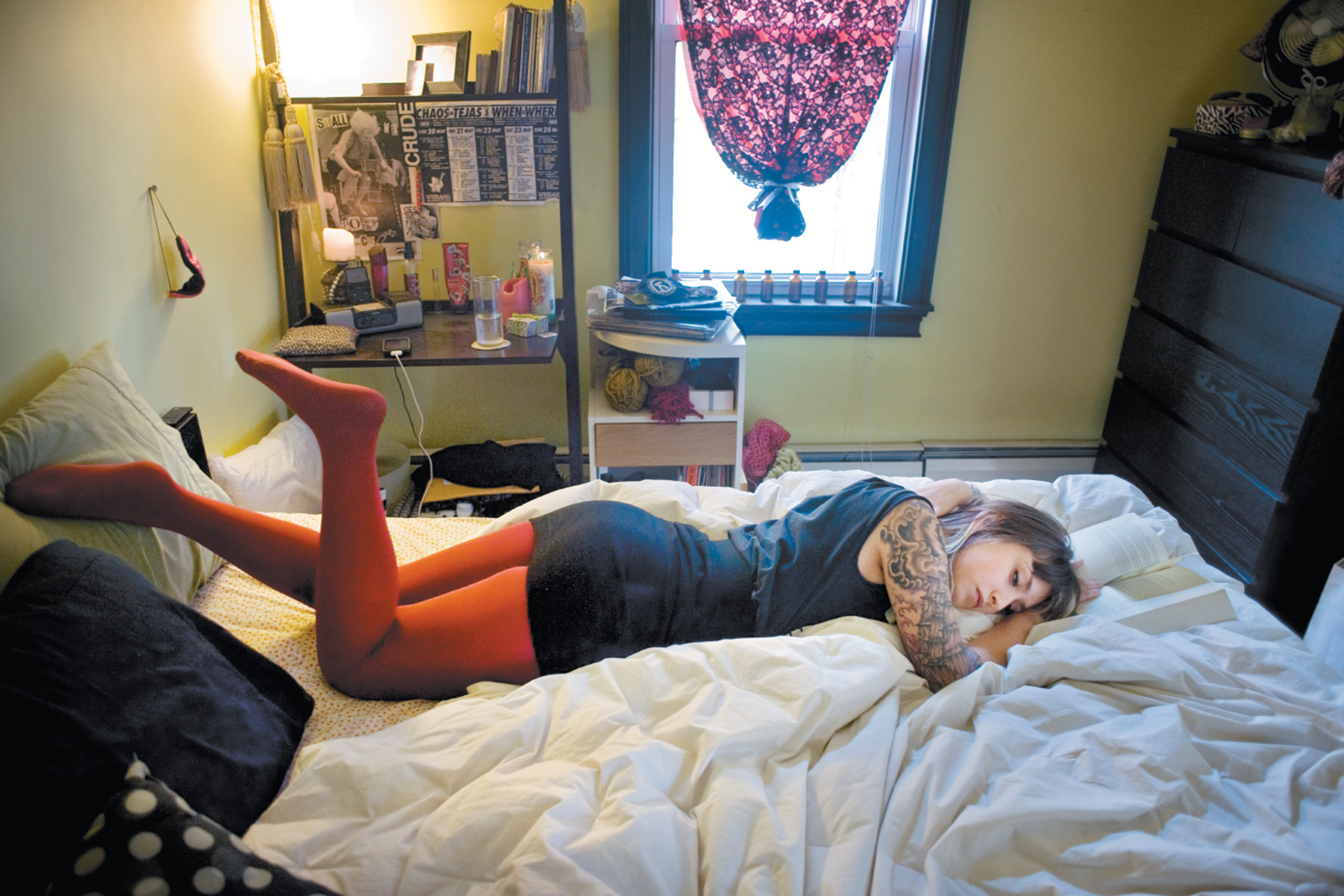
Rania Matar/InstituteDanielle, Jamaica Plain, Massachusetts, 2010; photograph by Rania Matar from her book A Girl and Her Room (2012), which collects her portraits of teenage girls in their bedrooms in the US and Lebanon. It includes essays by Susan Minot and Anne Tucker and is published by Umbrage Editions.
By some measures, girls appear to be faring rather well in twenty-first-century America. Teenage pregnancy rates have been in steady decline since the 1990s. Girls have higher graduation rates than their male counterparts at all educational levels. The popular culture abounds with inspirational images and anthems of girls “leaning in” and “running the world.” But according to two new, rather bleak books, these official signs of progress have given us an unduly rosy impression of the modern girl’s lot.
In American Girls, a study based on interviews with more than two hundred girls, Vanity Fair writer Nancy Jo Sales argues that the most significant influence on young women’s lives is the coarse, sexist, and “hypersexualized” culture of social media. American girls may appear to be “among the most privileged and successful girls in the world,” she writes, but thanks to the many hours they spend each day in an online culture that treats them—and teaches them to treat themselves—as sexual objects, they are no more, and perhaps rather less, “empowered” in their personal lives than their mothers were thirty years ago.
All young female social media users, Sales contends, are assailed “on a daily, sometimes hourly, basis” by misogynist jokes, pornographic images, and demeaning comments that “are offensive and potentially damaging to their well-being and sense of self-esteem.” In addition to this steady stream of low-level sexual harassment, many girls are subject to more aggressive forms of sexual teasing and coercion: having their attractiveness crudely assessed on “hot or not” websites, receiving unsolicited “dick pics” on their phones, being pestered or blackmailed for nude photos. (A group of thirteen-year-olds in Florida explain to Sales that girls who acquiesce to demands for “nudes” run the risk of having their photos posted on amateur porn sites, or “slut pages,” while those who demur are usually punished in some other way—by being branded “prudes,” or by having sexual rumors spread about them.)
The unsparing gaze that social media train on girls’ sexuality—the supreme value that they place on being sexually appealing—engenders a widespread female anxiety about physical appearance that is highly conducive to “self-objectification,” Sales claims. All of her interview subjects agree that on sites like Instagram and Facebook, female popularity (as quantified by the number of “likes” a girl’s photos receive) depends on being deemed “hot.” “You have to have a perfect body and big butt,” a fifteen-year-old from the Bronx observes grimly. “For a girl, you have to be that certain way to get the boys’ attention.” Girls who spend long enough in this competitive beauty pageant atmosphere don’t need to be coerced into serving themselves up as masturbatory fantasies, Sales argues. Taking their cues from celebrities like Kim Kardashian—whose vast following on Instagram Sales identifies as a marker of social media’s decadent values—they post “tit pics,” “butt pics,” and a variety of other soft-porn selfies as a means of guaranteeing maximum male attention and approbation. “I guarantee you,” a seventeen-year-old from New Jersey tells Sales,
every girl wishes she could get three hundred likes on her pictures. Because that means you’re the girl everybody wants to fuck. And everybody wants to be the girl everybody wants to fuck. Every girl who isn’t that girl secretly hates herself…. It’s empowering to be hot…. Being hot gets you everything.
The “empowering” nature of hotness is a theme that crops up frequently in Sales’s book. A number of the girls she meets vehemently reject the notion that they are oppressed or objectified on social media. On the contrary, they tell her, they are proud to be sexy “hos” and their highly sexualized self-presentation is a freely chosen expression of their “body confidence.” Naturally, Sales is not much persuaded by these claims. The fact that being “the girl everybody wants to fuck” can now be characterized as a bold, feminist aspiration is one measure, she suggests, of how successfully old-fashioned sexual exploitation has been sold to today’s teenage girls as their own “sex-positive” choice.
Peggy Orenstein, the author of Girls and Sex, is equally skeptical about the emancipatory possibilities of hotness. “Whereas earlier generations of media-literate, feminist-identified women saw their objectification as something to protest,” she writes, “today’s often see it as a personal choice, something that can be taken on intentionally as an expression rather than an imposition of sexuality.” Her investigation into the sex lives of teenage girls finds plenty of evidence to suggest that the confidence and power conferred by “a commercialized, one-dimensional, infinitely replicated, and, frankly, unimaginative vision of sexiness” is largely illusory. This generation of girls, she argues, has been trained by a “porn-saturated, image-centered, commercialized” culture “to reduce their worth to their bodies and to see those bodies as a collection of parts that exist for others’ pleasure; to continuously monitor their appearance; to perform rather than to feel sensuality.” As a result, they are eager to be desired, but largely clueless about what their own desires might be, or how to satisfy them; they go to elaborate lengths to attract male sexual interest, but regard sex itself as a social ritual, a chore, a way of propitiating men, rather than as a source of pleasure.
Orenstein, it is worth noting, is not concerned about the quantity of sex that young women are having. (There is, she points out, no evidence to suggest that rates of sexual intercourse among young people have risen in recent decades.*) Her interest lies rather in the quality of young women’s sexual experiences. “The body as product…is not the same as the body as subject,” she observes sternly.
Nor is learning to be sexually desirable the same as exploring your own desire: your wants, your needs, your capacity for joy, for passion, for intimacy, for ecstasy…. The culture is littered with female body parts, with clothes and posturing that purportedly express sexual confidence. But who cares how “proud” you are of your body’s appearance if you don’t enjoy its responses?
Orenstein interviewed more than seventy young women for her book, each of them chosen to represent those who had “benefited most from women’s economic and political progress.” All were at college or college-bound, and almost all struck her as “bright, assertive, ambitious” students. Yet their sexual histories, she reports, were characterized less by joy, ecstasy, or even minimal satisfaction than by discomfort, intimidation, and a chronic lack of “self-efficacy.” Half of them had suffered “something along the spectrum of coercion to rape.” And much of what they described about even their consensual experiences was “painful to hear.” Although many of them led active sex lives and professed to find sex “awesome,” few had ever achieved orgasm with a partner. (Most of them had faked it.) And while the majority of them regarded providing oral sex as a mandatory feature of the most fleeting sexual encounter, they rarely received, or expected to receive, oral sex in return. (Several rejected the idea of cunnilingus as embarrassing and worried that their vaginas were “ugly, rank, unappealing.”)
Rania Matar/InstituteLilly, Brookline, Massachusetts, 2009; from Rania Matar’s A Girl and Her Room
Some of the misery of teenage girls’ sexual experiences is attributable, Orenstein contends, to the “hookup culture” in which sex, “rather than being a product of intimacy…has become its precursor, or sometimes its replacement.” (Rates of female orgasm are much lower for casual encounters, she notes, than for sex that takes place within committed relationships.) Another contributing factor, she suggests, is the part that pornography now plays in determining normative standards of teenage sexual behavior. As one example of this, she points to the fact that most of her interview subjects had been dutifully shaving or waxing their “bikini areas” since the age of fourteen. (Rather like Ruskin, whose ideas about the naked female form are said to have been gleaned from classical statuary, modern porn-reared boys expect female genitalia to be hairless.)
She also notes that, in the years since the Internet made hardcore porn widely accessible to teenage boys, anal sex has become a more or less standard feature of the heterosexual repertoire. (In 1992, only 16 percent of women aged eighteen to twenty-four had tried anal sex; today, the figure has risen to 40 percent.) Despite the fact that most girls report finding anal penetration unpleasant or actively painful, they often, Orenstein claims, feel compelled to be good sports and submit to it anyway. (According to one study she cites, girls are four times as likely as boys to consent to sex they don’t want.) Among the girls she interviewed, the most common reasons given for doing so were a fear of being considered “uptight” and a desire to avoid “awkwardness.”
History has taught us to be wary of middle-aged people complaining about the mores of the young. The parents of every era tend to be appalled by the sexual manners of their children (regardless of how hectic and disorderly their own sex lives once were, or still are). There were some in the 1950s who were pretty sure that the decadent new practice of “going steady” augured moral disaster. Both Sales and Orenstein have undoubtedly grim and arresting information to impart about the lives of American girls. And neither of them can be dismissed as a sexual puritan. (They are not troubled about teenagers leading active sex lives, they assure us, only about the severely limited forms in which female sexuality is currently allowed to express itself; they are not even against casual sex per se, just eager to ensure that there should be, as Orenstein puts it, “reciprocity, respect, and agency regardless of the context of a sexual encounter.”) Even so, neither of their books entirely avoids the exaggerations, the simplifications, the whiff of manufactured crisis that we have come to associate with this genre.
Both writers make rather invidious comparisons between the frenzied, romance-free social lives of today’s young women and their own halcyon youths. Sales recalls walking back from school with her ninth-grade boyfriend to do homework together at her house. “The point of being together was not to have sex, necessarily. It was to become intimate,” she writes. Orenstein observes that her college experience was not about binge-drinking and hook-ups, but “late-night talks with friends, exposure to alternative music and film, finding my passions, falling in love.”
To use these sun-dappled recollections of life before the iPhone as a way of pointing up the misery of girls’ present conditions is a little misleading. To be sure, certain kinds of sexism have been amplified—or perhaps transmitted more efficiently—in the Internet era, and girls are now under pressure to present themselves as pliable sexual creatures at a much earlier age than they have been in the past. But even in the far-off 1970s and 1980s, young women experienced their share of exploitation, abuse, and unsatisfactory sex. Witness the feminist writer Ellen Willis drily reporting on the state of the sexual revolution in 1973:
For men, the most obvious drawback of traditional morality was the sexual scarcity—actual and psychic—created by the enforced abstinence of women…. Sex was an illicit commodity, and whether or not a sexual transaction involved money, its price almost always included hypocrisy; the “respectable” man who consorted with prostitutes and collected pornography, the adolescent boy who seduced “nice girls” with phony declarations of love (or tried desperately to seduce them)….
Men have typically defined sexual liberation as freedom from these black-market conditions: the liberated woman is free to be available; the liberated man is free to reject false gentility and euphemistic romanticism and express his erotic fantasies frankly and openly…. Understandably, women are not thrilled with this conception of sexual freedom.
If the good old days were never as good as both writers are wont to imply, the dark days of our present era are not quite as unremittingly desperate either. Notwithstanding the vicious influence of pornography, social media, and Miley Cyrus, contemporary girls still manage to have high school boyfriends; some of them even get around to watching alternative films at college. Fifteen-year-olds may go online to learn how to perform fellatio, but they also post fearsome rebukes to boorish boys on Facebook and have lengthy debates on Twitter about whether or not Kim Kardashian is really a good “role model.” Girls use editing apps to whiten their teeth in their selfies and fret about the size of their “booties,” but they also celebrate the sororal power of “girl squads” and attend Nicki Minaj concerts to hear the rapper sermonize on why a woman should never be financially dependent on a man.
Sales portrays social media as an irresistible and ubiquitous force in the lives of young women. All of the girls in her book, regardless of their socioeconomic background or individual circumstances, are presented as being equally in thrall to their phones and computers. Some are queen bees, most are drones, but all are trapped in the social media hive. None of them appears to have a single cultural resource or pursuit outside of its ambit. (The one exception is a young woman who doesn’t own a smartphone—but that’s because she’s homeless and itinerant.) Is this an accurate representation of social media’s utter dominion, one wonders, or a reflection of Sales’s rather narrow line of questioning? (If you gathered up two hundred young women and asked them exclusively about their pets, you could probably write a shocking exposé of the outsized role that domestic animals play in the lives of American girls.)
Orenstein offers a rather more nuanced and measured account of the way girls live now, but she too has a tendency to underestimate the heterogeneity of teenage culture and the multiplicity of ways in which girls engage with it. At the start of her book she notes that the meanings of cultural phenomena are complex. Selfies are neither simply “empowering” nor simply “oppressive,” and wearing a short skirt is neither just “an assertion of sexuality” nor just “an exploitation of it.” Better, she suggests, to think of these issues in terms of “both/and.” Yet more often than not, she ignores this advice and opts for the reductive language of “might seem, but is actually.” Thus, Beyoncé may appear to be an inspiring, powerful figure, but she is actually “spinning commodified sexuality as a choice.” Girls may think they’re powerful when they look hot, but in fact, “‘hot’ refracts sexuality through a dehumanized prism regardless of who is ‘in control.’”
Orenstein is most convincing when she addresses the passivity, the “concern with pleasing, as opposed to pleasure,” that characterize her interview subjects’ approach to sex. Young women’s propensity to give male satisfaction priority over their own is not a new development, but Orenstein is surely right to be indignant about how little has changed in this regard over the last fifty years. Her belief that new, stricter definitions of consent on college campuses are a step toward establishing “healthy, consensual, mutual encounters between young people” is perhaps unduly optimistic. Setting aside the question of whether it is useful or fair to apply the bright line of “yes means yes” to sexual situations that tend, by her own admission, to be blurry and complicated, the new college codes assume a female confidence, a willingness to challenge the primacy of men’s sexual wishes, that many of Orenstein’s subjects have specifically demonstrated they lack. Making young men more vigilant about obtaining consent and discouraging their tendency “to see girls’ limits as a challenge to overcome” is no doubt essential, but if young women are still inclined to say “yes” when they mean “no”—are more willing to endure unwanted sex than to risk being considered prudish—the new standards of consent would seem to be of limited value.
Far more interesting and persuasive are Orenstein’s recommendations for revising the American approach to sex education. In place of the failed “abstinence-only” programs (that have used up $1.7 billion in government funding over the last thirty-five years) she proposes offering classes that frankly address all aspects of teenage sexuality, including female pleasure. (Even the most comprehensive sex education classes currently on offer in high schools fail to mention the existence of the clitoris, she notes.) In addition to candid discussions of “masturbation, oral sex, homosexuality, and orgasm,” this new sex education curriculum would offer guidance on how to make decisions and to “self-advocate” in sexual encounters.
The idea of encouraging girls to speak up for themselves—of promoting their ability to ask for what they want and to refuse what they don’t—seems an eminently sensible one. “Assertiveness training” for women has gone out of fashion in recent years. Indeed much of the recent discourse about girls and sex has tended to reinforce rather than to challenge the idea of female vulnerability and victimhood. It would be a salutary thing to have some old-school feminist pugnacity injected back into the culture.
“I don’t expect these things to last more than 30 or 45 minutes,” the artist explained when asked about the naked Donald Trump statues that appeared in cities across the U.S.
‘But I would love to watch some irate 65-year-old Trump supporter try to take the thing down with his bare hands.’
The Washington Post reports the nude Trump statues gave passersby in New York City, San Francisco, Los Angeles, Cleveland, and Seattle quite an eye-opener Thursday morning.
‘Hoping to strip away the Teflon Don’s legendary confidence to reveal the fleshy mortal beneath the expensive suits and long ties, members of the anarchist collective INDECLINE decided they would showcase the aspirant president in the most humiliating way they could imagine: without his clothes.’
You’ve probably never heard of Ginger, the Las Vegas sculptor who created these grotesque, bloated, life-size versions of the GOP’s sorry excuse for a presidential candidate. But he’s renowned among insiders for the scary monsters he creates for haunted houses and horror movies.
‘When the guys [from INDECLINE] approached me, it was all because of my monster-making abilities. Trump is just yet another monster, so it was absolutely in my wheelhouse to be able to create these monstrosities.’
GInger told the Washington Post he worked 25 hours a week on the naked Trump statues and used 300 pounds of clay and silicone since INDECLINE hired him in April. The biggest challenges were giving Mein Trumpf’s scowl a “constipated look” and making his physique look realistic but “unsettling.”
‘If somebody were to look at my browser history, it would be a little disturbing. Turns out there’s not too many Google results for “saggy old man butt.” ‘
The Washington Post adds that “Each statue weighs 80 pounds and was glued to the ground using industrial strength epoxy, an adhesive that dries within several minutes.”
The creator of the naked Trump statues admits he once considered voting for The Donald but changed his mind because Trump kept opening his mouth.
Twitter reacts to the naked Trump statues.
The first statue went up in New York City’s Union Square, complete with a saggy, veiny paunch and other anatomy.
An Omaha dad who mistakenly ate some marijuana brownies didn’t enjoy the experience.
Omaha police officers were called to a house near 90th and Maple Streets about 9:45 p.m. Tuesday to investigate an accidental overdose. They learned that a 53-year-old man had been unloading groceries and found some brownies in the back seat of a car that his adult children had used earlier in the day.
The man’s wife told police that as she and her husband were watching TV, he noted that he was getting “bad anxiety.” She tried to call their children to ask them what was in the brownies but couldn’t reach them. (The woman told officers that she would rather not provide her children’s names because she thought they could get in trouble. An Omaha police spokesman said the investigation into the matter has concluded.)
While police were at the house, one of the couple’s children arrived and told officers the brownies belonged to his siblings. He told them he was “pretty sure it was just marijuana in the brownies,” according to a police report.
Paramedics called to the scene who checked the man found his vital signs to be normal. But they noted that he was displaying odd behavior — crawling around on the floor, randomly using profanities and calling the family cat a "bitch."
The man told paramedics he felt like “he’s trippin’.” He declined their offer to be taken to the hospital.
The paramedics helped the man to his bedroom and he got into bed. The man and his wife were told to call 911 again if his situation worsened.
For 24 years, a postage stamp taunted NASA's top minds, beginning first with a couple of engineers at the Jet Propulsion Laboratory.
The little piece of paper released in 1991 at a special ceremony at JPL depicted all nine planets and the Moon, with the name of the mission that explored each world below.
We’ll be reporting from Cleveland all week and live-blogging each night. Check out all our dispatches from the GOP convention here.
CLEVELAND — “You’re looking at a post-mortem today, which is sad,” Selena Coppa, a Washington state delegate to the Republican National Convention and a member of the “Stop Trump” movement, told me Wednesday as we sat in the blistering midday sun in Cleveland’s Public Square. The night before, Donald Trump had officially received the Republican Party’s nomination for president, putting to an end that leaky pipe dream of some conservatives. A little ways away, the Westboro Baptist Church was launching verbal vollies into a gathering crowd while another protest group read aloud the stories of women’s abortions.
Coppa, a 33-year-old military intelligence veteran who lives in Tacoma, was part of the last-ditch efforts at this week’s convention to halt the businessman’s nomination by forcing a roll call vote to change convention rules and unbind the delegates. But the frustrations she voiced during our talk were not just about the failed parliamentary Hail Mary, but about the tone of the convention.
“I think it’s waving the bloody, bloody shirt, an attempt to get us on board,” Coppa said of the speeches during the evening program.
With hindsight, Coppa said that the “Stop Trump” grass-roots efforts didn’t want for principled conservative enthusiasm, but rather organization. She pointed to “three to four factions” of the “Never Trump” movement and said that most of the people involved were new to organizing while “the hardened politicos were sitting trying to figure out which way the wind was shifting.” Some Never Trumpers, like former Virginia Attorney General Ken Cuccinelli, she said, were just in the movement to lay groundwork for a Ted Cruz 2020 run, and others, like herself, were simply averse to the idea of Trump at the party’s helm.
There remains a certain amount of confusion over how exactly the Republican National Committee stopped Monday’s roll call vote — the anti-Trump coalition thought it had enough votes from state delegations, but at the last minute, three states pulled out. It remains unclear which ones.
“I know the threats were coming pretty heavy,” Coppa said, referring to the behind-the-scenes maneuvering before the roll call motion. She’d heard that one delegate had been told by an RNC whip that “when Trump got elected, he would remember not just what he did but what the state did and punish the state — there would be no funding coming for candidates.”
The landscape of delegate support, Coppa said, was mixed. She estimated that 40 percent enthusiastically back Trump, 30 percent are reluctant adopters of his cause, and the remaining 30 percent want nothing to do with him.
When asked who she’d support in November, Coppa seemed resigned to an imperfect choice.
CLEVELAND >> Chris Hume took a red-eye from Los Angeles to stand in the hot sun to yell this out to people passing by his kiosk on wheels: "Make America toot again!"
The 50-year-old took time off from work to pack 200 whoopee cushions with a picture of Donald Trump on it and was selling them outside the Republican National Convention on Monday and Tuesday.
by By Josh Lederman and Julie Pace The Associated Press
CLEVELAND >> Melania Trump's well-received speech Monday to the Republican National Convention contained two passages that match nearly word-for-word the speech that first lady Michelle Obama delivered in 2008 at the Democratic National Convention.
The passages in question focus on lessons that Mrs.
Donald Trump rolled out a new presidential campaign logo on Friday and, well, the internet thinks it looks a little, errrrr, phallic.
The presumptive Republican presidential nominee announced his running mate on Friday: Indiana Governor Mike Pence. So naturally, Trump needed to incorporate his new bud into his campaign logo, and this was the best that they came up with.
The mania surrounding “Pokeman Go” continued Thursday as more users found themselves in precarious situations while playing the augmented reality game.
In North San Diego County, two men fell off a bluff while playing the smartphone game, while farther north in Anaheim, a player was stabbed by group of men in a park recently.
The incidents come as law enforcement agencies across the nation are reporting a plethora of Pokemon-related attacks and odd happenings since the game was released last week.
On Wednesday, firefighters rescued two men who fell several stories after a sandy bluff they were standing on collapsed in Encinitas, according to authorities. The men, who were in their early 20s, were playing Pokemon Go at the time and were likely led to cliff when they were trying to catch characters, said Sgt. Rich Eaton of the San Diego County Sheriff’s Department.
One man fell 75 to 100 feet, and the other was found unconscious 50 feet down the bluff. Both were taken to area trauma centers and suffered moderate injuries, Encinitas fire officials said.
The men, according to firefighters, had crossed a fenced area to get to the bluff.
“I think people just need to realize this is a game,” Eaton said. “It’s not worth your life. No game is worth your life.”
In Anaheim, a man who was playing the game into the wee hours Wednesday was stabbed multiple times by a group of men at a park, police said.
The victim, who was in his late 20s, was using the app in Schweitzer Park in the 200 block of Bel Air Street, when he encountered the group of men around 12:30 a.m., police said.
Anaheim police Sgt. Luis Correa said five to six men, ranging in age from teens to 20s, attacked the man and stabbed him several times.
A motive for the attack has not been determined, he said.
Correa said detectives don’t think the group lured the man to the park. Instead, they think he happened to run into them there.
The victim was taken to an area hospital, where he was in fair condition with injuries that did not appear life-threatening.
Wednesday’s attack should serve as a reminder to “Pokemon Go” players to pay attention to their surroundings, Correa said.
“Your focus should be on what’s in front of you, so you don’t lose sight of what is happening,” he said.
Just in California, two men were reportedly robbed and carjacked Sunday while playing the game and trying to catch fictional characters at a Sacramento County park.
Hundreds of miles south, a brother and sister were robbed of their smartphones Sunday while playing “Pokemon Go” in San Francisco.
Two former Marines playing the game in Fullerton on Tuesday helped nab a man who was wanted in connection with attempted murder in Sonoma County. They notified police after they noticed the man was bothering children at a playground.
But in the world of Pokemon, it’s not crime all the time. Some bizarre happenings also have been associated with the game.
In San Luis Obispo County, Dan De Vaul reported that his sober-living facility, Sunny Acres, had been a designated stop in the latest “Pokemon Go” craze. The facility houses released sex offenders, which was a concern for De Vaul because he said his clients can’t be around children.
“I have no idea what Pokemon is,” he said. “I have no idea who put the stop — if it was sabotage — because we don’t want kids showing up here.”
State water officials are urging people to avoid any contact with the water at Pyramid Lake because of a toxic algae bloom that has developed on the Los Angeles County reservoir.
In a statement issued Wednesday, the California Department of Water Resources advised the public to not wade, swim or water-ski at the lake and to keep dogs and children away from the water.
Google "corn in Massachusetts" in order to have something to share here, so I could ask:
Can anybody recommend good corn stands in the Boston area? I'll be driving from Falmouth, Massachusetts to downeast Maine on August 6th, via this route: https://goo.gl/maps/PaBoQku8zE12
The corn that grows in Maine really sucks, according to my parents. They said that if I can get some fresh-picked corn from a farm stand in MA on my way, that would be awesome.
It’s that time of year again! If you look forward to making your way through a corn maze each fall, here’s a list of worthy mazes to tackle. It’s a big list, but we think so much hard work goes into making the mazes each year’s it’s fair to say they all deserve to be called “the best!”
Best Corn Mazes in New England
Many of the farms and orchards also offer additional family activities like pumpkin and apple picking, cider donuts, farm animals, corn cannons, “night mazes,” and more. Visit the individual maze websites or call ahead to check about additional offerings, hours of operation, and rates.
If we missed your favorite maze tell us in the comment section below!
BEST CORN MAZES IN NEW ENGLAND | CONNECTICUT
Ekonk Hill Turkey Farm – Moosup, CT
Travel through miles of paths, relax on the hayride and visit the animals in the barnyard.
277 Ekonk Hill Road. getlostinthemaze.com
Foster Family Farm – South Windsor, CT
Two corn mazes (this year’s theme is Peter Pan) spanning 8 acres of land and 4 miles of trails.
90 Foster Street. 860-648-9366. fosterfarm.com
Lyman Orchards – Middlefield, CT
This year’s maze features PEZ Candy, and is 4 acres with 2 miles of trails. $1.00 of every ticket is donated to the Pediatric Cancer Unit of Connecticut Children’s Medical Center.
32 Reeds Gap Road. 860-349-1793. lymanorchards.com
Plasko’s Farm – Trumbull, CT
Spanning 4 acres and over 1.5 miles of pathways among 10 foot tall corn, the maze at Plasko’s is a family favorite. $1.00 of every ticket is donated to charity.
670 Daniels Farm Road. 203-268-2716. plaskofarm.com
Preston Farms – Preston, CT
This maze includes 16 stamping stations to find (or not) and 3-5 miles to trek while enjoying this year’s maze theme: The Legend of Sleepy Hollow!
92 Route 2. 860-886-6293. prestonfarmscornmaze.com
BEST CORN MAZES IN NEW ENGLAND | MAINE
Thunder Road Farm – Corrina, ME
This year’s maze design celebrates our furry friends with a “Support Your Local Animal Shelters” theme!
178 Newport Road. 207-278-2676. personalpages.tdstelme.net/~trfarm
Pumpkin Valley Farm – Dayton, ME
Enjoy a 6-acre maze, take a hayride to the pumpkin patch, feed the farm animals, launch an ear of corn, try the jumping pillow, and more!
100 Union Falls Road. 207-929-4088. pumpkinvalleyfarm.com
BEST CORN MAZES IN NEW ENGLAND | MASSACHUSETTS
Davis Mega Maze – Sterling, MA
The ultimate maze! With 8 acres of corn and almost 3 miles of paths, the maze at Davis Farmland keeps things extra interesting with 7 Extreme Mazing Levels that let you choose your maze intensity. There’s also zip lining, special Fright Nights, and more!
145 Redstone Hill. 978-422-8888. davisfarmland.com
Marini Farm – Ipswitch, MA
Ten miles of pathways weave among 8 acres of corn at Marini Farm, where the maze is both interactive and educational. Don’t miss the weekend flashlight nights!
259 Linebrook Road. 978-238-9386. marinicornmaze.com
Mike’s Maze – Sunderland, MA Yankee honored Mike’s Maze with a “Best Bargain” pick in 2009, and it’s still a favorite today (and still the same rate!). This year’s unique design is a tribute to Alice in “Sunderland,” and at night, there’s a Haunted Maze for bigger thrill-seekers.
23 South Main Street. 413-665-8331. mikesmaze.com
Sauchuk Farms – Plympton, MA
This year’s maze marks the 50th anniversary of Star Trek, but there are also hayrides to the pumpkin patch, jumping pillows, and corn cannons to keep the fun going.
53 Palmer Road. 781-585-1522. sauchukfarm.net
BEST CORN MAZES IN NEW ENGLAND | NEW HAMPSHIRE
Beans and Greens Farm – Gilford, NH
Take on the farm’s annual corn maze during the day or try your luck at night during the weekends, where the paths get spookier at Halloween draws near.
245 Intervale Road. 603-293-2853. beansandgreensfarm.com
Coppal House Farm – Lee, NH
With three designs for 2016 featuring flowers, bees, and honeycombs, a visit will send you searching among 10-foot tall ears of corn. Don’t forget to pick a pumpkin to bring home!
118 North River Road. 603-659-3572. nhcornmaze.com
Sherman Farm – Conway, NH
This year Sherman Farm’s 12-acre maze (open weekends only) celebrates an “Alice in Farmland” theme. There’s also a jumping pillow, hayrides to the pumpkin patch, corn cannons, cider donuts, and kettle corn.
679 East Conway Road. 603-939-2412. shermanfarmnh.com
BEST CORN MAZES IN NEW ENGLAND | RHODE ISLAND
Clark Farm – Wakefield, RI
Family fun at Clark Farm this year includes a dinosaur corn maze theme.
2984 Comd. Oliver Hazard Perry Hwy. 401-783-1331. clarkfarms.com
Escobar’s Highland Farm – Portsmouth, RI
Spanning 8 acres, the maze this year at Escobar’s Highland Farm features a PawSox theme! Don’t miss the pumpkin patch and hayrides, too.
133 Middle Road. 401-683-1444. escobarshighlandfarm.com
BEST CORN MAZES IN NEW ENGLAND | VERMONT
Great Vermont Corn Maze – Danville, VT
This year’s theme is “Native Vermont,” covering 10 acres with 3 miles of trails that weave between corn stalks that tower up to 12 feet tall.
1404 Wheelock Road. 802-748-7399. vermontcornmaze.com
Gaines Farm – Guilford, VT
Dinosaurs comes to Guilford at this year’s 7-acre corn maze. Don’t miss the Twilight Walk, Haunted Hayride, or Haunted Maze nights if you like things a little more on the spooky side!
6343 Coolidge Highway. 802-257-0409. gainesfarm.com
Hathaway Farm – Rutland, VT
Declaring themselves “the largest corn maze in Vermont,” the folks at Hathaway Farm boast 12 acres and miles of pathways in this year’s maze, an ode to Animals Under the Sea!
741 Prospect Hill Road. 802-775-2624. hathawayfarm.com
What are your picks for the best corn mazes in New England?
Average weekday ridership on the Metro Expo Line jumped about 58 percent in June, the first full month the line offered service to Santa Monica, compared to April, while Sunday ridership more than doubled, according to figures released Monday.
The Expo Line extension from Culver City to Santa Monica opened on May 20.
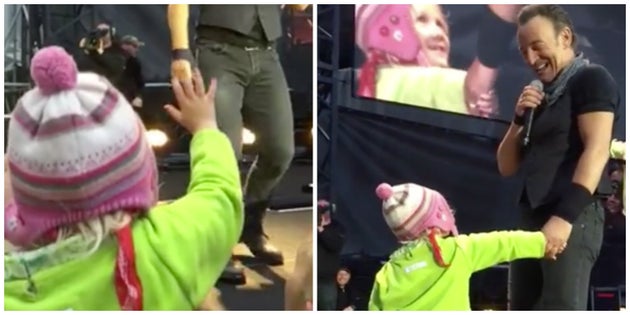
The 66-year-old musician was half-way through singing 'Waitin' On A Sunny Day' when he spotted Hope fist pumping to the song.
Donning a lime green jacket and pink hat, it was hard for the singer to miss her enthusiastic dancing in the front row.
After a few minutes of watching Hope, Springsteen reached out his hand and invited the four-year-old on stage. An offer that she slowly accepted.
Facebook
The pair held hands and danced around to the song.
And then the magic happened.
Springsteen sung the first line of the chorus then pointed the microphone at Hope and she perfectly sung: "Waitin' on a sunny day, gunna chase the clouds away."
The crowd let out a huge cheer and Springsteen looked pretty gobsmacked that Hope knew the words.
Facebook
After a short duet, Hope intended to head off stage back to her parents, but Springsteen picked her up, placed her on his shoulders and danced to the rest of the song.
The Facebook video was uploaded by Thomas Andersson on 29 June and was viewed nearly six million times in six days.











&clickthroughUrl=http://gph.is/2adU6Zm&posttype=photo&tags=giphy,donald%20trump,rnc,pat,patting,ivanka%20trump)