Shared posts

13 Nov 17:32

“The Most Contentious Of All Letters”

by Andrew Sullivan

H, according to Michael Rosen, author of Alphabetical:

In Britain, H owes its name to the Normans, who brought their letter “hache” with them in 1066. Hache is the source of our word “hatchet”: probably because a lower-case H looks a lot like an axe. It has certainly caused a lot of trouble over the years. A century ago people dropping their h’s were described in the Times as “h-less socialists.” In ancient Rome, they were snooty not about people who dropped their Hs but about those who picked up extra ones. Catullus wrote a nasty little poem about Arrius (H’arrius he called him), who littered his sentences with Hs because he wanted to sound more Greek. Almost two thousand years later we are still split, and pronouncing H two ways: “aitch”, which is posh and “right”; and “haitch”, which is not posh and thus “wrong”. The two variants used to mark the religious divide in Northern Ireland – aitch was Protestant, haitch was Catholic, and getting it wrong could be a dangerous business.

Perhaps the letter H was doomed from the start: given that the sound we associate with H is so slight (a little outbreath), there has been debate since at least AD 500 whether it was a true letter or not. In England, the most up-to-date research suggests that some 13th-century dialects were h-dropping, but by the time elocution experts came along in the 18th century, they were pointing out what a crime it is. And then received wisdom shifted, again: by 1858, if I wanted to speak correctly, I should have said “erb”, “ospital” and “umble”.

13 Nov 17:29

Pop Music For The Present Age

by Andrew Sullivan

In a recent interview, Arcade Fire frontman Win Butler divulged the unlikely influence behind the band’s new album, Reflektor – the 19th century Christian philosopher, Søren Kierkegaard:

I studied the Bible and philosophy in college and I think in a certain sense that’s the kind of stuff that still makes my brain work. There’s an essay by Kierkegaard called The Present Age that I was reading a lot that’s about the reflective age. This is like in [1846], and it sounds like he’s talking about modern times. He’s talking about the press and alienation, and you kind of read it and you’re like, “Dude, you have no idea how insane it’s gonna get.” [Laughs.] …

It reads like it was written here, basically. He basically compares the reflective age to a passionate age. Like, if there was a piece of gold out on thin ice, in a passionate age, if someone went to try and get the gold, everyone would cheer them on and be like, “Go for it! Yeah you can do it!” And in a reflective age, if someone tried to walk out on the thin ice, everyone would criticize them and say, “What an idiot! I can’t believe you’re going out on the ice to try and risk something.” So it would kind of paralyze you to even act basically, and it just kind of resonated with me — wanting to try and make something in the world instead of just talking about things.

Paul Elie digs up the relevant passage from The Present Age:

A Revolutionary Age is an age of action; the present age is an age of advertisement, or an age of publicity: nothing happens, but there is instant publicity about it. A revolt in the present age is the most unthinkable act of all; such a display of strength would confuse the calculating cleverness of the times. Nevertheless, some political virtuoso might achieve something nearly as great. He would write some manifesto or other which calls for a General Assembly in order to decide on a revolution, and he would write it so carefully that even the Censor himself would pass on it; and at the General Assembly he would manage to bring it about that the audience believed that it had actually rebelled, and then everyone would placidly go home—after they had spent a very nice evening out.

Jon Pareles offers more context for the big ideas behind Reflektor:

The album’s lyrics allude to Kierkegaard’s ideas about a “reflective age,” when passion and story line have been replaced by ambiguity and passive contemplation. And they trace a loose plotline similar to the myth of Orpheus and Eurydice: the musician who plays songs that are so beautiful that they persuade Death to give his lover a second chance, though the musician will only lose her again. (Auguste Rodin’s statue of Orpheus and Eurydice is on the album cover.) The songs move through love, rebellious self-affirmation, a struggle to stay together and, at the end, a ghostly mourning. Six minutes of wordless sound at the end of the album, in billowing, burbling, sustained loops reminiscent of Terry Riley’s late-1960’s compositions, may be a glimpse of an eternal next world.

11 Nov 19:46

Students awkwardly posing for camera while being filmed

by biotv
While filming events during this year's freshers week at Nottingham Trent University, in Enland, a lot of the students filmed mistakingly took the video camera for a stills camera. Here's a montage of such clips:


Nottingham Trent Students Union | via
11 Nov 19:40

Mooning garden gnome

by biotv

Mooning garden gnome, from Sunstar Industries Inc.
You're probably familiar with the popular folk tale "The Princess & The Gnome." You're not?! Well, since there's no time to tell it, we'll give you an idea -- The story involves a princess, an evil witch, and a spell that can't be broken until the princess sees a full moon at the crack of dawn. Whether you grew up with that story or not, you'll find The Mooning Garden Gnome a delightful object. Mischievous little Gnomes have become commonplace throughout the American landscape. This guy has decided to stand out from the crowd with an age-old gesture of defiance and rebellion. He means no disrespect, he's merely... oh, maybe he does mean disrespect. What the heck do we know? The Mooning Garden Gnome stands (or is it "squats"?) a diminuitive 6 inches tall and 8 inches long. He's made of colorful hard rubber, which strikes us as very durable.
Also: Flashing garden gnome, Stripper garden gnome

via
11 Nov 19:38

Simpson No-No's

by biotv
An illustration from They Never Think Evil Thoughts - an interview with The Simpsons animators David Silverman and Wes Archer published in the first edition of the Simpsons Illustrated comics, in 1991 - uses Lisa Simpson's face in a "Do's and Don'ts" guide for the animators, on the facial expressions for the characters of the show.

Simpsons No-No's
E.Leventine | via
10 Nov 03:26

Would You Take A CompSci Course Taught By Matt Damon?

by Andrew Sullivan
Ibktim

Matt Damon in Team America still makes me crack up. Also, MOOCs are dumb.

Some MOOC providers hope so:

“From what I hear, really good actors can actually teach really well,” said Anant Agarwal, CEO of EdX, who was until recently a computer-science professor at MIT. “So just imagine, maybe we get Matt Damon to teach Thévenin’s theorem,” he added, referring to a concept that Agarwal covers in a MOOC he teaches on circuits and electronics. “I think students would enjoy that more than taking it from Agarwal.”

Casting Damon in a MOOC is just an idea, for now: In meetings, officials have proposed trying one run of a course with someone like Damon, to see how it goes. But even to consider swapping in a star actor for a professor reveals how much these free online courses are becoming major media productions—ones that may radically change the traditional role of professors.

Jeffrey Young notes that one MOOC provider, Udacity, already employs scriptwriters who turn lecture notes into productions “complete with demonstrations and suggested jokes.” He adds, “At least one long-time distance education expert argues that it makes sense to look for acting talent rather than deep content knowledge to appear on camera”:

“Having people who are really good at explaining ideas and putting the right graphics and videos around them can create a pretty darn good learning experience,” said Russell Poulin, a researcher with the Western Interstate Commission for Higher Education. “I’m assuming Matt Damon wouldn’t be answering the questions from students,” he added.

In fact, he argued that one benefit of online learning is that the various parts of the professor’s role can be “pulled apart.” In an online course, he argued, there’s no reason to have the same person develop the content, deliver it, and run assessments, when people with skills in each of those areas can work together to create clearer and more effective lessons.

That essentially argues for treating the development of a MOOC like a Hollywood production, with long credits at the end of the many specialists who teamed up on a shared vision. There’s a director running the show, but no one expects the same person to also act all the roles.

Previous Dish on MOOCs here, here, and here.

09 Nov 16:34

The Many Meanings Of Ender’s Game

by Andrew Sullivan

Beyond the straightforward theme of sending young people to fight and die in war, Alexander Huls reads the new film as a partial defense of Generation Y, with Ender saving the world at the request of condescending and ungrateful Boomers:

Boomers tend to represent Gen Y’s virtues simultaneously as faults (Millennials are great at tech! Millennials are narcissistic and distracted workers because of tech!) but the film understands the impulses behind them. Technology is presented not as an indulgence, but a highly useful tool Ender wields to achieve productive results and self-exploration—not narcissism. When Ender feels outraged that Graff revokes his email privileges, the movie presents the hero’s anger not as lost entitled access to technology. He’s upset that he’s lost what he uses the technology for: meaningfully connecting with people he cares about.

Millennials will likely be happy with the portrayal. They, after all, played a major part in propelling Ender’s Game to its canonical status. This adaptation honors the text they grew up with while heightening the generational conflicts in it, going even rougher on the adults.

Andrew O’Hehir reads into a historical analogy probably not intended by author Orson Scott Card or the filmmakers:

“Ender’s Game” can definitely be read as an allegorical treatment of the other American original sin, besides slavery: the destruction and replacement of Native American society, which stood in the way of our nation’s manifest destiny. The sentimental idea that whites who killed or uprooted the Indians became infused with their spiritual or moral essence did not begin with New Agers in the 1960s. It goes clear back to the invented legend of the first Thanksgiving feast and the apocryphal peace treaty between William Penn and the Lenape chief Tamanend (aka Tammany) in 1683.

Harris O’Malley, who stubbornly refuses to see the film due to Card’s history of homophobia, points out that the book preaches a message of tolerance:

[F]or someone who seems consumed by hate, he has produced what is, in many ways, his own counter-argument. …

Ender’s ultimate strength isn’t his willingness to win at any cost, it’s his empathy. To quote Ender: “In the moment when I truly understand my enemy, understand him well enough to defeat him, then in that very moment I also love him. I think it’s impossible to really understand somebody, what they want, what they believe, and not love them the way they love themselves.” Ender’s own horror at the realization that he has committed xenocide is born out of that empathy; in the end, he realizes that the “buggers” were never truly the threat that everybody thought them to be.

It’s a shame that Card seems incapable of equal understanding, instead of grumpily complaining about the intolerant reception of his own intolerance.

Rany Jazayerli, a long-time fan of Card’s writing who grew increasingly pained by the author’s hateful rhetoric in real life, grapples with further complexities:

We all feel alienated at some point, but the book’s message resonates even deeper with those who really stick out from the crowd. The empathy extends to the reader. There are no gay characters, but that is presumably because most of the characters are prepubescent children. (Ender is essentially asexual.) But there are girls at Battle School who play important roles; there are characters who are dismissed by other kids because they’re too short; there are Jewish kids who get mocked for the size of their noses.

I am neither gay, nor a girl, nor short. I am, however, a Muslim who grew up in Kansas in the 1980s, and I struggle to think of a more perfect recipe for creating a sense of isolation in an American teenager. … It was in the context of trying to find my place in the world, of struggling to reconcile my faith with my country when I had no role models to show me the way, that I encountered the following passage about Ender and his Battle School classmate Alai. It stopped me cold:

“I don’t want to go,” he said.

Alai hugged him back. “I understand them, Ender. You are the best of us. Maybe they’re in a hurry to teach you everything.”

“They don’t want to teach me everything,” Ender said. “I wanted to learn what it was like to have a friend.”

Alai nodded soberly. “Always my friend, always the best of my friends,” he said. Then he grinned. “Go slice up the buggers.”

“Yeah.” Ender smiled back. Alai suddenly kissed Ender on the cheek and whispered in his ear, “Salaam.” Then, red-faced, he turned away and walked to his own bed at the back of the barracks. Ender guessed that the kiss and the word were somehow forbidden. A suppressed religion, perhaps. Or maybe the word had some private and powerful meaning for Alai alone. Whatever it meant to Alai, Ender knew that it was sacred; that he had uncovered himself for Ender, as once Ender’s mother had done, when he was very young, before they put the monitor in his neck, and she had put her hands on his head when she thought he was asleep, and prayed over him. Ender had never spoken of that to anyone, not even to Mother, but had kept it as a memory of holiness, of how his mother loved him when she thought that no one, not even he, could see or hear. That was what Alai had given him; a gift so sacred that even Ender could not be allowed to understand what it meant.

If you don’t see the importance of this passage, I envy you. Alai is clearly a Muslim, and in the 1980s, Muslims were portrayed in American popular culture as one of three categories, if they were portrayed at all: crazy ayatollahs, greasy lecherous oil sheikhs, or bomb-wielding hijackers. Ender’s Game was literally the first time I had encountered a positive portrayal of a Muslim character in American fiction. It floored me. I finally saw a positive image of myself in print, and it came not from a fellow Muslim but from a wildly popular Christian author who could trace his American lineage for generations.

Previous Dish on the film and the controversy over Card here, here, and here.

08 Nov 23:05

Drones In The Fog

by Andrew Sullivan

Political scientist Frederik Rosén argues that “if military commanders have drones, then under international humanitarian law they are required to use them to the greatest possible extent” to prevent civilian casualties:

If a state possesses drone technology, and if the deployment of this technology may potentially reduce unnecessary harm from armed attacks, the state is obliged to employ the technology. This is not at all different from the obligation to pick up the binoculars before firing the shells. The obligation to use drones for precaution is logically not limited to drone attacks. It applies across all weapon systems. Even in the near future, ground attacks may no longer be lawful without engaging available drone technology for the purpose of precaution. … It is as if drone technology lifts the “fog of war” from critical aspects of the use of armed force. We therefore need to think through the application of the laws of war in armed conflicts characterized by total visibility. Because drone technology is not only a game changer, it also triggers obligations.

08 Nov 23:05

The Ho-Hum Of Jet Engines

by Andrew Sullivan

Virginia Postrel believes the airline industry will never recapture the glamour of its early days, no matter how hard it tries:

3910755129_a08527a59b_b“When the jet age was new and exciting, flying was a glamorous and sexy endeavor,” the Virgin Atlantic website declared in 2006, pledging “to bring this glamour back.” It’s a perennial promise in the contemporary airline industry, usually offered along with an announcement of new in-flight luxuries or stylish new crew uniforms. But however nice the amenities or attractive the uniforms, the old glamour never returns, because Jet Age glamour wasn’t about the actual experience of flying. It was about the idea of air travel and the ideals and identity it represented.

Jet Age glamour expressed the longing to experience a world of variety and excitement, a fast-moving, dynamic, and diverse alternative to the familiar and routine. We now inhabit the real version of that world, a world glamour advertised and helped bring about. We can never bring the old illusion back. We can only invent new ones, reflecting new circumstances, new possibilities, new desires, and new versions of yearnings that never go away.

(Image via James Vaughan)

07 Nov 14:36

How Much Math Do We Really Need? Ctd

by Andrew Sullivan

A reader writes:

Good morning from Nebraska. As a computer engineer I have definitely had my share of math classes. The classic question of “when am I ever going to need this?” doesn’t stop with Algebra. It continues well into the college curriculum. The best answer I ever got was from my discrete math professor. He said (and I agree) that we might never use it. But that’s not the point.

Learning new math concepts not only increases your problem-solving sophistication, it also exercises your ability to analyze and then solve problems. In my experience, he’s been absolutely right. I rarely use (or remember to use) any of the advance math I learned in undergrad. Heck, I don’t even use much of the math that I learned in high school and I’m a freaking engineer. I do, however, encounter problems everyday and rely on my learned ability to analyze the problem and find a solution. Giving students the option to eliminate math at such an early stage is not only going to impact their mathematical understanding, but also the problem-solving sophistication.

And just a little jab: how many students really use what they learned by reading and then analyzing Ethan Frome or The Great Gatsby? How are lit classes any more relevant to everyday use than math? It’s not necessarily the content of the subject that’s important, but rather the method and process for approaching and solving problems that is.

Another:

If there was ever a post to make me absolutely insane, this is it.

Replace every instance of “math” in your post with “reading.” If the post then infuriates you, you know how I feel. I haven’t had to write a paper about Gatsby’s green light since I was 18, but I recognize that the subject built fundamental cognitive and intellectual skills that I do use all the time.

If you want to re-imagine a relevant curriculum for mathematics instruction, I’m all for that. But, to eliminate math for a significant portion of young minds is absurd. Making it optional will result in many children opting out of math, goaded on by the shocking number of adult parents who feel that math is “hard” and “useless.”

Do all students need to take trigonometry and calculus? Of course not. But everyone should take statistics. Everyone should take basic finance. In the eighth grade, my idiot friends and I still thought we’d be rock guitarists and professional athletes. If we’d opted out of math at that point, we’d have been woefully unqualified in careers in science. By the time kids know what they want to do with their lives, they’re past the point of making up for gaps in their education.

And this is what whining about math always seems to miss: math education is not about math for math’s sake; it’s about science, technology, and engineering. In the 21st century, when computer illiteracy is tantamount to actual illiteracy, when biotechnological breakthroughs are helping us live longer and more productive lives, when the threat of climate change, fossil fuels, and stray asteroids become more and more unavoidable by the day, asking for a reprieve from learning something hard is tantamount to sabotaging our future.

Another:

Gary Rubenstein may be right that most students do not need to take algebra, calculus, or geometry (worthy as these topics are) unless they’re planning to go into a technical field.  However, there is one type of math instruction that American high school students desperately need – and most aren’t getting it.  It’s consumer math and basic financial literacy.

How to manage your checking and savings accounts.  Understanding mortgages, home equity loans, school loans, car loans, payday loans, and other types of consumer loans.  How to safely use credit cards.  How to save for education and retirement (and why it’s a good idea to start early in life).  Understanding sales, coupons, discount and reward programs from retailers.  In other words, the kind of math needed to navigate everyday situations that involve money.

Many high schools do teach these classes, but they are not normally required for graduation.  They probably should be. The benefits would be huge. For instance, if more Americans had the financial savvy to understand and avoid the funny mortgages that were being peddled during the early-to-mid 2000s, the housing crash might not have been as severe.


07 Nov 14:35

Skimming A Show

by Andrew Sullivan
Ibktim

Not sure how I feel about this. Fine if you're worried about filling every minute of your time with "quality" culture/experiences etc. but I still like the serendipity of an ending or turn of phrase etc. that I hadn't been expecting. That's lost in Cliffnotes/spoiler viewings.

J. Bryan Lowder likes spoilers. He calls them “a prophylactic against mediocrity in shows of middling appeal”:

In truth, if the spoiler does her job well, you will leave with an appreciation of the episode at least equal to, if not better than, those poor souls who gambled their lives watching the whole thing. Memory is organized in flashes, moments, and a few pithy, secondhand ones recounted on a newsfeed are, considering cost-benefit, preferable to recording some myself over a long hour. (And honestly, I find the practice so seamless that I often can’t remember whether I actually watched something or spoil-watched it.)

You could say that, in my support of spoil-watching, I’m arguing for a CliffsNotes approach to television—and why not? Every good student knows there are texts worth reading in full and texts for which it is perfectly appropriate, even necessary, to skim. As students of pop culture, we should jealously guard our time with the former and, each according to his taste and ability, help each other get on with the latter as quickly and efficiently as possible. Such a utopian arrangement won’t spoil anything, I promise.

02 Nov 14:41

Mental Health Break

by Andrew Sullivan

YouTube’s latest star freestyles with his fingers:

02 Nov 14:31

Your Moment Of Ze

by Andrew Sullivan

This time he tackles the fantastically bizarre cuttlefish:

Apparently the mollusk goes really well with asparagus.

01 Nov 15:50

The Divorce Divide

by Andrew Sullivan
Ibktim

Sucks for Susan. We're too educated for her to divorce me and find someone better.

Divorce Education

Derek Thompson notes that, with divorce, “richer you are, the less likely you are to do it”:

Divorce rates by age 46 are twice as high among high-school dropouts than college grads. The point isn’t that a 30-percent divorce rate among bachelor’s degree holders is low. Divorce is common. But it’s much, much more common for drop-outs and graduates of high school, only. This same point is made more starkly (albeit less colorfully) in new study of divorce trends from Demographic Research. Watch the rising black bars and falling white bars [in this chart]. The story you’re following is that divorce rates among dropouts are going up, up, up, while divorce for bachelor’s holders have fallen to half-century lows.

27 Oct 22:53

How Much Math Do We Really Need?

by Andrew Sullivan
Ibktim

Shoutis? Vlamis?

Long-time math teacher Gary Rubinstein confesses that he would “gleefully chop at least 40 percent of the [math] topics that are currently taught from K to 12″:

Two hundred years ago, students who finished high school learned about as much mathematical content as modern fifth graders learn today. And over the past 200 years, topics were gradually added to the curriculum until the textbooks have become giant bloated monstrosities. And though the modern high schooler ‘learns’ algebra, geometry, algebra II and trigonometry, statistics, and maybe even precalculus and calculus, the average adult still only remembers about as much as the adults from 200 ago did, or about what the average fifth grader is supposed to have learned.

His modest proposal: Make all math instruction optional after 8th grade.


27 Oct 22:52

The Decline And Fall Of Christianism

by Andrew Sullivan
Ibktim

I don't know what the debt-ceiling debacle did to Sully's wiring, but man has he been writing some missives lately. Also, I really love when he ends with "know hope." His determined positivity about the future in general and Gen Y in particular feels good.

.jpg

The fusion of politics and religion – most prominently the fusion of the evangelical movement and the Republican party – has been one of the most damaging developments in recent American history. It has made Republicanism not the creed of realists, pragmatists and compromise but of fundamentalists – on social and foreign policy, and even fiscal matters. And once maintaining inerrant doctrine becomes more important than, you know, governing a complicated, divided society, you end up with the extremism we saw in the debt ceiling crisis. When doctrine matters more than actually doing anything practical you end up with Cruz cray-cray. How does one disagree with a Taft:

Watching the Republican Party use the full faith and credit of the United States to try to roll back Obamacare, watching its members threaten not to raise the debt limit — which Warren Buffett rightly called a “political weapon of mass destruction” — to repeal a tax on medical devices, I so wanted to ask a similar question: “Have you no sense of responsibility? At long last, have you left no sense of responsibility?”

But there is some light on the horizon. The Catholic hierarchy has been knocked sideways by the emergence of Pope Francis and his eschewal of their fixation on homosexuality, contraception and abortion. That fixation – essentially a Christianist and de facto Republican alliance among Protestants and Catholic leaders – has now been rendered a far lower priority than, say, preaching the Gospel or serving the poor and the sick. Francis has also endorsed secularism as the proper modern context for religious faith:

I say that politics is the most important of the civil activities and has its own field of action, which is not that of religion. Political institutions are secular by definition and operate in independent spheres.

But perhaps a more powerful shift against Christianism is now taking place among evangelicals, especially the younger generation. Check out this terrific profile of the Southern Baptist Convention’s new public voice, Russell Moore. Money quote:

“We are involved in the political process, but we must always be wary of being co-opted by it,” Mr. Moore said in an interview in his Washington office, a short walk from Congress. “Christianity thrives when it is clearest about what distinguishes it from the outside culture.”

Moore, moreover, is not alone. At 42, he is more in touch with the next generation of evangelical Christians who do not share or support the harsh political agenda of their elders:

A March survey of nearly 1,000 white evangelicals by the Public Religion Research Institute, a nonpartisan polling organization, found half of those under 35 favored same-sex marriage, compared with just 15% of those over 65. The younger evangelicals were more likely to be independents over Republicans, while the opposite was true of their elders.

“The religious right was born on the theology of numerical expansion: the belief that conservative churches grow while liberal ones die. That conceit is gone now,” says David Key, director of Baptist Studies at Emory University’s Candler School of Theology.

And that conceit was very much behind the stance of a Catholic like Ross Douthat, who, despite his youth, sounds at times more like a theocon of the 1990s than a Millennial Catholic or evangelical. What Ross and others got wrong, I’d suggest, was being too utilitarian in a context where truth still matters. No one should support a church’s doctrine because it is more effective in the short run at putting bottoms on pews, as they P1-BN650_EVANGE_G_20131021185409say in England. A doctrine or moral position can only be defended as true, not useful. And the Christianist positions on gay people – they can be cured or should be required to be celibate their entire lives, without even masturbation – is so ludicrous as an example of what God would want for a small proportion of his Creation that it has rightly evaporated among the next generation.

Ditto the silly notion that contraception somehow violates the order of nature in ways so grave it must be outlawed. Evangelicals never had to deal with this transparent nonsense, but Catholics still labor under its staggering lack of persuasiveness. The idea that universal healthcare should be opposed because of a tiny detail about contraception coverage is as theologically ass-backwards as the notion that the church might shut down its services for abandoned children or the homeless for fear of employing one spouse of a married gay couple. Perhaps a strong dose of the old medicine could firm up the older generations – but clinging to arguments that no one under 40 finds even vaguely plausible, let alone humane, is not a long-term strategy for the health of Christianity.

The exception to this is abortion, where the moral arguments against it remain powerful and coherent, if impractical as a political project. So it’s no surprise that it’s that issue the younger generation have not shifted on. But the political program to criminalize it may not be as appealing to this generation as a prophetic call against abortion’s dehumanization of human life, and violence against the most vulnerable. To oppose contraception as well as abortion strikes many, rightly, as morally contemptible as a practical question.

And so the pendulum swings back. We do not yet know what a more apolitical, Gospel-centered, life-centered Christianity will achieve, how popular it may be, or whether it will lead to higher levels of commitment to God than at present. But I suspect even Pope Benedict finally realized it is the only way forward – hence his resignation in the face of his papacy’s near-total failure. What matters now and always is truth, not usefulness, faith, not politics. The next generation gets this.

Know hope.

(Chart: from the WSJ. Photo: A visitor inspects a light installation by British-born artist Anthony McCall during a preview of the exhibition “Anthoy McCall. Five Minutes of Pure Sculpture” at the Hamburger Bahnhof museum in Berlin on April 19, 2012. By Stephanie Pilick/AFP/Getty Images.)


26 Oct 16:37

Global Warming Groupthink

by Andrew Sullivan

Judith Shulevitz psychoanalyzes climate change deniers:

Risk assessment by groupthink is reasonable, if not rational, because, at the personal level, it costs nothing. If you misconstrue the nature of a global threat, your mistake won’t hurt you much, because you can’t save yourself anyway. But if you contradict your friends or powerful members of your group—that could cost you dearly. (Incidentally, Kahan sees evidence of scientific groupthink on both sides of the ideological spectrum.) [Yale psychology professor Dan] Kahan’s most provocative finding, though, is that people better at “cognitive reflection,” or slow, probing thought, are actually more likely to arrive at predetermined conclusions about risk, not less. The urge to maintain status within one’s social network is so powerful, Kahan told me, that well-educated people will use their information-gathering and computational skills to marshal a more impressive body of evidence in support of whatever identity it is (freethinking skeptic, caring mother hen) that earns them brownie points in their troop. On his blog, he once called these strong in-group effects “tapeworms of cognitive illiberalism” and a dispiriting omen for democracy.


26 Oct 16:34

A Hellenistic YOLO

by Andrew Sullivan


Classicist Armand D’Angour, who is reconstructing the music of ancient Greece, discusses the 1,800-year-old ditty heard above:

One complete piece, inscribed on a marble column and dating from around 200 AD, is a haunting short song of four lines composed by Seikilos. The words of the song may be translated:

While you’re alive, shine:

never let your mood decline.
We’ve a brief span of life to spend:
Time necessitates an end. …

Dr. David Creese of the University of Newcastle has constructed an eight-string “canon” (a zither-like instrument) with movable bridges. When he plays two versions of the Seikilos tune using Ptolemy’s tunings, the second immediately strikes us as exotic, more like Middle Eastern than Western music.

George Dvorksy summarizes some qualities of ancient Greek music:

In the ancient Greek tongue, voices went up in pitch on certain syllables and fell on others; the accents indicated pitch, not stress. Some of the music during this period used subtle intervals such as quarter-tones. And sometimes the melody didn’t conform to the word pitches. Interestingly, Euripides was considered an avant-garde composer who frequently violated long-held traditions of Greek folk singing by neglecting word-pitch.


26 Oct 16:32

Early American Pirates

by Andrew Sullivan

In a review of Robert Spoo’s Without Copyrights, Greg Barnhisel describes how early copyright laws led to British dominance in American reading habits:

In the 19th century, the so-called “reprint industry,” which mined previously published books, largely British, dominated American publishing. And while reprinters bore most of the fixed costs facing any publishing concern (labor, materials, advertising, distribution) they had one great competitive advantage: they didn’t have to pay their authors. Until 1891, US law extended copyright protection only to works by American citizens, so these reprinters made a business model out of selling British books, generally without ever contacting (much less entering into an agreement with) their authors. It’s hard to think of a more obvious example of “piracy” than this, and authors from Dickens to Wilde fumed about their vast lost revenue. …

Frustrating as it was to aggrieved British authors, the law had some justification. The US was a large but largely under-booked nation in the early 1800s. In keeping with the spirit of the US Constitution’s Copyright Clause, which emphasizes that the real goal of copyright is not first and foremost the protection of an author’s rights but the promotion “of Science and useful Arts,” the law subsidized the production and dissemination of books. A lot of books. A lot of cheap books that would, Congress hoped, spread across (and educate) our widely dispersed and unschooled nation.


24 Oct 22:48

Canned Laughter Has Passed Its Expiration Date, Ctd

by Andrew Sullivan
Ibktim

Because I know Szil cares about this topic deeply, and also because it led me to wasting an hour of time listening to comedy to get to this brilliant 6 minutes of Louis CK. http://www.youtube.com/watch?v=3li_aZWt-r0

Superman, and President Obama, and fucking Lisa.

Scarface finally gets the laugh track it deserves:

A reader writes:

Regarding your canned laughter thread; it’s likely that only those who live in California’s Central Valley will remember that Fresno, the mini-series starring Carol Burnett, was aired twice, originally in 1986 without a laugh track and again in 1989 with canned laughter “added so that the audience would know Fresno was supposed to be funny”, as mentioned on Wikipedia. I remember the talk at the time was that the original broadcast was too dry and people outside Central California didn’t realize it was a parody of Dallas and meant to be funny. I thought it was hilarious as originally aired and felt uneasy about the added laughter in the 1989 version, since it was obviously not filmed in front of a studio audience. The entire four-and-a-quarter hours without the laugh track is here. (You might enjoy a young Gregory Harrison as Torch, since he didn’t wear a shirt in any scene.)

Another:

Apparently when they were taping Seinfeld (an actual, honest-to-goodness funny show), they ran in to a related problem: too much laughter.

As the series progressed, the scripts began to fill more and more of the 22 minutes (later episodes of the show omit Jerry’s lead-in stand-up bits) and were precise enough they couldn’t afford much time for laughter. Apparently, according to the DVD, Larry David was especially annoyed when the audience would laugh too much – or cheer Kramer upon his first appearance, which went on for more than a season – and therefore take up his valuable comedy time. (Of course, Larry David gets annoyed at pretty much everything.)

Another:

The problem of canned laughter extends well past TV sitcoms. A few years ago my wife and I took in the revival of “Promises, Promises” with Kristen Chenowith and Sean Hayes on Broadway, and the audience was the worst audience I’ve ever seen. They too laughed at nearly every line, conditioned to do so by years of TV viewing. My suspicion is that the TV stars in the cast, Hayes and Chenowith, attracted a TV-familiar audience who believed that they were part of the show.

The worst moment, however, was when Hayes’s character discovers that Chenowith, with whom he has been in love, is having an affair with his boss. The audience collectively gasped. It’s not a subtle moment in the production. The affair has been building to this point and anyone paying attention, or anyone who has seen earlier productions, knows what is going on and what’s about to happen. Yet the audience seemed to be stunned by the revelation.

It was like sitting in the movie theater with the cliched woman yelling at the actors on screen not to go into the basement.


24 Oct 01:01

Getting Real About Regret

by Andrew Sullivan
Ibktim

Humanities, ftw.

Carina Chocano finds that those who insist we ”just look on the bright side” are “not just as inhumanly opposed to emotion, but also as anti-intellectual”:

In starting to lay out the possible uses of regret, [Janet Landman, author of Regret: The Persistence of the Possible,] quotes William Faulkner. ‘The past,’ he wrote in 1950, ‘is never dead. It’s not even past.’ Great novels, Landman points out, are often about regret: about the life-changing consequences of a single bad decision (say, marrying the wrong person, not marrying the right one, or having let love pass you by altogether) over a long period of time. Sigmund Freud believed that thoughts, feelings, wishes, etc, are never entirely eradicated, but if repressed ‘[ramify] like a fungus in the dark and [take] on extreme forms of expression’. The denial of regret, in other words, will not block the fall of the dominoes. It will just allow you to close your eyes and clap your hands over your ears as they fall, down to the very last one.

Not surprisingly, it turns out that people’s greatest regrets revolve around education, work, and marriage, because the decisions we make around these issues have long-term, ever-expanding repercussions. The point of regret is not to try to change the past, but to shed light on the present. This is traditionally the realm of the humanities. What novels tell us is that regret is instructive. And the first thing regret tells us (much like its physical counterpart — pain) is that something in the present is wrong.


21 Oct 00:02

Vocabulary Out Of Vogue

by Andrew Sullivan

Brad Leithauser ponders how “words become unusable for all sorts of reasons”:

Though “niggard” and “niggardly” have a rich pedigree running through Chaucer and Shakespeare and Browning, they’ve recently fallen out of currency as the result of being near-homonyms to a hateful epithet. On the other hand, a cluster of earthy terms that used to be unusable, at least in civil discourse, has gained acceptability, especially among the young. Not long ago, teaching a course in the novella to undergrads, I was apparently the only one in the classroom who felt there was anything odd or untoward when a shy, soft-spoken sophomore raised her hand to offer this assessment of Edith Wharton’s put-upon and pitiable hero Ethan Frome: “I think Ethan’s a total asshole.” Though the seventies, when I was in college, are recalled as a freewheeling and iconoclastic era, back then “asshole” wouldn’t have been deemed an acceptable lit-crit characterization. …

Words also can become unusable, paradoxically, through excessive usefulness—overuse. “Awesome” strikes me as an all but unusable word, except in irony, now that we live in a world in which you might plausibly hear an oatmeal cookie or a shoelace described as awesome. (“Awful,” né awe-full, went in an analogous direction but died in a different way.) Likewise, “amazing” and “totally.”


20 Oct 22:36

The Religion Of Non-Achievement

by Andrew Sullivan

Amidst a culture that “leads us to spend our lives frantically propping up our image or reputation, trying to have it all, do it all, and do it all well, often at a cost to ourselves and those we love,” Tullian Tchividjian reminds us that the message of Jesus had little to do with “performance” – despite what you’ll hear in most churches:

In recent years, a handful of popular books have been published urging a more robust and radical expression of the Christian faith. I heartily amen the desire to take one’s faith seriously and demonstrate before the watching world a willingness to be more than just Sunday churchgoers. The unintended consequence of this push, however, is that we can give people the impression that Christianity is first and foremost about the sacrifices we make rather than the sacrifice Jesus made for us – our performance rather than his performance for us. The hub of Christianity is not “do something for Jesus.” The hub of Christianity is “Jesus has done everything for you.” And my fear is that too many people, both inside and outside the church, have heard our “do more, try harder” sermons and pleas for intensified devotion and concluded that the focus of the Christian faith is the work that we do instead of the work God has done for us in the person of Jesus.

Furthermore, too many churches perpetuate the impression that Christianity is primarily concerned with morality. As my colleague David Zahl has written, “Christianity is not about good people getting better. It is about real people coping with their failure to be good.” The heart of the Christian faith is Good News not good behavior. When Sunday mornings become one more venue for performance evaluation, can you blame a person for wanting to stay at home?


19 Oct 19:26

Belletristic Beatdowns

by Andrew Sullivan

barrunto

Annie Murphy reports from Lima on a literary alternative to Mexico’s lucha libre wrestling – “Lucha Libro”:

In the Peruvian version, instead of headlocks and body slams, aspiring writers compete against each other by writing short stories in front of a live audience, all for a shot at the grand prize of a publishing contract. … Each writer gets three words they have to incorporate into their story, a laptop connected to a large screen, and five minutes. Their writing – including errors, deletions, and dead ends – is projected in real time before a packed room.

Murphy says the writing ring is more forgiving than Lima’s literary establishment:

Peru is the birthplace of writers like Mario Vargas Llosa, and poet Cesar Vallejo. Yet today books are prohibitively expensive, often costing twenty or thirty dollars for a paperback. As a result, readership is low, and publishing contracts are even harder to come by than in the US. Nonetheless, the Andean country has plenty of aspiring writers, eager for a big break. “Lima is still dominated by last names, and social circles,” says Christopher Vásquez, the writer who runs Lucha Libro along with his wife, event producer Angie Silva. “This [event] is democratic, because here you come together in front of a public made up of readers, and no one knows who’s behind the mask.”


17 Oct 17:43

Tea Party In Time-Out

by Andrew Sullivan

Over the past three weeks, the Dish has cranked out 174 posts related to the government shutdown. But if you didn’t have time to follow the thread, this summary should suffice:

Or as we noted yesterday from Congresswoman Jacqueline Speier:

This is like a pre school that’s gone awry.


14 Oct 23:06

Jefferson’s Outreach To Islam

by Andrew Sullivan

Denise Spellberg finds that the Founding Fathers anticipated and advocated tolerance and equality for Muslim Americans:

Muslims, for most American Protestants, remained beyond the outer limit of those possessing acceptable beliefs, but they nevertheless became emblems of two competing conceptions of the nation’s identity: one essentially preserving the Protestant status quo, and the other fully realizing the pluralism implied in the Revolutionary rhetoric of inalienable and universal rights. Thus while some fought to exclude a group whose inclusion they feared would ultimately portend the undoing of the nation’s Protestant character, a pivotal minority, also Protestant, perceiving the ultimate benefit and justice of a religiously plural America, set about defending the rights of future Muslim citizens.

They did so, however, not for the sake of actual Muslims, because none were known at the time to live in America. Instead, Jefferson and others defended Muslim rights for the sake of “imagined Muslims,” the promotion of whose theoretical citizenship would prove the true universality of American rights. Indeed, this defense of imagined Muslims would also create political room to consider the rights of other despised minorities whose numbers in America, though small, were quite real, namely Jews and Catholics. Although it was Muslims who embodied the ideal of inclusion, Jews and Catholics were often linked to them in early American debates, as Jefferson and others fought for the rights of all non-Protestants.


13 Oct 17:59

Utah Won't Disclose Records On Police Militarization

by Radley Balko
One of the main forces behind the mass militarization of America's police officers has been the Pentagon's 1033 and 1122 programs, which makes surplus military equipment -- think guns, tanks, helicopters, grenade launchers, etc. -- available to police agencies across the country for almost nothing. (Usually, they pay only the cost of shipping.) As I reported last spring, the ACLU is currently engaged in a nationwide effort to collect information about how this equipment is being used.

In Utah, Connor Boyack of the libertarian-leaning Libertas Institute recently filed a state open records request with the Utah Department of Administrative Services. (Possibly the most bureaucratically-named agency ever.) Boyack wanted information on how Utah police agencies are using the 1033 program, and what sorts of stuff they're getting from it. His request was rejected, under a section of Utah law that says the state can withhold records if releasing them would . . .


(11) . . . jeopardize the life or safety of an individual;
(12) . . . jeopardize the security of governmental property, governmental programs, or governmental recordkeeping systems from damage, theft, or other appropriation or use contrary to law or public policy;
(13) . . . would jeopardize the security or safety of a correctional facility, or records relating to incarceration, treatment, probation, or parole, that would interfere with the control and supervision of an offender's incarceration, treatment, probation, or parole;


You can read the response here.

So basically, Utah's Department of Administrative Services has decided that merely letting Utahns know what kind of war gear the Pentagon is giving to the state's police agencies could jeopardize the lives of police officers. So they've decided they get to keep that information secret.

Boyack says he plans to appeal. I'll have much more about police reform in Utah in an upcoming series for HuffPost.


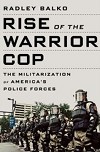
HuffPost writer and investigative reporter Radley Balko is author of the new book, Rise of the Warrior Cop: The Militarization of America's Police Forces.
12 Oct 15:27

Why Would You Put Your Balls To The Wall?

by Andrew Sullivan
Ibktim

The video.

I guess I should ask Tina Brown, who was inordinately fond of the expression. Maybe it was my balls she was putting “to” the wall? Anyway, it probably doesn’t matter what she meant. From a short history of idioms:

Many figurative expressions have literal origins, but few people stop to think about what they are. For example, the saying “it’s raining cats and dogs” apparently comes from a time when cats and dogs liked to hide in thatched roofs for warmth; when heavy rains fell, the animals would either fall through the roof or jump down in masses, according to etymologist and author Michael Quinion. It’s doubtful that Marvin Gaye knew the roots of his own lyrics, “I heard it through the grapevine”—a term that caught on in the mid-19th century in reference to the twisted vine-like wires of the telegraph and the jumbled messages that would result.

To be fair, it’s hard to believe there was once literal meaning to most phrases. It all seems so violent:

we’d be shooting ourselves in the foot, cutting off our noses, breaking each other’s legs for good luck, shooting messengers, and stabbing friends in the back. We’d be too hurt to dig our own literal graves. We’d be killing birds with stones, breaking camels’ backs, and beating dead horses. Dogs would be eating other dogs, cats would be getting skinned, and Mr Biden would be strangling Republicans. Maybe people would somehow lose their shit, but not before it hits the fan.

Alas, sometimes we think we know the root of a term but we are wrong. “Balls to the wall”, for example, is a term that refers to military pilots accelerating rapidly, thrusting the ball-shaped grip of the throttle lever to the panel firewall, thus gaining full speed. (Naturally Mr Borg was perplexed over this expression as well. “[Putting my balls on the wall] does not help me to do anything, except smell the wall,” he observed.

Another observation from Borg above.


12 Oct 15:14

Why The GOP Is Relenting, Ctd

by Andrew Sullivan
Ibktim

Maybe there is some hope, if the corpse of John McCain is being trotted out to try to dissuade Fox News-types from trying to defund the ACA.

That stopped clock, John McCain, tries to save his party from oblivion:

I love that last Fox News sigh. Yes, they can sigh! Never seen that before. It implies some kind of human capacity for introspection, which, at this point, amazes.


06 Oct 20:15

Tweeter Home shares explode on apparent Twitter mix-up

Ibktim

Wow. Wish I had been on board for that ride.

NEW YORK (Reuters) - Excitement for Twitter's coming IPO is running pretty high - so much so that some investors on Friday mistook the nearly worthless stock of long-dead electronics retailer Tweeter for the "tweeting" site, sending shares up more than 1,000 percent.