Shared posts

09 Feb 17:20

More Benefits of Gossip

by Freakonomics

(Photo: Kamyar Adl)

(Photo: Kamyar Adl)

Last week’s podcast, “Everybody Gossips (and That’s a Good Thing),” was all about the functions of gossip — good and bad. A new study (abstract; PDF) by Matthew FeinbergRobb Willer, and Michael Schultz looks at how gossip influences group cooperation. The researchers played a game with 216 participants, with groups investing in public goods. Participants were allowed to gossip in between rounds and exclude a participant from future rounds, if they chose. They found, as Nicholas DiFonzo said on our podcast, that gossip is great for policing and reforming selfish free riders. From The Telegraph:

Dr Matthew Feinberg, a researcher at Stanford University in the United State who co-wrote the study, said: “Groups that allow their members to gossip sustain co-operation and deter selfishness better than those that don’t.

“And groups do even better if they can gossip and ostracize untrustworthy members.”

The researchers found that when people learn about the behavior of others through gossip, they use the information to ally themselves with those deemed co-operative.

…Doctor Robb Willer, co-author and associate professor of sociology at Stanford, said: “By removing defectors, more co-operative individuals can more freely invest in the public good without fear of exploitation.”

When people deemed selfish suffer social exclusion they often learn from the experience and reform their behaviour by co-operating more in future group settings, the team found.

(HT: George Ghanem)

09 Feb 16:58

The Inefficiency of Long Hours

by Freakonomics

office night

(Photo: Pithawat Vachiramon)

Writing for The New Yorker, James Surowiecki explores the downside of working long hours:

The perplexing thing about the cult of overwork is that, as we’ve known for a while, long hours diminish both productivity and quality. Among industrial workers, overtime raises the rate of mistakes and safety mishaps; likewise, for knowledge workers fatigue and sleep-deprivation make it hard to perform at a high cognitive level. As [David] Solomon put it, past a certain point overworked people become “less efficient and less effective.” And the effects are cumulative. The bankers [Alexandra] Michel studied started to break down in their fourth year on the job. They suffered from depression, anxiety, and immune-system problems, and performance reviews showed that their creativity and judgment declined.

If the benefits of working fewer hours are this clear, why has it been so hard for businesses to embrace the idea? Simple economics certainly plays a role: in some cases, such as law firms that bill by the hour, the system can reward you for working longer, not smarter. And even if a person pulling all-nighters is less productive than a well-rested substitute would be, it’s still cheaper to pay one person to work a hundred hours a week than two people to work fifty hours apiece. (In the case of medicine, residents work long hours not just because it’s good training but also because they’re a cheap source of labor.) On top of this, the productivity of most knowledge workers is much harder to quantify than that of, say, an assembly-line worker. So, as Bob Pozen, a former president of Fidelity Management and the author of “Extreme Productivity,” a book on slashing work hours, told me, “Time becomes an easy metric to measure how productive someone is, even though it doesn’t have any necessary connection to what they achieve.”

While several investment banks have been making an effort to curtail working hours, Surowiecki points out that changing expectations and norms will be necessary for a true culture change.  One researcher, for example, told Surowiecki of a ”consulting firm that mandated that people stay out of the office on weekends, only to discover that they were working secretly from home. In a culture that venerates overwork, people internalize crazy hours as the norm.”

28 Jan 14:49

Raised From The Bed

by Andrew Sullivan

Amid serious drought in the American West, once-flooded towns are re-emerging:

6403502759_b6790dca0c_oNear this Sacramento suburb [of El Dorado Hills], man-made Folsom Lake has receded to less than one-fifth of its capacity amid bone-dry conditions in California, recently revealing outskirts of a ghost town called Mormon Island founded during the mid-19th century gold rush. On an unseasonably warm winter day recently, throngs of visitors descended on the cracked mud flats of the reservoir to inspect hand-forged nails, rusted hinges and other vestiges of frontier life that were inundated when the lake was created in 1955. …

Texas’s Lake Buchanan shrank in 2011 to reveal the original site of the town of Bluffton, drawing visitors to the remains of homesteads, a store and cotton gin that had been mostly under water since the reservoir was created in 1937, said Alfred Hallmark, a local historian. The town is one of more than 200 archaeological sites in Texas, including cemeteries, that have been uncovered by drought, said Pat Mercado-Allinger, director of the Texas Historical Commission’s archaeology division.

Geoff Manaugh stresses the fragility of these rediscovered locations:

6403495359_0b348c155f_bCurious visitors and amateur collectors alike are beginning to pick the old sites dry, rambling through the ruins of these dead towns revealed by drought, carrying metal detectors and looking for worthy artifacts. In the process, they are removing old objects – even whole pieces of architecture – before local authorities have the time and resources to catalog and protect what is re-emerging there. This surreal and unexpected opportunity to explore what was lost – in some cases nearly 100 years ago – mummified by water and preserved beneath the rising waves of western reservoirs, might thus simply go to waste.

Instead, the best option might be for the sites to be drowned all over again, assuming the drought will end and that these historic locales can once more be inundated, taken off the tourist map and sealed for their own protection beneath the calm surfaces of artificial lakes. Perhaps, then, future archaeologists better prepared for moments like this might yet be able to explore these historic sites when yet another drought rolls through.

(Photos from Texas’s Lake Buchanan by Merinda Brayfield)

27 Jan 13:36

Into The Woods

by Andrew Sullivan

dish_campsite

Environmental illness made Jill Neimark ”insanely reactive to everything – most clothing, my gas stove, a new mattress, the faint odour of fragrances on my partner, Paul, when he came in from work.” She sought health and solace in living outside:

Camping has not cured me, but it has helped to heal me. I’m still sick – vulnerable genetics, a few tick bites, and some bad environmental luck has made me forever fragile. … Yet I’m back in the game of life. Much of the world and its chemicals sit well with me now. I wear whatever I want, cook over gas and propane stoves, and don’t notice residues of fabric softener on [my partner] Paul’s clothes. I’ve camped winter and summer, and enjoyed them both. Where once I could barely walk to my bathroom, I now walk miles on nature trails and country roads. I become cold-adapted in winter, cooking in a hoodie and sandals, in temperatures that might have formerly made me shiver – and research backs me up there, too (cold thermogenesis, as it’s called, burns brown fat and raises antioxidant levels. It’s the reason Finns like to jump in the snow after a sauna).

This summer I spent time at an RV park in the northeast corner of Georgia, where I saw the glitter and dust of the Milky Way from horizon to horizon. And all the clichés held true: I was awestruck by my beautiful universe, and grateful to see it before me.

(Photo of “the night sky as seen from our camp at Machame Huts” at Kilimanjaro by Stig Nygaard)

27 Jan 00:00

A Poem For Saturday

by Andrew Sullivan
Ibktim

For all my bearded brethren.

Dish poetry editor Alice Quinn writes:

This coming Monday, January 27th, will mark the fifth anniversary of the death, at age 76, of John Updike. Poetry had a special place in his life. He wrote a poem every time he took a trip, and by the time he published Collected Poems, 1953-1993, by his calculation, The New Yorker had “said yes” to his poems one hundred and thirty five times. After his death, in the March 16th issue, the magazine ran ten poems from his last, dazzling, and tremendously moving collection, Endpoint, with a sequence of poems about his diagnosis, hospitalizations, and approaching lift-off from the world he celebrated so abundantly in his more than sixty books. In the opening poem of the sequence, “Spirit of ’76,” he wrote,

Be with me, words, a little longer; you
have given me my quitclaim in the sun,
sealed shut my adolescent wounds, made light
of grownup troubles, turned to my advantage
what in most lives would be pure deficit,
and formed, of those I loved, more solid ghosts.

In Updike’s honor, we’ll post three of his poems in the coming days.

“Upon Shaving Off One’s Beard” by John Updike:

The scissors cut the long-grown hair;
The razor scrapes the remnant fuzz.
Small-jawed, weak-chinned, big-eyed, I stare
At the forgotten boy I was.

(From Collected Poems, 1953-1993 by John Updike © 1993 by John Updike. Used by permission of Alfred A. Knopf, an imprint of the Knopf Doubleday Publishing Group, a division of Random House LLC.  All rights reserved.)

26 Jan 20:55

Deathbed Prayers, Finally Deciphered

by Andrew Sullivan

prayercode

Last week, MetaFilter member Janna Holm posted a request for help to the online community:

My grandmother passed away in 1996 of a fast-spreading cancer. She was non-communicative her last two weeks, but in that time, she left at least 20 index cards with scribbled letters on them. My cousins and I were between 8-10 years old at the time, and believed she was leaving us a code. We puzzled over them for a few months trying substitution ciphers, and didn’t get anywhere. My father found one of the cards the other day and I love puzzles and want to tackle the mystery again.

Mario Aguilar summarizes what happened next:

Holy moly, wouldn’t you know it? The code turned out to be last prayers of a dying woman. Each letter stood for the first letter of the word in a prayer or message to God. The back of the card [here] was the easiest to decypher, revealing the pattern. As harperpitt noted, this is almost certainly the Lord’s Prayer:

Our Father who art in Heaven, hallowed be thy name… etc etc etc

Having recognized the pattern and the prayer-like sentiment, community members started piecing together the front side of the card bit by bit. It all appears to be a series of thank yous and requests to god; things like “Please see that we are all happy and safe in our lives and work” and “thank you Almighty God for listening to my prayers and answering them.”

Casey Cep comments:

Janna Holm, in one of her final posts on the thread, said that her father suspects her grandmother had not only lost the ability to speak but was losing her memory when she wrote out the cards. Perhaps, then, the code was not to disguise her prayers but a device by which she preserved and protected them. Realizing that, Holm wrote on Tuesday, “At this point, I don’t think much more can or should be deciphered …. I’m O.K. leaving a little mystery with this one.” Would that we all could live with such mystery, and not only in prayer.

(Photo via MetaFilter user JannaK)

26 Jan 20:53

A Formula For Life?

by Andrew Sullivan

Natalie Wolchover profiles Jeremy England, a scientist who has developed “a new physics theory of life”:

From the standpoint of physics, there is one essential difference between living things and inanimate clumps of carbon atoms: The former tend to be much better at capturing energy from their environment and dissipating that energy as heat. Jeremy England, a 31-year-old assistant professor at the Massachusetts Institute of Technology, has derived a mathematical formula that he believes explains this capacity. The formula, based on established physics, indicates that when a group of atoms is driven by an external source of energy (like the sun or chemical fuel) and surrounded by a heat bath (like the ocean or atmosphere), it will often gradually restructure itself in order to dissipate increasingly more energy. This could mean that under certain conditions, matter inexorably acquires the key physical attribute associated with life.

“You start with a random clump of atoms, and if you shine light on it for long enough, it should not be so surprising that you get a plant,” England said.

England’s theory is meant to underlie, rather than replace, Darwin’s theory of evolution by natural selection, which provides a powerful description of life at the level of genes and populations. “I am certainly not saying that Darwinian ideas are wrong,” he explained. “On the contrary, I am just saying that from the perspective of the physics, you might call Darwinian evolution a special case of a more general phenomenon.”

(Hat tip: 3QD)

24 Jan 01:17

Mental Health Break

by Andrew Sullivan

Something good finally came out of all those annoying spam solicitations:

23 Jan 13:47

The Myth Of American Generosity?

by Andrew Sullivan

This is news to me:

For a start, it isn’t clear why the rest of us get credit for the fact that the Gateses and Warren Buffett gave away the bulk of their fortunes. But as importantly, it simply isn’t true. Private development assistance in the United States equals 0.2 percent of gross national income—the same as government development assistance. Private development assistance in the United Kingdom also equals 0.2 percent of gross national income—while government assistance equaled 0.6 percent in 2011. Add the two together, and the United States is one-half as generous as Great Britain — and two-fifths as generous as Sweden.

22 Jan 16:23

Outsourcing Injustice

by Andrew Sullivan

Jon Fasman calls private probation an extortion racket:

It works like this: say you get a $200 speeding ticket, and you don’t have the money to pay it. You are placed on probation, and for a monthly supervisory fee you can pay the fine off in instalments over the course of your probation term. The devil, as ever, is in the details, as a great Sunday story from the Atlanta Journal Constitution makes clear. Those supervisory fees vary markedly: in Cobb County, for instance, just north of Atlanta, the government charges a $22 monthly fee. Private companies charge $39, and often add extra costs on top of that to cover drug testing, electronic monitoring and even classes they decide offenders need. Fees often rise and even multiply when probationers cannot pay—and remember, these are people, for the most part, who could not come up with a hundred bucks and change to pay the initial fee; you have to expect they’ll have some trouble paying.

Even worse, people who fail to pay the fines imposed by these private companies can find warrants for their arrests sworn out and the period of their probation extended. I spoke with an attorney for a couple in Alabama who say they were threatened with Tasers and the removal of their children if they did not pay the company what they owed. In 2012 a court found that the fees levied by private-probation companies in Harpersville, Alabama, could turn a $200 fine and a year’s probation into $2,100 in fees and fines stretched over 41 months. A judge in Richmond and Columbia counties ruled such probation extensions illegal last autumn.

Drum adds:

Isn’t that great? It’s the free market at work, all right. It reminds me of last year’s piece in the Washington Post about the privatization of the debt collection in Washington DC[.] … You may remember this as the story of the 76-year-old man struggling with dementia who was thrown out on the street and had his house seized because of a mix-up over a $134 property tax bill.

15 Jan 14:52

Putting The “Why” In History

by Andrew Sullivan
Ibktim

That there even should be a discussion over this is maddening to me.

Eric Foner argues for a more analytical approach to history in high school:

I’m strongly in favor of students knowing the facts of history, not just memorizing or having it drilled into their heads. I’m certainly against this testing mania that’s going on now where you can judge whether someone really understands history by their performance on a multiple-choice test. Knowledge of the events of history is important, obviously, but also I think what I see in college students, that seems to be lacking at least when they come into college, is writing experience. In other words, being able to write that little essay with an argument. I see that they think, “OK, there are the facts of history and that’s it—what more is there to be said?” But of course, the very selection of what is a fact, or what is important as a fact, is itself based on an interpretation. You can’t just separate fact and interpretation quite as simply as many people seem to think.

15 Jan 14:32

Cool Ad Watch

by Andrew Sullivan

Exploding with flavor indeed:

The Sound of Taste from Grey London on Vimeo.

13 Jan 16:48

Kale, Kale Everywhere, but Only Cheetos to Eat

by Olga Khazan
alice_henneman/flickr

A food desert, according to the USDA, is an area that lacks grocery stores, farmer's markets, and other sources of healthy food. People living in food deserts often struggle to buy fresh produce, the thinking goes, so they rely on junk- and fast food, which contributes to their health problems. 

But what happens when you live in the opposite of a food desert? A place that is literally surrounded by the freshest food possible—a farm?

According to a wonderful recent piece in Modern Farmer, today's busy farmers are like the ancient mariner: Kale, kale everywhere, but only Cheetos to eat.

Farmers' days often stretch to 12 and 16 hours as they rush from field to CSA pickup to farmer's market. As with Americans in other professions, the time crunch means cooking is often the first thing to go. A variety of growers told Modern Farmer that they snack on candy all day and their families live on pizza during harvest season. 

“At the height of the season, it is a feat in and of itself to sustain the energy to work let alone come home and start preparing food," one Massachusetts farmer told the magazine.

Then there are the logistical challenges:

Nick Hagen, 28, a fifth-generation farmer at Hagen Farm in North Dakota, said says eating in the fields also poses logistical challenges. “Throughout our wheat or sugar beet harvests, there is no time to stop for lunch. I typically have one hand on the tractor’s steering wheel all day, and fish around in my lunch box with the other.” Hagen ends up eating a lot of one-palm foods like peeled hardboiled eggs and plain beans packaged in a container he can “hold and almost drink.” Apples are in; oranges, which need to be peeled, are out. “I can occasionally manage a banana,” he said.

This could explain why, as the magazine reports, 80 percent of farmers in California’s Central Valley are overweight or obese.

Though physical access to fresh food is certainly a factor in health and weight, stories like this are a good reminder that there's more to our obesity crisis than the objective availability of produce. Americans spend the least amount of time cooking and eating than any other country in the OECD, for example. We also tend to work more than our thinner brethren in Europe. You can put a Whole Foods on every block, but many of us still won't have the time to soak dried beans and whip up a healthy soup.


13 Jan 14:36

The Rise and Fall—and Rise—of Facial Hair

by Olga Khazan
 Library Company of Philadelphia/flickr

In 1940, the anthropologists Jane Richardson and Alfred Kroeber examined pictures of catalogues, magazines, and drawings dating back to the 1600s in an attempt to find trends in the cuts and styles of women’s dresses. What they produced were fascinating graphs of evolving social mores, with periods of plunging necklines quickly succeeded by buttoned-up decades of modesty, and vice-versa. One particularly entertaining chart shows generally Amish-length skirts throughout history — save for a racy, rapid shortening during the libidinous 1920s.

Skirt lengths by decade, from 1600 to 1940. (Richardson and Kroeber)

In 1976, University of Washington economist Dwight E. Robinson sought to apply the same technique to fashion trends in the opposite sex—specifically, in men's “facial barbering.”

For the study, published in the American Journal of Sociology, he examined the period between 1842 and 1972, the years of continuous weekly publication of the Illustrated London News. Since this was the “world’s most venerable pictorial news magazine,” it would serve as his sole source.

With the acknowledgement that the “gentlemen of the News” were largely limited to prominent members of society, he set about counting the frequency with which five different facial hair styles appeared: sideburns alone, sideburns and mustache, a beard (“any amount of whiskers centering on the chin,” in case you were confused), mustache alone, and clean-shaven. He excluded pictures of royalty, models, and non-Europeans, and gathered about 100 images for each year.

Here are the bristly results:

American Journal of Sociology

Beards and sideburns began losing their luster in the mid-late 1800s, while mustaches hit their apex in the early 20th century and have been increasingly less popular ever since. The number of brave souls who sported both sideburns and mustaches peaked in 1877, though the study did not address their later resurgence in modern-day Bushwick.

Few were clean-shaven in the late 1800s, but by the 1970s, nearly everyone was:

American Journal of Sociology

What’s more, the great “beard wave” of 1844 to 1955 corresponded to a similar heydey, for whatever reason, of extra-wide skirts in the Richardson-Kroeber study:

American Journal of Sociology 

Robinson’s theory as to why fashion—both sartorial and hirsute—seems to come in waves is this: Young people tend to eschew the tastes of their elders, but old trends seem new again after a sufficient amount of time has passed. So while long skirts may fall out of favor for one generation, their grandchildren will think they’re the cat’s pajamas.

1890s and 1950s dresses (Herbert Art Gallery & Museum, Coventry/Bess Georgette/flickr)

And most men might have been anti-beard between the 1940s and 1976, but a spin around the nearest artisanal cheese shop today will show that’s no longer the case.


13 Jan 14:31

Will It Fly? Bicycle Desk Edition

by James Hamblin
Ibktim

Wow, that's a really interesting idea about gyms as the solution to three national problems. I don't see it as a real solution, but that's creative and potentially useful. Sam, this is something that out to be sent to that guy you follow who writes comics that address crazy physics questions.

Prototype (Amblin Entertainment)

Earlier this week I wrote about a great bicycle desk that can generate power. The start-up Pedal Power demonstrated their product running laptops and cell phones, but also splitting logs, pumping water, and literally grinding axes. This is the prototype:

Pedal Power

Among the reader responses I received was this:

Dear Dr. Hamblin,

I posted your story about the bicycle desk to our intranet here at NASA, and I thought you might be interested in the string of comments it has generated thus far.  

Thanks for the great article,

Mary Tonkinson

Normally, reading a string of comments about one of my posts is not a super appealing proposition. That's just because by nature, Internet comment threads aren't, you know, bastions of cordiality. But that was a positive email, and it involved NASA. I have a long-standing interest in the progressive desk sciences.

So I read, and I did find it interesting. I asked if I could share it with everyone, and they said yes, so here is the conversation from Yammer—the internal social network used by NASA. Some of these people have not met in person and work at different branches. Most are aerospace engineers. They are not speaking for NASA.

Nelson Brown

I totally thought of this first. [Link to archived conversation.]

Mary Tonkinson in reply to Brown

You weren't the only one.  Years and years ago I had a friend named Phil who used to ask—repeatedly—why every gym and sports club didn't have a giant spring or battery system on the roof to collect all the energy being expended by the exercisers inside. I told him that the club members paying those hefty monthly fees to work out probably wouldn't go for the idea of their labor producing actual value—it counts as conspicuous consumption only when waste is involved.  But evidently others were also imagining how many watts of electricity could be generated by all those fashion- and health-conscious spinners, not to mention the desk jockeys of the world.  That's a lot o' wattage.

Nelson Brown to Green NASA

I was somewhat joking about connecting a generator to an office treadmill, but it made me curious about how much power a human can make. According to Wikipedia:
Walking (240 watts)
Running (1000 watts)
Sprinting (1700 watts at 25km/h)

So walking should provide enough power to run my laptop, if the mechanism is somewhat efficient.

Kevin Farrah in reply to Brown

I'd rather be flying...

David Barford testing his "Betterfly" human powered aircraft at Sywell airfield, Northampton, June 2012


Nelson Brown in reply to Tonkinson 

I’ve also daydreamed about a stationary bike on a hexapod connected to a flight sim. The simulated horsepower of your Fokker could be a function of your pedal output wattage. Also, I think there could be haptic feedback using a continuously-variable transmission or varying how deep the rotors and stators go in the generator.

I wonder if micro-turbine generators (for DIY hydroelectric in wetter climates than ours) or generators for small scale wind turbines would be an appropriate size. I also wonder if recent developments in small/light electric motors also translate to generators.

3-DoF (mboardmansc/wikimedia)

Originally my idea was to mount monitors on the hexapod cockpit, but now I’m thinking of Oculus Rift.

Maybe a 3-DoF motion sim would be fun but cost effective. Sometimes I think of an upright bike style seat and inceptors and a TRON 2.0 flying sim.

I think it would be strong encouragement to stick to exercise resolutions…

Mary Tonkinson in reply to Brown

My own daydream was more in the direction of social engineering. I started thinking that muscle-powered, energy-producing machines — treadmills, cycles, elliptical trainers, rowers, etc. — could be installed in existing gyms and sports clubs, and that patrons could choose to use them either to defray the cost of their membership or to produce an electricity "donation" to the club or, better yet, to a charity of their choice.

Then I began to think bigger: three national problems could be addressed with a single solution if POTUS and the First Lady joined forces to create "Power Stations"—public gyms where people could work out on energy-generating machines and receive cash for a small percentage of the power they produced, thus fighting obesity, providing (self-)employment, and creating alternative energy in one fell swoop. Instead of paying to work out, people could be paid to get fit, which would be a great incentive for a lot of folks. Or people could donate their wattage to a program for those who can't afford to pay for their utilities—PEPCO already has such a program. And all of this would have the salutary effect that the bike guys are hoping to see, namely, a renewal of people's relationship not only to the concept of power but to that of empowerment.

If you work at an interplanetary aeronautical engineering agency and have also been discussing one of my articles and how to make part of it fly, please do let me know.

My interview with the aforementioned bike guys (Steve Blood and Andy Wekin, Pedal Power's co-founders and only employees) ended with them musing that they have "been a little bit surprised by the media attention."

"We're just a couple of guys who live in a small town in upstate New York."

Now they are a couple guys who live in a small town in upstate New York who made a bike that can split logs and irrigate farmland (they are in talks to implement that in a part of rural India) and potentially take flight and solve at least three national crises. What else?

Would you work out at a public facility that paid you? What if the electricity you were generating was being used for evil?


13 Jan 14:30

Can Creationists Be Reasoned With?

by Andrew Sullivan
Ibktim

I hope this isn't a preview of how Nye plans to debate. This was a thoroughly terrible argument and will be much too easy to pick apart in ways that don't matter and allow the creationists to walk away feeling as though they were right.

On February 4th, Bill Nye will debate Creation Museum founder Ken Ham at the Creation Museum in Petersburg, Kentucky. The question: “Is creation a viable model of origins?” Ham explains why he set up the event:

Because our ministry theme for 2013 and for 2014 is “Standing Our Ground, Rescuing Our Kids,” our staff thought that a debate on creation vs. evolution with a man who has influenced so many children to believe in evolution would be a good idea. Now, those of you who know me realize that I don’t relish public debates, so please pray for me. But this debate will help highlight the fact that so many young people are dismissing the Bible because of evolution, and even many young people who had grown up in the church decided to leave the church because they saw evolution as showing the Bible could not be trusted.

Jerry Coyne thinks Nye should stay away:

My worries are these. First, Nye is likely helping fund the Creation Museum and its mission to teach children Biblically based untruths about the origin and diversity of life. Had I been Nye, I would have suggested some other recipient of the money. Not only that, but why hold such debates in a Temple of Ignorance instead of on neutral ground? Second, Nye, by his very appearance, is giving some credibility to Ham and his views. After all, The Science Guy is known and beloved by many Americans as a popularizer of science. Why debase himself this way? My third worry, then, is this will look great on Ham’s curriculum vitae, but not so good on Nye’s. It is my practice not to debate creationists for reasons #2 and #3. Nye can attack creationism in his own talks and writings, as he has been doing with great effectiveness. Debates are not the way to help people accept evolution.

Tyler Francke is also strongly against Nye’s participation:

[A]ny modern-day public debate over the fundamental tenets of creationism is a sham, a mockery of real discourse. That’s because there is no scientific debate to be had over whether the earth is billions of years old, or whether life shows strong evidence of common descent, or whether a global flood occurred within the memory of modern man. These questions (particularly the first and third) were settled by the experts who are paid to study such matters long before any of the would-be “debaters” were even born.

Joe Hanson agrees the premise of the debate is flawed:

[W]ho is this going to convince?

Are there large numbers of people who are on the fence about whether evolution or creationism is the One True Way? And I mean really, truly “on the fence” in the sense that they could be tipped to one side by the words of either a hero of their elementary school afternoons and Tumblr memes and bow-tie-shipping, or … that other guy?

Chaplain Mike predicts the debate “will only serve to further separate a segment of very vocal Christians into their little cubbyhole of biblicism and obscurantism”:

By holding this “debate,” Ham continues to attempt to reinforce the impression that his opinion is the Christian worldview, that his organization is engaged in serious interaction with scientists, and that the way Christians should “engage and impact the culture” is through trying to defeat them publicly with arguments. And if you can stack the deck, hold the debate on your home field, and raise a lot of money for your cause in the meantime, all the better! Christianity’s reputation for hucksterism is taking a giant step forward with this event.

But James Kirk Wall thinks “the people against the debate are wrong”:

Bill Nye is absolutely right in doing this, and here’s why. If someone had a belief that human babies came from storks, we wouldn’t need a debate. If one third of the adults in this country believed that babies came from storks, as insane as it sounds, yes, we need to have the debate. And that’s where we are. … Bill Nye has an opportunity to valiantly promote science over creationist nonsense. I expect Bill is going to do very well.

Ham’s response to Nye’s video at the top of the page is here.

13 Jan 14:23

How Sex Affects Intelligence, and Vice Versa

by Dan Hurley
macieklew/flickr/wikimedia

Forget mindfulness meditation, computerized working-memory training, and learning a musical instrument; all methods recently shown by scientists to increase intelligence. There could be an easier answer. It turns out that sex might actually make you smarter.

Researchers in Maryland and South Korea recently found that sexual activity in mice and rats improves mental performance and increases neurogenesis (the production of new neurons) in the hippocampus, where long-term memories are formed.

In April, a team from the University of Maryland reported that middle-aged rats permitted to engage in sex showed signs of improved cognitive function and hippocampal function. In November, a group from Konkuk University in Seoul concluded that sexual activity counteracts the memory-robbing effects of chronic stress in mice. “Sexual interaction could be helpful,” they wrote, “for buffering adult hippocampal neurogenesis and recognition memory function against the suppressive actions of chronic stress.”

So growing brain cells through sex does appear to have some basis in scientific fact. But there’s some debate over whether fake sex—pornography—could be harmful. Neuroscientists from the University of Texas recently argued that excessive porn viewing, like other addictions, can result in permanent “anatomical and pathological” changes to the brain. That view, however, was quickly challenged in a rebuttal from researchers at the University of California, Los Angeles, who said that the Texans "offered little, if any, convincing evidence to support their perspectives. Instead, excessive liberties and misleading interpretations of neuroscience research are used to assert that excessive pornography consumption causes brain damage."

Whether or not porn "addiction" literally damages the brain, even brief viewing of pornographic images does interfere with people’s “working memory”—the ability to mentally juggle and pay attention to multiple items. A study published last October in the Journal of Sex Research tested the working memory of 28 healthy individuals when they were asked to keep track of neutral, negative, positive, or pornographic stimuli. “Results revealed worse working memory performance in the pornographic picture condition,” concluded Matthias Brand, head of the cognitive psychology department at the University of Duisburg-Essen, Germany.

One myth about sex—or perhaps it’s just a joke?—is that “testosterone poisoning” makes young men stupid. Actually, a 2007 study in the journal Neuropsychologia measured the level of testosterone in the saliva of prepubertal boys, including some who were intellectually gifted, with an IQ above 130, some who were average, and some who were mentally challenged, with an IQ less than 70. They concluded that “boys of average intelligence had significantly higher testosterone levels than both mentally challenged and intellectually gifted boys, with the latter two groups showing no significant difference between each other.”

But if having sex can make people smarter, the converse is not true: being smarter does not mean you’ll have more sex. Smarter teens, in fact, tend to delay their initiation of coital activities. A 2012 study by researchers at the University of Pennsylvania found that high working memory decreases the likelihood of early adolescent sexual debut. Some researchers have attributed the delay to greater overall “competence” among smarter teens. But a 2010 study found that adolescents at both the upper and lower ends of the intelligence distribution were less likely to have sex. Most recently, a study of 536 same-sex twin pairs concluded that intelligence may be a red herring: the association is really between school achievement, not IQ per se, and age at first sexual experience.

In old age, too, cognitive abilities affect one’s chances of getting lucky. A study published just last month found that older adults with mild cognitive impairment (MCI), often a forerunner of Alzheimer’s disease, were only about half as likely to have engaged recently in sexual activity as were their cognitively healthy peers. Of those with MCI, just 32.5 percent had recently engaged in sex, compared to 62.3 percent of those without MCI.

Perhaps, however, the dream of getting smarter through sex is just an alluring fantasy. Tracey J. Shors, a psychologist at the Center for Collaborative Neuroscience at Rutgers University, has reported that while many activities can increase the rate at which new brain cells are born, only effortful, successful learning increases their survival. As she said at a meeting on “Cognitive Enhancers” at the Society for Neuroscience in 2012: “You can make new cells with exercise, Prozac and sex. If you do mental training, you’ll keep alive more cells that you produced. And if you do both, now you have the best of both worlds—you’re making more cells and keeping more alive.”


12 Jan 19:03

“Who Am I When Nobody Pays Attention?”

by Andrew Sullivan

In an interview about his new book, The Slavery of Death, Richard Beck thinks through the question:

The answer most of us would give, shaped as we are by the culture, is this: you’re a nobody. If you’re not someone who “stands out” you’re a nobody. Brene Brown calls this the “shame-based fear of being ordinary.” Nobody wants to be ordinary. We want to be extraordinary.

And why is that? Because of existential (death) anxiety. We want our lives to matter, to be noteworthy and significant in the face of death. We don’t want to fade away, we want to leave a dent in the universe. So we grasp at anything that makes us stand out from the crowd, that allows us to make and leave a mark. And so we get caught up in the neurotic social comparison game–online, at work, and in our social relationships. The main symptom of this “shame-based fear of being ordinary” is envy/jealousy fused with a feeling of inferiority and inadequacy. The trouble with this, and here is the pastoral turn, is that everywhere we see Jesus asking us to “take the last place.” To be a servant. To be the littlest, least, and last.

But that is impossible if our egos are being driven by a neurotic and shamed-based anxiety. Because the reality of Good Friday is that if you become like Jesus–if you carry his cross–nobody will pay attention, no one will say thank you, no one will recognize your work. That’s crucifixion. Of the ego, of the self, of our aspirations to be “a somebody.”

So that’s the rub. Jesus asks us to become a “nobody” in the eyes of the world. In our own eyes. But because of our death-infected neurosis–the shamed-based fear of being ordinary–we can’t accept Jesus’s offer. We don’t want to take up the cross. It’s too embarrassing. We don’t want to be a servant. No one will applaud or like us on Facebook.

The Dish previously has featured Beck’s work here, here, and here.

11 Jan 01:21

What air passengers hate: inattentive parents top seat-kickers

Ibktim

Bullshit. Peopel are not reacting to real situations, they're reacting to what they think is more annoying in theory. Sitting next to someone drenched in perfume/cologne for the duration of a flight is inescapable. Even little brats eventually get tired and pass out or find someone new to piss off.

(Reuters) - Americans ranked the "Inattentive Parent" as the most annoying type of fellow air traveler, defeating the "Rear Seat Kicker," "The Aromatic Passenger" and "The Boozer," according to a list by online travel agent Expedia.com.


11 Jan 01:00

Egypt apologies for constitution banner blunder

Ibktim

Wow. This is like those ACA ads out of Colorado.

CAIRO (Reuters) - Egypt has apologized for a banner promoting the new constitution that misspelt the word "Egyptians" and carried images of foreigners instead of locals, embarrassing the government as it tries to rally support for the document.
11 Jan 00:50

Oklahoma man charged with 'atomic wedgie' murder of stepfather

OKLAHOMA CITY (Reuters) - A 33-year-old Oklahoma man has been charged with killing his stepfather by giving him an "atomic wedgie," that caused the victim to suffocate on his own underwear.
11 Jan 00:07

[video] Blanket Of Snow Creates Illusion That Town Not A Total Shithole

A new teen trend ‘walking wet and nude’ couldn’t have caught on at a worse time, a man unknowingly purchases a lifetime supply of condoms, and a study proves this descended from wolves.


10 Jan 21:08

@MrJonesHistory @NatGeoLive @carlzimmer

by tom68373409 (tom)
Ibktim

Ignore the tweet. This is important, and I don't know why someone didn't tell me about it sooner. Comediansincarsgettingcoffee.com

Jerry Seinfeld + classic cars + another comedian = comedy gold.

09 Jan 17:58

Why So Few Black Women On SNL?

by Andrew Sullivan

Sasheer Zamata, the 27-year-old comedian seen above, has been tapped to join the cast of Saturday Night Live, becoming the first black woman on the show since Maya Rudolph’s departure in 2007. Drew Grant comments:

It’s an uneasy victory: While it’s definitely a good thing to have more diversity in the cast, the fact is that Ms. Zamata was hired in direct result to the backlash caused by Kenan Thompson’s comments to TV Guide last October, when he claimed the show had a hard time staffing black women because many of them were not qualified. The show’s producers were under considerable pressure to address the problem, and held several auditions to find someone who could reprieve Mr. Thompson of having to put on a dress every time the show needed an Oprah character. (SNL, which does have a sense of humor about itself, did a brilliant send-up of the issue in its cold opening with Kerry Washington last year.)

This is not to say Ms. Zamata is not qualified. A graduate of the University of Virginia, the acting major has been taking classes UCB, a popular feeding pool for late night, since 2009. Her YouTube videos show that she has a wide array of characters and impressions up her sleeve, including Beyonce and Michelle Obama. She’ll make a great addition to the show, and hopefully going forward, SNL will not have to hold seperate auditions for black women.

Erik Voss explored the controversy back in October:

The lack of diversity on SNL has always been a thorn in the paw for the show’s progressive fan base.

Since SNL premiered in 1975, only 15 black performers have been in the cast (and only two Latinos and zero Asian-Americans), and only four of those black performers have been women: Yvonne Hudson (1980-81), Danitra Vance (1985-86), Ellen Cleghorne (1991-95) and Maya Rudolph (2000-2007). Since Rudolph left, viewers have complained that SNL has no one to play zeitgeist celebrities like Michelle Obama, Oprah Winfrey, or Beyonce — not to mention a wealth of original black female characters. In the past, Thompson donned drag to play Whoopi Goldberg and Star Jones, but he now refuses to play such roles. SNL‘s casting process is notoriously secretive, leaving outsiders wondering why the show hasn’t diversified its cast. Is it, as Thompson suggested, simply a matter of the SNL‘s producers being unable to find black women who are “ready”? How is that possible when those of us in the alternative comedy scene know hilarious black women who have auditioned, only to be mysteriously rejected? Is anyone ever “ready” for SNL?

Poniewozik says SNL’s writers have work to do as well:

The next step will be making sure Zamata has someone to play besides Beyoncé, Michelle Obama, and Oprah Winfrey. Impressions, for better or worse, have been SNL’s bread and butter for decades; pretty much everyone in the cast needs to do them (Rudolph had a famous Oprah) and presumably so will Zamata. It’s one reason that diversity on SNL matters for practical reasons and not just social ones: you need people who can play everyone in the wide world of public figures.

But what will make Zamata’s hire worthwhile, for her and for the show, is making sure that she gets written great, memorable characters who aren’t black female celebrities as well. It’s the difference between being an African American woman SNL star (a funny performer who is black and female) and being the African American woman SNL star (a performer who’s specifically there to be black and female). That may seem like semantics, but it’s also about what real diversity on a cast means–giving a performer like Zamata the kind of range that the show’s most successful white men have had (and white women, and black men like Eddie Murphy).

Watch five impressions by Zamata here and many more videos of her work here.

09 Jan 16:27

The Sad Clowns

by Andrew Sullivan

Andrew McConnell Stott muses over the dual personas of many comedians:

Is it a condition of comic genius to be perpetually wrestling with demons? From Canio, the iconic, stiletto-wielding clown of Ruggero Leoncavallo’s 1892 opera, Pagliacci, to modern greats like Richard Pryor, Andy Kaufman, and John Belushi, it would seem so. Even in Chaplin’s day, the depressed and often violent clown was a well-established trope, both offstage and on.

Around the time of his divorce, Chaplin had fallen into such “full-blown despair” that he told the journalist Benjamin De Casseres:

There are days when contact with any human being makes me physically ill … I am oppressed at such times and in such periods by what was known among the Romantics as world-weariness. I feel then a total stranger to life.

Back to Stott:

That comedy is a mansion built on tragic foundations was a theory given credence by Sigmund Freud.

“A jest betrays something serious,” he wrote in Jokes and Their Relation to the Unconscious, which argued that humor was a means of circumnavigating taboo and repackaging unpalatable thoughts into digestible form. At the heart of Freud’s argument is a reluctance to accept comedy on its own terms as comedy, viewing it rather as a proxy for something kept hidden. For Freud, Chaplin was “a particularly simple and transparent case” of someone who used humor to explore the darker states of mind. Writing to his friend Max Schiller, Freud commented how Chaplin always seemed to play the same part:

The weak, poor, helpless, clumsy young man for whom things turn out right in the end. Do you think he has to forget his own ego for this role? On the contrary, he only acts himself as he was in his bleak youth. He cannot escape from those impressions, and even today he is compensating himself for the deprivations and discouragement of that period.

On that note, Harmony Korine depicts a deeply conflicted Chaplin in a NSFW scene from his 2007 film Mister Lonely:

09 Jan 16:11

Cool Ad Watch

by Andrew Sullivan
Ibktim

Whoa.

David Gianatasio is struck by the latest bit of brilliance from the New Zealand government:

This eerie safe-driving PSA from New Zealand employs an Outer Limits-style time freeze to impressive, heartbreaking effect as we watch two drivers, poised to collide in a matter of seconds, emerge from their vehicles and discuss the situation. … ”This campaign aims to reframe the way people look at their speed when they’re driving,” the New Zealand Transport Agency says. “We usually get to learn from our mistakes, but not when driving—the road is an exception. Even the smallest of mistakes on the road can cost us our life, or someone else’s.” The spot, by Clemenger BBDO, marks a departure from the agency’s recent work for the client, which successfully used humor and charm to highlight the dangers of driving while stoned. Here, the tone is intensely serious, and the riveting results are memorable and stand up to repeat viewings.

The Dish has posted both the stoned-while-driving PSA and this one on drunk driving. A reader adds, “I have no idea why NZ PSAs have gotten so inventive, but they are tapping into very working-class representation and language in such memorable ways.”

09 Jan 16:07

Why Shouldn’t China Outgrow Us?

by Andrew Sullivan

Charles Kenny reminds us not to mistake the rise of the East for the fall of the West:

What’s happening now is that the Rest are growing faster. China, the world’s most populous country, grew at an average rate of over 9 percent between 2010 and 2012. India grew at nearly 7 percent over the same period. Seven percent is more than three times our long-term growth rate. The developing world has an easier time growing fast, because we have invented a lot of technologies they can use to catch up to our levels of wealth. If they avoid tragic incompetence in policymaking, that means we should expect them to converge toward Western levels of income per person. In turn that implies the world is slowly returning to an era when economic dominance is largely a function of population—the default state for humanity for most of history, barring the industrial revolution. So we can stop blaming Washington, or Eurocrats, or kids today or wastrel boomers for the decline of the West. However annoying they surely are, they are not to blame for China getting bigger than we are. There’s one simple reason for that: China has a lot more people than the United States or Europe.

Looking at the broad span of history, Noah Smith argues that China’s global dominance isn’t assured either, precisely because it’s so large:

China has always been one of the world’s leading civilizations over the last five millennia. But it has only held both economic and military preeminence for brief periods of time—the late 1300s and 1400s being the most notable. Why has China not been preeminent for longer stretches? History is not a science, but we can make some guesses. The very thing that makes China so powerful and important–its titanic size–also endows it with fundamental weaknesses. …

Fortunately for China, this time may really be different. Modern communication and transportation technology mean that a big country is easier to defend and to integrate. Globalization, and China’s embrace of trade, mean that China is more open than it was during most of its history. But China has shown signs of worryingly isolationist instincts, harassing foreign companies operating within its borders. Meanwhile, China’s increasingly aggressive policies toward its neighbors—notably Japan and India, but also Vietnam and the Philippines—run the risk of inviting an effort at containment. The “Middle Kingdom,” like Germany in Europe a century ago, runs the risk of fighting all of its neighbors at once. In other words, China is vulnerable now for the same reason it was vulnerable in ages past. History is not a tale of Chinese preeminence, but a tale of Chinese oscillation.

04 Jan 18:57

J.R.R. Tolkien’s Little-Known, Gorgeous Art

by Maria Popova

An important side of the beloved writer, who was as much an artist of pictures as he was of words.

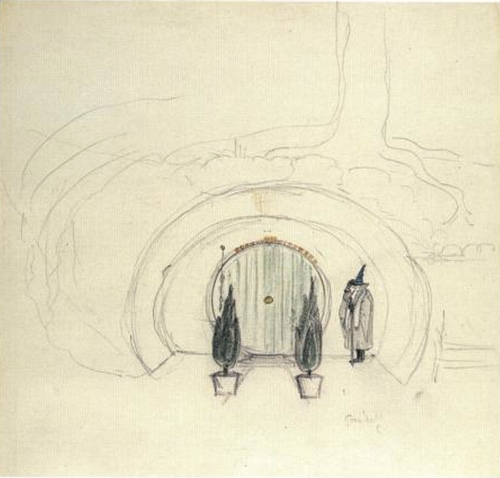
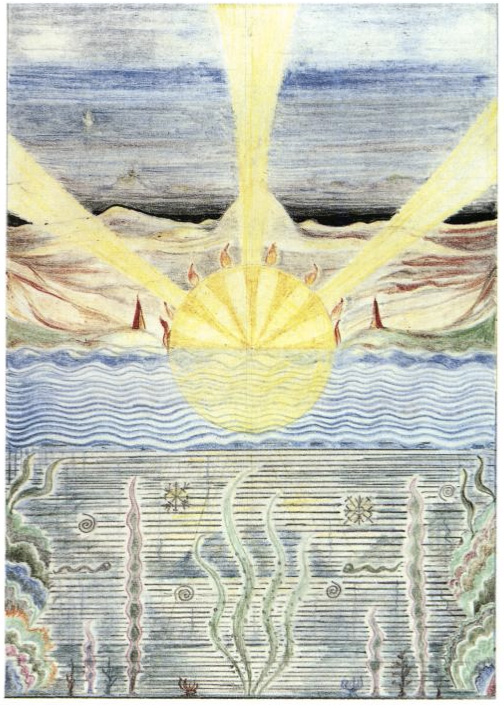
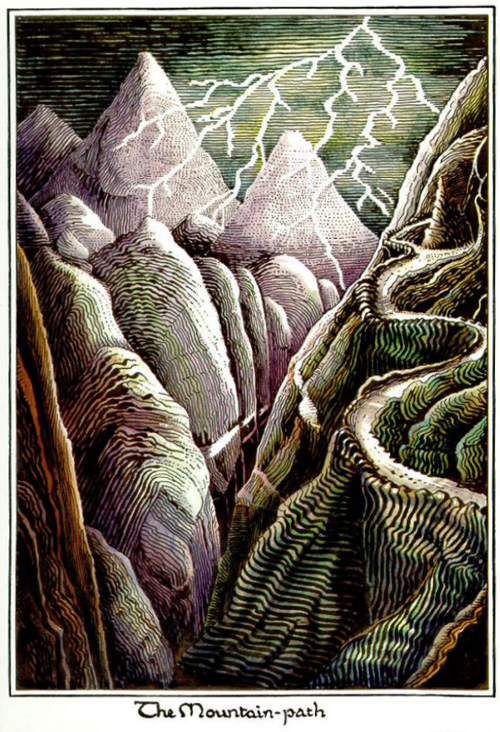
Storytelling icon J.R.R. Tolkien (January 3, 1892–September 2, 1973) was also among those rare creators with semi-secret talents in a discipline other than their primary realm of fame — but while his original sketches for the first edition of The Hobbit have seen the light of day in recent years, few realize that Tolkien, who self-illustrated many of his famous works, was as much an artist of pictures as he was of words. Unlike other famous authors who also drew but only as a hobby or diversion, including Sylvia Plath, William Faulkner, and Flannery O’Connor, Tolkien approached the visual medium with as much thoughtfulness and imaginative rigor as he did his stories. J.R.R. Tolkien: Artist and Illustrator (public library) collects more than 200 color reproductions, many previously unpublished, of Tolkien’s surviving art in watercolor, pencil, and ink, spanning sixty years of his life — from his childhood drawings to his illustrations for his books to his final sketches, as well as the drawings he created for his own children, his obsessive calligraphy, and his imaginative maps of Middle Earth.

Wayne G. Hammond and Christina Scull, who edited the volume and who ventured to England to find the exact locations where each of Tolkien’s drawings was created, write in the introduction:

We have long felt that Tolkien’s art deserves to be as well known as his writings. The two were closely linked, and in his paintings and drawings he displayed remarkable powers of invention that equalled his skill with words. His books have been read by countless thousands; most of his art, however, has been seen by only a very few.

Fortunately, a wealth of Tolkien’s art survives, for the beloved author seems to have had “an archivist’s soul,” as Hammond and Scull aptly put it: He kept nearly everything he drew, down to the scraps of paper filled with spontaneous doodles, and carefully tucked his most prized creations into special envelopes which he opened periodically to add captions and inscriptions years after the drawings were made.

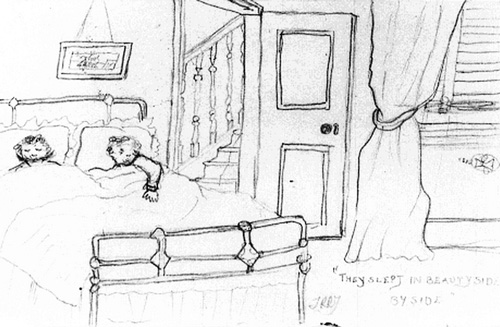
'They Slept in Beauty Side by Side' | Pencil

Tolkien drew this in early 1904, when he was twelve, when his mother was hospitalized for diabetes and he had to stay with her younger sister, Jane, in Sussex. The drawing depicts Jane and her husband Edwin, and the title was likely inspired by a line from the popular 19th-century poem 'The Graves of a Household' by Felicia Dorothea Hemans, which goes: 'They grew in beauty, side by side / They fill'd one home with glee.'

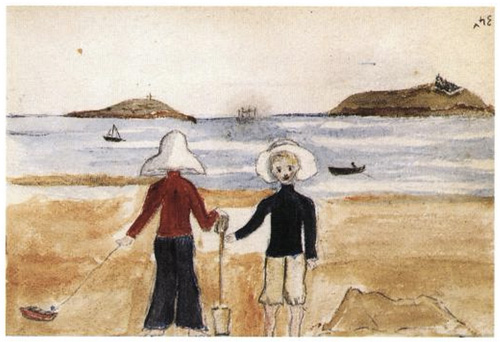
'Untitled (Two Boys at the Seaside)' | Watercolor, pencil

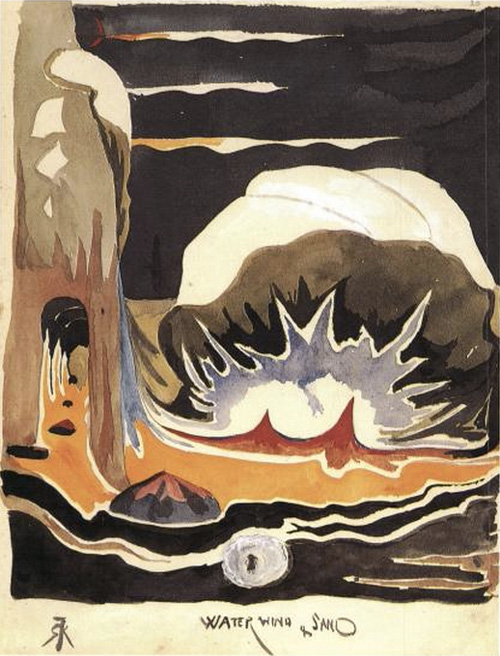
'Water, Wind & Sand' | Pencil, watercolor, white body color.

Tolkien drew this in early 1915 for 'The Book of Ishness'

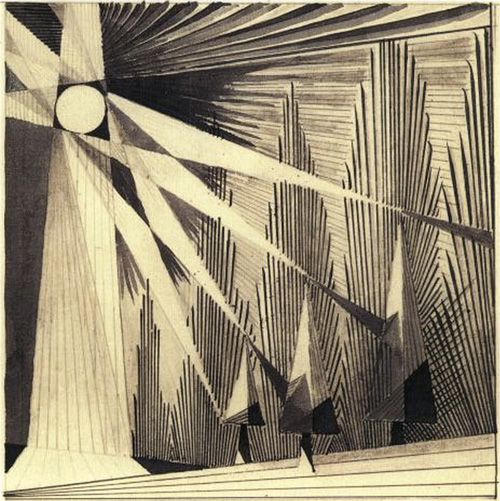
'Moonlight on a Wood' | Pencil, black ink, watercolor

'Gandalf' | Pencil, colored pencil

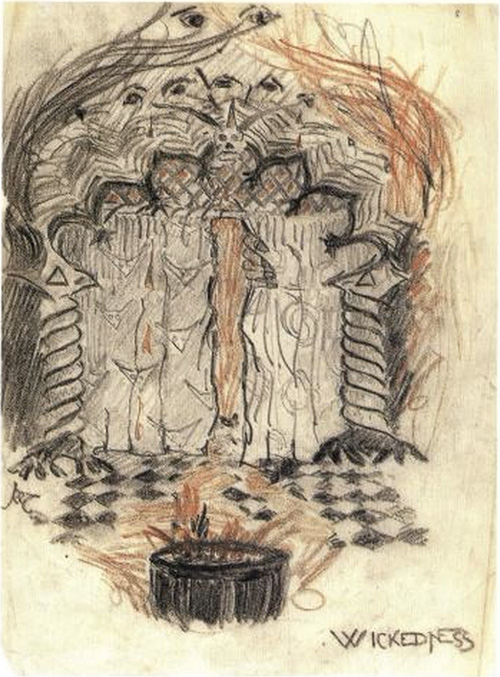
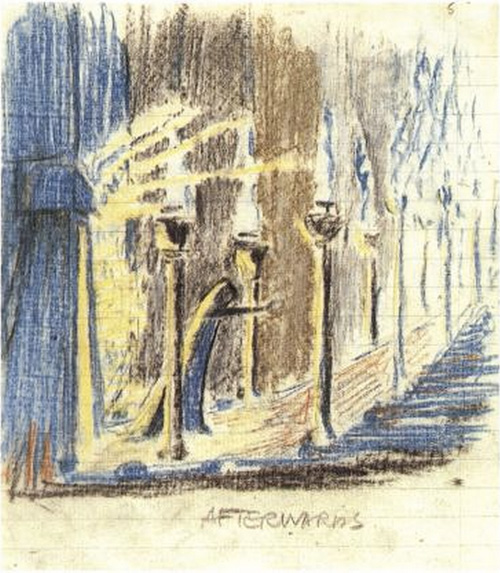
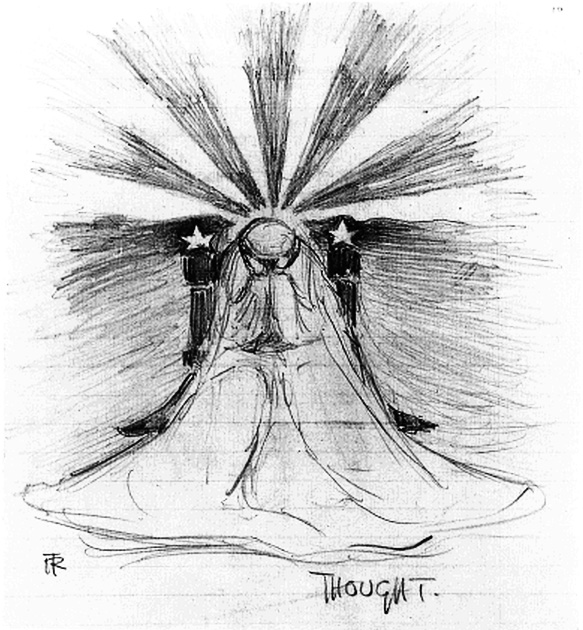
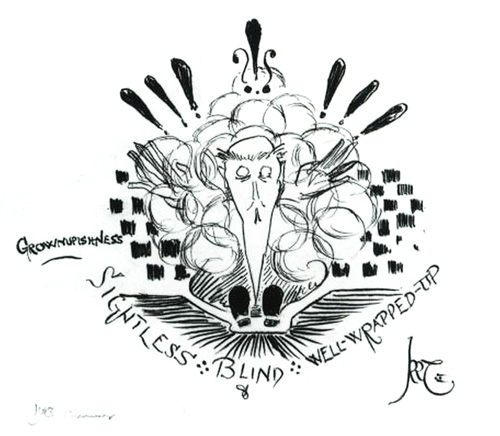
One of the most fascinating sections of the book, titled “Visions, Myths and Legends,” explores Tolkien’s drawings for abstract and psychological concepts like wickedness, weirdness, thinking, and time — something on which he had strong opinions.

'Wickedness' | Pencil, colored pencil

'Afterwards' | Pencil, colored pencil

'Thought' | Pencil

'Undertenishness' | Watercolor, black ink

'Grownupishness' | Black ink

(Curiously, Tolkien made the above drawing shortly after turning twenty-one, that special “grownupishness” rite of passage.)

J.R.R. Tolkien: Artist and Illustrator is a treasure trove in its entirety. Complement it with Tolkien on fairy tales, the psychology of fantasy, and why there’s no such thing as writing “for children.”

Donating = Loving

Bringing you (ad-free) Brain Pickings takes hundreds of hours each month. If you find any joy and stimulation here, please consider becoming a Supporting Member with a recurring monthly donation of your choosing, between a cup of tea and a good dinner:


♥ $7 / month♥ $3 / month♥ $10 / month♥ $25 / month


You can also become a one-time patron with a single donation in any amount:


Brain Pickings has a free weekly newsletter. It comes out on Sundays and offers the week’s best articles. Here’s what to expect. Like? Sign up.

Brain Pickings takes 450+ hours a month to curate and edit across the different platforms, and remains banner-free. If it brings you any joy and inspiration, please consider a modest donation – it lets me know I'm doing something right. Holstee

04 Jan 14:43

How Long It Takes to Form a New Habit

by Maria Popova
Ibktim

Really enjoying this feed lately. Sharing this to remember to buy this book . . . maybe.

Why magic numbers always require a grain of empirical salt.
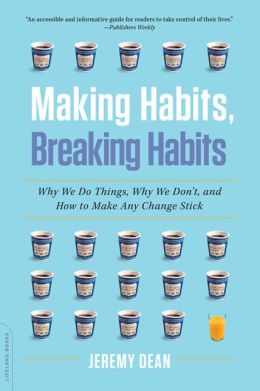
“We are what we repeatedly do,” Aristotle proclaimed. “Could the young but realize how soon they will become mere walking bundles of habits, they would give more heed to their conduct while in the plastic state,” William James wrote. But how, exactly, do we rewire our habits once they have congealed into daily routines? We already know that it takes more than “willpower.”

When he became interested in how long it takes for us to form or change a habit, psychologist Jeremy Dean found himself bombarded with the same magic answer from popular psychology websites and advice columns: 21 days. And yet, strangely — or perhaps predictably, for the internet — this one-size-fits-all number was being applied to everything from starting a running regimen to keeping a diary, but wasn’t backed by any concrete data. In Making Habits, Breaking Habits: Why We Do Things, Why We Don’t, and How to Make Any Change Stick (public library) — which also gave us this fascinating read on the psychology of self-control — Dean, whose training is in research, explores the actual science of habits through the existing empirical evidence on habit-formation. He cites one influential study that gives a more concrete answer to the elusive question of how long it takes for a new habit to take root:

In a study carried out at University College London, 96 participants were asked to choose an everyday behavior that they wanted to turn into a habit. They all chose something they didn’t already do that could be repeated every day; many were health-related: people chose things like “eating a piece of fruit with lunch” and “running for 15 minutes after dinner.” Each of the 84 days of the study, they logged into a website and reported whether or not they’d carried out the behavior, as well as how automatic the behavior had felt.

This notion of acting without thinking — known in science as “automaticity” — turns out, perhaps unsurprisingly, to be a central driver of habits. And it helps illuminate the real question at the heart of this inquiry: How long did it actually take for people to form a habit? Dean writes:

The simple answer is that, on average, across the participants who provided enough data, it took 66 days until a habit was formed. As you might imagine, there was considerable variation in how long habits took to form depending on what people tried to do. People who resolved to drink a glass of water after breakfast were up to maximum automaticity after about 20 days, while those trying to eat a piece of fruit with lunch took at least twice as long to turn it into a habit. The exercise habit proved most tricky with “50 sit-ups after morning coffee,” still not a habit after 84 days for one participant. “Walking for 10 minutes after breakfast,” though, was turned into a habit after 50 days for another participant.

What’s more, when researchers plotted the results, they found a curved relationship between habit and automaticity — meaning that the earlier repetitions were most beneficial for establishing a habit, and gains gradually dwindled over time. Dean explains:

It’s like trying to run up a hill that starts out steep and gradually levels off. At the start you’re making great progress upwards, but the closer you get to the peak, the smaller the gains in altitude with each step.

Indeed, the slowing down of gains was especially pronounced among some participants, to whom habit-formation simply didn’t seem to come naturally — so much so, that the researchers were surprised by how slowly some habits seemed to form:

Although the study only covered 84 days, by extrapolating the curves, it turned out that some of the habits could have taken around 254 days to form — the better part of a year!

What this research suggests is that 21 days to form a habit is probably right, as long as all you want to do is drink a glass of water after breakfast. Anything harder is likely to take longer to become a really strong habit, and, in the case of some activities, much longer.

While the finding may at first appear disheartening, it’s actually oddly assuring in reminding us that habit, like genius, is merely a matter of doggedness and “deliberate practice” — in fact, this brings us to the lesser-cited yet pivotal second half of Aristotle’s famous dictum: “Excellence … is not an act but a habit.”

Making Habits, Breaking Habits, which goes on to explore such fascinating facets as the difference between habit and intention, the key to getting off autopilot, and how to break out of habitual loops, is remarkably insightful and functionally helpful in its entirety. Complement it with the proto-treatise on the subject, William James’s famous meditation on habit, which includes his three rules for the successful formation of new habits.

Donating = Loving

Bringing you (ad-free) Brain Pickings takes hundreds of hours each month. If you find any joy and stimulation here, please consider becoming a Supporting Member with a recurring monthly donation of your choosing, between a cup of tea and a good dinner:


♥ $7 / month♥ $3 / month♥ $10 / month♥ $25 / month


You can also become a one-time patron with a single donation in any amount:


Brain Pickings has a free weekly newsletter. It comes out on Sundays and offers the week’s best articles. Here’s what to expect. Like? Sign up.

Brain Pickings takes 450+ hours a month to curate and edit across the different platforms, and remains banner-free. If it brings you any joy and inspiration, please consider a modest donation – it lets me know I'm doing something right. Holstee

04 Jan 12:57

The Baloney Detection Kit: Carl Sagan’s Rules for Bullshit-Busting and Critical Thinking

by Maria Popova

Necessary cognitive fortification against propaganda, pseudoscience, and general falsehood.


Carl Sagan (November 9, 1934–December 20, 1996) was many things — a cosmic sage, voracious reader, hopeless romantic, and brilliant philosopher. But above all, he endures as our era’s greatest patron saint of reason and critical thinking, a master of the vital balance between skepticism and openness. In The Demon-Haunted World: Science as a Candle in the Dark (public library) — the same indispensable volume that gave us Sagan’s timeless meditation on science and spirituality, published mere months before his death in 1996 — Sagan shares his secret to upholding the rites of reason, even in the face of society’s most shameless untruths and outrageous propaganda.

In a chapter titled “The Fine Art of Baloney Detection,” Sagan reflects on the many types of deception to which we’re susceptible — from psychics to religious zealotry to paid product endorsements by scientists, which he held in especially low regard, noting that they “betray contempt for the intelligence of their customers” and “introduce an insidious corruption of popular attitudes about scientific objectivity.” (Cue in PBS’s Joe Hanson on how to read science news.) But rather than preaching from the ivory tower of self-righteousness, Sagan approaches the subject from the most vulnerable of places — having just lost both of his parents, he reflects on the all too human allure of promises of supernatural reunions in the afterlife, reminding us that falling for such fictions doesn’t make us stupid or bad people, but simply means that we need to equip ourselves with the right tools against them.

Through their training, scientists are equipped with what Sagan calls a “baloney detection kit” — a set of cognitive tools and techniques that fortify the mind against penetration by falsehoods:

The kit is brought out as a matter of course whenever new ideas are offered for consideration. If the new idea survives examination by the tools in our kit, we grant it warm, although tentative, acceptance. If you’re so inclined, if you don’t want to buy baloney even when it’s reassuring to do so, there are precautions that can be taken; there’s a tried-and-true, consumer-tested method.

But the kit, Sagan argues, isn’t merely a tool of science — rather, it contains invaluable tools of healthy skepticism that apply just as elegantly, and just as necessarily, to everyday life. By adopting the kit, we can all shield ourselves against clueless guile and deliberate manipulation. Sagan shares nine of these tools:

  1. Wherever possible there must be independent confirmation of the “facts.”
  2. Encourage substantive debate on the evidence by knowledgeable proponents of all points of view.
  3. Arguments from authority carry little weight — “authorities” have made mistakes in the past. They will do so again in the future. Perhaps a better way to say it is that in science there are no authorities; at most, there are experts.
  4. Spin more than one hypothesis. If there’s something to be explained, think of all the different ways in which it could be explained. Then think of tests by which you might systematically disprove each of the alternatives. What survives, the hypothesis that resists disproof in this Darwinian selection among “multiple working hypotheses,” has a much better chance of being the right answer than if you had simply run with the first idea that caught your fancy.
  5. Try not to get overly attached to a hypothesis just because it’s yours. It’s only a way station in the pursuit of knowledge. Ask yourself why you like the idea. Compare it fairly with the alternatives. See if you can find reasons for rejecting it. If you don’t, others will.
  6. Quantify. If whatever it is you’re explaining has some measure, some numerical quantity attached to it, you’ll be much better able to discriminate among competing hypotheses. What is vague and qualitative is open to many explanations. Of course there are truths to be sought in the many qualitative issues we are obliged to confront, but finding them is more challenging.
  7. If there’s a chain of argument, every link in the chain must work (including the premise) — not just most of them.
  8. Occam’s Razor. This convenient rule-of-thumb urges us when faced with two hypotheses that explain the data equally well to choose the simpler.
  9. Always ask whether the hypothesis can be, at least in principle, falsified. Propositions that are untestable, unfalsifiable are not worth much. Consider the grand idea that our Universe and everything in it is just an elementary particle — an electron, say — in a much bigger Cosmos. But if we can never acquire information from outside our Universe, is not the idea incapable of disproof? You must be able to check assertions out. Inveterate skeptics must be given the chance to follow your reasoning, to duplicate your experiments and see if they get the same result.

Just as important as learning these helpful tools, however, is unlearning and avoiding the most common pitfalls of common sense. Reminding us of where society is most vulnerable to those, Sagan writes:

In addition to teaching us what to do when evaluating a claim to knowledge, any good baloney detection kit must also teach us what not to do. It helps us recognize the most common and perilous fallacies of logic and rhetoric. Many good examples can be found in religion and politics, because their practitioners are so often obliged to justify two contradictory propositions.

He admonishes against the twenty most common and perilous ones — many rooted in our chronic discomfort with ambiguity — with examples of each in action:

  1. ad hominem — Latin for “to the man,” attacking the arguer and not the argument (e.g., The Reverend Dr. Smith is a known Biblical fundamentalist, so her objections to evolution need not be taken seriously)
  2. argument from authority (e.g., President Richard Nixon should be re-elected because he has a secret plan to end the war in Southeast Asia — but because it was secret, there was no way for the electorate to evaluate it on its merits; the argument amounted to trusting him because he was President: a mistake, as it turned out)
  3. argument from adverse consequences (e.g., A God meting out punishment and reward must exist, because if He didn’t, society would be much more lawless and dangerous — perhaps even ungovernable. Or: The defendant in a widely publicized murder trial must be found guilty; otherwise, it will be an encouragement for other men to murder their wives)
  4. appeal to ignorance — the claim that whatever has not been proved false must be true, and vice versa (e.g., There is no compelling evidence that UFOs are not visiting the Earth; therefore UFOs exist — and there is intelligent life elsewhere in the Universe. Or: There may be seventy kazillion other worlds, but not one is known to have the moral advancement of the Earth, so we’re still central to the Universe.) This impatience with ambiguity can be criticized in the phrase: absence of evidence is not evidence of absence.
  5. special pleading, often to rescue a proposition in deep rhetorical trouble (e.g., How can a merciful God condemn future generations to torment because, against orders, one woman induced one man to eat an apple? Special plead: you don’t understand the subtle Doctrine of Free Will. Or: How can there be an equally godlike Father, Son, and Holy Ghost in the same Person? Special plead: You don’t understand the Divine Mystery of the Trinity. Or: How could God permit the followers of Judaism, Christianity, and Islam — each in their own way enjoined to heroic measures of loving kindness and compassion — to have perpetrated so much cruelty for so long? Special plead: You don’t understand Free Will again. And anyway, God moves in mysterious ways.)
  6. begging the question, also called assuming the answer (e.g., We must institute the death penalty to discourage violent crime. But does the violent crime rate in fact fall when the death penalty is imposed? Or: The stock market fell yesterday because of a technical adjustment and profit-taking by investors — but is there any independent evidence for the causal role of “adjustment” and profit-taking; have we learned anything at all from this purported explanation?)
  7. observational selection, also called the enumeration of favorable circumstances, or as the philosopher Francis Bacon described it, counting the hits and forgetting the misses (e.g., A state boasts of the Presidents it has produced, but is silent on its serial killers)
  8. statistics of small numbers — a close relative of observational selection (e.g., “They say 1 out of every 5 people is Chinese. How is this possible? I know hundreds of people, and none of them is Chinese. Yours truly.” Or: “I’ve thrown three sevens in a row. Tonight I can’t lose.”)
  9. misunderstanding of the nature of statistics (e.g., President Dwight Eisenhower expressing astonishment and alarm on discovering that fully half of all Americans have below average intelligence);
  10. inconsistency (e.g., Prudently plan for the worst of which a potential military adversary is capable, but thriftily ignore scientific projections on environmental dangers because they’re not “proved.” Or: Attribute the declining life expectancy in the former Soviet Union to the failures of communism many years ago, but never attribute the high infant mortality rate in the United States (now highest of the major industrial nations) to the failures of capitalism. Or: Consider it reasonable for the Universe to continue to exist forever into the future, but judge absurd the possibility that it has infinite duration into the past);
  11. non sequitur — Latin for “It doesn’t follow” (e.g., Our nation will prevail because God is great. But nearly every nation pretends this to be true; the German formulation was “Gott mit uns”). Often those falling into the non sequitur fallacy have simply failed to recognize alternative possibilities;
  12. post hoc, ergo propter hoc — Latin for “It happened after, so it was caused by” (e.g., Jaime Cardinal Sin, Archbishop of Manila: “I know of … a 26-year-old who looks 60 because she takes [contraceptive] pills.” Or: Before women got the vote, there were no nuclear weapons)
  13. meaningless question (e.g., What happens when an irresistible force meets an immovable object? But if there is such a thing as an irresistible force there can be no immovable objects, and vice versa)
  14. excluded middle, or false dichotomy — considering only the two extremes in a continuum of intermediate possibilities (e.g., “Sure, take his side; my husband’s perfect; I’m always wrong.” Or: “Either you love your country or you hate it.” Or: “If you’re not part of the solution, you’re part of the problem”)
  15. short-term vs. long-term — a subset of the excluded middle, but so important I’ve pulled it out for special attention (e.g., We can’t afford programs to feed malnourished children and educate pre-school kids. We need to urgently deal with crime on the streets. Or: Why explore space or pursue fundamental science when we have so huge a budget deficit?);
  16. slippery slope, related to excluded middle (e.g., If we allow abortion in the first weeks of pregnancy, it will be impossible to prevent the killing of a full-term infant. Or, conversely: If the state prohibits abortion even in the ninth month, it will soon be telling us what to do with our bodies around the time of conception);
  17. confusion of correlation and causation (e.g., A survey shows that more college graduates are homosexual than those with lesser education; therefore education makes people gay. Or: Andean earthquakes are correlated with closest approaches of the planet Uranus; therefore — despite the absence of any such correlation for the nearer, more massive planet Jupiter — the latter causes the former)
  18. straw man — caricaturing a position to make it easier to attack (e.g., Scientists suppose that living things simply fell together by chance — a formulation that willfully ignores the central Darwinian insight, that Nature ratchets up by saving what works and discarding what doesn’t. Or — this is also a short-term/long-term fallacy — environmentalists care more for snail darters and spotted owls than they do for people)
  19. suppressed evidence, or half-truths (e.g., An amazingly accurate and widely quoted “prophecy” of the assassination attempt on President Reagan is shown on television; but — an important detail — was it recorded before or after the event? Or: These government abuses demand revolution, even if you can’t make an omelette without breaking some eggs. Yes, but is this likely to be a revolution in which far more people are killed than under the previous regime? What does the experience of other revolutions suggest? Are all revolutions against oppressive regimes desirable and in the interests of the people?)
  20. weasel words (e.g., The separation of powers of the U.S. Constitution specifies that the United States may not conduct a war without a declaration by Congress. On the other hand, Presidents are given control of foreign policy and the conduct of wars, which are potentially powerful tools for getting themselves re-elected. Presidents of either political party may therefore be tempted to arrange wars while waving the flag and calling the wars something else — “police actions,” “armed incursions,” “protective reaction strikes,” “pacification,” “safeguarding American interests,” and a wide variety of “operations,” such as “Operation Just Cause.” Euphemisms for war are one of a broad class of reinventions of language for political purposes. Talleyrand said, “An important art of politicians is to find new names for institutions which under old names have become odious to the public”)

Sagan ends the chapter with a necessary disclaimer:

Like all tools, the baloney detection kit can be misused, applied out of context, or even employed as a rote alternative to thinking. But applied judiciously, it can make all the difference in the world — not least in evaluating our own arguments before we present them to others.

The Demon-Haunted World is a timelessly fantastic read in its entirety, timelier than ever in a great many ways amidst our present media landscape of propaganda, pseudoscience, and various commercial motives. Complement it with Sagan on science and “God”.


donating = loving

For seventeen years, I have been spending hundreds of hours and thousands of dollars each month composing The Marginalian (which bore the outgrown name Brain Pickings for its first fifteen years). It has remained free and ad-free and alive thanks to patronage from readers. I have no staff, no interns, no assistant — a thoroughly one-woman labor of love that is also my life and my livelihood. If this labor makes your own life more livable in any way, please consider lending a helping hand with a donation. Your support makes all the difference.


newsletter

The Marginalian has a free weekly newsletter. It comes out on Sundays and offers the week’s most inspiring reading. Here’s what to expect. Like? Sign up.