Shared posts

27 Feb 17:52

How the New Model of Marriage May Drive Income Inequality

by Freakonomics

(Photo: Boston Public Library)

(Photo: Boston Public Library)

Our last two podcasts, “Why Marry?” (Part 1 and Part 2) explored the broad and deep changes in the institution of marriage. One theme was that the old marriage model of “production complementaries” has shifted to one based on “consumption complementarities.” Here’s Justin Wolfers on the subject:

We have more time, more money, and so you want to spend it with someone that you’ll enjoy. So, similar interests and passions. We call this the model of hedonic marriage. But really it’s a lot more familiar than that. This is just economists giving a jargon name to love. So you want someone who’s actually remarkably similar to you or has similar passions that you do. So it fundamentally changes who marries who.

But is this change also related to income inequality? Wolfers briefly referenced that idea a few years back; in a recent article for Vox, the economics Jeremy Greenwood, Nezih Guner, Georgi Kocharkov, and Cezar Santos further the argument:

Think about the following simple thought experiment. Suppose that there are only two types of people, equal in numbers, those that went to college and those who did not. Those who went to school earn $30 and those who did not earn $10. If educated men marry uneducated women and uneducated men marry educated women, then every household will earn $40 in total. So, household income is perfectly equalised. Now, imagine a world in which educated people only marry other educated people. Then, a household made up of an educated man and an educated woman will earn $60 versus the $20 earned by a household that consists of only uneducated spouses. The households at the top of the distribution would have three times the income of those at the bottom.

Obviously, the example above is a dramatic simplification of reality, but it does capture an important trend that is actually taking place in the U.S. economy. To study its impact, we track samples of hundreds of thousands of households from the U.S. Census Bureau for the period 1960 to 2005 (see Greenwood, Guner, Kocharkov and Santos 2014). The upshot of the analysis is that rising assortative mating together with increasing labour-force participation by married women are important in order to account for the determinants of growth in household income inequality in the U.S.

26 Feb 14:45

Pondering The Prodigal Son

by Andrew Sullivan

In a column on what the parable of the Prodigal Son can teach us about social policy, David Brooks expresses (NYT) a wish for more grace and forgiveness in American life:

The father … understands that the younger brothers of the world will not be reformed dish_spada and re-bound if they feel they are being lectured to by unpleasant people who consider themselves models of rectitude. Imagine if the older brother had gone out to greet the prodigal son instead of the father, giving him some patronizing lecture. Do we think the younger son would have reformed his life to become a productive member of the community? No. He would have gotten back up and found some bad-boy counterculture he could join to reassert his dignity.

The father teaches that rebinding and reordering society requires an aggressive assertion: You are accepted; you are accepted. It requires mutual confession and then a mutual turning toward some common project. Why does the father organize a feast? Because a feast is nominally about food, but, in Jewish life, it is really about membership. It reasserts your embedded role in the community project.

Dreher squirms at the idea of no-strings-attached love:

I mostly agree with Brooks’s point here, but would emphasize that the Prodigal Son repented in humility. In practical terms, that means he recognized the error of his ways and came back with firm intention of changing. As Brooks says, the reconciliation and redemption of the Prodigal Son requires mutuality. If the Father and the Older Brother do not make it possible for the Prodigal to find welcome and restoration, then it won’t happen. On the other hand, the Prodigal must make a decisive act of humility, which is to turn from his life-destroying ways. Notice the Prodigal doesn’t come back expecting his family to forgive and forget, and restore him to his former state. Having tasted the bitterness of his own waywardness, he just wants to do whatever he can to be part of their community again.

David Zahl and Will McDavid defend the radical message of the parable:

If [Dreher's response] sounds reasonable, that’s because it is. But Christ’s parable is not about a reasonable son or a reasonable father or their reasonable relationship. Doubtless Dreher means well, but his line of thinking opens the door for forgiveness to be predicated on proper repentance, or what he calls “firm purpose of amendment” (a milder “desire and resolution” in his ex-tradition’s catechism). There may be other biblical passages you could use to defend such a framework, but this isn’t one–after all, the son isn’t even allowed to finish his speech or declare his intent. So if the phrase “firm purpose” makes you shiver, you’re in good company. It’s a reliable recipe for religious neurosis, one which thrusts a person into the kind of excruciating internal guessing game that drove Martin Luther to despair: How do I know I’ve really repented? What if I say I repent but don’t feel it? What if I feel repentant but don’t act on it? What if I only act on it for a while? What if there’s something I need to repent of that I can’t remember? What if my neighbor’s repentance looks a lot firmer than mine? What if I’m in a coma? You get the idea.

(Image of Return of the Prodigal Son by Leonella Spada via Wikimedia Commons)

23 Feb 17:38

When Love Bids You Welcome

by Andrew Sullivan

Miranda Threlfall-Holmes credits the 17th century poet and Anglican clergyman George Herbert for converting her to Christianity:

[Herbert's] poems are, in effect, a spiritual autobiography. Although they are not individually dated and so cannot be directly related to different phases of Herbert’s life, dish_herbert many of them clearly describe his intensely personal struggles with faith and calling. Even those that are more formal explorations of particular religious doctrines or concepts have a similar air of spiritual authenticity. There are no mere statements of dogma. The poems record the poet’s own doubts and faith in a way that still rings true with many readers, even those with no explicit faith of their own. …

They are also full of genuine emotion. This makes them feel much more modern than their date would suggest. For Herbert, religion is never simply a set of dogmatic assertions, or a collection of cultural practices, as historical religion is sometimes caricatured. Nobody reading these poems can be left in any doubt as to Herbert’s emotional engagement with his subject matter. The question Herbert’s poetry raises is eternally contemporary. The poems don’t ask us “Is this true?” but “How do I feel about this?”

It is this question that slipped under my guard as a teenager. It was easy to dismiss the truth of the 20 impossible things that religion seemed to expect me to believe before breakfast. It was much harder to dismiss my own emotional reaction to these poems: the beauty, the yearning, the enticing danger. They left me with the sense that I was standing on a cliff, staring out to sea, hearing marvellous tales of lands beyond the horizon and wondering if they were, after all, just fairy tales or whether the intensity with which the tales were told was evidence that the teller had indeed seen a barely imagined kingdom.

Previous Dish on Herbert and his poetry here, here, and here.

(Image of portrait of George Herbert by Robert White, 1674, via Wikimedia Commons)

23 Feb 00:02

Mental Health Break

by Andrew Sullivan

“Tainted Love” via floppy drives:

(Hat tip: Devour)

23 Feb 00:01

“The Great American Novel Is A Chimera”

by Andrew Sullivan

In response to Lawrence Buell’s essay on the “Great American Novel,” David L. Ulin calls the term into question, writing that, as a concept, the GAN “misreads the fundamental function of literature, which is less about the grand defining statement than it is about empathy”:

What literature offers is not an overview; it is not a way to understand the broad movements of the world. Such aspects may be represented — we can learn a lot about what it was like to live in 19th century London by reading Dickens, or St. Petersburg under the czars by reading Gogol — but they are not the point. No, literature is a connection-making mechanism: We read about people, individuals, and inhabit their lives, their struggles, their desires. We see that they are not unlike we are. This creates both identity and identification, allowing us to step (for a moment, anyway) outside ourselves.

The Great American Novel is something different; it signifies a belief in literature as all-encompassing, as able to gather the diverse strands of an inexplicable and unruly nation, and make sense of them in a single work. That this is impossible should go without saying; it’s more than a little reductive as well. Consciousness is chaos and life has no meaning, and the stories we tell — including the big ones: faith, statehood, family, history — are just a series of dreams we make up to give shape to the shapeless, to build a firewall against the void. That it all falls to pieces is part of the point; we are alone together, after all.

Though he says he would “rather talk about a novel in any other conceivable terms,” Scott Esposito sees some significance in the concept of the GAN:

There are places out there that are both small enough and have young enough literary scenes that such-and-such an author can legitimately be considered the “Great _______ Novelist,” having written the “Great _______ Novel.” One upon a time this was what was meant by the epic, though that’s long, long over now. So in a sense it maybe was possible somewhere, although, in a completely different literary genre and back when people sacrificed bulls. … [A]t some point way, way back, the literary world was small enough that a single figure could dominate a literature for a even a large and diverse country like the U.S. in a way that’s just completely incomprehensible now.

Previous Dish on the topic here, here, and here.

22 Feb 14:50

AZ’s Discrimination Bill: Not Just Bad For Gays

by Andrew Sullivan

Refuse Service

Even the Anti-Defamation League is freaked out by the anti-gay bill that passed the Arizona state House yesterday and is now headed to Governor Jan Brewer’s desk:

Under Arizona’s law, the ADL says, a business owner could refuse to hire someone of a different religion, an employer could refuse to pay men and women an equal wage, or a cab driver could refuse a fare to a house of worship different from their own, as long as they say doing so would “substantially burden” their excercise of their religious faith.

Bill Konigsberg says the bill opens up new forms of discrimination:

That which is already prohibited (not hiring a person because of their race, for instance), remains prohibited. That which is NOT prohibited (you can decide not to hire me, or you can fire me, because I am gay) remains that way. And now, because of this bill, a new form of discrimination will be allowed: exclusion.

As an openly gay person, this bill terrifies me. Imagine walking into a local restaurant and being told you had to leave because they don’t want to serve people “like you.” If Governor Jan Brewer signs this into law, that will become a real possibility every time I walk into a business. I’ve heard people say, “Well, just don’t walk into that business.” That’s a lot easier to say than to live.

Burroway points out that the law creates a special right:

It also adds a new element of discrimination into the law: atheists would have no grounds to claim protection for refusing to serve gay people in a restaurant or rent to Latinos or hire Jews. This law and others like it carve out a special privilege available to religious people only.

One Arizona business is already highlighting the absurdity of the bill, as seen in the photo above:

Rocco’s Little Chicago Pizzeria, a locally-owned pizza/pasta/wings restaurant in Tucson, Arizona, wants bigoted state lawmakers to know that if they’re going to legalize discrimination in the Grand Canyon State, they’d better be prepared to receive a taste of their own medicine. Shortly after last night’s vote, the restaurant took a stand for equality by posting this photo to their Facebook page. The caption: “Funny how just being decent is starting to seem radical these days.”

The Dish sounded off on this and other discrimination laws here, and explored the “religious liberty” argument here.

22 Feb 14:45

Cool Ad Watch

by Andrew Sullivan

A little smug but really clever way to get your competitors to advertize for you:

Update from a reader:

DHL actually had nothing to do with that advert that you embedded – the video was a result of an internal creative competition held by German advertising agency Jung von Matt.  There is an original German version, though the English version is the one that has gone viral. DHL is thrilled with the free publicity, and the message is very much in line with what the company believes about itself, but DHL was as surprised as anyone to see these videos when they were first uploaded on YouTube.

(Hat tip: Tastefully Offensive)

22 Feb 14:37

Faces Of The Day

by Andrew Sullivan

South and North Korea Resume Family Reunions

South Korean Park Yang-Gon meets with his North Korean brother Park Yang-Soo during a family reunion after being separated for 60 years in Mount Kumgang, North Korea on February 20, 2014. The program, which allows reunions of family members separated by the 1950-53 Korean war, is a result of recent agreement between Koreas which had been suspended since 2010. By Park Hae-Mook-Korea Pool/Getty Images.

22 Feb 14:33

The History Of Animal Names

by Andrew Sullivan


Stephen Messenger provides a lesson:

[B]y the 8th century BC in ancient Greece, animals with names began to be recorded in literature. The most famous example perhaps is Odysseus’ faithful hound Argos, whose name means “swift foot,” in Homer’s Odyssey. Other classical texts reveal names of horses, bulls, cows, and even elephants owned by hellenistic kings. In Ancient Rome, personal names for animals abound, given to trusty dogs, horses, and others, and were often chosen from mythology — suggesting that by then animals held a lofty place in the lives of their owners. These non-humans were no longer just animals. Indeed, they were our friends.

Frank Abbott, in his book Society & Politics in Ancient Rome, writes of ancient epitaphs found written in honor of pets. One dog, named Patricus, received this tribute from his grieving owner, revealing a rare early sentiment of love for an animal:

“My eyes were wet with tears, our little dog, when I bore thee (to the grave)… So, Patricus, never again shall thou give me a thousand kisses. Never canst thou be contentedly in my lap. In sadness have I buried thee, and thou deservist. In a resting place of marble, I have put thee for all time by the side of my shade. In thy qualities, sagacious thou wert like a human being. Ah, me! What a loved companion have we lost!”

(“Dogs of NYC” map by WNYC)

21 Feb 20:54

An App for a New Kind of Holiday

by Ian Ayres

SHIn 2009, while watching the closing credits of Invictus, the film about Nelson Mandela’s first years as South African president, I heard Yollandi Nortjie sing “9000 days were set aside / 9000 days of destiny / 9000 days to thank Gods wherever they may be.”  Mandela spent 9,000 days in prison (about 24.7 years).

For some reason, I started thinking about the power of expressing the passage of time in alternative incremental units, and after playing around on Excel, I figured out that my spouse and I would soon have the opportunity to celebrate our “ten millionth marriage minute” (a little over 19 years). 

It struck my fancy that this was a length of time worthy of observing in some way – even if just as an excuse to share a nice bottle of wine.  For whatever reason, I loved discovering these additional, arbitrary moments of celebration and I decided it would be pretty easy to alert people when an unusual holiday was about to occur. 

So today Greg Conyers and I are happy to announce that we’re launching a free iPhone app, Secondhand Holidays. Our app will alert you when unusual moments of celebration are about to occur.  If you liked “500 Days of Summer,” you might enjoy telling your boyfriend or girlfriend when you’ve been in a relationship for 100 million seconds (after 3.17 years). 

If you want, the app will also calculate “secondhand” holidays for Facebook friends that you select.  Because of this feature, I now know that next week will be a billion seconds since my friend Betsy’s graduation from Indiana University (about 32 years ago).  The app makes it easy to send to a friend an email, text, or Facebook message about an upcoming holiday.  Using the app, I was able to text my nephew the exact moment when his twin toddlers will be a million minutes old (when they’re 1.9 years old).  The app also lets you easily create calendar events for any of the holidays and, if you want will even warn you 7 days in advance. 

On our Facebook page, you can post photos and vines of how you celebrated the moment of your own Secondhand Holiday.

We tend to celebrate the “anniversaries” of events – from the Latin for “returning yearly.”  But Secondhand Holidays alerts you to what I hereby name an “exigiversary” from the Latin (with some poetic license), for “returning after small or minute periods of time.”

You might wonder what this app has to do with law.  The answer is not much.  The app is a frivolity that surprisingly required relatively little of my attention (thanks to the efforts of Greg and a stupendous programmer).  But I couldn’t resist including a few Easter-egg alerts that let you know the legal significance of particular birthdays. For example, the app will tell when your friend is about to get kicked off her parents’ health care coverage (age 26) or when congress thinks you’re so old that you might be the victim of age discrimination (age 40).  You’ll have to use to the app to find the others.

The app also doesn’t have much to do with economics.  Unlike my buddy and recidivist coauthor, Barry Nalebuff, who has launched yet another legit entrepreneurial venture, this is an endeavor bereft of a reasonable revenue stream.  We might make a little money from banner ads – which might make it easier for you to send flowers or chocolates to friends who are about to celebrate a heretofore unnoticed event – but we don’t expect to even cover the few thousand we spent on programming. 

At some subconscious level, I was probably motivated by my hometown memories of Hallmark. (Shout out to my high school classmate, Hillary Hall).  You can take the boy out of Kansas City, but you can’t take Kansas City out of the boy.  In the unlikely event that the app takes off, one might imagine a line of cards helping to commemorate the passage of notable numbers of “marriage minutes” or “birth seconds.”

GPS technology has created new destination oriented tourism where people seek out points that only have significance on a coordinate system.  There are a few souls out there – including my brother-in-law Pat – who get a certain thrill out of being the first person to stand on 40ºN90ºW and recording their presence.  Our app does the same thing with time: we use an even simpler technology to identify moments that only have significance because we have challenged the standard measurement conventions.  It wouldn’t surprise me that most people have no interest in these moments (just as most don’t have an interest in GPS tourism).  Even so, I hope there are a few like-minded souls who might take a moment’s pleasure in learning about these additional moments of potential celebration. 

For those people, we wish you Happy Secondhand Holidays.

20 Feb 12:23

Abortion Is A Poor Choice

by Andrew Sullivan

Abortion researcher Tracy Weitz discusses the ongoing Turnaway Study, which examines the long-term outcomes for women who seek out abortions but can’t get them:

The take-home from that study is that most women are having an abortion because they say they can’t afford to have a child. And it turns out that they’re right: Two years later, women who had a baby they weren’t expecting to have, compared to the women who had the abortion they wanted, are three times more likely to be living in poverty. They knew they couldn’t afford a kid and it turns out they were correct. … The study has really exposed how hard it is to be a parent in this country. It is a huge economic investment. And if you don’t have the economic resources to be a parent, there’s nothing to help you.

Eyal Press looks at access to contraception to explain why poor women are more likely than others to have abortions:

Low-income women tend to have less access to the most reliable forms of birth control—in particular, long-acting intrauterine devices (I.U.D.s), which are extremely effective, and which the new Guttmacher study touted as a potential factor behind the recent decline in the over-all abortion rate. …

Thanks to publicly funded family-planning services provided to poor women under Title X—a federal program that House Republicans have repeatedly tried to eliminate—there is evidence that more low-income women have been using I.U.D.s in the past decade. But the total number of users is still small, and the cost, which can exceed a thousand dollars before insertion, remains prohibitive for many low-income women who don’t qualify for Medicaid and cannot afford private insurance. “We know that cost is a major factor in a woman’s ability to choose and access a method of contraception that works best for her, and behind the cost is access to health-insurance coverage,” Kinsey Hasstedt, a public-policy associate at the Guttmacher Institute, told me.

Recent Dish on abortion and contraception here and here.

20 Feb 04:12

An Animated Guide to the Economics of Sex

by Freakonomics
Ibktim

This was pretty interesting.

You may have detected a theme in our three most recent podcasts: “Reasons to Not Be Ugly,” “What You Don’t Know About Online Dating,” and “Why Marry? (Part 1).” If any of this interests you in the least, you should also check out an animated video on the economics of sex from The Austin Institute for the Study of Family and Culture:

(HT: The Big Picture)

19 Feb 21:24

Do Children Have A Right To Die?

by Andrew Sullivan
Ibktim

Fascinating.

Late last week, Belgian lawmakers overwhelmingly passed a measure that would allow euthanasia for terminally ill children. Ben White and Lindy Willmott explain:

Belgium has removed the age limits to access its assisted dying regime and this has been reported as a world first. This is true, but it is also important to note that the scheme in the Netherlands permits access for children as young as 12, provided various conditions are met. So, the key difference in Belgium is that access to euthanasia is not limited by age. A child will only be eligible to access the legislation if all of the following conditions are satisfied:

  • The child must be “conscious” and display “a capacity of discernment”. This refers to a child who is competent to decide for themselves. …
  • The child must “be in a hopeless medical situation of constant and unbearable suffering that cannot be eased and which will cause death in the short-term”.
  • The child must be counselled by doctors and a psychiatrist or psychologist, and the child’s decision must be approved by his or her parents.

What is apparent is that the cohort of children who may access euthanasia in Belgium is narrow: terminally ill children who cannot otherwise be helped and who are capable of making a considered decision about seeking assistance to die. The capacity aspect serves as an indirect limit related to age, as only older, mature children would be able to satisfy that criterion.

Eugene Kontorovich fiercely objects:

Allowing minors to take their lives, or have them been taken, necessarily makes assumptions about their capacity that is at odds with many liberal features of international law.

International treaties, including the Rome Statute of the ICC, make the recruitment of child soldiers a crime, and European countries have been active in promoting the expansion of these norms. Being a child soldier (under 15) is not a crime, only enlisting them. Crucially, the consent of the child, her parents or any psychologists is not a defense. Indeed, consent is presumed, as the crime covers accepting voluntary enlistees. As the Special Court for Sierra Leone put it:

The act of enlisting presupposes that the individual in question voluntarily consented to be part of the armed force or group. However, where a child under the age of 15 years is allowed to voluntarily join an armed force or group, his or her consent is not a valid defense.

But is this still a far cry from euthanasia? Not if the underlying issue is one of capacity to make life-imperiling decisions.

The Belgians, who overwhelmingly approve of euthanasia for adults, seem to have been caught off guard by the international outcry. As Clare Wilson reports, even Belgian kids seem to support euthanasia, at least in certain cases:

There is some research on how children themselves view euthanasia. Take Femke, a fictional 14-year-old girl who has terminal bone cancer, cannot tolerate the pain and wants to die. Her hypothetical case was presented to 1,769 Belgian teenagers aged around 14 at 20 secondary schools. Of these, 61 per cent said Femke should be offered euthanasia, compared with only 18 per cent for Nathalie, a girl with severe but not life-threatening burns. In another study, 90 per cent of adolescent cancer survivors interviewed said terminally ill children should be free to make end-of-life decisions. ”Most children say they would want to make the decision on their own,” says Johan Bilsen of the end-of-life care research group at the Free University of Brussels and Ghent University, who co-authored both studies, “but would want their parents involved.”

19 Feb 21:17

King Of The Anthill

by Andrew Sullivan

Meet the crazy ant:

Researchers recently discovered that crazy ants have a natural defense against the venom of fire ants:

When a crazy ant is sprayed with venom from the abdomen of a fire ant, the crazy ant secretes formic acid from its own abdomen, takes the secretion in its mouth, and smears it over its body. According to Furturity, exposed crazy ants that were allowed to detoxify themselves had a 98 percent survival rate in lab experiments. When [researcher Edward] LeBrun and his team sealed up the crazy ants’ abdominal glands with nail polish, the number of survivors dropped to below half. On the battlefield, this makes the crazy ants impervious to the weapons of the fire ant.

Kate Shaw Yoshida has more on the evolutionary arms race between the species:

While this rare ability confers a huge advantage for crazy ant survival, its biggest implications are ecological.

Ever since fire ants were imported into the southern US in the 1930s, they have been the dominant ant species in most grassland ecosystems. But crazy ants—introduced only about 12 years ago—are now taking over, thanks in part to their ability to detoxify fire ant venom. When the two species fight over food or space, crazy ants come out on top 93 percent of the time.

Digging into these two species’ past sheds light on this asymmetry. Tawny crazy ants and red imported fire ants share an evolutionary history since their native ranges overlap in parts of South America. Their arms race began there, with fire ants evolving venom to defend themselves and crazy ants evolving a detoxification mechanism as a counter-defense. Now the chemical warfare has been re-engaged here on a second continent, playing out across the Gulf Coast. And for a second time in the past century, a new invasive ant species is dominating and drastically transforming ecological communities.

George Dvorsky calls crazy ants “a total headache”:

As they make their way north at a rate of 600 feet a year, they’re wreaking havoc on populations of insects, spiders, centipedes and crustaceans. This is likely to cause deleterious effects on various ecosystems. They can’t be stopped with conventional pesticide, they’ve been known to disable a huge industrial plant, and they frequently short out electrical equipment.

19 Feb 21:12

The CBO’s Two Cents On The Minimum Wage

by Andrew Sullivan

The Congressional Budget Office forecasts that raising the minimum wage to $10.10 an hour, as Obama and the Democrats in Congress hope to do, would give 16.5 million American workers a raise and lift 900,000 out of poverty – but it would also lead to 500,000 job losses. Barro thinks this is a pretty good deal:

As economist Richard Thaler puts it, “All methods of helping the poor cause distortions”; a minimum wage increase can cause a modest rise in unemployment and still be a good policy idea, so long as it has more than offsetting positive effects.

And the minimum wage trade-off presented by CBO looks awfully favorable. For every person put out of work by the minimum wage increase, more than 30 will see rises in income, often on the order of several dollars an hour. Low- and moderate-income families will get an extra $17 billion a year in income, even after accounting for people who get put out of work; for reference, that’s roughly equivalent to a 25% increase in the Earned Income Tax Credit.

Mike Konczal accuses the CBO of “putting a thumb on the scale” to inflate the number of job losses:

[T]he CBO’s methodology is weighed to overstate the impact of a $10.10 minimum wage on jobs, while also understating the benefits. Even then there’s a clear tradeoff – a minor fall in jobs for serious real gains again inequality and wage security.

Never mind the scary headlines, or the report that unfortunately plays to them: When you consider that the academy is far more ambiguous about the costs of giving the country a raise, and more bullish on the benefits, this is still an excellent deal for working Americans.

To Jared Bernstein, the report confirms the wisdom of raising the minimum wage:

As I’ve stressed many times on this blog, policy makers need to be concerned about the quantity of jobs, and pursue policies that will increase that number.  But they also have to worry about job quality, especially in the low-wage sector, where the decline in the real value of the minimum wage, the increase in earnings inequality (meaning less growth finds its way to the low end of the wage scale), and the low bargaining power of the work force have placed strong, negative pressure on wage trends for decades.

With such job-quality concerns in mind, I’d say the long history of research shows that increasing the minimum wage is a simple, effective policy that achieves its goal of raising the value of low-wage work with minimal distortions at no cost to the federal budget.  The Congressional Budget Office report further confirms that conclusion.

The administration is disputing the job loss numbers, but Yglesias argues that they really shouldn’t be:

If the White House genuinely believes that a hike to $10.10 would have zero negative impact on job creation, then the White House is probably proposing too low a number. The outcome that the CBO is forecasting—an outcome where you get a small amount of disemployment that’s vastly outweighed by the increase in income among low-wage families writ large—is the outcome that you want. If $10.10 an hour would raise incomes and cost zero jobs, then why not go up to $11 and raise incomes even more at the cost of a little bit of disemployment?

Cowen sees it differently:

Spin it as you wish, we should not have a major party promoting, as a centerpiece initiative and for perceived electoral gain, a law that might put half a million vulnerable people out of work, and that during a slow labor market.

Philip Klein seizes on the contradiction between the CBO report and the president’s promises:

The bottom line is that Obama has presented hiking the minimum wage as a no-brainer that would boost the economy, increase wages and immediately reduce poverty without adverse effects. CBO has estimated that in reality, the action would raise unemployment among lower-income workers, deliver most of its benefits to families living above the poverty level, and have offsetting adverse effects on businesses and consumers. To the extent that it will reduce poverty, according to the CBO, the effect will be less significant and less immediate than what Obama has claimed.

Jordan Weissmann puts the numbers in perspective:

[T]he report … demonstrates the limits of the minimum wage as a policy tool for curing poverty or bolstering the middle class. There are currently about 45 million people living in poverty—the CBO’s estimate suggests the wage hike being debated in Washington would only reduce that number by 2 percent. Among families under the poverty line, average incomes wouldn’t increase any more than 3 percent.

For liberals looking for ways to combat inequality and poverty, raising the minimum wage would be a good start, but no more.

Bouie chimes in:

I should also say that this gets to why—as far as raising incomes is concerned—the minimum wage isn’t the greatest option. An expansion of the Earned Income Tax Credit—to raise payments and include single, childless workers—could increase incomes without the hit to the labor market. Indeed, a combination of the two policies—a larger EITC and higher minimum wage—could substantially boost incomes and provide enough stimulus to the economy to completely outweigh the adverse effects.

But, with the notable exception of Florida Senator Marco Rubio, it’s hard to find Republicans who would support a stronger EITC, or any measure that would move funds from the wealthy to the poor. Which leaves the minimum wage at a disadvantage as well. The difference, of course, is that the EITC is a federal policy, while individual states can set a minimum wage. And it’s for this reason that Democrats have committed to the latter; even if they lose in Congress, they can still take their fight to America’s statehouses.

Suderman cautions against reading too much into the CBO’s findings:

It’s complex and highly politicized, and the CBO tries hard to avoid politicization to the extent that it’s possible. So this report is probably best taken as a wonky but readable guide to the economic research on the topic. And it’s probably not worth investing too much in the specific point projections about jobs lost and incomes raised. Instead, it’s best to think of the report as highlighting the variety of economic costs and trade-offs that would come with a hike in the minimum wage, including job loss, and a reminder that the administration has an incentive to downplay potential negatives and paint its policy proposals in the most positive possible light.

And Drum wonders why the office bothered to take up this issue in the first place:

[T]his is a report that I suspect CBO shouldn’t have bothered doing. Their value-add lies in assessing the effects of legislation that no one else is studying. But the minimum wage has been studied to death. CBO really has nothing to add here except its own judgment about how to average out the dozens of estimates in published academic papers. In other words, they aren’t adding anything important to the conversation at all. This report is going to get a lot of attention, but it really doesn’t teach us anything new.

19 Feb 17:58

Why Marry? (Part 1): A New Freakonomics Radio Podcast

by Gretta Cohn
Ibktim

I love being married. It has made my life better in more ways than I could have guessed, even when I was already all-but married. Still, I had a hard time answering this deceptively simple question. I still can't say what the difference is between going through all of the steps of getting married and the signing of that stupid slip of paper at Town Hall, but that nearly throw-away experience made a difference to me, somehow.

(Photo: mazaletel)

(Photo: mazaletel)

This week’s episode is called “Why Marry?” (Part 1). (You can subscribe to the podcast at iTunes, get the RSS feed, or listen via the media player above. You can also read the transcript, which includes credits for the music you’ll hear in the episode.)

This episode is about all the ways that marriage has changed over the last 50 years. We begin by challenging some of the myths of modern marriage. For instance: does marriage make you happier? Is divorce as common as we think? The discussion then moves on to how the institution of marriage is perceived these days, and to what degree it has outlived its original purpose.

We begin by hearing the voices of people all around the country, talking about why they got married or want to. As you might imagine, their reasoning runs from pure romance (love!) to hardcore pragmatic (a visa, a pregnancy, to conform).

Stephen Dubner spends a lot of time talking with Justin Wolfers, an economist at the University of Michigan and the Brookings Institution. Along with his partner/co-economist Betsey Stevenson, Wolfers has done significant research on marriage, divorce, and family. He explains one dramatic change to marriage over the past half-century — from a factory-style model of “production complementarities,” where the mister went off to work and the missus ran the household, to something very different:

WOLFERS: We’ve moved to what economists would call consumption complementarities. We have more time, more money, and so you want to spend it with someone that you’ll enjoy. So, similar interests and passions. We call this the model of hedonic marriage. But really it’s a lot more familiar than that. This is just economists giving a jargon name to love. So you want someone who’s actually remarkably similar to you or has similar passions that you do. So it fundamentally changes who marries who.

But this new model hasn’t just changed the way marriage looks; it has also changed the numbers. In 1960, two-thirds of all Americans aged 15 and older were married. By 1990, that number had fallen to 58.7 percent. Now? It’s dropped to around 50 percent. Harvard economist Claudia Goldin, who has done extensive research on women’s career and family attainments, tells us what accounts for this drop:

GOLDIN: In the U.S., one group of individuals who eventually marry, marry late. And one group is not marrying — the lower-educated, lower-income Americans are not marrying for lots of different reasons. So I wouldn’t say that marriage is still the institution that it once was.

So if marriage isn’t the institution it once was – what does that mean? How does this affect the rest of society? And if the old model of marriage is less attractive, how about a new model? Those are some of the question we’ll try to answer on next week’s episode, Part 2 of “Why Marry?”

14 Feb 23:02

Tweet Of The Day

by Andrew Sullivan
Ibktim

Not the Onion.

Note to Tom Perkins–how about if we give poor people only three-fifths of a vote? Would that work for you?

— Bruce Bartlett (@BruceBartlett) February 14, 2014

Yes, the aggrieved billionaire has proposed that the rich should get more votes than the poor.

14 Feb 22:51

The Legality of “Dumb Starbucks”

by Kal Raustiala and Chris Sprigman

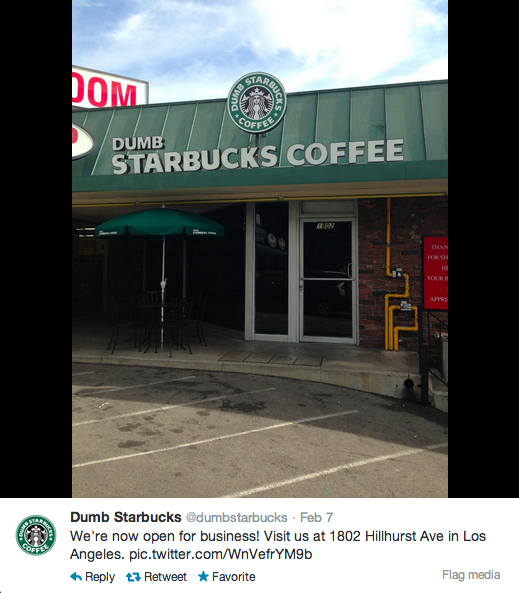
(Photo: https://twitter.com/dumbstarbucks)

(Photo: @dumbstarbucks)

By now, pretty much everyone has heard about how Comedy Central star Nathan Fielder opened his personal version of a Starbucks in an L.A. strip mall. Fielder’s “Dumb Starbucks” looked just like a real Starbucks – same logos, colors, store layouts, and similar products and menu. With the exception that everything was preceded by the word “dumb”, including the “Dumb Blonde Roast” coffee and the “Dumb Norah Jones” CDs on sale by the register.  Also, the coffee was free.

Fielder kept his involvement under wraps at first. But by Monday he revealed his ownership, and by Tuesday the L.A. County Board of Health had shut him down for operating without a license. And yet, while Dumb Starbucks lived, it created a sensation, with lines snaking down the street and Fielder invited onto Jimmy Kimmel to talk about his adventure.

Starbucks itself was not amused. “We are aware of this store, and it is not affiliated with Starbucks. We are evaluating next steps, and while we appreciate the humor, they cannot use our name, which is a protected trademark.” Starbucks spokeswoman Laurel Harper said in a statement. When pressed on whether Starbucks intends to take legal action, she replied, “That may happen. We’re not sure at this point.”

Fielder’s use of Starbucks’ trademarks, and his mimicking of the interior design of Starbucks’ shops (yes, distinctive interior designs can be trademarked as well) seems to give Starbucks ample opportunity to sue. But in recent years, courts deciding trademark cases have been gradually expanding the scope of fair use – that is, unauthorized uses of others’ trademarks that would otherwise be illegal, but are excused because they serve some overriding social purpose. In particular, judges have held that use in parodies – especially using a trademark in order to criticize the business that the trademark represents – are widely permitted. 

A great example involves Louis Vuitton handbags. A pet products company named Haute Diggity Dog marketed a handbag-shaped “Chewy Vuiton” dog toy that mimicked LV’s famous marks. Louis Vuitton, which very aggressively enforces its trademarks, sued. But it lost – a federal court held that the Chewy Vuiton dog toy was a successful parody, one that was unlikely to fool consumers into believing that it was actually produced by or otherwise connected to Louis Vuitton.

Fielder is doing something similar here – sort of.  As Fielder made clear both in the “FAQ” posted in the Dumb Starbucks shop and in this amusing video, Dumb Starbucks isn’t really a coffee shop – it’s a piece of conceptual art. And the concept has something to do with trademark law and the nature of parody.

The twist is that Fielder’s “parody” isn’t aimed primarily at Starbucks. Rather, it’s aimed at dumb parodies. Here’s a line from Fielder’s video that makes the point clearly: “By adding the word ‘dumb’ we are legally allowed to use the coveted name and logo, because we’ve fulfilled the minimum requirements to be considered a parody under U.S. law.”

Fielder is probably wrong about his parody defense. Since he is not really parodying Starbucks, but instead the idea of parodies, his defense is not that great and we wouldn’t bet on him winning on that ground. But that doesn’t mean Fielder should lose if Starbucks (unwisely, we think) decides to sue him.

Trademark law is fundamentally based on protecting consumers from being confused about the source of a product. Fielder’s Dumb Starbucks confused no one. For one, despite looking like a Starbucks in every way, literally everything had the word “dumb” appended to it —even the CDs for sale. In addition, Fielder did not take over an existing Starbucks and add “Dumb” to the signage; he used a formerly empty space. So no one headed to the local Starbucks, and by accident discovered Fielder’s art project. And of course the coffee was free — something that Starbucks as a rule does not do. Add in the fact that waits for coffee were well over an hour, and it is hard to imagine —especially in a savvy hipster neighborhood like Los Feliz — that anyone really thought they had wandered into a strangely-crowded and vandalized Starbucks.

It may be that Starbucks can claim that Fielder “tarnished” their brand, which is one other way of winning a trademark action. But it’s hard to see how Starbucks’ brand is really tarnished by what Fielder did. The typical tarnishment case involves the use of a trademark in a way that’s likely to saddle the mark with unsavory associations. But what Fielder has done with his Dumb Starbucks is a joke. And the only way Starbucks will be hurt by this is if it decides to sue rather than laugh.

14 Feb 16:59

What Television Might Become

by Andrew Sullivan

House of Cards creator Beau Willimon discusses the series and the conventions of television:

I don’t know how much longer the idea of a “season” will be something that we feel like we need to adhere to in television. Even the idea of an episode. I think with streaming, you might have shows in the future where you have three or four hours released. And then three months later you’ll get another couple hours. And then nine months later you might get six more hours. I mean, do all of those constitute a season, or do you sort of dispense with the notion of seasons altogether?

I’ve toyed with the idea for a show that doesn’t have episodes at all. That would simply be one eight-hour stream for a season, and the viewer decides when they want to pause, if at all. That definitely could affect the writing of a show. But we’re in an in-between period now, where we have traditional broadcast networks on one end of the spectrum and streaming on the other, meaning that shows kind of have to be able to live in both worlds.

Scott Meslow wants Netflix to continue experimenting:

Someone could create a show where one episode is 75 minutes long, and the next episode is 15 minutes long. Someone could decide to release one episode every week, or every month, or every holiday — or at random, turning every new installment into a welcome surprise. Someone could release every episode of a series but the finale, then hold that finale back for six months — turning its premiere into a buzzy event that will be simultaneously shared by all of its viewers.

The structure of television is so deeply ingrained that it takes effort to even imagine these kinds of scenarios — but anyone who’s willing to break with convention has the opportunity to expand the very definition of TV storytelling.

Alex Soojung-Kim Pang defends binge-watching the new House of Cards. He calls doing so a “restorative experience”:

The term “restorative experiences” was coined by University of Michigan psychologistStephen Kaplan. He wanted to understand why walks in the park, or even looking at a picture of a landscape, can recharge your mental batteries. Restorative experiences, he found, share a few common features. They’re fascinating: Unlike a conference call or spreadsheet, they hold your attention without effort. They provide a sense of transporting you from your normal life and environment. They strike a balance between complexity and compatibility: They’re rich and fully realized worlds, but you can make sense of them. Natural environments like parks and beaches, and built spaces like churches and gardens, can be restorative. So can the theater or good books.

Previous Dish on the Netflix model here and here.

14 Feb 16:11

Why Do People Fear G.M.O.’s?

by Freakonomics

(Photo: Alexis Baden-Mayer)

(Photo: Alexis Baden-Mayer)

Genetically modified food (or G.M.O.’s) continue to provoke heated debates about safety and labeling, even though scientific evidence indicates they’re safe.  Why?  A new article in Cosmos by David Ropeik explores the psychology behind people’s G.M.O. fears. Here is Ropeik on why man-made risks “feel” scarier than natural risks.

Beyond those heuristics, several specific emotional characteristics also make G.M.O.’s feel scary. These “fear factors” have been identified in pioneering research in risk perception by Paul Slovic at the University of Oregon, Baruch Fischhoff at Carnegie Mellon University, and others. You can hear them pop up as the young man explains his fears. “It’s just not natural to take the gene from one species and put it in another. It’s just not natural!”

Indeed, taking a gene from a soil bacterium (Bacillus thuringiensis - Bt) that produces a natural pesticide and injecting that gene into the DNA of a soy plant, is hardly Mother Nature’s way of hybridising plants. But does that have anything to do with whether it’s actually risky? No. Scientifically, whether something is a risk depends on whether it is physically hazardous, in what ways and at what dose, and whether we’re exposed, at what age and how often. A radioactive particle in your lungs can cause cancer whether the particle came from the natural breakdown of uranium in the soil, which produces natural radon gas, or from a nuclear power plant accident. But risk perception research has found that natural risks don’t feel as scary as the the equivalent man-made risks. 

14 Feb 12:46

The Laughter Of Puritans

by Andrew Sullivan

When Tocqueville visited America, he wasn’t impressed with our humor, claiming that “people who spend every day in the week making money, and the Sunday in going to Church, have nothing to invite the muse of Comedy.” Reviewing John Beckman’s American Fun: Four Centuries of Joyous Revolt, Ben Schwarz thinks that’s not the whole story:

The country’s true comic muse, [Beckman] suggests, has always resided in rebellious, unacceptable humor and entertainment. He begins this chronicle with the forgotten hedonist pilgrim Thomas Morton and his lively seventeenth-century settlement, Merry Mount. The name alone was a pornographic joke to the locals. In his satirical poetry, Morton referred to Puritan leader Myles Standish as “Captain Shrimpe,” and at Merry Mount he encouraged forbidden Maypole dancing, refused to recognize bonded service, embraced Native American culture aesthetically, and Native American women literally. Within a year, Standish’s and Morton’s followers negotiated at gunpoint for Morton’s expulsion from the New World, after which Standish had the pilgrim playboy’s Maypole chopped down. From there, Beckman offers a narrative history touching on the revolutionary bonhomie of Samuel Adams’s taverns (a barroom insurgency that led, in turn, to the rowdy, whooping Boston Tea Party), the subversive revelry of plantation slave culture, Western prank journalism, P. T. Barnum, jazzmen, flappers, merry pranksters, and riot grrrls. In American Fun, humor and music catalyze cultural subversion, breaking out spontaneously in response to intolerant majority rule.

Above is a 1993 standup routine from Bill Hicks that Letterman initially refused to air. Update from a reader:

The whole interview with Bill Hicks’ mom is priceless:

In addition to being sugar-sweet and tack-sharp, Mrs. Hicks offers some fascinating background on her son. He wasn’t an easy comic for a parent to watch, and her pain at his loss remains palpable. The whole visit was an unusual move by a talk show host, but it was as close as Letterman could come to correcting the mistake … especially since he used the opportunity to go ahead and show the original routine in full.

Previous Dish on Hicks here and here.

13 Feb 13:33

On Beauty and Biking

by Freakonomics

(Photo: Paul Wilkinson)

(Photo: Paul Wilkinson)

Our recent podcast “Reasons to Not Be Ugly” examined the beauty premium, as well as the “downside of ugly.”  A new paper by evolutionary biologist Erik Postma in Biology Letters highlights one more advantage of beauty: better endurance performance (in the form of faster cycling).  Bill Andrews of Discover‘s D-brief blog summarizes the study’s setup:

As the paper’s abstract explains, “Females often prefer to mate with high quality males, and one aspect of quality is physical performance.” So the more physically fit a human male is, the more human females might want to bang him. But how to test for this — and, specifically, how to test for this with the measure of physical performance being endurance, a trait not easily quantified?

Simple. Just get headshots of 80 male cyclists who finished the grueling Tour de France, put them up on www.fluidsurveys.com, and have people rate them on a scale of 1–5 (5 being the dreamiest). Then, compare the cyclists’ hot-or-not ratings with how they did in the race. Sole author Erik Postma also asked the participants to rate the man’s masculinity and likeability, and asked whether the rater, if female, was on hormonal contraception.

The results were clear. The most attractive men were also, unbeknownst to raters, the riders that performed best. This correlation was strongest in women not on the pill. (The effect was about the same for women on it and men, interestingly enough.) A rider’s perceived masculinity didn’t seem to have anything to do with his performance; there was a positive relationship between performance and likeability but it, too, was mostly dependent on the guy’s looks.

Postma speculates the correlation may be due to an unobserved variable that affects both performance and looks, or that facial attractiveness may actually signal endurance performance:

Facial attractiveness may signal endurance performance in particular. Indeed, high endurance performance is thought to have been the target of selection in early hominids, as being able to efficiently cover large distances allowed for more efficient hunting, gathering and scavenging, resulting in a number of uniquely human adaptations.

(HT: The Daily Dish)

13 Feb 13:31

Want to Win Olympic Medals? Fix Your Economy First

by Freakonomics

Steven Perlberg of Business Insider quotes a private research note by ConvergEx’s Nick Colas on the correlation between Olympic success and economic strength. “The Winter Olympics are a useful backdrop for case studies on the relationship between athletic performance and economic progress in emerging markets around the world,” writes Colas. “We’ve analyzed the medal count by country since the inaugural Winter Games in 1924, and indeed the results show that athletes rarely make it to the podium until their respective countries experience economic progress and stability.”  A few case studies from Colas’s note:

  • Japan’s Winter Olympic performance history tells a post-WWII recovery story.  The country competed in three Winter Games (1928, 1932 and 1936) before it won its first medal – silver – in 1956.  Japanese athletes didn’t earn any additional medals until the 1972 games, which the country hosted, and have been consistently making an appearance on the podium since 1980.  Japan won its first medal when it was taking off as an emerging economy and getting its economic act together following WWII.  Industrialism in the country picked up rapidly following the war, and the Olympic medal consistency coincided with the consumption boom in the 1980s. 
  • South Korea’s Winter Games story is similar to Japan’s, just two to three decades later.  However, it did take South Koreans a bit longer to arrive on the podium – the country competed in 10 Winter Games before winning four medals in 1992 (two gold, one silver and one bronze).  Since then, South Korea has performed consistently well, earning a peak of 14 medals at the 2010 Games in Vancouver.  Just as the country fully emerged from the shadow of the Korean War, its athletes were solid performers on the global stage.
  • China’s performance history is also emblematic of a developing economy gaining critical mass in sport and economic growth.  Like South Korea, China won its first Winter Olympic medals in 1992 (three silvers).  Chinese athletes had competed in three prior games dating back to 1980 before the emerged on the podium in Albertville, France.  Also similar to South Korea, China consistently earned medals in subsequent Games, recording a high of 11 at the 2010 Olympics.  China underwent a host of economic reform initiatives in the 1970s and 1980s; by the 1990s the country experienced rapid economic growth (10.4% GDP) even with skyrocketing inflation that topped 20% in 1994.  Again, consistent trips to the Winter Olympics podium went hand-in-hand with an emerging economy.
12 Feb 17:10

Happy Darwin Day!

by Tracy R. Walsh
Ibktim

That last Darwin quote pretty much sums up my view.

Darwins_first_tree

Today is the famed naturalist’s 205th birthday, and Ian Chant is ready to celebrate:

[Darwin Day] is a day to be thankful for innovative thinkers, brave scientists of all stripes, and yes, evolution in general, because frankly, we take our opposable thumbs for granted 364 days of the year, and respect should be paid. If you’re looking for something to do in your neck of the woods to celebrate among like-minded lovers of evolution, the International Darwin Day Foundation has a guide to events at colleges, libraries and museums around the world that will be celebrating the life and work of Charles Darwin in the coming days.

Science-lovers around the world are hosting lectures, discussions, and exotic entertainments such as “phylum feasts” (dinners with a variety of species represented on the menu) in honor of the man. But perhaps the best way to pay tribute is with sober skepticism, like this professor of evolutionary ecology:

I’d be disappointed if this celebration of all things Darwinian began and ended with the great naturalist, because I think a focus on the person tends to undersell the science … The beauty of an idea like natural selection is that it is true, whether or not you choose to believe it. It is true, even if nobody has yet had the idea or written it down. If Darwin hadn’t done so, Alfred Russell Wallace’s version might have swayed the Victorians. Or perhaps a version discovered some 50 years later.

Humanity owes a great debt to Darwin, and the history of science followed the course that it did because of him. But he isn’t the reason for the season; science does not need deities and messiahs. Darwin was merely the guy who figured it all out first.

And what I admire about Darwin is not just his evident human-ness, nor his openness to new ideas, nor his magnificent beard, but his equally skeptical view of religion, which some of his contemporary followers would do well to note:

It seems to me absurd to doubt that a man may be an ardent Theist & an evolutionist.— You are right about Kingsley. Asa Gray, the eminent botanist, is another case in point— What my own views may be is a question of no consequence to any one except myself.— But as you ask, I may state that my judgment often fluctuates. Moreover whether a man deserves to be called a theist depends on the definition of the term: which is much too large a subject for a note. In my most extreme fluctuations I have never been an atheist in the sense of denying the existence of a God.— I think that generally (& more and more so as I grow older) but not always, that an agnostic would be the most correct description of my state of mind.

(Illustration: part of a page from Darwin’s notebooks around July 1837 showing his first sketch of an evolutionary tree.)

12 Feb 16:04

What Do a Law Professor and a Kindergarten Teacher Have in Common?

by dianeravitch

Ty Alper is a law professor at The University of California in Berkeley, one of the nation’s most prestigious law schools. He is running for school board in Berkeley. As he thought about the challenges of teaching today, he realized that his child’s kindergarten teacher was teaching some of the same skills he was teaching:

“Brook Pessin-Whedbee teaches five-year-olds at Rosa Parks. I teach law students in their mid-20s. As a kindergarten teacher, Brook teaches her students how to collaborate in the telling of stories, so they develop not only oral language and story writing skills but also the ability to form partnerships and work together. As a clinical law professor training and supervising law students in the complex representation of clients facing the death penalty, I teach my students how to collaborate in the telling of stories — stories of our clients’ lives, of unfair trials, of prosecutorial misconduct, etc. Brook and I have the same goals: to improve our students’ oral and written skills, and to teach them what it means to work productively as part of a team.”

He doesn’t think that the work they do can be measured by standardized tests. He is right.

Ty is a graduate of the public schools in Berkeley, so is his wife. Both his parents worked in public schools.

I bet he would be a great addition to the Berkeley school board.


11 Feb 17:24

Clinton’s Achilles Heels, Ctd

by Andrew Sullivan
Ibktim

Last snippit most interesting.

Readers keep the recent thread going:

OK, you have a fair point that Hillary Clinton does not have a clearly defined, very specific record of accomplishment that she can point to as justification for being POTUS. Fine. Now, can you please point to a president who DID have such a record?Hillary Clinton Addresses National Automobile Dealers Association Convention

George W. Bush? What did he accomplish as governor of Texas, or, for that matter, in any area of his life? Bill Clinton? He was governor of Arkansas, but I have no idea what he did in that job, and I worked on his transition team in 1992 (all I did was answer his mail, but I was there). George H. W. Bush? He had a resume longer than Hillary’s, but, again, I can’t think of any notable accomplishments. Reagan? Nixon? Kennedy? About the only president who I can think of who had a great resume before becoming president was Eisenhower. Heck, Lincoln hadn’t done much before 1860.

Another focuses on one president in particular:

In your discussion of Hillary Clinton’s major accomplishments, there is one name that I think is remarkably comparable and am surprised that has not been mentioned: George HW Bush. In 2016, Hillary will be selling exactly what Bush was selling in 1988:

competence and experience. Both have long records of public service and a record of competence yet few signature accomplishments. In fact, their pre-presidential resumes are remarkably similar. Whereas Bush had eight years of experience in the White House as Vice President, Hillary has eight years in the White House as First Lady. In fact, given how marginalized Bush was in the Reagan administration, Hillary probably had more policy influence on her husband’s administration than Bush did with Reagan.

Bush spent a total of 1482 days in the ’70s as CIA Director, Envoy to China and UN Ambassador. Clinton spent 1472 days as Secretary of State. Bush spent four years as Congressman from Texas, whereas Clinton spent eight as Senator. Bush always had a problem with the “vision thing.” Clinton seems to as well. Both lost bitter presidential primaries to more charismatic rivals, then they went to work for the man who defeated them. Both served admirably as competent, effective government employees without racking up signature accomplishments. Hillary probably has a more impressive record overall as compared to Bush, yet in 2016 Hillary will essentially be selling the same thing as Bush did in ’88 – a continuation and consolidation of their predecessor’s administration against an opposition party that had failed miserably to reform itself after two crushing losses.

Another notes:

Yes, Linker points out an often overlooked fact that the Clintons and Bushes are making American democracy seem like a bizarrely royal affair. But it gets worse: if you include the Doles, well then the Republicans alone have nominated either a Bush or a Dole on the presidential ticket for 28 consecutive years! Add in the Clintons and we can expect 40 consecutive years of presidential contests between the Clintons, Bushes and Doles, with the empty 2012 election campaign as the only exception. If Jeb or Hillary wins a second term, I will have lived from the age of 9 until age 57 with just three political families vying for the White House.

1976: Ford/Dole

1980: Reagan/Bush

1984: Reagan/ Bush

1988: Bush/Quayle

1992: Clinton/Gore v. Bush/Quayle

1996: Clinton/Gore v. Dole/Kemp

2000: Gore v. Bush (Elizabeth Dole defeated in primaries)

2004: Bush v. Kerry

2008: Obama v. McCain (Hillary Clinton defeated in primaries)

2012: Obama v. Romney

2016: Bush v. Clinton ??

Update from a reader:

Your reader points out that the Republican ticket had a Bush or Dole for 28 consecutive years (actually 8 consecutive tickets). But it gets even worse if you throw in Nixon. The GOP had Richard Nixon, Bob Dole, or a George Bush on every ticket from 1952 to 2004 – except once, in 1964 (Goldwater/Miller):

1952 – Eisenhower/Nixon
1956 – Eisenhower/Nixon
1960 – Nixon/Lodge
1964 – Goldwater/Miller
1968 – Nixon/Agnew
1972 – Nixon/Agnew

And then onward to the present. That’s 13 out of 14 tickets with Nixon, Dole or a Bush.

(Photo: Former U.S. Seceratary of State Hillary Clinton speaks at the 10th National Automobile Dealers Association Convention on January 27, 2014 in New Orleans, Louisiana. By Sean Gardner/Getty Images)

11 Feb 02:24

Ann Coulter: Coca-Cola CEO ‘Should Be Executed For Treason’

by TDC
Ibktim

It still might be.

Conservative commentator Ann Coulter provoked controversy today by calling for the public execution of Coca-Cola's CEO. In an interview with Fox News this morning, the bombastic author claimed that the company's Turkish-American leader Muhtar A. Kent should be hung for treason over Coke's Super Bowl commercial celebrating diversity. The advertisement, which featured the song "America the
10 Feb 21:36

david salman’s mint cousins for a garden abuzz

by margaret

IN THE MOOD for something aromatic, hot-colored, and abuzz with insect pollinators, butterflies and hummingbirds? With the help of High [read more…]

The post david salman’s mint cousins for a garden abuzz appeared first on A Way To Garden.

10 Feb 13:25

Peter Greene on #evaluatethat

by dianeravitch

Peter Greene, who teaches high school English in Pennsylvania, here reviews the Twitter outburst with the hash tag #evaluatethat.

The campaign on Twitter began as a way to point out that teachers do far more important things for students than get measured on standardized tests. And it grew.

Greene points out that people in many occupations go beyond their job descriptions.

So what is the point of #evaluatethat?

He writes:

“It goes back to what’s wrong with “college and career ready.” Because it is not enough to be good at your job. You need to be good at life. You need to be good at being a human in this world, and that is so much more than a job.

“I’ve maintained for years that teaching is a kind of guerilla warfare, that many of us are fighting in the underground, doing what we can in spite of the authorities. Under the current wave of reformy stuff, this is more true than ever. Education is occupied territory, and we are members of the resistance, not powerful enough to directly oppose the forces that have taken control of our home. Instead, we save who we can when we can, chip away at the occupiers, and work toward the day when we can send them packing.

“In the meantime, we have to do what we can to stay in contact with the rest of the underground and remind ourselves what we represent, what we fight for. I don’t think #evaluatethat will change much. I think people who are imagining that occupiers will slap their heads and say, “Yes, yes, I’ve been so blind” are kidding themselves. But for the rest of us, knowing that we are not alone, that other people get it, that other people are also standing up for what is best and brightest, that we are not crazy for thinking that we are in a classroom to help nurture and grow real human people and not to just collect data, read a script and do some test prep– I think knowing that is golden. Evaluate that, indeed.”


09 Feb 16:53

A Game Theorist on Jeopardy

by Freakonomics

(Photo:  Shawn M. Smith)

(Photo: Shawn M. Smith)

A game-theory nerd named Arthur Chu has been kicking butt on Jeopardy. From The Atlantic Wire:

Due to Arthur’s newfangled shenanigans, Wednesday’s Jeopardy ended in a rare tie. In Final Jeopardy, the leading contestant typically wagers $1 more than double of the 2nd place contestant. If both answer correctly, then the person in the lead wins by that extra buck. But Arthur did not add the $1, wagering enough so that if he and Carolyn both answered correctly, they would tie. And that’s exactly what happened, as both moved on to the next round. He made the same move on Tuesday, as well, though he was the only contestant to answer correctly. ”Interesting wager,” host Alex Trebek condescended, after the tie. 

While it seems strange, it’s actually the correct move to make, says The Final Wager blog, the brainchild of former Jeopardy winner Keith Williams that breaks down the proper mathematical wagering. Basically, the whole point of the game is to move on to the next round. Whether or not someone joins you is largely irrelevant. In addition, there’s a certain mind-game tactic that can make the trailing contestant bet an irrational number. While the numbers stand behind these ideas, Tuesday’s tie-targeting move was the first to do so all season, Williams said. “It’s really cool to see this happen,” he said. In fact, Arthur admitted to Williams that he got the idea from his videos.