
Journal of the American Chemical Society
DOI: 10.1021/jacs.0c00896

 Open Access
   This article is licensed under a Creative Commons Attribution-NonCommercial 3.0 Unported Licence.


Supramolecular polymer metal–organic cage (polyMOC) gels with Cu24L24 cuboctahedral junctions featuring a high density of coumarin ligands were prepared. These robust, dynamic materials could be reversibly switched between CuII, CuI, and Cu0 states, each with distinct mechanical, optical, and catalytic properties. In particular, the CuI state was used to catalyze covalent network formation, providing novel polyMOC covalent double networks.
Photoresponsive materials that change in response to light have been studied for a range of applications. These materials are often metastable during irradiation, returning to their pre‐irradiated state after removal of the light source. Herein, we report a polymer gel comprising poly(ethylene glycol) star polymers linked by Cu24L24 metal–organic cages/polyhedra (MOCs) with coumarin ligands. In the presence of UV light, a photosensitizer, and a hydrogen donor, this “polyMOC” material can be reversibly switched between CuII, CuI, and Cu0. The instability of the MOC junctions in the CuI and Cu0 states leads to network disassembly, forming CuI/Cu0 solutions, respectively, that are stable until re‐oxidation to CuII and supramolecular gelation. This reversible disassembly of the polyMOC network can occur in the presence of a fixed covalent second network generated in situ by copper‐catalyzed azide‐alkyne cycloaddition (CuAAC), providing interpenetrating supramolecular and covalent networks.
Abstract
Pyridine[4]arenes have previously been considered as anion binding hosts due to the electron-poor nature of the pyridine ring. Herein, we demonstrate the encapsulation of Me4N+ cations inside a dimeric hydrogen-bonded pyridine[4]arene capsule, which contradicts with earlier assumptions. The complexation of a cationic guest inside the pyridine[4]arene dimer has been detected and studied by multiple gas-phase techniques, ESI-QTOF-MS, IRMPD, and DT-IMMS experiments, as well as DFT calculations. The comparison of classical resorcinarenes with pyridinearenes by MS and NMR experiments reveals clear differences in their host–guest chemistry and implies that cation encapsulation in pyridine[4]arene is an anion-driven process.
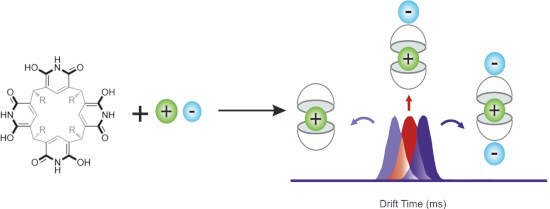
Beilstein J. Org. Chem. 2019, 15, 2486–2492. doi:10.3762/bjoc.15.241
Open Access   This article is licensed under a Creative Commons Attribution 3.0 Unported Licence.

Abstract
In this short review, we describe different pathways for synthesizing 1,2,3-triazolium macrocycles and focus on their application in different areas of supramolecular chemistry. The synthesis is mostly relying on the well-known “click reaction” (CuAAC) leading to 1,4-disubstituted 1,2,3-triazoles that then can be quaternized. Applications of triazolium macrocycles thus prepared include receptors for molecular recognition of anionic species, pH sensors, mechanically interlocked molecules, molecular machines, and molecular reactors.

Beilstein J. Org. Chem. 2019, 15, 2142–2155. doi:10.3762/bjoc.15.211

Open Access  This article is licensed under a Creative Commons Attribution-NonCommercial 3.0 Unported Licence.
Abstract
Functionalized O6-corona[3]arene[3]tetrazines were synthesized efficiently and conveniently by means of a macrocyclic condensation reaction between N-functionalized 3,6-dihydroxyphthalimides and 3,6-dichlorotetrazine under mild conditions in a one-pot reaction manner. The novel macrocycles exist as a mixture of rapidly interconvertible conformers in solution while in the solid state they adopt the conformation in which three phthalimide units are cis,trans-orientated. Acting as electron-deficient macrocyclic hosts, the synthesized O6-corona[3]arene[3]tetrazines self-regulated conformational structures to complex anions in the gas phase and in the solid state owing to the anion–π noncovalent interactions between anions and the tetrazine rings.
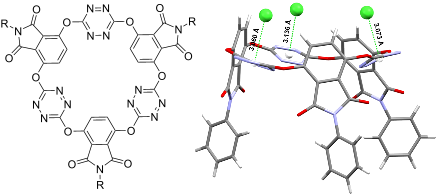
Beilstein J. Org. Chem. 2019, 15, 1976–1983. doi:10.3762/bjoc.15.193
Open Access  This article is licensed under a Creative Commons Attribution-NonCommercial 3.0 Unported Licence.

Mechanically robust nanotubes: Inclusion of a pyridine moiety within an imine‐linked macrocycle framework allows for cooperative protonation driven assembly into nanotubes. Touch‐spinning of the nanotubes results in nanofibers with Young's moduli of 1.33 GPa exceeding that of many synthetic polymers and biological filaments.
Nanotubes assembled from macrocyclic precursors offer a unique combination of low dimensionality, structural rigidity, and distinct interior and exterior microenvironments. Usually the weak stacking energies of macrocycles limit the length and mechanical strength of the resultant nanotubes. Imine‐linked macrocycles were recently found to assemble into high‐aspect ratio (>103), lyotropic nanotubes in the presence of excess acid. Yet these harsh conditions are incompatible with many functional groups and processing methods, and lower acid loadings instead catalyze macrocycle degradation. Here we report pyridine‐2,6‐diimine‐linked macrocycles that assemble into high‐aspect ratio nanotubes in the presence of less than 1 equiv of CF3CO2H per macrocycle. Analysis by gel permeation chromatography and fluorescence spectroscopy revealed a cooperative self‐assembly mechanism. The low acid concentrations needed to induce assembly enabled nanofibers to be obtained by touch‐spinning, which exhibit higher Young's moduli (1.33 GPa) than many synthetic polymers and biological filaments. These findings represent a breakthrough in the design of inverse chromonic liquid crystals, as assembly under such mild conditions will enable the design of structurally diverse and mechanically robust nanotubes from synthetically accessible macrocycles.

Abstract
The quantitative double self-sorting between the three-component rectangle [Cu4(1)2(2)2]4+ and the four-component sandwich complex [Cu2(1)(2)(4)]2+ is triggered by inclusion and release of DABCO (4). The fully reversible and clean switching between two multicomponent supramolecular architectures can be monitored by fluorescence changes at the zinc porphyrin sites. The structural changes are accompanied by a huge spatial contraction/expansion of the zinc porphyrin–zinc porphyrin distances that change from 31.2/38.8 Å to 6.6 Å and back. The supramolecular interconversion was used for the highly selective detection of DABCO in a mixture of other similar compounds.
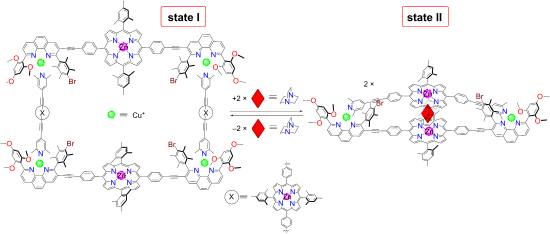
Beilstein J. Org. Chem. 2019, 15, 1371–1378. doi:10.3762/bjoc.15.137

The work of Gottfried Schill and other Freiburgers regarding catenanes, rotaxanes, and molecular knots are summarized. Included are syntheses of the first catenane ever (A) and of the first (B) as well as the second catenane (C) without a ring within either constituent – a feature which makes them unique till today. C also is the only purely hydrocarbon catenane ever made. The first [3]catenanes were from Schill's group, too, e.g. the mixture of constitutional isomers C 2h‐D (R1 = H, R2 = OAc) and C 2v‐D (R1 = OAc, R2 = H). Compound E was Schill's first rotaxane.
Research at the University of Freiburg is summarized which aimed at realizing catenanes, rotaxanes, and a molecular knot from 61–62 until 41 years ago. Taking a fresh view at ansa‐compounds – distinct from those in which he had been interested for other reasons before – Arthur Lüttringhaus began to tackle syntheses of catenanes in 1957. The first isolation of a pure catenane (37) succeeded in 1964 jointly with Gottfried Schill. Most of the progress made in the sequel was due to Schill alone or achieved under his direction; in addition, a few follow‐up studies were published without Schill or Lüttringhaus being their authors. The major feats of these endeavors were the syntheses of the following molecules: (1) the first catenanes (38 – de‐acetyl‐41, 74) without a ring in any constituent (this feature makes them unique till today; the catenane 74 holds the additional record of being the only all‐hydrocarbon catenane till now); the first [3]catenanes at all (obtained as a mixture of constitutional isomers C 2v‐97 and C 2h‐97); the first [3]catenanes exhibiting topological isomerism (89, iso‐89, and neo‐iso‐89); the rotaxanes 70 [which had the design peculiarity of being convertible into a catenane (74)], 113 (Schill's #1‐rotaxane), and 115; the pre‐knotane rac‐dia‐iso‐123 [provided it was obtained and not (only) its topological isomer dia‐iso‐123]. – For due perspectives, pertinent studies of third parties are included, too: 1) Wasserman's reports on the isolation of the catenane 8 are analyzed in great detail; the conclusion is that the identity of 8 was never established. 2) Schill's oscillating rotaxane 70 from 1988, which is subject to a reversible and non‐degenerate ring migration (→ iso‐70), is supplemented by Stoddart's much faster oscillating rotaxane 71 from 1991, which undergoes a reversible and degenerate ring migration (→ 71 instead of → iso‐71) and was dubbed “molecular shuttle”. 3) The first [3]catenanes from the groups of Schill (97; 1969), Sauvage (98 and 99; 1985), and Stoddart (100–102; 1991) are juxtaposed. 4) The Harrisons' synthesis of the rotaxane 106 by a most noteworthy solid‐phase approach (1967) is recalled in the context of Schill's synthesis of the rotaxane 113 (1967 or 1969). 5) Attempts at threading α‐cyclodextrin by long‐chain 1,ω‐dithiols (→ 130) and ring‐closing the latter oxidatively for obtaining catenated disulfides failed in Lüttringhaus' 1957/1958 studies; in contrast, Stoddart's threading permethyl‐β‐cyclodextrin (133) by the long‐chain 1,ω‐diamine 132 and ring‐closing the latter by a double condensation with terephthaloyl dichloride was successful by providing 3 % of the catenated bislactame 134 in 1993. The concluding section characterizes the synthetic strategies towards catenanes and rotaxanes developed in Freiburg as “template‐based”. This differs from the Nobel Prize Committee's assessment.


Get organized: The first system where the two‐dimensional organization of particles at the air/water interface is controlled by light stimulation is reported. By mixing anionic microparticles and a cationic photosensitive surfactant, fast and dynamic switch between a disordered phase (in the dark) and the crystalline state is obtained on demand by light irradiation. The reverse transition takes place after switching off the light.
Control over particle interactions and organization at fluid interfaces is of great importance both for fundamental studies and practical applications. Rendering these systems stimulus‐responsive is thus a desired challenge both for investigating dynamic phenomena and realizing reconfigurable materials. Here, we describe the first reversible photocontrol of two‐dimensional colloidal crystallization at the air/water interface, where millimeter‐sized assemblies of microparticles can be actuated through the dynamic adsorption/desorption behavior of a photosensitive surfactant added to the suspension. This allows us to dynamically switch the particle organization between a highly crystalline (under light) and a disordered (in the dark) phase with a fast response time (crystallization in ≈10 s, disassembly in ≈1 min). These results evidence a new kind of dissipative system where the crystalline state can be maintained only upon energy supply.


![European Journal of Organic Chemistry A Triply Operable Molecular Switch: Anion‐, Acid/Base‐ and Solvent‐Responsive [2]Rotaxane](https://onlinelibrary.wiley.com/cms/attachment/8f9545b9-fcce-4f51-8bba-13b0e485ef79/ejoc201801785-toc-0001-m.png)
A (O‐methyl)6‐2,6‐helic[6]arene‐based bistable [2]rotaxane was synthesized, and showed a triply operable molecular switching through addition and removal of fluoride ion, adding acid and base, or altering the solvent polarity.
A 2,6‐helic[6]arene‐based bistable [2]rotaxane has been designed and synthesized, which incorporates protonated tertiary ammonium salt as a reversible control unit and hexamethylene chain as a second binding site. In particular, it was found that [2]rotaxane could perform as a triply operable molecular switch through addition and removal of fluoride ions (TBAF/NaBArF), protonation and deprotonation of tertiary amine (HBArF/DBU), and altering the solvent polarity. It represents the first triply operable molecular switch based on helic[6]arenes.


![European Journal of Organic Chemistry Pillar[5]arene Based Pseudo[1]rotaxane Operating as Acid/Base‐Controllable Two State Molecular Shuttle](https://onlinelibrary.wiley.com/cms/attachment/b207b2c7-be23-45e4-b8fe-16e69b02fa1c/ejoc201900075-toc-0001-m.png)
A ethylene glycol bridged pyridine and pillar[5]arene based mechanically selflocked pseudo[1]rotaxane was successfully constructed. It was found that in dilute solution the pseudo[1]rotaxane could be operated as an acid/base‐controllable two state molecular shuttle. In concentrated solution, the pseudo[1]rotaxane existed as a dimer and could be operated from shrinking state to extension state.
A ethylene glycol bridged pyridine and pillar[5]arene based mechanically selflocked pseudo[1]rotaxane was constructed successfully. The structure and selflocked conformation of pseudo[1]rotaxane were confirmed by 1H, 2D NMR spectrum and HR‐ESI‐MS. It was found that in dilute solution the pseudo[1]rotaxane could be operated as an acid/base‐controllable two state molecular shuttle while In concentrated solution, the pseudo[1]rotaxane existed as a dimer and could be operated from shrinking state to extension state.

The reaction of 6,8‐bisethynylpyrene‐2‐carboxylic acid methyl ester with 1‐azido‐2‐(2‐(2‐azidoethoxy)ethoxy)ethoxy)ethane using standard “click” chemistry produced a 1+1 crown ether (CPYR). The copper ions used both catalyse the reaction and provide a template for ensuring smooth cyclisation. The X‐ray crystal structure of the compound reveals the two triazole groups are non‐coplanar with the pyrene moiety. The triazole groups are more co‐planar with the pyrene subunit in the first‐excited singlet state as revealed by a DFT calculated molecular structure (B3LYP, 6‐311G). Partially structured emission observed in acetonitrile is consistent with the calculation result. In acetonitrile solution the macrocycle CPYR interacts with a Na+ ion to form a complex in which the ion binds with the crown and the pyrene residue.
Abstract
Cryptands with sucrose scaffold, an unknown class of such derivatives, were prepared from the readily available 2,3,3’,4,4’-penta-O-benzylsucrose and 1’,2,3,3’,4,4’-hexa-O-benzylsucrose.
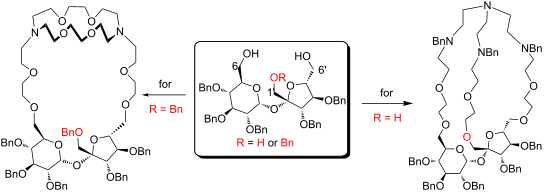
Beilstein J. Org. Chem. 2019, 15, 210–217. doi:10.3762/bjoc.15.20

Solid chemistry: The acid‐catalyzed synthesis of hemicucurbiturils proceeds quantitatively in the solid state. Mechanochemically obtained mixtures of solid oligomers spontaneously and selectively rearrange into either six‐ or eight‐membered macrocycles in the presence of suitable anion templates.
Self‐organization is one of the most intriguing phenomena of chemical matter. While the self‐assembly of macrocycles and cages in dilute solutions has been extensively studied, it remains poorly understood in solvent‐free environments. Provided here is the first example of using anionic templates to achieve selective assembly of differently‐sized macrocycles in a solvent‐free system. Using acid‐catalyzed synthesis of cyclohexanohemicucurbiturils as a model, size‐controlled, quantitative synthesis of 6‐ or 8‐membered macrocycles by spontaneous anion‐directed reorganization of mechanochemically‐made oligomers in the solid state is demonstrated.


