18 Dec 06:28
by Michael Mastalerz,
Tobias HG Schick,
Jochen C Lauer,
Frank Rominger

All‐carbon cages: In just three steps imine cages are converted into hydrocarbon cages by reduction, nitrosylation, and formation of the C−C bonds by an Overberger reaction. The method has been successfully applied to even larger structures, such as derivatives of C72H72.
Abstract
In contrast to organic cages which are formed by exploiting dynamic covalent chemistry, such as boronic ester cages, imine cages, or disulfide cages, those with a fully carbonaceous backbone are rarer. With the exception of alkyne metathesis based approaches, the vast majority of hydrocarbon cages need to be synthesized by kinetically controlled bond formation. This strategy implies a multiple step synthesis and no correction mechanism in the final macrocyclization step, both of which are responsible for low overall yields. Whereas for smaller cages the intrinsic drawbacks are not always obvious, larger cages are seldom synthesized in yields beyond a few tenths of a percent. Presented herein is a three‐step method to convert imine cages into hydrocarbon cages. The method has been successfully applied to even larger structures such as derivatives of C72H72 , an unknown cage suggested by Fritz Vögtle more than 20 years ago.
11 Dec 00:34
by Nicholas V. Hud,
Gary Schuster,
Suneesh Karunakaran,
Brian Cafferty,
Angela Weigert-Muñoz

Homochiral domains appear in supramolecular assemblies formed by the achiral monomers 2,4,6‐triaminopyrimimidine and a modified cyanuric acid. These samples become uniformly homochiral when as little as 0.1 % of a chiral cyanuric acid monomer is added, or when there is at least a 6 % ee in samples containing both enantiomers of the chiral monomer.
Abstract
Aqueous solutions of the achiral, monomeric, nucleobase mimics (2,4,6‐triaminopyrimidine, TAP, and a cyanuric acid derivative, CyCo6) spontaneously assemble into macroscopic homochiral domains of supramolecular polymers. These assemblies exhibit a high degree of chiral amplification. Addition of a small quantity of one handedness of a chiral derivative of CyCo6 generates exclusively homochiral structures. This system exhibits the highest reported degree of chiral amplification for dynamic helical polymers or supramolecular helices. Significantly, homochiral polymers comprised of hexameric rosettes with structural features that resemble nucleic acids are formed from mixtures of cyanuric acid (Cy) and ribonucleotides (l‐, d‐pTARC) that arise spontaneously from the reaction of TAP with the sugars. These findings support the hypothesis that nucleic acid homochirality was a result of symmetry breaking at the supramolecular polymer level.
03 Dec 03:15
by Steiner, S., Wolf, J., Glatzel, S., Andreou, A., Granda, J. M., Keenan, G., Hinkley, T., Aragon-Camarasa, G., Kitson, P. J., Angelone, D., Cronin, L.
The synthesis of complex organic compounds is largely a manual process that is often incompletely documented. To address these shortcomings, we developed an abstraction that maps commonly reported methodological instructions into discrete steps amenable to automation. These unit operations were implemented in a modular robotic platform using a chemical programming language which formalizes and controls the assembly of the molecules. We validated the concept by directing the automated system to synthesize three pharmaceutical compounds, Nytol, rufinamide, and sildenafil, without any human intervention. Yields and purities of products and intermediates were comparable to or better than those achieved manually. The syntheses are captured as digital code that can be published, versioned, and transferred flexibly between platforms with no modification, thereby greatly enhancing reproducibility and reliable access to complex molecules.
18 Sep 14:28
by Yang Yang
Macroscopic helical chirality and self-motion of hierarchical self-assemblies induced by enantiomeric small molecules
Macroscopic helical chirality and self-motion of hierarchical self-assemblies induced by enantiomeric small molecules, Published online: 18 September 2018; doi:10.1038/s41467-018-06239-5
Chirality transfer by chemical self-assembly has been studied intensively for years but chirality transfers along the same path remains elusive. Here the authors use a multiscale chemo-mechanical model to elucidate the mechanism underlying the chirality transfer via self-assembly in hierarchical camphorsulfonic acid doped polyaniline.

05 Sep 13:53
Chem. Sci., 2018, 9,8343-8351
DOI: 10.1039/C8SC03040E, Edge Article

Open Access
Ulrike Warzok, Mateusz Marianski, Waldemar Hoffmann, Lotta Turunen, Kari Rissanen, Kevin Pagel, Christoph A. Schalley
Ion-mobility mass spectrometry and DFT calculations reveal the surprisingly solvent-dependent formation of large pentameric [N⋯I+⋯N] halogen-bonded capsules.
The content of this RSS Feed (c) The Royal Society of Chemistry

31 Aug 14:21
by Felix J. Rizzuto, William J. Ramsay, Jonathan R. Nitschke

Journal of the American Chemical Society
DOI: 10.1021/jacs.8b07494

27 Aug 10:17
by Lei Zhiquan, Han Xie, Sarah E. Border, Judith Gallucci, Radoslav Z. Pavlovic, Jovica D. Badjic

Journal of the American Chemical Society
DOI: 10.1021/jacs.8b06190

21 Aug 08:55
by Hendrik V. Schröder and Christoph A. Schalley
Abstract
With the rise of artificial molecular machines, control of motion on the nanoscale has become a major contemporary research challenge. Tetrathiafulvalenes (TTFs) are one of the most versatile and widely used molecular redox switches to generate and control molecular motion. TTF can easily be implemented as functional unit into molecular and supramolecular structures and can be reversibly oxidized to a stable radical cation or dication. For over 20 years, TTFs have been key building blocks for the construction of redox-switchable mechanically interlocked molecules (MIMs) and their electrochemical operation has been thoroughly investigated. In this review, we provide an introduction into the field of TTF-based MIMs and their applications. A brief historical overview and a selection of important examples from the past until now are given. Furthermore, we will highlight our latest research on TTF-based rotaxanes.
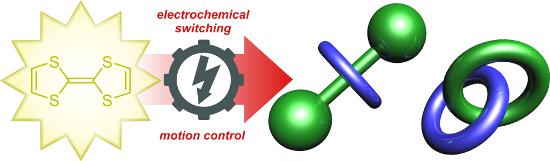
Beilstein J. Org. Chem. 2018, 14, 2163–2185. doi:10.3762/bjoc.14.190
03 Aug 06:43
by Jake L. Greenfield, Emrys W. Evans, Daniele Di Nuzzo, Marco Di Antonio, Richard H. Friend, Jonathan R. Nitschke

Journal of the American Chemical Society
DOI: 10.1021/jacs.8b06195

31 Jul 07:56
by Dr.
Daniel
Spitzer
,
Dr.
Vincent
Marichez
,
Georges J. M.
Formon
,
Prof. Dr.
Pol
Besenius
,
Prof. Dr.
Thomas M.
Hermans
Angewandte Chemie International Edition, EarlyView.
31 Jul 07:54
by Mohammad A. Alnajjar, Jürgen Bartelmeß, Robert Hein, Pichandi Ashokkumar, Mohamed Nilam, Werner M. Nau, Knut Rurack and Andreas Hennig
Abstract
We introduce herein boron-dipyrromethene (BODIPY) dyes as a new class of fluorophores for the design of reporter dyes for supramolecular host–guest complex formation with cucurbit[7]uril (CB7). The BODIPYs contain a protonatable aniline nitrogen in the meso-position of the BODIPY chromophore, which was functionalized with known binding motifs for CB7. The unprotonated dyes show low fluorescence due to photoinduced electron transfer (PET), whereas the protonated dyes are highly fluorescent. Encapsulation of the binding motif inside CB7 positions the aniline nitrogen at the carbonyl rim of CB7, which affects the pKa value, and leads to a host-induced protonation and thus to a fluorescence increase. The possibility to tune binding affinities and pKa values is demonstrated and it is shown that, in combination with the beneficial photophysical properties of BODIPYs, several new applications of host–dye reporter pairs can be implemented. This includes indicator displacement assays with favourable absorption and emission wavelengths in the visible spectral region, fluorescence correlation spectroscopy, and noncovalent surface functionalization with fluorophores.
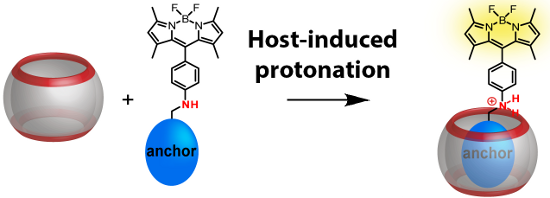
Beilstein J. Org. Chem. 2018, 14, 1961–1971. doi:10.3762/bjoc.14.171
27 Jul 08:19
by Lorna G. Christie, Silke Asche, Jennifer S. Mathieson, Laia Vilà-Nadal, Leroy Cronin

Journal of the American Chemical Society
DOI: 10.1021/jacs.8b05059

26 Jul 08:22
by Sarah J. Vella and Stephen J. Loeb
Abstract
A two-station [2]catenane containing a large macrocycle with two different recognition sites, one bis(pyridinium)ethane and one benzylanilinium, as well as a smaller DB24C8 ring was synthesized and characterized. 1H NMR spectroscopy showed that the DB24C8 ring can shuttle between the two recognition sites depending on the protonation state of the larger macrocycle. When the aniline group is neutral, the DB24C8 ring resides solely at the bis(pyridinium)ethane site, while addition of acid forms a charged benzylanilinium site. The DB24C8 then shuttles between the two charged recognition sites with occupancy favoring the bis(pyridinium)ethane site by a ratio of 4:1. The unprotonated [2]catenane has a deep yellow/orange color when the DB24C8 ring resides solely at the bis(pyridinium)ethane site and changes to colorless when the crown ether is shuttling (i.e., circumrotating) back and forth between the two recognition sites thus optically signalling the onset of the shuttling dynamics.
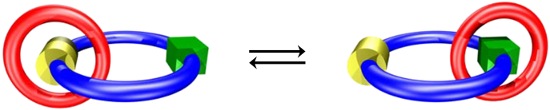
Beilstein J. Org. Chem. 2018, 14, 1908–1916. doi:10.3762/bjoc.14.165
24 Jul 11:38
by Eunji Lee, Huiyeong Ju, In-Hyeok Park, Jong Hwa Jung, Mari Ikeda, Shunsuke Kuwahara, Yoichi Habata, Shim Sung Lee

Journal of the American Chemical Society
DOI: 10.1021/jacs.8b05751

20 Jul 12:27
by Chuanqiang Zhou, Yuanyuan Ren, Jie Han, Xiangxiang Gong, Zhixiang Wei, Ju Xie, Rong Guo

Journal of the American Chemical Society
DOI: 10.1021/jacs.7b12178

20 Jul 12:25
by Ting
He
,
Dr.
Xiaobin
Xu
,
Bing
Ni
,
Dr.
Haifeng
Lin
,
Chaozhong
Li
,
Prof.
Wenping
Hu
,
Prof.
Xun
Wang
Angewandte Chemie International Edition, EarlyView.
20 Jul 07:55
by AtsukoKuno
,
MasayaFujiwara
,
YoheiHaketa
,
HiromitsuMaeda
Chemistry – An Asian Journal, EarlyView.
17 Jul 10:20
by Motoya Yamagami, Tomohisa Sawada, Makoto Fujita

Journal of the American Chemical Society
DOI: 10.1021/jacs.8b04284

17 Jul 10:15
by Ping Wang, Guangchao Liang, M. Ramana Reddy, Melissa Long, Kandria Driskill, Christian Lyons, Bruno Donnadieu, John C. Bollinger, Charles Edwin Webster, Xuan Zhao

Journal of the American Chemical Society
DOI: 10.1021/jacs.8b05108

05 Dec 15:53
by Jiawen Chen
Artificial muscle-like function from hierarchical supramolecular assembly of photoresponsive molecular motors
Artificial muscle-like function from hierarchical supramolecular assembly of photoresponsive molecular motors, Published online: 04 December 2017; doi:10.1038/nchem.2887
A centimetre-long string formed by the hierarchical self-assembly of a photoresponsive amphiphilic molecular motor — composed of 95 wt% of water — undergoes muscle-like contraction. Under irradiation, rotary motion at the molecular level is amplified through non-covalent interactions to sustain a fast macroscopic mechanical motion of large amplitude.

22 Nov 08:39
Chem. Sci., 2017, Accepted Manuscript
DOI: 10.1039/C7SC04453D, Edge Article
Open Access
Hiroki Yokoi, Satoru Hiroto, Daisuke Sakamaki, Shu Seki, Hiroshi Shinokubo
A directly connected azabuckybowl dimer was synthesized via a palladium-catalysed C-H/C-Br coupling. The electron-donating nature of the pyrrolic nitrogen atoms of the azabuckybowl enabled a strong complexation with pristine C60....
The content of this RSS Feed (c) The Royal Society of Chemistry

21 Nov 13:44
by Christophe Lescop, Mehdi Elsayed Moussa, Sloane Evariste, Barbara Kräemer, Régis Réau, Manfred Scheer
Abstract
The reaction between a preassembled CuI bimetallic molecular clip with a short intermetallic distance and a series of fully aliphatic cyano-capped ditopic linkers with increasing lengths was investigated. It is shown that, depending on the length of the ditopic linkers, the rational design of unprecedented supramolecular compact metallacycles containing fully aliphatic walls is possible. The specific preorganized molecular arrangement of the molecular clip used favors stabilizing interlinker London dispersion interactions, which allow, as the length of the linkers increases, the selective formation of discrete compact metallacycles at the expense of 1D coordination polymers. The generalizability of this approach was demonstrated by the reaction of fully aliphatic cyano-capped linkers with two other types of preassembled CuI bimetallic molecular clips that also had short intermetallic distances.

Give them a sense of direction: Cyano-capped fully aliphatic linkers underwent supramolecular assembly with preorganized CuI dimers with short intermetallic distances to form different types of metallacycles and 1D coordination polymers depending on the length of the linkers (see picture). Stabilizing London dispersion interactions between the methylene units made the selective self-assembly of such linkers with nondirectional backbones possible.
16 Nov 10:37
Chem. Sci., 2018, 9,608-616
DOI: 10.1039/C7SC03652C, Edge Article
Open Access
Yuan Luo, Nicolas Marets, Takashi Kato
The first examples of lithium ion-selective receptors that are capable of forming stable liquid-crystalline nanostructures have been developed.
The content of this RSS Feed (c) The Royal Society of Chemistry

18 Oct 10:48
Chem. Sci., 2017, 8,8357-8361
DOI: 10.1039/C7SC04125J, Edge Article
Open Access
Yuetong Kang, Xiaoyan Tang, Hongde Yu, Zhengguo Cai, Zehuan Huang, Dong Wang, Jiang-Fei Xu, Xi Zhang
As low as 1% content of a supramolecular catalyst, cucurbit[8]uril, is sufficient to accomplish the photodimerization of Brooker's merocyanine within 10 minutes.
The content of this RSS Feed (c) The Royal Society of Chemistry

05 Oct 10:17
by Liat Avram, Anthony D Wishard, Bruce C. Gibb, Amnon Bar-Shir
Abstract
The ability to accurately determine and quantitatively evaluate kinetic phenomena associated with supramolecular assemblies, in real time, is key to a better understanding of their defined architectures and diverse functionalities. Therefore, analytical tools that can precisely assess a wide range of exchange rates within such systems are of considerable importance. This study demonstrates the ability to use an NMR approach based on saturation transfer for the determination of rates of guest exchange from molecular capsules. By using cavitands that assemble into distinct dimeric assemblies, we show that this approach, which we term guest exchange saturation transfer (GEST), allows the use of a conventional NMR setup to study and quantitatively assess a wide range of exchange rates, from 35 to more than 5000 s−1.

Don't put up with sneaky guests: Guest exchange saturation transfer (GEST), an NMR-based approach for studying dynamic supramolecular assemblies, enabled the quantitative determination of exchange processes in cavitand dimeric capsules (see picture), even when there was no indication of complex formation by 1H or 19F NMR spectroscopy. By using various guests, a wide range of exchange rates were extracted, from 35 to more than 5000 s−1.
05 Oct 10:10
by Wojciech Drozdz, Camille Bouillon, Clement Kotras, Sebastien Richeter, Mihail Dumitru Barboiu, Sebastien Clement, Artur Stefankiewicz, Sebastien Ulrich
Abstract
Cage compounds are very attractive structures for a wide range of applications and there is ongoing interest in finding effective ways to access such kinds of complex structures, particularly those possessing dynamic adaptive features. Here we report the accessible synthesis of new type of organic cage architectures, possessing two different dynamic bonds within one structure: hydrazones and disulfides. Implementation of three distinct functional groups (thiols, aldehydes and hydrazides) in the structure of two simple building blocks resulted in their spontaneous and selective self-assembly into aromatic cage-type architectures. These organic cages contain up to ten components linked together by twelve reversible covalent bonds. The advantage provided by the presented approach is that these cage structures can adaptively self-sort from a complex virtual mixture of polymers or macrocycles and that dynamic covalent chemistry enables their deliberate disassembly through controlled component exchange.

Doing some remodelling: Multi-component aromatic cages are self-assembled, self-sorted, and reconfigured in aqueous solutions through two simultaneous dynamic covalent reactions, hydrazone and disulfide.
01 Jun 12:50
by Bahiru Punja Benke, Pulakesh Aich, Younghoon Kim, Kyung Lock Kim, Md Rumum Rohman, Soonsang Hong, In-Chul Hwang, Eun Hui Lee, Joon Ho Roh and Kimoon Kim

Journal of the American Chemical Society
DOI: 10.1021/jacs.7b02708

01 Jun 12:41
Chem. Sci., 2017, 8,5392-5398
DOI: 10.1039/C7SC01801K, Edge Article
Open Access
Craig. C. Robertson, James S. Wright, Elliot J. Carrington, Robin N. Perutz, Christopher A. Hunter, Lee Brammer
Choice of solvent is used to direct the formation of either hydrogen bonds or halogen bonds in competitive self-assembly.
The content of this RSS Feed (c) The Royal Society of Chemistry

02 May 14:05
by Carlo Bravin, Elena Badetti, Francesca A. Scaramuzzo, Giulia Licini and Cristiano Zonta

Journal of the American Chemical Society
DOI: 10.1021/jacs.7b02341

05 Apr 08:37
by Yudong Hao

Nature Chemistry.
doi:10.1038/nchem.2745
Authors: Yudong Hao, Martin Kristiansen, Ruojie Sha, Jens J. Birktoft, Carina Hernandez, Chengde Mao & Nadrian C. Seeman
Although DNA nanotechnology has found many applications in developing functional structures, there has never been an independent device contained within a 3D crystal. Now, a self-assembled three-state device that can change the colour of its crystal by diffusion of DNA-ligated dyes has been reported, representing the potential to develop programmable nanomechanical devices.

No more posts. Check out what's trending.


