Shared posts

16 Sep 14:50

[psych/anthro, Patreon] Friendship's Frequency

Following on my last post about friendship, I want to say something about a phenomenon I'm still wrestling with expressing at all, and, worse, about a problem I as of yet have no actual solution to.

goldjadeocean mentioned in a comment at that post:
It was awkward to set up because we had to both assume that we were going to want to meet up every week.
That.

Something I've been trying to figure out for some years now is how to bring the negotiation of what I'm going to call, for want of a better term, "relational contact frequency", into explicitness.

What I mean by "relational contact frequency" is how often two (or I suppose more, but maybe let's constrain ourselves to two-body problems for simplicity) people get together or otherwise deliberately put themselves into contact for the purpose of socializing with each other.

rmc28 gave an example of the range of contact frequencies:
I have convention/conference friends (you know, the ones I see once every year or two and enjoy their company and then fail to keep in touch with until the next time); I have internet friends who I exchange comments with daily or at least weekly; I have local friends in different contexts: school gate, politics, geekery, work etc; I have extended family who I like very much but see rarely.
Thing is, the contact frequency of a relationship isn't entirely determined by outside forces. The con friend one sees yearly one could, theoretically, call on the phone, friend on FB, friend on LJ, visit personally. Someone on my flist literally moved to another state to be closer to where a big bunch of her online friends friends lived, so that she could socialize in person with them.

And likewise, with a local social contact, one might have a friendship that involves getting together multiple times a week, and another that involves getting together once a month or so, and another that involves getting together once every few months.

Within the logistical constraints of any given potential relationship, there's a range of possible contact frequencies.

(Let's ignore for the sake of simplicity, that relationships also have various contact modalities – in person, phone calls, texting, email, social networking, etc. – and the frequencies of contact can be different for different modalities. Let's just discuss frequency of contact as if it were a single thing, because I think it doesn't actually make a difference to the issues that follow.)

And with two people involved, there can be two quite different ideas of just what the frequency of contact of the relationship between them should be.

So what establishes the rate of contact that they have? Well it's generally not having a grown-up conversation about the matter and coming to a mutually agreeable arrangement, because there is absolutely no polite way of explicitly negotiating the contact frequency of a relationship. Or if there is, I haven't found it for months of applying myself to the question.

In Western culture (and possibly others?) relational contact frequency is conflated with the degree of "closeness" between two parties. How often you spend time with someone – and how long you spend – is taken to signify the extent of the relationship: the degree of emotional intimacy, the degree of commitment, the degree of esteem and affection.

This shows up in various ways we discuss relationships. For instance, when someone has a friendship with a high degree of affiliative closeness and trust for self-disclosure, but really infrequent contact, this is remarkable enough to be insisted upon: "When we get together, it may have been four years, but it's like we never parted." For another example, when describe a dyad as "inseparable", we're saying something about the closeness of those two people.

It's baked into our culture to assume that contact frequency is the measure of a relationship; consequently, to tell someone "I don't want to see you as frequently as you want to see me" is tantamount to saying, "I don't like you that much" and "I don't want to be (so) committed to you" and "I don't want to share myself with you or have you share yourself with me (so much)."

Thus it is a rejection, because of how our society has assigned this meaning to the contact frequency. It should be a mere matter of disappointment – "alas, this person I like who likes me doesn't want to spend more time with me" – but carries a semiotic freight that turns it into rejection – "I am not adequate in this person's judgment."

Or put another way, our culture admits of no polite way to say "I think you suck", and because wanting a lower contact frequency has the symbolic meaning of "I think you suck", there's no polite way to say that. It's entirely taboo.

So two people can't just have a reasonable conversation and work it out between them. Instead, what's supposed to happen is that each person unilaterally decides what they want, and the party that wants less contact just refuses the other's overtures with polite excuses, leaving the other to puzzle out, "Does this mean they don't want this specific contact? Or they don't want me? Is this supposed to signal something? WHAT?"

I keep running into this, myself. One of the things I've been thinking about since reading (1500 comments of) the Great Metafilter EmotionalLabor!Win thread of 2015, is, of course, the role of emotional labor in my life and the emotional labor I do in my relationships. And it's really come into focus for me how limited my capacity for emotional labor is in any given relationship. I manage to start out with some handicaps of pure availability – from introversion to having to hustle to earn a living to not great physical energy levels – and then attempt to (1) have an extremely high emotional-labor (and more specifically affective labor) career and (2) maintain an absolutely huge group of friends. So no surprise, the slices of my social pie are very, very, very, very thin.

I keep having this experience:

Friend: Let's get together!
Me: Yes!
*get together*
Friend: That was great!
Me: Yes!
Friend: Let's do that more!
Me: No!

But I don't actually say "no", because to do that is uncouth. There is no way to say, "I love you and I don't want to see you any more than I already do, so could we keep it the same?" "I love you and I would like to see you less" is entirely beyond the pale.

Because actually coming out and saying "I want a lower contact frequency than you propose" is taboo, the only way to negotiate the contact frequency of a relationship is through implications encoded in initiating/accepting/rejecting behaviors that are fully intended to be ambiguous, so there's plausible deniability, and so that nobody ever comes out and says (or does the equivalent of saying) "I think you suck."

This is awful. It is a complete and utter set-up to fail, and a perfect generator of anxiety.

0) Two people are likely going to have two different ideas of what would be an agreeable contact frequency for them to have between them. Conflict in this is highly probably. This is not some sort of edge case, it's the norm.

1) The person with the desire for the higher frequency of contact – let's call her Eager Edith – initiates contacts more frequently than the person with the desire for the lower frequency – let's call her Busy Betty. Busy Betty finds her availability for contact completely sufficed, and more than sufficed, by all the contacts initiated by Eager Edith, so Busy Betty stops initiating. From her perspective, her friend, Edith, is "always" initiating contact; Betty has no opportunity or occasion to initiate contact, because her friend, Edith, does it so frequently – more frequently, than Betty can comfortably handle.

Then Eager Edith notices she's doing all the initiating. This is one of those ambiguous signals that the other party isn't actually into you. Eager Edith thinks, "Oh god, does Busy Betty think I suck?"

At this point Eager Edith examines the rate of acceptances of proposals for contact. If they are reasonably often – if the frequency preferred by the lower-frequency-preferring party (Betty) isn't too much lower – the higher-frequency preferring party (Edith) may be reassured that the other person isn't trying to indirectly signal "I think you suck."

But if a large percentage (for a wholly personally defined quantity of "a large percentage") of initiations are rebuffed, Edith may, reasonably, conclude, "Betty thinks I suck."

1a) Edith may then withdraw in the face of rejection: stop initiating contact. Ideally what should happen then is that Betty starts initiating to bring the rate of contact up from zero to Betty's preferred frequency.

But, horribly, if the pattern has gone on long enough, Busy Betty may have gotten conditioned to expect Edith to always be the one to initiate. By the time Betty notices "Hey, I haven't heard from Edith in ages" and thinks to initiate, Edith may be done with her. At the very least, Edith may have had her heart slightly (or a lot) broken, and taken a beating to her sense of self-worth and lovability.

1a) Meanwhile, though it may have taken her a while to notice, Busy Betty just suddenly got dropped by her friend Edith. An abrupt cessation of contact is one of those "I think you suck" signals. When Betty gets around to noticing she's not being contacted any more, she may be suddenly stricken with the thought that maybe Edith thinks Betty sucks. (And maybe she does! After all, Edith got from Betty a signal she understood to mean as "I think you suck", and "well, I think you suck, too!" is a time-honored reply to that.)

1b) When Edith notices that Betty never initiates contact with her, she may also resent that she's doing all the emotional labor of initiating in her relationship with Betty. From her perspective, this is pretty unfair: Betty never initiates; Betty never takes the risk of having a contact rebuffed; Betty isn't troubling to think of Edith when Edith isn't there, or at least isn't troubling to show it.

2) The person with the desire for the higher frequency typically attempts to escalate the frequency of contact to get it where they want it. After all, when Eager Edith when asked her therapist and wrote to advice columnists about what she should do to parley the unsatisfactory relationships she had into closer ones, initiating contact more is the unanimous answer she got. This is the standard advice for how to move a relationship to greater closeness. Escalating the frequency of contact is the socially prescribed behavior for someone who wants more out of the relationship.

And since, by definition, the party with the preference for more contact than the other is the one who wants more frequent contact than they're getting, Eager Edith is merely doing what our society says she should do, to be a proper self-asserting individualistic Westerner, and "make friends".

This directly leads into the situation in #1 above: Eager Edith responds to her disappointment in not seeing Busy Betty more by trying to see her more, flooding Busy Betty's availability such that Betty never initiates, and Edith eventually notices and, hurt, stops initiating. If, after Eager Edith drops contact to zero and busy Betty starts initiating, Edith is willing to rejoin/reinvest in the relationship, she is (my experience indicates) highly likely to interpret the contact initiations of Betty as a confirmation, "No, I don't think you suck."

Which would be great if that was all she took it as. "Yay! Betty doesn't think I suck!"

Ideally Edith would then take her cues for the frequency of contact from Betty. Instead, she is likely to jump directly from "Yay! Betty doesn't think I suck!" to "That means everything was fine before after all... and *phew* I can resume right where we left off!"

It's like a lot of people believe the only two interpretations possible are "I think you suck" and "everything is fine". In the former case, the appropriate response is to crawl under a rock, eat worms, and die. In the latter case, one concludes one was being silly and insecure for thinking there was anything wrong, and clearly one was making something out of nothing, and can completely ignore what one thought was a signal.

So Edith starts right back in again. Whether she resumes at a earlier (lower) rate of contact initiation and escalates, or whether she resumes at exactly the same rate of contact she was at when she stopped (and further escalates!), she returns to the same pattern that lead Betty not to initiate contact at all.

Repeat ad infinitum. Or at least indefinitely.

This results in a bursty, sawtooth relationship pattern of contact. The higher-frequency preferring partner winds up oscillating between "they like me" and "they don't like me". This is, to say the least, rough on them.

3) Meanwhile, Busy Betty, the lower-frequency preferring party, if she really doesn't think Edith sucks, is in this awful situation of knowing that Edith is getting hurt, but having literally no other socially acceptable way of communicating her wants for the relationship, except in this way which results in Edith's suffering.

Because nobody wants to see someone they like hurt, Betty may be inclined to go along with a higher frequency of contact than she prefers – or can afford or sustain. She can then find herself getting resentful at being put in the rock/hard-place position of having to refuse initiations in a way that will send Edith crashing, or suck up her own measure of suffering.

3a) Worse, what is going on inside Busy Betty is invisible to Edith. It's not like Betty can talk about it to Edith. That, right there, puts a strain on the relationship. Here is something emotionally important about their relationship that Betty can't disclose to Edith.

The effect of that kind of secret on Betty is to incline her that much more, whether a little or a lot, to feeling that Edith doesn't know what's going on with her, doesn't understand her, isn't someone she can talk to.

Which, let us note, is the the exact opposite of what Edith wants. If you asked Edith, "Would you like Betty to confide more in you and feel like she could tell you anything?" Edith would respond, "YES! That's exactly what I want, to be closer to Betty!"

3b) Worse still, Busy Betty may resent that Eager Edith doesn't appreciate the value of the time Betty manages to break free for spending with Edith, and doesn't appreciate the sacrifices Betty is making to spend time with her. At the very moment that Eager Edith is feeling disappointed that Busy Betty doesn't spend more time with her, Busy Betty is feeling unappreciated, in that Edith doesn't perceive what a testament it is to Betty's affection for her that Betty has moved heaven and earth to spend what time with her she does.

3c) If Eager Edith figures out any of the above, it's a short walk over the cliff of "OH GOD THIS JUST PROVES IT I AM TOO MUCH FOR OTHER PEOPLE I AM TOO NEEDY TOO DEMANDING MY EMOTIONAL NEEDS ARE AN UNFILLABLE BLACK HOLE I AM AN UNLOVABLE MONSTER AN EMOTIONAL VAMPIRE WHY AM I THIS AWFUL WAY."

3c1) If Edith then responds to feeling that way by turning to Betty and presenting Betty with the emotional wound and asking/demanding Betty reassure her that she is not, in fact, "too much", there isn't much chance for that to work out well for their relationship. If she attempts to get that reassurance by radically increasing the rate of contact with Betty, to essentially covertly get all the contact she wants, as a symbolic reassurance Betty likes her as much as she wishes, that will probably test the relationship to destruction. Or go someplace very, very unfortunate.

4) It is entirely possible – even probable – for the reasons one party wants/needs a lower frequency of contact to be things entirely other than how warmly the lower-frequency preferring party regards the higher. It can have nothing to do with how close Busy Betty wants to be – or thinks of herself as being – to Eager Edith, how committed Betty feels they are to the other, how much she welcomes self-disclosure from Edith or wants to self-disclose to Edith, or any other dimension of emotional closeness.

It can be something like, "I'm caring for my mother who has Alzheimer's", or "I have MDD", or "I just got my dream job at a startup", or "Grad school", or "very busy social life", or "I want to be there for my kids while they're young", or "Rehearsals". As cvirtue observes:
There are several people with whom I'd like to be better friends, but I don't presently have the carrying capacity. The *reason* I (and some section of the population) don't have the capacity is due to someone else's critical need, so unless someone is an extant friend, (and in a need to know pool) that reason is going to be completely invisible.
Quite aside from whether Betty wants to self-disclose why she has limited capacity ("Mom's throwing up hourly" may be both TMI and not her secret to share), some of these are socially acceptable reasons to decline social contact, and some are not. "I'd love to see you more, but dad has cancer": everyone understands (or can be expected to). "I have a whole lot of friends and I'm trying to make time for all of them, so you're going to get one thin slice of my time-pie": a lot less acceptable. "I like you, but the amount I like you means I want to see you no more than about once a month": not really acceptable.

This is, of course, why people come up with excuses why they can't socialize – "so, sorry, that's the night I have to floss the cat" – rather than say "socializing with you is nice, but not as high a priority to me as socializing with my other friends". The whole point of excuses is to maintain to the other party (what is sometimes the fiction) that "I would totally socialize with you more, because I want to but I am prevented from doing so by this thing that is outside my control, or of severe importance." Saying anything to the gist of "I just don't want to see you as frequently as you want to see me" trips the "You think I suck" circuit.

This is why when you turn down a formal invitation, the expression is "to send your regrets", i.e. your regrets that you cannot attend. Because the only decorous expression is that you wish you could attend, but cannot, so regret you cannot.

5) Unless by some fortune Edith and Betty find a mutually agreeable frequency and Edith doesn't attempt to escalate it, this whole mess guarantees that both parties are constantly insecure for a long, long time, if not forever.

Poor Edith is constantly seesawing between "I'm getting positive signals, Betty likes me and wants to see more of me" and "I'm getting negative signals, oh god Betty thinks I suck." Poor Betty is trying to delicately handle the signals she's sending Edith, so Betty doesn't actually signal "I think you suck", but still manages to deter Edith from so much contact. Betty can feel like she's walking on eggshells.
Because the system is based on plausibly deniable ambiguous signals, nobody is entirely sure where they stand vis a vis the other – not unless or until the relationship settles down for a good long time at some frequency of contact, without changing.

5a) The exhaustion of the walking-on-eggshells thing, itself, can be exhausting emotional labor that reduces the availability of the lower-contact preferring party. "It would be great to have a modest chat with Edith," Betty thinks, "But if I take one phone call, she'll be calling me twenty times this week, eh, it's just not worth the stress."

This whole mess is terrible. It's like one giant set up for hurt feelings and disappointment. And, as an aside, as terrible as it is for everyone, it's especially brutal on people with autism.

Also, as an aside, all the above also applies to sexual/romantic relationships, as well as "platonic" friendships. It doesn't work out any better in that domain, either.

And I didn't even go into the scenarios of "What if Betty actually does think Edith sucks?" or "What if Betty's reactions to Edith are made extra erratic because Betty's feelings about Edith are fluctuating?" To say nothing of "What happens when more people are involved." This is like the simplest example of the dynamic, almost to the point of a spherical chicken; but no complexity will make it easier for either Betty or Edith to figure out where they stand in the relationship. Further elaborations will only make it harder for them to send and interpret these already maddeningly vague signals.

I don't have a solution. I think in some cases there isn't a solution possible: when two people want things that directly conflict, at least one of them is going to be disappointed, maybe both of them.

Though I, myself, find myself these days more in the Betty role, I've certainly been Edith, too. And I certainly don't think the solution is "just" for Edith to suck it up that Betty doesn't want as much contact with Edith as Edith wants. Though that may be what it takes to be friends with Betty. A hat tip to David Schnarch, a sex therapist, who pointed out in his books that, in romantic-sexual couples, the partner who wants the least sex regulates the amount of sex the couple has; the same dynamic necessarily plays out with contact frequency, where the partner who wants the least regulates the amount of contact the friendship has. Alas, his solution, which involves the couple using words to talk about how much sex they have, is, ironically, acceptable for frequency of sex in an intimate relationship, but taboo for frequency of contact in a friendship.

I do think that it would be a boon to humanity if there were a way of asserting what one desires in terms of contact frequency, that didn't trigger the "I think you suck" circuit (aka Rejection), such that one could get out in advance of conflicts. Once one is in a situation of "I don't like how things are and want them to change", any discussion of wants is going to be even more fraught. Being able to say "what I would like is" before getting to that point would probably prevent a lot of hurt feelings.

Or to put it all another way: I feel like friendship (and friendship parts of other sorts of relationships more broadly) is stuck in Guess Culture, and I think it would be really great to have the option of conducting friendship in Ask Culture.

I'm sending this out with no little trepidation, because I can HEAR friends of mine reading this thinking, "AUGH SIDEREA THINKS I'M A TERRIBLE NUDGE WHO CONTACTS HER TOO FREQUENTLY. I SHOULD NEVER CONTACT HER AGAIN. WHERE ARE THOSE WORMS." Dear friends: please don't change your behavior on account of this, unless you're on the short list of people I've explicitly broached to topic of changing your behavior in this way. (Or, you know, if you've come up with a way you want to try talking about this!) Please do not panic.

Even talking about this is like sticking a fork in a light-socket, I know. I'd like to ask you to be extra careful in the comments. If you find yourself having a strong emotional reaction to this, please, as best you can, in commenting, try to manage your own anxiety and insecurity, rather than speaking right from them.


Patreon Banner

This post brought to you by the 47 readers who funded my writing it – thank you all so much! You can see who they are at my Patreon page. If you're not one of them, and would be willing to chip in so I can write more things like this, please do so there.

Please leave comments on the Comment Catcher comment, instead of the main body of the post – unless you are commenting to get a copy of the post sent to you in email through the notification system, then go ahead and comment on it directly. Thanks!
05 Aug 09:26

The Poster: The Monkees in Nashville, Tennessee, July 31, 2015

by Sarah Clark
Twokees

All Nashville photos courtesy Sherri Hansen unless otherwise noted.

Prologue:

It was June of 1997, long before meeting the Frodis Femmes and even longer before Gazpacho became one of my favorite soups. Fresh home from my study abroad year in Scotland that coincided with one of the most eventful periods of the Monkees to date, I tried to make up for one of my dumbest life choices (not seeing a Justus show in the UK) by driving down to Dallas to catch Peter in a Two Man Band Show with James Lee Stanley. After the Justus Reunion imploded I knew that there would almost certainly never be another Monkees reunion or tour again (especially since all four of them were in their *gasp* 50s), but at least I’d get a chance to see one Monkee, one time, and say thanks to one of the people who had saved me in the 1980s, and introduced me to new friends in the 1990s, courtesy of the internet.

2mbIt was a memorable night. From meeting other Monkees fans in the flesh for the first time in my life, to nearly weeping when Peter opened his solo set with Take a Giant Step, to awkwardly stammering my way through my first meet and greet with any celebrity, I knew I would treasure that evening forever. When I went home, I rummaged through my old foot locker filled with childhood relics. I was specifically looking for my old orange poster, with the vague notion of putting it up in my dorm room when I moved back to college in the fall. It was at the bottom of the truck, dogeared and and creased beyond any hope of looking good on my wall. I pulled out my childhood diary and a few LPs from the trunk, and then closed the lid with a gentle sense of regret. Around the time I left elementary school, I listened to the band, and took a giant step back into the world. The risk turned out to be worth the price, but the price was leaving behind the childhood obsession that saved my sanity but which had eventually become a gilded cage separating me from reality. I didn’t imagine that one day I would find the strength to return to Monkees fandom, if only at what I was certain was the very end of the band’s story.

18 years and 7 concerts later…

2015-07-31 16.00.39As Cindy and I walked into the Schermerhorn Symphony center for my ninth solo or group Monkees show, I quickly scanned the stage to get an idea of the lineup. I saw one drum set with no Monkees logo, implying that Micky would be spending the whole night at the front of the stage. I also didn’t see any wind instruments on stage, suggesting this would also be the first Monkees concert I attended that wouldn’t feature Aviva Maloney. 😦 After exchanging pleasantries with other hard core fans, we settled down to watch the show. I watched the opening video with special attention, having heard rumors that there might be an addition to the Channel Surfing montage. I was rewarded with a few seconds of my recent Zilch! guest Dylan Reitz’ adorable Lego video, and was heartened by the cheers the new bit garnered. 🙂 Check it out, it’s gotten a lot of hits views. 😉

The set opened with Clarksville, as excellent a set opener as always, followed by a song I’m pretty sure I’ve never heard before live, That was Then, This is Now. Maybe it was just the road trip I’d just made from Tulsa to Nashville, but my mind was immediately sent back to the interminable drives my family made to Virginia every summer, and how I would spend hours in the back seat with my nose stuck in a book, listening to the That was Then, This is Now compilation cassette over and over and over in my Walkman and brooding that I would never, ever, ever be able to go to a Monkees show. 😉

Next of course was Auntie Grizelda, and my jaw hit the ground as that 73 old man with (formerly?) bad knees did everything but a backflip on stage! In addition, Peter Tork looked the happiest he’s looked on stage in a Monkees show that I’ve seen. EVER. And that carefree vibe continued through the night…

Next up was a song that had been neglected during the Gazpacho era; A Little bit Me, A Little bit You. As I watched, I pulled up a foggy memory of the song from my one pre-Gazpacho Monkees concert in 2001. Davy sang it of course, but back in 2015, Micky delivered it with gusto. The band slid directly into She, with no mike stand spinning, but a guy in front of me contributed Nez’s late “Hey!” that had been a gag in some of the recent tours. At first I was sad that Micky wouldn’t be on the drums for Mary Mary. But then I realized that would free him to go a wee bit nuts. He spent the song bouncing around the stage like a maniac, singing to the folks in the seats behind the stage and generally tearing the roof off the joint. And then, the music stopped, and we realized that the band had played through the first half-dozen songs with barely a chance to stop for air.

Peter stops for air (and raises some questions?)

Peter than began reciting a bit of the early history of the band, by way of setting up The Girl that I knew Somewhere. Towards the end, he uttered the following sentence which I have transcribed verbatim.

“This song was written by our former—“

*something that appeared to be a Meaningful Glance from Micky but that I might have misinterpreted*

“–sometimes partner, Mr. Michael Nesmith…”

And then with that little bit of commentary, the band started playing again. I glanced up to the video wall, which I have somewhat ignored in recent shows, and observed that it included pretty much every girl featured in the show, from April Conquest to Valerie in One Man Shy. Cute, Andrew…Cute. 😉

Sidebar: Peter has made comments to this effect on Facebook, in multiple interviews, and now in stage banter as well. In a recent Zilch episode, famed Convention organizer Jodi Ritzen reported Nez saying pretty much the exact opposite about his 2016 plans to her at Chiller. Micky has unsurprisingly kept mum, as have the other key players. My hypothesis, having lived through Justus AND Gazpacho: Everyone, quite possibly Nez included, really has no bloody clue who is going to be on stage in 2016 yet. Time will tell.

Back to the concert…

11231263_816844581755955_3962544886210356570_nNext was another song I’m 99% sure I’ve never heard before live, I’ll be Back Upon my Feet! A great number, delivered well. It was followed by For Pete’s Sake, and I was once again struck by how bouncy and relaxed Peter was, compared to a sedate (by his standards) Micky Dolenz. This is the first show I’ve ever seen where all of the Monkees on stage really came off as co-front men, well balanced and neither really subordinate to the other. This could be because of the particular dynamic between those two men, or simply because there was one less personality on stage. Whatever it was, it brought a loose, buddy comedy vibe to the proceedings which was new to me and a treat to watch. Peter’s antics even continued into Randy Scouse Git, where Peter, instead of robing Micky in the Ceremonial Tablecloth, donned the Sacred Poncho himself. Kudos to Sherri Hansen for getting such an awesome shot of this. One other side note: Peter claims to remember more of the infamous party at the Speakeasy than Micky does. 😉

Next, and last before the intermission, was No Time. Now, no offense to absent friends, but last Saturday’s rendition was better than Tulsa—at least until Micky (?) flubbed a verse, the first of a few missed cues during the evening. For the record none of his goofs were really much more serious than some of what we saw from Nez in his first few shows back in 2012, and he had an iPad in front of him! I hesitate to even mention this aspect of the evening, but I try to keep these reviews honest so folks go in with realistic expectations. Please remember that these guys are in their 70s, and are still willing and able to get out there and put on one hell of a show. May I be half that vibrant when I get to that age. 😉

Intermission
And with that, Micky or Peter (I forget who) said something inaudible into the microphone, and the house lights came up as everyone abruptly left the stage. We were all confused for a moment, until the video screen resumed, roadies set out stools for the acoustic set, and we realized it was a planned intermission, not some sort of strange technical issue (I later got a peek at the set list and was able to confirm this). It may have just been that blown verse that led to the weirdness, but the intermission just felt like it hit at a weird spot in the set, with all the energy from No Time slowly draining away like the air from a deflating balloon. Most of the footage in the intermission was familiar, but I would SWEAR that copy of Oh My My looked much better than the fuzzy VHS transfer I vaguely remember from 2012. Did Andrew find a better print, or get it restored or something? Whichever, it was lovely. Then the house lights dimmed, and the second act montage started up, concluding with the little snippet from Tear the top off my Head from Hitting the High Seas, which Peter finished on stage.

Acoustic Set

STHHAfter a few now-obligatory old age jokes, the acoustic set proper kicked off with a song I was delighted to hear again, Take a Giant Step. Immediately I was transported back to that smoky pub in Dallas where I heard that song live for the first (and I assumed last) time. This version sounded very similar to the arrangement in Stranger Things have Happened, a slightly neglected solo album from Peter in the early 90s that I heartily recommend (if nothing else, Listen to “Milkshake”. I’m serious here. Listen. To. MILKSHAKE.). This was followed with a few verses of Peter’s blues take on Clarksville, a one-off that I think first appeared in Orillia but which seems to have joined the setlist. The Monkees’ band cooked on this almost as much as the time I saw Shoe Suede Blues do it, and Wayne was particularly excellent, as always.

Next up was Sometime in the Morning, another song like Take a Giant Step that hits me in the feels, albeit for different reasons. While very meaningful to hear it live, especially sitting next to one of my fellow Frodis Femmes, I’m just not sure I liked this take on it. A little too mannered, a little too Broadway/Melodramatic? I’m still trying to figure out what bugged me about it, but something about the arrangement just didn’t do it for me—or Cin. Oh well, Onward and upward…

Next up was a return to the Nez catalog with the tried and true Papa Gene’s Blues. The stools precluded any Tulsa-esque ass slaps, but there were some adorable shared glances that will no doubt set the hearts of some in the Tumblr set aflutter. I loved seeing a vibe that felt remarkably like brotherly affection flow through this song. Throughout the evening, over and over again I felt as though I was watching the growth of an old-yet-new partnership, and a new incarnation of a band that’s existed in almost every mathematically possible permutation over the years. It’s hard to put the dynamic into words, but the vibe between Micky and Peter on Friday night was truly lovely to see, whether it was authentic or just damn good acting. I try never to question or speculate on a Monkee’s life choices, because every longtime fan knows that way lies madness. I also want to reassure you that as a true-blue Nezhead I am a little sad he decided to sit these dates out, though I think I understand why he did. However, in this moment, I realized I didn’t miss him on stage nearly as much as I had expected to.

Peter took lead on the next song, I’ll Spend my Life with You, after telling a lovely (and I think new to me) story about another departed friend, Tommy Boyce, and his inspiration in crafting the song. During this last song in the acoustic sequence I was struck by how much Peter’s vocals have improved (even over 2013), and how brightly his subtle, witty stage presence shines in this intimate two-man lineup. His interpretation also elevated a song I’d always found a bit “meh”, so there’s that too. 🙂

And speaking of Peter’s more prominent role, He and Coco very nearly stole DW Washburn out from under Micky! You can’t totally see it from this angle, but between Peter’s air Trombone to his miming being drunk, poor Micky had to kick it up a notch and utterly belt out the lyrics to get the attention back on him. 😉

Next up was another split lead, with Words. Like No Time, This was another moment where the loose vibe of the evening got a little too loose. Micky (?) seemed to flip around some lyrics or something, but the band rolled with it, and he and Peter finally just laughed over the whole thing and finished it out. The audience didn’t care, we were just laughing and singing along. 😉

At that point Micky slipped off stage, and Peter introduced Long Title with its full title and punctuation, and then he and the band knocked out of the park as per usual. Then Micky returned to do Goin’ Down. Believe it or not, I don’t actually listen to much Monkees music or watch many episodes these days when not preparing something for Zilch–burnout is an occupational hazard of podcasting. I actually had a sudden moment of panic in the first set that Cin and I might get the Microphone treatment because of our close seats (3rd row!) and my wacky sparkly fedora (A planned gift for a mutual friend of mine and Micky’s that I’d vaguely hoped to have a chance to get autographed but couldn’t. I’m not naming said friend because it’s gonna be a surprise. ;-)). I spent most of the intermission mentally reciting the second verse over and over, making sure I still remembered it. Which of course meant that Micky, though teasing our side of the stage at the crucial moment, didn’t actually go for any audience participation. 😉

Solo Spots:

Micky Remember CoverNext up was Sugar Sugar, from Micky’s album Remember (reviewed elsewhere in this site as well as on Zilch).

Yes, ladies, I said it.

SUGAR.

SUGAR.

I thought I would have to use my hat to fan off Cindy. But shock of shocks, I almost needed it myself. In recent years I’ve not had the same emotional connection to Micky as I did to Peter and Nez, and I felt slightly guilty about that. However, events in the past year that have hit close to some of my own pubescent issues (*cough* Zak *cough*) have resolved (ok, obliterated) that issue. On a less emo note, Micky is one hot septuagenarian, especially when he says “Turbinado” in that oh-so-special way…

Uncropped SelfieThen Micky traded spaces with Peter, who kicked off his solo spot with the utterly adorable Alvin! And then a tone shift to Saved by the Blues. This is a song that is near and dear to my literal and metaphorical heart even aside from the fact that I first heard it live in Bay City, during what still holds the record as the most surreal 24 hours of my life. Being the increasingly proud owner of a backwards-plumbed circulatory system that was “corrected” with the best kludge science had to offer in the 1970s, I bring a dramatically different meaning to the line “there’s colors you can change and some you cannot switch” than the author intended. However, it’s a tune I bring literally or metaphorically to every workout and routine MRI. Plus it’s got a good beat for a warmup song. 😉

After the two solo moments, the stage lights dimmed for another Film interlude, this one concluding with the music video for Valleri. The pair emerged toward the song, watching Davy play onscreen before the opening of Daydream Believer. The intense grief of 2012 and the mournful undertones of 2013 had mellowed into a sweet poignancy, in this moment for Davy that I suspect will remain in every show from now on in which two or more Monkees are gathered. I clutched my owl pendant and belted out that final chorus one more time for Davy and Anissa.

Next up was Listen to the Band. I have to say that Nez does it better than Micky, but you know, this was damn good too. Threekees, Nez Threekees, Micky and Peter, I refuse to pick a favorite. it’s like deciding which flavor of ice cream is the “best”. Radically different though each lineup is, they were good and made–make–us happy. The fact that Micky and Peter can pull off that trick at 70 and 73 years of age is its own miracle and I refuse to question it.

The second set ended with Stepping Stone, done with Micky’s usual excellent proto-punk vamping. The place erupted in cheers as we waiting the obligatory 60 seconds or so for the encore. When the gang emerged, The show concluded with two perfect crowd pleasers, Pleasant Valley Sunday and I’m a Believer. Peter took the intro riff on the former and performed it with at least as much panache as Nez’s recent outings, and Micky rattled the chandeliers in that lovely symphony hall with another excellent rendition of the latter. One note though– Micky didn’t deliver the Shrek Line!

Peter did. 😉

And after a long, delightful exit where each kept slipping away from the other on their walk off stage to get the last cheer, that was it, save waiting for our friend Sherri to finish with her photography duties and get a group shot of all her friends who had come out. Another show was in the books. All that was left was a long walk back to the hotel for Cindy and I. Due to highway closures and 4 simultaneous concerts downtown Nashville was a traffic jam for miles in every direction, so a cab was pointless. I shudder to think how long it probably took the band to get back to their hotel, which may or may not have been next door to ours in a amusingly cosmic coincidence. Any band members who did hang out at the hotel bar after the show were made of stronger stuff than us, as tentative plans to stroll over for a post-show cocktail and people watching session were abandoned in favor of, y’know, SLEEP. We Frodis Femmes are getting old too, I guess. 😉

Epilogue

Two mornings after the show, it was time for us to leave Nashville. Cin opened her car, and even though I knew it was coming, my breath caught a little when I saw Anissa’s orange poster. A few months before the show, Anissa’s mom, who was preparing to move closer to her family in another state, sent us a list of the Monkees Memorabilia she didn’t want to save for herself. I called dibs on her bobble heads, a vintage fan club pin, and, of course, her orange poster. Anissa’s copy of the poster I once kissed good night, and that watched over my while I wrestled with my father’s health problems and the trials of puberty, now hangs in the office where I type these words. Yet another strange loop in a life that continues to twist in the most unlikely directions.

2015-08-03 20.23.59

My Memorabilia wall can’t compete with hardcore collectors like Stephen Coleman (who hosted a gaggle of us for a cookout before the show), but I do have a bookshelf filled with ticket stubs, pictures, and other gewgaws from a variety of beloved people and accomplishments in my life. Anissa’s poster now hangs on the wall over that shelf, providing a memory that because life is finite, we all have an obligation to live it to the fullest. Like the epilepsy that killed Anissa far too young, there are colors in my life that I cannot switch. However, I can slap on a sparkly Fedora, make new friends, and take risks that help me live a fuller, healthier life both inside and outside this fandom, for however long it lasts. And the Monkees, in whatever configuration we are blessed to have with us, will probably always be part of the soundtrack of that life. 🙂

04 Aug 12:45

Day 5326: My Fair Ladies (and Lords)

by Millennium Dome
Monday:


The Conservatories seem to have discovered a previously-buried passion for democratic "fairness". They say something like this:

"The Lib Dems only got 8 MPs, but they have 101 Lords, that's so unfair."

And of course they are RIGHT.

We believe in Proportional Representation. There are 1432 Westminster Parliamentarians, and so to represent the 7.9% of the electorate who voted for us on May 7, we should have 113. So we are owed 4 Peers.

I look forward to Mr Balloon firing 29 of his more egregiously stupid followers so they can achieve the "fairness" that they say they want.


Lords Reform aka Night of the Living Clegg


*I've heard this line several times now. See also: Lib Dem Voice. So clearly our erstwhile Conservatory "friends" are being heavily briefed to repeat it. They are trying to set the agenda, make the story before they gerrymander even further and clearly want to hammer the legitimacy of the revising chamber before anyone notices that the practically-in-name-only-elected chamber is far more WILDLY lacking in legitimacy.

**No, I'm not calling for the creation of 176 UKIP Peers; or even 54 Green Peers – the Liberal Democrats pushed very hard to REFORM the Lords during the Coalition; reform that was blocked by the usual unholy reactionary alliance of Conservatory and Hard Labour. But it's a bit rich of them complaining now that the unfair system they insisted on produced an unfair outcome!

***yes, I did just call the Conservatories "a bit rich". I'm experimenting with UNDERSTATEMENT!


04 Aug 10:04

The Bloody Pantomime In Which You Have Enslaved Yourselves (Lemmings)

by noreply@blogger.com (Philip Sandifer)
They move ceaselessly forward. Always forward. They cannot do anything else; their nature is set. At best they may be acted upon by outside influences, but still they are like water. They may be diverted and rerouted, but there is nothing that actually stops the flow. They will walk until they drown.

It is the same with us, really. Time’s riptide pulls us all under, drowning us all beneath the waterline of history. We are perhaps more complex than the green-haired mascots of Psygnosis’s 1991 multiplatform classic, occasionally making what appears very much like a choice. But our choice is just the removal of all the other options; We are set within a system of rules and defined by outside influences. We are not protagonists; not individual avatars of some demiurgic player-souls. We are but part of the flock, buffeted by outside forces.

(And yet the outside forces cannot, strictly speaking, be described as “causal.” The path of history’s flow is defined and knowable, and yet nobody actually follows it with any precision. To use a specific example, we might successfully root the development of the masculine “gamer” identity in the Sega Genesis’s attempt to counter Nintendo’s family marketing with a male-skewing notion of coolness, but it is not as though every Genesis household spawned a Gamergate supporter, or as though there are no misogynistic fuckheads who owned a SNES.)

Perhaps one separates from the crowd. Often this is accomplished by literally elevating him above the rest, designating him with two of the three (or arguably four) permanent traits, namely Climber and Floater, which allow him to scale walls and subsequently parachute down from great heights. This newly minted ubervole will be forever marked as such, appearing under the cursor as “Athlete.” He will strike out and explore the vast landscape, reshaping it to whims that he no doubt imagines are his own. 

But this great reshaping’s only purpose is, in the end, to provide the path that the crowd shall flow through, so that his individuality is subsequently lost in the tide that follows. Indeed, the functions of reshaping -  Builder, Digger, Miner, and Basher - are all temporary roles. When the tasks are completed, whoever performed them simply recedes back to the faceless crowd, reclaiming their identity as “Walker.” The landscape has no author. Nobody made it this way. It simply is. 

More chilling is what is revealed about the the landscape itself when it is altered. Once it has been Dug or Mined or Bashed, or even Blasted, it is simply removed, and the shadows and texture remain fixed around it. For all the intricate play of light and shadows with which it is rendered, it proves flat, an illusion that can be torn through and scraped off. Individual points of landscape may be resistant to destruction or fatal to the touch, but it is all the same substance - a trompe l’oeil painted upon the world. 

This is the state of things: a world designed only so that a mass of people can flow deterministically through it, and a mass of people who exist only to sluice within it. And at the end of things, a pockmarked landscape with a traced path from entry hatch to exit gate, left desolate and void of life. We call this blasted husk “history” and move on. And thus the game is played.

Within this, one figure stands out: the Blocker. There are several dynamics from which the game’s challenges arise: the difficulty of isolating a specific figure from within the crowd, the steady creep of chaos that arises from simultaneously managing events at opposite sides of the board in real time, and the simple dance of timing involved in renewing a Builder’s status after the twelfth brick is laid or in converting a Walker into a Basher at the precise moment before it turns around to walk in the other direction. But none are quite as profound as the Blocker.

The problem is simple enough: like Climber and Floater, Blocker is a permanent status. Unlike these others, however, it is also a terminal one. The Blocker, once named, cannot be unnamed. It will stand there forever, looking side to side, until the clock runs out and history is imposed upon the world. Or, alternatively, until the player opts to euthanize it, either by assigning it the status of Bomber or by simply nuking the place. 

The practical consequence is an enforced upper bound on how much of the flock can be saved. In those maps where 100% survival is a requirement there can be no use of Blockers, despite the fact that they are, on other levels, one of the most basic units of play. And on those other levels a perfect score is impossible. Instead a brutal logic of necessary sacrifices is imposed. And once this logic takes hold, it is difficult not to apply it in other circumstances. The stragglers who, by happenstance of facing the wrong direction at a crucial moment, lag behind the flock. The rear of the line, slowly meandering towards the gate long after the goal has been met. Armageddon becomes an ever-present temptation, a handy means of avoiding idle time. 

Oh, to be among the flock. To march ever forward is, after all, to never be idle. To never face the awful, mocking spectacle of boredom. Why be a player, suffering the cruel delusion of selfhood that afflicts all who sit behind the cursor, when one can instead submit to history’s flow and be swept along with the tide, trusting or perhaps hoping that you will not be among those turned to Blockers.

In the end, of course, it is all based on a lie. Lemmings do not simply blindly follow each other off of cliffs and drown. The myth is based largely on a documentary produced by the Walt Disney company entitled White Wilderness, which purported to show a mass of the creatures marching to their doom in the Arctic Ocean. In reality, the body of water was the Bow River near Calgary, and the effect was produced by placing lemmings on a rotating platform so that they were pushed to their doom.


The lesson here: the game, like the landscape, is an illusion, created only by the presence of a would-be player. The cruelty has only ever been ourselves. 
04 Aug 09:53

Appeals to Authority

by Jack Graham
Following the stoically mute Karkus, Felix and the Doctor found themselves in a seemingly endless grey corridor.  It felt like miles of the same tiny patch of space, extruded into infinity. 

"Why do we spend so much of our time in corridors?" asked Felix.

"Because we spend so much of our time fighting institutionalised hierarchies," said the Doctor, "and institutionalised hierarchies depend upon armed force and bureaucracy.  Both of which require staff, and therefore also functional premises in which staff can operate."

"Oh," said Felix, "yes, I see."

He didn't pursue it.  Things had gotten quite socratic enough today already.

*

At the Doctor's command, the Karkus had demanded admittance to the castle.  The great door had swung open for him, a grudging note in the creaking of its iron hinges.  The Doctor had wanted to have a few words with whatever jobsworth owned the voice from behind the door, but there was nobody there when she looked.

"Obviously such a minor character he never even got a physical description," she said, "which explains the insecurity."

Then she had turned to the Karkus and demanded that he tell her about the prison.  He had tried to deny knowledge, but so half-heartedly and guiltily that it was almost funny.  It took little more than a sigh of irritation from his new Mistress to make him crack.

"Lead us there," the Doctor had commanded.

So the strange little band had made their way into the dark corridors of the castle.  They passed through a lazily-planned labyrinth, past cells in which razor sharp pendula depended menacingly over tables with shackles at each corner, past a courtyard in which a pair of feet stuck out from beneath a gigantic plumed helmet...

"How did you know he was involved in the prison?" Felix asked the Doctor.

"Just the sort of thing he'd be involved in... until the heroine turns up and makes him come over to the goodies."

"Do these fictional people not have free will?" asked Felix.

"Well, that's a tricky one," said the Doctor.  "It could be argued we only have free will because all possible choices come true in some world or another.  Brigadiers and Brigade-Leaders, you know."  (Felix didn't, but he let it pass.)  "The people of the Land of Fiction have their variant iterations, just as we have ours.  But they also have creators."

"So do we have a Creator," said Felix.

"That's debateable," said the Doctor, "but I think a nice Catholic boy like you would want to say that our notional Creator gives us free will, yes?"

"That's what the Church tells us," said Felix.

"Is that an appeal to authority?" asked the Doctor.

"No," said Felix, slightly stung, "I'm simply citing wisdom with which I happen to agree."

"Well, in any case, the creators of fictional people definitely don't allow them free will.  They make them do as they're told.  They leave them no choice.  But then there are those variant iterations.  Re-interpreptations.  Reboots.  And then there's fan-fic, of course.  Endless numbers of people expropriating characters from their creators and letting them run wild.  But is that freedom, or just a new master?  And are you yourself free if it's actually a separate version of you getting to enjoy all the other options?  Maybe we are the freed characters of a benevolent tyrant while they, the fictional, are the unfree characters of a huge democratic committee.  Which is worse?"

"But is this place not where the fictional come so that they might enjoy free will?" asked Felix, "after all, when they are here they are no longer trapped inside novels and motion pictures and fairytales.  They are here instead."

"You make it sound like this is the world beyond the garden," said the Doctor, "like they've fallen and been expelled."

"Could it work that way?"

The Doctor looked at him thoughtfully.

"I've seen evidence that could go either way," she said, "I've seen characters here who seem to do whatever they like.  I've also seen characters who can't do or say anything their creators didn't write."

"But that sounds exactly like our world to me," said Felix.  "I've known people who never obeyed an order in their lives, who seemed constitutionally incapable of obeying orders.  I've also known people who complied with every request made of them as a matter of course, and never questioned it."

"Good point," said the Doctor, "so have I.  There was even a time... long ago... when I was like that myself."

"You?" asked Felix, almost spluttering.

"Oh yes," said the Doctor, making a face of distate, "I was such a good boy for so long."

"But these people... the people here... Can they choose one path or the other?  Are they choosing whether to be free or not?"

"Can one choose to not be free?"

"Choosing to not be free is just choosing to do nothing," said Felix, "choosing to be acted upon rather than act.  Freedom is action."

"What about negative capability?"

"That's a different thing."

"I suppose that might be true here," said the Doctor, "for the fictional people."

"It might be true everywhere."

"But does that mean that slaves choose slavery through apathy?  Because I've always thought slavery had more to do with chains and whips."

"What about the Karkus?"

"Oh there's all sorts of implied consent going on with him," said the Doctor good-humouredly, "It's part of the character.  Truth is, he wants to play the game he plays.  It's part of why we love him despite the fact that technically he's a villain.  His heart's visibly not in it.  He's always dying to be conquered."

"Or is he just a character who obeys rules written by someone else?"

"He's written with the choice built in."

"Like us," said Felix, with a flourish in his voice to show that he felt he had won the argument.

"Maybe," said the Doctor again, "but that still implies that when real people become slaves, it's somehow their choice."

"There's a sense in which every slave has the choice to not be one," countered Felix, "They just have to choose the whips instead.  Maybe the noose.  Not easy.  But possible."

"Easy for us to say.  We're not facing that choice."

"It's still a choice though.  Just as we have the choice, the freedom, to hurl ourselves off cliffs if we want to."

"Monstrous freedom, as Sartre might put it..."

"Ahead of my time again?"

The Doctor ignored him this time.

"...like the monstrous freedom exercised by a soldier clambering over the top of a trench," she continued,  "counterposed with the choice of a soldier to not obey orders.  To desert.  And risk everything you risked."

"Yes..." said Felix slowly, feeling that it was rather unfaire of the Doctor make make this personal to him, "though I knew I was coming with you.  I knew I'd be safely away from anyone who wanted to punish me."

"Coming with me could be seen as volunteering for more danger than just staying in the war and following orders.  We don't exactly shy away from danger, do we?  You chose all sorts of possible consequences.  You signed up for my war instead of theirs."

"Yes, I suppose so,"said Felix glumly, sounding unconvinced.

"But you can't expect those sorts of choices of people."

"No, that's why we praise them as special when people do make them."

"That's also why they never solve anything, at least in the long run.  Because the circumstances are exceptional and isolated."

"Except when lots of people make them at once."

The Doctor had stopped and stared at him, a smile spreading across her face.

"Maybe we should get you back for the end of the war," she said.

Felix said nothing.

"I think what you really want to know," continued the Doctor, "is whether these people have souls."

"Do they?"

"Why ask me?  I don't know.  I think we are what we do."

"No, there's more to it than that."

"But aren't souls judged on actions?  Your actions are your soul."

"So Cybermen have souls?  They do things."

"Yes, if you like.  You believe souls can be damned or saved, yes?  Then souls are not good or bad in themselves.  They are what we make them."

"Then these people have souls too, even if they're just working to the instructions of an author, like machines."

"The Church wouldn't agree with you."

"That's not what I think.  I'm following your logic."

"Aquinas would be on my side," said the Doctor.

"Is that an appeal to authority?" Felix countered, which both irritated the Doctor and made her beam at him proudly again.

*

"This way Mistress," said the Karkus, before leading them down a right turn that had been invisible to Felix until the big man stomped into it.

"This is like having K9 back," said the Doctor to herself.

"Are you sure we can trust him?" asked Felix in a whisper.

"We can trust his formula," said the Doctor outloud and unabashed.

And it seemed that they could, because after bringing them only a short way down this new corridor, the Karkus stopped outside a large steel door and barked: "Here, Mistress."

"So this place," said Felix, looking up and around to indicate that he meant the entire realm of the Land of Fiction, "isn't really a democracy now after all?"

"Democracies have their prisons, Felix," said the Doctor, "and their bureaucracies and armed forces and institutionalised hierarchies.  Depressing, but true.  There are better ways, of course.  I thought they might be practicing something better here, in their way, but..."

She stared at the Karkus.  He looked grim, and slightly shamefaced.

"Let me in then," she said.

"I do not have the key, Mistress," he said, with truculent innocence.

The Doctor just raised an eyebrow at him again.  He deflated instantly.  He turned to the door and ripped it out of the wall with an air of harassed resignation.

"That's better," said the Doctor sternly, and walked through the gaping hole where the door had been.

Felix followed the Doctor, leaving the Karkus holding the massive steel door like someone unsure of where to set down their shopping.

"Come on," said Felix.

The Karkus did not move.

"Come on," called the Doctor.

This time he instantly obeyed.

They found themselves on a gantry which seemed to be raised above a huge black pit.  But the space below them was more than just emptiness.  It felt somehow full and alive.

"Lead the way," said the Doctor.

"Yes Mistress."

Felix rolled his eyes.

"Aren't you getting bored with that 'Mistress' stuff?" he asked the Doctor as they followed the Karkus, who was now striding purposefully along the gantry.

"I have to keep playing by the rules if I want him to keep playing by them," said the Doctor, "and I need him to keep obeying until he takes us to this prison."

Felix thought about the military prison where he would be put if he ever returned home, a deserter.

At least it wouldn't be like this.  A dark, echoing pit.
03 Aug 22:21

How weak regulation is helping to build corporate kingdoms in America

by Y.Y. | LONDON

"IF WE will not endure a king as a political power, we should not endure a king over the production, transportation, and sale of any of the necessaries of life." So said Senator John Sherman, who proposed the first American law against monopolies in 1890. Merging firms, however, argue that they will rule benevolently and lower prices. They claim that savings made from combining their efforts will be passed on to customers. The problem for regulators is that it is difficult to tell how much firms are fibbing. Prices can change for many reasons—higher costs, tariff changes, consumers’ tastes—and a price rise after a merger might not directly be the result of price fixing by a newly crowned monopoly.

A new paper published earlier this summer in the RAND Journal of Economics tests whether regulators made the right call in the American beer industry. The paper looks at the 2008 merger of Miller and Coors, the second and third largest brewers at the time in the United States. Miller and Coors argued that a merger would combine their distribution networks, thus reducing transportation costs. Regulators worried that the merger would...Continue reading

03 Aug 21:34

Life in Squares and Forty Years On

by Jonathan Calder
I am trying to watch Life in Squares but am overpoweringly reminded of the parody of Bloomsbury in Alan Bennett's Forty Years On:
Of all the honours that fell upon Virginia's head, none, I think, pleased her more than the Evening Standard Award for the Tallest Woman Writer of 1927, an award she took by a neck from Elizabeth Bowen. 
And rightly, I think, for she was in a very real sense the tallest writer I have ever known. Which is not to say that her stories were tall. They were not. They were short. But she did stand head and shoulders above her contemporaries, and sometimes of course, much more so. Dylan Thomas for instance, a man of great literary stature, only came up to her waist. And sometimes not even to there. 
If I think of Virginia now it is as she was when I last saw her in the spring of 1938 outside the changing rooms in the London Library. There she stood, all flushed and hot after a hard day’s reading. Impulsively perhaps I went up to her and seized her hand. "It’s Mrs Woolf, isn’t it?" "Is it?" she said and looked at me out of those large limpid eyes. ‘Is it? I often wonder,’ and she wandered away.
Bennett says somewhere that this passage originally mentioned Cyril Connolly and was rewritten to feature Dylan Thomas instead when he complained. Connolly was disappointed. He wanted to stay in but be made taller.
03 Aug 17:17

The New York Times bestseller that didn't exist.

The New York Times bestseller that didn't exist.
03 Aug 17:10

The stamp collector: a parable about objectivism.

The stamp collector: a parable about objectivism.
03 Aug 17:06

clever girls

archive - contact - sexy exciting merchandise - search - about
← previous August 3rd, 2015 next

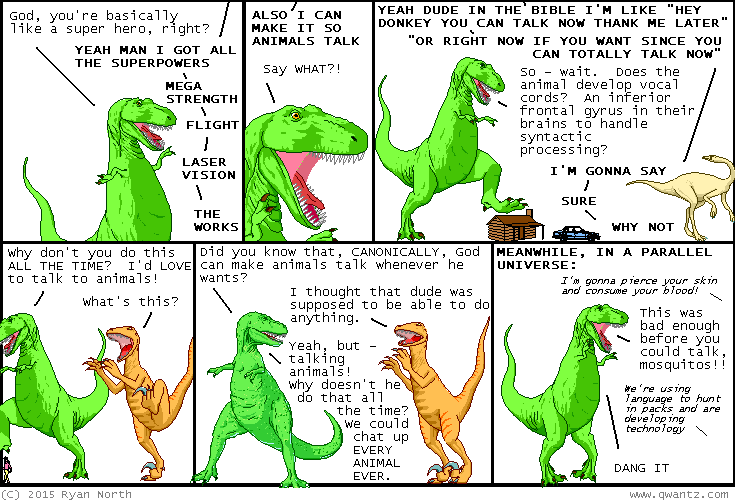
August 3rd, 2015: The talking donkey in the Bible never even gets a name! I propose we call her... "Chatty McVocalcords". It is a reasonable name that will fit into the other names in the Bible nicely.

– Ryan

03 Aug 08:52

What does Sean Connery eat when he goes on holiday to Cornwall?

by Andrew Rilstone
On page 279 of the Hugo-nominated collection of essays Transhuman and Subhuman, John C. Wright writes the following:

Now, it must also be clear that men have free will, and can train themselves either to fulfill their nature or oppose their nature. Merely because we have a natural inclination toward something tells us nothing about whether we ought to do or avoid that impulse. I have an impulse to be kind to children with big eyes, which I think I should indulge, and I have an impulse to stab my rivals through the eye and into the brain pan with my sword cane, which is an impulse I think I should suppress, not the least because my blade is dull and I am past the age when one can face the gallows with dignity. 

As a matter of fact I agree with Hugo-nominee J.C Wright’s point. You can’t get from an “is” to an “ought”. You can’t make gut-feeling the arbiter of morality. You should sometimes suppress your urge to be kind to cute children, say, because this particular cute child is a Skrull agrent; or because giving that one more chocolate will make him sick and rot his teeth. 

But what a bizarre way this Hugo-nominated writer has of expressing himself! Why talk of stabbing someone with a sword-cane, when you are a citizen of the United States and could legally obtain a hand-gun if you wanted to? And why talk about “facing the gallows” when your home state carries out executions (by gas and lethal injection, not hanging) only about once a decade, and then only for the most grotesque and heinous multiple murders? Why not write “I have an impulse to shoot my rivals, which is an impulse I think I should suppress, because I’m a rotten shot and I shouldn’t think I would cope very well with jail?”

And anyway....is it really true that the main reasons for not murdering people are that you you don’t have an appropriate weapon and that you are afraid of the punishment? Isn’t the main reason that you think that a higher authority than your own gut-feelings — God or the Tao or natural law — says that murder is wrong? And doesn’t that same morality tell you that you should not only be kind to cute children, but ugly ones as well?

At the end of an essay about Disney’s Snow White and the Seven Dwarfs, the Hugo-nominated Wright muses that it is possible to imagine angels telling stories or writing poems, but not to imagine them telling fairy tales. Fairy tales speak to our sense that, since the Fall, we humans don’t quite belong in the natural world, so angels wouldn’t have any reason to make them up. This is a perfectly decent point. It’s a perfectly decent point derived from Tolkien’s Essay on Fairy Stories and C.S. Lewis's Weight of Glory, but none the worse for that. Good writers borrow; great writer’s steal, as the fellow said.

The Hugo-nominated essay concludes: 

Why should they daydream, and not do? No youth sighs over his beloved's picture when she is in the bridal bower and demurely shedding her veil.

In the bridal what? Demurely shedding her what? Why this sudden lapse into archaism? Wouldn’t “No young man drools over his girlfriend’s photo when she is already undressing in front of him” have made the point better? I should have been inclined to write “No-one surfs for porn while they’re having sex with an actual human being” but I probably go too far in my preference for plain speaking. 

Having said that, this Hugo-nominated author writes very well. Many of the essays in this volume are worth reading, even if they don’t exactly push the boat out in terms of radical or challenging subject matter. Why do science fiction stories so often imagine future wars being conducted with swords? Because swords evoke an older, more chivalrous, version of war. Who were the great writers of the Golden Age? Heinlein, Asimov and (unjustly neglected) Van Vogt. Is it better to be regarded as good, or to actually be good regardless of what anyone thinks of you? Better to be good. What characterized classic science fiction? Competent men solving problems by gumption, ingenuity and intelligence. What is the secret of great writing? Show, don't tell; tell the truth; fulfill your promises to your readers. Was Arthur C. Clarke's critique of religion a bit naive? Yes. Was the Desolation of Smaug very good? Er... No. His pen has a habit of running away with itself, but he has the knack of summing up a train of thought in a forceful paragraph.

Here he is on the fact that science fiction readers — as opposed to mundanes, or, as he amusingly calls them, muggles —  positively like to be confused or baffled by a setting. In return, the science fiction writer — like the traditional detective story writer — has an obligation to play fair. He has to understand how his world works, and he has to give the reader reasonable clues so he stands a chance of working it out for himself. But:

This willingness to be lost tends not to work across genre boundaries. The reason why a collective groan of disbelief rose up to heaven from the massed fans of Star Wars was because of one line in one scene from the Phantom Menace, when the Jedi say Jedi powers are based, not on a mystical energy field binding the galaxy together, but due to microscopic bodies in the bloodstream. The groan was because the genre boundary had been crossed. 

I couldn't have put it better myself, and indeed didn’t. Unless…maybe that crossing back and forth between genre was part of the point of Star Wars to begin with? Maybe a mystical energy field which is also a side effect of telepathic micro-organisms is very much the same thing as an old-fashioned sword which is also a high tech piece of hardware? But let's not press that point. He's dead right that making Obi-Wan "a crazy old wizard" is a different proposition from making him "a student of mind science" even if the super-powers are the same either way.

He thinks that science fiction is more about mythology than prediction, and defines mythology thus:

A mythology is an explanation by means of concrete images of the abstractions and passions of the age; myth speaks in a vocabulary of anthropomorphoized figures.


Very well put: that’s just what mythology is, and it would be worth running the definition past the kinds of people who think that the Bible (for example) is either the LITERAL HISTORICAL TRUTH or else a PACK OF LIES. In fact, he's rather good —  if a little verbose and shrill —  on the whole idea of science and religion being necessarily at odds: 

With apologies to my fundamentalist brethren in Christ, all that happened is that one small group in schism with the Roman Catholic Church, militant fundamentalist Christians who reject the authority of the Magisterium to interpret and teach scripture, has decided on a literal interpretation of Genesis, and insist on a six-day timeline of creation that does not fit geological, astronomical, or biological evidence......


Meanwhile, another small group in schism with the Roman Catholic Church, militant fundamentalist atheists who reject the authority of science to say what is and what is not science, has decided on a mystical, Shavian, Hegelian or Marxist misinterpretation of Darwin’s Origin of Species....


These two groups, neither of whom represents mainstream Christianity or mainstream scientific thinking, have decided that there is a war going on between science and Christianity....


I mean, it's a bit of a stretch to see fundamentalists as schismatic Catholics and a big stretch to see Dawkins' lot that way, but the idea that "religion vs science" is not a clash of two mighty ideologies by a quarrel between too tiny sub-groups is really very well played. 

And he’s pretty good even when he’s being deliberately contentious. He is very annoyed with Hell is the Absence of God, a satirical short story by three-times Hugo award winner Ted Chiang, because (he thinks) it sets up a straw-man version of Christianity instead of engaging with what Christians actually believe. The Hugo-nominated Wright claims to have been an atheist when he first read the book, and says that even then his reaction was “doesn’t Ted Chiang know any Christians?”

The major charge of honest atheists is that the claims of the Christian religion are false…. When asked politely if they can see the Wizard, the atheists are told that no one can see the Wizard, not nobody not no how. Small wonder the atheists are skeptical. You do not undercut this fairytale by saying that The Wizard is an evil bunny-killing tyrant and that the Wicked Witch of the West is merely a soulful and misunderstood victim of circumstance. 


This is a good analogy. I shall probably steal it at some point. It's the flip side Ford Prefect's "isn't it enough that the garden is beautiful without believing that there are fairies are the bottom of it?" Can't you say that you don't believe in fairies without lying about what the fairy tale is about? 

But in the same essay, the pen of Hugo-nominated J.C Wright demonstrates its tendency to run out of control: 

The major objection honest atheists must level is that religion is false; that even if true, it has no claim on our loyalty; that the reason of man, being reason, cannot be bound by dogma; and that the claims, true or false, are repellent to the dignity of free and rational beings. 


Well, no. Those are not arguments that an honest atheist must put forward. These are four different arguments that four different kinds of people might possibly have for rejecting religion. 

1: Religion is false

2: Religion has no claim on our loyalty

3: Humans can’t be bound by dogma

4: The claims of religion are repellent

I think what the Hugo-nominated writer is trying to get at here is that you might plain and simple not believe in God. On the other hand, you might be far from sure that God does not exist, but very sure indeed that there is no need to worship him even if he does. Or again, you might be agnostic about God's existence but still have a problem with the absolute claims of some churches. You might even say that religion is so horrible that you don't care whether or not it is true. It obviously isn't the case that an honest atheist must say that the claims of religion are repellent. Lots of honest atheists say "It's a lovely story. I can see why you want it to be true. But I don't believe it is." Perhaps the Hugo-nominated Wright means to say "an honest atheist must level one or more of the following claims against religion"? But that doesn't work either —  only the first claim is strictly atheistic, and there are many more than four reasons for rejecting religion.

The sentence is a muddle because one word, religion, is being pressed into service to mean

a: Theism, the belief in God

b: Religion, the practice and worship of a particular God

c: Catholicism, a particular version of a particular religion.

And a single word, atheism, is being treated as "the opposite of religion" so it covers “people who don’t think there is a God”; “people who don’t practice any religion” and “people who aren’t Catholics.” It doesn't help that dogma has a technical theological meaning and a popular, colloquial one and that it isn't clear in which sense it is being used.

The Hugo-nominated Wright likes to present himself as a bit of a donnish pedant, worrying about the proper meanings of words and distinguishing between Aritstotle's four different ways of answering a "why?" question. But he actually writes quite carelessly, particularly when he's affecting to be annoyed about something. And he has a habit of saying the same things over and over in different words. (He is also addicted to reiterating statements using various synonyms.)

*

There is a certain kind of modern art where the idea is more important than the object. It is quite funny to know that a Frenchman once put a toilet in an art gallery and labeled it “Fountain”; it’s not so necessary to go and see the actual loo in question.

Similarly, the idea of a book is sometimes more important than the book itself. It is quite funny to know that someone once translated Winnie the Pooh into Latin, or photographed every public lavatory in London, but once you know that they have done so, you do not necessarily need to read the books.

The Hugo-nominated Transhuman and Subhuman is best thought of as a conceptual book. All the talk about sword-canes and hangings and bridal bowers is a bit of literary cos-play. The book is an homage: a pastiche. It has a point  — an obnoxious point, but still a point — but it makes that point by existing, not by arguing any particularly compelling case. People who agree with the point will own a copy; and quite possibly vote for it in the 2015 Hugo Awards. But they will not necessarily read it; at any rate, not right to the end. (The last two extended essays defeated me, and I'm the sort of person who is good at struggling through difficult books.) 

This is a Hugo-nominated essay collection that is trying, very hard, to sound as if it comes from 1920s England, not 2015 California. The rhetoric, and many of the actual arguments, sound like something out of C.S. Lewis. It keeps lapsing into flowery archaic language, and sometimes pretends not to understand modern vocabulary. It doesn’t reference any philosopher more recent than Aristotle. Its science fiction reference-points are books that I was reading at school: A Princess of Mars, The Foundation Trilogy, Childhood’s End, the Lensman series, classic Star Trek, the original Star Wars. Not insignificantly, the author appears to deliberately dress like G.K. Chesterton.

The medium is the message. You don’t need to read any modern science fiction to know that it's all awful. You don’t need to read modern philosophy to know that it’s all codswallop. The Golden Age is past: schools no longer educate children; journalists no longer tell the truth; and science fiction has turned away from the one true way of John W. Campbell. 

So the thing to do is to huddle together writing very old fashioned essays on very old fashioned books in very old fashioned language, and wait for an intellectual savior in an old fashioned hat, and old fashioned frock coat, armed with an old fashioned sword cane to stab the dragons of modernity through the eye (and into the brain pan) on our behalf. 

.....continues


This blog is financed by Patreon. This means that people who like my writing pledge to give 50c or $1 every time I publish a substantive essay. If you think that this essay is worthwhile, then please consider supporting me. 


02 Aug 12:49

Softy Calais goes ballistic…

by Geoffrey K. Pullum

Calais in north-western France, and Kent in south-eastern England, have been experiencing weeks of extraordinary chaos. Thousands of desperate migrants from Africa and the Middle East are fighting to get into the Eurotunnel depot where they think they might be able to stow away on trucks that will make the train journey through the tunnel to the immensely desirable destination of Great Britain. The British think the Calais local authorities and the French government have been making only desultory efforts to prevent the migrants from clogging the approach roads, breaching the security fences, delaying train departures, and causing side effects like 24-hour traffic jams on the M20 freeway in Kent. So the headline writers at The Sun went to work, with feghoot based on a song from Mary Poppins:

Softy Calais goes ballistic… Frenchies are atrocious!

One would have to spare a grudging moment of appreciation for this tortured effort at eye-catching summary [if it were not a case of multiple self-plagiarism by The Sun — see footnote at the end].

But incidentally (for this is Language Log, not Asylum-Seeker Log), I have always been irritated by the famous song "Supercalifragilisticexpialidocious." What's wrong is that it's an impossible word. The morphemic structure is fairly obvious:

Super+cali+fragil+ist+ic+ex+piali+doci+ous

The main thing that makes this an impossible word is that the suffix -ic can never be followed in any word by the prefix ex-. Absolutely no word has -icex- in it. But even the spelling tells you that: no word has c pronounced [k] when followed by e (correct me in the comments below if you can find a counterexample).

Of course, supercalifragilistic is a possible word (an adjective; one related abstract noun would be supercalifragilisticity), and expialidocious is a possible word (also an adjective; one related abstract noun would be expialidocity and another would be expialidociousness). It's gluing the two together that loses the possible-word status.

It would be easy to make up morphologically possible but nonexistent English words of this length, but *supercalifragilisticexpialidocious isn't one of them.

[Update: Two or three commenters pointed out that The Sun was plagiarizing itself, drawing on an earlier headline about a soccer match between Caledonian (winners) and Celtic (humiliated losers). The latter team's name is usually pronounced "seltik", so that wouldn't be a counterexample to my claim about c; but the language family name Celtic is pronounced with initial [k], so that is a counterexample; and sceptical in its British spelling (American skeptical) is another. And as several people have pointed out, "soccer" is a counterexample if you don't draw a distinction between c and double c.]

02 Aug 09:53

Fats Domino – Why Don’t You Do Right

by weatherhead.adam@gmail.com

Fats Domino recorded Why Don’t You Do Right for ABC-Paramount in 1965. The bright brass backing is just one marker of the stylistic change from his many collaborations with Dave Bartholomew at Imperial. On this song, which has a distinctive big-city jazz feel, it works. Why Don’t You Do Right is often sung from a woman’s perspective – famously by Peggy Lee, Della Reese and Jessica Rabbit. Having a woman telling her man to go get her some money softens the lyrical allusions to prostitution. When Domino sings the same words, with the gender roles reversed, he sounds like a straight out pimp. Why Don’t You Do Right’s first incarnation was as Weed Smoker’s Dream by the Harlem Hamfats in 1936. It’s about a man, the weed smoking protagonist, who wishes his woman friend would go earn some money by turning tricks.

31 Jul 17:24

Thoughts About Thought About Pixels

by Dave

Last week the Adam Sandler movie Pixels came out, to dismal reviews. The movie seems to be the usual Sandler fare: lazy, juvenile, wasteful, and unnecessary. Nothing unexpected or out of the ordinary. Sandler has become a favorite punching target for folks, and I can’t say it’s without reason, though I think he sleeps fine on a huge bed of cash. I’ve no love for Sandler. I’ve seen only one or two movies with him in them (one being Punch-Drunk Love) and don’t see much of anything there for me.

This time, however, one thing was a little different. Since the subject of Pixels was video games — particularly old-school video games — and therefore a nerdy subject, geeks decided to join in on the bashing. This is interesting to me because 364 other days of the year geeks will loudly and proudly declare that they don’t read reviews and don’t care about them because reviewers don’t know what they like and not every movie has to be Citizen Kane and what not. But this time it was very important to point out and laugh at the poor reviews Pixels was given and get mad when it left 0% on Rotten Tomatoes. Again, usually they’re getting angry that someone failed to give some Marvel movie an A-plus-plus-plus-with-a-star-and-grape-job-sticker.

It was an odd moment to watch. Pixels looks like garbage, sure, and it most likely is. I’ve no doubt it deserves the thumping its getting by reviewers. But I can’t figure out in what way it’s quantifiably worse than any other garbage that usually gets a pass. Especially the stuff that usually gets a pass from the nerds who formed this unusual “enemy-of-my-enemy” alliance with movie reviewers, of all people.

In any given month we get several geek-aimed movies that show similar lazy pandering, vapid characterization, undercooked special effects, and so forth, and usually instead of gleefully showing them the exit we instead have to hear the usual litany of, “just turn off your brain” or “it doesn’t pretend to be more than what it is” or “so bad it’s good” or “I just go in not expecting much”. It’s worth pointing out that Pixels debuted almost simultaneously with Sharknado 3, which didn’t get the same treatment. I can’t figure out why 15 mediocre CGI-fests can get a “meh, I was entertained” but the 16th is just beyond the pale.

I commented elsewhere that I suspected that, if everything else remained exactly the same except Adam Sandler were instead replaced by Chris Pratt, we’d be hearing a different story. My supporting evidence for me is that two of the criticisms I saw thrown at Pixels was shamelessly trading on nostalgia and having only a handful of female characters, one of which is solely a prize for the hero. Well, I’ve seen The Lego Movie, which had both of those things in spades. Was it a better movie and offered more than I imagine Pixels does? I’d bet it does. But these things which are apparently dealbreakers for Pixels were largely overlooked. I would compare it with the phenomenon of how very concerned about poor relationships and role models fans of comics, anime, videogames, and such suddenly get when the subject at hand is Twilight and not, say, Buffy the Vampire Slayer.

So I guess it’s the fact that Adam Sandler is a designated punching bag, as is Twilight or 50 Shades of Gray, which makes people who’ve gone to bat for much much worse schlock suddenly turn their nose up and jump on the anti-Pixels brigade. Nerds are famously very much against bullying until it’s them doing it to a convenient lesser target, and I can’t help but be reminded of the celebrated Geek Hierarchy chart which allowed geekdom to say, “Whatever I am, at least I’m not a *groan* furry.” As long as there’s something we can all agree is worse than whatever it is we’re into, we’re above reproach. I might watch any number of hacky-assed brainless movies, but if one of them wasn’t Pixels, I have a clear conscience. See, I do have limits!

Again, I’m not defending Pixels. It looks like a pile of worthless junk. What I’m saying is, it’s not the only pile of worthless junk I’ve seen on offering, just the only one that, for some reason, it’s very important everyone denounce as worthless junk. In the meantime, there will still be a supply of movies no better or worse than it which we’ll be told we can’t say anything bad about or else we’re “haters” or “bitter” or “hate fun”.

31 Jul 14:23

A Headcanon Named Autism: In defence of finding our own representation

by feministaspie

Let’s start with a trip down memory lane. When I was in Sixth Form, I studied Tennessee Williams’ A Streetcar Named Desire for A-Level English; being one of few people in the classroom who didn’t really mind reading out a particularly large share of lines, I ended up reading Blanche DuBois every lesson. I’ll be honest, Blanche is basically the dictionary definition of “your fave is problematic”, and yet she became one of my favourite characters in the whole syllabus; I sort of identified with her in a way I couldn’t really put my finger on at the time. Before long, I was combing through the text over and over, reading far more articles and criticisms online than was really necessary for the coursework, and developed a theory that I eventually felt confident enough to share with friends, only to receive a perplexed look and a “…Really? Are you sure?” in response.

Though I didn’t know it at the time, I’d accidentally reinvented the autistic headcanon.

For those of you unfamiliar with the term, “headcanons” are reader interpretations and theories that aren’t expressly stated within the media itself (i.e. it isn’t “canon”). So an autistic headcanon basically means “I interpret this character as autistic” and it’s also worth noting that the headcanon-er is usually, though not always, autistic themselves, because we’re the ones most invested in autistic representation. I’ve noticed a strange backlash against autistic headcanons, mostly from neurotypical people. “Stop glorifying/romanticising autism!” they say, just like they do whenever we talk about autism as anything other than the horrifying-tragic-burden portrayed by organisations like Autism Speaks. “Stop mocking autism!” they say, telling autistic people that they’re somehow mocking themselves whilst ignoring all the actual mockery of autism that neurotypical people do all the time. Self-insertion is another accusation thrown around (although somehow never at neurotypical people who insist a given character has to share their neurotype…) but that’s rarely the case; often, apart from being autistic, we aren’t actually all that like our autistic headcanons. It’s almost like autistic people aren’t all the same or something…

Which brings me to the current state of canon autistic representation which, like the representation of many other marginalised groups, is very poor. The main problem, of course, is that there isn’t enough of it. Then, when there is a canonically autistic character, it’s often the same-old-same-old “gifted at maths/science/technology but inept at every single human interaction” stereotype. I don’t doubt that some autistic people happen to fit that stereotype, but when that’s all the representation that’s available, many of us will continue to struggle to relate to even the few characters that are supposed to be like us. They’re often defined by the neurotypical point of view, with little or no mention of traits such as sensory processing issues. They’re also virtually always cis white men. Sometimes, characters are very heavily coded autistic (albeit in very stereotypical ways) to the point that it can’t be an accident, but it’s never expressly stated; this increases the stigma around the autism label (the idea that it’s too horrifying to speak of), allows the writers to be as inaccurate/stereotyping/offensive as they want with no consequences, and allows neurotypical people to continue to ignore autism and even try to take this very limited and very flawed representation away from us. Because yes, many of us cling to such characters anyway despite all these issues, because it’s all the representation we’ve got.

Representation issues are often dismissed as “just fiction” but this does matter; this does have real-world consequences. If, growing up, you are never or rarely shown people like you, it reinforces the idea that you’re abnormal, that you’re somehow wrong. If people like you are only shown to be one narrow type of person, you assume that that’s all people like you can be, and you start to feel that not only are you a failure for not being neurotypical, you’re also failing at being autistic. It also shapes how other people think about people like you; if they are only shown this one stereotype of people like you, they will believe that that’s how all people like you are, and that’s how they will expect you to be. We do get expressly compared to autistic or heavily-coded-autistic characters all the time – if I had a pound for every time my name was put in the same sentence as Sheldon Cooper or Christopher Boone or Sherlock Holmes, I could buy a plane flying a banner which reads “SERIOUSLY I WANT MORE FEMALE AUTISTIC CHARACTERS” – which only goes to show that these characters do send out a clear message about autism, good or bad, right or wrong, to neurotypical people. Personally, I’m frustrated by the fact that so many canonically autistic characters have a ~special talent~ that somehow redeems them; when I was younger I genuinely thought that was true of all people like me (it isn’t; see this post by Unstrange Mind), so as a straight-A student who didn’t (and doesn’t) have any glaringly obvious ~special talent~, I assumed mine had to be school and therefore I would be doomed shortly after I turned 18. And I’m speaking as a white cishet woman who has no other disabilities besides autism; autistic people in one or more other marginalised groups are often rendered completely invisible.

So, is it any wonder we resort to finding our own representation? Sometimes we aren’t even looking for it, it just happens, but sometimes some of us do just randomly decide a character is autistic because-why-not, and that’s okay too – because, well, why not? Why is neurotypical the default unless expressly stated otherwise? Believe me, there are headcanons out there a lot more far-fetched than “I see a lot of my own autistic traits in this character” that don’t get anywhere near the same level of scrutiny and people desperately trying to prove them wrong. I suppose if you’ve always been told your neurotype is the default to which everything else is “other”, you’d react negatively to being told you’re not. Autistic headcanons aren’t hurting anyone – unlike the currently poor canon representation, and of course the real-world ableism routinely ignored or perpetuated by the same people who are so against autistic headcanons – so why else would there be such a backlash from neurotypical people?

Representation matters, and I want to see a world where books and TV shows and films depict autistic people of colour, LGBTQIA+ autistic people, autistic women, autistic people with other disabilities, autistic people who can pass for neurotypical and who can’t, autistic people who are verbal, non-verbal, partially verbal, autistic people with all kinds of special interests, autistic people who use special interests in their work and those who don’t, autistic people who are hypersensitive and hyposensitive and sensory-seeking, autistic people of all ages and all occupations, autistic heroes, autistic villains, autistic geeks and autistic sports captains and everything in between, with good qualities and flaws that are related to autism and those that aren’t related to autism at all – realistic, multi-dimensional autistic characters that don’t feel hollow or like the butt of a joke.

I suppose, unlike Blanche, I do want realism. And until that’s achieved, autistic media consumers everywhere will keep working our headcanon magic.

(Also, I’m interested to hear your autistic headcanons, or favourite canon autistic characters – let me know in the comments!)


Tagged: autistic headcanons, representation
31 Jul 14:20

#1147; In which a Lock is needed

by David Malki

The lock is for a time capsule containing everything else in the garage.

31 Jul 13:08

"Being without becoming" - Disjointed Thoughts on Dialectics and the Third Doctor, Part 1

by Jack Graham
"Being without becoming [is] an ontological absurdity" says the Doctor in 'The Time Monster'.

He's talking about time, about the fact that time is - by definition - a process of change.  Time is what entropy looks like to those of us in the midst of it.  Entropy increases, thus time's arrow goes forward.  'Becoming' is just a way of saying 'change'.  Everything is always in the process of becoming something else.  Every apple is in the process of becoming a rotten apple, or an eaten apple, or seeds resown.  'Ontology' is the fancy name used by philosophers to mean the study of what it means for things to exist, to be real.  The Doctor is saying: "the idea of things being frozen in time is inherently absurd because things that don't change effectively don't exist".

Though, of course, in 'The Time Monster', things and people do get frozen in time.  The story shows us something happening which has already been established as impossible.  It's almost as if we are being explicitly invited to read the story metaphorically.

This is something that doesn't quite happen in 'The Three Doctors'.  As Phil Sandifer has said, the story should be set in the Land of Fiction.  The moments when Omega materialises an ornate chair from nowhere, and when the Doctors make a normal door appear amidst all the bubbly orangely madness, are moments when we see how Omega's realm should have been done - as an openly metaphorical realm of familiar imagery surreally employed.  We have a similar problem in 'The Trial of a Time Lord'.  Clearly the entire trial should have occured in the Matrix, in the realm of metaphor, in the nest of sinister and surreal Victoriana, instead of in a bog-standard courtroom with some spangly bits stuck on because it's in space.   Omega's realm should have been such a place.  It should have been like the Land of Fiction, or Goth's Matrix, or the Valeyard's Matrix, or Heaven in A Matter of Life and Death.  We are, after all, clearly engaged in a life and death metaphor here, with things disappearing from our world and being stranded in another, and then hauntingly returning to attack our world.  However, as I say, 'The Three Doctors' attempts to foreclose on such readings by stubbornly insisting upon sciency-sounding jargon.  Black holes, anti-matter, etc.  The metaphorical possibilities of being transported from one realm of reality to another of unreality are shut-down (the attempt is at least made) by the technobabble about matter being processed so it can exist in a world of anti-matter.

Thing is, it never quite takes.  Anti-matter is rarely used to mean anything scientific in sci-fi.  The name itself is metaphor, expressing a scientific concept that is very hard to grasp in literal terms, especially for the layman.  In sci-fi, 'anti-matter' is usually metaphorical.  In 'Planet of Evil', anti-matter is straightforwardly hauntological!  It is evil matter.  Ghostly matter.  Gothic matter.  Hammer matter.  It can infect our world, bringing ghosts with it, making jungles into haunted spaces, turning a sci-fi boffin from a Dr Jekyll into a shambling, simian Mr Hyde.  In 'The Three Doctors', despite the attempt to shut down the metaphorical reading, anti-matter refers to the realm of ideas, and more particularly to the way of thinking about the world that sees ideas as primary, as more fundamentally real than material things.

As Engels pointed out, all philosophy can be divided into idealism and materialism.  Idealism, in this context, refers to the notion that ideas are in some way more fundamental or more primary or more influential than matter, and that material things exist in some way 'after' ideas.  Materialism, in this context, refers to the notion that material reality is more fundamental, more primary or more influential, and that ideas stem from matter rather than the other way round. In many ways, materialism has won this argument.  Modern science is pretty unambiguous in its findings: ideas are products of brains, which are products of material processes.  The material world existed long before anybody had any ideas about it, and would continue to exist if there were no ideas.  However, it's interesting how many scientists harbour idealist conceptions in other areas.  Take Richard Dawkins, for instance.  In many ways, a classic example.  His scientific viewpoint is decidely materialist.  We don't even need to get into the old debate about whether his genes-eye-view of evolution is reductionist and determinist.  We can take his own account of things at face value and declare, undoubtedly with his agreement, that his worldview is materialist rather than idealist.  There is no mystical component.  In the beginning there was not the word.  However, in spite of himself, his ideas about memes are highly idealist. He tries to ground his view of culture in a hard-headedly materialist understanding modelled on his view of genetics, but his account flies off into the realm of idealism.  Memes are themselves entirely notional units which exist only in poor-defined and fuzzy metaphorical accounts.  Dawkins sees society and culture as made of such notional units (their size, complexity and nature fluctuates with the needs of his storytelling) which interact almost without human agency.  They occupy human heads like germs in bodies.  They replicate like bacteria in the gut.  They spread like diseases.  They self-organise and use people as hosts.  And this dance of these selfish memes, these impersonal little idea-creatures, forms the basis of changes in human society and, ultimately, human history.  They get transmitted in novels and films, etc, until they occupy enough heads to make sufficient numbers of people act in ways that change the "moral zeitgeist".  It really is like computer viruses causing widespread changes in how computers work by replicating and transmitting across networks.  It's an account that is as essentially mystical as it is incoherent, even as it models itself on a materialist account of biological evolution - a delicious irony coming from such a crusty so-called atheist and sceptic.  Ironies pile on top of each other when Dawkins tries to use the memetic view of culture to explain the otherwise inexplicable (to him) popularity of supposedly irrational ideas... and falls directly into the most embarassingly vulgar and irrational kinds of idealist reductionism.  The really interesting thing here is that Dawkins arrives at this thoroughly idealist view of society, culture and history via the route of vulgar materialism, the kind of vulgar materialism which insists upon a reductionist genes'-eye-view of evolution coupled with a reductionist view of brains as being like machines which run software.  And this is where we can draw a distinction between vulgar materialism and dialectical materialism.

Dawkins' materialism is vulgarly positivist because it is based upon treating reductionism as though it is more than a tool, as though it represents something true about how the world works.  Reductionism is fine as a method - it has done some wonderful heavy-lifting in the history of science.  It is, essentially, the procedure of studying things by taking them apart (either literally or metaphorically) into bits and pieces and then studying the pieces in isolation to see how they work on their own.  And that's fine.  You can learn a lot about rivers by studying water molecules.  The great mistake made by so many people is the idea - which is impliclty held often by people who would explicitly reject it if it were offered to them - that you can understand everything you need to know about rivers from the study of water molecules because rivers are essentially nothing more than aggregations of lots of water molecules.  A more dialectical view of materialism would see an interrelation of material at various levels, from the molecular to the social.  It would remember that rivers are also things that people use socially.
31 Jul 10:46

Labyrinths

by Lawrence Burton

Jorge Luis Borges Labyrinths (1964)
I was beginning to get the feeling that almost everything I've ever read might either be traced back to Borges or else somehow prefigure his writing, but I never actually located any of his writing in the usual book stores and, in any case, probably wasn't in a huge hurry to do so due to a niggling fear of finding myself way out of my depth. Almost everything I've ever read is admittedly something of an exaggeration here, when really I mean certain things I've read which have made a significant and particular kind of impression on me - Philip K. Dick and certain looser strains of science-fiction, Grant Morrison, Alan Moore, and a few other comic strip authors. Borges seems either an originator or an otherwise significant name in the history of books within books, seemingly self-aware narratives reflecting  the readers' existence as potentially no less a fiction than that which appears on the page. His central point seems to be that reality is a function of language, or something of the sort, and he illustrates this over and over in a series of surprisingly succinct short stories and essays. Curiously, the dividing line between what constitutes fiction and what constitutes an essay in Borges' oeuvre is ambiguous as he tends to employ each form towards similar ends, whether it's an analysis of Cervantes' Don Quixote, or the fiction of the writer who strives to rewrite the same.

He did not want to compose another Quixote—which is easy—but the Quixote itself. Needless to say, he never contemplated a mechanical transcription of the original; he did not propose to copy it. His admirable intention was to produce a few pages which would coincide—word for word and line for line—with those of Miguel de Cervantes.

Peculiarly, there are points at which Borges reminds me of Woody Allen, specifically the absurdity of Without Feathers.

Do I believe in God? I did until Mother's accident. She fell on some meat loaf, and it penetrated her spleen. She lay in a coma for months, unable to do anything but sing  "Granada" to an imaginary herring.

Compare, for example, the tone of the above with that of Borges' The Library of Babel:

The mystics claim that their ecstacy reveals to them a circular chamber containing a great circular book, whose spine is continuous and which follows the complete circle of the walls; but their testimony is suspect; their words, obscure. This cyclical book is God.

This actually reminded me of laughing until my sides hurt over an article in an old issue of Brian Moore's Head football fanzine presenting a fictitious history of the introduction of football to colonial Africa: our Livingstonian narrator arrives at the remote village and realises that the locals have failed to grasp the point of the game once he sees their circular pitch with its single set of goalposts erected at the centre. I'm not trying to denigrate Borges here so much as illustrate his finely-tuned sense of the absurd, albeit in an informally Surrealist or Symbolist context, and how this renders some seriously headachey philosophical points as entirely more readable than they probably have a right to be, even compellingly so.

Why does it disturb us that the map be included in the map and the thousand and one nights in the book of the Thousand and One Nights? Why does it disturb us that Don Quixote be a reader of the Quixote and Hamlet a spectator of Hamlet? I believe I have found the reason: these inversions suggest that if the characters of a fictional work can be readers or spectators, we, its readers or spectators, can be fictitious. In 1883, Carlyle observed that the history of the universe is an infinite sacred book that all men write and read and try to understand, and in which they are also written.

Which would be more or less the same as the point at which Grant Morrison has Animal Man look out of the page at his reader and exclaim 'I can see you!', except Borges states his case in clearer terms which are much more difficult to refute - I would argue - not least in the essay in which he more or less proves - at least in philosophical terms - that words constitute reality; unless I imagined that one.

There's much more in Labyrinths than I could hope to summarise, even had I understood all of it, so I'll close by stating that it has depths within depths and yet remains mostly as clear as an unmuddied lake. His reputation seems entirely warranted.
29 Jul 16:11

love in the time of robots and perfect brain duplication

archive - contact - sexy exciting merchandise - search - about
← previous July 29th, 2015 next

July 29th, 2015: Sorry for calling your body "noticeably nonrobotic"; I know it's probably a sore point. :(

– Ryan

29 Jul 16:10

Duke Ellington, The Conny Plank Session

by Michael Leddy

[The back cover.]

Duke Ellington and His Orchestra. The Conny Plank Session (Grönland, 2015). Total time: 29:21.

The Conny Plank Session is the only Ellington release I know of to be named for a recording engineer. Conny Plank (1940–1987) was an acclaimed producer and engineer who would become known for his work with David Bowie, Brian Eno, and Kraftwerk, among other musicians. I don’t suspect an undiscovered Ellington–Plank affinity: my guess is that Plank just happened to be the engineer in the Cologne studio where Ellington was adding yet another session to the countless sessions that formed the stockpile — music recorded at his expense to test ideas and document work in progress. Suffice it to say that the band sounds great: bright, clear, rich, and well-balanced. The work of the piano player in particular has startling presence.¹

This session — two tunes, three takes each — gives us the Ellington band in July 1970. Or 1970 A. H., After Hodges, the alto saxophonist Johnny Hodges, who had died on May 11. “Because of this great loss, our band will never sound the same,” Ellington wrote on that day. Yet the band continued, as ever, as a collection of idiosyncratic voices (who sometimes, it’s true, modeled themselves on earlier Ellingtonians). Wild Bill Davis was on board as organist: he had just appeared to great advantage (along with Hodges) on “Blues for New Orleans,” the opening section of Ellington’s New Orleans Suite. Fred Stone, trumpeter and flugelhornist, had played with Clark Terry-like fleetness on the Suite ’s “Aristocracy à la Jean Lafitte.” Norris Turney played a Hodges-like alto and was an important presence in the Suite as a flutist, the first band member to play flute on an Ellington recording (on “Bourbon Street Jingling Jollies”).² Davis, Stone, and Turney all have prominent parts in this session.

“Alerado,” by Wild Bill Davis, is the slighter of the two tunes here. It’s named for the record producer Alexandre Rado, who supervised the French RCA Integrale LP series of Ellington reissues. The tune is little more than its attractive chord changes, which evoke (strongly) the bridge of Rodgers and Hart’s “Blue Moon” and (less specifically) Dave Brubeck’s “The Duke.” Turney (flute, alto), Stone (flugelhorn), and Paul Gonsalves (tenor) solo briefly in what was likely designed as a concert showpiece for Davis.

Ellington never stopped listening: in his last official concert recording (Eastbourne, 1973), he was parodying the Art Ensemble of Chicago and other avant-gardists, giving the audience a taste of “the future” (as he derisively called it) with an atonal explosion that turned into “Basin Street Blues.” “Afrique,” a section of The Afro-Eurasian Eclipse (1971), is a more genuine engagement with the new: it gives us the band playing on a single chord (B minor, of all things) in a latter-day version of the so-called “jungle music” that established Ellington in the ’20s. (“Chinoiserie,” another section of the Eclipse, is another late engagement with the new: particularly in a 1973 performance that gives us the Ellington band hitting “the one,” the defining element of James Brown’s funk.)

The 1971 “Afrique” (released on LP by Fantasy in 1975) is primarily a vehicle for piano, trombones, and reeds, with Russell Procope (clarinet), Harry Carney (baritone), Gonsalves, and Turney (alto) engaging in call and response. The three 1970 takes are markedly slower and more devoted to exploring the atmosphere established by Rufus Jones’s untiring drumming. They are tremendously exciting music. Trombones, organ, and Gonsalves’s tenor are the key elements here, with Ellington’s piano at its most percussive. The third take is one of the wildest Ellington recordings I’ve heard, with an unidentified singer who evokes Adelaide Hall’s growls (“Creole Love Call”) and Alice Babs’s soaring vocalise (“T. G. T. T.,” from the Second Sacred Concert ). The profane and the sacred, in one voice! I can only wonder what further treasures remain in the stockpile.

Grönland’s presentation of The Conny Plank Session is less than satisfactory. The musicians are identified in nothing more than a line of abbreviations reproduced from W. E. Timner’s Ellingtonia: The Recorded Music of Duke Ellington and His Sidemen (2007):


[Got that?]

The line is partly hidden behind the CD spindle, with some of its text barely readable. But for anyone with some prior knowledge and a little time at Google Books, it’s easy enough to put together the band:
Cat Anderson, Mercer Ellington, Fred Stone, Cootie Williams, Nelson Williams, trumpets, with Stone doubling (?) on flugelhorn

Chuck Connors, Malcolm Taylor, Booty Wood, trombones, with Connors on bass trombone

Harold Ashby, Harry Carney, Paul Gonsalves, Russell Procope, Norris Turney, reeds

Duke Ellington, piano; Wild Bill Davis, organ; Joe Benjamin, bass; Rufus Jones, drums
The liner notes identify the brass soloist on “Alerado” as Cat Anderson, but it must be Fred Stone: the instrument is flugelhorn, not trumpet, played with the same facility as on “Aristocracy à la Jean Lafitte.” NPR and other sources identify Lena Junoff as the singer on “Afrique” but offer no explanation.

Related listening, via YouTube
“Afrique” (1971)
“Chinoiserie” (1973)
“Creole Love Call” (1927)
“T. G. T. T.” (1968)

Related reading
All OCA Ellington posts (Pinboard)

¹ Why piano player and not pianist ? Because Ellington mock-deprecatingly referred to himself as “our piano player.”

² Harold Minerve would soon play flute and piccolo (and alto). The trombonist Art Baron played recorder in the Third Sacred Concert (1973). I used to write papers this way in grad school, adding little bits of extra detail in endnote after endnote.³

³ But HTML limits superscripts to 1 , 2 , and 3 .

You’re reading a post from Michael Leddy’s blog Orange Crate Art. Your reader may not display this post as its writer intended.

This work is licensed under a Creative Commons 3.0 License.
29 Jul 08:39

On Corbyn: What if the rules have changed?

by Mark Thompson
Like many seasoned Westminster watchers I have been somewhat amused by the recent travails of the Labour Party.

There were three candidates of the centre/centre left (Andy Burnham, Yvette Cooper and Liz Kendall) all of whom managed to get the requisite number of nominations from MPs (35) to stand in the contest. But there was also a figure that many people had never even heard of who wanted to enter the race. The very left-wing MP for Islington North, Jeremy Corbyn.

Enough MPs "lent" Corbyn their nominations in the interests of having a wide debate and hence he also entered the contest.

Since then to say he's been a disrupter to the contest would be a gross understatement. Polls have indicated that he could actually win and the other candidates have been scrabbling around desperately trying to work out how to respond to the rise of the red tide.

Also like many seasoned Westminster watchers I have been assuming that Corbyn has very little chance of winning (despite what the polls say - remember the general election?!) and that if he was to somehow manage to win he'd have absolutely no chance of becoming Prime Minister.

But what if we're all wrong?

Ever since the financial crisis of 2008 I have been wondering when things will change politically. I don't mean in terms of the Tories getting in and implementing austerity or even the coalition (that was bound to happen eventually when the dice fell that way). I mean something much more fundamental. The crisis demonstrated that the way we have our economy (and politics) structured is woefully wrong. The banks took reckless risks with everyone else's money and then when they were standing on the brink the taxpayer stepped in and bailed them out to the tune of hundreds of billions of pounds, making a mockery of the term "Moral Hazard".

So far there has been remarkably little actual change in response to this complete and utter failure of our structures, despite the fact that we have all paid the price both literally and figuratively. Growth has been much forestalled, the economy is much weaker than it was before 2008 and many millions of us have had to readjust our longer term plans. But the banks and the institutions that prop them up haven't really changed very much at all.

This is what I mean when I ask if all of us old hands are wrong.

The received wisdom which has seemed to be true ever since Thatcher came to power is that parties, whether of the left or right have to run on the centre ground and also tack towards the direction of the party in power when in opposition (cf Blair in the mid-90s and Cameron in the late 00s). But what if the rules have changed and we just haven't realised it yet? Given how devastating the financial crisis has been, a realignment of politics and a recasting of the rules is actually now overdue. Could it be coming in the form of a 66 year old socialist who can easily be mocked up to look like Obi Wan Kenobie?

However the 2015 general election would appear superficially to contradict this thesis. Didn't the result prove that Labour should have run a more centrist campaign? That's what most of the commentators (including me) have been saying since 7th May.

The truth is the result of the election is a very, very mixed bag and there is a lot of noise which makes it difficult to correctly read any signal that may be contained within it. Firstly there was the UKIP surge which led to them getting 13% of the vote and thus distorting what would have been the results in dozen of constituencies. This affected both Tories and Labour but seemingly more so Labour. There was also the (lesser but still very real) similar effect of the Greens again mostly affecting Labour. Then there was the collapse of the Lib Dem vote which allowed the Tories to capture many more seats than they would otherwise have done. Indeed the Tories increased their vote by 0.8% but managed to get 25 more seats than in 2010 due to these disparate effects. There was also the huge effect of the SNP in Scotland who actually ran on an anti-austerity ticket and almost swept the entire board there.

That still doesn't fully answer what happened with Labour though. They increased their vote by over 1% but actually lost a couple of dozen seats. But by wide consent Ed Miliband was a bad leader. He was uncharismatic, unfocused, chopped and changed during the parliament allowing his shadow ministers to oppose almost all the cuts and then latterly trying to claim Labour could be "trusted" on the economy when he had allowed the Tories to paint them as profligate and set the agenda. On all of these scores Corbyn would be more consistent than Miliband. He is charismatic, very focused and would clearly stick to his line of opposing austerity. He is also a breath of fresh air as Evan Davis pointed out last night on Newsnight after interviewing Andy Burnham (who was typically evasive on various questions as most modern politicians are) Corbyn simply answers the questions. He doesn't faff about trying to triangulate or refusing to accept the premise of the question. Sure, this could eventually trip him up but from what I have seen so far it merely makes him look like he believes what he says and his word can be trusted, unlike so many of his Labour colleagues.

It is also worth noting that in many of the policy positions Corbyn took in the 80s and 90s he has subsequently been vindicated. For example he was in favour of equal marriage and against section 28 when it was not fashionable to be so, he talked to Sinn Fein when the official government line was to claim they were beyond the pale (and dub their voices over with actors on TV) while at the very same time secretly talking to them which ultimately led to the peace process. He is also in favour of policies such as renationalisation of the railways and the energy companies which have high levels of public support. What the political classes try to paint as extreme are actually often fairly popular positions. It is very difficult to read how a leader and a party that fully backed these policies would now fare as it simply hasn't been tried for several decades.

I could be reading this all wrong. In many ways it would be more comforting for me if this analysis is wrong because if it is right then lots of what I think I know about politics and how to follow it is also wrong. Ever since I have been interested in it (and even before that) the rules have been set in stone and those deviating from them have paid a high price.

I just wonder though if we need to prepare ourselves for a shock. At the moment Corbyn is set to win the internal contest. And if he does, perhaps, just perhaps his chances of becoming PM are a fair bit higher than received wisdom would suggest.

29 Jul 07:08

Non-Dual Awareness

by Scott Alexander

Seen on Lauren’s Facebook: How Does Academia Resemble A Drug Gang?

Their answer is that both academia and drug gangs are marked by an endless supply of foot soldiers willing to work in terrible conditions for a small chance at living the good life. In drug gangs, the average street-corner dealer makes $3-something an hour; given that he’s got a high chance of being arrested or shot, why doesn’t he switch to McDonalds instead where the pay’s twice as good and the environment’s a lot safer? The article suggests one reason is because drug gangs offer the chance of eventually becoming a drug kingpin who is drowning in money.

(I’d worry they’re exaggerating the importance of this factor compared to wanting to maintain street cred and McDonalds jobs being much more regimented both in the application process and performance, but they’re the ones who have talked to anthropologists embedded in drug gangs, not me.)

Academia has the same structure. TAs and grad students work in unpleasant conditions for much less than they could make in industry, because there’s always the chance they could become a tenured professor who gets to live the life of the mind and travel to conferences in far-off countries and get summer vacations off.

The article describes this structure as “dualization” – a field that separates neatly into a binary classification of winners and losers.

This concept applies much more broadly than just drugs and colleges. I sometimes compare my own career path, medicine, to that of my friends in computer programming. Medicine is very clearly dual – of the millions of pre-med students, some become doctors and at that moment have an almost-guaranteed good career, others can’t make it to that MD and have no relevant whatsoever in the industry. Computer science is very clearly non-dual; if you’re a crappy programmer, you’ll get a crappy job at a crappy company; if you’re a slightly better programmer, you’ll get a slightly better job at a slightly better company; if you’re a great programmer, you’ll get a great job at a great company (ideally). There’s no single bottleneck in computer programming where if you pass you’re set for life but if you fail you might as well find some other career path.

My first instinct is to think of non-dualized fields as healthy and dualized fields as messed up, for a couple of reasons.

First, in the dualized fields, you’re putting in a lot more risk. Sometimes this risk is handled well. For example, in medicine, most pre-med students don’t make it to doctor, but the bottleneck is early – acceptance to medical school. That means they fail fast and can start making alternate career plans. All they’ve lost is whatever time they put into taking pre-med classes in college. In Britain and Ireland, the system’s even better – you apply to med school right out of high school, so if you don’t get in you’ve got your whole college career to pivot to a focus on English or Engineering or whatever. But other fields handle this risk less well. For example, as I understand Law, you go to law school, and if all goes well a big firm offers to hire you around the time you graduate. If no big firm offers to hire you, your options are more limited. Problem is, you’ve sunk three years of your life and a lot of debt into learning that you’re not wanted. So the cost of dualization is littering the streets with the corpses of people who invested a lot of their resources into trying for the higher tier but never made it.

Second, dualized fields offer an inherent opportunity for oppression. We all know the stories of the adjunct professors shuttling between two or three colleges and barely making it on food stamps despite being very intelligent people who ought to be making it into high-paying industries. Likewise, medical residents can be worked 80 hour weeks, and I’ve heard that beginning lawyers have it little better. Because your entire career is concentrated on the hope of making it into the higher-tier, and the idea of not making it into the higher tier is too horrible to contemplate, and your superiors control whether you will make it into the higher tier or not, you will do whatever the heck your superiors say. A computer programmer who was asked to work 80 hour weeks could just say “thanks but no thanks” and find another company with saner policies.

(except in startups, but those bear a lot of the hallmarks of a dualized field with binary outcomes, including the promise of massive wealth for success)

Third, dualized fields are a lot more likely to become politicized. The limited high-tier positions are seen as spoils to be distributed, in contrast to the non-dual fields where good jobs are seen as opportunities to attract the most useful and skilled people. This reminds me of the other article I read today comparing academia to drug gangs, which was where Paul Krugman theorized that the reason so many criminals have horrible tattoos in inappropriate places is as a conspicuous symbol of criminality! He says that since these people’s tattoos mean they can never get a job in legitimate industry, other gang members and black market contacts can trust them to keep their bargains, since they’ve got no option under than continuing to work in the criminal underworld. Krugman writes (h/t Nathaniel Bechhofer):

The author, Diego Gambetta, adds a wonderful parallel: according to his account, Italian academics, who do a lot of horse-trading in appointments etc., cultivate a reputation for incompetence at actual research, again designed to reassure those with whom one deals.

“Being incompetent and displaying it,” he writes, “conveys the message I will not run away, for I have no strong legs to run anywhere else. In a corrupt academic market, being good at and interested in one’s own research, by contrast, signal a potential for a career independent of corrupt reciprocity. In the Italian academic world, the kakistrocrats are those who best assure others by displaying, through lack of competence and lack of interest in research, that they will comply with the pacts.”

(wait, this argument sounds kind of familiar. KRUGMAN, HAVE THEY GOTTEN TO YOU TOO?!)

II.

What dualizes some fields but not others?

Originally I was going to make a simplistic comment about licensing and regulation, but this doesn’t exactly capture it. Certainly the fact that medicine requires an MD has some effect on the dualization of medicine (alternatively, insofar as medicine isn’t entirely dualized, it’s because you can get less lucrative positions, like naturopath or therapist or nurse practitioner, without an MD). But we can imagine a system in which there were more than enough medical schools for everyone, anyone who applied to one got in, there was a glut of doctors, and the good doctors got good jobs and the less good doctors got less good jobs. So we might more soberly blame it on scarce licenses – for complicated reasons I won’t get into here, the number of residency spots is much lower than it should be, leading to a bottleneck where only a few people can obtain the MDs.

What about tenure? We can imagine an alternate universe where academia is populated with various PhDs on equal footing. Since there would be a glut, their salaries would be very low to start, but low salaries would mean easy employment, and colleges would find a lot of room for them to do one-on-one tutoring, or low-level research, or something like that. Eventually some of them would become a bit more prestigious in their fields and could demand higher salaries from hiring institutions, and a few superstars like Nobel Prize winners and the like could demand millions. At no point would there ever be anything called a “tenure track”. It seems like the main difference between this universe and our own is that tradition plus the reasonable desire of professors to be free from political interference has created this dichotomous variable called “tenure” and caused it to replace the continuous variable of salary as the prize for success. In favor of that theory, top professors seem weirdly underpaid compared to eg top athletes or top artists, even though I would expect having one of the world’s top scientists or historians to be a big draw for a school. According to the List Of Highest Paid Professors, only five professors in the US make more than a million dollars a year, and all of those are professors of lucrative medical subspecialties or of finance, who presumably are being paid that much to compensate them for teaching instead of participating in the high-paying professions they are otherwise qualified for.

What about drug dealers? I think there might be “licensing” at work here too. There’s no such thing as a mid-level independent drug dealer, because – if the three seasons I’ve watched of Breaking Bad are accurate – if you try this, the other drug dealers will shoot you. So you need a scarce “license” from the drug lords – basically El Chapo giving you the rights to a big piece of “turf” – instead of a license from the government. Whatever; I’m liberal Monday Wednesday Friday and libertarian Tuesdays and Thursdays; today is a Tuesday so all organizations that rely upon the use of force look the same to me.

But what about lawyers? Sure, there are regulations on who can practice, but the dualization in the legal fields comes after graduation of law school. Here, have some statistics:

The first step of what’s going on isn’t a mystery – the people on the very sharp mountain on the right are hired by big law firms on the “partner track” (note the similarity to “tenure-track”) and the people in the more gradual plateau on the left are everyone else. But there’s still a lot to be explained. Why isn’t there a law firm that hires people almost as good as the people on the mountain, for $100,000? This article suggests that “Not paying the standard top-tier salary [of $160,000] is a tacit admission that you’re no longer top-tier”, but you could say that about any industry where quality isn’t 100% obvious. How come chefs don’t have a salary graph that looks like that? How come engineers don’t?

It seems possible that maybe top law firms act as a de facto licensing system – picking out a couple of excellent young law school grads as Officially Excellent, and then if you’re a sufficiently big corporation you refuse to use any except those? But once again, I don’t know why law would develop this structure and other professions wouldn’t.

So if I had to figure out what all of these have in common, it would be an idea of privilege. Some people get guaranteed an unexpected privilege over and above the continuous measure of salary. The people who have to subsidize this privilege resent it and try to limit access to it. People start competing for scarce access to the privilege instead of having normal competitions for salaries, benefits, working conditions, et cetera, and all of those other things go out the window.

This is interesting because of how well it maps on to some other issues. For example, minimum wage creates a dualized system between workers and the unemployed. If there were no minimum wage, we would expect a sort-of-continuous wage distribution from 0.01$ an hour all the way up to whatever Taylor Swift makes for an hour’s performance. Instead, we guarantee everyone the privilege of $15 per hour. Employers resent this and (in theory) try to limit access to the privilege by lowering workforce, automating, etc, as much as possible. This creates a dualized system with an upper tier (employees with high wages) and a lower tier (unemployed with nothing at all).

Or how about benefits? If there were no benefits, we’d expect a more continuous spectrum of people working 40 hour weeks, 30 hour weeks, 20 hour weeks, and so on. Instead, we guarantee everyone who works X hours the privilege of good health care. Employers resent this and try to limit access to the privilege by hiring people to work X – 1 hours per week, or hiring independent contractors, or so on. This creates a dualized system with an upper tier (real employees) and a lower tier (people working 29.999 hours a week or whatever who don’t quite qualify for the benefits).

If you really want to stretch it, think about urban growth. If there was no zoning or regulation, desirable cities would have a continuous distribution from rich people living in nice mansions with lots of surrounding green land to poor people in apartment projects. Instead, we guarantee people living there certain privileges like “never having their view blocked” and “never having to worry about congestion”. This creates a two-tier system of current residents with the privileges, and non-residents who can’t live in desirable cities at all.

This raises a question of – assuming we want to give people privileges – or assuming we’re political realists who understand it’s going to happen anyway – are there ways to do it with a minimum of dualizing? It seems possible to imagine some solutions along those lines – for example, instead of mandating full health care for people who work more than 30 hours per week, we could seek systems where companies give health benefits that scale up with the number of hours worked. Instead of giving tenure, we seek systems where it becomes progressively harder to fire academics the longer they’ve worked for you.

Other cases seem harder – you can’t give half of a medical license to a doctor who finishes two years of med school, and the idea of a half a minimum wage defeats the whole point.

28 Jul 18:47

No Brainer.

by Peter Watts

For decades now, I have been haunted by the grainy, black-and-white x-ray of a human skull.

It is alive but empty, with a cavernous fluid-filled space where the brain should be. A thin layer of brain tissue lines that cavity like an amniotic sac. The image hails from a 1980 review article in Science: Roger Lewin, the author, reports that the patient in question had “virtually no brain”. But that’s not what scared me; hydrocephalus is nothing new, and it takes more to creep out this ex-biologist than a picture of Ventricles Gone Wild.

The stuff of nightmares. (From Oliviera et al 2012)

The stuff of nightmares. (From Oliveira et al 2012)

What scared me was the fact that this virtually brain-free patient had an IQ of 126.

He had a first-class honors degree in mathematics. He presented normally along all social and cognitive axes. He didn’t even realize there was anything wrong with him until he went to the doctor for some unrelated malady, only to be referred to a specialist because his head seemed a bit too large.

It happens occasionally. Someone grows up to become a construction worker or a schoolteacher, before learning that they should have been a rutabaga instead. Lewin’s paper reports that one out of ten hydrocephalus cases are so extreme that cerebrospinal fluid fills 95% of the cranium. Anyone whose brain fits into the remaining 5% should be nothing short of vegetative; yet apparently, fully half have IQs over 100. (Why, here’s another example from 2007; and yet another.) Let’s call them VNBs, or “Virtual No-Brainers”.

The paper is titled “Is Your Brain Really Necessary?”, and it seems to contradict pretty much everything we think we know about neurobiology. This Forsdyke guy over in Biological Theory argues that such cases open the possibility that the brain might utilize some kind of extracorporeal storage, which sounds awfully woo both to me and to the anonymous neuroskeptic over at Discovery.com; but even Neuroskeptic, while dismissing Forsdyke’s wilder speculations, doesn’t really argue with the neurological facts on the ground. (I myself haven’t yet had a chance to more than glance at the Forsdyke paper, which might warrant its own post if it turns out to be sufficiently substantive. If not, I’ll probably just pretend it is and incorporate it into Omniscience.)

On a somewhat less peer-reviewed note, VNBs also get routinely trotted out by religious nut jobs who cite them as evidence that a God-given soul must be doing all those things the uppity scientists keep attributing to the brain. Every now and then I see them linking to an off-hand reference I made way back in 2007 (apparently rifters.com is the only place to find Lewin’s paper online without having to pay a wall) and I roll my eyes.

And yet, 126 IQ. Virtually no brain. In my darkest moments of doubt, I wondered if they might be right.

So on and off for the past twenty years, I’ve lain awake at night wondering how a brain the size of a poodle’s could kick my ass at advanced mathematics. I’ve wondered if these miracle freaks might actually have the same brain mass as the rest of us, but squeezed into a smaller, high-density volume by the pressure of all that cerebrospinal fluid (apparently the answer is: no). While I was writing Blindsight— having learned that cortical modules in the brains of autistic savants are relatively underconnected, forcing each to become more efficient— I wondered if some kind of network-isolation effect might be in play.

Now, it turns out the answer to that is: Maybe.

Three decades after Lewin’s paper, we have “Revisiting hydrocephalus as a model to study brain resilience” by de Oliveira et al. (actually published in 2012, although I didn’t read it until last spring). It’s a “Mini Review Article”: only four pages, no new methodologies or original findings— just a bit of background, a hypothesis, a brief “Discussion” and a conclusion calling for further research. In fact, it’s not so much a review as a challenge to the neuro community to get off its ass and study this fascinating phenomenon— so that soon, hopefully, there’ll be enough new research out there warrant a real review.

The authors advocate research into “Computational models such as the small-world and scale-free network”— networks whose nodes are clustered into highly-interconnected “cliques”, while the cliques themselves are more sparsely connected one to another. De Oliveira et al suggest that they hold the secret to the resilience of the hydrocephalic brain. Such networks result in “higher dynamical complexity, lower wiring costs, and resilience to tissue insults.” This also seems reminiscent of those isolated hyper-efficient modules of autistic savants, which is unlikely to be a coincidence: networks from social to genetic to neural have all been described as “small-world”. (You might wonder— as I did— why de Oliveira et al. would credit such networks for the normal intelligence of some hydrocephalics when the same configuration is presumably ubiquitous in vegetative and normal brains as well. I can only assume they meant to suggest that small-world networking is especially well-developed among high-functioning hydrocephalics.) (In all honesty, it’s not the best-written paper I’ve ever read. Which seems to be kind of a trend on the ‘crawl lately.)

The point, though, is that under the right conditions, brain damage may paradoxically result in brain enhancement. Small-world, scale-free networking— focused, intensified, overclockedmight turbocharge a fragment of a brain into acting like the whole thing.

Can you imagine what would happen if we applied that trick to a normal brain?

If you’ve read Echopraxia, you’ll remember the Bicameral Order: the way they used tailored cancer genes to build extra connections in their brains, the way they linked whole brains together into a hive mind that could rewrite the laws of physics in an afternoon. It was mostly bullshit, of course: neurological speculation, stretched eight unpredictable decades into the future for the sake of a story.

But maybe the reality is simpler than the fiction. Maybe you don’t have to tweak genes or interface brains with computers to make the next great leap in cognitive evolution. Right now, right here in the real world, the cognitive function of brain tissue can be boosted— without engineering, without augmentation— by literal orders of magnitude. All it takes, apparently, is the right kind of stress. And if the neuroscience community heeds de Oliveira et al‘s clarion call, we may soon know how to apply that stress to order. The singularity might be a lot closer than we think.

Also a lot squishier.

Wouldn’t it be awesome if things turned out to be that easy?

28 Jul 18:44

“Private poll” seen by Mirror sees Corbyn with 22% lead on first prefs with Cooper pipping Burnham for 2nd place

by Mike Smithson

The private poll seen by Mirror with Corbyn 22% ahead & Cooper in 2nd place. http://t.co/b3wbQFQhtI pic.twitter.com/bSMovl8nhP

— Mike Smithson (@MSmithsonPB) July 28, 2015

It’s hard to comment on private polling and I’ve no idea about the veracity of it. But I don’t think that the Mirror would be flagging it in the way it is without it having some confidence about the source.

The Corbyn lead is extraordinary and fits in with other indicators.

The question is which of Cooper/Burnham/Kendall will get to the final round of counting against Corbyn.

    One of the crazy misjudgements of Team Burnham was that the Corbyn second preferences would come their way. If JC is in the lead then his supporter’s 2nd and 3rd prefs simply are NOT going to be counted.

Thanks again Labour for all the entertainment you are giving us during what is usually a quiet time.

Mike Smithson

Follow @MSmithsonPB

Tweet

28 Jul 18:34

1992 and all that: Useful advice from Paddy

by Nick

220px-PaddyAshdownCampaigningOne interesting side-effect of my dissertation research has been looking at some of the responses to the 1992 general election. Any parallels to then are obviously inexact – Labour had a leadership contest then that didn’t threaten to split the party, for instance – but some of the reaction to the Tories’ fourth election victory in succession was to claim that everyone was doomed and John Major and Norman Lamont were now masters of all they surveyed in the political landscape. It’s interesting how much our conventional narrative of ‘Tories win election, then Black Wednesday happens’ elides the fact that there were several months between the two events when things looked very different.

It was in that gap – just a month after the election – that Paddy Ashdown delivered a speech in the town of Chard. It’s an important moment in the history of the party because it’s where Paddy began the process of switching the party’s strategy from one of equidistance between the two main parties and towards the goal of ‘realignment on the left’, a strategy first advocated by Jo Grimond in the 50s. The Chard speech didn’t make that leap in one go, but it does mark a clear positioning of the party as an ‘anti-Conservative’ one even though Ashdown is generally dismissive of Labour’s chances of recovery. Indeed, the idea that Labour was a hopeless case after an election defeat is perhaps the biggest parallel between 1992 and now – before Black Wednesday, things did look dire for Labour.

So the first lesson from 1992 is that in politics, things aren’t often as bad as they seem, and no matter how dominant a Government may look, events can always get in the way of even the best laid plans. No one expected that within twelve months of the 1992 that the Tories would have lost their reputation for economic confidence and would be facing guerilla warfare from their own back benches over the Maastricht Treaty.

The more interesting, and possibly important, lesson is how much of what Ashdown says in the speech is relevant today. Indeed, there are large sections of it that you could cut and paste into a speech for Tim Farron to give today, and they’d seem just as appropriate. Consider these as aims for the next five years, for instance:

to create the force powerful enough to remove the Tories; to assemble the policies capable of sustaining a different government; and to draw together the forces in Britain which will bring change and reform.

Or this as a reason why it needs to be done:

The poor, the unemployed, the homeless, those who have lost and will increasingly lose the small luxuries of hope as our public services continue to decline, our environment continues to get dirtier, and our pride in a compassionate and caring society withers away in the face of a continued Conservative assault on the things we took for granted as part of a civilized society only a few years ago. As we now contemplate our strategy for the years ahead, let us never forget that these are the people who sit huddled outside, waiting for us to get it right.

And this, on the role and ideology of the Liberal Democrats:

It is our task, as Liberal Democrats, to set our sails to the new winds which will blow through the nineties; to establish the new frontier between individual choice and collective responsibility; to draw up the practical means to change our economic system in order to respond to the environmental challenge; to liberate the political power of the individual within a practical system of government; to build a powerfully competitive economy, based on individual enterprise and founded on a flexible labour market; to create a taxation system whose purpose is not just to redistribute wealth, but also and perhaps chiefly, to redistribute opportunity; to extend ownership as a means of spreading wealth and diffusing economic power; to establish a network of individual rights which will fill the gap left by the death of collectivism; to rediscover pride in being English, Scottish, Welsh and Northern Irish within a Britain that is big enough to allow different cultures and diffused government to flourish; to respond to the decline of the nation state in Europe without recreating the nation state on a European scale; to find practical means to strengthen global institutions so as to increase our capacity to act to preserve world peace and respond to global catastrophe.

It’s an interesting speech, and worth reading in full, but this is at the heart of it. At the time, the popular media caricature of Paddy, thanks to Spitting Image, was that he led a party that was ‘neither one thing, nor the other, but somewhere inbetween’ and this is an attempt to move beyond that by pushing forward a policy agenda that’s both liberal and of the left. Yes, it’s straying into some of the territory and language that Tony Blair would use for New Labour, but it was those similarities that allowed Ashdown and Blair to develop a working relationship after 1994, by which time Ashdown and the party had been able to develop the party’s position in more detail.

What’s important is that while Ashdown couldn’t predict the events of the next few years, he understood the fundamental pressures that would drive the party’s strategy. The nature of the political and electoral system meant it was unlikely that someone would defeat the Tories on their own, but combining efforts to achieve a common aim doesn’t mean you have to surrender your own identity to achieve it. That’s something we need to bear in mind over the next few years if we want a happier result in 2020, regardless of the events that come between now and then.

And one final idea to take away from that speech: Paddy proposed working with other parties in a National Election Reform Commission, which doesn’t seem to have taken flight back then, but in our more diverse politics with more high-profile parties seeking electoral reform, maybe now its time has come?

28 Jul 18:34

From the E-Mailbag…

by evanier

Jef Peckham writes to ask…

Your latest encore post reminded me of a question that I've thought about for a while. How do you come up with ideas or plot points on which to hang a story/script/article, and then expand it into a full story/script/article?

I'm not talking about "fat cat jokes about Garfield. Hilarity ensues," although after 37 years it may be difficult to find new ones. I'm talking about some new project using characters you may not be totally familiar with, or ones you create yourself.

I've had a few small ideas crop up from time time to time that are not in my comfortable wheelhouse, and I'm lost when it comes to expanding them beyond a paragraph. It could mean these ideas may not be worth expanding any further, but since I've never made it beyond that point, I don't know.

Well, if I were you, I'd try an experiment. I'd pick my best idea and I'd commit to writing it to its completion. Don't worry about what might happen if it's not good. Nothing will happen except that you'll have wasted a few hours and probably learned something in the process. Too many new writers write like the minute they finish something, it's going to be read and judged by everyone they know.

They need to get over that. One of the emotional controls a writer requires is to be able to write something, spends days or even weeks on it and then to review it and say, "This isn't good enough" and toss it out and immediately start on a rewrite or something else. It's easier to do that when you're prolific but even if you agonize for hours on every word, you need to be able to do that. (I just wrote a long blog post about Donald Trump, then gave it another read and decided it didn't really say anything that was worth saying. So into the "Probably Not" folder it goes…)

Just write something — and here, I'll give you a push. If you don't have an idea, pick one of these…

  1. Think of someone in your life you really disliked…someone who wronged you horribly. Then write a fictional story of that person getting punished, humiliated, arrested…whatever they deserve. And don't forget the scene where he or she comes to you and begs you for forgivance.
  2. Think of someone in your life you lusted after…someone with whom you wished you'd had a romantic involvement. Then write a fictional story of that person coming to you, confessing that the feeling was mutual and the two of you do act upon your mutual yearnings. Make it as dirty as you like.

Pick one, write it and show it to no one. You can delete it once it's done…or for extra credit, leave it for a few weeks, then come back and read it and see if it reads better or worse to you then. The point is that you don't have to write for publication. You can write for yourself. Most of us spend a certain amount of time writing for ourselves whether we know it or not at the time.

I suspect that if you can't write one of the above stories, you can't write much of anything…at least of a fictional nature. But you can write something, Jef. You wrote me that message. You've written many to me and they all seemed reasonably intelligent even when I thought you were dead wrong about some political belief.

You had something to say so you said it in a message. If you have something longer and more important to say, you could use the same muscles and say it in an article or essay. That's what I do. I write messages and then I write essays and I write stories. The software differs and if I'm addressing a large audience instead of one person, I'll probably make an extra effort to be witty or funny or understandable…but it's the same me at the same keyboard.

A lot of folks who want to write but can't need to demystify the act. They think of it as giving a speech in front of the whole world when, in fact, a new writer's efforts aren't much different from writing a letter to a friend. You do that all the time.

The post From the E-Mailbag… appeared first on News From ME.

28 Jul 16:07

#40 Dinah the Aspie Dinosaur and the Email Reply

by Dinah
28 Jul 14:17

Depict: a browser add-on that helps the visually-impaired understand images on the web.

Depict: a browser add-on that helps the visually-impaired understand images on the web.
27 Jul 20:34

Happy Bugsday!

by evanier

bugsbunny06

Bugs Bunny is 75 years old today and you may be wondering how they figure that. Well, the cartoon A Wild Hare was released 75 years ago today. That was arguably the first Bugs cartoon — arguable because the Warner Brothers cartoon studio had made several earlier cartoons with an irreverent rabbit who baited and thwarted hunters who came after him. The rabbit in A Wild Hare clearly evolved out of those rabbits and there are still a few animation historians around who insist that one of them — usually Elmer's Candid Camera or Hare-um Scare-um is more deserving of that distinction.

It's not an argument that leads anywhere…so the date A Wild Hare was released is as good as any. The experts also can't concur on how the rabbit got the name Bugs — which was not mentioned until the cartoon after A Wild Hare. The naming seems to have had something to do with the fact that Porky's Hare Hunt — the W.B. cartoon that started the evolutionary process — was co-directed by Ben Hardaway and his nickname was "Bugs."

But enough history. On Friday, I recorded a phone interview for CBS radio about the wabbit that is running today. I was asked why people like Bugs Bunny and I have no idea what I said. I should have said something like this: Because he's always funny, usually fearless and he always comes out on top unless it's an opera.

Bugs was kind of an early role model for me. Popeye was funny too but Popeye had a grand total of one way to solve a problem: After getting battered and beaten, he'd haul out and gobble down a can of spinach he could have consumed three minutes earlier and he'd then punch the hell out of his opponents. That was entertaining but even at age six, I knew that I was never going to solve a single problem in my life with my fists. (The first time I ate spinach, it made me so sick I decided that getting pounded into a pulp by Bluto couldn't be as bad as that. This was before I learned about my food allergies.)

Ah, but what Bugs did…that looked possible to me. Also, I could eat carrots.

Bugs didn't take his foes seriously. He ridiculed them and except for a few cartoons that struck me even then as horribly, horribly wrong, he triumphed by outsmarting Elmer Fudd or Yosemite Sam or even some more threatening antagonists. That, I thought I might be able to do and I've spent most of my life trying. Once in a while, I like to think I actually succeed.

I don't recall being as happy at getting any assignment in my life as when my editor at Western Publishing, Chase Craig, asked me to take a whack at writing some Bugs Bunny comics. I'd been doing mostly Disney titles for him and none of those characters seemed particularly aggressive or clever to me. Bugs was clever. It was a lot more fun to hear his voice in my head as I wrote and I just felt better. To the extent we identify with the players in our stories, I identified with Bugs and felt more effectual and braver and smarter.

They say Mickey Mouse became a sensation during the Great Depression because audiences reveled in his spunk and determination. That's what I got out of Bugs Bunny: Spunk and determination…oh, and also funny. Let's not forget funny. It's silly to ask how a character with all that could be around for 75 years. How could he not?

The post Happy Bugsday! appeared first on News From ME.

27 Jul 07:34

DonaldTrumpDonaldTrumpDonaldTrump

by John Scalzi

A friend of mine not from the United States said to me the other day, and this is pretty much a direct quote, “Seriously, dude, your country is scaring the shit out of the rest of us with this Donald Trump thing.” To assure him and others, a few points, covered by others to be sure but worth repeating.

1. The election is 15 months away. Relax, lots will happen between now and then.

2. And what’s going to happen is that the GOP primary voters will eventually settle down and vote for Jeb Bush (or maaaaaybe Scott Walker), who will go on to be defeated by Hillary Clinton in the general election. While it’s a quantum physics universe and anything can happen, realistically, this is how it’s going to go down.

3. But in the meantime, why shouldn’t potential GOP voters have their fun with Trump? Rich assholes are amusing, for a while. This is like that time in high school when you ditched your regular friends for a couple of weeks to hang out with that kid whose parents bought him a Camaro and let him take the speedboat out on the lake by himself and have keg parties at his house when they weren’t around. Eventually you figured out that no one at his parties was actually his friend, they were just there for the beer, and the reason he took you out on the speedboat was because he had no one else to hang out with, because he confused having a lot of money with having a bearable personality. And eventually you went back to your old friends and that was that. Which is to say: Jeb Bush, ’16.

4. But what if I’m wrong? What if Trump waltzes away with the GOP nomination? Well, first, that would be hilarious, and second, then he gets squashed by Hillary in the general, by a much wider margin than she would have against Bush or Walker, in part because then 2016 would see the largest Hispanic voter registration drive ever, and having Donald “racist against Hispanics” Trump as the GOP banner carrier would basically set back Republican attempts to court Hispanics by probably thirty or forty years. It would be entirely deserved too, so there’s that. He’d also have at least some mainstream GOP folks holding their noses and voting for Hillary, I expect.

5. All of which is to say that no one, not even potential GOP voters, expect Trump to get the nod, even as they poll him highly and want him to stay in the race. He’ll make trouble, and he’s making the GOP really uncomfortable by gleefully exposing the fact that so many members of their potential voter base lap up dumbed-down racist populism. But with the latter, Trump didn’t create the demand for dumbed-down racist populism, he’s just exploiting it, and with the former, well, again, this is the time in the election schedule where trouble looks kind of fun. But at the end of the day, most GOP voters will line up behind the person they think has the best chance of actually getting into the White House. That ain’t Trump.

6. Last point? What the GOP really hates about Trump is that if they somehow manage to push him out of the GOP voting pool, they know that means Trump isn’t defeated, he’s just pissed off. It’s entirely possible that his response to being punted will be to run as an independent. If he does, there’s a good chance he’ll peel off four or five percent of the presidential vote: Not enough to win, but more than enough to doom the GOP flag bearer, since it’ll be the GOP from which he’s taking votes. This won’t matter much in my estimation because I don’t expect whoever the GOP runs this election to win, but I wouldn’t expect the GOP to be as sanguine about it.

Basically, the GOP is screwed either way, when it comes to Donald Trump. And Donald Trump will never, ever be president. I could be wrong about this. But I really really don’t think I am.