×You need to sign in to continue.

Shared posts

02 Dec 08:41

Recommended Reading

by evanier

I'm generally fine with the idea that when someone dies, there should be a grace period in which we focus only on the good they did in life and we overlook the bad. I'm not sure though that that applies to people whose actions were as important and life-changing as most Presidents of the United States. If you feel it should apply to Presidents…if you think we should for a while only note the many fine, principled actions of George H.W. Bush, then maybe you'd better wait a few weeks before you read this essay by David Greenberg.

The post Recommended Reading appeared first on News From ME.

30 Nov 22:54

Against debate

by chris

Everybody, it seems, wants a debate. Theresa May wants to debate her Brexit deal with Corbyn; Grace Blakeley invites her critics to “come debate me”; and Sarah O’Connor wants a “nuanced debate now about what we value in the economy”.

Include me out. Most debates – and especially televised ones between politicians – are worse than a waste of time. They are downright pernicious.

A debate, like many things, is a selection device. The question is: does it select for the truth, or against it?

There’s a presumption – best expressed by John Stuart Mill – that it selects for the truth. Honest and rational men, he thought, would present arguments and evidence to other rational men and so the truth would emerge:

There must be discussion, to show how experience is to be interpreted. Wrong opinions and practices gradually yield to fact and argument: but facts and arguments, to produce any effect on the mind, must be brought before it.

This is woefully over-optimistic. It’s very possible instead that debates are counter-selection devices. Far from selecting in favour of the truth, they select against it. I’m thinking of four mechanisms here:

 - Some facts are hard to present in debates. Numerical data can be cherry-picked or presented out of context, with the result that the debate degenerates into claim and counter-claim. The truth about numbers is often best shown in chart or tabular form, not by talking heads. In this way, “hard” data doesn’t get the weight it merits in debates. But not just hard data. As Michael Polanyi pointed out, there can be tacit knowledge – senses of comfort or disquiet that cannot be properly articulated. This too is underweighted in debate. Debates select for articulable arguments, which means selection against both hard numbers and tacit feelings.

 - Debates select not just for truth but for overconfidence. The confident assertion of a clear statement beats caution and caveats. Experiments tell us that people often mistake overconfidence for competence thereby selecting for it and against actual ability. Debates favour articulate overconfident posh folk who in fact know nothing – which is why we got into this mess.

 - Lies can win. Mill assumed that interlocutors would present facts. But this isn’t necessarily true. As Tim Harford has said, “a simple untruth can beat off a complicated set of facts simply by being easier to understand and remember.” As we saw in the Brexit debate, with claims that Turkey was about to join the EU and that leaving would give the NHS £350m a week, bare-faced lied can gain credence. Selection for dishonesty isn’t necessarily a problem if we are choosing our next Prime Minister: I’m happy to have a lying bastard deal with Putin and Trump. But it is if we want to ascertain the truth of an issue.

 - Debaters appeal not to reason but to cognitive biases. Mill assumed, implicitly, that audiences were good Bayesians who would yield in the correct fashion to “fact and argument”. We now know that they are not, that all of us (yes, even me) are a mass of cognitive biases. Debates can be won not by the side with the most rational arguments and strongest facts, but by those who best appeal to our irrationality. This, I suspect, was the genius of the Brexit campaign: it harnessed such biases as wishful thinking and prospect theory whilst remainers were mired in abstract facts about GDP. Cam_debate512

On top of these adverse selection mechanisms, debates have another baleful effect. They are polarizing. If we ask “who’s right?” we cannot build consensus. This problem is magnified by a phenomenon first pointed out in 1979 by Charles Lord, Lee Ross and Mark Lepper. They showed people mixed reports on the effects of the death penalty. They found (pdf) that, after reading these reports people who supported capital punishment became stronger in their support, whilst opponents of the death penalty also became more dogmatic. Even balanced and factual data thus produce polarization and extremism, through mechanisms we now know as asymmetric Bayesianism and the backfire effect.

As evidence for all this I need only point to Brexit. We’ve now had three years of debate about it. The result is ignorance and division. Or just watch Question Time, or any other of the endless "posh twats talk shit" shows that pollute the airwaves. 

I’m not saying that there is no point to political discussion. Instead, such discussions, if they are to be useful, must be carefully structured. There are strict rules on how court cases should be conducted and what evidence is admissible. The same should be true for political deliberation.

In its current form, political debate perpetuates the idea that the road to power lies in the ability to rationally persuade people. This is a lie. 

27 Nov 22:10

M.R. James goes to the Glee Club

by Jonathan Calder
Embed from Getty Images

It's a while since I have been to Liberal Democrat Conference. In the days when I did, one of the pleasures of the Glee Club was the song Woad.

You know it:
Romans keep your armours;
Saxons your pyjamas:
Hairy coats were meant for goats,
Gorillas, yaks, retriever dogs and llamas.
Tramp up Snowdon with our woad on:
Never mind if we get rained or blowed on.
Never want a button sewed on.
Go it, Ancient Bs.  
Woad was written some time before 1914 by William Hope-Jones, a housemaster at Eton, for the school's Scout troop. It became popular in the Scouting movement in the 1920s.

The Provost of Eton in that era was M.R. James, the famous writer of ghost stories.

James also wrote for the school Scout troop. Knowing his audience, he made his story Wailing Well gruesome and included caricatures of some of the masters at the school.

One of those caricatures was of William Hope-Jones.

You can hear Wailing Well discussed in an episode of the excellent A Podcast to the Curious, which is devoted to James's works.
25 Nov 00:02

One Hundred Years Ago Today

by evanier

One hundred years ago, the first installment of the Gasoline Alley newspaper strip appeared in newspapers. It isn't in a lot of papers today but it is still running.

The strip was created by Frank King, who wrote and drew it — with the increasing help of assistants — until 1959. One of those assistants, Bill Perry, took over full responsibility for the Sunday page in 1951 and another assistant, Dick Moores, officially took over the daily strips in 1959, though he'd been doing most of the work on them a few years before that. In 1975, Perry retired and Moores took over the Sunday pages along with the dailies. When Moores died in 1986, his assistant Jim Scancarelli took over the strip and is still drawing it today. So the amazing feat or creating a comic strip every day for a century has been done essentially by four men.

And you know…it's been a pretty good strip. It's not loud or controversial or shiny and there's been very little merchandising of it over its hundred years. It's a quiet, gentle story about a couple of generations of a family that has the same problems and challenges as most families. Now and then, the characters in it aged and then they'd become frozen in time. I think the lead character, Walt Wallet, must be pushing 115 by now.

I don't follow it regularly but every now and then, I'll click over to this page on Go Comics and read me a month or two. It always feels very comfortable…like an old neighborhood landmark that you're glad is still there. The page has a link which says that if you click on it, you can Read Gasoline Alley from the Beginning but alas, it's a lie. It only takes you back to April of 2001. Someday when I have nothing better to do and if it's available, I'd like to try reading it from the actual beginning. Maybe when I'm pushing 115…

The post One Hundred Years Ago Today appeared first on News From ME.

23 Nov 17:18

Brexit! Means! Brexit!

by Charlie Stross

So: Brexit means Brexit means, apparently, a choice between a deal negotiated by Theresa May's government which is broadly as appealing as eating a shit sandwich, or leaving the EU with no transitional arrangement in place, the equivalent of stripping naked and rolling around in the contents of an entire sewage farm.

(Consequences of May's deal include: millions of people lose the right to move freely and live in the UK or EU territory they've relocated to, British citizens lose the right to move freely through 27 other countries, the UK has to abide by EU rules we don't get to vote on for an indefinite period, and a bunch of other unpalatable issues summed up, ironically, by pro-brexit politicians as "loss of sovereignty". Consequences of no deal make May's deal look like a walk in the park; food and medicine shortages, flights grounded, currency crisis, companies going bust because inputs and outputs are unavailable or suddenly subject to high tariffs, troops on the street, state of civil emergency likely.)

My money is on—eventually—either a parliamentary coup and a new Conservative PM who unilaterally withdraws May's Article 50 submission, or a period of chaos leading up to a second referendum (at which point the Leave side will be soundly defeated).

But. In the meantime. What options, however implausible, might make Brexit work?

Let me give you some ideas. (Then you can try your hand at 'make Brexit Brexit' in the comments!)

  1. Scotland/North Korea Swap

Scotland: fiercely pro-EU, spent most of the 500 years before the Union of Crowns in alliance with the French, politically a bunch of gay-hugging pinko commie socialists, but unfortunately indispensible to England because the Royal Navy nuclear deterrent is based at Faslane.

North Korea: fiercely independent, not even remotely an ally of France, has nukes and Juche ideology (which is pretty similar to British Conservativism, or at least British Conservativism minus the carpetbaggers and disaster capitalists), similar crinkle-cut highland landscape to Scotland.

A quick look at the big picture (which, according to the proponents of Brexit, is the only picture that matters) indicates that North Korea is a really good fit for England's requirement for a poor northern neighbour they can bully into tagging along on any world conquest junkets—at least compared to Nicola Sturgeon's wee LGBT-positive social democratic Scandinavian wannabe nation. So we propose to swap Scotland for North Korea. (How? Oh, the experts can figure out how to do it. Don't bother me with details, details are for nerds.)

With North Korea's votes, the Brexit arm of the Conservative party will have a baked-in majority in event of any attempt to re-run the referendum, plus a new happy home for the Royal Navy Trident missiles, a nuclear test range in the highlands (slightly leaky, one previous owner), and a whole bunch of party cadres to turn loose on any pinko back-sliders in exchange for a daily bowl of nettle soup and a moldy turnip.

(Quite what South Korea will make of their new kilt-wearing Buckfast-drinking northern neighbours is anybody's guess, but who cares? This isn't about them, this is about England.)

  1. De-decimalization

(Coincidentally, the key to rebuilding the British computer industry!)

Support for Brexit correlates with a number of social issues: support for reintroducing the death penalty, selling goods in pounds and ounces, banning CFL light bulbs in favour of filament bulbs, blue passports, permitting smoking in pubs and restaurants, and reverting to the pre-1971 non-decimal currency.

Interestingly, before the traitorious unpatriotic running-dog Euro-satrap Cameron government permitted Japan's SoftBank to buy the company responsible, more than 90% of the microprocessors sold in the world ran on licensed versions of a British computing architecture, ARM. No, really: the British computing industry used to be a world leader. And it still could be, again! But we need to give it a post-Brexit shot in the arm, a home mover advantage if you like, and also teach our kids how to do mental arithmetic (it'll give them moral fibre, along with the beatings and the cold gruel).

I propose to de-decimalize the currency after Brexit. (When Sterling crashes because our economy is in the shitter it won't make any difference anyway.) The new currency will consist, as of yore, of pounds, shillings, and pence. But the conversion ratio will be all new, so there will be:

23 shillings in £1 (pre-1971: only 20 shillings—this is because of inflation!)

11 pence in 1 shilling (to counterbalance the extra shillings in the pound)

3 ha'pennies in 1 pence

Note that these are all prime numbers. The new, post-nationalization ARM-13 architecture will have a separate quantum currency coprocessor for handling interconversion and factoring of British currency units; this will effectively lock out foreign-made computers from the British market, giving us a gigantic first-mover advantage (once we convince India to ditch the rupee/lakh/crore currency counting system which is far too rational, but I'm sure they'll tag along willingly once we explain the advantages of the Empire 2.0 project). We will of course also have to revive the Lyons Tea Company's computing arm to sell the LEO mainframes required by anyone wanting to trade with us.

Oh yeah, once we de-decimalize we will introduce the death penalty for trading in BitCoin, thus killing two birds with one stone. Er, noose.

  1. Invade Gibraltar

What this country needs (to distract attention) is a Short Victorious War. We obviously don't have the military might to send a task force to the South Atlantic these days, but I suspect a couple of C-130s full of Hereford's finest could credibly occupy the Rock. Once emplaced, we can fly in all the time-expired Harpoon anti-shipping missiles that are being offloaded from the Type-45 destroyers (no longer certified to carry them) and put them in the Grand Battery. If necessary we can probably beef them up with some second-hand Iranian Noor anti-shipping missiles from Syria.

We can then impose customs charges on all goods entering and leaving the Mediterranean Sea via the Straits, and send the Astute class submarines to blockade the Suez Canal and deter smugglers. (Memo to Admiralty: remember to get the Ministry of Justice to update their letters of Marque. Also: once out from under the ECJ we can carry a couple of spare judges in the wardroom to run the Admiralty Courts that will steal everything that isn't nailed down impose fines to a level necessary to fund the venture.)

Anyway, I submit that any of the above proposals is more credible at this point than a successful Brexit on the terms negotiated by Theresa May—or a no deal Brexit, for that matter, although they do have a few minor drawbacks in the practicality department.

What can you come up with?

13 Nov 00:49

Stan Lee, R.I.P.

by evanier

Wow. I have so many things to say about this man that it's going to take me a while to distill them down into a piece I feel comfortable posting here. I kept meaning to write it in advance but I never made it a high priority because as poor as his health has been in recent years, it just never felt like he was going to go away. Or that if he did, someone wouldn't find a way to bring him back next issue.

His achievements in the world of comic books were awesome. I happen to think they're not exactly what a lot of people think but I don't doubt their size and endurance. I knew him since 1970, worked for him a few times, talked with him at length and fielded an awful lot of phone calls from him asking me questions about comic books he worked on. He really did have a bad memory, if not when he first started telling people he had a bad memory, then certainly later on as he turned more and more into the Stan Lee character he'd created for himself.

That's all I'm going to write now.

The post Stan Lee, R.I.P. appeared first on News From ME.

10 Nov 16:35

Not debating diversity

by chris

Was Mill right? This, ultimately, is the question raised by the argument over whether centrists should debate with rightists whether diversity is a threat.

Mill thought that:

[Mankind’s] errors are corrigible. He is capable of rectifying his mistakes by discussion and experience. Not by experience alone. There must be discussion, to show how experience is to be interpreted. Wrong opinions and practices gradually yield to fact and argument: but facts and arguments, to produce any effect on the mind, must be brought before it.

This wasn't wholly wrong. If he were to return to us today, Mill would probably be impressed by our progress since his time on attitudes to (for example) religion and women’s rights: the latter weren’t achieved by terrorism alone. And even during my adult life, we’ve seen a decline in racism and homophobia.

But. But. But. There are big dangers with debating diversity. One lies in the mere exposure effect. By treating the claim that diversity threatens the west as a legitimate issue, we risk making it respectable. In this way, racists come out of the margins and into the mainstream. It’s for this reason that Richard Dawkins refuses to debate with creationists. Diversitydebate

Another problem is that very few of us are rational Bayesians. Instead, when confronted with contrary evidence, we double down on our priors. And we tend to be much more sceptical about opposing evidence than supportive evidence. Even the most rational debate can therefore lead not to rectifying mistakes but to attitude polarization. This was first pointed out (pdf) back in 1979 by Charles Lord, Lee Ross and Mark Lepper. They showed people mixed reports on the effects of the death penalty. They found that, after reading these reports people who supported capital punishment became stronger in their support, whilst opponents of the death penalty also became more dogmatic. I’m not sure that events since then have shown that their finding was an isolated instance. The "marketplace of ideas" does not always select for the best. 

Yes, some people can be persuaded by single debates. But these tend to be those who were open-minded to begin with, rather than partisans. 

All this would be true even if racists and near-racists were debating in good faith. Many, however, are not. You can’t debate with liars.  

In this context, I fear that centrists are committing an old error, a version of the Wykehamist fallacy. This is the tendency to believe that their interlocutors are, at bottom, good chaps who are amenable to reason because they went to the right schools (as, in fact, many actually did).

You don’t need to disprove ideas – assuming such a thing can be done – to defeat them. You can marginalize them by ignoring them instead.

In saying this, I’m not arguing for infringing freedoms of speech. Just because you don’t share a platform with someone or give them prominence in other ways does not mean you are denying them rights to free speech. I’m not invited to write columns for national newspapers or to address student unions, but my rights are not thereby infringed in any way. The same should be true for anti-immigrationists.

So far, all I’ve said rules out debating with anti-immigrationists as equals but is compatible with us arguing in blogs and newspaper columns that diversity and immigration are good things.

There are, however, two dangers with doing even this.  

One is that it might commit a framing error. Framing the immigration issue in terms of the question “is diversity a threat?” begs the question. It assumes that we collectively have a right to reduce diversity by excluding others from our society. But as Chris Bertram has so ably shown, this is not necessarily the case.

In fact, though, I have another problem here. It’s about opportunity cost. If we are debating diversity, we are not debating other things. This matters, because an under-rated facet of political power is the ability to decide what gets onto the agenda. The more we debate immigration, the less time we devote to debating the failings of contemporary capitalism. In this sense, doing so serves a reactionary function, by taking debate about radical progressive social change off the agenda. I’ll leave others to speculate upon whether, for centrists, this is a bug or a feature.

10 Nov 13:22

Day 6517: DOCTOR WHO: How Many Family Dramas can you pack into one spaceship? And then eat it?

by Millennium Dome
Sunday:

Mr Chibbers is continuing his high concept drama of “let’s prove we can do trad Doctor Who using Russell’s model.”

Russell set the standard for his revived series with present, future, past and back to the present stories. And didn’t much vary from that for four years.

So after three weeks of cracking Dr Who episodes…

the “look what effects we can do now” one,
the “moving historical” one
and the “Holy Freekin’ Giant Spiders scary” one

…the model says we should be on to the “this year’s Dalek one” one.

Oh. We’ve skipped to “The Long Game” instead.

I guess I picked the wrong week to give up not reviewing Doctor Woo...

No relation...


Actually I liked this. The design, the direction, the acting were all really good. The regulars gave us more reasons to love them. I love that the Doctor got taken down a peg for acting selfishly and took it like a woman. There was more of the Ryan/Ryan’s father backstory, nicely used, and more bonding with Graham. Yas uses a staser, drop-kicks a Pting and still somehow hasn’t had the scenes that I think she deserves.

This wasn’t outstanding.

But Doctor Who can’t always be outstanding. And already this year we’ve had the beautiful direction in “The Ghost Monument”, and the scariest scary spiders ever, in “Arachnids” and all of “Rosa”. And spellbinding writing – if not always plotting – every week. I think we can cut “average” a decent break this episode.

So, Millennium is being a bit harsh comparing “the Tsuranga Conundrum” to 2005’s under-loved “The Long Game”.

But it probably is fair to say that this is Chris Chibnall trying to show he can do Russell Davies-style “relationships” writing, in a space setting, only with a plot that actually resolves itself properly rather than pulling a deus ex machina out of its hat.

(In as much as the two perils established are the monstrous cute Pting and the remote explosion of the ship, and each turns out to be the solution to the other.)

We have:

The brother and sister who cannot tell each other they love each other because their pride is getting in the way. Complicated by the weird alien android/clone consort.

The young man having to face up to fatherhood when he thinks he’s not ready. Complicated by weird alien – and to a certain value of “hilarious” – “hilarious” biology.

The junior medic thrust into being in charge by the death of her superior, the only person who trusted her.

What we have linking them here is people doubting each other, underlined by the severe lack of trust shown by Tsuranga’s Rhesus Station who would rather kill everyone on board than risk an uncontrolled danger reaching them, and by the mentions of “dark times” in the tricky middle of the sixty-seventh century.

We also see everyone falling into worrying about their own troubles even in the face of the Pting, which is pretty much the definition of an environmental catastrophe, particularly in the confined space of the ship.

It’s a subtler metaphor for our times than last week’s Trump-lite.


As usual in Doctor Who, hard science is first to be blown out of the airlock.

You could use anti-matter for a power source, because matter + anti-matter makes a lot of boom.

But you certainly wouldn’t make it on board. Not even in a miniature CERN. In fact especially not in a miniature CERN.

Because whatever you are using to power your atom smasher must be putting at least as much power in as you’d get out from the anti-matter it creates – that’s just what E=mc2 means! – so why not just plug that directly into the drive and cut out the middle positron?

(Or, Mr Writer, you say that the anti-matter is being created from a portable rift into an anti-matter universe – and incredibly dangerous way of doing it, but one that gets you your anti-matter “for free” to fuel the matter/anti-matter reaction for the drive.)

Of course, it’s very trad Doctor Who, going right back to the years of Ian and Barbara for us to take a moment to say “so, Ian, we’re in the future, so what is this week’s science spot?”. Not to mention all those black holes, and the pop-science-inspired stories of the Seventies, from artificial intelligence to body language, and that’s just Leela’s first two adventures.

Meanwhile, the Pting appears to be able to fly through space, overtake a ship travelling (we presume from the maps) faster than the speed of light, penetrate the shields and hull, without any visible means of propulsion.

Yes, it looks a bit “Slitheen” – do not go there.

(It also appears to be bigger on the inside, from the way it swallows objects its own body size. Which suggests some seriously fan-baiting possibilities for its origins.)

But we better hope that it’s seriously blissed out from the bomb it swallowed, because booting it out an airlock (and not very far outside the Rhesus station) is not going to stop it if it can do all that.

What we do see is another example of season 37’s “villain walks away” syndrome – getting so obvious even the RadioTimes has commented on it.

Much speculation abounds that we are going to see someone from this list return as “big bad” for the season (or all of them in an Alliance of B-List Monsters to rival Moffat’s “Big Bang”!). Maybe we will.

But I’d like to suggest an alternative reading.

The Doctor’s faced adventures this year that are, more than even is usual, stamped with great big metaphors: if we skip “The Woman Who Fell to Earth”, we get “Selfishness”, “Racism”, “Corruption”, and this week “Doubt” or you might prefer “the System”.

Most often in Doctor Who, the Doctor will deal with a baddie (monsters or villain) who will get their comeuppance.

But dealing with the “big issue” problems, that can be the trite answer.

By leaving our villains this year to walk away, we could be saying that look the big problem remains whether we have some false closure with this little bad guy or not. So, let’s not pretend we’ve solved something as difficult as “racism” by making sure that Rosa Parks is remembered for where she was sitting when she rode the bus.

Overall, a moderate Doctor Who episode is actually nice. It’s nice to see a TARDIS crew who are happy being there, doing what they’re doing. And a Doctor who’s enjoying being the Doctor. “That chapter in the book of celebrants. More of a volume, really.”

It’s like a return to the days of Tom Baker, when the Doctor bestrode the universe, dealing with diabolical masterminds for breakfast and just having fun with best-friend Sarah, Leela and the tin dog, or Romana. It’s like the joy is back.

Next time: we’ve seen segregation in America. Let’s try partition in India. And with more of Yas’s family, will she finally get to shine?
09 Nov 13:54

New polling finds 42% saying the referendum was “unfair and illegitimate” against 38% who say it wasn’t

by Mike Smithson

\

There’s a new Deltapoll out for the December issue of Prospect which asks a number of Bexit-related questions that I do not think have been highlighted before.

The biggest one is in the heading that more voters think the referendum was “unfair and illegitimate” against 38% who disagree. This perception will surely add to the Government’s political challenges as we get close to the due date.

Martin Boon of DeltaPoll says the polling shows “just how deep is the fault line that Brexit has cut across our politics”:

” The small print of the survey shows that roughly two-thirds of Remainers, in a 64:21 split, look back on the referendum as unfair, but that is almost exactly mirrored by a 63:22 in the other direction among leavers…

…with the Brexit talks entering their fraught final phase, and with so many big questions still up in the air, perhaps we should not be surprised to discover doubts about where the process is headed. Even so, there is no disguising that Britain is getting the jitters: more people than not tell us they’ve doubts about the referendum, and many more people than not think the whole process is weakening the country. Many expect Europe to get by OK without us, and many also expect that before too long we could be asking to go back in.”

The poll also finds 42% saying they think Brexit is “weakening Britain’s voice in the world” against 27% who say it will strengthen it.

All this, I suppose, adds to the pressure for another vote but what else. I still think BINO will be what happens.

Mike Smithson

Follow @MSmithsonPB

Tweet

09 Nov 07:32

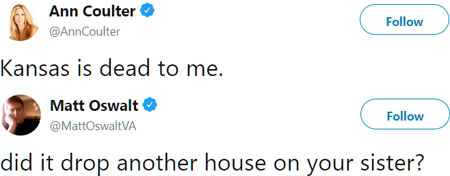
Today's Favorite Twitter Exchange

by evanier

The post Today's Favorite Twitter Exchange appeared first on News From ME.

07 Nov 17:18

Not wearing a poppy

by chris

I agree with Harry Leslie Smith. I too am increasingly disinclined to wear a poppy.

The thing is that the nature of national remembrance has changed. For the first 60+ years after it began it was personal for pretty much everybody. Well over a million British soldiers and civilians were killed in the two world wars. Almost everyone therefore had lost a friend or family member. And everybody knew old soldiers who remembered the horrors of war and often still bore the mental and physical scars. 

But this is no longer the case. Almost nobody under the age of 90 fought in World War II. For increasing numbers of us, war is no longer personal: our grandparents who suffered in it have left us*.

My personal ties to war are confined to the death of a great uncle at Ypres and two friends who served in Northern Ireland – not that everybody wants to remember the latter. Oakhampoppies

Of course, there are many for whom this is not the case, who remember friends, husbands and sons killed in the Falklands, Iraq, Ireland or Afghanistan to name but a few. It would, however, be intrusive and even abusive for me to pretend to share their grief – which of course they bear every day, not just on Sunday. I respect it and sympathize with it. But it is their burden, not mine. To pretend otherwise is a con, a narcissistic flaunting of ersatz emotion.

One or two generations ago, Remembrance Day was about strong people struggling with horrors and grief we cannot imagine. For some, this is still the case. But for many others, it is a display of emotional incontinence.

There’s a paradox here. Although the memory of war is becoming different for us all, there are increasing pressures to conform by wearing poppies: those who refuse to do so, like James McClean or Charlene White, face abuse**, some of it racist. And this, I suspect, is deeply hypocritical. How many poppy fascists support benefit cuts for ex-soldiers and piss on the addicted homeless ones? It is abstract dead soldiers they claim to respect, not real living ones.

Of course, remembrance is not just a personal matter. There is such a thing as collective identity. We can remember our dead as a nation even if many of us individually have no memory of specific victims of war.

But here again, there are hypocrisies.

One is that Remembrance Day is linked with nationalism: how many union jacks will we see on Sunday? And yet it is nationalism that contributed massively to the deaths of those we claim to remember.

Another is that war is not some tragedy that befalls us by unavoidable accident. It is the result of policy error. The error might be the direct one of choosing to go to war, as in Iraq. But it’s also due to a failure to deal with the complex causes that led to WWI or to the rise of Hitler. If there had been better economic management – less harsh reparations, no hyper-inflation in the early 20s, no Great Depression – we might not have had Hitler and WWII. Von Clausewitz was right: war is the continuation of politics by other means.

It’s sometimes said we should wear poppies with pride. We should, in the sense of having pride in those who served their country. But we should also wear them with shame – same at the political mistakes that led to those wars.

Memory, if it is to be anything more than an empty gesture, must mean learning. The lesson of our war deaths is that politics is a deadly serious business. It is a job for serious people who must avoid egregious errors.

This, of course, is a lesson we have not learned. The Chilcot report describes how the errors leading to the Iraq war were ones which should have been well-known to anybody with a passing knowledge of decision theory. And the BBC executives who enforce poppy-wearing to the extent of expecting contestants on Strictly Come Dancing to wear one on their gym kit also give us TV shows in which politics is just fact-free banter between men who went to the right schools. They persist with the Old Lie, that politics a game for jolly good chaps in which – notwithstanding the imbecilic martial metaphors – the stakes are low. It’s not just our war dead who prove this to be an illusion: so too does Grenfell Tower and the thousands killed by austerity. And yet our rulers and media don't heed the message. 

Now, none of this is to say we should not have public commemorations of the war dead. We should. My problem is that these have been taken over by hypocritical posturing.

* Not that it was all suffering. My grandad – like many I suspect – had quite fond memories of the war.

** Not, I suspect, from old soldiers themsleves. Whenever I give to British Legion collectors but refuse the poppy, I sense a respect for my decision.

The picture is of 603 crosses in Oakham churchyard, one for every Rutlander who died in WWI.

02 Nov 11:09

Day 6514: Making the Case (part one)

by Millennium Dome
Thursday:

Featured on Liberal Democrat Voice

One day the tale of the Cheadle selection will be told. But not today.

The short version is: when Mark Hunter lost the seat in 2015, we stepped up to try to win it back. We fought a positive, honest, values-driven Liberal campaign… but they chose someone else.

No regrets. That’s democracy. We had a fun ride along the way.

Thanks to Dave, Holly, Andrew and Daddy Alex


But we DO want to keep on taking a stand for Liberal Values and giving Britain a Liberal Voice.

Because Britain NEEDS to hear Liberal Voice.

Perhaps it’s best is I let Daddy Ricard explain, with his hustings speech:

Good evening.

I’m really pleased to see so many people here.

Because tonight is important, for our future, our community, even our country.

We need a Liberal Voice and we need that voice to be heard.

Throughout this campaign, I’ve been talking about our Liberal values.

About how Britain needs to hear those values again,

About how we need to connect to people through those values we share.
Our values should never be an add-on, an extra, an afterthought. They should be driving what we do.

Values that speak to our supporters, like:

Equality and social justice. Environmentalism.

Free trade, free movement of people and multiculturalism.

A Britain that’s open and welcoming instead of nationalist.

In short: Freedom. Fairness. The Future.

But we need to go further. To reach out to people who don’t support us yet, but who share values, like:

compassion, workers’ rights and animal welfare

aspiration, rewarding work, and social mobility

pro-business, pro-environment, pro-diversity

Freedom. Fairness. The Future. can reach those people too.

Above all, we need to offer hope for a better future.

So, let’s talk about Cheadle.

Cheadle voted to remain. People here are outward looking, forward looking, persuaded that it’s better to be a part of a common goal that helps everyone.

We share those values.

Stockport had a Lib Dem Council for more than a decade. And it shows. This town feels cared for, optimistic, friendly.

We share those values.

Cheadle has a liberal legacy we should be proud to inherit and uphold. From Michael Winstanley, back in the day, to Patsy, who we miss so much, to Mark, who was an exemplary local MP.

Cheadle’s values are our values.

We should be winning here.

But we’re not.

As our party’s new slogan says, people should Demand Better. And that starts with demanding better of ourselves.

Many of you have campaigned here all your lives. And you’re brilliant.

But we’re not winning here.

So we need to do something more, something different. We need to demand better.

I have a good local story to tell. I grew up here. Went to school here. Went to London for work. Came back to get married here. My husband was born in Stepping Hill. We’ve made a home here.

But that is just the start of the story.

Anyone can tell a local story. We know that Labour do it. Even Mary Robinson, the invisible MP, does it.

If we are going to win, we need to do more. And different. And better.

That is why I talk about our values.

The Tories and Labour have the advantage. Their messages are easy. Vote Labour for fear of Tory austerity, or vote Tory for fear of Jeremy Corbyn.

We need to change the story, make it: "who represents your values?".

We must always campaign on the bedrock of our local story.

But we must build on that with our values in order to win.

My local story is the start of a conversation about our great schools in Cheadle not getting a fair deal. But it’s our values that say why schools are important for opportunity and social mobility.

My local story is the start of a conversation about housing and traffic on the A6 and A34. But it’s our values that say it’s about defending the environment for the future and building sustainable communities.

And it’s our values that have driven me to add national experience to my story too.

With Lib Dem Immigrants, I’ve changed party policy for the better, for fairness.

During the coalition, I brought together a group that changed Nick Clegg’s mind on the Snooper’s Charter, for freedom.

And through LGBT+ Liberal Democrats we got the biggest win of our time in government, for me anyway, the right to marry my husband four years ago this week at Stockport Town Hall and make our future together.

And when we lost most of our MPs we lost all our diversity.

Not just all our women, but all our gay and bi MPs too.

Last year we won back four women MPs. We have an ethnic minority MP for the first time in a decade. We have an MP with a disability.

Our Parliamentary Party should represent the face of Britain, and deserves to have LGBT representation again too.

It’s our values that mean I have made a difference.

For freedom and fairness and the future.


And I’m still learning.

One thing I’ve learned talking to so many of you, is that there is always much more to learn. There is so much wisdom among our members.

So please demand better of me.

But never doubt I will try to deliver.

I never thought of becoming an MP.

I spent twenty years working at an ordinary job.

But like a lot of you, I got more involved because I could see that something had to be done and no-one else was doing it.

When we lost in here in 2015, I stepped up to try to win us back seats on the Council, working in Cheadle Hulme, standing in Bramhall.

When Macclesfield Lib Dems needed a candidate last year just weeks before the General Election, I stepped up. And I found I was good at it – as well as bringing their team to campaign here where they could make more of a difference.


So when I look at the state of our country and the voices on the political stage right now, I know that I have to step up again.

Listen to the division, the anger and the hurt blighting our politics, and you will hear a country that needs Liberal values.

That is why I want to be your MP.

Because Britain needs people like me to be MPs.

To be a local champion – giving us a national voice – with a positive Liberal message.

To win back this seat, we need to get organised.

We need to raise a lot of money.

Above all we need to talk to people, more people than we’ve talked to in years.

And it is talking about our values that will enthuse people, recruit new members, and give people a positive reason to vote Liberal Democrat.

In 2017, we lost here because Labour took that message of hope, even though it was fantasy.

We cannot let that happen again.

We have to tell people that if they want a better future, it’s got to be the Liberal Democrats.

I know it’s going to be hard work – I’m not afraid of hard work.

I will give Cheadle a positive Liberal reason to want to vote Liberal Democrat.

I will deliver every street, canvass every ward, speak with every voter that I can.

And I will give a voice to our Liberal values on a local and a national stage because Britain needs to hear a Liberal Voice.

And you’re all going to need to play your part. We will all need to speak up. Because winning means making our voices heard together.

And we have to start right now.

Because Brexit is happening right now.

No one is speaking for the majority in Cheadle who voted Remain.

The two Brexit parties Tory and Labour have abandoned them.

Tories are telling business to … "go away"; Jeremy Corbyn is backing the biggest job killer of all time.

But our values can speak to them and speak for them.

We must speak up as the only party whose values are pro-business, pro-jobs and pro-rights at work.

We must be positive for Remain: we say “Exit from Brexit” because we are for a better Britain in a better Europe.


All my adult life, I’ve been campaigning, talking with people for liberal causes.
If you’ll have me, Cheadle will be all of my life.

Friends, Liberal Democrats… let me be your voice.

A local champion giving us a national voice – and with something to say.

Speak up for Cheadle.

Speak up for Britain.

Speak for Liberal Values, the Values that made you join the Liberal Democrats.

Speak up for winning this seat back. And together we will win.

Please, tonight, give me your first preference.

Thank you.


In Part Two (found HERE) we’ll share some of the literature we sent out.

And in Part Three (link HERE) we'll show you our email manifesto.


We’re going to take a break from the frontlines for a little while – good news! Daddy can do my diary more! – but we will take stock and be back.

And in the meantime, if there’s a constituency out there who want to fight a positive campaign for Liberal values, and you’re looking for a top-notch candidate… well, get in touch.
01 Nov 16:11

Buying Used Voting Machines on eBay

by Bruce Schneier

This is not surprising:

This year, I bought two more machines to see if security had improved. To my dismay, I discovered that the newer model machines -- those that were used in the 2016 election -- are running Windows CE and have USB ports, along with other components, that make them even easier to exploit than the older ones. Our voting machines, billed as "next generation," and still in use today, are worse than they were before­ -- dispersed, disorganized, and susceptible to manipulation.

Cory Doctorow's comment is correct:

Voting machines are terrible in every way: the companies that make them lie like crazy about their security, insist on insecure designs, and produce machines that are so insecure that it's easier to hack a voting machine than it is to use it to vote.

I blame both the secrecy of the industry and the ignorance of most voting officials. And it's not getting better.

01 Nov 16:11

On the Ben Uri Gallery

by fugitive ink

There is something distinctive and, yes, slightly thrilling about the sound made by an auction house catalogue being pushed awkwardly through the letter-box then falling, cushioned by its soft plastic envelope, onto the worn-out coir matting beneath. And indeed, this morning I was glad to discover a Sotheby’s catalogue arriving in just such a way.

It was only when I extracted the pleasingly bulky softback catalogue from its plastic that I felt a lurch of alarm.

The cover image was, surely, David Bomberg’s great [Woman] At The Window (1919). It’s a work that’s been in the Ben Uri collection since 1920. I last encountered it in the brilliant Bomberg show that took place earlier this year at Pallant House in Chichester, organised in conjunction with the Ben Uri Gallery. Leafing quickly though the catalogue, which relates to a sale in late November, it became apparent that several other familiar images from the Pallant House show were also there in the catalogue, not least the luminous Mount Zion with the Church of the Dormition: Moonlight (1923), acquired by the Ben Uri Gallery in 1928.

As you may have gathered from what I have just written, the Pallant House Bomberg show depended heavily on the Ben Uri Gallery — as indeed would, by necessity, any serious Bomberg retrospective. But so did the William Roberts show at Pallant House a couple of years ago. So did the Whitechapel Gallery’s ‘Whitechapel Boys’ show in 2009. So do quite a lot of exhibitions dealing with British modernism, if only because several of Britain’s best modern artists have been Jews, and for more than a century, the Ben Uri Gallery existed to encourage and support the work of Jewish artists in Britain.

The Ben Uri Art Society was founded in 1915 in London’s East End. It was created by a Jewish immigrant, Lazar Berson, as an exhibition and selling space for Jewish artists who often faced discrimination and exclusion from more well-established art galleries and institutions. Surprisingly, perhaps, the funding came not from Britain’s well-established and active Jewish philanthropists, but from much more recent arrivals from the Yiddish-speaking Pale of Settlement, contributing their hard-earned pennies towards the idea of a Jewish museum.

Slightly later, the organisation — named after the craftsman who is believed to have built the Ark of the Covenant — also took to buying work by Jewish artists. Over the years, it has amassed a collection of some 1,300 works, including not only masterpieces by well-known artists such as David Bomberg, Mark Gertler, Leon Kossoff and Frank Auerbach, but also important work by artists whose work is neither so well understood nor appreciated. There is an excellent short essay about the history of the Ben Uri Gallery in the front of the Sotheby’s catalogue I mentioned earlier, which I’d recommend to anyone interested in learning more.

As late as 2002, the Ben Uri Gallery was happy to be labeled ‘The London Jewish Museum of Art’. More recently, however, the Ben Uri Gallery has chosen to re-invent itself as a showcase for displaced or émigré artists in general, rather than for Jewish artists in particular. This shift in branding is very emphatic. On their website, for instance, the organisers of the Ben Uri Gallery announce that ‘We hold Europe’s only collection principally dedicated to emigre artists whether refugees or immigrants by choice or as more often as a result of terror. This unique collection comprises of over 1300 works by over 400 artists from 40 countries of birth.’

And in the last few days, the Ben Uri Gallery, discontented with its current Boundary Road site and having struggled to find a new base in central London, has announced an even more significant development. David Glasser, the organisation’s executive chairperson, explained that they now plan to get rid of half the existing collection — 700 works. Some of the works will be auctioned, while others will be given away to organisations that can derive a ‘meaningful public benefit’ from them. The idea is to fund, among other things, an initiative to use art as a means of managing dementia, and also to give the Ben Uri Gallery’s award-winning study centre a stronger online presence.

Mr Glasser went on to say that the Ben Uri Gallery was no longer distinctive enough. He told the Guardian that there is no real demand today for ‘a Jewish institution for a Jewish public about Jewish artists’. He does, however, feel certain that there was a pressing need for an organisation exploring and championing immigrant artists. And so that is the route that the re-invented Ben Uri Gallery will take.

I suppose, at one level, this ought to be a cause for celebration. Heaven knows the story of British, or perhaps specifically English art, has always been, to an almost humorous degree, the story of emigré achievement — England as net importers of cultural labour. To think of historic English portraiture, for instance, is to conjure up a roll-call of artists from elsewhere. Holbein, Mytens, Van Dyck, Lely, Kneller, Winterhalter, Tissot, Sargent, Orpen, Annigoni, Freud, Rego — literally not one of these was English by birth, yet each is central to how many of us imagine various periods of English history. And that’s not even including Rubens, Hollar, van de Velde the younger, Pissarro, Sickert, Kapoor — I could play this game all day, and I’m not even an actual art historian.

So today, living as we do in a climate where our own Prime Minister has vowed to create a ‘hostile environment’ for immigration (always presumed to be ‘illegal’ until proven otherwise, especially for those from unfashionable religious backgrounds) — a climate in which previously fairly benign politicians have been queuing up to say that we all need to listen more respectfully to those UKIP / AfD / Trumpian ‘concerns about immigration’, which often sounds like code for something else — it’s more important than ever to insist on the contribution made by immigrants to our national cultural life.

At that level, it is hard not to salute the Ben Uri Gallery’s change of mission. It should also be said that there are manifestly diaspora communities here in the UK that are very badly understood, where they are noticed at all, by mainstream British cultural consumers. There are almost certainly artists out there who face the same informal barriers to success — lack of the right connections, more or less conscious racism, or simply incomprehension — faced by Bomberg, Gertler and their contemporaries at the time when the Ben Uri organisation was first developed. There’s certainly a logic in updating the remit of the Gallery to take account of this. The idea of using art as a way of working with dementia patients also sounds very worthwhile.

And yet there is something that makes me a bit queasy about the change, and I think it’s worth mentioning that, too.

My first experience of the Ben Uri Gallery came in 2001, when the organisation was undergoing one of its periodic episodes of homelessness, and so ended up putting on a major loan show in the Bond Street rooms of Philips the auctioneers (now Bonhams). There’s a catalogue that commemorates this show, called The Ben Uri Story. I went along, however, not because I was interested in the Ben Uri Story per se, but because I had recently fallen head-over-heels in love with the work of Frank Auerbach, some of which was apparently included in the exhibition.

I should also add that I went along to the exhibition harbouring all sorts of doubts about its basic premise. Yes, I loved Auerbach’s work — but I loved it because of its hard-won, handmade, slightly painful quality, because of everything I had read about his practice, everything I’d read about him. And it has to be said that, at least in what I had read at the time, Auerbach had not given the impression of being a particularly ‘Jewish’ artist. Which is to say, he seemed to me then, based on what I had read, to be someone who had made a very conscious effort to turn his back on his own horrific, heartbreaking, literally tragic family story, someone with no interest in religious or ethnic labels, someone to be appreciated as an entirely unique individual, defined in his own terms, encountered in a sort of neutral zone of pure aesthetic appreciation. (Let’s all pause to remember that this was 17 years ago, and one shouldn’t have to apologise for learned a few things as the years go by, eh?) But anyway, I was by no means convinced that it was in any way useful for me to view Auerbach through the prism of his Judaism.

The Ben Uri show convinced me otherwise.

It was, first and foremost, a very strong exhibition. It included work by some very well-known artists, notably Bomberg, who — along with de Kooning, although I realise this is a niche perspective and don’t want to get into a fight about it right now — has to be understood to get much sense out of Auerbach’s achievement. But it also included work by artists I’d never encountered, dealing in some cases with strands of subject matter about which I knew absolutely nothing. I’m not Jewish, my family background isn’t Jewish, and so gaining access to the incredibly rich and varied treasure-trove of Judaic culture and tradition remains an ongoing project, if a very rewarding one. And it did, in the end, tell me quite a lot about Auerbach that I didn’t know already.

Because that’s the logic of pulling together an exhibition, or indeed a major collection, of Jewish art — the result ends up providing commentary on all the choices made, the roads taken or not taken, the many strategies available when it came to confronting a century that included, among quite a lot of other events, the attempted obliteration of Europe’s Jewish population and that diverse, evolving, complicated culture.

The Ben Uri Story included all sorts of things. It included images of traditional, orthodox Judaism which probably would have embarrassed the younger, trendier, more secular and assimilated artists of the Great War era — the sort who were hanging out at the Slade, creating a central strand of British modernism. It included fewer Holocaust references than I had expected, perhaps suggesting that for many — Auerbach perhaps included — the enormity of what had been done to the Jews, to humanity, took more than a little time to confront, to process, to find its way intelligibly into the language of the visual arts, perhaps because it was a bigger and more terrible thing than I, a non-Jew although an immigrant myself, could easily comprehend. It included reminders that ‘normal’ things — enjoying the beauty of flowers, the proximity of a lover’s naked body, the effect of light on landscape — were and are also part of being Jewish. It spoke, if indirectly, to the argument made by antisemitic bigots like Munnings that modernism was intrinsically non-English, which was, by implication, why Jews were always at the forefront of it. The exhibition served, finally, as a helpful hint that different Jewish artists define their Judaism in many ways — often, as in Bomberg’s case, changing sharply over the course of a lifetime — and that as such, my own understanding of Auerbach’s Judaism might be naive, shallow and due for a bit of eventual revision. (This book helped.)

In any event, I left the exhibition realising that the Ben Uri Gallery had done a very good thing by showing those hundred paintings from their collection in the way that they did. And in the years that have followed, I have felt grateful for Ben Uri loans to countless other shows, the organisation’s scholarship and enthusiasm. Articles about the forthcoming sale keep emphasising, for some reason, that the Ben Uri Gallery is a ‘small’ gallery. Well, if so, they always managed to punch massively above their weight.

So I am sad, in a way, that such a unique, important collection is being broken up and dispersed. Of course, ‘de-acquisitioning’ happens a lot, and needn’t always be a bad thing, either. There is little point in holding on to thousands of works that are never shown, or locking up value in unwanted work while not having enough cash to pursue some central institutional mission.

I am not sure, however, that either of these applies in the case of the Ben Uri Gallery. Nor am I entirely convinced by Mr Glasser’s explanation, although perhaps I simply misunderstand it.

First of all, is it really right that there is no real demand today for ‘a Jewish institution for a Jewish public about Jewish artists’? As mentioned above, I’m not a Jew — I’m an Anglican Christian, albeit not a particularly orthodox one — but I’m nonetheless conscious of having benefited enormously from the Ben Uri Gallery. Nor am I certain that Jewish artists no longer need encouragement, support and inspiration — a point to which I’ll return in a moment.

Does Mr Glasser really feel, for instance, that there was ‘no demand’ for the David Bomberg exhibition which the Ben Uri Gallery arranged in conjunction with Pallant House? Or for the William Roberts show at the same venue, to which the Ben Uri Gallery made generous loans? Both exhibitions got brilliant reviews in a variety of publications and were also full to bursting when I visited. Many of the reviews explicitly noted that only now was Bomberg really achieving the reputation that this cantankerous, stubborn, deeply intelligent man has for so long deserved. The work of the Ben Uri Gallery is part of what made that development possible. Does that not seem a worthwhile achievement? Yet once the Sotheby’s sale in November is finished, it will no longer be possible for the Ben Uri Gallery to make as strong a case for Bomberg as they did earlier this year. That seems to me, anyway, a backward step.

And then there are the lesser artists, the non-superstars. It is true, of course, that their work, shown in the right context, tells us a great deal about the experiences, interests, influences and personalities of a variety of Jewish artists working in Britain from the late nineteenth century onwards. But it is also true that tastes change, reputations shift, the paintings that were most fascinating ten years ago aren’t always the ones that make an important show in ten years’ time.

We happen to own a near-abstract painting by a Whitechapel artist, born in Galicia (her village is now in Ukraine) but an emigrant to London, named Clare (or sometimes Clara) Wisten. Wisten is not, it must be said, particularly well-known. Yet she was a contemporary of Bomberg, studying with him at the Slade, and pushing on the boundaries of representational art every bit as firmly, passionately and powerfully as he did. As a woman, however, and as an actual immigrant — Bomberg, in contrast, was born in Birmingham, albeit to immigrant parents — she faced even greater challenges to the success of her career than did her male contemporaries. What happened to her, and why is she not a big name? Increasingly, audiences want to hear these sorts of stories, and to learn more about the figures that mainstream art history has for too long neglected. One of the best references to Clare Wisten in print is a very fine essay in a Ben Uri (of course) publication about Isaac Rosenberg, another friend and colleague of Wisten’s. But will the new Ben Uri still care about stories like this, so deeply embedded in the stuff of their older remit — and will they still have the pictures necessary to tell those stories? Will they still bother with initiatives like the exhibition of their work hosted by the German embassy in London, commemorating German artists in exile in Great Britain, 1933-1945? The drawing they use to illustrate this latter event is one that has been included in the Sotheby’s sale.

The Sotheby’s sale is, by the way, expected to raise up to £2 million. In some sense, of course, this is a huge amount of money — but it terms of art, or London property, it isn’t very much at all. And against this, the Ben Uri organisers will have to balance the concerns they have, surely, now raised in the minds of donors and supporters. What is the point of giving to an organisation when its rationale is capable of shifting in such a dramatic way?

I should probably add at this point that I am sure the people responsible for making these difficult decisions regarding the Ben Uri Gallery’s future have thought deeply about what they are doing, explored all the alternatives, devoted far more time and energy to these questions than some casual recipient of this Sotheby’s catalogue will ever do. Almost certainly, they are doing the right thing. There are plenty of institutional responses that look misguided if one doesn’t know all the facts. It is very easy to second-guess other people’s choices. Many of the most resilient institutions out there change constantly, which is what allows them to thrive and expand and develop.

And yet the Sotheby’s catalogue, sitting here on the kitchen table in front of me, still makes me feel a bit queasy.

It will, no doubt, be a great experience to see these works all hung at the Bond Street auction rooms. Not least, seeing a work hung for sale is always a bit different from seeing it in a normal exhibition. It’s possible to get right up close to the paint surfaces, to touch, to ask serious questions. A different sort of critical faculty engages, keener and more intimate. And I am also fascinated to see how the Ben Uri Gallery gets on with their new set of projects, and of course wish them well in all that they do.

It’s probably just an accident of timing. Last Saturday’s murder of eleven entirely ordinary, slightly elderly, Jewish Americans, shot dead in their synagogue purely because they were Jews, is a hard thing to get out of my mind. One of the victims was a 97-year old lady — a ‘young spirit’ according to her rabbi. Two others, in their 50s, were mentally disabled men, by all accounts enthusiastic members of their congregation and always anxious to help, who used to enjoy welcoming visitors to shul with an open prayer-book and friendly greeting. Did they greet their murderer as he approached? Did they reach out to him, in the full kindness and generosity of their faith?

Should any of us, here in 2018, have to stop to imagine these things?

But we can, and we do. Meanwhile our Prime Minister, in her public declaration that ‘a citizen of the world is a citizen of nowhere’, evoked, knowingly or otherwise, a very old and dangerous anti-semitic trope. The American president, denouncing ‘globalists’ in the course of a political rally, first listened warmly to shouts of ‘George Soros!’ and ‘lock him up!’, then responded by repeating ‘lock him up’! He beamed as he did so. The current Labour leadership seems unwilling or unable to reassure its Jewish members and their friends that they remain welcome within the party. And as anyone who bothers with Twitter is all too aware, even the most innocuous posts by Jews — tweeting, in general, about things that have nothing to do with Judaism — are met, in the comments underneath, with the most vile, rancid and self-confident antisemitic abuse.

I’m not a Jew, but all this frightens me.

And perhaps that’s why, almost unconsciously, the reinvention of the Ben Uri Gallery worries me a little, too. Of course, I can see that stepping away from an explicit identification with Judaism is a perfectly legitimate means of broadening the Gallery’s remit, reaching out to new generations of immigrant artists, carrying forward an ongoing project without being limited by its past definitions. That all makes sense.

But at the same time, I worry that the central issues that prompted the foundation of the Ben Uri Art Society back in 1915 haven’t gone away — that despite high-profile exhibitions and important roles for Jews within the British arts establishment, specifically Jewish art still needs protecting, defending, explaining and supporting, even here, even now, even today. And if the Ben Uri Gallery no longer see that as their central role, who will?


01 Nov 13:02

25 Things

by evanier

  1. The letters printed in letter columns in no way represented the consensus of the readership.  They may have been the ones that reflected what the letter-selector wanted to believe represented the readers' opinions.  Some letters were phony or so heavily edited that they didn't even represent the letter-writer's views.
  2. Most of the editors were very sharp, creative and benevolent.  But a couple of them were managing with the same kinds of skills you'd employ if you were running a Jiffy-Lube.
  3. No freelancer was paid what he or she was worth.
  4. And most of those on staff were not either.
  5. When a new comic failed to sell and was canceled, that might have meant that the readers weren't interested in it.  But at least as often, it meant that the company didn't know how to market it and/or that the publisher gave up on it too quickly.
  6. Approximately 50% of editorial alterations made on the work of the writers and artists were made mainly because someone in the office wanted to look like they were making a vital contribution.
  7. When a popular writer or artist was replaced on a comic, the readers would always hate the new guy for a while, no matter who it was.
  8. The sales figures published in the little Statement of Ownership boxes that ran in some comics were sometimes rough approximations and occasionally pure fiction.
  9. When one artist did the inking on the penciled art of another, the penciler might like the finished product because "He inked it just the way I would have."  Or he might have liked it because "He did things I never would have thought to do."  The penciler might also have disliked the result for either reason.
  10. Still, most artists would vastly have preferred to ink their own work.  And better artwork would frequently have resulted if they had.
  11. Your work being turned in late was a major crisis which demonstrated unprofessionalism on your part no matter what the reason.  Your check getting to you late was an understandable delay that was no big deal and no one's fault so don't complain about it.
  12. An awful lot of people who worked in comics could not look at a page of comic art and recognize who had drawn or lettered it.
  13. Better comics generally resulted when one writer was more or less in charge of a feature or character for a long time and could make it his or her "own."
  14. But it was usually a personal mistake for a writer to get possessive about a strip or character if they did not own the copyright.  That made it jarring when they were replaced, as everyone eventually was and is.
  15. In the constant struggle to get books to press on time, the unsung, unappreciated hero was usually the letterer.
  16. The credit for Editor often did not tell you who was really doing the work you'd normally associate with that job title.  There were Editors who never even read the comics they theoretically edited.
  17. While there certainly were writers and artists lacking in ability, poor artwork was more often the function of miscasting.
  18. And it was rarely the result of the artist "hacking it out" or just doing a "grab the money and run."  Some of the guys who were maybe not good enough for their assignments tried like hell.
  19. If a comic underwent a major change of writer and/or artist in its first six issues, the comic would probably fail.
  20. From about 1970 on, if a reader bought an issue of Heroguy Comics, he wanted a full book of new Heroguy material; no back-up features of other characters (not even Herogirl or Hero-Dog) and no reprints of old Heroguy adventures.  Reprints were fine in their place and their place was in comics devoted wholly to reprints.
  21. From about 1970 on, readers rarely had the patience to love a comic that did not come out monthly.
  22. For some reason, many readers never caught on to the oft-true practice where the great artist who drew that great cover was not the person who drew the insides.  It was a lot like Charlie Brown trying to kick a football when Lucy held it for him.
  23. A couple of my favorite writers and artists had deep, permanent loathings for each other.
  24. If as a writer, you pitched an editor three or four ideas for stories and the editor bought any of them, it would be the one you liked the least.  This is true with any kind of writing in any field at any time.  It's the same with artists submitting rough sketches.
  25. Comics were a great field to work in for a time while you tried to work your way towards something with greater possibilities.  And if you got to an "all the work you can handle" situation, that was not always good because it gave you a powerful disincentive to try anything else.  I am very glad that I got into the field but even gladder than I never made it my entire profession.

The post 25 Things appeared first on News From ME.

25 Oct 15:20

Publishing: A Slice of Life

by Charlie Stross

The problem of fraud on the internet needs no introduction, but sometimes it takes on manifestly surreal forms. Here's an extract from the US National Cyber-Security Center's weekly threat report from last week: Publishing House Phishing Warning:

Penguin Random House North America has issued an alert to staff following a spate of global phishing scams attempting to access agencies' and publishers' manuscripts and other sensitive information.

The UK arm has been similarly targeted, with fraudsters posing as literary agents and foreign-rights staff from seemingly legitimate email addresses. Macmillan has confirmed that it has also been targeted by scammers trying to access manuscripts and has reportedly issued an internal briefing to staff.

I will confess I was somewhat boggled when I stumbled across this one. Everybody knows that the best way to make a small fortune in publishing is to start with a large one. And while there are some reasonable targets for fraudsters targeting a large publishing house (the accounts department springs to mind), author's manuscripts are not among them! Targeting manuscripts for profit is a bit like burgling a farm in order to steal all the crops growing in the field, three months before they're ready for harvest.

But still, it caught my attention. Scammers posing as literary agents and foreign rights staff have apparently targeted Macmillan and Random Penguin? My author-brain immediately started generating screwball heist caper comedy plot lines in which hapless scam artists discover how publishing really works.

(Continued below the fold.)

THE SCENE: a seedy boilerroom scam office/call centre somewhere unspecified, where our protagonists, SCAMMER 1 and SCAMMER 2, are discussing their heist.

Scammer 1: "I just got ahold of the submission draft of the next Charlie Stross Laundry Files novel! We're gonna be rich!!"

Scammer 2: "All we have to do is copy edit the hell out of this sucker, slap a cover on it, run a marketing campaign, upload valid metadata to all the wholesaler databases, and get our version published on Amazon before Tor beats us to the punch ...!"

(contd.)

Scammer 1: "Shouldn't be too hard. I mean, publishing is easy money, right?"

Scammer 2: "Tell you what, you go work up a marketing campaign while I find some clip art of unicorns an' shit to put on the cover and feed it into Microsoft Word to make it look good. Shouldn't take long."

Scammer 1: "Marketing campaign ... how do I do that?"

Scammer 2: "I dunno. I thought the author was supposed to go on a signing tour?"

Scammer 1: "That could be a problem: we'll need an author. Unless you're volunteering? Anyway, that sounds expensive. Why should we pay for some dude with a laptop to go on vacation for a month?"

Scammer 2: "I got it! I know how! We'll tell Charlie we're his publisher's marketing people. Think he'll buy it?"

Scammer 1: "But, uh, he is with Tor. Doesn't he, like, know those people?"

Scammer 2: "Naah, we'll tell him they just outsourced marketing to us. He's dumb enough to sign up with those marks and they're dumb enough they clicked on the link in the phishing email, so dumbness squared, know what I'm saying?"

Scammer 1: "Okay, so I'll figure out a, uh, a tour. Where do they send authors, anyway?"

Scammer 2: "I dunno, the Canary Islands? The Dead Sea?"

Scammer 1: "Do they have bookstores in the Dead Sea? Isn't he supposed to sell books while he's on tour or something?"

Scammer 2: "Yeah, that sounds right. Guess he's supposed to go where the bookshops are."

(Scammer 2 googles a list of likely bookstores, and sends an email to the author.)

(Time passes.)

(An email reply is received the next day, and responded to.)

(More time passes.)

(An email reply is received the next day, and responded to.)

Scammer 1: "Are you getting anywhere with the marketing, dude? I've got the book designed and ready go to on Lightning Source! We're waiting on you!"

Scammer 2: "I dunno, he's like, really slow replying to my emails?"

Scammer 1: "That's because we're in Tulsa and he's in Europe. It's, like, three in the morning in Europe right now. Every time you send him an email it takes a day to get a reply."

Scammer 2: "Shit. Maybe I should phone him ..."

(A telephone is resorted to.)

Scammer 1: "So?"

Scammer 2: "He swore at me and hung up. And now it's going through to voicemail."

Scammer 1: "Dude, it's 5am."

(More time, and email, passes.)

Scammer 1: "So, how's the marketing campaign coming along?"

Scammer 2 (whining): "He says we're supposed to pay for his tour!"

Scammer 1: "He's just trying it on. Persist. If he won't budge, tell him we'll repay his expenses if he keeps receipts."

Scammer 2: "Got it, boss."

(Later)

Scammer 2: "He says he can't afford the bus fare from, uh, Edinburgh to Kansas City? He wants us to fly him everywhere in business class, put him up overnight in boutique hotels, and have a bowl of M&Ms waiting in every motel room—with no blue ones?"

Scammer 1: "Well, forget that. You can send him on a blog tour instead: it's cheaper."

Scammer 2: "What's a blog?"

Scammer 1: "Dunno, it's something you send authors on a tour of, like 4chan only more polite."

(Later)

Scammer 2: "He says he already did that the last seven books running and he's bored and can I place an ad in the New York Times?"

Scammer 1: "That sounds like a great idea! How much do they charge?"

(Later)

Scammer 2 (despondent): "I had to max out my credit card, but the guy in advertising said they'll take it. All I need to do now is get author dude to write some, uh, copy, whatever that is? By tomorrow?"

Scammer 1: "Don't worry about the Amex card, I'll steal you another one. Copy is like an advert or something, he's a writer, he does this shit for a living. How much space did you manage to buy?"

Scammer 2: "Fourteen words, no punctuation."

Scammer 1: "He'll have to make every letter count, then. He's used to twitter, fourteen words to promote his yarn is luxury."

Scammer 2: "How's the book coming along?"

Scammer 1: "Oh, Microsoft Spell Check cleaned it up good, and I've made a great cover for it! There were loads of rainbow-pooping unicorns on Pinterest and they'll never notice me ripping off their artwork."

Scammer 2: "Looks legit! Let's upload it to Amazon, then we're—"

(DANCE ROUTINE IN THE SCAMMER'S OFFICE)

Scammer 1: "We're in the money! We're in the—wait."

Scammer 2: "What now?"

Scammer 1: "It's Amazon. They want our bank details, credit card number, date of birth, street address, mortgage lender, blood group, and a W8 form from the IRS before they'll pay us."

(FADE TO BLACK)

24 Oct 20:37

Echo chambers: a defence

by chris

It’s become fashionable to decry “safe spaces” and echo chambers and to call instead for cognitive diversity. Instinctively, I agree: cognitive diversity is one counterweight to the tightly bounded knowledge and rationality that afflict us all.

In this context, then, I’m pleased to see a recent paper (pdf) by Ole Jann and Christoph Schottmuller which defends echo chambers.

To see their point, consider what happens when a rightist says a government can’t raise much money merely by taxing the rich. Leftists reply: “you’re just a shill for the rich. Who fnds you?” A useful message is therefore ignored. Imagine then we are segregated into echo chambers of left and right, and a leftist says the same thing to a leftish audience. Because s/he cannot be dismissed as a shill, the same message is taken seriously. Worthwhile information thus enters leftist thinking.

There are many examples of this. If CNBC says something disobliging about Trump, it’s “fake news”, but if (ex hypothesi!) Fox were to do so, it’d have credence with Trump voters. And whereas Jacob Rees Mogg’s diatribes against the EU are ignored by Remainers, criticism of the EU (some of which is warranted) would be taken seriously if uttered by Remainers.

In these ways, echo chambers can actually promote worthwhile discourse by filtering out comments that’d not be taken seriously because they are discredited by association with our opponents, whilst giving proper credence to similar comments coming from like-minded people.

Jann and Schottmuller say:

Segregation into small, homogeneous groups can be a rational choice that maximizes the amount of information available to an individual. In fact, homophilic segregation can be efficient and even Pareto-optimal for society

There’s another way this can be true. If we know we’re speaking among friends, we can be more candid. “Safe spaces” can free like-minded people to express sentiments they would otherwise repress if they feared they’d be exploited by their opponents. The model here is perhaps the Chatham House rule, which allows speech to be reported outside as long as it isn’t credited to a particular person. This frees people to speak more freely than they otherwise would. “Safe spaces may provide opportunities to communicate that would otherwise not exist” say Jann and Schottmuller. JudeanPeoplesFront

Now, there are caveats here. All this takes for granted that there is sharp polarization. It would be better if there weren’t and that we could speak freely and credibly across divisions. Given that we cannot, however, echo chambers might be a way to improve communication and to get messages across that would otherwise be ignored.

Also, this requires that there be some degree of diversity within the chambers. If people were to endlessly split and create new echo chambers after every slight disagreement – as the People’s Front of Judea and some Trotskyites have done – then information is lost anyway.

The issue here is crucially important. In a polarized world, how can we best promote credible and high quality political communication? I’m not sure if Jann and Schottmuller are right that echo chambers really are the answer – although I welcome their challenging of my priors. But theirs is a much more useful intervention than partisan mythologizing about threats to free speech.

19 Oct 15:04

Crib Sheet: The Delirium Brief

by Charlie Stross

Shockingly, it has been drawn to my attention that The Labyrinth Index is nearly in print and yet I have failed to issue my usual crib sheet for The Delirium Brief. This cannot be! So without further ado ...

The eighth book in The Laundry Files (a title pinned on the series by marketing fiat at Random Penguin—sorry, Penguin Random House, Inc., who decreed that all series of more than three novels had to have a series title, and by an editor who wanted to leverage the brand name recognition of another urban fantasy author she edited, Jim Butcher) was written in early 2016 with a very specific goal: to deal with the aftermath of The Nightmare Stacks, which in turn had decisively broken the doldrums that nearly becalmed the "big picture" series story arc between books 3 and 6. That story arc is, loosely speaking, the story of the Lovecraftian singularity: in which vast, transhuman, and unsympathetic intelligences disrupt humanity's tenuous position of terrestrial dominance (but note they're not artificial intelligences but godlike alien ones—yes, it's also an alien invasion narrative, if you squint at it hard enough.)

The Nightmare Stacks ended in a version of April 2015 that had decisively split from the one we're all familiar with, as an Elven combined-arms battle group crashed through the English county of West Yorkshire and came to rest in the wreckage of a major city, with a death toll in the tens of thousands. That was a very explicit smackdown for the classic urban fantasy trope whereby the things that go bump in the night—vampires, zombies, elves—always seem to know their place, and that place is well away from the rolling global 24 hours cycle. It's a trope I've had increasing difficulty taking seriously over the years: it strikes me as lazy world-building. (Similarly, the emergence of a world like our own where magic nevertheless exists also demands explanation: there is such an explanation for The Laundry Files—history is mutable and has, in fact, been tampered with extensively—but it's largely implied, although future stories may deal with this aspect of the setting which is, if anything, one of the most horrific aspects of the series.)

Anyway, by the end of The Nightmare Stacks, it was glaringly obvious that the djinn could not be recaptured and put back in the bottle: contained incidents, even mass casualty incidents, could be suppressed if they took place in a single building (as in The Annihilation Score), but not when airliners are shot down, cities are explosively remodelled, and the All-Highest of the Host of Air and Darkness appeals for political asylum in from of the news cameras.

So, with The Delirium Brief, I set out to ask, what happens next?

Only life comes at you fast, and I was writing the first draft in spring of 2016, to a background of rolling news coverage of the Brexit referendum campaign ...

The first draft opened much as the final published version opens, with a hapless Bob Howard—now seemingly consigned to middle management, because he's pushing forty and now moderately senior—wearing a suit in front of the TV cameras as a thinly-disguised rendition of Jeremy Paxman grills him lightly on Newsnight. (Note for non-British readers; until Tony Blair jerked the BBC's choke-chain circa 2003-07 over funding and brought it to heel for its not-entirely-positive coverage of the Iraq invasion, Newsnight monstered cabinet ministers in a manner most other journalistic cultures can barely conceive of, totally lacking in deference to power and willing to badger politicians relentlessly with uncomfortable questions and to crucify them if they refused to answer. Today's BBC is a sad parody of this era, which is what Bob was subjected to a mild version of ...)

But the narrative continued in like vein for somewhat longer, following a plot that was somehow less vibrant and effective than the final version: one in which the Laundry, now exposed to the full glare of public scrutiny, is set up for privatization along the usual lines pioneered by successive British governments in the 21st century (and described in detail in the current draft). Subjected to successive private sector managers, budget cut, morale leaking out, increasingly outsourced to the usual contractors (the companies from which those private sector managers are borrowed and to which they return, fully informed of the agency's business so they can tender for the contracts to provide those services). It was a very 2015 novel. Against this backdrop, an increasingly put-upon Bob and Mo underwent a gradual raprochement, bonding over a pile of broken relationship counsellors (you can find the off-cuts from this sequence on Archive of Our Own, as their case files). And, finally, the bad guys were defeated, sort-of. It was all a bit limp, but I wasn't sure how to make it work any better, so I threw it at my editors to figure it out and left it alone for a while. That was in May.

In June, I was in London when the results of the Brexit referendum came in and all hell broke loose. In the space of a week both major UK political parties experienced leadership challenges, it became evident that two constitutional crises had broken out, there was a run on the pound, and I got a ringside seat at the sort of clusterfuck that ensues in British politics when a truly major crisis erupts—not as destructive as the one in The Nightmare Stacks, but similarly all-engulfing. And it became glaringly clear that in the initial version of The Delirium Brief I hadn't gone nearly far enough.

With Brexit to provide contrast, it became obvious in hindsight that the events of The Nightmare Stacks would result in a witch-hunt and an institutional bloodbath. Forget public enquiries: entire agencies would be axed, employees might well face criminal charges, and—oh look, waiting in the background since book four, the Prime Minister's friendly relations with the wrong cultist might well come back to bite the Laundry. The Laundry had always relied on secrecy (being a spin-off of the wartime SOE) and used rigid obedience to keep things quiet. Rather than controlling physical assets and documents, which multiply inordinately and can be leaked, they used the capability to compel obedience in their employees by means of a geas, thereby reducing the number of points of control. Which worked as long as only their employees and a limited number of contacts were in the know. Once their activities came into public view the game was up, and the organization was unable to effectively defend itself against institutional predators—political lobbyists, private sector contractors, frightened cabinet ministers, and actual hostiles like the Reverend Raymond Schiller (now making a very unwelcome re-appearance after his earlier defeat in The Apocalypse Codex).

The point at which the published version of The Delirium Brief departs from the pre-Brexit draft is the moment when Bob is arrested—and, subsequently, the entire agency is shut down and goes on the run, with Continuity Operations in effect. None of that featured in the first draft (nor the tank-v-Mercedes chase on Salisbury Plain). It gave the post-Brexit draft a degree of tension and jeopardy that the earlier draft lacked, and a lot of added foreboding and darkness: the re-appearance of The Mandate, the rehabilitation of Iris Carpenter, and the ghastly hospitality suite at Nether Stowe House all emerged fluidly from the new sense of impending catastrophe.

Because, yes, this is the Brexit Laundry novel; not in the simplistic voted-to-depart-from-the-EU sense, but in the context of how the UK deals (or fails to deal) with what Iain Banks called an Outside Context Problem, "the sort of problem most societies encounter the way a sentence encounters a full stop."

Things of note:

Continuity Operations is modelled, very loosely, on the remain-behind plans European governments (presumably including that of the UK) drew up for continuing resistance in the aftermath of a successful Soviet invasion—Operation Gladio. Second world war resistance movements were largely ad-hoc and set up under occupation: post-1945 plans were drawn up in advance and relied on stay-behind teams of motivated and trained security service personnel who would conduct operations against the occupier. These were historically co-opted by far-right-wing groups and in some cases destabilized their host country: the history of the Propaganda Due Masonic Lodge in Italy is one notorious example, which led to an escalating conflict between right and left wing terrorist groups during the 1970s. The Laundry doesn't have P2 levels of behind-the-scenes influence, but there are parallels—notably their willingness to release notorious criminals in order to deploy them against the admittedly hostile regime, and their belief that they know what's best for the nation.

The Constitutional Reform And Governance Act referenced in early chapters is entirely genuine and caused considerable head-scratching in the more secretive corners of HM Government when it was brought in. It was arguably necessary insofar as it regularized certain legal oddities: for example, when it is legal for a soldier, spy, or police officer to be ordered to use lethal force, and when is it murder? Under what circumstances can the machinery of law enforcement commit acts that break the law? Bringing the Laundry into compliance with CRAG is an obvious requirement for the government, once they realize the Laundry exists ... but it brings a whole basket of new problems with it, for the Laundry deals with classes of entity which are not entirely human or have their existence recognized in law, and while the courts tend to take a pragmatic approach to hitherto unrecognized situations and types of person, there are limits to what can be expected of them without legislative guidance. (How does the law deal with gods, for example—beings who can bend or break the constraints of reality?)

The Mandate, Fabian Everyman, is the tip of an occult iceberg: he's increasing in power exponentially and is already extremely dangerous. We'll see more of him in The Labyrinth Index and subsequent novels, as the avatar of N'yar Lat-Hotep, the Black Pharaoh. There is explicit overlap in the Laundryverse between the elder things ranted about by H. P. Lovecraft (the series' equivalent of the author of the Anarchists' Cookbook—he's a very unreliable guide to the occult) and some of the nastier human pantheons, including the ancient Egyptian and Aztec ones—any religion with an obsession with human sacrifice and skull-reaping was probably echoing the preoccupations of the elder gods, after all.

Originally the Laundry Files seemed to be about Bob Howard, geek and agent. However, as with all series that don't hit an implied reset button at the start of each episode, Bob gains experience and power as the series progresses. By The Delirium Brief it is becoming quite clear that Bob is the Eater of Souls, having inherited all of Angleton's power. He's not a human being, any more than Angleton was: but while Angelton was a monstrous being that dreamed itself to be an English public school teacher, Bob is a monstrous thing that dreams himself to be a lovable sandal-wearing hacker-geek nerd (with the ability to slay everyone within a half mile radius if he loses his temper). His wife Mo's concerns for her personal safety are entirely justified, even though she is herself an extremely powerful sorceress, right up until the end: the question of what precisely she is, after this novel, is as yet unanswerable, but she may or may not be more human than Bob at this point.

We will see more of Bob and Mo in future Laundry novels, but not in The Labyrinth Index, which is Mhari's story. (Neither Bob nor Mo quite understand Mhari, which is probably a good thing for all three of them.) Similarly, we may see more of Alex and Cassie and the others in future books---but not all at once. But Bob in particular has "leveled up" so far that he's quite hard to use as a sympathetic viewpoint character in a work of fiction: we're already three books past the point where he could wander through a nest of vampires and come out the other side with his dignity mostly intact. So this is no longer the Bob series; it's more like Discworld, which fissioned into about five disparate series with a shared setting and different viewpoint characters who grow and change over time.

I'm pretty sure that Spooky the Cat is just a cat, though. (Sometimes a pipe is just a pipe.) And that burst condom? Again, sometimes shit happens (and Mo, in any case, is around 40 years old, an age when human fertility drops off a cliff-edge).

Any questions? Ask below! But bear in mind that the immediate aftermath of The Delirium Brief is explored in The Labyrinth Index, coming out on October 30th.

17 Oct 12:54

McVey's Rumsfeld assumption

by chris

When she was told yesterday that some Universal Credit victims were being driven into prostitution, Esther McVey replied:

Tell these ladies that now we’ve got record job vacancies – 830,000 and perhaps there are other jobs on offer.

This, I suspect, is an example of a longstanding and widespread error on the right.

I don’t mean merely the failure to see that what’s possible for one person cannot be possible for all. Even if every unemployed person were to magically fill one of the 832,000 recorded job vacancies, there’d still be 531,000 unemployed and a further 1.9 million people out of the labour force who’d like to work. Esthermcvey

Instead, she’s committing what we might call the Rumsfeld assumption. He famously said “people are fungible. You can have them here or there.” But this is not true in the labour market. Just because there are lots of vacancies, it does not follow that the unemployed can fill them. If vacancies are for bricklayers or software writers, an unskilled woman will be unable to fill them. People are not fungible. They cannot move to any job that’s available. Each unemployed person is slightly different from the next, and each vacancy slightly different. What matters is that the two match up. Rightists under-estimate this problem. Take three examples of this:

 - In 1981, Norman Tebbit told the unemployed to get on their bikes and look for work. He under-estimated the fact that it was difficult for jobless manufacturing workers to adapt themselves to the (few) new jobs that were available.

 - During the miners strike, Patrick Minford supported pit closures on the grounds that the unemployed miners would find work elsewhere. Generally, they didn’t.

 - Some Brexiters today claim that any jobs lost in exporting to the EU will be compensated for by new jobs in – I dunno – exporting to Discworld or Narnia.

In all these cases, the right over-estimate fungibility. They under-estimate the amount of sand there is in the wheels of the market mechanism, and so under-estimate market frictions. Ms McVey is following a long tradition. Here, for example, is John van Reenen and colleagues on Economists for Free Trade:

Minford uses a 1970s-style trade model in which all firms in an industry everywhere in the world produce the same goods and competition is perfect. There is no product differentiation – a German-made car is identical to a Chinese-made car.  Importantly, trade does not follow the gravity equation – everyone simply buys from the lowest cost producer.

In other, words, Minford’s world is one in which everything and everyone is fungible. But they are not. Just as some leftists have a unrealistically utopian vision of how socialism works, so some rightists are too utopian about markets and thus about our ability to adapt to disturbances such as to aggregate demand or trading rules. It is no coincidence that support for Brexit and faith in free markets are so correlated: both derive from the same dubious assumption.  

16 Oct 11:52

Step Function

by Peter Watts

A lot of disgruntlement hereabouts regarding Google’s smiley annexation of Toronto’s waterfront. A certain lack of transparency over who owns the panopticon being erected by Sidewalk Labs, who owns the data to be harvested from every footstep in the Quayside Zone. People quitting in protest; others patting us on the head, assuring us in kindly tones that it’s just too early in the process to worry about esoteric things like privacy.

As chance would have it I’ve recently written a story set in that very locale, on that very theme. I hesitate to provide details because as far as I can tell there’s been no official announcement and I don’t want to scoop the publishers. At the same time, the controversy appears to be especially hot right now— locally, at least— and I strive for topicality. So I’m going to sneak out a brief fiblet, to mark my territory while it’s worth marking.

Stay tuned.

Ghazali sighs. “I had a friend too, once. Deon Rizk.”

Her eyes flicker across some invisible datascape. “Our cops didn’t kill him.”

“Not your cops. Your apps. Google Fitness showed Dee running 15K four times a week. Google Fitness showed him doing thirty chin-ups at a stretch. Google fucking Fitness showed reflexes and fast-twitch muscle response consistent with a middleweight practitioner of Mixed Martial Arts. Oh, and apparently Google Assistant overheard him expressing anti-police sentiments, which was enough to disable his privacy settings under the ATA. So poor little Officer Neukamp feared for her life. Murdered Dee because he was— how’d she put it— assuming an aggressive posture. Didn’t even bother trotting out I thought his phone was a gun.”

Hancock doesn’t say anything for a few seconds. “I’m sorry. If I were in your shoes, I’d be pissed too.”

Ghazali snorts.

“What I wouldn’t have done,” Hancock continues, “is wait three years, then beat some random stranger to a pulp.”

“He works for Google.”

“Which makes him personally responsible for—”

“He knew what side he was choosing.”

That face. That stupid fucking Travis face. That stupid Google baseball cap. Oh, he chose sides all right. Guy signs up to work for the spooks and the suits and fucking ICE-9, you don’t let him walk because he’s only the janitor.

That rage.

“I see what you did there,” Hancock murmurs, and Ghazali almost responds before he realizes that she isn’t talking to him; she’s talking to her tablet, to the little coruscating false-color silhouette writhing there. Gamium data.

She’s talking to something in his brain.

But now she sets the tablet aside and meets his eyes. “And I’m sorry, but I still don’t buy it. That level of anger, that— fury— our algos are too good to have missed it. You’re not even a Quayside resident, you’re a third-order downstream variable and they still knew what you were going to order off that truck before you even thought about eating out.”

“They fucked up the satay,” Ghalazi reminds her.

And they shouldn’t have. That’s exactly my point. Any more than they should have let a human pressure cooker walk up to one of our people on a public street and hammer him into a coma. If you were going to go berserker you would have done it three years ago, and you didn’t. These things do not come out of nowhere, Marius. They are predictable.” There’s an intensity behind the smartspec eyeshine, an—anger, at any reality with the temerity to defy expectation…

Something thumps against the window. Ghazali turns, glimpses a small dark blur plastered for just an instant on the other side of the frosted glass.

“Bird.” Hancock says. “Don’t worry about it.”

“Bird?”

“The polarizing mesh messes with their magnetic sense or something. When we blank the windows.”

“Your ecofriendly miracle windows kill birds.”

She shrugs. “We’ve got half a dozen drones on collection duty. Send the bodies to FLAP for barcoding. Nothing gets wasted.”

14 Oct 11:28

It looks as though TMay won’t be the only main party leader facing a Brexit rebellion. Corbyn’s has one as well

by Mike Smithson

The Indy report names some LAB MPs:

“Labour MPs told The Independent that at least 15 could rebel against Mr Corbyn and back the government, which could be enough to tip the balance in the Commons in favour of the deal.

Hammond claims Brexit deal would deliver ‘economic bonus’
One prepared to go public, Gareth Snell, MP for Stoke Central, said: “If the deal is some sort of customs union, protection of the unity of the union and looking at a future trade deal, it would be very hard to justify why we’re not supporting that.”

Ruth Smeeth, another Stoke MP, said: “If the option is voting for the deal or voting for something that would mean no deal – well, I’m not prepared to vote for no-deal.”

Don Valley MP Caroline Flint said: “I believe if there is a reasonable deal that stops us crashing out with no deal, we shouldn’t rule it out..”

Mike Smithson

Follow @MSmithsonPB

Tweet

13 Oct 11:35

DUP-No10 relations mean that 6/1 for Corbyn as Next PM is value

by David Herdson

There is enough uncertainty over the next year to give him a decent chance

When Ian Paisley said “No!”, people believed that he meant what he said. The Big Man may be gone but his party lives on and it would be extremely unwise for anyone to assume that when Arlene Foster says “no”, she means any different from her predecessor. The DUP do not bluff. Ever. They might occasionally change their minds but when they do, they do so in their own time and on their own terms.

All that ought to be obvious to anyone who has paid any attention to N Ireland politics, which presumably rules out the N Ireland secretary. Which is why it was a measure (and perhaps an explanation) of the difficulties the government is in to see a tweet from the political editor at UTV stating that many senior Tories at Westminster believe that the DUP is bluffing when they threaten to veto the Budget and, implicitly, bring down the government in the Confidence vote that would inevitably follow.

Presumably, the government’s thinking is twofold. Firstly, that the DUP have the balance of power and, hence, huge leverage. To bring down the government and precipitate an election would very likely throw away that position. And secondly, to call an election, particularly at a moment when the Tories were in turmoil, would be to invite IRA-sympathising and United Ireland supporting Jeremy Corbyn into Number Ten: not exactly an appealing prospect for hardline unionists.

But to think along those lines is to misunderstand the situation. Governments come and governments go. At some point, the Conservatives will lose power and in all probability, Labour will replace them. That might be this year, it might not be until the 2030s, but at some point it will happen – and the DUP know that. By contrast, the implementation of a border in the Irish Sea would be a genuine game-changer and fundamentally alter the relationship between Britain and N Ireland (and, implicitly, between the Republic and N Ireland). If it comes to a choice between a temporary setback and a permanent one, it’s not difficult to see which the more attractive is.

Which brings us to the betting markets. For a long time, I’ve not seen any value in Jeremy Corbyn as next PM. I’ve always been of the opinion that if it looked likely that Labour would win the next election, the Tories would switch leader meaning that the next PM would come from Theresa May’s party. That thinking was based on the assumption that the Conservative administration would last through to 2022 with DUP support, which with sensible management, it should.

The Ken Reid tweet however has prompted me to reconsider.

    I think there is a very real risk that May could put her initials to an agreement that crosses the DUP’s red lines, in the belief that they, like the ERG, will prove more hot air than substance. That would be a fatal error.

If she does, my guess is that it will come after the Budget and possibly not even this year.

The would present the DUP with an even starker choice. They will not want a deal that contemplates an Irish Sea border to even come to the Commons because of the risk that the government might gain enough Labour support (on what would, after all, be a soft Brexit), to outweigh ERG and DUP opposition. That means liaising with Labour to bring about a Vote of No Confidence before the Commons could vote on the Brexit deal. Given that Corbyn’s main aim is to bring down the government, he would probably go with that. After all, if he could force a general election – and form a government afterwards – he could request an extension to the A50 period and seek a different deal, one which would produce an even softer Brexit but, crucially for the DUP, no GB-NI differential.

As far as the bets go, we might not even need to think about a general election. How governments are formed after a No Confidence vote now that the FTPA is in place is unknown territory. We do have the guidance of pre-FTPA history, the Cabinet Manual, and the Act itself, but these are not exhaustively prescriptive.

If May’s government were to be No Confidenced, I would fully expect Corbyn to demand to be given the chance to form a government, which would not be an unreasonable request in the circumstances. Whether the Palace would accede to such a demand is the crucial unknown, not least because Labour wouldn’t be the only ball in motion (which we’ll come back to). There certainly wouldn’t be time to do full deals with the SNP, Lib Dems, DUP and others; Corbyn and McDonnell would have to wing it and hope for the best. Crucially, however, they would not have to prove that they could form a government: that would be to test in the Commons. The strongest argument would be that with May out of the game, the Tories couldn’t and that they might.

Importantly, as far as the FTPA goes, to head off an election, the Commons has to pass a motion “that this House has confidence in Her Majesty’s Government.” In other words, we are not talking about a potential government; we are talking about the ministers already in office. If Corbyn was to be given a chance to test support in the Commons, he would have to be PM already.

However, the Tories would be unlikely to allow that to passively happen. If May’s ministry were to be No Confidenced, there is a good – but not overwhelming chance – that she would either resign as party leader or be no confidenced, in the hope that some other Tory leader could build something from the wreckage. The problem there is that the replacement would have to be in place almost immediately. There could be no time for the election the Conservative Party constitution demands – unless there were only one candidate. If the Tories could swap leaders within days, that would place them back in the game; if not, it would leave them in a horrible position.

The enormous risk that the Tories would be taking in dumping May immediately would be that if neither Labour nor an alternative Tory could gain the confidence of the House, then a general election would be triggered before the Conservatives had had chance to complete their own election. The Party would be in a state of utter turmoil, without a leader and divided into warring factions, and having failed to deliver a Brexit Deal. The temptation would surely be for Corbyn to not try very hard to win the vote. On the other hand, if May were not ousted, there could still be a general election but in that case, with the Tories stuck with a lame duck leader whose campaigning skills have already been tested and found wanting. (And note – under this scenario, a bet on Corbyn as Next PM would be likely to still pay out).

The chance of a misunderstanding between a No 10 machine which has always been a bit tin-eared, and a DUP which sees what it stands for under existential threat, leading to the government falling means that the 6/1 available for Corbyn to be Next PM is now value.

David Herdson

12 Oct 23:38

The welcome return of utopian economic thinking

by Jonathan Calder
Suddenly people are questioning the idea that the future involves all of working harder for ever and ever.

Frances O’Grady, the general secretary of the Trades Union Congress, said recently:
"In the 19th century, unions campaigned for an eight-hour day. In the 20th century, we won the right to a two-day weekend and paid holidays. 
"So, for the 21st century, let’s lift our ambition again. I believe that in this century we can win a four-day working week, with decent pay for everyone. It’s time to share the wealth from new technology, not allow those at the top to grab it for themselves."
Sian Berry, co-leader of the Greens, said at their conference earlier this month:
"It’s time to shift away from the culture which sees us work harder and harder for longer and longer, often without reward or satisfaction. And to recognise that true freedom will only be found when people have more control of their time and how it is spent. 
"That is why Greens want the next Budget, and every future Budget, to include a new economic indicator that measures people’s leisure time."
And the philosopher Kate Soper has called for an 'alternative hedonism':
Most politicians and business leaders seem likewise incapable of thinking ‘outside the box’ of consumerism.
Obsessed as they are with economic growth and GDP,  they do not invite the electorate to think about other ideas of progress and prosperity, and are more than happy for advertisers to retain their monopoly over the imagery and representation of pleasure and the ‘good life’. 
Even the left-wing critics of capitalism have been more bothered about the inequalities of access and distribution it creates than about the ways it confines us to market-driven ways of living.
I would want to read the small print before I endorsed her ideas, but she is right to point out how the narrow is the strip of ground usually occupied by economic debate in Britain.

And this has consequences. Jeremy Corbyn won the Labour leadership because none of his rivals had anything interesting to say or much to say at all. And he, when you get beyond the noise on social media, was offering what was not much more than a conventional social democratic programme.

I welcome this flowering of utopian economic thinking. It's proponents have to make the sums work if they are to be taken seriously, but when I am told such ideas would bankrupt industry I recall what Charles Dickens wrote in Hard Times:
Surely there never was such fragile china-ware as that of which the millers of Coketown were made. Handle them never so lightly, and they fell to pieces with such ease that you might suspect them of having been flawed before. They were ruined, when they were required to send labouring children to school; they were ruined, when inspectors were appointed to look into their works; they were ruined, when such inspectors considered it doubtful whether they were quite justified in chopping people up with their machinery; they were utterly undone.
And, I must ask, what would utopian Liberal Democrat ideas look like? It feels an awful long time since we had any.
12 Oct 09:27

Mr. Hanks' Neighborhood

by evanier

A movie is coming out shortly in which Tom Hanks plays the popular kid show host, Fred Rogers. I don't think there's a better actor working today than Tom Hanks but if we were ignoring box office heat — as few films can afford to do — I think there might be someone around more suited to play Mr. Rogers. It would be someone who didn't keep looking or sounding like Tom Hanks.

Maybe it's just me but I have trouble with well-known people playing well-known people. They rarely seem to disappear into the roles for me.  I feel the same way when someone familiar acts with a lot of makeup on…Billy Crystal in The Princess Bride or Mr. Saturday Night, for example.  In those cases, I didn't see an older man on the screen.   I saw Billy Crystal with a lot of stuff on his face.

When I watched the movie of Lenny, I did not see Dustin Hoffman becoming Lenny Bruce. I saw Dustin Hoffman doing Lenny Bruce's material. When I saw Will Smith playing Muhammad Ali, I saw Will Smith telling people he was Muhammad Ali.

In Saving Mr. Banks, we were supposed to buy Tom H. as Walt Disney and I'm afraid I didn't.  To me, one of the charming things about the real Walt was that he was so non-slick in front of a camera; like they'd randomly picked someone's uncle to host a TV show. He was not a natural for that position, whereas Tom Hanks just twinkles with stardom on screen.  He can dial it down but he can't shut it off.

I'm not saying those weren't great performances or great movies. I'm just saying that the better known the actor is — of for that matter, the person he or she is playing — the harder it is for me to stop seeing it as an actor playing a role. I did a little better with Bryan Cranston in Trumbo (though I didn't much like that film) and Philip Seymour Hoffman in Capote, in large part because I didn't know the sound of Dalton Trumbo's voice and I had no particular memory of this Hoffman in any other role.

I am trying not to pre-review a movie that isn't finished and which I haven't seen yet…but it would seem to me that the same thing applies with Hanks as Rogers, only more so. Fred Rogers' every word and gesture reminded you that he was not an actor; that he had never attended the Columbia School of Broadcasting or any other place to give him a polished, professional screen presence. It just seems to me he shouldn't be played by a fellow with two Oscars, four Golden Globes, six Emmys and a whole mess of other awards and nominations.

Then again, Mr. Rogers did win five Emmys, one of which was a lifetime achievement award. Another was a writing award which he got in 1985 and one of the nominees he beat out for it was me. I was not unhappy about that.  To the extent such trophies actually recognize achievement, he probably deserved it way more than I did. If he'd been at the ceremony, I would have told him so.

A few years later, I was at the Licensing Show in New York and he was there to sign autographs for a few hours. Someone I knew there knew him and asked me, "You want to meet Mr. Rogers?" Well, of course I did.  How could anyone pass up that opportunity?  (At another one of those conferences, I met "Buffalo" Bob Smith of Howdy Doody fame.  Have I told that story here?)

Introductions were made…and I was instantly struck by how Mr. Rogers was exactly the same in person as he was on-screen. Exactly. He talked the same, he smiled the same, he acted the same — which meant that on TV, he wasn't acting at all. I should have known better but, trying to get a chuckle out of him, I said, "It's an honor to meet you even though you beat me out for an Emmy Award."

Big mistake, Mark. Mr. Rogers suddenly acted like I was in need of medium-level grief counseling. He said, oh so kindly, "Now, young man, you shouldn't feel bad about such things. Awards are not the measure of what we do. I'm sure you did something of great value if it was nominated and the pride in that work should be your reward…"

"Well, I was just kidding. Actually, I thought it was great that you won and —"

"Because if you feel good about yourself, that's all that should ever matter.  The approval of others is nice to have, of course, but it should never be a necessity in your life."

"It isn't," I said — and at that moment, all sorts of smartass quips, most of them self-deprecating, were racing through my mind. They were drowned-out by some part of my brain shouting at me, "Don't try to be funny! He takes things literally!"

So I said to him, "I'm sorry. I gave you a wrong impression. I was just trying to say it really was an honor to meet you."

And so help me, he grinned and said something that to him at that second I'm sure was absolutely true. He said, "Well, it's an honor to meet you, too!" And then he turned to some people near us and introduced me to them as his new friend. Even remembered my name and pronounced it properly, which I don't always do.

Even if Tom Hanks is the best actor alive — and I'm not saying he isn't — I don't see how he or anyone in show business could capture the total delight and complete lack of guile or sarcasm or artifice in Mr. Fred Rogers at that moment. In life, we sometimes play roles, acting nicer or more sincere than we really are because that seems to suit the situation.

I will keep an open mind and cheer if Mr. Hanks can make me accept him totally as Mr. Rogers. But in my one Mr. Rogers moment — the one I've just described — my then-new friend was totally honest and not playing any sort of role of any sort. Tom Hanks will be.

The post Mr. Hanks' Neighborhood appeared first on News From ME.

01 Oct 22:23

Beer

by evanier

At last, I have something in common with Donald Trump. He said this morning, "I'm not a drinker. I can honestly say I never had a beer in my life." Neither have I. Honest to God, I'm 66 years old and I've never had one. Never had a sip of wine, either. I'm sure I've had traces of both in, for example, beer-battered fried shrimp or French Onion Soup made with wine…but I've never had an actual glass of either or anything harder. I had a NyQuil once when I was around twenty and it did worse things to my system than the ailment it was supposed to soothe.

I'm sure all those things are wonderful to some people, especially if they know when to stop consuming them and can. I have nothing against social drinking. I just don't want to do it.

Friends sometimes ask me why. "Because I just don't want to" is my answer and to me, that oughta be sufficient…but it usually enough isn't for them. "Don't you want to at least try it?" they ask — and my answer is no. I have some very bad mental associations with excessive drinking — friends who took it to self-destructive levels — and non-excessive drinking reminds me of excessive drinking. I know there's a big difference but I can't always shake the association.

Moreover, I don't like trying new foods or beverages. No, let me rephrase that: I don't try new foods or beverages. You get to be like that when you have serious food allergies and even just the wrong hors d'oeuvre at a party can lead to long hours of stomach cramps, painful vomiting and worse. Surely, no matter how bulletproof your tummy may be, you can grasp the concept of "It ain't worth the risk."

Some people don't. I know I've written about this before but you'd be amazed that a lot of folks don't see the difference between "I won't eat that because I might not like it" and "I won't eat that because it could put me in the hospital." A woman once, unasked, cooked asparagus for me. When I told her asparagus did awful, awful things to my system, she asked, "Well, what if I put a sauce on it so it didn't taste like asparagus?"

I get offered beer and wine and harder stuff all the time. At a party at Comic-Con a year before last, a fellow writer walked up to me, thrust an uncapped bottle into my hand and said, "Here — I bought you a Corona." When I returned it to him with a polite "Thanks, but…" explanation, he acted like since he'd paid for it, it was awfully rude and unsporting of me to not chug-a-lug his gift.

But I really have no desire to try beer, especially since about ten years ago when I also gave up all liquids except water. Today, if you handed me a Pepsi-Cola or an apple juice I'd gently decline those also. I've decided my body just runs better that way and you should not think I'm condemning you in the slightest for enjoying something I choose not to put into my system.

Actually, I started this post before Trump's quote because the other day, we saw a Supreme Court nominee testifying of his love for beer and the evidence suggests it was a very big thing in his life, once upon a time. It might still be. Another thing that scared me off alcohol is the way some people seemed to need it so badly.

I can't think of anything I ever put in my body for pleasure that I care about as much as Brett Kavanaugh — and let's be fair, many others — cares about beer. I've made a fuss on this blog over the Classic Creamy Tomato Soup that's occasionally available at Souplantation but over the course of a year, I maybe consume eight bowls of the stuff and I go through no withdrawal symptoms or cravings during the 10-11 months per year it's unavailable. As of today, it's unavailable for an indeterminate time and I'll be fine 'til it's back.

It will be back, won't it? Please tell me it will be back soon. Please.

The post Beer appeared first on News From ME.

29 Sep 09:57

On reading about Nazis

by fugitive ink

For a long time, I had no particular interest in reading about the Second World War.

History, per se, always mattered a lot, which is how I ended up with a doctoral degree from Cambridge University, the odd insight into how the Tudor reformations did or didn’t play out in the flatter parts of west Norfolk, and a lasting aversion to academic infighting.

But because I was born in the mid 1960s, WW2 somehow never registered as ‘history’. Like my parents’ dated taste in music, their books, indeed the blind-spots of their politics, WW2 was simply a generational experience which I could regard with a sort of semi-detached bemusement. It wasn’t my own experience, true, but it never really seemed like ‘history’ either, if only because when I was growing up, every middle-aged person I met spoke of those wartime years with absolute familiarity. ‘The war’, as everyone called it, was both too far and to near to me to come into easy focus. Hence I ignored it.

Of course, like the rest of my generation, both in the USA where I grew up, and in the UK which is now my home, I also grew up in a world where ‘the war’ was omnipresent. At school, the most innocent games of throwing balls or chasing each other invariably had some WW2 overlay. We all watched war films, knew each other’s parents’ families’ war records (embellished or otherwise), and speculated regarding the origins of the only German any of us knew, our rather portly, lugubrious maths teacher. There was also a big illustrated book about the war that most households, somehow, seemed to own. We were encouraged to study it for, in effect, its unproblematic patriotic content, but mostly ended up carrying away memories of images that matched nothing at all about our safe, comfortable suburban lives — visions of burnt bodies, protruding from a tank turret or the wreckage of a bombed-out house, or piles of what looked like badly-stacked firewood but were actually our fellow human beings. War was horrible and in some ways inexplicable, but it was also glorious, and had made our parents and our nation what they were. Would I ever need to know more about WW2 than that?

Yet in this present year, 2018, I have read more about WW2 than in all the rest of my life put together, and I want to explain why.

At first, it was an accident. I was at our house in Norfolk, the heating wasn’t working, and the weather forecast promised several days of snow and sub-zero temperatures. Also, I was preoccupied with the apparently imminent demolition of a nearby house to which I had grown greatly attached. So I made a huge fire in our drawing room — but what could I read that would suit my circumstances? For some reason, Antony Beevor’s Berlin felt like the right sort of comfort-reading — ‘comfort’, in the sense that, having read it before, I knew it would put my own extremely minor troubles in perspective.

Beevor is, whatever else he may be, engaging company. With my laptop computer open beside me on the sofa, using Google Maps to try to trace out that doomed retreat through places whose names were never stable, as the snow silenced everything outside and the day-old fire continued to warm the heart of a dark old house, time passed pleasantly enough. The content of the book, of course, was absolutely grim. Men died by the thousands on the Seelow Heights, around Königsberg, in Berlin’s suburban villas and its office buildings. Meanwhile I drank coffee, cradling the mug to warm my hands. That is what history is like sometimes — tales told by a fire late at night, a bedtime story the sheer outlandishness of which serves to make us feel relatively safe.

Yet this time, perhaps because I was alone with no distractions other than the need to feed that fire, something was different.

One feature of Beevor’s narrative — which may relate to his own brief military experience in the Cold War Germany of the late 1960s — is his across-the-board sympathy for middle-ranking officers on all sides, having to deal with incompetent commanders and frankly insane political leaders, while still remaining loyal to their men, their own military professionalism and, in some complex sense, their deeply troubled and problematic nations. (I should add here, by the way, that Beevor is also very clear that the Wehrmacht was complicit in many of the worst atrocities of WW2, but this isn’t an essay about that, so if you want to know more, try reading Berlin.)

And for the first time, despite having read the book before, I was struck by the real tragedy of this story. Both Germans and Soviets were fighting on the orders of what were, by any definition, appalling governments, capable of near-unimaginable evil. What’s more, many of them seem to have recognised some version of this tragedy. Some of the better Germans, for instance, seem very much aware that they were fighting, in effect, to slow down the inevitable defeat of a regime that many of them had long since learned to hate, not least for the damage it had done to the country for which they were notionally fighting. The better Soviets would return, if they survived, to a land of show-trials, gulags and a repressive government that, even in 2018, views PoWs as non-persons or traitors. For none of these men, or for the civilians around them, would the war entirely end in 1945. None of this had really dawned on me before.

In fairness, this is not how most normal American or British people of my generation think about WW2. In the previous year I had been with my son to see a film called Darkest Hour, which seems more typical.

Darkest Hour is, frankly, a rather odd film. In it, Gary Oldman, playing Robert Hardy playing Churchill, battles with Viscount Halifax to ensure that Britain ends up definitively on the right side of history. One can quibble with all sorts of things about it, from the wrong kind of champagne glasses (coupes not flutes please) and Churchill’s wartime rooms which, with their distressed wall-finish and quirky lighting, look like some hipster Soho pop-up cafe designed by Retrouvius, to the fact that Viscount Halifax didn’t actually have a left hand, to what my son immediately identified as a bomb-strike borrowed from some banal video-game. Or indeed, one could question whether it was entirely right that Halifax is shown as being virtually the only person in the UK who isn’t desperate to go to war, which even I, with my lack of WW2 insight, was pretty sure wasn’t the case.

The main point here, though, is something else — the way the film positions the great struggle of WW2, the ultimate point of it all, as the existential moment wherein the UK as a nation ended up doing the right thing. If there is actual blood, sweat and tears to be had — let alone mixed motives, a dash of moral ambiguity, a tiny nod to why it was that the generation who had got through WW1 didn’t invariably want their sons or daughters to live through a world war of their own — it happens somewhere else, offstage. Meanwhile the Great Man himself makes a famous speech, surrounded by a mandorla of mysterious light, leaving everything else in darkness at the margins, because for us, nothing much matters next to the rightness of Britain’s cause, her stature as an elect and justified nation. And the audience in the cinema all seemed very happy with this, and went away soothed and reassured.

So what I suppose happened to me, reading Beevor’s Berlin, was the gradual realisation that there were other nations and people for whom WW2 was a more complicated, protracted and painful story — and also, that this was something not only interesting, but also possibly relevant to my life right now.

If Godwin’s Law enjoins that any internet discussion that goes on long enough will eventually mention Hitler, there should really be some comparable law for the days in which we live now, in which every conversation eventually converges on Brexit or Trump, or maybe both. Well, brace yourselves: this brief memoir is about to do precisely that.

There are some very real ways in which the referendum on EU membership (June 2016) and the election of Donald Trump as president of the United States (November 2016) changed my world. For one thing, both thinned out the ranks of my friends. As someone who had long been involved in Tory politics — very much on the eurosceptic side, too — my conviction that leaving the EU would be a big mistake has caused problems. After May gave her ‘a citizen of the world is a citizen of nowhere’ speech (October 2016), with its unsubtle appeal to immigrant-hating, UKIP-voting goons, I no longer felt at home in the Conservative party, which also caused problems. Also, rather to my amazement, several friends whom I thought I knew really well revealed themselves to be supporters of a US president-elect who seemed quite clearly to me a racist, a sexual predator, quite possibly a federal criminal several times over, a stooge of Russian security operatives and very certainly not fit material to hold any sort of public office. Recently, I’ve learned that a close relative really enjoys going to Trump rallies, and admires Trump for his direct speech, so unlike that of most politicians. On the other hand, she’s an ex-communist, so perhaps in that case, the warning signs were there from the start. But none of this has done much to boost my sense of security regarding the way in which our world is headed.

Meanwhile Brexit and Trump get everywhere. Conversations with incidental contacts — the guys who are putting up a stock fence, the chap who is driving me, that nice Hungarian guy who used to work at my local coffee shop until he got fed up and went back to Hungary — come back to these two great magnetic poles of our time. Is Trump just a fool or has he got a point? Is Brexit some great triumph of classical liberalism, or of grass-roots democracy, or actually just a way of keeping Muslims out of Wisbech — and why is the government making such a mess of it?

Just as regular as the conversations, though, are the poignant silences. There are people with whom, for decades, I discussed absolutely nothing other than politics — whereas now if we speak at all, we chat about children and gardens, tiptoeing gingerly around great matters we cannot mention, and go away sadder than before. And this is all before actual Brexit happens, and before whatever Trump’s extraordinary approach to foreign policy will produce over the next few months! On the other hand, a few friends have made the same journey that I have over the past year or two. These people matter even more to me now than they did before.

Anne Applebaum discusses her own Polish version of this problem with great elegance and historical sweep here.

So, what does any of this have to do with reading about Nazis?

First, an important disclaimer: although I do think Brexit is, in practice, quite a racist, nationalistic enterprise, and that Trump, insofar as he is intellectually capable of anything other than petty venality and crude animal impulses, is both a racist and a nationalist, and also that Steve Bannon is an intensely nasty piece of work, I am absolutely clear that neither the current Tory government, or indeed the Trump administration, is anywhere near as bad as Hitler’s Third Reich or Stalin’s USSR. There is an absolute difference in kind here — worryingly dysfunctional situations as opposed to regimes predicated on mass murder and systematic evil. So, let’s all be clear that this is not the comparison I’m making. I should also add, for Brexit or Trump-supporting pals who might chance to read this, that I genuinely don’t think you are Nazis. I do, however, think it is true that both US and UK politics are currently polarised in a very profound and painful way, and hence that it is not unreasonable to look, for instance, to the Germany of the 1930s and 40s when it comes to attempting to understand how that polarisation works, what the costs of it might be and what, if anything, can be done about it.

What I discovered, then, reading Beevor’s Berlin in a snow-bound Norfolk house, was a sort of indirect, almost poetic reflection of a pain that had been very much present in my life for many months, for which it had previously been hard to find a working metaphorical language. Of course, like most metaphors, the minute one starts to pick it apart, it starts to look ridiculous. There is, to put it mildly, quite a lot of difference between a slightly depressive, extremely insignificant ex-Tory unsure how best to fight Brexit — is it worth engaging on Twitter? — versus the highly-decorated Graf von Stauffenberg, glamorous Nazi war hero, fumbling with his three remaining fingers to prime the bombs that are supposed to kill his Fuhrer in a few minutes’s time, if everything goes according to plan, which of course it will not.

So that, then, would be quite a stupid comparison to make. Let’s look elsewhere. Later in the spring, after the snow had melted and the primroses were blooming, I read A Good German: Adam von Trott zu Solz (1994) by Giles MacDonogh. Like Stauffenberg, Trott was executed for his part in the 20 July 1944 plot to assassinate Hitler, all eloquently described in the book. But the part that really stood out for me, sadly, was the painful, foreseeable but ineluctable deterioration of friendships that Trott had made during his time as a Rhodes Scholar at Balliol College, Oxford. There still seems to be quite a debate about Trott: was he right to go back to Germany, to serve the Nazi regime, even while trying at the same time to moderate or undermine it, and certainly to keep channels open to the Allies? Many of his ex-friends were very sure that this thoughtful, charismatic man was, indeed, very wrong, and blamed him for it. Yet on the other hand, having had the good luck to be born British, they were never faced with the sort of dilemma that defined and ultimately destroyed Trott.

It is easy to feel ambivalent about aspects of Trott’s story, although perhaps impossible not to feel sympathetic towards him in human terms. In particular, when it came to those rather stilted letters, the visits that should have been happy but were actually just awkward and inadequate, there was a definite feeling of being on familiar ground. On the other hand, just who was who in this story? Was Trott, in effect, my pro-Trump ex-friend, unwilling to criticise an administration in which my ex-friend still hoped to play a what might have been a constructive, damage-limiting part? And if so, had I made a terrible mistake? Or conversely, was Trott offering me a cautionary tale about why I was right to give up on the Tories, my old friends and comrades, because trying to fight against immigrant-hating and UKIP-lite nationalism from within the present-day party was a task destined to certain failure? What, in short, are any of us to do when allegiances and loyalties pull one way, but conscience pulls another? Trott’s story provided no simple answers, any more than history usually does, but at the same time, the discussion was one that I needed to hear.

Another interesting book, along related lines, was The German War: A Nation Under Arms, 1939-1945 (2015) by Nicholas Stargardt. For anyone who has ever wondered how it is that a nation full of largely normal, non-psychopathic people can end up spending years committing acts of unimaginable monstrosity, day after day, month after month, and then later largely excuse themselves for doing so, or mis-remember so that perhaps with hindsight they hadn’t personally done anything wrong at all — well then, this is your book. Stargardt makes a damning, and to my mind utterly convincing case that it was almost impossible for anyone in Germany during the years in question not to have realised what was being done by Germans to Jews, to Poles, to Soviets, to the disabled or to political opponents — and also that although it was perfectly possible for Germans to speak out against this, often without serious sanctions, few did so. Using letters and diaries, Stargardt chronicles the deterioration of perfectly nice-sounding individuals into torturers, rapists and mass murderers. What is hard to capture in this summation, however, is the skill with which he makes his case. I have probably never read a book that made me question more frankly what I would have done, faced with the sequence of incremental challenges described here. And no, the conclusions aren’t always optimistic ones.

The German War is, in that sense, the converse of that film Darkest Hour, because it suggests that the reality of war lies less in one heroic speech than it does in a million little decisions, many of them apparently trivial, carried out over a long stretch of time. In other words, we can’t always count on some soi-disant Great Man to save us. Only our own positive moral choices will do that — and even that won’t always work.

Stargardt is strong not only on momentous events — the impact of the Commissar Order, for instance, or the bombing of Hamburg and its aftermath — but also the very ordinary ones. A Lutheran schoolteacher turned soldier details to his wife his revulsion about what he is seeing on the Eastern Front — but then after a while, he starts to draw a veil over the whole subject, except by saying that perhaps it is better not to talk about it until after the war. Ditto another young, rather cultured officer, writing to his friend. One soldier and his wife basically invent for themselves the 1940s postal version of ‘sexting’ — and yes, as a reader in 2018, it feels very odd to get that close to a man who almost certainly did truly appalling things, but who also missed his wife and his home.

Nastiest of all though, perhaps, is observing the way in which little nuances of social pressure, tiny little friendly or familial inducements to conform, seem to have kept people in line much more reliably than the spectre of the Gestapo, their informers and blood-spattered cellars. The Germans in this book turn out to be motivated not only by things that seem alien and inexplicable to me — antisemitism, the general idiocy of pseudo-scientific race theory, that famous ‘stab in the back’ myth — but also things that make perfect sense, like patriotism, a feeling that troops at the front deserve our support, anger at being attacked, even just a desire to get on well with friends and neighbours. And that, for all sorts of reasons, makes The German War an uncomfortable and challenging book for British and American readers, as well as presumably for German ones.

Of course, not everyone let the Nazi regime go unchallenged, even in Germany itself. During the Cold War, when the UK and US urgently needed to embrace as allies against Communism some of those very same Germans who had so recently featured as enemies, the need to discover ‘good Germans’ became particularly pressing. There’s a fascinating if dense book by Eberhard Zeller called Flame of Freedom: The German Struggle Against Hitler (1967) that shows this impulse in action. Yet in Germany itself, this process was slow and ambivalent. I think it is right to say that the widows of Stauffenberg, Moltke and other July Plot participants, for instance, were unable to collect their military pensions for many years, as their late husbands were still listed as traitors, not heroes, while it was only in 1980 that anything much was done about making a public memorial to the July Plot conspirators. And even now, the narratives around these men’s lives remain controversial. Did someone like Moltke — whose letters to his wife Freya, now available in English translation, provide an amazing insight into his thinking, both during his time as a diplomat and then during his imprisonment — spend too much time intellectualising pointlessly about the finer details of a post-Hitler Germany, when he should have been getting on with toppling the regime? Was Stauffenberg really just a mostly-unreformed romantic nationalist who got a bit sick of how badly Hitler & Co were managing the war, and simply wanted to put better commanders in charge of the same project instead? Or are we barking up the wrong tree when we expect active participants in Hitler’s army and diplomatic corps to at the same time be fully ‘woke’ liberals, when in fact we should really be honouring any attempts to curtail the survival of a wholly loathsome and hateful regime, in all cases at enormous personal cost? Should we criticise or admire? Can we even hope, at a deep level, to understand instead?

I should perhaps also add, for those who get nervous about such things, that I am not advocating assassination. There are perfectly good constitutional ways of removing Trump from office, perhaps even of reversing the disaster that is Brexit. The point here, rather, is what, for instance, a patriotic conservative ought to do about a badly-flawed regime that’s drifting ever further to the right. At which points is it better to stay engaged, to fight from within  — and at which points does one have to do the massively counter-intuitive thing of willing the victory of the regime’s enemies, either in private or in public? I don’t think any of the Germans who resisted Hitler found this a particularly easy distinction to make. How much more difficult, then, it is to gauge the validity of ‘resistance’ in our far less catastrophic, if also deeply worrying times.

Two more books deserve a quick name-check here, in this partial account of my year’s reading.

The first is by Hans Erich Nossack, a slim little book published in English as The End: Hamburg 1943, in what seems to me (I cannot read German) an elegant translation by Joel Agee (1943, translation 2004). It’s relatively well known, if only because it gets a shout-out in W. G. Sebald’s weirdly flawed essay, ‘On the Natural History of Destruction’ (2003).

I mention The End for a variety of reasons, but in part because my grandfather and uncle were both officers in the US Army Air Corps / USAF. My grandfather was too old for much flying by the time WW2 occurred, so commanded various bases in the US; my uncle was only a small child at the time, playing with Bakelite recognition models. Still, growing up, when I and my school friends played WW2-themed games in the playground, my family’s war record always seemed to me a source of pardonable pride. Unlike Vietnam, after all, which was taking place simultaneously with my early school days, WW2 was a ‘good war’, both because it had clearly been a good war to fight, and also, because unlike Vietnam, it ended with an unambiguously positive result — the US had won, hadn’t we? The fact that all of Eastern Europe had ended up in Soviet hands was a detail that, alas, slipped my infant notice. Ditto, of course, all the unspeakable harm that was done along the way, because of course the reality of war is infinitely beyond the grasp of most of us, let alone a rather cosseted child growing up in 1970s America, only hearing the stories told by the winners.

So to me, The End, when I got round to reading it during this hot, unseasonable summer, was a sort of rebuke, all the more powerful for being, in some ways, remarkably understated. It’s an account of the author’s experience of being in and around Hamburg during the Allied bombing raids of July 1943, in which something like 42,600 people were killed, and a beautiful and historic city which had long had the closest of links with my beloved East Anglia completely devastated. Hamburg was a military target insofar as some armaments production took place there, but the other point of the raids was explicitly to harm German morale, which is an indirect way of saying that the Allies were quite relaxed about killing German civilians. Or at least their commanders were relaxed. Apparently some Allied air crew remained traumatised for years afterwards by their experiences over Hamburg.

The End is horrifying, as much for a sort of numbed, resigned tone as for any of its various horrifying details. What it isn’t, oddly, is a book about being German, or being at war with Britain and America. It is just a book about being human, or at least trying to be human, in a context where the world has near enough come to an end, which is, I expect, why it ended up with the English title that it did.

Yet this isn’t just a book about the past, either. There are a lot of things I dislike both about what I take to be the main motivations behind Brexit, and also the main motivations for electing Trump, but perhaps the greatest of these is the elevation of callousness into a signal patriotic virtue. It’s everywhere in the language, that aggressive self-centredness: ‘America first’, Trump’s ‘trade is bad’ carefully scratched out in all caps using a marking pen, the immigrant children ripped from their parents’ arms, that stupid red bus with its message about ‘our’ NHS spending, the whole business of ‘taking back control’, etc, etc.

Who cares about the pregnant teenager lurching on her precarious, overloaded raft off the coast of Greece, or the rural Polish lad who not unreasonably wants a better life, or the Mexican dad who would quite like to raise his little family away from criminal gangs? Who cares about careers, relationships, entire lives casually dislocated by removing the rights of EU citizens to move in and out of the UK, or indeed the rights of British residents to move in and out of the EU? As far as that goes, who cares about wanting economic prosperity for other people’s countries, as well as one’s own? Or wanting peace and stability pretty much everywhere, almost as if we all shared a common humanity, and might have a certain fellow-feeling for each other?

No, present-day populism invites us to feel at best indifferent, at worst distrustful or downright hostile to those who live elsewhere, speak different languages, maybe worship in different ways. And callousness really has a lot to do with what went wrong with Nazi Germany, as is very clear from Stargardt’s book, where concentration camp guards and members of the Einsatzgruppen quite consciously worked on their callousness, perfecting it like some sort of professional skill, needed to complete tasks that they felt were more important than mere human feeling. So when a political movement asks for callousness, we all ought to be very worried indeed. 

The reason The End mattered to me, anyway, was because it seems to put the strongest possible argument against that kind of thinking. It demonstrates very starkly, and without a lot of extraneous commentary, exactly what happens when people decide that they no longer need to care at all about each other’s survival.

The last book I want to mention, although a very different one, has in some ways a strangely similar message. It’s by Hans Graf von Lehndorff, and published in English as East Prussian Diary: a journal of faith, 1945-1947 (1963). It is no longer in print, hence quite expensive.

Lendorff was a surgeon, from an aristocratic, rather horse-obsessed East Prussian background. A devout Lutheran, he was certainly no Nazi. One of his brothers, Heinrich, was yet another German officer executed for his part in the July 1940 plot against Hitler. His mother was persistently in trouble with the local Gestapo for protecting enemies of the regime.

Although no short summary will do any sort of justice to the power of this extraordinary book, suffice to say that it is simply Lendorff’s diary and recollections, as he continues to work as a surgeon, first for the German military, later for the Red Army, then drifts off into a strange sort of nightmare-picaresque through the hellish no man’s land that is neither really East Prussia nor Poland nor much else at that point — a place that includes his old family home, various family members, a world at once familiar and unrecognisable, in countryside both blighted and also, as the seasons pass, sometimes achingly beautiful. This is a book full of rape, torture, murder, absolutely pointless cruelty and horror — but at the same time, it is also, quite bizarrely, entirely life-affirming. The dilemma facing Lehndorff is no longer really about survival — a sort of fatalism, or perhaps more accurately an absolute surrender to God’s will, descends upon him fairly early on — but rather, about how to be a decent person in a world that has all-but-literally turned upside down. ‘Inspiring’ is an over-used word, but it’s inescapable here.

It is quite striking how quickly, in Lehndorff’s account, all the usual distinctions central to books about WW2 simply cease to matter. The diary includes admirable and also deeply unpleasant Germans, decent and monstrous Russians, good and bad Poles — Lehndorff really doesn’t seem to care, accepting instead that extreme circumstances show up human nature both at its best and its worst, regardless of nationality or ideology. There is a massive amount of loss in this book, but not a shred of self-pity. If Lehndorff offers any sort of meaningful resistance either to the barbarity of Nazism or its mirror image, the barbarity of Soviet communism, it’s expressed through a calm, brave commitment to service, decency and humility.

It really isn’t going too far to say that East Prussian Diary is now one of my favourite books, and Lehndorff a personal hero. If ever a book deserved a cheap modern addition, this time with a few maps, it’s East Prussian Diary.

Where, then, does that leave us?

Even ‘good wars’, I think, are very bad, and should be avoided when we can do so. Peace is better, more rare and fragile than many of us realise. In particular, people who have grown up in the US and the UK can be more than a little blind to what war actually means in practice — not, as it turns out, a heart-warming feeling of national solidarity and shared purpose played out to a crackly Vera Lynn soundtrack, as my generation too often seems to assume — but rather, a self-fulfilling prophesy of violence, terror and death, as many in continental Europe know all too well, in which it is hard to emerge with much if any honour. This may be part of the reason why, for instance, some Germans and French people, along with their friends from elsewhere on the continent, seem quite keen on retaining supranational bodies charged with maintaining peace and cooperation. It may also be why people in the UK think we can afford to be quite casual about it all, and why people in the US think it will work well for the US simply to stand back from European affairs. They should all, perhaps, spend more time reading about Nazis.

Happy are those with the luck to be born on the right side of ‘good wars’. I think it is true to say that my own grandfather, mentioned above, was briefly gazetted to the rank of general in WW2. He was, however, as it happened, not only an early airman, but also a friend to that other early and much more famous American airman Charles A. Lindbergh, he of “Spirit of St Louis” trans-Atlantic solo crossing fame. At some point, for reasons not entirely clear to me, my grandfather made a point of leaving out in a prominent place in his home or office a copy of a controversial pamphlet by Lindberg. Heaven knows what this was (my grandfather died more than a decade before I was born, so I only know this story second hand) but as Lindbergh was, among other things, a rancidly antisemitic, eugenicist supporter of America First, it clearly can’t have been anything very good. Scandal ensued, which might or might not be why my grandfather ended the war back as a lowly full colonel.

At such a distance, aware of the demands of filial piety, what can we say about my grandfather’s motivations? On one hand, he was a very loyal friend, in some ways quite the rebel by nature, and may simply have enjoyed winding up the Army top brass, whom he felt had been unfair to his old friend in refusing him access to active service. And yet on the other hand — well, my grandfather might simply have been rancidly antisemitic, a eugenicist and an America First supporter himself. My point, really, is that as my grandfather was lucky enough to be born an American, I can discuss this point as a rather arid thought-experiment. Had my grandfather been born a German, I do slightly worry than he might have ended up not only a decorated officer in the Luftwaffe, but also an early Nazi party member. In the end, some of the choices we are offered in life — whether to be virtuous or evil, or at least whether to be seen to be virtuous or evil — really do involve a degree of good fortune. And this, in itself, may teach us something about humility in the face of other people’s moral choices, both then and now.

It is helpful too, sometimes, to realise how lucky I have been. Through my son’s rather international junior school, I got to know other mums whose personal experiences included losing most of their families in the Holocaust, having relatives tortured by repressive political regimes, or indeed seeing the destruction of their own familiar and much-cherished homeland in the ongoing Syrian civil war. It is important to keep these things in context. Reading about Nazis helps with that, too.

On the other hand, history suggests that other people, while fortunate for most of their lives, sometimes live to see their luck run out. Graf von Lehndorff’s very privileged, comfortable family — not Nazis, nor, as far as I can see, horrible people in any way — lost several close relatives in horrific circumstances, as well as their East Prussian estate, the landscape around it — their whole way of life. The same is true, ceteris paribus, for the von Moltkes, the von Dönhoffs, or indeed plenty of far less famous names in places like Hamburg and Konigsberg, Stalingrad and Kiev, indeed Rotterdam or Belfast. Yet all of these experiences pale beside those of Europe’s Jews, who effectively lost a whole civilisation.

Perhaps almost the last word should be left to a 93-year old Jewish man, who recently wrote a very powerful article about his experiences in the Warsaw Ghetto. Stanisław Aronson was born a Pole, took part in the resistance during the Nazi occupation of his country, and after the war moved to Israel. He frames his article, explicitly, in terms of the lessons he would like to pass on to future generations. The article merits being read in full, and indeed has helped me to recognise various points mentioned above. These passages in particular, however, continue to haunt me:

“Confronting lies sometimes means confronting difficult truths about one’s self and one’s own country. It is much easier to forgive yourself and condemn another, than the other way round; but this is something that everyone must do. […]

“Finally, do not ever imagine that your world cannot collapse, as ours did. This may seem the most obvious lesson to be passed down, but only because it is the most important. One moment I was enjoying an idyllic adolescence in my home city of Lodz, and the next we were on the run. I would only return to my empty home five years later, no longer a carefree boy but a Holocaust survivor and Home Army veteran living in fear of Stalin’s secret police, the NKVD. I ended up moving to what was then the British mandate of Palestine, fighting in a war of independence for a Jewish homeland I didn’t even know I had.

“Perhaps it is because I was only a child that I did not notice the storm clouds that were gathering, but I believe that many who were older and wiser than me at that time also shared my childlike state.

“If disaster comes, you will find that all the myths you once cherished are of no use to you. You will see what it is like to live in a society where morality has collapsed, causing all your assumptions and prejudices to crumble before your eyes. And after it’s all over, you will watch as, slowly but surely, these harshest of lessons are forgotten as the witnesses pass on and new myths take their place.”

“Finally, do not ever imagine that your world cannot collapse, as ours did …”

Because that, too, is what history is like sometimes — truths told by elders who bear the scars of that truth, their parting gift to different generations, who have no cause whatsoever to feel even relatively safe but who are, paradoxically, perhaps stronger for having that fragile truth in their keeping.

Believe me, I have often wondered, this year, embarking on another deeply grim book along the lines of Timothy Snyder’s Black Earth or Philippe Sands’ East West Street because for some reason other books can’t hold my attention so firmly right now, whether there was something a bit unwholesome in dwelling on these terrible warnings from history — or recent memory, or whatever it is that I now consider WW2. Further, I have often wondered why it is the more uncertain and conflicted amongst the Germans — basically, people just one step removed from that classic Mitchell & Webb ‘are we the baddies’ sketch — for whom I feel the most obvious, if involuntary and often uncomfortable empathy.

The answer to the latter question, at least, is surely fairly simple. As someone who for several decades was an energetically eurosceptic Tory, even though I was also a Remain voter, there’s a level at which I do feel a degree of guilt regarding Brexit — even regarding Trump, as far as that goes, if only because when I was still in America back in the 1980s, I identified as a Republican, as a libertarian conservative, and those people surely bear some of the responsibility for Trump. Put bluntly, I don’t want the sort of ambiguity to exist regarding what I really thought about the great issues of our day that still exists regarding, for instance, how my grandfather felt about America First. I want to stand up and be counted as somehow who thinks Brexit is a colossal mistake, and that Trump is a monstrous fraud — someone who sees the positives in immigration, in diversity, in trade, in international cooperation, in peace. But at the same time, I fear I spent far too long inadvertently giving support to those who believed then, and believe still the absolute opposite. For those friends who are no longer friends, or only ‘friends’ because social media muting and a degree of physical and emotional distance makes it possible for me — well, this is why.

And now, when it’s far too late to change any of this, it’s hard to know what I can do to redeem past mistakes. True, I can heap old friendships and allegiances upon a bonfire of vanities, whilst doubting as I do so that this shabby and belated sacrifice will appease anyone or anything. Or I can try to explain, crafting ever more intricately contextual excuses, in the unlikely event that anyone will believe that it all seemed more sensible at the time. Or perhaps I should do what all sorts of sensible people do, and stand back from anything political, because it is all too ghastly and complicated right now — as Voltaire put it, in a typically sly and double-edged way, semi-retired from the politics at which he, too, was often quite bad, il faut cultiver notre jardin.

What is hardest to do, of course, is to try to follow, in some inadequate fashion, Lehndorff’s hint — to try to behave decently, speak up when it could possibly do some good, avoid despair, pursue kindness and generosity, and hope for better times.

And what is easiest, of course, is to keep reading, because I’ll always keep reading — if only to remind myself that there have always been, and always will be, sane, rational and loving voices to be heard there among all the inchoate baying, even if these are sometimes in themselves slightly quiet or uncertain, and to take whatever encouragement I can from all that.


26 Sep 09:51

If the current CON leadership rules had been in place in November 1990 Maggie would probably have survived

by Mike Smithson


November 1990 – Mrs. T leaves Number 10

A CON leader’s position is now much more secure than it was in 1990

One of the things that’s driving me crazy at the moment is the sheer level of of ignorance from parts of the media and even some MPs about how CON leaders can be ousted and the consequencial process for choosing a successor.

So many are familiar with the downfall of Maggie in November 1990 that they are convinced that the same still applies. Well it doesn’t and I’d argue that the arrangements now in place make it much harder to depose a leader and that if the current process had applied in 1990 then the Tories’ most successful general election winner would have survived.

Back in November 1990 Michael Heseltine challenged Mrs Thatcher for the CON leadership by putting himself forward in an election amongst the party’s MPs. She was in France at a summit at the time and Heseltine was seeking to capitalise on the discontent within the party following the resignation of former Chancellor Geoffrey Howe. The rules then required that the incumbent needed to survive the first round by a margin of 15% or more to be safe. This is what happened.

Her winning gap of 14% was just four votes short of the 15% margin and this meant that other contenders could put themselves forward. Eventually she was persuaded by her cabinet colleagues not to participate in the second round. The eventual outcome was that John Major succeeded her.

Compare that with the current process which was brought in by William Hague during the first Blair government. This splits the process up into two distinct phases – the first being a vote of confidence amongst CON MPs and then, if the leader loses, a leadership election in which she/he cannot be a contender.

A big safeguard for the incumbent is that if he/she survives the confidence vote, even by just one vote, then there can be no further challenge for a year an element that adds considerably to the risk of a leadership challenge failing. You can end up with the person you are trying to get out being in a stronger position than before.

    So whereas a winning margin of 52 votes for Mrs Thatcher in 1990 was not enough to save her a confidence vote victory by a single vote for Mrs. May now would be enough for her to keep her job and guarantee it for twelve months. Is it any wonder that in spite all her travails the required 48 MPs demanding a confidence vote has never come forward?

The other factor inhibiting CON MPs from demanding a confidence vote is that they could be triggering a process that could lead to someone they vehemently oppose getting the job.

Mike Smithson

Follow @MSmithsonPB

Tweet

23 Sep 00:37

Do my Homework

by Charlie Stross

So, anent nothing in particular, I was contemplating another of James Nicoll's essays on Tor.com the other day—this one concerning utopias in SF—and found myself trying to stare into my own cognitive blind spot.

Like all fiction genres, SF is prone to fashion trends. For example, since the late 1970s, psi powers as a trope have gone into steep decline (I'd attribute this to the death and subsequent waning influence of editor John W. Campbell, who in addition to being a bigoted right-winger was into any number of bizarre fringe beliefs). "Population time bomb"/overpopulation stories have also gone into decline, perhaps due to the gradual realization that thanks to the green revolution and demographic transition we aren't doomed as a direct consequence of overpopulation—climate change and collapsing agriculture are another matter, but we're already far past the point at which a collapse into cannibalism and barbarism was so gloatingly depicted in much 1960s and 1970s SF. And so are stories about our totalitarian Stalinist/Soviet overlords and their final triumph over the decadent free western world. These are all, if you like, examples of formerly-popular tropes which succumbed to, respectively, critiques of their scientific plausibility (psi powers), the intersection of unforeseen scientific breakthroughs with the reversal of an existing trend to mitigate a damaging outcome (food production revolution/population growth tapering off), and the inexorable historical dialectic (snark intentional).

Oddly enough, tales of what the world will be like in the tantalizingly close future year 2000 AD are also thin on the ground these days. As are tales of the first man on the moon (it's always a man in those stories, although nobody in the 1950s thought to call the hero of a two-fisted space engineering story "Armstrong"), the big East/West Third World War (but hold the front page!), and a bunch of other obsolescent futures that were contingent on milestones we've already driven past.

Some other technological marvels predicted in earlier SF have dropped out of fiction except as background scenery, for they're now the stuff of corporate press releases and funding rounds. Reusable space launchers? Check. (Elon Musk really, really wants to be the Man who Sold the Moon.) Space elevators/tether systems? Nobody would bother writing a novel like "The Fountains of Paradise" these days, they're too plonkingly obvious. It'd be like writing a novel about ITER, as opposed to a novel where ITER is the setting. Pocket supercomputer/videophone gadgets in every teenager's pocket? No, that's just too whacky: nobody would believe it! And so on. (Add sarcasm tags to taste.)

We are living through the golden age of grimdark dystopian futures, especially in Young Adult literature (and lest we forget, there's much truth to the old saying that "the golden age of SF is 12", even for those of us who write and read more adult themes). There's also a burgeoning wave of CliFi, fiction set in the aftermath of global climate change. We're now seeing Afrofuturism and other cultures taken into the mainstream of commercial SF, rather than being marginalized and systematically excluded: diversity is on the rise (and the grumpy white men don't like it).

Which leads me to my question: what are the blind spots in current SF? The topics that nobody is writing about but that folks should be writing about? (Keep reading below the cut before you think about replying!)

I can immediately think of four blind spots, right now (and this is without engaging my brain and trying to work out what topics I have, as a pale-skinned male of privilege, been trained to studiously ignore):

  1. In the 1950-1999 period, tales of the 21st century were everywhere. Where are the equivalent stories of the 22nd century, that should be being told today? (There are a few, but they are if anything prominent because of their scarcity.)

  2. The social systems based on late-stage currently-existing capitalism are hideously broken, but almost all the SF I see takes some variation on the current system as a given: in the future, apparently people will have these things called "jobs" whereby an "employer" (typically a Very Slow AI controlled by a privileged caste of "executives") acquires an exclusive right to their labour in return for vouchers which may be exchanged for food, clothing, and shinies (these vouchers are apparently called "money"). Seriously folks, can't we imagine something better?

  3. What does a world look like in which the (very approximately) 2,500-10,000 year old reign of the patriarchy has been broken for good? The commodification of women and children that followed the development of settled agricultural societies with ruling/warrior castes to police and enforce laws casts a very long shadow, even in societies that notionally endorse gender equality in law. (Consider, for example, that a restricted diet stunts growth, and that average adult stature tracks food availability by a generation or three, and ask why men are, on average, taller than women; or why rape culture exists and where it came from: or where the impetus for #MeToo is coming from ...) Even if the arc of history indeed does bend towards justice, we're still a long way from finding it (whether it be for racism, sexism, or any other entrenched, long-standing historic injustice). Which in turn leads me to ...

  4. Blind justice: "the law in its majesty forbids the millionaire and the pauper alike from sleeping under bridges". Stable societies need norms of behaviour and some way of ensuring that most people comply with them, but our current approach to legal codes is broken. One size does not fit all (if the pauper and the millionaire both face a $50 fine for the same offense, then the law is a hideously onerous burden on one of them and trivially ignored by the other—yes, I know there are jurisdictions where fines are proportional to income, but they're the exception rather than the rule and they rely on the concept of a fine as punishment). Nor is it clear that punishment by incarceration or state violence achieves anything productive, or that our judicial systems produce anything that can reasonably be termed justice (in strict Rawlsian terms). What does a future social contract look like? Hell, what does a future legal system look like? Malka Older ("Infomocracy") and Ada Palmer ("Too Like the Lightning") have been ploughing that field, with a side-order of trying to conceptualize what a new age of enlightenment might look like, but again: being able to name them just highlights how few authors are exploring these vital issues in SF. Indeed, law enforcement is a huge blind spot for many Americans, as witness this think-piece in The Atlantic (How Mars Will be Policed) which seems to assume that the current American quasi-military police caste is a universal constant.

So: four themes (the world as it might be an entire human lifetime hence: what could replace the ideology of industrial-era capitalism: how would a world without entrenched hierarchies of race, privilege, and gender look: and what the future of law, justice, and society might be) are going under-represented in SF.

And here is my subsequent question: what big themes am I (and everyone else) ignoring?

Do my homework, please. Comment thread provided below for your mutual entertainment.

19 Sep 10:26

Time For Hard-Headed Realism On Immigration

by Alex Wilcock


Liberal Democrat members have attacked the proposed Migration paper A Fair Deal for Everyone for reasons ranging from fairness, to morality, to family, to economics. But for a political party, it has another fatal flaw. Its well-meaning, wishful-thinking naivety is just terrible politics. It’s time to get politically streetwise with a bit of hard-headed realism. Let’s ask the tough questions, get back to evidence-based policy and demand better.


Meaning Well and Wishing Are Not Enough


I’m sure the people who wrote the proposed paper for debate at Lib Dem Conference and its defenders mean well. I know and respect quite a few of them. And I can see how they got themselves into this mess. Two of the deepest Lib Dem instincts might be put simply as ‘Stand up to bullies’ and ‘Why can’t everyone get along?’ And most of the time those go hand in hand. But at times like these, when the country’s split, hate’s on the rise and things seem to be going horribly wrong, cracks can appear between the two. The proposed Migration paper feels upset at how nasty things have got – and I feel the hurt of that too – and wishes, really hard, that everyone would be nice to each other again. ‘Why can’t everyone get along?’ And so it compromises: a bit for immigrants; a bit for people who hate them and want them all gone. But in the real world, wishing doesn’t cut it, and there comes a time when you have to choose standing up to bullies instead of hoping they’ll turn nice if you only half-encourage them.

In thirty years of the Liberal Democrats, there can’t have been many more wince-inducing juxtapositions than one month ago. On August 14th, Lib Dem Leader Vince Cable said unequivocally that, hard as it might be, there was no room for racism in the Lib Dems. On August 15th, Lord William Wallace – a peer I have a lot of time for and usually agree with – gave an apologetic defence of the proposed Migration paper by saying that we have to pander a bit to racists otherwise they won’t vote for us (I paraphrase, but not unfairly).

The proposed Migration paper has the point of view that policy and the British polity should be kinder and gentler, wishing that people were nice, assuming everyone means well deep down and really agrees with us, and if they don’t yet then compromises in good faith will help them agree with us, and if nothing else maybe they’d vote for us after we tell them we agree with them, really, just a bit, and please, please, don’t hurt us. I can empathise. The problem is that the evidence supports none of it. I believe the Lib Dems backing these proposals mean well. But I’m realistic enough to know that not everyone else means well, and that wishing won’t make it so. The fight to make Britain better can be won. But it will take a fight, and if Liberals don’t put up a fight, who will? It won’t be won by acting as if we’re non-combatants who won’t take our own side in a quarrel, saying, ‘If you don’t want immigrants then you have a point’.

I don’t want to take this unduly personally, but when the proposed Migration paper puts forward a well-meaning compromise and I realise, ‘I’m the son of an immigrant and had this proposed Lib Dem policy been around when my parents met I’d never have been born’, it loses its appeal. That’s the trouble with compromising between haters and the people they hate; it always makes things worse for the ones who are already getting all the flak, but never goes far enough to satisfy those who want them gone. The proposed Migration paper proposes as a moderate compromise that I shouldn’t exist. What would I have left to give on the next compromise?


Stop wishing. Look at the evidence. Ask the difficult questions.


Look back ten, twenty, thirty years: the attitudes and policies and hostile environment against immigrants that are now ‘mainstream’ were confined to a few vicious hatemongers like the British National Party and then UKIP. How did we get here?

Has compromising bit by bit to defuse racists worked? Has mainstream politicians talking about ‘valid concerns’ increased harmony? Has fanning flames extinguished them? Has encouraging xenophobia quietened it? Has being too scared to confront lies made the truth more widely known?

I don’t blame people for thinking, once – maybe if we give a little we can avoid something worse. I do blame people who still stick to that hope when it has been tried over and over again and every time, the bigots have grown and strengthened as a result. Hostile immigration policy – hate crimes – Brexit – all these were unimaginable ten, twenty, thirty years ago. Compromising a little at a time has never stopped at a little. It didn’t work. That is the evidence. That is the unhappy fact. As the saying goes, one definition of insanity is doing the same thing over and over again, but expecting different results. The ‘wishing’ approach of the proposed Migration paper has been tested to destruction.

Pandering to racists only increases racism. Saying ‘I share your valid concerns’ doesn’t win hearts and minds – it just makes people in the middle say, ‘Well, if even the Liberals say immigrants are bad…’ while hardcore racists think we’re just mealy-mouthed politicians out to con them. And saying out loud – the shocking naivety! – that we have to pander to racists not because we actually agree with them but just to make them vote for us, so we’ll campaign on a promise that although we want to make things nicer for immigrants, because we recognise their ‘valid concerns’, we wouldn’t make things as nice as all that? That’s just treating voters as idiots.

Since the Brexit Referendum there’s been more hard polling evidence than ever before in British history on how social attitudes break around votes for parties. About 90% of the Lib Dem vote comes from people who also voted Remain. Voters who hate immigrants as their top issue? That’s UKIP’s big thing. That’s Theresa May’s big thing. That’s even Jeremy Corbyn’s big thing. Why on Earth would Lib Dems propose a Migration paper in the hope of appeasing appealing to such a crowded marketplace as what will only ever be the fourth choice of authoritarian racists? Let’s make an evidence-based call here: stop asking, ‘How do we get racists to vote for us?’ Because they won’t anyway.

Look at Labour’s record. Gordon Brown in 2010 trying to recover from “I agree with Nick” in the first debate by monstering him over immigration in the second and third (the third Leaders’ Debate was the one in which an audience member said “We’re not allowed to talk about immigration,” despite it being the only issue bar the economy featured in every debate, because hardcore racists are impossible to satisfy or to shake from their lies). Yvette Cooper attacked the Coalition from the right for not being tough enough on immigrants. Ed Miliband put immigrant-bashing on a mug. Brexit-backer Jeremy Corbyn tells lies about foreign workers stealing British jobs. Do Labour get ‘credit’ for being tough on immigration? No. Racist voters still think they’re too soft. Because there are always other parties that will go harder right to compete.

When I campaign, I try for every vote. If someone disagrees with us on immigration, they might still respect us locally for getting their potholes fixed. But if the economic and moral and principled case for a powerfully Liberal migration policy doesn’t persuade you, here’s the naked political calculation. We’re on 11% in the polls (at best). We’re not chasing an immediate 500-seat landslide. So to build up our vote, does it make more sense to make policy that’s weaselly and indistinct in the vain hope that’ll attract the people who are least likely to vote for us, when they can get red meat from several other parties? Or should we put our effort into attracting people who already agree with our values into voting for us?

It’s worth reading Andrew Hickey’s The Howard Rule – in which he proposes testing Lib Dem policy against Michael Howard’s once-infamous authoritarianism as Home Secretary – not just as a statement of principle, but as a reminder of just how far right all political parties have shifted in the last quarter-century. In the 1990s, he was appalling. Present his immigration regime today and it would scare the horses with its liberal openness.


Taking A Stand


We must do better than the proposed Migration paper. We can do better by demanding better of ourselves again.

One of my defining early political experiences was Paddy Ashdown leading the newly formed Liberal Democrats alone in standing up for the rights of Hong Kong British citizens. You might think struggling on a good day to hit 11% in the polls puts our party in the doldrums now, but back in 1989 a good day was hitting half that and the sheer relief of getting beyond the margin of error of nothing in the opinion polls. Standing up for a liberal immigration policy then let us hold our heads up. Margaret Thatcher’s Government steered the familiar Tory course of nationalism tempered by greed: standing by Britain’s promises to only the richest, offering citizenship by bribery. Norman Tebbit led a Tory rebellion against Mrs Thatcher to stop anyone with the wrong colour skin entering Britain, and the Labour Party piously opposed the idea of citizenship for the rich – then voted with Mr Tebbit’s Tory far right to stop anyone being let in at all. Mr Corbyn takes the same faux-ethical stance of economic populism as cover for immigrant-bashing today.

In April 2000, during a hard-fought by-election campaign where the Liberal Democrats were striving to take ultra-Tory Romsey, Charles Kennedy took on the immigrant-bashing Conservative campaign head-on. The Lib Dem campaign could have played down our Liberalism, played it safe, stuck to ‘popular’ issues and only challenged the Tories where they were perceived as electorally ‘weak’. Instead, the Lib Dem Leader took the huge risk of facing down the Conservatives’ asylum policy, in a speech in Romsey, where conventional wisdom was that saying the right thing would lose us the seat. We didn’t cower. We won. Charles said afterwards:
“The voters of Romsey were not beguiled by William Hague’s personal brand of politics – those based on fear and division… By concentrating on the negative, and pandering to the small-minded, he insulted the electorate.”
Standing up for our principles heartens, rallies and recruits the people that none of the anti-immigrant parties can reach. And making the case instead of letting it go by default changes minds. We can persuade by telling it as it is – not by pretending and pre-compromising. How do we make racism less bad? Not by saying it’s right. Why can’t we all get along? Because some people don’t want to. Someone has to confront hate, say why it’s wrong, and don’t say they have a point when they don’t. But it’s not just about standing up to hate: it’s appealing to the better instincts of people for whom it’s complicated. Whose fears have been stoked by the Daily Hate, but who like their neighbours and were appalled by Theresa May over Windrush.

Liberal Democrats must make the case for immigration and for immigrants – because it’s right, because it’s the only way to turn back the poison, and because no-one else will. Immigration is good for the economy. But it’s not all about the money. Immigrants are the lifeblood of the NHS. But it’s not all about the work we get from them. Families should be able to be together because love is more important than money. Tabloids screaming lies about “open door” immigration, when it’s way tougher than anyone believes, has led to families being torn apart, but still most people think if you marry an immigrant they can stay. That would be a Liberal immigration policy. That’s the sort of appeal Lib Dems should make – not the proposed Migration paper keeping a price on family life.


Demand Better


Remember – these are only proposals to be debated and decided at Conference. It is not A Fair Deal. For Liberal Democrats, it is not a done deal.

Be politically streetwise. Look at the evidence. Tell the truth. Don’t pander to racism and don’t settle for wishful thinking that has been proven year after year only makes things worse. Vote to send the proposed Migration paper back so the Liberal Democrats can offer – can demand – something better.


This is a slightly longer version of my article published on Liberal Democrat Voice earlier today. I recommend going there to read Caron Lindsay’s The paper on migration, even amended, is not good enough. Her piece is brilliant, speaks from the heart on how to persuade people, and scathingly dissects the paper in detail.

14 Sep 09:35

The Liberal Democrats new immigration policy will not appeal to Remain voters

by Jonathan Calder

The Liberal Democrats dream of becoming the party that represents the 48 per cent of the electorate who voted Remain.

But what policies should such a party have? The same question would face a new party that expressed this ambition.

Research by Christina Pagel and Christabel Cooper suggests it is not an easy one to answer.

They surveyed 7000 UK voters to rank 13 challenges for the UK in order of importance to them. Having analysed the results, they write:
Using this data, we examined whether the numbers add up for a new party – and what such a party might stand for. 
First off, we can debunk the notion of united Remainers: we found three distinct groups that, apart from not caring about immigration, have very different priorities. 
We call the first group ‘left wing Remainers’ – they prioritise reducing inequality, improving housing, jobs and public services. They do not care much about control over laws and regulations, independent trade or ensuring economic growth. 
The second group we call ‘Liberal Democrat’ types, who prioritise the economy above all, then jobs and housing. They also are not at all concerned with control over regulations and trade. 
The third group we label ‘sovereignty liberals’ - they prioritise the economy, control over laws and regulations, and independent trade but do not care about immigration - and least of all about inequality.
You can quibble about the label 'Liberal Democrat' for that second group, but the important message here is that their is no simple policy programme or clever act of positioning that will unite all Remain voters behind one party.

At the very least, there is a lot more thinking to be done.

But there is another important message here and it's in that throwaway phrase "apart from not caring about immigration".

That's right: the one thing Remain voters have in common (apart from having voted Remain) is that are not worried by immigration.

And what are the Liberal Democrats doing at their conference? Proposing to adopt a new, stricter immigration policy.

You can read Jo Swinson promoting that policy - and some critical comments on her article - on Liberal Democrat Voice.

I have long thought that one of the Lib Dems' fundamental problems is that we have no clear idea of who it is we are trying to attract. "We can win anywhere" has its downside too.

Our new immigration policy is nothing to do with an ambition to unite moderates, centrists or Remain voters. It is about not upsetting more conservative voters in the handful of constituencies that we hold.

We are trapped in the wide gap between where we are and where we dream of being.