Shared posts

19 Feb 11:27

RIP Scalzi DSL Line, 2004 – 2026

by John Scalzi

As most of you know, I live on a rural road where Internet options are limited. More than 20 years ago, DSL became available where I live, which meant that I could ditch the satellite internet of the early 2000s, which topped out at something like 1.5mbps and rarely achieved that, and which went out entirely if it rained, for a line that had a, for me, blisteringly fast 6mbps speed.

That was the speed it stayed at for most of the next twenty years, until my provider, rather grudgingly, increased the speed to 40mbps — not fast, but certainly faster — and there it stayed. Over time the DSL service stopped being as reliable, rarely actually got up to 40mbps, and, actually started going out when it rained, like the satellite internet of old, but without the excuse of being, you know, in space and blocked by clouds.

A few months back I went ahead and ordered 5G internet service from Verizon, because it was faster and doesn’t have usage caps, which had been a stumbling block for 5G service previously. It’s not top of the line, relative to other services that are available elsewhere — usually 120+mbps, where the church’s service is at 300+mbps, and Athena’s in town Internet is fiber and clocks in at 2gbps — but it’s fast enough for what I use the internet for, and to steam high-definition movies and TV. I held on to the DSL since then to make sure I was happy with the new service, because that seemed a sensible thing to do.

No more. The 5G wireless works flawlessly and has for months, and the time has come. After 20+ years, I have officially cancelled my DSL line. A big day in the technology life of the Scalzi Compound. I thank the DSL for its service, but its watch has now ended. We all most move on, ceaselessly, into the future, where I can download stuff faster.

I’m still keeping my landline, however, to which the DSL was attached. Call me old-fashioned.

— JS

04 Feb 10:28

Why is conservative music so awful?

by PZ Myers

The Super Bowl is coming up! This weekend, I think, but I haven’t been paying much attention.

I don’t like football, and I don’t think I’ve ever watched it for the sports. I’ve tuned in to the half-time show a few times, and it’s always disappointing — there’s a musical act drowning in a sea of ridiculous commercials, and from what little I’ve seen of broadcast television, a lot of those ads will be for gambling services. No thank you, I’m well informed on how probability works. The musical act this time around is Bad Bunny, and I’ve liked what I’ve heard of his music, but not enough to wade through all the Super Crap.

But Bad Bunny is Puerto Rican, so some people are furious that he’s featured on an all-American event — these are the same people so ignorant that they don’t realize that Puerto Rico is American. Apparently, we’ll have some counterprogramming available, from TPUSA, an anti-American white Christian nationalist organization.

Conservative advocacy group Turning Point USA has announced Kid Rock will headline its counterprogrammed halftime show, dubbed “The All-American Halftime Show,” when Bad Bunny takes the Apple Music Super Bowl Halftime Show stage on Sunday, Feb. 8.

Along with Kid Rock, The “one-of-a-kind streaming event,” which will celebrate “American faith, family, and freedom,” will feature performances from “Bottoms Up” singer Brantley Gilbert, “I Drive Your Truck” singer Lee Brice, and “I Hope” singer Gabby Barret, according to a press release.

Oh god. That sounds awful. Couldn’t they sign up Lee Greenwood, even? They’re all country-western singers, my least favorite music genre, I’ve never even heard of the songs they mentioned, and Kid Rock is a washed-up hack. Television is going to be more of a dead wasteland to me on Sunday than it usually is.

Hey, I’m a washed-up hack, too — maybe I should schedule a livestream for that hour. I promise I won’t try to sing.

04 Feb 10:27

“renovations”

by PZ Myers

Donald Trump has announced that he is closing the Kennedy Center — pardon me, the Trump Kennedy Center — for two years starting this July. This is for necessary renovations, he says. He also says he’s awaiting approval from the board.

The president said that this would take effect July 4, pending approval of the board, a group that he has appointed and made himself the chairman of.

I’m going to go out on a limb here and make a bold prediction that on July 5, he will start “renovating” with backhoes and bulldozers, that he will proceed with no plans for what renovations will be done other than a vague demand for more gold-plated geegaws, and further, that no one in congress will raise a hand in protest, and the laws regulating historical buildings in Washington DC will be ignored.

Another prediction: the building doesn’t actually need major renovations, but that this demolition will occur solely because artists around the world are cancelling engagements at anything with the Trump name on it, and he finds this embarrassing.

He really is determined to leave his mark on the country, even if it is only a mark of shame.

29 Jan 09:34

Fossil Fuels are Doomed — and Trump can’t Save them

by The Conversation

By Wesley Morgan, UNSW Sydney

(The Conversation) – The past three years have been the world’s hottest on record. In 2025, Earth was 1.44°C warmer than the long-term average, perilously close to breaching the Paris Agreement goal of 1.5°C.

This warming is fuelling Australia’s current record-breaking heatwave. Other consequences are visible globally, from Iran’s crippling drought to catastrophic wildfires and unprecedented floods in the United States to deadly cyclones hitting southern Asia.

We know what to do to tackle the climate crisis: replace fossil fuels with clean energy technologies such as solar, wind, electric vehicles and batteries. We are well on our way. Globally, the power produced by renewables overtook coal last year.

Petrostates such as Saudi Arabia and the US have made trillions from oil and gas. Now they are fighting a rearguard action to prolong fossil fuels. The US is pushing European nations to buy its gas, for instance.

But most countries have seen the writing on the wall. In November, the COP31 climate talks in Turkey are expected to deliver a global roadmap away from fossil fuels. Dozens of countries will meet in Colombia in April to fast-track the transition. The road ahead is bumpy. But the end of fossil fuels may finally be coming into view.

No holding back clean energy

There’s no one trying harder to slow the clean energy transition than US president Donald Trump. During his bid to return to the White House, Trump pressed oil executives for US$1 billion (A$1.4 bn) in campaign finance, promising a windfall in return.

In 2025, he increased subsidies for fossil fuel producers, weakened environmental laws, gutted Biden-era support for clean energy and moved to block clean energy projects, even some near completion. The US is now one of the world’s biggest exporters of liquefied natural gas (LNG) and oil.

But clean energy growth has proved difficult to kill. Despite Trump’s efforts, domestic solar generation is still expected to grow 46% in the next two years while electricity output from fossil fuel plants falls.

Trump is betting fossil fuels are the key to future American power. He made no secret of the fact the US military raid on Venezuela earlier this month was aimed at increasing oil production. He has implored US oil companies to invest billions to revive the country’s battered oil infrastructure. The response was lukewarm. ExxonMobil CEO Darren Woods said Venezuela was “uninvestable”.

Developing Venezuela’s oil reserves assumes there will be demand for decades to come. But the world now faces an oversupply of oil, even as sales of electric vehicles grow strongly in many countries. Last month, battery electric vehicles outsold petrol cars for the first time in Europe.

Electrostates rising

While the US doubles down on 20th century fossil fuels, China is betting on an electric 21st century. It is emerging as the first electrostate, dominating production and export of solar, wind, batteries and EVs. China is now the world’s biggest car exporter. Most new Chinese cars are powered by batteries, not oil.

China’s manufacturing might has driven down the price of batteries, the main cost of EVs. As EVs get cheaper, emerging economies are finding they can leapfrog fossil fuels and move straight to solar panels and EVs – even if the national power grid is limited or unreliable.

Commodity price trends show surging global demand for copper, silver and other metals needed for mass electrification. Worldwide, investment in clean energy technologies first overtook fossil fuel investment ten years ago. In 2025, clean investment was more than double the investment in coal, oil and gas. Clean energy is where the world is headed, whether Trump likes it or not.

China, India and Pakistan are rapidly making the shift to renewable power. Developing nations from Nepal to Ethiopia are taking up electric transport to slash the cost of importing fossil fuels.

A new roadmap away from fossil fuels

This week, the US formally withdrew from the Paris Agreement. But no other country has followed.

For decades, the COP talks have focused on “cutting emissions” without dealing directly with the use of coal, oil and gas. But at the 2023 talks, nearly 200 countries agreed to “transition away from fossil fuels”.

At last year’s COP30 talks, host nation Brazil proposed a roadmap to phase out fossil fuels. More than 80 countries backed the idea, including Australia, but pushback from Saudi Arabia and Russia kept it out of the final outcomes.

In response, Brazil is working to develop a roadmap for phasing out fossil fuels. This – or something similar – may be formally adopted at the next climate talks in November.

While COP31 will be held in Turkey, Australian climate minister Chris Bowen will have a key role as “President of Negotiations” and will steer global discussion ahead of the summit.

Bowen plans to lobby petrostates to support a managed shift away from fossil fuels, drawing on Australia’s experience as a major exporter of coal and LNG facing its own transition. Korea – Australia’s third largest market for thermal coal – will retire its entire coal fleet by 2040.

Government modelling suggests Australia’s coal and gas exports could plummet 50% in value in five years as global demand falls. Independent modelling suggests the decline for coal could happen even faster if countries meet their climate targets. Policymakers must plan to manage this transition.

Coalitions of the willing?

Frustrated by slow progress, a coalition of nations is separately discussing how to phase out fossil fuels. The first conference will take place in April in Colombia. Here, delegates will discuss how to wind down fossil fuels while protecting workers and financial systems. Some nations want to negotiate a standalone treaty to manage the phase-out. Conference outcomes will also feed back into the UN climate talks.

Pacific island nations aim to be the world’s first 100% renewable region. Ahead of COP31, Australia and island nations will meet to progress this.


Photo of EV charging by JUICE on Unsplash

Progress is happening

In an ideal world, nations would rapidly tackle the existential threat of climate change together. We don’t live in that world. But it may not matter.

The shift to clean electric options has its own momentum. The question is whether the shift away from coal, oil and gas will be orderly – or chaotic.The Conversation

Wesley Morgan, Research Associate, Institute for Climate Risk and Response, UNSW Sydney

This article is republished from The Conversation under a Creative Commons license. Read the original article.

13 Nov 13:53

New Attacks Against Secure Enclaves

by Bruce Schneier

Encryption can protect data at rest and data in transit, but does nothing for data in use. What we have are secure enclaves. I’ve written about this before:

Almost all cloud services have to perform some computation on our data. Even the simplest storage provider has code to copy bytes from an internal storage system and deliver them to the user. End-to-end encryption is sufficient in such a narrow context. But often we want our cloud providers to be able to perform computation on our raw data: search, analysis, AI model training or fine-tuning, and more. Without expensive, esoteric techniques, such as secure multiparty computation protocols or homomorphic encryption techniques that can perform calculations on encrypted data, cloud servers require access to the unencrypted data to do anything useful.

Fortunately, the last few years have seen the advent of general-purpose, hardware-enabled secure computation. This is powered by special functionality on processors known as trusted execution environments (TEEs) or secure enclaves. TEEs decouple who runs the chip (a cloud provider, such as Microsoft Azure) from who secures the chip (a processor vendor, such as Intel) and from who controls the data being used in the computation (the customer or user). A TEE can keep the cloud provider from seeing what is being computed. The results of a computation are sent via a secure tunnel out of the enclave or encrypted and stored. A TEE can also generate a signed attestation that it actually ran the code that the customer wanted to run.

Secure enclaves are critical in our modern cloud-based computing architectures. And, of course, they have vulnerabilities:

The most recent attack, released Tuesday, is known as TEE.fail. It defeats the latest TEE protections from all three chipmakers. The low-cost, low-complexity attack works by placing a small piece of hardware between a single physical memory chip and the motherboard slot it plugs into. It also requires the attacker to compromise the operating system kernel. Once this three-minute attack is completed, Confidential Compute, SEV-SNP, and TDX/SDX can no longer be trusted. Unlike the Battering RAM and Wiretap attacks from last month—which worked only against CPUs using DDR4 memory—TEE.fail works against DDR5, allowing them to work against the latest TEEs.

Yes, these attacks require physical access. But that’s exactly the threat model secure enclaves are supposed to secure against.

15 Apr 12:12

CodeSOD: Message Oriented Database

by Remy Porter

Mark was debugging some database querying code, and got a bit confused about what it was actually doing. Specifically, it generated a query block like this:

$statement="declare @status int
        declare @msg varchar(30)
        exec @status=sp_doSomething 'arg1', ...
        select @msg=convert(varchar(10),@status)
        print @msg
        ";

$result = sybase_query ($statement, $this->connection);

Run a stored procedure, capture its return value in a variable, stringify that variable and print it. The select/print must be for debugging, right? Leftover debugging code. Why else would you do something like that?

if (sybase_get_last_message()!=='0') {
    ...
}

Oh no. sybase_get_last_message gets the last string printed out by a print statement. This is a pretty bonkers way to get the results of a function or procedure call back, especially when if there are any results (like a return value), they'll be in the $result return value.

Now that said, reading through those functions, it's a little unclear if you can actually get the return value of a stored procedure this way. Without testing it myself (and no, I'm not doing that), we're in a world where this might actually be the best way to do this.

So I'm not 100% sure where the WTF lies. In the developer? In the API designers? Sybase being TRWTF is always a pretty reliable bet. I suppose there's a reason why all those functions are listed as "REMOVED IN PHP 7.0.0", which was was rolled out through 2015. So at least those functions have been dead for a decade.

[Advertisement] Keep the plebs out of prod. Restrict NuGet feed privileges with ProGet. Learn more.
01 Feb 09:02

Anyone want to go to a concert?

by PZ Myers

Over the last several years, I’ve gone from “Who the heck is this Taylor Swift person everyone is talking about?” (yeah, I’m old) to “Those songs are catchy, I get it now.” They’re not in regular rotation on my headphones, but that’s OK, I don’t begrudge anyone their enjoyment.

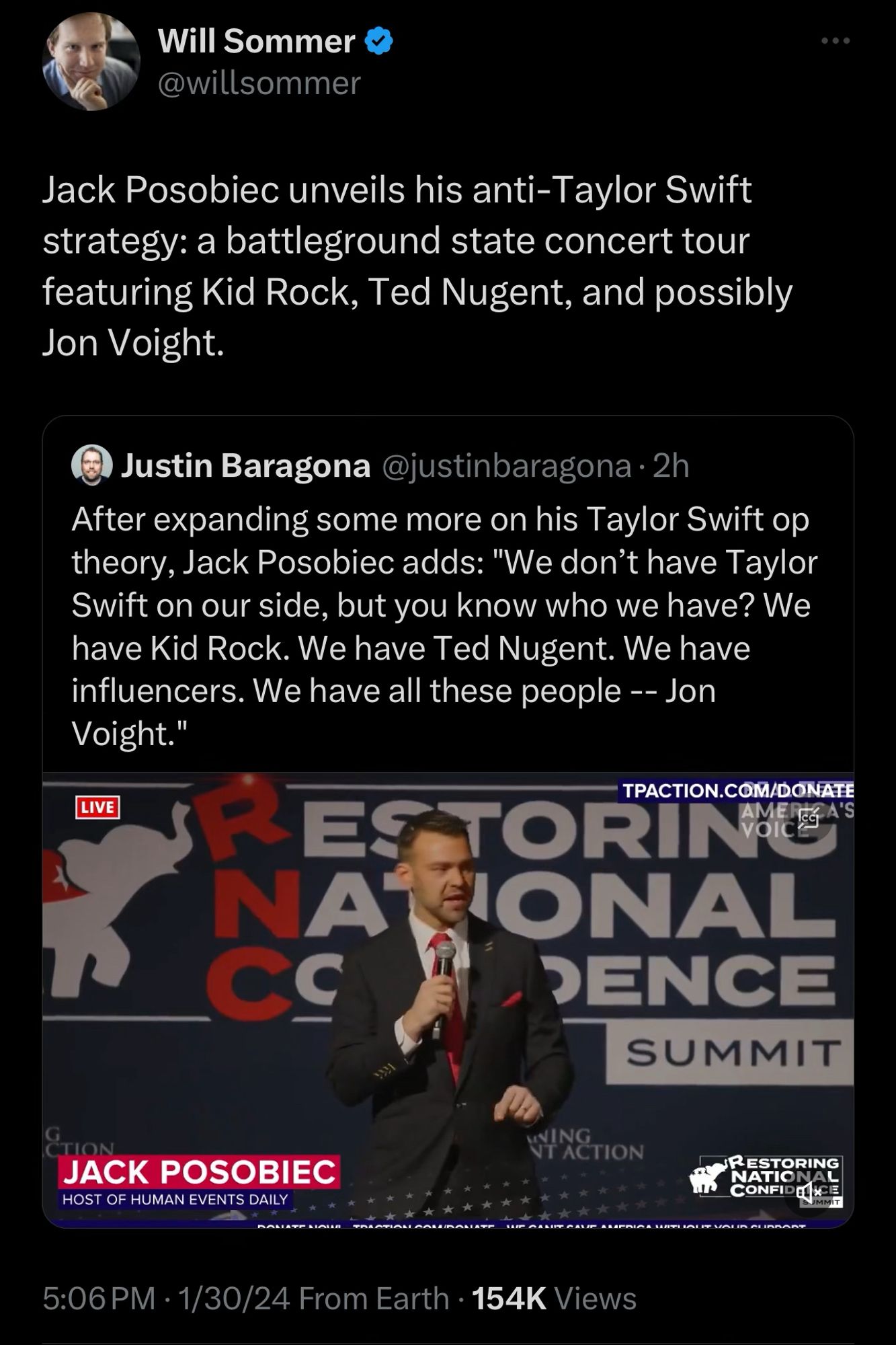
What I’m especially enjoying, though, is seeing Fox News melt down over Taylor Swift’s political views. They’re getting all testerical and insisting that she needs to shut up, she shouldn’t be allowed to have opinions on anything other than music. Of course, you’re only allowed to talk about political candidates if you’re endorsing the Fox News perspective, as Jack Posobiec does here.

Desperately reaching for some Republican “influencers” in entertainment, he coughs up Kid Rock, Ted Nugent, and…Jon Voight? Does he sing?

They don’t get it. Taylor Swift is a symptom, not a cause. Young artists are not going to be attracted to conservative causes, because Republicans are the death of art. Young educated people are not drawn to conservative causes, because Republicans are the death of learning. Young activists for a multitude of causes, like environmentalism or anti-racism or sexual freedom, are not interested in conservative causes because Republicans are death of all.

But I still believe in free speech. You go ahead, Jack Posobiec, and organize your “battleground state concert tour” featuring Kid Rock, Nugent, and Voight. I always approve of the Republicans throwing their campaign money down ratholes. And I’m sure there’s someone who likes Nugent’s and Rock’s music somewhere.

17 Jul 15:36

DXL

by Remy Porter

Managing requirements for even a simple project is a nightmare. As projects get more complicated, "requirements management" mutates into "systems engineering". The requirements for, say, an entire IT migration, or an automobile, or a lunar lander turn into a tree of requirements, where each implementation step is traced back to an overall master requirement at the root of the tree. Five to one, your average project isn't this complicated, but you don't want to ship a product missing features and have to say "it slipped my mind".

Enter a certain large vendor's Dynamic Object Oriented Requirements System (DOORS). Doors allows the requirements for a large, complicated product, to be organized into objects which are further organized into modules, where each object is a requirement, paragraph, section, table, figure, or anything that explains the nature of requirements.

Greg L's team adopted DOORS for managing their requirements. Unfortunately for them, DOORS stored all its data in a proprietary database. If you wanted to automate anything in DOORS, or even if you just wanted to say "show me this requirement, its siblings, and all of its ancestors", you needed to learn the Doors eXtension Language (DXL).

DXL was not the kind of language that would make you get up and dance. No, it would make your average developer an unhappy girl.

For example, if you wanted to access the currently opened object, you could use the keyword current, but current was only available when using the assignment operator. You could assign to (and from) current, but not do anything else. Unless you're in a loop. Then it's fine.

Property names on objects were allowed to have spaces, and many of the default properties did, so get used to writing o."Object Text" = "some text".

Speaking of spaces, a single space was the concatenation operator. So, this would be one way to print out a list of variable values: print i " " r " " s " " d " " b "\n". It's also worth noting that non-string variables, like integers, can't be printed out unless they're converted to strings, which can be done via concatenation to an empty string: `print i " "

Strings are also stored in a global string table. Each time you create string literals the entire literal ends up in that table and will live there for ever, so if you keep building strings incrementally, you'll very quickly fill up that table and crash the application with an out of memory error.

Why is it like this? Well, we could say that people are strange, but the reality is that DXL was the kind of thing one employee invented to make their work easier, and then management and customers got wind of it and demanded that it be included in the product.

Once there was an extension language, internal developers had to use that extension language, which means many features in DOORS were implemented in DXL. That includes the very obvious feature of "export your requirements as a human-readable word document".

I'll let Greg explain:

At some point in the application's lifetime it became apparent that users might want their requirements documents exported to Word or Excel. They could have implemented this by adding a feature to DOORS, but instead the vendor chose to provide some DXL scripts for this task. This required thousands of lines of DXL, most of which is poorly formatted and not commented in any way. If you have the misfortune if needing to tweak it (as I did) then you will find this little gem at around line 335:

// insert some text
    // cycle through styles
    // delete the text
    /*
        We have to go through this sorry farce because Word in it's infinite wisdom
        keeps track of whether or not styles have been used.  If they haven't, and
        some text is pasted in in a style which has the same name as one which already
        exists, then the style is updated to match what is in the clipboard, rather
        than keeping it's own formatting properties.

        The last thing we want to do is overwrite styles in the current template,
        so we make sure that they are all used before we start
    */

This comment doesn't explain the whole logic, but it hints at the awfulness involved. DXL was not used to create a Word document directly. No, it used the Windows copy/paste buffer and COM+ automation libraries to interact with a running Word program directly. So it was all hacks: throw text in, use all the Word styles, and then delete the text (to enable all the default styling in Word), then lock the copy buffer, and spend the next few hours copy/pasting from DOORS to Word. And yes, it took hours for this job to run, and it ran on your desktop (since it needed a running copy of Word), which meant you couldn't use copy/paste for the duration of the run.

Greg adds:

After four years of writing DXL (and re-writing what was provided by the vendor) I eventually moved to a different job, where I am able to "conveniently forget" that I know anything about DOORS and their nightmare of a language.

Tell all the people that using DOORS isn't a walk down Love Street, but at least Greg was able to break on through (to the other side).

[Advertisement] Keep the plebs out of prod. Restrict NuGet feed privileges with ProGet. Learn more.
16 Dec 13:02

CodeSOD: A Bit of Javascript

by Remy Porter

We've recently discussed how bit masks can confuse people. Argle's in a position to inherit some of that confused code.

In this case, Argle's company inherited some NodeJS code from a customer who was very upset with the previous development team they had hired. It was a mix of NodeJS with some custom hardware involved.

Like many of us, the first thing Argle's team did was just pull up the code and skim the documentation. It seemed thorough and complete. But it wasn't until they started looking at the implementation that they started to see the true horrors.

Someone had reimplemented all of the bitwise functions as methods. And the core pattern revolved around the bitTest function:

function bitTest( value, bit ) {
    let temp = value.toString(2);
    temp = temp.split('').reverse().join('');
    let i;
    for( i=temp.length; i<32; i++ )
        temp += '0';
    if ( temp[bit] == '1' )
        return true;
    else
        return false;
}

This turns an integer into a string of its binary representation, splits it into an array to reverse the array to rejoin it into an array (gotta think about endianness!), and then pads the string out to 32 characters long, all so that it can finally ask if temp[bit] == '1' is true.

But think about the readability benefits! Instead of writing the cryptic if (variable & (1 << bit)), which is nigh unreadable, you can now say if (bitTest(variable, bit)) which doesn't actually convey any more information and in fact conceals a gigantic pile of string manipulation for a very, very simple check.

I expect this code to be uploaded to NPM and turned into a microframework that ends up powering 75% of web applications by the end of the week, as a dependency-of-a-dependency-of-a-dependency.

[Advertisement] Otter - Provision your servers automatically without ever needing to log-in to a command prompt. Get started today!
12 Sep 06:33

Skepchick Sundaylies! The Genius Behind Einstein’s Work, the Crisis Facing Trans Kids, Children’s Digital World, and more!

by Mindy

Sunday Funny: Wrong. (via xkcd)

Mad Art Lab

Erasing Mileva Mari?-Einstein, The Woman Behind Einstein’s Math
Dale tells the story of the brilliant mathematical mind behind Einstein’s work.

School of Doubt

Bathrooms: For Trans Students Who have Considered Suicide when the Rainbow is Not Enough
School should not be scary for trans students, writes new contributor aswetz.

Grounded Parents

We Don’t Live in North Korea and Other Reasons Why I Don’t Make My Kids Say the Pledge or Stand for the National Anthem
Steph explains why she doesn’t force patriotism on her children.

To Monitor or Mentor: A Review of Screenwise by Devorah Heitner
Emily reviews Screenwise: Helping Kids Survive (and Thrive) in Their Digital World.

Internet Meme Demolition Derby: The Scourge of the Man Bun
Lou explains why he hates the hate directed at the “man bun.

Featured image credit: Tim & Selena Middleton via Flickr

05 Oct 20:49

Now that’s counterintuitive

by PZ Myers

Science role models who are too feminine are discouraging — because there’s a perception that it’s too hard to be both pretty and sciencey?

Maybe we need to change the perception, rather than asking women representing science to try and dress down.

13 May 06:31

Pfizer's Shareholders and AstraZeneca's

The Financial Times is out with an editorial denouncing Pfizer's attempted takeover of AstraZeneca. It's definitely worth a read for the case it makes. What's a drug company supposed to be doing, anyway?

But (the effect on British research) is not the only big question requiring discussion. Another is the extent to which the board of AstraZeneca – as it decides how to respond to the US group’s overtures – should be driven by the desires of its own shareholders.

One of the most troubling aspects of Pfizer’s bid is its lack of evident commercial logic. The choice of target and the form of consideration seem to be driven principally by the US group’s desire to re-domicile itself in the UK and shrug off certain burdensome American tax liabilities.

The deal will not obviously strengthen AstraZeneca in its pursuit of drug discoveries, or its ability to bring new life-saving compounds to market. Nor will it increase competition or sharpen innovation across the sector.

Pfizer’s dealmaking history is moreover a deeply dispiriting one. The group has a reputation for delivering returns to its investors not through creative management and groundbreaking research, but by the frequent execution of accountant-led, cost-crunching acquisitions.

Comments here to past posts on this deal have raised the same question, and it's a tough one. If the purpose of AstraZeneca (and Pfizer) is to deliver money to their shareholders, full stop, then the deal makes sense. It will deliver money - of that there seems little doubt. It will deliver that to Pfizer through finagling the tax laws (which the British government has written in the hopes that just these sorts of deals would happen, one would think), and it will deliver it to AstraZeneca's shareholders by paying them more than their stock was worth a few weeks ago. Money is money, and pecunia presumably non olet. If the discussion is supposed to end there, then there's not much to discuss.

Is that where it's supposed to end, though? The FT editorialists, not exactly a bunch that are unfamiliar with capitalism, don't think so:

The prevailing wisdom in the Anglo-Saxon world over the past 35 years has been that boards should simply respond to what they perceive their shareholders’ wishes to be. But this is incorrect.

Directors have wider responsibilities on which they should reflect before making any recommendation about a company’s future. Legally, their duties under the Companies Act are not simply to snap to attention when shareholders whistle. They are to advance the interest of the business as a whole over the long term.

Just as surely as it is in Pfizer's financial interest to swallow AstraZeneca, it would seem to be in AstraZeneca's long-term interests not to be swallowed by Pfizer. They are most certainly not the greatest drug company around, but they deserve a chance to see if they can work out of the pit that time, circumstance, and some of their own decisions have put them into. On a larger scale, Pfizer's history of acquisition has damaged the entire pharmaceutical industry's store of R&D ability and intellectual capital.

Some AZ shareholders may well decide that taking Pfizer's money and running is the right decision - after all, who's to say if the company is going to make any sort of comeback at all? Better to take the sure thing - many of these investors are managing funds themselves, and they have responsibilities to their own shareholders and customers. But at some point this reasoning breaks down, or at least reveals its limitations. If we're always going to take the sure thing, the money that can be realized right now, then most startup companies (to pick an extreme example) have no reason to exist. After all, they're just promising and hoping to deliver something eventually. Better to just close up shop, sell what's sellable, and return the money to the shareholders, right? Screw the future.

Somewhere in between these extremes lies the "right" answer, and we're all still figuring it out. It's not just the drug industry - you can see the same issues playing out with Amazon - the company barely makes any actual profit, and its investors are getting increasingly restless about that. Shareholders have rights, for sure - but do they have all the rights?

12 Oct 21:05

Stilla dagar i Torrevieja, första dagen

by Staffan Sävenfjord
Det gäller att välja sina vänner. Själv väljer jag gärna vänner som har hus i Spanien och som man kan våldgästa en vecka varje höst. Roger och hans fru Tanja är sådana vänner. De får till och med mig att känna mig välkommen till Torrivieja där det för mig blir några lata dagar i den sol som alltid lyser över den här delen av Europa. Årets första utomhusbad kan jag ta i oktober i Medelhavet på Playa La Mata.

Den tredje oktober flög jag således med Ryan Air till Alicante. Det har sagts mycket om Ryan men jag tycker faktiskt att det fungerar bra på deras plan. Och att det är billigt att flyga med dem är ju inte precis någon nackdel även om man får betala över 500 kronor för att ta med en väska som är större än normalt handbagage. Och så tillkommer prioriterad ombordstiging om man vill ha det. Och det vill jag. Men lite över 1 740 kronor för att flyga från Göteborg Säve till Alicante Airport och tillbaka är ju inte mycket att säga om. Visst: det tillkommer taxi från bostaden till Borås Resecentrum och biljetten på buss 100 till Göteborg.

Roger hade varit hemma i Sverige för ett tjänsteärende och därför hämtade han och hans son upp mig vid Göteborgs central så den biten kostade inget extra. Roger och jag fick därmed också sällskap på flyget. Säve flygplats är inte precis någon höjdare och det var långa köer till bagagedropen och incheckningen. Men vi var ute i god tid så vi upplevde inte någon stress. Och det är korta avstånd från entré till allt annat inklusive till planet som står på plattan.

Längre att gå blev det på flygplatsen i Alicante. Men just som vi kom fram till bagagebandet satte detta i gång och efter bara ett par minuter kom min väska. Så 14.20 kunde vi gå upp till parkeringen där Tanja mötte med bil. Inte dåligt med tanke på att det var 14.20 vi skulle landat. Planet var alltså före tiden.

Jag hälsade på dem även förra hösten och det visade vara sig likt när vi kom fram till Calle Aquiles. Ja, det är inte grannen utan gatan som heter så. Calle skall uttalas "kajje" och betyder rätt och slätt gata.

Tanjas och Rogers hus är det som syns längst till höger på bilden. Inom området finns 52 hus sammanbyggda som radhus. Bara ett fåtal av dem ägs av spanjorer. De andra ägs av utlänningar (ur spansk synvinkel alltså) som svenskar, norrmän och engelsmän. 


Den första dagen ägnade vi åt att gå upp till poolen och att prata lite med grannarna. Många av dem känner jag igen från förra hösten.

Andra dagen innebar marknad och en rätt misslyckad gatufest. Mer därom i kommande inlägg.
09 Oct 06:08

hungerspelet och sponsorerna

by Alice

Hunger_ko- Blir du borta länge, undrade maken.
- Nej, nej, releasefesten för Hunger är bara en timme. Jag är hemma i tid att assistera med läggningen av minst ett barn, lovade jag flott.

Detta är veckan för premiären av magasin som är livsstilsmarkörer. Jag är nyss hemkommen från Södra Teatern och minglet som är avstampet för systertidningen till Filter. På torsdag ska jag till So Stockholm i Kungsträdgården där LRF Media firar tillkomsten av magasinet Äkta Mat. Framåt helgen kan vi hoppas på en bloggpost som jämför de två tidningarna, men just nu får ni hålla till goda med ytligare ting som goodiebaginventering.

Hunger_samarbeten
Alla små papper som trillade ur tidningen när jag började bläddra.

När jag själv på mitten av 00-talet skulle starta mattidning (för Egmont) lärde jag mig att det svåra inte är att fylla tidningen med läsvärt innehåll. Det svåra, gränsande till hopplösa är att fylla den med välbetalda life style-annonser som gjorde att vi alla skulle kunna få lön. I Hunger är 41 av 124 sidor annonser. Inte så mycket jämfört med en modemagasin, men för en nystartad mattidning är det inte illa. City Gross, Granit, Mio, Nespresso,  Naturkompaniet, Svenskt Kött,  Naturskyddsföreningen mfl. har öppnat plånboken.

Dessutom låg det inte mindre än fem papper istuckna i tidningen. Ett var det obligatoriska prenumerationserbjudandet och resten var annonsörerna Ekolådan, Naturskyddsföreningen, Kitchenlab och Södra Teatern.

Goodiebag från Hungers releasefest

Och så var det goodiebagen. Jag kan fortfarande inte se en goodiebag utan att tänka på påsen från Gourmets 30-års kalas som innehöll påste, fetlösande rengöringsmedel, Lindtchoklad, Kavlis aioli och Doves handkräm. Jag blir mer och mer luttrad på gränsen till oförskämd och på senaste Årets Kock-middagen kunde man sent på natten se mig rota igenom den festens goodiebag, demonstrativt slänga ut sötningsmedlet och undra om jag kunde få byta till mig mer lakrits.

Hungers påse var så välpackad att jag inte kom mig för att titta i den förrän jag kom hem. En DVD med en film med matanknytning som jag gärna vill se (hurra), en spork från Naturkompaniet (strålande till sonens utflyktsmat), en gigantisk tekanna från Granit (jag vet inte riktigt… hade de ett stort restlager?) och fyra stycken fairtrademärkta hälsodrycker som smakar omogen banan (jo men visst). Inte så illa innehåll. Ganska bra i linje med tidningen, utöver tekannan. Har inte de flesta hushåll redan fyllt sin tekannekvot? Den här blev min femte…

hunger_mat
Carola Magnusson hade gjort mingelmaten. Här en pulled vildsvin inslagen i magasinets förstasida.

Hur var tidningen då? Tror ni att jag har haft tid att läsa den OCH blogga om goodiebags? Jag har hunnit titta på Lotta Lundgrens väldigt snygga dekolletage på sidan 26,  läsa Ulrika Brydlings förklaring om halloumins gnisslande på sidan 106 och glädjas stort åt att min journalistmentor Anna Kågström är tidningens redaktör. Jag tecknar min prenumeration i morgon. Nu tänker jag sova.

Barnen sov redan när jag kom hem. Maken hade ockuperat soffan. Informationsdelen av releasefesten var mycket riktigt slut några minuter innan klockan åtta, men mest för att Mats-Eric Nilsson inte pratade mer än några minuter. Sen ägnade jag några minuter åt att hälsa på en oändlig mängd människor, äta två av Carola Magnussons utmärkta vildsvinsburgare samt, tillsammans med Martin Jönsson, försöka hitta ett ex av magasinet. Slutligen gav jag upp och tänkte gå hem tomhänt. Då märkte jag att goodiebags inklusive magasin fanns i garderoben.

Mama’s got a brand new goodie bag.


25 Jul 23:05

What atheist church?

by PZ Myers

Hey! I don’t know about this arrangement — Salon ran an article I really wanted to rip into, and while I was distracted, Chris Clarke snatched it away from me, and made all the good points. Now I’m left with the dregs.

It was an article that asked “Where are the women of New Atheism?”, while weirdly and obliquely citing a number of prominent woman atheists and putting pictures of atheist men at the top. I felt like screaming, “They’re everywhere! But lazy media always makes the story about the men!” But Chris already said all that.

So, dregs. That story actually annoyed me from the very first paragraph.

“New Atheism” is old news. Enter “New, New Atheism”: the next generation, with its more spiritual brand of non-belief, and its ambition to build an atheist church. It is an important moment for the faithless.

Say what? The author really is trying to build up her bizarre misperceptions into a reality. I see no significant effort to incorporate “spirituality” (whatever the hell that is) into atheism, or to mimic the trappings of institutional religion. There are a few scattered individuals who are doing that — atheism is diverse and unregimented, so of course there are varieties of exploration of the implementation — but no one I know is interested in building atheist “churches”. I have seen no shift in the newer atheists towards the spiritual — if anything, the young atheists I know are more likely to take for granted that spirituality is meaningless. The new, new atheism is about taking material action.

I really wonder if the author has had any experience with atheists at all, because this was more of an outsider’s warped view of struggles within the atheist movement (we are all trying to end discrimination against women and broaden our reach), distorted into her preconceptions about what it should be like.