Shared posts

28 Oct 21:11

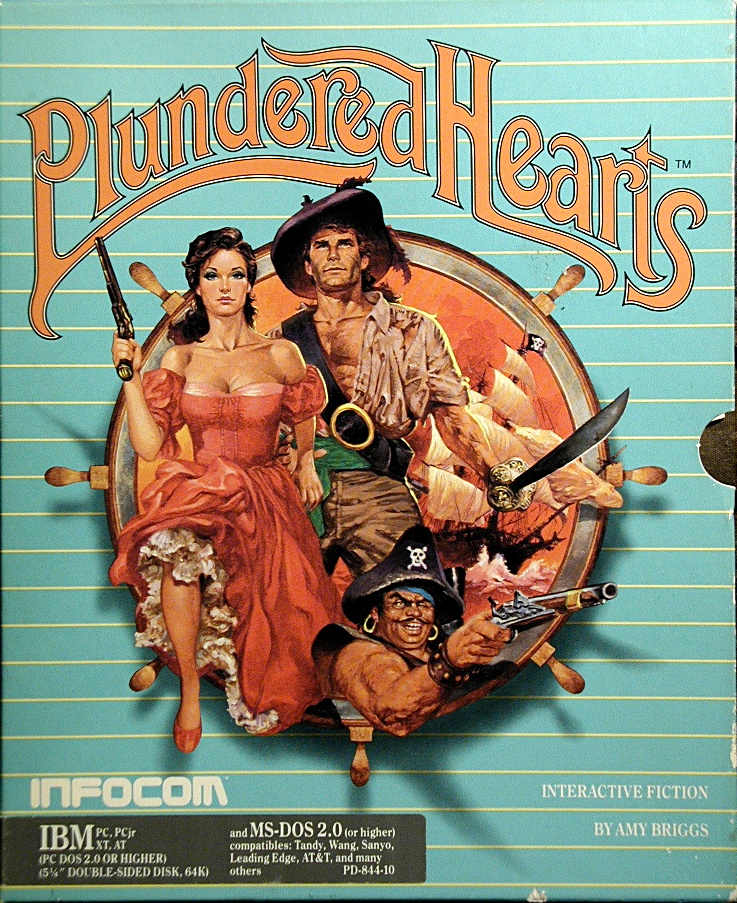
Plundered Hearts

by Jimmy Maher

Plundered Hearts

Amy Briggs first discovered text adventures during the early 1980s, when she was a student at Macalester University in her home state of Minnesota. Her boyfriend there worked at the local computer store, and introduced her to the joys of adventuring via Scott Adams’s Ghost Town. But she only became well and truly smitten — with text adventures, that is — when he first booted up a Zork for her. The pair were soon neglecting their studies to stay up all night playing on the computer.

After graduating with a degree in English and breaking up with the boyfriend, Briggs found herself somewhat at loose ends, asking that question so familiar to so many recent graduates: “What now?” Deciding that six months spent back at home with her parents was more than enough, she greeted 1985 by moving to Boston, which made for a convenient location for seeking a fortune of a type still undetermined since she had a sister already living there. Only half jokingly, she told her friends and family just before she left that if all else failed she could always go to work for Infocom.

Lo and behold, she opened the Boston Globe for the first time to find two want ads from that very company, one looking for someone to test games and the other for someone to do the same for some mysterious new business product. Briggs, naturally, wanted the games gig. Straining just a bit too hard to fit in with Infocom’s well-established sense of whimsy, she wrote a cover letter she would later “blush about,” most of all for her inexplicable claim that she had “a ridiculous sense of the sublime.” Despite or because of the cover letter, she got an interview one week later — she “stumbled out something incomprehensible” when asked about the aforementioned “ridiculous sense of the sublime” — and got a job as a game tester two weeks after that. As she herself admits, she “just walked into it,” the luckiest text-adventure fan on the planet who arrived at just about the last conceivable instant that would allow her to play a creative role in Infocom’s future.

She joined at the absolute zenith of Infocom’s success and ambition, with the whole company a beehive of activity in the wake of the recent launch of Cornerstone. On her first or second day, no less august a personage than Douglas Adams came through to talk about the huge success of his Hitchhiker’s Guide to the Galaxy game and to plan the next one. Her first assignment was to help pack up everything inside the dark warren that was Infocom’s Wheeler Street Offices and get it all shipped off to their sparkling new digs on CambridgePark Drive. Humble tester that she was, it felt like she had hit the big time, signed on with a company that was going to be the next big success story not just in games but in software in general.

Of course, it didn’t work out that way. Having enjoyed just a couple of months of the good times, Briggs would get to be present for most of the years of struggle that would follow. She kept her head down and kept testing games through all the chaos of 1985 and 1986 leading up to the Activision acquisition, managing to escape being laid off.

As a woman, and as a very young and not hugely assertive woman at that, Briggs was in a slightly uncomfortable spot at Infocom, one to which many of my female readers at least can probably relate. Infocom was not, I want to emphasize, an openly or even unconsciously misogynistic place. On the contrary, it was a very progressive place in most ways by the standards of the tech industry of the 1980s. But nevertheless, it was dominated by white males with big personalities, strong opinions, and impressive resumes. Very few who didn’t fit that profile would ever have much to say about the content of Infocom’s games. (Discounting outside testers, about the only significant female voice that comes to mind other than that of Briggs is Liz Cyr-Jones, who came up with the premise and title for Hollywood Hijinx and made contributions to many other games as one of Infocom’s most long-serving, valued, and listened-to in-house testers.) Briggs needed someone in her corner, “pushing me and showing me how to do everything from compiling ZIL to insisting that I be taken seriously.”

None other than Steve Meretzky stepped forward to fill that role.  He saw a special creative spark in Briggs quite early, when she helped test his labor of love A Mind Forever Voyaging and just got what he was trying to do in a way that many other testers, still stuck in the mindset of points for treasures, didn’t. He proved instrumental in what happened next for Briggs. When she told him that she’d like to become an Imp herself someday, he introduced her to ZIL. She started working on a little game of her own for two or three hours after work in the evenings and often all day on the weekends. Like the generations of hobbyist text-adventure authors who have set their first game in their apartments, Briggs elected to begin with what she knew, the story of a tester finding bugs and taking them back to the Imp in charge. But because it was after all adventure games that she wanted to write, she muddled up this everyday tale with Alice in Wonderland: the bugs in questions were literal, metamorphosed critters, and the Imp was a caterpillar smoking a hookah.

In the fall of 1986, a call that was destined to be the last of its type went through the Infocom ranks, for a new Imp to help maintain the ambitious release schedule being pushed by Activision in the wake of the acquisition. Meretzky, showing himself to be far less sanguine on Infocom’s future prospects than he let on in public interviews, told Briggs that she should do her best to get it because “after this hiring there’s not going to be another Imp hired until one of us dies.” Along with a quiet word or two from Meretzky, her testing experience and the sample game she had been tinkering with for the last year were enough to convince management to give her a shot. Before the year was out she was an Imp, given a generous nine months — thanks to her being new on the job and all — to write, polish, and release her first game. What said first game would be was, within reason, to be left up to her.

The plan she came up with was a humdinger. She wanted to write an interactive romance novel, much like the literary guilty pleasures she had been addicted to ever since she was a teenager. Marketing immediately liked the idea of having Infocom’s first game with an explicitly female protagonist be written by a woman, saw great possibilities for opening up a “whole new market” with a game that should have huge appeal to female players. Infocom had halfheartedly pursued a similar idea before, entering into talks with a mid-list romance-novel author about a possible collaboration, only to see them peter out in the wake of the chaos wrought by Cornerstone and an evolving feeling that such partnerships with non-interactive authors usually didn’t work out all that well anyway. Now, though, they were happy to revisit the idea via a game helmed by an author who, if admittedly unproven, had been steeped in interactive fiction as well as romance fiction for quite some time now.

Meretzky, for his part, was much less bullish on the idea. A romance game must revolve around character interaction in a way that he, experienced Imp that he was, knew would be incredibly hard to pull off. Indeed, in some ways it marked the most ambitious concept anyone at Infocom had mooted since his own A Mind Forever Voyaging. And being a new, unproven Imp, Briggs would not even be given the luxury of the Interactive Fiction Plus format; her game would have to fit into the standard, aged 128 K Z-Machine. Meretzky’s advice was to do something else first and then circle back to the idea, much as Brian Moriarty had agreed to write Wishbringer before tackling his dream project Trinity. Perhaps sensing already that there might not be enough time left for that, perhaps just feeling stubborn, Briggs for once rejected his advice and pressed ahead with her original plan. Her reason for doing so was about as good as they come: this would be the Infocom game that she had always wanted to play.

Amy Briggs

Amy Briggs

Steeped sufficiently in romance novels to have become something of a scholar of the genre, Briggs had long since divided the books she read into four categories: contemporary romances; Gothic romances in the tradition of Jane Eyre and Rebecca; historical romances, or “bodice rippers,” with “lurid sex-filled plots in historical settings”; and the more subdued Regency romances in the tradition of Jane Austen, as much comedies of manners as stories of love and lust. She decided that she wanted to make her game a cross between a Regency novel, her personal favorite category, and an historical romance, with “more action than a Regency but less sex than an historical.” Whatever else it was, her game would still be an adventure game, and thus the emphasis on action seemed necessary. As for the lack of explicit sex, Briggs wasn’t suited by temperament to writing lurid sex scenes any more than Infocom was interested in publishing them — not to mention the complications of trying to craft interactive sex in a medium that struggled to depict even the most basic conversation.

Looking for an historical milieu, Briggs settled on the age of Caribbean piracy. Like Sid Meier, who was working on a very different pirate-themed game of his own 400 miles away in Baltimore, she wasn’t so interested in the historical reality of piracy as much as she was in the rich tradition of swashbuckling fiction. Many of the references she studied were doubtless the same as those being perused at the exact same time by Meier. Her actual statements about her game’s relationship to real history also echo many of Meier’s.

I already had plenty of experience with romance novels, from my reading, and I have long been interested in fashions, so I only needed to brush up on those. Pirates, though, I had to research, and sailing ships. I watched a lot of movies — Captain Blood-type movies and romantic adventures like Romancing the Stone. Plundered Hearts is about as historically accurate as an Errol Flynn movie. I tried not to be anachronistic if I could help it, but if the heroine’s hairstyle is from the wrong century or if pirates really didn’t make people walk the plank, if stretching the truth adds a lot to the story, does it really matter?

As the extract above attests, she gave her game the pitch-perfect title of Plundered Hearts. You take the role of the young Lady Dimsford, whose ship is waylaid on the high seas by a pirate who is both less and more than he seems. Captain Jamison, the legendary pirate known as “the Falcon,” is actually there to rescue you from kidnapping by the captain of your own ship, who’s in the thrall of the evil Governor Jean Lafond; Lafond already holds your father captive. Cast in the beginning in the role of damsel in distress, to survive and thwart the sinister plot against your family you’ll soon have to take a more active part in events. Along the way, you’ll need to rescue your erstwhile rescuer Captain Jamison a few times, and of course you’ll have the chance to fall in love.

As Emily Short notes in her review of the game, at times Plundered Hearts layers on the romance-novel stylings a bit thick, and with a certain knowingness that skirts the border between homage and parody, as in the heroine’s daydream that represents the very first text we see.

>SHOOT THE PIRATE
Trembling, you fire the heavy arquebus. You hear its loud report over the roaring wind, yet the dark figure still approaches. The gun falls from your nerveless hands.

"You won't kill me," he says, stepping over the weapon. "Not when I am the only protection you have from Jean Lafond."

Chestnut hair, tousled by the wind, frames the tanned oval of his face. Lips curving, his eyes rake over your inadequately dressed body, the damp chemise clinging to your legs and heaving bosom, your gleaming hair. You are intensely aware of the strength of his hard seaworn body, of the deep sea blue of his eyes. And then his mouth is on yours, lips parted, demanding, and you arch into his kiss...

He presses you against him, head bent. "But who, my dear," he whispers into your hair, "will protect you from me?"

A number of Infocom’s other more unusual genre exercises similarly verge on parody, whether as a product of sheer commitment to the genre in question or the company’s default house voice of sly, slightly sarcastic drollery. One thing that redeems Plundered Hearts, as it also does, say, many a Lovecraftian pastiche, is the author’s obvious familiarity with and love for the genre in question. And another is that even its knowing slyness, to whatever extent it’s there, departs from the usual Infocom mold. There aren’t 69,105 of anything here, no “hello, sailor” jokes, no plethora of names that start with Zorkian syllables like “Frob,” no response to “xyzzy” — all of which (and so much more like it) was beginning to feel just a little tired by 1987. Like Jeff O’Neill, another recently minted Imp who brought a fresh perspective to the job, Amy Briggs just isn’t interested in plundering the lore of Zork. Unlike O’Neill, she gives us a game that’s eminently playable. Plundered Hearts is the polar opposite of the cavalcade of insider jokes and references that is The Lurking Horror. Yes, that game certainly has its charms… but still, new blood feels more than welcome here. Plundered Hearts really does feel like it wants to reach out to new players rather than just preach to the choir.

Yet at the same time that it’s so uninterested in so many typical Infocom tropes, Plundered Hearts might just be the best expression — ever — of the Infocom ideal of interactive fiction. The backs of their boxes had been telling people for years that interactive fiction was like “waking up inside a story.” Still, the majority of Infocom games stay far, far away from that ideal. Some, like Hollywood Hijinx and Nord and Bert, are little more than a big pile of puzzles built around a broad thematic premise. Others, ranging from Infidel to Spellbreaker, give you a dash of story in the beginning and a dab of story in the end, with a long, long middle filled with lots of static geography to explore and yet more puzzles to solve. Even Infocom’s two most forthrightly literary efforts, A Mind Forever Voyaging and Trinity, aren’t quite like waking up inside a story in the novelistic sense: there’s very little conventional narrative of any sort in Trinity, while for most of its length A Mind Forever Voyaging makes its hero more an observer than the star of its unfolding plot. The mysteries do offer relatively stronger narratives and more complex characters, but they’re very much cast in the classic mystery tradition of figuring out other peoples’ stories rather than really making one of your own.

Plundered Hearts, however, feels qualitatively different from them and almost everything else that came before. (The closest comparison in the catalog is probably Seastalker, Infocom’s only game marketed explicitly to children.) There’s a plot thrust — a narrative urgency — that’s largely missing elsewhere in the Infocom canon, coupled with many more of the sorts of things the uninitiated might actually think of when they hear the term “interactive fiction.” As you play, the plot thickens, events unfold, relationships change, characters develop and deepen, romance blossoms. In short, real, plot-related things actually happen. I don’t mean to say that this is the only way to write a compelling text adventure. Nor do I mean to say that there’s a lot of plot here by the standards of a typical novel or even novella, nor that you can do a whole lot to influence it beyond either clearing the hurdles before you and making it to the end — the game does offer a few alternate endings via a final branch — or screwing up and dying or suffering a “fate worse than death” that usually implies rape, and often a lifetime of indentured sexual servitude. What I am saying is that Amy Briggs took interactive fiction as Infocom preferred to describe it and made her best good-faith effort to live up to that ideal.  And, against all the odds, it works way better than it has any right to. I recently called the Infocom ideal of interactive fiction “something of a lost cause.” Well, I should have remembered that Plundered Hearts was waiting in the wings to prove me wrong just this once. Briggs dispenses with the things she can’t easily implement, like character interaction, via quick text dumps and concentrates the interactivity on those she can. By keeping the plot constantly in motion, she distracts us from the myriad flaws in her world’s implementation.

While Plundered Hearts has plenty of puzzles, those puzzles feel more organic than in the typical Infocom game, arising directly out of the plot rather than existing for the sake of their own cleverness. They’re also a bit easier than the norm, which suits the game’s purposes fine; you don’t want to spend hours teasing out the solution to an intricate puzzle here, you want to keep the plot moving, to find out what happens next. Most of the puzzles require only straightforward, commonsense deductions based on the materials to hand and your own goals, which are always blessedly clear. Yes, were Plundered Hearts written today, there are a few things a wise author would probably do differently. The timing of the first act, when you need to keep a powder keg in the hold of your ship from exploding, is tight enough that you might need to replay it once or twice to get it right, and it’s quite easy in one or two places to leave vital objects behind (don’t forget to grab that piece of pork when you make it to St. Sinistra!). Still, this game is far friendlier as well as far more plotty than the Infocom norm, and as a result it feels surprisingly modern even today.

As with many Infocom games, particularly in the latter half of the company’s history, much of the process of developing Plundered Hearts came down to cutting out all those pieces that wouldn’t fit into the 128 K Z-Machine. Briggs says that she finished the game inside six months, and then spent the remaining three cutting, cutting, and painfully cutting some more. Impossible as it is to make any real judgments without seeing the game she started with, Plundered Hearts doesn’t feel so much like a victim of those cuts as does Dave Lebling’s nearly contemporaneous The Lurking Horror. In some ways the cutting may have improved it, made it more playable. Briggs notes that she just didn’t have the space to allow the player to go too far astray, meaning that a screw-up more often leads to immediate death — or one of those other nasty, rapey endings — rather than a walking-dead situation. There are, she admits, “a lot of deaths” in Plundered Hearts. A lot of rapes too, more than enough to make the game feel squiggy if it had been written by a man. (Yes, this is a double standard. And no, I don’t feel all that motivated to apologize for it in light of the history that gave rise to it. Your mileage may obviously vary.)

In an interview published in Infocom’s The Status Line newsletter, Briggs tried to head off accusations that the game offered a retrograde depiction of gender relations by noting that “feminism does not rule out romance, and romance does not necessarily have to make women weak in the cliché sense of romance novels.” She further pointed out, rightly, that the protagonist of Plundered Hearts must soon enough take responsibility for her own fate, must turn the tables to rescue her Captain Jamison (“several times!”) and certainly can’t afford to “act as an air-head.” Not having much — okay, any — experience with romance novels, I don’t know whether or how unusual that is for the form, and thus don’t know to what degree we can label Plundered Hearts a subversion of romance-novel tropes. I do think, however, that by the time near the end of the game that it’s you, the allegedly helpless female, who comes swinging down off a chandelier to effect a rescue, the game has quite thoroughly upended the gender roles of your typical Errol Flynn movie.

Plundered Hearts and Nord and Bert, released simultaneously in September of 1987, represented the two most obvious marketing experiments in a 1987 Infocom lineup that otherwise largely played to the adventure-gaming base. These were also the two titles about which marketing had been most excited at their inception, as chances to pry open whole new demographics. By that September, however, following a punishing nine months already full of commercial disappointments, such ideas seemed like the fantasies they had probably always been. Infocom’s marketing efforts on behalf of Plundered Hearts in particular were tentative to the point of confusion, playing up the romance-novel angle on the one hand while seeking on the other to reassure the traditional adventurers that Infocom could hardly afford to lose that, really now, this wasn’t all that big a departure from Zork. And so we got this testimonial from one Judith C.: “Infocom’s first romance does the genre proud. Playing Plundered Hearts was like opening a romance novel and walking inside.” But we also got this one from Ron T.: “I was a little afraid that I wouldn’t like the game at first, being male and playing it as a female, but once you got started it was NO PROBLEM! I enjoyed it!!!”

Neither marketing angle was sufficient to make Plundered Hearts a hit. The sales of it and its release partner Nord and Bert dropped off substantially from those of the pairing of Stationfall and The Lurking Horror of just a few months previous. The final numbers for Plundered Hearts reached only about 15,500. Briggs recalls no big thrill of accomplishment at seeing her name on an Infocom box for the first time, nor even a sense of creative fulfillment at having done something so different from the Infocom norm and done it so well, only a deep disappointment at what she and Infocom’s management viewed as just another failed experiment.

Briggs’s remaining time at Infocom proved equally frustrating. While certainly not the only Imp whose most recent game had failed to sell very well, she was in a precarious position as the newest and most inexperienced of the group, with no older, more successful titles to point to as proof of her artistic extincts. In contrast to Plundered Hearts, an idea which Infocom’s management had embraced from the get-go, her new ideas got rejected one after another by a company she characterizes as now “terrified,” desperate to find “the next Hitchhiker’s” that could save them all. Management wanted games with obvious “marketing tie-ins,” but her personal interests were “geekish.” At the same time, though, they gave her little real direction in what sorts of subjects might be more marketable: “Just write us a hit.” The most retrospectively promising of her ideas, one that would seem likely to have satisfied management’s own criteria if they’d given it a chance, was a game either heavily inspired by or outright licensing Anne Rice’s vampire novels. But it came perhaps just a little too early in the cultural conversation — Rice’s books hadn’t quite yet exploded into the mainstream to help ignite the still-ongoing craze for all things vampire in popular culture — and was ultimately rejected along with all her other ideas. About the time that management started pushing her to call up Garrison Keillor to try to get a game deal out of her very tangential relationship with him — she had worked as an usher on A Prairie Home Companion during her university days, and had attended occasional potlucks and the like with the rest of the cast and crew at Keillor’s house — she decided that enough was enough.

Briggs left Infocom in mid-1988 after completing her final work for them, the “Flathead Calendar” feelie that accompanied her old mentor Steve Meretzky’s Zork Zero. She said that she was leaving to go write the Great American Novel. But like many an aspiring novelist, Briggs found the reality of writing less enchanting than the idea; the novel never happened. She jokes today that her fellow Imps set expectations a bit too high at her farewell party when they gifted her with a tee-shirt emblazoned with the words “1989 Winner of the Pulitzer Prize.” She wound up taking a PhD in Experimental and Behavioral Psychology instead, and has since enjoyed a rewarding career in academia and private industry. Her one published work of interactive fiction — for that matter, her one published creative work of any stripe — remains Plundered Hearts.

It may be a thin creative legacy, but it’s one hell of an impressive one. Other Infocom games like A Mind Forever Voyaging and Trinity may carry more thematic weight, but in terms of sheer entertainment I don’t think Infocom ever made a better game. The last game ever released for the original 128 K Z-Machine, it’s the interactive equivalent of a great beach read in all the best senses, grabbing hold quickly and just rollicking along through rapier duels, exploding powder kegs, daring waterborne escapes, secret passages, death-defying leaps, etc., all interspersed — this being an interactive romance novel, after all — with multiple costume changes, a little ballroom dancing, and a few sweaty seductive interludes sufficient to make the old bosom heave. Much as I usually shy away from the Internet’s obsession with ranking things, if I was to list my personal favorite Infocom games Plundered Hearts would have to be right there at number two, just behind Trinity. And this comes from someone who doesn’t know the first thing about romance novels.

Indeed, one of the thoroughgoing pleasures of Plundered Hearts, the gift that keeps on giving for years after you’ve played it, is watching players like me and our friend Ron T. above fall victim to its charms despite all their stoic manly skepticism. Even Questbusters‘s redoubtable William E. Carte, who in just the previous issue had declared Nord and Bert unfit for “true adventurers,” succumbed to Plundered Hearts despite being “a traditionalist and quite conservative as well.”

I must admit it bothered me a bit at first — my character being hugged and kissed by a man. After the initial scenes, however, I quickly got lost in the plot, and soon my character’s sex honestly didn’t matter. One female QB reader wrote me that she enjoyed the game and gave it to a male friend who also liked it. He particularly liked changing clothes repeatedly.

Don’t you love the sound of prejudices collapsing? I complain from time to time, doubtless more than some of you would like, about the lack of diversity in so much ludic culture. Leaving aside politics and social engineering and even concerns about simple fairness, I think that Plundered Hearts serves as a wonderful example of why diversity is something to be sought and cherished. Amy Briggs’s unique perspective resulted in an Infocom game like no other, one that gives people like me a glimpse of what people like her see in all those trashy romance novels. In a world that could use more of that sort of understanding, that can only be a good thing. But we don’t even have to go that far. In a world that can always use better and more varied games, more and more diverse game designers is the obvious best way to achieve that.

Like a number of people I’ve written about on this blog who have long since gone on to lead other lives, Amy Briggs’s own relationship to the game she wrote all those years ago is in some ways more distant than the one some of its biggest fans enjoy with it. It crops up in her life on occasions scattered enough that they always surprise, like the time that a student knocked on her door at the university where she was teaching to ask in awed tones if she was “the Amy Briggs.” He had played Plundered Hearts ten years before with his sister — young male fans, Briggs notes bemusedly, are almost always careful to make that distinction — had loved it, just wanted to say thank you. Briggs’s own memories of her brief, unlikely career as a game designer remain a mishmash of nostalgia for “the best job I’ve ever had” with the still-lingering disappointment of Plundered Hearts‘s commercial failure — a commercial failure that, at the time and even now, is all too easy for her conflate with its real or alleged artistic shortcomings. “There are actually people who think my game is really good,” she says with more than a tinge of disbelief in her voice. Yes, Amy, there are. We think your game is very good.

(As usual with my Infocom articles, much of this one is drawn from the full Get Lamp interview archives which Jason Scott so kindly shared with me. Thanks again, Jason! Other sources include Infocom’s Status Line newsletters of Fall 1987 and Winter 1987, Questbusters of December 1987, and an XYZZY interview with Briggs.

Plundered Hearts and most of the other Infocom games are available for purchase as part of an iOS app.)


Comments
25 Oct 09:07

[me, psych, writing, Patreon] One Year On: Writing for My Supper, Part 3

[Previously: Part 1 Part 2]

On Relationships: Seeing Sense (Gaze No More)

I first heard about Patreon and its funding model in May of 2014. I then spent about five months wrestling with the idea of launching my own Patreon project. A substantial part of the wrestling was with having the nerve to do it.

There are several standard ways of approaching the whole Patreon thing, and I did none of them.

Most people who turn to Patreon to support their art are, for one thing, already doing that art on an ongoing basis. The classic example is web comic authors: if you're already publishing on a regular schedule – perhaps on an advertising-supported website – setting up a Patreon to invite your fans to fund you fits great with this. There's just about no emotional risk: you already have fans, and you already know where you stand with them, and if they also want to give you money, that's great.

Sometime it's the fans who demand request the artist set up a Patreon. That's even less emotionally risky for the creator: "You seem to want to give me money, so, er, okay have at it."

I don't know anybody else whose Patreon proposition was, "This thing that I used to do? That I haven't done in a long time? I'll start doing it again if you pay me to." That's the first big difference.

Somebody asked me how to get into professional blogging, and I said, "It's easy! Step 1: do it for free for a decade or so to build up your readership. Step 2: profit!" Obviously, I couldn't have done this without having what amounts to a portfolio to point to – which, as an aside, took me a shockingly long time to compile. Not just things I'd written that I thought were good, but things I'd written that I thought were good and other people indicated they thought were good.

There seem to be a lot of would-be Patreon creators laboring under the misimpression that there are roaving bands of patrons looking for upcoming new artists to fund. No, there aren't. These misguided souls tend to show up in Patreon's open meetings/forums to complain that Patreon isn't doing a good enough job driving traffic to their Patreon pages, which... I don't even. That is not how this works. And, to the best of my knowledge from early music study, that is not how it has ever worked, anywhere.

At Honk!, our local donation-supported festival of activist street bands, there are volunteers who wander the crowds, holding out the tin cans for donations. That is precisely Patreon's role. It is not the job of the person holding the tin can to rally a crowd for the band to play to. Causing there to be a crowd in the first place is the band's job. And it's up to the band to do that by being awesome, loudly. Patreon's only in a position to solicit money for you from the audience you've attracted to yourself – and the only way I've ever heard of getting an audience, much less one willing to chip in, is by being awesome, loudly.

Which brings us to the next point of unconventionality in my approach.

The usual approach to Patreon – the relationship model Patreon sort of assumes – is that of artists and fans. The relationship between artist (or rather, in Patreon-speak, "creators") and fans is one where the fans are largely strangers to the creator, just there to enjoy the creations.

I was really clear that the people I was, at least initially, proposing this to were, by and large, friends. Friends are not the same thing as fans. Being a friend is not exclusive of being a fan (or a creator): it is possible for a friend to also become a fan, and a fan to become a friend. Indeed, many people following me on LJ through the years were both.

But most were friends first. I was keenly aware that if I did this, I would be soliciting financial support from people who were not strangers to me who just liked consuming the products of my creativity. I would be asking for money from friends.

This brought up all sorts of huge, highly emotionally charged questions.

The first question was Is it okay to ask for money from friends? In the culture of my upbringing: no, actually, it is not okay to ask for money from friends, not unless you have had some horrific tragedy befall you like your house burning down or getting cancer; and even in those cases, asking for financial help from friends was gauche enough that convention was a third party had to solicit the donations for you.

But said culture of origin holds it okay if unclassy to sell things to friends. And, for that matter, I was and am aware that the culture of my family of origin is not the only culture, nor necessarily an ideal one.

So I, as we put it in my biz, "took supervision": I had some conversations with friends asking them when they thought of the idea, and they saw no issue with it.

And I reflected that in my original culture, it is okay to ask friends for help. And by "okay" I mean socially licit, and do not at all mean I am totally okay with it.

Which brings us to the next set of questions, around the general topic of asking for help, first of which is wait, is this asking for help? Or is this offering a service for sale? The answer is: the way I did it, it's kind of both, and something else besides.

I went around on this for a while. There are, as I see it, three main appeals I can make: "please fund me to make more of this stuff you like"; "please fund me so that I don't starve"; "please fund me in return for the cool stuff I've already done for you or other appreciation you have for me". The first is a business proposition, the second is a plea for charity, and the third is a request for this other thing we don't really have a name for, but "consideration" fits, not unlike tipping a waiter for good service or sending an expensive gift to a courtesan. I thought about which I wanted to do, and concluded "embrace the power of AND": I crafted an appeal that included all three.

Getting to that point involved my thinking through how I felt about all three. I was perfectly fine with the business proposition, because, as I explain in my thank-you post, music. Musicians, as a species, are deeply comfortable with the idea that their work is work, and worthy of remuneration, if only because they've had to become so in the face of the eternally recurrent bright idea, down through the centuries, "Hey! What if musicians just worked for no money?" Vivray je du vent? And I've been cautioned my whole life about women's tendency to undervalue their labor as labor, and thus collaborate in their own oppression by misogynist systems that consider both women's work and work done by women to be, for various excuse-shaped reasons, exempt from financial compensation. (A topic for another day!)

But that lead to another question: Do people actually value my insights enough to pay for them? People have certainly said enthusiastic and complimentary things in the past. But talk, as they say, is cheap. As I mentioned in Part 1, employers aren't generally willing to pay for insight (a topic on which I may write separately), because it simply isn't valued very much in this culture (I have case studies and anecdotes and stuff about this).

Growing up a preternaturally insightful child in this culture really sucked. The story of my life is the story of being told that things that were as obvious and plain to me as the nose on a face were not so, and I was imagining things, stupid, crazy, engaged in wishful thinking, or attention seeking – i.e. bad and wicked – for saying otherwise. This was, of course, painful for me, but also bewildering, because as I child I didn't know which were the things we were collectively pretending not to know. (I love the emic vs. etic paradigm.) Imagine being in pre-school and half the toys in the room, if you mention them existing in any way – like saying, "I like the red truck best" or "May I play with the blocks when you're done?" – you get in trouble... only you don't know which half. This's a metaphor of concrete things for abstractions, but an apt one.[*] Clearly, my first order of business was to figure out which things it was permissible for me to admit knowing about, and which were not. I was the world's littlest anthropologist.

One of the things that hooked me on LJ, way back when, was that it was a space which had a rhetorical property novel in my experience: it was a space that was, we could say, social but not shared. It was social in that it was a space in which one encountered others, and could engage with them – that was in fact the point for most users. But it belonged to you, and thus you didn't share it: you didn't have to share any part of it with anyone you didn't want to, not content, and not authority over it. Livejournal, back when there was such a thing as LJ culture, in the aughts, had an idiomatic saying: "my journal, my rules; your journal, your rules." Your journal was not a space in which one had to negotiate a commonly held set of norms, but rather could assert your own.

And the reason it was this way was that LJ was simultaneously three things: person-centered, long-form, and social.

Person-centered: LJ's spaces are organized around people, not topics or shared resources or commonalities. It does have "communities" (shared journals), but the core functionality are spaces specific to individuals: the journals. We're used to this idea now, but it was new at the dawn of social networking. Back in the day, we had forums (e.g. Usenet) which were organized around topics, and therefore were shared resources for all the people who were interested in the topic. Social networking was novel in that it organized its spaces for discussion around individuals, so individuals could (if the platform allowed them to) control their own space. It was the dawn of privacy on the internet. No, not "privacy" meaning people don't get to read things you don't want to let them read. The socially constructed privacy of architecture: having private homes into which you could, at your choice, invite guests. Hence the LJ-culture doctrine of "My journal is my living room."

Long-form: while most social networking was person-centered, most social networking was somewhere between unsupportive of (e.g. FB) to downright hostile to (e.g. Twitter) long-form writing. Spaces that supported long-form were either not social (e.g. blogs) or not person-centered (e.g. forums).

Social: LJ was person-centered and long-form, but unlike blogs, it did the social networking thing. ACLs built in, friends-feed, and other social affordances. There's some additional subtleties I'm not going to go into here, around reciprocity, except to say it really does make a difference that on LJ, you are interacting with people who all have their own LJ journals, which is not the case when you use a blog.

This was for me a magical, liberating combination. Your journal was a space in which you could – to the extent of your persuasive power and skill at using the tools LJ gave you – establish the emic of your choice. And this was both endorsed by the meta-norms of LJ-culture and afforded by LJ's person-centered asset architecture and attendent feature set.

Previously to LJ, I had access to basically two sorts of spaces of expression: private journals (the kind on ruled paper) and public forums both in person and virtual. In the former I didn't have to worry about transgressing against the emic, but, obviously, private; the only person I was talking to was myself. In the latter, I had the opportunity to express myself to others, just so long as I either didn't transgress the emic or was willing to run that risk of the negative social reactions (e.g. flamewars) that inevitably ensue.

It turns out I am pretty willing to run that risk, but still: it made getting listened to a ridiculous tapdance around people's landmine-like feelings of offense at being told something which contradicted their fond fancies. (Rumor once got back to me that somebody who knew me almost exclusively through the Maunche [SCA thing] list said of me, "She says these things that piss you right off, and then three months later you realize she was right.") Talking about anything substantial came with a labor tax that was severely discouraging.

That's the thing about contradicting the emic: you can reliably expect people's response to be no, that can't be true, you take that back. Managing that is a lot of work; you spend all your time doing that and comparatively little time actually saying what you have to say.

LJ provided me a space in which that tax was radically reduced. Not eliminated, mind you, but reduced. I still have to work to manage the reaction to contradiction of the emic, but that labor does not engulf my available time for writing the way a wildfire engulfs a hapless town in its path.

I think one of the things about the LJ person-centered spaces model, is that it makes it possible for some people to tolerate hearing the sorts of things I have to say, people who would not otherwise be able to do so when in a shared space. There are things you will not hear preached in your church, that you don't mind being taught in the synagogue down the street; and you might even drop by to hear the sermon and have your mind broadened, and it might even be you that brings those ideas back to your own faith. So long as they're not preached in your own church, first, before you have a chance to get used to them.

So LJ was the first space where I could substantially speak my mind, and describe how the world looked from where I could see it, around other people – without being shouted down or immediately policed. So that other people who wanted to hear it, could.

Which, it turned out, a bunch of people did.

Now, on some level, that's a "that's nice". Artist makes art, finds warm receptive audience, yay.

On another level... *points up to what was said a bunch of paragraphs before*
The story of my life is the story of being told that things that were as obvious and plain to me as the nose on a face were not so, and I was imagining things, stupid, crazy, engaged in wishful thinking, or attention seeking – i.e. bad and wicked – for saying otherwise.
LJ was the place that story stops. The space LJ made for me – and the space I made for myself out of the space LJ made for me – was way more important to me emotionally and psychologically than "that's nice".

So one of the questions raised by the idea of establishing a Patreon project was do I want to risk fucking that up by changing the dynamic here? and, related but different, do I want to risk finding out that people are merely tolerating what I have to say because they like me as a person, but don't really value my insights?

Because that's what asking friends – as opposed to fans – to fund my writing might do.

In a sense, the question was whether, having already cultivated a space in which I could speak my peace and in which I enjoyed the company of friends (and fans too), I was willing to double down.

Evidently the answer is "yes". I do not think my insights are merely tolerable. I think they are actually valuable. And asking people to value them, felt both scary and right. "I think what I do here has value; do you agree?"

In fact asking felt, very much, like directly contradicting the message relentlessly transmitted to me from childhood through my young adulthood, that my way of seeing the world is wrong and of no value. I had long since established to my satisfaction that I wasn't wrong in what I perceived; and certainly I extracted value from my own perceptive gifts. The question was whether my gifts could be welcomed into the/a human community. Do I have to leave my perspective at home when I come out into the agora? Can I participate in human social affairs as my whole self, or only the socially acceptable part of me? (But more on this, below.)

It was scary to ask, because long experience taught me to expect rejection, but exhilarating to ask because recent experience gave me reason to hope. To ask was to defy my toxic training.

So in addressing the questions of whether I was okay with the "business proposition" aspect of my Patreon project, I worked my way around answering the questions about "consideration": the question Do you value my insights enough to pay for them? is as valid in retrospect as prospect.

That leaves the third aspect of my Patreon project: "plea for charity". To the extent I was asking for financial help in the face of straitened circumstances, that brings us right to the immortal question of insecurity, What if I ask for help, and it's not forthcoming?

That's not an illegitimate fear: I saw that happen on somebody else's Patreon project. Someone vaguely in my ill-defined artistic domain, whom I thought was much more popular than me – had more regular readers, regularly went viral, etc – and was in obvious financial difficulty, put out a hat and after a month or two of asking had a whopping $30/mo. Ouch. (I just checked, and they're doing better, but still less per month than my first post of the month.) And I've certainly had experiences of asking for support and help from friends and getting let down. So the neurotic questions proliferated in response to the idea of having – announcing – a Patreon project: What if my friends don't really like me? What if I've been bad all along at telling whether someone is my friend? What if my friends take me for granted? What if my friends don't value the help and support I've provided them all that much?

Well, responded the more interesting part of me, That would be good to know, wouldn't it? I had to admit, it was a intriguing proposition, and caught my imagination, hauling it right over the comparatively modest speed bumps of Asking for help is a sign of weakness or inadequacy and Asking for help just invites people to interfere, try to control you, make things worse, and then abandon you without ever actually helping you. If I asked for help, and nobody helped, or very little help was forthcoming, well, that would be cuttingly disappointing. It would suggest I didn't matter very much to people to whom it had seemed to me I mattered. But if I didn't matter very much, I'd rather know that. (Spoiler: it turns out I was right: my friends do like and value me. In case anybody was worried about my being unclear on that.)

The interesting thing was, I'm not someone given to insecurity about where I stand with my friends. I am not particularly – or really at all – anxious that people secretly don't like me. I think I'm actually really good at telling when somebody doesn't like me, and, in any event, I tend to provoke strong – and unsubtle! – reactions, so it's typically pretty obvious. Also, I'm under the impression that I have at least tolerably good taste in friends, and don't hang with people who would be false to my face, or who are mere fair-weather friends, or who flake out when it's important. I didn't have traumatic developmental experiences of relational violence from peers (e.g. people pretending to be my friend for malicious reasons), so I've been able to be pretty secure in my sense of friendship.

But one of the reasons, I realized, I was able to be so secure in my sense of friendship was that I unconsciously tried to avoid asking for anything. The thing that suddenly made these insecure thoughts pop into my head was the thought of asking for help. So what those questions really were expressing was the underlying fear, Maybe my friends would stop liking me if I asked for help and support. Maybe my friends only like me insofar as I am independent and self-sufficient. Maybe my friends only like me because being my friend is cheap and easy and rewarding for them.

Which is insane. I am typing this: sitting at a desk a friend sold to me at a discount after seeing my request for help finding an ergonomic desk, and which he delivered to my home and helped me assemble; looking into a monitor that was a thank-you gift from a job that another friend got me; sending bytes through a modem that I bought through the advice from other friends. If I do anything to make the bell beep, the sound will come out from speakers yet another friend, who is an audiophile, shopped for me. From where I sit I can see the microwave another friend gave to me when my old one died, the serving platter in my dish drainer that held the cake another friend recently baked me, the DVD drive that another friend helped me repair, and the NAS that so many of you helped me with. And all of these people are here on my friends list, and most of these interactions were mediated via LJ.

My actual lived experience teaches me, when I am willing to listen to it, that assistance and support are abundant and highly available for the asking from people so long as the people I ask are not my parents.

It is at these moments, in these headspaces in which I am most insecure, that it is most important that I lean into my fear and pain, and shut up and let people help me. Because when I do, when I defy the programmed response of my childhood to minimize the cost I am to others, the supportive response I get disrupts the plague of ghosts in my head and grounds me in the present reality.

There is a vicious cycle, where fear of not having others one can reach out to for help leads one to withdraw from others one might be able to reach out to for help – or at least not reach out for help to them – lest one test a relationship past breaking, which leads one to feel even more confirmed in one's isolation from human concern, which makes the anxiety at not having others to reach out to for help even worse, etc. The way out of the vortex is reach out for help, anyway. The whirlpool is an artifact of imagination chasing the tale of memory; reality is the shore on which you can crawl up to safety. Reality may bruise you in the getting there, but you can stand on it.

So I think there was something deeply emotionally important to me in the plea-for-charity aspect of doing this Patreon project; I think it's actually good for me, psychologically, to reach out for help and let people help me. It reminds me that I am less alone in the world than my crappy childhood sometimes still tells me I am.

At the same time, I don't want to be endlessly in need of rescue! Being a giver-of-help is much nicer than being a receiver-of-help, and it is my considered position that there is a responsibility to the commonweal to take the least you need to. I don't think it's fair or desirable to lean on the charity of affection indefinitely, not if one has alternatives.

So longer term, I hope that I will be able to move away from the plea-for-charity model. I'm hoping that over time the balance of friends-to-fans among my patrons will shift towards fans as my writing attracts more fans – a process I already see beginning as more readers discover my journal and chose to become patrons (*waves to new patrons*). My hope for the future is that eventually my Patreon will be handsomely funded, largely by fans of my writing, some of whom are also friends, and by people, some of whom also are friends, who fund me so I can continue to hang out online being me instead of having to get a day job; and then those friends of mine who are funding me out of concern for my well being will be able to rest easy that I'm financially more secure and reprioritize their funds if they want.


[* If you were a child with a precocious vocabulary, you likely have experienced a different form of the exact same pattern: getting socially punished, in some contexts, by some people, for using certain perfectly ordinary words, which were considered "showing off" to use, or "getting smart with me", "high falutin'", etc. when a child your age used them, i.e. they were taboo for you to use. So you had to keep track of what words it was okay to use in expressing yourself, where and when, and what words weren't – or you had to take your (sometimes literal) lumps. There's a technical term for this, and I've never heard it applied to gifted kids.]


To be continued... (yes, there's a part 4 in the works)


Patreon Banner


This post brought to you by the 56 57 readers who funded my writing it – thank you all so much! You can see who they are at my Patreon page. If you're not one of them, and would be willing to chip in so I can write more things like this, please do so there.

Please leave comments on the Comment Catcher comment, instead of the main body of the post – unless you are commenting to get a copy of the post sent to you in email through the notification system, then go ahead and comment on it directly. Thanks!
24 Oct 15:56

#1168; In which Fish are demanded

by David Malki

Nice of that dude to tell us so, though

24 Oct 13:31

Day 5409: Fatal Attraction

by Millennium Dome
Friday:


David Cameron is tearing down the British constitution before our eyes.

The Conservatories, apparently HIGH on the ARROGANCE of victory, have taken their WAFER-THIN majority to be a sign of DIVINE RIGHT and are rapidly moving to use any means, no matter how dubious or illegitimate, to extend their hegemony.

They've got the House of Lords in their sights.

But if they are so keen on the SUPREMACY of the House of Commons then they should remember that it was the House of Commons that voted to keep the Powers of the House of Lords EXACTLY AS THEY ARE.

Prime Monster Cameron clearly does not believe in of the British Constitution, written or unwritten. He tramples the traditions and conventions in much the same way Boris Johnson tramples small Japanese children.

Which makes him an anti-social Prime Monster and a pretty poor Conservatory to boot.

Instead of PRIMARY LEGISLATION (or even taking it to the actual PEOPLE in a referendum) he is sneaking around trying to nobble the noble opposition by the back door.

This week, we have already seen him and his incompetent henchling Chris Grayman manipulating the standing orders of the House of Commons to freeze out non-English members of the BRITISH Parliament (while further overburdening English MPs who do not have the support of devolved assembly members and thus actually WEAKENING the voice of the people of England).

And now they are threatening to flood the House of Lords with Tory Peers in order to create an UNEARNED majority (remember how they protest that the numbers in the Lords should be "proportional" to the election result – so they should actually lose Peers to match the 35% of the vote they scraped in May).

The alleged cause precipitating this crisis is the Tory plan to slash tax credits, taking up to £1200 away from people IN WORK on the LOWEST WAGES.

It totally makes a LIE of the Tory claim to be the "Party of Labour". And completely UNDERMINES the work of the Coalition in raising people OUT OF TAX to make being in work reward more the people who need it most.


The Liberal Democrats have therefore tabled a "fatal motion" in the Lords to kill the cuts.

(While Labour have tabled a WEAKER, delaying motion, which the Lib Dems WILL support if Labour are too cowardly to support the fatal amendment).

And this has given the Prime Monster the excuse he needed to throw his toys out of the pram.

We have seen a string of figures bullying the House of Lords from the Prime Monster down – and shamefully including the Speaker of the Commons, whose powers are so rightly protected within those doors precisely because they end at those doors (and that's why Black Rod has those doors slammed in his face every year), acting way ultra vires in telling the House of Lords what to do.

(It's worse because the Speaker is supposed to be neutral. He must of course act, within his powers, to defend the interests of the House of Commons. But he also has a duty to defend the people in whose Parliament it is his privilege to sit. If he goes over to the side of the Government – and it looks very like he has been persuaded to speak for the Government here – then frankly that's a resigning matter and he should step down.)

The Tory case for overriding the Lords hangs on two slender threads:

The first is the Salisbury Convention that the Lords do not overturn a Government's manifesto pledges.

Mr Cameron refers to the fact that the Tory manifesto contained a pledge to cut £12 billion from the Welfare Budget. Fair enough. But it did not specify from where within the Welfare Budget. However, the Prime Monster himself said that Tax Credits would not be cut. So how else can we interpret this but that that Prime Monstering promise was part of their manifesto pledge?

So to block the Tax Credits Cut, the Lords would actually be enforcing not overturning the Tories' manifesto, and it's hardly their fault that the Prime Monster is caught in the act of breaking his promise to the British People.

The other is the 1911 Parliament Act which says that the Upper Chamber will not block the will of the commons on Money Bills.

A "Money Bill" (it goes on to say) is a Public Bill which the Speaker says is a money bill.

(Or rather, in his opinion contains provisions dealing with a longish list of understandably tax and borrowing related subjects – in fact contains only such provisions, so you cannot just stick a small tax change in the "Invasion of Mars and Slaughter of the First Born" Bill and ram it through the Lords as a "Money Bill").

Importantly, it then adds that to be such a Bill the Speaker needs to endorse it with a certificate saying it is such before they send it up to the Lords.

So there are two rather glaring problems with what the Prime Monster and his government and his tame Speaker are saying here.

The Tax Credits (Income Thresholds and Determination of Rates) (Amendment) Regulations 2015 is NOT a Public Bill. It's what is called a Statutory Instrument (secondary legislation, using powers granted by an earlier bill to adjust the details – or another example of the Prime Monster dodging the full scrutiny of a proper bill, what a shame THAT came back to bite him on his Eton Mess).

And secondly, it would need to have a certificate of "do not touch" tied to the front.

So unless Speaker Bercow has done so, his threat to the Lords is based on a lie.

The Prime Minister, likewise, if he is saying that the Lords cannot block this is telling lies to the House of Commons.


The regulation was originally laid before Parliament in September and the government won by a majority of 325 to 290.

This week, Labour tabled an Opposition Day motion: "That this House calls on the Government to reverse its decision to cut tax credits, which is due to come into effect in April 2016", which was defeated by the government 317 to 295.

It would not have been binding on the Government, but losing it would have been… "embarrassing".

In the course of the debate, though, a number of Conservatories were reported to make "powerful" speeches against the policy… only to then troop meekly through the Government lobby at the end of the day.

I do worry that another sign of the Tories' fast march towards Chinese Democracy is to generate a SYNTHETIC opposition that is then shown to be entirely compliant with their wishes, doing away with the need for a Labour Party altogether.


Meanwhile senior, even normally entirely sensible Tories, continue to protest that the Lords will "provoke" a CONSTITUTIONAL CRISIS.

Be under no doubt. The Prime Monster was LOOKING for this CRISIS. He would have FOUND a PRETEXT.

And frankly, either we Liberal Democrats use what powers we have left to try to protect people from the cruelty of full-blooded Tory cuts or we might as well all go home.

So we should NEVER back down from this fight.

And the Prime Monster should remember too that Governments govern only with CONSENT.

Cite the 1911 Parliament Act all you like, if THAT is the precedent the Tories think they should follow, if they think it covers the Prime Monster for breaking his election promise, but REMEMBER your HISTORY – before forcing the People's Budget through the Lords the Liberal Government sought and received the endorsement of the people on the promise they were actually voting on in a GENERAL ELECTION.
24 Oct 11:59

[me, psych, writing, GT, Patreon] One Year On: Writing for My Supper, Part 2

My anniversary post constrained itself to facts and figures. That's the objective, "left-brained" side of things.

But that raises questions about what was left out, about what it was like for me and what it meant for me. The subjective, "right-brained" side of things.

This is that post: what I experienced and what I learned.

Actually, it's the next two posts. Maybe. Maybe three posts. This is Part 2, but I've also been working on a Part 3, which has been kicking my ass. It is suggesting a Part 4. I've been working on these from before the 1st of the month; it's the 23rd. I've decided to kick this one out the door.

I. On Development: Seeing What I Can Do (Sing, and Louder Sing)

I've been wrestling days with how to explain the necessary predicate of what I want to discuss, with adequate decorousness, and I basically can't, so I'll just put it out there.

You guys know I know, right?

One of the weird rules of our society is that people who are – use any term you like here: high IQ, intellectually advanced, gifted, genius, highly intelligent – must never, ever admit to knowing that about themselves. But at the same time they're – we're – supposed to know that everybody else knows this about us, and comport ourselves according to this special set of norms that only apply to us because of what we are. We grow up never supposed to ever say that we find an academic class easy, but expected to never refuse to provide free tutoring on demand; never to self-describe as smart, but if we express insecurity in our performance, "What do you have to worry about?"; never to have a name for what we are, but to understand that we are never to have problems because of what we are, which we are never to speak of. We are required to perform this crazy-making knowing-not-knowing act, or be verbally attacked, socially ostracized, or physically attacked.

(I gotcher link between genius and madness right here: all neurological correlates aside, we drive gifted kids insane.)

It's kind of like the opposite of a closet. Or rather, a closet made of glass. (A bell jar? I'm not Plath-hip enough to say, but the wikipedia page is suggestive.) Everyone can see that you're in it, but you're still not allowed to leave it. It hides nothing; to the contrary, it puts you on display. It has all of the curtailment of liberty and vitality, and much of the alienation, that the traditional closet does, and none of the privacy. You can be seen, but you can't be heard: you can't speak for yourself, you are unvoiced.

I promise, I'll head back in when I'm done with this and go back to being a decorous "talented" person. It's just that I can't explain to you the interesting thing I want to explain to you without explaining what I'm up to, which, in turn, has everything to do with being the being I be.

We all face the fundamental existential challenge of figuring out how to be the people we find ourselves to be in the world we find ourselves in. Me included, and in my case, that means figuring out how to be this person who finds herself custodian of this unusual intellectual gift.

And my talent is unusual even among the rarefied intellects – all-y'all's – I typically hang with, because it lets me see things like the aforementioned knowing-not-knowing-act/glass-closet-phenomenon I probably just blew a bunch of high-voltage minds by mentioning.

Here I am admitting that I know this about myself. It is, after all, basically my value proposition here: I tell you things I see that maybe nobody else has seen. Or as I have it on my Patreon banner: "Telling you things you knew but didn't know you knew & pointing out things that you didn't know you didn't know".

Some of what I have to say is perhaps pertinent to gifted adults in general; some may be specific to my talents. I'm not planning on slowing down enough to sort out which is which. You're on your own with that; good luck. On with the show.

Growing up with these capacities was, honestly, a lot like being given a Lamborghini at 13. I had no resources to maintain it; nobody in my life had any clue how to help me with it, and some had the attitude, "you've been given an Lamborghini, what more do you want?"; I got stuck with the excise taxes for owning it; being only 13, I wasn't allowed to do anything with it for years, so when I did, I had to deal with the consequences of it being neglected; and other people made assumptions about me when they found out about it, most of which were not true – the driver's ed teacher, for instance, hated me from first sight for no more reason than having it.

For most people – people who don't have Lamborghinis of their own – Lamborghinis are all about how swank they look, how fast they go, and how much fun they must be to drive – or how superior it must make one feel to have one – while for me, like most Lamborghini owners, they're all about maintenance.

I'm not complaining, mind you. I'm not asking for pity for having been given a Lamborghini. I was given a Lamborghini for Pete's sake. I appreciate. It's just that the actual lived experience of having one differs quite sharply from what non-Lamborghini-owning folks imagine it is like. It's a much more complicated gift than it may look from the outside. It comes with consequences and costs and considerations. And maintenance.

And here's the thing. It is true that a Lamborghini can go really fast, and that could be a lot of fun. But you know what? The speed limit on the Mass Pike is still 65MPH for everybody, including for those of us with Lamborghinis.

A lot of gifted grownups wind up just driving their Lamborghinis back and forth to work. Some even just wind up leaving them in their garages, and get some more practical car to commute in and to ferry the kids around in, because of the huge hassle and expense.

For someone with a Lamborghini, if they want to enjoy the vroom-vroom – if they want to realize the potential of all the horsepower – they have to make some special arrangement to allow that to happen. Otherwise, at best they'll just be riding a fighter jet to the grocery store and back, and sitting on a rocket in stop-and-go rush hour traffic.

Here's where the metaphor breaks down. For actual literal Lamborghini owners, getting to actually experience this promised fun of opening it up means arranging for some time on a closed track, I suppose, or something similar. I don't know there's a lot of opportunity for Lamborghini owners to harness all of that horsepower for an actual pragmatic purpose, to achieve some goal for self or others, beyond looking cool and taking some satisfaction in being able – having the potential – to go real fast, if only occasion ever permitted.

That's not true for the minds of gifted grown-ups. Intellectual horsepower can actually do things of use in the world. Actual Lamborghinis are more toys than tools; minds are always, as fun as I admittedly find them to play with, not just toys but also tools.

I have been in my life asking the question of whether there might be some way I can actually use the tool I have – how to capitalize on having it, and actually open it up and let it do what only it can do – on a regular basis, as part of my regular life, because it seems an awful shame to leave it in the garage all the time.

In some important sense, starting with the process that wound up with my becoming a therapist, and proceeding through my Patreon writing project, I have been my exploring the possibility of not just leaving it in the garage or driving it back and forth to work, or not just having the occasional field trip to a closed track for some game of no import.

This is not a trivial project, not in this society, not for me with my talent. There are jobs for smart people; many of you have them. But the smarts those jobs use are the more conventional academic sorts of smarts: math, logic, linguistic ability, writing ability, memory. While I have gifts in many of those areas, too, my gifts of insight are not really of interest to employers. Some are actively hostile. (A topic for another day.) The best that one can hope for is jobs where such capabilities are tolerated, without antipathy, as some sort of personal quirk.

Healthcare is reasonably good for that, which is part of what I'm doing here. Such capabilities as I have pertain to medical treatment, and talented treaters aren't scorned as troublemakers (even when they are, heh). They aren't necessarily prized, either. The therapist who is 10x as good as the other therapists is still paid the same amount per session. (Actually, they get to spend more time on uncompensated intake paperwork, because if your patients get better faster, you have a higher churn rate in your caseload. But I digress.)

I understand academia can be something of a haven, though it doesn't sound like a very happy one from the accounts of my friends who are academics. Hilariously, apparently militaries and some national security agencies, and their associated contractors, have some track record of being able to leverage talents like mine, but it's erratic and catch as catch can, and, well.

There's basically only one circumstance I know of in which people approach me and say, "This thing you can do: I will pay you to do it for me." That's being a therapist in private practice.

Okay: two circumstances. Or rather, the similar circumstance of my saying, "If you pay me to do this thing I can do, I will do it." And that's this Patreon project.

All my life, my capacity to do these things that I do has been at cross-purposes with my earning a living or otherwise acquitting my fundamental responsibilities: at best something that is simply orthogonal to the whole enterprise of putting a roof over my head – or perhaps something that allows me a little edge in my work – and at worst something actively at odds with earning a living. The only exercise this part of me got was when I made some time for it in my discretionary, recreational time, or when I smuggled it in to my place of employment like a pet dog I hid under my desk. Earning a living necessarily came first, so this, not having much utility in doing that, got shunted off for after-work hours.

Until now.

As a therapist – and more generally as a consultant on matters psychological and cultural – my clients either seek me out for these abilities of mine, or having encountered me by happenstance, stick with me for my having them. For my clients, I can pull out, if not all the stops, a lot of them, and that's generally not considered a problem. (Well, by them; I've put a few gray hairs on supervisors' heads.)

But my clients are only my employers in my private practice; at clinics, my employers are the clinics themselves, and in a sense the insurers and other third-party payers who pay for my labor. And they don't care about such talents of mine. They care about billable hours. They're mostly willing to let me be my bad self, so long as I can work within their horrible treatment planning, "solution-focused"/pathology-centered paradigm without whining too much, and don't commit any ethical breeches.

(And to be clear, I deeply appreciate that there is zero pressure to be a good therapist, because that means I can take the hardest cases without fear that I'll be punished for my patients not getting better fast enough!)

In private practice, word is getting out about what I can do, slowly. Part of the challenge of marketing me is that there's not really a lot of language for explaining what makes me different. (If our culture had words for it, it would probably be, well, a different culture.)

But here, I can do what it is that I do, and that is what people pay me for. In my writing Patreon-supported posts, the alignment between what I can do and how I earn my living is complete. These two things are, for once, not in competition.

Here, finally, I can – I must – open up the throttle, and see what I can do.

I'll tell you what I've found I can do in a bit. First, about what it was like to go from only having a little of that alignment to having so much.

There's this idea that if you take someone out of a situation which is not conducive to their flourishing and drop them in a situation that is, that they will – *fwooomph!* – burst into full bloom. That is not what happens.

I'm fortunate to have previously run into discussions of these sorts of transitions, and so when I found, as I did, that there was what we in the biz call an adjustment process to be worked through, it wasn't dismaying. It was a bit of a surprise though. I wasn't doing much that was all that different than I had done before for free, for kicks and giggles, so I didn't think there would need be much psychological change.

But the change in status of my writing, from something I take time away from my livelihood to do, to something that is my livelihood, turned out to necessitate quite a bit of adjustment on my part, something that's really unfolded over a matter of months – and may not even be done.

It turns out that when you think of something like a hobby, as opposed to a job, what you're conceptually doing is putting certain limits around the hobby's priority in your life. You're saying it comes after – often literally – doing the Important Things in your life. And I say this as someone who has literally quit gainful employment to go to Pennsic and probably has prioritized her avocations much higher than most people ever dare; I know perfectly well how consuming hobbies can be. Yet no hobby can be allowed to be all consuming, or you'll die of exposure. Something being a hobby means it can't be permitted to incur too badly on the Real Work, and the party who is responsible for keeping it safely corralled is the person who is doing it.

When something is a hobby, and a hobby you really, really, really enjoy doing, to be able to live with it in your life and not have it eat you out of house and home, you learn mental-emotional ways to manage it. Having a hobby you are passionate about means learning how not to do it, so you continue to earn a living, pay your bills, feed yourself, feed your dependents, etc. despite the temptation of going off to do the hobby, which is so much more enjoyable than those things. So you do things like having rules about doing the housework before rocking out, or no WoW on work nights, or only knitting after dark.

These are terrible habits of mind for taking a hobby pro. All these things that you didn't realize you learned to do to make sure your hobby stayed in its place in your hierarchy are directly counterproductive for an activity that's been promoted to livelihood. It is profoundly unhelpful to have welded to one's avocation all these checks against doing it.

I hadn't realized that I had any such mental habits around writing, but by gum, when writing stopped being something I was stealing time away from other things to do and started being the thing I was supposed to be spending time on, lo and behold. I spent months feeling like I was being naughty, neglecting something more important that I was supposed to be doing, when I sat down to write. I had to give myself stern talkings-to: "No, what you're supposed to be doing right now is writing."

(As an aside, having had this experience and figured all this out, I look back on a bunch of things that were done to me as a gifted kid and see whopping set-ups to fail. Consider all the above, and the below, in the context of two kids, one who learns to program in an academic class and one who learns in an after-school club. But a topic for another day.)

Now a shout-out here to Laurie Riley, a harpist and harp instructor who wrote a book on studying the harp that I read, which had a very useful little essay in it. (I think the book might have been The Harper’s Manual, but she's prolific and now I don't remember for certain) The essay was primarily addressed to adult women students who were taking up folk harp, acknowledging that that's a very common demographic in folk harp circles. It talked about how women's socialization intersected with practicing a musical instrument.

Obviously, you can't learn to play folk harp if you don't... take time to play folk harp. But because learning to play the harp is something most students think of as a pleasure they are pursuing for their own amusement, it gets prioritized dead last after absolutely every other responsibility in the student's life: job, mate, children, housekeeping, etc. Now, there are very many reasons not to practice harp (mine has 19 of them); it's a particularly trying instrument to practice. And there are reasons not to practice any instrument – demoralization, more entertaining things to do, physical discomfort. But aside from all the things that might make a student not want to practice, there are these other things, these responsibilities, that discourage the adult woman music student from practicing even when she wants to.

Riley confronts the reader with this, and points out that if you want to learn to play harp, you can't leave it last in your priority queue, because you're never going to make it to the last item in your priority queue. If you will only play when work is done, well, "a woman's work is never done" and you will never set hand to instrument. The only way to do this, Riley points out, is to prioritize harp study above some "work" and "responsibility" things, and literally let those things lie, undone, while you practice. And that in turn requires some hard choices.

Obviously this problem isn't strictly gendered, but it does seem to be one that particularly besets women, for whatever reason.

I'm really glad I read that, some years ago, because I found myself doing the same damn thing with writing: trying to get "important" tasks out of the way so I can write – after all, I can write in the evening, after business hours, after it's too late to make phone calls, so the responsible time-management thing to do (I reasoned) was put the writing off to the evening.

When I originally read that essay years ago, I had thought it was primarily about women being socialized to being caretakers of others, and that what was coming before harp-practice (or artistic endeavor in general) was caring for children, caring for a spouse (presumed male), caring for parents, caring for friends, caring for a boss or team at work. But I don't have those commitments, and I was still doing this. The issue was with responsibility and the idea of what constitutes being responsible.

I'm am suddenly reminded of Z. Greenstaff's short story, "The Box of All Possibility" (in Faery! ed. Terri Windling):
It was a custom of Sigrinne's people to hold a celebration for any daughter of the new blood, and give her special gifts. Sigrinne, however, was such an odd child that no one was quite sure what to give her, and so Sigrinne's mother took charge.

"For heaven's sake," she said, "give her something practical. Something for the kitchen, the bath, or the bed. Don't give her books, and don't give her paints."

So nobody did and Sigrinne was sad.
There is nothing more practical and responsible than paying the rent, but that was not what I was used to thinking of writing LJ posts as. Instead I had all these now-bad mental habits discouraging me to do what was, now, the practical and responsible thing.

I was treated to the astonishing spectacle of my treating writing like something I didn't want to do, and procrastinating doing it, even though I really wanted to do it.

If I hadn't previously read Riley's essay on adult women harp students and priority setting, I think I might have been badly confused and deterred by this. I think I would have questioned whether I really did want to write for money. I would have wondered if my difficulty making myself sit down and write when there were dirty dishes to wash was some sort of revealed preference.

And our larger culture, unhelpfully, has all these handy narratives that slot right in here. It would be so easy to accept the culturally endorsed explanation, "Putting a dollar amount on it makes it work, it's not fun to do any more. It's too much pressure." But I knew in my heart that that wasn't it at all.

What was happening was that I was having trouble taking (my) writing seriously as work, because of a lifetime of being conditioned that it wasn't – it was just a hobby.

You don't get over that in an instant. Unlearning that habit of mind takes a while: that aforementioned adjustment.

So, yes, money changes things. But not necessarily the way you might expect! It's not necessarily that money seduces and taints pure artistic expression (though more on how money changed my writing, subsequently). It can also be that one is thrown for a loop by the change in context.

We have this tendency in our society to try to divine the revealed preferences of artists starting out: "if you don't want to practice, you must not be that into it." That's one possibility. But there's this other possibility: that you've been trained not to do your art. And getting yourself to do you art may involve getting over that training that you didn't even know you had.

Writing, among arts, has an additional challenge. Even as harp is a hard instrument to get oneself to practice, writing, as a human activity, is notoriously aversive to actually do. All the different arts (and their schools and movements within them) have their own cultures, and writing's is chalk full of lore about how miserable it is to actually write. Writers as a people, myself among them, love to quote Gene Fowler's quip: "Writing is easy. All you do is stare at a blank sheet of paper until drops of blood form on your forehead."

(This is no longer true. I, for instance, do my staring into empty emacs buffers.)

There may be people for whom writing is a blissful flow state of sensuous action. I am not one of them. To hear writers talk, most aren't.

Rather, writers talk a lot about having the discipline to sit down and write, and I think that's pretty obviously because for the vast majority of us, writing is so uncomfortable, so unpleasant to actually do, that we will find ways to avoid actually doing it, absent something like discipline.

Discipline is hard, and I don't pretend to have particular strengths in that area. But fortunately, it turns out nauseating financial terror is a convenient substitute. Right now, I'm going "in 25 minutes, it will be the 9th of the month, and I still haven't posted anything for money yet" and sitting here cranking. I started writing this last night, started again on it at around 1pm today, worked on it but got interrupted by a bunch of other things to about 3pm, worked on it to 5pm, ran off to my private practice, came back and had dinner, took a little break, and got back at it around 9pm. It is now almost midnight; I've been taking little breaks to snack and go to the bathroom and look things up (the Riley book, the passage from the short story, the source for the drops of blood quote, other resources I haven't decided to use yet). What can I say? Fear works for me.

I am beginning, maybe, to start learning this discipline stuff, maybe. If I want to get four posts a month out – and I am now admitting in public that I do – that means, duh, one a week, on average. But actually I want to do six. Which means more than one a week. I am beginning to connect "it's been a week and I haven't posted" with "I need to buckle down and write" (if not-writing has been the cause of my not posting; sometimes it's technical difficulties in the writing process or other hold ups.) Fear of not making the rent is proving, surprisingly, to be a kind of helpful scaffolding for my building my capacity for discipline.

It's taken me most of a year to get to this place where I can really start to feel like "doing this is my job; I have a responsibility to do this", which is a necessary thing, I think, to getting over the bad hobby-habits, and a thus it is a liberating thing. It's only really been in the last month or so that I've really begun to think of writing here, this is my job. Or rather, to feel that, instead of just thinking it.

(

Before proceeding, I feel the need to address the obvious question: "Good grief, if writing is so unpleasant to do, why would anybody do it?"

0) It's a writer thing you wouldn't understand.

1) There's a quip writers quote (can't find original source) which goes something like "If there's anything else you can do besides writing, do that." Yeah. It's the only art I can think of where it's normal for practitioners to frankly and directly discourage the newbs as a matter of policy, telling them "save yourselves while you can".

2) Mountain climbers get frostbite. Surfers get smashed by waves. Football players get concussions. Skiers break their necks. Have you seen what ballet dancers do to their feet? It's possible to madly love something that doesn't treat you gently.

3) It's like.... eating a really spicy dish that is simultaneously incredibly tasty but also just a bit beyond what you can manage comfortably in terms of scovilles. Starting is hard; but so is stopping.

)

So, having had this experience, having finally gotten to take the Lamborghini out of the garage, pointed it at the moon, and stomped on the gas to find out what it can do, what I have I found that it can do?

First, I have written over 130,000 words of formal writing. Which: holy crap. By NaNoWriMo standards, that's 2.6 novels in length; by epic fantasy standards, that's almost a whole novel!

I am really proud of that!

Now, I don't actually know how 130k words actually compares to my normal LJing/emailing/commenting output, neither last year nor in the years before I went to grad school. I've always been super prolix online, and I've never kept a word count before.

Also, there's this interesting fact that as a therapist working for clinics, I have to write a lot of documentation in the course of my job. So I've been exercising the string-words-together part of my mind – and the finger-actuator tendons in my forearms – really hard for the last 6+ years, quite aside from my personal writing.

It may be that I've been writing 130k words – or more! – in past years, too. What I'm proud of myself for, is having 130k words of what I wrote 130k words of.

I look back over that list of what I wrote under patronage and I'm pretty proud of my output. There's some pieces I am less happy with, there's things I look back on and see how to improve. But: hot damn.

And for the first time, I have something like a portfolio. I can point at this and say, "This is what I can do."

Also, one of the things I was surprised to discover is that I am inclined to write at much, much greater length than I had thought. I thought of myself as most typically writing in the 1,000-3,000 word range. I certainly do write pieces on that scale. But I also, for no damned better reason than I felt like it, wrote 8k+ words on filing, 7k+ words on torture, 15k+ words on a book, and 17k+ (or 21k+) (and counting – it's not done) words in my serialized piece on healthcare. This piece, itself, is turning into a multi-part monster (4.6k 5k at this moment, and climbing).

This seems to reflect several things: I realize that I have what I'll call "bigger" ideas that require more words to explain – ideas with more complexity to untangle, or with further distance from conventional knowledge which require more steps to get to. I had not, perhaps, appreciated that when writing was something I did between other more important things, that I was writing what I thought I could squeeze into the time I felt I could spend on it.

*looks in drafts folder* Or, you know, I just started, and never got time to finish, a whole bunch of pieces which turned out to be more involved than what I could manage in the then-available corners of my life. This is my 793rd draft file (i.e. work-in-progress, that hasn't yet migrated to my posts folder).

I am also pleasantly surprised that I'm developing in my capacity to manage larger more complicated works. One of the things that (often) makes the big ones hard is internal organization, and simply keeping track of what I've explained already and what needs more explanation. I am pleased to report that I am now merely quite bad at it, whereas before it was freaking impossible.

I've also noticed, I think – it can be hard to tell with me – that I'm having more ideas, more insights. Well, I no longer quite so much have to tell myself "stop thinking about that and get back to work." I mean, I still have to do it lots to get anything out the door, but still. I don't know, even if it's true, whether that's a product of the alignment between talent and work that this project provides, or just maturity marching on as it always does.

And this brings us to what I've noticed about what it is I chose to write about....

II. On Content: Seeing Shadows (Mithridates, He Died Old)

Part of the rules of the game we are playing is that my patrons fund me to write, and I write, within the rules, on anything I damn well feel like.

I was recently chatting with someone I've not been in touch with for quite a long while, and they asked me what I was up to, and I told them I was now "blogging professionally" (which feels like a first approximation of this, but close enough), and they reasonably enough asked me what I blog about.

It's an interesting question.

One of the things I've been discovering over the last year is that, left to my druthers, what I wind up writing about is, well, pretty impressively grim.

Which, uh. Wow. Huh. That is not what I was expecting.

It's not (at least so far) been part of my self-concept. I mean, I know that my muse is the ancient goddess πυρομάχη (called in the Latin "UEXATA MISSIUORUM"); so long as somebody, somewhere, is wrong on the internet, my inspiration shall not fail me.

But I'm reminded of a discussion many moons ago, in an INTJ forum, where somebody brought up the idea that INTJs are "negative".

(And I'm reminded of how Tolkien had Théoden give the name "Stormcrow" to Gandalf for so perennially being the bearer of bad tidings: while it's ultimately revealed that Théoden in laboring under a curse at that time... he's not wrong. And I have a sneaking suspicion that this is a little Gary Stu moment, wherein the author edifies us by means of a morality play illustrating how the author feels (not that I disagree) one should and should not greet somebody who has troubled to show up to tell you you're about to be hip-deep in orcs. Calling them names and whining, "Oh here you are again, jeeze, what do you want now?": wrong. Thanking them profusely and offering them your best horse in gratitude: right. *wanders off to google "tolkien faculty meetings"*)

I've always seen a couple of other reasons other folks might see INTJs as "negative", but, hmm! I am surprised to discover that I have developed, over the last few years and now bursting into full flourishing, quite an interest in "man's inhumanity to man", and also suffering and things that suck. It's not that I am negative in sentiment, it's that my intellectual preoccupations are negative. I'm pretty cheerful about the whole thing. I mean, sure, the world is a terrible place, a vale of tears, full of death, destruction, woe – and it's all just so fascinating, don't you think?

(I'm reminded of my sweetie pointing out to me how... interesting... it was that I had hanging by my computer monitor for months a training event flier that said in big block letters "SUICIDE AND SELF-INJURY SELF-MUTILATION" [sorry, misremembered and just got mailed a fresh one]. "Oh, that.")

From my perspective these topics are sort of intellectual low-hanging fruit: most people are too busy feeling about them to stop and think about them, so it's fertile unbroken ground.

And it's why I think my preoccupations, as a writer, are tolerable: sure, I'm talking about horrible things, but I'm inviting the reader to reason about them, not react to them. And more than tolerable, I think some of the unexpected value of my writing is that I show that even terrible things can be thought about instead of just felt about, and that thinking about them is profitable and much less overwhelming way of encountering them than only feeling.

And I don't do the standard thing of prescribing not-feeling as a way of dealing with difficult, distressing topics. I don't suggest that reason requires the abandonment of emotion. (I don't suggest that because I think it's stupid, and also bad.) I offer reasoning as a complement to feeling, as an occasional refuge from it, but also a means of retaining and supporting one's capacity to feel.

All that said, even I get tired of the unremitting gloom from time to time. That's where the Watership Down thing came from.

This is interesting to manage. For one thing, I suspect the less grim pieces of mine have less general interest. It took a pretty hardy reader to read the thing on Watership Down if they weren't already something of a fan, or committed to reading it; and I was pretty frank up front that the latter 10k words were for people who had recently read the text. That's a pretty minuscule population. I can't be doing that too often, or I risk alienating my audience.

For another, it's not really compatible with my writing process for me to try to decide, all intellectually, that it would be a good idea for me to write something cheerier. If the part of my mind responsible for deciding which fuckupedness I am going to feel on fire to explicate to the general reader has other plans, trying to override it works terribly. Sniffing in pique, it takes its bat and ball – or as you may call them, vocabulary and grammar – and goes home, and no blood beads on my forehead no matter how long I squint in into an emacs buffer.


To be continued?


Patreon Banner


This post brought to you by the 56 readers who funded my writing it – thank you all so much! You can see who they are at my Patreon page. If you're not one of them, and would be willing to chip in so I can write more things like this, please do so there.

Please leave comments on the Comment Catcher comment, instead of the main body of the post – unless you are commenting to get a copy of the post sent to you in email through the notification system, then go ahead and comment on it directly. Thanks!
23 Oct 22:06

Michael Meacher and the Oldham West and Royton by-election

by Jonathan Calder


Michael Meacher enjoyed a remarkable 45 year career as an MP. The most generous tribute to him was that by John Vidal in the Guardian:
Michael Meacher was a remarkable environment minister because for six years, at the start of the Blair government, he almost single-handedly fought to defend the natural world from road-building, the first generation of GM crops and rampant industrialisation. 
While junior environment ministers usually accept the Treasury or No 10 line without question, "the Meach", as he was widely known, stood up to Tony Blair and Gordon Brown and possibly saved the administration from political embarrassment by urging caution at key moments.
Julia Langdon, in the same newspaper, was more measured:
He sat on Labour’s frontbench in government and opposition for a total of 29 years, but his misfortune was that he was never greatly favoured or particularly trusted by the six party leaders under whom he served.
At least he died under a leader with whom he was perfectly in tune.

Meacher was also known for losing a celebrated libel action against the journalist Alan Watkins, who had questioned his working class credentials.

In fact, Meacher had attended a public school - Berkhamsted. The late Robin Totten, who was the leader of Harborough District Council in the days when the Liberal Democrats ran it, once told me that Meacher had been his fag there.

I suggested to him that this is what had made Meacher a socialist, but I am sure it was not as Robin was a lovely man.

But politics, as Alan Watkins, used to observe, is a rough old game and already thoughts are turning to the forthcoming by-election in Oldham West and Royton.

On Lib Dem Voice Jonathan Fryer is absolutely right when he argues the Lib Dems must take it seriously:
During the Coalition government the Liberal Democrat powers that be took what I believed to be a misguided decision to virtually ignore northern parliamentary by-elections, with predictably disastrous results. In a couple of cases there was, however, a tremendous surge towards UKIP, almost causing shock Labour defeats. 
We lost our deposits spectacularly, despite the hard efforts of by-election candidates and mainly local party support. The impression given to the wider public, however, was that in the North of England the LibDems are rubbish, even irrelevant. We must not allow that to happen again.
By-elections campaigns are important for raising party morale, learning new campaigning techniques and making and renewing useful friendships.

But the strongest challenge to Labour in Oldham will almost certainly come from Ukip. Both Guido Fawkes and Sebastian Payne claim to have the inside on their likely candidate and campaign strategy.

After 45 years of Michael Meacher, who used to be called 'Tony Benn's representative on Earth, the Labour voters of Oldham are unlikely to be spooked by the leftward turn the party has taken by electing Jeremy Corbyn.

Corbyn should, however, be very worried about how they will react to a three weeks of being exposed to the views of his newly appointed lieutenants.

I cannot see John McDonnell's take on the Provisional IRA or Seamus Milne's view of the death of Lee Rigby going down at all well.

Which is why, like Nick Tyrone, I believe Labour needs to take the Ukip challenge extremely seriously.

 Ukip's fortunes seem to be in decline at the moment, but we shall have a clearer idea of their future, and of how the Corbyn leadership will play with Labour voters, after this by-election.
23 Oct 18:01

Murphy Anderson, R.I.P.

by evanier

murphyanderson01

Another great comic book artist of the past has left us. Murphy Anderson has died at the age of 89. No details as to the cause but he'd been in poor health and declining convention invites for some time now.

Murphy hailed from Asheville, North Carolina where he was born on July 9, 1926. He got into comics in 1944 drawing for Fiction House, doing work that was so polished that in 1947, he moved over to draw the Buck Rogers newspaper strip for two years. He worked for several companies before finding a home at DC Comics around 1950. Apart from brief stints away when he worked for Will Eisner on PS Magazine (an army publication) and later when he produced that magazine himself, he worked pretty much exclusively for DC as long as he could. When he found his output slowing in later years, he began shifting his attention to his own company, Murphy Anderson Visual Concepts, and doing color separation work and other technical chores in comic book production.

He was best known for his work at DC where he was often employed as a kind of utility player, able to handle any position. He frequently worked in the office so he was called upon to do rush covers and ink jobs, to retouch the artwork of others and to work on merchandising art. At times, the DC staff could be very fussy how Superman, Batman and their other superstars were drawn but Murphy was a guy who always drew them "on model."

Murphy produced fine work when he penciled and inked, especially on features of a science-fiction nature like The Atomic Knights or Captain Comet in Strange Adventures. He did a long stint drawing Hawkman, and did the early issues of The Spectre when that feature was revived in the sixties. He also did finished art on hundreds of covers, mainly for Julius Schwartz, the editor with whom he was most closely associated. His style often reminded one of one of his artistic heroes in comics, Lou Fine.

murphyanderson02

At times though, DC deployed him as an inker. He inked some of their best artists like Carmine Infantino, Gil Kane and Curt Swan — and many fans would tell you that the work of those men never looked better than when "Murph" did the inks — though oddly, neither Infantino or Kane were happy with the mesh of styles, perhaps because Murphy was more of an artist than a tracer. DC also sometimes used him when there was a weak pencil job that needed a lot of fixing. Murphy was the guy who could do anything.

He was an absolutely charming man, gifted not only with artistic talent but a deep, rich speaking voice and a penchant for groan-inducing puns. In the office or at a convention, he was always impeccably dressed in a suit and tie. At the conventions, which he loved doing, he was usually accompanied by his loving wife, Helen, and fans came to love her as much as they loved Murphy. And they loved Murphy a lot. We all did.

The post Murphy Anderson, R.I.P. appeared first on News From ME.

23 Oct 14:49

Human Subjects

After meeting with a few of the subjects, the IRB actually recommended that you stop stressing out so much about safety guidelines.
23 Oct 12:59

How to Write a Letter

by Scott Meyer

I later made up a letterhead with the slogan “With knowledge comes fear” and a better fist-and-lightbulb logo. I can’t find the image files now because I came to my senses before ever using it.

Question from Missy: is this the least amount of art to ever appear in a BI strip?

Answer from Scott: Yes. I think it is.

23 Oct 12:28

White evangelical church-goers think their ‘science’ is better than the science those stupid scientists say is science

by Fred Clark

A new survey from the Pew Research Center attempted to gauge American’s views of science. Instead, it produced an incoherent mess of scrupulously measured nonsense. Oops.

The problem, it seems, is that the nice folks at Pew allowed anyone responding to the survey to define for themselves what “science” means. This makes the survey’s main supposed finding meaningless.

Well … not quite meaningless. But it means that the survey says something very different from what the headlines are claiming it says — including the headlines written by the Pew Research Center itself.

Here’s Pew’s own headline: “Highly religious Americans are less likely than others to see conflict between faith and science.”

MuppetLabsThat’s not true. That’s not what Pew’s own survey shows.

But this weird, distorting spin on the survey is being widely repeated. Here’s the headline at Christianity Today*: “Churchgoers Least Likely to See Science and Religion in Conflict.”

Again, no. That is not at all what the survey shows.

What the survey shows, rather, is that Churchgoers Are More Likely to Redefine Science as That Which Does Not Conflict With Their Religion. Or, in other words, that Real, True Christians also imagine they alone possess the Real, True Science.

Here’s the question that Pew itself and CT, et. al., are mangling with their reporting on this survey: “Generally, do you think science and religion are: A) Often in conflict; or B) Mostly compatible.”

And all you need to know about that question is that Ken Ham and all of his fellow “creation scientists” would answer an emphatic “B) Mostly compatible.” Sure, their religious views are in direct conflict with biology, geology, astronomy, physics, and every other scientific discipline that demonstrates we’re living in an ancient universe — but for these folks, none of that counts as real, true science. It’s all the counterfeit conspiracy of false science promoted by the Darwinian cabal and the cult of evolution. Science properly understood, they say, is completely compatible with and supportive of their sectarian young-Earth creationist views.

Nothing in Pew’s survey discourages this kind of self-serving redefinition of “science.”

And that seems to be why “highly religious” church-goers were more likely to respond that “science and religion are mostly compatible.”

These same “highly religious” folks also told Pew that they do not believe “that humans evolved over time.” Worse than that, they cheerfully told Pew that “scientists do not generally agree that humans evolved over time.”

I couldn’t find a direct cross-comparison to confirm that the one third of respondents who told Pew that “scientists do not generally agree” with evolution overlaps with the same segment of respondents Pew identifies as “highly religious,” but I’m confident that’s the same bunch because I know those people.

I’m pleased that Pew asked a question like this in their survey: “From what you’ve heard or read, do scientists generally agree that humans evolved over time, or do they not generally agree about this?”

That’s a useful question and an interesting question. But it’s also one of a string of such questions in this survey that seem to encourage respondents to define “science” as whatever they want it to mean. Those questions seek to measure what it is that science means in respondents’ opinion, but they all thus contribute to the notion that “science” is a matter of such opinions. They reinforce the idea that “science” refers to whatever you’d prefer it to mean.

A separate section of questions asks questions about specific scientific matters. One, for example, measures whether or not respondents know that nanotechnology refers to very small things. Another asks whether nails rusting or water boiling is an example of a chemical reaction, while another asks about the function of red blood cells. Responses to those questions are measured and reported as either correct or incorrect, but that’s not how any of the questions about evolution, the age of the universe, or climate change are presented, measured or reported. Those are all, in this survey, matters of opinion for which there can be no correct or incorrect answer.**

Even that question about whether or not “scientists generally agree that humans evolved over time” is treated as a matter of opinion with no correct or incorrect answer. That’s bizarre — particularly since Pew’s own report on its survey supplements that question by citing “trends for comparison” data showing that the vast majority of scientists do, as a matter of objective fact, generally agree that humans evolved over time.

It is interesting to research whether most respondents know that this is what nearly all scientists “generally agree” about evolution. It is interesting to learn that nearly a third of respondents do not know this. But everything that’s interesting about that gets lost when Pew decides to pretend — to us, and to those respondents themselves — that this third of respondents was not simply wrong about that.

That misleads those respondents into saying that their religion conflicts with evolution, but not with “science.” And that, in turn, misleads the Pew Research Center into thinking that its study shows that religion that conflicts with evolution does not conflict with “science.”

And that, in turn, leads to Pew and Christianity Today and a host of other publications attempting to mislead the rest of us with nonsensical headlines misreporting the meaning of their own wretched survey.

Meanwhile, highly religious white evangelical church-goers continue to demand that the sectarian colleges they send their kids to purge their faculty of any scientist or biblical scholar who doesn’t believe that a historical Adam walked in a historical Eden less than 10,000 years ago. And the leaders of supposedly prestigious white evangelical colleges publicly argue that they’re allowed to redefine human biology because sincere religious belief empowers them to make up their own facts about how contraception works.

Because, you see, “Highly religious Americans are less likely than others to see conflict between faith and science.”

- – - – - – - – - – - -

* Christianity Today, please do not forget, is a publication that believes gay and lesbian couples are “destructive to society.”

** This weird refusal to distinguish between matters of fact and matters of opinion also surfaces in an especially conceptually awful question in Pew’s survey. Respondents are asked to choose one of these two binary options:

1. “Public opinion should play an important role to guide policy decisions about scientific issues.”

2. “Public opinion should NOT play an important role to guide policy decisions about scientific issues because those issues are too complex for the average person to understand.”

The way this question is framed and presented likely reinforces respondents’ confusion (and, it seems, the Pew researchers’ own confusion) about the distinction between science itself and “policy decisions” made in response to that science. It’s not clear that either group — respondents or researchers — quite grasps the difference between democratic self-government deciding how to respond to climate change and the notion that the properties of the element carbon are a matter for “public opinion” to decide.

This question, and the rest of the survey, more generally, thus seems to present a false choice between a technocratic dictatorship of scientific philosopher-kings and an idiocracy in which the age of the universe is to be determined by a straw poll of the uninformed.

It also irresponsibly commends irresponsibility — suggesting both that scientists have no obligation to help “the average person” understand complex scientific issues and that the average citizen has no responsibility to attempt to understand science before voting on policies based on it. Feh.

23 Oct 09:35

Today's Video Link

by evanier

Here's the video of yesterday's ceremony in which Bob Kane received a posthumous star on the Hollywood Walk of Fame…

I haven't watched it. If anyone does, lemme know if anyone says anything interesting or the name "Bill Finger." It would not surprise me if someone did, as Finger has started receiving his new credit (It was on an episode of Robot Chicken last week!) and everyone involved in Batman seems to be sensitive to the issue these days.

I've received several e-mails asking me if I'm horrified that Bob Kane is receiving this star and others asking me what it will take to get one for Bill Finger. Taking the first matter first: Nope, not horrified. I think Bob Kane deserves an honor like that. Even if one was only the co-creator of Batman…well, come on. It's Batman. How many people had even a little to do with the creation of something that beloved and important and iconic? I had my problems with Mr. Kane, who was not the nicest man in the world but I went to his funeral because…well, Batman. That's why I went to his funeral. And it's why I think he merits one of those stars.

I will add that I also think people often take things like those stars too seriously. They are, after all, a promotional tool for the Hollywood Chamber of Commerce, doled out for the promotional needs of others. They are not a definitive judgment on greatness and achievement. There are actors and disc jockeys you never heard of who have them. There are folks of tremendous accomplishment who don't. Clint Eastwood, Paul Simon and David Letterman — to name but three — aren't there.

As for how to get one for Bill Finger…or for that matter, Jack Kirby: There's a process and it's much more difficult for someone who's deceased since they give out so few posthumous ones. Here's the nomination form (PDF) but don't bother filling it out. The folks who award the stars may deny this but really, the only way anyone like Bill Finger is going to receive a star is if sometime when a new Batman movie or TV show is coming out, someone at the studio decides to throw the studio's clout (and the $30,000 fee) behind the effort as part of the promotion of that movie or TV show. They can make that happen. You and I really can't…and besides, it's $30,000.

I hope they do it for Finger. It won't make up all the way for decades of neglect and lack of credit but it would be appropriate, given the new recognition that his name oughta appear wherever Kane's does.

The post Today's Video Link appeared first on News From ME.

22 Oct 18:54

i wrote the first half of this comic in 2006 and the second have in 2015. it is a collaboration with my past self! i'd like to praise my co-author and say the li'l guy's got a lot of potential

archive - contact - sexy exciting merchandise - search - about
← previous October 21st, 2015 next

October 21st, 2015: Today, for once, actually IS the day Marty travels to in Back to the Future II! To celebrate, I went back in time and wrote a review of the official novelization of Back to the Future, which is also officially crazy, I PROMISE.

– Ryan

22 Oct 18:53

#1167; In which a Train is late

by David Malki

You seem like a smart one, man. You know what's REALLY going on. Stay strong, brother. That train's gonna be another 45 minutes.

22 Oct 18:44

It might not be all over for Joe Biden

by Nick

BOCA RATON, FL - SEPTEMBER 28:  U.S. Vice President Joe Biden speaks during a campaign event at the Century Village Clubhouse on September 28, 2012 in Boca Raton, Florida. Biden continues to campaign across the country before the general election. (Photo by Joe Raedle/Getty Images)

BOCA RATON, FL – SEPTEMBER 28: U.S. Vice President Joe Biden speaks during a campaign event at the Century Village Clubhouse on September 28, 2012 in Boca Raton, Florida. Biden continues to campaign across the country before the general election. (Photo by Joe Raedle/Getty Images)

Joe Biden won’t be making a third bid for the US Presidency, and the assumption is that his political career will come to an end in January 2017 when his second term as Vice-President ends.

There is, however, a way it can continue and not just in unlikely scenarios where a weary Democratic National Convention turns to him to break the deadlock between a faltering Hillary Clinton and a not quite surging enough Bernie Sanders. It comes in a simple omission from the US Constitution: the 22nd Amendment limits any holder of the Presidency to no more than two terms in office, but no such limit is placed on the Vice-Presidency.

It looks increasingly likely that Hillary Clinton will be the Democratic nominee for President, while the prolonged Republican flirtation with Donald Trump and other odd figures from the fringe right continues unchecked. That would give Clinton a great opportunity to reach out to moderate Republican voters and try to draw them over which would bring benefits to other Democrat candidates in Senate, House and state races. For many reasons, Hillary has problems reaching out to those voters but what if she chose a running mate with a proven track record of bipartisan action and who has received great praise from Republicans for his work? A Clinton-Biden ticket would be a huge positive for the Democrats, and give them the opportunity to win back lots of electoral ground from the Republicans. There’s even precedent for it – George Clinton was Vice-President for both Thomas Jefferson and James Madison, while John C Calhoun served for both John Quincy Adams and Andrew Jackson.

And if Biden doesn’t want to do it, there’s another former Vice-President out there who might be interested. There might even still be some Clinton-Gore campaign materials left to be recycled…

22 Oct 13:57

The Big Idea: Amie Kaufman and Jay Kristoff

by John Scalzi

In their novel Illuminae, authors Amie Kaufman and Jay Kristoff decided to break stuff. What stuff? And why? They’re here to explain.

AMIE KAUFMAN and JAY KRISTOFF:

The Big Idea behind Illuminae?

Break the idea of what a book could be.

Epistolary novels aren’t a new concept. The conceit of telling a story through documents—be they journals or letters or diary entries—has been around since pistols at dawn and pantaloons were all the rage. But there hadn’t been much science fiction that played with the epistolary structure, or expanded it beyond the traditional journal/diary/email format.

And that’s where we started with Illuminae, too: A science fiction mystery, set in a refugee fleet fleeing a collapsed world, in which two unlikely heroes stranded on two different ships would communicate via text and email. Even though we were told “editors don’t buy SciFi”, we thought it was a cool enough idea to tinker with, and our Hacker Grrl and Pilot Boy were enormous fun to write. But around 30 pages and quite a few drinks into our first draft, we came up with the thought that’d break Illuminae out of the mold, and maybe break the idea of what a book could be.

What if one of the narrators was a damaged artificial intelligence, whose worsening madness would alter the documents in the novel? What if the way this AI perceived events would change the visual nature of the files, and the fundamental design of the entire book? Imagine a dogfight in space, where the chaos of battle was communicated visually as well as verbally. The effects of a computer virus unfolding typographically in front of your eyes. A book which ceased to be a simple medium for the story, where the object in the reader’s hands became part of unravelling the mystery of what went on aboard this fleet?

“That’s so pants-on-head crazy it might work,” we said. So we pulled together a 130pg sample, with Jay utilizing the design skillz he’d learned during a misspent youth in advertising agencies, selling petrol guzzling monstrosities to undersexed men and toilet paper to anyone with a bottom. And fortunately we found an editor crazy enough to not only buy our pants-on-head crazy idea, but help us push the boundaries even further.

It was vital to us that the story came first—that any design elements would be used to augment to novel, rather than be used as a crutch for shoddy storytelling. So the creation of Illuminae really came in two phases.

The first, the actual, you know writing part. Co-authoring is a strange and awesome experience—two styles and two mindsets colliding on the page. But two heads always seems to trump one, at least in terms of devising fiendish ways in which to torture protagonists. And so we put our two heroes and their AI nemesis/saviour through every kind of disaster, turn and twist we could devise. Pursuing enemy ships. Virulent plagues. Command conspiracies. Murder and mayhem and mutagens, oh my. But in between all this chaos, we also found the chance to ask a few of the Big Questions. What is it to be human? What would you sacrifice to save the ones you love? What is the meaning of life, the nature of mortality, the reason for all this? Our little SciFi mystery/romance/thriller took us places we never expected, and in the end, stopped being all that little (the final copy clocks in at 600 pages).

The second phase was design, in which no idea was considered too left field or too crazy. We were writing an insane artificial intelligence, after all. Gravity goes out aboard the fleet? We’ll just have the typography float. Want to visually explore the nature of a nuclear explosion on an atomic level? 5 hours in photoshop and half a bottle of Jack Daniels and watch the magic happen. And again, this wasn’t a new idea; Alfred J Bester’s classic The Stars My Destination incorporated experimental typography alllll the way back in 1956. But no one had done it to the scale we were pushing. Nobody had pushed it this far. We’re not kidding around when we tell you Illuminae is like no book you’ve ever read before in your life.

And in the end, did we break the idea of what a book could be?

You can always click on the links below and see. Either way, it was a lot of fun to try.

—-

Illuminae: Amazon|Barnes & Noble|Indiebound|Powell’s

Visit the book site. Visit the sites of Kaufman and Kristoff. Follow Kaufman on Twitter. Follow Kristoff on Twitter.


22 Oct 13:47

Donald Trump, ‘Playboy,’ and when bigots were kids

by Fred Clark

News item: “Trump Might Not Talk to Playboy Again: ‘It’s Not the Same’ Without Nudie Pics.”

Donald Trump’s presidential campaign has tapped into the fecund politics of resentment, appealing to those who fear change and want everything to just go back to the way it was before.

Before what? Just before — before anything changed anywhere from the idealized past they imagine. Before anything came along that confused or frightened them or called on them to grow or to care or to strive.

You know, the way things were before. Before there were gay weddings and black presidents and universal health insurance. Before the NFL outlawed helmet-to-helmet hits on the quarterback, before they said Pluto wasn’t a planet, before they started taking away our trans fats and our polio and our beloved inefficient light bulbs. Before you had to press 1 to hear good old American English. Before New Math. Before Seneca Falls and Selma and Stonewall.

Playboy1950sAnd this jumbled up, idealized nostalgia seems to include all of that. I overheard a seamless rant recently that started as a complaint about Chase Utley’s suspension for a leg-breaking tackle-slide in baseball and ended up with a declaration that the idea of a female president was wholly unacceptable. It was dizzying how quickly and inexorably he moved from his opening words, “F–k Joe Torre,” to his final words, “F–k Hillary.” The two things were interwoven in the ranting guy’s mind. They won’t let ballplayers act like Ty Cobb anymore. They want to let women be equal to men.

They are ruining the way things were before — the way things were “when I was a kid.”

Unvarnished bigotry obviously plays a huge role in all of that, and to some extent these other complaints about how much better things were “before” function as shorthand proxies. They’re a way of expressing racist, xenophobic, anti-gay or misogynist sentiments without risking getting called out for it. I see this quite a bit in Aisle 3 at the Big Box.

Aisle 3 is Light Bulb Land — a vast, astonishing array of a dizzying variety of light bulbs in every shape and size, from giant floodlights to the tiniest of appliance bulbs. But Aisle 3 also makes some people angry — because it’s not like it was before. You can’t go there and buy a 60-watt incandescent bulb that’ll burn out in three months, wasting huge amounts of energy by kicking out enough heat to cook a Holly Hobbie brownie. And some people claim to resent that.

We can show them an efficient, long-lasting bulb that looks just like the old bulbs they claim to have preferred — one that casts the same warm yellow light they say they miss so much, but that usually doesn’t satisfy them. Because, of course, they’re not really nostalgic for mid-20th-century technology — they’re nostalgic for the way things were before, when gay people could be forced into hiding and it was unthinkable that anyone other than a white male could be president. Their proclaimed preference for the inferior lighting options they had when they were kids is largely just a euphemism for bigoted animus toward a variety of people who aren’t like them.

But that bigotry isn’t the whole story. It’s inseparable from a larger bewilderment — both a cause and an effect of that confusion. But that confusion itself is another key factor driving this desire to go back to the way things were before.

Things used to be so much simpler, so much easier, so much happier, in the idealized past they imagine they remember, before they starting ruining it all and “snuffing out the America that I grew up in.”

That’s a quote from Speaker of the House John Boehner. Specifically, Boehner was blaming Democrats for “snuffing out the America that I grew up in.” Or, in other words, he’s blaming Democrats for everything that’s harder about the world now that he’s a grown up. Being an adult is hard. No one tucks him in at night anymore, reads him a bed-time story, and then kisses him softly on the forehead as he drifts off to sleep. He blames Democrats for this.

Paul Waldman calls this “The False Glow of Remembered Childhood“:

When you’re a child the world is simple and innocent. Your parents take care of feeding and clothing and housing you, and if you’re lucky the biggest problem you have is what you’re going to get for your birthday. But your world only looked like the world because children are naive. That’s part of what makes childhood wonderful, but once you grow up you should come to an understanding of what it was and what it wasn’t.

Waldman, correctly, highlights this classic Daily Show bit as “the definitive statement on this.”

Correspondent John Oliver struggles to identify what it is that a long string of conservative pundits — Glenn Beck, Sean Hannity, Bill O’Reilly, among others — mean when they all talk about how much better America was “when we were kids.” Then, finally, it hits him: “It was a better, simpler time,” Oliver says, “because they were all 6 years old. For children, the world is always* a happy, uncomplicated place.”

The “happy, uncomplicated place” that you might imagine you remember from when you were a child is the world that Donald Trump is promising his supporters he will restore to them. This is pretty much the same thing that the biggest fundraisers of the religious right have long been promising to do for their supporters — which is part of why Trump is doing well with voters in that religious right constituency, even despite his hilariously inept attempts to pose as one of them.

This is also why Trump can come out and lament that Playboy will not be “the same” if it follows through on its plans to stop running pictures of nude women. Religious right voters have long condemned Playboy as an emblem the modern depravity that is ruining America. But I don’t think that defending pictures of nude women in Playboy will hurt Trump’s standing with religious right voters, because what he’s saying there is still congruent with their core message: Change is bad and we need to go back to the way things were before.

“When I was a kid” has changed since back when I was a kid. It’s a new generation and a new century. I sat in my church youth group listening to Sketch Erickson bemoan the evils of rock and roll, tracing all of the ills of modern society back to Elvis. Aron. Presley. But Elvis has been dead for nearly 40 years. He no longer serves as an icon of all that is frightening and confusing about the future. Now he’s a nostalgic icon of the past — part of that blessed, idealized before that social conservatives long to restore.

And for anybody younger than about 60, so is Playboy. The magazine was founded in 1953, so unless you were born before then, it was already around as part of the simpler, happier, less-complicated world of your childhood. When I was a kid, I often heard my elders lamenting that when they were kids, newsstands weren’t brazenly peddling pornography. But now, they complained, Playboy was everywhere — at the gas station and the 7-Eleven, and they wanted to get rid of it and to go back to the way things were before. (Plenty of those same people are still around, still saying that same thing. Phyllis Schlafly is 123 years old and she hasn’t updated her shtick since 1972.)

A generation later, though, and those days of bemoaning Playboy at the 7-Eleven have become part of the idealized past. That’s part of the before that we’re desperately trying to bring back.

This is true even for religious conservatives who remain steadfastly opposed to the legal sale of nudie magazines. That opposition is still tangled up with all the fear and confusion (and tribal bigotry) that manifests as an aggressive opposition to the way they are changing everything and “snuffing out the America that I grew up in.” Playboy’s decision to stop publishing new nude photos of women is just the latest in a long line of bewildering, enraging changes. It gets blurred together with marriage equality, universal health insurance, black presidents, bilingual immigrants, the NFL’s new rules for kickoff returns, and those terrifying new efficient lightbulbs.

The world is supposed to be just like it was before — back when we were kids. That means bedtime stories, playing in the back yard, prayer in schools, leaded gasoline and lousy lightbulbs, women and minorities who knew their place, gays in the closet, white men in the White House, and centerfolds in Playboy.

- – - – - – - – - – - -

* Not for all children, sadly. Waldman’s qualifying “if you were lucky” is sadly necessary. But I hope that childhood was mostly happy and uncomplicated for you, as it apparently was for Beck and Hannity and O’Reilly and Boehner.

21 Oct 13:12

Eighties Eighties Eighties

by LP

Pitchfork, the music website that everybody loves to hate, has just released a list of the alleged 200 best singles of the 1980s.  Response on the internet has been, well, response on the internet:  discussion of the merits of the songs included is vastly outweighed by outrage at the absence of the songs excluded; the purpose and utility of making such a list has been subsumed to ad webinem attacks on Pitchfork itself, with the site’s defenders heaping scorn on the outdated tastes of its attackers and the site’s critics shoveling shit on the contrarian wisdom nouvelle of its writers; and any worthwhile discussion about actual music has largely been lost in a flash flood of you-forgots and how-dare-yous.  Of course, there is really no purpose in making such lists other than to start arguments, so in that sense, you might call it a raging success, but for me, it serves only as a reminder of why I absolutely hate hierarchical rankings of any kind of art or culture.

Of course, I am a critic, and any critic who claims to not enjoy making lists is lying. The only critics who don’t make lists do so merely as a reaction against the fact that pretty much all critics make them, either for their own private consumption or for public edification.  The whole struggle involves that deadly little four-letter word, “best”.  The easy way to forestall the kind of endless and unproductive sniping engendered by things like the Pitchfork list is to recognize that all experience of art is subjective, that a person who thinks that “Uptown Girl” is the best song of the 1980s is at least sincere if not brain-damaged, and that nothing like a definitive list of the best of anything can ever be assembled, and, in light of that recognition, to simply refer to your list as “200 great singles of the 1980s” or “200 of our favorite songs of the 1980s”.  It’s the reason I place every review I write in the “PERSONAL” category, a constant reminder of the fact that, however confident I feel of my opinion of a film or book or album, I can never assume my viewpoint to be universal or definitive.

But that’s not the sort of position that draws in eyeballs and triggers clicks, so here we are, left to contemplate the list as it is.  There’s plenty of room to criticize it simply on factual detail, from the definition of what, exactly, constitutes a ‘single’ to the boringly persistent truth that the decade in question goes from 1981-1990 and not 1980-1989.  Leave all that alone, however, and you’re left with the most common criticism:  that the list contains not enough of (whatever the critic in question’s preferred musical genre is) and too much (whatever the critic in question doesn’t happen to like).  There are lots of reasons why this happens, but rarely do they get discussed by the people doing the arguing, and while it won’t change the particulars of the situation, it’s something I’d like to bat around here in aid of some perspective.  Lists like this will never go away just as surely as they will never be perfect or even right, but maybe we can understand why they are what they are.

For one thing, even leaving aside the constant shift in popular taste and the fact that what is seen as marginal by one generation can be regarded as essential by the next, there is the inherent absurdity of a website that purports to be on the vanguard of popular music posting a canonical list of the “best” music of a period that is now at least 25 years behind us. There is also the fact that many, if not most, of the people who wrote the lists’ entries were either not even born in the 1980s, or were at the very least too young to have had a real sense of pop music, at least in terms of its origins, popularity, context, and commerce.  This is more important than it seems because of the major criticism labeled against the list.

The majority of people attacking the Pitchfork 200 cite its lack of representation in three major categories: country music, Americana/alternative country, and the guitar-pop mutation alternately known as alternative and college rock.  Country (and metal) we can dismiss out of hand.  Aside from occasional stabs at socializing it for an audience that couldn’t care less, Pitchfork has never cared about mainstream country, and mainstream country fans couldn’t care less about Pitchfork, which they no doubt think of as being penned by postmodernist hipsters whose streaming media is piped in straight from Beijing.  We can dismiss its absence out of hand, just as we might its complete lack of jazz, concert music, world music, and so on:  it’s just not their crowd.  The absence of alt-rock and alt-country are a little harder to explain away, however, particularly since the group that constituted Pitchfork’s core audience in its early days were hugely influenced by those musics and are the most outraged by their absence.

The most common response to this has been that alt-rock and alt-country had their day, and that day is gone; and, having gone, it has left little mark on the music of today.  There’s no arguing that this is a lie; clearly it is not. Hip-hop, electronic dance music, and indie rock are the dominant modes of the contemporary pop charts, so focusing, as Pitchfork did, on rap, house, and the strain of British post-punk that has come to influence today’s indie pop darlings (as opposed to the more raucous and earthy American post-punk, whose influence has largely waned) is clearly the way to go.  The problem with this, however, is that while it’s perfectly correct to argue that the ‘where’s R.E.M.’ crowd is viewing music through an outdated lens, it’s also correct to argue that the current Pitchfork writers are working from a perspective that’s going to fade with time as well.  Since they are interpreting the influence of the past through the eyes of the present, just as their critics are interpreting the influence of the past through the eyes of the past, their views about what is and isn’t important in pop music are likely to spoil.  They will seem as misguided to readers in the year 2035 as the alternatives proposed by their haters seem dated to readers in the year 2015, and as oblivious as the actual list would have seemed to writers and critics in the year 1990.

And, too, the list was assembled by a group of people, each of whom likely specializes in a particular kind of music.  The ones who care deeply about house and soul are dismissive of the pleas of those who care about alt-country and jangle-pop, just as the devotees of those genres would likely never have included any freestyle or new jack swing.  But before they simply scorn the olds for thinking their music is a badly dated joke whose time has passed, or pat themselves on the back for their ability to root out the sources of music that have since become of paramount importance, it must be remembered that they have the advantage of perspective; they are viewing musical developments from a distance, able to use vast resources and technologies that were not available to those who lived through it.  This historical presence should not be lightly dismissed; as important as it is from our perspective, music like Afrobeat and Detroit techno were difficult to hear for most of the 1980s.  They had little to no radio airplay, their recordings failed to penetrate most record stores, and their audiences were in the low thousands and mostly concentrated in ethnic enclaves of big cities.  The critics of the list may well have loved the music if they’d had a chance to hear it, but we’ll never know.  They were denied by fate the chance to make musical connections that are, for a 20-something writer working today, as effortless as a Wikipedia search.

None of which, of course, is to defend the list’s critics, who are often short-sighted, dismissive of unfamiliar music, and — too much — unwilling to take into account the musical accomplishments of women and minorities.  (Pitchfork also engages in their on-again, off-again romance with poptimism; there’s more than a few big hits on the list, from Prince to Hall & Oates to Whitney Houston and Phil Collins, but the new wave and synth-pop of the early ’80s, which yielded tons of big hits, is curiously underrepresented, particularly in light of the fact that it’s far more influential on today’s dance-pop than anyone there is willing to admit.)  The fact that one type of music gets ignored in favor of another is understandable and probably inevitable, and really isn’t anything to get excited about unless you start out by defining your list as canon in the first place.  But the aggression of some defenders in the ‘get over it, old white dudes’ mode marginalizes the voices of people who lived through something that seemed, at the time, just as influential and revelatory as the alternatives they’re getting yelled at for preferring.

Looking over what I’ve written here, it seems far to much like I’m standing up for an aging demographic whose time has come and gone.  That’s not my intention.  But it’s reminiscent of why these lists do more to divide than to enlighten when presented in such a definitive way, and the conventional wisdom of today is the folly of tomorrow.  The process of mapping culture is just that:  it’s a process, one that unfolds over time and takes effort.  The voices of the current generation are useful in providing a fresh perspective on the past, but the voices of those who lived through it are likewise valuable in providing context and clarity.  We can’t pretend that we know everything about a context we weren’t there to see, just like the people who were there can’t pretend that they knew everything that was going on outside their purview.  And while criticism should absolutely not be completely positive and all-embracing — quite the opposite — neither is anything to be gained by vilifying something somebody loved as unworthy.  It is possible to champion your cause without shitting on someone else’s.

Earlier this week, it was announced that Waxahatchee would be opening for Sleater-Kinney on their forthcoming reunion tour.  This is good news indeed, or so it seems to me as a fan of both bands; but the news happened to come on the same day as the 40th anniversary of Bruce Springsteen’s Born to Run.  Someone on my Twitter feed announced to the world that it was Waxahatchee that we should all be excited about, not one more boring old white man rattling on about Springsteen.  That’s probably true; I’m very excited to see this show (though, of course, S-K themselves are a band formed 20 years ago, and scandalously Caucasian at that), and I read exactly zero reminiscences of Born to Run because I have better things to do with my time, like write incoherent 2,100-word essays with no particular point.   But if I know one thing, it’s that any criticism that is built on dismissing things that are personally meaningful to people is a criticism that has failed, and, sadly, that’s the kind of criticism that seems to be coming to the fore in the internet age.  It is useful to discuss the aesthetics, the politics, the sociology, the craft, the emotional weight, the cultural meaning, and even the commerce of art, but it is worse than futile to attack it on whether or not it should keep being important to the people it’s important to, or on the unchangeable qualities of its audience.

I get why Pitchfork posts articles like this.  They’re surefire attention-grabbers and articles that people will return to again and again.  They’re features, they’re reference works, they’re events.  The company’s marketing knew exactly what they were doing, seeding search engines with paydirt for years to come.  They’re even, as I can testify by having been involved in one or two myself, a hell of a lot of fun to write.  The problem is that they posit music criticism as a series of events, each one peaking at a certain time and providing the final word on its subject, when really, music criticism is a process, a spectrum with no poles, an ongoing conversation that never ends.  It is something driven not by an algorithm, but by the queries that generate that algorithm.  We allow them to happen, and when we do, we encourage a blurring of ‘favorite’ and ‘best’ that ultimately marginalizes everyone.

21 Oct 13:03

Takes Coordination

by LP

For many first-time visitors to the United States, an understanding of its culture can be hard to come by.  Despite the American entertainment industry’s never-flagging efforts to export the nation’s finest bullet- and fart-joke-imbued movies and television programs to far-flung parts of the globe, many foreign tourists have been insufficiently exposed to the local customs and enjoyments, with the result that they find officially sanctioned amusement activities something of a bafflement.  Here at the Riff Guide, we aim to provide you with quick, simple reference guides to the world of American popular entertainment to ‘get you up to speed’ so that you never lack for subject on which you can launch a successfully ‘riff’, should you find yourself on an autobus, in a long line at the motor vehicle division, or in the back of a patrol car.

Today we’ll be discussing ‘animation’. Originally intended to distract children from boredom until they learned to read, ‘cartoons’ are now popular with a number of adults, particularly those with replica sword collections.  Animated shows are popular because they can express a far greater range of environments, reactions, and situations than a ‘live-action’ program, and because South Korea does not have robust worker protections.  American animation often involves talking animals, oafish men who cannot properly provide for their families, and ‘far-out’ space adventures; these qualities distinguish it from Japanese animation, which usually involves romantic interaction between teenaged pop-music stars who operate robotic exoskeletons, and Eastern European animation, which is entire centered on skulls.

Today, the Riff Guide will introduce you to five of America’s most beloved animated characters.

MICKEYMOUSE.  Created by beloved anti-Semite Walter Disney, Mickeymouse is an unassuming rodent who often takes a leadership position in areas of cuisine, sorcery, and warm-weather recreational resorts. He debuted in “Steam Boat Bill”, a 1928 cartoon in which he is tasked with subjugating a Negro and preventing a passenger liner from capsizing.  Mickeymouse is usually seen in the company of Minniemouse, his common-law wife, who is in actuality a Norwegian wharf rat, and is friends with Donald, a duck with neurological impairment, and Goofy, a canine economist/hobo.  Mickeymouse is extremely litigious despite his knack for hip-hop dancing and selling garments emblazoned with his own countenance.  Recent evidence suggests that Mickeymouse was involved in Jewish extermination camps, but it is not clear whether it was as a victim or a perpetrator.

Things to know:  Mickeymouse’s theme song was written by Toni Basil.  Contrary to the predilections of his breed, he has not managed to produce offspring, and wears gloves thanks to his crippling fear of germs.  Imitate Mickeymouse by laughing in a shrill falsetto for several minutes when anyone in your vicinity receives a terrible injury.

STAR WARS.  Originally based on a children’s fantasy film from 1977 made with live-action actors and small bits of plastic designed to inject potent nostalgia-creating chemicals in the human bloodstream, Star Wars is now the main character in a series of children’s fantasy cartoons aimed at the developmentally mistaken.  Wars is a large man with respiratory difficulties in a fetish uniform, who sends a team of men in sculpted hygienic uniforms to interfere with the harvesting of fresh water.  Along the way, he wields a weapon made of harmless special effects and does not win major awards.  Supporting characters include Death Star, a sporting arena in outer space; Hans Olo, a Swedish-American pilot of low moral character; and Chewbacca, a giant creature whose dialogue is creator George Lucas’ greatest triumph.

Things to know:  Newcomers to the Star Wars program may find its adult themes unsettling.  These include the appearance of a Jamaican lizard who encourages genocidal thoughts, the sexualization of a drug-addicted slave woman, and the insistence that everything that can possibly be tied into Star Wars must be, and repeatedly.

SCOOBY DOO.  Thanks to America’s poor school system and underfunded, dysfunctional criminal justice system, most law enforcement is undertaken by sentient canines who have graduated from psychic colleges   Scooby Doo is the story of one such dog.  Like all crime-fighting dogs, he patrols the country in a van, accompanied by a gang of reformed drug addicts; together, they respond to complaints stemming from the traveling carnival and amusement park industries.  Ever since his debut in 1969, Scooby Doo’s activities have caused a substantial drop of over 675% in crimes committed by small-town functionaries dressed in gaudily painted rubber suits.  When Mr. Doo retired in 1996, his position was taken over by his nephew, Jar Jar Binks, who was almost immediately lynched by a gang of marauding white supremacists who mistook him for a Tobagonian.

Things to know:  Although Mr. Doo is a fictional character, the United States has a long tradition of law enforcement by dogs.  This includes such celebrated crimefighters as Rex, the Dog Who Bums You Out By Sniffing the Weed You Were Going to Take on the Megabus; Fred McGriff, the Crime First Baseman For the Atlanta Braves; and Sparky, the 9/11 Dog Who Really Fell Down on the Job.

BAT MAN.  Originally appearing in Sunday comics, a venue designed to support advertising for discount potted meats, the Bat Man was a youthful plutocrat whose parents were murdered after choosing the wrong matinee.  Mr. Man responded to this injustice by weeping briefly, then turning himself into a living weapon to inflict vengeance on every criminal who had nothing to do with his being orphaned.  The character proved so popular he was turned into an animated program against his will; only partly aware of his predicament, the confused millionaire attempts to break free of his fictional confinement by hurling rodent-shaped metal boomerangs hither and thither.  Bat Man’s traditional opponents include the Joker, a laughing clown who murders everyone; the Penguin, an obese fop to whose parties Mr. Man is never invited; and the Two Faced Man, a disfigured attorney who has been disbarred and has no right to serve anyone with a summons, but frustratingly continues to do so.

Things to know:  In his civilian identity, Bat Man is Bruce Wayne, a city father who spends all his free time in a subterranean cave that is stocked with gigantic coins instead of pornography.  It is not necessary to learn the names of the adolescent boys that Bat Man is forever brainwashing and bending to his will, as they will all either die or turn into homicidal lunatics by year’s end.

HOE MORE SIMPSON.  America’s most beloved animated character, dull-witted farmer Hoe More Simpson has been the patriarch of his TV clan of morons since 1962.  Before Simpson’s debut, it was considered socially stigmatic to be grossly overweight, incompetent, criminally negligent on the job, and sub-literate, but because of the popularity of this jaundice-stricken dolt, it is now the default personality type for American wage-earners.  Hoe More’s son, Barthold, single-handedly raised the occurrence of juvenile delinquency threefold and ushered in the age of Caucasian rap singers; his daughter Liesl was a beacon of intellectual achievement until being arrested for war crimes in 2002. His wife Marjoram was elected Vice-President of the United States in perpetuity six years ago, and it is a standard clause in the entertainment industry that everyone with a Q rating of more than 5.8 must appear on the program at least once.

Things to know:  A robust debate has broken out amongst fans of The Simpsons about which season represented the end of the series’ quality episodes.  In fact, the entire program, from episode 4 of season 1, has been ‘written’ by a computerized algorithm that simply rearranges dialogue from old episodes of The Mary Tyler Moore Show.  For this, it is paid $6.5 billion per year.


21 Oct 07:49

Mushroom Soup Tuesday

by evanier

mushroomsoup190

I have deadlines and doctor appointments today so I'm going to take another — probably futile — stab at not posting much more today than this message. I wouldn't bet money on me refraining.

Like you, I have no idea if Joe Biden will vault into the presidential race, nor do I know if I'll be pleased if he does. The more and more I think about this election, the more I think we're in for at least one big moment when someone or something kicks over the chessboard, the pieces fly in all directions and we start over again, almost from scratch. Well before voting day, we'll look back at those moments when Hillary had the nomination in the bag, Trump was way out there in the lead, some guy who's become a contender had single-digit support…and it'll be hard to believe that was all part of the same election. All I know for sure is that Lindsey Graham will still be able to fit all his supporters into a Mazda with room to pick up hitchhikers.

There seems to be a silly controversy raging over the new Captain America story arc in which a black guy dons the costume. Not that anyone seems to care about the character's creators in matters like this but co-creator Jack Kirby proposed long ago that Steve Rogers stop being Captain America and pass the costume on to others…including at times, a black man, a woman, a naturalized citizen and eventually one of every kind of human being that makes up the United States of America. Jack also had an idea that Mr. Rogers should be placed in suspended animation again and should awake in the far future to become the Captain America of a post-America world. I have a page or so about Jack's proposals in the new biography of him that I'm writing and hope to have published by the 100th anniversary of his birth, which is in August of 2017.

In the above paragraph, when I said "Mr. Rogers," I meant Steve, not Fred. But Fred Rogers would have made a great Captain America, too.

I will be a guest tomorrow on Stu's Show as part of a panel discussing the history of Late Night Television. We'll probably spend much of the show discussing the current state of that form, mainly with regards to Stephen Colbert. I'll post more details and a link late tonight.

The post Mushroom Soup Tuesday appeared first on News From ME.

20 Oct 19:07

Courtly Love isn’t about Love, You Piece of Shit

by Ovid

Here’s another article on the past and how you are wrong about it.

[Also: if you want to help me in my eternal quest to not starve/be homeless, you can buy my book about American History, buy my other book about World Mythology, or just stuff money in my Patreon. I’m not choosy, just jam it in there. Also this is my Twitter.]

Right, where was I? Oh yeah, Courtly Love.

The laws of chivalry themselves have basically nothing to do with romance. They’re all about trying to regulate just how much of an asshole a guy on a horse can be. The secret ingredient that links chivalry to romance in our tiny brains is called courtly love. It’s the great-great granddaddy of “Nice Guy Syndrome,” and it has always been fucked.

OKAY SO WHAT IS COURTLY LOVE?

According to the thousands of poems, songs, and stories about courtly love, the process goes something like this:

1. Pick a total babe who is married to someone better than you.
2. Pine after said babe until you are literally ill.
3. Babe virtuously rejects you because, let’s be clear, this is a terrible idea and also her husband is better than you.
4. Do a bunch of heroic shit that nobody asked you to do, to make yourself worthy of babe.
5. Babe still says no, and you go write a fucking poem about it. OR
5b. Babe is finally like “okay fine,” in which case, great job Romeo, now you have to bust your ass to keep from getting caught. OR
5c. You get caught and the whole world catches on fire.

Courtly love was originally dreamed up by horny poets in the early 1400s, but it flourished because it served a social purpose. Most popular stories, myth and legend especially, survive because they illustrate rules that we think are important for keeping our society together. Coincidentally, most of these rules have to do with humping.

So whose social purpose is served by this miserable dicktease of a courtship ritual? Who comes out a winner? The lady is locked into a straightjacket of protocol that makes actual consent super hard to suss out, the knight is running around murdering dudes nobody asked him to murder because he’s too proud to just jack off into his helmet, and if the two of them ever do get together, every example we have shows it ending apocalyptically. No, you know who’s the real winner here? The husband.

WHAT COURTLY LOVE IS ABOUT: SECURING YOUR HOT WIFE

Think about this from the perspective of a Medieval monarch: you have a smoking hot wife who your buddy gave you because he wanted to use your beach house, and you also employ about a hundred of the best-armed, best-trained psychopaths in the world. These people all live inside of your home with you. At some point, at least one of these psychopaths is going to want to have sex with your wife. And these aren’t just regular psychopaths, either. These are handsome, fit, wealthy psychopaths, in an era where “wealthy” means “everybody else sleeps in mud, and I am the one who pees in that mud.” And your wife, let me reiterate, is married to you because her dad wants to use your beach house. If your stable of monsters starts spitting game at your wife, it is highly likely that your wife will want to sex them back. You need a game plan.

You can’t just tell these guys to cut it out. You hired these guys because they’re unstoppable bastards. You can’t just stand aside and let them fuck your wife, either, because then you look like a weenie, and nobody wants to bow down to King Weiner. Plus there’s all the shit with heirs and succession. It’s a logistical nightmare. But how are you gonna stop them? Put them in jail? These dudes own their own jails. Send another knight after the knight who fucks your wife? Spoiler alert: the second knight also wants to fuck your wife.

What you can do, though, is control the culture by advocating for an elaborate code of etiquette that lets these handsome nightmare people do everything *but* fuck your wife. This is, at the core, what courtly love is: a code of behavior that provides a dubiously healthy outlet for all that pent up wife-fuck-want. Every part of courtly love reinforces the same message: “you can look, but if you touch then I will chop your fucking hand off.” This is perfect for our hypothetical king with his hypothetically hot wife, because it lets him turn a blind eye to all the erotic roleplay as long as it stays “virtuous,” while reserving the right to bring the hammer down as soon as shit goes public.

WHAT COURTLY LOVE IS NOT ABOUT: GETTING YOUR DICK TOUCHED

What I’m trying to get at is this: Despite what everybody seems to think these days, courtly love was *never* designed to help you get laid. It is a system explicitly designed to prevent people from getting laid. The entire process is an erotic Rube Goldberg machine that is a thousand times more likely to chop off your dick than fondle it, and maybe you also kill a bear, I don’t know. If I’ve said it once, I’ll say it a thousand times: DO NOT LOOK TO MEDIEVAL EUROPE FOR SEX TIPS.

And yet pretty much every movie produced in the 90s is an ode to courtly love with one key point altered: where the old stories had tragic consequences, the new stories have zero consequences. The Wedding Singer, Wet Hot American Summer, Revenge of the Nerds, The Fucking Karate Kid, and about a million other movies all follow the courtly love formula, right up to the point where the love is consummated and there is NO NEGATIVE FALLOUT. The 90s took “If you fuck someone’s honey, bad things will happen” and turned it into “If you fuck someone’s honey … you will have fucked someone’s honey?”

What we’ve done, and where the whole “Nice Guy” thing comes from, is we’ve taken the purpose and the outcome of courtly love and flipped them. We act like because our love is noble, we deserve satisfaction. Courtly love says “your love is evil and you will never be satisfied, so you might as well make it noble.” Neither one is super healthy, as evidenced by the amount of death and vitriol both camps have dealt out, but at least courtly love is honest about what you can expect.

Look, I’m not saying you shouldn’t try to fuck your boss’s spouse. Fuck away, for all I care. All I’m saying is that our modern conception of hopeless romance, of the tormented lover pining away in the night, striving to become worthy of the unattainable beloved, is based on a ridiculous, outdated, socially motivated code of behavior that was invented at a time when marriages were business mergers and adultery carried the god damn death penalty. And I get that it feels good to feel bad, to experience the exquisite pain of loving somebody you know you can never be with. I’ve done it loads of times, and I got some great poetry out of it. Just, for God’s sake, don’t pretend like your secret pain has a noble lineage. The noble lineage is inbred.

RedditStumbleUponShare

20 Oct 15:47

special MICE comics with guest artist Patt Kelley!

archive - contact - sexy exciting merchandise - search - about
← previous October 16th, 2015 next

October 16th, 2015: This weekend (October 17th-18th) I'll be at MICE: the Massachusetts Independent Comics Expo! It's totally free, totally great, and if you're anywhere around Cambridge, you should come.

They asked if I'd do some comics themed around mice, comics, or expos, and that's what I did! I wrote out regular Dinosaur Comics scripts (I do actual scripts, now you know!) and instead of me laying them out, some of the terrific artists at MICE drew them instead. And they're super great!

This comic is by Patt Kelley who I have also never met in real life before, but we made a comic together none the less! He's super great: he does terrific comics but also illustration and sculpture and I am jealous of that talent. THAT'S RIGHT, I SAID IT

– Ryan

20 Oct 14:25

The Big Idea: Catherynne M. Valente

by John Scalzi
Andrew Hickey

Sharing mostly because this might be good and I want to remember it later.

I could write a lot about Catherynne Valente and her new novel Radiance, but instead let me just say two words:

Space whales.

Space whales, people!

CATHERYNNE M. VALENTE:

Radiance doesn’t have a big idea at its heart.

It has about six. It’s a decopunk alt-history Hollywood space opera mystery thriller. With space whales.

Over-egging the pudding, you say? Too many cooks going at the soup? Gilding that lily like it’s going to the prom? I say: grab your eggs and hold onto your lilies because I am cannonballing into that soup FULL SPEED AHEAD. It is the souping hour up in here and I’ve got a rocket-powered ladle ready to go.

The year is 1944. But not our 1944. No Blitz, no rationing, no Russian front—not yet, anyway. In fact, most of Earth is looking a little empty. The Solar System, however, is bustling, buzzing, bursting with human life. Each and every one of our familiar planets is inhabitable and inhabited, from the red swamps of Venus to the frozen neon streets of Uranus to the opium fields of Pluto. New industries and intrigues are everywhere—and the Moon is where they make movies. Silent movies, mostly, for the scions of the Edison family keep an iron grip on their sound and color patents. In the world of Radiance, Space exploration began around 1870, but film still streams along in black and white silence.

By the early 20th century, the solar neighborhood has become one big boomtown. But here and there, quietly, horribly, on these faraway worlds, colonies are vanishing, leaving little behind but a few shredded houses and shattered souls.

When Severin Unck, a documentary filmmaker, travels to Venus to uncover the truth behind the destroyed settlements, she loses half her crew to death and madness and disappears off the face of the planet. Radiance is the search for Severin. Her father, her lover, her stepmother, and her studio bossestravel the length and breadth of nine worlds to find her, but the only one with any hope is the the lone survivor of the lost Venusian village, a lost little boy grown to a bitter, angry man.

And that’s not even getting into the giant space whales who lactate a substance that everyone drinks and no one understands, the Plutonian buffalo, the Uranian porn theaters, the movie studios fighting IP wars with guns and tanks, or the murders, riots, money, gossip, sex, and celluloid secrets that are part and parcel of a frontier Solar System on the brink of colossal change.

Plus, there’s a musical number.

I’m not going to lie. This book is crazypants. I threw everything I had into it. Heart and soul and probably some cartilage and eyeball fluid, too. I wanted to write a melodrama about a wild, living and breathing and squabbling Solar System. I wanted to write a horror-romance about huge, elemental aliens. I wanted to write a non-linear postmodern SF novel that was also a page-turning thriller because I secretly always wanted to write a hardboiled noir murder mystery. I wanted to write a badass adventure about film patents. I wanted to write a book about movies. About seeing and being seen. About what the camera does to us when it never leaves our side. About who has the right to speak, and who has to buy it. About the meaning of science fiction in a science fictional universe. And through it all I wanted to write about a lost girl who didn’t come home. It all hangs together, I promise! I think. I hope. Because everything really is like that. Everything really is about a thousand things at once, all the time. All the lilies, and eggs, and soups, pouring into an ocean of story the size of Neptune.

Radiance is easily the most ambitious novel I’ve ever written. And I’m a pretty ambitious girl. It’s also my first adult novel in four years—which means I got to swear again! And make people shoot each other and hop into bed together! Oh, I’m just screamingly proud of it, my bouncing baby abomination. It’s a world that came into my head fully formed—cross a story about silent filmmakers with Golden Age SF pulp-style planets with huge Lovecraftian monsters and it just appeared, all squirmy with art deco tentacles and gin and black eyeliner. I wrote a short story called The Radiant Car Thy Sparrows Drew in 2008. It took seven more years to become a good enough writer to get the rest of that world into a book. I just wasn’t good enough in 2008. I didn’t know how. It was too big for me. Here’s hoping I got big enough to do it right.

Full speed ahead.

—-

Radiance: Amazon|Barnes & Noble|Indiebound|Powell’s

Read an excerpt. Visit the author’s site. Follow her on Twitter.


20 Oct 13:16

Do surgeons wear latex gloves in Catholic hospitals?

by Fred Clark

The eminent Doktor Zoom at Wonkette invites us to “Read Some Terrible Pro-Abstinence Comics.” The terrible comics in question are included as part of the spectacularly awful “Truth for Youth Bible,” a rad resource for Christian young people produced by white evangelist Tim Todd, who’s down with kids these days and hip to all their cool lingo.

Here’s how Todd describes his new Bible:

Help us bring the message of the Gospel to America’s youth and counter the ill effect of the liberal agenda being promoted aggressively in America’s public schools by helping to provide Truth for Youth Bibles for every teenager in the United States.

The Truth for Youth consists of the entire New Testament in the God’s Word Translation along with 100 pages of powerful, full color comic stories that present the “absolute truth” about issues that young people are confronted with, such as: Sexual Purity, Evolution, Pornography, Secular Rock Music, Abortion, Homosexuality, Drugs, Drunkenness, Peer Pressure, School Violence, Sorcery and Witchcraft. … God’s wonderful plan of salvation is incorporated into each of the stories.

(The scare-quotes around “absolute truth” there are, inexplicably, from Todd himself.)

This is all just as mortifying as you might expect it to be. The newly canonical “comic stories” added to the Bible* are a shoddy collection of Jack-Chick-ish urban legends warning against the evils of Harry Potter and Elvis. Aron. Presley, but with Chick’s aggressively ugly artwork replaced by a differently ugly kind of imitation manga.

This sort of thing is so utterly useless for outreach to “America’s young people” that I can’t believe that even Tim Todd considers that their real purpose. He’s selling these in bulk — “50 bibles to a case … for Christian young people to give away to unsaved friends in school.” And I suspect he knows exactly what will happen to any unfortunate “Christian young person” coerced into doing such a thing. I suspect he knows that the persuasive potential of these abysmal “bibles” is less than zero, and that the only possible effect of Christian young people giving them away at school will be the ostracism and isolation of those Christian young people.

That is, after all, the most predictable outcome of such a deliberately offensive “evangelistic tool.” Give your classmates a deliriously weird comic book telling them they’re damnably stupid and evil and they’re likely to regard you as a creepy weirdo who thinks they’re better than everyone else. But this social suicide is a feature, not a bug. That ostracism and isolation is the intended result of such “evangelism,” which has nothing to do with “outreach” to the “unsaved,” but rather with strengthening tribal bonds of identity for the poor kids duped into passing these things out. It’s a way of manufacturing a sense of persecution that will create the illusion of righteous contrast.

Setting kids up for that kind of failure in order to isolate them from anyone other than their sectarian subculture is an old trick. Isolation is always an early, necessary step for abusers — and for spiritual abusers.

Stuff like this is utterly deserving of the Wonkette treatment, and Doktor Zoom does not disappoint. You can click through this link for his thorough ridicule of this ridiculousness.

Here I just want to highlight one panel from one of Todd’s cartoons, “Passes and Plays: The Truth About Safe Sex.” Because it’s full of lies about sex — lies enthusiastically circulated throughout the white evangelical subculture. These are lies and urban legends about condoms that make up part of what Everyone Knows within that subculture. Like all such legends, they can be repeated and reaffirmed without any need to source or verify them, because as part of what Everyone Knows they are treated as beyond questioning.

Here’s the panel:

LyingAboutCondoms2

Yeah, that. I’ve heard and seen this claim endlessly repeated by apparently well-meaning white evangelicals for decades. In their circles, this is something that Everyone Knows to be true — even though it’s completely false. And even though it’s transparently false — a bogus claim that can’t withstand even a momentary bit of scrutiny.

I’ve been charitable here in describing this falsehood as an urban legend and as something Everyone Knows. But that’s too charitable. The ritual repetition and reaffirmation of such falsehoods is a largely unthinking reflex for members of the white evangelical subculture, but it can never be a wholly unthinking reflex. Such falsehoods are thus never fully something that Everyone Knows but, rather, something that Everyone Pretends to Know.

And that pretending — that pretense — is a form of deliberate deception. That this deliberateness is only partially conscious, and that it isn’t experienced as an explicit moral choice in the moment, doesn’t change the fact that such a choice is being made. Habit and indoctrination and being surrounded by a subcultural bubble of others all making that same choice may all serve to make it easier and smoother and less noticeable, but none of that means that those telling and spreading and repeating this blatant lie are less culpable than any other deliberate, willful liar. it just means that their lying and dishonesty have become so ingrained that they no longer fully notice when they’re doing it.

This habitual, tribally mandatory, dishonesty is corrosive. The corrosive effect of such ritual lies — about condoms, about birth control and Planned Parenthood and LGBT people and Satanic baby-killers — are rotting the core of the religious communities that embrace them.

- – - – - – - – - – - -

* The fundies I grew up around might have approved of Todd’s anti-evolution, anti-rock-music, anti-everything cartoons, but they would have balked at his idea to include them as part of his Bible, quoting Revelation 22:18 (in the King James Version, of course):

For I testify unto every man that heareth the words of the prophecy of this book, If any man shall add unto these things, God shall add unto him the plagues that are written in this book.

That’s terrible exegesis — that verse refers only to Revelation and not to the entire Bible. But at least that terrible exegesis would’ve prevented them from including those cartoons as part of any edition of the Bible.

20 Oct 10:52

Schnapp Judgment

by evanier

jlalogo01

The above iconic logo was created by the late, great Ira Schnapp. So were most of the other great logos that appeared on the covers of DC Comics from some time in the forties until around 1967. He did almost all of the cover lettering from '50 to '67 and also did the calligraphy for some very effective advertising in the books.

He was a major talent whose work has too long been overlooked but in the last few years, it has been rightly celebrated. The website Dial B for Blog did a long feature on his work that contained a lot of biographical information. Recently, Todd Klein (himself, a superb letterer) recently completed a more in-depth look at Schnapp's life and work, aided by access to the Schnapp family. To read Todd's superb report, start with Part 1, then read Part 2, Part 3, Part 4, Part 5 and Part 6.

The last part of Todd's series will also give you a look at a recent art show staged by my buddy Arlen Schumer, a graphic designer who has been among the greatest champions of Ira Schnapp. Like Arlen, I believe Schnapp is a major figure in the history of comics and that his graphic designs have bled into other areas. He really was one of the great lettering designers of the twentieth century. Go find out about him.

The post Schnapp Judgment appeared first on News From ME.

20 Oct 09:48

DESTINYS CHILD – “Survivor”

by Tom

#895, 28th April 2001

dc_survivor For a song that seems simple and repetitive, “Survivor” is rammed with hooks. Perhaps the least-remembered but most telling one comes a couple of minutes in, moments before Michelle Williams attempts to wrap a positive homily around the song’s unfettered will to power. “Whoa-oh” sings Beyoncé, and the other girls replicate it, and then pass little melismatic drills back and forth, repeating one another precisely. It’s a segment of abstract but perfect vocal choreography that works as a ritual of unity, a demonstration of the unbreakable closeness of Destiny’s Child. Which needs demonstrating, of course, since the song is generally taken to be a massive fuck-you to the band’s former members.

Its origins are the least attractive thing about “Survivor”. So far as we know, LeToya and LaTavia quit the group because they were sick of the dominance of the Knowles family onstage and behind the scenes. No doubt it pissed the remaining members off, but whether you frame the split as a bid for freedom or (as here) an act of sabotage, the departed pair were achieving no very great success afterwards. And once you know “Survivor” is about them, it can sound grossly disproportionate, a hellstorm of self-righteous fire unleashed for the pettiest of reasons. The song takes some pains to be transferable – “Now that you’re out of my life I’m so much better” could easily be aimed at a friend or lover. So could the rest of the lyric – most of it, anyhow: by the time Beyonce gets onto her sales figures the mask is slipping. And “Survivor”’s route to healing also fits a broken contract better than a broken heart. As the music falls away, we’re left with the backing vocals and their Stakhanovite chant: “WORK…WORK…WORK…WORK…”

As Laurie Anderson put it, when love is gone, there’s always justice. Not much justice here, you might say. But when justice is gone, there’s always force. And “Survivor” has force to spare. The track’s ever-cycling synth riff sets the tone – half church organ, half get-in-the-ring intro music. Behind it a newton’s cradle of snares is set in motion, an incessant, trebly, treadmill of percussion set over the beat. The impression is of relentless discipline, and the vocals confirm it. This era’s singles – “Independent Women” and “Bootylicious” too – are as churchy as modern R&B gets, building songs out of pulpit-ready rhetoric and aerobic call-and-response routines. “Survivor” is the finest example. The constant lyrical pattern, the chain of “thought I…but I….” is overwhelming. Even if a couple of the individual pieces lack inspiration (“Thought I couldn’t last without you, but I’m lasting”) it hardly alters the crushing effect. This is Beyoncé at her steeliest, her imperious side coming to full view. In future she’ll use it as part of her public persona, showing it on record only in flashes and glints. Here it powers the song.

What does this emergence mean for the other members of Destiny’s Child? They’re caught up in the flood: there is no space left by the vocals on “Survivor”, no moment to breathe, no gap for the beat. Kelly Rowland gets to play the superego to Beyoncé’s unleashed id, turning fury into deliciously insincere forgiveness. Her words are pure smarm – “Not gonna compromise my Christianity” – but the venom is all in the way she sings them, tight, purse-lipped runs of syllables punctuated by a barked “I’m better than that!” from her bandmates. It’s hilarious, and the contrast between Beyoncé’s wrath and Kelly’s poisoned graciousness is a perfect synopsis of how people act when they cut off a friend.

(Plus, it’s capped by the record’s funniest line. “Diss you on the Internet” sounded awkward then and now, but older media rarely manage to acknowledge newer media gracefully: besides, the Internet returned the compliment by turning the phrase into a meme.)

A point of comparison: for Gloria Gaynor, surviving was a decision you take, a positive choice in the face of abuse or adversity. For Destinys Child, survival is that too, but it’s also innate: a survivor is what you are, not what you do. The idea of “the fittest” hangs over the song (and not just because it’s becoming ever-clearer whose band this is). “Survivor”’s cyborg gospel takes this Darwinian impulse and wreaths it with an implied morality: Beyoncé survives because she is in the right. In this, the song reflects the emergent politics of its time as well as “I Will Survive” chimed with the liberation philosophies of the 1970s. You’re a survivor, because you’re gonna work harder. Survival is always deserved. As for the others? Let God sort it out.

Through that lens, “Survivor” is a horrible song. Sometimes it makes me flinch. But it’s also magnificent. There’s so much life to it, such drive – especially set against the will-this-do dreariness of British pop at the time. And that movement and life makes “Survivor” transcend its bitter inspiration and work not just as an intra-band kiss-off but as a cold blast against any false friend, liar or abuser who might cross your path. What pop does better than anything else does is to take feelings and situations, and crush and simplify them, making them immediate and thrilling and useful. It applies no moral filter. People feel self-righteous and wrathful, and so ultimately pop will product songs that are diamonds of self-righteousness and wrath. This is one of them: a church-inspired song that celebrates the dark joy of excommunication.

20 Oct 09:37

Early thoughts on the Canadian election results

by Nick

canadaresultWell, I got the number of Conservative seats almost right – right on close to 100, just wrong on which side of it they’d fall. For the other two, though, I seem to have got it quite wrong: underestimating the size of the Liberal surge and underestimating how far the NDP would fall. But anyway here’s some early thoughts:

There does appear to have been a decent amount of strategic voting (see here for a view from inside Canada) against the Conservatives. They actually outperformed the final polling projections in terms of the percentage of the vote they got, but underperformed in terms of the seats they won.

Liberals and NDP appear to have benefited from this in different ways. The Liberals have swept up a huge number of seats, gaining from both Conservatives and NDP, with NDP switchers giving them more of the former than they’d expect. The NDP appear to have limited their losses thanks to Liberals switching in seats they weren’t going to win. In some seats, the Liberals have steamrollered the NDP from second place, or jumped them to go from third to first to take a seat from the Conservatives, but when the Liberals were out of the running in an NDP-held seat, their voters seem to have kept a few NDP MPs in place where the Conservatives were the leading opposition.

The size of the Liberal victory is worth pointing out too, giving from how far down they’ve come in a single election. They’ve increased their number of seats fivefold (they’d have won 36 in 2011 on the new boundaries, and won 184 this time) and moved straight from third place into majority government. Yes, they’re an historic major party in Canada and 2011 was a frakishly bad result for them, so it’s not quite a shock insurgency, but I’m still struggling to think of another party that has made such gains in a single election. Then again, the volatility of Canadian electors and their willingness to shift dramatically during election campaigns is already a bit of an outlier, so perhaps this is to be expected given their political culture?

One interesting area of comparison between Canada and the UK could be the contrasting election experience of Justin Trudeau and Ed Miliband. Both were subjected to sustained criticism of their credibility before the election (Conservatives portrayed Trudeau as ‘just not ready’) but Trudeau appears to have turned that completely around, while Miliband was never able to. Was it just a case of Conservatives making expectations so low that Trudeau was able to easily surpass them, or was there something else there?

Finally, I’m sure the Trudeau name helped Justin, but I want to see polling to see just how important it was compared to the ‘not Michael Ignatieff’ factor. That, I think, could be a crucial distinction.

20 Oct 09:36

Another First Past The Post system bites the dust

by Nick

unfairFrom the newly elected Canadian Liberal election platform:

We will make every vote count.

We are committed to ensuring that 2015 will be the last federal election conducted under the first-past-the-post voting system.

We will convene an all-party Parliamentary committee to review a wide variety of reforms, such as ranked ballots, proportional representation, mandatory voting, and online voting.

This committee will deliver its recommendations to Parliament. Within 18 months of forming government, we will introduce legislation to enact electoral reform.

Let the wrangling over the ideal replacement system begin!

Obviously, it’ll be sad to lose a good example of strategic and tactical voting in operation, but that’ll be more than outweighed by the benefits of having an electoral system that actually represents the diversity and multi-party nature of Canadian politics.

20 Oct 06:24

More Science Fiction Novels Like This, Please

by Wesley
Andrew Hickey

I picked this up as an ebook a while ago but haven't read it yet. Looks like it's getting bumped up the list a bit...

The Long Way to a Small Angry Planet by Becky Chambers is a rarity in modern science fiction and fantasy: A novel with a large ensemble cast, none of whom are assholes. Most of the people in their universe are not assholes. Even the guy who’s sort of an asshole turns out to want not to be an asshole, and is just incompetent at it. God, this is refreshing. I had no idea how much I needed an asshole-free SF novel until I read it.

Cover of The Long Way to a Small Angry Planet

The Long Way to a Small Angry Planet, which I think I’ll just abbreviate as Long Way, is a space opera about people traveling the galaxy in a small spaceship. Many reviews have compared it to Firefly. This is less because it’s a good comparison than because nerds have spent the past decade mentioning Firefly every two minutes and have forgotten how to stop. I mean, I liked Firefly, but I have to admit it was kind of asshole-based. Which this, as I mentioned, is not. Also the characters on Firefly were drifters and borderline criminals, and Long Way’s crew have actual jobs building space portals for the Galactic Commons. One of the characters is a clerk who solves problems with form-filling skills and general reasonability. If you have to compare Long Way to a TV series a better choice would be Star Trek: The Next Generation, which is also about people who like each other despite their differences working together to accomplish productive things in space.

Long Way’s structure encourages the TV comparisons. It’s an episodic novel: The crew of the Wayfarer are taking a months-long trip to set up a portal in a distant system, making stops along the way. Their adventures are thematically related, and set up plot strands that come together for the denouement, but don’t have a single overarching plot. I’m often impatient with novels that remind me of movies or television, but that’s because those novels usually seem written to fit the Procrustean bed of the default Hollywood blockbuster plot template. Long Way’s episodic structure was common in the days when SF writers gathered their stories into fix-up novels, but it goes against the modern conventional wisdom on how genre books should be written, which is pretty much “use the default Hollywood blockbuster plot template.” So I haven’t seen it much lately, which makes it feel fresh. And the novel uses this structure deliberately to support its themes. This is a novel about a family accepting a new member and becoming closer over the course of a long journey in each other’s company. Every member of the Wayfarer’s crew gets a spotlight chapter that allows both us and the other characters to learn their background and understand them better.

This isn’t just an unusual structure for modern SF, it’s an unusual subject. The SF genre tends to think that, at least at novel length, the genre is properly about epic problems: wars, invasions, world-wide conspiracies. Big crises with high body counts. Any SF plot that doesn’t put at least an entire city in peril doesn’t amount to a hill of beans. Some stories kill hundreds of offstage extras just to prove how Serious they are. Not enough SF is about the human-scale problems that make up the bulk of almost every other branch of literature, from romance to social satire to murder mysteries. Long Way is proof that a small human-scale story can be far more compelling than epic bombast. A standard epic space opera plot is brewing in this universe–the Wayfarer gets caught at the very edge of it–but the novel concludes that the civilized galaxy ought to be sensible enough to have nothing to do with this sort of nonsense.

The villains are a culture that cannot tolerate difference, even in opinion: everything is true or false and they work out conflicts with fights to the death. The antagonist who seeks to establish a single worldview, creating order by assimilating or destroying anyone who doesn’t fit, is another trope standard in televised space opera–think Star Trek’s Borg or Doctor Who’s Daleks. As with those shows Long Way‘s villains clarify its heroes’ values by embodying their opposites. Everyone wants to understand each other better, and this “understanding each other” strategy generally works because in this world when you extend a hand to someone they are unlikely to bite it. The Galactic Commons is a place where everyone’s first instinct when meeting someone different is curiosity.

In SF the world is as much a character as the actual characters. Long Way uses a lot of explanations and infodumps in its worldbuilding, but that shouldn’t put anyone off because Long Way is a perfect example of how infodumping can be a workable technique.[1] Long Way’s infodumps stay interesting because they’re placed where they’re directly relevant and centered on people instead of things. They explain how the characters live and what’s happening to them in that moment, and end long before they test the reader’s patience.

Some critics are skeptical of the entire concept of worldbuilding. They’re right that it’s a bad sign when a novel echoes with what M. John Harrison called “the clomping foot of nerdism”: irrelevant yet intricately worked out histories and legends of how Lordfather Zargon collated the heavens and Tuf the Mighty defeated the Poodlians at Smug Harbor. The most unreadable of these books–usually they’re epic fantasies–include whole prologues of this stuff, usually in italics. But there are different kinds of worldbuilding. I like the kind that imagines the material conditions of the characters’ lives. Who else lives in this world? What jobs do people do, what hobbies do they have? What do they eat? It sounds trivial, but I’ve found one of the surest signs I’m reading a good SF novel is that it pays attention to food. This is the kind of worldbuilding Long Way engages in.

Material worldbuilding gives the sense that the protagonist’s world isn’t the backdrop for a solipsistic hero’s journey populated by disposable extras, but a lived-in world full of other equally significant people. The story revolves around the protagonists, but their world does not. I think this distinction is crucial to how Long Way is able to create a world that feels less dysfunctional and more benign. Not safe–these characters get hurt. But hurt is not constant and not their natural state. This world is not designed to constantly punch all but the most privileged people in the face. So when one character actually did die it connected with my emotions in a way very little recent SF has managed. It’s not that it was an unusually well written death scene, though it wasn’t bad[2]. I just hadn’t been numbed by 500 pages of prior misery. Numb, I’ve come to realize, is what most modern SF leaves me feeling.

For a couple of decades the dominant strain of fantasy and science fiction has been grimdark. This stuff appears to have sprung from the brain of Timon of Athens in full root-chewing mode. A Game of Thrones is the thought leader here: Trust gets people killed, callousness trumps compassion, and the continued existence of any possible society will inevitably depend on an exploited underclass. Fans call this “realistic.” I guess I can see how they might believe that, if they’re still stuck at the emotional age of twelve.

There’s also a superficially similar tradition of dystopian SF that’s produced worthwhile and even brilliant writing, using dysfunction and dystopia to come to grips with real injustices and the brokenness of the real world. Much as some fans would like to believe otherwise, SF is inherently political. If its imaginary worlds are not responses to the real world, wrestling metaphorically with real problems, the genre isn’t doing its job. Getting down into the weeds with exploitation, oppression, and dystopia is one way to do that, and a vital one.

What depresses me–

And when I say “depresses” I don’t mean “I don’t want to think about this stuff,” I mean I’ve come to realize many novels I’ve tried to read have literally not been good for my mental health–

What depresses me is that when I browse the SF shelves at the bookstore grimdark and dystopian stories are practically all I see. Diving into the misery seems to be the only tool left in 21st century SF’s utility belt. So much SF has so much grimness baked into its worldbuilding, it seems the genre is telling me it cannot even imagine a world that isn’t either a boot stamping on a human face or a war of all against all, if not both. Exploitation and injustice are inherent, ineradicable properties of the real world and of any other world conceivable, no matter how fanciful. It’s exhausting when most of our fictional alternatives are… well, not really alternatives. It’s like SF was taken over by Margaret Thatcher.

Long Way gave me what I haven’t had nearly enough of from recent science fiction and fantasy: a world that isn’t irredeemably terrible. Not a world without problems: the Galactic Commons is maybe too willing to make deals with assholes if it might be profitable, and their caution over transhumanism translates into second-class-citizenship for clones and artificial intelligences. But this society is not Omelas and doesn’t need to be entirely dismantled before anyone can begin to fix its problems.

Grim SF is one perfectly fine way to deal metaphorically with an imperfect world, but the genre needs alternative metaphors[3] and a wider emotional range. The Long Way to a Small Angry Planet imagines a world where people are trying to do better. Not a warning, or a cry of despair, but a role model. I hope it’s a sign of a trend.


  1. Moby Dick and Les Miserables are big on infodumps and I’m fond of both.  ↩

  2. Not as good as Hamlet’s, but way better than Little Nell’s  ↩

  3. I should acknowledge, because I can imagine someone misunderstanding my argument, that when I say “alternatives” I really do mean metaphorical and allegorical alternatives, not literal alternative plans for society. I mean, I don’t expect very many people to misunderstand that, but it’s always worried me that when you mention Star Trek people–even fans, who should know better–talk about Gene Roddenberry’s “vision” as though he had a workable blueprint for the future. We’re talking about people flying around in a spaceship, guys!  ↩

19 Oct 11:43

If only Lib Dem blogging paid so well…

by Nick

labourlistjobsBrowsing through the W4MP Jobs site yesterday, I spotted a couple of interesting adverts, which made me question if I’m doing blogging right.

LabourList want to employ a staff writer for £21,000 and an editor for £30-35,000, both of which are so many orders of magnitude above what I’ve ever made from this blog that I do question if I’m doing it right. My income from this blog has normally sufficed to pay the not-very-large hosting costs of it, and that’s about it and I’m pretty sure the same is true for just about every other blogger I know.

Maybe I could make more if I hawked myself round the media companies as an expert on the party? After all, given some of the people they use for that role, the bar for it can’t be set too high. Even then, though, I doubt I could raise my prominence so much as to pay for anything more than a few beers now and then. No, I shall have to follow the example of Labour List and find some willing benefactor to pay for me to do this. They’ve got four different trade unions footing the bills, but there’s a lot more of them than there are of me, so just one organisation with a bit more money than sense and willing to fund a job for the boy will do fine. Any suggestions?

Until someone does come forward, I’ll just keep doing it as I always have, but please remember that one of the drawbacks of being in a party that doesn’t cater to the vested interests of unions or non-dom billionaires and encourages people to speak their mind, not the party line, is that there are few, if any, people willing to subsidise propaganda outlets independently-minded blogs. Until such time as they do, you’ll just have to put up with me having my own opinions, and counting the pennies I get from the few of you who don’t use AdBlock.

19 Oct 09:57

The Top 20 Voice Actors: Clarence Nash

by evanier

top20voiceactors02

This is an entry to Mark Evanier's list of the twenty top voice actors in American animated cartoons between 1928 and 1968. For more on this list, read this. To see all the listings posted to date, click here.

clarencenash01

Clarence Nash

Most Famous Role: Donald Duck of course.

Other Notable Roles: Huey, Dewey, Louie and (briefly) Daisy Duck, plus he does bit roles in many Disney features, usually making sounds for inarticulate animal characters.  Once in a while, he even did a line or two as Mickey for something.

What He Did Besides Cartoon Voices: He started out in show biz doing impressions, mostly of animals and touring schools to entertain.  Later, Disney equipped him with the above Donald puppet and sent him out to make personal appearances as a goodwill ambassador for the studio.

Why He's On This List: Has there ever been a voice that more people tried to imitate than the quackery of Clarence "Ducky" Nash?  And Donald was such a great character, in large part because of Nash's acting skills.

Fun Fact: As Mr. Nash grew older, he found that doing the duck voice inflamed his throat so he cut back on personal appearances.  But he also never wanted to disappoint anyone so if you met him, he would always do Donald saying hello to you and saying your name.  He's probably the only major voice actor who ever built a career on one role.

The post The Top 20 Voice Actors: Clarence Nash appeared first on News From ME.