
Andrew Hickey
Shared posts
11 Nov 00:45


#1205; The Cargo Cult of Adulthood, Part 2
by David Malki
personal responsibility likes this
06 Apr 13:47
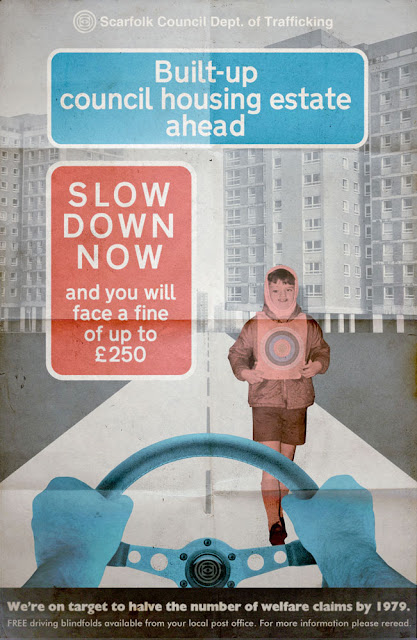
In 1971 it became compulsory for welfare recipients to sew targets onto their clothing so that they could be identified in public at all times. The minister for social services rejected claims that the target invited personal attacks, sidestepping the fact that the government had concurrently increased its funding of archery classes for newly released criminal sociopaths as part of their reintegration into society.
Despite these developments, the number of people claiming welfare tripled by 1973, in part because many families had lost one or more breadwinners to arrow-related injuries. The government, desperate to reduce spending, began promoting the idea that less dependent members of society involved in "crimes against target wearers" should be exempted from legal proceedings. In fact, they were rewarded. For example, points on drunk drivers’ licenses were removed following accidents which produced fatalities within the boundaries of large council estates.
There were also several instances of fully-armed Alvis FV101 Scorpion tanks, with the keys in their ignitions, inexplicably left by the army on the driveways of decent, middle-class citizens who neighboured built-up social housing areas.
Welfare Recipient Targets (1971-1979)
by Scarfolk Council

In 1971 it became compulsory for welfare recipients to sew targets onto their clothing so that they could be identified in public at all times. The minister for social services rejected claims that the target invited personal attacks, sidestepping the fact that the government had concurrently increased its funding of archery classes for newly released criminal sociopaths as part of their reintegration into society.
Despite these developments, the number of people claiming welfare tripled by 1973, in part because many families had lost one or more breadwinners to arrow-related injuries. The government, desperate to reduce spending, began promoting the idea that less dependent members of society involved in "crimes against target wearers" should be exempted from legal proceedings. In fact, they were rewarded. For example, points on drunk drivers’ licenses were removed following accidents which produced fatalities within the boundaries of large council estates.
There were also several instances of fully-armed Alvis FV101 Scorpion tanks, with the keys in their ignitions, inexplicably left by the army on the driveways of decent, middle-class citizens who neighboured built-up social housing areas.
29 Mar 14:44
Tricky Dicky, Part 4: Of Performity
by Jack Graham
 Just a reminder: I recently guested (again) on the Oi! Spaceman podcast to talk about ‘Caves of Androzani’. Download here.
What makes an English king ‘bad’? It certainly isn’t starting wars, brutally oppressing peasants and vassals, invading places, or killing and exploiting lots of people. If it were, most of them would be seen as bad, and Edward III (who basically started the Hundred Years War) and Richard I (crusader) wouldn’t have the perennially good reputations they still enjoy. Generally we seem to decide a king is bad if he lost something. We - by which I of course mean 'someone somewhere' - seem to have decided that John, Edward II, Richard II and Richard III were the 'bad' kings. Losers all. John lost a lot of France, and a lot of his power to his barons, an event marked by Magna Carta. Edward II lost to Robert Bruce at Bannockburn, thus losing control of Scotland, and then lost control of his kingdom to his wife and Roger Mortimer, Earl of March. Richard II was challenged by the peasants’ revolt, and ousted from power twice by his barons, being finally deposed by Henry Bolingbroke, Earl of Lancaster. Richard III, of course, lost at Bosworth Field to Henry Tudor, thus ending the Plantagenet dynasty and inaugurating the rule of the Tudors. It seems that what we don’t like from our kings, above all else, is failure.
Peter Ackroyd once wrote, beautifully, that when a man fails Shakespeare’s sympathy envelopes him… which you can see in almost all Shakespeare’s history plays. Even Shakespeare’s Richard III is allowed flawed introspection and guilt, and even some faint self-awareness, before his final battle, thus lending him tragic dimensions… and then gets his last moments of brazen, daring defiance (the horse remark having been, in my view, seriously misunderstood). But as for history, or rather for those 'someones somewhere' who have decided how history is told, generation upon generation, it seems that when a king fails, condemnation envelopes him. The reasons for his defeat, military or political, are then discovered by working backwards. John failed because he was ‘bad’. The flimsiness of his claim to the throne is played up, his apparent murder of a child pretender is paraded as proof of his perfidy, etc… all the way up to becoming a villainous cartoon lion advised by a snake. Edward II failed because he was too fond of his favourites, i.e. men of lesser nobility who exploited their access to him for personal gain, and who antagonised the baronage by cutting them out of the action and insulting them. It’s unclear whether people at the time though Edward was having sexual relationships with his favourites (historians disagree), though this has become the standard popular account since. The probably apocryphal story about the red-hot poker emerged years later, and seems to sadistically imply a fitting end for a sodomite. Marlowe’s play about Edward contains a charge of admiration for the frank love of two men, and Marlowe’s tragic overreacher version of Edward is now favoured in an era when many of us are inclined to sympathise with a man attacked for being gay. You can see this in Derek Jarman’s sympathetic film version, in which Edward is explicitly a gay man victimised by homophobes. Even so, the whole concept of Edward as ‘gay’ (a modern category that people of that era would not have understood) stems from the attempt to reason out why he was a bad king, a failure. Richard II also gets similar treatment, with generations of English actors playing sexual implications into Richard’s relationships with his male friends.
Richard II is a fascinating play for the disparity between what is actually on the page and what ends up on stage, on screen, or in books of criticism. A product of the mature Shakespeare (unlike his play on John which is probably from earlier in his career, and a rewrite of an older play by someone else), Richard II is a deeply ambiguous play. The standard mainstream account of the play, which you’ll find regurgitated in most text books and in most performances, is that it’s about a weak and vacillating king who loses his kingdom through imprudence to a more machiavellian but also more competent competitor. But it seems to me that the Richard of the play Richard II is far from weak or vacillating, at least before his power is challenged. What he is, however, is more interested in making money for himself and his friends (his comparatively lowly born ‘flatterers’) than in protecting the prestige and landholdings of the old aristocracy. The barons grumble about the taxes they have to pay, John of Gaunt bewails that the king is like a landlord (i.e. he makes money from land), and then Richard confiscates all Gaunt’s property when he dies, to pay for Irish wars, effectively disinheriting Gaunt’s banished son Bolingbroke. Bolingbroke was banished to stop him talking about the murder of his uncle Gloucester, a murder it is implied the king ordered. In short, the problem with Richard is not that he is weak and vacillating - or gay - but that he acts like a modern man, more interested in a man’s qualities than his breeding, a machiavellian politician, a rentier, the head of a taxation-state… and, crucially, that the people at the sharp end of this are the feudal aristocrats. Bolingbroke returns to claim his inheritance and, somewhere along the line, decides to claim the entire kingdom. His narrative is that Richard is weak, misled by flatterers. When justifying the summary execution of two of them, Bolingbroke implies they have alienated Richard from his wife. Bolingbroke’s narrative wins the political contest so decisively that it becomes dominant, to the point where it has taken over how the play is read, acted, and interpreted. And yet the evidence for this narrative is surprisingly thin in the play itself. Richard never seems unduly weak before he finds himself already outmanoeuvred, he never shows over-dependence on the words of his favourites, they never get between him and the queen, and indeed the queen seems to get on fine with them and be genuinely fond of Richard. The irony is that to champion the cause of the aristocracy against their overly modern king, Bolingbroke must himself be a very modern kind of man. He is a ruthless, self-serving, machiavellian politician. This is what is meant when he is said to be ‘competent’. He’s playing the same game of power that Richard tries to play. He just performs it better. And even then, the support of the aristocracy for him soon wanes, and he spends the next two plays he’s in - Henry IV, Parts I & II - fighting insurrections by disaffected nobles.
Overall it’s clear that, to Shakespeare, kingship itself is caught in inescapable contradictions in a world where feudal power is the basis of an autocratic state that increasingly has to try to manage amid a nascent bourgeois economy and culture. The management of these contradictions is, to a great extent, what the history plays are about, which is why Shakespeare is so extraordinarily good at them: he's very good at writing about performance, successful and failed.
Richard III, of course, is the king about whom the most extravagant stories of villainy are told. Shakespeare’s play draws on Thomas More’s unfinished biography of Richard III which was published after More’s death. It is, perhaps, a mistake to consider this work a biography or hit-piece so much as a dramatic account of an archetypal tyrant, created in order to satirize royal tyranny and create a negative example from a humanist perspective. More does not stick to facts, indeed he freely alters them. It’s often called ‘Tudor propaganda’ but that’s an egregious anachronism which fails to take into account the fact that More is consciously working with archetypes according to the example of classical historians like Lucian and Plutarch, who freely altered the facts if they got in the way of telling the moral stories they wanted to tell. It also fails to take into account the fact that More loathed Henry Tudor (Henry VII after Bosworth) for persecuting his father. It’s far more correct to say that More, who idolised Henry VIII (at least to start with), manages to find a way to make what he assumes to be eternal verities about good and bad government coincide harmoniously with the status quo of which he was a part. The very people who are ready to write off More as a ‘propagandist’ are probably guilty of doing exactly the same thing in their newspaper articles, columns, popular history books and TV history documentaries. It is always a tacit underlying assumption that ‘we’ are the good guys, running or living in essentially good states in which everyone tries to do the right thing. Meanwhile, the bad guys are always somewhere else, in some other country or era, opposing ‘us’ directly or in principle, because of their deformities - physical, moral, and/or ideological. If More was straightforwardly a 'propagandist' then so are Andrew Marr, Jeremy Vine, and Jonathan Jones.
Shakespeare innovates all over the place, but More’s basic picture migrates directly to the play: Richard is a 'deformed' man possessed of ferocious drive and low character, who schemes and murders his way to the top. Moreover, Shakespeare probably found More’s account apt because More builds into his account the idea of Richard as a performer on the stage of politics or history, which is, as noted, one of Shakespeare’s perennial obsessions and techniques.
Shakespeare’s Richard, you see, is an actor. This, parenthetically, is yet another reason why Shakespeare’s plays couldn’t have been written by the Earl of Oxford. Stage metaphors pervade Shakespeare’s plays and poems, and that’s just the start. Almost all his great characters are, in some sense, performers. The mechanics of performer and audience underwrite so many of his depictions of social interaction. He understands the theatrical aspects of politics, the manipulation of expectation and ‘belief’ that makes up so much of it, the fact that ‘belief’ is so often a reciprocal performance… and there are few plays that demonstrate these things better than Richard III. As is often the case, the textual reasons why we know the plays weren’t written by a dilettante aristocrat but by a professional man of the theatre are far more interesting than the question itself. But I must resist this rabbit hole.
One of the longstanding issues about the play Richard III is the way Richard’s ‘deformity’ relates to his evil. Anxieties about this have only intensified in the twentieth century and onwards. From a blithe acceptance that Richard’s abominable exterior mirrors or expresses the corruption within, critics and audiences have come to worry about the implications of this, just as they have worried about the sexual/gender implications of Taming of the Shrew, the racial implications of Merchant of Venice and Othello, and other plays in the canon. Critics from the last century or so have attempted to explain the relation between the ‘deformity’ - which is also what we would call ‘disability’ - and the evil by turning to the ways in which Richard has been socially excluded, or the ways in which he has attempted to rescue his sense of his own masculinity in a warrior culture, or his dysfunctional relationship with his mother, etc. Freudian and psychoanalytic critics have led the way.
In his essay ‘Of Deformity’, Francis Bacon (a contemporary of Shakespeare’s… though not the author of his plays) says that
…because there is, in man, an election touching the frame of his mind, and a necessity in the frame of his body, the stars of natural inclination are sometimes obscured, by the sun of discipline and virtue. Therefore it is good to consider of deformity, not as a sign, which is more deceivable; but as a cause, which seldom faileth of the effect. Whosoever hath anything fixed in his person, that doth induce contempt, hath also a perpetual spur in himself, to rescue and deliver himself from scorn.
Essentially he’s saying that while we can’t choose our bodies there is a degree to which we can choose our personalities. You can choose to act a certain way, even against an inborn predisposition. So instead of seeing deformity as an exterior illustration of inner nature, it should be seen as a (near unfailing) cause of certain kinds of behaviour. In the case of the ‘deformed’, the scorn with which they are always treated by society causes certain reactions. He goes on to list the reactions, and we needn’t trouble ourselves with them. Bacon can be an astonishingly crude and lazy reasoner. What’s interesting here is what Bacon’s attempt at bio-sociology tells us about the Early Modern culture in which he was writing. He assumes that behaviour can be empirically observed and rationally understood. He claims that the bourgeois virtues of “discipline and virtue” can rationally conquer the inborn traits that he assumes to exist. For him, the key is the personal choice of the individual. There is a mechanistic, near-inevitable process whereby certain behaviour stems from certain causes. He sees the contempt of society for the 'deformed' as natural. Equally, the reaction is natural. But the agency of the individual is also seen as important. This passage expresses, in compact form, a great many of the paradoxes that will plague bourgeois rationalism for centuries to come. The tension between society and the isolated individual, between a reductive view of fixed material traits and the concentration on individual enterprise. Such paradoxes would have been unthinkable, at least in this form, to someone living in pre-modern high medievalism.
A new culture is attempting to work out material explanations for social behaviour based on contingencies of birth. At the same time the hegemonic culture represented in Bacon - who was part of the political establishment - is trying to justify the stratification of people according to desert. Yet the fact that his culture felt the need to do so, complete with appeals to the (state regulated) authority of scripture and to a form of empirical observation, tells us that we are looking at an artifact of a society undergoing rapid and chaotic social reorganisation in a bourgeois direction.
Bourgeois culture went on to concoct spuriously scientific explanations for inequality based on race and gender, because it needed an ideological way to justify the dirty practicalities of slavery in the face of the greater potentialities for human freedom brought by the very system slavery was integral to constructing. The revolutions (short and violent, or long and gradual) that swept away feudalism had to make universalising promises in order to co-opt the power of the people against ossified aristocracies and monarchies… but certain people - women, black people, natives - had to be exempted from the universal declarations. We see such categories-under-construction being pondered in Shakespeare’s plays, in Kate and Shylock and Othello and Aaron and Caliban. I think we see something similar happening with nascent ideas of gay identity in Shakespeare, and also in Marlowe’s Edward II. I think all the Elizabethan and Jacobean popular writers are doing something along these lines, but perhaps particularly the playwrights, who are writing for the popular stage, texts to be performed in the bubbling social hubbub - to the very people attempting to navigate the shifting new categories of a society in profound transition. I’d want to argue that we see something similar in Richard III, in the construction of 'deformity'. The process is not unlike the process that has been called ‘race making’, the social construction of ‘races’, which is (to be crude about this) the process whereby bourgeois society decides which groups count as ‘white’ and which don’t, and which groups thereby enjoy white privilege to some extent or another, based on their roles in the economy… roles which are themselves socially constructed, partly based on the categorization of people according to socially-constructed 'races', with the one feeding into the other dialectically.
The stark and disconcerting fact is that Richard III is arguably potentially of a different race. He is constructed by himself and others as so noticeably physically different that he is potentially classifiable in terms of racial difference. The concept of biological race is a very new one, only just beginning to be constructed when Shakespeare was writing. Racial categories are partly constructed from supposed deviations from the ‘norm’, much as are ‘deformities’. By definition, the 'norm' is set by the hegemonic culture doing the construction of difference. Othello, Shylock, Aaron, and Caliban represent groups that have since gone on to be categorized according to biological race (which has irrevocably effected how we now read them). We see the beginnings of the process of categorization in the plays, in the way each character negotiates their role in societies in which they are, to some extent, outsiders, and which treat them in contradictory ways depending on what it needs from them. Richard is seen negotiating his own role in startlingly similar ways, and being treated in similarly contingent ways by his society. There are those who treat him as a monster, and emphasize his physical difference at every turn. He does this himself. There are others who accept him without comment.
The fact that the ‘deformed’ did not ultimately quite get categorized in racial terms is a contingency of history. But there are moments in history when the political biologism of bourgeois societies has racialised or semi-racialised the ‘disabled’, or treated them in ways akin to racialization, or lumped them in with racialist programs. Most particularly there is the eugenics movement of the 19th and 20th centuries, which was wildly popular and mainstream in many more places than Germany, but which nevertheless found its ultimate and most ghastly expression in the Nazis’ T4 ‘euthanasia’ program, under which thousands of “lives unworthy of life” were murdered by their doctors. There is no question that the Nazis conceived of the ‘disabled’ (physically and mentally) in racial terms. If they didn’t construct them as a race, they certainly saw them as a racial threat. We only have to remember the unsavoury fact that people with Down’s Syndrome were originally called ‘Mongoloid’ to see the ways in which race-making and the social construction of disability rhyme, and sometimes directly overlap.
(So profoundly has our view of Nazi Germany been ideologically managed that we need to do some work to establish that it was actually bourgeois at all... but that's a subject for another time. For now, take it from me: it was.)
One of the most profound examples of deformity as villainy and potential racial difference is in R. L. Stevenson’s The Strange Case of Dr Jekyll and Mr Hyde. Hyde is never properly described, and seems to have different features depending upon who is seeing or talking about him, but he is always said to be “deformed in some way”. People who have encountered him are never able to put their fingers on quite how he is deformed, just that “he gives a strong impression of deformity”. In this the deformity of the body is abstracted to a point where it is barely even physical anymore, but is almost a spiritual sensation which confounds the perceptions. The ape-man Hyde of the movies is an attempt to supply something visual where the book is deliberately vague, and tries to use social-Darwinistic and racism-tinged associations to put across the idea of the degenerate, the savage, the rapaciously sensual, the uncivilised side of mankind, etc. But even in the book, Hyde is sometimes possessed of simian features, and Jekyll dreams of new races of men, the result of the widespread use of his potion, segregated according to their innate moral natures and going their separate ways. Here again we see the spectre of race and race-making, its linkage to a discourse of deformity both physical and moral. Similarly, way back in Shelley’s Frankenstein, one of the threats of the monster is that he will propagate a new race. It carries on throughout the history of modern monstrosity, to the horrors of miscegenation expressed by Lovecraft in ‘the Innsmouth look’ to the SF discourse of alien ‘races’ inaugurated by Wells.
Arguably you can interpret the monstrousness of the alien in pulp SF as a (very unfortunate but entirely consistent) analogue to inborn physical ‘deformity’ as well as to 'race'. An unfortunate side-effect of this is that it becomes impossible to offer a Baconian reading of the behaviour of monsters as a reaction to the scorn of society… at least, most of the time. You can't read the Zygons in ‘Terror of the Zygons’ that way, as they come from a separate culture in which they are the norm. Indeed, this is stressed in the story when they speak of loathing the human form, which they find an “abomination”. In ‘The Zygon Inv’ you could actually read some of their behaviour as a reaction to the way they are treated by human society, though the story seems to go out of its way to alibi us against any charge of actually mistreating the Zygons into revolt. Actually, there’s a sense in which the rebellious Zygons of ‘The Zygon Inv’ are quite Ricardian in that they construct and perform their own monstrousness out of a physical difference which they choose to accentuate, owing to a pre-rational sense of victimhood. But then, one of the problems with ‘The Zygon Inv’ is the way it insists upon the necessary virtue of ‘passing’. You can argue that there should be no need for Richard or the Zygons to ‘pass’ any more than there should be any need for anyone LGBT+ to pass… and maybe that the refusal of Richard and Zygons both to pass thus constitutes a heroic defiance, one that is twisted by their respective narratives into perversity… but that way lies a rabbit hole, in which both deformity and monstrosity are used as metaphors for LGBT+ identities. The moment you introduce any element in which the other has to, or chooses to, hide itself and, in some sense, ‘pass’, you leave a text open to this interpretation. This is because LGBT+ identities have been constructed as monstrous or abnormal, a construction that some LGBT+ people like to weaponize and embrace, in a way analogous to the way post-colonial discourse has embraced Caliban.
It’s unclear exactly what Caliban is in The Tempest, yet generations of critics, actors and audiences have interpreted him as, in some way, a ‘native’ - to the point where he has been reclaimed, to an extent, by post-colonial thinkers and critics. He is best understood, I think, as a sort of early and fuzzy stage in Western imperialist culture’s gradual construction of its ideas about the peoples it was going to be encountering in the process of building a global empire. He is a native, and a slave, and a monster, a “thing of darkness”. He’s an early sketch in the construction of the category of ‘native’, and of its meaning. Now, of course, we look back and read back into him the whole subsequent history of Western colonial and imperialist relationships with native peoples. Many readers and audiences are inclined to be very sympathetic to him, as they now are to Shylock and Othello.
And it’s important to notice that such sympathy is warranted by the original plays. It’s partly the theatrical effect, where we are inclined to sympathise with whoever is talking, simply because they are the most dynamic thing in front of us, and their words and emotions come at us unfiltered. On stage, there are no close-ups and no privileged perspective. Theatre can’t quite do what prose and film do, and tell us who to sympathise with. Theatre presents us with unfiltered human figures, right in front of us, in the same space as us, capable of looking us in the eye. A book can inform us that a figure is terrifying; a film can force us to concentrate on the horror on the faces of others. The theatre has to let us make up our own minds, at least to an extent, based on our assessment of the presence and voice of whoever is talking to us. It’s vital to remember that this was a part of the cultural process of the construction of our ideas about groups and races, which is why it was so popular with people trying to navigate the choppy waters of a changing society, and why the state tried so hard to control what the theatre showed them.
It is absolutely essential to understanding Richard to understand that he is fundamentally theatrical, performative. Richard draws upon his ‘deformity’ for an identity. As it turned out, 'disability' was never fully constructed into race, and yet it is socially constructed. Disability is the result of society choosing to organize itself according to imperatives that fail to take into account certain kinds of bodies, whether we’re talking about the scarcity of ramps or Osborne’s budget yesterday. Ability and disability are, in a sense, performed. Gender is performed. Sexuality is performed. Race is performed. (Not that this makes any of these categories any less ‘real’ to those in them - what we socially construct and live is not ‘unreal’ or immaterial even if, like ‘race’, it lacks a biological basis.) The theatre had an impact in the way modern Western bourgeois culture ended up performing these things, for good or ill or both.
There’s an extent to which Bacon was right when he said that people adopt characters as a result of how their bodies interact with society. Society is going to interact with your body whether you like it or not.
18 Mar 13:39
It’s not about you
by Fred Clark
When you step into the voting booth, you’re not voting for a candidate, at least not primarily for her. You are voting to protect twenty million newly-insured people under health reform. You’re voting for the single mom in Texas who has an unintended pregnancy, the child in Little Village whose parents need humane immigration policies, the disabled man who needs decent medical and social services, the little girl in Bangladesh whose village may someday be submerged if we don’t address to climate change.
It’s not about Clinton. It’s not about Sanders or Trump. We’re not voting “for” these people, or at least primarily for them. This election is not about expressing our personal identities and tribal affinities as voters, either. It’s about millions of people who have real things to lose if we elect the wrong person.
Listen, here’s the thing about politics: It’s not an expression of your moral purity and your ethics and your probity and your fond dreams of some utopian future. Progressive people constantly fail to get this.
Both Kushner 13 years ago and Pollack, writing today, are addressing those of us who are more left of center, because, as Kushner says, “progressive people constantly fail to get this.” We have a long history of circular firing squads and of giving in to the tendency to blur the line between standing on non-negotiable principle versus a narcissistic focus on our personal purity — of imagining that our politics consists mainly of voting, and that our voting should be an expression of tribal or ethical identity. Of making voting more about our ability to tell others or to tell ourselves who we voted for than about making the most responsible choice possible between imperfect choices.
It’s the difference between voting as taking responsibility and voting as preserving purity by avoiding complicity. The former is our obligation — legally as well as ethically. The latter is an illusion — a form of self-deception.
 I’m fortunate — or, rather, everyone else is fortunate — in that I was able to get this narcissistic Politics of Me out of my system in 1996, when it didn’t contribute to any unfortunate consequences. I didn’t cast a vote for president that year because I treated that vote as though it were about me, and I was too pure to become complicit in supporting Bill Clinton after welfare reform. Fortunately for the rest of the country, I wasn’t living in Florida with that same mindset four years later, casting one of those this-band-T-shirt-makes-me-cool-by-proxy votes for Ralph Nader that resulted in eight years of debt-financed tax-cuts for the rich, and in “All right. You’ve covered your ass, now,” and in the invasion and occupation of Iraq, and in “heck of a job, Brownie,” and in Roberts and Alito, and in Abu Ghraib and Gitmo, and in a near-Depression, and in the idea that the heat-trapping properties of carbon atoms should be a matter of partisan dispute.
This year, though, I’m seeing more of the narcissistic confusion that Pollack and Kushner criticize above on the right — and especially on the far right. The screeching voices of the religious right and of AM talk radio have divided into Trump and Cruz factions. After two terms of fiercely opposing every aspect of Obama’s presidency they have trained themselves in a Manichaean view of politics as a struggle between pure good and pure evil. They haven’t been able to turn that off during the primaries.
I don’t know if they’ll be able to dial that back after the primaries, either. The GOP may be headed to a riotously contested convention not because no candidate is able to secure a majority of delegates, but because many Republicans have become so invested in voting “as an expression of your moral purity and your ethics and your probity” and in voting as an expression of “personal identities and tribal affinities” that they are now unable to imagine backing anyone other than the candidate they’ve supported thus far in the primaries. They don’t see being on Team Trump or Team Cruz as a responsible choice between imperfect outcomes, but as a non-negotiable component of their identity as a morally pure, blameless, uncompromised and uncompromising political agent.
That’s not what voting is. It’s not about me and it’s not about you.
Myrddinn likes this
17 Mar 11:03
Day 5554: Zombie Economics Rising
by Millennium Dome
Wednesday:

In Gideon's Reheated Black-Hole Budget nothing actually adds up. It's almost like he's not got the Lib Dems there to do the maths for him!
Tax on sugar, that was his (sugar-free) Easter Bunny – money he immediately spent again, so does nothing to bridge the gap between taxing and spending, and a balanced budget slips further beyond his reach.
The growth forecasts are down, the borrowing forecasts are up… and then, like an underpants gnome, with one bound* he leaps to surplus by 2020.
But how?
The economy is slowing, the deficit is growing… so let's cut taxes.
So even though Gideon is putting up the personal allowance too, like the good ol' days, UNLIKE the Liberal Democrats' policy he's raising not tightening the threshold of the 40% band, so that the lion's share of the benefit goes to the higher rate taxpayers.
It's unaffordable when there's still a deficit; it's unconscionable when you're snatching £30 a week from the hands of the disabled; and it's unmistakable for anything other than a blatant sweetener ahead of the EU referendum (and subsequent Tory leadership bloodbath). Has a BRIBE ever been so naked?
Seven billion quid on a middle-class give-away. And, as the saying goes, that's not all.
George's idea of "doing something for the young folks": if you're young and rich and can afford to put £4000 into an ISA, he will make you even richer. Who can afford that? He might as well call it the "Trust Fund ISA" and be done with it. Hard luck if you're a struggling young person, though, or disabled, or expecting your Universal Credit. Or have had your maintenance grant turned into a loan.
This is a budget for young people the way the BLACK DEATH was an "opportunity" for serfs in the Middle Ages – one they were UNLIKELY to SURVIVE!
It's almost like Master Gideon is on a mission to undo all of the progressive tax changes under the Coalition that led to a more equal Britain.
Even that sugar tax, so beloved of Jamie Oliver, disproportionately hits the poor.
And the giveaways to chums continued into the capital budget too.
Billions to be spent on infrastructure… so long as it's Crossrail 2. Or is it the Elizabeth II line now? And to places that vote Tory. He even admitted as much: "When the south west votes blue we listen." Has a BRIBE ever been so naked? Again?!
Promises to fix the flood defences for Yorkshire and Cumbria amount to un-cancelling things he previously cancelled. And then re-announcing the un-cancellation as new money.
And as Labour's Andy Burnham tweeted: the Northern Powerhouse turns out to be an extra lane on the M62. Hooray! Something else for Labour to abstain on, then.
It's EIGHT years since the crash and the terrible depression (aka Mr Frown). And that's about as long as economic cycles last. Or to put it another way, that's about as long as the Chancellor's luck can hold. Gideon's warnings of "storm clouds on the horizon" show that he knows it. He's getting his excuses in early. But if as seems likely we go into another downturn in the next couple of years, if it turns out that these WERE the "good years", it's going to be apparent how very NOT FIXED the roof was when the sun was shining. How the long-term economic plan was neither long-term nor economic. Nor a plan.
In the play Timon of Athens, Mr Timon is bountiful with his generosity to all his friends until his cash runs out, and then discovers that none of them will help him. That's you, Gideon, that is.
The albatrosses are coming home to roost. They're like chickens, only bigger and nastier and they bury you in guano.
Though at least it will be sugar free.
*It appears that the surplus in 2020 is down to changes to Corporation Tax that bring forward receipts; in short, he gets two years tax in one. Obviously that's a one-off gain – so a one-off surplus. Another of Gideon's tricks.
In Gideon's Reheated Black-Hole Budget nothing actually adds up. It's almost like he's not got the Lib Dems there to do the maths for him!
Tax on sugar, that was his (sugar-free) Easter Bunny – money he immediately spent again, so does nothing to bridge the gap between taxing and spending, and a balanced budget slips further beyond his reach.
The growth forecasts are down, the borrowing forecasts are up… and then, like an underpants gnome, with one bound* he leaps to surplus by 2020.
But how?
The economy is slowing, the deficit is growing… so let's cut taxes.
- Tax cuts for big corporates – welcome, "Google", to tax haven Britain;
- tax cuts for the oil & gas industry – the effective end of the carbon subsidy, and so much for greenest government ever;
- tax cuts for landlords – paid for by local councils who will have to find the £6 billion quid he'd promised to hand back to them and now just evaporated;
- and tax cuts for those hedge fund dealers and stock market speculators with a return of the Capital Gains Tax rate to the giveaway levels that saw bankers pay less tax than their cleaners under old New Labour.
So even though Gideon is putting up the personal allowance too, like the good ol' days, UNLIKE the Liberal Democrats' policy he's raising not tightening the threshold of the 40% band, so that the lion's share of the benefit goes to the higher rate taxpayers.
It's unaffordable when there's still a deficit; it's unconscionable when you're snatching £30 a week from the hands of the disabled; and it's unmistakable for anything other than a blatant sweetener ahead of the EU referendum (and subsequent Tory leadership bloodbath). Has a BRIBE ever been so naked?
Seven billion quid on a middle-class give-away. And, as the saying goes, that's not all.
George's idea of "doing something for the young folks": if you're young and rich and can afford to put £4000 into an ISA, he will make you even richer. Who can afford that? He might as well call it the "Trust Fund ISA" and be done with it. Hard luck if you're a struggling young person, though, or disabled, or expecting your Universal Credit. Or have had your maintenance grant turned into a loan.
This is a budget for young people the way the BLACK DEATH was an "opportunity" for serfs in the Middle Ages – one they were UNLIKELY to SURVIVE!
It's almost like Master Gideon is on a mission to undo all of the progressive tax changes under the Coalition that led to a more equal Britain.
Even that sugar tax, so beloved of Jamie Oliver, disproportionately hits the poor.
And the giveaways to chums continued into the capital budget too.
Billions to be spent on infrastructure… so long as it's Crossrail 2. Or is it the Elizabeth II line now? And to places that vote Tory. He even admitted as much: "When the south west votes blue we listen." Has a BRIBE ever been so naked? Again?!
Promises to fix the flood defences for Yorkshire and Cumbria amount to un-cancelling things he previously cancelled. And then re-announcing the un-cancellation as new money.
And as Labour's Andy Burnham tweeted: the Northern Powerhouse turns out to be an extra lane on the M62. Hooray! Something else for Labour to abstain on, then.
It's EIGHT years since the crash and the terrible depression (aka Mr Frown). And that's about as long as economic cycles last. Or to put it another way, that's about as long as the Chancellor's luck can hold. Gideon's warnings of "storm clouds on the horizon" show that he knows it. He's getting his excuses in early. But if as seems likely we go into another downturn in the next couple of years, if it turns out that these WERE the "good years", it's going to be apparent how very NOT FIXED the roof was when the sun was shining. How the long-term economic plan was neither long-term nor economic. Nor a plan.
In the play Timon of Athens, Mr Timon is bountiful with his generosity to all his friends until his cash runs out, and then discovers that none of them will help him. That's you, Gideon, that is.
The albatrosses are coming home to roost. They're like chickens, only bigger and nastier and they bury you in guano.
Though at least it will be sugar free.
*It appears that the surplus in 2020 is down to changes to Corporation Tax that bring forward receipts; in short, he gets two years tax in one. Obviously that's a one-off gain – so a one-off surplus. Another of Gideon's tricks.
PS
Clearly Voodoo Economics is the new black as, over in Americaland, John Kasich seeks to paint himself the new Ronald Reagan. Governor Kasich is of course a fruity wingnut, but STILL not as outright berserk as Senator Cruz or as completely unhinged as Mr Drumpf. Unfortunately, he needs to win 109% of the remaining delegates in order to secure the Replutocrats' nomination. Unless it goes to the first contested convention (outside of the West Wing) in living memory…
17 Mar 10:37


The Voice of the People
by John Scalzi
I mocked this a bit on Twitter already, but I want to mock it some more here, and also, make a somewhat more serious point. This, found on Facebook, is in reference to my post yesterday about voting for Kasich in the Ohio primary (poster anonymized to avoid the appearance of me maliciously pointing people toward some random schmuck):

So, a few points here.
1. Democrat: Nope.
2. Socialist: Bwa ha ha ha hah ha! No.
3. Disdain for uneducated and “unwashed” whites: Folks, we all know I was the first person in my immediate family to graduate from high school (not to mention college), yes? And that I’m white? When you describe the uneducated and “unwashed,” you’re describing my family and where I come from. I can be called many things, but “self-hating” isn’t one of them. It’s certainly true that I am neither uneducated nor “unwashed” now, but you never do forget your past. At least I don’t.
4. Self-designated elite: You know, generally speaking, the “self-designated elite” is better described as Republicans than Democrats (or independents), especially if one is speaking economically. Demographically speaking (white, bachelor’s degree, heterosexually married, well-off), it’s certainly true that someone like me is more likely to be a Republican than a Democrat. I don’t know that I would call folks in my general demographic “elite”; they’re just white, college-educated, heterosexually married and well-off.
Be that as it may, given that someone like me is generally more likely to be an “establishment Republican” than not, and Kasich is pretty well what passes for an establishment Republican these days, then someone like me voting for Kasich is actually fairly unexceptional.
5. Ohio law allows me (or anyone else) to ask for a ballot from either party when I vote in the primary, so I’m confused as to how my asking for the GOP ballot would “take away the voice of the people.” When I asked for the Democratic ballot in the primary eight years ago, was I taking away from the voice of the people then as well? Or is it different when it’s the GOP ballot? If so, how so? And if in both cases the State of Ohio allowed me to ask for either, and the State of Ohio’s government is elected by the people, then is not the ability to ask for either ballot also the will of the people?
6. Who the fuck died and put this petty little ignorant shitbird in charge of determining who “the people” are? Even if I were a Democrat and a socialist who self-designated myself as the elite and hated uneducated and unwashed white people, I would still be “the people.” This petty little ignorant shitbird is also “the people,” as personally depressing as I may find that fact. On election day, if he wanted to vote and had a flat tire, I would drive this asshole to the polling station myself so that he could pull the proverbial lever and possibly cancel out my vote.
Why? Because this petty little ignorant shitbird should vote, and so should I, and so should you, provided you are legally able to. We are all “the people” and the people — as many as possible — should decide who leads them, and who should not.
Now, this petty little ignorant shitbird may stamp his feet and whine that I didn’t vote the way he wanted, waaaaaaaaaaaaah, but one, fuck this dude, I’ll vote how I want, and two, sometimes we don’t get our way and that’s life. I’ve voted in seven presidential elections to date; I didn’t get what I wanted in three of them. In the entire time I’ve lived in the OH-8 congressional district I’ve never voted for a winner for the House of Representatives; it’s unlikely I ever will, in point of fact. Should I mewl like a petulant child about that fact, querulously complaining that the “voice of the people” has somehow been blocked because I didn’t get what I want? No, I should probably suck it up and move on.
Why did John Kasich win in Ohio? Because the voice of the people spoke, and what it said was “We want John Kasich (oh, and also Hillary Clinton, kthxbye).” What comprised the voice of the people? In the case of the Ohio GOP primary, lots of folks, including me, presumably him and 1,952,683 others. That’s a lot of voices in “the voice of the people.”
I get this dude is sad that the voice of the people didn’t tell him what he wanted to hear. No one likes to hear the word “no.” But it doesn’t mean the voice of the people was wrong in what it said, or not actually the voice of the people. How wonderful for us.
mary and -1 others like this
16 Mar 19:44
Deploying the monomyth in Space Opera
by Charlie Stross
So: in the ongoing investigation of space opera, I've looked at cliches, I've tried to come up with a rough definitional rule of thumb ... but I've avoided what's possibly the largest elephant in the room, namely, plot structures.
A key aspect of space opera is that it's about epochal events and larger-than-life characters. Most genres can be written to work in a variety of modes; for example, consider the difference in the level of melodrama in spy thrillers betwee James Bond and Graham Greene's The Human Factor. Similarly, high fantasy can be quietly introspective and pastoral, or focus on the clash of kings and dark lords, and horror can run the scale/focus gamut from The Yellow Wallpaper to The Stand.
But space opera is different: it's almost impossible to conceive of a space opera with a plot that revolves around the eqivalent of a middle-aged English professor's mid-life crisis as he carries on a furtive affair with one of his female students under the nose of his long-suffering wife (the somewhat cruel stereotype of the MFA-approved Great American Novel). I mean, you could do it, but your professor would have had to have invented a new type of FTL drive that threatens to revolutionize interstellar travel, the student is a spy from a cartel of space traders and is trying to get the blueprints out of him before she stabs him in the kidneys (because: lecherous middle-aged prof, ew), and his wife—the professor of political science at Galactic U—is actually a retired assassin (and just wait 'til she finds out about the student). Into the middle of this quiet literary novel of academic infidelity and domestic lies, we then add an evil religious cult of alien space bat worshipers who want to steal the new space drive to equip their battle fleet when they sweep in from the Orion Arm to bring fire, the blaster, and the holy spacebat inquisition to the Federation, and when they kidnap the professor his wife and his grad student have to work out their differences to get him back before he cracks under (well-deserved) torture and gives the fanatics the ultimate weapon ...
(Huh. Actually, that'd make a cracking space opera; just not one of mine. Anyone want to borrow it?)
I stand by my point: you can't write space opera without ramping up the stakes to melodramatic levels. (Well, maybe you could if you were Iain M. Banks, but he was special that way.) The need for romanticist drama is one of the pillars of the sub-genre. And one of the recurring core tropes of the genre, which is so fundamental you can hardly call it a cliche (any more than boy-meets-girl/boy-loses-girl/boy-gets-girl is a "cliche" in genre romance) is the Campbellian Hero's Journey.
If you are reading this blog you are familiar with the Hero's Journey monomyth because it's ubiquitous in our mythology and entertainment. Campbell derived it from studies of myths in many cultures, publishing his exposition The Hero with a Thousand Faces in 1949: his theory was that major myths from various world cultures can be traced back thousands of years and share a common cyclic template (with roughly 17 stages). Since then, it's been used repeatedly by entertainers as a construction template; for example, Christopher Vogler more or less codified it as a recipe while working for Disney studios. The plot of the original Star Wars trilogy was an explicit appropriation of the HJ cycle by to George Lucas (to be fair, before Vogler's codification); it's no accident that Darth Vader is Luke Skywalker's father (Vader is Dutch for "Father") or that the fight between Skywalker and Vader in The Empire Strikes back is one that Skywalker loses—but survives to re-fight more successfully later. A key feature of the monomyth is that the hero leaves home on a quest, faces challenges, confronts and is struck down by his father/the darkness, then rises again, atones/achieves enlightenment/excellence, and triumphs in a final struggle that represents maturation.
Campbell's work isn't uncritically or universally accepted, to say the least, and there are variants on it: for example, Valerie Frenkel critiched him for focussing exclusively on the male variant of the Hero's Journey. It turns out that there are plenty of recurring myths where a version of the monomyth applies to women, with similar but distinctively different recurring stages focussing on the heroine's progress from girl to mother. Rather than fighting to defeat/overturn the parent, the heroine's struggle is to become the parent: rather than returning to the original home but as master (the male branch of the monomyth) the female version has her joining a new household as its mistress and new mother or goddess/priestess.
Yes, this is all horribly gender-stereotyped. But I'll take a stab in the dark at diagnosing its origin: the stages in the monomyth echo the mammalian K-selective reproductive cycle—on hitting puberty the young adult leaves the nest/parents, goes looking for a mate, meets and overcomes obstacles (competitors and predators), finds a mate, forms a new mated pair. In the case of humans or other primates there may also be issues about troupe/pack hierarchy to be resolved. Yes, there are problems with this: it doesn't map onto social structures once established settlements and agriculture become the norm and the young adults are expected to stay home and plough the fields. But the monomyth remains deeply appealing because the mythic framework it builds on has very deep roots that go all the way down to primate reproductive biology.
The monomyth doesn't have to be melodramatic: you can, at a pinch, apply it to that stereotypical MFA lit-fic novel of lecherous middle-aged academics without too much trouble. (The journey is one of internal psychological discovery, the threats are the protagonist's inner demons, the allies are the psychiatrist, the crisis/conflict is one of understanding ...) But as often as not, it's a structure for heroism: melodrama acts as a spice, raising the stakes and giving us a reason to pay attention to the protagonists, for their deeds are significant and implicitly may affect us (or the proxy the author has provided for our viewpoint).
So: Space Opera. Take the monomyth as a framework for how the action unfolds, and mix it up with melodrama. Then add space ships, ray guns, and wide-scale travel backdrops. Arguably the monomyth comes first, before the background: although some of the more skilled authors of the sub-genre spin their plots within the constrains of a background world, and sometimes manage to avoid the monomyth completely. (I'd go so far as to say that "Matter" by Iain M. Banks is an almost complete rejection of the form, as is "Look to Windward" ... actually, I suspect IMB had his own different idea of a story structure in mind for the Culture novels: as often as not they're epic tragedies ("Consider Phlebas") or illustrations of the limits of heroism.)
But if you're trying to spin a space opera, and you're reaching for a plot skeleton that works, the monomyth is your friend. Here's an exercise for the involved reader: take my dysfunctional Galactic U professorial marriage from the beginning of this essay and use the monomyth structure to come up with a plot, climax, and ending that delivers a satisfactory sense of closure. You might first want to consider who you are focussing on—the lecherous male prof, his spouse the academic with a dead-and-buried past (she thought) as an assassin, or the grad student with the secret mission. Then you need to consider what stage of the Hero's Journey you are joining them at—for there's no reason to assume the story starts at the beginning, rather than in media res. Next, work out what challenges and allies they might encounter on their way to the climax and resolution, and what role the other characters play in their quest. Finally: what is the prize they're seeking, how do they achieve it, and at what cost? For added points, see if you can find a way to twist the standard Hero's Journey cycle to apply a surprise climax to it—for example, by spinning this steamy menage-a-trois with added murderhate and alien space bats so that it appears at first to be one protagonist's journey but then switches track and turns out to be about one of the others (your classic example of this would be IMB's "Use of Weapons") ...
What variations can you come up with?
16 Mar 19:40
anyway turns out that yes, thermodynamics isn't just a good idea: it's the law!
| archive - contact - sexy exciting merchandise - search - about | |||
 |
|||
| ← previous | March 16th, 2016 | next | |
|
March 16th, 2016: I have a new book coming out! It is called Romeo and/or Juliet and I think you will like it. That's what I think! I'm not gonna lie about it!! – Ryan | |||
Dave P, Burthwheeler likes this
16 Mar 16:31


Clinton and Sanders and Trump and Kasich and Also a Bit About Cruz and Rubio
by John Scalzi
Well, that was an interesting Tuesday night in American politics, wasn’t it? A few thoughts about it.
1. First, sympathy for Sanders supporters out there, who after last week’s emotionally satisfying win in Michigan — even if Clinton ended the night with a net gain of delegates thanks to Mississippi — had to deal with their candidate going 0-5 in state results last night. To be fair, there’s still a small possibility that Sanders might pull ahead in Missouri once absentee votes are tallied in, but after the other results of the evening, winning by the thinnest possible margin in a single state is the political equivalent of “playing for pride.”
However and more importantly, Clinton yet again expanded her pledged delegate lead. Leaving out Missouri for the moment, Clinton netted more than 100 delegates over Sanders in the other four states voting last night. Given the closeness of the Missouri race, and the proportional nature of delegate allocation in Democratic primaries, it doesn’t matter if Sanders eventually squeaks out a win there — Clinton still ends the night with a triple-digit delegate gain.
2. I had someone on Twitter last night say, yes, well, but Florida is a closed primary state where Clinton was favored; okay, but she also took Ohio by 13 points, and that’s an effectively open primary (technically “semi-open”). I do see some Sanders supporters pinning hopes of victories based on whether a particular state has caucuses or open primaries, which is fine, but it’s a bit of fetish thinking. There are four types of primaries and caucuses: Open, closed, semi-open and semi-closed. Leaving out semi-closed caucuses (only one state has that and hasn’t voted yet) Clinton has won contests in every format but open caucuses; Sanders has won contests in every format but closed primaries. I’m not sure Sanders can rely on voting format to save him.
Even if he did, a) the next set of contests features a closed primary (Arizona) with the largest delegate count of the evening, and Sanders hasn’t won any of those yet, and there are nine more of those including New York and Pennsylvania, b) there are only two more open caucus contests left (that being the format Clinton hasn’t won in yet). So, uh, yeah. That math doesn’t look great for Sanders.
Ultimately Sanders’ problem isn’t format, it’s that he doesn’t win enough contests (nine to Clinton’s nineteen), doesn’t win enough big states (he’s won only one contest with more than a hundred delegates; Clinton’s won six), and the one big contest he won, he won by a slim margin (49.8% to 48.2%) meaning he netted only a few pledged delegates over Clinton (four). Meanwhile Clinton’s pledged delegate net in the large state contests she’s won is 218 over Sanders.
3. But Sanders can still take it! Well, as a matter of pure mathematics, sure. As a practical matter involving real voters in real states and territories going to actual polling stations or caucuses, it’s pretty much over at this point. It’s not to say that Sanders can’t or won’t win more states; I suspect he will. But the question is will he ever catch up in the pledged delegate count, and the answer is, that’s going to be a hard row for him to hoe. Someone on Twitter last night suggested that they said the same thing about Obama in 2008, and look where he is now. But on March 16, 2008, one, Obama was ahead of Clinton in the pledged delegate count, not the other way around, and two, as a matter of percentages, Obama and Clinton were substantially closer than Clinton and Sanders are now — Clinton had 92% of the pledged delegates Obama had then; Sanders has 72% of the pledged delegates Clinton has now.
And while we’re considering this, bear in mind we’re only talking about pledged candidates here, not superdelegates. With superdelegates, Clinton is already two thirds of the way to the magic number of 2,383 delegates needed for the nomination. Adding in Sanders’ superdelegates, he’s 35% of the way there. Superdelegates can change their mind between now and the election, but if I were a Sanders supporter I wouldn’t be holding my breath. Again, it’s not impossible for Sanders to win the nomination, but at this point it’s gone from “unlikely” to “really goddamned difficult.”
If my Twitter feed is any indication, I suspect a number of Sanders supporters have begun the grieving process — the disbelief that Sanders lost Ohio (it was supposed to be like Michigan!), the glumness of looking at the Florida result, the glimmer of hope in Missouri, extinguished as Clinton ground out a .2% victory. As I noted before, I have sympathy for Sanders supporters. It was not a good night for them. Clinton supporters, on the other hand, have to be feeling pretty good.
4. On the other side of things, oh, hey, look, John Kasich won Ohio! Which is nice, and deprived Trump of its 66 delegates, which means for the first time since early February, Trump is below his Fivethirtyeight delegate tracker number, that being the number of delegates he needs to clinch the GOP nomination ahead of the convention. He was at 104% of that number going into the evening; now he’s at 96% of that number. As someone who voted for Kasich basically to achieve this very goal, I feel I had a vote well cast (note well, this number may not include his Missouri delegates).
Not, mind you, that I think Kasich can win the nomination; some folks have suggested that he would have to win 110% of the currently available GOP delegates from here on out to do so, and, well. That would be a stretch, wouldn’t it. Nor do I think Cruz will get it either; Fivethirtyeight has him at 54% of his delegate goal. At this point, and despite Cruz’s self-lathering nonsense suggesting he could win the nomination outright, Cruz and Kasich are in the race to keep Trump from hitting his delegate number, forcing a contested convention.
At which Trump is already hinting there will be riots if he isn’t given the nomination! One, bless his heart. Two, he’s not wrong, especially if Trump is close to the number of delegates he needs going in. The sort of folks willing to cold-cock protesters at rallies aren’t folks who will be willing to let some back-room bureaucrats snatch their man’s rightful nomination out of his famously not-short fingers. It’s of course keeping with Trump’s personal idiom to give a speech last night about the party needing to come together, and then this morning strongly hint that his people are going to wreck shit if they don’t get their way. Congratulations, GOP! Your frontrunner is a classy dude.
5. That said, let me go out on a limb and suggest Trump is going to hit his number. Why? Because Ohio was a semi-open primary, which meant people like me, who don’t normally vote in the GOP primary, were able to cross the line and do so, and it appears that a lot did — there were 1.6 times as many voters in the Ohio GOP primary last night than in the Democratic primary, at least some of which were folks like me voting against Trump. Which is nice, but there’s only two more open primaries on the GOP docket (Indiana and Wisconsin) and one open caucus (American Samoa). The rest of the contests are closed or semi-closed, limiting the number of people willing to save the GOP from itself. From here on out it’s up to GOP voters to do it.
And will they? Unclear. There have been four closed primaries so far, and they’ve split half for Trump and half for Ted Cruz (who, to be clear, is not exactly an optimal alternative). The closed caucuses have also split between Trump and Cruz (and Minnesota and DC for Rubio). As most of the upcoming contests are winner-take-all, Trump wouldn’t have to share most of his delegates when he wins, so if he wins, even by a tiny margin, he still leaps ahead.
Trump is going to win more, and it seems likely to me that Cruz and Kasich, the other guys in the race, will probably eat each others’ lunch to Trump’s benefit. One of them should probably drop out if at this point they really aim to stop Trump. Kasich is the obvious one to drop, since he has no chance to win the nomination outright, and because Cruz won’t, no matter what; he’d rather push an entire troop of Girl Scouts under a bus than give up his run. Also there’s the matter of who are Kasich’s supporters at this point. He presumably would pick up whoever was still voting for poor Marco Rubio. Those three people won’t help him.
On the other hand, Cruz is an overripe pustule of hateful need who deserves to be dropkicked into historical oblivion, and the rest of the GOP primary schedule doesn’t really match his political strengths, so maybe he should drop and let Kasich roll as the sane alternative to Trump. But again, Cruz has no intention of leaving the race until the race leaves him. So onward Trump will likely go, to the nomination.
6. And what about Marco Rubio, who exited the race last night? Honestly, I can’t be bothered to think of him any further. He was always underready, and the fact that the GOP ever seriously considered him as their answer to Obama is a reminder that the GOP neither understands Obama nor understands anyone who isn’t white as paste. Look! A young ethnic person! The kids love that! Surely we shall win the White House now! Meanwhile, Rubio’s politics were those of a conservative 73-year-old white dude shaking his cane in the yard at the kids riding their bikes in the road (Cruz’s politics are the same, except the 73-year-old is also praying for God to send a bear to rip the children to shreds). Dear GOP: Voters do pay attention to policies and positions, not just packaging. Which is why (among other things) an old white man is more popular with under-30 Democratic voters than his opponent.
But now Rubio is gone, and good riddance. He’ll soon be gone from the Senate as well, and where he goes from here I have a complete lack of interest, so long as it is in the private sector and I never have to deal with him again. I’m sad for the GOP that he was their Great Establishment Hope for ’16, and that what we have left is Kasich, who has no chance, Cruz, who should have “well, actually” in blinking neon over his head, and of course Trump, the walking embodiment of political nihilism and sub-standard cuts of beef. The GOP deserves no better than this, but our nation certainly does.
ThePrettiestOne likes this
16 Mar 16:23

They have always been here. If you didn’t know that before, it’s because you couldn’t be trusted to know.
by Fred Clark
Michelle Boorstein offers a strong entry in the burgeoning field of Donald-Trump-and-white-evangelicals reporting. There’s a lot to chew on here, with some sharp probing around the True Scotsman objections that real, true white evangelicals aren’t the ones rallying behind Trump.
The bit I want to highlight, though, doesn’t have to do with Donald Trump. It comes from right-wing culture-warrior Rick Scarborough. Boorstein writes:
Pastor Rick Scarborough has spent 20 years traveling the country to politically mobilize evangelical voters and knows better than most just how un-monolithic they are. In recent years, those differences have just gotten more pronounced, said Scarborough.
“In the past when we’d talk about abortion, 90 percent said: ‘You’re right.’” Now half seem to have experienced it or know someone who has, he said. And “when Falwell spoke against gay marriage there was unanimity. Now half the congregation has a niece or brother who is impacted.”
Scarborough’s recollection of recent history is garbled — Jerry Falwell didn’t quite live long enough for his anti-gay activism to take the form of speaking “against gay marriage.” But it’s true that Falwell’s anti-gay bloviations back in the day were met with what seemed like a unanimous chorus of “Amens” from white evangelical audiences.
Scarborough laments that such anti-gay preaching no longer has unanimous support because, “Now half the congregation has a niece or brother who is impacted.”
He doesn’t understand that this is nothing new. When Falwell was rallying white evangelicals behind Anita Bryant’s anti-gay crusade in the 1970s, more than half the congregation already had a niece or a brother or some other relative or friend who was directly harmed by that. Those nieces and brothers have always been there.
But back in the ’70s — or in the 1980s, when Falwell was praising AIDS as a righteous form of divine punishment — many of those white evangelical congregants shouting “Amen” didn’t realize that the hateful sermons they were praising applied to their nieces and brothers because they didn’t realize that they had friends and family members who were LGBT.
Mel White speaks on CNN in 2007 about the death of Jerry Falwell. White, who ghost-wrote two books for Falwell, came out in 1993.
Others, sadly and shamefully, did realize this. They knew about their closeted nieces or brothers, and they knew that what Falwell was saying about them wasn’t true or fair or good. But they were afraid to say anything. They didn’t yet realize that they weren’t the only ones in that congregation whose loved ones were being targeted by this culture war, and so they felt alone and powerless and intimidated, and they fearfully submitted, shouting “Amen” along with everyone else, enabling the illusion of unanimity.
That unanimity was always a crock. It was an enforced unanimity — a required, mandated unanimity. Folks like Falwell or Scarborough would spew their anti-gay message then ask for a show of hands to confirm that everyone present agreed, as required. And, lo and behold, everyone raised their hands, as required.
But we always knew this unanimity was an illusion because even back in Falwell’s prime, when 100-percent of the congregation was shouting “Amen,” we had polling data that contradicted this apparent unanimity. When speaking anonymously to a pollster — to someone who wouldn’t report back to the tribal elders and gatekeepers — a chunk of these white evangelicals felt safe enough to express their dissent.
Those tribal elders and gatekeepers dismissed such polls the same way they’re dismissing all the polls today showing white evangelical support for Donald Trump. These evangelicals dissenting or wavering from the anti-gay unanimity must not really, truly be real, true evangelicals. They probably don’t even go to church (or, if they go on Sundays, they don’t go Wednesday night). If those pollsters fixed their polls to screen out all the fake evangelicals, the tribal gatekeepers said, then this dissent would disappear and polls would confirm the required unanimity.
After all, the gatekeepers know these people. They go to church with them every Sunday (and Wednesday night) and they’ve never, ever heard anyone question the required anti-gay orthodoxy. They’ve never heard anyone challenge their anti-gay sermons or fail to say “Amen” when expected and required to do so.
That’s also how white evangelical gatekeepers have always responded to decades of polling that consistently shows that a solid third of white evangelicals are pro-choice.
That confounds them. They find it baffling — impossible, inconceivable. No white evangelical preacher has ever advocated such a thing. No white evangelical publication has ever permitted such thoughts to be printed. The Statements of Faith for every white evangelical institution require and receive the assurance that everyone associated with them unanimously opposes legal abortion. And in all their years working in and with all of these churches and publications and institutions, they’ve never heard anyone speak up to say anything different. So they’re certain the polls must be wrong — this pro-choice third of white evangelicals simply cannot exist.
But they do. And they always have. They’ve always been there — just like those LGBT nieces and brothers have always been there.
Rick Scarborough seems shocked that many white evangelical Christians have had abortions or know someone who has. He regards this as a sudden and very recent development. It’s not. These folks have always been there — in white evangelical churches and institutions.
About one in three American women will have an abortion in her lifetime. In white evangelical churches — real, true white evangelical churches with real, true, Wednesday-prayer-meeting, daily-quiet-time, devoted Christians — that figure is … about one in three.
And here’s the thing: There’s one and only one reason Scarborough did not already know this. There’s one and only one reason that any white evangelical does not already know this. If you’re a white evangelical pastor or publisher or parachurch administrator and you don’t know this, it’s because you are someone who could not be trusted to be told.
White evangelicalism is enormously, vindictively hostile to any public dissent from its official, mandatory opposition to legal abortion. In that context, such dissent had to be kept secret. Protecting that secret was even more necessary for the one-in-three white evangelical women who have had abortions, or who have accompanied their nieces or sisters or other loved ones through that process. And the men in charge — the culture-warriors like Scarborough or Falwell, and the local pastors who admire them — were manifestly incapable of being trusted to protect that secret. They have made it perfectly clear that if they learned that secret, they would respond with condemnation, punishment, banishment, or worse.
But something seems to be changing. The untrustworthy men in charge remain just as obviously untrustworthy, but they’re losing some of the power they have attained from forcing others to live and speak and pray in secret. Because now those secrets are being spoken aloud.
Pastor Rick Scarborough has spent 20 years traveling the country to politically mobilize evangelical voters and knows better than most just how un-monolithic they are. In recent years, those differences have just gotten more pronounced, said Scarborough.
“In the past when we’d talk about abortion, 90 percent said: ‘You’re right.’” Now half seem to have experienced it or know someone who has, he said. And “when Falwell spoke against gay marriage there was unanimity. Now half the congregation has a niece or brother who is impacted.”
Those are two of the most hopeful and hope-filling paragraphs I’ve read in a long time.
16 Mar 15:11
Investigatory Powers Speech to LibDem Conference
by Zoe O'Connell
Unsurprisingly, a motion to Liberal Democrat conference against the Investigatory Powers Bill passed overwhelmingly this weekend. Below is the video and text of my contribution to the debate, which I can share with you as I had written it in advance, albeit only a couple of hours earlier!
The myth spread by the Home Office that the technical industry understands the Bill is always something I am keen to dispell, so that was my main purpose in wanting to speak. The quote from the New York Review of Books is also something that’s stuck in my head since I first read it, and I particularly wanted to give it an airing in the debate. (I have verified the quotes given in the article from other sources)
All of this is, sadly, against the backdrop of a very showing from both Labour and the SNP who abstained at the second reading of the bill yesterday. A particular shout out is due to Cambridge’s Labour MP Daniel Zeichner, who said he wants to “robustly challenge” the bill… but abstained anyway.
(The text below is what I wrote in advance, it does not entirely match what I actually said. No autocue for most speakers at conference)
I am a member of the Security & Liberty working group, so it should come as no surprise to you that I would urge you to support the motion. Brian Paddick has already made the case for the motion very well. However, there are some points I would like to make in relation to metadata and some of the claims being made by the current government.
A couple of months ago, I was asked to speak as part of a Q&A panel on the Investigatory Powers Bill at the UK Network Operators Forum. This forum, in case the name is not enough of a giveaway, was a full of a couple of hundred of the people who really run the Internet. I worked as one of those running the internet myself, for over a decade.
I asked – who here understands what data you are being asked to collect by the Home Office? Now, if you believe what we’re being told by the Tories, every hand in that room should have gone up. Because we’re told that – absolutely – Service Providers really understand the limits of what is being asked of them.
But not one hand went up. Nobody understood the limits of the powers Theresa May is asking for. The bill is so confused, and hands Theresa May such sweeping and unchecked power, that the draft bill includes the now-infamous phrase “Data includes any information which is not data”.
Of course, the Tories claim that it’s only meta-data, or “Internet Connection Records” as they’re now calling it. That can’t be too harmful, can it? Here’s a quote from David Cole in the New York Review of Books, in 2014
As NSA General Counsel Stewart Baker has said, “metadata absolutely tells you everything about somebody’s life. If you have enough metadata, you don’t really need content.” When I quoted Baker at a recent debate at Johns Hopkins University, my opponent, General Michael Hayden, former director of the NSA and the CIA, called Baker’s comment “absolutely correct,” and raised him one, asserting, “We kill people based on metadata.”
No other democratic country in the world gives such powers to its politicians to monitor and collect Internet browsing history to this extent.
Please vote for the motion.
16 Mar 12:09


The Big Idea: Lavie Tidhar
by John Scalzi
Andrew HickeySharing for myself, this sounds like it could be good

World Fantasy Award-winning author Lavie Tidar came up with a awful, terrible, no-good idea for a novel — and then wrote it anyway, resulting in A Man Lies Dreaming, which then went on to garner starred reviews in the trades, award nominations and wins, and the sort of glowing praise writers dream of. What’s this awful, terrible, no-good idea, and why did Tidhar decide to write it anyway? The answers await you below.
LAVIE TIDHAR:
The idea is simple: what if a disgraced Adolf Hitler was working as a lowly private eye in 1939’s London?
But I should backtrack.
Ideas are easy. Bad ideas are easier still. And as far as ideas go, this must be one of the worst. This was certainly the reaction of my agent, when I mentioned it to him – a slightly shocked expression followed by genuine laughter. That’s the thing I like about my agent – he gets it, even when it sounds (as my work often does to him) ridiculous.
“Write it!” he said. “No one will buy it, but you should write it!”
So let me backtrack a bit more. . .
Around 2011, I was living back in London. It was a cold winter. My novel Osama, which had been rejected by more publishers than I could count, was finally coming out from a small publisher in the UK. My Bookman Histories trilogy was finished and delivered, and I was out of contract, out of cash, and I didn’t have a coat. A lot of this, I suspect, would feed into the book later. . .
I was figuring out what to write next. At the time, I was trying to work on a difficult book which would eventually become The Violent Century. It was an act of faith, since no one was lining up to buy it, but it felt worthwhile, and so I struggled on. I don’t actually know why some books are so hard to write, while others feel natural, easy. But I remember the moment when A Man Lies Dreaming came. It was around one o’clock at night. I was reading one of Philip Kerr’s Bernie Gunther novels. They’re excellent crime thrillers about a private detective in Nazi Germany, sometimes difficult to read but generally brilliant. In the novel (I forget which one), Kerr makes a throwaway mention to the idea that Adolf Hitler could have himself become a private eye. A light pinged in my head.
It was the very ridiculousness of the idea that I liked. It was the sort of idea that is so offensive, so tasteless, that I would be terribly offended if anyone ever did it…
Which is why it appealed to me, I think. I thought, if anyone might actually get away with something like this, it could be me. I don’t mean this in a hubristic sense. But the Holocaust features large in my life. My family died in Auschwitz. My mother was born in a refugee camp in Germany, after the war. If anyone could do this – and I didn’t know if I could! – then it just might be me.
I remember being very excited about it. Then I tried to forget all about it.
Of course I didn’t want to write it. It was a ridiculous idea, an unsellable idea, and moreover it would require me to walk down a pretty dark path to reach it. So I put it away.
I worked on The Violent Century. In the meantime, to my surprise, Osama had picked up a few award nominations. It ended up winning a World Fantasy Award a year later, just a week after I’d finally finished the manuscript of The Violent Century – which quickly sold to Hodder & Stoughton in the UK.
All of this was pretty unexpected.
I tried not to work on “the Hitler book”. Occasionally the subject would come up, and people would laugh, and shake their heads. I tried to work on the next novel, but nothing worked. Meanwhile, on the sly, I was acquiring books. Hitler’s childhood. Hitler and women. Mein Kampf (my God, is there a book more unreadable than Mein Kampf?). Then the manga version of Mein Kampf. . . Hitler became a constant presence – Hitler the abused child, Hitler the starving artist in Vienna, living in an attic with his friend Gustl, Hitler the young soldier suffering post-traumatic stress disorder. . . Hitler, in fact, before he became Hitler.
Hitler was not a monster. None of us are. He was a person who had become monstrous by his actions, and I felt it was imperative for me to understand Hitler, to get into his head.
Let me say this: it’s not a particularly pleasant way of spending a year of your life, living with Adolf Hitler.
I didn’t want to write the book, but nothing else was working, and Hitler was everywhere, staring at me from the shadows, a fedora over his head: a bitter, unknown, raging Hitler, a man who history had passed by, a loser now eking a meagre living on the mean streets of London.
So I gave in.
It was late one night. The entire first draft was written at night, between midnight and 3am, very quickly and intensely. I remember that night, sitting at the computer, itching to get rid of him. I thought, I’ll only write the first line. It’s been stuck in my head for a long time, so long that it’s become a mantra. It was a line in Raymond Chandler’s The Big Sleep, in fact, whose casual anti-Semitism had arrested me for years.
No one would have to know, I figured. I’d just write it and then… move on.
So I wrote: She had the face of an intelligent Jewess.
And I couldn’t stop.
It’s been bottled up for so long that it all came out. My hero, “Wolf”, sitting in his office above the Jew baker’s shop. Outside the prostitutes are gathering in Berwick Street. The night is full of eyes, watching. And a glamorous Jewish woman, Isabella Rubinstein, comes waltzing into Wolf’s office with the offer of a job, to find her missing sister…
I couldn’t stop. I’m not sure I spoke to anyone much during this time. Hitler’s picture stared at me from the desk. The story unfolded, a dark comedy, a detective noir novel, an alternate history… take your pick. And all this while, grounding this lurid tale of shund, or pulp, was its possible narrator – Shomer, a Jewish pulp writer trapped in Auschwitz, the dreaming man of the title – a man seeking an impossible escape.
A Man Lies Dreaming, it seems to me, is several things. It is an argument about escape, about the power or futility of fantasy. It’s an argument began in Osama, continued in The Violent Century, and concluded here. Is escape possible – for any of us?
It is also, I think, a dark comedy. Humour underlines the horror, and humour has been an important part of survival, even during the worst times of the Holocaust. I loved writing Wolf – his impotent rage, his increasing hysteria, his endless rants. There is nothing funnier, after all, than a Hitler without power. “Do you not know who I am?” Wolf rages, at some point – and of course, by then, no one does.
At the same time, A Man Lies Dreaming is grounded in the contemporary. It is written at a time when Europe’s anti-immigrant rhetoric terrifyingly echoes the 1930s. Wolf’s London does not welcome immigrants, and Oswald Mosley’s Blackshirts are marching in the streets, chanting slogans that eerily echo today’s. . .
. . . in the event, I did manage to get A Man Lies Dreaming published. It wasn’t particularly easy, but my editor at Hodder was incredibly supportive, and the book came out in late 2014, was nominated for a British Fantasy Award, and won me my first literary fiction prize, the £5k Jerwood Fiction Uncovered. It’s just come out in Italy, where they seem to like it. . . and it’s out now in the US from Melville House. The bad joke that was “Hitler: P.I.” had turned into the book I am most proud of having written – even if it’s damaged me in the process.
—-
A Man Lies Dreaming: Amazon|Barnes & Noble|Indiebound|Powell’s
Visit the author’s site. Follow him on Twitter.
16 Mar 11:31
Dumb Adult.
by Peter Watts
Actually, this was pretty good.
We didn’t have “Young Adult” when I was your age, much less this newfangled “New Adult” thing they coddle you with. We had to jump right from Peter the Sea Trout and Freddy and the Ignormus straight into Stand on Zanzibar and Solaris, no water wings or training wheels or anything.
Amazingly, I managed to read anyway. I discovered Asimov and Bradbury and Bester at eleven, read Zanzibar at twelve, Solaris at thirteen. I may have been smarter than most of my age class (I hope I was— if not, I sure got picked on a lot for no good reason), but I was by no means unique; I only discovered The Sheep Look Up when a classmate recommended it to me in the tenth grade. And judging by the wear and tear on the paperbacks in the school library, everyone was into Asimov and Bradbury back then. Delany too, judging by the way the covers kept falling off The Einstein Intersection. Back in those days we didn’t need no steenking Young Adult.
Now get off my lawn.
I’ll admit my attitude could be a bit more nuanced. After all, my wife has recently been marketed as a YA author, and her writing is gorgeous (although I would argue it’s also not YA). Friends and peers swim in young-adult waters. Well-intentioned advisers, ever mindful of the nichiness of my own market share, have suggested that I try writing YA because that’s where the money is, because that’s the one part of the fiction market that didn’t implode with the rest of the economy a few years back.
But I can’t help myself. It’s not that I don’t think we should encourage young adults to read (in fact, if we can’t get them to read more than the last generation, we’re pretty much fucked). It’s that I’m starting to think YA doesn’t do that.
I’m starting to think it may do the opposite.
Hanging out at last fall’s SFContario, I sat in on a panel on the subject. It was populated by a bunch of very smart authors who most assuredly do not suck, who know far more about this YA than I do, and whom I hope will not take offense when I shit all over their chosen pseudogenre— because even this panel of experts had a hard time coming up with a working definition of what a Young Adult novel even was (beyond a self-serving marketing category, at least).
The rules keep changing, you see. It wasn’t so long ago that you couldn’t say “fuck” in a YA novel; these days you can. Back around the turn of the century, YA novels were 100% sex-free, beyond the chaste fifties-era hand-holding and nookie that never seemed to involve the unzipping of anyone’s fly; today, YA can encompass not just sex, but pregnancy and venereal disease and rape. Stories that once took place in some parallel, intercourse-free universe now juggle gay sex and gender fluidity as if they were just another iteration of Archie and Betty down at the malt shop (which is, don’t get me wrong, an awesome and overdue thing; but it doesn’t give you much of a leg up when you’re trying to define “Young Adult” in more satisfying terms than “Books that can be found in the YA section at Indigo”).
Every now and then one of the panelists would cite an actual rule that seemed to hold up over time, but which was arcane unto inanity. In one case, apparently, a story with an adolescent protagonist— a story that met pretty much any YA convention you might want to name— was excluded from the club simply because it was told as an extended flashback, from the POV of the protagonist as a grown adult looking back. Apparently it’s not enough that a story revolve around adolescents; the perspective, the mindset of the novel as artefact must also be rooted in adolescence. If adults are even present in the tale, they must remain facades; we can never see the world through their eyes.
Remember those old Peanuts TV specials where the grownups were never seen, and whose only bits of dialog consisted entirely of muted trombones going mwa-mwa-mwa? Young Adult, apparently.
Finally the panel came up with a checklist they could all agree upon. To qualify as YA, a story would have to incorporate the following elements:
- Youthful protagonist(s)
- Youthful mindset
- Corrupt/dystopian society (this criterion may have been intended to apply to modern 21rst-century YA rather than the older stuff, although I suppose a cadre of Evil Cheerleaders Who Run The School might qualify)
- Inconvenient/ineffectual/absent parents: more a logistic constraint than a philosophical one. Your protagonists have to be free to be proactive, which is hard to pull off with parents always looking over their shoulders and telling them it’s time to come in now.
- Uplifting, or at least hopeful ending: your protags may only be a bunch of meddlesome kids, but the Evil Empire can’t defeat them.
Accepting these criteria as authoritative—they were, after all, hashed out by a panel of authorities— it came to me in a blinding flash. The archetypal YA novel just had to be— wait for it—
Don’t blame me. The shoe fits.
A Clockwork Orange.
Think about it: a story told from the exclusive first-person perspective of an adolescent, check. Corrupt dystopian society, check. Irrelevant parents, check. And in the end, Alex wins: the government sets him free once again, to rape and pillage to his heart’s content. Admittedly the evil government isn’t outright defeated at the end of the novel; it simply has to let Alex walk, let him get back to his life (a more recent YA novel with the same payoff is Cory Doctorow’s Little Brother). Still: it failed to defeat the meddlesome kid.
So according to a panel of YA authors— or at least, according to the criteria they laid out— one of the most violent, subversive, and inaccessible novels of the Twentieth Century is a work of YA fiction. Which pretty much brings us back to 11-year-old me and John Brunner. If A Clockwork Orange is Young Adult, aren’t that category’s boundaries so wide as to be pretty much meaningless?
But there’s one rule nobody mentioned, a rule I suspect may be more relevant than all the others combined. A Clockwork Orange is not an easy read by any stretch. Not only are the words big and difficult, half of them are in goddamn Russian. The whole book is written in a polygot dialect that doesn’t even exist in the real world. And I suspect that toughness, that inaccessibility, would cause most to exclude it from YAhood.
In order to be YA, the writing has to be simple. It may have once been a good thing to throw the occasional unfamiliar word at an adolescent; hell, it might force them to look the damn thing up, increase their vocabulary a bit. No longer. I haven’t read a whole lot of YA— Gaiman, Doctorow, Miéville are three that come most readily to mind— but I’ve noticed a common thread in their YA works that extends beyond merely dialing back the sex and profanity. The prose is less challenging than the stuff you find in adult works by the same authors.

Nice try, Bloomsbury. It’s still KidLit.
Well, duh, you might think: of course it’s simpler. It’s written for a younger audience. But increasingly, that isn’t the case any more, at least not since they started printing Harry Potter with understated “adult” covers, so all those not-so-young-adult fans could get their Hogworts fix on the subway without being embarrassed by lurid and childish artwork. The Hunger Games was first recommended to me by a woman who was (back then) on the cusp of thirty, and no dummy.
All these actual adults, reading progressively simpler writing. All us authors, chasing them down the stairs. Hell, Neil Gaiman took a classic that nine-year-old Peter Watts devoured at age nine without any trouble at all— Rudyard Kipling’s The Jungle Book— and dumbed it down to an (admittedly award-winning) story about ghosts and vampires, aimed at an audience who might find a story about sapient wolves and tigers too challenging. It may only be a matter of time before Nineteen Eighty Four is reissued using only words from the Eleventh edition of the Newspeak Dictionary. We may already be past the point when anyone looking to read Twenty Thousand Leagues Under the Sea looks any further than the Classics Illustrated comic.
I know how this sounds. I led with that whole crotchety get-off-my-lawn shtick because the Old are famously compelled to rail against the failings of the Young, because rants about the Good Old Days are as tiresome when they’re about literacy as they are when they’re about music or haircuts. It was a self-aware (and probably ineffective) attempt at critic-proofing.
So let me emphasize: I’ve got nothing against clear, concise prose (despite the florid nature of my own, sometimes). Hemingway wrote simple prose. Orwell extolled its virtues. If that was all that made up Young Adult, even I would be a YA writer (at least, I don’t think your average 16-year-old would have any trouble getting through Starfish).
But there’s a difference between novels that happen to be accessible to teens, and novels that put teens in their heat-sensitive, wallet-lightening crosshairs. I know of one author who had to go back and tear up an adult novel, already written, by the roots: rewrite and duct-tape it onto YA scaffolding because that’s the only way it would sell. I know a very smart, highly-respected editor who once raved about the incredible, well-thought-out plotting of the Harry Potter books, apparently blind to the fact that Rowling— her claims to the contrary notwithstanding— seemed to be just making shit up as she went along.[1]
A long time ago, a childhood friend named Stuart Blyth gave me the collected tales of Edgar Allen Poe for my tenth birthday. I loved that stuff. It taught me things— made me teach myself things, in the same way a Jethro Tull song a few decades later forced me to look up the meaning of “overpressure wave”. I have to wonder if YA does that, if it improves one’s reading skills or merely panders to them. I doubt that your vocabulary is any bigger when you finish Harry Potter and the Well-Deserved Bitch-Slap than when you started. You may have been entertained, but you were not upgraded.
Of course, if entertainment’s all you’re after, no biggie. The problem, though, is that it acts like a ratchet. If we only allow ourselves to write down, never up— and if the age of the YA market edges up, never down— it’s hard to see how the overall sophistication of our writing can do anything but decline monotonically over time[2].
Who among you will tell me this is a good thing?
Late-breaking edit, 22/03/2016: Courtesy of “Damon”, about whom I know very little except that he’s chosen an awesome ISP, Teksavvy, which puts him somewhere in my end of Canada. Apparently his buddies in the local bookstore have taken my insights to heart, and rearranged the YA section thusly:
My work here is done.
[1] I mean, think about it: we have a protagonist whose central defining feature is the murder of his parents when he was an infant. And when he discovers that time travel is so trivially accessible that his classmate uses it for no better purpose than to double up her course load, it never once occurs to him to wonder: Hey— maybe I can go back and save my parents! This is careful plotting?
[2] This was one of the points I was trying to make a few weeks back when I announced my retirement from the word of adult fiction, and my new career as an author of stories written exclusively for preschoolers. That post was satirical, by the way, although I’m grateful to all of you who wished me well in my new endeavor.
15 Mar 17:35


Hell Yes I’m Voting for Kasich Today
by John Scalzi
 Today is primary day in Ohio, and on the GOP side of things this election is a “winner take all” sort of affair — whoever gets the most votes in the GOP primary gets to take all 66 of Ohio’s GOP delegates to the Republican National Convention, which this year, as it happens, will be in Cleveland.
As a voter, I’m registered as an independent, i.e., not of either party, so on most primary election days when I go to pick up my ballot, I usually get to vote only on some local non-partisan stuff. However, if one so chooses, Ohio allows one to ask for a party ballot. Eight years ago, if memory serves, I asked for one for the Democrats. This year, I’ll be asking for the Republican ballot, because this year I want to vote for Ohio Governor John Kasich in the GOP primary.
More specifically, not only do I wish to vote for Kasich in the GOP primary, I also specifically wish to vote against Donald Trump. My vote will be only one of hundreds of thousands (or perhaps millions, depending on the turnout), but this year, I think voting for Kasich, and against Trump, is the very best use of my vote today.
Why? Well, you know. Because Trump is an active danger to the body politic, a fatuous demagogue who is far better at inciting racist anger for laughs than articulating any policy position beyond a two-sentence bluster at the stump. There’s no doubt that the Republican Party went out of its way in the last several election cycles to bring about someone like Trump as a successful candidate, and because of it there’s no doubt that it deserves Trump and everything he brings with him. But the rest of us don’t, and Trump is already doing damage outside of the party.
To put it another way: The GOP has been a sloppy drunk for years, and this year it’s sprawled on the couch, shitting its own pants and moaning horribly. And whether or not everyone else thinks that this is what the GOP deserves, from a moral point of view you have to take its keys and keep it from getting on the road and possibly killing others as it swerves through traffic.
John Kasich, as I’ve noted before, is not a person with whom I have much in common, in terms of positions. He’s much more conservative than I like, is terrible for the rights of women and workers, and would generally exasperate me as president. I don’t want him in the job. But for all of that, Kasich is not a horrible person, inciting other people to be as awful as they can possibly be. He has respect for the idea of constitutional government and its checks and balances, and genuinely seems to believe — within the limited scope of conservatism these days — that government can do some good. No one is punching anyone at a Kasich rally, nor is he offering to pay the legal fees of the assaulter. No one is throwing out Nazi salutes. No one is spewing racial epithets.
If Trump were not the GOP front runner at the moment, this would be another year where I would take the non-partisan ballot. I’m sanguine about the Democratic side of the race; I’d be fine with either Hillary Clinton or Bernie Sanders in the general so I don’t feel the need to weigh in on that. Let the Democrats sort that out. Generally speaking in most years I feel the same about the GOP side: Not my circus, not my monkeys. If this were just Kasich and Cruz and Rubio at this point, I’d make popcorn and enjoy the show.
It’s not. Trump is, I feel, a legitimate danger, both in who he is as a presidential candidate — an inchoate, grasping, insecure, angry and ignorant blowhard — and in his encouragement of the worst aspects of America that have dredged themselves out of the muck and attached themselves to his mess of a campaign. Not everyone who supports Trump is a horribly racist piece of shit, to be sure. Trump himself didn’t make the conditions of legitimate economic anxiety that he’s tapped into for his campaign. But people who are horribly racist pieces of shit have found support and encouragement from Trump, and revel in the legitimacy he’s offering.
So here’s the question: When you have the opportunity to vote against someone who you see as both the worst major party candidate in your lifetime and an actual danger to your country, on many levels, do you take it? My answer: You’re goddamned right you do. It’s more than just an electoral choice. It’s a moral imperative. And as a bonus, I’ll vote for a person whose presence in the general election will not fill me with disgust. I’ll take that.
Will this stop Trump? Certainly my single vote won’t, although if Kasich wins Ohio, it becomes that much harder for Trump to win an outright majority of GOP delegates, and if he doesn’t do that, then the GOP national convention is likely to be interesting as hell. Nor am I under the illusion that, save some truly fantastic legerdemain at the convention, Kasich will be the eventual GOP nominee. I do suspect when all is said and done, Trump will either be the GOP nominee, or the electoral calisthenics required to deny him the slot will tear the GOP right in half.
But if he is the GOP nominee, it won’t be because I slept on my chance to say “Hell, no” to him. The best case scenario is the that I only have to vote against him once. But if necessary I’ll be delighted to vote against him twice (the worst case scenario would be voting against him three times). I’m hoping for just once, suspect twice. But either way, voting against him is a thing I’ll be doing.
Does this mean I think everyone in Ohio should be voting in the GOP primary, against Trump (and for Kasich)? No, I think people anywhere, not just in Ohio, should vote their conscience. My moral calculus isn’t the same as everyone else’s, or possibly anyone else’s. I would be happy if at the end of the evening Trump was fourth in Ohio, and pretty much everywhere else; it would mean a great number of voters agreed with me that the man was an electoral nightmare and should be stopped. I’m not exactly holding my breath.
But again, this isn’t about what others do. It’s about what I do, with my vote. And my vote today is for Kasich, against Trump.
Barbara Printz likes this
15 Mar 16:07

NRA: There’s no gospel in this gospel
by Fred Clark
Nicolae: The Rise of Antichrist; pp. 313-315
I think that Tim LaHaye and Jerry Jenkins would tell us that these are the most important pages of this book. This is where, they believe, they have their spokesman, Rayford Steele, “explain the way of salvation” and where they map out the “simple plan” that would allow an unsaved reader to get saved.
I find this scenario implausible. It’s difficult for me to imagine who this hypothetical “unsaved” reader might be. I can’t imagine that anyone who didn’t already believe in and agree with everything Tim LaHaye believes would still be reading at this point, hundreds of pages into the third book of the series. And I find it even harder to imagine that such a theoretical “unsaved” reader could have gotten this far and still want to have anything to do with the faith of Rayford and Buck and LaHaye and Jenkins.
But set that aside. The larger problem with this explanation of the way of salvation is that it never explains the way of salvation. We finally reach Rayford’s presentation of the gospel and find that he forgets to actually present the gospel.
I don’t just mean that he presents a distorted, stunted version of some warped, Americanized “gospel.” That’s what I expected and even, at first glance, what I thought I was seeing here. But while Rayford regurgitates several of the ingredients of that sort of gospel message, he never puts them together into any meaningful whole. He never tells us about this “simple plan.”
Buck never ceased to be moved by what Bruce had always called “the old, old story.”
The reference there is to “I Love to Tell the Story,” an old gospel hymn based on a poem by Katherine Hankey. The song contains some lovely lines — “And when, in scenes of glory, I sing the new, new song / ‘Twill be the old, old story, that I have loved so long” — but it’s notable mainly for its ironic refusal to ever actually tell the story that it tells us it loves to tell. “I love to tell the story, for some have never heard,” it says, “the message of salvation, from God’s own holy word.” But if any of those poor benighted souls who have never heard this message were to hear this hymn sung a dozen times over they would still have never heard that message.
This hymn, in other words, is about “the message of salvation,” but it does not itself contain or convey that message. It tells us that telling the story is important, but it never tells that story itself.
Here again, I think, we get a glimpse of the way that Bad Writing and Bad Theology intersect. The telling should serve the story, not the other way around. There’s a danger, I think, when we start loving to tell the story more than we love the story itself.
In Hankey’s defense, though, her poem at least hints at the general gist of this untold story. It is the old, old story, she says vaguely, “of Jesus and his love.” That’s far more substantial than anything we find in this chapter from Rayford, LaHaye and Jenkins. Their discussion of this old, old story scarcely mentions Jesus — only in passing, as the scapegoat for our sin problem. And it never, ever mentions love. Love seems to have nothing to do with it.
So what’s left of this old, old story if we take away Jesus and his love? Not much. And not a story at all, really. Or a simple plan or an explanation of any way of salvation.
What we find here, instead, is more like poor Rayford trying to retell an old joke that he doesn’t quite remember correctly. That joke seems to be something like the version of the “gospel” you might hear from someone following one of those pop-evangelism methods like the Wordless Book or the Navigators’ “Bridge” diagram or the “Romans Road.” He references bits of all of those here, and those references are so familiar to white evangelical readers that we instinctively fill in the rest of the story the way we’ve heard it a thousand times before. We knew the original joke so well that we imagine we’ve just heard it repeated again, even though Rayford botches the set-up and then forgets the punchline.*
Rayford’s bungled presentation of “the way of salvation” starts with an emphatic rejection of what he says it’s not. The Christian gospel, Rayford Steele says to a church filled with Christians, “has been the most misunderstood message of the ages.” And he takes great pains to ensure that any pre-Council of Trent medieval Catholic princes in his audience don’t misunderstand the “simple plan” of salvation as having anything to do with the buying and selling of indulgences.
“Had you asked people on the street five minutes before the Rapture what Christians taught about God and heaven, nine in ten would have told you that the church expected them to live a good life, to do the best they could, to think of others, to be kind, to live in peace. It sounded so good, and yet it was so wrong. How far from the mark!”
This is a major theme in the Left Behind series — denouncing the menace of “works righteousness” or “salvation by works.” See for example, way back in Tribulation Force, where Buck gets into a theological argument with an evil Catholic bishop over the meaning of Ephesians 2:8-9, “Skipping Verse 10.”**
Rayford is concerned that nine out of 10 people misconceive of the “way of salvation” as having something to do with earning one’s way to Heaven through good works, so he starts off with a barrage of proof-texts to hammer home the point that everyone is a miserable, God-damned sinner who deserves only calamity, death, and eternal torture in Hell:
“The Bible is clear that all our righteousnesses are like filthy rags. There is none righteous, no not one. We have turned, every one, to his own way. All have sinned and fall short of the glory of God. In the economy of God, we are all worthy only of the punishment of death.”
This is the Gospel According to Linda Ronstadt: You’re no good, you’re no good, you’re no good, baby, you’re no good.***
Again, this is familiar stuff for evangelical readers who’ve just been told that they’re about to read an evangelistic sermon. Some happier renditions of the old, old story start with “Jesus and his love,” or with John 3:16, or with “God loves you and has a wonderful plan for your life.” But Rayford seems to prefer the version of the story that starts with sin and damnation. He starts with the sin-and-death page of the Wordless Book, and with the chasm of sin separating us from God in the Bridge illustration. He explicitly cites the first few verses of the “Romans road,” reminding us that “all have sinned” and that “the wages of sin is death.”
But then he turns aside from this Romans Road — never getting to the bits where it suggests the possibility of salvation. Rayford forgets all about “God proves God’s love for us in that while we were yet sinners …” and about “No one who believes in him will be put to shame.” He sketches out the unbridgeable chasm, but never really draws in the cross that bridges it. He forgets that the Wordless Book has a bunch of other pages.
What’s this? Just a happy little evangelistic tool that appropriates the colors of Kente cloth to teach children that God hates evil blackness and can only approve of pure whiteness.
Here’s the conclusion of Rayford’s evangelistic message. Here is his explanation of “the way of salvation”:
“I would be remiss and would fail you most miserably if we got to the end of the memorial service for a man with the evangelistic heart of Bruce Barnes and did not tell you what he told me and everyone else he came in contact with during the last nearly two years of his life on this earth. Jesus has already paid the penalty. The work has been done. Are we to live good lives? Are we to do the best we can? Are we to think of others and live in peace? Of course! But to earn our salvation? Scripture is clear that we are saved by grace through faith, and that not of ourselves; not of works, lest anyone should boast. We live our lives in as righteous a manner as we can in thankful response to the priceless gift of God, our salvation, freely paid for on the cross by Christ himself.
“That is what Bruce Barnes would tell you this morning, were he still housed in the shell that lies in the box before you. Anyone who knew him knows that this message became his life. He was devastated at the loss of his family and in grief over the sin in his life and his ultimate failure to have made the transaction with God he knew was necessary to assure him of eternal life.”
Rayford loves to tell the story about how Bruce loved to tell the story, but he’s still not actually telling us the story. It has something to do with Jesus having “paid the penalty” (for our sins, presumably). And that means “the work has been done … on the cross by Christ himself.” But that work is also apparently insufficient. Some essential work remains — work that we must do ourselves. We have to “make the transaction with God.”
What does that entail? Rayford doesn’t say. We can guess here that — despite all the pseudo-Calvinism of his introductory screed against works-righteousness — it requires some kind of decision for Christ and the recitation of the magic words of the sinner’s prayer.
But we can only guess, because Rayford never says. He forgot the punchline. He forgot that there’s supposed to be one.
– – – – – – – – – – – –
* There’s an old joke about a bunch of people stranded on a desert island and the only book they had was an old joke book. Eventually, everybody had read it so many times that they had it memorized, so nobody bothered telling the actual jokes anymore, they’d just cite the page number. “Page 14” someone would say, and everyone would laugh.
“Page 137,” someone else said, and one guy really lost it, just laughing and laughing hysterically. “I never heard that one before,” he said.
“Page 228,” someone said. Silence. Nothing. Some people can tell ’em, and some people can’t.
Anyway, that’s kind of how this section of Nicolae reads for its evangelical audience. There are enough of the ingredients of a standard evangelistic sermon here that we respond as though we’d heard the full joke and not just the page-number. But Rayford never actually tells the whole joke we imagine we’re hearing. And he gets the page numbers wrong.
** What we discussed there applies here to Rayford’s pseudo-Reformed anti-works “gospel” as well, so let’s revisit a bit of that:
Martin Luther believed in the doctrine of grace. Buck, LaHaye and Jenkins believe in believing in the doctrine of grace. The archbishop of Cincinnati did not believe in that doctrine, and so he was left behind. Pope Calvin was raptured along with all the other RTCs because he had come to believe in the gospel of salvation by belief in the proper understanding of the mechanics of salvation. RTCs are not real, true Christians because of the grace of God — they are real, true Christians because their sentiments are aligned with the correct side of the argument about the role of God’s grace in salvation.
What L&J and Buck are arguing for here is self-refuting nonsense that swallows its own tail and it isn’t easy to give a lucid description of such madness, but try thinking of it this way: They do not believe in Calvinism, but in Calvinism-ism. They believe that we achieve our own salvation by means of asserting that Luther, Calvin and Augustine were correct to say that we cannot achieve our own salvation. The logical implication of this would seem to be that Heaven will be populated with Calvin-ists and Luther-ans, but that Calvin and Luther themselves will be excluded. Those reformers mistakenly believed that God’s grace would be sufficient to save them, not realizing — as L&J do — that God and grace are powerless apart from what really matters, which is our own assent to the proposition that grace is sufficient. To be saved, then, we need to say that God’s grace alone is sufficient, but to mean by that that our belief in the power of our believing that we believe that is what is really sufficient to save us. Or something like that.
The point is that it is the authors and their mouthpiece who are here rejecting the doctrine of grace. The gist of that teaching is that God’s grace is not dependent on our merit or worthiness — that’s what “grace” means, after all. But the authors believe God’s grace is dependent — that it is earned and not freely given. They believe grace is dependent on a correct understanding of grace, that it is contingent on whether or not its potential recipients can properly articulate how it works. They believe, in other words, in righteousness by works — but mental, or sentimental, works, rather than tangible ones.
*** Rayford is quoting here from Isaiah, Romans, and the Psalms. The Isaiah passages have to be bent and twisted to apply to Rayford’s point. The ones from Romans need to be excised from the context of that letter’s larger argument. This isn’t to say that “the Bible is not clear” that we are all sinners, but that this doesn’t necessarily mean what Rayford’s garbled, unfinished gospel suggests.
Here it’s important to remember that the word our English Bibles like to translate as “righteous” or “righteousness” is the same word that is better, and more precisely, translated elsewhere as “just” or “justice.” This is another place where that makes a big difference. “There is none who is just, no not one” means and entails something very different from “There is none righteous, no not one.” Or think of the vast difference in how we perceive the message “repent of your sins” versus “repent of your injustice.”
The prophet, psalmist and apostle quoted by Rayford were all explicitly concerned about justice and injustice, but that’s gotten lost in translation.
14 Mar 14:19


Where Next for Diversity in the Liberal Democrats?
by JHSB
Becky Thomas moving the East Midlands Lib Dems amendment opposing All-Women Shortlists
Unfortunately, the amendment to remove all-women shortlists was defeated at Conference earlier today. The debate was generally good on both sides, though the summation was patronising in the extreme. Ultimately though, the strength of the leadership support and the long-trailed campaign including paid Facebook and Twitter adverts, helped to win the day. Sarah Brown’s excellent canary speech swayed a few undecided voters to support the amendment, but not enough.
Still, the voice of Conference has been heard, and it is time to look forward. I do not believe that AWS will solve all our problems, and I believe they need solving. This means I need to play a part in changing my party for the better, and help obviate the arguments made to support AWS before they become entrenched. Thinking more about the points from my last post on this, and from talking to members at conference, it seems that the problems that need to be tackled can be divided into a small number of intertwined areas:
- Direct discrimination and harassment, particularly of young and female members. This is effectively a pastoral care issue. We know from the Morrissey Report that the pastoral care in the party has been lacking. We now have a Pastoral Care Officer at LDHQ who is highly praised, but the party hasn’t managed to embed a culture of challenging harassment using the pastoral care system. I get the impression that people still think it’s too awkward, too much red tape, or too unlikely to get results. Perhaps we need another update to the Morrissey Report following the preliminary December 2014 review to give more confidence to members, or the Rock the Boat group to become some sort of support group for those making complaints.
- Concentration of power among unaccountable cliques, which entrenches unconscious (and conscious) bias in ways that are difficult to challenge through the democratic processes of the party. Changing the processes to improve transparency and accountability is a governance issue; the current Governance Review may be a good opportunity to challenge this at an institutional level, but practical suggestions must be made.
- Bias in recruitment and retention – this is a membership issue. The idea of my previous post, that development and target seats must meet local membership and leadership diversity targets to receive support from LDHQ, still seems to have merit; this would go some way to tackling the bias in winnable seats. As with the membership rebate scheme, giving ownership of this problem to local parties is likely to be the best way to see concrete results.
- The expectations we have of potential candidates, and the criteria we use (consciously or otherwise) to select them. This is a campaigns issue. We expect our candidates to primarily be “good campaigners”, rather than people who will make good councillors or Parliamentarians. This biases us towards the able-bodied, those without caring responsibilities, those who do not work long hours, and those who are able to handle the stress of being the focal point of the campaign trail. This even goes against our own best campaign practice about building strong teams and identifying candidates who will be good at the job once elected.
These problems are all interlinked to some degree – for example, if your local party isn’t diverse, then the power will always be held by a homogeneous group no matter how transparent and accountable the members of that group may be. And the solutions to these problems will be far more complex than the glib outlines I’ve made above. But I think that trying to tease the issues apart into different areas of responsibility may be helpful in finding a starting point. So what have I missed? Let me know!
Liberal Youth members protesting all-women shortlists, with “I Am Not A Token Woman” T-shirts
14 Mar 11:15
My Lib Dem Spring Conference 2016 Speech on All Women Shortlists
by Sarah
This is the 3 minute speech I gave to the Lib Dem conference on all women shortlists. It was supporting an amendment which would remove them from a diversity motion we were considering. I took the view that the underlying problem is that the political environment is hostile towards women, and all women shortlists don’t address that, but paper over it.
We lost, but it was quite close, and some told me that my speech had changed their minds, which I suppose is the mark of a successful debate speech.
Conference,
In days of yore, it’s said coal miners took caged canaries down mines, to test the air. Imagine, if you will, one mine that has a problem. Nine miners take down a canary, and the canary, after looking distressed for a bit, dies.
The miners realise they have a problem. “Better get another canary”, says one.
So they do, and that canary dies.
As does the third, and the fourth.
Well word gets round the local canary flock, and when they see the miners coming they make themselves scarce. Now the miners really have a problem.
“I know”, says one of them; “for every five of us who go down, we will reserve another five spaces for canaries.”
“We’ll fill them from all canary shortlists.”
Slowly the miners all get unpleasant health problems, because canary targets don’t clean up toxic air.
I served four years as a councillor. At the end of my term, I feel like I discovered a dirty little secret. I ended my term on antidepressants and so, it seems did a statistically implausible number of my colleagues, in all parties.
Some of us ended up comparing notes: Citalopram or Mirtazapine, which has worse side effects? That sort of thing. How messed up is that?
Maybe we need a spent canaries support group.
Studies show that men often overestimate or overstate their abilities and women underestimate and understate them, and this is reflected in how different genders tend to respond in toxic environments, be it investment banking or be it politics.
We ask a lot of our candidates: organise deliverers, run campaigns, spend x nights a week knocking on y hundred doors. Our local parties often ask for more time than is reasonable. Men will quite often sign up, and then just not do it all. Women, who tend to have less free time to start with, will look at the expected workload and become stressed.
I’m no expert in why the response here is gendered; but it is, and we in all parties have built an environment that unconsciously selects men by tailoring it towards male-typical responses to stress. That’s a bad thing for the men too, by the way, they just tend to respond differently to it.
The problem is not with the women. The problem is with the toxicity of the environment. If we learned anything from New Labour’s love of targets and quotas, it’s that they provide simple solutions to the wrong problem.
Don’t get more canaries. Fix the toxicity.
14 Mar 11:14
[psych/sci] Acetaminophen vs the Pain of Surrealism...and Maybe Therapy
Welp, this is definitely the weirdest research I've read this month.  alexx_kay, knowing my interest in surrealism, pointed me at the 2013 article in Psychological Science, titled "The Common Pain of Surrealism and Death: Acetaminophen Reduces Compensatory Affirmation Following Meaning Threats", by Daniel Randles, Steven J. Heine, and Nathan Santos. What Alexx didn't know is that I'm also way into meaning threats.
Here's the abstract:
Approaches to bearding that lion span the gamut from leaving the patient to flail around till the figure it out for themselves (e.g. "blank-screen" psychoanalysis, hardcore constructivist approaches), through socratic questions (e.g. Motivational Interviewing) and direct proposal of the counter hypothesis (e.g. Narrative Therapy), right on up to bluntly telling the patient "You're wrong" (implied: "and you should feel like an idiot for thinking that") (e.g. CT, REBT (ergo CBT), Gestalt). But pretty much all therapists have to deal, very regularly, with helping patients realize that the meaning they've made from some life experience – sometimes super-huge important ones – is badly wrong, and why they are stuck now: they are reasoning from false premises.
Doing this provokes negative reactions on at least four fronts. First, most people associate being wrong with justification for (or the expectation of) being humiliated by others, possibly abused, and losing both status and credibility. Second, the giving up of the wrong idea often involves some form of painful loss; often the reason the person is clinging to the wrong idea is out of wishful thinking – often a desperate hope. "Maybe this time I will be perfect enough to earn the love of my (now elderly) parent."
Third, finding out you are wrong about a big and important thing in your life tends to rattle your confidence in your ability to make meaning at all; you may wonder what else you've got wrong, or whether you can trust your own judgment. Fourth, being wrong can be several kinds of dangerous, from the "no, that ice isn't thick enough to be walked on" sort of dangerous to the "if the other people in your clan hear you say that you will be driven away to start on your own" sort of dangerous; finding out one has been wrong about something substantial can cause fear. Finding out one may be wrong, is worse for fear; ambivalence is more threatening.
All this is meaning threat. Threat of contradictory meanings, threat to one's sense of one's ability to make meanings, threat of having socially unacceptable meanings.
And what this article says is that they have evidence that 1000mg of acetaminophen reduces the negative emotional reaction to meaning threat.
Huh.
Was anybody looking for a PhD thesis topic?
alexx_kay, knowing my interest in surrealism, pointed me at the 2013 article in Psychological Science, titled "The Common Pain of Surrealism and Death: Acetaminophen Reduces Compensatory Affirmation Following Meaning Threats", by Daniel Randles, Steven J. Heine, and Nathan Santos. What Alexx didn't know is that I'm also way into meaning threats.Here's the abstract:
The meaning-maintenance model posits that any violation of expectations leads to an affective experience that motivates compensatory affirmation. We explore whether the neural mechanism that responds to meaning threats can be inhibited by acetaminophen, in the same way that acetaminophen inhibits physical pain or the distress caused by social rejection. In two studies, participants received either acetaminophen or a placebo and were provided with either an unsettling experience or a control experience. In Study 1, participants wrote about either their death or a control topic. In Study 2, participants watched either a surrealist film clip or a control film clip. In both studies, participants in the meaning-threat condition who had taken a placebo showed typical compensatory affirmations by becoming more punitive toward lawbreakers, whereas those who had taken acetaminophen, and those in the control conditions, did not.Okay, so, here's the thing. Meaning threat is – and until I started constructing this sentence, I didn't realize this was true, and a superior answer to my previous one – the heat of psychotherapy. That is, no matter which flavor of therapy a therapist is doing, there is a good chance that whatever is afflicting the patient, something that is causing or exacerbating that problem is an erroneous understanding of something, and the therapist is going to have to – one way or another – get the patient to realize that. And unfortunately, if the patient's problem has gotten to the point they want a professional's help with it, it may be becase they are really, really, really emotionally attached to that erroneous understanding.
Approaches to bearding that lion span the gamut from leaving the patient to flail around till the figure it out for themselves (e.g. "blank-screen" psychoanalysis, hardcore constructivist approaches), through socratic questions (e.g. Motivational Interviewing) and direct proposal of the counter hypothesis (e.g. Narrative Therapy), right on up to bluntly telling the patient "You're wrong" (implied: "and you should feel like an idiot for thinking that") (e.g. CT, REBT (ergo CBT), Gestalt). But pretty much all therapists have to deal, very regularly, with helping patients realize that the meaning they've made from some life experience – sometimes super-huge important ones – is badly wrong, and why they are stuck now: they are reasoning from false premises.
Doing this provokes negative reactions on at least four fronts. First, most people associate being wrong with justification for (or the expectation of) being humiliated by others, possibly abused, and losing both status and credibility. Second, the giving up of the wrong idea often involves some form of painful loss; often the reason the person is clinging to the wrong idea is out of wishful thinking – often a desperate hope. "Maybe this time I will be perfect enough to earn the love of my (now elderly) parent."
Third, finding out you are wrong about a big and important thing in your life tends to rattle your confidence in your ability to make meaning at all; you may wonder what else you've got wrong, or whether you can trust your own judgment. Fourth, being wrong can be several kinds of dangerous, from the "no, that ice isn't thick enough to be walked on" sort of dangerous to the "if the other people in your clan hear you say that you will be driven away to start on your own" sort of dangerous; finding out one has been wrong about something substantial can cause fear. Finding out one may be wrong, is worse for fear; ambivalence is more threatening.
All this is meaning threat. Threat of contradictory meanings, threat to one's sense of one's ability to make meanings, threat of having socially unacceptable meanings.
And what this article says is that they have evidence that 1000mg of acetaminophen reduces the negative emotional reaction to meaning threat.
Huh.
Was anybody looking for a PhD thesis topic?
14 Mar 10:58
maybe there's a statute of limitations on tax fraud where you live. i don't know! i'm like the exact opposite of a tax lawyer!
| archive - contact - sexy exciting merchandise - search - about | |||
 |
|||
| ← previous | March 9th, 2016 | next | |
|
March 9th, 2016: I have a new book coming out! It is called Romeo and/or Juliet and I think you will like it. That's what I think! I'm not gonna lie about it!! – Ryan | |||
13 Mar 19:48
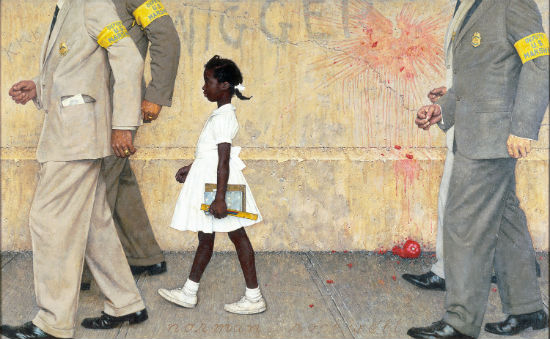
This is what abortion politics is for
by Fred Clark
State Sen. Jake Chapman was in a tight spot. The Iowa legislature was debating a hate-crime bill that would protect transgender people. An anti-terrorism bill, in other words — one that would add penalties for the crimes of violence when that violence was intended to intimidate and terrorize an entire class of people.
That bill being considered would add gender identity and gender expression to the list of protected classes covered by the state’s hate crimes law. …
The bill protecting transgender people is backed by a long list of church, civic and law enforcement groups. It took on added symbolic urgency because the previous week, Kedarie Johnson, a 16-year-old Burlington High School junior described as female-to-male transgender, was shot to death in an alleyway, and was buried Wednesday.
And Chapman was against this bill. He was on the pro-terrorism side of it. That’s an uncomfortable place to be, because defending violent intimidation doesn’t just make others think you’re mistaken, it makes them think you’re immoral and morally incompetent. They start to look at you not just with moral disapproval, but with that look of appalled consternation that suggests they’re all thinking, “What the f–k is wrong with this guy?”
So Chapman was losing the argument. He was going down not just in defeat, but in disgrace. He had surrendered the moral high ground and was flailing in an indefensible position.
Fortunately for Chapman, there’s a playbook for this situation.
Back in the 1970s, white evangelicalism was mired in the disgrace of having been epically, utterly, spectacularly wrong about the Civil Rights movement. They hadn’t just picked the wrong side in a political battle. It was far worse than that. By defending injustice, they had disgraced themselves, surrendered all claims of moral competence, and become disgraced pariahs.
This was unsettling. These were people who thought of themselves as the standard-bearers of morality and rectitude. They read their Bibles and held forth on what those Bibles mean and how others should read them too. They didn’t drink or dance or cuss or go to the movies. They expected other people to honor them as the arbiters and exemplars of morality and “godly” living. But now those others were looking down on them — appalled by their utter lack of morality and decency because they had failed the biggest, clearest and most obvious moral test of their time. They had no excuse, no answer, no recourse.
For several years, they flailed about, bewildered. White evangelicals had grown so accustomed to assuming their role as the spokespeople for morality that they weren’t quite able to understand how thoroughly they had surrendered any claim to that role. So they chose to keep fighting. They rallied behind private Christian schools as an alternative to the now-desegregated public schools, attempting to relitigate the political battles they had lost. They doubled-down on the shameful defense of injustice, taking to the courts to defend their “religious liberty” to practice segregation. This only made things worse — not just because they were losing the legal battle, too, but because this religious liberty argument loudly proclaimed that the odious, immoral defense of injustice was something they regarded as integral to their faith and their identity.
That legal battle lasted from 1971 until it was lost, conclusively, in 1983, with the Supreme Court’s ruling in Bob Jones University v. United States.
But by then it didn’t matter, because by 1983, white evangelicals had found a new strategy to reclaim their rightful place as the standard-bearers of morality. That strategy was simply this: Change the subject.
Failing the clearest moral test of your time and culture is only a problem so long as that moral test is what people are talking about and thinking about. So talk about something else.
If you’ve made yourself a moral pariah because you’ve spent the past three decades fighting a rear-guard battle in defense of systemic, violent, oppressive injustice, then you need to find some other subject on which you can cast yourself as the Good Guy — as the heroic champion of morality. If your position has been exposed as morally indefensible, then don’t even bother trying to defend it. Just go on the offensive instead.
Norman Rockwell, “The Problem We All Live With,” 1963. How do you come back from being the guy who threw that tomato? Change the subject.
And that’s what white evangelicals did in the late 1970s and into the 1980s. They didn’t change their minds about the Civil Rights movement, but they enthusiastically changed the subject. They started talking about abortion.
This is what abortion politics is for. This is what it was designed to do. This is its function and its purpose. It is — above all — a weapon for reasserting a claim to the moral high ground, and for putting the moral upstarts of the Civil Rights movement back in their proper place as moral subordinates who should have no say in determining right and wrong unless they first consult the rightful arbiters of such things, i.e., us.
Those people, you see, are depraved baby-killers. But how does that change the utter failure of –?
Baby-killers.
But how do you justify defending brutality, inequality, segregation, oppressi–?
They kill babies.
And it worked. It worked so remarkably well that within another decade or so, the disgraced moral pariahs who had so thoroughly shamed themselves by failing the great moral test of the Civil Rights movement had been rebranded as “values voters” — the repository and safeguard of our national morality.
The fantastic thing about this trick is that it worked even though everyone knows that abortion is not the same thing as “killing babies.” That’s part of why it worked. Others might respond by talking about the actual status and personhood of a zygote relative to that of …
See? The rest of that sentence is irrelevant because the subject has already been changed. We’re talking about abortion now, not justice. And this new conversation about this new subject will only be allowed to be discussed in terms of the polarizing caricature of baby-killing. This may be a wholly disingenuous and misleading framework for that conversation, but misleading was the goal here in the first place. This conversation was designed and intended to lead us away. It’s purpose was to change the subject.
And it worked. It still works. Which brings us back to Jake Chapman, defender of violence and intimidation against transgender people. Chapman has read the playbook:
Much of the Senate debate of the bill was taken up by Chapman’s attempt to classify the unborn … to the list of Iowans protected by hate crime laws.
Chapman provided lengthy and detailed descriptions of abortion procedures over the objections of other lawmakers. … Chapman insisted his graphic descriptions of abortion were relevant, and he said the Senate had “failed in its most basic responsibility” to protect “a right to life.”
Kedarie Johnson, 16, was shot to death in an alleyway–
Shut up, baby-killers.
That’s what this is for.

13 Mar 19:41
(Most of) my Hugo nominations
I don't believe that I've ever submitted a full slate of Hugo nominations in the fiction categories before. I'm not totally certain that I will again. My own personal reading pace is very much geared towards novels; in past years, award nominations have determined my short fiction reading rather than vice versa. But this year is, of course, different, and I suspect I'm not the only person that resolved to nominate more this time.
I haven't kept strict count, but I reckon I've read about 250 pieces of short fiction in this process, and I know I've only scratched the surface. I found it quite exhausting to keep track, even though I knew that I was deliberately reading with a view to nominating. For next year, I may try a different approach; and in any case I won't blog about it.
I'm still deciding about the Best Novel category, and will read a couple more before the deadline, but I've pretty much made my mind up on all the others - not planning to read anything more in other categories apart from the two BSFA nominees (one in Short Fiction, one in Non-Fiction) that I have not yet read; if they change my nomination, I shall say so. (Also still looking for a fifth nominee in Best Graphic Story.)
Obviously I think all the below are wonderful and will be pleased if others share my tastes. I don't think that they will. In particular I can almost now predict that Naomi Kritzer's "Cat Pictures Please" will win the Best Short Story award; it is exactly the kind of story that Hugo voters tend to like. It didn't especially grab me, but I may end up voting for it anyway depending on what else makes the final ballot.
There are two items on my Best Related Work list that were not on my BSFA ballot. First, it had not occurred to me until the last couple of days that Phil Sandifer's magisterial TARDIS Eruditorum blog finished in early 2015 and is therefore eligible for nomination as a whole. I think it's an extraordinary achievement of criticism and commentary which richly deserves recognition.
Second, my one concession to recognising the Puppy affair is to nominate Matthew David Surridge's 16,000-word explanation of why he declined nomination on the Sad Puppies slate. Despite being a relative outsider to Worldcon, he basically nailed the weaknesses of the Puppy case at a level of forensic detail and balanced polemic that no later commentator was able to match (including George R.R. Martin, Eric Flint, Camestros Felaptron, Jim Hines and all the others).
I'm not revealing my votes in the various Fan and Professional categories. I will say that I share the widely held dissatisfaction with the dearth of information available to the lay reader wanting to be properly informed about the Best Editor (Long Form) category, and I also found it very difficult to know whether particular artists are fans or professionals.
And yeah, my Best Dramatic Presentation (Short Form) nominations are a little one-sided. So what?
Novellas
Aliette de Bodard, "Citadel of Weeping Pearls" (Asimov's, Oct/Nov 2015)
Lois McMaster Bujold, Penric's Demon (Spectrum)
Paul Cornell, Witches of Lychford
Eugene Fischer, "The New Mother" (Asimov's, Apr/May 2015)
Lisa Shapter, A Day In Deep Freeze (Aqueduct Press)
Novelette
Eneasz Brodski, "Red Legacy" (Asimov's, Feb 2015)
Paul Evanby, "Utrechtenaar" (1, 2 - Strange Horizons, Jun 2015
Naomi Kritzer, "So Much Cooking" (Clarkesworld, Nov 2015)
Sarah Pinsker, "Our Lady of the Open Road" (Asimov's, Jun 2015)
Alan Smale, “English Wildlife” (Asimov's, Oct/Nov 2015)
Short Stories
Karl Bunker, "Caisson" (Asimov's, Aug 2015)
Nino Cipri, "The Shape of My Name" (Tor.com, Mar 2015)
Amal El-Mohtar, "Madeleine" (Lightspeed Magazine, Jun 2015)
Hao Jingfang, tr Carmen Yiling Yan, "Summer at Grandma's House" (Clarkesworld, Oct 2015)
Kelly Robson, "The Three Resurrections of Jessica Churchill" (Clarkesworld, Feb 2015)
Best Related Work
Perilous and Fair: Women in the Works and Life of J. R. R. Tolkien, eds. Janet Brennan Croft and Leslie A. Donovan
Letters to Tiptree, eds Alissa Krasnostein and Alexandra Pierce
Companion Piece: Women Celebrate the Humans, Aliens and Tin Dogs of Doctor Who, eds. L.M. Myles and Liz Barr
TARDIS Eruditorum, by Philip Sandifer - the entire blog, which finished in February 2015
A Detailed Explanation, by Matthew David Surridge
Best Graphic Story
Sex Criminals, Vol. 2: Two Worlds, One Cop, Matt Fraction and Chip Zdarsky
The Sculptor, Scott McCloud
The Thrilling Adventures of Lovelace and Babbage, Sydney Padua
Saga vol 5, Brian Vaughan and Fiona Staples
Best Dramatic Presentation (Long Form)
Marvel's Jessica Jones (Season 1)
The Martian
Star Wars: The Force Awakens
Best Dramatic Presentation (Short Form)
Doctor Who: Face The Raven
Doctor Who: The Girl Who Died
Doctor Who: Heaven Sent
Doctor Who: The Husbands of River Song
Doctor Who: The Zygon Invasion / The Zygon Inversion
Retro-Hugo nominations for 1941
Best Novel
Twice in Time, Manly Wade Wellman
The Last Man, aka No Other Man, Alfred Noyes
Captain Future and the Space Emperor, Edmond Hamilton
Kallocain, Karin Boye
The Ill-Made Knight, T.H. White
Deadline is 31 March; we'll see what comes out in the wash.
I haven't kept strict count, but I reckon I've read about 250 pieces of short fiction in this process, and I know I've only scratched the surface. I found it quite exhausting to keep track, even though I knew that I was deliberately reading with a view to nominating. For next year, I may try a different approach; and in any case I won't blog about it.
I'm still deciding about the Best Novel category, and will read a couple more before the deadline, but I've pretty much made my mind up on all the others - not planning to read anything more in other categories apart from the two BSFA nominees (one in Short Fiction, one in Non-Fiction) that I have not yet read; if they change my nomination, I shall say so. (Also still looking for a fifth nominee in Best Graphic Story.)
Obviously I think all the below are wonderful and will be pleased if others share my tastes. I don't think that they will. In particular I can almost now predict that Naomi Kritzer's "Cat Pictures Please" will win the Best Short Story award; it is exactly the kind of story that Hugo voters tend to like. It didn't especially grab me, but I may end up voting for it anyway depending on what else makes the final ballot.
There are two items on my Best Related Work list that were not on my BSFA ballot. First, it had not occurred to me until the last couple of days that Phil Sandifer's magisterial TARDIS Eruditorum blog finished in early 2015 and is therefore eligible for nomination as a whole. I think it's an extraordinary achievement of criticism and commentary which richly deserves recognition.
Second, my one concession to recognising the Puppy affair is to nominate Matthew David Surridge's 16,000-word explanation of why he declined nomination on the Sad Puppies slate. Despite being a relative outsider to Worldcon, he basically nailed the weaknesses of the Puppy case at a level of forensic detail and balanced polemic that no later commentator was able to match (including George R.R. Martin, Eric Flint, Camestros Felaptron, Jim Hines and all the others).
I'm not revealing my votes in the various Fan and Professional categories. I will say that I share the widely held dissatisfaction with the dearth of information available to the lay reader wanting to be properly informed about the Best Editor (Long Form) category, and I also found it very difficult to know whether particular artists are fans or professionals.
And yeah, my Best Dramatic Presentation (Short Form) nominations are a little one-sided. So what?
(Most of my) Hugo nominations for 2016
Novellas
Aliette de Bodard, "Citadel of Weeping Pearls" (Asimov's, Oct/Nov 2015)
Lois McMaster Bujold, Penric's Demon (Spectrum)
Paul Cornell, Witches of Lychford
Eugene Fischer, "The New Mother" (Asimov's, Apr/May 2015)
Lisa Shapter, A Day In Deep Freeze (Aqueduct Press)
Novelette
Eneasz Brodski, "Red Legacy" (Asimov's, Feb 2015)
Paul Evanby, "Utrechtenaar" (1, 2 - Strange Horizons, Jun 2015
Naomi Kritzer, "So Much Cooking" (Clarkesworld, Nov 2015)
Sarah Pinsker, "Our Lady of the Open Road" (Asimov's, Jun 2015)
Alan Smale, “English Wildlife” (Asimov's, Oct/Nov 2015)
Short Stories
Karl Bunker, "Caisson" (Asimov's, Aug 2015)
Nino Cipri, "The Shape of My Name" (Tor.com, Mar 2015)
Amal El-Mohtar, "Madeleine" (Lightspeed Magazine, Jun 2015)
Hao Jingfang, tr Carmen Yiling Yan, "Summer at Grandma's House" (Clarkesworld, Oct 2015)
Kelly Robson, "The Three Resurrections of Jessica Churchill" (Clarkesworld, Feb 2015)
Best Related Work
Perilous and Fair: Women in the Works and Life of J. R. R. Tolkien, eds. Janet Brennan Croft and Leslie A. Donovan
Letters to Tiptree, eds Alissa Krasnostein and Alexandra Pierce
Companion Piece: Women Celebrate the Humans, Aliens and Tin Dogs of Doctor Who, eds. L.M. Myles and Liz Barr
TARDIS Eruditorum, by Philip Sandifer - the entire blog, which finished in February 2015
A Detailed Explanation, by Matthew David Surridge
Best Graphic Story
Sex Criminals, Vol. 2: Two Worlds, One Cop, Matt Fraction and Chip Zdarsky
The Sculptor, Scott McCloud
The Thrilling Adventures of Lovelace and Babbage, Sydney Padua
Saga vol 5, Brian Vaughan and Fiona Staples
Best Dramatic Presentation (Long Form)
Marvel's Jessica Jones (Season 1)
The Martian
Star Wars: The Force Awakens
Best Dramatic Presentation (Short Form)
Doctor Who: Face The Raven
Doctor Who: The Girl Who Died
Doctor Who: Heaven Sent
Doctor Who: The Husbands of River Song
Doctor Who: The Zygon Invasion / The Zygon Inversion
Retro-Hugo nominations for 1941
Best Novel
Twice in Time, Manly Wade Wellman
The Last Man, aka No Other Man, Alfred Noyes
Captain Future and the Space Emperor, Edmond Hamilton
Kallocain, Karin Boye
The Ill-Made Knight, T.H. White
Best Novella
The Mound, H.P. Lovecraft and Zealia Bishop
If This Goes On, Robert A. Heinlein
Fattypuffs and Thinifers, Andre Maurois
The Invention of Morel, Adolfo Bioy Casares
But Without Horns, Norvell Page
Best Novelette
It, Theodore Sturgeon
New York Fights the Termanites, Bertrand L. Shurtleff
Into the Darkness, Ross Rocklynne
Farewell to the Master, Harry Bates
The Sea Thing, A.E. van Vogt
Best Short Story
John Duffy's Brother , Flann O'Brien
The Stellar Legion, Leigh Brackett
The Piper, Ray Bradbury (as Ron Reynolds)
Tlön, Uqbar, Orbis Tertius, Jorge Luís Borges
Quietus, Ross Rocklynne
Best Dramatic Presentation (Long Form)
Pinocchio
The Thief of Bagdad
Fantasia
Best Dramatic Presentation (Short Form)
Weltraumschiff 1 startet
Best Professional Editor (Short Form)
Raymond A. Palmer
Mort Weisinger
Frederik Pohl
Best Professional Artist
Virgil Finlay
Margaret Brundage
Hubert Rogers
Deadline is 31 March; we'll see what comes out in the wash.
11 Mar 15:30
Did LIGO Detect Dark Matter?
by Sean Carroll
It has often been said, including by me, that one of the most intriguing aspects of dark matter is that provides us with the best current evidence for physics beyond the Core Theory (general relativity plus the Standard Model of particle physics). The basis of that claim is that we have good evidence from at least two fronts — Big Bang nucleosynthesis, and perturbations in the cosmic microwave background — that the total density of matter in the universe is much greater than the density of “ordinary” matter like we find in the Standard Model.
There is one important loophole to this idea. The Core Theory includes not only the Standard Model, but also gravity. Gravitons themselves can’t be the dark matter — they’re massless particles, moving at the speed of light, while we know from its effects on galaxies that dark matter is “cold” (moving slowly compared to light). But there are massive, slowly-moving objects that are made of “pure gravity,” namely black holes. Could black holes be the dark matter?
It depends. The constraints from nucleosynthesis, for example, imply that the dark matter was not made of ordinary particles by the time the universe was a minute old. So you can’t have a universe with just regular matter and then form black-hole-dark-matter in the conventional ways (like collapsing stars) at late times. What you can do is imagine that the black holes were there from almost the start — that they’re primordial. Having primordial black holes isn’t the most natural thing in the world, but there are ways to make it happen, such as having very strong density perturbations at relatively small length scales (as opposed to the very weak density perturbations we see at universe-sized scales).
Recently, of course, black holes were in the news, when LIGO detected gravitational waves from the inspiral of two black holes of approximately 30 solar masses each. This raises an interesting question, at least if you’re clever enough to put the pieces together: could the dark matter be made of primordial black holes of around 30 solar masses, and could two of them have come together to produce the LIGO signal? (So the question is not, “Are the black holes made of dark matter?”, it’s “Is the dark matter made of black holes?”)

This idea has just been examined in a new paper by Bird et al.:
Simeon Bird, Ilias Cholis, Julian B. Muñoz, Yacine Ali-Haïmoud, Marc Kamionkowski, Ely D. Kovetz, Alvise Raccanelli, Adam G. Riess
We consider the possibility that the black-hole (BH) binary detected by LIGO may be a signature of dark matter. Interestingly enough, there remains a window for masses 10M⊙≲Mbh≲100M⊙ where primordial black holes (PBHs) may constitute the dark matter. If two BHs in a galactic halo pass sufficiently close, they can radiate enough energy in gravitational waves to become gravitationally bound. The bound BHs will then rapidly spiral inward due to emission of gravitational radiation and ultimately merge. Uncertainties in the rate for such events arise from our imprecise knowledge of the phase-space structure of galactic halos on the smallest scales. Still, reasonable estimates span a range that overlaps the 2−53 Gpc−3 yr−1 rate estimated from GW150914, thus raising the possibility that LIGO has detected PBH dark matter. PBH mergers are likely to be distributed spatially more like dark matter than luminous matter and have no optical nor neutrino counterparts. They may be distinguished from mergers of BHs from more traditional astrophysical sources through the observed mass spectrum, their high ellipticities, or their stochastic gravitational wave background. Next generation experiments will be invaluable in performing these tests.
Given this intriguing idea, there are a couple of things you can do. First, of course, you’d like to check that it’s not ruled out by some other data. This turns out to be a very interesting question, as there are good limits on what masses are allowed for primordial-black-hole dark matter, from things like gravitational microlensing and the fact that sufficiently massive objects would disrupt the orbits of wide binary stars. The authors claim (and quote papers to the effect) that 30 solar masses fits snugly inside the range of values that are not ruled out by the data.
The other thing you’d like to do is figure out how many mergers like the one LIGO saw should be expected under such a scenario. Remember, LIGO seemed to get lucky by seeing such a big beautiful event right out of the gate — the thought was that most detectable signals would be from relatively puny neutron-star/neutron-star mergers, not ones from such gloriously massive black holes.
The expected rate of such mergers, under the assumption that the dark matter is made of such big black holes, isn’t easy to estimate, but the authors do their best and come up with a figure of about 5 mergers per cubic gigaparsec per year. You can then ask what the rate should be if LIGO didn’t actually get lucky, but simply observed something that is happening all the time; the answer, remarkably, is between about 2 and 50 per cubic gigaparsec per year. The numbers kind of make sense!
The scenario would be quite remarkable and significant, if it turns out to be right. Good news: we’ve found that dark matter! Bad news: hopes would dim considerably for finding new particles at energies accessible to particle accelerators. The Core Theory would turn out to be even more triumphant than we had believed.
Happily, there are ways to test the idea. If events like the ones LIGO saw came from dark-matter black holes, there would be no reason for them to be closely associated with stars. They would be distributed through space like dark matter is rather than like ordinary matter is, and we wouldn’t expect to see many visible electromagnetic counterpart events (as we might if the black holes were surrounded by gas and dust).
We shall see. It’s a popular truism, especially among gravitational-wave enthusiasts, that every time we look at the universe in a new kind of way we end up seeing something we hadn’t anticipated. If the LIGO black holes are the dark matter of the universe, that would be an understatement indeed.
10 Mar 10:55


Michigan and Mississippi and Those Other States Too
by John Scalzi

Thoughts on last night’s political festivities:
1. Wow, the pollsters surely humped the proverbial bunk last night in Michigan, didn’t they? Hillary Clinton was in most polls up by double digits in the state against Bernie Sanders, and yet at the end of the day, Sanders squeaked by with a victory, 49.8% to 48.3%. What’s interesting about it is that the news stories I’ve seen have been like “Hillary Clinton’s surprise loss in Michigan raises an urgent question for her campaign: What went wrong?” when the ledes should be “All the polling in Michigan for the Democratic race has been horribly inaccurate: How did the pollsters blow it so badly?” I mean, with the possible exception of her own internal polling, Clinton’s not exactly responsible for the polling being egregiously wrong, is she? That’s on the actual pollsters themselves. If the polling had been accurate, then the closeness of the Michigan Democratic results wouldn’t have been surprise. This is a reminder that simulations and polling are just that: Simulations and polling. You still have to run the election.
This does put Clinton on notice that she can’t pivot to Trump yet; she still has to beat Sanders, and maybe she shouldn’t take that as a done deal just yet. A useful reminder to be sure. But it should also put the rest of us on notice that, hey, guess what: In this political season, no one knows anything. I mean, everyone got Michigan so wrong I’m glad I was well ahead of the curve reminding people I’m often wrong about political stuff. But this does mean that no one should be genially blithe about the predictions for next week in Florida and Ohio (and all those other states that will be having elections, as if they matter, hmph). The pollsters have shown that when it comes to the Democratic races, at least, they’re currently working on an immense margin of error.
2. With that said, a reminder to justifiably happy Sanders supporters that Clinton ended last night with 18 more pledged delegates than Sanders thanks to her blowout of Mississippi, where she won 24 delegates to Sanders’ three, and because in Michigan she won 58 to his 63, thanks to the closeness of that race. Overall, Clinton is 214 pledged delegates up, and the gap, so far at least, continues to stretch in Clinton’s favor.
Sanders’ problem is that generally speaking, when Clinton wins, she’s won with larger margins than Sanders does when he wins, and (of course) she’s won more states than he has. To mix sporting metaphors, Sanders’ wins are mostly three yards and a cloud of dirt, while Clinton’s wins mostly are triples and home runs. It was a surprise Sanders won Michigan, and that’s energizing to his campaign, and justly so. But he netted only five more delegates out of the state than Clinton did. If he doesn’t start winning some big states with wider margins, he’s just not going to catch up.
Will he? Well, you know. Before last night you could look at the polls and say, oh, probably not, but today, knowing how gloriously the pollsters whiffed in Michigan, you can say, who knows? I don’t think he will — I suspect next Tuesday he’s probably going to lose Florida by a large margin and if he wins other states, he’ll win them by margins like we saw in Michigan. Which means, again, he’ll be further behind in terms of delegates.
But then, what do I know? Apparently, as much as anyone else as regards the Democratic primary races, which appears to be: Not much! It certainly makes for exciting times. The good kind of exciting, mind you, not the scary oh fuck how could this actually still be happening exciting on the GOP side.
3. Speaking of which: Three states and 73 delegates last night for Donald Trump, one state and 59 delegates for Ted Cruz, and pretty much dick for Marco Rubio, who finished the night with one (1) delegate to his tally, or, 16 fewer than John “I’m only in this to win my home state” Kasich. Yes, yes, the #NeverTrump express is chugging right along, my friends. They are blunting his momentum so hard! As a fellow named Max Berger archly noted on Twitter: “It’s somewhat ironic that the GOP will be destroyed by a billionaire against whom they couldn’t figure out how to collectively organize.”
FiveThirtyEight notes that Trump is currently at 106% of the delegate count it thinks he needs, momentum-wise, in order to get the GOP nomination in the free and clear. Inasmuch as Ohio and Florida are winner-take-all states for the Republicans, if he wins either of them next week, it’s a much harder slog for Cruz (realistically the only one who can catch him, although he’s only at 69% of his target count). If he wins both, everyone else in the GOP better start praying for a bolt of lightning to strike Trump dead.
Yet again, the GOP’s problem is that it wants desperately to stop Trump, but unfortunately the voter base it’s cultivated for years to accept a candidate just like Trump is doing what it’s been trained to do. And while the irony is delicious, it has a horrifying aftertaste because it doesn’t change the fact that barring divine intervention, Trump and his fascistic shitshow of a campaign are going to the general election. So, you know, again: Thanks for that, GOP.
(And while I’m at it, GOP, thanks so much also for having the only barely viable alternative to Trump be Ted Cruz, a bipedal mound of pig offal that yet manages to form words. When we’re done with this election, we’re going to have a talk, you and I. Depend on it.)
4. Hey, Scalzi, you ask, do you think the GOP will actually fracture because of Trump? The more I think about it the more I think “no,” because of several reasons. One, and what should be most obviously, the actual people who vote GOP seem to be just fine with Trump. Say what you will about the fact he’s running the most overtly racist and horrible campaign in modern history, but at the end of the day he’s the front runner because he’s earning the votes and delegates. He’s playing by the rules the GOP set up and he’s winning (and don’t think that at this moment the GOP doesn’t wish that it had borrowed that “superdelegate” idea from the Democrats).
Two, the question to start asking is not whether the GOP hates Trump more than Cruz, but whether it hates Trump more than Clinton, or Sanders. Let’s stipulate that the GOP in general hates Clinton with an unholy passion, out of muscle reflex if nothing else. A quarter century of intense dislike of a single person (and her husband) is hard to shake. As for Sanders, they don’t have the same institutional hatred of him as they do of Clinton, but, look, he’s an actual goddamn socialist, or something close enough that the sort of person who thinks Barack Obama is as pink as a Swedish daycare will lose their ever-lovin’ mind about living in Sanders’ America (I’m coming back to this in a minute).
So I submit to you that the average GOP establishment type, confronted with the choice of Clinton or Sanders, or Trump, is going to suck it up and vote for Trump. As Josh Marshall put it, #NeverTrump is actually just #EventuallyTrump, and just as Cruz and Rubio and Kasich stood up there on that podium and after excoriating Trump for two hours and said they would vote for him in general, so will the GOP folks currently holding their head at the shonda that is Donald Trump do the same.
So, no, I don’t think there will be a fracturing, and Clinton and Sanders (but mostly Clinton) are the reason. You might have people sit out; you might even have GOP folks hold their nose and secretly (or not so secretly!) vote for Clinton or Sanders in the general. But I suspect one way or another the GOP holds together. Whether this is a good thing for them in the long run is a discussion for another time, that time, I imagine, being the comment thread.
5. To follow up on this thought in more detail: For the Democrats/liberals in the crowd, I suspect that in general election, an advantage that Clinton has, that Sanders does not, is familiarity — not to the people who like her, but with regard to the people who don’t. I think the vast majority of Clinton’s potential negatives are already baked into her public persona, whereas Sanders’ negatives have yet to be played with in a general sense.
What do I mean by this? I mean that everyone who is going to hate Clinton — for her political positions, for her gender, for her public demeanor, for her husband, for Vince Foster and Benghazi and her email server — probably already does. There aren’t really too many surprises left there. She’s a known quantity for everyone.
Sanders, on the other hand, represents a whole lot of opportunity on the part of the GOP and its various allies to scaremonger and to have that scaremongering be a significant part of the Sanders’ public persona. I mean, come on: If you don’t think the GOP isn’t going to have a field day with the socialist thing, for starters, you haven’t been paying attention to what the Republicans have been about for the last three decades. The Republicans haven’t been very good at government for a long time (in part because they don’t really want to be), but they are just fine at scaring old and/or angry white people, thanks very much, and they’ll be more than happy to fill them in on all the terrible things they don’t know about Sanders.
(And if you don’t think Sanders being a Jew won’t matter in the election, remember who Donald Trump retweets. Be assured the GOP as a party won’t go anywhere near that, and I say that with no wink or nod whatsoever; The GOP knows enough to steer well clear of anti-semitism. But also be assured that Sanders being a Jew, and a Jewish socialist, will be a topic of “conversation” anyway for a fair number of the folks who will be voting for the GOP candidate, particularly if the candidate is Trump.)
This is not to say scaremongering is fated to work. After all, Barack Hussein Obama, Black Muslim born in Africa, was elected twice as president, with majorities both in the popular vote and in the electoral college. But it does mean that there’s more room for Sanders scaremongering to do unexpected damage, because it’s new to the general electorate. The scaremongering on Clinton goes back to the early 90s. It’s stale, and it has a hard ceiling and floor. We don’t know the ceiling and floor on the Sanders scaremongering yet. And that’s a real factor to consider.
09 Mar 13:53

Credit scores and the Mark of the Beast
by Fred Clark
I’m still a bit puzzled to learn that many of the same people who formerly denounced supermarket scanners, ATMs, and GPS because of the Antichrist and the Mark of the Beast now seem to be rallying around the idea of a national ID card that they say would need to be shown to police upon request.
Hal Lindsey warned us about national ID cards. He was certain that by 1980, such cards would be administered — or perhaps implanted on the hand or the forehead — and that no one would be able to buy or sell anything without one. For generations, any hint of anything even remotely like a national ID card was loudly denounced by Rapture Christians crying Mark of the Beast. And now some of those same folks are demanding that the government start printing them.
To be clear, I don’t want a national ID card. I do wish that, for example, my auto registration and proof of insurance could be coded into my Pennsylvania driver’s license so that I wouldn’t need to carry up-to-date paper hard copies of those in my glove compartment. But even relatively benign technology like that has been politically fraught thanks to paranoid End-Times enthusiasts still freaked out over the guillotine scene in A Distant Thunder.
So again, I’m puzzled. And maybe a bit disappointed. Anti-Antichrist paranoia did have the salutary side-effect of turning anti-Antichristians into unwitting defenders of our civil liberties.
I may be biased here, but I think part of this development may be due to our friends Tim LaHaye and Jerry Jenkins. The phenomenal popularity of the Left Behind series has changed the way “Bible-prophecy” obsessed Christians think about the Antichrist. Go back to Hal Lindsey, or the films of Donald W. Thompson, or to the earlier Tribulation novels that LaHaye & Jenkins borrowed from/ripped off and you’ll find cunning, devious Antichrists who plot and scheme creatively. Those guys were sneaky and clever, demanding constant vigilance against their soon-to-be-revealed wiles.
But then along comes Left Behind, with the least imaginative Antichrist imaginable. Nicolae Carpathia inspires the world by reciting the list of countries alphabetically. This stirs up such national pride in his audience that all of those countries promptly disband, voluntarily ceding him global sovereignty. And then, once he is named global potentate and leader of the one-world government, he turns around and declares war against himself, bombing all the cities he now leads because … um, well, just because bwahaha — Antichrist!
So instead of semi-lucid conspiracy theories about the Mark of the Beast, now we get third-rate nonsense like last year’s freak-out over Jade Helm. People were worried that the United States was plotting to invade Texas. This confusion of boundaries and nationalities and arbitrary war against oneself read like something taken directly from Nicolae Carpathia’s playbook.
People steeped in Left Behind’s version of this folklore no longer expect an Antichrist with a devious plan that makes any sense. And since they’ve stopped expecting the Antichrist to think creatively and coherently, they’ve become less able to think creatively and even semi-coherently about the Antichrist.
And that’s a shame, because I have a terrific candidate for what could have been the next target of their Mark-of-the-Beast vigilance: Credit scores.
It fits. Here, again, is the Mark-of-the-Beast crowd’s favorite passage from Revelation 13:
Then I saw another beast that rose out of the earth; it had two horns like a lamb and it spoke like a dragon. … It causes all, both small and great, both rich and poor, both free and slave, to be marked on the right hand or the forehead, so that no one can buy or sell who does not have the mark, that is, the name of the beast or the number of its name. This calls for wisdom: let anyone with understanding calculate the number of the beast, for it is the number of a person. Its number is 666.
So we’re looking for a three-digit number without which no one will be permitted to buy or sell. Credit scores, people, think about it.
They’re calculated in secret by a triumvirate of unelected overlords who constitute a kind of shadow-government not restricted by national boundaries. They’re assigned to each of us, for they are the number of a person. And if that number is too low, things begin to get prohibitively expensive, making buying and selling ever-more difficult. How low is too low? We can’t know for sure — Mystery Babylon guards such mysteries — but I’ve been assured that it’s best to keep one’s credit score above 700. Dip too far below that — to, say, 666, or 616 (according to other ancient manuscripts) — and you’re going to be paying a poverty-tax on many transactions.
The credit-rating agencies, as described by the soothsayer Daniel.
We could go on — consider how the reign of the credit rating agencies was prophesied in the book of Daniel: “And behold another beast, a second, like to a bear, and it raised up itself on one side, and it had three ribs in the mouth of it between the teeth of it: and they said thus unto it, Arise, devour much flesh.”
Three ribs, people. Transunion, Equifax, Experian. Three. What more do you need?
But apparently we can no longer count on the people we used to be able to count on to get riled up by this sort of thing. Despite this clear fulfillment of biblical prophecy, we can’t rely on Bible-prophecy fans to rise up against credit scoring the same way they once reliably opposed computerized records, RFID chips for pets, and pay-at-the-pump credit-card scanners.
09 Mar 13:34
Satanic baby-killers.
by Fred Clark
News item: “Columbus Planned Parenthood clinic vandalized”
Vandalism at Planned Parenthood’s East Columbus Surgical Center is an example of the alarming increase “in vitriolic, hateful rhetoric” over reproduction rights, the organization said.
Someone splashed red paint on the front door and painted “SATAN DEN OF BABY KILLERS GOD SEE ALLLL (sic) Mark 9:14” on the front of the center at 3255 E. Main St. sometime overnight Sunday.

Please open your copies of Mere Christianity and read along with me as C.S. Lewis explains the corrosive rot festering in the center of American evangelicalism:
The real test is this. Suppose one reads a story of filthy atrocities in the paper. Then suppose that something turns up suggesting that the story might not be quite true, or not quite so bad as it was made out. Is one’s first feeling, “Thank God, even they aren’t quite so bad as that,” or is it a feeling of disappointment, and even a determination to cling to the first story for the sheer pleasure of thinking your enemies are as bad as possible?
If it is the second then it is, I am afraid, the first step in a process which, if followed to the end, will make us into devils. You see, one is beginning to wish that black was a little blacker. If we give that wish its head, later on we shall wish to see grey as black, and then to see white itself as black. Finally we shall insist on seeing everything — God and our friends and ourselves included — as bad, and not be able to stop doing it: we shall be fixed for ever in a universe of pure hatred.
This is how it works. The process begins with “the sheer pleasure of thinking your enemies are as bad as possible” and it accelerates downhill, leading to fever-dreams of the worst-possible “bad as possible” that we can imagine.
And ultimately, that worst-possible bad-as-possible always takes the same form: Satanic baby-killers.
09 Mar 12:25
Has Michael Gove been reading The Dictator’s Handbook?
by Nick
 Something often seen in corrupt and autocratic regimes is a system that resembles democracy but is subject to an element of social coercion to ensure that the results of supposedly free votes help to maintain the existing order. As I discussed here before, there’s a whole field in international relations that discusses the idea of the selectorate theory, and how autocratic regimes use the distribution of public and private goods to reward their supporters and keep them loyal. The public might be presented with a choice of parties that they can back at elections, but they’ll be reminded that only by voting the right way can they ensure that they’ll get their share of government resources. They can vote for the opposition parties and not be directly punished for it, but the rewards for complying with the government will go elsewhere. (There’s a lot more detail and examples of this in The Dictator’s Handbook

Of course, that’s the sort of thing that doesn’t happen in proper democracies like Britain. Here, people are encouraged to vote for whoever they want, safe in the knowledge that the governing party won’t seek to reward those who vote for them and punish those who don’t.
It’d be nice if someone told Michael Gove that, though. He was in Colchester last week and spoke to the local paper. During his interview he said:
Colchester is growing dramatically and needs investment in its infrastructure.
A Conservative council will be able to make that case and will always get a sympathetic hearing.
The implication is quite clear – the borough needs things, but needs to have a Conservative council to get ‘a sympathetic hearing’ if it wants to actually get them. This is the politics of the protection racket, a warning to vote the right way if you want to get things. It’s not surprising that Conservatives think this way – I’ve seen too much of them in operation to be shocked – but I don’t think I’ve ever seen a member of the Cabinet make a statement like that.
It’s the ultimate end point of the Conservative vision of localism, where you’re free locally to tell the Government just how much you agree with them, and they’ll reward you for the level of enthusiasm you show. It does a good job of looking like democracy on the surface, but it’s a pretty long way from it underneath.
09 Mar 11:58
DJ OTZI – “Hey Baby (Uhh, Ahh)”
by Tom
#909, 22nd September 2001
 So the cruddiest number one of 2001 lands at the top in a week when a lot of people were not caring about music. And certainly, spending £1.99 on “Hey Baby” is one of the more aggressive ways you could find to not care about music. The song is a mugging of a rather sweet #2 hit from 1962 by Bruce Channel: his “Hey Baby” was hayseed bubblegum, a bag of folksy candyfloss with a harmonica hook hot enough that people assumed the Beatles swiped his idea.
Channel’s song does nothing to deserve this monkey’s paw resurrection, except be catchy. Otzi preserves that property – “Hey Baby” became an instant terrace hit – and puts the song on steroids, before welding on any 90s sample he can locate. Even our old chum “Uno, Dos, Tres, QUATRO!” gets a turn. Otzi’s main innovation is significant enough to land in the title – “Hey Baby (Uhh, Ahh!)” – the two-note crowd participation hook he inserts. Anyone fortunate enough to have been on a bus or train when groups of men give lusty voice to the song will know how effective, and painful, this alteration is.
Crassness isn’t really the problem here though, it’s the marriage of crassness with a total severing of imagination. Add a touch of surreal invention to amped-up cover versions and you have the reliably entertaining Scooter, whose crossover audiences wouldn’t be as distinct from DJ Otzi’s as I’d like to believe. But there’s no invention in “Hey Baby”, just a brute force ramming of song into forebrain in the service of parties you wouldn’t want to be at. This kind of Eurostomp has a heritage (inevitably, Otzi turned in a cover of Opus’ deathless schlager-rocker “Live Is Life”) and a tenacity. People were buying it on the 10th of September. People were buying it on the 12th of September. Like the cockroaches set to survive armageddon, “Hey Baby” was resilient.
08 Mar 14:21
This Turkish Princess Gets a Little Salty
by Ovid
Somebody was kind enough to actually translate a story from Turkish
just so I could ruin it on my website
it’s from Turkey
and it is about REVENGE
Okay so there’s this sultan
he has three daughters
and he is very insecure
so he calls all his daughters in
and he’s like “Hey daughters, pop quiz:
(get it because I am your father)
how much do you love me?
answer using hyperbolic comparisons please”
So the first daughter is like “I love you as much as the whole world”
which is objectively false
because that would have to mean that she has absolutely zero love
for anything in the world that is not her father
but it sure makes the sultan happy.
The second daughter is like “I love you more than my mom’s womb”
which is not a great answer
because she only spent nine months up in there
before violently busting out.
But then the third daughter tops both of them
by being like “I love you as much as SALT”
and her dad is like “WHAT???
SALT?!?!?!?!
FUCK SALT.
What a shitty answer
for that shitty answer
I will now have you killed”
And the third daughter is like “wait what?”
But it’s too late
now she’s getting dragged up onto a hill by an executioner
and he’s like “Yeah sorry I have to kill you
you seem cool
what did you even do?”
and she’s like “I said I loved my dad as much as salt”
and the executioner is like “seriously?
I mean okay, that’s a weird thing to say
but I’m not sure it merits an execution?????
No fuck this
just give me your shirt
I’m going to smear a wild beast’s blood all over it
and give it to your dad
he won’t bother to fact check, he’s a busy man
also INSANE
you go do you, princess.”
So the princess goes walking down the road
topless and weeping
which is why when she arrives at the next town
some rich dude immediately gives her a job as a house servant
where she works until she grows up and becomes extremely pretty
at which point some random prince sees her
and they get married because that’s how shit goes
So she’s worked her way back up to princess status
and she’s hanging out with her royal husband
and she’s like “did I ever tell you about my dad?”
and the prince is like “no what about him?”
and she’s like “Oh nothing big
he just ordered me executed because I compared him to salt.”
and the prince is like “lol what
i mean that IS a really weird thing for you to have said
but EXECUTED?
who put this guy in charge of a country!
Dude, you know what we should do?
We should prank him.”
and the princess is like “way ahead of you.”
See, she’s already invited her dad to come have dinner at the palace
but he doesn’t know who she is, obviously
and before he arrives, the princess
(now a sultana actually)
goes to her cook and she’s like “okay here’s the menu
I want everything to be delicious
EXCEPT
No
salt”
and the cook is like “What the fuck
you might as well ask me to cook without hands”
and the sultana is like “do you usually put severed hands in the food”
and he’s like “that’s not what I meant”
and she’s like “THEN GET TO WORK”
so big daddy sultan shows up to his secret daughter’s palace
and he sits down for dinner
and all this delicious looking food comes out on gold platters and shit
but it all tastes like hot garbage
he can’t finish a damn thing
and this is when the sultana stands up at the other end of the table
and reveals
that he was actually eating his kids the whole time
no wait i mean
that he was actually eating his kids the whole time
no wait i mean
that he was actually eating his kids the whole time
NO
WAIT
I MEAN
that she was actually his daughter
and that this shitty meal proves how important salt is
and the sultan feels like a real dick for ordering her execution
and they make up sort of
but he probably doesn’t come over for dinner much after that
because the food wasn’t very good
and also because he still fucking tried to have her killed
you don’t just get to say sorry and put that behind you.
Anyway the moral of the story
is seriously fuck people who don’t salt their food
one time I was at a party and I met this asshole
who was like “real cooks don’t use salt”
and I was like “I’ve got a prime unsalted knuckle sandwich right here for you
and when I’m done tenderizing your face
we’ll see how you like salt IN YOUR WOUNDS
PROBABLY ABOUT AS MUCH AS YOU LIKE IT ON YOUR FOOD I WOULD GUESS”
seriously
“real cooks”?
“real cooks” are the reason you can buy 36 pounds of salt in bulk
basically what I’m saying
is fuck that one guy I met at a party that one time
actually he was pretty cool for the most part
I just disagreed with him about this one thing
still though


08 Mar 11:05
 Until 1771, people weren’t allowed to publish detailed reports of what went on in Parliament. Only Hansard, the official record, was allowed to give verbatim coverage of what had been said by representatives. This restriction was lifted, and over time we’ve been given more and more access to the inner workings of the supposed centrepiece of our democratic system culminating in both radio and television eventually getting the right to broadcast the proceedings of Parliament.
Let’s make satirising Parliament legal
by Nick

Nothing amusing has ever happened here.
Well, most radio and television. You see, there’s a provision in the rules on broadcasting Parliament in the UK that “no extracts from Parliamentary proceedings may be used in comedy shows or other light entertainment such as political satire.” You may have wondered that while American shows such as The Daily Show or Last Week Tonight often use speeches from Congress as part of their reporting, we never get to see Parliament in Have I Got News For You, Screenwipe or The Last Leg and that rule is why.
Unsurprisingly, it seems that the Government has no desire to change this state of affairs, but there is now a power for us to get them to do something about it. Parliament’s petitions site means that if we can get 10,000 people to sign a petition on a subject, the Government has to make a statement on it, and if we can get 100,000 signatures, Parliament will debate the issue.
Wouldn’t it be good to get Parliament to debate whether it should be like everything else in our society and be open to comedy and satire? That’s why I tried to set up a petition on the Parliamentary petitions site to get it overturned. Unfortunately, my petition was rejected, but only because someone else had had the idea first and set one up before me. So click here to go and sign it, then share it around. Let’s see our MPs try and justify why they shouldn’t be open to satire.