I’ve disemvoweled the surname. I understand why it’s become viral. Please don’t splain the logic and the rationale to me. I don’t object out of ignorance or a lack of understanding about political humor, satire, or the indictment of hypocrisy.
Seriously, if you’ve been reading here, and if you know me from elsewhere, you know that I’m well aware of the mechanics of all three.
Yet again, I’m disturbed by the willingness of the avowed liberal side to engage in Othering tactics that have collateral damage in the form of immigrants and the visibly unassimilable. Nearly 100% of the apologetics I’m seeing for John Oliver’s mocking takedown of Trump are from people who have never been faced with claims that they are unAmerican (and don’t belong) because of their “clearly foreign” surname, or whose appearance never elicits the questioning of their citizenship or right of residency.
For the rest of us…this isn’t going to have a limited impact. It fuels Anglo-normalization, and the questioning of “non-foreign” surnames for those of us who are visibly non-white in our ancestry. You wouldn’t condone using homophobia to combat homophobia. Or at least I hope you wouldn’t.
I cannot imagine anybody who reads this blog not enjoying Gaston Dorren’s book Lingo: Around Europe in 60 Languages. Yes, sixty languages are a lot to cover, but each one is discussed quite briefly, making only one or two points about the language before moving on. The text takes less than 300 pages, so each language gets the equivalent of a blog post’s worth of discussion. You won’t learn Basque this way, but you will learn that Basque does not have subjects and objects (although speakers can still distinguish between the doer and the doee). The book is full of interesting nuggets doled out in witty prose. Most of the chapters end with an example of a word the language has given English speakers: e.g, avalanche comes (via France) from the only language native to Switzerland, Romansh. There are also sample words from the languages, reminding all readers of the richness of tongues. For instance, the German Gönnen means “the exact opposite of envy,” giving English speakers a word to wish for, while the Portuguese have a term, pesamenteira, for a person who comes to a funeral for the free food.
Random facts about language and history are salted throughout the text. It turns out that not all languages have a verb to have. Languages in the Finno-Ugric family (mostly Finnish, Estonian and Hungarian) say something like It is on me when they want to say I have it. Similarly, on the island of Manx between Britain and Ireland, folks say something that translates (roughly) as It is at me. Alone, these facts and quick chapters would make the book a great one to stick in the bathroom as an occasional read. What makes it more than that are the recurring themes that turn the book into a unit. Some of the themes are grammatical, like the nuggets about articles (you know, words like the, a and an). Years ago I read a funny novel in which a Russian was trying to learn English and was being driven mad by the pointless distinction English grammar made between a book and the book. Why, the enraged man wondered, can’t you just say give me book? I laughted then and I still enjoy thinking about articles, and Dorren’s book offers steady noshing: The original Indo-European tongue did not have articles, but they have developed independently in many languages. In the Balkan languages (e.g., Macedonian, Bulgarian, Romanian, Albanian) articles have emerged as suffixes stuck onto the end of words, so instead of saying the book a Romanian would say the equivalent of bookthe. Basque does not use suffix articles, but does place them after the word, saying the equivalent of book the. Apart from their Balkan strain, most Slavic languages have not evolved articles, but some are in the process of doing so right now. Czech and Polish speakers will often say their multi-consonanted versions of one book or that book. This process repeats the way the Latin that (ille) began its transition to Romance language words like le, il, el etc. while the Latin one (unum) went on to become une, uno etc. One Slavic language that I absolutely never heard of – Sorbian – is well on its way to full use of articles. They are standard in speech, but not in formal, written Sorbian.
The difference between written and spoken Sorbian brings up another of the book’s recurring themes: linguistic variety. Romansh in Switzerland and Norwegian in Norway are both notable for their many separate strands. Not coincidentally, both languages are spoken by people living in valleys surrounded by high walls. Probably the butterflies vary from valley to valley too. Meanwhile, Icelandic has proven so stable that Icelanders can still read the Sagas of old in the original, and enjoy them. How do English speakers fare when Beowulf is plopped in front of them? And then over in the mountainous Balkans the languages have come together grammatically, but kept their separate vocabularies. It’s a good way of keeping your difference while still being able to talk with your pesky neighbors.
These varieties of language are not corruptions. It is the standard language that has been corrupted. They are the ones that try to squeeze out the variety—laughing at the yokels who say y’all or pronounce nuclear as nukuler. The benefit of that standardization, however, is strong. You can converse with people over a wide area. Russian is Russian in Moscow and Vladivostok, so when a tsar sends you to Siberia you can still talk to your jailers. That diversity in unity is a common idea across the whole book: on the Iberian peninsula you’ve got Spanish, Portuguese, Galician, Catalonian, and Basque. Each is distinct, but only Basque absolutely bars one’s neighbors from getting the gist of one’s speech. Up north you’ve got Norwegian, Swedish, and Danish and apparently a trio of speakers representing each language could enjoy themselves together in a café. Then there is English, the language whose sounds cannot be guessed from the spelling and whose prepositions are enough to drive any non-native speaker mad, but which has still managed to make itself so universal I can blog to the whole world with it.
Always nice to find, read, save, forget about, re-find, re-read, re-save and discover that you’d done the same thing about half a year ago, so here is something that just happened to me with, about the Less Wrong lads in general, and Scott Star Codex and Big Yud in particular, and their disregard for science (with an additional response to a response here). Good stuff. Over and out.
Since I wrote about Bitcoin a couple of years ago, I’ve had a few people ask me what’s going on with Bitcoin this week. There’s been some pretty hysterical-sounding pieces in the press about bitcoin’s nightmare scenario, and folks want to know what’s going on, and whether it’s real, or just a hyped up press thing.
It looks real to me. The technical problem is definitely solvable, but there’s a bunch of social/political stuff piled on top that’s making it hard for the technical solution to actually get implemented.
To understand what’s going on, we need a quick refresher on how bitcoin works.
The basic idea of bitcoin is pretty simple. There’s a thing called a ledger, which consists of a list of transactions. Each transaction is just a triple, (X, Y, Z), which means “X gave Y bitcoins to Z”. When you use a bitcoin to buy something, what’s really happening is that you’re adding a new entry to the ledger.
To make it all work, there’s a bunch of distributed computing going on to maintain the ledger. Every 10 minutes or so, a batch of transactions is added to the ledger by performing a very expensive computation. The set of transactions is called a block. The entire ledger is just a list of blocks – called the blockchain. In the current bitcoin protocol, a ledger block can only hold 1 MB of information.
That block size of 1MB is the problem. There are enough bitcoin transactions going on right now that at peak times, the amount of data needed to represent all of the transactions in a ten minute period is larger than 1MB.
That means that transactions start to back up. Imagine that there’s 1.5M of transactions occuring every 10 minutes. In the first period, you get 1M of them wrapped in a block, and the remaining 0.5MB gets delayed to the next period. The next period, you process the remaining half meg from the previous period, plus just 1/2MB from the current – leaving 1M to roll over to the next. That next period, you’re going to spend the entire block on transactions left from the previous time period – and the full 1.5MB gets deferred to later. Things have backed up to the point where on average, a new transaction doesn’t get added to a block for 45 minutes. There are confirmed reports of transactions taking 7 or 8 hours before they get added to the blockchain.
This is a problem on many levels. If you’re a store trying to sell things, and people want to pay with Bitcoin, this is a massive problem. Up until a transactions is confirmed by being part of a block accepted into the blockchain, the transaction can be rescinded. So you can’t give your customers their merchandise until you’re sure the transaction is in the blockchain. That was awkward when you had to wait 10 minutes. That’s completely unacceptable when you have no idea how long it might take.
Looking at this, you might think that the solution is just to say that you should create blocks more frequently. If there’s 1.5M of transactions every 10 minutes, why not just create a block every five minutes? The answer is: because it takes an average of around 10 minutes to perform the computation needed to add one block to the chain. So you can’t reduce the amount of time per block.
Alternatively, you could just increase the size of the block. In theory, that’s a great answer. Jump a block to 2M, and you’ve got enough space to handle the current volume. Jump it to 10M, and you’ve got enough buffer space to cover a couple of years.
But that’s where the social/political thing comes in. The work of performing the computation needed to add blocks to the chain (called mining) has become concentrated in the hands of a small group of people. And they don’t want to change the mining software that they’re running.
I don’t follow bitcoin closely, so I don’t know the details of the fights over the software. But as an outsider, it looks like a pretty typical thing: people prefer to stick with known profits today even if it kills the business tomorrow, rather than take a risk of losing todays profits. Changing the protocol might undermine their dominant mining position – so they’d rather see Bitcoin fall apart than risk losing todays profits.
To quickly address one stupid “answer” to this problem: I’ve seen lots of people say that you can make your transaction get added to the chain faster. There’s an option in the protocol to allow a transaction to say “I’ll pay X bitcoins to whoever adds this transaction to the chain”. Miners will grab those transactions and process them first, so all you need to do is be willing to pay.
That’s a partial solution, but it’s probably not a long term answer.
Think of it this way. There’s a range of different transactions performed with bitcoin. You can put them into buckets based on how time critical they are. At one end, you’ve got people walking into a store and buying something. The store needs to have that transaction processed while the customer waits – so it needs to be fast. You’ve got other transactions – like, say, paying your mortgage. If it takes 12 hours to go through, big deal! For simplicity, let’s just consider those two cases: there’s time critical transactions (fast), and non-time-critical ones (slow).
For slow transactions, you don’t need to increase the transaction fees. Just let the transaction get added to the blockchain whenever there’s room. For the fast ones, you need to pay.
The problem is, 1MB really isn’t that much space. Even if just 1/3 of the transactions are fast, you’re going to wind up with times when you can’t do all of the pending fast transactions in one block. So fast transactions need to increase their fees. But that can only go on for so long before the cost of using bitcoin starts to become a significant issue in the cost of doing business.
The ultimate problem is that bitcoin is being to successful as a medium of exchange for the current protocol. The blockchain can’t keep up with transactions. What adding transaction fees does is increase the cost of using bitcoin for fast transactions until it reaches the point where enough fast-transactors drop out of using bitcoin that all of the remaining fast-transactors no longer exceed the blocksize. In other words, transaction fees as a “solution” to the block-size problem only work by driving businesses away from accepting bitcoin. Which isn’t exactly in the best interest of people who want to use bitcoins. This is why I think that online wallets like paypal to western union are going to continue to be the mainstay.
Realistically, if you want to use bitcoin as a currency, you can’t solve its capacity problems without increasing its capacity. If there are more than 1MB of transactions happening every 10 minutes, then you need to do something to increase the number of transactions that can be part of a block. If not, then you can’t support the number of transactions that people want to make. If that’s the case, then you can’t rely on being able to use bitcoin to make a purchase – and that means that you don’t have a usable currency.
March 4th, 2016: I have a new book coming out! It is called Romeo and/or Juliet and I think you will like it. That's what I think! I'm not gonna lie about it!!
Welcome to the latest in a series of essays here about how professional or aspiring professional writers can and must cope with two various kinds of rejection — rejection of your work by the buyers and rejection by various folks in the audience. Part 1 can be read here, Part 2 can be read here, Part 3 can be read here, Part 4 can be read here. Part 5 can be read here and Part 6 can be read here. Here comes Part 7…
This one's about writers who make a mistake that seems to me more common than you might think. It's when the writer does have opportunities but doesn't take them. He or she feels rejected but really has no one to blame but themselves and maybe some "friends" who aren't worthy of that noun.
There are lots of folks out there who want to be full-time professional writers and aren't getting the work or making the sales. Some of them try to keep up appearances of success by writing for little or no money. That usually doesn't work the way they hope it will. Working cheap or for free occasionally leads to getting paid decently but more often, it leads nowhere…or to more offers to work for little or no money.
When I was starting out, I sometimes made that mistake. One instance of several was when a publisher approached me about writing for a new magazine he was trying to launch. There was no money but the guy was not unconvincing when he swore on the graves of relatives who had not even died yet that when he could, he would pay Top Dollar. He seemed sincere and he also seemed like someone who could get his proposed magazine off the ground.
It looked to me like a decent gamble. It also looked like an impressive credit — the kind that might be read by some other publisher or editor who'd say, "Hey, I've got to get that guy to write for my well-paying magazine." This is usually very bad rationale for working for free and I don't think I really believed there was a genuine chance of that happening. I think at that stage of my career, I just wanted to see my work in print.
So I wrote for free, the magazine caught on briefly — and I'll give this to the guy: He kept his word about paying well once he could. He just didn't pay me or any of the other folks who'd labored for him for nothing. Once he could afford good rates, they went to "name" writers — the kind who didn't write for nothing and whose presence, he thought, would honor his publication. The magazine didn't last long and I'm uncomfortable with the fact that that still pleases me a little.
If you're having trouble getting paid for writing…well, I won't say you should totally avoid working for bad or non-existent money. There are times when it is a respectable gamble. But when you start feeling a little desperate, it's easy to delude yourself into thinking a bad risk is a promising one. When you start thinking, "This could turn my whole career around," you're probably kidding yourself. Recently, a writer I know told me, "Every time I work for free for the exposure, the most it does for me is to get me more offers to work for free for the exposure!"
General rule of thumb: Be wary of any offer that includes the word "exposure" unless it's working in a photographic darkroom.
Most of those are bad offers. Even if you're not making a satisfactory living as a writer, you should probably decline bad offers. And what you really shouldn't do is decline the good ones. Amazingly, there are under-earning authors and artists who do this.
It's sometimes a tricky thing to balance "I want to write because I love doing it" with the need to make a living…and by "making a living," I don't just mean paying this month's rent and gas bill. I mean creating a safe, healthy and reasonably-secure environment in which to live and work. That requires a certain amount of income. It might mean moving yourself past a couple of fears, one being that someone will think of you as a money-driven mercenary.
Most of us want to think of ourselves not as writers who write for money but as writers who do what we love and are fortunate that, usually, someone will pay us to do that. Onlookers may have trouble with that distinction but we understand it about ourselves. The problem is that it gives us a great area of vulnerability. We can be exploited by those who are willing to jab at that hot button.
I'm thinking now of a writer I know who has since largely given up writing. I've actually encountered several with this problem and also some artists and actors but I'll just talk about her. Her writing was fine. Her career management was not. She was too easily manipulated by a fear that her integrity as a writer would be questioned by anyone, even total strangers.
She'd write something. It would get to someone who was in a position to publish it or hire her to write something else and who wanted to. The potential publisher might say, "This is wonderful. This is a great piece of writing. This is an important piece of writing. This is a piece of writing that could help others. This is a piece of writing that could save lives."
She would be flattered and moved and delighted that the publisher wanted to publish it. Timidly — because she didn't want anyone think she was the kind of writer who only writes for the money — she would ask about, uh, maybe money?
The publisher would react one of several ways. Sometimes, he would say he didn't have any with which to pay her and if she was going to insist on money, well…that was a shame because it was such an important story, one which deserved to be published because it would help so many people. It might even help her because the exposure (there's that word again) would lead to great-paying offers. "I would hate for this wonderful story to go unpublished," he'd say. "But it's your right to demand money for it so…"
And she would quickly say, "No, no…forget about the money!"
Or sometimes, it was a publisher who couldn't deny he could pay but simply didn't want to. She'd mention compensation and the publisher would look at her askance — and maybe just that askance look would do it. Or maybe he'd add, "Well, I guess I misjudged the kind of writer you are…"
And she would quickly say, "No, no…forget about the money!" Or she'd accept something way lower than was appropriate. She worked for a lot of fly-by-night, unreliable outfits, including some who promised pay that never came.
Another problem was that she had "friends" who were also writers who were not doing too well in the profession. I put that word in quotes because they were the kind of friends who don't really want you to do well if it means you're doing better than they are. They were also poking at this tender area, telling her that financial success doing anything less than writing wholly from your heart was like selling your body on a street corner. One kept telling her, "Keep your artistic soul pure. Don't sell out."
The following story happened around 1978 and I guess it would help tell it if I gave her a name. We'll call her Wanda. She was, remember, very talented. She was probably a lot more talented than another writer she knew, a guy we'll call Eugene. They weren't close buddies but they often hung out together out of mutual problems. Both were writers who weren't getting paid much or anything to write.
One big difference between them: Eugene had way too much confidence in the utter wonderfulness of anything he wrote. Wanda didn't have nearly enough. I only met Eugene once in person but he spent the entire time telling me what a great writer he was — he quoted all these things that others had said about how superior his work was. He had an awful lot of such alleged quotes given how rarely he seemed to obtain paying work. (I admit to a prejudice in this area: When someone tells me how superb their writing is, I assume they're telling me that because they don't expect me to arrive at that conclusion based on the work itself.)
Wanda never did that. She did though call me for occasional pep talks and to tell me how her parents, well aware of her meager, unpredictable income, were urging her to give up this silly vocation and to get a non-writing job or husband. She was very much afraid she might have to do either if things didn't change soon.
So one day, I was offered a job I couldn't take. A division out at Disney wanted someone to write some educational films (today, we'd call them videos) in which the eminent Professor Ludwig Von Drake would teach basic science to kids in elementary schools. The project struck me as an interesting challenge — to communicate all that info but to find a way to make it entertaining — and the fee was decent. Had I the time to do it, I would have accepted that rate and there was a lot of this work to be done. But since I was too busy to do it just then, I recommended Wanda.
She went out to the Disney lot in Burbank, met with the folks in that department and left them samples of her writing. And though I wasn't there, I'll bet you she didn't tell them how wonderful it was and didn't quote others who said as much. She just left the pages, they read them and they offered her one of the films to write — and please understand that this was not "spec" writing. It was a thoroughly professional gig. She would be paid for it and if they liked it, paid for many, many more.
She wrote it, they liked it and they offered her many, many more. She turned them down.
One of the folks out at Disney called me, a little pissed that I'd sent them someone so "flaky." That was the word they used: Flaky. Wanda had not only turned them down but acted like they'd tried to trick her into doing something contrary to her best interests. "She was upset she'd even done the one," the Disney producer told me. "She told me it would 'corrupt' her creative integrity to write things like that."
I phoned Wanda and asked her what the hell she was thinking. She said, "I can't work for The Mouse. Disney is an evil, soulless corporation and I have to be true to my own writing. I can't be writing their work. I can't prostitute myself like that." This was from a woman who had maxed out her credit cards and though living quite modestly, was still spending more than she was taking in.
Overriding Rule for Writers: Do what you have to but pay your rent, your grocery bills and your power bill on time. Not since H.P. Lovecraft has anyone written anything of value if they were homeless, starving or sitting in an apartment without electricity.
It had taken her two days to write the script. I pointed out to her that she could write one of those a week to pay down her Visa card, then spend five days a week on her own writing. Nope. She said, "I can't allow myself to be the kind of writer who does that kind of thing." Then she thought to add, "I didn't mean you're that kind." Gee, thanks, Wanda.
That was pretty much the end of that possible job. She turned down others for similar reasons and before long, she was forced to take her parents' advice. I don't think she's written much of anything since about half-past the Reagan Administration.
Who had put this idea into her head that she was whoring if she worked for decent, dependable money for Disney? Eugene, of course. I figured that out when he called the next day. Though I barely knew him and had never read anything he'd written, he wanted me to put in a good word for him with that producer at Disney. I somehow don't believe I did.
I haven’t played any console games for quite a while. They’re really expensive, and I don’t have as much time as I used to. There are a few console-only franchises that I miss, but not enough to buy a console to play them. I love Mario Kart, but not $300 worth.
It’s strange to think that many of the games on my phone have graphics that are superior to anything my old Xbox and Game Cube could muster. Of course, I really don’t have much time for phone games either, but at least I’m failing to get around to games that cost $5 or less. That’s an improvement.
So I'm chewing over the idea of eventually returning to writing far future SF-in-spaaaace, because that's what my editors tell me is hot right now (subtext: "Charlie, won't you write us a space opera?"). A secondary requirement is that it has to be all new—no sequels to earlier work need apply. But I have a headache, because the new space opera turns 30 this year, with the anniversary of the publication of "Consider Phlebas" (or maybe "Schismatrix")—or even 40 (with the anniversary of the original "Star Wars"). There's a lot of prior art, much of it not very good, and the field has accumulated a huge and hoary body of cliches.
Some of you might remember the Evil Overlord's List, a list of all the generic cliche mistakes that Evil Overlords tend to make in fiction (16: I will never utter the sentence "But before I kill you, there's just one thing I want to know."). I think that it might be a good idea to begin bolting together a similar list of the cliches to which Space Opera is prone, purely as an exercise in making sure that once I get under way I only make new and original mistakes, rather than recycling the same-old same-old.
This is not an exhaustive list—it's merely a start, the tip of a very large iceberg glimpsed on the horizon. And note that I'm specifically excluding the big media franchise products—Star Wars, Star Trek, Firefly, and similar—from consideration: any one of them could provide a huge cliche list in its own right, but I'm interested in the substance of the literary genre rather than in what TV and film have built using the borrowed furniture of the field.
List follows, below the cut.
Planetary civilizations
This subheading covers common cliches/mistakes made in discussing inhabited (Earthlike) planets and the people who live on them.
Planets are small and easily explored
All the land masses on a planet are easily accessible
You can fly anywhere on a planet in a short time without leaving the atmosphere
You can fly anywhere at Mach 2.2+ without experiencing hull heating due to atmospheric friction
You can fly anywhere at Mach 2.2+ without worrying about Air Traffic Control and NOTAMs
Everywhere on a planet shares a common climate and the same weather patterns
The same plants and animals can be found everywhere on a given planet
Coriolis force, trade winds, cyclones, what are those?
Oceans are small, land-locked, and mainly useful for fishing
Plate tectonics is easily ignored, unless the plot requires a Volcano/Earthquake
Deep carbon cycle, subduction, ionosphere UV splitting of water, long-term terraforming stability: why worry about little things like that?
Ice ages are inevitably global
Some planets have a breathable atmosphere but no water
Space and cosmology
Common blunders in cosmology, planetography, orbital mechanics, and related.
Moons are good, the more the better!
Suns are good, too, the more the better!
... Especially if one of them is a giant. (Those never explode or flare messily.)
Planetary ring systems are picturesque, not dangerous
Planets have a diurnal period precisely 86,400 Earth seconds long
Planets rotate east-to-west
Planets have magnetic poles that approximate their rotational axis
Planetary gravity can be approximated to a point source for purposes of calculating orbital dynamics
All satellites orbit the equator
You can change orbital inclination easily
Stuff in orbit doesn't change orbital inclination spontaneously
Geosynchronous orbit is easy to get to
If you are in geosynchronous orbit away from the equator you still hover over the same spot on the planetary surface all the time
Planets are close together
Concentric planets orbit the same distance apart
The flight time between planets in an inner star system is the same as between planets in the outer system
Asteroids are so close together that you can hide between them
... but they never clump into planets
Asteroidal dust makes an irritating ping as it bounces off a ship's hull
... for some reason you never run into it at multiple km/sec
Actually, hitting a space rock or other spaceship is no big deal, a bit like being in a minor car accident
... Even though the kinetic energy released by an impact increases with the square of the velocity, and you're travelling hundreds to millions of time faster
Gas giants are good for mining volatiles
... Because dealing with Mach 6 wind shear, 10,000 Bar pressure, and a lethally deep gravity well is trivial
... Because we need volatiles such as 3He, to fuel our aneutronic fusion reactors (hint: Boron is cheaper and much less scarce)
All comets have tails
... they're sort of hairless and scaly, like a [sarcasm limit exceeded - Ed.]
Rocky planets are either airless or shirt-sleeves worlds with breathable air
Pay no attention to Venus, runaway greenhouse worlds are imaginary
Big stars are as long-lived and likely to have planets as dwarf stars
Supernovae happen routinely and are no big deal
Interstellar space is totally empty
... You can fly as fast as you like without worrying about dust particles
You don't have to worry about interstellar gas, either
... Except when there's not enough of it to keep your ramscoop accelerating
Incidentally? Ramscoops totally work! (Larry Niven said so in 1968.)
You can go fast enough to experience relativistic time dilation without worrying about the pesky cosmic background radiation blue-shifting into hard X-rays and frying you
You can forget all about hitting the occasional interstellar 4He nucleus with some multiple of the energy of an alpha particle, several million times a second
... Don't worry about hitting the electrons bound to the neutral hydrogen either, gamma photons totally aren't a thing
You can use handy black holes and neutron stars to make handbrake turns in space
You an also use gas giants to make handbrake turns, at high relativistic speeds
Don't let the fact the space is full of exciting high energy physics put you off going there, squishy meatsack-persons!
Biology
Biology is complicated—so much so that many SF authors suffer from Dunning-Kruger syndrome in approaching the design of life-supporting planets.
All planets harbour a single apex predator that eats people
All planets harbour is a single venomous insect/reptile analog that poisons people
The native flora and fauna use a biochemistry that we can derive sustenance from
... This includes weird-ass micronutrients
Pay no attention to the native microbiota, they're harmless
... You won't even suffer from hay fever! Much less systemic anaphylaxis.
Ecosystems are robust; why not let your ship's cat stretch her legs whenever you land?
... This goes for your ship's rats, too
Planets only have one class of plant-analog and one class of animal-analog
... Only Earth has reptiles, amphibia, fish, birds, insects, mammals, fungi, etc.
Terraforming is really simple; you can do it with algae capsules delivered from orbit
There are no native parasites that might eat Maize, so we can turn the entire largest continent into a robot-run plantation
... Soil exhaustion isn't a thing
... Terrestrial constraints on agriculture don't apply on other planets
You can keep a starship crew healthy and sane indefinitely using a life support system running on blue-green algae, tilapia, and maybe the odd soy bean plant
Life support systems are simple, stable, and self-managing
It is safe to put bleach down the toilet on a starship; your algae/tilapia/soy will totally deal with it it when it comes out of the recycler
Vitamins? Naah, we'll just genetically modify the crew to make their own
If you implant humans with the gene for chlorophyl they can magically become photosynthetic
... Okay, if you add the genes for RuBiSCO and the C3 pathway they can magically become photosynthetic
... Because of course two square meters of skin is enough surface area to photosynthetically capture enough energy for a high-metabolic-rate mammal to live off
Humans can too hibernate/deep sleep between star systems! All you need is a cold enough chest freezer
... Just as long as their intestinal flora go into cold sleep at the same time
... and so do the low metabolic rate arctic pseudofungi spores they picked up at the last planetary stop
Economics
Fingernails-on-blackboard time for me. (See also: Neptune's Brood)
New Colonies may be either agricultural or mining colonies; rarely, resort colonies
Everyone uses Money to mediate exchanges of value
Money is always denominated in uniform ratios divisible by 10
Money is made out of shiny bits of metal, OR pieces of green paper, OR credit stored in a computer network
There is only one kind of Money on any given planet, or one credit network
The same kind of Money is accepted everywhere as payment for all debts
Visitors are always equipped to interface with the planet-wide credit network
Planetary credit networks are incredibly secure except when the visitor needs to hack into someone else's bank account
Barter is a sign of primitive people who haven't invented money
People who rely on Barter are simple, trusting folks (and a bit stupid on the side)
Inflation? What is this, I don't even ...
Deflation? What will they think of next?
Sales tax? What's that?
Income tax? What's that?
Import duty? What's ... (rinse, spin, repeat)
You can get a loan from your friendly bank manager whenever you need one
Bank loans accrue interest
If you fail to replay a bank loan you may be arrested and held in debtor's prison
... Or sold into slavery
... Or your organs can be seized
... Because your body is just one of your fungible assets, right?
... And harvesting organs for transplant surgery is a universal practice
People on planets have not heard of Ponzi Schemes
People on planets have not heard of Credit Default Swaps or the Black-Scholes equation
If money is made of shiny bits of metal or green paper, banks have vaults where they store lots of money
Money sitting in a bank vault is worth something
Visitors to a Colony can print fake currency without fear of consequences
Visitors to a Colony can leave their money with a bank between infrequent visits without fear of consequences
Banks are stable, because ...
... The planetary government will never let a bank go bust, because ...
... The galactic emperor will never let a planetary government go bust, because ...
Traders on starships land on planets to load and unload cargo
... Or they carry their own orbit-to-surface shuttle
It is profitable to ship crude break-bulk cargo like timber or foodstuffs between star systems because starships are cheap and easy to repair and operate
Break-bulk shipping in open cargo holds has never been improved upon
Multimodal freight containers, EDI/EDIFACT standards for commerce, bar codes, bourses, and RFID technologies are just inferior and unnecessarily complicated alternatives to a bazaar or indoor market
All cargo starships need plenty of unskilled deck hands to help load and unload cargo
All cargo starships need gun turrets to fight off swarms of space pirates
... Cargo starships with guns can fight off space pirates
Cargo starship crews can fix battle damage
... All it takes is enough duct tape and determination
... Because space pirate weapons are as deadly as shotguns, not H-bombs
... And starships cost no more to build and operate than a 1920s tramp steamer
Space pirates will happily open fire on a cargo ship to damage it before boarding
Space pirates need to board cargo ships in order to steal their cargo
... And impress/conscript/enslave their crew
Piracy is a huge problem for space traders
You can tell the difference between a pirate and a space trader with a glance
A cargo captain in a hole might easily turn to smuggling to improve their bottom line
Navies are a lesser threat to smugglers than random encounters with pirates
Nobody has ever heard of end-user certificates or bonded cargo
Nobody ever thinks to ship their high-tax cargo via a free port or use complex financial arrangements to avoid customs duty without having to hire a dodgy armed ship with a poor credit rating
Politics
Planets have a single unitary government (or none at all)
Planetary governance is no more complex than running a village or small township
... This is because the planetary capital is a village or small township, not, say, Beijing or Mexico City
If there are two or more ethnicities represented on a planet their collective politics are simple and easily understood by analogy to 20th century US race relations
All planetary natives everywhere speak Galactic Standard English, or Trade Pidgin
New Colonies can't afford police, detectives, customs inspectors, or the FBI
New Colonies don't require visting spacers to conform to local dress codes or laws
New Colonies don't have gun control laws
New Colonies don't have laws, or if they do they were written by a mad libertarian
Despite the lack of laws, nobody underage drinks in the saloon
... Nobody underage works in the saloon rooms you rent by the hour, either
... Nor is there an extensive school truancy problem or much illiteracy
On reaching pensionable age, all colonists are forced to retire and deported to the Planet of the Pensioners
There is no unemployment because happy smiley frontier needs cowboys or something
If the planetary government is a democracy, the new Mayor will be elected by a town meeting
If the planetary government is an oligarchy, the new Patrician will be elected by a town meeting (of oligarchs, in the back room of the saloon)
If the planetary government is a theocracy, there will be only one sect of the planetary religion and no awkward long-standing heresies that are too strong/embedded to suppress
... And there will be direct rule by Clergy, along the lines of an oligarchy: no Committees of Guardians of the Faith, no separation of executive and legislature, none of the complexity and internal rivalries of Terrestrial theocracies (e.g. Iran, Saudi Arabia)
If the planet is a colony of the Galactic Empire, the new Planetary Governor will be appointed by the local Sector Governor
... It's Governors all the way up (until you hit the Emperor)
Monarchy is the natural and perfectly ideal form of government
Only an Imperial Monarchy can ensure the good local governance of a myriad of inhabited planets scattered across the vast reaches of deep space
Monarchies are never a Single Point Of [Galactic] Failure
Monarchs are never stupid, mad, ill, or distracted by a secret ambition to be a house painter instead
Viziers are Always (a) Grand and (b) Evil. (At this point, let's just #include the regular Evil Overlord list, m'kay?)
Democracies are always corrupt
You can always bribe your way out of sticky situation if you're from off-world
All planetary legal systems work the same way (some remix of Common Law, constitutional governance, and trial by jury).
The standard punishments for a crime range from a small fine, to slavery in the uranium mines for life (about 18 months), to an excruciating death
Trials are swift and punishments are simple and easy to understand
Justice is always punitive/retributive/exemplary, never compensatory/preventative/rehabilitative, much less poetic/cryptic/incomprehensible
... If the Author disapproves of the death penalty, substitute mind-wipe for the death penalty (like, there's a difference?)
Culture
There is usually only one culture per planet
... Sometimes there are two, to provide for an oppositional plot dynamic
... Pay no attention to the blank spots on the map
... And especially don't go looking for the unmarked mass graves
Planetary natives are either Colonists or Indigenous
Indigenous peoples are either Primitive or Advanced (and Decadent)
Advanced Indigines either don't have space travel or gave it up (see: Decadent)
Primitive Indigines are either Tribal or Mediaeval
Mediaeval Indigines invariably recapitulate the politics of the Hundred Years War
Visits to Mediaeval Indigenous Colonies can be approximated to a side-quest into Fantasyland
If the planet is a Colony it is either a Lost Colony or a New Colony
Lost Colonies may resemble Primitive Indigines but never Advanced
New Colonies resemble Tombstone, AZ, circa 1880
New Colonists live in log cabins, ride mules/horses and carry ~six-guns~ blasters
... You can find logs (cabins, for the construction of) everywhere on planets
... They're like abandoned crates in first-person shooters
Psychologically speaking, everybody is either WEIRD or Primitive
Primitive (non-WEIRD) people are stupid and unimaginative
WEIRD people accept and embrace change and innovation; non-WEIRD people reject both
Colonies are usually modelled on WEIRD 1950s cultural norms
Colony People come in two genders
The Women on New Colonies are either:
... Barefoot and pregnant in the kitchen (because colonies need babies)
... Dungaree-wearing two-fisted starship-engineering-obsessed lesbians desperate to get off-world
The Men on New Colonies are either:
... Manly plaid-shirt-wearing heterosexual farmers breaking sod in the ~west~ new world
... Dastardly drunken muggers waiting behind the spaceport saloon for an unwary spacer
QUILTBAG: huh? Who are those people and why doesn't somebody cure them?
... (Alternatively: everybody is QUILTBAG, pale patriarchal heterosexual penis people are extinct)
Clothing invariably obeys some regional dress code that has been observed on Earth in the past thousand years; in extreme cases 1950s business attire will serve to avoid attracting undue attention
You can recognize someone's gender on any planet because:
... Women wear dresses or skirts with make-up and long hair
... Men wear pants (or occasionally suits of armour)
... Hijra? Hermaphrodites? Transgender? Asexual? What are those?
On some planets people go naked, except for body paint
... This causes no problems, whether social or practical
Colony Planets are invariably a Crapsack World that people are desperate to escape from, unless they're the planetary governor or some species of NPC
The only place worse than a Colony World is Old Earth
Old Earth is
... An over-crowded overpopulated hell-hole
... An over-regulated bureaucratic hell-hole
... A poverty-stricken backwater and hell-hole
... Destroyed
... Lost (because everyone in the galaxy somehow forgot the way home)
... Mythical (and many people think it never existed)
... Somewhere to run away from
... (Rarely) Somewhere to run to
Slavery is
... Ubiquitous
... No big deal
... Illegal but all the bad guys do it
"the best thing we ever did for them; they're much happier now"
Humans are free; aliens are slaves
Humans are slaves; aliens are free
Technology - space travel
Running a nuclear power plant is kid's business; even a drunken college drop-out can be a ship's engineer
Rocket motors are simple to maintain and operate, too—they never break
Reaction mass is incredibly dense, cheap, and easy to stash away in a spare corner
... It never runs out
... It doesn't require special handling procedures
... It's never toxic, cryogenic, teratogenic, radioactive, or corrosive
Oxygen is freely available in space
You can go as fast as you like if you just accelerate in a straight line
Spaceships accelerate at right angles to the direction the occupants experience gravity in
Spaceships are:
... bilaterally symmetrical
... rugged and able to survive impacts with other objects
... easily maintained by semi-skilled labour/shade tree mechanics
... about as complex as a 1920s tramp steamer, or maybe a deep-sea fishing trawler
... easily piloted
... can stop on a dime
... available second-hand in good working order from scrapyards
... have wings and an undercarriage, like a biplane
... You can hear them coming a parsec away
Generating electricity aboard a spaceship without solar panels is easy
... So is getting rid of waste heat
... The bigger the spaceship, the easier it gets (because the square-cube law doesn't exist)
... The Death Star would totally not melt itself with its waste heat whenever it fired its planet-zapper!
... Also, a space shuttle in-falling from low earth orbit totally doesn't arrive at ground level with kinetic energy equal to about ten times it's own mass in TNT, because if it did it would be a field-expedient weapon of mass destruction
Flying a spaceship is not only easy, it's easier than flying a Cessna
Spaceship life support systems are simple to maintain and repair and very forgiving
Spaceships communicate across interplanetary or interstellar distances by radio
... Interplanetary radio works instantaneously
... Interplanetary radio communications are as easy to operate as tuning your car stereo to a new AM channel
GPS works in space beyond low earth orbit: who needs navigation skills these days?
Technology - Pew! Pew! Pew!
Radar gives us an instantaneously updated map of everything in a star system
... But stealth technology is totally a thing!
We can't detect spaceships by looking for their infrared emissions against the 2.7 kelvin cosmic background temperature
Also, spaceships can hide behind planets or asteroids indefinitely without using their engines or knowing the bearing of the enemy they're hiding from
Laser beams are instantaneous, don't spread or disperse, and can melt anything
... Except a force field that somehow refracts/bends/absorbs the confused photons
Missiles, with a constrained (small) propulsion system, can overhaul a much bigger/less constrained spaceship at great range
Gun turrets have to have a glassed-in canopy and a gunner inside or they won't work
Also, human gunners can totally draw a bead on a hostile pirate ship maneuvering a few light seconds away. Fire control computers, not so much
Boarding actions have mysteriously made a come-back from the 1850s.
Guns are still bang-sticks that require a human to point them at a target
Stun-guns have no unpleasant after-effects
Bullets are brainless
You can dodge laser beams
Fisticuffs are universally considered to be the optimal way to resolve a sincere difference of opinion over complex commercial interactions
All starships need to carry armed guards, or at least a gun locker full of blasters for the crew when they're visiting a Colony planet
Knife missiles—who ordered that?
Aliens
Aliens are multicellular organisms with nervous systems and musculoskeletal systems
Aliens communicate in language
... Using noises
... Emitted by their mouths
... At frequency ranges we can perceive
Aliens are individuals
Aliens are eusocial hive organisms
Spacefaring aliens are conscious
Aliens are WEIRD people with latex face paint or funny haircuts
... Because primates are a universal deterministic outcome of evolution on all worlds
Wittgenstein was wrong about talking lions. (If they could speak we'd find what they can say fascinating—mostly because we'd be waiting for them to mutter, "I wonder what those bipeds taste like?")
Aliens build starships sort-of like humans, but with wonky furniture
Aliens are interested in us (see Wittgenstein above)
Aliens want to trade with us
Aliens want to exchange bodily fluids with us (ewww ...)
Aliens want to induct us into their civilizational-level fraternity/sorority and make contact in order to teach us the house rules
Alien species only have one dominant culture
Alien species are noteworthy for their universally applicable stereotypy, utterly unlike us complicated and divergent human beings
Aliens have a much longer history of spaceflight than humans, but unaccountably failed to stumble upon and domesticate us during the 11th century
Aliens have religious beliefs because they have the same theory of mind as human beings and attribute intentionality to natural phenomena (see also: Daniel Dennett)
Alien religion resembles those of a human culture that thrived prior to 1000 CE and is now considered quaintly obsolescent by most humans
Aliens can't control themselves
Aliens are unconditionally hostile
Aliens are robots
... Robot-aliens are just like alien-aliens, only more alien, because robots
Aliens are incomprehensible
Aliens have no sense of humor
Aliens have a human sense of humor
Aliens have been extinct for millions of years, but:
... have left treasures behind in their death-trap-riddled tombs
... their ephemeral technologies still work flawlessly
... If humans trip the burglar alarm, they're coming back—and they'll be mad
... they're extinct because they Sublimed
... they're extinct because they became Decadent
... they're extinct because they suicided
... (robot-alien remix): they're extinct because they tripped over the Halting Problem
... they're extinct because (insert dodgy social darwinist argument here)
(I’m really sorry that this is only my second post this year – I promise I haven’t abandoned the blog totally, just that I’m basically in finals mode now, so I don’t expect to get back to any sort of regular posting until summer. TRIGGER WARNING: This post discusses food, food-policing and disordered eating.)
Food is hard.
Considering that it’s literally necessary for survival, food is really, really hard. For many of us, for different reasons, in different ways. To top it off, food and diet seems to come with a particular stigma, with individual morality attached to it: the idea that if you don’t eat this, if you don’t cut out that, if you don’t have a perfectly balanced/perfectly ethical/perfectly “normal” diet, you’re a bad person. In that sort of atmosphere, we can’t talk about it – and if we can’t talk about it, we can’t ask for help or share advice about the subsection of these varied issues which can be resolved, so we’re less likely to ever be able to meet whichever standards are being asked of us. Food-policing helps no-one.
When people think of food-policing they tend to think of dieting, fatphobia, forcing people (especially, but not exclusively, women) into starving themselves to meet impossible beauty standards and so on; sadly, this remains a huge issue. But food-policing has many other faces. You may have noticed that I included “perfectly ethical” above, and – in the interests of honesty – this blog post is inspired by a thread in which people were claiming veganism is necessary for feminism and dismissing all the various obstacles to veganism that were brought up, so that’s the particular strand of “if you don’t do XYZ with your diet then you’re a bad person” I had in mind with this post. Having said that, cutting meat and/or animal products out of your diet is also subject to pretty relentless food-policing, whether by outright mockery or concern trolling and telling vegetarians/vegans that they can’t possibly be healthy when they know they are. People with certain food allergies or intolerances are routinely mocked for those too, even though they have absolutely zero choice in the matter.
So, before you judge, you may want to consider the following:
Class is a thing. Poverty is a thing. Not everyone can afford to implement whatever you’re advocating. If something has saved you money personally, that’s great, but options that are cheaper long-term often require higher costs initially, which can mean it’s not an option at all.
Whilst money has a big part to play itself, financial difficulty brings other difficulties too. After long working days, many don’t have the time or energy to cook in a certain way, or teach their children to do so. Poverty can also be linked to mental health problems, which make food harder in their own right.
Disability is a thing – or rather, it can be many things. Some people need to eat certain things. Some people cannot eat certain things – at least not without really messing up their health – and this often eliminates lots of food from the options pool from the start. Adding additional restrictions on top of that can be expensive at best and downright dangerous at worst.
It isn’t always just about the actual eating of the food – planning, buying, and preparing food requires spoons and energy and executive function and not everyone can take those things for granted. Personally, it’s this stage which is often the giant hurdle for me. At the moment I rely quite heavily on the fact that my university offers meals during the week, and things really went a bit pear-shaped for a while on my year abroad, which also scares me for the future. And again, the constant feeling of being judged that comes with food adds so much to that – the more I’m worrying about what other people in the kitchen will think if I make a “silly” mistake, the less likely I am to make it into the kitchen at all, which means I’m even less confident about it, and so on.
I feel like this shouldn’t need saying, but eating disorders are a thing, and constant bombardment with moral judgments about what you as an individual should and shouldn’t eat can be particularly damaging for those affected.
If you fit into one of the above categories and you’ve made it work (or know someone who is/has), that’s fantastic, but remember you (or they) are not everyone. Even the same disability can affect different people very differently – autism is just one example of that. My main issue here is executive function and anxiety as mentioned above; for others like me, the main issue here is sensory overload, with some tastes and textures being physically painful; for others still, the main issue might be diverging from a long-established, safe routine.
“I can’t” does not always mean “I can’t yet“. For example, even if I did want to cure my autism (which I don’t) it wouldn’t be possible to do so. The idea that if we’re not where you want us to be with food then we’re just not there yet is incredibly damaging. As mentioned above, sometimes food-policing can start from a place of good, and of course increasing accessibility is generally better than assuming accessibility cannot be achieved (although it’s funny how this is only considered when accessibility means doing what abled people want), but no amount of shouting at people because something may be possible for them in future does anything to actually help them do it.
Any sort of rhetoric revolving around ” well, if you genuinely really can’t…” plays right into the hands of an overarching ableist society in which disabled people are constantly being told we’re not disabled enough for accomodations. Too often, nobody is considered genuine in this narrative. Given this context, I imagine very few disabled people would respond by thinking “Oh, that includes me” even if you intend to include them – it’s more likely that, like me, they’ll think “well maybe if I ~just tried harder~…”
Don’t assume what people are or are not dealing with. Evidently, there’s a huge stigma around food, and this means the people you’re stepping over are less likely to speak out about it at all, never mind openly identify as one of the people you’re stepping over. In the case of disability, not everyone with a relevant disability will even know they have it (for instance, autism is hugely underdiagnosed in adults, people of colour, and women).
Unless you’re a doctor, don’t assume you know what’s healthy for a person better than they do. Contrary to popular belief, weight isn’t always an accurate indicator of health at all. And yes, vegetarians/vegans who are able to access sufficient non-animal sources of nutrients can and do live healthy and active lives, sometimes more so than some omnivores. Mockery out of ~concern~ is still mockery.
“But some people do use their disability as an excuse-“ NOPE. Stop. This is often just another version of “just try harder” in practice. This isn’t just fun for us, and it definitely isn’t convenient to have to carefully navigate that thing that’s literally necessary to survive and face everyone else’s scrutiny on top of that. Stop.
Food is necessary. Yet, food is hard. Think before you make it harder.
I grew up in the New York media part of New Jersey, so I’ve been watching Donald Trump on my TV since I was in junior high. He was a character then — a shamelessly self-promotional, gold-plated hack who embodied the coke-fueled get-rich dreams of Manhattan Yuppies back when the word “Yuppies” was still a thing.
That Donald Trump was a different creature from the Donald Trump now favored to win a majority of Repubican delegates on Super Tuesday. That earlier version of Trump was, like the current one, a boorish blowhard with a flair for garish tackiness that he relentlessly insisted was “classy.” But he hadn’t yet become the demagogue we see today.
In the ’80s and into the ’90s, Trump made a name for himself as someone desperate to make a name for himself. He seized on the idea that there’s no such thing as bad publicity and ran with it, willing to engage in whatever ridiculous antics it took to spark another round of the ridicule that kept his name in the papers. He made himself synonymous with a string of splashy failures — bad ideas and bad decisions aggressively pursued until their eventual collapse.
The epitome of 1980s Trump was probably his ownership of the New Jersey Generals — New York’s franchise in the upstart USFL, the professional football league that sought to compete with the NFL. Trump put himself front and center, as always, as the winning winner who would build a winning team. Then he sold his stake in the team to someone else and walked away to pursue some real estate deals instead. In his absence, the team drafted Heisman Trophy winner Herschel Walker — outbidding the NFL in a move that suddenly made the Generals and the entire USFL seem viable. That’s when Trump returned as owner and began pushing for the league to abandon its spring schedule to compete head-to-head with the NFL by playing in the fall. Trump’s big plan was that this move would force a merger with the NFL, producing a bonanza of profit for USFL investors.
That didn’t happen. The league’s 1986 fall schedule never happened. It folded. The anti-trust lawsuit against the NFL that Trump insisted would produce a windfall for team owners and force a lucrative merger wound up being settled — for $3.
That was pretty much the pattern for every subsequent Trump venture — a bunch of pushy, headline-grabbing publicity moves, followed by stubborn litigious maneuvering, erratic involvement and, ultimately, financially disastrous decisions and failure. And it was all wrapped in this boisterous attempt to redefine crude selfish greed as “classy” — an effort that was about as effective as the way strip clubs grasped for respectability by rebranding themselves as “upscale gentlemen’s clubs.”
Trump became more of a punchline as he seemed stuck in the ’80s well into the ’90s. That’s when Spy magazine made Trump its whipping-boy as the incarnation of everything that was wrong with Manhattan. Bruce Feirstein recalled that long-running feud last summer in “Trump’s War on ‘Losers’: The Early Years“:
In 1988, Spy magazine described Donald Trump as “a short-fingered vulgarian.” The founding editors of the magazine, Graydon Carter and Kurt Andersen, recognized Trump for what he was: the id of New York City, writ large— a bombastic, self-aggrandizing, un-self-aware bully, with a curious relationship to the truth about his supposed wealth and business acumen. He wasn’t so much a Macy’s balloon, ripe for the targeting, as he was the Stay Puft Marshmallow Man from Ghostbusters, stomping on everything in his gold-plated path. …
Today, 27 years and a reality-TV show later … he’s become the dark, nasty id of America itself: uncensored, unthinking, bullying, angry, forever unapologetic, and vaguely unhinged.
I’ve read dozens of articles over the past few months arguing that Trump is no longer funny. And dozens more responding to those by saying that Trump was never funny. But Trump wasn’t a running joke for Spy magazine because he was funny, he was a perpetual punchline because he was a lot ridiculous and also more than a little bit dangerous. He was a transparently clownish clown, but also a reckless cretin with a propensity for punching down — for exploiting workers and tenants, for enriching himself though a string of failures that always seemed to become somebody else’s problem. He was the real-life incarnation of Fitzgerald’s description of Tom and Daisy Buchanan in Gatsby: “They were careless people, Tom and Daisy — they smashed up things and creatures and then retreated back into their money or their vast carelessness or whatever it was that kept them together, and let other people clean up the mess they had made.”
Even so, the Donald Trump of the ’80s and ’90s was still a creature of Manhattan. He was a bully and a jerk who was prone to saying ghastly things about women and “the blacks,” but he lived and worked in a cosmopolitan city that required him to reject the kind of explicitly, defiantly racist ideology that he’s come to embrace in more recent years.
This weekend, Trump appalled everyone capable of being appalled by refusing to distance himself from the endorsement of former Klansman and current white supremacist David Duke. Trump claimed that he’d never heard of Duke — an obvious lie because years ago Trump had explicitly cited Duke’s involvement in the Reform Party as the reason for abandoning his short-lived, publicity-seeking “campaign” for president under their banner. That 2000 statement rejecting Duke is now being cited as proof that Trump was lying yesterday when he said “I know nothing about David Duke.” But I think it’s more important as evidence of how much Donald Trump has changed over the past 16 years. The mostly ridiculous and somewhat dangerous clown from the 1980s has evolved into a still-ridiculous, but far more dangerous, demagogue.
Some of us saw that change occurring as it happened — as he dove into birtherism following the election of President Obama. There has never been any non-racist basis for birther conspiracy theories about the first black president, but since that foolishness was so widespread among tea party Republicans, it was long treated as just a matter of legitimate partisan dispute — another matter to be addressed through he-said, she-said journalism that gives equal credibility to both sides of the issue.
So for many observers — including much of the New York media and the Republican “establishment” — Trump’s transformation into an explicitly racist, anti-immigrant, anti-Muslim demagogue went unnoticed until it was too late. They saw him as nothing more than the buffoon and 1980s-relic they remember reading about in the pages of Spy.
Their failure to trace the transformation of Trump was, in some ways, understandable. The man’s inexhaustible demand for attention had long since exhausted most people’s ability to keep pace. Keeping track of his every move seemed about as rewarding and significant as wondering whatever became of Marla Maples and her “No Excuses” jeans. A billionaire-turned-reality-TV-star-turned-birther-crank didn’t seem likely to re-emerge as the politically significant reincarnation of George Wallace.
I know that many of my fellow Democrats regard Trump’s leading role in the GOP primary season as good news, since it likely increases the odds of a Democratic victory in November. It probably does, but this still scares the bejeezus out of me for at least three reasons:
1) Trump’s campaign isn’t just relying on widespread racism and xenophobia. He’s whipping it up, feeding and nurturing and promoting it. He didn’t invent or create this, but he’s making it even worse. That’s doing real harm to real people, regardless of the outcome in November.
2) Once he secures the Republican nomination, there’s a chance he could win in the fall. Sure, he’s got sky-high negatives for a national campaign, but the partisan divide is still starkly partisan. Maybe a Trump nomination will make people like David Frum or David Brooks cross the aisle to vote against him, and maybe a percentage of other Republicans will just decide to stay home. But he’ll still be the nominee of one of our two parties, and that gives him a credible chance to win.
3) Trump’s nomination would transform a good chunk of the currently anti-Trump Republican electorate into something more Trumplike. That happens. I knew a lifelong Republican who fought for Gerald Ford in 1976, fiercely opposing the primary challenge from Ronald Reagan, whom he viewed as a dangerous, radical kook and the embodiment of everything that was wrong with that wing of the party. In 1980, he supported George H.W. Bush in the primary, cheering Bush’s rejection of Reagan’s “voodoo economics.” But by 1984, he was a Reaganite through-and-through. That happens. And, despite the current, belated Republican “establishment” panic over Donald Trump’s success, it’s already begun happening again.
“There is no fear in love, but perfect love casts out fear.” — 1 John 4:18
Amanda Taub has an excellent piece at Vox exploring “The rise of American authoritarianism.” Taub offers a helpful overview of some fascinating research into authoritarianism, and then, working with the political scientists behind much of this work, applies their models and measurements to the 2016 presidential campaign. The piece articulates a clear way of describing and thinking about the alarming phenomenon we’re observing, and goes on to make some disturbing predictions about what this suggests we can expect to see in the near future.
It’s a long read, but it’s rewarding. I recommend it.
At the same time, though, I’m not quite convinced that this model of “authoritarianism” is as groundbreaking as these political scientists seem to think. I suspect that what we have here, actually, is a description posing as an explanation.
Don’t get me wrong, a good description is a valuable thing. It helps us to see more clearly and to think more clearly — to better articulate our own thoughts and to better articulate the shape before us. A good description helps us to see where the sides and sharp edges of something are, thus enabling us to grasp it or to get a handle on it, or any of the other tactile metaphors for comprehension you care to use there.
But while a good description makes it clearer what we’re up against, it cannot tell us what to do.
This particular good description — the model of “authoritarianism” — was produced by political scientists, so it’s quantitative. This is what political scientists try to do. They measure things, which means coming up with ways to translate descriptions into units of measurement so that these units can then be charted and graphed and tabulated.* This can be helpful, and I think the survey data these folks have come up with offers a useful and effective metric for studying and analyzing authoritarianism.
Of course, thanks to Taub’s application of this metric in surveys of the 2016 Republican electorate, we see that we already had another way of measuring and quantifying all of this. If you want a scientific measurement of the percentage of Americans who share this trait of authoritarianism, it turns out all that you need to do is get Donald Trump to run for president and then count how many people vote for him. Trump’s campaign and electoral success offers a frightening confirmation of everything these political scientists are telling us.
Yet I’m still not sure they’re telling us anything new. Cut through all the modeling and the survey data and what this boils down to is this:
1. Some people punch down when they are frightened.
2. The kind of people who punch down when they are frightened are also more likely to be frightened more often.
In short, they are afraid. Everything Taub ably summarizes for us from these good scientists thus basically brings us back to something we already learned years ago from Yoda: “Fear is the path to the dark side. Fear leads to anger, anger leads to hate, hate leads to suffering.”
But neither these political scientists nor the little green Jedi gets at the darkness of this dark side. The problem with authoritarianism is not that “fear leads to anger,” but that — for authoritarians — fear leads to misdirected anger. When such people fear being crushed from above, they respond by punching down — lashing out at others who have nothing to do with the causes of their fear.
That does, indeed, lead to hatefulness and suffering, but those are not the product of anger, they’re the product of misdirected anger.
Misdirected anger — punching down — fuels fear. The scholars of authoritarianism recognize this. They see that the authoritarians they’re measuring and quantifying are more fearful than others. But while they record and measure this fact, they don’t explain it.
The explanation, I think, is a misshapen empathy — the last vestiges of the empathy authoritarians are working so hard to deny and ignore, but which stubbornly endures even for the victims of their angry punching down.
We talked about this recently with regard to the mass hysteria that gripped New York City in the so-called Conspiracy of 1741. White New Yorkers went into a panic due to fear of a slave revolt. Fear gripped them and ruled their lives. They went mad with fear. And that fear was, on some basic level, logical. The idea that the 2,000 enslaved and abused persons in New York would want to rebel — to break their chains, overthrow their masters and seek vengeance — made perfect sense. White New Yorkers understood that it made sense because of empathy — because no matter how hard they tried not to, they couldn’t help but think “What if that were me?” And once you’ve even half-glimpsed that question, the answer comes unbidden: If that were me, I would try to escape, to fight back, to seek revenge.
Fear is, therefore, inescapable for anyone on the advantageous side of systemic injustice. The oppressors will always, quite logically, fear the oppressed. And due to that fear, they will press down harder. Whether that makes the thing they fear more or less likely, it compounds their guilt and compounds the injustice, and thus their fear will also be compounded and intensified.
The Golden Rule, it turns out, isn’t just a nice platitude or a lovely piece of inspirational and aspirational sentiment. It’s an actual rule — a law that governs the behavior of the universe. When I fail to do unto others as I would have them do unto me, I will — rightly and reasonably — begin to fear that those same others will soon do unto me as I have been doing unto them. And the more I violate that rule, the more fearful I will become, until fear and fearfulness is all that I have left. I will become obsessed with fear of the day of the Lord — the day of justice which will bring darkness, not light, gloom with no brightness in it.
All of this suggests that there’s an important missing element in our political scientists’ description of American authoritarianism. What they’re really describing, I think, is white American authoritarianism. The nature of what they’re identifying and measuring as authoritarianism is thoroughly enmeshed with power — with punching down. Punching down is only an option for those in a position to do it. Marginalizing others is, for the most part, only possible for those not already on the margins.
That’s not to say that black Americans or LGBT Americans or members of some other marginalized group cannot also possess the personality traits associated with this authoritarianism. But the expression of it still strikes me as, well, really white (or, in Trump’s case these days, really orange with white circles around the eyes).
I’m not sure how the political scientists’ models account for this. The politically neutral survey questions they use to gauge authoritarian tendencies seem to be colorblind. They’re about parenting. I would guess that a share of black American parents might respond to those questions with the stricter, more rule-based and “authoritarian” responses, but that many would do so for very different reasons — reasons these survey questions aren’t able to quantify.**
My biggest concern with this approach to “the rise of American authoritarianism” isn’t just that it provides a description without an explanation, but that it tempts us to mistake this description for an explanation. That leads us down a dead end, or worse. It tells us that this is just how some people are.
And, yes, this is in fact exactly how some people are. The model provides an excellent description. But why are these people like this? Why did they become this way and can they — or how can they — become another way?
The framework of “authoritarianism” tells us, correctly, that this is how some people behave. It tells us that this is the way they have learned and have chosen to be. It doesn’t tell us how they learned to be this way, nor why they chose to be this way. And all of that — the teaching, learning, training, choosing, practicing, and choosing again and again and again, that shapes us into what we are becoming — that’s the really important stuff.
I do not believe that “authoritarians” are doomed to be authoritarians for life. I think it’s possible for them to learn to live without immiserating fear. I think it’s possible for them to learn to redirect their anger and to choose to stop punching down. I think there exists a more excellent way.
– – – – – – – – – – –
* Here is where I think those obsessive audiophiles hoarding their vinyl records are onto something. Whether or not their hearing can really pick up on it, the physics of their claim makes sense: a sound wave is rounder and smoother than the digital approximation of it.
Someone, Churchill maybe, said that the mark of an educated person was the ability to be moved by statistics. I would add that the mark of an overeducated person is the inability to be moved without them. (A certain man fell among thieves? Anecdotal.)
** Here, for example, is one of those questions: “Please tell me which one you think is more important for a child to have: curiosity or good manners?” An authoritarian white parent would say “good manners,” but so might a black parent who doesn’t want their child to end up like Tamir Rice or Emmett Till.
On the other hand, something in this model already seems capable of capturing and measuring the essential whiteness of this phenomenon of authoritarianism. As Taub repeatedly shows us, the political scientists’ models perfectly align with Trump supporters. And Trump supporters aren’t a particularly diverse bunch.
I was startled to pick up from POLITICO, quoting The Standard, that according to Boris Johnson, "We had more visitors to the British Museum alone than came to the whole of Belgium" in 2015.
So it's a fair bet that Belgium had at least three times as many visitors as the British Museum. But why let the facts get in the way of cheap rhetoric?
Blade Runner looks nice, but it doesn’t make much sense. “I’m Lance Parkin. I’m a blogger. Stands for ‘Web Log’.” Oh, I’m sorry. I’ve accidentally put out the Theatrical Cut of this blog post. “I was typing words about Blade Runner when-” That’s quite enough of that.
Hang on. Before I start. OK, Blade Runner is set in 2019. Not long now. It’s the exact opposite of ‘weird’ that a movie made thirtysomething years ago, set thirtysomething years in the future is set soon. That’s how numbers work. But it is a little weird to think that the first time most people born after, say 2005, watch the movie, it’ll be set in the past.
So, OK. Blade Runner doesn’t make much sense. The entire point of this character:
Is that someone else’s memories have been transferred into her, that they live on in android body. And the whole point of this character:
Is that memories absolutely can’t live on, that when he dies, it’s all gone. See? Makes no sense. And the ending really is awful, overblown nonsense. But let’s look at that ending again. Perhaps something’s going on that we’ve never noticed before. In the last sequence, Roy Batty goes … well, batty. He does this:
He sticks a nail in his hand because he doesn’t want to die. Because, as you know, sticking a nail in your hand increases your health.
He also, for no obvious reason, takes all his clothes off.
None of this makes sense. Any sense. Unless. Let’s think this through. Why would Roy Batty do any of those distracting things? And the answer is ‘to distract’. So what’s he really up to, while you’re going ‘WTF? Why is he howling like a wolf?’.
Let’s start with the dove. Most of the real animals are dead in Blade Runner because reasons. The dove that Roy Batty suddenly has is an android dove. And you can transfer your memories into androids. Remember?
Or do you really remember? Perhaps it’s not your memory, perhaps it’s Tyrrell’s niece who read the beginning of this blog and you had those memories implanted. Anyway: so, Batty releases the dove, and suddenly dies, and the rain is symbolic of his tears, although the rain in the rest of the movie is probably just rain.
And even Harrison Ford, in the voiceover, doesn’t get why he let Deckard live.
But it’s obvious, isn’t it? The dove isn’t symbolic of Batty’s soul departing his body. It’s his actual soul, copied over to the android dove, making his escape.
It’s a shame the dove doesn’t go ‘Meep Meep!’ like Roadrunner, to get this point across better. But that’s it, isn’t it? All the howling and running around in his underpants is what he’s doing to hide the fact he needs a few minutes to cut and paste his soul into that android dove. And as Deckard and Rachel [do whatever they do at the end of the version you’re watching], somewhere in Los Angeles in the distant space year of 2019, there’s a dove flying around with Rutger Hauer’s soul.
Makes you think, doesn’t it? Or does it? Is it you thinking that? Aren’t we all replicants, deep down? Ooh, Blade Runner is so profound.
It might not be who you think you would have voted for.
It’s another election year in the United States, another year of people arguing about whose candidate is the most like Hitler, another year where almost none of them actually know anything about pre-WWII Germany.
The question is meaningful, if only barely so. Political issues, and political party alignments, haven’t changed all that much since the 1800s. Roughly the same positions and issues are called “left” versus “right” in 2016 as they were in 1930s Germany, or 1920s Spain, or for that matter 1800s France when the whole “left versus right” terminology was coined. So you can map issues onto parties.
But because Hitler is our go-to trope for “irredeemable monster evil” the political terms, the words we use to describe various parties and various positions, have been so politicized that, if you want a meaningful comparison, you can’t say that party X was “liberal” or some issue or party Y was “socialist” on some issue or party Z was “conservative” on some issue.
So let’s look at who was on the left in the election that brought Hitler into the government, and who was on the right, not in terms of labels, but in terms of what they stood for. Compare their issues to your own issues, their stances to your own stances, and then ask yourself honestly, if you believed then what you believe now and as someone who didn’t know what was going to happen next, who you really would have voted for.
And before I get started, let me point out something about massively multi-party governments like the German government during the period between World War I and World War II. In such a system, the word “party” doesn’t mean what it means in 21st century America. It means what we mean by “caucus.” After each election, when it came time to appoint someone to run the country and to appoint many people to various government offices, the parties voted more-or-less in lockstep: all the left-wing parties voted for the Social Democrat candidate and all the right-wing parties voted for the Center candidate; whichever one won (almost always the Social Democrat) handed out cabinet positions and such among the various parties (think “caucuses”) in his coalition (think “party”).
On the Left: the Social Democrats and Their Allies
When Germany first became a democracy by the Kaiser’s last decree on his way out of the country after World War I, the Social Democrats were practically the whole legislature, because “there should be a legislature” was their original defining issue: they were the pro-democracy party. But it didn’t take long for more parties to form, because once there was a legislature, everybody has to take actual sides on issues. But in almost every election until 1930, the Social Democrats were able to parlay their incumbency and popularity into a leadership position. Then came the world-wide Great Depression, and just like voters in a lot of countries, they took the blame.
But the Social Democrats had a pretty consistent set of positions:
They supported a market economy, but …
They also supported a tax system that mostly taxed rich people and very-profitable corporations, and …
They supported the right of unions to bargain collectively and to strike.
They encouraged investment in Berlin and other major cities, in order to promote the already-strong industrial export economy, and encouraged farmers and their children to move to the cities if they needed work.
They supported a strong national defense in order to protect against revolutionary movements within and to deter invasion by France or Russia, but …
They supported compliance with the Treaty of Versailles until or unless a peaceful exit from it could be diplomatically negotiated. And finally …
They supported strong separation between church and state, in order to prevent any resurgence of violence between Protestants and Catholics, and to discourage violence by either of the above versus Jews.
The Independent Social Democrats were a splinter party that broke away from the Social Democrats over the issue of national defense. They agreed with every single plank of the Social Democratic platform but one: they opposed nearly all military spending, believing that Germany would be safer without a strong national army, safer pursuing a peaceful policy of neutrality (like Switzerland), that Germany couldn’t afford an army strong enough to stand up to Germany’s many enemies. Unsurprisingly, they preferred that money be diverted from soldiers and defense contractors to schools, clinics, and hospitals.
And finally there was the Communist Party of Germany. They were a pro-Soviet reform party, which means that they renounced Communist revolution as a tactic, but supported constitutional amendments that would replace the existing government with one in which nobody who had employees or who earned the majority of their income from rents or investments could vote. In practice, they voted in lock-step with the Independent Social Democrats.
If you would have voted for any of the above parties, congratulations: you would have voted against Hitler.
On the Right: the Center Party and its Allies
For most of the time between 1918 and 1930, the Center Party was the leader of the opposition groups; after World War II, it absorbed most of the rest of the non-Nazi right-wing parties and became the Christian Democratic Union party that runs Germany now. Originally, the Center Party stood for opposition to everything that the Social Democrats stood for, including democracy itself — the party ran, in part, on a platform of bringing back the absolute monarchy and making the elected government merely advisory, as it had been under the Kaiser. But once that was a moot point, they carved out a niche for themselves as Germany’s rural conservative party, running on two issues:
They stood for direct government funding of Catholic education (and not for schools run by any other religion) and for taxpayer-funded pensions for Catholic priests and nuns (and not any other clergy). They insisted that this was necessary to preserve German culture and virtues against Protestant and Jewish “tolerance” for deviance, what they were the first to call the Culture War. And …
They proposed reducing government support for big-city industries in favor of more subsidies and price-supports for struggling German farmers, both to promote rural virtues and to free Germany from dependence on imported food.
On almost every other issue, they deferred to their coalition partner, the German National Party. In practice, the German National Party supported the Center Party’s religious policies, but they did so knowing that if the Center Party was in power, they would vote against it the same way that the Independent Social Democrats voted against every defense budget. (And, in fact, it was mostly by reaching out to the National Party that the Social Democrats were able to pass military funding bills.) The National Party agreed with the Social Democrats on some issues:
They supported a market economy.
They supported a strong national defense, for the same reasons as the Social Democrats, and subject to the same restriction:
They supported obedience to the Treaty of Versailles and only diplomatic efforts to seek relief from it.
But on business and the economy, they were in opposition:
They supported lower taxes on investors and on business, believing that this would stimulate more investment and a stronger economy.
They wanted union strikes made illegal again; they wanted the government to intervene on behalf of companies against workers.
And finally, there were the National Socialists, or, as they came to be called, the Nazis. In practice, they voted in lock-step with the National and Center parties. They did not run for office on a platform of “here is how we think government should work” as much as on a list of complaints about the government, both Social Democrat and Center, that they felt were not being addressed:
They wanted Germany out of the Treaty of Versailles, by force if necessary. They blamed the Social Democrats in the World War I era advisory legislature for the loss (the “stab in the back” theory). They insisted that if Germany threatened to go on the attack if the treaty’s sanctions weren’t lifted, then the weak, soft, peace-loving British and French and Americans would surrender and lift the sanctions.
They demanded stronger action against the Communists, who they felt had gotten off easy after a failed communist revolution in 1918; that the Communist Party of Germany voted in lock-step with the Social Democrats “proved” that the Social Democrats were traitorous stooges of Moscow. And, …
They blamed all of the above on the Jews, and promised an unspecified “final solution” — usually interpreted by the press as meaning “mass deportations.” They accused the Jews of subverting Germany’s traditional Christian religious values, of plotting with Germany’s enemies, of planning a campaign of pro-communist terrorism. They told the public that the other parties were naive: the next World War had already begun, and Germany was losing.
If you would have voted for any of the above parties? You would have voted for Hitler. Because when the votes were counted here was the choice the parties faced:
The Social Democrats won the election. But they didn’t get enough votes to form a government, even with the support of the Independent Social Democrats and the Communists. The only way they could form a government would be if the Center Party and the National Party agreed to a centrist coalition.
The Center Party and the National Party could not form a government by themselves. The only way that they could have a center-right government would be if Hitler and his Nazis would agree to form a coalition with them, and that was unthinkable: a vote for Hitler was a vote for a war that they knew Germany would lose. And besides, the man’s race-baiting was intolerably ignorant.
And so Hitler himself cut the knot. Even though his party came in 2nd in the elections, even though it was the largest right wing party, he didn’t insist on forming a Nazi government. He offered to hand the government to the Center Party in exchange for one purely symbolic position, the chancellorship: a job that mostly consisted of going to state funerals and cutting ribbons, except during national emergencies, when it incorporated the job that we would call FEMA director.
Then came the Reichstag Fire, which Hitler insisted was the first terrorist act of a pro-Moscow communist uprising to come. Then came the declaration of national emergency. The next election was held with Nazi death squads in the streets, murdering anybody they suspected would vote for any center-left or left-wing party. The next election after that was never held until we held it for them, after millions of people had died.
So If Today’s American Candidates had Run in 1930 Germany
If you compare our remaining American 2016 presidential candidates to the positions of the various parties in the 1930 German national elections, I think it’s pretty clear:
Hillary Clinton would be the Social Democrat.
Bernie Sanders would be the Independent Social Democrat.
[Disclaimer: Nothing here should be taken to endorse using illegal or dangerous substances. This was a quick informal survey and you should not make any important health decisions based on it. Talk to your doctor before trying anything.]
Nootropics are traditionally defined as substances that improve mental function. In practice they usually refer to psychoactive chemicals that are neither recreational drugs like cocaine and heroin, nor officially-endorsed psychiatric drugs like Prozac or Risperdal. Most are natural supplements, foreign medications available in US without prescription, or experimental compounds. They promise various benefits including clearer thinking, better concentration, improved mood, et cetera. You can read more about them here.
Although a few have been tested formally in small trials, many are known to work only based on anecdote and word of mouth. There are some online communities like r/nootropics where people get together, discuss them, and compare results. I’ve hung out there for a while, and two years ago, in order to satisfy my own curiosity about which of these were most worth looking into, I got 150 people to answer a short questionnaire about their experiences with different drugs.
Since then the field has changed and I wanted to get updated data. This year 850 (!) people agreed to fill out my questionnaire and rate various nootropics on a scale of 0 – 10 – thanks again to everyone who completed the survey.
Before the results themselves, a few comments.
Last time around I complained about noisy results. This year the sample size was five times larger and the results were less noisy. Here’s an example: the ratings for caffeine form a beautiful bell curve:
Even better, even though this survey was 80% new people, when it asked the same questions as last year’s the results were quite similar – they correlated at r = 0.76, about what you’d get from making students take the same test twice. Whatever’s producing these effects is pretty stable.
A possible objection – since this survey didn’t have placebo control, might all the results be placebo? Yes. But one check on this is that the different nootropics controlled against one another. If we believe that picamilon (rated 3.7) is a placebo, this suggests that PRL-8-53 (rated 5.6) does 19 percentage points points better than placebo.
But might this be confounded by lack of blinding? Yes. That is, if companies have really hyped PRL-8-53, and it comes in special packaging, and it just generally looks cooler than picamilon, maybe that would give it a stronger placebo effect.
Against this hypothesis I can only plead big differences between superficially similar drugs. For example, rhodiola and ashwagandha are both about equally popular. They’re both usually sold by the same companies in the same packaging. They’re both classified as “adaptogens” by the people who classify these sorts of things. But ashwagandha outperforms rhodiola by 0.9 points, which in a paired-samples t-test is significant at the p = 0.03 level. While you can always find some kind of difference in advertising or word-of-mouth that could conceivably have caused a placebo effect, there are at least some reasons to think something’s going on here.
Without further ado, here’s what I found:
Median rating, mean rating, and sample size for each nootropic. You can find more information on the individual substances herePercent of responders who rated each nootropic at least five (the middle rating) or ten (the highest rating)
Some very predictable winners: Adderall is a prescription drug and probably doesn’t even qualify as a nootropic; I included it as a reference point, and it unsurprisingly did very well. LSD microdosing is the practice of taking LSD at one-tenth or less of the normal hallucinogenic dose; users say that it improves creativity and happiness without any of the typical craziness. Phenibut is a Russian anxiolytic drug of undenied effectiveness which is sort of notorious for building tolerance and addiction if used incorrectly. And modafinil is a prescription medication for sleep issues which makes users more awake and energetic. All of these are undeniably effective – but all are either addictive, illegal without prescription, or both.
I’m more interested by a second tier of winners, including tianeptine, Semax, and ashwagandha. Tianeptine is a French antidepressant available (legally? kind of a gray area) without prescription in the US; users say it both provides a quick fix for depression and makes them happier and more energetic in general. Semax is a Russian peptide supposed to improve mental clarity and general well-being. Ashwagandha might seem weird to include here since it’s all the way down at #15, but a lot of the ones above it had low sample size or were things like caffeine that everyone already knows about, and its high position surprised me. It’s an old Indian herb that’s supposed to treat anxiety.
The biggest loser here is Alpha Brain, a proprietary supplement sold by a flashy-looking company for $35 a bottle. Many people including myself have previously been skeptical that they can be doing much given how many random things they throw into one little pill. But it looks like AlphaBrain underperformed even the nootropics that I think of as likely placebo – things like choline and DMAE. It’s possible that survey respondents penalized the company for commercializing what is otherwise a pretty un-branded space, ranking it lower than they otherwise might have to avoid endorsing that kind of thing.
(I was surprised to see picamilon, a Russian modification of the important neurotransmitter GABA, doing so badly. I thought it was pretty well-respected in the community. As far as I can tell, this one is just genuinely bad.)
Finally, a note on addiction.
Adderall, phenibut, and nicotine have all raised concern about possible addictive potential. I wanted to learn a little bit about people’s experiences here, so I asked a few questions about how often people were taking things at what dose and whether they got addicted or not.
In retrospect, these were poorly phrased and didn’t get me the data I wanted. When people said they were taking Adderall every day and got addicted, I didn’t know whether they meant they became addicted because they were using it every day, or that they were using it every day because they were addicted. People gave some really weird answers here and I’m not sure how seriously I can take them. Moving on anyway:
A bit under 15% of users got addicted to Adderall. The conventional wisdom says “recreational users” are more likely to get addicted than people who take it for a psychiatric condition with a doctor’s prescription. There was no sign of this; people who took it legally and people who took it for ADHD were actually much more likely to get addicted than people who described themselves as illegal or recreational users. In retrospect this isn’t surprising; typical psychiatric use is every day; typical recreational use is once in a while.
Only 3% of users got addicted to phenibut. This came as a big surprise to me given the caution most people show about this substance. Both of the two people who reported major addictions were using it daily at doses > 2g. The four people who reported minor addictions were less consistent, and some people gave confusing answers like that they had never used it more than once a month but still considered themselves “addicted”. People were more likely to report tolerance with more frequent use; of those who used it monthly or less, only 6% developed tolerance; of those who used it several times per month, 13%; of those who used it several times per week, 18%; of those who used it daily, 36%.
Then there was nicotine. About 35% of users reported becoming addicted, but this was heavily dependent upon variety of nicotine. Among users who smoked normal tobacco cigarettes, 65% reported addiction. Among those who smoked e-cigarettes, only 25% reported addiction (and again, since there’s no time data, it’s possible these people switched to e-cigarettes because they were addicted and not vice versa). Among users of nicotine gum and lozenges, only 7% reported addiction, and only 1% reported major addiction. Although cigarettes are a known gigantic health/addiction risk, the nootropic community’s use of isolated nicotine as a stimulant seems from this survey (subject to the above caveat) to be comparatively but not completely safe.
I asked people to name their favorite nootropic not on the list. The three most popular answers were ALCAR, pramiracetam, and Ritalin. ALCAR and pramiracetam were on last year’s survey and ended up around the middle. Ritalin is no doubt very effective in much the same way Adderall is very effective – and equally illegal without a prescription.
People also gave their personal stacks and their comments; you can find them in the raw data (.xlsx, .csv) or the fixed-up data (.csv, notes). If you find anything else interesting in there, please post it in the comments here and I’ll add a link to it in this post.
A long time ago, when I was a comic, I was the middle act in a three person show somewhere in western Washington State.
The MC (the person who goes on first) was at the club when I got there. He introduced himself. I forgot his name almost as soon as he told me it. The MC went to the restroom, and while he was away the headliner (the person who goes up last) arrived. We said hello and caught up for a bit, then he asked about the MC. I told the headliner that the MC was in the restroom, and that I was embarrassed that I couldn’t remember the MC’s name.
The headliner said, “Don’t worry. I know exactly how to handle this.”
The MC came out. I introduced the headliner. The headliner shook the MC’s hand and said, “Meyer can’t remember your name.”
We? We? I don’t know if Michael R. Strain is up on the news, but Trump is polling at 49% nationally among Republican voters. He’s outpolling Rubio, Ted Cruz, John Kasich and Ben Carson combined among the people who are actually going to go to the polls to vote Republican. Likewise, Beinart’s suggestion that liberals throw in with Rubio, who aside from his pandering antediluvian positions appears to dissolve into a stammering puddle of flop sweat when people are mean to him, which is a quality I know I always look for in a potential leader of the free world, is actively insulting. Hey, liberals! Save the GOP from Trump by supporting the establishment’s hand-picked empty suit, which it will use to shore up shaky senatorial races and then push and pass a political agenda massively antithetical to everything you believe in! Yeeeeah, thanksfor the hot take, there, Pete. Let me know who you buy your weed from, because that’s clearly some primo shit you’re smoking.
News flash, pundit guys: No one can save the GOP from Trump but the GOP, and its voters clearly have no intention of doing that. To repeat: Trump currently outpolls every other GOP candidate in the race, combined. What, pray tell, do you want any of the rest of us to do about that? The answer may be “vote against Trump in the primaries,” but this is where I point out that the rest of us are not GOP primary voters for a reason. Some of us may want to vote in the Democratic primaries. Some of us may be independents and have to wait to see what dumbasses the parties elect. Some of us may belong to third parties because we’re political idealists/masochists. The point is, we have other plans for the day. They are legit plans. They don’t involve keeping the GOP from setting itself on fire.
Also, you know. If I were the paranoid type, I’d look at the pundit class begging the rational portion of the electorate to save the GOP from itself as a suspicious bit of political theater orchestrated by the shadowy cabal that really runs the nation. We can’t let the GOP implode yet, we still have to pay taxes! I know! Convince the liberals to vote against their interests to save a political party whose goals oppose theirs in every relevant way! And as a bonus, that way they don’t vote for that commie Sanders! Quick! To the pundits! I’m not saying that’s what’s happening. But I’m also not not saying it, nod, wink, nod, hand signal, wink.
Even if liberals (to Beinart’s point) and everyone else (to Strain’s) decided to vote against Trump in the states that allow open primaries — or changed their registration to Republican to vote in closed primaries, because, yeah, that will happen — again, Trump has the support of half the GOP voters right now. Folks, it’s Super friggin’ Tuesday. Half the GOP delegates needed for a nomination are getting sorted out tonight (595 of the 1,237 needed, of which Trump already has 82), and it’s a fair bet that Trump is taking every state except Texas, which will go to Ted Cruz, an odious fistula that walks the earth in a human skin.
Now, most of these states as I understand it will allocate delegates proportionally, so Cruz and Rubio are likely to take some. But most are going to Trump. He’s likely going to end the night so far ahead that even the active intervention of everyone else won’t keep Trump from chugging along to Cleveland with a plush stack of pledged delegates. Neither Cruz nor Rubio is going to drop out of the race — Rubio because the establishment’s assassins will murder his future if he does, Cruz because his monomaniacal sense of manifest destiny doesn’t allow for quittin’ — and neither of them is likely to poll substantially better than the other. They’re Tweedle-Dee and Tweedle-Dum all the way down the line. You want to choose between these two embarrassments to the name of Generation X? After you.
But that’s why Beinart tells liberals to vote for Rubio! To get him ahead! Oh, you dear, sweet, precious jewel in the firmament of heaven. Yes, I’m sure that if liberals do cross the line, hold their noses and vote for Rubio in primaries, that absolutely positively won’t be used against him by either Trump or Cruz, two gentlemen who are celebrated worldwide for their probity and graciousness in all things political. Indeed, I see no way this fantastic plan of Beinart’s could ever possibly go wrong, or work to Trump’s advantage with his core constituency of angry white people who may or may not be flaming bigots, but who certainly hate friggin’ libruls.
Folks, I’m the first to admit that my political crystal ball is not exactly piercingly clear, but here’s what I believe: It’s too late to stop Trump. Probably from getting the GOP nomination, but at the very least from being a significant and possibly controlling force at the Republican convention. Is anyone under the impression that, in the case of a contested convention, Trump’s pledged delegates — or his actual supporters — are suddenly going to abandon him after the first ballot? Bless their hearts, but no one’s in love with Rubio, and no one actually likes Cruz. Trump’s people, on the other hand, are in love with him in the way that only the simple can pine for a demagogue. If you want to see what a middle-aged riot looks like, wait until the GOP tries to torpedo Trump at the convention.
But somebody needs to do something! Well, yes. Those “somebodies” should have been the GOP, but it didn’t want to, and then when it wanted to it couldn’t, because it realized too late that its entire governing strategy for the last couple of decades, but especially since Obama came to office, has been designed to foster the emergence of a populist lectern-thumper like Trump. The GOP has made its electoral bones on low-information, high-anxiety white folks for years now, but has only ever looked at the next election, and not ever further down the road, or where that road would lead too. Well, it led to Trump.
And now the GOP wants a bailout, and people like Beinart and Strain are arguing we should give it to them, because the GOP is apparently too big to fail (and yes, this means that Trump is a festering ball of subprime loans in this scenario). And, well. We bailed out the banks in ’08, but no one was punished and no one on Wall Street apparently learned anything from the experience, because why would they? No matter how hard they fucked up, someone would come along to save them, and after a couple of years of grumping about smaller bonuses, they’d be back on top, sucking up even more of the wealth of the nation while everyone else muddled along on a glide path that slowly slides them into financial insecurity.
If the rest of us somehow could bail out the GOP by saving it from Trump, what would we get out of it? The GOP establishment certainly isn’t in the mood to learn — shit, it’s shoving all its chips onto Rubio, whose arms are probably already fitted with the titanium eye screws through which they’ll loop the strings once he’s elected. There’s no percentage in saving the GOP from itself; its policies are already inimical to good governance and have been for the last several election cycles. Saving the GOP from Trump doesn’t change the fact that the GOP is by conscious and intentional design primed to create more Trumps — more populist demagogues who will leverage the anxious discontent of scared and aging white people into electoral victories. That won’t be fixed. The GOP doesn’t want it fixed. It just wants the demagogue to be someone it can control.
The good news is that there is a way for everyone else to stop Trump: It’s called voting in the general election for the candidates who are not him. At this point as a practical matter that probably means voting for Hillary Clinton. This won’t solve the GOP’s problems, but again, maybe from the point of view of everyone else, the GOP’s problems aren’t solvable. Maybe it really does need to blow up and start over. Otherwise we’ll be back here four years out. And eight years out. And twelve years out. And so on.
The first sun they make gets carried off in a flood
which is just like
you should not be keeping your sun that close to water
oh and then all the people turn into fish
which, if there is a LIVE SUN IN THE WATER
is probably the exact wrong thing to do.
The second sun is eaten by jaguars
which is even less acceptable
because what the fuck tiny-ass sun fits in a jaguar’s mouth
maybe people turned into the jaguards?
I don’t know
seems like you’ve got to spend an awful lot of time watching proto-humans
just to make sure they don’t turn into other animals
Third sun, demolished by firey rain
THE SUN
IS MADE
OUT OF FIRE
WHERE ARE THEY BUYING THESE GARBAGE SUNS?
All the people are set on fire too
but at least that’s an expected result of firey rain.
Fourth sun, blown away in a windstorm
which i think raises a larger question
about the quality of the worlds these gods are building
like, why are there all these cataclysmic sun-destroying disasters?
None of these questions are really answered by the myth
all we know is that the gods don’t like not having a sun
so they decide to make a new one.
Apparently the way to make a sun
is to set a god on fire permanently
which seems EXPENSIVE
and that’s probably why
after pissing away four suns this way
they finally decide to economize a bit
by sacrificing the poorest god, Nanauatl
they’re like “Here Nanauatl, come jump in this fire
you’re poor, no one will miss you.”
But there’s this other god Tecciztecatl
who is one of the richest
and also apparently stupidest
because he sees Nanauatl on his way to get immolated
and he’s like “THAT SEEMS COOL, I WANT TO DO IT INSTEAD”
so the gods are like “Okay, fine
you’re rich so we can’t tell you no”
but then he realizes he’s volunteering to jump into A FIRE
so he’s like “Mmmmmmaybe I’d rather not”
and Nanauatl is like “Haha asshole
I’m about to get rid of ALL MY DEBT”
and then he jumps into the fire and turns into the SUN
so Tecciztecatl sees this and he’s like “Aw fuck
I assumed
VERY REASONABLY, I THOUGHT
that jumping into this fire would just kill me
rather than turning me INTO A DEEP SPACE FUSION REACTOR
NOW I WANT TO DO IT AGAIN.”
And before anyone can be like “No we don’t need two suns”
he jumps into the fire and becomes SUN 2:
TURBO EDITION.
Seriously, though, nobody asked for a second sun
this is way more sun than even the sun-rich Aztecs can use
they’re like “this is a disgrace, we must do something
oh I know
let’s throw a rabbit at that second sun
throwing rabbits at problems is a great way to solve problems
and get rid of rabbits”
so they do that
and it somehow has the effect of dimming Tecciztecatl down
until he can only be seen at night
and while this is certainly not the most fucked up story explaining the origin of the sun and moon
it is definitely one of the more entertaining ones.
Oh and just so you know
the Aztecs believed that constant sacrifices were necessary
to make sure this fifth sun stayed in the sky
which is why it’s a good thing
we have so many wars.
Something strange happened when I searched for Whitney Houston on Spotify last month. Instead of an image depicting a goddess who made origami swans of the word “actually” in her sleep, who would be my baby tonight and every night until the end of recorded time, a turtle-like figure hunched in the corner of the screen, its neck craned skyward below the words “latest release.” Accompanying this distinct Not-The-Face-Of-My-Black-Empress were six more words: “I Believe in You and Me.”
My heart sank. “What treachery is this?” tingled strategically distributed black outrage sensors, each in the shape of Phylicia Rashād. Dare I click? I stepped quietly away from my work desk and into the Potential Rage room on my office floor. I took a deep breath.
There it was: Barry Manilow’s “I Believe in You and Me.” Was this a cover? No. It was a “dream duet” from his new album My Dream Duets, or How to Sing With Dead People. These were formerly songs of, by today’s standards, questionable audio fidelity, whose vocal tracks Manilow’s engineers had isolated, then zoomed in and enhanced. This allowed Manilow to then rearrange and retouch beloved tunes otherwise foreign to multitrack recording.
Contrary to the assertions of some, one can’t sing a live duet with a decidedly dead performer. At best you can sing a simultaneously alive-and-dead duet, hereby known as the Schrödinger’s Cat Collabo.
Steeling myself, I seized the opportunity to watch the fruits of his labor during a live performance of the album on QVC. “We put together some videos for these songs so you can see them as well as hear them,” crooned Manilow. A grand piano and television screen took center stage, but over the course of an hour I cringed less and less as my skepticism dissipated. Intent mattered here. These weren’t songs I’d ever want to listen to again in their current iterations, but the earnestness with which Manilow spoke of his love for the originals moved me. I was touched.
The more I heard him discuss the project, the more it became clear how ecstatic it had made him, how proud he was of the repeatedly-thanked audio engineers. These really were his dream duets, and he was humbled by the feat. When asked about harmonies, Manilow exclaimed, “My goal was to have the audience feel how talented these people were. I tried not to get in their way.”
To be clear, Manilow is a man who loves harmony. Really loves it. He wrote a musical called Harmony. So what if he penned a spit valve of a song titled “What a Wonderful Life,” meant to be layered atop Louis Armstrong’s “What a Wonderful World”? All Manilow wants is to talk about letting the voices of dead singers breathe as though he were an aural sommelier for Hades. Which is all well and good, except when it comes to Whitney.
Houston’s “I Believe in You and Me” is itself a cover of a Four Tops’ single that makes Momofuku’s cereal milk ice cream look tart. If some hairless, heat-resistant incarnation of you wished to know how it felt to swim in a pool of warmed caramel, it could listen to Levi Stubbs’s rendition and towel off invigorated.
But in 1996, Houston covered it for the Penny Marshall holiday film The Preacher’s Wife, itself a remake of 1947’s The Bishop’s Wife.
How can I put this? It doesn’t matter whether you’ve seen the film; before Beyoncé and Jay Z, Whitney Houston singing “I Believe in You and Me” to Denzel Washington in 1996 was the definition of black love and black superstardom. Washington played an angel who adored pizza, saving marriages, and smiling at the woman whose 1993 Billboard performance of “I Have Nothing” temporarily extinguished life on earth. When Lionel Richie prods Houston into singing at a jazz club in the film, asserting that she carries the secret to “what lovin’ really sounds like” in her voice, Washington gently responds: “I’d like to know what love really sounds like.”
Penny Marshall knew. She spent 10 seconds zooming in on Washington’s enraptured face as he heard it. I would hear it again in the coming years. The sheer power of her, the beauty; the firing shot of a long goodbye.
Across pop culture, the mid-90s felt like a time when black stars were everywhere, demolishing previously held records and earning quantifiable recognition. That last part has changed. Then, you could find us towering on the charts (sorry Bey), across critically acclaimed black sitcoms, in a variety of nonreductive black films. It’s gotten better in recent years, particularly in television, but nothing like it was then.
This is the context in which I and others (roughly 6 million copies of The Preacher’s Wife soundtrack have been sold worldwide) experienced “I Believe in You and Me,” a time of infinite possibility and two Chicago Bulls three-peats. To hear it stripped of this in My Dream Duets reduces a massive cultural signifier to the happenstance physics of timbre. The “why” and “whom for” vanish. It’s how we get Annie Lennox claiming “Strange Fruit” as a song of universal struggle.
In this way, Manilow’s albums is a tribute to content over substance. In “I Believe in You and Me” he alters the words “my love” in the opening verse to “my friend,” making it the neutered complement to Sam Smith’s infuriating, gender-neutral cover of Houston’s “How Will I Know” from earlier this year.
My Dream Duets is also far from the first dead duet album. A 1965 Billboard review describes Father & Son by Hank Williams Sr. & Hank Williams Jr., the earliest dead duet album I could find, as such:
This deluxe LP has been referred to as a ‘modern-day electronics miracle,’ and indeed it is. Hank Jr. bears a striking vocal resemblance to his dad. They are heard here dueling on memorable Williams hits. A remarkably done dual-tracking process gives the effect of a new recording of both voices. The result is [a] worthy collector’s item.
Fifty years later, tribute is not without its issues. The video of Manilow performing with Whitney Houston uses a random, backlit black woman in place of the star. While chances are this was a matter of failing to obtain rights to Houston’s likeness more than a microagression, it is also a nod to the ease with which one can erase an icon even in reanimation.
The slight appears to have had little effect on Manilow’s fans. According to QVC host Carolyn Gracie, 6,000 units of My Dream Duets were ordered in the first 15 minutes of the show, over 10,000 at the halfway mark, and by the end of the hour more than 21,000 records had been sold. The album would go on to debut on the Billboard 200 at number four.
Despite Taylor Swift’s 1989 providing 2014 with its first platinum album, the music industry is far from flourishing. In an article titled “Why Big Artists Are Banking on Year-End Covers Albums,” Ed Christman explains the reasoning behind labels’ willingness to forgo potential publishing revenue from new music by older performers. “Big sales for original material from mature acts are never guaranteed,” he writes. “The fourth quarter is when cover albums’ target demographic—adults age 35 and older—is most likely to buy music for the holidays.” And so we have Barbra Streisand’s star-studded Partners. Annie Lennox’s Nostalgia, featuring a cover of “I Put a Spell on You.” Bette Midler—whose rendition of “I Put a Spell on You” beats eternal—tackling “Waterfalls” with aplomb on It’s The Girls.
This temporal mining shows no sign of relenting anytime soon when so much is at stake. Not when the sector of the population most willing to spend money on tangible media keeps aging into oblivion. And yet it’s important to remember certain covers can come with unintended consequences. Many songs, particularly the great ones, are often more than the sum of their parts. None are free of their history.
Rahawa Haile is an Eritrean-American writer of short stories and essays. Find her on Twitter at @RahawaHaile.
This is Part 3 of N. This post is not actually intended to function as a stand-alone essay, though actually maybe kind of works okay. You might want to start with Part 1 instead, in which case Part 1 is here.Part 2 is here.
To recap:
The term for whether or not someone is "responsible" for a crime or wrong they have committed is culpability.
When we are talking about whether or not to hold someone with a mental illness responsible for something bad they've done, such as a violent crime, we're talking about whether mental illness is exculpatory.
The mental illness that exculpates someone of violent crime is mental illness that is morally incontinencing, as I've somewhat idiosyncratically defined it earlier.
Not all mental illness is morally incontinencing.
Not all people with mental illnesses are morally incontinent.
It's possible to be mentally ill and morally continent.
In fact it's more common to have a mental illness and be morally continent than to have a mental illness and be morally incontinent due to the mental illness.
Rates of successful Not Guilty by Reason of Insanity pleas, which are apparently very rare, suggest that morally incontinencing mental illness is very rare.
Not all morally incontinent mentally ill people have symptoms that increase their risk of committing violent crimes (e.g. catatonia).
The prejudicial stereotype of people with mental illness is that all people with mental illness are morally incontinenced by their mental illness (the stereotype of the raving lunatic). It is simultaneously the case that it is widely felt that suspecting moral incontinence of mentally ill people is a kindness to them ("they can't help it"). This makes for a huge social pressure on us to think of mental illness as morally incontinencing, even when in flagrant violation of our own lived experiences of knowing and being mentally ill people, who are obviously morally continent. Meanwhile, there actually are people who are morally incontinent due to their mental illnesses.
VIIII.
All of this adds up to point out the existence of a huge cultural blind-spot: the violence committed by mentally ill people whose mental illnesses have symptoms that increase their propensity for violence, but who are not morally incontinenced by their mental illnesses.
This is something we do not talk about. This is something we do not think about. It's something we are cognitively unprepared to deal with, because it's something our culture doesn't realize or acknowledge or have any categories for dealing with.
It is something the (or at least our) construct of culpability absolutely cannot cope with. The reality of morally continent violent mentally ill people is the rock against which our concept of culpability runs aground.
And this, gentle readers, is the other reason I did not address culpability in my post on violence and mental illness: the paradigm of culpability is inadequate to the topic. Using it to try to think about violence and mental illness is, with the exception of that rare subset that is morally incontinencing mental illness, like using a hammer to drive a screw.
This is what I really want to talk about here. I want to try to give you a bigger conceptual toolbox for dealing with this issue.
Because, as illustrated by comments on the previous parts of this piece and the original one on violence and mental illness, this isn't an abstract, theoretical concern. How we react – personally, emotionally, socially, politically – to antisocial behavior arising in some part from mental illness is an immediately, viscerally relevant topic to many, if not all, people.
When we wrestle with the issue of mental illness and violence, what we're really struggling with is the question of what behaviors we – individually or collectively – should or will tolerate, and the question of, if we're not going to tolerate them, what we're going to do about them.
Which is another way of saying this is about boundaries: where we put them and what we do about them when they're transgressed.
This may be – I offer it as candidate for – the great societal question of the twentieth century[*]: how do we do moral reasoning in light of the realization that the human mind is a physical phenomenon?
X.
Prior to and well into the 19th century, what we now think of as the mind was, to the extent it was thought about at all, largely thought of as a supernatural phenomenon. The Self, the That-Which-Experiences, the "I", the "-o" in Descartes' "cogito" by the existence of which which he decided "sum", was identified with a supernatural soul or spirit. Hence the word "psychology": from "-ology" meaning "study of", and "psyche", which means soul. Psychology is the scientific study of the soul. Likewise, psychiatry is the ("-iatry" = medical treatment) medical treatment of the soul.[**]
Crucially, in Western culture, this-that-we-think-of-as-"I" was generally understood to be distinct from whatever physical vessel it inhabited, and, in an important sense, prior to it. This position is called dualism.
Because the mind was identified with the soul, the study of the Self was largely a theological and philosophical project. The field of psychology arose from the field of philosophy; many of its pioneers were philosophers, William James being perhaps the most famous, who converted over in the late 19th century.
Psychology, the field, is actually considerably younger than the field of psychiatry, surprisingly enough. The Enlightenment hit medicine hard and fast, and medical doctors had been pondering mental malfunction for millennia already. A medical model – as opposed to the popular alternative paradigms of demonic possession and moral turpitude – had been popping up in Western medical thought off and on for centuries. According to wikipedia, Battie's Treatise on Madness 1758 "argued that mental disorder originated from dysfunction of the material brain and body rather than the internal workings of the mind". In the late 18th century emerged phrenology. Phrenology is generally derided as a pseudoscience today, but it is important to remember that it was a pioneering materialist, rationalist attempt by medical doctors to root the theretofore regarded-as-supernatural mind in the operation of the brain; wikipedia:
In 1816, the phrenologist Johann Spurzheim (1776–1832) visited Edinburgh and lectured on his craniological and phrenological concepts; the central concepts of the system were that the brain is the organ of the mind and that human behaviour can be usefully understood in neurological rather than philosophical or religious terms.
Eventually the Enlightenment caught up with philosophy, too, and bright people started saying, in res, "Wait, some of these philosophical ideas, they're really empirical questions that could be empirically tested. This mind thing – what if we were to bring science to bear on it?" From wikipedia:
Psychology was a branch of philosophy until the 1870s, when it developed as an independent scientific discipline in Germany and the United States. [...] Psychology as a self-conscious field of experimental study began in 1879, when Wilhelm Wundt founded the first laboratory dedicated exclusively to psychological research in Leipzig, Germany. Wundt was also the first person to refer to himself as a psychologist.
Meanwhile, the wikipedia page on William James, widely called "The Father of American Psychology", claims James taught the first course in psychology in the US, in experimental psychology, in the 1875–1876 academic year. In any event, psychology coalesced out of philosophy very fast in the last quarter of the 19th century.
So here at the end of the 19th century, we have these two intellectual traditions emerging: psychiatry, coming out of the field of medicine and remaining part of medicine, and psychology, coming out of the field of philosophy and establishing itself as a science.
Now, there's a story I'd like to tell you, but I don't know it myself: it's the story of Psychiatry and Psychology Get Together But Somehow Don't Fuse In The Last Quarter Of The 19th Century And This Changes Everything. I know Kraepelin, the great pioneer in biological psychiatry, was a student of Wundt's and his thesis was titled "The Place of Psychology in Psychiatry" (1879) though I don't know what's in it. I know that in 1892, the Association of Medical Superintendents of American Institutions for the Insane changed its name to the American Medico-Psychological Association (nineteen years later it changed again to the American Psychiatric Association.)
And I know that in 1901, this guy in Vienna writes a work published in the Monograph for Psychiatry and Neurology, which he subsequently published as a stand-alone book in 1904. With his The Psychopathology of Everyday Life, Freud set the 20th century on fire.
Freud was a medical doctor – a neurologist by training, and generally described as a psychiatrist – and this book he wrote was very "psychological", in that it had nothing to do with biology psychiatry (or so I am told) and everything to do with mental life. But this book was not read exclusively by doctors or scientists. This, I gather, was the book that brought the idea of psychology to the general public.
This is so hard for us to understand, today, more than a century later, our culture and ourselves having utterly internalized this revolutionary new way of thinking about minds and people. In 1901, the population that considered minds as something brains do – as natural, physical phenomena – was mostly constrained to psychiatrists and psychologists – to medical professionals and academics – and a rather limited subset of the intelligentsia. Then Freud's book sets this idea free in the general population. Freud's great accomplishment may well be, regardless of what you think of him as a scientist or theorist, introducing Western Civilization to the idea of the material mind. He introduced our society as a whole to the gospel that we, and our minds, are – as the famous science fiction story puts it – made of meat.
To us today, the relevance and significance of this is lost on us. We don't get it. That seems like a "no-brainer" (ha!). Why not consider the possibility, nay, likelihood, that mind is not a supernatural phenomenon but a natural one?
Because, gentle reader, if the mind – if the That-Which-Experiences, which is also the That-Which-Acts – is made of meat, then it is made of matter – and subject to all of nature's (rather newly discovered) laws for matter.
The thing Cartesian dualism got Western philosophy – and most importantly Western moral philosophy – was the idea that the mind is exempt from nature. Cartesian dualism conceives of the mind-Self-soul as a being of pure will: the Self is a being that acts, not a being that is acted upon. It is whatever it chooses to be, it does whatever it chooses to do.
If the That-Which-Experiences is made of meat, then it is a machine. A biological, squishy machine. A meat machine. But a machine. It operates by mechanical rules – electrochemical, physical rules. It is a mechanism, ticking along like a watch, following physical forces which play out per their natural laws.
The idea that we are meat machines probably doesn't scandalize you, gentle reader, and probably doesn't precipitate in you any sort of existential crisis (I am sorry if I just precipitated in you an existential crisis). You may choose to additionally believe in some sort of supernatural soul or spirit, but as a good 21st century educated person, one who has probably had some direct experience with any of the abundant opportunities our society provides us to confirm the meatiness of one's cognitive apparatus (from mental illness to psychoactive substances to concussions to strokes to brain surgery to...), you probably take pretty much for granted that you are a meat machine.
And as you are, even so, still a conscious, contemplating, feeling, experiencing, morally-agentic being, this being a meat machine – as opposed to being a supernatural entity of pure will – doesn't seem to have such terrible consequences. Sure, meat's kind of fragile, and entropy is a real bummer, but none of that is news; none of that goes away under the supernatural entity of pure will paradigm.
I mean, I'll be the first to say that being made of meat kind of stinks, and I don't much like it – personally, I could rather use a hardware upgrade but there's apparently no upgrade path for this platform – and I can certainly see where any reasonable person might wish it were not so. But in our culture, and maybe most or all modern cultures, regardless of religious commitments, we're pretty clear, that, lamentable as it is, it is so. We might not like it, but we're like, "Yep, made of meat."
And the vast majority of us do not therefore conclude "...and thus I am a mindless automaton who has no actual decision-making authority over my behavior."
I think a lot of us are accustomed to thinking that the emotional value of believing in a non-meat, supernatural Self is in the proposition of a Self enduring past the destruction of the meat, i.e. immortality of the soul. Sure, that's one thing people get out of that idea. But there's this other emotional value to believing in a non-meat, supernatural self: the idea that people are "freely" choosing their actions.
The idea that we're meat machines – this bedrock idea of the new fields of psychology and psychiatry – really upset a lot of people because it meant that we – our innermost thinking selves – were not exempt from causality.
If we were mechanisms ticking along like watches (the reasoning went), how could be said to chose our actions? Weren't our acts just the products of electrochemical cascades or whatever the biological mechanism of thought? Weren't our behaviors as preordained as the march of the planets around the sun, and for the exact same reason?
I used to think that the reason people got really emotionally invested in the idea of minds being supernatural beings of pure will and totally freaked out by the meat machine paradigm was straight-up vanity: that they wanted to think of themselves, by virtue of being human, as being somehow specialer, magical and important. To wit: divine. I now realize that there's a much more pragmatic reason people get worked up about this. Or at least used to get worked up about this.
And that is the belief – or fear – that if humans are not exempt from causality, if human behavior is the product of the operations of the human mind, a mind made of meat and ordered by natural laws, then how does it make sense to hold people responsible for their actions? How can humans be regarded as having moral agency if we're machines made of meat, emitting behaviors as a product of our electrochemical mainsprings winding down and encountering the physical world within and without us?
This is not a trivial question, because civilization – I believe all civilization, in all times and places – is predicated on the idea of individuals having moral agency, and of being able to hold people responsible for their conduct.
Let me explain.
Society, on any scale, requires a thing to function that I'm going to call morality, because, technically that's its name, but it's not what is usually meant by "morality". Usually when we talk about morality, we mean a specific moral system. Here, instead, I'm referring to the general class.
A morality is a set of rules or principles of conduct. Morality, in general, is the having of a morality – the having of a set of rules or principles of conduct.
Morality can be thought of as a socially organizing mental technology. Wetware, if you will: software for the mind. If the members of a group of people, from a dyad to an empire, run the same (or at least similar) morality, it allows them to coordinate their behavior to achieve more than they could individually.
This is back to that aforementioned social apex predator thing: without something to the contrary, we'd never cooperate, because we'd just eat each other and take one another's stuff whenever opportunity presents, and otherwise spend all of our time and effort trying never to present others with that opportunity. We humans have the capacity to internalize rule systems that function like protocols for collaboration. They allow us to trust one another sufficiently to have nice things like families and markets and cities and technology and so on. While specific moralities aren't built-in, this capacity to install one seems to be, presumably because the evolutionary advantage of being able to team up is really huge.
My way of putting all this is super-21st century, but the fundamental role of morality for organizing society was not lost on people in the 19th century. This is actually an ancient and venerable idea. It's kind of obvious.
Morality – all morality – apparently requires the idea that individuals have moral agency: individuals are understood to be picking their behaviors and are "held responsible" for conforming their conduct to the society's morality, which means that when an individual does not so conform their conduct, it is understood that that is a choice the individual is making to defect (in the game theory sense) for their own advantage at the expense of society[***], and as such can (and should) be punished to discourage them from defecting from the rules that allow collaboration, and thus allow society to function.
In other words, the entirety of Western civilization – and possibly all civilizations always – rested in a very pragmatic way on the idea that almost all people in almost all circumstances are culpable for their actions.
Oh, it had made some carve outs: the mad, small children, the demented elderly. But, as described before, if extended that exception, it came as part of a deal: those who are not morally continent are not permitted to truly be a part of society. Those who cannot follow the protocols of collaboration that constitute a society, are not allowed in it; rather they are sequestered from society, where they can not harm it.
The idea that we are meat machines was (and for all I know still, in some quarters, is) taken as a direct threat to the operation of morality necessary to the functioning of a (our) civilization because being meat machines seemed to mean that nobody was culpable for anything any more.
Today, I think that strikes most of us as a really weird conclusion to come to. We're all acclimated to the meat machine paradigm, and the fact that we're subject to causality and not supernatural beings of pure will choosing our actions entirely out of our thoughts and preferences doesn't seem to us to mean that we don't have moral agency. To the contrary, we still seem to feel guilt and shame, still learn the social rules of the social environments we find ourselves in, still strive to conform to some extent our behaviors to those rules, still think about what our laws, ethics, and moral systems say, still ponder what we should do in situations of conflicting moral principles. In short, we may be meat machines, but we experience ourselves to be moral meat machines.
The idea of culpability thus seems intact to us, and not threatened by the meat machines paradigm.
But we get to that position the hard way. We grew up with or early encountered the meat machine paradigm, and we directly experienced various evidence that seemed to substantiate it, and we simultaneously experienced ourselves as moral beings with moral agency. So we sort of just accepted the evidence of our senses that the meat machine paradigm was not actually antithetical to our being moral agents or the functioning of moral systems so we can have society. Nobody has yet – to the best of my knowledge – come up with a compelling and accessible argument – or, really, any argument at all – that the meat machine paradigm is compatible with being moral agents, or even a explanation of how that can be.
It's not like somebody wrote a famous book that made everyone in Western civilization go, "Ohhhh! This makes it all so clear! There's nothing about being meat machines that is incompatible with being moral agents, after all! Phew! What a relief that the philosophical keystone of our society is not about to crumble out from under us", and then everyone adopted its philosophy because it was so sensible and convenient and all right thinking people thought that way.
No, we as a society – and as individuals – have decided – or, really, assumed – that the meat machine paradigm is not incompatible with being moral agents because we lived through it, rather than being convinced of it by argument.
A hundred and fifty years ago, they didn't have that lived experience. Our ancestors, by and large, did not experience themselves as meat machines. Our cultures were not at all convinced of the meat machine paradigm; the dualist, beings of pure will paradigm was pretty convincing from where they stood.
And I gather that there were those who argued – and found a lot of sympathy for the argument – that the citizens of (our) civilization must choose the beings of pure will paradigm over the meat machines paradigm, because if they don't, they will become amoral and run amok (all emphasis mine):
Cousin [higher education reformer in the 1830s in France] concentrated on psychology in his educational policy because he believed that the self – or, more precisely, the way people conceptualized the self – played a pivotal role in contemporary French politics. The Revolution furnished his evidence for this belief. Its psychology of choice, taught in Revolutionary secondary schools and undergirding Revolutionary cultural innovations, had been the sensationalism of John Locke and Étienne Bonnot de Condillac, which depicted the mind as a blank slate at birth subsequently inscribed by the sensory bombardments emanating from the surrounding world. As Cousin never tired of pointing out, sensationalism made do with a flimsy and fragmented self: it built that self up over time from an accumulation of atomistic sensations, and it contained no inherent resources to forge them into a unified whole. Thus Condillac had even had the gall to nonchalantly define the self as “nothing but the collection of the sensations that [the person] experiences and those that memory recalls to it.”
It was the guiding insight of Cousin and his circle (including the future prime minister François Guizot) that people who conceived of their selves as loosely bound collections of mental contents rooted in the brute materiality of the sense organs lacked the kind of moral fiber that would reliably serve as a brake on rash impulses. Thus saddled with a faulty psychology, the French had unleashed the Terror and changed their political constitution seven times between 1789 and 1830. To achieve stability, a nation required a citizenry that conceived of their selves as absolutely unified and centered, as robust loci of moral action and responsibility. Since divisibility and fragmentation were properties of matter and absolute unity a property only of spiritual stuff, a socially and politically desirable self could not be grounded in sensation. A different epistemology was called for.
When the revolution of 1830 brought Guizot to power, Cousin found himself on the national council of public instruction and in a position, bureaucratically, to furnish the remedial psychological education that would help secure the sociopolitical stability of France. To this end, the philosophy curriculum promulgated in 1832 had crucial new features: it made psychology the first, substantive part of philosophy instruction and the foundation for the whole discipline; and it specified that the student learn about the “identity and unity” of the self or moi, that this moi be defined in terms of “voluntary and free activity,” and that the student acquire the introspective techniques necessary to access it. All of these principles derived from Cousin’s insistence that consciousness was not made up of sensation alone (as Condillac had held) but instead resulted from the tripartite collaboration of sensation, reason, and will; that, of these three elements, will was the uniquely personal element in consciousness and hence was tantamount to selfhood; and that the unified self was given to human beings a priori and was a spiritual, not material, entity.
The thing I am quoting? Jan Goldstein's 2013 "Neutralizing Freud: The Lycée Philosophy Class and the Problem of the Reception of Psychoanalysis in France", a paper that argues that the famous unpopularity of Freudianism in France was a product of the French state having effectively inoculated its intelligentsia against the meat machines paradigm by having a nationwide standardized curriculum that not only taught the beings of pure will paradigm, but taught that it was necessary to the preservation of civilization i.e. France.
Which brings us back to Freud. If you know anything about Freud, you probably don't associate him and his work with biological materialism. You quite possibly think of his work as the opposite of that. Biological materialism is the Good!New!Sciencey!Modern!DSM-III! stuff that overturned Freudianism, right?
These things, it turns out, are relative. From where we stand, Freud's work is very "psychological", and we contrast that with the "neurological" and the "medical". A hundred and fifteen years ago, Freud's work was just as psychological, but it was regarded in contrast to the philosophical and the theological.
Freud's work did not contend directly that the mind is a function of the brain; his work was not to that point. He wasn't interested in the hardware, he was interested in the software. His work didn't attempt to directly contradict the theological position of a supernatural soul-self. He did something much more devastating.
The book that Freud wrote that became the international best seller, The Psychopathology of Everyday Life, was the one in which he introduced the world to what we now call the Freudian slip: errors of routine behavior that betray the existence of unconscious motives.
In describing how people accidentally did things for unconscious reasons, he was arguing that people often behaved in ways they did not choose. I know that doesn't sound radical. I'm pretty sure he wasn't the first person to observe that. But his book was a huge compendium of examples, illustrating his contention that, hey, you know, quite a bit of human behavior seems to be a product of something other than the will. And he gave it to the general public.
He didn't contradict the supernatural soul, he contradicted the being of pure will paradigm. And he did it not by logical philosophical argument, but by demonstrating empirically, pretty conclusively and convincingly, that humans were not beings of pure will.
Freud had conclusively demonstrated that human behavior isn't wholly voluntary.
He didn't come out and say "humans and their minds are meat machines" (or I don't think he did – he was a materialist atheist, so it is possible). What he said was, "Hey, there sure is a whole lot of mechanism in these here human minds". And that was enough, because any amount of mechanism, any demonstration that there were forces driving human behavior other than will, was enough to contradict the beings of pure will paradigm. It was like the first time the stick of psychology firmly connected with the piñata of Cartesian dualism.
It wasn't the last. The twentieth century has been one long beatdown of Cartesian dualism. Freud got the first lick in, but then came the Behaviorists – Pavlov (who discovered what we now call classical conditioning in 1901 and presented it in 1903), Watson, Skinner (wikipedia tells me that Bertrand Russell promoted Pavlov's work to the West in 1931, as having utility to philosophy). The first conclusively effective pharmaceutical treatment of a psychiatric illness – syphilis – was discovered in 1910, with penicillin curing it in 1943; lithium was first used to treat Bipolar Disorder in 1948; chlorpromazine (Thorazine), the first antipsychotic medication, was discovered in 1951; iproniazid was discovered to be an antidepressant in 1952.
Kraepelin was exactly the sort of biological-minded psychiatrist we think of as modern today; he pre-dated Freud, but "Kraepelin's great contribution in classifying schizophrenia and manic depression remains relatively unknown to the general public, and his work, which had neither the literary quality nor paradigmatic power of Freud's, is little read outside scholarly circles." However, his work later inspired the "neo-Kraepelinians" of the mid-twentieth century, who, led by Rober Spitzer, conducted the biologically-minded coup d'état of the DSM fomented in the late 1960s, launched in 1972, and culminating in the new "scientific" DSM of 1980.
Neurology and neuroscience had already been ticking along in the 19th century, but their discoveries had little impact on the larger society until the middle of the 20th century, which, coincidentally, is when the first major neuroscience research programs were founded and when the "action potential" model for the transmission of electrical signals along neuron axons was proposed (wikipedia). With the rise of the mass media, scientific discoveries had more opportunity to come to the attention of the whole culture, and with the rise of the "Space Race" (started 1955) in the US and USSR, science became a topic interest – and media coverage – as never before.
The temperance movement won many legislative battles against alcohol in a variety of countries during and after WWI, which turned out to be fiascos, and which were largely repealed through the middle of the 20th century. In the US, the repeal of Prohibition was followed, two years later, by the founding of Alcoholics Anonymous. You may thinking of AA as religious and spiritual (and it is), but it was one of the primary cultural vectors of the disease model of addiction; for millions of people and their families in the 20th century, Twelve Step meetings were where the rubber of personal responsibility met the road of the meat machine paradigm.
I'm getting bored writing history, and, in any event, some of you lived through some of this for yourselves. I'll just dump the rest of my notes here: Benjamin Spock's Baby and Child Care 1946; ENIAC 1946; "The Imitation Game" 1950; ELIZA 1964/1976; first electrode surgically implanted in an animal's brain 1950; Psychology Today founded 1967; Harlow, "The Nature of Love", 1958; Maslow, 1943; the Human Potential Movement, 1960s; marijuana, cocaine, opium, morphine, heroin, LSD; Prozac 1987, Listening to Prozac 1993. First use of fMRI on humans 1992. Etc, etc, etc.
All of this that our culture has gone through, and more besides, has shaped our understanding of our selves: we, culturally, are entirely down with the meat machines model because in the face of the vastness of the evidence, we don't really have a choice. In fact, so immanent has the meat machine paradigm become in Western culture, I don't know that most of us can really imagine what the alternative was like, or imagine what it was like to adopt it when it was controversial.
I want to be terribly clear here: I work in an impoverished community; many of my patients are poorly educated, highly superstitious/spiritual, and Catholic (and the Catholics may have fought against the meat machines paradigm harder than anybody) and even they implicitly believe the meat machine paradigm. They certainly didn't get it from anybody explicitly teaching it to them. I think they mostly got it from cultural osmosis and doing drugs.
And, of course, encountering the concept of "mental illness". The very idea of "mental illness" is predicated upon conceiving of the mind as an organ of the body, and as potentially disordered as any other bodily organ. Illness is a property of biological systems; the concept of mental illness presupposes the meat machine paradigm.
Our culture has given us a million and one reasons to understand ourselves to be material beings, subject to causality, and acting out of many forces, not just our wills, alone. But as I said above, our culture – hauled along unwillingly to confront the meat machine paradigm – has not provided us with a conscious paradigm for how to regard morality and personal responsibility if people are meat machines.
We kind of have one though. A sort of default approach, that we cobbled together on the fly, out of necessity.
* At least for Western civilization; but given globalization of culture, maybe all contemporaneous civilizations.
** BTW, if you had thought, like me, that this use of "psyche" is simply because the ancient Greeks who gave us our language stems had no terms to distinguish between the "soul" and the "mind", you might be interested to learn that the Greek for mind is φρήν, or "phren". You know, as in "phrenology". (Also "schizophrenia".)
*** My impression is that this is why criminal matters are tried as the state vs the defendant, i.e. "The People vs" or "The Crown vs": crimes are a special class of tort against not just their victim, but the whole of society, so it is the society as a whole that is the plaintiff in the case.
This post brought to you by the 98 readers who funded my writing it – thank you all so much! You can see who they are at my Patreon page. If you're not one of them, and would be willing to chip in so I can write more things like this, please do so there.
Please leave comments on the Comment Catcher comment, instead of the main body of the post – unless you are commenting to get a copy of the post sent to you in email through the notification system, then go ahead and comment on it directly. Thanks!
But here are my absolute top ten favourite things about my diary for the first ten years…
#10 Mr Balloon Cartoon
OK, the silly names.
Over the years, I've had my little, er, misunderstandings about people's names, whether it was calling the leaders of my own Party Captain Clegg (as in the notorious Pirate Clegg) or Sir Mr the Merciless (as in the notorious Emperor Ming) or those of the (Hard) Labour Party Lord Blarimort, Mr Frown or Mr Milipede.
…or there are the ever changing adjectives to describe the perma-tanned pestilence that is Mr Peter Vain, er Hain. He been:
…but from very early on – okay, in fact from my VERY FIRST diary – I have called the then leader of Her Majesty's Loyal Opposition and now (as absurd as it may seem, and with whatever culpability for it that the Liberal Democrats may have) Prime Minister of Great Britain and Northern Ireland Rt Hon David William Donald Cameron… Mr Balloon.
He just LOOKS like a Balloon. An empty pink bladder with a smile painted on it.
The era of New Labour came and went like a bout of gastric flu, but it left behind a legacy of political spin doctoring – ironically usually reduced to just "spin", when the whole point of Labour's news management strategy as run by Mr Alistair Henchman was to counter the "spin" that the (mostly right-wing) press were already putting on their stories about the non-Tory Party.
Terms like "remaining on message", sticking to "the grid" and "burying bad news" have all added to the public feeling that politicians – ALL politicians – are manipulative, deceptive even downright deceitful.
But the apogee (or nadir) of this technique comes with the dark art of appearing to deliver an apology while actually not doing so, and often managing to blame the person to whom you should be apologising for their misinterpretation of your perfectly acceptable behaviour being the only reason for taking offence.
Labour under Lord Blairimort quite quickly gave up any pretense of Civil Libertiies and started playing the SECURITY card left, right, and centre… tell more like right and far-right and even further right.
Quite early on, I had to go ON THE RUN from the Stormtroopers of the Labour Government after they mistook my SINCERE ADMIRATION for JAMES BOND for GLORIFICATION of TERRORISM. Fortunately, I was able to apply for political asylum on the Moon. Here's the full saga…
Another early victory was the time we had a run-in with Republican Push-Poller and semi-resident "expert" on Newsnight, Mr Frank Luntz.
He had presented what he called a focus group on the telly. Clearly a sensitive soul, he posted comments on a lot of Lib Dem blogs… but obviously it was MY piece, suggesting how a STAGE MAGICIAN could have arrived at a VERY SIMILAR outcome that most troubled him.
For once read the comments, and Mr God Bless the Liberal Blogosphere for riding to the rescue of a soft toy under fire!
Of course, once Hard Labour went back into opposition, it was safe for Mr Sunny to have his moral high ground cake and eat it, so he slunk back into the party and his fabulous media career™ was quietly wound up.
Meaning my Diary has outlived his PROJECT. So yay!
It remains a source of GREAT PRIDE in this LIBERAL Liberal Democrat Party that no matter how silly or bizarre it might have seemed to have a soft toy in their midst passing satirical comment on their goings on, at every level up and down the Party from grassroots to grandees they have been so willing to talk and listen and take part in bloggers' conversations.
And no one moreso than the Party Leader, Nick Clegg, who really took to the bloggers interviewers and talked to us on many occasions.
I'm particularly grateful to Ming Cambell who, when HE was leader, was the first to talk to the bloggers, and to Chris Huhne who, during that leadership contest, was so easy to persuade to talk, perhaps because he as the insurgent was as much the outsider as we were. They got us going, and thanks to them Nick saw how important it was to open up a channel to talk to friends inside the Party. And Danny and Vice and Ed and others all followed.
#3 The Day of Meeting the Doctor (and all his chums)
But it's not ALL been about the politics. In fact there's been quite a bit of Doctor Who over the years, what with the telly series actually coming back to the telly pretty much in sync with my Diary. Obviously.
The highpoint for many a fan was the fiftieth anniversary and the Day of the Doctor, which we celebrated – of course – but by remembering ALL the eras of Dr Woo and all the many starts big and small who have given us so much to enjoy and think about over the first fifty years.
And so, obviously, the first thing the Liberal Democrats did on getting into government for the first time in EIGHTY years was to give a prize to a stuffed elephant. I was, I have to say, taken somewhat by surprise.
Of course, it didn't QUITE work out first time around… or second… or third or fourth… but, as the saying goes, if at first you don't succeed… throw a TANTRUM!
So this is ME winning Blogger of the Year in 2006, 2007, 2008, 2009, (FINALLY!) 2010!
#1 Daddies Get Married
Because THIS is why I write my Very Fluffy Diary. This is why I keep telling you all this Liberal stuff.
Big Gay Wedding
Because The Liberal Democrats changed the World. For the better.
“How is your plan to cut 50 MPs but add 40 Lords a/ democratic or b/ money-saving?”
Four years ago, Liberal Democrats, Labour and Conservatives all promised to make the House of Lords elected – but Labour and Tories teamed up to stop the changes. That’s why voters still can’t hold peers to account or throw them out. Today, the news breaks that the Prime Minister wants to stuff the Lords with forty new cronies at the same time as slashing the number of MPs (for whom we get to vote) by fifty.
The House of Lords already has hundreds more members than the House of Commons – and all Lords have seats for as long as they want them, usually for life. Personally, I’d give more power to the regions and only then cut MPs’ numbers once there’s less work for them to do, but anyone who thinks democracy matters at all can see Mr Cameron’s plan is the wrong way round.
There should be no cuts to the Commons until the Lords is cut to the same size, and no more unelected peers appointed at all if the Parliamentarians we can at least theoretically vote to get rid of are being removed.
The Tories claim they want to “cut the cost of politics,” but this isn’t about reducing the numbers of politicians – just swapping out fifty MPs for nearly as many new Lords instead. The difference is, even after the Tories do their best to choose which voters are put into which constituency boundaries to try and get as many Tories elected as they possibly can, they’re still scared to death that voters can still choose not to vote Tory after all. So now they plot to just stop us pesky voters from getting in their way. That’s why Mr Cameron plans to swap MPs who voters have power over for Tory crony nodding dogs in the Lords – who no voter has ever had a say on.
One to file under ‘You couldn’t make it up’ (but now the Tories have absolute power on a third of the vote they think they can get away with anything).
Sourced from today’s The Times Red Box bulletin:
“In for a peerage
“Yesterday we had news of David Cameron's plan to cut the number of MPs from 650 to 600 to help to ‘cut the cost of politics’.
“Today comes an extraordinary story in The Times [paywall] about how Downing Street is preparing to create up to 40 new peers after the EU referendum.
“Sam Coates reports that it means the PM will be able to reward supporters of the Remain campaign, while trying to prevent embarrassing defeats in the upper chamber.
“Legally all such stories must include this fact: The Lords is already the second biggest legislature in the world, after the Chinese politburo.
“And there was me thinking Cameron wanted to take back powers from an unelected, unaccountable elite who threaten the supremacy of British democracy.”
In a rational world, the Conservative party would select the candidate who is best able to connect with the concerns of the public and develop and explain Conservative policies to meet those concerns. However, we are dealing with the Conservative party here and the successful candidate is going to need to win over two different electorates long before he or she gets to the voters who will actually select the next government. With the Conservatives supremely complacent that pigs will fly before the British public will make Jeremy Corbyn their Prime Minister, they are settling in to indulge their private fantasies. And what really gets Conservative sap rising is the EU.
The decision about the next Conservative leader will be taken in the wake of a four month referendum campaign in which all other political debate has been seen through the prism of EU membership. The Conservative party’s appetite for further consideration of the subject, far from being sated, will have increased to gargantuan proportions.
We have three permutations to think about. If Leave wins, even by a hairsbreadth, David Cameron’s authority is shot. He can go quickly or he can go slowly but power will reside elsewhere. I expect that he would go quickly. His replacement would then need to lead negotiations with the EU over Britain’s departure terms. That person would need to be someone whose credibility was unshot. So the viable leadership candidates will be exclusively from the Leave side. That rules out most of the Cabinet at a stroke. The winner will presumably be the person viewed as best capable of standing up for Britain in exit negotiations.
If Remain wins by a small margin, the bulk of the Conservative party membership will have voted for Leave. The losing side is unlikely to take defeat with grace. The bulk of the Parliamentary party will want to pull together again and when the time comes, it can be expected to nominate two candidates who are capable of unifying the party again. David Cameron will probably defer his resignation for as long as possible to let passions cool but nevertheless the membership will in all probability select the leader who they consider sounder on the vital question of the age. So the most Eurosceptic candidate will probably win.
If Remain wins by a big margin, the question will be dead for the foreseeable future and the leadership election will take place at a time when it is no longer as salient. There will be irredentist backwoodsmen who will still be writing below the line on Conservative Home threads about Qualified Majority Voting, but the caravan will, by and large, have moved on. The battle will take place on conventional lines.
How likely are each of these probabilities? Candidly, I’m not that sure, so I’m going to assign them fairly arbitrarily in an approximate bell curve distribution 25% Leave win, 50% narrow Remain win, 25% big Remain win. You can adjust the percentages to personal taste, of course.
The first thing to notice is that George Osborne, as one of the prominent Cabinet Remainers, is utterly shot on the first permutation and very poorly placed on the second permutation. He only looks reasonably placed on the third permutation and even then he is hardly a slam dunk. You can currently lay him on Betfair at 4/1 or so – to me he now looks like an 8/1 shot at best, and that’s probably being kind. This seems quite clearcut.
Indeed, the hopes of anyone else on the Remain side depend first on George Osborne not standing and secondly on Remain winning well. They’re trying to thread a needle. You can disregard them all, pretty much (none of them are short enough priced to be worth laying, even).
That leaves the Leavers. Superficially, Boris Johnson looks immensely well-placed: he was already favourite for the role before he plumped for Leave. He is charismatic and wobbles on and off message in a way that the general public enjoy. But the general public don’t get to choose: that’s down to MPs and then the party faithful. And the party faithful in particular aren’t feeling particularly obliged to consider the views of the general public.
There is a feeling about Boris Johnson that every bandwagon is a vehicle for his ambitions. Many Conservatives distrust the depth of his sincerity. That is by no means usually an insuperable problem for an ambitious Conservative: Benjamin Disraeli, Harold Macmillan and David Cameron himself all overcame such concerns when party members decided to choose a leader who would appeal to the public rather than worry too much about ideological purity.
But right now the Conservatives don’t think they need to worry about the opposition, so they can indulge themselves. They may well prefer to opt for a candidate that satisfies them most completely. It won’t matter that every other prominent Leaver Conservative is either strongly disliked by the voters or not conspicuously able (or both): any Leaver with a high sense of self-regard who can get enough support in the Parliamentary party will be well-placed.
There lies the key question: who else can get that support in the Parliamentary party? George Osborne continues to control a large bloc of MPs and if he judges that he cannot win he will choose to be kingmaker. Search for Leavers who are friendly with George Osborne, who he respects and who he could work with. There are no doubt others at more junior ranks who may yet make their way to prominence but it’s hard to look past Michael Gove at 28/1 for next Prime Minister with Paddy Power. Sure, the public hate him. But it’s not about the public, is it?
I ask this with all good intent, and agreeing that the best course of action is to set up a system that meaningfully supports all vulnerable people, even ones who themselves have harmed, harm or are inclined to harm others. I also ask this as a nursing student who is trying to decide if working in mental health is for me:
where is the line between mental illness and personal responsibility? All your example scenarios were fairly, hm, clear cut? How about someone who is mentally ill and abuses their SO/spouse in a way that is connected to their mental illness? (Abuse can of course, come from people who aren't mentally ill, and certainly people like Lundy Bancroft seem to insist that most of it Is Not At All Related, but that's another thing). Am I doing some false conflating here? I get the feeling there's something I'm not getting here.
There totally is something, and you're very astute to tune in to it, because it's very hard to see. I hope you won't mind my using your question as a jumping off point.
When you ask about "personal responsibility" I think what you're asking about is to what extent one can or should consider an individual morally or legally "responsible" for their conduct.
The term for that – for the state of being "responsible" for the crimes or other wrongs one has commited – is culpability.
I.
Culpability comes in a bunch of varieties. There's moral culpability, which is whether or not someone should be considered morally wrong for something they did. We might distinguish ethical culpability, as whether or not someone should be considered to be in violation of an ethical code. There's legal culpability, which is whether or not someone should be considered responsible before the law; and in our system, that is further divided into the criminal (called criminal culpability) and the civil (civil liability). We might also say there's such a thing as emotional culpability, which is whether or not someone should be considered to have earned the animus of others. And there may be others I haven't thought of.
In effect, atheist_cheese's question is a asking me what I am saying about culpability and mental illness.
I'm not. Or at least, I haven't so far.
atheist_cheese, I can't quite tell from here, as you posed the question, whether it was just kind of incidental to the post, in a sort of, "oh, hey, you seem to think about these things, how about this other topic", way, or whether it was a sort of implicit, "yeah, but what about" in response to the post.
If the latter, you may have been thrown for a loop because it's entirely possible that, given our society, you've literally never encountered someone doing what I did in that post: discussing violence and mental illness and not be saying something about culpability.
In our society the rhetorical function of bringing up mental illness in discussion of violence has just about exclusively been to excuse violence. That is, the relevance of mental illness in the commission of crimes is thought merely to be the argument that mental illness is exculpatory.
Given that, you might well have read what I wrote and thought, "But I can't quite figure out what she thinks about culpability from this; it is unclear." Well, yes. It is not clear from what I wrote in that post what I think about culpability because I said nothing about culpability in it.
Our society has this bad habit: we don't discuss mental illness' role in crime to discuss mental illness. We discuss it as a proxy for the issue of whether or not someone should be "held responsible" for their acts. That is, in discussions of violence, and more broadly crime, mental illness is considered only significant of culpability or lack thereof. It is as if our society tries to turn all discussions of violence and mental illness into in the question, "Well, do we hold them guilty or not?"
What I wrote doesn't do that.
What Iwrote about mental illness and violence is entirely orthogonal to that question.
It does not address the question of whether or not mental illness is or should be considered excuplatory. It does not address whether or not someone who commits violence that is in some sense symptomatic of their mental illness should be found guilty of a crime. It doesn't say one way or the other. Nor does it comment on whether we should consider them wicked or innocent for what they did. Nor does it say anything about what emotional responses – anger? disgust? pity? sorrow? frustration? fear? hatred? – are appropriate to have towards such violence, or to the people who commit it.
Nothing I wrote addressed what our society should or should not do with or to these people when they commit violence.
I did not address the question of culpability. And I didn't for several reasons.
II.
The first reason I didn't address culpability is that there are other discussions we need to be having. We have a crying need to have discussions about mental illness and violence which aren't just about culpability. It's not that culpability isn't an important topic. It is. It's just that the discussion of culpability sucks all the oxygen out of the room.
(atheist_cheese, I want to acknowledge that you expressly agreed with the importance of providing supports for all, including those who harm others. I'm still going to belabor this point, if only for the edification of other readers.)
Discussion of culpability is about the assignment of blame. Blame is not a worthless idea, but assigning blame is almost entirely distinct from solving problems.
Here are some things that we will never talk about so long as culpability is allowed to derail all other discussions of public policy, mental illness, and violence (or other crime):
• The role of child abuse in the subsequent PTSD-related violence of adults.
• The role of economic privation and insecurity, including homelessness, in the expression of mental-illness related violence.
• The role of medication insecurity in mental illness recovery and lack thereof. I'm coining that term right here, to mean the precarity of reliable access to psychiatric medication due to everything from affordability to prior authorization schemes by insurers to faults in the manufacturing and distribution chains that supply medications to CVS not being able to keep their computers running
• Umpteen zillion other things I'm not going to get into here.
These are things that might well command a public policy response, but get edged out of the discourse by the "Yes, but is it their fault?" discussion.
To a first approximation, culpability is about what happens after someone has committed a crime or other wrong: culpability is a conceptual tool we use to decide how to respond, as individuals or as a society, to unacceptable behavior after it's happened.
I was writing about – and am primarily concerned with – what happens before someone commits violence.
It is my considered position that the very best possible response a society could have to a violent crime would be to go back in time and make it so that it never happened in the first place. Given that the obstinately irreversible inexorable arrow of time does not permit that, we are left attempting to prevent that which has yet to happen.
We must never kid ourselves: there is nothing we can truly do to make whole what is rent when violence happens. We can ameliorate the consequences. We can sanction the perpetrator, and attempt to "even the scales" by means of punishment, on some abstract, conceptual level. We can attempt to provide the victim with "satisfaction". We can demand the perpetrator compensate the victim to ease their lives, living with what was done to them and the enduring damage they contend with.
But we can never make someone unraped, unassaulted, unwounded, unmurdered. For all our medical miracles, if you spend a month in the hospital recouperating from being stabbed, there is nothing we can do to give you back those thirty odd irreplaceable days of your life that you might have spent doing anything else more pleasing or useful than healing. For all that we can do to succor the minds of those who have been traumatized, we cannot give you back the minutes, hours, years you lost to the often chronologically ravenous sequelae.
We cannot call the bullets back. We cannot make it that the violence never happened. And all the criminal sentences, all the wrongful harm awards, all the court proceedings in the world can never truly make right was was wronged. Our mere human laws and courts, as vital as they are, are an ultimately feeble attempt to do the impossible. No one is ever truly "made whole" by them.
As I see it, the moment of the act of violence is the point of failure: everything that follows – cops, courts, judgments, punishments, civil sanctions - is an attempt to put Humpty-Dumpty back together again. It's just mopping up the blood, and attempting to recover from the catastrophe. The only true success in dealing with violent crime is that which keeps it from happening.
This is the other reason why I am so ardently passionate about mental health treatment in the service of the prevention of violent crime. It seems nakedly obvious to me that the best way to protect and promote the mental health of the greatest number of people is to prevent them becoming the victims of violent trauma by treating those who might otherwise victimize them.
(This is the place where it's traditional for someone to make the excluded middle fallacy argument "But you can't prevent aaaaaaaall violence through treatment." Actually, we don't know that's true, but granting it for the sake of argument: so fucking what? If we can't prevent all of it, we shouldn't treat any of it?)
It seems obvious to me that we, as a society, have a moral responsibility to provide treatment to those whose mental illnesses make them more of a danger to others, not just out of a responsibility to those with the mental illnesses, but to all of society.
From that perspective, the question of whether or not someone "should be held responsible" after they have committed an act of violence is deeply, tragically, utterly besides the point.
atheist_cheese, I am explaining all this because it's an answer to a question you didn't ask, but maybe is latent in what you did, which is: How do you – how does anyone – handle providing services – succor – to people who have maybe done reprehensible things? This is one of the two critical answers: if it takes being willing to be charitable to those who have done reprehensible things in the past to prevent them doing reprehensible things in the future, I am personally willing to show up and do that, if only for the sake of potential future victims.
But not only for the sake of potential future victims. More on which below.
So, as I was saying, I wrote what I did in that previous post without discussing culpability because culpability expands to engulf discussion of mental illness in the context of crime, to the point of excluding these other discussions we as a society need to have.
III.
Here we come to another false dichotomy embedded in how our culture conceptualizes mental illness, crime, and culpability: that of prevention versus punishment.
Our society has this idea that if you're in favor of one, you must be against the other, as if they were mutually exclusive. Violence prevention is posed - by both Right and Left – as an alternative to punishment, as oppositional, as antithetical to punishment. The Right poses it thus to scorn it. The Left poses it thus – that divide-by-zero thing again – as a substitute for addressing the problem.
But punishment vs. prevention is a false dichotomy, in several ways. For instance, one of the primary functions of punishment is to prevent further crime, by being a deterrent. Through its deterrent function, punishment is itself an attempt at prevention (among other things). When the Right scorns prevention as "soft on crime", they're scorning what we might describe as types of prevention other than punishment; they're quite in favor of prevention when it's through punitive "tough on crime" policies.
The fact that I push back on the narrative hegemony of mental-illness/culpability/punishment to make a space for discussing prevention doesn't mean I'm suggesting we should substitute prevention for punishment – or even that I think punishment is wrong. I actually have an attitude towards punishment that I think will surprise a lot of folks – more on which subsequently.
I don't buy into the idea that we have to choose. The pitting of punishment vs prevention is a false dichotomy because they're not exclusive. Sure, there are places where punishment and (non-punishment) prevention conflict, but by and large there's nothing about punishing that prevents prevention activities, such as treatment.
I mean, seriously: I provided psychotherapy to people while they were serving prison terms.
(And, as an aside, an unfortunate and subtle effect of conceptualizing punishment and treatment as mutually exclusive, is that it lets correctional institutions – prisons – off the hook for providing treatment. It establishes a cultural norm of correctional institutions not being expected to provide mental health care to inmates. When you think of punishment as exclusive of or alternative to treatment, then it doesn't violate your expectations when a prison doesn't provide mental health care for inmates. I think it would help our society if we did expect our prisons to provide mental health care as part of their charters, and objected when they don't.)
Before proceeding, I want to take aim at two other problematic popular lines of thinking about mental illness and culpability.
There is an unconsidered assumption many people have that the process of figuring out how to respond to violence (or other crimes or torts) by people with mental illness starts with assessing culpability. An attitude of, "Well of course first we have to know if they're at fault." This can arise from two other underlying erroneous assumptions.
One such assumption is that society's only available response to antisocial behavior is punishment. If you are unaware of treatment and other prevention as potential societal responses to mental illness and violence, then you may well work from the assumption that the only response society has is after-the-fact of violence, responses of punishing the crime. But, since mental illness is sometimes exculpatory, and it's wrong to punish somebody who is not culpable, when the only response society has is punishment, then (it erroneously follows) you have to figure out whether somebody is culpable before doing anything (i.e. punishing).
The other is the assumption that before you can treat somebody, you have to assess culpability to determine whether they are worthy of being treated. This too can arise from buying into the false dichotomy of punishment vs. treatment (or other prevention). If you believe punishment and treatment are mutually exclusive, then you (i.e. society) have to pick one before doing either. And that requires determining culpability to determine whether the perpetrator is worthy of treatment, or to be relegated to punishment – as if one can't be both deserving of punishment and worthy of treatment.
To state the obvious, lest it go unsaid: we do not hold trials in hospitals. It has been a principle of medical professions around the world for centuries, if not millennia, that it is not the place of medical treaters to pass moral judgment on patients and give or withhold medical treatment thereby. When they roll Dzhokhar Tsarnaev, bleeding from a gunshot wound, into the emergency room you're working in, you sew him up. And this is as true for psychiatric care as any other kind of health care.
We absolutely do not need to discuss culpability to discuss the moral imperative of treatment. Not even of the violent mentally ill. Culpability is, in fact, completely beside the point.
And this is the other critical thing, in answer to the question of how one provides mental health care to people who have done reprehensible things: healthcare – mental or otherwise – is not something we only provide the good and the worthy.
(Well, to a first approximation. This is the USA, where we have a nasty tendency to provide healthcare only to those who can pay for it, which, in a society as beholden as ours is to the Protestant Work Ethic and the related idea that God's assessment of a person's virtue is readable in their bank statements, is pretty much tantamount to reserving healthcare for (one definition of) the virtuous.)
I think often people have a gut sense that health care, and mental health care, is a form of being nice. And they don't want to be be nice to Bad People; the idea that anyone might be nice to Bad People is very upsetting to many: it feels like a repudiation of the idea that the Bad People are Bad. Like: "Wait, if you are providing health care to this person, you are being nice to them! If you are willing to be nice to them, you must not think they are Bad People. Your provision of care to this person indicates you disagree with me that this is a Bad Person! How can you disagree that this is a Bad Person?!"
In which, to answer: "No, it's not that I disagree that this is a Bad Person. (Though maybe I don't agree, either.) It's that I disagree that healthcare is being nice and that I disagree that only non-Bad People deserve healthcare."
atheist_cheese, this is one of the things I heard in your question, especially in the part where you observed my previous examples were "clear cut". What they were (superficially – though not actually) "clear cut" about was culpability: they were examples where one can make the argument that these were not Bad People. When you contrast it with the example of someone whose mental illness contributes to domestic violence, you're asking, "But what about Bad People?"
To which my answer has to be, "What about them?"
If you're asking, or just wondering, "What about people you can't convince yourself aren't Bad People?" my answer is: I don't try to convince myself people aren't Bad People before I treat them. I don't care whether my patients are Bad People. I treat patients you might well consider Bad People, because I think even "Bad People" deserve health care. Because Bad People – and that's not a mental category I use myself, though I recognize what other people mean by it – are people.
To put a super-fine point on this: this gets Kantian in a hurry. I take this one entirely personally. I'm an atheist. I'm Ashkenazi. Knowing what I know about how many Americans feel about the moral capacity of atheists and moral rectitude of Jews, pretty much the last thing I want of society is for it to be acceptable to allocate healthcare on the basis of moral judgment. "Christ-killing amoral degenerates can wait until the blood bank has served everyone else": no. I really appreciate that should I present at an emergency room with a-fib, I'm not asked if I've accepted the Lord into my heart as a precondition of them paging the on-call cardiologist.
(Now someone out there is thinking, "But–! But you're setting up an equivalence between disapproving of murder and antisemitism! Murder is actually wrong! Disapproving of murderers is nothing like disapproving of Jews!"
No, see, I am not setting up that equivalence: the antisemites are. And, to varying degrees, they don't agree with you with that Jews != murderers proposition. That is why, if and when they are in a position to decide whether or not to provide someone with health care, I want them to be in a system which holds them responsible to treat the goddamned patient, even if they think the patient God-damned. So that is how I conduct myself as a treater – and promote as a conduct standard for treaters.)
I am concerned that I may have strayed into the realm of hypocrisy. I don't work in an ER; nor do I work in a hospital with people so ill and out of control that they can't be out on the streets. While I have worked with prison inmates, they were in the treatment program more-or-less voluntarily. I talk a good game – but I wonder if I don't talk a better game than I walk. There have been patients I have refused to work with, though not due to the severity of their violent crimes or personal repugnance at their character; the limiting factor is usually strong evidence that the patient can't respect my boundaries sufficiently that I'm safe and can profitably work with them, or an inability on my part to establish psychotherapeutic rapport (which is, aside from being necessary for psychotherapy to work, necessary for the safety of the therapist).
I would be remiss to claim it's always easy to work with people who have done very bad things. But my experience suggests it's much, much easier than our culture would suggest one expect it to be.
I haven't, so far, actually answered atheist_cheese's question. Instead I've spent about 3,500 words explaining that I didn't answer atheist_cheese's question, and why I didn't answer it in my previous post.
I'm not going to answer it in the next part, either, in which I continue to explain why I did not answer, only for a different reason, but one which involves understanding how it is we think about culpability.
[To Be Continued]
This post brought to you by the 98 readers who funded my writing it – thank you all so much! You can see who they are at my Patreon page. If you're not one of them, and would be willing to chip in so I can write more things like this, please do so there.
Please leave comments on the Comment Catcher comment, instead of the main body of the post – unless you are commenting to get a copy of the post sent to you in email through the notification system, then go ahead and comment on it directly. Thanks!
I can out-fear any bear. I’m still proud of that idea.
I’m also pretty proud of that bear drawing! It’s a shame I never used it again. I could have had the Emperor of the Moon mistake the bear for Rocket Hat. That’s something he would do.


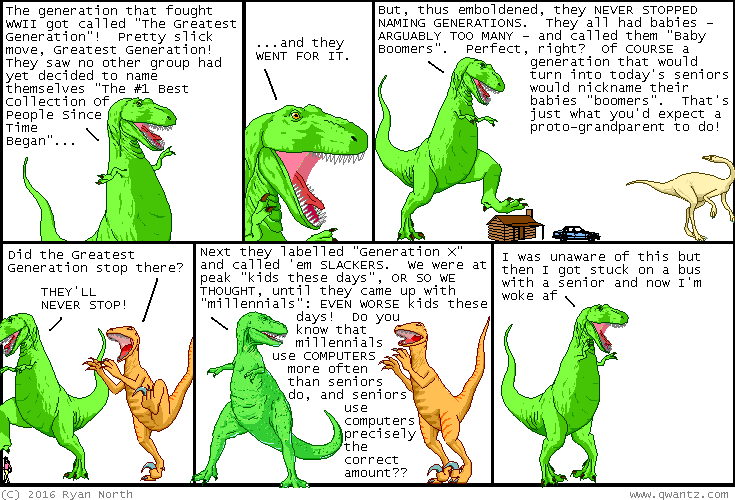



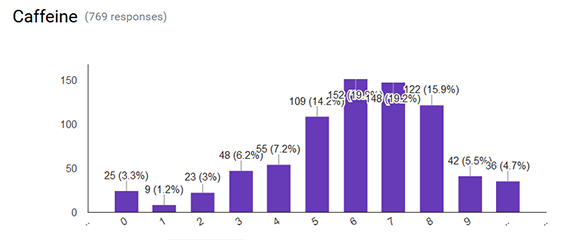
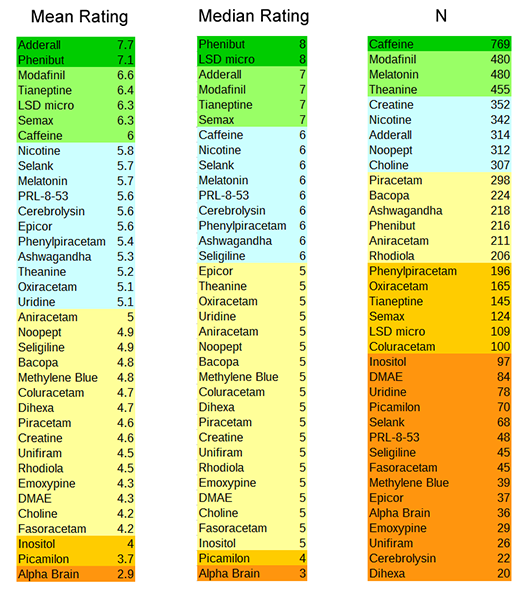 Median rating, mean rating, and sample size for each nootropic. You can find more information on the individual substances here
 Percent of responders who rated each nootropic at least five (the middle rating) or ten (the highest rating)
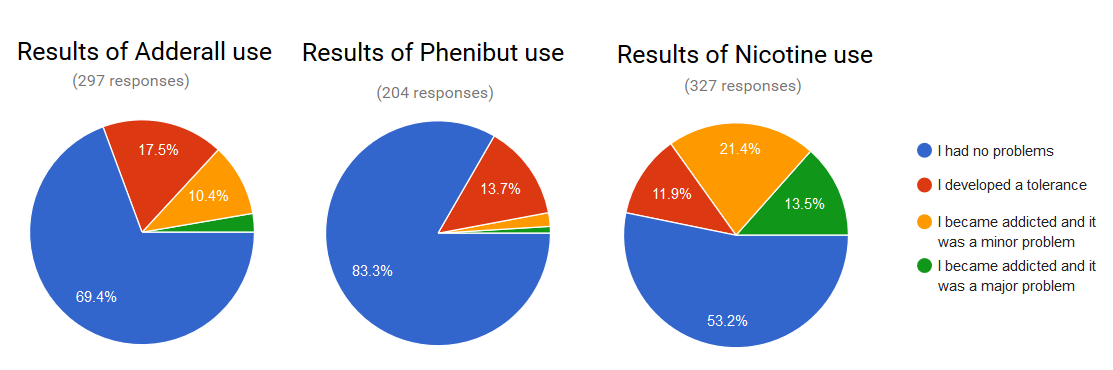




 atheist_cheese asks a great question: