Shared posts

15 Apr 10:13

Jeremy Corbyn grows up 30 years overnight

by Jonathan Calder
"I knew him when we were 18 or 19, and his views have not changed. We are talking about the thick end of 50 years ago."
So said one of Jeremy Corbyn's old friends when interviewed by the Shropshire Star last year.

That planting a red flag on top of the Wrekin is the most endearing thing I have read about Corbyn, but his friend's comment did play into the fear that his politics do not represent an engagement with the world around him.

So it was good to hear him today accepting political reality and arguing Britain should remain in the European Union.

As Martin Kettle says:
The Labour leader finally caught up with the pro-EU shift that his party made under Neil Kinnock in the 1980s.
That pro-EU shift did arise partly out of despair at Margaret Thatcher's repeated victories, but it also recognised that the world was changing. Westminster was not the only seat of power, and battles that could not be won there might be won somewhere else.

Throughout this period, Jeremy Corbyn clung to his anti-EU beliefs. He was a supporter of the Labout left's 'alternative economic strategy' and its emphasis on import controls.

There is a danger in getting less radical as you grow older - "I used to be a bit of a firebrand when I was your age, but you can't change human nature" - but there is a greater danger in living inside your head and not engaging with contemporary problems.

Somewhere in the background of every young radical is the ghost of Billy Liar and his imaginary kingdom of Ambrosia.

So I was pleased to see Corbyn accepting reality and arguing for continued British membership of the EU.

For the result of Brexit would not be the socialist paradise of his dreams, but - as he recognised - a more right-wing government glorying in the opportunity to remove protection from British workers.

Someone should tell Jenny Jones the same thing when it comes to environmental legislation.

Martin Kettle goes on to say:
Meanwhile the feebleness belongs to David Cameron. He called this referendum. He always knew he would be campaigning to stay in Europe. But he did little to prepare the ground and has given practically no thought to the alliances that will be required to ensure a remain win. A reckless budget and an inept response to the Panama Papers means that Cameron comes to the campaign starting line like an athlete lining up for the race of his life after a night on the tiles. 
All of which adds up to the extraordinary truth that, for once, Cameron desperately needed Corbyn to rise to the occasion. Labour votes will be crucial on 23 June, and until now Corbyn has allowed the idea to get around that he is not massively bothered by the outcome of the referendum. That made Thursday a speak-for-England moment for a Labour leader who is an instinctive sectarian – yet it was one that he seized.
This is a little strong: I doubt that Corbyn will appeal to the sort of Labour voters who are or have been tempted to vote Ukip,

But he is right that Cameron has been feeble. And not just Cameron.

I wrote in Liberal Democrat News (remember that?) five years ago:
For years the main parties have engaged in something close to a conspiracy. The issue of Europe has been taken out of general elections, with the promise that it will be decided through a referendum. Those referendums never take place. The result has been an infantilisation of debate on Europe, as politicians are allowed to take up self-indulgent, extreme positions they know they will never have to defend to the electorate.
Well, that referendum could not be put off for ever and it is fast approaching.

The political class will survive it unscathed: it is the rest of us who will suffer.
15 Apr 09:19

How to Write a Haiku

by Scott Meyer

I could have written the haiku in panel three better. It should have read:


“The two Adamas.

Which one is better: Olmos,

or perhaps Lorne Greene?”


It loses the Miami Vice and Bonanza references, but it’s clearer, which is usually for the best. And for the record, I prefer the Edward James Olmos Adama to the Lorne Greene version, but that’s just me.

On a semi-related note, what’s the deal with Canadians and the name Greene (or Green)?

Lorne Greene

Graham Greene

Tom Green

Red Green


Coincidence, or conspiracy?


Note from Missy:

Haiku Poetry

Day is April Seventeenth.

Such perfect timing.


You can comment on this comic on Facebook.

As always, thanks for using my Amazon Affiliate links (USUKCanada).

14 Apr 13:43

Why Twitter doesn't work, Labour won't win and the Lib Dems are irrationally cheerful

by Jonathan Calder


It's hard to have sensible conversations with people from other parties on Twitter. Too often, name-calling or petty point-scoring takes over from rational discussion early in the proceedings.

Labour activists find it particular hard to talk to Conservatives because they have convinced themselves that the Labour Party is the fount of virtue. Therefore, they reason, anyone who votes Tory must be an evil person.

Let's call it the Hesmondhalgh Doctrine.

It's predominance in Corbyn's Labour Party mean that it cannot talk to the many voters who have no great love for the Conservative Party but suspect that it is more to be trusted from an economic point of view than Labour.

Meanwhile many Liberal Democrats, when they have been traumatised by the result of the last general election, shrugged, declared a #libdemfightback and carried on as if not much had happened.

An article in the New York Times by David Brooks puts a finger on the social changes that are behind these phenomena.

He writes:
In healthy societies, people live their lives within a galaxy of warm places. They are members of a family, neighborhood, school, civic organization, hobby group, company, faith, regional culture, nation, continent and world. Each layer of life is nestled in the others to form a varied but coherent whole. 
But starting just after World War II, America’s community/membership mind-set gave way to an individualistic/autonomy mind-set. The idea was that individuals should be liberated to live as they chose, so long as they didn’t interfere with the rights of others. ... 
The individualist turn had great effects but also accumulating downsides. By 2005, 47 percent of Americans reported that they knew none or just a few of their neighbors by name. There’s been a sharp rise in the number of people who report that they have no close friends to confide in.
Brooks cites Marc J. Dunkelman, author of The Vanishing Neighbor, as arguing that
people are good at tending their inner-ring relationships - their family and friends. They’re pretty good at tending to outer-ring relationships - their hundreds of Facebook acquaintances, their fellow progressives, or their TED and Harley fans. 
But Americans spend less time with middle-ring township relationships - the PTA, the neighborhood watch.
These middle-ring relationships sound like Edmund Burke's little platoon and Dunkelman sounds very like Robert Putnam, whose Bowling Alone we all read at the turn of the century.

What has this to do with the state of party politics?

Brooks continues:
With fewer sources of ethnic and local identity, people ask politics to fill the void. Being a Democrat or a Republican becomes their ethnicity. People put politics at the center of their psychological, emotional and even spiritual life. This is asking too much of politics.
Once politics becomes your ethnic and moral identity, it becomes impossible to compromise, because compromise becomes dishonor. If you put politics at the center of identity, you end up asking the state to eclipse every social authority but itself. Presidential campaigns become these gargantuan two-year national rituals that swallow everything else in national life. 
If we’re going to salvage our politics, we probably have to shrink politics, and nurture the thick local membership web that politics rests within.
He goes on to say we should "scale back the culture of autonomy," which makes my liberal hackles rise and suggests Brooks too is in danger of wanting the state to eclipse every other social authority.

As a liberal I believe in individuality, and we express our individuality through the groups we choose to join. There must be a liberal route to the revival of social bonds.

But the idea that we are asking too much of politics is one I have long been toying with.

Political activists do tend to make their political affiliation central to their identity. More than that, they find their social life, their friends, even their partners, through their activism.

That party membership is such a minority taste now suggests that the 19th-century model of political parties we still embrace is hopelessly outdated.

Yet no politician has the vision or overweening ambition to wrench it apart and allowing something more attuned to our needs today to take its place.
14 Apr 13:37

DeDRM Tools 6.4.1 Released

by Apprentice Alf

Version 6.4.1 of the tools is now available. Please update to the latest version if you are having issues.

DeDRM_tools_6.4.1.zip can be downloaded from
https://github.com/apprenticeharper/DeDRM_tools/releases/tag/v6.4.1

Changes in 6.4.1:

  • This release fixes a problem with interpreting Topaz ebooks from Amazon. There’s no need to update unless you’re having problems with decoding a Topaz ebook from Amazon.

To leave a comment, see the previous post: DRM Removal Tools for eBooks.


14 Apr 12:27

there's no rule that says a dog can't do a lot of things

archive - contact - sexy exciting merchandise - search - about
← previous April 13th, 2016 next

April 13th, 2016: I can just see a campaign poster of President Dog with "DON'T WORRY" at the top and "HE'S FRIENDLY" at the bottom. WE COULD LIVE IN THIS WORLD, IF ONLY WE HAD THE POLITICAL WILL!!

– Ryan

14 Apr 11:37

Gone Yard

Andrew Hickey

Sharing for one line that Holly might appreciate... or not...

It’s baseball season, and that, friends, is the best of all seasons.

Baseball writers, who, given their love of a game that has historical weight over all other American sports, tend to be a poetic and sentimental lot, even more obnoxious than people who mark out over other sports.  They’re not quite as obnoxious as football writers, but they make up for it with their wobbly rhapsodizing; they even manage to be more pretentious than soccer journalists, who have the added benefit of being European.  It’s quite an accomplishment, when you think about it.

Anyway, one of the most cherished myths of the baseball hack is that baseball begins in the spring, the season of life, when the weather is changing and everything is growing, and this symbolizes the endless potential of humanity and something something oh the kids are all in the other room watching basketball on the big TV.  As with most such eternal verities farted out by old white guys from the East Coast, it is total nonsense.  Baseball actually begins at the end of winter, when pitchers and catchers report, and carries on into spring training, an egregious misnomer based on the fact that it is played exclusively in Florida and Arizona, which do not have seasons.  Once regular games begin, it is April, and while that’s arguably the magniloquent springtime of journalistic legend in Texas and California, in the rest of the country, it’s still godawful cold weather.  I went to opening day in Chicago for eight years in a row and it was a miserable slog every time, and for a week before this year’s White Sox home opener, it was apocalyptic.  The first game at White Sox Park wasn’t notable for how badly the Good Guys got thumped, but for how it somehow managed to be sunny and clear and also 30 degrees with periodic blizzards at the same time.

A companion myth is that the excitement of Opening Day, which is really just attributable to the fact that the weather is becoming moderately less dreadful and that football is finally fucking over, is because “anything can happen” and “any team can win”.  This is abhorrent nonsense.  The San Diego Padres, for example, or the Philadelphia Phillies, were in essentially the same position on Opening Day of the 2016 season as they were on the last day of the 2015 season, and stand about as much chance of appearing in the playoffs come October as Manchester United has of winning the Stanley Cup.  That’s not to say that the early goings aren’t interesting, of course; as a fan of the Chicago White Sox, I always enjoy watching Cubs fans hollering about how this year for sure they’re going to win the World Series come April 1st, and I also enjoy seeing what development (this year, it was the early career-ending injury of slugger Kyle Schwarber) what will make that result unthinkable by April 15th.

All of this is to say is that for all of our talk about how spring is the time of renewal, baseball doesn’t really start to matter until June at the earliest.  It’s a game of summer.  Of course I’m excited about baseball; of course I’m going to watch every White Sox game on TV and go to the ballyard as often as I can.  There’s even some exciting early-season fun, like speculating whether the Baltimore Orioles will ever lose a game again, or whether the Minnesota Twins will ever win a game again.  But 162 games is a lot of games.  I’d rather eat a beanbag chair than watch an NFL game, but it’s a fair point that in pro football’s 16-game season, everything matters. Even a devoted baseball fan like me could take a nap, wake up on Father’s Day, and not really feel like I’d missed that much.

But still, this is the time of year we have to deal with the utter worst of flowery sportswriter tripe (here’s an amazing example from Tim Keown’s article at ESPN on Mendoza-line-courting overparenting enthusiast Adam LaRoche, which contains the phrases “the molecules traveled their viral tributaries” and “they wielded their emotions like crude homemade weapons”).  2016 is going to be particularly bad, because the MLB instituted a handful of rules changes last year, and the ‘purists’ (which is baseball code for humorless scolds) are feeling the last of their oats before they succumb to nut cancer.  We’re of course going to hear the usual moaning about the designated hitter rule from people who think the entire enterprise will be sullied if we aren’t treated to the hourly tragedy of watching pitchers try to hit, but this year we get an additional bunch of whinging about new baserunning rules, some leftover nonsense about instant replay, and coded racism imported from the NFL about how certain players (ahem) are making a mockery of the game with their home run trots and their bat-flipping and their gold chains and their rock and roll and their hair.  Bob Costas didn’t die from the eye crud and now we have to deal with Goose Gossage blowing hot farts about how computer nerds destroyed baseball.

The thing is, I agree with a lot of this stuff!  I am unflagging in my love of the designated hitter rule, but I don’t like that hitters wear body armor, I think it sucks that they’re trying to discourage baserunners from breaking up plays at second and home, I love pitchers who plunk hitters for pretty much any reason at all, and I wish the pitcher could still own the inside unless the hitter was gutsy enough to risk getting pummeled.  Even though I hate the old-school horseshit about ‘character’ and ‘gut feelings’ and ‘intangibles’, I’m still distrustful of SABRmetrics because it still never manages to predict anything worth knowing.  But these issues are never discussed honestly; they’re just eructated randomly as part of the old folks’ tirades about how when they were kids things were super cool and great but the kids now are into real dumb shit and why can’t we ruin their fun so that way no one will have any at all.  It’s not only boring and pointless, it’s the worst possible way to attract young people to a sport that’s losing fans every generation.

So, in short, baseball fans, players, ex-players, owners, officials, journalists, and everyone else involved in the sport are awful and should all be shunned.  But baseball, the sport, is beautifully paced, brutally strategic, brilliantly strategic, incredibly beautiful, and irresistibly dense.  And, on top of all that, it’s so much fun.  I couldn’t be happier it’s back, and not even all the people in it can make me stop loving it.

Mirrored from LEONARD PIERCE DOT COM.

14 Apr 11:22

Rejection, Part 8

by evanier

rejection

Here's yet another of those articles where I share what little I know about the writing business just in case there's anyone out there who knows less. Part 1 can be read here, Part 2 can be read here, Part 3 can be read here, Part 4 can be read here, Part 5 can be read here, Part 6 can be read here and Part 7 can be read here. Part 8 begins now…

If you want to stop being an amateur writer, it helps to stop acting like one. This will probably not, in and of itself, get you work but it may remove an important obstacle that is making that less likely.

There are lots of amateurs around and there's a reason that some of them remain amateurs: Their work isn't that good. If you have never been in a position to hire writers and been deluged with submissions and applications, you may not realize how many people there are out there who want to be writers who aren't that good. It's probably more than you imagine.

Anyone who's in a position to hire writers or buy their work for any length of time has seen plenty of them. And if you in some way resemble them…well, you don't want to do that. It causes your submissions or samples to not be taken seriously and not given even the shortest of shrifts.

Every editor or producer has some indicators in this category. One of the most prevalent is a kind of mindless sense of oversell and bragging. Put simply, the top writers do not have to tell you how good their work is. If anyone will, it's their agents but they themselves don't feel a need to try and convince you. If anything, their work and their credits will convince you. Amateurs, however, usually think they have to. And then the potential buyer of your writing thinks, "He's pretty desperate so he's probably not very good."

I don't particularly enjoy being in a position to buy work from or hire other writers. Given the choice of one, I would much, much, much, much (add at least three more muches in there) be the writer than the editor. But occasionally, I have been in an editorial position and I was amazed, as stated above, how poor or inappropriate some of the submissions were. I was also amazed how many people tried to sell their writing with a sales pitch as opposed to letting their writing speak for them. The merits of the writing were all that interested me.

A very common mistake — I thought — was to quote what others had said. One applicant said in a cover letter, "Three different writing teachers told me my work was excellent. One said I had the potential to be the next Kurt Vonegutt." I of course wrote back to him that he couldn't be the next Kurt Vonnegut until he'd learned how to spell the first Kurt Vonnegut's name…and while I was at it, I also told him I wasn't looking for the next Kurt Vonnegut. The gig he was applying for, as he well knew, was writing for the Richie Rich cartoon show. Mr. Vonnegut was among my all-time favorite writers but I was not sitting there thinking, "Gee, I wish I could find the next Kurt Vonnegut because he'd be so ideally suited for Richie Rich."

Beyond all that, there's this: Why should I care in the slightest what three writing teachers I never heard of allegedly thought? There are writing teachers in this world who can't tell good writing from bad, and they certainly have no idea what I'm looking for. There are also writing teachers who will tell you your work is good because you're paying them…just as you have friends who'll tell you it's brilliant to make you feel good and/or to get you to go away.

You know what a lot of editors and producers think when you tell them how simply brilliant your work is? A lot of them feel insulted; like you think they're so dumb that that will mean something to them. They think to themselves, "Hey, pal…I'll decide if it's brilliant." They also worry that you may have a bit of an ego problem.

Remember that the person who's considering buying your writing or hiring you to write is asking him- or herself two questions. One is whether you're capable of producing work that fits their needs both in terms of style and quality. For the most part, they will make that decision based on reading your work, not on how you hype it. Then there's the other question, which pretty much comes down to "Can I work with this person?"

Will you be reliable? Will you give me grief if I tell you something needs a rewrite? Will we have the kind of rapport I need to have with someone? This is where what's on the paper isn't as important as how you come across. This is where being pushy or frighteningly in love with your own work may make someone think you might be trouble. Not long ago, a movie producer told me that she has found some good, new filmmakers for high-level projects by looking at low-budget student films. Of course though, that means sitting through a lot of bad ones.

We got to joking about how in such productions, the lower the budget is, the more times the people in charge will put their names in the credits. I don't remember the name of the guy about whom she told me the following but let's say it was Harvey Lipsitz. She said, "The film he made wasn't bad but the credits…oy! It said, 'Produced by Harvey Lipsitz, Directed by Harvey Lipsitz, Written by Harvey Lipsitz and Someone Else, Based on an Idea by Harvey Lipsitz, Cinematography by Harvey Lipsitz, Costume Design by Harvey Lipstiz, Music by Harvey Lipsitz…' He probably ordered lunch delivered himself just so he could put down 'Catering by Harvey Lipsitz.' And then at the beginning of the film, he gave himself a possessive credit. It said 'Harvey Lipsitz's' before the title and at the end, it said 'A Harvey Lipsitz Film.' And this wasn't a joke."

She said it made her decide not to get into business with Harvey Lipsitz.

None of this is to suggest one should not promote and sell one's work and one's self. But just as a car salesman can sell you so aggressively that you think, "Gee, there must be something wrong with that Hyundai," a writer can sell his or her work in a way that makes you wonder if just maybe there's something wrong there. If you're going to sell, sell with a little class and wit and please, please don't sell so hard you appear desperate. Desperate is not a quality that makes people think, "Hey, this person must be a good writer." It makes them think you're an amateur.

The post Rejection, Part 8 appeared first on News From ME.

14 Apr 11:00

Tricky Dicky, Part 6: Dress Modern

by Jack Graham

We are now in an odd, reversed position when it comes to William Shakespeare and Richard III: all of a sudden, and for the first time, we seem to know where Richard III's head is, but not where to find Shakespeare's.

I’ve written in previous instalments of this series about the relationship between Richard III (the man), Richard III (the play), William Shakespeare, and history. 

Essentially, my argument is that William Shakespeare was, for various reasons to do with his class position, his family, his career, and the historical moment and social milieu in which he found himself, peculiarly well placed to dramatise social energies, feelings, anxieties, and vertigos, which still speak to us today.  He was writing at the dawn of modernity, during the years immediately following the end of the medieval, in the immediate aftermath of the English Reformation… all of which is related to the fundamental fact that he was writing during the transition from feudalism as the dominant economic form of English society to capitalism.  We still live with the energies and dystrophies of modernity, since we still live in capitalist society.  Indeed, Shakespeare has in some ways only become more relevant as capitalism has become more predominant.  He dramatises some of its foundational myths, legends, conflicts, and anxieties.  He offers a still relevant interrogation of much foundational bourgeois ideology that has gone on, in mutant form, to become hegemonic.  His drama is based on people torn apart in social struggles, and though feudalism is long dead in Western Europe, we still today understand the feeling of being pulled between the imperatives of capitalist society and other non-capitalist instincts.  As I said before, I don’t claim that any of this constitutes any particularly original insight on my part… though I may be slightly original in claiming that part of why we continue to find Shakespeare compelling is because he wrote about life during the phase of ‘primitive accumulation’ and, at least according to David Harvey drawing on Rosa Luxemburg, primitive accumulation has never quite gone away.   Capitalism has always accumulated primitively, and this has only become more noticeable in the Western world with the rise of neoliberalism, which has cannibalised social wealth built up during the years of social democracy.  Moreover, Shakespeare is embraced and performed in many other parts in the world than Europe, including places wracked by even more violent and rapacious forms of present-day primitive accumulation, usually practiced via Western economic and/or military imperialism, and/or corporate extortion.

One of the ways in which theatrical performances attempt to express, mediate, or emphasize Shakespeare’s continued ‘relevance’ is through modern dress productions.  There’s an interesting irony about modern dress productions.  They are almost the rule rather than the exception these days, and yet you still hear people say they dislike them.  And yet it would be fair enough to describe what Shakespeare and his company did on stage at the Globe and the Blackfriars as modern dress productions.  It appears that they did not generally try to present the past as looking much different.  Julius Caesar, King Lear, and many other Shakespeare plays are set in ‘the past’ and yet 16th/17th century actors would have performed many of these roles wearing 16th/17th century togs.  The main thing was that the costumes should be interesting, gorgeous, visually arresting.  Theatrical companies and theatre managers seem to have bought expensive and luxurious aristocratic clothes from servants who were left them in their masters’ wills.  The masters would have expected their servants to sell the clothes and make some money.  Indeed that would have been the point of the bequest, since ‘sumptuary laws’ strictly controlled what you were allowed to wear according to your social position, and servants would have been in a lot of trouble if they’d gone around wearing fine and dandy upper class clobber.  Early Modern theatrical companies considered costumes hugely important, and spent a lot of money on them.

The Peacham Drawing is the only surviving contemporary illustration of the performance of a Shakespeare play by Shakespeare’s company.  It shows a scene from Titus Andronicus, a Roman tragedy and one of Shakespeare’s earliest plays (probably written in collaboration with George Peele).  The drawing (which is housed at Longleat, interestingly enough) shows an attempt to reflect the classical subject matter in the costumes, but also shows other figures on stage in 16th century clothes.  


Now, obviously, you can’t object to modern dress.  I’ve seen some great modern dress productions.  And theatre isn’t just a dry exercise in exploring theme and context.  It isn’t the job of a production to analyse the contextual historical significance of a play.  The job of a production is to turn words on a page into an enjoyable evening.  However, I confess there’s a part of me that grieves when a modern dress production scrambles the meaning of a play into incomprehensibility by cloaking it in irrelevancies. 

I saw Patrick Stewart play Macbeth on stage in 2007, and as good as he was (and he was), and as good as the rest of the cast were (and they were), and as cleverly done as it was done (and it was done cleverly), the decision to give the production a ‘soviet’ feel, with Macbeth becoming a kind of Lenin/Stalin-figure (as in Animal Farm, the two are misleadingly elided), seemed an example of grafting an anachronistic extra layer of valences and implications onto a text already rife with valences and implications of its own which don’t, if we’re honest, have much to do with the history of early-to-mid 20th century Russia.  It didn’t help that the toying around with communist imagery seemed to amount to little more than window dressing, justified in the programme by strained and forced analogies between Shakespeare’s tale of political tyranny and modern totalitarianism.  This analogy really is deeply ahistorical and misleading, tying a deeply facile mainstream view of soviet communism to a reductionist view of Shakespeare which has him as a sort-of liberal moraliser who addresses ‘universal’ faultlines in human nature.  This is, of course, perhaps the most fundamental and common - or do I mean hegemonic? - underlying view of Shakespeare… and it’s wrong and stupid.

I mean, on the most facile level, the tacit assumption of a production which likens Macbeth’s rise to the rise of Lenin/Stalin/Communism is that it presents, in a simplistic and abstract (and thus allegoricalised) way, communism as an irruption of tyranny which mysteriously negates what we could call ‘normal freedom’.  The mystery of where the negation comes from it one issue (the answer really does seem to be: 'bad guys', with a side order of that old favourite 'human nature').  Also, this 'normal freedom' is inevitably going to be associated, by implication and via normative assumptions, with non-communist forms of the 20th Century.  The presence of communism as a negation implies its purported opposite.  We can acknowledge that Stalinism was greatly more authoritarian than Euro-American democracy while, at the same time, not endorsing the way in which it was, and is still, portrayed as an irrational and endlessly hostile evil in capitalist ideology, which seeks to absolve Euro-American imperialism as a corollary.  The association of the irruption of Macbeth's semi-supernatural and blood-caked rise to political power with communism is automatically going to work in the same ideological system, even so long after the Cold War.  Indeed, in 2007 - which was before the sudden upsurge in conscious ideological management in the entertainment industries which was necessitated by the Great Recession, etc - this very reiteration of such ideological Cold War narratives only becomes more abstract and allegorical precisely because it lacks a present-day real-world referent.

Moreover, the use of the Early Modern text to conveigh such supposedly near-allegorical eternal verities of liberal politics can only work by distorting it and its historical context, and by association our understanding of Western Europe's own political history.  The freedom that Stalin/Macbeth seems to negate is an assumed basic 'normal' level of social existence upon which tyranny suddenly wreaks havoc… and yet, as we’ve seen, the social norm in Shakespeare’s society (let alone medieval Scotland, which is where the play is nominally set) involved things like sumptuary laws, a strict and state-imposed universal dress code which both ruthlessly enforced and publicly illustrated complex and subtle gradations in social status.  Surely, by modern liberal mainstream standards - which are the standards with which the production chooses to associate itself since it sets itself in a kind of abstracted mid-20th Century which is then clucked at moralistically - this would be seen as ruthlessly repressive, an intrusion of the state into personal lives, a 'totalitarian' measure.  This tacitly misrepresents the play as coming from a set of assumptions grounded in a liberal consensus about social freedom.  But that's anachronistic, and thus effaces the true historical nature of Western societies.  Not only that, but it also sets up a tacit false opposition between this implied past, which has had all its own authoritarianism scrubbed away, and the history of 20th Century Russia, which is set up as an example of an irrational tyranny which arises from ahistorical causes.  Whatever you think about what communism was, what it became, and how the whole thing happened, at the very least you have to admit that we're not being given any insight here.  On the contrary, the record is actively being disorted... and guess what, the distortion runs in an ideological direction which tacitly positions communism as an irrational evil which stands in opposition to assumed eternal standards of what could be called 'normal freedom', i.e. 'us'. 

You could argue that the job of a theatrical Shakespeare production is not to give us historical insight on communism... and you'd have a point (which is also kind-of my point)... but then why invoke the aesthetic of soviet communism in your re-summoning of Macbeth?  Okay, it makes everything look pretty... it all takes place in a kind of deracinated, soft-gothic, 'dark' mid-20th century... but you end up with little more than 'soviet chic' as a decoration on top of what are, basically, some very dull and hegemonic ideas.  The dull and hegemonic ideas also happen to actively distort the text by de-historicising it, even as extra layers of history are slathered over it.

Shakespeare's plays are very rooted in their own time and place, and ignoring that not only diminishes their complexity but also sends them off free-floating into a sort of cloud of thematic vapour, where they become ‘about’ atomised and reified idea/things like Ambition and Evil and Love, etc.  This isn’t just bad for them as texts, it allows the very ideological co-optation I just described, through the shearing away of historical context.  This isn’t (usually) a big conspiracy of course, it happens almost by accident, almost as a self-organizing phenomenon, when these texts land in a sea of hegemonic ideological assumptions without any of their original historical embeddedness… and I’m now drowning in so many mixed metaphors that even the Bard himself would raise an eyebrow and say “steady on mate”.  And he liked his mixed metaphors did the Bard. 

To be clear, I’m not worried about historical ‘accuracy’ as such.  One of the mistakes I at moments made when I wrote about ‘The Shakespeare Code’, and about Merlin and villains, was to allow myself to sound like I was assessing the quality of fictional texts set in the past based on how ‘accurate’ they were.  That’s not what I’m about.  Shakespeare himself paid little attention to historic ‘accuracy’ when setting his own plays in the past.  Plays like Pericles and Timon, both supposedly set in ancient Greece, are stuffed with inaccuracies and anachronisms… and, more profoundly, are fundamentally based on peculiarly Early Modern habits of thought, ideas fashionable in 16th/17th century English literary culture, etc.  Famously, Shakespeare puts references to mechanical clocks into Julius Caesar.  History, as a discourse and field of study, didn’t really exist in a form we'd recognise in Shakespeare’s time, so it’s hard to know how he (or any of his contemporaries) could really have gone about investigating historical ‘accuracy’.  And they didn’t.  They read their classical authors like Plutarch, and took it from there.   Similarly, they were not remotely shy about projecting contemporary perspectives on British history back onto their own recitations of events from the chroniclers.  Many of the characters in Shakespeare’s Second Tetralogy (Richard II, Henry IV Parts1-2, Henry V) seem strangely aware of the looming possibility of the Wars of the Roses as a punishment to be visited upon the land if Richard II is deposed, or if monarchical legitimacy is not then restored, etc.  Shakespeare is writing stories about the past based in the thoughtworld of his present, based on his world’s perspectives. At a crude level, he is hooking his writing into then-current anxieties about the sucession, and the possible political consequences for everyone if it turns into another argument.

This is why I like so many of the productions in the later end of the BBC’s Complete Dramatic Works of Shakespeare series.  As part of the funding deal with Time/Life, the producers of the series were limited to producing the plays in historical costume.  The early part of the series, as produced by Cedric Messina, unfortunately tended towards very literal-mindedly rendering the plays in a style very directly based on their subject matter.  The production of Julius Caesar, for instance, does the whole thing in togas.  They even hired the guy who directed I, Claudius to direct it, because he had experience doing in-period Roman stuff (though the idea that I, Claudius represents a faithful attempt at representing Roman history is laughable… what with it deriving so much of its power and wit from filtering Roman history through the manners and mores of the late-19th/early-20th Century upper middle classes of imperial Britain).  By contrast, when Jonathan Miller comes in as producer for series 3, the series branches out a bit in ambition, becomes more textually aware (they even change the titles to look like the pages of the First Folio), and starts using its remit more flexibly, pushing as far as possible against its limitations, an approach which continues when Shaun Sutton takes over for the last lap.  In this latter half of the series, you get productions set in a non-specific and generic past, productions where the setting and costumery is based on paintings (the excellent version of All’s Well That Ends Well seems to take place inside a Vermeer canvas), and productions where the resolutely and distinctly 17th Century concerns of plays like Antony and Cleopatra, Troilus and Cressida, Timon of Athens, etc, are emphasized by simply setting them in the 17th Century, no matter that they ostensibly take place in ancient Rome, ancient Troy, and ancient Athens respectively.  It really is hard to beat the frisson of history one gets from seeing these fascinating plays performed in such a way as to shine a spotlight onto the historical context from which they emerge.  (It helps that they’re all excellent productions of endlessly engaging plays.)

Shakespeare was writing them in the 17th Century and for the 17th Century.  He was (quite consciously, I think) using them as a way of interrogating and negotiating the meaning of his society as it underwent vertiginous and disorienting change.  You might be tempted to say “No Jack, he was writing popular entertainment in order to make some money” and I’d agree with you, but I’d add the wrinkle that what he wrote about was popular with so many people precisely because it addressed things about their changing world that they wanted and needed to see presented in a discursive, dramatic, thoughtful, interrogative way.

And this is what you want from drama.  And it’s what Shakespeare provides, in spades.  However, I actually think that you lose some of the wide-ranging power of these dramatic and discursive interrogations when you confine them or narrow their scope by imposing overly specific systems of references on them via themed modern dress productions.  The Patrick Stewart Macbeth I mentioned above is a case-in-point. 

Relatedly, via the ideological marker of what is called ‘totalitarianism’, there is the famous stage production of Richard III starring Ian McKellen, which was later adapted (partly by McKellen himself) into a film.  This film is set in an alternate 1930s England, just after a historically relocated version of the Wars of the Roses.  Richard’s usurpation of the crown becomes the rise of a modern dictator, and as Richard finally achieves power, he is saluted by massed crowds of chanting, marching, uniformed fanatics.  Red banners unfurl behind him, bearing his symbol – the boar – stylised in black on a white disc, and looking uncannily familiar…


But we’ll go into that another time.

See, I told you all that stuff about Hitler last time wasn’t just a pointless diversion.


14 Apr 10:09

Autism, Asperger’s and Surviving in the Workplace

by Gavin Bollard
For many people with autism, getting a job is a pretty difficult prospect in itself but once they have one, the difficulties shift towards keeping the job.

Keeping a job when you are on the autism spectrum seems to be a matter of maintaining the delicate balance between being largely invisible and not being too quiet.

Hiding in Plain Sight 

For many people, the word “autism” conjures up bad images. At one end of the spectrum, people assume that they are hiring a person who will need babysitting rather than someone who will perform their allotted tasks independently. At the other end of the spectrum, people think of the high school shootings or computer hackers and sense danger in employees on the spectrum. 

Of course, we've just had “autism acceptance month”, so everyone is fine with it all now right? Wrong. What people say and what they do are very separate things. If it was that easy to conquer fear and discrimination, there would be no reason to discuss racial issues any more.

We can control, to some extent, what people say and do but we don't have any power over their thoughts - or the things that they say and do in secrecy.

For the time being, until you are an accepted and valued person on your own merits at your workplace, it's best not to disclose that you have autism - unless of course your traits are significant enough that most people will notice them without you having pointed them out.

It's not legal to get rid of employees simply because you discover that they have a medical condition but that won't stop a determined employer from finding or arranging another excuse.

Hostile Workplace Environments

When you start a new job, you generally start at the bottom of the corporate ladder doing the most menial jobs. This is true whether you're a school leaver or a university graduate.

Everybody has to start somewhere and unfortunately, the lower positions can be fairly competitive in terms of promotion prospects. They're also positions which are filled by less educated people or by other school leavers who are just getting their first taste of freedom and don't know how to behave in the workplace.

Consequently there is a lot of teasing, jostling and bullying happening in the lower levels of every workplace.

Bullying in the Workplace 

Different Jobs come with different levels of professionalism. For example, you have to expect that a job at a fast food outlet won't command the same professionalism from fellow employees as an office or bank job.

Your fellow workers at fast food outlets tend to be young and inexperienced. They're less likely to be understanding of people with differences - and of course due to the noisy, smelly and greasy environment, fast food outlets are more likely to trip autistic sensitivities than most jobs.

That's not to say that there's no bullying in office environments. Sometimes office bullies are worse because office bullying tends to be done by adults with a long history of manipulating people to achieve their intentions. Office environments in particular tend to attract sociopathic workers.

Hardening Yourself 

In the school yard, you can report bullies to the teachers and occasionally things don't go worse for you.

In the workplace, despite all of the laws and social commentary that says otherwise, it's almost impossible to report a bully and survive, particularly if you're a junior.

The answer is to harden yourself against the bullying and attempt to shine through. Note that hardening yourself means to refuse to allow the bullying to affect you, rather than to attempt to fight back. If you fight back in the workplace, you may spur the bully into further acts and if you come off as aggressive, you will be caught by management.

Harden yourself by trying to think positive. In particular, don't take all corrections as criticisms. Some people sound nasty in your own head when you read their emails - or even when you listened to them but they don't always mean to be that way. Some people simply have angry sounding voices or "angry-looking" faces.

You have to be mindful that much of what you get out of communication depends on what you bring to the conversation. 

Of course there are other people DO mean to be that way but there's not a lot you can do about them.

One of the best things to do is to try to only provide positive reactions. Remember, if you “lose it in a job”, you generally lose the job. Be nice and "presume" no matter how wrongly, that people mean the best. It will help you be happier and for the most part it will make people at work happier to interact
with you.

Being pleasant to work with will attract other pleasant colleagues and positive mentors. Eventually, these people will make it hard for workplace bullies to ruin your day. 

Find Happiness

You can't undervalue happiness. If you're sad or depressed at work, it will be noticed and your colleagues and supervisors will assume that you don't want to work there and get rid of you.

It sucks but it's true. No matter how much pain suffering and trauma you have in your life, the workplace is generally unforgiving. Your issues will be tolerated for a short period of time, depending upon your popularity, how long you have worked there and how valuable your contribution towards the workplace is.

You're not irreplaceable however and that means that you need to give the impression that you're happy -- even when you're not.

Practice fake smiling, avoiding overly emotional discussions and keeping "bounce" in your voice. 

You're going out into the world of “plastic people”. Sadly, this means that you have to appear to be a bit “plastic” like them in order to survive.

13 Apr 10:26

The problem with almost all movies

by Ana Swanson
Rachel Orr / The Washington Post

Rachel Orr / The Washington Post

By now, most people have heard of “the Bechdel test.” To pass this famous three-part test, which measures whether female characters in a film are anything more than superficial, a movie has to (1) have at least two female characters (2) who talk to each other (3) about something other than a man.

It seems like a pretty low bar, but at least 40 percent of films fail, according to BechdelTest.com, a site that crowdsources these test results. “Birdman” fails. The "Lord of the Rings” movies all fail. “Harry Potter and the Goblet of Fire” fails. Even “Toy Story” fails. And it’s hard to think of a movie that doesn't pass the Reverse Bechdel test -- where two male characters don’t talk to each other about something other than a woman (according to the IMDB universe, some do exist).

The Bechdel test has its critics. Some films with prominent female roles, like Sandra Bullock in “Gravity,” don’t pass the test, while other films that are male dominated or sexist do. But, as Walter Hickey wrote for FiveThirtyEight.com in 2014, for a long time the crowd-sourced information on the Bechdel test was the best data on gender equity in film that we had.

Two years later, we're amassing more data that gives a clearer look at the real role of women in film. In a new project, Hanah Anderson and Matt Daniels at Polygraph analyzed screenplays for 2,000 popular movies, and broke down the number of words spoken by male and female characters -- “arguably the largest undertaking of script analysis, ever,” they say.

To do the analysis, Anderson and Daniels mapped characters who have at least 100 words of dialogue in a movie from the screenplay to the actor's IMDB page. (They caution that their analysis is based on the screenplay, not the actual film – sometimes directors may cut or change lines from the screenplay, and or even change the name or sex of the characters. So there may be small variations between the screenplay and the final film, though the results should be fairly accurate.)

What they find isn’t that pretty. As the Bechdel test suggested, most popular movie scripts are dominated by male characters.

The graphic below shows their analysis for 2,005 screenplays. The dots on the left, in blue, represent films where more than half of the dialogue is spoken by a man. The dots on the right, in red, represent films where more than half of the words are spoken by women. As you can see, there are few films where even half of the dialogue is spoken by women, and quite a few films where 100 percent of the lines are male. (The original graphic is interactive, so you can click on the dot so see the name of the film.)

Hanah Anderson and Matt Daniels, Polygraph

Hanah Anderson and Matt Daniels, Polygraph

Overall, a woman ended up having the most dialogue (i.e., being the lead) in 22 percent of the films they looked at. In about a third of the films, a woman was in second-place in terms of having the most dialogue. And only in about 18 percent of films did women occupy at least two of the top three speaking roles. In contrast, men occupied at least two of the top three speaking roles in 82 percent of films.

Men consistently have more lines than women across different genres of film. Perhaps predictably, men dominate action movies:

Hanah Anderson and Matt Daniels, Polygraph

Hanah Anderson and Matt Daniels, Polygraph

But men also dominate comedies:

Hanah Anderson and Matt Daniels, Polygraph

Hanah Anderson and Matt Daniels, Polygraph

And dramas:

Hanah Anderson and Matt Daniels, Polygraph

Hanah Anderson and Matt Daniels, Polygraph

And even horror films. In case you're wondering, the all-female horror film is 2005's "The Descent."

Hanah Anderson and Matt Daniels, Polygraph

Hanah Anderson and Matt Daniels, Polygraph

Another major critique of Hollywood's gender issues is that women can only obtain big roles when they're young -- which is why movies feature so many female scientists, astronauts and criminal defense lawyers who are somehow all in their 20s. While men can get leading roles into their 40s and 50s, women disappear from the screen.

Anderson and Daniels's data confirms this. The graphic below shows the percentage of total words spoken by male and female actors, broken down by age. For women, 22-to-31-year-old actresses have the most lines, speaking 20 million words; for men, 42-to-65-year-old actors speak the most, with nearly three times as many words as the most outspoken group of women.

Hanah Anderson and Matt Daniels, Polygraph

Hanah Anderson and Matt Daniels, Polygraph

The trouble with princesses

The project was inspired in part by an academic study that my colleague Jeff Guo wrote about in January, in which linguists analyzed speaking roles in Disney films. That research showed that men spoke more often than woman in most of Disney’s princess films, like “The Little Mermaid” and “Mulan.”

That might not seem like such a big deal, but the researchers pointed out that little boys and girls watch these movies on constant repeat, and learn a lot from them. And one of the things that kids might take away is that most of the people doing anything useful or entertaining in these films are male.

“There are no women leading the townspeople to go against the Beast, no women bonding in the tavern together singing drinking songs, women giving each other directions, or women inventing things,” one of the researchers of that earlier study said. “Everybody who’s doing anything else, other than finding a husband in the movie, pretty much, is a male.”

[Researchers have found a major problem with ‘The Little Mermaid’ and other Disney movies]

Daniels and Anderson also looked at Disney movies, doubling the sample size from the original experiment. They found a similar result: In 22 of the 30 Disney films they looked at (the films listed on the left in the graphic below) men had most of the lines. In about five films (shown in the middle) the dialogue was relatively balanced, and only in the four films on the right did female characters have more than 60 percent of the lines.

Hanah Anderson and Matt Daniels, Polygraph

Hanah Anderson and Matt Daniels, Polygraph

As the Disney princess movies suggest, one of the most surprising results of this analysis is that men have more lines than women even in movies that are about women or made primarily for a female audience -- like “Pretty Woman” and “10 Things I Hate About You.” Even in the romantic comedies in their data set, men had on average 58 percent of the dialogue, Anderson and Daniels said.

See also:

How Hollywood privately talks about women, in 7 hilarious but awful tweets

Researchers have found a major problem with ‘The Little Mermaid’ and other Disney movies

What’s straight across the ocean when you’re at the beach

13 Apr 10:24

This study 40 years ago could have reshaped the American diet. But it was never fully published.

by Peter Whoriskey

(iStock)

It was one of the largest, most rigorous experiments ever conducted on an important diet question: How do fatty foods affect our health? Yet it took more than 40 years  — that is, until today —  for a clear picture of the results to reach the public.

The fuller results appeared Tuesday in BMJ, a medical journal, featuring some never-before-published data. Collectively, the fuller results undermine the conventional wisdom regarding dietary fat that has persisted for decades and is still enshrined in influential publications such as the U.S. government's Dietary Guidelines for Americans.  But the long-belated saga of the Minnesota Coronary Experiment may also make a broader point about how science gets done: it suggests just how difficult it can be for new evidence  to see the light of day when it contradicts widely held theories.

The story begins in the late 1960s and early ’70s, when researchers in Minnesota engaged thousands of institutionalized mental patients to compare the effects of two diets.  One group of patients was fed a diet intended to lower blood cholesterol and reduce heart disease. It contained less saturated fat, less cholesterol and more vegetable oil. The other group was fed a more typical American diet.

Just as researchers expected, the special diet reduced blood cholesterol in patients. And while the special diet didn’t seem to have any effect on heart disease, researchers said they suspected that a benefit would have appeared if the experiment had gone on longer.

There was “a favorable trend,” they wrote, for younger patients.

Today, the principles of that special diet — less saturated fat, more vegetable oils — are recommended by the Dietary Guidelines for Americans, the government’s official diet advice book. Yet the fuller accounting of the Minnesota data indicates that the advice is, at best, unsupported by the massive trial. In fact, it appears to show just the opposite:  Patients who lowered their cholesterol, presumably because of the special diet, actually suffered more heart-related deaths than those who did not.

The higher rate of mortality for patients on the special diet was most apparent among patients older than 64.

The blue line represents the mortality rate of patients on the special cholesterol-lowering diet. The dashed red line represents the mortality rate of patients on the conventional diet. The take-away: people on the special diet were dying at a higher rate. (Source: BMJ)

The blue line represents the mortality rate of patients on the special cholesterol-lowering diet. The dashed red line represents the mortality rate of patients on the conventional diet. The take-away: people on the special diet were dying at a higher rate. (Source: BMJ)


The new researchers, led by investigators from the National Institutes of Health and the University of North Carolina, conclude that the absence of the data over the past 40 years or so may have led to a misunderstanding of this key dietary issue.

“Incomplete publication has contributed to the overestimation of benefits and underestimation of potential risks” of the special diet, they wrote.

“Had this research been published 40 years ago, it might have changed the trajectory of diet-heart research and recommendations” said Daisy Zamora, a researcher at UNC and a lead author of the study.

The new research drew quick criticism, however, especially from experts who have been prominent in the campaign against saturated fats.

"The bottom line is that this report adds no useful new information and is irrelevant to current dietary recommendations that emphasize replacing saturated fat with polyunsaturated fat," Walter Willett, chair of the nutrition department at Harvard University, said in a blog post from the school. "Many lines of evidence support this conclusion."

He characterized the new analysis of the old experiment as "an interesting historical footnote."

***

[Related: The rapidly evolving science on dietary fat]

The new research will agitate the debate over one of the most controversial questions in all of nutrition: Does the consumption of saturated fats —the ones characteristic of meat and dairy products  — contribute to heart disease?

It is, without doubt, an important question. Heart disease is the leading cause of mortality in the United States, and Americans eat a lot of red meat and dairy foods.

The federal government has long blamed saturated fats for health troubles, and it continues — through the Dietary Guidelines for Americans — to recommend that people limit their intake.

Indeed, the Dietary Guidelines continue to embrace the principles advocated by the Minnesota researchers from 40 years ago. The book advises Americans to limit their intake of saturated fats  and to replace them at least in part with oils, just as the Minnesota experimenters did 40 years ago. More specifically, it advises Americans to consume about five teaspoons (27 grams) of oils per day, mentioning canola, corn, olive, peanut, safflower, soybean and sunflower oils.

“Oils should replace solid fats rather than being added to the diet,” it advises.

But the idea that spurning saturated fat will, by itself, make people healthier has never been fully proved, and in recent years repeated clinical trials and large-scale observational studies have produced evidence to the contrary. Whether cutting saturated fats out of your diet will make you healthier depends, of course, on what you replace them with.

“What this research implies is that there is not enough evidence to draw strong conclusions about the health effects of vegetable oils” Christopher Ramsden, a medical investigator at NIH and a lead author of the study, said in an interview. While urging caution in drawing conclusions about the new analysis, he said the research suggested saturated fats "may not be as bad as originally thought."

Ramsden and colleagues discovered the missing data during their research examining the potentially harmful effects of linoleic acid — a key constituent of most vegetable oils — on human health. Preliminary research suggests a link between linoleic acid and diseases such as chronic pain, Ramsden said, and humans have been consuming it in larger quantities than their bodies may be prepared for. Before the advent of agriculture, humans got 2 to 3 percent of their calories from linoleic acid, according to the new paper; today most Americans, awash in cooking oils and oils added to snack foods, get much more.

***

It's not exactly clear why the full set of data from the Minnesota experiment was never published.

As research efforts on diets go, the study was rigorous. Funded by the U.S. Public Health Service and the National Heart Institute, it involved more than 9,000 patients who were randomly assigned to one of the two diets.  Detailed measurements of blood cholesterol and other indexes of health were recorded.

Willett, the Harvard nutritionist, faulted the experiment because many of the patients were on the special diets for relatively brief periods - many were being released from the mental institutions. But about a quarter of the patients remained on the diet for a year or longer, and why such an apparently well-done study received so little fanfare is mystifying to some.

The results of the study were never touted by the investigators. Partial results were presented at an American Heart Association conference in 1975, and it wasn't until 1989 that some of the results were published, appearing in a medical journal known as Arteriosclerosis.

The lead investigators of the trial, noted scientists Ancel Keys and Ivan Frantz, are deceased.

Steven Broste, now a retired biostatistician, was then a student at the University of Minnesota and used the full set of data for his master's thesis in 1981. He interacted with the researchers. Part of the problem, Broste suggested in an interview, may have been limits on statistical methods at the time. Computer software for statistics wasn't as readily available as it is today. So, at the time of the study, it wasn't as easy to know how significant the data was. Broste completed his thesis several years after the last patients had left the trial, but it was not published in a journal.

Broste also suggested that at least part of the reason for the incomplete publication of the data might have been human nature. The Minnesota investigators had a theory that they believed in — that reducing blood cholesterol would make people healthier. Indeed, the idea was widespread and would soon be adopted by the federal government in the first dietary recommendations. So when the data they collected from the mental patients conflicted with this theory, the scientists may have been reluctant to believe what their experiment had turned up.

“The results flew in the face of what people believed at the time,” said Broste. “Everyone thought cholesterol was the culprit. This theory was so widely held and so firmly believed — and then it wasn’t borne out by the data. The question then became: Was it a bad theory? Or was it bad data? ... My perception was they were hung up trying to understand the results.”

13 Apr 09:54

Only one thing is impossible

by PG

Only one thing is impossible for God: to find any sense in any copyright law on the planet . . . Whenever a copyright law is to be made or altered, then the idiots assemble.

Mark Twain

Click to Tweet/Email/Share This Post

13 Apr 08:03

The politics of white resentment (a slice of local history)

by Fred Clark

On Thursday I’m headed back to school. I’ll be at Temple University to hear several promising young scholars — including my older daughter — present their history research papers. Pretty cool.

My daughter’s research focuses on public housing in Philadelphia during the Rizzo years. Frank Rizzo was a pugnacious Philly beat cop who rose through the ranks to become police commissioner and then mayor. He was a master of euphemistic racial politics, realizing early on that talk of “law and order” could convey the same meaning as “Segregation now, segregation tomorrah, segregation forevah” while allowing him to claim the pretense that his whole shtick wasn’t based on appeals to racism.

TrumpRizzo

The resemblance is striking.

The very particular example of this that OD’s paper explores involves a long fight in which Rizzo championed the white residents of the Whitman Park neighborhood who were opposed to a public housing project in their area. That “neighborhood” was, itself, a creation of post-war housing policy. Its identity, boundaries, and ethnic homogeneity were a product of “urban renewal” efforts in the 1950s and ’60s — policies that displaced black families from the area while subsidizing improvements in the homes of white residents. White residents got handouts, black residents got pushed out. By the 1970s the remaining, mostly white families had come to think of this as their heritage — the way things had always been and the way things should always be.

So they fought against the proposed public housing tooth and nail. They protested and picketed and helped to elect Frank Rizzo as mayor, enlisting City Hall and the Philly police department in their opposition to any public housing project that might bring “crime” or “blight” (i.e., black people) to their neighborhood.

One of the fascinating aspects of this story is the way this defense of official segregation was fought without explicit reference to whiteness or blackness or the obvious racism pervading and driving the whole thing. One example of that, from an article my daughter draws on in her paper, is particularly striking.

This is from “The Battle of Whitman Park: Race, Class, and Public Housing in Philadelphia, 1956-1982,” by Timothy J. Lombardo in the Winter 2013 edition of the Journal of Social History. Lombardo mined the archives of “Whitman News,” a local white community newspaper, which ran letters from concerned local homeowners decrying the threat that public housing posed to their neighborhood. If you read those letters, they don’t mention race at all — just crime and blight and property values.

This one, from July 1976, is typical. It’s from a man the paper identified as Barry Mitchell:

I am writing to express my anger at some statements made recently — in the newspapers — by CLS [Community Legal Services] spokesmen.

How can they ignore the fact that in South Phila. projects — Wilson Park, Tasker Homes, etc. — it is young toughs who beat and rob the tenants forcing them to flee.

Isn’t anyone honest enough to admit that what has happened to these once fine projects? Why aren’t the Project Managers speaking out that it is the tenants who are responsible for the broken elevators, crime, dirt, vandalism, etc.

As I said, the young toughs and bad tenants force the good to flee.

See? Nothing there about race. So it’s unfair and uncharitable to interpret this person’s concerns about “crime, dirt, vandalism, etc.” as proxies or code-words for racism.

But Lombardo didn’t just read through the archived issues of “Whitman News,” he also sifted through all the records of the newsletter, finding the original version of that letter, before it was edited — rewritten, really — by the more politically astute white community leaders who published the paper:

Am sending you a copy of these articles (you may have seen already) to express my anger at some of the statements made by CLS lawyers.

How could they ignore the FACT that in So[uth] Phila[delphia] alone, Shipyard Homes, Wilson Park and Tasker Homes were once all white projects and are now all Blac — in their attempt to “desegregate” Public Housing. Where … were they 30 or more years ago! Are they aware how black toughs intimidate white tenants, forcing them to flee (Shipyard, Wilson, Tasker & Schuylkill Homes — to name a few) and that these are projects NOW cited as examples to force integration in virgin, new areas as Whitman? These poor whites tried, oh how they tried — to make it with the newcomer Blacks and eventually were forced to flee by crime and intimidation.

It’s unfair, grossly unfair — to now charge that Blacks are being “segregated” and to point to these projects, yet, isn’t anyone honest enough to admit what has happened. Why haven’t Project Managers, like Cavanaugh and others complained bitterly that some black tenants are responsible for busted elevators, crime, filth, graffiti and vandalism again and again in answer to Black complaints, to conditions there.

The fact is, they (the toughs) segregate themselves by forcing others to flee.

A whole other research paper could be written trying to unpack that letter’s use of the single word “virgin.” There’s a direct line from that word to Donald Trump’s “Mexican rapists” — and a thousand other lines branching off toward D.W. Griffith and Eldridge Cleaver and Douglas Wilson. (Again, “intersectionalism” isn’t new. The other side got there centuries ago.)

But my main point here is simply the contrast between the original race-obsessed letter and the re-written, published letter, which makes no mention of race at all. This, in a nutshell, is the story of American politics over the past 50 years.

That’s easier to see in a figure like Donald Trump. Like Rizzo, Trump lacks the caution and patience to keep the mask in place all the time. But Trump is not substantially different from hundreds of other politicians playing the same game. They’re just better at hiding it — editing it away, out of sight, like the editors of that white community newsletter. That lets them deny that their political aims have anything to do with racism — and to pretend to be indignantly offended at the suggestion of such a thing. But they’re working from the same starting point — the same raw, unedited starting point of white resentment.


12 Apr 16:42

Hacking Lottery Machines

by schneier

Interesting article about how a former security director of the US Multi-State Lottery Association hacked the random-number generator in lottery software so he could predict the winning numbers.

For several years, Eddie Tipton, the former security director of the US Multi-State Lottery Association, installed software code that allowed him to predict winning numbers on specific days of the year, investigators allege. The random-number generators had been erased, but new forensic evidence has revealed how the hack was apparently done.

[...]

The number generator had apparently been hacked to produce predictable numbers on three days of the year, after the machine had gone through a security audit.

Note that last bit. The software would only produce the non-random results after the software security audit was completed.

It's getting harder and harder to trust opaque and unaccountable algorithms. Anyone who thinks we should have electronic voting machines -- or worse, Internet voting -- needs to pay attention.

12 Apr 14:03

The Queens of Nonfiction: 56 Women Journalists Everyone Should Read

by PG

From New York Magazine:

I went hunting for one good piece of nonfiction by a different woman writer published in every year since 1960, the year Esquire first published Talese. It was difficult. Most of this stuff just isn’t well archived digitally. And yes, far fewer women were working as magazine journalists in the ’60s, ’70s, and ’80s.

But they were there.

I found them — one for each of the past 56 years. And I was ashamed. Despite the fact that I graduated from journalism school, own several nonfiction anthologies, and am an avid reader of magazines, this was the first time I read much of their work. It was the first time I’d even seen many of their names. The male bylines I scrolled past in decades-old tables of contents were familiar, either because those men are still working their prestigious jobs today, or because they have been anthologized. Most of the women nonfiction writers of previous eras, I discovered after some Googling, had short-lived journalistic careers. And the excellent work they did produce has escaped every curator of the past several decades. We simply haven’t remembered them. And it’s time we start.

. . . .

Jan Morris, The World of Venice, 1960.

Martha Gellhorn, “The Arabs of Palestine,” The Atlantic Monthly, 1961.

Rachel Carson, “Silent Spring,” The New Yorker, 1962.

Gloria Steinem, “A Bunny’s Tale,” Show Magazine, 1963.

Lillian Ross, “Dancers in May,” The New Yorker, 1964.

Elaine Dundy, “Can a Simple Welsh Lass of Thirty-Six Find Happiness?Esquire, 1965.

. . . .

Ellen Willis, “Up From Radicalism,” US Magazine, 1969

Nora Ephron, “Helen Gurley Brown Only Wants to Help,” Esquire, 1970.

Lucy Eisenberg, “The Politics of Cancer,” Harper’s, 1971.

Gail Sheehy, “Inside Grey Gardens,” New York, 1972.

. . . .

Barbara Grizzuti Harrison, “What Do Women Want? Feminism and Its Future,” Harper’s, 1981.

Shana Alexander, “The Patriot Game,” New York, 1982.

Debby Miller, “The Secret Life of Prince,” Rolling Stone, 1983.

. . . .

Jennifer Egan, “Uniforms in the Closet,” The New York Times Magazine, 1998.

Jennifer Gonnerman, “The Supermax Solution,” The Village Voice, 1999.

Pamela Colloff, “The Sins of the Father,” Texas Monthly, 2000.

. . . .

Rebecca Solnit, “Detroit Arcadia,” Harper’s, 2007.

Vanessa Grigoriadis, “The Autumn of the I-Banker,” New York, 2008.

Sheri Fink, “The Deadly Choices at Memorial,” The New York Times Magazine, 2009

Charlayne Hunter-Gault, “The Third Man,” The New Yorker, 2010.

Link to the rest at New York Magazine and thanks to Matthew for the tip.

Click to Tweet/Email/Share This Post

12 Apr 13:20

Correction of the year

by Mark Liberman

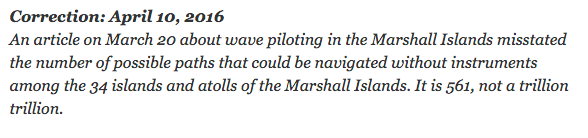
…and maybe of all time, at least in quantitative terms. In the New York Times Magazine, 4/10/2016:

An article on March 20 about wave piloting in the Marshall Islands misstated the number of possible paths that could be navigated without instruments among the 34 islands and atolls of the Marshall Islands. It is 561, not a trillion trillion.

A trillion trillion is presumably 1024, and 561 is 5.61 x 10², so the original number was off by a factor of about 1.78 x 10²², which is more than a thousand times greater than the estimated number of grains of sand in all the beaches and deserts of planet earth.

The obligatory screen shot:

I don't know how either the original number or the revised number were calculated. One hypothesis might start with 34!, which is about 2.952328e+38, but that seems too big even for the version of trillion that makes it 1018 rather than 1012. And (34^2)/2 is 578, not 561. Ideas?

[h/t John Burke]


12 Apr 11:30

Trans politicians standing for election: May 2016 edition

by Zoe O'Connell

Each April, I compile a list of openly trans politicians standing for election in the UK. This year, elections involve a number of local councils as well as devolved Assembly, London Assembly and Police and Crime Commissioner elections. The returning officers have almost all now declared who is to on the ballot, so it’s time to publish the list.

The current situation is that there are two out, full-time trans people holding publicly elected office at a principal local authority level or higher: I sit on Cambridge City Council for the Liberal Democrats, and Zoë Kirk-Robinson on Bolton City Council for the Conservatives. Having one or two out, elected politicians is something that has been maintained almost continuously for the last 15 years, mostly in Cambridge, with Jennifer Liddle, Jenny Bailey, Sarah Brown and (briefly, after she came out) Nikki Sinclaire as an MEP.

I have no local knowledge in any of the seats up for election, but based on past results most people listed below do not appear to be starting from particularly enviable positions. The exception to this is Anwen Muston, whose East Park Ward seat appears to be a Labour stronghold. Unless something unexpected happens in Wolverhampton, it seems likely that we will reach a new peak of three simultaneously out, elected politicians.

Also on the positive side, we have the first non-binary person standing for election – Anna Crow – that I know of. Courtesy of excessive gatekeeping and paperwork in the UK, name changes have made it easy to decide who to include in a binary or mostly-binary-identified list and helped filter out people who cross-dressed once and it made the paper. (On that basis, I’d have had to include sitting MPs in previous lists) That method doesn’t apply so well for non-binary identified people and the problem of spurious press articles and tenuous claims-to-fame seems less likely so for now at least self-declaration is sufficient for listing.

But there are still problem – everyone listed here is white and in seven of eight cases, a binary-presenting trans woman. Although much progress has been made, there is still a relative lack of diverse political representation within the trans community – a problem that likely stems from a general lack of BAME (in particular) representation in national politics.

Update, 28th April 2016: I have now added a second non-binary person, Maria Munir, who came out when asking a televised question to US President Obama. Maria is also BAME, which means that although we are a long way from properly diverse representation, it is at least a step in the right direction.
Update, 4th May 2016: There are now three non-binary people listed below!

Please do let me know if you know of someone who I have missed, as word-of-mouth is about the only way to find out who is standing – political party HQs are generally busy running elections and do not collect diversity statistics on candidates. But I must be able to verify (Either news articles or public statements by the candidate) that they are publicly out or have been outed to the point of no return, i.e. not just rumours. Every time I do this, at least one person emails me to tell me about one of a councillor who is not out – there are far more trans people in politics than most people realise.

Trans
(Binary, or predominantly IDs as such)
Northern Ireland Assembly
Green Party Northern Ireland Ellen Murray
West Belfast party list, sole GPNI candidate [source]
2011 party result: Did not stand. [source]
Scottish Parliament
No known candidates
(But see below under non-binary)
National Assembly for Wales
No known candidates
Police & Crime Commissioner
No known candidates
London Assembly
Labour Emily Brothers
London-wide party list, 9th of 11 [source]
2012 party result: 4 of 11 list members elected [source]
Principal Local Authority
Liberal Democrats Helen Belcher
Wokingham Borough Council, Evendons Ward [source]
2015 party result: 2nd place, 20.4%. (1st place: 50.5%) [source]
Green Party Aimee Challenor
Coventry City Council, St Michael’s Ward [source]
2015 party result: 5th place, 6.4% [source]
Liberal Democrats Jane Fae
North Hertfordshire District Council, Letchworth East Ward [source]
2014 party result: Did not stand. [source]
Conservatives Jennifer Kirk
Bolton City Council, Tonge with the Haulgh Ward [source]
2015 party result: 2nd, 18.3%. (1st place: 42.9%) [source]
Labour Anwen Muston
Wolverhampton, East Park Ward [source]
2015 party result: 1st, 51.9%. (2nd place: 23.7%) [source]
Non-binary
Northern Ireland Assembly
No known candidates
Scottish Parliament
Scottish Greens Anna Crow (IDs as non-binary, see this article)
Glasgow party list, 9th of 9 (Not yet officially confirmed)
2011 party result: 1 of 9 list candidates elected [source]
Police & Crime Commissioner
No known candidates
London Assembly
No known candidates
Principal Local Authority
Liberal Democrats Henry Foulds (IDs as non-binary, see this tweet)
Amber Valley Borough Council, Alfreton Ward [source]
2015 party result: 4th place, 3.4% [source]
Liberal Democrats Maria Munir (IDs as non-binary, see this article)
Watford Borough Council, Vicarage Ward [source]
2015 party result: 3rd place, 14.7% [source]
12 Apr 10:30

The dirty little secret that data journalists aren’t telling you

by Christopher Ingraham

pop_maps

Take a look at the map above. It tells the story of a year's population change in the United States, according to the latest census data. It shows where the population is growing, like the coasts, the Sun Belt and the oil fields of western North Dakota.

It shows, too, where numbers are in decline -- along the Mississippi River and in much of the rural Northeast, from northern Maine down through New York, western Pennsylvania and into the heart of the Appalachians.

This is the story that I believe the good folks at the Pew Charitable Trusts wanted to tell last week when they dug into these numbers. But using the exact same data set, they generated a map that looks like this:

Screen Shot 2016-04-11 at 12.07.09 PM

"Population growth slowed last year in some of the nation's most expensive counties, like those in California's Silicon Valley, and picked up in more affordable counties in the Sun Belt," according to the text above the map. But it's next to impossible to discern that just from looking at the map. In fact, it's hard to discern just about anything.

The difference between my map and Pew's -- again, they both use the exact same data set -- underscores a bit of a dirty little secret in data journalism: Visualizing data is as much an art as a science. And seemingly tiny design decisions -- where to set a color threshold, how many thresholds to set, etc. -- can radically alter how numbers are displayed and perceived by readers.

Pew treated the data in a seemingly sensible and rational way. It sliced up the full range of data -- from minus-6.3 percent (Terrell County, Tex.) to plus-28.7 percent (Loving County, Tex.) -- into five buckets of equal size: -6.3 to 0.7, 0.7 to 7.7, 7.7 to 14.7, etc. Assign a color to each bucket, color each county according to which bucket its population falls into, and voila! A map. Right?

The problem is that while Pew's buckets are nice and evenly distributed, the numbers are not. There are 3,141 counties in the Census Bureau's data set, and 3,138 of them fall into either the first or second buckets. Only three counties -- extreme outliers, all of them -- posted a population gain greater than 7.7 percent last year.

So those three darker shades of the scale are essentially unused, and the entire map gets washed out into two similar colors.

[The rise of humankind, in one mesmerizing map]

But there's a potentially bigger problem, too. Some counties lost population, while others gained. That's a pretty big distinction. Mapmakers often respect big distinctions like that by using a bivariate color scale -- say, one set of colors for positive values (like blue), and another set of colors for negative ones (like red).

That's what I ended up doing in the map at the top of this page. But that crucial positive-negative threshold gets lost in Pew's map -- that lightest shade of colors on its map encompasses all negative values and some positive ones as well. The map becomes blind to perhaps the most significant dividing line in the data -- the border between growth and recession.

I don't write any of this to pick on the Pew Charitable Trusts (full disclosure: I used to work at the Pew Research Center, a project it funds). Its overall analysis of the census data in its story is 100 percent sound, and like anyone else who does this for a living I've made my share of clunker maps over the years.

But each time I put numbers on a map, I'm struck by how it's possible to radically alter the appearance of a visualization just by tweaking a couple of basic parameters. And with the proliferation of maps like these, as well as tools that make it easy for just about anyone to make them, it's helpful to understand just how much these decisions can affect what you see on the printed (or digital) page.

Numbers carry a veneer of authority and objectivity that words can seem to lack. But communicating with numbers is, in many ways, just like communicating with words. You make decisions about what to emphasize and what to downplay, and about how to convey a full understanding of the subject at hand.

Ideally, those decisions lead to presenting the numbers in the clearest possible light. But as with words, inarticulate framing can lead you to muddle rather than clarify.

More from Wonkblog:

Map: Literally every goat in the United States

One map shows why America's gun violence is so much worse than anywhere else

A poverty map where the South looks the best

12 Apr 10:27

In a sense, we are ALL Jacob Horner

archive - contact - sexy exciting merchandise - search - about
← previous April 11th, 2016 next

April 11th, 2016: I am 25% of the way through Moby Dick and they JUST got on the boat, but there have been some pretty good jokes so far which I was not expecting, so good job Herman!

– Ryan

12 Apr 10:07

Sing a Song of Suxpence

by Ovid

basically fuck medieval europe

you guys know this nursery rhyme right?

it’s like “sing a song for basically free
like I will give you six pennies and some bread to sing it
a pocket full of bread actually
which is a horrible amount of bread
because have you ever tried to store bread in your pocket
it doesn’t fucking work
might as well be “a pocket full of bird treats”
which is appropriate because this song is about 24 birds in a pie”
THIS IS WHERE I AM GOING TO STOP THE RE-TELLING FOR A SECOND

let me ask you dear reader
what do you think the line “four and twenty blackbirds
baked in a pie”
ACTUALLY MEANS?
are they the 24 letters used to print the English bible?
are they the 24 hours in a day?
NO ASSHOLE
THEY ARE ACTUAL FUCKING BLACKBIRDS
people in medieval europe
straight up used to bake pie shells
and then stuff live birds into the pie shells
so that when you cut the pie open BIRDS FLY OUT
ONE TIME
INSTEAD OF BIRDS
IT WAS A DWARF
FUCK
THIS
ENTIRELY
PIE IS OBJECTIVELY ONE OF THE BEST THINGS THERE IS
AND YET SOMEWHERE IN THE CLOGGED OUTHOUSE OF HISTORY
SOME PSYCHOPATH DECIDED TO TURN PIE INTO A DELIVERY MECHANISM
FOR BIRD-BASED TERROR ATTACKS
LITERALLY THE ONLY GOOD ASPECT OF THIS I CAN THINK OF
IS YOU MIGHT DECAPITATE A BIRD WHILE CUTTING OPEN THE PIE
BUT THERE’S NO WAY YOU’RE GONNA DECAPITATE ALL OF THEM
EXCUSE ME WHILE I STAB EVERY PIE FIFTY TIMES BEFORE I EAT IT NOW

anyway the story unfolds predictably from there
they try to serve the pie to the king
but the king is scrooge mcduck apparently
(which makes it even weirder that they’re serving him live birds)
and he’s in his vault swimming in gold coins
his wife is somewhere else eating an actual meal
but someone still cuts open the pie because they’re an asshole
and the birds fly out
and one of the birds goes into the garden
AND RIPS OFF THE MAID’S NOSE
doesn’t even eat it
just rips it off and leaves it there
so they call the king’s doctor
and he’s pretty chill about it
almost as if he knew something like this was bound to happen.
he sews the nose back on flawlessly
and nobody can tell it was ever ripped off by a frenzied bird

the moral of the story
is if you’re working for a king
make sure he provides comprehensive health insurance

the end

12 Apr 09:44

Hot-desking offices wreck productivity.

Hot-desking offices wreck productivity.
12 Apr 09:44

Leonard Brenner, R.I.P.

by evanier

leonardbrenner01

Back in the sixties, the makers of Contadina Tomato Paste claimed — in commercials created by the great Stan Freberg — that they "put eight great tomatoes in each little bitty can." This prompted MAD magazine to do a parody ad showing the hapless chef who had to do that.

But right now, we don't care about tomato paste or the ad. We care about the guy in the above photo. His goateed face should be familiar to everyone who read MAD back then because it was always turning up in photo features for the publication. As a kid reading MAD back then, I wondered who he was. Answer: He was Leonard Brenner, the Production Manager and later Art Director for MAD and someone who made an enormous contribution to it.

"The Beard" (that was his nickname) didn't write or draw articles in the same way as most MAD contributors you could name but he touched almost every page between 1958 when he joined the magazine and 1995 when he retired. Aside from publisher William M. Gaines, Lenny's name appeared on MAD's masthead more than anyone else's.

His sense of humor and painstaking attention to design and detail were often evident, especially when the staff had to replicate a piece of someone else's advertising or mimic the look and feel of another publication. He and his longtime colleague John Putnam made sure MAD always looked good and always got to press on time. He was also a delightful, funny gentleman, dearly loved by everyone else at MAD. He passed away last Saturday and those who knew him are really, really sad about that. If you ever met the man, you understand why.

The post Leonard Brenner, R.I.P. appeared first on News From ME.

11 Apr 11:02

Why the UK has the worst electoral integrity in Europe.

Why the UK has the worst electoral integrity in Europe.
11 Apr 10:46

Mapping the Brain to Build Better Machines

by Emily Singer

Take a three year-old to the zoo, and she intuitively knows that the long-necked creature nibbling leaves is the same thing as the giraffe in her picture book. That superficially easy feat is in reality quite sophisticated. The cartoon drawing is a frozen silhouette of simple lines, while the living animal is awash in color, texture, movement and light. It can contort into different shapes and looks different from every angle.

Humans excel at this kind of task. We can effortlessly grasp the most important features of an object from just a few examples and apply those features to the unfamiliar. Computers, on the other hand, typically need to sort through a whole database of giraffes, shown in many settings and from different perspectives, to learn to accurately recognize the animal.

Visual identification is one of many arenas where humans beat computers. We’re also better at finding relevant information in a flood of data; at solving unstructured problems; and at learning without supervision, as a baby learns about gravity when she plays with blocks. “Humans are much, much better generalists,” said Tai Sing Lee, a computer scientist and neuroscientist at Carnegie Mellon University in Pittsburgh. “We are still more flexible in thinking and can anticipate, imagine and create future events.”

An ambitious new program, funded by the federal government’s intelligence arm, aims to bring artificial intelligence more in line with our own mental powers. Three teams composed of neuroscientists and computer scientists will attempt to figure out how the brain performs these feats of visual identification, then make machines that do the same. “Today’s machine learning fails where humans excel,” said Jacob Vogelstein, who heads the program at the Intelligence Advanced Research Projects Activity (IARPA). “We want to revolutionize machine learning by reverse engineering the algorithms and computations of the brain.”

Time is short. Each team is now modeling a chunk of cortex in unprecedented detail. In conjunction, the teams are developing algorithms based in part on what they learn. By next summer, each of those algorithms will be given an example of a foreign item and then required to pick out instances of it from among thousands of images in an unlabeled database. “It is a very aggressive time-frame,” said Christof Koch, president and chief scientific officer of the Allen Institute for Brain Science in Seattle, which is working with one of the teams.

Koch and his colleagues are now creating a complete wiring diagram of a small cube of brain — a million cubic microns, totaling one five-hundredth the volume of a poppy seed. That’s orders of magnitude larger than the most-extensive complete wiring map to date, which was published last June and took roughly six years to complete.

By the end of the five-year IARPA project, dubbed Machine Intelligence from Cortical Networks (Microns), researchers aim to map a cubic millimeter of cortex. That tiny portion houses about 100,000 neurons, 3 to 15 million neuronal connections, or synapses, and enough neural wiring to span the width of Manhattan, were it all untangled and laid end-to-end.

No one has yet attempted to reconstruct a piece of brain at this scale. But smaller-scale efforts have shown that these maps can provide insight into the inner workings of the cortex. In a paper published in the journal Nature in March, Wei-Chung Allen Lee — a neuroscientist at Harvard University who is working with Koch’s team — and his collaborators mapped out a wiring diagram of 50 neurons and more than 1,000 of their partners. By pairing this map with information about each neuron’s job in the brain — some respond to a visual input of vertical bars, for example — they derived a simple rule for how neurons in this part of the cortex are anatomically connected. They found that neurons with similar functions are more likely to both connect to and make larger connections with each other than they are with other neuron types.

While the implicit goal of the Microns project is technological — IARPA funds research that could eventually lead to data-analysis tools for the intelligence community, among other things — new and profound insights into the brain will have to come first. Andreas Tolias, a neuroscientist at Baylor College of Medicine who is co-leading Koch’s team, likens our current knowledge of the cortex to a blurry photograph. He hopes that the unprecedented scale of the Microns project will help sharpen that view, exposing more sophisticated rules that govern our neural circuits. Without knowing all the component parts, he said, “maybe we’re missing the beauty of the structure.”

The Brain’s Processing Units

The convoluted folds covering the brain’s surface form the cerebral cortex, a pizza-sized sheet of tissue that’s scrunched to fit into our skulls. It is in many ways the brain’s microprocessor. The sheet, roughly three millimeters thick, is made up of a series of repeating modules, or microcircuits, similar to the array of logic gates in a computer chip. Each module consists of approximately 100,000 neurons arranged in a complex network of interconnected cells. Evidence suggests that the basic structure of these modules is roughly the same throughout the cortex. However, modules in different brain regions are specialized for specific purposes such as vision, movement or hearing.

David Cox, a neuroscientist at Harvard who leads one of the IARPA teams.

Each team is starting with the same basic idea for how vision works, a decades-old theory known as analysis-by-synthesis. According to this idea, the brain makes predictions about what will happen in the immediate future and then reconciles those predictions with what it sees. The power of this approach lies in its efficiency — it requires less computation than continuously recreating every moment in time.

The brain might execute analysis-by-synthesis any number of different ways, so each team is exploring a different possibility. Cox’s team views the brain as a sort of physics engine, with existing physics models that it uses to simulate what the world should look like. Tai Sing Lee’s team, co-led by George Church, theorizes that the brain has built a library of parts — bits and pieces of objects and people — and learns rules for how to put those parts together. Leaves, for example, tend to appear on branches. Tolias’s group is working on a more data-driven approach, where the brain creates statistical expectations of the world in which it lives. His team will test various hypotheses for how different parts of the circuit learn to communicate.

All three teams will monitor neuronal activity from tens of thousands of neurons in a target cube of brain. Then they’ll use different methods to create a wiring diagram of those cells. Cox’s team, for example, will slice brain tissue into layers thinner than a human hair and analyze each slice with electron microscopy. The team will then computationally stitch together each cross section to create a densely packed three-dimensional map that charts millions of neural wires on their intricate path through the cortex.

With a map and activity pattern in hand, each team will attempt to tease out some basic rules governing the circuit. They’ll then program those rules into a simulation and measure how well the simulation matches a real brain.

Tolias and collaborators already have a taste of what this type of approach can accomplish. In a paper published in Science in November, they mapped the connections between 11,000 neuronal pairs, uncovering five new types of neurons in the process. “We still don’t have a complete listing of the parts that make up cortex, what the individuals cells look like, how they are connected,” said Koch. “That’s what [Tolias] has started to do.”

AlphaGo, the computer that recently defeated the world’s top Go player — the rules that artificial neural networks use to alter their connections are almost certainly different than the ones employed by the brain.

Contemporary neural networks “are based on what we knew about the brain in the 1960s,” said Terry Sejnowski, a computational neuroscientist at the Salk Institute in San Diego who developed early neural network algorithms with Geoffrey Hinton, a computer scientist at the University of Toronto. “Our knowledge of how the brain is organized is exploding.”

For example, today’s neural networks are comprised of a feed-forward architecture, where information flows from input to output through a series of layers. Each layer is trained to recognize certain features, such as an eye or a whisker. That analysis is then fed forward, with each successive layer performing increasingly complex computations on the data. In this way, the program eventually recognizes a series of colored pixels as a cat.

But this feed-forward structure leaves out a vital component of the biological system: feedback, both within individual layers and from higher-order layers to lower-order ones. In the real brain, neurons in one layer of the cortex are connected to their neighbors, as well as to neurons in the layers above and below them, creating an intricate network of loops. “Feedback connections are an incredibly important part of cortical networks,” Sejnowski said. “There are as many feedback as feed-forward connections.”

Neuroscientists don’t yet precisely understand what these feedback loops are doing, though they know they are important for our ability to direct our attention. They help us listen to a voice on the phone while tuning out distracting city sounds, for example. Part of the appeal of the analysis-by-synthesis theory is that it provides a reason for all those recurrent connections. They help the brain compare its predictions with reality.

Microns researchers aim to decipher the rules governing feedback loops — such as which cells these loops connect, what triggers their activity, and how that activity effects the circuit’s output — then translate those rules into an algorithm. “What is lacking in a machine right now is imagination and introspection. I believe the feedback circuitry allows us to imagine and introspect at many different levels,” ​Tai Sing Lee said.

Perhaps feedback circuitry will one day endow machines with traits we think of as uniquely human. “If you could implement [feedback circuitry] in a deep network, you could go from a network that has kind of a knee-jerk reaction — give input and get output — to one that’s more reflective, that can start thinking about inputs and testing hypotheses,” said Sejnowski, who serves as an advisor to President Obama’s $100 million BRAIN Initiative, of which the Microns project is a part.

Clues to Consciousness

Like all IARPA programs, the Microns project is high risk. The technologies that researchers need for large-scale mapping of neuronal activity and wiring exist, but no one has applied them at this scale before. One challenge will be dealing with the enormous amounts of data the research produces — 1 to 2 petabytes of data per millimeter cube of brain. The teams will likely need to develop new machine-learning tools to analyze all that data, a rather ironic feedback loop of its own.

It’s also unclear whether the lessons learned from a small chunk of brain will prove illustrative of the brain’s larger talents. “The brain isn’t just a piece of cortex,” Sejnowski said. “The brain is hundreds of systems specialized for different functions.”

The cortex itself is made up of repeating units that look roughly the same. But other parts of the brain might act quite differently. The reinforcement learning employed in the AlphaGo algorithm, for example, is related to processes that take place in the basal ganglia, part of the brain involved in addiction. “If you want AI that goes beyond simple pattern recognition, you’re going to need a lot of different parts,” Sejnowksi said.

Should the project succeed, however, it will do more than analyze intelligence data. A successful algorithm will reveal important truths about how the brain makes sense of the world. In particular, it will help confirm that the brain does indeed operate via analysis-by-synthesis — that it compares its own predictions about the world with the incoming data washing through our senses. It will reveal that a key ingredient in the recipe for consciousness is an ever-shifting mixture of imagination plus perception. “It is imagination that allows us to predict future events and use that to guide our actions,” Tai Sing Lee said. By building machines that think, these researchers hope to reveal the secrets of thought itself.

This article was reprinted on Wired.com.

11 Apr 09:49

Random Notes on Structure

by Wesley

This is another post in a series on a style of genre prose that I dislike; I wanted to analyze why I dislike it, and it’s turning out quite long. It will probably make more sense if you’ve read the earlier posts, which I’ve just linked to and are all under the tag “Novelization Style.”


This post is going to be a bit of a grab bag and, I will admit, probably the weakest in the series. So far I’ve discussed style almost exclusively. These observations are more about elements of story structure that, fitting with my running theme, feel like borrowings from visual media. As with everything else I’ve discussed, they’re all perfectly fine on their own–it’s just that together they add up to less than the sum of their parts. I don’t have a full-fledged theory on the structure of Novelization Style, so this will be a collection of notes.

Cutting Between Scenes

I’ll begin with a paragraph-level observation on a ridiculously specific subset of Novelization Style novels. Specifically, books with multiple point of view characters that also switch between those characters within chapters. It’s about how these books use section breaks–those gaps between paragraphs that tell you time has passed or the scene has changed within a chapter.

Unlike an omniscient narrator, Novelization Style doesn’t move from one point of view to the next within an unbroken passage of narrative.[1] Novelization Style switches characters with a distinct break–either a chapter break (A Game of Thrones stays with one character for every chapter, even naming each chapters after its POV character) or a section break.

During the decade and a half Doctor Who was off the air one or two Doctor Who novels came out every month. True confession: I’ve read most of them. Most were written in what I’m now calling Novelization Style, and most switched POVs. At some point I noticed the story chunks framed by the section breaks felt like scenes from the TV show: we’d get a chunk of story with one character, then cut to another at the point a TV show might cut to another scene–often a cliffhanger moment.

Again, Three Parts Dead is a good example: When Tara’s having her magical duel in court, the narrative breaks away at a tense moment and spends a few paragraphs with her friends in the audience before resuming, the same way a TV show would cut away for a bit of dialogue. What’s interesting is what happens when the novel gets into the more intense action set pieces, as in chapter 16–17 during a police raid intercut with a dinner and confrontation between Tara’s mentor and the villain. Often books that reach action sequences will pick up the pace of the prose but narrate the action straight through in an unbroken scene. Three Parts Dead picks up the pace of the section breaks and point of view switches. They come more often, switching focus characters within the raid and, at cliffhanger moments, switching scenes between the raid and the dinner. It feels like the way movies edit shots faster and tighter in action scenes. That’s a logical and reasonably effective technique for books in this style. Still, when I read them there are times I wish for a chapter of unbroken text.

The Teaser

Contemporary writing advice often borrows techniques from scriptwriting: I often see writers talking about “acts” and “beats,” for instance. I suspect few novels are specifically and deliberately written to the three-to-five-act structures and Save the Cat breakdowns favored by Hollywood. But I seem to encounter some storytelling tics more often in recent novels, and they feel like they drifted into prose from movies and TV. Not all Novelization Style novels use every one–again, Novelization Style is a collection of tendencies, not a hard formula–but it’s the style that uses them most. First, how these novels often begin, and how they often end.

Most TV shows set up the premise of the week with a pre-credits scene called a teaser. Often they don’t feature the main cast. The Avengers, for instance, usually showed a minor character getting eccentrically murdered before bringing in Steed and Mrs. Peel. Leverage began each episode with a new victim getting screwed over. This kind of opening is also common in horror movies: a lot of them (Night/Curse of the Demon is one example) show a random victim stumbling onto the monster before they introduce the main cast.

Anymore this is also a common feature in written SF. A lot of modern SF novels begin with prologues that don’t star anyone who will be important later in the book. Minor characters stumble onto the big threat or conspiracy the heroes will uncover, offering clues to the plot which prove meaningful 400 pages later. Leviathan Wakes has a prologue like this; so have the first volumes of half the epic fantasies published in the last decade.

This is actually a bit weird. It’s more common for novels to spend their first pages introducing, if not their protagonists, at least somebody we’ll spend a lot of the book with. (Again, look at Bujold’s openings: the first person we meet on the first page of her novels is usually the protagonist.) But it makes sense if you assume these prologues are teasers! The thing is, when I watch a teaser on The Avengers I know John Steed and Emma Peel will be along in a few minutes. When I read the prologue of a novel I haven’t even been introduced to the main characters. When I realize the apparent protagonist is going to disappear for the rest of the book it feels like hitting a narrative speed bump.

The Wrap-Up

I’ve also gotten used to reading a certain kind of ending. In the next-to-last chapter the hero has a big showdown with the villain. When the villain is defeated the chapter ends almost immediately. The next chapter jumps forward a few hours or days to when the situation has calmed down, and characters meet to exchange exposition, tie up loose ends, and explain what they plan to do next. This should be familiar to anyone who’s seen a procedural or monster-of-the-week series: there’s a punch-up and then a cut to everybody standing around with emergency vehicles in the background, expositing. Or, heck, The Avengers again. Steed and Mrs. Peel knock down the villain; ten seconds and one fade-out later they’re cracking jokes while doing something amusingly wine-related.

Which, again, works best on television. Showing the immediate consequences of a villain showdown, all the cleanup and the taking of responsibility for things, would throw off the pacing. On the other hand… a book shouldn’t have that problem because prose can vary its pace, and summarize. Except that Novelization Style usually doesn’t. And a lot is elided, sometimes, in that time skip. Sometimes I’d like to know how the protagonists managed to dig themselves out of the hole they’re generally still in. Sometimes the logistical details of cleaning up after a villain are as interesting as the defeat.

When a story has a villain–whether a plain old conventional evil genius or something more metaphorical but still unequivocally bad, like a pending natural disaster–a big confrontation is normal. What’s interesting is that with Novelization Style the confrontation is frequently also the story’s emotional high. The protagonist solves the plot and completes their character arc at the same time. The other big moments along the way tend to be action set pieces and trailer moments.

I think back on books I’ve enjoyed, and I’m specifically including my lighter, more adventureish favorites: Steven Brust’s Vlad Taltos novels, Lois McMaster Bujold’s work, old mystery novelists like Margery Allingham and Edmund Crispin. It strikes me how varied they are. Some of them, the mystery novels especially, are formulaic, but I still can’t always predict exactly which chapter the climax will come in, or what will happen just afterwards, or where the emotional high will be. Some stories come to a climax a few chapters before the end, and some hit their emotional high before the big plot-finishing scene, or after it, and some wrap everything up satisfyingly in their last few pages.

And though many books do action well, the frantic set pieces aren’t the parts that stick with me: I recall quieter moments, what the characters said or felt. When I read a novel that gives the emotional content less attention than the action, I retain less.

Stakes

At shorter lengths, Novelization Style can be small; at novel length, it has to be big. A disaster or a conspiracy must threaten to upend the protagonist’s world (unless they’re among those dystopian heroes who have to upend society themselves). As the novel begins, its problems may seem limited to the protagonist’s own life. But by the two-thirds mark at the latest it will reveal that, no, actually the whole city is under threat, or the whole country, or even the world. Mass death or go home!

This is what’s known as “raising the stakes.” That’s supposed to mean that a novel’s central question should feel more important, more intense as the novel continues. SF often assumes instead that the initial stakes are not enough to sustain a novel. But the initial stakes were what got me interested in the novel in the first place! I mean, I love when I’m reading a story and it turns out it was a completely different story all along–that’s a great trick to pull off. But when it just turns into a bigger story–when the only revelation is that, once again, lives are at stake–it feels like a bait and switch.

If I’ve been mentioning Lois McMaster Bujold a lot it’s because I recently finished her latest book, Gentleman Jole and the Red Queen. (Which is the Worst Title Ever. But the book is good.) It’s science fiction about two older people planning the next stage of their lives in a world where technical advances give them more options. As the novel progresses it continues to be about two older people planning the next stage of their lives. Bujold is serenely confident in her ability to make older people planning subsequent life stages interesting and her confidence is not misplaced.

Which was refreshing, because a lot of SF novels are about preventing or dealing with mass trauma. I mean, it’s got to be more than half the genre, especially if you include the books that deal with smaller issues but have mass trauma as part of the background. It’s numbing. After reading about too many existential threats they cease to mean anything, like an air conditioner that hums so constantly I’ve tuned out. The breathtaking epics no longer take breath. I need smaller SF like Gentleman Jole to create contrast, make the epics feel epic again.

Extras

Lastly, and most sketchily… when reading Novelization Style I often get the impression that the characters walking around in the background are extras–nonspeaking actors walking around in the background of a scene, the ones we’re not supposed to pay attention to.

It’s hard to describe. But sometimes when reading a novel I get the impression that the protagonists, and other plot-relevant characters, aren’t deeply embedded in their society. As though they live in a plot bubble populated entirely by plot-related people, and everyone outside the bubble is just background. Not just that they aren’t the characters the story is about, but that they’re a qualitatively different kind of people within the fiction.

In many novels even characters who appear for less than a page show signs of life. A passerby cracks a joke, a shop clerk isn’t one hundred percent cooperative. The hero asks for directions, and in the paragraph it takes to explain the direction-giver shows off a personality quirk. The characters aren’t important, but the writer pulls off the illusion that they could be people with their own lives and stories. Other novels–especially those written in Novelization Style–treat very minor characters like film extras, who aren’t supposed to draw attention to themselves; they fade into the background, keeping out of the way of the speaking roles. Novelization Style stories sometimes don’t even acknowledge other people are around unless a protagonist interacts with them. I think it’s related to that lack of descriptive details I discussed in an earlier post, which affects characters as much as settings.

In some stories the characters really are off in their own little world–say, the cast of a stereotypical country house murder mystery. In that case this is not a problem. Where it does become a problem is when the story gives the impression that other people’s lives aren’t just less important to this story but diegetically less important than the protagonist’s. Some time ago I read a blog post I found striking enough that I saved the URL, speculating on what about our current culture would look weird in 50 years. The author guessed it might be stories that treat minor characters, extras, as literally less important than protagonists. Like, the hero causes a car accident during a chase and we’re supposed to find it exciting and not worry whether the people in the car were okay.

I’ll take a chance on almost any book about travelling to strange alternate realities. So a while back I read a very bad book called The Flight of the Silvers. The strangest part was that the heroes travelled to their new reality after our entire world was utterly destroyed… and it took them no time at all to recover from the shock. Because, yes, billions of people including everyone they ever knew and loved had just died horribly, but the important thing was that now they had superpowers.

Jo Walton in The Just City came up with a phrase I find useful in this context: equal significance. Every novel has characters around its edges who aren’t relevant, and I’m not necessarily interested in reading about them… but I want the story to imply that everyone in its world is equally significant, that it’s a place where the needs of people who don’t have stories told about them are not less important than the needs of a protagonist.


That’s it for describing Novelization Style. In the last post, I’ll summarize, wrap up, describe what’s missing for me in this style, and admit that I enjoy the occasional Novelization Style book–my problem isn’t that it exists, it’s that there’s so much of it.


  1. Badly written Novelization Style sometimes hops from one character’s head to another in a way that superficially resembles omniscient POV. The best way to tell omniscient POV from head-hopping close third person is that omniscient is never disorienting. When a close POV goes head-hopping it’s sometimes momentarily unclear whose head we’re in.  ↩

11 Apr 09:41

PSA: Stroke awareness

Two friends of mine have suffered strokes this month (and it's only the 10th) - both women of about 40, living in Belgium. I'm glad to hear that cygny is recovering, but Keni has been taken from us far too soon. Everyone, remember FAST:

Facial weakness: Can the person smile? Has their face fallen on one side?

Arm weakness: Can the person raise both arms and keep them there?

Speech problems: Can the person speak clearly and understand what you say? Is their speech slurred?

Time: If you see any one of these three signs, it’s TIME to call emergency services. Stroke is always a medical emergency that requires immediate medical attention.

It can happen to any of us.
11 Apr 07:02

Dangerous Vision

by evanier

The Boston Globe shows us what its front page might look like a year from now if Donald Trump is elected president. It's a PDF file but your computer should know how to handle those.

The post Dangerous Vision appeared first on News From ME.

10 Apr 09:45

We analyzed the names of almost every Chinese restaurant in America. This is what we learned

by Roberto A. Ferdman and Christopher Ingraham
(Credit: Rachel Orr/The Washington Post; iStock)

(Credit: Rachel Orr/The Washington Post; iStock)

A funny thing happened when reporter Jennifer 8. Lee showed the man who invented General Tso's Chicken what had become of his dish: He was appalled.

"That's not right. This isn't authentic," he told her, an interaction she chronicled in her 2009 book The Fortune Cookie Chronicles: Adventures in the World of Chinese Food.

General Tso's Chicken might be the most popular Chinese dish in the western world, but like so much of the Chinese food Americans eat, it's the product of a telephone game we play with foreign cuisines.

In many ways, this has turned American Chinese Food into a cuisine of its own, an amalgam of dishes that either barely resemble the authentic versions that inspired them or resemble traditional Chinese dishes not at all. (This isn't a new concept—others have suggested it, too).

And that cuisine is vast, at least in terms of its reach. There are a lot of Chinese restaurants in this country. Tons of them! Somewhere around 50,000, according to Lee, who likes to point out that there are more Chinese restaurants in the United States than McDonald's, Burger King, Kentucky Fried Chicken, and Wendy's—combined.

But the dishes aren't the only thing that defines the landscape of Chinese food in the United States. Another constant is something you might have noticed anecdotally: the restaurant naming structure.

In the same way that opening up a new Chinese restaurant without any of the food staples Americans already love might make it difficult to woo customers, launching one without the sort of name people have come to expect could throw things off, too.

Americans have been trained to expect Chinese food at places with names like “Golden Dragon Buffet.” If you were to open a Chinese restaurant named like “Dorchester Meadows” it would probably tank.

Lee points out that this isn't specific to Chinese restaurants. The widespread use of certain phrases and words, she says, is characteristic of many cuisines, including not only other Asian ones, but also European ones.

Still, we wanted to quantify exactly what the vernacular of American Chinese restaurant names sounds like. To do that, we needed a database containing all of the country's Chinese restaurants. And we were able to get it -- or something pretty close to it -- from Yelp.

The crowdsourced review company provided us with geolocated names of close to 40,000 Chinese restaurants. And after sifting through the data, some interesting patterns became clear.

The single most frequent word appearing in Yelp’s list of Chinese restaurants is, perhaps unsurprisingly, “Restaurant.” “China” and “Chinese” together appear in the names of roughly 15,000 restaurants in the database, or over one third of all restaurants.

“Express” is the next-most popular word, showing up in the names of over 3,000 restaurants. But as with “Panda” (2,495 restaurants), the numbers for “Express” are inflated by the Panda Express restaurant chain, which has over 1,500 locations.

“Wok,” another popular naming option, was represented in over 2,500 restaurant names. “Garden,” “House” and “Kitchen,” meanwhile, are the three places that appear most often in Chinese restaurant names.

Interestingly the word “New” comes in at #11 on the list, appearing in the names of over 1,500 restaurants like “New Fortune Chinese Restaurant” and “New Chef Huang Buffet.” But the word “old” only appears 31 times, in restaurants like “Old Peking” and “Old Sichuan.”

The most popular color appearing in the list is “Golden” (1,238 restaurants), and other than “Panda” the most well-represented animal is “Dragon.”

Rather than rattle off a huge list of words, we’re just going to show you the word cloud below, which represents the 100 most frequently appearing words in Yelp’s database of Chinese restaurants.

chinese_food

These 100 words make up the lexicon of American Chinese restaurant names. They're the words American consumers unconsciously scan for when they drive through an unfamiliar town with a hankering for some General Tso's, the indicators American Jews look for when satisfying their Christmas-time craving. Search for them on Google, and you might find the nearest place you can order Chinese take-out from.

The other thing we can do with Yelp’s data is map it. Below, for instance, is a county-level map of the number of Chinese restaurants in the United States.

chinese_food_map1

Yes, this is essentially a population map – where there are people, there are Chinese restaurants. But if we want to get a little more specific, we could note that the the number of Chinese restaurants in a county looks like more a function of the county’s Chinese-American population, which the Pew Research Center mapped not too long ago.

We can also map the number of restaurants on a per capita basis, which corrects for population to some extent. Here’s what that looks like.

chinese_food_map2

The Northeastern states, Nevada and San Francisco’s Bay Area are the big standouts here, as well as parts of Hawaii and Alaska. There are a lot of sparsely populated counties in the middle of the country that stand out on this map too, but that doesn’t necessarily mean that they’re hotbeds of Chinese cuisine. Rather, when you only have a few thousand people living in a county, it only takes one or two restaurants to end up with a sky-high per capita number.

Taken together, though, these maps do show the surprising ubiquity of Chinese restaurants all across the country. Unless you’re smack in the middle of that Chinese food desert running from North Dakota to West Texas, you’re never really that far from Chinese cuisine -- or from the very specific words that denote that cuisine in the American imagination.

10 Apr 08:14

ADULTHOOD COMICS, NO PUNCHLINE

archive - contact - sexy exciting merchandise - search - about
← previous April 8th, 2016 next

April 8th, 2016: Don't worry though, The Monster At The End of This Book is STILL AMAZING and holds up perfectly! So just like that book and you'll be fine forever.

– Ryan

09 Apr 18:34

Pin Spotting

by evanier

Before I forget: Read Ezra Klein on the ways in which he thinks the press is biased for and against Bernie Sanders.

Anyway, for what little anyone may care, I am warming to the idea of Bernie Sanders as the next president of the United States…not that I was ever against that. I'm still unconvinced he can beat Hillary Clinton for the nomination but I used to not have a preference and now I'm starting to have one, modest though it may be. This may sound silly but while I think Clinton and Sanders would both be fine presidents, I could personally get more excited about Sanders as the nominee.

Then again, I'm wary of these polls that say he'd do a better job than she would of defeating Trump or Cruz. I can't believe his personal approval rating wouldn't take a deep nosedive if he secured the nomination and Republicans started in with the ads calling him a Communist with a congenital contempt for the American Way of Life who'd raise your taxes, take away your property and your freedoms, etc.

Regarding his chance to getting the nomination: He did a surprise cameo on Stephen Colbert's show last Friday night and bragged how well he and his team have been doing winning state caucuses. That's true — he has been doing better than Clinton in states that hold caucuses. But unmentioned was that there aren't many caucuses left and that the polls show her with big leads in most of the remaining states. I wish this were not so and if he does lose the nomination, I hope it's not by so wide a margin that people say it proves something about being "too liberal" even for Democrats, which would mean really "too liberal" for this country.

berniesanders03

While we're talking Bernie, here's a microscopic, unimportant thing that made me like Senator Sanders a bit more. I noticed on Colbert — and you may already have noticed this — that he wasn't wearing an American flag lapel pin. He apparently never does.

Most folks seeking the presidency do, at least most of the time, lest they open themselves to abuse from people with very low I.Q.s who think that to not wear one means you hate your country, wish it would fall to the Commies, pray the terrorists win, etc. Apparently, if those are your goals, it is impossible for you to mask them by pinning on a little $2.95 replica of Old Glory.

Since Socialist Sanders is a bit more vulnerable to such attacks than your average presidential aspirant, you'd think he'd make the teensy gesture of slapping one on just to shut off that one line of attack. Even Barack Obama did that at times but as you can see, Sanders has instead a gold, round lapel pin. I looked at a number of recent photos online of him and he always seemed to have it on. What the heck is it? A bit of Googling gave me the answer: It's the badge which identifies him as a U.S. Senator to security when he enters the Capitol building in Washington.

I'm not sure I can explain why but that feels more genuine than any politician making the decision — probably in consultation with handlers — to wear a flag pin. It even makes me feel like Bernie never gave a thought to what adornment on his lapel might help his candidacy…and that he only owns the one suit.

The post Pin Spotting appeared first on News From ME.