
Andrew Hickey
Shared posts
25 Jul 12:45
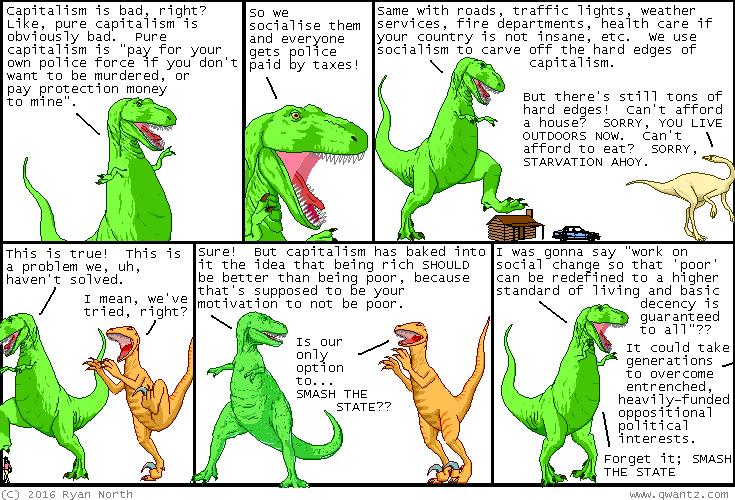
on the other hand "pay for your own police force" historically results in samurai, which are objectively PRETTY NEAT
| archive - contact - sexy exciting merchandise - search - about | |||
 |
|||
| ← previous | June 13th, 2016 | next | |
|
June 13th, 2016: Hey, have you preordered my new book, Romeo and/or Juliet? IT IS OUT NOW!!!!!!!!!! ahhhhh – Ryan | |||
Burthwheeler likes this

03 Jul 15:28
Silicon Valley's bloody plant burger smells, tastes, and sizzles like meat.
Silicon Valley's bloody plant burger smells, tastes, and sizzles like meat.


02 Jul 21:01
Book Review: Unlearn Your Pain
by Scott Alexander
[Content warning: discussion of chronic pain and related conditions, and the debate over whether some of them may be psychological in origin. None of this is medical advice or a recommendation to start or stop any form of therapy. Low confidence in my conclusions here.]
I.
Some of the most interesting lectures in medical training are the ones that start with “Okay, you’re all going to think I’m a quack, but…”
This was how Dr. Howard Schubiner started the lecture he gave at the hospital where I work. Dr. Schubiner isn’t an obvious quack – he’s a professor of medicine at the local university, directs a clinic at a reputable hospital nearby, and is on the editorial boards of a bunch of medical journals. And although his lecture raised what we will generously call a few red flags, there was also just enough interesting stuff there that I couldn’t resist buying his book Unlearn Your Pain to learn more.
Dr. Schubiner’s specialty is psychosomatic complaints – bodily symptoms that don’t come from any obvious disease and seem to reflect psychological stress. Everyone agrees that this category exists. Most doctors have stories about conversion disorder – usually patients who become “paralyzed” in previously healthy limbs after some life crisis. One of my medical school professors had a pretty good diagnostic test for this – feign a punch at the patient’s face, really quickly, without warning her. If she instinctively uses her “paralyzed” limb to block it, it’s conversion disorder. The same sort of thing works for pseudoseizures – apparent seizures not associated with objective seizure EEG activity. There’s a legend about a neurologist telling a medical student that a certain patient’s fit was a pseudoseizure, and the patient interrupting his seizure to protest “No it isn’t!”.
Most people who have worked with conversion or pseudoseizure patients don’t doubt their inherent honesty. These patients aren’t faking, per se. Such a person genuinely can’t move their limb, can’t just decide not to have seizures. Often they’re very distressed at what’s happening to them (although sometimes they really aren’t). Psychologists like to say that it’s subconscious – whatever that means. Just like somebody crippled by panic attacks, the symptoms are real and involuntary, but they’re also psychologically produced.
The existence of this category isn’t controversial, but its size definitely is. Some people propose a long list of conditions – fibromyalgia, irritable bowel syndrome, chronic fatigue syndrome, chronic Lyme disease, tension headaches, interstitial cystitis, et cetera – that they think of as mostly or entirely psychosomatic. On the other hand, patients’ rights groups get very upset at claims that their conditions are “all in their head”, accuse doctors of thinking that they’re lazy or making up their symptoms, and pass around stories with titles like RE: RE: RE: FWD: RE: THE MEDICAL PROFESSION about some guy whose doctor dismissed him as making up his symptoms but who was later diagnosed with zebra-itis and cured with an experimental gene therapy treatment.
Dr. Schubiner is a psychosomatic complaint maximalist. He thinks that just about anything that can’t be traced to a well-understood physiological cause is probably psychosomatic – in his language, Mind-Body Syndrome or MBS. He quotes a fascinating theory by Edward Shorter that this all dates back to the invention of the tendon hammer, ie that little thing doctors hit your knee with:
An important advance in medicine was the discovery of deep tendon reflexes. The simple test of striking a tendon with a reflex hammer can quickly distinguish pathological from psychological paralysis. Amazingly, once doctors could do this test, the number of people with this type of conversion disorder decreased substantially, and now the condition is rare. When doctors and the general public come to view a medical condition as psychologically induced, it is less likely to occur..the subconscious mind is unlikely to produce symptoms that will be easily seen as psychological. But since humans continue to experience great stresses and strong emotions, paralysis has been replaced by chronic back pain, fibromyalgia, fatigue, irritable bowel syndrome, and many other symptoms.
When Schubiner talks about fibromyalgia and fatigue, he’s not so far outside (one edge of) respectable medical opinion. But he goes further and lists migraine headaches, heartburn, carpal tunnel syndrome, tinnitis, postural orthostatic tachycardia, repetitive stress injury, and reflex sympathetic dystrophy as likely Mind-Body Syndrome as well. And most explosively, he says the condition explains almost all pain.
Schubiner admits there is such a thing as anatomically-caused non-psychological pain. It tends to be associated with very obvious injuries like dropping an anvil on your foot, and it tends to go away after a couple of weeks at most. Anything more mysterious and chronic – facial pain, TMJ pain, joint pain, abdominal pain, neck pain, shoulder pain, tendonitis, and especially back pain – is probably Mind-Body Syndrome. After a medical workup has failed to reveal obvious cancer or infection, these are almost certainly psychosomatic and continuing to treat them as potentially medical just makes them worse:
When patients with Mind-Body Syndrome are labeled as having degenerative disc disease on the basis of an MRI….symptoms can be exacerbated and patients harmed by medical diagnoses. This occurs because the diagnosis creates fear and the belief that there is something seriously wrong with one’s body. These emotions activate the anterior cingulate cortex, which creates even more pain by ramping up the learned nerve pathways of MBS.
If this were true, it would be really important. Surveys suggest that between 40 million and 100 million Americans have chronic pain; the former study finds 67% of them say their pain is “constantly present” and 50% say it is sometimes “unbearable and excruciating”. The financial cost is between $60 billion and $600 billion per year. I’m not sure what to think about all these estimates that differ by orders of magnitude, but the point is that there’s a “chronic pain epidemic” and it’s really bad. The mainstay of treatment for chronic pain is opioids, and by non-coincidence there’s also an opioid addiction epidemic and an opioid-related death epidemic. To some degree the government can use regulation to trade off pain burden against opiate deaths, but no point at that curve is very palatable and we desperately need some kind of real solution.
Schubiner says he has it. It’s time to admit that all of this pain that’s getting all epidemicky is almost entirely psychosomatic. It might start with a real injury, but after that injury heals the brain “remembers” the relevant pain pathways and exploits them as a way to express psychological stress. He presents some fascinating and delightful evidence for this.
A guy named Harold Schraeder studied prevelance of chronic whiplash in Lithuania, of all things. He found the prevalence was zero. In most Western nations, a certain subset of people who get in car accidents suffer chronic disabling neck pain, presumably related to having their neck get suddenly jerked by the force of the impact. But Schrader found that this never happened in Lithuania, even though they had a lot of accidents and their cars were no safer than ours. Simotas and Shen found that there was zero whiplash in demolition derby drivers, even though they got into crashes all the time and it was basically their job description. Further studies found that accident victims with more neck injury were no more likely to develop whiplash than victims with less neck injury. Perhaps, they argue, chronic whiplash isn’t a bodily injury at all, but a culture-bound syndrome in which people who expect whiplash to exist use its symptom profile as a way of expressing their psychological tension.
Then there’s back pain, one of the most common and disabling types of chronic pain – Medicare back-pain related costs have grown about 3-4x in a decade. Standard medical workup for back pain usually involves getting an x-ray or MRI, finding some problem with the discs in the spine, and treating with painkillers, steroids, or surgery. Schubiner is not convinced. He notes studies that find that radiographic findings of disc degeneration or herniation do not accurately predict future back pain. Yes, most back pain sufferers will have problems visible on MRI, but most perfectly healthy people pulled off the street will also have problems visible on MRI – for example, this study finds that half of all 21-year-olds in Finland have a degenerated disc, and a quarter have a bulging disc. The book quotes an NEJM article as saying that “neither baseline MRIs nor followup MRIs are useful predictors of low back pain”. However, studies (1, 2) find that a patient’s job satisfaction does predict their future back pain. Books and studies called things like Time To Back Off?, Back In Control and Watch Your Back point out that many surgeries and injections for back pain work no better than placebos in controlled experiments, with a review article in the Journal of the American Board of Family Medicine concluding that “prescribing yet more imaging, opioids, injections, and operations is not likely to improve outcomes for patients with chronic back pain” On the other hand, Schofferman et al found that childhood trauma correlates heavily with success of back pain treatment: 95% of patients with a happy childhood got better after back surgery, but only 15% of patients with multiple childhood traumas did.
Based on these studies and others like them, Schubiner concludes that chronic back pain is psychological rather than physiological. He thinks there may have been some original minor injury, of the sort that most people would get over in a couple of weeks. This causes the nerves to “sensitize” – ie the brain is primed to think about and remember this form of pain. Then, when people recall their subconscious tension over childhood trauma and the stresses of life, they express it as back pain through the sensitive nerve pathways.
Extend this model to headaches, irritable bowel, chronic fatigue, and everything else, and you have Dr. Schubiner’s theory of pain.
II.
If all of this pain has a psychological cause, then it should have a psychological solution. But psychological solutions to chronic pain are no more effective than physical ones. For example, Cochrane Review finds that cognitive behavioral therapy for chronic back pain has a moderate short-term effect which fades quickly. There was a similar effect for neck pain which Cochrane found “could not be considered clinically meaningful” and which also faded quickly.
Dr. Schubiner says this is because cognitive behavioral therapy is inappropriate for this condition. It’s caused not by negative thoughts and dysfunctional behaviors, but by unresolved childhood traumas. He recommends a therapy designed to help resolve such traumas called Intensive Short Term Dynamic Psychotherapy.
Freudian therapy (“psychoanalysis”) usually takes several years to get anywhere, and may take ten years or longer to complete. Around the 1960s, some psychiatrists got tired of waiting and invented a high-speed version called “psychodynamic therapy”. Schubiner’s version, which derives from the word of a guy named Dr. Davanloo in Montreal, promises results in as little as four weeks. It involves a lot of stuff, including some kind of silly-sounding things like writing affirmations, finding your acupuncture points, and putting your body in very masculine “power poses” and raising your fists and shouting “I AM GOING TO OVERCOME MY PAIN!”. Dr. Schubiner demonstrated this last in front of us and he did indeed look very masculine and determined; if I were chronic back pain, I would definitely put him on my list of people to avoid.
But the heart of the therapy is a technique for returning to traumatic childhood moments. You try to figure out what your traumatic childhood moments were – for example, maybe your father got drunk and beat you up. So you go back to the incident, either as a solo visualization or in a conversation with a partner. It goes something like this:
Doctor: Tell me what’s happening
Patient: I’m in my childhood home. My father approaches me, beer bottle in hand, looking really angry.
Doctor: How do you feel?
Patient: Really scared.
Doctor: But also?
Patient: Angry.
Doctor: Good! You have every right to! Tell your father that!
Patient: Father, I’m really scared and angry!
Doctor: Now what does your father do?
Patient: He doesn’t care.
Doctor: And what would you like to do now?
Patient: Beat up my father.
Doctor: Then go back into that experience and beat up your father.
Patient: AAAARGH! I HATE YOU SO MUCH, FATHER! YOU RUINED MY CHILDHOOD! GRAAAAAAAAAH! DIE! DIE! DIE! DIE! DIE!
Doctor: How do you feel now?
Patient: My chronic back pain is gone!
There are enough variations on this to make it a four week course, but in Schubiner’s examples (which he takes from real clinical practice), even something as simple as this can be enough to make chronic pain go away near-instantly. He has about a dozen anecdotes from his own practice where this happens. Then the rest of the course is just solidifying that gain and making sure it doesn’t come back.
I talked to a professor of psychoanalysis I work with about this. She says that Davanloo is well within the psychoanalytic mainstream. She says that she herself is not a big fan of his work, because she thinks it’s important to spend those several years unpeeling a patient’s defenses instead of just smashing them with a sledgehammer. But she says chronic pain patients may have unusually strong defenses and that maybe the sledgehammer approach is the right one. So overall she cautiously approves.
On the other hand, my more cynical readers might note that “well within the psychoanalytic mainstream” isn’t exactly equivalent to “definitely not a quack”. Schubiner is aware of this and has tried to get some evidence for his method. Along with a case series, he has published a study on the psychological treatment for fibromyalgia, in which 45% of the intervention group experienced significant pain relief compared to 0% of the controls. He also tested the full version of his therapy in a preliminary trial in which “two-thirds of the patients improved at least 30% in pain”.
So, should we believe him?
III.
I tried to verify some of the claims in this book and discovered things were much more ambiguous than it let on.
The idea of whiplash as psychosocial is still controversial in the literature. It’s true that some studies in Lithuania and Greece show almost no whiplash. But some critics say that these studies lacked enough power to find a difference in whiplash rates among countries even if such a difference existed. There were also extremely weird fluctuations in the data – for example, the same team in the same city doing two studies a few years apart found neck injury rates of 15% versus 47%. Here’s a long and acrimonious debate in a medical journal about this. But interestingly, even the pro-psychosocial side doesn’t seem to want to say there’s no biological component. And such a claim would be difficult to sustain given studies that show significant effects of things like head position during an accident on future whiplash rates. You can find a good summary of some of the points on each side here. Here’s another review by Dr. Arthur Croft, Ph.D., D.C., M.Sc., M.P.H., F.A.C.O., and Emmy award nominee (really) – who says, brutally:
Ferrari, et al., have recently promoted the so-called biopsychosocial model in the context of whiplash, making numerous excursions into the literature in support of it. The lynchpin of their theory relies on two studies conducted in Lithuania which purportedly followed the natural history of late (i.e., chronic) whiplash in a population of persons exposed to rear-impact motor vehicle crashes – the putative injury mechanism for acute whiplash injury. Unfortunately, “fatal” errors in study design in both cases prevented meaningful interpretation of their results, not the least of which was that only a small portion of their cohort actually had an acute whiplash – the necessary precursor for late whiplash. Our post hoc power calculation revealed that their cohort was inadequate to support any of their conclusions.Unfortunately, many authors – since these flaws were pointed out – have failed to be dissuaded from citing this literature in support of the biopsychosocial theory, particularly those authors from the camp of the nonbelievers. These Lithuanian papers, it should also be noted, stand alone as outliers to more than 50 other published reports of outcome over the past 45 or so years, and arrive at some rather improbable conclusions that almost immediately beg some questions. In the first paper, the results suggested that persons exposed to whiplash mechanisms would have about the same long-term neck pain as age-matched uninjured persons in the population. In the second study, acute whiplash trauma exposure seemed to actually have a protective effect, somehow immunizing these people against future neck pain. Again, these findings would be particularly interesting if the studies had the added virtue of being valid on a statistical and methodological basis.
To these I would add that even if a US-Lithuania whiplash rate difference existed, it wouldn’t necessarily have to be psychological. Some people bring up Americans having bigger cars; other people bring up differences between American and European car seat headrest design, and still others bring up differences in US and Lithuanian diets and lifestyles which might affect pain and healing.
The book’s treatment of back pain also raises some concerns. It is definitely true that the relationship between back pain and radiographic findings is way lower than anybody wants to admit, and that MRI isn’t very useful for diagnosis. That having been said, the relationship is not zero. For example, in this study, patients with the highest level of radiographic degeneration were 4.5x more likely to be in the highest back pain category compared to patients with the lowest level of radiographic degeneration. The correlation is not one, but neither is it zero. Some people with lots of back pain will have no radiographic findings, and some people with lots of radiographic findings will have no back pain, and the relationship is weak enough that using MRIs for diagnosis is heavily discouraged, but in general the two have a positive and significant relationship. See for example here, here, and here. I don’t know to what degree this affects the book’s thesis, but it seemed important to point out.
Nor is there any more clarity about the relationship of back pain to job (dis-) satisfaction. I was able to find three meta-analyses on it. One of these, Linton, said that:
The available literature indicated a clear link between psychological variables and neck and back pain. The prospective studies indicated that psychological variables were related to the onset of pain, and to acute, subacute, and chronic pain. Stress, distress, or anxiety as well as mood and emotions, cognitive functioning, and pain behavior all were found to be significant factors. Personality factors produced mixed results. Although the level of evidence was low, abuse also was found to be a potentially significant factor.
But Hartvingsen et al concluded:
According to recent epidemiological literature we found moderate evidence for no positive association between perception of work, organisational aspects of work, and social support at work and LBP. We found insufficient evidence for an association between stress at work and LBP. Regarding consequences of LBP, there was insufficient evidence for an association between perception of work in relation to consequences of LBP. There was strong evidence for no association between organisational aspects of work and moderate evidence for no association between social support at work and stress at work and consequences of LBP. There were major methodological problems in the majority of studies included in this review and the diversity in methods was considerable. Therefore associations reported may be spurious and should be interpreted with caution.
Finally, Hoogendoorn, Poppel and Bongers, who sound like a band for very young children, are very ambivalent. They do find some effects, but they all give off an air of desperation, eg “Low job control was found to have a statistically significant positive effect on short and long absences due to back pain, except in men in lower grade jobs and women in higher grade jobs, in whom the effect was reversed”. They are very open about this, and conclude:
“Evidence was found for the effect of some of the psychosocial work characteristics, but there is no psychosocial work characteristic for which evidence was found in all reviews…the conclusions drawn in the various reviews appear to be rather heterogenous”.
And, very significantly for our purposes:
“Having evaluated the strength of the evidence for both physical and psychosocial factors as risk factors for back pain, using the same methods, the question arises of whether the findings indicated a difference in the evidence for physical and psychosocial factors. Strong or moderate evidence has been found for heavy physical work, lifting, bending, and twisting, and whole body vibration at work. Unlike the results for psychosocial factors, these results were rather insensitive to slight changes in the assessment of the findings and the methodologic quality of the studies and in agreement with the results of previous reviews on physical load. This indicates that the body of evidence supporting the role of these physical load factors as risk factors for back pain is somewhat more consistent than that for the psychosocial factors)
The consensus in pain medicine is that pain depends on both psychological and physical factors working together. Schubiner is trying to shift that consensus to say pain is almost entirely psychological and based mainly on childhood trauma. But the studies, while not ruling out a psychological cause, are very emphatic that physical causes definitely matter. And even the papers supporting psychological causes say that, among all such causes, there is unusually little evidence for childhood abuse as a factor.
But the part that bothered me most was the use of Schofferman’s study showing that childhood trauma predicted back surgery success rate (I should note that he doesn’t cite this explicitly in the book, but he implicitly works off it, and he discussed it explicitly during the lecture). This was a surprising study that cried out for replication – and which was in fact re-tested in 2002 on a larger sample by Nickel, Egle, and Hardt. They were unable to replicate the findings. Chronic back pain patients, surgery-failing and otherwise, were no more likely to have childhood trauma than anybody else. This bothered me because Schubiner played up Schofferman’s 1991 study that supported his hypothesis without even mentioning this one. People have a right to present their case the way they want, but when someone clearly ignores better and more recent evidence, it makes me a little more skeptical of everything they say.
IV.
What about the psychiatric part of Unlearn Your Pain‘s program?
The psychodynamic therapy literature is even more of a mess than the back pain literature. I’ve been there before and don’t want to go back. You can read Jonathan Shedler and Jared DeFife in support and James Coyne and Michael Anestis in opposition. I find myself more sympathetic to the “doesn’t work very well” camp, but the field is muddy enough, and my biases against it strong enough, that I place little confidence in that judgment.
So let me try to cut through all of this with my favorite weapon for these kinds of things: behavioral genetics. Of the five behavioral genetics studies on back pain I could find, four (1, 2, 3, 4) found no shared environmental effect on back pain, with only one dissenter. This is in common with a large literature finding little shared environmental effect on a host of psychological problems including depression, anxiety, and bipolar disorder – and indeed, it would be very strange if chronic pain were more related to childhood experiences than those were.
Psychiatry tried really hard to give the “childhood trauma causes everything” thesis a go for fifty-something years. Sure enough, psychiatrists found loads of childhood trauma, because, much as pretty much everybody will have something weird with the discs in their backs that can be detected on MRI, pretty much everybody will have something weird with their childhood that can be detected with psychotherapy. Using the kabbalistic method, you can always find suspicious coincidences linking their childhood trauma with their current pain. Schubiner writes – as far as I can tell, 100% seriously – that:
When someone develops a pain in the buttocks, there may be someone in their lives who is ‘a pain in the butt’.” Someone who develops difficulty swallowing may be reacting to a situation in life that is ‘hard to swallow’. I evaluated a woman with pain in the bottom of her feet. While waiting in line one day, she realized there was a situation in her life that she ‘just couldn’t stand anymore’
I want you to appreciate how much willpower I’m showing here. There is form of psychiatry based around corny puns, and yet instead of emailing these people my resume immediately I’m trying to maintain a cautious skepticism.
And when I do, I just can’t believe it. The early psychoanalysts weren’t doing science, they were taking Sofer’s Law and running with it. Eventually we realized that talking about childhood traumas wasn’t predictive, wasn’t especially curative as per rigorous studies, and we moved on.
There’s a lot of controversy around this decision, but I think behavioral genetics has made the childhood-trauma side increasingly untenable. Assuming twin studies aren’t entirely fatally flawed – something thousands of people have looked for and nobody has found – childhood shared environment, which presumably includes things like abusive parents, just doesn’t affect adult outcomes very much. I can’t see a way to reconcile that with psychoanalytic theories and I don’t think we should keep trying.
I don’t deny that there are a lot of suspicious coincidences. But I think if we look harder, we can find that those suspicious coincidences all have more reasonable explanations. Like, yes, people with a lot of psychological problems tend to have a lot of back pain. But again, when you do twin studies:
On initial analysis considering the participants as individuals, rather than twins — and therefore not accounting for genetic and familial factors — the odds of having back pain were about 1.6 higher for those with symptoms of depression and anxiety.
On further analysis of monozygotic twins — who are genetically identical — the association between symptoms of depression and low back pain disappeared. This suggested that the strong association found in non-identical twins resulted from the “confounding” effects of common genetic factors influencing both conditions. For example, genes affecting levels of neurotransmitters such as serotonin and norepinephrine might affect the risk of both conditions.
Previous studies have shown a “consistent relationship” between back pain and depression — a combination that may complicate diagnosis and treatment. However, the nature of the association remains unclear. The new study is the first to examine the relationship between depression and low back pain using twin data to control for genetic and familial factors.
When you control for genetics, WHICH YOU SHOULD ALWAYS DO AND I AM SO SERIOUS ABOUT THIS, this explains the entire psychological problem/back pain link. Combined with the previous twin studies showing no effect of childhood environment, this is a very strong challenge that theories claiming a psychogenic origin of back pain based in life events will have trouble surviving.
V.
So in the end, what do we make of chronic pain?
Many, many, many people report using the techniques in Unlearn Your Pain (or the closely related techniques of Dr. John Sarno) and having good success. I don’t think this is entirely coincidence or bias. But I’m also not willing to entirely buy into this repressed childhood trauma theory.
There are definitely some types of pain which are not related to bodily injury. My best evidence for this, which Dr. Schubiner talks about too, is the people who have pain which is anatomically implausible or “migrating”. By “anatomically implausible” I mean pain that cuts willy-nilly across the body’s neural regions; pain in the distribution of the ulnar nerve may be an ulnar nerve problem, but if it has half the distribution of the ulnar nerve plus half the distribution of the median nerve, while leaving the other half of both distributions pain-free, it’s a little harder to figure out what could be causing it (especially if it’s on both sides equally!) By “migrating”, I mean that somebody has right hand pain, the doctor gives them some kind of treatment, that goes away, the next day they have right foot pain, another treatment, it goes away again, and the next day they have diarrhea. While there are very rare processes that can do something like that, when it goes on long enough that’s good evidence that the pain isn’t anatomical.
But I think the way in which pain isn’t anatomical is more complicated than the simple model that Unlearn Your Pain uses. Instead of the brain “using” pain to express repressed emotions, maybe gating and modulating pain sensations is just really hard.
Let me give an example [trigger warning for inducing mild bodily discomfort]. Right now, you’re suddenly aware of the feeling of your tongue in your mouth. And right now, the top of your head is suddenly really itchy. Also, right now something is wrong with your saliva and you’re swallowing consciously, but it feels awkward and you’re worried something might be wrong with your throat.
This isn’t because I have magic powers inflicting these things on you, it’s because you’re constantly receiving all sorts of sensations and your brain effectively gates and modulates them. You’ve always got micro-itches and micro-pains going on everywhere – no part of your body is one hundred percent optimal and even if it were there are still variations in neural noise – but your brain usually correctly decides these aren’t worth your time. It’s only when something forces you to focus on them – whether worry about a back injury, or an annoying blogger – that they make it through.
All psychiatric disorders are heavily comorbid. People with one or more of depression, anxiety, OCD, anorexia, autism, gender dysphoria, PTSD, et cetera are many times more likely to have all of the others, and it doesn’t just seem to be in a boring “OCD is depressing and makes me anxious” sort of way. All of this seems to relate to a general factor of neural messed-up-ness. It wouldn’t be surprising if this correlated with some kind of messed-up-ness in the neural systems that are supposed to process and gate pain.
Remember also that stress can cause relapses of many very biological and serious diseases like ulcerative colitis, multiple sclerosis, or epilepsy. Also, inflammation seems to be a shared and complicated factor between various bodily illnesses, stress, and depression. So for stress to cause a “relapse” of chronic pain, all we’d need is for it to put extra pressure – whether through inflammation or some other method – on an already slightly messed-up pain-gating system in the brain. And then there’s muscular tension, which I inexcusably forgot to mention until now but which is also a relevant system by which stress affects chronic pain.
We know that pain is very sensitive to the placebo effect – I’m generally a placebo effect skeptic, but even arch-skeptics Hróbjartsson and Gøtzsche agree that pain is one of the few places where the placebo effect really dominates. This is why we so often see faith healers and saints and miracle water from Lourdes treating pain so effectively – at least briefly. It’s why homeopathic treatment for pain shows such an amazingly good effect size.
And, I will say cynically, it’s why so many people have reported (genuine) success from Unlearn Your Pain and related programs. It’s why Schubiner writes:
I believe that each and every person with Mind Body Syndrome can get better because it is possible to overcome MBS by using this program. Those people who are unable to accept that their symptoms are due to MBS, or who do not develop positive expectations of relief, or who are unable to believe that they can make changes in their health and in their lives are the people who are less likely to improve.
Part of me wants to say that we have a word for medical treatments that only work if you believe that they will, and it rhymes with “gazebo”.
Another part worries this is unfair. If the placebo effect comes from the brain’s ability to gate pain, then saying “You’re not really affecting the brain’s ability to gate pain, it’s just the placebo effect” stops making sense. It’s not that it doesn’t work and is just placebo – it’s that it does work, via placebo.
There’s something to be said for glorifying in the placebo effect, laying it on as hard as possible, putting on the fanciest robe and wizard hat you can find and saying “I CAST YOU OUT BY THE POWER OF PLACEBO, GO FORTH AND SIN NO MORE!” I think in some ways there can be better and worse placebo therapies just as there can be better and worse real therapies, placebo therapies that activate the placebo effect only a little and don’t help much, and placebo therapies that activate the placebo effect really strongly and use it to work miracles. Maybe we should give more status to the best placebo therapies, to view them as highly perfected works of the placebomantic arts in the same way that powerful medications are triumphs of psychopharmacology. I think psychodynamic therapy and everything descended from it would have a high place in that pantheon.
In that sense, I think Unlearn Your Pain might be a useful book. I think that even if I accept what I consider the consensus theory of chronic pain – genuine (if small) lingering injuries (or nerve sensitization from such) interacting with a poorly-wired pain gating system in the brain which is highly susceptible to placebo effects – Unlearn Your Pain remains a useful book, as the distilled wisdom of many years of work trying to activate those effects as strongly as possible.
Another possibility is that the active ingredient isn’t the intensive psychotherapy, it’s the belief that the pain is caused by Mind-Body Syndrome. It seems just possible that this belief could break the cognitive loops that seem so relevant in all of these processes.
So I guess I’m in a weird spot in terms of what I think of Unlearn Your Pain.
I think it’s definitely right that a lot of pain has psychosomatic components. I think it probably helps treat psychosomatic pain, maybe really effectively, and partly for the reasons that it thinks it does.
But I’m not convinced by its more sweeping claims that physical injuries play little-to-no role in chronic pain. Along with Schubiner’s talk of nerve sensitization, one can imagine a scenario in which alternatively apparently-healed physical injuries may leave very small irritations on local nerves, and that the degree of irritation a nerve is able to bear without giving you chronic pain is related to your general neural-non-messed-upness and stress level. In such a scenario psychological factors might play a role in gating the pain, or in tensing or releasing muscles around the pain, but would not entirely explain it.
I’m also not convinced by its claims that childhood trauma has any interesting relationship with pain, nor that trauma-related therapy has a unique non-placebo ability to deal with such pain. I think that childhood trauma is overemphasized throughout psychiatry and that this theory of pain represents a step in the wrong direction. If trauma-related therapy works, it works by a nonspecific process of making people feel like they’re doing something useful and taking their attribution for their pain off of bodily processes.
Niels Bohr used to hang a horseshoe above the door to his office, saying “I’m not superstitious, but I hear this works whether you believe in it or not.” Part of me is tempted to recommend Unlearn Your Pain to my patients on the same principle. And if any readers of this blog have chronic pain and want to try to the month-long self-help therapy course in this book, I would be very interested in hearing back from you (please tell me before you start, so that there aren’t response biases). If the $25 price of this book is the difference between someone in that category trying vs. not trying it, I’m happy to send you the book if you agree to get back to me with your results. Contact me at slatestarcodex@gmail.com if you’re interested in this.
Adam Victor Brandizzi likes this
01 Jul 16:20

Villain:
Sandman

Amazing Spider-Man #4
by Andrew Rilstone
Nothing Can Stop…the Sandman!
Villain:
Sandman
Named Characters:
Aunt May, Jonah Jameson, “Miss Brant”, Flash Thompson, “Liz”, Principal Davies
Aunt May, Jonah Jameson, “Miss Brant”, Flash Thompson, “Liz”, Principal Davies
Observations:
J. Jonah Jameson wears blue and green striped boxers at a time when briefs were the norm for older men.
Miss Brant’s first words to Peter are “Would you take these trousers to Mr. Jameson, Peter.”
The Principal of Mid-Town High is Mister Davis. Peter Parker’s science teacher doesn’t have a name.
There is no streaming or specialization at Mid-Town High. Prodigies like Peter Parker go to the same science classes as thickies like Flash Thompson.
In the first panel of Amazing Spider-Man #4, Spider-Man hangs upside down, looking at the face of J Jonah Jameson on a hoarding. He is still attacking Spider-Man. “Some guys just never give up!” he exclaims. In the final panel, he asks the audience what they think his motivation is. “Why do I do it?” he asks “Why don’t I give the whole thing up?”
I seem to remember that Johnny Storm had a few choice words to say about the subject of giving up last issue. Fate really has to work very hard to get through to Peter Parker.
Spider-Man #3 rebooted Spider-Man as a masked crime fighter plagued by self-doubt. But it is Spider-Man #4 which finally nails what Spider-Man is all about. The Doctor Octopus story had Peter Parker in it, certainly, but Peter Parker was simply Spider-Man without his mask. The story was about how Spider-Man loses his self-confidence and how Spider-Man gets it back again.. This is the first time that Amazing Spider-Man has properly been a soap opera -- the first time Peter Parker’s life and Spider-Man’s life are separate strands which get tangled up into a bigger story. It’s the first of these old issues which I found myself re-reading puewlt for enjoyment. It truly is one of my favourite comics of all time.
All the main characters are now in place. Flash Thompson and Liz who have, up to now, been placeholders for “the jock” and “the jock’s moll” are now two characters in a school-based situation comedy. Between issues, Peter Parker has asked Liz out (I would like to have been, so to speak, a fly on the wall during that conversation!) ; she has accepted out of pity; but Peter has to break the date so he can go Spider-Manning. Up to now, we have had routine exchanges of insults, but this time we have something approaching wit.
Peter: I can take you out tonight, after all!
Liz: Really? Perhaps we should declare this a national holiday! I’m sorry Mr Parker, but I have made other plans!
Flash: Meaning yours truly, punk! Now run along and find your umbrella!
Similarly Aunt May, who up to now has been been limited to saying “Peter, dear, what’s wrong?” gets some of her own screen time. Peter uses a dressing gown to his spider suit from his Aunt; and she puts him to bed, thinking he has a fever. This is also the episode in which J. Jonah Jameson -- the embodiment of the mob in issue #1, and a mere plot device in issues #2 and #3 -- emerges as a character. Six months ago, Parker almost knocked a wall down, whining “Jameson…It’s all his fault!” Bur now, the “responsibility hero” is covering the rabble-rouser’s chair with web-glue, leaving him with the choice of sitting down all day or walking around the office in his underwear. It’s an incredibly petty thing for Spider-Man to do: one level up from putting a drawing pin on Teacher’s chair, and it's quite brilliant. And in a way, it's an example of Stan Lee's "realistic" approach -- thinking through what the logical results of webbing someone's chair would be.
Jameson gets his own back, kind of, later on, with a line that made me laugh out loud. After the Big Fight, Parker gives Jameson a reel of film, presumably worth thousands of dollars, apologizing that he didn’t have time to have it developed. “That’s all right! Don’t worry about!” replies J.J.J. “I’ll take the cost of development out of your pay.”
Jameson gets his own back, kind of, later on, with a line that made me laugh out loud. After the Big Fight, Parker gives Jameson a reel of film, presumably worth thousands of dollars, apologizing that he didn’t have time to have it developed. “That’s all right! Don’t worry about!” replies J.J.J. “I’ll take the cost of development out of your pay.”
For the three plot threads — Spider-Man vs Jameson; Peter Parker vs Flash and Spider-Man vs Sandman to come together, we have to swallow a certain amount of coincidence. Reading these old issues, it sometimes feels like the only villains who don’t rampage through Peter Parker’s perfectly normal high school are the ones who rampage through the offices of the Daily Bugle. And the bit where the Sandman demands that Principal Davis writes him a diploma, and Davis bravely refuses, is frankly a bit feeble. But the idea that Spider-Man’s fights the Sandman in front of the kids who three minutes ago were poking fun at Parker because Aunt May made him carry an umbrella -- and that Jameson turns up to watch -- is such fun it doesn’t matter.
The plotting is beautifully tight. Ditko keeps setting up inconsequential chains of foreshadowing which pay off later in the story. Peter breaks his date with Liz because he wants to fight Sandman; this leads to him worrying about whether he should give up his duel identity or not; which leads to the teacher rebuking him for not paying attention, which leads him being made to run an errand after school. (The not paying attention incident happened in a generic classroom, but he is clearly asked to carry bottles from the lab to the boiler room. Regardless of what Ditko draws, Stan assumes that Peter is always studying Science.) While he’s in the boiler room, Parker notices the janitor trying out a new vacuum cleaner. And, of course, six pages down the line, this very vacuum cleaner is used to defeat the Sandman. But at 21 pages, the story has so much space to breath that this kind of thing doesn’t feel remotely contrived.
The Vulture was a skillful jewel thief; Doctor Octopus a monomaniacal mad scientist. Sandman is simply a thug. The ability to turn to sand and back again isn’t that interesting, but Steve Ditko allows him to do some fun things with it — stretch his body like Mr Fantastic; turn into quicksand; becomes rock hard and then incorporeal like the Vision. Spider-Man’s battle with him follows the now established formula: Sandman gets the better of the first fight (Spidey runs away with a damaged mask) but Spider-Man uses his brain to win the second encounter.
Jack Kirby had been in street fights when he was a kid, and seen combat in the army: fights in Captain America often seem like hyper-exaggerated depictions of actual combat. The fight between Spider-Man and Sandman resembles no actual fist-fight or knife-fight that has ever been: it’s more like a series of proposals and objections; an exploration of how the opponents can use their powers. This makes it gleeful and funny, especially on a first reading; we are not thinking “who is going to win” or even “that must have hurt” but “what will they think of next?”
- Spider-Man punches Sand-Man; Sandman turns his body rock hard.
- Spider-Man grabs Sandman while he is still rock-hard and throws him through the door.
- Sandman recovers, turns his fists into battering rams and starts thumping Spider-Man.
- Spider-Man can easily dodge them with his spidery agility.
- Spider-Man webs Sandman; Sandman turns to sand and pours through the holes in the net.
- Spider-Man runs away, chased by Sandman's giant hand
- Spider-man punches Sandman
Sandman turns his body incorporeal and then hard, trapping his fist in his chest. - Spider-Man rams Sandman's head against banister, shattering it into sand.
- Sandman reforms, smothering Spider-Man with sand.
- Spider-Man roles up into ball, and roles downstairs
- Sandman roles into boiler room.
- Spider-Man attacks Sandman with and electric drill.
- Sandman turns into sand.
- Spider-Man sucks the sand into...a high powered vacuum cleaner.
While the battle carries on, there is a continuous narration and backchat between the characters, as:
“I’ll just let my grains of sound ooze over there toward you..like having your leg in quicksand, isn't it”
“I’ll bet you'd be great at a party. Your just a barrel of fun, aren’t you?”
It was always going to be hard to keep this kind of inventive writing up for very long, and within a few months, “fight scenes” will have degenerated be an endless sequence of A punching B while B makes a wisecrack, and B punching A while A makes a wisecrack. Indeed, by the end, Stan Lee gives up altogether and just runs with sound effects. But this is as good a superhero battle scenes as has ever been done. We don’t feel that the scenes about Peter Parker and Jameson are ballast we have to trudge through to get to the fight; or that the fight has interrupted the romantic comedy about Peter and Liz. The comic is a unified whole.
But in the end, it’s still about fame and infamy; about truth and lies; about the difference between what really happened and what the papers say happened. Parker, unbelievably, not only sells Jameson pictures of him fighting the Sandman (knowing Jameson will claim they were in cahoots) but actually fakes the pictures, convinced he isn't doing anything wrong.

The final page is a triple whammy. Panels 1 and 2 quite explicitly recapitulate the first panels of Amazing Fantasy # 15. Liz still isn’t interested in Peter while there are dream-boats like Flash Thompson around, and everyone drives off in Flash’s car leaving Peter by himself. And this time it’s mostly his own fault.
Panel 3 is Ditko at his most effortlessly brilliant; we’ve moved away from The Crowd looking stunned and incredulous at Spider-Man's TV act: now a group of individuals with individual voices talk about Spider-Man, not knowing that Peter Parker (still holding that damn umbrella!) is listening. Each face is a little character study. The old men, shooting the breeze; the younger women with their grocery bags, including one with terrifyingly trendy glasses; the impassive man reading the paper, and best of all the snooty man indicating that Spider-Man is probably crazy.
And the final panel is Peter’s soliloquy on the subject of Fame.
“Am I really some sort of crackpot, wasting my time seeking fame and glory?? Am I more interested in the adventure of being Spider-Man than I am in helping people?”
A little from column B and a little from column A, I should say.
“Why do I do it? Why don’t I give the whole thing up?”
The answer is not "Because Uncle Ben". And it's not even “because the Human Torch taught me a good lesson about perseverance” or “because I can earn, like, $20,000 in one go selling pictures of myself to Mr Jameson”.
This time around, Peter Parker tries to pin the blame on God.
This time around, Peter Parker tries to pin the blame on God.
“I must have been given this great power for a reason! No matter how difficult it is, I must remain as Spider-Man. And I pray that some day the world will understand.”
As motivations go “because God” isn't that much more help than "because Uncle Ben." Both come down to "just because".
I am Spider-Man because I am Spider-Man because I am Spider-Man. And it is not making me very happy.


01 Jul 16:00
So what am I thinking about today?
by Nick
I’m thinking back to 1987, when I got the chance to go to West Berlin on a school trip. I can remember seeing the Berlin Wall, one side of it covered in defiantly hopeful graffiti, the other flanked by a massive literal dead zone of concrete and search towers. The Cold War was something that was part of our lives, the threat of nuclear annihilation something that hung over our heads, the idea that this wall might come crumbling down in under three years faintly ridiculous.
I’m thinking about going back to Berlin in 2012, where the dead zone had been filled with towers, where we spent a day exploring a market that filled the space where that dead zone had been. A continent that I’d grown up in expecting its future to only be devastating war had chosen peace, openness and trade instead.
I’m thinking about how we spent a day in Guben (Gunther Von Hagens’ Plastinarium is a fascinating place) and were casually able to stroll over the bridge across the Neisse into Poland and back again. No passports, no papers, no visas were needed.
Mostly, I’m thinking about my brother. In 1990, when the walls were crumbling and the fences were being torn down, he chose to go and live in France. Through a combination of luck and dedication he found himself a job at Eurosport, rising from ‘the guy who occasionallydoes the English voiceover for the news’ to a full-time producer, travelling the world to cover various sports and bring them to a channel that covered a continent.
It was in France that he fell ill, in France where his doctors diagnosed and treated a brain tumour, looking after him in exactly the same way as they did anyone else who lived there. It was in France where he got the all clear, then the news that it had returned, and it was in France that he died and was buried. But by then, France wasn’t the distant and exotic country it had seemed when I was growing up, it was a neighbour where I could travel from the North Station on my Colchester doorstep to the Gare du Nord in Paris with ease, where borders were just lines on a map.
I’m thinking that until this morning it never occurred to me to think that my brother’s resting place was in a foreign country, and that my right to go and visit it without restriction was something that could easily now disappear.
And I’m thinking: how will we explain this in the future? How will we explain how we went from a Europe divided by suspicion and paranoia to one of friendship, partnership and open borders in such a short time and then we decided ‘no, we don’t want that’? How will we explain that we were willing to give away so much because a bunch of demagogues let themselves believe that their political careers were more important than anything else? What are they going to think about us?
23 Jun 15:41
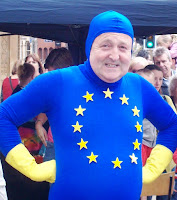 It will come as no surprise that a Liberal Democrat member is going to vote Remain.
Though I have never been an instinctive federalist, I have always believed that membership of the European Union and and embracing of our European identity are good for Britain.
The referendum campaign has only strengthened me in that belief.
The Remain campaign has lacked sparkle, but the sheer weight of informed opinion from economists and business against leaving the European Union is compelling.
So much so that Michael Gove, who has long presented himself as the champion of rigour in education, has been reduced to telling us that "people in this country have had enough of experts".
But I am now even more worried about what Leave would do to British society that what it would do to our economy.
As Professor Simon Wren-Lewis writes on his blog mainly macro:
Tomorrow I shall vote Remain and I hope you will too
by Jonathan Calder

Though I have never been an instinctive federalist, I have always believed that membership of the European Union and and embracing of our European identity are good for Britain.
The referendum campaign has only strengthened me in that belief.
The Remain campaign has lacked sparkle, but the sheer weight of informed opinion from economists and business against leaving the European Union is compelling.
So much so that Michael Gove, who has long presented himself as the champion of rigour in education, has been reduced to telling us that "people in this country have had enough of experts".
But I am now even more worried about what Leave would do to British society that what it would do to our economy.
As Professor Simon Wren-Lewis writes on his blog mainly macro:
When Brexit fails to improve our public services or our economy there will be other scapegoats. Maybe migrants already here, or nasty foreigners who failed to give the beneficial trade deals the Leave campaign pretend we will get. In the US right now it is already happening, and this Brexit campaign shows that the UK has no inbuilt immunity to it. This is how it goes, as it has gone in the past.These are the reasons why I shall vote Remain tomorrow. I hope you will too.
22 Jun 09:56
The Last Man, by Mary Wollstonecraft Shelley
Second paragraph of third chapter:
The second half, when a great plague comes and wipes out humanity, is better executed but perhaps not quite as interesting. I recently read The Last Man (aka No Other Man) by Alfred Noyes, written over a century later but, I now realise, leaning a bit on Shelley; in both cases, the surviving central characters flee the post-holocaust England through a devastated France to find refuge in Italy. There are some great descriptions of places Shelley must herself have known quite well, and she doesn't shirk the awfulness of death by disease (which she had far too much personal experience of). Romantic ideals fail through death of the gallant protagonists. (Adrian, the Shelley character, drowns in a boating accident, in case you were wondering.)
There's a nice framing narrative of Shelley herself finding the text of the story in prophecy in the cave of the Cumaean Sibyl near Naples. And in general, it's very interesting as an early example of post-apocalyptic fiction. I'd recommend it to anyone interested in knowing what happened to the author after Frankenstein - which was written 200 years ago this summer.
This came to the top of my pile as the most popular unread book that I acquired in 2014. Next on that list is Earthlight by Arthur C.Clarke - one I have in fact read before, but not for decades.

After a residence of about a year at Ullswater, Adrian visited London, and came back full of plans for our benefit. You must begin life, he said: you are seventeen, and longer delay would render the necessary apprenticeship more and more irksome. He foresaw that his own life would be one of struggle, and I must partake his labours with him. The better to fit me for this task, we must now separate. He found my name a good passport to preferment, and he had procured for me the situation of private secretary to the Ambassador at Vienna, where I should enter on my career under the best auspices. In two years, I should return to my country, with a name well known and a reputation already founded.This is in some ways a slightly silly book, but in other ways profoundly interesting. The first half of it is dominated by the debate about the best way forward for Art, and for England, between Adrian - a thinly disguised Percy Bysshe Shelley, who happens to be the displaced heir to the recently abolished British throne - and his more ebullient friend Lord Raymond, who (apologies for the spoiler) eventually dies fighting for the Greeks against the Turks; can you imagine who he might be based on? In the year 2073 there has been no advance on technology since 1826, but our chums can just live in Windsor Castle and pop down to London now and then for a spot of governing. But given the importance of the relationship between Lord Byron, Percy Bysshe Shelley and Mary Wollstonecraft Shelley to literature and especially to sf, it is fascinating to have an insight, even if a fictionalised insight, from one of the protagonists. However the interpersonal relationships bit is not as exciting as I would have liked.
The second half, when a great plague comes and wipes out humanity, is better executed but perhaps not quite as interesting. I recently read The Last Man (aka No Other Man) by Alfred Noyes, written over a century later but, I now realise, leaning a bit on Shelley; in both cases, the surviving central characters flee the post-holocaust England through a devastated France to find refuge in Italy. There are some great descriptions of places Shelley must herself have known quite well, and she doesn't shirk the awfulness of death by disease (which she had far too much personal experience of). Romantic ideals fail through death of the gallant protagonists. (Adrian, the Shelley character, drowns in a boating accident, in case you were wondering.)
There's a nice framing narrative of Shelley herself finding the text of the story in prophecy in the cave of the Cumaean Sibyl near Naples. And in general, it's very interesting as an early example of post-apocalyptic fiction. I'd recommend it to anyone interested in knowing what happened to the author after Frankenstein - which was written 200 years ago this summer.
This came to the top of my pile as the most popular unread book that I acquired in 2014. Next on that list is Earthlight by Arthur C.Clarke - one I have in fact read before, but not for decades.
22 Jun 09:55
To my British friends
As you may know, I was born in Belfast. I grew up in a country which was not at peace. I sat in the back row during the first six months of the 1996-98 talks that led to the Good Friday Agreement. Peace in Northern Ireland would simply not have been possible without the European dimension, which transformed the relations between the UK and Ireland from a zero-sum game over sovereignty and loyalty, to a co-operative project of shared growth.
I see the Leave campaign asserting that nothing would change between Northern Ireland and the Republic if Britain left the European Union. I can’t reconcile this with their commitment to regain control of Britain’s borders. At the very least, there would need to be customs posts if the UK is no longer in the EU customs union. (And if nothing is going to change, what is Thursday’s vote actually for?)
On similar lines, I recently had a very interesting chat with leading members of the government of Gibraltar, who are very concerned that their delicate relationship with Spain will be critically undermined if the UK votes to leave. Northern Ireland and Gibraltar are both likely to deliver strong votes for Remain on Thursday; these are the people who face the sharp end of the sovereignty question, and perhaps their views matter.
I've worked in other troubled parts of the world. I contributed to the 2001 EU-brokered Macedonian peace agreement. I advised Croatia's negotiators on their EU accession, and Montenegro and Kosovo on how to anchor their independent status in the European framework. In the Balkans, the governments and peoples that were at war with each other in the 1990s are now committed to working out their differences peacefully, in the framework of joining the EU.
I have also advised the Turkish Cypriot leadership and the Moldovan government. In both cases, the attraction of the EU is proving to be crucial in overcoming the deep divisions that have previously erupted into conflict. These are imperfect processes – what process is perfect? – but the shared factor is clear. Compare these two situations, inching forward, with other frozen conflicts in the neighbourhood (Israel/Palestine being the most obvious) which remain intractable and coincidentally have no prospect of European integration.
Britain may well choose to walk away from the project of making and keeping peace in Europe by building a common future. But that will certainly weaken the mission as a whole, increasing the risk of new conflict. I hope it doesn’t happen.
Just two other points, if I may. First, I’m really saddened by the vicious rhetoric about migration that has characterised the campaign. I take it personally. I am a migrant, as are several of my closest relatives. It seems to me, from afar, that if public services in Britain are under stress, that is because of a broader problem with the funding model. Blaming migrants, particularly considering how much they actually contribute to delivery of those services, is a distraction.
I also want to say that, contrary to some perceptions, I find the Brussels policy machinery very open to external input. It’s not surprising that this is the case, given that a broad consensus from business, unions, consumers and citizens is needed to persuade a sufficient majority of elected governments and elected MEPs to agree to any particular proposal. I may have been fortunate – I work on a fairly narrow range of issues – but I really think that this is the single aspect that has been most maliciously reported by the UK media. I’m happy to talk more about this if you have any questions.
Of course, Brexit will be a bonanza for public affairs consultants like me. The process itself will include lots of moving parts to report on and to try and influence; the end result will be more decisions taken in London, where lobbying is barely scrutinised, rather than Brussels, where the demands of transparency are getting tougher. But my pocket does not always rule my head.
Anyway, I’ll be up all night on Thursday, hoping for the best. Good luck.
(Sent to a large number of people this evening - not quite as large as I'd have liked, as Gmail has a limit to the number of messages you can send!)
I see the Leave campaign asserting that nothing would change between Northern Ireland and the Republic if Britain left the European Union. I can’t reconcile this with their commitment to regain control of Britain’s borders. At the very least, there would need to be customs posts if the UK is no longer in the EU customs union. (And if nothing is going to change, what is Thursday’s vote actually for?)
On similar lines, I recently had a very interesting chat with leading members of the government of Gibraltar, who are very concerned that their delicate relationship with Spain will be critically undermined if the UK votes to leave. Northern Ireland and Gibraltar are both likely to deliver strong votes for Remain on Thursday; these are the people who face the sharp end of the sovereignty question, and perhaps their views matter.
I've worked in other troubled parts of the world. I contributed to the 2001 EU-brokered Macedonian peace agreement. I advised Croatia's negotiators on their EU accession, and Montenegro and Kosovo on how to anchor their independent status in the European framework. In the Balkans, the governments and peoples that were at war with each other in the 1990s are now committed to working out their differences peacefully, in the framework of joining the EU.
I have also advised the Turkish Cypriot leadership and the Moldovan government. In both cases, the attraction of the EU is proving to be crucial in overcoming the deep divisions that have previously erupted into conflict. These are imperfect processes – what process is perfect? – but the shared factor is clear. Compare these two situations, inching forward, with other frozen conflicts in the neighbourhood (Israel/Palestine being the most obvious) which remain intractable and coincidentally have no prospect of European integration.
Britain may well choose to walk away from the project of making and keeping peace in Europe by building a common future. But that will certainly weaken the mission as a whole, increasing the risk of new conflict. I hope it doesn’t happen.
Just two other points, if I may. First, I’m really saddened by the vicious rhetoric about migration that has characterised the campaign. I take it personally. I am a migrant, as are several of my closest relatives. It seems to me, from afar, that if public services in Britain are under stress, that is because of a broader problem with the funding model. Blaming migrants, particularly considering how much they actually contribute to delivery of those services, is a distraction.
I also want to say that, contrary to some perceptions, I find the Brussels policy machinery very open to external input. It’s not surprising that this is the case, given that a broad consensus from business, unions, consumers and citizens is needed to persuade a sufficient majority of elected governments and elected MEPs to agree to any particular proposal. I may have been fortunate – I work on a fairly narrow range of issues – but I really think that this is the single aspect that has been most maliciously reported by the UK media. I’m happy to talk more about this if you have any questions.
Of course, Brexit will be a bonanza for public affairs consultants like me. The process itself will include lots of moving parts to report on and to try and influence; the end result will be more decisions taken in London, where lobbying is barely scrutinised, rather than Brussels, where the demands of transparency are getting tougher. But my pocket does not always rule my head.
Anyway, I’ll be up all night on Thursday, hoping for the best. Good luck.
(Sent to a large number of people this evening - not quite as large as I'd have liked, as Gmail has a limit to the number of messages you can send!)
22 Jun 09:52
APCO’s Guide to Referendum Night
See my guide to how Referendum night could play out, area by area, hour by hour, now available for download. Enjoy!
21 Jun 18:48
Day 5651: The Dark is Rising
by Millennium Dome
Tuesday:
We must turn back the tide.
In the last week there have been two murderous attacks on people who, although not close to me are only a short step away and feel like my people.
In America, my soon-to-be-step brother knows people in Orlando who have lost loved ones in the massacre at the Pulse nightclub – an attack on the gay community, my community.
And then in Birstall, I know people who have campaigned near there and who have campaigned with Jo Cox for better treatment of refugees – an attack on liberal-thinking politics, my tribe of politics.
These incidents do not come in isolation.
The roots of this poison go deep. Fear, anger, rage have been encouraged, fed by years of austerity. Left and right have encouraged a blame culture and simplistic answers. Our media have traduced politicians as venal and corrupt. The immediacy of social media has unleashed a tidal wave of trolls with the power of abuse. And this referendum has been the ugliest political campaign, fought in the ugliest political climate. To get to this point.
How many tweets calling a person with the opposite view a traitor does it take before some people think it's okay to shout abuse in the streets? How may expletive-laden chants of traitor have to be shouted before some people think it's okay to whisper threats of rape and violence to a young woman as she campaigns? How many whispered threats before some people think it's okay to stop threatening and use violence? How many assaults and beatings does it take before one person thinks that he will do what everyone he reads is saying he should do? To get to this point.
When did it become okay to say we've had enough of experts?
When did it become okay to say that violence would follow if you don't get your own way?
When did it become okay to just lie?
Those on the right need to be held to account for how they have promoted simplistic – and wrong – answers, seeking protectionism and blaming the foreigner, the other, despite the clear historical precedent that these answers do not work – we hear people like Peter Oborne saying the working class are fearful for their jobs but stoking that fear by repeating the falsehood that immigrants "take British people's jobs" when that is simply not how economies work.
Those on the left need to look at how they behaved during the coalition years: all the cries of betrayal and blame, never seeking to promote answers or accepting responsibility, abandoning arguments just as they abandoned the working class vote to the nationalists – the likes of Polly Toynbee who now condemns the toxic climate but never took a week off from denigrating Nick Clegg for trying to make a bad situation work.
Those in the media need to admit to their own faults, and failings and bias, who have given platforms to Farage and his rag tag minority far beyond what they deserved until the prophecy has become self-fulfilling; who have spun news stories – or just plain falsehoods – to the tune of business tycoons whose interests do not in any way correspond with the interests of the British public; and who push the idea that politicians never give a straight answer, but who won't let a politician answer the question without interrupting, and some questions need more than a soundbite to answer, who have earned far more than the MPs they bully while painting politicians as venal and corrupt and deserving of abuse and yes even death.
But I won't accept false equivalence. There are faults on all sides, but they are not the same, and to pretend that there is any sense that the Stronger In campaign mounting piece after piece of evidence that things will not be good outside the EU – dismissed as "Project Fear" by the people scaremongering about immigrant rapists – is in any way similar to the malice and lies of Vote Leave is to give succour to the racists who can hardly even be said to be hiding in plain sight any more, they are out in the open and revelling in their vile views.
There comes a time when you have to ask yourself – as in the Mitchell & Webb sketch – are you the baddies?
UKIP are not the victims here. Nigel Farage, asked about the death of Jo Cox, claimed that he was the victim of hatred. Nigel Farage is not the victim here. If you foment hate and you get hate back, that is not a free pass to go on spewing hate.
Evil exists.
It is a childish thing to think in terms of good and evil. We are more sophisticated than that. Grown up life is so much more complex and nuanced, full of difficult compromise and the best being enemy to the better. But sometimes is really is that simple. Because we have seen this road before and we know the place it ends.
It is a childish thing to think in terms of good and evil. But it is story of my childhood that keeps coming back to me – Susan Cooper's "The Dark is Rising". And that is what I have been feeling, for the last days, weeks, months even.
There is Darkness in all humans. And that Dark is rising.
I'm not immune. I'm not a saint. I've felt anger, fury even, at some of the things that have been said and done in this campaign. I like to tell myself that I've tried to campaign in an honest and optimistic way, that I've tried to stick to the facts and called on people to use fact and reason to build their case, to use the best of British tradition to encourage us to be part of holding together a Europe that for the first time in history has gone not one but two generations without tearing itself apart. But if you scrutinise, I would not be surprised if you found I'd sent a tweet in wrath, or posted an irate put-down on FaceBook.
Many have said that her death was the first they had heard of Jo Cox. Because she'd been working with Tim Farron and Yvette Cooper to urge Britain to do more for refugees I was vaguely aware of her work. But I can hardly say that I knew her.
But I want to try to be a better person, to not give in to that anger, as my way to honour her memory.
We must all strive to do better. And we can be better.
Today I am appalled to hear that a man was planning to assassinate Donald Trump. We cannot defeat Trump – or Farage – by killing him. That way, we only replace him.
The vigils that have been held for Orlando and for Jo Cox, the dignity of the tributes paid in parliament, have shown that there is love and there is a better way. The sudden and very obvious panic in the Vote Leave camp, and in Farage in particular, the way he's desperately trying to turn this around to make the story all about him again, the disrespectful claim that Remain are out to "profit" from the death of one of their strongest voices all tell the tale that they know they've been rumbled.
These vigils are not about any political campaign any more. They are about doing a politics that is Good.
Vote Leave's fear and anger is because they embraced the Darkness months, if not years ago. They lost the argument. All they have is driving people with fear, anger, hate, poison.
There is now the palpable sense that people have awoken to the clear and present danger of allowing free reign to this poison that has festered. There is a sense that I am not alone in wanting to strive to do better.
The Dark is rising.
But the Light is rising to turn back the Dark.
“The hope is always here, always alive, but only your fierce caring can fan it into a fire to warm the world.”
― Susan Cooper, Silver on the Tree
We must turn back the tide.
In the last week there have been two murderous attacks on people who, although not close to me are only a short step away and feel like my people.
In America, my soon-to-be-step brother knows people in Orlando who have lost loved ones in the massacre at the Pulse nightclub – an attack on the gay community, my community.
And then in Birstall, I know people who have campaigned near there and who have campaigned with Jo Cox for better treatment of refugees – an attack on liberal-thinking politics, my tribe of politics.
 |
| At the Westminster vigil |
These incidents do not come in isolation.
The roots of this poison go deep. Fear, anger, rage have been encouraged, fed by years of austerity. Left and right have encouraged a blame culture and simplistic answers. Our media have traduced politicians as venal and corrupt. The immediacy of social media has unleashed a tidal wave of trolls with the power of abuse. And this referendum has been the ugliest political campaign, fought in the ugliest political climate. To get to this point.
How many tweets calling a person with the opposite view a traitor does it take before some people think it's okay to shout abuse in the streets? How may expletive-laden chants of traitor have to be shouted before some people think it's okay to whisper threats of rape and violence to a young woman as she campaigns? How many whispered threats before some people think it's okay to stop threatening and use violence? How many assaults and beatings does it take before one person thinks that he will do what everyone he reads is saying he should do? To get to this point.
When did it become okay to say we've had enough of experts?
When did it become okay to say that violence would follow if you don't get your own way?
When did it become okay to just lie?
Those on the right need to be held to account for how they have promoted simplistic – and wrong – answers, seeking protectionism and blaming the foreigner, the other, despite the clear historical precedent that these answers do not work – we hear people like Peter Oborne saying the working class are fearful for their jobs but stoking that fear by repeating the falsehood that immigrants "take British people's jobs" when that is simply not how economies work.
Those on the left need to look at how they behaved during the coalition years: all the cries of betrayal and blame, never seeking to promote answers or accepting responsibility, abandoning arguments just as they abandoned the working class vote to the nationalists – the likes of Polly Toynbee who now condemns the toxic climate but never took a week off from denigrating Nick Clegg for trying to make a bad situation work.
Those in the media need to admit to their own faults, and failings and bias, who have given platforms to Farage and his rag tag minority far beyond what they deserved until the prophecy has become self-fulfilling; who have spun news stories – or just plain falsehoods – to the tune of business tycoons whose interests do not in any way correspond with the interests of the British public; and who push the idea that politicians never give a straight answer, but who won't let a politician answer the question without interrupting, and some questions need more than a soundbite to answer, who have earned far more than the MPs they bully while painting politicians as venal and corrupt and deserving of abuse and yes even death.
But I won't accept false equivalence. There are faults on all sides, but they are not the same, and to pretend that there is any sense that the Stronger In campaign mounting piece after piece of evidence that things will not be good outside the EU – dismissed as "Project Fear" by the people scaremongering about immigrant rapists – is in any way similar to the malice and lies of Vote Leave is to give succour to the racists who can hardly even be said to be hiding in plain sight any more, they are out in the open and revelling in their vile views.
There comes a time when you have to ask yourself – as in the Mitchell & Webb sketch – are you the baddies?
UKIP are not the victims here. Nigel Farage, asked about the death of Jo Cox, claimed that he was the victim of hatred. Nigel Farage is not the victim here. If you foment hate and you get hate back, that is not a free pass to go on spewing hate.
Evil exists.
It is a childish thing to think in terms of good and evil. We are more sophisticated than that. Grown up life is so much more complex and nuanced, full of difficult compromise and the best being enemy to the better. But sometimes is really is that simple. Because we have seen this road before and we know the place it ends.
It is a childish thing to think in terms of good and evil. But it is story of my childhood that keeps coming back to me – Susan Cooper's "The Dark is Rising". And that is what I have been feeling, for the last days, weeks, months even.
There is Darkness in all humans. And that Dark is rising.
I'm not immune. I'm not a saint. I've felt anger, fury even, at some of the things that have been said and done in this campaign. I like to tell myself that I've tried to campaign in an honest and optimistic way, that I've tried to stick to the facts and called on people to use fact and reason to build their case, to use the best of British tradition to encourage us to be part of holding together a Europe that for the first time in history has gone not one but two generations without tearing itself apart. But if you scrutinise, I would not be surprised if you found I'd sent a tweet in wrath, or posted an irate put-down on FaceBook.
Many have said that her death was the first they had heard of Jo Cox. Because she'd been working with Tim Farron and Yvette Cooper to urge Britain to do more for refugees I was vaguely aware of her work. But I can hardly say that I knew her.
But I want to try to be a better person, to not give in to that anger, as my way to honour her memory.
We must all strive to do better. And we can be better.
Today I am appalled to hear that a man was planning to assassinate Donald Trump. We cannot defeat Trump – or Farage – by killing him. That way, we only replace him.
The vigils that have been held for Orlando and for Jo Cox, the dignity of the tributes paid in parliament, have shown that there is love and there is a better way. The sudden and very obvious panic in the Vote Leave camp, and in Farage in particular, the way he's desperately trying to turn this around to make the story all about him again, the disrespectful claim that Remain are out to "profit" from the death of one of their strongest voices all tell the tale that they know they've been rumbled.
These vigils are not about any political campaign any more. They are about doing a politics that is Good.
Vote Leave's fear and anger is because they embraced the Darkness months, if not years ago. They lost the argument. All they have is driving people with fear, anger, hate, poison.
There is now the palpable sense that people have awoken to the clear and present danger of allowing free reign to this poison that has festered. There is a sense that I am not alone in wanting to strive to do better.
The Dark is rising.
But the Light is rising to turn back the Dark.
“The hope is always here, always alive, but only your fierce caring can fan it into a fire to warm the world.”
― Susan Cooper, Silver on the Tree
21 Jun 18:46
Amazing Spider-Man #3
by Andrew Rilstone
Spider-Man versus Doctor Octopus, the Strangest Foe of All Time.

Four months ago, Spider-Man was about to turn evil.
Two months ago, Spider-Man was looking for ways to make money.
This month, Spider-Man is a professional hero who has "cases" and "assignments" and "opponents".
Today, we would call Amazing Spider-Man #3 a reboot. Characters are created, status quos established and precedents that haven't even been established yet are daringly broken. This is the first fully fledged issue of the comic we now know as Spider-Man. And it's not actually very good.
The episode begins with Spider-Man defeating a gang of bank robbers; beating up all three of them in a single panel and leaving them hanging on the end of a cobweb. This is the first time we have seen him do this kind of thing, but it clearly isn't the first time he has done it. He introduces himself with the spider-signal; which the crooks are all familiar with. He doesn’t take any photos or claim any reward. Catching thieves (just like flies) is simply what he does.
"Strange that an old fashioned punch to the jaw defeated the most dangerous villain I’ve ever faced" says Spider-Man. It is never clear whether we should regard these remarks as Stan Lee patting himself on the back for being so original, or reprimanding Steve Ditko for being so boring. I am inclined to think the latter.
For once, we have a Spider-Man story which is not about fame: it's about pride. Octopus believes himself to be the most powerful man on earth; even though all he has is physical strength. Parker is defeated because he thinks he is defeated: once he believes he can win, he beats Octopus quite easily. The final frame underlines Peter’s confidence: Flash tells him that he is is a bookworm and the Torch is a real man, but rather than running away crying, Parker effectively responds that it was the “bookworm” side of him — Science — that defeated the bad guy.
Is Peter Parker coming to grips with his dual identity?
SPOILER: No.

Villain
Doctor Octopus
Guest appearance
Human Torch
Named Characters
Jameson, Aunt May,
First appearance of
Doctor Octopus
Spider-Signal
First time Spider-Man catches a gang of robbers.
Observations
Flash Thompson is back to being a red-head, but is not referenced by name.
Parker tells Jameson to have his cheque ready, even though he was paid in cash last month.
Ditko and Lee have different idea about why the Human Torch is taking time off from the Fantastic Four. On page 21, the art clearly shows him visiting a doctor and being given the all-clear. But on page 13, the text clearly says that he has over-used his flame power and needs to rest it.
Four months ago, Spider-Man was about to turn evil.
Two months ago, Spider-Man was looking for ways to make money.
This month, Spider-Man is a professional hero who has "cases" and "assignments" and "opponents".
This is the second consecutive issue which has ended with Parker looking relatively happy. It won't last.
Today, we would call Amazing Spider-Man #3 a reboot. Characters are created, status quos established and precedents that haven't even been established yet are daringly broken. This is the first fully fledged issue of the comic we now know as Spider-Man. And it's not actually very good.
The episode begins with Spider-Man defeating a gang of bank robbers; beating up all three of them in a single panel and leaving them hanging on the end of a cobweb. This is the first time we have seen him do this kind of thing, but it clearly isn't the first time he has done it. He introduces himself with the spider-signal; which the crooks are all familiar with. He doesn’t take any photos or claim any reward. Catching thieves (just like flies) is simply what he does.
And then he complains “It’s almost too easy. I’ve run out of enemies who can give me any real opposition. I am too powerful for any foes. I almost wish for an opponent who’d given me a run for my money.” Enemy; opposition; opponent. Spider-Man was introduced to the world as a wrestler; and Stan Lee's language is still the language of a fight promoter, talking up the challenger, making it sound as though the hero can't win. “The world’s most dreaded super villain;” “his most powerful foe;” “can anything that lives defeat the mighty Doctor Octopus?” “the only foe ever to defeat Spider-Man;” “the power of Doctor Octopus is far greater than yours!” Each month from now on, Spider-Man will have a fight with an opponent; it will look as if he is going to lose; but he will win. When a challenger is particularly "popular", he will be invited back for a rematch.
“I almost wish for an opponent who’d give me a run for my money”. It’s now almost a year since Peter Parker told the old cop that catching criminals was none of his business. It isn't clear if Parker believes in God (although I will never not believe that Uncle Ben was Jewish) but he certainly believes in Fate, or talks as if he does. And if there's one thing we know about Fate, it's that you shouldn't go around tempting it.
It's been established over the last couple of stories that Spider-Man always loses the first bout with his challenger, goes away, uses his brain, and works out a way of winning the second round. This time, the formula is escalated in a frankly rather corny way. When Doctor Octopus throws Spider-Man through a window Whining Peter immediately decides (for the third time) that he’s going to quit being Spider-Man. He doesn't seem to be very badly injured; he just gives up. But it just so happens that the Human Torch is giving a motivational speech at Peter Parker’s school that very day.
There is no special reason for it to be the Human Torch; Spider-Man and Johnny Storm’s feud is yet to be established. It could just as well have been a policeman or a vicar. Johnny, often depicted as a spoiled brat, comes over here in rather a good light. The original idea for Spider-Man may have been “what if there were a person in the real world with superpowers”; but that idea has now subtly changed into “what if the superheroes lived in a world like ours?" What if a visit from an older lad who could spontaneously combust and throw fireballs around were a not-very-remarkable part of your school day? Which is, it has to be said, a lot more fun.
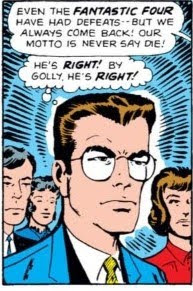 The Torch’s message is the same one that, oddly enough, a little spider once gave to a demoralized Scottish king: "If at first you don't succeed, try, try, try again." “The important thing is never give up. Remember that. Never give up.” So Spidey goes back and has another fight with Doctor Octopus, but this time, he uses Science to make Doctor Octopus's arms stick together, sprays web over his glasses, and knocks him out.
 The Torch’s message is the same one that, oddly enough, a little spider once gave to a demoralized Scottish king: "If at first you don't succeed, try, try, try again." “The important thing is never give up. Remember that. Never give up.” So Spidey goes back and has another fight with Doctor Octopus, but this time, he uses Science to make Doctor Octopus's arms stick together, sprays web over his glasses, and knocks him out.
"Strange that an old fashioned punch to the jaw defeated the most dangerous villain I’ve ever faced" says Spider-Man. It is never clear whether we should regard these remarks as Stan Lee patting himself on the back for being so original, or reprimanding Steve Ditko for being so boring. I am inclined to think the latter.
Doctor Octopus is a visually charismatic figure; a classical mad scientist with four extra arms attached to his torso. They are very strong; and they can be any length Ditko wants them to be; but I never understood quite why they made him quite such a dangerous enemy. There are one or two nice scenes: Doc Ock disguising his arms as water pipes so a guard doesn’t notice him; and the arms reaching through the door of the Atomic Research Centre -- but the two fight scenes are a little nondescript. For a number of panels Ditko stops bothering with backgrounds altogether.
For once, we have a Spider-Man story which is not about fame: it's about pride. Octopus believes himself to be the most powerful man on earth; even though all he has is physical strength. Parker is defeated because he thinks he is defeated: once he believes he can win, he beats Octopus quite easily. The final frame underlines Peter’s confidence: Flash tells him that he is is a bookworm and the Torch is a real man, but rather than running away crying, Parker effectively responds that it was the “bookworm” side of him — Science — that defeated the bad guy.
Is Peter Parker coming to grips with his dual identity?
SPOILER: No.
21 Jun 17:38
Margaret Thatcher, quoting Clement Attlee, once described referendums "a device of dictators and demagogues".
She was right.
A referendum on Britain's membership of the European Union was always a bad idea and it has had an unlovely effect on our politics - or at least revealed a side of it that is usually well buried.
For a discussion of that effect I recommend articles by Alex Massie and the great Neil Ascherson.
Reader's voice: Come off it! You are only saying this because you are afraid your side is going to lose.
Not so.
I have been saying the same thing for many years. Most substantially, as far as I can recall, in this article for the much-missed Liberal Democrat News in 2011:
In 2010 he gave 14 reasons why the move to introduce referendums to British politics should be resisted, The European referendum campaign has proved he was right in every case.
Here are a couple of examples:
The Conservative Party used to be united by its belief in upholding that constitution. Today, most of its members, and many of its MPs, would rather scribble on it.
Scribbling on the constitution: A referendum on Europe was always a bad idea
by Jonathan Calder
Margaret Thatcher, quoting Clement Attlee, once described referendums "a device of dictators and demagogues".
She was right.
A referendum on Britain's membership of the European Union was always a bad idea and it has had an unlovely effect on our politics - or at least revealed a side of it that is usually well buried.
For a discussion of that effect I recommend articles by Alex Massie and the great Neil Ascherson.
Reader's voice: Come off it! You are only saying this because you are afraid your side is going to lose.
Not so.
I have been saying the same thing for many years. Most substantially, as far as I can recall, in this article for the much-missed Liberal Democrat News in 2011:
For years the main parties have engaged in something close to a conspiracy. The issue of Europe has been taken out of general elections, with the promise that it will be decided through a referendum. Those referendums never take place. The result has been an infantilisation of debate on Europe, as politicians are allowed to take up self-indulgent, extreme positions they know they will never have to defend to the electorate.
This process has been bad for us Liberal Democrats, encouraging the idea that all we need do to prosper is not offend anybody and deliver lots and lots of leaflets. And it has been bad for democracy as a whole. Why should voters feel enthusiastic about Westminster when their representatives avoid talking about one of the most important issues facing the country?But don't take my word for it: read a guest post by Paul Evans on Slugger O'Toole, the best blog on Northern Ireland politics.
In 2010 he gave 14 reasons why the move to introduce referendums to British politics should be resisted, The European referendum campaign has proved he was right in every case.
Here are a couple of examples:
- They drive out the deliberative element in policymaking. The referendum question is an appeal to reflexes rather than an attempt to get a thoughtful response from the public.
I am a believer in representative government - what George Watson called The English Ideology. It is the cornerstone of our constitution.
- They hand enormous powers to newspaper proprietors and people with the finances to take one side of the argument. It also hands the reins of government over to unelected and well-heeled pressure groups.
The Conservative Party used to be united by its belief in upholding that constitution. Today, most of its members, and many of its MPs, would rather scribble on it.
21 Jun 16:15
[anthro, Patreon] Where Geek Girls Come From
[View in black and white]
Many years ago, the father of a baby girl posted to an email list I was on. It was an email list largely populated by computer geeks, and he posted to ask what he could to as a father to cultivate geekiness in his daughter as she grew. I thought this was a great question, and I've always wanted to get back to it to answer it.
And part of why I've always thought it was a great question was a phenomenon I observed back when I first went to college, and just reproduced in the little informal "study" I just ran. If you want to go answer the survey, you're welcome to, but maybe do that first before having your answer skewed by reading the rest of this.
My freshman year of college was 27 years ago, which I mention because it might matter – the same reason I asked people's ages. You'll have to take my word on it if you weren't there then – I do hope someday to write a post about this, too, but not today – it was another world. That was the tail end of the 80s. A lot has happened in the last quarter century, in the social status and roles of women in the industrialized West. Having said that, I don't know if this has changed or not.
I was a student at an engineering school; I seem to recall my entering class was about one third women. So I was around, literally, hundreds of young women with impeccable geek cred. And I observed a thing. I remember there was a sort of conversation we women often had, which I don't think the men had.
The other day, I asked a friend – in person, as it happens, but she's on my f.list – who was a contemporaneous frosh at the same engineering school, and a woman, "So how did you get into tech?"
She said, "Oh, well, my dad–" and then some other stuff.
I asked another friend, who is a programmer, and in his mid-50s, how he got into programming, and he told me a story about educational opportunities he took advantage of in college. I probed further, about "geeky stuff in general" before college, and spoke of earlier educational opportunities, in high school. And that was particularly remarkable because I know for a fact his father was an electrical engineer.
And that was the thing. Back in 1989, when I was a geeky frosh entering a geeky college, there would be this little conversation I found myself having with my fellow geek women that just never came up chatting with geeky men.
We women had these origin stories. In the same way that Peter Parker climbing sheer walls and shooting webs were things that require recourse to the explanatory power of being bitten by a radioactive spider, we all understood there had to be something to account for why a young woman would find herself at an elite engineering school. It was 1989, and even though we'd generally be raised on warm, fuzzy "Girls can grow up to be anything they want to be!" PBS programming, we were all perfectly aware that we were in flagrant violation of gender norms.
And the thing was – I'm speculating here – I don't think any of us wondered how it was that a woman could be good at such things. Obviously: the same way men were. We just were. Happens. No, the thing was, I think all of us knew women who were incredibly intelligent – possibly even greatly capable in math or logic – who never became geeks. For me, I had the example of my mother, a person with a intellect no less naturally capable of being a programmer than me, who never used her gifts thus. And it wasn't that I thought my mother liked the earning potential of being a legal secretary better than that of being a programmer or other technical professional. It had simply never been an option in her life.
I think all of us knew personal examples like that. Women who could have been us, but never were.
And I think that, because we kept asking one other something that amounted to, "Sooooo, how did you storm the gates of this ivory tower?" We knew what was being asked, and we had our origin stories ready – I suppose we had first had to work them out for ourselves.
Young men, of course, didn't need origin stories. Their being engineering students was wholly unremarkable, and thus unremarked upon. No explanation was required.
The origin stories we women told though, overwhelmingly had one thing in common. Over and over and over, young women mentioned that at some impressionable point in their life, there had been someone. Sometimes it was a grandfather, or an uncle, or an older brother, but usually it was a father. It was almost always a man. A geeky man. And he brought the girl into the geek tribe.
As of when I collected the data a little while ago, my little poll had a total of 31 results, plus the results of the two people I asked in person, bringing us to 33 respondents (does not include me). Fourteen are women and one presented as female as a child and now identifies as genderqueer, for a total of 15 people who identified as female when they "got into geeky stuff". Seventeen identified as male and one who I believe presently identifies as male said they didn't have a gender presentation then, so I'll count that as 18 male people. (Edge cases, please let me know if I shouldn't so lump.)
Of those females, two thirds identified someone specific who is male in their answer to the question (10 did, 5 did not). Of those males, two thirds did not; 12 did not mention anyone specifically male, five did mention specific males and one referred to "someone", gender unknown.
Women wrote:
"My parents got me some sort of keyboard..."
"Parents are geeks, surrounded me with geek stuff from birth..."
I can hear some of my poll respondents protesting, "But there was an important geeky older male person in my life, too! I just didn't mention!" Right, like the male friend I asked in person. This isn't about what actually happened in our youths – none of us did it alone, we all had lots of people, probably of a variety of genders, who assisted and influenced our nascent geekery – it's about what stories we tell when we're asked how we get here.
For whatever reason – speculation on which below – most geeky women I have spoken to about this, when generally asked, there answer is when I was a girl, there was a man.
When we listen to these stories that geeky women tell when they tell the "when I was a girl, there was a man" story, there are stories we generally don't hear. It is not the story "the man taught me everything I know": these are not stories of long, involved tutelage. Or even short, cursory tutelage. They are stories of the man introducing the girl to some aspect of geekery. Possibly even in passing, or by osmosis. It is not the story "the man taught me everything he knows": these are not stories of continuing a legacy or a legacy being passed on. Which is to say, these are not stories of identity, "my father was a geek, as his father was before him, and it is my duty to carry on the family tradition." It is not the story "they wouldn't let me until he made them." There are no antagonists in these stories. Nobody is keeping the young geek girl from her geekery, nobody's opposition needs to be overcome.
Nor are they the stories, "I didn't like it until he showed me how to appreciate it", "I wasn't any good at it until he helped me master it", "I didn't think I could do it until he gave me confidence in my ability to do it." Quite to the contrary: I've never encountered a geeky woman whose geek identities were given to them.
The story you do hear is more like, he showed me what there was out there in the world which resonated with what was inside of me. Or he showed me there was another world, better than this one. One in a book or movie or a floppy disk. Or reachable through an acoustic coupler modem or in a laboratory or in a machine shop. Or on a plane of pure abstraction, or underlying the physical order of this world.
Sometimes in these stories, it is not men but older women to whom geeky women refer. But for those of us in my age cohort, when we were girls, there simply weren't that many geeky women to encounter. There weren't that many women who frequented those other worlds, and could show us the doors to them. My mother could mouth all the right platitudes about girls pursuing traditionally male pursuits, but she couldn't be much more than a cheerleader, not being a geek herself. Ironically, it was my mother who unconsciously bought into the notion that what kept girls from traditional male domains was what girls thought or felt, as if there was some fault in the hearts girls that could be corrected if they just adopted the right attitude, while it was my father who matter-of-factly shared with me things that were traditionally male, with the assumption that of course I would like them, too, if someone just provided them to me.
(I have long thought my father was in many ways a better feminist than my mother. What society said was for males, my mother thought I should want, but my father thought I would want.)
I think there's a subtlety here. These geeky women's origin stories aren't saying "I couldn't have found the way into geekery without him". That doesn't seem to be the gist – though it might be true. I think there is something else, implicit.
Geeky women could tell the story, "the first time I encountered the geeky thing I loved it" – a story without any recourse to a person at all. Geeky men, when asked the same question, reasonably often don't mention any person at all. In our little sample, 8 of 18 males – almost half – literally did not mention any other person. They spoke of their own interests, they spoke of institutional opportunities. Only four out of 15 females did the same, a hair over a quarter.
Now perhaps this isn't about geekery at all. Maybe it's just that when you ask women about their pasts, they're more likely to mention influential people than are men, regardless of what the topic is. Maybe it's a female tendency – whether acquired or innate – to think in terms of people. I have no idea. Further research is indicated.
But another possibility is that there is an implicit significance to telling the story as they (we) do. I'm inclined to this interpretation, as a therapist; we therapists are all about listening to what is said between the lines when people tell their stories.
My intuition tells me that what these stories – these "when I was a girl, there was a man" stories – are, are stories of initiation. I mean, not just in the sense of a beginning, though surely that too, but in the sense of being dubbed a member. In the ceremonial sense, an initiation is the inward crossing of a group's membership boundary: before you were not a member, now you are a member.
I'm not saying these are stories of ceremonies; they are almost never so formal. Yet these stories implicitly answer the question, "How did you become a member of the geek nation?" Some say, "I was born into it"...
I think this, then, is the answer to the question that young father asked so many years ago about how to bring his daughter up a geek. You put something geeky in her hands. By doing so, you tell her in deeds this is for you.
And then she knows it is for her.
I know this doesn't sound like much, but when you listen to these origin stories of geek women, they don't sound like much, either. The things that geek women remember, the things that they mark as important, are so slight in retrospect – "he read me the first few pages and then gave me the book"! – one has to wonder if the person who did the thing even remembers it, or knew at the time how important it would be in the memory of the adult the child would one day grow to become.
But these simple gestures are the things that unlock the doors for girls.
These moments are where the geekiness in an adult hails the geekiness in a child.
In none of the women's stories is it proposed that they were introduced to geekery by someone who wasn't themselves a geek. None of these are stories about some parent who wasn't a geek but who thought, say, a career in computer programming was a desirable aspiration for their child to have, so they signed their kid up for a computer programming class (while one or two of the men's stories seem to perhaps follow exactly that model, though it is unclear.)
Geeky women's origin stories are of adult geeks – usually, but not always men – sharing their geekiness. It is an adult geek, sharing their enthusiasm with a child, as an expression of their affection and of their own geekiness. It is often as if the adult is saying, "I love this; here, you will probably love this too."
I would propose that what geeky women's origin stories tell us is that what they remember as crucial is being seen as nascent geeks by adult geeks and those adult geeks sharing their geek enthusiasms with the girls.
What these geeky women's origin stories suggest to me is that initiation is the complement to representation. Representation is showing girls, in general, that a thing can be for women, in general. Initiation shows a specific girl that a thing can be for her, in specific.
Initiation can function where representation is scarce on the ground, which would explain why so many of us middle-aged geek women have the sorts of origin stories we do. They aren't "when I was a girl, I saw a woman could do those things so then I pursued them", and they aren't "when I was a girl, I just was interested (it never occurred to me that being a woman factored into it)". They're "when I was a girl, there was a man, and he shared his enthusiasm for the geeky thing with me, and that's how I knew it was for me".
I started this post saying I had long wanted to write it because I wanted to answer a father's question of how to raise a geek daughter. But I have another purpose, too.
I think I see a thing in history, and want to bear witness to it even as it fades away.
In the US, the women's movement of the 1960s and 1970s agitated for society to respect the full humanity of women, and petitioned society to grant its daughters full and free access to all the halls where men alone could walk. It called on all people to see their daughters as having no less potential than their sons.
I see in these stories – these origin stories of geeky women in our 30s, 40s, 50s and 60s that follow that narrative "when I was a girl, there was a man" – evidence that a great number of men, many tens of thousands, if not hundreds of thousands, heard that plea, and took it to heart. These men heard the petition of the second wave feminists, and turned to their daughters, their granddaughters, their nieces, their sisters, and said yes. They knew what their society had long believed of women, and they heard feminism's alternative vision of what women could be, and they chose to believe feminism instead.
I do not want this lost to time. So many of the doors women wanted unbarred could not be unbarred from the outside – such is privilege; men opened them for us, men who agreed we had every right not to be locked out. Not a grudging few, but great numbers of them.
To my knowledge, the great majority of women of my generation who strode in unprecedented numbers into science, engineering, and technology in the 1970s, 1980s, 1990s and 2000s were able to do so in crucial part because some man in their lives, when they were girls, looked at them and saw a fellow human and a fellow geek.
Link for sharing: http://siderea.livejournal.com/1283810.html?format=light
This post brought to you by the 108 readers who funded my writing it – thank you all so much! You can see who they are at my Patreon page. If you're not one of them, and would be willing to chip in so I can write more things like this, please do so there.
Please leave comments on the Comment Catcher comment, instead of the main body of the post – unless you are commenting to get a copy of the post sent to you in email through the notification system, then go ahead and comment on it directly. Thanks!
Many years ago, the father of a baby girl posted to an email list I was on. It was an email list largely populated by computer geeks, and he posted to ask what he could to as a father to cultivate geekiness in his daughter as she grew. I thought this was a great question, and I've always wanted to get back to it to answer it.
And part of why I've always thought it was a great question was a phenomenon I observed back when I first went to college, and just reproduced in the little informal "study" I just ran. If you want to go answer the survey, you're welcome to, but maybe do that first before having your answer skewed by reading the rest of this.
My freshman year of college was 27 years ago, which I mention because it might matter – the same reason I asked people's ages. You'll have to take my word on it if you weren't there then – I do hope someday to write a post about this, too, but not today – it was another world. That was the tail end of the 80s. A lot has happened in the last quarter century, in the social status and roles of women in the industrialized West. Having said that, I don't know if this has changed or not.
I was a student at an engineering school; I seem to recall my entering class was about one third women. So I was around, literally, hundreds of young women with impeccable geek cred. And I observed a thing. I remember there was a sort of conversation we women often had, which I don't think the men had.
The other day, I asked a friend – in person, as it happens, but she's on my f.list – who was a contemporaneous frosh at the same engineering school, and a woman, "So how did you get into tech?"
She said, "Oh, well, my dad–" and then some other stuff.
I asked another friend, who is a programmer, and in his mid-50s, how he got into programming, and he told me a story about educational opportunities he took advantage of in college. I probed further, about "geeky stuff in general" before college, and spoke of earlier educational opportunities, in high school. And that was particularly remarkable because I know for a fact his father was an electrical engineer.
And that was the thing. Back in 1989, when I was a geeky frosh entering a geeky college, there would be this little conversation I found myself having with my fellow geek women that just never came up chatting with geeky men.
We women had these origin stories. In the same way that Peter Parker climbing sheer walls and shooting webs were things that require recourse to the explanatory power of being bitten by a radioactive spider, we all understood there had to be something to account for why a young woman would find herself at an elite engineering school. It was 1989, and even though we'd generally be raised on warm, fuzzy "Girls can grow up to be anything they want to be!" PBS programming, we were all perfectly aware that we were in flagrant violation of gender norms.
And the thing was – I'm speculating here – I don't think any of us wondered how it was that a woman could be good at such things. Obviously: the same way men were. We just were. Happens. No, the thing was, I think all of us knew women who were incredibly intelligent – possibly even greatly capable in math or logic – who never became geeks. For me, I had the example of my mother, a person with a intellect no less naturally capable of being a programmer than me, who never used her gifts thus. And it wasn't that I thought my mother liked the earning potential of being a legal secretary better than that of being a programmer or other technical professional. It had simply never been an option in her life.
I think all of us knew personal examples like that. Women who could have been us, but never were.
And I think that, because we kept asking one other something that amounted to, "Sooooo, how did you storm the gates of this ivory tower?" We knew what was being asked, and we had our origin stories ready – I suppose we had first had to work them out for ourselves.
Young men, of course, didn't need origin stories. Their being engineering students was wholly unremarkable, and thus unremarked upon. No explanation was required.
The origin stories we women told though, overwhelmingly had one thing in common. Over and over and over, young women mentioned that at some impressionable point in their life, there had been someone. Sometimes it was a grandfather, or an uncle, or an older brother, but usually it was a father. It was almost always a man. A geeky man. And he brought the girl into the geek tribe.
As of when I collected the data a little while ago, my little poll had a total of 31 results, plus the results of the two people I asked in person, bringing us to 33 respondents (does not include me). Fourteen are women and one presented as female as a child and now identifies as genderqueer, for a total of 15 people who identified as female when they "got into geeky stuff". Seventeen identified as male and one who I believe presently identifies as male said they didn't have a gender presentation then, so I'll count that as 18 male people. (Edge cases, please let me know if I shouldn't so lump.)
Of those females, two thirds identified someone specific who is male in their answer to the question (10 did, 5 did not). Of those males, two thirds did not; 12 did not mention anyone specifically male, five did mention specific males and one referred to "someone", gender unknown.
Women wrote:
"My dad brought home The Hobbit..."If we drop the "specific" limitation, and assume references to "parents" include at least one male parent, then 73% of females mentioned a male influence (11 of 15), compared to 33% of males (6 of 18).
"My dad used to sit me on his lap while he used the computer..."
"I discovered computers aged 10 when visiting my uncle."
"At about 12, my dad suggested I might like this book about dragons"
"...because my dad suggested they might be interesting..."
"...when my dad started pushing books like..."
"Dad worked with computers..."
"My uncle sat me down..."
"My parents got me some sort of keyboard..."
"Parents are geeks, surrounded me with geek stuff from birth..."
I can hear some of my poll respondents protesting, "But there was an important geeky older male person in my life, too! I just didn't mention!" Right, like the male friend I asked in person. This isn't about what actually happened in our youths – none of us did it alone, we all had lots of people, probably of a variety of genders, who assisted and influenced our nascent geekery – it's about what stories we tell when we're asked how we get here.
For whatever reason – speculation on which below – most geeky women I have spoken to about this, when generally asked, there answer is when I was a girl, there was a man.
When we listen to these stories that geeky women tell when they tell the "when I was a girl, there was a man" story, there are stories we generally don't hear. It is not the story "the man taught me everything I know": these are not stories of long, involved tutelage. Or even short, cursory tutelage. They are stories of the man introducing the girl to some aspect of geekery. Possibly even in passing, or by osmosis. It is not the story "the man taught me everything he knows": these are not stories of continuing a legacy or a legacy being passed on. Which is to say, these are not stories of identity, "my father was a geek, as his father was before him, and it is my duty to carry on the family tradition." It is not the story "they wouldn't let me until he made them." There are no antagonists in these stories. Nobody is keeping the young geek girl from her geekery, nobody's opposition needs to be overcome.
Nor are they the stories, "I didn't like it until he showed me how to appreciate it", "I wasn't any good at it until he helped me master it", "I didn't think I could do it until he gave me confidence in my ability to do it." Quite to the contrary: I've never encountered a geeky woman whose geek identities were given to them.
The story you do hear is more like, he showed me what there was out there in the world which resonated with what was inside of me. Or he showed me there was another world, better than this one. One in a book or movie or a floppy disk. Or reachable through an acoustic coupler modem or in a laboratory or in a machine shop. Or on a plane of pure abstraction, or underlying the physical order of this world.
Sometimes in these stories, it is not men but older women to whom geeky women refer. But for those of us in my age cohort, when we were girls, there simply weren't that many geeky women to encounter. There weren't that many women who frequented those other worlds, and could show us the doors to them. My mother could mouth all the right platitudes about girls pursuing traditionally male pursuits, but she couldn't be much more than a cheerleader, not being a geek herself. Ironically, it was my mother who unconsciously bought into the notion that what kept girls from traditional male domains was what girls thought or felt, as if there was some fault in the hearts girls that could be corrected if they just adopted the right attitude, while it was my father who matter-of-factly shared with me things that were traditionally male, with the assumption that of course I would like them, too, if someone just provided them to me.
(I have long thought my father was in many ways a better feminist than my mother. What society said was for males, my mother thought I should want, but my father thought I would want.)
I think there's a subtlety here. These geeky women's origin stories aren't saying "I couldn't have found the way into geekery without him". That doesn't seem to be the gist – though it might be true. I think there is something else, implicit.
Geeky women could tell the story, "the first time I encountered the geeky thing I loved it" – a story without any recourse to a person at all. Geeky men, when asked the same question, reasonably often don't mention any person at all. In our little sample, 8 of 18 males – almost half – literally did not mention any other person. They spoke of their own interests, they spoke of institutional opportunities. Only four out of 15 females did the same, a hair over a quarter.
Now perhaps this isn't about geekery at all. Maybe it's just that when you ask women about their pasts, they're more likely to mention influential people than are men, regardless of what the topic is. Maybe it's a female tendency – whether acquired or innate – to think in terms of people. I have no idea. Further research is indicated.
But another possibility is that there is an implicit significance to telling the story as they (we) do. I'm inclined to this interpretation, as a therapist; we therapists are all about listening to what is said between the lines when people tell their stories.
My intuition tells me that what these stories – these "when I was a girl, there was a man" stories – are, are stories of initiation. I mean, not just in the sense of a beginning, though surely that too, but in the sense of being dubbed a member. In the ceremonial sense, an initiation is the inward crossing of a group's membership boundary: before you were not a member, now you are a member.
I'm not saying these are stories of ceremonies; they are almost never so formal. Yet these stories implicitly answer the question, "How did you become a member of the geek nation?" Some say, "I was born into it"...
"My parents, especially my mother, were into SFF and subscribed to New Scientist. I [...] was encouraged to be interested in all things scientific from as early as I can remember."... some say "since I was given this introduction to it"...
"Parents are geeks, surrounded me with geek stuff from birth"
"My family is very into natural sciences and math, so I got a lot of support."
"He read me the first few pages and then gave me the book."It seems to me the deep question geek women's origin stories are are often answering is When did you know this was for you? Sometimes the answer is "oh, always, was brought up in it." But sometimes it's, "when my father, my uncle, my grandfather, my brother, put the book, the computer, the circuit board in my hands."
"He also, probably age 4, gave me a circuit board and a pair of pliers to wreck it with"
"My dad used to sit me on his lap while he used the computer [...] I'd help him type"
"my dad started pushing books like the Earthsea trilogy into my hands"
I think this, then, is the answer to the question that young father asked so many years ago about how to bring his daughter up a geek. You put something geeky in her hands. By doing so, you tell her in deeds this is for you.
And then she knows it is for her.
I know this doesn't sound like much, but when you listen to these origin stories of geek women, they don't sound like much, either. The things that geek women remember, the things that they mark as important, are so slight in retrospect – "he read me the first few pages and then gave me the book"! – one has to wonder if the person who did the thing even remembers it, or knew at the time how important it would be in the memory of the adult the child would one day grow to become.
But these simple gestures are the things that unlock the doors for girls.
These moments are where the geekiness in an adult hails the geekiness in a child.
In none of the women's stories is it proposed that they were introduced to geekery by someone who wasn't themselves a geek. None of these are stories about some parent who wasn't a geek but who thought, say, a career in computer programming was a desirable aspiration for their child to have, so they signed their kid up for a computer programming class (while one or two of the men's stories seem to perhaps follow exactly that model, though it is unclear.)
Geeky women's origin stories are of adult geeks – usually, but not always men – sharing their geekiness. It is an adult geek, sharing their enthusiasm with a child, as an expression of their affection and of their own geekiness. It is often as if the adult is saying, "I love this; here, you will probably love this too."
I would propose that what geeky women's origin stories tell us is that what they remember as crucial is being seen as nascent geeks by adult geeks and those adult geeks sharing their geek enthusiasms with the girls.
What these geeky women's origin stories suggest to me is that initiation is the complement to representation. Representation is showing girls, in general, that a thing can be for women, in general. Initiation shows a specific girl that a thing can be for her, in specific.
Initiation can function where representation is scarce on the ground, which would explain why so many of us middle-aged geek women have the sorts of origin stories we do. They aren't "when I was a girl, I saw a woman could do those things so then I pursued them", and they aren't "when I was a girl, I just was interested (it never occurred to me that being a woman factored into it)". They're "when I was a girl, there was a man, and he shared his enthusiasm for the geeky thing with me, and that's how I knew it was for me".
I started this post saying I had long wanted to write it because I wanted to answer a father's question of how to raise a geek daughter. But I have another purpose, too.
I think I see a thing in history, and want to bear witness to it even as it fades away.
In the US, the women's movement of the 1960s and 1970s agitated for society to respect the full humanity of women, and petitioned society to grant its daughters full and free access to all the halls where men alone could walk. It called on all people to see their daughters as having no less potential than their sons.
I see in these stories – these origin stories of geeky women in our 30s, 40s, 50s and 60s that follow that narrative "when I was a girl, there was a man" – evidence that a great number of men, many tens of thousands, if not hundreds of thousands, heard that plea, and took it to heart. These men heard the petition of the second wave feminists, and turned to their daughters, their granddaughters, their nieces, their sisters, and said yes. They knew what their society had long believed of women, and they heard feminism's alternative vision of what women could be, and they chose to believe feminism instead.
I do not want this lost to time. So many of the doors women wanted unbarred could not be unbarred from the outside – such is privilege; men opened them for us, men who agreed we had every right not to be locked out. Not a grudging few, but great numbers of them.
To my knowledge, the great majority of women of my generation who strode in unprecedented numbers into science, engineering, and technology in the 1970s, 1980s, 1990s and 2000s were able to do so in crucial part because some man in their lives, when they were girls, looked at them and saw a fellow human and a fellow geek.
Link for sharing: http://siderea.livejournal.com/1283810.html?format=light

This post brought to you by the 108 readers who funded my writing it – thank you all so much! You can see who they are at my Patreon page. If you're not one of them, and would be willing to chip in so I can write more things like this, please do so there.
Please leave comments on the Comment Catcher comment, instead of the main body of the post – unless you are commenting to get a copy of the post sent to you in email through the notification system, then go ahead and comment on it directly. Thanks!
21 Jun 15:42

The Owner of the Gospel of Jesus' Wife is Unmasked
by Mark Goodacre
In September 2012, four journalists were granted special interviews on the Gospel of Jesus' Wife, published the day that Karen King revealed the manuscript in Rome. One of them, Lisa Wangsness, returned to the topic last November in a follow-up article in the Boston Globe. Now another of them, Ariel Sabar, who wrote a compelling and lengthy article for The Smithsonian, has also returned to the topic in a quite brilliant piece of investigative journalism, published this time in The Atlantic:
A hotly contested, supposedly ancient manuscript suggests Christ was married. But believing its origin story requires a big leap of faith.
Ariel Sabar
Karen King has always protected the anonymity of the owner of the papyrus but his identity is now no longer in doubt. Quite simply, this is a superb piece of investigative journalism. Sabar unmasks Walter Fritz in a detailed and compelling story that is the result of intelligent and detailed research. It will take you a while to read, but it will be worth it.
I could excerpt pieces of the article, but I'd rather not spoil it by doing that, especially as it is structured so beautifully. I will, however, say that I am delighted that Walter Fritz has such confidence in the scholarship of those who exposed the forgery, whom he describes as "'county level' scholars from the 'University of Eastern Pee-Pee Land'”.
Update (Thursday 16 June, 5.08pm): Christian Askeland helpfully fills in some further details on Walter Fritz in the Evangelical Textual Criticism blog:
More on the Gospel of Jesus Wife and Walter Fritz
Update (Thursday 16 June, 11.30pm): Only twenty-four hours after Sabar's article, he has this follow-up:
Karen King Responds to ‘The Unbelievable Tale of Jesus’s Wife’
The Harvard scholar says papyrus is probably a forgery
And so we have reached the final chapter of this affair, after almost four years of discussion.
Ariel Sabar
Karen King has always protected the anonymity of the owner of the papyrus but his identity is now no longer in doubt. Quite simply, this is a superb piece of investigative journalism. Sabar unmasks Walter Fritz in a detailed and compelling story that is the result of intelligent and detailed research. It will take you a while to read, but it will be worth it.
I could excerpt pieces of the article, but I'd rather not spoil it by doing that, especially as it is structured so beautifully. I will, however, say that I am delighted that Walter Fritz has such confidence in the scholarship of those who exposed the forgery, whom he describes as "'county level' scholars from the 'University of Eastern Pee-Pee Land'”.
Update (Thursday 16 June, 5.08pm): Christian Askeland helpfully fills in some further details on Walter Fritz in the Evangelical Textual Criticism blog:
More on the Gospel of Jesus Wife and Walter Fritz
Update (Thursday 16 June, 11.30pm): Only twenty-four hours after Sabar's article, he has this follow-up:
Karen King Responds to ‘The Unbelievable Tale of Jesus’s Wife’
The Harvard scholar says papyrus is probably a forgery
And so we have reached the final chapter of this affair, after almost four years of discussion.
21 Jun 13:18
Monday Morning
by evanier
Hey, here's an unlikely thing: Donald Trump firing someone. In this case, it's his current campaign manager, Corey Lewandowski, who must be responsible for all that has gone wrong. I mean, none of that couldn't possibly be Trump's fault, could it? Of course not.
Jonathan Chait tells us more about it and he mentions something that I hadn't heard before. In his immediate, self-serving response to the Orlando mass-killing, Trump wrongly declared that the shooter was foreign-born. It says here that that's because "staffers had accidentally uploaded the wrong version of the speech into the teleprompters" — or as I spell it, TelePrompters. That sounds like a "blame someone else" fib but I suppose it's possible.
It's interesting to me that (a) Trump has begun to sometimes use a TelePrompter for his speeches instead of rattling off whatever silly thing pops into his mind and (b) it hasn't helped. He's still saying stupid, factually-incorrect things.
Remember when one of the umpteen insults that Obama detractors were hurling at that man was that he uses a TelePrompter? The people who don't like Obama will still say absolutely anything negative about him that comes to mind. He was born in Kenya, he's a Nazi, he's a fascist, he's gay, his kids are adopted, he's a puppet of William Ayers, etc. "He uses a TelePrompter" was how some of them said he really wasn't intelligent. Never mind that he did fine in debates and press conferences without one, he was incapable of uttering a semi-coherent sentence without reading what someone else had written for him.
This was uttered by people who fervently supported and voted for other politicians who often used TelePrompters and/or read speeches written by others. It wouldn't surprise me if some of the charges that Obama was so stupid he needed a TelePrompter were read off TelePrompters. And now here's Donald Trump employing one and none of the folks who thought that proved Obama was kinda dumb for using one thinks that of Donald.
Anyway, I am mystified why Trump is running such a weak, underfunded campaign. You don't have to be an experienced politician to know that you have to at least come close to matching the efforts of your opponent. There are wealthy Trump donors, even if he doesn't have as many as he'd like. So what's the deal here? Saving it all for the Big Finish?
The post Monday Morning appeared first on News From ME.
21 Jun 13:16
Crib Sheet: The Annihilation Score
by Charlie Stross
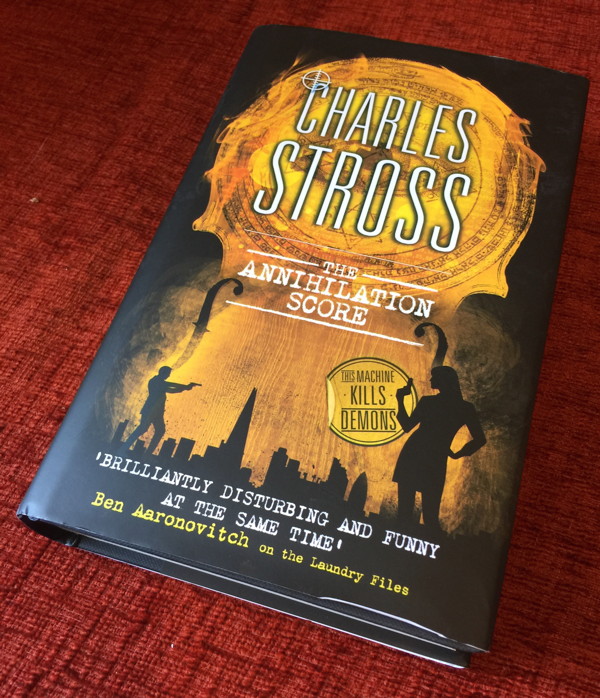
So, while this week sees the first publication of "The Nightmare Stacks", it also sees the paperback publication (on both sides of the Atlantic!) of "The Annihilation Score". And as is my custom these days, I figure it's time to post a brief essay about the novel. Keep reading below the fold if you dare; here be spoilers!
There comes a point in every series of books when the author has to ask whether the series is about a single person (the protagonist) or the setting. The Laundry Files are no different. While the first book was very clearly about Bob Howard, hapless geek and accidental occult counterintelligence agent, an ensemble cast slowly assembled itself around him and then intermittently stole the show. And after five books in a row about Bob, narrated in the first person/present tense from his point of view, I thought it would be a good idea to step outside his skin and show the reader what the back of his head looks like, so to speak.
A point that was becoming clear by book 3 or book 4 is that Bob is an unreliable narrator. This was (spoiler!) originally an accident, but then a bonus. When I began writing "The Atrocity Archive" I had no plan to write a series; the book unpacked itself organically, and a lot of what came out was played deliberately for laughs. About four years later I was called on (ahem, paid money to) write a sequel, "The Jennifer Morgue", and I decided that it'd be fun to make Bob four years older, wiser, and a bit more senior. And of course I'd forgotten some minor details, and I'm terrible about re-reading my own work and remembering what I'd done. So inconsistencies began to creep in.
How do you deal with inconsistencies? Well, in "The Fuller Memorandum" I introduced a framing conceit, that these first-person narratives are Bob's working journals, kept by his employer so that if he dies in the line of duty you, the postulated reader, the person stepping into his still-warm boots, have access to some of his hard-won knowledge. This is also a neat way of sidestepping the essential loss of tension implicit in a first-person narrative (you know that the narrator survives to the end—unless, as in "Glasshouse" or Mira Grant's "Feed", they're murdered part-way through recording their experiences). Bob is ageing and learning his place in the institution as he is promoted, and sometimes he learns that what he was told, or inferred, as a junior employee, is flat-out wrong. But Bob is also ageing and maturing; we start the series with him as a callow twenty-something, and by the time we reach THE ANNIHILATION SCORE he's nearly forty, married, much more cynical, and thinks he's a grown-up now.
Boy is he wrong.
Like most of us, Bob has a near-infinite capacity for self-deception. (We're all the heroes of our inner narrative, after all.) He's also been getting increasingly powerful throughout the series. With great power comes great self-delusion, and all is not well in Bob's world; in particular his spouse, Dr Dominique O'Brien, aka Agent CANDID—who has been levelling up alarmingly herself—is having trouble controlling her ill-omened and murderously inclined violin, not to mention coping with Bob's increasing necromantic abilities. For the first few years they've got along by carefully ignoring the more dangerous aspects of each other's life, and by providing mutual support: but when two monsters live together, the question to ask is, how long will it be before one of them tries to eat the other?
Which brings us to the red wedding sequence at the end of "The Rhesus Chart" and the set-up for "The Annihilation Score", which is there to give us a whole different perspective on Mo, on Bob, and on what's going on in the background that Bob is oblivious to.
Now, I will note that quite a few readers seemed to absolutely hate "The Annihilation Score"; they specifically disliked Mo, accusing her of being bitchy, nasty, aggressive, self-centered ... all the epithets that get hurled at assertive, competent, strong women (and especially managers) in day to day life. Previously the series focussed on Bob, a cuddly (if somewhat lethal) turbo-geek everyman with a neat line in self-deprecating humor. Mo, in contrast, is caught in the career woman trap: required to be a pretty adornment to her husband or partner, but expected to be vastly more proficient and competent than a man in the same occupational niche just to be seen as average. She is, if anything, the Ginger Rogers to Bob's Fred Astaire: "Ginger Rogers did everything Fred Astaire did, except backwards and in high heels." The stress is grinding her into the dirt, so much so that she's riding a bobsleigh down a run towards an explosion or a breakdown, or both. In other words, she's not written to be a nice person, or even one the reader necessarily empathizes with (if the reader is wanting a warm bath of self-congratulatory affirmation): she's written to be a professional, trapped in a deadly situation and trying to make the best of the desperately bad hand she's been dealt by fate. (And when she develops a superpower, by way of dramatic irony it turns out to be a paranormally enhanced version of one that women over 40 usually find themselves suffering from whether they want it or not.)
Lest you think this is a rather brutal treatment of her, let me remind you that Agent CANDID was the James Bond figure of "The Jennifer Morgue", and Bond was not a spy—he was a state-sanctioned executioner. This is the position Mo effectively starts from in the series (after I realized with a big "oops" that I'd written her as a girl in the tower cliche, but had also given her a plausible motivation for making something more of herself). Anyway, throughout the entire series Bob's wife is not a helpmeet: she's a professional killer and arguably even deadlier than he is. She props Bob up and provides a shoulder for crying on from time to time, as he does for her in return, but the domestic tranquility Bob thinks he's found at home with her is a comforting illusion they both connive at and when the disguise is ripped away the reality turns out to be somewhat darker. Think "Mr and Mrs Smith" with vampires, zombies, and ... superheroes ...
So, to "The Annihilation Score" itself.
I've long had a fondness for superhero fic, but my background lore in the field was warped by growing up in 1970s Britain. Marvel and DC Comics were not widely distributed and din't show up in the sort of newsagent I had access to. Instead, my reading was skewed towards 2000AD, and biased by British TV—including interminable re-runs of the Adam West "Batman" series. Oh, and a dose of Greek and Roman mythology, which taps into the same deep wellsprings as the modern superhero mythos—asking questions about the limits of human agency and the archetypes of human existence and the effects of granting limitless power to limited, flawed personalities. Given the Laundry Universe has it's own post-Lovecraftian eschatological imperative—as the stars come into alignment magic becomes easier and there are random outbreaks of power—it's easy enough to see how someone who wakes up invisible one morning might think herself possessed by a demon, or cursed by an evil magician ... or become a superhero.
The current cycle of Laundry Files novels is exploring and pastiching different contemporary fantasy subgenres, from unicorns ("Equoid") to vampires ("The Rhesus Chart") and elves ("The Nightmare Stacks"). "The Annihilation Score" is the superhero novel. With increasing numbers of people waking up with superpowers, a subset turn to crime while others—presumably educated on superhero comics and contemporary culture—turn to vigilantism: lycra body suits, punching out alleged criminals, damaging the evidence and crime scenes, intimidating witnesses, resulting in mistrials. The Home Office—the British interior ministry in charge of policing and prisons—hates that sort of thing. And so Mo, still reeling from her first encounter with a supervillain in public and the loss of her cover identity, is detached from the Laundry, reassigned to the Home Office under cover, and set to establishing the Transhuman Police Coordination Force—an under-budgeted over-worked public-relations-oriented excuse for a superhero police team, established to take the more tractable vigs in hand and find a lawful and acceptable outlet for their enthusiasm. Mo is given three months and a fraction of the necessary resources to set up an agency that will field the official government superhero team as special constables (normal duration of training: two years) ... and meanwhile she comes under enormous pressure to hunt down and apprehend the ominously super-competent criminal mastermind whose calling card, left at the scene of their crimes, is tagged "Professor Freudstein".
So you probably won't be surprised to learn that the original elevator pitch for the book was "a pessimistic downbeat literary exploration of one woman's simultaneous mid-life, career, marital, and nervous breakdown (with superheroes)". Although it's leavened a bit by the comedy element that runs through the Laundry files: Mo herself doesn't have the same sense of humour as Bob (although over almost a decade together lots of Bob-isms have rubbed off on her), so she isn't consciously aware of it, but she's fallen into a classic Ragtag Bunch of Misfits plot with an entirely different elevator pitch: "Bob's exes form a superhero team and Fight Crime".
Finally, there's a serious (ish) memo embedded in the background conceit: that the age of the Mad Scientist is over. In the 20th, and even more the 21st century, Mad Science is a team effort, not something that can be left to one guy (or gal) and their minion in a leaky castle; rather than look for a Mad Scientist, you should always look for a Mad Science Multinational ... or a shadowy quasi-autonomous non-governmental organization with special powers to do something unspeakable in the name of the Defense of the Realm. Because by the time "The Annihilation Score" takes place the onset of CASE NIGHTMARE GREEN is becoming noticable to government agencies other than the Laundry, and even if they don't quite understand what's going on they know that they disapprove strongly, and want it to stop, and will stop at nothing to make it go away.
Real spoilers, now: Bob and Mo don't really feature in "The Nightmare Stacks" (which comes out this week, and is mostly about Alex the PHANG, a girl named Cassie, and something called CASE NIGHTMARE RED). You'll have to wait for "The Delirium Brief" in June 2017 to find out how their relationship counseling sessions go down and whether they manage to get over each other's problems before the end of the world.
Incidentally, you can buy "The Annihilation Score" here:
US paperback | US Kindle edition | UK paperback | UK Kindle edition
20 Jun 11:16
Why I’ll be voting “remain”
by James Graham
I decided a few weeks ago to break my blogging silence in the run up to the referendum, and the events of yesterday have somewhat concentrated my mind. I had imagined this article would be a magnificent rant about the lies and hate-mongering of the Leave campaign, but as I come to write this, I’ve found myself rather angered out.
Like many people with a history working in politics, Jo Cox’s murder feels close to home. I was working in Lib Dem HQ in 2000 when Cllr Andrew Pennington was killed by a constituent in Nigel Jones MP’s constituency office. I’ve worked the political beat in West Yorkshire. I campaigned for one of my friends, also called Jo, who also went on to represent the community she grew up in in Parliament. So yeah, despite having walked away from party politics, there are plenty of parallels in my own life to have given me pause for thought over the last 24 hours.
The referendum itself has become an undignified, ghastly mess. As a survivor of a previous referendum campaign, this of course has not surprised me one bit. What has surprised me rather more by how, as we near the finish line, I’ve found myself feeling quite as strongly as I did.
Twelve, even six months ago, I was feeling distinctly ambivalent about the EU. The way Greece has been treated, essentially as the sin eater for Eurozone’s shortcomings, has been appalling. The refugee crisis has been met with moral cowardice and indifference. Regardless of the TTIP’s merits or flaws (I’m genuinely on the fence), its secrecy has been, to say the least, undignified. For quite a while now, it hasn’t felt like the EU I felt proud to be a member of at the turn of the millennium.
The one thing I can say about this referendum is that it has clarified my thinking on that. Because the question arises, again and again, what the alternative is. I’ve heard countless people talk about how the EU is “undemocratic” – and yet not a single supporter of leaving the EU seems interested in a system that would be more democratic.
I can think of a number of ways in which the EU could be made more democratic. Opening up Council meetings, for example; there’s even a debate to be had over directly electing the Commission president (regardless of the pros and cons of that particular one, I doubt Jean-Claude Juncker would have had an easy time winning a popular vote). None of them whatsoever involve negotiating EU legislation in the same way that we negotiate bilateral treaties – entirely in the hands of the executive, with most of the work and negotiating done by civil servants entirely behind closed doors.
If we’re serious about improving the democratic scrutiny of EU legislation however, the most crucial place to start is home. Why, for example, are the committees which do the lion’s share of scrutiny of draft EU legislation, seated in the entirely unelected House of Lords? Why doesn’t our parliament scrutinise legislation as closely as so many other countries take for granted, particularly Nordic countries such as Denmark? In turn, if Parliament really wanted to give people more say, there are plenty of models it could adopt. None of these reforms would require agreement in Brussels – we could adopt them tomorrow if there was the political will.
If the EU ceased to exist tomorrow, the need for it would continue. We need trans-national agreements on standards; you might bristle about having to meet EU standards, but believe me you would bristle a lot more if you had to comply with 27 national ones. We need trans-national agreements on social and employment rights, because otherwise employers will face a Dutch auction, with the companies with the worst records in looking after their employees free to price out those with the best. And yes, all too often the EU, far from being an exemplar of free and open trade, is a cosy club of wealthy nations. But scrapping an organisation with protectionist tendencies with a free-for-all in which nation states will be under even greater pressure to roll up the drawbridge, isn’t going to solve that.
Most of the EU’s failings can be put down to narrow national self-interest, something which the EU exists to mitigate. You don’t solve that problem by embracing narrow national self-interest; I’d have thought that was self-evident. I’m actually not convinced that its main problems are institutional; predominantly, they’re cultural. “Europe lacks a demos,” by which is meant a sense of common identity and purpose amongst the people, has become a cliché, but it is nonetheless true and I can’t see an easy solution. Put simply, the vast majority of people just don’t feel a sense of ownership of the European institutions, let alone control. People struggle to name their MEPs and our media does little to report their work. As such, we have a set of actually quite open and democratic bodies which effectively operate in secret because so few people are actually paying attention.
It gets worse though. I think you could equally argue that local government largely lacks a “demos”. It is increasingly becoming true of national parliaments as well. Since 2009 and the expenses scandal, closely followed by the coalition government’s utterly failed programme of reform, the feeling that Westminster is unreformable and irrelevant seems to have set in. Increasingly, political outsiders are being invoked to ride in and solve all our problems, regardless of how unrealistic and futile their positions are. And it’s a global phenomenon: for every Nigel Farage, there’s a Donald Trump; for every Jeremy Corbyn there’s a Bernie Sanders.
What I’m getting round to saying here is that the problem with the EU is not rooted in the fact that we look to our cosy nation-states to represent us and solve our problems, but that democracy itself is in crisis because it is reliant on a sense of identity and common cause that we are losing rapidly. It’s a loss the left is struggling with more than the right, but even though the right is finding itself the beneficiary, it is becoming something shrill and even more incapable of providing reforms that don’t simply make things worse. Moderates who indulge their right flanks are being replaced by demagogic parodies of the politicians they have supplanted.
Not even countries with the best democratic systems are proving immune to this problem, which is fundamentally technological at root and thus irreversible (unless you consider nuclear apocalypse to be an option). Our problems are increasingly global ones. Our communities are too, even if they’ve become narrower. Walking away from the EU won’t stop that; it will just make our problems harder to solve.
Nowhere is this more true than in the case of migration. Economically, we have benefited hugely from immigration and we simply can’t control our borders without international cooperation. There simply is no drawbridge to pull up. Where there is a clear failure in our immigration policy, it is our national failure to ensure that the wider public see those benefits – especially in the case of providing decent social housing for all.
The refugee crisis isn’t going to magically go away if we decide the leave the EU. The tight border controls at Calais aren’t magically going to be made impermeable if we go – and does anyone seriously believe that the price of French cooperation in that regard is not going to go up if we do? Laughably, the Leave campaign’s solution is a “points-based” system along the lines of Australia – a country with a higher number of immigrants per head of population than we do; and while they’re busy plastering brown faces on their billboards with an explicit aim to scare white people, they’re quietly telling Asian voters that they’d make it easier for their relatives to come to the UK.
I don’t think I’ve ever seen a more disreputable political enterprise in the UK, with the stakes as high as they are, yet it plugs into people’s fears and has proven effective. And does anyone seriously doubt that if they get their way on the 23rd, public dissatisfaction about immigration will get anything but worse?
I have no idea what the solution to any of this is. What I do know is that things will go downhill, much more quickly, if we vote to leave next Thursday. What I do know is that the EU, already under pressure as people across Europe increasingly vote for insular and and xenophobic parties, will struggle even more. And I know that those self-same xenophobes, whether they wrap themselves in Nazi flags or claim to be insulted at the suggestion that they have anything in common with fascists, will only lead us to more violence, death and bloodshed. Not a single one of these problems will go away if the UK votes to remain, but we might just get a little bit more time to breathe and come up with something that might work. And I can’t believe that close pan-European economic, political and social cooperation won’t be part of that solution.
The post Why I’ll be voting “remain” appeared first on Quaequam Blog!.
20 Jun 11:15
Google: Still Stupid
After four years of development, Google's "Knowledge Graph" is still clueless.


16 Jun 20:01
The unspeakable truth
by Charlie Stross
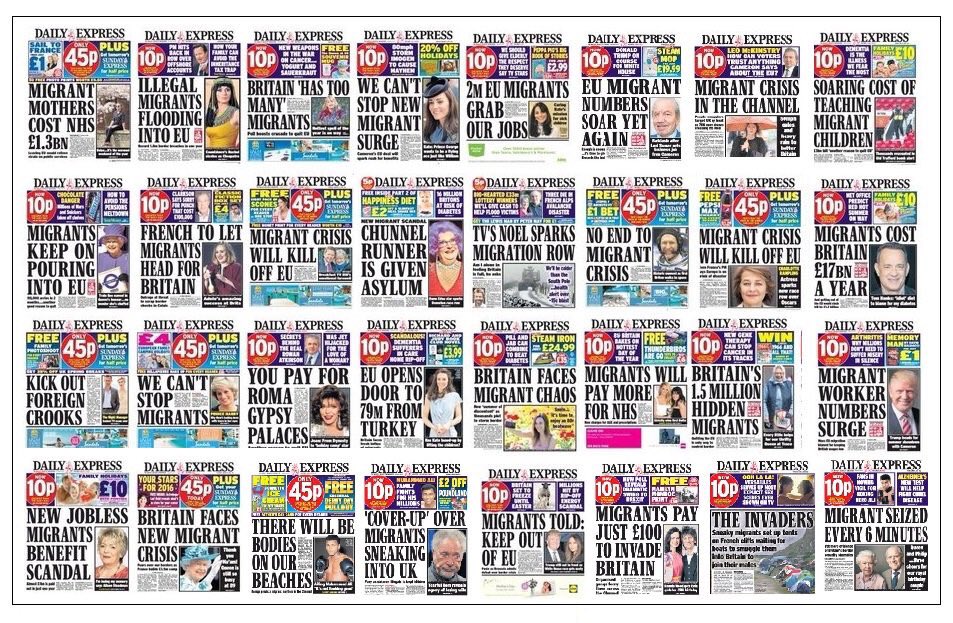
British people don't like to talk about racism, much less admit that their fellow Brits—much less they, themselves—are racists. It's far too easy to point to other bad examples in foreign lands, from Jim Crow and segregation in the Deep South to men with Hugo Boss uniforms and gas chambers in the Nazi Reich. But racism is a thing in the UK, with deep-running currents that occasionally bubble to the surface. And right now we're getting a most unwelcome but richly deserved reminder of what it's about.
(Text below the cut contains strong language)
British racism is subtly different from American racism, because there is no long-standing internal sub-population who are visually distinctive and the target for racist hatred. One can point to the traditional English hatred and contempt for the Irish—it's still within living memory that boarding houses proudly displayed signs saying "no dogs or Irishmen"—but people of Irish descent aren't visually identifiable at a distance, unlike African-Americans. So the most visible expression of racism wears a different name: the primary epithet isn't "nigger" but "immigrant".
And our newspapers know that talking about "immigrants" is a legal way to push racist xenophobia (see the montage of Daily Express covers that I updated this essay with, above: source, twitter, @kwr66).
(Discursive point: this isn't to say that anti-immigrant racism isn't a thing in the United States. But it's not the primus inter pares expression of racism. That dishonourable status belongs to the generationally-installed white phobia of the descendants of the slaves they systematically raped and kidnapped over centuries, and whose bloody uprising the slaveowning caste were deathly afraid of.)
The UK is different because the black community established here mostly immigrated voluntarily in the 1950s to 1970s: for many years, British racists used the word "immigrant" as a synonym for "black", and kept with it because it was so useful for describing other groups.
Which brings me rapidly back to the current ongoing campaign over the BRexit referendum: a ballot asking the public if Britain should leave the EU. The vote is due to be held next Thursday, and I already blogged about it back in April. What I didn't say back then, because I didn't fully anticipate it, was that the "Leave" campaign (with the knowing connivance of most of the UK's media, owned for the most part by right-wing billionaires) was going to play power chords in the key of racism, not even resorting to dog-whistle rhetoric. Britons overestimate the proportion of Muslims in the UK by a factor of four and think there are more than twice as many immigrants in the UK as is actually the case—and the Leave campaign's rhetoric, when challenged on how leaving the EU would improve things for the UK, has focussed unerringly on reducing immigration, because that's what the voters respond to—not abstractions about trade deals or tax rises or interest rates, but the folks they see on the street who talk the wrong talk or follow the wrong dress code or look different.
And the Leave campaign have been pushing that lever so hard that UKIP have been rolling out material indistinguishable from Nazi propaganda posters of the 1940s.
Now, if your election campaigning material is only distinguishable from films emitted by Josef Goebbels' Ministry of Propaganda by your use of Photoshop and color separation technology, then you might want to ask yourself why you are peddling warmed-over Nazi propaganda. (Also: the white faces in the foreground of the UKIP "immigrant" poster have been conveniently obscured. Fun, huh?) But that's not the most important point.
The unspeakable truth is that right now British politics is in a Naked Lunch situation: the "frozen moment when everyone sees what is on the end of every fork", as William Burroughs put it:
Jo Cox, MP for Batley and Spen, has been assassinated by a man who allegedly shouted Britain First as he stabbed and shot her.
Points you need to know, for the full context of this vile murder:
Jo Cox was an activist for the Remain campaign
Jo Cox was the former head of policy for Oxfam and an anti-slavery campaigner
Britain First is a far-right movement founded by former members of the (defunct) British National Party, a fascist movement. It takes inspiration from Ulster loyalist terrorist groups and has a vigilante wing that engages in direct action campaigns. Their policies include a total ban on Islam.
Britain First is strongly opposed to EU membership and supports the Leave campaign. Their primary campaign focus is against immigration, multiculturalism, and "the islamisation of the United Kingdom".
Britain First has threatened to target elected politicians for direct action earlier this year (specifically: Sadiq Khan, Mayor of London): "Britain First now considers all Muslim elected officials as 'occupiers' and will start to oppose their strategy of entryism and take-over of our political system."
The Leave campaign are recycling Nazi propaganda and directing it at "immigrants", pouring gasoline on the flames of British racism. They are doing so in a politically charged climate where mainstream conservative politicians have legitimized talk of "cutting immigration" as they run to the right to reduce the risk of losing their voters to UKIP, who are merely one dog-whistle away from being an explicitly racist party. They do so with the connivance of The Daily Mail, the Daily Express, and the other right-wing newspapers that peddle racism (because outrage captures eyeballs and eyeballs sell advertising)—whose every front page loaded with a hate-filled message about "immigrant scroungers". Britain First are an explicitly racist fringe party, and it now looks as if one of their followers may have conducted the first politically motivated murder of a sitting MP (other than in the context of Ireland) since Spencer Perceval in 1812.
I've been saying a while that when fascism comes to Britain it will be wearing a tweed jacket and a cheeky grin, holding a pint of beer in one hand and a noose in the other.
I wasn't expecting to be proven right so soon.

15 Jun 20:38
The Austro-Hungarian parable
by TSE

Austria-Hungary does not have a good press nowadays. It is vaguely thought of as an autocratic dysfunctional empire whose demise was unmourned. Lands that once formed a single empire that had been ruled by the Hapsburgs for centuries are now shared between a dozen independent countries. No one clamours for it to be reconstituted.
Is this a parable for the fate of the EU? Perhaps. But the parable might be a bit more complex than that.
For a start, Austria-Hungary was rather more effective than is supposed. In the 50 years before the First World War, it achieved rapid economic growth. By the eve of the First World War, it was a well-integrated and industrialising economic entity, especially in the western half. Between 1875 and 1925 Budapest was the fastest-growing city in the world.
By 1914, Austria-Hungary was under some political strain. Because Austria (or, more properly, Cisleithania) and Hungary (more properly, Transleithania) were two separate countries under a single crown with few shared functions, reaching agreement on reforms was not straightforward. While the empire was dominated by two ethnic groups – Germans in the west, Hungarians in the east – those two groups made up less than half the population of the empire, with many other ethnic groups pressing for more power and more autonomy.
The Germans were relatively willing to accommodate this but the Hungarians were enjoying their supremacy and were unwilling to loosen their grip. Archduke Franz Ferdinand, the heir to the throne, was propounding a more federal arrangement giving more rights and power to minority groups. The Hungarians sabotaged attempts at reform by threatening to veto military budgets. The Archduke’s assassination brought the curtain down on that idea and ultimately on the empire.
There was, however, no particular reason to believe in early 1914 that Austria-Hungary was in any imminent danger. Its downfall was caused by being sucked into a political vacuum on its southern flank from the slow collapse of the Ottoman Empire, not from any insurmountable internal weaknesses. It took a war of an unprecedented scale to destroy it.
The consequences for the deconstructed parts were dire. Divided, small and weak, these states, constructed around national identity, fell prey first to fascism and Nazi depredations and then (with the exceptions of Italy and Austria and the partial exception of Yugoslavia) to Communist rule and Soviet domination. With the fall of the Iron Curtain, those former parts of Austria-Hungary that had ended up in Yugoslavia suffered still further as revived nationalism was pursued to its logical and ugly conclusion.
Still, no one sentimentally mourns Austria-Hungary. And yet nine of the twelve countries that occupy lands once governed by Austria-Hungary are EU member states. The other three all aspire to membership. All value their independence but all want to share their sovereignty with their neighbours, having seen how a fixation on national identity has served them so poorly in the last century.
So what after all might be the lessons to learn? I see them as sixfold. First, unloved supranational institutions may have substantial, if unappreciated, practical value. Secondly, as a result they may have more internal strength than their detractors might appreciate. Thirdly, they may be most vulnerable to external shocks caused by a power vacuum on their borders – we have already seen the EU struggle with the collapse of the former Yugoslavia and if I were a Eurocrat I would be more concerned in the long term about the potential impact of Russian febrility than about Brexit. Fourthly, national identity can prove inadequate to maintain a stable demos. Fifthly, the unappreciated practical value of unloved supranational institutions might well eventually become appreciated after some hard lessons have been learned. And sixthly, the practical value offered may well eventually be sought through an entirely different route.
Alastair Meeks
15 Jun 16:52
VDP talks about Randy Newman
by Michael Leddy
For the podcast My Favorite Album , Van Dyke Parks talks to Jeremy Dylan about Randy Newman’s Randy Newman : “There are a lot of insults on the way to a record album. I mean, there’s blood on the tracks.”
Related reading
All OCA Van Dyke Parks posts (Pinboard)
A new song from Randy Newman
You’re reading a post from Michael Leddy’s blog Orange Crate Art. Your reader may not display this post as its writer intended.
This work is licensed under a Creative Commons 3.0 License.
Related reading
All OCA Van Dyke Parks posts (Pinboard)
A new song from Randy Newman
You’re reading a post from Michael Leddy’s blog Orange Crate Art. Your reader may not display this post as its writer intended.
This work is licensed under a Creative Commons 3.0 License.
15 Jun 14:27

 This is, I think, an interim issue: intended for an anthology comic (it’s only 14 pages long); somewhat connected to Spider-Man #1 (Peter Parker’s main objective is still financial); but focusing more on heroic action and less on character. The "realistic" setting is dropped; for the first time, Spider-Man has an enemy — a flying bank-robber. The aerial duel with the Vulture isn’t as breath-taking as the rescue of the John Jameson in issue #1, but it’s vastly more exciting than the feeble helicopter sequence in the Chameleon story. The sheer visual charisma of the Vulture carries the day. Ditko’s art is sometimes said to be scratchy and cartoony, but the close up of the Vulture on page 5 is on a level with an art-house woodcut.
Peter Parker does not see it as his duty to capture or defeat the Vulture. In their first encounter Spider-Man is following the villain at distance and setting up his camera, thinking “If these pictures come out, the ought to be worth a small fortune”. The Vulture spots him, knocks him out, and leaves him for dead; and when he recovers, he takes the pictures to Jameson. When Parker witnesses the Vulture’s jewel heist, he thinks “If I can get some new pictures of him now, I’ll be able to name my own price for them.” After the fight (in which Spider-Man deactivates the Vultures wings with some Science that he made in his laboratory earlier) he immediately thinks “this is my chance to get some exclusive pix of the capture of the Vulture”; as the police arrest him, he think “these pictures should be prize winners”. Peter is not an altruist; he is not driven by a sense of duty. He becomes embroiled with the Vulture while trying to make an honest buck taking photos.

 Amazing Fantasy # 15 ended with Parker slinking into the darkness, in shame. Spider-Man #1 ends with him cursing his powers and crying. But this story ends with a grinning Peter Parker telling an equally happy Aunt May that their financial troubles are over. There’s a trivial example of art and text being “out of sync” in this scene: we see Jameson looking at the photos; we see Peter leaving Jameson’s office with a huge pile of green dollar bills and we see a happy Peter and a happy Aunt May at home, each holding smaller piles of cash. We can clearly read what has happened: Peter Parker, like a nice little mummy’s boy, has split his first wage packet with his Auntie. But the text says something slightly different: Peter has kept the money, but is planning to spend it all on things Aunt May needs. “I paid the rent for a full year, and tomorrow I’m buying you the newest kitchen appliances you ever drooled over.”
At today's prices, a years rent on a two bedroom house wouldn’t leave you much change from $15,000, before you’ve counted in whatever a new washing machine and dishwasher costs. Parker has taken home practically a year's salary in one day. Jameson clearly doesn’t deserve his reputation as a skinflint.

The Uncanny Threat of the Terrible Tinkerer
 Villain
Tinkerer
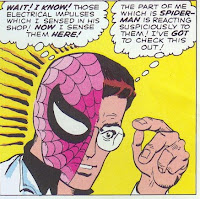 And on page 4, we get this first occurrence of the Parker/Spider-Man split face motif. Note that on this occasion, the Spider-Man mask is coloured in a lighter shade of red than usual, as if to emphasize that it’s not really there. It has been said that Lee wanted the comic to be primarily about Spider-Man whereas Ditko wanted to give Peter Parker equal space; and the half-mask was a compromise; reminding readers that Spider-Man was present, even in long Peter-centric sequences. Certainly, the half-face mask is going to become part of iconography of the strip, so intuitive that we hardly notice it is there. But this is the first time it's been used, so Lee writes in way too much exposition. Peter Parker is working in Prof. Cowbell’s workshop, but can’t shake the feeling that something is wrong. Suddenly, he thinks “Those electrical impulses. I sensed them in his shop! Now I sense them here! The part of me which is Spider-Man is reacting suspiciously to them! I’ve got to check this out!” This is a rather elaborate way of what would soon be expressed simply as “My spider-sense is tingling like crazy!” But Ditko’s visual motif has suggested to Lee that Peter Parker is not merely a kid who dresses up as Spider-Man for the benefit of the cameras, but at some level a split personality. The idea that there are two sides to Peter Parker — the side of him which is Peter Parker and the side of him which is Spider-Man —is going to be around for several issues to come; and it is by no means clear that Spider-Man is the good half.

Amazing Spider-Man #2
by Andrew Rilstone
Duel to Death With the Vulture

Villain
The Vulture
The Vulture
Named Characters
Aunt May, J Jonah Jameson, "Moose" (Flash Thompson), Jameson's secretary
Aunt May, J Jonah Jameson, "Moose" (Flash Thompson), Jameson's secretary
First Appearance of
Utility Belt, Automatic Camera
Utility Belt, Automatic Camera
Observations
When Peter is at home doing Science he does not bother to wear his glasses.
We get a very brief look at Jameson's secretary/receptionist (who appears to wear scary librarian glasses at this point.) Next month she will become "Miss Brant", and "Betty Brant" thereafter.
And so, on the first page of the second issue of Amazing Spider-Man, the original Spider-Man concept is abandoned, and the character we are familiar with comes into focus.
Jameson, the chauvinistic tabloid editor from the previous issue, wants photographs of the Vulture, a flying bank robber with wings powered by Science. Peter Parker realizes that he could provide them. Aunt May, very conveniently, finds an automatic camera that once belonged to Uncle Ben. At a stroke, all Spider-Man’s financial worries are wiped away; the previous episodes relegated to the status of prologue; and the question “what should I do with my powers?” resolved. Peter Parker becomes Clark Kent; Jonah Jameson becomes Perry White; very soon the secretary glimpsed on page 8 will become Lois Lane.
Peter Parker does not see it as his duty to capture or defeat the Vulture. In their first encounter Spider-Man is following the villain at distance and setting up his camera, thinking “If these pictures come out, the ought to be worth a small fortune”. The Vulture spots him, knocks him out, and leaves him for dead; and when he recovers, he takes the pictures to Jameson. When Parker witnesses the Vulture’s jewel heist, he thinks “If I can get some new pictures of him now, I’ll be able to name my own price for them.” After the fight (in which Spider-Man deactivates the Vultures wings with some Science that he made in his laboratory earlier) he immediately thinks “this is my chance to get some exclusive pix of the capture of the Vulture”; as the police arrest him, he think “these pictures should be prize winners”. Peter is not an altruist; he is not driven by a sense of duty. He becomes embroiled with the Vulture while trying to make an honest buck taking photos.
I will say that again: while trying to make an honest buck. Jameson wants photos; Parker can get photos; Jameson pays Parker what they are worth; and for the first time, everything ends well.
Some of Stan Lee’s captions get ahead of themselves. Lee has a habit of “back-filling” stories. Once he thinks up a new plot element, he writes as if it was there from the beginning; which gives a new reader the impression that Spider-Man is a much more established character than he really is. “The most colorful superhero of all” cries the title page of Spider-Man #2 “His very name makes the underworld tremble.” So far as we know, in his entire career, Spider-Man has arrested one armed robber (without much publicity) and run out of a fight with one communist spy (also without anyone knowing). The last we saw of him, he was crying and threatening to quit being Spider-Man because he didn’t have any friends and no-one liked him. So what has the underworld got to tremble about? But Stan Lee has decided — I suspect after Ditko had completed the art — that Spider-Man is going to be a crime-fighting guy from now on, and therefore writes as if a crime-fighting guy is what he has always been.
On page 7, Spider-Man is shown, at home in his bedroom, constructing a utility belt. I think that this is another example of words and pictures being “out of sync”. The pictures shows Spider-Man picking up his camera; looking at the front page of Now Magazine (with the camera still in his hand); making the belt; slipping it under his suit and then constructing a device out of mechanical components. The picture show that the suit can be used to store metal objects about the size and shape of cigarette lighters. They could be web shooters. They could be film canisters. The next sequence shows him selling his first photographs to J. Jonah Jameson. But Stan Lee’s think-bubble reads “If I’m really going to be a secret adventurer I’ve got to make some changes”. Nothing in the pictures suggest that he is going to be a secret adventurer. What he is going to be is a freelance photographer.
The episode is still all about fame. The Vulture is supplanting Spider-Man as the celeb who shifts copies of Jameson's papers. Spider-Man was a TV hit because he seemed to be more spider than human; today, the crowds are looking at the Vulture because he is “more bird of prey than human”. Jameson, who was obsessed with Spider-Man, now wants to fill whole issues of his magazine with pictures of the Vulture. The Vulture actively courts publicity, announcing in advance where his crimes are going to be committed. And so Parker makes a faustian pact to keep himself in the public eye. He is going to sell pictures of himself to Jameson, knowing full well what Jameson is will do with them.
Peter Parker is still a performer; Spider-Man is still a role he plays, but from now on, the Daily Bugle will be his stage, and his shows will consist of the dramatic capture of super villains. Jameson thinks Spider-Man is a publicity hound, but obligingly prints pictures of him on the front page of every newspaper he publishes. Parker is miserable because the Bugle tells a false story about him, but provides the very photos that ensure that story is the one that will be told. Parker can make a living only as long as he continue providing Jameson with material for his hate campaigns. Jameson can sell papers only as long as Peter Parker keeps providing photos of Spider-Man to fill them with. Jameson hates Spider-Man because he is famous; but it is Jameson who makes him famous. Spider-Man hates Jameson for making him look bad, but obliging provides the photos that allow Jameson to make him look bad.
It’s a merry dance; a dance they both seem at some level to enjoy. They don’t seem to notice how many people — including themselves — the game is harming.
Amazing Fantasy # 15 ended with Parker slinking into the darkness, in shame. Spider-Man #1 ends with him cursing his powers and crying. But this story ends with a grinning Peter Parker telling an equally happy Aunt May that their financial troubles are over. There’s a trivial example of art and text being “out of sync” in this scene: we see Jameson looking at the photos; we see Peter leaving Jameson’s office with a huge pile of green dollar bills and we see a happy Peter and a happy Aunt May at home, each holding smaller piles of cash. We can clearly read what has happened: Peter Parker, like a nice little mummy’s boy, has split his first wage packet with his Auntie. But the text says something slightly different: Peter has kept the money, but is planning to spend it all on things Aunt May needs. “I paid the rent for a full year, and tomorrow I’m buying you the newest kitchen appliances you ever drooled over.”At today's prices, a years rent on a two bedroom house wouldn’t leave you much change from $15,000, before you’ve counted in whatever a new washing machine and dishwasher costs. Parker has taken home practically a year's salary in one day. Jameson clearly doesn’t deserve his reputation as a skinflint.
In the end, the argument about who “created” Spider-Man is pointless. Ditko and Lee figured out for themselves what the comic was about, and those different idea became the first half-dozen issues of Spider-Man. This issue places a few more components into place; but we are some distance from the finished character.

The Uncanny Threat of the Terrible Tinkerer
 Villain
Tinkerer
Named character
Dr Cobbwell, Flash Thompson
Dr Cobbwell, Flash Thompson
First Appearance of:
The Parker/Spider-Man mask motif
Sarcasm.
Observations:
Spider-Man thinks that the Tinkerer is “one of the greatest menaces I’ve ever faced” —the others, presumably, being the Chameleon and the Vulture.
The Beatles famously intended Sgt Pepper to be the world’s first concept album: a fictitious concert played by a fictitious band. After recording the introduction and the first song, they reportedly said “Oh, soddit. Let’s just do tracks.”
One is tempted to imagine Stan Lee, one issue into his rule-breaking game-changing realistic new super-hero, looking up from his typewriter and saying “Oh, soddit. Let’s just do monster stories.”
In a filler strip entirely without redeeming features, Peter Parker (having just trousered a year's wages for one afternoon’s work) takes a weekend job running errands for an electronics expert and…foils an alien invasion.
The plot has been phoned in from Amazing Adult Fantasy: a shop offers to fix radios for a dime; everyone takes them up on the offer; but the radios are being bugged by extraterrestrials to enable them to spy on the human race. The idea of a radio that listens to you while you listen to it could have been quite spooky, but isn’t.
The story follows the formula that was established in the previous episode: Spider-Man fights the baddies; Spider-Man is defeated by the baddies; Spider-Man uses his brain and beats the baddie on the second attempt. This time he is zapped by a ray-gun and imprisoned in an unbreakable glass container, oddly like the one the Fantastic Four tried to trap him last issue. (Could that be because people who don’t like spiders sometimes trap them in glasses?) I have never thought that “escaping from the water tower by jumping” or “defeating the Vulture by rustling up a special anti-Vulture-wings-zapper” were very interesting ploys, but this one is actually quite clever. There must be air-holes in the container (because he isn’t suffocating) so all Spider-Man has to do to get free is fire a tiny thin strand of webbing through one of the holes and snag the “open unbreakable glass prison” button on the aliens' control panel.
Decades later it was decided that the Tinkerer wasn’t an alien after all, but was pretending to be because of Reasons. This doesn’t retrospectively make the story less awful.
The story does have two points of interest:
On page 8, one of the aliens cries out “Look! It’s impossible! But he’s loose!” and Spider-Man, punching two aliens with one blow, retorts “Who do you think you are — the town crier?” This is, to the best of my reckoning, the first joke Spider-Man ever makes. Up to now, his dialogue has been melodramatic (”there’s no place on earth where you can hide from me”) boastful (”the sky is my element just as much as it is yours”) and arrogant (”ya big ape who do ya think you’re pushing around”) but this is the first actual wisecrack. By issue #7, telling jokes will be specifically mentioned on the cover as one of things Spider-Man is famous for.
 And on page 4, we get this first occurrence of the Parker/Spider-Man split face motif. Note that on this occasion, the Spider-Man mask is coloured in a lighter shade of red than usual, as if to emphasize that it’s not really there. It has been said that Lee wanted the comic to be primarily about Spider-Man whereas Ditko wanted to give Peter Parker equal space; and the half-mask was a compromise; reminding readers that Spider-Man was present, even in long Peter-centric sequences. Certainly, the half-face mask is going to become part of iconography of the strip, so intuitive that we hardly notice it is there. But this is the first time it's been used, so Lee writes in way too much exposition. Peter Parker is working in Prof. Cowbell’s workshop, but can’t shake the feeling that something is wrong. Suddenly, he thinks “Those electrical impulses. I sensed them in his shop! Now I sense them here! The part of me which is Spider-Man is reacting suspiciously to them! I’ve got to check this out!” This is a rather elaborate way of what would soon be expressed simply as “My spider-sense is tingling like crazy!” But Ditko’s visual motif has suggested to Lee that Peter Parker is not merely a kid who dresses up as Spider-Man for the benefit of the cameras, but at some level a split personality. The idea that there are two sides to Peter Parker — the side of him which is Peter Parker and the side of him which is Spider-Man —is going to be around for several issues to come; and it is by no means clear that Spider-Man is the good half.
Next issue, Lee will claim that the Doctor Octopus story is the first one to end without Parker selling pictures to Jonah Jameson; but in fact (despite a brief look at what might be a camera on panel 5 of page 2) there is no reference to photo-journalism in this episode. Stan Lee is obviously pretending it didn’t happen. I advise everyone to do the same.


Andrew Hickey likes this
15 Jun 09:36
The Jetsons Movie
by evanier

My obituary for Janet Waldo brought a number of questions about the 1990 film, Jetsons: The Movie. Most folks wanted to know why —
Well, let me quote this paragraph again…
She continued voicing Judy Jetson in many incarnations of The Jetsons but in the 1990 animated feature, a controversy erupted. Janet recorded the speaking role of Judy and it was expected that the then-current pop sensation, Tiffany, would only supply the singing voice. Tiffany was signed but she and/or her managers reportedly insisted that Tiffany also replace the spoken lines. At the insistence of Universal Pictures, which was releasing the film, this was done. Janet was upset, though comforted by an incredible outpouring of support from her many fans. In 1997 at a retirement party for her frequent co-star Don Messick, Joe Barbera spoke and took the opportunity to apologize in front of most of the voiceover community to Janet for letting that happen. She forgave him and that more or less buried that matter.
So I got a lot of messages asking me why Joe Barbera would allow such a thing to happen. The explanation I heard was pretty simple, along the lines of: "The studio that was financing and distributing the film gave me two choices: Make the substitution or cancel the whole thing." That's close to a direct quote.
In a perfect world, you'd find some way around this but sometimes there isn't one. I argued this point a few years ago with an animation buff who was enough of a purist to insist that Barbera should have told the studio to take a flying something and find some other deal to make the movie. This kind of thing is easy to say when you don't have to go out and find a perfect deal.
There might have been one but I doubt it. Hanna-Barbera wasn't good at such deals and didn't get many of them. While I was there, I saw dozens of features developed with scripts and art and even sample animation and then go nowhere. Also, it's worth remembering that if the Jetsons movie had been delayed a few years, they would have had to get replacement voices for the original George Jetson (George O'Hanlon) and Mr. Spacely (Mel Blanc), both of whom passed away after recording most but not all of their lines. Voice expert Jeff Bergman imitated them for the remaining dialogue.
When you make a movie and you don't have the clout of a top star or filmmaker — and in that arena, Joe Barbera did not — you usually have to make compromises. I don't like the compromise that Hanna-Barbera agreed to in this case. It hurt Janet and it hurt the film. But if I were in the position of having to agree to Tiffany or kill the whole film and hope I could place it somewhere else and soon…
Well, I'm glad I didn't have to make that decision. I like to think I'd have said no.
The post The Jetsons Movie appeared first on News From ME.
13 Jun 17:15
The Monkees :: Good Times
by Satisfied '75
After 30 years of Monkees reunions, the group has delivered a new album that captures the rollicking nature and aesthetic of their classic ’60s recordings. As a lifelong fan, I’ve spent a whole lot of time defending my fandom of this group; it’s an oft told tale of their manufactured origins, but unlike most other […]

