| archive - contact - sexy exciting merchandise - search - about | |||
 |
|||
| ← previous | June 8th, 2016 | next | |
|
June 8th, 2016: Hey, have you preordered my new book, Romeo and/or Juliet? IT IS OUT NOW!!!!!!!!!! ahhhhh – Ryan | |||
Andrew Hickey
Shared posts
25 Jul 12:47
self-driving cars will complete the word "driving"'s evolution from "human whipping a horse" to "human turning a wheel" to "human telling a computer to just get me there already; I DON'T CARE"
14 Jun 17:32
Tagged: shopping, social anxiety, social awkwardness


#70 Dinah the Aspie Dinosaur and the Supermarket
by Dinah

These things were clearly not designed by Aspies.
Tagged: shopping, social anxiety, social awkwardness
14 Jun 15:51
My Hugo votes: Best Related Work - No Award
My nominations for Best Related Work this year were:
Perilous and Fair: Women in the Works and Life of J. R. R. Tolkien, eds. Janet Brennan Croft and Leslie A. Donovan
Letters to Tiptree, eds Alissa Krasnostein and Alexandra Pierce
Companion Piece: Women Celebrate the Humans, Aliens and Tin Dogs of Doctor Who, eds. L.M. Myles and Liz Barr
TARDIS Eruditorum, by Philip Sandifer - the entire blog, which finished in February 2015
A Detailed Explanation, by Matthew David Surridge
None of these made the final ballot, which was completely determined by the slate. I don't regard any of the finalists as having legitimately earned their places, so I am voting No Award in this category; it does not in any way reflect the state of commentary on the genre in the last year.
Edited to add: The state of the genre last year is possibly better illustrated by the most popular Related Works among respondents to the File 770 straw poll. These were:
Letters to Tiptree, eds. Alexandra Pierce and Alisa Krasnostein (24)
You’re Never Weird on the Internet (Almost): A Memoir, by Felicia Day (12)
John Scalzi Is Not a Very Popular Author and I Myself Am Quite Popular: How SJWs Always Lie About Our Comparative Popularity Levels, by "Theophilus Pratt" [Alexandra Erin] (10)
Invisible 2: Personal Essays on Representation in SF/F, ed. Jim C. Hines (5)
The Wheel of Time Companion, by Robert Jordan, Harriet McDougal, Alan Romanczuk, and Maria Simons (5)
“A Detailed Explanation”, by Matthew David Surridge (4)
A History of Epic Fantasy, by Adam Whitehead (4)
Modern Masters of Science Fiction: Lois McMaster Bujold, by Edward James (4)
Women of Wonder: Celebrating Women Creators of Fantastic Art, by Cathy Fenner, intr. Lauren Panepinto (4)
(end of edit.)
Unlike last year, though, I'm going to give a couple of transfers to maximise the chances of the worst of them being beaten by the less awful. It's subjective, of course, but my ranking is as follows:
1) No Award
2) Between Light and Shadow: An Exploration of the Fiction of Gene Wolfe, 1951 to 1986 by Marc Aramini
Second paragraph of third chapter:
3) The First Draft of My Appendix N Book by Jeffro Johnson
Second paragraph of third chapter (which is on The High Crusade by Poul Anderson):
The other three nominations are sheer malice. Two are straightforward propaganda; the third combines a harrowing account of personal trauma with an attack on all homosexuals and on same-sex marriage. I'm not going to rank them on my ballot at all. The excerpts will give a sufficient sense of the content, I hope.
“Safe Space as Rape Room” by Daniel Eness
Second paragraph of third entry:
SJWs Always Lie: Taking Down the Thought Police by Vox Day
Second paragraph of third chapter:
“The Story of Moira Greyland” by Moira Greyland
Second last para:
Well, that was depressing. Let's hope for better next year (though I will have to refrain from commentary).
Best Novel (1941/2016) / Best Novella (1941/2016) / Best Novelette (1941/2016) / Best Short Story (1941/2016) / Best Related Work (2016) / Art categories (1941/2016)
Perilous and Fair: Women in the Works and Life of J. R. R. Tolkien, eds. Janet Brennan Croft and Leslie A. Donovan
Letters to Tiptree, eds Alissa Krasnostein and Alexandra Pierce
Companion Piece: Women Celebrate the Humans, Aliens and Tin Dogs of Doctor Who, eds. L.M. Myles and Liz Barr
TARDIS Eruditorum, by Philip Sandifer - the entire blog, which finished in February 2015
A Detailed Explanation, by Matthew David Surridge
None of these made the final ballot, which was completely determined by the slate. I don't regard any of the finalists as having legitimately earned their places, so I am voting No Award in this category; it does not in any way reflect the state of commentary on the genre in the last year.
Edited to add: The state of the genre last year is possibly better illustrated by the most popular Related Works among respondents to the File 770 straw poll. These were:
Letters to Tiptree, eds. Alexandra Pierce and Alisa Krasnostein (24)
You’re Never Weird on the Internet (Almost): A Memoir, by Felicia Day (12)
John Scalzi Is Not a Very Popular Author and I Myself Am Quite Popular: How SJWs Always Lie About Our Comparative Popularity Levels, by "Theophilus Pratt" [Alexandra Erin] (10)
Invisible 2: Personal Essays on Representation in SF/F, ed. Jim C. Hines (5)
The Wheel of Time Companion, by Robert Jordan, Harriet McDougal, Alan Romanczuk, and Maria Simons (5)
“A Detailed Explanation”, by Matthew David Surridge (4)
A History of Epic Fantasy, by Adam Whitehead (4)
Modern Masters of Science Fiction: Lois McMaster Bujold, by Edward James (4)
Women of Wonder: Celebrating Women Creators of Fantastic Art, by Cathy Fenner, intr. Lauren Panepinto (4)
(end of edit.)
Unlike last year, though, I'm going to give a couple of transfers to maximise the chances of the worst of them being beaten by the less awful. It's subjective, of course, but my ranking is as follows:
1) No Award
2) Between Light and Shadow: An Exploration of the Fiction of Gene Wolfe, 1951 to 1986 by Marc Aramini
Second paragraph of third chapter:
At the culmination of the first book, Severian presents his philosophy of composition in the chapter titled “Five Legs”, comparing the writing of his manuscript to an actual execution, in which the competent headsman can position people who “want different things in such a way that he pleases everyone (save perhaps his victim, of course). Severian also states:Apart from The Book of the New Sun, I've read only a couple of other Wolfe books; a lot of people really like him, but he doesn't do much for me to be honest. However, this seems a harmless enough exploration of his writing that just happens to have been published by the chief slater.The authorities for whom the carnifex acts, the chiliarchs or archons … will have little complaint if the condemned is prevented from escaping, or much inflaming the mob; and if he is undeniably dead at the conclusion of the proceedings. That authority, as it seems to me, in my writing is the impulse that drives me to my task. Its requirements are that the subject of this work must remain central to it—not escaping into prefaces or indexes or into another work entirely; that the rhetoric not be permitted to overwhelm it; and that it be carried to a satisfactory conclusion. (Shadow, XXXIII 226)
3) The First Draft of My Appendix N Book by Jeffro Johnson
Second paragraph of third chapter (which is on The High Crusade by Poul Anderson):
Now… the thief class takes a lot of flak in spite of the enduring appeal of characters like Robin Hood and Bilbo Baggins. Yet not only was it a latecomer that wasn’t even in the original three “little brown books” that made up the original “White Box”rule set, but its system of skills and abilities was seen as taking away from actions that everyone tended try during the earliest game sessions.² For instance, fighting men might take a stab at being stealthy by removing their armor and then scouting ahead for the party. When the thief class came along with an explicit chance to “move silently”, a lot of people leaped to the conclusion the other classes couldn’t attempt such a thing anymore. This made for some hard feelings, and fixing the design issues implied by this class’s existence is such a hassle that maybe it’s best to just drop it altogether!A fairly harmless look at the books listed in Appendix N of the original Dungeon Master's Guide, from the very narrow perspective of what each book contributed to Dungeons and Dragons. (The paragraph excerpted is actually a side remark in an article mainly about clerics.) The book is not actually finished; it's a collection of blog posts, a poorly formatted table of contents being included in the Hugo packet. In a normal year would lose marks from me for messiness.
² See “The Trouble with Thieves” by James Maliszewski in Knockspell #2 for a good run down on the arguments surrounding the introduction of the thief class.
The other three nominations are sheer malice. Two are straightforward propaganda; the third combines a harrowing account of personal trauma with an attack on all homosexuals and on same-sex marriage. I'm not going to rank them on my ballot at all. The excerpts will give a sufficient sense of the content, I hope.
“Safe Space as Rape Room” by Daniel Eness
Second paragraph of third entry:
The answer is simple: vandalism and destruction is not the unintended consequence of the protesters, nor is the inactivity of the majority a sign of helplessness. It is not the vocal few who have torn down Lovecraft’s statue, but the seemingly passive majority within World Fantasy’s body who, through unvoiced cheers, have blessed the desecration.Actually one of the less inflammatory passages.
SJWs Always Lie: Taking Down the Thought Police by Vox Day
Second paragraph of third chapter:
From the famous and accomplished to the insignificant and the ordinary, absolutely no one is safe. Consider a few of the following examples:To be clear, Watson was forced to resign from Cold Spring not for comments about human biodiversity but because he said black people were stupid. Shannon Dildine was not fired for "wearing Confederate flag boxers"; he was fired for posting a picture of himself wearing nothing but Confederate flag boxers on Facebook, the week that nine black churchgoers were murdered in his community and as calls mounted for the flag to be taken down from state property - you get the joke? And it goes on, but I think the point is clear.
- Dr. James Watson, Nobel Laureate and co-discoverer of DNA, awarded the 1962 Nobel Prize in Physiology or Medicine, forced to resign as chancellor and board member of the Cold Spring Harbor Laboratory after 43 years due to comments he made concerning human biodiversity. The president of the Federation of American Scientists said, “He has failed us in the worst possible way. It is a sad and revolting way to end a remarkable career”.
- Brendan Eich, CEO of Mozilla, forced to resign due to a single $1,000 political donation made five years prior.
- Sir Tim Hunt, Nobel Laureate, awarded the 2001 Nobel Prize in Physiology or Medicine, forced to resign from the University College London and fired by the European Research Council’s science committee due to a comment about women crying in the laboratory.
- Pax Dickenson, Chief Technology Officer of Business Insider, forced to resign due to tweeting several politically incorrect comments.
- Curt Schilling, former Major League Baseball pitcher, baseball analyst, and expert ASL player was suspended by ESPN and removed “from his current Little League assignment pending further consideration” for a single tweet comparing the estimated percentage of Muslims who are extremists to the historical percentage of Germans who were National Socialists.
- North Charleston Police Sgt. Shannon Dildine, fired for wearing Confederate flag boxers.
- Florida high school principal Alberto Iber, fired for defending a Texas police officer accused of racism.
- Greg Elliott, Canadian graphic artist, fired and charged with criminally harassing two female political activists for refusing to endorse their plan to “sic the Internet” on a young man in Northern Ontario who developed a video game of which they disapproved.
“The Story of Moira Greyland” by Moira Greyland
Second last para:
But that is not going to slow me down one bit. I am going to keep right on speaking out. I have been silent for entirely too long. Gay “marriage” is nothing but a way to make children over in the image of their “parents” and in ten to thirty years, the survivors will speak out.Greyland's trauma is entirely real, and what happened to her is deplorable, but there's no way that I'm endorsing her political conclusions, even indirectly, with a preference vote. In a week when the Stanford rape victim's testimony has seared across the airwaves, the slate's exploitation of Greyland's trauma to try and score points in a game that nobody else wants to play seems particularly disgusting.
Well, that was depressing. Let's hope for better next year (though I will have to refrain from commentary).
Best Novel (1941/2016) / Best Novella (1941/2016) / Best Novelette (1941/2016) / Best Short Story (1941/2016) / Best Related Work (2016) / Art categories (1941/2016)
14 Jun 15:40
Janet Waldo, R.I.P.
by evanier

Janet Waldo, whose career in entertainment stretched from motion pictures to radio to television to the world of cartoons, died this morning. The cause was a brain tumor and her age…well, no one's quite sure how old Janet was but she sure never looked or sounded it. Since she made her radio debut playing ingenue roles in 1940, it's safe to say she was in her nineties.
She was a distant relative of Ralph Waldo Emerson. She was the widow of writer Robert E. Lee, whose credits as a playwright included collaborating on Inherit the Wind, Auntie Mame, The Night Thoreau Spent In Jail and many others. Lee passed in 1994 and Janet kept his office intact in the home they shared together. Once when I visited her there, she made me sit in his writing chair and told me wonderful stories of this fine writer.
She appeared in more than two dozen movies but established herself in radio, mostly notably as the star of Meet Corliss Archer. Her most memorable role in television was probably the episode of I Love Lucy in which she played Peggy, a teenager with a crush on Ricky Ricardo.
In 1962, she spoke for Judy Jetson in the animated series, The Jetsons. It was her first cartoon but it launched an entire new career in that area, mainly working for Hanna-Barbera. She was Josie in Josie and the Pussycats, Penelope Pitstop in Wacky Races and The Perils of Penelope Pitstop, Granny Sweet in the Precious Pup cartoons and was heard in hundreds of other roles.
She continued voicing Judy Jetson in many incarnations of The Jetsons but in the 1990 animated feature, a controversy erupted. Janet recorded the speaking role of Judy and it was expected that the then-current pop sensation, Tiffany, would only supply the singing voice. Tiffany was signed but she and/or her managers reportedly insisted that Tiffany also replace the spoken lines. At the insistence of Universal Pictures, which was releasing the film, this was done. Janet was upset, though comforted by an incredible outpouring of support from her many fans. In 1997 at a retirement party for her frequent co-star Don Messick, Joe Barbera spoke and took the opportunity to apologize in front of most of the voiceover community to Janet for letting that happen. She forgave him and that more or less buried that matter.
Janet continued working until just a few years ago when illness prevented her from continuing. It was about the only thing that could. She was a wonderful lady and a great trouper and talent. I had the honor of working with her on several occasions and I can't think of anything she ever did wrong or anyone who knew her who did not absolutely adore her.
And as I said, I don't know how old she was. But I can tell you that well into her nineties, she could still sound like the teenage Judy Jetson. I think I'll just assume she was always that age.
The post Janet Waldo, R.I.P. appeared first on News From ME.
14 Jun 13:08
A taste of nightmares to come
by Charlie Stross
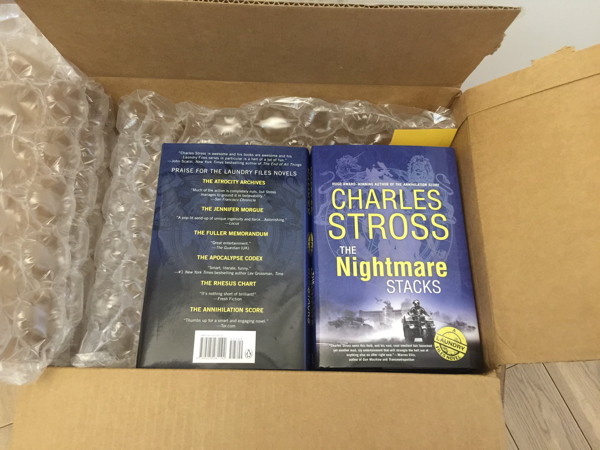
So "The Nightmare Stacks" is just 11 days away in the UK (and 18 in the USA) and my UK publisher, Orbit, have kindly posted an extract from the first chapter:
A vampire is haunting Whitby; it's traditional.
It's an hour after dusk on a Saturday evening four weeks before the spring gothic festival. Alex the Vampire strolls along the sea front, his hands thrust deep into the pockets of his tweed jacket. There's a chill breeze blowing onshore, and he has the pavement to himself as he walks, eyes downcast and chin tucked into his chest, lost in thought. What profound insight does the creature of the night contemplate as he paces along the North Promenade beside the beach, opposite a row of moonlit houses? What ancient wisdom, what hideous secrets haunt the conscience of the undying?
Let's take a look inside his head ...
Carry on reading "The Nightmare Stacks"
In case you were wondering where to buy it, here are some handy links:
[US Hardcover via Amazon] [US Kindle store] [All formats via Barnes and Noble]
[UK Hardcover via Amazon] [UK/EU Kindle store] [Via Waterstones]
14 Jun 13:08


Thoughts and Prayers
by John Scalzi
A man goes into an immigration services center in Binghamton New York, blocks the exit in the back with his car, goes through the front door with handguns, body armor and ammunition. He shoots the receptionists and opens fire on a citizenship class. He murders thirteen. This is horrific. I offer my thoughts and prayers.
A psychiatrist trained to help others with the stress of combat goes to Ft. Hood, the army base at which he is stationed, and opens fire on his fellow soldiers and some civilians, too. Another thirteen people are murdered there. Three are killed charging the shooter. Words cannot express my sorrow. I offer my thoughts and prayers.
A professor is denied tenure at the University of Alabama at Huntsville. She goes to a department faculty meeting and in that conference room pulls out a nine-millimeter handgun and shoots six people, three of whom she manages to murder. Those people were just doing their jobs and what happened to them is terrible. I don’t want to have to think about it any further. I offer my thoughts and prayers.
A truck driver in Manchester, Connecticut comes out of a company disciplinary hearing for allegedly stealing beer and starts shooting up his place of work. He murders eight people, calls his mother and tells her about it, and then shoots himself. Gun control discussions are a mess in this country and they never go anywhere productive, there’s no middle ground, and they make me tired thinking about them. I offer my thoughts and prayers.
In Tucson, Arizona, a member of Congress is meeting with her constituents in the parking lot of a supermarket, and a 22-year-old man comes up and shoots her straight in the head. A representative to Congress, can you believe that! She somehow survives, but he murders six others, ranging in age from nine to 79. That’s quite a range. Surely the attempted assassination of a US Representative will start a substantive discussion by someone. In the meantime, I offer my thoughts and prayers.
Seal Beach, California, where a man and a woman are having a custody dispute. His solution: Enter his wife’s place of work, a hair salon, and open fire on anyone there. He murders his ex-wife and seven other people, including one man not even in the salon. He is in his car in the parking lot outside the salon. Bad luck. Here’s an interesting thing: there is a sort of magical power to saying that you offer your thoughts and prayers.
Oakland, California, and at a small Christian college, a man who had been expelled for behavioral and anger management problems decides that he’s going to find an administrator he has issues with. He doesn’t find her, so instead grabs a secretary, enters a classroom and orders the students there to line against a wall. Some refuse. He shoots, reloads and shoots some more. Seven people are murdered. The shooter later says he’s sorry. The magical power of saying that you offer your thoughts and prayers is that once you do it, you’re not required to do anything other than to offer your thoughts and prayers.
In Aurora, Colorado, a midnight audience of Batman fans are half an hour into the final installment of Christopher Nolan’s superhero trilogy when a man enters the theater, clad in protective armor, sets off two gas canisters and starts shooting. Some audience members think this is a stunt tied into the film. It’s not a stunt, and the shooter, armed with an assault rife, a shotgun and a glock, murders a dozen people, ten of whom die right there in the theater. When police visit the shooter’s home, they find it rigged with explosives. The shooter placed a camera to record what happens if the police just barge in. Saying “thoughts and prayers” is performative, which is to say that just in saying it, you’ve performed an action. Prayers leave your mind and go to God. It is a blessed, holy and as such apparently sufficient thing, to offer your thoughts and prayers.
Sunday morning, and in Oak Creek, Wisconsin, members of the Sikh temple there have gathered for services and meditation and are preparing a communal meal when a white supremacist and Army veteran starts shooting, murdering six and wounding a police officer before killing himself. Did you know that Sikhs are often confused by the unknowing and possibly uncaring for being Muslim, and that the excuse of “I thought they were Muslims” is itself a sign of racial hatred? Mind you, there are people who will say to you that it’s not enough, only to offer your thoughts and prayers.
In Minneapolis, a man is called into an office by his supervisor and told he is losing his job. The man replies, “Oh, really?” and pulls out a handgun, shooting the supervisor after a struggle for the weapon, eventually murdering five others before killing himself. Indeed, people particularly expect more from lawmakers, who have the ability to call hearings and allow government studies and even change laws, rather than only to offer their thoughts and prayers.
Brookfield, Wisconsin, another hair salon, another estranged couple. The wife seeks a restraining order when the husband threatens to burn her with acid and set her on fire with gasoline. He does neither. He does, however, murder her, along with two other women. Witnesses say the wife tried to protect the others before she died. But again, even if you’re a lawmaker, with the ability to do things that could have concrete impact, you might argue that your responsibility to women being murdered by husbands, workers murdered by co-workers, religious minorities murdered by bigots, soldiers murdered by other soldiers, innocents murdered by those who are not, ends when you, in a tweet, Facebook post or press release, offer your thoughts and prayers.
A man enters an elementary school in Newtown, Connecticut, and with a Bushmaster XM15-E2S carbine rifle, murders twenty children, all of whom are either six or seven years old.
We pause here a moment to think about that.
Twenty children. Ages six, or seven.
And here maybe you think to yourself, this is it. This is the place and time where thoughts and prayers in fact aren’t enough, where those who only offer their thoughts and prayers recognize that others see them in their inaction, see that the convenient self-absolution of thoughts and prayers, that the magical abnegation thoughts and prayers offer, is no longer sufficient, is no longer proper, is no longer just or moral, or even offers the appearance of morality.
We pause here a moment, and wait to see what happens next.
And then they come. One after another.
I offer my thoughts and prayers.
And it keeps going.
Five murdered in Santa Monica, California by a gunman. I offer my thoughts and prayers.
12 murdered in a running firefight through the Washington Navy Yard in DC. Like a ritual, I offer my thoughts and prayers.
Ft. Hood, Texas again, for another three murdered. Like a litany, I offer my thoughts and prayers.
Six murdered in Isla Vista, California. Violence against women is horrible, and I offer my thoughts and prayers.
Nine murdered in Charleston, South Carolina. It’s unspeakable that violence against black Americans has happened like this, and I offer my thoughts and prayers.
Five murdered in Chattanooga, Tennessee. Muslims should answer for the crimes of this person, even if they do not know him or would in any way condone the action, and I offer my thoughts and prayers.
Nine murdered in Roseburg, Oregon. I offer my thoughts and prayers.
Three murdered in Colorado Springs, Colorado. Thoughts and prayers.
Fourteen murdered in San Bernadino. Thoughts. Prayers.
Fifty murdered in Orlando.
Fifty people, in a gay club, by a shooter who his father says was disgusted by the sight of two men kissing, and who news reports now tell us had pledged allegiance to ISIS.
And what do we do now, I wonder, when the victims are who they are and the perpetrator is who he is, the situation is ripe for posturing, and there’s a phrase to be used that allows one to assert maximum public virtue with minimum personal effort or responsibility?
What do we do now, when thoughts and prayers are easy, and everything else is hard?
Here is the thing: In the aftermath of terrible violence, offer thoughts, and prayers, if it is your desire to do so.
Then offer more than thoughts and prayers. Ask for more than thoughts and prayers. Vote for more than thoughts and prayers. Help those for whom thoughts and prayers are the start of their responsibilities, not the abdication of them. And as for the others, you may politely remind them of Matthew 6:5-6, and perhaps also Matthew 7:21-23. Perhaps they will see themselves in the words there. Perhaps not. They’re worth thinking on regardless.
“I offer my thoughts and prayers.”
Thank you.
It’s not enough.
It never was.
What more do you have to offer?
Jenl1625 likes this
12 Jun 12:34
Amazing Spider-Man #1 (cont)
by Andrew Rilstone
Spider-Man vs The Chameleon
 Villain:
The Chameleon
Guests:
The Fantastic Four
Named characters:
None!
Un-named characters:
Cops, guards, spies etc
First Appearance of:
Spider-Man’s spider-sense
Observations:
Spider-Man’s mask is now separate from his shirt.
Spider-Man refers to communists as “commies”.
For the first, but not the last time, Spider-Man runs out of web-fluid at an inopportune moment.


The Chameleon
Guests:
The Fantastic Four
Named characters:
None!
Un-named characters:
Cops, guards, spies etc
First Appearance of:
Spider-Man’s spider-sense
Observations:
Spider-Man’s mask is now separate from his shirt.
Spider-Man refers to communists as “commies”.
For the first, but not the last time, Spider-Man runs out of web-fluid at an inopportune moment.
It is hardly possible to over-emphasize the importance of the Marvel Method when reading these ancient comics. It is debatable how detailed a brief Stan Lee gave to his artists: Steve Ditko talks in terms of two page synopses; Stan Lee admits that it was sometimes not more than a one-line summary. But what is not in question is that Ditko delivered completed artwork to Lee with no writing on it; and that Lee added the speech bubbles, the captions and the sound effects after the pictures had been completed. So it is always a good rule to look at what the pictures would be saying if there were no words, and see if that is in any way different from what the text is saying (or what the text and pictures say together.) When the writing and the art are "out of sync", it doesn’t follow that Stan has done a Bad Thing; or that we should ignore the words and just look at the pretty pictures. The slight clash — as when Steve provides a dark, scary villain and Stan adds an ironic, comical commentary — is probably the biggest single thing in the early years which made Spider-Man feel like Spider-Man. But occasionally, it does give a clue as to the textual archaeology of the piece.

One such case occurs in Spider-Man #1. In the final panel of page 5, Peter moans “I don’t get it. How do other superhuman guys like Ant Man and the Fantastic Four get away with it?” In the picture, he is standing by a news-stand, with a rack of papers saying “SPIDER MAN: MENACE”. The picture is reminding us the Jonah Jameson hates Spider-Man; the words are about the Fantastic Four and Ant Man being popular. If “Spider-Man wonders why the F.F are so popular” had been part of the brief that Lee gave to Ditko, then Ditko would surely have drawn a panel showing Spider-Man thinking about the other heroes; or at least put “FANTASTIC FOUR SAVE WORLD AGAIN” on some of the papers. He didn't. So it is a good bet that when Lee briefed Ditko, and when Ditko drew this story, they didn’t know that Spider-Man was going to start meeting other Marvel Superheroes. When Lee sat down to write the dialogue, they did.
The J Jonah Jameson story, which runs to 11 pages, was clearly intended for an anthology comic: Amazing Fantasy #16. This leaves Lee and Ditko with 10 pages to fill in Amazing Spider-Man #1. So Spider-Man vs the Chameleon is a filler, the first material written with a solo Spider book in mind. It’s been a long time since Lee wrote the first four and a bit episodes of his “realistic” hero — so long that he has forgotten Peter Parker’s name! This isn’t a lettering error: he’s Peter Palmer on every page. And in those months, Lee has rethought what Spider-Man is all about.
Amazing Fantasy #15 shows no signs of taking place in something called the Marvel Universe. People would hardly be breath taken and incredulous by a wall-crawling TV star if the Fantastic Four and the Hulk were already famous, and there is no hint that Uncle Ben has regaled Petey with stories about how he saw Captain America and the Human Torch during the war. The logic of the first four and a bit chapters is that Parker is in a unique situation and doesn’t know what to do with it. But in the months between the axing of Amazing Fantasy and the launch of Amazing Spider-Man, Lee had started to think of Marvel Comics as a shared world. In Fantastic Four #4, Johnny Storm still thinks of the Hulk as a comic book character; but by issue #12 General Ross is asking the F.F to help the army capture the big green bad tempered guy. Fantastic Four #12 and Spider-Man #1 came out in the same month. The Hulk is on the cover of the F.F's comic; the F.F are on the cover of Spider-Man's. Stan Lee is establishing a brand.
The filler strip is actually two unrelated stories: one, running to four pages, is about Spider-Man trying to join the Fantastic Four; the other, running to six, is about a communist traitor trying to frame him. There’s no attempt to integrate them, and the faces of the F.F (EXTRA BONUS EXTRA!) are rather incongruously stuck over a splash page depicting Spider-Man and the Chameleon. The story is called Spider-Man vs the Chameleon rather than Spider-Man Meets the Fantastic Four; but it’s a Kirby F.F on the cover. (So, yes: the cover of the first ever Spider-Man comic advertised a sub-plot in the back-up strip.)
Both segments are about Spider-Man trying to make some money. In the first half; Spider-Man arrogantly thinks he can get paying work with the Fantastic Four; in the second he naively follows up a job offer, which turns out to be from a Soviet spy. The F.F. tell Spider-Man (truthfully) that they are a non-profit organization and don’t pay wages — fairly politely considering he’s just broken into their building unannounced: but Spider-Man chooses to think that they have turned him down because they believe in J. Jonah Jameson’s editorials. He remains appalling, horribly arrogant, telling the most famous heroes in the world that he never wanted to join their club in the first place. Once again, a door has been closed off to Spider-Man: he can’t work as an entertainer and now he’s alienated himself from the other superheroes. Stan Lee could legitimately claim that a story in which Spider-Man visits the Fantastic Four and nothing comes of it is a fairly unconventional bit of story telling.
Both segments are about Spider-Man trying to make some money. In the first half; Spider-Man arrogantly thinks he can get paying work with the Fantastic Four; in the second he naively follows up a job offer, which turns out to be from a Soviet spy. The F.F. tell Spider-Man (truthfully) that they are a non-profit organization and don’t pay wages — fairly politely considering he’s just broken into their building unannounced: but Spider-Man chooses to think that they have turned him down because they believe in J. Jonah Jameson’s editorials. He remains appalling, horribly arrogant, telling the most famous heroes in the world that he never wanted to join their club in the first place. Once again, a door has been closed off to Spider-Man: he can’t work as an entertainer and now he’s alienated himself from the other superheroes. Stan Lee could legitimately claim that a story in which Spider-Man visits the Fantastic Four and nothing comes of it is a fairly unconventional bit of story telling.
The Chameleon section is entirely separate — Peter “Palmer” is rediscovered studying spiders in a museum, having completely forgotten about his visit to the Baxter Building, or, indeed, his breakfast time plans to become a super-villain. The Chameleon sends out a message offering Spider-Man a job, and Spider-Man thinks “I can’t afford to pass up any chance for profit”. One wonders why no-one thought to call the comic Peter Parker: Hero For Hire.
The idea — that the Chameleon wants to lure Spider-Man to a particular roof-top, so that it will look like the latter stole the plans that the former is running away with — is quite cool; and the ending, in which the police continue to believe that Spider-Man is the traitor despite all evidence to the contrary fits in pretty well with the rest of the issue. In between is a fairly generic run-about. It’s quite depressing to look at the sketchy artwork in which a tiny figure of Spider-Man webs himself onto the Chameleon’s helicopter, and compare them with the thrilling space capsule sequences that Ditko produced ten pages, (or looked at another way, seven months) ago. It’s a bit crap to put the helicopter sequence and the space capsule sequence in the same issue, actually: if your main movie features an aerial rescue, then your B-feature should be a car chase or a gunfight.
The episode is most notable for introducing what is described as Spider-Man’s “spider instincts” “spider senses” or “spider’s sense”. It’s an odd idea: if you were trying to think of an additional power to give to a hero who could walk on walls and spin web, “telepathic radar” wouldn’t necessarily be the first thing that comes to mind. The spider sense is a generic bit of plot machinery, as multi-functional as a sonic screwdriver. It warns “Palmer” that the Invisible Girl is behind him; it enables him to hear the Chameleon’s electronic message; it allows him to “tune in” on the Chameleon’s ship; it tells him that one of the police is the Chameleon in disguise; and it enables him to to find his way around a dark room. It is consistently represented, as it would be for years to come, by lines radiating from Spider-Man’s head.
When the fake Spider-Man steals the plans, the cop says “I can’t believe you have turned traitor”. The Fantastic Four seem only mildly concerned that he is wanted by the FBI. The cliffhanger at the end of the last story in which Spider-Man is a wanted felon on the point of turning bad has already been forgotten. Spider-Man is not an outlaw and a fugitive: he’s merely a do-gooder who people don’t quite trust.
 |
| Spider-Man #1 |
 |
| Amazing Fantasy #15 |
The second time the cops assume Spider-Man is a traitor he runs out of the fight ("in a fit of white hot fury”, apparently) crying “well, they can catch that spy themselves now.” So much for power and responsibility.
And in the final frame, we are right back where we started: Peter wishing for the second time in one issue that he could give up being Spider-Man. The final two frames echo the endings of Amazing Fantasy # 15 and the first strip in Spider-Man #1. In one “a lone figure looses himself in the shadows of the night” (compare with “a silent figure silently fades into the gathering darkness”) while in the other, the Invisible Girl wonders “what if Spider-Man ever turned his power against the law”? Clearly "Parker turns bad" is a storyline that Lee wants to trail, but nothing ever comes of it.
And in the final frame, we are right back where we started: Peter wishing for the second time in one issue that he could give up being Spider-Man. The final two frames echo the endings of Amazing Fantasy # 15 and the first strip in Spider-Man #1. In one “a lone figure looses himself in the shadows of the night” (compare with “a silent figure silently fades into the gathering darkness”) while in the other, the Invisible Girl wonders “what if Spider-Man ever turned his power against the law”? Clearly "Parker turns bad" is a storyline that Lee wants to trail, but nothing ever comes of it.
“Every time I try to help, I get into worse trouble!” whines cry-baby Peter in the final frame. “NOTHING turns out right... (SOB) I wish I had never GOTTEN my superpowers”

12 Jun 12:28
A game of consequences
by Charlie Stross
There's an old saying that only two things are unavoidable: death and taxes. I think this is wrong—the two unavoidable things are politics, and it's seldom-admitted offspring, bureaucracy. (Their Titan) parent is of course economics.)
Politics: you may not like it but you can't ignore it because whenever two or more people have ideas about how to do something requiring the participation of two or more people there's going to be an argument about how to do it. Bureaucracy: because once the argument is settled you need to coordinate the tasks, and once your community exceeds Dunbar's number you need to develop mechanisms for managing work and social relationships between people who don't know each other.
It's fairly obvious that technology affects the implementation details of politics and bureaucracy (and there's feedback involved too, via market regulators and command economies). And there are scale issues too. Back in the 1670s and 1680s century when Samuel Pepys served as Secretary for the Admiralty, administration for the Royal Navy ran on a handful of staff and relied on disbursement of funds—in cash—to ships' captains to see to their maintenance and the pay of their sailors. Today it's hard to imagine a modern defense ministry running on cash-in-hand: even Da'esh have accountants and an org chart. But the ability to run a modern bureaucratic defense procurement and supply organization is required due to the capital-intensive nature of modern warfare (you try buying an Aircraft Carrier with cash) and relies in turn on availability of modern tools: not just computers, but accounting procedures, project management, quality assurance, process control, and a host of other specialities that simply didn't exist back in the age of sail. On the other hand, back in the 17th century ships and squadrons might be commanded by officers weeks or months from the nearest political point of control and operating on the basis of orders which, although obsolete, had not been countermanded (and it wasn't just at sea: for example, the Battle of New Orleans took place in 1815, weeks after the treaty ending hostilities had been signed).
So. Taking the space cadets seriously for once ...
What are the political problems that would arise from the extension of an Earth-based political framework to governance of off-world space colonies? And what kind of bureaucratic mechanisms might be developed to deal with the arising issues?
Most SF centering on near-future space colonization is regrettably polluted by rose-tinted libertarian bullshit. Let's face it: in the really short term, outposts like the ISS or a near-term return-to-Moon or expedition-to-Mars will be governed by existing legal arrangements made by the national government with jurisdiction over the crew. In practice this means the 1998 ISS agreement, the Outer Space Treaty, and customary international law. And the "colonists" aren't; they're typically highly trained middle-aged scientists, engineers, and bureaucrats-with-other-skills (note how many of NASA's retired astronauts go on to careers in space program senior management or even seats in the Senate or Congress).
Looking further ahead—by which I mean out past 2030 at the very earliest—we might see encampments with a handful of people living and working off-planet semi-permanently, along the lines of an Antarctic research station (albeit in a vastly more hostile environment). "Law enforcement" overlaps messily with psychological healthcare, and generally is a matter of shipping the unruly home for treatment and diagnosis (and, optionally, restraining them en route). Money? Hah! While informal economies eventually emerge once you have a population in double or triple digits (things like trading extra shifts worked, or food, or homebrewed moonshine) it takes a long time to get to the point where "money" is internally useful for anything other than keeping track of interpersonal exchanges of obligations. And as for "no taxation without representation", that's a really long way in the future, and becomes highly problematic when the polity of 3000 who are objecting to remote governance and taxation is reliant on a distant polity of 300,000,000 who built the metal world they live in.
But by the time we look as far as self-sufficient comet-mining or terraforming colonies, a century or two in the future, the questions of political coordination and local vs. remote administration will become pressing. And these questions also apply to long-term colonies and generation ships. Assuming the (huge) obstacles to these are overcome (notably: deleterious medical radiological and microgravity effects of long-duration spaceflight; economic framework for repaying the cost of foundation; ability to maintain a large-scale closed cycle life support ecosystem; ability to replicate all necessary infrastructure components and consumer goods; ability to care for, educate, and train new members of the population and to sustain those who can no longer work or who aren't suitable for work at core survival tasks) ... what, realistically, happens?
I have some starting assumptions. Notably: the traditional right-wing American vision of settlers in space is utterly untenable because it assumes people can "walk away" from local market failures, and that individuals are solely responsible for their own errors. Libertarianism won't fly in space where any "market adjustment" is likely to prove lethal to a significant proportion of the population. Indeed, the American formulation of rugged individualism is horrifically dangerous in such a setting: imagine the mind-set that gives rise to schoolyard shooters, and put it in an environment where the only things holding in the atmosphere are the walls.
Secondly: in the absence of magical scientific breakthroughs, getting home from a fucked-up colony will be hard to impossible. If you colonize the Gobi desert or Phoenix, Arizona, you can probably escape if you have a gassed-up SUV, some cash, and enough water. If you colonize Mars, though, you're going to need a spaceship capable of reaching orbit and at least three months (more likely 18 months) of air and supplies. That's a whole different ball game, and once you realize you're living in a failed world, you're going to be far too late: it makes the plight of the people in the European migrant crisis today look trivial. Space colonies exist, of necessity, in a kind of liminal Gene Cernan voiced "failure is not an option" territory: and this is not a good place to live, much less to raise a family and expect a peaceful retirement.
So I don't see our contemporary interpersonal or cultural relationships working. Some sort of tribal organizational structure might work, by which people could work with distant or unrelated "relatives" within a web of familial obligations; it's a way of diffusing relationships to allow larger groups to work together for joint survival. Look at parts of the middle east for cultures adapted to that way of life ... or better still, don't (if you're attached to the idea of personal autonomy, choosing your own sexual partners, and deciding whether or not to have children or how to work for yourself). I'm only half-kidding: obviously iron-age tribal practices won't help cultures in brittle, high-risk environments mediated by high technology survive ... but neither will what we've got now on the sleepwalking, neoliberalalism-dominated west.
Nor are our current political representative structures, adapted to heterogeneous nations sharing an open, relatively resilient world, necessarily going to work well in a closed system. A space colony can't afford to be governed by ideology in the absence of feedback from instrumentation. But technocracy isn't the answer either; technocracy has nothing to say by way of answering the core questions of human existence, such as "what is best in life?" much less "what is right?" And a space colony probably can't survive a revolution that turns violent.
Any workable form of government for such a fragile environment is going to have to provide mechanisms for prompt and non ideologically-biased responses to deviations from the baseline. It's going to have to provide solutions that work for everybody, because the environment is a lifeboat and if you give up on someone they will die (or worse, having no expectation of living may choose to take everybody else with them). It's going to have to provide a framework for settling arguments where there is no obvious "best" solution without pissing off one faction or the other, and a framework for orderly and non-violent transfers of power (because shaved apes are addicted to up-ending their social hierarchies). The bureaucracy it comes with is going to have to offer mechanisms for delegating authority across vast gulfs of space and time, be relatively lightweight (at least in the early decades of a colony), and should arguably satisfy Rawls' philosophical notion of justice as fairness and provide distributive justice, lest it give rise to grievances leading to instability or revolution. (As a propensity for fairness seems to be wired into primates at a very low level, running on an administrative system that optimizes for fairness seems like an appropriate way to minimize friction.)
Anyway. What other angles am I missing here? You, too, can help design a constitution for a space colony! Just remember two things: it has to be somewhere you'd be comfortable living the rest of your life as an ordinary citizen, and if you get it wrong, you can't walk away.
12 Jun 09:56
It's hidden behind the Sunday Times paywall and buried in the article, but Tim Shipman's profile of Boris Johnson contains this bombshell:
Huge if true... Boris Johnson is a bottle-enhanced blond
by Jonathan Calder
It's hidden behind the Sunday Times paywall and buried in the article, but Tim Shipman's profile of Boris Johnson contains this bombshell:
I think back to the photoshoot, when Boris runs his hand through that bird's nest of platinum hair. "This is the real thing," says Boris. "It's all natural." But you do die it, don't you Boris? I say. "Yes," he admits. Real but enhanced, a little like the public personality.I had hoped we would learn one day that it is a wig, but I will settle for this as a reminder of how carefully managed Johnson's unmanaged image is.
09 Jun 18:26
Day 5639: Messages from Cheadle #3 - Education
by Millennium Dome
Thursday:
Daddy goes back to school to talk about a key Liberal Value:
Daddy goes back to school to talk about a key Liberal Value:
09 Jun 16:07


This Vermont newspaper is having an essay contest. The prize? This Vermont newspaper
by PG
From Poynter:
The Hardwick Gazette sent out a press release Wednesday for an essay contest with a newsworthy prize – The Hardwick Gazette.
The contest winner will assume ownership of The Hardwick Gazette, the historic Main Street building where the newspaper has been published for better than 100 years, and equipment and proprietary materials necessary to operate the business.
It’s real, said Ross Connelly, editor and publisher of the Hardwick, Vermont weekly. He hasn’t gotten any entries yet, of course, since the release just went out, but they’re supposed to come in by mail anyway. “Real mail,” he said.
The cost to enter the contest is $175. The guidelines: 400 words “about the entrant’s skills and vision for owning a paid weekly newspaper in the new millennium.”
From the press release, which you can find here:
“We want to hear from people who can hold up a mirror in which local citizens can see themselves and gain insights into the lives within their communities,” says Connelly. “We want to hear from people with a passion for local stories that are important, even in the absence of scandal and sensationalism. We want to hear from people who recognize social media is not the same as a local newspaper. The winner of his contest will demonstrate this is a business that employs local people, that keeps the money we earn in the communities we cover, that is here week after week because the people who live here are important.”
Connelly, who turns 71 on Saturday, bought the paper with his wife in 1986. She died four years ago, and running the weekly paper by himself isn’t the same, either emotionally or financially, as it was with his partner, he said.
“The newspaper needs more energy than I have to offer now,” Connelly said, “I’m older than I used to be.”
. . . .
The Gazette has one full-time person in production, two people in part-time production, a reporter who recently went part-time, several other correspondents and a courier who picks up the paper at the printer each week in New Hampshire.
. . . .
He previously advertised the newspaper through Editor & Publisher, and people did come and look at it, but they were mostly tire kickers. The conventional way of selling the paper didn’t work, but Connelly felt that this institution that’s served the community since 1889 is still an important one.
Weekly papers fly under the radar of the mainstream press, who swoop in when big news hits, he said. But there’s still a lot going on that residents have the right to know about.
Link to the rest at Poynter and thanks to Dave for the tip.
PG has a soft spot for tiny newspapers in tiny towns that originates from his high school days when he was the unpaid sports editor for the local paper. Aside from learning all sorts of synonyms for “scored”, he listed the editorship on his college applications and was accepted everywhere he applied, so perhaps there was a tangible benefit other than seeing his name in the paper every week.
Click to Tweet/Email/Share This Post
09 Jun 16:04


The Big Idea: Shannon Page
by John Scalzi
Andrew HickeySharing as note to self

My personal path to publication, in terms of novel writing, was to post my novel on this blog, where it was read by an editor, who made me an offer. Is this the usual way it’s done? No. But is it wholly unusual? Well, as it turns out, there are a lot of ways to be published. Editor Shannon Page has assembled some of these way in her non-fiction anthology The Usual Path to Publication.
SHANNON PAGE:
I love writing workshops. I mean, sure, the internet is great and all, but the way I really learned about how the writing world works—not to mention how I made every writer friend I have—was by going to workshops, as well as their close cousins, conventions. Putting myself out there where lots of writers congregate, to talk about writing stuff, and everything else.
(I even met my husband at a writing convention. But that’s a different Big Idea.)
Imagine my thrill when I “graduated” from attending workshops to being asked to instruct at workshops. I will be the first to admit that I still have plenty to learn about the craft of writing; and as far as the business goes, I have quite obviously not become a household name, nor made even a small fortune. Even so, it was very encouraging to realize that I have learned a thing or two which newer writers might find useful. It’s a joy and an honor to be able to share that knowledge.
Last summer, I was an instructor at the Cascade Writers Workshop, a Milford-style small-group workshop. Cascade is a wonderful group of people dedicated to bringing writers together, giving newer writers a hand up, welcoming everyone into this great community. At one point during the workshop, all the instructors were gathered together in an open panel where the participants could ask us anything. One intrepid audience member raised their hand with a question about the “usual path to publication.”
It grieves me a bit to admit that we all laughed. In our defense, it was nervous laughter, startled laughter, uncomfortable laughter. And then we proceeded to seriously tackle this frankly impossible question. We spoke about the fact that there are as many answers to that as there are published authors. We told our own stories, both in that panel and for the rest of the weekend.
At some point, I realized, This would make a great anthology.
I shrugged it off at first. I had (still have!) too many projects on my plate already. But the idea wouldn’t let go. I talked to a few people about it. Tor editor Claire Eddy, another of the instructors, told me, “That’s a great idea. I’d buy that book. Everyone would buy that book.” By the end of the workshop, I’d decided to go for it. And this project was born.
Over the next few months, I put out a call to as many authors as I could get hold of, asking them for their unusual, amusing, inspirational, bizarre, even dreadful tales of how they actually got published. And, amazingly, so many of them responded. I got a little shiver of delight every time I opened my email to find another submission. The stories are great—charming, funny, painful, inspirational. There are missed connections, dead agents and editors, serendipity, technology woes, ignored advice, and deeply altered expectations. Most of all, there is persistence. If one thread unites all the essays I gathered, it is that these are people who did not give up.
As I began compiling the essays into a book, a second thread became clear: breaking in is only the start of the adventure. As the publishing landscape continues to change, seemingly faster all the time, once-comfortably established writers are having to adapt, often dramatically. Series get canceled, publishing houses merge or vanish altogether, agents and editors quit the business or move to other houses.
And then there is the bold (and terrifying, and exciting) new world of self-publishing. A few of my authors have dabbled there; one has jumped in all the way, and is doing far better than she had imagined possible. If there is ever a Usual Path to Publication Volume II, I wouldn’t be at all surprised to find it brimming with successful self-published writers.
This is not a how-to book. It’s a how-this-person-and-that-person-and-the-other-person-did-it book, twenty-seven times over. Coincidence and luck and timing and the random forces of nature run strong in these stories. I hope readers find them as enjoyable, entertaining, and inspirational as I do!
—-
The Usual Path to Publication: Amazon|Barnes & Noble|Book View Cafe|Kobo
Visit the editor’s site. Follow her on Twitter.
09 Jun 15:02
How to Give Someone a Gift
by Scott Meyer

At the end of the day, it’s impossible to give a gift without sending messages about yourself and your opinions of the recipient. How the recipient reacts to the gift also sends clear messages about them and their opinion of the gift giver.
I know a guy who gave his girlfriend the birthday gift of a cheerleader costume. They both learned a great deal that day.
You can comment on this comic on Facebook.
As always, thanks for using my Amazon Affiliate links (US, UK, Canada).
09 Jun 14:33
Ketamine Research In A New Light
by Scott Alexander
[Preliminary drawing of very far-out conclusions from research that hasn’t even been 100% confirmed yet]
A few weeks ago, Nature published a bombshell study showing that ketamine’s antidepressant effects were actually caused by a metabolite, 2S,6S;2R,6R-hydroxynorketamine (don’t worry about the name; within ten years it’ll be called JOYVIVA™®© and you’ll catch yourself humming advertising jingles about it in the shower). Unlike ketamine, which is addictive and produces scary dissociative experiences, the metabolite is pretty safe. This is a big deal clinically, because it makes it easier and safer to prescribe to depressed people.
It’s also a big deal scientifically. Ketamine is a strong NMDA receptor antagonist; the metabolite is an AMPA agonist – they have different mechanisms of action. Knowing the real story behind why ketamine works will hopefully speed efforts to understand the nature of depression.
But I’m also interested in it from another angle. For the last ten years, everyone has been excited about ketamine. In a field that gets mocked for not having any really useful clinical discoveries in the last thirty years, ketamine was proof that progress was possible. It was the Exciting New Thing that everybody wanted to do research about.
Given the whole replication crisis thing, I wondered. You’ve got a community of people who think that NMDA antagonism and dissociation are somehow related to depression. If the latest study is true, all that was false. This is good; science is supposed to be self-correcting. But what about before it self-corrected? Did researchers virtuously say “I know the paradigm says NMDA is essential to depression, and nobody’s come up with a better idea yet, but there are some troubling inconsistencies in that picture”? Or did they tinker with their studies until they got the results they expected, then triumphantly declare that they had confirmed the dominant paradigm was right about everything all along?
This is too complicated an issue for me to be really sure, but overall the picture I found was mixed.
A big review of ketamine and NDMA antagonism came out last year. In this case, I was most interested in the section on other NMDA antagonists – if ketamine’s efficacy is unrelated to its NMDA antagonism, then we shouldn’t expect other NMDA antagonists to be antidepressants like ketamine. So if the review found that other NMDA antagonists worked great, that would be a sign that something fishy was going on. But in fact the abstract says:
The antidepressant efficacy of ketamine, and perhaps D-cycloserine and rapastinel, holds promise for future glutamate-modulating strategies; however, the ineffectiveness of other NMDA antagonists suggests that any forthcoming advances will depend on improving out understanding of ketamine’s mechanism of action.
This is pretty impressive; they basically admit that other NMDA antagonists don’t work and that maybe this means they don’t really understand ketamine.
But dig deeper, and you find a less sanguine picture. The body of the paper lists notes five NMDA antagonists as confirmed ineffective – memantine, lanicemine, nitrous oxide, traxoprodil, and MK-0657. But the paper itself notes that all of these were effective on some endpoints and not others, and the decision that they were ineffective was sort of a judgment call by the reviewers. Just to give an example, there’s only ever been one study done on traxoprodil. Since the reviewers reviewed this one study and declared it ineffective, you might expect the study to be negative. But here’s the abstract of the study itself:
On the prespecified main outcome measure (change from baseline in the Montgomery-Asberg Depression Rating Scale total score at day 5 of period 2), CP-101,606 produced a greater decrease than did placebo (mean difference, 8.6; 80% confidence interval, -12.3 to -4.5) (P
Read this quickly, and it looks like they’ve confirmed traxoprodil is pretty great. The reviewers say it isn’t. They argue that p No statistically significant differences were observed in rates of treatment response or symptom remission associated with placebo (64% and 42%, respectively) versus rapastinel at any dose (up to 70% and 53%, respectively). However, statistically significant differences in the reduction of the 17-item HAM-D scores were observed for the 5-mg/kg dose at all intervals except day 14) and the 10-mg/kg dose at day 1 and day 3. Neither the low nor the high rapastinel doses were associated with significant greater 17-item HAM-D score reduction than placebo, leading the authors to posit an inverted U-shape dose-response curve.
Sometimes things do have inverted U-shaped dose-response curves – for some discussion of why, read the Last Psychiatrist’s Most Important Article On Psychiatry. But a study that shows no treatment response or symptom response, and the test score response is only on a medium dose but not a high or a low dose – that makes me kind of suspicious.
Why is the review so much more accepting of these ambiguous results than of the last set of ambiguous results? Psych blog 1BoringOldMan points out that the original study was done by the company making rapastinel and two authors of the review article I’m citing were affiliated with the companies that are developing rapastinel. And that at least one of them has a “legendary” history of conflicts of interest.
I don’t want to say for sure this is what’s going on. For all anybody knows, rapastinel might work – the NMDA and AMPA systems are really connected, and the base rate of a randomly chosen compound being an antidepressant is higher than you’d think. But I think it’s at least one possible explanation.
This review article also gets into the nitty-gritty of mechanisms of action:
That other NMDA channel blockers have yet to replicate ketamine’s rapid antidepressant effects has led to speculation that ketamine’s antidepressant properties may not be mediated via the NMDA receptor at all…additional evidence indicates that activation of glutamatergic AMPA receptors is necessary for ketamine’s antidepressant effects. Specifically, coadministration of an AMPA receptor antagonist has been shown to block ketamine’s antidepressant-like behavioral effects.
So that’s neat.
Two other relevant studies: Do The Dissociative Side Effects Of Ketamine Mediate Its Antidepressant Effects finds that they do, which contradicts the recent metabolite-related findings. On the other hand, the two papers share some authors, so I’m tempted to say it was an honest mistake. This paper incidentally finds that the dissociative effects of ketamine are not related to its antidepressant effects, which I think makes more sense now.
The other studies I found were mostly compatible with the new results, with a lot of people expressing doubt about whether NMDA really mediated ketamine, a lot of people finding null results for other NMDA antagonist medications, and a lot of people saying there were weird hints that AMPA was involved somewhere.
I feel kind of premature doing this, because as much as I think it’s elegant the discovery about the metabolite hasn’t been totally confirmed yet. But assuming it’s right, psychiatry comes out of this looking sort of okay. There were a lot of early results with a lot of hype. But the big review articles mostly put these in their place and were able to come up with the right results and fit the pieces together.
The one place this wasn’t so clear was when there were conflicts of interest. If we assume rapastinel doesn’t really work (which right now would be very preliminary and I’m not actually saying this, but these latest findings do seem to imply that), various teams made up of people affiliated with rapastinel’s manufacturers were unable to determine this (neither was the FDA, who just just gave rapastinel “breakthrough drug” status, apparently on the strength of industry studies).
A big reason I’m concerned about this is that I want to know how much to trust the rest of the psychiatric literature – for example, those claims about SSRIs being mostly ineffective. An answer of “you can trust it a lot, except in cases of conflicts of interest” would be a mixed bag. Almost every drug was originally researched and promoted by people with conflicts of interest, and then we trust the academics to catch up with them later and keep them honest. I don’t think this system has failed us too terribly yet. But it’s important to remember that that is the system.
09 Jun 10:40
Daddy, why didn’t you blog about Trump?
by Scott
Andrew HickeyDisagree, obviously, with the SJW-baiting bit...
A few days ago, Terry Tao, whose superb blog typically focuses on things like gaps in the primes and finite-time blowup in PDEs, wrote an unusual post, arguing that virtually everyone knows Donald Trump is unqualified to be President, so the challenge is “just” to make that fact common knowledge (i.e., to ensure everyone knows everyone knows it, everyone knows everyone knows everyone knows it, etc). Tao’s post even included the pseudo-mathematical
Proposition 1: The presumptive nominee of the Republican Party, Donald Trump, is not even remotely qualified to carry out the duties of the presidency of the United States of America
together with some suggestions for how this proposition might be “proven” (e.g., using Hillary’s recent San Diego speech).
In thus speaking out, Tao joins Stephen Hawking, who recently called Trump “a demagogue, who seems to appeal to the lowest common denominator.” Now Ed Witten just needs to issue his statement, and we’ll have a trifecta of “the three greatest geniuses.” This shouldn’t be a stretch: Witten started his career by campaigning for George McGovern, and has supported liberal causes for decades. I’m not expecting him to be seen around Princeton sporting a “Make America Great Again” baseball cap.
Notwithstanding this site, I don’t belong on any list with Tao, Hawking, or Witten. Nevertheless, friends have expressed surprise that I’ve had almost nothing to say on Shtetl-Optimized about what’s already—regardless of what happens next—the most shocking US political development of my life. Of course, I’ve mined the subject for humor. When I gave the Strachey Lecture on “Quantum Supremacy” on a recent visit to Oxford, I started out by asking whether I should disavow support from quantum supremacists, before averring that I needed to research the subject more. (Get it? I need to research it more?)
I didn’t say more because … well, what could I possibly say that wasn’t being said 1010000 other places on the Internet? Shouldn’t some little corner of human discourse remain Trump-free, so that civilization has a base from which to rebuild after this is all behind us?
Against those considerations, I recently realized that there’s an argument for speaking out, which goes as follows. Suppose Trump actually wins (as of this writing, Predictwise still gives him a frighteningly-high 27% probability). Suppose my family somehow survives whatever comes next, and one day my daughter Lily comes to me across the rubble of the post-thermonuclear hellscape and says, “daddy, in the Good Days, the days before the War of the Small-Hands Insult, the days when there was plentiful food and water and Internet, didn’t you have what used to be called a ‘blog’? Then why didn’t you speak out on this blog, why didn’t you do whatever tiny amount you could to prevent this?” So, alright, this post is my answer to her.
Trump, famously, doesn’t even try to refute the ubiquitous Hitler comparisons; instead he sneeringly invites them, for example with the faux Nazi salutes at his rallies. Certainly with Trump, there’s the eerily familiar sense of how could this possibly happen in a modern country; and of a candidate winning not despite but because of his open contempt for Enlightenment norms, his explicit promises to elevate his will over the law.
At the same time, I think there’s a deep reason why Trump is not Hitler. Namely, Hitler believed in something, had a purity of conviction. Late in the war, when every available resource was desperately needed at the front, Hitler and his deputies still insisted that scarce trains be used to transport Jews to the death camps. To me, that shows some real dedication. I’m not convinced that an examination of Trump’s long career in bullshit artistry, or of his unhinged statements today, shows a similar dedication to any cause beyond his own self-aggrandizement.
Yet as many others have pointed out, “not being Hitler” is sort of a low bar for a President of the United States. If Trump were “merely” a Pinochet or Putin level of badness, I’d still see his election as a calamity for the US and the world—like, maybe an order of magnitude worse than the in-retrospect-mini-calamity of Bush’s election in 2000.
Since Tao was criticized for not explicitly listing his reasons why Trump is unqualified, let me now give my own top ten—any one of which, in a sane world, I think would immediately disqualify Trump from presidential consideration. To maximize the list’s appeal, I’ll restrict myself entirely to reasons that are about global security and the future of democratic norms, and not about which people or groups Trump hurled disgustingly unpresidential insults at (though obviously there’s also that).
- He’s shown contempt for the First Amendment, by saying “libel laws should be opened up” to let him sue journalists who criticize him.
- He’s shown contempt for an independent judiciary, and even lack of comprehension of the judiciary’s role in the US legal system.
- He’s proposed a “temporary ban” on Muslims entering the US. Even setting aside the moral and utilitarian costs, such a plan couldn’t possibly be implemented without giving religion an explicit role in the US legal system that the Constitution was largely written to prevent it from having.
- He’s advocated ordering the military to murder the families of terrorists—the sort of thing that could precipitate a coup d’état if the military followed its own rules and refused.
- He’s refused to rule out the tactical first use of nuclear weapons against ISIS.
- He’s proposed walking away from the US’s defense alliances, which would probably force Japan, South Korea, and other countries to develop their own nuclear arsenals and set off a new round of nuclear proliferation.
- He says that the national debt could be “paid back at a discount”—implicitly treating the US government like a failed casino project, and reneging on Alexander Hamilton’s principle (which has stood since the Revolutionary War, and helps maintain the world’s economic stability) that US credit is ironclad.
- He’s repeatedly expressed admiration for autocrats, including Vladimir Putin and Kim Jong-un, as well as for the Chinese government’s decision to suppress the Tiananmen Square protests by arresting and killing thousands of people.
- He’s expressed the desire to see people who protest his rallies “roughed up.”
- He said that, not only would he walk away from the Paris accords, but the entire concept of global warming is a hoax invented by the Chinese.
Would Trump moderate his insane “policies” once elected? I don’t know, but I’d say that electing someone who promises to ignore the rule of law, in the hope that they don’t really mean it, has one of the worst track records of any idea in human history. Like, I acknowledge that a Trump presidency has a wide distribution over possible badnesses: whereas a Ted Cruz presidency would be pretty much a point distribution concentrated on “very bad,” a Trump presidency would have appreciable probability mass on “less bad than Cruz,” but also appreciable mass on “doesn’t even fit on the badness chart.”
Anyway, for these reasons and others, Shtetl-Optimized unhesitatingly endorses Hillary Clinton for president—and indeed, would continue to endorse Hillary if her next policy position was “eliminate all quantum computing research, except for that aiming to prove NP⊆BQP using D-Wave machines.”
Even so, there’s one crucial point on which I dissent from the consensus of my liberal friends. Namely, my friends and colleagues constantly describe the rise of Trump as “incomprehensible”—or at best, as comprehensible only in terms of the US being full of racist, xenophobic redneck scumbags who were driven to shrieking rage by a black guy being elected president. Which—OK, that’s one aspect of it, but it’s as if any attempt to dig deeper, to understand the roots of Trump’s appeal, if only to figure out how to defeat him, risks “someone mistaking you for the enemy.”
I remember watching the now-famous debate in August, where Megyn Kelly confronted Trump with his long history of derogatory comments about women, and Trump replied with a smirk, falsely claiming that his comments were “only [about] Rosie O’Donnell”—bringing down the house (both men and women) in laughter. At that point, something clicked; I got it. From then on, Trump’s continuing rise often scared or depressed me, but much less about it surprised me.
I think people support Trump for the same reason why second-graders support the class clown who calls the teacher a fart-brain to her face. It’s not that the class literally agrees that the teacher’s cranium is filled with intestinal gases, or considers that an important question to raise. It’s simply that the clown had the guts to stand up to this scolding authority figure who presumes to tell the class every day what they are and aren’t allowed to think. (As far as I can tell, this has also been the central operating principle of right-wing shock artists over the decades, from Rush Limbaugh to Ann Coulter to Milo Yiannopoulos.)
Support for this thesis comes from r/The_Donald, the main online clearinghouse for Trump supporters. Spend some time there, and many of the themes will be instantly recognizable if you’ve followed the interminable controversies about campus political correctness over the last few decades. Perhaps the most popular theme is the self-referential one, of “refusing to be silenced” by the censorious Social Justice Warriors. Trump supporters, for example, gleefully share articles about the university administrators and students who’ve treated “Trump 2016” and “Make America Great Again” chalked on campus sidewalks as hate crimes to be investigated and punished.
(Every time I read such a thing, I want to yell at the administrators and students involved: how can you not see that you’re playing directly into the other side’s narrative, giving them the PR bonanza of their dreams? Actually, I’ve felt the same way about many left-wing campus antics since I was a teenager.)
I explained earlier how abysmally I think Trump comes across under the cold light of reason. But how does he look to my inner five-year-old, or my inner self-serving orangutan? Well, Trump’s campaign has attracted some noxious anti-Semites, who surely want me dead for that reason, but I see little indication that Trump himself, or most of his supporters, feel similarly. I can’t say that they’ve said or done anything to threaten me personally.
Meanwhile, many of the social-justice types who are Trump’s ideological opposites did try to destroy my life—and not because I hurt anyone, tried to hurt anyone, or said anything false, but just because I went slightly outside their Overton Window while trying to foster empathy and dialogue and articulate something true. And having spent a year and a half reading their shaming attacks, on Twitter, Tumblr, Metafilter, etc., I’m well-aware that many of them will try again to destroy me if they ever see an opportunity.
So on the purely personal level, you might say, I have a hundred times more reason to fear Amanda Marcotte than to fear Donald Trump, even though Trump might become the next Commander-in-Chief (!?), while Marcotte will never become more than a clickbait writer. And you might add: if even a nerdy academic in Cambridge, MA, who’s supported gay rights and environmentalism and Democrats his whole life, is capable of feeling a twinge of vicarious satisfaction when Trump thumbs his nose at the social-justice bullies, then how much the more might a “middle American” feel that way? Say, someone who worked his whole life to support a family, then lost his job at the plant, and who’s never experienced anything but derision, contempt, and accusations of unexamined white male privilege from university-educated coastal elites?
The truth is, there’s a movement that’s very effectively wielded social media to remake the public face of progressive activism—to the point where today, progressivism could strike an outside observer as being less about stopping climate change, raising the minimum wage, or investing in public transit than simply about ruining the lives of Brendan Eich and Matt Taylor and Tim Hunt and Erika Christakis and Dongle Guy and Elevator Guy and anyone else who tells the wrong joke, wears the wrong shirt, or sends the wrong email. It strikes me that this movement never understood the extent to which progressive social values were already winning, with no need for this sort of vindictiveness. It’s insisted instead on treating its vanquished culture-war enemies as shortsightedly as the Allies treated the Germans at Versailles.
So yes, I do think (as Bill Maher also said, before summarily reversing himself) that the bullying wing of the social-justice left bears at least some minor, indirect responsibility for the rise of Trump. If you demonstrate enough times that even people who are trying to be decent will still get fired, jeered at, and publicly shamed over the tiniest ideological misstep, then eventually some of those who you’ve frightened might turn toward a demagogue who’s incapable of shame.
But OK, even if true, this is water under the bridge. The question now is: how do we make sure that the ~30% probability of a Trump takeover of American democracy goes toward 0%? I feel like, in understanding the emotional legitimacy of some of the Trump supporters’ anger, I’ve cleared a nontrivial Step One in figuring out how to counter him—but I’m still missing Steps Two and Three!
In the weeks leading to the 2000 election, I ran a website called “In Defense of NaderTrading.” The purpose of the site was to encourage Ralph Nader supporters who lived in swing states, like Florida, to vote for Al Gore, and to arrange for Gore supporters who lived in “safe” states, like Massachusetts or Texas, to vote for Nader on their behalf. I saw correctly that this election would be razor-close (though of course I didn’t know how close), that a Bush victory would be a disaster for the world (though I didn’t know exactly how), and that almost any novel idea—NaderTrading would do—was worth a try. My site probably played a role in a few hundred vote swaps, including some in Florida. I think constantly about the fact that we only needed 538 more, out of ~100,000 Floridian Nader voters, to change history.
Is there any idea that shows similar promise for defeating Trump, as NaderTrading did for defeating Bush in 2000? Here are the four main things I’ve come across:
- Terry Tao’s proposal: All the respected people who think Trump is gobsmackingly unqualified (even, or especially, “normally apolitical” people) should come out and say so publicly. My response: absolutely, they should, but I’m unsure if it will help much, given that it hasn’t yet.
- Paul Graham’s proposal: Democrats need to turn Trump’s name-calling and other childish antics against him. E.g., if voters love Trump’s referring to Rubio as “Little Marco,” Elizabeth Warren as “Pocahontas,” etc., then why doesn’t Hillary start referring to “Baby Donald” or “Toddler Trump,” having another temper tantrum for which he needs a pacifier? My response: again I’m skeptical, since Trump has already shown an uncanny ability to absorb all ridicule and shaming without injury, like the giant saucers in Independence Day.
- Trump needs to be baited into more social-media wars that make him look petty and unpresidential. My response: while it’s obvious by now that he can be so baited, it’s unfortunately far from obvious whether this sort of thing hurts him.
- Hillary should hold debates against the libertarian candidate, Gary Johnson, thereby helping to shift conservative votes from Trump to Johnson, and also making an implicit statement that Johnson, not Trump, is her legitimate conservative opposition. My response: this is maybe the most interesting idea I’ve heard (besides the obvious one, of the so-called “NeverTrump” Republicans bolting to start a new party—which, alas, it looks less and less likely that they’re going to do).
If you have additional ideas, feel free to share them in the comments! As you work it out, here’s my promise to you. Just like I dropped my research in 2000 to work on NaderTrading, so too over the next five months, I’ll do anything legal if I become convinced that it draws on my comparative advantage, and has a non-negligible probability of helping to ensure Hillary’s victory and Trump’s defeat. Even if it involved, like, working with Amanda Marcotte or something.
Chris Concannon, Andrew Hickey likes this
09 Jun 09:52
http://www.andrewrilstone.com/2016/06/from-trowbridge-last-year-few-seconds.html
by Andrew Rilstone
From Trowbridge last year, a few seconds caught on my phone of the best musician I imagine I'll ever see live. So pleased that I went to see them three times last year. (On the final occasion, Swarb had to more or less be lifted onto the stage, and couldn't tell his story about "Unst" because of massive dental problems...but it didn't seem to affect his fiddle playing at all.) I heard him do a solo set at the Folk House a couple of years ago, and he described collecting fiddle tunes off an old fiddler and recording them on a primitive reel-to-reel tape recorded. "The same kind we recorded Liege and Lief on..." It suddenly hits you: genuine legend.
09 Jun 09:51
Amazing Spider-Man #1
by Andrew Rilstone
Spider-Man
Spider-Man part 2
Spider-Man part 3


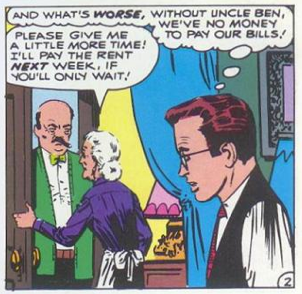


Spider-Man part 2
Spider-Man part 3
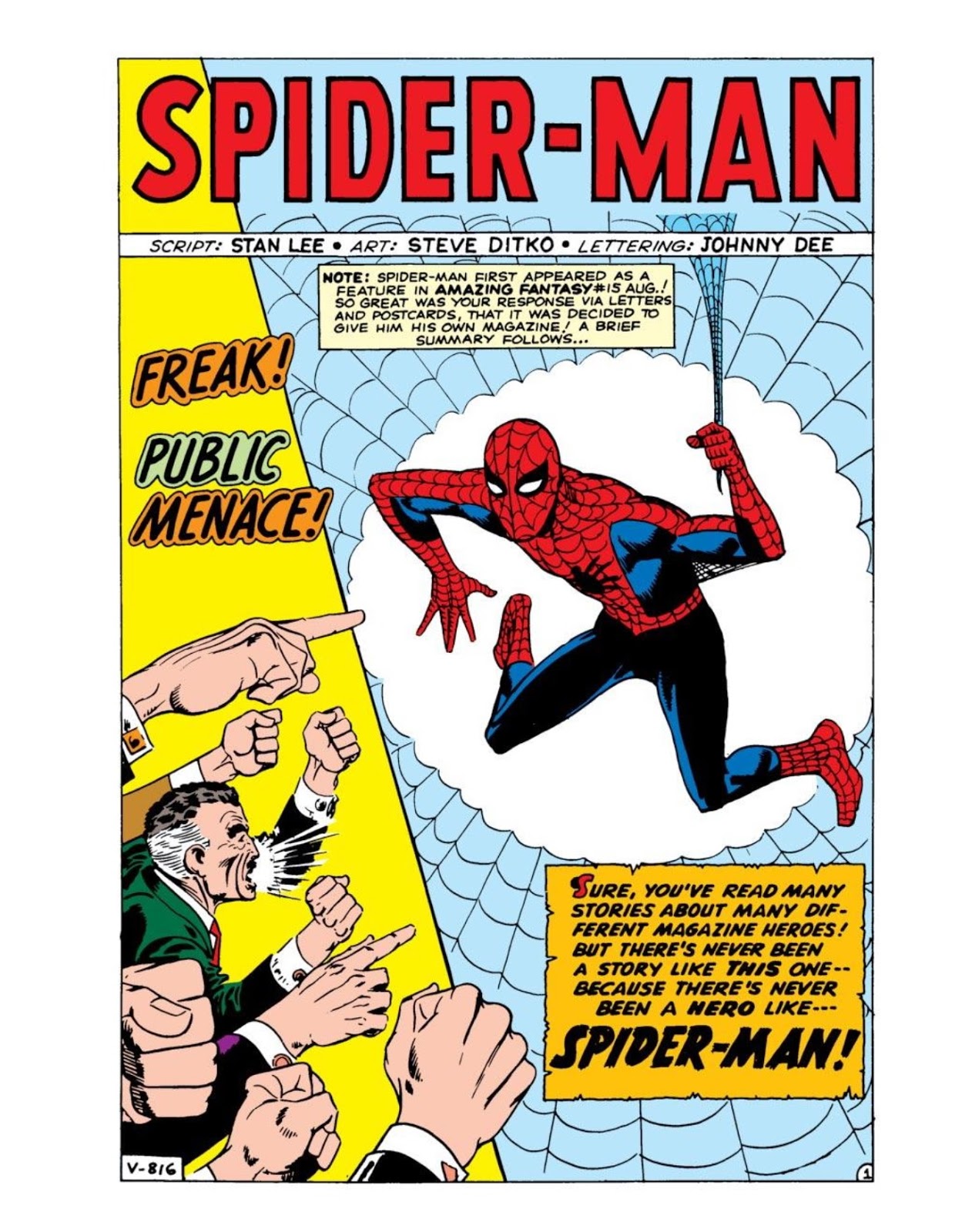
Named Characters:
Aunt May, J Jonah Jameson, John Jameson
Unnamed characters:
Landlord, TV producer, Bank teller, News Vendor, Diner Man, Pawn Broker
Observations:
The whole top half of Spider-Man’s costume, including gloves, is a single piece.
Peter Parker and Aunt May live in a rented house. They evidently relied on Uncle Ben for their income.
Flash Thompson, the blond boy with the T on his shirt appears to have morphed in a dark haired boy with an O on his shirt. None of the other schoolkids are named.

A hero’s enemy needs to be the opposite of that hero. It might be that the hero is strong, but not-too-bright, so the villain is weak but brilliant. It might be that the hero is a brilliant scientist so the villain pursues the occult and magic with equal genius. The editor of Harvey Comics told Joe Simon that his character the Silver Spider (who Joe had briefly considered calling Spider-Man) should have a nemesis who was the natural enemy of a Spider. “Either The Fly or Mr D.D.T”.
Steve Ditko and Stan Lee came up with something better.
They left us, maybe eight months ago with the message that “with great power there must also come, great responsibility”. That is the moral core of Spider-Man; so his enemy must be the opposite of that: someone powerful but irresponsible.
In a speech given in March 1929, British Prime Minister Sir Stanley Baldwin (arguably quoting Rudyard Kipling) attacked the growing power of the press.
The newspapers attacking me are not newspapers in the ordinary sense. They are engines of propaganda for the constantly changing policies, desires, personal vices, personal likes and dislikes of (the editors). What are their methods? Their methods are direct falsehoods, misrepresentation, half-truths, the alteration of the speaker's meaning by publishing a sentence apart from the context...What the proprietorship of these papers is aiming at is power, and power without responsibility – the prerogative of the harlot throughout the ages.
Power without responsibility. Spider-Man's nemesis, his moral opposite was not a supervillain, but a tabloid editor.
Did Stan Lee know from the beginning that the relationship between Peter Parker and J Jonah Jameson would define his comic for at least the first decade? I doubt it. Why launch a comic which has at its heart the feud between a superhero who tries to do good and a newsman who represents him as doing evil, but leave the newsman out of the first installment? It would have been a good pitch: better than “a kid who climbs walls” or “a comic which breaks the rules.” But J Jonah Jameson never features in Stan Lee’s myths about how his wonderful idea was rejected by an uncomprehending publisher.

When "Mr Jameson" came on stage, for the first time, on the third page of Spidey's first issue, did Lee and Ditko know that he was going to appear in every issue from now on -- one of only five regular supporting characters? It seems unlikely. In Amazing Spider-Man #1, Ditko makes more use than usual of stereotypes and caricatures — characters who appear for single panels and embody particular types. He’s rather good at them. We have the evil capitalist landlord, come to kick the old lady out of her home, with a bald head, bow tie and cigar; the snooty bank teller with fussy suit and little round glasses; the cook who won’t even give Peter a dish-washing job, with bare arms, apron and paper hat; and the man to whom Aunt May pawns her jewelry… Ditko had a thing about bald men and cigars. Jameson could easily have been one more vignette — the nasty journalist in his shirt-sleeves, long fingers ready to start hammering on a big old manual typewriter, and a toothbrush mustache in case we were in any doubt as to whether he was a goody or baddie. He gets fleshed out a bit in the second half; but for all anyone knew, the next chapter might have introduced a different opponent — an F.B.I agent, perhaps?
Amazing Fantasy # 15 began with a crowd of kids gesturing at Peter Parker — the kid in the checked coat stabbing a forefinger at him, the blond girl gesturing with her thumb, “Flash” pushing him away with his hand. On the first page of issue #1, we have nothing but hand gestures: hostile fingers and fists, waving and jabbing at Spider-Man; and one human face, with shout lines coming out of his mouth. We know now that the shouty-man is is Jameson, but the foul temper, the meanness, the awful grin, even the cigar will come later. Here he is just the spokesman for the mob, and the person who controls it. (Flash Thompson has a similar function, giving a face and voice to the undifferentiated mob of high school students, not one of whom has so much as a name.)
At this point, Spider-Man is little more than a character that Peter Parker plays on television. Jonah Jameson is going to take control of Spider-Man’s celebrity and tell a different story for his own ends. Parker cares a great deal about what other people think of him, and from on now people will think -- to quote another fictional tabloid editor -- what J.J.J. tells them to think.
The three chapters which appear in Amazing Spider-Man #1 each has its own title and logo “Spider-Man”, “Spider-Man part 2” and “Spider-Man part 3”. Each chapter could very easily have been presented as a single item in an anthology comic. Part 1, in particular, would have worked nicely as a stand alone: a superhero story without a villain, long before the justly famous Amazing Spider-Man #18. It begins and ends with Peter Parker having a temper tantrum; and covers a lot of ground in between. Aunt May is poor; she is going to be kicked out of her home. Peter Parker briefly considers turning to crime; but instead, he resumes his show-business career -- until Jameson terminates it by printing lies in his paper. The final page in particular is wonderfully immersive; we feel Parker’s desperation as Stan Lee gradually closes off all his options. He can’t cash his cheque; he can’t work on TV; he can’t even get a job washing dishes…and then he sees Aunt May pawning her jewelry. This breaks Peter Parker, and the final panel shows him pounding the wall in anger.
It must, incidentally, have been a very strong wall.
Stan Lee is very proud of the cheque-cashing scene, citing it over and over again as example of Spider-Man’s realism, of the kind of thing that wouldn’t have happened to any other super powered character. The voice of the snooty bank teller is rather fun ("don’t be silly, anyone can wear a costume") but the scene doesn’t actually make a lot of sense. Spider-Man is, at this point, basically a stage persona, so there is no reason not to reveal his true name to his agent; and his agent warns him that a cheque made out to Spider-Man will be uncashable. The scene is really there to get us over a plot difficulty: if Spider-Man is a huge celebrity, why isn’t Peter Parker rich? Jameson is also, at this point, a narrative answer to the question "if Spider-Man could have a lucrative stage career, why does he get involved in dangerous adventures?"
Chapter 2 goes off in a different direction. Ironically, J Jonah Jameson's son John is an astronaut; ironically, his rocket-launch goes horribly wrong; and ironically the person who saves his life is Spider-Man. Up to now, we have seen crowds of people looking at and reacting to Spider-Man: this section begins with Peter as part of the crowd watching John Jameson launched into space. Page 11 and 12 are some of the most dramatic and kinetic scenes in the early years of the comic; Spider-Man leaping from an army jet to the out of control space capsule and changing its direction with his physical strength and web.
This is the first time Spider-Man acts altruistically: the guy who told the police officer that catching criminals was not his job leaps into action to save his enemy's son just because he can, and because he is the only person who can. (If he thinks that he has a responsibility to do so, he doesn’t say so, and he certainly doesn’t think that he’s doing it for Uncle Ben.) But it is a very public act, and Peter Parker is still thinking in terms of celebrity. He doesn’t think that he has done a good thing for its own sake, or to partly atone for the bad thing he did a few weeks ago. He thinks that he has restored his reputation; taken his story back from Jameson, and (most importantly) that he can now resume his career as a TV celebrity.
Of course, it doesn’t turn out like that.
Why does Jameson hate Spider-Man? Lots of reasons will be given over the next few issues: that he's a bad man bringing down a good one; that it sells papers; that he honestly believe vigilantes are a public menace. But today, his motivation is simple enough. Jameson resents Spider-Man getting the publicity that he feels should go to his son John. On page 1 of this comic, Spider-Man is literally shown with a spotlight shining on him. On the final page Jameson says that Spider-Man engineered the disaster and the rescue in order to “steal the spotlight” from his son. Publicity, fame and celebrity are what this comic is all about.
The final page is genuinely shocking; turning the agony up a notch. The mob turns against Spider-Man. He has no way of making money, and May has no more jewels. The FBI put out a warrant and issue a reward for his capture, and even Aunt May thinks Spider-Man is evil.
And so we are left pretty much where we started, with Peter Parker being tempted to turn to crime:
“What do I do now? How can I prove I’m not dangerous? How can I convince people I wasn’t responsible for the failure of that capsule? Everything I do as Spider-Man seems to turn out wrong. What good is my fantastic power is I cannot use it. Or must I be forced to become what they accuse me of being and really become a menace. Perhaps that is only course left for me!”
And there, tragically, Stan Lee and Steve Ditko’s experimental graphic novel comes to an end. It has clearly been left unfinished: parts 1 and 2 are six and five pages long, respectively where chapter 3 stops after only three. The “the end” box has clearly been stuck onto the art after the fact.
So, nothing comes of this dilemma. Peter Parker doesn’t stalk the city by night, whatever that means. The FBI make no attempt to arrest him, and within a month or two, everyone will have forgotten that he's an outlaw. Next month, Spider-Man will solve all his financial problems at a stroke, foil an alien invasion, and the comic will reboot with Spider-Man as a professional crime fighter.
There is no point in mourning unmade films and unwritten books. Spider-Man, the Spider-Man we fell in love with, is a crime-fighting superhero with a lack of self-confidence and a tendency to over-worry. But still. I wish there were some way of knowing what Ditko and Lee, in the absence of editors and sales figures and pesky readers, would have put into Amazing Fantasy #17.
This is part of an on-going project to write a commentary on the early years of Spider-Man. If you think this is worthwhile, please consider donating 50p or £1 each time a new section comes out.
09 Jun 09:17
Today's Video Link
by evanier
This is a short 1939 documentary on how they made Popeye cartoons at the Max Fleischer Studio in Florida. The cartoon they're making in it is Aladdin and His Wonderful Lamp, which was the third and final in a series of extra-long and color Popeye cartoons Fleischer produced. Max's brother Dave was credited as director but according to most reports, he was more like the producer on most projects.
The animation process depicted is very similar to the way other studios then worked with two exceptions. The Fleischers and their crew had designed a special camera that allowed them to put three-dimensional models in the backgrounds of some scenes. You can see it in action in this film. Also, at other studios, the voices were done before the animation. At the Fleischer Studios, they were done after which is why the lips rarely matched the dialogue.
Max and Dave moved their operation from Manhattan to Miami after a bitter 1937 labor dispute. The Miami studio opened in October of 1938 with most of its resources devoted to the animated feature, Gulliver's Travels. In May of 1941, Paramount Studios — which had been financing and distributing the Fleischer product — called in loans and effectively seized ownership of the animation company. Later that year, Max and his brother Dave had a major falling-out, refusing to work with each other any longer. At that point, Paramount got rid of both men. The business was renamed Famous Studios and in 1943, it was moved back to New York and turned into a very ordinary company. Here's a look at what it was like there before that happened…
The post Today's Video Link appeared first on News From ME.
08 Jun 16:40


How much to protect your heart: The Monkees in Cleveland (again), June 5, 2016
by Sarah Clark
 There is no obligatory throwback intro. That’s because nothing obvious sprung to mind around which I could frame this review. I could have talked about listening to She Makes Me Laugh as the plane descended over the Cleveland skyline, thinking of Anissa, who I was still grieving when i flew in to town for my first serving of Gazpacho and who IS the subject of that song for me. I could have written about the first meeting of Melanie and my fellow charter members of the Frodis Femmes, and the Instant Click that proved she was an appropriate new member of our sisterhood. I could have written about touring the Christmas Story house/museum/gift shop, gazing at the cornucopia of themed shirts, mugs, flagpoles, BB Guns, and above all Leg Lamps in every size, and wondering if that’s where Clevelander John Hughes got the idea to sell those dang ponchos. I could have talked about working the line for Team Zilch before the doors opened, handing out pink party hats, accepting compliments on the show, recording bumpers, and wondering exactly when I’d become revered by a (very) small minority of a (decreasingly) small minority.
But none of those moments seemed like a big enough theme to hang an essay on, so I sat there, chatting as the lights dimmed, and waited to see what The Monkees would tell me. They’re pretty handy that way. I just sat back, watched the utterly stunning remastered show footage, and screamed my head off alongside Cindy and Melanie as they launched into a new opener:
Listen To The Band
With the rediscovered Clarksville train ride concert playing on the screen, Micky and Peter nailed their duet opening. I know that Nez/Micky is the vocal pairing we all swoon over these days, but those two are nothing to sneeze at either, with Micky soaring to the top of his vocal range over Peter’s rock-solid foundation. HOME RUN, even though I’ve never thought of it as an opening.
Clarksville
Moving on to the traditional opening, it was sung in the traditional manner, with the traditional panache. Liked how they wove the LTTB closing into the Clarksville opening, though. One note on the video screen—Peter’s sweatshirt in the Clarksville train romp IS RED. Not orange like we thought for 50 years.
Saturday’s Child
99% sure this is new to me, but it works well live.  Wayne Avers (glad you’re back!) played a barn-burner of a guitar solo, though Peter did join in on the fun there if memory serves.
Auntie Grizelda
OK, there are times in life where I must take a stand, and this is one of them. I don’t care if you philistines disagree with me—IT IS NOT A MONKEES SHOW WITHOUT AUNTIE GRIZELDA. Obviously Peter’s knee surgery took, because that’s the craziest I’ve seen that man dance since he climbed the amp tower back in ’01. And that patter he does over the bridge must save him THOUSANDS in psychotherapy. In fact, as I watched Peter sashay around the stage, it occurred to me that it’s high time for us Auntie Grizelda fans to strike a blow for this obviously beloved song, not as a guilty pleasure, but as an iconic touchstone of pure, unadulterated Monkee Magic.
Here’s my Pro-Grizelda argument in a nutshell:
- Auntie Grizelda is really a poignant protest song all about fighting for freedom against the snobbish, oppressive, and emotionally frigid older generation who are refusing to give way to change and creativity.
- Seriously, i think it’s safe to say Andrew Sandoval isn’t frogmarching Peter on stage at gunpoint or something at this point in the proceedings. If Peter didn’t want to do the stupid number, he most likely wouldn’t do the stupid number. He certainly wouldn’t do it with such unbridled, cathartic joy, right down to the parrot sounds and therapeutic mocking asides he raps over the bridge. It’s Peter’s Mooging the Nightly, he just doesn’t get enough credit for it because
- he’s been doing it in every show for decades, and
- when Nez does essentially the same schtick with Daily Nightly or No Time, Lord Nesmith, the Right Honorable Baron of Sparklyshoes is hailed as being all “witty” and “creative” and “subversive”. (Aside: I love Nez. In a disturbing number of ways I am a far dumber and dorkier version of the guy. Please don’t hit. But really, folks…what’s the difference?)
- Fans, both hardcore and not, LOVE this song. The second best memory of my husband at his first (and probably last) Monkees concert was him singing along cathartically with Peter, thinking of his own personal Auntie Grizeldas. (Every family has at least one…). I can verify that Melanie, who is one of the wisest and most insightful fans I know, appeared to love every second of it.
Snark is a time-honored and frankly necessary ingredient of the Monkees Fandom Recipe, lest the Good Times get too treacly. However, to mangle a famous quote by Samuel Johnson, he who is tired of Auntie Grizelda is tired of life. Therefore, I am hereby inaugurating the #teamgrizelda hashtag, for those who share my love of this song as a completely non-guilty pleasure. Go Forth and retweet your love of this song on its own terms!
She
Once again, Micky nailed this song, and once again Peter nearly stole it out from under him with various gestures and asides at key junctures. Oh—and Micky AND peter nailed the mic stand tilt!
She Makes Me Laugh
Before I get into my thoughts on this one, I’d like us all to take a moment to stare in awe at a universe where Micky Dolenz can say in 2016, “Here’s a song off our new album!”
Are we good?
Ok, onward.
Micky’s still learning the lyrics on this one, which is understandable. However, the band is definitely getting solid on it, and it was a crowd pleaser, with a strong round of applause from the audience.
A Little Bit Me, a Little Bit You
After dispatching a smart-aleck in the front row yelling “Manchester Cowboy!” while Peter was attempting to introduce a song by his “dearly departed friend”, Peter (yes PETER!) launched into lead vocals on this song, and he and Micky, trading verses, knocked it out of the park. I hope they give Peter more of Davy’s traditional vocals—they have similar ranges, and Peter’s voice gets more rock solid every time I see him. And if you disagree with me, you can just surf on over to the next overly verbose and existential PhD fangirl Monkees concert reviewer in your bookmarks. :-p
The Girl I Knew Somewhere
It never ceases to amuse me that Micky is more solid on the lyrics to this tune than Nez (who got a lovely and warmly received shoutout) was on the gazpacho tours. Though in fairness Micky HAS probably sung it a few thousand more times than Nez has…
Steam Engine (click link for facebook video)
This isn’t one of those things that’s on my Monkees Live Song Bucket List, but it’s near the top of Cindy’s, right next to Oh My My. As Micky belted it out and Wayne shredded his solo into musical confetti, I watched my sister Cin chair dance in bliss.
Shades of Grey
The minute I interpreted Peter’s setup about the wayback machine and realized what was coming, my gut clenched. I knew it was in the setlist, but I hadn’t really thought about the implications of seeing it live for the first time till now. I saw the Davy fans around me reaching for Kleenex. An involuntary “Oh no,” escaped my lips in a murmur. As Peter started the keyboard introduction, I found myself transported halfway between Then and Now, images from 30 years ago battling in my mind with the real world sight of a young Davy and an old Peter singing the duet that I’d longed to hear live, never expected to hear live and was suddenly absolutely terrified to hear live.
When the world and I were young, just yesterday,
Life was such a simple game, a child could play

As Davy’s archived vocal track rolled out of the speakers and into my ears, my own wayback machine roared into gear, and I suddenly found myself experiencing
a Saturday afternoon in the fall of 1986. I was 9 years old, and a brand-spanking new Monkees fan. Mom was running errands. Dad was watching me and Daniel, as well as the football game. I’d been spinning my new album Headquarters non-stop all day. That’s probably why I missed the knock at first. By the time I got to the door, Dad was opening it up to reveal my new friends. At least I hoped they’d be new friends. After my best friend’s Mom died of type 1 diabetes and her Dad remarried and they moved to Texas, I needed to make new friends. But I was finding it harder to make friends than it used to be. The girls looked up at Dad as I poked nervously around the corner into the front hall. They asked if I could go ride bikes with them. I looked up at Dad, grinning hopefully.
It was the Rocksino in 2016. I forced myself to stay in 2016, in the now. Listen to Davy. Listen to Peter. Listen to the Band. Feel the tears starting to roll down my cheeks—yes, for the man who left us too soon, but mostly for the girl I used to be.
It was easy then to tell right from wrong,
Easy then to tell weak from strong
Back in 1986, the girls had just asked dad if I could go ride bikes. He just stood there.
Still.
Too still.
From 4 years of experience I knew what was coming, and ran in front so I could try to break his fall as he pitched forward, already starting to tremble before the real convulsions of his seizures. Out of the corner of my eye I saw the girls back away in fear, or revulsion, or I didn’t really care much what. Then Me held on to Dad with all her strength as Now Me heaved herself forcefully back to
2016, as Peter and Micky both joined in to the chorus. My shoulders started shaking. I knew I had to keep my eyes open, even as the tears streamed. I had to stay in 2016. I would not have a flashback here, not now, NOT AT A FUCKING MONKEES CONCERT.
“I remember when the answers seemed so clear,
we had never lived with doubt or tasted fear…”
My throat caught in a sob as Peter started in on the second verse, his eyes looking suspiciously misty, his weathered, post-op voice adding a new, gloriously horrible layer of resonance that sent me careening back into
1986, where I’d managed to tip dad away from the concrete of the front porch to instead fall on a slightly softer kitchen floor. I tried to hold Dad’s limbs down as he convulsed, but he was too big to maneuver. I found myself on top of him, holding on for dear life in a sadistic parody of a bareback rodeo ride, trying to keep him away from the table legs. He had work Monday and wouldn’t want a bruise on his head. As his tremors calmed, he resumed his normal breathing pattern, and looked up at me with glazed eyes. A random, insane but ever-present thought flew through my 9 year old head, “God let them fix my heart but I’m not good enough to deserve it, so he made Dad sick instead. This is all my fault.” 39 year old me and her various psychotherapists had heard quite enough of THAT nonsense, and so I dragged myself with a LURCH back to
2016, where Peter and Micky were doing the chorus. The Monkees were and are my elixir. I was 39, older, stronger. My dad hadn’t had a seizure in 25 years, I would live to a fucking ripe old age and I WOULD NOT BE RULED BY MY PAST. I felt Melanie’s arm slide over my shoulders as I trembled. I felt stronger, more grounded. I could do this. But then I glanced at the monitor as Davy and Peter and Micky sang
It was easy then to know truth from lies, selling out from compromise
Who to love and who to hate, the foolish from the wise
Photo courtesy Scott Edwards
And I was
BACK in 1986, after helping Dad back to the sofa. I ran to the door to reassure my friends, but they were long gone. Oh well, it really wasn’t worth the bother, they all would find out eventually, and then they’d all run away. But the versions of Davy, Peter, Mike and Micky that lived in my head wouldn’t leave me. I knew intellectually they were almost a decade older than my parents. but even as a brand new fan I already knew the music and the show made it better, made me less desperate to die or to run away forever. If other kids didn’t want me, well, I didn’t want them. I had the Monkees.
Dad was fine, already starting to talk back to the OU football game. We didn’t typically talk about the seizures unless we had to, because what was there to say? The seizures were a family routine whose perverse banality I only appreciated years later. I went back to my room, shut my door, turned on Headquarters. Shades of Grey was next and 1986 Me and 2016 Me sang along in a bizarre time warp with
It was easy then to know what was fair
When to keep, and when to share
How much to protect your heart
And how much to care…
And I found myself back in 2016, waves of terror receding. And I hoped the Me of 1986 could somehow sense the band singing in front of me, the replica poncho in my bag, and everything else I had done and would do to give her the glorious, hopeful, healthy, friend-filled future that she couldn’t believe in during those dark days. I found myself shaking from catharsis and relief, as Peter, Micky, and Davy’s magnificent performance drew to a close. And I screamed out my triumph as much as my appreciation as the crowd cheered.
Papa Gene’s Blues

And in a transition that felt a something like that moment in Hamilton right after It’s Quiet Uptown where Jefferson and Madison rap “Can we get back to Politics? PLEASE?”, Micky and Peter riffed on the “Quiet, isn’t it, George Michael Dolenz?” line, making the assembled crowd (your neurotic author included) bust out in cathartic laughter. And then we launched into Papa Gene’s blues, confirming as we all guessed that there would be no Skype tonight. Having just rather violently and melodramatically discovered my theme for tonight’s concert, I was content to sit between two of my best friends on earth, and hear Micky and Peter do a lighthearted duet on a song I’d somehow heard Nez do live more times than I’ve heard them do it live. I’d worried this year’s events would feel forced and contrived after the twin shocks of Davy’s loss and the Gazpacho tours, but the 50th anniversary actually seems sweeter for all we’ve lost and gained and overcome the past 5 years. I have no more than I had before, but now I have all that I need, indeed.
Randy Scouse Git
Photo Courtesy Andrew Kruczek
And if that wasn’t enough…Micky put on the tablecloth (A REPLICA OF WHICH I NOW OWN) and cut to the chase, sans story. Excellent as always. 1986 felt 30 years ago again as Micky did his “The Colors, The COLORS!” freakout. Which is still apparently obligatory, as well as hilarious.
For Pete’s Sake
Well, after 50 years, Peter finally confessed that the Monkees didn’t play their own instruments. (The drums were rented, and he’d borrowed a guitar from Wayne). And then after reciting the tale of the palace revolt, Peter sang another setlist staple with another rock-solid performance. Rich Dart added some tasty fills throughout, as is his habit.
Johnny B. Goode
I’ll admit feeling a little sad that Micky didn’t do Don’t do It for his solo number (the topic of one of my first, small “tryout” appearances on Zilch back in episode 2 or 3), but he apparently removed the Red Bull from the tour rider, resulting in a much more reasonable tempo that Micky could even dance to some. (Side note—the guys were MOVING around stage more than I’ve seen in a good 15 years. Wayne’s solo, again, was awesome, and Dave Alexander contributed some tasty honkytonk work on the keys that would have made Jerry Lee Lewis smile from that wackadoodle Piano Pyramid they put him on back in ‘69.
Higher and Higher
Photo Courtesy Nicki Lock
You know how Cin was blissing out during Steam Engine? This tune was Melanie’s turn. I was thrilled to hear it live myself! But then, some, erm, *lubricated* gentleman started screaming out “you guys rock!” I tensed up, not looking forward to him potentially spoiling something Melanie had seriously been looking forward to (and a favorite of mine from his solo repertoire as well). However, Peter Tork is not only 35 years sober. he’s rather (in)famous for not suffering fools. He raised an eyebrow in his inimitable Peter Tork fashion, and drily retorted, “One of the things about getting old is you can’t hear people very well.” The guy bellowed something else, and Peter snarked back, “Steve Martin used to say at this juncture in his show, ‘Yeah, I remember my first beer…’ ”. As the crowd busted up in hysterics, the drunken gentleman was suitably chastened. (or ejected. Either way, not a peep from him the rest of the night.)
Higher and Higher was lovely (once he ordered the crowd not to clap along and we meekly obeyed), with Coco’s background vocals and John Billings’ rocking Bass solo particularly worthy of note. Melanie looked like she was in heaven.
Let’s Dance On
So happy for Craig Cohen. Solid song, sung well, with the relevant romp from the pilot playing in glorious HD in the background and plenty of goofing around from Micky, Peter, and the rest of the band. They seem to have figured out the weird pacing issue they were dealing with in Nashville, because this was a perfectly organic act 1 closer.
Intermission
Stay if your bladder allows! Among other things, we got restored footage of the original pilot opening credits, some less familiar Yardley Black Label commercials, and the uncut Daddy’s Song performance (black suit, white background. Without the strobing crosscutting, you can tell it was mostly filmed in only 3-4 long continuous takes. You can also see just how damn good a dancer Davy was. The remastered Teardrop City and Someday Man performances were also noteworthy.
Mary Mary
Act two kicked off with a bang, and Micky back on drums for Mary Mary! This one’s easily one of my favorites with him on drums.
Circle Sky
After a slightly wonky entrance, Micky settled nicely into the groove, with a little help from Rich Dart and John Billings.
Porpoise Song (Click for video)
And I was transported on a pleasanter trip to the past—Dundee by way of Cleveland and Tulsa. I wouldn’t have much new to say here if it weren’t for the fact that Micky made up for his struggles on Circle Sky by wailing so hard on the drums that his fedora plum flew off his head. See video. 
Long Title
Not much to say about this, aside from the fact they did this just as amazingly as they have every time the past few years. And that Peter’s voice is the best I’ve heard it. EVER. I can’t believe I’ve been able to say that each and every time I’ve reviewed him for this blog. Yet another reason the #teamgrizelda hashtag’s time has come.
I was There (and I’m Told I had a Good Time)
It’s a sign of how strong this album is selling that they’ve already added a second song to the set. Micky was much more solid on the lyrics for this one, but I suppose co-writing it helps. It’s gonna be hard with Micky and Rich doing an incredible dual performance on drums, but watch the animated cover art streaming down the video wall in the manner of the end credits of a Pixar film. I got the giggles when the spaceship took off and started flying around. Alas, said animations didn’t translate well to the video but this is still worth a watch.
Stepping Stone
After 4 years I’m running out of creative ways to say “The band played the hell out of this setlist staple”, but, well, the band played the hell out of this setlist staple. Micky was maybe a little heavier on the glam 70s antics than usual, though, and Peter got in on the act as well. The drawn out outro was awesome too.
Words
Micky’s got the words to Words rock solid again! Woohoo! Another great duet from Micky and Peter.
Goin’ Down
Forget my random 30 year time warp during Shades of Grey—Micky’s dancing legs just teleported in from 1967. Cin and I sang along with the first verse or two, then sat there, jaws agape, as Micky sashayed across the stage with as much panache as his onscreen TV version. After a quick interlude to introduce the band (minus one—we’ll get there), he ended the song with flair. No audience participation this time, that may be gone from the set.
DW Washburn
Glad to see this still in the setlist after falling in love with it in Nashville, and Peter contributed lovely banjo work as well as commentary asides. I’ve concluded it’s one of those songs that works best live. J The only thing that would make this song better would be Davy’s presence—I can only imagine what vintage Threekees antics he would have brought to the proceedings.
What am I doing Hanging Round (click for video)
Another song Peter inherited (from Nez this time). Apparently he was doing this one back in the ’80s, but, well, I was a kid/broke/in a state that didn’t get many Monkees shows in the 1980s, so this was new to me. All I’m gonna say is that Nez better hurry up and get his butt on tour before the ink dries on his final book draft and get his song back, because this might be my favorite live version of this one. And NO. I AM NOT KIDDING.
Daydream Believer

From the moment Micky and Peter yelled back my seat number from my flight to Cleveland at the screen, I knew they’d arrived at the only possible long term solution to the Daydream Believer Problem. Now, I don’t think that they should have done this from the start (we ALL had some grief to process), but from now on they need to do it this way, whether the Monkees tour for one more year or 50 (hey, researchers say they’re supposedly getting close to the Singularity! It could happen!) We sang as Micky and Peter conducted the crowd and we gave a rousing and collective FUCK YOU to fear, despair, and the Existential Abyss.
Photo Courtesy Scott Edwards
Not to belabor the point, but that spirit of acknowledging and then joyously overpowering the darkness is why I have loved the Monkees since I was 9 years old, and always will.
Pleasant Valley Sunday
The main show ender was marvelous, as always. This was when I realized for certain I wasn’t getting Heart and Soul, but I’ve got at least 2 more shows planned for this tour. (good Lord, what new stuff am I going to SAY?! Oh well, good problem to have. )
That was Then, this is Now
After a minute, Micky and Peter re-emerged for the encore, and introduced both the writer (Vance Brescia) and the song. As he and Micky traded lines, I watched the screen and was jolted back on a much more pleasant trip to 1986, as I saw video clip after instantly-remembered video clip from the MTV and Nick footage that helped me fall in love with the “real” Monkees just as hard as I’d immediately fallen for the cute 20 year olds in the beach house. It wasn’t Heart and Soul, but the trip was similar enough.
I’m a Believer
No Shrek Schtick! Did Micky hear that Melanie and I found the guy back in January, or was it just that we were at a 21 and over show?
And that was it. We inched out of the venue, right past Andrew Sandoval. I very nearly opened my mouth, but what do you say to a guy who curated your childhood as well as your midlife misadventures in rewriting your childhood the way it should have played? A guy who you would love to have back on Zilch after the Good Times dust settles to talk about how he FOUND all this STUFF? So I clammed up and kept the crowd flowing. Melanie was a little behind me in the crowd, and gave him a quick Thanks.
In summation
Even the saddest Monkees song is delivered with a dollop of ‘Yeah, but it’ll get better soon’.
–Andy Partridge
This was a very different experience seeing the Monkees, after truly thinking I’d seen it all. 2001 was my first time, and I was overwhelmed simply by FINALLY losing my Monkees Virginity (Not like THAT) after 15 years of near misses, dumb decisions, and low cash flow. 2012 and 2013, well, that was all about the gazpacho. And in 2015, I was a worried fangirl, hoping the Twokees could carry the torch and rejoicing to learn they could. This show was different. My subconscious had other stuff for me to process. It was an old lesson, but reinforced in a new way from a new angle. The Monkees (group as well as much of their solo stuff) are the founding artists in a playlist on my phone I jokingly titled Audio Prozac. But their songs don’t numb the feelings. Instead the music holds my hand as I grapple with whatever crap I’m grappling with that day. I emerge stronger and happier in the skills that I need to squeeze every last damn drop of joy out of my life, both for myself and for my loved ones and for the kids who died for the medical knowledge needed for me to live a healthy, happy life writing emo 4000+ word essays about the Monkees. And I think that the ticket sales and record sales we’re seeing in The Year of the Monkees prove that their flavor of hard-earned joy is something the world is crying out for right now. So let’s let the Good Times roll. I’ll see you after the Tulsa show in *gasp* about 3 weeks. No clue what new things I’ll have to say, but I also think I know who’ll tell them to me.

07 Jun 08:45
This Just In…
by evanier
Just got a text news flash that Hillary Clinton has locked up enough delegates to be the Democratic nominee. I'm annoyed at this…and not because she seems to have won. Like I said five and a half hours ago here, I voted for Bernie. Still, I'm fine with Hillary as the nominee. I think she's a lot more capable and honest than her detractors think or will ever believe. She's also a lot saner and more knowledgeable than her Republican opponent. But then again, so is Screwy Squirrel.

No, why I'm annoyed is that she clinched it today. Tomorrow is the California Primary…and the first time in recent memory we were going to get to vote on primary candidates before one of them had the nomination sewn up. I voted under the impression that my vote mattered on this and now, apparently, it doesn't. It's often that way on Election Night too, as they announce the results across the country from east to west. It's either settled before they get to California or they just award its electoral votes to the Democrat before the counting starts.
I'm waiting for the election where they're counting and counting and there's real doubt as to who'll win until they get to my ballot. That's how Democracy is supposed to work…right?
Hey, while I've got you here, I highly recommend this week's episode of Last Week Tonight with John Oliver. The segment on Trump University is great and then he savages those companies that buy up old debt and torment old debtors until they pay. And before I say the other thing about this I wanted to say, I need to insert one of these…

At the end, Mr. Oliver announces that his show has opened a debt collection agency and bought up old debt, which he then "forgives" and calls it a $15 million giveaway. But is it really? Jordan Weissmann says it isn't.
The practice Oliver denounces is really odious and dishonest. I know folks who've gotten caught up in it and it often winds up being a case where someone who has no right to harass you harasses you until you give them money to go away. 'Tis one of those things you can't believe is legal but it apparently is, at least in some states.
The post This Just In… appeared first on News From ME.
07 Jun 08:43
Day 5636: Winning with the Facts
by Millennium Dome
Monday:
Nearly 12,000 people came to read my Fluffy Diary in May – that's a HUGE spike in readership, and it's all driven by ONE post.
This one: Day 5588: EUROPE – JUST THE FACTS, MA'AM
People are DESPERATE for the FACTS in this referendum. And if you give it to them straight, sometimes you can win them over.
At the Cheadle Lib Dems’ street stall on Saturday, I talked to a student who was going to vote leave "because the EU isn't worth it".
I gave him the facts, simple maths convinced him, and he said he'd be voting in.
From the independent IFS:
The EU costs us £8 billion a year.
But it's worth 5% extra on our GDP.
5% of £2 trillion is £100 billion.
That's worth £40 billion to the Treasury.
MORE IMPORTANTLY, that's worth £60 billion to the pockets of all of US, something the Quitters never seem to factor in when they talk out "our" meaning the government's money.
Think of all the people employed with that money who have jobs because of the trade and investment through our membership of the EU.
Remaining IN gives those people – US! – more opportunities to work.
Because the Leave campaign keep talking only about the numbers cost to ‘Westminster’ – ignoring all the money coming to actual people that government had nothing to do with.
The FACTS in the Europe referendum are stacking up on the REMAIN side.
More and more independent bodies – like the IFS, the CBI, the OECD, and the IMF – weigh in with more and more evidence.
The Quitters’ increasingly desperate cries of "conspiracy" and "self-interest" merely highlight that only their own very few pet experts will speak up in defence of… well, whatever it is they think post-exit Britain will look like today.
The Leave Campaign say all these people are wrong. All of them. They say the Treasury always gets its predictions wrong… they missed the target on the deficit… they didn't see the crash of 2008 coming… Who on the Leave side got these things right? They simply don't have a counter case to put. Even the Treasury's results are BETTER than the people who haven't even written their name on the exam paper.
More and more of our friends and neighbours – like America's President Obama, Canada's Premier Justin Trudeau… and he’s not even the first Trudeau to plead with the UK that we stay in what was the EEC… Australia's Prime Minister Tony Abbott, and India’s Prime Minister Narendra Modi – appeal more and more to us to stay In Together.
The Leave Campaign SAY that countries around the world would be just waiting to do trade deals with us, gagging for us to leave and spend years negotiating whole new agreements with them after we rip up all the ones we’ve already got … but when we ASK those countries… they all say STAY IN.
The Quitters are wrong. But when the FACTS say they're wrong, the Leave Campaign deny the FACTS.
So now they say everyone on Earth from the President of the USA on is part of an EU conspiracy and the USA, Canada, Australia, India and all the others really want. The peoples of the USA, Canada, Australia, India don’t get a say, and the people they actually elect should shut up – only the Quitters can say what they really want. It’s Boris who’s the real President of the USA!
And when they don't like the future, they MAKE UP new ones to scare you.
Look out! They'll double the budget! They'll make us bail out the Euro! Seventy-seven million Turks are coming to take your jobs AND lounge about on benefits!
Even though NONE of this is true and if any of it were to be suggested we can veto it.
The FACTS about the EU Budget – Britain, playing our part, by agreeing with our allies from other countries, got the EU budget CUT (and it HAS been signed off by the auditors)!
The FACTS about the Eurozone – the Prime Monster's renegotiation might not seem like much, but the important bit was getting the EU to respect and protect those countries that had NOT joined up to the single currency, and to keep them OUT of any bailout!
The FACTS about Turkey – of course we WANT Turkey to join the EU… but when they are good and ready! When they've got human rights, and pulled out of Cyprus, and given women equal treatment, and when their economy can take it. And once they've GOT those things… then they are so much less likely to want to or need to become migrants. It will be a LONG time before they get there, if they even decide that's where they want to get.
The Cheadle Street stall on Saturday was gently reassuring for the Remain campaign. Sure, we had our share of vociferous Quitters (three, as it happens – including the one who said that Manchester's temporary Mayor having been appointed without election (yet) was proof that the EU was a "tyranny"…); and there were a few people who would see the In Together balloons and a look of nauseated disgust would cross their faces before they shuffled angrily away; but by the end of the day more than a dozen – quietly, and not wanting to attract the attentions of the Quitters – had come up to us to say that they would be voting "IN".
Not afraid. Not confused. Just quietly hopeful for a future faced together. FACT.
Nearly 12,000 people came to read my Fluffy Diary in May – that's a HUGE spike in readership, and it's all driven by ONE post.
This one: Day 5588: EUROPE – JUST THE FACTS, MA'AM
People are DESPERATE for the FACTS in this referendum. And if you give it to them straight, sometimes you can win them over.
At the Cheadle Lib Dems’ street stall on Saturday, I talked to a student who was going to vote leave "because the EU isn't worth it".
I gave him the facts, simple maths convinced him, and he said he'd be voting in.
From the independent IFS:
The EU costs us £8 billion a year.
But it's worth 5% extra on our GDP.
5% of £2 trillion is £100 billion.
That's worth £40 billion to the Treasury.
MORE IMPORTANTLY, that's worth £60 billion to the pockets of all of US, something the Quitters never seem to factor in when they talk out "our" meaning the government's money.
Think of all the people employed with that money who have jobs because of the trade and investment through our membership of the EU.
Remaining IN gives those people – US! – more opportunities to work.
Because the Leave campaign keep talking only about the numbers cost to ‘Westminster’ – ignoring all the money coming to actual people that government had nothing to do with.
The FACTS in the Europe referendum are stacking up on the REMAIN side.
More and more independent bodies – like the IFS, the CBI, the OECD, and the IMF – weigh in with more and more evidence.
The Quitters’ increasingly desperate cries of "conspiracy" and "self-interest" merely highlight that only their own very few pet experts will speak up in defence of… well, whatever it is they think post-exit Britain will look like today.
The Leave Campaign say all these people are wrong. All of them. They say the Treasury always gets its predictions wrong… they missed the target on the deficit… they didn't see the crash of 2008 coming… Who on the Leave side got these things right? They simply don't have a counter case to put. Even the Treasury's results are BETTER than the people who haven't even written their name on the exam paper.
More and more of our friends and neighbours – like America's President Obama, Canada's Premier Justin Trudeau… and he’s not even the first Trudeau to plead with the UK that we stay in what was the EEC… Australia's Prime Minister Tony Abbott, and India’s Prime Minister Narendra Modi – appeal more and more to us to stay In Together.
The Leave Campaign SAY that countries around the world would be just waiting to do trade deals with us, gagging for us to leave and spend years negotiating whole new agreements with them after we rip up all the ones we’ve already got … but when we ASK those countries… they all say STAY IN.
The Quitters are wrong. But when the FACTS say they're wrong, the Leave Campaign deny the FACTS.
So now they say everyone on Earth from the President of the USA on is part of an EU conspiracy and the USA, Canada, Australia, India and all the others really want. The peoples of the USA, Canada, Australia, India don’t get a say, and the people they actually elect should shut up – only the Quitters can say what they really want. It’s Boris who’s the real President of the USA!
And when they don't like the future, they MAKE UP new ones to scare you.
Look out! They'll double the budget! They'll make us bail out the Euro! Seventy-seven million Turks are coming to take your jobs AND lounge about on benefits!
Even though NONE of this is true and if any of it were to be suggested we can veto it.
The FACTS about the EU Budget – Britain, playing our part, by agreeing with our allies from other countries, got the EU budget CUT (and it HAS been signed off by the auditors)!
The FACTS about the Eurozone – the Prime Monster's renegotiation might not seem like much, but the important bit was getting the EU to respect and protect those countries that had NOT joined up to the single currency, and to keep them OUT of any bailout!
The FACTS about Turkey – of course we WANT Turkey to join the EU… but when they are good and ready! When they've got human rights, and pulled out of Cyprus, and given women equal treatment, and when their economy can take it. And once they've GOT those things… then they are so much less likely to want to or need to become migrants. It will be a LONG time before they get there, if they even decide that's where they want to get.
The Cheadle Street stall on Saturday was gently reassuring for the Remain campaign. Sure, we had our share of vociferous Quitters (three, as it happens – including the one who said that Manchester's temporary Mayor having been appointed without election (yet) was proof that the EU was a "tyranny"…); and there were a few people who would see the In Together balloons and a look of nauseated disgust would cross their faces before they shuffled angrily away; but by the end of the day more than a dozen – quietly, and not wanting to attract the attentions of the Quitters – had come up to us to say that they would be voting "IN".
Not afraid. Not confused. Just quietly hopeful for a future faced together. FACT.
07 Jun 08:40
Alastair Meeks on How Conservative Leavers could gift Labour the next election
by TSE
Asked Boris to explain fall in £ after leave poll lead. "The pound will go where it will in the short term". Concession of short term pain
— Harry Cole (@MrHarryCole) June 6, 2016
The 2015 general election result was a surprise to almost everyone. After the event, those who had not predicted the Conservative overall majority hastened to explain why it had happened. One of the prime underlying causes alighted upon after the event was Labour’s catastrophic reputation on economic competence. Labour’s own pollsters found that Labour had a 39% deficit behind the Conservatives on this topic among those who voted.
That Conservative lead was hard-won. The Conservatives had for many years made a virtue of taking difficult decisions, of having the bottle to stick with austerity and bring down the deficit, even when individual decisions were unpopular. Ed Miliband’s retail offer politics, while individually popular, did not comprise an election-winning platform when the public believed that keeping the purse strings under control was of vital importance.
Jeremy Corbyn has made no attempt to try to change public perceptions of Labour’s reputation for spending. So at present Labour is no doubt as far adrift of the Conservatives as ever in this key battleground.
If Leave wins, however, this is likely to change – not because of anything that Jeremy Corbyn does but because the Conservatives are likely to throw away their hard-won reputation for economic competence.
There is near-universal agreement among economists, even those supporting Leave, that there will be an economic shock in the event of a vote to leave the EU. There is less agreement about the size of the shock, of course, with Leave-supporting economists inclined to minimise it and Remain-supporting economists inclined to maximise it – funny that. But whatever way you slice it, if there is an economic shock it will come at a time when Britain continues to run a high deficit, even after years of austerity.
This potential cost can and has been estimated (unlike Michael Gove, I haven’t yet had enough of experts). The IFS, for example, has put the figure at £20bn to £40bn. That can and has been doubted by the Leave side, who in their usual charming way took the opportunity to suggest that the IFS were in the pay of the European Union when putting their estimate together. But for present purposes it will stand as a mainstream estimate.
Such an economic shock would not go unnoticed by the populace. It would coincide with a lot of market turbulence. And then those abstract numbers would need to be converted into cuts in services or tax rises.
It would not take long for it to dawn on the public that instead of leaving the EU they could have had countless new hospitals and far more spending on schools with the money that had been foregone by that economic shock. It will not take long because Labour politicians will be pointing it out relentlessly. The economic shock will be portrayed as a Conservative choice to waste untold billions on a hobby horse rather than the everyday problems that the general public face. Any suggestion that Labour is profligate with money would have an instant answer. The Conservatives would have thrown away their single biggest advantage over Labour in an instant.
Trust is hard-won and quickly-lost, as the Conservatives found out in 1992 when the UK was ejected from the ERM. If Leave win the referendum and the economic shock that most economists expect comes to pass, the Conservatives might very well come to look back on 23 June 2016 as Black Thursday.
Alastair Meeks
06 Jun 16:36
The Condorcet Paradox at work? Rock-paper-scissors in the EU referendum.
The Condorcet Paradox at work? Rock-paper-scissors in the EU referendum.
06 Jun 14:21
Dave Swarbrick died this week, a full 17 years after the Telegraph published his obituary. But what the paper said then remains true:
Martin Carthy and Dave Swarbrick: Byker Hill
by Jonathan Calder
Dave Swarbrick died this week, a full 17 years after the Telegraph published his obituary. But what the paper said then remains true:
Dave Swarbrick, the violinist and singer ... was one of the most influential folk musicians of the 1970s and 1980s, especially with the group Fairport Convention. A small, dynamic, charismatic figure, "Swarb"—cigarette perched precariously on his bottom lip, unruly hair flapping over his face, pint of beer ever at hand—could electrify an audience with a single frenzied sweep of his bow. He never failed to produce a dramatic effect, whether on fiddle or mandolin, whether playing in tiny folk clubs or at huge open air festivalsHere he is with his regular collaborator Martin Carthy - the pair have featured here before.
06 Jun 10:41
The Champ
by evanier
I used to be one of the writers of That's Incredible! One day, we booked a very special guest star…a man who according to surveys was then the most famous living human being on the face of this planet and also, I believe, the most admired. It was Muhammad Ali.
I don't know if I can possibly convey, in this short a space, how admired this man was and is…how much more important he has been to lives and to history than your average, garden-variety World Heavyweight Champion. I am not even sure I fully understand it, myself. Suffice it to say no other athlete will probably ever be held in the awe and reverence that a generation or two reserves for Muhammad Ali. The day he appeared on our show, everyone was excited. Everyone was concerned that it go well. We always cared about that but we cared a lot more since it was Ali.
During the afternoon rehearsals before he arrived, a little question came up, namely, "How do you address him?" "Muhammad?" "Mr. Ali?" What? (When someone asked me this, I answered, "Sir." It didn't get a laugh and it didn't satisfy anyone.) There had recently been some sort of incident on the news where Ali had snapped at a reporter who addressed him by his first name, as if they were bosom buddies. Everyone, obviously, wanted to avoid a similar situation on our stage.

Our show was hosted by John Davidson, Fran Tarkenton and Cathy Lee Crosby. Fran is no small figure in the Sports Hall of Fame himself. Many of the records he racked up as a Quarterback for the Minnesota Vikings may never be broken. He may not be as singularly-honored in football as Ali has been in boxing but Fran is and was certainly a super-sports star in his own right. He had met our guest on several occasions and always addressed him as a peer, as "Muhammad."
Cathy Lee Crosby had a not-undistinguished sports career of her own in the tennis world. I'm not sure if she said it or if one of her associates said it but it came down to this: If Fran was going to address our guest by his first name, she would, too. Naturally then, John Davidson didn't want to be the only one addressing our guest as Mr. Ali.
I know this sounds trivial but…well, welcome to Television. On the other hand, if you're doing a show, getting someone like Muhammad Ali to drop in and tape an appearance is a major coup and no one wanted to be the one to muck it up. Some members of the crew — like the make-up lady and the Stage Manager — also approached me and asked how they should address the former Heavyweight Champion of the World.
I went for a little walk to try and think of a solution. Outside the studio, I ran into Ali's advance man, whom I had met earlier, and I asked him how people addressed his boss. He gave me a wonderful, brilliant answer…
You just call him, "Champ."
Who could object to that? What man who had ever stepped into a boxing ring and won could be offended at being called "Champ?" I ran back in and told everyone, "Call him Champ!" Everyone liked the notion.
That evening, a limo pulled up and Muhammad Ali got out, looking every inch The Greatest. The man who opened the door for him said, "Good evening, Champ!"
Our producer ran up to greet him: "Great to have you here, Champ!"
John, Fran and Cathy Lee hurried over and welcomed him: "Thanks for coming, Champ!" "It's an honor to have you here, Champ." "Hey, you look great, Champ." Ali seemed pleased but we couldn't be sure.
I spent some time with him going over what he'd be doing on the show and I called him "Champ." He asked, by the way, that he not be too prepped. He said, "It's better if it's spontaneous."
Everyone wanted to meet him and everyone treated him like a superstar. I've been around some pretty famous, successful people and I can't think of one who matched him in sheer luminance. You just felt you were around someone very, very important. Maybe "significant" would be a better word.
I should have thought to keep count of how many times he was called "Champ" but I'm sure it was at least once a minute, maybe twice. All the way out of the building, across the street for dinner at Roscoe's House of Chicken and Waffles and then back to the limo, it was "Champ This" and "Champ That." The only two times his real name was heard during his visit were (a) when the hosts introduced him on the show and (b) when an Associate Producer noted for her huge chest ran over to meet him and I muttered something about the mountains going to Muhammad.
The next day, Ali's advance man came around to pass out some autographed photos that The Champ had promised folks. I asked him if Ali had any reaction to everyone calling him "Champ" like that so abundantly.
"It's funny," Ali's man said. "He was a little touched by it…he took it as everyone's way of saying that even though someone else currently has the belt, as far as we're concerned, you'll always be The Champ."
"That's nice," I said. "Don't ever tell him that everyone called him that because we didn't know what else to call him."
"Hell, no," the guy said. "I want to keep my job and my teeth."
The post The Champ appeared first on News From ME.
06 Jun 10:23
you won't believe these phrases that sound way more interesting than they actually are!! the only entry on this list will blow your mind!!
| archive - contact - sexy exciting merchandise - search - about | |||
 |
|||
| ← previous | June 6th, 2016 | next | |
|
June 6th, 2016: Hey, have you preordered my new book, Romeo and/or Juliet? IT COMES OUT TOMORROW!!!!!!!!!! ahhhhh – Ryan | |||
06 Jun 10:16
Dark Tide and the Dubious Appeal of Drama
by Wesley
History
The Boston Molasses Flood of January 15th, 1919 was always one of those events trotted out wherever weird and strange historical events were compiled. In the days before the internet details were sketchy; usually you’d encounter a brief summary in a magazine article or a trivia book. You might have thought of it as a harmless, quirky Wes-Anderson-movie kind of disaster, had Wes Anderson been a thing at the time. You know: molasses flowing down the street past a sad but knowing Bill Murray while an old Rolling Stones song plays.
Actually, the molasses flood was not a joke. It was a blast of 2.3 million gallons of molasses moving in a 15 to 25 foot wave at 35 miles an hour.[1] Pictures taken at the time show buildings smashed to pieces. Twenty-one people died, mostly from suffocation. Horses caught in the muck had to be shot. The cleanup was awful: people tracked the molasses all over and eventually the whole town was sticky. Even the molasses itself was serious: the United States Industrial Alcohol Company used it to distill alcohol for munitions.
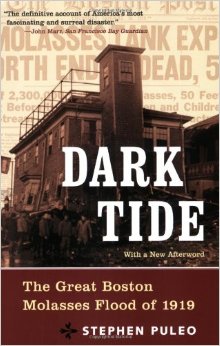
Details on the molasses flood are more available now, partly because they’ve been pulled together on the internet. You can find even more information in the single book about the flood, Dark Tide by Stephen Puleo. What’s great about Puleo’s book is that it doesn’t just describe the flood: it explains how the flood was not just weird, but actually important.
The molasses flood wasn’t a freak accident. The U.S. Industrial Alcohol Company’s tank was junk. The Industrial Alcohol employee in charge of construction, Arthur Jell, wasn’t an engineer. He approved a tank that wasn’t sturdy enough to hold two million gallons of molasses and didn’t bother with basic safety checks like testing for leaks. People who lived and worked near the tank told U.S. Industrial Alcohol they could see molasses leaking from the seams and running down the sides. The company responded by painting the tank brown.
Asked why their tank had burst, the Industrial Alcohol Company had a ready answer: anarchists. This was not as stupid as it sounds. Anarchists were the big terrorist threat at the time, and, remember, the company used the molasses to make alcohol for munitions, most recently for use in the First World War. This was war molasses, and the company really had received threats to blow up the tank.
But the tank wasn’t just shoddy, it was obviously, embarrasingly shoddy, as the subsequent investigation had no trouble establishing. Despite agreeing the tank wasn’t up to code, the grand jury didn’t indict any Industrial Alcohol Company executives for manslaughter. (From a 21st century perspective, maybe it’s amazing they considered indicting corporate executives at all.) But there was one important consequence. The government of Boston decided that before their building department would issue a construction permit more detailed architectural plans would have to be filed with the city, including all engineering calculations, certified by an actual engineer. Cities all over the U.S. followed Boston’s lead, tightening their building codes and increasing their oversight of construction projects and engineering requirements. If the buildings in which you live and work haven’t fallen down on you lately, you can thank molasses.
Drama
Dark Tide is a good, well-researched book. I’m going to get into some caveats here, and they’re big caveats, but I really do recommend it. It includes details on the flood you won’t find anywhere else. Sometimes, though, there are reasons you won’t find those details anywere else. Like, at one point Puleo describes Arthur Jell in his office getting some concerning news about the tank, and we get this line:
“‘The tank will be safe,’ Jell said aloud, sitting alone in his office.”
He was alone when he said this? Then… how do we know? Did Jell have one of those invisible offscreen butlers, like in Citizen Kane?
That would be cool. But, no, apparently Puleo just made it up:
In some cases, I have built the dramatic narrative and drawn conclusions based on a combination of primary and secondary sources, and my knowledge of a character’s background and beliefs. For example, Hugh Ogden’s[2] letter to Lippincott from the Cosmos Club in Washington, D.C., is real; Ogden’s concerns about the manner in which the country has been thrown into turmoil is my interpretation based upon what I know of Ogden’s patriotism and his soldier’s attention to order.
Dark Tide tells us things about people’s thoughts and feelings the author could not possibly know. It doesn’t sound speculative–it states them confidently, as facts, with the same omniscient tone novelists use with their characters. This is truthiness presented as history.
That novelistic tone is the key to what’s wrong here: Puleo’s desire to build a “dramatic narrative.” The line I quoted comes just before a section break. It’s narrative punctuation, a cliffhanger–a strong image to imprint itself in the reader’s memory as the subject changes. (And note it’s not just a strong line but a visual image, like you’d get before a scene change in a movie–a character is in a setting, saying something aloud. This is history written in Novelization Style.)
This is not a quirk of Dark Tide alone. Many popular histories lean hard on narrative. As much as possible the authors want their books to read like novels. (And maybe like movies–nonfiction books get optioned for film too.) Which misses the point of nonfiction. A lot of topics work better when not artificially squeezed into the shape of plot, suspense, and characterization. For all that history superficially resembles story, it’s usually one of those topics. I mean, it’s not like Dark Tide’s central arguments are weak–how the molasses flood came to happen, and how it influenced engineering standards, are dramatic enough without being dramatized.
But that’s quibbling. The real problem is how the dramatized scenes distort the history–the confidence with which Dark Tide narrates scenes that were never recorded in any form, and claims to know the hearts and minds of people long dead.
Switching gears for a moment… I’m reminded of something the novelist Guy Gavriel Kay has said more than once, most recently in an article at Boing Boing. One reason Kay writes fantasy instead of historical novels is that, even in a novel, he’s not comfortable imposing (his word) his own invented personalities and opinions on people who really existed. It’s arguable whether this is actually a problem in fiction; even Kay acknowledges good novels have been written about real people. But I’d argue that historians have a responsibility to tell the truth, as far as they know it, about real people.
Sometimes we do know with reasonable certaintly what a person was thinking or doing in private–sometimes they left diaries or letters or court testimony that tell us. (At least, they tell us what they’d have liked us to think they were thinking!) But usually we don’t know, especially when we’re talking about passing thoughts as opposed to fundamental beliefs and motivations. Historians may know the reasoning behind most of Lincoln’s decisions during the Civil War, but can’t claim to know what passed through his mind during breakfast. There’s nothing wrong with speculation–discussing what the author thinks a person was probably thinking, or probably doing–but it should be written as speculation, not omniscient narration, and supported by facts. Nonfiction takes humility, a willingness to acknowledge sometimes the author just doesn’t know. Otherwise writers run the risk of coming out with passages like this one, about the Industrial Alcohol Company’s lawyer:
But in the places none of us like to visit—the darkest corners of the mind, the coldest reaches of the heart—Charles F. Choate must have felt a sense of perverse satisfaction when he received word on the afternoon of September 16 that someone, most likely an anarchist, had detonated a deadly bomb on Wall Street in New York City.
Or this one about John Urquhart, a boilermaker who worked on the tank:
Urquhart knew that all of these issues were out of his control and would be decided by smarter men.
I mean, maybe Urquhart did think the people who made the Big Decisions were smarter than he was. Maybe he mentioned it in a diary somewhere, or in testimony during the lawsuit, or something. Without checking Puleo’s sources, I have no clue. Dark Tide has a problem common in popular narrative history: the novelistic style is meant to be exciting, but reading it feels like harder work than reading an academic tome by a professional historian. Reading this style of nonfiction is a tiresome exercise in sorting source from speculation, the literary equivalent of picking the fish bones out of ten pounds of chopped tuna.
In recent posts I’ve complained fiction that uses the style and narrative techniques of nonfiction was underrated; now I’m complaining nonfiction techniques are also underrated in actual nonfiction. I like fiction in the style of essays or histories, but I guess it doesn’t work the other way around!
06 Jun 10:13
Spider-Man
Part 2
 Named Characters:
Flash Thompson, Sally, Aunt May, Uncle Ben, Crusher Hogan
Unnamed Characters:
TV Producer, Burglar, Police Officer, Mother and Child
First Appearance of:
Spider-Man costume
 It’s laughter that Peter Parker is scared of. He first puts on a mask because he’s trying out his powers in a wrestling competition, and feels he’ll be a “laughing stock” if he fails. The mask is something to hide behind; somewhere safe from other people’s laughter. It releases a nastier, more arrogant side. His speech becomes more informal and slangy when he’s wearing it. Later on, when he puts on the mask, he’ll start obsessively cracking jokes. As if he wants to be laughed at, like he was in the old days, before…

According to Amazing Spider-Man #1 he has a temper tantrum, throws his costume on the floor, and considers giving up being Spider-Man.

Amazing Fantasy #15
by Andrew Rilstone
Spider-Man
Part 2
 Named Characters:
 Flash Thompson, Sally, Aunt May, Uncle Ben, Crusher Hogan
Unnamed Characters:
TV Producer, Burglar, Police Officer, Mother and Child
First Appearance of:
Spider-Man costume
Web-shooters
Observations:
Peter Parker wears blue and white striped pyjamas in bed.
His favourite food is wheatcakes.
His Uncle and Aunt call him “Petey”.
Spider-Man’s mask is sewn into the shirt of the Spider-Man costume, like a hoodie.
Spider-Man’s shoes have ridged soles, like running shoes or trainers.
Peter Parker’s school is named Midtown High.
Observations:
Peter Parker wears blue and white striped pyjamas in bed.
His favourite food is wheatcakes.
His Uncle and Aunt call him “Petey”.
Spider-Man’s mask is sewn into the shirt of the Spider-Man costume, like a hoodie.
Spider-Man’s shoes have ridged soles, like running shoes or trainers.
Peter Parker’s school is named Midtown High.
“Some day I’ll show them!” says Peter Parker before his encounter with the radioactive spider. “Some day they’ll be sorry! Sorry that they laughed at me!”
It’s the sort of thing a villain might say; the sort of thing you hear in diaries and videos produced by school shootists. On the cover of the Amazing Fantasy #15, he sounds more like a super-villain than a new hero; more like Thor from Asgard than Petey from Queens.
“Though the world may mock Peter Parker, timid teenager… it will soon marvel at the awesome might of Spider-Man!”
Years later, John Byrne would translate the cover into English: “Everyone laughs at that loser, Peter Parker... but they won’t be laughing at Spider-Man.”
Years later, John Byrne would translate the cover into English: “Everyone laughs at that loser, Peter Parker... but they won’t be laughing at Spider-Man.”
 It’s laughter that Peter Parker is scared of. He first puts on a mask because he’s trying out his powers in a wrestling competition, and feels he’ll be a “laughing stock” if he fails. The mask is something to hide behind; somewhere safe from other people’s laughter. It releases a nastier, more arrogant side. His speech becomes more informal and slangy when he’s wearing it. Later on, when he puts on the mask, he’ll start obsessively cracking jokes. As if he wants to be laughed at, like he was in the old days, before…
Publisher Martin Goodman hated this story: hated it so much he cancelled Amazing Fantasy, despite having given Spider-Man a great big build up. It’s not that Spider-Man is too skinny to be a hero, or that Aunt May treats him like a baby, or even that he has boringly un-heroic private problems. Anti-heroes are one thing: the Hulk is an anti-hero; the Sub-Mariner is an anti-hero; even Johnny Storm is an anti-hero at this stage. But but Ditko and Lee have made Spider-Man a dislikable character with no redeeming features. Peter Parker has a great home life, brilliant school grades, a guaranteed college place, and an excellent future ahead of him. But he spends the first half of the book whining. True, his friends don’t ask him to the dance; but he’s no Cinderella: they don’t ask him because he can’t dance, wouldn’t want to go and wouldn’t join in if he did. He actually cries (*SOB*) when Sally would rather go to the disco than attend an extra-curricula science lecture with him.
That early Parker, with the monstrous Spider-ego bubbling up inside him, provided a terrible role-model for other anti-social nerds. It made more than one of us think that remarks like “there’s nothing wrong with being a dumb-head, you were just born that way” (Amazing Spider-Man #2) were clever things to say to the school football hero. But there’s an element of bully-enabling here too. Parker chooses to be an outsider: chooses to go to school in a jacket and tie while Flash Thompson is wearing a football shirt; advertises his book-worm status by carrying a pile of books around with him. (None of the other kids have taken their text books home. Can’t he even find a satchel?) Isn’t there a subliminal message here that if you are bullied, it’s probably your own fault?
It may very well be that, if the Spider-Man graphic novel had continued, Steve and Stan would have shown how Parker grew into a reasonable human being. It is equally possible that the plan was for him to turn into a monster or a recluse. There’s another great story about a man who turns into an insect by another great Czech story teller. That one doesn’t end too well.
That might have all worked well enough if Spider-Man had been a limited run feature in an oddball anthology comic. It wasn’t a great idea for Marvel’s planned move into the lucrative super-hero market. If you’d been in Martin Goodman’s shoes, you’d probably have killed Spider-Man after only one issue too.
Amazing Fantasy #15 is a sacred text; a foundational document. If you are at all interested in comics, you have read it, many times. Even if you are not interested in comics, you know the basic plot, and the final line about responsibility and power. It’s the hardest thing in the world to pretend that it’s just an old comic book and sit down and read it.
It’s a good story. It covers a lot of narrative ground; establishing Peter Parker; showing us the circumstances under which he acquired his amazing powers and how he misused them, in exactly twelve pages. The pacing is spot-on: page one starts with single-panel scenes (Ben dragging Peter out of bed; May giving him breakfast; the school science lesson) but the pace slows right down when we reach the museum. We get three whole panels of the spider getting irradiated and the fight with the wrestler lasts a whole page. There is a tremendous sense of place. This isn’t a New York of skyscrapers, but one of chimney pots, back streets, waterfronts and old acme buildings. Everyone has their own face and their own voice; even the policeman who calls out to Spider-Man and the little boy who accidentally sees him climbing up a wall.
It’s split into two fairly self-contained parts; it’s quite possible to imagine them split over two issues, as may have been the original plan. Part 1 starts with Parker the outsider, and ends with Spider-Man hanging from the ceiling of his bedroom, with a wrestling match as a centerpiece. Part 2 begins with Spider-Man as a successful TV star, ends with him walking off into the distance, a broken man. It has the fight with the burglar as a centerpiece. Both halves are character pieces rather than action adventures (which was a good fit to "the magazine that respects your intelligence"). In neither fight is Spider-Man in the slightest danger.
Everyone knows the story; everyone knows the twist. Peter Parker is bitten by a spider and due to Science finds he is super-strong and can climb walls. He uses Science to create wrist mounted web-shooters in his bedroom. He demonstrates his new powers on TV and becomes an overnight celebrity. On that first night of fame, a man runs past him, being chased by an elderly police officer. The policeman calls out “Stop him!” but Spider-Man does nothing. Behind the mask, the young man who couldn’t bear to be laughed at snarls “Sorry pal! That’s your job! I’m thru being pushed around — by anyone. From now on I just look out for number one — that means — me.”

It really is a beautifully constructed moment. No sooner have we seen Peter Parker being incredibly petty and selfish towards the policeman than we see Ben and May being incredibly thoughtful and generous to him: buying him a microscope that they’ve obviously had to save up for. (Peter Parker is the sort of young man who has “always wanted” a particular piece of scientific apparatus.) The final panel on page 8, while rather corny, is incredibly cool: a grinning Parker playing with his new toy, with two happy old people behind him.
Stan Lee piles on the irony “They’re the only ones who have ever been kind to me!” Not true, by the way. His science teacher is friendly and encouraging. “I’ll see to it that THEY’RE always happy.” But of course, because of what he’s just done, that’s the exact thing he won’t do.
That happy scene with the microscope is the last time we will ever see Uncle Ben. Peter comes home from a TV show and is told that Ben Parker has been murdered. We don’t need to worry very much about the officer who breaks the bad news to Peter Parker being the same one who called out to Spider-Man at the TV studio -- and the same one who makes the arrest at the warehouse, come to that. (Later exegesis even made up a name for him: Baxter Bigelow.) I am sure that in real life it’s different cops who investigate domestic burglaries and deal with armed siege situations. But Ditko thinks in terms of character types: so the “nice policeman” has white hair and a mustache regardless of what context you meet him in.
Ditko is a cartoonist. He tells stories in pictures: Lee’s words are often superfluous and occasionally miss the point. Peter Parker carries a pile of books to indicate that he is a bookworm. Spider-Man has a coat over his arm to show that he is just leaving. Rich people have cigars; you can generally tell if someone is a wrong‘un by their hat. You can tell precisely what is happening in the final scene simply by looking at the pictures; they are as perfect a piece of visual story telling as has ever been committed to newsprint.
*Parker runs away.
*Parker puts on his costume.
*Spider-Man runs up the wall (leaving his bedroom window open).
*Spider-Man squirts some web at a flagpole.
*Spider-Man swings over the docks.
*Spider-Man arrives at “the old acme building.”
*The burglar looks out of the window (with his back to us).
*The burglar (who still has his back to us) looks up at Spider-Man.
*Spider-Man looks down at the burglar (who has covered his face with his hand).
*The burglar runs away (covering his face with his hand).
*Spider-Man faces the burglar; Spider-Man has his back to us; the burglar’s face is in shadow.
*Spider-Man faces the burglar; Spider-Man has his back to us; the burglar’s face is in shadow.
*Spider-Man webs the burglar’s gun; the burglar covers his face.
*Spider-Man punches the burglar, knocking his hat off.
*Spider-Man holds the unconscious burglar and see his face…and it’s the face of the thief he wouldn’t help the old cop catch on his first night as a TV star.
The final panels show the burglar being handed over the police ("on a spider’s web"), and Parker, mask removed, looking stunned. On the first page Peter Parker was sobbing because girls prefer parties to radiation experiments. On this last page, he is crying actual tears: “My fault…all my fault.” On the splash page, Spider-Man was only a shadow behind Peter Parker; in the last panel, he is a tiny, barely discernible figure “fading into the gathering darkness.”
This scene, more than any other, defines Spider-Man. It’s been retold over and over again, in two different movies, in cartoons and in multiple comic books. Spider-Man failed to stop the criminal who subsequently killed his Uncle and learned that in this world with great power there must also come great responsibility.
But what does it actually mean?
To answer that question, we need to get slightly ahead of ourselves.
Amazing Spider-Man #1, though published 6 months later, follows on directly from Amazing Fantasy #15, and is written and drawn in a similar style. On my view, it was intended to appear in Amazing Fantasy #16 and contains three more chapters which make up all we have of Ditko’s original graphic novel.
So: anyone.
In the original text, what does Spider-Man do straight after learning that he caused, or at any rate failed to prevent, the death of his beloved Uncle Ben?
In the original text, what does Spider-Man do straight after learning that he caused, or at any rate failed to prevent, the death of his beloved Uncle Ben?
According to Amazing Spider-Man #1 he has a temper tantrum, throws his costume on the floor, and considers giving up being Spider-Man.
The second thing he does is contemplate turning to crime to raise some money: Aunt May is on the point of being turned out of her house by her cigar chomping capitalist landlord.
The third thing he does is go back to his agent, and resume his TV career.
There is absolutely no sense that the death of Uncle Ben has motivated him to become a crime fighter, or even to live his life more generously from now on.
Over the next 28 issues, the matter of Uncle Ben’s death is hardly ever referred to again. In issue # 2,

Spider-Man is defeated by Doctor Octopus and considers giving up being Spider-Man. Uncle Ben is not mentioned: Spider-Man is turned around by a motivational speech from the Human Torch. In issue # 18, he is again ready to quit, but changes his mind when he sees how much gumption and determination Aunt May still has.
When Uncle Ben’s death is mentioned, it’s significance is down-played. In Spider-Man #1, Ben died because Peter was too late to save him; because he was showing off on TV when their house was burgled. In Spider-Man Annual #1, he is “partially to blame for Uncle Ben’s death” (which is a fair distance from “all my fault!”) and says that he let the thief escape because he didn’t want to waste his powers. In Spider-Man #33 he talks about “failing” Uncle Ben and “blaming himself” for what happened. If we were interested in psychoanalyzing fictitious characters, we might say that Peter repressed his memories of what happened on that terrible night. Presumably, it all comes back to him when he sees the security guard who resembles Ben Parker in issue #50. But that's way in the future.
The idea that “the one person I could have stopped but didn’t killed the one person I most cared about in the world” is very much the kind of O’Henry ending you'd have expected in Amazing Fantasy — not too far removed from “the man who warned us about the shapeshifting aliens is actually a shapeshifting alien with amnesia.” (I recall a post-Dahl episode of Tales of the Unexpected in which a sailor kills a man in a knife fight. An old flame directs him to a powerful gangster who owes her a favour and will get him out of town safely -- but it turns out that earlier in the day the gangster was killed...in a knife fight.) In one sense, it's meaningless. It’s true that if Peter Parker had stopped the burglar, the burglar could not have killed Uncle Ben, but thousands of us random events conspired to bring the burglar to that particular house on that particular day. (What was he stealing, by the way, if they are so poor they can hardly pay their rent? Microscopes?) It’s true, but it’s not usefully true.
Peter Parker has been forcibly shown the situation which everybody is in, every minute of every day. As a matter of fact, the bad guy he didn’t catch has murdered his uncle: but if it hadn’t been his uncle, it would have been someone else’s uncle -- or father or brother or husband or boyfriend. One thinks of J.B. Priestly’s An Inspector Calls: by a ghoulish coincidence, each member of the Brisley family mistreated the same woman and drove her to suicide; but the cruelties that the rich inflict on the poor ever day have the similar, if less visible, consequences. As the Inspector explains before leaving:
“We don't live alone. We are members of one body. We are responsible for each other. And I tell you that the time will soon come when, if men will not learn that lesson, then they will be taught in fire and blood and anguish.”
In the evil we have done, and in the good we have not done. In this world, with great power there must also come...great responsibility.
This is a socialist message: the very opposite of what Steve Ditko himself believed. Ditko was and is an objectivist. He thought honest self-interest was the only way forward; that looking after number one and not catching crooks unless you were a paid crook catcher was the only sane way to behave. Does this mean that the Uncle Ben motif originated with Stan Lee? If so, does it follow that Stan Lee must have given Ditko quite a detailed plot summary (much more than “what if a teenaged boy found he could stick to walls”); and that Steve Ditko, at that point in their relationship, was prepared to faithfully and brilliantly render story lines that weren’t to his personal taste?
By Stan Lee’s own account, Steve Ditko very rapidly became the driving creative force behind Amazing Spider-Man, creating plot-lines which Stan Lee had no input into. So we might imagine that while conservative Ditko controlled the book, the tragedy of Uncle Ben was quietly forgotten. But once liberal Stan Lee became the dominant force (in 1966) he lost no time in putting Ben Parker back at the center of his nephew’s psyche.
We might imagine that. But we might also imagine Ditko doing something stranger and cleverer and more subversive...
Amazing Fantasy #15 doesn’t contain, even in embryonic form, any of the things which made Spider-Man so great. There’s no Jameson, no action, no aerial acrobatics, no romantic misunderstandings, no super-villains and no jokes. All that it contains of the future Spider-Man was Stan Lee's name, and Ditko’s insane, iconic, un-improvable costume design.
Perhaps, as a point of origin, that was enough.
Perhaps, as a point of origin, that was enough.

06 Jun 09:57


The Greatest of All Time
by John Scalzi
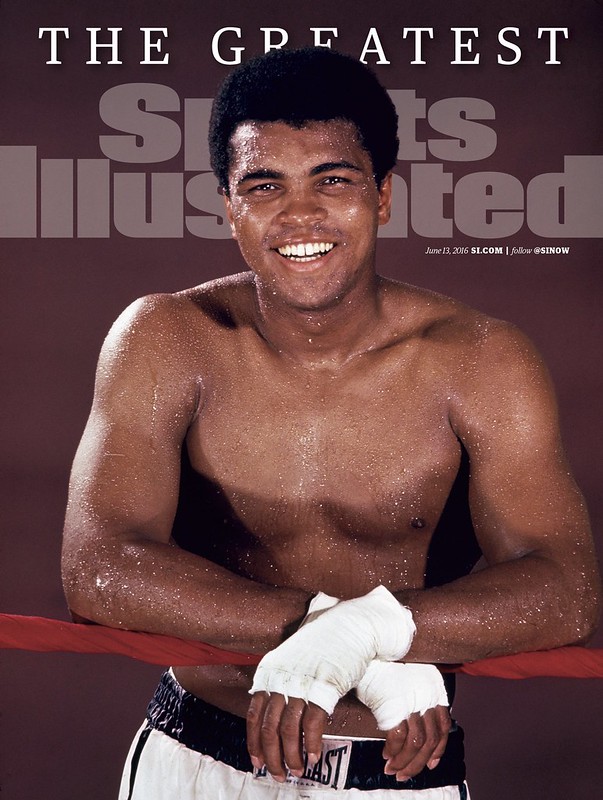
I cried for Muhammad Ali when I was eight years old, the night he fought and lost to Leon Spinks, February 15, 1978. When I was eight years old Muhammad Ali was everywhere, the best known and most admired athlete in the world — he even had an animated television series, for heaven’s sake! — and everyone knew, without qualification, that he was The Greatest of All Time. I knew that too, took it as an article of faith. The Greatest of All Time, a living legend, was a man who simply could not be defeated, certainly not by Leon Spinks, who I had never heard of before and who I, in the depth of my understanding at the advanced age of eight years old, considered something of a palooka (had I known what the word “palooka” meant at that age, which I didn’t). But he did lose to Spinks, and I sobbed for hours. For Ali to lose to someone like that unmoored my understanding of the world. It was literally my first crisis of faith.
What I didn’t understand then, and wouldn’t fully understand for years afterwards, was that Ali was not called The Greatest of All Time because he was undefeatable in the ring. He was defeatable, five times in his career, even if the other 56 times he out-thought, out-fought, out-danced, and out-psyched the other men in the ring with him, his artistry in doing so becoming the foundation of his greatness for most people, including me. What made Ali The Greatest of All Time was the totality of who he was, outside the ring as well as in it.
The world doesn’t need me to recount the details of his life — there will be enough obituaries that will do that, and I can say with utter confidence that there are vast numbers of people better equipped, for all sorts of reasons, to eulogize the man. What I can say is that from that early crisis of faith at age eight to today, almost 40 years later, my understanding of Ali changed from him being a simple god on a pedestal, someone who was The Greatest of All Time by acclamation — and who was I at eight years old to argue — to him being a complex, difficult, imperfect and inspiring human being, a product of and a shaper of his time. What was true at age eight is true at age 47: He was The Greatest of All Time. What changed was not Ali. What changed is my understanding of him, and what greatness is.
Let me talk a moment about Ali being both a black man and a Muslim. In the wake of his death, you’re going to see people saying that Ali transcended his race or his religion, or both of them, to become someone who belonged to all people. I think two things about this. First, it’s undeniable that people of all races and creeds admired him, his life and his accomplishments. I loved him as a child, when my understanding of him was simple, and I honored him as an adult, when my understanding of him was more complex.
But — and this is the second thing — you cannot love or honor Ali properly without acknowledging that blackness and Islam are at the core of his greatness. It seems to me, and I think the events of his life bear this out, that the greatness of Ali — who he was — was did not come out to you, was not there for you, and in a fundamental way did not care what you thought of it. It was there, and you could come to it or not, and if you did, you had to take it on its on terms. On Ali’s terms. And Ali’s terms were: He was a black man, in America and in the world. He was a Muslim man, in America and in the world. He was who he was. He did not have to transcend those things about himself. You, however, might have to overcome your understanding of what you thought of both blackness and Islam to appreciate him. People did or did not; Ali went on regardless.
I think it’s important that when I was an eight-year-old child, one of my idols, one of my pantheon, someone whose greatness I accepted uncritically, was a black man. I’d like to think in a small, early way that my love for Ali made a difference in how I grew up thinking about race. As I grew up, and I learned about his experiences being black in the US in the mid-20th Century, his refusal to submit for the draft and his reasoning for it, and his conversion and movement through Islam — and the responses to all of these by others as they happened — Ali was an unwitting but invaluable teacher.
I can’t say I have a perfect understanding of race or religion or of blackness in America or of Islam. The imperfections of understanding of each of those is on me. But I can say that to the extent I engage in any of them with any measure of success, Muhammad Ali is part of the reason why. Because he was black. Because he was Muslim. And because he made me understand that both of those were fundamental to his greatness, not things he needed to transcend to be seen as great.
My friend and classmate Josh Marshall noted earlier today that the decline in interest in the sport of boxing over the last few decades makes it difficult for younger people — especially under the age of 30 — to understand the scope of Ali’s greatness in his time. I think it also means, particularly with regard to the sport of boxing, that Ali’s appellation as The Greatest of All Time is unlikely to be seriously challenged, ever. It’s not that other boxers won’t have better records; it’s not that other boxers won’t be great. It’s that for a moment in time, boxing had in its ranks a man who could and did shape his nation and his world with his athletic talent, his political courage, his devastatingly sharp mind, and his great heart.
He was Muhammad Ali and there will never be another like him. I cried for him when I was eight because I did not understand why he was The Greatest of All Time. I understand now. I cry for him again because I do.
